
Plainfield City Zoning Code
ARTICLE IV
PLANNED DEVELOPMENTS
Sec. 9-42.- Purpose.
(1)
General. The Planned Development (PD) approach provides the flexibility needed to promote innovative and creative land development that achieves the community vision outlined in the comprehensive plan. Within the framework of a PD normal zoning standards may be modified. The resulting flexibility is intended to encourage developments that are more environmentally sensitive, economically viable, and aesthetically pleasing than might otherwise be possible if the standards of the underlying zoning district(s) were strictly enforced. A PD is intended to remain in substantial compliance with the densities outlined in the comprehensive plan. Increased densities from the underlying zoning may be permitted under this section if such increases can be substantiated based on a superior site design following the village's design guidelines. Each proposal for a PD shall be presented and judged on its own merits, and approval shall not be based exclusively on a comparison to an already existing PD.
(2)
Objectives. Specifically, the objectives of a PD are:
a.
To stimulate creative approaches to the residential, commercial, and industrial development of land; and
b.
To provide more efficient use of land; and
c.
To preserve or enhance natural features and provide open space areas.
Sec. 9-43. - Applicability.
(1)
Elective. Any owner of property who wishes to develop his or her property as a PD may voluntarily petition such approval under the provisions of this ordinance.
(2)
Mandatory.
a.
Development of land that includes more than one type of land use on a single zoning lot shall proceed as a PD.
b.
The village administrator or community development director shall have the right to require all development of land which meets or exceeds one or more of the following thresholds to be developed as a PD:
i.
Development of land totaling twenty (20) or more acres; or
ii.
Development of land including fifty (50) or more dwelling units.
Sec. 9-44. - Development standards.
In recommending approval or granting approval of preliminary development plans and final development plans, the plan commission and the village board shall ensure that the proposed PD meets the following standards:
(1)
Ownership. The land intended for the PD shall be under single ownership and/or unified control.
(2)
Compatibility. The proposed use or combination of uses is consistent with the goals and objectives of the comprehensive plan.
(3)
Accessibility. Adequate utilities, road access, draining, police and fire service and other necessary facilities already exist or will be provided to serve the proposed PD.
(4)
Designation of land for schools, recreational amenities and permanent common open space. The proposed PD shall provide for the dedication of land for school sites and land for recreational purposes. Alternatively, the village board may approve a cash payment in lieu of actual land dedication, or may approve a combination of cash and land dedication.
a.
Common open space. Common open space shall be provided for recreational purposes. Such open space may be designed for active or passive recreational use. Common open space shall meet the following standards:
i.
Each parcel of common open space intended for active recreation shall be at least twelve thousand (12,000) square feet. The minimum width of the common open space shall allow for the safe participation in the active recreational activities for which it is designed. For trail purposes the minimum open space width shall be twenty (20) feet.
ii.
Each parcel must be accessible to all the residents of the proposed PD. Sidewalks, bike trails or pedestrian trails must link the parcels.
iii.
The slope must be appropriate for the activities for which the common open space is intended.
iv.
Land dedicated to the village or Park District may be included in the calculation of usable common open space.
b.
Areas excluded from common open space. Common open space shall not include:
i.
Areas reserved for the exclusive use or benefit of an individual tenant or owner;
ii.
Dedicated streets, alleys, and other public rights-of-way;
iii.
Required detention areas, floodplains or wetlands, unless the village board determines that natural features, such as a creek or lake, will be a substantial amenity for the development;
iv.
Irregular or unusable narrow strips of land less than fifty (50) feet wide, unless containing a trail or bicycle path;
v.
Existing permanent utility easements.
(5)
Open space ownership and maintenance.
a.
Public or private ownership. The public or private ownership and maintenance responsibilities for all common open spaces shall be established by the developer and approved as part of the ordinance authorizing the PD. All common areas should be platted as separate outlots. Restrictive covenants running with the land shall guarantee that the common open space will be properly cared for and used only for purposes designated in the PD's approved final development plan.
b.
Maintenance. To ensure appropriate long-term maintenance of private common open space the developer shall submit a detailed open space management plan describing the method and schedule of maintenance.
(6)
Limits on use. No common open space may be put to any use not specified in the final development plan unless the final development plan has been amended according to section 9-50 of this ordinance.
(7)
Special service area. A special service area shall be required to ensure adequate property maintenance. This special service area shall be created at the time of final platting of the first phase of the PD, and shall include all phases of the Planned Development. In the event the entity that has ownership and maintenance responsibilities fails to adequately manage the open space, the village may assume maintenance responsibilities until such time as that or another appropriate entity can manage the open space. The village may tax the property of those within the special service area for the village's prior and estimated future cost of maintaining the open space.
(8)
Completion of recreational facilities and other site amenities.
a.
Commencement of construction. Construction of recreational facilities and other improvements to common open spaces serving a PD shall commence in accordance with the approved PD ordinance. At a minimum, such improvements shall commence prior to the completion of not more than thirty-three (33) percent of the dwelling units in the development or prior to the completion of the first seventy-five (75) dwelling units, whichever comes first.
b.
Completion of construction. Recreation facilities and other improvements to common open spaces shall be completed prior to the issuance of building permits for the last twenty-five (25) percent of the dwelling units, or twenty-five (25) percent of the total gross floor area of commercial and industrial uses within a PD developed as a single phase.
c.
Phased developments. In PDs containing two (2) or more phases, construction of recreation facilities in earlier phases shall be completed prior to the issuance of occupancy permits for the next phase of the PD.
(9)
Site design. PDs shall adhere to the site design provisions contained in Article XIII (Site Design) of this zoning ordinance.
(10)
Commercial development. Commercial development within a PD should be focused on the provision of goods and services to community residents. To further this goal, a maximum of thirty (30) percent of the building square footage within a commercial PD should be comprised of non-retail uses.
(11)
Additional conditions. To meet the unique circumstances presented by each PD, and to protect the health, safety, and general welfare of existing village residents and the residents of the proposed development, the village board reserves the right to attach any other conditions it deems necessary, but not specifically provided in this ordinance, to the approval of the PDs. Such additional conditions may include, but are not limited to, more stringent requirements for construction, phasing, and revocation.
Sec. 9-45. - Permitted variations from village ordinances.
(1)
General. Except as specifically provided otherwise in this section, planned developments shall be developed in conformity with this zoning ordinance and all other applicable codes and ordinances of the village. Modifications that deviate from the bulk, density, and design provisions in this zoning ordinance and in other applicable regulations are privileges and will be considered by the village only in direct response to the tangible community benefits received from the PD. These benefits shall be in the form of: exceptional amenities; outstanding environmental, landscape, architectural or site design; or the conservation of special man-made or natural features of the site. The village's Design Guidelines shall be used in the evaluation of these benefits.
(2)
Bulk regulations. PDs are governed by the bulk regulations of the underlying zoning district. However, the plan commission may recommend, and village board may authorize, exceptions to the applicable bulk regulations of this ordinance within the boundaries of such planned development including building height, lot area, lot width, and yard setback requirements, provided that:
a.
Such exceptions shall be solely for the purpose of promoting an efficient and coordinated site plan, no less beneficial to the residents or occupants of such development, as well as the neighboring property, than would be obtained under the bulk regulations of this ordinance for buildings developed on separate zoning lots; and
b.
Along the periphery of such PDs, yards or setbacks shall be provided that meet or exceed the regulations of the district in which the PD is located.
(3)
Land uses. The plan commission may recommend, and village board may authorize, that there be permitted in part of the area of a proposed PD, and for the duration of such development, specified uses not permitted by the use regulations of the district in which the development is proposed. Proposed PDs with mixed land uses shall not be recommended or approved unless:
a.
The proposed land uses are necessary or desirable and are appropriate with respect to the primary purpose of the PD; and
b.
The proposed uses are not of such a nature or so located as to exercise a detrimental influence on the surrounding neighborhood.
(4)
Other. See section 9-49 of this ordinance for additional required findings.
Sec. 9-46. - Guidelines for planned developments.
In accordance with the provisions of section 9-8, the village may publish design guidelines for PDs. In reviewing the preliminary and final development plans the plan commission and village board should consider the application as a whole; the deviation from one or more guidelines should not necessarily preclude approval of the plans. Nevertheless, before granting approval of preliminary development plans and final development plans pursuant to this article, the plan commission and the village board should encourage compliance with any and all published guidelines. All residential planned developments shall meet the minimum architectural requirements outlined in section 9-54 in addition to any approved project specific requirements of the PD.
Sec. 9-47. - Approval procedures for planned developments.
A PD shall be granted as a special use to the zoning district in which it is located. The village board is the final decision-making body. The process for obtaining a PD approval shall be as follows:
(1)
Pre-application meeting and concept plan.
a.
Purpose. Prior to filing a formal application for approval of a PD, the applicant shall request a meeting with the village planner or, with village board consent a PD Review Committee, in order to present a concept plan of the proposed PD. The nature of this meeting is advisory only. Nothing offered or said by the village planner, village staff, village representatives, or village consultants shall be construed as an approval of the project or approval of any particular element of the project. All advice and recommendations are subject to modification during later stages of the approval procedure as outlined in this section, and the petitioner remains responsible for ensuring that all applicable village ordinances and standards are met. The purpose of the pre-application meeting is to help the applicant determine whether:
i.
The concept plan appears to be in compliance with the provisions of this ordinance and all other applicable village standards and ordinances.
ii.
Any zoning amendment or variation is required in connection with the proposed development.
iii.
The concept plan appears to be in conformity with the land-use policies and objectives of the village as expressed in the village comprehensive plan and this zoning ordinance.
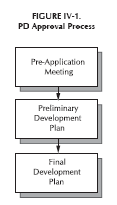
Figure IV-1. PD Approval Process
b.
Participation. At a minimum, the village planner or his/her representative shall participate in the pre-application meeting. The village administrator, with village board consent, may establish a PD Review Committee for the purposes of participating in the pre-application meeting, and the petitioner or the village administrator may request that this committee review the application. Such a PD Review Committee, if established, shall consist of: the village planner or his/her representative; at least one member of the plan commission; at least one member of the village board. The village administrator may name additional members to the PD Review Committee. These additional members may include, but are not limited to: village staff, village consultants, members of the Plainfield Economic Partnership, and additional members of the plan commission or village board.
c.
Concept plan. For the pre-application meeting with either the village planner or the PD Review Committee the petitioner should:
i.
Prepare documents describing the nature of the proposed development and the relationship of the proposed PD to adjoining uses, both existing and planned, and to the topography and natural features of the site and adjoining lands.
ii.
Prepare other documents as recommended by the village planner. The village planner may prepare, publish, and distribute a list of documents and information recommended for the pre-application meeting. This list may include, but is not limited to, such items as street and lot layouts, parking, current site vegetation, and preliminary engineering studies.
iii.
Forward the recommended documents to the village planner. Such documents should be received by the village planner at least two (2) days prior to the scheduled pre-application meeting.
d.
Review. The village planner or his/her representative and, if requested, the PD Review Committee, shall review the submitted documents and advise the applicant as to the compatibility of the proposed development with the comprehensive plan and this zoning ordinance. The recommendations relative to the pre-application review are advisory only, and shall not constitute a waiver from requirements contained in village ordinances.
e.
Additional meetings. The village planner, or, if established, the PD Review Committee, may request, but not require, additional pre-application meetings with the applicant. The intent of such additional meetings should be to ensure that the proposed PD conforms, to the maximum extent possible, with the applicable code provisions, goals and policies of the village.
f.
Report. The village staff, PD Review Committee, or consultants may prepare a written summary report of any pre-application meeting and forward the report to the plan commission and village board.
(2)
Preliminary development plan.
a.
Purpose. The purpose of the preliminary development plan is to obtain a recommendation from the plan commission and preliminary approval by the village board that the applicant's intended development of land is acceptable and that the applicant can reasonably proceed with preparation of detailed architecture, engineering, and site and landscape plans.
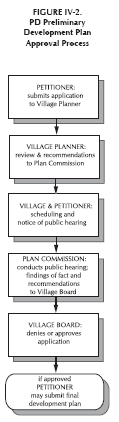
Figure IV-2. PD Preliminary Development Plan Approval Process
b.
Submission. An application for approval of a preliminary PD plan shall be filed with the village planner. The application shall include all information and documentation required by this ordinance. The village planner shall determine whether the application is in proper form and shall not consider the application as filed until all documents are submitted. Upon receipt and filing of the application the village planner will review the application and write a summary of its contents. This summary should include the proposed PD's compliance with village ordinances and suggestions and recommendations. The village planner will forward the application with the summary report to the plan commission.
c.
Submittals. See section 9-48 of this ordinance for the materials required for an application for approval of a preliminary development plan.
d.
Public hearing—Notice and conduct. The plan commission shall schedule and hold a public hearing on the application for special use for a PD and preliminary development plan. Notice for the public hearing shall be in accordance with the provisions of section 9-38 of the zoning ordinance. The plan commission shall preserve a record of the public hearing in such a manner as the plan commission shall, by rule, prescribe from time to time.
e.
Plan commission recommendations. The plan commission shall make written findings of fact and shall submit it together with its recommendations to the village board. Requirements for findings of fact for planned development applications are explained in section 9-49 of this ordinance.
f.
Village board actions. The village board shall review the plan commission's findings of fact and recommendations, and following such review may approve, deny, or approve with modification the final development plan of the proposed PD.
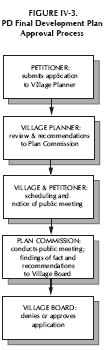
Figure IV-3. PD Final Development Plan Approval Process
(3)
Status of preliminary development plan.
a.
Approval of a preliminary development plan shall not constitute approval of the final plan, nor qualify a plat of the PD for recording. Rather it shall be deemed an expression of approval of the preliminary plan as a guide for preparation of the final plan. Furthermore, the approval of the preliminary development plan shall vest no rights to the applicants other than to be able to submit a final development plan.
b.
A preliminary development plan which has been granted approval as submitted, or approval with conditions or modifications, shall not be modified, revoked or otherwise impaired by action of the village, pending an application for final approval, without the consent of the applicants, provided that application for final approval is filed within any time or times that may be specified in the resolution granting preliminary approval.
(4)
Final development plan.
a.
Purpose. The purpose of the final plan is to provide a detailed design for the land to be subdivided, as well as the division of other lands into common open spaces and building areas, and to more specifically address land uses and building locations, engineering, and architectural design.
b.
Submission. The application for approval of the final development plan of a PD may be submitted in phases. An application for approval of the final development plan or for a phase of the final development plan shall be filed with the village planner. The application shall include all information and documentation required by this ordinance. Upon conclusion that the application includes all required documents, the village planner will forward the application to the plan commission for review and recommendation.
c.
Submittals. See section 9-48 of this ordinance for the materials required for an application for approval of a final development plan.
d.
Public meeting. The plan commission shall hold a public meeting on the application for a special use for a PD and final development plan or any phase of the development plan and shall preserve a record of the proceedings in such a manner as the plan commission shall, by rule, prescribe from time to time.
e.
Plan commission recommendations. The plan commission shall make written findings of fact and shall submit it together with its recommendations to the village board. Requirements for findings of fact are explained in section 9-49 of this ordinance.
f.
Village board actions. The village board shall review the plan commission's findings of fact and recommendations, and following such review may approve, deny, or approve with modification the final development plan of the proposed planned PD. If the final development plan is approved, the village board shall adopt an ordinance authorizing the PD as a special use. Supporting documents shall be attached to the ordinance as exhibits.
Sec. 9-48. - Content of planned development applications.
(1)
Minimum submission requirements. At a minimum, the applications for approval of preliminary development plans and final development plans shall include the following:
a.
Character and objectives. An explanation of the character of the proposed PD, and how the proposal accomplishes the objectives of the PD regulations.
b.
Drawings.
i.
The generalized pattern of existing land use, indicating ground elevations, major and minor roadways, sidewalks, railroads, sanitary sewers, storm sewers and drainage improvements, water mains, utilities and designated landmarks, historical areas and buildings.
ii.
Detailed drawings of the area covered by the proposed development indicating the proposed: ground elevations, streets, lots, buildings, heights and uses of buildings, landscaping, pedestrian access and circulation, common open space, recreational areas and facilities, parking areas, service areas and other facilities related to the proposed development.
c.
Land uses. A description of the quantity of all land uses in the proposed development.
d.
Dedicated acreage. The number of acres to be devoted to recreational areas, schools, parks, or municipal purposes; if the proposed development is to be constructed in phases, the area and location of such uses that will be provided at each stage.
e.
Requested modifications. A description of the modifications, exceptions, and deviations from the village's ordinances which are being requested as part of the application for approval of the PD.
f.
Agreements. Proposed agreements, provisions or covenants and by-laws which will govern the use, maintenance and continued protection of the planned development and any of its common open space of the homeowner associations, recreational areas and facilities, in the area covered by the preliminary development plan. Such agreements are required only for the application for approval of the final development plan, and are not required for the application for approval of the preliminary development plan.
(2)
Additional submission requirements. In addition to the minimum requirements listed in paragraph (1) of this section, the village staff, plan commission, or village board may request such information as may be required to conduct a comprehensive review and evaluation of the proposed PD. The village staff may publish and distribute application forms that list the requirements.
Sec. 9-49. - Findings of fact.
(1)
General. The plan commission shall not recommend a proposed PD for approval unless it shall make findings of fact based upon evidence presented to it in each specific case.
(2)
Findings—All PDs. In recommending approval for a proposed PD, the plan commission shall find that:
a.
The PD fulfills the objectives of the comprehensive plan and the land use policies of the village and presents an innovative and creative approach to the development of land and living environments.
b.
The proposed land uses fulfill, or can reasonably expected to fulfill a need or demand for such uses within the village.
c.
The physical design of the PD efficiently utilizes the land, adequately provides for transportation and public facilities, and preserves natural features of the site, and that the property is suitable for the proposed purposes and land uses.
d.
Any exceptions to bulk and density regulations of the underlying zoning shall be solely for the purpose of promoting an efficient and coordinated site plan, no less beneficial to the residents or occupants of such development, as well as the neighboring property, than would be obtained under the bulk and density regulations of this ordinance for buildings developed on separate zoning lots.
e.
The PD meets the requirements and standards of the planned development regulations.
f.
Open spaces and recreational facilities are provided.
g.
The PD is compatible with the adjacent properties and the neighborhood, and along the periphery of the PD yards or setbacks shall be provided that meet or exceed the regulations of the district in which the PD is located.
(3)
Mixed use PDs. In addition to paragraph (1) of this section, in recommending approval for all mixed use developments, the plan commission shall find that:
a.
That the land uses permitted are necessary or desirable and are appropriate with respect to the primary purpose of the PD.
b.
That the land uses are not of such a nature or so located as to exercise a detrimental influence on the surrounding neighborhood.
Sec. 9-50. - Compliance, amendments, and revocation.
(1)
General. All PDs shall be developed in strict compliance with the recorded final plan and supporting data. All final plans and covenants filed and recorded by the village shall be contractual undertakings by, and shall be binding upon, the applicants, therefore the owners of the land covered by such planned development, their successors and assigns. The final plan and supporting data shall control and limit the use of the parcel of land (including the general internal use of buildings and structures) and the location of the buildings and structures in the planned development.
(2)
Occupancy. No PD, or any portion of a PD, may be occupied until such time as all applicable building certificates have been issued by the appropriate village authority certifying that the development, or a stage of the development, if applicable, has been completed in compliance with the final plan and any recorded covenant or developer agreement as approved and recorded.
(3)
Amendments and administrative adjustments to the approved final development plan.
a.
Major changes. A major change requires a public hearing before the plan commission and approval by the village board. The procedure for the hearing and approval shall be in accordance with the provisions of section 9-38 of this ordinance. Submittal requirements maybe limited to plans and documents that indicate or are related to the major changes. Any of the following changes shall be deemed a major change:
i.
A change which alters the concept, character or intent of the final development plan;
ii.
A change which increases the residential density or the number of dwelling units;
iii.
A change which increases the height of any building or structure beyond five (5) percent, or alters the uses and design standards set forth as a minimum in this ordinance;
iv.
A change which increases nonresidential gross floor area of any building or of the entire development by more than ten (10) percent;
v.
A change which significantly reduces the amount of common open space or recreational amenities;
vi.
A change that significantly alters the number, type, or location of landscaping or existing vegetation;
vii.
A change that would have a significant environmental impact.
b.
Minor changes. Minor changes are changes not defined as major changes which do not alter the concept or intent of the PD. The village planner shall approve minor changes.
However, prior to considering any minor change the village planner may request that the plan commission review the proposed minor change and offer its recommendations.
c.
Revocation. The PD and the ordinances authorizing it shall be subject to revocation. If the PD is revoked the zoning classification of the subject property will revert to the zoning classification affixed to the property before approval of the PD.
d.
Grounds for revocation. The PD shall be subject to revocation if:
i.
The application for approval of the final development plan is not filed within two (2) years from the date of approval of the preliminary development plan; or
ii.
Construction does not commence within two (2) years from the date of approval of the final development plan. For a PD with a phasing plan, the PD shall be subject to revocation if the initial phase of construction has not commenced within two (2) years of the approval of the PD, or if construction of any of the subsequent phases has not commenced or is not completed in accordance with the terms of the phasing plan; or the developer requests revocation of the PD.
e.
Extensions and hearings. The village board may extend these time limits in one-year increments. The village board may schedule a revocation hearing once any of these time limits has expired. The developer shall be notified at least sixty (60) days prior to any revocation hearing.

