
Rockford City Zoning Code
CHAPTER 11
SIGNS
Sec. 11.1 - Purpose.
A.
The purpose of this chapter is to regulate the type, placement, and physical dimensions of signs within the various zoning districts, to recognize the communication requirements of all sectors of the community, to promote both renovation and proper maintenance of signs, and to guarantee equal treatment under the law. In all respects, it is the intent of this section to comply with Reed v. Town of Gilbert, 135 S. Ct. 2218 (2015). The general objectives of these standards are to promote the health, safety, welfare, convenience, and enjoyment of the public, and in part, to achieve the following:
1.
Safety. To promote the safety of persons and property by providing that signs:
a.
do not create hazards due to collapse, fire, decay, collision, or abandonment;
b.
do not obstruct firefighting or security surveillance; and
c.
do not create traffic hazards by confusing or distracting motorists, or by impairing the driver's ability to see pedestrians, obstacles, or other vehicles, or to read traffic signs.
2.
Communications efficiency. To promote the efficient transfer of information in sign messages by providing that:
a.
businesses and services may identify themselves;
b.
customers and other persons may effectively locate a business or service;
c.
no person or group is arbitrarily denied the use of the sightlines from the public streets for communication purposes; and
d.
persons exposed to signs are not overwhelmed by the number or size of messages presented and are able to exercise freedom of choice to observe or ignore messages.
3.
Landscape quality and preservation. To protect the public welfare and enhance the appearance and economic value of the landscape by providing that signs:
a.
do not interfere with scenic views;
b.
do not create a nuisance to persons using the public streets;
c.
do not constitute a nuisance to occupancy of adjacent and contiguous property by their brightness, size, height, or movement;
d.
are not detrimental to land or property values; and
e.
contribute to the special residential character of particular areas or districts within the city, helping the observer to understand the city and orient oneself within it.
4.
Message substitution. Notwithstanding any other provision of this section, noncommercial copy may be substituted for commercial copy or other noncommercial copy on any sign that is permissible under this section.
5.
Findings. The city finds that:
a.
Content neutrality, viewpoint neutrality, and fundamental fairness in regulation and review are essential to ensuring an appropriate balance between the important, substantial, and compelling interests set out in this section and the constitutionally protected right to free expression.
b.
The provisions in this chapter are unrelated to the suppression of constitutionally protected free expression, do not relate to the content of protected messages that may be displayed on signs, and do not relate to particular viewpoints.
c.
The incidental restriction on the freedom of speech that may result from the regulation of signs pursuant to this chapter is narrowly tailored, the least restrictive means, and no greater than is essential to the furtherance of the important, substantial, and compelling public purposes that are set out in this section.
d.
The regulation of the location, number, materials, height, size, form, and duration of display of temporary signs is essential to prevent sign clutter.
e.
Temporary signs may be degraded, damaged, moved or destroyed by wind, rain, flooding, and sun, and after such degradation, damage, movement or destruction, such signs harm the safety and aesthetics of the public on the city's streets or sidewalks if they are not removed.
Sec. 11.2 - General Requirements.
A.
Definitions. Terms used in this chapter shall have the definitions stated in Appendix A.
B.
Basic Standards.
1.
All permanent signs must be of a professional character, be erected by a qualified sign professional, and comply with the provisions of this chapter. Homemade lettered signs shall not be permitted, whether or not a permit is required, except for wire frame temporary signs.
2.
No sign shall be erected in any place where it may, by reason of its position, shape, color, or other characteristic interfere with, obstruct the view of, or be confused with any authorized traffic sign, signal, or device, or constitute a nuisance per se.
3.
No commercial vehicle, which in the opinion of the zoning administrator has the intended function of acting as a sign, shall be parked in any area abutting a street or other public right-of-way, unless no other parking area is available.
4.
Signs shall be maintained free of peeling paint or paper, fading, staining, rust, or other condition which impairs legibility or intelligibility.
C.
Sign Placement.
1.
No sign shall be placed in, upon, or over any public right-of-way, alley, or other public place except for permitted government signs and those signs permitted in the C-2 District which may project from a building wall over a public way.
2.
No light pole, utility pole, or other supporting member shall be used for the placement of any sign unless specifically designed for such use and approved by the zoning administrator.
3.
No person shall paste, print, nail, tack or otherwise fasten any card, banner, handbill, sign, poster, or advertisement or notice of any kind, or cause the same to be done, on any private property, without the written consent of the owner of such property.
D.
Measurement of Sign Area.
1.
The area of a sign shall be measured as the area within a single, continuous perimeter composed of any straight line geometric figure which encloses the extreme limits of writing, representation, emblem, logo, or any other figure of similar character, together with any frame or other material or color forming an integral part of the display or used to differentiate the sign from the background against which it is placed, excluding only the structure necessary to support the sign.
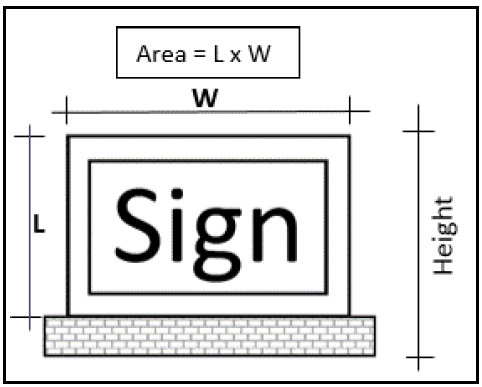
2.
The area of a pole, ground, or projecting sign that has two or more faces shall be measured by including the area of all sign faces, except if two such faces are placed back-to-back, are of equal size, and are no more than two feet apart at any point, the area of the two back-to-back faces shall be counted as one face. If the two back-to-back faces are of unequal size, the larger of the two sign faces shall be counted as the one face.
3.
The height of a sign shall be measured as the vertical distance from the highest point of the sign to the finished grade of the ground immediately beneath the sign, excluding any artificially constructed earthen berms.
4.
For buildings with multiple tenants, the sign area for wall signs, projecting signs and awning signs shall be determined by taking that portion of the front wall of the building applicable to each tenant and computing sign requirements for that portion of the total wall.
E.
Illumination and Movement.
1.
Unless otherwise provided in this chapter, signs may be internally or externally illuminated. If externally illuminated, the source of the light shall be enclosed and directed to prevent light from shining directly onto abutting streets or neighboring property.
2.
No sign shall employ any flashing, moving, oscillating, blinking or variable intensity light; provided, electronic changeable message signs meeting the requirements of this chapter are permitted.
3.
No sign shall contain any moving or animated parts or have the appearance of having any moving or animated parts.
4.
Signs adjacent to or within residential districts shall not be of such brightness to cause reasonable objection from nearby residents nor to spill light and glare onto adjacent residential properties and structures.
5.
All lighted signs shall be inspected by the city for proper electrical connections. If deemed necessary by the zoning administrator, an electrical code permit will be required.
F.
Safety.
1.
Signs shall not closely resemble or approximate the shape, form and color of official traffic signs, signals, and devices.
2.
No sign shall be so placed as to obstruct or interfere with a required doorway, other required means of ingress or egress, or traffic visibility.
3.
Signs shall be constructed to withstand a wind pressure of at least 30 pounds per square foot of surface, and shall be otherwise fastened, suspended, or supported so not to be a danger to persons or property.
4.
Signs erected, replaced, reconstructed, repaired, altered, relocated, or maintained within the city shall conform to the requirements of the Standard Building Code, Chapter 23, "Signs and Outdoor Displays," and to the requirements of the National Electrical Code, article 600, "Electrical Signs and Outdoor Lighting," both of which are adopted by the city.
5.
Sign supports, braces, guys, and anchors shall be maintained in such a manner as not to cause a hazard.
Sec. 11.3 - Exempt Signs.
The following signs shall not require a permit, but shall be subject to all other applicable general requirements of Section 11.2:
A.
banner,
B.
flag,
C.
government sign,
D.
historical marker,
E.
mural,
F.
sign not visible from any street,
G.
sign for essential services,
H.
sign with address, owner, or occupant name, of up to one square foot in area attached to a mailbox, light fixture, or exterior wall, placard,
I.
window sign; provided, the total area of all signs within one foot of the window shall not obscure more than 50 percent of the window area, and
J.
yard sign.
Sec. 11.4 - Prohibited Signs.
Signs not specifically permitted or exempted under this chapter are prohibited, including, but not limited to, the following signs:
A.
Signs located so as to obscure, or otherwise interfere with the effectiveness of any official traffic sign, signal, or device.
B.
Signs located so as to obscure, or otherwise interfere with a motor vehicle operator's view of approaching, merging, or intersecting traffic.
C.
Signs which obstruct any fire escape, any means of ingress, egress, or ventilation; signs attached in any manner to a fire escape.
D.
Balloons, balloon signs, feather signs, strings of light bulbs (not including holiday decorations), pennants, and streamers.
E.
Roof signs.
F.
Off-premise signs, except as expressly permitted by this chapter.
Sec. 11.5 - Temporary Signs.
A.
Temporary signs are permitted in any district subject to the following restrictions; provided, yard signs shall be regulated separately, in accordance with the provisions of Section 11.5 B.
1.
The temporary sign shall only be displayed upon receipt of a permit issued by the zoning administrator unless otherwise exempted by this chapter.
2.
Only one temporary sign shall be permitted on a lot or parcel.
3.
No temporary sign shall be displayed on any one lot or parcel for more than 30 consecutive days for any one permit period and no more than two permits shall be issued for any lot or parcel during any calendar year.
4.
Upon expiration of the permit, the temporary sign shall be removed by the permit holder.
5.
No temporary sign shall exceed 32 square feet.
6.
No temporary sign shall be closer than five feet from any property line abutting a street or other public right-of-way and 10 feet from any other property line.
B.
Yards signs are permitted within any zoning district, subject to the following requirements:
Sec. 11.6 - Signs Permitted by District.
The following signs are permitted (unless otherwise stated) in each zoning district as indicated, subject to the requirements described in the tables, issuance of a sign permit, and all other applicable requirements of this section.
Sec. 11.7 - Nonconforming Signs.
A.
Every permanent sign legally erected and which lawfully existed on July 10, 2017, but which does not conform to the type, height, size, area, or location requirements of this chapter, is hereby deemed to be nonconforming. This status shall not be granted to any temporary sign, yard sign, banner, or other non-permanent sign.
B.
Nonconforming signs may not be altered, expanded, enlarged, or extended; provided, nonconforming signs may be maintained and repaired to continue the useful life of the sign.
C.
For the purposes of this section, a nonconforming sign may be diminished in size or dimension without jeopardizing its permitted nonconforming status. The copy of the sign may not be amended or changed without bringing such sign into compliance with the requirements of this section, unless specifically designed to be changed periodically,
D.
Any nonconforming sign destroyed by fire or other casualty loss or damage to the point that the sign face must be replaced shall not be restored or rebuilt, except in conformity with this chapter.
E.
Any sign which for a period of one year or more no longer identifies a bona fide use conducted or product sold shall be removed by the owner of the building, structure, or property upon which such sign is located, within 30 days of receipt of written notice from the zoning administrator.
F.
A sign accessory to a nonconforming use may be erected in accordance with the sign requirements for the zoning district in which the property is located.
Sec. 11.8 - Sign Permits.
No person shall erect, alter, place, or permit to be placed, or replace any sign without first obtaining a permit, unless such sign is specifically exempted as provided in Section 11.3.

