
Rockford City Zoning Code
CHAPTER 3
RESIDENTIAL DISTRICTS
Sec. 3.1 - Purpose.
A.
R-1, Low Density Residential. This district is intended to provide a low density, single family residential living environment and to foster stable, high quality neighborhoods consistent with Rockford's small town character. The district will apply mainly to newly developing residential areas, permitting single-family homes on moderately sized lots. Non-residential uses are only allowed to the extent that they serve to further the creation of stable residential neighborhoods.
B.
R-2, Medium Density Residential. This district is intended to provide a medium density living environment comprised mainly of single family dwellings, and to retain stable, high quality traditional neighborhoods in the city. At the same time, the regulations for this district recognize the need to preserve existing housing stock, allow infill development within mature subdivisions, and provide housing that is attainable to the present and future residents of Rockford. As such, other forms of housing are permitted within the district; provided the established character of the neighborhood is retained. Non-residential uses are only allowed to the extent that they serve to further the preservation of stable residential neighborhoods.
C.
R-3, High Density Residential. This district provides a higher density residential living environment and fosters stable, high quality, livable neighborhoods while allowing a variety of housing opportunities and choices. Non-residential uses are only allowed to the extent that they serve to further the creation of stable residential neighborhoods.
D.
R-4, Mobile Home Park. Consistent with the city's goal to provide a mix of housing styles, types, and densities to accommodate the residential needs of all groups, the Mobile Home Park District is intended to regulate mobile home developments, consistent with Michigan law, to provide for additional variety in housing opportunities and choices consistent with the level of quality available in all other residential zoning districts. Like other residential districts, this district allows non- residential uses to serve stable residential neighborhoods.
Sec. 3.2 - Allowed Uses.
A.
Uses allowed in the residential districts are listed in Table 3-2. Additional requirements, if any, related to a specific use are cited in the "Additional Requirements" column. Any use not specifically listed shall be prohibited unless the use is determined to be a similar use in accordance with Section 2.5. The requirements in footnotes are an integral part of this chapter and shall apply in all instances.
B.
The following abbreviations apply to the Table of Uses:
1.
"P": Permitted Use, this use is authorized by-right, subject to all other applicable provisions of this ordinance and may be subject to additional requirements where indicated.
2.
"S": Special Land Use, this use is subject to review and approval in accordance with all applicable requirements of Chapter 8.
3.
"P/S": Permitted or Special Land Use, this designation will depend on whether the principal use or similar land use is a permitted or special land use within the applicable district.
Sec. 3.3 - Spatial Requirements.
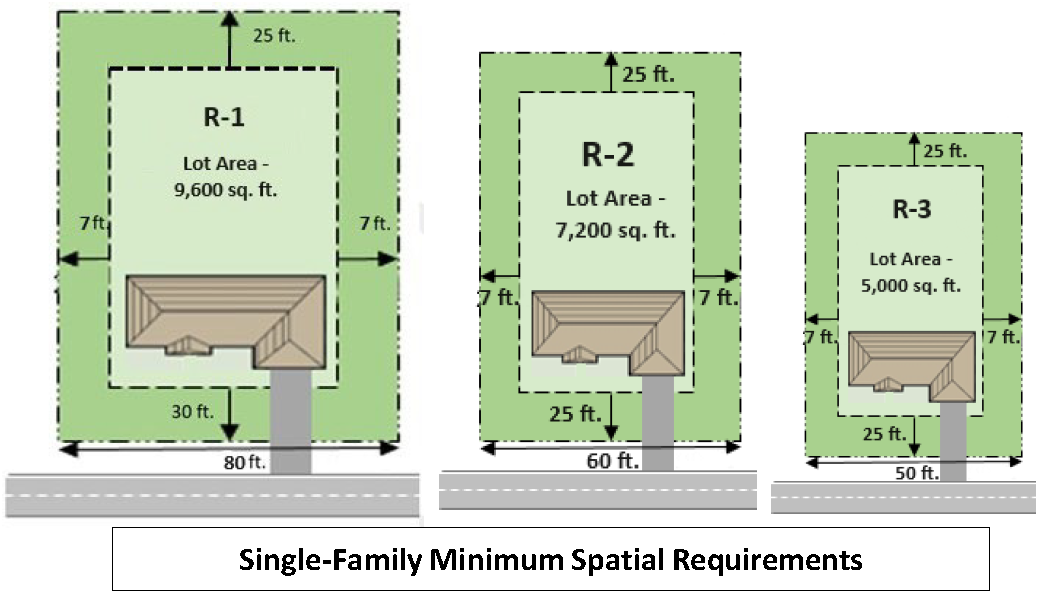
Unless specified elsewhere in this ordinance, all uses, structures, and buildings on all lots or parcels shall conform to the requirements specified in Table 3-3 and accompanying footnotes.
1 All dwelling units shall contain a minimum livable floor area in accordance with the following:
2 Total lot coverage for non-residential uses shall not exceed 65 percent.
3 Required lot area shall be measured within 120 feet or less from the front lot line.
4 For all non-residential principal buildings, a minimum side yard of 20 feet is required on each side.
5 A minimum lot area of 8,000 square feet and a minimum width of 80 feet shall be required for two-family dwellings, except as may otherwise be permitted in accordance with Section 9.3 BB.
6 A maximum of 14 dwelling units per net acre shall be permitted for multiple-family and 12 units per net acre for single-family attached units. No building shall exceed an overall length of 180 feet. There shall be a minimum distance between ends of contiguous buildings equal to the height of the taller building or 25 feet, whichever is greater.
7 A maximum density of 20 dwelling units per net acre shall be permitted. No building wall shall exceed an overall length of 180 feet along a continuous unbroken plane. There shall be a minimum distance between ends of contiguous buildings equal to the height of the taller building or 25 feet, whichever is greater.
Sec. 3.4 - Site Development Requirements.
All permitted and special land uses are subject to the following Site Development Requirements:
A.
General provisions of this ordinance as specified in Chapter 7 shall apply.
B.
All special land uses shall comply with the procedures of Chapter 8.
C.
Additional requirements applicable to specific uses are found in Chapter 9.
D.
Parking is required in accordance with Chapter 10.
E.
Signs are permitted in accordance with the requirements of Chapter 11.
F.
Landscaping and screening are required in accordance with Chapter 12.
G.
Lighting shall conform to the requirements of Chapter 13.
H.
Site Plan Review is required in accordance with Chapter 14.

