
Rockford City Zoning Code
Appendix A
DEFINITIONS
Sec. A.1 - Rules Applying to the Text.
A.
The following words, terms, and phrases, when used in this ordinance, shall have the meaning assigned to them in this chapter, except where the context clearly indicates a different meaning.
B.
Terms not defined in this chapter shall have the meaning customarily assigned to them.
C.
Whenever reference is made to any federal, state, county, or city ordinance, law, or act, that ordinance, law, or act is presumed to include any amendments.
D.
In computing the number of days, the first day is excluded and the last day is included. If the last day of any period during which an application, filing, or request is required to be made to the city or other governmental agency is a Saturday, Sunday, or legal holiday, the period is extended to include the next day which is not a Saturday, Sunday, or legal holiday.
E.
The following rules apply to the text of this Ordinance:
1.
The particular shall control the general.
2.
In the case of any difference in meaning or implication between the text of this ordinance and any caption or illustration, the text shall control.
3.
The word "shall" is always mandatory and not discretionary. The word "may" is permissive.
4.
Words used in the present tense shall include the future; and words used in the singular number shall include the plural; and the plural includes the singular, unless the context clearly indicates the contrary.
5.
A "building" or "structure" includes any part thereof.
6.
The word "person" includes an individual, a corporation, a partnership, an incorporated association, government, or any other similar entity.
7.
Unless the context clearly indicates the contrary, the conjunctions noted below shall be interpreted as follows.
a.
"And" indicates that all connected items, conditions, provisions, or events shall apply.
b.
"Or" indicates that the connected items, conditions, provisions or events may apply singularly or in any combination.
c.
"Either ... or" indicates that the connected items, conditions, provisions or events shall apply singularly but not in combination.
Sec. A.2 - Definitions A—B
Accessory Building. A detached building or structure on the same lot with and of a customarily incidental nature that is subordinate to the principal structure and accommodates an accessory use.
Accessory Dwelling Unit (ADU). A secondary dwelling unit located on the same parcel or lot as a single-family dwelling and subordinate to the principal dwelling, having permanent provisions for living, sleeping, cooking, and sanitation that are separate from the principal dwelling.
A.
Detached ADU. An ADU within a structure on the same lot as but completely detached from the principal dwelling.
B.
Attached ADU. An ADU attached to the principal dwelling unit, generally in the form of an addition or separate wing of the primary house.
C.
Interior ADU. An ADU built in a converted space within the principal dwelling, generally in either the attic or basement.
Accessory Use. A land use or activity located on the same lot as the principal use that is customarily and clearly incidental and subordinate to the principal use of the land or building.
Acres, Gross. The total area of land within the property boundaries.
Acres, Net. The gross acres exclusive of any dedicated public right-of-way or private easement for interior and abutting streets, any designated wetlands, and any area within a 100-year floodplain.
Adult Use. Any adult bookstore, adult cabaret, adult motion picture theater, and nude artist and photography studio. These terms shall have the following indicated meanings:
A.
Adult bookstore: A commercial establishment or facility that maintains 25 percent or more of its floor area for the display, sale, and/or rental of the following items (aisles and walkways used to access these items shall be included in "floor area" maintained for the display, sale, and/or rental of the items):
1.
Books, magazines, periodicals, or other printed matter, or photographs, films, motion pictures, videocassettes, CDs, DVDs, or other video reproductions, or slides or other visual representations which are characterized by their emphasis upon the display of specified sexual activities or specified anatomical areas; or
2.
Instruments, devices, novelties, toys, or other paraphernalia that are designed for use in connection with specified sexual activities as defined herein or otherwise emulate, simulate, or represent specified anatomical areas.
B.
Adult cabaret: An establishment including, but not limited to, a cafe, restaurant, or bar which features erotic dancers, strippers, or similar entertainers who perform in a state of undress and display specified anatomical areas.
C.
Adult theater: An establishment used for presenting motion picture films, video, cable television, or any other such visual media, distinguished or characterized by an emphasis on matter depicting, describing, or relating to specified sexual activities or specified anatomical areas for observation by patrons therein.
D.
Nude artist and photography studio: Any building, structure, premises, or part thereof used solely or primarily as a place which offers as its principal activity models to display specified anatomical areas as defined herein for artists and photographers for a fee or charge.
E.
Specified anatomical areas: Body parts defined as less than completely and opaquely covered:
1.
Human genitals, pubic region, buttock, and female breast below a point immediately above the top of the areola; and
2.
Human male genitals in a discernible turgid state, even if completely and opaquely covered.
F.
Specified sexual activities: Activities defined as:
1.
Human genitals in a state of sexual stimulation or arousal.
2.
Acts of human masturbation, sexual intercourse, or sodomy.
3.
Fondling or other erotic touching of human genitals, pubic region, buttock, or female breast.
Alley. Any dedicated public way affording a secondary means of access to abutting property, and not intended for general traffic circulation.
Awning. A sheet of canvas or other material stretched on a frame that extends out from the exterior building wall and used to keep the sun or rain off a storefront, window, doorway, or deck..
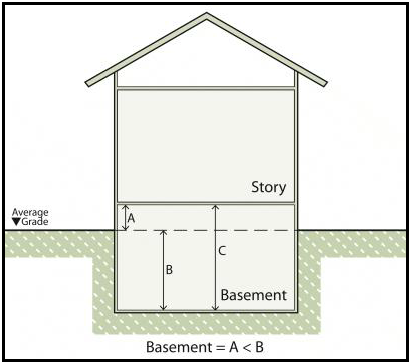
Basement. That portion of a building which is partly or wholly below grade but so located that the vertical distance from the average grade to the floor is greater than the vertical distance from the average grade to the ceiling. A basement shall not be counted as a story.
Bed and Breakfast. A use within a detached single-family dwelling in which transient guests are provided, in return for payment, a sleeping room, access to bathing and lavatory facilities, and typically breakfast.
Berm. A mound of earth graded, shaped, and improved with landscaping in such a fashion as to be used for visual and/or audible screening purposes.
Board of Zoning Appeals, Board. The Board of Zoning Appeals of the City of Rockford.
Buffer. A strip of land between certain zoning districts or uses reserved for plant material, berms, walls, and/or fencing to serve as a visual barrier or to block noise, light, and other sensory impacts.
Building. An independent structure with a roof, supported by walls, columns, or other supports that is designed for the shelter, housing, or enclosure of persons, animals, possessions, or property of any kind or to conduct business activities.
Building Code. The code or codes governing the erection and maintenance of buildings as currently adopted by the City of Rockford.
Building Official or Building Inspector. The person designated by the City Council to administer the provisions of the adopted Building Codes for the City of Rockford.
Business center. Any two or more businesses which:
A.
are located on a single parcel of property;
B.
are connected by common walls, partitions, canopies, or other structural members to form a continuous building or group of buildings;
C.
share a common parking area; or
D.
otherwise present the appearance of a single, contiguous business grouping.
Sec. A.3 - Definitions C—D
Canopy Tree. A deciduous tree whose mature height and branch structure provide foliage primarily on the upper half of the tree. The purpose of a canopy tree is to provide shade to adjacent ground areas.
Certificate of Occupancy. A document signed by an authorized city official as a condition precedent to the commencement of a use which acknowledges that such use, structure, or building complies with the provisions of the Zoning Ordinance.
Charity Collection Box. a box or receptacle, other than an accessory building or shed, complying with all building code and land use requirements, used for the receipt of money or goods intended as a charitable donation.
City Council, or Council. The City Council of the City of Rockford.
City Manager. The City Manager of the City of Rockford.
Clearing. The removal of vegetation from any site, parcel, or lot except when land is cleared and cultivated for bona fide agricultural or garden use in a district permitting that use. Mowing, trimming, pruning or removal of vegetation to maintain it in a healthy, viable condition is not considered clearing.
Clinic, Medical/Dental. A place for the care, diagnosis, and treatment of persons in need of medical, dental, or minor surgical attention. A clinic may also include customary laboratories and pharmacies incidental or necessary to its operation but does not include facilities for inpatient care or major surgery.
Clinic, Veterinary. A place for the care, diagnosis, and treatment of sick or injured animals, and those in need of medical or minor surgical attention. A veterinary clinic may include customary pens or cages only within the clinic structure.
Commercial Recreation, Indoor. The business of providing recreational and leisure activities such as billiard halls, bowling lanes, movie theaters, arcades, and similar uses within an enclosed building.
Commercial Recreation, Outdoor. The business of providing recreational and leisure activities such as mini-golf, driving ranges, go-cart tracks, batting cages, and skateboarding in the open air.
Commercial School. A facility, operated for profit, to provide specific training and instruction in dance, art, music, self-defense, business, trades, or similar specialized skills.
Commercial Storage Warehouse. A building, or group of buildings, in a controlled access and/or fenced compound, that contains individual stalls or lockers for the storage of a customer's goods or possessions.
Condominium Project. A plan or project consisting of not less than two condominium units established in conformance with the Michigan Condominium Act.
Condominium Unit. That portion of the condominium project designed and intended for separate ownership and use, as described in the master deed, regardless of whether it is intended for residential, office, industrial, business, recreational, use as a time-share unit, or any other type of use.
Convalescent or Nursing Home. A residential establishment, whether operated for profit or not, for the care of the aged, infirm, or those suffering from bodily disorders, wherein two or more persons are housed or lodged and furnished with meals, nursing, and medical care.
Cul-de-sac. A dead-end public or private street, generally short in distance, terminating in a circular or semi-circular section of street allowing for vehicle turnaround.
Day Care.
A.
Child care center. A facility, other than a private residence, receiving one or more preschool or school age children for care for periods of less than 24 hours a day, and where the parents are not immediately available to the child.
B.
Family day care home. A private home in which one but fewer than seven minor children are received for care and supervision for periods of less than 24 hours a day, unattended by a parent or legal guardian, except children related to an adult member of the family by blood, marriage, or adoption. The term "family day care home" includes a home that gives care to an one but not more than six unrelated minor child for more than four weeks during a calendar year.
C.
Group day care home. A private home in which more than six but not more than 12 minor children are given care and supervision for periods of less than 24 hours a day, unattended by a parent or legal guardian, except children related to an adult member of the family by blood, marriage, or adoption. Group day care home includes a home that gives care to more than six but not more than 12 unrelated minor children for more than four weeks during a calendar year.
Development. The construction of a new building or other structure on a lot or parcel, the relocation of an existing use or building on another lot or parcel, or the use of acreage or open land for a new use.
Drive-thru Facility. Any facility used to serve patrons of a business establishment while in their motor vehicles, either exclusively or in addition to service within a building or structure.
Dumpster. A container used for the temporary storage of trash and/or materials to be recycled pending collection, having capacity of at least one cubic yard.
Dwelling.
A.
Dwelling, multiple-family. A building containing three or more individual dwelling units.
B.
Dwelling, one-family, attached. A dwelling designed for occupancy by one family in a row of at least three dwelling units in which each unit has its own front and rear access to the outside, no unit is located over another, and each unit is separated from any other unit by one or more vertical common fire-resistant walls. These may also be referred to as "townhouses" or "rowhouses".
C.
Dwelling, one-family, detached. A detached building designed for and occupied exclusively by one family.
D.
Dwelling, two-family. A building containing two individual dwelling units.
Dwelling Unit. A room, or rooms connected, constituting a separate, independent housekeeping establishment for one family occupancy, physically separated from any other rooms or dwelling units which may be in the same building, and containing independent cooking, bathroom, and sleeping facilities. In no case shall a motor home, trailer, automobile chassis, tent, shipping container, or portable building be considered a dwelling. In the case of mixed occupancy, the part of a building occupied as a dwelling shall be deemed the dwelling unit and shall comply with all applicable provisions of this ordinance for dwellings.
Sec. A.4 - Definitions E—H
Easement. A right, distinct from ownership of the land, to cross property with facilities such as, but not limited to, driveways, roads, utility corridors, sewer lines, water lines, and transmission lines, or the right, distinct from the ownership of the land, to reserve and hold an area for open space, recreation, drainage, or access purposes.
Electric Vehicle (EV). A vehicle that runs fully or partially on electricity.
Electric Vehicle Charging Station. A device that supplies electrical power for recharging plug-in electric vehicles (including battery electric vehicles and plug-in hybrid vehicles).
Erected. Built, constructed, altered, reconstructed, moved upon, or any physical operations on the premises which are required for construction, excavation, fill, drainage, etc.
Essential Public Services. The erection, construction, alteration or maintenance by public utilities or municipal departments of underground, surface, or overhead gas, electrical, steam, fuel, or water transmission, distribution, collection, communication, supply or disposal systems, including towers, poles, wires, mains, drains, sewers, pipes, conduits, cables, fire alarm and police call boxes, traffic signals, hydrants and similar equipment, but not including buildings, substations, and storage yards, which are necessary for the furnishing of adequate service by such utilities or municipal departments for the general health, safety or welfare. The term "essential services" shall not include wireless communications towers, unless located on public property and used as part of a municipal communications network.
Evergreen Tree. A tree which has foliage that remains green and functional throughout the year.
Family. One of the following:
A.
An individual or group of two or more persons related by blood, marriage or adoption, together with foster children and servants of the principal occupants, with not more than one additional unrelated person, who are domiciled together as a single, domestic, housekeeping unit in a dwelling unit; or
B.
A collective number of individuals domiciled together in one dwelling unit whose relationship is of a continuing non-transient domestic character and who are cooking and living as a single nonprofit housekeeping unit. This definition does not include any society, club, fraternity, sorority, association, lodge, coterie, organization, or group of students or other individuals whose domestic relationship is of a transitory or seasonal nature or for an anticipated limited duration of a school term or other similar determinable period.
Fence. A permanent outdoor partition, wall, structure, or gate erected and used as a barrier, enclosure, or means of delineating a boundary line.
Floor Area.
A.
Floor area, gross (GFA). The sum of the gross horizontal areas of the several floors of a building measured from the exterior walls or from the centerline of walls separating two buildings.
B.
Floor area, livable (LFA). The area of a dwelling unit measured from the interior of the exterior walls of the unit: provided, areas of basements, unfinished attics, attached or detached accessory structures, breezeways, or enclosed and unenclosed porches shall not be counted as livable floor area.
C.
Floor area, usable (UFA). The area used for or intended to be used for the sale of merchandise or services, or for use to serve patrons, clients, or customers. Floor area which is used or intended to be used principally for the storage or processing of merchandise, for hallways, or for utilities or sanitary facilities shall be excluded from the computation of "usable floor area." Measurement of usable floor area shall be the sum of the horizontal areas of the several floors of the building measured from the interior faces of the exterior walls.
Funeral Home or Mortuary. A business that provides burial and funeral services for the deceased and their families and may include a prepared wake and a chapel for the funeral. This definition does not include crematorium.
Garage. An accessory building or portion of a principal building designed or used for the storage of motor vehicles, boats, and similar vehicles owned and used by the occupants of the building to which it is accessory or attached.
Grade. The gradient, the rate of incline or decline expressed as a percentage. For example, a rise of 25 feet in a horizontal distance of 100 feet would be expressed as a grade of 25 percent.
Grade, Average. The average finished ground elevation at the center of all walls of a building established for the purpose of regulating the number of stories and the height of buildings. The building grade shall be the level of the ground adjacent to the walls of the building if the finished grade is level. If the ground is not entirely level, the grade shall be determined by averaging the elevation of the ground for each face of the building or structure being measured.
Greenbelt. A strip of land of definite width and location reserved for the planting of shrubs, trees, or grasses to serve as an obscuring screen or buffer in carrying out the requirements of this ordinance. (See also "Berm" and "Buffer").
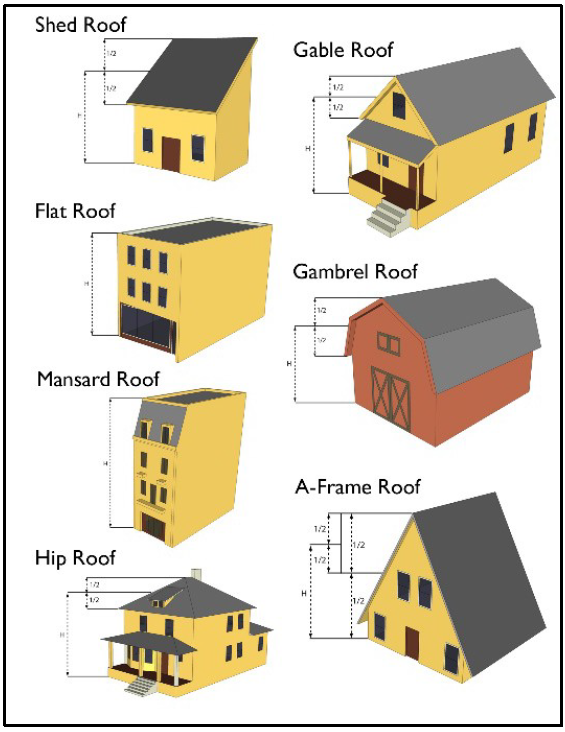
Height, Building. The vertical distance measured from the average grade to the highest point of a structure. In the case of a building, height shall be measured from the average grade to the highest point of the roof surface for a flat roof; to the deck line of mansard roofs; and to the midpoint between the eaves and ridge for gable, hip, A-frame, and gambrel roofs.
Home Occupation. A business or profession that is customarily incidental and secondary to the use of a dwelling. It is conducted in the dwelling or accessory building on the same lot as the dwelling, carried out by its occupants utilizing equipment typically found in a home, and is not evident from the outside.
Hospital. A facility providing health care services primarily for in-patient and surgical care of the sick or injured, including related facilities that are an integral part of the facility such as laboratories, out-patient departments, clinics, central service facilities, and staff offices.
Hotel. A facility offering lodging accommodations to the traveling public for a daily or other rate and which may provide additional services, such as restaurants, gift shops, meeting and banquet rooms, and recreational facilities.
Household Pet. An animal commonly domesticated as a companion or pet and kept in a home or yard. Examples include dogs, cats, birds, fish, rabbits, small rodents, and similar animals, and are not used for commercial purposes.
Sec. A.5 - Definitions I—L
Impervious Surface. Any surface composed of material that greatly impedes or prevents the natural infiltration of water into the underlying native soils. Impervious surfaces include but are not limited to, rooftops, buildings, sidewalks, patios, driveways, streets, and roads.
Inoperable Vehicle. A motor vehicle which is unlicensed or can no longer propel itself.
Junk. Any worn out or discarded materials including, but not necessarily limited to, scrap metal, inoperable motor vehicles and parts, construction material, household wastes, including garbage and discarded appliances, and yard debris.
Junk Yard. An open area where waste, discarded, surplus, or salvaged materials are bought and sold, exchanged, stored, baled, packed, disassembled, or handled. These materials include but are not limited to scrap iron and other metals, paper, rags, rubber tires, and bottles. A "junk yard " includes automobile wrecking yards and includes any area of more than 200 square feet for outdoor storage, keeping, or abandonment of junk, but does not include uses established entirely within enclosed buildings.
Kennel. Any lot or premises on which four or more dogs, cats, or other household pets, six months of age or older, are either permanently or temporarily boarded for commercial purposes. A kennel shall also include any lot or promises where household pets are bred or sold for commercial purposes.
Loading Space. An off-street portion of a lot of record designated for the temporary parking of commercial vehicles while loading or unloading materials used, sold, or made on the premises.
Lot. A parcel of land separately described on a deed or other instrument and recorded in the office of the Kent County Register of Deeds, whether by metes and bounds description or as part of a platted subdivision or site condominium.
A.
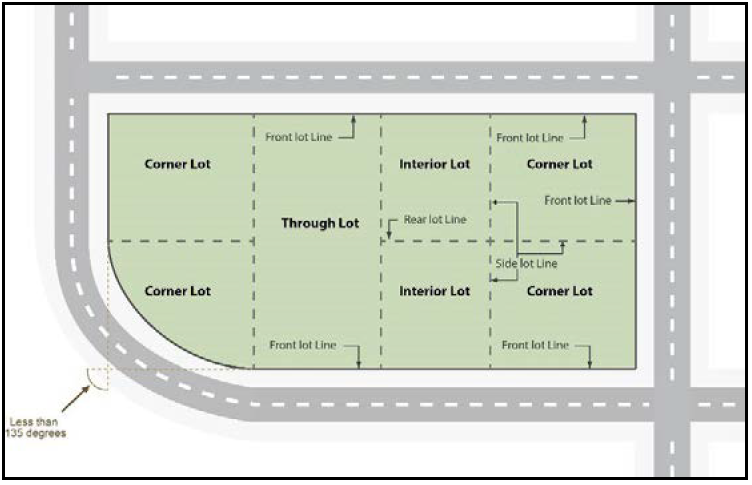
Lot, Corner. A lot having contiguous frontage on two intersecting streets if the interior angle at the intersection of such streets is less than 135 degrees. Also, a lot located on a curved street or streets if tangents of the curve, at the points of beginning with the lot or the points of intersection of the side lot lines with the street line, intersect at an interior angle of less than 135 degrees.
B.
Lot, Flag. An irregularly shaped lot or parcel located to the rear of another lot or parcel and which has a long narrow strip of land that provides access from the street to the wider buildable portion of the property.
C.
Lot, Interior. A lot other than a corner lot, flag lot, or through lot.
D.
Lot, Through. A lot having frontage on two approximately parallel streets or on a water body and a street.
Lot Area. The area within the property lines of a lot or other parcel of land, excluding street rights-of-way and private road easements.
Lot Coverage, Building. The part of the lot, expressed as a percent of the total lot area, occupied by any building or roofed structure, including accessory buildings, covered porches, gazebos, and carports.
Lot Coverage, Total. The part of the lot, expressed as a percent of total lot area, occupied by any building or roofed structure and all impervious surfaces, including one-half of pervious surfaces.
Lot Depth. The horizontal distance between the front and rear lot lines, measured along the median between the side lot lines.
Lot Frontage. The continuous linear distance of that portion of a parcel abutting upon a public street right-of-way or private street easement.
Lot Lines. The lines bounding a lot as follows:
A.
Front Lot Line. In the case of an interior lot, the line separating the lot from the public street right-of-way or private road easement and both lines separating the lot from the public street right-of-way or private road easement on through and corner lots.
B.
Rear Lot Line. That lot line opposite and most distant from the front lot line. In the case of a corner lot, the property owner may treat one of the lot lines opposite either of the two front lot lines as the rear lot line. In the case of a triangular lot, the rear lot line shall be an imaginary line parallel to the front lot line, not less than 10 feet long, lying farthest from the front lot line or wholly within the lot. A through lot has no rear lot line.
C.
Side Lot Line. Any lot line other than the front lot line or rear lot line. A side lot line separating a lot from a street is a side street lot line. A side lot line separating a lot from another lot is an interior side lot line.
Lot of Record. A parcel of land which is separately described on a deed, a platted subdivision, condominium master deed, or other instrument of conveyance and recorded in the office of the Kent County Register of Deeds as of a specified date.
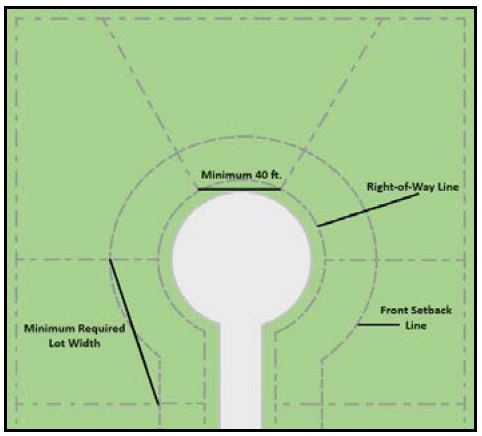
Lot Width. The horizontal straight-line distance between the side lot lines of an interior or through lot or designated side and opposite secondary front lot line of a corner lot, measured between the two points where the front setback line intersects with those lot lines. In the case of a lot on the bulb end of a cul-de-sac street, the minimum required lot width shall be measured at the required front setback line, but in no case shall the lot frontage be less than 40 feet.
Sec. A.6 - Definitions M—P
Master Plan. The City of Rockford Master Plan.
Massage Parlor. A commercial establishment providing therapeutic massages by massage therapists licensed by the State of Michigan.
Mobile Home. A structure that is transportable in one or more sections, built on a chassis, and designed to be used as a dwelling, with or without a permanent foundation, when connected to the required utilities, and includes the plumbing, heating, air-conditioning, and electrical systems contained in the structure. Mobile homes, also referred to as manufactured homes, are built to building standards established by the Department of Housing and Urban Development. This term does not include modular homes.
Mobile Home Park. A parcel or tract of land under the control of a person upon which three or more mobile homes are located on a continual non-recreational basis and which is offered to the public for that purpose regardless of whether a charge is made therefore, together with any building, structure, enclosure, street, equipment, or facility used or intended for use incident to the occupancy of a mobile home and which is not intended for use as a temporary trailer or recreational vehicle park.
Modular Home. A factory-built, single-family residential structure that is transportable to a building site in one or more sections, is attached to a permanent foundation and is used as a dwelling, but which is not constructed with a permanent hitch or other device allowing transport of the dwelling unit other than for the purpose of delivery to a permanent site, and which does not have wheels or axles permanently attached to its body or frame. Modular homes must comply with the city's building code.
Nonconforming Building. A building or portion of a building lawfully existing at the effective date of this ordinance or amendments thereto, but not conforming to the current provisions of this ordinance.
Nonconforming Lot. A lot lawfully existing at the time it was created that does not conform to the current provisions of this ordinance.
Nonconforming Use. A use or activity lawfully existing on the effective date of this ordinance or amendments thereto, but not conforming to the current provisions of this ordinance.
Nonresidential District. Any zoning district other than a Residential District.
Nuisance. Any thing, condition, or conduct that endangers health and safety, or that unreasonably and substantially offends the senses, or substantially obstructs the free use and comfortable enjoyment of property.
Sec. A.7 - Definitions O—S
Open Air Business. Retail sales establishments operated substantially in the open air, including:
A.
Bicycle, utility truck or trailer, motor vehicle, boats, or home equipment sales, repair, or rental services.
B.
Outdoor display area and sale of garages, motor homes, recreation vehicles, manufactured homes, snowmobiles, swimming pools and similar activities, but not including farm implements or commercial construction equipment.
C.
Retail sales of trees, fruits, vegetables, shrubbery, plants, seeds, topsoil, humus, fertilizer, trellises, lawn furniture, playground equipment and other home garden supplies and equipment, but not including lumberyards.
Open Space. Land that is primarily undeveloped except for accessory amenities and retained by means of easements or fee simple acquisition for its aesthetic, recreational, natural, and/or environmental benefits.
Ornamental Tree. A deciduous tree planted primarily for its ornamental value or for screening purposes which possesses qualities such as flowers or fruit, attractive foliage, bark, or shape and tends to be smaller at maturity than a shade tree.
Outdoor Storage Yard. Designated outdoor spaces for storing large items or equipment used in conjunction with the principal use of the property.
Overlay District. A zoning district superimposed upon the existing underlying zoning district and which imposes additional requirements specific to the purpose of the overlay district. Lands within the overlay are subject to the provisions of the existing zoning district and the overlay district.
Parking Lot. A paved area of land providing parking spaces, along with drives, maneuvering areas, and aisles, for the parking of more than three vehicles, other than in connection with a single- or two-family dwelling on an individual lot.
Parking Space. The space required to park one vehicle, exclusive of driveways and access aisles, in accordance with the requirements of this ordinance.
Personal Services. Businesses providing non-medical services to individuals, including, but not limited to barber and beauty shops, tattoo parlors, dry cleaners, small appliance repair, laundromats, massage therapists, shoe repair shops, and tanning salons. These uses may include incidental retail sales related to the services they provide.
Pervious Surface. A durable surface material suitable for pedestrian or vehicular traffic that allows stormwater to infiltrate into the ground.
Place of Public Worship. A building or structure or group of buildings or structures that, by design and construction, are primarily intended for conducting organized religious worship services. Associated accessory uses include, but are not limited to, classrooms, meeting halls, indoor and outdoor recreational facilities, daycare, counseling, and kitchens.
Planned Unit Development (PUD). A land development technique that allows regulatory flexibility in return for the creation of open spaces, mixed land uses, environmental preservation, and otherwise creative projects, based on an overall site plan and unified control of the project.
Planning Commission, or Commission. The City of Rockford Planning Commission.
Porch, Enclosed. A roofed structure with walls whose surface area is at least 50 percent glass or screen attached to or a part of a building and which provides direct access to and from the building.
Porch, Unenclosed. A roofed structure without walls attached to or a part of a building which provides direct access to and from the building.
Principal Building. The building(s) in which the principal use of the property is conducted, excluding any accessory structure or building.
Principal Use. The main use to which the property is devoted, excluding any accessory use.
Public Utility. A person, firm, or corporation, municipal department, board, or commission duly authorized to furnish to the public under federal, state, or municipal regulations, gas, steam, electricity, sewage disposal, communication, transportation, or water; provided this definition shall not include any person, firm, or corporation engaged in radio or television broadcasting or wireless communication.
Recreational Vehicle. Vehicles or equipment used primarily for recreational purposes, including but not limited to motor homes, travel trailers, camper trailers, pop-up campers, boats, snowmobiles, motorcycles, dune buggies, and similar vehicles, and the trailers used to transport them.
Recycling Center. A building or premises where used material is separated and processed prior to shipment to others who will use those materials to manufacture new products.
Residential District. The R-1, R-2, R-3, and R-4 zoning districts.
Senior Housing. A residential facility, licensed as a "home for the aged" by the Michigan Department of Public Health, providing room, board, and supervised care to unrelated, non-transient individuals 60 years of age or older or couples where either partner is 60 years of age or older. This does not include a development that contains convalescent or nursing homes; or a hospital for mental patients.
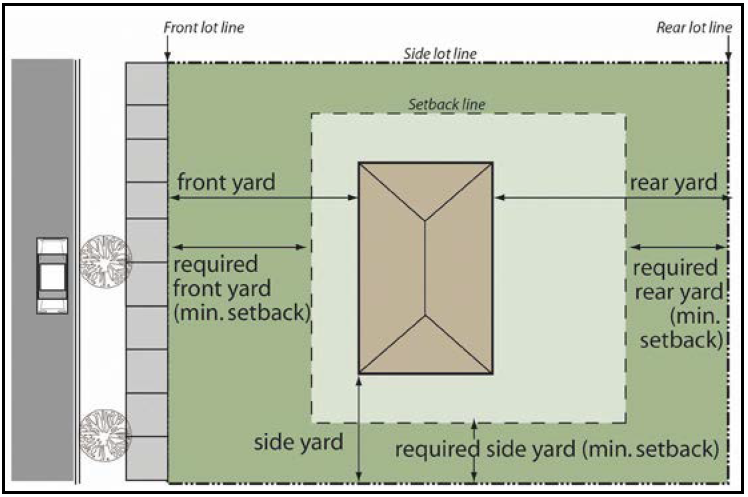
Setback, Required. The minimum horizontal distance that buildings and structures shall be separated from a public street right-of-way or private street easement, lot line, wetland, edge of a riverbank, or ordinary high water mark, to meet the minimum requirements of this ordinance.
A.
Front Setback Line. The line marking the minimum required building or structure setback distance from the road right-of-way line or the private road easement line that establishes the required front yard.
B.
Rear Setback Line. The line marking the minimum required building or structure setback distance from the rear lot line that establishes the minimum required rear yard.
C.
Side Setback Line. The lines marking the minimum required distance for buildings or structures from the side lot lines that establish the minimum required side yards.
Short-term Rental. A business engaged in the rental of a furnished dwelling unit to provide guest lodging for pay for periods not-to-exceed 29 consecutive days and which does not include serving food.
Sign. Any display, figure, painting, drawing, placard, poster, or other device visible from the public way which is designed, intended, or used to convey a message, advertise, inform, or direct attention to a person, institution, organization, activity, place, object, or product. It may be a structure or part thereof painted on or attached directly or indirectly to a structure.
A.
Awning sign. A sign affixed flat against the surface of an awning.
B.
Balloon sign. A sign composed of a non-porous bag of material filled with air.
C.
Banner sign. A fabric, plastic, or other sign made of non-rigid material without an enclosing structural framework.
D.
Billboard. Any structure, including the wall of any building, on which lettered, figured, or pictorial matter is displayed for a business, service, or entertainment which is not conducted on the land upon which the structure is located; or products not primarily sold, manufactured, processed or fabricated on such land.
E.
Business center sign. A freestanding sign typically identifying the name of a business center and/or one or more individual businesses within the center.
F.
Changeable message sign, manual. A portion of a sign on which copy may be changed manually.
G.
Changeable message sign, electronic. A changeable message sign comprised of a computer or playback device connected to a sign face which utilizes digital, LCD, LED, plasma, or similar technology or moving or rotating elements to display or change images on the sign face. Such signs can be controlled remotely and display electronic images that have the potential to change without the necessity of physically or mechanically removing and replacing the sign face or its components.
H.
Directional sign. A sign which gives traffic or wayfinding directions, instructions, or facility information for the use on the lot on which the sign is located.
I.
Feather sign. A temporary freestanding sign typically consisting of a single pole or shaft of plastic, metal or other rigid material, imbedded or otherwise fastened in the ground at the base with a vertically elongated pennant made of fabric, vinyl or other flexible material in the shape of a feather, teardrop or similar configuration attached along the pole.
J.
Flag. A typically rectangular piece of fabric of distinctive design, attachable by one edge to a pole or rope, used as a symbol of a governmental body, institution, or organization; as a signaling device; or as a decoration.
K.
Government sign. A temporary or permanent sign erected by the city or other governmental entity.
L.
Ground sign. A sign, the bottom of which is no more than twenty-four (24) inches from the ground which rests directly on the ground or is supported by short poles or a base and is not attached to a building or wall.
M.
Historical marker. A sign, marker, or tablet located on a building or site that has been designated as a historic landmark by city, state or federal agencies.
N.
Marquee. A permanent structure constructed of rigid materials that projects from the exterior wall of a building.
O.
Marquee sign. A sign affixed flat against the surface of a marquee.
P.
Mural. A design or representation painted or drawn on a wall which does not identify an establishment, product, service, or activity.
Q.
Off-premise sign. A sign which relates to, identifies with, or advertises an establishment, product, merchandise, good, service, or entertainment which is not located, sold, offered, produced, manufactured, or furnished at the property on which the sign is located, including, but not limited to, billboards.
R.
Pennant. A flag usually tapered to a point or swallowtail and used for identification or signaling.
S.
Placard. A sign not exceeding two square feet which provides notices of a public nature.
T.
Pole sign. A sign, not attached to a building or wall, supported on poles or supports with a minimum ground clearance of eight feet.
U.
Projecting sign. A double-faced sign attached to a building or wall that extends at least 12 inches but not more than 48 inches from the face of the building or wall.
V.
Residential subdivision sign. A permanent ground sign approved by the city located at the entrance to a recorded platted subdivision, site condominium project, multi-family development or other residential development on common open space or property owned by an association, developer, or similar entity responsible for the maintenance and care of the development.
W.
Roof line. The top edge of a roof or parapet wall, whichever is higher, but excluding any cupolas, chimneys or other minor projections.
X.
Roof sign. A sign projecting above the roofline of a building.
Y.
Sandwich board. A freestanding temporary sign consisting of two sign faces of equal size hinged at the top and placed on the ground.
Z.
Streamer. A long narrow wavy strip resembling or suggesting a banner floating in the wind.
AA.
Temporary sign. A sign, with or without a structural frame, intended for a limited period of display.
BB.
Wall sign. A sign painted or attached directly to and parallel to the exterior wall of a building extending no greater than twelve (12) inches from the exterior face of the wall to which it is attached.
CC.
Window sign. A sign installed inside a window and intended to be viewed from the outside.
DD.
Yard sign. A freestanding temporary sign placed on private property within a yard visible from a street.
1.
Rigid frame yard sign. A yard sign, consisting of a frame or skeleton made of steel, wood or similar sturdy material placed into the ground, that resists bending or movement and is capable of withstanding wind turbulence while supporting a sign of permitted size.
2.
Wireframe yard sign. A yard sign, typically consisting of a fairly pliable "H"-shaped metal frame, one end of which is inserted into a plastic sign and the other end is inserted into the ground.
Site Plan. A scaled drawing of a proposed project that shows all relevant features necessary to determine if it meets the requirements of this ordinance.
Solar Energy System (SES). An aggregation of parts including any base, mounts, tower, solar collectors, and accessory equipment such as utility interconnections and solar storage batteries, configured to convert solar radiation into thermal, chemical, or electrical energy.
A.
Façade-mounted SES. Solar panels attached to an exterior building wall.
B.
Ground-mounted SES. A solar energy system mounted on support posts, like a rack or pole, that are attached to or rest on the ground.
C.
Maximum tilt. The maximum angle of a solar array (i.e., most vertical position) for capturing solar radiation as compared to the horizon line.
D.
Minimum tilt. The minimal angle of a solar array (i.e., most horizontal position) for capturing solar radiation as compared to the horizon line.
E.
Photovoltaic system. A semiconductor material that generates electricity from sunlight.
F.
Roof-mounted SES. A solar energy system mounted on racking that is attached to or ballasted on the roof of a building or structure.
G.
Solar array. A photovoltaic panel, solar thermal collector, or collection of panels or collectors in a solar energy system that collects solar radiation.
H.
Solar collector. A photovoltaic cell, panel or array, or a heated air or water collection device, which relies upon solar radiation as an energy source for the generation of thermal, chemical, or electrical energy, i.e., solar cells or solar panels.
I.
Solar inverter. A device that converts direct current (DC) electricity generated by the solar panel to alternating current (AC) electricity which the electrical grid uses.
J.
Solar panels. Panels and tiles comprised of semiconductor devices and typically referred to as photovoltaic cells, which collect and convert solar energy directly into electricity.
Special Event. Atemporary community event, such as a festival, fair, car show, sporting event, carnival, art fair, holiday celebration, Christmas tree sales, and similar public gatherings. Special events do not include garage sales, nor would they include events or activities which occur entirely within a park, street, or other property owned or controlled by the city or schools.
Special Land Use. A use identified by this ordinance which may have characteristics of its operation (such as traffic, noise, hours of operation, or other potential nuisance effects) that requires special use permit review and may warrant additional conditions beyond the general requirements of the district in which it is located to mitigate its impacts and ensure its compatibility with its surroundings.
State Licensed Foster Family Home. A private home in which one but not more than four minor children, who are not related to an adult member of the household by blood or marriage, or who are not placed in the household under the Michigan Adoption Code (Public Act No. 288 of 1939) are given care and supervision for 24 hours a day, for four or more days a week, for two or more consecutive weeks, unattended by a parent or legal guardian.
State Licensed Foster Family Group Home. A private home in which more than four but fewer than seven minor children, who are not related to an adult member of the household by blood or marriage, or who are not placed in the household under the Michigan Adoption Code (Public Act No. 288 of 1939) are provided care for 24 hours a day, for four or more days a week, for two or more consecutive weeks, unattended by a parent or legal guardian.
State Licensed Residential Facility. A structure constructed for residential purposes that is licensed by the state pursuant to the Adult Foster Care Facility Licensing Act (Act No. 218 of 1979) and provides 24-hour supervision or care for six or fewer individuals who are aged, mentally ill, developmentally disabled, or physically handicapped and require supervision on an on-going basis, but who do not require continuous nursing care.
Story. That part of a building included between the surface of any floor above the average grade or ground at the foundation and the surface of the next floor, or if there is no floor above, then the ceiling next above.
Story, Half. An uppermost story lying under a sloping roof having an area of at least 200 square feet with a clear height of seven feet six inches. For the purpose of this ordinance, the usable floor area is only that area having at least five feet clear height between floor and ceiling.
Street, Arterial. A street or highway which carries large volumes of traffic at relatively high speed between population centers or from one section of the city to another. Northland Drive, Courtland Drive, and Division Avenue are Arterial Streets.
Street, Collector. A public way designed primarily to connect local streets with arterial streets or to provide access from residential areas to major destination points such as shopping or employment centers and which may be expected to carry a significant volume of traffic. Summit Avenue, E. Bridge Street, Main Street (N. of Division), Monroe St. (N. of Division), Oak Street, and Fremont Street are Collector Streets.
Street, Public. A public dedicated right-of-way other than an alley, which affords the principal means of access to abutting property.
Street, Private. A roadway contained within an easement which is privately owned and maintained, and which provides the principal means of access to more than two abutting lots.
Structure. A combination of materials constructed, erected, or placed in or upon the ground or attached to something having such a location. Structures may include but are not limited to buildings, elevated decks, gazebos, radio towers, signs, and swimming pools. Lawful fences or walls, utility poles, basketball goals, mailboxes, sidewalks, driveways, streets, parking areas, patios placed at grade, and retaining walls shall not be considered to be structures for purposes of this ordinance.
Substantial Construction. The completion of excavation for footings and foundations; provided, if the project will not contain buildings or structures, the completion of grading shall constitute substantial construction.
Sec. A.8 - Definitions T—Z
Temporary Use. A use or uses that occur on private property which are inherently temporary or which are proposed to be engaged in for only a relatively short period of time. Examples include construction related structures, model homes, and development sales offices.
Truck Terminal. A building or area in which freight brought by truck is assembled and/or stored for routing or reshipment, or in which semi-trailers, including tractor and/or trailer units and other trucks, are parked or stored.
Variance. A departure from or modification of any requirement of this ordinance authorized by the Board of Zoning Appeals under the provisions of this ordinance and the Michigan Zoning Enabling Act.
Vehicle Repair, Major. Any major activity involving the repair, rebuilding, or reconditioning of motor vehicles, engines, or trailers; collision services, such as body, frame, or fender straightening and repair; overall painting and vehicle rust proofing; refinishing or steam cleaning; but not including vehicle wrecking, junking, salvaging, or fuel sales.
Vehicle Repair, Minor. General maintenance on automobiles such as oil changes and lubrication; servicing and repair of spark plugs, batteries, pumps, belts, hoses, air filters, windshield wipers, and distributors; replacement of mufflers and exhaust systems, brakes, and shock absorbers; radiator cleaning and flushing; sale and installation of automobile accessories such as tires, radios, and air conditioners; wheel alignment and balancing. This definition does not include tire recapping or grooving or any major mechanical repairs, collision work, or painting.
Vehicle Service Station. An establishment where motor vehicle fuel is dispensed for retail sale. This use may also collectively include minor vehicle repair services, retail sales of convenience items, restaurant, and/or a single bay vehicle wash, but not overnight vehicle storage. This use does not include truck stops or truck fuel sales.
Vehicle Wash. A building or portion of a building with machine or hand-operated facilities used principally for the cleaning, washing, polishing, or waxing of cars and light trucks and vans. This use may also include accessory outdoor vacuums.
Wireless Communication Tower. A structure designed and constructed to support one or more antennas used for licensed telecommunications services including cellular, personal communication services (PCS), specialized mobilized radio (SMR), enhanced specialized mobilized radio (ESMR), paging, and similar services marketed to the general public.
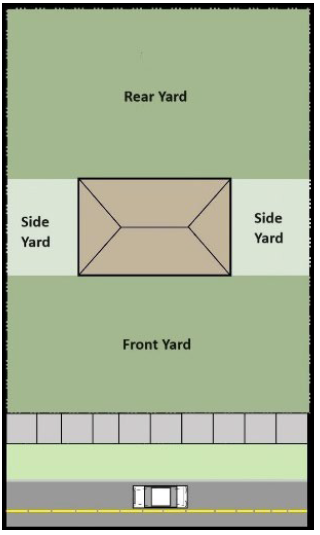
Yard. An open space at grade between a building and the adjoining lot lines.
A.
Yard, front. The space extending the full width of the lot, the depth of which is the shortest horizontal distance between the front lot line and the nearest wall of the principal building or a covered porch, deck, or patio attached to it. A corner lot has a principal front yard and a secondary front yard.
B.
Yard, rear. The space extending the full width of the lot, the depth of which is the shortest horizontal distance between the rear lot line and the nearest wall of the principal building or a covered porch, deck, or patio attached to it. Corner and through lots do not have a Rear Yard.
C.
Yard, side. The space between a principal building and the side lot line, extending from the front yard to the rear yard, the width of which is the shortest horizontal distance from the side lot line to the nearest wall of the principal building or a covered porch, deck, or patio attached to it.
Yard, required. The open area within the required minimum setback, on all four sides of a building.
Zoning Act. The Michigan Zoning Enabling Act, Public Act 110 of 2006, being M.C.L.A. §§ 125.3101 et seq., as amended.
Zoning Administrator. The person designated by the City Council to administer the provisions of this zoning ordinance.
Zoning District. A portion of the city, as shown on the city zoning map, within which specific uses of land, structures, or buildings are permitted and within which specific regulations and requirements apply under the provisions of this ordinance.

