
Rockford City Zoning Code
CHAPTER 4
BUSINESS DISTRICTS
Sec. 4.1 - Purpose.
A.
C-2, Central Business District. This district accommodates offices, personal services, civic and cultural functions, and convenience (day-to-day) retail for the residents of Rockford and visitors to the community within the city's central activity area. The uses established in this district are intended to be of a low intensity nature, of appropriate scale and appearance, and are to be generally compatible with most other uses, including residential.
B.
C-3, General Commercial District. The district is intended to accommodate uses which can provide office, personal services, and general commercial goods to residents of Rockford and surrounding areas in an integrated and cohesive arrangement. Permitted uses in this district are intended to be of an appropriate scale, appearance, and arrangement to maximize compatibility with adjoining uses and minimize conflicts with traffic on adjacent streets. District boundaries are intended to encompass properties of such size and depth as to promote clustered development, rather than so-called strip or linear commercial development.
C.
C-4, Highway Commercial District. This district provides appropriate locations for commercial and business enterprises which primarily serve the motoring public. The district will be established primarily in high traffic, arterial locations where the traffic and other characteristics of the permitted uses will not prove detrimental to or incompatible with the surroundings.
D.
I-1, Industrial District. This district permits most industrial uses such as wholesale, warehousing, manufacturing, and storage. The intent of the district is to provide a specific location for these uses and prevent their potentially negative impacts such as heavy truck traffic, continuous operation, noise, odor, or visual obtrusiveness from encroaching into areas or districts where they would be incompatible.
Sec. 4.2 - Allowed Uses.
A.
Uses allowed in the business districts are listed in Table 4-2. Additional requirements, if any, related to a specific use are cited in the "Additional Requirements" column. Any use not specifically listed shall be prohibited unless the use is determined to be a similar use in accordance with Section 2.5. The requirements in footnotes are an integral part of this chapter and shall apply in all instances.
B.
The following abbreviations apply to the Table of Uses:
1.
"P": Permitted Use, this use is authorized by-right, subject to all other applicable provisions of this ordinance and may be subject to additional requirements where indicated.
2.
"S": Special Land Use, this use is subject to review and approval in accordance with all applicable requirements of Chapter 8.
3.
"P/S": Permitted or Special Use, this designation will depend on whether the principal use or similar land use is a permitted or special land use within the applicable district.
1 Offices are not permitted on the first floor of any building space facing Main Street between Courtland and Maple; Courtland Street from Main Street west to the City parking lot; Squires Street; and Bridge Street between Squires Street and Main.
Sec. 4.3 - Spatial Requirements.
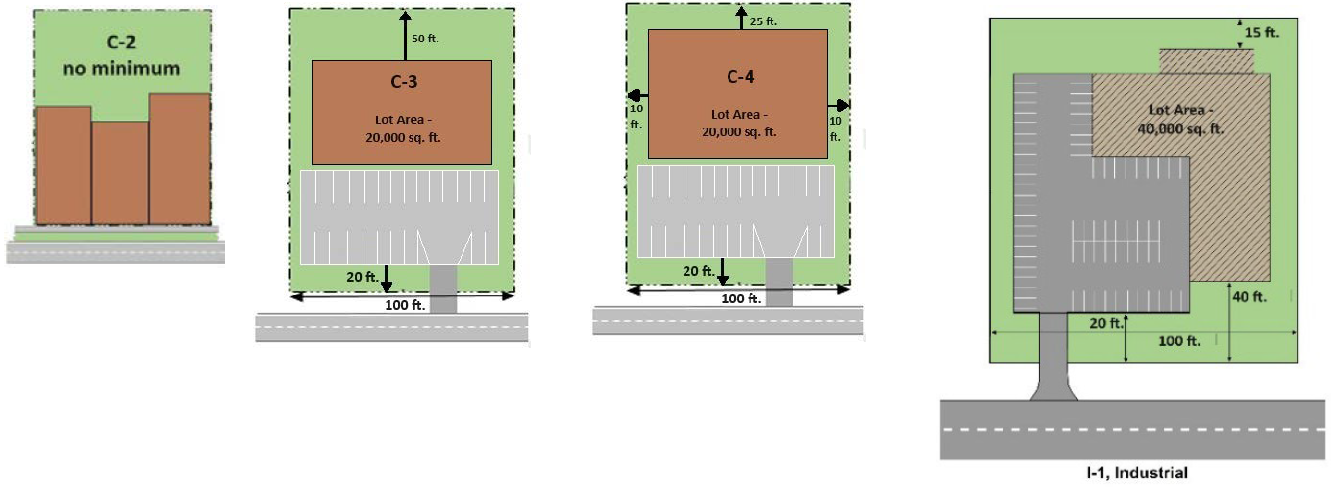
Unless specified elsewhere in this ordinance, all uses, structures, and buildings on all lots or parcels shall conform to the requirements specified in Table 4-3 and accompanying footnotes.
2 No setback shall be required, unless a side or rear yard abuts a Residential District, in which case a buffer shall be provided in accordance with Section 12.5.
3 The front façade of the fourth story shall be set back 10 feet from the front façade of the lower floors.
4 The first 20 feet of the required front yard shall not be used for parking or aisles and shall be landscaped in accordance with Section 12.6 B.1.
5 If the side of rear yard abuts a Residential District, the minimum required setback distance shall be increased if necessary to meet the requirements of Section 12.5.
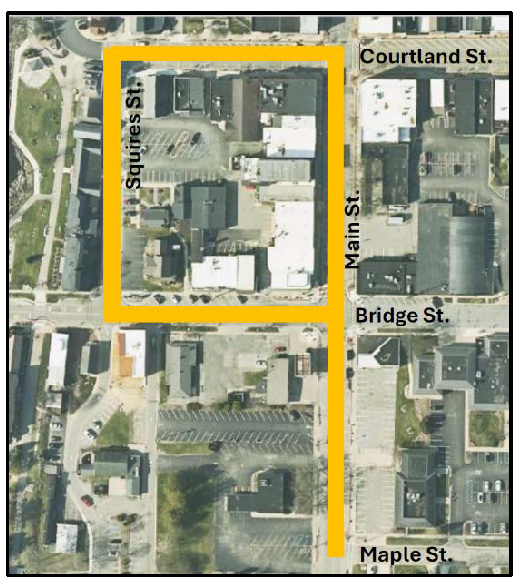
See footnote 1 under Table 4-2
Sec. 4.4 - Site Development Requirements.
All permitted and special land uses are subject to the following Site Development Requirements:
A.
General provisions of this ordinance as specified in Chapter 7 shall apply.
B.
All special land uses shall comply with the procedures of Chapter 8.
C.
Additional requirements applicable to specific uses are found in Chapter 9.
D.
Parking is required in accordance with Chapter 10.
E.
Signs are permitted in accordance with the requirements of Chapter 11.
F.
Landscaping and screening are required in accordance with Chapter 12.
G.
Lighting shall conform to the requirements of Chapter 13.
H.
Site Plan Review is required in accordance with Chapter 14.

