
Rockford City Zoning Code
CHAPTER 7
GENERAL PROVISIONS
Sec. 7.1 - Access and Frontage.
Any lot created after the effective date of this ordinance shall have frontage upon and be accessed from a public street or private street meeting city requirements. Frontage shall not be less than required for the zone district in which it is located.
Sec. 7.2 - Accessory Buildings, Structures, and Uses.
For purposes of this section, an accessory building is a building detached from the main building. If it is an integral part of the main building, sharing at least one wall with a climate-controlled room in the main building which serves a purpose other than as a connection to the accessory area, it shall be considered part of the main building and subject to all setback, height, and other dimensional requirements applicable to the main building. Otherwise, all accessory buildings shall be subject to the following regulations, as applicable:
A.
Reserved.
B.
Accessory buildings shall not be erected in any front yard or required side yard unless otherwise provided in this section. In the case of corner lots, both sides abutting the street right-of-way shall be considered front yards. This subsection, however, shall not apply to carports or rows of garages located within multiple-family housing developments.
C.
No accessory building shall be permitted on any lot which does not contain a principal building.
D.
No accessory building shall occupy any portion of a required green belt or buffer.
E.
No portion of an accessory building shall be used for residential dwelling or sleeping purposes, except as may be specifically permitted as an accessory dwelling unit.
F.
No detached accessory building shall be located closer than 10 feet to any main building.
G.
The eave line of a detached accessory building shall not be located closer than five feet to any side or rear lot line; provided, in the R-2 and R-3 zone districts, the eave line shall not be located closer than three feet to any side or rear lot line.
H.
Any accessory building with an area greater than 120 square feet shall be permanently constructed on a concrete foundation and shall conform to all applicable building and other codes for such a structure. The architectural character of all such accessory buildings shall be compatible with, and similar to, the main building with respect to materials, scale, design, and aesthetic quality as determined by the zoning administrator.
I.
The maximum height of a detached accessory building shall be determined as follows:
1.
The maximum height of the exterior side walls, measured from the finished floor to the top of the wall plate shall not exceed nine (9) feet.
2.
For the purpose of this section, "exterior side wall" shall mean an exterior wall not having a gable end.
3.
The height of the exterior side walls may be increased to a maximum of twelve feet, if the accessory building is set back an additional two feet from the side and rear lot lines for each additional one foot in height of the exterior side walls.
J.
The permitted number and size of detached accessory buildings on any lot containing a single- or two-family dwelling shall be in accordance with the requirements specified in Table 7-2, based on whether an existing garage is attached to the dwelling(s) and the number of vehicle stalls provided within such attached garage. Accessory buildings for multiple-family dwellings shall not occupy more than thirty (30) percent of the rear yard; provided, the maximum coverage limits of the zoning district shall not be exceeded.
K.
Any accessory building larger than 625 square feet and less than 865 square feet shall meet the minimum side yard setback, and one-half the rear yard setback requirements for a main building in the zoning district in which the lot is located.
L.
Any accessory building larger than 864 square feet shall meet all minimum setback requirements for a main building in the zoning district in which the lot is located.
M.
All accessory buildings located in non-residential zone districts, if located on a lot abutting a residential zone district, shall meet the setback requirements applicable to the main building located in such non-residential zone district.
Sec. 7.3 - Area or Space.
No lot, adjacent lots in common ownership, required yard, parking area, or other required open space shall be created, divided, or reduced in dimensions or area below the minimum requirements of this ordinance. If already less than the minimum requirements, a lot or adjacent lots in common ownership or a required yard, parking area, or other open space shall not be divided or reduced in dimensions or area so as to increase its noncompliance with the minimum requirements of this ordinance. Lots or yards created after the effective date of this ordinance shall comply with the requirements of this ordinance.
Sec. 7.4 - Clear Vision Corners.
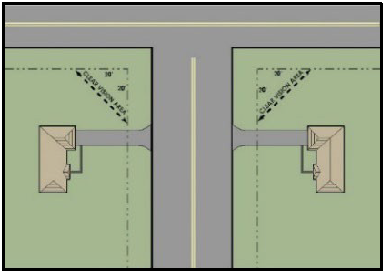
In any zone district on any corner lot, no fence, structure, or planting over 30 inches in height shall be erected or maintained within an area formed by the street property lines and a line connecting them at points 20 feet from the intersection of the street lines.
Sec. 7.5 - Corner Lots.
A.
A corner lot shall have two front lot lines: a principal front lot line and a secondary front lot line. The principal front lot line shall be the shorter of the two lot lines. Where the lot lines are of equal length, and/or the principal front lot line is not evident, then the zoning administrator shall determine the principal front lot line.
B.
The required front setback shall be met on both the principal and secondary streets; provided that where the lot contains an existing main building, the front setback from the secondary street may be reduced by 10 feet.
C.
The remaining yards shall be side yards.
Sec. 7.6 - Essential Public Services.
The erection, construction, alteration, or maintenance of essential public services shall be permitted in any zoning district; it being the intention of this section to exempt such erection, construction, alteration, or maintenance from the application of this ordinance.
Sec. 7.7 - Fences and Walls.
A.
Fences and walls in any side or rear yard in residential districts shall not exceed six feet in height, measured from the surface to the uppermost portion of the fence.
B.
Fences and walls erected within the front yard in any district shall not exceed four feet in height and shall be of a type which is not more than 50 percent solid.
C.
Fences in residential districts or enclosing residential uses shall not contain barbed wire or be electrified.
D.
In residential districts, the finished side of the fence or wall shall face the abutting property.
E.
Fences and walls shall not be erected within any public right-of-way in any district.
F.
Fences and walls shall not be erected or maintained in any district in such a way as to obstruct the vision of vehicle drivers within the clear vision corner described in Section 7.4.
G.
Fences and walls may be located on the property line but shall not be erected within two feet from a sidewalk, where the sidewalk is within the public right-of-way.
H.
Fences and walls shall be constructed of traditional materials customarily used for fence and wall construction such as, but not limited to, pressure-treated wood, high quality vinyl, wrought iron, vinyl coated chain link, split rail, brick, or masonry. Scrap or "recycled" material shall not be used. Recycled garage doors, sheet metal, corrugated metal, wood pallets, siding, file cabinets, tires, plywood, and similar materials are expressly prohibited.
I.
No fence shall be erected on any lot prior to issuance of a permit from the zoning administrator.
Sec. 7.8 - Governmental Improvements.
The provisions of this ordinance shall be applicable to the city itself and all other federal, state, or county governmental agencies and units; provided, city-owned buildings housing public safety services such as police and fire shall be exempt.
Sec. 7.9 - Height Exceptions.
The building height restrictions of all zoning districts shall be subject to the following exceptions: parapet walls not exceeding four feet in height, chimneys, cooling towers, elevator or stair bulkheads, fire towers, gas tanks, grain elevators, silos, stacks, stage towers and scenery lofts, flag poles, water tanks, public monuments, church spires, and penthouses or roof structures housing necessary mechanical appurtenances, subject to Section 7.14.
Sec. 7.10 - Home Occupations.
A.
Home occupations shall be approved by the zoning administrator, who may issue an approval upon receipt of an application.
B.
No persons other than members of the immediate family residing on the premises shall be engaged in such home occupation.
C.
The use of the dwelling unit for the home occupation shall be clearly incidental and subordinate to its use for residential purposes by its occupants, and not more than 20 percent of the livable floor area of the dwelling unit shall be used in the conduct of the home occupation.
D.
There shall be no change in the outside appearance of the building or premises, or other visible evidence of the conduct of such home occupation, other than one sign, not exceeding two square feet in area, non-illuminated, and mounted flat against the wall of the main building.
E.
The home occupation shall be operated entirely within the main building and not within any detached accessory building or structure and shall not involve any retail sales.
F.
No traffic shall be generated by the home occupation in greater volumes than would normally be expected in a residential neighborhood and any need for parking generated by the conduct of the home occupation shall be met off the street and other than in the required front yard.
G.
No equipment or process shall be used in a home occupation which creates noise, vibration, glare, fumes, odors, or electrical interference detectable to the normal senses beyond the boundaries of the property on which the home occupation is conducted. In case of electrical interference, no equipment or process shall be used which creates visual or audible interference in any radio or television receivers off the premises or causes fluctuation in line voltage off the premises.
H.
No one not living on the premises shall come to the home to pick up equipment or park a vehicle while working off-site.
Sec. 7.11 - Illegal Dwellings.
The use of any portion of a garage or accessory building for dwelling or sleeping purposes in any zoning district is prohibited, except as a permitted accessory dwelling unit conforming to the requirements of this ordinance. Basements shall not be used for sleeping purposes, unless adequate ingress and egress is provided per the requirements of the city building code and other applicable regulations. In no case, shall any living space located in a basement be counted toward the required livable floor area requirement for the district in which it is located.
Sec. 7.12 - Keeping Animals.
A.
The keeping of household pets, including dogs, cats, fish, birds, hamsters, and other animals generally regarded as household pets is permitted in any Residential District. However, no more than three dogs or cats, six months of age or older, in any combination thereof, shall be kept or housed in or at one dwelling unit.
B.
The keeping of animals not normally considered household pets, including, but not limited to, horses, pigs, sheep, cattle, and poultry is prohibited in all zoning districts.
C.
Any area where such permitted animals are kept shall be maintained in a safe and sanitary condition.
Sec. 7.13 - Mechanical Appurtenances.
A.
Except in the C-3 General Commercial District, mechanical appurtenances, such as blowers, ventilating fans, and air conditioning units, shall be placed not closer than 12 feet to any lot line.
B.
Any mechanical appurtenances, including elevator housings, stairways, tanks, HVAC equipment, and other similar apparatus, not including solar energy systems, located on the roof of any building shall comply with the following standards:
1.
Such apparatus shall be enclosed in a screening structure having walls constructed of material compatible in appearance with the main building to which it is attached.
2.
The apparatus and enclosure shall not exceed a height of ten (10) feet above the surrounding roof surface and shall not occupy more than fifteen (15) percent of the total area of the roof of the building on which it is placed.
Sec. 7.14 - Permitted Front Setback Reductions.
A.
Where the established front yards for existing main buildings within 200 feet of the side lot line of, and in the same zoning district as, a subject lot are less than the required front yard for the zoning district of the subject lot, the required front yard for the subject lot shall be the average front yard of existing main buildings on the same side of the street and entirely or partially within 200 feet of the side lot lines of the subject lot, subject to Subsections 7.14 B. and C., below.
Average setback of structures within 200 feet = 24.7 ft.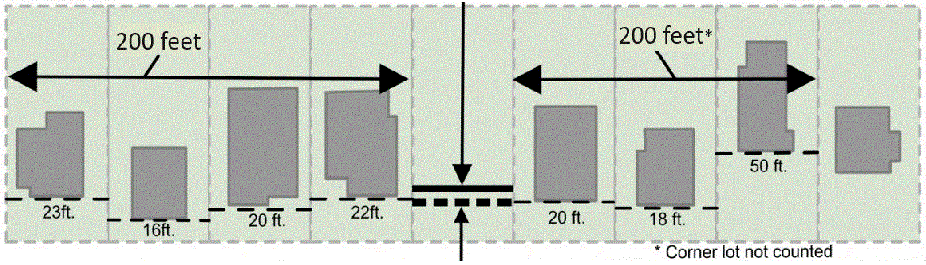
B.
The front yard reduction permitted in Subsection 7.14 A., shall only be permitted if there are two or more lots occupied by main buildings within the area described for computing the average front yard.
C.
In no case shall the front yard setback resulting from the application of these provisions, be less than 15 feet.
Sec. 7.15 - Projections Into Yards.
The following architectural elements and appurtenances may encroach into or over a required yard setback as provided in Table 7-15.
Sec. 7.16 - Regulations Applicable to Single-Family Dwellings.
Any single-family dwelling on a lot shall be permitted only if it complies with all the following requirements:
A.
If the dwelling unit is a mobile or manufactured home, the home must either be new and certified by the manufacturer and/or appropriate inspection agency as meeting the Mobile Home Construction and Safety Standards of the U.S. Dept. of Housing and Urban Development, as amended, or any similar successor or replacement standards which may be promulgated, or used and certified by the manufacturer and/or appropriate inspection agency as meeting the standards referenced above, and found, on inspection by the building official or his designee, to be in excellent condition and safe and fit for residential occupancy.
B.
All dwelling units shall comply with applicable building, electrical, plumbing, fire, energy, and other similar codes which are or may be adopted by the city; provided, where a dwelling unit is required by law to comply with any federal or state standards or regulations for construction, and where such standards or regulations for construction are different than those imposed by City Codes, the federal or state standard or regulation shall apply. Appropriate evidence of compliance with such standards or regulations shall be provided to the building official.
C.
The dwelling unit shall comply with all applicable restrictions and requirements of this ordinance, including, without limitation, the minimum lot area, minimum lot width, minimum livable floor area, required yards, lot coverage, and maximum building height.
D.
If the dwelling unit is a mobile or manufactured home, the home shall be installed with the wheels removed.
E.
The dwelling unit shall be firmly attached to a permanent continuous foundation constructed on the building site. Such foundation shall have a wall of the same perimeter dimensions as the dwelling unit and be constructed of such materials and type as required by the building code for on-site constructed single-family dwellings. If the dwelling unit is a mobile or manufactured home, its foundation shall fully enclose the chassis, undercarriage, and towing mechanism and an affidavit of affixture shall be provided to the zoning administrator to certify its permanence on the site.
F.
If the dwelling unit is a mobile or manufactured home, it shall be installed pursuant to the manufacturer's setup instructions and shall be secured to the building site by an anchoring system or device complying with the rules and regulations, as amended, of the Michigan Mobile Home Commission, or any similar or successor agency having regulatory responsibility for mobile home parks.
G.
The dwelling unit shall have a minimum core living area of at least 20 feet by 30 feet.
H.
Storage area of no less than 120 square feet shall be provided. This storage area may consist of a basement, closet areas, attic, within a garage attached to the main building, or in a detached accessory building which complies with all other applicable provisions of Section 7.2.
I.
Permanently attached steps or porch areas at least three feet in width shall be provided where there is an elevation difference greater than eight inches between the first floor entry of the dwelling unit and the adjacent grade.
J.
The exterior finish of the dwelling unit shall not cause reflection greater than that from siding coated with clean, white, gloss exterior enamel.
K.
The dwelling unit shall have no fewer than two exterior doors, with one being in either the rear or the side of the dwelling unit.
Sec. 7.17 - Swimming Pools.
A.
Every person owning land on which there is located a swimming pool, spa, hot tub, or similar device (below ground or above ground) which contains 24 inches or more of water in depth at any point, shall ensure that such device is made inaccessible to small children by means of a fence or enclosure surrounding the device or other means as permitted by the International Pool and Spa Code and approved by the zoning administrator. Side walls, fence, or enclosure, including gates, shall not be less than four feet or greater than six feet above grade. All gates shall be self-latching with latches placed no less than four feet above grade or otherwise made inaccessible from the outside to small children. Swimming pools, spas, hot tubs, and similar devices shall not be located less than ten feet from any lot line measured from the edge of the wall encompassing the water. The outer edge of adjacent patios, walkways, and other at-grade paved surfaces shall not be closer than three feet to any side or rear lot line. Adjacent decks and other raised structures shall not be permitted in the required side yard and shall not encroach more than 15 feet into the required rear yard.
B.
Swimming pools, spas, hot tubs, and similar devices shall not be located in any front yard.
C.
No pool, spa, hot tub, or similar device regulated by this section shall be constructed, installed, enlarged, or altered until a permit has been obtained from the zoning administrator.
Sec. 7.18 - Temporary Uses.
A.
Construction buildings. Construction buildings and structures, including trailers, incidental to construction work on a lot, may be placed on such lot, subject to the following restrictions:
1.
Construction buildings and structures shall only be used for the storage of construction materials, tools, supplies and equipment, and for construction management and supervision offices related to construction activity on the same lot.
2.
An enclosed structure for temporary sanitation facilities shall be required on all construction sites, unless otherwise available on the site.
3.
No construction building or structure shall be used as a dwelling unit.
4.
A permit shall be issued from the zoning administrator prior to installation of a construction building or structure.
5.
Construction buildings and structures shall be removed from the lot within 15 days after an occupancy permit is issued for the permanent structure on such lot or within 15 days after the expiration of a building permit issued for construction on such lot.
B.
Sales offices and model homes. Sales offices or model homes may be placed on a lot subject to the following conditions:
1.
A permit shall be issued by the zoning administrator prior to installation or construction. The permit shall specify the location of the office and shall be valid for a period of up to one year. A temporary permit may be renewed by the zoning administrator for up to two successive one-year periods or less, at the same location if such office or model home is still incidental and necessary.
2.
Only transactions related to the development in which the structure is located shall be conducted within the structure. General offices for real estate, construction, development, or other related businesses not exclusively related to the project shall not be permitted.
Sec. 7.19 - Timely Completion of Construction.
Following commencement of the construction, erection, reconstruction, modification, expansion, or enlargement of any building, fence, or other structure authorized under the provisions of this ordinance, completion of such work shall be diligently pursued and completed as follows:
A.
For residential, commercial, industrial, or other structures, the exterior features shall be completed within 12 months from the initial commencement of the project.
B.
The time for completion of all exterior features of a structure may be extended by the zoning administrator if extenuating circumstances are demonstrated such as the size of the building, unforeseen weather conditions, or delays in obtaining materials.
C.
Exterior features shall include all elements of the exterior of the structure and property including but not limited to siding, roofing, doors, windows, painting/staining, fences, garage floors, sidewalks, driveways and approaches, parking lots, appurtenant or auxiliary/accessory structures, lighting, and any other element needed to complete the exterior of the structure.
Sec. 7.20 - Voting Place.
The provisions of this ordinance shall not interfere with the temporary use of any property as a voting place in connection with a federal, state, county, city, or other public election.
Sec. 7.21 - Water and Sanitary Sewer Service.
Any building or structure which is to have drinking water and/or sanitary facilities located within the building or structure shall comply with the City of Rockford utility ordinance.
Sec. 7.22 - Withholding or Conditioning of Approval.
The Planning Commission or City Council may withhold approval of any use, site plan, or other approval required by this ordinance pending approvals required by County, State or Federal agencies or departments, or may approve subject to obtaining such approvals.

