
Rockford City Zoning Code
CHAPTER 6
PLANNED UNIT DEVELOPMENT
Sec. 6.1 - Purpose.
Traditional zoning, with its segregation of uses and rigid dimensional requirements may not be suitable in all situations to best achieve the city's objectives relative to desired land use and preservation of its resources and character. In order to permit and encourage more creative and innovative land development for the benefit of the community as a whole and in furtherance of the vision and goals of the City of Rockford Master Plan, Planned Unit Development (PUD) may be permitted as a zoning district to achieve the following purposes:
A.
provide for flexibility in development that will result in a better project for the developer, residents, and users, as well as for the city, in general;
B.
preserve existing natural assets, such as stands of trees, floodplain, open fields, wetlands, rivers, and the like;
C.
accomplish a more desirable and sustainable residential environment than would be feasible through the strict application of minimum requirements of this ordinance;
D.
encourage the utilization of open space and the development of recreational amenities within reasonable walking distance for all residents;
E.
encourage the use of lands in ways which are most in accord with their character and adaptability; and
F.
encourage the efficient use of land by facilitating economical and suitable arrangements for buildings, streets, utilities, and other land use features.
Sec. 6.2 - Qualifying Conditions.
All PUD developments shall meet the following qualifying conditions, at a minimum:
A.
Size. A two acre minimum site shall be required for a PUD, unless otherwise permitted by the Planning Commission upon determining that all other qualifying conditions of this section will be met.
B.
Utilities. All PUD's shall be served by public water and sanitary sewer facilities.
C.
Ownership and Control. The tract of land for which a PUD application is received must be either in one ownership or the subject of an application filed jointly by the owners of all properties.
D.
Recognizable Public Benefit. The PUD shall achieve recognizable and substantial benefits that may not be possible under the existing zoning classification(s). At least three of the following benefits shall be accrued to the community resulting from the proposed PUD:
1.
preservation of significant natural features;
2.
preservation of common open space beyond the minimum required;
3.
connectivity of preserved open space with adjacent open space, greenways, or public trails;
4.
implementation of specific goals or recommendations of the city's Master Plan;
5.
coordinated redevelopment of multiple lots or parcels; or
6.
removal or renovation of deteriorating buildings, sites, or contamination clean-up.
Sec. 6.3 - Permitted Uses.
A.
Any use permitted by right or by special land use allowed in any district may be permitted in a PUD; provided, all objectives and standards of this chapter are determined to be met and there is compliance with the procedures of this chapter.
B.
Residential and non-residential uses may be permitted in combination to create an integrated, mixed-use development based upon the recommendations of the City of Rockford Master Plan.
C.
Approval of a PUD shall include identification of the specific uses proposed within the PUD, and only those uses shall be permitted.
Sec. 6.4 - Development Requirements.
A.
Minimum Lot Size and Zoning Requirements. Lot area, width, setbacks, height, lot coverage, minimum floor area, parking, landscaping, lighting, and other requirements applicable to the zoning district corresponding to the proposed use, as specified in Table 6-4, shall apply to all such uses within a PUD, unless modified in accordance with the provisions of Section 6-4B. Within a PUD, the minimum buffer requirements between dissimilar uses, as specified in Section 12-5, shall not apply; provided, the Planning Commission or City Council may require separation or buffering of uses as a condition of concept plan approval.
B.
Modification of Minimum Requirements. Regulations applicable to a land use in the PUD district may be altered from the requirements specified in the above table, including modification of the lot area and width, lot depth, building setbacks, height, lot coverage, signs, and parking. Such modification shall be subject to the following:
1.
A reduction in lot size shall not result in an increase in the number of dwellings otherwise permitted by the applicable zoning district as determined by submission of a parallel plan, unless a density bonus is also granted in accordance with Section 6.4C. below. In the absence of a density bonus, land gained by the reduction in lot sizes shall be added to the required open space within the PUD.
2.
The PUD applicant shall identify, in writing, all proposed deviations from the zoning district requirements. Modifications may be approved by the City Council during the preliminary plan review stage, after Planning Commission recommendation. Adjustments to the minimum requirements may be permitted only if they will result in a higher quality and more sustainable development, consistent with the purpose of the PUD district, as expressed in Section 6.1.
C.
Residential Density Bonus. In addition to the modification of minimum requirements permitted in Section 6.4 B., the City Council, after Planning Commission recommendation, may permit an increase in the total number of residential units otherwise allowed within a PUD up to an additional 20 percent. If requesting a density bonus, the applicant shall submit a parallel plan, drawn to scale, as part of the preliminary PUD plan. The parallel plan shall show a feasible layout, meeting all applicable zoning requirements of the corresponding zoning district to establish the base density that would otherwise be permitted. Consideration of a density bonus shall be based on demonstrating that at least four of the following will be achieved:
1.
The appearance and construction will result in a development of high quality, as evidenced by innovative design and primary use of building materials such as stone, masonry, wood, or Hardie-plank on the front of the building;
2.
Amenities, beyond the minimum required open space, will be provided to create a more sustainable community and desirable living environment;
3.
At least two different housing types (single-family detached, two-family, multiple-family, or single-family attached) will be incorporated into the development.
4.
No less than 10 percent of residential units of each type will be priced at an annual mortgage or rental cost no greater than 30 percent of Kent County's median household income according to the US Census Bureau.
5.
The development will employ a traditional layout and design pattern reflecting the core city including grid street pattern, narrow streets, wide parkways, curbs, front porches, and garages in the rear yard.
6.
Dedicated common open space will be provided in excess of the minimum required, per Section 6.4D.
7.
One or more parking structures will be constructed within a mixed-use or residential PUD to meet the minimum parking requirements of this ordinance.
8.
Energy Star certified appliances and systems will be used throughout all buildings.
9.
Significant natural features, in addition to stands of mature indigenous trees, will be preserved and/or substantial landscaping beyond the minimum requirements will be incorporated into the development.
10.
Decorative pavers or similar aesthetic enhancements will be incorporated into the vehicular and pedestrian circulation system.
11.
A commercial and/or office component will be included within the PUD.
12.
Facilities for electric vehicles will be provided throughout the development.
13.
The dwelling units are all electric or solar powered and do not contain any natural gas or propane service.
D.
Open Space. All PUDs shall, at a minimum, meet the following requirements:
1.
Common open space. All land within a development that is not devoted to a principal or accessory use, street right-of-way, or is otherwise excluded by Subsection D.2. shall be set aside as common land for visual amenities, recreation, or conservation. At a minimum, common open space shall be provided as follows:
a.
PUDs containing only attached single-family residential: 10 percent of the PUD site.
b.
PUDs containing any other type of residential: 20 percent of the PUD site.
2.
Areas not considered open space. The following land areas shall not be considered open space for the purposes of meeting minimum open space requirements:
a.
Any platted lot, site condominium unit, or described parcel intended to be occupied by a building, structure, or parking lot not accessory to a designated open space area or use;
b.
The area of any street right-of-way or private street easement;
c.
Any submerged land area of a pond, lake, or river; provided, up to 50 percent of protected wetlands and stormwater basins aesthetically and functionally integrated into the open space via landscaping, pathways, observation platforms, or similar features may be counted toward the minimum required open space;
d.
Golf courses;
e.
Parking and loading areas, except those exclusively associated with a recreation facility or common open space area; and
f.
Any other undeveloped areas not meeting the intent and standards for open space stated in this section, as determined by the City Council during preliminary plan review.
3.
Open space location. Common open space shall be planned in locations that are visible and accessible throughout the development. The common open space shall be visually significant, designed to preserve natural features, provide buffers between adjacent uses, and/or connect open spaces throughout the development; provided, at a minimum, the following shall be applicable to the required open space:
a.
Open space shall be situated to maximize the preservation of any existing woodlands;
b.
A minimum 25-foot wide undisturbed open space setback shall be maintained from the edge of any river or wetland; provided, trails, boardwalks, observation platforms, or other similar structures that enhance passive enjoyment of the site's natural amenities may be permitted within the setback;
c.
Where adjacent land includes open space, public land, parks, recreation facilities, or existing or planned bike paths, sidewalk or paved pathway connections shall be provided between the PUD and such adjacent features; and
d.
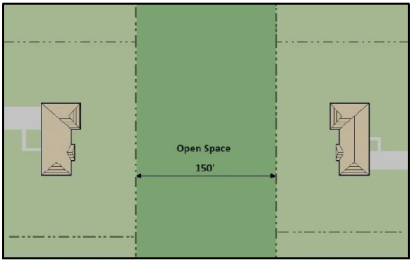
Where a linear dedicated open space abuts the rear yards of any lots, the open space shall have a minimum width of 150 feet measured from such rear lot lines; provided, a lesser dimension may be allowed specifically to accommodate trail or pathway connections.
4.
Open space protection. The dedicated open space shall be set aside in perpetuity by the developer through a conservation easement or other legal instrument approved by the city attorney. The conservation easement or other legal instrument shall assure that the open space will be protected from all forms of development, except as shown on an approved final site plan, and shall not be changed to another use.
5.
Allowable uses. Allowable uses of the dedicated open space shall be specified in the conservation easement or other legal instrument but shall prohibit the following:
a.
dumping or storing of any material or refuse;
b.
activity that may cause risk of soil erosion or threaten any living plant material;
c.
cutting or removal of live plant material, except for removal of dying, diseased, or invasive vegetation;
d.
use of motorized off-road vehicles;
e.
cutting, filling, or removal of vegetation from wetland areas; and
f.
use of pesticides, herbicides, or fertilizers on or within 50 feet of wetlands, rivers, streams, or other water bodies.
6.
Recreation or conservation use. Nothing in this section shall prevent the conveyance of open space to a public agency or other nonprofit entity for recreation or conservation use, if accepted by such agency or entity.
7.
Maintenance requirements. Provisions for maintenance of the open space shall be provided in the PUD agreement. In the event the open space is not adequately maintained or otherwise determined by the zoning administrator to be a public nuisance, the city may, at its sole discretion, cause such maintenance to be performed and shall assess the maintenance costs upon the owners of the open space.
Sec. 6.5 - Application and Review.
A.
Pre-Application Conference.
1.
A pre-application conference shall be held with the zoning administrator and such staff and consultants as appropriate for the purpose of determining the eligibility of the request for consideration as a PUD.
2.
A request for a pre-application conference shall be made to the zoning administrator who shall schedule a date and time for the meeting. As part of the pre-application conference, the applicant shall submit two copies of a conceptual plan and one electronic version which shows the property location, boundaries, significant natural features, generalized vehicular and pedestrian circulation, and land use for the entire site.
3.
The reviewers shall advise the applicant of the conformance of the PUD concept with the intent and objectives of the PUD District, whether it qualifies under the qualifying conditions of Section 6.2, and whether the general concept is consistent with the City's Master Plan. In no case, shall any representations made at the pre-application meeting be construed as an endorsement of the PUD or an approval of the concept.
B.
PUD Application and Preliminary Development Plan. Following the pre-application conference, a complete application shall be submitted to the zoning administrator. Incomplete applications will be returned to the applicant without further processing. Upon determining that the application is complete, the zoning administrator shall schedule a date and time for Planning Commission review. The application shall include the following:
1.
a completed application form;
2.
payment of a fee, as established by the City Council;
3.
a narrative statement describing:
a.
the objectives of the PUD and how it relates to the Intent of the PUD District, as described in Section 6.1.;
b.
compliance with the qualifying conditions of Section 6.2;
c.
requested modification of minimum requirements, per Section 6.4 C. and/or requested density bonus, per Section 6.4 D.;
d.
the relationship of the PUD to the City of Rockford Master Plan;
e.
phases of development and approximate time frame for each phase;
f.
projected start and completion of construction; and
g.
type, and size of areas to be dedicated for common open space.
4.
two copies of a preliminary development plan and one electronic version. If the PUD is to be developed in phases, the preliminary development plan shall show all phases. The preliminary plan shall contain, in addition to the information required in Table 14-3 for administrative plans, the following:
a.
existing zoning and land use of all abutting properties;
b.
proposed uses and their approximate locations;
c.
layout and typical dimensions of proposed lots;
d.
approximate phases of development;
e.
proposed residential density by dwelling type; and
f.
a parallel plan if modification of lot sizes and/or density bonuses are requested.
C.
Notice and Public Hearing.
1.
Following Planning Commission receipt of the preliminary PUD plan and upon the Commission's direction, the zoning administrator shall cause notice to be given for a public hearing, in accordance with the Zoning Act.
2.
Following notice, the Planning Commission shall hold a public hearing on the proposed PUD, for the purpose of receiving public comment on the application.
D.
Planning Commission Recommendation. Following the public hearing, the Planning Commission shall consider the PUD request, preliminary development plan, and public comment based on the conformance with the standards of Section 6.6; and shall make a recommendation to the City Council to approve, approve with conditions, or deny the PUD zoning. In its recommendation to the Council, the Planning Commission shall include the reasons for such recommendation, specifically citing appropriate standards and sections of the ordinance and identifying specific conditions, if any, it considers necessary.
E.
City Council Action. After receiving the Planning Commission recommendation, the City Council shall conduct a public hearing. Following the hearing, the Council shall consider the application, preliminary development plan, public comments, and the Planning Commission recommendation. The Council shall make its findings based on the standards of Section 6.6 as to approval, approval with conditions, or denial. An approval with conditions shall not be considered final until the applicant submits a written acceptance of the conditions and all necessary revisions of the preliminary development plan to the City Council. Upon receipt by the City Council of the applicant's written acceptance of conditions and a revised preliminary development plan incorporating all required changes and conditions, the rezoning shall become effective.
F.
Final Development Plan Application. Within 12 months of the City Council's approval of the PUD rezoning and preliminary development plan, the applicant shall submit a request for final PUD approval. Such application shall consist of the following:
1.
a completed application form;
2.
payment of a fee, as established by the City Council;
3.
a written response to the findings, review comments, and conditions, if any, from the City Council's review of the preliminary development plan and a narrative explanation of the changes made to the plan in response to those items; and
4.
three copies of a detailed site plan and one electronic version containing all the information required in Table 14-3 for Planning Commission plans; provided, for developments consisting of three or more phases, a plan meeting the requirements of Table 14-3 for administrative plans may be submitted for the overall PUD and the detailed plan may be submitted for the first phase. Each subsequent phase shall be reviewed in the same manner.
G.
Planning Commission Review of Final Development Plan.
1.
The Planning Commission shall review the final development plan in relation to its conformance with the preliminary development plan and the conditions, if any, of the PUD district approval. If the final development plan is consistent with the approved preliminary plan and meets all other relevant requirements of this ordinance, the Planning Commission shall approve the final plan or approve with conditions.
2.
If it is determined that the final plan is not in substantial conformance with the preliminary plan, the review process shall be conducted as a preliminary plan review, in accordance with the procedures of Section 6.5B. through Section 6.5E. of this ordinance.
3.
The decision of the Planning Commission may be appealed to the City Council which shall review the record of the proceedings, along with all materials submitted, and shall make its decision based upon such record.
H.
PUD Agreement. Prior to issuance of any building permits or commencement of construction on any portion of the PUD, the applicant shall enter into an agreement with the city in recordable form and approved by the City Council, setting forth the applicant's obligations with respect to the approved final PUD plan. All documents shall be executed and recorded in the office of the Kent County Register of Deeds and shall, at a minimum, include:
1.
A certified boundary survey of the acreage comprising the proposed development.
2.
The manner of ownership of the developed land and of dedicated open space and common areas, including the mechanism to protect and maintain all areas designated as common areas or open space.
3.
Assurance that those open space and common areas shown on the plan for use by the public, users, or residents of the development will be or have been irrevocably committed for that purpose. The city may require conveyances or other instruments for this purpose.
4.
Satisfactory provisions shall be specified for the future financing of any general improvements shown on the plan including, but not limited to: streets, utilities, stormwater management systems, landscaping, lighting, sidewalks, pathways, open space areas, and common areas which are to be included within the development. Mechanisms for on-going maintenance of such improvements shall be specified. The City Council may require a performance guarantee, in accordance with the provisions of Section 15.4, to ensure installation of such improvements.
5.
Provisions to ensure adequate protection of natural features.
6.
A copy of the approved final PUD site plan signed by the applicant and the zoning administrator.
7.
All conditions attached to the final plan approval.
8.
Remedies available to the city in the event of default by the applicant and all successors in interest in carrying out the PUD as approved.
Sec. 6.6 - Standards for Approval.
In considering a PUD request, the Planning Commission and/or City Council, as applicable, shall find that the proposed development meets all applicable requirements of this ordinance and other city regulations, as well as the following general standards:
A.
The proposed project is consistent with the spirit and intent of the PUD District, as described in Section 6.1 and represents a development opportunity for the community that could not be achieved through conventional zoning.
B.
The proposed PUD complies with all qualifying conditions of Section 6.2.
C.
The uses to be conducted within the proposed PUD are generally consistent with the City's Master Plan.
D.
The proposed PUD is compatible with surrounding uses of land, the natural environment, and the capacities of public services and facilities affected by the development.
E.
The proposed PUD will not contain uses or conditions of use that would be injurious to the public health, safety, or welfare of the community.
F.
The proposed PUD meets all the review standards of Section 14.5.
G.
Approval of the PUD will result in recognizable and substantial benefits to the users of the project and to the community which would not otherwise be feasible or achievable under conventional zoning districts.
Sec. 6.7 - Timing.
A.
Final PUD plan. A final PUD plan, including all required information and details, shall be submitted to the zoning administrator within 12 months of the date of the City Council's action approving the preliminary PUD plan and rezoning. One extension of up to 12 months may be granted by the Planning Commission; provided the request for an extension is submitted in writing by the applicant prior to the expiration of the initial 12 month period. If a final plan for at least the first phase of the project is not submitted within the specified time period or approved extension, the approved preliminary PUD plan shall become null and void and a new PUD application shall be filed and processed in accordance with the requirements of Section 6.5. Upon expiration of the preliminary plan, the Planning Commission or City Council, at its sole discretion, may initiate rezoning of the property from PUD to its former or other zoning classification.
B.
Construction. Approval of the final PUD plan by the Planning Commission shall expire 24 months after the date of that approval unless substantial construction has been commenced and is continuing. One extension of up to 12 additional months may be granted by the Planning Commission, if requested in writing by the applicant prior to the expiration of the initial 24 month period. If meaningful construction has not commenced and been diligently carried on within the specified time period or approved extension, the approved PUD final plan shall become null and void and a new PUD application shall be required in accordance with the requirements of Section 6.5. In such case, the PUD zoning district would remain unless the city initiates rezoning of the subject property to another zoning classification.
Sec. 6.8 - Changes to Approved PUD.
A.
Approval. Approval of the final PUD plan confers upon the zoning administrator the authority to approve certain minor changes when an applicant or landowner notifies the zoning administrator, in writing, of the proposed amendment to the approved plan, accompanied by a site plan illustrating the proposed change. The request shall be received prior to initiating any construction in conflict with the approved final plan.
B.
Procedure. The zoning administrator shall determine whether the change is major, warranting review by the Planning Commission, or minor, allowing administrative approval.
C.
Minor changes. The zoning administrator may approve a proposed change upon finding the change would not substantively alter the approved design or provisions of the PUD agreement, would not reduce the area devoted to open space, and all applicable regulations of this ordinance will be met. At their discretion, however, the zoning administrator may submit a minor change to the Planning Commission for consideration. Minor changes shall include the following:
1.
For residential buildings, the gross square footage of structures may be reduced or increased by 10 percent of the originally approved area; provided, the overall density of units does not increase, the minimum square footage and parking requirements are met, and the buildings do not extend into any required open space or required setback;
2.
Gross floor area of nonresidential buildings may be reduced or increased by up to 20 percent or 4,000 square feet, whichever is less, of the originally approved area; provided, parking requirements are met, and the building does not extend into any required open space or required setback;
3.
Change in floor plans or exterior design, if consistent with the approved character of the use;
4.
Relocation of a building by up to 20 feet, if compliant with required setbacks, open space, and other requirements;
5.
Height of buildings may be lowered;
6.
Designated woodlands or areas not to be disturbed may be increased;
7.
Replacement or substitution of plantings on the approved landscape plan with comparable materials of equal or better quality;
8.
Improvements to site access or circulation, such as inclusion of deceleration lanes, boulevards, curbing, or pedestrian/bicycle paths;
9.
Change in location, but not number, of access points to perimeter streets by no more than 50 feet and any change to interior street pattern or intersections;
10.
Changes of building materials to another of equal or higher quality, as determined by the building official;
11.
Grade change of up to two feet, after review by the city engineer;
12.
Modification of entry design, sign placement, or reduction in size of signs consistent with the intent of the approved PUD plan;
13.
Internal rearrangement of parking lots which does not affect the number of parking spaces or significantly alter access locations or design;
14.
Changes to the location of accessory buildings or structures, if compliant with the applicable ordinance requirements; and
15.
Changes required or requested by the city, county, or state for safety reasons.
D.
Major changes. Where the zoning administrator determines that a requested amendment to the approved final PUD plan is major, resubmittal to the Planning Commission shall be required. Should the Planning Commission determine that the modifications are substantially inconsistent with the approved preliminary PUD plan, a revised preliminary plan shall be submitted according to the procedures outlined in this chapter, including public hearings and City Council approval.
E.
Record of Changes. All approved changes shall be shown on a revised final plan drawing. Two copies of the revised plan and one electronic version shall be submitted to the zoning administrator and signed by the zoning administrator and applicant. One copy shall be retained for the city files and the other returned to the applicant.
Sec. 6.9 - Existing PUDs.
PUDs in existence prior to the date of adoption of this ordinance shall conform to the prior approved final PUD plans. However, any expansion, alteration, or amendment of the approved plans or the terms of the PUD agreement that constitute a major change, as defined in Section 6-8, or any subsequent phase for which a final PUD plan was not approved shall be subject to the applicable requirements of Section 6-5.
Sec. 6.10 - Appeals and Variances.
The Board of Zoning Appeals shall have no jurisdiction or authority to consider an appeal from any PUD determination or decision or any part thereof; nor shall the Board have authority to grant variances for or with respect to a PUD. This provision shall not preclude an individual lot owner from seeking a variance following final approval of the PUD; provided, the variance does not involve alterations to open space areas as shown on the approved final PUD plan or land outside the boundary of the lot and otherwise meets the review standards applicable to consideration of variance requests.

