
Rogers City Zoning Code
ARTICLE 2
DEVELOPMENT REVIEW PROCEDURES
Section 2.1 Purpose and Intent
To identify the procedures for review and approval of any development activity regulated by this UDC.
Section 2.2 Applicability
Any development activity regulated by this UDC may require approval as specified in this article.
Section 2.8 Zoning Map Amendments
Section 2.10 - Reserved
Section 2.10 amended by Ordinance 25-27 passed May 27, 2025.
2.3.1 Informal Meetings
Informal meetings in advance of application filing between applicants and members of the Development Review Group are often beneficial for both parties. This subsection intends to outline the options available and their intended purpose. Where references to feedback provided by Development Working Group are made in this subsection they should be interpreted as non-binding and preliminary and shall not be considered formal or binding. The Development Working Group reserves the right to modify preliminary feedback at any point between an informal meeting and the first round of review following application filing for any reason. Feedback provided at informal meetings is intended for the convenience of applicants.
(Ord 25-35, 7-8-2025)
2.3.3 Resubmittals
The Director is expressly authorized to assess and collect resubmittal filing fees and to give priority review to applications with fewer resubmittals. This provision intends to incentivize prompt and complete submittals and to prioritize applications filed by applicants responding promptly and completely for the sake of efficient and high-quality development of the City of Rogers
2.3.4 Public Hearing Notice
Whenever the provisions of this article require a public hearing, notice of the hearing shall be given in the form specified as follows, unless expressly stated otherwise.
Figure 2.4.A Master Plan Process & Applicable Standards
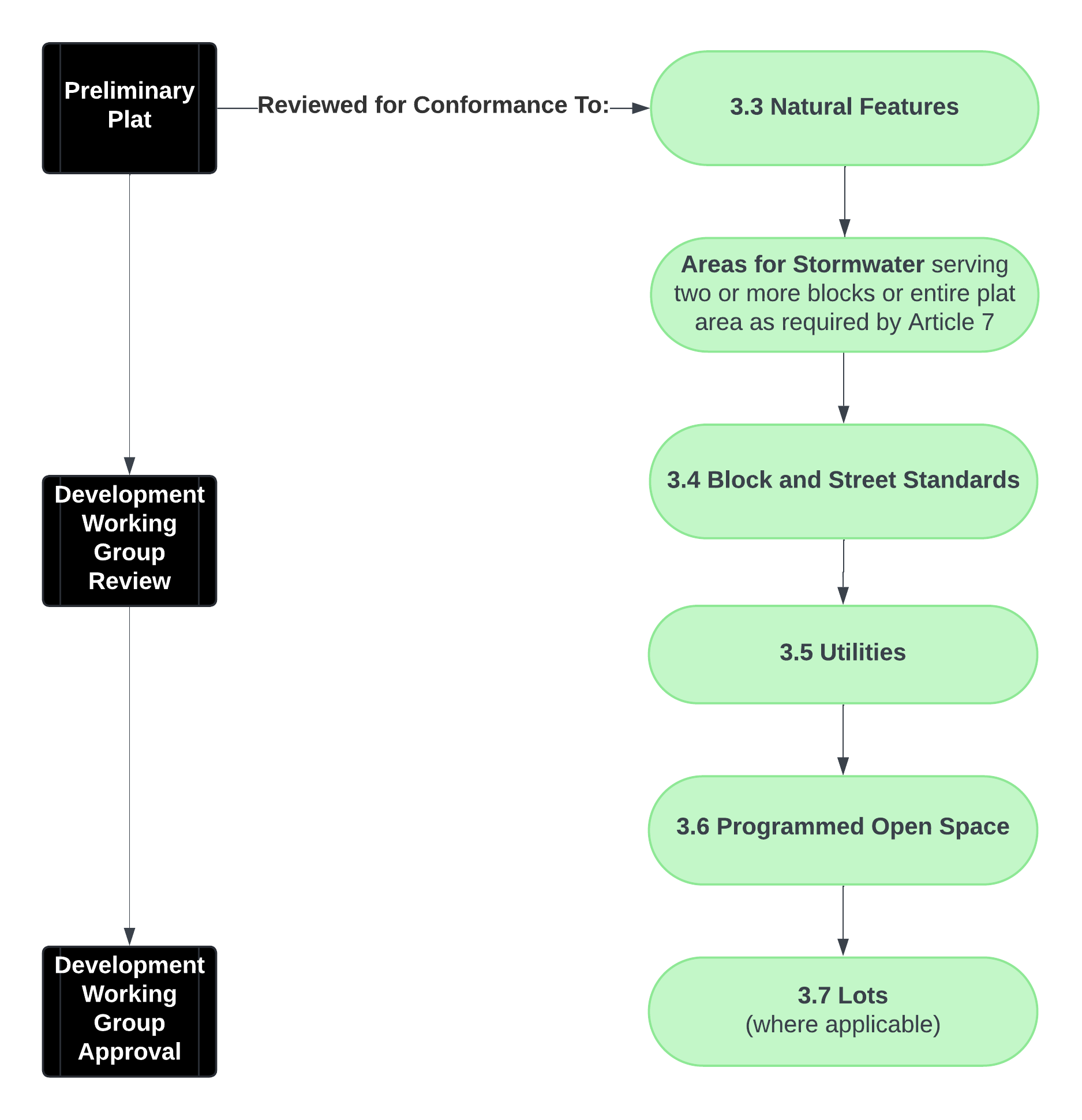
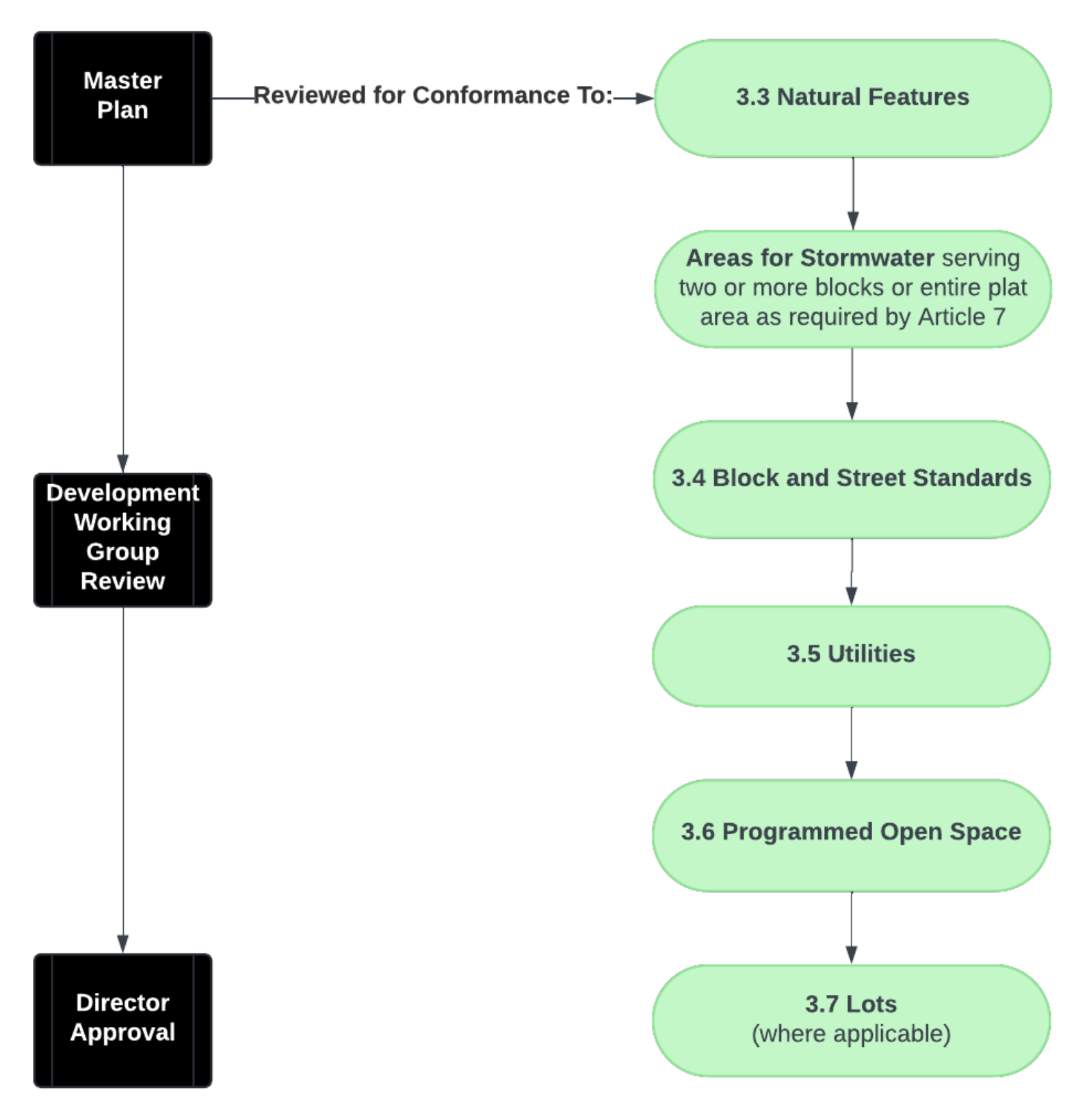
2.4.1 Purpose and Intent
The purpose of this section is to ensure that the intent of the Comprehensive Plan and this UDC are implemented by conserving natural features, setting aside land for stormwater management where necessary, establishing city blocks and a connected street network, identifying utility corridors when not located in streets, and identifying sites for programmed open space before considering vertical site development whether or not the developer intends to subdivide the property.
2.4.2 Applicability
Approval of a Master Plan is required for any property or two or more contiguous properties under common ownership that:
- Is proposed to be subdivided and public improvements are required; or
- Has a dimension exceeding 600 feet; or
- Lies adjacent to a site with a street stub or front parking lane stub; or
- Lies on the opposite side of a street from an intersecting street; or
- Lies along a city corridor place type; or
- Lies within 800 feet of a street intersection qualifying as a neighborhood center placetype; or
- Has a land disturbance area exceeding one acre; or
- Where the site area exceeds 2 acres in area; or
- Where rezoning a tract of land into two or more zones.
(Ord 25-35, 7-8-2025)
2.4.3 Exemptions
The Director is expressly authorized to waive the requirement for filing a Master Plan where:
- Public improvements are not required and when street connections and blocks are not required by this UDC; or
- Public improvements are not required and street connections and blocks required by this UDC are already provided; or
- Where building construction is not proposed and site improvements, if proposed, do not exceed 10% of site area or 20,000 square feet, whichever is less.
(Ord 25-35, 7-8-2025)
2.4.4 Review Criteria
No Master Plan may be approved unless the Director finds that:
- Natural features are preserved per 3.3 Natural Features; and
- Where stormwater management is required to serve more than one block or the entire plan area such space is set aside per Article 7; and
- Blocks are depicted as required by 3.4.2 Block Standards; and
- The street network conforms to 3.4.3 Street Network Standards and the Master Street Plan and is sufficient to serve the development intensity and uses allowed by zoning; and
- Street typologies conforming to 3.4.5 Street Typologies are applied to each street, and that selected typologies will, in the determination of the Director, create a placetype envisioned by the Future Land Use Map and is appropriate for the development intensity and uses allowed by zoning; and
- Alleys are shown where required by 3.4.13 Alleys or where appropriate for the development intensity and uses allowed by zoning; and
Utilities are located within streets and alleys, or where permitted in utility corridors outside of streets and alleys, and are located in a manner that allows vertical construction in conformance with this UDC; and
- Open spaces are depicted when required in conformance to 3.6 Programmed Open Space; and
- If subdividing blocks in the near term, lots per 3.7 Lots; and
- Any administrative adjustments from any of the above standards according to 2.4.9 and 2.11.
(Ord 25-35, 7-8-2025)
2.4.5 Development Working Group
The Development Working Group shall review complete applications for Master Plans and provide advice to the Director, who shall, using the criteria provided in 2.4.4 take any action authorized by 1.7.6. Where a zoning map amendment for two or more zones is proposed, approval of the Master Plan is conditional upon approval of the companion zoning map amendment.
(Ord 25-35, 7-8-2025)
2.4.6 Referral to Planning Commission
The Director may, at their discretion, elect to refer any Master Plan application to the Planning Commission. The Planning Commission is not required to hold a public hearing and shall review the referred application using the review criteria found in 2.4.4 and may, by a majority of the quorum present, take any action found in 2.4.6.
(Ord 25-35, 7-8-2025)
2.4.7 Appeals
The Director's decision may be appealed under Section 2.13.
2.4.8 Effect of Approval
No site development plan or final plat may be approved unless and until a Master Plan is approved. Master Plan approval does not constitute approval of site development plans, a final plat, or construction plans, even if such plans were submitted as part of the plan set, nor does it authorize the conveyance of a portion of the land therein. Approved Master Plans are regulatory and all development proposed for the site must conform thereto.
(Ord 25-35, 7-8-2025)
2.4.9 Administrative Relief
In considering Master Plans, the Director may grant an administrative relief from any standard of Article 3 where said article expressly grants such authority and according to Section 2.11 Administrative Relief.
(Ord 25-35, 7-8-2025)
2.4.10 Master Plan as Substitute for Preliminary Plat
Approval of a Master Plan is equivalent to approval of a preliminary plat, and no separate preliminary plat approval shall be required.
(Ord 25-35, 7-8-2025)
2.4.11 Amendments
Any amendment to an approved Master Plan must be processed as a new preliminary plat requiring Development Working Group review and Director approval which, once granted, supersedes the previously approved Master Plan except that the Director may approve any amendment deemed minor without Development Working Group review, as follows:
- Where block sizes are reduced; or
- Where additional pedestrian ways are proposed; or
- Where park spaces are relocated or adjusted in any manner consistent with Section 3.8; or
- Where phasing boundaries or order are proposed to be adjusted; or
- Where stormwater plans are modified in any manner supported by the City Engineer when such modifications do not increase the block size.
(Ord 25-35, 7-8-2025)
2.4.12 Concurrent Review of Public Improvement Plans
Where a public improvement plan approval is required according to 2.5.2 an application for public improvement plan review may be filed before approval of the corresponding Master Plan subject to consent to do so given by the Director.
(Ord 25-35, 7-8-2025)
2.5.1 Purpose and Intent
The purpose of this section is to outline the process for review and approval of plans for the construction of public improvements.
2.5.2 Applicability
Public improvement plan review and permitting are required anytime public improvements are proposed.
2.5.3 Review Criteria
No public improvement plan shall be approved unless the Director has found that:
- The plan conforms to the approved Master Plan or site development plan; and
- The plan conforms to Article 3, Land Development Standards; and
- The plan conforms to Article 6, Engineering Manual; and
- The plan conforms to Article 7, Drainage Criteria Manual.
(Ord 25-35, 7-8-2025)
2.5.4 Development Working Group
2.5.5 Referral to Planning Commission
The Director may, at their discretion, elect to refer any public improvement plan application to the Planning Commission. The Planning Commission is not required to hold a public hearing and shall review the referred application using the review criteria found in 2.5.3 and may, by a majority of the quorum present, take any action found in 2.5.4.
2.5.6 Appeals
The Director's decision may be appealed under Section 2.13.
2.5.7 Effect of Approval
The Director's decision on a public improvement plan becomes final upon the lapse of the appeal period and satisfaction of conditions imposed after which public improvement permits may be issued per 2.5.8.
2.5.8 Permits
- After approval of public improvement plans the developer may apply for a public improvement permit.
- The developer must declare at the time of permit application filing whether they intend to perform the work authorized by the permit before recording a final plat or issuing a certificate of occupancy or whether they intend to provide a financial guarantee of the improvements.
- The permit must be issued to a licensed contractor qualified to perform the work as determined by the City Engineer.
2.5.9 Performance
No final plat shall be released for recording, certificate of occupancy issued, or financial guarantees released unless and until:
- The permit holder has completed the required public improvements under the plans approved and permit issued; and
- The permit holder has satisfied any conditions attached to the permit as determined by the City Engineer; and
- Said improvements have been accepted by the City Engineer; and
- As-built plans have been accepted by the City Engineer
2.5.10 Lapse of Approval
- Approved public improvement plans shall lapse one year from the date of approval unless permits have been issued and work has commenced and been diligently pursued.
- Issued permits shall expire one year from the date of issuance unless work authorized by the permit has been diligently pursued.
2.5.11 Concurrent Review of Master Plan
Where a Master Plan is required according to 2.4.2 an application for public improvement plan review may be filed before approval of the corresponding Master Plan subject to consent to do so given by the Director. However, public improvement plans filed before the Master Plan will not be reviewed.
(Ord 25-35, 7-8-2025)
2.6.1 Purpose and Intent
To ensure that parcels and lots within the City’s jurisdiction are created or adjusted consistent with the Comprehensive Plan and this UDC.
2.6.2 Applicability
Subdivision review and approval are required when any parcel of land or platted lot within the City is adjusted, subdivided into two or more parcels or lots, or consolidated with another parcel of land or platted lot; or when any portion of a building is divided into parcels for the purposes for conveyance. The subdivision review and approval process varies depending on whether public improvements are required to serve the proposed subdivision. The Director has sole discretion in determining whether public improvements are required.
(Ord 25-35, 7-8-2025)
2.6.5 Violations
It is a violation of this UDC for the owner of any property to subdivide or otherwise alter the legal description of their property without first obtaining approval of the subdivision from the Director.
Figure 2.7.A Site Development Plan Review Process
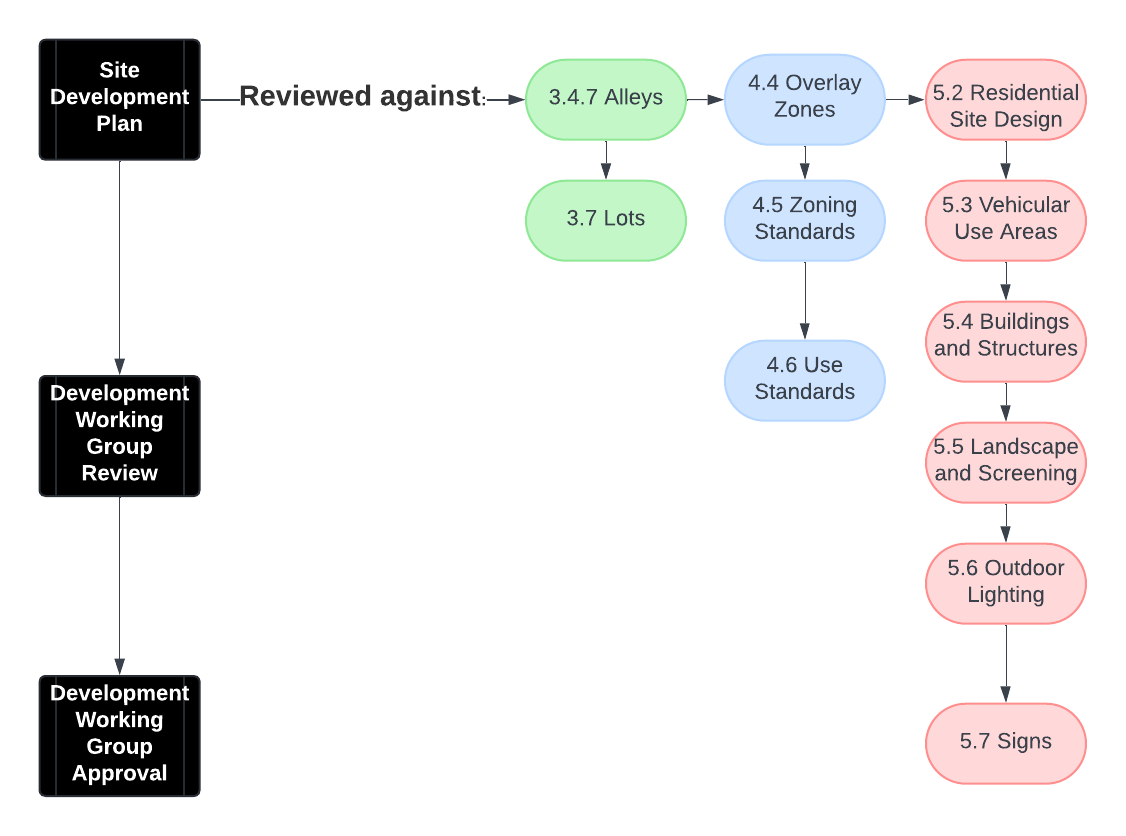
2.7.1 Purpose and Intent
To ensure projects fully conform to the requirements of this UDC, the approved Master Plan where applicable, and the Comprehensive Plan, and to ensure that the amount of review and oversight is commensurate with the scale and complexity of the application.
(Ord 25-35, 7-8-2025)
2.7.2 Applicability
Site development plan review is required for any development on any property where approval of a Master Plan according to 2.4.2 is required or where one has been approved. It is also required when one or more of the following is proposed whether or not a Master Plan is required.
Construction of any building exceeding 2,000 square feet; or
Any increase in impervious area coverage exceeding 2,000 square feet; or
Construction of two or more principal residential buildings on the same land lot; or
Establishment of any drive-through facility or auto service use in any zone; or
Establishment of outdoor storage in any T or HC zone when the storage is the principal use of the subject property or when the area of the storage exceeds the area of the principal use.
(Ord 25-35, 7-8-2025)
2.7.3 Exemptions
The following developments are exempted from site development plan review:
- Detached houses; or
- Attached houses on individual lots meeting the standards required of this code; or
- Accessory buildings serving a permitted residential use or serving any permitted nonresidential use when less than 2,000 square feet in floor area; or
- Buildings serving a permitted agricultural use.
(Ord 25-35, 7-8-2025)
2.7.4 Review Criteria
No site development plan will be approved unless the Director finds that the plan:
- Conforms to the approved Master Plan where such was required by Section 2.4; and
- Conforms to the applicable provisions of Article 4, Zoning Standards; and
- Conforms to the applicable provisions of Article 5, Site Development Standards; and
- Conforms to the purpose and intent of this UDC and the Comprehensive Plan.
(Ord 25-35, 7-8-2025)
2.7.5 Development Working Group
The Development Working Group shall review complete applications for site development plans and provide advice to the Director, who shall, using the criteria provided in 2.7.4 take any action authorized by 1.7.6.
2.7.6 Appeals
The Director's decision may be appealed under Section 2.13.
2.7.7 Effect of Approval
The Director's decision on a site development plan becomes final upon the lapse of the appeal period. No building permit will be issued until such date. Site development plan approval does not constitute approval of construction plans, even if such plans were submitted as part of the plan set.
2.7.8 Referral to Planning Commission
The Director may, at their discretion, elect to refer any site development plan application to the Planning Commission. The Planning Commission is not required to hold a public hearing and shall review the referred application using the review criteria found in 2.7.4 and may, by a simple majority of the quorum present, take any action found in 2.7.5.
2.7.9 Administrative Relief
In considering site development plans, the Director may grant administrative relief according to Section 2.11 Administrative Relief for any applicable provision of this UDC in which compliance with the applicable standard is impossible due to a property-specific reason. The Director is only authorized to grant such an adjustment where specified in this UDC; otherwise, the applicant must seek a variance through the Board of Adjustment.
(Ord 25-35, 7-8-2025)
2.7.10 Lapse of Approval
Site development plan approval lapses and has no further effect if grading or construction permits are not obtained and work authorized by such permits has not commenced within one year of the date of approval.
2.8.1 Purpose & Intent
To establish the process for zoning map amendment review.
2.8.2 Applicability
A zoning map amendment application may be filed by the property owner or their agent, or initiated by the Planning Commission, the Mayor, or the City Council. Should the City request and initiate a rezone request under this Article that request shall go directly to City Council without any required notices or hearings in front of the Planning Commission as found in this UDC.
(Ord 25-35, 7-8-2025)
2.8.3 Relationship with Future Land Use Map
The Future Land Use Map is an element of the Comprehensive Plan identifying placetypes that the Planning Commission and City Council have carefully considered and determined to be appropriate for the future growth of the City. According to Section 2.9 Comprehensive Plan Review, the map is periodically updated. Table 2.8.3.A Zoning Districts Allowed in Placetypes sets forth zoning districts that:
- Are likely to create the placetype envisioned by the Plan and thus conform to the Future Land Use Map. Such districts are subject to Standard Review.
- May create the placetype envisioned by the Plan and thus may conform to the Future Land Use Map. Such districts are subject to Standard Review and Enhanced Review.
- Will not create the placetype envisioned by the Plan and thus will not conform to the Future Land Use Map. Such districts will not be considered by the Planning Commission and City Council unless and until the Future Land Use Map and this UDC are amended accordingly.
2.8.4 Acceptance and Processing by Director
Applications for districts identified by blank cells will be set aside and no further processing will take place unless and until the Future Land Use Map and this UDC are amended to make them allowable for consideration. It is the stated intent of this UDC to ensure due process is provided for all property owners and in furtherance of this, the Director will cause the Future Land Use Map to be reviewed at least once per calendar year to determine if it should be amended. An owner of a property for which a zoning map amendment application was set aside during the preceding year may appear in a public hearing at such time to request an amendment that would allow their application to proceed. The Director will cause mailed notice to be provided to the owners filing such applications at least 15 days before the scheduled public hearing date for the Future Land Use Map review.
2.8.5 Public Hearing
The Planning Commission and City Council shall hold a public hearing unless specified otherwise in this UDC. Notice of the hearing before the Planning Commission shall be given per 2.3.4.1 Published Notice, 2.3.4.2 Mailed Notice, and 2.3.4.3 Posted Notice.
2.8.6 Standard Review Criteria
When reviewing and making decisions on zoning map amendments labeled “SR” in Table 2.8.3.A, the Planning Commission:
2.8.7 Enhanced Review Criteria
When reviewing and making decisions on zoning map amendments labeled “ER” in Table 2.8.3.A, the Planning Commission:
2.8.9 City Council Consideration and Action
Any application recommended for approval by the Planning Commission shall be placed on the next available City Council agenda. The City Council may act as follows:
- Approve the request as presented;
- Approve a modified request of lesser intensity or smaller land area;
- Remand the request to the Planning Commission for further study; or
- Deny the request.
(Ord 25-35, 7-8-2025)
2.9.1 Purpose and Intent
The purpose of this section is to set forth the procedure for reviewing the Comprehensive Plan.
2.9.2 Applicability
An application for Comprehensive Plan Review may only be initiated by the Director, the Planning Commission, the Mayor, or the City Council.
2.9.3 Periodic Review
The Comprehensive Plan must be reviewed at least once annually by the Planning Commission. Upon review, the Planning Commission may recommend amendments to the plan to the City Council.
2.9.4 Public Hearing
The Planning Commission shall hold a public hearing. Notice of the public hearing before the Planning Commission shall be given as required by 2.3.4.1. Mailed notice to owners of property filing an eligible zoning map amendment application since the last Comprehensive Plan Amendment hearing shall occur per 2.8.4.
2.9.5 Review Criteria
In considering amendments to the Comprehensive Plan, the Planning Commission must consider the following criteria:
- Whether the proposed amendment promotes fiscal and environmental sustainability; and
- Whether the proposed amendment meets the challenge of changing circumstances; and
- Whether the amendment promotes public health, safety, and welfare.
2.9.6 Planning Commission
After holding a public hearing, the Planning Commission will review proposed amendments against the review criteria of 2.9.5 and certify the proposed amendment as stated policy, certify as stated policy with revisions, or deny the proposed amendment.
2.9.7 City Council
Any amendment having received a recommendation of approval from the Planning Commission will be placed on the next available City Council agenda. The Council may approve the request as presented, remand the request to the Planning Commission for further study, or deny the application. Any action taken shall be by a majority vote of the quorum present.
2.11.1 Purpose & Intent
To provide a process for obtaining relief from specified standards of this UDC without the need to for a variance from the Board of Adjustment.
2.11.2 Applicability
The term administrative relief is an umbrella term intended to apply generally to both adjustments and waivers.
Administrative relief provisions of this section apply only when expressly stated. In all other cases, a variance from the Board of Adjustment shall be required.
When administrative relief is pursued, it must satisfy the decision-making criteria given in the specified section as well as 2.11.3.
When the term administrative adjustment is used, it shall be interpreted as meaning the Director has authority to adjust or modify the requirements but does not have authority to waive the requirement in its entirety. The Director is allowed to grant a waiver when specifically authorized in this UDC.
2.11.3 Review Criteria for Administrative Adjustments
The Director is authorized to grant an adjustment from strict application from the subject provision of this UDC when the Director finds that:
- The adjustment requested satisfies any review criteria provided in the specific section being adjusted; and
- The adjustment requested is no more than is necessary to carry out the related project; and
- The adjustment requested is consistent with the purpose and intent of this UDC; and
- The adjustment requested will have no adverse impact on the public health, safety, and welfare; or that such impacts have been mitigated to the maximum extent feasible.
2.11.4 Decision-Making Criteria for Administrative Waivers
The Director is authorized to grant an adjustment from the strict application of the subject provision of this UDC when the Director finds that:
- The waiver requested satisfies any review criteria provided in the specific section being adjusted; and
- Mere modification or adjustment to the standard in question will prevent the ability to carry out the project; and
- The adjustment requested is consistent with the purpose and intent of this UDC; and
- The adjustment requested will have no adverse impact on the public health, safety, and welfare; or that such impacts have been mitigated to the maximum extent feasible.
2.12.1 Purpose & Intent
The Board of Adjustment is authorized to grant a variance or waive from any provision of this UDC where strict enforcement of the provision would cause undue hardship due to circumstances unique to the individual property under consideration, and grant such variances or waivers only when it is demonstrated that such action will be in keeping with the spirit and intent of the provisions of the UDC.
2.12.2 Review Criteria
The Board of Adjustment shall consider the following in determining whether or not to grant a variance or waiver:
- Would the variance or waiver cause undue hardship to the property owner due to circumstances unique to the property; and
- Is the hardship a result of any action taken by the property owner or on their behalf; and
- Is the requested variance or waiver the minimum amount necessary to carry out the project; and
- Is there another reasonable method of avoiding the need for a variance or waiver; and
- Any other factor the Board feels is important to consider in keeping with the purpose and intent of this UDC.
(Ord 25-35, 7-8-2025)
2.12.3 Public Hearing
2.13.1 Purpose and Intent
To establish the process for filing and hearing appeals of final determinations or enforcement decisions issued by the Director as authorized by this UDC.
2.13.2 Applicability
Any written interpretation of this UDC made by the Director or final determination or enforcement decision issued by the Director as authorized by this UDC may be appealed by filing a request for appeal with the City Clerk, with a copy to the Director, within 30 days of the date of the final determination or enforcement decision was issued.
2.13.3 Eligibility
Appeals may only be filed by the owner of the subject property where a final determination or enforcement decision is given by the Director.
2.13.4 Review Criteria
In reviewing the appellant’s request, the Board of Adjustment shall review the Director’s decision and whether it was made in keeping with the spirit and intent of the UDC. Both the applicant and Director shall be allowed to present arguments to the Board at the public hearing. The burden of proof that the Director’s final determination or enforcement decision of this Chapter was incorrect shall reside with the applicant. The applicant must show by a preponderance of the evidence that the Director’s decision was incorrect in keeping with the spirit and intent of the UDC.
2.13.5 Board of Adjustment
By majority vote, the Board may uphold the Director’s final determination or enforcement decision in full; modify the Director's final determination or enforcement decision in part; or, overturn the final determination or enforcement decision in whole.
2.13.6 Ex Parte Communication
Neither the applicant nor the Director shall communicate with members of the Board of Adjustment, any of whom may serve as Board members, regarding a pending appeal application outside of the public hearing. The decision rendered by the Board on an appeal shall be based solely on the evidence presented at the hearing.
2.14.1 Purpose & Intent
To ensure that the development of the City is carried out in a manner consistent with the Comprehensive Plan and this UDC.
2.14.2 Applicability
An application for a development permit must be filed and approved by the Director before the construction, removal, modification, or installation of anything regulated by this UDC that does not require a construction plan review or before the issuance of a building permit. In lieu of an application and before the issuance of a development permit, the Director shall review any proposal for:
- Exterior changes to any existing building that either expands or reduces the current structure;
- Changes to any site, including but not limited to, grading, tree removal, land disturbance, etc.;
- Changes to any site improvement, including but not limited to, changes to any parking area and access, sidewalks, trails, lighting, landscaping, etc.; or
- Construction of any new structure or site improvement.
2.14.3 Review by Director
Any city official responsible for granting approval of anything noted in 2.14.2 Applicability must notify the Director of the request and provide a reasonable timeframe for review before approving. The Director must respond to such a request within the time frame allotted by the official granting such approval.
2.14.4 Violations
It is a violation of this UDC for a property owner to proceed with work without securing a development permit from the Director.
2.15.1 Applicability
A disturbance permit is required before:
- Any grading, clearing, filling, cutting, quarrying, construction, or similar activities that would result in a disturbed area of one acre or larger; or
- All developments and land alterations within a special flood hazard area or other high-risk area; or
All developments and land alterations that require approval of a site development plan or public improvement plan, or site development plan is proposed for any site containing; or:
10,000 square feet of contiguous canopy cover; or
Any area of canopy cover onsite that is contiguous with canopy cover on an abutting site that when combined exceeds 10,000 square feet of contiguous canopy
cover.
The removal of eight or more individual priority trees [as defined in list section] or where
approval of a master plan, public improvement plan, or site development plan is proposed.
- All developments and land alterations within the Cave Springs Karst (CSK) vulnerability zones 1, 2, or 3; or
- Stockpiling of construction materials, not to exceed six months; or
- As required by the City Engineer.
(Ord 25-35, 7-8-2025)
2.15.2 Permit Review and Issuance
The Director shall review complete applications against the applicable requirements of Article 6 and Article 7 of this UDC. Grading plans shall conform to the Phase II Stormwater Regulations as established by the United States Environmental Protection Agency’s regulations, Region VI published in the July 6th, 1998, Federal Register or its latest revisions. A copy of the ADEQ Notice of Coverage or Small Site Notice permit shall be required for all sites of one acre or more. A fee for each disturbance permit shall be paid to the City as currently established or as hereafter adopted by resolution of the City Council from time to time. Once all required documentation is submitted, the owner, engineer, and contractor will be notified and a pre-construction meeting with a Planning Inspector will be scheduled within 10 business days. Installation of Best Management Practices (BMPs), not to exceed the installation of the construction entrance, silt fence, wattle, sediment basins, and other typical BMPs may begin after project approval and before issuance of the disturbance permit. The disturbance permit will be issued on-site during the pre-construction meeting by the Inspector if there are no punch-list items to be addressed.
(Ord 25-35, 7-8-2025)
2.15.3 Violations
No land shall be altered or cleared to the extent regulated in this article unless approved by a permit. Any person who engages in land alteration activities regulated by this article without obtaining a disturbance permit shall be required to restore the land, to the maximum extent practicable to its original condition. The responsible party shall be liable for all fines levied or remedial action required under this article. Each high-priority tree illegally removed or improperly preserved or any other activity proscribed by this division shall be a separate violation. Any violation of this section shall be subject to the penalties authorized by law.
2.15.4 Exemptions
A disturbance permit shall not be required for emergency work or repairs to protect public health, safety, and welfare. Removal of damaged or diseased trees will be permitted by the Director who may require a report from a certified arborist or other tree care professional. As used in this subsection, “diseased tree” means any tree with a structural defect or a health condition, which makes it subject to a high probability of failure.
2.15.5 Preliminary Grading Permit
All rules governing the issuance of the preliminary grading permit apply with the following exceptions and requirements:
2.15.6 Floodplain Development Permit
The floodplain development permit is issued as part of the land disturbance permit and shall also meet the following regulations and requirements:
2.3.2.1 Concept Consultations
Concept consultations are intended for projects at an idea or concept stage before the contract on a property and before the creation of sketches or plans for the applicant to share their idea or concept and to obtain preliminary feedback from DRG. Concept consultations are required when the subject property meets one or more of the qualifications below, otherwise they are optional.
- Is proposed to be subdivided and public improvements are required; or
- Has a dimension exceeding 600 feet; or
- Lies adjacent to a site with a street stub or front parking lane stub; or
- Lies on the opposite side of a street from an intersecting street; or
- Lies along a city corridor place type; or
- Lies within 800 feet of a street intersection qualifying as a neighborhood center placetype; or
- Has a land disturbance area exceeding one acre; or
- Where the site area exceeds 2 acres in area.
2.3.2.2 Sketch Consultations
Sketch consultations are to be utilized after sketches or draft plans have been prepared to allow Development Working Group to provide initial feedback, outline required entitlement procedures, and allow the applicant to ask questions and receive answers. The Director may require sketch consultations on a case-by-case basis. Otherwise, such consultations are optional.
(Ord 25-35, 7-8-2025)
2.3.2.3 Pre-Application Consultations
Pre-application consultations are to be utilized immediately before application filing with the primary purpose being for the applicant to present their application to DRG. This is generally necessary for complex projects or ones with unusual details or nuances that could be lost without advance communication to facilitate review after filing. The Director may require pre-application consultations on a case-by-case basis. Otherwise, such consultations are optional.
2.3.2.1 Director's Minimum Submittal Requirements
The Director will publish a technical checklist of minimum submittal requirements for each development review procedure in this article. The Director is expressly authorized to require the submission of any information necessary to evaluate the application against the applicable requirements of this UDC and the Comprehensive Plan, even where such information may not be listed in the Director’s Minimum Submittal Requirements. The Director is also authorized to waive specific requirements on a case-by-case basis and to periodically update and reissue the minimum submittal requirements.
2.3.2.2 Fees
Fees, as stated in Appendix B of the Rogers Code of Ordinances, must be paid at the time of application filing.
(Ord 25-35, 7-8-2025)
2.3.2.3 Quality Control Review
Upon filing of an application, the Director will determine if the application satisfies the Director’s Minimum Submittal Requirements and whether fees have been paid in full. If both have been completed as required the application is deemed to have passed quality control review and the Director will cause review of the application to begin. If either has not been completed as required the application is deemed to have failed quality control review and the Director will notify the applicant of the deficiencies and will not cause review of the application to commence until the deficiencies have been corrected. Any application with a failed quality control review not rectified by an applicant within 30 days is deemed withdrawn by the applicant and will be removed from further action.
(Ord 25-35, 7-8-2025)
2.3.4.1 Published Notice
Published notice must identify the project by case number or name, its location, and the date, time, and place of the public hearing in a newspaper of general circulation in the county. Such notice must be published at least 15 days before the hearing date.
(Ord 25-35, 7-8-2025)
2.3.4.2 Mailed Notice
The mailed notice must identify the project by case number or name, its location, where additional information can be obtained on the project, and the date, time, and place of the public hearing. Mailed notice must be sent via certified mail to the owners of all properties 300 feet of the boundaries of the subject property. The notice must be postmarked at least 15 calendar days before the hearing date.
(Ord 25-35, 7-8-2025)
2.3.4.3 Posted Notice
Posted notice must identify the project by case number or name, where additional information can be obtained on the project and the date, time, and place of the public hearing. Posted notice must be placed on the subject property in a manner and number that it is visible from an abutting right-of-way. Posted notice must be posted at least 15 days before the hearing date.
2.3.4.4 Courtesy Notice
The City and the applicant may, at their discretion, conduct additional public notice and engagement in a manner appropriate to the location of the property and the nature of the project. Such courtesy notice may occur through various means including by subscription service and broadcast, print, or social media.
2.6.2.1 Public Improvements Required
When public improvements are required the applicant must obtain approval of the following:
- Master Plan according to 2.4; and
- Public Improvement Plan and permit according to 2.5; and
- Final Plat as required by 2.6.3
(Ord 25-35, 7-8-2025)
2.6.2.2 Public Improvements Not Required
When the Director determines public improvements are not required, the applicant need only obtain approval of a final plat as required by 2.6.3, Final Plats.
(Ord 25-35, 7-8-2025)
Figure 2.6.3.A Final Plat Process & Applicable Standards
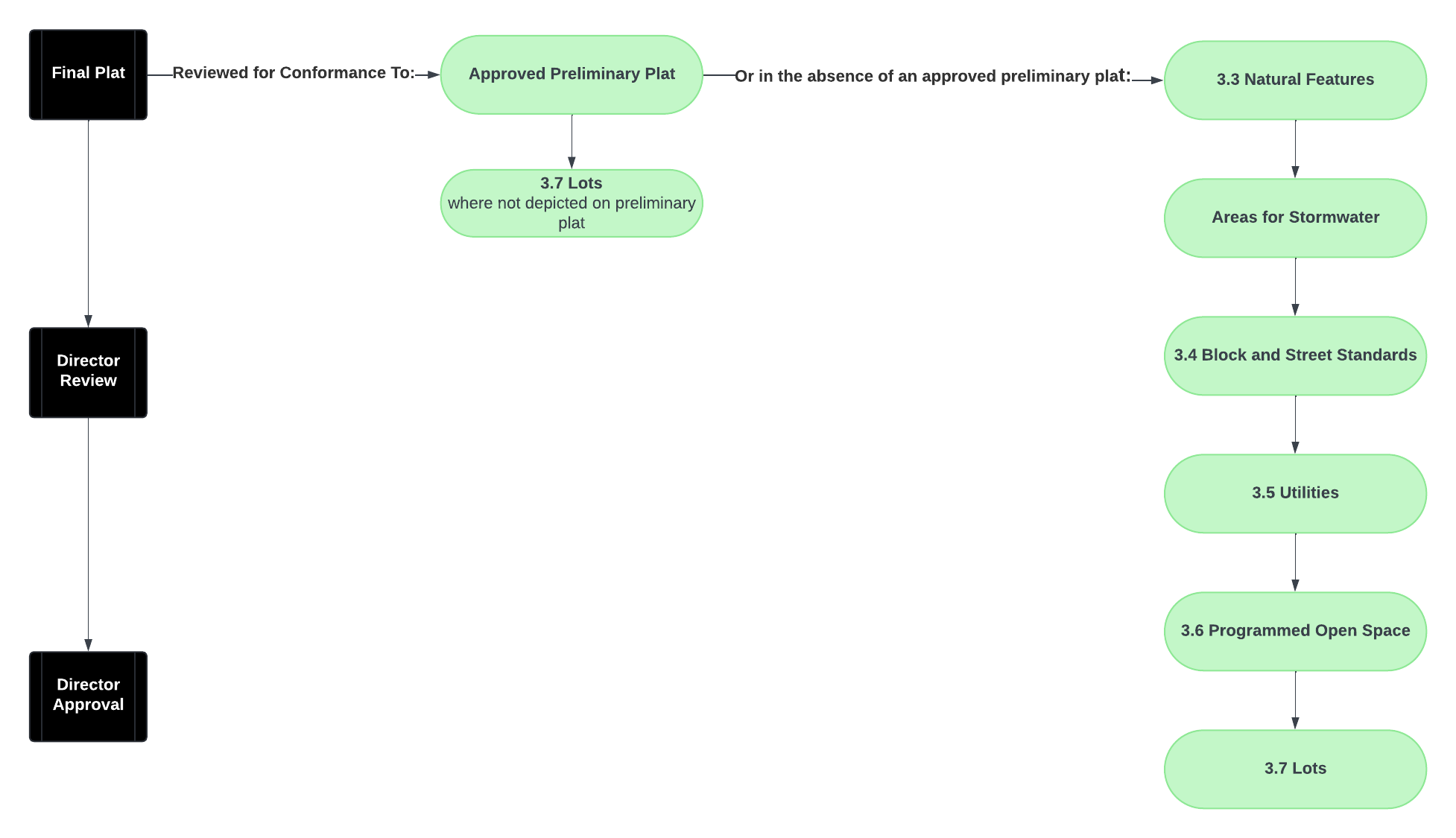
2.6.3.1 Review Criteria
In considering a final plat, the Director will consider whether the proposed final plat conforms to this UDC and the approved Master Plan, if one was required, or if one was not required that:
- Conforms to the requirements of this UDC; and
- Results in lots of sizes, dimensions, and arrangements suitable for the allowed development; and
- Conforms to the comprehensive plan.
(Ord 25-35, 7-8-2025)
2.6.3.2 Director
The Director has final decision-making authority on the subdivision of land proposed in a final plat, but any final plat proposing dedication of easements or right-of-way to the City may only be approved by the Director subject on the condition that the easements and rights-of-way are accepted by the City Council.
- The Director will consider a complete application for the final plat and after considering the review criteria of 2.6.3.2 must approve, approve with conditions, or defer approval pending resolution of the deficiencies which prevent its approval.
- The Director's decision is final unless appealed.
(Ord 25-35, 7-8-2025)
2.6.3.3 Appeals
The Director's decision may be appealed under Section 2.13.
2.6.3.4 City Council
Any easement or right-of-way shown on a final plat to be dedicated to the City must be accepted by the City Council prior to recording the plat.
(Ord 25-35, 7-8-2025)
2.6.3.5 Recording
No final plat will be recorded until:
- All public improvements, if required, have been constructed and accepted or a financial guarantee for the same has been accepted by the Director; and
- All conditions imposed by the Director, DWG, or the Planning Commission, whichever applies, have been satisfied; and
- City Council has approved the final plat with all dedicated easements and rights-of-way to the City, and the Mayor and City Clerk shall sign the final plat prior to its recording.
(Ord 20-24, 11-12-2024; Ord 25-35, 7-8-2025)
Table 2.8.3.A Zoning Districts Allowed in Placetypes
Place Type | T2 | T3.1 | T3.2 | T4.1 | T4.2 | T5.1 | T5.2 | T5.3 | T6.1 | T6.2 | T6.3 | HC | I-1 | I-2 |
|---|---|---|---|---|---|---|---|---|---|---|---|---|---|---|
| Regional Center | ||||||||||||||
Uptown Regional Center | ER | SR | SR | SR | SR | ER | ||||||||
Northwest Regional Center | ER | SR | SR | SR | SR | |||||||||
Pleasant Grove Regional Center | SR | SR | SR | SR | SR | SR | ||||||||
| City Centers | ||||||||||||||
Downtown City Center | SR | SR | SR | ER | ||||||||||
Midtown City Center | SR | SR | SR | SR | ||||||||||
Southwest | SR | SR | SR | SR | ||||||||||
| Neighborhood Centers | ||||||||||||||
Neighborhood Center | ER | ER | ER | |||||||||||
| Neighborhoods | ||||||||||||||
Urban Neighborhood | ER | SR | SR | ER | ||||||||||
Fabric | SR | SR | ER | |||||||||||
Downtown | ER | SR | ER | |||||||||||
Suburban Neighborhood | SR | SR | SR | |||||||||||
| Corridors | ||||||||||||||
City | ER | SR | SR | ER | ||||||||||
Regional | SR | SR | SR | ER | ||||||||||
Highway | SR | SR | SR | ER | ||||||||||
| Industry and Technology | ||||||||||||||
Industry and Technology | SR | SR | SR | SR | ||||||||||
| SR = Districts likely to create the place type and thus subject to Standard Review by the Planning Commission and City Council | ||||||||||||||
| ER = Districts that may create the place type and thus subject to both Standard Review and Enhanced Review by the Planning Commission and City Council. | ||||||||||||||
| Blank = Will not create the place type envisioned by the Plan and thus will not conform to the Future Land Use Map. Such districts will not be considered by the Planning Commission and City Council unless and until the Future Land Use Map and this UDC are amended accordingly. | ||||||||||||||
Table 2.8.3.B Zoning Mix for Sites Over 40 Acres
Place Type | T2 | T3.1 | T3.2 | T4.1 | T4.2 | T5.1 | T5.2 | T5.3 | T6.1 | T6.2 | T6.3 | HC | I-1 | I-2 |
|---|---|---|---|---|---|---|---|---|---|---|---|---|---|---|
| Regional Center | ||||||||||||||
Uptown Regional Center | 20% | 40% | 60% | 60% | 60% | 20% | ||||||||
Northwest Regional Center | 20% | 40% | 60% | 60% | 40% | |||||||||
Pleasant Grove Regional Center | 40% | 60% | 60% | 40% | 20% | 60% | ||||||||
| City Centers | ||||||||||||||
Downtown City Center | 20% | 40% | 100% | 20% | ||||||||||
Midtown City Center | 20% | 40% | 100% | 40% | ||||||||||
Southwest | 20% | 60% | 60% | 20% | ||||||||||
| Neighborhood Centers | ||||||||||||||
Neighborhood Center | 20% | 60% | 80% | |||||||||||
| Neighborhoods | ||||||||||||||
Urban Neighborhood | 20% | 40% | 80% | 20% | ||||||||||
Fabric | 40% | 80% | 40% | |||||||||||
Downtown | 100% | 80% | 20% | |||||||||||
Suburban Neighborhood | 40% | 80% | 20% | |||||||||||
| Corridors | ||||||||||||||
City | 20% | 100% | 100% | 60% | 20% | |||||||||
Regional | 20% | 40% | 100% | 100% | 40% | |||||||||
Highway | 40% | 40% | 100% | 40% | ||||||||||
| Industry and Technology | ||||||||||||||
Industry and Technology | 50% | 40% | 100% | 60% | ||||||||||
2.8.3.1 Zoning Transition in Neighborhood Centers
Neighborhood Centers may extend up to 660 feet or one block, whichever is less, from the designated intersection shown on the Master Street Plan and Future Land Use Map. When zoning map amendments are proposed in Neighborhood Centers adjacent to Suburban Neighborhood placetypes, the proposed zoning plan shall include two or more zones with the most intense zone located closer to the intersection. Zoning boundaries shall follow mid-block lines such as alleys or interior property lines rather than along streets.
(Ord 25-35, 7-8-2025)
2.8.3.2 Exemptions
- Uses categorized as “Civic Spaces” are exempt from adhering to Table 2.8.3.B Zoning Mix for Sites Over 40 Acres.
(Ord 25-35, 7-8-2025)
2.8.6.1 Rezoning to a Transect District
Shall recommend approval of the proposed district(s) where they conform to the applicable requirements of this UDC.
2.8.6.2 Rezoning to a Special Purpose District
Shall recommend approval of the proposed district(s) where the Commission finds:
- The proposed district(s) conform to the applicable requirements of this UDC; and
- The proposed district(s) are likely to implement the place type envisioned by the Future Land Use Map; and
- Adequate infrastructure exists to serve the development permitted in the proposed district(s); and
- The property is unlikely to develop, or poorly suited for development allowed under the current district(s); and
- The proposed district will result in development compatible with the placetype assigned to nearby properties.
2.8.7.1 Rezonings to Transect Districts
May recommend approval where the Commission finds:
- The proposed district(s) conform to the applicable requirements of this UDC; and
- The proposed district(s) are likely to implement the place type envisioned by the Future Land Use Map; and
- The proposed district(s) contribute to establishing an orderly transition of intensity within the broader place type by:
- Where the subject property is within a center and corridor placetype ensuring higher intensity zones are generally interior to the placetype to provide an orderly transition between the center and edge of the placetype; or
- Where the subject property is within a neighborhood placetype ensuring higher intensity zones are generally located at the edges of the placetype when the neighborhood lies adjacent to a center or corridor placetype to provide an orderly transition between the edge of the neighborhood and the adjacent placetype; and
- The proposed district(s) is within one full transect of the most intense zone allowed on adjacent properties, except when:
- Significant natural barriers separate the two properties; or
- Roadways of three or more lanes separate the two properties; or
- The subject property is less than 600 feet in depth, abuts a street classified as an arterial according to the Master Street Plan, and the proposed rezoning is to District T5.1 or T5.2.
- If applicable, the proposed district(s) conform to the zone mix requirements specified in Table Table 2.4.3.C Zoning Mix for Sites Over 40 Acres.
2.8.7.2 Rezonings to Special Purpose Districts
May recommend approval where the Commission finds:
- The proposed district(s) conform to the applicable requirements of this UDC; and
- The proposed district(s) are likely to implement the place type envisioned by the Future Land Use Map; and
- Adequate infrastructure exists to serve the development permitted in the proposed district(s); and
- The property is unlikely to develop, or poorly suited for development allowed under the current district(s); and
- Development allowed in the proposed district is less likely to detrimentally affect nearby properties than development allowed by a district subject only to standard review in the same place type; and
- The proposed district is more likely to protect the public health, safety, and welfare than any district subject only to standard review in the same place type; or
- The proposed district is necessary to allow economic development of regional significance or a use unique in the region and its impact can be mitigated to preserve the public’s health, safety, and welfare.
2.8.8.1 Standard Review Districts
Where the Director recommends approval of the application they shall cause the Commission to be presented with the request as part of its consent agenda. Interested persons must be provided an opportunity to speak in a public hearing before consideration of the consent agenda. Thereafter the Commission must take one of the following actions:
- Accept the findings and recommendations of the Director and recommend approval of the rezoning by a majority vote of the quorum present as part of the consent agenda; or
- Remove the application from the consent agenda for commissioner discussion on the application after which the Commission may accept the findings and recommendations of the Director and recommend approval of the rezoning by a majority vote of the quorum present or issue its findings and recommend approval or denial by majority vote of the quorum present.
2.8.8.2 Enhanced Review Districts
The Director shall place applications for enhanced review districts on the regular agenda and the Commission shall hold a separate public hearing. After holding a public hearing, the Commission must by a majority vote of the quorum present:
- Recommend approval or denial. Either motion is deemed to pass when a majority of the quorum present vote in favor; or
- Table the request to a date certain not to exceed 60 days for more information. Such a motion requires a majority of the quorum present to pass; or
- Dismiss the request and the applicant’s request. Such a motion requires a majority of the quorum present to pass.
(Ord 25-35, 7-8-2025)
2.15.5.1 Applicability
- The City Engineer may on a limited basis issue a preliminary grading permit to allow clearing, filling, excavating, demolition, or similar activities if:
- A corresponding Master Plan, public improvement plan, or site development plan has been approved; and
- The application does not contain any requests for administrative relief, waivers or variances that may change the grading at the location; and
- The applicant has displayed a hardship outside of the normal requirements of code and conveys the reason for the request within a written narrative.
- No construction, including, but not limited to, foundation work on structures, vehicular use areas, development, or other improvements is authorized by the issuance of a preliminary grading permit.
- Preliminary grading permits must be secured by a bond in the amount appropriate to restore the site to completion of construction standards. As used in this section, completion of construction means any construction site with a grading permit in which:
- Development and grading within the disturbed area is complete or approved by the City Engineer to submit a Performance Bond, and conforms to an approved Master Plan, site development plan, or public improvement plan; and
- The disturbed soil area is observed to have 80% grass coverage and 100% stability; and
- No slopes steeper than a 3:1 pitch are present onsite unless otherwise approved in writing by the City Engineer; and
- Notice of violations issued have been satisfactorily resolved with an inspection report signed by the City Engineer; and
- All heavy equipment, stockpiles, and construction site materials have been removed from the construction site.
- A Preliminary grading permit will expire six months after the date of issuance, and must meet the defined completion of construction 2.15.5.1.C (II), (III), (IV), and (V), or must be converted to a full grading permit.
(Ord 25-35, 7-8-2025)
2.15.6.1 Applicability
A Floodplain Development permit is required for all structural development, placement of manufactured structures, clearing, grading, mining, drilling, dredging, placement of fill, excavating, watercourse alteration, drainage improvements, roadway or bridge construction, individual water or sewer installations or any other development in or adjacent to a special flood hazard area or other high-risk areas.
Sections 2.15.6 and 2.15.6.1 amended by Ordinance 24-37 passed October 22, 2024
2.15.7.2 Permit Application
- An application for a Floodplain Development permit shall be presented to the Floodplain Administrator on forms furnished by him and may include, but not be limited to, plans in duplicate drawn to scale showing the location, dimensions, and elevation of proposed landscape alterations, existing and proposed structures, including the placement of manufactured homes, and the location of the foregoing in relation to areas of special flood hazard.
- The documentation required with an application for a Floodplain Development permit is dependent upon the type of development proposed and the risk zone of the proposed development site. Section 22-105 contains the general standards for all developments in all risk zones. Section 22-106 contains standards for specific development types in specific risk zones.
2.15.7.3 Elevation Certificates
Elevation certificates shall be required for all structural development in or adjacent to special flood hazard areas and other high-risk areas as indicated in a memo for record included within the Floodplain Development permit. The types of elevation certificates are outlined in Section 22-105 (22).

