
Rogers City Zoning Code
ARTICLE 4
ZONING STANDARDS
Section 4.1 Purpose and Intent
- To achieve the goals of the Comprehensive Plan, most zoning districts are based upon The Rural-to-Urban Transect, a commonly used system for organizing form-based zoning districts. These are referred to as transect districts or transect zones.
- Additional zoning districts are available for properties that, by the nature of their use, location, or development pattern, should continue to be regulated principally by use. These are referred to as special purpose districts or zones.
- The purpose and intent of transect districts is:
- To support, restore, and revitalize historic neighborhoods, downtowns, and main streets;
- To direct new development to create new neighborhoods, downtowns, and main streets that are walkable, bikeable, and supportive of public transit, not only accessible by cars;
- To ensure compatibility among neighboring properties by controlling the height and arrangement of buildings as opposed to use alone;
- To utilize land efficiently to preserve rural and natural areas;
- To utilize streets and utility infrastructure efficiently to reduce the long-term maintenance burden on the City of Rogers; and
- To direct development to be compact, reducing the per-person cost of providing municipal and life safety services.
- The purpose and intent of special purpose districts is to:
- To strategically provide for uses dependent on vehicular support; and
- To provide a location for uses that can have a negative impact on adjacent uses.
Section 4.2 Transect Districts
- The City of Rogers is divided into the following transect districts, mapped on the “City of Rogers Official Zoning Map”.
- Regulations specifying zoning districts beginning with “T” include a primary identifier (T2, T3, T4, T5, and T6) and may include a secondary identifier (such as T3.1 and T3.2), applied as follows:
- Regulations that specify only the primary identifier of a zone without a secondary identifier apply to all secondary identifiers (e.g. T5 means T5.1 and T5.2);
- Regulations that specify the primary and secondary identifier only apply to the specific sub-zone specified by both the primary and secondary identifier (e.g. T5.2 does not apply to T5.1); and
- Regulations may mix specifications for only primary identifiers with other primary and secondary identifiers (e.g. T4 and T3.2). Such conditions are evaluated independently for each instance (e.g. T4 applies to T4.1 and T4.2, while T3.2 does not apply to T3.1).
| Identifier | Name | Description |
| T2 | Rural | A very low-intensity district intended for agricultural uses and as a temporary holding zone pending development. |
| T3.1 | Neighborhood Very Low Intensity | A very low-intensity district intended primarily for suburban neighborhood placetypes. |
| T3.2 | Neighborhood Low-Intensity | A low-intensity district intended primarily for suburban neighborhoods, neighborhood fabric, and downtown neighborhood placetypes where nonresidential uses are limited. |
| T4.1 | Neighborhood Medium-Intensity | A medium-intensity district intended primarily for neighborhood fabric, downtown neighborhood, and urban neighborhood placetypes where compatible nonresidential uses within walking distance of homes are allowed. |
| T4.2 | Neighborhood High-Intensity | A high-intensity district intended primarily for urban neighborhood placetypes where compatible nonresidential uses within walking distance of homes are encouraged. |
| T5.1 | City Low-Intensity | A low-intensity mixed-use district where medium-scale buildings line streets mainly in corridor and city center placetypes. |
| T5.2 | City Medium-Intensity | A medium-low intensity mixed-use district where medium to large-scale buildings line streets in corridor and city center placetypes. |
| T5.3 | City High-Intensity | A medium-intensity mixed-use, pedestrian-oriented district, where large-scale buildings line streets in center placetypes. |
| T6.1 | Regional Low-Intensity | A medium-high intensity mixed-use, pedestrian-oriented district where tall buildings line streets in center placetypes. |
| T6.2 | Regional Medium-Intensity | A high-intensity mixed-use, pedestrian-oriented district where tall buildings line streets in center placetypes. |
| T6.3 | Regional High-Intensity | A very high-intensity mixed-use, pedestrian-oriented district where tall buildings line streets in center placetypes. |
(Ord 25-35, 7-8-2025)
Section 4.3 Special Purpose Districts
- The City of Rogers is divided into the following special purpose districts, mapped on the “City of Rogers Official Zoning Map”
- HC: Highway Commercial;
- I-1: Light Industrial; and
- I-2: Large Format Industrial.
| Identifier | Name | Description |
| HC | Highway Commercial | A district consisting mostly of low-scale commercial strip development. These districts standards allow for the existing condition to persist, however also allow for under-utilized parts of parking lots to be filled with active uses. |
| I-1 | Light Industrial | An industrial district with uses that are not particularly noxious or dangerous, that can be integrated with other nearby mixed-use districts. |
| I-2 | Heavy Industrial | An industrial district with uses that are not particularly noxious or dangerous but tends to consist of very large buildings, storage, and significant movement of goods and materials. |
Section 4.5 Zone Standards
Table 4.5.A Selected Zone Standards includes an abbreviated selection of common requirements for each transect and special purpose zone. In addition to the standards of this table, development may be subject to additional zoning and site development standards.
| Standard | T2 | T3.1 | T3.2 | T4.1 | T4.2 | T5.1 | T5.2 | T5.3 | T6.1 | T6.2 | T6.3 | HC | I1 | I2 | See Also |
|---|---|---|---|---|---|---|---|---|---|---|---|---|---|---|---|
| Area Standards | |||||||||||||||
| Max Building Coverage (% of lot) | 30 | 40 | 50 | 60 | 70 | 90 | 100 | 100 | 100 | 100 | 100 | 70 | 80 | 80 | See 4.5.1 |
| Max. Impervious Surface (% of lot) | 30 | 50 | 60 | 70 | 80 | 100 | 100 | 100 | 100 | 100 | 100 | 80 | 80 | 80 | See 4.5.2 |
| Principal Buildings | |||||||||||||||
| Min. Exterior Yard (ft) | 30 | 20 | 15 | 10 | 5 | 0 | 0 | 0 | 0 | 0 | 0 | 30 | 30 | 30 | See 4.5.3.1 |
| Max. Exterior Yard (ft) | See 4.5.3.1 | 30 | 10 | 0 | 15 | 10 | 0 | None | See 4.5.3.1 | ||||||
| Min. Building Occupancy | None | 70 | 80 | 100 | 90 | 100 | 100 | See 4.5.4 | |||||||
| Min. Interior Yard (ft) | 30 | 10 | 5 | 5 | 5 | 0 | 0 | 0 | 0 | 0 | 0 | 20 | 20 | 20 | See 4.5.3.2 |
| Min. Interior Yard, Alleyside | 10 | 5 | 5 | 0 | 0 | 0 | 0 | 0 | 0 | 0 | 0 | 0 | 0 | 0 | See 4.5.3.2 |
| Max Building Height (stories) | 2 | 2.5 | 2.5 | 3 | 4 | 4 | 6 | 6 | 10 | 20 | 30 | 6 | 5 | 6 | See 4.5.5 |
| Ground Floor Spaces | |||||||||||||||
| Min. Floor to Ceiling Height (ft) | None | 12 | 12 | 12 | 12 | 12 | 14 | 14 | None | See 4.5.6 | |||||
| Min. Depth (ft) | None | 12 | 12 | 12 | 12 | 12 | 12 | 12 | None | See 4.5.6 | |||||
| Min Entry Frequency (ft) | None | 60 residential; 100 nonresidential | None | See 4.5.6 | |||||||||||
| Min Glazing (% of facade) | None | 15/15 | 50/25 | 50/25 | 50/25 | 70/25 | 50/25 | 50/25 | 70/25 | None | See 4.5.6 | ||||
| Upper Floor Space Min Glazing (% of facade) | None | 15 | 15 | 15 | 15 | 15 | 15 | 15 | 15 | 15 | None | See 4.5.6 | |||
| Accessory Buildings | |||||||||||||||
| Allowed In | Any Yard | Interior Yards Only | Any Yard | See 4.5.7 | |||||||||||
| Min. Yards | Same as provided by principal building | See 4.5.7 | |||||||||||||
| Max Height | 16 ft unless including a dwelling unit then 25 ft, not to exceed the height of the principal building | See 4.5.7 | |||||||||||||
| Vehicular Use Areas | |||||||||||||||
| Parking Lot Allowed in Exterior Yard | Yes | See 4.5.8 | Yes | See 4.5.8 | |||||||||||
| Max Driveway Area (% of each yard area) | None | See 4.5.9 | None | See 4.5.9 | |||||||||||
| Max Driveway Width at Sidewalk (ft) | See 4.5.9 | 32 | 32 | 32 | See 4.5.9 | ||||||||||
| Drive-through Allowed in Exterior Yard | See 4.5.11 | ||||||||||||||
| Max Fence or Wall Height in Exterior Yard (ft) | 4/8 | 4/6 | 4/6 | 4/6 | 4/6 | 4/6 | 4/6 | 4/6 | 4/6 | 4/6 | 4/6 | 4/6 | 6 | 6 | See 4.5.10 |
(Ord 25-35, 7-8-2025)
Section 4.6 Principal Uses
Table 4.6.A below outlines permitted principal uses by district by indicating "P". Uses prohibited are identified as blank cells. The use-specific standards in the right column should always be consulted prior to determining whether the use is allowable or feasible on any given property.
| Use | T2 | T3.1 | T3.2 | T4.1 | T4.2 | T5.1 | T5.2 | T5.3 | T6.1 | T6.2 | T6.3 | HC | I-1 | I-2 | Use-Specific Standards |
|---|---|---|---|---|---|---|---|---|---|---|---|---|---|---|---|
| LIVING, in a | P | P | P | P | P | P | P | P | P | P | P | P | P | 4.7.1 | |
| Detached House | P | P | P | P | P | P | |||||||||
| Cottage House | P | P | P | P | P | P | |||||||||
| Attached House | P | P | P | P | P | P | |||||||||
| Duplex | P | P | P | P | P | ||||||||||
| Multi-Unit House | P | P | P | P | P | ||||||||||
| Town House | P | P | P | P | P | P | P | P | |||||||
| Apartment House | P | P | P | P | P | P | P | ||||||||
| Live-Work Building | P | P | |||||||||||||
| Mixed-Use Building | P | P | P | P | P | P | P | P | |||||||
| AGRICULTURE | P | P | P | P | P | P | P | P | P | P | P | P | P | P | 4.7.2 |
| CIVIC SPACES | P | P | P | P | P | P | P | P | P | P | P | P | P | P | 4.7.3 |
| COMMUNITY SERVICES | P | P | P | P | P | P | P | P | P | 4.7.4 | |||||
| OFFICE | P | P | P | P | P | P | P | P | P | 4.7.5 | |||||
| PROFESSIONAL OR PERSONAL SERVICES | P | P | P | P | P | P | P | P | P | 4.7.6 | |||||
| EATING AND DRINKING | P | P | P | P | P | P | P | P | P | 4.7.7 | |||||
| HEALTHCARE SERVICE | P | P | P | P | P | P | P | P | 4.7.8 | ||||||
| LODGING | P | P | P | P | P | P | P | P | P | P | 4.7.20 | ||||
| PARKING | P | P | P | P | P | P | P | P | P | P | P | 4.7.9 | |||
| RETAIL | P | P | P | P | P | P | P | P | P | 4.7.10 | |||||
| ENTERTAINMENT OR EVENT VENUE | P | P | P | P | P | P | P | P | P | 4.7.11 | |||||
| ARTISANAL INDUSTRY | P | P | P | P | P | P | P | P | 4.7.12 | ||||||
| TECHNOLOGY INDUSTRY | P | P | P | P | P | P | P | P | 4.7.13 | ||||||
| AUTO SERVICE | P | P | P | P | P | P | P | P | 4.7.14 | ||||||
| FREIGHT, LOGISTICS, AND STORAGE | P | P | P | 4.7.15 | |||||||||||
| TRANSPORTATION SERVICES | P | P | 4.7.16 | ||||||||||||
| GENERAL INDUSTRY | P | 4.7.17 | |||||||||||||
| WASTE TREATMENT, SEPARATION, AND TRANSFER | P | 4.7.18 | |||||||||||||
| HEAVY INDUSTRY | P | 4.7.19 |
(Ord 25-35, 7-8-2025)
Section 4.8 Accessory Uses
Accessory uses, functions, and structures are those customarily found in association with the principal use of a property and which are subordinate in area, extent, and purpose to the principal use. The Director is expressly authorized to determine when an accessory use is permitted or prohibited. Accessory uses are not regulated any further by this UDC except as follows:
4.4.1 Purpose and Intent
- To establish additional or alternative building and site design requirements within specific areas of the community.
- In case of conflicts between the standards of an overlay district and other requirements of this code, the standards of the overlay district prevail.
- Overlay district standards apply only to sites within the district, as specified in the official zoning map.
4.5.1 Building Coverage
Reserved
4.5.2 Impervious Area
Reserved
4.5.3 Yards Generally
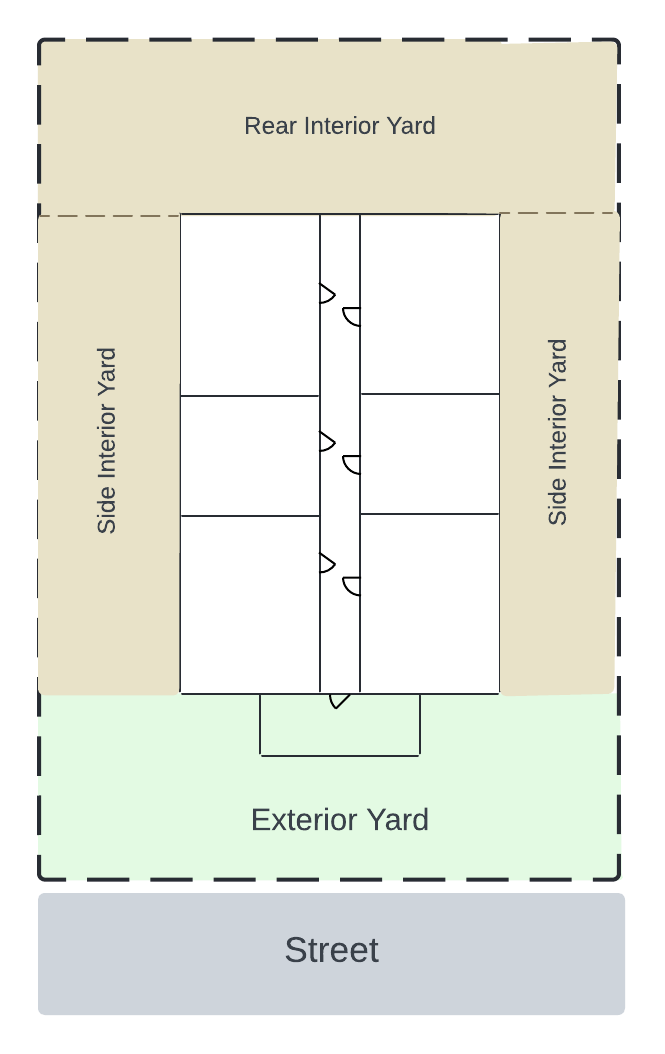
See 8.5.25 for definitions.
4.5.4 Minimum Building Occupancy
Maximum exterior yard depths establish a build-to area along street frontages where buildings must be located between the minimum and maximum setbacks, as illustrated in Table Figure 4.5.4.A Build-To Area Occupation Examples.A Build-To Area Occupation Examples.
4.5.6 Ground Floor Space Standards
The purpose of these standards is to ensure that buildings contribute to safe, active, and interesting placetypes by restricting blank walls, requiring frequent entries, and requiring that building ground floors along certain street typologies are designed to be occupied by active uses and not dedicated to storage or similar inactive spaces.
(Ord 25-35, 7-8-2025)
4.5.7 Accessory Buildings
All standards are located in Table 4.5.A.
4.5.8 Parking Located in Exterior Yards
These standards apply to parking located between buildings and streets.
4.5.10 Fences
The first of the two numbers in Table 4.5.A shall apply to fences in exterior yards. The second to fences in interior yards.
4.7.1 Living Uses
Living uses shall conform to the definition of a living use and dwelling unit provided in Article 10 and the following standards by building type. Where the provisions of these use standards conflict with other provisions of this UDC, these standards control.
4.7.2 Agriculture Uses
Nothing in this UDC seeks to expand any agricultural uses prohibited by Chapter 6 of the Rogers’ Code of Ordinance.
(Ord 25-35, 7-8-2025)
4.7.3 Civic Spaces
Reserved
4.7.4 Community Services
Such uses providing intensive services are prohibited in T4 in all cases and in T5 and T6 on a property with frontage on a mixed use street or boulevard. For the purposes of this use standard, "intensive services" shall mean services that are likely to result in loitering or queuing of pedestrians outdoors, including but not limited to provision of prepared food or sleeping accommodations.
4.7.5 Office
Reserved
4.7.6 Professional or Personal Services
Reserved
4.7.7 Eating and Drinking
In T4.2, such uses are allowed on the ground floor of a mixed-use building. Such uses are only allowed in a single-purpose building where:
Located within 660 feet or one block, whichever is less, of the intersection of two streets each being a collector or an arterial; and
They do not have a drive-through.
(Ord 25-35, 7-8-2025)
4.7.8 Healthcare Service
In T5 and T6 such uses are prohibited on lots with frontage on a mixed use street.
4.7.9 Parking
- These standards apply to off-street parking not dedicated to a particular use. Off-street parking intended for or dedicated to a particular use is considered accessory parking and is regulated elsewhere in the UDC.
- Surface parking is not allowed within 150 feet of a mixed-use street.
4.7.10 Retail
- In T4.2, such uses are allowed on the ground floor of a mixed-use building. Such uses are only allowed in a single-purpose building where:
- Located within 660 feet or one block, whichever is less, of the intersection of two streets each being a collector or an arterial; and
- They do not have a drive-through.
(Ord 25-35, 7-8-2025)
4.7.11 Entertainment or Event Venue
In T2 such uses are allowed only when located on properties exceeding 20 acres or when only occurring indoor and the building in which they occur is located at least 300 feet from the nearest residential use.
4.7.12 Artisanal Industry
In T5 and T6 such uses may not be located at ground level along a mixed use street or boulevard unless they occupy a storefront and at least 25% of the sales is derived from onsite transactions.
4.7.13 Technology Industry
In T5 and T6 such uses may not be located at ground level along a mixed use street.
4.7.14 Auto Service
- Such uses are prohibited on mixed use streets in centers.
- Such uses are prohibited on corner lots except in HC and I-1.
- Car washes are not permitted within 150 feet of any arterial street.
- Gas pumps must be accessory to a principal building and must be located in interior yards except in HC and I-1.
- Vehicle bays shall be oriented toward the interior of the lot and not visible from the street in T5 and T6.
Outdoor storage may be located in exterior yards abutting Service Road typologies, but in all other cases, it shall be located in interior yards and shall not be visible from streets, pedestrian ways, shared-use paths, parks, or programmed open spaces. The Director is expressly authorized to require landscaping, fences, walls or similar features sufficient to properly screen outdoor storage from view of streets, pedestrian ways, shared-use paths, parks, or programmed open spaces.
(Ord 25-35, 7-8-2025)
4.7.15 Freight, Logistics, and Storage
In HC such uses may not be located within 250 feet of an arterial or collector street or any mixed-use street or boulevard.
4.7.16 Transportation Services
Reserved
4.7.17 General Industry
Reserved
4.7.18 Waste Treatment, Separation, and Transfer
Reserved
4.7.19 Heavy Industry
Reserved
4.7.20 Lodging
- In T2 zones lodging uses are restricted to recreational vehicle parks.
- The following standards apply to recreational vehicles which may not be utilized unless located within an approved recreational vehicle park. The parks:
- Must include onsite management; and
- Must provide electricity, water and disposal of solid and sanitary wastes.
- Boundary must be located at least 300 feet from a T3 or T4 zoned property.
- Must provide perimeter landscaping, screening or fencing or similar edge condition at the discretion of the Director whenever any RV spaces are within 150 feet of any street.
- Are prohibited in city corridor and regional center place types regardless of the zone.
- May provide parking spaces of a dustless gravel in T2 and I-1 but are such spaces are required to be paved with asphalt or concrete in other zones.
4.8.1 Reserved
4.9.1 Purpose and Intent
- A temporary use is the use of property conducted from an area or structure (e.g., parking lots, lawns, trucks, tents, or other temporary structures) that does not require a building permit and that may not comply with the zoning standards of the zone in which the temporary use is located. The temporary use must not change the outside appearance of the dwelling;
- The temporary use regulations of this article are intended to permit such occasional, temporary uses and activities when consistent with the purposes of the UDC and when the operation of the temporary use will not be detrimental to other nearby uses.
(Ord 25-35, 7-8-2025)
4.9.2 Authority to Apply
Applications may be filed by the subject landowner or the subject landowner's authorized agent. The application shall identify the name of the tenant or other entity that will be using the permit and shall be signed by the landowner
(Ord 25-35, 7-8-2025)
4.9.3. Authority to Approve
- The director is authorized to approve a maximum of two temporary use permits per calendar year per property; and
- The director is authorized to approve temporary uses that comply with the provisions of this section and to impose conditions on the operation of temporary uses that will help to ensure their general compatibility with surrounding uses.
(Ord 25-35, 7-8-2025)
4.9.4 Exemptions
The following are permitted as temporary uses without complying with the permit requirements of this section:
Garage sales conducted in R districts or on lots occupied by residential dwelling units for no more than 6 days total in any calendar year; and
Temporary uses conducted on public property or on property owned by any provided the duration of such uses does not exceed 90 consecutive days or 15 nonconsecutive days in a calendar year. Must include onsite management; and
Outdoor storage of materials or temporary offices associated with a properly permitted construction project not exceeding the duration of the construction activity.
Temporary uses not exceeding 90 consecutive days or 15 nonconsecutive days in a calendar year in nonresidential districts on the same property as one of the following principal uses:
Civic Spaces
Lodging
Eating and Drinking
Temporary uses on any property with an approved plan with an outdoor space designed and intended and expressly allowing temporary uses when said uses do not exceed 90 consecutive days or 15 nonconsecutive days in a calendar year, unless otherwise expressly noted on the approved development plan.
Temporary portable storage units for a period not exceeding 30 consecutive days per calendar year when located on a paved surface.
(Ord 25-35, 7-8-2025)
4.9.5 Authorized Uses
The following may be approved as temporary uses when the Director determines that the operation of such use will be generally compatible with surrounding uses and will not be detrimental to public safety:
| Use | Time Limit per Permit |
|---|---|
Outdoor sale of products or services not offered by a permanent tenant located onsite | 90 consecutive days or 15 nonconsecutive days per permit |
Outdoor sale of products or services offered by a permanent tenant located onsite | 45 consecutive days or 15 nonconsecutive days per permit |
Outdoor events such as concerts, festivals and carnivals | 7 consecutive days per permit |
All other temporary uses | 45 consecutive days or 15 nonconsecutive days per permit |
(Ord 25-35, 7-8-2025)
4.9.6 Standards
- All temporary uses shall comply with all applicable regulations regarding noise and outdoor lighting.
- All temporary uses shall not be left unattended unless properly secured.
- All temporary uses shall not block or impede access into or out of a building.
- The arrangement of all temporary uses shall not result in conditions unsafe for pedestrians.
- The property upon which the temporary use occurs shall be restored to its original condition upon cessation of the temporary use.
- All structures installed, if any, (such as a tent or temporary building) shall meet applicable building and fire codes.
All temporary uses are limited to a total of two temporary signs. Such signs shall not be located in public right-of-way or in a manner that would impede pedestrian or vehicular movement. Such signs shall not require a sign permit in addition to the temporary use permit.
- All temporary uses are limited to a total of two temporary signs. Such signs shall not be located in public right-of-way or in a manner that would impede pedestrian or vehicular movement. Such signs shall not require a sign permit in addition to the temporary use permit.
- All temporary uses located within a vehicular use area shall be located such that they do not impede traffic flow or pedestrian safety. In particular, they shall not obstruct access to or be located over:
- Fire lanes, or
- Accessible parking spaces or loading zones, or
- Parking spaces dedicated for electric vehicles or with electric vehicle charging stations, or
- Pedestrian paths such as sidewalks or crosswalks, or
- Driveways or entrances to vehicular use areas from the public right-of-way, or
- Drive-aisles which connect directly to right-of-way or any other drive-aisle where a detour is not available, or
- Landscaped areas or areas designed for stormwater management.
(Ord 25-35, 7-8-2025)
4.9.7 Permits
Each use requires its own permit. All temporary uses meeting the standards set forth in this section are allowed subject to a permit issued by the Director. The Director must review the proposed use for its likely effects on surrounding properties and its compliance with the general provisions of this section, and is authorized to disapprove a temporary use on a property if it is found that prior temporary uses on the property operated in violation of this article. In issuing a permit, the Director is authorized to impose conditions of approval when necessary to ensure compliance with this section and to minimize effects on surrounding properties.
Any temporary use of property operating without a permit shall constitute a violation of this article. The Director is authorized to revoke a permit if it is found that the temporary use is in violation of the standards set forth in this section or any conditions imposed at the time of permit issuance.
(Ord 25-35, 7-8-2025)
4.4.2.1 Purpose and Intent
To guide the form, scale, and design of development in greater downtown to align with, respect, and protect the history and character of the official historic district, and to facilitate the long-term vitality of the historic district by:
- Requiring that renovations of existing buildings retain key architectural elements of their origins and introduce only new elements that are compatible with the official historic district; and
- Requiring new construction not exceed the scale of and respect the form of the development existing in the official historic district.
4.4.2.2 Applicability
- In the event the standards of this section conflict with the standards of the underlying zoning, the standards of this section prevail.
- Original details of existing buildings are considered to conform with this overlay district.
4.4.2.3 Requirements
- These requirements apply to building location and building elevations along exterior property lines.
- Material requirements apply as specified, including portions of a building not along exterior property lines.
- Site design
- Property coverage by impervious surfaces is not limited.
- Building location
- The maximum building footprint is unlimited.
- Maximum exterior yard shall be 5 feet or the setback provided on adjacent property, whichever is less.
- Minimum building occupancy shall be 90%.
- The build-to-area exemption for forecourts does not apply in the overlay district.
- Corner chamfers for building entries count towards the required build-to area.
- Building composition
- Buildings must express the divisions of base, middle, and top along the front property line, as illustrated in Figure 4.4.2.A Tripartite Composition and as follows:
- Building attachments, such as bay windows and balconies, must be applied symmetrically along the front property line.
- Along the front property line, wide buildings require divisions to maintain the historic rhythm of buildings as follows:
- Building elevations greater than 70 feet wide require one vertical division for every 30 feet of building width, however not to be construed as a vertical division every 30 feet.
- Vertical divisions may be achieved by:
- A change in the height of the parapet; or
- An engaged pilaster.
- Change in the vertical plane must be no more frequent than once for every 30 feet of elevation width.
- Change in the vertical plane may create no more than 3 divisions in the elevation.
- Roofs and parapets
- Flat roofs and hidden pitched roofs require a parapet.
- Parapets along the front property line must be a single level, except symmetrical crenulations are permitted.
- Parapets along the side street property line may be a single level or stepped along the slope of the roof.
- Wall Materials
- Exterior wall materials are limited as follows:
- At least 80% of the wall area shall be either brick or stone.
- Where brick is chosen, stone shall only be used as:
- A water table at the base of the building;
- As coining at building corners;
- As pilasters defining vertical facade divisions; and
- As lintels to span openings up to 4 feet wide.
- The quality of masonry must be consistent along all facades abutting an exterior property line.
- Applied brick or stone must appear to be true masonry, including the following:
- Vertical and horizontal joints must be obscured through transitions to columns, sills, cornices, relieving bands, and other common facade transitions in true masonry buildings;
- At corners, the material must appear to be the full size of the masonry unit; and
- Openings must appear to be spanned by one of the following methods:
- Lintel, with a height at least 1/5th the span;
- Jack arch;
- Segmented arch;
- Semicircular arch; or
- Conventional means when covered by a wooden pedimented surround, top casing only.
- Building elevations along alleys are not limited in material.
- Wood may be used within storefronts, cornices, window and door surrounds, and for incidental facade elements.
- Metal may be used within storefronts, canopies, awnings, to span openings, and for incidental facade elements.
- Exterior wall materials are limited as follows:
- Windows and doors other than Storefronts
- Windows and doors must be set into the building from the plane of the elevation at least 2.25 inches, as illustrated in Figure 4.4.2.B Window Recess.
- Windows and doors must be vertical in proportion.
- Windows in upper stories must be 2:1 in proportion or taller.
- Windows on the ground floor must be 3:1 in proportion or taller.
- Where doors or windows are combined, each unit must be separated by a minimum 4 inches, nominal.
- Window sills must project forward of the facade.
- Windows and doors must be trimmed with brickmould.
- Storefronts
- Storefronts are required for all ground floor non-residential uses along the front property line.
- Storefronts must be designed as a unified composition of doors, windows, bulkheads, transoms, signage, awnings, and lighting, as shown in Figure 4.4.2.C Storefront Components.
- Storefronts must have a continuous bulkhead 12 to 36 inches above the sidewalk.
- Storefronts may be made of the following materials: wood, composite board, brick, or metal.
- Storefront windows must be clear, non-reflective glass.
- Security devices, if installed, must be located to the interior of the glass.
- Storefronts must have a minimum of 60% clear glass.
- Storefront windows must be vertical in proportion, except where a transom is provided, in which case the windows may be square or vertical in proportion.
- Awnings
- If transom windows exist, awnings must be installed between the transom and the windows below.
- Awnings must be fabric.
- Awnings must have a valence flap.
- Awnings must exclude side panels.
- Awnings must extend a minimum of 6 feet from the building facade.
- Awnings must be set back from the curb a minimum of 2 feet.
- A minimum of 8-foot clearance must be maintained above the sidewalk.
- Awnings must span the shopfront area up to 80% of its width without gaps, except between tenants.
- Canopies
- If transom windows exist, canopies must be installed between the transom and the windows below.
- Canopies must be metal.
- Canopies must have a minimum thickness of 6 inches.
- Canopies must extend a minimum of 4 feet from the building facade.
- Canopies must be set back from the curb a minimum of 2 feet.
- A minimum of 8-foot clearance must be maintained above the sidewalk.
- Canopies must span the shopfront area up to 80% of its width without gaps, except between tenants.
(Ord 25-35, 7-8-2025)
Figure 4.4.2.A Tripartite Composition
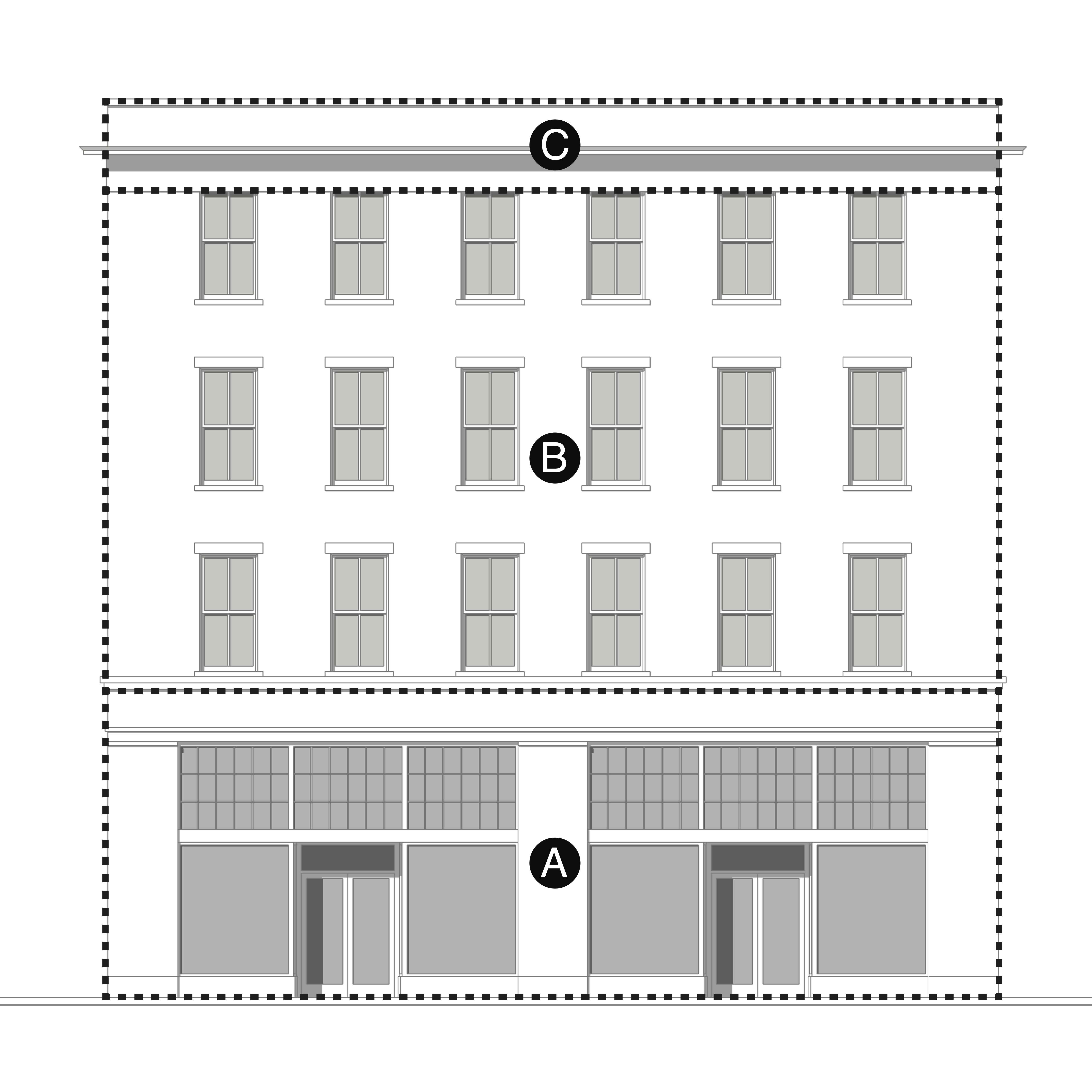 | C | Top |
| B | Middle | |
| A | Base |
Figure 4.4.2.B Window Recesses
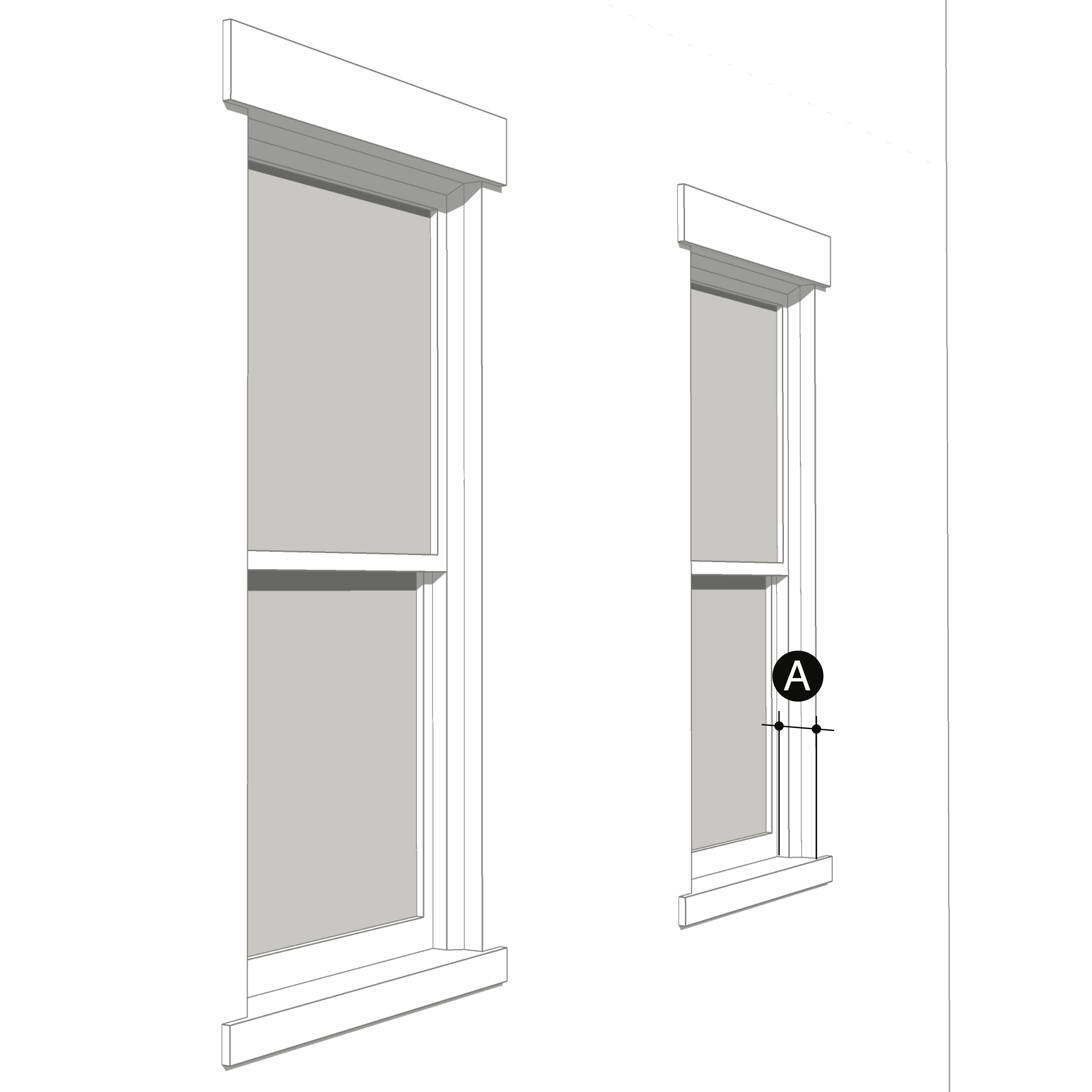 | A | Minimum window recess placing the window within the wall rather than at the surface of the wall. |
Figure 4.4.2.C Storefront Components
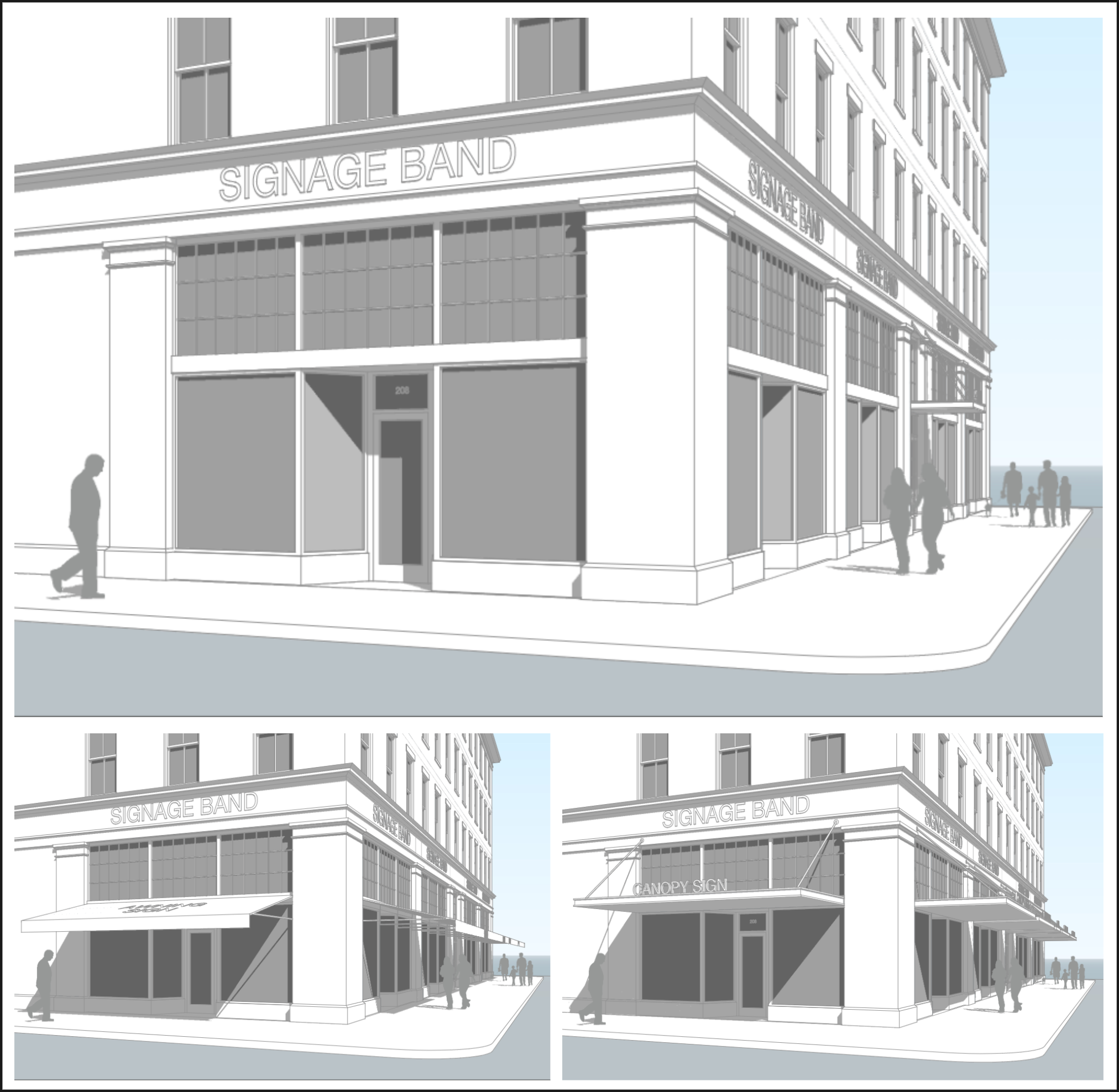 |
4.4.3.1 Intent
To reduce potential incompatibilities between the established airport and its’ flight patterns and surrounding land uses by restricting residential uses in close proximity to runways and restricting the height of buildings within airport flight paths.
4.4.3.2 Requirements
- Maximum building height is the lesser of the maximum building height specified in 4.5.2 Structure Height and the maximum according to the Federal Aviation Administration’s airfield height restrictions, available from the Airport Manager.
- Residential uses are prohibited within 1,000 feet of the runways and usable taxi or ramp surfaces specified in the adopted airport growth plan.
4.4.3.3 Exemptions
Properties within the airport overlay are exempt from the landscape requirements of this UDC which pertain to trees. Groundcover requirements must still be satisfied.
Figure 4.5.3.A Yards
|
|
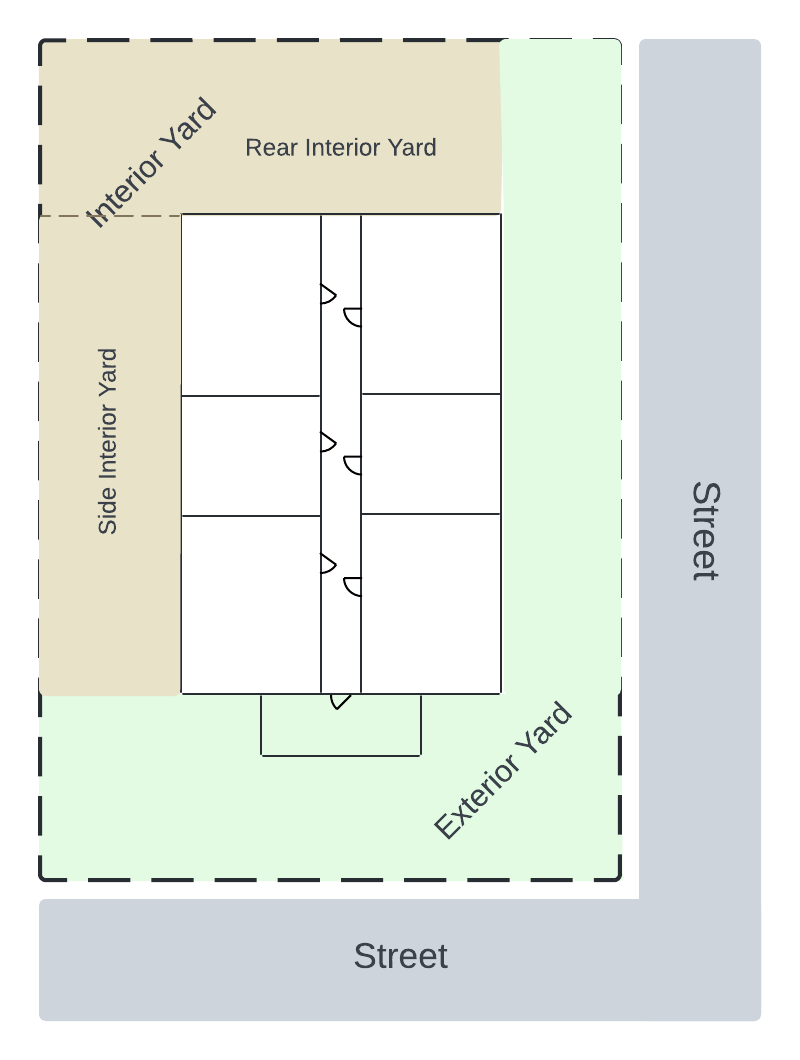
4.5.3.1.1 Contextual Standard for Downtown Neighborhood Placetype
In T2, T3, and T4 the yard depth provided may not be less than 75% nor more than 125% of the average provided by the two nearest homes sharing the same blockface when the subject property is located in the Downtown Neighborhood Placetype.
4.5.3.1.2 Contextual Standard Along Boulevards
The minimum and maximum exterior yard depth for lots abutting boulevards shall be the sum of the easement depth and right-of-way from centerline columns for the appropriate boulevard typology subtype in Table 3.4.5.1.B Street Typologies.
4.5.3.1.3 Exemptions
- The maximum exterior yard does not apply where any natural feature preserved under Section 3.3 prevents compliance.
- In HC, the minimum exterior yard does not apply where abutting a street with on-street parking and where the ground floor nonresidential design standards of T5.1 are applied to the building.
(Ord 24-37, 10-22-2024; Ord 25-35, 7-8-2025)
4.5.3.2.1 Contextual Standard for Downtown Neighborhood Placetypes
In T2, T3, and T4 the yard depth provided may not exceed 125% of the average provided by the two nearest homes sharing the same block face when the subject property is located in the Downtown Neighborhood Place Type.
4.5.3.2.2 Reduction for Industrial Zones
In I zones, the minimum setback in interior yards shall be 5 feet when abutting another property zoned I.
(Ordinance 24-37; 10-22-2024)
4.5.5.1 Measurement of Building Height by Story
Building height by story is measured as follows:
- Stories are measured from floor to floor, as illustrated in Figure 4.5.5.A Height Measurement by Story;
- Stories are limited to 16 feet in height as measured from floor to floor;
- Where stories of a building exceed 16 feet the number of stories calculated should be 1 to 16 regardless of the number of actual stories;
- Any story located below ground shall not count toward the maximum building height provided it extends for more than 4 feet above grade; and
- Attics may not exceed 50% of the area of the floor area immediately below.
4.5.5.2 Measurement of Height by Feet
- Building height by feet is measured to the eave of sloped roofs or the top of the roof for flat roofs;
- Structures that are not buildings are measured to the top of the structure;
- Height shall be measured from:
- Finished sidewalk grade adjacent to the main building or structure where such buildings or structures are within 30 feet of the sidewalk; or
- At the lowest elevation of adjacent grade at the perimeter of the building or edge of structure where they are more than 30 feet from the sidewalk.
- Height shall be measured from:
4.5.5.3 Measuring in General
- Where buildings are greater than 40 feet in width or depth height shall be measured every 40 feet;
- Mezzanines more than 40% of the ground floor area are counted as an additional story.
4.5.5.4 Transitions
Transition in building height shall be provided for any proposed building adjacent to a zone with a lower maximum building height than the subject property, as follows:
- Building height shall not exceed one story above the maximum allowed in the adjacent zone for the first 40 feet as measured from the zone boundary or shared property line, whichever is closer;
- Building height shall not exceed two stories above the maximum allowed in the adjacent zone between 40 and 80 feet as measured from the zone boundary or shared property line, whichever is closer;
- Building height shall not exceed three stories above the maximum allowed in the adjacent zone between 80 and 120 feet as measured from the zoning boundary or shared property line, whichever is closer.
4.5.5.4 Encroachments
- Water tanks, to the extent necessary for adequate pressure;
- Elevator bulkheads, to the extent necessary to house mechanical equipment;
- Stairways providing roof access, up to 10 feet above flat roof surface or threshold height of tthe door, whichever is less;
- Habitable space above sloped roofs, up to 10 feet above the flat roof surface or above the maximum building height, whichever is less;
- Habitable space above flat roofs no more than 400 square feet in area up to one floor above the flat roof surface or above the maximum building height, whichever is less;
- Rooftop mechanical equipment, up to 6 ft above the roof surface or maximum building height; whichever is less;
- Parapets, up to 8 ft above the roofline in the case of a flat roof or the bottom of the eave for pitched roofs or maximum building height, whichever is less. For the purposes of this the height shall be calculated as the average parapet height for all sides of the building with a parapet;
- Chimneys, up to 4 ft above the roof surface or maximum building height, whichever is less;
- Any other similar feature necessary for the operation and functionality of the building, as determined necessary by the Director.
(Ord 25-35, 7-8-2025)
4.5.6.1 Nonresidential Design
Where nonresidential design of ground floor spaces is required by 3.4.5.1.B Street Typologies buildings subject to a maximum exterior setback shall be designed to meet the applicable ground floor space requirements of Table 4.5.A and to provide:
- A finished interior floor elevation that is directly accessible to pedestrians from sidewalks on the abutting street; and
- The first of the two numbers is provided in Table 4.5.A pertaining to minimum glazing shall apply when nonresidential design is required and shall be applied to that area between 3 and 10 feet above outside grade; and
- A minimum average tenant space depth along the length of the building of 30 feet; and
- The composition of the ground floor facade is such that entrances to tenant spaces can be provided as required by Table 4.5.A; and
- Accommodation is made for appropriate ventilation and utility access through the building vertically and horizontally to serve the variety of permitted nonresidential uses.
4.5.6.2 Residential Design
Where nonresidential design is not required by 3.4.5.1.B Street Typologies buildings may be designed for ground-floor residential use and in such cases the design shall conform to the requirements of Table 4.5.A (the second of the two numbers for the glazing requirement shall apply) and 4.6.1. To the extent there are conflicts between Table 4.5.A and 4.6.1, the provisions of 4.6.1 shall apply.
4.5.6.3 Minimum Glazing Requirements
Where glazing is required by Table 4.5.A, it shall meet the following standards.
- Glazing requirements shall apply to all building facades facing towards and within 50 feet of the exterior property line.
- The clear glass area is measured as follows:
- The clear glass area is calculated individually for each elevation and each floor;
- The rough opening for each window and storefront system is considered glass for this calculation, including ¾ or more glazed doors; and
- Tinted, mirrored, or reflective glass, and glass covered by screening sheets, graphics, white, or UV protection film do not count towards required glazing.
- Blank walls within build-to areas are limited to 40 feet in length.
(Ord 25-35, 7-8-2025)
4.5.6.4 Administrative Relief Where Nonresidential Design and Nonresidential Uses are Required
Where 3.4.5.1.B requires both nonresidential design and use the Director is authorized to grant an administrative adjustment to substitute up to 25% of the linear dimension of the building's ground floor occupancy be dedicated active interior space including:
- Merchandise and display areas
- Art display
- Indoor or outdoor dining areas
- Building entries and lobbies
- Interior common areas in multi-tenant buildings
- Production and preparation areas
- Performance areas
- Meeting areas, and
- Other similar spaces intended for frequent occupation and active use.
4.4.8.1 Parking Generally
Parking in exterior yards is prohibited in Districts T3, T4, T5, and T6 unless expressly stated otherwise below.
4.4.8.2 Exception for Front Parking Lane Configurations
Front parking lane configurations act in a manner similar to a slip road, a feature common along boulevards, where they serve to provide cross-access and limited parking between a building and the boulevard which does not contain on-street parking.
- Front parking lane configurations are required between buildings and streets on boulevard street typologies unless granted an Administrative Waiver by the Director when it is found that cross-access is not needed to serve the block in question or when it is found that there is no need now or in the future for parking between the boulevard and the building.
- The design of the front parking lane configuration must conform to one of the boulevard typology subtypes in Table 3.4.5.1.B.
- The front parking lane configuration must be placed within a public access and utility easement as required by the City Engineer and in a manner conforming to the subtype selected in Table 3.4.5.1.B.
(Ord 25-35, 7-8-2025)
4.4.8.3 Relationship to Driveways Serving Residential Buildings
The prohibition on parking in an exterior yard shall not be interpreted to apply to parking on driveways serving residential buildings, where allowed by fire or building code, but rather shall be interpreted to apply to vehicular use areas specifically designed for the parking and queuing of vehicles such as a parking lot or drive-through.
4.5.9.1 Driveway Location and Area
- Where an alley is present or required to be constructed pursuant to 3.4.7, driveways in the exterior yard are prohibited.
- There is no limit on driveway width or area in interior yards aside from the maximum impervious surface area set forth in Table 4.5.A.
4.5.9.2 Driveways in Exterior Yards
Where driveways are permitted in exterior yards they shall meet the following standards.
- Driveways in exterior yards shall not exceed 33% of the area of the exterior yard. On corner lots only the portion of the exterior yard abutting the street the driveway connects to may be used in calculating the maximum area of the driveway.
Driveway width in exterior yards is measured from the sidewalk or, in its absence, the exterior property line. Driveways are limited to 33% of the lot width, not to exceed the following widths in the described contexts:
25 feet for driveways to parking lots or parking decks for residential uses;
30 feet for driveways serving nonresidential uses; and
20 feet for all other driveways.
- Driveways terminating in the exterior yard or providing access to a garage must be a minimum of 20 ft deep from the inside of the sidewalk or in the absence of one, the property line, so as to prevent vehicles from parking over the existing or future sidewalk.
(Ord 25-35, 7-8-2025)
4.7.1.2 Exemptions
There are no building type-specific standards applicable to detached houses.
4.7.1.3 Standards Applicable to All Residential Building Types
- Where a street or programmed open space abuts a residential building, the residential front façade shall be oriented toward it or the residential building(s) must be site planned in accordance with Section 5.2.4 Residential Site Typology Standards.
- Where a residential building abuts both a street and a programmed open space, the residential front façade shall be oriented toward the exterior lot line with the narrowest dimension.
- All residential buildings shall be located within 150 feet of a street, alley, or programmed open space designed as a fire access lane.
In T5.1, any single-purpose residential building type containing two or fewer units is prohibited on a lot exceeding 40 feet in width or 4,000 square feet in area; and when the area under common ownership exceeds one block or two acres in area, whichever is smaller, single-purpose residential building types containing two or fewer units shall not constitute more than half of the buildings in the area under common ownership.
(Ord 25-35, 7-8-2025)
4.7.1.4 Standards Applicable to Cottage Houses
Reserved
4.7.1.5 Standards Applicable to Attached Houses
- In all zones where they are permitted, attached houses:
- May have units arranged side by side as viewed from the street, front to back as viewed from the street, or stacked vertically.
- In T3 zones attached houses are permitted only when:
- Shall conform to Section 5.2 Residential Site Design; or
- No more than one entrance is on a street-facing facade.
(Ord 25-35, 7-8-2025)
4.7.1.6 Standards Applicable to Duplexes
- In all zones duplexes:
- May have units arranged side by side as viewed from the street, front to back as viewed from the street, or stacked vertically.
- In T3 zones duplexes are permitted only when:
- Developed in accordance with the courtyard or terrace site plan standards of Section 5.2 Residential Site Design; or
- Located on a lot abutting a street on the Master Street Plan excluding through lots; or
- On a corner lot where no more than one entrance and one garage door is on any one street-facing facade.
(Ord 25-35, 7-8-2025)
4.7.1.7 Standards Applicable to Multi-Unit Houses
- In T3 zones multi-unit houses are permitted:
- Only when developed in accordance with the courtyard or terrace site plan standards of Section 5.2 Residential Site Design; or
Only when located on a lot abutting any street on the Master Street Plan, excluding through lots.
- Only when developed in accordance with the courtyard or terrace site plan standards of Section 5.2 Residential Site Design; or
- In T4 zones multi-unit houses are permitted:
- When they are consistent in scale with the two nearest residential buildings on the same block face.
- A sidewalk connecting building entrances to all adjacent sidewalks or trails is required.
(Ord 25-35, 7-8-2025)
4.7.1.8 Standards Applicable to Town Houses
- In T3.2 town houses are permitted:
- When developed in accordance with the courtyard or terrace site plan standards of Section 5.2 Residential Site Design; or
Only when located on lots with frontage on a street on the Master Street Plan.
- When developed in accordance with the courtyard or terrace site plan standards of Section 5.2 Residential Site Design; or
- In all zones garages shall be rear or side-loaded.
(Ord 25-35, 7-8-2025)
4.7.1.9 Standards Applicable to Apartment Houses
- In T4 apartment houses are permitted only when:
- Located on a lot with frontage on an arterial or collector street according to the Master Street Plan; or
- Located on a property in a center placetype; or
- Located on a property abutting or across the street from a public park or programmed open space approved per this UDC.
- In T5 and T6 individual units at ground level within the build-to area must be designed as walk-to as depicted by Figure 4.7.1.8.A Apartment House with Walk-to Units wherein each unit along the building's street frontage has its own entrance and sidewalk connection to the street. Private outdoor spaces are allowed within the build-to area provided they are surrounded by a 4-5 ft tall fence or wall and provided that sliding glass doors are not permitted on any facade parallel to the street.
(Ord 25-35, 7-8-2025)
4.7.1.10 Standards Applicable to Live-Work Buildings
The nonresidential uses allowed in live-work buildings are limited to those allowed in T4.2 regardless of the zoning of the subject property.
(Ord 25-35, 7-8-2025)
4.7.1.11 Standards Applicable to Mixed-Use Buildings
The nonresidential uses allowed in mixed-use buildings are the same as those allowed in the zone of the subject property.
(Ord 25-35, 7-8-2025)
4.8.2.1 Purpose and Intent
To allow the operation of home-based business activities while minimizing impact on adjacent properties.
4.8.2.2 Regulations
- The home occupation must be clearly incidental and secondary to the primary residential use for the dwelling. The primary use of the building in which the home occupation is situated shall clearly be the dwelling used by the person as his/her private residence;
- The home occupation must not change the outside appearance of the dwelling;
- Exterior signage for a home occupation is prohibited;
- The home occupation must not generate traffic, parking, sewerage, or water use in excess of what is normal or customary in a residential neighborhood;
- The home occupation shall not create a hazard to person or property, result in electrical interference, or become a nuisance in the neighborhood;
- No outside storage of any kind related to the home occupation shall be permitted;
- No person other than self or family members residing on the premises, shall be employed or involved in any business activity related to the home occupation on the premises;
- No more than 25 percent of the gross floor area of the dwelling unit shall be used for the operation of the home occupation. No accessory buildings shall be issued in conjunction with a home occupation;
- Deliveries of materials to and from the premises in conjunction with the home occupation shall not require the use of vehicles other than parcel post or similar parcel services vehicles;
- Noise, vibration, smoke, odors, heat, or glare as a result of a home occupation, which would exceed that which is normally produced by a single residence, shall not be permitted;
- The home occupation shall not utilize more than one private commercial vehicle limited to one ton capacity. The vehicle shall be capable of being parked or stored inside the garage and shall be required to be kept in said garage when not in use for the home occupation;
- Retail sales on the premises shall be secondary to the major operation of the home occupation;
- Home occupations shall maintain required permits mandated by applicable local, state and/or federal laws; and
- Persons intending to operate a home occupation should notify the property owners association ("POA") or homeowners association ("HOA"), of their intent prior to beginning operations. The above regulations shall not be construed to supersede or negate any provisions contained in POA or HOA regulations or any covenants thereof.
Build-To Area Occupation: Corner Lot, Small Multi-unit Dwelling, Alley Parking Access
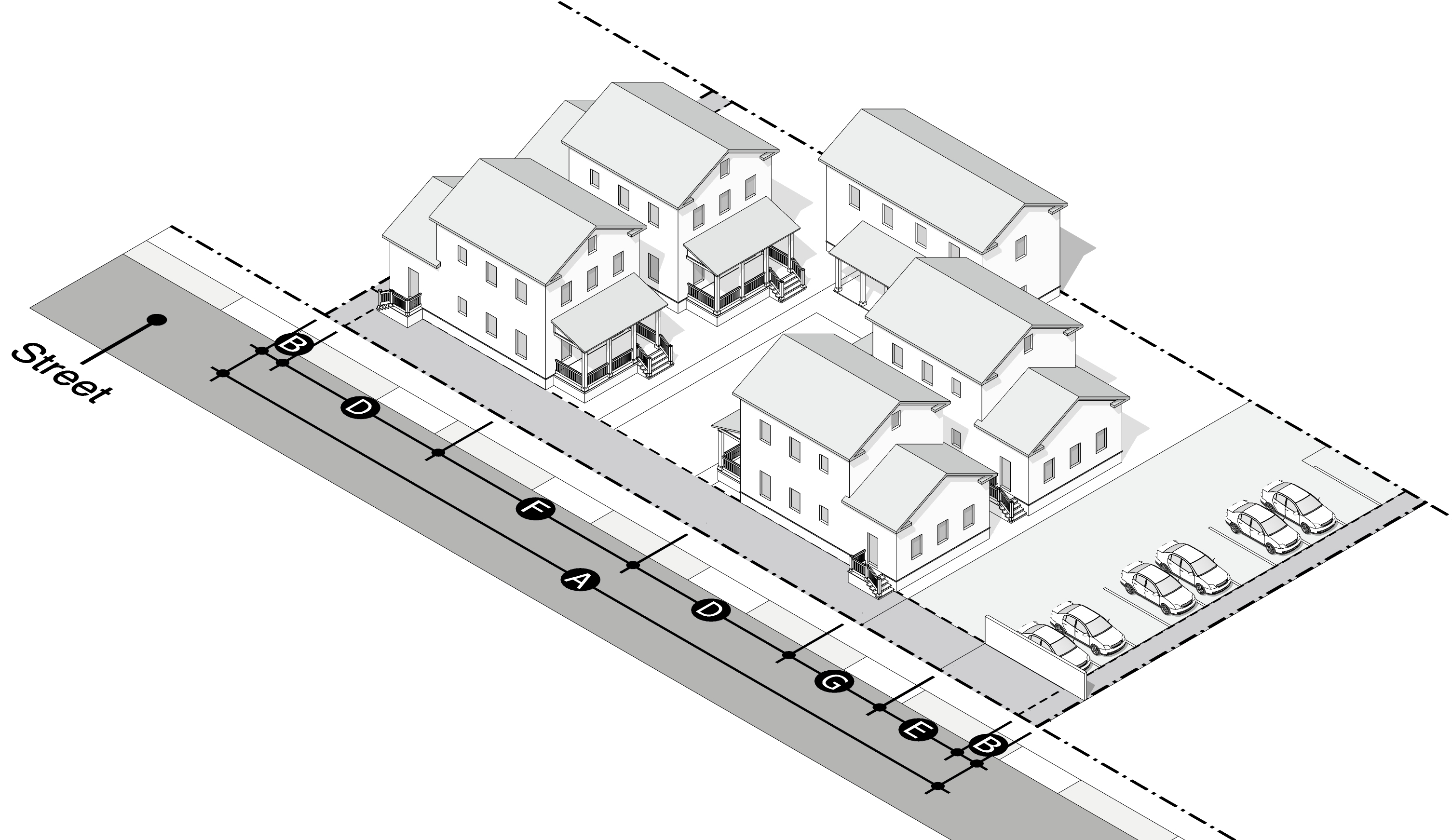 | A | Gross lot width |
| B | Minimum interior yard (where required), subtracted from gross lot width | |
| D | Building facade along the exterior lot line | |
| E | Vehicular use area (where allowed) | |
| F | Forecourt, subtracted from gross lot width | |
| G | Driveway (where allowed), subtracted from gross lot width | |
Net lot width = A-B-F-G Build-to area occupation = D / Net lot width | ||
Build-To Area Occupation: Middle Lot, Forecourt
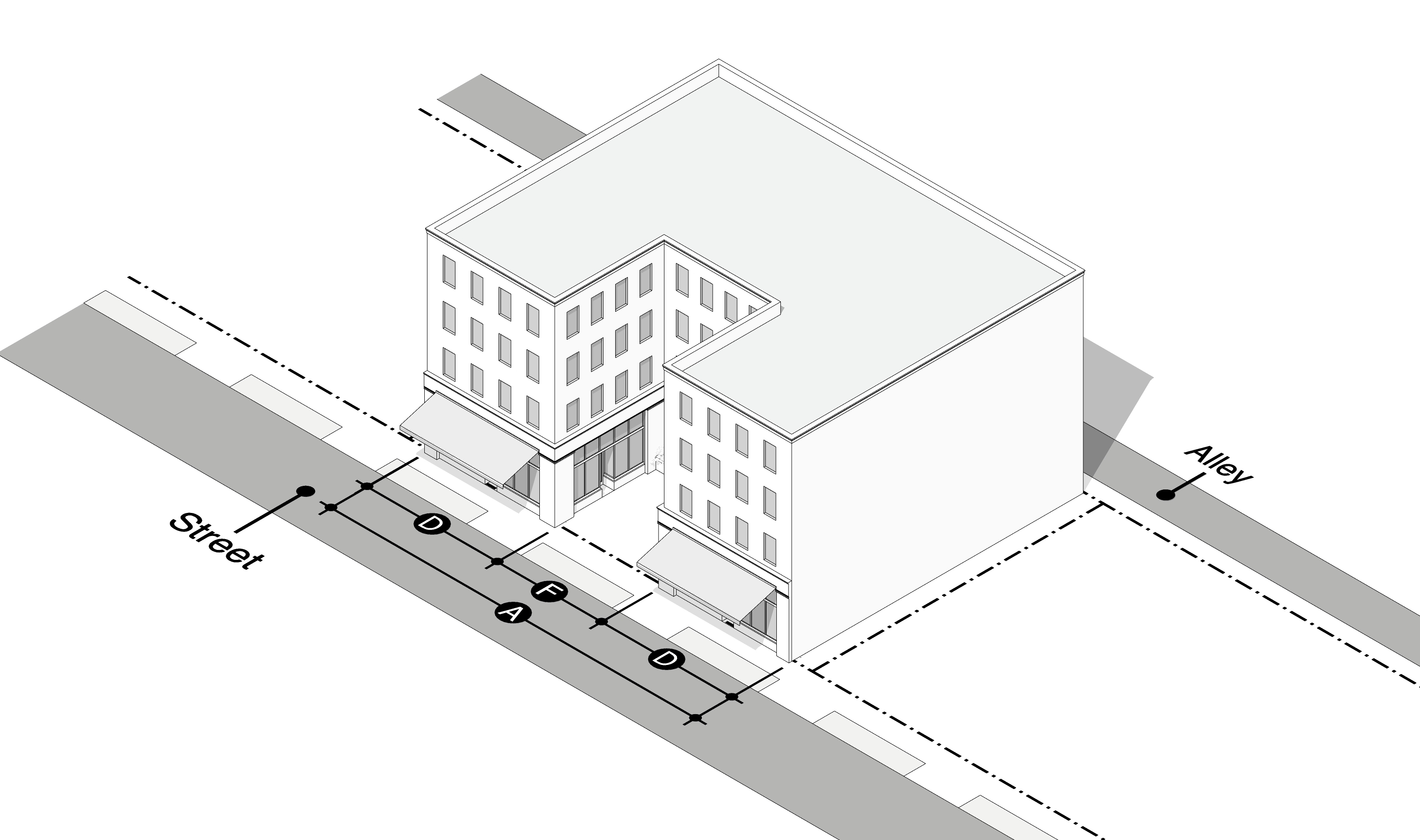 | A | Gross lot width |
| D | Building facade along the exterior lot line | |
| F | Forecourt, subtracted from gross lot width | |
Net lot width = A-F Build-To Area Occupation = D / Net lot width | ||
Build-To Area Occupation: Corner Lot
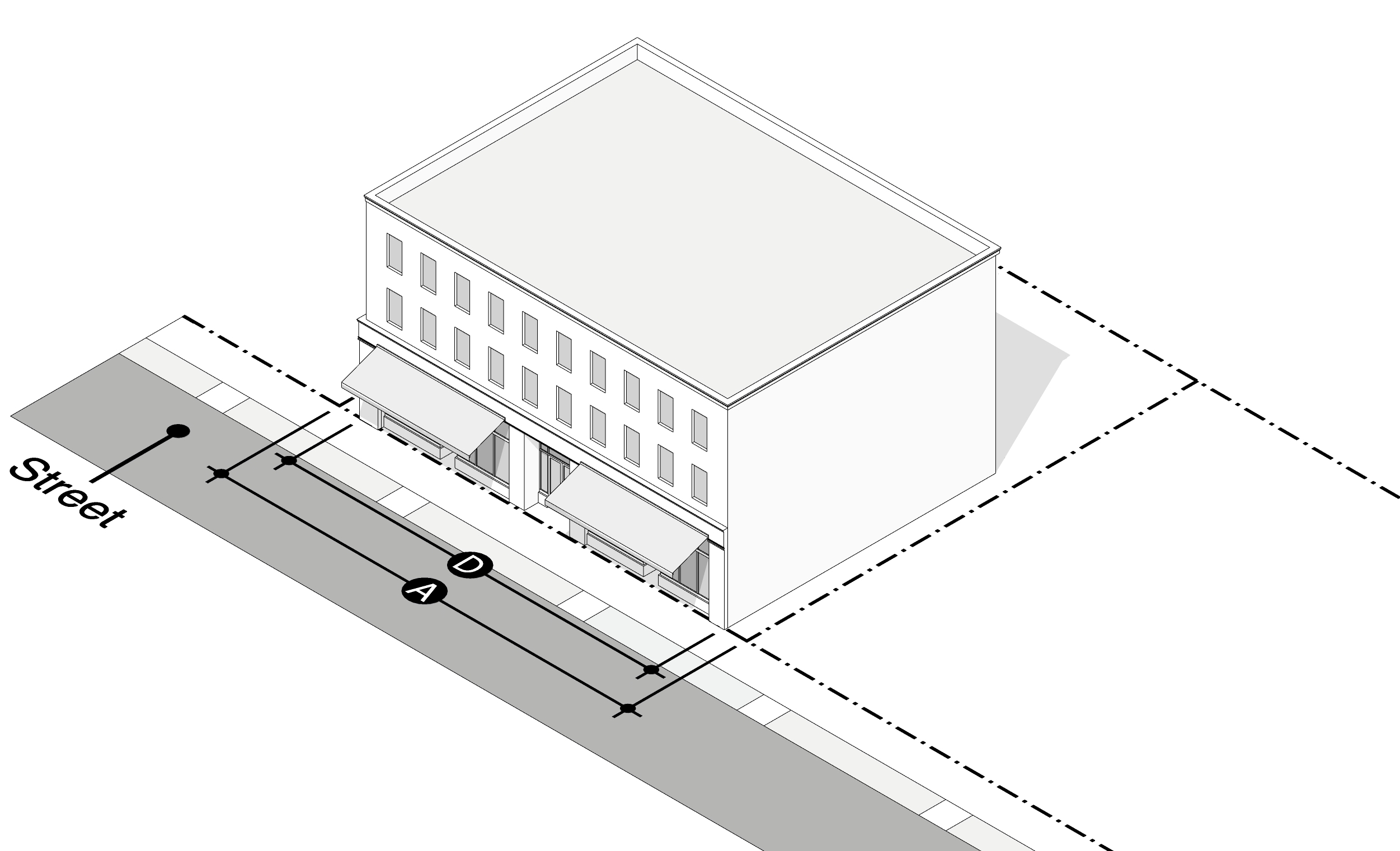 | A | Lot Width |
| D | Building facade along the exterior lot line | |
Net lot width = A Build-To Area Occupation = D / A | ||
Build-To Area Occupation: Middle Lot, Front Parking Access
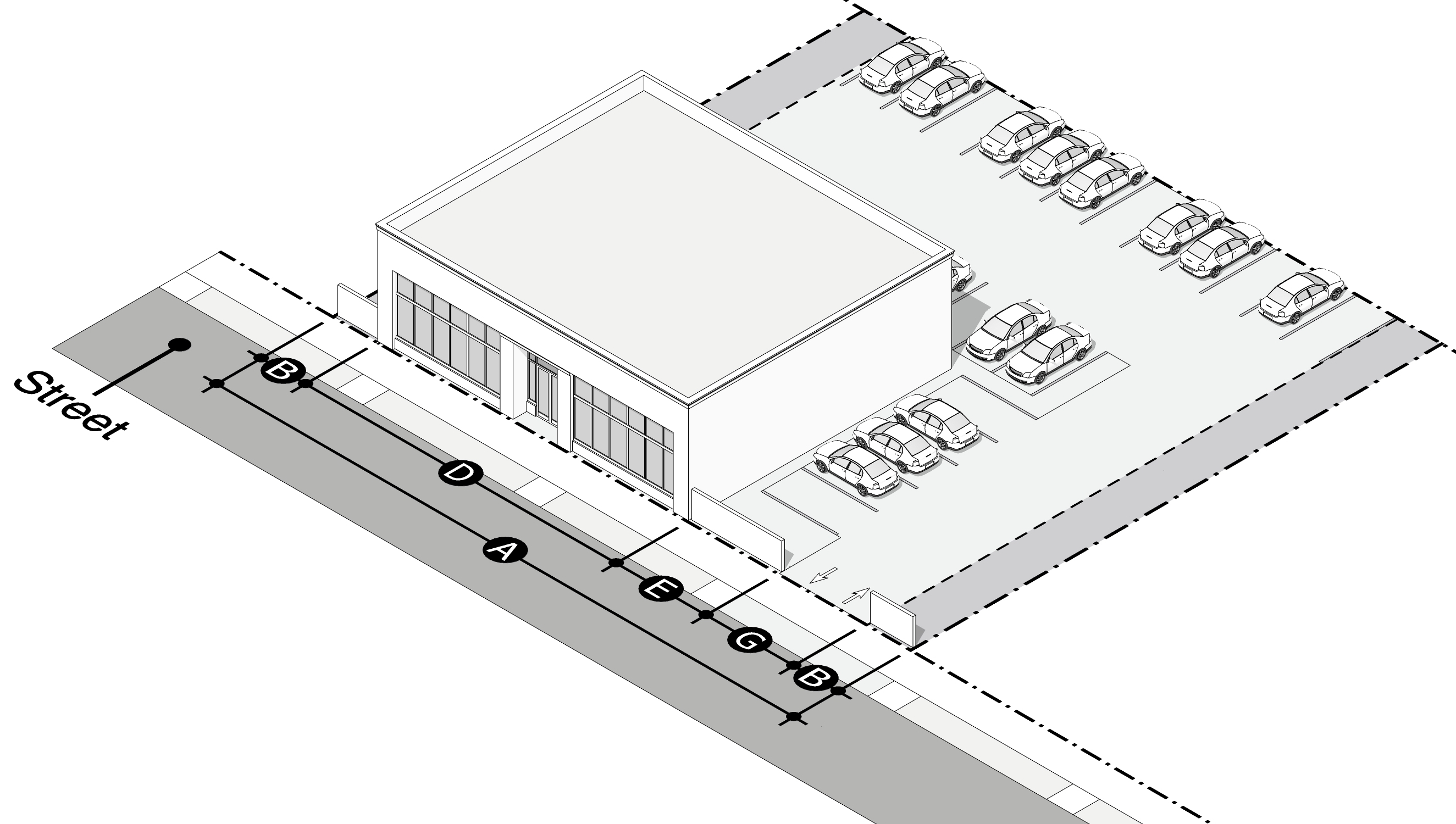 | A | Gross lot width |
| B | Minimum interior yard (where required), subtracted from gross lot width | |
| D | Building facade along the front lot line | |
| E | Exterior lot line without building facades, streetscreen required | |
| G | Driveway (where allowed), subtracted from gross lot width | |
Net lot width = A-B-G Build-To Area Occupation = D / Net lot width | ||

