
Rolling Meadows City Zoning Code
ARTICLE X
- SIGNS
Sec. 122-601.- Purpose.
The purpose of this article is to set out sign regulations that preserve the right of free speech and expression, yet also provide for design, construction, and placement of signs that:
(a)
Promote the health, safety, and general welfare of the city from signs that are unsafe, or interfere with drivers, bicyclists, or pedestrians;
(b)
Enhance the appearance and economic value of the city by avoiding sign clutter that can compromise the character, quality, and viability of commercial corridors;
(c)
Are compatible with surroundings and not a nuisance to occupants of adjacent and contiguous property due to brightness, reflectivity, bulk, or height;
(d)
Assist in wayfinding; and
(e)
Are aesthetically pleasing, of appropriate scale, and integrated with the built environment, in order to meet the objectives related to the quality and character of development set forth in the City of Rolling Meadows Comprehensive Plan.
(Ord. No. 20-47, § 3(Exh. A), 11-10-2020)
Sec. 122-602. - Scope.
The regulations of this article shall provide a balanced and fair legal framework for design, construction, and placement of signs. The article promotes the safety of persons and property by ensuring that signs do not create a hazard. To accomplish these aims, the article governs the installation, use, display, enlargement, alteration, maintenance, location and removal of all signs within the city. The regulations are based on the style and format of sign structures, and not their content.
(Ord. No. 20-47, § 3(Exh. A), 11-10-2020)
Sec. 122-603. - General provisions.
(a)
Code applicability. All sign elements (including but not limited to electrical and structural elements) shall meet the construction and standards of this article and requirements of chapter 18 of the City Code (Buildings and Building Regulations).
(b)
Illumination of signs.
(1)
All lighting of signs shall be directed only at the face of the sign and shall be shielded so as not to be visible from the property line or directly cast light on any right-of-way or adjacent property.
(2)
No reflective material may be included in a sign so as to reflect light directly upon an adjacent right-of-way or residential property.
(3)
In no case shall the lighting intensity of any sign exceed the limit of one footcandle at a commercial property line and one-half footcandle at a residential property line. In no instances shall a sign emit more than 75 footcandles, at a distance of ten feet from the sign.
(4)
Illuminated signs with revolving or rotating beams or beacons are not permitted. In addition, no sign may be illuminated by any flashing, blinking, or intermittent lights, or lights that change in intensity.
(5)
Illuminated signs shall be turned off between the hours of 11:00 p.m. and 7:00 a.m., or 30 minutes after close of business, whichever is later. No sign may be illuminated past the hour of 1:00 a.m.
(6)
Signs that are illuminated shall be in good working order. Signs with partially working lights shall not be illuminated until repaired.
(7)
No temporary sign shall be illuminated.
(8)
Window signs that are illuminated with neon lightning or comparable lighting are allowed in accordance with the standards detailed in this section 122-603(b) and section 122-533 Glare.
(9)
Signs with LED lighting. The light level of an illuminated sign lit with LED bulbs shall be no greater than 5,000 nits of luminance from dawn to dusk, and no greater than 150 nits of luminance from dusk to dawn. 1[2]
(c)
Maintenance, inspection, and removal.
(1)
Maintenance. The routine maintenance or changing of parts is permissible without permit, provided that such change does not alter the surface area, height, copy, or otherwise make the sign nonconforming.
(2)
All signs, support structures, and the required landscaped area immediately adjacent shall be maintained in a manner that is consistent with the approved plans, safe, secure, and not a danger or nuisance to the public.
(3)
Unsafe signs. Any sign that is found by the zoning administrator to pose an immediate peril to persons or property shall be removed or repaired by the property owner within the timeframe provided from the zoning administrator. If the property owner fails to act in the manner and timeframe specified by the zoning administrator, the sign may be removed by the city without further prior notice to the owner thereof. The cost of sign removal or other actions deemed necessary by the city in regard to said unsafe sign will be the responsibility of the property owner.
(4)
Abandoned signs.
a.
The sign face of any signs associated with a use that vacates a premises shall be removed within 30 calendar days of said vacation. Any remaining sign structure shall be maintained in a safe and tidy manner.
b.
Should any signs associated with a use that vacates a premise be nonconforming per the standards of this article, and use of the business location be discontinued for a period of 90 calendar days, regardless of any intent to resume such use, said sign shall not be reestablished or continued, and shall be immediately removed from the premises or brought into conformity with this article.
(5)
Paint and finishes. Paint and other finishes shall be maintained in good condition. Peeling finishes shall be repaired. Signs with running colors shall be repainted, repaired, or removed.
(d)
Exemption for addressing. The posting of building addresses in locations that are visible from the street is necessary for the effective delivery of public safety services; and the efficient and timely delivery of emergency services is a compelling governmental interest. Accordingly, the city requires that street addresses shall be posted so as to be readily visible from adjacent rights-of-way. Because address signs are required, numbers and letters used for addressing are not included in the calculation of sign area if they are not more than 14 inches in height, or as otherwise approved by the fire chief based on visibility and fire safety concerns.
(e)
Signs permitted before effective date. If a permit for a sign has been issued in accordance with all city ordinances in effect prior to the effective date of this article, and provided that sign construction is begun within six months of the effective date of this article and diligently pursued to completion, said sign may be completed in accordance with the approved plans for which the permit has been issued, subject thereafter, if applicable, to the provisions of this Zoning Ordinance regarding nonconforming structures (Article VII).
(f)
Relationship to other regulations. These regulations recognize other regulations pertaining to signage. Where any provision of this article covers the same subject matter as other regulations, the more restrictive regulation shall apply.
(g)
Prohibited signs: Except where specifically authorized by this article, the following signs are prohibited in all areas of the city:
(1)
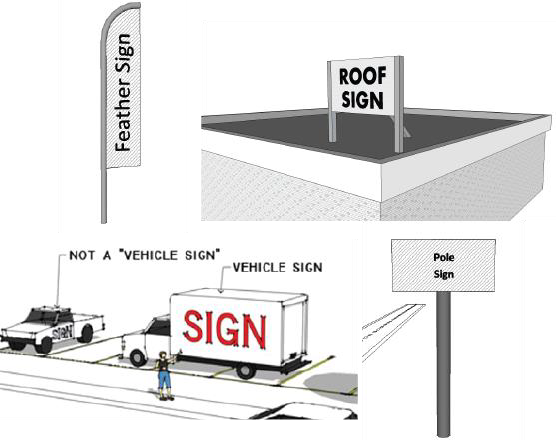
Attention getting devices, including searchlights, pennants, banners, propellers, spinners, streamers, balloons and similar devices;
(2)
Feather signs;
(3)
Moving Signs. Moving signs shall not include barber poles, electronic message signs, flags, street clocks, and other signs as established by this article;
(4)
Off premises signs;
(5)
Painted wall signs;
(6)
Pole signs;
(7)
Portable signs;
(8)
Roof signs;
(9)
Signs with more than two sign faces;
(10)
Signs that are a traffic hazard;
(11)
Signs that are animated or supported by manufactured air pressure;
(12)
Temporary window signs in excess of 25 percent of total window area (defined as window area located between architectural features (piers));
(13)
Vehicle signs;
(14)
Signs placed in vehicles containing more than six square feet in total size;
(15)
Other signs as may be prohibited in the City Code.
(h)
Permitted locations. All signs shall comply with the following standards.
(1)
Public property. Signs may only be placed on public property by a government agency or as authorized by this section. Any sign placed on public property without authorization may be removed without notice.
(2)
Private property. Signs may only be placed on private property with prior consent of the property owner and, if applicable, pursuant to an approved building permit issued by the zoning administrator.
(i)
Prohibited locations. In addition to the setback requirements of this article, and the other restrictions of this Zoning Ordinance, all signs shall comply with the following standards:
(1)
A minimum clear sight distance at all intersections shall be in accordance with provisions for a clear vision triangle as defined in this chapter. Signs found to otherwise be a visual obstruction by the zoning administrator shall be removed.
(2)
Signs shall not block or interfere with building features necessary for safety or convenient ingress or egress, including doors, windows, fire escapes, or required exit-ways;
(3)
A sign mounted on the exterior of a building shall not conceal any windows, doors, or unique architectural features. This standard does not apply to window signs.
(4)
Signs may not be in or over public rights-of-way, except:
a.
Traffic control signs installed by a governmental entity or which are required to be installed by a governmental entity;
b.
Signs posted by governmental entities that support event or emergency management, such as wayfinding to event or disaster relief locations;
c.
Banners posted by the city on utility or light poles.
d.
Signs constructed by the city or another governmental or quasi-governmental entity pursuant to terms and conditions set forth in an approved intergovernmental agreement with the city.
(5)
Signs may not be located within easements for overhead utilities (placement in other utility easement areas is allowed only if approved by the utility service provider and if the other applicable requirements of this Zoning Ordinance are met).
(j)
Prohibited design elements. The following elements shall not be used as an element of signs or sign structures, whether temporary or permanent:
(1)
Flashing lights;
(2)
Motor vehicles, unless:
a.
The vehicles are functional, used as motor vehicles, and have current registration and tags;
b.
The display of signage is incidental to the motor vehicle use; and
c.
The motor vehicle is properly parked in a marked parking space or is parked behind the principal building.
(3)
Semi-trailers, shipping containers, or portable storage units, unless:
a.
The trailers, containers, or portable storage units are functional, used for their primary storage purpose, and, if subject to registration, have current registration and tags;
b.
The display of signage is incidental to the use for temporary storage, pick-up, or delivery; and
c.
The semi-trailer is parked in a designated loading area or on a construction site at which it is being used for deliveries or storage.
(1)
Sound, smoke, or odor emitters; and
(2)
Spinning or moving parts.
(k)
Prohibited content. The following content is prohibited without reference to the viewpoint of the individual source (the narrow classifications of content that are prohibited by this subsection are either not protected by the United States or Illinois Constitutions, or are offered limited protection that is outweighed by the substantial governmental interests in protecting the public safety and welfare):
(1)
Text or graphics that present a clear and present danger due to their potential confusion with traffic control signs or signs that provide public safety information (for example, signs that use the words "Stop," "Yield," "Caution," or "Danger," or comparable words, phrases, symbols, or characters in such a manner as to imply a safety hazard that does not exist);
(2)
Text or graphics of an indecent or immoral nature and harmful to minors;
(3)
Text or graphics that advertise unlawful activity; or
(4)
Text or graphics that are obscene, fighting words, defamation, incitement to imminent lawless action, or true threats.
(l)
Prohibited mounts. No sign, whether temporary or permanent, shall be posted, installed, or mounted on any of the following locations:
(1)
Trees; or
(2)
Utility poles (including light poles, or on utility cabinets, except signs posted by the city or the utility that are necessary for public safety or identification of the facility by the utility provider).
(m)
Variances: Variances to sign regulations may be granted by the city of Rolling Meadows provided that:
(1)
The procedures and standards for variances in section 122-393 of this article are followed;
(2)
In addition to the standards for variance in section 122-393(5)(a) (Unique Physical Condition) of this chapter, the city shall consider the extent to which the sign is necessarily visible from the adjacent right-of-way. Lack of visibility as may be caused by the standards of this article may be considered a hardship as part of the city's consideration.
(n)
Regulations for non-conforming signs: Legally permitted signs installed prior to the adoption date of this chapter may be allowed to continue as an accessory structure on the Lot on which they are located in keeping with the following:
(1)
Regular maintenance may be conducted on the sign face and sign structure.
(2)
The sign face may be repaired or replaced, but not enlarged.
(3)
The sign may not be replaced and shall be removed should damage, destruction, or replacement of sign structure elements exceed 50 percent of the total replacement cost of the sign.
(Ord. No. 20-47, § 3(Exh. A), 11-10-2020; Ord. No. 23-28, § 2, 5-23-2023; Ord. No. 25-34, § 14, 5-27-2025)
Brightness of screens is generally expressed by a numerical value of nits. A nit is a unit of measurement of luminance, or the intensity of visible light, where one nit is equal to one candela per square meter (CD/M2).
Sec. 122-604. - Sign permits.
(a)
It shall be unlawful for any person to erect, construct, alter, or locate any sign or part of a sign in the City of Rolling Meadows without first obtaining a sign permit from the zoning administrator and paying the fee required. The routine maintenance or changing of parts is permissible, provided that such change does not alter the surface area, height, copy, or otherwise make the sign nonconforming.
(b)
Upon receipt of a sign permit, the city may evaluate whether the existing signage and sign components are conforming to past permits issued or existing regulations, and if not, that the non-conforming or illegal signs shall be removed prior to issuance of the new permit.
(c)
All construction, relocation, enlargement, alteration, and modification of signs within the city shall conform to the requirements of this article, as well as all State and Federal regulations concerning signs and advertising.
(d)
Signs that do not require a sign permit. Signs are approved by issuance of a sign permit. However, there are some signs that do not require a sign permit. The following signs do not require a sign permit, but may require a building or electrical permit or other related permit (if subject to building or electrical regulations of the City Code). The city may require applicants to submit photometric plans demonstrating compliance with this section 122-604 as a condition to issuance of a sign permit. Temporary signs that do not require permits shall still comply with the standards of section 122-607 Signs Not Requiring Permit, and section 122-603 General Provisions.
(1)
A Frame signs
(2)
Bumper stickers. Bumper stickers on vehicles;
(3)
Carried signs. Signs that are being carried by people (however, such signs are not exempt if they are set down or propped on objects);
(4)
Flags. Flags that are not larger than 30 square feet in area that are affixed to permanent flagpoles or flagpoles that are mounted to buildings (either temporary or permanent);
(5)
Interior signs. Signs intended to provide information for interior use of a property and that are not visible from adjoining property or public rights-of-way;
(6)
Official and legal notice. Official and legal notice signs that are issued by any court, public body, person, or officer in performance of a public duty, or in giving any legal notice;
(7)
Outdoor political campaign signs on residential property. Other than regulations as to size, nothing in this Section X prohibits the display of outdoor political campaign signs on residential property;
(8)
Signs with de minimus area. Signs that are affixed to a building or structure (even if wall signs are not permitted in the district or for the use), which do not exceed one square foot in sign area, provided that only one such sign is present on each elevation that is visible from public rights-of-way or neighboring property; and signs that are less than three-fourths of a square foot in area that are affixed to machines, equipment, fences, gates, walls, gasoline pumps, public telephones, or utility cabinets.
(9)
Traffic control signs. Traffic control signs and other signs related to public safety that the city or another jurisdiction installs or requires a developer to install;
(10)
Window displays. Merchandise, fixtures or models of products incorporated into a window display.
(Ord. No. 20-47, § 3(Exh. A), 11-10-2020)
Sec. 122-605. - Sign measurement standards.
The following standards shall control the measurement of sign area and sign height.
(a)
Gross sign area.
(1)
Gross sign area is calculated as the area within a continuous perimeter with up to eight straight sides that encloses the limits of text and graphics of a sign, together with any frame or other material or color forming an integral part of the display or used to differentiate the sign's message from the background against which it is placed.
(2)
Gross sign area excludes the structure upon which the sign is placed (unless the structure is an integral part of the display or used to differentiate it), but includes any open space contained within the outer limits of the display face of a sign, or between any component, panel, strip, or figure of any kind composing the display face, whether this open space is enclosed by a frame or border or not.
(3)
For double-faced signs, only one display face is measured if the sign faces are parallel or form an interior angle of less than 45 degrees, provided that the signs are mounted on the same structure. If the faces are of unequal area, then gross sign area is equal to the area of the larger face.
(b)
Sign face
(1)
Wall signs. A two-dimensional area on the facade of a building that describes the largest square, rectangle, or parallelogram which is free of architectural details.
(2)
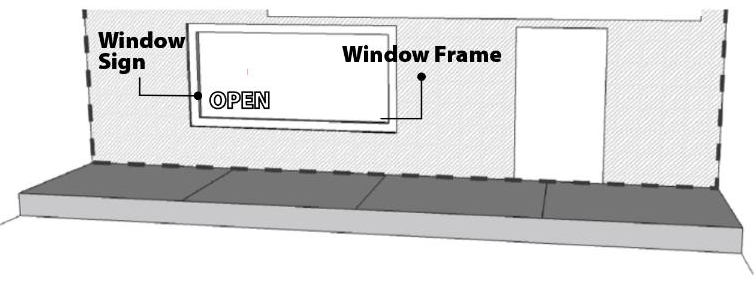
Window signs. The area of glass within a window frame.
(3)
Other signs. The area of the face of the sign which is designed to be used for text and graphics (the gross sign area does not include the sign's supporting frame or structure, if any, provided that such frame or structure is not designed to display text or graphics).
(c)
Signable area ratio. Signable area ratio is the sign area divided by the gross sign area. It is expressed as a percentage.
(d)
Relationship between maximum sign area and maximum signable area ratio. Where both a maximum sign area and a maximum signable area ratio are set out, the standard that results in a polygon that encloses all of the text and graphics and framing that differentiates them from the wall.
(e)
Measurement of height for freestanding signs. The vertical distance to the top of the sign face or sign structure, whichever is higher, measured from the elevation of the average grade around the base of the sign.
(f)
Items of information. An item of information is a word, logo, abbreviation, symbol, geometric shape, image, or number with ten or fewer digits (punctuation of numbers does not increase the number of items of information). No sign face shall contain more than 13 items of information. (Figure 10.1 contains seven items of information: five words, one 10-digit phone number, and one symbol).
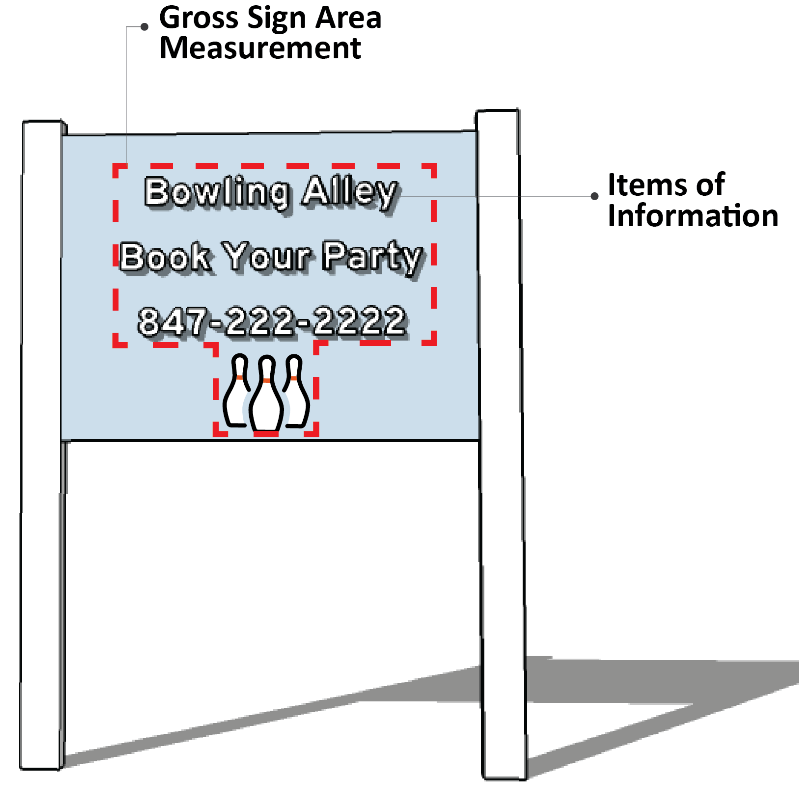
Figure 10.1
(Ord. No. 20-47, § 3(Exh. A), 11-10-2020)
Sec. 122-606. - Signs requiring permit.
Permanent signs identified below in this section shall be allowed in the City of Rolling Meadows, subject to the regulations of this article, provisions of the City Code, and receipt of a sign and/or building permit as may be approved by the zoning administrator.
(a)
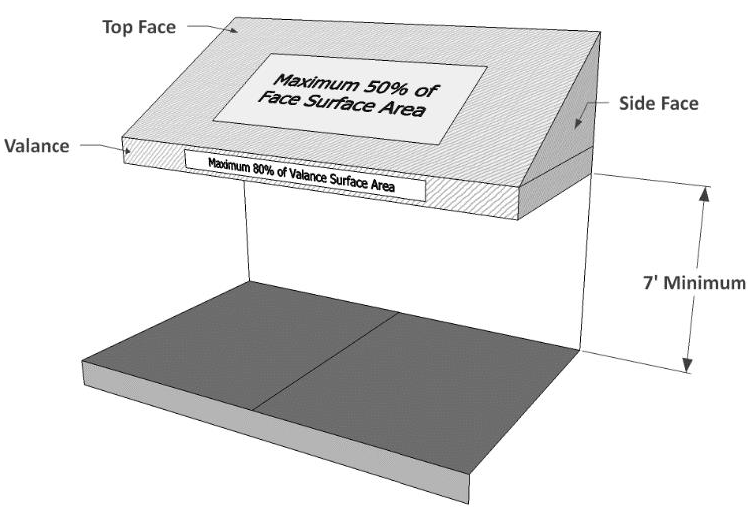
Awning signs. Awnings that do not display signs are not subject to the regulations of this article.
(1)
Location. Awning signs are allowed in the TC, C-1, C-2, C-3, M-1 and M-2, and in all residential districts for multi-unit dwelling uses and non-residential uses.
(2)
Size.
a.
80 percent of maximum valance area for copy and graphics on valance;
b.
50 percent of maximum top surface area for copy and graphics on top surface areas.
c.
No signs shall be located on the side surface areas of an awning.
(3)
Additional regulations.
a.
One sign is permitted per awning top surface area.
b.
Awning signs shall be displayed on awnings constructed out of durable, weather-resistant material such as canvas, nylon, vinyl-coated fabric, or metal.
c.
Awning with signs and awning signs shall be generally aligned with awning and awning signs that are attached to adjacent storefronts or buildings to maintain a sense of visual continuity.
d.
Awning signs shall not be backlit or otherwise internally illuminated.
e.
All awnings shall be constructed and erected so that the lowest portion thereof shall be not less than seven feet above the level of the adjacent sidewalk.
(b)
Canopy-mounted signs.
(1)
Location.
a.
Canopy-mounted signs are allowed in the TC, C-1, C-2, C-3, M-1 and M-2, and in all residential districts for multi-unit dwelling and uses non-residential uses.
(2)
Size.
a.
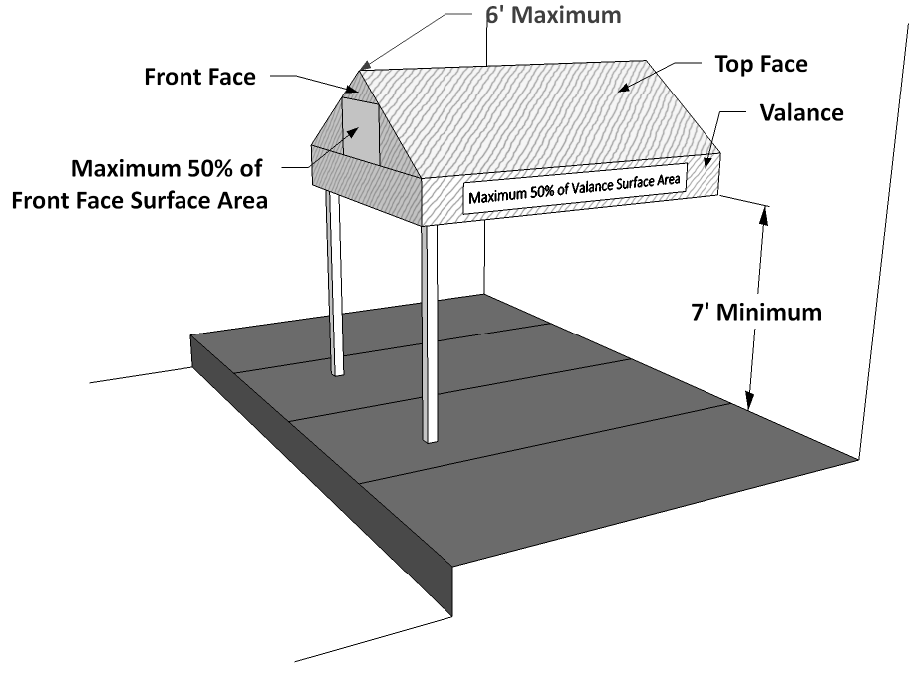
Front face - Any sign located on the front face of a canopy may take up a maximum of 50 percent of the total front face surface area.
b.
Any sign located on the front face of a canopy of a Gas/Fueling Station may take up a maximum of 25 percent of the total front face surface area.
c.
Top face - No signs are allowed on the top face of any canopy.
d.
Valance - Any sign or words on the valance of a canopy may take up a maximum of 50 percent of the total valance surface.
e.
Any sign located on the valance of a canopy of a gas/fueling station may take up a maximum of 25 percent of the total valance surface area.
(3)
Additional regulations.
a.
The canopy upon which the canopy-mounted sign is displayed may project from the front, side, rear, or corner side facade of the building to which it is attached and shall not project more than six feet.
b.
The canopy upon which the canopy-mounted sign is displayed shall be located at least seven feet above grade, and the canopy-mounted sign shall not extend below the lowest point of the canopy on which it is displayed.
(c)
Signs adjacent to drive through lanes
(1)
Location.
a.
Signs adjacent to drive through lanes are allowed for any drive-thru establishment in the C-1, C-2, and C-3 districts.
b.
Menu board signs shall be located a minimum of 15 feet from any residential zoned lot line.
(2)
Size.
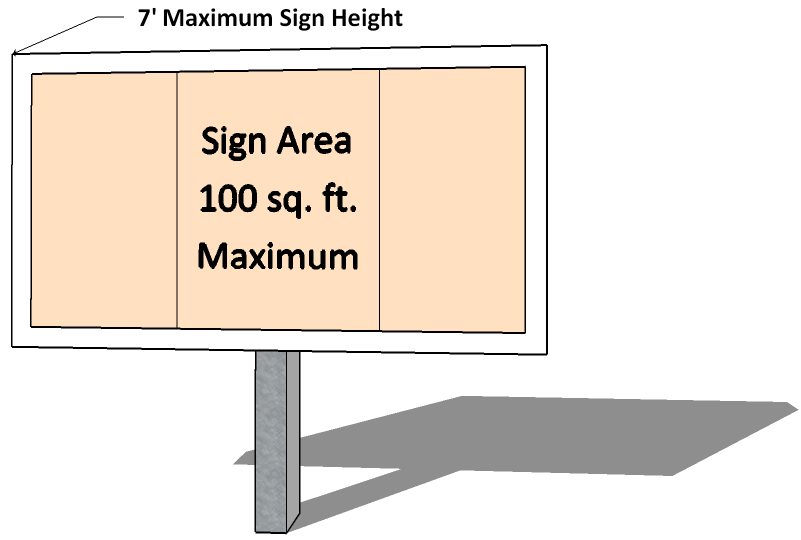
a.
Signs adjacent to drive through lanes shall not exceed 100 square feet in area and seven feet in height.
(3)
Additional regulations.
a.
Signs adjacent to drive through lanes signs may be displayed as wall signs, monument or pole signs.
b.
Up to two signs adjacent to drive through Lanes are allowed per drive-thru lane, and shall when added together not exceed the size allowed for one such sign.
c.
Internally illuminated menu board signs are allowed only in accordance with section 122-603(b).
d.
Menu boards may include an electronic screen to display information to customers.
(d)
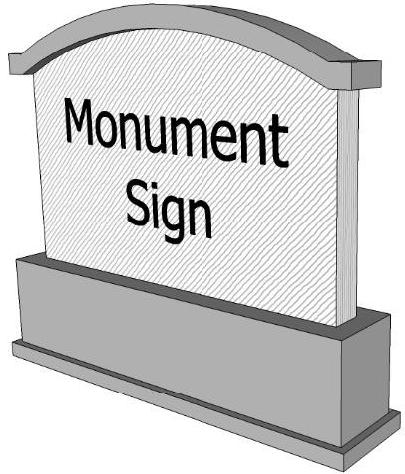
Monument signs.
(1)
Location.
a.
Monument signs are allowed in all zoning districts.
b.
In residential zoning districts, two monument signs are allowed per subdivision or development access, located on commonly owned private open space or in right-of-way areas as approved by city council.
c.
In TC, C-1, C-2, C-3, M-1, and M-2 zoning districts, one monument sign is permitted per principal structure.
(2)
Size.
a.
In residential zoning districts permitted monument signs shall meet the following requirements.
i.
The sign face may be up to 32 square feet.
ii.
Gross sign area shall be a maximum of 60 percent of the sign face.
iii.
The maximum sign height shall be six feet.
b.
In TC, C-1, C-2, and C-3 zoning districts permitted monument signs shall meet the following requirements.
i.
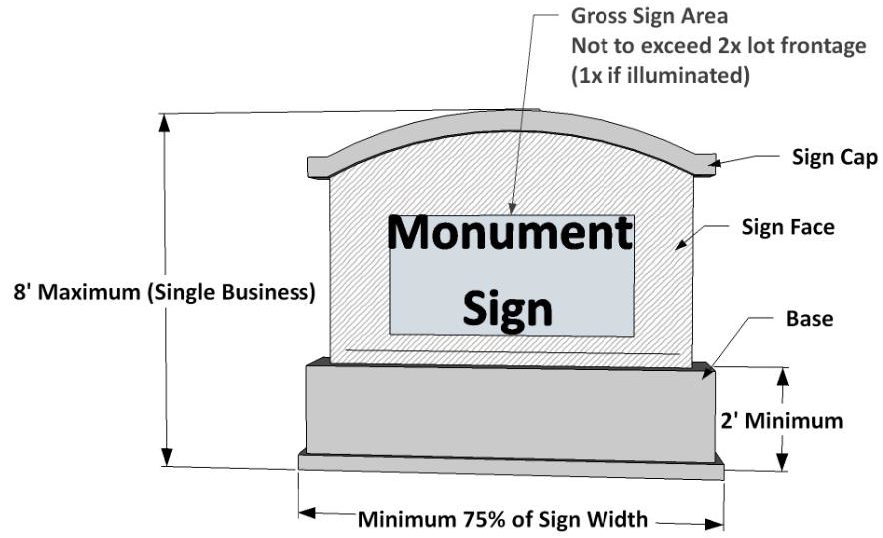
The square footage of a sign shall be calculated at one times the lineal frontage of the property.
ii.
Where the property has multiple road frontages, the largest shall be used to calculate sign area.
iii.
In no case shall gross sign area exceed 100 square feet in size.
iv.
In no case shall a sign located on a property with a single business exceed eight feet in height.
v.
In no case shall a sign for a development with multiple tenants exceed 15 feet in height.
c.
In M-1, M-2 and zoning districts permitted monument signs shall meet the following requirements.
i.
The square footage of a sign shall be calculated at one times the lineal frontage of the property.
ii.
Where the property has multiple road frontages, the largest shall be used to calculate sign area.
iii.
In no case shall sign area exceed 100 square feet in size.
iv.
In no case shall a sign located on a property with a single business exceed eight feet in height.
v.
In no case shall a sign for a development with multiple tenants exceed 15 feet in height.
d.
Sign height shall include the required base.
e.
On properties of ten acres or greater, a monument sign may be up to 18 feet in height and 250 square feet.
(3)
Additional regulations.
a.
No portion of a sign may extend over a property line.
b.
Monument signs shall be located a minimum of five feet from any front or corner side lot line, and ten feet from any interior side lot line.
c.
Base:
i.
Landscape. All monument signs shall provide landscape around its base. Landscape must extend a minimum of three feet from the sign base on all sides as approved by the zoning administrator or designee, who will require a mix of evergreen and deciduous small shrubs a minimum of 18 inches in height at planting, and perennials and annuals under the sign face. The remainder of the required landscape area on the sides must be planted with a mix of larger ornamental deciduous or evergreen trees or shrubs, perennials, or other live groundcover. All landscape beds must be spade edged and mulched with a minimum of 3" of hardwood ground cover material.
ii.
Monument signs shall be mounted on a base made of decorative masonry or stone.
iii.
The sign base shall be a minimum of two feet in height.
iv.
The sign base of any monument sign shall be a minimum of 75 percent of the width of the sign.
v.
Monument signs located as part of multi-tenant developments may include no more than eight individual sign items.
vi.
Alternative sign mounting method:
A.
Applicability: The alternative sign mounting method provided in this subsection (vi) may only be utilized for signage associated with the following uses located in the respective listed districts, and no variation may authorize its use elsewhere:
1.
"Schools (Public, non-profit or private)" in residential districts.
2.
"Public recreational facilities." "Golf course", and "community swimming pool," in residential districts.
3.
"Cemeteries," in all districts.
4.
For single-unit residential subdivision or development access signs in residential districts.
B.
Alternative Sign Mounting Method: Where applicable, any monument sign or signs may instead be erected on two vertical poles or supports in lieu of mounting the sign to a monument base as would be otherwise required by this subsection (c). The two supports must each be located at, behind, or beneath either horizontal end of the sign face.
C.
Landscaping requirement: The landscape requirements applicable to monument bases also apply to the alternative sign mounting method authorized by this subsection (vi). However, the zoning administrator may approve a landscape plan that provides a lesser amount of landscaping than otherwise required under the sign face where the administrator finds that the required plantings would obstruct the sign face due to the mounting height of the sign face.
(e)
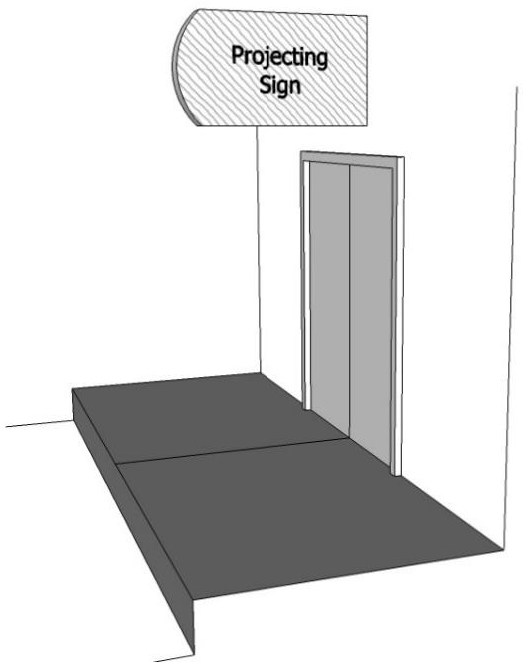
Projecting (blade) signs.
(1)
Location: Projecting signs are allowed in the TC, C-1, and C-2 districts.
(2)
Size: Projecting signs shall be not more than eight square feet.
(3)
Additional regulations.
a.
One projecting sign is allowed per ground floor tenant, except that establishments located in a corner unit may have two breezeway signs if there are two entry doors.
b.
A projecting sign shall be located at least eight feet above grade.
c.
A projecting sign may be attached to the under-side of a covered walkway or extend perpendicular to the face of the building, in which case they shall not extend more than four feet from the face of the building to which it is attached.
d.
A projecting sign is allowed under a covered walkway in a shopping center.
(f)
Wall signs.
(1)
Location.
a.
Wall signs are allowed in all zoning districts.
b.
In residential districts, wall signs shall be allowed only for non-single family uses.
c.
In residential districts, one wall sign is allowed per building.
d.
In TC, C-1, C-2, C-3, M-1, M-2 and zoning districts, one wall sign is permitted per separate tenant space.
(1)
Size.
a.
In residential zoning districts, permitted wall signs shall meet the following requirements.
i.
The gross sign area shall not exceed ten percent of the wall area to which the sign is affixed.
ii.
No sign shall exceed 100 square feet.
b.
In C-1, C-2, and C-3 zoning districts permitted wall signs shall meet the following requirements.
i.
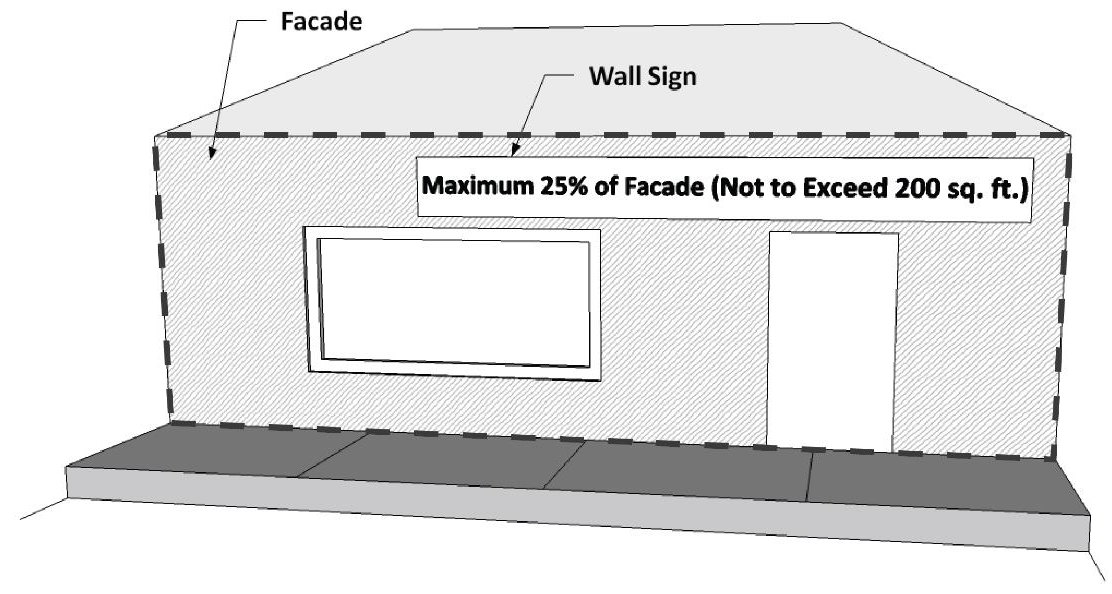
Wall signs shall not exceed 25 percent of the square footage of the facade on which the sign is located (facade is defined as including glass area within the wall on which the sign is to be affixed).
ii.
In no case shall wall sign exceed 200 square feet in area.
iii.
For one-story multi-tenant commercial buildings (shopping centers), each tenant space is allowed one wall sign equal in area to 25 percent of the front facade of the leased tenant space. In no case shall said sign exceed 200 square feet.
iv.
One additional wall sign shall be allowed on a second facade (sides of the building not facing the street and visible from a parking lot or second right-of-way) provided the sign on the second exposure may be no greater than the sign on the front facade.
c.
In M-1, M-2 and zoning districts permitted wall signs shall meet the following requirements.
i.
For buildings containing a single user, the wall sign shall not exceed ten percent of the square footage of the facade on which the sign is located (facade is defined as including glass area within the wall on which the sign is to be affixed). In no case shall said sign exceed 200 square feet in area
ii.
For multitenant buildings, each tenant space is allowed one wall sign equal in area to ten percent of the front facade of the leased tenant space. In no case shall said sign exceed 200 square feet.
iii.
One additional wall sign shall be allowed on a second facade (sides of the building not facing the street and visible from a parking lot or second right-of-way) provided the cumulative total area of both signs does not exceed the maximum allowable area for a single wall sign.
(3)
Additional regulations.
a.
Wall signs shall not extend beyond the roof ridgeline of the building.
b.
In the TC district, the following special rules apply:
i.
Professionally painted signs may be provided only in conjunction with mural art consistent with the TC district design guidelines.
ii.
Wall signs may extend beyond the roof ridgeline of the building or, in the alternative, a roof sign may substitute for any wall sign provided that the roof sign meets the size and location criteria applicable to wall signs.
iii.
Cabinet signs are not a permitted type of wall sign.
(g)
Manually changeable copy signs.
(1)
Location. Manual changeable copy signs are allowed in the TC, C-1, C-2, C-3, M-1, M-2, and in all residential districts for multi-unit dwelling uses and non-residential uses.
(2)
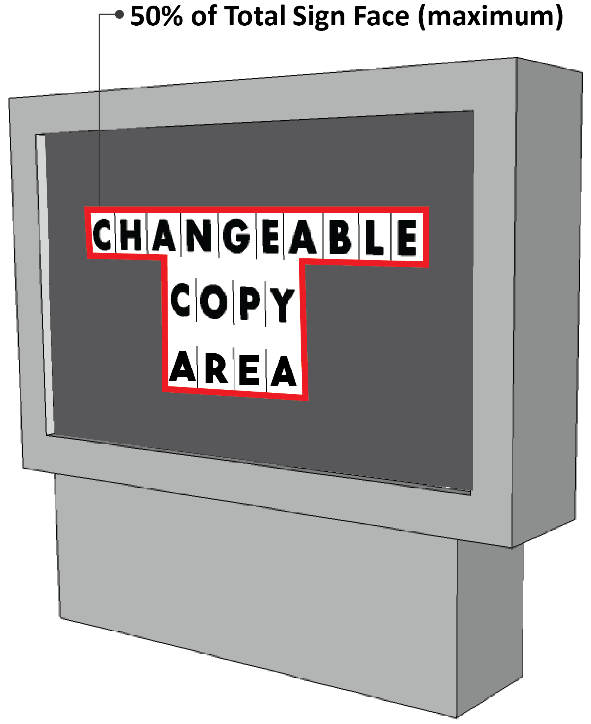
Size. A manually changeable copy sign may be displayed as part of a monument or wall sign and shall not occupy more than 50 percent of the total sign face of the monument of such sign.
(3)
Additional regulations.
a.
Manually changeable copy signs in residential districts for multi-unit dwelling uses and non-residential uses located upon land less than three acres in size shall be permitted subject to the following conditions:
i.
There shall be not more than one such sign per lot.
ii.
No sign shall exceed 24 square feet in area.
iii.
No sign shall be closer than eight feet to any other lot.
iv.
The top of a sign shall not be higher than eight feet above grade.
b.
Manually changeable copy signs in residential districts for multi-unit dwelling uses and non-residential uses located upon a property of three acres or more in size shall be permitted subject to the following conditions:
i.
One manually changeable sign in the form of a monument sign shall be permitted.
1.
Sign shall not exceed ten percent of the lot's frontage or 100 square feet, whichever is less.
2.
Sign height shall not exceed six feet.
c.
Monument or wall signs which enclose the manual changeable copy message center sign shall all sides be finished of brick, stone, stucco, powder coated or comparably finished metal. Gaps between the message center and the finish are permitted to accommodate locks and hinges for a cover for the changeable copy area, but only to the extent necessary for such locks and hinges to operate.
d.
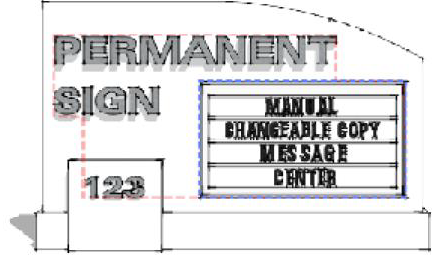
Manual changeable copy message centers, including their frames, shall make up not more than 50 percent of the sign area. The balance of the sign area shall utilize permanently affixed letters or symbols. See figure below.
e.
Gas/Fueling stations may have a changeable electronic message board sign for that portion of the sign that displays the price of fuel.
(h)
Electronic message signs.
(1)
Location.
a.
Electronic message signs, which may be displayed as part of a monument sign as regulated herein, shall be allowed only on properties that meet one of the following criteria:
i.
Government related land uses
ii.
Properties zoned C-1 and C-2 of ten acres or more
iii.
When authorized by Special Use pursuant to 122-395, Religious Institutions on properties having three and one half (3.5) acres or greater in the TC zoning district with a lot line abutting Kirchoff Road are allowed as follows:
• The monument sign face may be up to 60 square feet
• The maximum sign height shall be six feet, and shall include a one foot high base
• Gross sign area may not exceed 60 percent of sign face
(2)
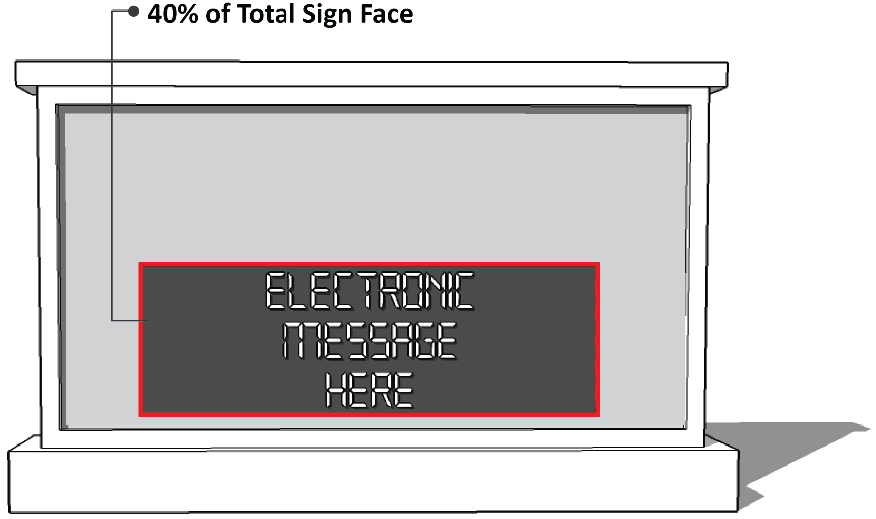
Size. An electronic message sign shall not occupy more than 40 percent of the total sign face of the permitted monument sign area.
(3)
Additional regulations.
a.
One electronic message sign is allowed per property.
b.
No sign containing a changeable copy sign may also contain and electronic message sign.
c.
Electronic message centers are only permitted on monument signs which enclose the electronic message center component on all sides with a finish of brick, stone, stucco, powder coated (or comparably finished) metal, or the surface of the sign face.
d.
Electronic message signs shall change messages no more than once every 30 seconds.
e.
Electronic message signs shall display static messages that do not contain a light source that flashes, blinks, strobes, travels, chases, rotates, or changes in intensity, brightness, or color.
f.
Transitions between messages shall be instantaneous.
g.
Every electronic message sign must have the capability to lower the intensity of the light being emitted after it is erected.
h.
Electronic message signs shall be designed to default to a static display in the event of mechanical failure.
i.
Photometric plan. The city may require applicants to submit photometric plans demonstrating compliance with this article as a condition to issue a sign permit.
(i)
Temporary banner signs
(1)
Location.
a.
Banner signs are allowed for non-residential uses in all zoning districts and may be displayed attached to walls, displayed on windows, or displayed as a free standing sign.
(2)
Size.
a.
Banners attached to a building shall not exceed ten percent of the wall area of the premises and in no case shall it exceed 100 square feet.
b.
Banners displayed in windows may only be displayed if there is no other window signs and the banner covers no more than 25 percent of the window area.
c.
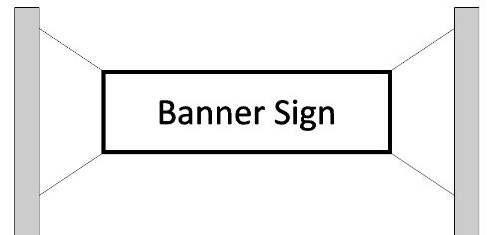
Banners displayed as free standing signs shall be no more than 32 square feet in size.
(3)
Additional regulations.
a.
Banners displayed as free standing signs shall be supported by a post on either site of the banner.
b.
Banners displayed as free standing signs may be located in front or side yards, a minimum of 15 feet from any property line.
c.
One temporary banner sign is allowed per property in residential districts.
d.
Banners are limited to a display period of 30 calendar days, up to four times per year per calendar year (up to a total of 120 days per year).
e.
Banners shall not be illuminated.
f.
Banners shall not project above the roof of the building to which it is attached.
g.
Banners shall not encroach into the public right-of-way.
h.
One banner is allowed per business, which may be displayed as a wall sign or window sign in C and M districts.
i.
Temporary signs shall not be displayed when weather conditions exist that may damage the sign or creates a safety risk, such as high winds, heavy rain, or excessive snow.
(j)
Temporary construction signs.
(1)
Location. Temporary construction signs are allowed in all zoning districts for nonresidential land uses.
(2)
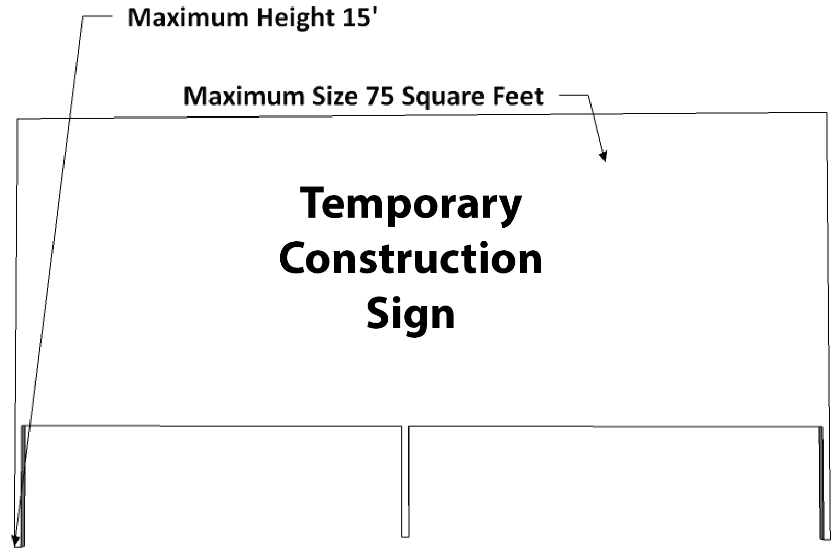
Size. 75 square feet each
(3)
Additional regulations:
a.
No temporary construction sign shall project higher than 15 feet above curb level.
b.
No temporary construction sign shall be located nearer than 25 feet to the property line upon which the sign is erected.
c.
Temporary construction signs are allowed during initial development of a property or structure.
d.
The sign permits shall be issued only once an active building permit is issued for the site and shall be removed prior to issuance of a certificate of occupancy.
e.
Illumination is prohibited.
(k)
Grand opening sign packages.
(1)
Intent. To provide visibility and awareness to businesses in the city upon their initial opening, reopening, or change of ownership. It cannot be used to promote grand openings in another location or to promote an existing business.
(2)
Eligible businesses. A business may apply for a permit from the community development department to authorize a grand opening sign package where:
a.
The business is new to the city, reopening within the city, or has had a change in 50 percent or more of their ownership, which change in ownership took place within the preceding 60 days;
b.
The business is located in any zoning district except an "R" district; and
c.
The business is primarily engaged in the retail sale of goods or services to the public.
(3)
Location. All signage and promotion materials must be placed on premise of the business. No off-premise signage may be utilized. No more than one grand opening sign package at one time may be issued for one parcel.
(4)
Dates of utilization. A grand opening sign package shall be valid for a period of up to 30 consecutive days. At least one day of the period of validity shall fall within 90 days of the date of the business opening or reopening to the public or the date of the change of ownership.
(5)
No illumination. No temporary illumination may be installed or used in conjunction with a grand opening sign package.
(6)
Signs permissible. Notwithstanding any more restrictive provision of this article X, a sign permit for a grand opening sign package shall authorize the following types and quantity of signage:
a.
Quantity limited: A total of four banner signs or inflatable advertising, in any combination, may be authorized as part of a grand opening sign package as follows:
i.
Banners. Except as to quantity, each banner shall be in accordance with section 122-606(i) concerning temporary banner signs.
ii.
Inflatable advertising. A maximum of one inflatable advertising balloon or device is permitted as part of a grand opening sign package. The maximum height for inflatable advertising is 20 feet, measured from the adjacent grade to the highest point. Inflatable advertising must be in contact with the ground and be securely anchored. Inflatable advertising shall not be animated or moving.
b.
Strings of pennants. Pennants strings may used. Pennant strings must be securely fastened.
(Ord. No. 20-47, § 3(Exh. A), 11-10-2020; Ord. No. 21-63, § 2(Exh. 1), 11-9-2021; Ord. No. 22-13, § 2(Exh. A), 4-12-2022; Ord. No. 23-20, § 2(Exh. A), 4-25-2023; Ord. No. 23-28, § 2, 5-23-2023; Ord. No. 24-57, § 2, 11-26-2024; Ord. No. 25-34, § 15, 5-27-2025)
Sec. 122-607. - Signs not requiring permit.
This section sets out which forms of signs not requiring a permit are allowed in each zoning district, and the size and height standards that apply to them. These signs are allowed in accordance with the provisions of this article, except that where other sections of the City Code regulate such signs, the more restrictive regulation shall apply.
(a)
A-frame signs.
(1)
Location. A-frame signs are allowed in TC, C-1 and C-2 zoning districts.
(2)
Size.
a.
The size of an A-frame sign shall be calculated based on one face of the signs.
b.
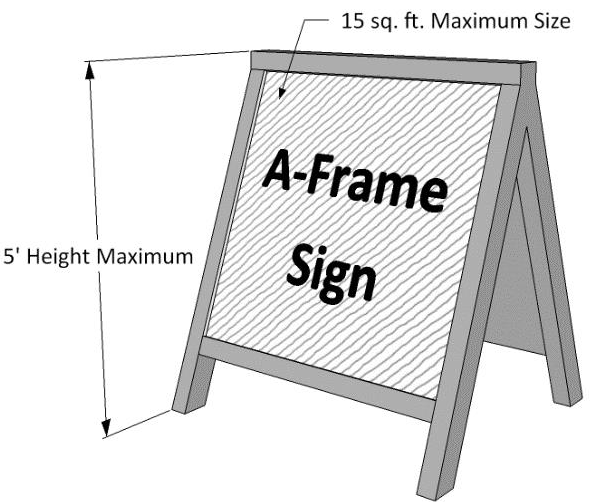
A-frame signs shall be no larger than 15 square feet, nor exceed five feet in height.
(3)
Additional regulations
a.
A-frame signs may be located on private property only.
b.
A-frame signs located on private sidewalks shall maintain at least four feet of sidewalk width and must not to interfere with pedestrian traffic or accessibility per the Americans with Disabilities Act.
c.
A-frame signs must be located within ten feet of the primary entrance of the business.
d.
One A-frame sign is allowed per business.
e.
A-frame signs may be displayed during operating hours of the business to which it is related.
f.
A-frame signs shall not be displayed when weather conditions exist that may damage the sign or creates a safety risk, such as high winds, heavy rain, or excessive snow.
(b)
Window signs.
(1)
Location. Window signs are allowed in all zoning districts.
(2)
Size.
a.
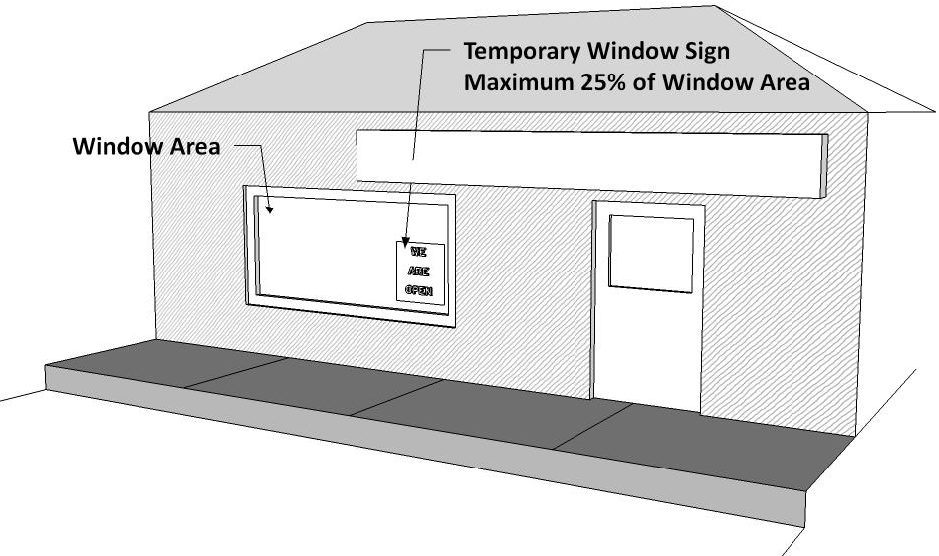
Window signs shall not occupy more than 25 percent of the total ground floor window area on each building facade.
b.
Total window area on which to define permitted 25 percent shall be the window area between the structural elements (pillars) defining the window area.
c.
Temporary window signs shall not be located above the ground floor.
(3)
Additional regulations:
a.
Neon, LED, or any similar rope lighting shall not be permitted to outline or be used as a design feature in windows.
b.
Each business is allowed one illuminated sign in the window, which shall not exceed nine square feet in total.
c.
No other lighting in the window is permitted.
(c)
Yard signs.
(1)
Location. Yard signs are allowed in all zoning districts.
(2)
Size.
a.
In residential districts, yard signs shall not exceed eight square feet in area per sign and six feet in height.
b.
In non-residential districts, yard signs shall not exceed 20 square feet in area per sign and eight feet in height.
(3)
Additional regulations.
a.
Two yard signs are allowed per street frontage.
b.
The display of temporary signs shall be limited to a cumulative total of 120 calendar days per calendar year per premises.
c.
Yard signs shall be a minimum of five feet from any property line
d.
Yard signs shall not create a hazard for any person or property.
e.
Yards signs placed in reference to construction work on premises must be in connection with an active, approved building permit, and shall be removed no later than ten days after expiration of the building permit, or issuance of an occupancy permit, whichever occurs first.
f.
Yard signs placed subject to sale or rent of a property shall be removed no later than seven days after the sale, rental, or lease agreement signing for the subject property.
g.
Yard signs placed in connection with a commercial sales event shall not be erected more than 30 days prior to the event and shall be removed immediately after the termination of the event of activity.
h.
Yard signs shall not be displayed when weather conditions exist that may damage the sign or creates a safety risk, such as high winds, heavy rain, or excessive snow.
(Ord. No. 20-47, § 3(Exh. A), 11-10-2020; Ord. No. 25-34, § 16, 5-27-2025)
Sec. 122-608. - Illinois Rte 53 expressway sign overlay district.
(a)
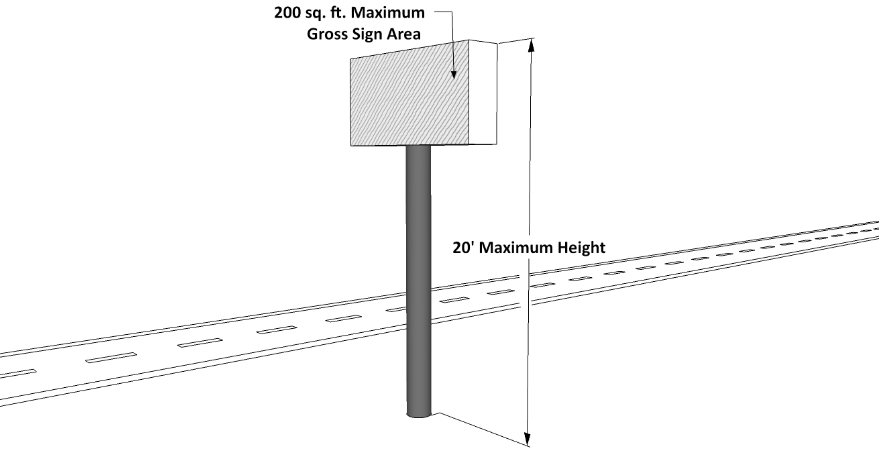
Purpose. The purpose of this district is to provide areas along the Illinois Rte. 53 Expressway through the City of Rolling Meadows for the erection of off-premises advertising signs; limit the area where such signs are permitted to certain lands zoned C-3 office, institutional and research district and M-1 business park district and located immediately west of and adjacent to Illinois Rte. 53 Expressway generally between Euclid Avenue and US Route 14 (Northwest Highway); provide regulations for such signs; provide provisions for the construction of such signs, and locate such signs so that they are not adverse to the health, safety and general welfare of the residents of the City of Rolling Meadows.
(b)
Location of district boundaries. All incorporated land zoned C-3 in the areas bounded by: 1) IL 53, Winnetka Ave, and Winnetka Circle, 2) Rohlwing Road, Euclid Ave and Euclid entrance Ramp to IL 53 and 3) Euclid Ave, Hicks Road, and Kirchoff Road, and land zoned M-1 west of and adjacent to Illinois Rte. 53 Expressway generally between Euclid Avenue and U.S. Route 14 (Northwest Highway) in the City of Rolling Meadows. The width of the overlay district shall be 100 feet from the edge of the Rte. 53 right-of-way along that span.
(c)
Permitted uses.
(1)
Off-premise advertising signs.
(d)
Dimensional standards.
(1)
Maximum height: 60 feet above the immediate adjacent expressway pavement surface to top of sign.
(2)
Maximum size: 1,200 square feet gross surface area per face.
(3)
Maximum length: 60 feet.
(4)
Minimum separation: 700 linear feet measured from pole-to-pole from one existing off-premises advertising sign to another existing off-premises advertising sign on the same side of the expressway.
(e)
Applicable provisions.
(1)
Any new off-premises advertising signs, including electronic message and digital display signs ("digital signs"), with an advertisement or information pertaining to business conducted off the property, may be located on property within the City of Rolling Meadows' Illinois Rte. 53 Expressway sign overlay district.
(2)
No off-premises advertising sign shall be located in such a position that it obscures the view of vehicular or pedestrian traffic in such a manner as to endanger the safe movement thereof.
(3)
No off-premises advertising sign shall be located within 500 feet, measured from the closest point of the sign to the closest property line of any lot used for residential purposes. No digital off-premises advertising sign (face) shall be located within 1,000 feet of any lot used for residential purposes. Hotels and motels are not considered residential uses for purposes of this section 122-608.
(4)
No off-premises advertising sign shall be erected or maintained upon or above the roof of any building or structure.
(5)
Off-premise advertising signs shall not be "stacked" one on top of another or placed together horizontally "end-to-end" or "side-by-side."
(6)
Only one off-premise advertising sign shall be erected per lot.
(7)
Off-premise advertising signs may be single-faced or double-faced but no off-premises advertising sign shall contain more than one face on each side of the display and the surface area shall not exceed a total of 1,200 square feet of gross surface area per face.
(8)
No off-premise advertising sign shall exceed 60 feet above the level of the immediate adjacent expressway pavement surface.
(9)
Lighting:
a.
No off-premise advertising sign shall be so illuminated that the light intensity or brightness adversely affects the safe vision of operators of vehicles moving on public or private streets, highways, or parking areas or of pedestrians.
b.
No off-premise advertising sign shall be illuminated by any exposed tubes or bulbs, strobe or incandescent lamp or floodlights, nor shall any off-premises advertising sign incorporate any reflective device.
c.
Flashing off-premise advertising signs are prohibited. In addition, no off-premises advertising sign shall contain or be illuminated by revolving, rotating, animated or any other form of moving light or lights.
d.
No off-premises advertising sign shall be so illuminated that the light intensity or brightness causes direct glare into or upon any building or in any other way adversely affects surrounding or facing properties.
e.
All lighting shall be shielded and directed towards the face of the sign to prevent spillage to the surrounding area.
(10)
Digital messaging:
a.
Hold time: A minimum ten second hold time shall be maintained for any message, sign, logo, image or other display on an off-premises advertising sign.
b.
Static: All messages or displays must be static. No flashing of images displayed on an off-premises advertising sign shall be permitted. "Flashing" in this context shall mean where the sign alternates suddenly between being fully illuminated and non-fully illuminated for the purpose of drawing attention to the off-premises advertising sign.
c.
Transition time: Regardless of technology used, changes between messages or displays must be instantaneous.
d.
No speakers or other audio systems shall be attached to the off-premises advertising sign, and no audio presentations shall emanate from the off-premises advertising sign.
e.
No motion pictures shall be displayed on off-premises advertising signs.
(11)
Appearance and maintenance:
a.
Exposed backs of signs, poles and other support structures shall be required to be painted or shielded to minimize adverse visual impacts and to present a finished appearance so as to improve the visual appearance.
b.
Supporting structures shall be adequately screened from adjoining properties with a combination of fencing and vegetation (existing and proposed) as shown on a landscape diagram.
c.
All off-premise advertising signs, including the sign faces, supporting structures, lights and landscaping shall be kept in good repair and free from tears, rust and other indication of deterioration.
d.
Off-premise advertising signs and support structures shall be removed within one month of cessation of use. "Cessation of use," shall be defined as a period of 90 consecutive days in which the sign is not used or there is no intent to resume the use or activity of the sign.
(12)
All off-premises advertising signs shall be subject to the City of Rolling Meadows annual sign and inspection fee as outlined in Appendix B entitled, "Schedule of Rates, Fees, Fines and Penalties" of the City Code.
(13)
Application requirements. An applicant for an off-premise advertising sign shall first obtain an approved permit from the Illinois Department of Transportation (IDOT). Along with the IDOT permit, the application submission to the city shall also include:
a.
A site plan on a current plat of survey for the property which shall show the location of the proposed sign in relation to all property lines and structures (principal and accessory) on the property, where applicable, easements, right-of-ways, utilities if nearby, etc.;
b.
A general description of structural design and construction materials of the sign;
c.
A color rendering/drawing of the proposed sign which shall contain specifications as to the height, perimeter, and area dimensions, means of support (support structure), methods of illumination, if any, source and location of power, and any other significant aspect of the proposed sign;
d.
A written certification by a professional engineer as to the wind load, structural performance, lighting characteristics, and orientation. Verification that the underlying soil is capable of sustaining the proposed load and that the electrical and structural strength of the proposed sign is satisfactory.
e.
A landscape plan encircling the support area of the sign.
f.
Any other information requested by the community development department in order to carry out the purpose and intent of this overlay district.
g.
Each sign face shall be considered a separate sign for purposes of permit and filing fees
(Ord. No. 20-47, § 3(Exh. A), 11-10-2020)
Sec. 122-609. - Sign related definitions.
Gross sign area: The total area of signage permitted for any given sign. Gross square area may be expressed as either a number of square feet, percentage of a defined sign face, or other measurement.
Illuminated sign, external: A sign illuminated by a source of light which is cast upon the surface or face of the sign to illuminate by reflection only.
Illuminated sign, internal: A sign, all or any part of which is made of incandescent, neon, or other types of lamps attached thereto; or raised letters lighted by an electric lamp attached thereto; or a sign having a border of incandescent or fluorescent lamps thereto attached and reflecting light thereon; or a transparent sign whether lighted by electricity or other illuminant.
Sign: Any object or device containing letters, figures and/or other means of communication or part thereof, situated outdoors or indoors, of which the effect produced is to advertise, announce, communicate, identify, declare, demonstrate, direct, display, and/or instruct potential users of a use, product and/or service.
Sign, a-frame. A type of portable sign that is intended to be placed on a hard surface, most commonly a sidewalk.
Sign, animated. Any sign, or any part thereof which changes physical position by means of movement, rotation or change in illumination to depict movement.
Sign, awning: A sign that is mounted, painted, or attached to an awning or other window or door canopy. Any projecting canvas or other material over a structural framework used for a small amount of shelter or shade on a facade that has signage displayed on the visible surface.
Sign, banner: A temporary advertising sign which is not attached to a permanently mounted backing.
Sign, cabinet: A sign where the message or graphic is displayed on a single, continuous flat or curved panel (insert) within a box-like enclosure. Cabinet signs lack dimensional articulation, routed lettering, or individually mounted characters. A common example of a cabinet sign is an internally illuminated box sign with a plastic or acrylic face bearing printed or translucent graphics as a single insert.
Sign, canopy: A permanent advertising sign located on a canopy.
Sign, changeable copy: A sign wherein provision is made for letters or characters to be placed in or upon the surface area, either manually or electronically, to provide a message or picture.
Sign clearance: Sign clearance is the distance between the bottom of a sign face or structural element that is not affixed to the ground and the nearest point on the surface under it. 'See Article X Signs'
Sign, directional: Any sign on a lot that directs the movement or placement of pedestrian or vehicular traffic with or without reference to, or inclusion of, the name of a product sold or service performed on the lot or in a building, structure or business enterprise occupying the same.
Sign, electronic message: A sign which exhibits changing and/or illuminated messages.
Sign, feather: A temporary sign typically supported on a single pole with the message on one side of that pole and unsupported on the other. See graphic:
Sign, freestanding: A permanent sign that is self-supporting in a fixed location and not attached to a building.
Sign message: The thought or idea conveyed or expressed by the words, letters, insignia, figures, designs, fixtures, colors, motion, illumination, sound or projecting images or any combination thereof.
Sign, monument: A freestanding sign, other than a pole sign, in which the entire bottom is in contact with or close to the ground.
Sign, moving. A sign or other advertising device having moving, revolving, or rotating parts.
Sign, neon: A sign consisting of glass tubing, bent to form letters, symbols, or other shapes and illuminated by neon or a similar gas through which an electrical voltage is discharged.
Sign, off-premise: A sign advertising a land use, business, product or service not located or available upon the premises whereon the sign is located.
Sign, painted wall: A sign that comprises only paint applied on a building or structure
Sign, permanent: A sign constructed of durable material and affixed, lettered, attached to or placed upon a fixed, nonmovable, nonportable supporting structure.
Sign, pole: A freestanding sign that is affixed, attached, or erected on a pole or poles and that is not itself an integral part of or attached to a building or structure, and has no structural base on which the sign is located.
Sign, portable: A sign that is designed to be easily moved from one location to another, and when placed, is neither fastened to a permanent structure or building, nor mounted in the ground. Portable signs include signs mounted on trailers, wheeled carriers, or frames that are designed to be placed onto a surface without being secured to it.
Sign, projecting: A sign supported by a building or other structure which projects over any street, sidewalk, alley, or public way or public easement (also knows as "Blade" or "Shingle" signs).
Sign, roof: A sign upon or above the roofline or parapet of the building or structure.
Sign structure: A sign structure shall include, but not be limited to, the supports, uprights, braces, backing, sign board, and framework designed to contain a sign message. Sign structure is not meant to include the message conveyed by the sign.
Sign face: The area of a sign which shall be computed by applicable mathematical formula for the shape of the sign face including both copy, background, and any frame of boxed display or, for a sign made up of separate letters or characterizations connected in meaning, by computing the area lying within straight lines connecting the extreme projections, corners or edges of the letters, characters and other figures composing the sign taken as a whole. Where a freestanding sign is multisided, one-half of the total surface area including copy, background, and any frame or display shall be the sign area.
Sign, temporary: A structure or device used for the public display of messages or images, which is easily installed and not intended or suitable for long-term or permanent display due to lightweight or insubstantial construction materials.
Sign, temporary construction: A temporary sign made of wood or other sturdy materials located on a site only for the time period that a building permit is active for the property.
Sign, vehicle: A sign attached to or painted on a vehicle parked and visible from the public right-of-way, unless said vehicle is used for transporting people or materials in the normal operations of the business and it is properly parking in a designated parking space. Signs attached to trailers or inoperable vehicles are presumed to be vehicle signs if they are parked in plain view from the right-of-way. Bumper stickers are not vehicle signs.
Sign, wall: A sign attached to, painted on, or erected against a wall of a building, whose display surface is parallel to the face of the building, structure, or fence, and whose height does not exceed the height of the wall, structure, or fence to which said sign is attached, painted upon, or against which said sign is erected.
Sign, window: A sign which is applied or attached to the exterior of a window, or applied to, attached to, or located within one foot of the interior of a window, which can be seen through the window from the exterior of the structure.
Sign, yard: A temporary portable sign constructed of paper, vinyl, plastic, wood, metal or other comparable material, and designed or intended to be displayed for a short period of time. Also includes signs suspended from a horizontal support (a swingpost) that is attached to a vertical support mounted in the ground.
(Ord. No. 20-47, § 3(Exh. A), 11-10-2020; Ord. No. 25-34, § 17, 5-27-2025)

