
Rolling Meadows City Zoning Code
ARTICLE III
REGULATIONS OF GENERAL APPLICABILITY
Sec. 122-71.- Introduction.
(a)
Scope. No building or structure shall be erected, converted, enlarged, reconstructed, or structurally altered, nor shall any building, structure, or land be used for any purpose other than is permitted in the district in which such is located. Further, no application for a building permit or other permit, license, or certificate shall be approved by the zoning administrator, their designee, or other city official unless in keeping with the provisions of this Zoning Ordinance.
(b)
Concurrence with plans and other regulations. Development plans prepared in keeping with this chapter shall also conform to other plans and regulations of the City Code, including but not limited to:
(1)
Comprehensive plan: The city's comprehensive plan shall provide guidance in the approval of all development under this chapter 122: Zoning.
(2)
Subdivision ordinance: In all cases where land is divided for the purpose of development or where a planned development is proposed, the provisions of chapter 98: Subdivisions of the City Code, as applicable, shall apply in addition to the provisions in this chapter.
(3)
Floodplain regulations: All development shall be constructed in compliance with the floodplain regulations in chapter 46 of the City Code.
(4)
Soil erosion: All development shall be constructed in compliance with the soil erosion and environmental impacts mattes in chapter 38 of the City Code.
(Ord. No. 20-47, § 3(Exh. A), 11-10-2020)
Sec. 122-72. - Lots, setback, and height.
(a)
Yard requirements.
(1)
Location. Yard requirements shall be set forth under each zoning district for all buildings, structures, and uses of land. All required yards shall be located on the same lot as the building, structure or use of land for which such yard is required. The right-of-way of any public roadway, public alley, or public accessway which exists by dedication, recorded easement, or prescription, and which is located on the lot shall not be included as part of the required yard.
(2)
Existing buildings. No yards existing on the effective date of this chapter or any amendment hereto, shall subsequently be reduced below, or further reduced if already less than, the minimum yard requirements of this chapter for equivalent new construction.
(3)
Reverse corner setbacks: In the case of a reverse corner lot in a residential zoning district, any accessory structure shall have a rear and side yard setback equal to the side yard requirements of the adjoining lot. Such structures shall not be located in any front yard.
(b)
Lot area and dimensions.
(1)
Any single lot or property of land held by an owner, unless also owning an adjacent lot, that does not meet the requirements for minimum lot width or area may be utilized for a permitted use provided the lot width and area are a minimum of 90 percent of the total relevant requirement.
(2)
Any single lot or property held by an owner, unless also owning an adjacent lot, that does not meet the requirements for minimum lot width or area, but is a minimum of 90 percent of the total relevant requirement, setbacks on said lot may be reduced to 75 percent of the minimum required yard dimensions.
(c)
Location of buildings and structures. Every principal building erected shall be on a lot or property which is adjacent to a public street for a minimum distance of 25 feet.
(d)
Division of lots. No lot shall be divided into two or more lots, and no portion of any lot may be sold, unless all lots resulting from each such division or sale shall conform with all of the bulk regulations of the zoning district in which the property is located.
(e)
Clear vision triangle.
(1)
Clear vision triangle defined. An area required in locations where an unobstructed view of approaching traffic is necessary for the safety of pedestrians, bicyclists and drivers.
(2)
Clear vision triangle measurement.
a.
At the intersection of two streets, no building, structure, planting or other obstruction to the vision of drivers exceeding a height of three feet above the street grade may be located within 25 feet of the intersecting right-of-way lines along corner lots (Figure 3-1).
Figure 3-1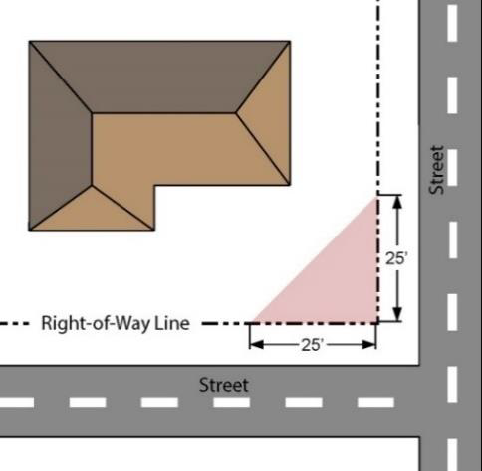
b.
At the intersection of a street and a driveway, no building, structure, planting or other obstruction to the vision of drivers exceeding a height of three feet above the street grade may be located within ten feet of the intersection of the right-of-way line and the edge of said driveway (Figure 3-2).
Figure 3-2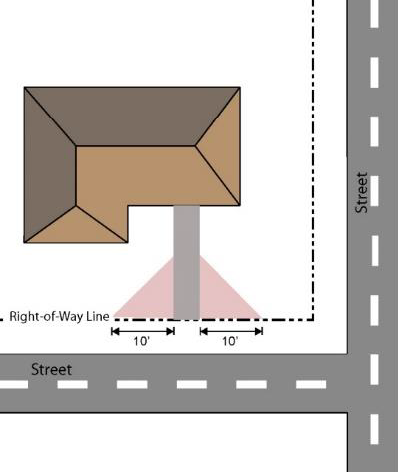
(f)
Building height limitations.
(1)
Height limitations shall be as set forth under each zoning district for all buildings, structures, and uses of land.
(2)
Exceptions.
a.
Roof structures including the housing of stairways; tanks, ventilating fans, or similar equipment required to operate and maintain the building; fire or parapet walls; skylights; steeples; flagpoles; chimneys; smokestacks; signage; and other rooftop structures deemed to be similar by the zoning administrator may be erected above the height limitations imposed by this chapter. No such structure may be erected to exceed by more than ten feet the height limits of the zoning district in which it is located.
b.
In addition to any applicable exception under [a.], an antenna or antenna support structure, where authorized by a special use permit, may be erected to the height authorized within the special use permit.
(g)
Permitted encroachments in required yards. The following encroachments may be permitted when located in the required yards as specified below. Unless otherwise indicated in this section 122-72(g) or elsewhere in this chapter, no permitted encroachment may be located closer than five feet to a side or rear yard and no encroachment may be permitted in any easement.
(1)
All yards.
a.
Open terraces, not over four feet above the average level of the adjoining ground, but not including a roofed-over terrace or permanently affixed awnings or canopies;
b.
Steps, four feet or less above grade, which are necessary for access to a permitted building or for access to a lot from a street or alley;
c.
Chimneys projecting up to 24 inches into the yard;
d.
Flagpoles.
e.
Fences shall be permitted encroachments only when constructed in accordance with the requirements of section 122-73 of this article.
f.
Overhanging cornices, eaves, sills, gutters or other similar architectural features projecting not more than 42 inches into the required yards.
g.
Open or lattice-enclosed fire escapes, fireproof outside stairways and balconies opening upon fire towers projecting into a yard not more than five feet or into a court not more than 3½ feet shall be permitted, where such are to be so placed as not to obstruct light and ventilation
h.
Open off-street parking spaces and driveways shall be permitted encroachments only when constructed in accordance with the requirements of article IV, Off Street Parking and Loading, of this chapter and as may be specified by the regulations of a zoning district.
(2)
Front yards.
a.
One-story bay windows projecting not more than three feet into the yard;
b.
Overhanging cornices, eaves, sills, gutters or similar architectural features projecting not more than 42 inches into the required yards;
c.
Basketball backboards and standards; provided such are a minimum of ten feet from any side lot line.
d.
Covered attached porches per the following:
1.
Encroachment is not to exceed six feet into the required front yard;
2.
The encroachment may be not taller than one story, corresponding with the first story of the home;
3.
May not be enclosed in any manner, including but not limited to walls, screens, and windows. A railing around the porch may not exceed 42 inches in height from the floor level of the porch;
4.
The porch roof's architecture must substantially conform to the house roof design and may not be a metal canopy, awning, or similar materials.
(3)
Rear yards.
a.
Accessory structures as permitted in section 122-78 of this article;
b.
Balconies; breezeways and open porches covering not more than 30 percent of the area defined by the required rear yard;
c.
One-story bay windows projecting not more than 2½ feet into the required yard;
d.
Overhanging cornices, eaves, sills, gutters or similar architectural features projecting not more than 42 inches into the required yards.
(4).
Side yards.
a.
Overhanging cornices, bay windows, eaves, sills, gutters or other similar architectural features projecting not more than 42 inches into the required yards.
b.
Air conditioners and generators projecting not more than three feet into the permitted side yard.
(h)
One principal building may be located on a lot used for a single-family detached or attached dwelling. For other uses, more than one principal building may be located on a lot provided that each building complies with the applicable requirements of this chapter as though it were an individual principal building on a lot.
(Ord. No. 20-47, § 3(Exh. A), 11-10-2020; Ord. No. 25-34, § 3, 5-27-2025; Ord. No. 25-64, § 3, 12-16-2025)
Sec. 122-73. - Walls, fences and screens.
(a)
General regulations.
(1)
Applicability. All fences and decorative walls must be erected and maintained in conformance with the requirements of this section 122-73.
(2)
Permits required. A permit issued by the zoning administrator is required to erect or alter any fence within the city that is greater than 42 inches in height, not withstanding required building permits.
(3)
Existing fencing. Fences legally constructed prior to the effective date of this chapter, shall be allowed to continue; provided, however, that replacement of fencing shall require conformance provisions of this chapter.
(4)
Reserved.
(5)
Barbed wire, electric, and dangerous fences. No fence may be maintained or constructed composed in whole or part of barbed wire, or with any similar materials designed to cause injury to persons, or wire charged with electrical current, anywhere within the city. In the case of protection of properties an M Zoning District barbed wire is allowed but must be at least six feet above the sidewalk and extend inward of property. Electric fences are not allowed anywhere within the city.
(6)
Height. No fence or may be maintained or constructed in whole or part in excess from the below requirements (Table 3-1). Fence height shall be measured as the vertical distance between the existing grade at the base of the fence and the top edge of the fence material or fence post, whichever is higher. Grade may not be modified in order to increase fence height. Fences built from the solid materials identified as decorative wall materials in subsection (7) shall not exceed the 'Wall Height' set forth in Table 3-1.
(7)
Permitted materials. Fences or decorative walls may be constructed with any of the following materials and shall be made of the same material on both sides. The finished side of all material used shall face the exterior of the lot fenced. Materials other than those that follow shall be subject to the approval by the zoning administrator upon evidence by the applicant that substituted materials are equally sturdy, safe, and similar in appearance.
a.
Fences:
i.
Wood (board, panel or picket).
ii.
Metal (wrought iron or panel).
iii.
Chain link may be permitted in M Districts one as part of a special use approval and provided the following requirements are met:
1.
Slats used as part of the chain link fence must be a single color.
2.
Chain link fence must be at least six (6) feet in height
3.
Additional landscaping along the fence is encouraged.
iv.
Vinyl plastic
v.
Composite
vi.
Recycled material
b.
Decorative walls:
i.
Concrete (plain, panel or textured).
ii.
Brick (plain or glazed).
iii.
Tile or architectural block
iv.
Stone (natural, block stone or rubble stone).
Table 3-1: Fence Height
(8)
Location.
a.
Generally.
i.
All fences shall be erected so that all supporting members and connecting elements are located on the property being enclosed and along the property line, except as necessary to connect the fence to the principal structure or to provide
ii.
No fence shall be built closer than one foot to any public path or sidewalk. A fence may be set back from the property line to maintain this clearance.
iii.
No fence shall be erected where prohibited by the clear vision triangle required by section 122-72(e).
b.
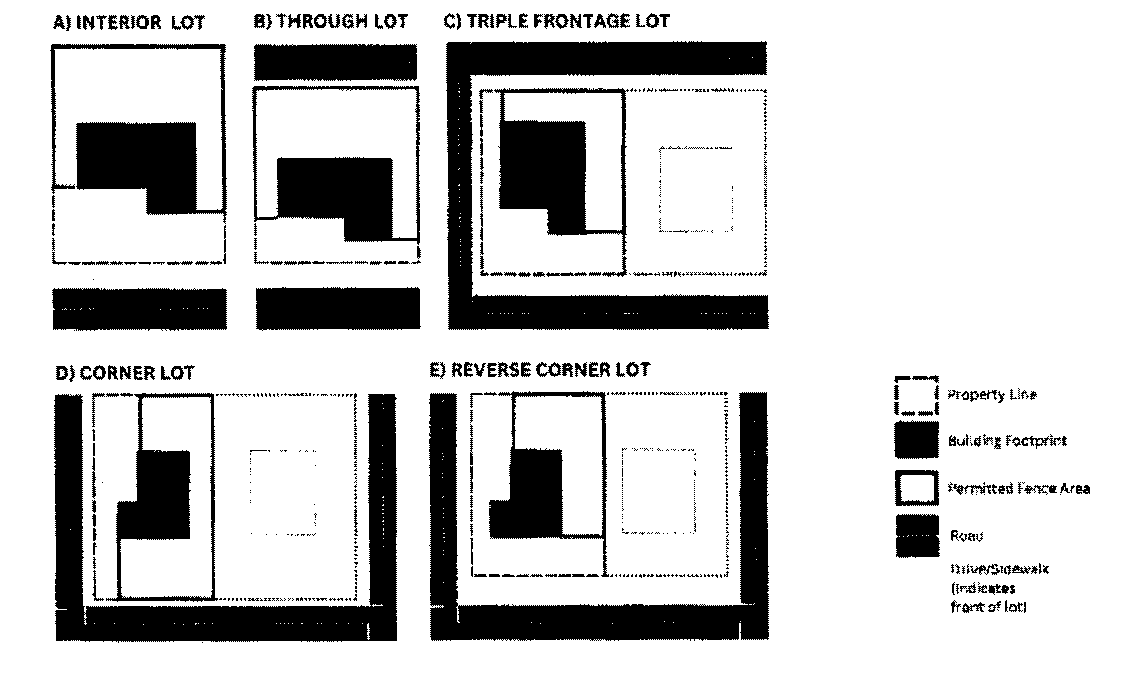
Arrangement of yards and fences (see Figure 3-3).
i.
Fences shall not be located in the area between the principal structure and the front lot line, for the full width of the front lot line.
ii.
On lots with multiple street frontages, including corner lots, fences shall not be located in the area between the principal structure and any street lot line where the yard abuts the front yard of an adjacent lot. This prohibition applies for the full width of the applicable lot line.
iii.
Notwithstanding the above, on a through lot without corner side yards, a fence may extend to the rear lot line opposite the primary frontage.
c.
Planned developments. Within a planned development, the permissible location of fences shall be determined solely by the provisions of the planned development.
d.
Vacant lots. Fences may be erected upon vacant lots as approved by the zoning administrator for good cause shown.
e.
Miscellaneous. A fence may additionally be located where specifically authorized or required by a special use permit or any other provision of this Code.
f.
Decorative walls: Notwithstanding the foregoing requirements, fences built from the solid materials identified as decorative wall materials in subsection (7) may be located in any required yard, including front yards. Decorative walls shall not be located within one foot of any public path or sidewalk; two feet of a driveway entrance; or where prohibited by the clear vision triangle required by section 122-72(e).
Figure 3-3. Permitted Fence Locations in "R" Districts.
The examples illustrate various building footprints and corresponding permitted locations for fences. The illustrations are not drawn to scaled and are not intended to accurately depict required setbacks or other dimensions.
(Ord. No. 20-47, § 3(Exh. A), 11-10-2020; Ord. No. 25-72, § 2, 11-25-2025)
Sec. 122-74. - Reserved.
Editor's note— Ord. No. 25-72, § 4, adopted Nov. 25, 2025, repealed § 122-74, which pertained to regulation of general applicability location and derived from Ord. No. 20-47, adopted Nov. 10, 2020.
Sec. 122-75. - Storing of recreational vehicles..
(a)
Keeping, maintaining or storing any camping vehicle or house trailer on any real property within the city shall be in keeping with Section 66-30 of the City Code.
(b)
All recreational vehicles shall be stored on an improved surface as approved by the city engineer and as may by otherwise regulated in article IV: Off Street Parking and Loading.
(Ord. No. 20-47, § 3(Exh. A), 11-10-2020)
Sec. 122-76. - Outdoor business activities.
(a)
General requirements.
(1)
Any outdoor business activity conducted in conjunction with a use permitted by the applicable zoning district shall do so in accordance with this section 122-75 and other applicable sections [of] the City Code.
(2)
Outdoor business activity shall be designated as permanent or temporary.
(b)
Permanent outdoor business activity: A permanent outdoor activity is an ongoing accessory element of a main business operation and may include but not be limited to: Material storage, product storage, and display of goods for sale not within a wholly enclosed building.
(1)
Outdoor sales are allowed only in Commercial Zoning Districts and may be permitted in keeping with the following.
a.
All other relevant city regulations must be met.
b.
May not include storage of materials or goods not available for sale to the public.
c.
May not exceed an area of ten percent of the indoor gross floor area of the principal structure on the site or 800 square feet, whichever is greater.
(2)
Outdoor storage is allowed only in manufacturing zoning districts and may be permitted as a special use pursuant to Table 5.13 in keeping with the following.
a.
All other relevant city regulations must be met.
b.
May not include sale of materials or goods to the public.
(3)
Permanently placed vending machines are permitted provided:
a.
They are on a property located in a Commercial zoning district,
b.
Said device does not exceed a volume of 120 cubic feet.
c.
The number permitted devices is one per 5,000 square feet of lot area, not to exceed a total of six.
d.
Placement must be adjacent to the wall of the principal structure.
(4)
The use of permanently parked vehicles, semi-trailers, truck bodies and drop storage containers for an outdoor business activity is prohibited.
(5)
Drop storage containers used for permanent storage shall be prohibited in Commercial districts.
(6)
All outdoor storage in commercial and manufacturing district shall be conducted in keeping with regulations of those districts and other requirements of the City Code.
(c)
Temporary outdoor business activity: A temporary outdoor business activity is one with a limited time of operation and may or may not be associated with a principal use. Conditions applicable to all temporary outdoor business activities are as follows:
(1)
A permit issued by the zoning administrator is required for each structure, activity, or event.
(2)
All material or product stored and displayed must be maintained in a safe, orderly, and clean manner.
(3)
Seasonal sales and displays are allowed only for landscape items, arts and crafts and retail products normally found within the premises' building, and holiday decorations with the following conditions:
a.
Must not occupy more than two percent of the lot area or 3,000 square feet, whichever is less.
b.
Sales including a temporary tent or canopy may not occupy more than one percent of the lot area or 1,500 square feet, whichever is less.
c.
The duration shall be for not more than 120 days per calendar year. With any one storage or display period not exceeding 90 days.
d.
Shall not occupy more than 20 percent of spaces provided on-site and not obstruct any parking designated for persons with disabilities.
e.
The location and arrangement is subject to the approval of the zoning administrator in keeping with site design and safety standards of the City Code.
(4)
Sidewalk sales are allowed as follows:
a.
Must be operated by the business such sale is fronting.
b.
Location and arrangement is subject to the zoning administrator in keeping with site design and safety standards of the City Code.
c.
The duration is not to exceed four days and may occur up to a total of 16 days per calendar year.
d.
A clear walkway of five feet shall be maintained to accommodate safe pedestrian access.
(5)
Temporary automobile or boat sales are allowed in residential districts as follows:
a.
The area occupied is not to exceed two percent of the lot area or 5,000 square feet, whichever is less.
b.
Occupy not more than ten percent of parking spaces provided on-site and not obstruct parking designated for persons with disabilities.
c.
Location and arrangement is subject to the review and approval of the zoning administrator in keeping with site design and safety standards of the City Code.
d.
The duration shall not exceed ten days per event not more than 30 days total per calendar year.
e.
One sign of no greater than six square feet may be placed in the window of the vehicle.
(6)
The following special activities are allowed in residential districts: church festivals, church seasonal sales, festivals and fundraisers in public parks, subject to the following:
a.
Location and arrangement is subject to the review and approval of the zoning administrator in keeping with site design and safety standards of the City Code.
b.
One sign not exceeding 32 square feet each shall be permitted subject to the approval of the zoning administrator so as to be in keeping other relevant standards of article X, Signs of this chapter.
(7)
Temporary storage trailers and drop storage containers are allowed only as follows:
a.
Maximum number allowed is one per acre of land or fraction thereof with a maximum of six each not to exceed 4,160 cubic feet in volume.
b.
Duration is limited to 60 consecutive days not to exceed 120 days per calendar year. Exception, in residential districts where the maximum is 11 consecutive days per calendar year.
c.
The location, arrangement and contents of the storage trailer or container are subject to the approval of the zoning administrator in keeping with site design and safety standards of the City Code.
(8)
Temporary seasonal outdoor seating.
a.
Temporary seasonal outdoor seating permitted. Temporary seasonal outdoor seating is permitted subject to the following conditions:
i.
Standards for outdoor seating as set forth in section 122-76(c)(8)(b) below are met.
ii.
All requests for permitted temporary seasonal outdoor seating shall be renewed annually with the zoning administrator for compliance with the standards of this section 122-76 and other relevant sections of the City Code.
b.
General regulations for all temporary seasonal outdoor seating areas. The following regulations shall apply to all outdoor seating areas:
i.
All applications for outdoor seating shall be submitted to the zoning administrator for review on forms provided by the city.
ii.
Applications for outdoor seating shall be valid from April 1 to November 1 and may be renewed each year.
iii.
An application for temporary seasonal outdoor seating shall include a plot plan clearly identifying the area to be used for outdoor seating in relation to the existing restaurant and all tables, chairs, waste containers and other items shall be clearly marked and to scale.
iv.
The outdoor seating area shall be incidental to the operation of a restaurant, appropriately located on the premises
v.
Landscaping or other form of screening a temporary outdoor seating area may be required by the zoning administrator in keeping with site planning and safety standards of the City Code.
vi.
All outdoor seating areas shall be placed on an all-weather hard surface area.
vii.
For multi-tenant commercial buildings only, the outdoor seating area shall be immediately adjacent to the principal building, having only one row of tables, and located directly adjacent to the space which is occupied by the restaurant.
viii.
Temporary outdoor seasonal seating areas are not considered to generate additional parking demand for the purposes of this chapter.
ix.
No smoking shall be allowed as part of temporary outdoor seasonal seating areas.
x.
Temporary outdoor seasonal seating areas shall be contained within a barrier designating the area, said barrier provided by landscaping, planters, fencing, ropes, or other material providing equally safe conditions as may be approved by the zoning administrator.
xi.
Temporary outdoor seasonal seating areas shall be subject to all applicable health and sanitation codes.
xii.
No additional signage may be displayed as part of a temporary outdoor seasonal seating areas. Seating may be located on sidewalks or pedestrian walkways (public or private) provided that five feet of the sidewalk or walkway remains unobstructed.
xiii.
If seating is provided on public property, the following shall apply:
1.
The applicant shall submit a hold harmless agreement which indemnifies the city from any and all liability that may arise relating to the outdoor seating activity.
2.
The applicant shall submit evidence of general liability and dram shop insurance (if required), in an amount acceptable to the city. The policy shall include the city as a named insured and insuring the city against any liability resulting from the operation of the outdoor seating. The minimum coverage shall be at least $1,000,000.00 for general liability insurance and $300,000.00 dram shop insurance and shall have no less than an "A" rating by the most recent AM Best Insurance Guide.
3.
All maintenance of the public right-of-way associated with the operation of the outdoor seating area shall be the responsibility of the owner of the restaurant (upkeep includes the replacement of damaged public property, etc).
xiv.
All seating shall be a minimum of five feet from any drive aisle or point of vehicular access.
xv.
The seating shall not occupy or interfere with the use of parking spaces, aisles, driveways, fire lanes and fire exits.
xvi.
The seating shall not occupy or interfere with the use of building entrances, exits and pedestrian walkways.
xvii.
Any music shall remain at a conversational level and be discontinued by 10:00 p.m.
xviii.
Exterior lighting shall be inwardly directed with light sources not directly visible from adjacent properties so that no direct lighting or glare is cast off-premises.
xix.
Hours shall be limited to 6:00 a.m. to 10:00 p.m. on Sunday through Thursday and 6:00 a.m. to 11:00 p.m. on Friday and Saturday.
xx.
All tables, chairs and other items are to be removed, and stored other than outdoors on site, by November 1 st or at such time as the applicant ceases serving at the outdoor area.
xxi.
All furnishings shall be durable, kept in a neat, orderly and clean condition.
xxii.
Outdoor furnishings and their color should be selected for harmony and aesthetic quality with the adjoining buildings and streetscape and be capable of withstanding a wind force of 30 mph. Materials shall be of durable quality such as wrought iron, sturdy metal, heavy wood construction, or other material as approved by the zoning administrator; light weight material such as plastic, aluminum or other light gauge material are not permitted.
xxiii.
Any other conditions deemed necessary by the city manager to protect the public health, safety and welfare may be imposed.
xxiv.
Sale and consumption of alcoholic beverages, as well as any additional related requirements on the temporary outdoor seasonal seating area, shall be regulated by the liquor license governing the restaurant.
xxv.
Outdoor liquor service is subject to approval by the City of Rolling Meadows Liquor Commissioner.
(Ord. No. 20-47, § 3(Exh. A), 11-10-2020; Ord. 21-06, § 2, 2-9-2021; Ord. No. 21-36, § 3(Exh. 2), 7-13-2021; Ord. No. 25-44, § 3, 9-9-2025)
Sec. 122-77. - Pedestrian and bicycle facilities.
(1)
Any property required by the applicable use district or planned development provisions of this chapter to have pedestrian and bicycle facilities shall provide such facilities in accordance with this section 122-77.
(2)
Any developed property of five acres or more, other than those designated as a planned development, on which more than 50 percent of the site area and/or parking areas or parking spaces are reconfigured or altered, shall provide pedestrian and bicycle facilities as directed by this section 122-77 and approved as such by the zoning administrator.
(3)
Pedestrian walkways and bicycle paths may be either combined or separate.
a.
Combined walkway paths shall be a minimum eight feet in width with a center stripe.
b.
Separate walkway/paths each shall be a minimum of five feet in width.
c.
Walkways and paths shall connect the public way (public street, sidewalk or both) and the main access to the building(s) or use. Developments five acres or more in size and bounded by more than one public street shall have walkways and paths from each street to the main building access.
d.
Walkways and paths shall be separated from parking areas by a barrier, except at driveways and aisle intersections. Barriers, as approved by the zoning administrator, shall be an object or approved method prohibiting access of a motor vehicle, such barriers may include curbs, bumpers, posts, trees, planters or fence.
e.
Walkways and paths shall be accessible to persons with disabilities as required by applicable law.
f.
Design and construction of walkways, paths and related appurtenances shall be approved by the zoning administrator and substantially conform to the Guide for the Development of Bicycle Facilities, 1999 Edition, as published by the American Association of State Highway and Transportation Officials or other standard as specifically approved by the city engineer.
(Ord. No. 20-47, § 3(Exh. A), 11-10-2020)
Sec. 122-78. - Accessory uses and structures.
(a)
General standards for accessory uses and structures.
(1)
All accessory structures or uses, as defined herein, shall:
a.
Be built, moved, remodeled, established, altered or enlarged only as permitted by this chapter.
b.
Be permitted only in connection with a principal structure and use that is permitted within the zoning district in which the property is located.
c.
Be located on the same lot as the permitted use or principal building.
d.
Be owned or operated by the same person as the permitted use or principal building.
e.
Be subject to all applicable design and development standards of this chapter and chapter 18, Building Code of the City Code.
f.
Be maintained in a safe, sanitary, and secure fashion.
(2)
Percentage of rear yard occupied. No accessory structures, buildings or use shall occupy more than 30 percent of the area of the rear yard.
(3)
Location.
a.
Unless otherwise stated within this chapter, no accessory building, structure or use shall be located in a required front, corner side, or interior side yard.
b.
No accessory building, structure or use shall be located in a platted easement or drainage swale.
(4)
The following accessory uses and structures below are permitted in specific districts and yards (Table 3-2):
Table 3-2: Accessory Uses and Structures
(b)
General standards for accessory structures.
(1)
Conformity to regulations. Where an accessory structure is attached to the principal building, it shall be subject to, and must conform to, all regulations of this chapter applicable to the principal building, unless otherwise stated.
(2)
Time of construction. An accessory structure shall not be erected prior to the establishment or construction of the principal building to which it is accessory.
(3)
Size in single family districts: In single family districts the maximum size of an accessory building shall be nine percent of the lot size or 1,000 square feet, whichever is less.
(4)
Location.
a.
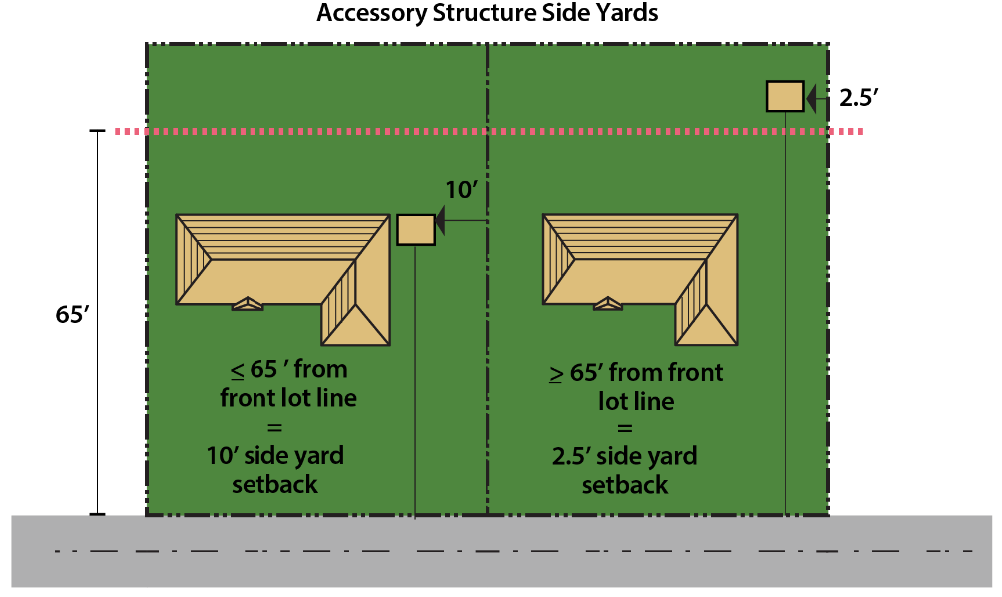
Single family residential districts - Side yard: An accessory structure located in the rear of a lot in a single-family residence district shall have a side yard of not less than 2½ feet when the structure is set back 65 feet from the front lot line, and not less than ten feet when located with a setback of less than 65 feet from the front lot line.
b.
Single family residential districts - Rear yards: Accessory structures shall be a minimum of five feet from the rear lot line.
c.
Non single-family districts - Rear yards: Accessory structures shall be a minimum of ten feet from the rear lot line.
(5)
Height.
a.
Measurement. The maximum height of any detached accessory structure is measured from grade to the peak of the roof.
b.
Residential districts. No accessory structure in residential zoning districts, except antennas and flag poles as otherwise regulated, shall exceed 15 feet 6 inches.
c.
Non-residential districts. No accessory structure in the non-residential zoning districts, except antennas and flag poles as otherwise regulated, shall exceed the height of the principal building or structure, or a height of 25 feet, whichever is less.
(6)
General restrictions.
a.
No accessory structures may be designed or used for permanent or temporary housing or sleeping purposes.
b.
Upon the demolition of a principal building, any remaining accessory structures on the same property as the demolished structure must also be demolished or altered to conform with this chapter.
(c)
Garages.
(1)
Requirements for attached garages. In all residential zoning districts:
a.
The maximum width of any attached garage shall not exceed 67 percent of the full width of the building.
b.
The maximum height of any garage door shall not exceed eight feet.
c.
The maximum number of garage doors facing in any one direction shall be limited to three single doors, each having a maximum width of nine feet, or one single door of nine feet maximum width plus one double door having a maximum width of 18 feet.
(2)
Requirements for detached garages. In all residential zoning districts:
a.
Maximum height of gable to ground. 15 feet 6 inches.
b.
Maximum dimensions. 1,000 feet.
c.
Accessory detached garages up to 18 feet may be approved as a special use in single family residential districts.
(3)
Requirements for non-residential parking structures:
a.
Accessory parking garages in commercial districts shall have no more than four levels of parking or shall not exceed 30 feet in height, whichever is less.
b.
Accessory parking garages in manufacturing districts shall have no more than four levels of parking or shall not exceed 40 feet in height, whichever is less.
(d)
Swimming pools, spas, hot tubs, and similar devices.
(1)
Location. Swimming pools, spas, hot tubs and similar devices shall not be located in any front yard, shall be setback at least ten feet from the rear lot line, and shall meet the side yard setback of the district.
(2)
Security Fencing. All outdoor swimming pools shall be enclosed by a fence. The minimum height from the pool decking shall be 48 inches and the maximum height shall be six feet.
(3)
Exemptions from security fencing. The specifications required in this section 122-77 shall not be required for any swimming pools or similar devices with a diameter of six feet or less or designed to contain less than two feet of water at any point, nor shall they be required for an aboveground spa or Jacuzzi. All other applicable requirements in chapter 18, Buildings and Building Regulations shall apply.
(4)
Requirements. All swimming pools, spas, hot tubs and similar devices shall meet all other relevant regulations of the City Code.
(e)
Trash/recycling/grease enclosures.
(1)
Applicability. A permanent enclosure for storage of garbage, refuse and other waste materials shall be provided for every use, other than single-family dwelling and multiple-family dwellings of less than four units.
(2)
Location and placement.
a.
Trash/recycling/grease enclosures shall not be located in any front yard or corner side yard.
b.
Placement of enclosures shall be planned and constructed in a manner that allows unobstructed access to each dumpster and the unobstructed opening of the gates during the emptying process.
c.
Trash/recycling/grease enclosures shall not be located in such a manner that the service vehicle will block any street intersection.
d.
When on a property adjacent to residentially zoned properties, enclosures shall be placed as far as possible from the adjacent residential property line.
(3)
Materials, construction, and design.
a.
The enclosure area shall be enclosed on three sides with permanent materials and on the fourth side with an access gate.
b.
Enclosures shall be of sufficient height to conceal contents on all sides including containers, but in no case shall be less than four feet in height above grade.
c.
All trash/recycling/grease enclosures shall be placed on a concrete surface as approved by the zoning administrator.
(4)
Screening.
a.
Screen enclosures from adjoining properties and the public right-of-way with fencing or building elements.
b.
The screening shall be compatible with the color, material and texture of the building.
c.
The screening shall be one or more of the following types of materials:
i.
Solid stockade or solid decorative wooden fencing;
ii.
Face brick wall;
iii.
Decorative concrete block wall; or
iv.
Reinforced wall with applied decorative finish.
(f)
Drive thru.
(1)
The following requirements are intended to minimize the potentially adverse effects of drive-thru activities on adjacent properties, pedestrians and traffic flow. As appropriate, additional requirements may be established per a special use approval.
a.
Location. Drive-thru lanes shall not be placed between the front lot line and the front building line of the principal structure.
b.
Hours of operation. Hours of operation shall be restricted to the hours of 6:00 a.m. to 10:00 p.m. if the property or the drive through [is] located within 150 feet of a residential zoning district.
c.
Vehicle stacking. The stacking area shall meet the requirements of article IV Off-Street Parking and Loading of this chapter.
d.
Pedestrian walkways. Pedestrian walkways shall be clearly visible, and be emphasized by enhanced paving or markings where they intersect with the drive thru.
e.
Screening requirements. Any drive-thru adjacent to a residential zoning district shall be screened with a six foot high solid fence, wall, landscaping or combination thereof. All service areas and ground-mounted mechanical equipment shall be screened from ground-level view.
(g)
Home occupations.
1.
Compliance. Home occupations are permitted as an accessory use in residentially zoned districts, provided they are in accordance with this subsection (g) and other applicable sections of this chapter.
2.
Standards. The following standards shall apply to all home occupations:
a.
The home occupation shall not change the outside appearance of the dwelling or its accessory buildings.
b.
No more than one person other than the immediate family residing on the premises shall be involved or employed in the home occupation activities taking place on the premises.
c.
All activities and storage shall be within an enclosed structure.
d.
All wholesale, jobbing, or retail business shall be conducted entirely by postal mail, electronic mail, or telephone.
e.
No more than ten percent of the total combined square footage of the principal structure and accessory garage, up to a total of 500 square feet, shall be devoted to the home occupation.
f.
A garage may be used for a home occupation only for passive incidental storage related to the business.
g.
No more than one truck of one-ton capacity associated with the home occupation shall be kept on the premises.
h.
No equipment or process shall be used in such home occupation, which creates noise, vibration, glare, fumes, odors, or electrical interference detectable from adjacent or nearby properties.
i.
A City of Rolling Meadows Business License is required for all home occupations.
j.
No traffic shall be generated by such home occupation in greater volumes than would normally be expected in a residential neighborhood, and any need for parking generated by the home occupation shall be met off the street in an area other than in a required front yard.
k.
Automotive repair shall be prohibited as a home occupation.
l.
All requirements of article IV: Off Street Parking and Loading shall be met.
(h)
Garage and yard sales.
(1)
A premise is limited to a maximum of three sales within any 12-month period.
(2)
Sales are not to exceed two consecutive weekends in duration.
(i)
Little Free Libraries.
(1)
Little free libraries are accessory structures for the purpose of storing books for exchange within neighborhoods and for the general public, and promoting access to reading materials.
(2)
Such accessory structures shall not be allowed in the public right-of-way, or in any easements.
(3)
Little free libraries shall not exceed five feet six inches in height from ground level to the top of the structure, and shall not have less than two feet between the ground and the bottom of the structure.
(4)
Installing such structures shall require a building permit and review.
(5)
Little free libraries shall be permitted encroachments in the front yard and shall be located with one foot of the property line.
(j)
Keeping of hens and outdoor hen shelters.
(1)
The keeping of hens and outdoor hen shelters, also known as chicken coops, are permitted as accessory structures on residential lots as regulated by chapter 14 article VIII of the City Code, section 14-160 through 14-168.
(k)
Sustainable energy systems.
(1)
Solar energy systems (SES):
a.
Purpose: The City of Rolling Meadows seeks to promote the development and use of local renewable energy resources, such as solar energy systems (SES), in order to meet the city's sustainability goals. the development of solar energy systems within the city will promote air quality and public health through the displacement of electricity consumption generated by fossil fuels; promote sustainable building design and practices; and allow residents and businesses to realize cost-savings and efficiencies. Solar energy systems, including systems used for community solar, are permitted as an accessory use to any principal permitted or special use subject to the following development standards.
b.
All SES shall meet applicable requirements of chapter 18, Buildings and Building regulations of the City Code.
c.
Building mounted facilities:
i.
Reserved.
ii.
Yards for mounted SES: Solar energy systems mounted to the principal building shall be subject to the following yard requirements:
1.
Solar energy systems are an allowed encroachment in front, side, and rear yards so long as they do not project more than five feet from an exterior wall.
2.
Solar energy systems shall be located flush to the exterior wall of the principal and street facing facades.
3.
In side or rear wall installations, solar energy systems must be set back a minimum of three feet from any property line.
iii.
Height for mounted SES: Solar energy systems mounted to the principal building shall be subject to the following height requirements:
1.
A mounted SES may be erected above the height limitations imposed by this chapter, subject to the following limitations.
2.
SES located on sloped roof buildings shall not extend beyond one foot above the roof surface at any point in residential zoning districts and 15 inches for all other zoning districts.
3.
SES located on flat roofed buildings shall not extend beyond two feet in overall height above the roof on which they are mounted in residential zoning districts or eight feet in all other districts. In no case shall solar collection devises extend above the parapet wall of the structure.
iv.
Bulk requirements for integrated SES: Solar energy systems integrated into the structure or building cladding shall be subject to the yard, height and any other bulk requirements of the zoning district in which they are located.
d.
Ground-mounted: Ground mounted separate or adjacent to the principal structure:
i.
Ground-mounted systems shall not be more than eight feet high;
ii.
On a lot with a principal building, be located in front- or street-facing yards. For the purposes of this subsection, a yard abutting Illinois Route 53 or Interstate 90 is not a "street-facing yard."
iii.
Notwithstanding any other provision of this section, an accessory ground-mounted solar energy system may be located on a vacant lot that is separate from the lot containing the principal use or building it serves. Such a system shall be kept in common ownership or control as the principal use or building. Such a system shall not be used for community solar.
iv.
Ground-mounted solar energy systems are not included when calculating building coverage.
v.
The contribution of the area of ground-mounted solar energy systems, if any, when calculating impervious surface shall be based upon the ground cover beneath the solar energy system.
vi.
The zoning administrator may approve the addition of a ground-mounted solar energy system to an existing planned development. Such a system shall be kept in common ownership or control as a principal use or building in the planned development. The addition of such a ground-mounted solar energy system is considered a "minor change" to an existing planned development as defined in section 122-462 of the City Code.
e.
Accessory structures: Solar energy systems mounted to accessory structures:
i.
Shall comply with all yard requirements for accessory structures; and
ii.
May extend up to four feet above the roof ridge for sloped roof structures and up to five feet above the roof height for flat roofed structures. A SES mounted to an accessory structure may be erected above the height limitations imposed by this chapter for accessory structures subject to these limitations.
(2)
Wind energy systems (WES):
a.
Purpose: The City of Rolling Meadows seeks to encourage environmentally sensitive development techniques to benefit its residents, business owners, and others in the community. This goal is supported by sustainable energy techniques such as Wind Energy Systems (WES). The purpose of this section 122-78(k)(2) is to ensure that wind energy systems are compatible in character and appearance with the principal structure and surrounding neighborhood or area of the zoning districts in which they are located. Wind energy systems are permitted as an accessory use to any principal permitted or special use subject to the following development standards.
b.
Wind energy systems: shall be allowed as an accessory structure, provided that no more than one WES is permitted per lot; except that, more than one WES may be permitted for commercial and manufacturing properties, subject to the approval of the city council. The following criteria have been established as minimum standards for consideration such systems:
c.
WES may only be designed for and installed on the roof of an existing principal structure and shall meet the following requirements:
i.
Shall be set back at least 20 feet from front or exterior building lines, and at least ten feet from side building lines. Setbacks shall be measured to the widest point of blade rotation or to the side of the WES, whichever is greater.
ii.
Shall be limited to a height of no more than 15 feet above the roof peak or top of a parapet wall, whichever is greater. Total height shall be measured from the highest point of blade rotation or the highest point of the WES, whichever is greater.
iii.
Shall comply with all noise regulations of the City of Rolling Meadows.
iv.
Shall be safely and securely attached to the rooftop in compliance with chapter 18, Building Code of the City Code.
v.
All WES structures shall conform to the appropriate city related rules and regulations pertaining to their construction, design, operation and maintenance.
vi.
WES shall be designed to withstand a minimum wind velocity of 100 miles per hour, with an impact pressure of 40 pounds per square foot.
vii.
The applicant shall submit documentation that the proposed WES will not create a nuisance to adjacent uses. In no event shall the noise level produced by a WES continuously exceed 65 decibels as measured at the property line.
viii.
No WES shall cause electromagnetic degradation in performance of other electromagnetic radiators, receptors, or generators of quality and proper design. The city reserves the right to revoke any special use permit for a WES system whenever electromagnetic interference from the WES is evident and cannot be corrected.
ix.
WES shall not be artificially lighted, except to the extent required by the FAA or other applicable government authority.
x.
All wind turbines shall have an automatic braking, governing or feathering system to prevent uncontrolled rotation, overspeeding and excessive pressure on the tower structure, rotor blades and turbine components.
xi.
Signage: No signs shall be attached except for a manufacturer and/or installer identification and those required for safety; provided that they do not measure more than two square feet.
xii.
Abandonment: If a small wind energy system is inoperable or abandoned for a period of 12 consecutive months; the owner may be notified by the city that the energy system must either be repaired or removed within 90 days.
(Ord. No. 20-47, § 3(Exh. A), 11-10-2020; Ord. No. 21-41, § 2, 8-10-2021; Ord. No. 22-13, § 2(Exh. A), 4-12-2022; Ord. No. 24-27, § 3, 5-28-2024; Ord. No. 25-14, § 3, 2-25-2025; Ord. No. 25-72, § 5, 11-25-2025; Ord. No. 25-73, § 3, 11-25-2025)
Sec. 122-79. - Adult regulated uses.
(a)
Location.
(1)
Adult regulated uses are prohibited in all districts other than the M-1 and M-2 district and are further prohibited within the following distances from the following specified uses or zones:
a.
Within 1,000 feet of any residential zoning district or any single-family or multiple-family residential use.
b.
Within 1,000 feet of any public or private school or day care center.
c.
Within 1,000 feet of any church or other religious facility or institution.
d.
Within 1,000 feet of any cemetery or mental health center.
e.
Within 1,000 feet of any public housing, public library, public park or public recreation area.
f.
Within 1,000 feet of, a school route.
g.
Within 1,000 feet of any other adult regulated use.
(2)
The distances provided in this section 122-79 shall be measured by following a straight line, without regard to intervening buildings, from the nearest point of the property upon which the proposed use is to be located, to the nearest point of the property, right-of-way, or the land use district boundary line from which the proposed land use is to be separated.
(3)
An adult regulated use which is established in conformity with the locational restrictions of this section 122-79 shall not be made nonconforming if, subsequent to the establishment of the adult regulated use, a residential zone, public or private school, church, religious facility, mental health center, public library, public park, recreation area or school route is created or established within the distance limitations for an adult regulated use specified in this section 122-79(1). However, if any adult regulated use is terminated or discontinued for a period of 30 days or more subsequent to the location of a use imposing a distance limitation on the adult regulated use, then the adult regulated use shall become a nonconforming use.
(Ord. No. 20-47, § 3(Exh. A), 11-10-2020)
Sec. 122-80. - Medical cannabis.
(a)
Medical cannabis cultivation centers.
(1)
In determining the compliance of a proposed medical cannabis cultivation center, the following components of the medical cannabis cultivation center shall be evaluated based on the entirety of the circumstances affecting the particular property in the context of the existing and intended future use of properties in the vicinity of the proposed use:
a.
The issuance or absence of issuance of a valid registration as a medical cannabis cultivation center by the Illinois Department of Agriculture to the proposed medical cannabis cultivation center.
b.
The existence, if any, of a medical cannabis cultivation center located within the Illinois State Police District within which the City of Rolling Meadows is located.
c.
The existence, if any, of a medical cannabis cultivation center located within the City of Rolling Meadows.
d.
Compliance by the medical cannabis cultivation center with the following restrictions:
i.
Compliance with state law and regulations. Medical cannabis cultivation centers shall comply with the requirements of the Compassionate Use of Medical Cannabis Pilot Program Act (410 ILCS 130/1, et seq.) and all regulations promulgated thereunder, as may be amended from time to time.
ii.
Single-use property. Medical cannabis cultivation centers shall not be established in multiple use or multi-tenant properties or on a property that shares parking with other uses.
iii.
Minimum distance from incompatible uses. No medical cannabis cultivation center shall be located, established, maintained, or operated on any lot that has a property line within 2,500 feet of the property line of any of the following uses:
1.
A pre-existing public or private preschool or elementary or secondary school;
2.
A pre-existing day care center, day care home, group day care home or part day child care facility; or
3.
A pre-existing area zoned for residential use.
iv.
Measurement. For the purposes of this section 122-80, distances shall be measured linearly in a straight line, without regard to intervening structures or objects, from the nearest point on the property line of the lot on which the medical cannabis cultivation center is located to the nearest point on a property line of a use listed in subsection (iii), above.
v.
Retail sales prohibited. Medical cannabis cultivation centers shall not conduct any retail sales.
vi.
An operation plan must be submitted. An operation plan must include, but is not limited to, the security measures that will be provided such as exterior lighting, security cameras, and hours of operation.
vii.
Drive-through facilities are prohibited.
viii.
No outdoor, window, or on-site media display of merchandise and/or products related to a cultivation center allowed.
ix.
No exterior signage that includes the words "marijuana," "cannabis," or any related word or symbol are allowed.
(b)
Medical cannabis dispensing facilities.
(1)
In determining the compliance of a proposed medical cannabis dispensing facility, the following components of the medical cannabis dispensing facility shall be evaluated based on the entirety of the circumstances affecting the particular property in the context of the existing and intended future use of properties in the vicinity of the proposed use:
a.
The issuance or absence of issuance of a valid registration as a medical cannabis dispensing facility by the Illinois Department of Financial and Professional Regulation to the proposed medical cannabis dispensing facility.
b.
The existing number of medical cannabis dispensing facilities, if any, located within the dispensing organization district within which the City of Rolling Meadows is located as established by the regulations of the Illinois Department of Financial and Professional Regulation.
c.
The existing number of medical cannabis dispensing facilities, if any, located within the City of Rolling Meadows.
d.
Compliance by the medical cannabis dispensing facility with the following restrictions:
i.
Compliance with state law and regulations. Medical cannabis dispensing facilities shall comply with the requirements of the Compassionate Use of Medical Cannabis Pilot Program Act (410 ILCS 130/1, et seq.) and all regulations promulgated thereunder, as may be amended from time to time.
ii.
Single-use property. Medical cannabis dispensing facilities shall not be established in multiple-use or multi-tenant properties or on a property that shares parking with other uses.
iii.
Minimum distance from incompatible uses. No medical cannabis dispensing facility shall be located, established, maintained, or operated on property zoned for residential use, in a house, apartment, or condominium, or on any lot that has a property line within 1,000 feet of the property line of any of the following uses:
1.
A pre-existing public or private preschool or elementary or secondary school;
2.
A pre-existing day care center, day care home, group day care home or part day child care facility; or
3.
A pre-existing area zoned for residential use.
iv.
Measurement. For the purposes of this section 122-80(b), distances shall be measured linearly in a straight line, without regard to intervening structures or objects, from the nearest point on the property line of the lot on which the medical cannabis dispensing facility is located to the nearest point on a property line of a use listed in subsection (iii), above.
v.
Hours of operation. Medical cannabis dispensing facilities shall only operate between the hours of 6:00 a.m. and 8:00 p.m.
vi.
Drive-through windows. Medical cannabis dispensing facilities shall not dispense medical cannabis or other products through a drive-through window.
vii.
An operation plan must be submitted. An operation plan must include, but is not limited to, the security measures that will be provided such as exterior lighting, security cameras, and hours of operation.
viii.
The dispensing organization shall be the primary use of the tenant space in which it is located. Retail sales occurring within said facilities shall be accessory to the facility's intended use as a dispensing organization and shall not occupy greater than ten percent of the total square footage of the facility.
ix.
Signage regulations:
1.
No outdoor, window, or on-site media display of merchandise and/or products related to a dispensing facility allowed.
2.
No exterior signage that includes the words "marijuana," "cannabis," or any related word or symbol.
3.
A sign must be posted at or near all entrances that includes the following language: "Only cardholders, designated caregivers, and staff may enter these premises. Persons under the age of 18 are prohibited from entering."
x.
Parking must be visible from the public road or private road in which it is accessible. It cannot be screened from the roadway with vegetation, fencing, or anything of similar nature.
(Ord. No. 20-47, § 3(Exh. A), 11-10-2020)
Sec. 122-81. - Community residences.
(a)
Licensure. Where a community residence or a community residence's operator is required to be licensed or certified by a State of Illinois agency or department to operate a community residence, the applicant shall: a) provide the city proof of such licensure or certification; and b) maintain at all times a current and valid license or certificate. The zoning administrator may revoke a certificate of occupancy for a community residence if its license or certification is revoked. A community residence that is not licensed or certified by the State of Illinois may only be established if a special use permit is approved in accordance with this chapter.
(b)
Occupancy. Full time staff shall be included when determining the number of individuals that may occupy a community residence pursuant to chapter 18, Building Code of the City Code. For the purposes of this section 122-81, "full time staff" shall mean staff that occupies the residence overnight.
(c)
Location. No community residence may be located within 660 feet of an existing or approved community residence, as measure from lot line to lot line, except when a special use permit is approved in accordance with this chapter.
(Ord. No. 20-47, § 3(Exh. A), 11-10-2020)
Sec. 122-82. - Small cell wireless facilities.
(a)
Compliance with laws.
(1)
All small wireless facilities must comply with the City Code and all other applicable federal, state, and local laws.
(2)
For small cell wireless facilities located in the right-of-way, see City Code Sections 82-300—82-303.
(b)
Districts. Small wireless facilities are allowed as permitted uses in all non-residential zoning districts.
(c)
Special use. Small wireless facilities allowed as a special use must be:
(1)
Designed so as to completely conceal all components of the small wireless facility within a new or existing structure that is architecturally compatible with its surroundings; including, but not limited to, an antenna behind louvers, or in a false roof on a building, or inside a steeple, clock tower, flagpole (with a maximum diameter of 15 inches), campanile or bell tower; or
(2)
Camouflaged so as to blend into its surroundings to such an extent that it is no more obtrusive to the casual observer than the structure on which it is:
a.
Placed, such as a rooftop, lighting standard or existing tower; or
b.
Replacing, such as a school athletic field light standard, or other similar structure.
(d)
Height.
(1)
The maximum height of a small wireless facility collocated on an existing structure shall be limited to ten feet above the structure on which the small wireless facility is collocated.
(2)
The maximum height of a new small wireless facility which is not collocated on an existing structure may not exceed:
a.
Ten feet in height above the tallest existing utility pole that is in place on the date the application is submitted, that is located within 300 feet of the small wireless facility and that is in the same right-of-way within the city; or
b.
Forty-five feet above ground level.
(e)
Special floor area ratio exception.
(1)
A small wireless facility collocated on an existing structure shall not count toward any required floor area ratio.
(Ord. No. 20-47, § 3(Exh. A), 11-10-2020)
Sec. 122-83. - Reserved.
Editor's note— Ord. No. 23-35, § 2, adopted July 11, 2023, repealed § 122-83, which pertained to collection boxes and derived from Ord. No. 20-47, § 3(Exh. A), adopted November 10, 2020.
Sec. 122-84. - Personal wireless services.
(a)
Purpose.
(1)
The purpose of this section 122-84 is to provide specific regulations for the placement, construction and modification of personal wireless service facilities. In order to accommodate the communication needs of residents and businesses while protecting the public health, safety, and general welfare of the community, the City of Rolling Meadows finds that these regulations are necessary to:
a.
Facilitate the efficient provision of personal wireless services to the residents of the city, as well as to other persons, firms, and/or corporations in the vicinity of the city;
b.
Minimize adverse visual effects of personal wireless service facilities, through careful design, siting, screening, and landscape buffering standards;
c.
Minimize the impacts of personal wireless service facilities on, and reduce conflicts with, the architectural, historical, tourism and economic significance of historic structures and districts designated by the Federal, State and local governments;
d.
Minimize the impacts of personal wireless service facilities on, and reduce conflicts with, the architectural, historical, tourism and economic significance of the city's principal commercial and tourist areas;
e.
Avoid potential damage to adjacent properties from falling ice and tower failure through structural standards and setback requirements;
f.
Promote, encourage and maximize the shared use of existing and approved buildings and antenna support structures to accommodate new personal wireless service facilities in order to reduce the number of towers needed to serve the community; and
g.
Promote, encourage and maximize the use of existing tall structures that have been established within the community for the collocation of new personal wireless service facilities.
(b)
Authorization.
(1)
Subject to the limitations of this section 122-84, all uses and structures that are classified as personal wireless services shall be subject to the following standards, regulations, and requirements at all times in those zoning districts in which they are special uses.
(c)
Requirement to exhaust collocation alternatives.
(1)
No special use permits authorizing construction of a new freestanding antenna support structure shall be authorized unless the applicant demonstrates that no lawfully pre-existing antenna support structure is available, on commercially reasonable terms, and sufficient for the location of an antenna necessary for the provision of personal wireless services.
(d)
Collocation-ready requirement for new freestanding antenna support structures.
(1)
Unless otherwise authorized by the city council for good cause shown, every new freestanding personal wireless services antenna support structure shall be designed, constructed, and installed to be of a sufficient size and capacity to allow the location of additional personal wireless services antennas to accommodate at least one additional personal wireless service provider on such structure in the future. Any special use permit for such an antenna support structure may be conditioned upon the agreement of the applicant to allow co-location of other personal wireless service providers on commercially reasonable terms specified in such special permit.
(e)
Design requirements for freestanding antenna support structures.
(1)
Every new freestanding antenna support structure for personal wireless services shall:
a.
Be a monopole, rather than latticework, unless otherwise authorized by the city council for good cause shown;
b.
Not be illuminated or have any signs installed thereon unless otherwise required by federal law or regulations; and
c.
Be separated from any principal building by a distance that is not less than 110 percent of the height of the tower. For the purposes of this requirement, this distance shall be measured horizontally from the center of the base of the supporting structure of the tower to the point where the ground meets a vertical wall of such principal building.
d.
Any deck on such a tower shall be centered on the tower and the radius from the center of the tower to the outside of the deck shall not exceed six feet. Each side of the deck shall not exceed six feet vertically.
(f)
Design requirements for building- or structure-mounted antenna support structures.
(1)
Building- or structure-mounted antenna support structures for personal wireless services must conform with the following:
a.
Such antennas shall be located only on a lawfully pre-existing building and shall not exceed the following dimensions:
i.
Omnidirectional or whip antennas shall not exceed six inches in diameter and 12 feet vertically; and
ii.
Directional or panel antennas shall not exceed three feet horizontally and six feet vertically.
iii.
Such antennas and any necessary antenna support structure shall be fully enclosed or shielded from view from any point located off the lot on which they are located by a structure otherwise permitted on the lot and all electronic equipment is fully enclosed in a structure otherwise permitted on the lot. All such antennas shall not exceed the maximum height authorized by applicable zoning district regulations, and shall not extend above the highest point of the building or structure to which they are attached or more than two feet from the exterior of any wall or roof of the building to which they are attached.
(g)
Color.
(1)
Every personal wireless services antenna and antenna support structure shall be neutral colors that are harmonious with, and that blend with, the natural features, buildings, and structures surrounding such antenna and antenna support structures; provided, however, that directional or panel antennas and omnidirectional or whip antennas located on the exterior of a building that will also serve as an antenna support structure shall be of colors that match, and cause the antenna to blend with the exterior of the building.
(h)
Screening of freestanding antenna support structures.
(1)
In addition to any other applicable buffer and landscaping requirements of this chapter, all freestanding antenna support structures, together with any associated antennas, equipment, and enclosures, shall be subject to the following screening requirements:
a.
In order to minimize the visibility of such facilities, a natural screen or fence shall be erected if not already provided, so as to provide the maximum reasonable achievable screening as determined by the city council.
b.
Any natural screen shall be a minimum of six feet in height when planted, with dense plantings spaced no more than two feet apart.
c.
Any fence shall be a minimum of eight feet in height, except where fence height is otherwise limited by this chapter, and shall be of a style of construction that provides a visual shield of the facilities.
(i)
Protection against climbing.
(1)
Every personal wireless services antenna and antenna support structure shall be protected against unauthorized climbing or other access by the public.
(j)
Equipment enclosures.
(1)
All electronic and other related equipment and appurtenances necessary for the operation of any personal wireless services antenna shall, whenever possible, be located within a lawfully pre-existing structure or completely below grade.
(2)
When a new structure is needed to house such equipment, screening shall be required as approved by the zoning administrator to mitigate views or other potential adverse impacts on adjacent properties and shall include one of the following: an open design fence with landscaping, a solid fence, or other design determined by the zoning administrator to be as equally effective screen.
(3)
Any freestanding structure that is not attached to or within an existing building or located completely below grade shall not exceed a maximum height of 15 feet.
(k)
Licenses and permits.
(1)
The operator of every personal wireless services antenna shall maintain all licenses and permits required by other agencies and governments with jurisdiction over the design, construction, location and operation of such antenna. In addition, any such operator shall annually provide copies of such licenses and permits, and provide evidence of renewal or extension thereof, to the zoning administrator.
(l)
Compliance with plans.
(1)
Every personal wireless services antenna and antenna support structure shall comply with all plans approved by the city.
(m)
Limited to applicant.
(1)
Every ordinance granting approval of a special permit for a personal wireless services antenna or antenna support structure shall state that any assignment or transfer of the special permit or any of the rights thereunder may be made only with the approval of the city council.
(n)
Term limitation.
(1)
Unless otherwise provided by ordinance, every special use permit for a personal wireless services antenna or antenna support structure is subject to the following conditions:
a.
Where the provider of personal wireless services is not the owner of the land on which such antenna or structure is located, the term of the special use permit is limited to the term of the lease or other agreement granting rights to use the land; and
b.
The special use permit shall be subject to review by the city council, at ten year intervals, to determine whether the technology in the provision of personal wireless services has changed such that the necessity for the special use permit at the time of its approval has been eliminated or modified, and whether the special use permit should be modified or terminated as a result of any such change.
(o)
Abandonment and removal.
(1)
When one or more antennas, an antenna support structure, or related equipment are not operated for the provision of personal wireless services for a continuous period of 12 months or more, such antenna, antenna support structure, or related equipment may be deemed to be abandoned and must be removed. The city will be entitled to remove such an antenna, antenna support structure, or related equipment if the owner does not remove such items within 90 days following the mailing of written notice that removal is required. Such notice shall be sent by certified or registered mail, return receipt requested, by the city to such owner at the last known address of such owner. If two or more providers of personal wireless services use the antenna support structure or related equipment to provide personal wireless services, then the period of non-use under this provision shall be measured from the cessation of operation at the location of such antenna support structure or related equipment by all such providers.
(p)
Security fund.
(1)
The owner of every personal wireless services antenna shall establish a security fund in a form and in an amount as set forth in this subsection (p). The security fund shall serve as security for the removal of the antenna. The security fund shall be continuously maintained in accordance with this subsection (p) at the owner's sole cost and expense until the antenna is removed.
a.
Form. The owner shall provide the security fund to the city in the form of cash, unconditional letter of credit, or surety bond, in a form acceptable to the city.
b.
Amount. The dollar amount of the security fund shall be equal to the city engineer's reasonable estimated removal cost for the antenna.
c.
Withdrawals. Following a removal notice provided under subsection (o) above, the city may withdraw an amount from the security fund, provided that the owner or operator has not removed the antenna within the 90-day notice period.
d.
Return. Upon removal of the antenna, the city will return the security fund, or such portion remaining on deposit, to the owner within a reasonable time after account is taken for all offsets necessary to compensate the city for the owner's failure to remove the antenna upon notice provided by Subsection (o)
e.
Rights not limited. The rights reserved to the city with respect to the security fund are in addition to all other rights of the city, whether reserved by this section 122-84 or otherwise authorized by law, and no action, proceeding or exercise of right with respect to said security fund shall affect any other right the city may have.
(q)
Insurance.
(1)
The operator of every personal wireless services antenna must tender to the zoning administrator, on an annual basis, proof of public liability insurance covering the facility in an amount not less than $1,000,000.00.
(Ord. No. 20-47, § 3(Exh. A), 11-10-2020; Ord. No. 25-64, § 3, 12-16-2025)
Sec. 122-85. - Adult-use cannabis.
(a)
Purpose and applicability: It is the intent and purpose of this Section to provide regulations regarding the cultivation, craft growing, infusing and dispensing of adult-use cannabis occurring within the corporate limits of the City of Rolling Meadows. Adult-use cannabis business establishments shall comply with all regulations provided in the Cannabis Regulation and Tax Act ("Act"), the Department of Agriculture rules, and the city regulations provided in the City's Zoning Ordinance. In the event that the Act is amended, the more restrictive of the state or local regulations shall apply.
(b)
Special use: Adult-use cannabis business establishment facilities, as defined herein, require approval of a special use in the districts in which they are listed according to Table 5.13 Land Use Table and such request for a special use shall be processed in accordance with section 122-395 (Special Uses) of chapter 122 (Zoning) and as provided herein below. If an adult-use cannabis business establishment is not identified as a permitted or special use in a particular zoning district of the city, such use shall be deemed prohibited in that zoning district.
(c)
Prohibited uses: The business of adult-use cannabis processing organization is a prohibited uses in any zoning district of the city, and is specifically excluded from the definition of the term "adult-use cannabis business establishment."
(d)
Adult-use cannabis business establishment facility components: In determining compliance with section 122-395 (Special Uses) of chapter 122 (Zoning), the following components of the adult-use cannabis business establishment facility shall be evaluated based on the entirety of the circumstances affecting the particular property in the context of the existing and intended future use of the properties in the immediate area:
(1)
Impact of the proposed facility on existing or planned uses located within the vicinity of the subject property.
(2)
Proposed structure in which the facility will be located, including total square footage, security installations/security plan and building code compliance.
(3)
Hours of operation and anticipated number of customers/employees.
(4)
Anticipated parking demand and available parking supply. Parking must be visible from the public road or private road in which it is accessible, unless otherwise authorized in writing by the police chief.
(5)
Anticipated traffic generation in the context of adjacent roadway capacity and access to such roadways.
(6)
Site design, including access points, internal site circulation, and adequate loading facilities and security.
(7)
Proposed signage plan in compliance with the following regulations:
a.
No outdoor, window, or on-site media display of merchandise and/or products related to marijuana or cannabis allowed.
b.
No exterior signage that contains any statement or illustration that is: (a) is false or misleading; (b) promotes excessive consumption; (c) depicts a person under 21 years of age consuming cannabis; (d) includes the image of a cannabis leaf; or (e) includes any image designed or likely to appeal to minors, including cartoons, toys, animals, or children, or any other likeness to images, characters, or phrases that are popularly used to advertise to children, or any imitation of candy packaging or labeling, or that promotes consumption of cannabis.
(8)
Compliance with all applicable requirements provided in any subsection of this section 122-85.
(9)
Other criteria determined to be necessary to assess compliance with section 122-395 (Special Uses) of chapter 122 (Zoning) of the Code of Ordinances City of Rolling Meadows, Illinois.
(e)
Adult-use cannabis cultivation center: In those zoning districts in which an adult-use cannabis cultivation center may be located, the proposed facility must comply with the following:
(1)
Facility may not be located within 2,500 feet of the property line of a pre-existing public or private nursery school, preschool, primary or secondary school, day care center, day care home or residential care home. Learning centers and vocational/trade centers shall not be classified as a public or private school for purposes of this section.
(2)
Facility may not be located within 2,500 feet of the property line of a vacant property zoned residential or a pre-existing use or structure on a property zoned or used for residential purposes.
(3)
Facility may not conduct any sales or distribution of cannabis other than as authorized by the Act.
(4)
[Reserved.]
(5)
Petitioner shall file an affidavit with the city affirming compliance with chapter 122 "Zoning", of the Code of Ordinances City of Rolling Meadows, Illinois, and all other requirements of the Act.
(f)
Adult-use cannabis dispensing organization: In those zoning districts in which an adult-use cannabis dispensing organization may be located, the proposed facility must comply with the following:
(1)
Except for commercially zoned properties east of New Wilke Road, a facilitymay not be located within 1,000 feet of the property line of a pre-existing public or private nursery school, preschool, primary or secondary school, day care center, day care home or residential care home. Learning centers and vocational/trade centers shall not be classified as a public or private school for purposes of this Section.
(2)
Except for commercially zoned properties east of New Wilke Road, a facility may not be located within 1,000 feet of the property line of a vacant property zoned residential or a pre-existing use or structure on a property zoned and used for residential purposes.
(3)
Single-use property. Except for commercially zoned properties east of New Wilke Road, a facility shall not be established in a multiple-use or multi-tenant properties or on a property that shares parking with other uses.
(4)
At least 75 percent of the floor area of any tenant space occupied by a dispensing organization shall be devoted to the activities of the dispensing organization as authorized by the Act, and no dispensing organization shall also sell food for consumption on the premises.
(5)
Facility may not conduct any sales or distribution of cannabis other than as authorized by the Act.
(6)
Adult-use cannabis dispensing facilities shall only operate between the hours of 6:00 a.m. and 8:00 p.m.
(7)
Facility shall not dispense cannabis or other products through a drive-through window.
(8)
For purposes of determining required parking, adult-use cannabis dispensing organizations shall be in compliance with article IV, provided, however, that the city may require that additional or less parking be provided, as a result of the analysis completed pursuant to this Section and section 122-395 herein. Additionally, off-site parking may be utilized when authorized and/or conditioned by the city council in the ordinance granting the special use.
(9)
Petitioner shall file an affidavit with the city affirming compliance with chapter 122 "Zoning", of the Code of Ordinances City of Rolling Meadows, Illinois, and all other requirements of the Act.
(10)
There shall be no more than a total of one adult-use cannabis dispensing organization permitted as a special use across all commercial zoning districts of the city.
(g)
Adult-use cannabis craft grower: In those zoning districts in which an adult-use cannabis craft grower may be located, the proposed facility must comply with the following:
(1)
Single-use property. Adult-use cannabis craft growers shall not be established in a non-cannabis multiple-use building or multi-tenant properties, or on a property that shares parking with other uses.
(2)
Facility may not conduct any retail sales or distribution of cannabis other than as authorized by the Act.
(3)
For purposes of determining required parking, adult-use cannabis craft growers shall be in compliance with article IV, provided, however, that the city may require that additional or less parking be provided, as a result of the analysis completed pursuant to this Section and section 122-395 herein. Additionally, off-site parking may be utilized when authorized and/or conditioned by the city council in the ordinance granting the special use.
(4)
Petitioner shall file an affidavit with the city affirming compliance with chapter 122 "Zoning", of the Code of Ordinances City of Rolling Meadows, Illinois, and all other requirements of the Act.
(h)
Adult-use cannabis infuser organization or infuser: In those zoning districts in which an adult-use cannabis infuser organization or infuser may be located, the proposed facility must comply with the following:
(1)
Single-use property. Adult-use cannabis dispensing facilities shall not be established in a non-cannabis multiple-use building or multi-tenant properties or on a property that shares parking with other uses.
(2)
Facility may not conduct any retail sales or distribution of cannabis other than as authorized by the Act.
(3)
For purposes of determining required parking, adult-use cannabis infuser organizations or infusers shall be in compliance with article IV, provided, however, that the city may require that additional or less parking be provided, as a result of the analysis completed pursuant to this section and section 122-169 herein. Additionally, off-site parking may be utilized when authorized and/or conditioned by the city council in the ordinance granting the special use.
(4)
Petitioner shall file an affidavit with the city affirming compliance with chapter 122 "Zoning", of the Code of Ordinances City of Rolling Meadows, Illinois, and all other requirements of the Act.
(i)
Additional requirements.
(1)
On-site consumption. On-site consumption of cannabis or any cannabis infused product is prohibited in any adult-use cannabis business establishment, or on any property occupied by an adult-use cannabis business establishment.
(2)
Limits on adult-use cannabis business establishments. There shall be no more than two adult-use cannabis business establishment within the corporate limits of the City of Rolling Meadows. This limit excludes adult-use cannabis transporting organizations.
(3)
Petitioner shall install building enhancements, such as security cameras, lighting or other improvements, as set forth in the special use permit, to ensure the safety of employees and customers of the adult-use cannabis business establishments, as well as its environs. Said improvements shall be determined based on the specific characteristics of the floor plan for an adult-use cannabis business establishment and the site on which it is located, consistent with the requirements of the Act.
(j)
Adult-use cannabis transporting organization; In those zoning districts in which an adult-use cannabis transporter organization may be located, the proposed facility must comply with the following:
(1)
Cannabis products of any kind, including but not limited to flower or edible cannabis, may not be present within the facility or within any transport vehicle parked on the property.
(2)
The approval for an adult-use cannabis transporter organization shall specify a limit upon the number and size of transport vehicles to be operated and stored for the use.
(3)
Transport vehicles shall not have any signs, markings, or other identification as a cannabis transport vehicle except as may be required by law.
(Ord. No. 20-47, § 3(Exh. A), 11-10-2020; Ord. No. 22-11, § 2(Exh. A), 3-8-2022; Ord. No. 22-14, § 2, 4-12-2022; Ord. No. 24-11, § 3, 3-26-2024; Ord. No. 25-44, § 4, 9-9-2025)
Sec. 122-86. - Data centers.
(a)
Purpose and intent. The purpose of this section is to provide special regulations for the development of data centers within the city given their unique site, infrastructure, and security needs.
(b)
Limited location of data center uses. Within those districts where "data center" is a permitted use, said use may only be located within the area bounded by: Interstate 290 and Illinois Route 53, to the west; Interstate 90, to the north and east; and Illinois Route 58 (Golf Road), to the south.
(Ord. No. 25-71, § 3, 11-25-2025)
Sec. 122-87. - Religious institutions.
(a)
Purpose and applicability. It is the intent and purpose of this section to provide regulations regarding religious institutions within the corporate limits of the City of Rolling Meadows in a manner that: (i) is non-discriminatory on the basis of religion or denomination; (ii) is equally or more permissive than the treatment of non-religious assemblies and institutions within a given zoning district; and (iii) furthers the city's compelling land use and other governmental interests using the least restrictive means available.
(b)
Special use. Religious institutions, as defined herein, require approval of a special use in the districts in which they are listed according to Table 5.1 Land Use Table and such request for a special use shall be processed in accordance with section 122-395 (Special Uses) of chapter 122 (Zoning) and as provided herein below. If a religious institution is not identified as a permitted or special use in a particular zoning district of the city, such use shall be deemed prohibited in that zoning district.
(Ord. No. 22-13, § 2(Exh. A), 4-12-2022; Ord. No. 23-19, § 2(Exh. A), 4-25-2023)
Sec. 122-88. - Smoking lounges.
(a)
Purpose and applicability. It is the intent and purpose of this section to provide regulations regarding smoking lounges within the corporate limits of the City of Rolling Meadows.
(b)
Special use. Smoking lounges, as defined herein, require approval of a special use in the districts in which they are listed according to Table 5.13 (located in section 122-331) and such request for a special use shall be processed in accordance with section 122-395 (Special Uses) and as provided herein below. If a smoking lounge is not identified as a permitted or special use in a particular zoning district of the city, such use shall be deemed prohibited in that zoning district,
(c)
Requirements for smoking lounges. All smoking lounges proposed to locate in the city must comply with all applicable state and city regulations and requirements, including, without limitation: all provisions of Chapter 22, Article II, Division 2 of the Municipal Code, being the city's business regulations applicable to tobacco and industrial hemp dealers, including smoking lounges; and the Smoke Free Illinois Act (410 ILCS 82/).
(Ord. No. 23-14, § 2(Exh. 1), 4-11-2023; Ord. No. 23-21, §§ 2, 3(Exh. 1), 4-25-2023; Ord. No. 25-16, § 3, 2-25-2025)
Sec. 122-89. - Dollar stores.
In those zoning districts in which a dollar store may be located, the proposed dollar store must not be located within one mile of the property line of any other dollar store, including dollar stores located outside of the corporate limits of the city, as measured from lot line to lot line.
(Ord. No. 25-34, § 4, 5-27-2025)

