OFF-STREET PARKING AND LOADING
(1)
The purpose of this article is to provide off-street parking and loading areas to support the needs of current, proposed, and future uses of a property. The provisions contained in this article are established to:
a.
Promote efficient circulation and prevent traffic congestion of the public right-of-way.
b.
Provide adequate screening and landscaping measures for parking and maneuvering areas in a manner that is visually attractive.
c.
Ensure pedestrian-friendly parking areas by providing safe, adequate, and convenient pedestrian routes.
d.
Provide for the accessibility needs and requirements of persons with disabilities.
e.
Allow flexible parking standards to improve circulation, promote community character, and support economic development.
f.
Provide adequate on-site bicycle parking.
g.
Provide adequate on-site vehicle parking.
(Ord. No. 20-47, § 3(Exh. A), 11-10-2020)
(1)
All zoning districts. The provisions for off-street parking and loading specified in this article shall apply to all zoning districts, unless otherwise noted.
(2)
Existing buildings. For existing buildings and existing land uses, the following provisions shall apply:
a.
At time ordinance is adopted. The minimum number of parking spaces designated for specific land uses in section 122-163 shall not be applied to existing structures or for structures that have an approved building permit on the effective date of this ordinance. The regulations in effect at the time of permit issuance apply in those cases.
b.
Subsequent expansions. If a structure or use of land is enlarged, expanded or changed, there shall be provided and maintained, for the increment of expansion only, at least the amount of off-street parking space that would be required if the increment were a separate structure, new use established or placed into operation after the effective date of this ordinance.
c.
Change in land use. Where land uses change in an existing building, the parking standards for the new land use shall apply.
(3)
Existing parking areas. For existing parking areas, the following provisions shall apply:
a.
Regular maintenance (such as sealcoating) of parking areas shall not require the parking area to be brought into conformance the requirements of this article.
b.
Parking areas of commercial and manufacturing uses for which partial reconstruction (such as grind and overlay) is conducted shall provide perimeter landscaping (as specified in section 122-157(6)e: Perimeter Landscaping of this article) and interior landscaping (as specified in section 122-157(6)d Interior Parking Lot Landscaping of this article); except that if complying with these requirements will reduce the number of parking spaces provided to below what is required by this article, the zoning administrator may grant the minimum amount of relief from section 122-157: Design and Maintenance of this article as is necessary to make enhancements to the parking area that allow the minimum required number of parking spaces to be preserved.
c.
Parking areas of commercial and manufacturing uses which are reconstructed to their base and properties where a new building is constructed, shall meet all requirements of this article; except that if complying with these requirements will reduce the number of parking spaces provided to below what is required by this article, the zoning administrator may grant the minimum amount of relief from section 122-157: Design and Maintenance of this article as is necessary to make enhancements to the parking area that allow the minimum required number of parking spaces to be preserved.
(4)
New buildings. All buildings constructed after the effective date of this ordinance shall provide for parking that conforms to the standards of this ordinance.
(Ord. No. 20-47, § 3(Exh. A), 11-10-2020)
(a)
Exemption. When application of the off-street parking provisions specified in this article results in a requirement of three spaces or less on a single lot in any commercial or manufacturing district, the standards contained in this section shall not apply.
(Ord. No. 20-47, § 3(Exh. A), 11-10-2020)
Required parking areas must be located off-street and on the same lot as the building or use they are required to serve, unless specified below:
(1)
Parking areas are permitted encroachments only as indicated in this subsection or otherwise allowed by this chapter:
a.
In commercial and manufacturing zoning districts and for multiple-family uses:
i.
Parking areas may encroach into required side yards and required rear yards, subject to the provisions of section 122-729 and 122-151(1)b.
ii.
Parking areas shall not encroach into front yards; except for properties zoned C-2, M-1, and M-2 where a minimum front yard setback of 15 feet shall be maintained for all parking areas.
b.
In commercial and manufacturing zoning districts and for multiple-family uses adjacent to properties with single family detached, single family attached or two family dwellings, parking areas may encroach into required side yards and required rear yards except that a minimum setback of ten feet shall be maintained for all parking areas.
c.
In residential zoning districts for non-residential uses, including schools and religious organizations:
i.
Parking areas may encroach into required side yards and required rear yards, subject to the provisions of section 122-729 and 122-151(1)b, except that a minimum setback of ten feet shall be maintained for all parking areas where the use is adjacent to single family detached, single-family attached or two-family dwellings.
ii.
Parking areas may encroach into front yards provided a minimum setback of not less than 15 feet is maintained.
(2)
In commercial and manufacturing zoning districts:
a.
Parking areas may be provided on the same lot or property being served, or on a separate lot or property, so long as all parking areas located on a separate property are located within 750 feet of a main entrance of the related building or use. The zoning classification of such separate lot or property where the off-street parking areas are located shall not be zoned for single family residential.
b.
Ten percent of the required parking and no less than five spaces shall be accessible to visitors outside of any fenced in or secured area.
c.
Clearly identifiable and safe pedestrian paths shall be provided from parking areas to the main building entrance.
(3)
Control of off-site parking areas. When required accessory off-street parking areas are provided elsewhere than on the lot on which the principal use served is located, they shall be in the same possession, either by deed or long-term lease, as the property occupied by such principal use, and the owner shall be bound by covenants filed of record in the Cook County Recorder of Deeds requiring the owner and his or her heirs and assigns to maintain the required number of parking spaces during the existence of said principal use.
(Ord. No. 20-47, § 3(Exh. A), 11-10-2020; Ord. No. 22-13, § 2(Exh. A), 4-12-2022)
Each required parking space shall provide safe and efficient means of vehicular access and egress to such parking space at all times. Each off-street space shall be marked on the ground to delineate its exact location. The dimensions of all parking spaces and aisles shall be as regulated in chapter 18 of the City Code, Section 18-245(3).
(Ord. No. 20-47, § 3(Exh. A), 11-10-2020)
(1)
Parking areas shall be designed with appropriate means of vehicular access to a street. Such access, as well as any access to an alley or adjacent property, will be designed in such a manner as will least interfere with the movement of traffic.
(2)
Any driveway accessing a street from private commercial or manufacturing property shall have a maximum width of 36 feet, unless otherwise provided in this chapter.
(3)
All driveway lanes accessing a public street from private commercial or manufacturing property shall have a minimum width of 12 feet.
(4)
The number of lanes per driveway will be determined as part of the site plan review (See article VI, Administration and Development Review). Wider driveway widths for commercial and manufacturing properties may be permitted through site plan review upon evidence provided by the applicant and finding by the zoning administrator that wider lanes or additional lanes are required to provide safe access or to best manage traffic flow to and from the site.
(5)
Driveways for single-family residential properties shall comply with the following:
a.
Driveway aprons (i.e. that portion of the driveway in the public right-of-way) shall comply with Chapter 18 Article VII Section 18-244 of the Municipal Code.
b.
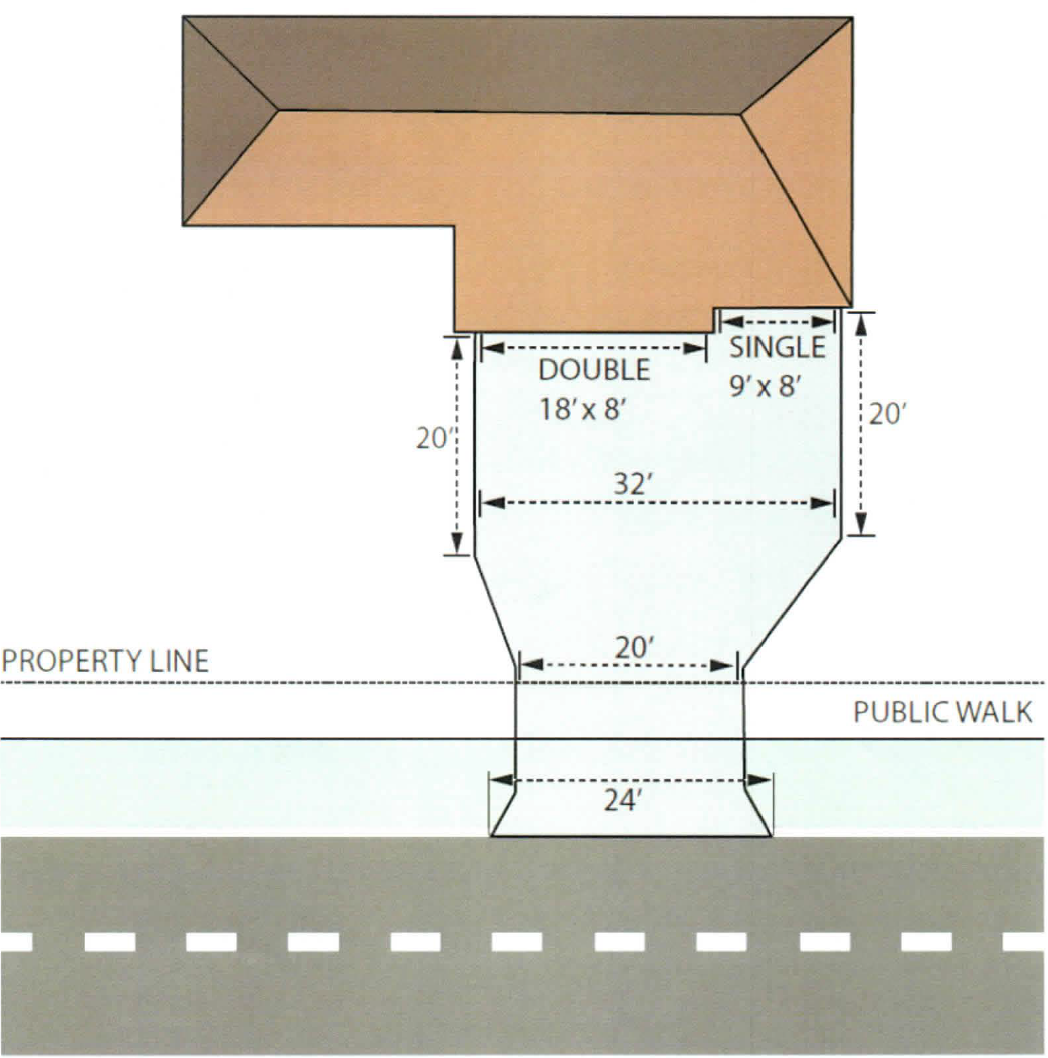
Width: Driveways on private property shall be a minimum of nine feet wide and a maximum of 20 feet wide, The portion of the driveway approaching a garage is permitted to widen to a maximum width that is the lesser of: 32 feet or (ii) the width of the garage, as measured from the interior demising wan of the garage to the outside of the exterior wall. The increased driveway width is only permitted to extend for a distance of 20 feet from the garage doors before tapering to the required driveway width (20 feet) at a point no further than 30 feet from the garage door.
(Ord. No. 20-47, § 3(Exh. A), 11-10-2020; Ord. No. 24-27, § 2, 5-28-2024)
When determination of the number of off-street parking spaces required by this article results in a requirement of a fractional space, any fraction in excess of one-half shall be counted as one parking space.
(Ord. No. 20-47, § 3(Exh. A), 11-10-2020)
(1)
Except where a special use has granted such authority, required accessory off-street parking areas shall be solely for the parking of vehicles in operating condition.
(2)
No vehicular repair work except emergency service shall be permitted in association with any off-street parking areas.
(Ord. No. 20-47, § 3(Exh. A), 11-10-2020)
Vehicles displayed and offered for sale are subject to the following restrictions:
(1)
The owner of the vehicle must reside on the property on the premises where the vehicle is displayed and offered for sale.
(2)
Not more than two vehicles shall be displayed and offered for sale at one time.
(3)
Not more than four vehicles shall be displayed and offered for sale within a 12-month period.
(4)
Any sign displaying a vehicle for sale shall be located inside of the vehicle.
(Ord. No. 20-47, § 3(Exh. A), 11-10-2020)
(1)
Plan. For all non-residential uses, the design of parking lots or areas shall be subject to approval through the site plan review process.
(2)
Character. Accessory parking spaces may be open to the sky, or enclosed in a parking structure.
(3)
Surfacing. All off-street parking spaces, drives, and aisles or lanes accessory to any building, structure or use shall be improved in keeping with engineering standards adopted by the city from time to time.
(4)
Curbs and wheel guards. All off-street parking spaces within parking lots shall provide continuous curbs. Wheel guards or bumper guards may be installed as determined through the site plan review process. Any concrete wheel guards or bumper guards shall be permanently secured to the finished surface of the parking area. Breaks in the curbs to facilitate drainage may be authorized by the zoning administrator.
(5)
Striping. All off-street parking spaces, within parking lots, shall be properly marked by a four inch wide painted stripe. All such striping shall be clearly visible at all times.
(6)
Screening and landscaping. It is the purpose and intent of this subsection to require adequate landscaping and site design of parking areas to protect adjacent property and surrounding neighborhoods against undesirable effects from the creation and operation of parking or loading areas through the screening effects and aesthetic qualities of landscaping and sound site design. It also is the intent of this subsection to create aesthetically appealing and safe parking areas for the users of such properties.
a.
All parking and loading areas, including any associated mechanical equipment shall be properly screened and landscaped as listed below, unless otherwise stated within this subsection.
b.
The zoning administrator shall have the authority to allow alternate landscape materials to those specified in this subsection upon finding that specified materials are not available for installation or there otherwise exists unique circumstance or particular hardship. Also, in allowing for alternative landscape materials the zoning administrator shall find that such landscape materials will provide equivalent or better aesthetic character and effective screening as required by this chapter.
c.
General parking lot landscaping:
i.
Lots with less than three parking spaces are not subject to the parking area landscaping provisions of this subsection.
ii.
The landscaping shall include, to the extent necessary, ground cover, shrubs, hedges, ornamental trees and grasses, perennials, decorative walls, or fencing as listed below.
iii.
All landscaping shall be permanently maintained in good condition, satisfactory to the city, with at least the same quality and quantity of landscaping as initially approved. In the event that landscaping should die, the property owner shall replace landscaping in a timely fashion, taking into consideration the season of the year.
iv.
At the time of installation, landscaped materials shall be of the following sizes:
1.
Two and one-half inches DBH for deciduous shade trees.
2.
Eight feet tall for evergreen trees and ornamental trees.
3.
Twenty-four inch shrubs.
4.
Gallon-sized perennials.
v.
All parking and loading landscape requirements within this subsection and chapter 114 - Vegetation of the City Code shall be met at the time of planting.
d.
Interior parking lot landscaping
i.
Required landscaping percentage (Table 4-2)
1.
Landscaping must be dispersed throughout the parking area. A portion of the required landscaping may be located so as to provide screening of loading areas.
2.
A landscaped area with at least one tree (as indicated in #5 below) shall be required at the end of all parking rows, and shall be equal to 180 square feet for a single row of parking or 360 square feet for a double row of parking.
3.
A landscaped area with at least one tree shall be installed and maintained a minimum every 20 parking spaces in order to avoid large expanses of landscaped areas within the parking lot. Landscape areas shall be equal to 180 square feet for a single row of parking or 360 square feet for a double row of parking.
4.
For every three double bays of parking in a parking area, an intermediate parking lot island a minimum of ten feet wide shall be installed between two of the those parking rows for the length of said parking rows, and serve as a safe pedestrian connection leading toward the main entrance of the principal use.
5.
A minimum of one shade tree must be provided for every parking lot island or landscaped area. In addition to the required shade trees, a minimum of 75 percent of every parking lot island or landscaped area must be planted in live groundcover, shrubs, perennials, or ornamental grasses.
6.
In no case can there be less than one tree for every 3,000 square feet of parking area, including driveways and drive aisles.
7.
No hedge, wall or berm shall exceed three feet in height within ten feet of any driveway opening.
Table 4-2: Required Landscaping Percentages
e.
Perimeter parking lot landscaping
i.
Frontage along the entirety of any parking or loading area adjacent to any public or private street shall be landscaped and protected so as to separate and screen any parking area from the adjacent streets or residential uses.
ii.
Fencing may be provided, in addition to landscaping for parking areas having common property lines with residential uses, upon evidence from the applicant and approval from the zoning administrator finding that a landscape screen is impractical to maintain and unlikely to survive.
iii.
A minimum 5-foot wide, landscaped area with a continuous three feet high row of shrubs or hedges must be provided between the property line and parking area. Plantings shall be no less than three feet within two years of planting.
iv.
The use of earth sculpting or berms may contribute to screening requirements, provided these are designed in any area of enough size so as to avoid erosion, drainage or maintenance problems.
v.
Existing vegetation which meets, in whole or in part, the purposes of perimeter landscaping above may be applied toward requirements.
f.
Transitional screening requirements
i.
All parking areas adjacent to residential land uses shall install and maintain a 100 percent screen along all lot lines adjacent to such residential use. Except as otherwise provided, it shall have a total height at time of installation of not less than six feet. A screen shall consist of one or more of the following types or as otherwise approved by the zoning administrator:
1.
Plants: Plant materials, when used as a screen, shall consist of dense evergreen plants and any mixture as the zoning administrator directs, in order to adequately shield adjacent residences from lights, noises, or other potential adverse impacts. The zoning administrator may require that additional plantings be installed if, two years after installation, plant materials have not formed a 100 percent screen or such a screen is not maintained.
2.
Fencing: Fencing type and location shall be as allowed by this ordinance, or in the case of a special use or planned development, as approved by the city council upon recommendation from the planning and zoning commission.
g.
Pedestrian access
i.
All parking lots with two or more double-loaded rows must provide internal pedestrian walkways within the parking area and outside of the parking row.
1.
The walkway must be a minimum of five feet in width.
2.
One walkway is required for every two double loaded aisles.
3.
The walkway must be located within the parking area to serve the maximum number of parking stalls.
4.
All walkways must meet all ADA accessibility requirements, see section 122-162 Accessible Parking.
ii.
All parking lots must include walkways that provide direct connections to building entrances from the spaces furthest from the entrance. At least one walkway must provide a direct connection between the building entrances and the adjacent public rights-of-way and associated sidewalk.
iii.
All pedestrian walkways must be clearly marked with high-visibility striping, through the use of alternative materials, such as pavers. Where walkways cross a drive aisle, the walkway must have a continuous surface treatment across the drive aisle.
h.
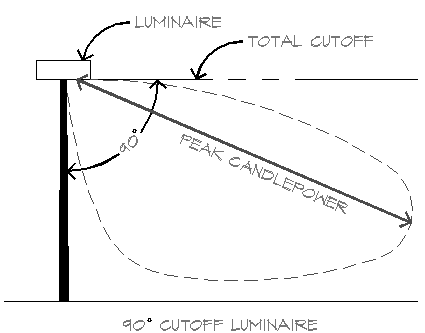
Lighting or other equipment. Any lighting used to illuminate off-street parking areas shall be directed or shielded away from residential properties and public streets such that the light source is not visible from the property line (so as to eliminate glare). In no case shall lighting exceed one foot candle measured at the property line (Figure IV-2). No lighting used to illuminate off-street parking areas shall create a nuisance.
i.
All lighting should minimize glare by using recessed, shielded or cut off fixtures, with a cut off angle of 90 degrees or less as shown below.
ii.
All lighting system designs shall be part of the site plan review process.
i.
Location. No driveways installed after the effective date of this chapter, shall be closer than three feet to the adjoining side yard.
i.
Except as authorized by a shared driveway for single-family residential properties.
j.
Restrictions:
i.
Vehicle repair. Parking areas shall not be used for the repair, dismantling or servicing of any vehicles, equipment, materials or supplies.
ii.
Inoperable vehicles. Inoperable vehicles shall not be parked or stored in any unenclosed parking areas or other portion of a property.
(Ord. No. 20-47, § 3(Exh. A), 11-10-2020)
Where parking lots for separate uses are adjacent to one another and the opportunity for connected cross-access exists, such access is in encouraged. Cross-access should be done in a logical manner that results in safe and efficient circulation between adjacent parking areas.
(Ord. No. 20-47, § 3(Exh. A), 11-10-2020)
(a)
Description. Shared parking is an arrangement whereby two or more owners of non-residential properties or uses with different peak-hour parking demands use the same off-street parking spaces to satisfy their off-street parking requirements.
(b)
General. The zoning administrator may approve shared parking areas, subject to the following standards:
(1)
Eligible uses. Shared parking is allowed among different use types or among uses with different hours of operation. Only those properties having and able to maintain parking in excess of minimum parking requirements may participate in shared parking arrangements.
(2)
Ineligible uses. Accessible parking spaces (for persons with disabilities) may not be shared and must be located on-site.
(3)
Location. Shared parking spaces shall be located within 750 feet of the primary entrance of all uses served, unless shuttle bus service is provided to the parking lot.
(4)
Shared parking study. Applicants wishing to use shared parking as a means of satisfying parking requirements shall submit a shared parking analysis to the zoning administrator that clearly demonstrates the feasibility of shared parking. It shall address, at minimum, the size and type of the proposed development, the composition of tenants, the anticipated rate of parking turnover and the anticipated peak parking and traffic loads for all uses that will be sharing parking spaces.
(5)
Agreement. Applicants must provide a shared parking agreement in a form approved by the city attorney and executed by the parties establishing the shared parking spaces and the City of Rolling Meadows. Shared parking privileges will continue in effect only as long as the agreement, binding on all parties, remains in force. Should the agreement cease to be in force, parking must be provided as otherwise required within this article. Shared parking agreements shall be recorded with Cook County Recorder of Deeds for all properties involved in the agreement.
(c)
Shared parking within shopping centers. Cumulative parking requirements for mixed-use occupancies may be reduced where it can be determined that the peak requirement of the several occupancies occurs at different times during the day. For a shared parking arrangement, the zoning administrator may make an administrative adjustment that reduces the off-street parking requirements for each participating commercial property. To approve such an administrative adjustment, the zoning administrator shall find:
(1)
The collective parking area is located within 750 feet walking distance of each of the uses, as measured from the entrance of each use to the nearest parking space in the collective parking area.
(2)
Convenient, safe, accessible and visible pedestrian connections are located between the facilities and all of the shared properties.
(3)
The commercial properties do not have the same hours of operation, i.e., there is some substantial difference in business hours; an example follows:
a.
Business 1: Monday to Friday: open 9:00 a.m. to 5:30 p.m., closed Saturday, Sunday.
b.
Business 2: Monday to Saturday: open 11:00 a.m. to 7:00 p.m., closed Sunday.
c.
Applicants must provide a shared parking agreement in a form approved by the city attorney and executed by the parties establishing the shared parking spaces
(Ord. No. 20-47, § 3(Exh. A), 11-10-2020)
(a)
A "bicycle parking facility" is defined as a designated area which shall offer a secure space for bicycle storage. Bicycle parking facilities shall offer either a lockable enclosure in which a bicycle can be stored or a stationary rack upon which the bicycle can be locked. Bicycle parking spaces should allow the user to securely attach both the bicycle frame and one tire to the bike rack with the use of a U-frame lock.
(b)
All nonresidential developments which provide automobile parking facilities shall provide bicycle parking facilities (bike racks) at a ratio of at least one bicycle parking space for every ten automobile parking spaces.
(c)
Multi-family developments shall provide interior bicycle parking facilities for building residents at a ratio of at least one bicycle parking space for every three dwelling units. Such bicycle parking facilities must be provided near the building entrance accessible to the street. Multi-family developments shall also provide bicycle parking facilities for visitors/public at a ratio of at least one bicycle parking space for every 20 automobile parking spaces provided and shall meet the location criteria under section 122-160, whichever is closer.
(d)
No development, except a one- or two-family development, shall have fewer than three bicycle/moped parking spaces nor be required to exceed a maximum of ten such spaces.
(e)
Bicycle parking facilities for nonresidential developments and bicycle parking facilities provided for the visitors and/or public shall be located within the parkway/street furniture zone a maximum distance of 50 feet from the building entrance, or shall be located at least as close as the closest automobile space.
(f)
Bicycle parking shall be installed so that it does not interfere with the flow of pedestrian and vehicular traffic in accordance with the rules outlined below:
(1)
The dispersion and proximity of all bicycle parking facilities required by this section shall provide for convenient bicycle parking which shall be separated from automobile parking by a physical barrier or by at least five feet.
(2)
Convenient access to bicycle parking facilities shall be provided and shall minimize travel distances from adjoining sidewalks and pathways to the bicycle parking facilities. A pedestrian accessible sidewalk must be provided between the bicycle parking facility and the building entrance.
(3)
The bicycle rack shall be installed on either asphalt or concrete, and shall be so graded and drained as to provide for the adequate runoff and disposal of surface water.
(g)
Each bicycle parking facility shall include a metal anchor sufficient to secure the bicycle frame when used in conjunction with a user supplied U-Frame lock.
(1)
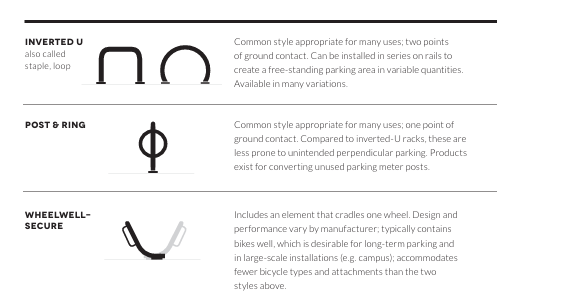
The following types of bicycle racks are permitted: inverted "U", post and loop, and wheel well-secure.
(2)
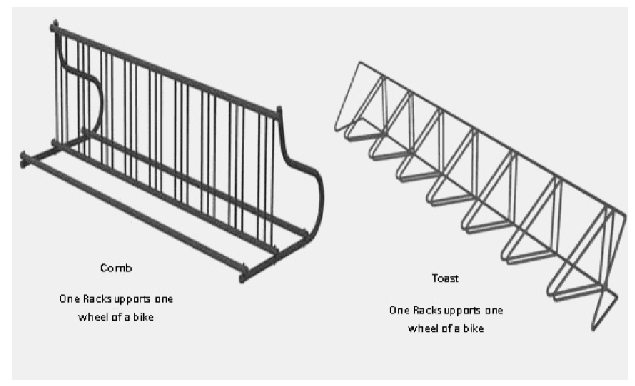
The following types of bicycle racks are prohibited: comb, toast, and other wheel bending racks, which provide no support for the bicycle frame.
(h)
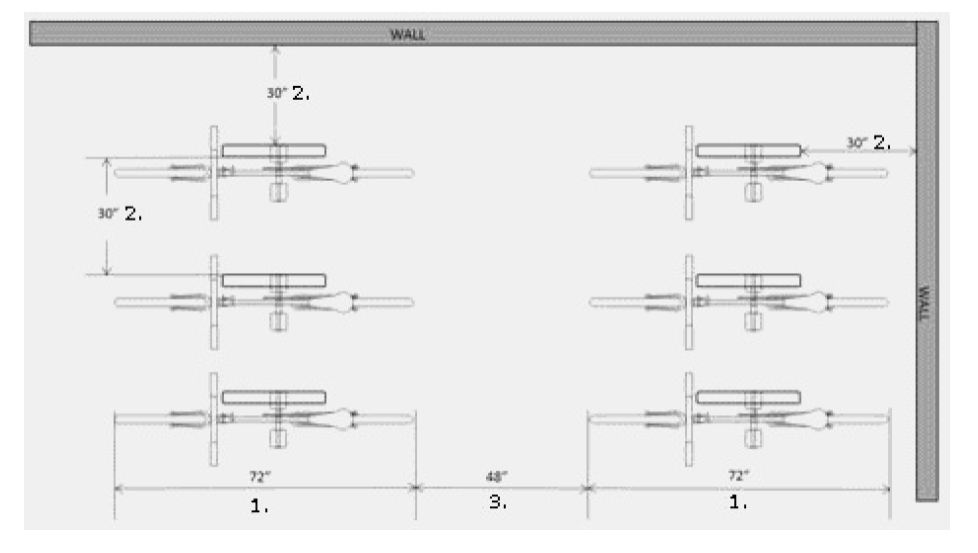
Each bicycle rack shall be placed in accordance with the requirements as described and illustrated in this section.
(1)
Bicycle parking space shall be at least six feet long.
(2)
A thirty-inch space of unobstructed paved surface shall surround the bicycle parking loops to allow the wheels of the parked bicycles to rest on the paved surface and allow for the minimum distance from adjacent walls, structures, and other racks.
(3)
A four-foot width aisle, measured from tire to tire, shall be maintained between multiple rows of bike racks.
(i)
Exiting developments are required to provide a bike parking facility that meets the criteria under section 122-160 when any permit is issued to reconfigure the parking lot. Restriping of an existing parking lot, as is, does not qualify as a reconfiguration.
(Ord. No. 20-47, § 3(Exh. A), 11-10-2020; Ord. No. 25-15, § 2, 2-25-2025)
(a)
Land banking future parking. The city council may grant relief from city parking requirements to allow banking of up to 25 percent of the required parking spaces, provided that:
(1)
Sufficient evidence shall be provided by the applicant that supports the reduced parking needs.
(2)
The area proposed for land banking of parking spaces shall be an area suitable for parking at a future time.
(3)
Landscaping of the land-banked area shall be in full compliance of the zoning regulations and, at a minimum, landscaped with turf. As a result of site plan review, additional landscaping of the land-banked area may be required.
(4)
The land banking area will not be used for any other use. The land banked parking area cannot be used to fulfill other landscaping requirements within this ordinance.
(5)
As part of the site plan review process, the applicant shall show the area to be banked on the site plan and marked as "Land-Banked Future Parking."
(b)
The zoning administrator at their sole discretion, on the basis of increased parking demand for the use, or provided parking proving to be inadequate, may require the conversion of all or part of the land-banked area to off-street parking spaces. The owner may convert the land-banked area to parking prior to city notification, subject to all required permits.
(Ord. No. 20-47, § 3(Exh. A), 11-10-2020)
(a)
ADA Compliance. All off-street parking areas must comply with the State of Illinois Accessibility Code and the Americans with Disabilities Act of 2010 (ADA) concerning the number and design of accessible vehicle parking spaces required in parking lots and structures.
(b)
Required spaces. Parking spaces for persons with disabilities shall be provided in all off-street parking areas where parking is provided for employees, visitors or both, with the exception of single family detached and townhomes uses. The number of accessible parking spaces shall be included in the total number of required parking spaces and shall be in accordance with the applicable requirements of the Illinois Accessibility Code, as amended from time to time, and all additional governing codes and applicable laws.
(c)
Dimensions and design. Such spaces shall comply with the design standards presented in the State of Illinois Accessibility Code, provided that in no instance shall the width of any one space be less than 16 feet, nor the length less than 20 feet. Such spaces shall be identified by a sign and pavement markings indicating parking for persons with disabilities only. Such spaces shall be the spaces closest to the entrance of the building or structure, and shall be connected by a paved surface designed to provide safe and easy access. Such spaces shall otherwise be in accordance with the Illinois Vehicle Code.
(d)
Table 4-3: Accessible Parking Space Requirements (source:www.IllinoisAttorneyGeneral.gov).
Table 4-3: Accessible Parking Spaces
* Any update to State of Illinois or National regulations regarding Accessible Parking shall supersede these requirements.
(Ord. No. 20-47, § 3(Exh. A), 11-10-2020)
(a)
General requirements. Off-street parking spaces shall be provided for all uses listed below in at least the minimum amounts specified.
(1)
The minimum number of usable off-street parking or stacking spaces shall be provided as noted in Table 4-4 below.
(2)
All references to "square feet" are calculated as "gross square feet of building floor area."
(3)
Mixed uses. When two or more uses are located on the same lot or within the same building, parking spaces equal in number to the sum of the separate requirements for each such use shall be provided. No parking space or portion thereof shall serve as a required space for more than one use unless otherwise authorized by the planning and zoning commission.
Table 4-4: Off-street parking ratio requirements
(b)
Special requirements.
(1)
TC district. Within the TC district, the general requirements provided in subsection (a) do not apply. The only minimum parking requirement applicable within the TC district is that any dwelling unit must be provided with a minimum of one off-street parking space.
(Ord. No. 20-47, § 3(Exh. A), 11-10-2020; Ord. No. 24-39, § 4, 9-10-2024; Ord. No. 25-34, § 5, 5-27-2025)
(a)
Visitor parking spaces. All residential developments listed in the Table 4-5 below shall provide the following number of off-street visitor parking spaces in addition to the parking required for the residents:
Table 4-5: Off-street visitor parking spaces
(1)
Any fractional requirement of a visitor parking space shall be rounded up to the one (1) parking space.
(2)
Visitor parking spaces shall be grouped in a location that is convenient to visitors and shall be accessible at all times. Visitor parking spaces shall not be located within a secured private or common parking garage that requires a key, handset, or other electrical or mechanical device to gain access to such spaces.
(Ord. No. 20-47, § 3(Exh. A), 11-10-2020)
(a)
Required spaces. Every drive-thru establishment, constructed after the effective date of this ordinance, shall provide a minimum of five stacking spaces per drive through facility lane, unless otherwise stated within this article or determined by the city council as part of a special use review.
(b)
Design and layout.
(1)
The stacking spaces shall be designed so as not to interfere with the ingress and egress to the off-street parking, traffic circulation on- or off-site, and traffic visibility.
(2)
Drive-thru facilities shall not be located in the front of the principal building and the maneuvering space shall be provided in the side or rear yard.
(3)
Drive-thru establishments shall provide a bypass lane in a width and configuration approved by the city engineer.
(4)
Stacking spaces should be separated from pedestrian paths or marked with signs to indicate such path to drivers and requirement to yield to pedestrians.
(c)
Additional standards.
(1)
Stacking spaces shall not be used for the sale, repair, dismantling or servicing of any vehicles, equipment, materials, or supplies.
(2)
Each off-street stacking space shall not be less than eight feet in width and 18 feet in length, exclusive of access drives.
(Ord. No. 20-47, § 3(Exh. A), 11-10-2020)
(a)
General standards.
(1)
Loading berth, description. An off-street loading berth shall be a hard-surfaced area of land, open or enclosed, other than a street or a public way, used principally for the standing, loading or unloading of motor trucks, tractors and trailers so as to avoid undue interference with the public use of streets and alleys. A required loading space shall be at least 12 feet in width, at least 55 feet in length, and 16 feet in height, exclusive of access aisles and maneuvering space, except as otherwise specifically dimensioned hereafter.
(2)
Location. No permitted or required loading berth shall be located along the front of any building. No berth shall be closer than 50 feet to any property or street in a residential district unless completely enclosed by building walls, or a uniformly painted solid fence or wall, or any combination thereof not less than six feet in height. No permitted or required loading berth shall be located within 25 feet of the nearest point of intersection of any two streets. Loading berths open to the sky may be located in any required yard, except a front yard.
(3)
Central loading facilities. Central loading facilities may be substituted for off-street loading facilities on individual lots provided the following conditions are fulfilled:
a.
Each lot served shall have direct access to the central loading area without crossing streets.
b.
The total number of off-street loading berths provided shall meet the minimum requirements of this article, based on the sum of the several types of uses served. Area of types of uses may be totaled before computing number of loading berths.
c.
No lot served shall be located more than 300 feet from the central loading area.
d.
Control of central loading facilities. When the required off-street loading facilities are collectively provided and used in central loading facilities, written covenants and easements assuring their retention, maintenance, and use for such purposes shall be executed by the parties concerned. Such covenants and easements shall be reviewed by the zoning administrator and approved as to content and form by the city attorney and filed for record in the office of the county recorder.
(4)
Measurement of berth. When determination of the number of required off-street loading berths results in a requirement of a fractional berth, any fraction up to and including one-half shall be disregarded, and fractions over one-half shall be interpreted as one loading berth.
(5)
Surfacing. All open off-street loading berths shall be improved in keeping with engineering standards adopted by the city from time to time.
(6)
Access. Each required off-street loading berth shall be designed with appropriate means of vehicular access to a street or alley in a manner which will least interfere with traffic movements and which shall be subject to approval through the site plan review process.
(7)
Receiving facilities. Uses for which off-street loading facilities are required in this chapter, but which are located in buildings of less floor area than the minimum prescribed for such required facilities, or may be reasonably expected to receive or distribute goods, shall be provided with adequate receiving facilities off any adjacent alley, service drive or open space on the same lot which is accessible by motor vehicle, as shall be determined through the site plan review process.
(8)
Utilization. Space allocated to any off-street loading facility shall not be used to satisfy the requirement for any off-street parking area or portion thereof.
(9)
Lighting. Any lighting used to illuminate off-street loading areas shall be directed away from adjacent properties and public streets in such a way as to not create a nuisance.
a.
All lighting should minimize glare by using recessed, shielded or cut off fixtures, with a cut off angle of 90 degrees or less with the light source not visible from the property line.
b.
All lighting system designs shall be part of the site plan review process.
(10)
Off-street loading and unloading facilities. In all districts where property uses include the loading and unloading of materials or merchandise from vehicles, off-street loading and unloading facilities shall be provided in accordance with the following requirements.
(Ord. No. 20-47, § 3(Exh. A), 11-10-2020)
(1)
All off-street loading space shall be include an area or means adequate for maneuvering, and site ingress and egress.
(2)
The minimum number of off-street loading spaces required shall be based on the Gross Floor Area of the associated structure in keeping with Table 4-6 below:
Table 4-6
(Ord. No. 20-47, § 3(Exh. A), 11-10-2020)
(a)
Purpose. The intent of this section is to remove barriers to the use of electric vehicles; expedite and promote the development of safe, convenient, and cost-effective electric vehicle infrastructure to support the use of electric vehicles; and protect the environment by reducing vehicle emissions.
(b)
Definitions. Terms used in this section have the meaning defined in the Electric Vehicle Charging Act (765 ILCS 1085/1 et seq.). In addition, whenever in this section the following words and phrases are used, they shall, for the purposes of this section, have the meanings respectively ascribed to them in this section, except when the context otherwise clearly indicates:
Direct current fast charging (DCFC). A type of EVSE that enables rapid charging by delivering direct current electricity directly to an electric vehicle's battery.
Electric vehicle supply equipment (EVSE). A charging system for an electric vehicle. See the Electric Vehicle Charging Act for the complete definition.
EVSE-capable. Having the electrical panel capacity and conduit installed to provide, at a future date, a branch circuit rated for at least 40 amps at 208 volts or 240 volts to an EVSE. Power sharing may allow two spaces to share one such circuit. See the Electric Vehicle Charging Act for the complete definition. Where this section requires a space to be EVSE-Capable, an EVSE-Ready or EVSE-installed space may also satisfy this requirement.
EVSE-ready. Having a branch circuit fully installed that provides at least 40 amps at 208 or 240 volts for an EVSE to be installed at a future date. Power sharing may allow two spaces to share one such circuit. See the Electric Vehicle Charging Act for the complete definition. Where this section requires a space to be EVSE-Ready, an EVSE-installed space may also satisfy this requirement.
EVSE-installed. Having EVSE fully installed from the electrical panel to the parking space.
Power sharing. The practice of dynamically limiting the charging power output of individual charging ports at the same charging station to ensure that the sum total power output to all electric vehicles concurrently charging remains below a maximum power threshold. This practice is also commonly known as automated load management.
Public use. Intended for use by the employees, visitors, and patrons of any establishment used for other than residential purposes. Parking and EVSE for residential uses, including residential visitor parking, is not parking for "public use." The term "public use" is not limited to EVSE required by this section.
Smart charge management. The practice of controlling the amount of power dispensed by chargers to electric vehicles to meet customers' charging needs while also responding to external power demand or pricing signals to provide load management, resilience, or other benefits to the electric grid.
(c)
Use restrictions.
(1)
Accessory use. EVSE are permitted as an accessory use in all zoning districts. EVSE for public use is prohibited for properties used exclusively for single-family and multi-family residential dwellings.
(2)
Principal use. As a principal use, EVSE requires approval of a special use in the districts in which they are listed according to Table 5.13 (located in section 122-331) and such request for a special use shall be processed in accordance with section 122-395 (Special Uses). If EVSE as a principal use is not identified as a permitted or special use in a particular zoning district of the city, such use shall be deemed prohibited in that zoning district.
(d)
Minimum required EV parking spaces. Where required by section 122-122, not less than the following number of EVSE-capable, EVSE-ready, and EVSE-installed parking spaces must be provided within an off-street parking and loading facility:
(1)
Small residential uses. For residential uses with four or fewer dwelling units, at least one EVSE-capable parking space must be provided for each residential unit that has dedicated parking.
(2)
Large residential uses. For residential uses with five or more dwelling units, all parking spaces designated for residential use must be EVSE-capable.
(3)
Gasoline stations. A property that is used as a "gas/fueling station" that receives a new or amended special use permit after the effective date of the ordinance from which this section derives must provide one DCFC EVSE-installed space per four fuel pumps.
(4)
All other uses. For all other uses, a minimum number of EVSE-installed spaces for public use must be provided according to the following table. Each public EVSE operated within 150 feet of the property line is included as an on-site EVSE-installed parking space, as well as EVSE available through a shared parking arrangement under section 122-159. Notwithstanding the provisions of section 122-122, this minimum requirement only applies where a new building (excluding an addition) or parking area is constructed or where an existing parking area is reconstructed to its base.
Note 1—In this category, no more than eight EVSE-installed spaces are required for properties used for restaurants, retail, service business, or any other use where the zoning administrator determines vehicles are typically parked for less than six hours.
(e)
Minimum public use EVSE charging performance.
(1)
Level 1 EVSE are prohibited for public use.
(2)
Level 2 EVSE provided for public use must provide at least six kilowatts per port simultaneously across all ports, except that Level 2 EVSE that meet the minimum per-space kilovolt-ampere requirements of the Electric Vehicle Charging Act (765 ILCS 1081/1 et seq.) may conduct power sharing that reduces the kilowatts delivered per port below this requirement.
(3)
DCFC EVSE provided for public use, whether or not required by this section, must have a continuous power delivery rating of at least 50 kilowatts per charging port.
(4)
Smart charge management. EVSE may temporarily reduce the kilowatts per port below these requirements in order to conduct smart charge management.
(5)
Grandfathering of Existing EVSE. Any Level 2 or DCFC EVSE that existed or was issued a building permit prior to February 25, 2025 is exempt from these requirements until its replacement.
(f)
Availability of EVSE-installed spaces for public use.
(1)
The property owner or EVSE operator of an EVSE-installed parking space for public use must designate the space as reserved exclusively for electric vehicles pursuant to 625 ILCS 5/11-1308.
(2)
The property owner or EVSE operator may establish reasonable restrictions upon EVSE-installed parking spaces for public use, including restrictions upon, without limitation: the time of day when the EVSE may be used by the public; the consecutive hours that an electric vehicle may occupy the EVSE space; the maximum kilowatt-hours delivered or percentage charge level that an electric vehicle may use the EVSE to reach; and the period of time, if any, that an electric vehicle may occupy the EVSE space when not actively charging.
(3)
For accessory use EVSE, each EVSE-installed space for public use must be available and accessible for public use at least as frequently as the business operating hours of the principal use of the site. This provision does not prohibit isolated or temporary interruptions in service or access because of maintenance or repairs.
a.
Exception: EVSE-installed spaces that serve office, institutional, industrial, or other uses not frequented by patrons, as determined by the zoning administrator, may provide their EVSE-installed spaces in an area reserved for employee personal vehicles and unavailable to visitors and patrons.
(g)
Design of EVSE-installed spaces.
(1)
Setbacks and screening.
a.
EVSE. Notwithstanding any contrary provision of this chapter, EVSE: may be located within any required yard; are not subject to any setback; and do not require screening. The parking space served by an EVSE is not exempt.
b.
Transformers and panelboards. Transformers and panelboards installed to serve EVSE may not be installed on a concrete or asphalt parking surface. Transformers and panelboards serving EVSE are subject to the setback and screening requirements of this chapter, except that the zoning administrator may modify or waive the setback requirement upon determining that the particular setback requirement creates an undue practical difficulty in installing an EVSE that meets the requirements of this section.
(2)
Accessible spaces.
a.
One accessible charging station required. Any location where electric vehicle charging stations are installed for public use must provide at least one parking space with an accessible charging station that meets the requirements of the most recent edition of the U.S. Access Board Americans with Disabilities Act (ADA) Accessibility Guidelines and the Architectural Barriers Act (ABA) Accessibility Guidelines. (For more information, see the U.S. Access Board's publication, Design Recommendations for Accessible Electric Vehicle Charging Stations.)
b.
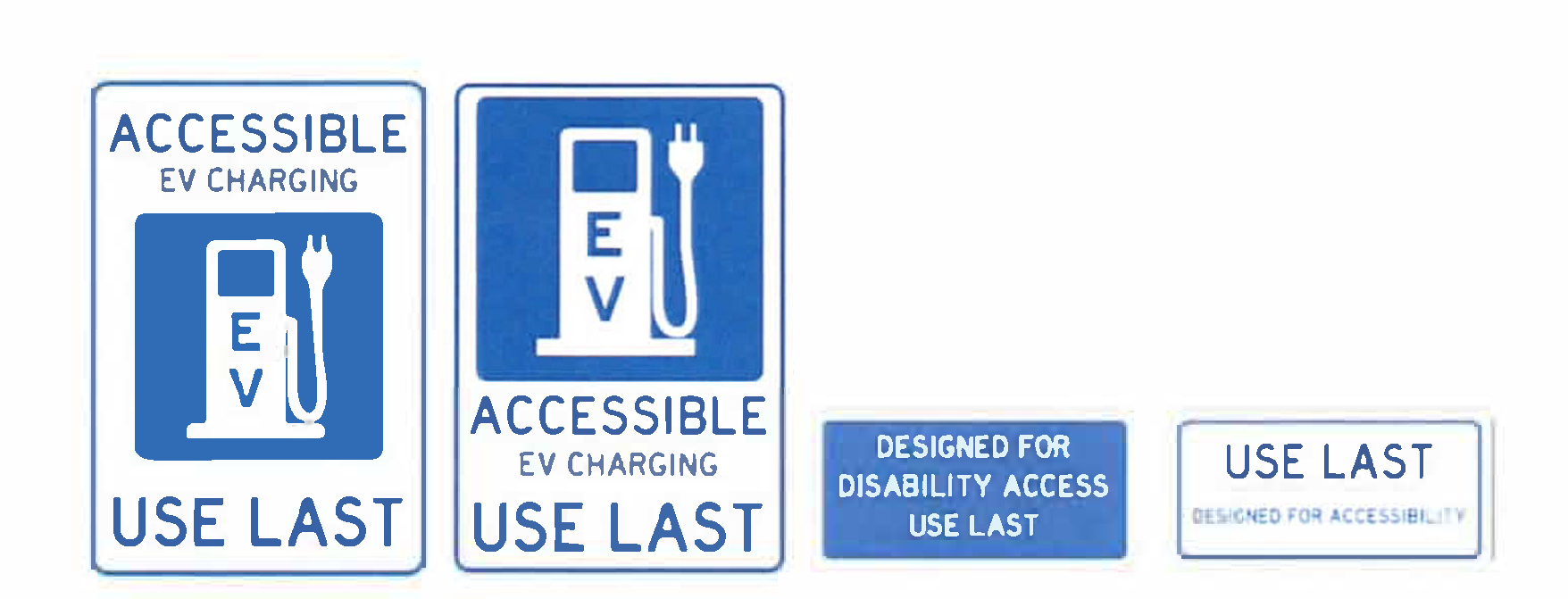
"Use last." The accessible charging station must either: (1) be reserved for the use of persons with disabilities or (2) must have one of the following signs indicating that the station is an accessible EVSE that should be occupied last by users without disabilities:
(3)
Space markings. An EVSE-Installed parking space serving any non-residential use must have the entire area of the space painted in green paint to signify that it is reserved for electric vehicles.
(4)
EVSE impact protection. EVSE must be protected from vehicle impacts by impact-resistant bollards, curb with an exterior face at least two feet away from the EVSE, or other methods approved by the zoning administrator.
(5)
Signage.
a.
Each EVSE-installed space for public use must indicate on a sign posted at each parking space that the space is reserved for the exclusive use of electric vehicles and that violators are subject to tow, as well as any other restrictions imposed by the property owner as to the use of an EVSE-installed space.
b.
Each EVSE-installed space for public use must indicate, on at least one physical sign or decal per EVSE pedestal: safety information regarding the use of the EVSE; and contact information for reporting when the equipment is not operating or other problems.
c.
Each EVSE-installed space for public use must indicate, on the EVSE's user interface or on at least one physical sign or decal per EVSE pedestal: voltage and amperage levels; hours of operation; time limits; payment methods; and usage fees.
d.
Off-premises signage and electronic signage, as those terms are defined in Article X of this chapter, is prohibited as part of an EVSE.
(h)
Minimum required off-street parking bonus. EVSE-installed and EVSE-capable parking spaces are considered to provide more than one parking space when calculating the minimum off-street parking requirements of section 122-163. When calculating the minimum number of parking spaces required for a development, the bonuses provided by this section apply before any rounding provided by section 122-163. These bonuses do not apply to residential uses.
(i)
Violations. It is a violation of this chapter for any person to:
(1)
Install, operate, or maintain any EVSE contrary to the provisions of this section.
(2)
Allow any port of any EVSE for public use to be inoperable for a period of longer than 14 calendar days, regardless of intent to resume the EVSE's operation at a future date.
(3)
Prohibit or unreasonably restrict a condominium or common interest community unit owner from installing an EVSE pursuant to Section 30 of the Electric Vehicle Charging Act (765 ILCS 1085/30).
(4)
Prohibit or unreasonably restrict a tenant from installing an EVSE pursuant to Section 35 of the Electric Vehicle Charging Act (765 ILCS 1085/35).
(Ord. No. 25-14, § 2, 2-25-2025)
OFF-STREET PARKING AND LOADING
(1)
The purpose of this article is to provide off-street parking and loading areas to support the needs of current, proposed, and future uses of a property. The provisions contained in this article are established to:
a.
Promote efficient circulation and prevent traffic congestion of the public right-of-way.
b.
Provide adequate screening and landscaping measures for parking and maneuvering areas in a manner that is visually attractive.
c.
Ensure pedestrian-friendly parking areas by providing safe, adequate, and convenient pedestrian routes.
d.
Provide for the accessibility needs and requirements of persons with disabilities.
e.
Allow flexible parking standards to improve circulation, promote community character, and support economic development.
f.
Provide adequate on-site bicycle parking.
g.
Provide adequate on-site vehicle parking.
(Ord. No. 20-47, § 3(Exh. A), 11-10-2020)
(1)
All zoning districts. The provisions for off-street parking and loading specified in this article shall apply to all zoning districts, unless otherwise noted.
(2)
Existing buildings. For existing buildings and existing land uses, the following provisions shall apply:
a.
At time ordinance is adopted. The minimum number of parking spaces designated for specific land uses in section 122-163 shall not be applied to existing structures or for structures that have an approved building permit on the effective date of this ordinance. The regulations in effect at the time of permit issuance apply in those cases.
b.
Subsequent expansions. If a structure or use of land is enlarged, expanded or changed, there shall be provided and maintained, for the increment of expansion only, at least the amount of off-street parking space that would be required if the increment were a separate structure, new use established or placed into operation after the effective date of this ordinance.
c.
Change in land use. Where land uses change in an existing building, the parking standards for the new land use shall apply.
(3)
Existing parking areas. For existing parking areas, the following provisions shall apply:
a.
Regular maintenance (such as sealcoating) of parking areas shall not require the parking area to be brought into conformance the requirements of this article.
b.
Parking areas of commercial and manufacturing uses for which partial reconstruction (such as grind and overlay) is conducted shall provide perimeter landscaping (as specified in section 122-157(6)e: Perimeter Landscaping of this article) and interior landscaping (as specified in section 122-157(6)d Interior Parking Lot Landscaping of this article); except that if complying with these requirements will reduce the number of parking spaces provided to below what is required by this article, the zoning administrator may grant the minimum amount of relief from section 122-157: Design and Maintenance of this article as is necessary to make enhancements to the parking area that allow the minimum required number of parking spaces to be preserved.
c.
Parking areas of commercial and manufacturing uses which are reconstructed to their base and properties where a new building is constructed, shall meet all requirements of this article; except that if complying with these requirements will reduce the number of parking spaces provided to below what is required by this article, the zoning administrator may grant the minimum amount of relief from section 122-157: Design and Maintenance of this article as is necessary to make enhancements to the parking area that allow the minimum required number of parking spaces to be preserved.
(4)
New buildings. All buildings constructed after the effective date of this ordinance shall provide for parking that conforms to the standards of this ordinance.
(Ord. No. 20-47, § 3(Exh. A), 11-10-2020)
(a)
Exemption. When application of the off-street parking provisions specified in this article results in a requirement of three spaces or less on a single lot in any commercial or manufacturing district, the standards contained in this section shall not apply.
(Ord. No. 20-47, § 3(Exh. A), 11-10-2020)
Required parking areas must be located off-street and on the same lot as the building or use they are required to serve, unless specified below:
(1)
Parking areas are permitted encroachments only as indicated in this subsection or otherwise allowed by this chapter:
a.
In commercial and manufacturing zoning districts and for multiple-family uses:
i.
Parking areas may encroach into required side yards and required rear yards, subject to the provisions of section 122-729 and 122-151(1)b.
ii.
Parking areas shall not encroach into front yards; except for properties zoned C-2, M-1, and M-2 where a minimum front yard setback of 15 feet shall be maintained for all parking areas.
b.
In commercial and manufacturing zoning districts and for multiple-family uses adjacent to properties with single family detached, single family attached or two family dwellings, parking areas may encroach into required side yards and required rear yards except that a minimum setback of ten feet shall be maintained for all parking areas.
c.
In residential zoning districts for non-residential uses, including schools and religious organizations:
i.
Parking areas may encroach into required side yards and required rear yards, subject to the provisions of section 122-729 and 122-151(1)b, except that a minimum setback of ten feet shall be maintained for all parking areas where the use is adjacent to single family detached, single-family attached or two-family dwellings.
ii.
Parking areas may encroach into front yards provided a minimum setback of not less than 15 feet is maintained.
(2)
In commercial and manufacturing zoning districts:
a.
Parking areas may be provided on the same lot or property being served, or on a separate lot or property, so long as all parking areas located on a separate property are located within 750 feet of a main entrance of the related building or use. The zoning classification of such separate lot or property where the off-street parking areas are located shall not be zoned for single family residential.
b.
Ten percent of the required parking and no less than five spaces shall be accessible to visitors outside of any fenced in or secured area.
c.
Clearly identifiable and safe pedestrian paths shall be provided from parking areas to the main building entrance.
(3)
Control of off-site parking areas. When required accessory off-street parking areas are provided elsewhere than on the lot on which the principal use served is located, they shall be in the same possession, either by deed or long-term lease, as the property occupied by such principal use, and the owner shall be bound by covenants filed of record in the Cook County Recorder of Deeds requiring the owner and his or her heirs and assigns to maintain the required number of parking spaces during the existence of said principal use.
(Ord. No. 20-47, § 3(Exh. A), 11-10-2020; Ord. No. 22-13, § 2(Exh. A), 4-12-2022)
Each required parking space shall provide safe and efficient means of vehicular access and egress to such parking space at all times. Each off-street space shall be marked on the ground to delineate its exact location. The dimensions of all parking spaces and aisles shall be as regulated in chapter 18 of the City Code, Section 18-245(3).
(Ord. No. 20-47, § 3(Exh. A), 11-10-2020)
(1)
Parking areas shall be designed with appropriate means of vehicular access to a street. Such access, as well as any access to an alley or adjacent property, will be designed in such a manner as will least interfere with the movement of traffic.
(2)
Any driveway accessing a street from private commercial or manufacturing property shall have a maximum width of 36 feet, unless otherwise provided in this chapter.
(3)
All driveway lanes accessing a public street from private commercial or manufacturing property shall have a minimum width of 12 feet.
(4)
The number of lanes per driveway will be determined as part of the site plan review (See article VI, Administration and Development Review). Wider driveway widths for commercial and manufacturing properties may be permitted through site plan review upon evidence provided by the applicant and finding by the zoning administrator that wider lanes or additional lanes are required to provide safe access or to best manage traffic flow to and from the site.
(5)
Driveways for single-family residential properties shall comply with the following:
a.
Driveway aprons (i.e. that portion of the driveway in the public right-of-way) shall comply with Chapter 18 Article VII Section 18-244 of the Municipal Code.
b.
Width: Driveways on private property shall be a minimum of nine feet wide and a maximum of 20 feet wide, The portion of the driveway approaching a garage is permitted to widen to a maximum width that is the lesser of: 32 feet or (ii) the width of the garage, as measured from the interior demising wan of the garage to the outside of the exterior wall. The increased driveway width is only permitted to extend for a distance of 20 feet from the garage doors before tapering to the required driveway width (20 feet) at a point no further than 30 feet from the garage door.
(Ord. No. 20-47, § 3(Exh. A), 11-10-2020; Ord. No. 24-27, § 2, 5-28-2024)
When determination of the number of off-street parking spaces required by this article results in a requirement of a fractional space, any fraction in excess of one-half shall be counted as one parking space.
(Ord. No. 20-47, § 3(Exh. A), 11-10-2020)
(1)
Except where a special use has granted such authority, required accessory off-street parking areas shall be solely for the parking of vehicles in operating condition.
(2)
No vehicular repair work except emergency service shall be permitted in association with any off-street parking areas.
(Ord. No. 20-47, § 3(Exh. A), 11-10-2020)
Vehicles displayed and offered for sale are subject to the following restrictions:
(1)
The owner of the vehicle must reside on the property on the premises where the vehicle is displayed and offered for sale.
(2)
Not more than two vehicles shall be displayed and offered for sale at one time.
(3)
Not more than four vehicles shall be displayed and offered for sale within a 12-month period.
(4)
Any sign displaying a vehicle for sale shall be located inside of the vehicle.
(Ord. No. 20-47, § 3(Exh. A), 11-10-2020)
(1)
Plan. For all non-residential uses, the design of parking lots or areas shall be subject to approval through the site plan review process.
(2)
Character. Accessory parking spaces may be open to the sky, or enclosed in a parking structure.
(3)
Surfacing. All off-street parking spaces, drives, and aisles or lanes accessory to any building, structure or use shall be improved in keeping with engineering standards adopted by the city from time to time.
(4)
Curbs and wheel guards. All off-street parking spaces within parking lots shall provide continuous curbs. Wheel guards or bumper guards may be installed as determined through the site plan review process. Any concrete wheel guards or bumper guards shall be permanently secured to the finished surface of the parking area. Breaks in the curbs to facilitate drainage may be authorized by the zoning administrator.
(5)
Striping. All off-street parking spaces, within parking lots, shall be properly marked by a four inch wide painted stripe. All such striping shall be clearly visible at all times.
(6)
Screening and landscaping. It is the purpose and intent of this subsection to require adequate landscaping and site design of parking areas to protect adjacent property and surrounding neighborhoods against undesirable effects from the creation and operation of parking or loading areas through the screening effects and aesthetic qualities of landscaping and sound site design. It also is the intent of this subsection to create aesthetically appealing and safe parking areas for the users of such properties.
a.
All parking and loading areas, including any associated mechanical equipment shall be properly screened and landscaped as listed below, unless otherwise stated within this subsection.
b.
The zoning administrator shall have the authority to allow alternate landscape materials to those specified in this subsection upon finding that specified materials are not available for installation or there otherwise exists unique circumstance or particular hardship. Also, in allowing for alternative landscape materials the zoning administrator shall find that such landscape materials will provide equivalent or better aesthetic character and effective screening as required by this chapter.
c.
General parking lot landscaping:
i.
Lots with less than three parking spaces are not subject to the parking area landscaping provisions of this subsection.
ii.
The landscaping shall include, to the extent necessary, ground cover, shrubs, hedges, ornamental trees and grasses, perennials, decorative walls, or fencing as listed below.
iii.
All landscaping shall be permanently maintained in good condition, satisfactory to the city, with at least the same quality and quantity of landscaping as initially approved. In the event that landscaping should die, the property owner shall replace landscaping in a timely fashion, taking into consideration the season of the year.
iv.
At the time of installation, landscaped materials shall be of the following sizes:
1.
Two and one-half inches DBH for deciduous shade trees.
2.
Eight feet tall for evergreen trees and ornamental trees.
3.
Twenty-four inch shrubs.
4.
Gallon-sized perennials.
v.
All parking and loading landscape requirements within this subsection and chapter 114 - Vegetation of the City Code shall be met at the time of planting.
d.
Interior parking lot landscaping
i.
Required landscaping percentage (Table 4-2)
1.
Landscaping must be dispersed throughout the parking area. A portion of the required landscaping may be located so as to provide screening of loading areas.
2.
A landscaped area with at least one tree (as indicated in #5 below) shall be required at the end of all parking rows, and shall be equal to 180 square feet for a single row of parking or 360 square feet for a double row of parking.
3.
A landscaped area with at least one tree shall be installed and maintained a minimum every 20 parking spaces in order to avoid large expanses of landscaped areas within the parking lot. Landscape areas shall be equal to 180 square feet for a single row of parking or 360 square feet for a double row of parking.
4.
For every three double bays of parking in a parking area, an intermediate parking lot island a minimum of ten feet wide shall be installed between two of the those parking rows for the length of said parking rows, and serve as a safe pedestrian connection leading toward the main entrance of the principal use.
5.
A minimum of one shade tree must be provided for every parking lot island or landscaped area. In addition to the required shade trees, a minimum of 75 percent of every parking lot island or landscaped area must be planted in live groundcover, shrubs, perennials, or ornamental grasses.
6.
In no case can there be less than one tree for every 3,000 square feet of parking area, including driveways and drive aisles.
7.
No hedge, wall or berm shall exceed three feet in height within ten feet of any driveway opening.
Table 4-2: Required Landscaping Percentages
e.
Perimeter parking lot landscaping
i.
Frontage along the entirety of any parking or loading area adjacent to any public or private street shall be landscaped and protected so as to separate and screen any parking area from the adjacent streets or residential uses.
ii.
Fencing may be provided, in addition to landscaping for parking areas having common property lines with residential uses, upon evidence from the applicant and approval from the zoning administrator finding that a landscape screen is impractical to maintain and unlikely to survive.
iii.
A minimum 5-foot wide, landscaped area with a continuous three feet high row of shrubs or hedges must be provided between the property line and parking area. Plantings shall be no less than three feet within two years of planting.
iv.
The use of earth sculpting or berms may contribute to screening requirements, provided these are designed in any area of enough size so as to avoid erosion, drainage or maintenance problems.
v.
Existing vegetation which meets, in whole or in part, the purposes of perimeter landscaping above may be applied toward requirements.
f.
Transitional screening requirements
i.
All parking areas adjacent to residential land uses shall install and maintain a 100 percent screen along all lot lines adjacent to such residential use. Except as otherwise provided, it shall have a total height at time of installation of not less than six feet. A screen shall consist of one or more of the following types or as otherwise approved by the zoning administrator:
1.
Plants: Plant materials, when used as a screen, shall consist of dense evergreen plants and any mixture as the zoning administrator directs, in order to adequately shield adjacent residences from lights, noises, or other potential adverse impacts. The zoning administrator may require that additional plantings be installed if, two years after installation, plant materials have not formed a 100 percent screen or such a screen is not maintained.
2.
Fencing: Fencing type and location shall be as allowed by this ordinance, or in the case of a special use or planned development, as approved by the city council upon recommendation from the planning and zoning commission.
g.
Pedestrian access
i.
All parking lots with two or more double-loaded rows must provide internal pedestrian walkways within the parking area and outside of the parking row.
1.
The walkway must be a minimum of five feet in width.
2.
One walkway is required for every two double loaded aisles.
3.
The walkway must be located within the parking area to serve the maximum number of parking stalls.
4.
All walkways must meet all ADA accessibility requirements, see section 122-162 Accessible Parking.
ii.
All parking lots must include walkways that provide direct connections to building entrances from the spaces furthest from the entrance. At least one walkway must provide a direct connection between the building entrances and the adjacent public rights-of-way and associated sidewalk.
iii.
All pedestrian walkways must be clearly marked with high-visibility striping, through the use of alternative materials, such as pavers. Where walkways cross a drive aisle, the walkway must have a continuous surface treatment across the drive aisle.
h.
Lighting or other equipment. Any lighting used to illuminate off-street parking areas shall be directed or shielded away from residential properties and public streets such that the light source is not visible from the property line (so as to eliminate glare). In no case shall lighting exceed one foot candle measured at the property line (Figure IV-2). No lighting used to illuminate off-street parking areas shall create a nuisance.
i.
All lighting should minimize glare by using recessed, shielded or cut off fixtures, with a cut off angle of 90 degrees or less as shown below.
ii.
All lighting system designs shall be part of the site plan review process.
i.
Location. No driveways installed after the effective date of this chapter, shall be closer than three feet to the adjoining side yard.
i.
Except as authorized by a shared driveway for single-family residential properties.
j.
Restrictions:
i.
Vehicle repair. Parking areas shall not be used for the repair, dismantling or servicing of any vehicles, equipment, materials or supplies.
ii.
Inoperable vehicles. Inoperable vehicles shall not be parked or stored in any unenclosed parking areas or other portion of a property.
(Ord. No. 20-47, § 3(Exh. A), 11-10-2020)
Where parking lots for separate uses are adjacent to one another and the opportunity for connected cross-access exists, such access is in encouraged. Cross-access should be done in a logical manner that results in safe and efficient circulation between adjacent parking areas.
(Ord. No. 20-47, § 3(Exh. A), 11-10-2020)
(a)
Description. Shared parking is an arrangement whereby two or more owners of non-residential properties or uses with different peak-hour parking demands use the same off-street parking spaces to satisfy their off-street parking requirements.
(b)
General. The zoning administrator may approve shared parking areas, subject to the following standards:
(1)
Eligible uses. Shared parking is allowed among different use types or among uses with different hours of operation. Only those properties having and able to maintain parking in excess of minimum parking requirements may participate in shared parking arrangements.
(2)
Ineligible uses. Accessible parking spaces (for persons with disabilities) may not be shared and must be located on-site.
(3)
Location. Shared parking spaces shall be located within 750 feet of the primary entrance of all uses served, unless shuttle bus service is provided to the parking lot.
(4)
Shared parking study. Applicants wishing to use shared parking as a means of satisfying parking requirements shall submit a shared parking analysis to the zoning administrator that clearly demonstrates the feasibility of shared parking. It shall address, at minimum, the size and type of the proposed development, the composition of tenants, the anticipated rate of parking turnover and the anticipated peak parking and traffic loads for all uses that will be sharing parking spaces.
(5)
Agreement. Applicants must provide a shared parking agreement in a form approved by the city attorney and executed by the parties establishing the shared parking spaces and the City of Rolling Meadows. Shared parking privileges will continue in effect only as long as the agreement, binding on all parties, remains in force. Should the agreement cease to be in force, parking must be provided as otherwise required within this article. Shared parking agreements shall be recorded with Cook County Recorder of Deeds for all properties involved in the agreement.
(c)
Shared parking within shopping centers. Cumulative parking requirements for mixed-use occupancies may be reduced where it can be determined that the peak requirement of the several occupancies occurs at different times during the day. For a shared parking arrangement, the zoning administrator may make an administrative adjustment that reduces the off-street parking requirements for each participating commercial property. To approve such an administrative adjustment, the zoning administrator shall find:
(1)
The collective parking area is located within 750 feet walking distance of each of the uses, as measured from the entrance of each use to the nearest parking space in the collective parking area.
(2)
Convenient, safe, accessible and visible pedestrian connections are located between the facilities and all of the shared properties.
(3)
The commercial properties do not have the same hours of operation, i.e., there is some substantial difference in business hours; an example follows:
a.
Business 1: Monday to Friday: open 9:00 a.m. to 5:30 p.m., closed Saturday, Sunday.
b.
Business 2: Monday to Saturday: open 11:00 a.m. to 7:00 p.m., closed Sunday.
c.
Applicants must provide a shared parking agreement in a form approved by the city attorney and executed by the parties establishing the shared parking spaces
(Ord. No. 20-47, § 3(Exh. A), 11-10-2020)
(a)
A "bicycle parking facility" is defined as a designated area which shall offer a secure space for bicycle storage. Bicycle parking facilities shall offer either a lockable enclosure in which a bicycle can be stored or a stationary rack upon which the bicycle can be locked. Bicycle parking spaces should allow the user to securely attach both the bicycle frame and one tire to the bike rack with the use of a U-frame lock.
(b)
All nonresidential developments which provide automobile parking facilities shall provide bicycle parking facilities (bike racks) at a ratio of at least one bicycle parking space for every ten automobile parking spaces.
(c)
Multi-family developments shall provide interior bicycle parking facilities for building residents at a ratio of at least one bicycle parking space for every three dwelling units. Such bicycle parking facilities must be provided near the building entrance accessible to the street. Multi-family developments shall also provide bicycle parking facilities for visitors/public at a ratio of at least one bicycle parking space for every 20 automobile parking spaces provided and shall meet the location criteria under section 122-160, whichever is closer.
(d)
No development, except a one- or two-family development, shall have fewer than three bicycle/moped parking spaces nor be required to exceed a maximum of ten such spaces.
(e)
Bicycle parking facilities for nonresidential developments and bicycle parking facilities provided for the visitors and/or public shall be located within the parkway/street furniture zone a maximum distance of 50 feet from the building entrance, or shall be located at least as close as the closest automobile space.
(f)
Bicycle parking shall be installed so that it does not interfere with the flow of pedestrian and vehicular traffic in accordance with the rules outlined below:
(1)
The dispersion and proximity of all bicycle parking facilities required by this section shall provide for convenient bicycle parking which shall be separated from automobile parking by a physical barrier or by at least five feet.
(2)
Convenient access to bicycle parking facilities shall be provided and shall minimize travel distances from adjoining sidewalks and pathways to the bicycle parking facilities. A pedestrian accessible sidewalk must be provided between the bicycle parking facility and the building entrance.
(3)
The bicycle rack shall be installed on either asphalt or concrete, and shall be so graded and drained as to provide for the adequate runoff and disposal of surface water.
(g)
Each bicycle parking facility shall include a metal anchor sufficient to secure the bicycle frame when used in conjunction with a user supplied U-Frame lock.
(1)
The following types of bicycle racks are permitted: inverted "U", post and loop, and wheel well-secure.
(2)
The following types of bicycle racks are prohibited: comb, toast, and other wheel bending racks, which provide no support for the bicycle frame.
(h)
Each bicycle rack shall be placed in accordance with the requirements as described and illustrated in this section.
(1)
Bicycle parking space shall be at least six feet long.
(2)
A thirty-inch space of unobstructed paved surface shall surround the bicycle parking loops to allow the wheels of the parked bicycles to rest on the paved surface and allow for the minimum distance from adjacent walls, structures, and other racks.
(3)
A four-foot width aisle, measured from tire to tire, shall be maintained between multiple rows of bike racks.
(i)
Exiting developments are required to provide a bike parking facility that meets the criteria under section 122-160 when any permit is issued to reconfigure the parking lot. Restriping of an existing parking lot, as is, does not qualify as a reconfiguration.
(Ord. No. 20-47, § 3(Exh. A), 11-10-2020; Ord. No. 25-15, § 2, 2-25-2025)
(a)
Land banking future parking. The city council may grant relief from city parking requirements to allow banking of up to 25 percent of the required parking spaces, provided that:
(1)
Sufficient evidence shall be provided by the applicant that supports the reduced parking needs.
(2)
The area proposed for land banking of parking spaces shall be an area suitable for parking at a future time.
(3)
Landscaping of the land-banked area shall be in full compliance of the zoning regulations and, at a minimum, landscaped with turf. As a result of site plan review, additional landscaping of the land-banked area may be required.
(4)
The land banking area will not be used for any other use. The land banked parking area cannot be used to fulfill other landscaping requirements within this ordinance.
(5)
As part of the site plan review process, the applicant shall show the area to be banked on the site plan and marked as "Land-Banked Future Parking."
(b)
The zoning administrator at their sole discretion, on the basis of increased parking demand for the use, or provided parking proving to be inadequate, may require the conversion of all or part of the land-banked area to off-street parking spaces. The owner may convert the land-banked area to parking prior to city notification, subject to all required permits.
(Ord. No. 20-47, § 3(Exh. A), 11-10-2020)
(a)
ADA Compliance. All off-street parking areas must comply with the State of Illinois Accessibility Code and the Americans with Disabilities Act of 2010 (ADA) concerning the number and design of accessible vehicle parking spaces required in parking lots and structures.
(b)
Required spaces. Parking spaces for persons with disabilities shall be provided in all off-street parking areas where parking is provided for employees, visitors or both, with the exception of single family detached and townhomes uses. The number of accessible parking spaces shall be included in the total number of required parking spaces and shall be in accordance with the applicable requirements of the Illinois Accessibility Code, as amended from time to time, and all additional governing codes and applicable laws.
(c)
Dimensions and design. Such spaces shall comply with the design standards presented in the State of Illinois Accessibility Code, provided that in no instance shall the width of any one space be less than 16 feet, nor the length less than 20 feet. Such spaces shall be identified by a sign and pavement markings indicating parking for persons with disabilities only. Such spaces shall be the spaces closest to the entrance of the building or structure, and shall be connected by a paved surface designed to provide safe and easy access. Such spaces shall otherwise be in accordance with the Illinois Vehicle Code.
(d)
Table 4-3: Accessible Parking Space Requirements (source:www.IllinoisAttorneyGeneral.gov).
Table 4-3: Accessible Parking Spaces
* Any update to State of Illinois or National regulations regarding Accessible Parking shall supersede these requirements.
(Ord. No. 20-47, § 3(Exh. A), 11-10-2020)
(a)
General requirements. Off-street parking spaces shall be provided for all uses listed below in at least the minimum amounts specified.
(1)
The minimum number of usable off-street parking or stacking spaces shall be provided as noted in Table 4-4 below.
(2)
All references to "square feet" are calculated as "gross square feet of building floor area."
(3)
Mixed uses. When two or more uses are located on the same lot or within the same building, parking spaces equal in number to the sum of the separate requirements for each such use shall be provided. No parking space or portion thereof shall serve as a required space for more than one use unless otherwise authorized by the planning and zoning commission.
Table 4-4: Off-street parking ratio requirements
(b)
Special requirements.
(1)
TC district. Within the TC district, the general requirements provided in subsection (a) do not apply. The only minimum parking requirement applicable within the TC district is that any dwelling unit must be provided with a minimum of one off-street parking space.
(Ord. No. 20-47, § 3(Exh. A), 11-10-2020; Ord. No. 24-39, § 4, 9-10-2024; Ord. No. 25-34, § 5, 5-27-2025)
(a)
Visitor parking spaces. All residential developments listed in the Table 4-5 below shall provide the following number of off-street visitor parking spaces in addition to the parking required for the residents:
Table 4-5: Off-street visitor parking spaces
(1)
Any fractional requirement of a visitor parking space shall be rounded up to the one (1) parking space.
(2)
Visitor parking spaces shall be grouped in a location that is convenient to visitors and shall be accessible at all times. Visitor parking spaces shall not be located within a secured private or common parking garage that requires a key, handset, or other electrical or mechanical device to gain access to such spaces.
(Ord. No. 20-47, § 3(Exh. A), 11-10-2020)
(a)
Required spaces. Every drive-thru establishment, constructed after the effective date of this ordinance, shall provide a minimum of five stacking spaces per drive through facility lane, unless otherwise stated within this article or determined by the city council as part of a special use review.
(b)
Design and layout.
(1)
The stacking spaces shall be designed so as not to interfere with the ingress and egress to the off-street parking, traffic circulation on- or off-site, and traffic visibility.
(2)
Drive-thru facilities shall not be located in the front of the principal building and the maneuvering space shall be provided in the side or rear yard.
(3)
Drive-thru establishments shall provide a bypass lane in a width and configuration approved by the city engineer.
(4)
Stacking spaces should be separated from pedestrian paths or marked with signs to indicate such path to drivers and requirement to yield to pedestrians.
(c)
Additional standards.
(1)
Stacking spaces shall not be used for the sale, repair, dismantling or servicing of any vehicles, equipment, materials, or supplies.
(2)
Each off-street stacking space shall not be less than eight feet in width and 18 feet in length, exclusive of access drives.
(Ord. No. 20-47, § 3(Exh. A), 11-10-2020)
(a)
General standards.
(1)
Loading berth, description. An off-street loading berth shall be a hard-surfaced area of land, open or enclosed, other than a street or a public way, used principally for the standing, loading or unloading of motor trucks, tractors and trailers so as to avoid undue interference with the public use of streets and alleys. A required loading space shall be at least 12 feet in width, at least 55 feet in length, and 16 feet in height, exclusive of access aisles and maneuvering space, except as otherwise specifically dimensioned hereafter.
(2)
Location. No permitted or required loading berth shall be located along the front of any building. No berth shall be closer than 50 feet to any property or street in a residential district unless completely enclosed by building walls, or a uniformly painted solid fence or wall, or any combination thereof not less than six feet in height. No permitted or required loading berth shall be located within 25 feet of the nearest point of intersection of any two streets. Loading berths open to the sky may be located in any required yard, except a front yard.
(3)
Central loading facilities. Central loading facilities may be substituted for off-street loading facilities on individual lots provided the following conditions are fulfilled:
a.
Each lot served shall have direct access to the central loading area without crossing streets.
b.
The total number of off-street loading berths provided shall meet the minimum requirements of this article, based on the sum of the several types of uses served. Area of types of uses may be totaled before computing number of loading berths.
c.
No lot served shall be located more than 300 feet from the central loading area.
d.
Control of central loading facilities. When the required off-street loading facilities are collectively provided and used in central loading facilities, written covenants and easements assuring their retention, maintenance, and use for such purposes shall be executed by the parties concerned. Such covenants and easements shall be reviewed by the zoning administrator and approved as to content and form by the city attorney and filed for record in the office of the county recorder.
(4)
Measurement of berth. When determination of the number of required off-street loading berths results in a requirement of a fractional berth, any fraction up to and including one-half shall be disregarded, and fractions over one-half shall be interpreted as one loading berth.
(5)
Surfacing. All open off-street loading berths shall be improved in keeping with engineering standards adopted by the city from time to time.
(6)
Access. Each required off-street loading berth shall be designed with appropriate means of vehicular access to a street or alley in a manner which will least interfere with traffic movements and which shall be subject to approval through the site plan review process.
(7)
Receiving facilities. Uses for which off-street loading facilities are required in this chapter, but which are located in buildings of less floor area than the minimum prescribed for such required facilities, or may be reasonably expected to receive or distribute goods, shall be provided with adequate receiving facilities off any adjacent alley, service drive or open space on the same lot which is accessible by motor vehicle, as shall be determined through the site plan review process.
(8)
Utilization. Space allocated to any off-street loading facility shall not be used to satisfy the requirement for any off-street parking area or portion thereof.
(9)
Lighting. Any lighting used to illuminate off-street loading areas shall be directed away from adjacent properties and public streets in such a way as to not create a nuisance.
a.
All lighting should minimize glare by using recessed, shielded or cut off fixtures, with a cut off angle of 90 degrees or less with the light source not visible from the property line.
b.
All lighting system designs shall be part of the site plan review process.
(10)
Off-street loading and unloading facilities. In all districts where property uses include the loading and unloading of materials or merchandise from vehicles, off-street loading and unloading facilities shall be provided in accordance with the following requirements.
(Ord. No. 20-47, § 3(Exh. A), 11-10-2020)
(1)
All off-street loading space shall be include an area or means adequate for maneuvering, and site ingress and egress.
(2)
The minimum number of off-street loading spaces required shall be based on the Gross Floor Area of the associated structure in keeping with Table 4-6 below:
Table 4-6
(Ord. No. 20-47, § 3(Exh. A), 11-10-2020)
(a)
Purpose. The intent of this section is to remove barriers to the use of electric vehicles; expedite and promote the development of safe, convenient, and cost-effective electric vehicle infrastructure to support the use of electric vehicles; and protect the environment by reducing vehicle emissions.
(b)
Definitions. Terms used in this section have the meaning defined in the Electric Vehicle Charging Act (765 ILCS 1085/1 et seq.). In addition, whenever in this section the following words and phrases are used, they shall, for the purposes of this section, have the meanings respectively ascribed to them in this section, except when the context otherwise clearly indicates:
Direct current fast charging (DCFC). A type of EVSE that enables rapid charging by delivering direct current electricity directly to an electric vehicle's battery.
Electric vehicle supply equipment (EVSE). A charging system for an electric vehicle. See the Electric Vehicle Charging Act for the complete definition.
EVSE-capable. Having the electrical panel capacity and conduit installed to provide, at a future date, a branch circuit rated for at least 40 amps at 208 volts or 240 volts to an EVSE. Power sharing may allow two spaces to share one such circuit. See the Electric Vehicle Charging Act for the complete definition. Where this section requires a space to be EVSE-Capable, an EVSE-Ready or EVSE-installed space may also satisfy this requirement.
EVSE-ready. Having a branch circuit fully installed that provides at least 40 amps at 208 or 240 volts for an EVSE to be installed at a future date. Power sharing may allow two spaces to share one such circuit. See the Electric Vehicle Charging Act for the complete definition. Where this section requires a space to be EVSE-Ready, an EVSE-installed space may also satisfy this requirement.
EVSE-installed. Having EVSE fully installed from the electrical panel to the parking space.
Power sharing. The practice of dynamically limiting the charging power output of individual charging ports at the same charging station to ensure that the sum total power output to all electric vehicles concurrently charging remains below a maximum power threshold. This practice is also commonly known as automated load management.
Public use. Intended for use by the employees, visitors, and patrons of any establishment used for other than residential purposes. Parking and EVSE for residential uses, including residential visitor parking, is not parking for "public use." The term "public use" is not limited to EVSE required by this section.
Smart charge management. The practice of controlling the amount of power dispensed by chargers to electric vehicles to meet customers' charging needs while also responding to external power demand or pricing signals to provide load management, resilience, or other benefits to the electric grid.
(c)
Use restrictions.
(1)
Accessory use. EVSE are permitted as an accessory use in all zoning districts. EVSE for public use is prohibited for properties used exclusively for single-family and multi-family residential dwellings.
(2)
Principal use. As a principal use, EVSE requires approval of a special use in the districts in which they are listed according to Table 5.13 (located in section 122-331) and such request for a special use shall be processed in accordance with section 122-395 (Special Uses). If EVSE as a principal use is not identified as a permitted or special use in a particular zoning district of the city, such use shall be deemed prohibited in that zoning district.
(d)
Minimum required EV parking spaces. Where required by section 122-122, not less than the following number of EVSE-capable, EVSE-ready, and EVSE-installed parking spaces must be provided within an off-street parking and loading facility:
(1)
Small residential uses. For residential uses with four or fewer dwelling units, at least one EVSE-capable parking space must be provided for each residential unit that has dedicated parking.
(2)
Large residential uses. For residential uses with five or more dwelling units, all parking spaces designated for residential use must be EVSE-capable.
(3)
Gasoline stations. A property that is used as a "gas/fueling station" that receives a new or amended special use permit after the effective date of the ordinance from which this section derives must provide one DCFC EVSE-installed space per four fuel pumps.
(4)
All other uses. For all other uses, a minimum number of EVSE-installed spaces for public use must be provided according to the following table. Each public EVSE operated within 150 feet of the property line is included as an on-site EVSE-installed parking space, as well as EVSE available through a shared parking arrangement under section 122-159. Notwithstanding the provisions of section 122-122, this minimum requirement only applies where a new building (excluding an addition) or parking area is constructed or where an existing parking area is reconstructed to its base.
Note 1—In this category, no more than eight EVSE-installed spaces are required for properties used for restaurants, retail, service business, or any other use where the zoning administrator determines vehicles are typically parked for less than six hours.
(e)
Minimum public use EVSE charging performance.
(1)
Level 1 EVSE are prohibited for public use.
(2)
Level 2 EVSE provided for public use must provide at least six kilowatts per port simultaneously across all ports, except that Level 2 EVSE that meet the minimum per-space kilovolt-ampere requirements of the Electric Vehicle Charging Act (765 ILCS 1081/1 et seq.) may conduct power sharing that reduces the kilowatts delivered per port below this requirement.
(3)
DCFC EVSE provided for public use, whether or not required by this section, must have a continuous power delivery rating of at least 50 kilowatts per charging port.
(4)
Smart charge management. EVSE may temporarily reduce the kilowatts per port below these requirements in order to conduct smart charge management.
(5)
Grandfathering of Existing EVSE. Any Level 2 or DCFC EVSE that existed or was issued a building permit prior to February 25, 2025 is exempt from these requirements until its replacement.
(f)
Availability of EVSE-installed spaces for public use.
(1)
The property owner or EVSE operator of an EVSE-installed parking space for public use must designate the space as reserved exclusively for electric vehicles pursuant to 625 ILCS 5/11-1308.
(2)
The property owner or EVSE operator may establish reasonable restrictions upon EVSE-installed parking spaces for public use, including restrictions upon, without limitation: the time of day when the EVSE may be used by the public; the consecutive hours that an electric vehicle may occupy the EVSE space; the maximum kilowatt-hours delivered or percentage charge level that an electric vehicle may use the EVSE to reach; and the period of time, if any, that an electric vehicle may occupy the EVSE space when not actively charging.
(3)
For accessory use EVSE, each EVSE-installed space for public use must be available and accessible for public use at least as frequently as the business operating hours of the principal use of the site. This provision does not prohibit isolated or temporary interruptions in service or access because of maintenance or repairs.
a.
Exception: EVSE-installed spaces that serve office, institutional, industrial, or other uses not frequented by patrons, as determined by the zoning administrator, may provide their EVSE-installed spaces in an area reserved for employee personal vehicles and unavailable to visitors and patrons.
(g)
Design of EVSE-installed spaces.
(1)
Setbacks and screening.
a.
EVSE. Notwithstanding any contrary provision of this chapter, EVSE: may be located within any required yard; are not subject to any setback; and do not require screening. The parking space served by an EVSE is not exempt.
b.
Transformers and panelboards. Transformers and panelboards installed to serve EVSE may not be installed on a concrete or asphalt parking surface. Transformers and panelboards serving EVSE are subject to the setback and screening requirements of this chapter, except that the zoning administrator may modify or waive the setback requirement upon determining that the particular setback requirement creates an undue practical difficulty in installing an EVSE that meets the requirements of this section.
(2)
Accessible spaces.
a.
One accessible charging station required. Any location where electric vehicle charging stations are installed for public use must provide at least one parking space with an accessible charging station that meets the requirements of the most recent edition of the U.S. Access Board Americans with Disabilities Act (ADA) Accessibility Guidelines and the Architectural Barriers Act (ABA) Accessibility Guidelines. (For more information, see the U.S. Access Board's publication, Design Recommendations for Accessible Electric Vehicle Charging Stations.)
b.
"Use last." The accessible charging station must either: (1) be reserved for the use of persons with disabilities or (2) must have one of the following signs indicating that the station is an accessible EVSE that should be occupied last by users without disabilities:
(3)
Space markings. An EVSE-Installed parking space serving any non-residential use must have the entire area of the space painted in green paint to signify that it is reserved for electric vehicles.
(4)
EVSE impact protection. EVSE must be protected from vehicle impacts by impact-resistant bollards, curb with an exterior face at least two feet away from the EVSE, or other methods approved by the zoning administrator.
(5)
Signage.
a.
Each EVSE-installed space for public use must indicate on a sign posted at each parking space that the space is reserved for the exclusive use of electric vehicles and that violators are subject to tow, as well as any other restrictions imposed by the property owner as to the use of an EVSE-installed space.
b.
Each EVSE-installed space for public use must indicate, on at least one physical sign or decal per EVSE pedestal: safety information regarding the use of the EVSE; and contact information for reporting when the equipment is not operating or other problems.
c.
Each EVSE-installed space for public use must indicate, on the EVSE's user interface or on at least one physical sign or decal per EVSE pedestal: voltage and amperage levels; hours of operation; time limits; payment methods; and usage fees.
d.
Off-premises signage and electronic signage, as those terms are defined in Article X of this chapter, is prohibited as part of an EVSE.
(h)
Minimum required off-street parking bonus. EVSE-installed and EVSE-capable parking spaces are considered to provide more than one parking space when calculating the minimum off-street parking requirements of section 122-163. When calculating the minimum number of parking spaces required for a development, the bonuses provided by this section apply before any rounding provided by section 122-163. These bonuses do not apply to residential uses.
(i)
Violations. It is a violation of this chapter for any person to:
(1)
Install, operate, or maintain any EVSE contrary to the provisions of this section.
(2)
Allow any port of any EVSE for public use to be inoperable for a period of longer than 14 calendar days, regardless of intent to resume the EVSE's operation at a future date.
(3)
Prohibit or unreasonably restrict a condominium or common interest community unit owner from installing an EVSE pursuant to Section 30 of the Electric Vehicle Charging Act (765 ILCS 1085/30).
(4)
Prohibit or unreasonably restrict a tenant from installing an EVSE pursuant to Section 35 of the Electric Vehicle Charging Act (765 ILCS 1085/35).
(Ord. No. 25-14, § 2, 2-25-2025)

