
Rolling Meadows City Zoning Code
ARTICLE II
DEFINITIONS
Sec. 122-41.- Rules of word construction.
(a)
Words used in the present tense shall include the future.
(b)
The word "shall" is mandatory and not discretionary.
(c)
The word "may" is permissive.
(d)
Words in the singular number shall include the plural number, and words in the plural shall include the singular number.
(e)
All definitions shall be gender neutral.
(f)
The word "city" means the City of Rolling Meadows, Illinois.
(g)
Whenever a word or term defined hereinafter appears in the text of this Code, its meaning shall be construed as set forth in the definition thereof. Any word not defined in this Code shall be construed as defined in normal dictionary usage.
(Ord. No. 20-47, § 3(Exh. A), 11-10-2020)
Sec. 122-42. - Definitions.
The words defined are those which have special or limited meanings as used in this Code. Words whose meanings are self-evident as used in this Code are not defined.
Abandonment: An action to give up one's rights or interests in property. A use that has not conducted regular, lawful business operations for a period of six consecutive months or more.
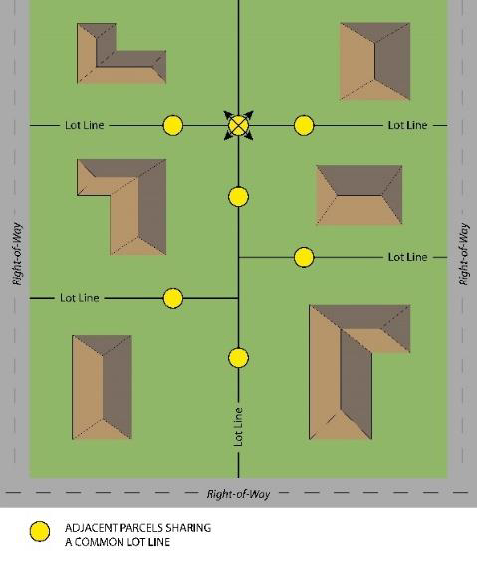
Abutting: See Adjacent.
Accessory structure: A structure, detached or attached, that is located on the same lot as the principal structure, and is subordinate and customarily incidental to the use of the principal structure. Such structure is smaller in size than the principal building.
Accessory use: A use that is subordinate in area, extent, and purpose to the principal use, contributes to the comfort, convenience, or operation of the principal use; and is located on the same lot as the principal use.
Adult-use cannabis business establishment means an adult-use cannabis cultivation center or an adult-use cannabis dispensing organization, as permitted by the city as a special use in the designated zoning district and regulated by this chapter. For purposes of the city's zoning ordinance, the business of cannabis processing organization, is specifically excluded from the definition of the term "adult-use cannabis business establishment," as such use is a prohibited use in any zoning district of the city.
Adult-use cannabis craft grower means a facility operated by an organization or business that is licensed by the Illinois Department of Agriculture to cultivate, dry, cure and package cannabis and perform other necessary activities to make cannabis available for sale at a dispensing organization or use at a processing organization, per the Cannabis Regulation and Tax Act.
Adult-use cannabis cultivation center means a facility operated by an organization or business that is licensed by the Illinois Department of agriculture to cultivate, process, transport and perform necessary activities to provide cannabis and cannabis-infused products to licensed cannabis business establishments, per the Cannabis Regulation and Tax Act.
Adult-use cannabis dispensing organization means a facility operated by an organization or business that is licensed by the Illinois Department of Financial and Professional Regulation to acquire cannabis from licensed cannabis business establishments for the purpose of selling or dispensing cannabis, cannabis-infused products, cannabis seeds, paraphernalia or related supplies to purchasers or to qualified registered medical cannabis patients and caregivers, per the Cannabis Regulation and Tax Act.
Adult-use cannabis infuser organization or infuser means a facility operated by an organization or business that is licensed by the Illinois Department of Agriculture to directly incorporate cannabis or cannabis concentrate into a product formulation to produce a cannabis-infused product.
Adult-use cannabis processing organization or processor means a facility operated by an organization or business that is licensed by the Illinois Department of Agriculture to either extract constituent chemicals or compounds to produce cannabis concentrate or incorporate cannabis or cannabis concentrate into a product formulation to produce a cannabis product, per the Cannabis Regulation and Tax Act.
Adult-use cannabis transporting organization or transporter means an organization or business that is licensed by the Illinois Department of Agriculture to transport cannabis on behalf of a cannabis business establishment or a community college licensed under the community college cannabis vocational training pilot program, per the Cannabis Regulation and Tax Act.
Adjacent: The condition of sharing a common property line.
Adult regulated use: Any business or establishment that offers its patrons services, entertainment, or products, characterized by an emphasis on matter depicting or relating to specified anatomical areas or specified sexual activities.
Alley: A narrow thoroughfare which abuts generally the rear of premises or service entrances of abutting buildings and which is not generally used as a thoroughfare by both pedestrians and vehicles or which is not used for general traffic.
Alteration: Any change in structure, size, shape, character, occupancy or use of a building or structure or any part thereof.
Animal shelter: Any facility where homeless, stray, abandoned, rescued or unwanted animals are received, harbored, maintained or made available for adoption to the general public and which is owned, operated or maintained by a humane society, animal welfare society, or similar organization devoted to the welfare, protection or humane treatment of animals.
Antenna: Any structure, or portion of a structure, designed, used, or capable of being used to physically support one or more antennas and related transmission equipment. An antenna support structure may be either (i) a freestanding antenna support structure, not attached to any occupied building, such as a monopole, lattice collocated an "antenna support structure."
Antenna support structure: Any structure or portion of a structure designed, used, or capable of being used to physically support one or more antennas and related transmission equipment. An antenna support structure may be either (i) a freestanding antenna support structure, not attached to any occupied building, such as a monopole, lattice tower, or guyed tower; or (ii) a building- or structure-mounted antenna support structure such as the portion of a building, roof, wall, utility pole, water tower, or similar structure that serves as the mounting surface for one or more antennas, whether the antenna is directly or supported by brackets, masts, or frames. A small cell wireless facility, as regulated by section 122-82, is not itself an "antenna support structure" and does not make a structure upon which it is collacted an "antenna support structure."
Apartment: A dwelling unit in a Multiple-Family building.
Arts studio, workspace or teaching: Studio for professional work or teaching of any form of fine arts, such as photography, music, drama, and dance.
Assembly/meeting halls: A meeting place at which the public or membership groups are assembled regularly or occasionally, including but not limited to schools, churches, theaters, auditoriums, funeral homes, stadiums, and similar places of assembly.
Assisted living/memory care housing: A residential facility providing care for persons with a disability or seniors needing assistance for a range of daily or medical needs. Staff persons provide on-site care, training, or support for the residents. The facility provides, or contracts to provide, supervisory care services, personal care services, directed care services on a continuous basis. These facilities are commonly designated as, assisted living, or skilled/memory care.
Attention-getting device: Any pennant, flag, valance, banner, propeller, spinner, streamer, searchlight, balloon, and similar device or ornamentation designed for the purpose of attracting attention, promotion, or advertising.
Automobile/truck rental: An establishment where contracts are prepared, or reservations accepted for the rental or leasing of motor vehicles. This term includes incidental storage of vehicles but does not include on premise maintenance of vehicles or a tool/equipment rental facility.
Automobile/truck repair/maintenance: Any building or part thereof where automotive vehicles are painted, repaired, rebuilt or reconstructed for compensation.
Automobile oil change/repair facility: Operations that provide lubrication and/or checking, changing, or additions of those fluids and filters necessary to the maintenance of a vehicle. These services typically will be provided while customers wait or vehicles are left for short duration. Services may include, but are not limited to, windshield repair or replacement, stereo installation, alarm installation, or tire service and installation.
Automobile/truck sales (new and used): The use of any building or portion thereof, or other premises, for the display and sale of new motor vehicles, or used motor vehicles as an ancillary use of a lot, and any warranty repair work and other repair service conducted as an accessory use.
Average front yard: The front yard established when more than 25 percent all of the improved lots in any one block are developed with buildings which establish a front yard setback greater or less than a defined distance.
Bakery/coffee shop: An establishment that sells beverages and baked products for consumption on or off-site.
Banks and financial institutions: A financial institution that is open to the public and engaged in deposit banking, and that performs closely related functions such as loan-making, investments, and fiduciary activities.
Banquet hall: An establishment which is rented by individuals or groups to accommodate private functions including, but not limited to, banquets, weddings, and other similar events. Such a use may or may not include: 1) kitchen facilities; 2) the sale of alcoholic beverages for on-premises consumption during scheduled events.
Basement: A story having part but not more than one-half of its height above grade on not less than three sides. A basement is counted as a half-story for the purpose of height regulation if used for dwelling purposes.
Bed and breakfast: An operator-occupied residence providing accommodations for a charge to the public. Bed and breakfast establishments do not include motels, hotels, boarding houses, or food service establishments.
Berm: An earthen mound designed to provide visual interest, screen undesirable views, and/or decrease noise.
Block: That property abutting on one side of a street between the two nearest intersecting streets, railroad rights-of-way, or other natural barriers.
Blue roof: A roof that is designed to store and discharge rainfall.
Brew pub: A full-service restaurant where beer is brewed or manufactured on the premises, with the primary distribution being in the adjoining full-service restaurant.
Buffer: An area of land left open with planted ground cover or landscaped to eliminate or minimize potential impacts of adjacent structures or land uses.
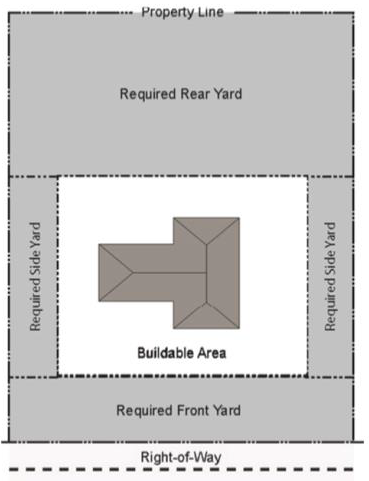
Buildable area: The space remaining on a lot, after the minimum setbacks have been complied with.
Building: A structure enclosed within exterior or common walls designed for the housing, shelter, enclosure and/or support of individuals, animals or property of any kind.
Building coverage: The horizontal area measured from the ground floor exterior faces of the wans or structural members of the principal building and any accessory structures, as wen as the horizontal area of attached above-grade improvements such as decks, porches, terraces, balconies, and steps. Building coverage does not include at-grade or subterranean improvements such as, for example: basements extending beyond the building footprint, patios, sidewalks, driveways, parking spaces, sport courts, in-ground swimming pools, steps at grade, and other paved surfaces. Where shown as a percentage, the gross square footage of building coverage is divided by the total area of the lot.
Building permit: A permit issued by the city for the construction, alteration, removal or demolition of a building or structure.
Bulk: A term referring to the collective regulations of a property that generally define the size and setback of structures on that property. These regulations include but are not limited to: minimum lot area, minimum lot width, minimum front yard setback, minimum side yard, minimum rear yard, maximum building coverage, maximum building height, and floor area ratio (FAR).
Cabana: An accessory structure that is a lightweight shelter containing an open side.
Carport: An accessory structure being open on at least two sides, intended for the sole use of sheltering automobiles.
Car wash: A building or portion thereof containing facilities for washing cars, vans, or similarly sized motor vehicles, using production-line methods and mechanical devices, or containing facilities for washing such motor vehicles, using self-service mechanical devices.
Cemetery: Land used for the burial of the dead and dedicated for cemetery purposes including but not limited to columbaria, mausoleums, necessary sales, and maintenance facilities.
Common open space: Open space that is held in ownership, maintained, used, and for the benefit of multiple owners with a common interest in the property, which may or may not be accessible to the general public.
Community solar: A solar energy system that qualifies as a community renewable generation project under the Illinois Power Agency Act (20 ILCS 3855/1-10). Such installations are interconnected at the distribution system level of an electric utility and enable multiple individual subscribers to receive credit for electricity generated by a single photovoltaic system. The term "community solar" identifies a specific type of solar energy system (as defined herein) and does not constitute a separate land use category under this chapter.
Community swimming pools: A recreational facility designed and intended for water contact and swimming activities that is operated for public use, including pools operated by Homeowner's Associations for the use of their residents only.
Comprehensive plan: The official adopted plan for the physical development, conservation, and redevelopment of the city.
Corner lot: See Lot, corner.
Country club: A club with recreation facilities for members, their families, and invited guests.
Curb level: See GRADE.
Currency exchange: A commercial use that exchanges common currencies, sells money orders or cashier's checks, and cashes checks as its principal business activity. This shall not include banks and financial institutions.
Data center: An establishment primarily engaged in the storage, management, processing, and/or transmission of digital data, and housing computer and/or network equipment, systems, servers, appliances and other associated components related to digital data operations.
Daycare center: Any facility operated in a non-residential dwelling for the purpose of providing care, protection, and guidance to children or adults during only part of a 24-hour day. This term includes nursery schools, preschools, and other similar uses but excludes public and private educational facilities or any 24-hour care facility.
Daycare home: A residential dwelling in which a permanent occupant of the dwelling provides for the care of children or adults for less than 24 hours per day.
Decibel: A unit of measurement of the intensity (loudness) of sound. Sound level meters which are employed to measure the intensity of sound are calibrated in decibels.
Deck: An uncovered and open platform built above grade typically supported by pillars or posts. Decks may or may not be attached to a principal or accessory structure.
Density: The number of housing units divided by the total land amount in acres of the property including land covered by wetlands, water bodies, public parks and trails, public open space, road rights-of-way, and other environmentally sensitive areas.
Density, net: The number of housing units divided by the net acreage, which is the total land amount in acres not including land covered by wetlands, water bodies, public parks and trails, public open space, road rights-of-way, and other environmentally sensitive areas.
Development: Any construction, change or other action related to a structure or land (other than maintenance of existing structures, paved areas and landscaping, and interior remodeling of existing structures), including, without limitation, the construction or installation of new, or enlargement of existing, structures, paved areas, or utilities; dredging, filling, drilling, mining, grading, paving, or excavating operations; installation of new landscaping; and open storage of materials.
Dog park: An enclosed outdoor area intended for the exercising and/or containment of dogs and similar animals.
Dollar store: A retail use which sells a variety of general merchandise, a majority of which are sold for one dollar or less, five dollars or less, or are similarly branded.
Drive thru, as part of a permitted or principal use: An opening in the wall of a building or structure and all related drive areas, access areas, and signage designed and intended to be used to provide for sales and/or service to patrons who remain in their vehicles.
Driveway: Any automobile access connecting a house, garage, other structure, or parking lot with the street.
Dwelling: A building or portion thereof providing shelter, sanitation, cooking and sleeping accommodations and the amenities for permanent habitation. It does not include mobile homes, temporary lodging or individual sleeping rooms for rent.
Dwelling above the ground floor: A dwelling unit located on the upper floor of a building that contains non-residential uses on its ground floor.
Dwelling, multi-family: A building or portion thereof, designed or altered for occupancy as two or more dwelling units. Multiple-family dwellings have individual entries, are located in a single building, and are accessed through a common entrance and corridors.
Dwelling, single-family attached: A single-family dwelling which is joined to another dwelling at one or more sides by a party wall or walls, with each dwelling having a separate entrance, commonly known as a duplex when two attached units, and a townhome/rowhome when three or more attached units.
Dwelling, single-family detached: A single dwelling unit designed exclusively for residential use and occupancy, which is entirely surrounded by open space and is not connected to any other dwelling unit by roof, walls or porches.
Easement: A right to use a portion of another person's real property for certain limited purposes.
Emergency shelter: A building or portion thereof in which shelter, food, lodging, and counseling is provided on an emergency basis for persons who are victims of crime or abusive treatment.
Encroachment: Any building, sign or other structure or object of any kind which is placed, located or maintained in, on, under or over any portion of a required yard.
Erect: To build, construct, attach, manually place, suspend, or affix.
Fence: A free-standing structure of metal, masonry, composite or wood, or any combination thereof resting on or partially buried in the ground and rising above ground level, and used for confinement, screening or partition purposes. "Fence" includes decorative walls that are not integral to a building or structure. Although a fence may be considered an "accessory structure," fences are regulated as a separate classification of structure and are specifically excluded from the definition of "accessory structure" for the purposes of this chapter.
Floor area: The sum of all gross horizontal areas of the several floors of the building measured from the exterior faces of the exterior walls or from the centerline of walls separating two units.
For the purpose of measuring Floor Area Ratio (FAR), the floor area of a building shall include:
• Basement floor area when more than one-half of the basement height is above the established grade;
• Elevator shafts and stairwells at each floor;
• Floor space used for mechanical equipment (except when located on the roof);
• Penthouses;
• Attic space having a headroom of seven feet, six inches or more;
• Interior balconies and mezzanines;
• Structures devoted to bulk storage; *
• Enclosed porches; and
• Floor area devoted to accessory uses.
The floor area of a building shall not include any space devoted to off-street parking.
Floor area ratio: The ratio of building floor area on a lot to the net lot area (not including dedicated rights-of-way) of the property upon which the building and structures are located. The floor area ratio is determined as follows:
Frequency: The number of oscillations per second in a sound wave and is an index of the pitch of the resulting sound.
Frontage: The portion of a property or properties facing a street or right-of-way.
Funeral home: An establishment engaged in undertaking services such as preparing the dead for burial and arranging and managing funerals.
Garage: A principal or accessory structure intended for and/or used to store vehicles.
Garage and yard sales: The temporary sale of miscellaneous used items commonly associated with residential use.
Gas/fueling stations: A business partly or entirely devoted to storing and dispensing of automobile fuels and accessories. Sale of convenience shopping goods to those purchasing gasoline, or others, may also be a part of this activity.
Gazebo: An accessory structure covered by a roof, and may be enclosed with screening, intended to be used for outdoor activities.
Golf course: A facility providing a private or public golf recreation area along with accessory golf support facilities but excluding miniature golf.
Government buildings and facilities: A building owned, operated and/or occupied by a governmental agency to provide a governmental service to the public.
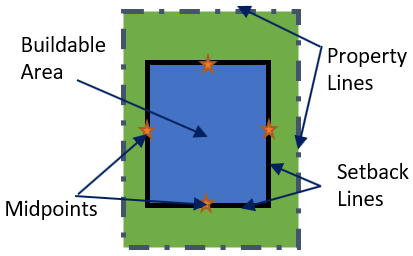
Grade: The average elevation taken from the midpoints of lines connecting the corners of the smallest polygon formed by the intersecting lines of the minimum required front, rear, side, and/or corner side yards. Grade shall be established prior to any development, demolition, or issuance of any development related permit.
Grade, street: The elevation of the established street in front of the building measured at curb level at the center of such front. Where no street grade has been established, the city engineer shall establish such street grade or its equivalent for the purpose of this chapter.
Green roof: A roof that is partially or completely covered with vegetation, a growing medium, and a waterproof membrane, that absorbs rainwater and reduces the heat absorbed by a building or structure.
Greenhouse: A business whose principal use is the growing of plants, all or part of which are sold at retail or wholesale. This shall not include accessory greenhouses in residential districts.
Group community residence: A single dwelling unit occupied on a relatively permanent basis in a family-like environment by persons with disabilities, plus paid professional support staff provided by a sponsoring agency, either living with the residents on a continuous basis or present whenever residents with disabilities are present at the dwelling.
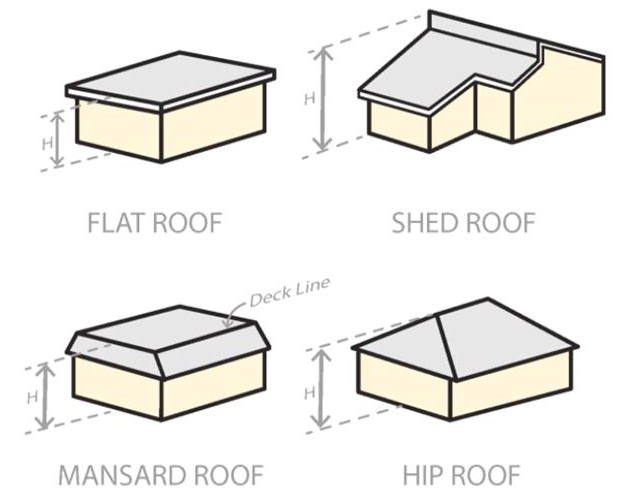
Height: The vertical distance measured from grade to the highest point of the building. Where a building is located upon a terrace or slope, the height shall be measured from the lowest elevation above grade at which the building protrudes.
Home occupation: Any occupation or profession conducted from a residential dwelling.
Home/garden stores: A place of business where products and tools for home maintenance, repair, and improvement are sold to the consumer. These centers may include a nursery and/or greenhouse.
Hospital: An institution providing health, medical and surgical facilities, for diagnostic, mental, and medical treatment (both surgical and nonsurgical) to inpatients with any of a wide variety of medical conditions. These establishments maintain inpatient beds, provide patients with food services and an organized staff of physicians and other medical personnel to provide patient care services. These establishments commonly provide other services, such as outpatient, diagnostic, clinical laboratory, and pharmacy services.
Hotel: A commercial establishment that provides transient guests with overnight accommodations, that do not exceed 28 consecutive days, in exchange for monetary compensation. Commercial areas, meeting areas, dining areas, and other guest facilities that are open to both patrons and the general public may be included. Individual guest rooms may include limited cooking facilities, such as a microwave or mini fridge, but not a full kitchen.
Impervious surface: Any area that prevents or significantly impedes the infiltration of stormwater into the underlying soil. Impervious surfaces include, without limitation: building roofs; driveways and parking areas constructed of asphalt, concrete, compacted gravel, crushed stone, or compacted dirt; paved or hard-surfaced walkways; patios; decks with impervious flooring; swimming pools; and recreational courts such as tennis or basketball courts. Semi-pervious or permeable pavement and paver systems shall be considered 100 percent impervious, regardless of their design or materials.
Indoor athletic facilities: An establishment that provides health, fitness, and exercise facilities such as running, jogging, aerobics, weightlifting, court sports, swimming, or other recreational activities. May also include facilities for sports training such as baseball, soccer, gymnastics, and martial arts.
Indoor entertainment and amusement facilities: An establishment where entertainment, either passive or active, is provided. Activities include but are not limited to bowling, billiards, performance arts and theater, indoor play park, and other similar uses.
Indoor retail sales of goods: A business which displays or conducts the retail sale or rental of merchandise and is conducted primarily within an enclosed building (and may include limited outdoor display or storage, as regulated herein). Examples may include: Antique shops, furniture stores, grocery stores, hardware stores, department stores, clothing/wearing apparel stores, bookstores, sporting goods stores, drug stores, pharmacies, florist shops, and similar land uses.
Junkyard: Any parcel of land where used goods or materials are bought, sold, exchanged, stored, baled, packed, disassembled or handled (including auto and building wrecking yards) outdoors.
Kennel: An establishment where dogs, cats, or other domestic animals are temporarily boarded overnight and for compensation.
Landscaping: The improvement of a lot, parcel or tract of land with grass, shrubs, and trees. Landscaping may include, flowerbeds, ornamental objects such as fountains, statuary, and other similar natural and artificial objects designed and arranged to produce an aesthetically pleasing effect.
Lighted sports fields: An open area of land used for outdoor games such as baseball, football, and soccer, illuminated so as to allow athletic competition in the evening hours.
Liquor stores: A store which sells alcoholic beverages for off-premises consumption.
Little free library: Accessory structures for the purpose of storing books for exchange within neighborhoods and for the general public and promoting access to reading materials.
Loading space or dock, off-street: An open, hard-surfaced area of land, other than a street or a public way, the principal use of which is for the standing, loading and unloading of motor vehicles, tractors and trailers, to avoid undue interference with public streets and alleys.
Lot: A single, subdivided parcel of land under one ownership devoted to a common use or occupied by a single or principal building plus accessory structures and which is shown as a lot on a recorded and approved plat of subdivision.
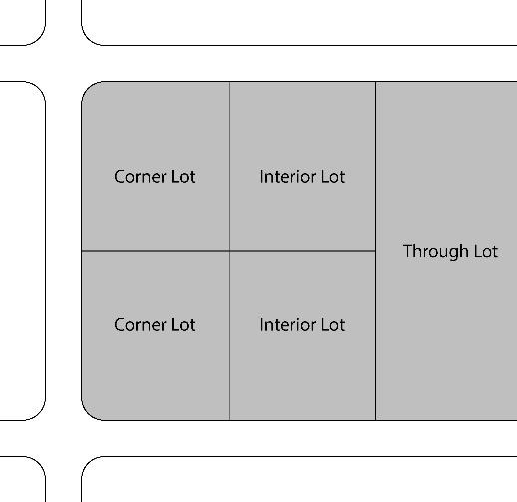
• Lot (corner): A lot which abuts on two (2) intersecting streets.
• Lot (through): A lot having its front and rear lot lines adjacent to and substantially parallel with, adjacent streets (also known as a double-frontage lot).
• Lot (interior): A lot abutting one street and other lots on other sides.
• Lot (reverse corner): A corner lot, the side street line of which is substantially a continuation of the front lot line of the first lot to its rear.
Lot area: The horizontal area within the exterior lines of the lot.
Lot depth: The minimum horizontal distance between the front and rear lot lines.
Lot line, corner side: The lot line, of a property adjoining to streets, coexistent with the right-of-way line of an adjacent street corresponding to the longer yard abutting one of those streets and located parallel or opposite an interior side yard.
Lot line, front: The lot line of a property coexistent with the right-of-way line of any adjacent street.
Lot line, interior: A side lot line common with another lot.
Lot line, rear: The lot line most nearly parallel to and most remote from the front lot line.
Lot line, side: Lot lines other than front or rear lot lines are side lot lines.
Lot width: The horizontal distance between the side lot lines measured at right angles to the lot depth at the established front building line.
Manufacturing, general: The manufacture, compounding, processing, packaging or treatment of products from raw materials.
Manufacturing, light: The manufacture, compounding, assembling or treatment of articles or merchandise from previously prepared materials.
Marquee: Any hood of permanent construction projecting from the wall of a building, but not supported by the ground or sidewalk, serving the purpose of providing shelter and protection from the weather.
Medical and dental clinics: A medical and/or dental facility used for offices of more than one doctor for the examination and treatment of patients, which doctors may be associated together or practicing independently of each other, while sharing the facilities and equipment therein, and shall not include a facility devoted primarily for the purpose of surgical procedures. Such facility shall not provide beds or other accommodations for the overnight stay of patients.
Medical cannabis cultivation center: A facility operated by an organization or business that is registered by the Illinois Department of Agriculture to perform necessary activities to provide only registered medical cannabis dispensing organizations with usable medical cannabis.
Medical cannabis dispensary: A facility where medical cannabis, paraphernalia, or related supplies and educational materials is dispensed to registered qualifying patients operated by a medical cannabis dispensing organization.
Microbrewery: A manufacturer of alcoholic malt beverages of up to 15,000 barrels per year for the purpose of wholesale distribution of a majority of its product with incidental sales of up to 3,000 barrels to the public for on-site consumption or carryout. The microbrewery facility may include an ancillary tasting room and retail sales in which guests/customers may sample and purchase the product(s) associated with the facility's use, and/or products manufactured on-site..
Microdistillery: A small-scale artisan manufacturing business that blends, ferments, processes, packages, and distributes alcoholic spirits on the premises. The microdistillery facility may include an ancillary tasting room and retail component in which guests/customers may sample and purchase the product(s) associated with the facility's use, and/or products manufactured on-site. Operation of the facility shall be consistent with Illinois State law regarding "Craft Distillers".
Microwinery: Combination retail, wholesale and small-scale artisan manufacturing business that blends, ferments, processes, packages, and distributes wine for sale on or off-site. The microwinery facility may include an ancillary tasting room and retail component in which guests/customers may sample and purchase the product associated with the facility's use, and/or products manufactured on-site. Operation of the facility shall be consistent with Illinois State law regarding "Second Class Wine Makers".
Miniature golf course: A novelty version of golf played with a putter and a golf ball on a miniature course, typically with artificial playing surfaces and including obstacles such as bridges and tunnels.
Mobile home park: A parcel or tract of land developed with facilities for locating two or more "manufactured homes" provided each mobile home contains a kitchen, flush toilet, and shower or bath and that such mobile home park shall be for use only by non-transient dwellers remaining continuously for more than six months. It shall not include a sales lot in which motor vehicles or unoccupied trailers are parked for the purpose of inspection or sale.
Motel: See Hotel.
Motor vehicle: Any passenger vehicle, truck, tractor, tractor-trailer, trailer or semitrailer propelled by mechanical power.
Mural art: A graphic displayed on the exterior of a building, generally for the purposes of decoration or artistic expression. Mural art includes, without limitation, works of painting, fresco, or mosaic. Signs, as defined in this chapter, are not mural art but may also exist within the same façade or installation where allowed by this chapter.
Museum or cultural facility: A use operated by a public, private or non-profit organization that is open to the public and providing cultural services and facilities including, but not limited to cultural centers, historical societies, aquariums and libraries.
Nonconforming structure: A structure or portion thereof lawfully existing prior to adoption of this Code, that was erected or structurally altered in such a manner that does not conform to the bulk regulations of the district in which it is located.
Nonconforming use: A use of property or portion thereof lawfully existing prior to adoption of this Code, that does not conform to the use regulations of the zoning district in which it is located.
Octave band: A means of dividing the range of sound frequencies into octaves in order to classify sound according to pitch.
Octave band filter: An electrical frequency analyzer designed according to standards formulated by the American Standards Association and used in conjunction with a sound level meter to take measurements in specific octave intervals.
Odorous matter: Any matter or material that yields an odor which is offensive in any way.
Obstruction: See Encroachment.
Offices, professional and business: The office of business and professional persons and businesses, such as an engineer, doctor, dentist, attorney, real estate broker, insurance broker, architect or other similar professional person, and any office used primarily for accounting, correspondence, research, editing or administration.
Off-street parking area: That portion of a property used for the daily parking of vehicle and the driveways and access points associated with such parking.
Off-street parking lot, private: Parking facilities that are owned, operated and maintained by a private owner.
Off-street parking lot, public: Parking facilities that are owned, operated and maintained by the city.
Open space: That area of a planned development or lot which is unoccupied and unobstructed from its lowest level to the sky. Streets, paved areas, ground-level parking and recreational facility structures are not included in open space.
Outdoor business activities, permanent: Activities that include the sale, display, and/or storage of material or product not within a wholly enclosed building. Such activities are permanent and ongoing (rather than seasonal).
Particulate matter: Material, other than water, which is suspended in or discharged into the atmosphere in a finely divided form as a liquid or solid.
Party wall: A wall separating two distinct uses or occupancies.
Patio: An unenclosed surface area located at the finished lot grade, usually constructed of concrete or masonry materials.
Performance standard: A criterion established to control noise, odor, smoke, toxic noxious matter, vibration, fire and explosive hazards or glare or heat generated by or inherent in uses of land or buildings.
Permittee: Any person holding a permit pursuant to this chapter.
Personal services: Establishments primarily engaged in providing individual services that are generally related to individual needs such as beauty and barber shops, financial, legal, and medical services, laundry and dry-cleaning services, tailor shops, and other similar uses.
Personal wireless services: A personal wireless service facility shall mean any facility of whatever kind or nature, except a small wireless facility, that receives, transmits or relays radio or microwave signals for cellular, PCS or other similar service. This shall include any installation or mounting structure or equipment and any appurtenant electronics necessary for the operation of the facility. This definition shall be inclusive of the definition of personal wireless service facility set forth in 47 USC 332(c)(7)(C), as amended now or in the future.
Pet day care: Facilities that provide day care and related services for dogs and cats, such as obedience training. This does not include medical services or overnight kenneling of animals.
Pet stores: A retail sales establishment primarily involved in the sale of domestic animals and pet-related supplies.
Pet supply stores: A retail sales establishment primarily involved in the sale of pet-related supplies, but does not sell animals.
Planned development: A tract of land which is developed as a unit under single ownership or control pursuant to the requirements of the planned development specifications of this chapter.
Playhouse: A freestanding structure, exclusively for the use of children.
Police/fire stations: See Government Buildings and Facilities.
Porch: A roofed-over structure, projecting out from the wall of a main structure and commonly open to the weather in part.
Property: A lot, parcel, tract, or plot of land together with the buildings and structures that may be located thereon.
Park, public: Public land that has been designated for passive recreation with limited recreational facilities, which is under the control, operation, or management of recreation authorities.
Principal structure: A structure in which is conducted the primary or predominant use of the lot on which it is located.
Public recreational facilities: Public land that has been designated for park or recreational activities including, but not limited to, a park, playground, nature trail, athletic field, basketball or tennis court, pedestrian/bicycle path, open space, pools, golf courses, or similar public land which is under the control, operation, or management of recreation authorities.
Public way: Any public sidewalk, street, alley, highway or other public thoroughfare.
Recycling center: A building or area where the primary activity is the separation of materials prior to shipment for remanufacture into new materials. This shall not include junk yard.
Rehabilitation facilities: A facility for the purpose of temporary short term or extended care and treatment of patients being treated for or recovering from alcoholism, drug abuse or other addiction.
Religious institutions: Any church, synagogue, mosque, temple or building which is used primarily for religious worship and related religious activities.
Research and development facilities: Research, development, and testing laboratories that do not involve the mass manufacture, fabrication, processing, or sale of products.
Restaurant: An establishment, or part thereof, in which, for a fee, food and/or drink is prepared, served and consumed on the premises or provided as part of a carryout service for the consumption of food and drink off the premises.
Right-of-way: Area dedicated to or owned by a public body. In the case of public streets, the right-of-way normally includes the curbs, lawn strips, and lighting, sidewalks and drainage facilities and may include special features such as grade separation, landscaped areas, viaducts, and bridges.
Ringelmann chart: A chart which is described in the U.S. Bureau of Mines Information Circular 6888, and on which are illustrated graduated shades of grey for use in estimating the light-obscuring capacity of smoke and smoke density.
Ringelmann number: The number appearing on the Ringelmann Chart ascribed by the observer to the density of the smoke emission. Where the density or light-obstructing capacity of the smoke as observed falls between two consecutive Ringelmann numbers, the lower Ringelmann number shall be considered the density of the smoke observed.
School (public, non-profit or private): An institution for the teaching of children or adults including preschools, primary and secondary schools, colleges, professional schools, business schools, trade schools, and similar facilities.
School route: The public right-of-way designated by public or private schools along which children wait for buses to or from or walk to or from an elementary school, junior high school or high school.
Screening: A structure erected or vegetation planted to conceal or significantly reduce visibility of the area behind it.
Self-storage facilities: A building or group of buildings, also known as a mini-warehouse, containing individual, compartmentalized storage spaces of varying sizes that are leased or rented on a short-term basis to individuals or businesses for the storage of personal property or business inventory. Such uses may also be referred to as "mini-warehouses."
Senior independent living: A facility providing housing and services for a group of persons, typically seniors, able to meet most regular daily needs. Such facilities may include provision of meals, common dining areas, housekeeping, and personal care assistance.
Setback: The minimum horizontal distance between the wall of a building and the property line, or between the wall of a building facing a stream and the mapped centerline of the stream where stream rights-of-way are platted in accordance with the official plan and the subdivision regulations in chapter 98 of this Code.
Setback line (corner side): The line between the closest point of the principal building and the lot line of the lot which abuts a street and corresponds to the longer yard adjacent to a street and located parallel or opposite an interior side property line.
Setback line (front): The line nearest the front of and across a lot, establishing the minimum setback to be provided between the front line of any building or structure and the front property line or street right-of-way line.
Setback line (rear): The line nearest the rear of and across a lot, establishing the minimum setback to be provided between the rear line of a principal building or structure and the rear property line or street right-of-way line.
Setback line (side): The line nearest the side of a lot, between the front and rear setback line, establishing the minimum setback to be provided between the side line of a principal building or structure and adjacent property or street right-of-way line (if a reverse corner lot).
Short term residential rental: Any dwelling or portion thereof made available for use or used for accommodations or lodging of guests paying a fee or other compensation for a period of less than 30 consecutive days.
Sign: Any object or device containing letters, figures and/or other means of communication or part thereof, situated outdoors or indoors, of which the effect produced is to advertise, announce, communicate, identify, declare, demonstrate, direct, display, and/or instruct potential users of a use, product and/or service.
Small cell wireless facility: A wireless facility that meets both of the following qualifications: (i) each antenna is located inside an enclosure of no more than 6 cubic feet in volume or, in the case of an antenna that has exposed elements, the antenna and all of its exposed elements could fit within an imaginary enclosure of no more than 6 cubic feet; and (ii) all other wireless equipment attached directly to a utility pole associated with the facility is cumulatively no more than 25 cubic feet in volume. The following types of associated ancillary equipment are not included in the calculation of equipment volume: electric meter, concealment elements, telecommunications demarcation box, ground-based enclosures, grounding equipment, power transfer switch, cut-off switch, and vertical cable runs for the connection of power and other services.
Smoke unit: The number obtained when the smoke density in a Ringelmann number is multiplied by the time of emission in minutes. For the purpose of this calculation, a Ringelmann density reading shall be made at least once a minute during the period of observation; each reading is then multiplied by the time in minutes during which it was observed. The various products are then added together to give the total number of smoke units observed during the entire observation period.
Smoking lounge: A commercial establishment or portion thereof where tobacco or nicotine, industrial hemp, vaping, or other related products used to consume tobacco and hemp products are used by persons on the premises. A "smoking lounge" shall not include any private residence.
Solar-energy system: A device, array of devices, or structural design feature, the purpose of which is to provide for generation or storage of electricity from sunlight, or the collection, storage, and distribution of solar energy for space heating or cooling, daylight for interior lighting, or water heating.
Sound level: For an operation or use, the intensity of sound, measured in decibels, produced by such operation or use.
Sound level meter: An instrument standardized by the American Standards Association for measurement of intensity of sound.
Specified anatomical area:
(1)
Less than completely and opaquely covered:
a.
Human genitals, pubic region;
b.
Buttock, and
c.
Female breast below a point immediately above the top of the areola;
(2)
Human male genitals in a discernible turgid state, even if completely and opaquely covered.
Specified sexual activities:
(1)
Human genitals in a state of sexual stimulation or arousal;
(2)
Acts of human masturbation, oral copulation, sexual intercourse or sodomy, actual or simulated;
(3)
Fondling or other erotic touching of human genitals, pubic regions, buttock, anus or female breast.
Stoop: A raised platform, approached by steps and sometimes having a roof, but not enclosed, at the entrance to a building.
Storage building: Any structure that is used for storage, does not have a door or other entranceway into a dwelling unit, and the use of which is limited solely to storage of inanimate objects.
Story: That portion of a building included between the surface of any floor and the surface of the floor next above it or, if there is no floor above it, the space between the floor and the ceiling next above it. Any portion of a story exceeding 14 feet in height shall be considered as an additional story for each 14 feet of height or fraction thereof.
Street: all property dedicated or intended for public highway, freeway or roadway purposes or subject to public easements therefor.
Street, private: Any street not owned by or dedicated to any governmental agency.
Street, public: A street that has been dedicated to and accepted by a government agency, which maintains the street under its jurisdiction.
Structure: Any combination of materials assembled to perform a function in a fixed location of land; includes buildings and decks.
Tattoo parlor: A commercial use where tattooing is performed for compensation.
Terrace, open: A level plane or platform which is located adjacent to one or more faces of the principal structure, above the average level of the adjoining ground, and which is not roofed.
Trailer: A vehicle without motive power used for recreation, business or storage purposes.
Use: The purpose for which land or a building thereon is designed, arranged, or intended or for which it is occupied, maintained, let or leased.
Use, accessory: See Accessory Use.
Use, permitted: A use allowed in a zoning district without the need for specific review and approval of the planning and zoning commission, or city council so long as it satisfies the standards and requirements established in this Code.
Use, principal: The main use of land or buildings as distinguished from a subordinate or accessory use. A principal use may be either permitted or special.
Use, special: A use that meets the intent and purpose of the zoning district but which requires the review and approval of the planning and zoning commission and city council in order to ensure that any adverse impacts on adjacent uses, structures, or public services and facilities that may be generated by the use can be, and are, mitigated.
Use, temporary: A use established for a fixed period of time with the intent that such use will terminate upon expiration of the fixed time period unless permission to conduct the use is renewed.
Utilities: Any facilities or equipment, above or below ground-level or pole-mounted equipment that is specifically provided in connection with any utility provided by or within the city, including, without limitation, electricity, gas, communications, transportation, water or sewage.
Variance: A departure from strict conformance with regulations of this Code related to the area and dimensions of a lot and/or structure, which may be granted by the city owing to special circumstances creating a unique hardship (as defined in section 122-393 Variances of this chapter, which spells out the procedures and standards for variances) that makes meeting the standards of this Code otherwise not feasible for the property owner.
Veterinary clinics: Any building or portion thereof designed or used for the care, observation or treatment of domestic animals, which may include overnight veterinary care or boarding of animals.
Wall, decorative: See Fence.
Warehousing: The activity and facilities related to storage and distribution of goods and products, and supplies goods to other locations for resale, as well as activities involving movement and storage of products, items or equipment of other persons, companies, or organizations. Self-Storage facilities are not categorized as warehousing.
White roof: A roof that is white or light in color that provides high levels of solar reflectance and reduces the heat absorbed by a building or structure.
Wind-energy system: An energy producing device which coverts wind energy by means of a rotor to mechanical or electrical energy.
Yard: The open space surrounding the principal structure of any lot, unoccupied and unobstructed by any portion of that structure or accessory structure from the ground to the sky, except where specifically permitted by this Code.
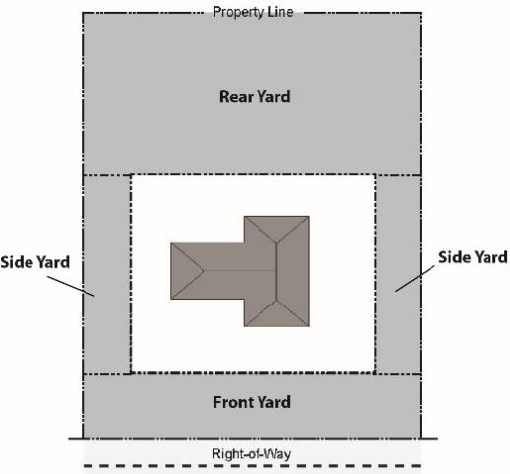
Yard, corner side: On properties abutting two streets, the longer yard abutting one of those streets and located parallel or opposite an interior side yard.
Yard, front: That portion of the yard extending the full width of the lot, between the side lot lines, and measured between the front property line and the front setback line.
Yard, interior side: Those portions of the yard extending from the front yard to the rear yard and measured between the side property lines and side setback lines.
Yard, rear: That portion of the yard extending the full width of the lot, between the side lot lines, and measured between the rear property line and the rear setback line.
Zoning administrator: The city official responsible for administering the various elements of this chapter. This includes, but is not limited to, granting zoning certificates and interpreting zoning regulations. As related to this Code, the director of community development or their designee is the zoning administrator.
Zoning district: A section of the city established for which regulations governing matters such as the use of buildings and premises, the height of the buildings, the size of yards and intensity of use is consistent.
Zoning map: The map or maps incorporated into this chapter, and made a part hereof, that identify the various zoning districts of the city.
(Ord. No. 20-47, § 3(Exh. A), 11-10-2020; Ord. No. 23-14, § 2(Exh. 1), 4-11-2023; Ord. No. 23-20, § 2(Exh. A), 4-25-2023; Ord. No. 23-21, §§ 2, 3(Exh. 1), 4-25-2023; Ord. No. 23-74, § 2, 11-28-2023; Ord. No. 24-11, § 2, 3-26-2024; Ord. No. 24-39, § 2, 9-10-2024; Ord. No. 25-16, § 2, 2-25-2025; Ord. No. 25-34, § 2, 5-27-2025; Ord. No. 25-64, § 2, 12-16-2025; Ord. No. 25-71, § 2, 11-25-2025; Ord. No. 25-72, § 2, 11-25-2025; Ord. No. 25-73, § 2, 11-25-2025; Ord. No. 25-74, § 2, 11-25-2025)

