
Rolling Meadows City Zoning Code
ARTICLE VI
ADMINISTRATION AND DEVELOPMENT REVIEW
Sec. 122-361. - Organization of ordinance administration.
(a)
This Zoning Ordinance is administered by the following, as identified in this chapter and elsewhere in the City Code:
(1)
Zoning administrator
(2)
Planning and zoning commission
(b).
The following zoning processes administered by the city are outlined in this article.
(1)
Hearing notice and procedures
(2)
Appeals
(3)
Variances
(4)
Amendments (Text Amendments and Map Amendments/Rezonings)
(5)
Special uses
(6)
Zoning certificates
(7)
Site plan review
(8)
Fees
(Ord. No. 20-47, § 3(Exh. A), 11-10-2020)
Sec. 122-362. - Zoning administrator and appointed bodies.
(a)
The zoning administrator:
(1)
Zoning administrator and authority: The zoning administrator (or their designee) is charged to administer and enforce this chapter. The City of Rolling Meadows Community Development Director is designated as the city's zoning administrator and authorized to:
a.
Issue all zoning certificates and permits required per this chapter, and to maintain records thereof.
b.
Conduct inspections of buildings, structures, and land to determine compliance with this chapter and the City Code and notify in writing the person responsible for any violation found, indicating the nature of the violation and directing actions necessary to correct it.
c.
Order discontinuance of illegal use of land, buildings, or structures; the removal of illegal buildings, structures, additions, or structural changes, directed to prevent violation of this chapter shall be as authorized by Illinois law and by the City Code.
d.
Maintain permanent and current records of this chapter, including, but not limited to all maps, amendments, special use permits, planned developments, variances, appeals, applications, and records of hearings and decisions.
e.
Provide interpretations regarding the meaning and applicability of regulations in this chapter and maintain a record of those interpretations.
f.
Receive, file, and forward to the planning and zoning commission as applicable, all applications for matters pertinent to this chapter. As needed the zoning administrator shall provide facts and information needed by these bodies making findings and support matters before them.
g.
Initiate, direct, and review, from time-to-time, a study of the provisions of this chapter and make recommendations as such study requires.
h.
Decide or make recommendations on all matters upon which the zoning administrator is required to act.
i.
Make an annual report to the planning and zoning commission and the city council on the work of the community development department on the enforcement of this chapter.
(Ord. No. 20-47, § 3(Exh. A), 11-10-2020; Ord. No. 23-20, § 2(Exh. A), 4-25-2023)
Sec. 122-363. - Planning and zoning commission.
(1)
Membership: Provisions regarding the establishment and membership of the planning and zoning commission are contained in chapter 78 "Planning" of article II "Planning and Zoning Commission" of the City Code.
(2)
Authority: The planning and zoning commission shall have the following duties and powers:
a.
To prepare and recommend to the city council a comprehensive plan for the present and future development or redevelopment of the city and contiguous unincorporated territory within one and one-half miles of the corporate limits of the city and not located in any other municipality.
b.
To recommend to the city council, from time to time, such changes in the Comprehensive Plan or any part thereof, as may be deemed necessary.
c.
To hear, consider and recommend to the city council matters dealing with Amendments to this chapter.
d.
To hear, consider and recommend to the city council matters dealing with the granting of special uses.
e.
To hear, consider and recommend to the city council matters dealing with variances, as authorized in this chapter.
f.
To hear, consider and recommend to the city Council appeals to a determination of the zoning administrator, as authorized in this Chapter.
g.
To hear, consider and recommend to the city Council matters dealing with the granting of planned developments in the form of a special use.
h.
To designate, subject to final consideration, evaluation and approval of the city council, land suitable for annexation to the city and the recommended zoning classification for such land upon annexation.
i.
To study and make recommendations to the city council regarding matters dealing with the planning and zoning of the community.
j.
To cooperate with the municipal or regional planning commissions and other agencies or groups to further local planning initiatives and to assure harmonious and integrated planning for the area.
k.
To take all actions directed by the city council.
l.
To take all other actions authorized by law.
(3)
Meeting procedures:
a.
All meetings of the planning and zoning commission shall be held on dates as determined by annual resolution of the city council. Additional meetings of the planning and zoning commission may be held as required and upon proper notice.
b.
All hearings conducted by the planning and zoning commission shall be open to the public.
c.
Minutes and records: The planning and zoning commission shall keep minutes of its proceedings summarizing said meeting and showing the vote of each member upon questions considered. Findings of fact shall be included in the minutes of each case and the reasons for recommending or denying such matter shall be specified.
d.
Voting: The concurring vote of a majority of the quorum at the hearing shall be necessary to approve any matter before the planning and zoning commission.
e.
Rules of procedure: The planning and zoning commission may adopt its own rules of procedure, said rules shall not conflict with ordinances of the city or with laws of the Illinois statutes.
(4)
Fees: All fees for petitions to the planning and zoning commission shall be as defined in Appendix B of the City Code.
(Ord. No. 20-47, § 3(Exh. A), 11-10-2020; Ord. No. 22-54, § 2, 12-6-2022)
Sec. 122-391. - Hearing notice and procedures.
(1)
Public hearing notice requirements: The following provisions, in addition to any other specific provisions set forth in the City Code, shall apply to public hearings required by this chapter:
a.
Timeframe: When the provisions of this chapter require a public hearing, the zoning administrator shall, upon receipt of a properly completed application, assign the matter a hearing date. Such hearing shall be set no later than 60 days following the submission of a fully complete application, unless the planning and zoning commission hearing agenda for that date is fully committed, as determined by the zoning administrator.
i.
An application shall be considered "fully complete" only when all materials identified in this chapter, other relevant city documents, and other pertinent data indicated as necessary by the zoning administrator have been provided. An application shall be considered complete only if the submitted material is deemed by the zoning administrator as sufficiently thorough to provide the information needed by the city to support making a fully informed determination on the requested matter.
ii.
Nothing prevents the zoning administrator, in the exercise of their discretion, from assigning a matter a hearing date prior to receipt of a fully complete application.
b.
Content of notice: The planning and zoning commission public hearing notice shall contain information as determined by the zoning administrator.
c.
Notice by mail: Where an application concerns a specific property, the zoning administrator shall give notice of the public hearing by mail to the owners of all properties within 300 feet, including public property and rights-of-way, of the property that is the subject of the application. Such notice shall be post marked not less than 15 days nor more than 30 days in advance of the hearing and shall be sent by first class US Mail.
d.
Notice by newspaper publication: The zoning administrator shall publish notice of the public hearing not more than 30 days nor less than 15 days before the date for the hearing, in a newspaper of general circulation in the city.
e.
Notice by sign:
i.
Where a public hearing concerns a specific property, the zoning administrator will cause to be placed on or in a right-of-way adjacent to the subject property a sign containing information regarding the public hearing. The sign will be placed on the property a minimum of 15 days prior to the public hearing and will remain until after a final determination on the matter is made by the city council, after which the sign shall be returned to the city.
ii.
It is a violation of this Code for any person to tamper with, deface, destroy, or remove a city sign to advertise a zoning public hearing except at the direction of the zoning administrator, whether or not such sign is strictly required by this subsection.
iii.
The notice by sign requirements of this subsection are a courtesy to the public. Failure to provide notice by sign as set forth in this subsection shall not delay or invalidate a hearing.
(2)
Public hearing procedures: The following provisions shall apply to public hearings required by this chapter, in addition to any other specific provisions set forth in the City Code or by the planning and zoning commission:
a.
All hearings shall be open to the public.
b.
All testimony shall be given under oath.
c.
Any interested person may appear and testify at a public hearing, either in person or by a duly authorized agent, and may submit documentary evidence; provided, however, that the planning and zoning commission may exclude immaterial or unduly repetitious evidence.
d.
Procedures defined by the planning and zoning commission may be applied to address processes including, without limitation: testimony, cross examination, continuation of the hearing, and the order of testimony.
e.
A record shall be prepared of each public hearing for presentation to the city council and include but not be limited to: meeting minutes or similar record, items submitted by applicants and those providing testimony, recommendation of the hearing body, and staff reports and exhibits provided as part of the hearing.
(Ord. No. 20-47, § 3(Exh. A), 11-10-2020; Ord. No. 23-26, § 2, 5-9-2023)
Sec. 122-392. - Appeals.
(1)
Authority: Appeals to determinations of the zoning administrator shall be heard by the planning and zoning commission in a manner described in this section 122-392.
(2)
Purpose: This appeal process is provided to mitigate against arbitrary or erroneous applications of this chapter by the zoning administrator and to avoid the need for litigation in resolving such actions. However, the planning and zoning commission and city council will give proper deference to the determination of the zoning administrator and those charged with applying the standards and intent of this chapter.
(3)
Parties entitled to appeal: An appeal may be taken to the planning and zoning commission by any person, firm or corporation aggrieved by a decision of the zoning administrator relative to this chapter.
(4)
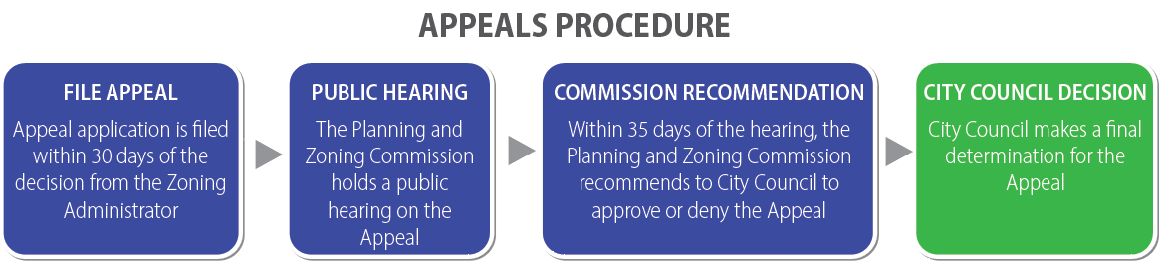
Procedures: An appeal shall be filed, by application in a form defined by the city attorney, within 30 days of a written determination by the zoning administrator. The zoning administrator shall transmit to the planning and zoning commission all materials constituting the record upon which the action appealed from was taken.
a.
An appeal shall stay all actions in furtherance of the matter appealed from; unless the zoning administrator determines that current conditions cause imminent danger to life or property, in which case the proceedings shall not be stayed, absent a restraining order, and actions needed to mitigate such danger shall be taken as soon as possible.
b.
The planning and zoning commission shall hold a hearing regarding the appeal at an established meeting or other date it may set, and give written notice of no less than 15 days to the interested parties.
c.
Within 35 days after closing the hearing, the planning and zoning commission shall render a recommendation on the appeal to the city council, which shall make the final decision on the appeal.
d.
Any person may appear and testify at the hearing, either in person, in writing or by duly authorized agent.
(5)
Decisions:
a.
The planning and zoning commission shall recommend to city council the affirmation or reversal, wholly, in part, or as amended, to the zoning administrator's determination that has been appealed.
b.
A majority of the quorum at the hearing shall be required to recommend to the city council reversal of any determination of the zoning administrator.
c.
A final determination for the Appeal shall be made by the city council.
(6)
Materials to be submitted: Applications for appeals will contain at least the following information:
a.
The owner's name, address, signed consent, and proof of ownership.
b.
The applicant's name and address, if different than the owner, and their interest in the subject property.
c.
The names and contact information of any professional consultants advising the applicant with respect to the application.
d.
The common address of the subject property.
e.
A description and/or graphic showing the situation for which the Appeal is being sought, as well as the existing zoning classification, use and development of the subject property.
f.
The chapter section and determination from which an appeal is sought.
g.
A narrative of any specific situation giving rise to the original determination and the appeal.
h.
A statement of the applicant's position as to alleged errors in the determination or failure to act being appealed, and why the relief sought is justified.
(7)
Fees: All fees for petitions to the planning and zoning commission shall be as defined in Appendix B of the City Code.
(Ord. No. 20-47, § 3(Exh. A), 11-10-2020)
Sec. 122-393. - Variances.
(1)
Authority: The city council shall have the authority to grant variances based on the standards outlined in this section 122-393 and upon receiving a recommendation from the planning and zoning commission.
(2)
Purpose: In certain circumstances, strict application of the regulations of this chapter may cause practical difficulties or a particular hardship relating to construction or alteration of buildings or structures. In such instances the planning and zoning commission may recommend to the city council granting variances from strict application of the terms of this chapter. Based on the standards for variance in section 122-393(5), presented hardship due to unique factors of the site, the general purposes and intent of this chapter, and the evidence presented at the hearing, the planning and zoning commission may find that a variance, if granted by the city council, will be necessary to alleviate some demonstrable hardship or difficulty so great as to interfere with reasonable use of the property, and not merely an inconvenience to the applicant. Variances shall not be granted as temporary measures or to permit a land use of land not otherwise authorized.
(3)
Variances to be considered. Variances may be considered and authorized for a specific property regarding the following standards defined in this chapter.
a.
To modify dimensional standards as set out in Table 5.1 and the district-specific sections in article V, Regulations for Zoning Districts, of this chapter.
b.
To modify dimensional standards associated with specific accessory uses in article III, regulations of general applicability of this chapter.
c.
To modify dimensional standards applicable to the location of parking accessory to a permitted use on the same lot, as set out in article IV, Off-Street Parking and Loading, and other sections of this chapter.
d.
To modify the number of visitor parking spaces as defined in section 122-164 of this chapter.
e.
To modify the number of required loading spaces as defined in Table 4.6 in article IV Off-Street Parking and Loading of this chapter.
f.
To modify dimensional standards associated with signs as defined in article X, Signs of this chapter (but not the total number of signs which shall not be varied).
(4)
Procedures:
a.
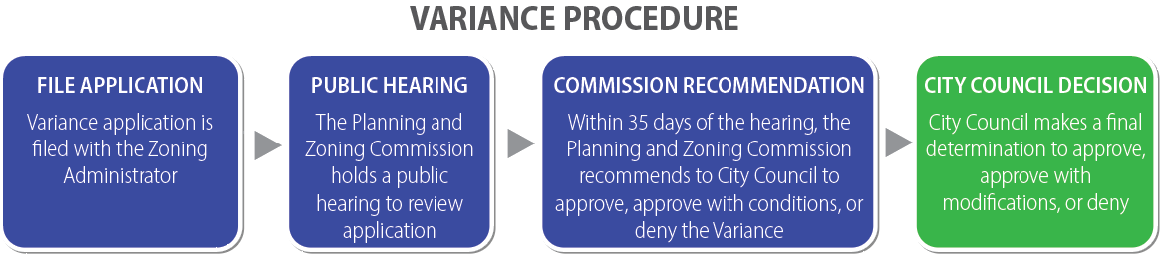
Applications for variance shall be filed with the zoning administrator on forms approved by the city attorney.
b.
Public hearing: A public hearing before the planning and zoning commission shall be set, noticed and conducted in accordance with the provisions of this chapter.
c.
Action by the planning and zoning commission: Within 35 days of the close of the public hearing, the planning and zoning commission shall make a recommendation that is forwarded to the next available city council meeting for approval, approval with conditions, or denial of the variance application. Failure to do so within 35 days, or longer period if agreed to by the applicant, shall be deemed a recommendation for denial of the variance by the planning and zoning commission.
d.
Action by the city council: Following receipt of a recommendation by the planning and zoning commission, the city council will either deny the variance application, approve the application or approve the application with modifications or conditions.
e.
If the variance application is denied, a similar application for relief may not be brought before the city for a period of one year.
(5)
Standards for variances: No application for variance to this chapter shall be approved without an affirmative finding regarding the following standards. The planning and zoning commission shall submit to the city council a written recommendation and findings of fact for each matter it hears based these standards:
a.
Unique physical condition: The presence of unique physical conditions related to the property that create a hardship or practical difficulty for the applicant to meet the established requirements of this chapter. The applicant must evidence how such unique hardship or practical difficulty is more impactful to meeting the requirements of this chapter than a mere inconvenience.
b.
Impact: Granting a variance will not substantially impact use and enjoyment of adjacent or nearby properties by impairing an adequate supply of light and air, increasing the risk from fire or other public safety hazard, or diminishing property values. To mitigate impacts, the variance should be the least amount of relief required to accomplish the proposed development.
c.
Not self-imposed: The conditions creating the hardship or practical difficulty are a result of application of this chapter, and not self-imposed, having been created by the applicant or by another on behalf of the applicant, or in furtherance of an opportunity for additional profit.
d.
Use of property: Use of the property possible under the standards of this chapter, without receiving the requested variance, would deprive the property owner of substantial rights commonly enjoyed by owners of other lots subject to the same provisions. This standard acknowledges that application of zoning standards may create somewhat increased development costs; which do not constitute, in and of themselves, a hardship.
e.
Community character: Granting a variance will not impair the public health, safety, morals, comfort, or welfare of the community. Further, said variance shall not significantly alter or impact the essential character or trend of development in the general area, including characteristics such as building height and setback, traffic management, landscaping, building orientation, and established aesthetic standards.
(6)
Conditions on variances: The planning and zoning commission may recommend and the city council may impose specific conditions related to the requested variance (such as landscaping, screening or other improvements or limitations) as needed to prevent or mitigate adverse impacts on adjacent properties or the general area. Failure to comply with or maintain such conditions will be grounds for the city council to revoke the variance.
(7)
Limitations on variances:
a.
Variance approval does not grant any rights related to the subject property other than those specified in the ordinance approving the variance. All other city processes and approvals must be met including, without limitation, building permits, subdivision approval, authorization of occupancy, and authorization of zoning.
b.
Unless a time extension is granted by the city council, no variance granted from the provisions of this chapter is valid for a period longer than one year, unless a building permit has been issued and construction has begun and is being pursued diligently toward completion. A time extension may be granted in keeping with the following:
i.
The zoning administrator may grant an extension of 180 days within which a permit is to be issued and construction begun, provided the applicant provides evidence of the delay being caused by factors beyond their control.
ii.
The city council may grant a second 180-day extension if a building permit and work on the project has not commenced within 18 month time frame, if the applicant provides evidence of the delay being caused by factors beyond their control.
iii.
Within one year of issuance of a variance, or an extension granted under section 122-393(7)(b)(i) or (ii) above, a certificate of occupancy shall have been issued by the city to the project for which variance was granted, or work on said project must continue to be pursued diligently to completion.
iv.
If a building permit has not been secured and work diligently begun within one-year of approval of the variance, or an extension granted under section 122-393(7)(b)(i) or (ii) above, or a certificate of occupancy issued, the city council may consider and take action to rescind the variance.
(8)
Materials to be submitted: Every application for variance will contain at least the following information:
a.
Plans/Drawings
i.
A graphic depicting proposed development of the subject property.
ii.
A current survey, certified by a registered land surveyor, of the subject property.
iii.
Legal description of property, including real estate tax number and common address.
iv.
The names and contact information of any professional consultants advising the applicant with respect to the application.
b.
Proof of ownership
i.
Legal document such as a deed, title policy, contract to purchase, etc. to show ownership.
ii.
The owner's name and address, and the owner's signed consent to filing of the application.
iii.
The applicant's name and address, if different than the owner, and their interest in the subject property.
c.
Description of proposed use(s).
i.
A narrative describing the proposed use and development of the subject property, as well as chapter section(s) for variance(s) being sought.
ii.
Description of the subject property characteristics preventing compliance with the specified regulation.
iii.
A statement of how the variance sought would satisfy each of the standards in subsection (5) above.
d.
Other materials deemed necessary by the zoning administrator for the city to conduct a thorough assessment of the proposed development and requested variance.
e.
Reimbursement of fees agreement executed by the applicant and property owner.
(9)
Fees: All fees for petitions to the planning and zoning commission shall be as defined in Appendix B of the City Code.
(Ord. No. 20-47, § 3(Exh. A), 11-10-2020; Ord. No. 22-13, § 2(Exh. A), 4-12-2022; Ord. No. 25-44, § 21, 9-9-2025)
Sec. 122-394. - Amendments.
(1)
Authority: The regulations established, and the districts created by this chapter may, from time to time, be amended by an ordinance passed by the city council upon receiving a recommendation from the planning and zoning commission. The consideration of a text amendment or a map amendment (Rezoning) may be initiated on behalf of the city by the city council, the planning and zoning commission, or the zoning administrator. In addition, the owner of a property or an individual or entity with a contractual interest in a property (with the authorization of the owner) may apply for an amendment to the zoning map, and any interested person may apply for an amendment to the text of this chapter.
(2)
Purpose: Amendments to this chapter are intended to revise or refine the Zoning Ordinance or Zoning Map as needed to keep it a current and effective tool for development regulation. Amendments should reflect new conditions or newly identified situations, technologies, business approaches or unexpected conditions. The Amendment process is not appropriate solely to relieve a particular inconvenience for an individual applicant, as such changes affect other aspects of the chapter and/or surrounding properties.
(3)
Procedures:
a.
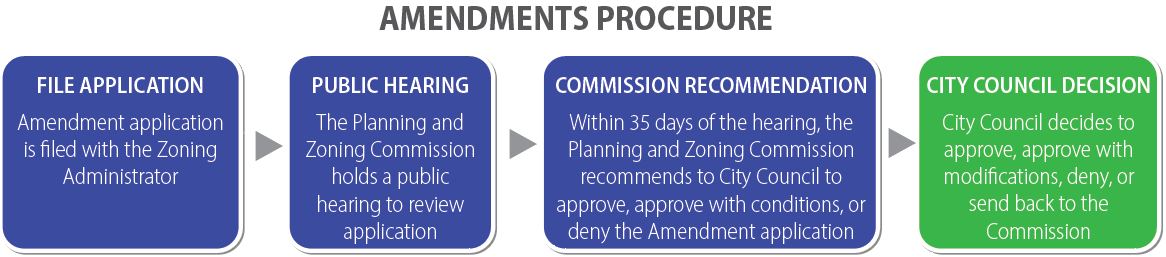
Applications for amendments shall be filed with the zoning administrator through procedures indicated in this chapter. Application shall be provided on forms approved by the city attorney. The city is not required to file an application to initiate the consideration of an amendment.
b.
Public hearing: A public hearing shall be set before the planning and zoning commission, noticed and conducted in accordance with the provisions of this chapter.
c.
Action by the planning and zoning commission: Within 35 days of the close of the public hearing, the planning and zoning commission shall make a recommendation that is forwarded to the next available city council meeting for approval, approval with conditions, or denial of the Amendment. Failure to do so within 35 days, or longer period if agreed to by the applicant, shall be deemed a recommendation for denial of the amendment by the planning and zoning commission.
d.
Action by the city council: Following receipt of a recommendation by the planning and zoning commission, the city council will either approve the amendment, approve the amendment with modifications, deny the amendment, or remand the matter back to the planning and zoning commission for further deliberation.
e.
If an application for an amendment is denied, a similar application for relief may not be brought before the city for a period of one year by any party other than the city.
(4)
Standards for amendments: No amendments to the city's zoning text or zoning map shall be approved without a satisfactory finding regarding the following standards. The planning and zoning commission shall submit to the city council a written recommendation and findings of fact for each matter it hears based upon said standards:
a.
Potential impacts: The amendment shall not adversely impact existing land uses in proximity to a subject property, or, in the case of a text amendment, the overall zoning district purpose or intent of a code section proposed for amendment. The amendment should not unreasonably affect the value, use and enjoyment of nearby properties.
b.
Trend of development/consistency: Map amendments should be a logical extension of the trend of development in the area around the subject property, or consistent with the approved comprehensive plan. In the case of a text amendment, the amendment shall be consistent with the overall zoning district purpose or intent of a code section proposed for amendment.
c.
Externalities: Relevant physical or market conditions that may have changed to make the existing zoning of a property inappropriate, or that make the proposed text amendment necessary for this chapter to be in keeping with the desirable development of the city shall be specified.
d.
City plans: Amendments should be consistent with the City's Comprehensive Plan, Official Map, and all other plans and policies adopted by the city.
e.
Zoning appropriateness: The extent to which use of the subject property (or relevant properties in the case of a text amendment) is diminished by the current zoning standards or designation and is no longer suitable for the underlying zoning shall be specified.
(5)
Materials to be submitted: Applications for an amendment will contain at least the following information:
a.
All Amendments applications shall include:
i.
The applicant's name and address, and their interest in any property subject the amendment.
ii.
A statement of how the amendment sought would satisfy each of the standards in subsection (4) above.
iii.
The names and contact information of any professional consultants advising the applicant with respect to the application.
iv.
Other materials deemed necessary by the zoning administrator for the city to conduct a thorough assessment of the proposed amendment.
v.
Reimbursement of fees agreement executed by the applicant and property owner.
b.
Map amendments applications shall include:
i.
The property owner's name and address, and the owner's signed consent to filing of the application.
ii.
Proof of ownership: Legal document such as a deed, title policy, contract to purchase, etc. to show ownership.
iii.
A graphic depicting proposed development or future use of the subject property.
iv.
A current survey, certified by a registered land surveyor, of the subject property.
v.
Legal description of property, including real estate tax number and common address.
vi.
Description of the subject property characteristics preventing compliance with the existing zoning.
vii.
A narrative describing any proposed use or development of the subject property, as well as such development's compliance with the proposed zoning district.
viii.
Description of the length of time, if any, that the subject property has been vacant, considered in the context of the pace of development in the vicinity of the subject property.
c.
Text amendments applications shall include:
i.
The general nature of, and if desired, the applicant's proposed wording of the requested text amendment.
ii.
A statement of the need and justification for the proposed text amendment.
iii.
A narrative indicating how the request is in keeping with the City's Comprehensive Plan and Official Map. Where the approval being requested does not conform to these, reasons justifying the approval despite the lack of conformity shall be provided.
(6)
Fees: All fees for petitions to the planning and zoning commission shall be as defined in Appendix B of the City Code.
(Ord. No. 20-47, § 3(Exh. A), 11-10-2020; Ord. No. 23-33, § 2, 7-11-2023)
Sec. 122-395. - Special uses.
(1)
Authority: Special use permits may be granted by the city council to authorize development of uses and structures identified as special uses in the regulations applicable to the district in which the subject property is located. Such approval shall follow a recommendation to the city council by the planning and zoning commission. An application for a special use permit may be filed by the owner of a subject property, or any person having a contractual interest in the property, with authorization of the owner.
(2)
Purpose: This chapter provides for an orderly arrangement of compatible buildings and land uses, and for the proper location of all types of uses affording for the social and economic welfare of the city. To advance this objective, some uses require particular consideration as to their proper location in relation to adjacent properties, orientation on a subject property, and compatibility with established or intended uses, or to the planned development of the community. These are classified as special uses. To mitigate potential impacts of a proposed special use, the city council may attach conditions to such requests, prior to approval.
(3)
Procedures:
a.
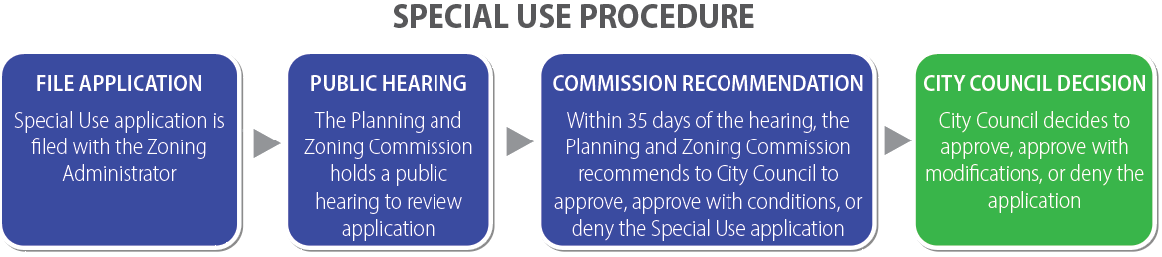
Application: Applications for special uses shall be filed with the zoning administra-tor through procedures indicated in this chapter. Application shall be provided on forms approved by the city attorney.
b.
Public hearing: A public hearing shall be set before the planning and zoning commission, noticed and conducted in accordance with the meeting and notice provisions of this chapter.
c.
Action by the planning and zoning commission: Within 35 days of the close of the public hearing, the planning and zoning commission shall make a recommendation that is forwarded to the next available city council meeting for approval, approval with conditions, or denial of the special use application. Failure to do so within 35 days, or longer period if agreed to by the applicant, shall be deemed a recommendation for denial of the special use application by the planning and zoning commission.
d.
Action by the city council: Following receipt of a recommendation by the planning and zoning commission, the city council will either deny the special use application, approve the application, or approve the application with modifications or conditions.
e.
If the application for special use is denied, similar application for relief may not be brought before the city for a period of one year.
(4)
Standards for special uses: No application for special use shall be approved without a satisfactory finding regarding the following standards. The planning and zoning commission shall submit to the city council a written recommendation and findings of fact for each matter it hears based on said standards:
a.
Potential impact: The special use shall not unduly impact adjacent or nearby properties or the general health, safety, and welfare of the general area and overall community. Impacts to be considered include ingress and egress to the site, potential traffic impacts from cars and trucks, and impacts to the appearance and character of the area.
b.
Consistency: The proposed special use shall be in keeping with the recommendations and intent of the City's Comprehensive Plan, Official Map, and all other plans and policies adopted by the city.
c.
Trend of development: Special uses should be a logical extension of the trend of development in the area around the subject site and not interfere with the use and development of adjacent or nearby properties.
d.
Public facilities: Adequate public facilities and services shall be available to serve the special use and the property on which it is located; including, without limitation, storm water, sanitary sewer, water service, public safety service, and waste disposal services.
e.
Site design: The on-site development design shall be understandable to users, safe, and maintainable in terms of road and pedestrian patterns, preserve natural features and incorporate such features into a maintainable development, and provide adequate parking, loading, and site maintenance.
(5)
Conditions on special uses: The planning and zoning commission may recommend, and the city council may impose specific conditions related to the requested special use (such as landscaping, screening or other improvements or limitations) as needed and appropriate to prevent or mitigate adverse impacts on adjacent properties or the general area. Failure to comply with such conditions will be grounds for the city council to revoke the special use.
(6)
Limitations on special uses:
a.
Special use approval does not grant any rights related to the subject property other than those rights granted in the ordinance approving the special use. All other city processes and approvals must be met, including but not limited to: building permits, subdivision approval, authorization of occupancy, or authorization of zoning.
b.
A special use granted under the provisions of this chapter is valid for a period not longer than one year, unless a building permit has been issued and construction has begun. If such is not the case, the zoning administrator may grant an extension of 180 days without approval of a special use amendment, within which a permit is to be issued and construction begun, provided the applicant provides evidence of the delay being caused by factors beyond their control.
c.
The city council may grant a second 180-day extension if a building permit and work on the project has not commenced within 18 month time frame, per subsection (b) above, if the applicant provides evidence of the delay being caused by factors beyond their control.
d.
Within one year of issuances of a special use permit, or an extension granted under subsection (b) or subsection (c) above, a certificate of occupancy shall have been issued by the city to the project for which special use was granted, or work on said project must continue to be pursued diligently to completion.
e.
If a building permit has not been secured and work diligently begun within one-year of approval of the special use, or an extension granted under subsection (b) or subsection (c) above, or a certificate of occupancy issued per subsection (d) above, the city council may consider and take action to rescind the special use permit.
f.
Amendments to special uses: A special use granted by the city council may only be amended, varied or altered through the procedures for special uses set out in this chapter, as if it were a newly requested special use.
g.
Authority to transfer special uses to new owners: A special use approved by the city after this chapter's effective date (_______, 2020) shall only be valid for the owner or operator to whom the special use is granted, unless the city council determines within the ordinance approving the special use, or any amendment thereto, that such special use and any associated conditions of the special use may be transferred to and assumed by a subsequent owner or operator. All special uses approved by the city on or before this chapter's effective date (_______, 2020) may be transferred to a subsequent owner or operator upon review and determination by the zoning administrator that the new owner or operator is reasonably able to substantially comply with all conditions imposed on the original special use approval and any amendments thereto.
h.
Discontinuance: A special use shall automatically expire and no longer be in effect if the use to which it was granted, for any reason, is discontinued for a period one year.
(7)
Materials to be submitted: Every application for a special use permit will contain at least the following information:
a.
Plans/Drawings
i.
A graphic depicting proposed development of the subject property.
ii.
A current survey, certified by a registered land surveyor, of the subject property.
iii.
Legal description of property, including real estate tax number and common address.
iv.
The names and contact information of any professional consultants advising the applicant with respect to the application.
b.
Proof of ownership
i.
Legal document such as a deed, title policy, contract to purchase, etc. to show ownership.
ii.
The owner's name and address, and the owner's signed consent to filing of the application.
iii.
The applicant's name and address, if different than the owner, and their interest in the subject property.
c.
Description of proposed use(s).
i.
A narrative describing the proposed use and development of the subject property.
ii.
A statement of how the special use sought would satisfy each of the standards in subsection (4) above.
d.
Other materials deemed necessary by the zoning administrator for the city to conducted a thorough assessment of the proposed development and requested variance.
e.
Reimbursement of fees agreement executed by the applicant and property owner.
(8)
Fees: All fees for petitions to the planning and zoning commission shall be as defined in Appendix B of the City Code.
(Ord. No. 20-47, § 3(Exh. A), 11-10-2020)
Sec. 122-396. - Certificate of zoning compliance.
(1)
Authority: Prior to review of any application for a non-single-family building permit (or certificate of completion, business license, or certificate of occupancy if no building permit is required), the zoning administrator shall determine that the application conforms with the regulations of this chapter and certifies such by issuance of a zoning certificate.
(2)
Purpose: Implementation of city plans, policies and ordinances related to the built environment depends, in part, on compliance with city development regulations. This includes, but is not limited to, ensuring that land uses are located appropriately per the City Zoning Map, that parking and loading standards are met, and that zoning bulk standards are met. To support this objective, the zoning certificate process ensures that property owners making improvements do so in a manner that is in keeping with the regulations of the city and does not adversely impact neighboring properties or the community at large. This process allows for consideration of such matters prior to commencement of construction and seeks to prevent owners from inadvertently undertaking construction that is contrary to the standards of this chapter.
(3)
Procedure:
a.
As part of a building permit process (or certificate of completion or certificate of occupancy if no building permit is required) the application shall include a request for certification by the owner or their designee that the proposed use will conform to all standards of this chapter.
b.
The zoning administrator, upon receipt of the application, shall conduct a review of relevant zoning standards within 21 days, or advise the applicant as to reasons for refusing to issue the certificate, need for additional information, or reasons for any delay.
c.
Zoning certificate shall be valid only so long as the use is made of the premises for which issued and provided the information submitted to obtain same is accurate and complete. The city shall not be prevented by the issuance of the certification from terminating same if the use made of the premises is not in conformity with the certificate or City Ordinances.
d.
All fees for petitions to the planning and zoning commission shall be as defined in Appendix B of the City Code.
(Ord. No. 20-47, § 3(Exh. A), 11-10-2020)
Sec. 122-397. - Certificates of occupancy or completion.
(1)
Authority: The zoning administrator will have authority to issue certificates of occupancy, temporary certificates of occupancy, or certificates of completion; provided, however, that no such certificate will be issued except in accordance with the provisions of this chapter and the other relevant provisions the City Code.
(2)
Purpose: For the purposes of this chapter, the certificates of occupancy or completion provides a procedure for the inspection of completed premises to ensure their compliance with this chapter and approved plans prior to commencement of the use or occupancy of such premises. The certificate may also evidence compliance with other relevant provisions of the City Code, as set forth in those provisions.
(3)
Procedure:
a.
Application: Once all requirements related to a requested zoning approval, building permit, or other such regulations as may be required per the City Code have been met, the property owner (or applicant authorized by the owner) shall submit a written request for certificate of occupancy or certificate of completion.
b.
Action on application: Within five business days following the receipt of a completed request for the certificate, the zoning administrator will cause the subject structure or property to be inspected and will determine if all City Code requirements have been met and a certificate of occupancy or completion may be issued. If all requirements have not been met, property owner (or applicant authorized by the owner) shall be provided a list of deficiencies required to be resolved prior to submitting a subsequent request for certificate of occupancy or completion.
i.
Temporary certificate of occupancy: The zoning administrator may grant a temporary certificate of occupancy "TCO" prior to final completion and full compliance provided that all of the following conditions are met:
1.
Eligibility. No owner may hold a TCP for more than one site or project in the city at one time unless waived by the zoning administrator. For the purposes of this subsection, in addition to its common meaning, "owner" shall be construed broadly to include any direct or indirect legal or beneficial interest by any person or entity connected with another certificate of occupancy.
2.
Application. A request for a TCP shall be made in writing in a form and number determined by the zoning administrator.
3.
Ability to perform. The zoning administrator may require the applicant to furnish a detailed completion schedule, cost estimate, and other evidence of the applicant's ability to complete all remaining work.
4.
Term. The term of any TCP shall be set by the zoning administrator in the exercise of their discretion, after considering the nature of the work to be completed and whether the ability to complete the work is affected by weather conditions. The TCP shall be for the shortest period of time necessary to complete the remaining work, as determined by the zoning administrator.
5.
Safety. The zoning administrator must determine that issuance of the TCP will not create a hazard to the health, safety and welfare of the structure's occupants or the general public and that all standards for habitability, sanitation, and life and fire safety have been satisfied,
6.
Fee and cash bond. In order to receive a TCP, a fee shall be paid and a cash bond shall be deposited with the city as set forth in Appendix B of this Code. The cash bond is subject to the provisions governing "code compliance and inspection bonds" provided in Section 18-3-7 of this Code.
7.
Conditions of approval, The zoning administrator may condition the issuance of a TCP on such matters necessary to ensure the full completion of the protect: compliance with this Code; and the protection of the health, safety, and welfare of occupants and the public. The recipient must consent to the conditions of the TCP in writing in a form provided by the zoning administrator.
8.
Transfer only upon prior approval. A TCP may only be transferred with the prior consent of the zoning administrator after determining, in their discretion, that the transferee has the ability to complete all remaining work. The transferee must agree, in writing and in a form provided by the zoning administrator, to complete the permit work in accordance with the approved construction documents, the provisions of this Code, and any TCP conditions. Any cash deposit held in connection with the TCP must either be (i) assigned in writing by the transferor to the transferee or (ii) replaced by the transferee. at which point a refund will be issued to the transferor.
ii.
Certificates issued in error: Any certificate of occupancy or completion issued in violation of the provisions of this chapter, whether intentionally, negligently, or inadvertently, will be void.
(Ord. No. 20-47, § 3(Exh. A), 11-10-2020; Ord. No. 23-25, § 2, 5-9-2023)
Sec. 122-398. - Site plan review.
(1)
Authority: The zoning administrator shall perform a site plan review for uses and developments requiring building permits for construction in the zoning districts noted in section 122-398(3)(a) below. In cases where a building permit application includes site development and interior or facade construction, proposed improvements to the interior or facade will not be part of the site plan review consideration except that the façade shall be considered as part of site plan review for all new construction and significant exterior renovations in the TC district. Site plan review approval is not required for applications considered through a special use process, as those matters are reviewed during the city's review of the special use application. Applications for site plan review approval may be brought by the owner of a property, or persons with a contractual interest in a property, and having authorization of the owner.
(2)
Purpose: Site plan review addresses uses and developments appropriate for a zoning district, but considers that there may be potential adverse impacts for how a site is designed or used, and that require a more detailed evaluation than is otherwise incorporated to building permit, life safety, and related considerations. The standards and procedures in this section 122-398 are designed to provide a thoughtful and efficient evaluation of such development applications.
(3)
Procedure:
a.
Site plan review required: The zoning administrator shall conduct site plan review as outlined in this section 122-398 for sites located in the following zoning districts:
i.
R-5 Multi-Family Residential
ii.
C-1 Community Commercial
iii.
C-2 Corridor Commercial
iv.
C-3 Office, Institutional, and Research
v.
TC Town Center
vi.
M-1 Business Park
vii.
M-2 Manufacturing
b.
Zoning administrator approvals:
i.
Application: Applications for site plan approval by the zoning administrator will be considered filed with the city as part of a complete building permit application for properties noted in section 122-398(3)(a) above.
ii.
Action by city: Based on review of the application, the zoning administrator will either: (1) approve the site plan as submitted; (2) approve it subject to conditions based on the standards noted below, with a written explanation to the applicant or (3) deny approval of the site plan with written findings provided to the applicant pursuant to the standards below. The failure of the zoning administrator to act within 60 days, or such further time to which the applicant may agree, will be deemed to be a decision approving the site plan as submitted. In reviewing a submitted site plan regarding the standards below, the zoning administrator may suggest alternative site plan or design approaches that could address specified deficiencies or may note that such deficiencies that cannot be avoided would have a minimal adverse impact on the property or nearby properties.
iii.
Effect of city action: Approval of a site plan by the zoning administrator, acceptance of required modifications by the applicant, or agreement by the applicant and zoning administrator on an approach to address required modifications will constitute final action regarding site plan review. All other city building permit and City Code requirements must still be met for the proposed construction.
iv.
Appeals: If the zoning administrator denies a site plan review application and the applicant wishes to appeal that denial, the applicant shall file such appeal in accordance with this chapter.
v.
Time constraints: Unless an extension is granted by the zoning administrator as a result of written request by the applicant showing good cause and external factors necessitating an extension, no site plan or design approval will be valid for a period longer than six months unless a building permit is issued. Within one year of site plan review approval, construction must have begun and (if not completed) be actively pursued to completion.
(4)
Standards for site plan review: In considering a site plan submitted for review pursuant to this section 122-398, the zoning administrator will consider the following standards:
a.
The application must be complete as specified in this chapter, other city regulations, or other requirements specified by the city.
b.
Any other application for approval by the city or other jurisdiction relevant to items considered under site plan review must be successfully secured.
c.
The proposed site plan or design is internally logical and safe and facilitates clear understanding of travel and circulation within the property, as well as to and from the site by vehicles, pedestrians, and bicyclists.
d.
The proposed site plan and design do not interfere with easements or rights-of-way, or create traffic hazards or congestion on surrounding public streets.
e.
The proposed site plan or design does not adversely impact use and enjoyment of surrounding properties.
f.
Outdoor storage is adequately screened.
g.
The proposed site plan, or design, does not create adverse impacts related to drainage or erosion for the subject site or nearby properties, and complies with all local, county, state and federal requirements.
h.
The proposed site plan or design should not place unreasonable burdens on city or other utility systems serving the site or area. The site plan should integrate site utilities into the overall existing and planned utility systems serving the city.
i.
The proposed site plan or design must provide for required public improvements as may be directed in this chapter, the Comprehensive Plan, City planning documents, or other aspects of the City Code.
j.
The proposed site plan or design shall not adversely impact the public health, safety or general welfare of the community.
(5)
Modifications:
a.
During development of the site, the zoning administrator may authorize an adjustment to the approved site plan if such change could have been authorized in the course of the original review.
b.
Amendments to site plan following completion of development. After a site is developed in accordance with an approved site plan, said site plan may be altered, if in the determination of the zoning administrator and based on the standards for review in section 122-398(4) above, in the same manner and subject to the same limitations as provided for the original approval of site plans.
(6)
Submittal requirements: Every application submitted for site plan review will contain the following information, except that the zoning administrator may waive items deemed unnecessary (including those concurrently required for a building permit submittal) or require additional information as needed to conduct the review:
a.
Plans/Drawings
i.
A graphic depicting proposed development of the subject property.
ii.
A current survey, certified by a registered land surveyor, of the subject property.
iii.
Legal description of property, including real estate tax number and common address.
iv.
The names and contact information of any professional consultants advising the applicant with respect to the application.
b.
Proof of ownership
i.
Legal document such as a deed, title policy, contract to purchase, etc. to show ownership.
ii.
The owner's name and address, and the owner's signed consent to filing of the application.
iii.
The applicant's name and address, if different than the owner, and their interest in the subject property.
c.
A description and/or graphic describing the proposal for which site plan approval is being sought and of the existing zoning classification, use and development of the subject property.
d.
A graphic rendering of the existing conditions, which depicts all significant natural, topographical and physical features of the subject property including, drainage structure and pattern, relevant soil conditions, and topographical contours at one-foot intervals;
e.
The location, use, size and height in stories and feet of structures and other land uses on adjacent properties.
f.
Data and related calculations concerning proposed structures and existing structures that will remain, including:
i.
Location, size, use and height;
ii.
Where relevant, gross floor area and floor area ratio;
iii.
Where relevant, number and size of dwelling units, by dwelling unit type and number of bedrooms; and
iv.
Building coverage.
g.
Yard and setback dimensions and dimensions related to the height, width and depth of any structure, as well as proximity to property lines.
h.
A vehicular and pedestrian circulation plan showing the location, dimensions, gradient and number of all vehicular and pedestrian circulation elements.
i.
All existing and proposed drainage, retention and detention facilities, and existing and proposed utilities and easements.
j.
Location, size and arrangements of all outdoor signs and lighting.
k.
Location and height of fences or screen plantings and the type or kind of building materials or plantings to be used for fencing or screening.
l.
Location, designation and total area of all usable open space.
m.
A detailed landscaping plan, showing location, size and species of all trees, shrubs and other plant material.
n.
A traffic study, if deemed necessary by the zoning administrator.
o.
Reimbursement of Fees Agreement executed by the applicant and property owner.
(7)
Fees: All fees for site plan reviews shall be as defined in Appendix B of the City Code.
(Ord. No. 20-47, § 3(Exh. A), 11-10-2020; Ord. No. 25-34, § 10, 5-27-2025)
Sec. 122-431. - Fees.
(1)
Fees established. Every application filed pursuant to this chapter will be subject to a non-refundable application fee in the amount established by the city council and as defined in Appendix B to the City Code.
(2)
Applicants shall be responsible to cover the actual cost, as hereinafter defined, incurred by the city in processing an application.
(3)
The owner of the property which is the subject of the application and, if different, the applicant, will be jointly and severally liable for the payment of all fees.
(Ord. No. 20-47, § 3(Exh. A), 11-10-2020)
Sec. 122-432. - Recoverable costs.
For purposes of calculating the recoverable cost due pursuant to this chapter, the actual costs incurred by the city in processing an application will consist of the following:
(1)
Legal publication;
(2)
Recording secretarial or court report services;
(3)
Professional and technical consultant services;
(4)
Legal review, consultation, negotiation, and document preparation;
(5)
Copy production;
(6)
Mailing;
(7)
Document recordation.
(Ord. No. 20-47, § 3(Exh. A), 11-10-2020)
Sec. 122-433. - Recoverable costs fee payment and escrow.
(1)
Initial payment and escrow: Every application filed pursuant to this chapter will be accompanied by the required amount for recoverable costs. The funds for recoverable costs, as fixed by the zoning administrator, will be deposited in a cost recovery fee escrow. No interest will be payable on any such escrow.
(2)
Charges against escrow: From the date of filing of any application pursuant to this chapter, the city will maintain an accurate record of the actual costs, as hereinabove defined, of processing the application. The zoning administrator will, from time to time, draw funds from the escrow account established for such application to pay such costs and will transfer such funds to the appropriate city accounts. The zoning administrator will maintain an accounting of all such drawings.
(3)
Additional escrow deposits: Should the zoning administrator at any time determine that the escrow account established in connection with any application is, or is likely to become, insufficient to pay the actual costs of processing such application, the zoning administrator will inform the applicant of that fact and require an additional deposit in an amount deemed to be sufficient to cover foreseeable additional costs. Unless and until such additional amount is deposited by the applicant, the zoning administrator may direct that processing of the application be suspended or terminated.
(4)
Final settlement: As soon as reasonably feasible following final action on an application, the zoning administrator will cause a final accounting to be made of the escrow deposits made in connection with an application and the actual cost of processing the application and will make a final charge of such costs against such escrow deposits. A copy of the accounting will be provided to the owner and the applicant. If the amount in the escrow account is insufficient to pay the total actual costs, a written demand for payment of the balance due will be forwarded to the owner and the applicant. If unused balance remains in the escrow account after paying the total actual costs, it will be returned to the applicant.
(5)
Condition of all applications, approvals and permits; Time Periods: No application filed pursuant to the chapter will be considered complete unless and until all fees and deposits due pursuant to this section 122-433 have been paid. Every approval granted and every permit issued pursuant to the city code will, whether or not expressly so conditioned, be deemed to be conditioned upon payment of fees as required by this subsection.
(6)
Where this chapter provides that the passage of time without decision or action will be deemed an approval or a recommendation for approval, time periods will be tolled during any period of non-payment, but will otherwise continue to run.
(7)
The failure to fully pay any such fee or deposit, when due, will be grounds for refusing to process an application and for denying or revoking any permit or approval sought or issued with respect to the land or development to which the unpaid fee or deposit relates.
(8)
By signing the application, the applicant and owner will be deemed to have agreed to pay such fee and to consent to the filing and foreclosure of a lien on the subject property to ensure collection of any such fee, plus the costs of collection, which has not been paid within 30 days following the mailing of a written demand for such payment to the owner at the address shown on the application. Any lien filed pursuant to this subsection may be foreclosed in the manner provided by statute for mortgages or mechanics liens.
(Ord. No. 20-47, § 3(Exh. A), 11-10-2020)
Sec. 122-434. - Penalties.
(1)
Penalties: Any person, firm or corporation who violates, disobeys, omits, neglects or refuses to comply with, or who resists the enforcement of any of the provisions of this chapter shall, upon conviction thereof, be fined up to $750.00 for each and every offense. A separate offense shall be deemed committed on each day a violation occurs or continues.
(2)
Additional remedies: In case any building or structure is erected, constructed, reconstructed, altered, repaired, converted or maintained, or any building, structure or land is used in violation of this chapter, the city attorney, in addition to other remedies, may institute any proper action or proceedings, in the name of the city to prevent such unlawful erection, construction, reconstruction, alteration, repair, conversion, maintenance or use to restrain, correct or abate such violation, to prevent the occupancy of said building, structure or land or to prevent any illegal act, conduct, business or use in or about said premises.
(Ord. No. 20-47, § 3(Exh. A), 11-10-2020)
Sec. 122-461. - Purpose and intent.
(1)
Authority: The city council may, in accordance with the procedures and standards set out in this chapter, grant a planned development in the form of a special use. The intent of a planned development is to consider developments presenting a higher form of design quality, public benefit, and a need for flexible application of certain zoning standards.
(2)
Purpose: The planned development is intended to encourage and provide means for desirable and quality development through greater flexibility in application of zoning regulations than permitted under the base district regulations. Latitude in application of zoning standards is to be accomplished in accordance with the purpose and intent of this chapter, and not adversely impact the environment, property values, or the character of the neighborhood or the community. The planned development should create diversity and creativity in the relationship of uses, structures, and open spaces in cohesive projects. Resulting developments should be in context of the community and surrounding areas, advance economic development in the city, be supportable by local public services, and facilitate preservation of open lands and natural areas.
(3)
Planned development considerations: Planned developments may be granted as a special use in any zoning district in the city in order to accomplish the objectives outlined in section 122-461(2) above. The following additional requirements shall apply to planned developments:
a.
The dimensions, bulk and area regulations for all zoning districts as required in section 122-201 of this article and as set forth in the schedules contained in said section shall be applied to the total area within the planned development, as one lot, for the specific district in which the planned development is located.
b.
In considering a planned development, the city may provide for relief from standards related to right-of-way widths, provision for sidewalks, street lighting, and similar site design criteria contained in chapter 98 - Subdivisions of the city code.
c.
If more than one property is to be part of a planned development, all such properties must be consolidated into a single lot of record as part of the planned development process.
d.
The planned development may, as necessary, subdivided into multiple lots to accommodate planned developments that require multiple lots.
e.
A single entity shall be responsible for maintenance of any common open space, private streets, parking areas and other facilities intended for private use and which are not publicly maintained, and such entity shall have a right to impose a legally enforceable lien for the cost thereof.
f.
Uses permitted in the underlying zoning district shall constitute the primary type of development permitted in a planned development (greater than 60 percent of the overall land square footage). Other land uses may be permitted in the planned development if found to be compatible with the primary land use type, and in keeping the findings required for a planned development and special use.
g.
Approval of the planned development project does not constitute approval for the construction of new buildings or structures on the site. Building permits are required for each building or structure.
h.
The gross density of a residential planned development shall be equivalent to that which may be achieved through a conventional subdivision development of the subject property.
(Ord. No. 20-47, § 3(Exh. A), 11-10-2020)
Sec. 122-462. - Procedure.
A planned development shall be granted as a special use in accordance with the following procedures. Applications shall be made on forms approved by the city attorney.
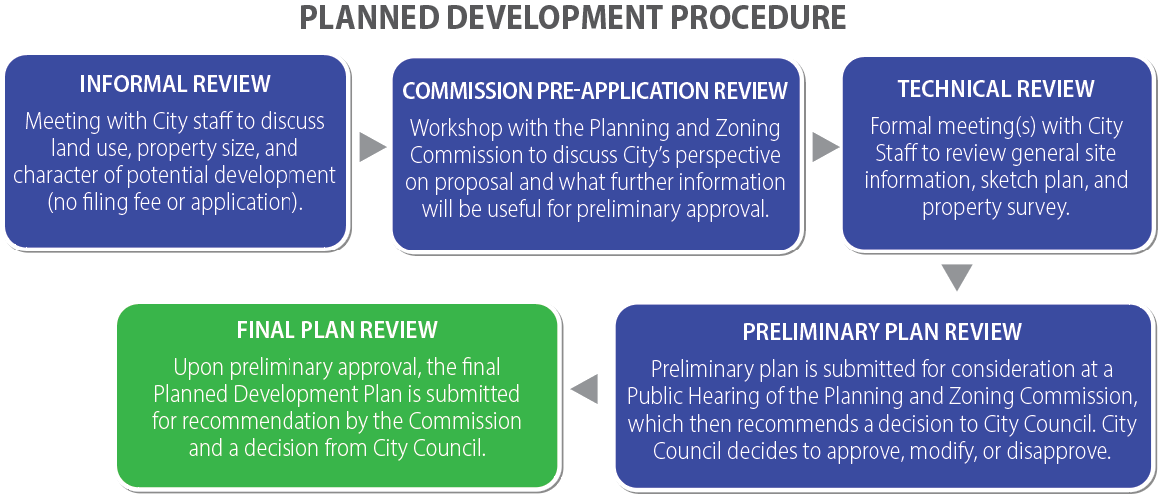
(1)
Informal review: To initiate the planned development process, the owner/developer shall meet with city staff for an informal review of the potential development, its compliance with the City's Comprehensive Plan and development ordinances, appropriateness for the site and surrounding areas, the approval process, and related matters. The informal review conference does not require formal application, fee, or filing of a planned development plan. To make the discussion productive, applicants are advised to provide information describing the land use, property size, and character of the anticipated development.
(2)
Planning and zoning commission pre-application review: Prior to the applicant filing for planned development consideration, a workshop meeting shall be held with the planning and zoning commission. In the case of a major change to an existing planned development, this pre-application review is encouraged but optional. This meeting is to benefit the applicant and provide insights and understanding as to the planning and zoning commission's and city's overall perspective on how the proposed planned development adheres to the city's comprehensive plan, what information will be useful to the planning and zoning commission as part of the formal approval process, and what issues the planning and zoning commission notes merit consideration during the process. This information will allow the applicant to prepare necessary and appropriately detailed information for the preliminary plan approval. The following materials shall be provided to the city prior to scheduling and conducting the planning and zoning commission pre-application review, as well as other materials that may be required by the zoning administrator as needed to provide useful background for the planning and zoning commission:
a.
Materials
i.
General site information: Data regarding site conditions, drainage, land and soil characteristics, available community facilities and utilities, existing covenants, and other related information.
ii.
Sketch plan: A scaled drawing in sketch form showing the proposed location and extent of the land uses, major streets, lots, environmental areas, stormwater management facilities, and other features as needed to convey the proposed form of development.
iii.
Property survey: A property survey and description of the site proposed for development.
iv.
Proof of ownership or interest: Evidence of property ownership or control.
b.
Any views expressed in the course of the planning and zoning commission's workshop review shall be deemed to be only preliminary and advisory and only the individual views of the member expressing them. Nothing said or done in the course of such review shall be deemed to create, or to prejudice, any rights of the applicant or to obligate the planning and zoning commission, or any member of it, to recommend approval or denial of any formal application following full consideration as required by this chapter.
(3)
Technical review: A formal meeting to review the proposed planned development shall be held with city staff for preliminary consideration of the proposed development in light of the requirements of this chapter. Materials required prior to scheduling and conducting the technical review, shall be the same as the planning and zoning commission pre-application review, as well as other materials that may be required by the zoning administrator as needed to provide useful background for the review team.
(4)
Preliminary plan review: A preliminary plan for the planned development shall be submitted to the zoning administrator for consideration by the planning and zoning commission at a public hearing:
a.
Materials to be submitted: The following materials shall be submitted by the applicant for review of the Preliminary Plan Approval by the planning and zoning commission in a quantity specified by the zoning administrator. As determined to be appropriate by the zoning administrator for the specific matter, the zoning administrator may waive any of the submittal requirements listed below, or require that additional information be submitted to provide for a thorough evaluation of the proposed planned development:
i.
Written application for approval of a planned development on forms as approved by the city attorney.
ii.
The names of the owners and developers of the development site and contact information for all parties.
iii.
Evidence that the applicant has sufficient control over the subject property.
iv.
The names and contact information of any professional consultants advising the applicant with respect to the application.
v.
A legal description of the area of the planned development.
vi.
A statement describing the general character of the intended development.
vii.
A statement indicating modifications requested to the underlying zoning district.
viii.
A preliminary plat of subdivision (as applicable)
ix.
An map of the project area, including the site's relationship to surrounding properties.
x.
A development plan of the proposed project showing at least the following information:
1.
Size of the development, residential density, and acres of various land uses.
2.
The location and dimensions of public and private roads, driveways, parking areas, sidewalks and lighting.
3.
The size, arrangement and location of lots and principal proposed structures.
4.
The type, size and location of accessory structures.
5.
Architectural drawings and sketches illustrating the design and character of proposed structures.
6.
The location of recreational and open space areas reserved or dedicated for public uses such as schools, parks, etc.
7.
The location of sewer and water mains.
8.
The general landscape treatment.
9.
The type, size, height, location, and illumination of all signs.
10.
Pedestrian and bicycle facilities.
xi.
A statement showing the starting and completion dates of the project.
xii.
Accurate topographical maps showing existing and proposed topographical data at two-foot intervals and extending within 100 feet beyond the exterior boundaries of the site, showing all public rights-of-way and all buildings accurately located within 100 feet of the exterior boundaries of such site. Such map shall contain all existing utilities, including drainage and the capacities thereof and high water elevations along streams.
xiii.
A preliminary engineering study showing the location and adequacy of existing and proposed sanitary sewer, storm sewer, water distribution systems, and stormwater management systems.
xiv.
An exhibit describing the existing natural and environmental resources and features on the subject property, including its vegetation, soils, geology, and attractive vistas, and the impact of the proposed planned development on such resources and features, including proposals to preserve or protect such resources and features.
xv.
A traffic impact study.
xvi.
An analysis indicating market support for the proposed development, its economic impact on the city, and details of proposed uses' manner of operation.
xvii.
The municipal services anticipated to be required to serve the site.
xviii.
For commercial and industrial developments:
1.
Gross and net number of square feet of buildings.
2.
Gross and net number of square feet of sales offices, general offices, production areas, and the number of employees anticipated in each such area.
xix.
Outline of intended organizational structure related to property owners' association, deed restrictions, and private provision of common services.
xx.
A statement of the applicant's intent with respect to the ownership, sale and leasing of the various completed units, structures, spaces and areas within the proposed planned development.
xxi.
A fee to accompany the planned development application, as defined in Appendix B of the City Code.
(5)
Hearing: The planning and zoning commission shall hold a public hearing on the application for a planned development. Notice and hearing procedures shall be followed as defined in article VI, Administration and Development Review, of this chapter.
(6)
Decisions by planning and zoning commission: Following the public hearing and review of the preliminary planned development plan and supporting materials for conformity to this chapter, the planning and zoning commission shall, within 60 days from date of public hearing, recommend approval, modification, or disapproval, and the reasons therefor, to the city council; said recommendation shall include the planning and zoning commission's findings of fact in regard to the standards for findings in this article.
(7)
Decisions by the city council: After receipt of the preliminary planned development plan from the planning and zoning commission, the city council shall approve, modify, or disapprove said plan. In the case of approval, or approval with modifications and/or conditions, the city council shall pass an ordinance approving the preliminary plan, incorporating findings of fact as recommended by the planning and zoning commission and as my be amended by the city council.
(8)
Effect of preliminary planned development plan approval: Approval of a preliminary Planned development plan shall not constitute approval of the final plan. It is an approval to the layout submitted on the preliminary plan as a guide to the preparation of the final plan. The final plan shall be approved as the final planned development plan if it substantially conforms with the preliminary planned development plan.
(9)
Concurrent review: An applicant for planned development may request concurrent review of preliminary and final plans. Such request shall be approved at the sole determination of the zoning administrator. If concurrent review is authorized, the process shall include the public hearing required by this section 122-461, and all materials required in for final plan approval shall be provided prior to scheduling said hearing.
(10)
Approval of final plan: The final planned development plan shall conform substantially—as defined below—to the preliminary plan as approved, and if desired by the developer, it may be submitted in stages with each stage reflecting the approved preliminary plan which is proposed to be recorded and developed; provided, however, that such stages conform to all requirements of these regulations. The required procedure for approval of a final plan shall be as follows:
a.
Submission of final plan: A final planned development plan and other supporting data required for approval shall be submitted to the zoning administrator within one year of preliminary plan approval by the city council. In the event an application for final plan is not submitted within one year, the city will automatically rescind the preliminary plan approval. Upon written request by the applicant and showing of good cause, the city council may extend the filing for the final plan by a period not to exceed one year.
b.
Required information: The following materials shall be submitted by the applicant for review of the final planned development plan by the planning and zoning commission in a quantity specified by the zoning administrator. As determined to be appropriate by the zoning administrator for the specific matter, the zoning administrator may waive any of the submittal requirements listed below, or require that additional information be submitted:
i.
Revised materials as outlined in section 122-462(4)(a) above, showing final locations of all buildings and structures, and in substantial conformance with the preliminary plan.
ii.
As required by the zoning administrator, any additional information to accurately define the final plan.
iii.
A final plat of subdivision as detailed in Chapter 98 - Subdivisions of the City Code (as applicable)
iv.
Plats of dedication or vacation (as applicable).
v.
Declarations and covenants that establish an owner's association as needed to maintain private areas of the development.
c.
Substantial conformance:
i.
If the submitted final plan is found by the zoning administrator to be in substantial conformance with the preliminary plan, the zoning administrator shall forward said plan to the planning and zoning commission for their review and recommendation to the city council.
ii.
If the submitted final plan is found by the zoning administrator to deviate from the preliminary plan so as not to be in substantial conformance, the proposed final plan shall be reviewed by the planning and zoning commission at a properly noticed public hearing and shall be treated as a new application for preliminary plan approval.
iii.
Final plans shall be considered to be in substantial conformance with preliminary plans as long as said final plans are consistent in regard to all of the following: 1) type of land use(s) proposed; 2) proportion of the development devoted to each proposed land use; 3) have increased residential density by no greater than five percent; 4) have increased of nonresidential square footage by no greater than five percent; 5) have reduced provided parking by no greater than five percent; 6) have decreased the amount of dedicated open space by no greater than five percent; or 7) have decreased the amount of gross square footage by no greater than five percent,.
d.
Decisions of planning and zoning commission: After review of the final plan, the planning and zoning commission shall, within 60 days after a complete submittal, recommend approval or disapproval or approval subject to stated modifications and the reasons therefor to the city council that the final plan is in substantial conformance with the preliminary plan.
e.
Decisions of city council: After receipt of the final plan from the planning and zoning commission, the city council shall approve or disapprove the final plan as being in substantial conformance with the preliminary plan. Such approval shall incorporate all conditions placed upon the applicant by the city council related to obligations that are part of the development.
f.
Permits: Permits are to be issued only after the final planned development plan and supporting data have been approved by the city council.
(11)
Amendments to an approved planned development: The planned development shall be constructed in accordance with the approved and recorded final plan and all supporting data. Should circumstances necessitate a major change to the final plan, such changes may be approved only by submission of a new preliminary plan and following the preliminary planned development plan approval procedure and subsequent approval of the new final planned development plan, as set forth in this article.
a.
Major changes: Major changes are those that alter the concept or intent of the planned development including: i) increasing density by greater than five percent, ii) increasing in the amount of gross square footage by greater than five percent, iii) increasing in the height of buildings, iv) reducing proposed open space by greater than five percent, v) changes in road standards, vi) or changes in the final governing agreements, provisions, or covenants.
b.
Minor changes: Minor changes are all changes other than those that qualify as a major change. The zoning administrator may approve minor changes in the planned development that do not change the concept or intent of the development, without going through the planned development approval steps. Approved changes shall be reported to the city council and filed with the city clerk.
(Ord. No. 20-47, § 3(Exh. A), 11-10-2020; Ord. No. 25-34, § 11, 5-27-2025)
Sec. 122-463. - Findings.
(1)
No application for preliminary planned development shall be approved without a satisfactory finding regarding the following standards. The planning and zoning commission shall submit to the city council a written recommendation and findings of fact for each matter it hears based on said standards:
a.
The standards for special use, as outlined in section section 122-395(4) of this article, shall be met by all planned developments.
b.
Character and density of land use. The uses proposed and their density and arrangement on the site shall be of a visual and operational character which:
i.
Is compatible to the physical nature of the site, with particular concern for preservation of natural features, tree growth, and open space.
ii.
Would produce an attractive environment of sustained aesthetic and ecologic desirability, economic stability and functional practicality compatible with the general development plans for the area as established by the community.
iii.
Would not adversely affect the anticipated provision for school or other municipal services.
iv.
Would not create a traffic or parking demand incompatible with the existing or proposed facilities to serve it.
c.
Economic feasibility and impact. There shall be satisfactory evidence of the planned development's economic feasibility and support of the economic prosperity of the city or the values of surrounding properties.
d.
Engineering design standards. The width of street rights-of-way, width and location of streets or other paving, outdoor lighting, location of sewer and water lines, provision for stormwater drainage, or other similar environmental engineering considerations shall implement their specific function to ensure the public safety and welfare. In addition, pedestrian and bicycle facilities shall be designed to comply with chapter 98 - Subdivisions.
e.
Preservation and maintenance of open space. Adequate provision shall be made for the permanent preservation and maintenance of common open space, either by private reservation or dedication to the public.
f.
Implementation schedule. A realistic schedule for the implementation of the development shall be submitted to the satisfaction of the city, including suitable phasing and assurance that each segment of the project shall constitute a logical module of development, and will not adversely effect the community as a result of termination at that point.
(Ord. No. 20-47, § 3(Exh. A), 11-10-2020)
Sec. 122-464. - Existing planned developments.
Any planned development approved prior to the effective date of this chapter (January 1, 2021) will be subject to the provisions of section 122-7(b) of this chapter. Any such development is eligible to be modified by minor and major changes as described in this division 4.
(Ord. No. 20-47, § 3(Exh. A), 11-10-2020; Ord. No. 25-34, § 12, 5-27-2025)
Sec. 122-465. - Deviations from the zoning regulations; public benefits.
Subject to the standards and limitations in this section, the city council as part of an approval of any planned development, including a major change to any planned development, may modify any provision of chapters 98 ("Subdivisions") and 122 ("Zoning") as they apply to the planned development upon finding that the development will provide public benefits to the city that are not required by conventional development applications. In approving any minor change to an existing planned development, the zoning administrator shall find that the minor change will not diminish the public benefits created by the planned development.
The type, scale and intent of the public benefit shall be (i) commensurate with the degree of zoning relief requested by the applicant, and (ii) proportional to the anticipated impact of the proposed planned development upon adjacent properties and land uses and upon the community at large. Potential public benefits that may be proposed include, without limitation:
(1)
Establishment of community amenities, such as plazas, gardens, public art features, outdoor seating areas, pedestrian facilities, and transit facilities.
(2)
Establishment of open space amenities, such as playing fields, playgrounds, swimming pools, fitness facilities, and dog parks.
(3)
Enhancement of the community's natural environment, including existing natural features, water courses, trees, and native vegetation.
(4)
Preservation and enhancement of the community's cultural resources and historic places.
(5)
Provision of public infrastructure improvements that exceed the requirements of the planned development, such as interconnected streets without dead ends or cul-de-sacs, enhancements to rights-of-way, stormwater management systems, and sewer systems.
(6)
Incorporation of sustainable development techniques, such as meeting the requirements of LEED or LEED-equivalent rating systems.
(7)
Provision of a mix of housing types, sizes, and styles with a specific emphasis on affordable housing or senior housing.
(8)
Provision of residential dwelling units with accessible features that exceed the requirements of the Americans with Disabilities Act.
(Ord. No. 25-34, § 13, 5-27-2025)

