
Roscoe City Zoning Code
ARTICLE X
- OFF-STREET PARKING AND LOADING
Sec. 15-610.- Purpose and intent.
The purpose of this article is to establish off-street parking, loading, and stacking space requirements related to the use of property with the intent of reducing congestion on public streets; controlling dust and soil erosion; and providing safe and convenient access, in order to promote the public health, safety and welfare.
(Ord. of 3-2-2021, § 155.10.1)
Sec. 15-611. - Applicability and general provisions.
(a)
Interpretation by zoning administrator. Parking spaces for other permitted or special uses not listed in this article shall be determined by the administrator based on the requirements for comparable uses.
(b)
Fractional numbers. Calculated fractional numbers shall be increased to the next whole number.
(c)
Square feet. When required parking is given by a ratio to square feet, it shall mean per square feet of gross building area.
(d)
Preexisting parking and loading spaces. Parking and loading spaces which were in existence on the effective date of the ordinance from which this chapter is derived or were provided voluntarily after that date shall not after that time be reduced in number except to conform to the requirements of this article.
(e)
Change in use. When the existing use of a building or structure is changed to a new use, parking and loading facilities shall be provided as required for such new use. Additional parking or loading spaces shall be required in the amount by which the requirements for the new use exceed the requirements for the existing use. The zoning administrator may grant relief of up to 25 percent of the additional required parking spaces if the applicant can demonstrate that additional required parking spaces cannot be accommodated on site.
(f)
Change in intensity of use. Any expansion of use shall require conformance with respect to surfacing requirements for all parking, loading, and driveways.
(1)
A minor expansion of a use (i.e., costing less than 50 percent of the value of the structure or increasing the area of the use by less than 20 percent) shall require additional parking and loading for the new or expanded portion of the use. Any existing legal nonconformity in quantity of off-street parking and loading requirements, as described in section 15-165, may be expanded as a matter of right.
(2)
A substantial expansion of a use (i.e., costing more than 50 percent of the value of the structure or more than 20 percent increase in area) shall require conformance with all provisions of this article.
(g)
Use exclusively for parking and loading. Parking and loading spaces shall be used solely for the intended use and not for the storage of goods, nor of vehicles which are inoperable, for lease, rent or sale, except for the sale of a vehicle at an owner's home.
(h)
Temporary waivers. The administrator may temporarily suspend parking requirements for major unused portions of buildings for periods of one year, renewable for periods of one year.
(i)
Provision of additional spaces. To minimize excessive areas of pavement, the voluntary establishment of additional off-street parking or loading facilities shall be permitted but shall not exceed the required number of parking spaces by more than 20 percent, except as approved by the zoning administrator. In granting additional spaces, the zoning administrator shall determine that the parking or loading is needed based on documented evidence of actual use and demand provided by the applicant. The location, design and control of such facilities shall be in accordance with this section.
(Ord. of 3-2-2021, § 155.10.2)
Sec. 15-612. - Accessible parking; ADA compliance.
All parking lots must comply with the Illinois Accessibility Code, promulgated pursuant to 410 ILCS 25/4 and issued under the Americans with Disabilities Act of 1990 (ADA), 42 USC 12101 et seq., for the amount and design of accessible vehicle parking spaces required in parking lots and structures.
(Ord. of 3-2-2021, § 155.10.3)
Sec. 15-613. - Construction; site plan.
Any application for a building permit shall include a plot plan, drawn to scale and fully dimensioned, showing any parking or loading facilities to be provided in compliance with this article, excluding parking of four or fewer spaces. The plot plan shall be approved by the administrator.
(Ord. of 3-2-2021, § 155.10.4)
Sec. 15-614. - Cross-access between adjacent lots.
When parking lots for separate uses abut one another and the opportunity for connected cross-access exists, such access in encouraged. Cross-access should be done in a logical manner that results in safe and efficient circulation between adjacent parking areas. When cross-access is provided, both property owners shall be exempt from landscaping and fencing requirements to the width of the drive aisle plus an additional 20 feet measured from each face of curb of the drive aisle.
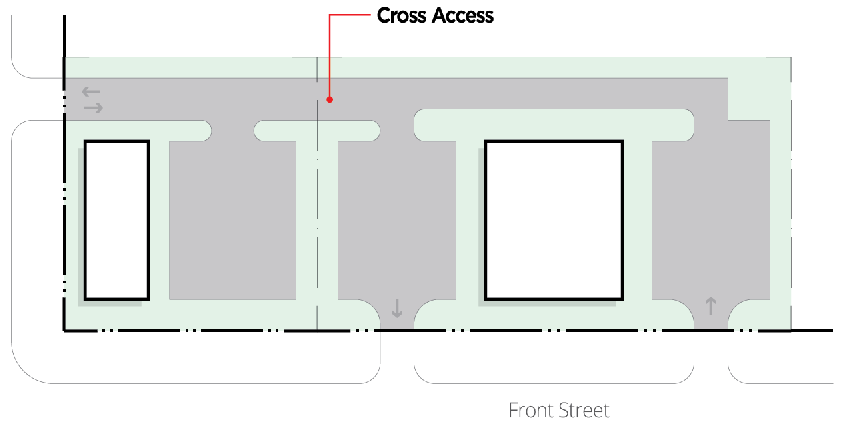
Graphic 15-614. Cross Access Between Adjacent Lots
(Ord. of 3-2-2021, § 155.10.5)
Sec. 15-615. - Shared parking facilities.
(a)
Mixed occupancies. In the case of two or more uses in the same building, the total requirements for off-street parking facilities shall be the sum of the requirements for the several uses computed separately. Off-street parking facilities for one use shall not be considered as providing required parking facilities for any other use, except as approved specifically by the administrator for joint but alternative uses.
(b)
Cooperative parking facility.
(1)
Up to a 15 percent reduction in the number of required parking spaces for four or more separate uses; ten percent for three separate uses; and five percent for two separate uses may be authorized by the administrator, following approval of a plan which provides for a collective parking facility serving two or more buildings or two or more uses, developed through voluntary cooperation or under any parking district which may be provided by law.
(2)
HC district shared or cooperative parking. Within the HC district, there are uses which, because of their unique characteristics, require flexibility and a case-by-case review of the parking requirements, including the potential for cooperative or shared parking facilities. The zoning administrator may recommend modification in the number of required parking spaces to address the unique aspects of the uses allowed in the HC district. These modifications must be approved by the village board.
(c)
Joint but alternate use. The administrator may authorize the joint use of parking facilities under the following conditions.
(1)
Up to 50 percent of the parking facilities by nighttime uses may be supplied by the off-street parking facilities of daytime uses.
(2)
Up to 50 percent of the parking facilities of daytime uses may be supplied by the off-street parking facilities of nighttime uses.
(3)
Up to 100 percent of the parking facilities of a church or auditorium incidental to a grade school may be supplied by the off-street parking facilities of daytime uses.
(4)
Definitions. The following words, terms and phrases, when used in this section, shall have the meanings ascribed to them in this subsection, except where the context clearly indicates a different meaning:
Daytime uses mean offices, banks, retail stores, personal service or repair shops, household equipment or furniture stores, manufacturing or wholesale or similar primarily daytime uses.
Nighttime uses mean auditoriums incidental to grade schools, churches, bowling alleys, dance halls, theaters, bars or restaurants, motels, or similar nighttime uses.
(5)
Conditions required for joint use.
a.
The building or use for which application is being made to utilize the off-street parking facilities provided by another building or use shall be located within 500 feet of the parking facilities;
b.
The applicant shall show that there is no substantial conflict in the principal operating hours of the two buildings or uses for which joint use of off-street parking facilities is proposed; and
c.
A properly drawn legal instrument, executed by the parties concerned for joint use of off-street parking facilities, duly approved as to form and manner of execution by the village attorney, shall be filed with the administrator. Joint use parking privileges shall continue in effect only so long as the instrument, binding on all parties, remains in force. If the instrument becomes legally ineffective, then parking shall be provided as otherwise required in this article.
(Ord. of 3-2-2021, § 155.10.6)
Sec. 15-616. - Location of off-street parking facilities.
(a)
On-site parking facilities. Parking and loading spaces generated by development shall be located on the same parcel as the use which they are intended to serve unless otherwise permitted in this article.
(1)
Single-family residential uses. The following standards apply to the location of parking spaces for residential uses:
a.
Off-street parking facilities accessory to residential uses and developed in any residential district in accordance with the requirements of this section shall be used solely for the parking of passenger automobiles or not more than one noncommercial truck owned or operated by the occupants of the dwelling, provided that such truck does not exceed a gross weight of 8,000 pounds.
b.
All required parking spaces for residential uses shall be located on the same lot as the building or use served.
c.
Parking spaces may be located in any yards except required front yards but shall be permitted in that portion of the front yard where the driveway or permitted parking pad is located.
d.
Recreational vehicles and equipment may be located in any yard in accordance with section 15-624.
e.
For single-family detached and single-family attached dwellings, parking shall be permitted in private driveways, but no such parking may encroach onto the public right-of-way. However, such driveway parking shall not be considered as satisfying the off-street parking requirements for such single-family detached and single-family attached dwellings.
f.
Tandem parking is permitted, however a parking space that is blocked by a tandem parking space shall not count toward fulfilling off-street parking requirements.
(2)
Non-single-family uses. Except for parking areas on the same lot as a single-family detached or single-family attached dwelling, off-street parking and loading areas shall meet the following requirements:
a.
Front yard setbacks.
1.
Within the CR districts, no parking shall be permitted in the front yard of the property between the right-of-way and the main building or structure.
2.
Within the RM, CG, CH, CO, and IG districts, parking shall be permitted in the front yard of the property between the right-of-way and the main building or structure. If parking is located along the front property line, a required minimum setback of seven feet shall be provided between the property line and edge of the parking lot.
b.
Side and rear yard setbacks. When located within or abutting a residential district, the parking area shall maintain the minimum side and rear yard setbacks as required in the residential district, except where an alley abuts the property, in which case the required rear yard setback may be reduced to five feet. When not located within or abutting a residential district, the parking area shall maintain a minimum side and rear yard setback of three feet.
c.
Landscape areas. Parking shall not be located within any required landscape areas as detailed in article XI of this chapter.
(b)
Off-site parking facilities. An exception to on-site parking requirements may be made in commercial districts, or whenever required parking and loading spaces cannot be located on the parcel in other districts because of development restrictions imposed by the presence of an existing principal structure which is to continue in use. Required parking may then be provided off the parcel, for permitted uses only, subject to the following requirements:
(1)
If the use is residential, hotel, motel, or tourist home, the off-lot spaces shall be within 200 feet of the principal entrance or the entrance for individual occupants for whom spaces are reserved;
(2)
If the use is other than residential, hotel, motel, or tourist home, the farthest portion of the parking lot shall be within 1,000 feet of an entrance to the establishment;
(3)
Distances indicated above shall be measured along routes generally available to the pedestrians involved;
(4)
Parking spaces may be at greater distances than those indicated above when approved by the administrator;
(5)
Such off-lot spaces shall be located only in districts in which similar off-street parking is permitted; and
(6)
The off-lot parking area shall be held in fee simple by the same owner as the use requiring the off-street parking space, or under lease, rental, or other form of agreement satisfactory to the administrator as assuring continuing availability for required off-street parking for the use.
(Ord. of 3-2-2021, § 155.10.7)
Sec. 15-617. - Design standards, access aisle, and space requirements.
(a)
Parking dimensions.
(1)
Except for parking spaces serving single-family detached and single-family attached dwellings, dimensions of parking spaces and maneuvering areas shall be provided as detailed in Table 15-617 and as shown in Graphic 15-617.
(2)
Parking spaces for single-family and two-family dwellings shall be a minimum of nine feet wide by 18 feet long.
(3)
All parking spaces shall have a minimum vertical clearance of eight feet.
(b)
Width of aisles. Aisle widths shall be that specified below for the angle of the stalls.
Table 15-617. Dimensional Standards for Parking Spaces and Aisles
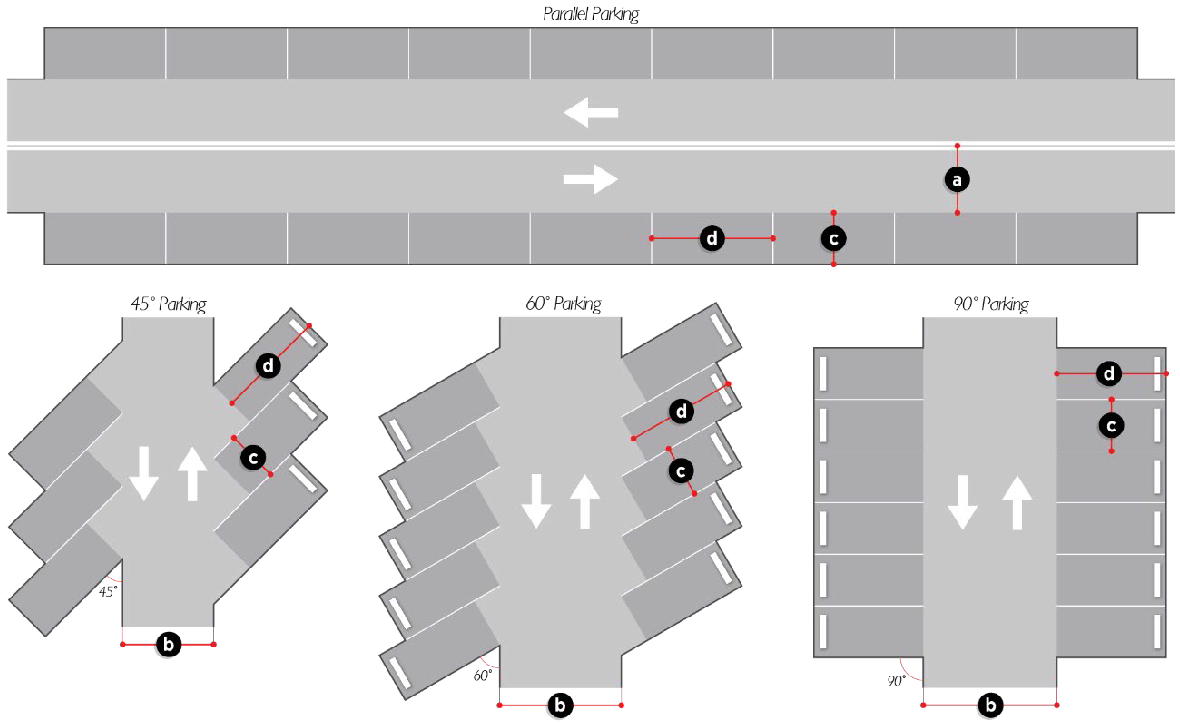
Graphic 15-617. Dimensional Standards for Parking Spaces and Aisles
(c)
Curbs and gutters. Combination concrete curb and gutter or concrete barrier curb is required around the perimeter of all parking lots and around all islands for all properties fronting rights-of-way, except for residential uses of less than four units. When alternatives to concrete curb and gutter are demonstrated to be more appropriate and recommended by the village engineer, the alternatives may be approved by the zoning administrator.
(d)
Wheel guards. Parking spaces adjacent to sidewalks, pedestrian circulation areas, or landscape areas shall be provided with wheel guards or bumper guards so that no part of parking vehicles will encroach. Bumper guards are not required for interior stalls.
(e)
Lighting. All parking lot lighting shall comply with the performance standards established in section 15-523. A lighting plan with photometric calculations shall be submitted during the design review process.
(f)
Striping. Striping of the pavement surface to define each parking space is required and shall be a minimum of four inches in width from the length of each space. Striping for each parking space shall be painted in yellow or white. Thermoplastic pavement markings are an acceptable alternative. All areas designated as fire lanes shall be marked by posting signs and/or yellow markings, provided that signs shall be used wherever feasible.
(g)
Maintenance. Upon completion, all parking areas shall be properly maintained at all times, without potholes, broken curbing, or other irregularities.
(h)
Drainage. Parking and loading areas shall be graded and drained to dispose of all surface water accumulated within the area. The method of discharge of this water to public facilities shall be subject to approval of the village engineer.
(i)
Surfacing. All required parking and loading spaces and access drives in the R1, R2 and RM districts shall be paved with concrete, bituminous pavement, pavers, or an equivalent material as approved by the village engineer. All required parking and loading spaces and access drives for all commercial or industrial zoned property shall be paved with concrete or bituminous pavement.
(Ord. of 3-2-2021, § 155.10.8)
Sec. 15-618. - Stacking spaces for drive-through facilities.
(a)
Required stacking spaces. Every drive-through facility shall be required to provide a minimum number of stacking spaces as detailed in Table 15-618.
Table 15-618. Drive-Through Stacking Space Requirements
(1) 4 of the required stacking spaces are to be located between the order-box and pick-up window, including the stacking space at the order box.
(b)
Stacking space design standards. Stacking spaces provided for drive-through uses shall be:
(1)
A minimum of nine feet in width, as measured from the outermost point of any service window to the edge of the driveway, and 18 feet in length.
(2)
Located such that:
a.
When in use, they do not obstruct ingress or egress to the site and do not obstruct access to required parking or loading spaces.
b.
The first space begins behind the vehicle parked at a last point of service, such as a window or car wash bay.
c.
They shall not interfere with other on-site traffic circulation, parking facilities, pedestrian movements or cause automobiles to queue within public rights-of-way.
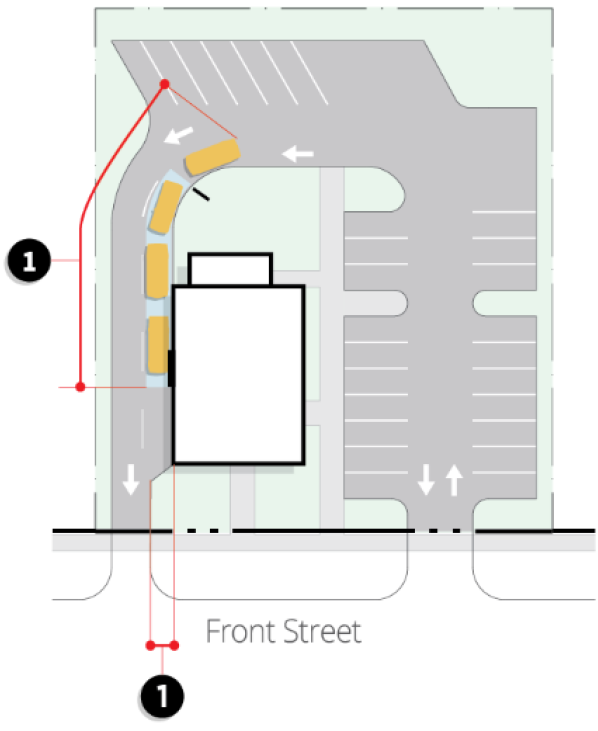
Graphic 15-618. Drive Through Stacking Space Design Standards
(Ord. of 3-2-2021, § 155.10.9)
Sec. 15-619. - Off-street parking requirements.
(a)
Minimum requirements. Except as otherwise expressly stated, off-street motor vehicle parking spaces must be provided in accordance with the parking ratio requirements of Table 15-619(1).
(b)
Maximum requirements. To minimize excessive areas of pavement no parking lot shall exceed the required number of parking spaces by more than ten percent, except as approved by zoning administrator. In granting additional spaces, the zoning administrator shall determine that the parking is needed based on documented evidence of actual use and demand provided by the applicant.
(c)
Off-street parking. Uses within the HC Health Care District must provide off-street parking in accordance with the parking ratio requirements of Table 15-619(2).
Table 15-619(1). Off-Street Parking Requirements
Table 15-619(2). HC Off-Street Parking Requirements
(Ord. of 3-2-2021, § 155.10.10)
Sec. 15-620. - Other parking uses.
For uses not listed in the schedule of parking requirements, parking spaces shall be provided on the same basis as required for the most similar use as determined by the zoning administrator.
(Ord. of 3-2-2021, § 155.10.12)
Sec. 15-621. - Off-street loading requirements.
(a)
Purpose. The purpose of this section is to prevent congestion of public rights-of-way and private lots to promote the safety and general welfare of the public by establishing minimum requirements for the provision of loading facilities on various sites.
(b)
Applicability. Any use which has a gross floor area of 6,000 square feet or more, and which requires deliveries or makes shipments, shall provide off-street loading facilities in accordance with the regulations of this section.
(c)
Location. All loading docks shall be located 25 feet or more from the intersection of two street right-of-way lines. All loading areas shall be located on the private lot and shall not be located within, or so as to interfere with, any public right-of-way, off-street parking area, or pedestrian circulation area. No loading dock or overhead doors shall face upon a street right-of-way in commercial or office and professional business zoning districts. Loading docks or overhead doors may face upon a street right-of-way in manufacturing districts only in cases where no practical alternative exists.
(d)
Size of loading area. Adequate space for standing, turning, loading, and unloading services shall be provided in a manner that does not interfere with required off-street parking areas, pedestrian circulation areas, and with the public use of streets or alleys.
(e)
Access to loading area. Each loading berth shall be located so as to facilitate access to a public street or alley and shall not interfere with other vehicular or pedestrian traffic and shall not interfere with the function of parking areas. In no instance shall loading areas rely on backing movements into public rights-of-way.
(f)
Surfacing and marking. All required loading areas shall be paved and maintained in a dust-free condition at all times. The surface shall be marked in a manner that clearly indicates required loading areas.
(g)
Use of required loading areas. The use of all required loading areas shall be limited to the loading and unloading of vehicles. The area shall not be used to provide minimum required parking spaces.
(h)
Required loading spaces. The number of required loading spaces shall be determined by the developer and shall provide for adequate space for standing, turning, loading, and unloading services shall be provided in a manner that does not interfere with required off-street parking areas, pedestrian circulation areas, and with the public use of streets or alleys.
(Ord. of 3-2-2021, § 155.10.13)
Sec. 15-622. - Bicycle parking requirements.
(a)
Applicability. For properties within commercial districts (CR, CG, CH, and CO) and RM districts, designated bicycle parking spaces shall be provided in accordance with the requirements of this subsection. Bicycle facilities shall be of high quality and reflect the architecture of the primary structure.
(b)
Minimum required spaces.
(1)
Commercial districts. Bicycle parking facilities should be provided at a rate of one bicycle space per 25 vehicle parking spaces with a minimum of two spaces and a maximum of ten spaces.
(2)
Multifamily residential districts (MR). Bicycle parking facilities should be provided at a rate of one bicycle space per ten dwelling units. A minimum of two bicycle spaces shall be provided.
(c)
Location. Bicycle parking shall be conveniently located near building entry points. Bicycle parking placement shall not conflict with pedestrian travel. Bicycle facilities provided in the public right-of-way may be used in parking calculations, so long as the entry point providing primary access to the building is set back no more than 20 feet from the front lot line.
(d)
Facility. Bicycle parking shall be provided using bicycle rack or locker-type parking facilities and shall be designed to allow a bicycle frame to be locked to a structure attached to the pavement or the building.
(Ord. of 3-2-2021, § 155.10.14)
Sec. 15-623. - Pedestrian access and circulation.
Pedestrian access shall be required for all sites to improve the health, safety, and welfare of the public by providing clear pedestrian pathways at perimeter and internal site locations to reduce pedestrian and vehicular conflicts, improve accessibility for persons with disabilities and establish a multi-modal environment that is supportive of walking, biking and transit use.
(1)
The construction and repair of on-site sidewalks shall comply with all chapters of this Code.
(2)
Walkways in parking lots. Paved walkways shall be provided from the public right-of-way to the primary entrance of the building and for access to adjacent parks, shopping areas, transit stops, anticipated walkways and institutions. Pedestrian movement shall be accommodated within parking lots through marked crosswalks or similar methods.
(3)
When trails exist or are planned, nonresidential properties shall include paths or sidewalks to connect building entries to the trail system, where appropriate and feasible, as determined by the zoning administrator.
(4)
Minimum width for pedestrians. At least five feet of sidewalk space shall be kept clean and clear for the free passage of pedestrians at all times.
(Ord. of 3-2-2021, § 155.10.15)
Sec. 15-624. - Parking and accessory use restrictions.
(a)
Commercial vehicles in residential districts. The following restrictions shall apply to the parking or storage of commercial vehicles on property within residential districts.
(1)
No commercial vehicle with a Class 3 rating or higher shall be parked on any residentially zoned private property or public right-of-way in a residential district, except for vehicles engaged in loading or unloading, or vehicles in connection with current work being performed on the adjacent premises.
(2)
Only one commercial vehicle with a Class 2 rating or lower, which is used on a regular basis and is the owner's principal means of transportation to and from his employment, may be stored or parked outdoors overnight on residentially zoned private property.
(3)
Permitted commercial vehicles, as described in subsection (a)(2) of this section, shall include such vehicles that are owned and used for commercial purposes by the occupant of a dwelling or guest, provided that the vehicle is stored or parked in the permitted parking area for that dwelling. Such permitted commercial vehicles may include the logo of the commercial business painted on or applied to the vehicle.
(4)
No stored or parked commercial vehicle shall be occupied or used for human habitation.
(5)
All other non-standard sized commercial vehicles including, but not limited to, semi-truck tractor units, with or without attached trailers, commercial trailers, buses, limousines, tow trucks, panel trucks, construction vehicles, or other large commercial and non-standard sized livery vehicles are not permitted to be stored or parked outdoors overnight on residentially zoned property.
(6)
A special-use permit shall be required for a commercial or related use in a residential district for required parking on an adjacent lot or a lot across the street, but not more than 200 linear feet from the use served. Such use shall meet the requirements of Table 15-617.
(b)
Recreational vehicles in residential districts.
(1)
Recreational vehicles and equipment may be parked or stored as follows:
a.
In a front yard on a private driveway or parking pad serving a single-family dwelling.
b.
In a side yard provided such equipment is parked on a driveway or parking pad at least five feet from the side lot line and at least ten feet from any building on an adjoining lot.
c.
In a rear yard provided it is parked at least five feet from a side or rear lot line and ten feet from any building on an adjoining lot.
d.
No recreational vehicle parking or storage is permitted in designated easements.
(2)
No recreational equipment shall be used for living, sleeping or housekeeping purposes when parked or stored on a residential lot, or in any location not approved for such use.
(3)
No major recreational equipment shall be stored out of doors on residential premises unless it is in condition for safe and effective performance of the function for which it is intended or can be made so at a cost not exceeding the value of the equipment in its existing state.
(4)
In no case shall any such equipment be so stored for a period of more than six months.
(c)
Utility trailers. Utility trailers may be parked or stored as follows:
(1)
In a front yard on a private driveway or parking pad serving a single-family dwelling.
(2)
In a side yard provided such equipment is parked on a driveway or parking pad at least five feet from the side lot line and at least ten feet from any building on an adjoining lot.
(3)
In a rear yard provided it is parked at least five feet from a side or rear lot line and ten feet from any building on an adjoining lot.
(4)
No utility trailer parking or storage is permitted in designated easements.
(d)
Vehicle repair work.
(1)
In a residential district, no motor vehicle repair work shall be permitted in conjunction with accessory off-street parking spaces or loading areas provided for a permitted nonresidential use.
(2)
In a nonresidential district, no motor vehicle repair work shall be permitted in conjunction with accessory off-street parking spaces or loading areas unless such service is provided by a uniformed employee of the associated business.
(3)
The sale of gasoline and motor oil, when permitted in conjunction with accessory off-street parking areas, shall be located with respect to residential properties so as not to create a nuisance.
(4)
No motor vehicle repair work or service of any kind shall be permitted in conjunction with loading facilities in any district.
(Ord. of 3-2-2021, § 155.10.16)

