
Roscoe City Zoning Code
ARTICLE III
RESIDENTIAL DISTRICT REGULATIONS
Sec. 15-407.- Purpose and intent.
(a)
Residential districts generally. The intent of all residential districts is to:
(1)
Accommodate a reasonable range of population density consistent with sound standards of public health and safety and the village comprehensive plan;
(2)
Ensure adequate light, air, privacy, and open space for each dwelling;
(3)
Provide space for public and semi-public facilities needed to complement urban residential areas and for institutions that require a residential environment;
(4)
Minimize traffic congestion and to avoid the overloading of utilities by preventing the construction of buildings of excessive size in relation to the land around them;
(5)
Provide necessary space for off-street parking of automobiles and where appropriate;
(6)
Protect residential properties from noise, illumination, unsightliness, odors, dust, dirt, smoke, vibration, heat, glare, and other objectionable influences; and
(7)
Protect residential properties from fire, explosion, noxious fumes, and other hazards.
(b)
RE Single-Family Rural Estate Residential District. The RE Single-Family Rural Estate Residential District is intended to reserve appropriately located areas for detached single-family homes on large lots that are consistent with the village's rural character.
(c)
R1 One-Family Residential District. The R1 One-Family Residential District is intended to reserve appropriately located areas for detached single-family homes on lots that are typical of the development that predominates the village's single-family neighborhoods.
(d)
R2 Two-Family Residential District. The R2 Two-Family Residential District is intended to accommodate increased population density compared to the R-1 district, including detached single-family homes, duplexes, and townhomes.
(e)
RM Multifamily Residential District. The RM Multifamily Residential District is intended to accommodate more compact and dense residential development compared to the R1 and R2 districts, consisting of duplexes, townhomes, and multifamily residential development.
(Ord. of 3-2-2021, § 155.3.1)
Sec. 15-408. - Residential bulk standards.
All development in residential districts must comply with the requirements in Table 15-408 unless otherwise expressly stated.
Table 15-408. Residential Districts-Bulk and Yard Standards
(1) The required front yard setback of lots fronting Main Street between Grove Street and Elevator Street or fronting Elevator Street between Highway 251 and Pearl Street shall be a minimum of ten feet and a maximum of 20 feet.
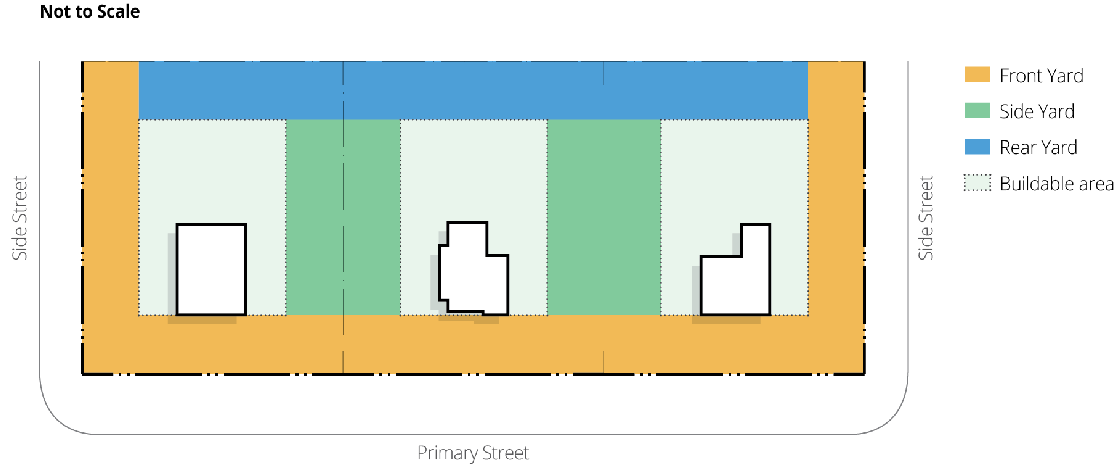
Graphic 15-408. Residential Required Yards
(Ord. of 3-2-2021, § 155.3.2)
Sec. 15-409. - Residential permitted uses.
Permitted and special uses lists permitted and special uses for all residential districts. Many allowed uses, whether permitted by right or as a special use, are subject to compliance with article VIII of this chapter.
(1)
Permitted uses. A "P" indicates that a use is considered permitted within that district as of right.
(2)
Special uses. An "S" indicates that a use is permitted, though its approval requires review by the village board as required in section 15-780 and is contingent upon the development/proposed use meeting certain special criteria.
(3)
Uses not permitted. A blank space or the absence of the use from the table indicates that the use is not permitted within that district. However, a use not identified on the table may be determined by the zoning administrator to be a permitted or special use in the district, based on their evaluation as to whether the proposed use is similar enough in character, intensity, and operations to that of a permitted or special use in the district.
Table 15-409. Residential Districts-Permitted and Special Uses
(Ord. of 3-2-2021, § 155.3.3)
Sec. 15-410. - Development standards applicable to residential districts.
(a)
Garages.
(1)
A lot with a single-family dwelling that is 1,199 square feet or less in area shall be required to have a single-car garage at a minimum.
(2)
A lot with a single-family dwelling that is 1,200 square feet or more in area shall be required to have a two-car garage at a minimum.
(b)
Residential driveways.
(1)
A residential driveway is any paved hard-surfaced, manmade area used to access any garage or accessory building, or leads to a garage, outdoor or indoor parking area, or is an established and surfaced portion of the lot, the use of which is for the purpose of ingress or egress to a carport, garage, accessory structure, parking area, or loading and unloading station for vehicles, whether the driveway crosses the village right-of-way or not.
(2)
All residential driveways must comply with the following standards, in addition to those set forth in the village subdivision code and other provisions of this Code:
a.
No residential driveway shall be set within the required side yards as required in section 15-408. The restriction in this subsection (b)(2)a does not apply to lots on a cul-de-sac;
b.
Only one driveway is permitted for each lot in the R1 district, unless a variance is granted by the village board of trustees.
(3)
All residential driveways must be constructed directly from the public road to the attached garage. If there is no attached garage the driveway shall be constructed to the primary detached garage if situated in the front or side yard.
(4)
No residential driveways may be built to any accessory structure, other than a garage as detailed in subsection (b)(3) of this section, unless a variance is granted by the board of trustees.
(5)
Residential driveways shall extend for a minimum of 30 feet in between the public right-of-way and garage.
(6)
Residential driveway design standards.
a.
Residential driveways shall not exceed 24 feet in width at the property line.
b.
Residential driveways shall be constructed of a minimum of two inches of bituminous pavement with six inches of aggregate base, Portland cement concrete at least four inches in thickness, concrete pavers, paving blocks, or similar materials approved by the village engineer.
c.
A garage access drive, the width of the garage, as measured from the garage walls, is permitted to extend for a distance of 20 feet from the garage doors before tapering, within ten feet, back to the maximum driveway width.
(7)
In addition to the requirements of article X of this chapter, residential circular driveways are permitted in a front or corner side yard, so long as it conforms to the following requirements:
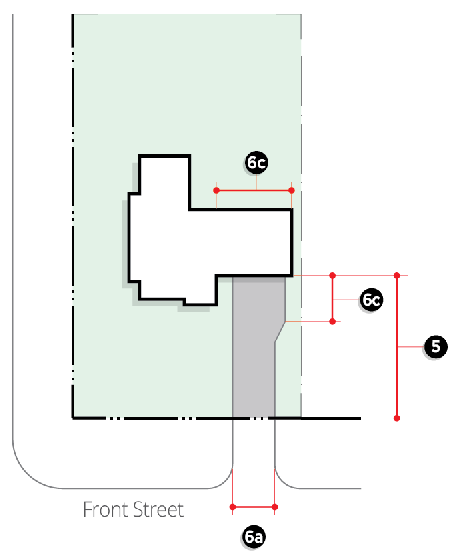
Graphic 15-410. Residential Driveways Design Standards
1.
The minimum lot width is greater than 125 linear feet.
2.
The minimum setback for residential structures in the yard in which the circular driveway is located shall be 30 feet.
3.
Circular driveways shall have a minimum width of nine feet, and a maximum width of 12 feet except where it provides access to a garage entry.
4.
There shall be a landscaped area between the circular driveway and the public right-of-way with a depth of no less than ten feet and a width of no less than 20 feet. This area shall include decorative landscaping intended to screen the circular driveway area.
(c)
Residential parking pads.
(1)
Limit. A residential driveway may be extended to include one parking pad.
(2)
Configuration.
a.
A parking pad shall be a minimum of ten feet in width.
b.
The portion of the parking pad adjacent to the driveway shall have a maximum length of 25 feet, as measured from the front facade line of the garage. A minimum seven-foot taper shall be included in the 25-foot maximum.
c.
The portion of the parking pad adjacent to the garage shall have a maximum length of 20 feet as measured from the front facade line of the garage.
(3)
Location. The parking pad shall be set back a minimum of three feet from any side property line.
(d)
Residential anti-monotony standards. The following standards and definitions shall apply to the construction of all new single-family detached dwellings within the village after the effective date of the ordinance from which this section is derived.
(1)
Similar elevations and/or facades prohibited on adjacent lots. No two single-family dwellings of similar front elevation and/or facade shall be constructed or located on adjacent lots or on lots opposite each other. Further, single-family dwellings of similar front elevation and/or facade shall be separated by at least two lots, regardless of the side of the street the dwelling is located on; nor shall there be constructed or located single-family dwellings of similar front elevation and/or facade constituting more than 25 percent of the single-family dwellings in any streetscape.
(2)
Identical footprint prohibited on adjacent lots. No two single-family dwellings with the identical footprint or mirrored footprint shall be constructed or located on adjacent lots or on lots opposite each other. Further, single-family dwellings with the identical footprint or mirrored footprint shall be separated by at least two lots, regardless of the side of the street the dwelling is located on; nor shall there be constructed or located single-family dwellings with the identical footprint or mirrored footprint constituting more than 25 percent of the single-family dwellings in any streetscape.
(3)
Criteria. Designated village officials shall deem front elevations and facades to be dissimilar when at least one of the delineated changes under each of the following categories of rooflines, windows, and construction materials and colors is made.
a.
Rooflines. To be considered dissimilar, the rooflines of two adjacent single-family dwellings, as seen from the front of the dwelling, shall be changed in at least one of the following ways:
1.
Changing gable roofs to hip roofs.
2.
Changing hip roofs to gable roofs.
3.
Providing an intersecting gable roof on the main gable roof, provided that the height of the intersecting roof is at least 35 percent of the height of the main roof.
4.
Providing an intersecting hip roof on the main hip roof, provided that the height of the intersecting hip roof is at least 35 percent of the height of the main roof.
5.
Subject to review by the designated village official, a shed roof when used as a front porch roof for a minimum of 50 percent of the entire width of the house, excluding area of garage.
6.
Subject to review by the designated village official, a substantial difference in roofline shall be deemed to exist if the front soffit is increased substantially and is combined with columns at least six inches in width or by other architectural features of a similar magnitude which reach the roofline of the highest story.
7.
Rotating gable roofs 90 degrees on the building.
8.
On a tri-level residence or other building type which has three independent major roof areas, the changing of two of the three rooflines shall be acceptable as a substantial change. Acknowledging certain design elements may prevent the changing of all three rooflines, it is desired that the roofs with the greatest impact on the streetscape be changed.
9.
The following changes to rooflines shall not be deemed sufficient to make adjacent structures dissimilar:
(i)
Small gable or hip projections above windows.
(ii)
Change in soffit overhang or minor variations in eave height.
(iii)
Skylight and cupola.
b.
Windows. To be considered dissimilar, the windows of two adjacent single-family dwellings shall be changed in at least one of the following ways:
1.
Changing from single windows to multiple window arrangement (ganged units).
2.
Changing from multiple window arrangement to single window.
3.
Changing the type of windows (e.g., casement to double hung).
4.
Providing a bay or bow window in the area of the predominant window.
(i)
When because of its size, location or design, one window is the predominant window on the front elevation or facade, and the size, location or type of that window is changed to render the dwelling dissimilar, then no other window need be changed.
(ii)
The addition or subtraction of muntin bars (dividing lines) shall not be deemed sufficient change to constitute a substantial change in windows.
c.
Construction materials or colors. To be considered dissimilar, the construction materials of two adjacent single-family dwellings shall be changed in at least one of the following ways, provided that when materials are changed, the change must occur throughout the front facade or elevation for a minimum of one story in height:
1.
Changing the siding from horizontal to vertical.
2.
Changing the siding from vertical to horizontal.
3.
Four-inch exposure horizontal siding.
4.
Eight-inch exposure horizontal siding.
5.
Brick siding.
6.
Stone facing.
7.
Stucco/stuccato board and trim.
d.
Facades. In addition to the other requirements of this section, all residences constructed in R1 and R2 zoning classifications shall have on the front of the residence (defined as corner to corner across that front elevation of the residence) a minimum of one-half of the area exposed on that elevation covered in brick, brick siding, stucco (or similar materials approved by the village) or stone facing excluding windows, doors and garage doors. Any material produced from vinyl or a wood-based product or that is produced in sheets for application shall not satisfy the requirements of this section.
(Ord. of 3-2-2021, § 155.3.4)

