
Roscoe City Zoning Code
ARTICLE VIII
USE PROVISIONS
Sec. 15-542.- Applicability.
The provisions of this section apply to all zoning districts unless indicated otherwise. if there is a conflict between this section and the individual requirements of the zoning district, the zoning administrator shall determine which standards control.
(Ord. of 3-2-2021, § 155.8.1)
Sec. 15-543. - Adult use cannabis.
(a)
Components of the adult-use cannabis facility. In determining compliance with section 15-780, the following components of the adult-use cannabis facility shall be evaluated based on the entirety of the circumstances affecting the particular property in the context of the existing and intended future use of the properties:
(1)
Impact of the proposed facility on existing or planned uses located within the vicinity of the subject property.
(2)
Proposed structure in which the facility will be located, including co-tenancy (if in a multitenant building), total square footage, security installations/security plan and building code compliance.
(3)
Hours of operation and anticipated number of customers/employees.
(4)
Anticipated parking demand based on section 15-780 and available private parking supply.
(5)
Anticipated traffic generation in the context of adjacent roadway capacity and access to such roadways.
(6)
Site design, including access points and internal site circulation.
(7)
Proposed signage plan.
(8)
Compliance with all requirements provided in subsection (b), (c), (d), (e), (f), or (g) of this section, as applicable.
(9)
Other criteria determined to be necessary to assess compliance with section 15-780.
(b)
Adult-use cannabis craft grower. In those zoning districts in which an adult-use cannabis craft grower may be located, the proposed facility must comply with the following:
(1)
Facility may not be located within 1,500 feet of the property line of a preexisting public or private nursery school, preschool, primary or secondary school, daycare center, daycare home or residential care home. Learning centers and vocational/trade centers shall not be classified as a public or private school for purposes of this section.
(2)
Facility may not be located within 1,500 feet of the property line of a preexisting property zoned or used for residential purposes.
(3)
Facility may not conduct any sales or distribution of cannabis other than as authorized by Cannabis Regulation and Tax Act, 410 ILCS 705/1-1 et seq.
(4)
For purposes of determining required parking, adult-use cannabis craft growers shall be classified as "warehouses, wholesale establishments, or storage and distribution centers," per section 15-621; provided, however, that the village may require that additional parking be provided as a result of the analysis completed.
(5)
Petitioner shall file an affidavit with the village affirming compliance and all other requirements of the Cannabis Regulation and Tax Act, 410 ILCS 705/1-1 et seq.
(c)
Adult-use cannabis cultivation center. In those zoning districts in which an adult-use cannabis cultivation center may be located, the proposed facility must comply with the following:
(1)
Facility may not be located within 1,500 feet of the property line of a preexisting public or private nursery school, preschool, primary or secondary school, daycare center, daycare home or residential care home. Learning centers and vocational/trade centers shall not be classified as a public or private school for purposes of this section.
(2)
Facility may not be located within 1,500 feet of the property line of a preexisting property zoned or used for residential purposes.
(3)
Facility may not conduct any sales or distribution of cannabis other than as authorized by the Act.
(4)
For purposes of determining required parking, adult-use cannabis cultivation centers shall be classified as "warehouses, wholesale establishments, or storage and distribution centers," per section 15-621, provided, however, that the village may require that additional parking be provided as a result of the analysis completed.
(5)
Petitioner shall file an affidavit with the village affirming compliance and all other requirements of the Cannabis Regulation and Tax Act, 410 ILCS 705/1-1 et seq.
(d)
Adult-use cannabis dispensing organization. In those zoning districts in which an adult-use cannabis dispensing organization may be located, the proposed facility must comply with the following:
(1)
Facility may not be located within 1,500 feet of the property line of a preexisting public or private nursery school, preschool, primary or secondary school, daycare center, daycare home or residential care home. Learning centers and vocational/trade centers shall not be classified as a public or private school for purposes of this section.
(2)
Facility may not be located within 250 feet of the property line of a preexisting property zoned or used for residential purposes.
(3)
At least 75 percent of the floor area of any tenant space occupied by a dispensing organization shall be devoted to the activities of the dispensing organization as authorized by Cannabis Regulation and Tax Act, 410 ILCS 705/1-1 et seq., and no dispensing organization shall also sell food for consumption on the premises other than as authorized in the same tenant space.
(4)
Facility may not conduct any sales or distribution of cannabis other than as authorized by Cannabis Regulation and Tax Act, 410 ILCS 705/1-1 et seq.
(5)
Facility may not permit the on-site consumption of cannabis.
(6)
For purposes of determining required parking, the facilities shall be classified as "retail and service use" per section 15-621, provided, however, that the village may require that additional parking be provided as a result of the analysis completed.
(7)
Petitioner shall file an affidavit with the village affirming compliance and all other requirements of the Cannabis Regulation and Tax Act, 410 ILCS 705/1-1 et seq.
(e)
Adult-use cannabis infuser organization. In those zoning districts in which an adult-use cannabis infuser organization may be located, the proposed facility must comply with the following:
(1)
The facility may not be located within 1,500 feet of the property line of a preexisting public or private nursery school, preschool, primary or secondary school, daycare center, daycare home or residential care home. Learning centers and vocational/trade centers shall not be classified as a public or private school for purposes of this section.
(2)
The facility may not be located within 250 feet of the property line of a preexisting property zoned or used for residential purposes.
(3)
At least 75 percent of the floor area of any tenant space occupied by an infusing organization shall be devoted to the activities of the infusing organization as authorized by the Cannabis Regulation and Tax Act, 410 ILCS 705/1-1 et seq. Facility may not conduct any sales or distribution of cannabis other than as authorized by the Cannabis Regulation and Tax Act, 410 ILCS 705/1-1 et seq.
(4)
For purposes of determining required parking, the facilities shall be classified as "manufacturing" per section 15-621, provided, however, that the village may require that additional parking be provided as a result of the analysis completed.
(5)
Petitioner shall file an affidavit with the village affirming compliance and all other requirements of the Cannabis Regulation and Tax Act, 410 ILCS 705/1-1 et seq.
(f)
Adult-use cannabis processing organization. In those zoning districts in which an adult-use cannabis processing organization may be located, the proposed facility must comply with the following:
(1)
The facility may not be located within 1,500 feet of the property line of a preexisting public or private nursery school, preschool, primary or secondary school, daycare center, daycare home or residential care home. Learning centers and vocational/trade centers shall not be classified as a public or private school for purposes of this section.
(2)
The facility may not be located in a dwelling unit or within 250 feet of the property line of a preexisting property zoned or used for residential purposes.
(3)
At least 75 percent of the floor area of any tenant space occupied by a processing organization shall be devoted to the activities of the processing organization as authorized by the Act. Facility may not conduct any sales or distribution of cannabis other than as authorized by the Cannabis Regulation and Tax Act, 410 ILCS 705/1-1 et seq.
(4)
For purposes of determining required parking, the facilities shall be classified as "manufacturing" per section 15-621, provided, however, that the village may require that additional parking be provided as a result of the analysis completed.
(5)
Petitioner shall file an affidavit with the village affirming compliance and all other requirements of the Cannabis Regulation and Tax Act, 410 ILCS 705/1-1 et seq.
(g)
Adult-use cannabis transporting organization. In those zoning districts in which an adult-use transporting organization may be located, the proposed facility must comply with the following:
(1)
The facility may not be located within 1,500 feet of the property line of a preexisting public or private nursery school, preschool, primary or secondary school, daycare center, daycare home or residential care home. Learning centers and vocational/trade centers shall not be classified as a public or private school for purposes of this section.
(2)
The facility may not be located in a dwelling unit or within 250 feet of the property line of a preexisting property zoned or used for residential purposes.
(3)
The transporting organization shall be the sole use of the tenant space in which it is located. Facility may not conduct any sales or distribution of cannabis other than as authorized by the Cannabis Regulation and Tax Act, 410 ILCS 705/1-1 et seq.
(4)
The village will make a determination as to the required parking and loading requirements based on the analysis completed.
(5)
Petitioner shall file an affidavit with the village affirming compliance and all other requirements of the Cannabis Regulation and Tax Act, 410 ILCS 705/1-1 et seq.
(h)
Additional requirements. Petitioner shall install building enhancements, such as security cameras, lighting or other improvements, as set forth in the special use permit, to ensure the safety of employees and customers of the adult-use cannabis business establishments, as well as its environs. The improvements shall be determined based on the specific characteristics of the floor plan for an adult-use cannabis business establishment and the site on which it is located, consistent with the requirements of the Cannabis Regulation and Tax Act, 410 ILCS 705/1-1 et seq.
(i)
Co-location of the cannabis business establishments. The village may approve the colocation of an adult-use cannabis dispensing organization with an adult-use cannabis craft grower center or an adult-use cannabis infuser organization, or both, subject to the provisions of the act and the special use criteria within this Code. In a co-location, floor space shall not apply, but the co-located establishments shall be the sole use of the tenant space.
(Ord. of 3-2-2021, § 155.8.2)
Sec. 15-544. - Assisted and supportive living facilities.
Any assisted or supportive living facility shall be located at least 1,500 feet from any family or group community residence. The assisted or supportive living facility shall be licensed by the state under the Illinois Nursing Home Care Act (210 ILCS 45), Nursing Home Administrators Licensing and Disciplinary Act (225 ILCS 70), or other applicable state statutes and shall meet all county and state health department requirements pertaining to facilities, equipment, and other features as well as complying with all applicable regulations of the village.
(Ord. of 3-2-2021, § 155.8.3)
Sec. 15-545. - Apiaries/beekeeping.
No person shall maintain any colony of bees, including honeybees, combs, honey, pollen, and brood, anywhere in the village without complying with the following requirements:
(1)
It shall be the duty of any person keeping honeybees on property in the village to maintain each colony so as not to create a public nuisance.
(2)
Honeybee colonies shall, in addition, shall be maintained in the following condition:
a.
All honeybee hives shall be registered with the state department of agriculture as required by state law.
b.
Colonies shall be maintained in movable frames or similar hives located in the side or rear yard not less than ten feet from any property lines.
c.
Adequate techniques, such as requeening, in handling bees, and adequate space in the hive shall be maintained to prevent unprovoked stinging ten feet or more from the hive.
d.
Lots having less than one acre of land shall be permitted by right to have not more than five hives.
e.
Lots having equal to or greater than one acre of land shall be permitted to have not more than five hives plus as a special use one additional hive for every half acre of land over one acre.
(3)
Any other nest or colony of stinging insects, such as yellow jackets, hornets, other varieties of bees, and wasps, including Vespidae, in trees, buildings, underground, or in any other space, diseased colony of honeybees, or any colony of bees not maintained in compliance this chapter, constitutes a public nuisance. The existence of a nest of wild bees of any type, not cultivated by any person and whose honey is not harvested by any person, shall not constitute a violation of this chapter unless such a nest is in such location as to present a threat of stinging to any person on any public street, sidewalk, mall, park, or public space, or to make any person in any parking lot, sidewalk, mall, park, or other public place, or to any person in any parking lot, sidewalk, or other place open to the public in a shopping center or other privately owned property open to the public, or to any person on adjacent private property.
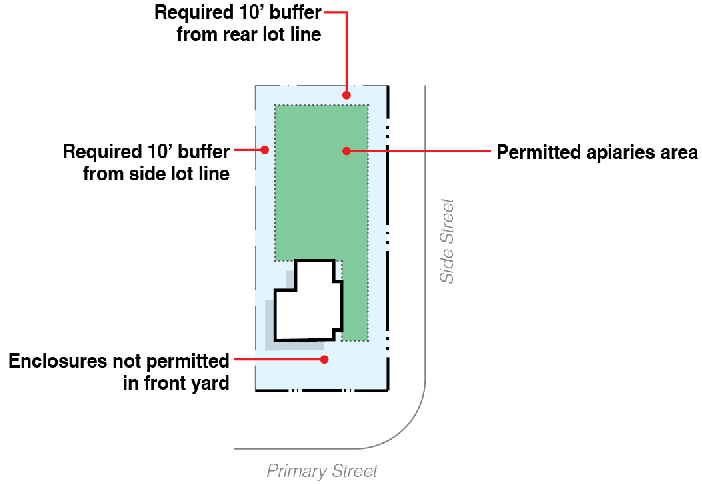
Graphic 15-545. Permitted Location of Apiaries
(Ord. of 3-2-2021, § 155.8.4)
Sec. 15-546. - Chicken keeping.
(a)
On lots less than or equal to one acre with a primary use of a single-family or two-family dwelling, the keeping of up to six chickens may be permitted as an accessory use.
(b)
On lots greater than one acre with a primary use of a single-family or two-family dwelling, the keeping of up to six chickens plus one additional chicken per half acre in excess of one acre may be permitted as an accessory use.
(c)
Neither the keeping of roosters nor the keeping of chickens for slaughter shall be permitted.
(d)
Chickens shall be provided with a covered enclosure and must be kept in the covered enclosure or a fenced enclosure at all times.
(e)
Enclosures are not permitted in any front or side yard and shall be set back a minimum distance of ten feet from all property lines.
(f)
All feed and other items associated with the keeping of chickens that are likely to attract or to become affected by pests shall be protected and stored.
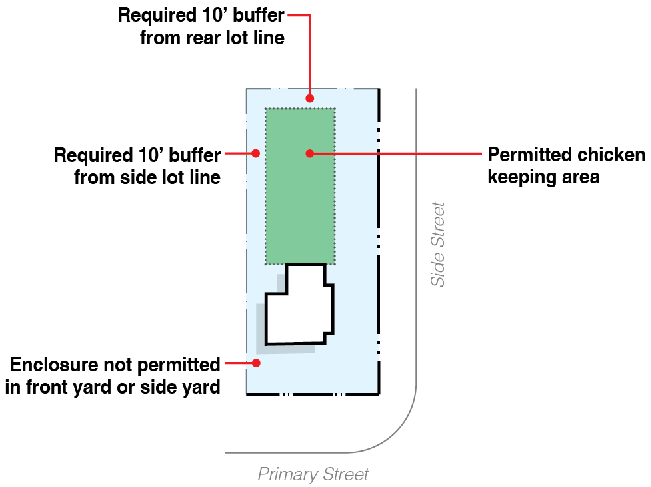
Graphic 15-546. Permitted Location of Chicken Enclosures
(Ord. of 3-2-2021, § 155.8.5)
Sec. 15-547. - Child daycare homes and child daycare centers.
In addition to all underlying zoning regulations, licensing requirements, and other building regulations, child daycare homes and centers shall conform to the following requirements:
(1)
Daycare homes shall have received a license from the state under the Child Care Act of 1969 (225 ILCS 10/1 et seq.) from the department of children and family services.
(2)
In a residential district, no structural or decorative alteration will be allowed which will alter the single-family character of an existing or proposed residential structure or be incompatible with surrounding residences.
(3)
The site must be landscaped in compliance with the building foundation landscape requirements included in section 15-655.
(4)
All yards containing equipment, amenities, or objects used by clientele for operation of the child daycare facility shall be enclosed in an opaque fence with a minimum height of six feet. No such equipment, amenities, or objects shall be located or stored in the front yard.
(Ord. of 3-2-2021, § 155.8.6)
Sec. 15-548. - Outdoor enclosure.
The outdoor enclosure of above-ground essential service utilities shall be screened using a permanent wall to recognize the permanence of the infrastructure, reduce maintenance requirements and lessen the opportunity for graffiti or vandalism on site.
(Ord. of 3-2-2021, § 155.8.7)
Sec. 15-549. - Food trucks.
(a)
Food trucks may only be established on sites which have an active open business during the hours of the food truck operations.
(b)
Sites for food trucks are required to have full public improvements (curb, gutter, sidewalk, access drive, etc.).
(c)
Food trucks shall locate on paved surfaces. Unimproved surfaces, landscaping areas, and required setback areas are prohibited. No food truck shall locate on dirt or gravel areas.
(d)
Food trucks shall obtain written permission from the private property owners, and upon demand shall provide it to authorized representatives of the village.
(e)
Only one food truck is allowed per site with the exception of special events approved by the village.
(f)
The food truck shall impact no more than four parking stalls on private property. Food vending shall be permitted into the adjacent stalls occupied by the food truck. Any furniture associated with the food truck shall be limited to the four-parking stall area.
(g)
Tables and chairs (furniture) shall be permitted and shall be located on improved and/or paved surfaces.
(h)
Tables and chairs located in parking stalls, landscape areas, or drive aisles shall be prohibited, excepting the four-parking stall area designated for vending.
(i)
Furniture shall not be retained on-site overnight.
(j)
ADA parking stalls and pedestrian paths of travel shall not be permitted for food vending.
(k)
Drive aisles, sidewalks, access to trash enclosures and similar areas may not be blocked by any vending activity.
(l)
Food trucks are prohibited within 1,000 feet of a school property or a residentially zoned property and 300 feet from the front door of any restaurant.
(Ord. of 3-2-2021, § 155.8.8)
Sec. 15-550. - Home occupations.
Home occupations in the urban transitional and residential districts shall comply with the following regulations:
(1)
There shall be no stock-in-trade other than products manufactured on the premises unless otherwise approved by the zoning board of appeals by special use permit as provided for by section 15-780;
(2)
A home occupation shall be conducted within a portion of a dwelling or accessory building that does not to exceed 500 square feet in an area;
(3)
There shall be no outdoor storage of supplies or equipment outside the building;
(4)
There shall be no external alteration of the dwelling or accessory building in which a home occupation is conducted, and the existence of a home occupation shall not be apparent beyond the boundaries of the site, except for a nameplate in accordance with the provisions of article XII of this chapter;
(5)
Doctors, dentists, osteopaths, chiropractors, and other practitioners of the medical arts may be permitted as a home occupation in the R districts if an approved special use permit is first secured in each case in accordance with the provisions section 15-780;
(6)
No one other than a resident of the dwelling shall be employed on premises in the conduct of a home occupation;
(7)
No motor power other than electrically operated motors shall be used in connection with a home occupation;
(8)
A home occupation shall not create any radio or television interference or create noise in excess of the standards set forth in section 15-523;
(9)
No odor, liquid, or solid waste shall be emitted;
(10)
Not more than one truck of not more than one ton capacity and no semitrailers incidental to a home occupation shall be kept on the site;
(11)
A home occupation shall not create pedestrian, automobile, or truck traffic significantly in excess of the normal amount in the district;
(12)
A home occupation shall comply with all performance standards included in section 15-523;
(13)
A registered caregiver shall be allowed as a home occupation assuming the establishment meets all requirements of the state and other regulations of this chapter. Nothing in this chapter, or in any companion regulatory provision adopted in any other provision of this chapter, is intended to grant, nor shall they be construed as granting, immunity from criminal prosecution for growing, sale, consumption, use, distribution, or possession of marijuana not in strict compliance with the Cannabis Regulation and Tax Act, 410 ILCS 705/1-1 et seq., and other applicable statutes. Also, since federal law is not affected by the Cannabis Regulation and Tax Act, 410 ILCS 705/1-1 et seq., nothing in this chapter, or in any companion regulatory provision adopted in any other provision of this chapter, is intended to grant, nor shall they be construed as granting, immunity from criminal prosecution under federal law. The following requirements for a registered primary caregiver shall apply:
a.
The medical use of marijuana shall comply at all times and in all circumstances with the Compassionate Use of Medical Cannabis Pilot Program Act, 410 ILCS 130/1 et seq., and other applicable state statutes;
b.
A registered primary caregiver must be located outside of a 1,000-foot radius from any school, including childcare or daycare facility, to ensure community compliance with federal "drug-free school zone" requirements;
c.
Not more than one primary caregiver shall be permitted to service qualifying patients on a parcel;
d.
Not more than five qualifying patients shall be assisted with the medical use of marijuana within any given calendar week;
e.
All medical marijuana shall be contained within the main building in an enclosed, locked facility inaccessible on all sides and equipped with locks or other security devices that permit access only by the registered primary caregiver or qualifying patient, as reviewed and approved by the building official and the police department;
f.
All necessary building, electrical, plumbing and mechanical permits shall be obtained for any portion of the residential structure in which electrical wiring, lighting and/or watering devices that support the cultivation, growing or harvesting of marijuana are located;
g.
If a room with windows is utilized as a growing location, any lighting methods that exceed usual residential periods between the hours of 11:00 p.m. to 7:00 a.m. shall employ shielding methods, without alteration to the exterior of the residence, to prevent ambient light spillage that may create a distraction for adjacent residential properties;
h.
That portion of the residential structure where energy usage and heat exceed typical residential use, such as a grow room, and the storage of any chemicals such as herbicides, pesticides, and fertilizers shall be subject to inspection and approval by the Harlem-Roscoe Fire Protection District to ensure compliance with the Illinois Fire Protection Code.
(Ord. of 3-2-2021, § 155.8.9)
Sec. 15-551. - Locational standards.
(a)
The following uses are not permitted within 1,000 feet of a similar use, or another such use listed below, or within 1,000 feet of a school:
(1)
Massage parlor.
(2)
Adult uses.
(b)
The following uses are not permitted within 2,000 feet of a similar use, or another such use listed below, or within 2,000 feet of a school:
(1)
Pawnshop or broker.
(2)
Tattoo and piercing establishment.
(3)
Currency exchange or loan office.
(Ord. of 3-2-2021, § 155.8.10)
Sec. 15-552. - Materials salvage and processing.
(a)
The salvaging and processing of materials shall occur in an enclosed building.
(b)
Objects waiting to be salvaged and/or parts already salvaged, may be stored outside, so long as the designated storage area is enclosed by an opaque fence at least eight feet in height and setback from all property lines at least 20 feet. The exterior of the fence shall be properly maintained and screened by landscaping. Landscaping shall include one shrub placed every three feet on center.
(Ord. of 3-2-2021, § 155.8.11)
Sec. 15-553. - Mobile home parks.
(a)
Occupancy. No manufactured or mobile home shall be occupied or used for living or sleeping purposes unless it is located in a mobile home park, provided that a manufactured or mobile home may be used as an office for a construction project, circus, or carnival, and provided that one manufactured or mobile home may be used for the temporary residence of a watchman on the site of a construction project, and manufactured or mobile homes may be used as temporary residences for circus or carnival personnel when approved by the zoning board of appeals by a special permit as provided for by section 15-780.
(b)
Preapplication requirements. A mobile home park may be permitted in the UT district subject to obtaining a special use permit in accordance with the provisions of this section.
(c)
Required conditions.
(1)
Mobile home parks may be permitted in UT district on parcels or lots of record of not less than five acres of area.
(2)
In addition to regulations set forth in subsection (c)(1) and (2) of this section, all mobile home parks shall be developed in accordance with design standards set forth in this section.
(d)
Design and performance standards.
(1)
There shall be a maximum of four mobile homes per gross acre.
(2)
There shall be a minimum of 5,200 square feet of site area per mobile home.
(3)
5,000 square feet of area for each ten acres of a mobile home park shall be improved with indoor and outdoor community use facilities and recreational open spaces for use by children. The aggregate community use facilities and open spaces shall not be less than 200 square feet for each mobile or manufactured home space.
(4)
No mobile home or dwelling unit shall be located in a required front yard or less than 25 feet from the property line of the mobile home park boundary.
(5)
Only one mobile or manufactured home may be located on a mobile home site as designated in a mobile home park and subject to the following yards and setbacks:
a.
Front yard and/or rear lot line, a minimum of ten feet;
b.
Side yard, minimum of five feet;
c.
Minimum distance of 20 feet between mobile homes and/or other permitted structures; and
d.
Minimum distance of ten feet from accessory structures or paved parking areas.
(6)
No accessory structure other than a temporary sun or wind shelter shall be erected for the use of occupants of an individual mobile or manufactured home.
(7)
All streets for automobile circulation shall be a minimum of 30 feet in width and surfaced with three inches of asphalt or its equivalent and ten inches of compacted aggregate base.
(8)
A minimum of two improved parking spaces shall be provided for each mobile or manufactured home, one of which shall be on the mobile home site.
(9)
All utilities, including television service, shall be underground.
(10)
Adequate landscaping shall be provided, including trees and shrubs around the perimeter of the mobile home park.
(11)
A designated trailer and boat storage area shall be provided with an aggregate area of 50 square feet per mobile home space.
(Ord. of 3-2-2021, § 155.8.12)
Sec. 15-554. - Outdoor storage of equipment, materials, and commercial vehicles.
Any commercial service provider located in the CR, CG, CH, CO, IG, or IH districts shall meet the following requirements:
(1)
In the CR, CG, and CO districts, no external storage of equipment, materials, or commercial vehicles related or unrelated to the primary use of the establishment is permitted.
(2)
In the CH, IG and IH districts, external storage of equipment, materials, or commercial vehicles related to the primary use of the establishment are permitted, so long as they are enclosed with an opaque fence that is a minimum of six feet in height and located at least 25 feet away from all property lines.
(Ord. of 3-2-2021, § 155.8.13)
Sec. 15-555. - Private solar energy collection systems.
Solar energy collection systems are permitted as an accessory use with the following conditions.
(1)
Building-mounted systems.
a.
Location. Building mounted systems may be located on any roof face of principal or accessory structures. Systems should be flush mounted when possible.
b.
Quantity. The total square footage of the system panels may not exceed the total area of roof surface of the structure to which the system is attached.
c.
Measuring height. Height is measured from the roof surface on which the system is mounted to the highest edge of the system.
d.
Maximum height.
1.
Systems shall not extend beyond three feet parallel to the roof surface of a pitched roof.
2.
Systems shall not extend beyond four feet parallel to the roof surface of a flat roof.
3.
Systems shall not extend more than five feet above the highest peak of a pitched roof.
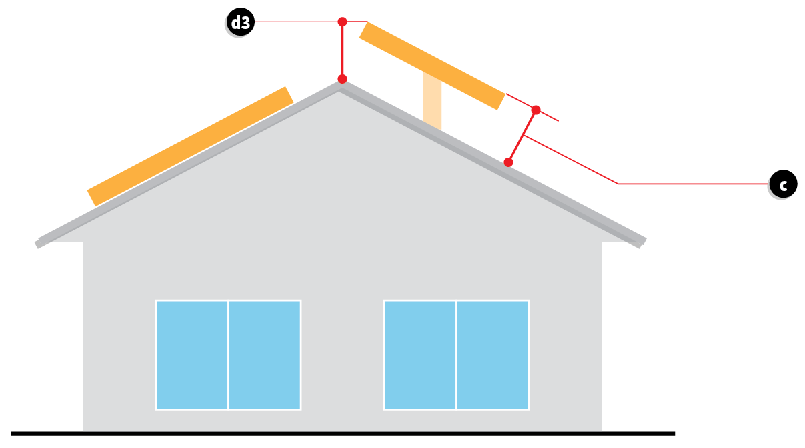
Graphic 15-555(1). Building-Mounted Solar Energy Collection Systems
(2)
Ground-mounted systems.
a.
Location. Ground mounted systems shall not be located within any required setback and shall not be located within the front or corner side yard.
b.
Fencing. Any yard containing a ground mounted solar energy production system shall provide a fence along adjacent properties. The fence shall comply with article VII of this chapter.
c.
Maximum height. The maximum height of a ground mounted solar energy production system, including any structural elements or energy producing elements, shall not exceed a height that is one foot less than the height of the fence provided in accordance with subsection (2)b of this section.
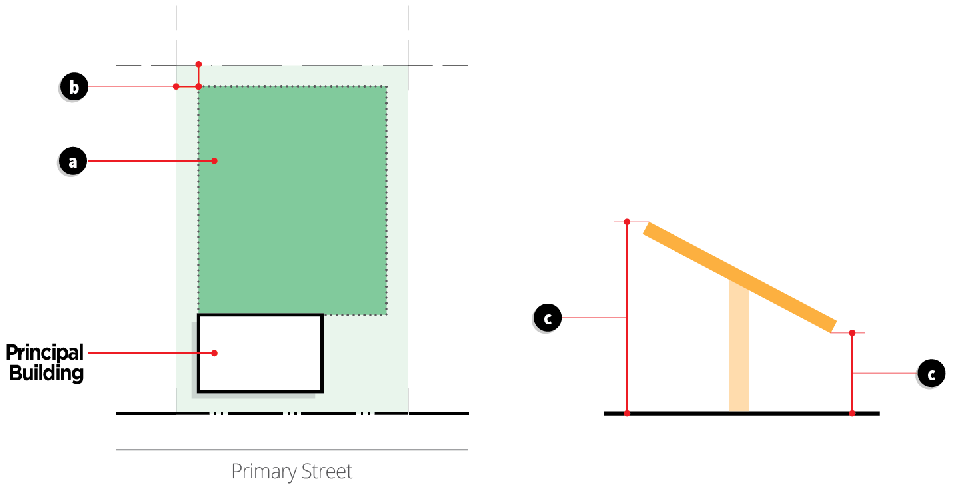
Graphic 15-555(2). Ground-Mounted Solar Energy Collection Systems
(Ord. of 3-2-2021, § 155.8.14)
Sec. 15-556. - Temporary outdoor portable storage unit.
Temporary portable outdoor storage units are permitted accessory uses in residential districts, subject to the following restrictions.
(1)
Permit required. A permit shall be obtained prior to the setting of the temporary portable outdoor storage unit on the property. A site drawing shall be submitted showing the location on the property where the unit will be placed, size of the unit, and distance to all applicable property lines and all other buildings and structures.
(2)
Size. No temporary portable outdoor storage unit shall be greater than 20 feet in length, eight feet in width, or eight feet in height.
(3)
Placement. The temporary portable outdoor storage unit cannot encroach on village property, village right-of-way, neighboring property, sidewalk, or be placed in the street. The unit must be sited on asphalt, concrete, gravel, or hard paved surface between the front property line and the rear building line of the principal structure. The visual distance between the portable temporary storage unit and the side yard property line is four feet or upon the approval by the zoning administrator and as agreed upon by written consent by the neighboring property owner.
(4)
Duration. Temporary portable outdoor storage units may be placed in a residential district for no more than 30 days in any consecutive 12-month period. Extensions beyond the 30-day limit may be granted by the zoning administrator.
(5)
Number of units. A maximum of one temporary portable outdoor storage unit is permitted on a lot.
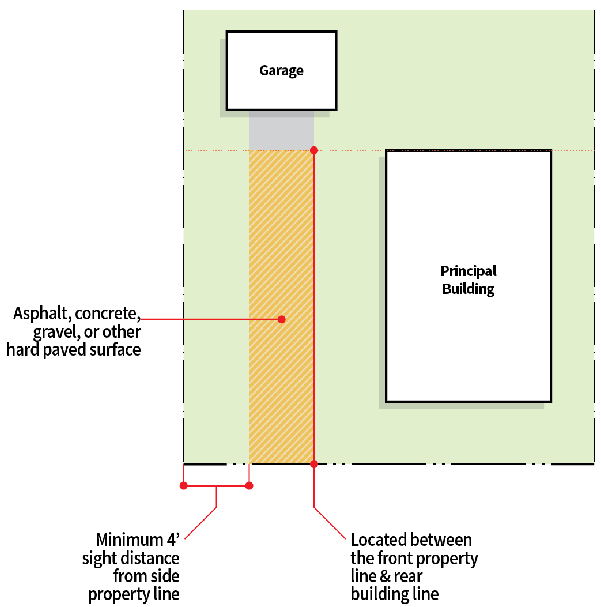
Graphic 15-556. Temporary Portable Outdoor Storage Units
(Ord. of 3-2-2021, § 155.8.15)
Sec. 15-557. - Urban gardening.
Urban gardens are permitted under the following conditions for both accessory and permitted use in all residential districts and the PC district.
(1)
Setbacks for the underlying zoning district apply.
(2)
Urban garden produce may be sold commercially through an onsite farm stand that conforms to all setback regulations of the underlying zoning district and has a maximum height of 12 feet.
(3)
Mechanical equipment, other than the type customarily identified as lawn and garden equipment, creating offensive noise, dust, odor, or electrical disturbance shall be prohibited. Within a residential zoned district, the use of motorized equipment shall be restricted to hours beginning at 8:00 a.m. and ending at 10:00 p.m.
(4)
The site shall be designed and maintained to prevent any chemical pesticide, fertilizer, or other garden waste from draining on to adjacent properties.
(5)
An on-site trash storage container shall be provided and located as close as possible to the rear lot line. Trash shall be removed from the site at least once a week.
(6)
Accessory structures including buildings or signs shall comply with requirements of the underlying zoning district.
(7)
Only individuals or organizations authorized by the property owner shall participate in the community garden.
(8)
The owner of any lot used for a community garden shall give each abutting property owner or occupant written notice of the owner's or the owner's agent's name, address, and telephone number and the use conditions provided in this chapter for community gardens, no less than 30 days prior to the start of any community garden use.
(9)
Cultivated areas shall be prevented from encroaching onto adjacent properties.
(10)
The property shall be maintained free of high grass, weeds, or other debris. Dead garden plants shall be regularly removed and, in any instance, no later than November 15 of each year.
(Ord. of 3-2-2021, § 155.8.16)
Sec. 15-558. - Wireless communication facilities.
(a)
Requirements. All wireless telecommunication facilities shall be subject to the requirements of this section, as well as any other applicable provisions of this Code.
(b)
Zoning district requirements. Wireless telecommunication facilities shall be permitted with the following conditions:
(1)
No new wireless telecommunication towers shall be permitted in the R1, R2, RM, CR or CG districts. Stealth design of wireless facilities, towers and antennas shall be permitted as a special use in these districts. Co-locations on existing wireless telecommunication facilities or existing structures that do not require any additional height shall be a permitted use in these districts.
(2)
Wireless telecommunication facilities shall be permitted as a special use in the CH, CO, IG, IH, HC, UT, or PC districts.
(c)
Compliance with federal regulations.
(1)
All telecommunication facilities shall comply with current regulations of the Federal Aviation Administration (FAA) and the Federal Communications Commission (FCC) or any other federal or state agency with authority to regulate telecommunication facilities, including towers and/or antennas.
(2)
In the event of a change in federal or state regulation, the owner of the telecommunication facility shall bring it into compliance with the revised regulations within six months of the effective date of such regulations, unless a different compliance schedule is mandated by the state or federal agency.
(d)
Compliance with building codes. All wireless telecommunications shall be constructed in compliance with all applicable building codes, including the Electronic Industries Association/Telecommunication Industry (EIA/TIA) standards for the construction of facilities including towers, antennas, and support structures.
(e)
General site location requirements. No new wireless telecommunication towers shall be permitted within a radius of 1,000 feet of an existing wireless telecommunication tower unless the applicant can demonstrate that the existing telecommunication tower is unsuitable for technical or structural reasons.
(f)
Setback requirements.
(1)
Wireless telecommunication towers shall be setback at least 50 percent of the tower height from any adjoining property.
(2)
Other structures associated with the wireless telecommunication tower (such as equipment shelters, guy wire anchors) shall comply with the setback requirements of the district in which the tower is located.
(3)
The setback requirements of this section are minimums. The zoning board of appeals may require additional setback distance as part of a special use approval.
(g)
Co-location requirements. Unless made technically infeasible as a result of the use of stealth design, new wireless telecommunication towers shall be designed to permit co-location by at least two additional entities and proposed locations for wireless telecommunication facilities shall be adequately sized and configured to allow the placement of at least two additional telecommunication equipment shelters.
(h)
Tower design. Wireless telecommunication towers that are not of stealth design shall be constructed as freestanding structures (monopole or lattice towers, as approved by the zoning board of appeals) and shall have a neutral surface finish color to reduce visual obtrusiveness, except as otherwise required by a state or federal agency.
(i)
Signs. Wireless telecommunication facilities shall not be used for advertising purposes. Wireless telecommunication facilities shall display one sign, not to exceed two square feet, which identifies the service provider and an emergency telephone number. These restrictions shall not apply to any safety signs placed on the security fence or tower.
(j)
Fencing. Wireless telecommunication facilities shall be enclosed by a solid screening fence not less than six feet in height. The zoning board of appeals shall review the need for the installation of anti-climbing devices and make a determination based on adjacent land use and zoning patterns.
(k)
Screening. Wireless telecommunication facilities shall be effectively screened with a landscape buffer, approved by the zoning board of appeals, to obscure views of the tower base, equipment shelter, security fencing, or guy wire anchors from adjacent uses and public rights-of-way. Locations where the visual impact of the tower will be minimal or where existing vegetation provide an effective natural screen or where the security requirements of the principal use prevent screening (utility substations), the zoning board of appeals may modify this requirement.
(l)
Lighting. Wireless telecommunication towers shall not be artificially lighted unless required by the FAA, FCC, or other agency with jurisdictional authority. If lighting is required by federal regulation, the applicant shall use the least intrusive form of lighting acceptable under the controlling regulation.
(m)
Equipment shelter design. The design and materials used in the construction of the equipment shelter shall, to the extent possible, blend the structure with the surrounding built or natural environment. The equipment shelter shall not exceed 15 feet in height.
(n)
Off-street parking. New wireless telecommunication facilities of non-stealth design shall provide one off-street parking space to accommodate maintenance vehicles, if practicable. Driveways and parking spaces serving such facilities may have a gravel surface, provided the surface is maintained in a dust-free condition and graded to maintain proper drainage.
(o)
Permitted additional antenna. Wireless telecommunication antennas shall be considered a permitted accessory use when placed on or attached to any existing wireless telecommunication structure, provided that all other applicable ordinance requirements are complied with. Any initial wireless telecommunication antenna placed on an alternative tower structure shall be subject to the same review and approval procedures as a new wireless telecommunications facility. Subsequent antennas on alternative tower structures shall be considered permitted accessory uses in all districts.
(p)
Permitted tower placement. An existing wireless telecommunication tower may be placed for the purposes of accommodating the co-location of additional wireless telecommunication antennas subject to the following review and approval process:
(1)
Tower replacements that result in the addition of 50 or fewer feet of additional tower height shall require site plan view and approval by the zoning board of appeals;
(2)
Tower replacements that result in the addition of more than 50 feet in height shall require special land use review and approval by the zoning board of appeals;
(3)
Tower replacements that require the installation of tower lights shall require special use review and approval by the zoning board of appeals.
(q)
Application requirements. In addition to any other applicable requirements of this chapter, the following information shall be provided in support of an application to initially construct a wireless telecommunication tower:
(1)
Certification from a state licensed professional engineer as to the manner in which the proposed wireless telecommunication tower is designed to collapse;
(2)
A report that addresses the review criteria contained in subsection (r) of this section. This report shall include a map depicting the existing and known proposed location of telecommunication, including telecommunication wireless towers and wireless telecommunication antennas attached to alternative tower structures, within a one-mile radius of the proposed site. This includes wireless telecommunication towers located within adjacent jurisdictions within the one-mile radius;
(3)
The name, address, and telephone number of the person to contact regarding site maintenance or other notification purposes. The tower owner shall periodically update this information;
(4)
A statement that indicates the applicant's intent to allow the co-location of other antennas, provided that the cost of modifying the existing tower is borne by the co-locating entity and reasonable compensation is paid by the co-locating entity.
(r)
Review criteria. A wireless telecommunication tower shall not be approved unless it can be demonstrated by the applicant that there is a need for the tower which cannot be met by placing wireless telecommunication antennas on an existing tower or other suitable structure, or placement of an existing tower:
(1)
No existing towers or alternative tower structures have the structural capacity to support the proposed antenna nor can existing towers or alternative tower structures be reinforced to support the proposed antenna;
(2)
No existing towers or alternative tower structures are located within the geographic area that meets the system's engineering requirements;
(3)
The cost of using an existing tower or other suitable structure or replacing an existing tower exceeds the cost of constructing a new wireless telecommunication tower; or
(4)
The installation or use of an alternative communication technology is unsuitable or infeasible.
(s)
Removal of abandoned facilities. Any wireless telecommunication tower or antenna that is not operated for a continuous period of 12 months shall be considered abandoned and the owner of such tower or antenna shall remove the same within 90 days of receiving an abandonment notification from the village. Failure to remove an abandoned tower or antenna within 90 days shall be grounds for the removal of the tower or antenna at the owner's sole expense.
(t)
Bond. Applicant shall provide the village with proof of an annual performance bond in the amount of $7,500.00 to ensure that the applicant will comply with the provisions set forth in subsection (s) of this section regarding the removal of an abandoned tower and/or antenna.
(u)
Inspection. An inspection of the wireless telecommunication facility shall be required every two years after the completion of improvements. The inspection shall be carried out by the owner of the facility and shall certify the structural integrity of the wireless telecommunication facility. The inspection certification shall be submitted to the zoning administrator and filed with the site permit documents. If the zoning administrator determines that an inspection has not been completed within the two-year time period, a notice will be sent to the owner. The owner shall have 30 days in which to comply with this requirement. If the inspection is not completed within the 30 days, the permit for the wireless telecommunication facility will be revoked.
(Ord. of 3-2-2021, § 155.8.17)
Sec. 15-559. - Adult uses.
(a)
Purpose. The purpose of this section is to provide specific regulations for adult uses, in order to accommodate constitutionally protected non-obscene sexual expression, while protecting the public health, safety, and general welfare of the village. The village board finds that:
(1)
Adult uses require special supervision from the village's law enforcement and public safety agencies to protect and preserve the public health, safety, morals, and welfare of the patrons and employees of businesses as well as the village's citizens;
(2)
Adult uses are frequently used for unlawful sexual activities, including prostitution and sexual liaisons of a casual nature;
(3)
Sexually transmitted diseases are a legitimate health concern for the village that demands reasonable regulation of adult uses by the village in accordance with this article;
(4)
These regulations are a legitimate and reasonable means of accountability to ensure that operators of adult uses comply with reasonable regulations and to ensure that operators do not allow their establishments to be used as places of illegal sexual activity or solicitation;
(5)
There is convincing documented evidence that adult uses, because of their outward appearance and very nature, have a deleterious effect on both the existing businesses around them and the surrounding residential areas adjacent to them, cause increased crime, particularly during the overnight hours, and reduce property values;
(6)
The village board desires to minimize and control these adverse effects by regulating adult uses in accordance with this article;
(7)
By minimizing and controlling these adverse effects, the village board seeks to protect the health, safety, and welfare of the citizenry; protect citizens from increased crime; preserve quality of life; preserve property values and the character of the village's neighborhoods; and deter the spread of urban blight;
(8)
The village board does not enact this article to suppress or authorize the suppression of any speech activities protected by the First Amendment; rather, this article establishes content-neutral regulations that address the secondary effects of adult uses;
(9)
The village board does not enact this article to restrict, deny, or authorize the restriction or denial of access by adults to sexually oriented materials protected by the First Amendment, or to deny, or authorize denial of, access by the distributors and exhibitors of adult entertainment and adult materials to their intended market;
(10)
Evidence concerning adult uses' adverse secondary effects on communities is readily available in many court decisions, including, but not limited to, Township of Littleton, Colorado v. Z.J. Gifts D-4, LLC, 541 U.S. 774 (2004); City of Los Angeles v. Almaeda Books, Inc., 535 U.S. 425 (2002); Township of Erie v. Pap's A.M., 529 U.S. 277 (2000); Barnes v. Glen Theatre, Inc., 501 U.S. 560 (1991); Township of Renton v. Playtime Theatres, Inc., 475 U.S. 41 (1986); Young v. American Mini Theatres, 426 U.S. 50 (1976); California v. LaRue, 409 U.S. 109 (1972); Illinois One News, Inc. v. City of Marwill, 477 F.3d 461 (7th Cir. 2007); Andy's Restaurant & Lounge, Inc. v. City of Gary, 466 F.3d 550 (7th Cir. 2006); Joelner v. City of Washington Park, 378 F.3d 613 (7th Cir. 2004); G.M. Enterprises, Inc. v. Town of St. Joseph, 350 F.3d 631 (7th Cir. 2003); Pleasureland Museum, Inc. v. Beutter, 288 F.3d 988 (7th Cir. 2002); Shultz v. City of Cumberland, 288 F.3d 831 (7th Cir. 2000); Genusa v. City of Peoria, 619 F.2d 1203 (7th Cir. 1980); Excalibur Group, Inc. v. City of Minneapolis, 116 F.3d 1216 (8th Cir. 1997); and XLP Corporation v. County of Lake, 359 Ill. App. 3d 239 (2d Dist. 2005; collectively, the "Cases");
(11)
Many cities and other units of government throughout the country have studied and found significant adverse secondary effects associated with adult uses, including, but not limited to, Phoenix, Arizona (1984); Minneapolis, Minnesota (1980); Indianapolis, Indiana (1984); Amarillo, Texas (1977); Whittier, California (1978); St. Croix County, Wisconsin (1993); Bellevue, Washington (1998); Beaumont, Texas (1982); and Des Moines, Iowa (1984; collectively, the "Studies");
(12)
The United States Congress has heard testimony detailing the negative secondary effects associated with adult uses on numerous occasions, including 136 Cong. Rec. S. 8987; 135 Cong. Rec. S. 14519; 135 Cong. Rec. S. 5636; 134 Cong. Rec. E. 3750 (collectively, the "testimony"); and
(13)
Based on secondary effects discussed and found to exist in the cases, studies, and testimony, as well as all evidence presented and matters discussed during all public hearings and meetings conducted by the village, and all other relevant information, including the village board's own knowledge and experience, the village board finds that:
a.
Adult uses can contribute to increased crime in the area where such businesses are located and burden local law enforcement and public safety efforts. Crimes associated with adult uses include, but are not limited to:
1.
Prostitution and other sex related offenses;
2.
Drug use and dealing; and
3.
Money laundering.
b.
Adult uses can contribute to significant public health concerns, including the spread of HIV/AIDS and other sexually transmitted diseases.
c.
Adult uses and their outward appearance can significantly:
1.
Contribute to the deterioration of residential neighborhoods;
2.
Increase neighborhood blight;
3.
Impair the character and quality of residential housing in the surrounding area; and
4.
Reduce overall housing appeal for potential residents.
d.
The concentration of adult uses in any one area can greatly impact the area by causing blight, decreasing property values, reducing the village's tax base, making the area less attractive to non-adult uses (i.e., marketability), and increasing crime.
e.
Adult uses can produce higher levels of noise, traffic, and glare as compared to other businesses by virtue of adult uses' hours of operation.
f.
Serving or otherwise allowing the consumption of alcoholic liquor at adult uses can lead to increased criminal activity and exacerbate neighborhood deterioration.
g.
The findings set forth in this subsection (a) constitute substantial governmental concerns.
h.
Adult uses have operational characteristics that require reasonable governmental regulation to address those substantial governmental concerns.
i.
Passing this chapter will promote and protect the public health, safety, and welfare.
(b)
Conditions. All adult uses will be subject to the following conditions in order to prevent or minimize substantial or undue adverse effects upon neighboring and adjacent properties and improvements, and substantial or undue or upon public facilities and services:
(1)
Adult uses will only be permitted in the IH district.
(2)
No adult use may be located within 1,000 feet of any existing school, religious institution, daycare center, public park, residentially zoned property, agriculturally zoned property, or other adult use.
(3)
No adult use may have more than one outdoor sign.
(4)
No adult use may have an outdoor sign exceeding ten feet in length or three feet in width.
(5)
No adult use may display the stock in trade of adult entertainment establishments to the public from view outside the establishment, including graphics, decorations, or displays.
(6)
No adult use may paint the exterior of the premises any other color than a single neutral, earth tone color.
(7)
No person or entity may hold a liquor license for the property operating as an adult use, or sell, serve, or allow the consumption of alcoholic liquor on the property.
(8)
No adult use offering live performance of adult entertainment will allow exposed or uncovered specified anatomical areas.
(9)
No adult use will permit persons under the age of 18 years on the property subject to the adult use, and all adult uses will post a notice at the door that entry by persons under the age of 18 years is prohibited.
(10)
All adult uses will maintain a buffer measuring at least six feet wide between all patrons and any individual conducting live performance of adult entertainment.
(11)
No adult use will allow or permit the occurrence of any specified sexual activities or permit the occurrence of any act constituting the offense of obscenity under state law on property subject to the adult use.
(12)
No adult use will allow, permit, or authorize physical contact between any adult use personnel and any patron.
(13)
Adult entertainment employees may not receive tips from patrons except as follows:
a.
An adult use that desires to provide for tips from its patrons for adult entertainment employees will establish one or more boxes or other containers to receive tips.
b.
All tips for adult entertainment employees must be placed by the patron into the tip box.
c.
An adult use that provides tip boxes for adult entertainment employees must post one or more signs to be conspicuously visible to the patrons on the premises in letters at least one inch high to read as follows: "All tips are to be placed in tip box and not handed directly to the entertainer. Any physical contact between the patron and the entertainer is strictly prohibited."
(14)
No adult use offering adult entertainment on the premises may open before 11:30 a.m. or close after 1:00 a.m., except that cleaning and maintenance activities necessary for the property's operation may occur before or after the hours specified in this subsection (b).
(15)
No adult use offering adult entertainment on the premises will open or operate on Sunday, on any federal holiday, or on any state holiday.
(16)
No animals, excluding animals trained and used to assist a person with a disability, are permitted at any time on property subject to an adult use, and any animal assisting a person with a disability must remain with that person at all times.
(17)
No adult entertainment will occur in any restroom located on a property subject to an adult use.
(18)
Patrons will not enter any non-public portions of a property subject to an adult use, including, without limitation, any storage areas, dressing rooms, or other rooms provided for the primary benefit and use of adult use personnel.
(19)
No adult use will utilize loudspeakers or other sound equipment that is audible outside of the structure in which the adult use is conducted.
(20)
Each adult use will have at least one manager's station allowing direct, unobstructed, and uninterrupted view from the manager's station to every part of the premises accessible to patrons, excluding restrooms.
(21)
All adult uses will comply with all provisions of this article and all federal, state, and local laws, rules, and regulations, as amended.
(22)
Upon the village's request, permittee will allow the village to inspect the adult use's books, records, and payroll information to allow the village to verify compliance with this article, state law, and federal law, as amended.
(c)
Penalty.
(1)
Every act or omission constituting a violation of this article by any adult use, adult use personnel, or patron will be deemed to be an act or omission by the adult use operator, and the adult use operator will be punished in accordance with the provisions of this subsection (c)(1).
(2)
Nothing in this section will prohibit the village or any person or entity from pursuing any claims at law or in equity, against any person or entity that violates this section or any other village ordinance, rule, or regulation.
(3)
Any adult use established, operated, or maintained in violation of any of the provisions or requirements of this article will be, and the same is, declared to be unlawful and a public nuisance. The village may, in addition to or in lieu of any other remedies set forth in this subsection, commence an action to enjoin, remove, or abate such nuisance in the manner provided by law and may take such other steps and apply to such court or courts as may have jurisdiction to grant such relief as will abate or remove such public nuisance, and restrain and enjoin any person from establishing, operating, or maintaining an adult use contrary to the provisions of this article.
(Ord. of 3-2-2021, § 155.8.18)

