
Roscoe City Zoning Code
ARTICLE XII
SIGNS
Sec. 15-687.- Purpose and intent.
(a)
Purpose. The purpose of article is to set out regulations for the erection and maintenance of signs while preserving the right of free speech and expression.
(b)
Scope. The regulations of article shall provide a balanced and fair legal framework for design, construction, and placement of signs that:
(1)
Promotes the safety of persons and property by ensuring that signs do not create a hazard by:
a.
Collapsing, catching fire, or otherwise decaying;
b.
Confusing or distracting motorists; or
c.
Impairing drivers' ability to see pedestrians, obstacles or other vehicles, or to read traffic signs;
(2)
Promotes the efficient communication of messages, and ensures that persons exposed to signs:
a.
Are not overwhelmed by the number of messages presented; and
b.
Are able to exercise freedom of choice to observe or ignore the messages according to the observer's purpose;
(3)
Protects the public welfare and enhances the appearance and economic value of the landscape by protecting scenic views and avoiding sign clutter that can compromise the character, quality, and viability of commercial corridors;
(4)
Ensures that signs are compatible with their surroundings, and prevents the construction of signs that are a nuisance to occupants of adjacent and contiguous property due to brightness, reflectivity, bulk, or height;
(5)
Promotes the use of signs that are aesthetically pleasing, of appropriate scale, and integrated with the built environment, in order to meet the objectives related to the quality and character of development set forth in the comprehensive plan of the village;
a.
Enhances property values and business opportunities;
b.
Assists in wayfinding; and
c.
Provides fair and consistent permitting and enforcement.
(c)
Authority. The village board finds that:
(1)
This article advances important and substantial governmental interests;
(2)
The regulations set out in this article are unrelated to the suppression of constitutionally protected free expression and do not involve the content of protected messages which may be displayed on signs, nor do they involve the viewpoint of individual speakers;
(3)
The incidental restriction on the freedom of speech is no greater than is essential to the furtherance of the interests protected by this article; and
(4)
Certain types of speech are not protected by the First Amendment due to the harm that they cause to individuals or the community, and speech that is harmful to minors may be prohibited in places that are accessible to minors.
(d)
General findings of fact. The village board finds that:
(1)
The ability to display signs of reasonable size and dimensions is vital to the health and sustainability of many businesses, and the display of signs with noncommercial messages is a traditional component of the freedom of speech, but the constitutional guarantee of free speech may be limited by appropriate and constrained regulation that is unrelated to the expression itself;
(2)
The village has an important and substantial interest in preventing sign clutter (which is the proliferation of signs of increasing size and dimensions as a result of competition among property owners for the attention of passing motorists), because sign clutter degrades the character of the community, makes the community a less attractive place for commerce and private investment, and dilutes or obscures messages displayed along the village's streets by creating visual confusion and aesthetic blight;
(3)
Sign clutter can be prevented by regulations that balance the legitimate needs of individual property owners to convey their commercial and noncommercial messages against the comparable needs of adjacent and nearby property owners and the interest of the community as a whole in providing for a high-quality community character;
a.
Temporary signs that are not constructed of weather-resistant materials are often damaged or destroyed by wind, rain, and sun, and after such damage or destruction, degrade the aesthetics of the village's streets if they are not removed;
b.
The village has an important and substantial interest in keeping its rights-of-way clear of obstructions and litter;
c.
The village has an important and substantial interest in protecting the health of its tree canopy, which contributes to the character and value of the community; and
d.
The uncontrolled use of off-premises outdoor advertising signs and their location, density, size, shape, motion, illumination and demand for attention can be injurious to the purposes of this chapter, and destructive to community character and property values, and that, as such, restrictions on the display of off-premises commercial messages are necessary and desirable.
(e)
Sign permit required. No sign shall be erected, enlarged, expanded, altered, or relocated unless a sign permit evidencing the compliance of such work with the provisions of this section and other applicable provisions of this title shall have first been issued in accordance with the provisions of this article; provided, however, that routine sign maintenance, changing of parts designed to be changed or changing the content of a sign in any manner does not change the functional classification of the sign and shall not, standing alone, be considered an alteration of the sign requiring the issuance of a sign permit.
(1)
Additional application requirements. All signs shall require permits and payment of all applicable fees as described in chapter 156. In addition to the information and documents required by other sections of this chapter, every application for a sign permit shall be accompanied by:
a.
Plans and specifications showing the location on the lot or building face and the method of construction, illumination and support of such sign;
b.
A scale drawing showing sign faces, exposed surfaces and the proposed message and design, accurately represented as to size, area, proportion and color;
c.
A landscape plan showing required landscape areas and plantings as applicable;
d.
Photographs of the street sides of the property in question, showing all existing signs on the property;
e.
A calculation of the total amount of sign area presently existing on the property;
f.
The applicant's attestation that the sum of the areas of the requested sign or signs and the existing signs does not exceed the maximum allowed by the provisions of this chapter.
(2)
A guarantee that sign installation and landscaping shall be completed within one year following issuance of the sign permit.
(Ord. of 3-2-2021, § 155.12.1)
Sec. 15-688. - Limit on sign area.
(a)
Permanent sign area limit. Each lot shall be allowed aggregate permanent sign area equal to one square foot of sign area per linear foot of lot frontage or 150 square feet, whichever is more.
(b)
Temporary sign area limit. Each lot shall be aggregate temporary sign area equal to one-half foot of sign area per linear foot of frontage or 75 square feet, whichever is more.
(c)
Premises having frontage on more than one dedicated street. Premises having frontage on more than one dedicated street will be allowed an additional one-half square feet of aggregate sign area for each lineal foot of the secondary lot frontage; however, additional sign area shall only be displayed on the secondary frontage.
(Ord. of 3-2-2021, § 155.12.2)
Sec. 15-689. - Sign measurement.
(a)
Sign height. Sign height shall be measured by the total distance between the highest point on the sign to the average elevation of the ground upon which the sign supports are placed, except when the sign supports rest upon a berm or other area elevated above the surrounding ground. In such cases, the average elevation of the base of such berm or other areas shall be considered as the ground level.
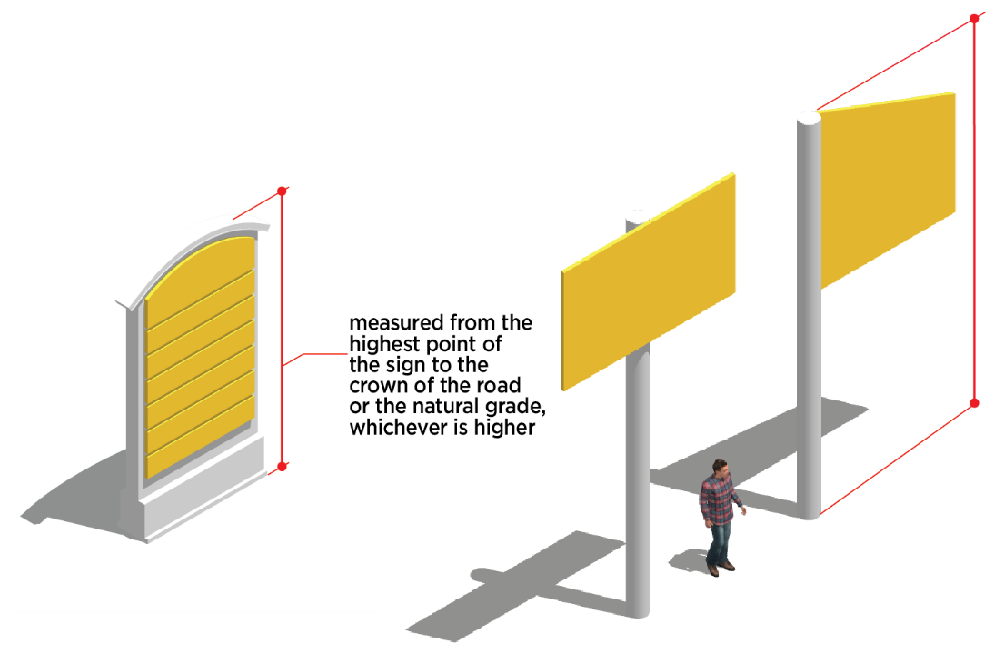
Graphic 15-689(1). Sign Height Measurement
(b)
Sign area. Unless otherwise defined, sign area is determined by the total area enclosed by a continuous perimeter along the edges of a sign, including any frame or border. The area of a sign composed of individually affixed letters is determined by the total area of the smallest geometric shape enclosing the copy. A maximum of two geometric shapes may be utilized. The calculation for a double-faced sign shall be the area of one face only.
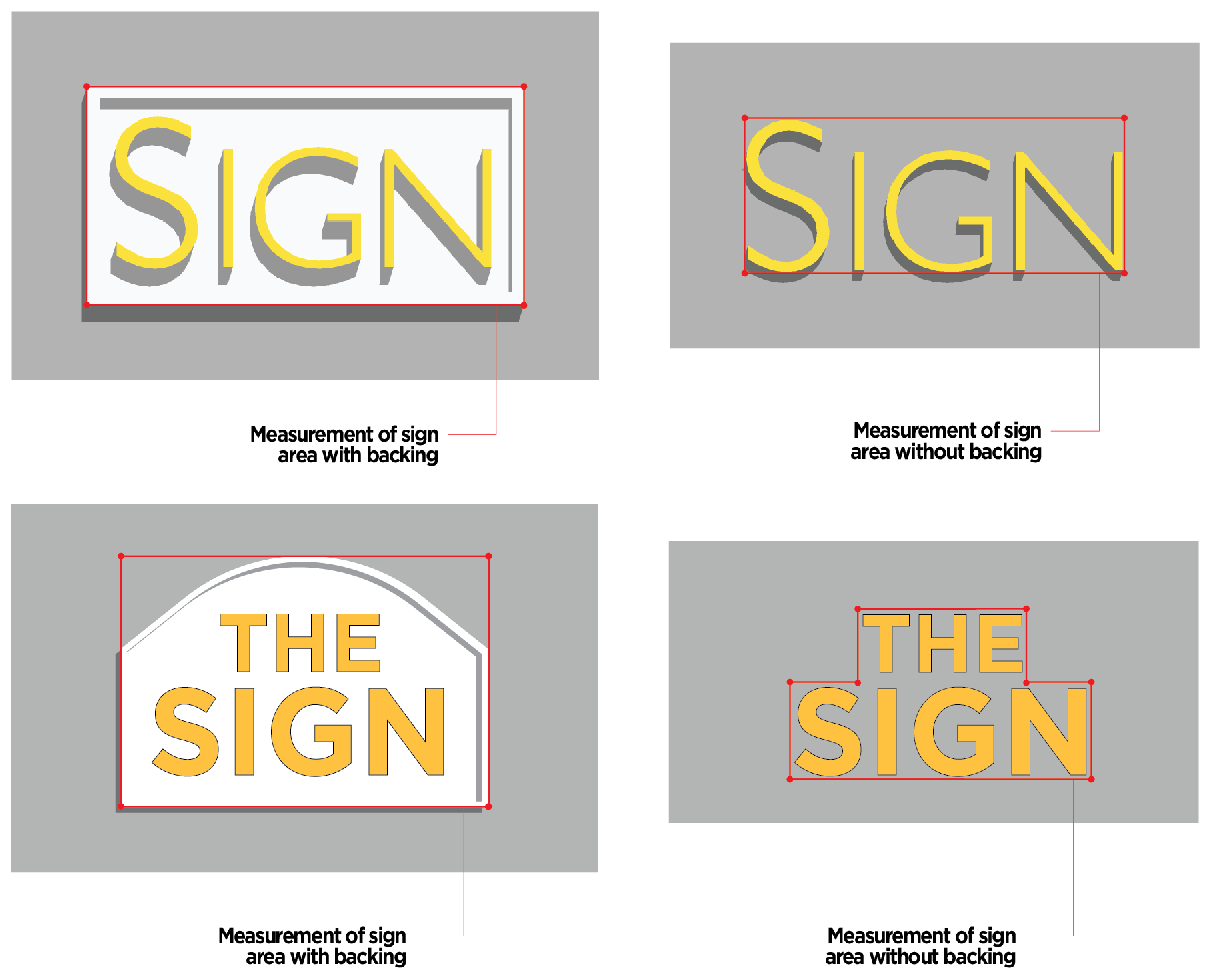
Graphic 15-689(2). Sign Area Measurement
(Ord. of 3-2-2021, § 155.12.3)
Sec. 15-690. - Permitted sign types.
(a)
Generally. The following key is to be used in the interpretation of Table 15-690.
(1)
Permitted sign types. Sign types marked as "P" in the table shall be permitted subject to all applicable regulations of this chapter and only after the issuance of a sign permit as detailed in section 15-782.
(2)
Prohibited sign types. A blank space in the table indicates that a sign type is not allowed in the respective zoning district.
Table 15-690. Permitted Sign Types by District
Notes:
(1) Sign shall be permitted for nonresidential and multifamily uses only.
(2) Sign shall be permitted at entryways or gateways to subdivisions or neighborhoods.
(Ord. of 3-2-2021, § 155.12.4)
Sec. 15-691. - Standards for permanent signs.
(a)
Wall signs.
(1)
Sign area.
a.
The maximum permitted sign area of wall signs in the UT, RE, R1, R2, and RM districts shall not exceed five percent of the total area of the face of the wall to which the sign is to be affixed.
b.
The maximum permitted sign area of wall signs in the CO, CR, CH, CG, IG, IH, P, and HC districts shall not exceed ten percent of the total area of the face of the wall to which the sign is to be affixed.
(2)
Height. No wall sign shall protrude above the highest roofline or the top of the parapet wall or mansard roof.
(3)
Projection. A wall sign shall not extend more than six inches from the wall of the building or structure to which it is attached and shall maintain a minimum vertical clearance of ten feet.
(4)
Number of signs.
a.
Single tenant buildings shall be permitted a total of two wall signs; however only one wall sign shall be permitted on any building facade.
b.
Multitenant buildings shall be permitted one wall sign per unit.
c.
A maximum of three secondary wall signs may be authorized for buildings with lineal frontage in excess of 75 feet by the zoning administrator provided such additional signage is:
1.
In keeping with the overall designs and architecture of the building;
2.
A minimum of 20 feet from the primary wall sign and other secondary wall signs;
3.
A maximum of 50 percent of the size of the primary wall sign;
4.
Accessory to the building's primary wall sign; and
5.
The total area of all primary and secondary wall signs does not exceed the maximum wall sign area as established in subsection (a)(1) of this section.
(5)
Sign copy. All wall sign copy featured on wall signs shall either be individually affixed letters, raceway letters, applied vinyl, or be printed, etched, or otherwise incorporated directly on the sign's backing plate. Painted wall signs shall be permitted only upon the issuance of a special use permit. Box signs shall be prohibited.
(6)
Other provisions.
a.
No wall sign shall cover any architectural features (architectural features shall include but not be limited to, pediment, cornice, belt course, pier, windows, pilaster, roof, decorative stone or inlay, kick plate/bulkhead, raised or colored brick pattern, and corbel) of the building to which it is affixed.
b.
No wall sign shall be affixed to HVAC screening, elevator overrun, or other features protruding from the roof of the structure.
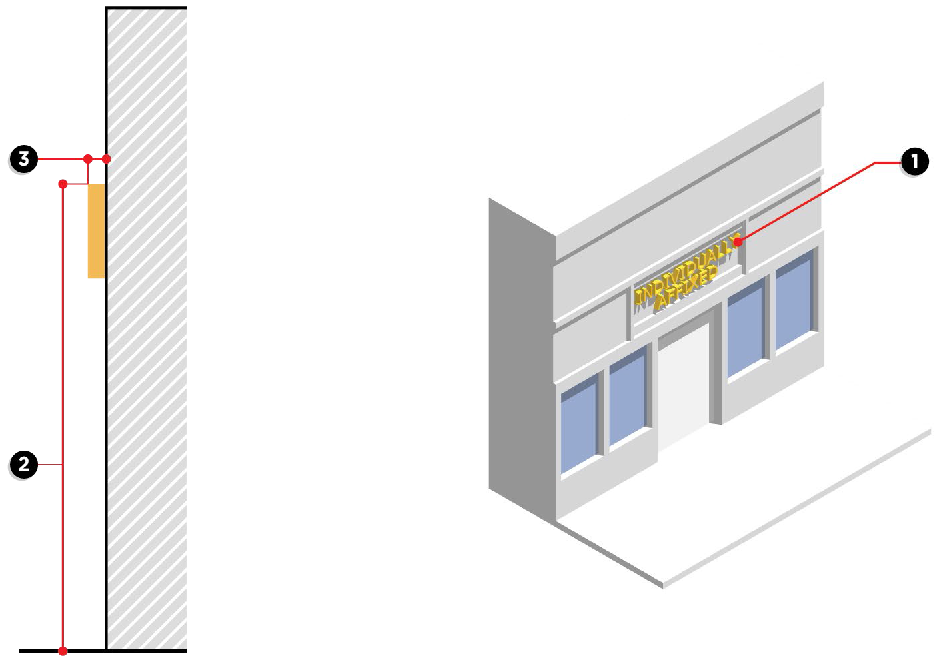
Graphic 15-691(1). Wall Signs
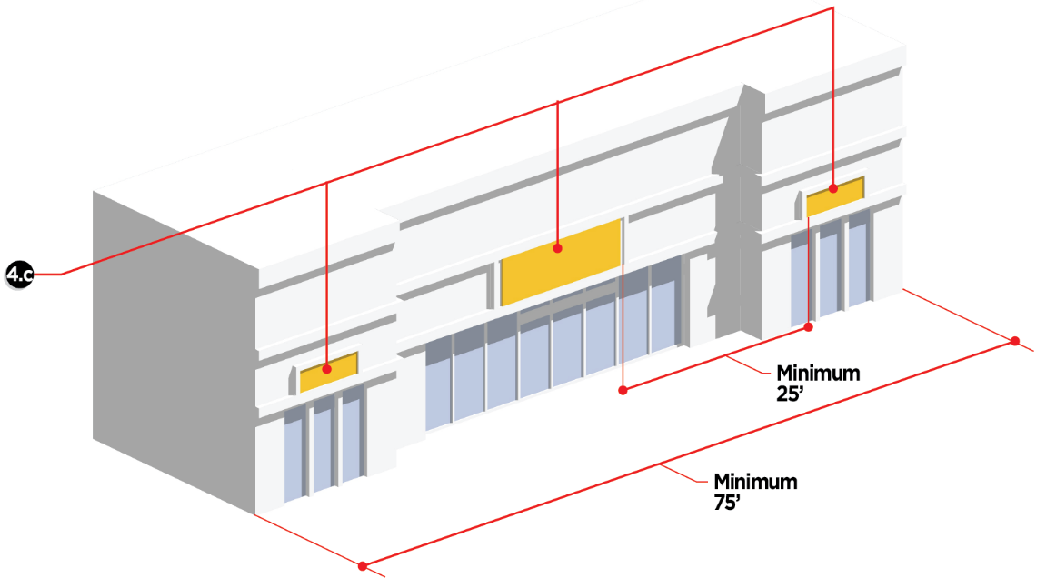
Graphic 15-691(2). Secondary Wall Signs
(b)
Single-tenant monument signs.
(1)
Sign area.
a.
The maximum permitted sign area of single-tenant monument signs in the UT, RE, R1, R2, and RM districts shall not exceed 15 square feet.
b.
The maximum permitted sign area of single-tenant monument signs in the CO, CR, CH, CG, IG, IH, P, and HC districts shall not exceed 50 square feet.
(2)
Height.
a.
The maximum permitted height of single-tenant monument signs in the UT, RE, R1, R2, and RM districts shall not exceed five feet.
b.
The maximum permitted height of single-tenant monument signs in the CO, CR, CH, CG, IG, IH, P, and HC districts shall not exceed ten feet.
(3)
Number of signs. A maximum of one single-tenant monument sign shall be permitted per lot frontage.
(4)
Location. Single-tenant monument signs shall be located a minimum of five feet from all property lines, rights-of-way, and utility easements; shall not block points of ingress or egress; be placed in any sidewalk or pedestrian walkway and shall not be located in a clear vision triangle as detailed in section 15-520.
(5)
Sign base. The base of single-tenant monument signs, including all structural components, shall extend horizontally from the sign face a minimum of ten percent and a maximum of 25 percent of the width of the sign face. The base of single-tenant monument signs shall be constructed from masonry, stone, or similar high-quality materials in keeping with the materials and design of the principal building of the lot.
(6)
Landscape requirement. All single-tenant monument signs shall be required to plant and maintain a landscape area at the base of the sign. The minimum area of the landscape area shall be equal to the square footage of the sign area of the sign it serves. Landscape areas shall be planted with one shrub or native grass per three square feet.
(7)
Other provisions. A single-tenant monument sign shall not be permitted on a lot frontage with an existing multitenant monument sign or pole/pylon sign.
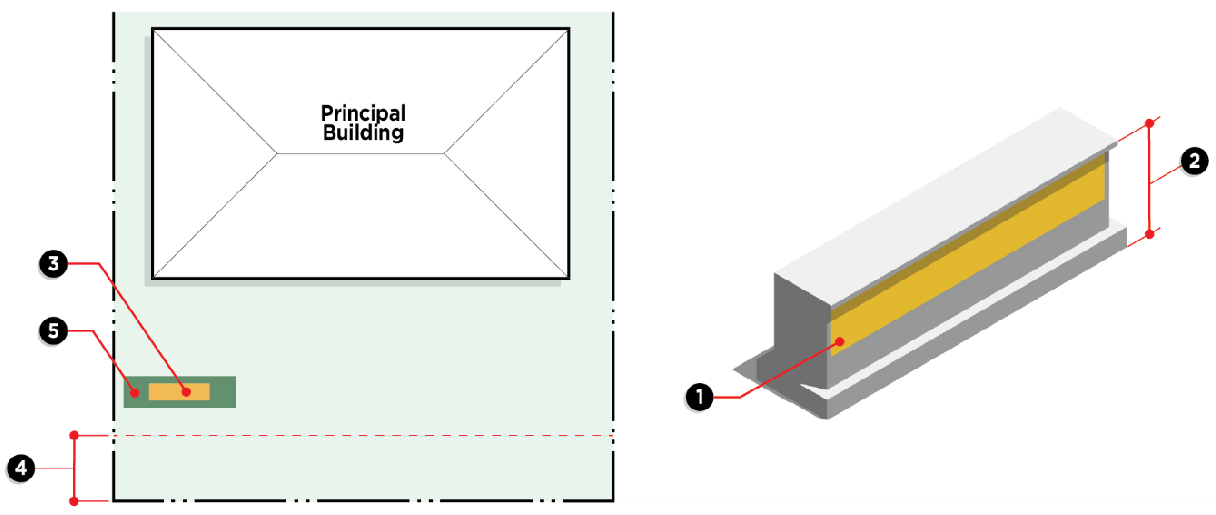
Graphic 15-691(3). Single Tenant Monument Signs
(c)
Multitenant monument signs.
(1)
Sign area. The maximum permitted sign area of multitenant monument signs shall not exceed 100 square feet.
(2)
Height. The maximum permitted height of multitenant monument signs shall not exceed 14 feet.
(3)
Number of signs. A maximum of one multitenant monument sign shall be permitted per lot frontage.
(4)
Location. Multitenant monument signs shall be located a minimum of five feet from all property lines, rights-of-way, and utility easements; shall not block points of ingress or egress; be placed in any sidewalk or pedestrian walkway and shall not be located in a clear vision triangle as detailed in section 15-520.
(5)
Sign base. The base of multitenant monument signs, including all structural components, shall extend horizontally from the sign face a minimum of ten percent and a maximum of 25 percent of the width of the sign face. The base of multitenant monument signs shall be constructed from masonry, stone, or similar high-quality materials in keeping with the materials and design of the principal building of the lot.
(6)
Landscape requirement. All multitenant monument signs shall be required to plant and maintain a landscape area at the base of the sign, the minimum area of which shall be equal to the square footage of the sign area of the sign it serves. Landscape areas shall be planted with one shrub or native grass per three square feet.
(7)
Other provisions. A multitenant monument sign shall not be permitted on a lot frontage with an existing single-tenant monument sign or pole/pylon sign.
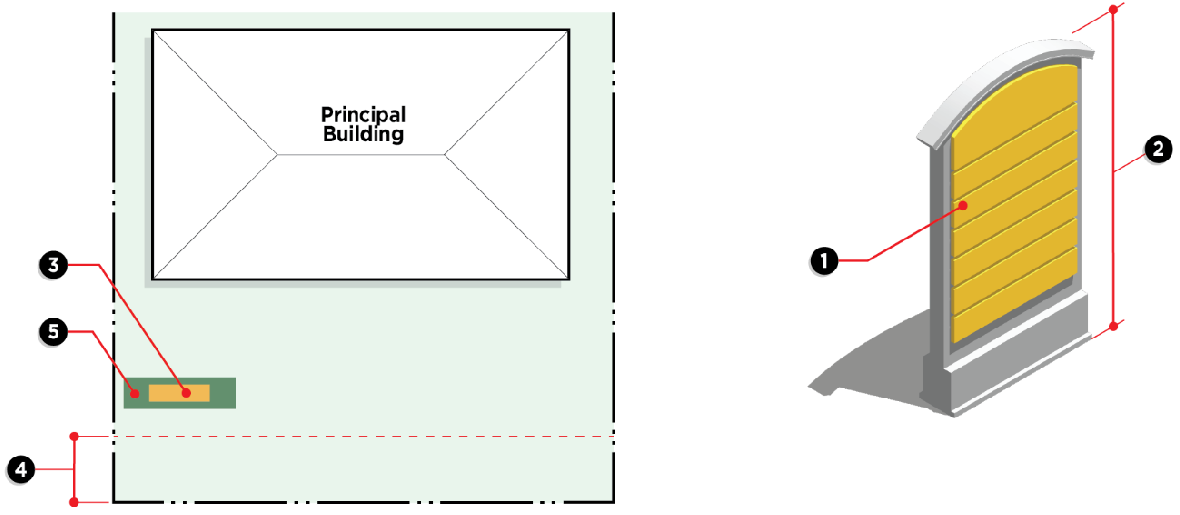
Graphic 15-691(4). Multitenant Monument Signs
(d)
Pole/pylon signs.
(1)
Sign area.
a.
The maximum permitted sign area of pole/pylon signs serving a single-tenant building shall not exceed 30 square feet.
b.
The maximum permitted sign area of pole/pylon signs serving a multitenant building shall not exceed 60 square feet.
(2)
Height.
a.
The maximum permitted height of pole/pylon sign serving a single-tenant building shall be 20 feet.
b.
The maximum permitted height of pole/pylon sign serving a multitenant building shall be 30 feet.
(3)
Number of signs. A maximum of one pole/pylon sign shall be permitted per lot frontage.
(4)
Location. Pole/pylon signs shall be located a minimum of five feet from all property lines, rights-of-way, and utility easements; shall not block points of ingress or egress; be placed in any sidewalk or pedestrian walkway and shall not be located in a clear vision triangle as detailed in section 15-520.
(5)
Landscape requirement. All pole/pylon signs shall be required to plant and maintain a landscape area at the base of the sign, the minimum area of which shall be equal to the square footage of the sign area of the sign it serves. Landscape areas shall be planted with one shrub or native grass per three square feet.
(6)
Other provisions. A pole/pylon signs shall not be permitted on a lot frontage with an existing single-tenant or multitenant monument sign.
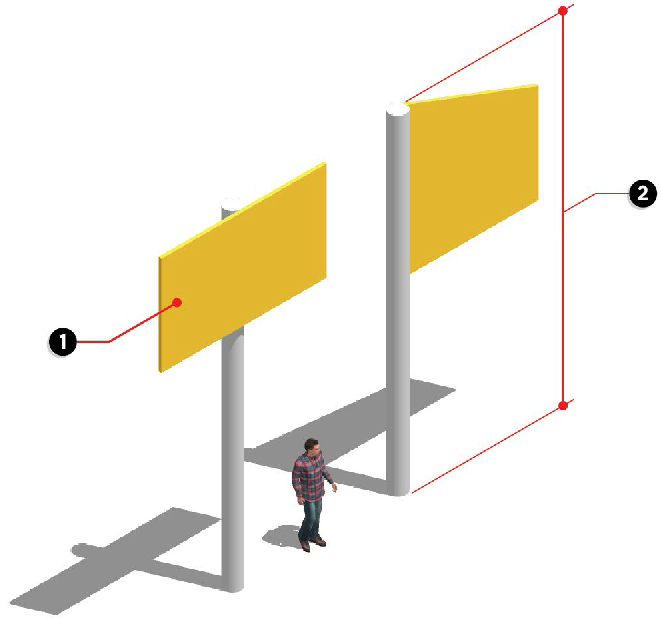
Graphic 15-691(5). Pole/Pylon Signs
(e)
Awning or canopy signs.
(1)
Sign area. The maximum permitted sign area of awning or canopy signs shall be 50 percent of the face of the awning or canopy upon which the sign shall be printed or affixed. The area of the awning or canopy sign shall count towards the maximum amount of sign area permitted for wall signs as detailed in section 15-520.
(2)
Other provisions.
a.
Awning or canopy signs shall only be permitted on awnings or canopies extending above ground floor entrances or windows.
b.
Awning or canopy signs shall not be internally illuminated.
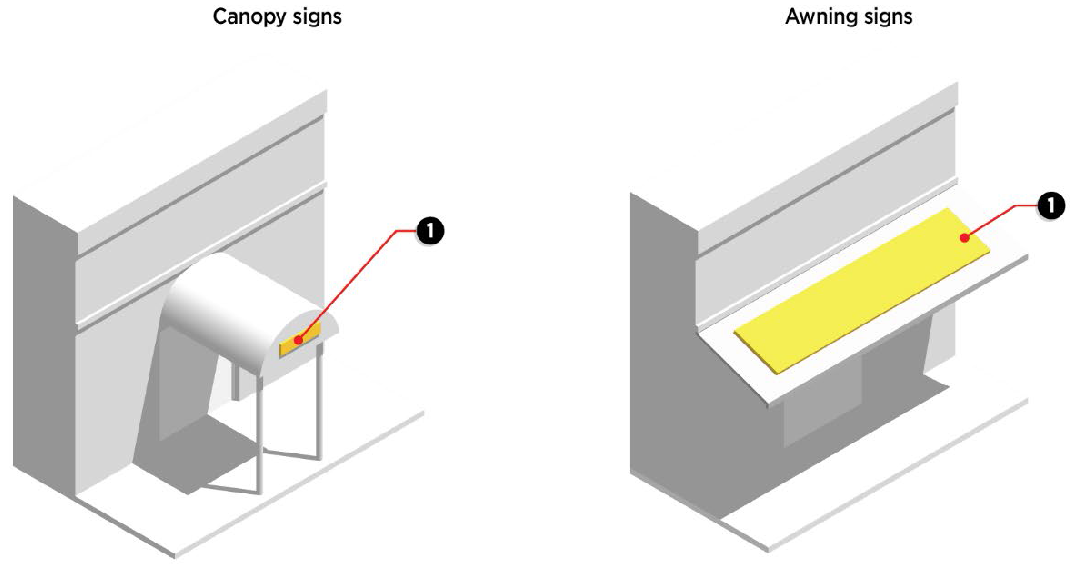
Graphic 15-691(6). Awning or Canopy Signs
(f)
Window signs, permanent; sign area. The maximum permitted sign area of a permanent window sign shall be 25 percent of the square footage of the individual window on which the sign shall be located. Permanent window sign area shall be counted in aggregate with temporary window sign area.
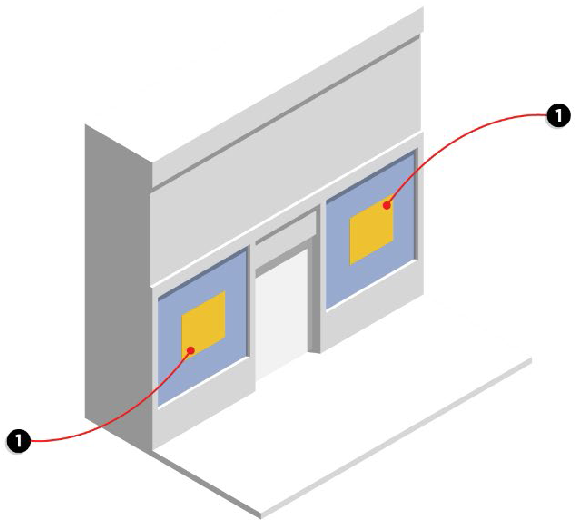
Graphic 15-691(7). Window Signs, Permanent
(g)
On-site traffic directional signs.
(1)
Sign area. The maximum permitted sign area of an on-site traffic directional sign shall be six square feet. Permitted on-site traffic directional sign area shall not count towards aggregate sign area.
(2)
Height. The maximum permitted height of an on-site traffic directional sign shall be four feet.
(3)
Number of signs. The permitted number of on-site traffic directional signs shall be determined by the zoning administrator as necessary to assist in the safe movement of vehicular and pedestrian traffic on a property.
(4)
Location. On-site traffic directional signs shall be located a minimum of five feet from all property lines, rights-of-way, and utility easements; shall not block points of ingress or egress; be placed in any sidewalk or pedestrian walkway and shall not be located in a clear vision triangle as detailed in section 15-520.
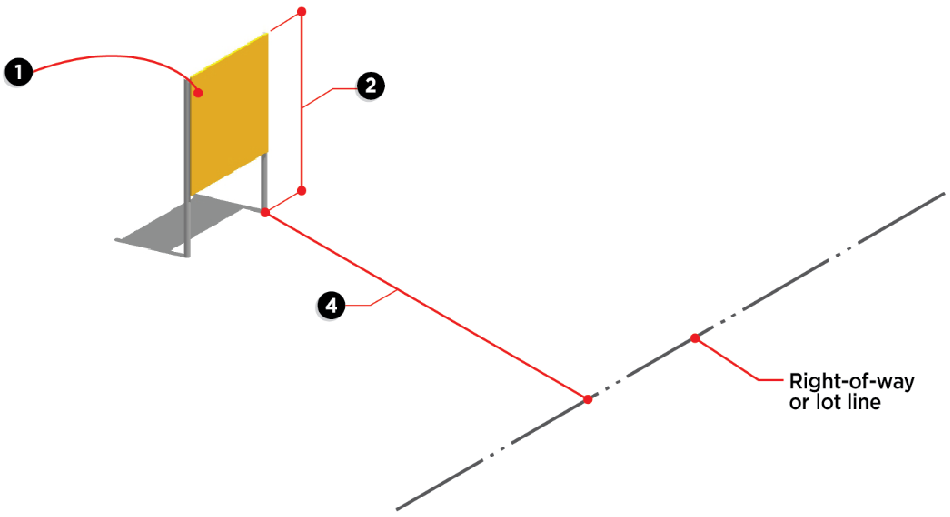
Graphic 15-691(8). On-Site Traffic Directional Signs
(Ord. of 3-2-2021, § 155.12.5)
Sec. 15-692. - Standards for temporary signs.
(a)
General standards for temporary signs in nonresidential districts.
(1)
Concurrent display. All nonresidential developments shall be permitted to display three temporary signs of any type concurrently.
(2)
Display period. The permitted display period of a temporary sign in a nonresidential district shall be a maximum of 30 days. A total of three nonconcurrent display periods shall be permitted per single-tenant building or unit of a multitenant building per calendar year. Nonconcurrent display periods shall be separated by a minimum of 30 days.
(3)
Temporary sign permit. The permitted display of a temporary sign in a nonresidential district shall require the issuance of a temporary sign permit as detailed in section 15-782.
(b)
Wall-mounted banner signs.
(1)
Sign area.
a.
The maximum permitted sign area of wall-mounted banner signs in the UT, RE, R1, R2, and RM districts shall not exceed 16 square feet.
b.
The maximum permitted sign area of wall-mounted banner signs in the CO, CR, CH, CG, IG, IH, P, and HC districts shall not exceed 32 square feet.
(2)
Height. No wall-mounted banner sign shall protrude above the highest roofline or above the top of the parapet wall or mansard roof.
(3)
Number of signs. A maximum of one wall-mounted banner sign shall be permitted per lot frontage of a single tenant building or unit of a multitenant building.
(4)
Location. Wall-mounted banner signs shall be affixed to a building.
(5)
Projection. Wall-mounted banner signs shall be affixed flat against the building to which they are mounted.
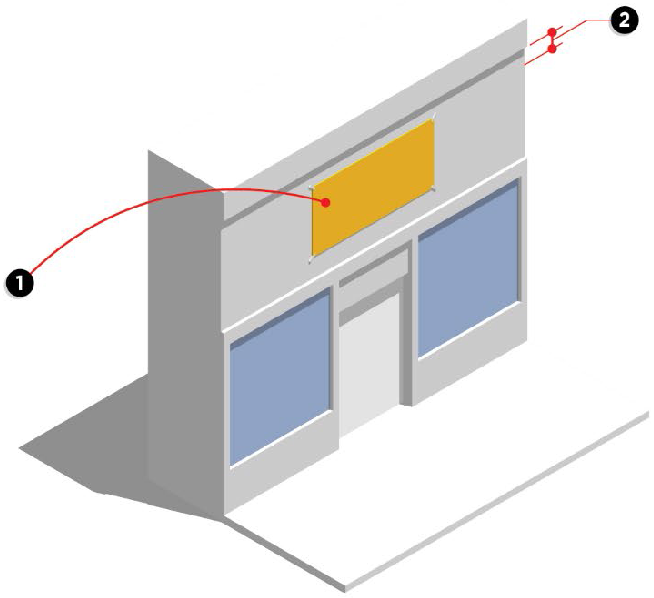
Graphic 15-692(1). Wall-Mounted Banner Signs
(c)
Ground-mounted banner signs.
(1)
Sign area. The maximum permitted sign area of a ground-mounted banner sign shall be 32 square feet.
(2)
Height. The maximum permitted height of a ground-mounted banner sign shall be six feet.
(3)
Number of signs. A maximum of one ground-mounted banner sign shall be permitted per lot frontage.
(4)
Location. Ground-mounted banner signs shall be located a minimum of five feet from all property lines, rights-of-way, and utility easements; shall not block points of ingress or egress; be placed in any sidewalk or pedestrian walkway and shall not be located in a clear vision triangle as detailed in section 15-520.
(5)
Other provisions.
a.
Ground-mounted banner signs shall be securely anchored into the ground or secured in a portable base designed for such function.
b.
Ground-mounted banner signs shall be maintained in good condition and shall not sag, lie on the ground, be torn, or otherwise kept in a disorderly state.
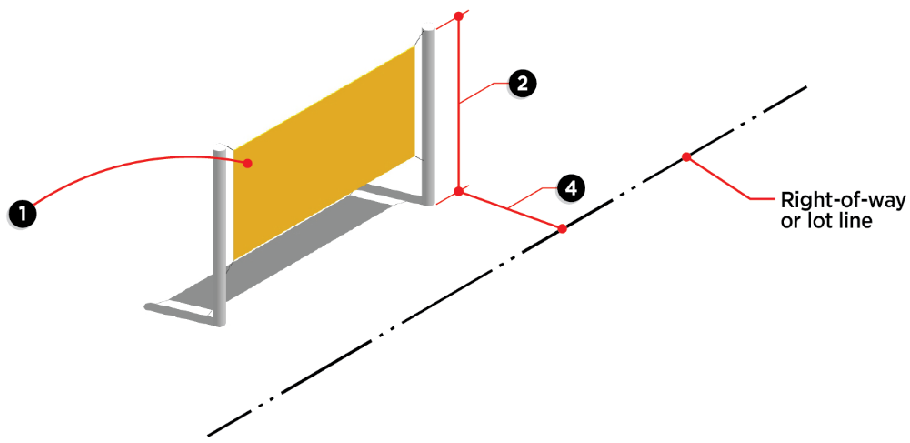
Graphic 15-692(2). Ground-Mounted Banner Signs
(d)
Feather signs.
(1)
Sign area. The maximum permitted sign area of feather signs shall be 16 square feet.
(2)
Height. The maximum height of a feather sign shall be eight feet.
(3)
Number of signs. A maximum of three feather sign shall be permitted per lot frontage.
(4)
Location. Feather signs shall be located a minimum of five feet from all property lines, rights-of-way, and utility easements; shall not block points of ingress or egress; be placed in any sidewalk or pedestrian walkway and shall not be located in a clear vision triangle as detailed in section 15-520.
(5)
Other provisions.
a.
Feather signs shall be securely anchored into the ground or secured in a portable base designed for such function.
b.
Feather signs shall be maintained in good condition and shall not sag, lie on the ground, be torn, or otherwise kept in a disorderly state.
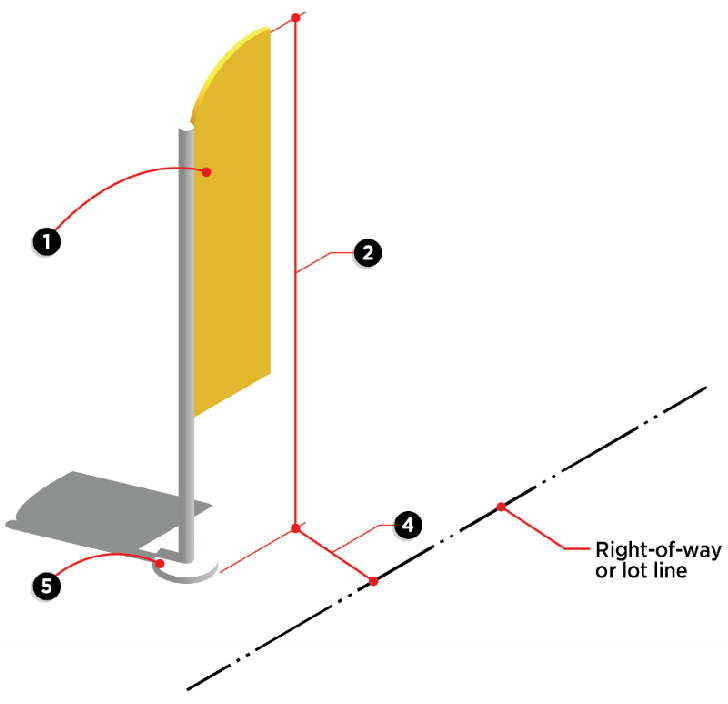
Graphic 15-692(3). Feather Signs
(e)
Window signs, temporary; sign area. The maximum permitted sign area of a temporary window sign shall be 25 percent of the square footage of the individual window on which the sign shall be located. Temporary window sign area shall be counted in aggregate with permanent window sign area.
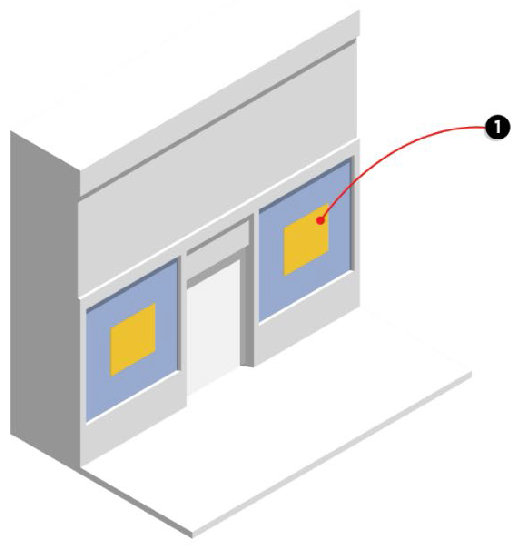
Graphic 15-692(4). Window Signs, Temporary
(f)
Post signs.
(1)
Sign area. The maximum permitted sign area of a post sign shall be six square feet.
(2)
Height. The maximum permitted height of a post sign shall be six feet.
(3)
Number of signs. A maximum of one post sign shall be permitted per lot frontage.
(4)
Location. Post signs shall be located a minimum of five feet from all property lines, rights-of-way, and utility easements; shall not block points of ingress or egress; be placed in any sidewalk or pedestrian walkway and shall not be located in a clear vision triangle as detailed in section 15-520.
(5)
Other provisions.
a.
Post signs shall be securely anchored into the ground or secured in a portable base designed for such function.
b.
Post signs shall be maintained in good condition and shall not sag, lie on the ground, be torn, or otherwise kept in a disorderly state.
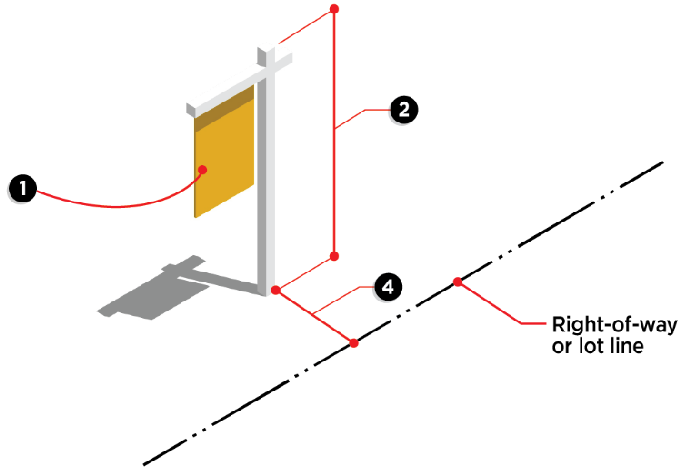
Graphic 15-692(5). Post Signs
(g)
Yard signs.
(1)
Sign area. The maximum permitted sign area of a yard sign shall be four square feet.
(2)
Height. The maximum permitted height of a yard sign shall be 3.5 feet.
(3)
Number of signs. A maximum of two-yard signs may be displayed concurrently. However, during the period 30 days before and 30 days after a general election a maximum of four-yard signs may be displayed concurrently.
(4)
Location. Yard signs shall be located a minimum of five feet from all property lines, rights-of-way, and utility easements; shall not block points of ingress or egress; be placed in any sidewalk or pedestrian walkway and shall not be located in a clear vision triangle as detailed in section 15-520.
(5)
Other provisions.
a.
Yard signs shall be securely anchored into the ground or secured in a portable base designed for such function.
b.
Yard signs shall be maintained in good condition and shall not sag, lie on the ground, be torn, or otherwise kept in a disorderly state.
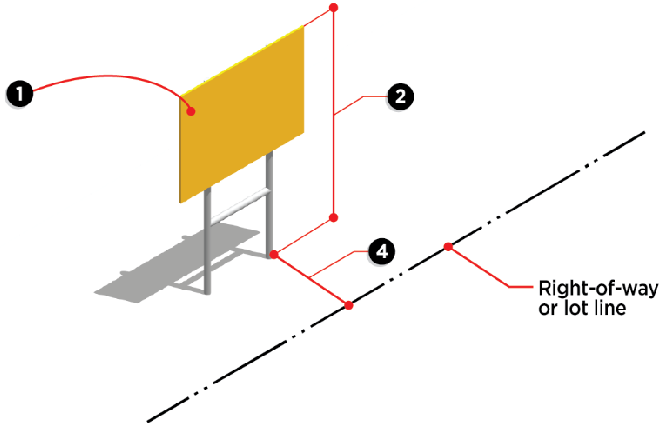
Graphic 15-692(6). Yard Signs
(Ord. of 3-2-2021, § 155.12.6)
Sec. 15-693. - Prohibited signs and content.
(a)
Prohibited signs. The following sign types shall be prohibited in all zoning districts:
(1)
Roof signs.
(2)
Outline lighting.
(3)
Billboards.
(4)
Attention getting devices.
(5)
Signs which encroach on the public right-of-way.
(b)
Prohibited content.
(1)
The following content is prohibited without reference to the viewpoint of the individual speaker:
a.
Text or graphics of an indecent or immoral nature and harmful to minors;
b.
Text or graphics that advertise unlawful activity;
c.
Text or graphics that are obscene, fighting words, defamation, incitement to imminent lawless action, or true threats; or
d.
Text or graphics that present a clear and present danger due to their potential confusion with traffic control signs or signs that provide public safety information (for example, signs that use the words "stop," "yield," "caution," or "danger," or comparable words, phrases, symbols, or characters in such a manner as to imply a safety hazard that does not exist).
(2)
The narrow classifications of content that are prohibited by this subsection (b) are either not protected by the federal or state constitutions or are offered limited protection that is outweighed by the substantial governmental interests in protecting the public safety and welfare. It is the intent of the village board that each paragraph of this subsection (b) be individually severable in the event that a court of competent jurisdiction were to hold one or more of them to be inconsistent with the federal or state constitutions.
(Ord. of 3-2-2021, § 155.12.7)
Sec. 15-694. - Comprehensive sign plan.
(a)
Applicability. The zoning administrator may approve a comprehensive sign plan for lots adjacent to federal or state highways.
(b)
Conditions. The zoning administrator may attach conditions, requirements, or standards necessary to ensure that the signs covered by the comprehensive sign plan will not be materially detrimental to persons or property in the vicinity. In making its determination, the zoning administrator shall not base any condition on the message content of a sign.
(c)
Evaluation criteria.
(1)
Placement. All signs shall be placed where they are visible and legible. Factors to be considered include the location of a sign relative to traffic movement and access points, site features, other structures, and orientation relative to viewing distances and viewing angles. Wall signs may be approved on building walls other than the wall of a unit of a multitenant building in which some units have little or no visibility from the street.
(2)
Quantity. The number of signs that may be approved within any development shall be sufficient to provide necessary facilitation of internal circulation of vehicular and pedestrian traffic and way finding for safety of the occupants of vehicles and pedestrians. Factors to be considered shall be those that impact safety considerations such as the size of the development and the number of development sub-areas.
(3)
Size. All signs shall be no larger than necessary for visibility and legibility. Factors to be considered in determining appropriate size include topography, volume, and speed of traffic, viewing distances and angles, proximity to adjacent uses, and placement of display.
(4)
Design features and materials. Sign design themes and materials shall be compatible with the architecture, colors, and materials of the project.
(Ord. of 3-2-2021, § 155.12.8)
Sec. 15-695. - General requirements.
(a)
Illumination.
(1)
Location and design of light source. When an external artificial light source is used for a sign, such source shall be located, shielded, and directed so as not to be directly visible from any public street or private residence. No receptacle or device housing a permitted light source for a sign shall protrude more than 12 inches from the face of the sign or building to which it is attached except if such light source is ground mounted, locked in place, and cannot be redirected.
(2)
Level of illumination. In no event shall the illumination of any sign, resulting from any internal or external artificial light source, exceed the exterior lighting standards detailed in section 15-523. All artificial illumination shall be so designed, located, shielded, and directed as to prevent the casting of glare or direct light upon adjacent property or streets.
(3)
Signs adjacent to residential areas. Any illuminated sign located on a lot abutting or across a street from, and visible from, any residentially zoned area shall not be illuminated between the hours of 10:00 p.m. and 7:00 a.m. except that such sign may remain illuminated during such time as the activity to which the sign pertains is open for business so long as such sign is not a public or private nuisance.
(b)
Electronic message boards. Single-tenant and multitenant monument signs and pole/pylon signs may incorporate electronic message boards in accordance with the following.
(1)
The area of the sign devoted to the electronic message board shall not exceed 40 percent of the sign area of which it is a part.
(2)
The area of the sign devoted to the electronic message board shall be part of, not in addition to, the maximum permitted sign area.
(3)
The electronic message format shall conform to the following requirements:
a.
The message shall contain a static or scrolling message or image only and not otherwise have movement, or the appearance of movement, during the static or scrolling display period.
b.
The transition to change from one message or image to another shall be instant and not dissolve, fade, scroll, travel, or have similar transitions.
c.
The message shall not change more frequently than once every 30 seconds.
(4)
All electronic message boards shall be equipped with a sensor or other device that automatically determines the ambient illumination and is programmed to automatically dim according to ambient light conditions.
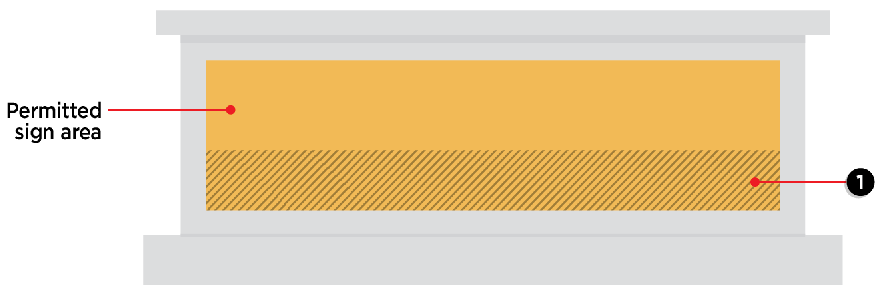
Graphic 15-695. Electronic Message Boards
(c)
Safety, maintenance, and abandonment.
(1)
Every sign and all parts thereof, including framework, supports, background, anchors and wiring systems shall be constructed and maintained in compliance with the property maintenance, building, electrical and fire protection codes of the village.
(2)
All signs, for which a permit is required, together with all supports, braces, guys, and anchors shall be kept in proper repair in accordance with the provisions of this chapter. When not galvanized or constructed of approved corrosion resistive, noncombustible materials, signs shall be painted when necessary to prevent corrosion, rust, peeling paint, and excessive fading. Failure of owners to keep signs maintained in good mechanical and visual repair shall be deemed a violation of this chapter.
(3)
It shall be the duty and responsibility of the owner or lessee of every sign to maintain the immediate premises occupied by the sign in a clean condition, free of rubbish. Any landscaping surrounding the sign shall be kept trimmed and in good repair. If the landscaping installed at the time of sign approval dies, the landscaping shall be replaced immediately or as soon as weather permits.
(4)
Every existing sign shall be subject to an inspection whenever the zoning administrator deems it necessary. In the event an inspection demonstrates that repairs, and/or maintenance is necessary, the sign owner shall be notified and required to complete the repairs and/or maintenance within 30 days of notification. The zoning administrator is authorized to grant one 30-day extension, if, upon written request, it is deemed necessary due to extenuating circumstances.
(5)
If the zoning administrator shall find that any sign is unsafe or unsecure, or is a threat to the public safety, or was, after the adoption of the ordinance from which this chapter is derived constructed, erected, or maintained in violation of the provisions of this chapter, he shall give written notice per the provisions of this chapter. Such notice shall specify the manner of which the sign is unsafe or in violation of this chapter.
(6)
If the zoning administrator finds a sign unsafe and an immediate peril to persons or property, he shall act to have the sign removed or altered summarily and without notice at the owner's expense. Such sign may be removed or altered by the village and a lien placed on the property for the full cost of such action, including administration, legal, and overhead costs.
(7)
Sign copy shall be removed and in the case of a wall sign, the building facade shall be repaired, by the owner or lessee of the premises upon which the sign is located when the use which the sign is associated is no longer conducted on the premises. The sign copy shall be removed within 30 days of when the use ceases to operate. If the owner or lessee fails to remove the sign copy, the zoning administrator shall give the owner 30 days written notice to remove it. Upon failure to comply with the notice, the zoning administrator may have the sign removed at the owner's expense.
(d)
Illegal signs.
(1)
Illegal permanent signs. If any permanent sign has been constructed or erected or is being maintained in violation of the provisions of this chapter, written notice shall be given to the occupant or property owner of the property on which the sign is located. If the occupant or property owner fails to remove or alter the permanent sign so as to comply with the standards set forth in this chapter or contact the zoning administrator to begin the repair or removal process within ten days after receipt of such notice, such sign may be removed or altered by the village and a lien placed on the property for the full cost of such action, including administration, legal, and overhead costs.
(2)
Illegal temporary signs. If any temporary sign has been constructed or erected or is being maintained in violation of the provisions of this chapter, written notice shall be given to the occupant or property owner of the property on which the sign is located. If the occupant or property owner fails to remove or alter the temporary sign so as to comply with the standards set forth in this chapter within 48 hours after receipt of such notice, such sign may be removed or altered by the village and a lien placed on the property for the full cost of such action, including administration, legal, and overhead costs.
(3)
Illegal signs on public property. If any sign has been placed upon public property for any purpose without the express permission of the village, it shall be removed by the village, without notice.
(Ord. of 3-2-2021, § 155.12.9)

