
Roscoe City Zoning Code
ARTICLE XI
LANDSCAPING
Sec. 15-652.- Purpose and intent.
The intent of this article is to provide screening and buffering between potentially incompatible uses and between specific operations which may create a nuisance for the occupants of adjoining properties.
(Ord. of 3-2-2021, § 155.11.1)
Sec. 15-653. - Applicability.
(a)
This landscape ordinance shall be applicable to all zoning districts and land uses within the village. The regulations contained herein shall be applied for any plan, plat or permit requiring review and or approval involving of any land development, alteration and or modification of a zoning lot, building structure, or parking facility contained therein requiring zoning department approval to maintain and protect property values.
(b)
Individuals purchasing property within a completed residential development and homeowners' associations in the case of townhome and condominium developments with established landscaping covenants shall be exempt from the planting specification and regulations contained herein, with the following exceptions:
(1)
Any landscape plan approved as part of a development shall be maintained as the minimum landscape requirements for that development and shall not be removed without zoning administrator approval;
(2)
All maintenance responsibilities as specified in this section and the proximity of plant materials to municipal utilities and property as stated in this section shall be enforced;
(3)
Parkway trees and plantings shall be required to meet and established regulations for the applicable district.
(Ord. of 3-2-2021, § 155.11.2)
Sec. 15-654. - Landscape plan submittal requirements.
(a)
Landscape plan. A landscape plan shall be submitted with any application requiring site plan review. At a minimum the final landscape plan shall be required to indicate the following, or be a component of a larger development proposal that includes the following:
(1)
The owner's name and address, if different from the applicant, and the owner's signed consent to the filing of the plan;
(2)
The street address and legal description of the property;
(3)
Title, scale, north marker, and date;
(4)
Zoning of site and all adjoining property;
(5)
All lot lines, easements and rights-of-way;
(6)
All surrounding roads names;
(7)
The total square footage of the site area dedicated for vehicle use, including parking, loading, queuing, circulation, and drop-off/pick-up area;
(8)
Existing and proposed trees, shrubs, and ground cover, natural features such as outcroppings, wetlands, and other landscaping elements;
(9)
Existing and/or proposed locations of plantings and/or construction details including paving materials, walls, fences, and street furniture;
(10)
Tree species, installation size, number of trees, and an approximate planting timetable;
(11)
Existing plant material to be preserved during construction shall be indicated on the submitted landscape plans along with the proposed methods for protection;
(12)
Existing and proposed site contours on the project site and 100 feet beyond the site lot lines, at intervals not to exceed two feet;
(13)
Typical cross section, including slope, height and width, of berms and the type of ground cover to be placed on them;
(14)
All existing and proposed drainage and detention areas;
(15)
Size and location of berms, fences and other screening or screening devices; and
(16)
Other information or documentation as the zoning administrator may deem necessary to allow a full and proper consideration and disposition of the particular plan, including, but not limited to, special features, sign locations, lighting, decks, paving, gazebos, or other structures.
(b)
Minor and major changes to approved landscape plans.
(1)
Minor changes to the landscape plan that do not result in a reduction in the net amount of plant material as specified on the approved landscape plan shall be approved by the zoning administrator.
(2)
Changes to the size and amount of plant materials of an approved landscape plan shall be considered a major change. Major changes shall be approved by the body granting approval of the landscape plan initially.
(Ord. of 3-2-2021, § 155.11.3)
Sec. 15-655. - General landscaping requirements.
(a)
Topsoil preservation.
(1)
A site development permit shall be required prior to the clearing, grading, transportation, or other movement of soil or earth. A detailed sketch plan showing all property lines, acreage, zoning, proposed utilities and structures, existing utilities and structures, soil type, adjacent land-uses, and floodplains shall be provided. A site development permit shall not be required for rototilling, planting, or other activity typically associated with privately maintained residential lots and gardens. Topsoil moved during construction shall be redistributed on all re-graded surfaces to provide a minimum of six inches of even cover throughout the development area, and shall be stabilized following final grading using seed, sod, hydro-seed, or other vegetation. During construction, erosion control devices, including silt fences, hay bales, ditch checks, inlet protection, and tarps, shall be used to prevent destabilized soils from being washed or blown from the site. All erosion control measures shall be approved by the village engineer prior to beginning construction.
(2)
Temporary material and soil deposit may not be placed within five feet of shrubs or within ten feet of the drip line of any tree designated to be retained on the landscape plan. Protective barriers and tree wells shall be installed around all plants, trees, and/or groups thereof that are to be retained. Barriers shall be at least four feet in height and constructed of durable materials and are to remain in place until construction is completed.
(b)
Debris removal. All stumps, tree parts, litter, brush, weeds, scrap or excess building materials, or other debris shall be removed from the site prior to the issuance of the occupancy permit. No tree stumps, tree parts, or other debris shall be buried anywhere in the development. Plant and tree material which is reduced to mulch may be used in landscaping areas, subject to zoning administrator approval.
(c)
Slope plantings. Landscaping of terraces, cuts, and fills shall be done using plant materials shown to prevent soil erosion. All slops greater than 3:1 or 33 percent slope shall be landscaped with ground cover and materials appropriate for the type of planting, soil conditions, and the surrounding environment.
(d)
Additional landscaping. All areas not covered by site improvements shall be landscaped with grass, shrubs, trees, ground cover or a combination thereof in accordance with the approved landscape plan. In addition to the required ground cover, street trees, and screening, additional landscaping elements and plantings may be required where necessary for climate control, privacy, or other reasons in accordance with the landscape plan.
(e)
Durable materials. All walls and fences hereafter erected shall be durable, weather-resistant, rustproof, and easily maintained. All fences shall be kept in good condition, plumb and true, and without damage.
(f)
Masonry walls. Masonry walls shall be erected on foundations which are a minimum of 42 inches below grade.
(g)
Privacy walls and fences. Walls and fences may be erected where necessary for privacy, screening, separation, security, erosion control, or other reasonable function. The design and materials used shall be functional and compatible with the surrounding environment and meet the requirements of section seven of this village zoning regulations.
(h)
Berms.
(1)
Berms shall not exceed a three to one (3:1) horizontal to vertical ratio and a maximum height of five feet above the base of the berm.
(2)
Berms shall be stabilized with a ground cover or suitable vegetation and properly located outside of clear vision areas.
(3)
Berms shall retain in good condition existing healthy vegetation designated for preservation.
(i)
Phased construction. Large tracts shall be graded in workable units following a scheduled timeline so that construction does not result in large areas left bare and exposed to seasonal runoff.
(Ord. of 3-2-2021, § 155.11.4)
Sec. 15-656. - Landscape areas and planting types.
(a)
Required landscape areas. Graphic 11.1 illustrates the location of the required landscape areas as discussed in this section. The zoning administrator may approve up to a 25 percent reduction in the overall required amount of landscape material for properties in industrial zoning districts not visible from properties in commercial or residential zoning districts or from major thoroughfares.
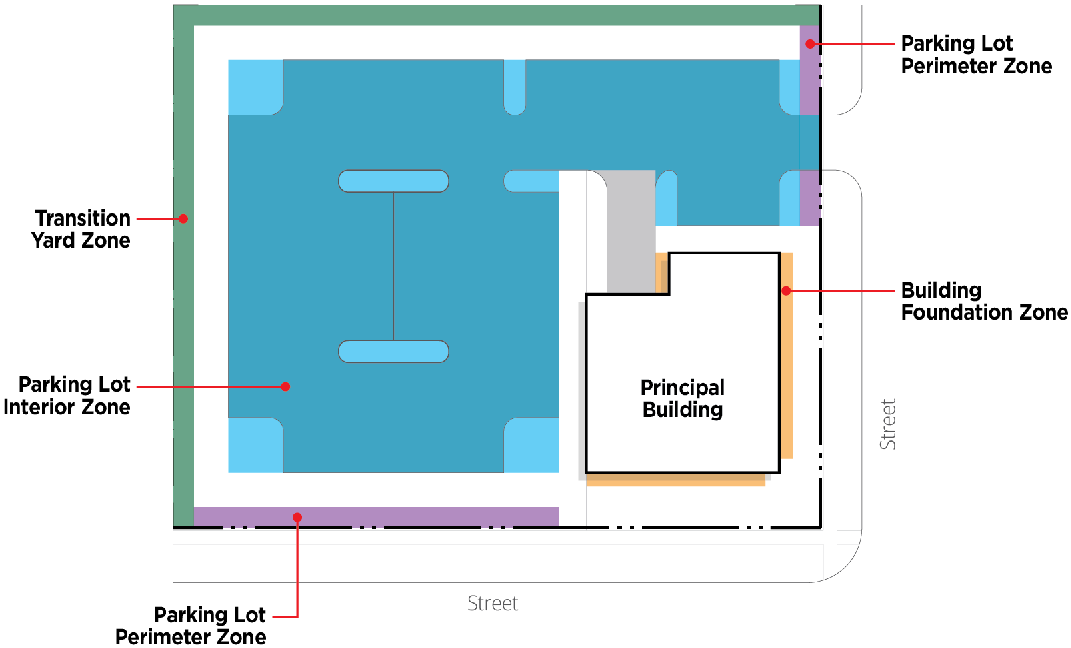
Graphic 15-656(1). Required Landscape
Areas
(b)
Planting types.
(1)
Canopy trees. A woody plant (deciduous or evergreen) having not less than a 2.5 inch caliper with single central axis which typically reaches a mature height of not less than 40 feet and a mature spread of not less than 15 feet.
(2)
Understory trees. A woody plant having not less than a 1.5 inch caliper, or six feet tall for multiple stem species, that normally attains a mature height of at least 15 feet.
(3)
Evergreen trees. A tree having foliage that persists and remains green throughout the year and has a height of not less than six feet at installation and maturing to a height of not less than 20 feet.
(4)
Shrub. A woody plant (deciduous or evergreen) of low to medium height characterized by multiple stems continuous from its base and having a height of not less than two feet.
(5)
Native grasses. Grasses that are native to, or adapted to, the state and that are commonly found in meadow and prairie plant communities, not including noxious weeds.
(6)
Herbaceous perennials. Plants with non-woody stems whose above-ground growth largely or totally dies back during winter months but whose underground plant parts (roots, bulbs, etc.) survive.
(7)
Groundcover. Herbaceous plants, other than turf grass, or prostrate shrubs normally reaching an average maximum height of 18 inches at maturity.
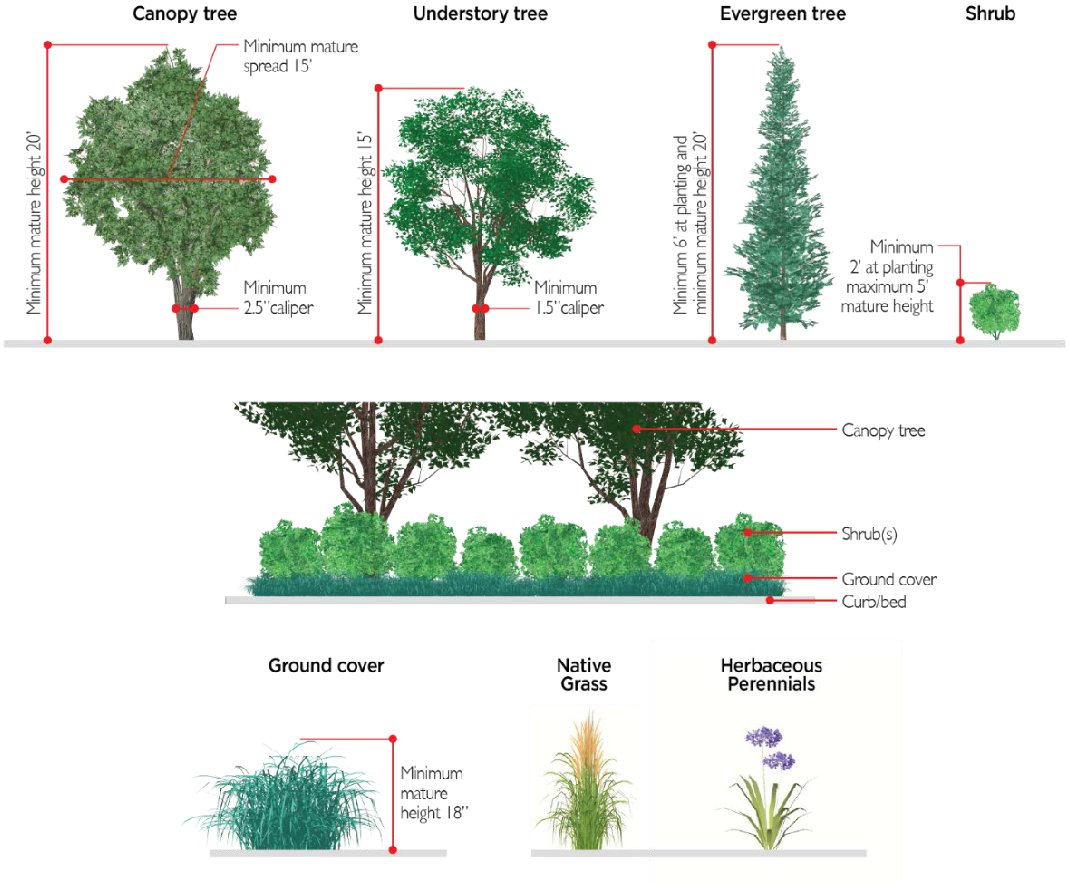
Graphic 15-656(2). Planting Types
(Ord. of 3-2-2021, § 155.11.5)
Sec. 15-657. - Building foundation landscape requirements.
All nonresidential, single-family attached, and multifamily development where a front yard setback is required shall include landscape located at the building foundation as required by this section. Landscape required by this section shall be in addition to landscape required under other sections of this chapter. It is the objective of this section to provide a softening effect at the base of buildings.
(1)
Applicable development is required to maintain a building foundation area at front and exterior side yards of seven feet at a minimum.
(2)
Foundation plantings shall be designed to supplement buffer yard plantings to frame important views, while visually softening long expanses of walls.
(3)
Foundation plantings shall be installed across 80 percent of the length of the facade of the building, except where walkways and driveways are located.
(4)
Foundation plantings may include trees, shrubs, native grasses, and groundcover.
(5)
When the area between the building and parking lot or street curb is entirely paved for pedestrian use, landscaping may consist of canopy trees planted in structural soils beneath tree grates or permeable pavement, at the rate of one tree per 50 linear feet of building facade. Minimum structural soil volume shall be 600 cubic feet.
(6)
Above-ground stormwater planter boxes along building facades may be substituted for foundation plantings.
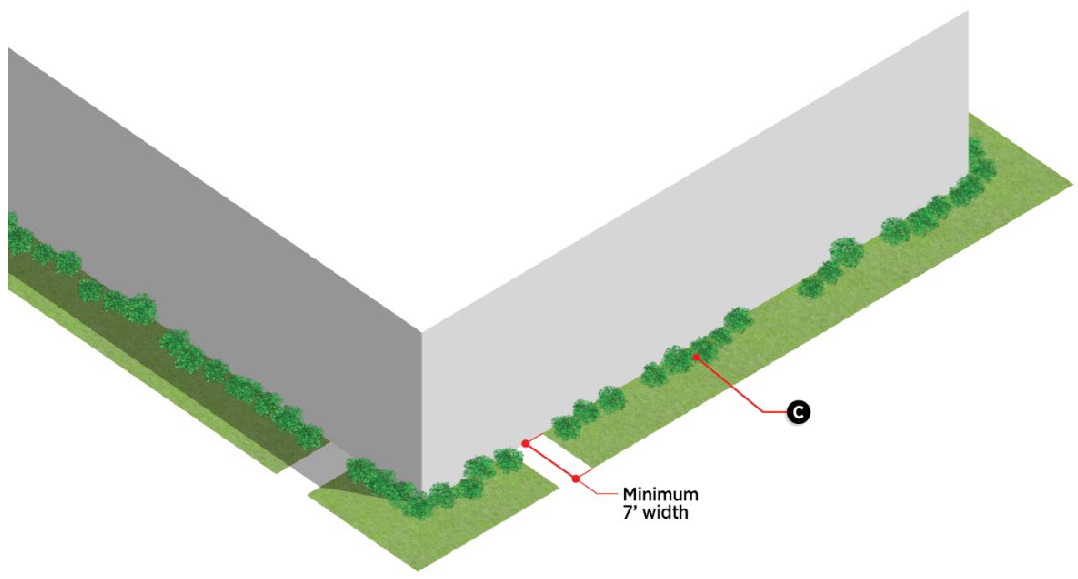
Graphic 15-657. Building Foundation Landscape Requirements
(Ord. of 3-2-2021, § 155.11.6)
Sec. 15-658. - Parking lot perimeter landscape requirements.
Trees and landscape required by this section shall be in addition to trees and landscape required under other sections of this chapter. It is the objective of this section to provide screening between parking areas and right-of-way, and to provide for the integration of stormwater management with required landscaping.
(1)
Location. All surface parking lots which abut a public or private right-of-way, excluding alleys, shall include landscape and trees as required by this section located between the parking lot back of curb and the right-of-way.
(2)
Applicability. The parking lot perimeter landscape regulations of this section apply to the following:
a.
The construction or installation of any new surface parking lot or vehicular use area; and
b.
The expansion of any existing surface parking lot or vehicular use area, in which case the requirements of this section apply only to the expanded area.
(3)
Requirements. Perimeter landscape shall be established along the edge of the parking lot with a minimum width of seven feet as measured from the parking lot back of curb, to accommodate vehicle bumper overhang and ensure planting areas that are adequate in size.
a.
The landscape treatment shall be located between the property line and the edge of the parking lot. Landscaped areas outside of shrub/native grasses and tree masses shall be planted in live groundcover. The landscaped area shall be improved as follows:
One shrub or native grasses the height of which shall not be less than three feet nor greater than five feet, shall be planted for every three feet of landscape area length. Required plant materials may run the full length of the parking lot perimeter area or may be clustered in landscape beds contiguous to the edge of parking lot. Landscape beds shall run for a minimum of 50 percent of the length of the parking lot.
b.
A low masonry wall or fence the height of which provides effective screening to a maximum height of three feet may be used in conjunction with required landscaping as detailed above. Plant materials shall be installed between the sidewalk and the fence or wall to provide a softening effect.
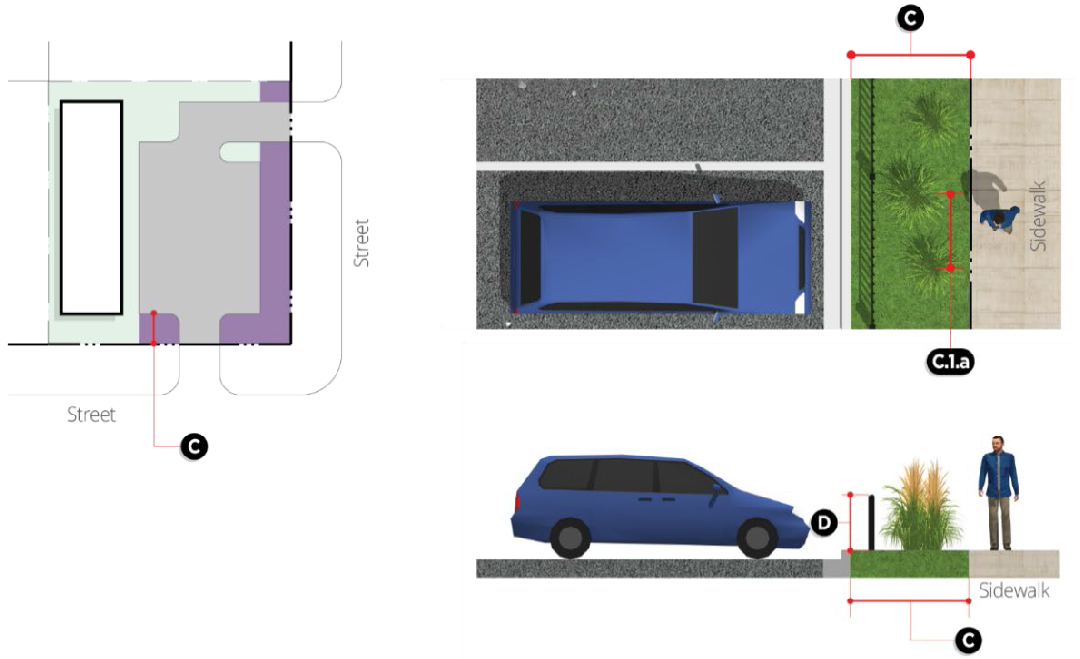
Graphic 16-658. Parking Lot Perimeter Landscape Requirements
(Ord. of 3-2-2021, § 155.11.7)
Sec. 15-659. - Parking lot interior landscape requirements.
All parking lots shall include landscape and trees located within the parking area as required by this section. Trees and landscape required by this section shall be in addition to trees and landscape required under other sections of this chapter. It is the objective of this section to provide shade within parking areas, break up large expanses of parking lot pavement, support stormwater management where appropriate, and provide a safe pedestrian environment.
(1)
Applicability. The parking lot interior landscape regulations of this section apply to the following:
a.
The construction or installation of any new surface parking lot containing 15 or more parking stalls; and
b.
The expansion of any existing surface parking lot if the expansion would result in 15 or more new parking stalls, in which case the requirements of this section apply only to the expanded area.
(2)
Requirements. For parking lots consisting of 15 or more continuous spaces, interior parking lot landscape as described herein shall be required. Parking lots consisting of fewer than 15 continuous spaces shall be required to terminate all rows of parking with a landscape area, as approved by the zoning administrator.
(3)
Amount. Required parking lot interior landscape area shall be provided in the form of islands and medians.
a.
Parking lot median amount requirement. Parking lot medians shall be placed between every third bay of parking.
b.
Parking lot island amount requirement. Parking lot islands shall be located on parking bays which are not required to have parking lot medians. Parking lot islands shall be spaced not more than 135 feet or more than 15 continuous spaces apart, and at the end of any bay of parking bordered by a drive aisle, public or private street, or pedestrian way.
(4)
Parking lot median standards.
a.
Size. Parking lot medians shall have a minimum width of nine feet and minimum soil depth of 36 inches.
b.
Planting. A minimum of one canopy tree and 15 shrubs or native grasses shall be planted for each 50 linear feet of parking lot median.
c.
Design. Parking lot medians shall be protected with concrete curbing unless the parking lot median is designed to be utilized for stormwater management in which case the perimeter shall be protect by wheel stops, or other suitable barriers. Such medians shall be properly drained or irrigated as appropriate to the site conditions to ensure survivability of plant materials and proper stormwater management function.
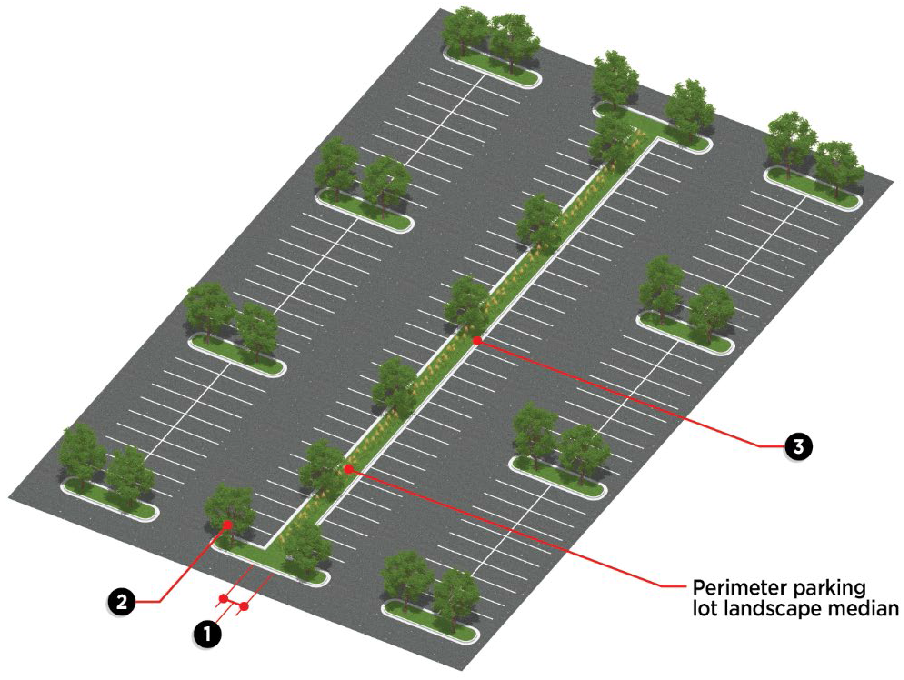
Graphic 15-659(1). Parking Lot Median Standards
(5)
Parking lot island standards.
a.
Size. Parking lot islands shall be a minimum nine feet wide by 18 feet long and shall have a minimum soil depth of 36 inches. Double rows of parking shall provide parking lot islands opposite one another to form continuous single islands.
b.
Planting. A minimum of one canopy tree shall be provided for every parking lot island. If the island extends the width of a double bay, then two canopy trees shall be provided.
c.
Design. Parking lot islands shall be protected with concrete curbing or other suitable barriers. Such islands shall be properly drained or irrigated as appropriate to the site conditions to ensure survivability of plant materials or proper stormwater management function.
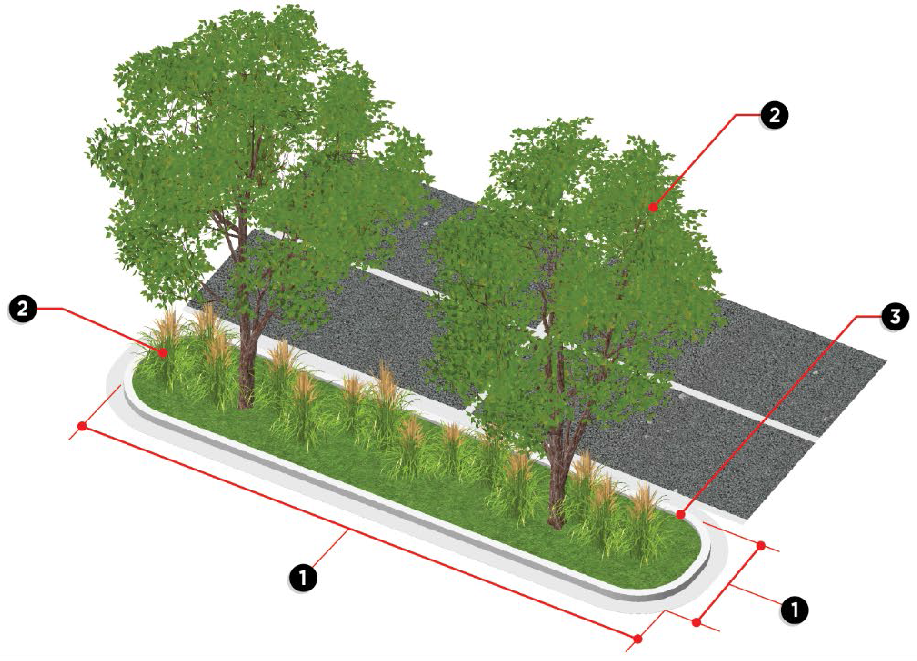
Graphic 15-659(2). Parking Lot Island Standards
(6)
Internal pedestrian walkways. Internal pedestrian walkways, as addressed in section 15-623, shall be located along parking lot medians. The zoning administrator may waive or modify this requirement on determining that locating internal pedestrian walkways along parking lot medians is impractical due to site conditions or undesirable because it would create unsafe conditions.
(7)
Type of landscape material. Except where areas are designed as vegetated stormwater management areas, canopy trees shall be the primary plant materials used in parking lot islands and canopy trees and shrubs or native grasses shall be the primary plant materials used in parking lot medians. Understory trees, evergreen trees, shrubs, native grasses, groundcover, and other plant materials may be used to supplement the required plantings but shall not create visibility concerns for automobiles and pedestrians. If medians or islands are designed as stormwater management areas, deviations from required plantings may be approved by the zoning administrator.
(8)
Groundcover. A minimum of 75 percent of the surface area of every parking lot island and median shall be planted with living groundcover.
(Ord. of 3-2-2021, § 155.11.8)
Sec. 15-660. - Transition area landscape requirements.
Transition area landscape shall be required along interior property lines of all multiunit residential, nonresidential, or mixed-use development. It is not expected that the transition area will totally screen such uses but rather will minimize land use conflicts and enhance aesthetics. Landscape required by this section shall be in addition to landscape required under other sections of this chapter.
(1)
Applicability. Transition area landscaping is required as follows;
a.
The construction or installation of any new primary building or primary use; and
b.
The expansion of any existing primary building or primary use that results in an increase in gross floor area by more than five percent or 1,000 square feet, whichever is greater. In the case of expansions that trigger compliance with transition area requirements, transition area landscaping is required only in proportion to the degree of expansion. The zoning administrator is authorized to allow the transition area to be established adjacent to the area of expansion or to disperse transition area landscaping along the entire site transition area.
(2)
Transition area types. Four transition area types are established in recognition of the different contexts that may exist, as shown in Table 15-660(1). Transition areas may include a combination of elements including setback distances for separation, planting types, solid fencing, green walls, vegetated stormwater management areas, living groundcover, or turf.
Table 15-660(1). Transition Area Types
(1) Required yard setbacks may be utilized for transition area landscape.
(2) Fence or wall requirements may be satisfied by a solid evergreen or arborvitae hedge with a maximum height of six feet, as approved by the zoning administrator.
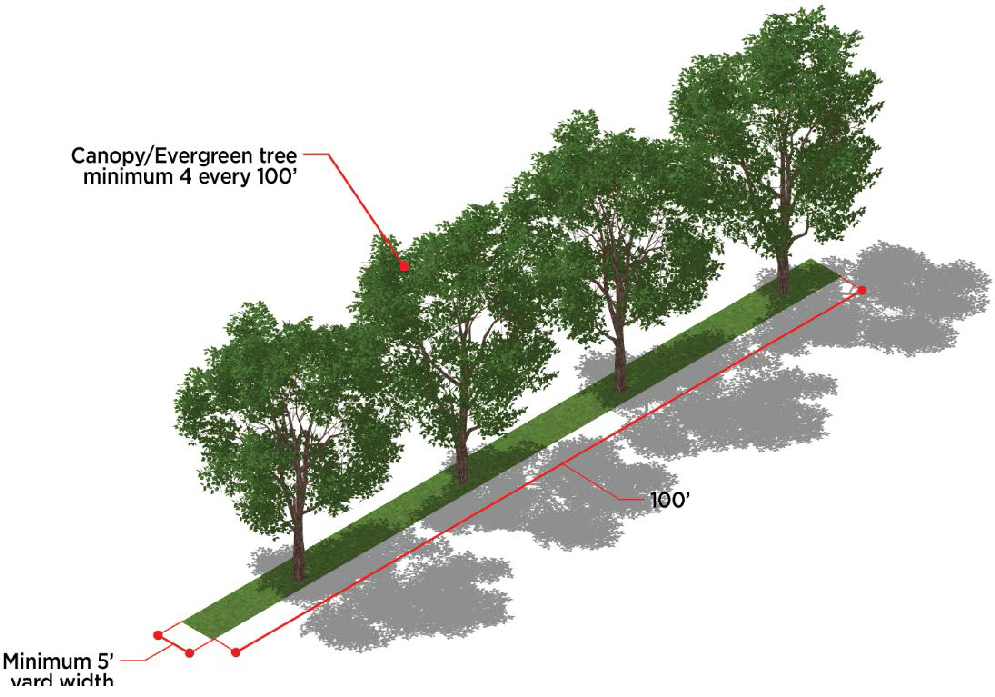
Graphic 15-660(1). Transition Area Type A
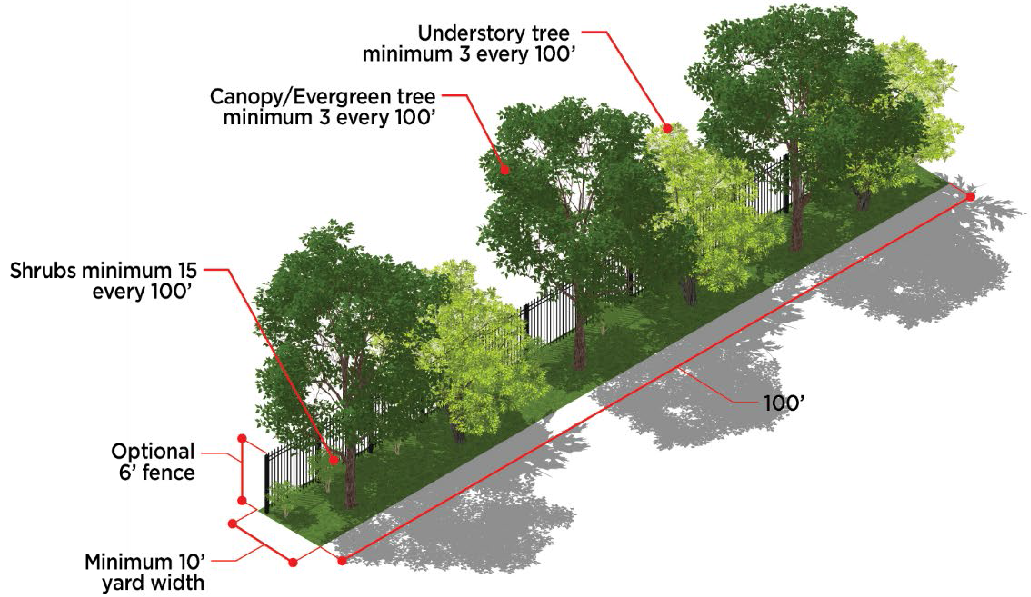
Graphic 15-660(2). Transition Area Type B
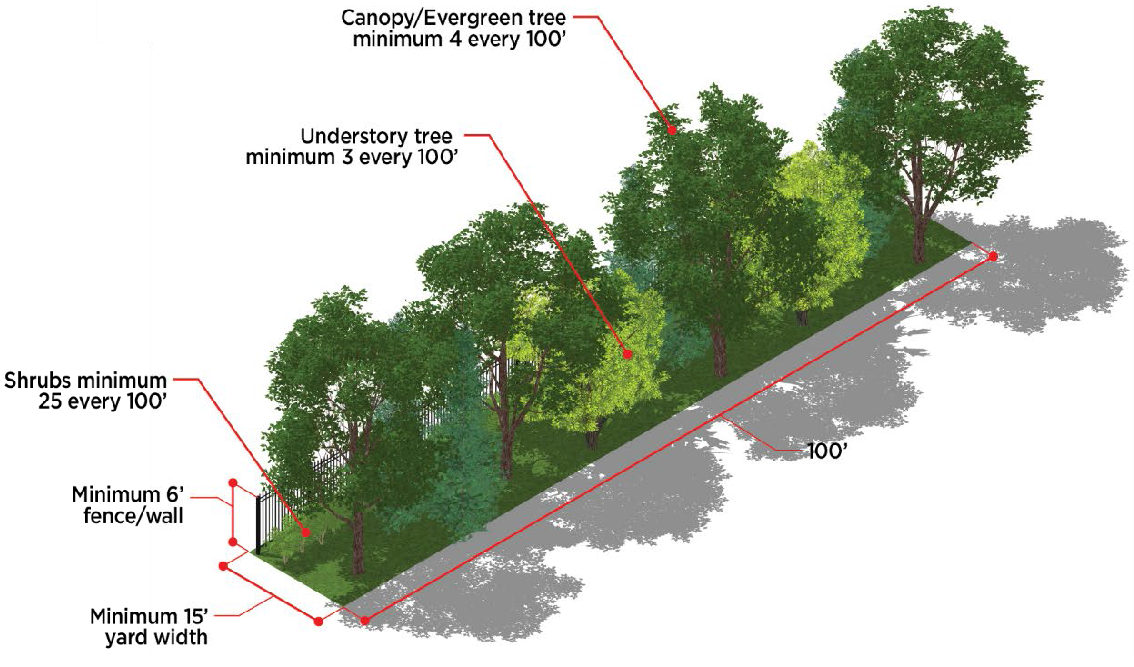
Graphic 15-660(3). Transition Area Type C
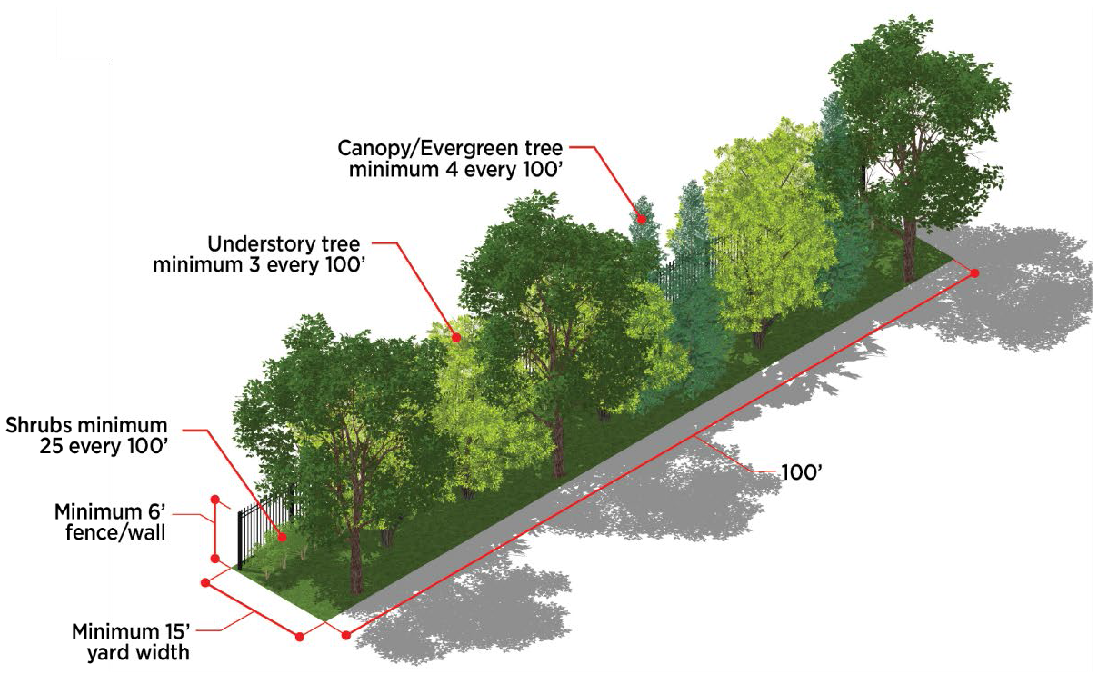
Graphc 15-660(4). Transition Area Type D
(3)
Application of transition area types. Transition areas shall be provided based on Table 15-660(2), except where adjacent uses are of a similar nature, scale, and intensity. As per Table 15-660(2), the type of required transition yard is dependent upon the land use type of the subject lot and the land use type of the adjacent lots.
Table 15-660(2). Application of Transition Area Types
(Ord. of 3-2-2021, § 155.11.9)
Sec. 15-661. - Additional landscape and screening requirements.
(a)
Landscape and building elements. Landscape and building elements shall be used to screen areas of low visual interest or visually intrusive site elements (such as trash collection, open storage, service areas, loading docks and blank walls) from off-site view. Such screening shall be established on all sides of such elements except where an opening is required for access. If access is possible only on a side that is visible from a public street, a removable or operable screen shall be required.
(b)
Screening of ground mounted mechanical units. For all uses, except any individual lot occupied by a single-family, two-family, or three-family dwelling, all ground-mounted mechanical units, including, but not limited to, air conditioning condensers, heat pumps, ventilation units, computer cooling equipment, etc., and any related utility structures and equipment, that are visible from any adjacent public thoroughfare shall be visibly screened from public view. The screen shall be designed and established so that the area or element being screened is no more than 20 percent visible through the screen.
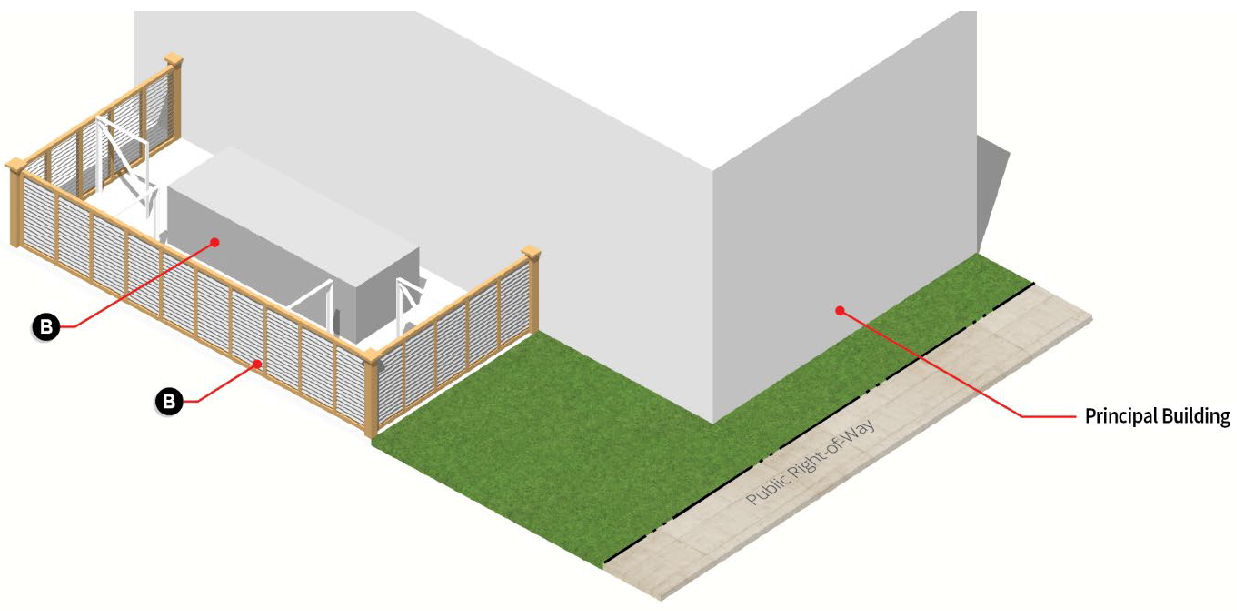
Graphic 15-661(1). Ground-Mounted Mechanical Units Screening
(c)
Loading docks, service yards, and exterior work or storage areas.
(1)
Service yards, loading docks and exterior work or storage areas shall be screened from view from public rights-of-way or adjacent lots.
(2)
The screening shall consist of all the requirements for Transition Area D as detailed in section 15-660(2).
(3)
If outdoor storage is allowed, the storage areas shall be screened in a manner such that the materials being stored are completely screened from view. If storage materials exceed the allowable maximum fence height, then a combination of berming, fencing and landscaping shall be used to accomplish appropriate screening. In no case shall stored materials exceed the height of the proposed screening method.
(d)
Drive-through facility. Drive aisles of drive-through facilities must be effectively screened from view along the public right-of-way and at the edges of sites adjacent to residential properties in order to minimize the impact of exterior site lighting, headlight glare and any menu intercom displays. Such screening must be approved during the site plan review process and must consist of an opaque masonry wall (stone, stucco or brick), a solid wood or simulated wood screen fence, or dense evergreen hedge no less than six feet. Plant materials must be installed along the fence or wall to provide a softening effect.
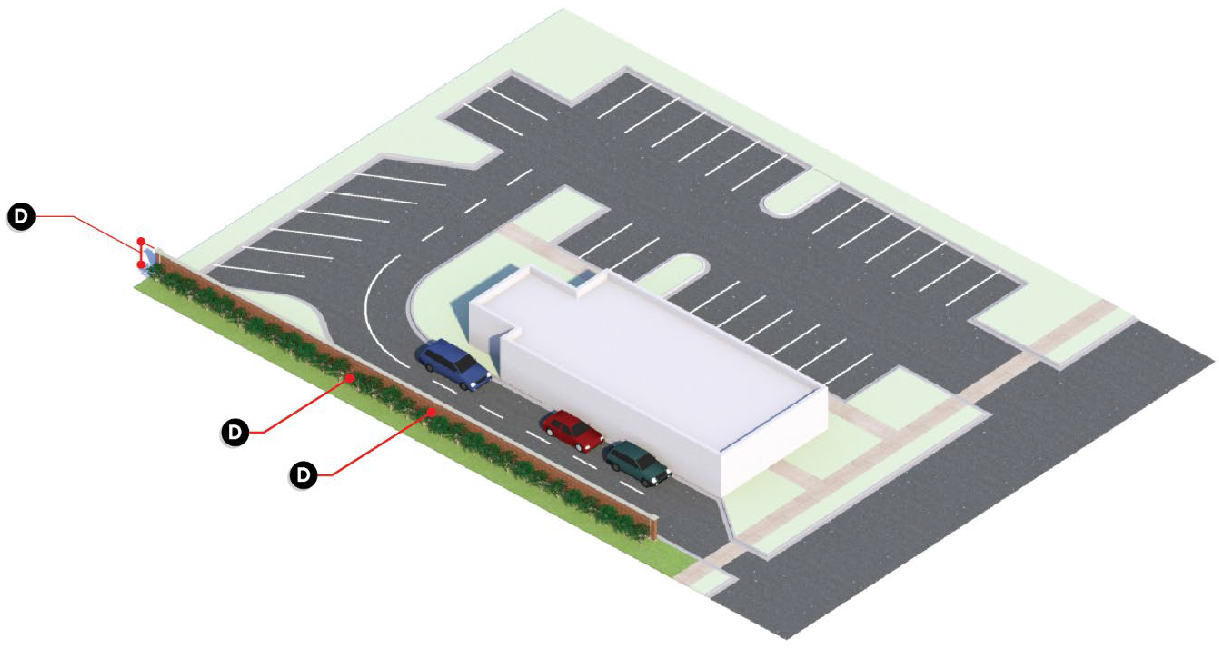
Graphic 15-661(2). Drive Through Facility Screening
(e)
Trash and recycling receptacles. The following screening standards shall apply to all uses, except for single-family, two-family, or three-family dwellings.
(1)
Trash and recycling receptacles shall be screened on three sides with a solid, opaque material with a minimum height of six feet and a maximum height of eight feet. The use of materials that are not solid, such as slats in chainlink, shall only be used to meet this requirement in the I district.
(2)
Materials used for screening shall complement the architecture of the primary structure.
(3)
Materials and elevations for enclosures that are attached to buildings shall be designed to be integrated into the primary structure.
(4)
If enclosures are to be attached to buildings, they shall comply with applicable fire and building codes.
(5)
Enclosure openings shall be gated with an opaque material and shall not be directly visible from a public right-of-way and/or adjoining residential areas.
(6)
Enclosure openings shall be kept closed at all times except for when the receptacle is being accessed by a service truck.
(7)
Property owners shall be responsible for ensuring that trash and recycling receptacles be placed in the enclosure at all times other than when they are being emptied by a service truck.
(8)
Access drives shall be constructed of material and thickness to accommodate truck loading. Yearround access to the enclosure area for service trucks shall be maintained by the property owner or tenant.
(9)
Enclosures shall be of an adequate size to accommodate expected containers. It is recommended that the enclosure be designed to be expandable to accommodate future additional containers.
(10)
Enclosure structures shall be designed to protect the walls from damage by containers. Such protection may be provided by the use of barrier curbing, reinforced masonry walls, or other similar means.
(11)
Trash and recycling receptacle enclosures shall not occupy areas used for required parking spaces.
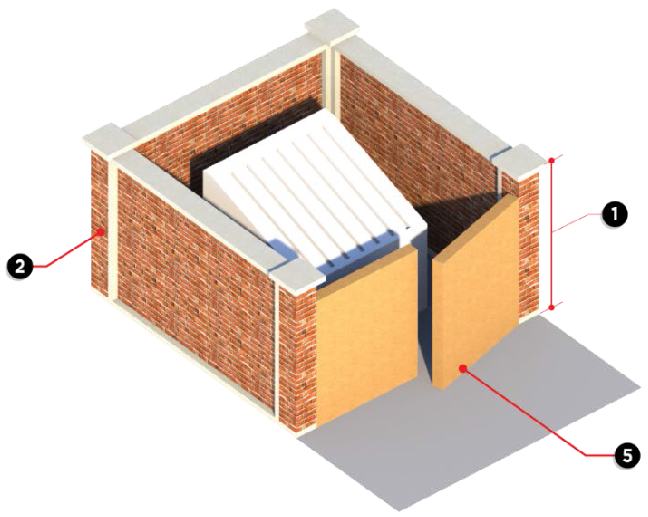
Graphic 15-661(3). Trash and Recycling Receptacle Screening
(Ord. of 3-2-2021, § 155.11.10)
Sec. 15-662. - Species diversity requirements.
The following species diversity requirements shall be required for all developments, unless otherwise approved by the zoning administrator in conjunction with approval of vegetated stormwater management areas:
(1)
A minimum of 50 percent of the landscape elements utilized on a parcel that is less than one-half acre shall be drought and salt tolerant native species.
(2)
A minimum of 60 percent of the landscape elements utilized on a parcel that is between one-half and five acres shall be drought and salt tolerant native species. Total landscape elements, excluding turf, shall not be comprised of more than 30 percent of any single species or 50 percent of any genus.
(3)
A minimum of 75 percent of the landscape elements utilized on a parcel that is greater than five acres shall be drought and salt tolerant native species. Total landscape elements, excluding turf, shall not be comprised of more than 20 percent of any single species or 25 percent of any genus.
(Ord. of 3-2-2021, § 155.11.11)
Sec. 15-663. - Tree preservation.
(a)
Existing viable trees of 12 inches or greater DBH shall not be removed from lots within the village without a tree preservation and removal plan approved by the zoning administrator. DBH is diameter at breast height measured at 4.5 feet off the ground or grade level.
(b)
The tree preservation and removal plan shall include an inventory of all trees of 12 inches or greater DBH on a lot.
(c)
Every reasonable effort shall be made to incorporate trees identified in the inventory into the landscape required for the proposed development. The zoning administrator must determine that one of the following criteria apply prior to granting approval to remove a mature, high-quality tree:
(1)
The tree is dead, dying, diseased, or a threat to public health or safety;
(2)
The tree interferes with the provision of public services or is a hazard to traffic;
(3)
The location of the tree prevents development or redevelopment that cannot be designed to protect the tree;
(4)
The tree is an identified invasive species.
(d)
Viable trees of 12 inches or greater DBH to be removed shall be replaced in accordance with the following standards.
(1)
The tree to be removed shall be replaced within one year of the date of approval and guaranteed.
(2)
Any tree designated for removal on an approved tree preservation and removal plan shall be replaced at the rate specified in Table 15-663.
(3)
In the event that a tree designated for preservation is destroyed, damaged, or removed during the construction process, such tree shall be replaced at three times the applicable rate specified in Table 15-663.
Table 15-663. Tree Replacement Rate
(e)
The value of a tree shall be determined by the zoning administrator in accordance with the methods developed by the council of tree and landscape appraisers in the most recent guide for plant appraisal.
(Ord. of 3-2-2021, § 155.11.12)
Sec. 15-664. - Installation and maintenance of landscape areas.
(a)
All installed landscape shall conform to the most recently approved American Standard for Nursery Stock (ANSI Z60.1), published by the American National Standards Institute.
(b)
All new landscape areas shall be installed prior to the occupancy or use of the building or premises, or substantial completion of the building to allow for occupancy; or if the time of the season or weather conditions is not conducive to planting, the developer shall apply to the zoning administrator for a delay in landscape installation. The delay in landscape installation request shall identify a date certain by which all required landscape materials shall be installed or the developer shall be subject to a fine as detailed in the agreement.
(c)
Dead plant materials shall be replaced within 60 days taking into consideration the season of the year and shall have at least the same quantity and quality of landscape elements as initially approved. If the particular project is constructed in more than one phase, the 60-day timeframe shall apply to each individual phase.
(d)
All landscape shall be maintained in a healthy, neat, trimmed, clean, and weed-free condition. With the exception of surface areas in vegetated stormwater management areas where mulch is not specified, the ground surface of landscape areas shall be covered with either turf and/or other types of pervious groundcover located beneath and surrounding trees and shrubs.
(e)
For stormwater management areas where irrigation is not specified, all installed plantings shall be guaranteed for a period of 18 months following municipal approval of installation. During this guarantee period landowner shall supply water as necessary to promote successful establishment and growth.
(f)
Any required landscaped area not intended for stormwater management, greater than 150 square feet in area, is recommended to be provided with an underground irrigation system or be provided with a portable water supply within 50 feet of the landscaped areas.
(Ord. of 3-2-2021, § 155.11.13)

