
Roscoe City Zoning Code
ARTICLE VII
GENERAL PROVISIONS
Sec. 15-512.- Applicability.
The provisions of this section apply to all zoning districts unless otherwise indicated. If there is a conflict between this section and the individual requirements of the zoning district, the zoning administrator shall determine which standards control.
(Ord. of 3-2-2021, § 155.7.1)
Sec. 15-513. - General requirements.
(a)
Standards and regulations. Standards and regulations pertaining to site layout and building placement, building elements, compatible uses, landscaping and related measures shall be assigned to promote and strengthen the defined character of village neighborhoods and commercial areas. It is determined that neighborhood and commercial character contributes to the unique and desirable identity of the village and that measures set forth herein are necessary and appropriate to promote and strengthen such characteristics.
(b)
Multiple buildings. Except as otherwise specifically provided in this chapter, no lot may contain more than one principal buildings, except as approved as a planned unit development.
(c)
Lot divisions. No improved zoning lot shall hereafter be divided into two or more zoning lots unless all resulting zoning lots conform to all the applicable bulk regulations of the zoning district in which the property is located.
(d)
Lot combinations. Two or more lots cannot be combined into a single lot unless the zoning district are the same and the resulting lot conforms to all the applicable bulk regulations of the zoning district in which the property is located.
(Ord. of 3-2-2021, § 155.7.2)
Sec. 15-514. - Lot area and dimension.
(a)
Two or more parcels of land, each of which lacks adequate area and dimension to qualify for a permitted use under the requirements of the use district in which they are located, are contiguous, and are held in one ownership, shall complete the lot consolidation process as detailed in chapter 155 prior to the development of the lots.
(b)
Any single lot or parcel of land, held in one ownership, which was of record at the time of adoption of the ordinance, which does not meet the requirements for minimum lot width and area, may be utilized for a permitted use, provided that yards, courts or useable open spaces are not less than 75 percent of the minimum required dimensions and areas.
(Ord. of 3-2-2021, § 155.7.3)
Sec. 15-515. - Access to public streets.
Except as otherwise provided for in this code, every residential building shall be constructed or erected upon a lot or parcel of land, which abuts upon a public street unless a permanent easement of access to a public street was of record prior to the adoption of the ordinance.
(Ord. of 3-2-2021, § 155.7.4)
Sec. 15-516. - Accessory building.
(a)
No accessory building shall be located in a required front yard.
(b)
A total of one accessory building may be permitted on any parcel, unless otherwise authorized through a provision of this Code.
(c)
On lots less than or equal to one acre, an accessory building shall not exceed 700 square feet in area.
(d)
On lots greater than one acre, an accessory building shall not exceed 1,200 square feet in area.
(e)
On a reverse street corner lot, a lone accessory structure shall not be located closer to the rear property line than the required side yard of the adjoining key lot and not closer to the street than the required front yard of the adjoining key lot.
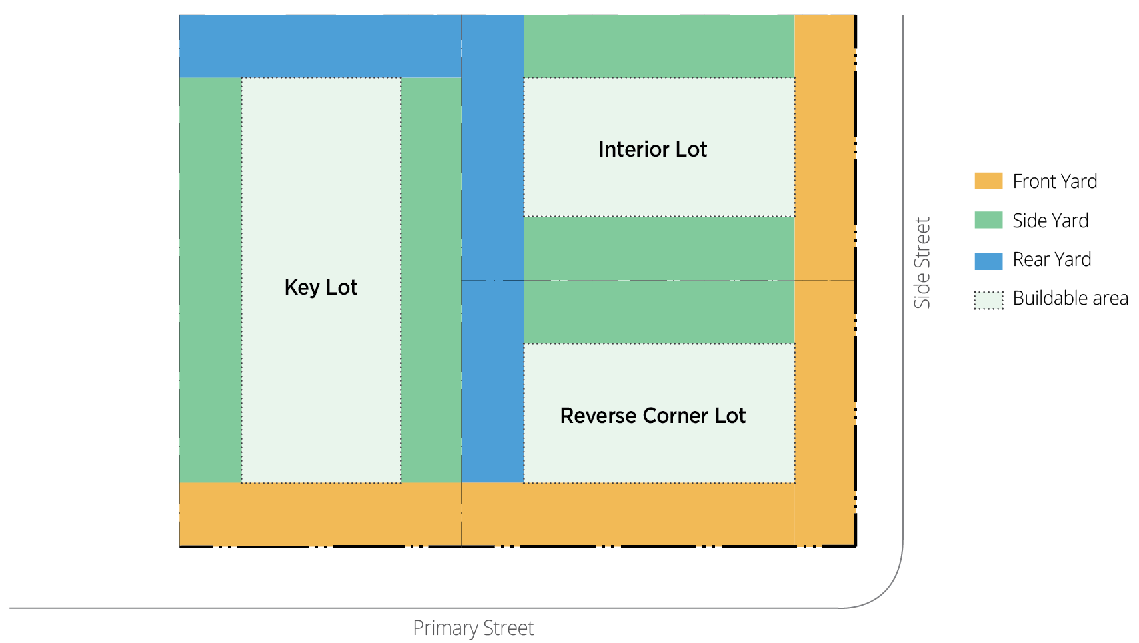
Graphic 15-516. Accessory Building Lot Types
(f)
Swimming pools used solely by persons resident on the site and their guests, provided that no swimming pool or accessory mechanical equipment shall be located in a required front yard or less than ten feet from a property line.
(g)
Accessory buildings shall meet the following height and setback requirements:
Table 15-516. Accessory Buildings
(Ord. of 3-2-2021, § 155.7.5)
Sec. 15-517. - Accessory structures.
(a)
No accessory structure shall be located in a required front yard nor closer to the front property line than the front or corner side elevation of the primary building.
(b)
Accessory structures shall not exceed 200 square feet in area.
(c)
Accessory structures shall be located a minimum of five feet from side and/or rear property lines.
(Ord. of 3-2-2021, § 155.7.6)
Sec. 15-518. - Lot and yard measurements; and encroachments.
(a)
Measurement.
(1)
A required front yard shall be measured as the shortest distance between the building and the following edge, using whichever edge is the most restrictive requirement (i.e., using whichever edge establishes the building farthest from the street, sidewalk, or easement):
a.
The front property line;
b.
The back of the sidewalk (the sidewalk edge away from the street);
c.
The edge of an easement for a private road or driveway.
(2)
A required side yard or rear yard shall be measured by the shortest distance between the building and the lot line.
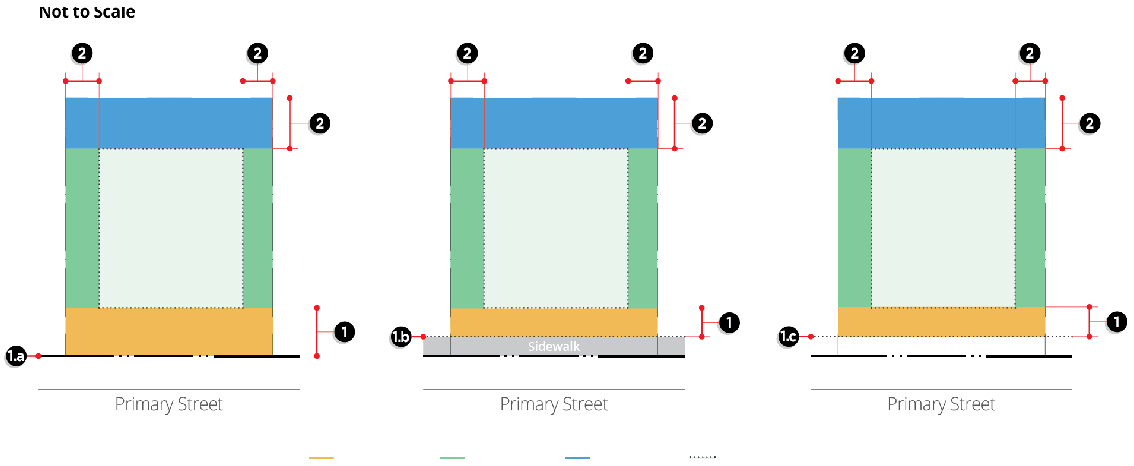
Graphic 15-518. Lot and Yard Measurements
(b)
Exemptions; nonconforming sites. A site having an area, frontage width, or depth less than the minimum prescribed for the district in which the site is located, which is shown on a duly approved and recorded subdivision map, or for which a deed or valid contract of sale was of record prior to the adoption of the ordinance from which this chapter is derived or amendment to this chapter, and which had a legal area, frontage, width, and depth at the time that the subdivision map, deed, or contract of sale was recorded, may be used for any permitted use, but shall be subject to all other regulations for the district in which the site is located.
(c)
Side and rear yards; requirements and exceptions.
(1)
On a reversed corner lot, the minimum rear yard shall not be less than the side yard prescribed in the district in which the lot is located, provided that the side yard adjoining the street shall not be less than the required front yard on the adjoining key lot.
(2)
When the side or rear lot line of the site of a use other than a residential use adjoins an R district, the minimum side or rear yard adjoining or opposite the R district shall be ten feet greater than the minimum yard prescribed in the district in which the lot is located.
(3)
Architectural features including projecting balconies, sills and chimneys, cornices, and eaves may extend into a required side yard or a space between structures not more than 18 inches and may extend into a required front or rear yard not more than four feet, provided that no projection shall extend into a public utility easement. Opened, uncovered balconies, landings, platforms, porches, stairways, and terraces, no part of which is more than four feet above the grade of the ground, and unenclosed, uncovered porches with floors not higher than eight inches above the grade may extend into a required rear yard or into a required front or side yard or space between buildings not more than four feet, provided that pedestrian ways or walks at ground level shall not be reduced below three feet in unobstructed width.
(4)
Open, unenclosed, uncovered metal fire escapes may project into any required yard or space between buildings not more than three feet, provided that no projection shall extend into a public utility easement.
(5)
Fences, walls, and hedges not over six feet in height; walks, parking pad, and retaining walls may occupy a required side or rear yard; and fences (a maximum of 50 percent open), walks, and hedges not over four feet in height may occupy front yards.
(6)
When the front, side, or rear lot of a site in a residential district adjoins state route 251 or Interstate I-90, the minimum front, side or rear yard adjoining state route 251 or Interstate I-90 shall be 60 feet. This provision is applicable to residential zoning districts only.
(d)
Width; corner lots. The minimum width of corner lots in an R district shall be ten percent greater than the minimum width established in article III of this chapter.
(e)
Depth adjoining freeway or railroad. No site rearing on a freeway or railroad right-of-way shall have a depth of less than 130 feet.
(f)
Exceptions; plat of Original Town of Roscoe. The minimum front yards for lots on the plat of the Original Town of Roscoe shall be 66 feet from the centerline of an 82.5-foot-wide street and 75 feet from the centerline of a 99-foot-wide street.
(Ord. of 3-2-2021, § 155.7.7)
Sec. 15-519. - Building height.
(a)
Measurement. The height of a structure shall be measured vertically from the average elevation of the natural grade of the ground covered by the structure to the highest point of the front elevation of the structure or to the coping of a flat roof, to the deck line of a mansard roof, or to the mean height between eaves and ridges for a hip, gable, or gambrel roof.
(b)
Exceptions. Towers, spires, cupolas, chimneys, penthouses, water tanks, flagpoles, monuments, scenery lofts, radio and television aerials and antennas, transmission towers, fire towers, and similar structures and necessary mechanical appurtenances covering not more than ten percent of the ground area covered by the structure may be erected to a height of not more than 25 feet above the height limit prescribed by the regulations for the district in which the site is located, unless approved as a special use. Utility poles and towers shall not be subject to the height limits prescribed in the district regulations.
(c)
Heights greater than prescribed. Additional height may be permitted, subject to first obtaining a special use permit as per section 15-780, in each case.
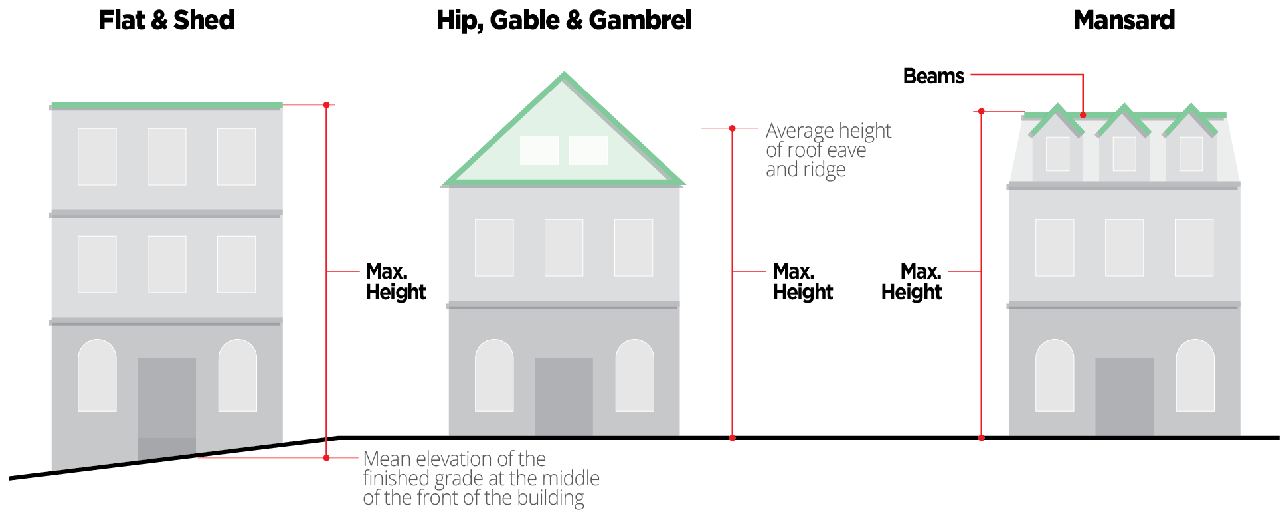
Graphic 15-519. Measuring Building Height
(Ord. of 3-2-2021, § 155.7.8)
Sec. 15-520. - Clear vision areas.
(a)
Required. Clear vision areas are required in locations where an unobstructed view of approaching traffic is necessary for the safety of pedestrians, bicyclists and drivers. A clear vision area is typically, but not exclusively, a triangular area at the intersection of two streets, or a street and a driveway; however, clear vision areas may be required at other locations identified in this chapter and in other chapters of this Code.
(b)
Exceptions. Required clear vision areas do not apply to structures that host the primary use of the lot and are permitted within the area as defined in subsection (c) of this section based on yard requirements as defined in this chapter.
(c)
Measurement. At the intersection of two streets or the intersection of a street and a driveway, the required clear vision area shall be established as follows:
(1)
Corner lot. On a corner lot a vision triangle extending 30 feet from all public street intersections shall be maintained. No wall, fence, or earth mound shall be permitted within the vision triangle which materially impedes vision above the height of 2.5 feet and below eight feet.
(2)
Driveways. For driveways, a vision triangle extending ten feet along the lot line and ten feet along the driveway starting at the intersection of the lot line and the closest edge of the driveway and connected by a straight line to form a triangular area shall be maintained.
(3)
Other required areas. Other areas for clear vision areas may be requested by the zoning administrator.
(d)
Landscaping or structures. No plantings, signs, fences, walls, or other structures exceeding 30 inches in height shall be established or maintained in clear vision areas. The village's zoning administrator may require a reduction in the height of any screening improvement, or a different location of a new building or structure otherwise required in this chapter to ensure an adequate clear vision area for driveways and streets. Such limitations shall be required only for that portion of the building, structure or screening improvement necessary to provide an adequate clear vision area.
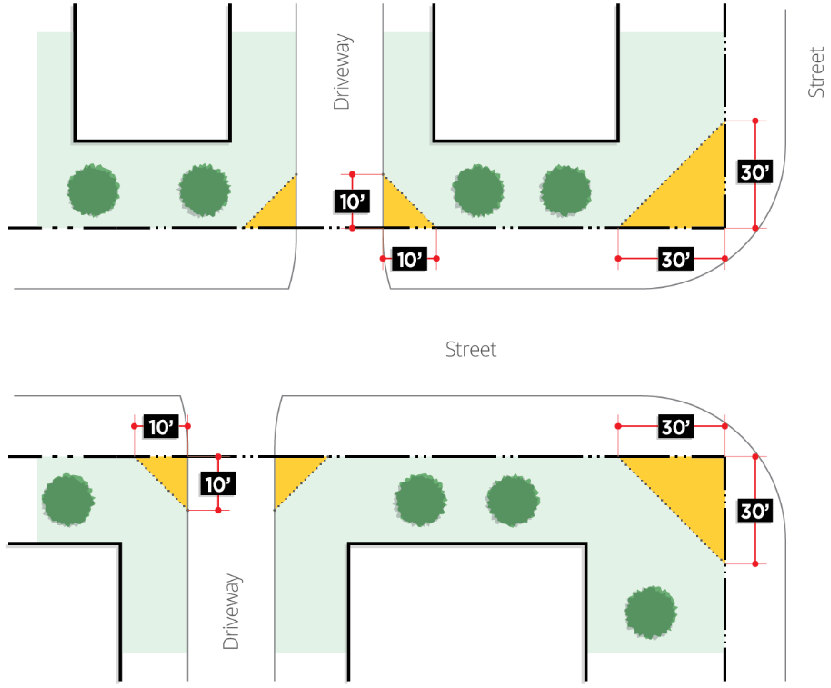
Graphic 15-520. Clear Vision Areas
(Ord. of 3-2-2021, § 155.7.9)
Sec. 15-521. - Floodplain protection.
Zoning lots, or portions of zoning lots, located in areas designated as floodplains on FEMA's flood insurance rate maps are subject to the following requirements:
(1)
Permitted uses. The following uses and none other shall be permitted in floodplains as shown on the official floodway map of the Federal Emergency Management Agency (FEMA), provided that no building or structure, other than fences for agricultural purposes, shall be erected, and further provided that the natural drainage grade shall not be substantially altered.
a.
Uses permitted in an adjoining district, provided that, where a delineated floodplain separates or adjoins two different districts, permitted uses shall be those of the most restrictive of the districts, further provided that parking lots in floodplains shall not be used for parking, stopping or standing of motor vehicles for more than 24 hour periods, and further provided that all storage of goods shall be in movable containers designed for the storage of goods, and that no acids, caustics, explosives, or highly flammable liquids, trash, rags, bottles, junk, or any other thing resembling junk may be stored or deposited in any floodplains; and
b.
Parks, recreation and open space, streets, bridges, and creek and storm drainage facilities.
(2)
Special uses. The following uses, when in harmony with uses in contiguous areas, may be allowed as special uses, following specific action by the board of trustees in accordance with the provisions of section 15-780:
a.
Circuses, carnivals, and similar amusement enterprises, provided that they are not in operation for more than 90 days in any calendar year;
b.
Any building or special use permitted in an adjoining district, provided that:
1.
When a floodplain separates or adjoins two different districts; permitted uses shall be those of the more restrictive of the districts;
2.
An analysis has been made establishing that the building or uses will not be subject to future inundation and that the remaining channel will be adequate to accommodate future runoff;
3.
The use permitted is compatible with the standards of the neighborhood;
4.
No acids, caustics, explosives, or highly flammable liquids, trash, rags, bottles, junk, or any other thing resembling junk may be stored or deposited in any floodplain.
c.
Summer homes or cabins, for seasonal and not permanent or yearround occupancy, provided the first-floor elevation is above the highwater line;
d.
Boat docks, private and commercial, including the selling or leasing of fishing equipment and bait; and
e.
Any other uses customarily accessory or incidental to the above uses.
(3)
Conditions of use. In floodplains, the following additional conditions shall pertain:
a.
No filling of land shall be permitted, except when approved by the applicable governing authority, and to those conditions as may be stipulated to protect the public interest;
b.
The natural drainage grade shall not be substantially altered except as executed or authorized by the governing authorities;
c.
Any structures permitted shall be placed so as to offer the minimum obstruction to the flow of water and shall be firmly anchored to prevent the structure from floating away and thus threatening to restrict further bridge openings and other restricted sections of the stream;
d.
When engineering and other studies are needed to determine the effect of the structure on the flow of water, the village engineer may require the applicant to submit such data or other studies prepared by competent engineers or other technicians;
e.
All special uses permitted shall be subject to approval of the board of trustees in compliance with the provisions of section 15-780 and to those conditions as may be stipulated to protect the public interest;
f.
No habitable floor shall be constructed below the minimum flood elevation to be determined by FEMA; and
g.
The granting of approval of any structure or use shall not constitute a representation, guarantee, or warranty of any kind or nature by the village or by any officer or employee of the village of the practicality or safety of any structure or use proposed and shall create no liability on or cause action against that public body, officer or employee for any damage that may result pursuant thereto.
(Ord. of 3-2-2021, § 155.7.10)
Sec. 15-522. - Fence regulations.
(a)
Generally. All fences erected within the village are required to comply with the following provisions, as well as all other provisions of this Code.
(1)
A fence may be located on a lot line, but no such fence shall protrude in full or part onto any adjacent property. A fence not located on a lot line shall be setback a minimum of two feet to accommodate fence and property maintenance.
(2)
The fence height shall be measured from an established grade to the topmost section of the fence. When the grade forms a contour, the fence shall be required to maintain the same contour.
(3)
All portions of a fence shall be constructed of consistent materials. Changes in materials or construction are permitted when doing so responds to a change in the function or context of the fence, such adjacent land use, visibility from the public street, etc.
(4)
All fences shall be constructed of materials that are complementary of and integral to the structural system supporting it.
(5)
All supporting poles must be placed on the inside of the property where the fence is erected, and the finished side must face out away from the property.
(6)
No fence shall be constructed in any public right-of-way, landscape, or drainage easement except when a release has been given in writing by the owner of the property absolving the village and/or utility company doing the work from all liability and damages resulting from the repair, inspection, maintenance, installation or removal of utilities. The village and/or utility company shall in no way be held liable for the replacement, repair, or re-erection of any fence within the easement.
(b)
Fences, residential. Any fence erected within a residentially zoned district must be in compliance with the following criteria, as well as all other provisions of this Code.
(1)
Front yards. Front and corner side yard fences shall not exceed four feet in height and shall be at least 50 percent open in the front yard.
(2)
Side yards. No fence, except as provided for in other provisions of this Code, shall exceed six feet in height.
(3)
Rear yards. No fence, except as provided for in other provisions of this Code, shall exceed six feet in height.
(4)
A fence located in a residential area shall be of any suitable construction material or type, including decorative masonry or brick, finished wood, decorative metal, decorative vinyl, or other aesthetically appropriate systems.
(5)
Residential fences shall not be constructed of unfinished or temporary materials of a primarily utilitarian nature, such as chicken wire, square welded mesh wire, chain link, barbed wire, electrically charged fence or wire, temporary snow fence, solid concrete block, or fence topped with sharp edged materials. However, vinyl coated chain link shall be allowed in rear yards only.
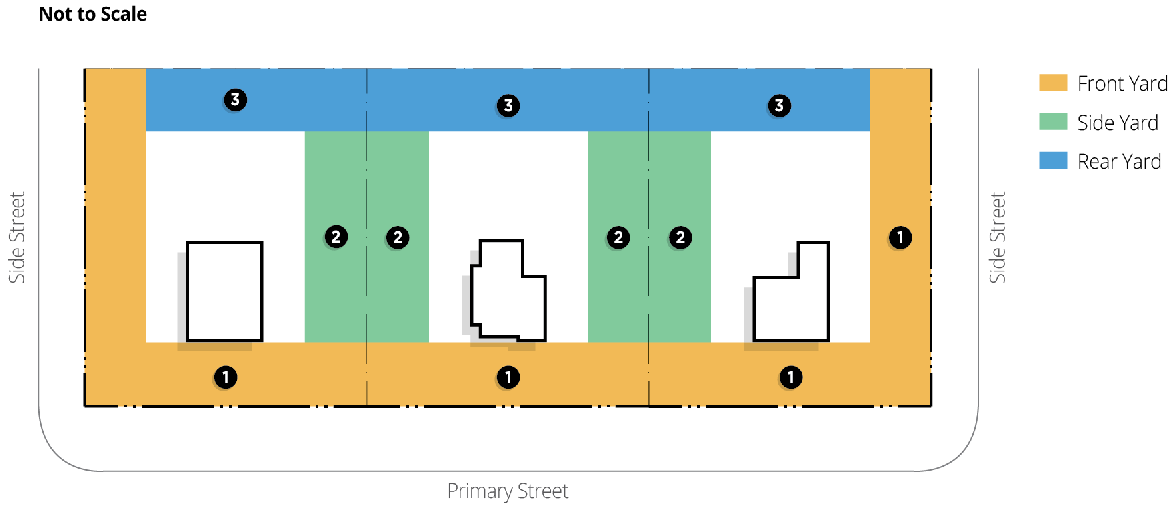
Graphic 15-522(1). Residential Fences
(c)
Fences, nonresidential. Any fence erected within a nonresidential district must be in compliance with the following criteria as well as all other provisions of this Code.
(1)
Front yards. Front and corner side yard fences shall not be permitted.
(2)
Side yards and rear yards. No fence shall exceed eight feet in height. No fence shall be allowed to extend past the front yard or the side yard building line on a corner lot, unless granted approval by the village.
(3)
Any fence enclosure blocking access to any area or structure open to the public must meet the current accessibility criteria as established by the Americans with Disability Act (1990), 42 USC 12101 et seq., and the Illinois Accessibility Code, promulgated pursuant to 410 ILCS 25/4.
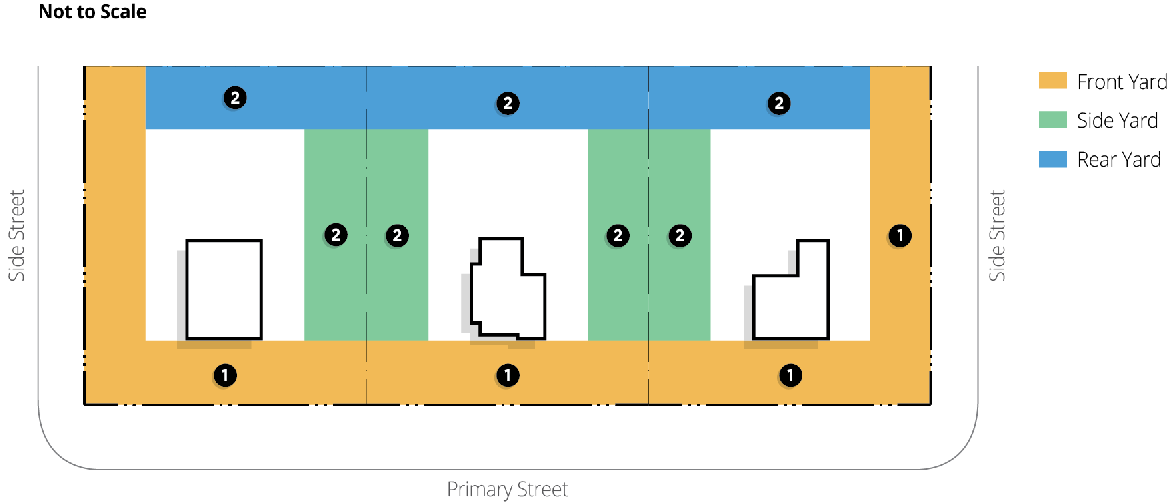
Graphic 15-522(2). Nonresidential Fences
(d)
Construction. Construction materials shall be the same as for residential districts, with the exception that barbed wire may be used within industrial districts. Barbed wire shall only be constructed above a height of eight feet from established grade, shall be turned to the inside of the property where erected, and not be closer than five feet from any public place or residential property. Construction and safety requirements shall be as follows:
(1)
Every fence shall be designed to have a minimum life expectancy of 20 years, with the performance of the minimum necessary maintenance.
(2)
All fences shall be designed and constructed to resist a horizontal wind pressure of 15 pounds per square foot (approximately 120 miles per hour winds).
(3)
All fences shall have an exterior gate access to the enclosed property.
(e)
Maintenance. Fence maintenance shall be the responsibility of the property owner, in accordance with all provisions of this Code. Fences shall be maintained in accordance with the adopted property maintenance code of the county. The replacement of up to 20 lineal feet of fence shall be permitted without a permit.
(Ord. of 3-2-2021, § 155.7.11)
Sec. 15-523. - Performance standards.
(a)
Compliance. This title permits specific uses in specific districts, and these performance standards are designed to limit, restrict, and prohibit the effects of those uses outside their premises or district. All structures, land, air, and waters shall, hereafter, in addition to their use and site regulations, comply with the following performance standards.
(b)
Outdoor lighting.
(1)
Shall be designed and installed with full cut-off fixtures to direct illumination onto the site and to prevent illumination from such fixtures on neighboring properties.
(2)
Shall have a color temperature less than or equal to 5,000 Kelvins.
(3)
Shall not be illuminated, as measured from the property line nearest the light source, in excess of 0.4 footcandles above ambient lighting conditions on a cloudless night.
(c)
Noise. The maximum permissible sound level of any continuous, regular, or frequent source of sound produced by an activity shall be 55 dBA in the UT, RE, R1, R2, and RM districts, 60 dBA in the CO, CR, CH, P, HC, and IL districts, and 65 dBA in the IG and IH districts, as measured from the property line nearest the source of the sound. Between the hours of 7:00 a.m. and 10:00 p.m., maximum dBA by district shall be lowered by five dBA.
(d)
Air pollution. No person or activity shall emit any fly ash, dust, particulate matter, fumes, vapors, mists, or gases in such quantities that would constitute a nuisance to surrounding property owners. Dust and other types of pollution borne by the wind from such sources as storage areas, yards, and roads within lot boundaries shall be kept to a minimum by appropriate landscaping, paving, fencing, or other acceptable means.
(e)
Fire and explosive hazards. All activities involving the manufacturing, utilization, processing, or storage of flammable or explosive materials shall be provided with adequate safety devices against the hazard of fire and explosion and with adequate firefighting and fire-suppression equipment and devices that are standard in the industry and approved by the Harlem Roscoe Fire Protection District. All materials that range from active to intense burning shall be manufactured, utilized, processed, or stored only within completely enclosed buildings which have incombustible exterior walls and an automatic fire extinguishing system. Storage of flammable and explosive material shall be in accordance with the requirements of chapter NFPA 30 of the National Fire Protection Act and all applicable state requirements.
(f)
Glare and heat. No activity shall emit glare or heat that is visible or measurable outside its premises except activities which may emit direct or sky reflected glare which shall not be visible outside their district. All operations producing intense glare or heat shall be conducted within a completely enclosed building. Exposed sources of light shall be shielded so as not to be visible outside their premises.
(g)
Water quality protection. No activity shall locate, store, discharge, or permit the discharge of any treated, untreated, or inadequately treated liquid, gaseous, or solid materials of such nature, quantity, obnoxiousness, toxicity, or temperature that might run off, seep, percolate, or wash into surface or subsurface waters so as to contaminate, pollute, or harm such waters or cause nuisances such as objectionable shore deposits, floating or submerged debris, oil or scum, color, odor, taste, or unsightliness or be harmful to human, animal, plant, or aquatic life. In addition, no activity shall withdraw water or discharge any liquid or solid materials so as to exceed, or contribute toward the exceeding of, the minimum standards set forth by state law.
(h)
Vibration. No activity in any district shall emit vibrations, which are discernible by the administrator or a designee without instruments outside its premises.
(Ord. of 3-2-2021, § 155.7.12)
Sec. 15-524. - Required buffers.
Certain uses and activities are inherently incompatible with other uses and activities and are required to be separated as indicated as follows so as to reduce conflict and to maintain amenity.
Minimum Distance Buffering
(Ord. of 3-2-2021, § 155.7.13)

