
Saint Lucie County Unincorporated
City Zoning Code
City Zoning Code
CHAPTER VIII
ACCESSORY AND TEMPORARY STRUCTURES AND USES
8.00.01. - Authorization.
Accessory structures and uses are permitted in any zoning district in connection with any principal lawfully existing permitted use within such district, or in connection with any existing conditional use within such district, subject to the requirements of Section 11.07.00, provided that all accessory structures or uses shall meet the requirements for the zoning district in which the structure or use is located, as provided in Section 3.01.03, and all other requirements of this section.
8.00.02. - Dimension and Location Regulations.
A.
No accessory use or structure except for fences, walls, and hedges as described in Section 8.00.04 shall be located in any required front yard in any residential zoning district.
B.
No accessory structure or use in any residential zoning district shall occupy more than thirty-five percent (35%) of the maximum permitted building area of the entire lot.
C.
Non-commercial garages, carports, and enclosed storage structures located within residential zoning districts may exceed the height of the primary structure but shall then be limited to twenty (20) feet in height and located a minimum of five (5) feet behind the front façade of the primary structure.
D.
Non-commercial garages, carports, pole barns, and enclosed storage structures within agricultural zoning districts may exceed the height of the primary structure but shall then be limited to twenty-five (25) feet in height and located a minimum of five (5) feet behind the front façade of the primary structure.
(Ord. No. 2024-3, § 2, 1-23-2024)
8.00.03. - Particular Permitted Accessory Structures and Uses in Residential, Agricultural, and Planned Unit Development Districts.
Permitted accessory structures and uses include:
A.
Non-commercial garages, parking lots, and parking areas, together with related circulation elements.
B.
Enclosed storage structures and greenhouses.
C.
A child's playhouse or gazebo.
D.
Non-commercial parks, playgrounds and athletic areas.
E.
Private swimming pools and bathhouses, provided that the swimming pool, or the entire property on which it is located, shall be walled or fenced to prevent uncontrolled access to such swimming pool from the street or from adjacent properties.
F.
Outdoor storage of recreational equipment subject to the following restrictions:
1.
Recreational equipment shall not be stored in the front yard or any side yard located between the main building and any projections thereof and the front property line, except that one (1) piece of recreational equipment less than thirteen (13) feet in height may be located on a paved surface in the front yard and shall be setback a minimum of five (5) feet from the edge of the adjacent paved surface or travelway, provided that the recreational equipment shall not obstruct or interfere with the maintenance, visibility or use of any public right-of-way or sidewalk. Where stored on a paved surface in the front yard, such recreational equipment shall be parked as nearly perpendicular as possible, to the street upon which the property is accessed, except when the recreational equipment is parked at least one hundred (100) feet from any street frontage on lots or parcels of land one (1) acre or more in total area. In those instances of a corner lot, or a parcel having more than one (1) frontage on more than one (1) street, and there is paved or improved access to the property from those streets, the same setback and numeric criteria outlined above shall apply.
Nothing is this paragraph shall be interpreted to permit any violation of the minimum Off-Street Parking requirements and standards set forth in Section 7.06.00 and Driveway Regulations set forth in Section 7.05.06 of this Code.
2.
A maximum of two (2) pieces of recreational equipment, including the one (1) piece of recreational equipment allowed in the front yard, may be stored on a parcel except that there shall be no limitation on the number or pieces of recreational equipment allowed in unenclosed structures on a lot or parcel of more than one (1) acre provided that the recreational equipment must be parked at least one hundred (100) feet from any public street or right-of-way and providing that the storing of this recreational equipment does not violate any other provision of this Code or the St. Lucie County Code of Ordinances. This limitation shall not apply to recreational equipment stored in enclosed structures.
3.
Recreational equipment shall not be used for living, sleeping or housekeeping purposes.
4.
Recreational equipment must be owned or used by the owner or occupant or guest of the owner or occupant of the property upon which the recreational equipment is parked, located or stored, and must be for the personal off-site use of the owner or occupant or guest, rather than for rent or hire.
5.
Recreational equipment must have a valid motor vehicle license or registration at all times as required by law.
6.
Recreational equipment shall not be stored on drums, barrels, concrete blocks, lumber or similar devices which cause the storage of the recreational equipment to be deemed unsafe.
7.
No inoperative recreational equipment may be stored or parked on the paved surface. For the purpose of this Code, recreational equipment shall be deemed inoperative if it has removed or flat tires; partial or complete dismantling or removal of parts; broken glass; missing major parts such as lights, doors, hoods, or motor parts essential for the lawful and safe operation of the recreational equipment. The positioning of the recreational equipment in other than an upright or operable manner or lack of a current license plate or current registration decal shall raise a rebuttable presumption that the recreational equipment is inoperable.
8.
For the purpose of implementing this paragraph, the restrictions and prohibitions described in Section 8.00.02(A) of this Code shall not apply, and shall be superseded by the restrictions and limitations contained herein.
In those subdivisions, condominium, home owners or property owners association areas that have duly recorded property or deed restrictions that impose stricter standards than outlined above, the stricter standards of the subdivision, condominium, home owners or property owners association shall apply, and enforcement of those standards shall be the responsibility of the duly recognized and empowered condominium, home owners or property owners association. Nothing in this section shall be implied to restrict the general public health, safety and police powers of the Board of County Commissioners in directing that any unsafe or hazardous situation be removed should such a situation be brought to the County's attention.
G.
Private water and sewage utility services provided that they are for the sole use of the particular private development, are not intended to be a sub-regional system, and do not involve industrial wastewater as defined.
H.
Swimming beaches.
I.
Non-commercial docks and boat houses.
J.
Home occupations subject to the requirements of Section 8.01.00.
K.
Historic and monument sites.
L.
Solar energy system subject to the requirements of Section 7.10.28. (999)
M.
Cargo containers subject to the requirements of Section 7.10.35.
(Ord. No. 10-034, Pt. A, 11-9-2010; Ord. No. 2020-22, Pt. A, 8-4-2020)
8.00.04. - Fences, Walls, Berms and Hedges.
The requirements of this section are minimum requirements and shall not be construed to supersede any fence requirements in state law, such as specific requirements for fencing and barriers around swimming pools. Fences, walls, and hedges are permitted, as follows:
A.
Fences, gates, and walls shall comply with industry standards along with governing rules and regulations, including the Florida Building Code, as applicable; shall require the proper permits prior to construction; and shall be constructed in accordance with the reviewed plans and permit. Fences, gates, and walls must be constructed of conventional and traditional materials, including, but not limited to, termite-resistant species of wood or wood treated to resist rot and termites, concrete, stone, brick, aluminum, iron, steel, chain link, PVC, or composite products. Fences and walls shall be constructed in a workmanlike manner and shall be of sound and sturdy construction. All fences and walls shall be maintained in a safe and sound manner and free of graffiti.
B.
In any residential zoning district, which includes Agricultural Residential (AR-1), a fence, wall or landscape berm shall be designed and located as follows:
1.
In any required front yard, the fence, wall or landscape berm shall not exceed a maximum height of four (4) feet above the elevation of the centerline of the roadway adjacent to the property on which the fence, wall or landscape berm is to be located. For sites where a significant grade change exists between the elevation of the centerline of the adjacent roadway and the property on which the fence, wall or landscape berm is to be located, the Planning and Development Services Director or designee shall have the ability to utilize the pre-development grade for the measurement of height in those instances. The following standards are also applicable:
a.
Columns are allowed, including decorative features, caps and finials, when integrated into a fence or wall, and may exceed the permitted height by a maximum of one (1) foot. Columns which exceed permitted height shall be not more than three (3) feet in width and shall be spaced at least six (6) feet apart.
b.
Entry features, such as columns and gates, located contiguous to and on both sides of the main access (driveway) may be permitted up to six (6) feet in height, provided an obstruction to cross-visibility is not created. Access gates on the driveway shall be located a minimum of twenty-two (22) feet from the edge of the roadway.
c.
Two (2) individual column entrance features on the side of the pedestrian walkway or gate may be permitted at a maximum height of five (5) feet, provided an obstruction to cross-visibility is not created.
2.
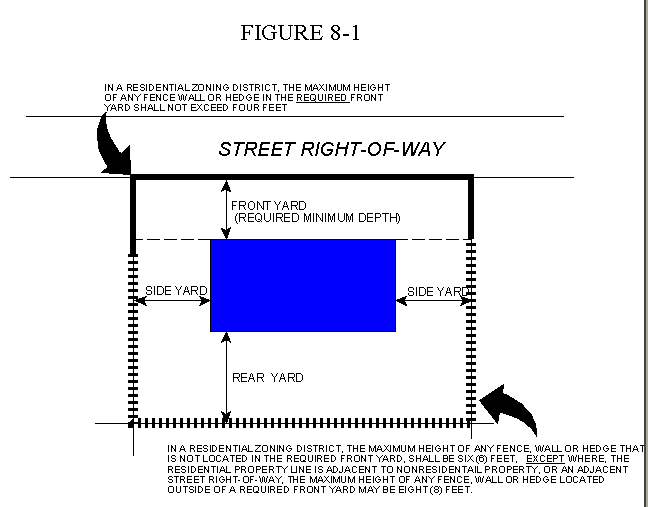
In any other required yard, a fence, wall or landscape berm is allowed at a maximum height of six (6) feet above the elevation of the centerline of the roadway adjacent to the property, except that:
a.
If a residential lot adjoins a non-residentially zoned lot, fence height may be increased to a maximum of eight (8) feet along the adjoining lot lines.
b.
If the rear or side lot line of a residential lot adjoins a street right-of-way, the fence, wall or landscape berm height may be increased to a maximum of eight (8) feet along the street right-of-way, as depicted in Figure 8-1 below, provided that no other provision of this Code is violated.
3.
When it is necessary for safety or security purposes for a public use or public facility, the Planning and Development Services Director may authorize a fence of up to six (6) feet in height in any required yard, with the exception of across the front property line contiguous to a street right-of-way. In no event shall the fence be permitted to create a traffic hazard or obstruct cross-visibility along a right-of-way and/or at intersections.
4.
Fences that are constructed, in whole or in part, of cattle wire, chicken wire, razor wire or barbed wire or similar materials are not permitted within the RE-1, RE-2, RS-2, RS-3, RS-4, RMH-5, RM-5, RM-7, RM-9, RM-11, RM-15 and HIRD zoning districts. Nontraditional materials, including, but not limited to tires, mufflers, hubcaps, or broken glass are prohibited.
5.
Notwithstanding subsection 8.00.04 B.4., residential properties within the RE-1, RE-2, RS-2, RS-3, RS-4, RMH-5, RM-5, RM-7, RM-9, RM-11, RM-15 and HIRD that are contiguous to a local, state, or federal named preserve area with an existing cattle wire or chicken wire fence installed by a local, state, or federal agency, may construct a fence with cattle wire or chicken wire within the rear and side yard, so as to provide for consistent fence design and material to the existing fence. In no event shall a fence be permitted within the required front yard or allowed to create a hazard or be inconsistent with the remaining provisions of Section 8.00.04.
6.
Notwithstanding subsection 8.00.04 B.4., residential properties within the RE-1, RE-2, R/C, RS-2, RS-3, RS-4, RMH-5, and RM-5 zoning districts, located on a parcel of one (1) acre or greater with a lawfully permitted dwelling unit and on an unpaved, privately maintained road, may construct a fence in whole or in part, of cattle wire, chicken wire, or similar materials. This exception within this subsection does not apply to razor wire or barbed wire. The fence height within the required front yard complies with subsection 8.00.04 B.1. Such fences shall be maintained and kept free of hazardous protrusions or loose wires. A building permit shall be required for the construction of any fence authorized under this subsection and must include a survey depicting the location of the proposed fence in relation to property boundaries, easements, and existing structures.
C.
In non-residential zoning districts, a fence, a maximum of eight (8) feet in height, may be located anywhere on the lot. In no event shall the fence be permitted to create a traffic hazard or obstruct cross-visibility along a right-of-way and/or at intersections.
D.
Hedges of any height may be located within any required front, rear or side yard provided that any hedge located at the intersection of two (2) streets shall comply with the cross-visibility provisions of Section 7.09.04(D).
E.
A permit shall not be required for split-rail fencing, cattle wire, chicken wire, barbed wire, and post-and-rail fencing within the Agricultural Residential (AR-1), Agricultural-1 (AG-1), Agricultural-2.5 (AG-2.5), or Agricultural-5 (AG-5) zoning districts, at a maximum height not to exceed six (6) feet above the elevation of the centerline of the roadway adjacent to the property on which the fence is located; however, the fence is subject to floodplain management regulations. Within the Agricultural Residential (AR-1) zoning district, fence height within the required front yard shall comply with subsection 8.00.04.B.1. The property owner is responsible for ensuring the location of the fence is wholly on their property and that the fence does not create an obstruction to cross-visibility.
F.
A permit shall not be required for a fence located on a property used for bona fide agricultural purposes, classified as agricultural land pursuant to F.S. § 193.461. The fence is exempt from the Florida Building Code; however, the fence is subject to floodplain management regulations. The property owner is responsible for ensuring the location of the fence is wholly on their property and that the fence does not create an obstruction to cross-visibility. A barbed wire fence and electrically charged fence may be constructed subject to the requirements of applicable State and Federal laws and regulations.
G.
Fencing or walling of vacant properties shall not be permitted. A fence or wall is an accessory structure, as defined in Section 2.00.00. As provided in Section 8.00.01, accessory structures and uses are permitted only in connection with any principal lawfully existing permitted use or conditional use.
H.
No fence, wall or hedge shall be constructed or installed in such a manner as to interfere with drainage on or adjacent to the property. Fences and walls in regulated floodways that have the potential to block the passage of floodwaters shall meet the limitations of Section 6.05.09(C)(4).
I.
When it is necessary to contain a public use or a public facility for safety or security purposes (i.e., high voltage substations, pumping stations, public wastewater treatment facilities, public airports and aircraft operations), the fence may be erected to a maximum height provided in national, state or otherwise recognized industry codes and regulations.
J.
When it is necessary to use a fence to contain athletic activity, a fence may be erected to a maximum of twelve (12) feet in height, if constructed of chain-link or another material that does not impair visibility.
(Ord. No. 2023-7, § 2, 5-16-2023; Ord. No. 2025-3, § 2, 1-7-2025; Ord. No. 2026-03, § 2, 2-17-2026)
8.00.05. - Swimming Pools.
A.
Fencing Required. In addition to the current standards of F.S. § 515.27, the following is required: All swimming pools in the unincorporated areas of the County, unless entirely screened in, shall be completely enclosed with a permanent fence or wall at least four (4) feet high and so constructed as to be not readily climbable by small children. All gates or doors providing access to the pool area shall be securely locked when the pool area is not in actual use or shall be equipped with a self-closing and self-latching device installed on the pool side for keeping the gates or doors securely closed at all times when the pool area is not in actual use, except that the door of any dwelling which forms a part of the enclosure need not be so locked or equipped. During construction of a swimming pool, the swimming pool contractor shall be required to take reasonable steps to secure the construction site so that the swimming pool under construction is not readily accessible to small children.
B.
Procedures for Waiver from Fencing Requirement. The owner of an existing or proposed swimming pool may apply for a waiver of the requirement of Section 8.00.05.A for fencing. The Planning and Development Services Director shall have the authority to grant waivers of Section 8.00.05.A. The owner must demonstrate that the proposed, built, or natural conditions provide equal or greater protection than the required four (4) foot high permanent fence. The waiver may be administratively approved, subject to any necessary conditions, including but not limited to the owner providing a notarized statement recorded in the public record to the effect that the proposed, built, or natural conditions must remain in perpetuity to ensure adequate protection is provided. If the Planning and Development Services Director does not find that conditions provide equal or greater protection than the required four (4) foot high permanent fence, the owner may appeal the decision to the Board of County Commissioners within thirty (30) days after rendition of such decision. If the Board of County Commissioners determines that such a swimming pool is not or would not be a hazard to small children by reason of its location, construction, surrounding vegetation or other natural or man-made barriers, the Board may, after a public hearing of which all property owners within five hundred (500) feet are given at least ten (10) days notice by certified mail, waive the requirement that such pool be fenced. In lieu of a total waiver of the fence requirement, the Board may attach reasonable conditions including a partial reduction in the height requirement.
(Ord. No. 2025-3, § 2, 1-7-2025)
8.01.01. - Purpose.
The purpose of this section is to protect and maintain the character of residential neighborhoods while recognizing that particular professional and limited business activities are traditionally and inoffensively carried on in the home.
8.01.02. - Authorization.
The following home occupations shall be permitted in any residential dwelling unit, including mobile homes, provided that the home occupation complies with the lot size, bulk, and parking requirements of the zoning district in which the home occupation is located:
A.
Homebound employment of a physically, mentally, or emotionally handicapped person who is unable to work away from home by reason of his/her disability;
B.
Office facilities provided that no retail or wholesale sales are made or transacted on the premises; and,
C.
Studios or laboratories.
8.01.03. - Use Limitations for Home Occupations.
In addition to meeting the requirements of the zoning district in which it is located, every home occupation shall comply with the following restrictions:
A.
No person other than members of the family residing on the premises shall be engaged in the conduct or support of such occupation.
B.
No stock in trade shall be displayed or sold on the premises.
C.
Only sales incidental to the home occupation shall be permitted.
D.
The home occupation shall be conducted entirely within the principal dwelling unit, and in no event shall such use be visible from any other residential structure or a public way.
E.
The use of the dwelling unit for the home occupation shall be incidental and subordinate to its use for residential purposes, and no more than twenty-five percent (25%) of the building floor area shall be used in the conduct of the home occupation.
F.
There shall be no outdoor storage of equipment or materials used in the home occupation.
G.
No more than one (1) vehicle shall be used in the conduct of the home occupation.
H.
No mechanical, electrical, or other equipment that produces noise, electrical or magnetic interference, vibration, heat, glare, or other nuisance outside the residential structure shall be used.
I.
No home occupation shall be permitted that is noxious, offensive or hazardous by reason of vehicular traffic generation or emission of noise, vibration, smoke, dust or other particulate matter, odorous matter, heat, humidity, glare, refuse, radiation, or other objectionable emissions.
J.
No traffic shall be generated by such home occupation in greater volume than would normally be expected in a residential neighborhood, and any need for parking generated by the conduct of such home occupation shall be met off the street and other than in a required front yard.
8.02.01. - Authorization.
Temporary uses are permitted in any zoning district subject to the standards hereinafter established, provided that all temporary uses shall meet the dimensional and parking requirements for the zoning district in which the use is located.
8.02.02. - Particular Temporary Uses Permitted.
Permitted temporary uses include:
A.
Garage sales, provided that no more than two (2) sales of three (3) days each are conducted at any site during any one (1) calendar year.
B.
Indoor and outdoor art and craft shows, bazaars, carnivals, revivals, circuses, sports events, and exhibits in the Residential, Mobile Home-5 (RMH-5); Residential, Multiple-Family-5 (RM-5); Residential, Multiple-Family-7 (RM-7); Residential, Multiple-Family-9 (RM-9); Residential, Multiple-Family-11 (RM-11); Residential, Multiple-Family-15 (RM-15); Commercial, Neighborhood (CN); Commercial, General (CG); Industrial Light (IL); Agricultural-1 (AG-1); Agricultural-2.5 (AG-2.5); Agricultural-5 (AG-5); Institutional (I); Planned Town or Village (PTV), Planned Retail/Workplace (PRW), and Recreational Vehicle Park (RVP) Districts, provided that no more than two (2) events of seven (7) days each are conducted on the same property during any calendar year.
C.
Tents for temporary uses and functions that are accessory to the principal use and are used as temporary cover during special events or sales for uses directly related to those events or sales provided that:
1.
No more than two (2) events of seven (7) days each are conducted on the same property during any calendar year; and
2.
The applicant secures a written statement from the St. Lucie County Fire District that the tents under which the operation are to be held are of fireproof material and will not constitute a fire hazard. (NFPA Code 102).
D.
Christmas tree sales in the Commercial, Neighborhood (CN); Commercial, Office (CO); Commercial, General (CG); Industrial Light (IL); Agricultural-1 (AG-1); Agricultural-2.5 (AG-2.5); Agricultural-5 (AG-5); Planned Town or Village (PTV), Planned Retail/Workplace (PRW), and Institutional (I) Districts, provided that such use shall not exceed sixty (60) days.
E.
Construction offices, which may be used for security purposes, and equipment sheds in any zoning district in which erection, addition, relocation or structural relocation is taking place provided that such use shall be limited to the period of actual construction and no more than one (1) security employee lives in the construction or sales office for a period not to exceed the period of actual construction.
F.
Mobile Homes.
1.
Mobile homes may be used as construction or sales offices in any district in which erection, addition, relocation, or structural relocation is taking place provided:
a.
Such use shall be limited to the period of actual construction;
b.
Tie down permits shall be obtained;
c.
All such mobile homes comply with any applicable regulations; and,
d.
The mobile home in which the security employee(s) live shall not remain after the period of actual construction.
2.
Mobile homes as temporary shelter incidental to construction of a residence in all residential zoning districts, AR-1, AG-1, AG-2.5 and AG-5. Prior to occupancy of such mobile home, permits for the principal residence shall be required. Occupancy of the mobile home shall be restricted to that period of time during which construction is taking place in accordance with a valid building permit. In no case shall occupancy exceed one (1) year, regardless of state of construction, with one (1) six (6) month extension. The extension shall be subject to the approval of the Board of County Commissioners.
G.
Use of Recreational Vehicles as Temporary Shelter. When fire or natural disaster has rendered a single-family residence unfit for human habitation, the temporary use of a recreational vehicle located on the single-family lot during rehabilitation of the original residence or construction of a new residence may be permitted subject to the following regulations:
1.
Required water and sanitary facilities must be provided.
2.
The maximum length of the use shall be six (6) months, but the director may extend the permit for a period or periods not to exceed sixty (60) days in the event of circumstances beyond the control of the owner. Application for an extension shall be made at least fifteen (15) days prior to expiration of the original permit.
H.
Reserved.
I.
Temporary on-site real estate sales centers:
1.
Included as a part of site plan approval, specific authorizations may be granted permitting the installation or construction of a temporary on-site sales center prior to the issuance of any building permits for the primary portions of the development project. As a prerequisite to the granting of this authorization the developer(s) of the approved site plan project shall be required to provide St. Lucie County with sufficient security, to be determined by the County, for the removal of this temporary facility should the development fail to proceed and the site plan approvals expire.
2.
All temporary on-site sales facilities shall be constructed in accordance with applicable St. Lucie County regulations and shall be required to obtain all necessary permit approvals, including but not limited to Stormwater Management Permits, Driveway Connection Permits, and all required building and public health permits. All temporary on-site sales facilities shall be removed from the development site upon the completion of the last phase or unit of the approved site plan or upon expiration of the site plan approval.
Sales and real estate transactions conducted under this authorization shall be for the property on which the site plan approval has been granted pursuant to Section 11.02.00 of this Code. No sales or other commercial trade activities will be authorized from these locations.
J.
Special vehicle, recreational vehicles, motorcycles and boat sales events on sites not approved for the permanent display of or for vehicle and boat sales may be approved by the Planning and Development Services Director or his or her designee if the following requirements and standards are met:
1.
Said events shall be conducted on property having a CG, IL or IH zoning designation.
2.
Said events shall be conducted on property having existing, permanent, and permitted driveways and access points. No new driveways (road cuts) are permitted in conjunction with sales events.
3.
The event shall have a duration of three (3) or fewer consecutive days. The three (3) days includes set up and break down of the event and shall be conducted by one or more dealers having a valid St. Lucie County business tax license. No more than two (2) sales events shall be conducted on the same property during any calendar year.
4.
Said events shall be conducted on property having adequate area for vehicle and vessel display, employee and customer parking. All display, employee and customer parking areas must be paved. Vehicles and vessels offered for sale must be displayed only in areas identified as display areas on the scaled drawing submitted as part of the temporary use permit application. Employee and customer parking must be provided at a rate of one space per one thousand (1,000) square feet of display area. The site must have parking in excess of the required parking for the host site.
5.
The event shall not use more than fifteen percent (15%) of the excess parking for the site for the display of vessels and/or vehicles, trade-in vehicles and employee and customer parking. For example: If site X is required to provide two hundred fifty (250) paved parking spaces and has three hundred fifty (350) paved parking spaces, there are one hundred (100) excess parking spaces. Fifteen percent (15%) (or fifteen (15) spaces) of the hundred (100) excess parking may be utilized for the temporary sales event. No other parking spaces may be used for any purpose related to the temporary sales event.
6.
Said events may be conducted on sites approved for other uses (such as banks, shopping centers) provided that the following conditions are met:
(a)
No parking spaces designated as being required on the approved site plan for the host site may be used as display area, trade-in parking or customer/employee parking for the special vehicle sales event.
(b)
No activity, temporary tent, mechanical device, temporary sanitary facility associated with the event shall be closer than five hundred (500) feet from any residentially zoned plot, nor closer than two hundred (200) feet from a public or private street line, and not less than three hundred (300) feet from any privately owned property in agricultural and rural districts.
7.
No extension of a temporary use permit for special vehicle and/or vessels sales events may be granted.
8.
All signs to be used in conjunction with the event must conform to the requirements of Section 9.01.02(c) of the St. Lucie County Land Development Code. A sign permit(s), if required, must be obtained prior to issuance of any temporary use permit for a sales event.
9.
Sanitary facilities shall be provided in accordance with applicable environmental health regulations. Prior to issuance of any temporary use permit for a sales event, the applicant must obtain written approval from the St. Lucie County Public Health Unit for all proposed sanitary facilities. All sanitary facilities shall be removed immediately at the end of the special sales event.
10.
Prior to the issuance of any temporary use permit for a sales event, the applicant must obtain written approval from the Planning and Development Services Director for use of any temporary facilities (such as a tent). Use of any facilities required to be inspected and approved by St. Lucie County Fire Department prior to operation of the facility.
11.
Concessions may only be permitted as an accessory use to the sales event. If concessions are proposed, the applicant for the sales event must obtain written approval from the appropriate agencies for the proposed concession facilities, prior to the issuance of any temporary use permit for the sales event.
12.
Special vehicle and vessel sales event applications must meet all submittal requirements for a temporary use permit application. In addition, special sales event applications must include the following:
(a)
A scaled drawing showing:
1.
The dimensions of the property parcel upon which the event is to be held.
2.
The dimensions of the sales event area.
3.
Location and dimension of all display areas, employee and customer parking areas, and driving aisles to be utilized.
4.
All adjacent roadways and driveways of the property parcel site.
5.
All signs to be used in conjunction with the sales event and the size and type of sign(s) used. A permit is required for all temporary flags, banners and pennants.
6.
Existing zoning of the subject property, surrounding properties and applicable setbacks.
7.
The scaled drawing shall identify the following uses and the required setbacks: all activity, temporary tent, mechanical device, temporary sanitary facility associated with the event must be setback at least five hundred (500) feet from any residentially zoned plot, two hundred (200) feet from a public or private street line, and three hundred (300) feet from any privately owned property in agricultural and rural districts.
(b)
Information identifying:
1.
Beginning and ending dates of the event.
2.
Hours of operation of the event.
3.
Total number of vehicles and/or vessels displayed at any one time on the event site.
A.
The calculation shall be provided that demonstrates the event does not use more than fifteen percent (15%) of the excess parking for the site for the display of vehicles and/or vessels, trade-in vehicles, employee and customer parking, temporary tent(s), waste receptacles, concessions and temporary sanitary facilities.
B.
The event shall provide handicap parking spaces with temporary signage in accordance with the American Disability Act and identify these parking spaces on the plan.
4.
Any temporary facilities, including sanitary, display (such as tents), waste receptacles and concessions. These facilities may require approvals from other departments and agencies.
5.
How parking and traffic flow will be properly directed onto, within, and exiting the event site.
6.
If existing parking spaces of a permanent use (such as shopping plaza) are to be utilized by patrons and employees of the sales event, parking calculations for the site shall be submitted demonstrating that the sales event will not utilize any required parking spaces necessary, in accordance with the parking standards specified in this code, to service the existing uses.
A.
The following shall be provided:
(1)
The site's total number of parking spaces.
(2)
The total number of parking spaces required for the existing, permitted uses, in accordance with the parking standards specified in this code.
(3)
The number of excess (not required) parking spaces multiplied by fifteen percent (15%).
13.
The applicant shall provide a written notarized authorization from the property owner stating the proposed temporary use is authorized at the location to include dates, hours of operation and the available excess space parking numbers.
14.
The Planning and Development Services Director may suspend consideration of any application for a special sales event during the pendency of a code compliance proceeding involving all or a portion of the parcel proposed. When a dealer or property has been issued a notice of violation or citation regarding noncompliance of a special sales event and has been found in noncompliance, an application for special sales event to be held for all or a part of the same property shall not be considered for a period of two (2) years after the date of violation.
15.
There shall be no overnight camping on the site during the special sales event.
16.
The special sales event shall provide waste receptacles and are not permitted to use the host property's sanitation facilities.
K.
Meteorological towers, subject to the following:
1.
Meteorological tower installations for a temporary period not to exceed three (3) years may be authorized by the Director of Planning and Development Services within AG-5 zoning district.
2.
The meteorological tower and equipment shelter (not to exceed 500 square feet in size), shall be enclosed within a minimum six (6) foot high fence or wall.
3.
The meteorological tower shall not exceed eighty (80) meters in height, as measured from existing grade and shall be set back a minimum distance of 110% of the overall height of the tower from all property lines.
4.
Meteorological towers shall have a galvanized, rust resistant steel finish or be painted a neutral color which is non-reflective to conform with the surrounding environment and reduce visual obtrusiveness.
5.
No meteorological tower shall have any signage, flags, banners, writing or decorative items that may be construed as advertising.
6.
There shall be no co-location of antennas or other forms of telecommunication devices or apparatus placed upon the tower at anytime.
7.
An FAA issued Determination of Non-Hazard shall be submitted with the construction drawings for a building permit. Any compliance conditions issued as a result of the determination shall be addressed within the construction drawings.
8.
All construction drawings submitted for a building permit shall be signed and sealed by a State of Florida licensed engineer as a component of the building permit application.
9.
The meteorological tower site shall be accessed via an all weather surface within the road right-of-way.
10.
Landscaping per Chapter 7, including but not limited to standards for telecommunication tower screening per Section 7.10.23(G) and vehicular use area screening per Section 7.09.04(C), will be required unless it is determined by the Environmental Resources Department Director that application of these regulations will not meet the intent of this Code as a result of use, traffic patterns, drainage, or other issues of configuration. Existing native vegetation may be utilized to meet landscaping requirements.
11.
When locating meteorological towers, reasonable efforts shall be made to avoid and minimize impacts to native vegetation.
12.
Avian, bat and wildlife monitoring equipment shall be permitted to be located upon the tower and equipment shelter.
13.
The operator or owner of the meteorological tower and equipment shelter shall provide surety in the form and amount to be approved by the County Attorney to ensure removal of the meteorological tower and equipment. The surety shall be provided to the County prior to the issuance of the building permit. Once the meteorological tower and equipment shelter have been removed from the site subject to a demolition permit, the County shall release the surety to the owner or operator.
L.
Special event expositions in Institutional Zoning Districts on parcels of land that are at least twenty (20) acres and have facilities for overnight accommodations. A special event exposition is defined as a large event of regional or statewide, or national appeal including but not limited to promoter led, multi-vendor sales and educational events. Standards shall be adopted by the Board of County Commissioners by resolution.
(Ord. No. 11-012, § A, 8-2-2011; Ord. No. 12-013, Pt. C, 12-4-2012; Ord. No. 18-013, Pt. A, 12-4-2018; Ord. No. 20-007, Pt. A, 8-18-2020)

