
Saint Lucie County Unincorporated
City Zoning Code
City Zoning Code
CHAPTER VII
DEVELOPMENT DESIGN AND IMPROVEMENT STANDARDS
7.06.00. - OFF-STREET PARKING AND LOADING[1]
Editor's note—Ord. No. 2013-44, § A, adopted December 17, 2013, repealed the former 7.06.00, §§ 7.06.01—7.06.04, and enacted a new 7.06.00 as set out herein. The former 7.06.000 pertained to similar subject matter and derived from Ord. No. 12-003, adopted May 15, 2012.
7.00.01. - Purpose.
The purpose of this Chapter is to provide development design and improvement standards applicable to development activity in the unincorporated area of the County.
7.01.01. - Purpose.
The Planned Unit Development (PUD) District is intended to achieve residential land development of superior quality through the encouragement of flexibility and creativity in design options that:
A.
Permit creative approaches to the development of residential land reflecting changes in the technology of land development;
B.
Allow for the efficient use of land, which can result in smaller networks of utilities and streets and thereby lower development costs;
C.
Allow design options that encourage an environment of stable character, compatible with surrounding land uses; and
D.
Permit the enhancement of neighborhoods through the preservation of natural features, the provision of underground utilities, and the provision of recreation areas and open space.
7.01.02. - Authorized Uses.
A.
Permitted Uses.
1.
Any permitted, conditional or accessory use in the Agricultural-1 (AG-1); Agricultural-2.5 (AG-2.5); Agricultural-5 (AG-5); Residential/Conservation in the Agricultural-1 (AG-1); Agricultural-2.5 (AG-2.5); Agricultural-5 (AG-5); Residential/Conservation (RC); Residential, Estate-1 (RE-1); Residential, Estate-2 (RE-2); Residential, Single-Family-2 (RS-2); Residential, Single-Family-3 (RS-3); Residential, Single-Family-4 (RS-4); Residential, Multiple-Family-5 (RM-5); Residential, Mobile Home-5 (RMH-5); Residential, Multiple-Family-7 (RM-7); Residential, Multiple-Family-9 (RM-9); Residential, Multiple-Family-11 (RM-11); and Residential, Multiple-Family-15 (RM-15) zoning districts of this Code may be permitted in a Planned Unit Development District subject to complying with the residential densities described in Section 7.01.03(B).
2.
Any Planned Unit Development including any development that has been granted final Planned Unit Development approval may place on empty lots, a single story, conventionally built single-family detached dwelling that complies with the building code, meets all setbacks and does not exceed the maximum size of the mobile home that would have been allowed.
B.
Nonresidential Development Uses. Uses of the types permitted in the Commercial, Neighborhood (CN) District are also permitted up to an amount not to exceed three percent (3%) of the gross area of the Planned Unit Development or ten (10) acres, whichever is less. In addition, playgrounds, public and non-public parks, golf courses, country clubs, bicycle paths, racquet sports facilities, riding stables, marinas, clubhouses, and lodges may be permitted in a Planned Unit Development District.
7.01.03. - Standards and Requirements.
Standards and requirements for a Planned Unit Development shall be as follows:
A.
Minimum Size. A Planned Unit Development shall be a minimum of five (5) contiguous acres of land under common ownership or control. Non-contiguous parcels can also be included in the PUD application for the purpose of transferring density into the developed area.
B.
Density. The maximum possible permitted density of a Planned Unit Development shall not exceed the density reflected in the Future Land Use Maps of the Comprehensive Plan. On North and South Hutchinson Island, the provisions of Section 3.01.03(AA)(8) shall govern.
C.
Area, Yard, and Height Requirements. Area, yard, and height requirements shall be determined at the time of Preliminary and Final Development Plan approval, except that for any structure on North or South Hutchinson Island that has not been occupied, constructed, or has not received a building permit, site plan or other County development approval as a permitted use prior to January 10, 1995 the requirements of Section 4.01.00, Hutchinson Island - Building Height Overlay Zone shall apply.
D.
Public Facilities.
1.
The Planned Unit Development shall be designed and located so there will be no net public cost for the provision of water lines, sewage lines, storm and surface drainage systems, and other utility systems.
2.
The minimum size of all water mains used, or intended for use, in fire protection activities is six (6) inches. Actual water main requirements will be determined by the St. Lucie County-Ft. Pierce Fire Prevention Bureau.
3.
The minimum size of all water mains used, or intended for use, in fire protection activities, that are located on a dead-end water main is eight (8) inches. Actual water main requirements will be determined by the St. Lucie County-Ft. Pierce Fire Prevention Bureau.
The maximum number of fire hydrants that may be located on any dead end water main is one (1).
4.
Fire hydrants shall be provided at a minimum spacing of one (1) every six hundred (600) feet unless otherwise approved by the St. Lucie County-Ft. Pierce Fire Prevention Bureau.
E.
Traffic and Pedestrian Circulation.
1.
Every dwelling unit, or other use permitted in the Planned Unit Development shall have access to a public street either directly or through an approved private road, a pedestrian way, or other area dedicated to public or private use.
2.
Principal vehicular access points shall be designed to permit smooth traffic flow with controlled turning movement and minimum hazards to vehicular or pedestrian traffic. Minor streets within the Planned Unit Development shall not be connected to streets outside the development so as to encourage their use by through traffic.
3.
The proposed Planned Unit Development shall be designed so that it will not create traffic congestion on the arterial and collector roads surrounding the project, or such surrounding collector or arterial roads shall be improved so that they will not be adversely affected.
4.
All non-residential land uses within the Planned Unit Development shall have direct access to a collector or arterial street without creating traffic hazards or congestion on any street.
5.
Streets in a Planned Unit Development may be dedicated to public use or retained under private ownership. Said streets and associated improvements shall comply with all pertinent County regulations and ordinances, however, variations to the standard minimum right-of-way widths may be considered as part of the Planned Unit Development if it is shown to the satisfaction of the Board of County Commissioners, that the requested variation is consistent with the intent of the County's roadway construction standards and necessary for the design of the Planned Unit Development.
6.
All roads and streets shall intersect at an approximate 5° angle of ninety (90) degrees unless circumstances acceptable to St. Lucie County indicate a need for a lesser angle of intersection.
7.
Street jogs or centerline offsets between any local street or road with another local street or road, shall be no less than one hundred fifty (150) feet.
8.
The intersection of any two (2) local roads or streets with a Major Collector or Arterial Roadway shall be separated by a minimum distance of six hundred sixty (660) feet, as measured from centerline to centerline.
9.
Permanent dead-end streets shall not exceed one thousand (1,000) feet in length. Cul-de-sacs shall be provided at the end of all dead end roads or streets greater than five hundred one (501) feet in length. The length of a dead-end street shall be measured along the centerline of the street from its point of perpendicular intersection with the centerline of intersecting street to the end of the dead-end street or roadway. All cul-de-sacs shall have a minimum right-of-way diameter of one hundred (100) feet.
If the dead end roadway is five hundred (500) feet or less in length, a "Y" or "T" type of turn around may be approved.
If a dead end street is temporary in nature then a temporary cul-de-sac shall be required until the roadway is connected to another street or road.
In the center of the cul-de-sac an unpaved island, surrounded by a curb, improved with grass and landscaping that will not interfere with sight distance, may be provided. Center islands shall have a diameter of not less than seventeen (17) feet, unless otherwise approved through the review of the Planned Unit Development.
10.
All roadways, exclusive of interior parking and access aisles areas, regardless of ownership, shall be located a minimum of ten (10) feet from any exterior building walls, except for security gate houses or similar security structures located in a private street or road right-of-way.
11.
Any pedestrian circulation system and its related walkways shall be insulated from the vehicular street system. This shall include, when deemed to be necessary by the Board of County Commissioners, pedestrian underpasses or overpasses in the vicinity of playgrounds and other recreation areas, local shopping areas, and other neighborhood uses which generate a considerable amount of pedestrian traffic.
12.
Access points on all collector or arterial streets serving a Planned Unit Development shall be located and spaced so that traffic moving into and out of the arterial streets do not cause traffic congestion.
F.
Parking and Loading.
1.
General Provisions.
a.
The number, type, and location of parking spaces shall be determined at the time of final Planned Unit Development plan approval. The determination of the number of spaces required shall be based on Section 7.06.01(F) of this Code. The number of parking spaces required by this section may be reduced based on substantial competent evidence that the reduced number of spaces is adequate for the proposed use or that parking may be shared by proximate uses that operate at different times or on different days.
b.
Reserved parking spaces may be provided, in lieu of paved spaces, subject to Section 7.06.02(C) of this Code.
2.
Off Street Parking and Loading. Off-street parking and loading requirements are governed by Sections 7.06.02 and 7.06.03 of this Code, and the following standards:
a.
Off-street parking and loading areas shall be designed to provide travelways between adjacent uses while discouraging through traffic.
b.
Off-street parking and loading areas shall be screened from adjacent roads and pedestrian walkways with hedges, dense planting, or changes in grades or walls.
3.
On Street Parking. In Planned Unit Developments, on street parking may be used so long as the road on which the on-street parking is proposed lies entirely within the limits of the defined Planned Unit Development and such parking would not contravene any other provision of this Code or the St. Lucie County Code of Ordinances. Where such on street parking and loading is used, it shall be consistent with the following design standards:
a.
The minimum size of a parking stall shall be as follows:
parallel 8 feet × 23 feet
angled 10 feet × 18 feet
handicapped (parallel) 12 feet × 23 feet
handicapped (angled) 12 feet × 18 feet
b.
Handicapped parking spaces shall be appropriately marked.
c.
Access for emergency fire vehicles shall be in accordance with NFPA standards.
d.
No more than fifteen (15) parking spaces shall be permitted in a continuous row without being interrupted by a minimum landscape area of three hundred sixty (360) square feet.
G.
Lighting. All lighting facilities shall be arranged in such a manner so as to prevent direct glare or hazardous interference of any kind to adjoining streets or properties.
H.
Landscaping and Natural Features.
1.
Native trees and vegetation and other natural features shall be preserved to the extent practicable.
2.
All sensitive environmental vegetation, trees and areas shall be preserved to the extent practicable.
3.
Landscaping for off-street parking and loading areas shall meet the minimum requirements of Section 7.09.00.
I.
Open Space Standards.
1.
A Planned Unit Development that is proposed in any Agricultural, Residential, Conservation, Special District or Mixed Use Future Land Use Category shall conform to the following open space standards:
a.
A minimum of thirty-five percent (35%) of the gross area of land to be committed to a Planned Unit Development must be for use as common open space, which may include, parks, recreation areas, bicycle and pedestrian paths and facilities, marinas, swimming beaches, common open space, common landscaping and planting areas, stormwater retention areas, or other areas of public purpose or use. Common open space may not include street, road or drainage rights-of-way, above ground utilities, or parking areas.
A minimum of fifteen percent (15%) of any existing native upland habitat on the property must be preserved in its natural condition as part of the required thirty-five percent (35%) common open space. For each acre of preserved native habitat above the required minimum fifteen percent (15%) that is preserved in its original state, credit shall be given at a rate of one hundred fifty percent (150%) per acre towards the remaining common open space requirement.
All areas to be dedicated for common open space shall be identified as part of the Preliminary Development Plan for the Planned Unit Development. Areas that are floodways, lakes, wetlands, and stormwater retention areas may be applied to satisfy the total common open space requirement, subject to the requirement that fifteen percent (15%) of any existing native habitat on the property must be included as part of the required thirty-five percent (35%) common open space. As part of the Final Planned Unit Development submission process, the developer or petitioner for the Planned Unit Development shall provide for one (1) of the following:
1.
The advance dedication of all common open space to a public, or acceptable private, agency that will, upon acceptance, agree to maintain the common open space and any buildings, structures or improvements that have been placed on it. All such dedications or conveyances shall be completed prior to the issuance of any building permits, including land clearing, for any portion of the Planned Unit Development; or
2.
A phased conveyance of the land to a public or acceptable private agency that will, upon acceptance, agree to maintain the common open space and any buildings, structures or improvements that have been placed on it. The schedule for the phased conveyance of any such lands to be used for common open space shall be a specific condition of approval for the Planned Unit Development.
3.
The identification of restrictive easement or plat dedication that would serve to create a perpetual conservation or use restriction easement over those portions of the properties that are to be kept as open space meeting the requirements of this section.
b.
No parcel of land identified for use as a park or common open space shall be less than one (1) contiguous acre, and all such areas shall be physically part of the Planned Unit Development.
c.
Areas provided or reserved to meet any other environmental preservation or protection requirement of this code or other lawful regulatory authority may be counted towards the overall common open space requirement, provided that the common open space meets the requirements of this Code.
J.
Setbacks from Agricultural Land. Planned Unit Developments adjacent to land used for agricultural purposes, or designated for agricultural use on the Future Land Use Map of the St. Lucie County Comprehensive Plan, shall provide setbacks from the agricultural land sufficient to protect the function and operation of those uses from the encroachment of Urban activities or uses.
K.
Development Design. Planned Unit Developments in all Future Land Use Categories are required to design the project in a manner to avoid, to the extent reasonable, impacts to wetlands, native vegetative communities and protected species habitats.
L.
Phasing.
1.
A Planned Unit Development may be developed in more than one (1) stage or phase.
2.
If a Final Development Site Plan approved by the Board of County Commissioners is to be developed in stages or phases, each successive phase shall be constructed and developed in a reasonably continuous fashion. No more than two (2) years shall elapse between the completion of any stage or phase, and the final stage or phase shall be completed within ten (10) years of the date of Final Development Site Plan approval. Extensions of the above requirements are subject to approval by the Board of County Commissioners. Unless otherwise amended by the Board of County Commissioners through the Final Development Site Plan review process, the following sequence of development must be adhered to:
a.
One (1) or more major recreation facilities and other major amenities, planned to serve the entire development, shall be completed or adequate security posted prior to the issuance of building or mobile home permits of more than forty percent (40%), or other percentage as determined by the Board to be appropriate based on circumstances that include the size of the project and the proposed phasing schedule, of the total number of authorized dwelling units. Recreation facilities or facilities and other amenities planned to serve one (1) phase of a multi-phased development shall be completed or appropriate security posted prior to issuance of building or mobile home permits or the recording of any final plat within that phase.
b.
No commercial facility shall be permitted prior to the completion of at least forty percent (40%) of the total number of authorized dwelling units; and
c.
For Planned Unit Developments to be constructed in stages or phases, the net density of an individual stage or phase may vary from the approved Final Site Plan subject to the requirements in Section 11.02.05.
M.
Signs.
1.
Signs within any Planned Unit Development, less than or equal to two hundred (200) acres in overall area, shall comply with the provisions of Chapter IX of this Code, provided however, that the Board of County Commissioners may condition approval of a Planned Unit Development upon compliance with more stringent sign regulations in order to ensure design consistency throughout the proposed development, to ensure compatibility with surrounding land uses, to ensure public safety and prevent public harm, and to ensure compliance with the St. Lucie County Comprehensive Plan.
2.
Signs within any Planned Unit Development, greater than two hundred (200) acres in overall area may submit a general signage plan for the Planned Unit Development, as part of the Final Planned Unit Development Plan submissions. The general signage plan shall be based on the general dimension and size standards applicable to other similarly designated residential property; provided, however, that the Board of County Commissioners may condition approval of a Planned Unit Development upon compliance with more stringent sign regulations in order to ensure design consistency throughout the proposed development, to ensure compatibility with surrounding land uses, to ensure public safety and prevent public harm, and to ensure compliance with the St. Lucie County Comprehensive Plan.
7.01.04. - Hamlet Planned Unit Developments (PUDS).
A.
Applicability. As provided in Section 4.04. of this Code, a Hamlet PUD is a development option permitted within the TVC Overlay. Unless otherwise provided in Sub-section 7.01.04, a Hamlet PUD shall comply with all other applicable provisions of this Code and the St. Lucie County Code of Ordinances.
B.
Standards and requirements for Hamlet PUDs.
1.
Minimum Size. A Hamlet PUD shall have a minimum of five hundred (500) acres.
2.
Density. The maximum density of a Hamlet PUD shall not exceed the density provided in Table 7-1.
Table 7-1 Standards and Requirements for a Hamlet PUD
Notes to Table 7-1
(1)
A third-party lease agreement is not required for the local store.
(2)
In a Hamlet, workforce housing must meet the following standards:
a. Affordability must be maintained for a minimum of twenty (20) years, or the period
of affordability specified by the funding secured by the developer, whichever is longer.
b. The workforce housing units may be rental units or for-sale units and may be constructed
as the same unit type (i.e., apartments, townhouses, etc.) but shall include a variety
of unit sizes and price ranges. Workforce housing units must be complementary in exterior
design to the market rate units. Workforce units may have alternative exterior and
interior finishes, so long as the energy efficiency of these units is not diminished.
c. The workforce housing units shall be completed and receive a certificate of occupancy
prior to the completion and issuance of a certificate of occupancy of sixty percent
(60%) of the market rate units.
d. In the event the County develops alternative methodologies to address affordable
and workforce housing, the Board of County Commissioners may consider these alternative
methodologies, at the applicant's request.
e. The County may establish a payment-in-lieu program for workforce housing unit reduction.
The amount of payment-in-lieu shall be established by St. Lucie County and updated
on a yearly basis.
(3)
The details of the TVC Transfer of Development Rights Program are provided in Section
4.04.05., LDC.
3.
Area, Yard, and Height Requirements. Area, yard, and height requirements shall be determined during review and approval of the Preliminary and Final Development Plan. The Preliminary Development Plan shall propose the typical dwelling types, lot areas, setbacks, and building heights.
4.
Public Facilities.
a.
The Hamlet PUD shall be designed so there will be no net public cost for the provision of water lines, sewage lines, storm and surface drainage systems, and other utility systems.
b.
The minimum size of all water mains intended for fire protection is six (6) inches. Actual water main requirements will be determined by the St. Lucie County Fire District.
c.
The minimum size of all water mains intended for fire protection that are located on a dead-end water main is eight (8) inches. Actual water main requirements will be determined by the St. Lucie County Fire District. No more than one (1) fire hydrant may be located on a dead end water main.
d.
Fire hydrants shall be provided at a minimum spacing of one (1) every six hundred (600) feet unless otherwise approved by the St. Lucie County Fire District.
5.
Traffic and Pedestrian Circulation.
a.
Each dwelling unit and all other uses permitted in the Hamlet PUD shall have access to a public street either directly or through an approved road, a pedestrian way, or other area dedicated to public or private use.
b.
Connectivity between streets, pedestrian paths and bicycle routes interior to the Hamlet PUD and existing, planned and anticipated streets, pedestrian paths and bicycle routes outside the Hamlet is strongly encouraged. Landscaping, on-street parking, posted speeds, and lane width are among the techniques that shall be used to discourage excess through-traffic or speed.
c.
The proposed Hamlet PUD shall be designed so that it will not create traffic congestion on the arterial and collector roads surrounding the project, or such surrounding collector and arterial roads shall be improved so that they will not be adversely affected.
d.
Streets in a Hamlet PUD may be dedicated to public use or retained under private ownership. Said streets and associated improvements shall comply with all pertinent County regulations and ordinances. However, variations to the standard minimum right-of-way widths may be considered as part of the Hamlet PUD, if it is demonstrated that the requested variation is consistent with the intent of the County's roadway design and construction standards and necessary for the design of the PUD.
e.
The intersection of any two (2) local roads or streets with a Major Collector or Arterial Roadway shall be separated by a minimum distance of six hundred sixty (660) feet, as measured from centerline to centerline, unless otherwise approved by the County Engineer.
f.
Permanent dead-end streets should be avoided. If no reasonable alternative exists, dead-end streets shall not exceed one thousand (1,000) feet in length. Cul-de-sacs shall be provided at the end of all dead-end roads or streets greater than five hundred one (501) feet in length. The length of a dead-end street shall be measured along the centerline of the street from its point of perpendicular intersection with the centerline of intersecting street to the end of the dead-end street or roadway. All cul-de-sacs shall have a minimum right-of-way diameter of one hundred (100) feet. If the dead-end roadway is five hundred (500) feet or less in length, a "Y" or "T" type of turn-around may be approved. If a dead-end street is temporary in nature, then a temporary cul-de-sac or T-type turn shall be required until the roadway is connected to another street or road. In the center of the cul-de-sac an unpaved island, surrounded by a curb, improved with grass and landscaping that will not interfere with sight distance, may be provided. Center islands shall have a diameter of not less than seventeen (17) feet, unless otherwise approved for the Hamlet PUD.
g.
All roadways, exclusive of interior parking and access aisles areas, regardless of ownership, shall be located a minimum of twenty-two (22) feet from any exterior building walls, except for security gate houses or similar security structures located in a private street or road right-of-way and except for residential or non-residential structures in which garage parking is provided in the rear and residential structures which provide side-loaded garages, in which case the front setback may be reduced below twenty-two (22) feet.
h.
Any pedestrian circulation system and its related walkways shall be protected from the vehicular traffic.
i.
Modifications to the roadway alignment or network shown on an approved Preliminary Development Plan for a Hamlet PUD may be approved subject to Section 11.02.05.B.2.
j.
All driveways shall comply with County standards as approved by the County Engineer.
k.
The incorporation into Hamlet PUDs of street sections and standards provided in Section 3.01.03.EE.2.k., including alleys and lanes, is encouraged.
6.
Parking and Loading.
a.
General Provisions.
i.
Unless otherwise provided in this Sub-section 7.01.04, the parking and loading standards in Subsections 7.06.01 through 7.06.03 shall apply in Hamlet PUDs. The number, type, and location of parking spaces shall be determined at the time of Final Development Plan approval. The number of spaces provided shall comply with Section. 7.06.02. of this Code, except that each detached single-family or townhouse dwelling shall be provided a minimum of two (2) off-street parking spaces.
ii.
Pervious parking spaces may be provided, in lieu of paved spaces, subject to Sections 7.06.02(B) and 7.06.03. of this Code and approval of the County Engineer.
iii.
A limited portion of required parking spaces designated for compact vehicles or larger vehicles, with appropriate signage, may be provided, subject to approval by the County Engineer.
b.
Off-Street Parking and Loading. Off-street parking and loading requirements are governed by Sections 7.06.02 and 7.06.03 of this Code, and the following standards:
i.
Off-street parking and loading areas shall be designed to provide travelways between adjacent uses while discouraging through traffic.
ii.
Off-street parking and loading areas shall be screened from adjacent roads, pedestrian walkways and adjacent properties with landscaping that, at a minimum, complies with Section 7.06.02. and Section 7.09.04.
c.
On-Street Parking. On-street parking may be used so long as the road on which the on-street parking is proposed lies entirely within the limits of the Hamlet PUD and such parking would not contravene any other provision of this Code or the St. Lucie County Code of Ordinances. Where on-street parking is used, it shall be consistent with the following design standards:
i.
The minimum dimensions of an on-street parking stall shall be as follows:
Right-Angle—Ten (10) feet by eighteen (18) feet
Parallel—Eight (8) feet by twenty-three (23) feet
Angled—Nine and a half (9.5) by eighteen (18) feet
ii.
Handicapped parking spaces shall comply with FDOT and ADA standards.
iii.
Access for emergency fire vehicles shall be in accordance with NFPA standards.
iv.
No more than ten (10) parking spaces shall be permitted in a continuous row without being interrupted by a minimum landscape area of three hundred sixty (360) square feet.
7.
Lighting. All lighting facilities shall be designed and installed to prevent direct glare or hazardous interference of any kind to adjoining streets or properties and will be approved during Final Development Plan applications. All pedestrian walkways shall be illuminated.
8.
Landscaping and Natural Features.
a.
Native trees and vegetation and other natural features shall be preserved to the extent practicable.
b.
All sensitive environmental vegetation, trees and areas shall be preserved to the extent practicable.
c.
Unless otherwise expressly provided in Section 7.01.03, Chapter 6 of this Code, Resource Protection Standards, shall apply in Hamlet PUDs.
d.
Unless otherwise expressly provided in Section 7.01.03, Section 7.09. of this Code, Landscaping and Screening, shall apply in Hamlet PUDs.
9.
Open Space Standards.
a.
A Hamlet PUD shall provide common open space consistent with Table 7-1. Open space may include parks, recreation areas, lakes, floodways, wetlands, stormwater retention areas, bicycle and pedestrian paths and facilities, common landscaping and planting areas, or other areas of public purpose or use. Common open space shall not include street, road or drainage rights-of-way, above ground utilities or parking area landscaping. No open space provided on any individual residential lot shall be counted towards required common open space.
b.
The establishment of a healthy ecosystem within the required open space, diverse vegetation, elevations, and drainage conveyances are encouraged to promote the sustainability of both native and migratory species. Lakes, floodways, wetlands, and stormwater retention areas shall be interconnected to the maximum extent possible and shall include littoral and upland buffering plantings to provide habitat value and improve water quality before such water leaves the Hamlet.
c.
All areas to be dedicated for common open space shall be identified as part of the Preliminary Development Plan. As part of the Hamlet PUD application review and approval process, the Applicant shall provide for one (1) of the following:
i.
The advance dedication of all common open space to a public or acceptable private organization that will, upon acceptance, agree to maintain the common open space and any structures or improvements that have been placed on it. All such dedications or conveyances shall be completed prior to the issuance of any building permits, including land clearing, for any portion of the PUD; or
ii.
A phased conveyance of the land to a public or acceptable private organization that will, upon acceptance, agree to maintain the common open space and any structures or improvements that have been placed on it. The schedule for the phased conveyance of the lands to be used for common open space shall be a specific condition of approval for the PUD.
iii.
The identification of the restrictive easement or plat dedication that will create a perpetual conservation or use restriction easement over the land to be preserved as open space.
10.
No parcel of land identified for use as a park or common open space shall be less than one (1) contiguous acre, and all such areas shall be physically part of the PUD.
11.
Areas provided or reserved to meet any other environmental preservation or protection requirement of this Code or other lawful regulatory authority may be counted as common open space provided that the area meets the open space requirements of this Code.
C.
Setbacks from Agricultural Land. A Hamlet PUD adjacent to land used for agricultural purposes or designated for agricultural use on the Future Land Use Map of the St. Lucie County Comprehensive Plan shall provide setbacks from the agricultural land sufficient to protect the function and operation of those uses from the encroachment of Urban activities or uses.
D.
Development Design. A Hamlet PUD is required to design the project in a manner to avoid, to the extent reasonable, impact to wetlands, native vegetation communities, and protected species habitats.
E.
Water and Wastewater. All Hamlet PUDs are required to provide centralized potable water and sanitary sewer systems. Such centralized services shall be coordinated with St. Lucie County.
F.
Phasing.
1.
A Hamlet PUD may be developed in more than one (1) stage or phase.
2.
If a Preliminary Development Site Plan approved by the Board of County Commissioners is to be developed in stages or phases, each successive phase shall be constructed and developed in a reasonably continuous fashion. No more than three (3) years shall elapse between the completion of any stage or phase and the beginning of the next. The final stage or phase shall be completed, including completion of all required infrastructure and obtaining approval of all Record Plats, within twenty (20) years of the date of Preliminary Development Site Plan approval. Extensions of the above requirements are subject to approval by the Board of County Commissioners, unless otherwise provided by law. For Hamlet PUDs to be constructed in stages or phases, the net density of an individual stage or phase may vary from the approved Preliminary Site Plan subject to the requirements in Section 11.02.05.
G.
Signs. Signs within a Hamlet PUD may submit a general signage plan for the development, as part of the Final PUD submissions. The general signage plan shall be based on the general dimension and size standards applicable to other similarly designated residential property; provided, however, that the Board of County Commissioners may condition approval of a PUD upon compliance to ensure design consistency throughout the proposed development, to ensure compatibility with surrounding land uses, to ensure public safety and prevent public harm, and to ensure compliance with the St. Lucie County Comprehensive Plan.
(Ord. No. 2024-28, § Pt. B(Exh. B), 8-6-2024)
7.02.01. - Purpose.
The Planned Non-Residential Development (PNRD) District is intended to achieve non-residential land development of superior quality through the encouragement of flexibility and creativity in design options that:
A.
Permit creative approaches to the development of non-residential land reflecting changes in the technology of land development;
B.
Allow for the efficient use of land, which can result in smaller networks of utilities and streets and thereby lower development costs;
C.
Allow design options that encourage an environment of stable character, compatible with surrounding land uses; and
D.
Permit the enhancement of neighborhoods through the preservation of natural features, the provision of underground utilities, and the provision of recreation areas and open space.
7.02.02. - Permitted Uses.
The following general guidelines shall be used in determining the permitted use possibilities in any Planned Nonresidential Zoning Development:
A.
For properties located in any Residential or Agricultural classified land use area: Any permitted, conditional or accessory use, including any standards, conditions and requirements for those uses, as identified in the Commercial, Neighborhood (CN); Commercial, Office (CO); Institutional (I) Zoning Districts, and in the Agricultural land use classified areas only, any non-residential permitted or accessory use identified in the Agriculture-1 (AG-1), Agricultural-2.5 (AG-2.5), or Agricultural-5 (AG-5) zoning districts of this Code. Telecommunication towers must comply with the requirements of Section 7.10.23.
The general standards, conditions and requirements, as found in this Code, that pertain to conditional and accessory uses shall be used in the determination of the compatibility of the proposed use(s) with the surrounding land uses in the review of the Planned Nonresidential Development. All applications for Planned Nonresidential Development shall include a complete identification of all planned uses and activities.
B.
For properties located in any Commercial or Industrial classified land use area: Any permitted, conditional or accessory use, including any standards, conditions and requirements for those uses, as identified in the Commercial, Neighborhood (CN); Commercial, Office (CO); Commercial, General (CG); Commercial Resort (CR); Industrial Light (IL); Industrial Heavy (IH), Utility (U) and (I) Institutional zoning districts, and any non-residential permitted or accessory use identified in the Agriculture-1 (AG-1), Agricultural-2.5 (AG-2.5), or Agricultural-5 (AG-5) zoning districts of this Code. Telecommunication towers must comply with the requirements of Section 7.10.23.
For properties located in any Commercial classified land use area: Recreational Vehicle Parks (RVP) in accordance with Section 7.10.16 (SIC 7033).
The general standards, conditions and requirements, as found in this Code, that pertain to conditional and accessory uses shall be used in the determination of the compatibility of the proposed use(s) with the surrounding land uses in the review of the Planned Nonresidential Development. All applications for Planned Nonresidential Development shall include a complete identification of all planned uses and activities.
(Ord. No. 15-002, Pt. A, 4-7-2015; Ord. No. 2021-34, § Pt A, 9-7-2021)
7.02.03. - Standards and Requirements.
Standards and requirements for a Planned Non-Residential Development shall be as follows:
A.
Minimum Size. The minimum lot size requirements for a Planned Non-Residential Development shall be as follows:
1.
Any Planned Non-Residential Development in a Residential Land Use classification shall comply with the minimum lot requirements in the Commercial Neighborhood (CN) Zoning District.
2.
Any Planned Non-Residential Development in a Commercial, Industrial or Mixed Use Land Use classification shall comply with the minimum lot requirements in the Commercial General (CG) Zoning District.
B.
Area, yard, Height and Other Dimensional Requirements. Area, yard, and height requirements shall be determined at the time of Preliminary Development Plan approval, except that any structure on North or South Hutchinson Island that has not been occupied, constructed, or has not received a building permit, site plan or other County development approval as a permitted use prior to January 10, 1995, the requirements of Section 4.01.00, Hutchinson Island — Building Height Overlay Zone shall apply.
C.
Public Facilities.
1.
The Planned Non-Residential Development shall be designed and located so there will be no net public cost for the provision of water lines, sewage lines, storm and surface drainage systems, and other utility systems in order to ensure compatibility with surrounding land uses, to mitigate impact on the environment and natural resources, to ensure public safety and to ensure compliance with the St. Lucie County Comprehensive Plan.
2.
Water main requirements will be determined by the St. Lucie County-Ft. Pierce Fire Prevention Bureau.
3.
Fire hydrants spacing shall be approved by the St. Lucie County-Ft. Pierce Fire Prevention Bureau.
D.
Traffic and Pedestrian Circulation.
1.
Every use permitted in a Planned Non-Residential Development shall have access to a public street either directly or through an approved private road, vehicular accessway, a pedestrian way, or other area dedicated to public or private use.
2.
Principal vehicular access points shall be designed to permit smooth traffic flow with controlled turning movement and minimum hazards to vehicular or pedestrian traffic. Minor streets within the Planned Non-Residential Development shall not be connected to streets outside the development so as to encourage their use by through traffic.
3.
The proposed Planned Non-Residential Development shall be designed so that it will not create traffic congestion on the arterial and collector roads surrounding the project, or such surrounding collector or arterial roads shall be improved so that they will not be adversely affected.
4.
Streets in a Planned Non-Residential Development may be dedicated to public use or retained under private ownership. Said streets and associated improvements shall comply with all pertinent County regulations and ordinances, however, variations to the standard minimum right-of-way widths may be considered as part of the Planned Non-Residential Development if it is shown to the satisfaction of the County Commission, that the requested variation is consistent with the intent of the County's roadway construction standards and necessary for the design of the Planned Unit Development.
5.
Any pedestrian circulation system and its related walkways shall be insulated from the vehicular street system.
6.
Permanent dead-end streets shall not exceed one thousand (1,000) feet in length. Cul-de-sacs shall be provided at the end of all dead-end roads or streets greater than five hundred one (501) feet in length. The length of a dead-end street shall be measured along the centerline of the street from its point of perpendicular intersection with the centerline of intersecting street to the end of the dead-end street or roadway. All cul-de-sacs shall have a minimum right-of-way diameter of one hundred (100) feet.
If the dead-end roadway is five hundred (500) feet or less in length, a "Y" or "T" type of turn around may be approved.
If a dead-end street is temporary in nature then a temporary cul-de-sac shall be required until the roadway is connected to another street or road.
In the center of the cul-de-sac an unpaved island, surrounded by a curb, improved with grass and landscaping that will not interfere with sight distance, may be provided. Center islands shall have a diameter of not less than seventeen (17) feet, unless otherwise approved through the review of the Planned Unit Development.
7.
Access points on all collector or arterial streets serving a Planned Non-Residential Development shall be located and spaced so that traffic moving into and out of the arterial streets does not cause traffic congestion.
E.
Parking and Loading.
1.
General Provisions.
a.
The number, type, and location of parking spaces shall be determined at the time of final Planned Nonresidential Development plan approval. The determination of the number of spaces required shall be based on Section 7.06.02 of this Code. The number of parking spaces required by this section may be reduced based on substantial competent evidence that the reduced number of spaces is adequate for the proposed use or that parking may be shared by proximate uses that operate at different times or on different days.
b.
Reserved parking spaces may be provided, in lieu of paved spaces, subject to Section 7.06.02(B)(4) of this Code.
2.
Off Street Parking and Loading. Off-street parking and loading requirements are governed by Sections 7.06.02 and 7.06.03 of this Code, and the following standards:
a.
Off-street parking and loading areas shall be designed to provide travelways between adjacent uses while discouraging through traffic.
b.
Off-street parking and loading areas shall be screened from adjacent roads and pedestrian walkways with hedges, dense planting, or changes in grades or walls.
3.
On Street Parking. In Planned Non-Residential Developments, on street parking may be used so long as the road on which the on-street parking is proposed lies entirely within the limits of the defined Planned Nonresidential Development and such parking would not contravene any other provision of this Code or the St. Lucie County Code of Ordinances.
F.
Lighting. All lighting facilities shall be arranged in such a manner so as to prevent direct glare or hazardous interference of any kind to adjoining streets or properties.
G.
Landscaping and Natural Features.
1.
Native trees and vegetation and other natural features shall be preserved to the extent practicable.
2.
All sensitive environmental vegetation, trees and areas shall be preserved to the extent practicable.
3.
Landscaping for off-street parking and loading areas shall meet the minimum requirements of Section 7.09.00.
H.
Open Space Standards.
1.
For development projects of less than ten (10) acres, a minimum of twenty percent (20%) of the gross area of land to committed to a Planned Non Residential Development must be for use as open space, which may include parks, recreation areas, bicycle and pedestrian paths and facilities, marinas, swimming beaches, common open space, common landscaping or planting areas, floodways, lakes, wetlands, stormwater retention areas or other areas of public purpose but not including street or road rights-of-way, above-ground utilities (although open space may be provided under transmission lines) require written approval from utility entity and parking areas.
For development projects of ten (10) acres or more, a minimum of twenty-five percent (25%) of the gross area of land to be committed to a Planned Non Residential Development must be for use as open space, which may include parks, recreation areas, bicycle and pedestrian paths and facilities, marinas, swimming beaches, common space, common landscaping or planting areas, floodways, lakes, wetlands, stormwater retention areas or other areas of public purpose but not including street or road rights-of-way, above-ground utilities (although open space may be provided under transmission lines), and parking areas.
At the request of the developer, and subject to the approval of the Board of County Commissioners, use of recreational facilities may be offered to the general public.
A minimum of twenty-five percent (25%) of any existing native upland habitat on the property, must be preserved in its natural condition as part of the required twenty-five percent (25%) open space. For each acre of preserve native habitat above the required minimum twenty-five percent (25%) that is preserved in its original state, credit shall be given at a rate of one hundred fifty percent (150%) per acre towards the remaining open space requirement.
All areas to be dedicated for open space shall be identified as part of the Preliminary Development Plan for the Planned Nonresidential Development. Areas that are floodways, lakes, wetlands, and stormwater retention areas may be applied to satisfy the total common open space requirement subject to the requirement that twenty-five percent (25%) of any existing native habitat on the property must be included as part of the required twenty-five percent (25%) common open space. As part of the Final Planned Nonresidential Development submission process, the developer or petitioner for the Planned Nonresidential Development shall provide for one (1) of the following:
a.
The advance dedication of all common open space to a public, or acceptable private, agency that will, upon acceptance, agree to maintain the common space and any buildings, structures or improvements that been placed on it. All such dedications or conveyances shall be completed prior to the issuance of any building permits, including land clearing, for any portion of the Planned Non-Residential Development; or
b.
A phased conveyance of the land to be used for common space to a public or acceptable private agency that will, upon acceptance, agree to maintain the common open space and any buildings, structures or improvements that have been placed on it. The schedule for the phased conveyance of any such lands to be used for common open space shall be a specific condition of approval for the Planned Non-Residential Development.
2.
Areas provided or reserved to meet any other environmental preservation or protection requirement of this code or other lawful regulatory authority may be counted towards the overall common open space requirement, provided that the common open space meets the requirements of this Code.
3.
All land dedicated for common open space shall be physically part of the Planned Non-Residential Development.
I.
Phasing.
1.
A Planned Non-Residential Development may be developed in more than one (1) stage or phase.
2.
If a Preliminary Development Plan approved by the Board of County Commissioners is to be developed in stages or phases, each successive phase shall be constructed and developed in a reasonably continuous fashion. The final stage or phase shall be completed within ten (10) years of the date of preliminary development plan approval. Any extension of the above requirement is subject to approval by the Board of County Commissioners unless otherwise amended by the Board of County Commissioners.
(Ord. No. 2016-23, Pt. A, 11-1-2016; Ord. No. 2021-14, Pt. A, 6-1-2021)
7.03.01. - Purpose.
The Planned Mixed Use Development District (PMUD) is intended to allow for a combination of residential and non-residential land development of superior quality through the encouragement of flexibility and creativity in design options that:
A.
Permit creative approaches to the development of land reflecting changes in the technology of land development;
B.
Allow for the efficient use of land, which can result in smaller networks of utilities and streets and thereby lower development costs;
C.
Encourage a broad range of services (shopping, employment, schools, recreation, etc.) in close proximity to their need;
D.
Allow for a juxtaposition of land uses both horizontally and vertically, not otherwise allowed;
E.
Allow design options that encourage an environment of stable character, compatible with surrounding land uses; and
F.
Permit the enhancement of neighborhoods through the preservation of natural features, the provision of underground utilities, and the provision of recreation areas and open space;
7.03.02. - Permitted Uses and Locations.
Policy 1.1.6.4 of the St. Lucie County Comprehensive Plan sets forth an intensity plan for each area with a Mixed Use Development (MXD) future land use designation. Planned Mixed Use Development (PMUD) zoning is permitted only within the MXD future land use. Permitted uses within the PMUD zoning designation vary by intensity as specified below. Compatibility and relative placement of different uses shall be limited as specified in Table 7.1, Compatibility of Uses vs. Road Classification and Average Daily Trips.
A.
High Intensity. Any permitted use as identified in the Residential, Multiple-Family-5 (RM-5); Residential, Mobile Home-5 (RMH-5); Residential, Multiple-Family-7 (RM-7); Residential, Multiple-Family-9 (RM-9); Residential, Multiple-Family-11 (RM-11); Residential, Multiple-Family-15; (RM-15) Commercial, Neighborhood (CN); Commercial, Office (CO); Commercial, General (CG); Commercial Resort (CR); Industrial, Light (IL); Industrial, Heavy (IH); Utility (U); Institutional (I); or HIRD zoning districts of this Code, any accessory use specified in the final PMUD, and any conditional use specified in the final PMUD, subject to the requirements of Section 11.07.00 and any other special requirement as set forth in this Code, may be permitted in an area designated High Intensity Mixed Use Development to the extent consistent with the future land use designations of the St. Lucie County Comprehensive Plan.
B.
Medium Intensity. Any permitted, use as identified in the Residential, Multiple-Family-5 (RM-5); Residential, Mobile Home-5 (RMH-5); Residential, Multiple-Family-7 (RM-7); Residential, Multiple-Family-9 (RM-9); Commercial, Neighborhood (CN); Commercial, Office (CO); Commercial, General (CG); Commercial Resort (CR); Industrial, Light (IL); Industrial, Heavy (IH); Utility (U); Institutional (I); or HIRD zoning districts of this Code, any accessory use specified in the final PMUD, and any conditional use specified in the final PMUD, subject to the requirements of Section 11.07.00 and any other special requirement as set forth in this Code may be permitted in an area designated Medium Intensity Mixed Use Development to the extent consistent with the future land use designations of the St. Lucie County Comprehensive Plan.
C.
Low Intensity. Any permitted use as identified in the Residential, Estate-1 (RE-1); Residential, Estate-2 (RE-2); Residential, Single-Family-2 (RS-2); Residential, Single-Family-3 (RS-3); Residential, Single-Family-4 (RS-4); Residential, Multiple-Family-5 (RM-5); Residential, Mobile Home-5 (RMH-5); Residential, Multiple-Family-5 (RM-5); Commercial, Neighborhood (CN); Commercial, Office (CO); Commercial, General (CG); Commercial Resort (CR); Industrial, Light (IL); or HIRD zoning districts of this Code, any accessory use specified in the final PMUD, and any conditional use specified in the final PMUD, subject to the requirements of Section 11.07.00 and any other special requirement as set forth in this Code may be permitted in an area designated Low Intensity Mixed Use Development to the extent consistent with the future land use designations of the St. Lucie County Comprehensive Plan.
D.
Location Criteria. Planned Mixed Use Development shall be based on and controlled by the roadway classification as defined in Section 7.03.03(E) The various permitted uses shall be located within the development based on the functional classification of and the projected average daily trips on the adjacent roadway, as per Table 7-1 below.
In the case of large scale developments, the developer shall, subject to the review and approval of the county, specify the functional classification of each road within the development. In the case of smaller projects which are located on existing roads, the county's classifications shall be used. In either case, projected traffic volumes shall be submitted as a part of the required Traffic Impact Report.
TABLE 7-1
7.03.03. - Standards and Requirements.
Standards and requirements for a Planned Mixed Use Development shall be as follows:
A.
Minimum Area. Minimum areas for land uses within Planned Mixed Use Developments shall be as specified in Table 7.2 below. Where more that one (1) land use is developed within a Planned Mixed Use Development, the minimum size of the development shall be the sum of the minimum areas for each land use as specified in Table 7-2 below. All land included as a part of the minimum requirement shall be contiguous and under common ownership or control. Residential land uses may not exceed forty percent (40%) of the Planned Mixed Use Development, except for the Mixed Use Development (MXD-Grande Beach, Medium Intensity) Mixed Use Activity Area as adopted in Figure 1-7K of Policy 1.1.7.3 of the Future Land Use Element of the Comprehensive Plan that may include up to seventy (70) residential dwelling units.
TABLE 7-2
B.
Residential Density and Non-Residential Floor Area Ratios.
1.
The maximum permitted residential density of a Planned Mixed Use Development shall not exceed the residential density reflected in the Mixed Use Intensity Plans of the St. Lucie County Comprehensive Plan and referenced in Table 7-3 below. On North and South Hutchinson Island, the provisions of Section 3.01.03(AA), HIRD (Hutchinson Island Residential District) shall govern.
2.
For non-residential uses, intensity shall be limited by Floor Area Ratios as specified in Table 7-3 below. Floor Area Ratio is defined as the total floor area of the building divided by the total area of the lot. The total floor area of the building shall include all floors of the building.
TABLE 7-3
Where mixed land uses are horizontally or vertically integrated on the same parcel, the developer shall demonstrate that the parcel contains sufficient land area for the proposed uses to have been approved individually, except for the Mixed Use Development (MXD-Grande Beach, Medium Intensity) Mixed Use Activity Area as adopted in Figure 1-7K of Policy 1.1.7.3 of the Future Land Use Element of the Comprehensive Plan.
C.
Dimensional Requirements. For Planned Mixed Use Developments, area, yard, height and other dimensional requirements of Chapters VII, VIII, IX, and XIII shall be determined at the time of final PMUD Plan approval except that for any structure on North or South Hutchinson Island that has not been occupied, constructed, or has not received a building permit, site plan or other County development approval as a permitted use prior to January 10, 1995 the requirements of Section 4.01.00, Hutchinson Island - Building Height Overlay Zone shall apply.
Where area, yard, height and other dimensional requirements, as defined by the Planned Mixed Use Development are less restrictive than similar requirements of this Code, approval may be granted by the Board of County Commissioners upon demonstration that such less restrictive dimensional requirements are determined to be consistent with the intent and purpose of the St. Lucie County Comprehensive Plan, and the other standards and requirements of this Code.
D.
Public Facilities.
1.
In order to ensure compatibility with surrounding land uses, to mitigate impact on the environment and natural resources, to ensure public safety and to ensure compliance with the St. Lucie County Comprehensive Plan, the Planned Mixed Use Development shall be designed and located so there will be no net public cost for the provision of water lines, sewage lines, storm and surface drainage systems, and other utility systems.
2.
The minimum size of all water mains used, or intended for use, in fire protection activities is six (6) inches. Actual water main requirements will be determined by the St. Lucie County-Ft. Pierce Fire Prevention Bureau.
3.
The minimum size of all water mains used, or intended for use, in fire protection activities, that are located on a dead-end water main is eight (8) inches. Actual water main requirements will be determined by the St. Lucie County-Ft. Pierce Fire Prevention Bureau.
The maximum number of fire hydrants that may be located on any dead end water main is one (1).
4.
Fire hydrants shall be provided at a minimum spacing of one (1) every six hundred (600) feet unless otherwise approved by the St. Lucie County-Ft. Pierce Fire Prevention Bureau.
E.
Traffic and Pedestrian Circulation.
1.
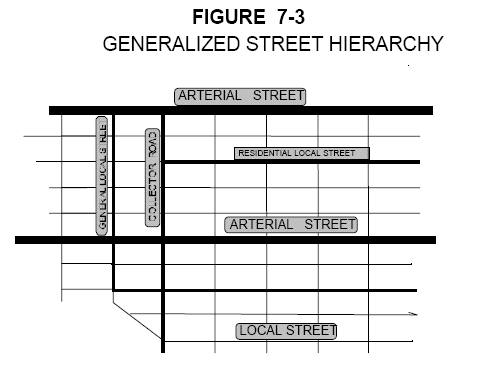
Roadway Classification - Roadways in Planned Mixed Use Developments shall be classified as arterial, collector, or local roads or streets. These classifications are presented in order of the intensity of their associated uses. Local streets are further subdivided into residential and general streets. While the uses permitted along these streets differ, neither of these classifications is intended to be used more intensively than the other. Further definitions of and standards for these classifications as used for Planned Mixed Use Developments are found below and in Table 7-4.
a.
Arterial road - A route providing service which is relatively continuous and of relatively high traffic volume, long average trip length, high operating speed, and high mobility importance.
b.
Collector road - A route providing service which is of relatively moderate average traffic volume, moderately average trip length, and moderately average operating speed. Such a route also collects and distributes traffic between local roads or arterial roads and serves as a linkage between land access and mobility needs.
c.
Local streets - Routes which primarily permit direct access to abutting property and connections to a higher order roadway. A local street provides service that is relatively low in volume and short average trip length or minimal through traffic movements.
(1)
Residential local street - a local street on which only residential, institutional, and neighborhood commercial uses are permitted (see Table 7-1).
(2)
General local street - a local street on which some residential uses are prohibited (see Table 7-1).
2.
Roadway Design Criteria - The following criteria shall be used in planning for traffic circulation.
a.
Minimum dimensional requirements for roadways in Planned Mixed Use Developments shall be as specified in Table 7-4 below, unless otherwise approved.
b.
Principal vehicular access points shall be designed for smooth traffic flow with controlled turning movement and minimum hazards to vehicular or pedestrian traffic. Local streets within the Planned Mixed Use Development shall not be connected to streets outside the development where their use would encourage through traffic.
c.
The proposed Planned Mixed Use Development shall be designed so that it will not create traffic congestion on the arterial and collector roads surrounding the project, or such surrounding collector or arterial roads shall be improved so that they will not be adversely affected.
d.
The proposed Planned Mixed Use Development shall be designed so that arterial and collector roads which enter or leave the project, shall connect to roads of the same or higher classification.
e.
As specified in Table 7-1 above, all non-residential land uses, other than neighborhood commercial, within the Planned Mixed Use Development shall have direct access to a general local or collector street without creating traffic hazards or congestion on any street.
f.
As specified in Table 7-1 above, all residential land uses within the Planned Mixed Use Development shall have direct access to a residential local, a general local or a collector street without creating traffic hazards on any street.
g.
Access points on all collector or arterial streets serving a Planned Mixed Use Development shall be located and spaced so that traffic moving into and out of the arterial streets does not cause traffic congestion.
h.
Access to arterial streets shall be permitted only for uses with projected average daily trips (ADTs) of four thousand five hundred (4,500) or greater (see Table 7-1).
i.
Streets in a Planned Mixed Use Development may be dedicated to public use or retained under private ownership. Said streets and associated improvements shall comply with Chapter XIII, Building Regulations and Public Works Construction, of the St. Lucie County Land Development Regulations. Variations to the standard minimum right-of-way widths may be considered as part of the Planned Mixed Use Development if it is shown to the satisfaction of the Board of County Commissioners, that the requested variation is consistent with the intent of the County's roadway construction standards and necessary for the design of the Planned Mixed Use Development.
j.
All roads and streets shall intersect at an approximate 5° angle of ninety (90) degrees unless circumstances acceptable to St. Lucie County indicate a need for a lesser angle of intersection.
k.
Street jogs or centerline offsets between any local street or road with another local street or road, shall be no less than one hundred fifty (150) feet.
l.
The intersection of any two (2) local roads or streets with a Major Collector or Arterial Roadway shall be separated by a minimum distance of six hundred sixty (660) feet, as measured from centerline to centerline.
m.
Permanent dead-end streets shall not exceed one thousand (1,000) feet in length. Cul-de-sacs shall be provided at the end of all dead end roads or streets greater than five hundred one (501) feet in length. The length of a dead-end street shall be measured along the centerline of the street from its point of perpendicular intersection with the centerline of intersecting street to the end of the dead-end street or roadway. All cul-de-sacs shall have a minimum right-of-way diameter of one hundred (100) feet.
If the dead end roadway is five hundred (500) feet or less in length, a "Y" or "T" type of turn around may be approved.
If a dead end street is temporary in nature then a temporary cul-de-sac shall be required until the roadway is connected to another street or road.
In the center of the cul-de-sac an unpaved island, surrounded by a curb, improved with grass and landscaping that will not interfere with sight distance, may be provided. Center islands shall have a diameter of not less than seventeen (17) feet, unless otherwise approved through the review of the Planned Unit Development.
n.
All roadways, exclusive of interior parking and access aisles areas, regardless of ownership, shall be located a minimum of ten (10) feet from any exterior building walls, except for security gate houses or similar security structures located in a private street or road right-of-way.
o.
Any pedestrian circulation system and its related walkways shall be separated from the vehicular street system. This may include, when deemed to be necessary by the Board of County Commissioners, pedestrian underpasses or overpasses in the vicinity of playgrounds and other recreation areas, local shopping areas, and other neighborhood uses which generate a considerable amount of pedestrian traffic.
TABLE 7-4
;sz;8q; * Requires curb and gutter for stormwater design unless otherwise approved by County Engineer.
;sz;8q;
Sources: United States Department of Transportation,
ABCD's of Bikeways Florida Department of Transportation, Florida's
Level of Service Standards and Guidelines, Manual for Planning, April 1992
St. Lucie County, Community Development Department
F.
Parking and Loading.
1.
General Provisions.
a.
The number, type, and location of parking spaces shall be determined at the time of final Planned Mixed Use Development plan approval. The determination of the number of spaces required shall be based on Section 7.06.01(F) of this Code. The number of parking spaces required by this section may be reduced based on substantial competent evidence that the reduced number of spaces is adequate for the proposed use or that parking may be shared by proximate uses that operate at different times or on different days.
b.
Reserved parking spaces may be provided, in lieu of paved spaces, subject to Section 7.06.02(C) of this Code.
2.
Off Street Parking and Loading. Off-street parking and loading requirements are governed by Sections 7.06.02 and 7.06.03 of this Code, and the following standards:
a.
Off-street parking and loading areas shall be designed to provide travelways between adjacent uses while discouraging through traffic.
b.
Off-street parking and loading areas shall be screened from adjacent roads and pedestrian walkways with hedges, dense planting, or changes in grades or walls.
3.
On Street Parking. In Planned Mixed Use Developments, on street parking may be used so long as the road on which the on-street parking is proposed lies entirely within the limits of the defined Planned Mixed Use Development and such parking would not contravene any other provision of this Code or the St. Lucie County Code of Ordinances. Where such on street parking and loading is used, it shall be consistent with the following design standards:
a.
The minimum size of a parking stall shall be as follows:
parallel 8 feet × 23 feet
angled 10 feet × 18 feet
handicapped (parallel) 12 feet × 23 feet
handicapped (angled) 12 feet × 18 feet
b.
Handicapped parking spaces shall be appropriately marked.
c.
Access for emergency fire vehicles shall be in accordance with NFPA standards.
d.
No more than fifteen (15) parking spaces shall be permitted in a continuous row without being interrupted by a minimum landscape area of three hundred sixty (360) square feet.
G.
Lighting. All lighting facilities shall be arranged in such a manner so as to prevent direct glare or hazardous interference of any kind to adjoining streets or properties. A detailed lighting plan shall be required for arterial and collector streets and any Planned Mixed Use Development located on North or South Hutchinson Island.
H.
Buffers and Landscaping Between Uses Within The Planned Mixed Use Development. Mixed Use Developments shall provide buffers and landscaping as required by Section 7.09.00, unless otherwise approved.
I.
Planned Mixed Use Development Perimeter Buffers. Buffers at the perimeter of the PMUD shall be as specified in Table 7-5 below.
TABLE 7-5
J.
Setbacks from Agricultural Land. Planned Mixed Use Developments adjacent to land used for agricultural purposes, or designated for agricultural use on the Future Land Use Map of the St. Lucie County Comprehensive Plan shall provide setbacks from the agricultural land sufficient to protect the function and operation of those uses from the encroachment of Urban activities or uses.
K.
Open Space and Landscaping Standards.
1.
A minimum of twenty-five percent (25%) of the gross area of the land to be committed to a Planned Mixed Use Development must be for use as open space, which may include, parks, recreation areas, bicycle and pedestrian paths and facilities, marinas, swimming beaches, common open space, common landscaping or planting areas, floodways, lakes, wetlands, stormwater retention areas, or other areas of public purpose but not including street, road or drainage rights-of-way, above ground utilities (although common open space may be provided under transmission lines), and parking areas.
A minimum of twenty-five percent (25%) of any existing native upland habitat on the property, must be preserved in its natural condition as part of the required twenty-five percent (25%) open space, For each acre of preserved native habitat above the required minimum twenty-five percent (25%) that is preserved in its original state, credit shall be given at a rate of one hundred fifty percent (150%) per acre towards the remaining common open space requirement.
2.
All areas to be dedicated for open space shall be identified as part of the Preliminary Development Plan for the Planned Mixed-Use Development. Areas that are floodways, lakes, wetlands, and stormwater retention areas may be applied to satisfy the total common open space, subject to the requirement that twenty-five percent (25%) of any existing native habitat on the property must be included as part of the required twenty-five (25%) percent common open space. As part of the Final Planned Mixed-Use Development submission process, the developer or petitioner for the Planned Mixed-Use Development shall provide for one (1) of the following:
a.
The advance dedication of all common open space to a public, or acceptable private, agency that will, upon acceptance, agree to maintain the common open space and any buildings, structures or improvements that have been placed on it. All such dedications or conveyances shall be completed prior to the issuance of any building permits, including land clearing, for any portion of the Planned Mixed Use Development; or,
b.
A phased conveyance of the land to be used for common open space to a public or acceptable private agency that will, upon acceptance, agree to maintain the common open space and any buildings, structures or improvements that have been placed on it. The schedule for the phased conveyance of any such lands to be used for common open space shall be a specific condition of approval for the Planned Unit Development.
No such parcel of land dedicated or conveyed for common open space shall be less than one (1) contiguous acre, and all such areas shall be physically part of the Planned Mixed Use Development.
3.
Areas provided or reserved to meet any other environmental preservation or protection requirement of this code or other lawful regulatory authority may be counted towards the overall common open space requirement, provided that the common open space meets the requirements of this Code.
4.
Landscaping for off-street parking and loading areas shall, as a minimum, meet the requirements of 7.09.00.
5.
For Planned Mixed Use Developments to be constructed in stages or phases, the net open space provided in an individual stage or phase may vary from the required thirty-five percent (35%) if the approved plan for the Planned Mixed Use Development provides for the required open space, and the County is assured that the open space will be provided.
L.
Phasing.
1.
A Planned Mixed Use Development may be developed in more than one (1) stage or phase.
2.
If a Final Development Site Plan approved by the Board of County Commissioners is to be developed in stages or phases, each successive phase shall be constructed and developed in a reasonably continuous fashion. No more than two (2) years shall elapse between the completion of any stage or phase, and the final stage or phase shall be completed within ten (10) years of the date of Final Development Site Plan approval. Extensions of the above requirements are subject to approval by the Board of County Commissioners. Unless otherwise amended by the Board of County Commissioners through the Final Development Site Plan review process, the following sequence of development must be adhered to:
a.
One (1) or more major recreation facilities and other major amenities, planned to serve the entire development, shall be completed or adequate security posted prior to the issuance of building or mobile home permits of more than forty percent (40%), or other percentage as determined by the Board to be appropriately based on circumstances that include the size of the project and the proposed phasing schedule of the total number of authorized dwelling units. Recreation facilities or facilities and other amenities planned to serve one (1) phase of a multi-phased development shall be completed or appropriate security posted prior to issuance of building or mobile home permits or the recording of any final plat within that phase.
b.
For Planned Mixed Use Developments to be constructed in stages or phases, the net density of an individual stage or phase may vary from the approved Final Site Plan subject to the requirements in Section 11.02.05.
3.
Notwithstanding the above, if the land is within a Development of Regional Impact and governed by a development order, the development order shall govern the timing of the phases or stages of development activity.
M.
Signs.
1.
Signs within any Planned Mixed Use Development (PMUD), less than or equal to one hundred (100) acres in overall area, shall comply with the provisions of Chapter IX of this Code, provided however, that the Board of County Commissioners may condition approval of a Planned Mixed Use Development (PMUD), upon compliance with more stringent sign regulations in order to ensure design consistency throughout the proposed development, to ensure compatibility with surrounding land uses, to ensure public safety and prevent public harm, and to ensure compliance with the St. Lucie County Comprehensive Plan.
2.
Signs within any Planned Mixed Use Development (PMUD), greater than one hundred (100) acres in overall area may submit a general signage plan for the Planned Mixed Use Development, as part of the Final Planned Unit Development Plan submissions. The general signage plan shall be based on the general dimension and size standards applicable to other similarly designated property; provided, however, that the Board of County Commissioners may condition approval of a Planned Mixed Use Development upon compliance with more stringent sign regulations in order to ensure design consistency throughout the proposed development, to ensure compatibility with surrounding land uses, to ensure public safety and prevent public harm, and to ensure compliance with the St. Lucie County Comprehensive Plan.
3.
All other requirements and standards relating to signs within the Planned Mixed Use Development (PMUD) zoning designation shall be consistent with Chapter IX of this Code.
(Ord. No. 2021-14, Pt. A, 6-1-2021)
7.04.01. - Requirements.
A.
Density, Height and Lot Coverage - General. Except as modified by the provisions for conditional uses or variances, no structure shall be constructed, built, moved, remodeled, reconstructed, occupied, or used on a lot that is greater than the maximum density, the maximum height, or the maximum lot coverage requirement shown in Table 7-10 for the Zoning District in which it is located.
B.
Area, Width and Yard Requirements - General. Except as modified by the provisions for conditional uses or variances, no structure shall be constructed, built, moved, remodeled, reconstructed, occupied, or used on a lot that is less than the minimum lot area, minimum lot width, and minimum yard requirement as shown in Table 7-10 for the zoning district in which it is located, except that unsupported roof overhangs may encroach up to thirty (30) inches within any required yard setback area and at-grade accessory structures, not more than thirty (30) inches above finished grade and not supported by any type of foundation or footer system, may be located within the side or rear yard, except in the case of corner lots, provided that no public drainage or utility easement is impacted without the expressed written release and authorization for such occupation by all affected drainage or utility authorities. This provision does not supersede the restrictions of Section 7.10.16(Q)(1)(a) of this Code.
C.
Minimum Building/Structure Elevation.
1.
The minimum first floor elevation of all residential buildings shall be as follows:
a.
For properties lying within a designated Special Flood Hazard Area where the base flood elevation has been determined, as further defined under Chapter II of this Code, all buildings shall be elevated a minimum of eighteen (18) inches above the crown of the adjacent roadway or shall comply with the minimum flood elevation for the property as established on the Flood Hazard Boundary Map for St. Lucie County, whichever is greater.
b.
For properties lying within a designated Special Flood Hazard Area for which the base flood elevation has not been determined, all buildings shall be elevated as follows:
1.
A minimum of thirty-six (36) inches above the adjacent average natural grade, or eighteen (18) inches above the crown of any adjacent roadway, whichever is greater; or
2.
As determined by a sub-basin drainage study for the proposed development meeting the requirements of a stormwater permit as set forth in Chapter VII.
c.
For properties lying outside of a Special Flood Hazard Area, as further defined under Chapter II of this Code, all buildings shall be elevated a minimum of eighteen (18) inches above any adjacent roadway.
2.
Habitable/non-residential buildings shall comply with the following standards:
a.
For properties lying within a designated Special Flood Hazard Area where the base flood elevation has been determined, as further defined under Chapter II of this Code, all buildings shall be elevated a minimum of eighteen (18) inches above the crown of the adjacent roadway or shall comply with the minimum flood elevation for the property as established on the Flood Hazard Boundary Map for St. Lucie County, whichever is greater.
b.
For properties lying within a designated Special Flood Hazard Area for which the base flood elevation has not been determined, all buildings shall be elevated as follows:
1.
A minimum of thirty-six (36) inches above the adjacent average natural grade, or eighteen (18) inches above the crown of any adjacent roadway, whichever is greater; or
2.
As determined by a sub-basin drainage study for the proposed development meeting the requirements of a stormwater permit as set forth in Chapter VII.
c.
For properties lying outside of a Special Flood Hazard Area, as further defined under Chapter II of this Code, all buildings shall be elevated a minimum of eighteen (18) inches above any adjacent roadway.
3.
When topographical conditions are such that compliance with this subsection would be impracticable or cause grade level conditions detrimental to adjacent or nearby property, the Planning and Development Services Director shall grant relief from the provisions of this subsection, consistent with Flood Protection regulations.
4.
For non-habitable/non-residential structures, when topographical conditions are such that compliance with this subsection would be impracticable or cause grade level conditions detrimental to adjacent or nearby property, the Planning and Development Services Director may grant relief from the provisions of this Code, consistent with the intent of the Flood Protection regulations and any other applicable portion of this Code.
D.
Filled Lands.
1.
Any filled land created in the unincorporated area of St. Lucie County shall be filled so that the settled elevation of such land shall be at least five (5) feet above mean sea level (MSL), as measured by U.S.C. and G.S. Datum.
2.
No trees, vegetation, organic materials, or garbage shall be used as fill material in the unincorporated area of St. Lucie County for the purpose of raising the existing grade of any land on which construction is intended. The disposal of all trees, vegetation, organic material, and garbage shall be in accordance with applicable St. Lucie County Regulations.
3.
Where fill is used, the owners of the property on which the fill is being located shall be responsible for assuring adequate drainage so that the immediate community will not be adversely affected. All permittees are required to execute a Filled Lands Affidavit with an application for a building permit. The Affidavit shall include an acknowledgment to retain an engineer or other design professional if the stormwater grading plan fails and that the applicant agrees to hold St. Lucie County harmless for any future drainage rework that may be required as a result.
A.
Requirements for Stormwater Grading Plan for Single-Family and Duplex Infill Development. This section uses simple design standards to avoid the necessity of complex engineering calculations and analysis. The applicant may, however, choose to retain the services of an engineer at their expense.
1.
Purpose. This section provides stormwater runoff standards for infill residential development within the unincorporated County to protect existing structures from adverse impacts of uncontrolled runoff from infill construction.
2.
Definitions.
Bio-swale means a storm water runoff conveyance system that can absorb low flows or carry runoff from heavy rains to storm sewer inlets or directly to surface waters; and, for the purposes of this Code, it is a long, channeled depression or trench that receives rainwater runoff (from the roof of the residence) and has vegetation (such as grasses, flowering herbs, and shrubs) and organic matter (such as mulch) to slow water infiltration and filter out pollutants.
Cistern, rainwater, means a waterproof reservoir for catching rainwater; it may be connected to a roof gutter system and downspouts that directs the rainwater to the storage cistern; and it may be located above ground or underground, and built of various materials.
Elevated building means a non-basement building which has its lowest elevated floor raised above ground level by foundation walls, shear walls, post, piers, pilings, or columns.
Fill means a volume of earthen material that is placed and compacted for the purpose of filling in a hole or depression to create a structure that, when placed, changes the grade or elevation of the receiving site.
Infill Lot Development means developing parcels within areas without a master drainage plan.
Grading Plan means a plan that delineates the shaping and grading of the land to direct surface runoff away from the structure and towards a swale or other stormwater conveyance system.
Lot means a tract, plot, or portion of land intended as a unit for immediate or future use, transfer of ownership, or building development.
Rain garden, means a shallow dug-out area that is landscaped with native plants and designed to collect stormwater runoff that comes from nearby impermeable surfaces, such as roofs, driveways, and sidewalks.
Slope means a surface that rises at an angle; slope is the measure of the steepness of a line.
Stormwater means any surface flow, runoff, and drainage consisting entirely of water from any form of natural precipitation and resulting from such rain.
Swale means a valley-like section of two slopes on a piece of land or a low place on a piece of land that is often wet with stormwater
3.
Applicability; Exemption; Waiver The provisions of this section shall only apply to development within the unincorporated county boundaries for lots being developed that do not have an approved stormwater management plan. Any development subject to this section must be designed to minimize directed runoff to an adjacent property. Additions or accessory structures less than 300 square feet have a one-time exemption from this section. The property owners of substantial acreage may demonstrate there is no need for a stormwater management plan; in that event, the Department Director may waive the requirement for a stormwater management plan.
4.
Requirements. All applicants that propose to develop a single family home or duplex on infill property shall:
a.
Submit a topographic survey that identifies existing conditions within and adjacent to the lot, including the finish floor elevation of any adjacent structures. The survey shall include a minimum of four (4) elevations along each property line to include the corners of the lot. The survey shall have been completed within six (6) months of building permit submittal.
b.
Submit a stormwater grading plan specifying the elevations as noted in [subsection] a. above, and include lot type, swale locations, spot elevations, flow direction arrows, side slope of 4 to 1, north directional arrow and scale, floor area calculation, a yard basin if applicable, retaining wall details if applicable.
c.
Limit the amount of fill on the lot; the amount of fill shall be the minimum necessary for the construction of the building.
d.
Note foundation construction methods.
1.
The foundation grade, fill, shall be limited to eighteen (18) inches not to exceed thirty-six (36) inches for an elevated building (a building on piles, stilts, stem wall, etc.).
a.
If an applicant wants to build the foundation grade with fill greater than thirty-six (36) inches, a stormwater management plan designed by an engineer is required; and, the design must include additional stormwater retention above this Code section to be approved by the Planning and Development Services Director.
2.
Alternative methods of construction that are not listed above in [subsection] d.1 may be considered, however, a report from an engineer is required to demonstrate compliance with this code.
e.
Limit the finished floor elevation of the ground floor to be no more than three (3) feet above the crown of the road unless required by the Florida Building Code or the State of Florida Health Department; or other constraint shall require a stormwater grading plan and report by a professional engineer to be approved by the Planning & Development Services Director.
1.
Pumps for on-site sewage disposal systems (septic tank and drain fields) may be required if a gravity drain field causes the finished floor elevation to be higher than specified in [subsection] 4.).
f.
Limit the maximum slope of fill on a lot so that the slope does not exceed 4:1.
g.
Include roof drainage provisions such as gutters and splash pads/downspouts, so that the runoff is directed away from the adjacent lot toward the stormwater conveyance system.
h.
Construct a swale along the back property line of the lot with a high point in the middle of the swale along the rear lot line. The swale shall slope from the high point to the side lot lines on both sides and continue to the front property line roadside swale or other approved outfall. Swales shall be no greater than two (2) feet in width unless otherwise approved. See subsection 5, Swale Flow Area Ratio Value Table. If an alternate method of design is proposed, the applicant has the option to provide an engineered plan.
1.
When conditions are extreme, and there is a need for an additional type of conveyance system, the applicant may consider retaining walls, berms, piping, or yard drains to aid in directing runoff to the conveyance system. A retaining wall design, berm, use of an existing canal system or a piping plan on site shall require a plan prepared by an engineer. The use of a canal system may require permits for regulatory agency. The outfall piped conveyance system shall be required to be maintained.
i.
Sod all swales to prevent erosion, unless used as a rain garden.
j.
Convey off-site runoff that flows to or through the lot to the adjacent roadside or other approved outfall. New construction shall not block this flow.
k.
Encourage alternative stormwater designs, (such as cisterns, bio-swales and rain gardens) to prevent runoff to adjacent property.
5.
Swale Flow Area. Any applicant may use the method of determining adequate flow area using the below Table:
Step 1. Determine water flow patterns on the project site and outfall (where the flow exits the property).
Step 2. Determine water flow area size by calculating the width and length of the affected site.
Step 3. Using the Table below, determine the swale flow area by finding the impervious area of building footprint in the first column and identifying the column of water flow area size from step 2 above.
Step 4. Using the Table below, if the value is between the rows and columns, chose the swale flow area ratio value of the next row and column in the Table.
Step 5. The following equation shall be used to calculate the dimensions of the swale flow area:
Swale Depth = (Swale Flow Area Ratio from Steps 3 or 4) x 2.0 x (width of swale = 1.0)
Swale Flow Area Ratio Value Table
6.
Maintenance. Perpetual maintenance of the stormwater conveyance system, including alternative conveyance systems, shall be the responsibility of the owner of the improved property. The maintenance shall include the routine mowing any growth of grass, weeds, flora, or underbrush within the swale area to a height of eight (8) inches or less; removing trash, debris, or litter; and removing any obstructions that impede stormwater drainage.
7.
Compliance. A final stormwater inspection shall be performed for compliance with the approved stormwater grading plan prior to the issuance of a Certificate of Occupancy.
E.
Non-Residential Buildings on Farms. Any person erecting a nonresidential farm building on a farm shall be required to obtain a Certificate of Zoning Compliance prior to construction showing that the structure meets the setback requirements shown in Table 7-10 for the zoning district in which it is located.
NOTES:
(a)
Expressed as dwellings/per acre.
(b)
For three (3) or more dwelling units, motel, or hotel uses, use the building spacing formula identified in Section 7.04.03.
(c)
For Industrial extraction uses, refer to Mining Regulations, Section 6.06.00.
(d)
Maximum net density of thirty-six (36) guest units/acre, except for North and South Hutchinson Island. For hotel/motel development density on North and South Hutchinson Island refer to Policy 1.1.10.2 of the St. Lucie County Comprehensive Plan.
(e)
All structures in excess of forty (40) feet shall comply with the provision of Section 7.04.03.
(f)
With central water.
(g)
For enclosed storage structures, greenhouses, child's playhouse and gazebos, of up to one hundred forty-four (144) square feet (twelve (12) feet by twelve (12) feet) this dimension may be reduced to five (5) feet.
(h)
Ten thousand (10,000) square foot lots permitted when use limitations consistent with the CN and CO zoning districts (see Section 3.01.03(Q) and (R).
(i)
For any development activity on Hutchinson Island, refer to Section 4.01.00, Hutchinson Island - Building Height Overlay Zone.
(j)
For aquaculture production activities, the maximum percentage of lot coverage by building is fifty percent (50%). All buildings are subject to meeting the applicable stormwater management standards and requirements of this code.
For the purpose of this section, aquaculture means the cultivation of aquatic organism and aquacultural products as defined in F.S. Ch. 597.0015.
(k)
There shall be no minimum lot size required for the Cpub zoning district, however the minimum yard setback for any structures erected on any site zoned Cpub shall be as identified.
(l)
For accessible handicap ramps and lifts, the required yard setback may be reduced to fifty percent (50%) of the minimum setback requirement.
The accessible handicap ramp or lift permitted under this amendment shall not have a roof or be enclosed and shall not provide for a deck or landing larger than is necessary to be in compliance with the Florida Accessibility Code for Building Construction. A Physician's Certification Form and proper Building Permit Application documentation is required.
(m)
Maximum hotel/motel density of thirty-six (36) guest units/acre. For hotel/motel projects containing condominium hotel units (as defined in the Land Development Code) the total number of hotel/motel units of any kind (including condominium hotel units) may not exceed 36 units per acre.
(n)
For Solar Generation Stations, see Section 7.10.28(A)(1)(b)(7).
(Ord. No. 08-025, Pt. A, 9-16-2008; Ord. No. 15-002, Pt. A, 4-7-2015; Ord. No. 2016-23, Pt. A, 11-1-2016; Ord. No. 2020-23, Pt. A, 8-4-2020; Ord. No. 2022-2, Pt. D, 2-1-2022; Ord. No. 2022-29, § 2, 10-18-2022; Ord. No. 2023-05, Pt. A, 3-21-2023)
7.04.02. - Open Space Requirements.
A.
Purpose. The purpose of this Section is to provide standards for Open Space and Habitat Preserve areas within the areas designated for Agricultural Land Use under the St. Lucie County Comprehensive Plan.
B.
General Guidelines. The following activities and land uses may be counted toward open space:
1.
Passive recreation areas.
2.
Natural preserves, wetland and upland habitats, including those areas of on-site preservation required by the other provisions of this Code.
3.
Required landscape and common areas.
4.
Playgrounds and active recreation areas, but not including swimming pools, tennis courts and/or other impervious activity areas.
5.
Golf courses.
6.
Agricultural activities not involving any activities within an enclosed or covered structure.
7.
Lakes, ponds, and waterways in private ownership, but available for use by the residents/occupants of the particular development.
8.
Stormwater detention and retention facilities providing that no more than thirty percent (30%) of the overall open space requirement shall be satisfied in this manner.
C.
Open Space Standards in Agricultural Areas. (Reserved)
D.
Open Space Standards in Planned Unit Developments. Open space requirements, as a percentage of the total site, for all Planned Unit Developments shall be as set forth in Section 7.01.00.
E.
Open Space Standards in Planned Nonresidential Developments. Open space requirements, as a percentage of the total site, for all Planned Nonresidential Developments shall be as set forth in Section 7.02.00.
F.
Open Space Standards in Planned Mixed Use Developments. Open space requirements, as a percentage of the total site, for all Planned Mixed Use Developments shall be as set forth in Section 7.03.00.
G.
Open Space Standards in Planned Towns or Villages. Open space requirements for Planned Town or Villages shall be as set forth in Section 3.01.03.FF.2.b and 2.o.
H.
Open Space Standards in Planned Country Subdivisions. Open space requirements for Planned Country Subdivisions shall be as set forth in Section 3.01.03.GG.2.j.
7.04.03. - Building Spacing Formula.
A.
Purpose. The purpose of this section is to insure the minimum distance between any multiple-family (except two- and three-family structures), hotel, or motel building, two (2) floors or greater in height, and any other building or any property line shall be regulated according to the length and height of such multiple-family, hotel, or motel building.
B.
Applicability. These requirements shall apply to all multiple-family dwellings, hotels, and motels, and to all accessory uses with two (2) or more floors that are customarily associated with and subordinate to the principal use.
C.
Maximum Horizontal Dimension. The maximum horizontal dimension of any building shall be three hundred (300) feet, including all deck areas and enclosed and covered walkways, as measured between the farthest points of such buildings.
D.
Formulas for Minimum Distance Between Buildings and Property Lines.
1.
Between Buildings. The formula regulating the required minimum distance between two (2) buildings (referred to as Building A and Building B) is as follows:
D = [L A + L B + 2(H A + H B )]/4
2.
Between Building and Property Line. The formula regulating the required minimum distance between a building (referred to as Building A) and a property line is as follows:
D = [ L P L + 2(H A )]/4
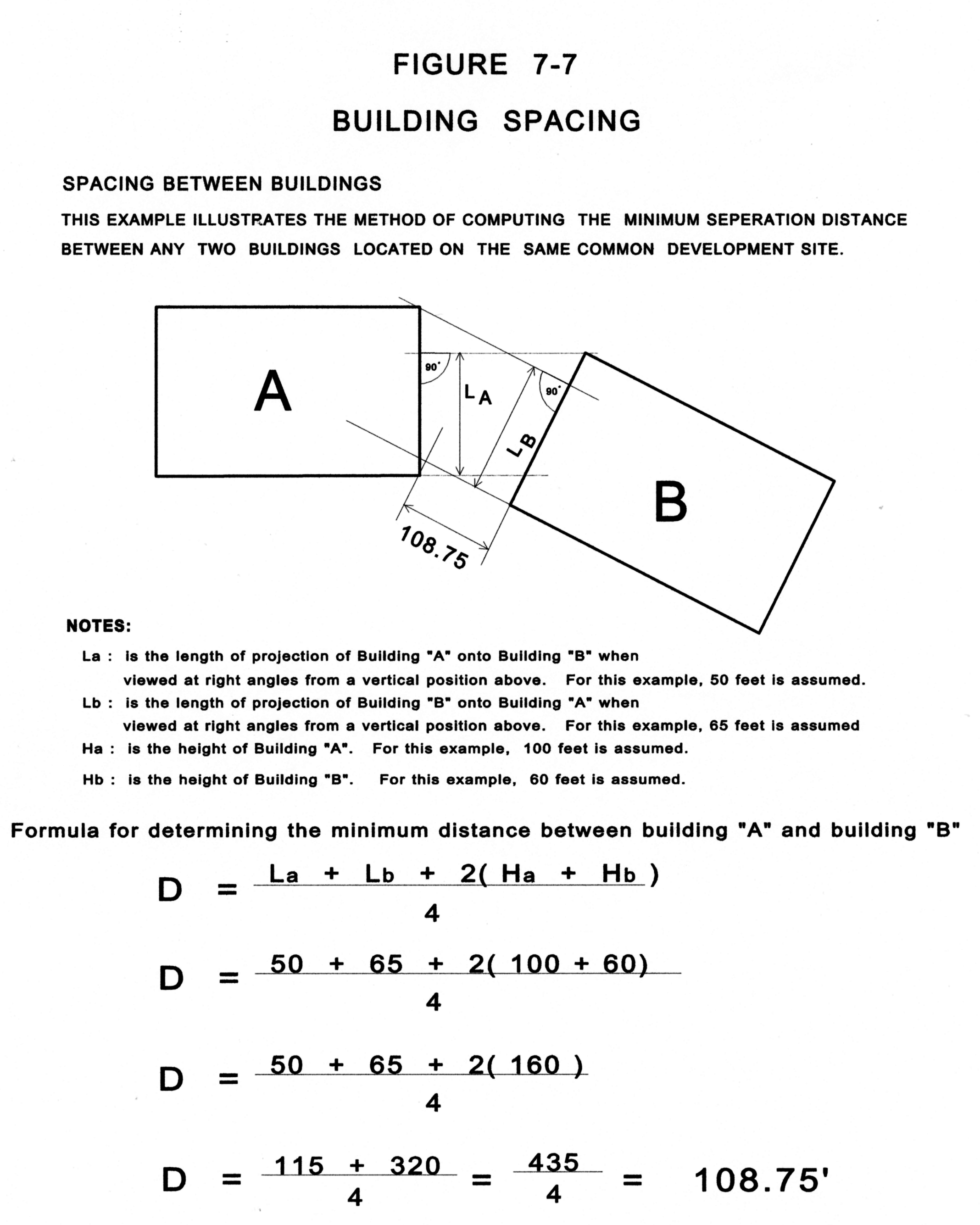
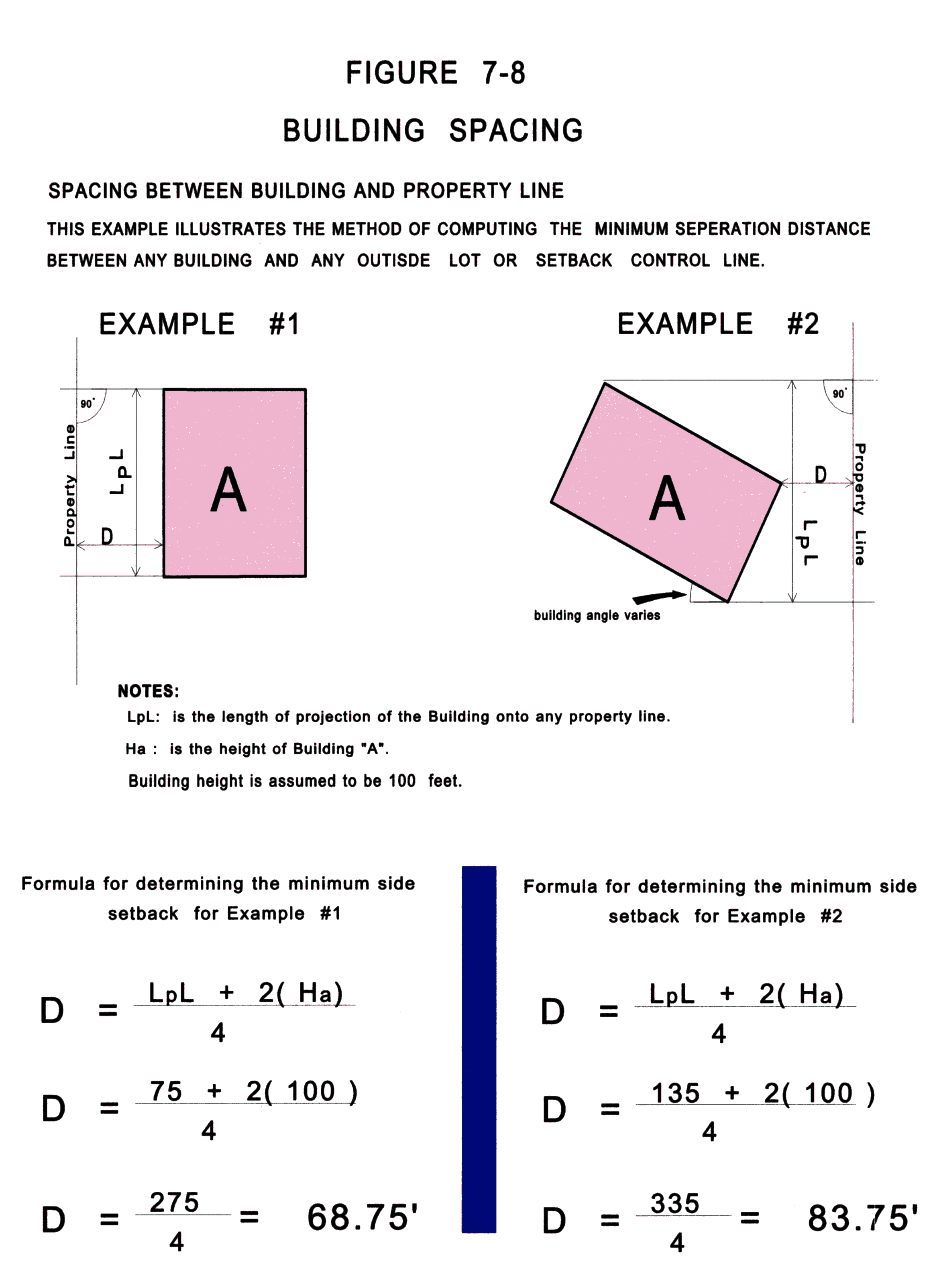
3.
Formula Symbols and Definitions. The symbols used in the formula described in Section 7.04.03(D)(1) and (2) mean the following:
a.
D is the required minimum horizontal distance between any wall of Building A and any wall of Building B (or the vertical extension of either) or between any wall of any building and a property line.
b.
L A is the total length of Building A. The total length of Building A is the length of that portion or portions of a wall or walls of Building A from which, when viewed directly from above, lines drawn perpendicular to Building A will intersect any wall of Building B.
c.
L B is the total length of Building B. The total length of Building B is the length of that portion or portions of a wall or walls of Building B from which, when viewed directly from above, lines drawn perpendicular to Building B will intersect any wall of Building A.
d.
L P L is the total length of the property line. The total length of the property line is the length of that portion or portions of the property line from which, when viewed directly from above, lines drawn perpendicular to the property line will intersect any wall of any building.
e.
H A is the height of Building A.
f.
H B is the height of Building B.
g.
Length of walls or property lines shall be measured as the horizontal distance from corner to corner. Wall length of a circular building shall be construed as the diameter or longest chord of the building, with the exception of ground floor area.
h.
The term "wall or walls" shall include porches, balconies, deck areas, and enclosed or covered walkways with the exception of ground floor area.
7.04.04. - Base Building Line Setback Requirements.
Base Building Lines are hereby established from which all front, side, and rear yard setbacks are to be measured. For all thoroughfares in St. Lucie County, the base building line dimension from centerline shall be in accordance with dimensions shown on the Base Building Line Information Chart. For all other roads not referenced in Table 7-11, the base building line dimension shall be thirty (30) feet. In any case, when a thoroughfare right-of-way from centerline is greater than the base building line dimension as hereby established, the right-of-way line shall serve as the basis on which to measure front, side, and rear yard setbacks.
TABLE 7-11
7.05.01. - General Provisions.
A.
The character, width, grade and location of all roads, streets and bridges in unincorporated St. Lucie County shall conform to the standards in this Code and shall be considered in their relation to:
1.
Existing and planned streets,
2.
Topographic conditions,
3.
Public convenience and safety, and,
4.
The relation to the proposed uses of the land to be served by such streets.
B.
All bridges shall conform to the latest edition of the "Standard Specifications for Highway Bridges" adopted by AASHTO. Construction and material specifications for streets and bridges shall conform to "FDOT Standard Specifications for Road and Bridge Construction" except as may otherwise be provided in Chapter XIII of this Code.
7.05.02. - Streets.
A.
Generally.
1.
Except as otherwise provided in this code, if existing roads or streets are located in adjoining subdivisions, the roads or streets on the new plat shall be so located as to provide an extension and continuation of the existing rights-of-way. All public rights-of-way shall terminate at a property line to provide for their extension to adjacent properties.
2.
In a rectangular block layout, all roads and streets should be centered on section lines or the standard subdivision lines of the section, unless otherwise determined inappropriate due to specific site conditions.
3.
In curvilinear patterns, the roads or streets shall be located, with respect to the property boundaries, so as to provide a continuity of traffic flow across the property, and such streets shall begin and terminate at street intersections wherever the same are existing.
4.
All roads and streets shall be planned in conformity with the Transportation Element of the St. Lucie County Comprehensive Plan.
5.
All roads and streets shall intersect at an approximate 5° angle of ninety (90) degrees unless circumstances acceptable to St. Lucie County indicate a need for a lesser angle of intersection.
6.
The intersection of any two (2) local roads or streets with a Major Collector or Arterial Roadway shall be separated by a minimum distance of six hundred sixty 660) feet, as measured from centerline to centerline.
7.
The right-of-way width shall be increased by at least ten (10) feet on each side of any arterial or major collector road or street for a minimum distance of two hundred (200) feet from its intersection with another arterial or major collector road or street, to permit proper intersection design.
8.
Street jogs or centerline offsets between any local street or road with another local street or road, shall be no less than one hundred fifty (150) feet.
9.
Permanent dead-end streets shall not exceed one thousand (1,000) feet in length. Cul-de-sacs shall be provided at the end of all dead end roads or streets. The length of a dead-end street shall be measured along the centerline of the street from its point of perpendicular intersection with the centerline of the intersecting street to the end of the dead-end street or roadway. All cul-de-sacs shall have a minimum right-of-way diameter of one hundred (100) feet.
If a dead end street is temporary in nature then a temporary cul-de-sac shall be required until the roadway is connected to another street or road.
In the center of the cul-de-sac an unpaved island, surrounded by a curb, improved with grass and landscaping that will not interfere with sight distance, may be provided. Center islands shall have a diameter of not less than seventeen (17) feet.
10.
All new construction for any arterial or collector street or roadway within the Urban Service Area shall be provided with sidewalks and bicycle paths along one (1) or both sides, as determined by the County Engineer. The County Engineer shall consult the Bicycle/Pedestrian Coordinator, the St. Lucie Metropolitan Planning Organization Bicycle and Pedestrian Plan or other adopted Bicycle and Pedestrian Plan in determining the location of any sidewalk and bicycle facilities.
11.
Except as otherwise may be provided in this Code, all arterial and major collector street and roadways shall have a minimum travel lane width of twelve (12) feet. In those instances where an open swale drainage system is utilized, five (5) feet of the required shoulder area shall be paved where practical.
12.
All arterial, collector and local streets or roadways, public or private, shall be marked and signed in accordance with Florida Department of Transportation standards.
13.
Median strips which are part of a dedicated or deeded public right-of-way shall not be utilized for any purpose other than by the County or authorized utility. The placement of any median landscaping shall be in accordance with Florida Department of Transportation specifications.
14.
All roadways, exclusive of interior parking and access aisle areas, regardless of ownership, shall be located a minimum of ten (10) feet from any exterior building wall, except for security gate houses or similar security structures located in a private street or road right-of-way.
7.05.03. - Rights-of-Way Determinations and Dedications, Improvements.
A.
St. Lucie County Thoroughfare Network Right-of-Way Protection Plan.
1.
Findings. Action must be taken to plan, designate, and develop transportation corridors within St. Lucie County for the following reasons:
a.
Traffic congestion and overcrowding on the State Highway System and County Road System constitute a serious and growing problem, which impedes the development of an effective County-wide transportation system, results in increased incidents of traffic accidents, personal injury, and property damage or loss, impedes sound economic growth, impairs effective growth management, discourages tourism, increases maintenance costs, shortens the effective life of transportation facilities, delays public evacuation for natural storms and emergencies, impairs national defense and disaster response readiness, delays response time for emergency vehicles, significantly increases public infrastructure needs and associated costs related to the provisions of police, fire, accident, medical, and hospital services, impairs air quality and otherwise is injurious to the public health, safety, and welfare.
b.
The designation and protection of transportation corridors and the planning and development of transportation facilities within transportation corridors will substantially assist in allowing St. Lucie County to mitigate traffic congestion and overcrowding on the State Highway System and County Road System, and aid in the development of an effective uncongested and adequately maintained County-wide transportation system.
c.
Transportation corridors cannot be developed without timely identification, preservation, and protection through regulation, or acquisition of property necessary to accommodate existing and planned transportation facilities within the State Highway System and County Road System.
d.
Protecting, preserving, and timely acquiring property for the development of transportation facilities within the transportation corridors will also prevent the creation of the health, safety and welfare problems and liabilities described above from burdening the County with increasing public revenue requirements, will substantially aid the sound planning for growth, assist the provision of transportation facilities concurrent with the impact of development, expedite the provision of an adequate State Highway system and County Highway System for the residents of the County, alleviate traffic problems, and substantially enhance the elimination of traffic hazards and the improvements of traffic facilities.
e.
The St. Lucie County Comprehensive Plan in Policies 1.1.7.3 and 2.1.3.1 directs that appropriate measures should be taken in order to protect the level of service standards on all public roadways within the unincorporated county which include the State Highway System and County Road System. The Comprehensive Plan also directs that land development adjacent to roads where there is substantial right-of-way requirements pursuant to County specifications should provide for dedication of sufficient additional right-of-way to bring the adjacent right-of-way up to minimum County standards.
2.
General. The St. Lucie County Thoroughfare Network Right-of-Way Protection Plan shall identify existing and future transportation corridors and transportation facilities, and shall serve as the implementing Section of the Transportation Element of the St. Lucie County Comprehensive Plan.
3.
Purpose. The purpose of the Thoroughfare Network Right-of-Way Protection Plan is:
a.
To identify the rights-of-way needed for both County and Inter-County Road Systems in conjunction with the State Highway System to ensure county and regional continuity of the transportation system for St. Lucie County.
b.
To encourage municipalities within St. Lucie County to adopt similar Thoroughfare Network Right-of-Way Protection Plans that are consistent with the County's Thoroughfare Network Right-of-Way Protection Plan.
c.
To utilize as many existing rights-of-way as is reasonably possible, and to anticipate future needs in areas where rights-of-way do not exist.
d.
To establish right-of-way widths for future transportation facilities.
e.
To establish and encourage harmonious, orderly and progressive development of the County Road system and State Highway System in St. Lucie County, that would assure safer and more efficient traffic circulation.
f.
To adequately plan for the future transportation needs of St. Lucie County and its citizens.
B.
Review of the Thoroughfare Network Right-of-Way Protection Plan. The Thoroughfare Network Right-of-Way Protection Plan shall be reviewed by each of the following the Growth Management Director, Public Works Director, St. Lucie Metropolitan Planning Organization, and the St. Lucie County Board of County Commissioners at least one (1) time every two (2) years to assess the necessity for continuing the protection of the transportation corridors and the necessity for retaining the property acquired for the transportation corridor. If a transportation corridor is determined to be no longer necessary, the transportation corridor shall be removed from the Plan. If a new transportation corridor is determined to be needed, the transportation corridor shall be added to the Plan. Any additions or deletions from this plan shall be accompanied by the appropriate amendments to the Transportation Element of the St. Lucie County Comprehensive Plan.
C.
Minimum Right-of-Way and Typical Section Requirements. The following minimum right-of-way widths (Table 7-15) shall be used in considering land dedication needs for roadways identified on the Thoroughfare Network Right-of-Way Protection Plan.
TABLE 7-15
D.
Determination of Right-of-Way Alignment.
1.
The Thoroughfare Network Right-of-Way Protection Plan is intended to indicate transportation corridors, not precise alignments, and is to be based upon the Right-of-Way Protection Map of the Transportation Element of the St. Lucie County Comprehensive Plan. Precise alignments will be determined at the time of development review and/or as a result of detailed alignment studies and surveys.
2.
The County Engineer shall conduct, on a continuing basis, alignment studies and surveys required to establish the precise alignment of rights-of-way shown on the Thoroughfare Network Right-of-Way Protection Plan that are not previously established. The centerline of the precise alignment shall be within one thousand three hundred twenty (1,320) feet of the approximate location shown on the Thoroughfare Network Right-of-Way Protection Plan, except where it can be demonstrated that an alternative centerline alignment is less potentially harmful to the environment, or displaces fewer residences, business or other development, or is more feasible technically or financially.
a.
Centerline Determination. A thoroughfare centerline shall be determined as follows:
(1)
For existing roads, the centerline shall be the centerline of the existing right-of-way, as the same is shown in the official records of the County at the time of approval of the Development Order, except where it can be demonstrated that an alternative centerline alignment is less potentially harmful to the environment or displaces fewer residences, businesses or other development, or is more feasible technically or financially.
(FIGURE 7-15 - space reserved for future)
(2)
For planned roads which are shown on the Thoroughfare Network Right-of-Way Protection Plan and which follow section lines and/or quarter or half section lines, the centerline shall be the section line or quarter of half-section line in question, except where it can be demonstrated that an alternative centerline alignment is less potentially harmful to the environment or displaces fewer residences, businesses or other development, or is more feasible technically or financially.
(3)
For planned roads which are shown on the Thoroughfare Network Right-of-Way Protection Plan and which do not follow section lines and/or quarter or half-section lines, the centerline shall be determined by the Board of County Commissioners by adoption of a resolution at a public hearing which must be held no later than one hundred eighty (180) days after approval of a development order which includes a condition making development order approval subject to the centerline determination for the road or roads in question. This hearing shall be preceded by certified mail notice sent by the County Administrator, or his/her designee, at least fifteen (15) calendar days prior to the hearing to every property owner of records whose land may abut or be crossed by any part of the section of proposed right-of-way. The cost of all surveys required to establish a centerline shall be borne by the County.
b.
Failure of the Board of County Commissioners to establish a centerline within the time constraints set forth above shall effect a waiver by St. Lucie County of all right-of-way dedication which otherwise may have been imposed on the development for which application has been made.
c.
Local roads are not included on the Thoroughfare Network Right-of-Way Protection Plan.
E.
Dedications to Public.
1.
All rights-of-way and easements for streets, drainage and utilities shall conform to the requirements of Chapter XIII of this Code.
2.
Except as otherwise provided by the Board of County Commissioners, all roads and streets shall be dedicated to the public. Any private roads permitted by the Board of County Commissioners shall be constructed to public road specifications. Construction plan review, construction inspection and required guarantee and surety reviews for private roads shall be as provided by this Code. No arterial or major collector road or street indicated on the future right-of-way maps of the Transportation Element of the St. Lucie County Comprehensive Plan shall be permitted to be private.
3.
Private streets shall be permitted within property under single ownership or a property owners' association as defined by Florida law. Where private streets are permitted, ownership and maintenance association documents shall be submitted with all final record plats and the dedication contained on the plat shall clearly dedicate the roads and maintenance to the association without recourse to St. Lucie County or any other public agency. The rights-of-way and related facilities shall be identified as tracts for road purposes under specific ownership on all record plats for the subdivision.
F.
Effect of Donation of Property in Computing Future Residential Density on Remaining Conforming Parcels of Land.
1.
All land area requested by the County, or the State of Florida, for street or road right-of-way and other related public purposes and which is conveyed or dedicated by donation to the County, or the State, and accepted by the County or the State, after December 1, 1988, may be included in the acreage calculations for the purpose of density determination when the parcel from which the land area was dedicated is proposed for development.
G.
Effect of Donation of Property When the Donation Creates a Nonconforming Property.
1.
All land area requested by the County, or the State of Florida, for street or road right-of-way and other related public purposes and which is conveyed by donation or purchase to the County or the State, and accepted by the County or the State after December 1, 1988, shall be included in acreage calculations for the purpose of lot size determination only if the conveyance would render the remaining property non- conforming as to lot size. The land area conveyed to the County or the State shall not be used to satisfy setback requirements or any other specific land use regulation.
H.
Prohibiting Dedications of Right-of-Way Resulting in Deprivation of Reasonable Use of Property.
1.
In no case shall the County require dedication to an extent which would deprive the owner of all economically beneficial use of the remaining property.
I.
Right-of-Way Dedication Requirements.
1.
General Requirements.
a.
Any applicant for a Development Order for property abutting a roadway designated on the Thoroughfare Network Right-of-Way Protection Plan shall dedicate sufficient land to account for the applicant's proportionate share of the right-of-way deficiency identified in the Thoroughfare Network Right-of-Way Protection Plan for the proposed development. The County Engineer shall determine the applicant's proportionate share by utilizing the Thoroughfare Network Right-of-Way Protection Plan, the Transportation Element of the St. Lucie County Comprehensive Plan, any traffic information available in the County records, and any traffic analysis submitted by the applicant as part of the development order approval process or otherwise.
2.
The County Engineer shall only require the applicant to account for the applicant's proportionate share of the right-of-way deficiency identified in the Thoroughfare Network Right-of-Way Protection Plan, if the County Engineer determines, based on the transportation information available to him, that there is a reasonable connection between the required dedication and the anticipated need for right-of-way created by the new development. Subject to the County Engineer's determination of the applicant's proportionate share, any right-of-way deficiency shall be made up by dedication of equal amounts of land from each side of the centerline of the right-of-way, except where:
a.
A drainage canal right-of-way or a railroad right-of-way abuts one (1) side of the existing road right-of-way; or
b.
More than one-half of the required right-of-way has been provided by the property owner on the opposite site of the right-of-way.
3.
Compensation for Dedication.
a.
The applicant shall be entitled to receive compensation for the value of any land dedicated for right-of-way for roads on the Thoroughfare Network Right-of-Way Protection Plan that is not site related, and consistent with the provisions of Article III, Chapter 1-17, St. Lucie County Code and Compiled Laws.
b.
Compensation shall be given by either granting credits against road impact fees or by payment of cash as determined by the County. Compensation for the dedication of right-of-way shall be valued at one hundred twenty percent (120%) of the most recent assessed value as determined by the county Property Appraiser. In the event that the county cannot provide total compensation by the granting of credits against road impact fees, and in the event the county determines not to pay cash, the applicant shall dedicate an amount of land comparable in value to the percent of compensation provided.
4.
Method of Dedication. Once the extent of dedication has been determined by the County Engineer, the applicant shall as a requirement of obtaining and prior to receiving a Development Order approval agree to convey the dedicated right-of-way to St. Lucie County free and clear of all liens and encumbrances. To the extent that the County determines that the County needs to obtain a title insurance commitment, a sketch and legal description and a Phase I environmental audit as part of the dedication, the County will pay those reasonable costs or otherwise reimburse or credit the applicant for these costs.
Any right-of-way required in conjunction with the Site Plan approval shall be conveyed to St. Lucie County within ninety (90) days of the site plan approval or prior to the issuance of the first building permit, whichever comes first.
5.
Appeals. Any decision made by the county Engineer pursuant to the provisions of this Section may be appealed to the County Administrator in accordance with Section 11.11.00.
J.
Clearing and Grading.
1.
Unless otherwise addressed through the site plan review process, a developer shall be required to clear all rights-of-way to their full width and to grade all streets and alleys to an approved grade. Minimum width of shoulders shall be six (6) feet.
2.
In lieu of clearing and grading as specified a developer may, with approval of the Board of County Commissioners, limit clearing to the width of paved surface and shoulders only and may install said improvements at any location within the right-of-way provided that:
a.
Area and right-of-way drainage can be accomplished to the satisfaction of the county engineer.
b.
The edge of pavement is located no closer than six (6) feet to the right-of-way line except that where a utility easement is located parallel with and adjacent to the right-of-way line, the pavement edge may abut right-of-way line.
c.
The improvements serve a limited number of properties only.
d.
Notation is made on plat and restrictive covenants are recorded stating that the County assumes no responsibility for maintenance of unpaved portion of said right-of-way.
K.
Private Roads—Maintenance. For private roads, a developer shall submit documents for review and approval which establish a homeowners association to maintain the private roads. The association documents shall be submitted concurrently with all final record plats. The dedication contained on the plat shall clearly dedicate the roads and maintenance to the association without recourse to St. Lucie County or any other public agency. The rights-of-way and related facilities shall be identified as tracts for road purposes under specific ownership.
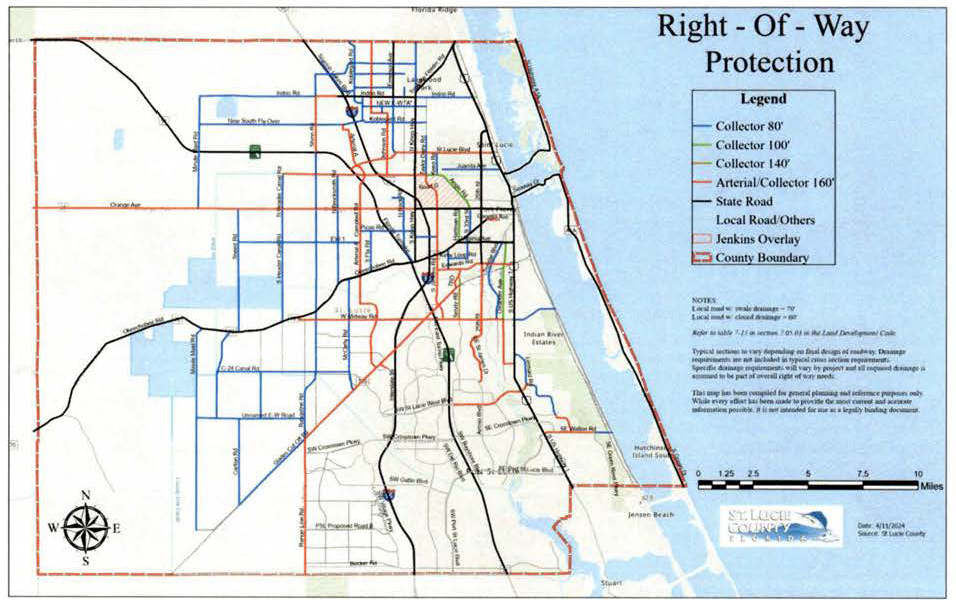
((Ord. No. 10-036, Pt. A, 12-21-2010; Ord. No. 12-003, Pt. D, 5-15-2012; Ord. No. 2024-012, § Pt. A, 4-2-2024))
7.05.04. - Sidewalks and Bikeways.
A.
Sidewalks.
1.
All residential developments required to obtain site plan approval located within the Urban Service Boundary and all non-residential development above 6,000 square feet located within the unincorporated area of St. Lucie County and within the Urban Service Boundary are required to design and construct sidewalks within the right-of-way of all streets and roadways that abut or lie within the perimeter of the property. Non-residential developments under 6,000 square feet and inside the Urban Service Boundary are generally presumed to be exempt from this sidewalk requirement particularly in areas not expected to generate pedestrian traffic. Exceptions to the presumed exemption include but are not necessarily limited to locations where connections can be made to existing sidewalks, or in locations on primary routes to schools or public transit. In any case, the design of proposed development should accommodate future sidewalk connection and future pedestrian traffic to and within the proposed development.
2.
New sidewalks must be a minimum of six (6) feet side along streets classified as collectors and arterials.
3.
Local street requirements are based upon local needs and existing conditions. Local streets shall have sidewalks five (5) feet wide along one (1) or both sides of the street as deemed necessary during the County's development review process.
4.
All new sidewalks shall be constructed of concrete, brick pavers or other materials acceptable to St. Lucie County. All construction must conform to Florida Department of Transportation and/or St. Lucie County standards.
a.
All sidewalks on internal private roads shall connect with the sidewalks in the abutting public right-of-way.
b.
The County Engineer may authorize a modification in sidewalk width to protect existing trees or to accommodate existing utilities. In no case shall sidewalks be less than four (4) feet.
c.
The Development Review Committee (DRC) as part of the site plan review process shall document any exemption of a development project from constructing specific sidewalk segments based on physical constraints such as proximity to drainage canals or structures where the construction of the particular sidewalk segment would result in a disproportionate burden on the development.
d.
Sidewalks shall be constructed around the perimeter of a cul-de-sac.
e.
All sidewalks and ramps shall conform to the latest requirements published in the most recent edition of the Americans With Disabilities Act (ADA) Accessibility Guidelines.
f.
The developer will bear the cost for design and construction of the sidewalk. Sidewalks on private property must be maintained by the developer, property owner's association or other entity as approved by St. Lucie County through the operation and maintenance covenants of the community, subdivision association or other recognized management entity. St. Lucie County shall maintain all sidewalks located within County maintained public rights-of-way unless otherwise agreed to through specific maintenance agreements.
g.
Multi-Use Paths (ten (10) to twelve (12) feet wide) may be required by the County in place of sidewalks when the multi-use path would be part of the adopted area-wide bicycle/pedestrian system or Greenways and Trails plan.
h.
The Board of County Commissioners shall authorize total or partial relief from the requirements of sidewalk construction if it finds, after receiving the recommendation of the Development Review Committee and based on conditions peculiar to the proposed development, that the proposed sidewalk construction is not in the best interest of the County. For those residential developments located within the County's Urban Service Boundary that propose lot sizes of 2.5 acres or greater, the Board may partially waive the sidewalk requirements along internal roads and allow those developments to construct unpaved sidewalks with a stabilized surface, as determined by the County Engineer, for use by pedestrians or horses along internal roads. The Board may impose conditions as part of the waiver. In all other cases, the applicant shall pay a fee-in-lieu to the County for sidewalk and/or greenways and trails construction. If the fees are not used to design, acquire needed right-of-way or construct sidewalks within ten (10) years from the date of payment, the developer may request a refund.
B.
Bikeways.
1.
All new developments within the unincorporated area of St. Lucie County or within municipalities that access County maintained roads and are constructing or reconstructing roads as part of the development shall be required to design and construct bike lanes. Bike lanes shall be constructed and dedicated to St. Lucie County in accordance with the St. Lucie County Public Works Standards.
2.
Bike lanes shall be provided on all internal project streets and roads that are classified as arterials or collectors. Bike lanes shall be constructed in accordance with the St. Lucie County Public Works Standards.
3.
Pavement markings and signage shall comply with the standards established by the Florida Department of Transportation (FDOT) and the Manual on Uniform Traffic Control Devices (MUTCD).
4.
Roadways constructed with closed drainage (curb and gutter) shall have a four-foot bike lane.
5.
Roadways constructed with open drainage (swale) shall have a five-foot bike lane.
6.
The construction of a multi-use path adjacent to an arterial or collector roadway internal or external to the development project does not relieve or otherwise release the requirement for the provision of bike lanes along said streets or roads.
C.
Bicycle Racks.
1.
Bicycle racks shall be required for all non-residential development unless it can be demonstrated that bicycle traffic would not have access to the property per the St. Lucie County Comprehensive Plan Policy 2.2.1.1. Agricultural and Industrial areas shall be exempt from this requirement. Planned Unit Developments (PUD) may be requested to have bike racks as deemed necessary during the development review process based on the proximity of the development to recreation facilities and school bus stops.
a.
There must be a minimum of six (6) bicycle parking spots.
b.
Bicycle parking should be located in close proximity to the buildings entrance.
c.
Bicycle parking facilities shall be located in highly visible well lighted areas to minimize theft and vandalism.
d.
Bicycle parking facilities shall support bicycles in a stable position without damage to wheels, frame or other components. The standard bicycle rack shall be the Inverted "U" style as pictured below.
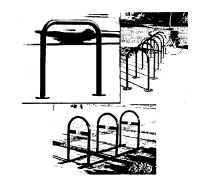
e.
Additional bicycle parking spots may be necessary and requested during the development review process by the Growth Management Director.
f.
Based on the review of the proposed parking area design, location and security features, the Growth Management Director may reduce the number of required automobile parking spaces by one (1) automobile space for each six (6) bicycle spaces provided.
D.
Time of Construction.
1.
All required sidewalks and bikeways shall be constructed in conjunction with the infrastructure for that phase of the development. The developer shall post a bond or other guarantee acceptable to the County as assurance of completion of the improvements in accordance with Section 11.04.00.
E.
Maintenance.
1.
Sidewalks and bikeways on private property must be maintained by the developer, property owner's association or other entity as approved by St. Lucie County through the operation and maintenance covenants of the community, subdivision association or other recognized management entity. St. Lucie County shall maintain all sidewalks and bikeways located within County maintained public rights-of-way unless otherwise agreed to through specific maintenance agreements.
(Ord. No. 12-003, Pt. D, 5-15-2012; Ord. No. 2021-39, Pt. A, 11-16-2021)
7.05.05. - Use of Residential Property for Access.
A.
No residentially zoned property, excluding arterial or major collector roadways, shall be used for driveways, or any other vehicular access purposes to any commercially or industrially zoned land except as may be provided for within the roadway system of an approved planned development project designed in accord with the provisions of Section 7.01.00, 7.02.00 or 7.03.00 of this Code. Planned Developments (PUD/PNRD/PMUD) with a commercial or industrial land use designation shall limit vehicular site access for off-site ingress and egress to arterial or major collector roadways. However, the Board of County Commissioners may permit additional access to a planned development, or a project subject to review under the processes and procedures of planned development review, via non-arterial or non-major collector roadways upon demonstration that (i) such access will not materially adversely affect adjacent or nearby residential neighborhoods or that such adverse effects can be appropriately mitigated, or (ii) such access is necessary for the safe and efficient movement of local traffic. The Board of County Commissioners shall make a finding that any such access will be the minimum necessary to allow for efficient site design and any approval permitting non-arterial or non-major collector street access includes traffic management steps to buffer, mitigate or direct traffic away from adjacent residential uses or neighborhoods. As part of that review, the Board of County Commissioners may consider, and apply, reasonable limiting conditions on the use of the adjoining local street. Bicycle and pedestrian facilities are exempt from these provisions to encourage and allow for community linkages.
7.05.06. - Driveways.
A.
Requirements Generally. Every person, firm, corporation or association that proposes to construct or reconstruct any curb cut or driveway on any County-maintained public road in the unincorporated areas of St. Lucie County shall apply for a permit to be issued by the County Engineer of St. Lucie County, Florida.
B.
Buildings, Building Regulations. No Certificate of Occupancy or final inspection shall be issued by the Public Works Department until the completed curb cut or driveway has been inspected and approved by the County Engineer. The property owner shall notify the County Engineer upon completion of the curb cut or driveway and at least twenty-four (24) hours prior to the requested inspection.
C.
Driveway Requirements.
1.
The following requirements must be met by any proposed driveway for a one- or two-family dwelling:
a.
A driveway shall be at least five (5) feet from the side property line.
b.
Construction of all driveways shall meet specifications for public works construction, as described in Chapter XIII of this Code, and all other applicable County regulations (see Section 7.04.04).
c.
In the case of corner lots, driveways shall be constructed so that the center line of the driveway is a minimum of twenty (20) feet from the parallel base building line.
d.
All driveway construction within the street or road right-of-way shall be paved, provided that the street or road to which the connection is being made is paved.
e.
Construction of all paved driveways on property fronting on an unpaved roadway shall terminate at the right-of-way line.
f.
The maximum width, at the right-of-way line, for a driveway accessing a one- or two-family dwelling is twenty (20) feet.
(FIGURE 7-18 - space reserved for future)
2.
The following requirements must be met for all development other than one- or two-family dwellings:
a.
The following driveway spacing standards shall apply to corner lots having frontage on functionally classified streets, except the intersection of two (2) local streets:
(1)
Driveways shall be constructed so that the nearest perpendicular edge line of the driveway to the street on which the connection is being made, is a minimum of fifty (50) feet from the parallel base building line, as described in Figure 7-18.
(2)
The nearest edge of any driveway servicing a residential or non-residential use generating more than three hundred (300) vehicle trips per day, as determined by standard ITE trip generation rates shall be a minimum of one hundred fifty (150) feet from the parallel base building line.
b.
The maximum width for a one-way driveway shall be twenty (20) feet and forty (40) feet for a two-way driveway.
c.
The edge of a driveway shall not be less than twenty-five (25) feet from a side property line.
d.
The nearest perpendicular edges of any two (2) driveways on adjacent properties shall be separated by a minimum of fifty (50) feet.
e.
The nearest perpendicular edge of any two (2) driveways on the same property shall be separated by a minimum of one hundred fifty (150) feet.
f.
If any of the following conditions exist as shown on plans for new construction, left turns shall be prohibited from the driveway:
(1)
In the case of corner lots, the center line of the driveway is less than twenty (20) feet from the parallel base building line.
(2)
Less than required spacing between driveways.
(3)
Any use, existing or proposed, located on the property(s), to be served by the driveway under application, that will generate more than fifty (50) vehicle trips per day, shall not be authorized left turn movements to access that driveway unless the nearest edge of the driveway is a minimum of three hundred fifty (350) feet from the parallel base building line. It shall be the responsibility of the person, firm, corporation or association seeking the driveway permit to design and install appropriate measures to prevent left turn movements at this driveway, should the required separation not be met. The County Engineer shall review, and approve of, all proposals to limit these left turn movements in accordance with sound engineering practices.
g.
On parcels with road frontage of three hundred (300) feet or less, the developer of such parcel shall design access to the property to allow combined access with any adjacent parcel with road frontage of three hundred (300) feet or less in order to meet driveway separation requirements for both parcels, subject to the agreement of all property owners. In cases where combined access is utilized, the provisions of Section 7.05.06(C)(2)(c) shall not be applicable.
h.
Tapers, deceleration lanes, left-turn lanes, bypass lanes, median modifications or other facilities shall be provided as requested by the County Engineer to protect the safe and efficient operation of an arterial or major collector roadway.
i.
All driveway construction within the street or road right-of-way shall be paved, provided that the street or road to which the connection is being made is paved.
j.
Construction of all paved driveways on property fronting on an unpaved roadway shall terminate at the right-of-way line.
k.
Not withstanding the above requirements, any driveway connection to an undivided arterial or collector roadway, made after August 1, 1990, shall be opposite any existing driveway connection. In the event compliance with this standard is not possible, a minimum offset of one hundred fifty (150) feet, between the nearest edges of the driveways, as measured perpendicular to the street centerline, shall be required. Those roadways or streets with a continuous center left turn lane shall be considered as undivided, for the purpose of this requirement. These requirements shall not apply to any local street driveway connections.
D.
Culvert Requirements. The following requirements must be met by any proposed driveway culvert:
1.
Except as provided in paragraph 2. below, all culvert openings shall be a minimum of fifteen (15) inches equivalent in diameter and a minimum of thirty (30) feet in length.
2.
Final culvert size, length and elevation shall be as determined by the County Engineer.
3.
All culverts shall end in a mitered end section with collar unless otherwise approved in writing and in advance by the County Engineer.
4.
Construction of all culverts shall meet the requirements of Chapter XIII and all other applicable County regulations.
7.05.07. - Provisions for Access to New Development Activities.
A.
Generally. All new road and street construction, public or private, shall be paved according to standard county specifications.
B.
Paving Requirements for Roads that Access Developments Requiring Site Plan Approval that Utilize Unpaved Public and Private Roads for Access. The following paving requirements shall apply to developments requiring site plan approval that utilize unpaved public or private roads and roadways for access:
1.
Access Roads. Unless explicitly listed in exempt development, as listed in subsection a. below, provisions for the paving of unpaved access roads that access the development shall be required as specified below under general requirements. County road design and construction standard specifications shall apply to all paving improvements.
a.
Exempt development. The following use(s) are exempt from the provisions of this Section:
(1)
Telecommunications towers with frontage on unpaved roads outside the Urban Services Boundary (USB).
2.
Waiver.
a.
Paving requirements and provisions shall be waived by the Board of County Commissioners, following a public hearing, if the Board determines:
(1)
That the road paving is not essential to provide adequate access to the proposed development and through the surrounding area, or
(2)
That the road will be paved as part of the County's five-year road program or an approved municipal service taxing or benefit unit, or
(3)
That the access road does not have adequate right-of-way in which to construct the necessary paving improvements in accordance with County standards.
b.
If paving requirements are waived, the Board may attach conditions deemed necessary to minimize the impacts of the road on the surrounding area including, but not limited to, payment by the developer of the development's fair share of paving costs for the unpaved public or private road providing access to the development prior to issuance of final record plat approval pursuant to the procedures set out in Section 11.03.00.
3.
Scenic and Historic Roads. Paving requirements and provisions for developments utilizing unpaved scenic or historic routes, as designated by the Board of County Commissioners, shall be addressed on a case-by-case basis. The requirements specified below under general requirements shall apply. Paving requirements and provisions shall be waived by the Board of County Commissioners if the Board determines:
a.
That the scenic or historic value or significance of the road would be adversely impacted by road paving.
b.
That road paving is not essential to provide adequate access to the particular development and through the surrounding area, and
c.
That the preservation of scenic or historic values outweighs the impacts of permitting a particular use to develop without paved access.
If paving requirements are waived, the Board may attach any conditions deemed necessary to minimize impacts on the road and surrounding area.
4.
General Requirements. Paving requirements are established to ensure that adequate road improvements are provided to adequately serve the development. County road design and construction standards shall apply to all paving improvements. Mixture of residential and non-residential traffic shall be avoided where possible. Persons applying for plat approval of developments utilizing access roads shall, as part of their application, include the appropriate provision for paving, as specified below.
The County Engineer shall determine the estimated average daily traffic of the development in accordance with accepted standards and good traffic engineering practice.
a.
Small Traffic Attractors/Generators. Developments determined to be small traffic attractors/generators, defined as developments generating less than one hundred (100) average daily trips, shall provide for road paving as follows:
(1)
Access road frontage: For the paving of a road(s) accessing the development, the applicant shall submit funds in the amount of the development's fair share of paving costs as determined by the Board of County Commissioners prior to the issuance of final plat approval. The fair share contribution shall be determined and prorated according to front footage or by such other lawful and equitable method as the Board may prescribe. Said funds shall be held by the County for a period not to exceed ten (10) years to be used for the paving of the road(s) accessing the development. Any funds not expended or encumbered by the end of the calendar quarter immediately following ten (10) years from the date the funds were submitted to the County shall, upon application of the feepayer, be returned to him with interest to be determined based upon the average rate of return to the County for the time period the funds were held. The road segment to be funded and later paved shall include all of the development's frontage on the road.
Any required submission of escrow funds shall include an escrow agreement acceptable to the County Attorney. Such agreement shall include provisions necessary to accomplish and facilitate future road paving.
(2)
Paving option: In lieu of submitting funds for paving under subsection 4(a)(1) above, the developer may propose to pave or arrange for paving the development's access road frontage notwithstanding requirements for roads designated on the Thoroughfare Network Right-of-Way Protection Plan, if such paving would connect to a paved public road. If such a paving option is utilized, no final plat approval shall be issued for all or any portion of the development until all paving has been completed, and improvements are inspected and approved by the County. At the option of the Board of County Commissioners, the developer may furnish the County security in the amount of one hundred fifteen percent (115%) of the estimated cost of providing the paving improvement at the time of final plat approval. The County Engineer shall approve the amount of security to be furnished.
(3)
Multi-phase projects: For purposes of determining if a multi-phase development is a small traffic attractor/ generator, the total number of project trips shall be compared to the small traffic project definition criteria.
(4)
Cumulative effect: No final plat approval shall be issued for any development utilizing access on an unpaved public or private road that exceeds two hundred (200) average daily trips as determined by the County Engineer until the road accessing the development is paved from the development's access point(s) to a paved public road. For the purpose of this Code and determination of this cumulative effect, all access roads in the unincorporated County are assumed to have a zero (0) average daily trip count as of the effective date of the ordinance. Provisions specified below under subsection 4.b(2) and (3) shall apply. The County Engineer's decision may be appealed to the Board of County Commissioners.
In considering the cumulative effect of small traffic attracting/generating developments on a road(s) or on an area, the Board of County Commissioners may determine the need for a municipal service taxing or benefit unit or assessment for road paving purposes in developed or developing areas, and may impose such an assessment.
b.
Large Traffic Attractors/Generators. Developments determined to be larger traffic attractors/ generators, defined as developments generating one hundred (100) or more average daily trips, shall provide for road paving as follows:
(1)
Access road frontage to access point(s): The unpaved public or private road accessing the development shall be paved from the development's access point(s) to a paved public road. The design of the connection shall be in accordance with County design standards. Said paving shall be completed, and improvements inspected and approved by the County, prior to the issuance of final plat approval. At the option of the Board of County Commissioners, the developer may furnish the County security in the amount of one hundred fifteen (115) of the estimated cost of providing the paving improvement at the time of final plat approval. The County Engineer shall approve the amount of security to be furnished.
(2)
Developer Agreements/MSBU Options: In considering the effect of large traffic attracting/generating developments on a road(s) or on an area, the Board of County Commissioners may enter into a development agreement with the developer pursuant to Section 11.08.00 to ensure the refund of monies expended by the developer on the paving of the unpaved access road pursuant to subsection 4.b(4), above the developer's fair share contribution as monies are made available by other development that uses the unpaved road as access to a paved public road. The Board may also create a municipal service taxing or benefit unit or assessment for road paving purposes in developed or developing areas, and may impose such an assessment.
(3)
Remaining access road frontage: For the paving of portions of a development's access road frontage not covered in the above paving requirement subsection 4(b)(1), the developer shall submit funds in the amount of the development's fair share of paving costs prior to the issuance of final plat approval. Said funds shall be held by the County for a period not to exceed ten (10) years to be used for the paving of the road accessing the development. Any funds not expended or encumbered by the end of the calendar quarter immediately following ten (10) years from the date the funds were submitted to the County shall, upon application of the feepayer, be returned to him with interest to be determined based upon the average rate of return to the County for the time period the funds were held. The road segment to be funded and later paved shall include all of the development's frontage on the road. Any required submission of escrow funds shall include an escrow agreement acceptable to the County Attorney. Such agreement shall include provisions necessary to accomplish and facilitate future road paving.
(4)
Paving option: In lieu of submitting funds for paving specified under subsection 4(b)(3) above, the developer may propose to pave or arrange for paving the development's remaining access road frontage, notwithstanding requirements for roads designated on the Thoroughfare Plan, if such paving connects to a paved public road. If such a paving option is utilized, no final plat approval shall be issued for all or any portion of the development until said paving is completed, and improvements are inspected and approved by the County. At the option of the Board of County Commissioners, the developer may furnish the County security in the amount of one hundred fifteen percent (115%) of the estimated cost of providing the paving improvements at the time of final plat approval. The County Engineer shall approve the amount of security to be furnished.
(Ord. No. 2022-13, Pt. A, 6-7-2022)
7.05.08. - Street Naming and Identification.
A.
Generally. For the purpose of this Section, the term street shall mean any public or private road, highway, boulevard, avenue, street, lane, court, terrace, place, drive or other identification used to describe the recognized accessway to a home or business.
B.
Addressing Base Line Established. The following street and house numbering and naming system be and hereby is established in the unincorporated areas of St. Lucie County, Florida.
1.
East-west base line. The centerline of the right-of-way for U.S. 1 shall be the division between east and west for the purposes of this Code.
2.
North-south base line (mainland). The centerline of the right-of-way for Orange Avenue (State Road 68) shall be the division between north and south on the mainland areas of St. Lucie County for the purposes of this Code.
3.
North-south base line (Hutchinson Island). The center of the Fort Pierce Inlet shall be the division between North and South Hutchinson Island for the purposes of this Code.
C.
Designation as Streets, Avenues, etc.
1.
Only streets classified as arterials or major collectors by St. Lucie County shall be designated boulevard, highway, or road. These designations may be used regardless of direction.
2.
Other streets, regardless of functional classification, which run parallel to the north-south base line (Orange Avenue) shall be called avenue, drive or some other designation beginning with a letter in the first half (A through M) of the alphabet. Street, regardless of classification, which run parallel to the east-west base line U.S. Highway 1) shall be called terrace, place, or some other designation beginning with a letter in the second half (N through Z) of the alphabet.
3.
These requirements shall be required only with regard to roads constructed after the effective date of this Code. These changes may be incorporated with regard to any major reconstruction or extension of an existing road upon specific direction by the Board of County Commissioners.
D.
Numeric Street Identification. Numeric street identification shall be limited to north-south streets only and shall be a continuation of the existing numeric system used by the City of Fort Pierce.
E.
Duplication of Names. No named street, etc., shall duplicate that of any other named street unless it is an extension of that street. Where possible, similar sounding street names shall not be used.
F.
Continuity of Names. Streets, etc., should not change names at intersection unless they change direction.
G.
Curvilinear and Circular Street Names and Numbering. Curvilinear streets will be named in accordance with Section 7.05.08(B) through (F). No named or number curvilinear street shall cross itself. Circular streets will be called Circle.
H.
Authority for Naming and Numbering Streets.
1.
New streets shall be assigned names or numbers in compliance with the provisions of this Code by the Growth Management Director. The Growth Management Director is hereby granted the authority to rename duplicate or similar sounding streets or renumber existing streets to comply with the provisions of this Code. In the case of duplicate names or similar sounding names where one (1) or more streets must be renamed and one (1) street shall retain the name, the Growth Management Director shall consider such factors as the historical significance of the name, the number of years the street has held that name, and the relationship name to the names of adjacent streets.
2.
Individuals residing on the street or developers of a subdivision may participate in the naming or renaming process by providing suggestions for street names to the Growth Management Director. Interested individuals should submit three (3) names with the first choice listed first, second choice listed second, and third choice listed last. The Growth Management Director shall assign the name after considering the choices provided and verifying compliance with the provisions of this section.
I.
Street Identification Signs. All officially named or numbered streets shall be identified with a street sign as prescribed in the Manual on Uniform Traffic Control Devices, U.S. Department of Transportation, Federal Highway Administration 1978 Edition, and subsequent revisions of this manual. No one other than St. Lucie County, the Florida Department of Transportation, or any officially authorized party may erect or maintain a street identification sign within any public road right-of-way that does not conform to the requirements of this section. The Public Works Director is authorized to remove any nonconforming street identification sign.
J.
Street Identification Signs - Minimum/Maximum Size. All street identification signs, erected in accordance with the provisions of Paragraph I above, shall have lettering no smaller than four (4) inches, nor larger than twelve (12) inches with a maximum of a two (2) inch border area around the street name.
The Public Works Director is authorized to remove any nonconforming street identification sign that is within the public right-of-way. All private streets or roads within the unincorporated area of the County shall comply with the requirements of this subsection by August 1, 1995.
(FIGURE 7-20 - space reserved for future)
7.05.09. - House and Building Numbers.
A.
Generally.
1.
House and building numbers will be assigned in all areas by relationship to the quadrant grid system, as established in Section 7.05.08(B).
2.
House and building numbers for all residential or commercial uses in the unincorporated areas of St. Lucie County shall only be assigned by the Growth Management Director, and shall be assigned at the time the building permit is issued.
3.
Even numbers shall be assigned to those properties on the north and east side of the street. Odd numbers shall be assigned to those properties on the south and west side of the street. The St. Lucie County addressing grid shall be based on the following:
a.
For every three hundred thirty (330) feet on the east-west axis, a hundred block shall change; and,
b.
For every six hundred sixty (660) feet on the north-south axis, a hundred block shall change.
B.
Duty of Owner for Placement on Existing Structures.
1.
Generally.
a.
It is the duty of the owner of any house or building to cause the house or building number to be placed conspicuously on the front of the house or building so that the number can be seen plainly from the street line. The numbers used to display the street identification number for nonresidential buildings shall be at least six (6) inches in height and for residential buildings shall be at least four (4) inches in height. The numbers shall be made of a durable, clearly visible material.
b.
If a house or building is situated more than fifty (50) feet from the street line, then the numbers shall be placed near the walk, driveway or common entrance and upon a post, mailbox or other appropriate place so as to be easily discernable from the street. The numbers used for nonresidential buildings shall not be less than six (6) inches in height and for residential buildings shall be at least four (4) inches in height. The numbers shall be made of a durable and clearly visible material.
2.
Noncompliance; violation. The owner of any house or building which does not have a house or building number posted on the effective date of this Section shall have until August 1, 1991 to comply with the requirements of this Section. Failure to comply with this Section shall constitute a violation of the technical code of St. Lucie County and shall be enforced pursuant to Article III, Chapter 1-2 of the Code of Ordinances.
C.
Placement Required Prior to Issuance of Certificate of Occupancy. No certificate of occupancy shall be issued for new construction until the house or building number is posted in accordance with Section 7.05.09(B).
D.
Application of System to New Development Activities. All new development activities in the unincorporated areas shall comply with the system established by this Section.
7.05.10. - Internal Trip Capture Standards.
Shall follow the latest version of the "STANDARDIZED TRANSPORTATION IMPACT STUDIES METHODOLOGY AND PROCEDURES," as adopted by the St. Lucie County Transportation Planning Organization.
(Ord. No. 2024-012, § Pt. A, 4-2-2024)
7.06.01. - Purpose and Applicability.
A.
Purpose. The requirements of this Section are intended to ensure that every building, structure, or use erected or instituted, except for bona-fide agricultural uses and buildings, shall be provided with adequate off-street parking facilities for the use of occupants, employees, visitors, and patrons, and that certain uses be provided with adequate off-street loading facilities, thereby reducing congestion to the public streets and promoting the safety and welfare of the public.
B.
Applicability.
1.
Existing Uses. Buildings or structures existing as of the effective date of this Code may be modernized, altered, or repaired without providing additional off-street parking or loading facilities, provided there is no change of use.
2.
Change in Use. Effective March 1, 1999, any change in use to an existing building or structure, will require that all on-site parking and loading facilities be brought into full compliance with the provisions of this Code, except as otherwise provided here in Section 7.06.00, as it may be amended from time to time. For the purposes of this Section. "change in use" shall mean any change in use or activity that requires the issuance of a new certificate of zoning compliance. Parking surface, landscaping, changes in use and zoning compliance are subject to the provisions of this Code as amended by Ordinance No. 12-003.
3.
Expansion of Structure. Expansion in the floor area, volume, capacity, or space occupied of any structure existing on or before July 1, 1984, shall require compliance with all off- street parking and loading requirements contained in this Code to be met for both new construction and existing structures, except as otherwise provided below and in Section 7.06.03.
a.
Exceptions:
1.
If the applicant can demonstrate to the satisfaction of the Planning and Development Services Director that the site has provided adequate off-street parking for its use prior to expansion, only the new construction shall be required to comply with the requirements of this Section.
2.
New construction not required to comply with off-street parking requirements include: Entry areas or vestibules, unoccupied storage areas provided these do not exceed twenty-five percent (25%) of the gross floor area, and areas which do not add to the occupancy capacity of a structure.
4.
Nonconforming Uses: When repairs and alternations are to be made in a building occupied by a nonconforming use, all off-street parking requirements contained in this Code shall be met of the cost of repairs and alterations exceed fifty percent (50%) of the assessed value of the building and structures.
a.
Exceptions.
1.
If the applicant can demonstrate to the satisfaction of the Planning and Development Services Director that the site has provided adequate off-street parking for its use prior to expansion, only new construction shall be required to comply with requirements in this Section.
2.
Construction not required to comply with off-street parking requirements include: Entry areas or vestibules, unoccupied storage areas provided these do not exceed twenty-five percent (25%) of the gross floor area, and areas which do not add to the occupancy capacity of a structure.
5.
Religious Facility and Membership Organization. When a building in which persons regularly assemble for religious worship or social organization is built, repaired, or expanded, the off-street requirements are as follows:
a.
Exceptions:
1.
Up to seventy-five percent (75%) of the total parking requirement may be stabilized grass parking for new construction and expansion of structure. All-weathered impervious surface is not required as provided herein.
2.
Grass parking shall be provided in a manner acceptable to the County Engineer.
3.
In the event grassed parking areas become deteriorated as indicated by dead or dying grass, bare dirt or overgrown grass and weeds, the Planning and Development Services Director may require the owner of the property to pave all or part of such area.
4.
The stabilized grass parking vehicular use area shall meet the design standards pursuant to Section 7.06.02(B), except for material as provided herein.
(Ord. No. 2013-44, § A, 12-17-13; Ord. No. 2021-14, Pt. A, 6-1-2021)
7.06.02. - Performance Standards.
A.
Number of Off-Street Parking and Loading Spaces Required.
1.
Off-Street Parking per Use. The most recently published edition of the Institute of Transportation Engineers Parking Generation is adopted by reference as the use-specific requirements for off-street parking.
a.
For any uses not listed in the latest edition of Parking Generation, the Planning and Development Services Director will make a determination for required parking based on the most similar use, professionally recognized standards, a survey of similar counties' regulations, and/or analysis by a traffic engineer based on use-specific parking requirements. The determination will be made in writing referencing the standards or analysis used to make the determination.
2.
Handicapped Parking. Handicapped parking shall be provided as required the Standard Building Code and F.S. §§ 316.1955 and 316.1956. The number of designated handicapped parking spaces shall be determined as follows:
HANDICAPPED PARKING REQUIREMENTS
*The number of required handicapped parking spaces may be included within the gross number of required parking spaces.
3.
Off-Street Loading. Off-street loading space shall be provided and maintained as follows:
a.
For all commercial and industrial development:
b.
For each auditorium, convention hall, exhibition hall, museum, motel, hotel, office building, sports arena, stadium, hospital, sanitarium, welfare institution, or similar use having an aggregate floor area of:
c.
For any use not specifically mentioned, the requirements for off-street loading facilities to which the unmentioned use is most similar shall apply. Such determination shall be made by the Planning and Development Services Director.
B.
Design Standards.
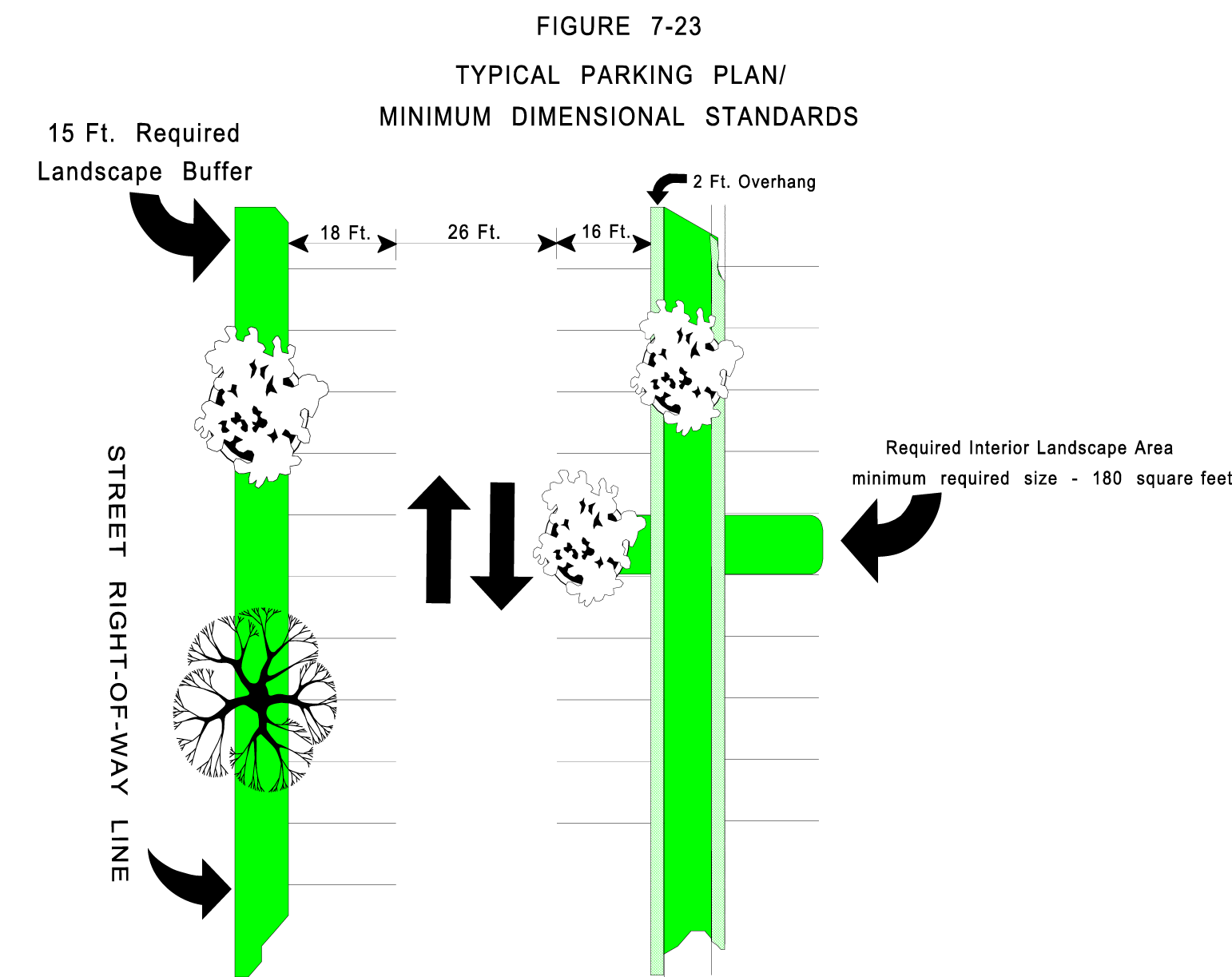
1.
Stall Size.
a.
The minimum size of a parking stall shall be as follows:
Standard: Ten (10) feet × eighteen (18) feet.
Angled: Ten (10) feet × eighteen (18) feet.
Parallel: Eight (8) feet × twenty-three (23) feet.
Handicapped: Twelve (12) feet × eighteen (18) feet.
(F.S. § 316.1955(3))
Two (2) feet of the required eighteen (18) feet provides for the overhang of the front of the vehicle beyond the front wheels, and therefore may be in grass instead of pavement if that two (2) feet is not included in any other required landscape or separation area, and if wheel stops or curbs are used to prevent vehicular encroachment into the two-foot area.
2.
Aisle Width, Ingress and Egress.
a.
Dimensional requirements of access aisles:
MINIMUM PARKING ACCESS AISLE DIMENSIONS
b.
No paving or vehicular use area, other than shared entrance or exit drives located in accordance with Section 7.05.06, shall be installed within ten (10) feet of adjoining property or within fifteen (15) feet of any road right-of-way frontage, and said unpaved area shall be landscaped in accordance with Section 7.09.00.
c.
All off-street parking areas shall be designed so that motor vehicles can exit without backing into a street, except for single-family, two-family and three-family dwellings.
3.
Material.
a.
Requirement for Paved Surface for All Required Off-Street Parking and Vehicular Use Areas. Subject to the Administrative Relief provisions below, all required off-street parking spaces, access aisles, vehicular use and off-street loading areas constructed, expanded or altered after March 1, 1999, shall be constructed with a paved surface meeting the requirements of the St. Lucie County Public Works Department. The permitted impervious surface materials be concrete, asphalt, brick pavers, stamped concrete, or paving block. Only asphalt or concrete will be permitted within the County's Right-of-Way. Pervious paving systems and grass paving systems shall be permitted for non-required parking spaces when the paving systems and materials are approved by the County Engineer. Stabilized unpaved parking areas may be permitted at locations outside the urban service area upon approval of the County Engineer, so long as parking spaces, accessways, and driveways are clearly marked and the vehicular/pedestrian circulation system is safe. The County Engineer shall publish a list of commercially available paving systems of pervious and imperious paving materials that are approved for use. The County Engineer shall approve design material and specifications on each site. For religious facilities or fraternal organizations, grass parking is exempt from the Administrative Relief provisions below, as provided in Section 7.06.01(B)(5).
4.
ADA Accessibility.
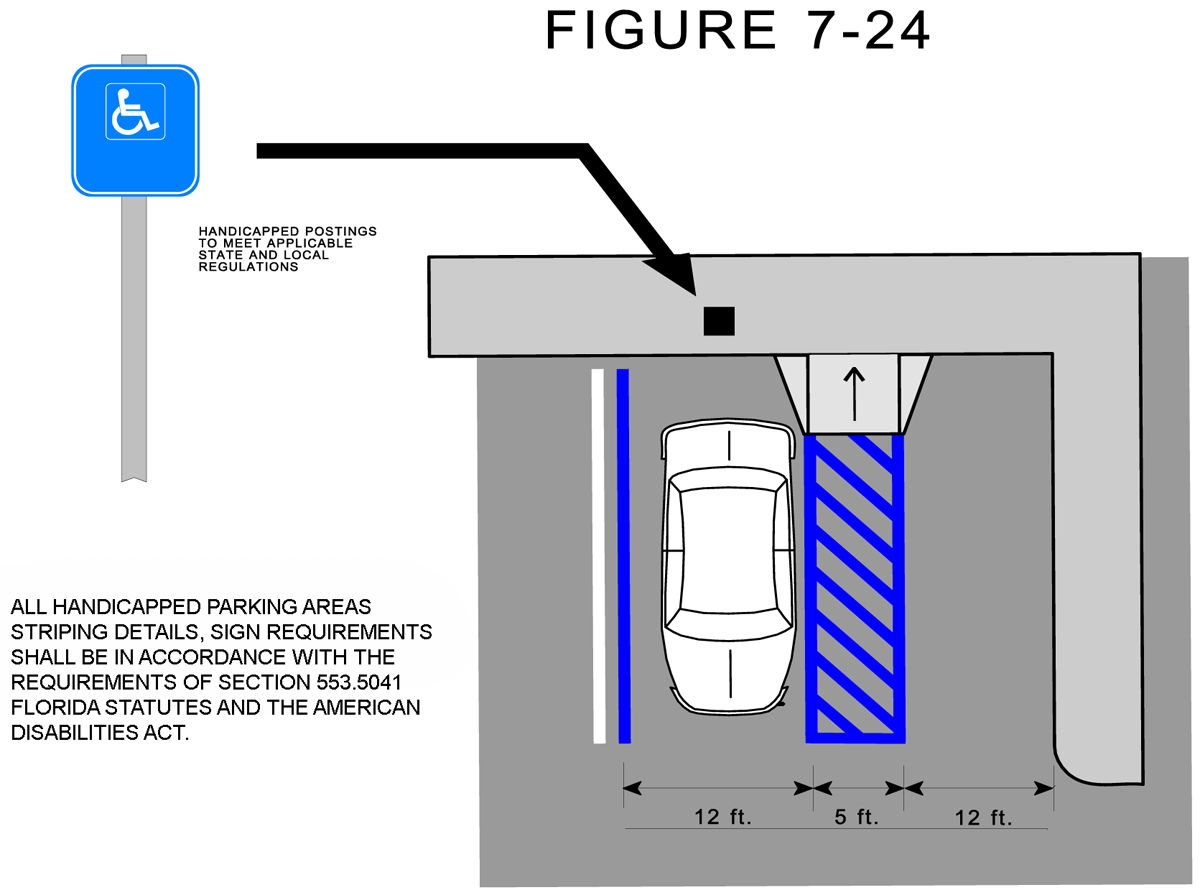
a.
All handicapped parking spaces shall be appropriately outlined with blue painted lines, minimum four (4) inches wide, and shall be posted with the international symbol of accessibility. Handicapped accessible spaces shall meet the minimum design, signing and marking standards of the Florida Department of Transportation, and shall generally be located as depicted in Figure 7-24.
b.
All handicapped spaces shall have an adjacent access aisle sixty (60) inches wide. Two (2) handicapped parking spaces may share a common access aisle.
c.
All spaces shall have accessible thereto a curb-ramp or curb-cut, to allow access to the building served and shall be located so that users would not be compelled to wheel behind parked vehicles.
d.
Parallel spaces that are being used for handicapped purposes, shall be located at the beginning or end of a block. Curbs adjacent to such spaces shall be of a height which will not interfere with the opening and closing of motor vehicle doors.
5.
Landscaping.
a.
No more than ten (10) parking spaces shall be permitted in a continuous row without being interrupted by a minimum landscape area of one hundred eighty (180) square feet for single row parking or three hundred sixty (360) square feet for double row parking (see Figure 7-23).
b.
Parking or display of any motor vehicle, recreational vehicle, boat, trailer or other vehicle in any required landscape area is prohibited.
6.
Wayfinding.
a.
All directional and regulatory signage and all pavement markings shall be in accordance with the "USDOT Manual of Uniform Traffic Control Devices."
b.
Off-street parking facilities, including access drives and aisles for all multi-family, including two-family and three-family dwellings, and non-residential uses and shall be marked either by painted lines, precast curbs, or in a similar fashion to indicate parking spaces.
7.
Vehicle Queuing.
a.
Vehicle Queuing Area spaces required, per use:
DRIVE UP/THRU VEHICLE STORAGE REQUIREMENTS
b.
Adequate vehicle storage areas shall be provided at all drive-through and access regulating facilities. A vehicle queuing area is to be a minimum of ten (10) feet by twenty-five (25) feet. Minimum vertical clearance of fourteen (14) feet shall be required unless provisions for an unrestricted pass area are made.
c.
No vehicle queuing area may block any other parking stall, access aisle, driveway or off-street parking facility.
d.
All vehicle queuing measurements shall commence from the drive-through service window. In the case where two (2) service windows are provided, the measurement shall commence at the second window from which services are provided.
8.
Vehicle Storage. Off-street parking facilities supplied by the owner or operator shall not be used by commercial vehicles owned, operated, or used in the business of such owner or operator during his/her regular hours of business, or by vehicles offered for sale unless additional parking spaces are made for these vehicles.
9.
Off-Street Loading Space Design.
FIGURE 7-25
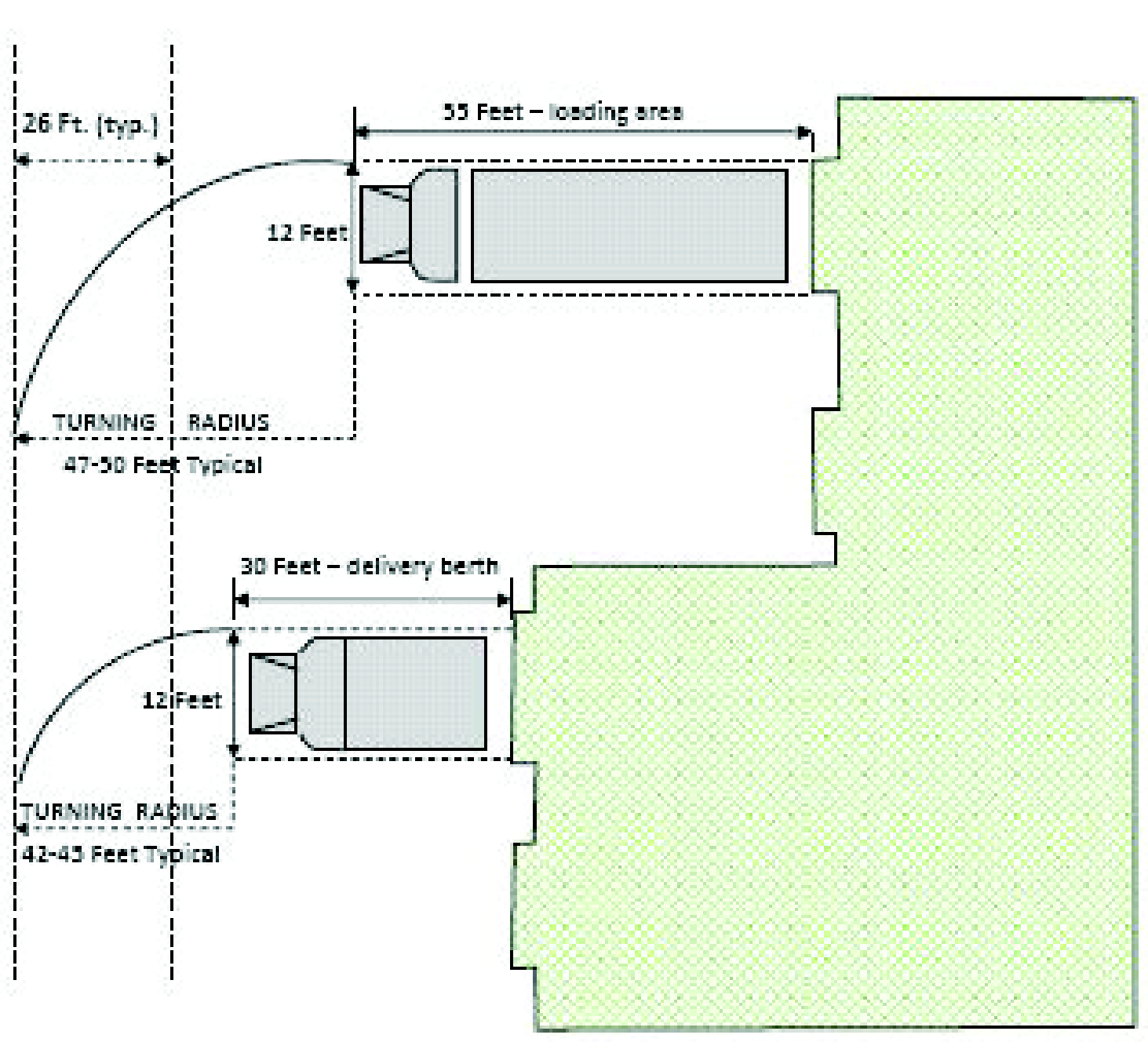
a.
Location. Loading spaces shall be located on the same lot as the building or structure to which they are accessory. No loading shall be located in a required front yard.
b.
Designation and Use. Each required loading space shall be designated as such and shall be used only for loading purposes.
c.
Design and Maintenance.
1.
Off-street loading spaces shall be an area at grade level at least twelve (12) × fifty-five (55) feet long with a fourteen-foot vertical clearance.
2.
For buildings less than fourteen thousand nine hundred ninety-nine (14,999) square feet, the required delivery space may have a minimum dimension of twelve (12) feet × thirty (30) feet with a fourteen-foot vertical clearance.
3.
Each loading space shall be accessible from the interior of the building it serves without crossing or entering any other required off-street loading space, off-street parking space, or circulation area. Such loading spaces shall be arranged for convenient and safe ingress and egress by motor truck and trailer.
4.
All loading spaces shall be paved.
(Ord. No. 2013-44, § A, 12-17-13; Ord. No. 2021-14, Pt. A, 6-1-2021; Ord. No. 2024-012, § Pt. A, 4-2-2024)
7.06.03. - Relief.
A.
Administrative Relief for Developments under six thousand (6,000) SF. The Planning and Development Services Director may grant administrative relief from the parking standards or the required amount of paved surface for off-street parking and vehicle use areas including vehicular use areas (Development < six thousand (6,000) square feet) based upon a written request for such administrative relief and an analysis submitted by the applicant. The analysis must demonstrate that the required amount of paved surface for off-street parking and vehicle use areas is unnecessary or not practical to construct because of environmental considerations, such as micrositing for large trees, for mass transit considerations, such as providing transit stops in an area to be served with mass transit services, and superior design considerations determined by exceeding the minimum requirements of the Land Development Code. Requests for administrative relief from the paved surface requirements shall meet the following standards:
1.
Lands within the Urban Service Boundary:
a.
The alterative off-street parking or vehicular use area shall not be visible from any the adjacent right-of-way;
b.
The alternative off-street parking or vehicular use area shall not be utilized for a public use;
2.
Lands outside of the Urban Service Boundary:
a.
Alternative off-street parking or vehicular use areas shall not be permitted for any operation involving retail lands.
The Public Works Department shall review the request for administrative relief from the paved parking surface requirements and provide the Planning and Development Services Director with a written recommendation based on the standards set out in this section. The Public Works Department may require the applicant to provide an engineered solution to any adverse impacts that the request for a waiver may create. If it is determined by the Planning and Development Services Director that it is not possible to meet the parking stall width requirements of this Code due to the size or configuration of the existing parcel, the Planning and Development Services Director may grant administrative relief, subject to determining consistency with the Standards of Review set out in Section 10.01.02, to the parking stall width to be required. Any such administrative relief shall be specific to the parcel or property in question and shall be the minimum necessary to address the particular problem. Any such administrative relief shall include specific findings of fact and shall be issued in a manner and form that is acceptable to the County Attorney. Any determination for relief that is made by the Planning and Development Services Director shall be recorded in the public records of St. Lucie County.
B.
Context Sensitive Parking. Within downtowns and walkable scale communities having mixed uses, on-street parking, and which may also include parking structures or common parking lots, on-site parking for each building may not be required when all of the required parking for the land use proposed in the building is provided within six hundred (600) feet of the building, and is not dedicated to another land use, except that shared parking agreements permitted by Section 7.06.02(B)(3) shall be allowed. Parking requirements for mixed use downtown and walkable scale mixed use areas shall be computed for general retail land uses using the shopping center parking standard. All other land uses and retail land uses that have parking rates that exceed the shopping center rate shall have their parking requirements computed at their parking generation rates and added to the basic retail shopping center requirement. Reductions may be made for land uses that enter into shared parking agreements. The total parking requirement must be met by a combination of on-street parking, off-site common parking facilities, shared parking (if used), and on-site parking. All on-street parking proposed within a public right-of-way shall require the issuance of a right-of-way use permit by the County Engineer prior to any land clearing or construction of pavement marking, whichever comes first. This section does not authorize on-street parking on public right-of-way but only gives credits for the reduction of on-site parking when properly approved on-street parking is available, as provided herein. The total parking requirement derived as required herein may be reduced by up to twenty percent (20%) by the Planning and Development Services Director for equivalent facilities that provide for transit access and sheltered transit stops, park-and-ride facilities, remote parking with motorized access between parking and destination, and/or bicycle parking and movements, or other modes of ground transportation not included herein (e.g., golf cart paths).
C.
Combined Properties Used for Off-Street Parking. Two (2) or more owners or operators of buildings, structures, or uses requiring off-street parking facilities may make collective provisions for such facilities, provided that the total of such parking spaces when combined or used together shall not be less than the sum of the requirements computed separately, and provided further that no off-site parking space shall be greater than six hundred (600) feet from any building it is designated to serve.
D.
Shared Off-Street Parking Areas. Where, in the determination of the Planning and Development Services Director, the required number of spaces is excessive for a specific building or facility requiring site plan approval, and the owner of the property has submitted to the Planning and Development Services Director an enforceable restriction of use, the Planning and Development Services Director may authorize the use of shared parking facilities effectively reducing the number of required parking spaces. In no case however, shall less than seventy-five percent (75%) of the required off-street parking spaces be provided. The purpose of this provision is to allow land uses located within a unified development or on adjacent lots to enter into agreements to use parking spaces at different times of day which correspond to their different hours of operation. When shared parking agreements are applied in approving site plans, no land uses can be permitted that exceed the maximum allowable parking demand at the prescribed times of day, even though the initial land uses may eventually be proposed to be changed. Additional parking may have to be constructed in order to accommodate new land uses proposed to be operating simultaneously during the day or evening. Restrictions on the parking generation rates and times of use of the affected buildings shall be required to be recorded in the public records of St. Lucie County, Florida, and may be in the form of restrictions contained within a development order or development agreement, or in such other form as the Planning and Development Services Director may prescribe with the approval of the County Attorney required for all standard and special forms used for this purpose.
E.
Provision of Reserved Parking Areas. Where, in the determination of the Planning and Development Services Director, the required number of required parking and loading spaces is excessive for a specific use, the owner or agent may substitute landscaping in lieu of paving provided said areas are reserved for future parking and loading should the County find those spaces are needed, and further provided:
a.
The owner of the land upon which such parking is being reserved shall enter into a written agreement with St. Lucie County which shall include a schematic portrayal as to how the required parking and loading areas can be provided with the County, to be filed with the Clerk of the Circuit Court, with enforcement running to the County ensuring that the reserved parking and loading area shall never be encroached upon, used, sold, leased, or conveyed, for any purpose except in conjunction with the building or use which the reserved parking area serves so long as the off-street parking facilities are required.
b.
The owner of the land upon which such reserved parking and loading area is located agrees to bear the expense of recording the agreement which shall bind his/her heirs, successors, or assigns.
c.
The written agreement shall be voided by the County if the reserved parking and loading area is converted to usable parking area or if the reserved parking area is no longer required.
d.
No handicapped parking areas may be included within a reserved parking area.
(Ord. No. 2013-44, § A, 12-17-13; Ord. No. 2021-14, Pt. A, 6-1-2021)
7.07.01. - Intent and Purpose.
A.
Intent. The intent of this Section is to:
1.
Protect the surface water, groundwater and other natural resources by ensuring that stormwater runoff peak discharge rate, volumes, and pollutant loadings are managed to minimize the adverse impacts of erosion, sedimentation, flooding, and water pollution;
2.
Accept and utilize the regulations of the South Florida Water Management District and the requirements of this Code for the design and construction of all surface water management systems.
B.
Purpose. The purpose of this Section is to:
1.
Address stormwater management in order to protect, maintain, enhance the health, safety and general welfare of the citizens of St. Lucie County.
2.
Implement the goals, objectives and policies of the St. Lucie County Comprehensive Plan.
7.07.02. - Relationship to Other Stormwater Management Requirements.
In addition to meeting the requirements of this Code, the design and performances of all stormwater management systems shall comply with all applicable regulations of the State of Florida and rules of the South Florida Water Management District. In all cases, the strictest of the applicable standards shall apply.
7.07.03. - Status of Previous Approvals.
Projects with unexpired development plans or development orders approved prior to the effective date of this Code shall meet the stormwater management requirements in effect on the date the development plan or development order was approved, provided that there are no changes or alterations to the development site that would be cause for the application of the requirements of Section 7.07.06 and 7.07.07.
7.07.04. - Prohibitions.
Unless exempted pursuant to Section 7.07.05, all development activities within the unincorporated areas of St. Lucie County shall be subject to the stormwater management design, permitting and construction requirements contained herein. For the purpose of submitting an application for a St. Lucie County Stormwater Management/Construction Permit (see Section 11.05.07) the following standards shall apply:
A.
A Category 1 Permit Application shall affect all development activities taking place on property qualifying for a South Florida Water Management Exemption under Chapter 62-330.051(4)—(14), F.A.C.
B.
A Category 2 Permit Application shall affect all development activities taking place on property qualifying for a South Florida Water Management District Permit under Chapter 62-330, F.A.C. The receipt of a South Florida Water Management District Environmental Resource Permit shall serve as prima facia evidence of compliance with the intent of this Code.
7.07.05. - Exemptions from Stormwater Permits.
Permit requirements for stormwater management set out in this Code are waived for the activities listed below:
A.
Construction of one (1) residential structure upon any lot of record.
B.
Construction of one (1) duplex residential structure.
C.
Construction of one (1) tri-plex residential structure.
D.
Construction of storage buildings, sheds, swimming pools, and other accessory structures constructed on A, B and C above.
E.
Performance of maintenance work on existing mosquito control drainage canals for the purpose of public health and welfare.
F.
Performance of maintenance work on existing drainage canals, utilities or transportation systems, provided such maintenance work does not alter the purpose, historical utilization and intent of the drainage system as constructed.
G.
Any maintenance to an existing structure.
H.
Bona fide agricultural operations and activities.
7.07.06. - Stormwater Management Requirements.
A.
Chapter 62-330, Florida Administrative Code, as same may be amended from time to time, is incorporated herein by reference as a part of this Code.
B.
The methodologies set forth in the South Florida Water Management District Environmental Resource Permit Information Manual shall be used in the design of stormwater management systems.
7.07.07. - Local Jurisdictional Permit Requirements.
In accordance with the provisions of Chapter 40E-4, Florida Administrative Code, Section 40E-4.091(1)(a) and the "Environmental Resource Permit Applicant's Handbook, Volume II For Use Within the Geographic Limits of the South Florida Water Management District, October 1, 2013" Section 3.2, and as these two (2) documents may be amended from time to time, the following local design criteria shall be used in St. Lucie County:
A.
Discharge. Off-site discharge is limited to amounts which will not cause adverse off-site impacts. These amounts may be determined by one (1) or more of the following:
1.
Historic pre-development discharges;
2.
Amounts determined in previous SFWMD permit actions;
3.
Amounts specified in SFWMD criteria (Applicant's Handbook Volume II, Appendix A);
4.
Amounts based on capacity of the downstream conveyance system;
5.
Amounts imposed by local water control districts;
6.
Amounts imposed through the study and evaluation of sub-basins throughout the County as a part of the County Stormwater Master Plan.
Unless otherwise specified by previous SFWMD permits, SFWMD criteria, or the County Stormwater Master Plan, a storm event of three-day duration and twenty-five-year return frequency shall be used in computing allowable off-site discharge. Allowable discharges will be designated by the County Stormwater Master Plan or on a case by case basis by the SFWMD upon request.
B.
Local Government Criteria. All developers shall provide drainage and flood protection designed in accordance with the following:
1.
Roads (lowest pavement elevation)
Frequency - Ten (10) years
Duration - One (1) day
2.
Parking Lots (lowest pavement elevation)
Frequency - Five (5) years
Duration - One (1) hour
C.
Requirement for Dry Detention/Retention. Commercial or industrial zoned projects shall provide at least one-half-inch of dry detention or retention pretreatment as part of the required retention/detention. If percolation tests demonstrate that soil conditions are unfavorable, dry retention/detention areas, at a minimum, shall incorporate a trench system backfilled with clean/uniform fine sand which shall meet the following criteria:
1.
Information to be supplied:
a.
Soil boring in location of retention/detention area.
b.
Detail drawing showing location and cross-section of trench system.
2.
Minimum Surface Area (greater of):
a.
Six (6) square feet.
b.
Five percent (5%) of total retention area.
3.
Minimum Depth (greater of):
a.
Two (2) feet.
b.
One (1) foot below hardpan layer.
c.
0.5 foot below wet season water table elevation.
4.
Maximum Depth of four (4) feet.
5.
Minimum Width of one (1) foot.
D.
All stormwater calculations, reports and plans shall be signed and sealed by a Florida Registered Professional Engineer.
7.07.08. - Failure to Maintain Stormwater Management Systems.
No surface water management system shall be allowed to deteriorate into a health hazard caused by unmaintained vegetative cover or improper drainage.
If the owner fails to maintain a stormwater management system, the County Engineer shall give such owner written notice of the nature of the corrective action necessary. Failure to take such corrective action within thirty (30) days shall constitute a violation hereunder subject to the enforcement procedures set forth in Section 11.13.00.
7.07.09. - Applicability to Existing Development.
An existing development must be brought into compliance with this article in conjunction with any of the following activities:
A.
Expansion of Total Area.
1.
The total impervious area of a development is expanded to total four thousand (4,000) or more square feet.
2.
If an existing development has a total impervious area of more than four thousand (4,000) square feet on the effective date of this Code or subsequently expands and/or alters its impervious area to exceed a total of four thousand (4,000) or more square feet, additions or alterations to the development shall require compliance with the provisions of this Code at a ratio of two (2) square feet of managed treatment area for every one (1) square foot of new or altered impervious surface.
B.
Change in Use. The use of a development is changed from residential to any non-residential use excluding any home occupation lawfully authorized under Section 8.01.00 of this Code.
C.
Change in Site Design. Any activity that requires the submission of a Site Plan or amended Site Plan and involves ten percent (10%) or more of the land area of the parcel.
7.07.10. - Permitting Procedures.
The procedure for obtaining a stormwater management permit under the provisions of this Code are as described in Section 11.05.07.
7.08.01. - Requirements for all Developments.
A.
All development in areas not provided with central sewer services shall be in accordance with Chapter 381.0065, F.S., which regulates on-site sewage disposal systems, and Chapter 10D-6, F.A.C. which regulates the installation of individual sewage disposal facilities.
B.
Existing development shall connect to central water and sewer systems when such facilities are made available, in accordance with Rule 10D-6, FAC.
C.
Permits for the replacement or expansion of existing on-site wastewater treatment systems shall not be issued until compliance with all current state and federal regulating requirements and water quality standards has been demonstrated.
D.
Package treatment plants shall be allowed only where central wastewater facilities are not available.
E.
All new residential development, including lot splits and subdivisions, shall provide either connection to a central water and sewer system or a package treatment plant if the gross density of the development exceeds two (2) units per acre. Individual wells and septic tanks for each lot are not permitted.
F.
Unless otherwise addressed through the development review process, all new development shall be served with underground electric, cable television, telephone and similar wire service.
7.08.02. - Utility and Drainage Easements in Subdivisions.
A.
Option 1.
1.
Where lots are back to back, provide a six-foot easement at the rear of all lots and a ten-foot easement centered on every other side lot line when the platted lots are back to back.
2.
Where lots are not back to back, provide a six-foot easement at the rear and a ten-foot easement on the front of all lots and a ten-foot easement centered on every other side lot line.
3.
If rear drainage easements are provided, utility easements will be separate and distinct easements for proper maintenance of drainage and utilities. In all above cases an additional easement for drainage shall be provided as required by the County Engineer.
4.
Where roads are to remain private and will not be dedicated to the County, then easements to cross such roads shall be provided.
B.
Option 2. In lieu of Option 1, the developer's engineer may certify in writing that the easements shown on the record plat have been coordinated with the utility companies and that such easements are adequate for utility and drainage construction.
7.08.03. - Water and Sewer Service Systems.
A.
Water Systems.
1.
The water distribution system may be accomplished by use of individual wells or by community water system provided, however, that for subdivisions that are within a utility's five-year service area, the developer shall construct and dedicate to the County or, at the County's discretion, the applicable service provider, dry water lines in accordance with standards and specifications of the County and the applicable service provider.
2.
All water distribution lines to be located within any dedicated street right-of-way shall be in place prior to County acceptance of the street as a public street.
3.
The subdivider shall be required to furnish written approval from the County Health Department or the State of Florida Department of Environmental Protection of the water system to be used prior to recording a plat of the subdivision.
4.
All water lines installed for the purpose of future service connections shall be properly capped and excavation backfilled.
B.
Sewage Systems.
1.
Sewage disposal may be accomplished by use of the septic tank method provided soil conditions and lot area meet the approval of the County Health Department or by self-contained sewage treatment plants provided, however, that for subdivisions that are within a utility's five-year service area, the developer shall construct and dedicate to the County or, at the County's discretion the applicable service provider, dry sewer lines in accordance with county standards and specifications of the County and the applicable service provider. If septic tanks are to be used, the subdivider shall furnish the St. Lucie County Public Health Unit with the following prior to submitting a plat to the County for approval:
a.
Topography map;
b.
Positive drainage pattern;
c.
Plat of lots and blocks showing the dimensions thereof;
d.
Data on soil structure and water table elevations, this information to be determined by test holes which must be located on the plat.
2.
All sewage lines that are to be located within any dedicated street right-of-way shall be in place prior to County acceptance of the street as a public street.
3.
The subdivider shall be required to furnish written approval from the St. Lucie County Public Health Unit or the State of Florida Department of Environmental Protection, as appropriate, of the sewage system to be used prior to recording a plat of the subdivision.
4.
All sewer lines installed for the purpose of future service connections shall be properly capped and excavation backfilled.
C.
Waiver of Dry Line Requirements. Dry line or sewer line requirements and provisions shall be waived by the Board of County Commissioners if the Board determines (1) that each of the lots in the proposed subdivision have an area of one (1) acre or greater and (2) that the construction of dry water or sewer lines is not essential to provide adequate water or sewer services to the particular development. If dry line requirements are waived, the Board may attach conditions deemed necessary to protect the health, safety and welfare of surrounding areas.
7.08.04. - Wastewater and Sewage Disposal Compliance Permit.
A.
Requirements.
1.
The owner of any property located in an Industrial or related zoning district (IL, IH, IX) in unincorporated St. Lucie County, for which wastewater and sewage disposal requirements are met through the use of an on-site septic system, shall, prior to the commencement of any business which shall be served by such system, obtain from the County a Wastewater and Sewage Disposal Compliance Permit pursuant to the provisions of this Section and Section 11.05.09.
2.
The owner of any property located in an Industrial or related zoning district (IL, IH, IX) in unincorporated St. Lucie County, for which wastewater and sewage disposal requirements are met though the use of an on-site septic system, shall, prior to changing the nature, character, or intensity of any business served by such system and located on the property, and prior to the addition of any new use or business operation on such property, obtain from the County a Wastewater and Sewage Disposal Compliance Permit pursuant to the provisions of this Section and Section 11.05.09.
3.
The owner of any property located in an industrial, or related zoning, districts (IL, IH, IX zoning districts) in unincorporated St. Lucie County, for which wastewater and sewage disposal requirements are met through the use of an on-site septic system, shall, every two (2) years, obtain from the County a Wastewater and Sewage Disposal Compliance Permit pursuant to the provisions of this Section and Section 11.05.09.
The owner of property located in an IL zoning district and conducting any use identified in Section 3.01.03(T) within that zoning district, shall obtain such permit between January 1 and December 31, inclusive, of every odd-numbered year, beginning 1989.
The owner of property located in an IH zoning district and conducting any use identified in Section 3.01.03(U) within that zoning district, shall obtain such permit between January 1 and December 31, inclusive, of every even-numbered year, beginning 1990.
The owner of property located in an IX zoning district shall obtain such permit between January 1 and December 31, inclusive, of every even-numbered year, beginning 1990.
Whenever a permit is obtained by a property owner pursuant to the requirement of subsection 1. or 2., above, during a year when a permit is also required to be obtained pursuant to this subsection 3. or not more than three (3) months prior to the beginning of such year, the requirement of this subsection 3. shall be deemed to have been satisfied.
B.
Requirement for On-Site Sewage Disposal System. Any on-site sewage disposal system permitted pursuant to this Section shall meet the following requirements:
1.
The on-site sewage disposal system shall only be used for the disposal of domestic sewage wastes as defined in Rule 10D-6.042(11), Florida Administrative Code. The disposal of on-site sewage disposal system of any industrial, hazardous or toxic sewage waste as defined in Rule 10D-6.042(20), Florida Administrative Code, is specifically prohibited.
2.
All toxic or hazardous waste material, except domestic sewage wastes, generated on the property shall be collected and removed from the property for proper disposal, unless approved and permitted by the County for on-site disposal or reuse. No occupational license shall be granted for any use on the property if such use generates waste material, other than domestic sewage waste, unless:
a.
A contract for removal and disposal of such waste has been reviewed and approved by the County; or
b.
On-site disposal or reuse has been approved and permitted by the County.
3.
No floor drain, rainwater leader, or other external drainage connection, except those serving solely for purposes of collecting domestic sewage wastes shall be made to any on-site sewage disposal system on the property.
4.
All drains that would potentially collect toxic or hazardous chemicals within the meaning of F.S. § 381.279(9), shall be connected to a properly approved and permitted waste collection facility.
5.
So long as any on-site sewage disposal system is in use on the property, notice shall be given by the owner to the County of any change in use that would require the issuance of a new occupational license. No occupational license shall be granted unless the County approves the proposed use as consistent with:
a.
Any on-site sewage disposal system authorized for the applicable portion of the property; and
b.
If necessary, either:
(1)
An appropriate contract for removal and disposal of waste material other than domestic sewage wastes; or
(2)
A proper approval and permit for on-site disposal or reuse.
6.
Monitoring wells, in the number and configuration determined by the County and the public health unit, shall be required for any on-site sewage disposal system that is permitted by the County.
7.
Any other requirement which the Growth Management Director determines necessary in the best interests of public health and safety to prevent groundwater contamination in industrial areas.
C.
Enforcement.
1.
No County permits or certificates of occupancy shall be issued to any violator of this Section until the violation(s) have been properly abated to the satisfaction of the County.
2.
In addition to, or in lieu of, other penalties provided by the law, appropriate mitigation may be required for violation of this Section.
7.08.05. - Wastewater Reuse Standards for Sewage Treatment Plants.
(Reserved).
7.09.01. - Purpose.
The purpose of this Section is to set forth regulations for the proper installation and maintenance of landscaping and the preservation of native vegetation that will contribute to air purification, regeneration of oxygen, absorption of water, abatement of noise, glare, heat, and control of erosion, as well as enhance the aesthetic character and value of surrounding neighborhoods and thereby promote the general welfare of the community. Such landscaping would also assist in traffic control, both vehicular and pedestrian. The provisions of the Vegetation and Preservation Section of the Land Development Code (Section 6.00.00) shall supersede the provisions of this Section to the extent of conflict.
7.09.02. - Applicability.
The landscaping requirements of this Section shall apply to all uses, including all requested changes in use, except for those uses interior to a common shopping center or similar multi-user building or structure provided that no additional parking is required, regardless of site plan status. Landscaping requirements also apply to all residential uses developments, including mobile home parks and subdivisions, single -family subdivisions, Planned Developments, recreational vehicle parks, and multiple-family residential uses. The landscape requirements within residential use developments apply to the rights-of-way, common areas and open spaces. Within residential use developments, the individual detached single-family (including individual mobile homes not located in a mobile home park), two-family, and three-family residences must comply only with Sections 7.09.03 and 7.09.04(I) of this Code. Bona-fide agricultural uses, bona-fide agricultural operations, and solar generation stations located within Agricultural zoning districts are exempt from the provisions of this Section, except for that portion of the bona-fide agricultural activity involving the retail sale of materials produced on site, and as may otherwise be required by this code.
(Ord. No. 09-007, Pt. A, 9-1-2009; Ord. No. 2022-21, Pt. A, 7-19-2022)
7.09.03. - General Provisions.
A.
Requirement for Landscaping Plan. A landscaping plan shall be required with all building permit applications associated with any new structural construction or addition to any existing structure, except for those structures that are part of a bona-fide agricultural use or operation, except as may otherwise be specifically addressed by this Code, and that as part of that operation do not involve the retail sale of materials produced on site.
The landscape plans for all residential and non-residential uses developments, regardless of site plan status, including mobile home parks, single-family subdivisions; final Planned Development applications, recreational vehicle parks; and multiple-family residential uses shall be prepared, signed and sealed by a registered Florida Landscape Architect, or as may be permitted under F.S. § 481.329. Landscape plans prepared for individual detached single-family (including individual mobile homes not located in a mobile home park), two-family, three-family residences, including those within residential use developments, and bona-fide agricultural uses and operations, are exempt from the requirement for signed and sealed landscape plan, except for that portion of any bona-fide agricultural use or operation involving the retail sale of materials produced on site, and as may otherwise be required by this Code.
In addition to demonstrating compliance with the other provisions of this Code, all landscaping plans must show the location of all existing and proposed utility lines and rights-of-way. The landscape plans shall indicate the relationship of the proposed landscaping to these utility lines and rights-of-way and shall demonstrate compliance with the other provisions of this Code.
The landscape plan shall identity the type and quantity of all plant and tree species to be installed consistent with the provisions of this Code.
Prior to the issuance of any certificate of occupancy or other final occupancy/use authorization, the Environmental Resources Director shall inspect and verify that the landscape plantings on the property are consistent with the approved landscaping plans.
B.
Installation. All landscaping shall be installed in a professional manner according to accepted planting practice with the quality of plant materials as hereinafter described and shall be irrigated by automatic means. Detached single-family (including individual mobile homes not located in a mobile home park), two-family, and three-family residences are exempt from this automatic irrigation requirement.
C.
Irrigation. Any new, required, automatic irrigation system installed, including those voluntarily installed for detached single-family (including individual mobile homes not located in a mobile home park), two-family, and three-family residences shall incorporate the following criteria:
1.
Zoning of irrigation systems: Sprinkler heads shall be circuited or zoned in order to promote the conservation of water.
2.
Automatic rain shut-off devices: Automatic irrigation systems shall be equipped with an automatic rain shut-off device for each zone.
3.
Elimination of over-throw onto impervious surfaces:
a.
Sprinkler heads shall be directed away from impervious surfaces.
b.
The effects of wind on the spray stream shall be reduced by requiring low trajectory spray nozzles.
4.
Maintenance of Irrigation Systems: Irrigation systems shall be maintained in working condition at all times, to prevent waste of irrigation water.
5.
Irrigation During Water Shortage: Irrigation systems shall be operated in accordance with the requirements of water shortages declared for St. Lucie County by the South Florida Water Management District, St. Lucie County or other appropriate regulating authority.
D.
Maintenance.
1.
The owner shall be responsible for the maintenance of all landscaping, which shall be maintained in a good condition so as to present a healthy, neat, and orderly appearance free from refuse and debris. Maintenance shall include the replacement of all unhealthy and dead material within sixty (60) days after a notification of a violation in conformance with the approved site plan/ or landscape plan. Violations of this section, or failure to maintain all required landscaping shall be grounds for referral to the Code Enforcement Board for appropriate enforcement actions. The sixty-day rule for compliance may be extended, when necessary, by the County Administrator or his/her designee to permit recovery from acts of nature such as a hurricane or a freeze.
2.
As part of the issuance of any Final Development Order/Permit requiring the installation of landscape materials as set forth in this code, excluding detached single-family (including individual mobile homes not located in a mobile home park), two-family, and three-family residences, the property owner shall submit to an inspection of the planted/preserved materials eighteen (18) months after the issuance of a certificate of occupancy or other use authorization as may be granted by the Public Works Director for the County. If it is determined that the planted landscaping is dead, diseased or otherwise not in compliance with the provisions of this Code and the original approved landscape plan, the property owner shall be provided notice and directed to correct any observed deficiencies and replace all noncompliant materials within sixty (60) days. Failure to maintain all required landscaping shall be grounds for referral to the Code Enforcement Board for appropriate enforcement actions. The Public Works Director is authorized to include within the building permit fee, adequate charges to cover the costs of enforcing the requirements of this section.
E.
Plant Materials.
1.
Quality. Plant materials used to meet the requirements of this Code shall conform to the standards of Florida No. 1 or better as given in the most recent edition of "Grades and Standards for Nursery Plants", Florida Department of Agriculture and Consumer Services, or standards equal thereto.
All plant materials shall be insect- and disease-resistant, and shall be clean and reasonably free of weeds and noxious pests or diseases when installed. Plant materials that are known to be intolerant of paving environments, whose physical characteristics may be injurious to the public, or that produce a quantity and quality of debris so as to present maintenance difficulties shall not be specified for use under this Code.
2.
Trees.
a.
Trees shall be species having an average mature spread of crown of greater than fifteen (15) feet in St. Lucie County and have trunks that can be maintained in a clean condition. Trees having a mature crown spread of less than fifteen (15) feet may be arranged or grouped so as to create the equivalent of a fifteen (15) foot spread, however, any such group or groups shall only count as one (1) tree for the purpose of compliance with this Code.
b.
Palm trees may be clustered into groups of three (3) to achieve this minimum fifteen (15) foot crown. All palm trees shall have a minimum clear trunk of ten (10) feet when installed. Three (3) palm trees are equal to one (1) shade tree having a mature spread of fifteen (15) feet.
c.
Tree species shall be a minimum of twelve (12) feet in height and have a caliper of two and one-half (2½) inches at four and one-half (4½) feet above the ground when installed. Height shall be determined by the average end of all branches not the tallest branch or two (2).
d.
All required trees, except palms, shall have a minimum of five (5) feet of clear trunk and a minimum five-foot canopy spread at time of planting.
e.
Trees of species whose roots are known to cause damage to public roadways or other public works shall not be planted closer than twelve (12) feet to such public roads or works, unless the tree root system is completely contained with a barrier for which the minimum dimensions shall be five (5) feet square and five (5) feet deep, and for which the construction requirements shall be four-inch thick concrete reinforced with number six (6) road mesh (6x6x6) or equivalent.
f.
None of the following trees shall be planted in St. Lucie County. Where such species already exist, their removal shall be a condition of any final development order.
None of the following species, or any species designated as Category I on the Exotic Plant Pest Council's most recent list of "Florida's Most Invasive Species," shall be used to meet the requirements of this section:
and all non-native fruit trees such as orange and grapefruit trees.
g.
Fifty percent (50%) of the required trees shall be species other than palm trees, except that on North and South Hutchinson Island the Public Works Director may approve the use of mix of tree species of more than fifty percent (50%) palm trees if it is demonstrated to the satisfaction of the Director that the particular site is exposed to high salt impacts or other similar natural conditions that are not conducive to non-coastal plant species.
h.
When more than ten (10) trees are required to be planted to meet the requirements of this Code, a mix of species shall be provided. The minimum number of species to be planted are indicated in Table 7-30. When a mix of species is required, no single species shall exceed a two (2) to one (1) ratio relative to all other individual species.
TABLE 7-30
i.
One hundred percent (100%) of the trees shall consist of native species such as Live Oaks (Quercus virginiana), Laurel Oaks (Quercus laurifola), slash pine (Pinus elliotti), or other species listed in Section 7.09.04(L)(2), Native and Drought-Tolerant Vegetation. The requirements for canopy or shade trees shall be exempted by the Public Works Director when the proposed location of the canopy or shade trees will be in conflict with overhead power lines as described in Section 7.09.03(E)(2)(l) of this Code. The Public Works Director shall require mitigation at a minimum ratio of one (1) inch to one (1) inch to compensate for the loss of any canopy or shade tree as outlined in Section 6.00.05(D).
j.
If any development activity is to occur on a site located on Hutchinson Island, that has, or has been determined to have, native scrub vegetation and habitat present prior to the commencement of building activities, any new landscaping material introduced to the site pursuant to the requirements of this code, shall comply with the restrictions of Section 7.09.04(M).
k.
If any development activity is to occur on a site located on any parcel of land located west of the Atlantic Intercoastal Waterway, that has, or has been determined to have, native scrub vegetation and habitat present prior to the commencement of building activities, any new landscaping material introduced to the site pursuant to the requirements of this code, shall comply with the restrictions of Section 7.09.04(N).
l.
No tree shall be planted where it could, at mature height, conflict with overhead power lines. Larger trees (trees with a mature height of thirty (30) feet or more) shall be planted no closer than a horizontal distance of thirty (30) feet from the nearest overhead power line. Medium trees (trees with a mature height between twenty (20)—thirty (30) feet) shall be off-set at least twenty (20) feet horizontally from the nearest overhead power line. Small trees (trees with a mature height of less than twenty (20) feet) shall not be required to meet a minimum off-set, except that no tree, regardless of size shall be planted within five (5) feet of any existing or proposed utility pole, guy wire, pad mounted electrical transformer or other utility transmission/ collection structure or equipment.
Palm trees with a maximum mature height great enough to interfere with overhead power lines shall not be planted below overhead power lines and shall be located a minimum of two and one-half (2½) feet, plus the average mature frond length, outside of any utility right-of-way. The Public Works Director, in consultation with Florida Power and Light Company, shall maintain a list of trees typically found in the South Florida area that at mature growth heights can reasonably be expected to interfere with overhead power lines.
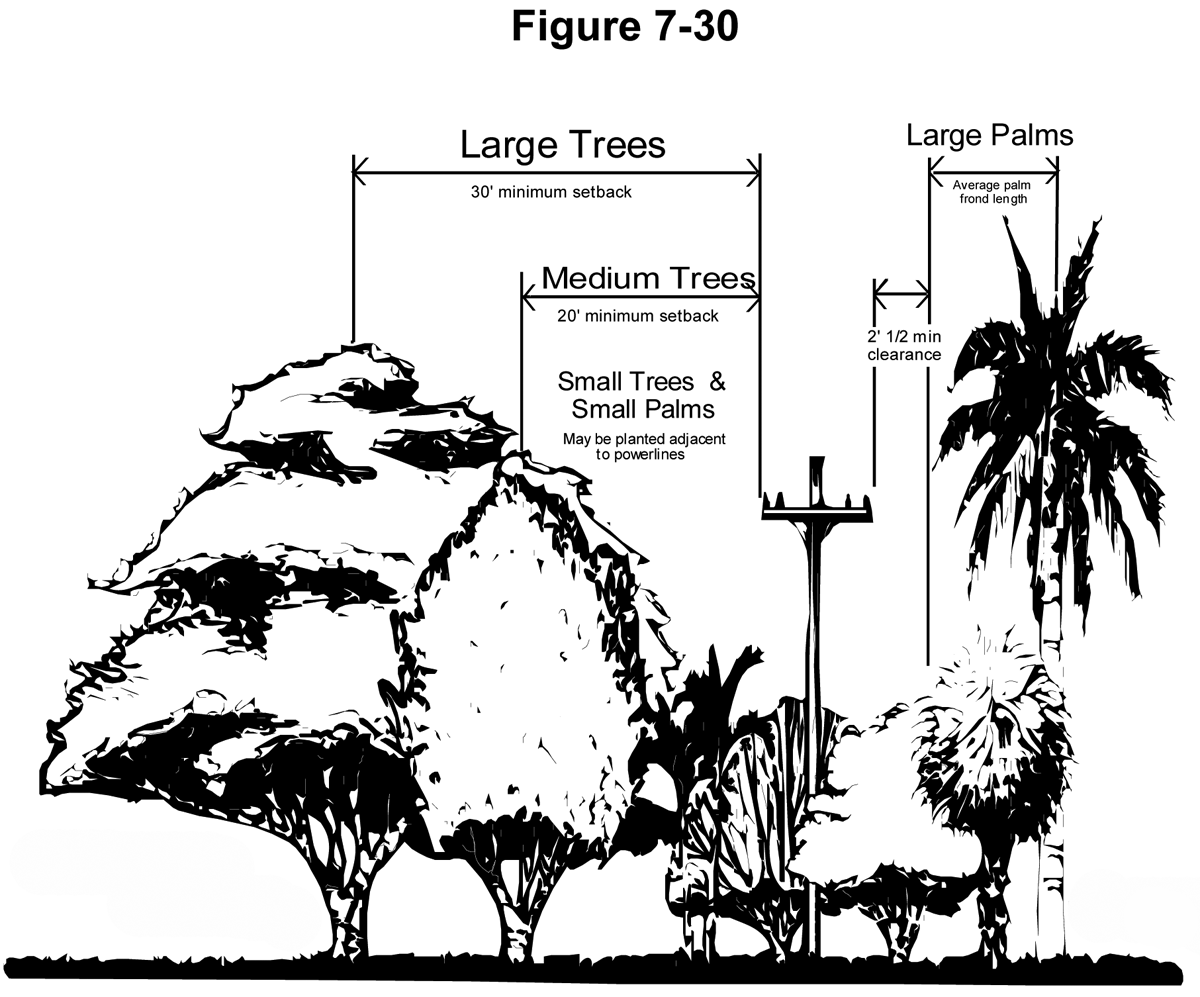
3.
Shrubs and Hedges. Shrubs shall be a minimum of twenty-four (24) inches in height above grade immediately after planting. Hedges, where required, shall be planted and maintained so as to form a thirty-inch or higher continuous, unbroken, solid visual screen within eighteen (18) months after the time of planting. Twenty-five percent (25%) of the quantity of planted shrubs shall consist of native species.
4.
Vines. Vines shall be a minimum of twelve (12) inches in height immediately after planting and may be used in conjunction with fences, screens, or walls to meet physical barrier requirements.
5.
Ground Covers. Ground covers, other than grass, shall be planted in such a manner as to present a finished appearance and reasonably complete coverage within four (4) months after planting.
6.
Lawn Grass. Grass areas shall be planted in species normally grown as permanent lawns in St. Lucie County. Grass areas may be sodded, plugged, sprigged, or seeded, except that solid sod shall be used in swales or other areas subject to erosion. When other than solid sod is used, protective measures shall be taken until complete coverage is achieved.
7.
Native Vegetation. The preservation of existing native vegetation shall be required where the location of said vegetation is not in conflict with the proposed building or parking areas. The Public Works Director, may require that reasonable changes be made to any site plan or application for building permit for the purpose of preserving or protecting any special or unique existing tree(s) or native habitat.
If the sites proposed landscaping area/plan preserves all or a substantial part of the existing native vegetation found on the property, then the requirements of this section may be presumed to be satisfied, if adequate screening is provided. The Public Works Director, shall determine if the quality and quantity of the preserved native vegetation meets the intent of this Code.
8.
Tree Preservation. A preserved native tree that meets the standards below may be substituted for any of the trees required by the landscaping requirements of this section.
a.
Credit Ratio: Preserved native trees shall be credited for required trees, pursuant to the following ratio:
b.
Trees Ineligible for Credit Ratio: No credit shall be granted for trees which are:
1.
Classified as prohibited;
2.
Located within recreational tracts, golf courses or similar subareas within planned unit developments, unless the recreational tracts, golf courses or similar subareas are under the perpetual control of the master property owners association or similar property owners group;
3.
Located within any required preservation areas;
4.
Dead, dying, diseased or insect-infested;
5.
Damaged from skinning, barking or bumping; or
6.
Suppressed trees which have been overtopped and whose crown development is restricted from above due to their relative size in relation to surrounding trees.
9.
Synthetic Lawns. Synthetic or artificial turf shall not be used in lieu of the plant requirements in this Code.
10.
Synthetic Plants. Synthetic or artificial material in the form of trees, shrubs, ground covers, or vines shall not be used in lieu of the plant requirements in this Code.
(Ord. No. 09-007, Pt. A, 9-1-2009)
7.09.04. - General Landscaping Requirements.
The following landscaping requirements shall apply to all non-residential and residential uses including but not limited to mobile home parks/subdivisions, single-family subdivisions, recreational vehicle parks, and multi-family residential uses, including all requested changes in use, except for those use interior to a common shopping center or similar multi-user building or structure provided that no additional parking is required, regardless of whether a site plan is required or not. All development activity shall comply with the provisions of the Vegetation Protection and Preservation of the Land Development Code (6.00.00), which shall supersede the provisions of this Section to the extent of conflict. Existing vegetation may be used towards landscape requirements, in accordance with the guidelines set up in Section 7.09.03(E)(8), with approval from the Environmental Resources Director. For the purposes of native tree protection, dimensional criteria in this section shall be reasonably flexible, with approval from the Environmental Resources Director.
A.
Required Landscaping Adjacent to Public or Private Street or Road Rights-of-Way. The area between any building, off-street parking area or other vehicular use area abutting a street or road right-of-way, shall be designed and landscaped as follows:
1.
A strip of land at least fifteen (15) feet in depth shall be located abutting street or road right-of-way and shall be landscaped to include one (1) tree for each thirty (30) linear feet of abutting right-of-way or major fraction thereof to be planted as far away from the right-of-way line as to allow for the installation, maintenance, repair or replacement of water/wastewater infrastructure.
In addition, a hedge, wall or other durable landscaping barrier shall be placed along the interior perimeter of this required landscaped strip.
2.
All property lying between the right-of-way and off-street parking or other vehicular use area outside the required landscaped strip shall be landscaped with at least grass or other ground cover.
3.
Landscaping shall be designed so that it will not interfere with the function of utility easements.
4.
Necessary accessways from the public right-of-way through all such landscaping shall be permitted to service the principal use, parking or other vehicular use areas.
5.
Noncontinuous landscaped earthen berms may be used in conjunction with the planting of a continuous hedge provided that the intent of the visual barrier created by the hedge is maintained. Maximum slope ratios for all earthen berms shall be no greater than 3:1.
6.
Fences, walls or other similar barriers, whether they are constructed of opaque materials or not, may be located in any required yard, consistent with the provision for Section 8.00.00 of this Code. All required perimeter landscaping shall be located on the outside (street side) of the wall or fence. Any brick, masonry, stockade or similarly constructed wall adjacent to a public or private street right-of-way shall be designed and constructed so that the wall face facing the street or road is articulated in such manner as not to result in a continuous flat wall surface facing the street or road right-of-way. Figure 7-31 generally depicts the placement of a fence or wall along a public or private street right-of-way. Pedestrian and vehicular access through any wall or fence are permitted, however the wall or fence shall be places so that adequate sight distance at any vehicular or pedestrian access is maintained. It shall be the responsibility of the property owner to maintain all landscaping along the outside edge of any fence or wall consistent with the requirements of this Code.
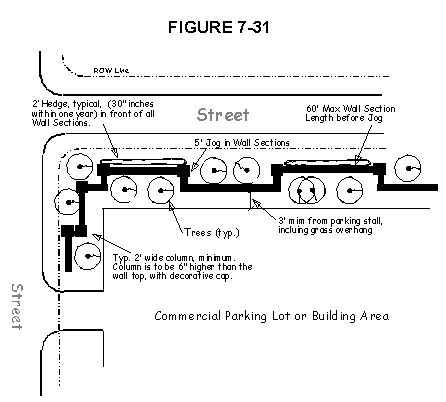
B.
Perimeter Landscaping Relating to Abutting Properties.
1.
When an off-street parking area or other vehicular use area will not be entirely screened by an intervening building or structure from abutting property, that portion of such area not screened shall be provided with a landscaped buffer of not less than ten (10) feet in width. Such landscaped buffer shall be designed and planted with a hedge or other durable landscape barrier not less than four (4) feet in height at planting, and to be maintained so as, to form a six (6) foot or higher continuous unbroken, solid visual screen after eighteen (18)months, between the off-street parking area or other vehicular use area and such abutting property. Such landscaped barrier shall be located between the common lot line and the off-street parking area and other vehicular use areas.
2.
In addition, one (1) tree shall be provided for each thirty (30) linear feet or major fraction thereof of such landscape barrier.
3.
Noncontinuous landscaped earthen berms may be used in conjunction with the planting of a continuous hedge provided that the intent of the visual barrier created by the hedge is maintained. Maximum slope ratios for all earthen berms shall be no greater than 3:1.
Fences, walls or other similar barriers, whether they are constructed of opaque materials or not, may be located within any required yard, consistent with the provisions of Section 8.00.00 of this Code. All required perimeter landscaping shall be located along the outside of the wall or fence. Pedestrian access through any wall or fence may be permitted, however the wall or fence shall be placed so that adequate sight distance at the pedestrian access is maintained. It shall be the responsibility of the property owner to maintain all landscaping along the outside edge of any fence or wall consistent with the requirements of this Code.
C.
Parking and Other Vehiclular Use Area Interior Landscaping.
1.
Generally. Surface parking and other vehicular use areas shall have at least one (1) square foot of interior landscaping for every eighteen (18) square feet or major fraction thereof of off-street parking and vehicular use area. Each separately landscaped area shall contain a minimum of one hundred eighty (180) square feet and shall have a minimum width of at least ten (10) feet and shall include at least one (1) shade tree of an appropriate species with the remaining area adequately landscaped with shrubs, ground cover, or other authorized landscaping material not to exceed three (3) feet in height.
Properties that are designated Industrial Extraction (IX), and Utilities (U) will be exempt from any parking area interior landscaping requirements and only need to provide interior landscaping for any required parking/access aisle areas. All other vehicular use areas are exempt from the interior landscaping requirements.
2.
Vehicle Encroachments into Landscaped Areas. The front of a vehicle may not encroach upon any landscaped area. Two (2) feet of the required depth of each parking space abutting on a landscaped area may be planted in extra grass or ground cover provided that a suitable motor vehicle stop is provided.
3.
Terminal Landscape Islands. Each row of parking stalls shall be required to end in a landscaped island which shall measure no less than ten (10) feet in width, or less than fifteen (15) feet in length. At least one (1) shade tree of an appropriate species shall be provided for each terminal island.
4.
Interior Landscape Areas. No more than ten (10) parking spaces shall be permitted in a continuous row without being interrupted by a minimum landscape area of one hundred eighty (180) square feet for a single row of parking or four hundred (400) square feet for a double row of parking. The number of continuous parking places and the minimum required distance may be altered to accommodate existing trees. Each interior landscaped area shall have a minimum width of ten (10) feet. One (1) shade tree of an appropriate species shall be provided for each interior island.
5.
Curbing. All terminal landscaped islands and interior landscaped areas shall be surrounded with a continuous raised, nonmountable curb in accordance with the specifications for public works of St. Lucie County as identified in Chapter XIII of this Code.
6.
Median Landscaping.
a.
A linear landscape median between two (2) abutting rows of parking may be used to satisfy, in part, the requirements of this Section relative to interior landscaping. Terminal islands are required as described in Section 7.09.04(C)(3).
b.
A landscaped parking lot median must be a minimum of eight (8) feet in width and provide for the planting of at least one (1) shade tree of an appropriate species for every thirty (30) linear feet of median length or fraction thereof. All parking lot median landscaped areas shall be protected with a continuous, raised, nonmountable curb in accordance with the specifications for public works of St. Lucie County as identified in Chapter XIII of this Code.
7.
Reserved Parking Area Landscape Requirements (7.06.02 (B) (4)). Where, in the determination of the Growth Management Director, in consultation with the Environmental Resources Director, the required number of parking and loading spaces is excessive for a specific use, the owner or agent may substitute landscaping in lieu of paving provided said areas are reserved for future parking and loading should the County find those are needed, and further provided:
a.
The owner of the land upon which such parking is being reserved shall enter into a written agreement with the County. The agreement shall be filed with the Clerk of the Circuit Court, with enforcement running to the County ensuring that the reserved parking and loading area shall never be encroached upon, used, sold, leased, or conveyed, for any purpose except in conjunction with the building or use which the reserved parking area serves so long as the off-street parking facilities are required. The agreement shall include a schematic portrayal as to how the required parking and loading areas will be provided.
b.
The owner of the land upon which such reserved parking and loading area is located agrees to bear the expense of recording the agreement which shall bind his/her heirs, successors, or assigns.
c.
The written agreement shall be voided by the County if the reserved parking and loading area is converted to usable parking area or if the reserved parking area is no longer required.
d.
No handicapped parking areas may be included within a reserved parking area.
D.
Visibility for Landscaping Adjacent to the Public Rights-of-Way and Points of Access. When an accessway intersects a public right-of-way or when the subject property abuts the intersection of two (2) or more public rights-of-way, all landscaping within the triangular areas described below shall provide unobstructed cross-visibility at a level between three (3) feet and six (6) feet, provided, however, trees or palms having limbs and foliage trimmed in such a manner that no limbs or foliage extend into the cross-visibility area shall be allowed provided they are so located so as not to create a traffic hazard. Landscaping, except required grass or ground cover, shall not be located closer than three (3) feet from the edge of any accessway pavement. The triangular areas referred to above are:
1.
The areas of property on both sides of an accessway formed by the intersection of each side of the accessway and the public right-of-way line with two (2) sides of each triangle being fifteen (15) feet in length from the point of intersection and the third side being a line connecting the ends of the two (2) other sides.
2.
The area of property located at the corner formed by the intersection of two (2) or more public rights-of-way with two (2) sides of the triangular area being thirty (30) feet in length along the abutting public right-of-way lines, measured from their point of intersection, and the third side being a line connecting the ends of the other two (2) lines.
E.
Landscaped Buffer Areas Between Non-Residential or Residential Structure(s) Housing Three (3) or More Dwelling Units and Single-Family or Two-Family Residential Uses. All side and rear yard perimeter buffer areas between non-residential or residential structure(s) housing three (3) or more dwelling units and single family or two family residential uses shall be landscaped with a masonry wall or opaque wood fence of at least eight (8) feet in height that forms a continuous screen between the uses. All masonry walls or opaque wood fences shall be landscaped with a continuous hedge along both the inside and outside base of the wall or fence. One (1) tree shall be planted along the wall or fence for each thirty (30) linear feet or major fraction thereof of the length of the wall or fence. Tree plantings shall be alternated so that at least sixty percent (60%) of the required number of trees is located on the outside of the wall or fence. The remaining forty (40) percent of the required perimeter tree plantings shall be located on the inside face of the wall or fence. Existing native vegetation may be used to satisfy all or part of the landscape planting requirements of this paragraph upon the approval of the Environmental Resources Director.
All fences or walls shall be treated with an anti-graffiti surface treatment. It shall be the responsibility of the property owner to removal any graffiti that may be applied to the wall or fence. In addition, the owner shall be responsible for the maintenance of all landscaping along both the inside and outside edge of any wall or fence. This landscaping shall be maintained in a good condition so as to present a healthy, neat, and orderly appearance free from refuse and debris. Maintenance shall include the replacement of all unhealthy and dead material within sixty (60) days in conformance with the approved site plan/or landscape plan. Violations of this section, or failure to maintain all required landscaping shall be grounds for referral to the Code Enforcement Board for appropriate enforcement actions. The sixty-day rule for compliance may be extended, when necessary, by the Environmental Resources Director or his/her designee to permit recovery from acts of nature such as a hurricane or a freeze.
Masonry walls or opaque wood fences may be located within any required yard, consistent with the provisions of Section 8.00.00 of this Code. The requirement for this perimeter masonry wall or opaque wood fence may be waived by the Environmental Resources Director if it is shown to the satisfaction of the Environmental Resources Director either that the adjoining properties owners have signed a consent that indicates their desire not to have the required masonry wall or opaque wood fence constructed along their property line, or that the Environmental Resources Director determines that a waiver is necessary to preserve any significant, protected or historic native vegetation.
The Environmental Resources Director may reduce the eight (8) foot height requirement down to six (6) feet, if it shown that adjoining property owners have signed a consent form that indicates their desire to reduce the height of the required masonry wall or opaque wood fence constructed along their property line. In the event that any such consent is issued, the owner of the property on which the nonresidential development is taking place shall need to comply with the standards of Section 7.09.04(B) of this Code as those standards relate to perimeter screening. All other landscaping provisions of this Code shall apply as applicable.
Pedestrian access through any wall or fence may be permitted, however, the wall or fence shall be placed so that adequate sight distance at the pedestrian access is maintained. Any wall or fence constructed adjacent to a public or private street right-of-way shall be designed and constructed so that the wall face facing the street or road is articulated in such manner as not to result in a continuous flat wall surface facing the street or road right-of-way. Figure 7-31 generally depicts the placement of a fence or wall along a public or private street right-of-way.
For the purpose of this section, non-residential uses shall not include any permitted or accessory use located in the institutional (I) or Religious Facilities (RF) Zoning District, except that a perimeter buffer area between any residential zoning district and a permitted or accessory use in the Institutional (I) or Religious Facilities (RF) Zoning District, shall consist of a landscaped masonry wall, opaque wood fence, hedge or other durable landscaped barrier of at least six (6) feet in height that forms a continuous screen between the uses. If a masonry wall or other non-living material screen is used to provide this required buffer, the masonry wall or other non-living material screen shall be landscaped with a continuous hedge along the base of the wall and with one (1) tree for each thirty (30) linear feet or major fraction thereof of wall length. All required perimeter landscaping shall be located along the outside of the wall. It shall be the responsibility of the property owner to maintain all landscaping along the outside edge of any wall consistent with the requirements of this Code. If vegetative landscape screens are installed, they shall be required to form a solid visual screen at time of planting. When existing vegetation is inadequate to function as a visual screen, it shall be augmented by two (2) staggered rows of shrub material at least six (6) feet in height.
To the extent permitted under Section 7.09.03(E)(7) of this Code, the Environmental Resources Director shall encourage the use of preserved native vegetation as meeting the intent and requirements of this Section. When making such a determination, the Environmental Resources Director shall attach a report to the building plans or development permits, with supporting photographs or other acceptable documentation, that indicates how the existing native vegetation meets the intent of this Section. The Environmental Resources Director may require a conservation easement or similar restrictive covenant, if the easement or covenant is necessary to ensure compliance with the terms of this section. Any developer seeking to utilize the provisions of Section 7.09.03(E)(7) to meet the requirements of this Section shall be required to maintain this native preserve area in perpetuity. If this preserve area is ever substantially altered or removed so that it no longer meets the intent of this Section, the developer shall be required to meet in the screening requirements of this Section.
The provisions of this Section, excluding the maintenance requirements may be varied by the Environmental Resources Director for any minor or major site plan, Planned Development Project (PUD, PNRD, or PMUD) if it shown through the Preliminary and Final Development Plan review process that the intent of this Section is being complied with and that all other applicable provisions of this Code are being met. A waiver of the provisions of this section shall require the approval of the Board of County Commissioners.
F.
Off-Street Loading Spaces and Waste Receptacles. All off-street loading spaces and waste receptacles shall be fully screened from any residential use by a uniformly colored, solid visual and auditory barrier of not less than six (6) feet in height, or a densely planted landscape screen consisting of evergreen shrubs or trees that shall be at least four (4) feet in height when planted and that can be expected to reach at least six (6) feet in height within eighteen (18) months. The screening shall extend the full length of any loading facility with openings as required for ingress and egress; however, there shall not be greater than twenty percent (20%) open space within the screen.
G.
Existing Off-Street Parking and Loading Lots. When an off-street parking or loading lot existed as of the effective date of this Code and such off-street parking lot is enlarged in area or capacity, the entire parking lot, both old and new, shall comply with this Code.
H.
Landscaping and Screening Requirements for Back-Siphonage and Backflow Preventers.
1.
It shall be the responsibility of the developer to landscape and screen backflow preventers.
2.
Backflow preventers shall be placed on private property.
3.
A continuous landscaped buffer shall be placed around the backflow prevention device, to provide a visual screen from adjacent properties. All shrubs or hedges shall be a minimum of eighteen (18) inches above grade immediately after planting, and shall be planted and maintained so as to form a four (4) foot or higher continuous, unbroken, solid visual screen within one (1) year after the time of planting.
I.
Landscaping Requirements for Residential Structures of Three (3) or Fewer Units.
1.
Any new residential structure containing one (1), two (2), or three (3) units must preserve or plant one (1) tree for every 2,500 square feet of the subject lot or parcel of land, up to a maximum planting of seventeen (17) trees per lot or parcel. On any lot or parcel greater than one (1) acre in area, the provisions of Section 6.00.00, Vegetation Protection and Preservation, shall be complied with.
2.
All trees preserved or planted in order to meet this landscaping requirement shall meet the standards of Section 7.09.03(E)(2) of this Code.
3.
One hundred percent (100%) of the planted trees shall consist of native species such as Live Oaks (Quercus virginiana), Laurel Oaks (Quercus laurifola), slash pine (Pinus elliotti), or other species listed in Section 7.09.04(L)(2) Native and Drought-Tolerant Vegetation.
4.
Automatic irrigation systems shall be equipped with an automatic rain shut-off device.
J.
Landscaping Requirements for Enclosed Buildings or Groups of Buildings Used for the Production of Food, Produce, Animals (Land or Water Species), or Ornamental Plants or Trees in a Agricultural Zoning District.
1.
Any new enclosed building, or group of buildings, used for the production of food, animals (land or water species) or ornamental products, excluding pole barns, sheds or barns used for the housing or sheltering of animals or livestock as an accessory use to the agricultural production operations, shall provide a minimum ten (10) foot wide landscape strip adjacent to, and around the perimeter of the building or group of buildings used for this purpose. This landscape strip shall include at least one (1) tree, meeting the requirements of this Code, for every thirty (30) liner feet of the building or group of buildings perimeter.
2.
One hundred percent (100%) of the planted trees shall consist of native species such as Live Oaks (quercus virginiana), Laurel Oaks (quercus laurifola), slash pine (pinus elliotti), or other species listed in Section 7.09.04(L)(2) Native and Drought-Tolerant Vegetation.
3.
Exceptions/Administrative Relief: The Public Works Director may grant relief from the requirements of this paragraph if it is shown to the satisfaction of the Public Works Director that the building or group of buildings being used for the production of food, animals (land or water species) or ornamental plants or trees is:
a.)
More that five hundred (500) feet from any adjacent property that is not under the ownership or control of the developing party. Road right-of-way and drainage canal right-of-way are not excluded from this property determination; or,
b.)
Is adequately screened by an existing native vegetation buffer meeting the intent of this paragraph. This existing native vegetative buffer must be located on the property that the building or group of buildings is located on. If relief is granted under this paragraph, and if the native vegetation buffer is ever removed fro any reason, the property owner shall be responsible to provide new plantings consistent with the requirements of this code.
K.
Off-Street Site Lighting Requirements and General Design Standards.
General Requirements. Where artificial outdoor lighting is provided, it shall be designed and arranged so that no source of the lighting will be a visible nuisance to adjoining property used or zoned for a residential purpose. In addition, the lighting shall be so designed and arranged so as to shield public streets and highways and all adjacent properties from direct glare or hazardous interference of any kind. For non-residential properties that abut property used or zoned for a residential purpose to the rear, or side, the following shall apply:
1.
For properties with a depth in excess of two hundred (200) feet: The maximum allowable mounting height of all outdoor light fixtures within fifty (50) feet from the front property line is twenty-five (25) feet, provided that such fixtures shall be shielded from public streets and highways to prevent direct glare or hazardous interference of any kind.
The maximum allowable mounting height of all outdoor light fixtures between fifty (50) feet from the front property line and seventy-five (75) feet from the rear property line is twenty (20) feet provided that such fixtures shall be shielded from all adjacent properties to prevent direct glare or hazardous interference of any kind.
The maximum allowable mounting height of all outdoor light fixtures within seventy-five (75) feet from any property line abutting a residential zoning district, including the AR-1 zoning district is six (6) feet, or not to extend above the height of the buffer wall.
2.
For properties with a depth less than two hundred (200) feet: The maximum allowable mounting height of all outdoor light fixtures within twenty-five (25) feet from the front property line is twenty-five (25) feet. provided that such fixtures shall be shielded from public streets and highways to prevent direct glare or hazardous interference of any kind.
The maximum allowable mounting height of all outdoor light fixtures between twenty-five (25) feet from the front property line and twenty-five (25) feet from the rear property line is twenty (20) feet provided that such fixtures shall be shielded from all adjacent properties to prevent direct glare or hazardous interference of any kind.
The maximum allowable mounting height of all outdoor light fixtures within twenty-five (25) feet from any property line abutting a residential zoning district including the AR-1 zoning district is six (6) feet or not to extend above the height of the buffer wall.
3.
All outdoor lighting installations shall use concealed source fixtures. These shall be cut-off type fixtures in which the lenses do not project below the opaque section of the fixture. All lighting fixtures shall be mounted with a zero degree tilt. Ground mounted flood and spotlight fixtures that are used to illuminate the building facade are exempt from this requirement. Fixture styles shall be consistent throughout the site.
4.
Ground mounted flood and spotlights, if used. shall be placed on standards pointing toward the building or wall and positioned so as to prevent light from glaring onto residential areas, rather than the buildings or walls and directed outward which creates dark shadows adjacent to the buildings.
5.
Building mounted outdoor lighting fixtures, other than those required by ordinances and regulations of the County, are prohibited on the rear or sides of buildings adjacent to residential zoning districts, including the AR-1 zoning district. All other building mounted outdoor lighting fixtures required by ordinances and regulations of the County shall be shielded to prevent light from glaring on residential areas.
6.
All outdoor lighting fixtures in place prior to March 1, 1999, shall be permitted to continue operation. However, any outdoor lighting fixture that replaces an existing fixture. or any existing fixture that is moved, must meet the standards of this Code. Existing fixtures that direct light toward streets, and are determined to be a traffic hazard, or existing fixtures that direct light toward adjoining property used or zoned for a residential purpose shall be either shielded or redirected within 90 days of notification.
7.
Parks and recreational uses are exempt from the above requirements.
8.
Nothing in this Section is intended to contravene the requirements of Section 6.04.02 (Sea Turtle Protection). In the event of a conflict between these regulations, the stricter to the two (2) standard shall apply. The Public Works Director is empowered to determine the stricter of the two (2) standards to be applied.
L.
Standards for Native and Drought-Tolerant Vegetation.
1.
When a development is designated as a major, minor, or planned site plan under the provisions of Section 11.02.02 of this Code, water-wise design incorporating the following standards shall be required, in addition to the general landscape standards in Section 7.09.00.
a.
At least fifty percent (50%) of the minimum landscaping required by Section 7.09.00 shall consist of water-wise plant materials as defined in Sections 7.09.04(L), 7.09.04(M) or 7.09.04(N) except that one hundred percent (100%) of required lawn areas shall consist of water-wise grasses listed in Section 7.09.04(L)(2)(a). Each type of required landscaping, such as trees, shrubs, vines, and lawn areas shall be calculated separately, and each type shall meet the required percentage minimum of defined water-wise plant materials.
b.
Plant materials shall be grouped according to watering requirements in order to prevent over-watering of water-wise plant materials. Proposed irrigation zones shall be shown on the landscaping plan. Such zones shall take into consideration both plant material and microclimate factors, such as northern or southern exposure, shade or full sun, slope, and berming.
c.
Ground covers approved under Section 7.09.04(L)(2)(g) may be used instead of grass when planting strips are eight (8) feet wide or less.
2.
Plant Materials. All plants utilized to meet the water-wise requirement shall be site appropriate, and shall be selected from the following lists or be water-wise and non-invasive species approved by the Public Works Director. In approving other plant materials, the Director shall consider criteria including, but not limited to, soil type, hydrology, and climate.
a.
Grasses:
(1)
Bahia grass (may be mixed with ryegrass);
(2)
St. Augustine grass;
(3)
Other grass serving a site specific need approved by the Public Works Director.
b.
Ground Cover/Accent Plants:
c.
Shrubs:
d.
Trees:
3.
Mulching Standards:
a.
All plant materials meeting the water-wise requirement of this code shall be mulched with at least a three-inch layer of mulch. Cypress mulch shall not be used for any non-residential landscaping areas or projects. The use of cypress mulch is to be discouraged on all residential projects or landscape areas.
b.
Mulch shall cover the entire area of the planting bed.
4.
Alternative Method of Meeting the Water-Wise Requirement When Native Upland Plant Communities Are Maintained.
a.
Preservation of existing native upland plant communities on the site may substitute for all or part of the water-wise requirement in the following ratios:
b.
Reduction of water-wise requirements by preserving existing native upland plant communities shall be allowed only when the Public Works Director determines that all of the following criteria are met:
1.
The existing native plant communities shall be viable and in good condition and include canopy, understory, and ground cover.
2.
The existing native plant communities must be protected by a conservation easement or other legally enforceable preservation mechanism.
3.
The execution of the site plan will not threaten the viability of the existing native plant community.
4.
The plant community to be preserved shall be at least one-half (½) acre in size, except that microcommunities totaling at least one-half (½) acre may be preserved providing that each microcommunity is at least ten (10) feet in width and contains at least one hundred (100) square feet.
5.
A management plan is submitted to show how the viability of the preserved communities will be maintained without the use of heavy equipment.
5.
Irrigation Systems:
a.
Irrigation System Design Standards.
1.
Permanent irrigation of preserved plant communities shall be prohibited.
2.
Irrigation required for the re-establishment or restoration of existing plant communities shall be limited to temporary irrigation systems. Newly installed plant communities or supplemental plants to existing plant communities may initially require additional water to become established. Temporary irrigation systems shall remain in place for at least six (6) months and shall include:
(a)
Temporary low-volume irrigation, or
(b)
Alternative method approved by Public Works Director.
3.
Automatic irrigation systems shall incorporate the following criteria:
(a)
Zoning of irrigation systems: Sprinkler heads irrigating designated high water demand areas shall be circuited or zoned so that they can be irrigated at a different frequency or application rate than low water demand areas. At a minimum separate zones shall be created for turf and planting beds, with a separate zone also required for trees not incorporated into planting beds.
(b)
Automatic rain shut-off devices: Automatic irrigation systems shall be equipped with an automatic rain shut-off device for each proposed zone.
(c)
Elimination of over-throw onto impervious surfaces:
1.
Sprinkler heads shall be directed away from impervious surfaces.
2.
The effects of wind on the spray stream shall be reduced by requiring low trajectory spray nozzles.
b.
Maintenance of Irrigation Systems: Irrigation systems shall be maintained in working condition at all times, to prevent waste of irrigation water. Broken sprinkler heads, pipes and nozzles shall be repaired or replaced within fourteen (14) days of notice.
c.
Irrigation During Water Shortage: Irrigation systems shall be operated in accordance with the requirements of water shortages declared for St. Lucie County by the South Florida Water Management District or St. Lucie County.
M.
Special Landscaping Requirements For North and South Hutchinson Island. If any development is to occur on a site located on North or South Hutchinson Island, seventy-five percent (75%) of the new landscaping material to be planted shall consist of the following species. The Public Works Director may reduce the minimum size requirements to the largest plant sizes available if the listed plant material is unavailable in the sizes set forth in 7.09.03 (E) (2) and (3). Each type of required landscaping, such as trees, shrubs, vines, and lawn areas shall be calculated separately, and each type shall meet the required percentage minimum of plant materials.
N.
Special Landscaping Standards For Development in Areas Determined to Contain Scrub Habitat. If any development is to occur on a site that is determined, through an Environmental Impact Report submitted pursuant to Section 11.02.09 or Section 11.02.10 of this Code, or by the Public Works Director following a specific site inspection by the Director, or his/her designee, to be scrub habitat as defined in Chapter 2 of this Code, then the development shall be required to provide for the preservation of the existing scrub habitat where the location of said habitat is not in conflict with the proposed building or parking areas. The Public Works Director, or his/her designee, may require that reasonable changes be made to any site plan or application for building permit for the purpose of preserving or protecting any special or unique existing tree(s) or native habitat. If the existing scrub habitat must be removed to provide for the reasonable use of the property, seventy-five percent (75%) of any new landscaping material to be planted shall consist of the following listed species. The Public Works Director may reduce the minimum size requirements to the largest plant sizes available if the listed plant material is unavailable in the sizes set forth in Section 7.09.03(E)(2) and (3). Each type of required landscaping, such as trees, shrubs, vines, and lawn areas shall be calculated separately, and each type shall meet the required percentage minimum of plant materials.
O.
Administrative Relief from the Provisions of this Section. The Environmental Resources Director may allow alternative landscaping where it is determined based upon a showing by the applicant for any Final Development Order, that a literal application of these regulations will not meet the general spirit and intent of this Code as a result of use, traffic patterns, drainage or other issues of configuration. The alternate landscape proposal may include changes to species, plant sizes, landscape area dimensions, quantities, planting schedules, and surety requirements; as long as the overall project meets the environmental enhancement and aesthetic intent of the Land Development Code and the alternatives provide comparable visual and/or noise screening. Any area landscape plan submitted as an alternative shall be designed in such a manner that the alternate landscape area and the amount of material provided equal the amount that was originally required, unless it is determined by the Environmental Resources Director that additional landscaping is required for that alternative to meet the minimum visual and noise screening requirements and environmental and aesthetic intent of the Land Development Code. The Environmental Resources Director may solicit comments from adjoining property owners for alternative screening proposals.
(Ord. No. 07-054, Pt. B, 12-11-2007; Ord. No. 09-007, Pt. A, 9-1-2009; Ord. No. 12-003, Pt. G, 5-15-2012; Ord. No. 2021-14, Pt. A, 6-1-2021)
7.09.05. - Removal of Exotic Vegetation.
A.
General.
1.
Any developer submitting a site plan for site plan approval or in conjunction with a Conditional Use Permit, Planned Unit Development, Planned Non-Residential Development, or Planned Mixed Use Development shall be required to remove, and chemically treat any remaining stumps, of all of the exotic vegetation listed as a "Category I" in the latest edition of the Florida Exotic Pest Plant Councils "List of Invasive Species."
2.
No person shall plant or cause to be planted or permit to be planted, anywhere within the area of unincorporated St. Lucie County, any species listed as a "Category I" in the latest edition of the Florida Exotic Pest Plant Councils "List of Invasive Species."
B.
Exotic Pest Plants; Maintenance and Removal.
1.
Nuisances declared and prohibited:
a.
It is found and declared to be expedient and necessary to the preservation of the public health, comfort, safety and welfare of the inhabitants of St. Lucie County that all lots in recorded subdivisions of St. Lucie County, outside of municipalities, be required to be kept free from any species listed as a "Category I" in the latest edition of the Florida Exotic Pest Plant Councils "List of Invasive Species," which, by reason of height, proximity to neighboring structures, physical condition, or other peculiar characteristics, might cause damage to life or property within the immediate area surrounding the same. The existence of vegetation which create a hazard is declared to be a public nuisance. Erosion control measures or reseeding of the area from which the exotic vegetation was removed may be required.
b.
No person shall plant or cause to be planted or permit to be planted, anywhere within recorded subdivisions of unincorporated St. Lucie County, any species listed as "Category I" in the latest edition of the Florida Exotic Pest Plant Councils "List of Invasive Species."
c.
Existing individual species listed as "Category 1" in the latest edition of the Florida Exotic Pest Plant Council's "List of Invasive Species" located within recorded subdivisions of unincorporated St. Lucie County shall be maintained at a height not to exceed the distance between the tree and the nearest property line, minus ten (10) feet. The existence of any such trees is hereby declared to be a public nuisance.
(Ord. No. 16-004, Pt. A, 3-1-2016)
7.10.01. - Mobile Food Vendors.
A.
In the Commercial General (CG), Industrial Light (IL), Industrial Heavy (IH), and Industrial Extraction (IX) zoning districts, a mobile food dispensing vehicle that sells prepared food products and mobile units that sell agricultural produce may be permitted, subject to the approval of a Class I or Class II permit application by the Growth Management Director and the presentation of written permission of the property owner on which the mobile food dispensing vehicle is to be located. A mobile food dispensing vehicle is further defined in Chapter II.
1.
Class I Permit for a Mobile Food Vendor.
a.
Class I permits for Mobile Food Vendors are intended for those vendors who operate mobile food service facilities that are either propelled by self contained means or are trailered from site to site for the purpose of conducting business. These vendors would typically remain in no one location for more than one (1) or two (2) hours.
A Class I permit for the operation of a Mobile Food Vendor shall be reviewed and treated as a Home Occupation license subject to the following standards:
1.
All business activities associated with the operation of the mobile food dispensing vehicle are to be conducted away from the home based point of licensure;
2.
The home based point of licensure is to be used for office facilities only. No retail or wholesale sales, except those associated with the stocking of the mobile food dispensing vehicle are to be made or transacted on the home based premises;
3.
No person other than members of the family residing on the premises of licensure shall be engaged in the conduct or support of such occupation.
4.
No stock in trade shall be displayed or sold on the premises of licensure.
5.
The use of the dwelling unit for the home occupation shall be incidental and subordinate to its use for residential purposes, and no more than twenty-five percent (25%) of the building floor area shall be used in the conduct of the home occupation.
6.
There shall be no outdoor storage of equipment or materials used in the home occupation, except for the parking of the mobile food dispensing vehicle provided that the provisions of Section 7.10.14 of this Code shall not be violated. No mobile food dispensing vehicle shall remain at the premises of licensure for more than twenty-four (24) hours, excluding weekends and legal holidays, unless parked within an enclosed structure.
7.
No more than one (1) mobile food dispensing vehicle shall be kept at the point of licensure
b.
A Class I permit shall not be issued by the Growth Management Director until such time as a valid certificate from the Florida Department of Health and Rehabilitative Services (HRS) has been supplied indicating that the proposed mobile food vendor is compliant with all minimum health and safety standards for food service operations.
c.
A Class I permit operation may be upgraded to a Class II permit operation upon the satisfactory demonstration of compliance with the provisions of Section 7.10.01(A)(2) of this Code.
2.
Class II Permit for a Mobile Food Vendor.
a.
Class II permits for Mobile Food Vendors are intended for those vendors who operate mobile food service facilities that are intended to be left in one (1) particular location for extended periods of time.
A Class II permit for the operation of a Mobile Food Vendor shall be reviewed and treated as standard commercial zoning/use application and shall be subject to the standards of development contained in this Code, the St. Lucie Code and Compiled Law, all applicable state of Florida health standards for food service operators, including any required licensing requirements, and the following special standards:
1.
All mobile food dispensing vehicles shall be located in accordance with the minimum yard requirements parking requirements and landscape requirements of the zoning district in which they are located.
2.
No ground signs shall be permitted for any mobile food dispensing location unless in compliance with the provisions of Section 9.01.01(F). One (1) wall sign, equal to twenty percent (20%) of the total wall face area of one (1) side of the mobile food dispensing vendor facing the street may be permitted subject to compliance with the provisions of Section 9.01.01(F).
7.10.02. - Outdoor Displays in Commercial Zoning Districts.
A.
General. In all commercial zoning districts, and except as noted below, all business activities shall be in a completely enclosed structure.
B.
Exceptions.
1.
Exceptions to this prohibition shall be for the display of motor vehicles, marine craft, aircraft, recreational vehicles, mobile homes, farm and construction equipment and vehicles, farm and garden supplies, stone products, any other products designed for outdoor use, and the location of dispensing equipment and devices. None of these displays may be located in any required off-street parking area, a required off-street loading area, any required landscape area, designated environmental protection area or any adjacent public right-of-way. All display areas shall be properly screened as provided for in Section 7.09.00 of this Code.
2.
The display of merchandise at the entry to any retail establishment shall be permitted provided that the merchandise displayed is limited to the width of the business stores frontage; the merchandise displayed is located on the sidewalk immediately adjacent to the stores primary street/parking lot frontage; the display of merchandise does not extend more than ten (10) feet from the wall of the commercial building; that a minimum six-foot wide pedestrian path is to be maintained along the sidewalk in front or, or adjacent to the business; and that the displayed merchandise is not located or placed in any traffic or access aisle, parking space, landscaped area, required fire lane or other emergency access path and does not obstruct any fire hydrant or other fire service connections.
3.
Outdoor eating areas are permitted as an accessory use to any permitted eating establishment in any commercial zoning district, subject to the following standards:
a.
The outdoor eating area does not occupy an area greater than fifty percent (50%) of the building area of the business or use to which the eating area is accessory;
b.
The outdoor eating area is not located in any required yard, parking area, service area, landscape area, drainage area or public right-of-way;
c.
If the outdoor eating areas is located along, or astride, a sidewalk or other pedestrian accessway, a minimum six-foot unobstructed passage shall be maintained through the outdoor eating area. This requirement may be increased if it is determined by the appropriate public safety authorities to be necessary for adequate pedestrian movement and emergency services access;
d.
All outdoor eating areas shall be designed and located in such a manner as to prevent them from becoming a nuisance to any adjacent property or use. All outdoor eating areas shall be located so that there are no adverse noise, lighting, trash or other negative impacts onto any adjacent property or use; and,
e.
All outdoor eating areas shall provide for adequate off-street parking. All parking computations shall be as if the outdoor eating areas were fully enclosed.
7.10.03. - Animals in Residential Districts.
A.
Exempt as provided in this section, no animals shall be kept in any residential district except those animals generally recognized as household pets, such as dogs, cats, caged birds, etc. In any residential district, no more than a total of five (5) dogs and/or cats four (4) months or older shall be allowed in each dwelling unit. For the purpose of this section, "residential districts" shall not include the following: AG-1; AG 2.5; AG-5: AR-1 with agricultural classification pursuant to F.S. § 193.461; or PUD where livestock is permitted.
An exemption to this section is granted by Section 7.10.03.D. — Backyard chicken-keeping One-Time Registration Holder Program. The holder of a valid backyard chicken-keeping registration is allowed up to a maximum of five (5) chickens on an occupied residential estate single family zoning district property in RE-1 and RE-2 zoning districts, and on an occupied single-family residential zoning district property within the RS-2, RS-3, RS-4 zoning districts, excluding the River Park Subdivision that is partially subject to an overlay district that encourages redevelopment to improve the area that suffers from deficiencies and has not developed as a result of changing market conditions.
B.
In the AR-1 district, animals other than household domestic pets may be kept provided they are not housed within one hundred (100) feet of any property line.
C.
In the RE-1 and RE-2 districts, horses may be kept provided that:
1.
The property is at least two (2) acres;
2.
No more than two (2) horses are kept;
3.
The horses are for the private and personal use of the resident and his/her family; and,
4.
The horses are to be stabled at least one hundred fifty (150) feet from any residence under separate ownership and three hundred (300) feet from the edge of the right-of-way of any street.
D.
Backyard Chicken-keeping One-time Registration Holder Program:
1.
Purpose. The purpose of this One-time Registration Holder Program is to establish and implement a Backyard chicken-keeping program allowing residents to keep or raise chickens on a developed and occupied detached single-family residential properties subject to the terms and conditions of this program. For this section, the term "chicken" refers to female chickens only (i.e. hens).
2.
One-time Registration and general conditions for backyard chicken-keeping in certain residential zoning districts. Persons desiring to participate in the backyard chicken-keeping program shall obtain a registration from the Planning and Development Services Department before keeping chickens.
a.
No more than one (1) registration holder for backyard chicken keeping shall be issued per developed and occupied single-family residential property.
b.
If a tenant or person applying for a one-time registration for backyard chicken-keeping is not a fee simple owner of the subject property, the property owner must agree and consent to the registration.
c.
To obtain registration under this program, persons applying for a registration for the keeping of chickens must show that they can meet the requirements of this program by a sketch plan of the back yard, including all required principal structures and approval from a Homeowners' Association where applicable.
d.
A signed and notarized affidavit is required to be submitted with all backyard chicken-keeping registration holders. The affidavit shall state that the chicken coop and enclosure will be designed, constructed, and operated to the standards outlined in this ordinance. The affidavit shall also state that the drawings submitted as part of the registration are a reasonably accurate representation of the subject site features and adjacent properties.
e.
The County may conduct on-site inspections of the subject property to make compliance determinations under this program before and after the filing of the registration. The County may provide forty-eight (48) hour notice to registration holders before performing inspections.
f.
The County may deny a registration application if the person(s) applying for the registration cannot meet the requirements of this program. The issuance of a registration for the keeping of chickens is conditioned upon and subject to the terms and conditions of this ordinance.
g.
If this section is repealed, the County will mail notices to each active registration holder advising that they will need to relocate their chickens, providing them at least sixty (60) days' notice from the adoption of any ordinance repealing backyard chicken-keeping program.
h.
If a resident decides to discontinue backyard chicken-keeping, or if their registration is revoked, per Subsection (e), or this section is repealed, the resident is responsible for finding appropriate homes for the chickens within thirty (30) days. Also, a final inspection shall be completed in thirty (30) days to ensure that the chickens, coop, and enclosure have been removed from the property.
i.
The date a registration application is approved for the keeping of chickens, such registration does not expire unless the registration holder is found in violation of the ordinance, and violations are not corrected. The registration will then be revoked, and the resident is responsible for finding appropriate homes for the chickens with thirty (30) days. Also, a final inspection shall be completed in thirty (30) days to ensure that the chickens, coop, and enclosure have been removed from the property.
j.
Up to five (5) chickens may be kept on an occupied detached single-family residential property upon receiving an approved-registration from the Planning and Development Services Department. Regardless of the underlying future land use designation, chickens shall not be kept on properties developed with commercial uses, mobile homes/manufactured home parks, duplexes, triplexes, townhomes, and apartments or other multifamily properties.
k.
Existing developed and occupied detached single-family residence that was lawfully approved to raise chickens before the adoption of this ordinance, shall be grandfathered and allowed to continue the use without requiring registration.
l.
Every person who owns, controls, keeps, maintains, or harbors chickens must keep them confined on the premises at all times within a chicken coop or chicken enclosure unless a person is supervising the chickens within the confines of a fenced rear yard on the premises. After a person has completed the personal interaction and supervision of chickens within the confines of the fenced rear yard, the chickens shall be returned to the coop or enclosure. Supervising shall mean that the person is outside in the fenced rear yard and has the chickens within sight distance at all times. No electronic monitoring is permitted.
m.
The keeping of ducks, geese, turkeys, guinea fowl, and pigeons or any other poultry or fowl by a person with an enclosure is prohibited under this program. This program does not prohibit the existence of these species in the wild as free-range birds.
n.
Chickens shall be kept for personal use only. Selling chickens, eggs, or chicken manure, or the breeding of chickens for commercial purposes is prohibited.
o.
Chickens shall not be bred or slaughtered on-premises. Deceased chickens shall be disposed of within twenty-four (24) hours; or, if sick, may be taken to a veterinarian office to be euthanized.
3.
Location and requirements for chicken coops and enclosures. Backyard chicken-keeping shall be permitted as an accessory use within single-family residential zoning districts, where the lot or parcel is developed and occupied by a single-family detached residence. Chickens shall not be kept on residential property with mobile home/manufactured home parks, duplexes, triplexes, townhomes, and apartments or other multi-family properties.
a.
Permission for backyard chicken-keeping shall be subject to the following standards and conditions:
(1)
The maximum size of the coop and enclosure area shall be one hundred and twenty-five (125) square feet. The coop may be movable so long as it meets the required setbacks in this ordinance.
(2)
The space per bird in the coop shall be not less than four (4) square feet.
(3)
The coop and enclosure shall be set back a minimum of ten (10) feet from the side and rear lot lines and a minimum of twenty (20) feet from any side street, so long as the coop and enclosure area shall be at least twenty-five (25) feet, from any residential structure on an adjoining lot. The coop and enclosure must be kept in the rear backyard of the residence.
(4)
A building permit from the building department shall not be required for the coop. The registration for keeping backyard chickens shall list the construction material methods as well as anchoring methods, such as tie-downs. Prefabricated mobile coops may be exempt from the requirement to obtain a building permit.
(5)
The coop and enclosure area shall be located in the rear yard of the developed and occupied single-family detached residential property.
(6)
Nothing in this section shall prevent the construction of a coop and enclosure from abutting the rear of an applicant's house, so long as it otherwise meets the requirements of this Code.
(7)
The maximum height of a coop and the enclosure area fence around the coop shall be six (6) feet, as measured from the existing grade to the highest part of the coop or fence.
(8)
Chicken coops and enclosures shall be completely screened from adjacent roadways and neighboring parcels by a six (6) foot-tall opaque fence, wall , or vegetated barrier consisting of evergreen shrubs that at the time of planting shall be a minimum of four (4) feet in height, planted three (3) feet on center, that can be expected to reach and be maintained at a minimum of six (6) feet in height within eighteen (18) months. Required buffers shall be erected or installed between the coop and the property line. A chain-link fence, chain-link fence with slats, or similar fence shall not constitute an opaque fence or wall. A building permit may be required to erect an enclosure area fence in accordance to Section 8.00.04 of the St. Lucie County Land Development Code.
(9)
Chicken coops shall be covered and ventilated, and a fenced enclosure/run is required. The coop and enclosure must be constructed in a way that establishes a clean, safe, and pleasant environment free of odor, vermin, noise, and disease.
(10)
All enclosures for the keeping of chickens shall be so constructed and maintained as to prevent rodents or other pests. Chicken coops must be impermeable to rodents, wild birds, predators and weather, including all openings, ventilation holes, doors, and gates. Enclosures shall be kept in clean and neat conditions, including the provision of clean, dry bedding materials and regular removal of waste materials, not to create an odor.
(11)
All chicken feed shall be kept in a secured and covered metal container, or otherwise protected to prevent rodents and other pests from gaining access to it.
(12)
Chicken coops shall not permitted within any protected St. Lucie River shorelines and adjacent upland areas along with water bodies such as the Indian River Lagoon, St. Lucie River, and its tributaries. Refer to Section 6.02.02 Riverine Shoreline Protection for buffer requirements.
4.
Health, sanitation, and nuisance as applied to the keeping of chickens.
a.
Chickens shall be housed at all times within a covered coop or fenced enclosure area, except that they may be removed from the coop or fenced enclosure area by a resident or visitor of the home, provided the resident keeps them under his or her continuous custody and control while they are outside the coop or fenced enclosure area. No electronic monitoring is permitted.
b.
Chickens must be secured within the chicken coop during non-daylight hours.
c.
Chickens shall not be permitted to trespass on neighboring properties, run at large, be released, or set free at any time.
d.
Chicken coops and runs shall be maintained in a clean and sanitary condition at all times. Chickens shall not be permitted to create a nuisance consisting of odor, noise or pests, or contribute to any other nuisance condition.
e.
If a chicken is injured or bitten by a family dog or neighbor's dog, said dog shall not be classified as a dangerous dog according to Section 6-23 of the St. Lucie County Land Development Code.
f.
All deceased chickens shall be properly disposed of off-site within twenty-four (24) hours of expiring.
g.
In a public health emergency declared by the St. Lucie County Health Department, including but not limited to an outbreak of Avian Flu or West Nile virus, immediate corrective action shall be required, per applicable public health regulations and procedures and Animal Service.
5.
Revocation and transfer of Registration.
a.
Revocation. The registration that granted the authority to have backyard chickens may be revoked by the County for the following reasons:
(1)
If a registration holder fails to obtain chickens within six (6) months of obtaining the registration.
(2)
If any condition of the chicken-keeping ordinance has been violated, the County may revoke the registration immediately if the violation has not been remedied within seven (7) days after written notice of the violation.
(3)
Without allowing the registration holder to remedy a violation as set forth above, the revocation shall occur if more than three (3) separate violations occur in ninety (90) days arising from the backyard chickens.
(4)
If revoked, neither the resident nor anyone else on the same premises may reapply for a period for twelve (12) months from the date of revocation. All chickens must be removed from the property any time a registration is revoked.
(5)
A person aggrieved by a decision to deny or revoke a chicken-keeping registration may appeal according to Section 11.11.00 of the St. Lucie County Land Development Code.
b.
Transfer. A registration issued according to this section shall not be transferred to a subsequent property owner. Any subsequent property owner will be required to apply for registration according to this section if the subsequent property owner wants to keep chickens.
c.
Relocation. Any active registration holder who relocated to a new location shall apply for a chicken-keeping registration for the new location.
d.
Cancellation. If a participant chooses to discontinue backyard chicken-keeping, they must provide notice to the County and remove the chickens, coop, and enclosure within thirty (30) days of the notice being given.
6.
Violations. If a violation of this program occurs, the County shall have the right to one or more of the following remedies or actions:
a.
Institute code enforcement proceedings and prosecute code violations against the violator and the property owner of the real property where the violation occurs according to Section 11.13.00 of the St. Lucie County Land Development Code;
b.
Take any other action or remedy authorized by law or in equity, including but not limited to, instituting an action in court to enjoin violating actions, in which case the violating person shall be liable to the County for reimbursement of the County's attorney's fees and costs concerning such action;
c.
Revoke the registration for the keeping of chickens within ten (10) days.
(Ord. No. 16-012, Pt. A, 7-26-2016; Ord. No. 2020-026, Pt. D, 10-6-2020; Ord. No. 2023-17, § 2, 12-5-2023)
7.10.04. - Guest Homes.
In the AG-1, AG-2.5, AG-5, R/C, AR-1, RE-1 and RE-2 zoning districts the Growth Management Director may authorize as an accessory use, the construction of a guesthouse per single-family dwelling, provided that upon receiving a building permit for this use, the property owner sign a notarized statement to the effect that under no circumstances shall the guest house be used for rental purposes seasonal or annual.
7.10.05. - Mobile Homes as Accessory Uses.
In the AR-1, AG-1, AG-2.5 and AG-5 zoning districts, the Growth Management Director may authorize the installation of a mobile home as an accessory use subject to the following conditions:
A.
Requirement for Agricultural Property Assessment Designation:
1.
Proof that the land upon which the mobile home shall be located is classified as agricultural land for purposes of ad valorem tax assessment. Termination of this assessment shall void the mobile home permit and necessitate the immediate removal of the mobile home.
B.
Additional Criteria for Issuance:
1.
The owner of the land shall be the owner or lessee of the mobile home.
2.
The mobile home shall be placed on at least five (5) acres of land and shall comply with all other requirements of Section 7.04.01, or qualify as a nonconforming lot of record as defined under Section 10.00.04.
3.
The Growth Management Director shall determine that the mobile home is an accessory use, pursuant to Section 8.00.00 of this Code.
4.
Such use shall be accessory to productive agricultural operations, having a minimum of five (5) acres.
7.10.06. - Recreational Vehicles; Use as Residence Outside of Approved Camps or Parks Restricted.
Except as provided in Section 8.02.00, no recreational vehicle-type unit as defined by Section 320.01(1)(b), Florida Statutes, shall be used as a residence in the unincorporated area of the County unless it is located in an approved camping ground, travel trailer park, provided, however, that such a unit may be temporarily occupied for a period not to exceed seventy-two (72) hours in any thirty (30) day period when the owner or operator of the unit is a gratuitous guest of the owner or occupant of the property on which the unit is located.
7.10.07. - Community Residential Homes.
A.
Community residential homes as defined in Chapter XI shall be a permitted use in the RM-5 (Residential, Multiple-Family-5), RM-7 (Residential, Multiple Family-7), RM-9 (Residential, Multiple Family-9), RM-11 (Residential, Multiple-Family-11), and RM-15 (Residential, Multiple-Family-15) zoning districts and on certain lot types as identified in the PTV (Planned Town or Village) and PRW (Planned Retail/Workplace) zoning districts subject to the following conditions:
1.
When a site for a community residential home has been selected by a sponsoring agency in a multiple-family zoning district, the agency shall notify the County Administrator and Growth Management Director in writing and include in the notice the specific address of the site, the residential licensing category, the number of residents, and the community support requirements of the program. Such notice shall also contain a statement from the district administrator of the Department of Health and Rehabilitative Services indicating the need for and the licensing status of the proposed community residential home and specifying how the home meets applicable licensing criteria for the safe care and supervision of clients in the home. The district administrator shall also provide to the County Administrator the most recently published data compiled that identifies all community residential homes in the district in which the proposed site is to be located. The Growth Management Director shall review the notification of the sponsoring agency in accordance with applicable zoning requirements.
2.
Pursuant to such review, the Growth Management Director may:
a.
Determine that the siting of the community residential home is in accordance with applicable zoning requirements and approve the siting. If the siting is approved, the sponsoring agency may establish the home at the site selected.
b.
Fail to respond within sixty (60) days. If the Growth Management Director fails to respond within such time, the sponsoring agency may establish the home at the site selected.
c.
Deny the siting of the home.
3.
The Growth Management Director shall not deny the siting of a community residential home unless the Director establishes that the siting of the home at the site selected:
a.
Does not otherwise conform to existing zoning regulations applicable to other multi-family uses in the area; or,
b.
Does not meet applicable licensing criteria established by the Department of Health and Rehabilitative Services, including requirements that the home be located to assure the safe care and supervision of all clients in the home; or,
c.
Would result in such a concentration of community residential homes in the area in proximity to the site selected, or would result in a combination of such homes with other residences in the community, such that the nature and character of the area would be substantially altered. A home that is located within a radius of one thousand two hundred (1,200) feet of another existing community residential home in a multiple-family zoning district shall be an overconcentration of such homes that substantially alters the nature and character of the area. A home that is located within a radius of five hundred (500) feet of an area of single-family zoning substantially alters the nature and character of the area.
All distance requirements shall be measured from the nearest point of the existing home or area of single-family zoning to the nearest point of the proposed home.
B.
Upon receipt of the written notice from the sponsoring agency provided for in (1) above, the County Administrator shall notify the Board of County Commissioners of the pending application. The Growth Management Director shall, within twenty (20) days of the receipt of the application, review the application and provide the Board and the applicant with a written decision outlining reasons for the decision. Either the Board or the applicant may appeal the decision of the Growth Management Director by notifying the County Administrator within ten (10) days from the date of the Administrator's decision. The County Administrator shall schedule the decision for review by the Board of County Commissioners at the next available meeting.
7.10.08. - Agricultural Labor Housing .
A.
Purpose. The purpose of this section is to recognize and provide temporary housing for agricultural laborers working at agricultural operations in St. Lucie County in the AG-1, AG-2.5, and AG-5 Zoning Districts. Agricultural Labor Housing is permitted as a conditional use subject to Section 11.07.00 and the requirements of this Section. It is the intent of these standards to meet the particular needs of the agricultural labor industry through design standards while protecting the health, safety and general welfare of the agricultural laborers and the general public. It is further the intent of this section that such housing will be used exclusively for agricultural housing purposes. Agricultural Labor Housing is encouraged to be clustered. Agricultural Labor Housing shall be subject to the Florida Building Code.
B.
Housing Types. These standards apply to the following housing types as Agricultural Labor Housing , either as principal buildings or accessory buildings in the AG-1, AG-2.5 and AG-5 Zoning Districts.
1.
Duplexes.
2.
Multiple-family dwellings.
C.
Accessory Use.
Caretaker's residence
D.
Conditional Use. No Agricultural Labor Housing shall be constructed until a request for conditional use has been approved by the Board of County Commissioners.
E.
Standards.
1.
Agricultural Labor Housing shall be set back a minimum of one hundred (100) feet measured from the front property line and all public or private right-of-way lines.
2.
No on-site Agricultural Labor Housing shall exceed in land area three (3) percent of the gross acreage of the agricultural operation, or twenty (20) acres, whichever is less. Off-site Agricultural Labor Housing shall have a land area of not less than five (5) acres.
3.
Certification of compliance of structures built under this section with the Florida Department of Health, pursuant to Chapter 64E-14. F.A.C. (Florida Administrative Code), as a migrant labor camp shall be required. The St. Lucie County Planning and Development Services Director shall be copied on the written notice of intent to the Department of Health required in F.A.C. 64E-14.0003.
4.
The owner of an Agricultural Labor Housing development shall provide copies of the Florida Department of Health biannual inspections to the Planning and Development Services Director to be filed with the Conditional Use Permit.
5.
No Agricultural Labor Housing structure licensed by the Florida Department of Health as a migrant labor camp shall be used as a permanent residence.
6.
In the event of a change of ownership of an Agricultural Labor Housing development, the new owner shall submit an application for a minor adjustment to the conditional use permit within ninety (90) days of the date the change in ownership is recorded in the public records of St. Lucie County.
7.
Agricultural Labor Housing shall comply with landscaping requirements in accordance with Section 7.09.00 of the County Land Development Code.
8.
The maximum number of dwelling units shall not exceed one (1) unit per gross acre.
9.
The minimum setbacks for structures from property lines shall be consistent with the zoning district. Any existing or proposed non-residential building(s) on the overall parcel shall be shown along with the distance between the proposed housing and other existing or proposed structures.
F.
Site plan. Every conditional use application for Agricultural Labor Housing must include a site plan consistent with Section 11.02.04, including the following additional information:
1.
The site plan shall include a statement that the units shall solely be occupied by individuals on a temporary basis who are employed in active on-site agricultural operations or agricultural operations located on other properties leased by the owner or under the same ownership as the subject project site.
2.
A map indicating the location and distance of both off-site agricultural operations at which the laborers will be working and the housing shall be provided.
3.
The area and dimensions of the land to be devoted to the housing development.
4.
The layout of building sites and type of proposed structures.
5.
Location, size and type of utilities.
6.
Environmental Impact Report, conforming to Section 11.02.09(A)(5) of the Land Development Code.
7.
Traffic Impact Report or Study, as needed or required by Land Development Code Section 11.02.04.
8.
The plan shall identify and label all common areas as defined in FAC 64-E-14.002.
9.
The site plan shall include the following statement:
Notice of Conveyance. Wherever an interest in real property within an area covered by an approved conditional use for Agricultural Labor Housing is sold, the seller shall attach to the instrument of sale, a notice directing the buyer's attention to such approval (including any amendment) and the area of the lot of record used as a basis for the Agricultural Labor Housing . The notice shall also generally apprise the buyer of the development rights, requirements, and remedies provided under such approval, under this Code. Such notice shall be on a form approved by the Planning and Development Services Director.
10.
The site plan shall include a designated transit stop shelter for residents' pickup, drop off and waiting to provide protection from the weather.
(Ord. No. 2017-04, Pt. A, 4-18-2017)
7.10.09. - Marinas.
(Reserved).
7.10.10. - Adult Establishments.
In the CG (Commercial General) zoning district, Adult Establishments may be permitted as a conditional use subject to the criteria set forth in Section 11.07.00 and the following requirements:
A.
An adult establishment shall be at least one thousand (1,000) feet from any other adult establishment, established religious facility, public or private school, public playground, public park, or any area in zoning district R/C, AR-1, RE-1, RE-2, RS-2, RS-3, RS-4, RMH-5, RM-5, RM-7, RM-9, RM-11, RM-15, RVP, PUD, or HIRD.
B.
For purposes of the distance limitations set forth in subparagraph (a) above, the measurement shall be made by extending a straight line from the main entrance of the building of the adult establishment to:
1.
The main entrance of the building occupied by (any other adult establishment or any established religious facility, or
2.
The nearest property line of any school, playground, park, or residential zoning district.
7.10.11. - Distance Requirements for Alcoholic Beverages.
A.
Distance Restrictions for Persons Selling or Transferring Alcoholic Beverages. No sales or transfers of alcoholic beverages for on-premises consumption shall be permitted except as noted below, within one thousand six hundred (1,600) feet of an existing religious facility, school, public park, or public playground. This section shall not be applicable to sales or transfers by any license holder whose use of his premises for such sale existed before the establishment of the use of the religious facility, school, public park, or public playground, or when the religious facility is located in a CG (Commercial General) zoning district.
B.
Measurement. The manner of measurement of the distance referred to in Section 7.10.11(A) above shall be as follows:
Begin at the main entrance of the church or school building or a public park or playground, regardless of which zoning they are in, thence run to the centerline of the street right-of-way in front of such entrance, thence along the centerline of such street right-of-way to a point immediately opposite the main entrance of the proposed licensed premises, thence to the center of the main entrance of the building of the proposed licensed premises.
If there is more than one (1) public entrance to an establishment, the main entrance shall be construed to mean the principal or leading entrance to the premises involved and to which the traffic route, whether vehicular or pedestrian, of those going to and from said premises chiefly directs itself.
In addition, the distance between a licensed establishment and a religious facility, school, public park, or public playground shall not be less than one thousand (1,000) feet measured by a straight line between the nearest corners of the establishment and a religious facility building, or in the case of a school, public park, or public playground, measured by a straight line between the licensed establishment and the park, playground, school building, or school playground area.
C.
Waiver Provision for Business Selling or Transferring Alcoholic Beverages as an Accessory to an Eating Place. Any person whose location or place of business does not meet the distance restrictions in Section 7.10.11(A) and who is proposing to sell or transfer alcoholic beverages for on-premises consumption as an accessory to an eating place may have this distance waived in the following manner:
1.
A request for waiver may be initiated by filing an application in writing for such waiver with the Planning and Development Services Director.
2.
The Planning and Development Services Director shall schedule a public hearing before the Board of County Commissioners in accordance with the requirements of Section 11.00.00 of this Code.
3.
An applicant operating a drinking place accessory to an eating place for which such waiver is sought must:
a.
Dispense sales of beer, wine or liquor only to persons patronizing the establishment for the main purpose of ordering and consuming food.
b.
Have permanent kitchen facilities located within the premises in which meals are regularly prepared for service to patrons of the establishment.
4.
A waiver of distance requirements under this section shall be granted only in the event it does not adversely affect community health, safety or general welfare and in connection therewith there shall be considered the following:
a.
The actual location and distance of the proposed establishment with respect to other places of business licensed to sell intoxicating beverages, whether on or off the premises, as well as churches, schools, public park or public playground.
b.
The type and size of the establishment, including bar floor space and seating capacity, capable of seating not fewer than thirty-five (35) persons simultaneously for the purpose of consuming food, and whether, in view of such type or size, the proposed establishment is likely to create a public nuisance or traffic impediment by drawing crowds or persons milling about outside the building.
c.
Whether adequate parking and landscaping for the facility is provided so as to meet the requirements set forth in Sections 7.06.00 and 7.09.00 of this Code.
d.
Whether the facility is physically separated or sufficiently well buffered from all adjacent residentially zoned areas; schools, churches, public parks and public playgrounds.
e.
Whether, if the facility is located with sixteen hundred (1,600) feet of a church, school, public park or public playground, it will generate traffic which may adversely affect the safety of persons attending or using such church, school, public park or public playground.
5.
Before any action is taken upon any application as provided in this section, the applicant shall deposit with the Planning and Development Services Director, the sum of three hundred dollars ($300.00) to cover the approximate cost of the procedure and such sum is not refundable in any event.
D.
Waiver Provision for Business Selling or Transferring Alcoholic Beverages as an Accessory to a Principal Use. This waiver provision shall only apply to tasting rooms associated with a licensed business establishment authorized to operate in a given zoning district as Manufacturing of beverages (SIC 208), Wholesale trade (SIC 518) or Retail liquor store (SIC 592) who is proposing to sell or transfer alcoholic beverages for on-premises consumption as an accessory to the permitted principal use, is not accessory to an eating establishment, and whose location does not meet the distance restrictions set forth in Section 7.10.11(A) as measured by Section 7.10.11(B) above. Such business establishment may apply to have this distance requirement waived in the following manner:
1.
A request for waiver may be initiated by filing an application in writing for such waiver with the Planning and Development Services Director.
2.
The waiver process shall follow the Conditional Use process set forth in Section 11.07.01, except that only one public hearing before the Board of County Commissioners shall be required, including all applicable fees determined by the Board of County Commissioners and published by the Planning and Development Services Director, and shall be subject to the standards of review as set forth in Section 11.07.03 where additional conditions may be imposed as necessary to effectuate compatibility with the surrounding neighborhood. Such conditions may include but are not limited to hours of operation, intensity, design, size, seating capacity, configuration and public facility impact associated with the tasting room. In addition to the mail notice requirements set forth in [Section] 11.07.01, mail notices must also include religious facilities, schools, public parks, or public playgrounds that fall within the affected measurement of Section 7.10.11(B) above.
E.
Exception. Provided, however, the distance restrictions set out in Sections A, B, C and D shall not apply to licenses when located within a hotel or motel of one hundred (100) rooms or more with restaurants with a minimum seating capacity of two hundred (200) containing a minimum of four thousand (4,000) square feet.
(Ord. No. 12-013, Pt. B, 12-4-2012; Ord. No. 16-001, Pt. A, 1-5-2016)
7.10.12. - Scrap, Waste and Recycling Operations.
A.
In the IL (Industrial Light) zoning district, scrap and waste material collection operations may be permitted as a conditional use subject to the following criteria:
1.
The collection operations shall be limited to the acceptance of glass, plastic, paper, cardboard, metal cans, and non-ferrous metals.
2.
The property on which the collection activity is to take place shall be at least forty-three thousand five hundred sixty (43,560) square feet (1 acre) and no more than two hundred thousand (200,000) square feet (4.5 acres) in total area.
3.
All activities, including storage of the collected materials shall be conducted within a completely enclosed structure. No outside storage of materials of any kind shall be permitted.
4.
The property on which the collection activity is taking place shall be surrounded by a fence, wall, or vegetative screening eight (8) feet in height. Such fence or wall shall be of similar composition, construction, and color throughout and shall be constructed without openings except for one (1) entrance and one (1) exit; the entrance and exit shall be equipped with unpierced gates. Such gates shall be closed and securely locked at all times, except during business hours.
If vegetative screening is to be substituted for a fence or wall, plans for such vegetative screening shall be submitted with the application for conditional use approval. Such vegetative screening shall consist of a greenbelt strip at least twenty (20) feet in width adjoining adjacent lot lines, and a greenbelt strip at least ten (10) feet in width adjoining street line. The greenbelt shall be composed of at least one (1) row of deciduous or evergreen trees and one (1) or two (2) rows of shrubs.
5.
Regardless of building size, a complete site plan prepared in accordance with the provisions of Section 11.02.00 (Major Site Plan) shall be required with the application for conditional use. The application for conditional use shall not be considered complete until all minimum site plan criteria have been determined to be met.
6.
The reprocessing of the collected materials into any other product, by-product or other use or form is prohibited, unless the reprocessing is allowed in conjunction with manufacturing of a new product or material as would otherwise be permitted in the IL (Industrial Light) district.
B.
In the IH (Industrial Heavy) zoning district, scrap and waste material operations may be permitted as a conditional use subject to the following criteria:
1.
The yard shall be at least forty-three thousand five hundred sixty (43,560) square feet and no more than two hundred thousand (200,000) square feet in area.
2.
No junked vehicle, or any other junk or scrap shall be located for storage, dismantling, or any other purpose within seventy-five (75) feet of any residential district, within fifty (50) feet of the front street line, within thirty (30) feet of any side street line, or within thirty (30) feet of any other lot line.
3.
The yard shall be surrounded by a fence, wall, or vegetative screening eight (8) feet in height. Such fence or wall shall be of similar composition, construction, and color throughout and shall be constructed without openings except for one (1) entrance and one (1) exit; the entrance and exit shall be equipped with unpierced gates. Such gates shall be closed and securely locked at all times, except during business hours.
If vegetative screening is to be substituted for a fence or wall, plans for such vegetative screening shall be submitted with the application for conditional use approval. Such vegetative screening shall consist of a greenbelt strip at least twenty (20) feet in width adjoining adjacent lot lines, and a greenbelt strip at least ten (10) feet in width adjoining street line. The greenbelt shall be composed of at least one (1) row of deciduous or evergreen trees and one (1) or two (2) rows of shrubs.
4.
Junked or wrecked vehicles shall be stacked to a height of no more than twenty-four (24) feet.
5.
Regardless of building size, a complete site plan prepared in accordance with the provisions of Section 11.02.00 (Major Site Plan) shall be required with the application for conditional use. The application for conditional use shall not be considered complete until all minimum site plan criteria have been determined to be met.
C.
In the IH (Industrial Heavy), U (Utility), AG-5 (Agricultural - 5), and PNRD (Planned Non-Residential Development) Zoning Districts, the recycling and processing of vegetative debris may be permitted as a conditional use subject to the following criteria:
1.
Business operations authorized under this Section shall be limited to the recycling, processing, composting, and short-term storage of vegetative debris. The receipt, collection, recycling, processing or storage of construction or demolition debris is not permitted, except for that subset of construction or demolition debris that constitutes vegetative debris. These eligible operations are distinguished from Commercial Composting Facilities pursuant to LDC Section 7.10.34.
2.
Site Area.
a.
The total site area devoted to a vegetative debris recycling operation shall be at least ten (10) acres, but no more than fifty (50) acres.
b.
Debris stockpiles including composting of vegetative debris but excluding the emergency stockpile area and excluding access aisles and fire lanes, shall not exceed sixty percent (60%) of the total site area.
3.
Building Cover, Impervious Cover and Open Space.
a.
When a vegetative debris recycling operation is in the IH (Industrial, Heavy), U (Utility) or AG-5 (Agricultural-5) Zoning District, the maximum building cover shall be governed by the Zoning District, as provided in Table 7-10 of this Code.
b.
When a vegetative debris recycling operation is in the PNRD Zoning District, the maximum building cover shall be 10% of the total site area.
c.
In all zoning districts, no less than twenty percent (20%) of the total site area shall be maintained as landscape screening, landscape buffers or other open space.
4.
Screening and Buffering.
a.
In addition to compliance with LDC Section 7.09.00.—Landscaping and Screening, these supplemental landscaping standards apply to this particular use.
b.
The area for receiving, recycling, processing, composting, storing, or distributing of vegetative debris shall be surrounded by a fence, wall, or opaque vegetative screening no less than eight (8) feet in height. Such fence or wall shall be of similar composition, construction, and color throughout and shall be constructed without openings except for one (1) entrance and one (1) exit; the entrance and exit shall be equipped with unpierced gates. Such gates shall be closed and securely locked at all times, except during business hours.
c.
If vegetative screening is to be substituted for a fence or wall, plans for such vegetative screening shall be submitted with the application for conditional use approval. Such vegetative screening shall consist of a greenbelt strip at least twenty (20) feet in width adjoining all adjacent lot lines, and a greenbelt strip at least fifteen (15) feet in width adjoining any street line. The greenbelt shall be composed of at least one (1) row of deciduous or evergreen trees and one (1) or two (2) rows of shrubs.
d.
Maintenance of the fence, wall, or opaque vegetative screening shall be the responsibility of the property owner consistent with the other provisions of this Code.
5.
Dimensions of stockpiles, separation areas, and fire lanes.
a.
No individual stockpile of vegetative debris in any stage of processing including final product shall exceed two hundred (200) feet in length, one hundred (100) feet in width, or fifteen (15) feet in height.
All sides of each debris stockpile shall be accessible by means of fire lanes. The width of fire lanes between stockpiles shall be a minimum of one and one-half (1½) times the height of the pile but in no case less than thirty (30) feet in width.
c.
A fire access lane no less than twenty (20) feet in width shall be located around the perimeter of the area used for receiving, storing, processing, composting, or shipping of vegetative debris. Figure 7-29 depicts the general layout of the debris storage stockpile areas.
6.
Fire Protection and Fire Suppression.
a.
Within the Urban Services Boundary, all stockpiles shall be surrounded with a network of fully operating fire hydrants spaced at intervals of no more than two hundred fifty (250) feet. No portion of the stockpile yard shall be more than two hundred (200) feet from any fire hydrant. Each fire hydrant shall provide for a minimum fire flow of seven hundred fifty (750) gallons per minute, unless otherwise provided for by the St. Lucie County Fire District.
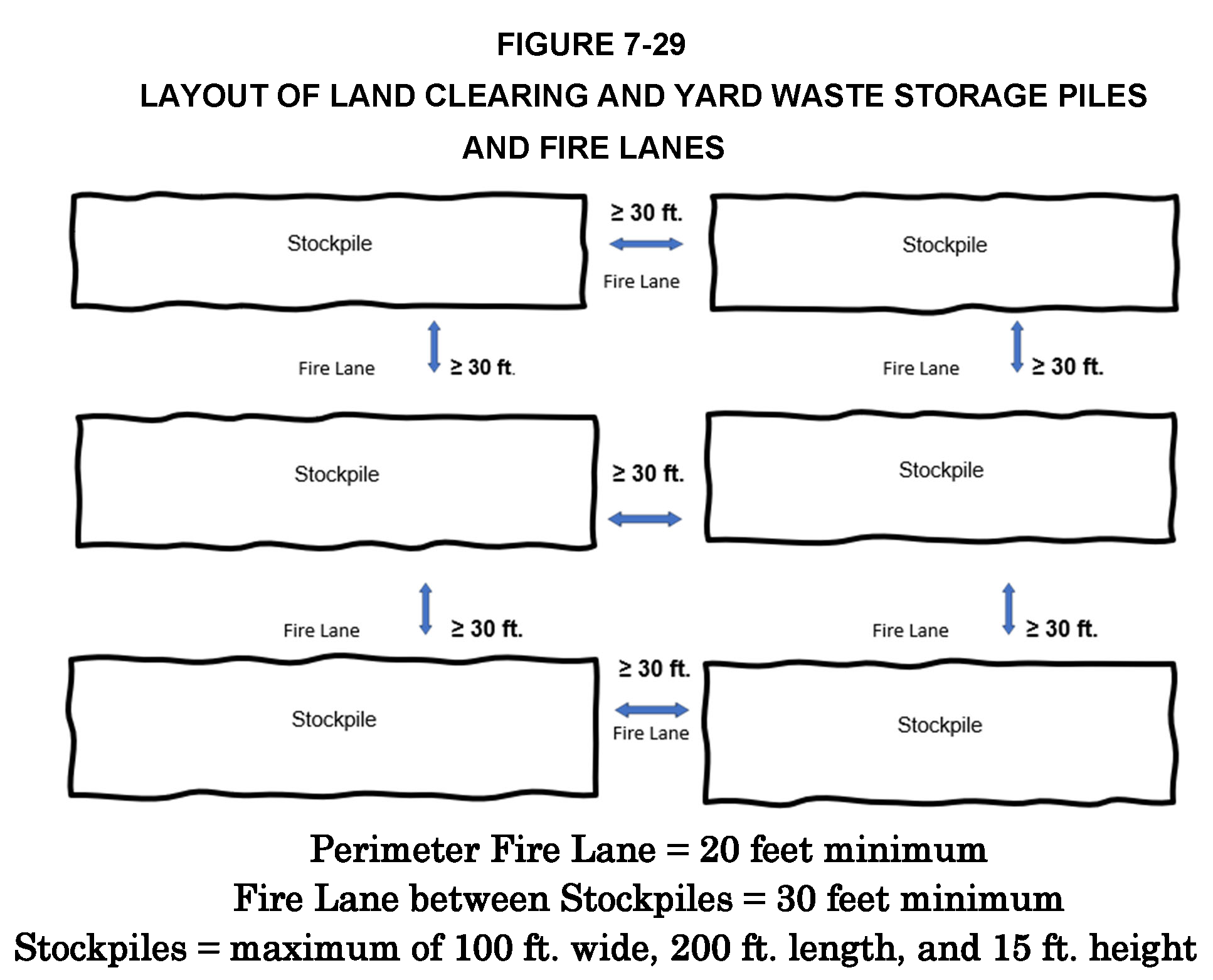
b.
Outside of the Urban Services Boundary, if approved by the St. Lucie County (SLC) Fire District, alternative means of, and standards for, fire suppression may be utilized in place of that set-forth in the previous paragraph for facilities within the Urban Services Boundary. Such alternative means of fire suppression, subject to the review and approval of the SLC Fire District, may include on-site water trucks, gravity tanks, dry hydrants, and canal pumps.
c.
Each vegetative debris recycling, processing and/or composting operation shall include as part of its application for a conditional use permit a copy of its Fire Prevention Plan that has been approved by the SLC Fire District, Community Rick Reduction Division. This Fire Prevention Plan shall, at a minimum, address all requirements and recommendations of the currently adopted Florida Fire Prevention Code (FPPC) and any applicable standard established by a Local Resolution amending the FFPC. If this section requires a more stringent standard, the Fire Prevention Plan shall address it.
d.
Outside of the Urban Services Boundary, if approved by the St. Lucie County (SLC) Fire District, alternative means of, and standards for, fire suppression may be utilized in place of that set-forth in the previous paragraph for facilities within the Urban Services Boundary. Such alternative means of fire suppression, subject to the review and approval of the SLC Fire District, may include on-site water trucks, gravity tanks, dry hydrants, and canal pumps.
d[e].
Each vegetative debris recycling, processing, and/or composting operation shall be responsible for scheduling an annual fire prevention inspection to be conducted by the SLC Fire District, Fire Prevention Bureau. Such operation shall also be subject to unscheduled inspections by the SLC Fire District, Fire Prevention Bureau, at the discretion of the District and according to its inspection protocols.
e[f].
An area equal to fifteen percent (15%) of the total area occupied by the receipt, processing, composting, packing, loading, or shipping of vegetative debris shall be reserved for the emergency relocation of the stored materials should it be necessary for fire-fighting purposes. This emergency storage area shall not include any area within the required minimum setbacks or separation corridors for the debris storage piles (stockpiles). This emergency storage area shall be adequately served with access to fire suppression resources, consistent with this code.
7.
Setbacks. Individual stockpiles of vegetative debris in any stage of processing shall be located at least one hundred (100) feet from any brush or tree line and shall be no closer than fifty (50) feet to any property line or street right-of-way line.
8.
Surface of storage areas and access lanes.
a.
The base area on which the stockpiles are located must be constructed of concrete, asphalt, or other clean stabilized surface that is acceptable to the County.
b.
The access aisles and fire lanes between the stockpiles must be constructed of concrete, asphalt, or other paved surface that is acceptable to the County. Alternative surfaces may be considered outside the Urban Service Boundary as approved by the Board of County Commissioners through the conditional use permit. These surface materials may include, but are not limited to, asphalt millings, coquina rock, shell rock, and engineered products suitable for the expected vehicle loads and frequency of use. The access aisles and fire lanes shall be designed and maintained to support at least the imposed loads of fire apparatus.
9.
Processing and Storage Time.
a.
All material received into the recycling yard shall be rotated through the recycling yard within twelve (12) months of its acceptance and deposition in the recycling yard.
b.
Processed vegetative debris being composted into top soil may remain on site for an additional period not to exceed twelve (12) months.
10.
Other Standards and Requirements.
a.
Section 7.07.00 — Stormwater Management—of this Code shall apply to vegetative debris recycling operations. Stormwater controls and specific site elements shall be designed to prevent run-off from entering the processing and storage areas.
b.
All stockpiles shall be formed and located so as to afford the opportunity to measure the internal temperatures of the vegetative debris stockpiles in order to monitor fire hazard.
c.
All vehicles used on the stockpile shall be of a type that minimizes the compaction of the stockpile.
d.
Operational processing equipment necessary for a vegetative debris recycling and/or composting operation must be maintained on site, including but not limited to a shredder, chipper, grinder, trommel screens, and bulldozer.
e.
Fuel Tanks.
(1)
The on-site storage of fuel must comply with all applicable local, state, and federal regulations, intended to prevent leaks, fire and/or harm to the environment.
(2)
All fuel tanks, regardless of size, shall be stored on a concrete surface and be located within a secondary containment structure designed to hold the maximum volume of the tank.
(3)
No fuel tank shall be located within one hundred (100) feet of any stockpile of yard waste, whether in receiving, processing, composting, or final product, unless another standard requires a greater distance.
f.
Restroom facilities shall be provided for on-site employees. A portable or mobile toilet does not constitute a restroom.
g.
Equipment may be stored or parked on gravel parking lots. Inside the Urban Services Boundary, employee parking must comply with surface requirements in LDC Section 7.06.02. Outside the Urban Services Boundary, alternative surfaces may be considered for employee parking.
11.
Deliveries to site and Wholesale or Retail Sales of Finished Product. The Applicant for a conditional use permit to operate a vegetative debris recycling operation shall include a detailed description of the intended delivery of raw material to the site, specifically addressing whether deliveries to the site will be limited to employees of the operation or whether landscape operators, arborists or members of the public might deliver material. Similarly, the application for a conditional use permit shall address in detail the disposition of the finished product, including whether any retail or wholesale customers will visit the site or whether all finished products will be delivered to the wholesale or retail customers by the operator's own employees and vehicles. If on-site sales are anticipated, the days and hours of operation and all other information relevant to consideration of the potential impacts of such on-site sales shall be provided.
12.
Application and Compliance.
a.
Regardless of the size of any proposed building, a site plan prepared in accordance with the provisions of Sections 11.02.04, 11.02.07, and 11.02.09 (Major Site Plans) shall be required with the application for the conditional use permit. The application for a conditional use permit shall not be considered complete until all minimum site plan criteria have been determined to be met.
b.
Every vegetative debris recycling operation, authorized under this section, shall establish a cash security fund, bond or provide the County with an irrevocable letter of credit. The amount of the security fund, bond, or letter of credit shall be based on the schedule below and shall secure the cost of removing all accumulated vegetative debris from the site if it has been determined by the County Commission, following a duly noticed public hearing, that the vegetative debris recycling operation has been abandoned or recycling operations have ceased for period in excess of six (6) months, or if the conditional use permit is revoked for any reason. The provisions of this paragraph shall not apply to any vegetative debris recycling operation operated by any unit of local government within the County.
Table 7.10.12.1
c.
Any lawfully, existing vegetative debris recycling operation as of August 17, 1999, shall conform to the above-described standards no later than January 1, 2001. In the event that any existing operation fails to meet the requirements of this section, the County shall pursue all available remedies to compel compliance with the provisions of this section and any other applicable provision of this code.
d.
The Code Enforcement Board shall be the responsible enforcement board assuring compliance with the provisions of this section and related sections within this Code. If the Planning and Development Services Director, in consultation with the County Administrator, or his/her designee, and the County Attorney, determines that the Code Enforcement Board process would be an inadequate response to a given violation(s), the County Attorney may institute appropriate proceedings in a court of competent jurisdiction for prosecution of the violation(s) as provided by law.
e.
The violation of any of the regulations, restrictions and limitations promulgated under the provisions of this section may be restrained by injunction, including a mandatory injunction and otherwise abated in any manner provided by law.
f.
Nothing contained in this provision shall prohibit the Board of County Commissioners from enforcing its codes by any other means.
g.
In the event that St. Lucie County is declared a federal disaster area following or as a result of either hurricane or freeze damage, the County Commission may suspend any or all of the standards above for the duration of the declared emergency in order to facilitate the removal of vegetative debris.
h.
If additional processing of vegetative debris is proposed in addition to mulching, such activities may be subject to additional requirements imposed through the conditional use process to mitigate impacts.
i.
All vegetative debris recycling operations shall submit to an annual site inspection to be conducted by St. Lucie County Code Compliance to ensure conformity with the conditional use permit. If evidence of unpermitted materials is found within the stockpiles, the subject permit shall be scheduled for the next available Board of County Commissioners meeting for a Revocation Hearing subject to the requirements of LDC Section 11.07.05(H) and the notice requirements of this Code.
(Ord. No. 2021-012, Pt. A, 4-20-2021; Ord. No. 2023-14, § A, 10-17-2023)
7.10.13. - Sewage and Septage Treatment Facilities in Agricultural Zoning Districts.
In the AG-1, AG-2.5 and AG-5 zoning districts, the establishment of a sewage and septage treatment facility may be authorized as a conditional use, subject to the following criteria:
A.
A minimum of ten (10) acres shall be required for all treatment facility sites.
B.
No structure, treatment storage area or treatment facility shall be located within fifty (50) feet of any property line or required base building line.
C.
All areas of development shall be fenced or walled. A minimum twenty-foot wide landscape barrier shall be provided around the perimeter of the treatment facility. This buffer shall contain at least one (1) tree for every thirty (30) linear feet around the perimeter. Trees, shrubs and hedges must comply with the requirements of Section 7.09.00.
D.
All entry and exit points must be gate controlled. All gates must be constructed with an opaque material. Except for business operation hours, all gates are to be kept closed and locked.
E.
A site plan of this facility must accompany the application for conditional use.
F.
In the event of municipal annexation of a site pursuant to Chapter 171, Florida Statutes, an application for a facility shall require review and approval by the County until the applicable provisions of the municipal comprehensive plan and land development regulations for the annexed site have been approved by the municipality and determined to be in compliance pursuant to Part II, Chapter 163, Florida Statutes.
7.10.14. - Restrictions on Heavy Vehicles in Residential Districts.
A.
Commercial Vehicles and Semitrailers Prohibited or Restricted in Residential Districts.
1.
It shall be unlawful for any owner, agent, operator or person in charge of any commercial vehicle, or semitrailer, to park, stop, store or keep the same on any public street, avenue, alley or other thoroughfare or any right-of-way therewith within any residential district in the unincorporated areas for a period exceeding one (1) hour in any twenty-four (24) hour period, each such period commencing at the time of first stopping or parking unless a permit is first obtained from the St. Lucie County Sheriff's Department.
2.
It shall be unlawful for any owner or lessee of real property in any residential district in the unincorporated area to park on, cause to be parked on or allowed to be parked on his/her, its, or their residential property any commercial vehicle or semitrailer for the period exceeding one (1) hour in a twenty-four (24) hour period unless same is in an enclosed garage. Each such period shall commence at the time of first stopping or parking unless a permit is first obtained from the St. Lucie County Sheriff's Department, and as may be otherwise provided in this division. This restriction shall also apply to the owner, agent, operator, or person in charge of any such vehicle in the event such person is not the owner or lessee of such real property.
B.
Delivery and Construction Vehicles; Emergency Repairs.
1.
The restriction of Section 7.10.14 shall not apply to the temporary parking of vehicles covered by such section on private property in residential districts whereon construction is underway, for which a current and valid building permit has been issued by the county, and such permit is properly displayed on the premises.
2.
The restriction of Section 7.10.14 of one (1) hour in residential districts shall not apply to routine deliveries by tradesmen, or the use of trucks in making service calls, provided that such time in excess of one (1) hour is actually in the course of business deliveries or servicing, as the case may be.
3.
The restriction of Section 7.10.14 shall not apply to a situation where such vehicle becomes disabled and as a result of such emergency, is required to be parked within a residential district.
C.
Industrial Equipment Prohibited or Restricted in Residential Districts.
1.
It shall be unlawful for any owner, agent, operator or person in charge of any industrial equipment to park, stop, store or keep such equipment on any public street, avenue, alley or other thoroughfare, or any right-of-way therewith, within any residential district in the unincorporated area any time unless moving directly to or from or actually located at any excavation or construction site whereon construction, clearing, removal of debris or other building and/or excavation activities are either currently underway or will commence within the next twenty-four (24) hours and for which a current and valid permit has been issued by the county and such permit is properly displayed on the premises. Industrial equipment used in lot clearing, tree trimming or removal, lawn care and related services is also included although a specific building permit may not be required and nothing in this division is intended to require a building permit where not otherwise required.
2.
It shall be unlawful for any owner of property in any residential district of the unincorporated area, to park on, cause to be parked on, or allow to be parked on his/her, its or their residential property any industrial equipment, at any time unless such industrial equipment is used on property whereon construction, clearing, removal of debris and/or other similar activities are currently underway or will commence within the next twenty-four (24) hours and for which a current and valid permit has been issued by the county and such permit is properly displayed on the premises. Heavy equipment used in lot clearing, tree trimming, or removal, lawn care and related services is also included herein although a specific building permit may not be required and nothing in this division is intended to require a building permit where not otherwise required. However, mowers, clippers, edgers, drills, saws, sanders and other normal tools and implements of home lawn and garden maintenance and repair, whether motorized or not, are not considered to be industrial equipment.
3.
Exempt from the foregoing provisions are items of industrial equipment in actual use or moving directly to or from the location of actual use:
a.
Owned or leased by the County, the City of Fort Pierce, City of Port St. Lucie, St. Lucie Village or the State of Florida for the accomplishment of a governmental purpose such as tree trimming, road repair or construction, water or sewerage system repair or construction, maintenance of street and traffic lights and/or similar activities.
b.
Owned or leased by a contractor or subcontractor under agreement with the city or county to accomplish a county purpose as provided above.
c.
Owned or leased by a recognized public utility operating within the unincorporated areas of the county or by a contractor or subcontractor under agreement with such public utility for the accomplishment of some installation maintenance, adjustment and/or repair to such public utility.
D.
Extension of Parking Restrictions. The sheriff of the county or his/her duly authorized designee may issue, upon proper application therefor by the owner or his/her authorized representative to the sheriff's department, a permit extending the parking time limits set forth in this Section up to but not exceeding twenty-four (24) hours upon establishing that such permit is requested in good faith for a reasonable cause shown or demonstrated to the sheriff or his/her designee and not for the purpose of avoiding the intent or objectives of this division.
7.10.15. - Security Gatehouse and Access Control Devices.
Security gatehouses or access control devices, may be permitted at the entrance to any commercial or residential development subject to the following design standards:
A.
A minor site plan approval, or Minor Adjustment, in accordance with the provisions of Section 11.00.00 shall be required. No building permits for any access control facilities shall be permitted unless this Minor Site Plan approval has been granted.
B.
The construction of any gatehouse shall be in accordance with all applicable provisions of this Code, including but not limited to the requirements of Section 7.04.00, Section 11.05.00 (permits) and Sections 13.00.00 through 13.05.00.
C.
The construction of any security gatehouse shall comply with the vehicle storage provisions of Section 7.06.02(B)(j) of this Code.
D.
In those instances where the construction of a security gatehouse or access control device is for an existing residential subdivision or commercial development site, the new construction shall not adversely impact the approved drainage pattern for the project.
E.
No security or access control structure shall be permitted on any public right-of-way, unless erected by St. Lucie County, the State of Florida, or the United States Government.
F.
All manned security gates shall comply, generally, with the design as indicated in Figure 7-30 below:
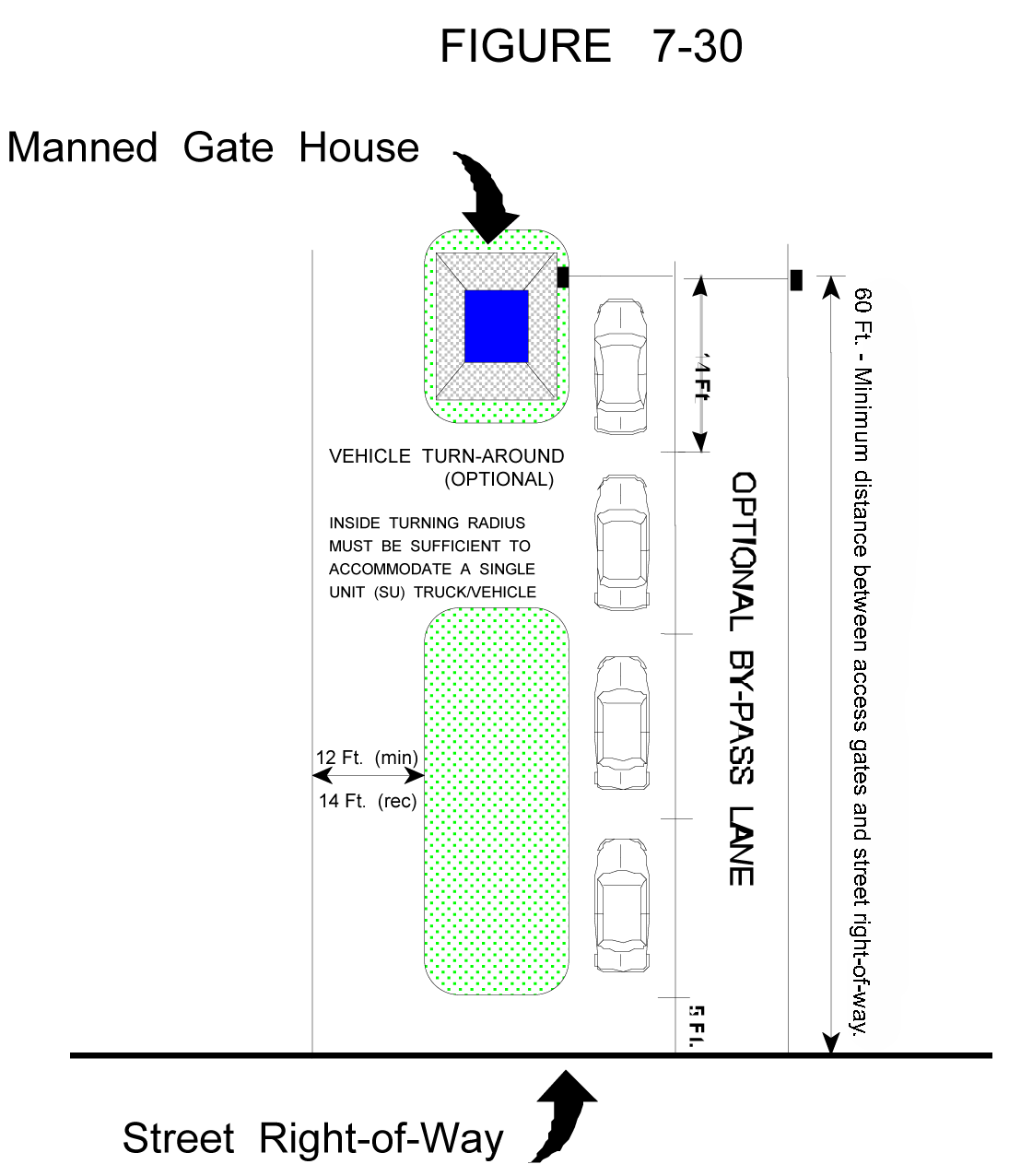
G.
All unmanned access controls shall comply, generally, with design standards as indicated in Figure 7-31 below:
FIGURE 7-31
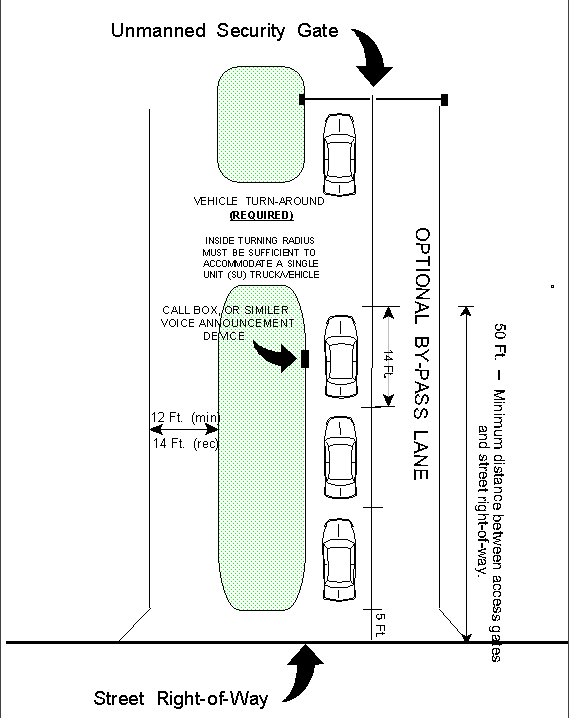
H.
All access control gates to any site plan approved project, shall be constructed of a break-away material.
I.
Minimum roof clearance for any roof overhang into a vehicle use area shall be fourteen (14) feet, unless an unrestricted pass-by lane is provided.
J.
Prior to the construction of any access control devices, the developer shall have provided the St. Lucie County-Ft. Pierce Fire District and the St. Lucie County Sheriff's Department with adequate access control devices or keys to permit emergency access to the property.
7.10.16. - Recreational Vehicle Parks.
A.
Generally. Unless otherwise noted, the following standards shall be applied to all Recreational Vehicle Parks within unincorporated St. Lucie County.
B.
Land Use Compatibility. No new Recreational Vehicle Park may be located in any Future Land Use District other than Commercial (COM), or as permitted in the Mixed Use (MXD) Designation. Unless otherwise addressed in this Code, any Recreational Vehicle Park located in any other Land Use Designation shall be considered a nonconforming use.
C.
Minimum Park Size. A Recreational Vehicle Park shall be permitted only on tracts on land consisting of a minimum of five (5) acres and having a minimum frontage of sixty (60) feet on a paved public road.
D.
Density. The maximum number of recreational vehicle lots shall not exceed fourteen (14) lots per gross acre.
E.
Lot Size Requirements.
1.
The minimum dimensions for any Recreational Vehicle Park lot, in any lawfully licensed Recreational Vehicle Park existing on or before August 1, 1990, shall be thirty (30) feet wide by sixty (60) feet long.
2.
The minimum dimensions for any Recreational Vehicle Park lot in any recreational vehicle park constructed after August 1, 1990, or any addition to any existing Recreational Vehicle Park made after August 1, 1990, shall be forty (40) feet wide, and seventy (70) feet long.
F.
Setbacks.
1.
Figure 7-32 identifies the minimum building setbacks for all recreational vehicle lots existing on or before August 1, 1990.
(see next page)
2.
Figure 7-33 identifies the minimum building setbacks for all Recreational vehicle lots created after August 1, 1990.
(see next page)
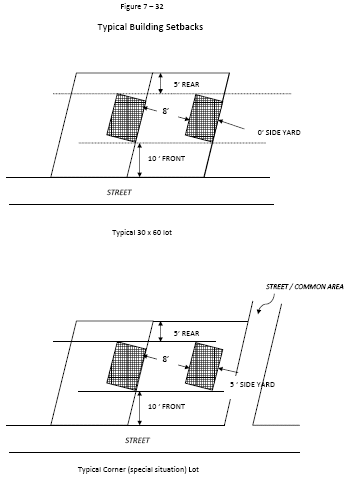
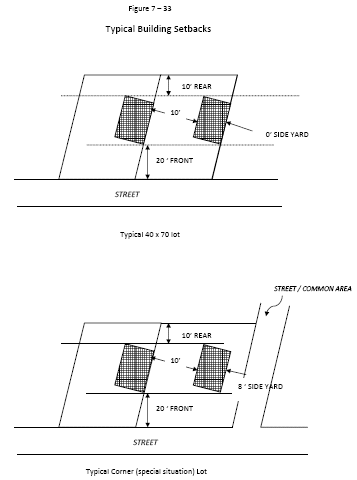
G.
Maximum Lot Coverage. The maximum coverage in the Recreational Vehicle Park by accessory buildings, shall be no greater than twenty percent (20%) of the total acreage of the park.
H.
Parking Pads. Each lot shall provide a stabilized vehicular parking pad, measuring no less than ten (10) feet by twenty (20) feet long; the pad shall be composed of shell, marl, paving, or stone screenings. Exposed ground surfaces in every space not protected by the vehicular parking pad shall be protected with a vegetative growth such as ground cover or shrubbery that is capable of preventing soil erosion and the creation of dust.
I.
Off-Street Parking. Off-street parking shall be in accordance with Section 7.06.02(A)(4).
J.
Open Space Standards. At least twenty percent (20%) of the gross site area of the park shall be set aside and developed as open space, recreation space, and buffering between recreational spaces. Such areas may provide recreation opportunities such as marinas, swimming pools, swimming beaches, tennis courts, picnic areas, playgrounds, pedestrian and bicycle paths, and playing fields. Common open space shall be laid out in according to the following standards:
1.
Open space shall not include streets, parking lots, lease or rental lots, buildings, public rights-of-way, or sites for water and sewer treatment plants.
2.
Up to fifty percent (50%) of the required open space may be accounted for through any on-site stormwater retention areas.
3.
Pedestrian and bicycle paths shall be at least six (6) feet in pavement width and shall, where practicable, form part of a system leading to principal destinations.
4.
Open space used as buffer areas or left undeveloped shall retain, to the maximum extent practicable, native vegetation that is present on the site.
K.
Landscaping. Landscaping shall be in accordance with Section 7.09.00.
L.
Buffer. There shall be a landscaped buffer around all Recreational Vehicle Parks of at least twenty-five (25) feet in width. Landscaping in this area shall conform to the requirements of Section 7.09.00.
M.
Traffic Circulation.
1.
All parks shall be provided with safe, convenient, paved vehicular access from a paved road to each lot.
2.
All streets internal to the park shall have a minimum right-of-way of thirty (30) feet, and shall be paved to county specifications.
3.
Park entrance paving shall be at least thirty-six (36) feet wide, and park rights-of-way shall be marked or signed.
4.
No entrance or exit from a park shall be permitted through a residential district.
N.
Specific Accessory Uses. In addition to those generally permitted Accessory Uses found in Section 8.00.00, a Recreational Vehicle Park may also provide for the following:
1.
One (1) permanent residence, intended for occupation by the manager of the park, and
2.
In parks with one hundred (100) or more lots, a retail and personal service establishment, intended exclusively for the use of the occupants of the recreational vehicles and travel trailers, which is contained within an enclosed building and located so as not to attract vehicular traffic from outside the park.
O.
Requirement For Site Plan. All Recreational Vehicle Parks are required to undergo a Major Site Plan review unless otherwise required to complete Planned Development review process as a Development of Regional Impact Review process as described in Chapter 380.06, Florida Statutes.
P.
Requirement For Central Utilities. All Recreational Vehicle Parks shall be required to be served by centralized water and sewer services.
Q.
Permitted Specific Uses and Additions.
1.
Any Recreational Vehicle Park, occupying more than ten (10) acres, unless located on North or South Hutchinson Island where there shall be no minimum acreage requirement other than that set out in Section 7.10.15(C), is permitted to have installed, erected, constructed or otherwise placed on site Recreational Vehicles, Travel Trailers, Detached Single-Family Residences, Mobile Homes and additions thereto, including wood decks, screen rooms, patios and like accessory facilities subject to the following requirements:
a.
1.
The following minimum yard requirements shall be maintained: in all recreational vehicle parks existing on or before August 1, 1990.
(a)
Front yard - ten (10) feet *
(b)
Side yard - eight (8) feet unobstructed on the left side and zero (0) feet on the right side when facing the lot from the center of the main street frontage. In the absence of recorded lot lines, a minimum eight (8) feet unobstructed between adjacent units shall be required.
(c)
Side yard corner - eight (8) foot left side and five (5) foot right side when facing the lot from the center of the main street frontage (includes all properties adjacent to public and private roadways). In the absence of recorded lot lines, a minimum eight (8) feet unobstructed between adjacent units and five (5) feet from any common use area shall be required.
(d)
Rear yard - five (5) feet.
* Note: The front yard setback for special situation lots shall be five (5) feet. Special situation lots include those lots in which the longest property dimension is found along the street frontage. Common use areas shall refer to public and private roadways only. Lots adjacent to pedestrian access shall not be considered corner lots.
For lots with double street frontage, the front yard shall be identified on the approved site plan of the particular Recreational Vehicle Park, which shall be kept on file with the Community Development Department. The front yard for a block of double frontage shall be consistent the length of that block. Double frontage lots are not eligible for special situation consideration or designation. Any deviation or change to the front yard designation that does not include the adjustment of the entire block shall only be approved by the Board of Adjustment in accordance with Section 10.01.00.
2.
In all recreational vehicle parks created after August 1, 1990, including the expansion of any existing recreational vehicle park.
(a)
Front yard - twenty (20) feet
(b)
Side yard - ten (10) feet left side and zero (0) feet on the right side when facing the lot from the center of the main street frontage. In the absence of recorded lot lines, a minimum ten (10) feet unobstructed between adjacent units shall be required.; and
(c)
Side yard corner - ten (10) foot left side and eight (8) foot right side when facing the lot from center of the main street frontage (includes all properties adjacent to common use areas). In the absence of recorded lot lines, a minimum ten (10) feet unobstructed between adjacent units and eight (8) feet from any common use area shall be required.
(d)
Rear yard - ten (10) feet.
No portion, other than a maximum twelve (12) inch unsupported roof overhang, including appendages to the roof, of the Recreational Vehicle, Travel Trailer, Detached Single-Family Residence, or addition, including but not limited to wooden decks, bay windows, tipouts or awnings, may encroach into any required setback or separation area. Steps or ramps for access purposes may be erected, but may not encroach into any required side setback. Steps or ramps may encroach into the front or rear setbacks, if necessary provided that the steps or ramps do not occupy more than ten percent (10%) of the required front or rear yard unless otherwise approved by the St. Lucie County Board of Adjustment in accordance with Section 10.01.00. Steps or ramps which encroach into front or rear setbacks may not have a landing with dimensions in excess of four (4) feet by four (4) feet where such landing encroaches into the required front or rear setback.
b.
The elevation of a wood deck shall not exceed the elevation of the floor of the recreational vehicle or travel trailer. The design of the wooden deck may include provision for use of the underlying space as a storage area. However, this space shall not be used for the storage of combustible materials nor for the storage or placement of flammable liquids, gases, or liquid or gas fuel-powered equipment.
c.
For the purpose of this section, the maximum height of any onsite construction or the installation of any Recreational Vehicles, Travel Trailer, Detached Single-Family Residence, Mobile Home including additions thereto, shall not exceed twenty-two (22) feet above finished grade or minimum flood elevation, whichever is higher. The maximum height of any structure shall be determined at the highest point of the roof. In the case of multiple roof lines, the maximum height of any structure shall be determined at the highest point of the highest roof structure or system. To the extent that the method of determining maximum building height as described in this paragraph conflicts with any other provision of this Code, the terms of this paragraph shall apply.
Figure 7-34 illustrates a typical wall section example that is to be used in determining the maximum height of all buildings.
Figure 7-34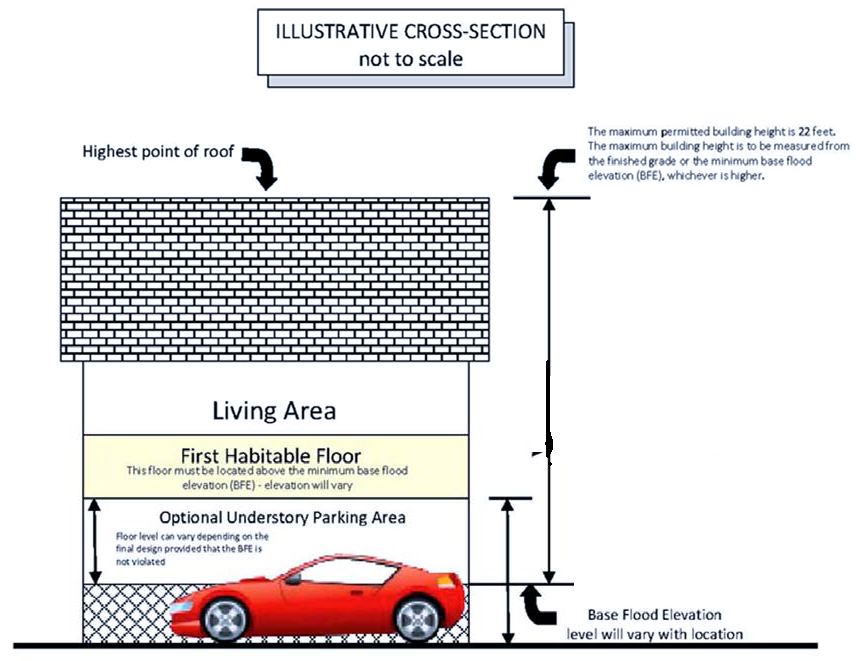
d.
Notwithstanding the other provisions of this Code, new construction or substantial improvement of any residential structure in any recreational vehicle park shall meet the requirements of the Flood Resistant Construction chapter of the current adopted Residential Florida Building Code.
In those instances where the lowest structural member of the first habitable floor is located less than five (5) feet above finished grade, the outside perimeter walls may include solid wall construction from the finished grade to the top of the minimum base flood elevation. Any solid wall construction below the minimum base flood elevation shall fully conform to the applicable flood protection standards, as set forth in this code.
e.
Repealed. (Ord. No. 12-003)
f.
All onsite construction must meet the applicable Flood Damage Prevention regulations, Section 6.05.00, and the Florida Building Code, Section 13.00.00, requirements of this Code.
g.
All new or replacement Recreational Vehicles, Travel Trailers, Single-Family Residences, Mobile Home and additions thereto are required to have a permit from the Planning and Development Services Director prior to any placement or construction activity commencing.
h.
Plans for Single-Family Residences, and additions including wood decks shall be submitted to the Growth Management Director for approval. Where required under Section 13.00.02(c)(3), all plans must carry the seal of a registered Florida architect or engineer and must be accompanied by an affidavit from the architect or engineer stating that the structure meets or exceeds Standard Building Code requirements. Preapproved Master Plans may be utilized.
i.
Construction of an enclosure around a propane gas tank or other combustible prohibited.
2.
An addition in existence on the effective date of this Code which does not meet the requirements established in this section shall be deemed a nonconforming structure and shall be subject to the provisions of Section 10.00.00. However, existing additions which pose a threat of imminent danger to the health, safety, or welfare of the general public as determined by the Fire Marshal pursuant to the Standard for Firesafety Criteria for Mobile Home Installations, Sites, and Communities, NFPA 501A-1982, as applicable, must be brought into compliance or removed. The decision of the Fire Marshal may be appealed to the Board of Construction and Appeal.
(Ord. No. 12-003, Pt. H, 5-15-2012; Ord. No. 2021-18, Pt. A, 7-6-2021; Ord. No. 2022-027, § 2, 9-20-2022)
7.10.17. - Mobile Home Parks.
A.
Generally. Unless otherwise noted, the following standards shall be applied to all Mobile Home Park developments within unincorporated St. Lucie County.
B.
Land Use Compatibility. No new Mobile Home Park may be located in any Future Land Use District other than Residential Urban (RU), Residential Medium (RM), Residential High (RH), or Mixed Use (MXD) as may be restricted. Unless otherwise addressed in this Code, any Mobile Home Park located in any other Land Use District shall be considered a nonconforming use.
C.
Minimum Park Size. A Mobile Home Park shall be permitted only on tracts of land consisting of a minimum of ten (10) acres and having a minimum frontage of one hundred (100) feet on a paved public road.
D.
Density. The maximum number of mobile home lots or divisions shall not exceed five (5) units/lots per gross acre.
E.
Lot Size Requirements.
1.
The minimum dimension for any Mobile Home Park lot, in any lawfully licensed Mobile Home Park existing on or before August 1, 1990, shall be seventy-five (75) feet wide by one hundred (100) feet long, unless otherwise noted by the Department of Community Development. Any variation in this minimum standard shall be based upon the original development plan for the Mobile Home Park and shall not infer any automatic relief from the minimum yard setbacks from the RMH-5 zoning district as further described in Section 7.04.00.
2.
Any mobile home park constructed after August 1, 1990, or any addition to any existing Mobile Home Park made after August 1, 1990, shall provide for a minimum lot width of eighty (80) feet, and a minimum lot depth of one hundred (100) feet unless otherwise accounted for through the Planned Development process described in Section 7.01.00.
F.
Off-Street Parking. Off-street parking shall be in accordance with Section 7.06.02(A)(3).
G.
Open Space Standards. At least twenty percent (20%) of the gross site area of the park shall be set aside and developed as open space, recreation space, and buffering between mobile home spaces. Such areas may provide recreation opportunities such as marinas, swimming pools, swimming beaches, tennis courts, picnic areas, playgrounds, pedestrian and bicycle paths, and playing fields. Common open space shall be laid out in according to the following standards:
1.
Open space shall not include streets, parking lots, lease or rental lots, buildings, public rights-of-way, or sites for water and sewer treatment plants.
2.
Up to fifty percent (50%) of the required open space may be accounted for through any on-site stormwater retention areas.
3.
Pedestrian and bicycle paths shall be at least six (6) feet in pavement width and shall, where practicable, form part of a system leading to principal destinations.
4.
Open space used as buffer areas or left undeveloped shall retain, to the maximum extent practicable, native vegetation that is present on the site.
H.
Landscaping. Landscaping shall be in accordance with Section 7.09.00.
I.
Buffer. There shall be a landscaped buffer around all Mobile Home Parks of at least twenty-five (25) feet in width. Landscaping in this area shall conform to the requirements of Section 7.09.00.
J.
Traffic Circulation.
1.
All parks shall be provided with safe, convenient, paved vehicular access from a paved road to each lot.
2.
All streets internal to the park shall have a minimum right-of-way of thirty (30) feet, and shall be paved to county specifications.
3.
Park entrance paving shall be at least thirty-six (36) feet wide, and park rights-of-way shall be marked or signed.
4.
No entrance or exit from a park shall be permitted through a residential district.
K.
Specific Accessory Uses. In addition to those generally permitted Accessory Uses found in Section 8.00.00, a Mobile Home Park may also provide for the following:
1.
One (1) permanent residence, intended for occupation by the manager of the park, and
2.
In parks with one hundred (100) or more lots, a retail and personal service establishment, intended exclusively for the use of the occupants of the recreational vehicles and travel trailers, which is contained within an enclosed building and located so as not to attract vehicular traffic from outside the park.
L.
Requirement For Site Plan. All Mobile Home Parks are required to undergo a Major Site Plan review unless otherwise required to complete the Planned Development review process as a Development of Regional Impact Review process as described in Chapter 380.06, Florida Statutes.
M.
Requirement For Central Utilities. All Mobile Home Parks shall be required to be served by centralized water and sewer services.
N.
Emergency Shelter. In Mobile Home Parks or subdivisions of twenty-five (25) or more lots, an on-site emergency shelter shall be provided. Requirements for the construction, size and equipping of this shelter are to be obtained from the St. Lucie County Office of Emergency Management.
7.10.18. - Airport Industrial Park—Special Regulations.
A.
Generally. All lands within the Airport Industrial Park, as more particularly described in Plat Book 12, Page 40, and Plat Book 20, Page 3, shall be subject to the Restrictions and Covenants of the Airport Industrial Park, as described in Port and Airport Resolution 87-17, and referenced, in part, below.
B.
Authorized Uses. Lands within the Airport Industrial Park may only be used for those uses identified in Section 3.01.03(T) of this Code. Accessory uses shall be subject to the provision of Section 8.00.00.
C.
Block 7 Restrictions. Unless otherwise permitted by the St. Lucie County Port and Airport Authority and the Federal Aviation Administration, no lot owner or lessee in Block 7, Airport Industrial Park, Unit One, is permitted unrestricted access to the St. Lucie County International Airport Grounds, Taxiways or Runway Systems.
D.
General Provisions.
1.
No noxious offensive trade or activity shall be performed, nor shall anything be done on the premises which may be, or may become, an annoyance or nuisance to other occupants of the area by reason of unsightliness or the excessive emission of odors, dust, fumes, smoke, or noise.
2.
No building permit or construction authorization shall be applied for until the St. Lucie County Port and Airport Authority has approved, by resolution, a site development plan for the proposed construction. For the purpose of these Covenants, all development plans, regardless of size, within the Airport Industrial Park shall be prepared in accordance with the requirements of Section 11.02.00, of this Code.
3.
Those projects requiring standard site plan review, approval by the Board of County Commissioners is required prior to presentation before the St. Lucie County Port and Airport Authority.
4.
No building permit or construction authorization shall be issued for any building or structure in the Airport Industrial Park until construction plans have been reviewed and approved by the St. Lucie County Port and Airport Authority. These plans should indicate the physical appearance of the proposed structure including an identification of all exterior coverings and/or painting schemes to be used. The purpose of this review is to maintain a harmony of external design and provide a visually appealing development.
Structural review shall be conducted by the St. Lucie County Growth Management Director, following standard permit review procedures.
E.
Temporary Use and Structure. Unless otherwise permitted by the St. Lucie County Board of County Commissioners, and the St. Lucie County Port and Airport Authority, no temporary uses or structures, as identified in Section 8.00.00 of this Code, are permitted in the Airport Industrial Park, except that construction offices, equipment and equipment storage facilities used during the period of construction of a permanent facility are permitted.
F.
Land Coverage. No building or structure may be placed, altered, or erected which covers more than fifty percent (50%) of the land area of the subject parcel.
G.
Building Setbacks. No building or projection thereof shall be placed, altered, or erected within forty (40) feet of the front line facing a street; twenty (20) feet of a side lot line and thirty (30) feet of each rear lot line.
H.
Off-Street Parking. Off-Street parking shall meet the requirements of Section 7.06.00 of this Code.
No loading dock or loading area may be located along any building or structure face having main street frontage. Provisions for the handling of all freight shall be along the sides or rear of the building or structure.
I.
Building Height. No building or structure may exceed a maximum height above existing grade of fifty (50) feet, unless further limited by other permitting agencies. All buildings, structures, communication towers and ground station facilities must comply with all Federal Aviation Administration height restrictions and limitations.
Prior to the issuance of any final development plan approvals by the St. Lucie County Port and Airport Authority, the developers shall have secured from the St. Lucie County Port and Airport Director, written approval that the proposed improvements do not conflict with any aircraft takeoff/approach clearance zones.
J.
Storage Area Regulations. No materials, waste, supplies or equipment shall be stored outside of the buildings constructed or erected onsite, unless the storage yard or area is screened in accordance with Section 7.09.00 of this Code.
K.
Landscaping. All landscaping shall be in accordance with the requirements of Section 7.09.00 of this Code, with the exception that:
1.
No vehicular use area, except for driveways, shall be located within twenty (20) feet of the front property line or within ten (10) feet of any side or rear property line.
2.
All required landscaped areas shall be irrigated.
L.
Billboards and Signs. All signage in the Airport Industrial Park shall comply with the requirements of Chapter 9 of this Code, except that:
1.
No off-premises (Billboards) signs shall be permitted within the Airport Industrial Park.
M.
Change in Use. No change in use shall be permitted without the written approval of the St. Lucie County Port and Airport Authority.
N.
Enforcement. Enforcement shall be by proceedings at law or in equity against any person, firm or corporation violating or attempting to violate any covenant, either to restrain violations or to recover damages. The provisions of this resolution may also be enforced and administered through the Office of the St. Lucie County Growth Management Director. Violation of the Protective Covenants may result in enforcement proceedings before the St. Lucie County Code Enforcement Board.
(Ord. No. 2021-14, Pt. A, 6-1-2021)
7.10.19. - Outdoor Shooting Ranges.
Outdoor shooting ranges shall be subject to the following supplemental regulations:
A.
A minimum lot size of five (5) acres is required.
B.
Outdoor shooting ranges shall not be allowed within 2500 feet of a school, church, public park, or playground, except that a temporary church or a vocational or trade school located in CG (Commercial, General) zoning shall not be included in this prohibition.
Measurement between a shooting range and any public park or playground, school, or church shall be in a straight line from nearest corner of the shooting range to nearest corner of the lot on which the park, playground, school, or church is located.
C.
A site plan shall be submitted in accordance with Sections 11.02.07 through 11.02.09 of this Code.
D.
Site plan review shall consider berming, proximity to roads and homes, line of sight, and line of sound.
7.10.20. - Bed and Breakfast Residences.
A.
Generally. In the RE-1, RE-2, and HIRD Zoning Districts a Bed and Breakfast Residence is permitted as a Conditional Use subject to Section 11.07.00 and the requirements of this Section. A Bed and Breakfast Residence is also permitted by right or as a conditional use on certain lot types as identified in the PTV and PRW zoning districts. A Bed and Breakfast Residence may also be approved as a Conditional Use in any other zoning district if the structure is listed on the National Register of Historic Places or is a contributing structure, as defined in the Code of Federal Regulations. Unless exempt, Historical structures are subject to the provisions of this Section.
B.
Minimum Standards.
1.
The following requirements shall apply to all Bed and Breakfast Residences:
a.
The Bed and Breakfast Residence must be secondary to the use of the premises for dwelling. All operators of a Bed and Breakfast Residence must own and occupy the building where said use will occur as their principal residence. Separate structures, accessory building and garages are not permitted to be used as living units or sleeping rooms.
b.
Only a singular sign, for the purposes of identification, no advertisement shall be permitted. Identification sign shall not exceed four (4) square feet in area and shall not be illuminated.
c.
The maximum number of guest rooms made available for rent shall be five (5).
d.
One (1) off-street parking space shall be provided per guest room. All off street parking shall meet the minimum design criteria of Section 7.06.00.
e.
No food preparation or cooking shall be conducted within any bedroom nor other individual rented rooms. Meals shall only be provided to overnight guests, unless the conditional use approval specifies provisions for food service to the general public.
f.
The exterior appearance of the structure shall not be altered from its single-family character.
g.
Guests are limited to a length of stay no longer than thirty (30) consecutive days.
C.
Restrictions. Unless it is designated a Hotel or Motel, and then only if it is located in accordance with the provisions of the CG, or HIRD, PTV, or PRW zoning districts, no structure shall be constructed for the sole purpose of being used as a Bed and Breakfast Residence; and no existing structure shall be enlarged or expanded for the purpose of providing additional rooms for guest occupancy.
7.10.21. - Off-Road Vehicle Parks.
A.
Intent. The intent of this section is to prevent the widespread and unnecessary destruction or degradation of private property and the Region's natural systems through the unregulated use of Off-Road Vehicles. This Section does not permit go-cart raceway operation or go-cart rentals (Standard Industrial Classification 7999) within the AG-5 zoning district.
B.
Generally. Private landowners may apply for permission to develop trails for use by off-road vehicles. These defined trails would limit the destruction and degradation of natural systems and wildlife values, while at the same time providing off-road vehicle users a suitable place to enjoy this growing sport.
In the AG-5 (Agricultural - 5) zoning district, amusement and recreational services for off-road vehicle use may be permitted as a conditional use subject to the criteria set forth in Sections 6.02.01(C)(3), Protected Species, 6.02.04, Regulation of Motorized Vehicles in Environmentally Sensitive Areas, and Section 6.04.01, Native Upland Habitat Protection, and the following minimum requirements:
1.
The property on which the off-road vehicle activity is to take place shall be at least one hundred (100) acres;
2.
A site plan of this facility must accompany the application for conditional use;
3.
An Environmental Impact Report as defined in Section 11.02.09(A)(5) shall be satisfactorily completed;
4.
No removal of county-protected vegetation shall occur;
5.
A buffer zone of native upland edge vegetation shall be provided and maintained around all wetlands as defined in Chapter II of this code which are constructed or preserved on new development. The buffer zone may consist of preserved or planted vegetation but shall include canopy, understory, and ground cover of native species only. The edge habitat shall begin at the upland limit of any wetland or deepwater habitat. This upland edge habitat shall be located such that the total shoreline is buffered by a minimum width of fifty (50) feet of upland habitat. The upland buffer requirement does not apply to drainage canals or stormwater conveyance systems requiring periodic maintenance.
6.
No noxious offensive activity shall be performed, nor shall anything be done on the premises which may be, or may become, an annoyance or nuisance to other occupants of the area by reason of unsightliness or the excessive emission of odors, dust, fumes, smoke, or noise.
7.10.22. - Car Washes, Self-Service.
In the CN (Commercial, Neighborhood) Zoning District, self-service car washes may be authorized as a conditional use, subject to the meeting the standards of review set out in Section 11.07.00 and the following supplemental criteria:
A.
The car wash operation is considered to be a drive-through facility and is subject to the site plan submission requirements of Section 11.02.00. No application for conditional use will be considered complete until all minimum site plan criteria have determined to be met.
B.
The car wash, and all related activity areas shall be screened from all adjoining side and rear properties with an eight (8) masonry wall, or a wall constructed of similar materials. The wall shall be located a minimum of five (5) feet inside the side and rear property line. The wall shall be of similar composition, construction, and color and shall not include chain link fence, with or without slates or wooden screening materials. If any side property line is adjacent to any street right-of-way line, no screening wall will be required along that property line.
The five (5) foot landscape buffer that is located on the outside of the masonry wall shall be landscaped with one (1) tree for every thirty (30) linear feet and with one (1) shrub or vine for every five (5) linear feet of wall length. At least five (5) feet of the area inside of the required wall along the side and rear property lines shall be landscaped with one (1) shrub or vine for every five (5) linear feet of wall length. All landscaping shall be irrigated in accord with the provisions of Section 7.09.03 of this Code.
A strip of land at least fifteen (15) feet in depth shall be located between any abutting street right-of-way and the car wash, and its related activity areas, shall be landscaped to include one (1) tree for each thirty (30) linear feet of abutting right-of-way or major fraction thereof. In addition, a hedge, wall or other durable landscaping barrier shall be placed along the interior perimeter of the landscaped strip. All landscaping shall be irrigated in accord with the provisions of Section 7.09.03 of this Code.
C.
No more than seven (7) car wash bays shall be allowed in any one (1) car wash facility.
D.
All car wash bays shall be enclosed on two (2) sides and covered by a permanent roof.
E.
All on-site lighting fixtures shall be directed so that adjacent properties are not illuminated. In addition to the above mandatory standards and the standards of review set forth in Section 11.07.00 of this Code, in considering any application for Conditional Use the Board of County Commissioners may also consider reasonable limitations on the cash wash operations, including but not limited, the hours of business operation and the necessity for manned attendance during those business operation hours. If limitations are imposed on the hours of operation, or if manned attendance is required or if any other special limitation is imposed, the Board shall expressly include in any approval Resolution or other form of Final Development Order the specific reasons that such limitations have been determined to be necessary.
F.
Waiver. The Board of County Commissioners may grant a waiver from the requirement of an eight (8) foot masonry wall upon a determination that the adjacent property is zoned commercial and that the adjacent property owner consents to a waiver of the requirement of a wall.
(Ord. No. 2020-14, Pt. A, 6-2-2020)
7.10.23. - Telecommunications Tower Siting.
A.
Purpose. The purpose of this section is to establish regulations and requirements for the siting of wireless telecommunications facilities. All new towers or antennas in the County shall be subject to these regulations, except where specifically excluded. The section is intended to accomplish the following:
1.
Protect and promote the public health, safety and general welfare of the residents of the unincorporated areas of the County;
2.
Accommodate the growing need and demand for reliable wireless communications services by permitting the siting of wireless telecommunications towers and antennas within the County's boundaries and provide reasonable accommodation to promote and to encourage fair and reasonable competition among telecommunications service providers or providers of functionally equivalent services on a neutral and nondiscriminatory basis;
3.
Minimize potential impacts of towers upon residential areas and land uses;
4.
Encourage and promote the location of towers in nonresidential areas, where the adverse impact on the community is minimal;
5.
Minimize the total number of towers throughout the community by strongly encouraging the collocation of antennas on new and pre-existing tower sites as a primary option rather than construction of additional single-use towers;
6.
Encourage and promote users of telecommunications towers and antennas to configure them in a way that minimizes the adverse visual impact of the telecommunications towers and antennas through careful design, siting, landscape screening, and innovative camouflaging techniques;
7.
Minimize potential damage to property from wireless telecommunications towers and telecommunications facilities by requiring such structures be soundly designed, constructed, modified and maintained and in compliance with all requirements of the Florida Building Code applicable to similar structures;
8.
Enhance the ability of the providers of wireless telecommunications services to provide such services to the community through an efficient and timely application process;
9.
Encourage the location and collocation of antennas on existing structures thereby minimizing new visual impacts and reducing the need for additional antenna support structures;
10.
Further the balance between predictability for the communications industry in the placement of wireless telecommunications facilities and appropriate land use regulations to protect the aesthetic integrity and public safety of the County's residents, visitors and businesses;
11.
Establish appropriate zoning requirements, including but not limited to setback and distance separation requirements, aesthetics, landscaping, land use based location priorities, and structural design for wireless telecommunications towers and antennas within the County's boundaries, with due consideration to the County's comprehensive plan, zoning map, existing land uses and environmentally sensitive areas, including hurricane preparedness areas;
12.
Establish setback and distance separation requirements for towers that do not exceed the minimum distance necessary to satisfy structural safety or aesthetic concerns;
13.
Adopt regulations that are consistent with applicable federal and state laws, including but not limited to the Telecommunications Act of 1996, which as set forth in 47 U.S.C. § 332(c)(7)(B)(iv), expressly preempts, state and local government regulation of the placement, construction, and modification of personal wireless service facilities on the basis of the environmental effects of radio frequency emissions to the extent that such facilities comply with the FCC's regulations concerning such emissions, and F.S. § 365.172(13);
14.
Establish procedural requirements and substantive criteria applicable for the review and approval or denial of applications for eligible facilities modification;
15.
Ensure that application submittal requirements for eligible facilities modifications are related to information reasonably necessary to the determination of whether or not the proposed modification will result in a substantial change in the physical dimensions of the eligible structure;
16.
Exempt facilities modifications approved under this section as eligible facilities requests from zoning and development regulations that are inconsistent with Section 6409 of the Spectrum Act, Middle Class Tax Relief and Job Creation Act ("Spectrum Act") (PL-122-96; codified at 47 U.S.C. § 1455(a)) and FCC orders promulgated thereto, codified at 47 C.F.R. § 1.40001;
17.
Establish specific regulations, which are limited to Section 7.10.23(U) in this section, for Federal Communications Commission (FCC) licensed amateur radio; and
18.
Preserve the County's right to continue to enforce and condition approvals pursuant to this Section on compliance with generally applicable building, structural, electrical, and safety codes and with other laws codifying objective standards reasonably related to health, safety and welfare.
In furtherance of these goals, the County will at all times give due consideration to the County's Comprehensive Plan, zoning maps, existing land uses, and environmentally sensitive areas, including hurricane preparedness areas, in approving sites for the location of towers and antennas.
B.
Definitions. The terms used in this Section will have the meanings set forth in the Land Development Code, Chapter II, Definitions, Section 2.00.00, Definitions.
C.
General.
1.
Telecommunications towers may be located as a permitted use in the "AG-5" Agricultural-5, "IL" Industrial Light, "IH" Industrial Heavy, and "U" Utility Zoning Districts subject to the requirements of Section 7.10.23. Telecommunications towers may be located as a conditional use, subject to the requirements of Section 7.10.23 and Section 11.07.00, in all remaining zoning districts. A proposed telecommunications tower in a residential zoned district must be stealth and may be approved as a conditional use. A proposed telecommunications tower must include the attachment of a wireless communications facility such as antennas to be used for the provision of wireless telecommunications services. A proposed telecommunications tower that does not include wireless communications facilities to be used for the provision of wireless telecommunications service shall not be approved in any zoning district.
2.
Priority Siting Locations.
a.
Any new wireless telecommunications facility including but not limited to a tower shall be subject to a determination of the appropriate siting location priorities range from 1 to 7, with the preferred siting location found in Priority 1 and the least desirable siting location found in Priority 7. In the event that a proposed wireless communications facility or tower cannot be sited to comply with a location in Priority 1, the development application shall demonstrate why a lower priority site is necessary. The information to demonstrate why a higher siting priority is not possible shall include the information set forth in subsection 7.23.10(C)(6)(a). In addition, the collocation preference set forth in subsection 7.23.10(C)(5) shall take precedence over the siting of a new Tower in any siting priority.
b.
Priority 1. Collocation of a wireless communications facility on existing towers or antenna support structures is preferred. Notwithstanding this provision, a tower or wireless communications facility on County-owned property, not including property within the public rights-of-way, with an appropriate agreement with the County, shall be considered a Priority 1 siting location. Nothing herein shall require that the County provide access to County-owned or controlled property. Only when it can be demonstrated that there are no feasible existing towers, structures or site on County-owned property for the proposed tower, can an applicant propose a lower priority site for a proposed tower.
c.
Priority 2. If a proposed wireless tower or communications facility cannot comply with a site specified in Priority 1, the applicant may propose a new monopole or stealth tower on property designated "AG-5" Agricultural-5, "IL" Industrial Light, "IH" Industrial Heavy, and "U" Utility on the zoning map.
d.
Priority 3. If a proposed wireless communications facility cannot comply with Priorities 1 or 2, the applicant may propose a new monopole or stealth tower on property designated "CG" Commercial General, "CO" Commercial Office, or "CN" Commercial Neighborhood on the zoning map.
e.
Priority 4. If a proposed new telecommunications tower cannot comply with Priority 1, 2, or 3, the applicant may propose a new monopole or stealth tower on property within any other zoning district, other than residential zoning district on the zoning map, unless specifically excluded.
f.
Priority 5. If a proposed new telecommunications tower cannot comply with Priority 1, 2, 3, or 4 the applicant may propose a new tower (that does not have to be a monopole or stealth tower) on property owned by the County or on property designated "AG-5" Agricultural-5, "IL" Industrial Light, "IH" Industrial Heavy, and "U" Utility, "CG" Commercial General, "CO," Commercial Office, or "CN" Commercial Neighborhood on the zoning map.
g.
Priority 6. If a proposed new telecommunications tower cannot comply with Priority 1, 2, 3, 4 or 5, the applicant may propose a new tower (that does not have to be a monopole or stealth tower) on property within any other zoning district, other than residential zoning on the zoning map.
h.
Priority 7. If a proposed new telecommunications tower cannot comply with Priority 1, 2, 3, 4, 5, or 6, the applicant may propose a new stealth tower on property within a residential zoning district on the zoning map in a location that would minimize adverse impacts on adjacent residential properties.
3.
Telecommunications towers may be located as a permitted use on the same property as another use. A different existing use on the same lot or parcel that is proposed to have a telecommunications tower located on it shall not preclude the installation of that telecommunication tower if the other requirements of this section can be met.
4.
Broadcasting Facilities/Receive Only Antennas. This ordinance will not govern any telecommunications tower, or the installation of any antenna, that is for the use of a broadcasting facility or is used exclusively for receiving only antennas. Telecommunications facilities owned by the County shall not be subject to this Section 7.10.23, except as specifically referred to herein to the extent not inconsistent with applicable law.
5.
Except to the extent not consistent with applicable law, the County hereby establishes a preference for the use of approved pre-existing towers, structures and technologies when feasible for the applicant's proposed wireless telecommunications service, as opposed to the construction of new towers, with respect to all siting priorities. Collocation of antennas by more than one (1) provider on pre-existing telecommunications towers, structures, or technologies shall take precedence over the construction of new telecommunications towers. Accordingly, each application shall include a written report certified by a professional licensed engineer licensed to practice in the State of Florida, stating that the applicant has reviewed the County's inventory of existing towers, antennas and approved sites within the search area for collocation opportunities on an existing site, and that no existing tower or structure within the search area of the proposed site can accommodate, or be modified to accommodate the applicant's proposed facility.
6.
Inventory of Existing Sites.
a.
Each applicant shall review the County's inventory of pre-existing towers, antennas, and approved sites. All requests for sites other than the inventory shall include specific information concerning the location, height, and design of the proposed telecommunications tower. No new telecommunications tower shall be approved unless the applicant demonstrates to the reasonable satisfaction of the County that no pre-existing tower, structure or economically or technically feasible alternative technology that does not require the use of new telecommunications tower or new structures can accommodate, or be modified to accommodate, the applicant's proposed antenna. Evidence submitted to demonstrate that no pre-existing telecommunications tower, structure or alternative technology is suitable shall consist of any of the following:
i.
An affidavit demonstrating that the applicant made diligent efforts but was unable to obtain permission to install or collocate the applicant's telecommunications facilities on County owned telecommunications towers or usable antenna support located within as applicable, the search area or a one mile radius of the proposed telecommunications tower site.
ii.
An affidavit demonstrating that the applicant made diligent efforts to install or collocate the applicant's telecommunications facilities on pre-existing towers or useable antenna support structures owned by other persons located within as applicable, the search area or a one-mile radius of the proposed telecommunications tower site, but was unable to obtain permission.
iii.
Pre-existing towers or structures do not have sufficient structural strength and cannot reasonably be modified to support applicant's proposed antenna and related equipment as demonstrated by supporting plans and calculations by a licensed engineer experienced in the design of wireless telecommunications facilities.
iv.
The applicant's proposed antenna would cause interference with the antenna on the pre-existing towers or structures, or the antenna on the pre-existing towers or structures would cause interference with the applicant's proposed antenna and such interference cannot reasonably be eliminated as demonstrated by a licensed engineer.
v.
The fees, costs, or contractual provisions required by the owner in order to share an existing tower or structure or to adapt an existing tower or structure for sharing are unreasonable. Costs exceeding new tower development are presumed to be unreasonable.
vi.
The applicant demonstrates with support from a licensed engineer that no pre-existing tower or structure located within the search area has the capacity to provide reasonable technical service, is of sufficient height to meet applicable requirements, or there are other limiting factors that render pre-existing towers or structures unsuitable.
vii.
The applicant demonstrates that alternative technology used in the wireless telecommunications business and within the scope of applicant's FCC license, is economically or technically not feasible.
7.
No signals, artificial lights, or illuminations shall be permitted on any tower or antenna unless required by the FAA or other applicable authority. If lighting is required, the lighting alternatives and design chosen must cause the least disturbance to the surrounding views.
8.
Other than warning signs, no signs, including commercial advertising, logos, political signs, flyers, or banners shall be allowed on any part of a telecommunications tower. Any signs placed in violation of this section shall be removed at the expense of the owner.
All warning signage shall conform with the requirements of Chapter 9.00.00 of this Code. Notwithstanding those requirements, the following provisions shall apply:
a.
The warning signs may be attached to free standing poles if the content of the signs may be obstructed by landscaping.
b.
The County reserves the right to modify or waive the above requirements to avoid visual clutter and to better apply the goals of this section.
c.
Warning signs shall include the name of the owner(s) and operators and a twenty-four-hour emergency telephone number posted adjacent to the gate.
d.
If high voltage is necessary for the operation of the telecommunications tower or any accessory structures, "HIGH VOLTAGE—DANGER" warning signs shall be permanently attached to the fence or wall surrounding the structure and spaced no more than forty (40) feet apart.
e.
"NO TRESPASSING" warning signs shall be permanently attached to the fence or wall and spaced no more than forty (40) feet apart.
f.
The height of the lettering of the warning signs shall be at least twelve (12) inches in height. The warning signs shall be installed at least five (5) feet above the finished grade.
9.
Parking shall be in compliance with Section 7.05.00 and 7.06.00 of this Code.
10.
All telecommunications towers, and the accessory building(s) and/or equipment associated with the towers, shall be enclosed by opaque security fencing eight (8) feet in height and the tower shall be equipped with an appropriate anti climbing device, regardless of the zoning district in which the tower is located, provided, however, the County may waive such requirements.
11.
Telecommunication tower setbacks and separation standards, as provided in Sections 7.10.23(N) and 7.10.23(O)(1) of this Code shall be calculated and applied to telecommunications tower facilities located in the County irrespective of municipal and county jurisdictional boundaries.
12.
Telecommunications towers shall be regulated and permitted pursuant to this Section and shall not be regulated as essential services, public utilities, or private utilities.
13.
Owners and/or operators of towers shall certify that all licenses required by law for the construction and/or operation of a wireless communications system in the County have been obtained and shall file a copy of all required licenses with the County.
D.
Applications for New Wireless Telecommunications Towers and Antennas.
1.
Prior to submitting an application for a new tower or antenna, the applicant shall engage in a pre-submission meeting with the County Administrator. At the discretion of the County Administrator, such meeting may be waived, or may be conducted via telephone or electronic communications. The County shall grant or deny each properly completed application for any wireless communications facility, not otherwise subject to subsection K, based on the applicant's compliance with the County's applicable regulations, including but not limited to land development regulations, consistent with this subsection and within the normal time frame for a similar type of review but in no case later than ninety (90) business days after the date the application is determined to be properly completed in accordance with this paragraph.
2.
a.
Completeness of Applications. An application is deemed submitted or resubmitted on the date the application is received by the County. If the County does not notify the applicant in writing that the application is not completed in compliance with the County's regulations within twenty (20) business days after the date the application is initially submitted or additional information resubmitted, the application is deemed, for administrative purposes only, to be properly completed and properly submitted. However, the determination shall not be deemed as an approval of the application. If the application is not completed in compliance with the County's regulations, the County shall so notify the applicant in writing and the notification must indicate with specificity any deficiencies in the required documents or deficiencies in the content of the required documents or deficiencies in the content of the required documents which, if cured, make the application properly completed. Upon resubmission of information to cure the stated deficiencies, the County shall notify the applicant, in writing, within the normal time frame of review, but in no case longer than twenty (20) business days after the additional information is submitted, of any remaining deficiencies that must be cured. Deficiencies in document type or content not specified by the County do not make the application incomplete. Notwithstanding this subparagraph, if a specified deficiency is not properly cured when the applicant resubmits its application to comply with the notice of deficiencies, the County may continue to request the information until such time as the specified deficiency is cured. The County may establish reasonable time frames within which the required information to cure the application deficiency is to be provided or the application will be considered withdrawn or closed.
b.
Supplements to Applications. If an application is subject to a state or federal timeframe for review and determination (i.e. "shot clock"), to allow sufficient time for review, an applicant may not submit corrected, new or supplemental materials without the consent of the County Administrator, unless an applicant was notified that the application was incomplete. The County Administrator may determine not to review or to provide comment on corrected, new or supplemental materials after the application is scheduled for a public hearing without good cause.
3.
The time frames specified in this subsection D may be extended only to the extent that the application has not been granted or denied because the County's procedure generally applicable to all other similar types of applications permits, require action by the Board of County Commissioners and such action has not taken place within the time frames specified. Under such circumstances, the County will act to either grant or deny the application at its next regularly scheduled meeting automatically. The County may request, but not require, a waiver of the timeframes by the applicant, except that, with respect to a specific application, a one-time waiver may be required in the case of a declared local, state, or federal emergency that directly affects the administration of all permitting activities of the County. Applicants may request a subsequent or additional pre-application conference with the County. Such request shall be submitted with a non-refundable fee of five hundred dollars ($500.00) to reimburse the County for the cost and fees incurred by the such conference.
4.
It is the County's intention that the requirements of this Section 7.10.23 shall not prohibit or have the effect of prohibiting the ability of a service provider to provide wireless services in violation of federal law. If an applicant maintains that compliance with one (1) or more of the provisions of this section will prohibit or have the effect of prohibiting the provision of wireless services in violation of federal law, the applicant may apply for a variance to be exempted from the requirements of one (1) or more provisions of this section for its proposed wireless telecommunications facility or tower. In such circumstances, the applicant shall include an affidavit from a licensed engineer specifying in detail why such provisions would prohibit or have the effect of prohibiting the provision of wireless service and what modifications or exemptions, if any, to the provisions of this section may be necessary. The County shall review such application for a variance pursuant to the County's procedures for processing variances. The timeframes for review and approval of an application contained herein, shall not apply to an application for a variance.
E.
Building Codes/Safety Standards. The construction, maintenance, operation and repair of telecommunications facilities are subject to the supervision of the County to the extent not otherwise prohibited by F.S. § 365.172, the Telecommunications Act of 1996 or the Spectrum Act, and shall be performed in compliance with all applicable laws, ordinances, departmental rules and regulations and practices affecting such structures including, but not limited to, zoning codes, building codes, and safety codes, and as provided below.
1.
All telecommunication towers must meet or exceed current standards and regulations of the FAA, the FCC, including radio frequency emission standards and regulations of the state or federal government with the authority to regulate towers prior to issuance of a building permit by the County. If such applicable standards and regulations are changed, then the owners of the telecommunications towers governed by this ordinance shall bring such towers and antennas into compliance with such revised standards within six (6) months of the effective date of such standards and regulations, unless a different compliance schedule is mandated by the controlling state or federal agency. Unless otherwise prohibited by applicable federal or state law, failure to bring towers and antennas into compliance with such revised standards and regulations shall constitute a violation of this ordinance and grounds for the removal of the tower at the expense of the owner.
2.
To ensure the structural integrity of telecommunications towers, the owner shall construct and maintain the telecommunications tower in compliance with all applicable building codes, other applicable codes and standards as amended from time to time. A statement shall be submitted to the County by a professional licensed engineer certifying compliance with this subsection. Where a preexisting structure, including light and power poles, is requested as a camouflage facility by the owner, the facility, and all modifications thereof, shall comply with all requirements as provided in this section.
3.
Although the County will not require wireless providers to provide evidence of a wireless communications facility's compliance with federal regulations except evidence of compliance with applicable Federal Aviation Administration requirements, and evidence of proper FCC license or other evidence of FCC authorized spectrum use, the County may request the FCC to provide information as to a wireless provider's compliance with federal regulations, as authorized by federal law.
F.
Requirement of Site Plan and Engineering Report. All applicants for new towers and towers which are modified or reconstructed to accommodate additional antennas shall submit a written report certified by a professional licensed engineer. The report shall include: all information required by Section 11.02.09(A)(1), (2), (3) and (5) of the Land Development Code of St. Lucie County except to the extent such information is determined to be not applicable by the Building Department or otherwise prohibited by applicable state or federal law. In addition, the report shall include the following:
1.
A site plan of the property within three hundred percent (300%) of the tower height of the tower drawn to scale prepared in accordance with the requirements of Section 11.02.00 of this Code, including, but not limited to:
a.
Site plan development consistent with Section 11.02.00 including:
i.
A tax parcel number, legal description of the parent tract and leased parcel, total acres, and Section/Township/Range of the subject property;
ii.
The lease parcel fully dimensioned, including property lines, setbacks, roads on or adjacent to the subject property, easements;
iii.
Outline of all existing buildings, including a purpose (i.e., residential buildings, garages, accessory structures, etc.) on subject property located within three hundred percent (300%) of the tower height from the tower;
iv.
All existing vegetation, by mass or individually by diameter, measured four (4) feet from the ground of each stand-alone tree on the subject property located within three hundred percent (300%) of the tower height of the tower
v.
Proposed/existing security barrier, indicating type and extent as well as point of controlled entry;
vi.
Proposed/existing access easements, utility easements, and parking for the telecommunications tower;
vii.
All proposed changes to the subject property, including grading, vegetation removal, temporary or permanent roads and driveways, storm water management facilities and any other construction or development attendant to the telecommunications tower;
viii.
If applicable, on-site and adjacent land uses, and Comprehensive Plan classification of the site.
2.
Type of Tower and Specifics of Design.
a.
Scaled renderings of elevations depicting the design of the tower and associated equipment including but not limited to the antennas, mounts, equipment shelters, cable as well as cable runs, fencing, landscaping and security barrier, if any.
b.
A statement that the proposed tower, within a reasonable period following the completion of construction, will be used for the provision of wireless communications services. If the applicant or tower owner is not a carrier or provider of wireless communications services, the application shall include appropriate documentation confirming that the tower will be used for the attachment of wireless communications facilities for the provision of wireless communications services. Such documentation may include a lease or license, with confidential information redacted, between the tower owner and a provider of wireless communications services.
c.
Materials of the proposed tower specified by generic type and specific treatment (i.e., anodized aluminum, stained wood, painted fiberglass, etc. These shall be provided for the antennas, mounts, equipment shelters, cable as well as cable runs, and security barrier, if any;
d.
Colors of the proposed tower represented by a color board or equivalent showing actual colors proposed. Colors shall be provided for the antennas, mounts, equipment buildings, cable as well as cable runs, and security barrier, if any;
e.
Dimensions of the tower specified for all three (3) directions: height, width and breadth. These shall be provided for the antennas, mounts, equipment shelters and security barrier, if any; and
f.
A visual impact analysis, with a minimum of two (2) photo digitalization or photographic superimpositions of the tower within the subject property. The photo digitalization or photographic superimpositions shall be provided for all attachments, including: the antennas, mounts, equipment shelters, cables as well as cable runs, and security barrier, if any for the total height, width and breadth, as well as at a distance of two hundred fifty (250) feet and five hundred (500) feet from the subject property line from all properties within that range, or at other points agreed upon in a pre-application conference.
3.
Prior to issuance of a permit, current wind-loading capacity and a projection of wind-loading capacity using different types of antennas as contemplated by the applicant. No telecommunications tower shall be permitted or be permitted to be modified so as to exceed its wind-loading capacity.
4.
A statement that the proposed tower, including reception and transmission functions, will not interfere with the customary transmission or reception of radio, television or similar services as well as other wireless services enjoyed by adjacent residential and nonresidential properties.
5.
Non-interference with Public Safety Telecommunications Facilities. A wireless communications facility shall not create interference with any public safety telecommunication facility. Any application for a wireless communications facility or tower pursuant to this article shall include a certification from a licensed engineer that the proposed facility is not expected to interfere with or obstruct transmissions to and from existing public safety telecommunications facilities. In the event that an authorized County official determines that a proposed wireless communications facility or tower interferes with a public safety telecommunications facility or public safety communications, the official may recommend denial of the application and set forth in writing the reasons for the recommendation of denial. In the event that a constructed wireless communications facility or tower does interfere with public safety telecommunication facilities, it shall be the responsibility of the owner and/or permittee of the wireless communications facility or tower which creates the interference or obstruction to make all necessary repairs, and/or accommodations to alleviate the problem at the owner/permittee's expense. The County shall be held harmless in this occurrence. To the extent not inconsistent with applicable law, if the service provider refuses to rectify interference within twenty-four (24) hours of receiving notice, said violation shall be considered a zoning violation and all applicable remedies thereto may be imposed for such violation. In addition, the County may, in addition to the foregoing, file a complaint with the FCC for resolution and/or seek an injunction and pursue other actions including criminal sanctions against the service provider pursuant to Florida law, including but not limited to F.S. §§ 843.025 and 843.165. Any person who is found to have violated this article shall be subject to sanctions as provided by applicable law.
6.
A statement of compliance with Section 7.10.23(E), all applicable Building Codes, associated regulations and safety standards. For all towers attached to existing structures, the statement shall include certification that the structure can support the load superimposed from the telecommunications tower. Except where provided herein, all towers shall have the capacity to permit multiple users; at a minimum, monopole towers shall be able to accommodate two (2) users and, at a minimum, self-support/lattice or guyed towers shall be able to accommodate three (3) users.
7.
Any additional information reasonably deemed necessary by the County to assess compliance with this Code and applicable law.
8.
Special fee. The County shall have the right to retain independent technical consultants and experts that it deems necessary to properly evaluate applications for individual towers. The special fee shall be based upon the hourly rate of the independent technical consultant or expert the County deems necessary to properly evaluate applications for a tower or towers. The special fee shall be applied to those applications requiring special review or evaluation. The special fee shall be paid by the applicant to the County.
G.
Aesthetics. All telecommunications towers and antennas shall meet the following requirements:
1.
At a telecommunications tower site, the design of the buildings and related structures shall use materials, textures, screening, and landscaping that will blend them into the natural setting and surrounding buildings to minimize the visual impact. Towers and any accessory buildings shall retain their silver/grey factory finish, or subject to any applicable standards of the FAA, be finished or painted in stealth or neutral tone colors, so as to reduce visual obtrusiveness.
2.
Except as noted in paragraphs 3 and 4 and subsection a. below; all telecommunications tower sites must comply with the landscaping and screening requirements of the Land Development Code. The Environmental Resources Director shall require landscaping in excess of any written requirements as is deemed reasonably necessary in order to enhance compatibility with adjacent residential and nonresidential land uses. All landscaping shall be properly maintained to ensure good health and viability at the expense of the owner. Telecommunications tower facilities shall be landscaped with a buffer of plant materials that effectively screens the view of the telecommunications tower compound from property used for residences. The standard buffer shall consist of a landscaped strip at least ten (10) feet wide outside of the perimeter of the compound, except that, if the tower compound perimeter abuts a public or private street or public right-of-way, the minimum buffer width shall be fifteen (15) feet. Existing mature growth, not including exotics, and natural land forms on the site shall be preserved to the maximum extent possible. In some cases, such as towers sited on large, wooded lots, natural growth around the property perimeter may be a sufficient buffer. The Environmental Resources Director shall be responsible for determining if the existing native perimeter vegetation meets the intent of this Code. All areas disturbed during project construction shall be replanted with vegetation according to Section 7.09.00, of this Code.
a.
If the telecommunications tower site is located outside the USB and the base of the tower is visually screened from the right-of-way and adjacent residences by existing native vegetation or intervening building(s), no additional landscaping is required.
3.
If an antenna is installed on a structure other than a telecommunications tower, the antenna and supporting electrical and mechanical equipment must be of a neutral color that is identical to, or closely compatible with, the color of the supporting structure so as to make the antenna and related equipment as visually unobtrusive as possible.
4.
The Environmental Resources Department Director may consider total or partial relief from the required perimeter landscaping requirements of paragraph 2 above, if the proposed telecommunications tower meets all of the following standards and criteria:
a.
The telecommunications tower is located in an AG-5, AG-2.5, AG-1, IL, IH or U Zoning district.
b.
The proposed telecommunications tower is located a minimum of one thousand (1,000) feet, or the tower height, whichever is greater, from the nearest public street or road right-of-way, public park or playground, public or private school (primary or secondary educational facility), habitable residential structure or any area zoned for residential or commercial uses. For the purpose of this paragraph this restriction shall apply to all properties regardless of political boundary.
c.
The proposed telecommunications tower base must be screened from view by either existing vegetation, intervening buildings, structures or other physical or made features meeting the intent of this code.
d.
It is demonstrated to the satisfaction of the Environmental Resources Director that the planting of any vegetation would result in the high probability of general plant mortality due to unacceptable soil conditions that cannot otherwise be resolved through replacement of the soil or other form of soil treatment. In considering any request for relief under the provisions of this section, the Environmental Resources Director may impose reasonable limiting conditions associated with that relief.
5.
The provisions of this paragraph shall not apply to wireless facilities erected or attached to any existing telecommunications tower or existing building or structure except that any support buildings or structures for the additional antenna or antenna arrays must be screened compliant with the intent of this code.
6.
The County reserves the right to require that any new towers be designed as stealth or camouflaged tower. All new telecommunications towers, equipment buildings, and antennas in a residential zoning district must be stealth or camouflaged.
7.
Cell on Wheels ("COW"). Notwithstanding any other provisions of this Section 7.10.23, the County Administrator may allow the installation of a cell-on-wheels in accordance with the following:
a.
During documented states of emergency as declared by the County Administrator;
b.
To continue the provision of personal wireless service during construction or maintenance of a wireless communications facility;
c.
For testing purposes;
d.
For special events; or
e.
As otherwise authorized by the FCC.
The County Administrator is limited to allowing the installation of each cell-on-wheels for up to ninety (90) total days. Approval by the County Administrator of a COW on County property shall not convey any title, equitable or legal, in County property. The Board of County Commissioners may extend the period of time in which a cell-on-wheels is allowed for good cause by resolution. The owner of the cell-on-wheels shall agree to indemnify the County and shall provide appropriate evidence of insurance and the fund in compliance with subsection H of this section.
H.
Security Fund. Every telecommunications service provider shall establish a cash security fund, or provide the County with an irrevocable letter of credit in the same amount, to secure the cost of removing an antenna, antenna array, or tower that has been determined to be abandoned under Section 7.10.23(R), in the event the owner fails to comply with the provisions of Section 7.10.23(R). The amount of the cash security fund or letter of credit to be provided as follows:
1.
For each commercial telecommunication tower, cell-on-wheels, and the initial set of antenna or antenna array .....$25,000.00
2.
For each co-located telecommunication provider's antenna or antenna array .....5,000.00
I.
General Requirements for the Location of New Wireless Telecommunications Towers on County Property. In addition to the other standards of this section, every new telecommunications tower proposed for location on any property owned, leased, and/or controlled by St. Lucie County shall be subject to the following minimum standards:
1.
Lease Required. Any new construction, installation or placement of a telecommunications facility on any property owned, leased, and/or controlled by the County shall require a lease agreement executed by the County and the owner of the facility. Notwithstanding any provision in the County Code to the contrary, subject to applicable state and federal law, telecommunications towers shall not be allowed in the public rights-of-way controlled by the County. The County may require, as a condition of entering into a lease agreement with a telecommunications services provider, the dedication of space on the facility for public health and safety purposes, as well as property improvements on the leased space. Any dedications and improvements shall be negotiated prior to execution of the lease.
2.
Incentive to collocate facilities on County property. Pursuant to the intent of this ordinance, the County shall provide the following incentives to tenants in order to encourage the collocation of telecommunications facilities on County-owned property:
a.
The County shall not require that proposed tenants seeking to co-locate on wireless towers on County-owned property pay rent to the facility owner in excess of the fair market value for the space, as determined at the time of execution of the lease.
b.
The County may receive a percentage of the rental fees received by the telecommunications facility operators from each subsequent tenant at a single telecommunications facility located on County property consistent with such lease or sublease of County-owned property. Fees for placement, installation and use of telecommunications towers and antennas shall be determined by resolution of the Board.
c.
No lease or sublease granted under this section shall convey any exclusive right, privilege, permit or franchise to occupy or use the public lands of the County for delivery of telecommunications services or any other purpose. The County cannot and hereby expressly does not waive or relinquish any of its land use, regulatory, permitting and police power authority, approval or enforcement rights and obligations, as they may relate to government regulations of general applicability which may govern property subject to a lease or sublease with the County, any improvements thereon, or any operations on the property. Nothing in any lease or sublease with the County shall be deemed to create an affirmative duty of the County to abrogate its right to exercise its police power and governmental powers by approving or disapproving or taking any other action in accordance with its zoning and land use codes, administrative codes, ordinances, rules and regulations, federal laws and regulations, state laws and regulations and grant agreements, as they may be amended.
d.
No lease granted under this section shall convey any right, title, or interest in the public lands other than a leasehold interest, but shall be deemed only to allow the use of the public lands for the limited purpose and term stated in the lease agreement. No lease granted under this section shall be construed as a conveyance of a fee title interest in the property.
e.
The Board of County Commissioners may adopt by resolution a standard fee schedule to be used in the calculation of lease rates for the use of County property for establishing a telecommunications tower site.
3.
Indemnification and insurance requirements.
Indemnification
a.
The County shall not enter into any lease agreement or otherwise allowing tower siting by a telecommunications service provider until and unless the County obtains an adequate indemnification from such provider. This indemnification must at least:
i.
Release the County from and against any and all liability and responsibility in or arising out of the construction, operation, or repair of the telecommunications facility. Each telecommunications facility operator must further agree not to use or seek any money or damages from the County in connection with the above mentioned matter;
ii.
Indemnify and hold harmless the County, its elected and appointed officers, agents, servants and employees, from and against any and all claims, demands, or causes of action whatsoever kind or nature, and the resulting losses, costs, expenses, reasonable attorney's fees, liabilities, damages, orders, judgments or decrees, sustained by the County or any third party arising out of, or by reason of, or resulting from, or out of each telecommunications facility operator's, or its agent's, employee's, or servant's negligent acts, errors, or omissions; and
iii.
Provide that the covenants and representations relating to the indemnification provision shall survive the term of any agreement and continue in full force and effect as to the responsibility of the party to indemnify.
Insurance
a.
The County may not enter into any lease agreement, or otherwise authorize a tower site by any telecommunications service provider until and unless the County obtains assurance that such operator (and those acting on its behalf) have adequate insurance as determined by the County Personnel/Risk Manager. At a minimum, the following insurance requirements shall be satisfied:
i.
A telecommunications facility operator shall not commence construction or operation of the facility without obtaining all insurance required under this section and approval of such insurance by the County Personnel/Risk Manager, nor shall a telecommunications facility operator allow any contractor or subcontractor to commence work on its contract or subcontract until all similar such insurance required of the same has been obtained and approved by the County Personnel/Risk Manager. The required insurance must be obtained and maintained for the entire period the telecommunications facility is in existence. If the operator, its contractors or subcontractors do not have the required insurance, the County may order such entities to cease operation of the facility until such insurance is obtained and approved.
ii.
Certificate(s) of such insurance, reflecting evidence of the required insurance shall be filed with the County personnel/Risk Manager. For entities that are entering the market, the certificates shall be filed prior to the commencement of construction and once a year thereafter, and as provided below in the event of a lapse in coverage.
iii.
The certificate(s) of insurance shall contain a provision that coverages afforded under such policies shall not be cancelled until at least thirty (30) days prior written notice has been given to the County. All insurance policies shall be issued by companies authorized to do business under the laws of the State of Florida.
iv.
Where applicable, in the event that the insurance certificate provided indicates that the insurance shall terminate or lapse during the term of the lease agreement with the County, then in that event the telecommunications facility operator shall furnish, at least thirty (30) days prior to the expiration of the date of such insurance, a renewed certificate of insurance as proof that equal and like coverage remains in effect for the balance of the lease term.
b.
A telecommunications facility operator and its contractors or subcontracts engaged in work on the operator's behalf, shall maintain minimum insurance, in the amounts determined by the County Personnel/Risk Manager, to cover liability, bodily injury and property damage. The insurance shall cover the following exposures: premises, operations, and certain contracts. Such coverage shall be written on an occurrence basis and shall also be required under any lease agreement between the County and the telecommunications facility operator.
J.
Initial Wireless Telecommunications Antennas on Existing Structures. Any telecommunications antenna which is not attached to a tower may be approved by the building official following a building permit review as an accessory use to any commercial, industrial, institutional, or multi-family structure of three (3) or more stories provided:
1.
The antenna does not extend more than twenty (20) feet above the highest point of the structure; and
2.
The antenna complies with all applicable FCC and FAA regulations and all applicable building codes; and
3.
Wall-mounted antennas shall be located as close as possible but no more than four (4) feet from the face of the wall of the building to which it is attached; and
4.
To minimize adverse visual impacts, antenna types shall be selected based upon the following priority: (1) camouflage; (2) whip; (3) panel; and, (4) dish. An applicant for the construction of a telecommunications tower shall state in writing why each choice cannot be used for a particular application if that choice is not the top priority; and
5.
Microwave dish antennas located less than sixty-five (65) feet above the ground may not exceed six (6) feet in diameter. Microwave dish antennas located sixty-five (65) feet and higher above the ground may not exceed eight (8) feet in diameter. Ground-mounted dish antennas must be located or screened so as not to be visible from abutting public streets; and
6.
No signals, lights, or illumination shall be permitted on an antenna or equipment building unless required by the Federal Communications Commission or the Federal Aviation Administration. Security lighting around the base of the antenna and equipment building may be provided if such light conforms to the overspill requirement in the County Code.
K.
Colocation of Wireless Antennas on Existing Towers and Structures. An antenna which is attached to an existing tower and that is not subject to subsection M, Proposed Facilities Modifications, shall be approved provided such collocation is accomplished in a manner consistent with the following:
1.
a.
The County shall grant or deny each properly completed application that is not subject to subsection M, Proposed Facilities Modifications, as provided in this Section, for the collocation of a wireless communications facility within the County's jurisdiction within the normal time frame for a similar building permit review but in no case later than forty-five (45) business days after the date the application is determined to be properly completed in accordance with the County's application procedures provided the following.
b.
Collocations on towers, including non-conforming towers that meet the requirements in subparagraphs (b)(i) through (b)(iii) below, are subject to only building permit review, which may include a review for compliance with this subparagraph, such collocations are not subject to any design or placement requirements of the County's land development regulations in effect at the time of the collocation that are more restrictive than those in effect at the time of the initial antennas placement approval, to any other portion of the land development regulations, or to public hearing review. This subparagraph shall not preclude a public hearing for any appeal of the decision on the collocation application, provided the following:
i.
The collocation does not increase the height of the tower to which the antennas are to be attached, measured to the highest point of any part of the tower or any existing antenna attached to the tower; and
ii.
The collocation does not increase the ground space area, commonly known as the compound, approved in the site plan for equipment enclosures and ancillary facilities; and
iii.
The collocation consists of antennas, equipment enclosures, and ancillary facilities that are of a design and configuration consistent with all applicable regulations, restrictions, or conditions, if any, applied to the initial antennas placed on the tower and to its accompanying equipment enclosures and ancillary facilities and, if applicable, applied to the tower supporting the antenna. Such regulations may include the design and aesthetic requirements, but not procedural requirements, other than those authorized by this section, of the County's land development regulations in effect at the time the initial antennas placement was approved.
c.
Except for a historic building, structure, site, object, or district, a collocation on all other existing structures that meet the requirements in subparagraphs (c)(i) through (c)(iv) below shall be subject to no more than building permit review, and an administrative review for compliance with this subparagraph. Such collocations are not subject to any portion of the County's land development regulations not addressed herein, or to public hearing review. Nothing herein shall preclude a public hearing for any appeal of the decision on the collocation application:
i.
The collocation does not increase the height of the existing structure to which the antennas are to be attached, measured to the highest point of any part of the structure or any existing antenna attached to the structure;
ii.
The collocation does not increase the ground space area, otherwise known as the compound, if any, approved in the site plan for equipment enclosures and ancillary facilities;
iii.
The collocation consists of antenna, equipment enclosures, and ancillary facilities that are of a design and configuration consistent with any applicable structural or aesthetic design requirements and any requirements for location on the structure, but not prohibitions or restrictions on the placement of additional collocations on the existing structure or procedural requirements, other than those authorized by this section, of the County's land development regulations in effect at the time of the collocation application; and
iv.
The collocation consists of antenna, equipment enclosures, and ancillary facilities that are of a design and configuration consistent with all applicable restrictions or conditions, if any, that do not conflict with subparagraph (c) and were applied to the initial antenna placed on the structure and its accompanying equipment enclosures and ancillary facilities and, if applicable, applied to the structure supporting the antennas.
d.
Regulations, restrictions, conditions, or permits of the County, acting in its regulatory capacity, that limit the number of collocations or require review processes inconsistent with this subsection, shall not apply to collocations addressed in this paragraph.
e.
If only a portion of the collocation does not meet the requirements of this subparagraph, such as an increase in the height of the proposed antenna over the existing structure height or a proposal to expand the ground space approved in the site plan for the equipment enclosure, where all other portions of the collocation meet the requirements of this subparagraph, the portion of the collocation only may be reviewed under the County's regulations applicable to an initial placement of that portion of the facility, including, but not limited to, its land development regulations, and within the review time frame specified in subsection D for the placement of new towers. The rest of the collocation shall be reviewed in accordance with this subparagraph. A collocation proposed under this subparagraph that increases the ground space area, otherwise known as the compound, approved in the original site plan for equipment enclosures and ancillary facilities by no more than a cumulative amount of four hundred (400) square feet or fifty percent (50%) of the original compound size, whichever is greater, shall, however, require no more than administrative review for compliance with the County's regulations, including, but not limited to, land development regulations review, and building permit review, with no public hearing. This subparagraph shall not preclude a public hearing for any appeal of the decision on the collocation application.
f.
If a collocation does not meet the requirements of subparagraph (K)(1)(b) and (c), the County may review the application under the County's regulations, including, but not limited to, land development regulations, applicable to the placement of an initial antennas and its accompanying equipment enclosure and ancillary facilities.
g.
If a collocation meets the requirements of subparagraph (K)(1)(b) and (c), the collocation shall not be considered a modification to an existing structure or an impermissible modification of a nonconforming structure.
h.
The owner of the existing tower on which the proposed antennas are to be collocated shall remain responsible for compliance with any applicable condition or requirement of a permit or agreement, or any applicable condition or requirement of the land development regulations to which the existing tower had to comply at the time the tower was permitted, including any aesthetic requirements, provided the condition or requirement is not inconsistent with this paragraph.
i.
An existing tower, including a nonconforming tower, may be structurally modified in order to permit collocation or may be replaced through no more than site plan and building permit review process for approval, and is not subject to public hearing review, if the overall height of the tower is not increased and, if a replacement, the replacement tower is a monopole tower or, if the existing tower is a camouflaged tower, the replacement tower is a like-camouflaged tower. The subparagraph shall not preclude a public hearing for any appeal of the decision on the application.
2.
An existing tower may be structurally modified or rebuilt up to the same height or to a taller height, to accommodate the collocation of an additional antenna(s), only if the modification or reconstruction is in full compliance with Building Code and requirements consistent with the original site approval process including but not limited to submission of a site plan and compliance with any stealth requirements. The County shall require a modified setback based on the modification or increased height of the tower to accommodate structural safety or aesthetic concerns. The County shall review an application to increase the height of an existing tower or substantially modify an existing tower under the County's regulations, including, but not limited to, land development regulations applicable to the placement of a new tower, to the extent not inconsistent with applicable law.
3.
A tower which is being rebuilt to accommodate the collocation of an additional antenna may be moved on site within fifty (50) feet of its existing location, subject to applicable setback and separation requirements. A tower which previously received a conditional use approval may be rebuilt according to the conditions under which the conditional use was approved.
4.
After the tower is rebuilt to accommodate collocation, only one (1) tower may remain on the site. The initial tower shall be removed within thirty (30) days of the final inspection for the new tower.
5.
Microwave dish antennas located less than sixty-five (65) feet above the ground may not exceed six (6) feet in diameter. Microwave dish antennas located sixty-five (65) feet and higher above the ground may not exceed eight (8) feet in diameter. Ground-mounted dish antennas must be located or screened so as not to be visible from abutting public streets to the extent not inconsistent with applicable law.
L.
RooftopMounted Telecommunications Towers and Antennas. All rooftop towers and antennas shall comply with the following requirements:
1.
The height of any tower or antenna, including support structures, shall not extend more than fifteen (15) feet above the average height of the roof line; and
2.
Rooftop communication facilities shall not adversely affect adjacent properties; and
3.
Screening shall be required to minimize the visual impact upon adjacent properties; and
4.
Rooftop mounted towers and antennas shall only be allowed on buildings that are at least three stories in height.
M.
Proposed Facilities Modification Applications.
1.
The County shall approve Proposed Facilities Modification Applications that do not result in a substantial change of a tower or base station and comply with the requirements as set forth in this subsection (M).
2.
This subsection (M) shall not apply to proposed facility modifications to an eligible support structure that is not a legal conforming, or legal non-conforming structure at the time a completed eligible facilities modification application is filed with the County.
3.
This subsection (M) shall not apply to a proposed facility modification to a structure, other than a tower, that does not, at the time of submittal of the application, already house or support transmission equipment lawfully installed within, or upon, or attached to, the structure.
4.
Eligible Facilities Modification Application Requirements. Applications for eligible facilities modification must meet the following standards:
a.
All applications for eligible facilities modification shall be in writing and accompanied by the applicable application and fee established by resolution of the county commission and attested to by the authorized person submitting the application on behalf of the applicant, certifying the truth and accuracy of the information provided in the application.
b.
No application for eligible facilities modification shall be approved unless it includes the following information:
i.
The legal and dba names, mailing address, tax identification number, and contact phone number(s) of applicant.
ii.
If a corporation, the name and address of the registered agent of applicant in the State of Florida and the state of incorporation of the applicant.
iii.
If applicant is an entity, other than a corporation, such a partnership or limited liability company, the names and business addresses of the principles.
iv.
An assertion that the proposed facilities modification is subject to review under Section 6409 of the Spectrum Act and that the modification does not constitute a substantial change to the tower or base station.
v.
If the applicant is not the owner or person in control of the eligible support structure and/or site, the following shall be required:
(1)
An attestation that the owner or person in control of the eligible support structure and/or site has consented to the proposed facilities modification.
(2)
If the eligible support structure is located in a public right-of-way, the applicant must also attest that applicant has authorization to install, maintain and operate transmission equipment in, under and above the public right-of-way.
vi.
If the applicant proposes a modification that will result in an increase in height of the eligible support structure, the application shall include record drawings, as built plans, or the equivalent, showing the height of the eligible support structure: (1) as originally constructed and granted approval by the County or other applicable local zoning or similar regulatory authority, or (2) as of the most recent modification that received County, or other local zoning or regulatory approval, prior to the passage of the Spectrum Act, whichever height is greater.
vii.
If the applicant proposes a modification to an eligible support structure, which structure, or proposed modification of the same, is subject to pre-existing restrictions or requirements imposed by a reviewing official or decision-making body pursuant to authority granted under the County Code, or an ordinance or a municipal code of another local government authority, the application shall include a copy of the document (e.g., permit or conditional approval) setting forth such pre-existing restrictions or requirements together with a certification that the proposed facilities modification conforms to such restrictions or requirements; provided that, such certification shall have no application to the extent the proposed facilities modification relates solely to an increase in height, increase in width, addition of cabinets, or new excavation, that does not result in a substantial change in the physical dimensions of the eligible support structure.
viii.
If the applicant proposes a modification to an eligible support structure, which structure, or proposed modification of the same, is subject to pre-existing concealment restrictions or requirements, or was constructed with concealment elements, the following shall be required:
(1)
Applicant shall set forth the facts and circumstances demonstrating that the proposed modification would not defeat the existing concealment elements of the eligible support structure.
(2)
If the proposed modification will alter the exterior dimensions or appearance of the eligible support structure, applicant shall include a detailed visual simulation depicting how the eligible support structure will appear after the proposed modification is complete. The visual simulation shall depict to scale the eligible support structure in relation to the trees, landscaping and other structures adjacent to, or in the immediate vicinity of, the eligible support structure.
ix.
If the applicant proposes a modification that will protrude from the edge of a non-tower eligible support structure, the application shall include record drawings, as-built plans, or the equivalent, showing at a minimum the edge of the eligible support structure at the location of the proposed modification.
x.
If the applicant proposes a modification to an eligible support structure that will include any excavation or would result in a protrusion from the edge of a tower that exceeds an existing protrusion of any transmission equipment attached to a tower, or would protrude from the edge of a non-tower eligible support structure, the following shall be required:
(1)
A description of the boundaries of the site together with a scale drawing based on an accurate traverse, with angular and lineal dimensions, depicting the boundaries of the site in relation to the tower or base station proposed to be modified and depicting the proposed location, elevation and dimensions of the new or replacement transmission equipment.
(2)
The County may require a survey by a land surveyor licensed in the State of Florida when, in the judgment of the approval authority, a survey is reasonably necessary to verify the boundaries of the site to determine if the proposed facilities modification would result in a substantial change in the physical dimensions of the eligible support structure.
xi.
If the applicant proposes a modification to the eligible support structure that includes hardening through structural enhancement, the following shall be required:
(1)
A technical report by a qualified licensed engineer, demonstrating that the structural enhancement is performed in connection with and is necessary to support the proposed collocation, removal, or replacement of transmission equipment and conforms to applicable code requirements.
(2)
The County may retain the services of an independent technical expert to review, evaluate, and provide an opinion regarding the applicant's demonstration of necessity.
xii.
If the applicant proposes a modification to a tower, the following shall be required:
(1)
A stamped report by a licensed engineer demonstrating that the tower with the proposed modifications will comply with applicable structural, electrical and safety codes, including by way of example, and not limitation, EIA/TIA-222-Revision G, published by the American National Standards Institute (as amended), allowable wind speed for the applicable zone in which the tower is located, and describing the general structural capacity of the tower with the proposed modifications, including:
(a)
The number and type of antennas that can be accommodated;
(b)
The basis of calculation of capacity; and
(c)
A written statement that the proposed complies with all federal guidelines regarding interference and ANSI standards as adopted by the FCC, including but not limited to nonionizing electromagnetic radiation (NIER) standard.
(2)
The County may retain, at the expense of the applicant, the services of an independent technical expert to review, evaluate and provide an opinion regarding the applicant's demonstration of compliance.
xiii.
If the applicant proposes a modification to a base station, the application shall include a stamped report by a Florida licensed engineer demonstrating that the base station, with the proposed modifications, will comply with applicable structural, electrical and safety codes.
xiv.
If the applicant proposes a modification requiring, alteration to the eligible support structure, excavation, installation of new equipment cabinets, or any other activities impacting or altering the land, existing structures, fencing, or landscaping on the site, the following shall be required:
(1)
A detailed site plan and drawings, showing the true north point, a graphic scale and, drawn to an appropriate decimal scale, indicating and depicting:
(a)
The location, elevation and dimensions of the existing eligible support structure;
(b)
The location, elevation and dimensions of the existing transmission equipment;
(c)
The location, elevation and dimensions of the transmission equipment, if any, proposed to be collocated or that will replace existing transmission equipment;
(d)
The location, elevation and dimensions of any proposed new equipment cabinets and the intended use of each;
(e)
Any proposed modification to the eligible support structure;
(f)
The location of existing structures on the site, including fencing, screening, trees, and other significant site features; and
(g)
The location of any areas where excavation is proposed showing the elevations, depths, and width of the proposed excavation and materials and dimensions of the equipment to be placed in the area excavated.
xv.
Copies of any environmental documents required by any federal agency. These shall include the environmental assessment required by 47 C.F.R. Part 1 (Part 1—Practice and Procedure), Section 1.1307, as amended, or, in the event that an FCC environmental assessment is not required, a statement that described the specific factors that obviate the requirement for an environmental assessment.
5.
Review of Application.
a.
The County shall review applications for Eligible Facilities Modification pursuant to this section, to determine whether the application qualifies.
b.
The County shall notify the applicant within thirty (30) days after the date the application is initially submitted or additional information resubmitted, whether the application is properly completed in compliance with the County's requirements. If the application is not completed in compliance with the County's requirements, the County shall so notify the applicant in writing delineating all missing documents and information required in the application that if are cured would deem the application properly completed.
c.
Upon resubmission of information to cure the stated deficiencies, the County shall notify the applicant, in writing, no later than ten (10) days after the additional information is submitted, of any remaining deficiencies that must be cured, delineating missing information. If a specified deficiency is not properly cured when the applicant resubmits its application to comply with the notice of deficiencies, the County may continue to request the information until such time as the specified deficiency is cured, or may establish a reasonable time frame within which the required information to cure the application deficiency is to be provided. The timeframe is tolled in the case of second or subsequent notices pursuant to the procedures identified herein. If the curative information is not provided within such time frame, the application will be considered withdrawn or closed and the application will be denied.
d.
Completeness Review; Time Limitation. The County shall grant or deny a properly completed application for Eligible Facilities Modification within sixty (60) days of the date of the applicant's submission of an application seeking approval under this subsection (M), after it is determined to be properly completed. An application is deemed submitted or resubmitted on the date the application is received by the County. The sixty (60) day review period begins to run when the application is filed and may be tolled by mutual agreement of the County and the applicant or in cases where the County's reviewing body determines that the applications is incomplete. The timeframe is not tolled by a moratorium on review of applications.
6.
Eligible Facilities Modification Permit. An eligible facilities modification permit issued pursuant to this subsection (M), and any deemed approved application, shall be valid for a term of one hundred eighty (180) days from the date of issuance, or the date the application is valid for a term of one hundred eighty (180) days from the date of issuance, or the date the application is deemed approved.
N.
Setbacks. The following setback requirements shall apply to all telecommunications towers:
1.
All telecommunications towers shall be setback from all property lines of the parcel on which it is to be constructed a minimum distance of one hundred ten percent (110%) of the fall radius of the tower or the minimum setback for the zoning district whichever is greater.
2.
The setback for the base of any guys for guyed towers and any equipment buildings must satisfy the minimum zoning district setback requirements.
3.
In establishing these setback requirements, the Board of County Commissioners finds that such setbacks are the minimum distance necessary to satisfy structural safety and aesthetic concerns for owners of adjacent properties, residents, and users of nearby public rights-of-way.
O.
Separation/Height.
1.
In addition to the setback from the property line, the following separation requirements shall apply to all telecommunications towers:
a.
Separation from off-site/designated areas:
1.
Telecommunication tower separation shall be measured from the base of the proposed telecommunication tower to the lot line of the off-site and/or designated areas as specified in Table 7-40.
2.
Separation requirements for towers shall comply with the minimum standards established in Table 7-40. The Board of County Commissioners hereby finds that the separation requirements for towers in Table 7-40 are the minimum distance necessary to satisfy structural safety and aesthetic concerns of nearby existing or potential residents.
Table 7-40
3.
The Board of County Commissioners may approve variances from the separation requirements to habitable residential structures, and to vacant residentially zoned land, provided that no variance shall permit a separation distance that is less than the setback requirement.
4.
The Board of County Commissioners shall not approve a variance except upon specific written findings of fact based directly upon the particular facts submitted to them showing that:
a.
A literal interpretation of the provisions of Table 7-40 would render the applicant in violation of State or Federal law or would preclude provision of service in the desired area.
b.
The granting of the variance will not be detrimental or injurious to surrounding properties, and will not endanger public safety.
c.
The variance is the minimum variance that will make possible reasonable use of the land, building, and structures; and
d.
The variance requested arises from a condition that is unique and peculiar to the land involved and that it is created by the conditions of this Code and not by the actions of the property owner or applicant.
The above standards of review are in addition to those general standards set out in Section 10.01.02 of this Code.
b.
Separation distances between telecommunications towers.
1.
The separation distance from pre-existing towers including other towers described in the inventory of existing sites shall be shown on an updated site plan or map. The applicant shall also identify the type of construction of the pre-existing tower(s) and the owner/operator of the pre-existing tower(s), if known.
2.
Separation distances between towers shall be applicable for and measured between the proposed tower and pre-existing towers. The separation distances shall be measured by drawing or following a straight line between the center of the base of the pre-existing tower and the center of the base of the proposed tower, pursuant to a site plan.
3.
Each applicant shall review the County's inventory of pre-existing towers, antennas, and approved sites within the search area. All requests for sites other than the inventory shall include specific information concerning the location, height, and design of the proposed tower. To support the County's preference for collocation over new towers, no new tower including but not limited to a stealth tower, shall be permitted within one (1) mile of a pre-existing tower unless the applicant demonstrates to the reasonable satisfaction of the County that no pre-existing tower, structure or alternative technology that does not require the use of new towers or new structures can accommodate, or be modified to accommodate the applicant's proposed antenna. The applicant shall also identify the type of construction of the existing telecommunications tower(s) and the owner/operator of the existing telecommunications tower(s), if known. Evidence submitted to demonstrate that no existing tower, structure or alternative technology is suitable may consist of any of the criteria set forth in subsection 7.10.23(C)(6)(a).
4.
The Board of Adjustment may approve variances from the separation requirement provided that the applicant meets all other provisions of Section 7.10.23(O).
5.
The separation distance of one (1) mile between towers shall not apply to properties that are proposed to be developed as a "telecommunications tower farm", in order to encourage clustering of telecommunications towers on a single property, provided that all other setback and separation standards as specified in this section are met.
6.
Unless otherwise granted a variance, telecommunications towers shall be constructed no greater than the heights as provided below:
a.
For a single user, up to one hundred (100) feet in height;
b.
For two (2) users, up to one hundred fifty (150) feet in height;
c.
For three (3) or more users, up to two hundred fifty (250) feet.
d.
For the purpose of determining compliance with all requirements of this Section, measurement of telecommunications tower height shall include the telecommunications tower structure itself, the base pad, and any other telecommunications facilities attached thereto. Telecommunications tower height shall be measured from grade.
P.
Buildings and Equipment Storage Areas. It is recognized that each telecommunications antenna will have some type of associated electronic support and equipment buildings at or near the telecommunications facility. Depending on the type of facility being erected, the following general standards shall apply, in addition to the other general provisions of the code.
1.
Rooftop mounted wireless equipment facilities shall comply with the following requirements:
a.
Rooftop equipment/storage cabinets shall be set back a minimum of fifteen (15) feet from the edge of the roof or one-quarter of the distance along the perpendicular axis of the roof, whichever is less. The height of the roof must be at least three (3) stories.
b.
All rooftop equipment buildings shall be stealth, and finished, screened or designed so that they blend into the architecture of the building on which they are located.
c.
All equipment buildings shall meet all County design standards and comply with the building codes.
d.
No commercial advertising, including company name, shall be allowed on an antenna, screen or equipment building.
e.
No signals, lights, or illumination shall be permitted on an antenna or equipment building unless required by the Federal Communications Commission or the Federal Aviation Administration. Security lighting ground the base of the antenna and equipment building may be provided if such light conforms to the overspill requirement in the County Code.
f.
The only signage that may be permanently attached to the building shall be for the purpose of identifying the party responsible for operation and maintenance of the facility, its address, and telephone number for safety and security and shall comply with this Code.
g.
Mobile or stationary equipment not located within the building upon which the antenna is mounted, or in an equipment building or cabinet, shall not be stored or parked on the site of a building mounted antenna, unless repairs to the antenna are being made.
2.
Proposed antennas located on power poles, street lights or other utility poles and equipment cabinets in the public rights-of-way shall comply with the requirements set forth in the St. Lucie County Communications Rights-of-Way Ordinance, Chapter 44, Article I, Sections 44-1—44-18, of the County Code, as it may be amended.
3.
Antennas located on towers shall comply with the following requirements:
a.
Equipment/storage facilities shall comply with the minimum building setback standards of the zoning district in which they are located. This requirement may be modified by the Board of Adjustment to encourage collocation.
b.
All equipment/storage facilities shall be screened in accordance with the general requirements of Section 7.09.00.
4.
Generators may be used only when other power sources are not available, and as an emergency back-up power source and shall comply with County Code.
Q.
Supplemental Review Information for Wireless Telecommunications Tower Conditional Use Applications. In addition to the minimum standards of review set forth in this section, any application for a conditional use permit for the construction of a telecommunications tower shall address the following standards and requirements:
1.
Compliance with the procedures and requirements of Section 11.07.00.
2.
Availability of suitable existing towers, other structures, or economically and technically feasible alternative technologies not requiring the use of towers or structures.
3.
Height of the proposed tower.
4.
Setback and separation distance between the proposed tower and the nearest residential units, residential district boundaries, and platted residentially zoned property, where applicable.
5.
Typography of the area where the tower is proposed to be located.
6.
Type, extent and density of existing native vegetation at the proposed site and the surrounding tree coverage and foliage.
7.
Design of the tower, with particular reference to design characteristics that have the effect of reducing or eliminating visual obtrusiveness. Camouflage tower designs shall be encouraged as meeting this criterion.
8.
Proposed ingress and egress.
9.
A nonrefundable fee of five hundred dollars ($500.00) to reimburse the County for the costs of reviewing the application.
R.
Removal of Abandoned Wireless Telecommunications Towers, Facilities and Antennas. Any telecommunications tower, wireless communications facility or antenna that is not used or operated for a continuous period of six (6) consecutive months shall be considered abandoned, and the owner of such telecommunications tower, facility or antenna shall remove the same at its cost within ninety (90) days of receipt of notice from the County notifying the owner of such abandonment and in accordance with applicable permits. Failure to remove an abandoned telecommunications tower, facility or antenna within the ninety (90) days shall be grounds for the County to remove the tower, facility, or antenna at the expense of the owner or for the County to allow another person to remove the facility at the owner's expense. The owner of the communications facility shall be responsible for all damage to property, facilities or utilities damaged as a result of such removal and shall restore or pay for restoration as required in the County code. If there are two (2) or more users of a single telecommunications tower or facility, the telecommunications tower or facility shall not be considered abandoned until all users cease using the telecommunications tower or facility for a continuous period of six (6) consecutive months. Upon determination by a tower, facility or antenna owner that its tower, facility or antenna is to be abandoned, the owner shall notify the County no later than ninety (90) days from such determination, or no later than thirty (30) days following such abandonment, whichever is sooner. The County may independently establish that a wireless communications facility has been abandoned. In reaching such determination, the County may request documentation and/or affidavits from the owner of the wireless communications facility regarding the active use of the facility. If the owner fails to provide the requested documentation within thirty (30) days, a rebuttable presumption shall exist that the owner has abandoned the wireless communications facility.
S.
Pre-Existing Telecommunications Towers. Any telecommunications tower lawfully erected before the effective date of this ordinance shall be allowed to continue usages which existed on this date. Routine maintenance of the tower and its support facilities is allowed to continue. Any existing tower that does not meet the standards of this section shall not be required to meet these standards unless and until the tower is proposed for modification or replacement, to the extent not inconsistent with applicable law.
T.
Inspections, Reports, Fees, and Monitoring.
1.
Telecommunications tower owners shall submit a report to the Building Department certifying structural and electrical integrity of the tower every five (5) years. The report shall be accompanied by a nonrefundable fee of two hundred dollars ($200.00) to reimburse the County for the cost of review. Notwithstanding this provision, an owner of a telecommunications tower shall provide such report following recovery from a declaration of a state of emergency by the County or by an appropriate state official that included the area of the tower.
2.
The County may conduct periodic inspections of telecommunications towers, at the owner's expense, to ensure structural and electrical integrity and compliance with the provision of this ordinance. The owner of the telecommunications tower may be required by the County to have more frequent inspections should there be extraordinary conditions or other reason to believe that the structural and electrical integrity of the tower is jeopardized. There shall be a maximum of one (1) inspection per year unless extraordinary conditions warrant. If, upon inspection, the County concludes that a tower fails to comply with applicable laws, codes, regulations or permits or constitutes a danger to persons or property, then upon notice being provided to the owner of the tower, the owner shall have thirty (30) days to bring such tower into compliance with such standards. Failure to bring such communications towers into compliance within thirty (30) days shall constitute grounds for the removal of the telecommunications tower or antenna at the owner's expense.
U.
Amateur Radio Antennas And Support Apparatus Utilized By FCC Licensed Amateur Radio Operator.
1.
Applicability and Findings. Amateur radio antennas and their support apparatus are subject solely to the regulations contained in this subsection 7.10.23(U) to the extent not inconsistent with applicable federal or state law, and are not subject to other provisions of Section 7.10.23, including but not limited to priority siting, setback, stealth and separation requirements. The Board of County Commissioners recognizes that the amateur radio service is a voluntary, noncommercial communication service that plays an important role in providing emergency communications. Moreover, the amateur radio service provides a reservoir of trained operators, technicians and electronic experts who can be called on in times of national or local emergencies. Accordingly, the regulations adopted herein are designed to protect the ability to operate amateur radio antennas while protecting important public safety and aesthetic interests.
2.
Amateur radio antennas and their support apparatus shall be limited to maximum height of eighty (80) feet except where a higher antenna is allowed pursuant to the FCC's preemptive ruling PRB-1 (Federal Preemption of State and Local Regulations Pertaining to Amateur Radio Facilities, Memorandum Opinion and Order, PRB-1, 101 FCC 2d 952 (1985) (PRB-1)) and provided that an administrative determination is made by the County Administrator or designee, based on evidence submitted by the applicant, that the proposed height is technically necessary to engage in amateur radio communications.
3.
A building permit from the County shall be required for the installation or substantial modification to the installation of an amateur radio antenna and its support apparatus. A building permit shall not be required for:
a.
Adjustment, replacement or repair of the elements of an amateur radio antenna array affixed to the antenna support apparatus;
b.
Amateur radio antenna facilities erected temporarily for less than twenty-four (24) hours for test purposes or for emergency communications; or
c.
Collocation of additional amateur radio antenna on an existing amateur radio antenna support apparatus installed pursuant to a permit or pre-existing amateur radio antenna support apparatus installed prior to the effective date of this ordinance.
4.
The following requirements shall apply provided they do not prohibit the operation of the amateur radio antennas:
a.
Building Site Location. Amateur radio antennas and their support apparatus shall be located behind the required primary/principal building within the rear and interior side yard of the property. They are prohibited within the front and side street yard areas. Amateur radio antennas and their support apparatus shall not be installed in County public rights-of-way.
b.
Setbacks. Amateur radio antennas and their support apparatus shall maintain the same rear and side setbacks as required for the principal building of the building site and shall be installed a minimum of eight (8) feet from any overhead utility line(s) and power line(s). Where such amateur radio antennas and their support apparatus are located on a building site which is fronting upon two (2) or more streets and/or alleys, the amateur radio antennas and support apparatus shall maintain the same primary/principal building setback as required from each such street or alley.
c.
As with the height limit, the County Administrator or designee may allow an exception to the building site location and setback requirements if technically necessary to engage in amateur radio communications.
5.
Installation. The installation or substantial modification of an amateur radio antennas and their support apparatus and foundation shall be in accordance with the manufacturer's prescribed installation and safety procedures and shall meet all applicable county, state and federal requirements, as amended including but not limited to the Florida Building Code, County Code, National Electric Code and FCC regulations.
6.
Notwithstanding the provisions of this subsection, existing amateur radio antennas and their support apparatus installed prior to the effective date of this Ordinance shall be allowed to continue operations and to undergo routine maintenance without having to comply with the provisions of this Ordinance. Existing amateur radio antennas and their support structures installed prior to the effective date of this Ordinance shall not require a permit unless they are being replaced or substantially modified.
7.
The Board of County Commissioners recognizes that the amateur radio service is a voluntary, noncommercial communication service that plays an important role in providing emergency communications and hereby sets the fee for a building permit at two hundred forty dollars ($240.00).
V.
Penalties. Any person, firm or corporation who knowingly breaches any provision of this Section 7.10.23, as it may be amended shall upon receipt of written notice from the County be given a time schedule to cure the violation. Failure to commence to cure within thirty (30) days and to complete a cure, to the County's satisfaction, within sixty (60) days, or such longer time as the County may specify, shall result in revocation of any permit or license and the County shall seek any remedy or damages to the full extent of the law. This shall not preclude other penalties allowed by law.
(Ord. No. 09-003, Pt. A, 1-20-2009; Ord. No. 2018-006, Pt. A, 5-15-2018; Ord. No. 2021-14, Pt. A, 6-1-2021; Ord. No. 2022-13, Pt. A, 6-7-2022)
7.10.24. - Community Architectural Standards.
A.
General. The Interim Community Architectural Standards set forth in this section are to apply to all areas of the Unincorporated County as minimum criteria for all new construction or substantial expansion to existing buildings or structures in areas zoned Commercial Neighborhood, Commercial Office, Commercial General, Institutional, Religious Facilities, Planned Unit Development (Commercial Components Only), Planned Non-residential Development and Planned Mixed Use Development.
These design standards are not intended to stifle imagination nor curtail variety but rather they are for the purpose of promoting a more attractive and unified community appearance.
B.
Site Plan Submission Standards.
Application and Review Process
Step 1: Submit Preliminary Conceptual Design Drawings and Site Plans to Planning Department.
In addition to the items required for Site Plan Approval in the Land Development Regulations, the following additional items must also be submitted for review and comment.
1.
Submittal Requirements. Utilize the Design Standards Checklist provided within this document to indicate the selected design elements.
Submit ten (10) sets of preliminary conceptual drawings which include a site plan, architectural elevations of front and sides of proposed building(s), sign plan and elevation, and exterior lighting locations and standards. Building elevations shall indicate building and roof form, windows, doors, materials/colors (include samples in color "spec" or "cut" sheets), and all other architectural details and elements. Note: The additional landscaping and sign standards articulated in these standards are more restrictive than other county codes.
2.
Staff Review. Staff will review preliminary conceptual drawings and provide written comment at the Development Review Committee Meeting. The applicant can schedule separate preliminary review meetings with staff upon request.
Step 2: Submit Final Plans.
After staff review and approval of preliminary conceptual plans, the Development Review Committee (DRC) will review final plans. Upon DRC approval, the Site Plan Application will be processed according to the requirements of Section 11.02.00 of the Land Development Code.
Note: These standards are a supplement to the existing site plan review standards. For projects requiring a Florida registered Architect pursuant to State regulations, final plans shall be signed and sealed. Signed and sealed plans by an Architect are not required when submitting preliminary conceptual drawings, but may be required in order to obtain building permits.
C.
Interim Design Standards.
Design Standards and Checklist
A.
Site Plan Standards.
2.
General Requirements.
A.
Building Orientation—The main entrance(s) of a building shall be oriented toward the primary street front.
B.
Building Configuration—Buildings shall be grouped or clustered on parcels having more than one (1) building.
C.
Building Length—Length of buildings will be reviewed on a case by case basis.
D.
Drive-Throughs—Drive-throughs shall not be located between a primary collector/arterial street and a building. If there is no other option, the drive-through shall be completely screened from view from the street by a continuous screen of vegetation having a height of six (6) feet at time of planting.
E.
Pedestrian and Vehicular Connections and Access—Pedestrian and vehicular connections shall be provided between adjacent parcels and buildings. Cross-access agreement(s) shall be obtained by adjacent property owners.
Interior sidewalks shall inter-connect with existing public sidewalks or shall provide stubouts to designated future public sidewalks.
A single point of vehicular access shall be provided along the primary street frontage, or the minimum driveway separation requirements shall apply. One (1) additional access is permitted if parcel abuts adjacent side or rear street and if distance requirements are met.
F.
Building/Parking Location—Parking is encouraged to be located along the rear and/or side of a building. Parking located along the front of building is permitted provided that at least one (1) additional architectural element as articulated in paragraph B. of Step 1 in the Site Plan Submission Standards of subsection B. above, is included in the design of the building.
[G.
Reserved.]
H.
Landscape Plan—In addition to other landscape code requirements, the landscape plan shall incorporate the following landscape features:
1.
Ten percent (10%) of the groundcover landscaping shall consist of seasonal flowers.
2.
A minimum ten-foot planting space between parking spaces and building and a minimum five0foot planting space between driveways, sidewalks, and buildings shall be provided.
3.
Sod coverage shall be limited to fifty percent (50%) of the site landscaping.
D.
Building Design Standards.
1.
Facade and Roof Design Commercial, Institutional, and ROI Districts (Industrial land uses are exempt)
A.
Prohibited Facade Features and Materials.
•
large, blank, unarticulated walls
•
corrugated metal siding
•
plastic siding, plastic laminates
•
unpainted concrete block/plain concrete walls
•
irregular modernistic, window shapes
•
imitation rockwork veneer
•
plywood
•
corrugated fiberglass
•
square, box-like, buildings without articulation of windows or facade.
B.
Facade Design. Requirements for the articulation of facades shall apply to the front and sides of all buildings.
1.
Articulation—Facade design shall appear as indicated on the approved drawing. Provide varying wall offsets and other architectural features to create horizontal and vertical building articulation. A minimum wall offset of five (5) feet is required to achieve horizontal facade articulation. A minimum vertical distance of two (2) feet between facade elements is required to achieve vertical articulation.
2.
Out Parcels—All facades of buildings located on out parcels shall be considered primary facades and shall therefore require facade and roof articulation on all sides. Architectural, site, and landscaping design elements shall be consistent with the design elements of the primary building with which the out parcel is associated.
3.
Color—As indicated in the Preferred Color Chart, soft, muted tones shall be used. A building shall have no more than three (3) colors on all facades. The applicant shall indicate the color scheme on conceptual and final drawings and shall provide paint color samples with conceptual and final plan submittal. List colors below:
Base Color__________________
Trim Color(s)______________
Minor variations to the colors shown in the color chart may be approved provided that the general intent of the color pattern is being complied with.
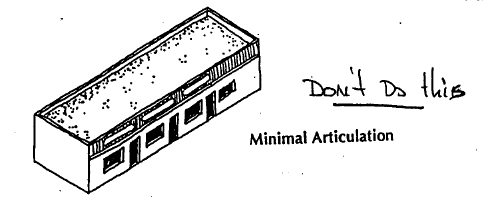
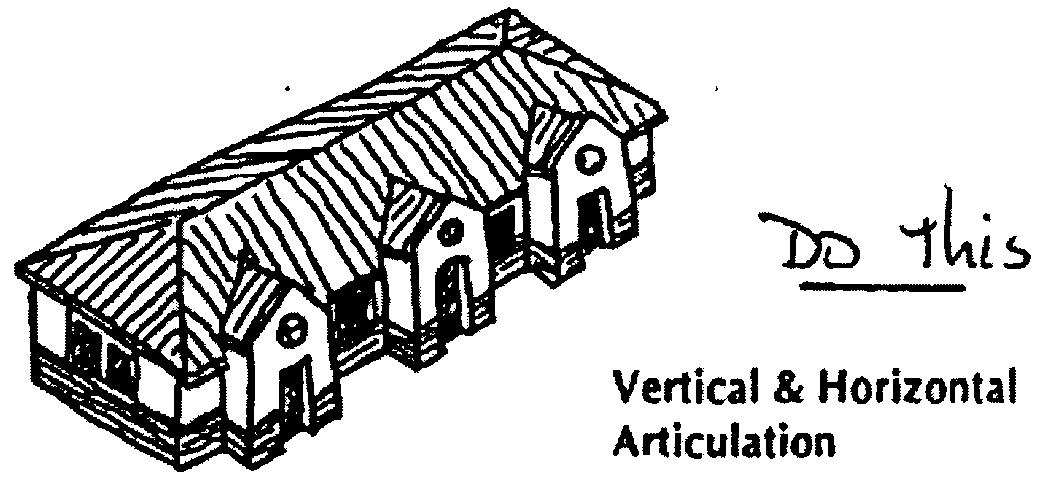
Figure 3. Facade Articulation
C.
Roof Design.
1.
Sloped Roofs—Roof height shall not exceed the average height of the supporting walls. The average slope shall be greater or equal than one (1) foot of vertical rise for every three (3) feet of horizontal run, and the average slope shall be less than or equal to one (1) foot of vertical rise for every one (1) foot of horizontal run. Proposed buildings shall incorporate at least two (2) of the following roof elements or features (Circle two (2) choices):
a)
Eaves that overhang a minimum of two (2) feet with a minimum fascia depth of eight (8) inches.
b)
Three (3) or more roof slope planes per primary facade.
c)
An additional vertical change in roof height (minimum two-foot change in elevation).
d)
Dormers or other additional roof elements facing primary street frontage.
e)
A porch, portion, arcade, or other similar element located at the main building entrance(s).
2.
Flat Roofs—Flat roofs may be used provided all of the following conditions are met:
a)
Peaked or pitched roof elements shall cover at least fifty percent (50%) of the length of a facade facing the primary street frontage. Mansard roofs and/or cornices (min. twelve (12) inches in height with a min. of three (3) reliefs) may be counted toward meeting twenty-five percent (25%) of the required horizontal length. Peaked or pitched roof elements shall cover at least twenty-five percent (25%) of the sides of a building.
b)
Equipment on roof shall not be visible from an elevation that is horizontal to the location of the roof equipment.
c)
A porch, portico, arcade, or other similar element shall be located at the main entrance(s).
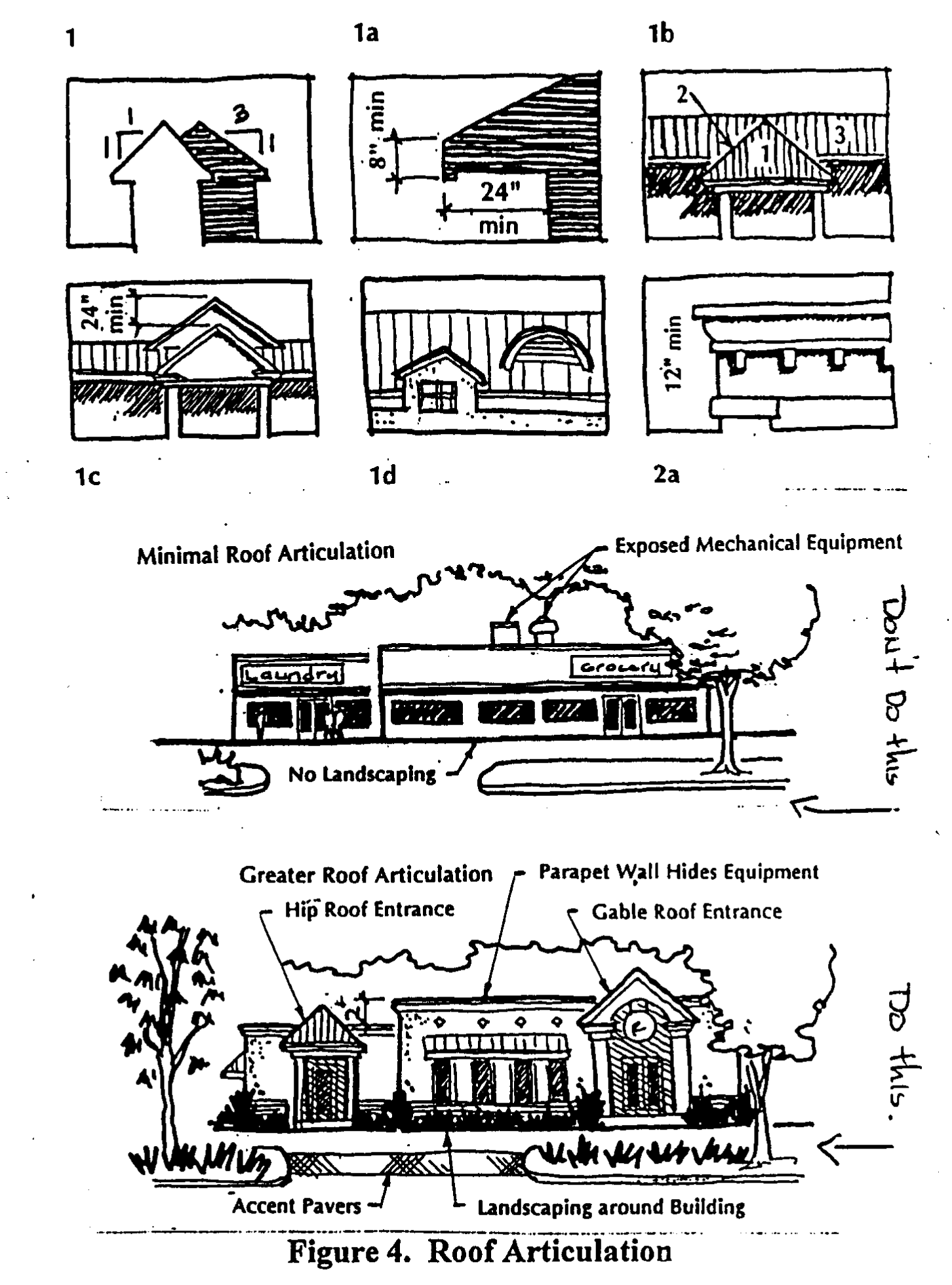
D.
Prohibited Roof Materials/Elements.
•
Asphalt shingles (except laminated, three-hundred-twenty-pound, thirty-year architectural grade shingles or better).
•
Mansard roofs/canopies without roof articulation using faux gables, dormers, etc.
•
Roofs with less than a 3/12 pitch (unless full parapet coverage is used).
•
Back-lit awnings used as a mansard or canopy roof.
•
Brightly colored glazed tile.
•
Roof color that does not conform to color standard.
E.
Rehabilitated or Remodeled Structures—Design standards shall apply to properties undergoing redevelopment when the sum of all building costs is fifty percent (50%) or more than the appraised value of the building. The conversion of an existing single-family home to a commercial use may trigger the requirement to comply with these standards.
F.
Architectural Style—Refer to architectural illustrations at the end of this document.
If parking is located in front of the building, add one (1) additional architectural design. List the additional element here, if applicable.
The applicant shall choose at least five (5) elements from the following list and shall illustrate the elements on the required elevation drawings (Circle five (5) choices):
1.
Predominantly vertical, rectangular, windows
2.
Clear glass windows (eighty-eight percent (88%) light transmission or more)
3.
Lightly stained/painted wood in a horizontal pattern
4.
Arbor
5.
Clock tower
6.
Bahama shutters
7.
Square Columns
8.
Porch with picket railing
9.
Arcade/loggia
10.
Cupola
11.
Dormer
12.
Standing seam metal roof
13.
Widow's walk
14.
Lattice detailing
15.
Stone or stamped concrete pavement at project entry, drop-off, or pedestrian crossing (three hundred thirty (330) sf. minimum).
16.
Pedestrian courtyard or plaza (two hundred (200) sf. minimum)
17.
Canopy
18.
Portico/Porte Cochere
19.
Sculpture
20.
Raised cornice parapets over doors
21.
Arches
22.
Display windows
23.
Bell tower
24.
Frieze/medallion
G.
Signs and Lighting Standards.
1.
Unified Sign Plan. A conceptual signage and sign lighting plan shall be submitted with the site plan review application that complies with these standards and the of the Land Development Code.
For projects with multiple signs on the property, the applicant shall submit, with application, a sign plan with elevations showing that all signs are compatible in color/material/design (including out parcel signs). These standards relate only to the construction materials and colors used for the supporting elements of signs, but are not mandatory as to the content of the sign face.
A.
Free Standing Tenant Signs. In addition to other county codes, the following standards shall apply:
1.
Design signs to be compatible with the architecture of the building (colors, materials).
2.
Legibility: Suggested use of a minimum nine (9) inches and a maximum twenty-four-inch letter height for all signs.
3.
Locate sign perpendicular to the street.
4.
Suggested appearance of sign face: Utilizing color of building on sign face, use no more than three (3) colors on one (1) sign face. Use a pictographic symbol, if possible (e.g., a key on a locksmith's sign).
5.
For pole hung signs, design a decorative base/skirt under the sign consistent with the architecture of the building to create the appearance of a ground-mounted monument sign.
6.
For shopping centers/multi-tenant developments, reserve a minimum of ten percent (10%) of the sign face to identify the name of the development.
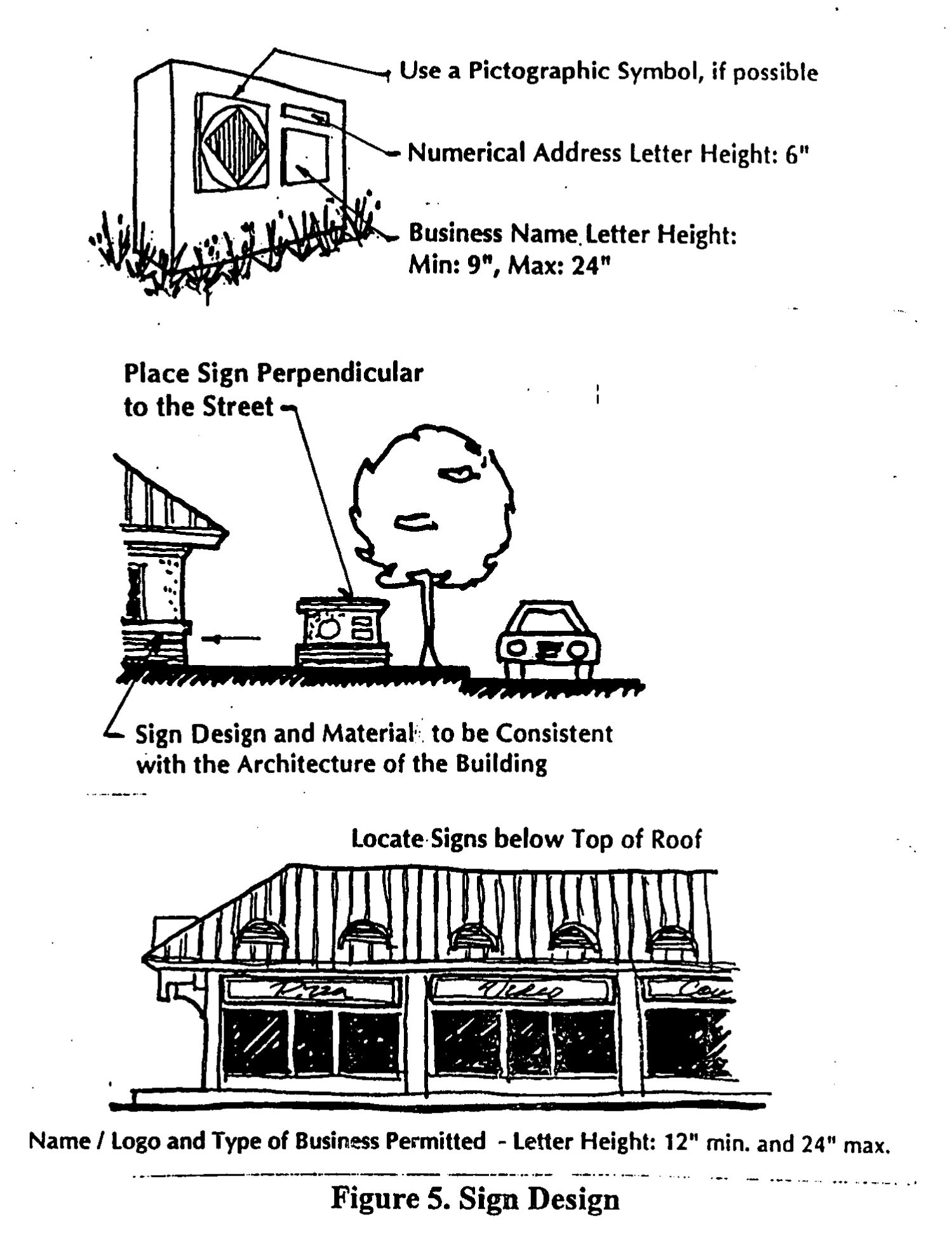
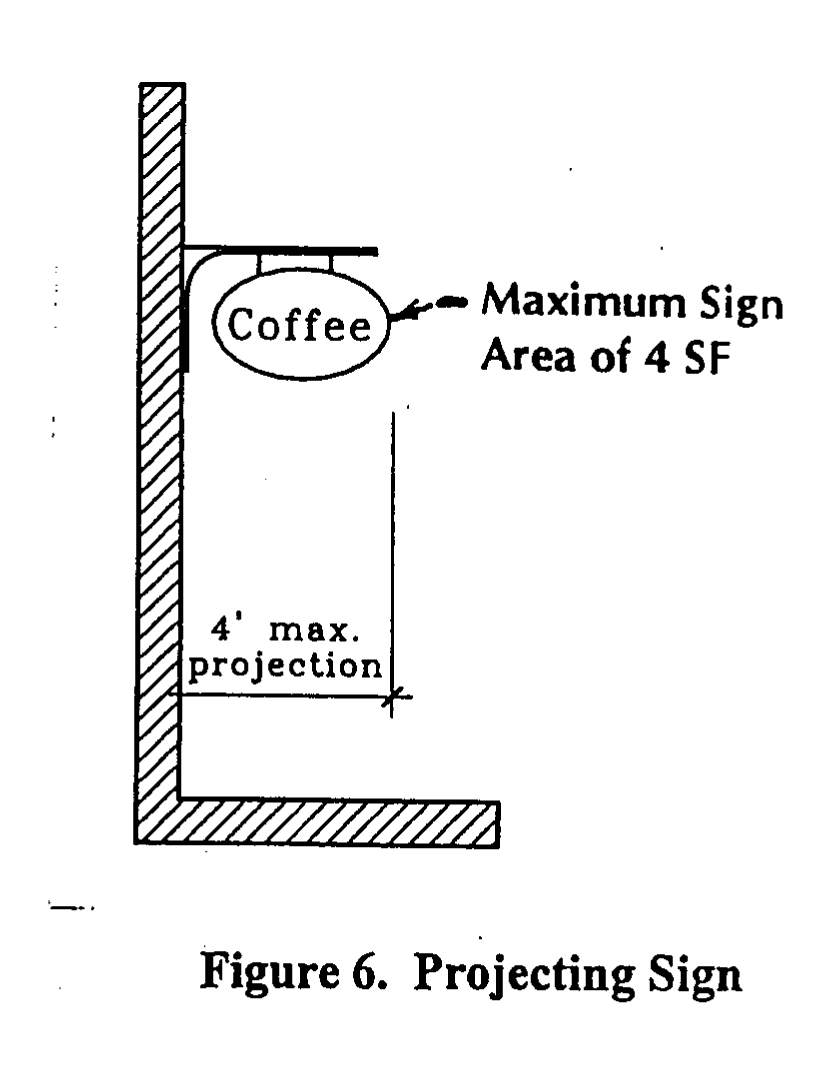
Note: Suggested Content of Sign Face:
B.
Wall Signs Attached to a Building. In addition to other county standards, the following standards apply:
1.
Design signs to be consistent with the architecture of the building (colors, materials).
2.
Suggested appearance of sign face: Use a minimum twelve (12) inches and a maximum twenty-four-inch letter height. Identify only the business name/logo and type of business on facade signs. Use a pictographic symbol if possible (e.g., a key on a locksmith's sign). Lettering should not take up more than seventy-five percent (75%) of the sign face.
3.
Keep signs below top of roof and within fifteen (15) feet above the ground floor.
C.
Miscellaneous Signs.
1.
Rear Building Wall Signs: Buildings with rear parking may have signs on the rear building walls, if otherwise permitted in the zoning district, that are no more than four (4) square feet in area, which shall be included in the total allowable wall sign area applicable to the zoning district. Observe guidelines for "Tenant Signs Attached to Buildings" listed above.
2.
Directional Signs: Design sign to be consistent with other site and building signs (color/material).
3.
Suggested format of Address Information: Exhibit numerical address on the front facade buildings (close to main building entrance) and on the free standing sign (if provided). Use six-inch height numbers in the Helvetica Medium typeface.
4.
Suggested format of Display Signs: Limit display of pricing information (gasoline/beer) or similar pricing to thirty percent (30%) of sign face.
5.
Window Signs: Commercial window signs should include only tenant/business name and hours of operation. Limit permanent commercial window sign displays to twenty percent (20%) of window area.
6.
Neon Signs: Suggested use of neon signs is for creative and exciting artistic expression. Limit area of neon to twenty percent (20%) of total sign or window face.
7.
Projecting Signs: Locate signs above ground level doors/windows but below the roofline or second-floor level to promote a pedestrian environment. Use no more than one (1) projecting sign per business. Signs shall project no more than four (4) feet from the building face and shall not project into the public right-of-way. At minimum, sign shall have a six-inch clearance from the building face. Design all projecting signs to be perpendicular from the building. A maximum sign area of four (4) square feet is permitted.
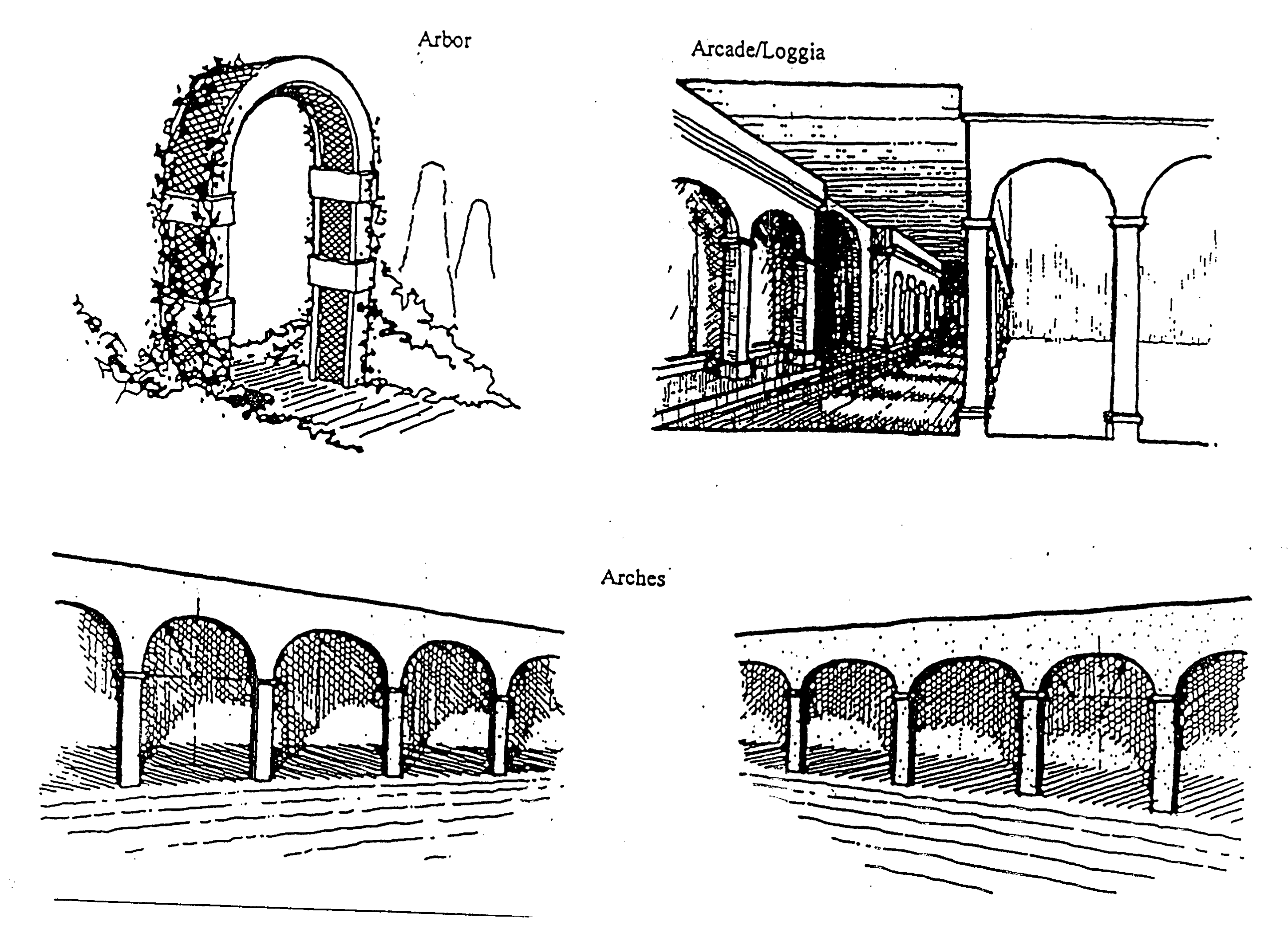
D.
Sign Lighting.
1.
Ground-mounted up-lights shall not exceed one hundred fifty (150) watts per sign face and shall shield light from aiming toward motorists and neighboring properties. Fixtures shall be hidden from view by sign foundation landscaping.
2.
Back-lit individually cut letters are encouraged in monument sign illumination.
3.
Use same-source lighting for signs and parking area lighting (i.e., do not combine metal halide with sodium vapor).
4.
Interior-lit tenant signs attached to buildings shall only illuminate name and type of business and not entire sign face.
5.
Lighting and buffering shall be consistent with the county's zoning and landscape code.
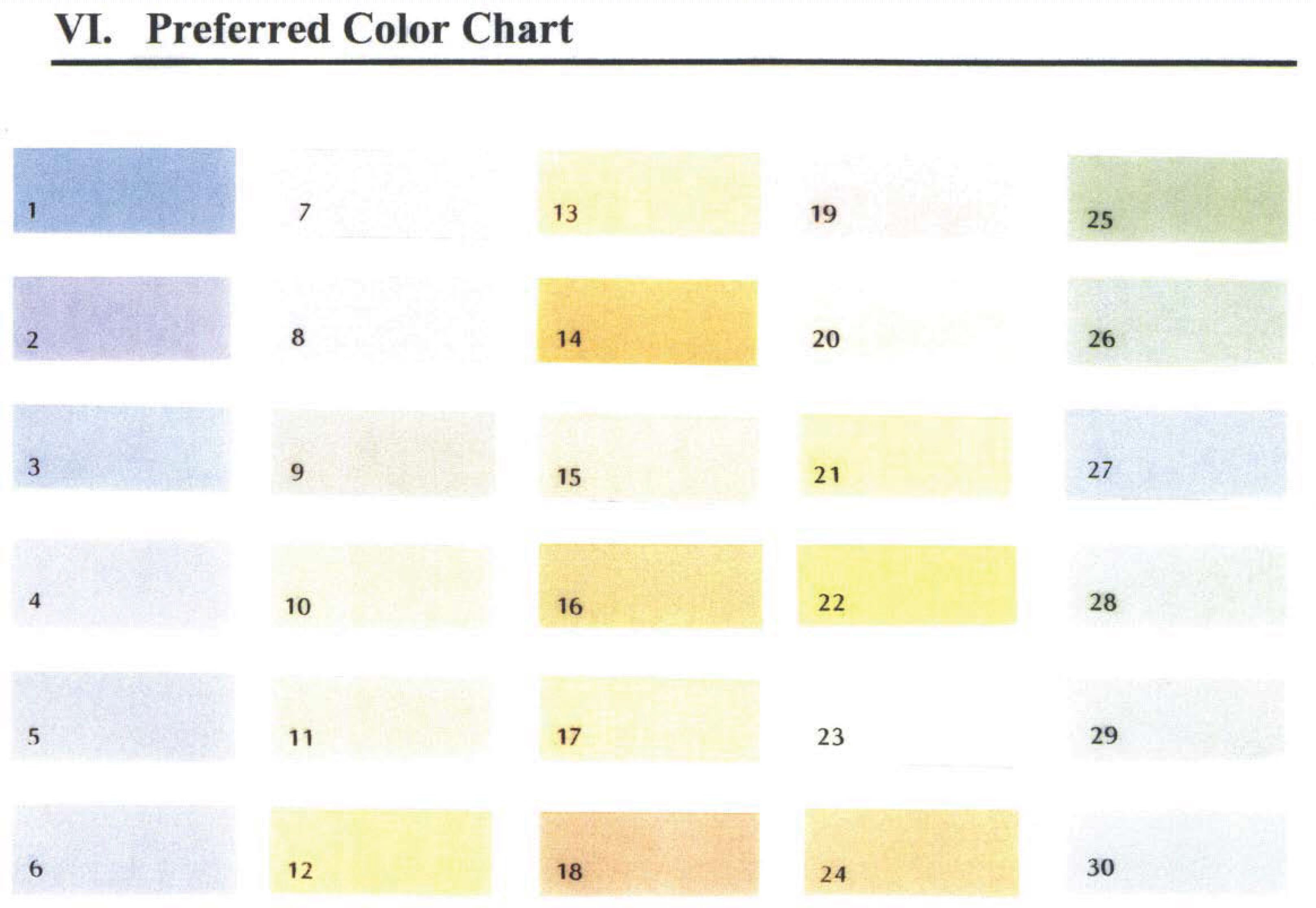
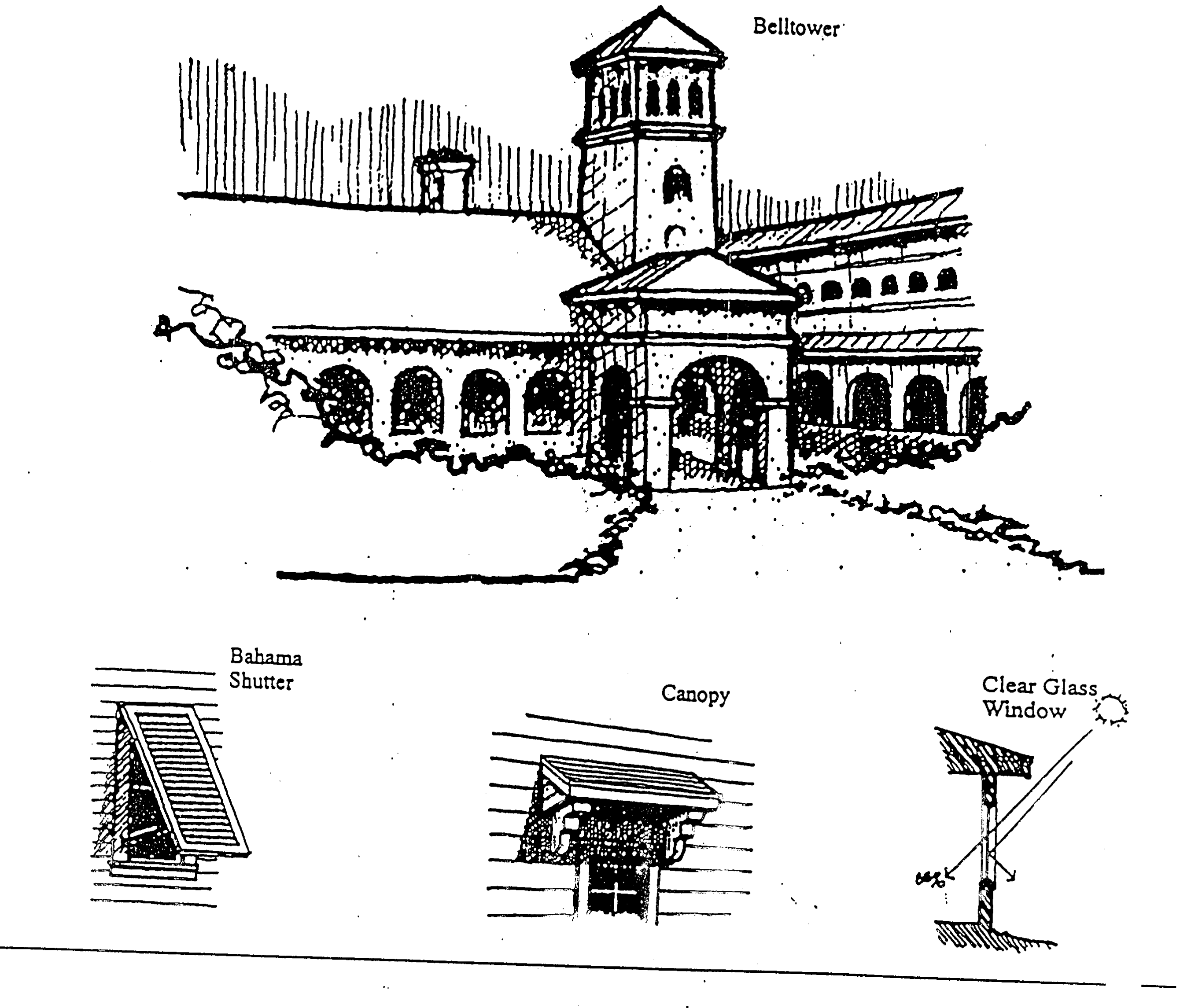
ILLUSTRATIONS: ARCHITECTURAL ELEMENTS
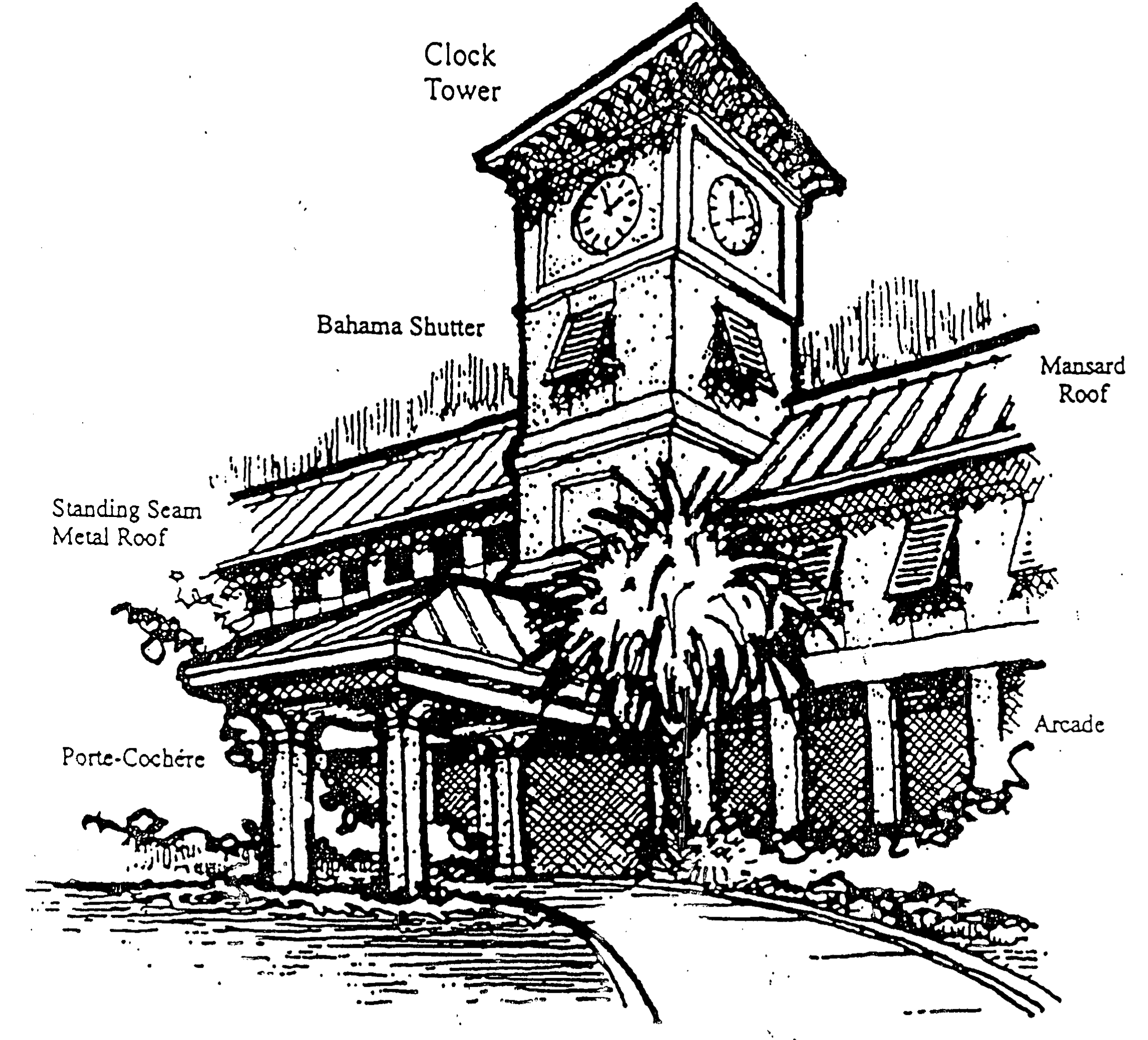
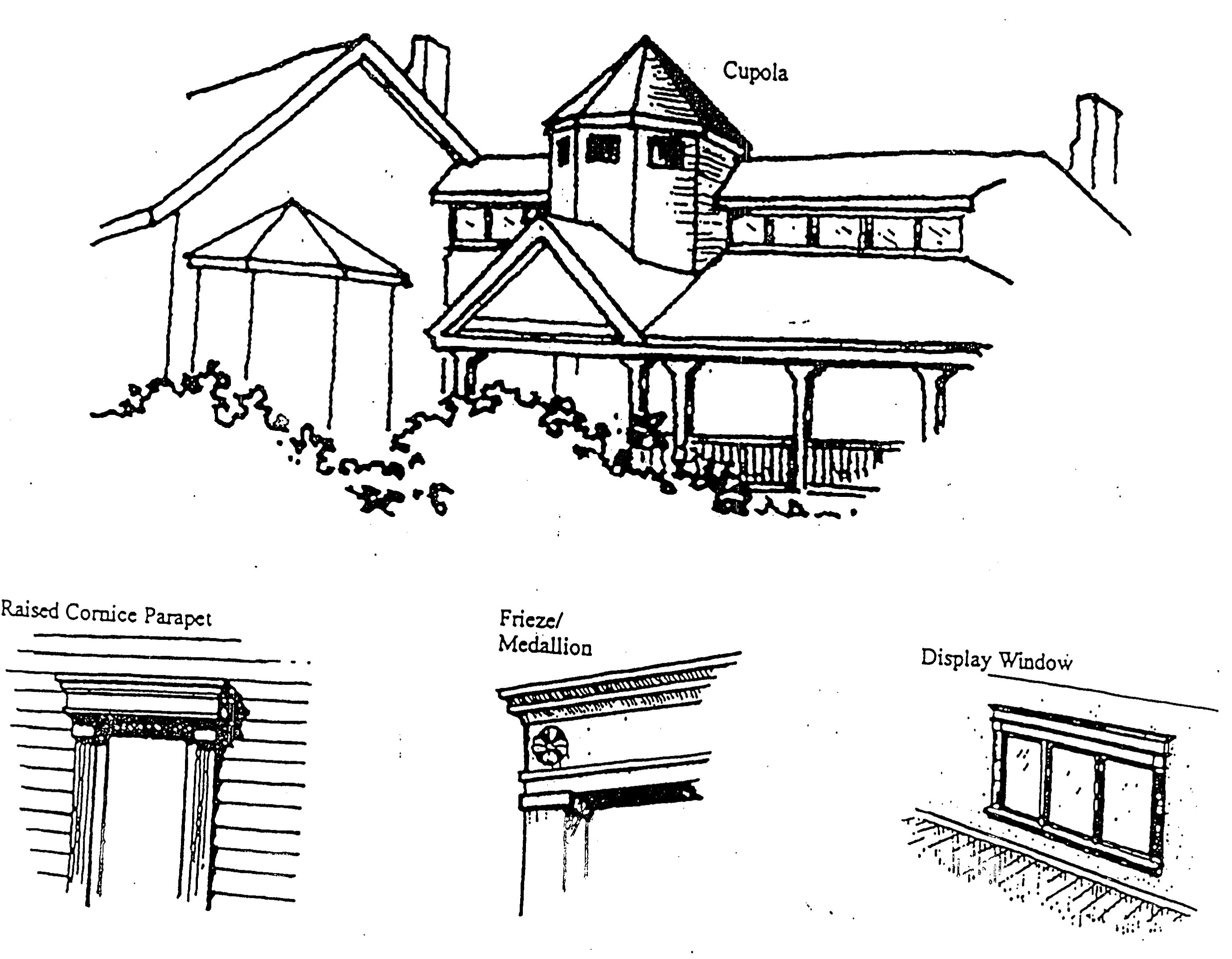
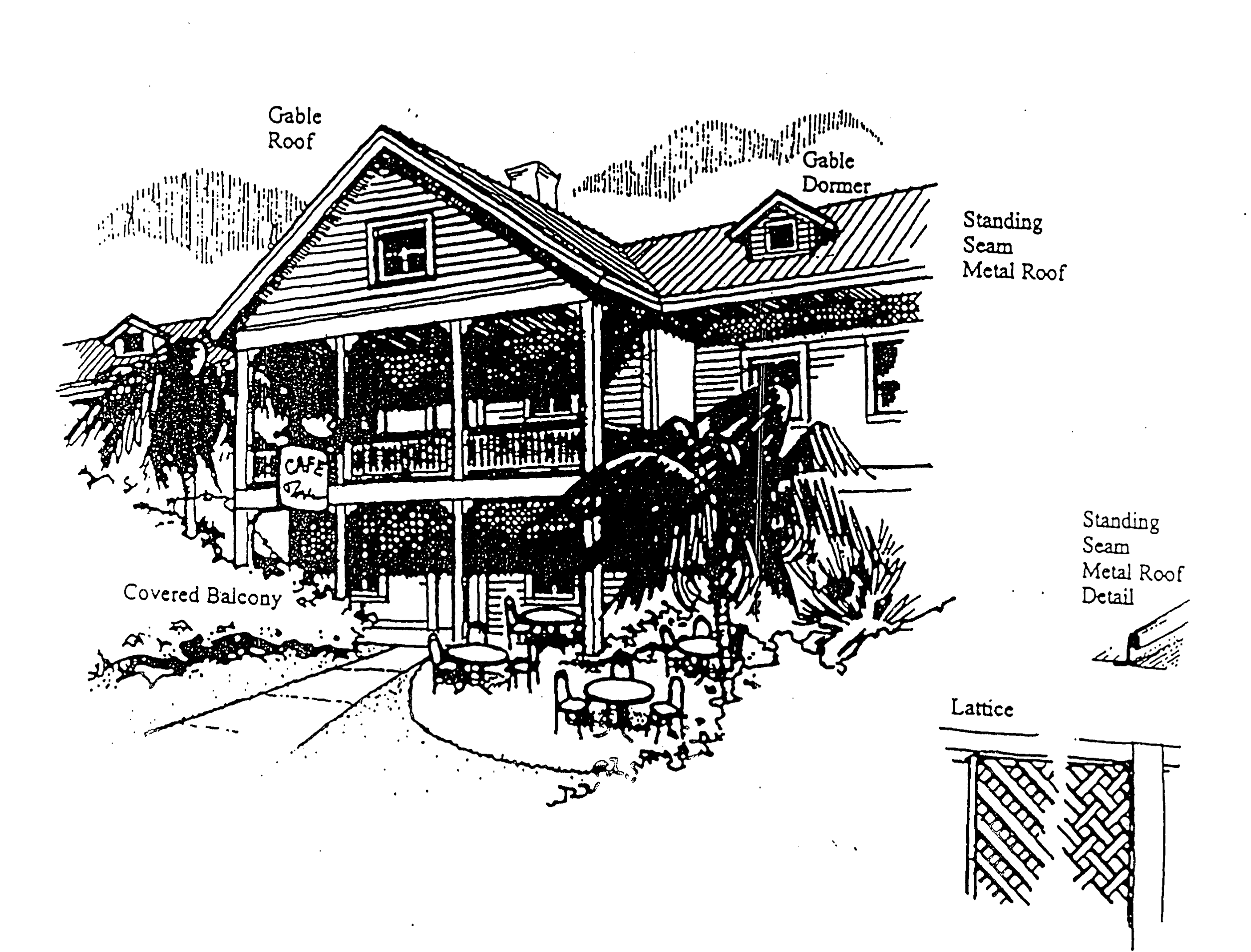
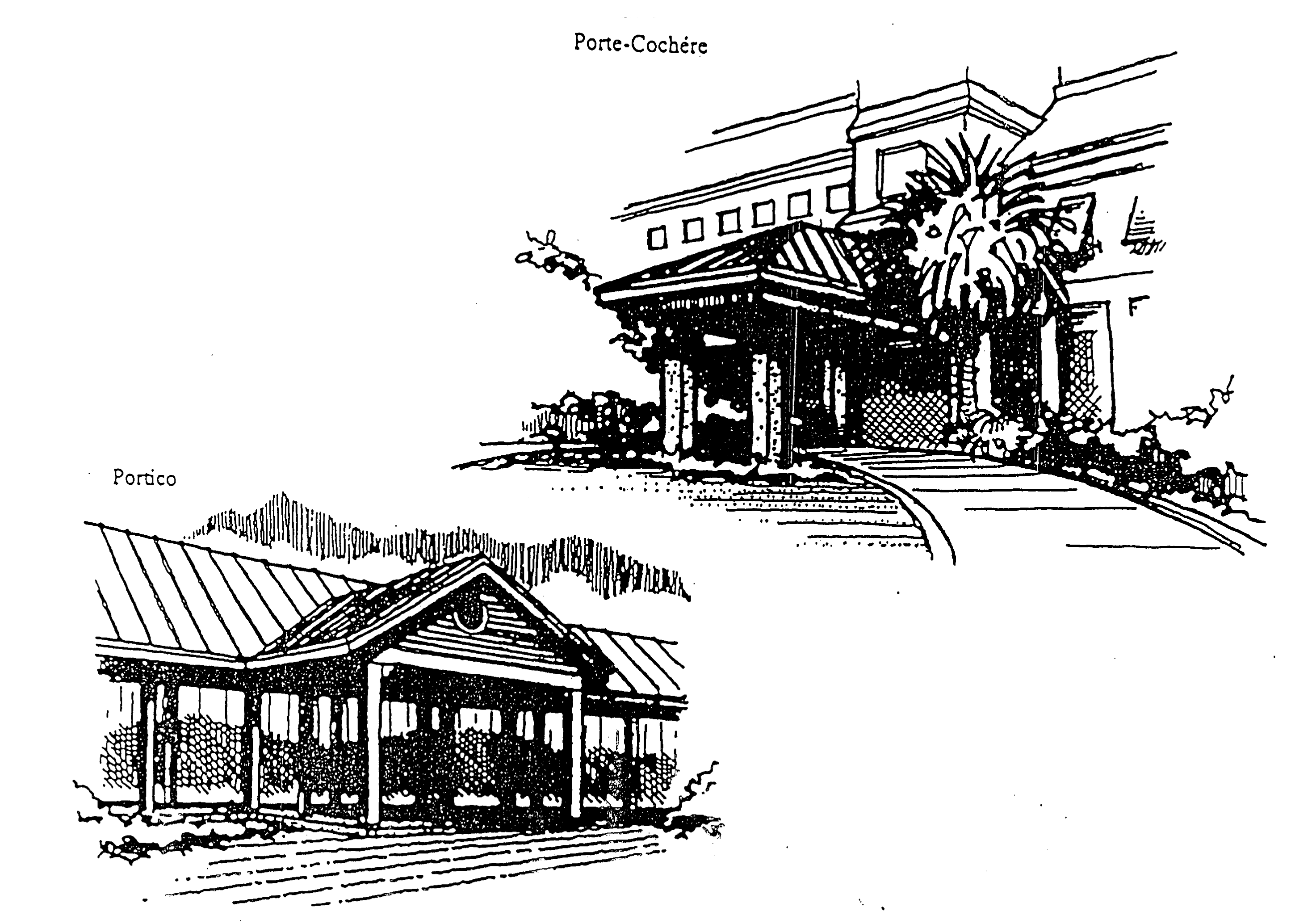
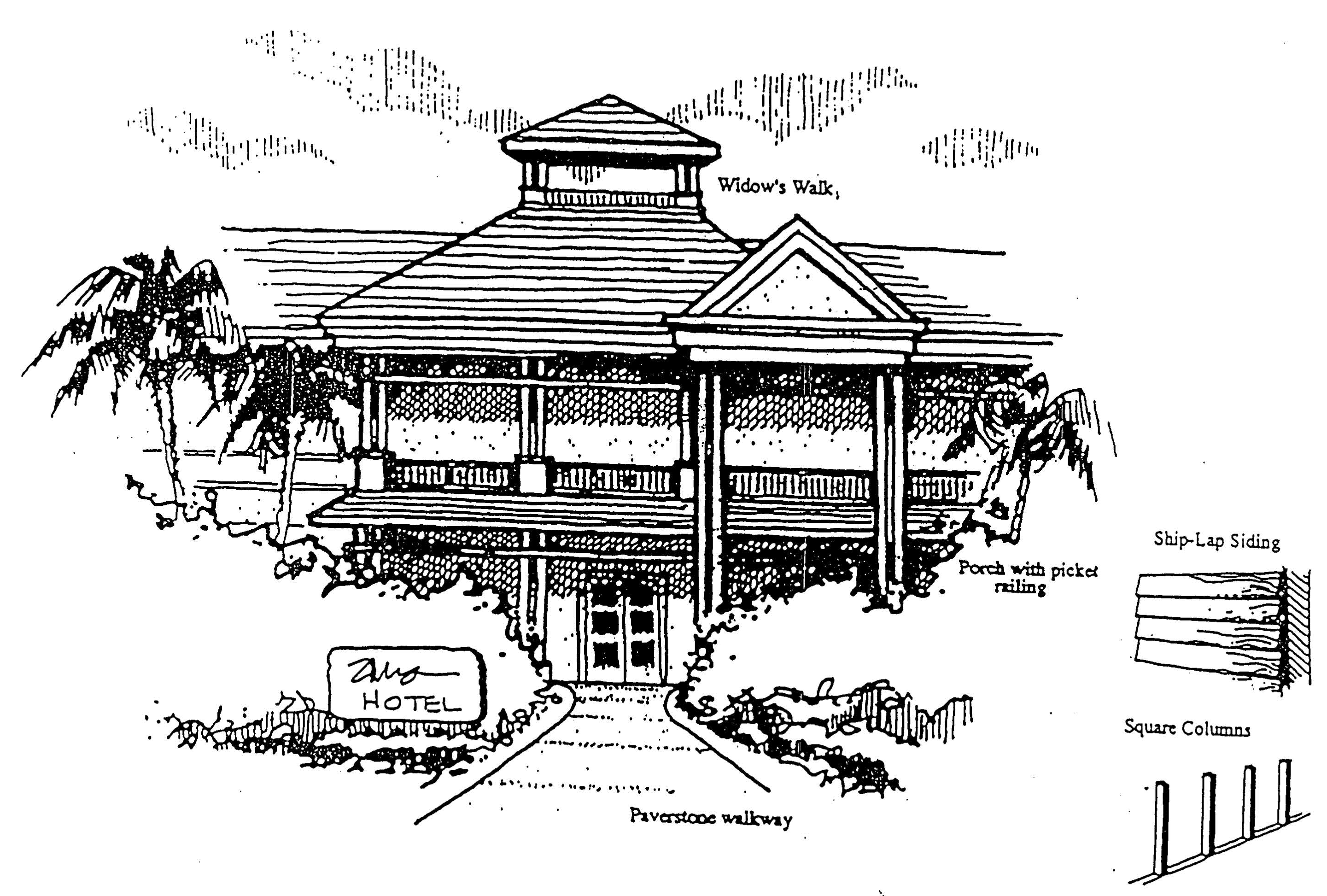
(Ord. No. 16-009, Pt. A, 6-7-2016)
7.10.25. - Emergency Services Communications.
A.
Purpose. Modern hurricane-resistant building techniques often use materials that significantly impede the passage of radio frequency signals through the walls, doors, and windows of newer and remodeled structures. This causes a loss of communications essential to the health, safety and welfare of St. Lucie County citizens and public safety responders during a police, fire, or emergency medical response within these buildings.
It is the intent of this section to provide for the continuation of these emergency communications (wherever possible) within these structures.
To this end, the constructing, erecting, or remodeling of buildings and structures in St. Lucie County will be required to accommodate the communications needs of emergency personnel.
A certificate of occupancy will not be issued for any new building or structure that fails to meet this requirement.
B.
General.
1.
It shall be the responsibility of all owners constructing or erecting, new buildings and structures four (4) stories or higher or more than one hundred fifty (150) feet in dimension to provide for the installation and maintenance of such equipment as necessary to support the required level of coverage for the St. Lucie County Emergency Communications System. These costs will be born by the building owner.
2.
Any changes to the shell of an existing building or renovation of fifty percent (50%) or more of the square footage of the interior of an existing structure will require testing. This testing will be performed as described for initial testing. Should testing results show lack of adequate coverage, costs for installation and maintenance of such equipment as necessary to support adequate coverage for the St. Lucie County Emergency Communications System will be born by the building's owner.
3.
Building's owners, engineers and architects are advised that the installation of roof and floor penetration conduits during construction can significantly reduce the cost of a bi-directional amplifier ("BDA" installation.
4.
Frequency ranges to be supported are 806 through 809 MHz uplink and 851 through 854 MHz downlink. These frequencies are permanently allocated to St. Lucie County Public Safety by the Federal Communications Commission.
5.
Initial testing to determine need:
Testing for adequate coverage will be conducted by the St. Lucie County Fire District or the St. Lucie County Building Department using a standard Motorola hand-held radio and communicating through the Emergency Communications System-Adequate communications coverage shall be defined as completion of successful communications throughout the building, or; less than seventy-five percent (75%) signal loss (<6.0 dB) throughout the building; within the frequency ranges of 806 through 809 MHz uplink and 851 through 854 MHz downlink.
C.
Owner Responsibility.
1.
Where this coverage cannot be achieved through building construction methods, building owners will be required to provide an alternate solution at their expense. In most cases, this will entail the use of a BDA system.
2.
Nothing in this section precludes the building owner from seeking the cooperation and assistance of commercial cellular telephone companies in providing financial and/or technical assistance. Multiple use BDA systems (systems accommodating cellular mobile telephones as well as the St. Lucie County Public Safety frequencies) will be acceptable and are encouraged.
3.
The installation and use of any such BDA system shall require the approval and meet the specifications of the St. Lucie County Department of Public Safety. This requirement ensures that the BDA system does not interfere with the functioning of the County's Emergency Communication System and satisfactorily meets the needs of the inhabitants and Public Safety personnel.
4.
All BDA systems installed on the St. Lucie County Public Safety frequencies shall be Federal Communications Commission (FCC) 'Type Accepted', shall have a four (4) hour battery backup and shall be approved by and registered with St. Lucie County Public Safety (the FCC licensee of these frequencies.
5.
St. Lucie County Public Safety reserves the right to waive the requirement for a BDA when necessary to protect the overall integrity of the Emergency Communications System. In such cases, a written letter of waiver shall be issued by the Public Safety Director to the building owner.
D.
Testing.
1.
The gain values of all amplifiers shall be measured and recorded by the installer and these measurements shall be registered with both St. Lucie County Public Safety and the building owner so that thev can be verified during annual tests and maintenance.
2.
The BDA system shall be tested annually by the St. Lucie County Fire District, at the building owner's expense, to ensure that the system is performing properly.
3.
The County, or its representatives, at any time, after providing reasonable notice to the owner or his/her representative, shall have the right to enter into the property to conduct field testing to be certain the required level of radio coverage is present.
4.
Any changes to the shell of an existing building or renovation of fifty percent (50%) or more of the square footage of the interior of an existing structure will require testing. This testing will be performed as described for initial testing.
E.
Violation. It shall be a violation of the St. Lucie County Land Development Code for a property owner, lessee, licensee, contractor, or a government entity not otherwise exempt by law, to erect a building, or other structure, or portion thereof, or cause a building or other structure, or portion thereof, to be erected or constructed in a manner that creates interference with St. Lucie County's public safety, law enforcement, other emergency-related and county operational telecommunications networks. For purposes of this article, a facility shall be considered part of St. Lucie County's law enforcement, public safety, other emergency-related arid county operational telecommunications networks if it is existing or if it is a part of St. Lucie County's long range comprehensive radio communications plan approved by the Board of County Commissioners, and shall include among other facilities those municipalities serviced by St. Lucie County's telecommunications system. Each day a building or structure, or portion thereof, constructed or erected after the effective date of this article creates such interference, shall constitute a separate violation.
F.
Non-Compliance. The owner or owners of existing buildings or structures that are found to be in non-compliance with this section shall be subject to code enforcement procedures and fines. This shall not preclude other penalties allowed by law.
(Ord. No. 08-012, Pt. A, 9-9-2008)
7.10.26. - Newsracks on Public Rights-of-Way.
A.
Purpose and Criteria. The purpose of the following standards is to promote the public health, safety and welfare through the regulation of placement, type, appearance and servicing of newsracks on public rights-of-way so as to:
(1)
Provide for pedestrian and driving safety and convenience.
(2)
Restrict unreasonable interference with the flow of pedestrian or vehicular traffic including ingress into or egress from any residence or place of business, or from the street to the sidewalk by persons exiting or entering parked or standing vehicles.
(3)
Provide for public and property safety during hurricane and emergency conditions.
(4)
Provide reasonable access for the use and maintenance of poles, posts, traffic signs, or traffic signals or any other traffic control device, hydrants, mailboxes and access to locations used for public transportation purposes.
(5)
Relocate and/or replace newsracks which result in a visual blight and/or excessive space allocation on the public rights-of-way or which unreasonably detract from the aesthetics of landscaping and other improvements, as well as to have abandoned newsracks removed.
(6)
Maintain and protect the values of surrounding properties.
(7)
Reduce unnecessary exposure of the public to personal injury or property damage.
(8)
Treat all newspapers equally regardless of their size, content, circulation, or frequency of publication.
(9)
To designate all private suppliers of modular newsracks which comply with the provisions of this section as qualified private suppliers of modular newsracks pursuant to F.S. § 337.408(3).
B.
Certificate of Compliance Required. No person shall place, affix, erect, construct or maintain a newsrack on public rights-of-way without first becoming a qualified supplier of modular newsracks or newsracks by obtaining a one-time only certificate of compliance for each newsrack or modular newsrack in accordance with the provisions of this section.
C.
Application and Issuance of Certificate of Compliance.
(1)
Issuing authority. The issuing authority and coordinator shall be the public works director or his/her designee. The public works director or his/her designee is responsible for fairly coordinating and administering the physical placement of newsracks of the type and location herein specified, and upon compliance herewith is responsible for issuing the certificates of compliance.
(2)
Approving authority. The approving authority shall be the public works director or his/her designee.
(3)
Applications. The applicant shall file with the public works director a written application for an installation certificate of compliance which shall contain the following information:
(a)
The name, address and telephone number of the applicant who is the owner and/or principal in charge of the newsrack.
(b)
The name, address and telephone number of a responsible person whom the county may notify or contact at any time concerning the applicant's newsrack.
(c)
The number of newsracks and the proposed location of each shown on a drawing provided by public works as in subsection (4) below.
(d)
Size, type or brand of newsracks, including an illustration and description of the newsrack and mount.
(4)
Procedure. The public works department shall:
(a)
Have a map which is to a large enough scale to show general countywide locations of newsracks by each publisher or distributor.
(b)
Request a list of proposed newsrack locations, marked on the above map, from each distributor.
(c)
Have a scale drawing or aerial photograph of each newsrack location showing the position and name of each newsrack at that location.
(d)
Obtain confirmation approvals of the above approved newsrack drawings from each distributor.
(5)
Issuance of certificate of compliance. Upon a finding by the public works director, or his/her designee, that the applicant is in compliance with the provisions of this section, the public works director or his/her designee shall cause to be issued a certificate of compliance for installation. Such issuance shall be made within ten (10) working days of the county's receipt of the completed application, which will include proof of required bond(s) and insurance. Upon issuance of a certificate of compliance, the applicant shall be considered a qualified private supplier of modular newsracks or newsracks pursuant to this section.
(6)
Denial of certificate of compliance. If a certificate of compliance for some newsrack location applied for shall be denied, the applicant shall be notified within ten (10) working days of the County's receipt of the completed application. The applicant shall be advised of the specific cause of such denial by the public works director or his/her designee. The applicant may reapply for substitute alternative location at no additional certificate of compliance fee.
(7)
Additional certificate of compliance. If at any time after initial application for an installation certificate of compliance a publisher wishes to install additional newsracks, then subsections (3) and (4) above are to be repeated in accordance with the provisions of this section. Under subsection D. Insurance, any additional returnable bond deposit required will be credit with any amount still on account. Additional certificate of compliance fees shall be in accordance with subsection E. Fees, except that the fifty-dollar publisher's fee is waived if previously paid.
(8)
[Denial; Appeals.] Any applicant who has been denied a certificate of compliance pursuant to the provisions of this section may file a written appeal within seven (7) working days of the date of the rendition of the decision with the County Administrator. The appeal shall be heard by the Board of County Commissioners within fifteen (15) calendar days from the date of the filing of the appeal. Any appeal filed pursuant to these regulations shall state succinctly the grounds upon which it is asserted that the determination should be modified or reversed, and provide any other papers material to the determination.
Any aggrieved parties may appeal a final decision of the Board of County Commissioners to the Circuit Court of the Nineteenth Judicial Circuit. An appeal shall be filed within thirty (30) days of the decision of the Board of County Commissioners being appealed.
D.
Insurance.
(1)
Prior to the issuance of a certificate of compliance by the public works director or his/her designee, the applicant shall furnish to the public works director a certificate of insurance annually and a one-time only returnable bond deposit, both in specific accordance with the terms of subsection D(2) below, except that returnable bonding amounts for newsrack installations shall be:
The bond being to guarantee compliance with terms of the permit and to be in force for six (6) months after the approved completion date of the work.
(2)
Before any permit shall be issued under this section, the applicant shall furnish to the county evidence that the applicant is carrying public liability insurance, with the county named as an additional insured, with bodily injury liability limits of five hundred thousand dollars ($500,000.00), each person; five hundred thousand dollars ($500,000.00) each occurrence, and property damage liability limits of two hundred fifty thousand dollars ($250,000.00), each occurrence, or bodily injury liability and/or property damage liability, single limit of five hundred thousand dollars ($500,000.00), each occurrence. The policy shall also provide the County will be given a thirty-day written notice of cancellation or non-renewal. No permit shall be issued to any applicant to perform work on, or cut into, the public rights-of-way until a deposit has been made in sufficient amount to the county to insure the repairs requested by the applicant, and such amount shall be determined by the director of public works; but in any event the minimum amount of such bond shall be one hundred fifty dollars ($150.00), and maximum amount of such bond shall be one hundred twenty-five percent (125%) of the cost of proper restoration of the public rights-of-way, the bond being to guarantee compliance with terms of the permit and to be in force six (6) months after the approved completion date of the work.
(3)
Insurance under this section shall run continuously with the presence of the applicant's newsrack in county rights-of-way, and any termination or lapse of such insurance shall be a violation of this section. Applicant shall provide the County yearly updated insurance certificates.
E.
Fees. There shall be a one-time only certificate of compliance fee in the amount of fifty dollars ($50.00) for each distributor or publisher plus ten dollars ($10.00) per newsrack or modular newsrack. Failed inspections are subject to a reinspection fee of fifteen dollars ($15.00). All of the above fees will be used to defray administrative expenses relating to this section only.
F.
Location and Placement. The purpose of the following is to regulate the location and placement of newsracks on public rights-of-way.
(1)
Newsrack placement is permitted only at the following locations:
(a)
Sidewalks. Newsracks shall be situated parallel and adjacent to the edge of the sidewalk. No newsrack shall be placed on the sidewalk. A minimum sidewalk space of six (6) feet shall remain clear.
(b)
In a grass, dirt, gravel or like area. Newsracks placed in a grass, dirt, gravel, or like area must be secured to concrete foundations, as required in this section. Notwithstanding the foregoing, newsracks may not be chained or otherwise tied to any poles, or any other traffic control device, tree etc., under any circumstances.
(2)
No newsrack shall be placed, installed, used or maintained at the following locations and/or shall be subject to the following restrictions:
(a)
Within five (5) feet of any edge of roadway.
(b)
Within five (5) feet of any marked crosswalk.
(c)
Within ten (10) feet of any unmarked crosswalk.
(d)
Within ten (10) feet of any fire hydrant, fire call box, police call box or other emergency facility.
(e)
Within five (5) feet of any edge of driveway.
(f)
Within five (5) feet ahead of, and fifteen (15) feet to the rear of any sign marking a designated bus stop, measured along the edge of roadway.
(g)
Within two (2) feet of any bus bench, or plaza bench.
(h)
At any location whereby the clear space for passageway of pedestrians is reduced to less than six (6) feet.
(i)
Where any protruding part of the newsracks is on or within twelve (12) inches of any area improved with hedges or within three (3) feet radius of flowers or trees.
(j)
Within five (5) feet of a building entrance.
(k)
On or within three (3) feet of signs or any other traffic control device, parking meters, street lights, utility poles or mailboxes.
(l)
On any handicap access ramp.
(m)
Within visibility triangles at street intersections. Visibility triangles shall be maintained to include an area bounded by the first twenty-five (25) feet along the intersecting edges of the rights-of-way, projected where rounded, and a line running across the lot in connecting the ends of such twenty-five-foot lines.
(n)
Within visibility triangles at the intersection of driveways with streets. Visibility triangles shall be maintained to include an area bounded by the first ten (10) feet along the intersecting area of the base building line and the driveway, projected where rounded, and a line running across any intervening rights-of-way and the lot and connecting the end of such ten-foot lines.
(3)
In addition, all newsracks shall be subject to the following restrictions:
(a)
No more than ten (10) newsracks shall be placed at any intersection, with no more than five (5) individual newsracks at any one (1) corner. If distributed from a modular newsrack, no more than twenty-four (24) publications shall be dispensed at any intersection with no more than twenty-four (24) publications dispensed at any one (1) corner. Priority shall be on a first come, first to obtain a certification of compliance with this section basis, except as provided in subsection (d) below.
(b)
No more than five (5) individual newsracks shall be placed side by side at any one (1) location and no more than twenty-four (24) publications shall be dispensed from a modular newsrack. There shall be a minimum 300-foot distance between groups of five (5) individual newsracks placed side by side or more than two (2) modulars along the same sidewalk. Priority shall be on a first come, first to obtain a certificate of compliance with this section basis, except as provided in subsection (d) below.
(c)
Modular and individual newsracks shall not be placed at the same location or intersection.
Subject to the provisions set forth above, newsracks shall be placed parallel to the edge of the curb, and newsracks placed near the wall of a building must be placed parallel to and not more than six (6) inches from the wall.
(d)
Newsrack locations existing as of the effective date of the adoption of this ordinance shall be deemed acceptable, provided that the private suppliers of said newsracks submit a map or maps to the public works director large enough in scale to depict said existing locations. Said map(s) must be submitted within one (1) month of adoption, and all such newsracks must otherwise be brought into conformity with this ordinance as set forth herein.
G.
Installation and Maintenance.
(1)
No individual free-standing newsrack shall exceed fifty-six (56) inches in height, thirty (30) inches in width, and twenty-four (24) inches in depth.
(2)
No modular newsrack shall exceed fifty-six (56) inches in height, eight (80) inches in width, and twenty-four (24) inches in depth.
(3)
By January 1, 2007, newsracks shall be hunter green (evergreen) pedestals and sides.
(4)
No newsrack shall be used for advertising signs or publicity purposes other than advertising the display, sale or availability of the newspaper periodicals, advertising circulars or other printed matter contained therein.
(5)
Each newsrack that charges a fee for the newspaper or printed material contained therein shall be equipped with a coin return mechanism to permit a person using the machine to secure an immediate refund in the event the user is unable to receive the publication paid for. The coin return mechanism shall be maintained in good working order.
(6)
Each newsrack shall be kept level on a solid base, or welded or bolted to a mount. The base must be set in and flush with the ground and maintained in a safe and secure condition. All bases or mounts shall conform to the standards set forth below. Any mount or base installed or used shall remain the responsibility of the distributor who installs or uses it and shall be removed by the distributor immediately upon abandonment or removal of the newsrack. When located in compliance with this section and on rights-of-way owned or maintained by the County, a newsrack may also be bolted into an existing sidewalk in accordance with the standards for bases and this section.
(a)
Newsracks bolted directly into bases shall be bolted in place through four (4) standard holes in the base in accordance with the following standards:
1.
Foundation of four-inch minimum concrete, two thousand five hundred (2,500) psi (Twenty-eight-day strength), Class I.
2.
Two-inch minimum concrete edge distance for bolts.
3.
One-half-inch minimum chamfer on all concrete edges.
4.
Three-eighths-inch diameter hot-dipped galvanized hex bolt mounts, three-inch minimum embedment, threads down, through four (4) corners of the newsrack.
(b)
Mounts bolted to bases shall be bolted in place through four (4) standard holes in a base plate in accordance with the following standards:
1.
Foundation of four-inch minimum concrete, two thousand five hundred (2,500) psi (Twenty-eight-day strength), Class I.
2.
Two-inch minimum concrete edge distance for bolts.
3.
One-half-inch minimum chamfer on all concrete edges.
4.
Three-eights-inch diameter hot-dipped galvanized hex bolt mounts, three-inch minimum embedment, threads down, through four (4) corners of the base plate.
(c)
A water-soluble, paintable, ten-year caulk shall be applied and wiped to seal around the base plug and the mounting surface.
(7)
Each newsrack shall have affixed to it, in a readily visible place so as to be seen by anyone using the newsrack, a notice setting forth the name and address of the distributor and the telephone number of a working local or toll-fee telephone service to call to report a malfunction, to secure a refund in the event of a malfunction of the coin return mechanism, or to give the notices provided for in this section.
(8)
Newsracks for free newspapers, periodicals, advertising circulars or other printed matters may omit the coin box and may have the pull bar welded to the door to produce an "honor rack".
(9)
Each Newsrack shall be maintained in a neat and clean condition and in good repair at all times. At a minimum, each Newsrack shall be serviced and maintained so that:
(a)
It is free of graffiti, dirt and grease;
(b)
It is free of chipped, faded, peeling, or cracked paint in the visible painted areas thereof;
(c)
It is free of rust or corrosion in the visible unpainted areas thereon;
(d)
The structural parts are not broken or unduly misshapen; and
(e)
The publications are kept dry and are not exposed to wind or precipitation.
H.
Abandonment. In the event a newsrack remains empty for a period of seven (7) continuous days, it shall be deemed abandoned.
I.
Emergency Removal.
(1)
Where the installation, use, or maintenance of a Newsrack, Base, or Mount poses an immediate or imminent: (i) danger to pedestrians or vehicles, (ii) health or safety hazard for pedestrians or vehicles, or (iii) otherwise unreasonable interference with the safe use of any Public Rights-of-Way or other public property, the County Administrator may have staff remove the newsrack, base, or mount immediatley. Within five (5) working days of removal, the County Administrator shall notify the distributor in writing, and provide the distributor with opportunity for an appeal according to the provisions of this section. After removal, the distributor may reclaim the newsrack upon repayment of the costs of removal, storage, and administrative expenses. If the distributor fails to reclaim within forty-five (45) days after notice of removal, the newsrack shall be deemed abandoned property and may be disposed of by the County, in the same manner as other abandoned or unclaimed property.
(2)
Under emergency weather conditions where a newsrack may become dangerous to persons or property, the Administrator may require that any newsrack that is not secured shall be removed by the distributor thereof. In such event, the County Administrator may give notice, by telephone, to the distributor, and shall specify the time provided for removal. Any newsrack that is not removed pursuant to notice from the Administrator may be removed by the Administrator and stored. In such event, the distributor may reclaim the newsrack upon paying the expenses incurred by the County to remove and store it, as well as any related administrative expenses. Should the distributor fail to reclaim any newsrack within forty-five (45) days after written notice of removal from the Administrator, the newsrack shall be deemed abandoned property and may be disposed of, by the County, in the same manner as other abandoned or unclaimed property.
J.
Appeals. A distributor may appeal a decision made by the County Administrator for emergency removal by filing a written notice of appeal with the County Administrator within seven (7) working days of the date of the rendition of the decision. The Board of County Commissioners shall review the emergency removal at a public meeting within fifteen (15) calendar days from the date of filing the appeal. The distributor shall be provided reasonable notice of the time, date and place of the public meeting. Any appeal filed pursuant to these regulations shall state succinctly the grounds upon which it is asserted that the determination should be modified or reversed, and any other papers material to the determination.
Any aggrieved parties may appeal a final decision of the Board of County Commissioners to the Circuit Court of the Nineteenth Judicial Circuit. An appeal shall be filed within thirty (30) days of the decision of the Board of County Commissioners being appealed.
K.
Enforcement. Beginning one hundred fifty (150) days from the effective date of Ordinance No. 05-001 and at any time thereafter, any newsrack in violation of any provision of this article shall be subject to remedy and due process under the provisions of Section 11.13.03 et. seq. of this Code pertaining to the code enforcement board.
L.
Rights Preserved. Nothing contained in this article shall prohibit the Commission from enforcing its ordinances by any other means. This article does not restrict the right of any person or the Commission to proceed with under either F.S. § 60.05 or § 832.05, against any public nuisance.
7.10.27. - Reserved.
Editor's note— Ord. No. 2018-006, Pt. A, adopted May 15, 2018, repealed § 7.10.27, which pertained to communications.
7.10.28. - Solar Energy.
The following provisions are intended to facilitate the commercial generation and distribution of solar power and the use of on-site solar energy systems to meet the energy demands of buildings and support facilities in the unincorporated County. All Solar equipment and devices shall comply with Florida Statutes and shall be certificated by the Florida Solar Energy Commission.
A.
Solar Generation Station. In addition to other applicable sections of this Code, a Solar Generation Station shall be subject to the following provisions:
1.
Solar Generation Stations are permitted uses in the AG 1, AG 2. 5 and AG 5 Zoning Districts and shall require submittal of a Minor Site Plan application. Solar Generation Stations not located within an Agricultural Zoning District shall require submittal of a Major Site Plan application concurrent with a Conditional Use Permit, when required.
a)
In Zoning Districts in which a Major Site Plan application is required, the development shall be subject to the following supplemental criteria:
1.
Physical access to a Solar Generation Station shall be restricted by fencing or walls. Razor wire is prohibited. All fencing and wall details shall be provided for review and approval as part of the required site plan.
2.
The devices that capture energy and convert it to electricity shall not be placed in wetlands, environmentally sensitive resources or habitats, imperiled and critically imperiled habitats as defined by the Florida Natural Areas Inventory, and/or buffers. Any environmental impacts from such devices, or any component of a Solar Generation Station, shall only be allowed in compliance with the provisions of the County's Comprehensive Plan and Land Development Code.
3.
All devices that capture and convert energy to electricity shall be located at least fifty (50) feet from any lot line under separate ownership, unless otherwise approved by the Board of County Commissioners.
4.
All Solar Generation Station sites must comply with the landscaping and screening requirements of the Land Development Code. The perimeter buffer landscaping requirements may be waived by the Board of County Commissioners, if it is shown to the satisfaction of the Commission that the adjoining property owners have no objection to the landscaping waiver. Interior vehicular use area landscaping requirements may be waived by the Commission, to the extent necessary to ensure optimal solar access. The Board of County Commissioners may require additional landscaping to enhance compatibility with adjacent land uses.
5.
On-site power lines shall be placed underground to the maximum extent possible.
b)
In Zoning Districts in which a Minor Site Plan application is required the development shall be subject to the following supplemental criteria:
1.
Physical access to a Solar Generation Station may be restricted by fencing or walls. Razor wire is prohibited. All fencing and wall details shall be provided for review and approval as part of the required site plan.
2.
The devices that capture energy and convert it to electricity shall not be placed in wetlands, environmentally sensitive resources or habitats, imperiled and critically imperiled habitats as defined by the Florida Natural Areas Inventory, and/or buffers: Any environmental impacts from such devices, or any component of a Solar Generation Station, shall only be allowed in compliance with the provisions of the County's Comprehensive Plan and Land Development Code.
3.
All devices that capture and convert energy to electricity shall comply with the setback regulations of the underlying Agricultural Zoning District, or provide a 25-foot setback, whichever is less.
4.
Perimeter buffers and landscaping requirements are only required for property lines that are directly adjacent to established residential uses and which are not separated by a public right-of-way or South Florida Water Management District Canal. When a Solar Generation Station is adjacent to a non-agricultural zoning district the buffer and landscape requirements for the underlying agricultural zoning district shall apply. The perimeter buffer landscaping requirements may be waived by the Board of County Commissioners, if it is shown to the satisfaction of the Commission that the adjoining property owners from the nonagricultural zoning district property have no objection to the landscaping requirement being waived.
5.
On-site power lines shall be placed underground to the maximum extent possible.
6.
The paving requirements within Section 7.05.07(B) shall not apply to Solar Generation Station that utilize unpaved public or private roads and roadways for access.
7.
The minimum frontage requirement for a Solar Generation Station in the AG-5, AG-2.5 or AG-1 l Zoning District is zero (0) feet, provided legal and sufficient ingress and egress to the facility is demonstrated to the satisfaction of the County Attorney, the County Engineer and the Planning and Development Services Director. Where such access to a Solar Generation Station site relies upon an easement, easements, or any interest in land that is less than fee simple ownership, the Final Development Order granting Minor Site Plan approval and the Site Plan shall identify the Book and Page where such easement or other right of access is recorded in the Official Records of St. Lucie County. The Development Order and the Site Plan shall contain the following statement:
"NEITHER ST. LUCIE COUNTY NOR ANY OTHER GOVERNMENTAL OR PUBLIC AGENCY IS RESPONSIBLE FOR THE MAINTENANCE, UPKEEP OR IMPROVEMENT OF ANY PRIVATE DRIVES, ROADS, STREETS, EASEMENTS, OR RIGHTS-OF-WAY PROVIDING INGRESS AND EGRESS OR DRAINAGE SERVICE TO THE PROPERTY THAT IS THE SUBJECT OF THIS DEVELOPMENT ORDER."
8.
Surveys for Solar Generation Stations shall be compliant with the requirements of Section 11.02.09(A)(2)(d), except that any Category III wetlands, as defined by the St Lucie County Comprehensive Plan, that are located on the site need only be graphically located on the project site plan, provided that they have been identified with field flagging or by GPS (orequivalent)coordinate mapping, by a qualified Professional Wetland Scientist (PWS). All such wetlands are to be buffered in accord with the County's Comprehensive Plan, unless otherwise proposed for alteration or impact.
Wetlands mapped under this paragraph are not required to provide individual conservation easements or a Preserve Area Monitoring and Management Plan (PAMMP) for the project site, provided that all required buffers are indicated on the project site plan and appropriate management restrictions and obligations are setout in any site plan approval orders or resolutions, for the Minor Site Plan activity.
B.
Accessory and Other Non-Utility Solar Energy Systems. In addition to other applicable sections of this Code, accessory solar and other non-utility solar energy systems shall be subject to the following provisions:
1.
All solar panels and devices are considered structures and subject to the requirements from the Land Development Code, together with all other applicable codes and ordinances, unless otherwise provided for in this Code. Solar panels installed on roofs are exempt from the building height requirements. Solar panels installed on rooftops shall be located at least three (3) feet from the roof edge.
2.
Non-roof installed solar energy devices integrated into the architecture of the building, such as the walls of the building, shall be no greater than ten (10) feet above the maximum height requirements of the zoning district.
3.
Ground or pole mounted systems shall be limited to a height of ten (10) feet above the base floor elevation of the primary structure.
4.
Solar energy systems shall not be located in front or side corner yards of any parcel, unless the following are met:
a)
the conditions of the side and back yards prohibit the installation of a system, and
b)
the lot is one (1) acre or greater, and
c)
adequate buffering along the adjacent roadway is provided, and
d)
the location is approved by the Director of Planning and Development Services.
5.
Solar ground and pole mounted systems less than six ( 6) feet in height may encroach into the side and rear setback area, but in no case shall the system be located closer than five ( 5) feet from the property line. Where the system is higher than six (6) feet in height the setback requirements of the zoning district shall apply.
6.
Solar collectors may be co-located on communication towers, and parking lot and street light poles, in which case the height and setback requirements for said tower/pole shall apply.
7.
All new exterior electrical lines and utility wires connecting a ground or pole mounted solar system to the building it serves shall be buried underground.
8.
The Board of County Commissioners may allow for a modification of these accessory use provisions when the proposed solar energy system will serve buildings within a planned development project. The modification shall be identified on the site plan graphics and within the resolution granting approval to the planned development.
9.
Waiver. In the event any of the provisions in this subsection have the effect of prohibiting or precluding the installation of a solar energy system, the applicant shall have the right to apply for a waiver from these provisions to the Director of Planning and Development Services or designee. The Director may grant a waiver upon determining that strict application of the Code would result in prohibiting the installation of a solar energy system.
10.
Landscape Waiver. The Environmental Resources Director may waive the landscaping requirements of the Land Development Code to the extent necessary to ensure optimal solar access.
11.
Any approval of a solar energy system does not create any actual or inferred solar energy system easement against adjacent property and/ or structures. The owner and/or property owner of a solar energy system shall not infer or claim any rights to protective writs to any caused shadows or operating ineffectiveness against future development adjacent to or higher than the property location of the solar energy system. The approval of any solar energy system granted by St. Lucie County shall not create any future liability or infer any vested rights to the owner and/ or property owner of the solar energy system on the part of the County for any future claims against said issuance of approval of the solar energy system that result from reliance on this section or any administrative decision lawfully made thereunder.
(Ord. No. 10-034, Pt. A, 11-9-2010; Ord. No. 2022-21, Pt. A, 7-19-2022; Ord. No. 2023-05, Pt. A, 3-21-2023; Ord. No. 2024-29, § 2, 10-1-2024)
7.10.29. - Pain Management Clinic.
The following provisions are intended to promote the health and general welfare of the residents of St. Lucie County through the regulation of pain management clinics within unincorporated St. Lucie County.
A.
Pain Management Clinics shall be subject to the following:
1.
Each pain management clinic shall at all times, be in compliance with each and every provision of this section, as well as all applicable federal laws, state laws, administrative rules, and county codes.
2.
A pain management clinic shall be permitted only as a conditional use in the Commercial General Zoning District, as provided in Section 3.01.03(S)(7), St. Lucie County Land Development Code (LDC), and must be operated by an approved pain specialist, or as a Florida Agency for Health Care Administration (ACHA) licensed operation, under Chapter 400, Part X, Florida Statutes, and as otherwise required by Florida law. In addition to the regulations in this section, all provisions of the LDC for conditional use permits, shall apply.
3.
In the event the owner or operator of a state licensed or designated pain management clinic has such license or designation revoked by the Florida Board of Medicine, the Florida Board of Osteopathic Medicine or by ACHA, any conditional use permit granted for a pain management clinic shall simultaneously be revoked, and shall thereafter be null and void.
4.
A change in ownership of a pain management clinic shall require a major adjustment to the conditional use permit authorizing the use.
5.
Location. Any new pain management clinic shall only be located in the CG (Commercial, General) Zoning District, subject to the other requirements of this section and all applicable federal, state, local and other agency provisions.
B.
Distance requirements. The following distances shall be measured by straight line measurement without regard to intervening buildings from the nearest point of the building or unit within a building in which the proposed clinic is to be located to the nearest point of the lot, use, or right-of-way line from which the proposed clinic is to be separated.
1.
No pain management clinic shall commence operation within 500 feet of any other pain management clinic.
2.
No pain management clinic shall commence operation within 500 feet of a pharmacy, unless such pharmacy shall have pre-dated the pain management clinic by at least one (1) year.
3.
No pain management clinic shall be located within 1,000 feet of real property comprising a residence, child care facility, public or private elementary, middle, or secondary school, park, community center or public recreation facility, church or religious facility.
C.
Other regulations.
1.
It shall be unlawful for any clinic to be open for operation between the hours of 6:00 p.m. and 7:00 a.m.
2.
The number of parking spaces required for pain management clinics shall be the same as for those required of medical offices, the Planning and Development Services Director may require the applicant to submit a parking analysis study if the Director has concerns as to the safety, sufficiency or configuration of available vehicle parking based on the unique circumstances of the site.
3.
All state licenses and permits shall be provided to the County prior to the issuance of any occupation authorizations, licenses, permits or renewals issued by the County.
(Ord. No. 11-017, Pt. A, 6-21-2011)
7.10.30. - Reasonable Accommodation Procedures.
1.
This section implements the policy of St. Lucie County (the "County") for processing of requests for reasonable accommodation to its ordinances, rules, policies, and procedures for persons with disabilities as provided by the Federal Fair Housing Amendments Act (42 U.S.C. 3601, et. seq.) ("FHA") and Title II of the Americans with Disabilities Act (42 U.S.C. Section 12131, et. seq.) ("ADA"). For purposes of this section, a "disabled" individual or person is an individual that qualifies as disabled and/or handicapped under the FHA and/or ADA. Any person who is disabled (or a qualifying entity) may request a reasonable accommodation with respect to the County's land use or zoning laws, rules, policies, practices and/or procedures as provided by the FHA and the ADA pursuant to the procedures set out in this section. Unless specifically allowed in any other section within the County's Land Development Code, any licensed or certified residential provider (including any Certified Recovery Residence as defined in F.S. § 397.311(5)) must seek approval from the County through an application for reasonable accommodation as set forth herein.
2.
A request by an applicant for reasonable accommodation under this section shall be made in writing by completion of a reasonable accommodation request form, which form is maintained by (and shall be submitted to) the Planning and Development Services (PD&S) Department. The reasonable accommodation request form shall be substantially in the form set forth in subsection 10. below and upon receipt by the County, will be date-stamped. If additional information is required by the County, the application will not be considered complete, and the County will notify the applicant in writing within the first thirty (30) days after the receipt of the application. The applicant shall have thirty (30) days after the receipt of the notice from the County to respond to the request. The applicant's failure to respond in whole or in part shall be deemed an abandonment of the application, and it will be considered withdrawn. Within seven (7) days after the County's receipt of the additional information (but no later than thirty-seven (37) days from the applicant's receipt of the County's request for additional information), the County will notify the applicant in writing as to whether the application is deemed complete or whether the application is considered abandoned.
3.
Should the information provided by the disabled individual to the County include medical information or records, including records indicating the medical condition, diagnosis or medical history of the disabled individual, such individual may, at the time of submitting such medical information, request that the County, to the extent allowed by law, treat such medical information as confidential information of the disabled individual. The County shall thereafter endeavor to provide written notice to the disabled individual, and/or their representative, of any request received by the County for disclosure of the medical information or documentation, which the disabled individual has previously requested be treated as confidential by the County. The County will cooperate with the disabled individual, to the extent allowed by law, in actions initiated by such individual to oppose the disclosure of such medical information or documentation, but the County shall have no obligation to initiate, prosecute or pursue any such action, or to incur any legal or other expenses (whether by retention of outside counsel or allocation of internal resources) in connection therewith, and may comply with any judicial order without prior notice to the disabled individual.
4.
The County Administrator, or his/her designee, shall have the authority to consider and act on requests for reasonable accommodation, after notice and a hearing to receive any additional information from the applicant. When a reasonable accommodation request form has been completed and submitted to the PD&S Director, it will be referred to the County Administrator, or designee, for review and consideration. The County Administrator, or designee, shall issue a written determination within sixty (60) days of the date of receipt of a completed application and may, in accordance with federal law, (1) grant the accommodation request, (2) grant a portion of the request and deny a portion of the request, and/or impose conditions upon the grant of the request, or (3) deny the request, in accordance with federal law. Any such denial shall be in writing and shall state the specific objective and evidence-based grounds therefore and identify any deficiencies or actions necessary for reconsideration. All written determinations shall give notice of the right to appeal. The notice of determination shall be sent to the requesting party (i.e., the disabled individual or entity or his/her/its representative) by certified mail, return receipt requested. Unless the County and the applicant agree otherwise, if a final written determination is not issued by the County within sixty (60) days after receipt of a completed application, the request shall be deemed granted. In addition, any reasonable accommodation a granted may be revoked for cause, including, but not limited to, a violation of any of the conditions for approval or, in the case of any licensed or certified operator, the lapse, revocation or failure to maintain licensure or certification, if not reinstated within one hundred-eighty (180) days.
5.
In determining whether the reasonable accommodation request shall be granted or denied, the requesting party shall be required to establish that they are protected under the FHA and/or ADA by demonstrating that they are handicapped or disabled, as defined in the FHA and/or ADA. Although the definition of disability is subject to judicial interpretation, for purposes of this section, the disabled individual must show: (i) a physical or mental impairment which substantially limits one (1) or more major life activities; (ii) a record of having such impairment; or (iii) that they are regarded as having such impairment. Next, the requesting party will have to demonstrate that the proposed accommodations being sought are reasonable and necessary to afford handicapped/disabled persons equal opportunity to use and enjoy housing. The foregoing (as interpreted by the Courts) shall be the basis for a decision upon a reasonable accommodation request made by the County Administrator, or designee.
6.
Within thirty (30) days after the County Administrator's, or designee's, determination on a reasonable accommodation request is mailed to the requesting party, such applicant may appeal the decision to the Circuit Court. Such appeal shall not be a hearing de novo but shall be limited to appellate review of the record created before the County Administrator or designee. An appeal shall be filed within thirty (30) days of the execution of the determination.
7.
There shall be no fee imposed by the County in connection with a request for reasonable accommodation under this section, and the County shall have no obligation to pay a requesting party's (or an appealing party's, as applicable) attorneys' fees or costs in connection with the request, or an appeal.
8.
While an application for reasonable accommodation, or appeal of a determination of same, is pending before the County, the County will not enforce the subject zoning ordinance, rules, policies, and procedures against the applicant. However, should the applicant proceed with any property purchase, building, construction, or other work associated with establishing a project or residence housing individuals covered by the Americans with Disabilities Act or the Fair Housing Act while an application or appeal for reasonable accommodation is pending, the applicant understands that any of these actions are done at the applicant's own risk because the application or appeal may be denied.
9.
The following general provisions shall be applicable:
(a)
The County shall display a notice on the County's webpage (and shall maintain copies available for review in P&Z, the Building/Permitting Division, and the City Clerk's Office) advising the public disabled individuals (and qualifying entities) may request reasonable accommodation as provided herein.
(b)
A disabled individual or qualifying entity may apply for a reasonable accommodation on his/her/its own behalf or may be represented at all stages of the reasonable accommodation process by a person designated by the disabled individual or entity.
(c)
The County shall provide such assistance and accommodation as is required pursuant to FHA and ADA in connection with a disabled person's or entity's request for reasonable accommodation, including without limitation, assistance with reading application questions, responding to questions, completing the form, filing an appeal, and appearing at a hearing, etc., to ensure the process is accessible.
10.
Reasonable Accommodation Request Form:
1.
Name of Applicant (or authorized representative):
Telephone Number:
2.
Address:
3.
Address and parcel identification number of housing or other location at which accommodation is requested:
4.
Describe qualifying disability or handicap:
5.
Describe the accommodation being requested and the specific regulation(s) and/or procedure(s) from which accommodation is sought:
6.
Reasons the reasonable accommodation may be necessary for the individual with disabilities to use and enjoy the housing or other service:
7.
Name, address and telephone number of representative, if applicable:
8.
Other information, which may include details of any proposed site improvements, parking needs, transportation protocols, utility facilities, etc., as necessary:
9.
Signature of disabled individual or representative, if applicable, or qualifying entity:
Date:_______
(Ord. No. 13-016, Pt. A, 4-2-2013; Ord. No. 22-033, Pt. A, 12-6-2022; Ord. No. 25-024, Pt. A, 12-2-2025)
7.10.31. - Membership Organizations—Enclosed Assembly Areas.
A.
Within the Commercial Office (CO), Commercial Neighborhood (CN) and Commercial General (CG) Zoning Districts Membership Organizations that contain enclosed assembly areas greater than seven hundred fifty (750) square feet in size shall only be authorized upon a determination of compliance with this section, and all other applicable requirements of this Code. In the CG Zoning District the supplemental standards shall only apply to existing nonresidential developments with more than one use, such as shopping centers and other multiple use developments.
B.
For the purposes of this section an enclosed assembly area is defined as any enclosed area, building or structure where people assemble for a common purpose, such as social, civic, cultural or religious purposes, whether owned and/or maintained by a for-profit or not-for-profit entity, and includes, but is not limited to, public assembly buildings such as auditoriums, halls, private clubs and fraternal lodges, assembly halls, exhibition halls, convention centers, and places of worship or other areas, buildings or structures that are used for assembly by persons.
C.
Prior to issuance of any Development Order or Certificate of Zoning Compliance the applicant shall provide sufficient information to allow a determination that adequate private and public facilities and services can be provided to meet the demands of the proposed use and that the proposed use would be compatible with the surrounding uses, both existing and proposed.
At a minimum the supplemental documentation shall include:
1.
Description of the proposed assembly use;
2.
The size and capacity of the proposed enclosed assembly area;
3.
An evaluation of the existing or proposed off-street parking area, and its compliance with the County's off-street parking requirements. Within existing shopping centers and other multiple-use nonresidential developments, documentation shall include a parking analysis of the pre- and post-assembly area demands based upon existing and proposed uses in the development.
4.
Any other information deemed necessary by the Planning and Development Services Director for review of the proposed enclosed assembly area.
D.
Upon a determination of compatibility with the surrounding uses and the availability of adequate public and private facilities the proposed enclosed assembly area shall be authorized. Any required conditions of approval shall be incorporated into the associated Development Order or Zoning Compliance document. Conditions of approval may include limitations on hours of operations, capacity, activities or other limitations as determined necessary to meet the provisions of this section.
7.10.32. - Supplemental Standards for Condominium Hotel Unit Uses.
Condominium hotel units may be utilized in any zoning district permitting the use of hotel/motel or resort units subject to the following use standards:
A.
Declaration of Condominium: A declaration of condominium and/or other documents satisfactory to the County Attorney will be recorded in the public records to:
1.
Provide for the long term maintenance and operation of the condominium hotel and it's amenities as a hotel in accordance with the terms and requirements of this chapter, any permits or approvals issued for the condominium hotel and Florida Statutes,
2.
Provide for the enforcement of the length of stay limitations set forth in paragraph E below, and
3.
Provide notice to future purchasers of the County's right to enforce the foregoing length of stay limitation and the terms and requirements of this chapter and any permits or approvals issued for the condo-hotel.
Approval of the site plan for a project containing condominium hotel units may be conditioned upon the property owner recording such declaration of condominium and/or other documents satisfactory to the County Attorney prior to issuance of a building permit for the project.
B.
Owner's Association: A condominium association, or equivalent, shall be established to govern, maintain and operate the condo-hotel, its amenities and services including, but not limited to, housekeeping for all public areas (including lobby and hallways) and guest rooms, the front desk, concierge services, banquet/ballroom facilities, restaurants, spas, pools and any other amenities or services, as a hotel in accordance with the terms and requirements of the declaration of condo and any permits or approvals issued for the condo-hotel.
C.
Management of Condominium Hotel: The declaration of condominium shall require the condo association to hire a single qualified professional management entity to maintain and operate the condo-hotel. The management entity shall offer short term rental services to all owners of the condo-hotel units.
Regardless of whether a unit owner utilizes the management entity to rent the unit, all persons renting units shall be required to check-in and check-out through the front desk reservation system operated by the management entity, and the management entity shall handle all room service, maid service and room maintenance for the individual units.
D.
Reporting and Inspection: Starting on the one-year anniversary of the issuance of the certificate of occupancy, or equivalent, for the condominium hotel, and annually thereafter for the next four (4) years (five (5) years total reporting period), the condominium association shall deliver to the Planning and Development Services Director an affidavit confirming that the condominium hotel is being operated and maintained in substantial compliance with the terms of (i) the declaration of condo and/or other documents required by paragraph (a) above, and (ii) any permits or approvals issued for the condominium hotel. Thereafter, the condo association shall provide such an affidavit upon the request of the Planning and Development Services Director.
E.
Length of Stay: For each condominium hotel unit, the owner of the unit is authorized to stay in the unit for no longer than the applicable length of stay limit, as set forth below. At all other times, each unit shall be used for short term occupancy purposes only. It is the intent of this section that the owner of the unit shall not be eligible to claim the unit as his or her homestead for the purposes of qualifying for the homestead ad-valorem real property tax exemption. The length of stay limit shall be determined as follows:
1.
If more than seventy-five percent (75%) of the units in the Hotel, Motel or Resort are condo-hotel units, then the length of stay limit is fifty-six (56) days per calendar year, fourteen (14) days per quarter (i.e. the owner of a condo-hotel unit may not stay in his or her unit for more than fifty-six (56) days per calendar year, or more than fourteen (14) days per quarter, and at all other times the unit shall be available to the public for short term occupancy purposes only).
2.
If more than fifty percent (50%) of the units, but no more than seventy-five percent (75%) of the units in the hotel, motel or resort are condo-hotel units, then the length of stay limit is thirty (30) consecutive days and no more than ninety (90) total days per calendar year (a unit owner may not stay in his or her unit longer than thirty (30) consecutive days, and no more than ninety (90) total days in any calendar year. At all other times the unit shall be available to the public for short term occupancy purposes only).
3.
If no more than fifty percent (50%) of the units in the hotel, motel or resort are condo-hotel units, then the length of stay limit is thirty (30) consecutive days and no more than one hundred eighty (180) total days in any calendar year (a unit owner may not stay in his or her unit longer than thirty (30) consecutive days and no more than one hundred eighty (180) total days in any calendar year. At all other times the unit shall be available to the public for short term occupancy purposes only).
7.10.33. - Reserved.
Editor's note— Ord. No. 17-023, Pt. A, adopted December, repealed § 7.10.33, which pertained to low-THC cannabis and medical cannabis dispensing facilities and derived from Ord. No. 17-005, adopted May 16, 2017.
7.10.34. - Commercial Composting Facilities.
A.
Intent. The intent of this Section 7.10.34 is to establish the criteria for the location, permitting, and operation of commercial composting facilities.
B.
Applicability. The provisions of this Section 7.10.34 shall be applicable to each commercial composting facility that will be located in an unincorporated area of St. Lucie County. The construction and operation of a commercial composting facility in an unincorporated area of St. Lucie County is prohibited, unless the construction and operation of the facility has been approved in compliance with the requirements in this Section 7.10.34 or is exempt from the requirements herein.
The supplemental standards in this Section 7.10.34 apply to commercial composting facilities that use biosolids to produce compost. For the purposes of this Section 7.10.34, Commercial Composting Facilities also include facilities that produce compost with: Manure; the treated effluent or reclaimed water from a domestic wastewater treatment facility; solids removed from pump stations and lift stations; screenings and grit removed from the preliminary treatment components of domestic wastewater treatment facilities; ash generated during the incineration of biosolids; septage; sludge from a food establishment or a grease trap interceptor; waste removed from portable toilets; waste removed from holding tanks associated with boats or marina facilities; garbage; or food waste. Facilities using one (1) or more of these materials to produce compost are prohibited in the unincorporated areas of St. Lucie County, unless the applicant for such facility demonstrates that the facility will comply with the requirements in this Section 7.10.34 or the applicant demonstrates that the facility is entitled to the County's approval pursuant to another section of the St. Lucie County Land Development Code.
Notwithstanding anything else contained herein, the requirements in this Section 7.10.34 do not apply to:
1.
Normal farming operations, which are defined as follows:
(a)
Composting or anaerobic digestion of yard trash, manure, or vegetative wastes generated on the farm, as part of agronomic, horticultural, or silvicultural operations, for use on the farm, as part of agronomic, horticultural, or silvicultural operations;
(b)
Composting or anaerobic digestion of yard trash, manure, or vegetative wastes generated off the farm, for use on the farm, as part of agronomic, horticultural, or silvicultural operations; or
(c)
A bona fide farm operation, as defined in F.S. § 823.14(3)(b), on land classified as agricultural land pursuant to F.S. § 193.461, provided such farm operation does not involve the transportation or land application of domestic wastewater residuals (biosolids) or other forms of sewage sludge.
2.
Backyard composting, including composting that is conducted by an individual or family solely for their own farming or gardening activities on their own property.
3.
A composting facility that only uses yard trash and/or untreated wood to produce compost.
4.
A commercial composting facility that has received all of the necessary permits, licenses, and other approvals needed to construct and operate the facility lawfully, if such permits, licenses, and other permits were issued before this Section 7.10.34 took effect.
C.
Zoning Districts where Commercial Composting Facilities are Allowed. Commercial Composting Facilities may be approved as a Conditional Use in an Agriculture-5 (AG-5) zoning district, subject to the requirements in this Section 7.10.34 and the other requirements applicable to the AG-5 zoning district. Commercial composting facilities are prohibited in other zoning districts.
D.
Supplemental Standards for Controlling Water Quality Impacts from Commercial Composting Facilities.
1.
In F.S. § 373.4595(1)(d), the Florida Legislature "finds that it is imperative for the state, local governments, and agricultural and environmental communities to commit to restoring and protecting the surface water resources of the Lake Okeechobee watershed, the Caloosahatchee River watershed, and the St. Lucie River watershed, and that a watershed-based approach to address these issues must be developed and implemented immediately." The Legislature also found that phosphorus and "other pollutants are contributing to water quality problems in the Lake Okeechobee watershed, … and the St. Lucie River watershed." F.S. § 373.4595(1)(g). In F.S. § 373.4595(4)(d), the Legislature required the adoption of a basin management action plan for the St. Lucie River Watershed. As part of the action plan, the Legislature prohibited the Florida Department of Environmental Protection from authorizing "the disposal of domestic wastewater biosolids within the St. Lucie River watershed unless the applicant can affirmatively demonstrate that the nutrients in the biosolids will not add to nutrient loadings in the watershed." F.S. § 373.4595(4)(d)5. A similar prohibition applies to the disposal of biosolids in the Lake Okeechobee Watershed. F.S. § 373.4595(3)(b)16.
2.
Consistent with the Legislature's findings and mandates, the County wants to ensure that the operation of commercial composting facilities in the unincorporated areas of the County will not cause or contribute to water quality problems in the St. Lucie River Watershed or the Lake Okeechobee Watershed. Accordingly, an applicant seeking a conditional use approval for a commercial composting facility in the unincorporated areas of the County must demonstrate that the proposed activities at the Commercial Composting Facility will not cause a net increase in the nutrient loadings or Pathogens in any surface water that drains into the St. Lucie River Watershed or the Lake Okeechobee Watershed.
3.
An applicant will be presumed to comply with the requirement in Section 7.10.34(D)(2), above, if the applicant demonstrates that the applicant's proposed commercial composting facility is designed to collect and appropriately treat all of the leachate that will be generated at the proposed commercial composting facility.
4.
For the purposes of this Section 7.10.34, leachate includes: (a) all of the stormwater that comes into contact with the biosolids, yard trash, solid waste, and other organic material that the applicant will use to create compost; (b) all of the liquid that emanates from the biosolids, yard trash, solid waste, and other organic material that the applicant will use to create compost; (c) all of the stormwater that comes into contact with, and all of the liquid that emanates from, the materials used to create compost after the materials have been combined for processing; and (d) all of the stormwater that comes into contact with, and all of the liquid that emanates from, partially treated compost (e.g., compost that is curing) and fully treated compost (i.e., compost that complies with the specifications for the commercial composting facility's finished product).
5.
To comply with the requirement in Section 7.10.34(D)(2), above: (a) all composting activities must be conducted inside an enclosed building; (b) all raw materials used to create compost (e.g., biosolids, yard trash, etc.), all partially treated compost, and all fully treated compost must be stored inside an enclosed building; and (c) the enclosed building must be designed, constructed, and maintained to comply with the requirements in Section 7.10.34(D)(6), below.
6.
For the purposes of complying with the water quality requirements in Section 7.10.34(D)(2), above, an enclosed building means a building or structure that satisfies all of the following criteria:
(a)
The building must have a roof and four (4) walls, which fully enclose the interior of the building from the floor to the ceiling, except as otherwise provided herein.
(b)
The building must have an impervious floor made of concrete, asphalt, or equivalent material that will prevent leachate from leaking into the soils and groundwater beneath the building. The impervious floor must have a permeability rate for leachate that is 1 × 10⁻⁷ cm/sec or less.
(c)
The floor of the building must be sloped toward drains or sumps, which are sized and located to collect and remove any leachate that is spilled, leaked, or discharged on the floor.
(d)
Drains, elevated speed bumps, or similar features must be installed at all doorways used to provide access into the building for vehicular traffic. These features must be designed and maintained to ensure that Leachate does not flow out of the building, via the doorways for vehicular traffic, and into the outside environment.
(e)
All of the building's doors, windows, and other similar openings to the outdoors must be designed and operated to:
(1)
Minimize the potential for rainwater to enter the building; and
(2)
Prevent the release of leachate from the building to any outdoor area.
7.
An applicant must demonstrate that it will appropriately treat the leachate collected inside the proposed commercial composting facility. More specifically, the applicant must demonstrate that the applicant will pump or transport the leachate to a domestic or industrial wastewater treatment facility that has received or will receive all of the necessary permits and approvals from the Florida Department of Environmental Protection to receive and treat the leachate from the commercial composting facility. The applicant also must provide the County with a letter from the owner or operator of the wastewater treatment facility, confirming that the wastewater treatment facility is willing and able to accept and treat the leachate from the commercial composting facility.
8.
An applicant must demonstrate that the stormwater management system for the proposed commercial composting facility will comply with the following requirements:
(a)
If the applicant's stormwater management system will discharge to a waterbody that drains into the St. Lucie River Watershed or the Lake Okeechobee Watershed, the stormwater system must be designed to collect, treat, and retain the runoff generated by a one hundred (100) year, seventy-two (72) hour design storm, without discharging.
(b)
All retention and detention basins in the applicant's stormwater management system must be setback one hundred (100) feet from any waterbody that drains into the St. Lucie River Watershed or the Lake Okeechobee Watershed.
(c)
If the applicant's stormwater management system will not discharge into a waterbody that drains into the St. Lucie River Watershed or the Lake Okeechobee Watershed, the stormwater management system must comply with all of the applicable standards established by the Florida Department of Environmental Protection and the South Florida Water Management District for such systems.
9.
The applicant must provide a vegetated buffer (setback) between certain areas of the applicant's site and any waterbody that drains to the St. Lucie River Watershed or the Lake Okeechobee Watershed. The setback shall be two hundred (200) feet for all areas on the site where biosolids are delivered, stored, or used to produce compost, including areas where the partially treated compost is cured. The setback shall be one hundred (100) feet for all areas where Yard Trash or other organic materials (except biosolids) are delivered, stored, or used to produce compost. The setback shall be one hundred (100) feet for all areas where the fully treated compost is stored.
10.
The applicant must demonstrate that the commercial composting facility will be built at an elevation above the one hundred (100) year floodplain. This requirement applies to all buildings and areas used for composting, including but not limited to buildings and areas used for receiving, storing, or processing biosolids, yard trash, solid waste, or other organic materials used to produce compost, as well as areas used to store partially or fully treated compost.
E.
Supplemental Standards for Controlling Objectionable Odors from Commercial Composting Facilities.
1.
An applicant must demonstrate that its commercial composting facility will not cause objectionable odors at or beyond the boundary (property line) of the applicant's site.
2.
An applicant will be presumed to comply with the requirement in Section 7.10.34(E)(1), above, if the applicant demonstrates that: (a) all composting operations will be conducted inside an enclosed building; (b) all biosolids, yard trash, solid waste, and other organic materials used to produce compost will be received, stored, and used inside an enclosed building; (c) all partially and fully treated compost will be stored inside an enclosed building; and (d), in each instance, the enclosed building will be designed, constructed, and operated to collect and minimize the objectionable odors emitted from the commercial composting facility.
3.
To comply with the odor control requirements in Section 7.10.34(E)(1), above, an applicant must comply with the following criteria for an enclosed building, in addition to the criteria set forth in Section 7.10.34(D)(6), above:
(a)
The applicant must demonstrate that the building will be designed, constructed, and operated to collect any objectionable odors that are generated inside the building. At a minimum, the design features and operating systems proposed by the applicant must be consistent with the best management practices used to collect objectionable odors in similar enclosed buildings. For example, the building should be equipped with a ventilation system designed to produce a negative air pressure inside the building. The negative air pressure should be maintained throughout the building at levels sufficient to prevent objectionable odors from leaving the inside of the building during normal operations.
(b)
The applicant must demonstrate that any objectionable odors generated in the building will be minimized before they are released to the outdoor environment. At a minimum, the design features and operating systems proposed by the applicant must be consistent with the best management practices used to neutralize or destroy objectionable odors from similar enclosed buildings.
(1)
The applicant should use an odor neutralization system to reduce objectionable odors inside the building. For example, the applicant should use misting systems that spray odor neutralizing compounds inside the building, and/or systems that generate and release ozone inside the building.
(2)
The objectionable odors inside the building should be treated with an activated carbon filter system or other air pollution control system that is designed and operated to minimize or eliminate the objectionable odors before the odors are discharged from the building to the atmosphere.
(c)
If the building has any doors or entranceways that are used to provide ingress and egress for vehicles, the doors must be equipped with high speed roll-up covers or equivalent mechanisms to minimize the potential for objectionable odors to leave the building.
(d)
The applicant must provide the County with an operations plan demonstrating that the doors used to provide vehicular access into the building, and other large openings into the building (e.g., openings for ventilation fans), will be closed to the greatest extent practicable.
(1)
All doors used to provide vehicular access into the building must be closed at all times, except when a vehicle is approaching the door to enter or exit the building.
(2)
All doors for vehicles must be closed at night, on weekends, and at other times that are outside of the commercial composting facility's normal business hours.
(3)
All of the other large openings into the building, such as the openings for ventilation fans (if any), shall be closed when the vehicle doors are closed, unless such openings need to remain open at other times pursuant to the operating plan for controlling objectionable odors (e.g., if the openings need to remain open so that ventilation fans can be used to provide negative air pressure inside the building).
4.
The applicant must provide buffers (setbacks) from its commercial composting facility to reduce the potential for objectionable odors and airborne pathogens to reach off-site areas.
(a)
A setback of three hundred (300) feet must be provided between the boundary (property line) of the applicant's site and any area on the site where the applicant receives, stores, or uses biosolids, yard trash, other organic materials used to produce compost, or partially or fully treated compost.
(b)
A setback of one thousand three hundred twenty (1,320) feet must be provided between any on-site area where biosolids will be delivered, stored, or used for composting and the nearest building that is not owned by the applicant. This setback does not apply to buildings that are located on the applicant's site. This setback also does not apply to buildings constructed after the County issues a conditional use approval for the construction of the commercial composting facility. Further, this setback may be reduced if a smaller setback has been accepted in writing by the person that owns the building.
(c)
A setback of one thousand three hundred twenty (1,320) feet must be provided between the boundary (property line) of the applicant's site and the boundary of the urban service area, as shown in the Future Land Use Element (Map FLU 12) of the St. Lucie County Comprehensive Plan.
F.
Other Supplemental Standards for Commercial Composting Facilities.
1.
The applicant must prepare an operating plan for the proposed commercial composting facility. The operating plan must demonstrate that the operation of the proposed commercial composting facility will not adversely affect off-site residents, businesses, or land uses as a result of objectionable odors, pathogens, dust, stormwater runoff, insects, vermin, other vectors, truck traffic, noise, or other adverse impacts caused by the operation of the commercial composting facility. The operating plan must be submitted to and approved by the County before the conditional use will be approved.
2.
The operating plan must include a contingency plan, which describes the fire control and emergency operating measures that will be used at the commercial composting facility. The contingency plan must describe the measures that will be followed during hurricanes, tropical storms, and other severe weather conditions to ensure that biosolids, yard trash, solid waste, other organic materials used to produce compost, partially and fully treated compost, and leachate will not be blown, discharged, or otherwise released into the environment as a result of the severe weather conditions. The contingency plan also must describe the measures that will be used to prevent fires from occurring on the site, as well as the measure that will be used to extinguish fires.
3.
Fire lanes shall be established and maintained on the site to ensure access can be provided in the event of a fire or other emergency. The fire lanes shall be at least fifteen (15) feet wide. The fire lanes shall be located between each windrow of partially or fully treated compost, and between any stockpiles of yard trash, other materials used to create compost, and compost. None of these materials may be more than fifty (50) feet from a fire lane or other location where access is provided for motorized firefighting equipment.
4.
The maximum height of any pile of yard trash, or partially or fully treated compost, shall be fifteen (15) feet.
5.
Yard trash and wood waste must be managed on a "first-in, first-out" basis. Such materials shall be used to produce compost or removed from the site within sixty (60) days after the material is delivered to the site. All of the fully treated compost shall be removed from the site within one hundred twenty (120) days after the composting process is completed. All of the raw materials used to produce compost (e.g., biosolids; yard trash; etc.), all of the partially treated compost, and all of the fully treated compost shall be removed from the site within sixty (60) days after the applicant ceases operation of the commercial composting facility.
6.
If the applicant's site is located within one thousand (1,000) feet of any zoning district that allows one (1) or more residential dwelling units to be built on lots that are less than five (5) acres in size, the following criteria shall apply:
(a)
The business hours of the commercial composting facility shall be limited to Monday through Friday, from 8:00 a.m. to 6:00 p.m.
(b)
The commercial composting facility shall not accept deliveries of biosolids, yard trash, or similar materials in trucks, and shall not transport compost from the site in trucks, except during the days and hours of operation specified in Section 7.10.34(F)(6)(a), above.
(c)
Chipping and grinding of yard trash, land clearing debris, wood waste, or other similar materials shall not be conducted on the applicant's site, except during the days and hours of operation specified in Section 7.10.34(F)(6)(a), above.
7.
The applicant must demonstrate that it has the ability to obtain and maintain a performance bond, irrevocable letter of credit, or other form of financial surety (collectively, "performance bond") for the benefit of the County. Before the applicant commences construction of the commercial composting facility, the applicant must provide a performance bond to the County to guarantee the applicant's performance in compliance with the County's Land Development Code and other applicable requirements. The form of the performance bond shall be subject to the County's prior approval. The amount of the performance bond must be large enough to ensure that the County will have sufficient funds available, if necessary, to remove all of the biosolids, yard trash, compost, leachate, and similar materials from the applicant's site if the applicant fails to perform in compliance with the County's Land Development Code and other applicable requirements. The applicant shall have an independent professional engineer prepare an estimate of the cost of having a third party remove the biosolids and other materials from the applicant's site at a time when the commercial composting facility is operating at its maximum design capacity. The County shall require the performance bond to be in the amount indicated in the following table, unless the applicant demonstrates to the County's satisfaction that a lesser amount is appropriate, based on the specific facts and circumstances of the applicant's project:
The County may increase or decrease the amount of the performance bond at the time of conditional use approval, based on the prevailing hauling, disposal, and treatment costs.
8.
The applicant must demonstrate that biosolids, yard trash, solid waste, and other materials will not be tracked from the applicant's site onto local roads as a result of truck traffic. The applicant must install a wheel wash system, or a "soil tracking prevention device" designed in compliance with the requirements of the Florida Department of Transportation, or a similar system that will remove biosolids, yard trash, solid waste, and other materials from the tires and undercarriage of the trucks leaving the site of the commercial composting facility.
9.
The supplemental standards in this Section 7.10.34 establish the minimum requirements applicable to the applicant's proposed commercial composting facility. In addition to the requirements in this Section 7.10.34, an applicant must demonstrate that the proposed commercial composting facility will be located, designed, built, and operated in compliance with all of the other applicable County requirements, including but not limited to the requirements for landscaping, lighting, fire protection, and signage. Further, the County may impose additional requirements on the applicant's proposed facility, based on the specific features of the applicant's proposed site, facility, and operating plan. Such requirements may address the facility's adverse impacts on public health, safety, and welfare, including but not limited to the adverse impacts on public safety and highway maintenance caused by the truck traffic generated by the applicant's proposed facility.
10.
The applicant's compliance with the requirements in this Section 7.10.34 does not eliminate the applicant's obligation to comply with other requirements applicable to the applicant's project pursuant to other local, state, or federal laws. The applicant will be required to demonstrate that all necessary permits and approvals for the construction of the proposed commercial composting facility have been received by the applicant, before the applicant begins to construct the facility. Among other things, the applicant will need to demonstrate that the applicant has obtained all of the necessary permits and approvals required by the Fire Marshall, the local or state Department of Transportation, the local or state Department of Health, the Florida Department of Environmental Protection, and the U.S. Environmental Protection Agency.
11.
The County's representatives shall have the right to enter the applicant's site, after presenting their credentials or other form of identification, to determine whether the construction and operation of the commercial composting facility complies with the County's requirements and the approved operating plan. The County's representatives shall have the right to collect and analyze samples of the environmental media (e.g., soil, air, water) on or adjacent to the applicant's site to determine whether the commercial composting facility is operating in compliance with the County's standards.
12.
The requirements in this Section 7.10.34 shall be enforced by using the County's code enforcement mechanisms, in addition to any other enforcement mechanisms or remedies authorized by local or state law.
13.
After providing notice to the applicant and an opportunity to be heard, the County may revoke its conditional use approval for the commercial composting facility if the county determines that the facility has not been built or is not being operated in compliance with (a) the information provided to the County in support of the applicant's request for a conditional use, (b) a requirement contained in this Section 7.10.34, (c) a requirement contained in the County's conditional approval for the applicant's facility, or (d) one of the other County requirements applicable to the commercial composting facility. The County also may revoke its conditional use approval or take other appropriate enforcement action if the applicant operates the commercial composting facility after one of the necessary local, state, or federal permits for the facility has been revoked.
14.
The applicant shall provide the County with a copy of each report the applicant submits to the FDEP or SFWMD concerning the commercial composting facility's compliance with the applicable FDEP or SFWMD standards. Each such report shall be delivered to the County within seven (7) days after the report is delivered to the FDEP or SFWMD.
15.
The County shall have the right to retain engineers, consultants, and other independent technical experts, as the County deems necessary, to assist the County with its review of an application for a commercial composting facility or an application for a waiver. In such cases, the County may charge a special fee for its review of the application. The amount of the special fee shall be equal to the estimated cost the County will incur for using the experts' services. The special fee must be paid to the County before the County conducts its review of the application.
16.
If a commercial composting facility fails to comply with the County's requirements in this ordinance, the County may require the facility to reimburse the County for any monitoring conducted by the County to evaluate the environmental conditions on the facility's site.
G.
Waivers of Supplemental Standards.
1.
The County supports and encourages composting, when the composting is performed properly and does not pose a threat to the environment or the public welfare. The County recognizes that the state-of-the-art is evolving relatively rapidly with regard to composting, odor controls, and related matters. Accordingly, the County will grant a waiver of a requirement in these Supplemental Standards in cases where the applicant demonstrates to the County's reasonable satisfaction that granting the waiver will not pose a threat to the environment or public welfare.
2.
More specifically, a waiver shall be granted from a requirement in this Section 7.10.34 when a person subject to the requirement demonstrates that: (a) the underlying purpose of the requirement has been or will be achieved by other means employed by the applicant, and (b) the application of the requirement would create a substantial hardship for the applicant.
3.
For the purposes of Section 7.10.34(G)(2), "the underlying purpose of the requirement" means the protection of the public health, safety, and welfare in the manner provided by the specific requirement from which the applicant is seeking relief. For example, a request for a waiver from a requirement in Section 7.10.34(D) must demonstrate that "the proposed activities at the commercial composting facility will not cause a net increase in the nutrient loadings or pathogens in any surface water that drains into the St. Lucie River Watershed or the Lake Okeechobee Watershed," even if the applicant does not comply with the specific requirement in Section 7.10.34(D) from which the applicant seeks relief. A request for a waiver from a requirement in Section 7.10.34(E) must demonstrate that the "commercial composting facility will not cause objectionable odors at or beyond the boundary (property line) of the applicant's site," even if the applicant does not comply with the specific requirement in Section 7.10.34(E) from which the applicant seeks relief. A similar demonstration would be required if an applicant requested a waiver from any of the other Supplemental Standards in Section 7.10.34(F), including but not limited to the Supplemental Standards in Section 7.10.34(F) that are designed to address fires, noise, nuisances, and other adverse impacts caused by a commercial composting facility. In all such cases, the applicant must demonstrate that the public health, safety, and welfare will be protected, even if the County grants a waiver from the specific requirement from which the applicant is seeking relief. Waivers will not be granted solely because the applicant will experience a hardship as a result of the requirement.
4.
For the purposes of Section 7.10.34(G)(2), "substantial hardship" means a demonstrated economic, technological, legal, or other type of hardship to the person requesting the waiver, in a case where the hardship to the individual significantly outweighs the public benefit of enforcing the requirement.
5.
The general procedures for requesting and obtaining a waiver shall be the same as the general procedures in Sections 10.01.04 and 10.01.05 of the St. Lucie County Land Development Code for requesting and obtaining a variance, except that: (a) the application and supporting information submitted by the applicant shall address the issues set forth in Sections 7.10.34(G)(2) and 7.10.34(G)(3), above; (b) the standards for granting or denying a waiver shall be limited to the standards set forth in Section 7.10.34(G)(2) and 7.10.34(G)(3), above; and (c) the Board of County Commissioners shall have the exclusive authority to review and approve an application for a waiver. The Board of Adjustment will not review or approve an application for a waiver.
H.
Exhaustion of Administrative Remedies.
1.
An applicant must exhaust the administrative remedies provided in Section 7.10.34(G), above, before the applicant seeks judicial review of any County decision denying, in whole or in part, an application for a conditional use approval, which is based on the County's determination that the application did not comply with one (1) or more of the requirements in Section 7.10.34 of the St. Lucie County Land Development Code.
2.
An applicant or property owner claiming that Section 7.10.34, as applied, constitutes or would constitute a temporary or permanent taking of private property or an abrogation of vested rights shall not pursue such claim in court unless he or she has first exhausted the administrative remedies provided in Section 7.10.34.
I.
Interpretation of the Definitions and Terms Used in These Supplemental Standards.
1.
The definitions in Section 2.00.00 of St. Lucie County's Land Development Code shall be used when construing and applying this Section 7.10.34. In addition, the definitions adopted by the Florida Department of Environmental Protection in Sections 62-640.200, 62-701.200, and 62-709.201, Florida Administrative Code, may be used to supplement the definitions adopted by the County in Section 2.00.00. If any definition adopted by the County conflicts with a definition adopted by the Florida Department of Environmental Protection, the definition adopted by the County shall prevail when construing and applying the requirements in the Land Development Code and this Section 7.10.34. Notwithstanding the foregoing, if a court of competent jurisdiction determines that a definition adopted by the County in Section 2.00.00 is inconsistent with a definition in F.S. § 403.703, the County's definition shall be modified as necessary to eliminate the inconsistency.
2.
When used in this Section 7.10.34, the words "include" and "including" shall not be construed to be terms of limitation. References to included matters or items will be regarded as illustrative and will not be interpreted as a limitation on, or an exclusive listing of, the matters or items referred to.
(Ord. No. 17-015, § 4, 7-5-2017)
7.10.35. - Cargo Containers.
A.
In the AG-1, AG-2.5, AG-5, IL, IH, and AR-1 Zoning Districts, the Planning and Development Services Director, or designee, may authorize the installation of a cargo container(s) as accessory structure, subject to receipt of a building permit for this use.
B.
In the AR-1 district, cargo containers are subject to the following development standards as follows:
1.
Cargo container shall not be stacked above the height of a single container.
2.
Cargo containers may be placed in a manner that renders the site nonconforming with off-street parking, loading landscaping areas, or lot coverage requirements.
3.
Cargo containers shall be placed in the rear yard in accordance with Table 7-10 in Section 7.04.00.
4.
Cargo containers shall be maintained free from rust and graffiti.
5.
Cargo containers shall not be permitted to have signage of any type.
6.
Cargo containers can be modified or retrofitted for habitation in accordance to the Florida Building Code.
7.
Cargo container shall be painted to be consistent with the primary structure.
8.
Permitted cargo containers shall be limited to one (1) per acre, or fraction thereof, not to exceed two (2) cargo containers for any parcel.
(Ord. No. 2020-22, Pt. A, 8-4-2020)
7.10.36. - Recreational Vehicle, Boat Storage, and Utility Trade Contractor Facilities.
In the AG-5 (Agricultural-5) Zoning District, Recreational vehicle, boat storage, and utility trade contractor facilities may be authorized as a conditional use, if located within one and a half (1.5) miles of State Roads 68 or 70 (Orange Avenue or Okeechobee Road). In the AG-2.5 (Agricultural-2.5) Zoning District, utility trade contractor facilities may be authorized as a conditional use for properties located adjacent to and with direct access to State Roads 68 or 70 (Orange Avenue or Okeechobee Road) with a minimum lot size of four (4) acres and a minimum lot width of two hundred fifty (250) feet. Such proposals shall be subject to the standards of review set out in Section 11.07.00 and the following supplemental criteria:
A.
Design Criteria.
1.
The facilities are accessible via a roadway paved to the County's minimum specifications and is subject to the site plan submission requirements of Section 11.02.00.
2.
The storage area(s) and all related activity areas shall be screened from all public rights-of-way and any adjoining properties, at minimum, as follows:
(a)
Public right-of-way: A minimum thirty (30) foot landscape buffer, containing a berm, and screening material consistent with Land Development Code Section 7.09.04.
(b)
Adjoining properties utilized for a residential use: A minimum fifteen (15) foot landscape buffer, including an eight (8) tall opaque wall or fence, with landscaping, in accordance with Land Development Code Section 7.09.04.
3.
All vehicular use areas shall be paved in accordance with Land Development Code Section 2.00.00, including but not limited to access driveways, interior drive-aisles, and storage spaces for motorized vehicles, however alternative surfaces may be considered for utility trade contractor facilities as approved by the Board of County Commissioners through the Conditional Use Permit. Alternative surface materials may include, but are not limited to, asphalt millings, coquina rock, shell rock, and engineered surface products suitable for the expected vehicle loads and frequency of use. An impervious surface may be required for areas offering boat storage to ensure oil drip capture.
4.
The site plan shall identify all proposed utilities (water, wastewater, electric), stormwater, lighting, refuse collection, and similar improvements and provisions for service.
5.
All on-site lighting shall be designed to prevent spillover to adjacent properties, including motion sensors, with no more than 0.25 footcandle of illumination projected onto the abutting right-of-way.
6.
Any restricted gate access design shall adhere to Land Development Code Section 7.10.15.
7.
In addition to the above mandatory standards and the standards of review set forth in Section 11.07.00 of this Code, in considering any application for Conditional Use the Board of County Commissioners may also consider reasonable limitations on the storage operations, including but not limited, the hours of business operation and the necessity for security provisions. If limitations are imposed on the hours of operation or if any other special limitation is imposed, the Board shall expressly include in any approval resolution or other form of Final Development Order the specific reasons that such limitations have been determined to be necessary.
B.
Public Notice. Public notice for conditional use permits shall be provided in accordance with Section 11.00.03, however in addition to the requirements set forth in Section 11.00.03, notice shall be provided by mail to all property owners who own real property within one thousand (1,000) feet of the property directly affected by the proposed action, whose address is known by reference to the latest ad valorem tax rolls. Notwithstanding the additional mailed notice requirement set forth in this Section, in the case of a written protest the conditional use permit application, the provisions of Section 11.07.01(C) shall apply.
(Ord. No. 2022-12, Pt. B, 6-7-2022; Ord. No. 2024-10, § Pt. B, 2-20-2024; Ord. No. 25-6, § Pt. B, 4-22-2025)
7.10.37. - Farmers' Markets.
A.
Intent.
1.
For purposes of this section, a Farmers' Market shall be a designated area for local farmers, gardeners and producers, to sell fresh, locally grown and locally produced Farm Products and Value-added Farm Products, to the general public.
2.
Sales may be conducted from trucks, tables, open booths, temporary tented structures, or a permanent structure less than six thousand (6,000) square feet. Unless required by the Florida Building Code, a building permit is not needed for open booths or temporary tented structures. Any permanent structure proposed for the site will be subject to all applicable building codes and standards.
3.
The design of the Site and the operation of the Market shall comply with the provisions of this Code, as described specifically in this Section, to avoid any negative impacts to any nearby property.
B.
Site Standards. In addition to the requirements applicable to the zoning district in which the Farmers' Market is proposed, the following site standards shall apply:
1.
Market Area. A Farmers' Market shall be allocated at least two (2) acres and not more than ten (10) acres. The land area allocated for the Farmers' Market may be located on a larger parcel without requiring a lot split or subdivision of the larger parcel. The Market Area includes all sales activity areas and all supporting activities or land uses such as parking, storm water management, restrooms and sanitation, ingress and egress, and any other function supporting the Market. Farmers' Markets proposed to be greater than ten (10) acres must locate within a commercial zoning district.
2.
Setbacks. All sales booths, temporary structures (including tents and shade shelters) and trucks being used to sell Farm Products or Value-Added Farm Products shall meet the following minimum setbacks:
a.
The front setback shall be fifty (50) feet from the front lot line or any street lot line.
b.
The side setback shall be thirty (30) feet from the side lot line.
c.
The rear setback shall be thirty (30) feet from the rear lot line.
C.
General Development Plan. A proposed Farmers' Market shall provide a site layout depicting the Market Area including all supporting activities and land uses. The General Development Plan shall include all the following:
1.
A location map showing the site relative to surrounding properties.
2.
A boundary survey of the proposed Farmers' Market Area consistent with LDC 11.02.09.A.2.d., except that the boundary survey may be limited to the Market Area and need not include the entire parcel.
3.
The location and dimensions of ingress and egress to the Farmers' Market. Driveway connections onto adjacent roads shall be governed by standards and requirements of St. Lucie County or Florida Department of Transportation, as applicable.
4.
The name, location and designer of the project site and the total square footage of the Market Area.
5.
The location and proposed type of onsite restrooms and sanitary facilities. The location and dimensions of customer parking as well as vendor loading, unloading and parking.
6.
Stormwater management facilities.
7.
The location and of type of waste receptacles, which shall be screened as required by LDC 7.09.04.F.
8.
The location, dimensions and type of proposed signage. Signage shall comply with the regulations generally applicable for Agricultural Zoning Districts.
9.
A landscaping plan that complies with LDC Section 7.09.04.B. shall be required for vehicle use areas and temporary restroom and sanitation facilities. As provided in LDC 7.09.04.O., alternative landscaping may be approved by the Environmental Resources Director.
10.
Should permanent structures be erected, all County landscape codes shall apply as if the Farmers' Market was located in the Commercial General Zoning District.
D.
Parking.
1.
The minimum required parking shall be one (1) parking stall for each one thousand (1,000) square feet of sales and marketing areas and such calculation shall be rounded-up to include the additional parking stall for square footage that exceeds three hundred (300) square feet.
2.
Parking shall comply with County dimensional standards.
3.
All ADA parking shall be paved with concrete, asphalt or pavers. Additionally, an accessible route into the sales area shall be required.
4.
The design of the parking area will be reviewed and approved as part of the consideration of the Conditional Use Permit. Concrete, paver blocks or asphalt paving may be required for vehicular use areas including parking. Other materials and methods of stabilization may be considered or required considering the scale, frequency and duration of use.
5.
The factors identified in LDC Section 7.06.01.B.5. (permitting up to seventy-five percent (75%) of required parking for a religious facility to be stabilized grass parking) and LDC Section 7.06.02.B.3. (permitting stabilized unpaved parking areas outside the Urban Services Boundary when authorized by the County Engineer, so long as parking, accessways, and driveways are clearly marked and the vehicular and pedestrian circulation is safe) shall provide guidance to the consideration of a request by a Farmers' Market to utilize unpaved parking, but need not be determinative. LDC Section 7.06.03.A.2.a. (which prohibits administrative relief for retail operations under six thousand (6,000) square feet outside the Urban Services Boundary) shall not apply to parking at a Framers' Market approved by this section.
6.
The conditions of approval for the Farmers' Market may include a time limitation on the use of unpaved parking. The conditions of approval may also be performance- based, such that if the alternative parking surface does not prevent erosion or dust, the Farmers' Market is required to pave the parking. In no case shall the use of alternative materials and/or methods for stabilization of the parking area be permitted to allow erosion or dust beyond the property boundary.
E.
Environmental Impact Report. The application for the Conditional Use Permit shall include an Environmental Impact Report consistent with the LDC if the proposed site meets any of the following criteria:
1.
The Market Area, regardless of size, contains any wetland, or;
2.
The Market Area is identified on the "Inventory of Native Ecosystems for St. Lucie County," or;
3.
The Market Area is located in whole or part within the one hundred (100) year flood plain.
The Environmental Resources Director may authorize partial or total relief from the requirement of an Environmental Impact Report (EIR). The applicant shall demonstrate that based on conditions unique to the proposed Farmers' Market none of the information foregone by such relief is needed to determine environmental impact of the proposed development.
F.
General Operating Standards.
1.
Farmers' Markets approved under this Section are intended for business operations not exceeding three (3) days, per week. Operational days during the week may vary and need not be consecutive. The Conditional Use Permit application shall identify intended days and hours of operation. Amendments to these days and hours of operation may be made at any time, provided the three (3) day per week limitation is not exceeded, by written notification to the County Planning and Development Services Director.
2.
All Farmers' Markets shall have a Market Manager, who shall be authorized to direct the operations of all vendors participating in the market, on the site of the market, during all hours of operation. The Market Manager shall be responsible for ensuring Market operations remain consistent with the Conditional Use Permit.
3.
All Farmers' Markets must have written operating rules addressing the governance of the Farmers' Market, hours of operation, and maintenance and security requirements and responsibilities. Administration and enforcement of these operating rules shall be the responsibility of the Market Manager. The County is not obligated to enforce any Market operating rules which shall be considered a private matter between the vendor, the customer, the Market Manager and/or the property owner.
4.
All Farmers' Markets and vendors must obtain all required operating, health, and food handling permits, and these permits shall be in the possession of the Market Manager or the vendor, as applicable, at the Farmers' Market during all hours of operation.
5.
All Farmers' Markets and vendors shall comply with all federal, state, and local laws and regulations relating to the operation, use, and enjoyment of the market premises.
6.
Conveniently located toilet facilities, including a hand wash lavatory with hot and cold water shall be available in sufficient number for Market vendors and patrons.
7.
The Farmers' Market shall be kept clean and free of trash, refuse or garbage during and after the hours of operation. All trash, refuse and garbage shall be removed from the Market at the end of each day. All discarded fresh fruits, vegetables or other food items shall be removed by the vendor.
8.
Sale of the following items is prohibited at a Farmers' Market approved pursuant to this Section:
a.
Crafts, souvenirs, antiques, clothing, jewelry, and other non-food items.
b.
Live animals such as household pets including dogs, cats, reptiles, caged birds. However, if allowed by the specific Conditional Use Permit and subject to the written operational rules of the individual Farmers' Market, the sale of young animals, such as rabbits, chicks, or goats, may be allowed so long as the maximum size and weight of the young animals is specified as part of application for a Conditional Use Permit and the Market's operational rules.
c.
Alcoholic beverages for on-premises consumption.
9.
There shall be no overnight parking at the Farmers' Market.
10.
All tents, tables and temporary booths shall be removed from the Market by the Vendors or disassembled and stored out of sight outside of Market operational hours.
(Ord. No. 2024-26, § 1, 7-2-2024)

