
Saint Lucie County Unincorporated
City Zoning Code
City Zoning Code
CHAPTER IX
SIGNS
9.00.00.- PURPOSE
The purpose of these sign regulations is to establish requirements for the size, character, appearance, location, installation and maintenance of signs in order to promote public safety, preserve and protect the visual beauty of the landscape and promote the general health, welfare and safety of the citizens of St. Lucie County. The Board of County Commissioners, after public hearing, finds that these regulations are necessary to maintain and enhance the visual beauty of the County, to maintain and enhance the safety for those using the public rights-of-way and other areas open to vehicular and pedestrian traffic, to protect private property rights and property values, and to provide citizens and businesses with ample and effective opportunities for identification, advertising, and the expression of ideas. The Board of County Commissioners intends that the provisions of this chapter are severable, and further intends that, should any provision be declared invalid or unconstitutional, such declaration shall not affect the part of this chapter that remains.
(Ord. No. 16-009, Pt. A, 6-7-2016)
9.02.00. - GENERAL PROVISIONS
9.03.00. - PROHIBITED SIGNS
No sign, whether otherwise allowable or exempt from permitting, may have any characteristic that renders it a prohibited sign. The following signs or types of signs shall be prohibited:
A.
Roof signs.
B.
Portable signs, other than allowable sidewalk signs, and trailer signs.
C.
Reserved.
D.
Snipe signs.
E.
Signs attached to any tree, shrub, plant, or rock.
F.
Signs located over or on any public right-of-way, except:
1.
Public directional and regulatory signs, erected by any duly authorized state or local government in accordance with applicable Florida Department of Transportation Design standards;
2.
Bus bench signs; and
3.
One sign per parcel in Commercial Neighborhood (CN), Commercial Office (CO), Institutional (I), Religious Facilities (RF), Commercial General (CG), Industrial Light (IL), Industrial Heavy (IH), Industrial Extraction (IX), and Utilities (U) zoning districts, provided that:
a.
It is located on the property of the applicant or the adjacent property;
b.
It does not exceed four (4) square feet in total sign area;
c.
It is erected in accordance with applicable Florida Department of Transportation design safety standards;
d.
It is not located within any State or Federal right-of-way;
e.
It is not located within twenty (20) feet of any intersecting street or driveway connection;
f.
It is not located within any utility easement or surface drainage swale; provided;
g.
The sign does not contravene any other applicable regulation or restriction of St. Lucie County.
G.
Any privately-owned signs attached to or placed within any public right-of-way upon any utility pole, street light, sidewalk curb, fire hydrant, bridge, or any other similar public or utility structure.
H.
Flashing, animated, fire or smoke-emitting, changeable-message, or noise-making signs, except for one (1) changeable-message monument, sign per parcel or group of parcels under a uniform site development plan, as allowable within a specific zoning district as provided in Section 9.01.01 and further provided that the changeable-message sign meets the following requirements:
1.
The sign content does not exceed an overall area of thirty (30) square feet. This dimensional limitation and the requirement for a "monument" sign structure, shall be waived by application to the Planning and Development Services Director for property located in an Institutional Zoning District situated along an arterial roadway or area where billboards are allowable under this Code, provided the site (development plan) on which such sign is proposed is greater than twenty (20) acres and the sign otherwise complies with the requirements of this Chapter for billboards.
2.
The message display shall not scroll, flash, move, or blink.
3.
The message display content shall not change more frequently than once every six (6) seconds, and must occur simultaneously for the entire sign face.
4.
The time to change completely from one display to another shall be a maximum of two (2) seconds, or, if messages are displayed digitally, as by LED's, the content must change immediately.
5.
The sign must be designed so that upon any failure or malfunction, there is no flashing, intermittent content, or any other apparent movement.
6.
The changeable-message sign may not direct the movement of vehicular or pedestrian traffic; may not obscure, obstruct, interfere with, or imitate any official traffic sign or signal; and shall comply with State standards and rules as administrated by the Florida Department of Transportation (FDOT) to the extent applicable to such signs.
7.
Each display shall have an ambience light sensing device and dimming ability that will adjust the brightness of the changeable-message sign as ambient lighting conditions change. Light intensity will be adjusted so as not to exceed 0.03 footcandles above ambient lighting, as measured using a footcandle impacts vary with the present distance. The pre-set distance to measure the footcandle impacts vary with expected viewing distances and the face size of each sign.
8.
No such changeable-message sign may be placed closer than one hundred (100) feet from the nearest boundary of any residentially zoned property, and if placed closed than three hundred (300) feet from such property boundary must be situated one hundred eighty (180) degrees, so that the sign face is facing away from the residentially zoned property and is operated only between the hours of 6:00 a.m. and 10:00 p.m.
An application that lacks the three hundred (300) feet separation from residentially zoned property boundary may apply for an administrative variance subject to Section 9.03.00.C.11.
9.
Except in area where billboards are allowable, any changeable-message sign shall be counted as part of the overall signage for the property or project site; must be a part of one (1) of the ground signs associated with the property or project site.
10.
All permitted changeable-message monument sign shall be equipped with a sensor or other devices that automatically determines the ambience lighting.
11.
Procedure for Review of Changeable-Message Monument Sign Application for an Administrative Variance from the three hundred (300) feet separation to adjacent residential zoned property required by this Code, shall be in accordance with the standards and procedures set forth in this section.
a.
Within twenty (20) days after an application has been submitted, the Planning and Development Services Director shall determine whether the application is complete. If the Director determines the application is not complete, a written statement shall be sent to the applicant by mail specifying the application's deficiencies. The Director shall take no further action on the application unless the deficiencies are remedied.
b.
Following the determination of completeness, the Planning and Development Services Director shall notify all adjacent property owners of the request. If there are no written objections provided by the property owners within the notification area within twenty-one (21) calendar days of receiving such notice, the Director shall administratively approve the request.
c.
If any written objection is obtained from a property owner within the notification area, the application shall be scheduled on the next available Board of Adjustment meeting, in accordance with the procedures in Section 10.01.00.
I.
Signs in motion, including swinging, rotating, or revolving signs or similar moving devices designed to attract attention by motion or illusionary motion.
J.
Signs that copy or imitate official governmental signs or that incorrectly purport to have official governmental status.
K.
Signs that display any written or graphic message that is lewd, lascivious, or obscene based on contemporary community standards.
L.
Signs that obstruct or interfere with any door, fire exit, stairway, ladder, or opening intended to provide light, air, ingress, or egress for any building.
M.
Any sign, whether otherwise allowable or exempt under this chapter, that, in the judgment of the Planning and Development Services Director, determined without reference to the content of the sign except as stated below in this paragraph constitutes a traffic safety hazard by reason of size, location, movement, or method of illumination; obstructs the vision of motorists or pedestrians; obstructs or interferes with any official traffic control device; or utilizes flashing or revolving red, green, blue, or amber lights, creates glare, or utilizes the words "stop," "look," "danger" or any other word, phrase, symbol, or character in such a manner as to interfere with, mislead or confuse traffic.
N.
Signs that utilize fluorescent colors in the yellow or red spectrums.
O.
Flags which are not exempt from permitting under Section 9.04.00, and except for temporary flags, banners, and pennants as permitted in Section 9.01.02(C).
P.
Signs that contain any mirror or mirrored device.
Q.
Vehicular signs.
R.
Any unpermitted sign not exempt from permitting under this chapter.
(Ord. No. 2013-39, § A, 12-17-13; Ord. No. 16-009, Pt. A, 6-7-2016; Ord. No. 2020-29, Pt. A, 12-1-2020)
9.05.00. - NONCONFORMING SIGNS
A.
General. Any sign or advertising structure in the unincorporated area of the County on which, by its height, area, location, use or structural support does not conform to the requirements of this chapter, shall be termed nonconforming.
B.
Continuation or Removal. All nonconforming signs or advertising structures which were properly permitted and conforming to the sign ordinances of the County in effect at the time the signs were erected, may continue in use in accordance with the other provisions of this Section. All other nonconforming signs shall be removed unless erected prior to September 1, 1961. Nonconforming signs that are subject to removal shall be subject to the provisions of this Code governing the procedures for Code violations; provided, however, that the Planning and Development Services Director may direct the removal, after making reasonable efforts to provide advance notice to the sign owner, of (1) any sign that in his/her judgment, determined without reference to the content of the sign except as stated in Section 9.03.00(M), constitutes an immediate and extreme danger to public safety, or (2) any sign erected or posted in the public right-of-way in violation of this Chapter. Temporary signs for which allowable time of display has expired and for which the sign owner cannot readily be located or identified, shall be deemed abandoned and may be removed at the direction of the Planning and Development Services Director.
C.
Structural Alterations. Nonconforming signs shall not be structurally altered or enlarged unless they are made to conform with all the requirements of this Chapter, except that substitution or interchange of copy may be permitted.
D.
Natural Damage. Nonconforming signs which are more than fifty percent (50%) destroyed by wind, deterioration or other damage shall be made to conform with all the requirements of this Chapter, or be completely removed.
E.
Billboards with less than the Minimum Separation. Where two (2) or more billboards, each of which was lawfully installed at its time of installation, are situated closer to each other than permitted by Section 9.01.01(F)(1), then all such signs except the one (1) first installed in the County shall be nonconforming.
F.
Removal of Non-Conforming Flags, Banners, and Pennants. Flags, banners, and pennants rendered non-conforming by virtue of being included in Section 9.03.00(P) shall be removed by March 1, 1994.
9.01.01. - Permitted Permanent Signs.
The following signs or advertising structures of a permanent nature shall be permitted within the following zoning districts:
A.
Agricultural - 1 (AG-1); Agricultural - 2.5 (AG-2.5); Agricultural - 5 (AG-5).
1.
One (1) non-illuminated nameplate per dwelling unit or structure which shall not exceed three (3) square feet in sign area.
2.
One (1) double-faced, ground sign or two (2) single-faced, wall or ground signs, located at each principal entrance into a residential development, farm, or ranch, as generally depicted in Figure 9-1. Wall signs shall be located on opposite sides of such entrances.
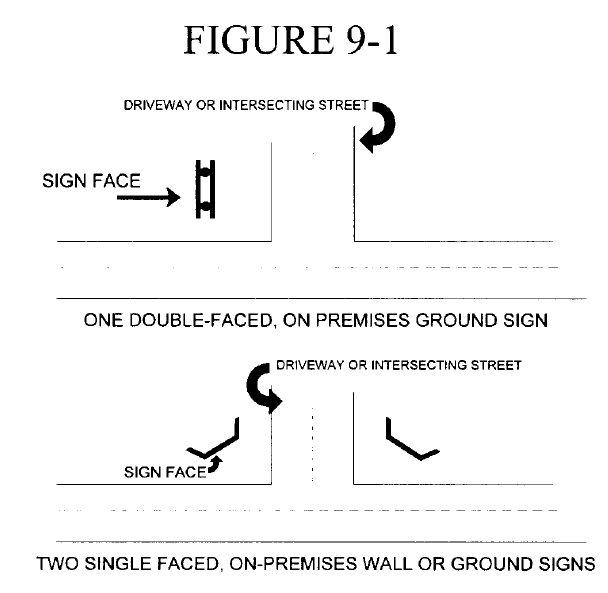
Such signs shall only be non-illuminated, externally illuminated, or backlit, meaning illuminated by a light source which is placed behind, and shines through, the sign face. The backlighting shall be designed to minimize glare and dispersion of light other than through the sign face.
No such ground or wall sign face shall exceed thirty-two (32) square feet in size and shall not exceed ten (10) feet in height.
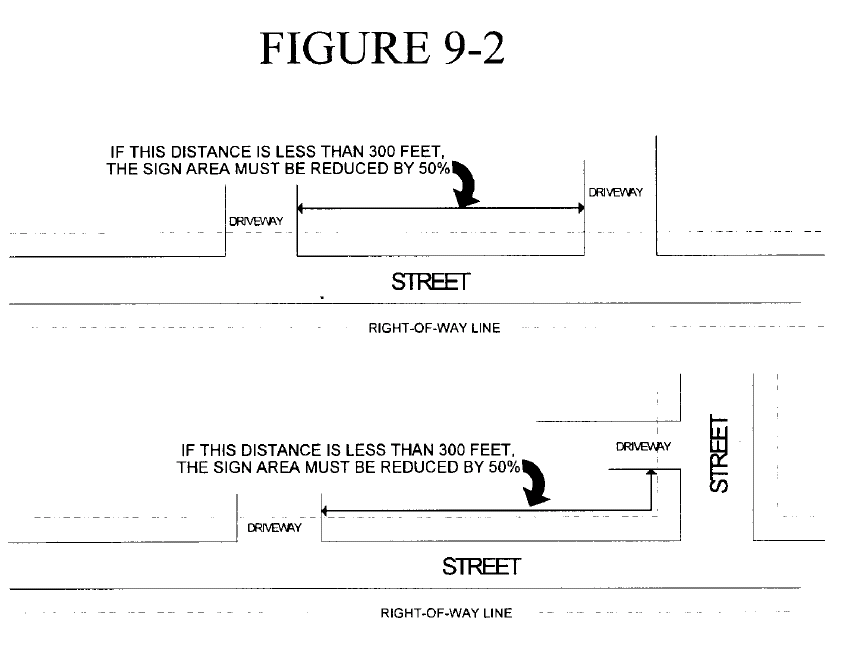
Where the distance between the nearest edges of separate entrances to the same residential development, farm, or ranch is less than three hundred (300) feet, as measured along the right-of-way of the abutting street, the maximum permitted sign area (indicated above) at such entrances shall be reduced by fifty percent (50%) (Figure 9.2).
3.
Changeable-message monument signs shall confirm to the specific requirements of Section 9.03.00.H.
4.
Directional signs which shall not exceed six (6) square feet each in sign area, may be installed as necessary for safety.
5.
Billboards shall only be permitted on properties which are physically contiguous to I-95 and the Florida Turnpike, located so as to be visible from such highway, and as further restricted in Section 9.02.02(A). Such signs shall not be spaced less than one thousand five hundred (1,500) feet from another billboard which is on the same side of, and is directed at, the same highway.
6.
Public utility signs, identifying the location of structures or facilities that may present a safety hazard, such as underground lines, high voltage areas, or the like, as needed for public safety purposes may be permitted if located so as not to create public safety hazards or interfere with rights-of-way maintenance, in the judgment of the Director of Planning and Development Services or his/her designee.
B.
Residential/Conservation (R/C); Agricultural Residential (AR-1); Residential, Estate-1 (RE-1); Residential, Estate-2 (RE-2); Residential, Single-Family-2 (RS-2); Residential, Single-Family-3 (RS-3); Residential, Single-Family-4 (RS-4); Planned Mixed Use Development (PMUD) - Residential (Low Intensity).
1.
One (1) non-illuminated nameplate per dwelling unit which shall not exceed three (3) square feet in sign area.
2.
Directional signs which shall not exceed six (6) square feet each in sign area may be installed as necessary for safety.
3.
One (1) double-faced, ground sign or two (2) single-faced, wall or ground signs, located at each principle entrance into a residential development, farm, or ranch, as generally depicted in Figure 9-3. Wall signs shall be located on opposite sides of such entrances.
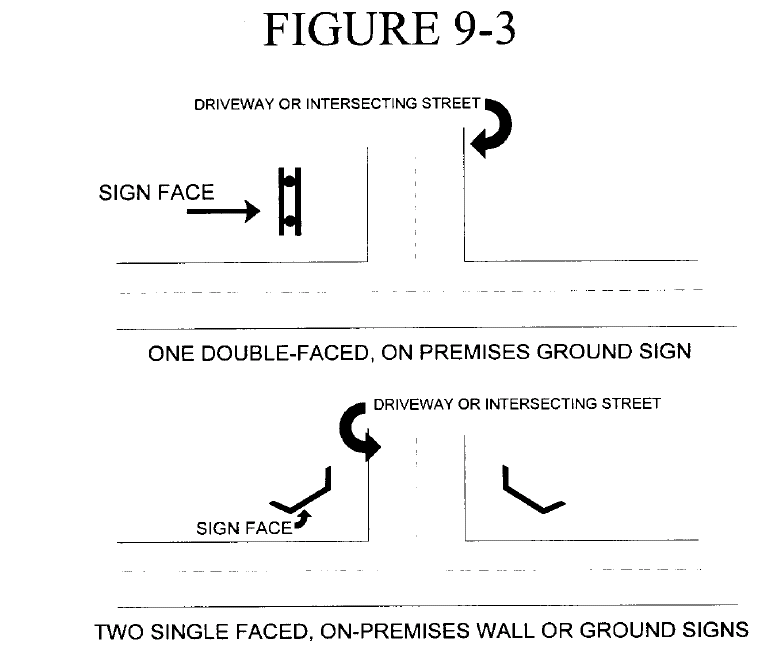
Such signs shall only be non-illuminated, externally illuminated, backlit, meaning illuminated by a light source which is placed behind, and shines through, the sign face. The backlighting shall be designed to minimize glare and dispersion of light other than through the sign face.
No such ground or wall sign face shall exceed thirty-two (32) square feet in size, and shall not exceed ten (10) feet in height.
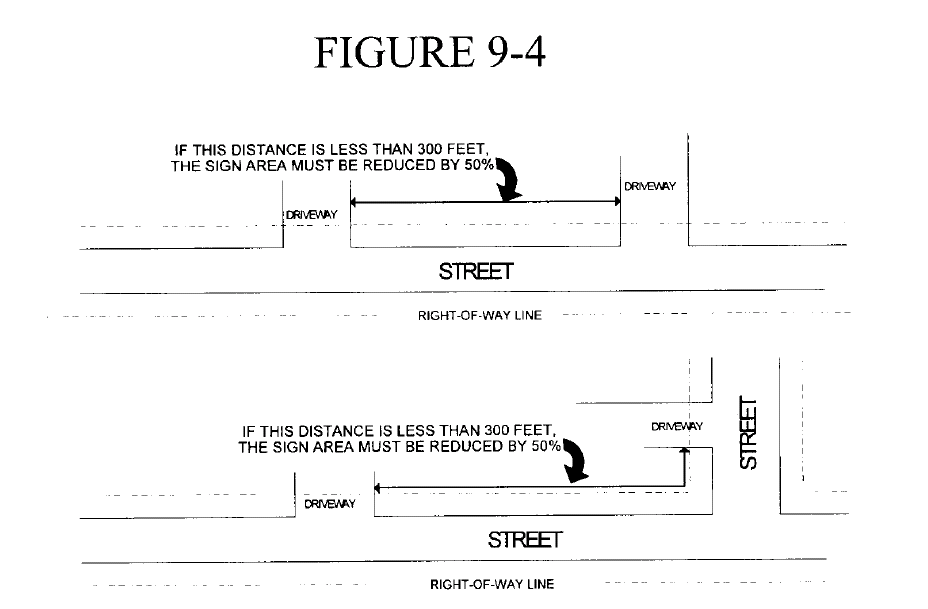
Where the distance between the nearest edges of separate entrances to the same residential development, farm, or ranch is less than three hundred (300) feet, as measured along the right-of-way of the abutting street, the maximum permitted sign area (indicated above) at such entrances shall be reduced by fifty percent (50%) (Figure 9-4).
4.
Public utility signs, identifying the location of structures or facilities that may present a safety hazard, such as underground lines, high voltage areas, or the like, as needed for public safety purposes may be permitted if located so as not to create public safety hazards or interfere with rights-of-way maintenance, in the judgment of the Director of Planning and Development Services or his/her designee.
C.
Residential, Mobile Home-5 (RMH-5); Residential, Multiple-Family-5 (RM-5); Residential, Multiple-Family-7 (RM-7); Residential, Multiple-Family-9 (RM-9); Residential, Multiple-Family-11 (RM-11); Residential, Multiple-Family-15 (RM-15); Planned Unit Development (PUD); Recreational Vehicle Park (RVP); Hutchinson Island Residential District (HIRD); Planned Mixed Use Development (PMUD) - Residential (Medium and High Intensities).
1.
One (1) non-illuminated nameplate per dwelling unit consistent with the following maximum sign area standards:
a.)
Single Family: Three (3) square feet
b.)
Multi-Family: One (1) square foot
2.
One (1) double-faced, ground sign or two (2) single-faced, wall or ground signs, located at each principle entrance into a residential development, farm, or ranch, as generally depicted in Figure 9-5. Wall signs shall be located on opposite sides of such entrances.
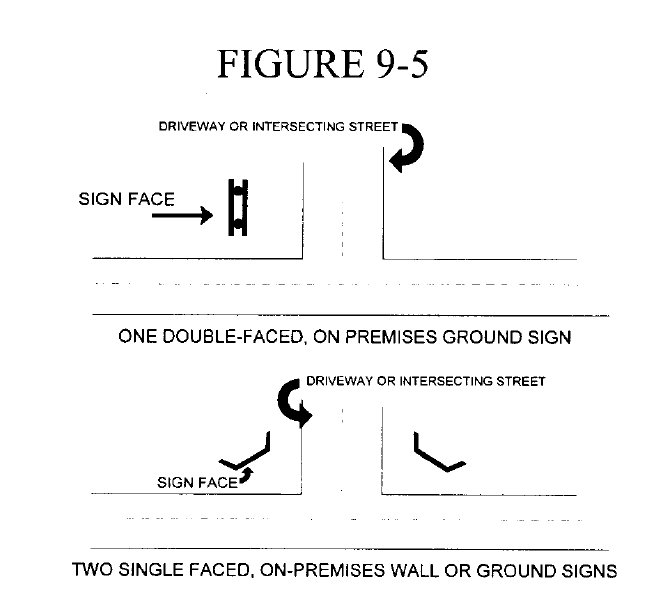
Such signs shall only be non-illuminated, externally illuminated, backlit, meaning illuminated by a light source which is placed behind, and shines through, the sign face. The backlighting shall be designed to minimize glare and dispersion of light other than through the sign face.
No such ground or wall sign face shall exceed thirty-two (32) square feet in size, and shall not exceed ten (10) feet in height.
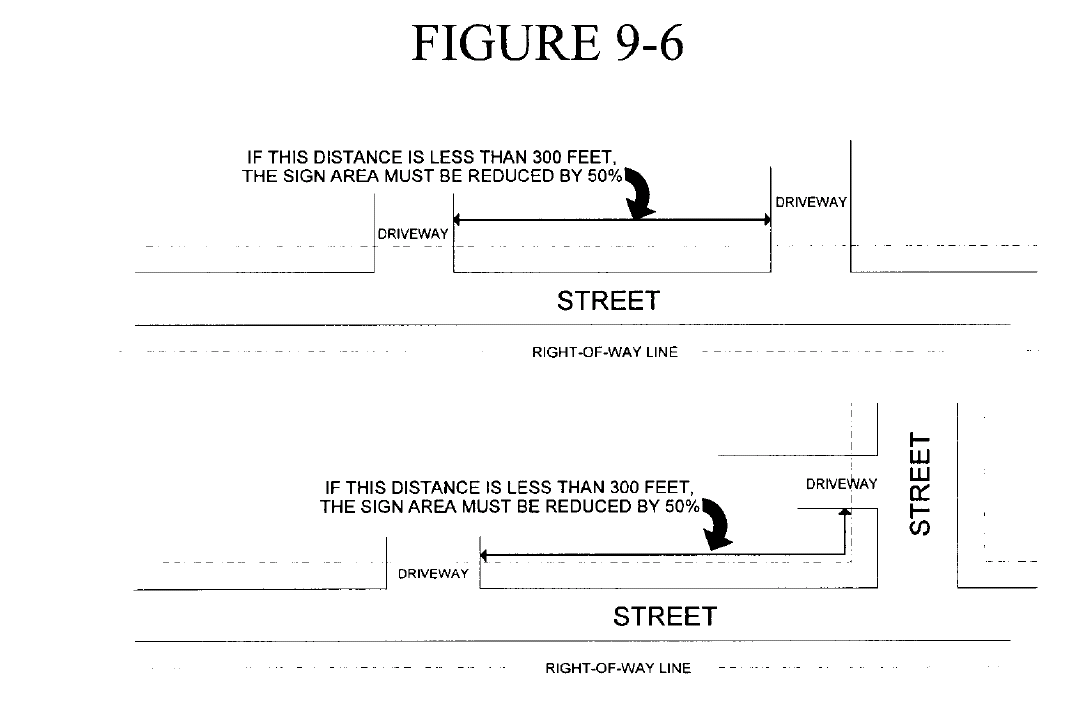
Where the distance between the nearest edges of separate entrances to the same residential development, farm, or ranch is less than three hundred (300) feet, as measured along the right-of-way of the abutting street, the maximum permitted sign area (indicated above) at such entrances shall be reduced by fifty percent (50%) (Figure 9-6).
3.
Directional signs, which shall not exceed six (6) square feet in sign area, may be installed as necessary for safety.
4.
Public utility signs, identifying the location of structures or facilities that may present a safety hazard, such as underground lines, high voltage areas, or the like, as needed for public safety purposes may be permitted if located so as not to create public safety hazards or interfere with rights-of-way maintenance, in the judgment of the Director of Planning and Development Services or his/her designee.
D.
Commercial, Office (CO); Planned Mixed Use Development (PMUD) - Professional Service/Office (Low, Medium, and High Intensities).
1.
One (1) nameplate per occupant which shall not exceed two (2) square feet in sign area.
2.
Any establishment or group of establishments that has a street lot frontage of fifty (50) feet or more, shall be permitted one (1) ground sign which shall not exceed a sign area equal to one (1) square foot for every two (2) linear feet of street frontage, up to a maximum of one hundred (100) square feet. Such ground signs shall also be consistent with the following standards:
a.)
For property that is located within any non-residential, non-agricultural Future Land Use District, as established in the St. Lucie County Comprehensive Plan, ground signs shall not exceed a height of twenty (20) feet.
b.)
For property that is located within the MXD or any residential or agricultural Future Land Use District, as established in the St. Lucie County Comprehensive Plan, ground signs shall not exceed a height of ten (10) feet. Such signs shall only be non-illuminated, externally illuminated, or backlit, meaning illuminated by a light source which is placed behind, and shines through, the sign face. The backlighting shall be designed to minimize glare and dispersion of light other than through the sign face.
c.)
Changeable-message monument signs shall conform to the specific requirements of Section 9.03.00.H.
3.
Wall, projecting, and/or canopy signs (attached canopy only) consistent with the following standards:
a.)
For property that is located within any non-residential, non-agricultural Future Land Use District, as established in the St. Lucie County Comprehensive Plan, total wall, projecting, and/or canopy sign area may equal up to twenty percent (20%) of the total wall face area fronting the main street.
b.)
For property that is located within the MXD or any residential or agricultural Future Land Use District, as established in the St. Lucie County Comprehensive Plan, total wall, projecting, and/or canopy sign area may equal up to ten percent (10%) of the total wall face area fronting the main street. Such signs shall only be non-illuminated, externally illuminated, or backlit, meaning illuminated by a light source which is placed between a background and the sign face.
Up to fifty percent (50%) of the permitted wall, projecting, or canopy sign area may be located on any other wall face of the same building or on any other canopy which is attached to such building.
4.
Directional signs which shall not exceed six (6) square feet in sign area may be installed as necessary for safety.
5.
Public utility signs, identifying the location of structures or facilities that may present a safety hazard, such as underground lines, high voltage areas, or the like, as needed for public safety purposes may be permitted if located so as not to create public safety hazards or interfere with rights-of-way maintenance, in the judgment of the Director of Planning and Development Services or his/her designee.
E.
Commercial, Neighborhood (CN); Commercial Resort (CR); Institutional (I); Religious Facilities (RF); Planned Mixed Use Development (PMUD) - Institutional (Low, Medium, and High Intensities), General Commercial (Low Intensity), and Public Service/Utilities (Low Intensity).
1.
Wall, projecting, and/or canopy signs (attached canopy only) consistent with the following standards:
a.
For property that is located within any non-residential, non-agricultural Future Land Use District, as established in the St. Lucie County Comprehensive Plan, total wall, projecting, and/or canopy sign area may equal up to twenty percent (20%) of the total wall face area fronting the main street.
b.
For property that is located within the MXD or any residential or agricultural Future Land Use District, as established in the St. Lucie County Comprehensive Plan, total wall, projecting, and/or canopy sign area may equal up to ten percent (10%) of the total wall face area fronting the main street.
Up to fifty percent (50%) of the permitted wall, projecting, or canopy sign area may be located on any other wall face of the same building or on any other canopy attached to such building.
2.
A maximum of four (4) canopy signs per face of free-standing canopy structure(s), consistent with the following standards:
a.
For property that is located within any non-residential, non-agricultural Future Land Use District, as established in the St. Lucie County Comprehensive Plan, total canopy sign area may equal up to twenty percent (20%) of the total canopy face area, except that no single canopy face shall have more than forty-five (45) square feet of sign area.
b.
For property that is located within the MXD or any residential or agricultural Future Land Use District, as established in the St. Lucie County Comprehensive Plan, total canopy sign area may equal up to ten percent (10%) of the total canopy face area, except that no single canopy face shall have more than twenty-three (23) square feet of sign area.
3.
Any establishment or group of establishments that has a street lot frontage of fifty (50) linear feet or more, shall be permitted one (1) ground sign. Such sign shall not exceed a sign area equal to one (1) square foot for every two (2) linear feet or major fraction thereof of street lot frontage up to a maximum of one hundred (100) square feet. Such ground signs shall also be consistent with the following standards:
a.
For property that is located within any non-residential, non-agricultural Future Land Use District, as established in the St. Lucie County Comprehensive Plan, ground signs shall not exceed a height of twenty (20) feet.
b.
For property that is located within the MXD or any residential or agricultural Future Land Use District, as established in the St. Lucie County Comprehensive Plan, ground signs shall not exceed a height of ten (10) feet.
c.
Changeable-message monument signs shall conform to the specific requirements of Section 9.03.00.H.
4.
One (1) pedestrian sign per establishment which shall not exceed six (6) square feet in sign area.
5.
One (1) rear entrance wall sign per establishment which shall not exceed six (6) square feet in sign area.
6.
Directional signs, which shall not exceed six (6) square feet each in sign area, may be installed as necessary for safety.
7.
Public utility signs, identifying the location of structures or facilities that may present a safety hazard, such as underground lines, high voltage areas, or the like, as needed for public safety purposes may be permitted if located so as not to create public safety hazards or interfere with rights-of-way maintenance, in the judgment of the Director of Planning and Development Services or his/her designee.
F.
Commercial General (CG); Industrial Light (IL); Industrial Heavy (IH); Industrial Extraction (IX); Utilities (U); Planned Mixed Use Development (PMUD) - General Commercial (Medium and High Intensities), Public Service/Utilities (Medium and High Intensities), Industrial (Medium and High Intensities).
1.
Billboards shall only be permitted on properties which are physically contiguous to I-95, the Florida Turnpike, U.S. 1, Orange Avenue, and Kings Highway/Turnpike Feeder Road, located so as to be visible from such highway, and as further restricted in Section 9.02.02(A). Such signs shall not be spaced less than one thousand five hundred (1,500) feet from another billboard which is on the same side of, and is directed at, the same highway.
2.
A maximum of four (4) wall, projecting, and/or canopy signs (on attached canopies only) per establishment. Such sign(s) shall not exceed a total sign area equal to twenty percent (20%) of the total wall face area of each establishment fronting on the main street. Fifty percent (50%) of such permitted sign area may be located on any other wall surface of the same building or on any other canopy attached to such building.
3.
A maximum of four (4) canopy signs per face of free-standing canopy structure(s). Such signs shall not exceed a total sign area of twenty percent (20%) of the total canopy face area, except that no single canopy face shall have more than forty-five (45) square feet of sign area.
4.
Any establishment or group of establishments having from fifty (50) to one hundred fifty (150) linear feet of frontage shall be permitted one (1) ground sign. Such sign shall not exceed a sign area equal to one (1) square foot for every one (1) linear foot or major fraction thereof of street lot frontage.
Establishments or groups of establishments having more than one hundred fifty (150) linear feet of frontage, shall be permitted one (1) ground sign. Such sign shall not exceed a sign area equal to either one (1) square foot for every one and one-half (1½) linear feet of street lot frontage, or one hundred fifty (150) square feet, whichever is greater, up to a maximum of two hundred (200) square feet. One (1) additional ground sign shall be permitted when the street lot frontage exceeds three hundred (300) linear feet. The second ground sign shall not exceed a sign area equal to one (1) square foot for every one and one-half (1½) linear feet of street lot frontage in excess of the first three hundred (300) feet of frontage. The sign area of individual signs may be aggregated, except that no single sign shall exceed a sign area of two hundred (200) square feet.
5.
Changeable-message monument signs shall conform to the specific requirements of Section 9.03.00.H.
Ground signs, including changeable message monument signs, shall not exceed a height of thirty (30) feet.
6.
For any establishment or group of establishments that has a street frontage of three hundred (300) linear feet or more and which has outdoor displays as provided for in Section 7.10.02 of this Code, the Planning and Development Services Director or his/her designee may allow for the placement of two (2) additional ground signs, using and subject to the procedures set forth in Section 9.04.01. The Director or his/her designee shall allow for such additional signage when it is shown that operation as provided under Section 7.10.02 creates a specific need. Such additional signs may not exceed one hundred (100) square feet in area nor shall they exceed a height of thirty (30) feet.
7.
One (1) pedestrian sign per establishment which shall not exceed six (6) square feet in sign area.
8.
One (1) rear entrance wall sign per establishment which shall not exceed six (6) square feet in sign area.
9.
Directional signs which shall not exceed six (6) square feet in sign area may be installed as necessary for safety.
10.
Public utility signs, identifying the location of structures of facilities that may present a safety hazard, such as underground lines, high voltage areas, or the like, as needed for public safety purposes may be permitted if located so as not to create public safety hazards or interfere with rights-of-way maintenance, in the judgment of the Planning and Development Services Director or his/her designee.
(Ord. No. 2013-39, § A, 12-17-13; Ord. No. 15-002, Pt. A, 4-7-2015; Ord. No. 16-009, Pt. A, 6-7-2016; Ord. No. 2020-29, Pt. A, 12-1-2020)
9.01.02. - Authorized Temporary Signs.
A temporary sign is any sign that does not meet the construction standards of the Florida Building Code and that, for a limited period of time, conveys any message relating to a special event or other occurrence of limited duration, such as an election, a building under construction, real estate for sale, rent or lease, or a business grand opening. Temporary signs include, without limitation, portable signs and sidewalk signs. Temporary signs of the types described below in this section are allowable, subject to the following general requirements:
1.
No temporary sign may have any characteristic that renders it a prohibited sign under Section 9.03.00.
2.
No temporary sign may be located at the intersection of two (2) streets or roadways, or within the segment created by the curb or road edges and an imaginary line between the points thirty (30) feet back from where the curb lines of the intersection quadrant intersect.
3.
No temporary sign shall be illuminated.
4.
Temporary signs may be erected only if located wholly on private property, by or with the permission of the property owner.
5.
Temporary signs must be capable of being moved and removed immediately and must be removed and stored indoors if a hurricane or other high-wind weather event is forecast to occur within twenty-four (24) hours.
6.
Temporary signs must be removed within ten (10) days after conclusion of the event or termination of the circumstance to which they relate.
7.
Except as stated below with respect to a specific type of temporary sign, allowable temporary signs may be erected without a permit.
Subject to the foregoing general regulations, specific temporary signs are allowable subject to the following additional provisions:
A.
Commercial Temporary Signs. Temporary signs relating to a commercial establishment, product, or service, or related to the sale or rental of nonresidential real estate, are classified as commercial temporary signs and shall be subject to the following regulations:
1.
Commercial temporary signs shall be limited to one (1) sign per parcel, establishment, dwelling unit, or per every five (5) acres or fraction thereof providing no more than one (1) sign per three hundred (300) feet of frontage shall be allowed on any one (1) parcel of property regardless of total acreage. A maximum of three (3) signs per parcel shall be provided on a single road frontage.
2.
Commercial temporary signs shall not exceed the following maximum sign areas in square feet by zoning district and parcel size:
3.
For properties exceeding five (5) acres, the sign area of individual signs, as indicated above, may be aggregated, except that no single sign may exceed an area of three hundred seventy-eight (378) square feet.
B.
Non-commercial Temporary Signs. Non-commercial temporary signs are temporary signs that do not fall within the definition of commercial temporary signs.
1.
Non-commercial temporary signs shall not exceed the following maximum sign areas by Zoning District:
C.
Temporary Flags, Banners, and Pennants Requiring a Permit. Flags which are not exempt from permitting under Section 9.04.00, banners, and/or pennants may be erected on a temporary basis upon the issuance of a permit. Such permit shall be issued by the Planning and Development Services Director or his/her designee using and subject to the procedures set forth in Section 9.04.01; provided that the Planning and Development Services Director or his/her designee shall grant or deny such permit within fifteen (15) days from receipt of a completed application. Such permit shall be granted provided that [a] the requirements of this Code are otherwise met; [b] no more than four (4) permits per year for one (1) professionally made banner shall be issued to any one (1) applicant, or a single applicant with more than three hundred (300) linear feet of roadway frontage may be permitted to have one banner every three hundred (300) linear feet of roadway frontage, [c] may be displayed for no more than a total of sixty (60) calendar days per year, and [d] also may be permitted during the holiday season from October 15 to January 2, when the above criteria are met and shall not count as part of the aforementioned sixty (60) day limit and [e] shall be no greater than 32 square feet, and [f] such flag, banner, or pennant shall not exhibit any other characteristic of a prohibited sign under Section 9.03.00. Such flags, banners, and pennants shall be removed by the permittee upon the expiration of the permit.
D.
Sidewalk Signs. One (1) temporary, movable sign that rests on but is not secured or attached to the ground, is permitted in commercial areas to be placed by a business or other occupant outside its premises as long as the sign does not impede the use of the sidewalk or block access to any part of the building or sidewalk as determined by applying the clearance standards under the 2012 Florida Accessibility Code for Building Construction. Such signs shall not contain content larger than eight (8) square feet with not more than two (2) sign faces, shall not be placed in the parking, county right-of-way or drainage swale and shall be placed not farther than twenty (20) feet from the entrance to the business. Such signs may be displayed only during the time the premises are open to the public, and must be stored inside the premises at other times. A permit for a temporary sidewalk sign is not required.
(Ord. No. 2013-39, § A, 12-17-13; Ord. No. 15-002, Pt. A, 4-7-2015; Ord. No. 16-009, Pt. A, 6-7-2016)
9.02.01. - Signs Other Than Billboards.
A.
Wall Signs.
1.
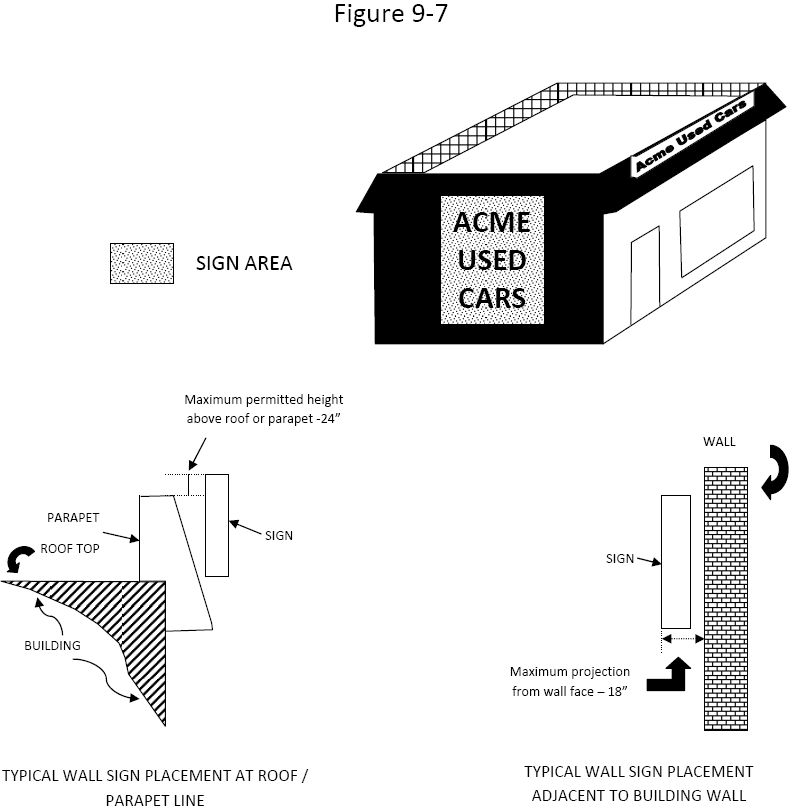
Shall not extend more than eighteen (18) inches from the wall or facade of the building to which they are attached.
2.
Shall not extend more than twenty-four (24) inches above the roof or parapet of a building, whichever is greater.
3.
Shall be adequately constructed and securely anchored in accordance with the Florida Building Code.
B.
Mansard and Marquee Signs.
1.
Mansard and marquee signs shall conform to Wall Sign provisions, Section 9.02.01(A).
C.
Projecting Signs.
1.
Shall provide a vertical clearance of not less than nine (9) feet over any pedestrian walkway or fourteen (14) feet over any vehicular driveway.
2.
Shall not extend closer (leading edge measured horizontally) than eighteen (18) inches to the curbface or, where no curb is installed, to the curbline as established by the County Engineer.
3.
Shall not extend more than twenty-four (24) inches above the roof or parapet of a building, whichever is greater.
4.
Shall be adequately constructed and securely anchored in accordance with the Florida Building Code.
D.
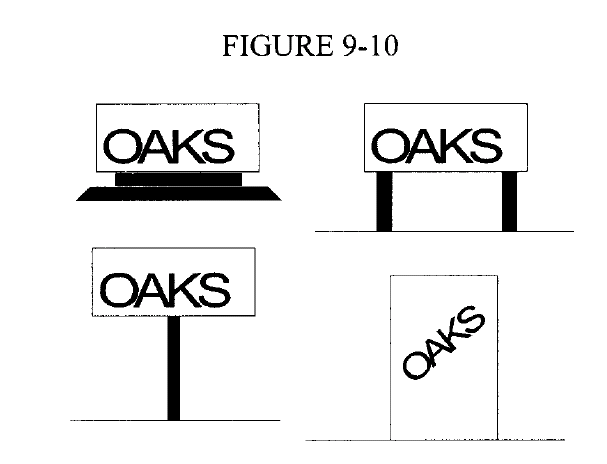
Ground Signs.
1.
Shall not exceed a total height of thirty (30) feet except as may be further restricted in this Code, and fifty (50) feet total height along those properties which are physically contiguous to and within fifty (50) feet of the right-of-way boundary of the Florida Turnpike and I-95.
The height of ground signs may either be measured from the crown of the road or at finished grade. If an applicant for a ground sign permit elects to measure the height from the crown of the road, the applicant shall submit, at the time of application for such permit, a survey of the property and of the abutting street.
2.
Shall not be located less than eighteen (18) inches (leading edge measured horizontally) from any public right-of-way line, adjacent property line, or structure.
3.
Shall provide a vertical clearance of not less than nine (9) feet over any pedestrian walkway or fourteen (14) feet over any vehicular driveway.
4.
When an access way intersects a public or private right-of-way or when the subject property abuts the intersection of two (2) or more public or private rights-of-way, all ground signs within the triangular area described below shall have a height of not more than three (3) feet or a vertical clearance of not less than ten (10) feet, and shall not have poles or support structures which are individually greater than twelve (12) inches in diameter.
The triangular area referenced above is the area of property located at the corner formed by the intersection of two (2) public or private rights-of-way, or at each corner formed by the intersection of an access way with a public or private right-of-way. Two (2) sides of such triangular area shall be twenty (20) feet in length as measured horizontally from the point of intersection, and the third side shall be a line connecting the ends of the two (2) other sides.
5.
Shall be adequately constructed and securely anchored in accordance with the Florida Building Code.
6.
Shall have a landscaped area around its base which extends a minimum distance of three (3) feet in all directions. Such landscaped area shall be completely covered by natural drought-tolerant ground cover and shrubs, hedges or similar vegetative materials. The Planning and Development Services Director shall grant relief from this landscaping requirement for billboards which are located on properties that are physically contiguous to I-95 or the Florida Turnpike if it is determined that such signs are located more than one hundred (100) feet from a developed area as defined in Section 2.00.00 of this Code.
E.
Pedestrian Signs.
1.
Shall provide a vertical clearance of not less than nine (9) feet over any pedestrian walkway.
2.
Shall not extend beyond the underside of a cantilevered roof, portico, or other overhang.
3.
Where the underside of an overhang exceeds a height of thirteen (13) feet, a pedestrian sign may be attached to the exterior wall from which such overhang extends. When a pedestrian sign is attached to a wall, such sign shall not extend (leading edge measured horizontally) more than thirty-six (36) inches from the wall face of any building.
4.
Shall include only the name and/or address of the establishment or use.
F.
Canopy Signs.
1.
Shall not extend more than eighteen (18) inches from the face of the canopy to which they are attached.
2.
Shall not extend above the roof or below the underside of the canopy to which they are attached.
3.
Shall be adequately constructed and securely anchored in accordance with the Florida Building Code.
4.
The height of individual canopy faces, for purposes of measuring sign area, shall be measured from the roof to the underside of the canopy.
(Ord. No. 2013-39, § A, 12-17-13; Ord. No. 16-009, Pt. A, 6-7-2016)
9.02.02. - Billboards.
A.
Shall not be located along any roadway other than the following:
1.)
Florida's Turnpike Indian River county line to Martin county line
2.)
I-95 Indian River county line to Martin county line
3.)
US #1 Indian River county line to Martin county line
except as may be further restricted in Section 9.01.01, of this Code.
B.
Shall not exceed a sign area of three hundred seventy-eight (378) square feet including all trim, molding, or skirting, except as may be further restricted in this Code.
C.
Shall not exceed a sign face dimension of thirty-six (36) feet horizontally or twelve (12) feet vertically including all trim, molding, or skirting.
D.
Shall not exceed a total height above the crown of the road of thirty-five (35) feet, except as may be further restricted in this Code, and fifty (50) feet total height above grade along the Florida Turnpike and I-95.
The height of billboards that are ground signs may either be measured from the crown of the road or at finished grade. If an applicant for a ground sign permit elects to measure the height from the crown of the road, the applicant shall submit, at the time of application for such permit, a survey of the property and of the abutting street.
E.
Shall be located a minimum of twenty-five (25) feet from any street right-of-way or property line.
F.
Shall not be located closer to a right-of-way line than any building on contiguous property if such building is situated within one hundred (100) feet of the sign.
G.
Shall not be located within a radius of two hundred (200) feet of any residential zone or residential use area within an approved Planned Unit Development or Planned Mixed Use Development Project.
H.
Shall not be located so as to face a lot on the same street occupied by a religious facility, public school, public park, playground, beach, civic area, or cemetery, nor nearer to such uses than a radius of two hundred (200) feet.
I.
Shall comply with Section 9.02.01(D) where the billboard is also a ground sign.
J.
Shall not be located on Hutchinson Island.
(Ord. No. 16-009, Pt. A, 6-7-2016)
9.04.01. - Permitting.
A.
Except as specifically exempted in Section 9.01.02 or Section 9.04.02, the erection, physical alteration, reconstruction, or physical conversion of any sign shall not be commenced without obtaining a Sign Permit from the Planning and Development Services Director. No Sign Permit shall be issued for development without the concurrent issuance of a Certificate of Zoning Compliance as provided by Section 11.05.00 of this Code. No permit shall be required for the sole purpose of changing content, including wording and graphics, on a lawfully existing sign that otherwise complies with the requirements of this Code both before and after such change.
B.
The process for obtaining a Sign Permit shall be the same as the process for obtaining a Building Permit pursuant to Chapter XI of this Code, except as specifically modified in this Section. The application shall be made on such form as the Planning and Development Services Director or his/her designee shall prescribe, which shall include a depiction of the proposed sign, its specifications including height, sign area, dimensions, location on the site and in relation to other structures and rights-of-way, means of support, method of illumination, if any, and such other information as the Planning and Development Services Director or his/her designee may require to determine whether the proposed sign meets the requirements of this Chapter.
C.
The Planning and Development Services Director or his/her designee shall grant or deny an application for a Sign Permit and Certificate of Zoning Compliance applicable to such application, within thirty (30) days from receipt of a complete application. The Planning and Development Services Director or his/her designee shall notify the applicant within fifteen (15) days from receipt of any application, or amendment or supplement thereto, if the application is incomplete, and shall notify the applicant of the information necessary to complete the application. The applicant has the option of supplying such information or, if the applicant deems the application complete despite such notification, upon notifying the Planning and Development Services Director or his/her designee who shall then treat the application as complete. Any application for a Sign Permit that is not granted or denied within thirty (30) days from receipt of a completed application shall be deemed denied.
D.
The Planning and Development Services Director or his/her designee shall grant the Sign Permit upon receipt of a completed application with all required fees, upon finding that the proposed sign conforms to all requirements of this Chapter; otherwise, the application shall be denied. The content of a proposed sign shall not be material to the grant or denial of a Sign Permit, except as necessary to determine that a sign conforms to the specific requirements of this Chapter.
E.
The denial of an application for Sign Permit may be appealed by the applicant to the Board of Adjustment in accordance with Chapter XI of this Code, within thirty (30) days from denial. The Board of Adjustment shall render its decision within forty-five (45) days from the date the appeal is filed. Any Sign Permit applicant aggrieved by a decision of the Board of Adjustment may seek review by certiorari in the Circuit Court in accordance with Chapter XI of this Code, within thirty (30) days from rendition of the decision of the Board of Adjustment.
9.04.02. - Exceptions.
The following signs shall not be required to have a sign permit, provided they do not otherwise violate any specific prohibition in this Chapter and they are not designed or located so as to cause or create a risk to public safety, as set forth in Section 9.03.00(M):
A.
Residential nameplates that comply with this Chapter.
B.
Temporary signs providing they comply with Section 9.01.02 of this Chapter.
C.
Signs that are not visible from any roadway or adjoining property.
D.
Memorial signs or tablets within duly licensed cemeteries.
E.
Public convenience signs, communicating the location of restrooms or public telephones.
F.
Public warning signs, indicating the dangers of trespassing, swimming, animals, or the like.
G.
Seasonal displays or decorations not advertising a product, service, or establishment.
H.
Garage or yard sale signs providing they are removed by sunset of the last day of the sale.
I.
Non-illuminated building identification signs which are under three (3) square feet in sign area on buildings which are located at least three hundred (300) feet from a public right-of-way.
J.
Ten (10) or fewer flags, per parcel or common development site. Such flags shall not be placed less than thirty (30) feet apart. Any flags, in excess of ten (10) per parcel or common development site may be erected on a temporary basis upon the issuance of a permit in accordance with Section 9.01.02(C).

