
Saint Lucie County Unincorporated
City Zoning Code
City Zoning Code
CHAPTER II
DEFINITIONS
2.00.00.- DEFINITIONS
Unless otherwise expressly stated, the following words and terms shall, for the purposes of this ordinance, have the meanings shown in this section. Where terms are not defined in this ordinance and are defined in the Florida Building Code, such terms shall have the meanings ascribed to them in that code. Where terms are not defined in this ordinance or the Florida Building Code, such terms shall have ordinarily accepted meanings such as the context implies:
Accessory Security Residence: One (1) dwelling unit contained within the commercial building, for on-site security purposes.
Accessory Structure, At-grade. An accessory structure constructed not more than thirty (30) inches above the finished grade and not supported by any type of foundation or footer system capable of supporting or permitting the erection or placement of walls or roofing systems, which may be located within the side or rear yard, except in the case of corner lots, provided that no public drainage or utility easement is impacted without the expressed written release and authorization for such occupation by all affected drainage or utility authorities. At-grade construction does not apply to permitted driveways, sidewalks access to or through a parcel or parking areas that are otherwise compliant with applicable County regulations.
Accessory Use: A structure or use that:
(1)
Is subordinate to and serves the principal building or principal use;
(2)
Unless specified in Section 8.00.02, is subordinate in area, extent, and purpose to the principal structure or principal use served;
(3)
Contributes to the comfort, convenience, or necessity of the occupant, business, or industry in the principal structure or use; and
(4)
Is located on the same lot as the principal structure or use.
Accessory Use: For purposes of Section 7.10.23, means a secondary use including a use that is related to, incidental to, subordinate to and subservient to the main use of the property on which an antenna and/or telecommunications tower is sited.
Accessway: A paved or unpaved area intended to provide ingress or egress of vehicular or pedestrian traffic from a public or private right-of-way or easement to an off street parking, loading, or similar area.
Acquiring Authority: The governmental entity proposing to acquire private property for public transportation or other purpose, pursuant to eminent domain action. Acquiring authorities include, but are not limited to, St. Lucie County ("County"), and the Florida Department of Transportation ("FDOT").
Addition (to an Existing Building): As used in Section 6.05.00, Flood Damage Prevention, means any walled and roofed expansion to the perimeter or height of a building.
Adult Establishment: An establishment that is one (1) or more of the following:
(1)
Adult Arcade: Any place to which the public is permitted or invited wherein coin-operated or slug-operated or electronically, electrically, or mechanically controlled still or motion picture machines, projectors, or other image-producing devices are maintained to show images to one (1) or more persons per machine at any one (1) time, and where the images so displayed have as their primary or dominant theme the depicting or describing of "specified sexual activities" or "specified anatomical areas".
(2)
Adult Bookstore: An establishment that sells or rents, or offers to sell or rent, for any form of consideration, adult materials and that (a) more than twenty percent (20%) of the stock on view to the public consists of adult materials or, (b) more than twenty percent (20%) of its gross revenue is derived from the sale or rental of adult materials.
Adult Materials shall mean any one (1) or more of the following:
a.
Books, magazines, periodicals or other printed matter, or photographs, films, motion pictures, video cassettes or video reproductions, slides, or other visual representations that have as their primary or dominant theme the depicting or describing of "specified sexual activities" or "specified anatomical areas" as defined below; or
b.
Instruments, devices, or paraphernalia which are designed for use in connection with "specified sexual activities" as defined below.
(3)
Adult Dancing Establishment: An establishment that permits, suffers or allows dancers, employees or other persons to display or expose specified anatomical areas to public view.
(4)
Adult Massage Parlor: A place in which "specified anatomical areas," as defined below, of one (1) person are touched by rubbing, stroking, kneading, or tapping by another person who is an employee, accompanied by the display or exposure of "specified anatomical areas," as defined below, but not including licensed health care facilities, licensed physicians or nurses engaged in the practice of their professions, establishments registered under F.S. Ch. 480, educational athletic facilities if the massage is a normal and usual practice in such facilities, health clubs and athletic clubs if the massage is incidental to or a normal part of the health and athletic activities, except places in which sexual intercourse takes place;
(5)
Adult Motel/Hotel: Any hotel, motel, boarding house, rooming house or other lodging which includes the word "adult" in any name it uses or otherwise advertises the presenting of closed circuit television transmissions, films, video, motion pictures or other visual material having as its primary or dominant theme the depicting or describing of "specified sexual activities" or "specified anatomical areas," as defined below, for observation by patrons of such establishment; or
(6)
Adult Motion Picture Booth: An adult motion picture booth, an enclosed area designed or used for the viewing by one (1) or more persons of motion pictures, films, video cassettes, slides or other visual materials which have as their primary or dominant theme matters depicting, illustrating or relating to specified sexual activities or specified anatomical areas.
(7)
Adult Motion Picture Theatre or Drive-in: An enclosed building or a portion or part of an enclosed building or open-air establishment designed to permit viewing by patrons for any form of consideration films, video or other visual material in which the primary or dominant theme of the material presented is distinguished or characterized by an emphasis on matter depicting, describing, or related to "specified sexual activities" or "specified anatomical areas," as defined below,
(8)
Adult Theatre: A theatre, concert hall, auditorium or similar establishment which features persons who appear in a state of nudity or live performances which have as their primary or dominant theme the depicting or describing of "specified anatomical areas" or by "specified sexual activities".
The determination as to whether an establishment constitutes an adult establishment, as herein defined, and shall be based upon reasonable cause. Reasonable cause may be established through visual observation of the stock, review of financial records, consideration of the nature of the stock which does not constitute adult materials or such other means which establishes a reasonable likelihood that the establishment constitutes an adult establishment. Once a preliminary determination has been made that an establishment constitutes an adult establishment, the owner of such establishment shall be notified of such determination and given the opportunity to provide financial or business records, or such other materials as would indicate whether or not the establishment constitutes an adult establishment, as herein defined. A final determination shall not be made until the owner has been given the opportunity to provide such materials.
Advertising Structure: A sign or sign structure erected or intended for advertising purposes, with or without an advertisement displayed thereon, situated upon or attached to real property.
Aggrieved or Adversely Affected Person: Any person or local government which will suffer an adverse effect to an interest protected or furthered by the St. Lucie County Comprehensive Plan, including interests related to health and safety, police and fire protection systems, densities or intensities of development, transportation facilities, health care facilities, equipment or services, or environmental or natural resources. The alleged adverse effect may be shared in common with other members of the community at large, but shall exceed in degree the general interest in common good shared by all persons.
Agricultural Laborer: Any person employed in hand labor operations in planting, cultivation, or harvesting agricultural crops.
Agricultural Labor Housing: One (1) or more buildings constructed and established as living quarters for seasonal or migrant agricultural laborers permitted by the Florida Department of Health as a migrant labor camp.
Agricultural Land: Land with soil, climate, water and topography so interrelated that, if prudently managed to protect its natural qualities, is favorable for the production of adapted crops.
Alley: A right-of-way privately or publicly owned, primarily for service access to the back or sides of properties.
Alteration of a Watercourse: A dam, impoundment, channel relocation, change in channel alignment, channelization, or change in cross-sectional area of the channel or the channel capacity, or any other form of modification which may alter, impede, retard or change the direction and/or velocity of the riverine flow of water during conditions of the base flood.
Amateur Radio Antenna: An antenna used to engage in amateur radio communications utilized by a Federal Communications Commission (FCC) licensed amateur radio operator.
Animated Sign: A sign that depicts action or motion or changes color through electrical or mechanical means; an animated sign differs from a flashing sign in that it uses movement to create a special effect or scene.
Antenna: A transmitting and/or receiving device mounted on a tower, building or structure and used in telecommunications personal wireless services that radiates or captures electromagnetic waves, digital signal, analog signals, and radio frequencies, directional antennas such as panel and microwave dish antennas, and omni-directional antennas such as whips but excluding small wireless facilities as defined in the St. Lucie County Communications Rights-of-Way Ordinance, Chapter 44, Article I of the Code of Ordinances, radar antennas, amateur radio antennas, and satellite earth stations.
Appeal: As used in Section 6.05.00, Floodplain Management, a request for a review of the Floodplain Administrator's interpretation of any provision of this ordinance.
Applicant [owner, licensed contractor, and/or lessee]: For purposes of Section 7.10.23, a person or entity with property owner authorization, with an application before the County for a permit for a wireless service facility.
Appropriately Treat: For the purposes of Section 7.10.34 only, this term means to treat Leachate in a domestic or industrial wastewater treatment facility that has obtained or will obtain all of the permits and approvals from the Florida Department of Environmental Protection that are needed to receive and treat the Leachate.
Aquatic Preserve: Includes the North Fork of the St. Lucie River and the Indian River Lagoon.
Aquifer: A geologic formation, group of formations, or part of a formation (stratum) that is capable of yielding potentially useable quantities of water from wells or springs.
Area of Shallow Flooding: A designated AO or VO Zone on a community's Flood Insurance Rate Map (FIRM) with base flood depths from one (1) to three (3) feet where a clearly defined channel does not exist, where the path of flooding is unpredictable and indeterminate, and where velocity flow may be evident.
Area of Special Flood Hazard: Refers to the land in the floodplain that is subject to a one percent (1%) or greater chance of flooding in any given year. The area may be designated on the Flood Hazard Boundary Map (FHBM) as Zone A, AO, AH, A1—A30, AE, A99, VO or V1—V30, VE or V.
Arterial Road or Street: A route providing service that is relatively continuous and of a relatively high traffic volume, long average trip length, and high operating speed. In addition, every United States numbered highway is an arterial road.
Artificial Light Source(s): Any source of light emanating from a manmade device including, but not limited to incandescent mercury vapor, metal halide or sodium lamps, spotlights, street lights, vehicular lights, construction or security lights.
ASCE 24: A standard titled Flood Resistant Design and Construction that is referenced by the Florida Building Code. ASCE 24 is developed and published by the American Society of Civil Engineers, Reston, VA.
Assessed Value: An annual determination of the just or fair market value of property upon which St. Lucie County ad valorem taxes are levied.
Atlantic Ocean: The body of water abutting the eastern shoreline of Hutchinson Island.
Awning: See "Canopy".
Awning Sign: See "Canopy Sign".
Backlit Sign: A sign illuminated by a light source which is placed behind, and shines through, the sign face.
Back-Siphonage Backflow Preventers: A device or combination of devices for preventing back-siphonage in a water supply line. They shall be installed, when required, in agreement with and under the supervision of the supplier of water or his/her designated representative (plumbing inspector, etc.) at the consumer's meter, at the property line of the consumer when a meter is not used, or at a location designated by the supplier or his/her designated representative.
Backyard Composting: The composting of organic solid waste, such as grass clippings, leaves, or food waste, generated by the owner or occupant of a single or multi-family residential dwelling unit, in cases where the composting occurs at that dwelling unit. Notwithstanding the foregoing, backyard composting does not include any process that involves the composting of biosolids or other forms of sewage sludge.
Banner or Banner Sign: Any sign on which a message, idea, or graphic design is expressed on cloth, bunting, plastic, paper, or similar non-rigid material, supported at two (2) or more edges or four (4) corners. Banner signs do not include flags.
Base Building Line: A line established by Section 7.04.04 of this Code.
Base Flood: A flood having a one percent (1%) chance of being equaled or exceeded in any given year. [Also defined in FBC, B, Section 202.] The base flood is commonly referred to as the "100-year flood" or the "1-percent-annual chance flood."
Base Flood Elevation: The elevation of the base flood, including wave height, relative to the National Geodetic Vertical Datum (NGVD), North American Vertical Datum (NAVD) or other datum specified on the Flood Insurance Rate Map (FIRM). [Also defined in FBC, B, Section 202.]
Base Station: A structure or equipment at a fixed location that enables FCC-licensed or authorized wireless communications between user equipment and a communications network. To the extent not inconsistent with applicable law, this term base station does not include a utility pole for the collocation of a small wireless facility in the County's public rights-of-way pursuant to the St. Lucie County Communications Rights-of-Way Ordinance, Chapter 44, Article I, of the County Code. The term base station does not encompass a tower as defined herein or any equipment associated with a tower. Base station includes but is not limited to:
(1)
Equipment associated with wireless communications services such as private, broadcast, and public safety services, as well as unlicensed wireless services and fixed wireless services such as microwave backhaul;
(2)
Radio transceivers, antennas, coaxial or fiber-optic cable, regular and backup power supplies, and comparable equipment, regardless of technological configuration (including distributed antenna systems ("DAS") and small-cell networks); and
(3)
Any structure other than a tower that, at the time the relevant application is filed with County under this article, supports or houses equipment described in subparagraphs (1), (2) above, and that has been reviewed and approved under the applicable zoning or siting process, or under another state or local regulatory review process, even if the structure was not built for the sole or primary purpose of providing such support. Base station does not include any structure that, at the time the relevant application is filed under this section, does not support or house equipment described in [subsection] (1) or (2) of this section [definition].
Basement: The portion of a building having its floor subgrade (below ground level) on all sides. [Also defined in FBC, B, Section 202; see "Basement (for flood loads)".]
Beach: The zone of unconsolidated material that extends landward from the mean low water line to the place where there is marked change in material or physiological form, or to the line of permanent vegetation (usually the effective limit of storm waves). Unless otherwise specified, the seaward limit of a beach is the mean low water line.
Beach or Shoreline Access Point or Access: Any walkway or ramp through or over the estuarine shoreline area or beach-dune shoreline area used for the purpose of gaining access to the beach or shoreline.
Beach-Dune Shoreline Area: Is a broader concept than that covered by the use of the words "beach" and "dune" independently and, at a minimum, consists of the whole beach-dune shoreline area.
Bench Sign: A sign attached to, or part of, a bench.
Best Management Practice: A practice or combination of practices that are the most effective, practical means of preventing or reducing the amount of pollution generated by the project to a level compatible with Florida Water Quality Standards found in Chapter 17-3, Florida Administrative Code, or in the case of an Outstanding Florida Waters, those standards prescribed in Chapter 17-4 F.A.C.
Bicycle: A vehicle propelled by human power upon which any person or persons may ride having two (2) tandem wheels, except scooters and similar devices. For the purposes of this Code bicycle shall also include unicycles, tricycles and quadracycles.
Bike Lane: A portion of roadway (four (4) to five (5) feet), which has been designated by signing and pavement markings for the preferential or exclusive use by bicyclists.
Bikepath: That portion of rights-of-way improved, designed, or ordinarily used for bicycle traffic.
Bike Ways: Any road, path, or way that in some manner is specifically designated as open to bicycle travel, regardless of whether such facility is designated for the exclusive use of bicycles or is to be shared with other transportation modes.
Billboard: A sign that is not otherwise allowable within a particular zoning district under Section 9.01.01 of this Code.
Biosolids: The solid, semisolid, or liquid residue generated during the treatment of domestic wastewater in a domestic wastewater treatment facility, formerly known as "domestic wastewater residuals" or "residuals," and includes products and treated material from biosolids treatment facilities and septage management facilities regulated by the Florida Department of Environmental Protection. The term does not include the treated effluent or reclaimed water from a domestic wastewater treatment facility, solids removed from pump stations and lift stations, screenings and grit removed from the preliminary treatment components of domestic wastewater treatment facilities, or ash generated during the incineration of biosolids.
Board of Adjustment: The St. Lucie County Board of Adjustment, as designated by the Board of County Commissioners.
Board of County Commissioners: The St. Lucie County Board of County Commissioners. Unless otherwise stated in the text of this Code, the term "Board" shall also mean the St. Lucie County Board of County Commissioners.
Boarding House: Any dwelling in which more than two (2) persons are lodged on a continuing basis and served meals for compensation.
Bona fide agricultural use: For purposes of this Code, bona fide agricultural use means farm operations as defined in the Florida Right to Farm Act, F.S. § 823.14, on lands with a valid agricultural classification pursuant to F.S. § 193.461.
Breakaway Wall: A wall that is not part of the structural support of the building and is intended through its design and construction to collapse under specific lateral loading forces without causing damage to the elevated portion of the building or the supporting foundation system.
Broadcasting Facility: Any telecommunications tower built primarily for the purpose of broadcasting licensed AM, FM or television signals pursuant to 47 C.F.R. Part 73 of the FCC rules, as it may be amended.
Buffer: An area that is established in order to protect or insulate one (1) land use from another use.
Building: Any structure, including a roof supported by walls, designed or built for the support, enclosure, shelter or protection of persons, animals, chattels, or property of any kind, that is erected for permanent location on the ground. A manufactured building shall be considered a building for the purposes of this Code. A mobile home shall not be considered a building for the purposes of this Code. As used in Section 6.05.00, Flood Damage Prevention, the term shall mean a structure as defined in this section.
Building Permit: Any permit for the erection, placement or construction of any building, structure, or related building system or building system component, or mobile home, or portion thereof.
Building-permit Review: A review for compliance with building constructions standards adopted by the County under Chapter 553 and Chapter XIII of the County Land Development Code and does not include a review for compliance with land development regulations.
Building Support Structure: Any structure which supports floor, wall or column loads, and transmits them to the foundation. The term shall include beams, grade beams, or joists, and includes the lowest horizontal structural member exclusive of piles, columns, or footings.
Bulk: The size of buildings or structures, and their relationships to each other and to open areas. The term is intended to include:
(1)
The size of buildings or other structures;
(2)
The area of the site upon which a building or structure is located, and the number of dwelling units or rooms within such building in relation to the area of the site;
(3)
The location of exterior walls of buildings or other structures; and
(4)
Open areas relating to buildings or other structures and their relationship thereto.
Canopy: Any roof or other form that shelters from sunshine, rain, snow, or other forms of precipitation, open on at least one (1) side. A canopy may be attached to a permanent building or it may be independent structure permitted in accordance with the Florida Building Code.
Canopy Sign: Any sign that is suspended from, attached to, or forming a part of any canopy or awning, whether or not that canopy or awning is part of a permanent building or structure.
Cargo Containers: A reusable container that is originally, specifically or formerly designed for or used in the parking, shipping, movement, or transportation of freight, articles, goods, or commodities and is also designed for or capable of being mounted or moved on a rail car, truck trailer or loaded on a ship.
Carport: A canopy, roof like structure, or shed, open on two (2) sides, three (3) sides, or four (4) sides, whose purpose is to provide shelter for one (1) or more motor vehicles.
Carrier: A company licensed by the Federal Communications Commission (FCC) that provides wireless services. A tower builder or owner is not a carrier unless licensed to provide wireless services.
Cell on Wheels (COW): A temporary, transportable wireless communications facility used to provide emergency or temporary transmission capacity.
Certificate of Capacity: A certificate approved by the Growth Management Director pursuant to the terms of this Code that constitutes proof of adequate public facilities to serve the proposed development.
Certificate of Capacity Exemption: A certificate approved by the Growth Management Director pursuant to the terms of this Code evidencing a determination by the Director that the development is exempt from the adequate public facilities requirements of this Code.
Certificate of Capacity Variance: A certificate approved by the Growth Management Director pursuant to the terms of this Code evidencing that a variance from the strict adequate public facilities requirements of this Code must be granted with respect to a specific development permit so as to avoid the unconstitutional taking of property without due process of law.
C.F.R.: Code of Federal Regulations.
Changeable-Message Sign: Any sign whose content changes more frequently than once in any twenty-four-hour period, by any mechanical, electronic, or other automatic or remotely controlled means, such as, but not limited to, signs that use light-emitting diodes, plasma or liquid crystal displays, or moveable stats or louvers, to change the content of the message or other display on the sign.
Child Care Facility: Any child care center or child care arrangement which provides child care for more than five (5) children unrelated to the operator and which receives a payment, fee, or grant for any of the children receiving care, wherever operated, and whether or not operated for profit. The following are not included: public schools and nonpublic schools and their integral programs; summer camps having children in fulltime residence; summer day camps; and Bible Schools normally conducted during vacation periods.
Church: See Religious Facility.
Closure: As used in Section 6.03.00, Wellfield Protection, means inactivity of business for a period of ninety (90) days or longer.
Closure Permit: The permit required by activities possessing operating permits in wellfield zones one or two, prior to closure of property or business.
Co-Generation Facility: A place where there is the combined production of two (2) or more forms of energy which usually involves the capture of waste heat for use in another process.
Coastal Area: Relates to the area which encompasses water and submerged lands of the Atlantic Ocean and Indian River Lagoon, shorelines adjacent to these waters, and all lands on Hutchinson Island and adjacent to such occurrences where development would impact the integrity and quality of the above.
Coastal Barrier Islands: Geological surface features above mean high water which are completely surrounded by marine waters, that front upon the open waters of the Atlantic Ocean and are composed of quartz sands, clays, limestone, oolites, rock, coral, coquina, sediment or other material, including spoil disposal. Mainland areas which were separated from the mainland by artificial channelization for the purpose of assisting marine commerce shall not be considered coastal barrier islands.
Coastal Building Zone: As used in Section 13.00.02, Coastal Construction Code means the area five thousand (5,000) feet landward from the coastal construction control line or the entire coastal barrier island, whichever is less.
Coastal Construction: The carrying out of any activity within the area between State Road A1A and the Atlantic Ocean or between the Coastal Construction Control line and the Atlantic Ocean, whichever is greater, to modify or improve site conditions. Modification or improvement of site conditions includes, but is not limited to, building, clearing, filling, excavation, grading or planting of vegetation, or the making of any material change in the size or use of any structure or the appearance of site conditions, or the placement of equipment or material upon such sites, or any work or action which is likely to have a material physical effect on existing shoreline conditions or natural shoreline and inlet processes.
Coastal Construction Control Line: The line established by the State of Florida pursuant to F.S. § 161.053, and recorded in the official records of the community, which defines that portion of the beach-dune system subject to severe fluctuations based on a 100-year storm surge, storm waves or other predictable weather conditions.
Coastal High Hazard Area: A special flood hazard area extending from offshore to the inland limit of a primary frontal dune along an open coast and any other area subject to high velocity wave action from storms or seismic sources. Coastal high hazard areas are also referred to as "high hazard areas subject to high velocity wave action" or "V Zones" and are designated on Flood Insurance Rate Maps (FIRM) as Zone V1-V30, VE, or V.
Code Enforcement Supervisor: The head of the Code Enforcement Section of the Public Works Department.
Code Enforcement Officer: The authorized agent or employee of St. Lucie County whose duty is to ensure compliance with the provisions of this Code.
Collector Road or Street: A route providing service that is of relatively moderate average traffic volume, moderately average trip length, and moderately average operating speed. Such a route also collects and distributes traffic between local roads or arterial roads.
Collocation: For purposes of an Eligible Facilities Modification, the mounting or installation of transmission equipment on an eligible support structure for the purpose of transmitting and/or receiving radio frequency signals for communications purposes. "Collocation" for all other purposes, means the situation when a second or subsequent wireless carrier use an existing structure to locate a second or subsequent antennas. The term includes the ground, platform, or roof installation of equipment enclosures, cabinets, or buildings, and cables, brackets, and other equipment associated with the location and operation of the antenna.
Commercial: A commercial message on a sign is one that promotes a privately-owned business or establishment offering a product, service, activity, or admission.
Commercial Composting Facility: A facility that uses composting techniques or technologies to process biosolids or other organic wastes, and thereby produce compost, as part of or in association with a commercial business or other for-profit venture.
Commercial Vehicle: Every vehicle designed, used or maintained primarily for the transportation of property with a gross vehicular weight of ten thousand (10,000) pounds or more. It shall also mean any bus with a gross vehicle weight in excess of ten thousand (10,000) pounds. It shall be presumed that any vehicle having a tax class of 40 to 44, both inclusive, is a "commercial vehicle" as defined herein.
Common Area: A parcel of land, together with the improvements thereon, the use and enjoyment of which are shared by the owners and occupants of the individual building sites in the development.
Community Residential Home: A dwelling unit licensed to serve clients of the Department of Children and Families, which provides a living environment for seven (7) to fourteen (14) unrelated residents who operate as the functional equivalent of a family, including such supervision and care by supportive staff as may be necessary to meet the physical, emotional and social needs of the residents. The term "community residential home" shall include congregate care facilities, foster homes, group care homes and child care facilities with seven (7) to fourteen (14) residents and that otherwise meet the definitional requirements of a community residential home.
Compost: Solid waste which has undergone biological decomposition of organic matter, has been disinfected using composting or similar technologies, and has been stabilized to a degree that is potentially beneficial to plant growth and that is used or sold for use as a soil amendment, artificial top soil, growing medium amendment or other similar uses.
Composting: The process by which biological decomposition of organic solid waste is carried out under controlled aerobic conditions, and that stabilizes the organic fraction into a material which can easily and safely be stored, handled and used in an environmentally acceptable manner. The presence of anaerobic zones within the composting material will not cause the process to be classified as other than composting. "Composting" includes processing.
Comprehensive Plan, St. Lucie County: The St. Lucie County Comprehensive Plan, adopted January 9, 1990.
Concurrency Test: A comparison of a proposed development's impact on public facilities with the capacity of public facilities that are, or will be, available to serve the proposed development no later than the time the impacts of the development occur.
Conditional Use: A use that is generally compatible with the use characteristics of a zoning district, but that requires individual review of its location, design, potential effect on nearby properties, and configuration in accordance with Section 11.07.00 to determine the appropriateness of the use on any particular site in the district.
Condominium Hotel Unit: A hotel unit that may be individually owned, but whose annual occupancy by the unit owner shall be limited and is intended to be available for short-term occupancy when not occupied by the unit owner, as more specifically set forth in the Supplemental Standards found in [Section] 7.10.32.
Congregate Care Facility: Any institution, building, residence, private home, or other place, licensed by the Florida Department of Children and Families, whether operated for profit or not, that undertakes through its ownership or management to provide for a period exceeding twenty-four (24) hours; nursing care, personal care, or custodial care for three (3) or more persons not related to the owner or manager by blood or marriage. A facility offering services for fewer than three (3) persons is within the meaning of this definition if it holds itself out to the public to be an establishment which regularly provides such services. The definition of congregate care facility shall not include foster homes.
Consistency, Consistent With, or in Compliance: Means the compared item is in accordance with, in agreement with, within the parameters specified by, exemplified by, compatible with, and furthers the norm to which it is compared. If the compared item deviates or departs in any direction or degree from the parameters of the norm, the compared item or action is not "consistent" with the norm. The term "consistent with" means that the compared item is not in conflict with the norm. The term "furthers" means to take action in the direction of realizing goals, policies or objectives of the norm. For purposes of determining the "consistency" of a development proposal with the Comprehensive Plan or the Land Development Regulations, each of the latter "norms" shall be construed as a whole and no specific goal, policy or objective shall be construed or applied in isolation from the other goals, policies and objectives contained therein.
Construction: The building of, or substantial improvement to, any structure of the clearing, filling, or excavation of any land. It shall also mean any alterations in the size or use of any existing structure or the appearance of any land. When appropriate to the context, "construction" refers to the act of construction or the result of construction.
Construction and Demolition Debris: means discarded materials generally considered to be not water-soluble and nonhazardous in nature, including, but not limited to, steel, glass, brick, concrete, asphalt roofing material, pipe, gypsum wallboard, and lumber, from the construction or destruction of a structure as part of a construction or demolition project or from the renovation of a structure, and including rocks, soils, tree remains, trees, and other vegetative matter that normally results from land clearing or land development operations for a construction project, including such debris from construction of structures at a site remote from the construction or demolition project site. Mixing of construction and demolition debris with other types of solid waste will cause it to be classified as other than construction and demolition debris. The term construction and demolition debris also includes:
(a)
Clean cardboard, paper, plastic, wood, and metal scraps from a construction project;
(b)
Effective January 1, 1997, except as provided in F.S. § 403.707(13)(j), unpainted, nontreated wood scraps from facilities manufacturing materials used for construction of structures or their components and unpainted, nontreated wood pallets provided the wood scraps and pallets are separated from other solid waste where generated and the generator of such wood scraps or pallets implements reasonable practices of the generating industry to minimize the co-mingling of wood scraps or pallets with other solid waste; and
(c)
De minimis amounts of other nonhazardous wastes that are generated at construction or destruction projects, provided such amounts are consistent with best management practices of the industry.
Construction Office: A building or mobile home used on a temporary basis on the site of a construction project, as an office for the contractor.
Contiguous: Means abutting, touching, the sharing of a common border at one (1) or more points of intersection.
County: St. Lucie County, a political subdivision of the State of Florida, in its present form or in any later reorganized, consolidated, or enlarged form.
County Health Director: Director of the St. Lucie County Health Department or his/her duly authorized representative.
County Permit: Any development permit or approval required by the county including, but not limited to, site plan approvals, subdivision approvals, and building permits.
County Road System: Consists of all collector roads in the unincorporated areas and all extensions of such collector roads into and through any incorporated areas, all local roads in the unincorporated areas, and all urban minor arterial roads not in the State Highway System.
Cure Plan: A site plan submitted by an acquiring authority or property owner for a site subject to an eminent domain action. The plan shall show proposed changes to structures or other physical features of the remainder parcel necessary to make the remainder parcel as compliant with the applicable Land Development Code as feasible.
Deficient Road Segment: A road segment that is operating below the adopted level of service standard set forth in the St. Lucie County Comprehensive Plan.
Density, Gross: The number of dwelling units located on an area of land, divided by the entire area of the development including lots, streets, and other development associated with the dwelling units. In calculating density, only those lands that lie above the elevation of mean high water (MHW) shall be considered. In determining the elevations above or below MHW, man-made changes in the topography, subsequent to the effective date of this Code shall be ignored. If a parcel of land is divided by a public right-of-way or zoning atlas boundary, it may, at the owner's discretion, be considered to be one (1) parcel for the purpose of determining gross density. When computing allowable density, fractions greater than or equal to 0.5 shall be rounded to the next higher whole number.
Density, Net: The number of dwelling units located on an area of land, divided by the area of the lot or parcel (excluding streets and other development associated with the dwelling units). In calculating density, only those lands that lie above the elevation of mean high water (MHW) shall be considered. In determining the elevations above or below MHW, man-made changes in the topography subsequent to the effective date of this ordinance shall be ignored. When computing allowable density, fractions greater than or equal to 0.5 shall be rounded to the next higher whole number.
DEP: The Florida Department of Environmental Protection.
Design Flood: The flood associated with the greater of the following two areas: [Also defined in FBC, B, Section 202.]
(1)
Area with a floodplain subject to a one percent (1%) or greater chance of flooding in any year; or
(2)
Area designated as a flood hazard area on the community's flood hazard map, or otherwise legally designated.
Design Flood Elevation: The elevation of the "design flood," including wave height, relative to the datum specified on the community's legally designated flood hazard map. In areas designated as Zone AO, the design flood elevation shall be the elevation of the highest existing grade of the building's perimeter plus the depth number (in feet) specified on the flood hazard map. In areas designated as Zone AO where the depth number is not specified on the map, the depth number shall be taken as being equal to two (2) feet. [Also defined in FBC, B, Section 202.]
Detached Sign: See "Ground Sign".
Developed Area: That portion of a lot or parcel upon which a building, structure, pavement, gravel, landscaping, or other improvements have been placed.
Developer: Any person, including a governmental agency, undertaking any development as defined in this Code.
Development: The carrying out of any work to modify site conditions including, but not limited to, building, clearing, filling, excavation, grading, or planting of vegetation; or the making of any material change in the size or use of any structure or the appearance of site conditions; or the placement of equipment or materials upon such site.
Development: As used in Section 6.05.00, Floodplain Management, any man-made change to improved or unimproved real estate, including but not limited to, buildings or other structures, tanks, temporary structures, temporary or permanent storage of equipment or materials, mining, dredging, filling, grading, paving, excavations, drilling operations or any other land disturbing activities.
Development Agreement: An agreement entered into between a local government and a person associated with the development of land, including, but not limited to Development Agreements pursuant to F.S. § 163.3220, or an agreement on a development order issued pursuant to F.S. § 380.01 et seq.
Development Order: Any order granting, denying authorization, or granting with conditions an application for a development permit.
Development Order, Final:
(1)
Building Permit;
(2)
Reserved.
(3)
Conditional use approval;
(4)
Mining Permit;
(5)
Planned Development Final Site Plan Approval;
(6)
Major Development Site Plan Approval;
(7)
Minor Development Site Plan Approval;
(8)
Variance;
(9)
Mobile Home (Tie Down) Permit.
Development Order, Preliminary:
(1)
Amendment to any Portion of the Comprehensive Plan;
(2)
Planned Development Preliminary Site Plan Approval;
(3)
Amendment to the Official Zoning Atlas;
(4)
Development of Regional Impact—Development Order;
(5)
Any other development approval other than a Final Development Order.
Development Permit: For the purposes of this Code, a development permit is that official St. Lucie County document that authorizes the commencement of construction or land alteration without need for further application or approval. Development permits include but are not limited to, building permits, sign permits, mining permits, tree removal permits, mangrove alteration permits, and wastewater and sewage compliance permits.
Diameter at Breast Height (DBH): The standard measure of a single stemmed tree at four and one-half (4½) feet above grade. When a tree has grown with cluster stems at breast height, DBH shall be equal to the sum or aggregate of the individual stems measured at four and one-half (4½) feet above grade.
Directional Sign: A sign, which is designed only to provide directions to promote safe vehicular or pedestrian traffic into, out of, or within a site.
Directional Sign, Public: A directional sign erected by a governmental agency to promote public safety, such as signs to denote the name of any thoroughfare; to point out the route to any city, educational institution, public building, public place, historic place, hospital, or park; to direct and regulate traffic; or to denote any railroad crossing, bridge, or other transportation facility.
Dispensing Facility: Refers to the building or structure where low-THC cannabis or medical cannabis, as well as cannabis delivery devices, are dispensed at retail.
Dispensing Organization: An organization approved by the state to cultivate, process, transport, and dispense low-THC cannabis or medical cannabis.
Disposal Manifest: Document used for identifying the quantity, composition, origin, routing including transporter and destination of hazardous waste and/or regulated substance during its transportation from the point of generation to the points of treatment, storage, and disposal.
Distributor: The person responsible for placing and maintaining a newsrack, the owner of the newsrack, or the publisher of the newspaper, periodical, advertising circulars or any other printed matter vended therein.
Dock: A boat mooring facility which has no more than ten (10) boat slips, and which does not provide a fuel facility, sewage pump-out station, or commercial land-to-water boat hoist.
Double-Faced Sign: A sign with two (2) faces which are parallel, or in the case of a V-shaped sign, has an interior angle which is less than sixty (60) degrees.
Drawdown: A lowering of the water table of an unconfined aquifer caused by the pumping of groundwater by wells.
Dripline: An imaginary vertical line extending from the outermost circumference of the branches of a tree to the ground.
Drive-Through Service: A structure in which a customer is permitted or encouraged, either by design of physical facilities or by service or packaging, to enter into the service area when seated in the motor vehicle.
Driveway: Any ingress or egress allowing access between a public street and abutting property.
Dry Model Home: a residential structure that shall be constructed in accordance with the ordinances and requirements of St. Lucie County, but which has not connected to some or all utility services.
Dune: A mound or ridge of loose sediment usually sand-sized sediment, lying upland of the beach, and deposited by any natural or artificial mechanism, and may also include beach ridge, dune ridge, etc. As used in Section 6.05.00, Flood Damage Prevention, the term shall mean naturally occurring accumulations of sand in ridges or mounds landward of the beach.
Dune Preservation Zone: The area between the mean high water line of the Atlantic Ocean and the western edge of the frontal dune system, as defined by vegetation and elevation. The dune preservation zone shall have the characteristics of the beach and dune lands environmental zone, as described in Chapter VIII, Natural Environmental Analysis, of the St. Lucie County Barrier Island Study: Analysis of Growth Management Policy Plan (August, 1982). Where the western edge of the frontal dune cannot be ascertained, the dune preservation zone shall be set by reference to a management and restoration plan that has been prepared based on natural coastal dynamics.
Dune Profile: The cross-sectional configuration of the dune.
Dune Vegetation: Vegetation that is characteristic of a dune and generally consists of these three (3) categories:
(1)
The "vine and grass zone" located immediately landward of the beach zone, extending up the seaward face of the primary dune. Vegetation includes, but is not limited to, Sea Oats (Uniola paniculata), Saltmeadow Cordgrass (Spartina patens), Dune Panic Grass (Panicum amarulum), Beach Bean (Canavalia maritima), Railroad Vine (Ipomoea pes-caprae), Morning Glories (Ipomoea spp.), Sea Rocket (Cakile spp.), Inkberry (Scaevola plumieri), Sea Blite (Suaeda lineareis), Beach Elder (Iva imbricata), Dune Sunflower (Helianthus debilis), Camphorweed (Hetrotheca subaxillaris), Sea Purslane (Sesuvium portulacastrum), and Beach Croton (Coroton punctatus).
(2)
The "prickly zone" located landward from the vine and grass zone on the sloping back edge of the primary dune and extending onto the overwash area. Vegetation includes, but is not limited to, Spanish Bayonet (Yucca aloifolia), Saw Palmetto (Serenoa repens), Sea Grape (Coccoloba uvifera), Prickly-Pear Cactus (Opuntia stricta), Cocoplum (Chrysobalanus icaco), Gray Nickerbean (Caesalpinia bonduc), Bamboo Vine (Smilax spp.), and Gopher-Apple (Licania michauxii).
(3)
The "strand zone," a narrow intermittent zone landward of the prickly zone. Vegetation includes, but is not limited to, Saw Palmetto (Serenoa repens), Wax Myrtle (Myrica cerifera), Woody Goldenrod (Solidago pauciflosculosa, Myrtle Oak (Quercus myrtifolia), Chapman's Oak (Quercus chapmanii), and Sea Myrtle (Baccharis halimifolia var. angustior).
Dwelling: Any building or structure or portion thereof that is designed for or used for residential purposes.
Dwelling, Detached Single-Family: An individual dwelling unit located in a building that is not physically connected to any other dwelling unit and that is designed to be occupied by no more than one (1) family, living as a separate household unit. A detached single-family dwelling includes a mobile home or manufactured home.
Dwelling, Multiple-Family: A building containing three (3) or more dwelling units, designed to be occupied by three (3) or more families living independently of each other, each as a separate housekeeping unit.
Dwelling, Two-Family: A building containing two (2) dwelling units, designed to be occupied by not more than two (2) families living independently of each other, each as a separate housekeeping unit.
Dwelling Unit: A self-sufficient dwelling that is designed for or used as a residence by a single housekeeping unit.
Easement: A right given by an owner of land to another person for specific limited use of that land.
Electric Substation: An electric substation is a use, including accessory administration or maintenance buildings and related accessory uses and structures, which takes electricity from the transmission grid and converts it to another voltage or a lower voltage so it can be distributed to customers through one (1) or more lines.
Elevated Building: A nonbasement building built to have the lowest floor elevated above the ground level by foundation walls, pilings, columns, posts, piers or shear walls.
Eligible Facilities Modification: Any request for modification of an existing tower or base station that does not result in a substantial change in the physical dimensions of such tower or base station, involving:
Collocation of new transmission equipment;
Removal of transmission equipment; or
Replacement of transmission equipment.
Eligible Facilities Modification Application: A written document submitted to the County pursuant to this article for review and approval of a proposed eligible facilities modification.
Eligible Facilities Modification Permit: A written document issued by the County pursuant to this article, approving an eligible facilities modification application.
Eligible Support Structure: Any tower or base station as defined in this section, provided that it is existing at the time the relevant application is filed with the County under this article.
Eminent Domain Action: A series of actions taken by an acquiring authority to obtain an interest in or title to all or some part of privately held real property for a public use. This term shall include voluntary and involuntary conveyance under the threat of condemnation, taking or expropriation.
Eminent Domain Waiver: Authorization from St. Lucie County for the continued use and enjoyment of a remainder parcel subsequent to an eminent domain action. An eminent domain waiver shall not be issued where the remainder parcel and existing structures conform with the applicable zoning district.
Enclosed Building: For the purposes of Section 7.10.34 only, this term means a building or structure that satisfies all of the criteria set forth in Section 7.10.34 of the Code concerning an enclosed building.
Encroachment: The placement of fill, excavation, buildings, permanent structures or other development into a flood hazard area which may impede or alter the flow capacity of riverine flood hazard areas.
Environmentally Sensitive Resources or Habitats: Those resources or habitats that include, but are not limited to, wetlands, mangroves, deepwater habitats, outstanding Florida waters, class II waters, class III waters, and protected species.
EPA: The United States Environmental Protection Agency.
Equipment Building: The cabinets, shelter, building or other such structure which contains the electronic equipment used in the operation of the antenna. Unless, the context indicates otherwise, the term includes generators, generator fuel supplies, cable connections and supports electrical panels and similar accessory components.
Equipment Shed: A structure erected on a construction site to shelter equipment and tools used in construction activities on that specific construction site.
Essential Services: Those services provided by the County and other governmental entities that directly relate to the health and safety of its residents, including fire, police and rescue.
Essential Utility Service Facilities: Small scale infrastructure improvements located outside transportation and utility rights-of-way that support the provision of public facilities and services and are required to be located in or near the neighborhood where the service is provided, including improvements that support the transmission or distribution systems of water, sanitary or storm sewage, cable, gas, electricity, and public safety, including poles, wires, mains, hydrants, drains, sewer lift stations, electric substations, pipes, conduits, police or fire call boxes, warning sirens, bus stops, stormwater retention or detention facilities, chloramine injection station, potable water booster station and other similar equipment necessary for the furnishing of adequate public service.
Estuarine Shoreline Area: Is the area between the mean high water line of the Indian River Lagoon and the landward extent of surface waters of the state (as defined in accordance with Section 17-4.022, Florida Administrative Code, and F.S. §§ 403.817 and 403.913).
Excavation: Any mechanical or manual removal of rock, consolidated or unconsolidated soil material, sand, or vegetation. "Excavation" includes, but is not limited to, dredging, draglining, bulldozing, scraping, digging, scooping, or hollowing out.
Existing: For purposes of an Eligible Facilities Modification, a constructed tower or base station that has been reviewed or approved under the applicable zoning or siting process of the County, or under another state or local regulatory review process, provided that a tower that has not been reviewed and approved because it was not in a zoned area when it was built, but was lawfully constructed, is existing for purposes of this definition.
Existing Building and Existing Structure: Any buildings and structures for which the "start of construction" commenced before August 13, 1981. [Also defined in FBC, B, Section 202.]
Existing Non-Residential Activity: As used in Section 6.03.00, Wellfield Protection, means:
(1)
Non-residential activities existing as of the effective date of this Code which have received site plan approval, subdivision approval or similar final development order approval, or
(2)
Non-residential activities existing as of the effective date of this Code which have received zoning compliance, occupational license, or similar forms of annual development approval, and which do not require a final development order. This term shall include renewal of annual development approvals, provided that there are no expansions, modifications or alterations that would increase the use, handling, production or storage of Regulated Substances in Wellfield Zones one and two.
Existing Structure: As used in Section 7.10.23, means a structure that exists at the time an application for permission to place antennas on a structure is filed with the County. The term includes any structure that can structurally support the attachment of antennas in compliance with applicable codes.
Exotic Vegetation: Non-native vegetation that is considered a nuisance, invasive, or a pest. Exotic vegetation includes, but is not limited to, Brazilian pepper (Schinos terebinthis folios), Australian Pine (Casuarina equisetifolia), and Melaleuca (Melaleuca quinquenervia).
Externally Illuminated Sign: A sign where the fixed source of illumination is reflected off the surface of the sign. A sign utilizing exposed neon lighting, or otherwise meeting the definition of an internally illuminated sign, shall not be considered an externally illuminated sign.
FAA: The Federal Aviation Administration.
Facade: See "Wall Face".
Facilities for Serious and Habitual Juvenile Offenders: Facilities for the detention of juveniles as defined under F.S. § 39.01(46)(a).
Fall Radius: The calculated distance measured from the center of the base of a tower which defines the maximum circular area into which the tower and any further distance in which any part of a tower may fall in case of structural failure or collapse.
Family: One (1) or more persons occupying a single housekeeping unit, provided that unless all members are related by blood, legal adoption, or marriage, no such family shall contain over six (6) persons, and provided further that such family may include gratuitous guests and domestic servants.
Family Day Care Home: An occupied residence in which child care is regularly provided for no more than five (5) preschool children from more than one (1) unrelated family and which receives a payment, fee, or grant for any of the children receiving care, whether or not operated for profit. The maximum number of five (5) preschool children includes preschool children living in the home and preschool children received for day care who are not related to the resident caregiver. Elementary school siblings of the preschool children received for day care may also be cared for outside of school hours provided the total number of children, including the caregiver's own and those related to the caregiver, does not exceed ten (10).
Family Residential Home: A dwelling unit licensed to serve clients of the Department of Children and Families, which provides a living environment for six (6) or fewer unrelated residents who operate as the functional equivalent of a family, including such supervision and care by supportive staff as may be necessary to meet the physical, emotional and social needs of the residents. The term "family residential home" shall include congregate care facilities, foster homes, group care homes and child care facilities with six (6) or fewer residents and that otherwise meet the definitional requirements of a family day care home.
Farm Products: Farm Products shall include but are not limited to agricultural products such as fruits, vegetables, mushrooms, herbs, nuts, eggs, honey or other bee products, flowers, nursery stock, livestock food products (including meat, milk, cheese and other dairy products), and seafood.
Farmers' Market: A retail sales use operated by a governmental agency, a nonprofit organization, or one (1) or more producers that primarily (greater than seventy-five percent (75%) of offered products) sells farm products and value-added farm products directly to consumers. Farmers' markets can include indoor and outdoor display and sales. A Farmers' Market is not a flea, antique or similar marketed activity.
FCC: The Federal Communications Commission.
FDEP: The Florida Department of Environmental Protection.
Federal Emergency Management Agency (FEMA): The federal agency that, in addition to carrying out other functions, administers the National Flood Insurance Program.
FEMA: Federal Emergency Management Agency.
Fence: An artificial structure of material or combination of materials serving as an enclosure, barrier or boundary, usually made of posts, boards, wire or rails.
Flag: Any sign, color, or graphic design applied to cloth, plastic, canvas, or other like material, attached to a pole, staff, cord, or rope and anchored only along one (1) edge or two (2) corners.
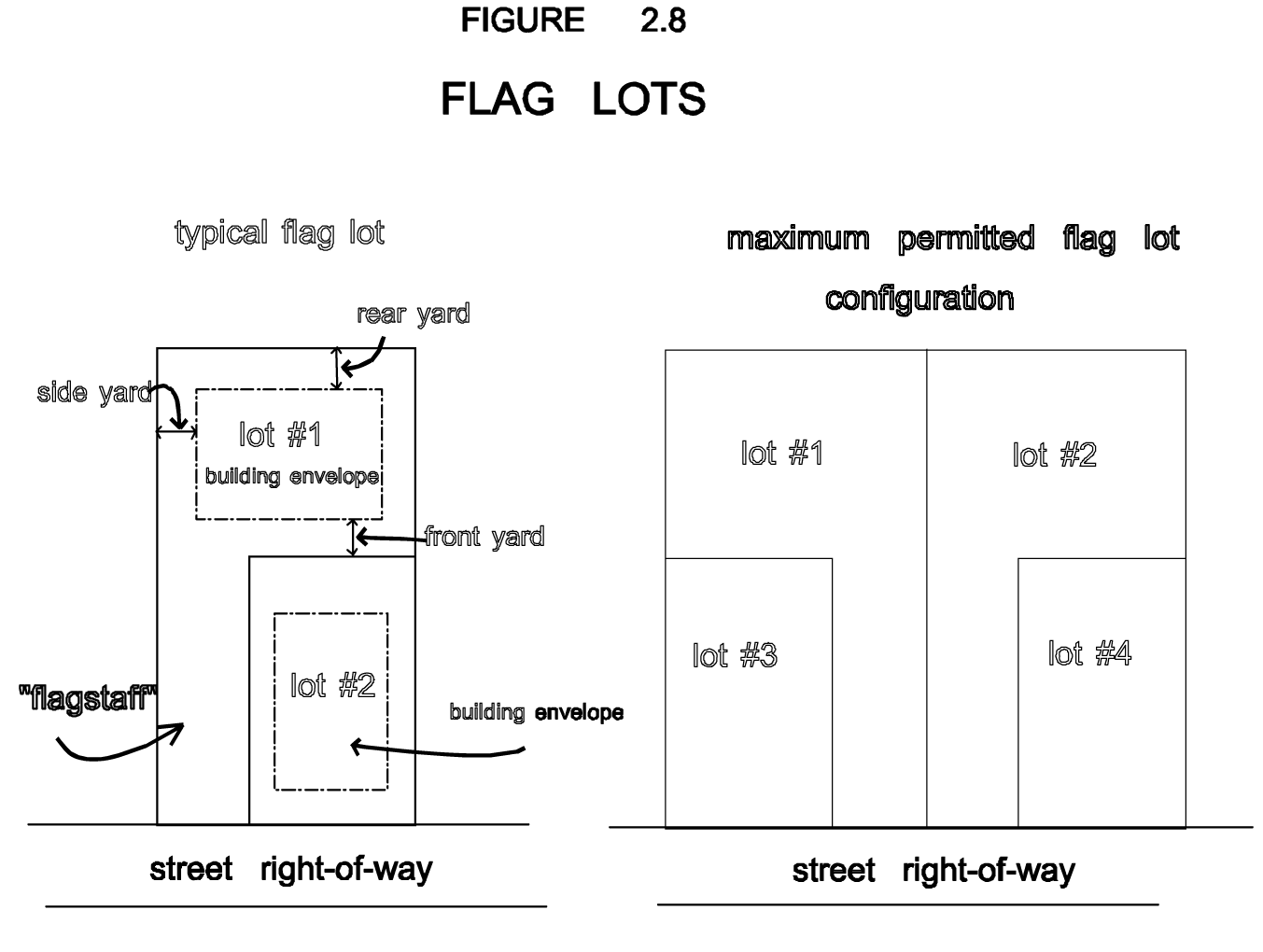
Flag Lot: A Flag Lot is any residential or commercial division of property that is shaped in the general configuration depicted in Figure 2.8. No more than two (2) Flag Lots shall be contiguous to each other and the depth of the staff shall not exceed five (5) times the minimum road frontage requirement for the zoning district in which the flag lot is located, except that a one (1) time division of a residential or agriculturally zoned parcel or lot of record as of the effective date of this Code, that exceeds the maximum flag staff depth restriction shall be approved provided that the lot split criteria of Section 11.03.04 and all other applicable provisions of this Code are met.
Flashing Sign: Any sign utilizing a continually intermittent or sequential flashing light source.
Flat Sign: See "Wall Sign".
Flood or Flooding: A general and temporary condition of partial or complete inundation of normally dry land from: [Also defined in FBC, B, Section 202.]
(1)
The overflow of inland or tidal waters;
(2)
The unusual and rapid accumulation of runoff of surface waters from any source.
Flood Damage-Resistant Materials: Any construction material capable of withstanding direct and prolonged contact with floodwaters without sustaining any damage that requires more than cosmetic repair. [Also defined in FBC, B, Section 202.]
Flood Hazard Area: The greater of the following two (2) areas: [Also defined in FBC, B, Section 202.]
(1)
The area within a floodplain subject to a one percent (1%) or greater chance of flooding in any year.
(2)
The area designated as a flood hazard area on the community's flood hazard map, or otherwise legally designated.
Flood Hazard Boundary Map (FHBM): An official map of a community, issued by the Federal Emergency Management Agency, where the boundaries of the areas of special flood hazard have been defined.
Flood Insurance Rate Map (FIRM): The official map of the community on which the Federal Emergency Management Agency has delineated both special flood hazard areas and the risk premium zones applicable to the community. [Also defined in FBC, B, Section 202.]
Flood Insurance Study (FIS): The official report provided by the Federal Emergency Management Agency that contains the Flood Insurance Rate Map, the Flood Boundary and Floodway Map (if applicable), the water surface elevations of the base flood, and supporting technical data. [Also defined in FBC, B, Section 202.]
Floodplain Administrator: The office or position designated and charged with the administration and enforcement of this ordinance (may be referred to as the Floodplain Manager).
Floodplain Development Permit or Approval: An official document or certificate issued by the community, or other evidence of approval or concurrence, which authorizes performance of specific development activities that are located in flood hazard areas and that are determined to be compliant with this ordinance.
Floodproofing: Any combination of structural and non-structural additions, changes, or adjustments to structures, which reduce or eliminate flood damage to real estate or improved real property, water and sanitary facilities, structures and their contents.
Floodway: The channel of a river or other riverine watercourse and the adjacent land areas that must be reserved in order to discharge the base flood without cumulatively increasing the water surface elevation more than one (1) foot. [Also defined in FBC, B, Section 202.]
Floodway Encroachment Analysis: An engineering analysis of the impact that a proposed encroachment into a floodway is expected to have on the floodway boundaries and base flood elevations; the evaluation shall be prepared by a qualified Florida licensed engineer using standard engineering methods and models.
Florida Building Code: The family of codes adopted by the Florida Building Commission, including: Florida Building Code, Building; Florida Building Code, Residential; Florida Building Code, Existing Building; Florida Building Code, Mechanical; Florida Building Code, Plumbing; Florida Building Code, Fuel Gas.
Footcandle (fc): The unit of illumination when the foot is taken as the unit of length. It is the illumination on a surface one square foot in area on which there is a uniformly distributed flux of one lumen, or the illumination produced on a surface, all points of which are at a distance of one foot from directionally uniform point source of one candela.
Foster Home: A facility licensed by the Florida Department of Health and Rehabilitative Services, whether operated for profit or not, providing housing and collective care and sustenance for no more than three (3) adults or children on a twenty-four (24) hour basis who are unrelated by blood, adoption, or marriage.
Freestanding Sign: See "Ground Sign".
Frontage: The length of a lot that fronts on a public street or that fronts on a private street having been constructed in conformance with the St. Lucie County Standard Specifications for Public Works Construction.
Frontal Dune: Is the first natural or manmade mound or bluff of sand which is located landward of the beach and which has sufficient vegetation, height, continuity, and configuration to offer protective value.
Functionally Dependent Use: A use which cannot perform its intended purpose unless it is located or carried out in close proximity to water, including only docking facilities, port facilities that are necessary for the loading and unloading of cargo or passengers, and ship building and ship repair facilities; the term does not include long-term storage or related manufacturing facilities.
Future Wellfield: Public water supply well(s) that are designated as future wellfields upon the issuance of a South Florida Water Management District Individual Water Use Permit and upon notification to the Department of specific locations.
Garage Sale: The offering for sale of ten (10) or more items of used personal property from any residential real property.
Governmental Agency:
(1)
The United States or any department, commission, agency, or other instrumentality thereof;
(2)
The State of Florida or any department, commission, agency, or instrumentality thereof;
(3)
Any county or municipality; or
(4)
Any school board or other special district.
Grade, Natural: The elevation of the ground surface, in its natural conditions, prior to any man made alteration resulting in an increase or decrease in elevation relative to Mean Sea Level (MSL).
Grade, Finished: The elevation of the finished surface of the ground adjacent to the exterior wall(s) of a building or structure.
Ground Cover: Low growing plants planted in such a manner as to form a continuous cover over the ground.
Ground-Level Barrier: Any natural or artificial structure rising above the ground which prevents beachfront lighting from shining directly onto the beach-dune system.
Ground Sign: Any sign that is permanently affixed to the ground, either flush or on poles, and not attached to an adjoining building. Ground signs include "pole signs," "monument signs," "freestanding signs," and "detached signs."
Groundwater: Water beneath the surface of the ground, whether or not it is flowing through known and definite channels.
Group Care Home: A facility or dwelling unit licensed by the Florida Department of Children and Families housing persons unrelated by blood, adoption, or marriage, and operating as a single housekeeping unit under a common housekeeping management plan based on an internally structured relationship providing organization.
Growth Management Director: The head of the Department of Planning and Development Services, who shall be appointed to serve at the pleasure of the County Administrator. Also referred to as the Planning Director or Planning and Development Services Director within this Land Development Code.
Grubbing: The removal of vegetation from land by means of digging, raking, dragging or otherwise disturbing the roots of vegetation and the soil in which such roots are located.
Guyed Tower: A telecommunications tower that is supported in whole or in part by guy wires and ground anchors.
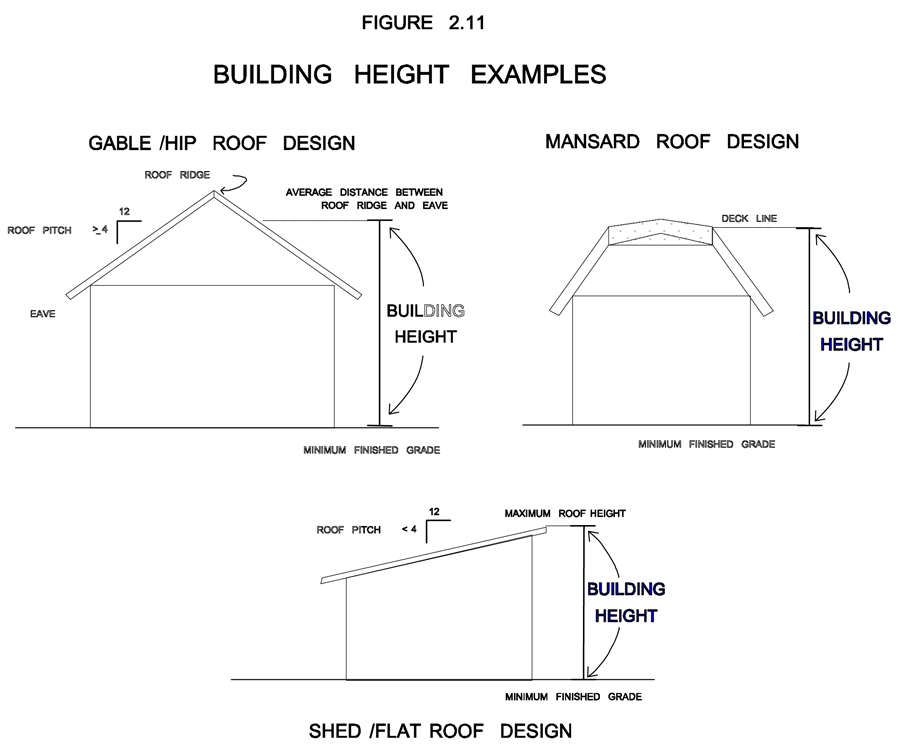
Height: The vertical distance between the minimum finished grade and the highest finished main roof surface in the case of flat roofs or shed roofs, the deck line of a mansard roof and the average distance between the eaves and the ridge of sloped roof with a pitch greater than a 4:12 ratio. For the purpose of this Code, minimum finished grade shall be that elevation, for both residential and nonresidential uses, required to meet minimum flood protection regulations. For the purposes of this Code, roof mounted solar energy panels are exempt from the building height limitations and except where the Board of Adjustment has granted relief for maximum height, nonhabitable architectural features and mechanical equipment along with corresponding enclosures, including but not limited to, parapets, chimneys, steeples, spires, elevator machinery and shafts, shall be allowed to exceed the maximum building height limitation by not more than five (5) feet for single-family residential structures, and by not more than twenty percent (20%) for multi-family and commercial structures but not to exceed twelve (12) feet, and where nonhabitable architectural features are limited to ten percent (10%) of the highest finished floor area.
In no event shall any of the exclusions for the features or equipment enumerated in this definition be construed to permit any habitable or usable space (including but not limited to roof top decks, dining, entertainment, recreation, etc.) to exceed the height limitations provided in Section 7.04.01 (Table 7-10), unless a Conditional Use Permit is granted in accordance with the provisions of LDC Section 11.07.00.
Highest Adjacent Grade: The highest natural elevation of the ground surface prior to construction next to the proposed walls or foundation of a structure.
Historic Building, Resource, Structure, Site, Object, or District: When used in Section in 7.10.23, means any building, resource, structure, site, object, or district that has been officially designated as a historic building, historic resource, historic structure, historic site, historic object, or historic district through a federal, state or local designation program.
Historic Structure: As used in Section 6.05.00, Floodplain Management, any structure that is determined eligible for the exception to the flood hazard area requirements of the Florida Building Code, Existing Building, Chapter 12 Historic Buildings.
Historic Tree: A tree which has been determined to be of notable historic interest and value to St. Lucie County because of its location or historic association with the community and which has been so designated by the Board of County Commissioners in the official record books of the county following the procedures set out in Section 4.11.00.
Historic Structure or Site: Any structure or site or archaeological site that is:
(1)
Listed individually in the National Register of Historic Places (a listing maintained by the U.S. Department of Interior) or preliminarily determined by the Secretary of the Interior as meeting the requirements for individual listing on the National Register;
(2)
Certified or preliminarily determined by the Secretary of the Interior as contributing to the historical significance of a registered historic district or preliminarily determined by the Secretary to qualify as a registered historic district;
(3)
Individually listed on a state register of historic places in states with historic preservation programs which have been approved by the Secretary of the Interior; or
(4)
Individually listed on a local inventory of historic resources per the procedures in Section 4.11.00.
Home Occupation: A business, profession, occupation, or trade conducted within a residential building for gain or support by a resident of the dwelling that is incidental and secondary to the residential use of the building and does not change the essential residential character of the use.
Hospital: Any building housing a medical institution designed, equipped, and staffed to receive two (2) or more persons for diagnosis, treatment, and other health services under the supervision of a medical doctor for periods continuing twenty-four (24) hours of a day.
Hotel/Motel: A building in which lodging is provided or offered to the public for compensation, generally with occupancies of less than four (4) weeks, provided however, that the foregoing limitation on occupancy shall not apply to condominium hotel units.
HRS: The Florida Department of Health and Rehabilitative Services.
Illuminated Sign: Any sign designed to emit artificial light or designed to reflect light from one (1) or more sources of artificial light.
Impermeable Surface: Any material applied to the surface of land that inhibits the natural infiltration or passage of water into the ground.
In Kind: The creation or enhancement of a wetland with vegetation and functions as those of an identified wetland.
Indian River Lagoon: The estuarine body of water including creeks, embayments, coves and other water designations abutting the western shoreline of Hutchinson Island.
Industrial Equipment: Farm tractors, backhoes, bulldozers, draglines, cranes, derricks, heavy earthmoving equipment normally used in farming, excavation and/or heavy construction activities.
Industrial Wastewater: Wastewater not otherwise defined as domestic wastewater (F.A.C. Chapter 17-6.030), including the runoff and leachate from areas that receive pollutants associated with industrial or commercial storage, handling, or processing.
Inspect or Inspection: Field surveys that are conducted by qualified personnel.
Institutional Residential Home: A dwelling unit licensed to serve clients of the Department of Children and Families, which provides a living environment for more than fourteen (14) unrelated residents who operate as the functional equivalent of a family, including such supervision and care by supportive staff as may be necessary to meet the physical, emotional and social needs of the residents. The term "institutional residential home" shall include congregate care facilities, foster homes, group care homes and child care facilities with more than fourteen (14) residents and that otherwise meet the definitional requirements of institutional residential home.
Interference or Interfere: The impairment of transmission or reception of any desired communications or radio frequencies.
Internally Illuminated Sign: A sign where the source of illumination is located inside the sign face and light emanates through the message of the sign. Also a "backlit sign." A sign utilizing exposed neon lighting shall be considered an internally illuminated sign.
Intertidal Areas: Those areas between mean low water and mean high water.
Jurisdictional Wetland: Any wetland within County jurisdiction as set forth in Section 6.02.03(B).
Kennel: An establishment for the breeding, boarding, or shelter of dogs and/or cats.
Lake Okeechobee Watershed: Lake Okeechobee, its tributaries, and the area within which surface water flow is directed or drains, naturally or by constructed works, to the lake or its tributaries.
Land: The earth, water, and air above or on the surface, including any improvement or structure customarily regarded as land.
Land Clearing Debris: Uprooted or cleared vegetation resulting from a land clearing operation.
Land Clearing Operation: The uprooting or clearing of vegetation in connection with construction for buildings and rights-of-way, residential or industrial development, mineral operations, or the clearing of vegetation to enhance property value and aesthetics. The removal and destruction of shade trees due to storm or insect damage is included as a land clearing operation.
Land Clearing and Yard Trash Recycling Operation: Those businesses that are engaged in the recycling and processing of land clearing and yard trash debris only and as may be authorized as a specific Conditional Use under Section 7.10.12(C) of this Code, Land Clearing and Yard Trash Recycling Operations shall not include, or apply to, the on-site disposal of land clearing and yard trash debris generated from land clearing activities on that property, provided that any such on-site disposal is not in conflict with any applicable federal, state or local regulations.
Land Development Regulations: Any ordinance enacted by the County for the regulation of any aspect of development, including zoning, subdivisions, landscaping, tree protection, or signs, the County's comprehensive plan, or any other ordinance concerning any aspect of the development of land. The term does not include any building construction standard adopted under and in compliance with Chapter 553.
Land Use: The development, activity, or use that has occurred on the land, or the development that is proposed by a developer on the land.
Lateral Limbs or Other Lateral Branches: Limbs or other branches situated on or coming from the side of the main trunk(s) of a tree.
Lattice Tower: A telecommunications tower that is constructed to be self-supporting by lattice type supports and without the use of guy wires or other supports.
Leachate: Any liquid that has come into contact with, passed through, or emerged from biosolids, yard trash, solid waste, any other organic material used in composting operations, partially treated compost (e.g., material that is curing), or fully treated compost, as more fully described in Section 7.10.34(D)(4). "Leachate" includes all soluble, suspended, and miscible materials in the liquid.
Letter of Map Change (LOMC): An official determination issued by FEMA that amends or revises an effective Flood Insurance Rate Map or Flood Insurance Study. Letters of Map Change include:
Letter of Map Amendment (LOMA): An amendment based on technical data showing that a property was incorrectly included in a designated special flood hazard area. A LOMA amends the current effective Flood Insurance Rate Map and establishes that a specific property, portion of a property, or structure is not located in a special flood hazard area.
Letter of Map Revision (LOMR): A revision based on technical data that may show changes to flood zones, flood elevations, special flood hazard area boundaries and floodway delineations, and other planimetric features.
Letter of Map Revision Based on Fill (LOMR-F): A determination that a structure or parcel of land has been elevated by fill above the base flood elevation and is, therefore, no longer located within the special flood hazard area. In order to qualify for this determination, the fill must have been permitted and placed in accordance with the community's floodplain management regulations.
Conditional Letter of Map Revision (CLOMR): A formal review and comment as to whether a proposed flood protection project or other project complies with the minimum NFIP requirements for such projects with respect to delineation of special flood hazard areas. A CLOMR does not revise the effective Flood Insurance Rate Map or Flood Insurance Study; upon submission and approval of certified as-built documentation, a Letter of Map Revision may be issued by FEMA to revise the effective FIRM.
Level of Service: An indicator of the extent or degree of service provided by a public facility and related to the operational characteristics of the public facility.
Licensed Engineer: A person who satisfies the requirements of F.S. § 471.003.
Light-Duty Truck: As used in Section 6.05.00, Floodplain Management, as defined in 40 C.F.R. 86.082-2, any motor vehicle rated at eight thousand five hundred (8,500) pounds Gross Vehicular Weight Rating or less which has a vehicular curb weight of six thousand (6,000) pounds or less and which has a basic vehicle frontal area of forty-five (45) square feet or less, which is:
(1)
Designed primarily for purposes of transportation of property or is a derivation of such a vehicle; or
(2)
Designed primarily for transportation of persons and has a capacity of more than twelve (12) persons; or
(3)
Available with special features enabling off-street or off-highway operation and use.
Light-Emitting Diode (LED): An electronic device that emits light when an electrical current is passed through it.
Light Meter: A handheld device that used measure or meter light. A light meter can read the ambient light in a scene, or direct light from a light source and calculate the correct shutter speed and aperture values required to capture an accurate exposure.
Local Road or Street: A route providing service which is of relatively low average traffic volume, short average trip length or minimal through-traffic involvements and high land access for abutting property.
Lot: A parcel of land occupied or intended for occupancy by a use that includes or will include at least one (1) structure together with any accessory structure, yard, open space, buffer area, or parking spaces required by this Code.
Lot, Corner: A lot situated at the junction of two (2) or more public rights-of-way.
Lot Coverage: The total horizontal ground area of a lot covered by all buildings or structures on the lot not open to the sky.
Lot, Depth of: The average horizontal distance between the front lot line and the rear lot line.
Lot Line: The boundary of a lot.
Lot of Record: As used in this Code, a lot of record shall mean:
(1)
Any contiguous quantity of land that is part of an approved subdivision recorded in the Office of the Clerk of the Circuit Court; or
(2)
Any contiguous quantity of land which is capable of being described with such definitiveness that its location and boundaries are established, and which has been so recorded in the public records in the Office of the Clerk of the Circuit Court prior to January 9, 1990, unless otherwise considered to be a nonconforming lot of record as described in Section 10.00.04 of this Code; or
(3)
Any contiguous quantity of land which is the subject of an agreement for deed or other instrument of conveyance properly executed prior to January 9, 1990, and which describes the parcel with such definitiveness that its location and boundaries are established and recognized by Florida Law, unless otherwise considered to be a nonconforming lot of record as described in Section 10.00.04 of this Code.
Lot Split: The division of land into two (2) contiguous lots or parcels without involving the establishment of a new street.
Lot, Platted: A lot platted in accordance with St. Lucie County after the effective date of this Code.
Lot, Width of: The distance between side lot lines. If the side lot lines are parallel, this distance is measured along a perpendicular to the side lot lines. If the side lot lines are not parallel, this distance is measured along a line drawn such that its intersections with the side lot lines form equal angles.
Low-Tetrahydrocannabinol Cannabis or Low-THC Cannabis: A plant of the genus cannabis, the dried flowers of which contain 0.8 percent or less of tetrahydrocannabinol and more than ten percent (10%) of cannabidiol weight for weight; the seeds thereof; the resin extracted from any part of such plant; or any compound, manufacture, salt, derivative, mixture, or preparation of such plant or its seeds or resin that is dispensed only from a dispensing organization.
Lowest Floor: As used in Section 6.05.00, Floodplain Management, the lowest floor of the lowest enclosed area of a building or structure, including basement, but excluding any unfinished or flood-resistant enclosure, other than a basement, usable solely for vehicle parking, building access or limited storage provided that such enclosure is not built so as to render the structure in violation of the non-elevation requirements of the Florida Building Code or ASCE 24. [Also defined in FBC, B, Section 202.]
Machinery, Heavy: Trucks, mechanical land clearing, earth moving, or earth working equipment with a gross weight in excess of five thousand (5,000) pounds. For the purposes of this Code, all machinery that utilizes steel tracks for traction shall be considered heavy machinery.
Maintenance: The action taken to restore or preserve the functional intent of any facility or system; normal custodial work needed to sustain original plans or permits.
Major Arterial Road: A roadway primarily focusing on carrying through traffic. Major arterials provide service that is relatively continuous, high in volume, of long trip length, and high operating speed.
Major Collector Street or Road: A roadway emphasizing traffic distribution between arterial roadways and roadways of a lower hierarchy. A major collector provides for services that are moderate in length, volume and speed.
Major Structure: As used in Section 13.00.02, Coastal Construction Code, includes, but is not limited to, residential buildings including mobile homes, commercial, institutional, industrial and other construction having the potential for substantial impact on coastal zones.
Mangrove: Any specimen of the species Avicennia germinans (black mangrove), Laguncularia racemosa (white mangrove), Rhizophora mangle (red mangrove) and Conocarpus erectus (buttonwood mangrove).
Mangrove Alteration: To cut, remove, damage, or destroy by any means. Mangrove Alteration is distinct from the "trimming" or "pruning" of mangroves.
Manufactured Building: A structure, building assembly, or system of subassemblies, approved by and bearing the insignia of approval of the Florida Department of Community Affairs, or its successor agency, pursuant to the provisions of F.S. Ch. 553, Part IV. No mobile home, whether complying or not complying with mobile home construction standards promulgated by the United States Department of Housing and Urban Development or required by the State of Florida shall be considered a manufactured building for the purpose of this Code.
Manufactured Home: A structure, transportable in one (1) or more sections, which is eight (8) feet or more in width and greater than four hundred (400) square feet, and which is built on a permanent, integral chassis and is designed for use with or without a permanent foundation when attached to the required utilities. A manufactured home means a mobile home fabricated on or after June 15, 1976, in an offsite manufacturing facility for installation or assembly at the building site, with each section bearing a seal certifying that it is built in compliance with the federal Manufactured Home Construction and Safety Standard Act. The term "manufactured home" does not include a "recreational vehicle" or "park trailer." [Also defined in 15C-1.0101, F.A.C.]
Manufactured Home Park or Subdivision: As used in Section 6.05.00, Floodplain Management, a parcel (or contiguous parcels) of land divided into two (2) or more manufactured home lots for rent or sale.
Manure: Solid waste composed of excreta of animals, and residual materials that have been used for bedding, sanitary, or feeding purposes for such animals.
Market Manager: A person or organization that manages the operation of the Farmers' Market, assigns space to producers and sellers, directs the maintenance of premises and records, and performs related duties as required.
Market Value: As used in Section 6.05.00, Floodplain Management, the value of buildings and structures, excluding the land and other improvements on the parcel. Market value is the Actual Cash Value (in-kind replacement cost depreciated for age, wear and tear, neglect and quality of construction), as determined by a qualified independent appraiser, or tax assessment value adjusted to approximate market value by a factor provided by the property appraiser.
Marquee: A hood, canopy, or awning of permanent construction that projects from the wall face of a building.
Marquee Sign: See "Canopy Sign."
Marsh and Salt Tolerant Vegetation: Native salt tolerant forbes, herbs, grasses, sedges, rushes, and nurse plants (for recruitment) which are listed in Chapters 17-4.02(17) or 17-4.022, Florida Administrative Code, in addition to: Halodule wrightii (cuban shoal grass), Ruppia maritinia, Syringodium filiformis (manatee grass), and Thalassia testudinum (turtle grass).
Mean High Water (MHW): The average height of the high tides over a nineteen-year period.
Mean High Water Line (MHWL): The intersection of the plane of mean high water, with the estuarine or beach-dune shoreline areas.
Mean Low Water (MLW): The average height of the low tides over a nineteen-year period.
Mean Low Water Line (MLWL): The intersection of the plane of mean low water with the estuarine or beach-dune shoreline areas.
Mean Sea Level (MSL): The average height of the sea for all stages of the tide. For purposes of this Code, the term is synonymous with National Geodetic Vertical Datum (NGVD).
Medical Cannabis: All parts of any plant of the genus cannabis, whether growing or not; the seeds thereof; the resin extracted from any part of the plant; and every compound, manufacture, sale, derivative, mixture, or preparation of the plant or its seeds or resin that is dispensed only from a dispensing organization for medical use by an eligible patient.
Medical Use: Administration of the ordered amount of low-THC cannabis or medical cannabis. The term does not include the:
(1)
Possession, use, or administration of low-THC cannabis or medical cannabis by smoking.
(2)
Transfer of low-THC cannabis or medical cannabis to a person other than the qualified patient for whom it was ordered or the qualified patient's legal representative authorized to receive it on the qualified patient's behalf.
(3)
Use or administration of low-THC cannabis or medical cannabis:
a.
On any form of public transportation.
b.
In any public place.
c.
In a qualified patient's place of employment, if restricted by his or her employer.
d.
In a correctional institution.
e.
On the grounds of any child care facility, preschool, or school.
f.
On or in any vehicle, aircraft, or motorboat.
Message Sign: An electronically changeable sign upon which graphic displays, symbols, or words can be varied upon the face or faces of the sign to display time, temperature, public service, or other information.
Meteorological Towers: A structure consisting of a tower foundation, tower, equipment shelter, guy wires and assorted instruments and equipment measuring wind speed and ambient weather conditions.
Microwave Dish Antenna: A dish-shaped device used to transmit and/or receive microwave signals in a straight line to and from similarly earth bound point sources.
Mining: Any activity that entails the excavation or removal of earth in excess of one hundred (100) cubic yards from one (1) parcel of property to another parcel of property, or from one (1) area of a parcel of property to another area on the same parcel if a public road is used.
Minor Arterial Road: A roadway emphasizing through traffic movement similar to a major arterial, but provides greater land access and distributed traffic to smaller geographical areas than the major arterials. Minor arterials offer lower traffic mobility.
Minor Collector Street or Road: A roadway emphasizing traffic collection and distribution between roadways of a greater hierarchy (arterials and major collectors) and local streets or roads. A minor collector provides service for moderate volumes, trip length and speed.
Minor Replat: A replat for the purpose of lot line adjustment, without an increase in the number of lots or units otherwise allowed.
Minor Structure: As used in Section 13.00.02, Coastal Construction Code, includes, but is not limited to, pile-supported, elevated dune and beach walkover structures; beach access ramps and walkways; stairways; pile-supported elevated viewing platforms gazebos, and boardwalks; lifeguard support stands; public and private bathhouses; sidewalks, driveways, parking areas, shuffleboard courts, tennis courts, handball courts, racquetball courts, and other uncovered paved areas; earth-retaining walls; sand fences, privacy fences, ornamental walls, ornamental garden structures, aviaries, and other ornamental construction. It shall be a characteristic of minor structures that they are considered to be expendable under design wind, wave, and storm forces.
Mobile Food Dispensing Vehicle: Any food service establishment that is self-propelled or otherwise movable from place to place, that is self-contained and does not use electrical or other utility connections of any kind, in which food is prepared and/or dispensed, and that complies with all applicable requirements set forth by the Florida Department of Business Regulation, Division of Hotels and Restaurants, or its successor agency, including but not limited to those regulations set forth in Rule 7C-4.03, Florida Administrative Code.
Mobile Home: A structure transportable in one (1) or more sections, which structure is eight (8) body feet (2.4 meters) or more in width and over thirty-five (35) feet in length, and which structure is built on an integral chassis and designed to be used as a dwelling when connected to the required utilities, and includes the plumbing, heating, air conditioning, and electrical systems contained therein. A mobile home is a residential unit certified to be in conformity with the Mobile Home Construction and Safety Standards of the United States Department of Housing and Urban Development, or its successor agency, and the standards of Section 320.823, F.S.
Mobile Home Park: A place set aside and offered by a person or public body, for either direct or indirect remuneration of the owner, lessor, or operator of such place, for the parking or accommodation of six (6) or more mobile homes utilized for sleeping or eating.
Monopole Tower: A telecommunications tower consisting of a single pole or spire self-supported on a permanent foundation, constructed without guy wires, ground anchors, or other supports.
Monument Sign: A ground sign that is connected to the ground, or supported by a freestanding wall, pedestal, or other structure, so that there is no clear space between the bottom of the sign and the ground, no less than eighty percent (80%) width of the sign. A monument sign does not have any exposed pole or pylon.
Motor Vehicle: An automobile, motorcycle, truck, trailer, semi-trailer, truck-tractor, and semi-trailer combination, or any other vehicle operated on the roads of this county, used to transport persons or property, and propelled by power other than muscular power.
Mulch: Non-living small aggregate materials such as gravel, rock, pebbles, bark, or pine needles, used as ground cover.
Multi Use Path: A bikeway (ten (10) to twelve (12) feet wide) physically separated from the motorized vehicular traffic by an open space or barrier and either within highway right-of-way or within an independent alignment. Multi-use paths may be used by pedestrians, skaters, and joggers as well as bicyclists.
Nameplate: Generally, a sign indicating the name of and other information pertaining to the occupant or resident of the dwelling unit or other building to which it is attached; provided, however, that a nameplate may contain any other information chosen by the property owner or occupant if all other requirements of this chapter are met.
National Geodetic Vertical Datum (NGVD): As corrected in 1929, is a vertical control used as a reference for establishing varying elevations within the floodplain.
Native/Drought-Tolerant Trees: Indigenous trees which tolerate periods of low rainfall. See Section 7.09.06 (Standards for Native and Drought-Tolerant Vegetation).
Native Vegetation: Any indigenous tree, plant or shrub adapted to soil and climatic conditions occurring onsite.
New Construction: As used in Section 6.05.00, Floodplain Management, for the purposes of administration of this ordinance and the flood resistant construction requirements of the Florida Building Code, structures for which the "start of construction" commenced on or after August 13, 1981 and includes any subsequent improvements to such structures.
Newspaper of General Circulation: A newspaper published at least on a weekly basis; it does not include a newspaper intended primarily for members of a particular professional or occupational group, a newspaper whose primary function is to carry legal notices, or a newspaper that is given away primarily to distribute advertising.
Newsrack: Any self-service or coin operated box, container, storage unit, dispenser or other unmanned device installed, used, or maintained for the display, sale or distribution of newspapers or other periodicals or advertising circulars or any other printed matter.
Nonconcurrency Affidavit: A document signed by an applicant which defers the application for a Certificate of Capacity and the Concurrency Test until receipt of a Final Development Order for the proposed development.
Nonconforming Lot of Record: A lot of record that does not meet minimum area, width or frontage requirements of this Code and as further described in Section 10.00.04 of the Code.
Nonconforming Structure: Any lawfully existing structure or building on the effective date of this Code that does not comply with all of the provisions of this Code. For purposes of nonconforming structure, lawfully existing means, a structure or building which does not conform to a current provision or regulation provided in the Comprehensive Plan and/or this Land Development Code, but was permitted, or otherwise in existence lawfully, prior to the effective date of the ordinance adopting the current provision or regulation that rendered the structure nonconforming.
Nonconforming Use: Any lawful use of any land, building, or structure on the effective date of this Code that does not comply with the provisions of this Code. For purposes of nonconforming use, lawful use means, a use which does not conform to a current provision or regulation provided in the Comprehensive Plan and/or this Land Development Code, but was permitted, or otherwise in existence lawfully, prior to the effective date of the ordinance adopting the current provision or regulation that rendered the use nonconforming.
Nonhabitable Major Structure: As used in Section 13.00.02, Coastal Construction Code, includes, but is not limited to, swimming pools; parking garages; pipelines; piers; canals, lakes, ditches, drainage structures, and other water-retention structures; water and sewage treatment plants; electrical power plants, transmission and distribution lines, transformer pads, vaults, and substations; roads, bridges, streets, and highways; underground storage tanks.
Non-Native Vegetation: Any tree, plant or shrub established from outside sources where local climatic and geologic conditions are similar to the source of origin and therefore favorable to growth.
Nonresidential Activity: As used in Section 6.03.00, Wellfield Protection, means any activity occurring on any described parcel of land, whether or not within a structure, with the exception of residential activity as defined herein. Those nonresidential activities which do not meet the definition criteria of existing nonresidential activity as defined herein, shall be defined as new nonresidential activities.
Non-Rigid or Flexible Structures: As used in Section 6.02.01, Coastal Area Protection, include, but are not limited to, beach and dune restoration, sand fencing, and stabilization with beach and dune vegetation to reduce or control vegetation.
Normal Farming Operations: This term shall have the meaning set forth in Section 7.10.34(B) of the Code.
North American Vertical Datum: (NAVD) of 1988 means a vertical control used as a reference for establishing varying elevations within the floodplain.
Nursing Home: An institution, public or private, that provides twenty-four (24) hours of nursing care for three (3) or more unrelated individuals and is presently licensed pursuant to F.S. § 400.062.
Nutrients: For the purposes of Section 7.10.34 only, this term shall mean nitrate, total kjeldahl nitrogen, nitrite and total phosphorus.
Objectionable Odor: Any odor present in the outdoor atmosphere which by itself or in combination with other odors, is or may be harmful or injurious to human health or welfare, which unreasonably interferes with the comfortable use and enjoyment of life or property, or which creates a nuisance.
Offstreet Parking: Any area except a public right-of-way, used for the purpose of parking, storing, or display of vehicles, boats, trailers, and mobile homes, including used car lots and other open lot uses.
One-Foot Drawdown Contour: The locus of points around a wellhead or wellfield where the free water elevation is lowered by one (1) foot due to a specified pumping rate of the well or wellfield.
One-Hundred-Year Storm or 100-Year Storm: A shore incident hurricane or any other storm with accompanying wind, wave and storm surge intensity having a one percent (1%) chance of being equaled or exceeded in any given year, during any one-hundred-year interval.
Open Space: Any parcel or area of land or water that is set aside, open and unobstructed to the sky, and designated or reserved for public or private use or enjoyment.
Open Space, Common: A parcel or area of land or water in or related to a development site that is set aside and designated or reserved for the use or enjoyment of the public or the residents, occupants, and/or owners of the development or project site. Common open space areas shall not be individually owned except by a recognized unit of local or state government or an entity or organization acceptable to St. Lucie County.
Open Water Areas: Those waters defined as state jurisdictional waters herein.
Operational Entity: An acceptable, legally bound, responsible entity which agrees to operate and maintain a facility or system.
Owner: For the purposes of Section 11.14.00, the term "owner" shall mean a person with a legal or equitable interest in real property who filed an application for a development permit for any parcel land at the state, regional, or local level and who received a final development order (including the rezoning of a specific parcel), or who holds legal title to real property that is subject to an enforcement action of a governmental entity.
Pain Specialist (Approved): Approved pain specialist means a physician, or group of physicians licensed under either F.S. Ch. 458 or 459 and who comply with State of Florida rules for medical doctors and osteopathic physicians.
Pain Management Clinic: Pain management clinic means the same as the definition found in F.S. (2010) § 458.3265(1)(a), as may be amended from time to time.
Parapet: A wall extension above the roof line.
Parcel of Land: Any contiguous quantity of land capable of being described with such definiteness that its location and boundaries may be established, that is designated by its owner(s) or developer(s) as land to be used or developed as a unit, or that has been or developed as a unit. If such a parcel of land is divided by a right-of-way or zoning boundary it may be considered to be one (1) parcel by the owner.
Parent Tract: The parcel of land that existed prior to an acquiring authority obtaining an interest in or title to some portion of the parcel through eminent domain action.
Park Trailer: As used in Section 6.05.00, Floodplain Management, a transportable unit which has a body width not exceeding fourteen (14) feet and which is built on a single chassis and is designed to provide seasonal or temporary living quarters when connected to utilities necessary for operation of installed fixtures and appliances. [Defined in F.S. § 320.01]
Parking Space: An area designated for temporary storage of a motor vehicle.
Participant: For the purposes of Section 11.14.00, the term "participant" shall mean:
a.)
A person holding title to land contiguous to the owner's property, who has been accepted by the Special Master as a participant in the proceeding; or
b.)
A substantially affected person who submitted oral or written testimony, sworn or unsworn, of a substantive nature which stated with particularity support for or objections to the development order or enforcement action in a prior proceeding, including a public hearing, and who has been accepted by the Special Master as a participant in the proceeding.
Pathogens: Disease-carrying organisms, including certain bacteria, protozoa, viruses, viable helminth ova, and other organisms that cause disease.
Pedestrian Sign: A sign that is attached to the underside of a cantilevered roof, portico, or overhang, that extends from the wall face of an establishment or use, and that covers a pedestrian passageway.
Pennant: Any animated, rotating and/or fluttering devices made of cloth, paper, balloons, or fabric of any kind, with or without lettering or design, which are joined together in a series, commonly attached in strings or strands, and designed so as to move in the wind.
Permanently Attached: Affixed by foundations, poles, braces, or other immovable structural means to the ground or to a building or structure. Signs manufactured or intended for portable use and affixed to the ground by ropes, chains, cables, weights, or other means deemed non-structural by the Growth Management Director shall not be deemed to be permanently attached.
Permitted Agent of the State: As it relates to Section 6.04.02, Sea Turtle Protection, any qualified individual, group or organization possessing a permit from DNR to conduct activities related to sea turtle protection and conservation.
Person: Any individual, firm, association, joint venture, partnership, estate, trust, corporation, group, state officer, or unit of federal, state, county, or municipal government, and all other associations and combinations, whether public or private.
Personal Watercraft: A small class A-1 or A-2 vessel as defined by state law which uses an outboard motor, or an inboard motor powering a water jet pump, as its primary source of motive power and which is designed to be operated by a person sitting, standing, or kneeling on, or being towed behind the vessel, rather than in the conventional manner of sitting or standing inside the vessel.
Personal Wireless Service: Commercial mobile services, licensed wireless services, and common carrier wireless exchange access services, and shall include "wireless service" as defined in F.S. § 365.172, as amended, as well as "personal wireless services" as defined in 47 USC § 322(c)(7)(C)(i), as amended.
Personal Wireless Service Facilities: Facilities for the provision of personal wireless services. A power, light, or other utility pole used exclusively as such prior to attachment of a personal wireless service facility shall not be considered a personal wireless service facility because of such attachment.
Pharmacy: Pharmacy means the same as the definition in F.S. (2010) § 465.003, as may be amended from time to time.
Planning and Development Services Director: The head of the Department of Planning and Development Services, who shall be appointed to serve at the pleasure of the County Administrator. See Growth Management Director.
Planting Area: Any area designated for landscape.
Pole Sign: See "Ground Sign."
Portable Sign: A movable sign not permanently attached to the ground, but not including a temporary sign otherwise allowable under this Code. The term may include, without limitation, "trailer," "sidewalk" or "sandwich" signs.
Potable Water: Water that is satisfactory for drinking, culinary and domestic purposes. Meeting current state and federal drinking water standards.
Pre-Existing Towers and Pre-Existing Antennas: Any permitted existing tower or antenna constructed or existing prior to September 2, 1997, or any telecommunications tower or antenna for which a building permit or special use permit has been properly issued and finalized, including permitted telecommunications towers or antennas that have not yet been constructed so long as such approval and building permit is current and not expired.
Primary Dune: That portion of the dune system containing the highest point of elevation (crest).
Processing: Any technique designed to change the physical, chemical, or biological character or composition of any biosolids, yard trash, or solid waste used at a commercial composting facility to produce compost. Processing includes but is not limited to physical turning, windrowing, aeration, and other means of mechanically handling biosolids, yard trash, solid waste, or other organic matter used to produce compost.
Producer: A person or entity that (a) raises or produces farm products on land that the person or entity farms and owns, rents, or leases; or (b) a person or entity that creates Value-added Farm Products (by cooking, canning, baking, preserving, roasting, etc.).
Projecting Sign: Any sign that is not defined as a wall, marquee, pedestrian, canopy, or awning sign that extends from the face of any primary supporting exterior wall of the structure to which it is attached.
Prop Roots: The structures generally originating below the lowest limbs of red mangroves which are also known as stilt roots.
Proposed Facilities Modification: Any request for modification of an eligible support structure which the applicant asserts is subject to review under the Middle Class Tax Relief and Job Creation Act ("Spectrum Act") (PL-122-96; codified at 47 U.S.C. § 1455(a)) and FCC orders promulgated thereto, codified at 47 C.F.R. § 1.40001, and involving:
(1)
Collocation of new transmission equipment;
(2)
Removal of transmission equipment; or
(3)
Replacement of transmission equipment.
Protected Species: Plant and animal species that are considered endangered, threatened, rare, or of special concern by the Florida Committee on Rare and Endangered Plants and Animals, the Florida Game and Fresh Water Fish Commission, the Florida Department of Agriculture and Consumer Services, and the U.S. Fish and Wildlife Service.
Prune or Trim: To cut away parts from a plant, top or lateral limbs, so as not to cause death or to shorten its natural life span.
Public Facilities: As used in Chapter V, Adequate Public Facilities, public facilities means drainage facilities, park and recreation facilities, potable water facilities, road facilities, sanitary sewer facilities, solid waste facilities, and mass transit facilities.
Public Safety Communications Facility: Any wireless communications facilities used by municipal, county, state or federal government agencies for the primary purpose of providing public safety related communications, including but not limited to, wireless communications for police, fire and emergency services.
Public Utility: Any system providing water service to the public which has at least fifteen (15) service connections or regularly serves an average of at least twenty-five (25) individuals daily for at least sixty (60) days of the year, with a permitted average withdrawal capacity of one hundred thousand (100,000) gallons per day.
Public Utility Sign: A sign identifying the location of structures of facilities that may present a safety hazard, such as underground lines, high voltage areas, or the like.
Public Water Supply Well: Wells withdrawing water from the surficial aquifer (localized relatively shallow aquifer sources) for use as potable water that are operated by public utilities.
Public Works Director: The head of the Department of Public Works, who shall be appointed to serve at the pleasure of the County Administrator.
Public Wellfield: An area within the Zone of Protection surrounding each Public Water Supply Well.
Qualified Applicant: As used in Section 11.08.00, Development Agreements, means a person who has legal or equitable interest in the real property which is the subject of a proposed Development Agreement. If there is a question as to whether a person is a Qualified Applicant, the applicant shall provide the County with an opinion of title from an attorney licensed to practice in the State of Florida or a commitment of title insurance demonstrating the person which has a legal or equitable interest in the property subject to the proposed Development Agreement.
Record Drawings: Amended site plans and/or construction drawings specifying the locations, dimensions, elevations, capacities and capabilities of structures or facilities as they have actually been constructed. Record drawings must be signed, sealed and dated by a registered professional engineer.
Recreational Equipment: Means boats, personal watercraft, trailers and items on trailers, utility trailers, recreational vehicles, and similar vehicles or items.
Recreational Vehicle: As used in Section 6.05.00, Floodplain Management, a vehicle, including a park trailer, which is: [See F.S. § 320.01)
(1)
Built on a single chassis;
(2)
Four hundred (400) square feet or less when measured at the largest horizontal projection;
(3)
Designed to be self-propelled or permanently towable by a light-duty truck; and
(4)
Designed primarily not for use as a permanent dwelling but as temporary living quarters for recreational, camping, travel, or seasonal use.
Recreational Vehicle Park: A place set aside and offered by a person or public body for either direct or indirect remuneration of the owner, lessor, or operator of such place, for the parking and accommodation of six (6) or more recreational vehicles or tents utilized for sleeping or eating; and the term also includes buildings and sites set aside for group camping and similar recreational facilities. For the purposes of this chapter, the terms "campground," "camping resort," "R.V. resort," "travel resort," and "travel park," or any variations of these terms, shall be considered synonymous with the term "recreational vehicle park."
Recruitment: The trapping of tidally supplied mangrove seeds and seedlings and other appropriate wetland species by nurse plants.
Regulated Area: That area within the Zone of Protection surrounding each Public Water Supply Well, as defined by the Zone of Protection Maps.
Regulated Substances:
(1)
Substances which are:
a.
Known to have hazardous and toxic properties including but not limited to those listed by the EPA in part 40 CFR 302; or
b.
Listed as a priority toxic pollutant by the EPA in part 40 CFR 122.21; or
c.
A toxic degradation product, which includes petroleum-based products; or
d.
On the Restrictive Use Pesticide List promulgated pursuant to F.S. Ch. 487, set forth in Chapters 5E-2 and 5E-9, Florida Administrative Code.
(2)
Regulated substances by generic designation shall include, but are not limited to, those set forth in the list entitled "Public Wellfield Protection Generic Substance List," which is maintained by the Wellfield Protection Officer.
(3)
Regulated Substances do not include those that are used in the quantities exempt as set out in Section 6.03.05.
Religious Facility: A building in which persons regularly assemble for religious worship, and that is maintained and controlled by a religious body organized to sustain public worship.
Remainder Parcel: That portion of the parent tract remaining in private ownership following eminent domain action. The remainder parcel may be vacant, or improved, just as the parent tract may be vacant or improved.
Remove or Removal of Vegetation:
(1)
The actual removal of vegetation; or
(2)
Direct or indirect actions resulting in the effect removal of vegetation through damaging or poisoning; or
(3)
Similar actions directly or indirectly resulting in the death of vegetation.
Resident: As used in "family residential home", "community residential home" and "institutional residential home" resident means any of the following: an aged person as defined in F.S. § 400.618(3); a physically disabled or handicapped person as defined in F.S. § 760.225a; a nondangerous mentally ill person as defined in F.S. § 394.455(3); or a child as defined in F.S. §§ 39.01(8) and (10).
Residential Activity: As used in Section 6.03.00, Wellfield Protection, means any building or structure or portion thereof that is designated for or used for residential purposes and any activity involving the use or occupancy of a described parcel of land for residential purposes. Residential activity shall not include any activity or business requiring an occupational license or other form of authorization to conduct a business.
Resort: A full-service lodging facility that provides access to or offers a range of amenities, facilities and activities focused on recreation, leisure or experience oriented venues. Resorts serve as the primary provider of the guests' experience, often provide services for business or meetings, and are characteristically located in vacation-oriented settings.
Restaurant: Any establishment that serves prepared food and beverage for consumption on the premises. Such establishment may include entertainment which is incidental to the food service character of the use.
Restoration: See "Shoreline or Beach Restoration".
Retail Trade: The sale of consumer goods, commodities, and services to ultimate consumers.
Retrofitting: As used in Section 7.07.00, refers to improving the quality of urban stormwater runoff to whatever degree is achievable. The improvement can include the modification of existing, or the addition of new, structures or stormwater management practices, or changes in activities or land uses.
Rights-of-Way: Land dedicated or deeded to public use or otherwise owned by a public agency on which facilities such as roads, roadways, swales, bikepaths, sidewalks, railroads, canals, utilities and for public street purposes and includes all dedicated rights-of-way for any such facility.
Rigid Structure: As used in Section 6.02.01, Coastal Area Protection, means a man-made or man-placed inflexible installation within the Dune Preservation Zone or Indian River Lagoon Shoreline including, but not limited to, wooden, metal, or plastic structures such as jetties, seawalls, bulkheads, mound structures, rip-rap, revetments, groins, breakwaters, and sandbags.
Ripeness Decision: For the purposes of Section 11.14.00, the term "ripeness decision" shall mean an available use decision which describes as specifically as possible the use or uses available to the subject real property.
Road: The term "road" includes streets, sidewalks, alleys, highways and other ways open to travel by the public including the roadbed, right-of-way and all culverts, drains, sluices, ditches, water storage areas, waterways, embankments, slopes, retaining walls, bridges, tunnels and viaducts necessary for the maintenance of travel and all ferries used in connection therewith.
Roof Sign: Any sign erected over or on the roof of a building.
Rooming House: Any dwelling in which more than two (2) persons are lodged on a continuing basis, without meals, for compensation.
Rural Arterial Road: Routes which generally interconnect with and augment urban minor arterial roads and provide service to trips of longer length and a higher level of traffic mobility.
Salt Marsh Impoundments: Those wetlands upon which mosquito control activities are or have been undertaken as part of a St. Lucie County Mosquito Control District program.
Sand Dunes: As used in Section 6.05.00, Flood Damage Prevention, the term shall mean naturally occurring accumulations of sand in ridges or mounds landward of the beach.
Scroll: A mode of message transition where the message is changed by the apparent vertical or horizontal movement of the letters or graphic elements of the message.
Scrub Habitat: A well-drained, fire adapted, plant community occurring primarily on ridges (elevated areas), characterized by white or light colored, acidic sand. Generally, the habitat has a sparse sand pine canopy, with dense clumps or vast thickets of scrub oaks and other shrubs dominating the understory. The ground cover is generally very sparse, being dominated by lichens and herbs, with open patches of barren, exposed sand.
Seagrasses: Those submerged beds of the genera Halophila, Syringodium, Halodule, Thalassia, and/or the green algae Caulerpa spp.
Sea Turtle(s): Any specimen belonging to the species Caretta (loggerhead turtle), Chelonia mydas (green turtle), Dermochelys coriacea (leatherback turtle) or any other marine turtle using St. Lucie County beaches as a nesting habitat.
Sea Turtle Hatchling: Any specimen of sea turtle, within or outside of a nest, which has recently hatched from an egg.
Sea Turtle Nest: Any place in which sea turtle eggs are naturally deposited or relocated beneath the sediments of the beach-dune system.
Search Area: The geographic area, in which a telecommunications facility must be located to provide FCC required coverage of the applicant's designed service areas, as certified by a radio frequency (RF) engineer, or other such appropriate technical expert.
Seasonal High Water Line: The line formed by the intersection of the rising shore and the elevation of one hundred fifty percent (150%) of the local tidal range above mean high water.
Semitrailer: A semi-trailer which is used or designed primarily for carrying commercial loads. It shall be presumed that any semitrailer having a tax class of 56 is a "semitrailer" as defined herein.
Service Station: Any building, structure or land used primarily for the sale of motor fuels or oil at retail direct to the customer, including the supplying of accessories, parts, and services essential to the normal operation of automobiles.
SFWMD: The South Florida Water Management District.
Shipping Container: Refer to Cargo Containers.
Shoreline: A boundary line between land and water. In St. Lucie County the term refers specifically to the interfaces along the Atlantic Ocean, Indian River Lagoon, North Fork of the St. Lucie River, Ten Mile Creek, and their tributaries.
Shoreline Access Point or Access: See Beach or Shoreline Access Point or Access.
Shoreline or Beach Restoration: Any work to enhance the value and function of the estuarine or beach-dune shoreline areas or to reconstruct or replace beaches or dunes. Restoration includes, but is not limited to, the replanting of vegetation to stabilize the estuarine or beach-dune shoreline areas.
Shrub: Any living, self-supporting woody evergreen plant, other than a tree, normally grown in St. Lucie County.
Sidewalk: That portion of a roadway designed for preferential or exclusive use by pedestrians and non-motorized vehicles.
Side Lot Lines: Straight lines connecting the end points of the front and rear lot lines.
Sidewalk or Sandwich Sign: See "Portable Sign".
Sign: Any exterior device, structure, fixture, painting, emblem, or other visual medium, that uses words, graphics, colors, illumination, symbols, letters, colors, or numbers for expression or communication. The term "sign" shall not include any noncommercial message displayed in the window, and entirely within the window area, of any lawfully existing building. Signs also shall include, without limitation, flags, banners, and pennants.
Sign Area: The entire area within a perimeter line not exceeding eight (8) straight lines, or a circle or ellipse, which encloses the extreme outer limits of the sign face. If a sign is composed of one (1) or more sign cabinets or modules, the area enclosing the entire perimeter of all cabinets and/or modules within a single, continuous geometric figure shall be the area of the sign.
The perimeter of measurable area shall not include embellishments such as poles, pole covers, framing, decorative roofing, support structures, etc., providing that there is no expressive or communicating medium on such embellishments.
Where the sign faces of ground or projecting signs are parallel, or are V-shaped and have an interior angle of less than sixty (60) degrees, the area of such signs shall equal the area of the larger of the two (2) sign faces.
Where the sign faces of ground or projecting signs are V-shaped and have an interior angle of sixty (60) degrees or greater, the area of such sign shall equal the sum of the area of both sign faces.
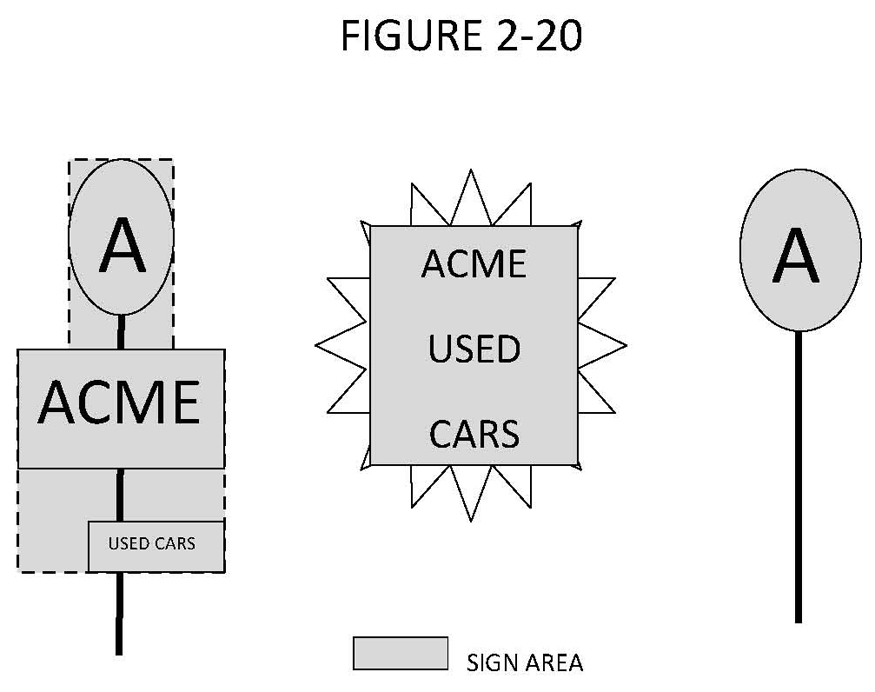
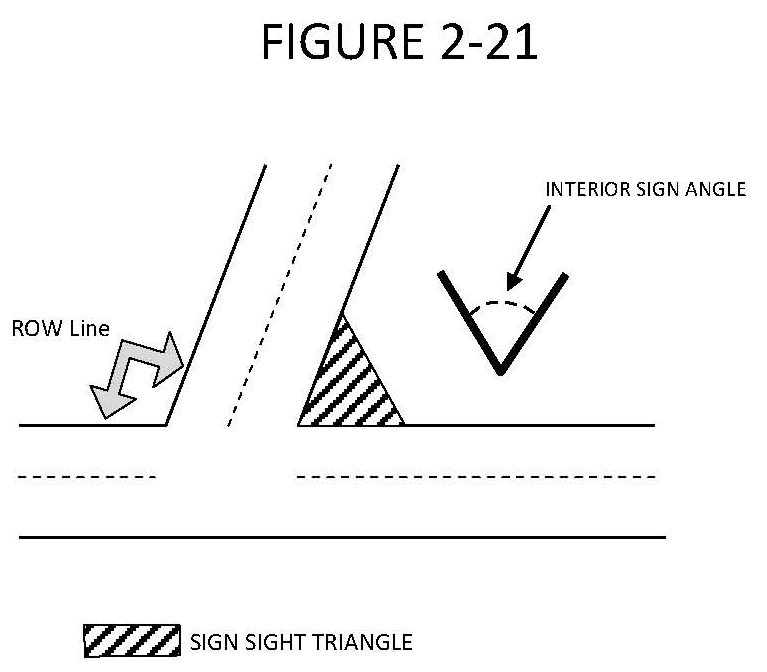
Sign Face: The part of a sign that is or may be used to convey a message or idea.
Site-Related Right-of-Way Dedications: Right-of-way dedications necessary to provide safe and adequate access to a development, which are made necessary by the traffic to be generated by or attracted to the development. Dedications of right-of-way to bring a road up to local (minor) road standards are presumed to be site related.
Snipe Sign: A sign of any material, including but not limited to paper, cardboard, wood, or metal, that does not comply with the standards of Section 9.02.01(A)(3) and is tacked, nailed, pasted, glued, or otherwise attached to trees, poles, fences, rocks, benches, or similar objects, either in the public right-of-way or other public property, or on private property without the permission of the owner.
Solar Access: The access of a solar energy system to direct sunlight.
Solar Energy System: Any device or combination of devices or elements which rely upon direct sunlight as an energy source, including but not limited to any substance or device which collects sunlight for use in the heating or cooling of a structure or building, the heating or pumping of water, or the generation of electricity. A solar energy system may be used for purposes in addition to the collection of solar energy. These uses include, but are not limited to, serving as a structural member or part of the roof of a building or structure and serving as a window or wall. A solar energy system may be mounted on the building or on the ground and is not the principal use of the property.
Solar Generation Station: An energy generation facility comprised of one (1) or more freestanding, ground mounted photovoltaic modules or devices that capture solar energy, converts it to electrical energy, stores energy, or delivers energy to a transmission system for use in locations other than where it is generated. Solar generation stations typically utilize photovoltaic solar cells, but can also be combinations of light reflectors, concentrators, energy storage equipment, and heat exchangers. A Solar Generation Station is also known as a solar facility, solar plant, solar generation plant, solar farm, solar power plant, battery storage plant, energy storage plant or solar thermal power plant. Ground mounted solar devices that capture solar energy (panels) shall not count towards maximum lot coverage. A Solar Generation Station may include, as an accessory use to the operation of the Station, administrative and maintenance support facilities.
Solid Waste: Sludge unregulated under the federal Clean Water Act or Clean Air Act, sludge from a waste treatment works, water supply treatment plant, or air pollution control facility, or garbage, rubbish, refuse, special waste, or other discarded material, including solid, liquid, semisolid, or contained gaseous material resulting from domestic, industrial, commercial, mining, agricultural, or governmental operations.
Special Flood Hazard Area: See Area of Special Flood Hazard.
Special Flood Hazard Area: As used in Section 6.05.00 Floodplain Management, an area in the floodplain subject to a one percent (1%) or greater chance of flooding in any given year: Special flood hazard areas are shown on FIRMs as Zone A, AO, A1-A30, AE, A99, AH, V1-V30, VE or V. [Also defined in FBC, B, Section 202.]
Special Master Proceeding: Means any combination of facilitation sessions, formal or informal hearings, of a public nature authorized under Section 11.14.00 of this Code.
Specified Anatomical Areas:
Less than opaquely covered:
(1)
Human genitals;
(2)
Human pubic region;
(3)
Human female breasts at or directly below the areola. This prohibition shall include the entire lower portion of the female breast but shall not be interpreted to include any portion of the cleavage of the breast exhibited by a dress, blouse, shirt, leotard, bathing suit, or other wearing apparel, provided the areola is not so exposed;
(4)
Human male genitals in discernible turgid state, even if completely and opaquely covered; and
(5)
Human buttocks.
Specified Sexual Activities: Human genitals in the state of sexual stimulation or arousal; acts of human adamitism, anilinctus, bestiality, coprophilia, cunnilingus, fellatio, flagellation, frottage, hyphephilia, masochism, masturbation, sadism, sadomasochism, sexual intercourse, sodomy, or urolagnia; and fondling or other erotic touching of human genitals, human pubic region, or female breasts.
Specimen Tree: A tree which has been determined by the Board of County Commissioners, following input from the Community Development Department, to be of high value because of its type, size, age, or other relevant criteria, and has been so designated by the Board in the official record books of the county following a public hearing with due notice provided in advance by certified mail to the owner.
Sponsoring Agency: As used in the context of "community residential home" sponsoring agency means an agency or unit of government, a profit or nonprofit agency, or any other person or organization which intends to establish or operate a community residential home.
St. Lucie County Port and Airport Authority: That authority created under Chapter 88-515, § 2, Laws of Florida responsible for the administration of the St. Lucie County International Airport and Port of Fort Pierce.
St. Lucie River Watershed: The St. Lucie River, its tributaries, its estuary, and the areas within St. Lucie County, Martin County, and Okeechobee County from which surface water flow is directed or drains, naturally or by constructed works, to the St. Lucie River, its tributaries, or its estuary.
Start of Construction: As used in Section 6.05.00, Floodplain Management, the date of issuance of permits for new construction and substantial improvements, provided the actual start of construction, repair, reconstruction, rehabilitation, addition, placement, or other improvement is within one hundred eighty (180) days of the date of the issuance. The actual start of construction means either the first placement of permanent construction of a building (including a manufactured home) on a site, such as the pouring of slab or footings, the installation of piles, or the construction of columns.
Permanent construction does not include land preparation (such as clearing, grading, or filling), the installation of streets or walkways, excavation for a basement, footings, piers, or foundations, the erection of temporary forms or the installation of accessory buildings such as garages or sheds not occupied as dwelling units or not part of the main buildings. For a substantial improvement, the actual "start of construction" means the first alteration of any wall, ceiling, floor or other structural part of a building, whether or not that alteration affects the external dimensions of the building. [Also defined in FBC, B, Section 202.]
State: The State of Florida.
State Highway System: Consists of:
(1)
Interstate system;
(2)
All rural arterial routes and their extensions into and through urban areas;
(3)
All urban principal arterial routes; and
(4)
Certain urban minor arterial routes designated by the Florida Department of Transportation.
State Jurisdictional Waters: Those waters and wetlands within the State dredge and fill jurisdiction pursuant to Sections 17-4.02(17) and 17-4.022, Florida Administrative Code, and rules on Sovereignty Lands, Chapter 16Q-21, Florida Administrative Code, and Florida Aquatic Preserves, Chapter 16Q-20, Florida Administrative Code.
State Minimum Building Code: The building code adopted by a municipality or county pursuant to the requirements of F.S. § 553.73.
State Roads: All streets, roads, highways, and other public ways open to travel by the public generally, and dedicated to the public use according to law or by prescription, and designated by the Florida Department of Transportation as provided by law, as parts of the State Highway System.
Static Message: Messages that do not have movement, or the appearance or optical illusion of movement during the static display period, of any part of the sign structure, design, or pictorial segment of the sign, including the movement or appearance of movement.
Stealth Tower or Camouflage Tower, Equipment Building or Antenna Structure: A designed structure that encloses, obscures or conceals the presence of an antenna, equipment building and/or telecommunications tower such that the tower, equipment building and/or antenna blends into the environment. For example, the following may be determined to be a stealth, or camouflage tower, equipment building or antenna: Towers and antennas integrated into man-made trees that are similar in height, branches and leaf coverage to natural trees occurring on the proposed site, clock towers, bell steeples, light poles, architecturally screened roof mounted antennas, equipment buildings installed below grade or not visible beyond the property as a result of landscaping or other buffering, and similar alternative designs. Stealth or camouflage tower may also be referenced as an "Alternative Tower Structure."
Stormwater Management Plan: The detailed analysis which describes the proposed stormwater management system for the development.
Street: Public or private ways that have been set aside through dedication, deed, or condemnation for public or private use or that have become a public way by prescriptive use, without regard to maintenance responsibility, but not including easements. This definition does not include any private street or way, that is not constructed in conformance with the provisions of Chapter XIII of this Code.
Structure: Anything constructed or installed, the use of which requires location on a parcel of land. It does not include a movable structure, even when it is located on land that can be used for housing, business, commercial, agricultural, or office purposes. "Structure" also includes fences, billboards, swimming pools, and signs. Structures should meet Florida Building Code requirements and be permanently affixed. As used in Section 6.05.00, Flood Damage Prevention, the term shall mean a walled and roofed building, including a gas or liquid storage tank that is principally above ground, as well as a manufactured home.
Subdivision: The platting of real property into three (3) or more lots, parcels, tracts, tiers, blocks, sites, units, or any other division of land.
Subdivision Collector Roads: Routes collecting and distributing traffic between local roads within a subdivision.
Substantial Change: A modification that changes the physical dimensions of an Eligible Support Structure if it meets any of the following criteria:
(1)
For towers other than towers in the public rights-of-way, it increases the height of the tower by more than ten percent (10%) or by the height of one (1) additional antenna array with separation from the nearest existing antenna not to exceed twenty (20) feet, whichever is greater; for other eligible support structures, it increases the height of the structure by more than ten percent (10%) or more than ten (10) feet, whichever is greater;
(2)
For towers other than towers in the public rights-of-way, it involves adding an appurtenance to the body of the tower that would protrude from the edge of the tower more than twenty (20) feet, or more than the width of the tower structure at the level of the appurtenance, whichever is greater; for other eligible support structures, it involves adding an appurtenance to the body of the structure that would protrude from the edge of the structure by more than six (6) feet;
(3)
For any eligible support structure, it involves installation of more than the standard number of new equipment cabinets for the technology involved, but not to exceed four (4) cabinets; or, for towers in the public rights-of-way and base stations, it involves installation of any new equipment cabinets on the ground if there are no pre-existing ground cabinets associated with the structure, or else involves installation of ground cabinets that are more than ten percent (10%) larger in height or overall volume than any other ground cabinets associated with the structure;
(4)
It entails any excavation or deployment outside the current site;
(5)
It would defeat the concealment elements of the eligible support structure; or
(6)
It does not comply with conditions associated with the siting approval of the construction or modification of the eligible support structure or base station equipment, provided however that this limitation does not apply to any modification that is non-compliant only in a manner that would not exceed the thresholds identified in sub-paragraphs (i)-(iv) of this section.
Substantial Damage: Damage of any origin sustained by a building or structure whereby the cost of restoring the building or structure to its before-damaged condition would equal or exceed fifty percent (50%) of the market value of the building or structure before the damage occurred. [Also defined in FBC, B, Section 202.]
Substantial Improvement: As used in Section 6.05.00, Flood Damage Prevention, the term shall mean, any repair, reconstruction, rehabilitation, alteration, addition, or other improvement of a building or structure, the cost of which equals or exceeds fifty percent (50%) of the market value of the building or structure before the improvement or repair is started. If the structure has incurred "substantial damage," any repairs are considered substantial improvement regardless of the actual repair work performed. The term does not, however, include either: [Also defined in FBC, B, Section 202.]
(1)
Any project for improvement of a building required to correct existing health, sanitary, or safety code violations identified by the building official and that are the minimum necessary to assure safe living conditions.
(2)
Any alteration of a historic structure provided the alteration will not preclude the structure's continued designation as a historic structure.
Substantially Improved Existing Manufactured Home Parks or Subdivisions: Where the repair, reconstruction, rehabilitation or improvement of the streets, utilities and pads equals or exceeds fifty percent (50%) of the value of the streets, utilities and pads before the repair, reconstruction or improvement commenced.
Telecommunications Facility Operator: A provider of telecommunications services, or an owner or operator of a telecommunications facility.
Telecommunications Tower Height or Height: When referring to a wireless telecommunications tower or other structure, the distance measured from the finished grade of a parcel to the highest point on the tower or other structure, including the base pad and any antenna, but excluding lights and lightning rods.
Temporary Building or Structure: A temporary building or structure is a building or structure that is intended to be located on a parcel of land for a limited period of time or duration. All temporary buildings or structures shall be adequately secured or anchored to the ground in accord with the requirements of the Standard Building Code or in the case of State Certified manufactured buildings or mobile homes, said modular buildings or mobile homes shall be properly anchored to applicable laws or regulations.
Temporary Sign: A sign that does not meet the construction standards of the Florida Building Code and that, for a limited period of time, conveys any message relating to a special event or other occurrence of limited duration, such as an election; a building under construction; real estate for sale, rent, or lease; or a business grand openings.
Temporary Use: A use, other than an accessory use, that does not involve the construction or alteration of any permanent structure and that is established for a fixed period of time with the intent to discontinue such use upon the expiration of the established time period. See Section 8.02.00.
Tinted Glass: Any window which has:
(1)
A shading coefficient (the percent of incident radiation passing through a window) of .45 or less; and
(2)
A minimum five-year warranty; and
(3)
Performance claims which are supported by approval testing procedures and documentation.
Trailer Sign: A movable visually communicative structure mounted on skids, wheel, or wheels, whether or not registered to travel on the public roads.
Transient Lodging Facilities: Structures with units or rooms generally used for occupancies of less than four (4) weeks including without limitations hotels/motels, time-share facilities and tourist courts.
Transmission Equipment: Equipment that facilitates transmissions for any FCC-licensed or authorized wireless communication service, including, but not limited to, radio transceivers, antennas, coaxial or fiber-optic cable, and regular and backup power supply. The term includes equipment associated with wireless communications services including, but not limited to, private, broadcast, and public safety services, as well as unlicensed wireless services and fixed wireless services such as microwave backhaul and the associated site, and shall not include for example: utility poles, light poles, pedestrian signalized poles or signalized intersection poles, masts, or similar vertical structures that have a primary purpose or function independent of supporting a wireless telecommunications facility.
Transportation Corridor: Any land area, designated by the state or the county which is between two (2) geographic points and which area is used or is suitable for the movement of people and goods by one (1) or more modes of transportation and may include areas necessary for management of access and securing applicable approvals and permits. Transportation corridors shall contain, but are not limited to, the following:
(1)
Existing publicly owned rights-of-way;
(2)
All property or property interests necessary for future transportation facilities, including rights of access, air, view, and light, whether public or private, for the purpose of securing and utilizing future transportation rights-of-way, including, but not limited to, any lands reasonably necessary now or in the future for securing applicable approvals and permits, borrow pits, drainage ditches, water retention areas, rest areas, replacement access for landowners whose access could be impaired due to the construction of a future facility, and replacement rights-of-way for relocation of rail and utility facilities.
Transportation Facility: Any public way provided for the passage of people and property from place to place that is constructed, operated, or maintained in whole or in part from public funds. The term includes the property or property rights, both real and personal, which have been or may be established by public bodies for the passage of people and property from place to place.
Travel Trailer: A vehicular portable structure not exceeding thirty-six (36) feet in length designed for travel, recreational, and vacation uses.
Tree: A woody plant having a well-defined stem, a more or less well defined crown, and which is capable of attaining a height of at least fifteen (15) feet with a trunk diameter of not less than two (2) inches, or a cluster of main stems having an aggregate diameter of not less than two (2) inches, DBH.
Tree Canopy: The leafy portion of a tree.
Tropical Hardwood Hammock Trees: Trees of Caribbean and South Florida origins, commonly found on Hutchinson Island and between the Florida East Coast railroad and western shore of the Indian River Lagoon including, but not limited to:
Underdrain: A perforated conduit, installed beneath the ground surface, which collects and conveys water by gravity to an outfall.
Undesignated Bike Lane: A bike lane, which is not designated by the diamond, bike and arrow pavement markings. It is striped as a regular bike lane on the approaches to intersections.
Urban Minor Arterial Road: Routes which generally interconnect with and augment urban principal arterial roads and provide service to trips of shorter length and a lower level of travel mobility. Such routes include all arterials not classified as principal and contain facilities that place more emphasis on land access than the highway system.
Urban Principal Arterial Road: Routes which generally serve the major centers of activity of an urban area, the higher traffic volume corridors and the longest trip purpose and carry a high proportion of the total urban area travel on a minimum of mileage.
Use: The purpose for which land, structures, buildings, or signs are designed, arranged, and erected.
Value-added Farm Products: A product processed by a Producer from a Farm Product, including but not limited to baked goods, jams and jellies, canned vegetables, dried fruit, syrups, salsas, salad dressings, flours, coffee and other beverages, smoked or canned meats or fish, sausages, or prepared foods.
Variance: A grant of relief from the requirements of this chapter which permits construction in a manner otherwise prohibited by this Code where specific enforcement would result in unnecessary hardship. See Section 10.01.00.
Variance: As used in Section 6.05.00, Floodplain Management, a grant of relief from the requirements of this ordinance, or the flood resistant construction requirements of the Florida Building Code, which permits construction in a manner that would not otherwise be permitted by this ordinance or the Florida Building Code.
Vegetated Buffer Strip: Areas retained in their natural state or replanted along the banks of watercourses, water bodies, or wetlands. The width of the buffer should be sufficient to prevent erosion, trap the sediment in overland runoff, provide access to the water body, and allow for periodic flooding without damage to structures.
Vegetation: Any living plant tissue including trees, shrubs, herbs, sedges, grasses, fungi, and algae.
Vegetation, Nonprotected: The following species are defined as nonprotected plant species for the purpose of this ordinance:
(1)
All species of Casuarina, including Australian pine;
(2)
Enterolobium cycocarpum: ear pod tree;
(3)
Melia azedarach: Chinaberry;
(4)
Schinus terebinthifolius: Brazilian pepper tree;
(5)
Melaleuca quinquenervia: Melaleuca, punk or paper tree;
(6)
Albezzia lebbeck: Mother's tongue;
(7)
Grevilla robusta: Silk oak;
(8)
Jacaranda acutifolia: jacaranda;
(9)
Eucalyptus: all species;
(10)
Sapium sebiferum: Chinese tallow tree;
(11)
Albizzia julibrissin: Mimosa.
Vegetation, Protected: All vegetation other than:
(1)
Prohibited plant species; or
(2)
Non-native fruit trees that are cultivated or grown for the specific purpose of producing edible fruit including, but not limited to, mangoes, avocados, or species of citrus; or
(3)
Trees that are less than five (5) inches in diameter at a point four and one-half (4½) feet aboveground or less than fifteen (15) feet in height;
(4)
Grasses.
Vegetation Inventory: A drawing or sketch prepared to scale which provides the approximate location, extent, and common names of the trees or major groups of vegetation on site. The vegetation inventory shall include the proposed locations of buildings, structures, driveways, and other improvements drawn to scale and the individual location of all protected trees of approximately twelve (12) inches DBH or greater within all improvement areas and within ten (10) feet of all improvement areas.
Vehicular Sign: A sign affixed to a vehicle or trailer for the purposes of this Code, this definition shall only be applicable when said vehicle or trailer is on a parcel for the primary purpose of conveying a message and not otherwise incidental to the vehicle's primary purpose of transportation.
Vehicular Use Area: Any area intended to support tracked or tired vehicles capable of self-propulsion. Vehicular use areas are engineered and constructed to support repeated loadings of these vehicles. The incidental use of any area by a tracked or tired vehicle to park non-self-propelled vehicles, for example, trailers, does not make the area used for the parking of such vehicles a vehicle use area. The vehicle use area construction of paved impervious surface is not required but shall include measure in conformance to St. Lucie County Engineering design standards to direct and store all stormwater run-off so it is treated prior to any off-site discharge. This requirement is not intended to supersede or otherwise contradict any regulatory requirements by any other agency.
Vendor: A farmer or other person designated as having the right to participate in the market.
Violation: As used in Section 6.05.00, Flood Damage Prevention, means the failure of a structure or other development to be fully compliant with the requirements of this section. A structure or other development without the elevation certificate, other certifications, or other evidence of compliance required by this section is presumed to be in violation until such time as that documentation is provided.
Wall: An upright structure of masonry, wood, plaster or other building material which is constructed on a supporting structure, such as a footer, serving to enclose, divide or protect an area and not intended to create a covered and habitable area.
Wall Face: The entire building front including the parapet.
Wall Mural: A wall mural shall mean any picture or graphic design painted on or otherwise applied to the exterior of a building or structure. A wall mural may include communicative wording or characters to the extent that the mural does not violate the wall sign requirements of the zoning district in which the mural is located.
Wall Sign: A sign erected parallel and attached to the outside wall facade of any building or fence, including flat, painted, individual letter, or cabinet signs.
Water Dependent Activity: An activity which can only be conducted on, in, over, or adjacent to water areas because the activity requires direct access to the water body or sovereignty lands for transportation, recreation, energy production or transmission, or source of water, and where the use of the water or sovereignty lands is an integral part of the activity.
Water or Sewer Utility: As used by this Code, a water or sewer utility shall mean a water or sewer utility which is providing service to one hundred (100) or more persons for compensation.
Watercourse: As used in 6.05.00, Floodplain Management, a river, creek, stream, channel or other topographic feature in, on, through, or over which water flows at least periodically.
Well: Any excavation that is drilled, cored, bored, washed, driven, dug, jetted, or otherwise constructed when the intended use of such excavation is to conduct groundwater from a source bed to the surface, by pumping or natural flow, when groundwater from such excavation is used or is to be used for a public water supply well.
Wellfield Protection Officer: The St. Lucie County Hydrologist or designee.
Wetland: An area that is inundated or saturated by surface water or groundwater at a frequency and duration sufficient to support, and that under normal circumstances does support, a prevalence of vegetation typically adapted for life in saturated soil conditions, commonly known as hydrophytic vegetation.
Wetland Alteration: Any dredging, filling, cutting, drainage, or flooding of a jurisdictional wetland.
Wetland Dredging: Any disruption or displacement of wetland substrate or bottom sediments or contours. It also means the excavation or creation of a water body which is or will be connected to jurisdictional wetlands as defined in Section 6.02.03(B).
Wetland Filling: The placement of any material in, on, or over a jurisdictional wetland.
Wetland Functions: The roles wetlands serve, including but not limited to flood storage, flood conveyance, ground water recharge and discharge, erosion control, wave attenuation, water quality enhancement and protection, nutrient removal, food chain support, wildlife habitat, breeding and habitat grounds for fishery species, and recreational values.
Wetland Mitigation: The compensation for the loss of wetland acreage, value and functions by the creation of new wetlands or the enhancement of existing wetlands.
Whip Antenna: A cylindrical antenna that transmits signals in three hundred sixty (360) degrees.
Wholesale Trade: The sale of goods for resale by a retail establishment to the ultimate consumer.
Wireless Communications Facility or Telecommunications Facility: Any equipment or facility used to provide wireless telecommunications service and may include, but is not limited to, antennas, towers, equipment enclosures, cabling, antenna brackets, and other such equipment. Placing a wireless communications facility on an existing structure does not cause the existing structure to become a wireless communications facility. Such definition shall not include facilities of a governmental entity where such facilities are utilized to provide intra-governmental communications, not generally available to the public, to protect the health, safety and welfare of the public, including but not limited to the South Florida Water Management District.
Wireless Telecommunications Service: Personal wireless service or "commercial mobile radio service" as provided under ss. 3(27) and 332(d) of the Federal Telecommunications Act of 1996, 47 U.S.C. §§ 151 et seq., and the Omnibus Budget Reconciliation Act of 1993, Pub. L. No. 103-66, August 10, 1993, 107 Stat. 312. The term includes service provided by any wireless real-time two-way communication device, including radio-telephone communications used in cellular telephone service; personal communications service; or the functional or competitive equivalent of a radio-telephone communications line used in cellular telephone service, a personal communications service, or a network radio access line. The term does not include wireless providers that offer mainly dispatch service in a more localized, noncellular configuration; providers offering only data, one-way, or stored-voice services on an interconnected basis; providers of air-to-ground services; or public coast stations.
Wireless Tower or Telecommunications Tower or Tower: Any structure, and support thereto, designed and constructed for the sole or primary purpose of supporting one (1) or more antennas and their associated equipment intended for transmitting or receiving wireless telecommunications services, telephone, radio and similar communication purposes, licensed or authorized by the FCC to the extent required, including lattice, monopole and guyed telecommunications towers. Unless otherwise expressly excluded, the term includes transmission telecommunications towers, microwave telecommunications towers, common-carrier telecommunications towers, cellular telephone telecommunications towers, alternative telecommunications tower structures, among others. To the extent not inconsistent with applicable law, the term Wireless Tower or Telecommunications Tower does not include a utility pole for the collocation of a small wireless facility in the County's public rights-of-way pursuant to the St. Lucie County Communications Rights-of-Way Ordinance, Chapter 44, Article I, of the County Code. A Wireless Tower, Telecommunications Tower or Tower shall not include the following:
(1)
A cell-on-wheels authorized pursuant to Section 7.10.23;
(2)
A structure supporting a utility transmission line(s) only;
(3)
A structure up to one hundred fifty (150) feet in height supporting a 69KV or higher voltage utility transmission line(s), and antenna(e), when located in non-residential zoning districts;
(4)
An amateur radio antenna or its support apparatus; and
(5)
A structure supporting a radio, television or satellite receiving antenna for residential uses only.
Yard orsetback: An open space at grade between a building and the property lines of the lot on which the building is located, unoccupied and unobstructed from the ground upward, except as otherwise provided herein. In measuring a yard for the purpose of determining the depth of a side yard, the depth of a front yard, or the depth of a rear yard, the minimum horizontal distance between the lot line and the main building shall be used.
Yard, Front orfront yard setback: A yard extending across the front of a lot, bounded by the side lot lines, front property line and the front of the main building or any projections thereof. In all cases, the main building and any projections thereof must be behind the line of minimum lot width.
Yard, Rear orrear yard setback: A yard extending across the rear of a lot between the side lot lines and the rear property line, and being the required minimum horizontal distance between the rear property line and the rear of the main building or any projections thereof. On all lots the rear yard shall be at the opposite end of the lot from the front yard.
Yard, Side orside yard setback: A yard between the main building and the side line of the lot, extending from the required front yard to the required rear yard, and being the minimum horizontal distance between a side property line and the side of the main building or any projections thereof.
Yard Trash (also known as Vegetative Debris): Vegetative matter resulting from landscaping maintenance and land clearing operations and includeing materials such as tree and shrub trimmings, grass clippings, palm fronds, trees and tree stumps, and associated rocks and soils. For purposes of Section 7.10.34 only yard trash also includes clean wood.
Zone of Protection: Those areas around public water supply wellfields meeting the criteria in Section 6.03.02.
(Ord. No. 10-003, Pt. A, 2-15-2010; Ord. No. 10-034, Pt. A, 11-9-2010; Ord. No. 11-005, Pts. A, B, 2-1-2011; Ord. No. 11-031, Pt. A, 12-20-2011; Ord. No. 11-017, Pt. A, 6-21-2011; Ord. No. 11-012, § A, 8-2-2011; Ord. No. 12-003, Pt. A, 5-15-2012; Ord. No. 12-009, Pt. A, 4-17-2012; Ord. No. 12-010, Pt. A, 2-14-2012; Ord. No. 13-038, Pt. A, 9-3-2013; Ord. No. 15-002, Pt. A, 4-7-2015; Ord. No. 16-009, Pt. A, 6-7-2016; Ord. No. 17-004, Pt. A, 4-18-2017; Ord. No. 17-005, Pt. A, 5-16-2017; Ord. No. 17-015, § 2, 7-5-2017; Ord. No. 18-001, Pt. A, 1-23-2018; Ord. No. 2018-006, Pt. A, 5-15-2018; Ord. No. 2020-22, Pt. A, 8-4-2020; Ord. No. 2020-29, Pt. A, 12-1-2020; Ord. No. 2021-14, Pt. A, 6-1-2021; Ord. No. 2022-18, § 2, 7-19-2022; Ord. No. 2022-21, Pt. A, 7-19-2022; Ord. No. 2022-027, § 2, 9-20-2022; Ord. No. 2022-29, § 2, 10-18-2022; Ord. No. 2023-05, Pt. A, 3-21-2023; Ord. No. 2023-7, § 2, 5-16-2023; Ord. No. 2023-14, § A, 10-17-2023; Ord. No. 2024-5, § 2, 1-9-2024; Ord. No. 2024-3, § 2, 1-23-2024; Ord. No. 2024-26, § 1, 7-2-2024)

