
San Miguel County Unincorporated
City Zoning Code
City Zoning Code
SECTION 5
27: - WIRELESS SERVICES AND COMMUNICATIONS FACILITIES
5-2701 - Wireless Services and Communications Facilities
5-2701A.
Purpose of Section
The purpose of this Wireless Services and Communications Facilities section is to ensure that residents, visitors, schools, public safety operations and businesses in unincorporated areas San Miguel County have reliable access to Personal Wireless Services while ensuring that this objective is achieved in a fashion that preserves the aesthetic character of the community and neighborhood and is accomplished according to the County's planning, zoning, and design standards.
The provisions of this section are intended to be in compliance with the provisions of the Federal Telecommunications Act of 1996, 47 USC §332(c)(7), and are not intended to prohibit or have the effect of prohibiting the provision of personal wireless services and shall be implemented accordingly.
To accomplish the above stated objectives and to ensure that the placement, construction or modification of Wireless and Communication Facilities comply with all applicable Federal laws, and is consistent with the County's land use policies, the County adopts this single, comprehensive, wireless services and communications section. Communication towers, antennas and facilities shall conform to the requirements of this section and all other applicable requirements of this Code.
No provision of this LUC section shall apply to the siting of Distributed Antenna Systems (DAS) or wireless facilities within a building, stadium or similar structure, school or park and is intended primarily to provide wireless coverage within that building, stadium, or similar structure, school or park.
This section establishes parameters for the siting, design, operation and maintenance of Wireless and Communication Facilities in the unincorporated areas of San Miguel County. By enacting this section it is the County's intent to:
I.
Ensure the County has sufficient wireless infrastructure to support public safety and emergency response communications throughout the county;
II.
Ensure access to reliable Personal Wireless Services throughout all areas of the county including wireless broadband data services and in no event prohibit or have the effect of prohibiting the provision of Personal Wireless Services;
III.
Minimize the number of towers by encouraging the joint use (collocation) of facilities and by maximizing the use of existing towers and structures;
IV.
Encourage the location of Support Structures, to the extent possible, in areas where any potential adverse impacts on the community and its residents will be minimized;
V.
Provide for the efficient modification and upgrading of existing Facilities to accommodate changing technologies and to cause the removal of obsolete Facilities;
VI.
Facilitate the responsible deployment of Facilities to serve residential areas and to ensure that Facilities are sited and/or co-located in a manner that does not detract from the scenic quality or residential character of the area;
VII.
Minimize the potential adverse effects of Wireless & Communication Facilities through the implementation of design, landscaping and construction practices;
VIII.
Allow competition in Wireless Services and Communication Facilities and to avoid unreasonably discriminating among providers of functionally equivalent services;
IX.
Ensure public health, safety, and welfare;
X.
Provide guidelines and standards for the siting and design of Wireless Services and Communications Facilities;
XI.
Protect the county's environmental resources and to minimize adverse impacts on visual resources, including compliance with applicable scenic quality standards; and
XII.
Ensure that Telecommunication Facilities are compatible with adjacent and neighboring land uses and meet all applicable Land Use Code provisions.
This Section 5-27 of the Land Use Code supersedes all other provisions of the Land Use Code pertaining to the permitting, placement, construction and modification of Wireless and Communication Facilities except as specifically provided for in this section.
5-2701B.
General
Wireless Services and Communication Facilities may be allowed subject to either Administrative Review or approval of a Special Use Permit application in any Zone District, except Open Space (OS), Scenic Foreground Overlay (SFO) and Scenic View Plane (SVP), residentially developed portions of Affordable Housing PUD's or the High-Country Area (HCA). A determination of whether a Facility may be permitted by an Administrative Review or will require consideration through a Special Permit Review process will depend on the type, design, location or height of the proposed Facility, the zoning of the property, the proximity to a Residential Area, and will be reviewed for compliance with the provisions and standards set forth herein.
Telecommunications towers must be built to provide service coverage and/or capacity for one (1) or more FCC licensed wireless carriers, e.g., Cingular, Verizon, Sprint, AT&T, Alltel, T-Mobile, or for a public entity, or to provide emergency service communication facilities. New towers will not be approved until it is demonstrated that no existing towers or structures (such as existing Wireless or Communication Towers, water towers, utility and/or light poles, rooftops of existing buildings and similar structures) can accommodate the wireless carrier's equipment and provide functionally equivalent coverage to a specified service area. The evidence should include the effort made to locate on an existing facility including coverage/interference analysis, capacity analysis, and technological feasibility, and a brief statement as to any other reasons for success in locating on an existing tower or structure or lack thereof.
In accordance with the 1996 Telecommunications Act the County is prohibited from considering the effects of radio frequency emissions in determining a suitable tower site location, provided, such tower complies with the regulations of the Federal Communications Commission regarding such concern.
In addition to complying with all applicable zone district standards wireless services and communication facilities shall comply with the standards in this section. Facilities and support Structures may be located on a parcel containing another principal use.
5-2702. - Review Procedures
5-2702A.
Uses Allowed Subject to Administrative Review
Unless otherwise specified herein, all Facilities and Support Structures permitted by Administrative Review and Approval are subject to the applicable standards in Section 5-27.
I.
Facilities Located on Existing Structures
a.
Antennas and Accessory Equipment when located on an Existing Structure or site.
b.
Antennas and Accessory Equipment may exceed the maximum Building Height limitation within a zoning district provided the structure and antenna attached to the existing facilities do not exceed forty-five (45) feet in combined height.
c.
Minor Modifications are permitted in all zoning districts subject to Administrative Approval in accordance with the requirements of this section.
II.
New Support Structures
a.
New Towers less than sixty (60) feet in height shall be permitted in all zoning districts, except those listed in Section 5-2701 B and those in Residential Areas, in accordance with the requirements of this section.
III.
COW Facilities ("Carrier on Wheels" or "Cell on Wheels")
a.
COW placed for a period of not more than fourteen (14) days for temporary uses related to a duly sanctioned special event;
b.
COW placed for a period of not more than one hundred twenty (120) days for temporary use related to Replacement or repair of an existing support structure or tower that has either been permitted by San Miguel County or is determined to be a pre-exiting non-conforming structure;
c.
COW placed for a period of not more than one hundred twenty (120) days at any location within unincorporated areas of the County after a Declaration of an emergency disaster by the governor or as authorized by the Board of County Commissioners.
5-2702B.
Uses Allowed Subject to One-Step County Planning Commission Special Use Permit Review
One-step Planning Commission decisions are subject to Call-up by the Commissioner of the district where the proposed facility will be located, in addition to the Call-up procedure set forth in Section 1-20.
I.
Stealth Towers, less than sixty (60) feet in height located in Residential Areas.
II.
A Stealth Tower less than sixty (60) feet in height adjacent to a Residential Area
5-2702C.
Uses Allowed Subject to Two-Step Special Use Permit Review
All new Towers and Facilities not listed under Administrative Review or One-step Review and all Towers over sixty (60) feet in height but less than one hundred ninety-nine (199) feet in height.
5-2702D.
Exemptions
Ordinary Maintenance of existing Facilities and Support Structures, as defined herein shall be exempt from obtaining a Development Permit. In addition the following facilities are not subject to the provisions of this section of the LUC:
I.
Antennas used by residential households solely for broadcast radio and television reception;
II.
Satellite antennas including satellite dishes used solely for residential or household purposes;
III.
FCC licensed radio operators or receive-only facilities less than forty-five (45) feet in height.
5-2703 - Preferred, Disfavored, Prohibited Facilities
5-2703A.
Preferred Facilities
Site location and development of Telecommunication Facilities shall preserve the existing character of the surrounding land uses and buildings and the aesthetic visual character of the area. If technically feasible, new facilities shall use the most preferred facility type in the order specified herein below. The order of preference for new facilities is as follows (the most preferred to the least preferred):
I.
Co-location on an existing tower.
II.
Antennas attached to existing structures such as towers, buildings, light poles, and utility poles that do not substantially increase the height of the existing structure.
III.
Location of new towers or facilities less than one hundred (100) feet in height in relatively remote areas at higher elevations far removed from Residential Areas that would not be highly visible from State Highways, neighboring developments and public uses areas.
IV.
Location of new towers or facilities less than one hundred fifty (150) feet but more than one hundred (100) feet in height in relatively remote areas at higher elevations far removed from Residential Areas that would not be highly visible from State Highways, neighboring developments and public use areas.
V.
Location of new towers or facilities less than one hundred ninety-nine (199) feet but more than one hundred fifty (150) feet in height in relatively remote areas at higher elevations far removed from Residential Areas that would not be highly visible from State Highways, neighboring developments and public use areas.
VI.
New tower or facility less than sixty (60) feet in height that is intended to service a Residential Area, where the tower or facility is located on an adjacent or nearby industrial and/or commercial zoned property or non-residential public facility. It is preferred that the tower or facility be a Stealth facility.
VII.
New tower or facility less than sixty (60) feet in height that is deemed necessary to provide or improve wireless or broadband data services to serve a Residential Area, which must be located within that Residential Area to meet technical requirements. Towers and facilities located within a Residential Area shall be a Stealth Facility that does not detract from the visual quality or residential character of the neighborhood or an adjoining neighborhood.
Preferred Examples:
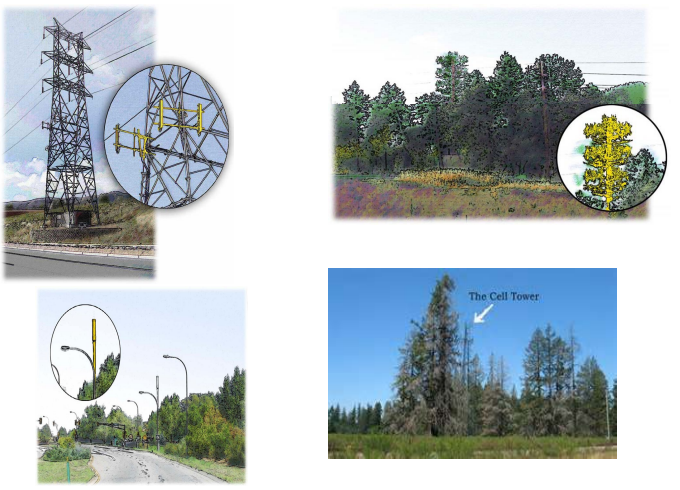
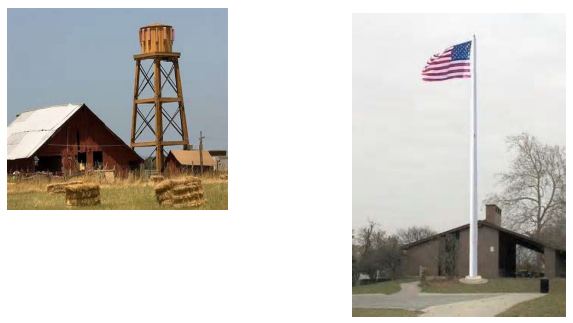
When a new tower is necessary Stealth Facilities are the preferred facility followed by a self-supporting Monopole, and then a Lattice tower. Guyed towers are considered a disfavored facility.
A lesser preferred or disfavored facility type may be permitted only if the applicant presents substantial evidence to show that it will have a lesser visual impact or is more technically necessary because of service coverage requirements than the use of more preferred facilities.
5-2703B.
Disfavored Facilities
Site location and development of Telecommunication Facilities shall preserve the existing character of the surrounding land uses and buildings and the aesthetic visual character of the area. Disfavored facilities shall not be considered unless it is demonstrated that there is not a preferred facilities location available that will provide similar coverage. The following are considered disfavored locations:
I.
New towers on any site that is within a state or county designated scenic highway corridor or major highway corridor.
II.
New towers located on a site within a Scenic Vista, Scenic View Plane or along a ridgeline so it is exposed to view from highway travelers or to Residential Areas, along a public trail, in a park or recreation area, unless the facility blends in with the surrounding natural and human made environment.
III.
New towers on sites within one-half (1/2) mile of a Residential Area. This does not include the installation of antennas and associated facilities on existing facilities.
IV.
New towers that are located in open fields, open meadows or low-lying areas that are highly visible from Scenic highways, public use areas and/or Residential Areas.
V.
New towers that are located in environmentally sensitive areas such as Floodplains, Wetlands, and Gunnison-Sage grouse habitat.
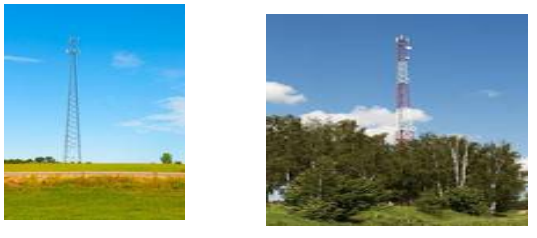
Disfavored Examples:
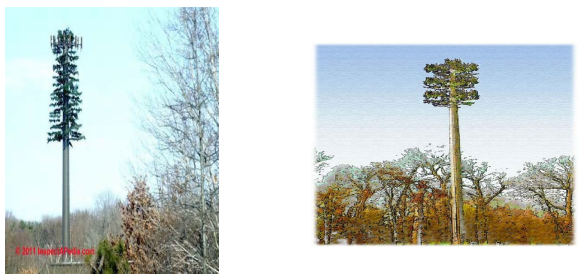
Unacceptable Siting and Design
Above: "monopine" incompatible with surroundings - Below: towers in highly visible site
5-2703C.
Prohibited Facilities
The following towers/facilities are prohibited:
I.
New towers or additions to towers that exceed one hundred ninety-nine (199) feet in height and/or that are located so that the Facility is required to be lighted to comply with Federal Aviation Administration requirements.
II.
Non-Stealth towers in Residential Areas.
5-2704 - Application Requirements
5-2704A.
Pre-application Conferences with Staff
Prior to the submittal of an application for either an Administrative Review or a Special Use Permit application for a telecommunications facility the applicant shall schedule the first of two (2) pre-application conferences with Planning Department staff. The tower applicant and at least one (1) person from the service provider or their appointed authorized qualified agent must attend the pre-application conferences. At the first conference the applicant will share with staff information on existing towers and the proposed service area. Staff will provide information regarding existing towers within the county, zone district information, Residential Area locations, and information on preferred and disfavored facilities and locations.
At the second conference the applicants will submit a written narrative explaining why the proposed site has been chosen, the type of Tower chosen, including an analysis of alternative locations that were considered and an explanation as to why they were not selected, why the proposed Telecommunication Facility is necessary, why the requested height was chosen, ability of the facility to accommodate other providers, and any other information requested at the first pre-application conference.
Based upon the written narrative information staff will review the Land Use Code requirements and submittal requirements. Staff will prepare a written Pre-application Conference Summary letter that will include a determination as to type of review (Administrative, One or Two step review), Public Notice requirements, and other applicable Land Use Code requirements in addition to Section 5-27 requirements.
In addition, for facilities located within one-half (½) mile of a Residential Area, the applicant shall hold a neighborhood meeting prior to the submittal of an application. Staff will attend the meeting and utilize the comments of neighbors in the analysis presented to the County Planning Commission and/or the Board of County Commissioners. The requirement of a neighborhood meeting may be waived by the Planning Director, in their discretion.
5-2704B.
General Requirements
I.
The following must be addressed as part of any application:
a.
Site plan, photos or drawings accurately representing existing and proposed conditions, specifying the location of antennas, support structures, transmission building, and other accessory structures, setbacks from property lines, all uses, access, parking, fences, signs, existing and proposed landscaping, and lighting, as well as all adjacent land uses within five hundred (500) feet for towers less than one hundred (100) feet high and one thousand (1000) feet for towers from one hundred (100) to one hundred ninety-nine (199) feet high. The Planning Director will assist in specifying recommended vantage points and the requested number of photo simulations.
b.
Elevation drawings, or before and after simulations/drawings specifying the height and location of antennas, support structures, transmission building(s), and any accessory uses, fences, or signs, and proposed materials and colors.
c.
Structural Integrity Report from a professional engineer licensed in the State of Colorado that documents tower height and design, total anticipated capacity of the structure, failure characteristics, and specific design/reconstruction plans to allow shared use.
d.
Statement from the Federal Communications Commission (FCC), or applicable federal agency, that the application complies with the regulations of the FCC or applicable federal agency with regard to maximum radio frequency and electromagnetic frequency emissions, or a statement from the applicant that no such compliance is necessary and the reasons therefore.
e.
The applicant shall erect a visual devise which specifically identifies the height and mass of the proposed facilities and provide notice of the date and time of the simulation in local newspapers with a display advertisement and on local radio. The public notice shall take place a minimum of ten (10) days prior to the erection of the visual device. This requirement may be waived or modified by the Planning Director, in their discretion.
The devise shall be erected prior to the scheduled meeting date as determined by the Planning Department.
f.
Written Narrative
A copy of the previously submitted written narrative, along with any updates, including any additional information requested at the pre-application conference, shall be submitted.
g.
Existing Structures
Evidence shall be submitted demonstrating that there is no existing structure that can be utilized within the targeted coverage area to meet the applicant's requirements.
h.
For facilities within one-half mile of a Residential Area provide evidence of notification of property owners within one-half mile, a map indicating tower site and residential area, and evidence of neighborhood meeting including sign-in sheet and a description of how the design addresses the residents' concerns. At the Planning Director's discretion the area of notification may be increased based upon potential visual impact or other extenuating circumstances.
i.
The location and type of any existing and/or proposed telephone and internet broadband facilities serving the proposed site.
II.
The County may, in its discretion, hire a qualified third party to review the submitted application. It will be the responsibility of the applicant to pay, at a customary reasonable market rate, for third party reviews initiated by the County.
III.
The Planning Director, Planning Commission or the Board of County Commissioners may reasonably require more materials or information to be supplied by an applicant.
IV.
Should an applicant for a wireless services facility, including any co-applicant(s), not be an FCC licensed wireless service provider, the application shall include written documentation from such an FCC licensed wireless service provider that it is contractually obligated to provide personal wireless services using the applicant's proposed telecommunications facility should it receive county land use approval.
5-2704C.
Communication Plan
In order to protect citizens against an unreasonable proliferation of wireless communication facilities in the County and in order to protect and preserve the character and aesthetics of County scenic view planes each applicant shall provide a plan of its existing and intended facilities to the County prior to, or in conjunction with, any application for the installation of a Telecommunication Facility. The plan shall cover the entire County extending five (5) miles beyond the County border. The plan shall include the following items. These shall be in general terms and are not meant to require submittal of confidential or proprietary information.
I.
All of the applicant's existing telecommunication facilities by size, type and coverage area.
II.
All presently anticipated future service areas, anticipated dates of development, and types and heights of facilities desired for each of the Service areas.
III.
The applicant's proposal to mitigate and/or reduce existing and proposed towers to avoid the proliferation of such facilities.
IV.
The applicant's proposal to mitigate and/or reduce the negative visual impacts created by new towers, including any proposals to conceal disguise such facilities designed to be architecturally and/or environmentally compatible with their surroundings.
V.
The applicant's proposal to co-locate antennas on their own facilities, on facilities from other applicants or tower companies, or on other structures that provide the verticality required for the antennas.
5-2704D.
Scenic Quality Mitigation Plan
I.
A plan for mitigation of visual impacts or other appropriate aesthetic impacts of the proposed tower, and associated telecommunication support facilities, shall be submitted.
II.
Visual simulations and renderings may be required by the Planning Department as a part of the submittal materials.
III.
Colors and Materials
Visual mitigation techniques such as coloring, screening and landscaping shall be used. Towers, attached antennas and accessory structures, such as equipment buildings, including the roofs, must be painted or coated in a color that blends with the surrounding environment.
IV.
Fencing
New towers and facilities may be required or allowed to be fenced to prevent trespass.
V.
Lighting
Lighting is prohibited on towers unless required by the Federal Aviation Administration or other applicable state or federal requirements. Motion detector security lighting may be approved if the lights are fully shielded and down lighted. Any outdoor lighting plan requires County approval. All exterior lighting shall comply with the standards of Section 5-710.
VI.
Landscaping
Perimeter landscaping may be required as a condition of approval of the facility, depending on the location. Existing vegetation shall be preserved to the maximum extent possible.
VII.
Weed Control
A weed control plan shall be submitted that addresses control of noxious weeds on all areas disturbed during construction. The applicant may be required to provide weed control at the facility for a period of three (3) years from the installation of the telecommunications facility and the plan shall be reviewed annually by the County Weed Manager who may modify the plan as necessary.
VIII.
Signs
No advertising is permitted anywhere upon or attached to the facility. Signage is limited to small non-illuminated warning and identification signs.
IX.
Storage
Long-term parking, vehicle storage or other outdoor storage is prohibited.
X.
The level of mitigation required will depend on the location of the proposed facility in relation to topographic features, important visual features, major public thoroughfares, public recreational areas, residential neighborhoods and other sensitive visual area. Siting of facilities and equipment shall follow the following order of preference: first, on existing structures; second, in locations where existing topography, vegetation, or structures provide adequate visual screening. The Planning Commission or Board of County Commissioners may require any one (1) of the following conditions for approval of an antenna or tower in order to further the goals of this Code and the County Master Plan:
a.
Moving the location of the tower or antenna to a more appropriate site.
b.
Using different technology that will lessen the impact of the tower or antenna.
c.
Requiring an appropriate alternative tower structure, including stealth design which appear or function as trees, flagpoles, windmills, etc.
d.
Other actions designed to disguise or otherwise lessen the impact of the tower.
5-2704E.
Antenna Standards
I.
Development Permit approval shall be required for replacement of an antenna(e) on an already approved or preexisting tower/structure provided the height of the telecommunication tower/structure not increased.
II.
Antennas mounted to an existing utility structure (not including a communication tower), a multi-family building, commercial building, mixed-use building or other non-residential structure shall meet the following design standards:
a.
The design of antennas and associated telecommunication support facilities shall use materials, colors, textures and screening that create compatibility with the surrounding built and natural environment. A plan for mitigation of visual impacts or other appropriate aesthetic impacts of the proposed antenna shall be submitted with any required development review application.
b.
The antenna shall not exceed the surface area of the structure on which it is located by more than ten (10) square feet.
5-2704F.
Area and Bulk Requirements
I.
Minimum Lot Size
The required lot size shall be determined as a condition of permit approval and shall be of sufficient size to meet the criteria stated in this section.
II.
Minimum Setbacks
The setback of the tower from all property lines at a minimum shall be no less than the height of the tower so that in case of collapse or failure of the tower it would be contained on the property. The setbacks may be reduced if a Colorado registered professional engineer certifies that in the event of failure the tower would be contained on site. Guy wires and accessory structures must meet the setbacks of the underlying zone district.
III.
Maximum Height
Maximum height shall be determined as a condition of approval except that no tower with antennas shall exceed one hundred ninety-nine (199) feet.
5-2705 - Review Time Frames
A.
Within thirty (30) days of the receipt of an application the County shall either:
I.
Deem the application complete; or
II.
Inform the applicant in writing of the specific reasons why the application is incomplete and does not meet the submittal requirements.
If the County informs the Applicant of an incomplete application within thirty (30) days, the overall timeframe for review is suspended until such time that the Applicant provides the requested information.
B.
The review time frames in Section 5-2705 C do not start until the County has deemed the application complete.
C.
The County shall issue a written decision granting or denying a request for Collocation of Antennas and/or Accessory Equipment on an Existing Structure or site within ninety (90) days of the submission of the initial application, and within one hundred fifty (150) days for requests to erect New Support Structures unless:
I.
The County notified the Applicant that its application was incomplete within thirty (30) days of filing. If so, the remaining time from the ninety (90) day or one hundred fifty (150) day total review time is suspended until the Applicant provides the requested information; or,
II.
Extension of time is agreed to by the Applicant.
5-2706 - Permits/Term/Transfer of Ownership
A.
Development Permit
Development Permit approval is required prior to constructing a tower or facility regardless of tower height or zone district.
B.
Building Permit
A Building Permit is required for the construction of any accessory structures as required by the Building Department. Certification by a Colorado Registered Engineer is required to be submitted to the Building Department at completion of the tower structure.
C.
Term of Special Use Permit
The Special Use Permit shall have a time limit of no more than five (5) years from the date of issuance. Prior to the end of the five-year period, the applicant and/or structure owner shall be responsible for submitting an application for renewal. The applicant shall demonstrate that changes in technology have not eliminated the need for the facility as approved. Renewal of a Special Use Permit shall be based on compliance with the conditions of approval. The Tower and Facility shall be maintained and kept in good repair.
D.
Sale or Transfer of Ownership of an Existing Tower and Related Facilities
Prior to transfer of ownership of an existing tower and related facilities the applicant(s) is required to submit an application to the County for transfer of the original Special Use Permit and provide a statement from the new owner/operator that they agree to abide by all conditions of the issued Special Use Permit.
E.
The approved use whether by Administrative or Special Use Permit shall commence within three (3) years of the date of approval. If the owner has not obtained a Development Permit and commenced use of the approved Facility within this three (3) year time period the approval shall be subject to review by the entity that approved the application.
5-2707 - Abandonment/Discontinued/Obsolete Towers and Removal
If at any time the approved use of the facility is discontinued for ninety (90) days, the County Planning Director or Building Official may declare the facility abandoned. The facility's owner/operator will receive written notice from the Planning Director or Building Official and instructed to either reactivate the facility's use within ninety (90) days, or dismantle and remove the facility. If reactivation or dismantling does not occur, the County will remove or will contract to have removed the facility and assess the owner/operator the costs. The applicant may seek an extension of the use provided they can show good cause for granting an extension.
The applicant shall reclaim the disturbed area as approved by the County Environmental Health Department.
5-2708 - Bond Requirement
A.
A bond, in an amount determined acceptable by the County, may be required, as a condition of any reviewable Use permit or renewal of a permit, as deemed necessary by the County, sufficient to cover the cost of removal of the tower, site remediation and/or satisfaction of the other conditions and requirements.
B.
When a bond is required the proposed Wireless Services and Communication Facilities development shall be bonded through an escrow account or uncancellable surety secured unto the County and acceptable to the County Attorney in an amount of the estimated remediation cost as approved by the County. Bonds shall be forfeited if the remediation work is not completed within ninety (90) days of removal of the facilities or within a reasonable time frame determined by the County.
5-2709 - Federal Certifications
A.
Federal Aviation Administration (FAA)
The applicant is required to provide the County with FAA certification that the proposed tower and facilities has received a "Determination of No Hazard to Air Navigation" and that the tower/facilities do not require lighting where such is required by the FAA.
B.
Federal Communications Commission (FCC)
The facility owner and/or service provider(s) shall provide the County with FCC, or applicable federal agency, certification annually that the maximum radio frequency and electromagnetic frequency emissions meets federal standards, if applicable.
5-2710 - Definitions
For the purposes of this section the following definitions apply:
Abandonment
Occurs when a telecommunications facility ceases to perform its intended function for a period of more than ninety (90) days, except in cases of declared emergency.
Accessory Equipment
Any equipment serving or being used in conjunction with a Facility or Support Structure. This equipment includes, but is not limited to, utility or transmission equipment, power supplies, generators, batteries, cables, equipment buildings, cabinets and storage sheds, shelters or other structures.
Administrative Approval
Land use approval that the County Planning Director is authorized to grant after Administrative Review.
Administrative Review
Evaluation of an application by the County Planning Director or designee. This process is not subject to a public hearing. The procedures for Administrative Review are established in Article 3, Section 3-402 of the Land Use Code.
Antenna
Any equipment or device used to receive or transmit electromagnetic waves for the provision of Personal Wireless Services including, but not limited to, cellular, paging, personal communication services (PCS), and microwave communications. Such structures and devices include, but are not limited to, directional antennas, such as panels, microwave and satellite dishes, and omnidirectional antennas, such as whips. This definition does not apply to broadcast antennas, antennas designated for residential or household purposes.
"Carrier on Wheels" or "Cell on Wheels" ("COW")
A portable self-contained Facility that can be moved to a location and set up to provide Personal Wireless Services. A COW is normally vehicle-mounted and contains a telescoping boom as the Antenna Support Structure.
Collocation
The act of siting Facilities on an Existing Structure without the need to construct a new Support Structure and without an increase in the size of an Existing Structure.
Existing Structure
Previously erected Support Structure or any other structure, including but not limited to, buildings, water tanks, transmission towers, poles, signs, or similar structures to which Facilities can be attached.
Facility(ies)
Any unmanned facility established for the purpose of providing wireless transmission of voice, data, images or other information including, but not limited to, Personal Wireless Services, cellular telephone service, personal communications service (PCS), and paging service. A Facility can consist of one (1) or more Antennas and Accessory Equipment or one (1) base station.
Guyed Tower
A support structure supported by multiple cables securely anchored to the ground. A type of wireless transmission tower that is supported by thin guy wires.
Height
The vertical distance from the existing grade at the base of the tower to the highest point of the tower including antennas.
Lattice tower
A support structure constructed of vertical metal struts and cross braces forming a triangular or square structure which often tapers from the foundation to the top.
Major Modifications
Improvements to Existing Structures that result in an increase in the overall height of the Tower and antennae or increases the size of the ground lease area. Collocation of new transmission equipment to an existing Support Structure without Replacement of the structure that does not increase the height of the Tower or Support Structure shall not constitute a Major Modification.
Minor Modifications
Improvements to Existing Structures that result in some material change to the Facility or Support Structures but is of a level, quality or intensity that does not increase the overall height of the Tower or Support Structure, does not increase the size of the ground lease area or is consistent with the terms and conditions of the Administrative or Special Use Permit approval. Minor Modifications include collocation of new transmission equipment and the Replacement of the structure with a new structure of equal or lesser height.
Monopole
A single freestanding pole-type structure supporting one (1) or more Antennas. For purposes of this section, a Monopole is not a Vertical Facility.
Ordinary Maintenance
Activities to ensure that Facilities and Support Structures are kept in good operating condition. Ordinary Maintenance includes inspections, testing and modifications that maintain functional capacity, aesthetic and structural integrity (e.g., the strengthening of a Support Structure's foundation or of the Support Structure itself). Ordinary Maintenance includes (i) replacing existing Antennas with Antennas of a similar size and color, (ii) replacing Accessory Equipment within an existing Facility, and (iii) relocating the Antennas of approved Facilities to different height levels on an existing Monopole or Vertical Facility upon which they are currently located as long as they do not increase the overall height of the facility. Ordinary Maintenance does not include Minor and Major Modifications.
Personal Wireless Services
Commercial wireless services, unlicensed wireless services and common carrier wireless exchange access services.
Provider
A wireless service provider (WSP) is a company that offers transmission services to users of wireless devices (handheld computers and telephones) through radio frequency (RF) signals rather than through end-to-end wire communication. Generally, a WSP offers either cellular telephone service, personal communication service (PCS) service, or both. The term also seems applicable to satellite television and Internet access providers.
Replacement
Constructing a new Support Structure of the same type and proportions and of equal height or lesser height to a pre-existing Support Structure in order to support a Facility or to accommodate Collocation and removing the pre-existing Support Structure. Replacement may include replacing a pre-existing Support Structure with a preferred tower type, e.g., replacing a guyed tower with a self-supporting monopole of the same or lesser height.
Residential Area
A residential area is a district or area where people live. It is a land use in which private residences predominates, as opposed to industrial and/or commercial areas or agricultural uses. It is typically an area that has been subdivided or divided into smaller lots and higher densities than agricultural lands or 35-acre parcels, and such lots are intended primarily to be developed with Single-family residences. A residential area may include parcels thirty-five (35) acres or larger which may have an HOA and were subdivided with the intention of being residential use lots.
Scenic Vista
Areas of alpine, sub-alpine and scenic hillsides of historic and natural landscapes including but not limited to the San Miguel watershed, hillsides around the Town of Telluride, the Town of Mountain Village and the Town of Ophir, views of the San Juan range, and San Sophia range on the east end of the County. Areas of alpine, sub-alpine and scenic hillsides and farm land located on Wright's Mesa looking both north and south, which includes Lone Cone Mountain and the Uncompahgre Plateau. Areas of piñon and juniper, sand canyons, and high desert areas of the west end of San Miguel County.
Stealth Facility(ies)
Any Facility that is integrated as an architectural feature of an Existing Structure or changes a Support Structure design so that the purpose of the Facility or Support Structure for providing wireless services is not readily apparent. The stealth tower/facility must be similar in appearance and size and scale as the object it is replicating. Stealth Facilities in Residential Areas must not exceed sixty (60) feet and shall comply with all requirements of this section, as well as:
A.
Antennas must be enclosed, camouflaged, screened, obscured or otherwise not readily apparent; and,
B.
Existing Structures utilized to support the Antennas may be allowed and may include, but are not limited to, flagpoles, bell towers, silos, water towers, crosses, monuments, smoke stacks, parapets, trees and steeples.
Stealth Facilities shall be designed to accommodate the collocation of other Antennas whenever technically feasible.
Support Structure(s)
A structure designed to support Facilities including, but not limited to, Monopoles, Vertical Facilities, utility poles and other freestanding self-supporting structures.
Telecommunication
The technology which enables information to be exchanged through the transmission of voice, video, or data signals by means of electrical or electromagnetic systems.
Telecommunications facility
Any combination of one (1) or more antennas, towers and/or structures with equipment used for the transmission of wireless communication.
Tower
A structure intended to support equipment used to transmit and/or receive telecommunications signals including monopoles, guyed and lattice construction steel structures, or a structure affixed to or mounted on an existing or newly constructed building or other permanent structure, including supporting lines, cables, wires, braces, and masts, intended primarily for the purpose of mounting an antenna, meteorological device, or similar apparatus above grade.
Vertical Facility(ies)
A lattice-type structure, guyed or freestanding facility built for the sole or primary purpose of supporting FCC-licensed Antennas and their associated facilities.
Wireless Services
See Personal Wireless Services

