
San Miguel County Unincorporated
City Zoning Code
City Zoning Code
SECTION 5
29: - MEDICAL AND RETAIL MARIJUANA FACILITIES & ESTABLISHMENTS — INCLUDING PLANT COUNT LIMITS FOR BOTH PERSONAL USE/RECREATIONAL AND MEDICAL MARIJUANA CULTIVATION ON RESIDENTIAL AND NON-RESIDENTIAL PROPERTIES IN ALL ZONE DISTRICTS IN UNINCORPORATED SAN MIGUEL COUNTY
5-2901 - Medical and Retail Marijuana Facilities & Establishments
5-2901A.
Purpose of Section
The Purpose of the Medical and Retail Marijuana Facilities and Establishments Section is to set forth the general requirements, review procedures, notice provisions and review standards for locating and allowing both Medical and Retail Marijuana Facilities and Establishments (Medical Marijuana Optional Premises Cultivation Operations, Medical Marijuana Infused Products Manufacturing and Retail Cultivation Facility and Retail Production Manufacturing) in unincorporated areas of San Miguel County that are eligible for licensing under the State of Colorado and San Miguel County licensing authority. The County is aware of concerns expressed by some individuals that allowing marijuana establishments may expose them to public safety risks and may also change or alter the character of their neighborhood or the community. In considering these concerns it is the County's position that the most effective way to control marijuana use in the community and to address public safety concerns is to regulate it. In addition to having stringent state and local licensing requirements for both medical and retail marijuana establishments the intent of this section is to strike a reasonable balance of allowing regulated marijuana establishments in limited locations through a thorough public review process that will not expose residents in our residential neighborhoods and in rural areas to safety risks and or dangerous situations.
Through citizen-initiated measures, Colorado voters provided its citizens protections for the cultivation and use of medical marijuana in 2000 and personal use/recreational marijuana in 2012. One (1) of the reasons behind these citizen-initiated measures in addition to "legalizing" marijuana, was to treat and regulate personal use/recreational marijuana similar to the regulation of alcohol. The authority for marijuana cultivation for both personal use/recreational and medical marijuana is generally limited to six (6) plants per person, some provisions allow individuals to grow more plants for medical purposes. In the medical marijuana code, a Medical Marijuana Patient ("Patient") can grow an "extended plant count" if his or her physician makes a recommendation that the Patient has a medical necessity for more than six (6) plants. A Primary Caregiver can grow medical marijuana for each of the patients that he or she serves up to a total of five (5) patients. The State Health Agency (CDPHE) may allow a primary caregiver to serve more than five (5) patients in exceptional circumstances.
The constitutional provisions for both medical and recreational marijuana provide protections for personal marijuana cultivation, but these provisions are silent on the questions of the time, place, and manner, where marijuana plants may be grown or processed for medical or recreational use.
The extended plant count for Patients and Primary Caregiver provisions have created a situation in which individuals are cultivating large quantities of marijuana in unincorporated San Miguel County.
The County is setting plant count limits for both Medical and Personal Use/Recreational Marijuana cultivation on both residential and non-residential properties in all County Zone Districts in accordance with H.B.17-1220 in an effort to reduce the amount of legally grown marijuana that is being diverted to the illegal market.
Implementation of Plant Count Limits to Stop Diversion of Legal Marijuana to the Illegal Market
In adopting the Land Use Code (LUC) plant count restrictions for personal use/ recreational and medical cultivation operations on or in residential and non-residential properties the Board of County Commissioners (BOCC) does hereby specifically find and determine that significant quantities of medical marijuana are being grown by both Medical Marijuana Patients and Primary Caregivers on or in both residential and non-residential properties within unincorporated San Miguel County (SMC). The BOCC also finds that such excessive marijuana plant cultivation by Patients and Primary Caregivers contributes to the unregulated "gray" market for medical marijuana product and negatively affect's county and state approved and licensed marijuana operations and facilities, since such unlicensed operations do not bear the costs associated with compliance with state and county regulatory requirements. Large scale unregulated marijuana cultivation sites in unincorporated San Miguel County create a public safety issue and are a public nuisance. The purpose of setting plant count limits on or in residential and non-residential properties for personal use/recreational and medical marijuana cultivation in all zone districts is to set reasonable limits through plant counts restrictions on unlicensed, non-regulated, marijuana cultivation as provided for and consistent with the authority provided by H.B. 17-1220, effective January 1, 2018, to stop and or reduce the diversion of legal marijuana to the illegal market.
5-2902 - Plant Count Limits
5-2902A.
Plant Count Limit for Personal Use/Recreational Marijuana on Residential Property
Not more than twelve (12) plants, including not more than six (6) mature plants, shall be cultivated at any time within any Residential Property, as defined herein, unless the Retail Marijuana Cultivation Facility or Establishment growing recreational marijuana has obtained the applicable state and county marijuana cultivation facility or establishment licenses and any applicable County Special Use Permit and or Land Use Code (LUC) approvals. It is unlawful for a person to knowingly cultivate, grow, or produce more than twelve (12) marijuana plants for personal recreational use on or in a residential property; or knowingly allow more than twelve (12) marijuana plants to be cultivated, grown, or produced on or in a residential property. Multiple residences on a property will be treated individually for plant count purposes.
5-2902B.
Plant Count Limit for Medical Marijuana Cultivation on Residential Property
Not more than twelve (12) plants, including not more than six (6) mature plants, shall be cultivated at any time within any Residential Property, as defined herein, unless the subject Residential Property has been approved by San Miguel County for a Patient or Primary Caregiver to have an "Extended Plant Count" or unless the Medical Marijuana Cultivation Facility or Establishment has obtained the applicable state and county marijuana cultivation facility or operations licenses and any applicable County Special Use Permit and or LUC approvals. Multiple residences on a property will be treated individually for plant count purposes.
Patients and Primary Caregivers, registered with Colorado Department of Health and Environment (CDPHE), may cultivate more than twelve (12) plants but not more than twenty-four (24) plants on a Residential Property subject to County Administrative Approval of an "Extended Plant Count" to cultivate medical marijuana in excess of the twelve (12) plant count limit on Residential Property located within unincorporated SMC subject to the following. Any such extended medical marijuana cultivation located on Residential Property within unincorporated SMC may not exceed the twelve (12) plant count grow limit unless:
I.
The Medical Marijuana State issued card holder, including either a medical marijuana patient or a primary caregiver, has obtained San Miguel County Administrative Approval for an Extended Plant Count over twelve (12) plants but not more than twenty-four (24) marijuana plants on a Residential Property, as defined herein.
II.
Required State CDPHE license information for a San Miguel County Extended Plant Count that is consistent with the CDPHE state issued License number, License holder name, address of the cultivation, site and the number of marijuana plants to be grown is consistent with the CDPHE licensing. Plant count verification will be determined by the San Miguel County Sheriff or his designee through the state registration data base CRS 25-1.5-106(7)e(III).
III.
A Patient or Primary Caregiver must register with the Colorado Department of Revenue (DOR), the state licensing authority.
IV.
Information obtained from the CDPHE marijuana registration and/or the DOR state licensing authority data base, which is confidential under Colorado law, will only be used for code compliance purposes.
V.
A San Miguel County Extended Plant Count fee may be charged; such fee may include an annual administration fee plus a fee for each plant over twelve (12) plants, as set by Board resolution. Fees may be charged for each growing season, regardless of age of the plant. A compliance tag may be issued for each extended plant.
VI.
A Primary Caregiver's cultivation of his or her personal marijuana, whether classified as personal use/recreational or medical, is included and counted in determining the maximum number of plants allowed on a Residential Property, which on Residential Property is no more than twelve (12) or no more than twenty-four (24) if the County has authorized an "extended marijuana plant count."
5-2902C.
Cultivation of Medical or Personal Use/Recreational Marijuana on "Non-residential" Property
The cultivation of personal use/recreational unlicensed marijuana by persons, Patients and/or Primary Caregivers on Non-residential Property, for personal use/recreational or medical purposes, where there is not an established residential structure, is prohibited.
5-2902D.
General Standards for Both Medical and Recreational Marijuana Cultivation
I.
Any and all extended plant count medical and all personal use/recreational marijuana cultivation shall be grown or produced in an Enclosed and Locked Space as defined herein. Enclosed and Locked Spaces may include dwelling units and other primary structures.
II.
No person(s) may engage in marijuana cultivation or production in a manner that adversely affects the health or safety of neighboring or nearby property owners, to include but not limited to:
a.
Having visibility of plants from the exterior of the structure(s) or from a public road or public place; no form of signage is allowed.
b.
Emitting light pollution, glare or brightness of lighting that impacts an adjoining or neighboring property owner or resident.
c.
Causing excessive noise or odor in a residential area.
5-2902E.
Enforcement
Marijuana production prior to the adoption of these regulations that exceeded the maximum plant count limits set forth herein shall not be considered to be a legal pre-existing non-conforming use for purposes of §30-28-120, C.R.S. There will be no "grandfathering" of the number of plants that personal use/recreational grows, Patients or Primary Caregivers already possess prior to the adoption of these regulations.
Persons who cultivate medical and/or recreational marijuana in excess of the plant count limits set forth in LUC Section 5-29 on Residential Property, as defined herein, and or on non-residential property are subject to criminal prosecution for violation of §18-18-406(3)(a)(I)(II), C.R.S., as it may be amended in future, or under any other applicable statute. This marijuana plant count requirement may be enforced by the San Miguel County Sheriff's Office and may be criminally prosecuted by the District Attorney's Office for the Colorado Seventh Judicial District.
5-2903 - Department of Revenue Marijuana Enforcement Division (DOR MED) and Local Licensed Medical and Retail Marijuana Facilities and Establishments
These general standards are intended to cause such licensed establishments to be located and developed so they blend into the rural ranching and agricultural landscape, are not highly visible or have the location of these facilities readily apparent to neighboring landowners and the general public. This is proposed to be accomplished by requiring a Two-Step Special Use Permit Review process, requiring increased noticing requirements, including specific time, place and manner, restrictions limiting the location, prescribing distance requirements from Schools, and residential areas, setting size and scale limits on the operations, prohibiting signage, and potentially limiting the number of allowed marijuana establishments within the unincorporated areas of the county. Section 5-29, with the exception of Section 5-2910 Definitions, does not apply to licensed marijuana establishments within the Ilium Industrial Park where Marijuana Facilities and Establishments are allowed by right subject to the applicable provisions in the Lawson Hill PUD Land Use Matrix and Section 5-2910 Definitions.
5-2904 - General
Medical Marijuana Optional Premises Cultivation Operations, Medical Marijuana Infused Products Manufacturing, Medical Marijuana Centers and Retail Cultivation Facility, Retail Production Manufacturing, Retail Testing Facility and Off Premises Storage of Retail Marijuana Facility are uses allowed in the Low Intensity Industrial (I) Zone District in the Ilium Valley portion of the Lawson Hill PUD by Administrative Review.
Medical Marijuana Optional Premises Cultivation Operations, Medical Marijuana Infused Products Manufacturing and Retail Cultivation Facility and Retail Production Manufacturing may be allowed subject to approval of a Two-step Special Use Permit application in the Forestry, Agriculture and Open (F) Zone District, the Wright's Mesa (WM) Zone District and the Wright's Mesa Rural Agricultural (WMRA) Zone District.
Marijuana Facilities/Establishments are not allowed within the Wright's Mesa Master Plan Norwood Future Land Use Plan area.
A Medical or Retail Marijuana establishment may not operate until it is duly licensed by the state licensing authority and approved and licensed by San Miguel County.
The County Retail and Medical Licensing Standards, which are separate documents, shall establish the number of marijuana facilities allowed in the F, WM, and WMRA at any given time.
5-2905 - Review Procedures
All applications for Facilities or Establishments to be located within the Forestry, Agriculture and Open (F), Wright's Mesa (WM) and Wright's Mesa Rural Agricultural (WMRA) Zone Districts are subject to a Two-step Planning Commission and Board of County Commissioner review. The process will consider the zoning, type, location, size and scale, the proximity to a Residential Area, and will be reviewed for compliance with the provisions and the standards set forth herein, as well as the standards of the applicable Zone District. Future phases of expansion of the facility, either outdoors or indoors, may be approved administratively through a development permit, provided the initial Special Use Permit (SUP) identified conceptual future phases and included conditions to mitigate impacts of the expanded facility.
5-2906 - Application Requirements
5-2906A.
Pre-application Conference with Staff
Prior to the submittal of an application for a marijuana facility the applicant shall schedule a pre-application conference with the Planning Department staff. The applicant will provide information on the proposed facility, including the location. Staff may conduct a site visit to the proposed location to determine what specific issues may need to be addressed in addition to the following General Requirements.
5-2906B.
General Requirements
I.
The use must comply with all applicable county and state regulations including but not limited to state and local licensing regulations for Facilities and Establishments.
II.
Retail Marijuana Stores and Medical Marijuana Centers are prohibited within the unincorporated areas of the County, except as an Accessory Use to a permitted and licensed Retail Marijuana or Medical Cultivation facility or Retail or Medical Production Manufacturing facility within the Ilium Industrial Park.
III.
The use shall be located within a building or Substantial Greenhouse, or in an approved Outdoor Cultivation Area, and shall be designed to blend into the surrounding rural landscape. Non-substantial Greenhouses, i.e. "hoop-houses," may be allowed on a temporary basis. Such structures will be permitted for an initial period of one (1) year, with renewal for one (1) additional year upon administrative review, reviewed on an annual basis to ensure proper maintenance. Non-substantial greenhouses shall not be permitted to be used for a period longer than two (2) years. Non-substantial Greenhouses shall be subject to all requirements and limitations of this Section 5-2906.
IV.
Storage of Equipment
All equipment, with the exception of conventional farm equipment that is normally stored outside, must be stored inside the structure or within an enclosed fenced area.
V.
Water
The applicant must demonstrate a legal and physically adequate water supply for the proposed use. Applicant must complete the State of Colorado, Office of the State Engineer Water Supply Information Summary form and submit this form with the application for a Special Use Permit. This completed form will be referred by staff to the Office of the State Engineer, Division of Water Resources for review and comment.
VI.
The following must be addressed as part of any application:
a.
Site Plan. The site plan shall show the location of the Cultivation Areas containing the licensed premises and provide distances from the building or Cultivation Area to adjacent buildings, describe all existing uses within the building or Cultivation Area and all adjacent buildings, parking spaces, property lines, and physical land features, such as streams, existing vegetation, driveways, and roadways. If the applicant proposes an Outdoor Cultivation Area, the site plan shall provide distances from the Cultivation Area to property lines and also from the Cultivation Area to surrounding residences. The site plan shall also show all fences, waste storage, irrigation and utilities.
b.
Location Plan. The location plan shall show all uses located within one-half (½) mile of the property boundary line of the premises on which the Retail or Medical Marijuana Establishment is located, including, but not limited to: any public or private preschool or elementary, middle, junior high, or high school; the campus of any college, university, seminary, or residential child care facility; or a drug or alcohol rehabilitation center. The distance measurement shall be a direct line between the closest point of the Cultivation Area and the closest point on the neighboring lot or parcel containing the specified use.
c.
Building Plan. The plans for the interior of the Marijuana Establishment shall include a detailed floor plan layout and information needed to demonstrate compliance with the Local Licensing standards and the applicable requirements of the County's adopted Building Code(s). For Outdoor Cultivation Areas, a detailed site layout of the growing area shall be provided with information needed to demonstrate compliance with the Local Licensing standards and the applicable requirements of the County's adopted Building Code(s).
d.
Location of existing residential structures within ½ mile.
e.
Number of proposed employees, both permanent and temporary.
f.
A waste disposal plan.
g.
A noxious weed control plan.
h.
An odor abatement plan designed to keep all odors from the proposed use from emanating beyond the subject property lines to prevent impacts on adjacent properties.
i.
Proposed plant count for each Cultivation Area.
j.
Fence design, including layout, height and materials.
k.
Water source for irrigation.
l.
Drainage and stormwater management plan.
5-2906C.
Scenic Quality Mitigation Plan
I.
A plan for mitigation of visual impacts or other appropriate aesthetic impacts of the proposed access, structure(s), fencing, landscaping, and ancillary site improvements and use to achieve the goal set forth in Section 5-2301 A. Purpose.
II.
Visual mitigation techniques such as coloring, screening and landscaping. Use of natural colors and native vegetation is encouraged. If an Outdoor Cultivation Area is proposed, an exterior fence shall be erected around the cultivation area (i.e., a chain link fence or the like) that complies with state standards. Solid wood, slats, or screens may be required if necessary to screen the view of the cultivation area from adjacent roadways or properties.
III.
Provide a lighting plan. All exterior lighting shall comply with the standards of Section 5-710.
IV.
Signs
No advertising or business identification sign is permitted anywhere upon or attached to the facility or property. Warning or advisory signs related to security may be allowed.
V.
The level of mitigation required will depend on the location of the proposed facility in relation to topographic features, important visual features, proximity to residential neighborhoods and other sensitive visual areas. Placement of structures in treed or screened areas rather than open meadow areas is preferred in order to reduce the visibility of such facilities to the public to the maximum extent reasonably feasible.
5-2906D.
Area and Bulk Requirements
I.
Minimum Lot Area: Five (5) acres. The minimum lot area requirement for a Medical Marijuana Infused Product Manufacturer and/or a Retail Marijuana Products Manufacturing Facility shall conform to the Area and Bulk requirements of the underlying zone district. Marijuana Product Manufacturing may also be considered through a Two-step SUP Review process on legally created substandard sized parcels if the application meets all other applicable Land Use Code requirements.
II.
Maximum Size for a Proposed Cultivation Area
a.
Parcels less than thirty-five (35) acres: Three thousand (3,000) square feet within a Building or Greenhouse. The maximum square footage includes all marijuana related uses, whether a single use or combined uses.
b.
Parcels thirty-five (35) acres or larger: The maximum Cultivation Area(s) shall be dependent on the parcel location, size and the applicant's ability to comply with all applicable standards and the limitations of the operation's state license(s). Cultivation Areas may be located in a building, Greenhouse, or Outdoor Cultivation Areas, subject to the following restrictions:
i.
Buildings or Greenhouses: three thousand (3,000) square feet each; or
ii.
Outdoor Cultivation Area: twenty thousand (20,000) square feet per area, for the growing of female/female clone plants only; or
iii.
Any combination of buildings, Greenhouses, and/or Outdoor Cultivation Areas, to the maximum allowed.
iv.
One (1) additional three thousand (3,000) square foot building may be permitted for the hanging, trimming and processing of marijuana or any related products. The additional building shall not be used as a Cultivation Area.
v.
Additional structures may be allowed for the storage of materials and equipment related to the cultivation and operation business, but not for the storage or processing of any marijuana or related products.
III.
Setbacks
a.
The minimum setback for an indoor marijuana cultivation facility is fifty (50) feet from all property lines regardless of zone district.
b.
Outdoor Cultivation Areas shall have a minimum setback of one hundred (100) feet from the property line. Additionally, the Outdoor Cultivation Area shall be at least five hundred (500) feet from the closest dwellings existing on neighboring properties at time of application. The distance measurement shall be a direct line between the closest point of the Outdoor Cultivation Area and the closest points of the dwellings on the neighboring properties.
c.
In addition, the following setbacks shall also apply:
i.
Any public or private preschool or elementary, middle, junior high, or high school; the campus of any college, university, seminary, or licensed residential child care facility; or a drug or alcohol rehabilitation center must be located a minimum of one-half (½) mile from the nearest property line of the parcel. The distance measurement shall be a direct line between the closest point of the Cultivation Area and the closest point on the neighboring lot or parcel upon which any of the above uses are located.
ii.
Setbacks from a private camp or recreational facility frequented by minors: a minimum of one thousand (1,000) feet from the nearest property line of the land. The distance measurement shall be a direct line between the closest point of the Cultivation Area and the closest point on the neighboring lot or parcel upon which any of the above uses are located.
iii.
Setbacks from Residential Areas: New facilities may not be located within one-half (½) mile of a Residential Area.
d.
Setbacks may be increased or decreased during the review and evaluation of the Special Use Permit.
IV.
Fences
a.
Outdoor Cultivation Areas area shall be properly fenced for security with a minimum eight (8) foot chain-link fence or six (6) feet of chain-link material with two (2) foot security arms with barb wire or razor wire or equivalent type of fencing for security. Alternative fence materials, such as woven field fence, may be considered if approved by the State. Solid wood, slats, or screens may be required if necessary to screen the view of the cultivation area from adjacent roadways or properties.
b.
Portions of the fence may be required to be removable during periods when Outdoor Cultivation is not occurring, to allow the seasonal movement of wildlife through the property and where such removal would not compromise the security of the facility.
5-2907 - Noticing Requirements
Two-step reviews require that the notice to adjacent and affected property owners include the date, location and contact information for the time of the public meeting. The notice shall also include a provision that encourages the adjacent and affected property owners to provide written comments no later than one (1) week prior to the meeting date in order to be included in the meeting packets, although comments will be accepted up to the public meeting date.
The following noticing procedures shall apply:
5-2907A.
The owners, as recorded in the records of the county, of any land adjacent to or located within one-half (½) mile of any portion of the boundary of the parcel or tract containing the subject site and owners of each parcel of real property adjacent to or through which the designated Access Road extends from the nearest public road. Such notice shall be sent by the applicant or Planning Department at the applicant's expense at least twenty (20) days prior to the scheduled meeting date. Email notice to adjacent and affected property owners is encouraged if Email addresses are available from the County Assessor's Office. Persons notified and the distance of notice may be increased at the discretion of the County based upon size and scale of the proposed Facility, surrounding land use pattern and perceived impacts.
In addition to the required written notice under this provision, the applicant shall make a good faith effort (at a minimum contacting the County Planning Department and checking the records of the County Clerk and Recorders Office) to ascertain if any of the landowners required to be provided written notice, as part of an application, are also members of a condominium association or homeowner's association. If the result of the good faith examination identifies the existence of such condominium association or homeowner's association, the applicant shall provide written notice to these associations in the same manner as other landowners. Email notice to these associations is encouraged if Email addresses are available from the County.
5-2907B.
The public notice shall include the following:
I.
A description of the location of the facility (including a legal and practical locational description and a vicinity map), a general site plan, a vicinity map which includes the designated Access Road to the facility, and the proposed activity under review.
II.
Time and place of the public meeting.
III.
The name and address of the applicant and/or its designated agent, and a statement that additional information may be obtained from the Planning Department.
5-2907C.
Posting of notice shall be made by the applicant by posting a sign (to be obtained from the County) in a conspicuous place on the property or closest public roadway at least twenty (20) days prior to the scheduled meeting date.
5-2907D.
The applicant shall present proof of such notice by submitting a copy of the letter and a list of the landowners notified, together with an affidavit attesting to the mailing of such notice executed by the person responsible for providing such written notice, to the Planning Department.
5-2908 - Commencement, Duration and Modification of Special Use Permit
The Special Use Permit shall become effective on the date of written approval by the County.
Special Use Permits are issued to the applicant and do not run with the land.
If an applicant desires to modify the subject Facility by changes to equipment, site layout, approved operating plan, etc., an amendment to the original application shall be submitted for review and approval. The Planning Department shall determine whether the modification has substantial impacts or is considered a minor amendment pursuant to County adopted standards for Medical and Retail Marijuana uses.
Special Use Permit approval shall only be valid as long as the applicant holds a current State and County License for the approved use.
5-2909 - Disposal of Marijuana
Marijuana waste shall be stored, secured, and managed in accordance with applicable state laws, including but not limited to rules promulgated by the Colorado Medical Marijuana Enforcement Division and the Colorado Department of Revenue-Marijuana Enforcement Division (DOR-MED) in effect and as amended from time to time hereinafter.
5-2910 - Definitions
Cultivation Area
Means a building, Greenhouse, or Outdoor Cultivation Area used for the growing of marijuana.
Enclosed
Means a permanent or semi-permanent area covered and surrounded on all sides. Temporary opening of windows and doors or the temporary removal of a wall or ceiling panels does not convert the area into an unenclosed space.
Extended Plant Count
Means County approval given to either a Medical Marijuana Patient or a Primary Caregiver to allow a plant count over twelve (12) marijuana plants but not more than twenty-four (24) plants on a Residential property, which shall only be applicable for Patients whose physicians have recommended such an extended plant count as being medically necessary to address the Patient's debilitating medical condition.
Local Licensing Standards
Means Local Licensing Standards as adopted and amended by the Board of County Commissioners.
Locked Space
Means secured at all points of ingress or egress with a locking mechanism designed to limit access, such as a key or combination lock.
Medical Marijuana
Means marijuana that is grown and sold pursuant to the Medical Code and includes seeds and Immature Plants.
Medical Marijuana Business
Means a Medical Marijuana Center, a Medical Marijuana Infused Product Manufacturer, or an Optional Premises Cultivation Operation.
Medical Marijuana Center
Means a Person licensed pursuant to the Medical Code to operate a business as described in Section 12-43.3-402 C.R.S., and sells medical marijuana to registered patients or primary caregivers as defined in Article XVIII, Section 14 of the Colorado Constitution, but is not a primary caregiver.
Medical Marijuana Infused Product
Means a product infused with Medical Marijuana that is intended for use or consumption other than by smoking, including but not limited to edible product, ointments, and tinctures. Such products shall not be considered a food or drug for purposes of the "Colorado Food and Drug Act," part 4 of Article 5 of Title 25, C.R.S.
Medical Marijuana Infused Product Manufacturer
Means a Person licensed pursuant to the Medical Code to operate a business as described in Section 12-43.3-404, C.R.S.
Medical Marijuana Patient (Patient)
Means a person who has applied for and is entitled to receive a registry identification card with the Colorado Department of Public Health and Environment.
Non-residential Property
Means all other property than Residential Property as defined herein.
Non-substantial Greenhouse
Means a hoop house, high tunnel or other similar structure that is covered or uses a membrane or a soft pliable sheet, i.e., plastic sheeting, visqueen, tarps, canvas, polyethylene films or similar materials, to be used on a short-term basis.
Optional Premises Cultivation Operation
Means a Person licensed pursuant to the Medical Code to operate a business as described in Section 12-43.3-403, C.R.S.
Outdoor Cultivation Area
Means a designated and approved outdoor area to grow marijuana.
Primary Caregiver
Means a person who is eighteen (18) years of age or older who has significant responsibility for managing the well-being of a patient who has a debilitating medical condition. Primary caregivers who cultivate medical marijuana for their patients must register with CDPHE and the DOR-MED. In order to be a primary caregiver who cultivates medical marijuana for his or her patients or transports medical marijuana for his or her patients, he or she shall also register with the state licensing authority and comply with all local laws, regulations, and zoning and use restrictions.
Personal Use/Recreational Marijuana
Means all parts of the plant of the genus cannabis whether growing or not, the seeds thereof, the resin extracted from any part of the plant, and every compound, manufacture, salt, derivative, mixture, or preparation of the plant, its seeds, or its resin, including marijuana concentrate that is cultivated and/or consumed by a person twenty-one (21) years of age or older for personal use by persons twenty-one (21) years of age or older, but not for resale to others. Such Marijuana does not include industrial hemp.
Residential Area
Means an area as depicted on the maps attached as Exhibit I to this section. These mapped areas may be amended as necessary by the County. New licensed marijuana facilities may not be located within one-half (½) mile of a Residential Area. A Residential Area may be zoned something other than WM, WMRA and F.
Residential Property
Means a single unit providing complete independent living facilities for one (1) or more persons, including permanent provisions for living, sleeping, eating, cooking, and sanitation. "Residential Property" also includes the real property surrounding a structure, owned in common with the structure that includes one (1) or more single units providing complete independent living facilities.
Retail Marijuana
Means all parts of the plant of the genus cannabis whether growing or not, the seeds thereof, the resin extracted from any part of the plant, and every compound, manufacture, salt, derivative, mixture, or preparation of the plant, its seeds, or its resin, including marijuana concentrate that is cultivated, manufactured, distributed, or sold by a licensed Retail Marijuana Establishment. "Retail Marijuana" does not include industrial hemp, nor does it include fiber produced from stalks, oil, or cake made from the seeds of the plant, sterilized seed of the plant which is incapable of germination, or the weight of any other ingredient combined with marijuana to prepare topical or oral administrations, food, drink, or other product.
Retail Marijuana Cultivation Facility
Means an entity licensed to cultivate, prepare, and package Retail Marijuana and sell Retail Marijuana to Retail Marijuana Establishments, but not to consumers.
Retail Marijuana Establishment
Means a Retail Marijuana Store, a Retail Marijuana Cultivation Facility, a Retail Marijuana Products Manufacturing Facility, or a Retail Marijuana Testing Facility.
Retail Marijuana Product
Means a product that is comprised of Retail Marijuana and other ingredients and is intended for use or consumption, such as, but not limited to, edible product, ointments and tinctures.
Retail Marijuana Products Manufacturing Facility
Means an entity licensed to purchase Retail Marijuana, manufacture, prepare, and package Retail Marijuana Product, and sell Retail Marijuana and Retail Marijuana Product to other Retail Marijuana Products Manufacturing Facilities and to Retail Marijuana Stores, but not to consumers.
Retail Marijuana Store
Means an entity licensed to purchase Retail Marijuana from a Retail Marijuana Cultivation Facility and to purchase Retail Marijuana Product from a Retail Marijuana Products Manufacturing Facility and to sell Retail Marijuana and Retail Marijuana Product to consumers.
Retail Marijuana Testing Facility
Means a public or private laboratory licensed and certified, or approved by the Division, to conduct research and analyze Retail Marijuana, Retail Marijuana Products and Retail Marijuana Concentrate for contaminants and potency.
Substantial Greenhouse
Means a solid, secured structure constructed to the design requirements for imposed loads (e.g., wind, snow, seismic activity) as required by the International Building Code. The exterior wall and roof coverings must be materials such as concrete, glass, metal, wood, polycarbonates or any such material that is tested and approved for such use.
EXHIBIT 1
Residential Areas and Residential Area Buffer Zones
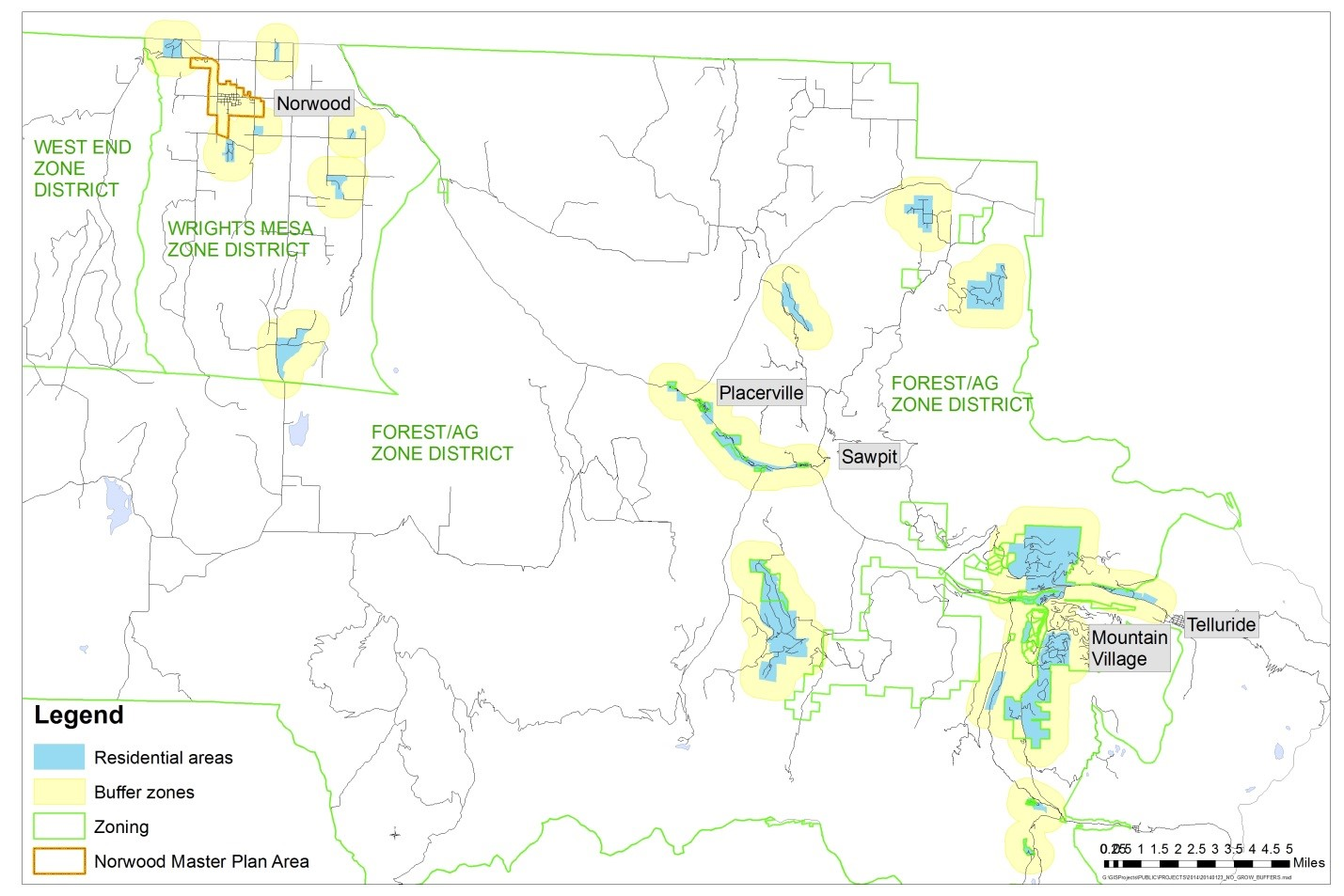
A full size version of this map may be viewed on the County webMap at www.sanmiguelcountyco.gov

