
San Miguel County Unincorporated
City Zoning Code
City Zoning Code
SECTION 5
3: - ZONE DISTRICT STANDARDS
5-301 - Zone District Standards
5-301A.
General
This section of the Code establishes standards for the use of land within zone districts. Uses not specifically listed in the various County Zone Districts that reasonably can be expected to produce impacts greater than the potential impacts of uses allowed by right are prohibited. Temporary uses with minimal adverse short-term impacts and reasonably necessary to achieve a valid public purpose or an approved project may be allowed for up to forty-five (45) days by administrative review.
5-301B.
Oil and Gas Development
Minor Oil and Gas Development in all Zone Districts shall be subject to Administrative Review in accordance with Section 5-26.
5-301C.
Solar Energy Systems
Medium-Scale Solar Energy Systems, including Microgrid Medium-Scale Solar Energy Systems, and Large-Scale Solar Energy Systems may be permitted in the Zone Districts set forth in Section 6-2.
5-301D.
Mining
Mining Operations, Mining Exploration, and Reclamation may be permitted in the Zone Districts set forth in Section 6-301 E.
(Res. No. 2024-40, § 9, 9-18-2024; Res. No. 2026-05, § 2(Exh. C), 1-21-2026)
5-302 - High Density (HD)
5-302A.
Purpose
I.
The purpose of the High Density (HD) Zone District is to provide areas suitable for high density, clustered, mixed-use development in accordance with the East End Master Plan. The Master Plan includes an analysis of the East End's physical characteristics and the capability of the community to provide essential public services. The HD Zone District also provides a high density and mixed use development alternative to low density development as an incentive for the preservation of substantially more open space than could reasonably be required as part of a lower density development. Clustering of residential uses will be required to preserve environmentally sensitive lands and the scenic foreground as open space.
II.
Minimum requirements for approval of the residential densities and the nonresidential land uses allowed in the Zone District shall include appropriate guarantees for the protection of public health, safety and welfare, which shall include, but are not limited to, the provision of alternate transportation, recreational amenities and affordable housing, as described in the East End Master Plan and in this Code (see Sections 5-13 and 5-20). In the absence of such guarantees and in the absence of the fulfillment of the other requirements set forth in the PUD process, non-environmentally sensitive lands will remain zoned either LD or PUDR and therefore will be subject to the standards of the applicable district, and environmentally sensitive lands will remain zoned either OS or PUDR and therefore will be subject to the standards of the applicable district.
5-302B.
Planned Unit Development (PUD) Procedure
All development proposed within the HD Zone District, except for proposed development of uses allowed by right, shall be reviewed pursuant to the Planned Unit Development (PUD) procedure to establish permitted uses and to allow variation from area and bulk requirements. Refer to Section 3-7 for PUD procedure and Section 5-14 for PUD standards.
5-302C.
Uses Allowed by Right
I.
Single-family dwellings with less than twelve thousand (12,000) sq. ft. of Floor Area.
For Single-family dwellings with greater than five thousand (5,000) sq. ft. of Floor Area but less than twelve thousand (12,000) sq. ft. of Floor Area: if the proposed residence is located within a subdivision or PUD with an established Home Owner's Association (HOA) that is responsible for administering an applicable design review board general declaration covenant requirement, the applicant shall provide a written approval of the proposed building plan from the HOA as part of their Development Permit application;
II.
Customary residential accessory buildings and uses;
III.
Day care homes; and
IV.
Home occupations.
5-302D.
Uses Allowed Subject to Administrative Review
I.
Accessory Dwelling Units. The Floor Area of the Accessory Dwelling Unit shall be included in the Calculation for employee housing Impact Fee mitigation as defined in, and is subject to, Section 5-13 of this Code unless such unit is voluntarily deed restricted pursuant to LUC Section 5-1303 G.XIX; and
II.
Day care centers - allowed only on lots of at least one-half acre.
5-302E.
Uses Allowed Subject to Board of County Commissioner Approval Pursuant to Planned Unit Development (PUD) Procedure
I.
Duplex residences;
II.
Multi-family residences;
III.
Tourist accommodations;
IV.
Commercial uses and personal services including the following and similar types of uses: clothing, hardware, drug, liquor, record, sporting goods, electronic and computer stores; barber or beauty shops, restaurant, cocktail lounge, movie theater, health club, grocery store of less than twelve thousand (12,000) square feet, dry cleaning and laundry pick-up station, laundromat, delicatessen, post office branch, television sales and service shop, shoe repair shop, camera and video rental and sale shop and gasoline service station without repair facilities; nothing to the contrary withstanding, no use shall be allowed that is incompatible with the nature of the applicable development;
V.
Conference facilities;
VI.
Offices and financial institutions;
VII.
Transportation terminals;
VIII.
Churches; and
IX.
Fire stations, schools and hospitals.
5-302F.
Area and Bulk Requirements Permitted by Right
I.
Density - one (1) dwelling unit per lot
Minimum Lot Area - thirty-five (35) acres
II.
Setbacks
a.
Front yard - thirty (30) feet
b.
Rear yard - thirty (30) feet
c.
Side yard - thirty (30) feet
III.
Maximum Building Height - thirty-five (35) feet
5-302G.
Density, Area and Bulk Requirements Permitted Subject to Board of County Commissioner Approval Pursuant to the Planned Unit Development (PUD) Procedure
I.
Density for Residential and Tourist Accommodation Units
Maximum Density - eighty (80) persons per acre
Minimum Density - forty (40) persons per acre
The density of residential and tourist accommodation development may not be greater than forty (40) people per acre. Density is based upon the cumulative number of people to be housed as determined by the "population level" standards (see definition in Article 7).
II.
Density for Commercial Development
Minimum lot area - Determined pursuant to Section 5-14
III.
Setbacks - Determined pursuant to Section 5-14
IV
Maximum Building Height - Determined pursuant to Section 5-14
V.
Maximum Floor Area Ratio (FAR) - Determined pursuant to Section 5-14
5-302H.
Minimum Common Open Space - thirty percent (30%)
5-302I.
Minimum Off-street Parking
Off-street parking shall be provided for each use as required in Section 5-702.
5-302J.
Review Standards for Land Uses and Area and Bulk Requirements Requiring Board of County Commissioner Approval pursuant to the Planned Unit Development (PUD) Procedure
An applicant seeking approval for any of the uses listed in Section 5-302 E or approval to utilize the area and bulk requirements in Section 5-302 G must demonstrate to the satisfaction of the Board of County Commissioners substantial compliance with the standards in this section:
I.
The use is consistent with the Land Use Policies (Article 2);
II.
Adequate public services such as roads, water, wastewater, public safety and fire protection are available to serve the proposed use and to insure the protection of the public health, safety and welfare in the region;
III.
Adequate mitigation by the applicant of the incremental impacts on the community's existing public services;
IV.
The use minimizes or mitigates any materially adverse environmental impacts and generally utilizes the most environmentally suitable site;
V.
Any proposed structures are located outside the Scenic Foreground Overlay Zone District or are designed consistently with the Scenic Foreground Overlay standards;
VI.
The use is consistent with the relevant goals and objectives of the San Miguel County Comprehensive Development Plan;
VII.
Acceptable guarantees that fulfill the criteria set forth in the East End Master Plan have been made for the provision of:
a.
Adequate alternate transportation to serve the development (see Section 5-2001);
b.
A sufficient quantity and quality of affordable housing to house the employees attributable to the proposed land use (see Section 5-1304);
c.
A sufficient quantity and quality of recreational amenities to serve the residents of the development without overburdening existing off-site recreational facilities (see Section 5-803); and
VIII.
Any neighborhood commercial services are designed and planned to be compatible with the surrounding neighborhood (see Section 5-1403 B) to reduce traffic generation, mitigate traffic circulation and parking problems and serve the daily or frequent trade or service needs of the neighborhood.
5-302K.
Uses Allowed Subject to Two-step Special Use Permit Review
Single-family Dwellings greater than twelve thousand (12,000) sq. ft. require Planning Commission and Board of Commissioner Special Use Permit review pursuant to Section 5-307 L.
I.
Such dwellings must include one (1) Accessory Dwelling Unit, as provided in Section 5-1302 B.II.g subject to County R-1 Housing Deed Restriction and ADU Deed Restriction Covenant, of at least seven hundred (700) sq. ft. but no greater than eight hundred (800) sq. ft.
(Res. No. 2024-54, 12-18-2024)
5-303 - Medium Density (MD)
5-303A.
Purpose
I.
The purpose of the Medium Density (MD) Zone District is to provide areas suitable for clustered medium density residential development in accordance with the San Miguel County Comprehensive Development Plan. The East End Master Plan includes an analysis of the East End's physical characteristics and the capability of the community to provide essential public services. Due to consideration of such factors as neighborhood compatibility, availability of community services and road capacities, lands zoned MD are capable of accommodating higher density development than can lands zoned LD. Clustering of residential uses will be required to preserve environmentally sensitive lands and the scenic foreground as open space.
II.
Minimum requirements for approval of the residential densities proposed for the MD Zone District shall include appropriate guarantees for the protection of public health, safety and welfare, which shall include, but are not limited to, provision of alternate transportation, recreational amenities and affordable housing, as described in the East End Master Plan and in this Code (see Sections 5-13 and 5-20). In the absence of such guarantees and in the absence of the fulfillment of the other requirements set forth in the PUD process, non-environmentally sensitive lands will remain zoned either LD or PUDR and therefore will be subject to the standards of the applicable district, and environmentally sensitive lands will remain zoned either OS or PUDR and therefore will be subject to the standards of the applicable district.
5-303B.
Planned Unit Development (PUD) Procedure
All development proposed within the MD Zone District, except for proposed development of uses allowed by right, shall be reviewed pursuant to the Planned Unit Development (PUD) procedure to establish permitted uses and to allow variation from the area and bulk requirements established in this Section. Refer to Section 3-7 for PUD procedure and Section 5-14 for PUD Standards.
5-303C.
Uses Allowed by Right
I.
Single-family dwellings with less than twelve thousand (12,000) sq. ft. of Floor Area.
For Single-family dwellings with greater than five thousand (5,000) sq. ft. of Floor Area but less than twelve thousand (12,000) sq. ft. of Floor Area: if the proposed residence is located within a subdivision or PUD with an established Home Owner's Association (HOA) that is responsible for administering an applicable design review board general declaration covenant requirement, the applicant shall provide a written approval of the proposed building plan from the HOA as part of their Development Permit application;
II.
Customary residential accessory buildings and uses;
III.
Day care homes; and
IV.
Home occupations.
5-303D.
Uses Allowed Subject to Administrative Review
I.
Accessory Dwelling Units. The Floor Area of the Accessory Dwelling Unit shall be included in the Calculation for employee housing Impact Fee mitigation as defined in, and is subject to, Section 5-13 of this Code unless such unit is voluntarily deed restricted pursuant to LUC Section 5-1303 G.XIX; and
II.
Day care centers - allowed only on lots of at least one-half acre.
5-303E.
Uses Allowed Subject to Board of County Commissioner Approval Pursuant to the Planned Unit Development (PUD) Procedure
I.
Duplex residences;
II.
Multi-family residences;
III.
Tourist accommodations;
IV.
Commercial uses including the following and similar: drug, liquor and sporting goods stores, barber and beauty shops, restaurants, cocktail lounges, clothing, electronic, camera and video rental stores, dry cleaning and laundry pick-up stations, gasoline service stations, and grocery store less than three thousand (3,000) square feet; nothing to the contrary withstanding, no use shall be allowed that is incompatible with the nature of the applicable development;
V.
Transportation terminals;
VI.
Fire stations;
VII.
Elementary, junior and senior high schools;
VIII.
Hospitals; and
IX.
Churches.
5-303F.
Area and Bulk Requirements Permitted by Right
I.
Density - one (1) dwelling unit per lot
Minimum Lot Area - thirty-five (35) acres
II.
Setbacks
a.
Front yard - thirty (30) feet
b.
Rear yard - twenty (20) feet
c.
Side yard - twenty (20) feet
III.
Maximum Building Height - thirty-five (35) feet
5-303G.
Density, Area and Bulk Requirements Permitted Subject to Board of County Commissioners Approval Pursuant to the Planned Unit Development (PUD) Procedure.
Maximum density will be determined pursuant to the standards established in Section 5-1403 F.
I.
Density for Uses Permitted by PUD
Maximum overall residential density - one (1) unit per three (3) acres
II.
Minimum Lot Area for lots final platted or replatted following the adoption of this Land Use Code:
a.
Single-family dwellings - fifteen thousand (15,000) sq. ft.
b.
Duplex dwellings - twenty thousand (20,000) sq. ft.
c.
Multi-family dwellings - twenty thousand (20,000) sq. ft.
d.
Tourist Accommodations - twenty thousand (20,000) sq. ft.
e.
Commercial buildings - ten thousand (10,000) sq. ft.
f.
Public buildings - twenty thousand (20,000) sq. ft.
III.
Setbacks for all buildings located on lots final platted or replatted prior to the adoption of this Land Use Code:
a.
Front yard - twenty-five (25) feet
b.
Rear yard - twenty (20) feet
c.
Side yard - twelve point five (12.5) feet
IV.
Maximum Building Height - thirty-five (35) feet
V.
Maximum Floor Area Ratio (FAR) - Determined pursuant to Section 5-14
5-303H.
Minimum Common Open Space - sixty percent (60%)
5-303I.
Minimum Off-street Parking
Off-street parking shall be provided for each principal use as required in Section 5-702.
5-303J.
Review Standards for Land Uses and Area and Bulk Requirements Requiring Board of County Commissioner Approval pursuant to the Planned Unit Development (PUD) Procedure
An applicant seeking approval for any of the uses listed in Section 5-303 E or approval to utilize the area and bulk requirements in Section 5-303 G must demonstrate to the satisfaction of the Board of County Commissioners substantial compliance with the standards in this section:
I.
The use is consistent with the Land Use Policies (Article 2);
II.
Adequate public services such as roads, water, wastewater, public safety and fire protection are available to serve the proposed use and an applicant adequately mitigates the incremental impacts on the community's existing public services;
III.
The use minimizes or mitigates any materially adverse environmental impacts and generally utilizes the most environmentally suitable site;
IV.
Any proposed structures are located outside the Scenic Foreground Overlay Zone District or are designed consistently with the Scenic Foreground Overlay standards;
V.
The use is consistent with the relevant goals and objectives of the San Miguel County Comprehensive Development Plan;
VI.
Acceptable guarantees (as described in the East End Master Plan) have been made for the provision of:
a.
Adequate alternate transportation to serve the development (see Section 5-2001);
b.
A sufficient quantity and quality of affordable housing to house the employees attributable to the proposed land use (see Section 5-1304); and
c.
A sufficient quantity and quality of recreational amenities to serve the residents of the development without overburdening existing off-site recreational facilities (see Section 5-803); and
VII.
Any neighborhood commercial services are designed and planned to be compatible with the surrounding neighborhood (see Section 5-1403 B) to reduce traffic generation, mitigate traffic circulation and parking problems and serve the daily or frequent trade or service needs of the neighborhood.
5-303K.
Uses Allowed Subject to Two-step Special Use Permit Review
Single-family Dwellings greater than twelve thousand (12,000) sq. ft. require Planning Commission and Board of Commissioner Special Use Permit review pursuant to Section 5-307 L.
I.
Such dwellings must include one (1) Accessory Dwelling Unit, as provided in Section 5-1302 B.II.g subject to County R-1 Housing Deed Restriction and ADU Deed Restriction Covenant, of at least seven hundred (700) sq. ft. but no greater than eight hundred (800) sq. ft.
(Res. No. 2024-54, 12-18-2024)
5-304 - Low Density (LD)
5-304A.
Purpose
I.
The purpose of the Low Density (LD) Zone District is to provide areas suitable for clustered, low-density residential development in accordance with the San Miguel County Comprehensive Development Plan. The LD Zone District applies to areas so zoned already; it shall not provide a mechanism for rezoning areas not currently so zoned. The East End Master Plan includes an analysis of the region's physical characteristics and the capability of the community to provide essential public services. If land is developed under the LD Zone District, the rural characteristics of the land shall be preserved to the maximum extent possible by careful site planning and, if necessary, the clustering of development. Clustering of residential uses will be required to preserve environmentally sensitive lands and the scenic foreground as open space.
II.
Minimum requirements for approval of the residential densities proposed for the LD Zone District shall include appropriate guarantees for the protection of public health, safety and welfare, which shall include, but are not limited to, provision of transportation (capital, facilities and equipment) necessary to serve the development, long-term operation and maintenance of the regional transportation system, recreational amenities and affordable housing, as described in the East End Master Plan and in this Code (see Sections 5-13 and 5-20). In the absence of such guarantees and in the absence of the fulfillment of the other requirements set forth in the PUD process, all lands will be subject to the standards for uses and area and bulk requirements allowed by right.
5-304B.
Planned Unit Development (PUD) Procedure
All development proposed within the LD Zone District, except for proposed development of uses allowed by right, shall be reviewed pursuant to the Planned Unit Development (PUD) procedure to establish permitted uses and to allow variation from the area and bulk requirements established in this Section. Refer to Section 3-7 for PUD procedure and Section 5-14 for PUD Standards.
5-304C.
Uses Allowed by Right
I.
Single-family dwellings with less than twelve thousand (12,000) sq. ft. of Floor Area.
For Single-family dwellings with greater than five thousand (5,000) sq. ft. of Floor Area but less than twelve thousand (12,000) sq. ft. of Floor Area: if the proposed residence is located within a subdivision or PUD with an established Home Owner's Association (HOA) that is responsible for administering an applicable design review board general declaration covenant requirement, the applicant shall provide a written approval of the proposed building plan from the HOA as part of their Development Permit application;
II.
Customary residential accessory buildings and uses;
III.
Day care homes; and
IV.
Home occupations.
5-304D.
Uses Allowed Subject to Administrative Review
I.
Accessory Dwelling Units. The Floor Area of the Accessory Dwelling Unit shall be included in the Calculation for employee housing Impact Fee mitigation as defined in, and is subject to, Section 5-13 of this Code unless such unit is voluntarily deed restricted pursuant to LUC Section 5-1303 G.XIX; and
II.
Day care centers - allowed only on lots of at least one (1) acre.
5-304E.
Uses Allowed Subject to One-step Planning Commission Review
I.
Equestrian Centers (see Section 5-24).
5-304F.
Uses Allowed Subject to Board of County Commissioners Approval Pursuant to the Planned Unit Development (PUD) Procedure
I.
Fire stations;
II.
Duplex dwellings;
III.
Churches; and
IV.
Neighborhood Commercial Uses that offer goods and services needed by residents of the PUD on a daily or frequent basis, including convenience store, drug store, liquor store, self-service laundry and postal service substation.
5-304G.
Area and Bulk Requirements Permitted by Right
I.
Density - one (1) dwelling unit per lot
Minimum Lot Area - thirty-five (35) acres
II.
Setbacks
a.
Front yard - fifty (50) feet
b.
Rear yard - fifty (50) feet
c.
Side yard - fifty (50) feet
III.
Maximum Building Height - thirty-five (35) feet
5-304H.
Area and Bulk Requirements Permitted Subject to Board of County Commissioners Approval Pursuant to the Planned Unit Development (PUD) Procedure
I.
Maximum Density - one (1) unit per seven (7) acres
II.
Setbacks
a.
Front yard - Determined pursuant to PUD procedure
b.
Rear yard - Determined pursuant to PUD procedure
c.
Side yard - Determined pursuant to PUD procedure
III.
Maximum Building Height - thirty-five (35) feet
5-304I.
Review Standards for Land Uses and Area and Bulk Requirements Requiring Board of County Commissioner Approval pursuant to the Planned Unit Development (PUD) Procedure
An applicant seeking approval for any of the uses listed in Sections 5-304 F or approval to utilize the area and bulk requirements in Section 5-304 G must demonstrate to the satisfaction of the Board of County Commissioners substantial compliance with the standards in this Section.
I.
The use is consistent with the Land Use Policies (Article 2);
II.
Adequate public services such as roads, water, wastewater, public safety and fire protection are available to serve the proposed use and an applicant adequately mitigates the incremental impacts on the community's existing public services;
III.
The use minimizes or mitigates any materially adverse environmental impacts and generally utilizes the most environmentally suitable site;
IV.
Any proposed structures are located outside the Scenic Foreground Overlay Zone District or are designed consistently with the Scenic Foreground Overlay standards;
V.
The use is consistent with the relevant goals and objectives of the San Miguel County Comprehensive Development Plan;
VI.
Acceptable guarantees (as described in the East End Master Plan) have been made for the provision of:
a.
Adequate transportation to serve the development (see Section 5-2001);
b.
A sufficient quantity and quality of affordable housing to house the employees attributable to the proposed land use (see Section 5-1304); and
c.
A sufficient quantity and quality of recreational amenities to serve the residents of the development without overburdening existing off-site recreational facilities (see Section 5-803); and
VII.
Any neighborhood commercial services are designed and planned to be compatible with the surrounding neighborhood (see Section 5-1403 B) to reduce traffic generation, mitigate traffic circulation and parking problems and serve the daily or frequent trade or service needs of the neighborhood.
5-304J.
Minimum Common Open Space - sixty percent (60%)
5-304K.
Minimum Off-street Parking
Off-street parking shall be provided for each use as required in Section 5-702.
5-304L.
Uses Allowed Subject to Two-step Special Use Permit Review
Single-family Dwellings greater than twelve thousand (12,000) sq. ft. require Planning Commission and Board of Commissioner Special Use Permit review pursuant to Section 5-307 L.
I.
Such dwellings must include one (1) Accessory Dwelling Unit, as provided in Section 5-1302 B.II.g subject to County R-1 Housing Deed Restriction and ADU Deed Restriction Covenant, of at least seven hundred (700) sq. ft. but no greater than eight hundred (800) sq. ft.
(Res. No. 2024-54, 12-18-2024)
5-305 - Affordable Housing Planned Unit Development (AH) (PUD)
5-305A.
Purpose
The purpose of the Affordable Housing Planned Unit Development (AH) (PUD) is to provide areas suitable for clustered affordable housing for persons (and their families) who live and earn their living primarily in the R-1 School District. The AH PUD Zone District may be applied as an overlay where other zoning currently exists to encourage a socioeconomic mix of residents in a development; however, neither the underlying zoning nor the affordable housing requirement associated with that zoning by Section 5-1303 may be affected by the overlay, and one hundred percent (100%) of the increase associated with the AH PUD overlay must be subject to the County's R-1 Housing Deed Restriction (see Section 5-1304). The AH PUD Zone District is intended for lands currently serving this purpose and may be applied to any land identified as suitable for such development within the San Miguel Comprehensive Development Plan or any element of the Plan.
5-305B.
Planned Unit Development (PUD) Procedure
All development proposed within the AH PUD Zone District, except for proposed development of uses allowed by right, shall be reviewed pursuant to the Planned Unit Development (PUD) procedure to establish permitted uses and area and bulk requirements. Refer to Section 3-7 for PUD procedure and Section 5-14 for PUD procedure.
5-305C.
Uses Allowed by Right
I.
Single-family residences;
II.
Day care homes; and
III.
Home Occupations.
5-305D.
Area and Bulk Requirements Permitted by Right
I.
Minimum Lot Area - thirty-five (35) acres
II.
Setbacks
a.
Front yard - fifty (50) feet
b.
Rear yard - fifty (50) feet
c.
Side yard - fifty (50) feet
III.
Maximum Building Height - thirty-five (35) feet
5-305E.
Uses Allowed Subject to Board of County Commissioners Approval Pursuant to the Planned Unit Development (PUD) Procedure
I.
Duplex dwellings;
II.
Single-family dwellings;
III.
Multi-family dwellings;
IV.
Fire stations, hospitals, schools and churches;
V.
Day care centers - allowed only on lots of at least one-half acre;
VI.
Neighborhood Commercial Uses that offer goods and services needed by residents of the PUD on a daily or frequent basis, including convenience store, drug store, liquor store, self-service laundry and postal service substation; and
VII.
Rooming Houses.
5-305F.
Area and Bulk Requirements Permitted Subject to Board of County Commissioner Approval Pursuant to the Planned Unit Development (PUD) Procedure
I.
Maximum Density - fifteen (15) units per acre
II.
Minimum lot size - six thousand (6,000) square feet
Minimum lot area per dwelling unit (sq. ft.)
a.
Single-family dwellings - six thousand (6,000)
b.
Duplex dwellings - three thousand (3,000)
c.
Multi-family dwellings - two thousand nine hundred (2,900)
III.
Minimum Setbacks
a.
Front yard - ten (10) feet
b.
Side yard - five (5) feet
c.
Rear yard - ten (10) feet
IV.
Minimum Open Space - fifty percent (50%)
V.
Maximum Building Height - thirty-five (35) feet
VI.
Maximum Floor Area for all uses except duplex and multi-family residences
VII.
Maximum Floor Area for duplex residences
VIII.
Maximum Floor Area Ratio (FAR) for Multi-family buildings - 1:1
5-305G.
Review Standards for Land Uses and Area and Bulk Requirements Requiring Board of County Commissioner Approval pursuant to the Planned Unit Development (PUD) Procedure
An applicant seeking approval for any of the uses listed in Section 5-305 E or approval to utilize the area and bulk requirements in Section 5-305 F must demonstrate to the satisfaction of the Board of County Commissioners substantial compliance with the standards in this section.
I.
The use is consistent with the Land Use Policies (Article 2);
II.
Adequate public services such as roads, water, wastewater, public safety and fire protection are available to serve the proposed use and an applicant adequately mitigates the incremental impacts on the community's existing public services;
III.
The use minimizes or mitigates any materially adverse environmental impacts and generally utilizes the most environmentally suitable site;
IV.
Any proposed structures are located outside the Scenic Foreground Overlay Zone District or are designed consistently with the Scenic Foreground Overlay standards;
V.
The use is consistent with the relevant goals and objectives of the San Miguel County Comprehensive Development Plan;
VI.
The use is compatible with and similar to the predominant land use in the immediately adjacent neighborhood (e.g., multi-family uses would be considered compatible only if the predominant land use in the immediately adjacent neighborhood were multi-family);
VII.
Any neighborhood commercial services are designed and planned to be compatible with the surrounding neighborhood (see Section 5-1403 B) to reduce traffic generation, mitigate traffic circulation and parking problems and serve the daily or frequent trade or service needs of the neighborhood; and
VIII.
All residential dwelling units developed within the Zone District are affordable housing deed-restricted pursuant to the "R-1 Housing Deed Restriction" concerning use and occupancy (refer to Section 5-1304 for the R-1 Housing Deed restriction).
5-305H.
Minimum Off-street Parking
Off-street parking shall be provided for each principal use as required in Section 5-702.
(Res. No. 2024-54, 12-18-2024)
5-306 - Single-family Residential (R)
5-306A.
Purpose
The Single-family Residential (R) Zone District applies to areas so zoned already; it is not intended to provide a mechanism for rezoning areas not currently so zoned. The purpose of the R Zone District is to provide areas suitable for single-family residential use in the San Miguel Canyon and adjacent to the Town of Norwood and the communities of Slick Rock and Egnar. Variable densities of such residential use (not to exceed one (1) unit per nine thousand three hundred seventy-five (9,375) sq. ft.) may be allowed depending upon the availability of approved water and sewer facilities.
5-306B.
Uses Allowed by Right
I.
Single-family dwellings;
II.
Day care homes; and
III.
Accessory buildings and uses.
5-306C.
Uses Allowed Subject to One-step Planning Commission Review
I.
Parks, playgrounds, playing fields, golf courses, tennis courts, outdoor ice-skating rinks and swimming pools;
II.
Churches and community meeting halls, libraries or other civic facilities;
III.
Medical and dental offices and clinics; and
IV.
Day care centers - allowed only on lots of at least one (1) acre.
5-306D.
Uses Allowed Subject to Two-step Special Use Permit Review
I.
Fire stations;
II.
Boarding and rooming houses and rest homes;
III.
Public utility structures subject to the special standards in Section 5-709 and the standards for all Two-step Special Use Permits.
5-306E.
Area and Bulk Requirements Allowed by Right
I.
Density
Minimum Lot Area - thirty-five (35) acres
II.
Setbacks
a.
Front yard - thirty (30) feet
b.
Rear yard - twenty (20) feet
c.
Side yard - ten (10) feet
III.
Maximum Building Height - thirty-five (35) feet
5-306F.
Area and Bulk Requirements Allowed by PUD
I.
Minimum Lot Area for Each Principal Use
a.
On land not served by approved water and approved sewage facilities - two (2) acres
b.
On land served by either approved water or approved sewage facilities - one-half (1/2) acre
c.
On land served by both approved water and approved sewage facilities - nine thousand three hundred seventy-five (9,375) sq. ft.
II.
Minimum Lot Width for Each Principal Use
a.
On land not served by approved water and approved sewage facilities - two hundred (200) ft.
b.
On land and served by either approved water or approved sewage facilities - one hundred (100) ft.
c.
On land served by both approved water and approved sewage facilities - seventy-five (75) ft.
III.
Minimum Setbacks
a.
Front Yard - thirty (30) feet
b.
Side Yard - ten (10) feet
c.
Rear Yard - twenty (20) feet
IV.
Maximum Height of Buildings - thirty-five (35) feet
5-306G.
Minimum Off-street Parking
Off-street parking shall be provided for each principal use as required in Section 5-702.
5-307 - Forestry, Agriculture and Open (F)
5-307A.
Purpose
The Forestry, Agriculture and Open (F) Zone District is intended to preserve large, relatively remote areas of the County for resource, agricultural, open space and recreational proposes. These areas currently have minimum public facilities and services and are considered inappropriate for substantial development. Development activities in these areas should be limited to the minimal list of activities that are allowed under State and Federal laws. All permitted development should fully mitigate the effects of such development upon the environment and on the County's budget. Development and/or special uses are encouraged to be located outside environmentally sensitive land.
5-307B.
Uses Allowed by Right
I.
Single-family dwellings with less than twelve thousand (12,000) sq. ft. of floor area, mobile homes and accessory uses and accessory buildings with footprints less than three thousand (3,000) sq. ft. (if such buildings and uses are not part of normal and customary agriculture and ranching activities);
II.
Day care homes;
III.
Logging operations resulting in hauling of up to five thousand (5,000) board feet in any 12-month period beginning with commencement of hauling;
IV.
Normal and customary agriculture and ranching activities; and
V.
Home Occupations.
5-307C.
Uses Allowed Subject to Administrative Review
I.
Caretaker unit - a second residential unit may be allowed on all parcels, thirty-five (35) acres or larger; and on parcels five (5) to thirty-five (35) acres in the Telluride R-1 School District, except no caretaker units shall be allowed in the San Miguel Canyon Area. Such unit shall be attached to or located within three hundred (300) feet of the primary residence (as measured between the closest exterior walls). Such unit shall contain no more than two thousand (2,000) sq. ft. of floor area, and shall contain full kitchen and bathroom facilities. The Floor Area of the caretaker unit shall be included in the calculation for employee housing Impact Fee mitigation as defined in Section 5-13 of this Code unless such unit is voluntarily deed restricted pursuant to LUC Section 5-1303 G.XIX. No lease or rental of a caretaker unit shall be for a term less than six (6) months. Caretaker units shall not be conveyed or sold separately from the remainder of the parcel and shall remain under the same ownership as the primary residence;
II.
Day care centers - allowed only on parcels of at least two (2) acres;
III.
Ski area trails and slopes. The Planning Director shall require the developer to demonstrate that off-site impacts are mitigated in accordance with the standards in Section 5-10. If the impact mitigation plan does not meet these standards, the development shall be subject to One-step Planning Commission Review pursuant to Section 5-10;
IV.
Logging operations resulting in hauling of between five thousand (5,000) and three hundred thousand (300,000) board feet in any 12-month period beginning with commencement of hauling; and
V.
Minor Oil and Gas exploration, drilling and pipelines, including wells, and geophysical operations (refer to Section 5-26).
5-307D.
Uses Allowed Subject to One-step Planning Commission Review
I.
Parks, playgrounds, playing fields, tennis courts, outdoor ice-skating rinks and swimming pools;
II.
Churches and community meeting halls, libraries or other civic facilities;
III.
Lumber mills;
IV.
Horseback riding and sleigh ride operations, and outdoor recreation areas and campgrounds (subject to compliance with Standards in Section 5-1008);
V.
Cemeteries subject to Section 5-307 K and wind turbines for residential use over thirty-five (35) feet in height;
VI.
Junkyard, including garbage dump and sanitary fill, subject to C.R.S. 43-1-501, et seq.;
VII.
Hunting Lodges;
VIII.
Bed and Breakfasts, subject to Section 5-307 I;
IX.
Construction/Contractor Office and Staging Area;
X.
Private Schools;
XI.
Accessory Structure with a footprint greater than three thousand (3,000) sq. ft. (if such structure is not part of normal and customary agriculture and ranching activities); and
XII.
Social and Scenic Uses, such as a location for weddings, meetings, retreats, reunions, video and film photo shoots and commercials, on parcels containing thirty-five (35) acres or more, and with attendance of two hundred (200) or fewer guests.
5-307E.
Uses Allowed Subject to One-step Board of County Commissioner Review
I.
Open Land Protection, subject to the standards in Section 5-1207.
II.
Logging operations resulting in hauling of more than three hundred thousand (300,000) board feet in any 12-month period beginning with commencement of hauling, in accordance with all provisions of Sections 5-10 and 5-17.
5-307F.
Uses Allowed Subject to Two-step Special Use Permit Review
I.
Water treatment plants;
II.
Airports, sanitary landfill operations and sewage disposal areas, subject to Section 5-307 K;
III.
Kennels and veterinary hospitals;
IV.
New ski area base facilities (also subject to the provisions of Section 5-1303 D.I), ski lifts and related buildings, parking and incidental facilities (also subject to the provisions of Section 5-1303 D.II);
V.
Public utility structures, including dams and reservoirs (refer to Section 5-709);
VI.
Music or other festivals with anticipated attendance of more than two hundred (200) people;
VII.
Hotels, subject to Section 5-307 I;
VIII.
Aircraft Landing Areas;
IX.
Wind Turbines for commercial uses;
X.
Golf Courses subject to a conceptual joint work session with the Planning Commission and Board of Commissioners prior to the applicant submitting engineering documents and survey drawings (subject to compliance with Standards in Section 5-1004);
XI.
Single-family Dwellings greater than twelve thousand (12,000) sq. ft. of Floor Area on a minimum of thirty-five (35) acres shall comply with the standards in Section 5-307 L. (LUC Section 5-10 does not apply).
XII.
Major Oil and Gas Facilities, including compressor stations, gas treatment facilities and pipelines (refer to Section 5-26).
XIII.
Conditional Uses on Federal Lands subject to Section 5-11, Article 7, and applicable State and Federal statutes and regulations.
XIV.
Social and Scenic Uses, such as a location for weddings, meetings, retreats, reunions, video and film photo shoots and commercials, on parcels containing thirty-five (35) acres or more, and with attendance of more than two hundred (200) guests.
5-307G.
Area and Bulk Requirements
I.
a. The minimum lot size for each principal use is thirty-five (35) acres except for single-family residential dwellings approved pursuant to the subdivision exemption standards for Open Land Protection (see Section 5-1207).
b.
Any legally created parcel less than thirty-five (35) acres in the F Zone District may qualify for a building permit for one (1) single-family dwelling unit, provided the parcel meets the criteria set forth in Section 5-1908.
II.
Minimum Setbacks
a.
Front Yard - thirty (30) feet
b.
Side Yard - twenty (20) feet
c.
Rear Yard - twenty (20) feet
III.
Maximum Height of Buildings - thirty-five (35) feet
5-307H.
Minimum Off-street Parking
Off-street parking shall be provided for each principal use as required in Section 5-702.
5-307I.
Hotel, Guest Ranch, and Bed and Breakfast Standards for the F Zone District. In addition to complying with the standards for special uses in Section 5-10, hotels shall comply with the standards in this section:
I.
Neither activity nor traffic associated with a hotel may materially and/or substantially adversely affect ranching or farming operations, residences or scenic quality of land surrounding State or County roads;
II.
All hotel buildings must comply with the setbacks and height restrictions;
III.
Minimum Lot Size - forty (40) acres;
IV.
Maximum occupancy may be limited depending upon impacts on surrounding property;
V.
Accessory facilities within the hotel complex may include restrooms and showers;
VI.
Full meals must be provided for overnight guests and may be provided for others;
VII.
All exterior lighting shall comply with the standards of Section 5-710;
VIII.
Affordable housing for hotel employees may be allowed as an accessory use;
IX.
Any other conditions necessary to preserve the character of the F Zone District and protect wildlife habitat may be applied to hotels in the F Zone District;
X.
Population density allowed, including for all Affordable Housing required and/or requested, shall not exceed the density allowed for the acreage of the subject parcel at one (1) single-family residential unit per thirty-five (35) acres (except south of Wright's Mesa and Beaver Canyon);
XI.
Sole access to the hotel parcel may not be achieved by aircraft, and all access roads must meet all applicable County road standards (except south of Wright's Mesa and Beaver Canyon); and
XII.
The hotel parcel shall be deed restricted against any future subdivision (except south of Wright's Mesa and Beaver Canyon).
XIII.
An existing hotel or guest ranch that is nonconforming solely because it includes density beyond that allowed pursuant to this Section 5-307 I is eligible to become a permitted use under this section, provided that the population density, including Affordable Housing for employees, is not increased.
5-307J.
Airports, Cemeteries, Sanitary Land Fill Operations and Sewage Disposal Areas Standards
In addition to complying with the standards for special uses in Section 5-10, airports, cemeteries, sanitary land fill operations and sewage disposal areas facilities shall comply with the standards in this section.
I.
Such uses shall serve an obvious public need;
II.
Sufficient distance shall separate such uses from incompatible abutting properties; and
III.
Satisfactory proof shall be given that such areas will be properly maintained.
5-307K.
Single-family Dwellings over twelve thousand (12,000) square feet of Floor Area on a minimum of thirty-five (35) acres
I.
Such dwellings must include one (1) Caretaker or Accessory Dwelling Unit (depending upon Zone District), as provided in Section 5-1302 B.II.g subject to County R-1 Housing Deed Restriction and ADU Deed Restriction Covenant, of at least eight hundred (800) square feet but no greater than two thousand (2,000) square feet for a Caretaker Unit and of at least seven hundred (700) square feet but no greater than eight hundred (800) square feet for an Accessory Dwelling Unit.
II.
Submission Requirements
a.
A Site plan shall be provided including:
i.
Building plan, including location and dimensions of structures;
ii.
Typical elevations/heights of buildings;
iii.
Topography;
iv.
Existing landscaping and proposed landscaping plan;
v.
Lighting plan; all exterior lighting shall comply with the standards of Section 5-710; and
vi.
Existing structure and uses on adjacent parcels.
b.
Applicant shall address Land Use Code Section 5-21 Scenic Quality Standards. Each developer shall describe in detail how the visual impact of the proposed development on neighboring developments and public use areas shall be mitigated.
III.
Review Standards
a.
Demonstration of compliance with the Prescriptive Energy Code and Green Building Standards as adopted by Board of County Commissioner Resolution 2005-44;
b.
Provisions to provide renewable energy sources such as, but not limited to, passive solar design, wind, geothermal, photovoltaic, hydrogen fuel cells, etc.;
c.
Parcel size and preservation of Open Space;
d.
The use shall be consistent with and compatible with the Character of the neighborhood of the parcel proposed for development and surrounding land uses;
e.
Compatibility with the Character of Parcels adjacent to the Parcel shall be expressed in terms of appearance, scale and features, Site design, landscaping, weed seed dispersal, as well as, the control and Minimization of adverse Impacts including Noise, vibration, dust, dirt, smoke, fumes, gas, odor, explosion, glare, Impacts on pedestrian and traffic congestion, parking, trash, service delivery, or other undesirable or hazardous conditions; and
f.
Demonstration of Compliance with Scenic Quality standards in Section 5-2101.
(Res. No. 2024-53, 12-18-2024; Res. No. 2026-05, § 2(Exh. C), 1-21-2026)
5-308 - Heavy Commercial (HC)
5-308A.
Purpose
The Heavy Commercial (HC) Zone District is intended to protect existing commercial areas and consolidate the location for new commercial activities. Examples of potential development under this zone, as suggested in the Master Plan, could be an out-of-town parking complex for Telluride (with related commercial facilities), or a small industrial park outside of Norwood. Although some light industrial uses could be appropriate for this Zone District, heavy industrial activity would not be, and would be better accommodated through the special permit process in the Agriculture, Forestry and Open (F) Zone District. It is intended that the HC Zone District be located so that the heavy commercial activity and its accompanying noise and/or smell is compatible with neighboring land uses.
5-308B.
Uses Allowed Subject to One-step Planning Commission Approval
I.
Warehouses, lumberyards, and building supply sales;
II.
Manufacturing and processing businesses;
III.
Light industrial, research and development facilities;
IV.
Public facilities (excluding those allowed in the F Zone District);
V.
Feed and seed stores;
VI.
Auto sales;
VII.
Auction houses;
VIII.
Construction contractors;
IX.
Commercial laundries, dry cleaning plants and self-service laundries;
X.
Affordable housing for persons employed on-site;
XI.
Day care centers - allowed only on lots of at least one (1) acre; and
XII.
Gasoline service stations and auto repair shops, which shall comply with the standards for special uses in Section 5-10 and the following standards:
a.
Conditions of soil, groundwater level, drainage and topography shall not create hazards to life or limb;
b.
There shall be one (1) contiguous roof covering all operations;
c.
All gas storage tanks shall be subject to all relevant state, federal and/or National Fire Protection Association Code standards;
d.
All outdoor storage areas shall be enclosed with opaque fences or closely planted landscape material sufficient in height to conceal such facilities from adjacent property;
e.
Exposed ground surfaces in all parts of a service station or auto repair shop shall be paved or covered with stone screening or other solid material, or protected with a vegetative growth capable of preventing soil erosion and eliminating objectionable dust;
f.
An adequate drainage system shall be designed and installed to ensure that corrosive materials, petroleum wastes, etc., do not contaminate the natural drainage system;
g.
Adequate and safe water supply and sewage system shall be provided;
h.
All refuse shall be stored in fly-tight, watertight, rodent-proof, dog-proof containers;
i.
Vehicles shall not be stored in the public right-of-way before, during or after servicing;
j.
All automotive equipment on the premises must carry a current registration and show a work order with a reasonable completion date, not to exceed thirty (30) days. Automotive equipment for which the shop or service station operator has no valid registration and work order shall be classified as salvage and junk and may not be kept, stored or worked on in an auto repair shop or service station;
k.
Access roads and parking areas shall be designed so that no traffic hazards are created. The location and design of all access road which abut a State Highway shall be reviewed and approved by the Colorado State Department of Highways to ensure safety and conformance to its adopted action plan for the area; and
l.
No unusual amounts of dust, noxious odors or noise shall be normally disseminated beyond the boundaries of the property on which the shop or service station is located.
XIII.
Waste Transfer Station/Recycling Center.
5-308C.
Area and Bulk Requirements
I.
For single uses:
a.
One-half (1/2) acre minimum lot size
b.
One hundred (100) ft. width
c.
Twenty-five (25) ft. setbacks
d.
Thirty-five (35) ft. height limit
II.
For multiple uses:
a.
Two (2) acre minimum lot size
b.
Two hundred (200) ft. minimum lot width
c.
Fifty (50) ft. setbacks all sides
d.
Thirty-five (35) ft. height limit
5-308D.
Minimum Off-street Parking
Off-street parking shall be provided for each principal use as required in Section 5-702.
5-309 - Low Intensity Industrial (I)
5-309A.
Purpose
The Low Intensity Industrial (I) Zone District is intended to provide for the establishment of non-polluting manufacturing, warehouse, research and repair facilities. The I Zone District also is intended to accommodate retail uses accessory to primary non-retail uses.
5-309B.
Uses Allowed by Right
I.
Single-family dwellings; and
II.
Day care homes.
5-309C.
Area and Bulk Requirements Permitted by Right
I.
Minimum Lot Area - thirty-five (35) acres
II.
Setbacks
a.
Front yard - fifty (50) feet
b.
Rear yard - thirty (30) feet
c.
Side yard - twenty (20) feet
III.
Maximum Building Height - thirty-five (35) feet
5-309D.
Uses Allowed Subject to Board of County Commissioners Approval Pursuant to the Planned Unit Development (PUD) Procedure
Uses allowed include, but are not limited to the following and similar types of uses:
I.
All uses allowed in the HC Zone District;
II.
Appliance and equipment rental, storage and repair;
III.
Automobile washing facilities;
IV.
Electrical and plumbing service shops;
V.
Commercial bakeries;
VI.
Computer product sales and service;
VII.
Printing and publishing plants;
VIII.
Telecommunications supply;
IX.
Utility service facilities;
X.
Day care centers - allowed only lots of at least one (1) acre;
XI.
Affordable Housing, accessory to a principal use, for persons employed within the PUD, and Live-work Housing (as defined in Section 5-1305 B.X); and
XII.
Business and Professional Offices.
5-309E.
Height, Area and Bulk Requirements allowed by PUD
I.
For single uses:
a.
Minimum lot size - six thousand (6,000) square feet;
b.
Minimum lot width - fifty (50) feet;
c.
Minimum side and rear yard setback - ten (10) feet;
d.
Minimum front yard setback - thirty (30) feet;
e.
Maximum height - thirty-five (35) feet; and
f.
Maximum Floor Area Ratio (FAR) - 0.50:1.
II.
For multiple uses:
a.
Minimum lot size - twenty-one thousand five hundred (21,500) square feet;
b.
Minimum lot width - seventy-five (75) feet;
c.
Minimum side and rear yard setback - ten (10) feet;
d.
Minimum front yard setback - thirty (30) feet;
e.
Maximum height - thirty-five (35) feet;
f.
Maximum Floor Area Ratio (FAR) - 0.50:1.
5-309F.
Minimum Off-street Parking
Off-street parking shall be provided for each principal use as required in Section 5-702.
5-310 - Placerville Residential (PR)
5-310A.
Purpose
The purpose of the Placerville Residential (PR) Zone District is to provide areas and design standards for single-family residences surrounding the Placerville Commercial (PC) Zone District.
5-310B.
Uses Allowed by Right
I.
Single family dwellings;
II.
Accessory buildings and uses;
III.
Day care homes; and
IV.
Day care centers - allowed only on lots of at least one-half acre.
5-310C.
Uses Allowed Subject to One-step Planning Commission Review
I.
Parks, playgrounds, playing fields, golf courses, tennis courts, outdoor ice-skating rinks and swimming pools.
5-310D.
Uses Allowed Subject to Two-step Special Use Permit Review
I.
Fire station; and
II.
Boarding and rooming houses and rest homes.
5-310E.
Area and Bulk Requirements
I.
Minimum Lot Area for each Principal Use:
Eighteen thousand seven hundred fifty (18,750) sq. ft. or five (5) platted lots.
II.
Minimum Setbacks
a.
Front Yard - thirty (30) feet, or an average of the front yard setbacks on adjoining properties
b.
Side Yard - ten (10) feet
c.
Minimum Rear Yard - twenty (20) feet
III.
Maximum Height of Buildings - thirty-five (35) feet
5-310F.
Minimum Off-street Parking
Off-street parking shall be provided for each principal use as required in Section 5-702.
5-311 - Placerville Commercial (PC)
5-311A.
Purpose
The purpose of the Placerville Commercial (PC) Zone District is to provide standards for commercial establishments located on Front Street in Placerville and at the southwest corner of the intersection of State Highways 62 and 145 west of Placerville. The size of the PC Zone District shall not be increased.
5-311B.
Standards for All Development
All development in the PC Zone District shall comply with the following standards.
I.
Conditions of soil, groundwater level, drainage and topography shall not create hazards to persons or the natural environment.
II.
All outdoor storage areas shall be enclosed with non-reflective opaque fences or closely planted landscape material sufficient in height to conceal such facilities from adjacent property.
III.
All Scenic Quality standards of Section 5-2101, and all Sign standards of Section 5-704.
5-311C.
Uses Allowed by Right
I.
Any use permitted by right in the Placerville Residential Zone District (refer to Section 5-310 B), subject to all requirements specified in the PR Zone District;
II.
Business and Professional Offices and Neighborhood Commercial Uses offering goods and/or services needed by local and/or regional residents on a daily or frequent basis, including but not limited to the following and similar uses: Grocery Store up to three thousand (3,000) sq. ft., Drug store, Bookstore, Barber Shop, Hardware Store, Dry Goods Store, Auto Parts Store; and
III.
Art Studios, Galleries and Craft Shops.
5-311D.
Uses Allowed Subject to One-step Planning Commission Review
I.
Woodworking Shops and Small Manufacturing Operations;
II.
Repair Shops other than for Automobiles;
III.
Trades Businesses, such as Plumbing, Heating, Electrical, etc.;
IV.
Restaurants, eating and drinking facilities;
V.
Liquor stores;
VI.
Bed and breakfast, Gallery;
VII.
Bakery; and
VIII.
Accessory Rental Dwelling Units for Persons Employed in the PC Zone District; such units may be owned only by the owner of a primary non-residential use and may not be condominiumized.
5-311E.
Uses Allowed Subject to Two-step Special Use Permit Review
I.
Fire station;
II.
School;
III.
Museum;
IV.
Park, playground, playing field, tennis court;
V.
Public utility service and repair facilities (subject to Section 5-709 standards);
VI.
Auto Repair Garages and Gasoline Service Stations and accessory retail uses, subject to the provisions of Section 5-308 B.XII;
VII.
Grocery Store more than three thousand (3,000) sq. ft.; and
VIII.
Any building on Front Street larger than six thousand five hundred (6,500) square feet, subject to a determination that the building will not be in conflict with the historic character of Front Street.
5-311F.
Area and Bulk Requirements
I.
Minimum Lot Area for each Principal Use:
a.
Without Central Sewer Service - At least seven thousand five hundred (7,500) sq. ft. (two (2) platted town site lots) per building, in accordance with Colorado State Guidelines on Individual Sewage Disposal Systems (adopted pursuant to CRS 10-25).
b.
With Central Sewer Service - At least three thousand seven hundred fifty (3,750) sq. ft. (one (1) platted town site lot) per building.
II.
Minimum Setbacks:
a.
Front Yard - five (5) ft.
b.
Side Yard - three (3) ft., with zero (0) ft. setback allowed with firewall meeting requirements of the Uniform Building Code and the appropriate fire protection district.
c.
Rear Yard - twenty (20) ft.
III.
Maximum Height of Buildings - twenty-eight (28) ft.
IV.
Maximum Building Size - six thousand five hundred (6,500) sq. ft., or pursuant to Section 5-311 E.VIII.
5-311G.
Minimum Off-street Parking
Off-street parking shall be provided for each principal use as required in Section 5-702.
5-311H.
Customer Access
Customer access shall be obtained primarily from Front Street.
5-312 - Mobile Home (MH)
5-312A.
Purpose
The purpose of the Mobile Home (MH) Zone District is to regulate parcels so zoned already. Future mobile home parks shall be developed under the Planned Unit Development (PUD) procedure.
5-312B.
Planned Unit Development (PUD) Procedure
All development proposed within the MH Zone District shall be reviewed pursuant to the Planned Unit Development (PUD) procedure to establish permitted uses and to allow variation from the area and bulk requirements established in this section. Refer to Section 3-7 for PUD procedure and Section 5-14 for PUD Standards.
5-312C.
Uses Allowed by Right
I.
Single family dwellings; and
II.
Accessory buildings and uses.
III.
Individual mobile homes;
IV.
Mobile home parks, subject to the provisions of Section 5-312 E; and
V.
Day care center (must be licensed by the State and must receive County approval of water and sewage systems).
5-312D.
Area and Bulk Requirements
I.
Minimum Lot Area for Allowed Uses and Individual Mobile Homes:
a.
On unsubdivided land - two (2) acres;
b.
On subdivided land not served by approved water and sewer facilities - two (2) acres;
c.
On subdivided land served by either approved water or sewer facilities - one-half (1/2) acre;
d.
On subdivided land served by both approved water and sewer facilities - seven thousand five hundred (7500) sq. ft.
II.
Minimum Lot Width For all Allowed Uses and Individual Mobile Homes:
a.
On unsubdivided land - two hundred (200) ft.;
b.
On subdivided land not served by approved water and sewer facilities - two hundred (200) ft.;
c.
On subdivided land served by either approved water or sewer facilities - sixty (60) ft.;
d.
On subdivided land served by both approved water and sewer facilities - sixty (60) ft.
III.
Minimum Setbacks:
a.
Front Yard - twenty (20) feet
b.
Side Yard - seven (7) feet
c.
Rear Yard - ten (10) feet
IV.
Maximum Height of Buildings - thirty-five (35) feet
5-312E.
Minimum Off-street Parking
Off-street parking shall be provided for each principal use as required in Section 5-702.
5-312F.
Mobile Home Park Standards
I.
Plans and specifications shall be prepared describing in reasonable detail the proposed improvements;
II.
Conditions of soil, groundwater level, drainage and topography shall not create hazards to life or limb;
III.
The site shall not be exposed to objectionable smoke, noise, or odors;
IV.
Exposed ground surfaces in all parts of every mobile home park shall be paved or covered with stone screening or other solid material, or protected with a vegetative growth that is capable of preventing soil erosion and of eliminating objectionable dust;
V.
Mobile homes shall be separated from each other and from other buildings and structures by at least fifteen (15) feet;
VI.
All mobile homes shall be located at least twenty-five (25) ft. from any park property boundary lines;
VII.
All streets shall be paved with a smooth, hard and dense surface that shall be at least twenty (20) ft. in width;
VIII.
All parks shall be provided with safe, convenient, all-season pedestrian access of adequate width for intended use;
IX.
An accessible, adequate, safe and potable supply of water shall be provided in each mobile home park;
X.
An adequate and safe sewage system shall be provided in all mobile home parks for conveying and disposing of all sewage. Such systems shall be designed, constructed and maintained in accordance with regulations of the Colorado Department of Public Health;
XI.
All refuse shall be stored in fly-tight, water-tight, rodent-proof, dog-proof containers, which shall be located no more than one hundred fifty (150) ft. from each mobile home space. Containers shall be provided in sufficient number and capacity to properly store all refuse;
XII.
Grounds, buildings, and structures shall be maintained free of insect and rodent harborage and infestation; and
XIII.
Any natural gas piping systems, liquefied petroleum gas systems, and electrical wiring systems shall be installed and maintained in accordance with applicable codes and regulations governing such systems.
5-313 - Park (P)
5-313A.
Purpose
The Park (P) zone is intended to preserve existing public and private parks and allow for the development of future parks. The P Zone District is intended to ensure that non-federal land intended for recreation use is developed so as to serve its intended use while not exerting a disruptive influence on surrounding land uses. All federally owned land shall remain zoned Forestry, Agriculture and Open (F). The P Zone District is differentiated from the Open Space (OS) Zone District in that active recreational uses are allowed in the P Zone District while they are specifically prohibited in the OS Zone District.
5-313B.
Uses Allowed by Right
I.
Park;
II.
Playfield, playground;
III.
Passive and active open-air recreation facilities;
IV.
Botanical gardens, nursery;
V.
Open-air riding arena;
VI.
Golf course; and
VII.
Tennis courts.
5-313C.
Uses Allowed Subject to One-step Planning Commission Approval
I.
Recreation building;
II.
Park maintenance building;
III.
Amphitheater;
IV.
Covered or enclosed picnic facilities;
V.
Sport shop;
VI.
Restaurant;
VII.
Campgrounds (subject to compliance with Standards in Section 5-1008);
VIII.
Activity centers; and
IX.
Ski trails, slopes, lifts and related buildings and incidental facilities.
X.
Accessory Affordable Housing for employees employed on-site or for First Responders or Essential Personnel.
5-313D.
Area and Bulk Requirements
Structures developed within the P Zone District must be built in accordance with the development plan adopted by the Planning Commission pursuant to the One-step Review Procedure. Such plan will establish the appropriate height, setback, lot size and width, floor area ratio and parking requirements as are appropriate and necessary to ensure uses are kept within the purpose of the P Zone District.
(Res. No. 2024-53, 12-18-2024)
5-314 - Open Space (OS)
5-314A.
Purpose
The Open Space (OS) Zone District is intended to preserve land within view corridors, floodplains, wetlands, riparian areas and big game habitats in its natural character for public or private use or enjoyment. The OS Zone District requires the preservation of natural features, view corridors and environmentally sensitive areas. The OS Zone District shall be applicable to land dedicated to and/or owned by a public or quasi-public entity, but may also include portions of large, privately owned parcels.
The OS Zone District includes some lands previously zoned Forestry, Agriculture and Open (F). For private ownership parcels with split zoning (a parcel with more than one (1) zone district) the development should be located on the portion of the property not zoned OS. In all cases where the OS Zone District has been applied to private lands previously zoned F, the allowed density under the F Zone District (1 unit/35 acres) may be clustered on adjoining acreage (under the same ownership) not zoned Open Space, Park or High Country.
The Open Space Zone District is a transition area between the Town of Telluride, the Telluride Regional Airport, areas of clustered low-density residential development and the surrounding hillsides and mountainous areas some of which are in the High Country Area Zone District. The areas zoned OS include lands owned by the Telluride Regional Airport Authority that are intended to prevent development of uses and structures that are incompatible with airport operations, reclaimed mine tailing piles and lands in the vicinity of the Pandora Mill site in the east end of the Telluride Valley, lands owned by San Miguel County that are subject to a Conservation Easement, and privately owned lands adjacent to the Town of Telluride. Many of these OS zoned properties are on steep hillsides and are subject to Geologic Hazards that include but are not limited to avalanche areas, potentially unstable slopes, debris flow, rockfall areas, and slopes greater than thirty percent (30%). In addition to these natural hazards these hillside areas can be seen from many places in the Town of Telluride, public use areas and the surrounding mountainsides, therefore any development, particularly the development of residences, has the potential for significant environmental and visual impact on the overall character of the region. Any development of structures in the OS Zone District should undergo an Administrative Review to ensure that these natural hazards will be avoided or will be properly mitigated, the proposed development will be safe, and to the greatest extent possible the structure(s) should appear to blend in with the hillside and/or immediate surrounding topography so the natural landscape is preserved and the residence will have minimal visibility from State Highway 145, Colorado Avenue, CR K69, the Town of Telluride and public use areas. Development of residences on property within the OS zone district should be sited, designed and built to maximize the perception of Open Space.
5-314B.
Uses Allowed by Right
I.
Uses as defined in Article 7 Definitions for Passive Open Space.
A Development Permit may be required for these uses.
5-314C.
Use Allowed by Administrative Review
The purpose of the County Planning Department Administrative Review is to provide staff an opportunity to work with an owner or developer to minimize the impacts of development on the environment, to ensure that the proposed development adequately avoids or mitigates natural and geologic hazards, to reduce the visual impacts associated with access roads, driveways, cut and fill areas, site and building lighting, and to ensure that the site improvements and the mass, scale and form of a residential structure is consistent with the Purpose of the OS Zone District. Visually overpowering building forms, where the mass and scale of the proposed structures are significantly larger and incompatible with the surrounding area, should be avoided.
I.
Single-family residences, including customary residential uses and underground utility service.
a.
Buildings are to be placed in locations that minimize visibility. Avoid placing buildings at high points on the site or in other highly visible areas. In no case shall residential development occur above the nine thousand fifty (9050) foot elevation line in the OS Zone District.
b.
To the greatest extent possible, cutting and filling of sloping areas should be avoided but where it must occur, the visual impacts should be minimized. Use natural materials to minimize visual impacts. Buildings that cut into slopes are encouraged where they can help minimize the perceived mass and scale. Roof slopes that repeat the slope of the hillside are encouraged.
c.
Large picture windows of glass that reflect toward the Town of Telluride, State Highway 145, Colorado Avenue, County Road K69, and public use areas are to be avoided.
d.
All exterior lighting shall minimize visual impact of light sources as seen from the Town of Telluride, public use areas, and from other surrounding areas. All exterior lighting shall comply with the standards of Section 5-710.
e.
Site plans. The following siting and design guidelines will be considered during the Administrative Review for a Development Permit or Building Permit by the Planning Department, which may be approved with or without conditions. The submitted plans should:
i.
Consider ways to minimize disturbances of natural topography and retain natural vegetation of substantial size, including trees, shrubs and other natural landscape features in place, or relocate them within the site. Include a landscaping plan. Use of natural plantings rather than non-native ornamental materials is encouraged.
ii.
Minimize the height of walls and retaining devices and use natural materials to minimize visual impacts.
iii.
Minimize the visual impact of a structure from the Town of Telluride, State Highway 145, Colorado Ave, County Road K69, and public use areas.
iv.
Consider shared driveways and clustered parking areas to minimize disturbance to natural landscape.
v.
Include a lighting restriction plan. Position lighting to minimize visual impacts as seen from lower viewpoints that may affect the night character of the community.
vi.
Visually overpowering building forms should be avoided. Low profile buildings are encouraged.
vii.
Buildings that cut into slopes are encouraged where they can help minimize the perceived mass and scale.
viii.
Step buildings down at hillside edges, to minimize visual impacts and reduce the apparent height.
ix.
Roof forms that protect views of significant features and existing view corridors are encouraged.
x.
Designs that blend with the character of the natural hillside in material, muted colors and texture are encouraged.
II.
Wildlife friendly fences for the protection of certain natural features, as prescribed in Land Use Code Section 5-407 A and or as recommended by the Colorado Parks and Wildlife.
5-314D.
Uses Allowed Subject to One-step Board of County Commissioner Approval
I.
Specific Uses allowed in accordance with Article 7 Definition of Active Open Space;
II.
Vehicular and pedestrian bridges and roads open to the public;
III.
Necessary access for public and private utilities not associated with an allowed Single-family Residence;
III.
Minor flood control activities limited to proper control measures using natural vegetation, provided aesthetics are considered;
V.
Land to be rehabilitated back to its natural state.
VI.
Alternative energy, such as solar panels, to serve the Single-family Dwelling.
5-314E.
Area and Bulk Requirements
I.
Minimum Lot Area
a.
The minimum lot size for a single-family dwelling unit use is thirty-five (35) acres.
Any legally created parcel less than thirty-five (35) acres in the OS Zone District may qualify for a development permit for one single-family dwelling.
II.
Minimum Setbacks
a.
Front Yard - thirty (30) feet
b.
Side Yard - twenty (20) feet
c.
Rear Yard - twenty (20) feet
The Planning Director may consider a reduction to a setback if it allows the structure to be less visible from the valley floor or surrounding mountain side areas through an Administrative Review. Such setback shall not be less than ten (10) feet.
III.
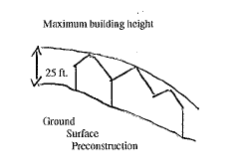
Maximum Height of Building - twenty-five (25) feet
The maximum height of buildings in the OS shall be measured according to the following provision and method which is intentionally different than the definition of Height contained in Article 7 of the LUC: The maximum height of twenty-five (25) feet shall be measured from preconstruction grade. Height shall be measured as the length of any line which is plumb from a plane located at the highest building point, which plane is above and parallel to the original, pre-construction grade of the building site coverage area. The following diagram illustrates this principle:
IV.
Maximum Single-family Residence Square Footage Allowed - three thousand five hundred (3,500) of Floor Area
a.
An additional five hundred (500) square feet of Floor Area may be allowed for an attached garage within or as a part of the single-family residential dwelling.
b.
Below grade floor area which qualifies as a basement as defined by the current adopted County Building Code, does not count toward the maximum allowed Floor Area.
c.
Maximum footprint - three thousand five hundred (3,500) square feet.
d.
Accessory structures are prohibited.
5-314F.
Minimum Off-street Parking
Off-street parking shall be provided for each principal use as required in Section 5-702. All parking shall be onsite.
5-314G.
Residential Fences
Privacy fencing for gardens, decks and patios shall be located within twenty (20) feet of the Single-family Residence and no higher than thirty (30) inches. Perimeter fencing of a lot or lots is prohibited.
5-314H.
Water and Sewage Disposal
It is preferred that water and wastewater disposal be provided from municipal or community systems, if available, to minimize site disturbance. If municipal or community utility services are not available individual wells and/or individual sewage disposal systems shall be sited and designed to minimize site disturbance to the maximum extent possible. Applicants are encouraged to meet with the County Environmental Health Director to identify the types of sewage disposal system that may be best suited for the site and that minimizes site disturbance.
(Res. No. 2024-54, 12-18-2024)
5-315 - Public (PUB)
5-315A.
Purpose
The purpose of the Public (PUB) Zone District is to provide for the development of public uses, facilities and services for governmental, civic, educational, humanitarian health care and other public purposes consistent with County land use plans and policies and to provide for related uses which are customarily incidental or accessory to public uses, facilities and services. Development activity in the zone shall be based upon the adoption of a master plan.
5-315B.
Uses Allowed Subject to One-step Planning Commission Approval
I.
Hospitals;
II.
Libraries;
III.
Schools;
IV.
Cemeteries;
V.
Fire Stations;
VI.
Police Stations;
VII.
Public Museums;
VIII.
Water and Sewage Treatment Plants;
IX.
Public Airports;
X.
Accessory Affordable Housing for employees employed on-site or for First Responders or Essential Personnel;
XI.
Road Maintenance Facilities; and
XII.
Animal Shelter.
5-315C.
Criteria for Uses Allowed Subject to One-step Planning Commission Approval
To grant approval for the uses listed in Section 5-315 B, the Planning Commission must find that, in addition to meeting the criteria for special uses subject to One-step Planning Commission Approval (See Section 5-1002), the use:
I.
Provides basic or fundamental services on which the community is dependent for support;
II.
Is available to serve the general public and serves principally the local community;
III.
Meets an essential public purpose that is not adequately provided by the private sector;
IV.
Fulfills the functions and obligations of a publicly elected body or is mandated by legislation, ordinance or statute; and
V.
Is, or is a subsidiary of, a not-for-profit-venture.
5-315D.
Area and Bulk Requirements
I.
Minimum lot size - Established by Planning Commission.
II.
Minimum lot width - Established by Planning Commission.
III.
Minimum Setbacks
a.
Side and rear yard - ten (10) feet
b.
Front yard - thirty (30) feet
IV.
Height limit - thirty-five (35) feet
V.
Maximum Floor Area Ratio (FAR) - 0.50:1
5-315E.
Minimum Off-street Parking
The number of off-street parking spaces shall be established by One-step Planning Commission Approval pursuant to the standards in Section 5-702.
5-316 - Scenic Foreground Overlay (SFO) and Scenic View Plane (SVP)
5-316A.
Purpose
The Scenic Foreground Overlay (SFO) and Scenic View Plane (SVP) Zone District is intended to establish a scenic resource area including those lands proximate to and most visible from State Highway 145 which substantially contribute to the unique visual character of the East End and/or the entrance to Telluride. The purposes of establishing the SFO and SVP are to steer development away from the most highly visible sites and to insure that developments are designed to complement the natural features within transportation corridors so as to maintain an aesthetically pleasing, rural approach to Telluride. Land development previously allocated to areas within the SFO and SVP Zone District may be clustered elsewhere on a site, as may be appropriate.
5-316B.
Applicability
Development on any parcel of land that falls within or is crossed by the boundary of the SFO or SVP Zone District as designated on the officially adopted San Miguel County Zoning Map is subject to review to determine the conformance with the standards in Section 5-316 C.
5-316C.
Development Standards - Subject to Planning Commission Review
Development within the SFO and SVP Zone District shall generally comply with the standards in this section and shall be subject to review by the Planning Commission. Compliance with every standard is not required, but developments shall comply with the cumulative intent of these standards:
I.
Utilize existing topography such as dry ridges and hills to screen buildings to the maximum extent possible from the State or County road system.
II.
Design developments to complement the natural topography of the land, whenever possible and appropriate.
III.
Utilize innovative architectural techniques such as earth sheltered design and clustering of structures in the least visible portion of the site.
IV.
Design structure height and bulk to avoid to the maximum extent possible visibility from the State and County road systems.
V.
Avoid locating uses on the highest ground or most visible sites from the State and County road systems.
VI.
Locate development outside of the SFO and/or SVP Zone District, or on a suitable site with the least possible visual impact on the State and County road systems.
VII.
Avoid development within wetland and wildlife habitat areas.
VIII.
All exterior lighting shall comply with the standards of Section 5-710;
IX.
Utilize landforms and earth moving to complement and enhance development rather than as primary devices for screening development from the State and County road systems.
X.
Cluster development outside the SFO and/or SVP Zone District to minimize visual impacts.
(Res. No. 2024-54, 12-18-2024)
5-317 - Planned Unit Development Reserve (PUDR)
5-317A.
Purpose
The Planned Unit Development Reserve (PUDR) Zone District is intended to define maximum long-term development potential of specific, large parcels of land under contiguous ownership in the East End (See Section 5-1403 F.). PUD Reserve status for a contiguous parcel provides a transition between designation under the San Miguel County Comprehensive Development Plan and final zoning. No development shall occur under the PUDR Zone District. An applicant desiring to develop a PUD Reserve must obtain PUD approval for the entire parcel. However, portions of a Reserve may be given different rezoning designations as necessary to implement the East End Master Plan. PUDR applies only to existing parcels so zoned already; PUDR shall not be applied to any additional parcels.
5-317B.
Development Potential
The development potential assigned to a given parcel through the PUDR Zone District is based on classifying the Reserve land into one (1) of three (3) categories:
I.
High Density - as shown on the specific PUD Reserve Map (see Section 5-317 F)
II.
Environmentally Sensitive - includes all land:
a.
Within wetlands (designated by the Army Corps of Engineers and/or the Environmental Protection Agency) or the 100-year floodplain,
b.
Within fifty (50) feet of the centerline of any perennial stream,
c.
With slopes of thirty-five percent (35%) or greater encompassing at least one (1) acre, and
d.
With known geologic hazard areas, wildlife migration corridors and/or critical wildlife habitats.
III.
Residential - all lands not classified as High Density, Environmentally Sensitive, or Mixed Use.
IV.
Mixed Use - as described in Appendix B of the East End Master Plan (originally Section N of the Telluride Regional Area Master Plan) and established as part of the Combined PUD/Subdivision Plan Review process.
5-317C.
Calculating Development Potential
For the purpose of calculating development potential, densities are assigned to each land type as follows:
I.
High Density - forty (40) units per acre
II.
Environmentally Sensitive - None
III.
Residential - one (1) unit per three (3) acres
IV.
Mixed Use - notwithstanding the foregoing density calculations, density for a mixed-use project shall be established as part of the Combined PUD/Subdivision Plan Review process.
5-317D.
Density of Residential Development
The density of residential development in the PUDR Zone District is based upon the cumulative number of people to be housed in various types of housing, as follows (as per the East End Master Plan, Section III. A.):
I.
Hotelor lodge unit .....1.5 people
II.
Accessory unit (caretaker type) .....1.5 people
III.
Hotel efficiency unit .....2.0 people
IV.
One-bedroom condominium unit .....2.5 people
V.
Minor duplex or secondary unit .....2.5 people
VI.
Two-bedroom or larger condo unit .....3.0 people
VII.
Single family house or residence .....4.0 people
VIII.
Major duplex unit or primary unit .....4.0 people
5-317E.
Sub-districts and Designated Uses
Assigning sub-districts within parcels zoned PUDR can help define development potential by indicating specific locations for and sizes of various types of development.
I.
High Density Accommodations
a.
Purpose - The purpose of this sub-district designation within a PUDR is clustering of tourist-oriented accommodations. Densities are high to allow for preservation of open space and scenic vistas.
b.
Uses Allowed by Right - All Uses Allowed by Right in the Forestry, Agriculture and Open (F) Zone District - see Section 5-307.
c.
Maximum Density - forty (40) units per acre.
II.
Residential
a.
Purpose - The purpose of this sub-district designation within a PUD Reserve Zone District is to promote the placement of large-lot, single-family dwelling units in appropriate locations.
b.
Uses Allowed by Right - All uses permitted in the Forestry, Agriculture and Open (F) Zone District - see Section 5-307, and in the Low Density (LD) Zone District - see Section 5-304.
c.
Maximum Density - one (1) unit per three (3) acres.
III.
Light Industry/Public Utility
a.
Purpose - The purpose of this sub-district designation within a PUD Reserve Zone District is to allow for light industry and public utility uses in appropriate locations.
b.
Uses Allowed by Right - All uses permitted in the Low Intensity Industrial (I) Zone District - see Section 5-309, and in the Forestry, Agriculture and Open (F) Zone District (see Section 5-307).
IV.
Planned Open Space
a.
Purpose - The purpose of this sub-district designation within a PUD Reserve Zone District is to preserve open space and to indicate lands intended for general open space, agricultural, park and cultural and/or educational use that would not compromise the preservation of open space.
b.
Uses Allowed by Right - Normal and customary ranching and agriculture-related activities and all uses allowed by right in the Park (P) Zone District - see Section 5-313, and in the Open Space (OS) Zone District - see Section 5-314.
V.
Mixed Use
a.
The purpose of this sub-district designation within a PUD Reserve Zone District is to provide areas suitable for the development of a balanced mix of land uses, including office, retail, flex space, medical, lodging, and housing, which are compatible with the East End.
b.
Uses Allowed by Right - All Uses Allowed by Right in the Forestry, Agriculture and Open (F) Zone District - see Section 5-307.
c.
All other Allowable Uses shall be established as part of the Combined PUD/Subdivision Plan Review process.
VI.
Special Use Permit
Uses allowed with a special use permit in all sub-districts within the PUDR Zone District shall be those uses allowed through special use permit in the Forestry, Agriculture and Open (F) Zone District - see Section 5-307 F, as long as such uses are compatible with the overall PUDR zoning.
5-317F.
PUD Reserve Map
Maps for each of the existing PUD Reserves are retained by the County and the owner of the Reserve parcel. Each PUD Reserve Map, at a scale of four hundred (400) feet = one (1) inch or larger, shows the boundaries of the Reserve and its sub-districts. The maps also show maximum unit counts and densities.
5-317G.
Development and PUD Approval Procedure
At such time as a parcel owner is ready to proceed with any development within a PUD Reserve, the developer shall apply for PUD approval of the entire parcel. Sub-districts may receive different final zoning designations as necessary to implement the East End Master Plan. All development plans shall be processed via the PUD Procedure (see Section 5-14)
(Res. No. 2024-54, 12-18-2024)
5-318 - Rangeland Grazing (RG)
5-318A.
Purpose
The Rangeland Grazing (RG) Zone District is intended for the grazing of livestock, and for other uses related to and attendant to and compatible therewith. The RG Zone District shall apply only to lands within the Official East Wilson Mesa Zoning District established by a plat approved by the Board of County Commissioners on Aug. 20, 1979, and recorded at Book 1, Page 169, in the Office of the Clerk and Recorder of San Miguel County.
5-318B.
Uses Allowed by Right
I.
Single-family residence on at least thirty-five (35) acres;
II.
Grazing Operations - A grazing operation shall consist of one or more grazing units (a grazing unit shall consist of a tract of forty (40) or more contiguous acres, or an entire quarter-quarter section), and shall be permitted one-single family residence together with outbuildings and corrals commensurate with the grazing operation; and
III.
Accessory buildings and uses.
5-318C.
Uses Allowed by Special Use Permit Subject to Two-Step Planning Commission and Board of Commissioner Review on Parcels three hundred twenty (320) Acres or Larger and where the property is subject to a permanent Conservation Easement, or a similar legally binding preservation instrument, that is intended to protect, preserve and maintain the ongoing private ranching, agriculture and historic use of the property in perpetuity.
I.
Sporting Uses: including, but not limited to, hunting, guiding, and outfitting, cross-country skiing, horse-drawn sleigh/wagon rides, and horseback riding consistent with the historic use and frequency of use of the property and the terms of the permanent Conservation Easement or applicable preservation instrument.
II.
Social and Scenic Uses: such as a location for weddings, meetings, retreats, reunions, video and film photo shoots and commercials consistent with the historic use and frequency of use of the property and the terms of the Conservation Easement or applicable preservation instrument.
5-318D.
Review Standards for All RG Special Uses listed or authorized in 5-318 C. and 5-318 D. shall:
I.
Be consistent with the Purpose of the RG Zone District (5-318 A.).
II.
Be consistent with the terms and conditions of the applicable Conservation Easement or preservation instrument.
III.
Be found to comply with submittal requirements and review Standards for Special Uses contained in Section 5-10.
IV.
Be granted specifically to the applicant and/or the owner and do not run with the land and are not transferable to another owner.
5-318E.
Uses Expressly Prohibited
I.
Industrial uses including, but not limited to, industrial parks, sawmills and feed lots;
II.
General commercial uses including, but not limited to, hotels, motels, restaurants, mobile home parks and convention and retreat centers;
III.
Mobile homes and manufactured housing as residences; and
IV.
Recreational commercial uses including, but not limited to, dude ranches, hunting and guide services and riding stables except where the Board of County Commissioners has approved a Special Use Permit for a specific recreational commercial use in accordance with Sections 5-318 D and 5-318 E.
(Res. No. 2026-05, § 2(Exh. C), 1-21-2026)
5-319.1 - Wright's Mesa (WM) (1991)
5-319.1A.
Purpose
The Wright's Mesa Zone District is identified by the map adopted in the Wright's Mesa Master Plan. The Zone District is intended to preserve the rural and agricultural character of Wright's Mesa while encouraging compatible, diverse economic opportunities that fit in with the rural landscape. Wright's Mesa has a history of co-existing agriculture and ranching, residential and small business uses that comprise its rural character.
The WM District discourages the large-lot pattern of sprawl typically created through 35-acre development by offering alternatives and incentives to cluster buildings, retain open lands and keep large parcels whole. The tradeoff for flexibility in uses and densities on Wright's Mesa is that development cannot adversely affect neighbors and detract from the rural character.
Each WM parcel is allowed a single-family dwelling, home occupation and/or normal and customary agriculture and ranching activities, plus either a second Principal Use (whether by Right or Special Review), or a Secondary Unit (pursuant to Section 5-319.1 D), or a Subdivision Exemption for Wright's Mesa (pursuant to Section 5-1210). Section 5-319.1 K establishes review standards for all special uses in the WM Zone District.
Development Permits (other than those associated with Building Permits, Sign Permits, or Oil and Gas Exploration and Development) are not required in the WM Zone District.
5-319.1B.
Uses Allowed by Right on Parcels Less than 150 Acres
I.
Normal and customary agriculture and ranching activities;
II.
Single-family dwellings (including mobile homes) and accessory buildings;
III.
Day care homes;
IV.
Logging operations resulting in hauling of up to fifteen thousand (15,000) board feet in any 12-month period beginning with commencement of hauling;
V.
Home occupations;
VI.
Equestrian activities and private riding stables with structures up to three thousand (3,000) sq. feet; and
VII.
Bed and Breakfasts with five (5) or fewer rooms for rent.
5-319.1C.
Uses Allowed by Right on Parcels 150 Acres and Larger
I.
All uses allowed in Section 5-319.1 B;
II.
Additional Uses allowed with 100-foot setbacks on all sides:
a.
Logging operations resulting in hauling of up to fifty thousand (50,000) board feet in any 12-month period beginning with commencement of hauling;
b.
Equestrian activities and private riding stables with structures up to six thousand (6,000) sq. feet;
c.
Hunting Lodges (including Hunting Camps) and Guest Ranches accommodating up to twenty (20) overnight guests;
d.
Animal breeding and/or boarding operations and animal kennels; and
e.
Fruit and vegetable stands.
5-319.1D.
Uses Allowed Subject to Administrative Review
I.
Secondary Dwelling Unit - a second dwelling unit shall be allowed on parcels five (5) acres or larger, provided that:
a.
No uses other than a single-family dwelling, home occupation and/or normal and customary agriculture and ranching activities exist on the property, and
b.
No Subdivision Exemption for Wright's Mesa has been granted for the parcel, and
c.
The parcel was not created through a Subdivision Exemption for Wright's Mesa.
Such unit may be attached to or located within three hundred (300) feet of the primary residence (as measured between the closest exterior walls). Such unit shall contain no more than two thousand (2,000) sq. ft. of floor area, and shall contain full kitchen and bathroom facilities. Second Dwelling Units shall not be conveyed or sold separately from the remainder of the parcel and shall remain under the same ownership as the primary residence;
II.
Logging operations resulting in hauling of up to three hundred thousand (300,000) board feet in any 12-month period beginning with commencement of hauling in accordance with all provisions of Sections 5-319.1 K and 5-17;
III.
Open Land Protection Subdivision Exemption for four (4) or fewer lots (see Section 5-1207); and
IV.
Minor Oil and Gas exploration, drilling and pipelines, including wells, and geophysical operations (refer to Section 5-26).
5-319.1E.
Uses Allowed Subject to One-step Planning Commission Special Use Permit Review (see Section 5-319.1 K)
I.
Parks, playgrounds, playing fields, tennis courts, ice-skating rinks and swimming pools;
II.
Churches, community meeting halls, private schools, day care centers, libraries, and civic activities;
III.
Private riding stables and equestrian centers with structures larger than allowed by right;
IV.
Cemeteries (subject to Section 5-319.1 J);
V.
Bed and Breakfasts with more than five (5) rooms to rent, and Hunting Lodges and Guest Ranches on parcels less than one hundred fifty (150) acres and/or accommodating more than twenty (20) overnight guests;
VI.
Construction/Contractor Office and Staging Area;
VII.
Animal breeding and boarding kennels on less than one hundred fifty (150) acres, and veterinary hospitals;
VIII.
Manufacturing and processing businesses up to two thousand (2,000) sq. ft.;
IX.
Light industrial, research and development facilities up to two thousand (2,000) sq. ft.;
X.
Feed and seed stores up to two thousand (2,000) sq. ft.;
XI.
Repair service shops up to two thousand (2,000) sq. ft.;
XII.
Art studios, galleries and craft shops up to two thousand (2,000) sq. ft.;
XIII.
Business and professional offices up to one thousand (1,000) sq. ft.;
XIV.
Trade businesses, such as plumbing, heating, electrical and carpentry up to two thousand (2,000) sq. ft.;
XV.
Auto repair with no more than five (5) cars stored or parked overnight outside the building;
XVI.
Printing and publishing offices up to two thousand (2,000) sq. ft.;
XVII.
Fruit and vegetable stands on parcels less than one hundred fifty (150) acres;
XVIII.
Lumber mills; and
XIX.
Secondary Dwelling Units more than three hundred (300) feet from the primary residence.
5-319.1F.
Uses Allowed Subject to One-Step Board of County Commissioner Review
I.
Open Land Protection Subdivision Exemption for five (5) or more lots (see Section 5-1207);
II.
Logging Operations resulting in hauling of more than three hundred thousand (300,000) board feet in any 12-month period beginning with commencement of hauling, in accordance with all provisions of Section 5-319.1 K and 5-17; and
III.
Wright's Mesa Subdivision Exemption (for parcels one hundred fifty (150) acres or greater in size) to create a new parcel between two (2) and five (5) acres (see Section 5-1210).
5-319.1G.
Uses Allowed Subject to Two-Step Planning Commission and Board of Commissioners Special Use Permit Review (see Section 5-319.1 K)
I.
Manufacturing and processing businesses greater than two thousand (2,000) sq. ft.;
II.
Light industrial, research and development facilities greater than two thousand (2,000) sq. ft.;
III.
Repair service shops greater than two thousand (2,000) sq. ft.;
IV.
Business and professional offices greater than one thousand (1,000) sq. ft.;
V.
Trade businesses, such as plumbing, heating, electrical and carpentry greater than two thousand (2,000) sq. ft.;
VI.
Printing and publishing offices greater than two thousand (2,000) sq. ft.;
VII.
Golf Courses, subject to an additional conceptual joint work session with the Planning Commission and Board of Commissioners to discuss how and if the applicant can meet the purpose and standards of the golf course regulations (subject to compliance with Standards in Section 5-1004).
VIII.
Public utility structures, including dams and reservoirs.
IX.
Major Oil and Gas Facilities, including compressor stations, gas treatment facilities and pipelines (refer to Section 5-26).
X.
Conditional Uses on Federal Lands—subject to Section 5-11, Article 7, and applicable State and Federal statutes and regulations.
XI.
Wright's Mesa Subdivision Exemption (for parcels thirty-seven (37) acres or larger but less than one hundred fifty (150) acres) to create a new parcel between two (2) and five (5) acres (see Section 5-1210).
5-319.1H.
Area and Bulk Requirements
I.
Minimum Parcel Size
The minimum Parcel size for each principal use is thirty-five (35) acres, except for single-family dwellings approved pursuant to the standards for Open Lands Protection Subdivision Exemption (Section 5-1207) and except for Parcels approved pursuant to the standards for Essential Community Facilities Subdivision Exemption (Section 5-1204), pursuant to any required Special Use review, and which satisfy the following criteria (to be determined through the review under Section 5-1204):
a.
Such Parcel shall have legal Access to a dedicated public right of way that safely, and adequately serves the intended Use for such Parcel;
b.
Such Parcel shall comply with the minimum Setbacks for the WM Zone District and shall provide an additional Setback buffer, if necessary, considering the function, nature and extent of the Use and the dimensions of any Structures; and
c.
Such Parcel safely accommodates the intended Use and does not endanger the public health, safety and welfare as demonstrated by a detailed survey, accurate Site Development plan for the planned Structures, Buildings and/or infrastructure to be erected thereon.
d.
Any legally created Parcel less than thirty-five (35) acres in the WM Zone District may qualify for a Building Permit for one single-family dwelling unit, provided the Parcel meets the criteria set forth in Section 5-1908.
II.
Minimum Setbacks
a.
Front Yard - thirty (30) feet
b.
Side Yard - twenty (20) feet
c.
Rear Yard - twenty (20) feet
III.
Maximum Height of Buildings - thirty-five (35) feet
5-319.1I.
Minimum Off-street Parking
Off-street parking shall be provided for each approved use as required in Section 5-702.
5-319.1J.
Cemetery Standards
In addition to complying with the standards for special uses in Sections 5-319.1 K and 5-10, cemeteries shall comply with the standards in this section.
I.
Such uses shall serve an obvious public need;
II.
Sufficient distance shall separate such uses from incompatible uses on adjacent properties; and
III.
Satisfactory proof shall be obtained that such areas will be properly maintained.
5-319.1K.
Review Standards for All WM Zone District Special Uses
All special uses shall:
I.
Be consistent with the County Master Plan, the County Land Use Policies in Article 2 and the purpose of the WM Zone District;
II.
Be consistent with and compatible with the character of the immediate vicinity of the parcel proposed for development and surrounding land uses, and/or shall enhance the mixture of complimentary uses and activities in the immediate vicinity of the parcel proposed for development;
III.
Be designed, located and proposed to be operated so that the public health, safety and welfare will be protected;
IV.
Be located, designed and operated to minimize adverse effects, including impacts on scenic quality, pedestrian and vehicular circulation, parking, trash, service delivery, noise, vibration and odor on surrounding properties. (The allowed number of employees or occupants may be limited depending upon potential impacts on surrounding properties);
V.
Provide adequate public facilities and services to serve the special use, including but not limited to roads, adequate water supply in terms of both quality and quantity, sewer, solid waste and fire protection;
VI.
Not substantially adversely affect agriculture or ranching operations, residences or scenic quality of land surrounding State or County roads (including through addition of traffic);
VII.
Comply with setback and height restrictions; however, the County may require greater setbacks to mitigate impacts on neighbors or scenic quality;
VIII.
All exterior lighting shall comply with the standards of Section 5-710;
XI.
Be located to preserve scenic views and blend in with and utilize the natural topography;
X.
Use native or similar horticultural materials for revegetation and reforestation, and provide guarantees that any needed revegetation or reforestation will be completed during the first planting season after construction;
XI.
Only include roads, utilities and associated structures that bear logical relationships to existing topography and minimize cuts and fills;
XII.
Comply with the applicable sign standards in Land Use Code Section 5-704; and
XIII.
Be consistent with the historic rural and agricultural character of Wright's Mesa. The following standards, along with input from neighbors, shall be considered by the County in determining consistency:
Siting of Buildings
•
Locate buildings away from open meadows, visible ridges, and wildlife habitat areas.
•
Cluster structures with surrounding open space ("ranch compound" concept).
•
Locate buildings to maximize solar access.
Roads/Driveways
•
Minimize cuts and fills, which should not exceed 2:1 slopes.
•
Stabilize cut and fill slopes with erosion-resistant vegetation or material contoured to blend with natural, undisturbed terrain.
•
Maintain the natural drainage on the property to the greatest extent possible.
•
Encourage shared driveways between buildings.
•
Avoid cutting through open meadows.
•
Surface driveways with gravel, or employ dust-control.
Parking
•
Locate parking areas behind or to the side of buildings.
•
Consider parking-surface alternatives, such as gravel and reinforced sod.
•
Separate parking areas from buildings with pedestrian ways and planting zones.
•
Landscape at least fifteen percent (15%) of parking areas, and provide one (1) shade tree for each three hundred (300) square feet of parking.
Building Materials
•
Utilize predominantly natural building materials, such as wood siding and native stone. (Corrugated metal buildings are discouraged, and at minimum should be sited to minimize visibility from roads.)
•
Encourage natural earth tones and muted colors to blend with surroundings.
•
Paint or anodize exposed metal flashing or trim to reduce reflectivity.
•
Encourage composition shingle, metal, slate or other earth toned non-reflective roofing.
Architectural Elements
•
Encourage front and side porches.
•
Encourage roof slopes that change pitch and peaked roofs with gentle slopes.
•
Encourage horizontal building forms (this does not preclude two (2) stories).
•
Encourage pitched roofs, and discourage flat, mansard, curved and domed roofs.
•
Match roof colors with the darkest colors in the adjacent landscape.
•
Encourage reuse, renovation, and/or modification of existing buildings.
Accessory Structures
•
Screen mechanical appurtenances, service and storage areas and trash receptacles from public view.
•
Utilize the same or similar building materials (forms, colors and textures) for main and accessory structures.
•
Mitigate visibility of accessory structures with fences, walls and/or landscaping.
XIV.
Review of Approved Special Uses
a.
All approved Special Uses subject to either one-step Planning Commission or Board of County Commissioner review or two-step Special Permit Review shall commence within three years of the date of approval. If the owner has not obtained a Development Permit for the approved Special Use and/or commenced the approved use or activity, in accordance with the terms and conditions of the approval, within this three-year time period. The Special Use shall be subject to review at a duly noticed Public Hearing by the entity that approved the Special Use. The purpose of this review is to determine if there has been a change in circumstances since the Special Use Permit was granted and to determine if the Special Use meets or complies with the review standards for Special Uses set forth in Land Use Code Section 5-319.1 K Review Standards for all WM Zone District Special Uses.
Upon or prior to the expiration of the three years period, the owner/applicant may provide a written statement withdrawing the Special Use application and requesting the Special Use approval be terminated. If upon expiration of the three years period the owner/applicant does not provide a written statement withdrawing the application the matter shall be noticed and scheduled for Public Hearing by the County. The applicant is encouraged to provide a written statement, prior to the Public Hearing, indicating why the approved Special Use has not been permitted and/or commenced, identifying any changes that may have occurred in the surrounding land uses and explaining how the proposed Special Use meets the review standards in Land Use Code Section 5-319.1 K.
Review of an approved Special Use shall be conducted in accordance with the applicable provisions of Article 3 Procedures for one-step reviews and shall include posting and sending written notice of the Public Hearing for review of the Special Use to adjacent property owners. Development Permits for an approved Special Use shall not be issued following the expiration of the three-year period, prior to the required Public Hearing.
The Planning Commission and/or Board of County Commissioners in reviewing the Special Use Permit, at a duly noticed Public Hearing, may extend the Special Use Permit approval, extend the approval subject to modifications or additional conditions, or they may rescind and terminate the approval if a finding is made that the Special Use no longer meets the review standards for Special Uses pursuant to Section 5-319.1 K Review Standards for all WM Zone District Special Uses.
b.
If any approved Special Use is discontinued or abandoned for twelve (12) consecutive months, then such Special Use shall be subject to review initiated by the County. The procedures and standards for review of discontinued or abandoned Special Uses are the same as those for Review and Approval of Special Uses set forth in Land Use Code Section 5-319.1 K. If a Special Use is discontinued or abandoned for twelve (12) consecutive months, and the Special Use is re-established or resumed by the owner, the use shall be subject to review in accordance with the provisions of this section and subject to review by either the Planning Commission and/or Board of County Commissioners, at a duly noticed Public Hearing, where the permitting entity may rescind or terminate, recognize and extend the original approval, or extend subject to additional conditions or modifications. The procedures and standards for review of discontinued Special Uses are the same as those for Review of Approved Special Uses set forth in 5-319.1 K. Review Standards for all WM Zone District Special Uses.
WRIGHT'S MESA ZONE DISTRICTS
The current Land Use Code Section 5-319.1 Wright's Mesa Zone District (WM) and related texts will remain in full force and effect as to parcels of real property included within the Wright's Mesa Master Plan Area until and unless the Board of County Commissioners approves the rezoning of any such specific parcel of real property to one (1) of the new Wright's Mesa Zone District classifications as follows:
The following Section 5-319.2 contains the new language adopted March 2010.
SECTION 5-319.2 WRIGHT'S MESA ZONE DISTRICTS
(Res. No. 2026-05, § 2(Exh. C), 1-21-2026)
5-319.2 - Wright's Mesa Zone Districts (2010)
5-319.2A.
General Provisions
I.
General Purpose and Intent
This section is generally intended to:
a.
Implement the Wright's Mesa Master Plan;
b.
Allow for and encourage town-level residential and light industrial uses within the Norwood Master Plan Boundary; and
c.
Allow for and encourage ongoing and future agricultural operations and compatible uses outside the Norwood Master Plan Boundary, while protecting the character and quality of Wright's Mesa.
II.
Applicability
This Section 5-319.2 applies to all land located within the boundaries of the Wright's Mesa Master Plan. The use of land, buildings, or structures, and all development as defined by this Code, shall conform to the regulations applicable to the zone district in which the lot or site is located, unless a variance, adjustment, or exemption is provided by or pursuant to the terms of this section. This Section 5-319.2 does not apply to pre-existing, non-conforming uses, which shall instead be governed by Section 5-19 of this Land Use Code.
5-319.2B.
Establishment of Wright's Mesa Zone Districts
Table 1 lists the Wright's Mesa Zone Districts.
5-319.2C.
District Boundaries
Boundaries of the Wright's Mesa Zone Districts are to be shown on the adopted County Zoning Map as specific properties are rezoned to these new Districts. The Districts are within the Wright's Mesa Master Plan boundary, which is shown on the Following Figures WM1 (Wright's Mesa Master Plan Boundary and Future Land Use Plan) and WM2 (Wright's Mesa Future Land Use — Norwood Master Plan Area).
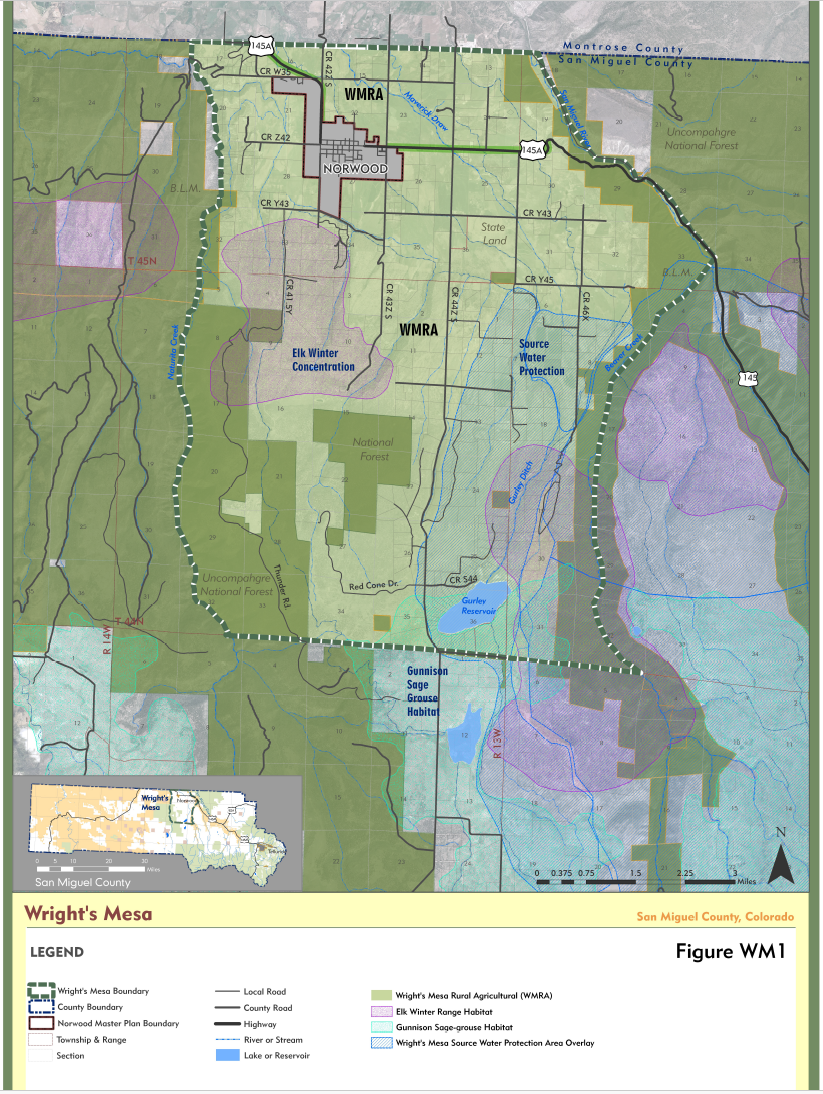
Figure WM-1
Figure WM2
5-319.2D.
District Purposes
I.
Wright's Mesa Rural Agricultural (WMRA)
The Wright's Mesa Rural Agricultural district is intended to implement the Wright's Mesa Master Plan by protecting the rural and agricultural character of Wright's Mesa and allow for and encourage ongoing and future agricultural operations outside of the Norwood Master Plan Boundary, while encouraging compatible, diverse economic opportunities that enhance the economic viability of agricultural lands and fit within the rural landscape. The district discourages the type of large-lot sprawl development patterns that are typically created through 35-acre development, by offering alternatives and incentives to cluster buildings, retain open lands, and keep large parcels whole. The PUD process is not applicable in this district. This Section 5-319.2 includes criteria to guide the siting of and performance of general industrial services and heavy manufacturing within the WMRA district. Industry that would have significant adverse impacts to neighbors or that would detract from the rural character may not be appropriate on Wright's Mesa. These types of uses may be more appropriately considered in the West End (WE) zone district (defined in Section 5-320) in proximity to existing resource extraction, mining and mineral processing, and major oil and gas facilities.
II.
Wright's Mesa Rural Residential (WMRR)
Existing rural subdivisions located on Wright's Mesa outside of the Norwood Master Plan Boundary that are in the Residential (R), Mobile Home (MH), and Planned Unit Development (PUD) zone districts, or parcels created through other means, are eligible to rezone to Wright's Mesa Rural Residential (WMRR). The WMRR zone district is intended to allow existing lots that are smaller than thirty-five (35) acres to comply with reasonable area and bulk requirements and make them conforming. This district is not intended to expand rural residential subdivisions into other parts of Wright's Mesa. The PUD process is not applicable in this district.
III.
Wright's Mesa Light Industrial (WMLI)
The Wright's Mesa Light Industrial (WMLI) district is established to implement the "Town Light Industrial" land use classification in the Wright's Mesa Master Plan. The district is intended to apply to county parcels that have been identified as appropriate for light industrial development currently outside town limits but within the Town of Norwood Master Plan Boundary. The district is intended to allow for the development of small-scale and relatively low-impact manufacturing and processing uses, offices, business services, live-work units, civic uses, and other uses compatible with the small-town character of Norwood, in locations where uses and activities can be efficiently served by the Town of Norwood, Norwood Sanitation District, and Norwood Water Commission. This district is near the downtown commercial area and at the edge of town residential areas, where town-level residential and commercial should occur. Therefore, commercial and residential uses in this district require greater review process than light industrial uses. Developers seeking higher density or variation in permitted uses or area and bulk requirements shall use the Planned Unit Development (PUD) process and must demonstrate legal and physically adequate water and sewer services. The district's location allows for the expansion of Norwood in a compact and orderly fashion. It is also intended to ensure general consistency with the Town of Norwood's Major Streets and Future Land Use Plan. Prior to rezoning parcels to the WMLI district, the county will encourage landowners to seek annexation into the Town or enter into a pre-annexation agreement with the Town of Norwood.
IV.
Wright's Mesa Town Residential (WMTR)
The Wright's Mesa Town Residential (WMTR) district is established to implement the "Town Residential" land use classification in the Wright's Mesa Master Plan. The district is intended to apply to county parcels that have been identified as appropriate for town-level residential development within the Town of Norwood Master Plan Boundary. "Town-level residential development" is consistent with Town of Norwood residential development densities and all other standards, including paving standards for streets and sidewalks. Developers seeking higher density or variation in permitted uses or area and bulk requirements shall use the Planned Unit Development (PUD) process and must demonstrate legal and physically adequate water and sewer services. The WMTR zone district is determined to be necessary and suitable for future town uses and can be efficiently served by the Town of Norwood, Norwood Sanitation District, and Norwood Water Commission. It is also consistent with the Town of Norwood's Major Streets and Future Land Use Plan. Prior to rezoning parcels to the WMTR district, the county will encourage landowners to seek annexation into the Town or enter into a pre-annexation agreement with the Town of Norwood.
5-319.2E.
Allowed Uses
Table 5-319.2-3 lists the uses allowed within the four (4) zone districts. Development or use of property for any other use not specifically allowed in Table 5-319.2-3 and authorized under the applicable procedure is prohibited. All the use categories and use types listed in the Table of Allowed Uses are defined in Section 5-319.2 K.
I.
Explanation of Table Abbreviations
Table 5-319.2-2 lists the review procedures and abbreviations used in the Table of Allowed Uses (Table 5-319.2-3).
II.
Table Organization
In Table 5-319.2-3, land uses and activities are classified into general "use categories" and specific "use types" based on common functional, product, or physical characteristics, such as the type and amount of activity, the type of customers or residents, how goods or services are sold or delivered, and site conditions. This classification provides a systematic basis for assigning present and future land uses into appropriate zoning districts. Both use categories and use types are defined in Section 5-319.2 K.
III.
Use-specific Standards
Regardless of whether a use is allowed by right or permitted as a special use, additional standards may be applicable to the use. The existence of these use-specific standards is noted through a cross-reference in the last column of the table.
IV.
Multiple Principal Uses Allowed
a.
WMRA District
In the WMRA district, each parcel is allowed one (1) single-family dwelling and any number of home occupations, agricultural uses, and/or agricultural support uses provided such uses meet all standards of this code. In addition, one (1) other principal use may be allowed, provided that such use complies with all applicable standards of this code.
b.
WMRR District
In the WMRR district, each parcel is allowed one (1) single-family dwelling and any number of home occupations, and agricultural uses provided such uses meet all standards of this code.
c.
WMTR and WMLI Districts
Multiple principal uses may be allowed on a single parcel in the WMTR and WMLI districts, provided that each such use complies with all applicable standards of this code.
V.
Classification of New and Unlisted Uses
The county recognizes that new types of land use will develop and forms of land use not anticipated in this Land Use Code may seek to locate in the Wright's Mesa zone districts. When application is made for a use category or use type that is not specifically listed in Table 5-319.2-3, the Planning Director shall make a determination as to the appropriate classification of any new or unlisted form of land use in the following manner:
a.
The Planning Director shall provide an interpretation as to the use category, if any, into which such use should be placed. In making such interpretation, the Planning Director shall consider the nature of the use and whether it involves dwelling activity; sales; processing; type of product, storage, and amount, and nature thereof; enclosed or open storage; anticipated employment; transportation requirements; the amount of noise, odor, fumes, dust, toxic material, and vibration likely to be generated; and the general requirements for public utilities such as water and sanitary sewer. The Planning Director shall make a finding that the newer, unlisted use has similar or lesser impacts than the similar listed use; if not the use shall not be allowed.
b.
Standards for new and unlisted uses may be interpreted as those of a similar use. A similar review procedure shall apply for the new and unlisted use.
c.
Appeal of the Planning Director's decision shall be made to the Board of County Commissioners under Section 1-1903 A.
VI.
Table of Allowed Uses
Allowed uses are identified in Table 5-319.2-3. All uses shall be consistent with the Wright's Mesa Master Plan. All uses shall comply with all applicable provisions of county, state and federal regulations and permitting.
5-319.2F.
Procedures that Apply
This section sets forth procedures that apply within the Wright's Mesa zone districts. This section supplements the general County review procedures found in Article 3 of this Land Use Code. In case of conflict between this section and Article 3, the procedures in this section shall control.
I.
Uses Subject to Issuance of a Development Permit
Uses subject to issuance of a Development Permit shall comply with applicable regulations of this Land Use Code, including use-specific standards in Section 5-319.2 H and site development standards in Section 5-319.2 I. Development permits shall be processed in accordance with Section 3-402.
II.
Special Uses
Special Uses are allowed only if the applicant applies for and is issued a Special Use Permit in accordance with the procedures below and in Article 3. Special Uses are subject to all other applicable regulations of this Land Use Code, including Section 5-10, the submittal requirements of Section 5-1002 E, the use-specific standards in Section 5-319.2 H and site development standards in Section 5-319.2 I. Special Uses require either a One-or Two-step review procedure, as set forth in this section and Section 3-6 of this Land Use Code.
a.
One-Step Review (Wright's Mesa)
Uses that are subject to a One-Step Special Use Permit review and decision shall comply with procedures in this section.
i.
One-Step Review Process
The One-Step Special Use Permit review procedure shall be in accordance with the general review process described in Section 3-2 and the One-Step review procedure set forth in Section 3-5. The Board of County Commissioners shall be responsible for the meeting and/or public hearing and decision for One-step reviews on Wright's Mesa.
ii.
Public Notice Abbreviated Process
Certain uses in the WMRA zone district subject to the One-Step review procedure are eligible to shorten the review process as follows:
(a)
The following uses in the WMRA zone district are eligible for the abbreviated process: commercial stable; convent or monastery; cemetery; school (elementary or secondary); minor utility; rural resort or retreat; office; rural recreational establishment (outdoor); greenhouse or nursery with retail; lodge (hunting or guest ranch); and shop-craft, business or industry.
(b)
An applicant proposing one (1) of the above-listed uses who wishes to pursue the abbreviated process shall provide the county planning department with a draft copy of the notice to be sent to property owners. The notice shall include a description of the proposed project, including a site plan and list of proposed uses and activities, and a description of how the use will meet applicable standards of this code. The applicant shall also provide the county with a list of intended recipients of the written notice.
(c)
Following approval of the draft notice and mailing list, the applicant shall send by postal mail or electronic mail a written copy of the notice, as approved by the county, to all contiguous property owners and landowners within one-half mile of the subject property line, plus all property owners along any private road adjoining the subject property. The notification also shall include a consent form and a stamped envelope addressed to the county planning department.
(d)
In addition to sending written notice, the landowner shall post notice of the proposed project on-site in accordance with county noticing requirements in Section 3-9 of this Land Use Code.
(e)
If all recipients of the written notice sign and return the consent form within thirty (30) days of the mailing of notification, indicating acceptance of the proposed project, the county shall review the use following the administrative review process set forth in Section 3-402 of this Land Use Code.
b.
Two-Step Review
The Two-Step Special Use Permit review procedures shall be in accordance with the general review process described in Section 3-2 and Section 3-6 of this Land Use Code with (1) Planning Commission Review and Recommendation, and (2) Board of County Commissioner Review and Decision.
c.
Joint Review of Rezoning and Special Use Permit
Following a pre-application meeting with county staff, an applicant may submit a combined application for rezoning to the WMTR or WMLI district and a special use permit to establish a use in one (1) of those districts. In such cases, the applications shall be processed concurrently.
d.
Commencement and Expiration
All Special Uses shall comply with the commencement and expiration provisions in Section 5-1002 F. Review of Approved Special Uses.
III.
Accessory and Temporary Use Review
Unless otherwise stated in this Code, accessory uses are subject to all other applicable regulations of this Land Use Code.
Temporary uses are subject to all other applicable regulations of this Land Use Code.
5-319.2G.
Area and Bulk Requirements
All primary and accessory structures are subject to the dimensional standards set forth in Table 5-319.2-4 below. These general standards may be further limited or modified by other applicable sections of this Land Use Code.
I.
Dimensional Requirements
The table sets forth dimensional requirements for allowed uses and for accessory uses. Uses may be allowed on smaller pre-existing or non-conforming lots or parcels created through an OLP or other subdivision exemption provided that the proposed use meets other applicable standards.
II.
Planned Unit Development (PUD) Variations in WMTR and WMLI Zone Districts
PUD is a subdivision procedure permitting variation of dimensional, permitted uses, and parking standards to allow flexibility with dimensional requirements. Where area and bulk requirements may be varied for the WMTR and WMLI zone districts, as allowed through a PUD, the table indicates the dimensional requirement allowed.
A PUD shall comply with all standards set forth in Section 5-14.
5-319.2H.
Use-Specific Standards
All uses are subject to the applicable use-specific standards set forth in the section.
I.
Agricultural: See Definition of Agriculture in Section 5-319.2 K.
Agricultural Support Uses
This section addresses the use-specific standards applicable to agricultural uses.
a.
Agricultural Processing Facility
An agricultural processing facility in the WMRA zone district shall comply with the following standards:
i.
Minimum Lot Area: The minimum lot area shall be five (5) acres.
ii.
Structure Size: The structure shall not exceed two thousand (2,000) square feet.
iii.
Larger structures may be permitted by special use review.
iv.
The use shall comply with all applicable state and federal standards.
b.
Farm and Ranch-Based Tourism
A farm and ranch-based tourism use in the WMRA zone district shall comply with the following standards:
i.
Minimum Lot Area: The minimum lot area shall be five (5) acres.
ii.
Maximum Structure Size: Structures shall not exceed two thousand (2,000) square feet.
iii.
Owner: The use shall be operated or maintained by the owner, or occupant of the land upon which the activity is being conducted.
iv.
Number of Visitors: Up to two hundred (200) visitors per day may be allowed.
v.
Parking: Parking shall be screened from a county road or state highway to the extent possible, and use an all-weather surface, such as gravel, to control erosion and dust.
c.
Farm Machinery Repair and Sales
A farm and machinery repair and sales use in the WMRA zone district shall comply with the following standards:
i.
Storage of Equipment: To the extent possible equipment and storage of materials for repair and sales shall be screened and located to the side or rear of buildings. The storage yard shall not exceed twenty thousand (20,000) square feet.
ii.
Setbacks from Residential: Structures for repair and equipment storage shall be a minimum of one hundred (100) feet from a lot line abutting an existing dwelling or property zoned for residential use.
iii.
Noise: Shall not exceed fifty-five (55) dBA at the lot line adjacent to a residential use or where residential uses are allowed by right.
d.
Feedlot, Commercial
A commercial feedlot in the WMRA zone district shall comply with the following standards:
i.
Minimum Lot Area: The minimum lot area shall be thirty-five (35) acres.
ii.
Setbacks from Residential: The feedlot shall be a minimum of two hundred (200) feet from lot lines abutting existing dwellings or property zoned for residential use.
iii.
Manure Management Plan: As part of the Special Use application, the applicant shall prepare a Manure Management Plan for approval by the county.
iv.
Water Protection: No unconfined manure stacking or piling shall occur within the Source Water Protection Area Overlay (as set forth within Section 5-319.2 J), within three hundred (300) feet of a stream, or within one hundred (100) feet of an irrigation ditch.
e.
Lumber Mill
A lumber mill shall comply with the following standards:
i.
Minimum Lot Area: the minimum lot area shall be thirty-five (35) acres.
ii.
Maximum Structure Size:
iii.
Noise: Noise at the lot line shall not exceed fifty-five (55) dBA adjacent to a residential use or where residential uses are allowed by right.
iv.
Hours of Operation: Hours of operation shall be limited to 7:00 a.m. to 7:00 p.m.
v.
Setback: The setback from the lot line adjacent to a residential use shall be one hundred (100) feet.
vi.
Wright's Mesa Source Water Protection Area Overlay: This use is prohibited in the Source Water Protection Area, as set forth in Section 5-319.2 J.
vii.
Prohibited: This use is prohibited in the Gunnison Sage-grouse Habitat Overlay.
f.
Small-Scale Business
The intent of the small-scale business uses are to allow residents in the WMRA district to locate and operate small-scale service and contracting businesses or lease such businesses, which are compatible with the rural character of the district and agricultural operations and supplemental to an ongoing agricultural business or residential use on a lot. Such businesses should locate near a paved county road; however, some businesses may locate to provide economical and convenient services in the area or to supplement farming and ranching as a source of income. Businesses shall operate with designs and conditions that mitigate impacts on neighboring residential properties. A small-scale business in the WMRA zone district shall comply with the following standards.
i.
Minimum Lot Area: The minimum lot area shall be five (5) acres.
ii.
Structure Size/Lot Size: The business shall comply with the maximum structure size related to lot size identified in the table.
iii.
Vehicles: The business shall not have more than four (4) motor vehicles stored on the property. Vehicles parking shall be screened and placed to the rear of structure(s) to the extent possible.
iv.
Number of Employees: The business shall not have more than four (4) employees working on the property.
v.
Heavy Equipment: The business shall have no heavy equipment stored outside.
vi.
Outdoor Storage (Size and Screening):
vii.
Setbacks from Residential: The following minimum setbacks shall apply from any lot line abutting a property with an existing dwelling unit or zoned for residential use:
viii.
Owner: The use shall be operated or maintained by the owner, or occupant of the land upon which the activity is being conducted.
ix.
Expansion: Once a small-scale business needs to expand its area, number of employees, or traffic beyond the capacity and character of the area, the business shall relocate to a location appropriately zoned for commercial or light industry.
x.
Adaptive Re-use: The adaptive re-use of farm structures for the intended use of home occupations and small businesses is allowed with respect to the use of small-scale businesses.
g.
Stable Commercial
A commercial stable shall comply with the following standards:
i.
Structure Size/Lot Size: Structures shall be permitted on lots that conform to the minimum lot or parcel size set forth in the table below:
h.
Wayside Stand
A wayside stand shall comply with the following standards:
i.
Maximum Structure Size: The structure shall not exceed one thousand (1,000) square feet.
ii.
Parking: Parking shall be provided on-site with all-weather surface, such as gravel, to control erosion and dust. Parking shall comply with standards set forth in Section 5-702.
i.
Kennel and Veterinary Clinic or Hospital
A kennel in the WMLI and WMRA zone districts shall comply with the following standard:
(a)
Outdoor Runs/Residential Setback: Outdoor runs shall only be permitted by special use review and shall only be approved if adverse noise and odors on nearby properties can be mitigated.
II.
Residential
a.
Cottage Housing
A cottage housing development in the WMTR district shall develop as part of a PUD and shall comply with the following standards:
i.
Lot Area (Minimum and Maximum): Minimum lot area shall be thirty thousand (30,000) square feet. Maximum lot area shall be forty-five thousand (45,000) square feet.
ii.
Number of Units (Minimum and Maximum): Shall include a minimum of four (4) units and a maximum of nine (9) cottage dwelling units, all included in one (1) development application.
iii.
Size of Units: A detached dwelling unit shall not be greater than eight hundred fifty (850) square feet in lot coverage or a maximum floor area of one thousand five hundred (1,500) square feet or 1.5 times the lot coverage, whichever is less.
iv.
Common Open Space: Each cottage dwelling unit shall include a minimum of two hundred fifty (250) square feet of common open space. At least fifty percent (50%) of each cottage dwelling unit shall abut common open space. All cottage dwelling units shall be within sixty (60) feet of common open space, and the common open space shall have cottage dwelling units abutting at least fifty percent (50%) of its boundaries.
b.
Dwelling, Live/Work
The live/work use may have a maximum of one (1) additional employee who is not a resident.
c.
Dwelling, Multi-Family
Multi-family units in the WMTR district shall be developed only as part of PUD and shall comply with the following standards:
i.
Location: Units shall be located within the WMTR or WMLI master plan area. The density and appearance must be compatible with the surrounding neighborhood.
ii.
Streets: Streets shall be adequate for traffic generated by the use.
iii.
Variety: The development provides a variety of model or building types.
iv.
Massing: Design techniques shall be used to break up the scale of buildings that are greater than twenty thousand (20,000) square feet GFA to provide visual diversity.
v.
Utilities: Utilities shall be adequate to serve the development.
d.
Secondary Dwelling Unit
A secondary dwelling shall be allowed provided that it complies with the following standards:
i.
Minimum Lot Size: The minimum lot size shall be five (5) acres.
ii.
Secondary Use: No uses other than a single-family dwelling, home occupation(s), and/or agriculture and ranching activities exist on the property, and no Subdivision Exemption for Wright's Mesa has been granted for the parcel, and the parcel was not created through a Subdivision Exemption for Wright's Mesa.
iii.
Location: The secondary dwelling unit may be attached to or located within three hundred (300) feet of the primary residence (as measured between the closest exterior walls). A secondary dwelling unit more than three hundred (300) feet from the primary residence shall only be permitted by special use review.
iv.
Size: The unit shall not exceed two thousand five hundred (2,500) square feet floor area, and shall contain full kitchen and bathroom facilities.
v.
Ownership: Secondary Dwelling Units shall not be conveyed or sold separately from the remainder of the parcel and shall remain under the same ownership as the primary residence.
e.
Boarding or Rooming House
A boarding or rooming house use shall provide at least seventy (70) square feet of habitable floor area for each room intended for sleeping and at least thirty (30) additional square feet of floor space for each additional intended occupant.
f.
Co-Housing
Co-housing units may be permitted in the WMTR and WMLI zone districts only as part of a PUD if they are located within the WMTR or WMLI Master Plan area. The density and appearance must be compatible with the surrounding neighborhood.
III.
Public and Institutional
a.
Community/Recreational Center
A community and/or recreation center shall comply with the following standards:
i.
Size: Structure shall not exceed fifteen thousand (15,000) square feet of Gross Floor Area.
ii.
Noise: Building will be designed so that noise will not interfere with the surrounding uses. Noise shall not exceed fifty-five (55) dBA at the lot line adjacent to a residential use or where residential uses are allowed by right.
iii.
Storage: Adequate provision shall be made in the design and/or location of building and loading areas for equipment and supplies, so that storage and service areas are screened from adjacent residential areas and the street.
iv.
Hours of Operation: Hours of operation shall be determined through special use review.
v.
Utilities: The facility shall connect and be served by the Norwood Water Commission and the Norwood Sanitation District.
vi.
Parking: Parking shall comply with Section 5-702. Parking shall be screened and sited to minimize visual impacts of the development.
vii.
Other: Alcohol may be served at private functions pursuant to a valid special events liquor license.
b.
Government Administration and Civic Building
A government administration and civic building shall comply with the following standards:
i.
Maximum size: The Gross Floor Area shall not exceed ten thousand (10,000) square feet.
ii.
Utilities: The facility shall connect and be served by the Norwood Water Commission and the Norwood Sanitation District.
iii.
Parking: Parking shall comply with Section 5-702 and shall be screened and sited to minimize visual impacts of the development.
c.
Educational Facility
Any school or trade or vocational school shall comply with the following standards:
i.
Utilities: The facility shall connect and be served by the Norwood Water Commission and the Norwood Sanitation District.
ii.
Parking: Parking shall comply with Section 5-702 and shall be sited to minimize the visual impacts of the development.
iii.
Adequate Roads and Utilities: The applicant shall demonstrate that adequate roads exist to access the property and that adequate utilities are or will be in place to service the facility.
iv.
Noise: Noise at the lot line shall not exceed fifty-five (55) dBA adjacent to a residential use or where residential uses are allowed by right.
d.
Public Safety Facilities
A public safety facility shall comply with the following standards:
i.
Minimum Lot Area: The minimum lot area shall be one (1) acre.
ii.
Storage: The total area of storage shall not exceed more than twenty percent (20%) of the lot.
iii.
Setbacks from Residential: The public safety facility shall be a minimum of fifty (50) feet from lot lines abutting an existing dwelling or property zoned for residential use.
e.
Religious Assembly Facilities
Any religious facility shall comply with the following standards:
i.
Maximum Size: The gross floor area shall not exceed fifteen thousand (15,000) square feet in the WMTR and WMLI zone districts and ten thousand (10,000) square feet in the WMRA zone district.
ii.
Maximum Auditorium Seating: The main worship area or sanctuary shall not exceed seating capacity for two hundred (200) persons.
iii.
Utilities: The facility shall connect and be served by the Norwood Water Commission and the Norwood Sanitation District.
iv.
Parking: Shall comply with Section 5-702. Parking shall be screened and sited to minimize visual impacts of the development.
f.
Tower/Antenna
Any transmission tower, facility or antenna shall comply with the following standards in Land Use Code Section 5-27 Wireless Services and Telecommunication Facilities.
g.
Renewable Energy Facility
Any renewable energy facility shall comply with the following standards:
i.
Maximum Height: The use may be approved using the administrative review and development permit process if it will not exceed the district's maximum height limit by up to twenty percent (20%) by seeking approval through the Special Use process indicated in the use table.
ii.
Minimum Lot Area: the minimum lot area shall be thirty-five (35) acres.
iii.
Noise: Noise at the lot line shall not exceed fifty-five (55) dBA adjacent to a residential use or where residential uses are allowed by right.
iv.
Setback: The setback from the lot line adjacent to a residential use shall be two hundred (200) feet.
v.
Review Procedure: The use may extend above the specified maximum limit with a One-Step review Special Use Permit approval.
vi.
Gunnison Sage-grouse Habitat: Wind turbines are restricted in lek sites within the Gunnison Sage-grouse Habitat Overlay.
IV.
Commercial
a.
Conference and Training Centers and Rural Resort or Retreat
A conference and training center shall comply with the following standards:
i.
Maximum Size: The gross floor area of the structure(s) shall not exceed ten thousand (10,000) square feet.
ii.
Maximum Auditorium Seating/Events: The main auditorium or meeting room shall not exceed capacity for two hundred (200) persons. No event shall have more than two hundred (200) people in attendance.
iii.
Utilities: The facility shall connect and be served by the Norwood Water Commission and the Norwood Sanitation District.
iv.
Parking: Parking shall comply with Section 5-702. Parking shall be screened and placed to the side or rear of the structure(s).
b.
Restaurant or Bakery
A restaurant or bakery shall comply with the following standards:
i.
In the WMRA zone district, the restaurant or bakery must be related to an on-site agricultural use or on-site agricultural processing and the restaurant or bakery shall not exceed two thousand (2,000) square feet.
c.
Office
An office located outside a home shall comply with the standards in this section (Offices located in homes that are being occupied for residential purposes are defined either as home occupations or as accessory to the residential use and are subject to applicable requirements in Section 5-319.2 H.VI. Accessory Uses and Structures.)
i.
Maximum Structure Size: The office shall comply with the maximum structure size by zone district as provided in the table below.
ii.
Parking: Parking shall comply with Section 5-702 and shall be screened and placed to the side or rear of structure(s).
d.
Vehicle Service and Repair and Parts Sales (indoor)
Vehicle Service and Repair Garages shall comply with the following standards:
i.
Frontage: To the maximum extent feasible, the entrance to a vehicle repair bay shall not face the primary street frontage.
ii.
Screening and Storage: Vehicle service bays facing a rear or side setback shall be screened from adjacent residentially zoned properties. All parts and equipment shall be stored indoors at all times or screened from off-site view by a wall or fence that is at least six (6) feet in height.
iii.
No off-site parking for vehicles awaiting repairs shall occur.
e.
Bed and Breakfast
A Bed and Breakfast shall comply with the following standards:
i.
Minimum Lot Area: In the WMRA district, the minimum lot area shall be five (5) acres. In other districts, the minimum lot area shall be consistent with the zoning district standard.
ii.
Number of Rooms for Rent: The maximum number of rooms for rent shall be based on the lot area, as shown in the table below. Rental of three (3) or fewer bedrooms will be considered an accessory use to a single-family residence.
iii.
Setback: The structure shall be setback a minimum of one hundred (100) feet from the lot line.
iv.
Utilities: The facility shall connect and be served by the Norwood Water Commission and the Norwood Sanitation District or by a water supply system and sewage collection and disposal system approved by the Colorado Department of Public Health and Environment.
v.
Parking Screening: Provisions shall be made for adequate all-weather parking, such as gravel. Parking shall be screened and placed to the side or rear of the structures(s) to the extent possible.
f.
Recreational Vehicle Park, Travel Trailer Park or Campground
In addition to complying with the standards for special uses in Section 5-10 and campgrounds in Section 5-1008, a recreational vehicle/travel trailer park, campground and incidental facilities shall comply with all applicable state Colorado Department of Public Health and Environment (CHPHE) and County Environmental Health review standards and with the following standards:
i.
Setbacks from Property Line:
(a)
WMLI zone district:
•
Front: twenty-five (25) feet;
•
Side: twenty-five (25) feet;
•
Rear: twenty-five (25) feet;
(b)
WMRA zone district:
•
Front: forty (40) feet
•
Side: thirty (30) feet
•
Rear: thirty (30) feet
(c)
The Highway 145 Scenic Corridor Standards of Section 5-319 I.III shall also apply where applicable.
ii.
Access: Entrances and Exits from a State Highway or County Road shall require the applicant to obtain the necessary access permits. The RV Park, Travel Trailer Park, or Campground shall abut and have direct access to a State Highway or a paved County Road that is maintained year-round. Signage advising users of County Off-Highway Vehicle (OHV) regulations shall be posted on the site.
iii.
There shall be no more than three (3) Recreational Vehicle Parks, Travel Trailer Parks or Campgrounds permitted in the Wright's Mesa Rural Agricultural zone district.
g.
Campground Semi-Primitive
A Semi-Primitive Campground shall comply with the standards for special uses in Section 5-10, and campgrounds in Section 5-1009.
h.
Hotel or Motel
i.
Number of Units: Shall be determined upon submittal of site plan, lot size, parking requirement and landscaping plan.
ii.
Parking: Must provide one (1) space per unit plus one (1) space per every three (3) employees.
iii.
Utilities: The facility shall connect and be served by the Norwood Water Commission and the Norwood Sanitation District or a water supply system and sewage collection and disposal system approved by the Colorado Department of Public Health and Environment and the County Health Department.
i.
Lodge (Hunting or Guest Ranch)
A lodge shall comply with the following standards:
i.
Number of Guests: The lodge may have up to twenty (20) overnight guests on more than one hundred fifty (150) acres. Lodges accommodating more than twenty (20) overnight guests or less than one hundred fifty (150) acres shall be permitted by special use review.
ii.
Setback: The structure shall be setback a minimum of one hundred (100) feet from the lot line.
iii.
Utilities: The facility shall connect and be served by the Norwood Water Commission and the Norwood Sanitation district or a water supply system and sewage collection and disposal system approved by the Colorado Department of Public Health and Environment and the County Health Department.
iv.
Parking and Screening: Provisions shall be made for adequate all-weather parking, such as gravel. Parking shall be screened from a county road or state highway and placed to the side or rear of structure(s) to the extent possible.
j.
Rural Recreational Establishment (Outdoor)
Outdoor shooting ranges are not allowed on Wright's Mesa.
V.
Industrial
a.
Logging
A logging operation is subject to the following standards:
i.
Board Feet Hauling Allowances by Lot Size:
ii.
Setbacks: Setback shall be one hundred (100) feet from lot line to logging except to selectively remove dead or diseased trees.
iii.
Prohibited: Removing, damaging, or destroying trees or other vegetation within the Wright's Mesa Source Water Protection Area Overlay or within the Gunnison Sage-grouse Habitat Overlay is prohibited except to selectively remove dead or diseased trees or if requested by CPW.
b.
Light Manufacturing
Light manufacturing shall comply with the following standards:
i.
Size of Structure: The maximum structure size is based on the zone district.
ii.
Vehicles: The business shall not have more than four (4) motor vehicles stored on the property in the WMRA zone district. Motor vehicle parking shall be screened and placed to the side of structure(s) to the extent possible.
iii.
Number of Employees: The business shall not have more than four (4) employees working on the property in the WMRA zone district.
iv.
Heavy Equipment: The business shall have no more than two (2) pieces of heavy equipment stored outside in the WMRA zone district. Equipment shall be screened from public right-of-way.
v.
Outdoor Storage (Size and Screening): The maximum size is based on the zone district.
c.
General Industrial Service (Major) and Heavy Manufacturing
Any such use in the WMRA zone district shall comply with the following standards that are consistent with the Wright's Mesa Master Plan:
i.
Location:
The service, manufacturing, and processing use must be sited:
(a)
Where land is already impacted by industry or mining;
(b)
Away from Highway 145 on a paved county road;
(c)
Where it will minimize visibility and skylining from Highway 145 and county roads;
(d)
No permitted in the Wright's Mesa Source Water Protection Area Overlay;
(e)
Not permitted in the Gunnison Sage-grouse Habitat Overlay or Elk Winter Range; and
(f)
Where prevailing winds will not affect the Town of Norwood or neighborhoods.
ii.
Standards:
In addition to meeting the locational criteria in (i) above, the following standards shall apply:
(a)
Minimum Lot Size: The minimum lot size shall be ten (10) acres;
(b)
Setback: A minimum setback of two hundred (200) feet from the lot line shall apply from an existing dwelling or property zoned for residential use;
(c)
Outdoor storage, waste, and refuse facilities, mechanical equipment, loading facilities, and heavy equipment shall be screened with an opaque six-foot fence, or landscaping and natural berming (with an approved landscape plan);
(d)
Structures shall have a maximum height of thirty-five (35) feet;
(e)
Vibration shall not be noticeable beyond the lot line;
(f)
Noise: Noise shall not exceed sixty (60) dBA at a lot line that abuts a commercial property or fifty-five (55) dBA at the property line adjacent to a residential use or where residential uses are allowed by right;
(g)
Hours of Operation: Shall be limited to 7:00 a.m. to 7:00 p.m.;
(h)
Applicant shall submit a plan to address chemicals, waste, disposal methods, potential impacts to air and water (and comply with all other county, state, and federal standards).
d.
Construction Staging Area/Stockpiling of Dirt
A construction staging area and stockpiling of dirt shall comply with the following standards:
i.
Minimum Lot Size: The minimum lot size shall be five (5) acres.
ii.
Pile Area: A single stockpile of dirt shall not exceed an area greater than one (1) acre.
iii.
Height: Construction materials and a single stockpile of dirt shall not exceed fifteen (15) feet above natural grade.
iv.
Slope: The slope shall not exceed a 3:1 ratio.
v.
No stockpile is permitted in the Wright's Mesa Source Water Protection Area Overlay or the Gunnison Sage-grouse Habitat Overlay.
vi.
The use shall comply with all other standards in Section 5-4.
e.
Mini-Storage
Mini-storage units shall comply with the following standards:
i.
Size: The facility shall not exceed two thousand five hundred (2,500) square feet in the WMRA zone district. Facilities larger than two thousand five hundred (2,500) square feet in the WMLI zone district are only permitted by special use.
ii.
Setbacks: The mini-storage structure shall be set back at least one hundred (100) feet from the lot line abutting a highway or county road or an existing dwelling or property zoned for residential use.
iii.
Screening and Fencing: A six-foot opaque perimeter wall or fence, or landscaping and natural berming (with an approved landscape plan) shall be constructed adjacent to residential areas to provide screening.
iv.
Signage: Signage shall be unlit.
v.
Outdoor Storage: No exterior storage of goods or materials shall occur. Covered trash dumpsters shall be maintained on-site.
f.
Recreational Vehicle (RV) Storage and Service
An RV storage and service use shall comply with the following standards:
i.
Size: The outdoor storage area shall not exceed forty thousand (40,000) square feet.
ii.
Screening and Fencing: The storage area shall be fenced with a sight-obscuring fence that is a minimum of six (6) feet high. The design of the fence shall be compatible with the surrounding properties and shall be approved by the Planning Director.
g.
Material Recovery Facility or Salvage, Junk Yard
These uses shall comply with the following standard:
i.
Stacking: No material shall be piled or stacked to a height in excess of fifteen (15) feet above the ground level.
ii.
Screening and Fencing: All site boundaries shall be fenced with a sight-obscuring fence at least eight feet high, except on the portion of site boundaries where a structure abuts the lot line. The design of the fence shall be compatible with the surrounding properties and shall be approved by the Planning Director.
VI.
Accessory Uses and Structures
An accessory use shall be incidental and customarily subordinate to a principal use of the property. All accessory uses shall comply with the standards for the principal use and the standards set forth in this section.
a.
Alley House (Accessory)
An Alley House, as an accessory use to a conforming single-family dwelling in the WMTR district, is subject to the following conditions:
i.
Size of Building: The Alley House may contain up to five hundred (500) square feet or fifty percent (50%) of the finished and heated square footage of an otherwise conforming single-family dwelling or double-wide manufacture/mobile home, a garage or other accessory building, subject to compliance with applicable setbacks and maximum lot coverage requirements.
ii.
Configuration: The Alley House may be attached or detached to an otherwise conforming single-family dwelling unit or a double wide manufactured/mobile home, a garage or other accessory building, subject to compliance with applicable setbacks and maximum lot coverage requirements.
iii.
Parking: One (1) additional off-street parking space with access to and from an alley shall be provided for the Alley House, in addition to off-street parking otherwise required for single family residences in Section 5-702.
iv.
Utilities: All applicable water and sewer fees shall be paid for the accessory Alley House as required for any residence or dwelling unit.
v.
Other: The Alley House shall not be sold separately.
b.
Heliport
A heliport is an accessory use for public purposes only in the WMLI district and shall comply with the following standards:
i.
Minimum Lot Area: The minimum lot area shall be two (2) acres.
ii.
General Aviation Standards: The heliport shall meet all state and federal aviation standards and design criteria.
iii.
Setbacks from Residential: The heliport shall be a minimum of five hundred (500) feet from an existing dwelling or property zoned for residential use.
iv.
Fire Protection: The use/development shall include adequate fire protection measures.
c.
Home Occupation
i.
Home Occupation(s) in the WMTR and WMLI districts shall be permitted as accessory uses to a dwelling unit, provided each home occupation complies with the following standards:
(a)
Activity/Location: The use shall be clearly incidental or secondary to the residential use of the building.
(b)
Structural Alteration: The use does not involve any structural alteration in the main building or any of its rooms or involve the installation of machinery or additional equipment other than that customary to normal household operations.
(c)
Employees and Residency: No person other than a member of the family or owner or the user of the principal dwelling shall be employed or work in or at such home occupation.
(d)
Signs: A person who engages in a home occupation shall not use an advertisement, sign, or display on or off the premises.
(e)
Hours: A home occupation shall not operate during the hours other than 8:00 a.m. to 10:00 p.m.
(f)
Patrons: A home occupation shall not involve more than four (4) patrons on the premises at one time.
(g)
Off-Site Impacts/Noise: A home occupation shall not generate loud and raucous noise, or utilize mechanical, electrical, or other equipment or items that produce noise, electrical or magnetic interference, vibration, heat, glare, smoke, dust, odor, or other nuisance outside the residential building that substantially and unreasonably interferes with public peace and comfort.
(h)
Outdoor Storage: The use shall not store outside of the dwelling unit any equipment or materials used in the home occupation.
(i)
Occupational License: the use shall operate pursuant to a valid occupational license for the use held by the resident of the dwelling unit, if required.
ii.
In the WMRA and WMRR districts, a home occupation shall be permitted as an accessory use to a dwelling unit subject to compliance with the standards set forth in the Land Use Code Article 7, Definitions ("Home Occupation").
d.
Outdoor Storage
Outdoor storage, as an accessory use in the WMLI zone district, is subject to the following standards:
i.
Location: Each outdoor storage area shall be incorporated into the overall design of the primary structure on the site and shall be located at the rear of the primary structure. No materials may be stored in areas intended for vehicular or pedestrian circulation.
ii.
Type of Goods: Goods stored in an approved outdoor storage area shall be limited to those sold on the premises as part of an associated primary use.
iii.
Screening and Fencing: Each outdoor storage area shall be screened from view from all lot lines and adjacent right-of-way by an opaque fence or wall that incorporates at least one (1) of the predominant materials and one (1) of the predominant colors used in the primary structure. The fence shall be of the appropriate height that all outdoor storage areas are effectively screened. Materials may not be stored higher than the height of the primary structure. A landscaped earthen berm may be used instead of or in combination with a required fence or wall.
e.
Stable, Accessory Use
A stable, as an accessory use, shall comply with the following standards:
i.
Minimum Lot Size: The lot shall be at least two (2) acres in size.
ii.
Size: An accessory use stable shall not exceed six thousand (6,000) square feet.
iii.
Setback: The stable shall be set back from the lot line at least fifty (50) feet.
VII.
Temporary Uses and Structures
The WMTR, WMLI, and WMRA zone districts allow for the establishment of certain temporary uses for a limited duration, provided that such uses comply with the general and specific standards of this section.
a.
Asphalt or Concrete Batch Plan (Temporary)
A temporary asphalt or concrete batching plant to furnish concrete, asphalt, or both to the specific project for which a Temporary Development Permit is issued shall comply with the following standards.
i.
Duration: The batch plant Temporary Permit will be valid for up to six (6) months.
ii.
Location: The placement of a temporary batching plant for a private project is restricted to the site of the project.
iii.
Applicable Laws: The batch plant site shall comply with all applicable provisions of county, state, and federal laws.
iv.
Setbacks: The batch plant shall be located a minimum of six hundred (600) feet from a residence.
v.
Hours of Operation: Limited to Monday through Friday, 7:00 a.m. to 7:00 p.m.
vi.
Off-Site Impacts: No portion of the batch plant or its operation shall be located on a public street. The temporary plant shall be operated in a manner that eliminates unnecessary dust, noise, and odor (as illustrated by, but not limited to, covering trucks, hoppers, chutes, loading and unloading devices and mixing operations, and maintaining driveways and parking areas free of dust.
vii.
Completion: The site must be clear of all equipment, material, and debris upon completion of the project. At termination and/or removal of plant permit, permittee shall have the person responsible walk the site with the County Building Official or his/her designee to verify the site meets county approval. All public improvements that are damaged during the operation of the temporary batching plant must be repaired within thirty (30) days of completion of the project.
b.
Construction Staging Area/Stockpiling of Dirt (Temporary)
A construction staging area and stockpiling of dirt shall comply with the following standards to obtain a Temporary Development Permit:
i.
Standards in Section 5-319.2 H.V.d shall apply.
ii.
Duration: A temporary permit allowing stockpiling may be issued for a period not to exceed one hundred twenty (120) days from approval of a Temporary Development Permit, unless an alternative time period is approved by the County.
c.
Trailer (Temporary)
A temporary use permit may be issued for a mobile office trailer used while model homes are being constructed subject to the following conditions:
i.
Duration: A temporary permit allowing sales from a mobile office trailer may be issued for a period not to exceed one hundred twenty (120) days from approval of a Temporary Development Permit, with no extensions, while permanent model homes are being constructed.
ii.
The trailer shall not be used for living or sleeping purposes.
iii.
Skirting shall be installed around the trailer to conceal the undercarriage.
iv.
The trailer shall be located in a platted subdivision on a lot that is owned by the applicant/builder and shall not be located within a required front yard setback.
v.
A building permit must be issued for the model home at the time of the temporary permit for the trailer.
5-319.2I.
Site Development Standards
Uses on Wright's Mesa shall comply with the following site development standards.
I.
General Wright's Mesa Standards
All development shall comply with the standards set forth in Section 5-6, which establishes service standards; Section 5-7, which establishes improvement standards (including but not limited to parking drainage and flood control, signs, lots, monuments, and landscaping); Section 5-8, dedication standards (including but not limited to parks and public area, school land); and the following:
a.
Landscaping and Screening
i.
The Planning Commission and the Board of County Commissioners may require planting of trees and other plant material to mitigate visual impacts of development.
b.
Lighting
i.
General Lighting Standards
All exterior lighting shall comply with the standards of Section 5-710.
II.
Additional Site Development Standards for WMTR and WMLI Zone Districts
All uses on Wright's Mesa in the Norwood Master Plan Boundary are subject to the general site development standards in Subsection I above plus the following additional standards:
a.
Lighting Standards for WMTR and WMLI Zone Districts
The following lighting standards apply in the WMTR and WMLI Zone Districts.
i.
All exterior lighting shall comply with the standards of Section 5-710.
b.
Performance Standards
All uses shall conform in operations, location, and construction to the subject performance standards herein specified so that the public health, safety, and welfare will be protected. The location, size, design, and operating characteristics of all uses shall minimize adverse impacts, including visual impacts on surrounding properties.
i.
Noise: It is unlawful for any person to make, continue, or cause to permit to be made or continue any unreasonable noise upon any premises under such person's control or operation. "Unreasonable noise" means any sound or such level or duration as to be or tend to be injurious to human health or welfare, or which would interfere with the enjoyment of life or property. Noise shall not exceed fifty-five (55) dBA at the lot line.
ii.
Smoke and Particulate Matter: No operation or use shall at any time create smoke and particulate matter beyond the property perimeter of the source of operation that causes a nuisance or distracts from the use and enjoyment of adjacent property.
iii.
Odors: No use shall be located or operated in any district that involves the emission of odors from a source of operation where the odors are noticeable beyond the property perimeter.
iv.
Fire and Explosive Hazard Materials: No use involving the manufacture or storage of compounds or products that decompose by detonation shall be permitted, except that chlorates, nitrates, phosphorous, and similar substances and compounds in small quantities for use by industry, school laboratories, pharmacists, or wholesalers may be permitted when approved by the Norwood Fire Protection District as not presenting a fire or explosion hazard. The storage and use of all flammable liquids and materials shall only be permitted when such sue conforms to county standards.
v.
Toxic Materials: No operation shall emit a concentration across the property perimeter of toxic or noxious matter that will exceed threshold limits set forth by the Colorado Department of Health.
vi.
Vibration: No operation or use shall at any time create earthbound vibration across the property perimeter of the source of operation that creates a nuisance or distracts from the use and enjoyment of adjacent property.
III.
Highway 145 Scenic Corridor Standards
These standards are intended to protect the scenic resources along Highway 145, including those lands adjacent to and most visible from State Highway 145 which substantially contribute to the unique visual character of Wright's Mesa or the entrance to Norwood. The standards steer development away from the most highly visible sites and ensure that developments are designed to complement the natural features to maintain an aesthetically pleasing, rural approach to Norwood. Land development may be clustered elsewhere on a site, as may be appropriate.
a.
Applicability
Development on any parcel of land (or any portion of land) that falls within one hundred (100) feet of the right-of-way of Highway 145 on Wright's Mesa shall comply with these standards.
b.
Exemption
These standards do not apply to agriculture (use of land for the production of food, including crops, pasture, raising of livestock, greenhouses or accessory uses or structures ancillary to the primary agricultural use).
c.
Standards
Development within one hundred (100) feet of the Highway 145 right-of-way shall generally comply with the standards in this section. Compliance with every standard is not required, but developments shall comply with the cumulative intent of these standards:
i.
Utilize existing topography such as dry ridges and hills to screen buildings to the maximum extent possible from the highway.
ii.
Design developments to complement the natural topography of the land, whenever possible and appropriate.
iii.
Utilize innovative architectural techniques such as earth sheltered design and clustering of structures in the least visible portion of the site.
iv.
Design structure height and bulk to avoid to the maximum extent possible visibility from the highway.
v.
Avoid locating uses on the highest ground or most visible sites form the highway.
vi.
Cluster development outside of the 100-foot setback or on a suitable site with the least possible visual impact on the highway.
vii.
Avoid development within wetland and wildlife habitat areas.
viii.
Utilize landforms and earth moving to complement and enhance development rather than as primary devices for screening development from the highway.
5-319.2J.
Overlays
This section establishes overlays for the Wright's mesa Source Water Protection Area and the Gunnison Sage-grouse Habitat Area, as illustrated in Figure WM1.
I.
Wright's Mesa Source Water Protection Area Overlay
The following standards apply to protect water supply and waterworks from pollution, impairment, injury, or damage and to aid in implementing the Town of Norwood "Watershed Protection District Regulations," Ordinance No. 1113, Series of 2008:
a.
District Boundary
The boundaries of the Wright's Mesa Source Water Protection Area Overlay are illustrated on Figure WM1.
b.
Prohibited Uses
The following uses shall be prohibited within the Wright's Mesa Source Water Protection, unless a permit for such activity is issued by the Town of Norwood:
i.
Logging,
ii.
Lumber mills,
iii.
Mining,
iv.
Major oil and gas facilities (unless allowed by state regulations), and
v.
Commercial feed lots and other commercial livestock impoundments not part of any farming or ranching operations, excluding agricultural operations including grazing and noncommercial domestic livestock impoundments. If the Town of Norwood permits a use listed in Section 5-319.2 J.I.b.i, above, the county's Special Use Review procedures and standards shall apply.
II.
Gunnison Sage-grouse (GUSG) Habitat Overlay
To implement habitat protection measures set forth in the Rangewide Conservation Plan, the following standards apply:
a.
District Boundary
The boundaries of the Gunnison Sage-grouse Habitat Overlay are illustrated on Figure WM1.
b.
Standards for GUSG Habitat Overlay
i.
Sagebrush Removal
Any sagebrush removal or treatment shall be prohibited within 0.60 miles of an active lek, unless maintained to enhance the lek. Within seasonal habitat, the sagebrush loss, removal, or other surface-disturbing activities shall be limited to thirty percent (30%) of the total mapped habitat. (Note: RCP also includes different standards for summer and winter habitats. For winter habitat, treatment shall not exceed ten percent (10%) of the delineated winter habitat.)
ii.
Fences
Fences should not be constructed within 0.60 miles of an active lek and should be avoided in the GUSG Habitat Overlay if they will cause collision danger to GUSG. Agricultural fences are exempt from this provision. If new fences must be placed in the GUSG Habitat Overlay, fence reflectors or other markers to improve the visibility of the fence should be installed in areas where the local biologists deem there is collision danger.
iii.
Roads
Local (generally, unpaved) roads shall be prohibited within 0.60 miles of an active lek. Local roads should be avoided in the GUSG Habitat Overlay. If not possible, road length and width shall be minimized to the extent possible. Vehicle speed shall depend on activity in relation to leks and application review; in no cases shall speeds exceed thirty-five (35) mph.
iv.
Powerlines
Consultation with local biologists (CPW and federal) shall occur before placement of any new powerlines, above-ground facilities, or replacement of existing structures in the GUSG Habitat Overlay, to use local knowledge and options (such as local topographic features) to minimize impacts to GUSG. Powerlines shall not be constructed within 0.60 miles of active leks, and transmission lines should not be constructed within .93 miles of an active lek. The S-1 special use review process shall apply to powerlines. Their development shall depend on the level of activity in relation to leks.
v.
Housing
Housing units should not be built within 0.60 miles of active leks. The county will discourage housing development in the GUSG Habitat Overlay. If this is not practical, house should be clustered as much as possible to maintain larger areas of undisturbed habitat.
vi.
Wind Power Generation and Communication Towers
Consultation with local biologist (CPW and federal) shall occur before placement of any new wind power generation or communication towers in the GUSG Habitat Overlay, to use local knowledge and options (such as local topographic features) to minimize impacts to GUSG. Wind turbines should be located outside direct lines-of-sight of occupied habitat if possible. Exceptions may be allowed based on topography, line-of-sight (viewshed analysis), type of turbine, and whether effective perch deterrents are used. Wind turbines and communication towers shall not be constructed within 0.60 miles of active leks. Development of wind power generation and communication towers shall depend on level of activity in relation to leks.
vii.
Human and Disturbance Activities
Human and disturbance activities in the GUSG Habitat Overlay, except foot and horse traffic, should be confined to established roads and trails.
viii.
Pets
Dogs should be on a leash in the GUSG Habitat Overlay area. Dogs used for ranching should be within sight of their owner and under voice control in the GUSG Habitat Overlay area, especially from May through June when hens are nesting and chicks are vulnerable.
5-319.2K.
Wrights Mesa Definitions
The following definitions apply specifically to Wright's Mesa. They are organized by general use categories and specific use types. These definitions supplement the list of defined terms in Article 7 of the Land Use Code.
AGRICULTURAL USES
The use of land for purposes including farming, dairying, pasturage, horticulture, animal and poultry husbandry, and the necessary accessory uses for treating or storing of farm products and parking of equipment. Specific use types include, but are not limited to:
Adaptive Re-use Shop
An antique shop, art gallery, art studio, auction house, coffee house, country store, craft shop, office, or teahouse use located in a farm structure that existed on May 6, 2010. The use shall comply with the relevant parking standards for the use.
Agricultural Operation
An ongoing or future business or activity of soil cultivation, crop production, and/or the raising of livestock for human use or marketing purposes.
Agriculture
"Use of land for the production of food and fiber, including the growing of crops and/or the grazing of animals on natural prime or improved pastureland. Agricultural activities include commercial greenhouses, tree farms, and clearing of vegetation exclusively for growing of crops and/or grazing of animals, including background feedlots (seasonal impoundment of livestock associated with any part of any ongoing farming and ranching operations)… but not including any agriculture industry or businesses such as commercial feedlots (also known as confined animal feeding operations), animal clinics or hospitals, processing facilities, or other uses listed separately in Table 5-319.2-3. Agriculture also does not include stockpiling of dirt or other activities when such activities do not result in an active and ongoing agricultural activity within sixty (60) days.
AGRICULTURE SUPPORT USE
This use category includes business and service uses related to and that support traditional and new agriculture, horticulture and animal husbandry uses. Such uses are limited to and operate in conjunction with the on-site and ongoing agricultural uses. Agricultural support use types include:
Agricultural Processing Facility
Processing operations for agricultural products including meat preparation; feed mills; dairy processing; and fruit and vegetable packing, sorting and grading.
Agricultural Research Facility
A facility for the investigation, testing, and demonstration of agricultural products and processes, including biotechnical agriculture, veterinary, soil, plant and animal sciences. A facility also used for training or educating persons in such activities.
Biotechnical Agriculture
Agriculture that uses biotechnical methods to modify living cells or organisms to produce substances or perform processes.
Farm and Ranch Based Tourism
Rural tourism activities and facilities designed to attract visitors to a farm or ranch to tour or participate in the operations, and to view the scenery, plant and animal life. This definition does not include overnight visits.
Farm Building
Any building or structure used for agricultural purposes and not listed as a separate use in this Land Use Code, including but not limited to sheds, corrals, and agricultural well structures.
Farm Machinery Repair and Sales
A commercial enterprise for the repair of equipment normally or routinely used on farms and gardens, and related parts, tools and accessories, includes small-scale sales of such materials.
Feedlot, Background
The seasonal impoundment of livestock associated with and part of any ongoing farming and ranching operation.
Feedlot, Commercial
A confined area for the controlled feeding of animals that is not a background feedlot.
Small-Scale Business
A business or service in the WMRA zone district that may be conducted in a private residence or a new structure to promote new business and to supplement agricultural operations. The business shall operate according to the restrictions and standards of this Land Use Code. The following businesses may be approved as small-scale businesses, business service occupations, personal service occupations, repair and service for farm and ranch equipment, studios for fine arts and crafts, antique sales and the sale of any goods or items produced on the premises.
Stable, Commercial
A building in which horses or other beasts of burden are boarded or are kept for hire, payment, or sale that may include riding areas and tracks.
Wayside Stand
Any structure or land used for the sale, by the owner or his family or tenant, of agricultural or horticultural produce, livestock or merchandise principally produced on-site, but may include produce grown on other farms and accessory products. The stand is clearly a secondary use of the premises and does not change its character.
ANIMAL RELATED SERVICES
Animal related service uses involve the boarding and care of animals on a commercial basis. Accessory uses may include confinement facilities for animals, parking, and storage areas. Specific use types include but are not limited to:
Kennel
Any facility where animals owned by another person are temporarily boarded for compensation or where dogs are kept for the purpose of breeding, hunting, training, selling, or showing; provided, however, that this definition shall not apply to zoos or to veterinary hospitals. Some kennels have outdoor fenced runs attached to the enclosed structure with pens to provide for outdoor exercise of dogs.
Veterinary Clinic/Hospital
A facility where animals or pets are given medical or surgical treatment and are cared for during the time of such treatment. Use as a kennel shall be limited to short-term boarding and shall be only incidental to the clinic/hospital use.
RESIDENTIAL USES
HOUSEHOLD LIVING
This use category is characterized by residential occupancy of a dwelling unit by a household. Tenancy is arranged on a month-to-month or longer basis (lodging where tenancy may be arranged for a period of less than thirty (30) days is classified under the "Lodging Facilities" category). Common accessory uses include recreational activities, raising of pets, gardens, personal storage buildings, hobbies, and parking of the occupants' vehicles. Specific use types include, but are not limited to:
Dwelling, Single-family (?Single-family Residence? and ?Single-family Dwelling? defined in Article 7)
Cottage Housing
A comprehensive development consisting of cottages on a single lot. Individual dwelling units are clustered around a shared courtyard (common open space) with off-street parking and access.
Dwelling, Duplex ("Duplex Residence" defined in Article 7)
Dwelling, Live/Work
A structure or portion of a structure: (1) that combines a commercial or manufacturing activity that is allowed in the zone district with a residential living space for the owner of the commercial or manufacturing business, or the owner's employee, and that person's household; (2) where the resident owner or employee of the business is responsible for the commercial or manufacturing activity performed; and (3) where the commercial or manufacturing activity conducted takes place subject to a valid business license associated with the premises.
Dwelling, Multi-family ("Multi-family unit" defined in Article 7: includes townhouses)
Dwelling, Single-family ("Single-family Residence" and "Single-family Dwelling" defined in Article 7)
Mobile Home ("Mobile Home" defined in Article 7)
Mobile Home Park ("Mobile Home Park" defined in Article 7)
Secondary Dwelling Unit
A Secondary Dwelling Unit is a second residence on an existing parcel. Secondary Dwelling Units may be attached to or detached from the Primary Residence.
GROUP LIVING
This use category is characterized by residential occupancy of a structure by a group of people who do not meet the definition of "Household Living". Tenancy is arranged on a monthly or longer basis, and the size of the group may be larger than a family. Generally, Group Living structures have a common eating area for residents. The residents may receive care, training, or treatment, and caregivers may or may not also reside at the site. Accessory uses commonly include recreational facilities and vehicle parking for occupants and staff. Specific use types include, but are not limited to:
Boarding or Rooming House (defined in Article 7)
Co-Housing
A residential arrangement consisting of more than one (1) individually owned dwelling unit and extensive common facilities, such as a large dining room, kitchen, lounges, meeting rooms, recreation areas, library, workshops, childcare, laundry, greenhouses, or other facilities for use by the organized group of residents living in the co-housing community who participate in the planning, design, ongoing management and maintenance of the residential arrangement and in the routine activities of household living.
Convent or Monastery
A residence or facility used by nuns or priests, religious sisters or brothers for religious purposes with community facilities such as a dining room, lounges or rooms for worship and meeting.
Nursing Home
A residential facility maintained for the purpose of providing skilled nursing care and medical supervision at a lower level that that available in a hospital to no more than nine (9) residents.
PUBLIC AND INSTITUTIONAL USES
COMMUNITY AND CULTURAL FACILITIES
This use category includes buildings, structures, or facilities owned, operated, or occupied by a governmental entity or nonprofit organization to provide a service to the public. Specific use types include, but are not limited to:
Cemetery
A place used or intended to be used for the internment of human remains or pet animal remains and dedicated or designated for that purpose.
Community/Recreation Center
A place, structure, area, or other facility used for and providing fraternal, cultural, social, educational, or recreational programs or activities, open to the public or for private functions, operated by a public or nonprofit organization.
Essential Community Facility
A public use and/or facility whose primary function is to provide services for governmental, civic, recreational and other public purposes. Essential Community Facilities include, but are not limited to, recreation facility, government administration and civic building, schools, hospital, fire station, and police station. Essential Community Facilities are subject to the applicable Wright's Mesa Zone District standards set forth in Land Use Code Section 5-319.2 Wright's Mesa Zone Districts and must meet the General Standards and the Use-Specific standards for the proposed use in Section 5-319.2.
Fairground
An open area and facilities for holding fairs, rodeos, festivities, or exhibitions.
Government Administration and Civic Building
An office of a governmental agency that provides administrative and/or direct services to the public, such as, but not limited to: post offices, employment offices, libraries, museums, public assistance offices, or motor vehicle licensing and registration services. Structures can also be used for the conducting of organized assembly and meeting, with membership not required for participation.
Social, Fraternal Lodge
Buildings and facilities owned or operated by a corporation, association, person, or persons for a social, educational, or recreational purpose, to which membership is required for participation, and not primarily operated for profit nor to render a service that is customarily carried on as a business.
DAY CARE FACILITIES
This use category includes facilities that provide care for children on a regular basis away from their primary residence. Specific use types include, but are not limited to:
Day Care Center (defined in Article 7)
Day Care Home (defined in Article 7)
EDUCATIONAL FACILITIES
This use category includes public, private, and parochial institutions at the primary, elementary, middle, high school, or post-secondary level, or trade or business schools that provide educational instruction to students. Accessory uses include play areas, cafeterias, recreational and sport facilities, auditoriums, and before- or after-school day care. Specific use types include, but are not limited to:
School (elementary or secondary)
An educational institution that satisfies the applicable educational laws of the State of Colorado for students in elementary or secondary grades.
Trade or Vocational School
A secondary or higher education facility primarily teaching usable skills that prepares students for jobs in a trade or in industry, construction, or commerce, and meeting all applicable state requirements for a facility of its type.
HEALTH CARE FACILITIES
This use category includes heath care uses characterized by activities focusing on medical services, particularly licensed public or private institutions that provide primary health services and medical or surgical care to persons suffering from illness, disease, injury, or other physical or mental conditions. Accessory uses may include laboratories, outpatient, or training facilities, and parking, or other amenities primarily for the use of employees in the firm or building. Specific use types include, but are not limited to:
Clinic
An establishment primarily engaged in furnishing, on an outpatient basis, chiropractic, dental, medical, surgical, medical imaging, or other services to individuals, including the offices of chiropractors, physicians, dentists, and other health practitioners, medical and dental laboratories, outpatient care, and outpatient care facilities. Patients are not kept overnight except under emergency conditions.
Hospital (defined in Article 7)
PARK AND OPEN SPACE
This use category includes park and open space uses focused around natural areas, large areas consisting mostly of vegetative landscaping or outdoor recreation, community gardens, or public squares. Lands tend to have few structures. Accessory uses may include playgrounds, shade and picnic structures, maintenance facilities, concessions, and parking. Specific use types include, but are not limited to:
Athletic Fields and Courts
Land, often requiring equipment, designed for outdoor games and sports such as baseball, football, tennis, and soccer.
Community Garden
A public facility for cultivation of fruits, flowers, vegetables, or ornamental plants by more than one (1) person or family.
Open Space ("Common Open Space" "Active Open Space" and "Passive Open Space" defined in Article 7)
Park (defined in Article 7)
PUBLIC SAFETY FACILITY
This use category includes publicly owned safety and emergency stations, such as, but not limited to, fire stations, police stations, and emergency medical and ambulance services.
Fire and/or Rescue Station
A building used to house fire trucks and equipment and to dispatch fire personnel.
Police or Sheriff Station or Substation
A station that serves as a place to dispatch police or sheriffs, and to house equipment. The station may include temporary detention quarters.
RELIGIOUS ASSEMBLY
This use category includes uses providing meeting area for religious observances and activities. Accessory uses include religious school facilities, parking, caretaker's quarters, and cemeteries.
TELECOMMUNICATIONS STRUCTURES
This use category includes telecommunications facilities to transmit analog or digital voice or communications information using electromagnetic signals via antennas, microwave dishes, and similar structures. Supporting equipment includes buildings, shelters, cabinets, towers, electrical equipment, parking areas, and other accessory development. Use types include towers/antenna and transmission towers. A telecommunications structure may include a tower, monopole, and other antenna support structure or equipment buildings. A telecommunications use and/or structure do not include non-commercial applications, such as amateur radio operations. Such use does not include those uses or structures that are accessory to and solely used by an individual business.
TRANSPORTATION FACILITY
This use category includes pubic facilities providing for transportation including bus stations, bus stops, or park-and-ride/bus interceptor lots.
Bus or Interceptor Lot
A parking area for automobile drivers who then board vehicles, shuttles, or carpools to commute to other locations.
UTILITY/ENERGY PRODUCTION
This use category includes oil and gas facilities and public utility service centers and also major utilities, which are infrastructure services providing regional or community-wide service, and minor utilities, which are infrastructure services that need to be located in or near the neighborhood where the service is provided. Services may be publicly or privately provided. Accessory uses may include control, monitoring, data, or transmission equipment.
Public Utility Service Center and Storage Yard
A facility owned by a public utility company that may include business offices, a dispatching center, and fenced yard for the storage of vehicles and materials related to the maintenance, construction, and repair of a utility transmission line, substation service line and other such facilities. Such service and storage yard may include shop facilities for the serving and repair of equipment. Similar facilities owned by a public agency or private road company for maintenance of roads and interchanges are included in this definition.
Renewable Energy Facility (solar, wind)
A facility designed to produce energy, through, either: (a) A series of solar photovoltaic cells in panels used to convert sunlight into electricity (often integrated with agriculture), or (b) A group of wind turbines in the same location used for production of electric power. Individual turbines are interconnected with a medium voltage (usually 34.5 kV) power collection system and communications network or (c) A Wind Energy Conversion System (WEC) to generate power.
Utility, Major
A utility installation generally having moderate to high impact on neighboring properties which may be of a regional nature. The utility normally entails the construction of new buildings or structures and typically has employees on the site on an ongoing basis. Examples include, but are not limited to: water or sewer treatment plants, reservoirs, power or heating plants, electrical substations, water towers, or steam generating plants.
Utility, Minor
A utility installation generally having low impact on neighboring that is necessary to support development within the immediate vicinity and that involves only minor structures or underground infrastructure. Employees typically are not located at the site on an ongoing basis. Examples include, but are not limited to: irrigation ditches, electric transformer stations, gas regulation structures, water/fire hydrants, telephone exchange buildings, well, water and sewer pumping stations, and similar installations.
COMMERCIAL USES
CONFERENCE AND TRAINING CENTERS
This use category includes structures for conferences and training which may include accommodations for sleeping, eating and recreation.
Conference and Training Center
Facilities used for business or professional conferences, seminars, and training programs, which may include accommodations for sleeping, eating and recreation.
Rural Resort or Retreat
A private establishment consisting of a detached structure or structures located in a rural setting with lodging units along with conference and meeting facilities, restaurant and banquet facilities, and rural recreational amenities.
FOOD AND BEVERAGE SERVICES
Food and beverage service businesses serve prepared food or beverages for consumption on or off the premises. Accessory uses may include food preparation areas, offices, and parking. Specific use types include, but are not limited to:
Restaurant or Bakery
An eating/drinking establishment in which the principal business is the preparation and sale of foods or beverages to the customer in a ready-to-consume state. Operations may or may not include outdoor seating areas or outdoor food service.
OFFICE AND BUSINESS PROFESSIONAL USES
This use category provides executive, management, administrative, personal, or professional services, but not involving the sale of merchandise except as incidental to a permitted use. Typical examples include real estate, insurance, property management, investment and finance, employment, treatment or care, travel, dentists, advertising, law, architecture, design, engineering, accounting, call centers, and similar offices.
Bank or Financial Institution
A financial institution for financial services, providing retail banking services, mortgage lending, and similar financial services to individuals and businesses, including those institutions engaged in the on-site circulation of cash money and check-cashing facilities. The use category does not include bail bond brokers. Accessory uses may include automatic teller machines, offices, and parking.
Office (defined in Article 7)
Personal Services
Establishments that provide individual services related to personal needs to customers at the site of the business, or that receives goods from or returns goods to the customer, which have been treated or processed at that location or another location. An establishment, whether for consideration or not, that provides care, advice, aid, maintenance, repair, treatment, or assistance, not including the practice of a profession and the wholesale or retail sale of goods. Examples include, but are not limited to, shoe repair, beauty and barber shops, massage therapy, tanning salons, and dry-cleaning pick-up and drop-off shops that do not conduct cleaning on the premises.
RECREATION AND ENTERTAINMENT (INDOOR)
This use category includes structures that provide recreation or entertainment activities within an enclosed environment. Accessory uses may include concessions, snack bars, parking, and maintenance facilities. Specific use types include, but are not limited to:
Movie Theatre
An indoor theater for the showing of motion pictures.
RECREATION AND ENTERTAINMENT (OUTDOOR)
This use category includes facilities that provide recreation or entertainment activities outside of an enclosed environment. Accessory uses may include concessions, snack bars, parking, and maintenance facilities. Specific use types include, but are not limited to:
General Outdoor Recreation, Commercial
The type includes intensely developed recreational uses such as amusement parks, miniature golf courses, commercial tennis courts, batting cages, skateboard or skate parks or courses, bicycle motocross courses, water parks or slides, drive-in movie theaters, and archery facilities.
Golf Course or Driving Range
A tract of land laid out with a course for the playing of golf, including any accessory clubhouse, driving range, offices, restaurant, concession stand, picnic tables, pro shop, maintenance facilities, or similar accessory uses or structures.
Rural Recreational Establishment, Outdoor
Any establishment operated as a commercial enterprise in which seasonal facilities directly related to outdoor recreation are provided for all or any of the following: picnicking, fishing, swimming, outdoor games and sports, shooting and archery range, animal-mounted trail riding, and similar activities. Nothing in this definition shall be construed to mean a track for motorized vehicles of any type.
RETAIL SALES
This use category includes retail sales firms that are involved in the sale, lease, or rent of new or used products to the general public. Accessory uses may include offices, parking, storage of goods, and assembly, repackaging, or repair of goods for on-site sale. Specific use types include, but are not limited to:
Greenhouse or Nursery with Retail
Land or greenhouses used to raise flowers, shrubs, trees, and plants for sale.
Grocery Store (Supermarket)
A retail establishment primarily selling prepackaged and perishable food as well as other convenience and household goods.
Retail, General (Indoor)
A commercial enterprise that provides goods directly to the consumer, where such goods are available for immediate purchase and removal from the premises by the consumer. Examples include, but are not limited to, apparel shops, antique shops, appliance sales, hardware stores, auto parts stores, bait shops, bakeries, bookstores, convenience stores without gas pumps, department stores, print shops, florists, and souvenir shops. This use does not include commercial greenhouses, grocery stores, or liquor stores and does not entail outdoor sales, service, delivery display, storage, or other activity.
Retail, General (Outdoor)
A commercial enterprise that provides goods directly to the consumer, where such goods are available for immediate purchase and removal from the premises by the consumer. Outdoor retail establishments entail some outdoor sales, service, delivery, display, storage, or other activity, including but not limited to monument sales or hot tubs. This category does not include vehicle and equipment sales.
VEHICLES AND EQUIPMENT
This use category includes a broad range of uses for the maintenance, sale, or rental of motor vehicles and related equipment. Accessory uses may include incidental repair and storage and offices. Specific use types include, but are not limited to:
Car Wash
A facility used to clean the exterior and, in some cases, the interior of vehicles.
Gasoline Station (defined in Article 7)
Recreational Vehicle (RV) Storage and Service
An establishment used for the storage of Recreational Vehicles (RV's) and their service that includes outdoor areas to store RV's for extended periods of time.
Vehicle Sales and Rental
An establishment engaged in the display, sale, leasing, or rental of new or used motor vehicles. Vehicles include, but are not limited to, automobiles, light trucks, vans, trailers, recreational vehicles, motorcycles or scooters, personal watercraft, utility trailers, all-terrain vehicles, and mobile homes.
Vehicle Service and Repair and Parts Sales
An establishment engaged in the repair and maintenance of motor vehicles.
VISITOR ACCOMMODATIONS
This use category includes for-profit facilities where lodging, meals, and the like are provided to transient visitors and guests for a defined period. Specific use types include, but are not limited to:
Bed and Breakfast (defined in Article 7)
Campground or RV Park (defined in Article 7)
Campground Semi-Primitive (defined in Article 7)
Hotel or Motel
A building or group of buildings containing six (6) or more sleeping rooms that are occupied or intended or designed to be occupied as temporary accommodations for persons who are lodged with or without meals, for compensation.
Lodge (Hunting or Guest Ranch) (defined as "Hunting Lodge" and "Guest Ranch" in Article 7)
INDUSTRIAL USES
GENERAL INDUSTRIAL SERVICE
This use category includes industrial service firms that are engaged in the repair or servicing of agricultural, industrial, business, or consumer machinery, equipment, products or by-products. Typically, few customers come to the site and contractors perform services off-site. Accessory activities may include sales, offices, parking, and storage. There are minor and major use types within this category:
Minor
An establishment for the sale of materials, hardware, and lumber customarily used in the construction of buildings and other structures, including facilities for storage. Operations are indoors only.
Major
This type applies to industrial service establishments that generally have high impacts on neighboring properties and that are not listed within one (1) of the other use types. Examples include but are not limited to: construction materials storage; welding shops; machine shops; electric motor repair; repair, storage, salvage, or wrecking of heavy machinery; and heavy truck servicing and repair and maintenance and repair services for buildings. Operations may be indoor or outdoor.
RESOURCE EXTRACTION
The development or extraction or processing of a rock, mineral, or timer product.
Logging Operation
The work of cutting down trees for timber to transport to a mill.
Mining (defined in Section 6-3).
Oil and gas facility, minor and major (defined in Minor and Major Facilities in Section 5-26).
MANUFACTURING AND PRODUCTION
This use category includes firms involved in the manufacturing, processing, fabrication, packaging, or assembly of goods. Natural, constructed, raw, secondary, or partially completed materials may be used. Products may be finished or semi-finished and are generally made for the wholesale market, for transfer to other plants, or to order for firms or consumers. Custom industry is included (i.e., establishments primarily engaged in the on-site production of goods by hand manufacturing involving the use of hand tools and small-scale equipment). Goods are generally not displayed or sold on site, but if so, such activity is subordinate. Accessory activities may include retail sales, offices, employee facilities, storage yards, repair facilities, truck fleets, and caretaker's quarters. Specific use types include, but are not limited to:
Manufacturing, Heavy
An establishment engaged in the manufacture or compounding process of raw materials that is likely to have moderate to heavy impacts on surrounding properties. Such activities may include the storage of large volumes of highly flammable, toxic matter or explosive materials needed for the manufacturing process. Examples include, but are not limited to: refining or initial processing of raw material; rolling, drawing, or extruding of metals; asphalt batch plants; meat slaughtering or packing house; and manufacture or packaging of cement products, feed, fertilizer, flour, glue, paint, petroleum products, soap, charcoal, or distilled products.
Manufacturing, Light
An establishment that is likely to have light impacts on surrounding properties where assembly and manufacturing activities take place in enclosed buildings. Such an establishment is engaged in the assembly and manufacture, predominantly from previously prepared materials, of finished products or parts, including processing, fabrication, treatment, and packaging of such products, and incidental storage, sales, and distribution of such products, but excluding basic industrial processing. Examples include, but are not limited to: door or cabinet manufacturing shops; bottling works; machine or blacksmith shops; metalworking or welding shops; paint shops; and printing and publishing shops.
Shop-Craft Business or Industry (defined in Article 7)
WAREHOUSE AND STORAGE
This use category applies to companies engaged in the storage or movement of goods for themselves or others. Goods are generally delivered to other firms or the final consumer, except for some will-call pickups. Little on-site sales activity occurs with a customer present. Accessory uses may include offices, truck fleet parking, and maintenance areas. Specific use types include, but are not limited to:
Mini-Storage
A building or group of buildings in a controlled access and fenced compound that contains varying sizes of individual, compartmentalized, and controlled access stalls or lockers for the storage of customers' goods or wares.
Storage or Hauling Company
Any lot or portion of a lot that is used for the sole purposes of the outdoor storage of fully operable motor vehicles, construction equipment, construction materials, or other tangible materials and equipment.
Warehouse
A structure containing an area available for the purpose of storing raw materials, goods, or property.
WASTE AND SALVAGE
Waste and Salvage firms receive solid or liquid wastes from others for disposal on the site or for transfer to another location. The category includes uses that collect sanitary wastes, or uses that manufacture or produce goods or energy from the composting of organic material or processing of scrap or waste material. Waste and Salvage uses also include uses that receive hazardous wastes from others. Accessory uses may include recycling of materials, offices, and repackaging and shipment of by-products. Specific use types include, but are not limited to:
Material Recovery Facility (MRF)
A solid waste management facility which collects mixed solid wastes and manually or mechanically separates recyclable materials to be marketed and disposes of all non-recyclable wastes to a permitted facility, or a solid waste management facility for the collection, recovery and processing of materials, such as metals, paper or glass, from solid waste for the production of a fuel from solid waste, including a solid waste transfer station, or a compost facility that utilizes a controlled biological process to degrade non-hazardous solid waste.
Salvage, Junk Yard
A parcel used for storage of non-operable vehicles (autos, Commercial equipment, RV's, etc.) or scrap materials (steel, lumber, miscellaneous materials, etc.). A salvage yard must be completely fenced with all accesses secured from the public.
ACCESSORY USES AND STRUCTURES
Accessory Dwelling Unit ("Accessory Use/Structure" and "Accessory Dwelling Unit" defined in Article 7).
Alley House, Dwelling
A separate dwelling unit located on a lot which includes a single-family dwelling unit or double wide manufactured/mobile home. The Alley House is accessory to the primary residential use on the property.
Caretaker or Guard Residence
Dwelling facilities located on a premise occupied by a permitted main use for the housing of persons and their families who are employed on the premises as guards, caretakers, or in similar custodial capacity.
Heliport
A landing facility for rotary wing aircraft used for public purposed only, where the heliport is an accessory use on the property.
Home Occupation (accessory to single family dwelling) (defined in Article 7)
Solar Energy Collector
Solar panels used to power a farm, home or business.
Stable (accessory use)
A stable in which horses or other beasts of burden owned by the occupant of the premises are kept for the occupant's private use as an accessory structure or use, and in which no animals are kept for hire, remuneration, or sale.
Wind-powered Energy Generator
A Wind Energy Conversion System (WEC) to generate power rated one hundred (100) kW or less, which is generally smaller than one hundred twenty (120) feet tall and typically used to power a farm or ranch, home, business, or on-site use.
TEMPORARY USES
Asphalt/Concrete Batch Plant (Temporary)
A temporary facility for producing asphalt or concrete products used in construction activities on the same or nearby sites.
Building Material Yard/Construction Office (Temporary)
A yard or building for storing or housing building material and building equipment in conjunction with an approved construction or development project on a temporary basis.
Construction Staging Area/Stockpiling of Dirt (Temporary)
A storage location for bulk materials, tools, and vehicles for construction and/or storage of dirt for use in construction or as excess from construction activities conducted off-site. The acceptance, collection, accumulation or aggregation of dirt, fill, or gravel from off-site sources, for a period of less than twelve (12) months on a parcel. Such stockpiles are removed or immediately graded out in accordance with an approved grading plan.
Field Office (Temporary)
A structure or shelter used in connection with an approved development or building project for housing on the site of temporary administrative and supervisory functions and for sheltering employees and equipment.
Sales Office (Temporary)
A mobile office trailer used while model homes are being constructed.
ADDITIONAL TERMS
Full-Cutoff
A fixture that conforms to the International Dark Sky Association criteria for full-cutoff fixtures; that is, no significant amount of the fixture's total output may be emitted above a vertical cutoff angle of ninety (90) degrees. Any structural part of the fixture providing this cutoff angle must be permanently affixed.
Gross Floor Area (GFA)
The area within the perimeter of the outside walls of a building as measured from the inside surface of the exterior walls, with no deduction for hallways, stairs, closets, thickness of walls, columns, or other interior features.
Heavy Equipment
A vehicle, truck, or machinery used for earth moving, construction, and hauling that weighs eight thousand (8,000) pounds or more and that has two (2) or more axles.
Motor Vehicle
A vehicle that weighs up to eight thousand (8,000) pounds.
Norwood Master Plan Boundary or Urban Growth Boundary
The Master Plan Boundary for Norwood illustrated on the Wright's Mesa Master Plan and identifying an area surrounding the Town of Norwood within which the town anticipates town level growth that distinguishes these lands from Wright's Mesa rural lands.
Off-site
Describing a location or an area of land which is proximate to a parcel of land defined as "on-site". Off-site means not on-site; that is, outside the lot or parcel that is the subject of a given land use application.
On-site
"On-site" shall be construed to be describing a location on all, or a portion, of a parcel of land which is the subject of an application review, and which parcel of land is in single ownership or under unified control. In general, "on-site" shall mean within a lot or parcel.
Outdoor Storage
The holding or storage, in an unroofed area, of any goods, junk, materials, merchandise, or vehicles in the same place for more than twenty-four (24) hours. All outdoor storage shall be required to be enclosed by a fence, wall, landscaped berm, or other suitable and appropriate method.
Outdoor Storage, Accessory
The holding or storage of merchandise, goods, equipment or materials as an accessory use, wherein the outdoor storage area does not exceed ten percent (10%) of the gross floor area of the primary use. All outdoor storage shall be required to be enclosed by a fence, wall, landscaped berm, or other suitable and appropriate method.
Outdoor Storage, Construction Materials
The holding or storage of materials utilized in off-site construction, to include machinery, tools or construction equipment and/or supplies including, but not limited to, lumber, prefabricated structural elements, forms, jigs, or other articles utilized in the fabrication of structural elements, structural steel, steel wire rods, concrete beams, or other materials utilized in construction.
Outdoor Storage, Vehicles
The holding or storage of new or used automobiles, trucks, buses, snowmobiles, motorcycles, all terrain vehicles, boats, light aircraft, mobile homes, trailers, farm machinery, major recreational equipment, or construction machinery or equipment. The storage of inoperable equipment shall be deemed to be a motor vehicle storage and impoundment yard.
(Res. No. 2024-53, 12-18-2024; Res. No. 2026-05, § 2(Exh. C), 1-21-2026)
5-320 - West End (WE)
5-320A.
Purpose
The West End (WE) Zone District is intended to preserve large, relatively remote areas of western San Miguel County for resource, agricultural, open space, and recreational purposes, while protecting private property rights. These areas currently have minimum public facilities and services and are considered premature for substantial development. Development activities in these areas shall be encouraged to preserve historical, archeological and natural resources and landmarks, while allowing individuals the right to farm and ranch, using the necessary resources desired and needed with as little intrusion as possible on property rights.
Development Permits are not required in the WE Zone District except for Data Centers pursuant to Section 5-320 J, Oil and Gas Exploration and Development pursuant to Section 5-26, Solar Energy Systems pursuant to Section 6-2, and Mining pursuant to Section 6-3. Based on historic lack of growth in the West End and the flexibility inherent in the WE District, this Zone District shall be reviewed every five (5) years.
5-320B.
Uses Allowed by Right
I.
Agriculture, ranching and related uses, operations and activities, including but not limited to:
a.
Elevators and feed grain storage and mixing operations;
b.
Storage and sale of motorized and non-motorized farm and ranching equipment and structures other than dwelling units;
c.
Animal training and boarding facilities;
d.
Livestock or equipment auction yards and facilities;
e.
Truck and sod farms, nursery stock and green houses;
f.
Milk and dairy product processing;
g.
Owner operated poultry hatcheries and production facilities, fish hatcheries, specialty domestic animal production farms, dairy farms, fur farms, bee-keeping operations;
h.
Feedlots (livestock owned by operator); and
i.
Commercial feed lots (livestock owned by other parties) existing at the time of adoption of this zoning amendment, and expansion of existing operations within existing property boundaries;
II.
Single-family detached dwellings including mobile homes and homes abandoned prior to adoption of the West End Zone District and utility, water, and sewer systems where an abandoned home or mobile home existed, provided such homes meet applicable state standards;
III.
Group home with no more than eight (8) persons and not located within seven hundred fifty (750) feet of another such group home;
IV.
Timber production and farming including raising of trees for any purpose, and timber harvesting operations;
V.
Mining of sand and gravel or other minerals for personal (non-commercial) use;
VI.
Multi-family residential, office, commercial, industrial, and associated accessory uses existing at the time of adoption of the WE Zone District;
VII.
Veterinary clinics, hospitals, small animal kennels, and large animal holding facilities for medical purposes;
VIII.
Accessory Uses (accessory to uses by right):
a.
Personal ham radio and/or television tower and satellite TV dishes;
b.
Living quarters for up to twenty (20) farm and ranch workers (on the farm or ranch where they are employed), or family members of any configuration or size supported by adequate water and sewage disposal in accordance with Section 5-320 L;
c.
Farm and/or ranch related commercial offices;
d.
Garages, parking and other equipment storage and supply buildings for use in all agricultural and related uses, operations and activities;
e.
Roadside stands for sale of locally grown vegetables, fruit and farm products;
f.
Farm and ranch buildings, storage sheds, and silos for storage and protection of farm and ranch products and livestock;
g.
Petroleum, fertilizer and chemical storage for personal (non-commercial) use;
h.
Home Occupations and offices associated with Home Occupations (as defined in Article 7);
i.
Storage of equipment, supplies and vehicles related to home occupations; and
j.
Outhouses, with County Environmental Health Department approval;
IX.
Bed and breakfast (with up to ten (10) guest bedrooms);
X.
Day care homes;
XI.
Hunting Lodges;
XII.
Non-commercial indoor/outdoor shooting ranges and courses;
XIII.
Non-commercial golf courses;
XIV.
Private cemeteries;
XV.
Private airstrips existing as of Dec. 31, 1998;
XVI.
Restoration or reconstruction of any building damaged by fire or other natural disasters;
XVII.
Auto Repair Shops; and
XVIII.
Equestrian activities and private riding stables.
5-320C.
Uses Allowed Subject to Administrative Review
I.
Open Land Protection Subdivision Exemption for four (4) or fewer lots (see Section 5-1207), and
II.
Minor Oil and Gas exploration, drilling and pipelines, including wells, and geophysical operations (refer to Section 5-26).
5-320D.
Uses Allowed Subject to One-step Planning Commission Special Use Permit Review (see Section 5-320 L)
I.
Public recreation facilities;
II.
Churches, civic facilities, public emergency service facilities;
III.
Campgrounds and recreational vehicle (RV) parks (subject to compliance with Standards in Section 5-1008);
IV.
Public indoor/outdoor shooting ranges and courses;
V.
Junk, scrap metal, auto wrecking, storage and salvage yards;
VI.
Auto sales;
VII.
Construction contractors;
VIII.
Commercial laundries, dry cleaning plants and self-service laundries;
IX.
Appliance and equipment rental;
X.
Automobile washing facilities;
XI.
Electrical and plumbing service shops;
XII.
Commercial storage units;
XIII.
Private airstrips constructed after Dec. 31, 1998; and
XIV.
Guest Ranches.
5-320E.
Uses Allowed Subject to One-Step Board of County Commissioner Review
I.
Open Land Protection Subdivision Exemption for five (5) or more lots (see Section 5-1207); and
II.
Subdivision Exemption for the West End to create four (4) or fewer parcels, each three (3) acres or larger, from a single original parcel (see Section 5-1211).
5-320F.
Uses Allowed Subject to Two-Step Planning Commission and Board of Commissioners Special Use Permit Review (see Section 5-320 L)
I.
Schools;
II.
Commercial golf courses;
III.
Utility service facilities such as utility lines and service centers;
IV.
Commercial feedlot operations, poultry hatcheries and production facilities, fish hatcheries, specialty domestic animal production farms, dairy farms, fur farms that are operated by someone other than the landowner;
V.
Cemeteries and crematoriums;
VI.
Solid waste sites or landfills;
VII.
Water and sewer treatment and storage facilities;
VIII.
Vehicular and animal race tracks;
IX.
Mobile home parks;
X.
Group homes for persons not covered pursuant to C.R.S. 30-28-115;
XI.
New commercial operations such as retail food service, general stores;
XII.
New industrial operations;
XIII.
Gasoline stations and commercial gasoline storage facilities (which must meet all applicable State regulations); and
XIV.
Hotels and motels (excluding bed and breakfasts, guest ranches and hunting lodges);
XV.
Major Oil and Gas Facilities, including compressor stations, gas treatment facilities and pipelines (Section 5-320 L does not apply, refer to Section 5-26);
XVI.
Conditional uses on federal lands—subject to Section 5-11, Article 7, and applicable State and Federal statutes and regulations.
XVII.
Data Centers (refer to Section 5-320 J) with accessory renewable energy generation.
5-320G.
Area and Bulk Requirements
I.
Minimum Parcel Size
The minimum parcel size for a single-family residence is three (3) acres. Two (2) principal uses are allowed per parcel, including legally created parcels less than three (3) acres created prior to the adoption of this section.
II.
Setbacks
Front yard - fifteen (15) feet
Rear yard - ten (10) feet
Side yard - ten (10) feet
III.
Maximum Height of Buildings - thirty-five (35) feet (Agricultural Buildings are exempt from any height limit)
5-320H.
Minimum Off-street Parking
Off-street parking shall be provided for each approved use as required in Section 5-702.
5-320I.
Cemetery and Radio and Microwave Transmitting Station Standards
In addition to complying with the standards for special uses in Sections 5-320 L and 5-10, cemeteries and radio and microwave transmitting stations shall comply with the standards in this section.
I.
Such uses shall serve an obvious public need;
II.
Sufficient distance shall separate such uses from incompatible uses on adjacent properties; and
III.
Satisfactory proof shall be obtained that such areas will be properly maintained.
5-320J.
Data Centers
I.
Development Standards
a.
Minimum Parcel Size: thirty-five (35) acres.
b.
Setbacks:
i.
Fifty (50) feet from all property lines.
ii.
Five hundred (500) feet from residences.
c.
Location: Data Centers shall be within either the Egnar-Slickrock Fire Protection District or Norwood Fire Protection District.
d.
Noise: Sound emissions shall be less than fifty (50) decibels at all property lines.
e.
Screening: All equipment, including but not limited to cooling and ventilation equipment, transformers, and generators, shall be fully screened. This requirement may be modified if site topography effectively screens the view of the facility.
f.
Structures: Facilities shall be located within buildings. The use of cargo containers, railroad cars, semi-truck trailers and other similar storage containers for any component of the operation is prohibited.
g.
Electronic waste: There shall be no expired or unused electronics or equipment stored on the site.
h.
There shall be no more than three (3) data centers permitted in the West End zone district.
II.
Review Standards
In addition to complying with the standards of Section 5-320 K, 5-320 L, and 5-10, Data Centers shall comply with the standards of this section:
a.
Energy Use: The Data Center shall be designed to be a net zero facility and shall include development of on-site renewable energy generation such as solar or wind energy in order to reduce climate impacts and mitigate impacts on local and regional power grids. Net zero emissions means the facility must offset the energy it uses from the grid with an approximately equal amount of renewable energy generated on-site. The Data Center facility must establish that the development will introduce new renewable energy onto the electrical grid beyond what would have been developed otherwise. The data center shall not burden the existing local or regional grid.
i.
The application shall include all substations and infrastructure upgrades necessary for construction and operation of the facility.
ii.
Adequate capacity shall be available on the applicable supply lines and substation to ensure that the capacity available to serve the other needs of the planning area is consistent with the normal projected load growth envisioned by the area power provider. Utility supply equipment and related electrical infrastructure shall be sufficiently sized and shall safely accommodate the proposed use. The use will not cause electrical interference or fluctuations in line voltage on and off the operating premises.
iii.
All power lines shall be installed underground.
iv.
Accessory solar development to power the Data Center shall meet the application requirements and review standards of the County LUC, Article 7, Section 6-2, Regulations for Solar Energy Systems.
b.
Water: Except for facilities for the use by onsite workers during work shifts or onsite workers who live on property, the Data Center shall be non-consumptive in its water use and will have no effect on water resources in the area. Water shall not be used for the cooling of equipment.
c.
Fire Suppression: Due to limited firefighting resources in the West End zone district, a fire suppression plan shall be provided, including a list of all major fire hazards, proper handling and storage procedures for hazardous materials, potential ignition sources and their control, and the type of fire protection equipment necessary to control each major hazard.
d.
Wildfire Mitigation: To reduce the risk of potential wildfire-causing ignition associated with the Data Center and its infrastructure, a Wildfire Mitigation Plan shall be provided, addressing wildfire prevention, fuel reduction, fire suppression methods, fire safety, and mitigation measures to ensure that any fire at the facility does not spread.
e.
Noise and Vibration: A sound and vibration impact analysis shall be submitted, establishing an ambient noise baseline and demonstrating how noise and vibration levels are being mitigated to minimize impacts on neighboring uses and on wildlife. The analysis shall include detailed information concerning all activity, equipment and machinery associated with use, sound and vibration levels resulting from such activity, equipment and machinery, as well as all measures, including but not limited to those of a structural and/or non-structural nature, necessary to mitigate noise and vibration and to ensure that the noise to be emitted from the proposed development does not substantially raise the established baseline environmental noise level, emit harmful sounds (i.e., infrasound) or create vibration levels to a degree that would adversely affecting neighboring properties or wildlife.
f.
Natural Environment: The Data Center and all related infrastructure shall be designed to mitigate impacts on wildlife, plants, and other elements of the natural environment. A wildlife impact report shall be required and shall address noise, migration routes, critical winter range, fencing, and other potential impacts. A natural resources report identifying sensitive plants, invertebrates, soils and any other resources shall be prepared. All reports shall be prepared by qualified biologists.
5-320K.
General Development Guidelines for All Uses
I.
All uses must conform to the state health and sanitation requirements regarding potable water supply and sewage disposal;
II.
Before issuing a special use permit for any land use change adjoining or affecting agricultural lands, assurance must be established that adequate provisions are included that minimize or eliminate impacts on agricultural lands, including compliance with the following guidelines:
a.
Fences shall be constructed to separate development from adjoining agricultural lands or stock drives. Both new and existing fences shall be properly maintained and repaired. Notification of the lot owner's duty to maintain such fences shall be provided on subdivision plats;
b.
Where irrigation ditches cross or adjoin land proposed to be developed, adequate provisions shall be made to ensure that the use of such ditches, including the maintenance thereof, can continue uninterruptedly; and
c.
Existing historical easements utilized to gain access to ditches, head gates and fences for maintenance or operational purposes shall be preserved or replaced with alternate easements suitable for a continuation of the historic use.
III.
In addition, local landowners recognize that the cooperative existence between landowners and wildlife is a way of life. To assure the preservation of both farmers/ranchers and wildlife, the Colorado Parks and Wildlife is encouraged to maintain reasonable herd populations.
IV.
In order to provide emergency services to residents, the assignment of an official address by the County Addressing Official according to the Standards in Appendix B is required for all permanent structures or habitable locations where a person might reside or work, subject to the discretion of the Addressing Official. A permanent driveway is required for the assignment of an address. If accessed directly from a County-maintained road, a Driveway Permit from the County Road and Bridge Department will be required. If accessed directly from a State highway, an access permit from the Colorado Department of Transportation will be required. The posting of a standardized address number sign according to the Standards is required to aid in timely emergency response.
5-320L.
Review Standards for All WE Zone District Special Uses
All special uses shall:
I.
Be consistent with the County Master Plan, the County Land Use Policies in Article 2 and the purpose of the WE Zone District;
II.
Be consistent with and compatible with the character of the immediate vicinity of the parcel proposed for development and surrounding land uses, and/or shall enhance the mixture of complimentary uses and activities in the immediate vicinity of the parcel proposed for development;
III.
Be designed, located and operated so that the public health, safety and welfare will be protected;
IV.
Be located, designed and operated to minimize adverse effects, including impacts on scenic quality, pedestrian and vehicular circulation, parking, trash, service delivery, noise, vibration and odor on surrounding properties;
V.
Provide adequate public facilities and services to serve the special use, including but not limited to roads, adequate water supply in terms of both quality and quantity, sewer, solid waste and fire protection;
VI.
Not substantially adversely affect agriculture or ranching operations and residences;
VII.
Only include roads, utilities and associated structures that bear logical relationships to existing topography and minimize cuts and fills; and
VIII.
Be consistent with the historic rural and agricultural character of the West End. Input from neighbors shall be considered by the County in determining consistency.
(Res. No. 2024-40, § 10, 9-18-2024; Res. No. 2024-54, 12-18-2024; Res. No. 2026-05, § 2(Exh. C), 1-21-2026)
5-321 - High Country Area (HCA)
5-321A.
Purpose
I.
The High-Country Area (HCA) Zone District is intended to protect and preserve the alpine, sub-alpine and scenic hillsides in the upper San Miguel watershed for their historic and natural landscapes and retain the relatively undeveloped character of these backcountry areas. It is the intent of this Zone district to preserve historical structures and to protect the native flora and fauna. This Zone District is comprised of public lands managed by the United States Forest Service (USFS) and patented mining claims. Much of this Zone District was once mined and may again be mined. It is the intent of this Zone District to preserve and protect public lands from the impacts of incompatible development and to protect access to the minerals that are known to be or expected to be within this Zone District. Commercial and industrial uses are not permitted within the Zone District. The size, scale, and location of Single-family Dwellings and Accessory Structures are limited to avoid conflict with past and/or future mining. The County favors preservation and protection for open space, public recreation and watershed and source water protection over the use of these properties for any development purpose.
II.
These areas are typified by a lack of improved or maintained roads, little or no utilities or infrastructure and very limited or sparse development other than historic mining remnants from past mining activities. Development activities in these areas should be limited due to high elevation, environmentally sensitive and geologically hazardous areas, steep terrain, limited access, mining remnants, and other site constraints. If residential development occurs it should be limited to cabins and small scale residential development consistent with the type of development that historically occurred in the area. Development that results in a demand for public services beyond what is currently provided should be prohibited.
III.
It is the intent of this Zone District to prohibit both public and private improvements on existing public roads and to prohibit the construction of new roads within the HCA Zone District as a means of maintaining the areas existing character and as a means of preserving historic access methods. Existing private roads within the HCA Zone District are considered to be pre-existing driveways. Driveways may be constructed or improved to access property within this Zone District. However, property owners are not required to improve driveways accessing their property in this Zone District to the driveway standards that are required throughout the remainder of the County. Rather, the intent of this Zone District is to minimize the number of driveways and the impacts driveways may have on the scenic and environmental character of the HCA Zone District.
5-321B.
Review of Allowed Uses
At a minimum, any Allowed Use is subject to an Administrative Review. The purpose of the County Planning Department Administrative Review is to provide staff an opportunity to work with the owner or developer to consolidate and minimize the impacts associated with the development of dwellings, driveways or improvements, to ensure that the proposed development is consistent with the goals and objectives of the Telluride/Ophir High Country Area Sections of the Master Plan and to avoid hazards from past mining or conflicts with potential future mining. As a part of an Administrative Review the Planning Director shall consider all relevant information and /or analysis provided by Referral Agencies concerning the potential impacts of the development proposal and may require the applicant to comply with any and all review comments deemed necessary to mitigate impacts and secure the objectives of the HCA Zone District.
5-321C.
Administrative and Land Use Approvals
I.
All applications for Administrative Review or land use approvals shall include, at a minimum, the information and materials specified in Land Use Code Section 4-2 and/or as follows:
a.
If the certificate of title indicates that the mineral estate and surface estate have been severed; the applicant shall, as a part of the applicant's submittal for Administrative Review, send written notice of an application for approval of a development proposal to the owners of record of the severed mineral estate consistent with LUC Section 3-903.
b.
Written notice of an application for Administrative Review shall be sent to the owners of properties located adjacent to the property subject to the application and notice of the application shall be posted in a conspicuous place on the subject property.
c.
The mailing of the written notice and posting of the property shall be made by the applicant, within five (5) days of submitting the application. The notice shall inform the owners of severed mineral estates and/or adjacent property owners that they have thirty (30) days from the time the notice is postmarked to notify the Planning Director in writing of any issue or objection to the proposed development.
II.
Referral Agencies
The application shall be referred to the State of Colorado's Division of Minerals and Geology and the State Water Quality Control Division and will be referred to the Towns of Telluride, Mountain Village or Ophir or the County Historical Commission, the Telluride Fire District, or other referral agencies, as deemed appropriate by the Planning Department staff to determine compliance with the Land Use Code.
III.
The following must be addressed as part of any application:
A site plan including:
a.
The location of all existing and proposed improvements on the property including the access to the property and driveway, if any;
b.
The size, height, number of stories and basic design of the structure(s) and including the type of materials to be used in construction;
c.
Information regarding all existing or proposed utilities or services that may or will serve the property, including the type and layout of the water supply and sewage treatment system;
d.
The location of any and all existing mines, mine remnants, mine adits or mine waste located on the property to be developed;
e.
The location of any and all historic buildings or structures or cultural resources located on the property to be developed;
f.
Identification of Areas of State and Local Interest (1041 Environmental Hazard) as set forth in Section 5-4 and Wetland Areas as set forth in Section 5-22 and Watershed Protection Areas as set forth in Section 5-25, for all areas where development activity is proposed;
g.
The location of existing roads and Trails on the property to be developed.
IV.
Scenic Quality Report
An applicant shall submit a site plan and Scenic Quality Report showing how the siting, design, materials and construction of any and all structures including the driveway will minimize the visual impact of the development on the scenic quality of the HCA Zone District, the Towns of Telluride, Mountain Village and Ophir, the Ski Area, mountain passes, major historic roads, public use areas and neighboring properties.
V.
The owner of a patented mining claim must submit a Mining Resource Report that addresses the following:
a.
Demonstrate compliance with all applicable state and federal requirements, if any, for reclamation, stabilization, bonding, storm water drainage and any other requirements that are deemed necessary by the State of Colorado's Division of Minerals and Geology and/or Water Quality Control Division to protect the public health, safety and welfare of the owner, occupants and neighbors of the property where the development is to occur.
b.
Provide a written report, stamped and sealed by a qualified Colorado registered professional engineer, knowledgeable of mining and mining hazards, identifying any and all surface or sub-surface mining related hazards on the entire claim where the development is proposed. If mining related hazards are identified, the engineer's report shall include recommended measures to adequately mitigate such surface or sub-surface mining related hazards.
VI.
Liability and Disclosure
The owner shall execute a release of liability prepared by the County waiving any and all claims against the County for issuing a building permit on a mining claim that has been mined in the past and may be mined in the future. The release of liability and disclosure, to be executed by the owner, shall also acknowledge that there is no guarantee of fire response or emergency services to properties in the High-Country Zone District.
VII.
Merger of Surface and Mineral Estates
Where the applicant is the owner of both the surface and mineral estate on the property on which the development is proposed, as a condition of Administrative Review and a Development Permit, the owner shall execute a "merger covenant," or deed restriction prepared by the County to be recorded in the chain of title for the property, that provides for the merger of the surface and mineral estate in perpetuity so these estates cannot be severed into separate estates by the current owner, and/or his heirs, successors or assigns.
5-321D.
Standards for All Administrative Reviews and All Special Uses Requiring One-step and Two-step Review
I.
All uses shall be:
a.
Consistent with the Goals and Objectives of the Telluride/Ophir High County Area sections of the Master Plan.
b.
Consistent with the County Land Use Policies in Article 2.
c.
Consistent with the purpose of the HCA Zone District.
d.
Located, designed and operated to minimize visual impacts so as not to detract from the scenic quality of the HCA Zone District, the Towns of Telluride, Mountain Village and Ophir, the Ski Area and public use areas.
e.
In compliance with Section 5-4 Areas and Activities of Local and State Interest/"1041" Environmental Hazard Review including the Section 5-407 A. General Standards for Wildlife Habitat Areas, Section 5-2203 Development in Wetland Areas, and Section 5-25 Watershed Protection Areas. If a conflict exists between the requirements of the above referenced Land Use Code provisions and the standards of the HCA Zone District, the most restrictive provisions shall apply.
f.
Located and proposed to avoid hazards from past mining or conflicts with potential future mining and include those measures recommended in the Mining Resources Report necessary to adequately mitigate surface or sub-surface mining related hazards.
g.
Compatible with and minimize adverse impacts on the surrounding area.
h.
Designed, located and proposed to be operated so that the public health, safety and welfare will be protected.
II.
All Uses are subject to the following Standards:
a.
Outdoor lighting shall be limited to the minimum required to comply with the applicable provisions of the Uniform Building Code and National Electric Code. All exterior lighting shall comply with the standards of Section 5-710.
b.
All areas of surface disturbance, excluding the travel surface of driveways, shall be re-vegetated with species native to the site and/or surrounding area. Removed topsoil shall be replaced and only species native to the site and/or surrounding area may be planted. The property owner shall control and remove all noxious and invasive plant species on the property or introduced as a result of development in accordance with the Colorado Noxious Weed Management Act. The property owner shall also control and remove all plant species on the site that are not native to the HCA.
c.
Fuel tanks, water storage units and generators shall be located within a permitted structure or placed underground. If generators or similar devices are to be used sound levels of generator noise radiating from a property line at a distance of twenty-five feet or more shall not exceed fifty (50) dba.
d.
Demolition of national, state or locally certified County Historic Landmarks is prohibited.
5-321E.
Uses Allowed Subject to Administrative Review
I.
Single-family residential dwellings with less than one thousand (1,000) square feet of Floor Area.
a.
An additional five hundred (500) square feet of Floor Area may be allowed for each Development Right retired in perpetuity on a developable parcel(s) within the HCA Zone District. A developable parcel is a property capable of meeting all applicable provisions of the Land Use Code necessary to obtain a Development Permit for a Single-family dwelling.
b.
An additional five hundred (500) square feet of Floor Area may be allowed where the owner is proposing measures that preserve or enhance public recreation opportunities and/or provides an easement for public non-motorized access through their property consistent with the County Trails Master Plan.
c.
An additional five hundred (500) square feet of Floor Area may be allowed where the owner does not construct a driveway to serve the property. This provision does not prohibit use of a temporary driveway during construction, if the use is discontinued, the driveway is restored to its natural condition, and the property is restricted in perpetuity against construction of any future driveway.
d.
An additional three hundred (300) square feet may be allowed for an attached garage within or as a part of the single-family residential dwelling if there is no detached accessory structure. A garage as defined in Article 7, and as limited herein, is not included in the calculation of Floor Area.
e.
An additional five hundred (500) square feet may be allowed for a Basement within or as a part of the single-family residential dwelling, if the development is located and designed so that the residence would not be visible, during summer months, from the towns of Telluride, Ophir and Mountain Village, or public roads, public trails and public use areas within the High-Country Master Plan Area. If a Basement is proposed as a part of the development it is incumbent on the applicant to demonstrate this improvement can be made in a manner consistent with the HCA Master Plan and the land use standards for the HCA Zone District and Watershed Protection Areas (such as, limiting site disturbance, avoiding or minimizing blasting, handling of excavated materials, surface drainage, etc.).
f.
In no circumstance shall a single-family residential dwelling, with a Floor Area larger than two thousand five hundred (2,500) square feet be allowed by Administrative Review.
II.
One detached Accessory Structure (shed) with two hundred (200) square feet of Floor Area or less if there is no attached garage. Where gasoline/diesel powered/electric generators are used they shall be placed in the garage, accessory shed or underground to minimize noise impacts.
III.
Electric Distribution Lines & Electric Service Lines.
Electric Distribution Lines are prohibited except under the following limited and specific circumstances:
a.
There is an existing Electric Distribution line located on the parcel or mining claim where a Single-family residence is proposed to be developed and the applicant has obtained Administrative or Special Use Approval for a specific Single-family residential development; and
b.
The proposed Single-family residence is to be served by an alternative energy source(s), including but not limited to solar, photovoltaic, wind, hydropower or other alternatives, that provides a substantial amount, at least fifty percent (50%), of the projected power usage for the single-family residence, the alternative energy source is tied to the electrical grid system by an Electric Distribution Line or Electric Service Line and there is an approved net-metering agreement with the providing utility company; and
c.
The Electric Distribution Line or Electric Service Line shall be placed underground where it has been determined that such undergrounding would not have significant adverse environmental impacts. Above-ground Electric Distribution Lines are prohibited; and
d.
The maximum allowed length of the proposed extension of the Electric Distribution Line shall not be greater than one-quarter mile in length from the existing utility service line to the proposed Single-family residence. If possible the buried Electric Distribution Line or Electric Service Line should be placed within or alongside an existing access road or the proposed driveway unless there is a more practical route that would result in less environmental impact to the property.
e.
Underground Electric Service Lines are allowed in the HCA Zone District subject to Administrative Review pursuant to LUC Section 5-321 B.
f.
Property Owners should realize that for most High-Country Area properties solar, wind, hydropower, or other alternatives to the extension of an Electric Distribution Line or Electric Service Line might be the only electric service available.
IV.
Development or improvement of driveways and recreational Trails.
a.
Driveways do not have to comply with the driveway standards contained in Land Use Code Section 5-502 DD because these private driveways are not intended to provide emergency vehicle access to single-family residential dwellings. The standards for driveways in the HCA Zone District are identified in Land Use Code Section 5-321 N.II. Driveways.
b.
Trails do not have to comply with the standards contained in Land Use Code Section 5-506 Trails. The design standards for Trails in the HCA Zone District are to be determined by the Planning Department in consultation with the San Miguel Trail Council and shall be consistent with the goals and objectives of the Telluride/Ophir High Country Area Sections of the Master Plan.
c.
Helicopter Access may be allowed by Administrative Review for limited construction activities where it has been determined by clear and convincing evidence that the benefits of such access outweigh the detriments. Helicopter Access is not allowed under any other circumstances except for bona fide emergencies.
5-321F.
Uses Allowed Subject to One-step Planning Commission Review Subject to Section 5-10
Public recreational structures and outdoor recreational areas, such as backcountry/ski shelters, picnic areas, educational centers, limited to 500 square feet. Such uses shall be consistent with the purpose and definition of Active Open Space in Article 7.
5-321G.
Uses Allowed Subject to One-step Board of County Commissioner Review Subject to Section 5-10
I.
Open Land Protection, subject to the standards in Section 5-1207 and the standards of the HCA Zone District.
II.
Driveways greater than one-quarter (1/4) mile and/or driveways with vehicle pullouts. A distance of one-quarter (1/4) mile was established based on a finding that the extension of further development decreases the integrity of the environment, and diminishes the historic and rural landscape.
In approving driveways greater than one-quarter (1/4) mile and/or driveways with pullouts, the Board of Commissioners shall consider visibility of the roads/driveways from all public roads in the High Country Master Plan Area, to include Tomboy Road, Imogene Pass, Black Bear Pass, Bear Creek Road, Liberty Bell Road, Boomerang Road, Gold King Basin Road, upper and lower Bridal Veil Roads, Blue Lake Road, Marshall Basin, Blix Road, Waterfall Canyon Road, Alta Lakes (east) and Ophir Pass, Lewis Mill, the Towns of Telluride, Mountain Village and Ophir, impact on recreational activities, and environmental impacts, including soil disturbance and erosion. Where access requires a driveway greater than one-quarter (1/4) mile in length alternative access should be considered (including, but not limited to, skiing, hiking, snowmobiling).
III.
Automobile parking areas that centralize parking adjacent to existing roadways in order to allow alternative access beyond that point.
IV.
Repair or restoration of damage to existing public roads, as a result of natural catastrophes or "acts of God", that exceed routine Road Maintenance but do not constitute Road Improvements. In approving repair or restoration of existing public roads the Board of Commissioners shall consider if the proposed road repair adequately addresses public safety in a manner that does not change or alter the rough condition or historic character of the road. Board of County Commissioner review is not required for expedient repairs to provide for public safety in bona fide emergencies (such as the removal of material from rock slides) as determined by the San Miguel County Road Superintendent.
V.
Logging activities resulting in cutting down trees for use on-site and /or the hauling of up to five thousand (5,000) board feet of timber in any 12-month period beginning with the commencement of tree cutting. In approving logging activities the Board of Commissioners shall consider the availability of access from existing roads, the method of access, the potential impacts to public roads and any required mitigation thereto, and the visual impacts of such activities on the scenic quality of the property and the surrounding area. The BOCC may also consider whether the proposed activities are consistent with a forest management plan that is intended to promote forest health and reduce the risk of wildfire. It is not the intent of this section to allow commercial logging operations, or activities that encourage the construction of new roads or involve the use of heavy construction equipment in the HCA.
5-321H.
Uses Allowed Subject to Two-step Special Use Permit Review Subject to Section 5-10
I.
Single-family residential dwellings with greater than two thousand five hundred (2,500) square feet of Floor Area or single-family residential dwellings and Accessory Structures that exceed the square footages that may be authorized by Administrative Review pursuant to Land Use Code Section 5-321 E. To authorize a larger Floor Area for a Single-family Dwelling or Accessory Structure, there must be a finding that the proposed development furthers the goals and objectives of the Telluride/Ophir High Country Area sections of the Master Plan, shall include the retirement of additional Development Rights in a manner that results in less developed square footage than what may be authorized through an Administrative Review, is located so it does not create a visual impact or detract from the scenic quality of the basin or area in which it is located, and is in the public interest.
II.
Radio, microwave transmitting stations and other antennae subject to Section 5-307 K. and wind turbines for residential use over twenty-five (25) feet in height.
III.
Public utility structures, including dams, reservoirs and municipal water distribution systems (refer to Section 5-709).
IV.
Conditional uses on federal lands—subject to Section 5-11, Article 6, and applicable State and Federal statutes and regulations.
5-321I.
Area Bulk Requirements
I.
The minimum lot size for each principal use is thirty-five (35) acres except for single-family residential dwellings approved pursuant to the subdivision exemption standards for Open Land Protection (see Section 5-1207).
II.
Any legally created parcel less than thirty-five (35) acres in the HCA Zone District may qualify for a Building Permit for one single-family residential dwelling Unit, provided the parcel satisfies the criteria set forth in Section 5-1908 Sub-standard size parcels, except for the standards for driveways in Section 5-502 DD.
5-321J.
Minimum Setbacks
The preferred setbacks for all yards adjacent to Public Lands are thirty (30) foot front and twenty (20) foot side and rear. The minimum setback for all yards is ten (10) feet, except the ten (10) foot minimum setback may be further reduced by Administrative Review where the applicant has demonstrated there would be no negative impact to the adjoining property. The intent of allowing a reduced setback is to provide maximum flexibility in siting the single-family residential dwelling and accessory structure to reduce visibility and impacts on scenic quality. The location of structures, setbacks and separation requirements for residences, mines, mine tailings, wells and septic systems, if any, will be determined during the site-specific review of the proposed development.
5-321K.
Maximum Height of Buildings
The maximum height of buildings is twenty (20) feet for single-family residential dwelling and sixteen (16) feet for an attached Garage or twelve (12) feet for a detached Accessory Structure: The ridge of a gable, hip, gambrel or similar pitched roof may extend up to five (5) feet above the specified maximum height limitation. (See Height as defined in Article 7 of the LUC.)
5-321L.
Minimum Off-street Parking
All parking shall be provided on-site where vehicle access is available.
5-321M.
Water and Sewage Disposal
An adequate water supply (which may include a cistern or storage tank) and a sewage disposal system that minimizes site disturbance and complies with the State and County Sewage Disposal System requirements must be demonstrated. Depending on site conditions, the County Environmental Health Department may require an engineered system. Applicants are encouraged to meet with the Environmental Health Department to identify the type of sewage disposal system that may be best suited for the Development proposed and that minimizes site disturbance.
5-321N.
Development or Improvement of Roads, Driveways, and Recreational Trails
I.
New Public Roads, Existing Private Roads, and Road Improvements
New public roads and Road Improvements to existing public roads are prohibited. This provision is not intended to prohibit Road Maintenance as defined in Article 7 of the Land Use Code. Existing private roads within the HCA Zone District are considered to be pre-existing driveways and may be improved and maintained in the same manner as driveways.
II.
Driveways
New driveways shall have minimal visibility as may be viewed from the Towns of Telluride, Mountain Village or Ophir, the Ski Area and all public roads in the High-Country Master Plan Area. Construction of new driveways shall be allowed only if there is no existing access determined to be adequate by the County Road and Bridge Department or County Engineer. Landowners are required to obtain a County access permit to construct driveways off of County roads, however landowners are not required to construct driveways to County standards as required in Section 5-502 DD except that:
a.
Driveways shall be no wider than ten (10) feet; but vehicle pullouts may be allowed where deemed necessary for public safety;
b.
Switchbacks and cuts and fills are minimized for roads and driveways to the fullest extent possible;
c.
Blasting shall be limited to the least extent reasonably necessary in the development of a driveway;
d.
Driveways are not limited to a specified grade. Owners are solely responsible for creating safe vehicular access to their property;
e.
Driveways may not be paved or improved with an impervious surface;
f.
Driveways greater than one-quarter (1/4) mile or driveways with vehicle pullouts must be approved subject to One-step Board of Commissioners Review; and
g.
Driveways may serve multiple Single-family Residences, if and where it has been determined by clear and convincing evidence that doing so would reduce the potential number of driveways and would minimize the overall aesthetic and environmental impacts consistent with goals and objectives of the Telluride/Ophir High Country Area sections of Master Plan.
III.
Public Trails/Recreational Access
a.
Public access to Trails from existing public roads, as identified in the adopted County Trails Master Plan or as identified during the administrative review process, should be maintained or enhanced to the maximum extent possible for both summer and winter use. The County shall work cooperatively with landowners in the HCA Zone District to ensure that through-access on such roads is maintained.
b.
Trails shall be kept in their historic alignments to the greatest extent possible. Road and driveway crossings of Trails shall be avoided wherever possible.
High Country Area Roads
(Res. No. 2026-05, § 2(Exh. C), 1-21-2026)
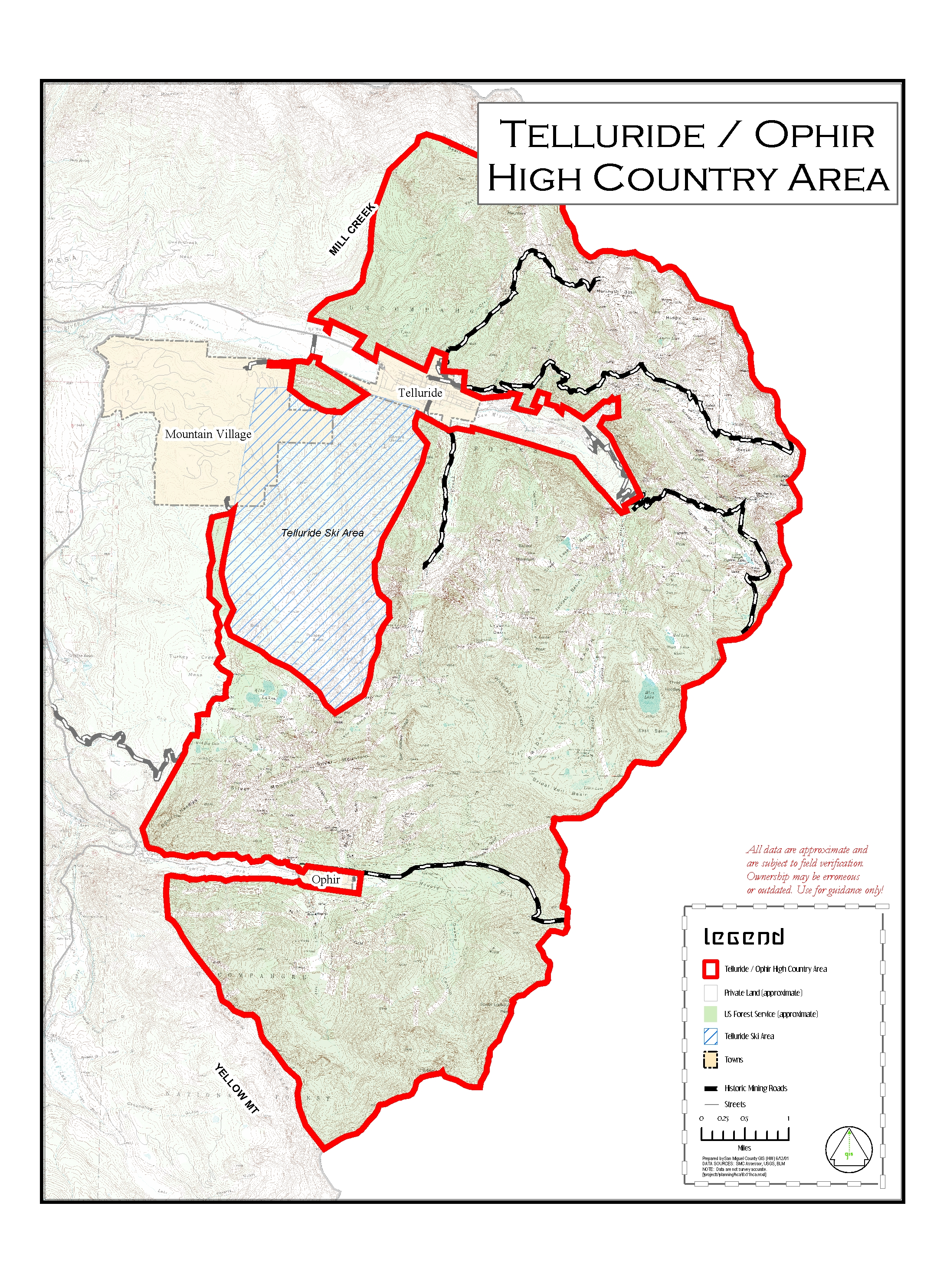
5-322 - Low Density Residential (LDR)
5-322A.
Purpose
I.
The purpose of the Low Density Residential Zone is to provide areas suitable for clustered, low density residential development in accordance with the San Miguel County Comprehensive Plan and the PUDR Zone and to implement the "alternative density" provided for in the PUDR Zone District and the East End Master Plan. Only property currently located in the East End and zoned PUDR may be classified in the Low Density Residential Zone.
II.
In planning for the development of land under the Low Density Residential Zone, clustering of residential uses and the establishment of building envelopes on lots to restrict areas of development to preserve environmentally or visually sensitive open space and wildlife habitat will be required. In addition, attention shall be given to visual vulnerability and/or the relationship of each parcel to essential public facilities and services and the use of the scenic foreground as open space. The density of residential development in the Low Density Residential Zone may vary from one (1) unit per six (6) to eight (8) acres, depending upon an analysis of factors such as neighborhood compatibility, availability of urban services, road capacities, and consistency with the adopted goals and objectives of the East End Master Plan.
5-322B.
Planned Unit Development (PUD) Procedure
All development proposed within the Low Density Residential Zone, except for proposed development of uses allowed by right, shall be reviewed pursuant to the Planned Unit Development (PUD) procedure to establish permitted uses and Area and Bulk Requirements. Refer to Section 3-7 for PUD procedures and Section 5-14 for PUD Standards.
5-322C.
Uses Allowed by Right
I.
Single-family dwelling on lots containing thirty-five (35) acres or more, with a residence containing less than twelve thousand (12,000) sq. ft of Floor Area;
II.
Accessory Uses and Structures, including customary utility services;
III.
Active Open Space; and
IV.
Passive Open Space.
5-322D.
Allowable Uses Requiring Review Through the Planned Unit Development (PUD) Procedure
I.
Single-family dwelling on lots containing less than thirty-five (35) acres, with building sizes and heights as provided for in Section 5-322 F subject to review requirements provided for in Section 5-322 F;
II.
Accessory Uses and Structures, including customary utility services; not to include a second residential unit;
III.
Day care homes;
IV.
Active Open Space, except that the uses and activities that may occur on portions of the property designated as Active Open Space may be further expanded or restricted in the course of the review of the required PUD application; and
V.
Passive Open Space, except that the uses and activities that may occur on portions of the property designated as Passive Open Space may be further expanded or restricted in the course of the review of the required PUD application.
5-322E.
Area and Bulk Requirements for Uses Permitted by Right
I.
Density - one (1) dwelling unit per lot
II.
Minimum Lot Area - thirty-five (35) acres
III.
Setbacks
a.
Front Yard - fifty (50) feet
b.
Rear Yard - fifty (50) feet
c.
Side yard - fifty (50) feet
IV.
Maximum Building Height - thirty-five (35) feet
5-322F.
Area and Bulk Requirements for Uses Requiring Review Through the Planned Unit Development (PUD) Procedure
The maximum Area and Bulk Requirements for a lot in the Low Density Residential Zone shall comply with and not exceed the following standards, which shall be applied by the County in the course of its review of the PUD for the property to evaluate mass and scale, and other related design issues. During its review of the PUD application, the County may establish more restrictive design limitations relating to house size, building heights and/or setbacks associated with the proposed development if the County determines that such restrictions are reasonably necessary and appropriate to address mass and scale, and other related design issues identified during the PUD review process.
I.
Allowed House Size: The allowable size of a residence ("House Size") shall fall within a range of between five thousand five hundred (5,500) sq. ft and seven thousand (7,000) sq. ft. of Floor Area, which shall be determined by a site-specific review during consideration of the Preliminary PUD Plan for the property. The foregoing shall not preclude the construction of a residence that is less than five thousand five hundred (5,500) sq. ft if proposed by the lot owner. The maximum House Size shall be determined based upon the following criteria ("Review Criteria"):
a.
Analysis of the proposed location of the structure and the visual impact of the building when viewed from West Colorado Avenue and the Airport Road (CR64L), as applicable, based upon proposed size and scale of the structure and the proposed visual mitigation provided for in the Preliminary PUD Plan.
b.
Analysis of the amount of the clearing, grading and the extent of the removal of trees and natural vegetation that may be required to construct a residence of the proposed size on the site, which is to be balanced against goals of mitigation of visual impacts.
c.
Analysis and evaluation of the relationship of the proposed building size to property conditions that would be in place upon the completion of the construction of the structure, including factors relating to the sites topography, vegetation, distance from the public highway including Scenic Foreground setbacks, size of the lot and homesite, proposed building height, spacing of units, proximity of residences to surrounding uses, view angles, visibility, and similar considerations.
d.
Consideration of siting and design criteria, including, without limitation, color/materials, lighting, architectural styles/themes and the like, that may be utilized to reduce or minimize the visual impact of the proposed structure on the scenic quality of the surrounding area.
II.
Minimum Lot Area: Two (2) acres, unless the lot is connected to a private or public community water system, in which the Minimum Lot Area is one (1) acre.
III.
Maximum Density: One (1) unit per six (6) to eight (8) acres.
IV.
Setbacks: Improvements must be contained within the Building Envelopes established on the approved Preliminary PUD Plan for the property, provided that the Building Envelope will be setback at least twenty-five (25) feet from the lot line.
V.
Maximum Building Height: The Allowed Building Height for a residence shall fall within a range of between twenty-eight (28) feet and thirty-five (35) feet, unless a more stringent height restriction is imposed in order to comply with ridgeline regulations. The foregoing shall not preclude the construction of a residence that is less than twenty-eight (28) feet if proposed by the lot owner. The Allowed Building Height shall be determined during the review of the Preliminary PUD Plan for the property utilizing the Review Criteria.
VI.
Restricted Open Space: For purposes of this Low Density Residential Zone, the term "Restricted Open Space" shall mean any Active Open Space or Passive Open Space included in the project being reviewed, which is restricted against development of structures or other improvements, other than areas required for infrastructure, including roads, utilities, driveways, OWS and similar facilities. The Restricted Open Space may be included in parcels owned by the project's homeowners association, parcels dedicated to a public agency for open space purposes and/or the boundary of a platted lot, outside of the designated Building Envelop. Not less than seventy-five percent (75%) of the area being subdivided will be Restricted Open Space.
5-322G.
Minimum Off-street Parking
Off street parking shall be provided for each principal use as required in Section 5-702 of the San Miguel County Land Use Code.
5-322H.
Review Standards for Land Uses and Area and Bulk Requirements Requiring Review Through the Planned Unit Development (PUD) Procedure
An applicant seeking approval for any of the uses listed in Sections 5-322 D or approval to utilize the area and bulk requirements in Section 5-322 F must demonstrate to the satisfaction of the Board of County Commissioners substantial compliance with the standards in this section.
I.
The use is consistent with the Land Use Policies (Article 2);
II.
Adequate public services such as roads, water, wastewater disposal/treatment, public safety and fire protection are available to serve the proposed use and an applicant adequately mitigates the incremental impacts on the community's existing public services;
III.
The use minimizes or mitigates any materially adverse environmental impacts and generally utilizes the most environmentally suitable site;
IV.
Any proposed structures are located outside the Scenic Foreground Overlay Zone District or are designed consistently with the Scenic Foreground Overlay standards and meet the Scenic Quality standards in LUC Section 5-21;
V.
The use is consistent with the relevant goals and objectives of the San Miguel County Comprehensive Development Plan; and
VI.
Acceptable guarantees (as described in the East End Master Plan) have been made for the provision of:
a.
Adequate transportation to serve the development (see Section 5-2001);
b.
A sufficient quantity and quality of affordable housing to house the employees attributable to the proposed land use (see Section 5-1304); and
c.
A sufficient quantity and quality of recreational amenities to serve the residents of the development without overburdening existing off-site recreational facilities (see Section 5-803).
VII.
The use and density is compatible with existing adjacent neighborhoods.
VIII.
Large picture windows of glass that reflect toward the town of Telluride, State Highway 145, Colorado Avenue, Airport Road (CR 64L), and public use areas are to be avoided.
IX.
All exterior lighting shall minimize visual impact of light sources as seen from the Town of Telluride, public use areas, or from other surrounding areas. All exterior lighting shall comply with the standards of Section 5-710.
(Res. No. 2024-54, 12-18-2024)
5-323 - Mixed Use Development (MXD)
5-323A.
Purpose
I.
The purpose of the Mixed-Use Development (MXD) Zone is to provide areas suitable for the development of a balanced mix of land uses that are compatible with the East End as contemplated by the East End Master Plan. Uses and activities should complement those occurring in the Town of Telluride, Town of Mountain Village, and Lawson Hill, enhancing the overall mix of uses serving local residents, employees and visitors alike.
II.
Development of property included in the MXD Zone shall occur in accordance with the East End Master Plan, the San Miguel County Comprehensive Plan, the PUDR Zone, this MXD Zone and other applicable provisions of the San Miguel County Land Use Code.
5-323B.
Planned Unit Development (PUD) and Subdivision
I.
Applicability. All development proposed within the MXD Zone shall be reviewed pursuant to the Planned Unit Development (PUD) and subdivision review procedures, which shall be used to establish permitted uses, densities, Area and Bulk Requirements, lot layouts, phasing, infrastructure and other relevant elements of the proposed development for property located in the MXD Zone. Refer to Section 3-7 for PUD procedures and Section 5-14 for PUD review standards and this Section 5-323 for further review standards. Refer to Section 3-7 for Subdivision procedures and, applicable portions of Sections 5-1 to 5-10 for Subdivision review standards and this Section 5-323 for further review standards. The PUD review will be combined with a subdivision review, referred to hereafter as a "Combined PUD/Subdivision Plan."
II.
Combined PUD/Subdivision Plan Review. The purpose and intent of the Combined PUD/Subdivision Plan review process will be to establish relevant elements and components of the proposed development on property located in the MXD Zone that will control development that may occur on the separate lots and parcels in the project, which factors and elements shall include, without limitation, the following:
a.
A range of Allowable Uses;
b.
Maximum allowable density for each of the Allowable Uses;
c.
Maximum overall allowable density for the development, which Applicant may allocate among each of the Allowable Uses, not to exceed any maximum density established for an individual Allowable Use;
d.
Maximum building height(s);
e.
Building areas and envelopes, along with minimum required setback(s);
f.
Site access, roads and sidewalks;
g.
Minimum required parking;
h.
Required employee housing mitigation;
i.
Landscaping/hardscaping;
j.
Evaluation and potential reduction of the 200-foot scenic setback requirement for property located in the Scenic Foreground and the 100-foot major highway setback requirement;
k.
Preliminary review and approval of required infrastructure to serve the development, including timing and phasing;
l.
Location of open space, recreational facilities and amenities;
m.
Project Phasing and vesting;
n.
Review and approval of Design Guidelines for the overall development, which shall be applied to the review of site-specific development proposed on a lot or parcel as part of a PUD Architectural Review Plan application.
III.
PUD Architectural Review Plan. Prior to obtaining a building permit for particular building(s) contemplated on one (1) or more lots or parcels, an applicant is required to submit a site-specific architectural design plans ("PUD Architectural Review Plan") for review and approval by the County as provided for in Section 5-1405 and this Section 5-323 B.III. When approving a Combined PUD/Subdivision Plan, the County will establish certain Area and Bulk Requirements for building(s) occurring on lots or parcels in the project as provided for in Section 5-323 D, which shall be followed and applied by the applicant and the County as part of the review of the PUD Architectural Review Plan under Section 5-1405. An applicant can elect to submit and complete the review of the PUD Architectural Review Plan as follows:
a.
An applicant may submit an application and supporting materials to enable the review and final approval of all elements of a PUD Architectural Review Plan required to be reviewed under Section 5-1405 and Section 5-323 D for one (1) or more buildings on one (1) or more lots or parcels as part of the Combined PUD/Subdivision Plan; or
b.
An applicant may elect to defer the submission and review of one (1) or more separate PUD Architectural Review Plan for individual building(s) on individual lots or parcels, provided that the plan is ultimately reviewed by the County prior to development of any such building and conforms with this Section 5-323 B.III. Unless obtained as part of the review of Combined PUD/Subdivision Plan, an applicant shall secure the approval of PUD Architectural Review Plan prior to initiating development on a particular lot.
The PUD Architectural Review Plan will be reviewed by the decision-making body identified in Section 5-323 C and subject to the requirements of Section 3-2. The purpose of the review of a PUD Architectural Review Plan is to allow the County to evaluate: (a) that the building design meets the provisions of Section 5-1405, Section 5-21, and this Section 5-323 and other relevant provisions of the LUC in terms of architectural styles/themes, color/materials, lighting, landscaping, and the like; and (b) that the building design conforms to the particular elements approved for the lot as part of the Combined PUD/Subdivision Plan, such as the Area and Bulk Requirements (building height, setbacks), parking, Allowable Uses, and densities. The size, scale or location of the building as contemplated in Section 5-1405, will be established by the County as part of the approval of the Combined PUD/Subdivision Plan and the County's determination of the Area and Bulk Requirements for building(s) occurring on lots or parcels in the project under Section 5-323 D. The Area and Bulk Requirements established as part of the Combined PUD/Subdivision Plan shall not be increased or reduced as part of the review of PUD Architectural Review Plan under Section 5-1405 unless agreed to by the applicant and the County, which may require an amendment to the Combined PUD/Subdivision Plan if increases to the Area and Bulk Requirements are proposed. The PUD Architectural Review Plan review is not intended to be used for further review of or require changes to the Approved Uses and Densities or other land use elements established as part of the Combined PUD/Subdivision Plan Review.
Site design and improvements, such as parking, access roads, berming, landscaping, utilities and similar facilities shall be considered as part of the Combined PUD/Subdivision Plan and need not be reviewed as part of the review of a PUD Architectural Review Plan; provided that parking, access roads, berming, landscaping, utilities and similar facilities approved as part of the Combined PUD/Subdivision Plan, may be modified as part of the review of a PUD Architectural Review Plan.
5-323C.
Allowable Uses
I.
General. The uses and activities allowed ("Allowable Uses") that may occur in a project on property located in the MXD Zone are indicated below. The Allowable Uses shall be determined by the County in connection with its review of and action on an application for a Combined PUD/Subdivision Plan. The resulting uses and densities approved by the County as part of its action on the Combined PUD/Subdivision Plan is referred to as the "Approved Uses and Densities." The Approved Uses and Densities will be noted in a Development Agreement and reflected in a land use matrix appended to the Development Agreement, noting a maximum cap for each particular use with an overall maximum cap on the uses and activities based upon available infrastructure serving the project (road access and water/sewer service). The Development Agreement shall provide that the Approved Uses and Densities may be allocated among the parcels, provided that no particular use exceeds its allowable maximum limit and the overall cumulative amount of the uses does not exceed that maximum overall cap on the uses and activities allowed for the Project.
II.
If the Combined PUD/Subdivision Plan did not establish one (1) of the following Allowable Uses or if an applicant seeks to modify the Approved Uses and Densities involving one (1) of the following Allowable Uses, the applicant may submit an application seeking an amendment to the Combined PUD/Subdivision Plan to add one (1) of the following Allowable Uses into the Project or to modify the Approved Uses and Densities, which will be reviewed by the County as an Insubstantial Plat Amendment:
a.
Active Open Space;
b.
Passive Open Space;
c.
Public Uses, including, but not limited to, expansion of the Regional Sewage Treatment Facility, Governmental/Municipal Facilities and Transit Facilities;
d.
Visitor Center;
e.
Day Care Home or Day Care Center;
f.
Community Meeting Space;
g.
Employee Housing;
h.
Medical Services including, but not limited to, pharmacy, optician, dental, physical therapy, and mental health/counseling;
i.
Medical Offices;
j.
Retail establishments no greater than eight thousand (8,000) square feet gross floor area for an individual use;
k.
Flex Space no greater than eight thousand (8,000) square feet gross floor area for an individual use;
l.
Eating/Drinking Establishments;
m.
Offices and Personal Services; and
n.
Wireless Communications Facilities that are concealed within a building or structure (stealth facilities).
III.
In connection with its review of the following Allowable Uses as part of its review of a Combined PUD/Subdivision Plan, the County may include reasonable mitigation measures intended to reduce impacts of those uses. If the Combined PUD/Subdivision Plan did not establish one (1) of the following Allowable Uses or if an applicant seeks to modify the Approved Uses and Densities involving one (1) of the following Allowable Uses, the applicant may submit an application seeking an amendment to the Combined PUD/Subdivision Plan to add one (1) of the following Allowable Uses into the Project or to modify the Approved Uses and Densities, which will be reviewed by the County as a Substantial Plat Amendment:
a.
Regional Medical Center, including a helipad;
b.
Retail Establishments greater than eight thousand (8,000) square feet gross floor area;
c.
Flex Space greater than eight thousand (8,000) square feet gross floor area for an individual use; and
d.
Hotel/Motel Lodging, including conference facilities. If an applicant is proposing this Allowable Use as part of its Combined PUD/Subdivision Plan or any later amendment thereto, the County, in evaluating this use, shall reasonably consider whether there is a current or future community need for lodging or other related uses that would be available in the Hotel/Motel Lodging facility; potential impacts of being located outside of the towns and away from activities and services; growth effects on the region; preservation of community; and transportation impacts. Development of lodging should include a transportation management plan addressing methods to reduce guest trips in personal vehicles to the Town of Telluride and Town of Mountain Village while still encouraging visitors to patronize local businesses and participate in activities. Examples include the use of van shuttle services and local transit opportunities. Other considerations should include proposed amenities and facilities, proposed room sizes and types, and operational or management structure.
e.
Other uses not designated in Section 5-323 C.II as an Allowable Use.
IV.
Accessory Uses: The uses, activities and improvements allowed by right in connection with other Allowable Uses review that may occur in a project on property located in the MXD Zone are indicated below:
a.
Accessory Uses and Structures, including customary utility services and maintenance and storage facilities; and
b.
Infrastructure serving the development.
5-323D.
Area and Bulk Requirements for Allowable Uses
The maximum Area and Bulk Requirements and densities for lots in the Mixed Use Development zone shall comply with and not exceed the following standards, which shall be preliminarily evaluated and considered by the County in the course of its review of the Combined Sketch PUD/Subdivision Plan Review for the project and then finally determined and established by the County in the course of its review of the Combined Preliminary PUD/Subdivision Plan Review for the lots in the subdivision.
I.
Allowed Building Size: Except with respect to maximum size limitations established with respect to certain uses as provided for in Section 5-323 C, there is no maximum or minimum "Building Size." The allowable Building Size for buildings on a lot shall be determined and established during consideration of the Combined PUD/Subdivision Plan Review for the property. The maximum Building Size shall be determined based upon the following criteria ("Review Criteria"):
a.
Analysis of the proposed location of the structure and the visual impact of the building when viewed from State Highway 145, based upon proposed size and scale of the structure and the proposed visual mitigation provided for in the Combined PUD/Subdivision Plan Review.
b.
Analysis and evaluation of the relationship of the proposed building size to property conditions that would be in place upon the completion of the construction of the structure, including factors relating to the site's topography, vegetation, distance from the public highway including Scenic Foreground setbacks, size of the lot, proposed building height, spacing of units, proximity of improvements to surrounding uses, view angles, visibility, and similar considerations.
II.
Minimum Lot Size: None
III.
Maximum Lot Size: None.
IV.
Maximum Density: As determined in the course of the review of the Combined PUD/Subdivision Plan Review.
V.
Maximum Floor Area Ratio (FAR): As determined in the course of the review of the Combined PUD/Subdivision Plan Review on an envelope by envelope basis.
VI.
Setbacks: In connection with the review of the Combined PUD/Subdivision Plan Review, the County shall establish a building envelope for each lot. All development, except for access, trails, sidewalks, parking, landscaping and utilities must occur within the designated building envelope.
VII.
Scenic Foreground and Highway Setbacks: Any development proposed within the 200-foot Scenic Foreground setback and/or the 100-foot major highway setback shall be determined in the review of the Combined PUD/Subdivision Plan Review. Mitigation of impacts from development occurring within these setbacks shall occur through the placement of buildings and other improvements on the site, massing, design, roof forms, landscaping, screening, and other design strategies.
VIII.
Maximum Building Height: Maximum Allowable Building Height for a building or other improvement shall be established on an envelope by envelope basis as an above sea-level maximum elevation and determined in the course of the review of the Combined PUD/Subdivision Plan Review. The ridge of a gable, hip, gambrel or similar pitched roof may extend up to five (5) feet above the specified maximum height limit. A building may exceed the Maximum Allowable Building Height by up to twelve (12) feet if the additional development is being used for employee housing in excess of the required employee housing. Roof appurtenances (other than architectural features) such as chimneys, flues, vents, mechanical equipment, elevator override height, or similar structures may extend up to five (5) feet above the specified maximum height limit. Bell towers, pergolas, and like architectural features may extend up to ten (10) feet above the specified maximum height limit per criteria set forth in any project specific design guidelines approved for the development. Elevator access to a rooftop helipad shall be permitted to be the height necessary for operation of the elevator.
IX.
Minimum Common Open Space: Twenty percent (20%), inclusive of land dedicated to the County or School District for park, recreation, school, other open space purposes or other uses and purposes, which dedication may occur by fee simple conveyance or by a perpetual easement. If determined to meet the needs of residents, customers, tenants and other users of the development and satisfy the requirements of Section 5-805, credit may be given for dedication of offsite land or easements through the Combined PUD/Subdivision review, e.g. the dedication or easement grant for an offsite trail, parking area or recreational use area that improves access to and from the site and other recreational amenities or open space.
5-323E.
Minimum Off-street Parking
Off-street parking shall be provided for each principal use as required in Section 5-702 of the San Miguel County Land Use Code. Any waiver for off-street parking shall be reviewed and determined in the course of the review of the Combined PUD/Subdivision Plan Review. Waivers shall be considered when credit can be applied towards shared multiple-use parking facilities, mixed-use development, and transit-oriented development as determined by a qualified traffic engineer or consultant. If development of a PUD is phased, each phase shall include at a minimum the construction of the parking required for all uses in that phase. Parking may be constructed in an earlier phase than the development the parking would serve. As part of an overall development plan, elements of the required parking may be provided in interim, temporary parking facilities with an all-weather surface such as gravel or other similar treatments and a binding agent to manage dust.
5-323F.
Employee Housing Mitigation
Employee Housing Mitigation shall be provided as required in Section 5-13 of the San Miguel County Land Use Code or as set forth within the Development Agreement approved in the course of the review of the Combined PUD/Subdivision Plan Review. If development of the PUD is phased, the amount of employee housing constructed in each phase shall meet and may exceed the amount of employee housing mitigation required for the development within that phase. Employee housing may be constructed in an earlier phase than the development for which it is providing mitigation and may be credited for future phases as determined by the applicant, which must be documented in a manner acceptable to the County and Owner.
5-323G.
Review Standards
An applicant seeking approval for any of the Allowable Uses shall demonstrate to the satisfaction of the Decision Maker substantial compliance with the standards in this section.
I.
The use is consistent with the applicable Land Use Policies (Article 2);
II.
Adequate public services such as roads, water, wastewater disposal/treatment, public safety and fire protection are available to serve the proposed use and the development adequately mitigates the incremental impacts on the community's existing public services;
III.
The use minimizes or mitigates any materially adverse environmental impacts and generally utilizes the most environmentally suitable site; and
IV.
The use is consistent with the relevant goals and objectives of the San Miguel County Comprehensive Development Plan and the East End Master Plan.
(Res. No. 2024-54, 12-18-2024)
5-324 - COMMUNITY HOUSING (CH)
5-324A.
Purpose
The purpose of the Community Housing zone district is to provide for the development of high-density, clustered housing for people who live and work within San Miguel County. Housing may be in attached or detached single-family homes, duplexes, multi-family buildings, or rooming houses. Development may also include alternative living units such as spaces for RVs, tiny homes or yurts. Dwelling units shall be subject to the County's R-1 Housing Deed Restriction (see Section 5-1304 and 5-1305), unless free-market units are allowed within the development.
Properties that may be considered for rezoning to the Community Housing (CH) zone district shall be located within the Telluride R-1 School District boundaries. Zone districts that are most appropriate for rezoning to CH are those that can be served by municipal water, including Low Density (LD), Low Density Residential (LDR), Medium Density (MD), and High Density (HD). The Forestry, Agriculture, and Open (F) zone district may be considered where water can be developed. Properties that are zoned High Country Area (HCA) or Rangeland Grazing (RG) shall not be considered for rezoning to CH. The maximum density of twenty (20) units per acre may be higher than that found in surrounding areas. It is the position of the County that housing for people who live and work in the local communities is a high priority. When rezoning land to the CH zone district, the higher density that may be achieved in that zone shall not be considered incompatible with surrounding land uses, neighborhood characteristics or community character.
Clustered development is encouraged to maintain open space, to be efficient in design and construction of infrastructure, and to mitigate impacts on adjacent properties. Recreational, civic and public uses may be part of the development where appropriate. All development shall include appropriate guarantees for the protection of public health, safety and welfare, which shall include, but are not limited to, provision of water and wastewater treatment; mitigation of geohazards; site access; and any other applicable site-specific considerations.
All development in the Community Housing zone district is encouraged to include energy efficient design and alternative energy generation such as solar power. Net zero development — producing enough energy through the use of measures such as solar panels, passive design, and other means to offset the energy consumed on an annual basis — is strongly encouraged. Sites that are not suited to net-zero development should strive to be as energy efficient as possible, through design, construction, and building systems.
5-324B.
Uses Allowed by Right
I.
Customary residential accessory buildings and uses;
II.
Day care homes; and
III.
Home occupations.
5-324C.
Uses Allowed Subject to Administrative Review
I.
Temporary Alternative Living Space sites;
II.
Day care centers;
III.
Public transportation facilities primarily serving the development; and
IV.
Public utilities and infrastructure to primarily serve the development.
5-324D.
Uses Allowed Subject to One-Step Planning Commission Review
I.
Dwelling units - on parcels five (5) acres or less:
a.
Single-family dwellings, attached and/or detached;
b.
Duplexes;
c.
Multi-family dwellings;
d.
Rooming houses;
e.
RV, tiny home, yurt and other Alternative Living Spaces (no more than twenty percent (20%) of total units);
II.
Churches, community meeting halls, libraries, and other civic and community-serving facilities;
III.
Parks, playgrounds, playing fields, and other recreational facilities to serve residents of the development; and
IV.
One (1) Free-market (not deed restricted) dwelling unit.
5-324E.
Uses Subject to Two-Step Special Use Permit Review
I.
Dwelling units - on parcels greater than five (5) acres:
a.
Single-family dwellings, attached and/or detached;
b.
Duplexes;
c.
Multi-family dwellings;
d.
Rooming houses;
e.
RV, tiny home, yurt and other Alternative Living Spaces (twenty-one percent (21%) or more of total units);
II.
Parks, playgrounds, playing fields, and other recreational facilities to serve residents of the development and regional residents;
III.
Fire stations, schools, and other public facilities and uses; and
IV.
Free-market (not deed restricted) dwelling units:
a.
Comprising ten percent (10%) or less of the total units for a development that is not net zero on an annual basis; or
b.
Comprising twenty percent (20%) or less of the total units for a development that is net zero on an annual basis.
5-324F.
Uses Allowed Subject to Board of County Commissioner Approval Pursuant to Planned Unit Development (PUD) Procedure
I.
Free-market (not deed restricted) dwelling units:
a.
Comprising eleven percent (11%) or more of the total units for a development that is not net zero on an annual basis; or
b.
Comprising twenty-one percent (21%) or more of the total units for development that is net zero on an annual basis;
II.
Neighborhood Commercial Uses that offer goods and services needed by residents of the PUD on a daily or frequent basis, including convenience store, drug store, liquor store, self-service laundry, medical and dental offices and clinics, and postal service substation; and
III.
Flex Space.
5-324G.
Area and Bulk Requirements Permitted by Right
I.
Maximum Density — twenty (20) units per acre
II.
Minimum Lot Area — None
III.
Setbacks
a.
Setbacks from any development to property lines of any abutting parcel zoned other than Community Housing and to any right-of-way—twenty (20) feet;
b.
Front yard — ten (10) feet to adjacent buildings; otherwise, to allow flexibility in the design process, there is no minimum internal front yard setback;
c.
Rear yard — ten (10) feet to adjacent buildings; otherwise, to allow flexibility in the design process, there is no minimum internal rear yard setback;
d.
Side yard:
i.
Detached Principal buildings — ten (10) feet to adjacent buildings;
ii.
Attached Principal buildings — zero (0) feet on the attached side(s) and ten (10) feet to adjacent buildings on the detached side.
e.
Accessory buildings — five (5) feet to the nearest building(s), all sides.
IV.
Maximum Building Height:
a.
Thirty-five (35) feet;
b.
For development that is net zero on an annual basis, forty-five (45) feet.
V.
Minimum Common Open Space — thirty percent (30%), to be developed as either Active or Passive Open Space.
VI.
Minimum Off-street Parking
Clustered parking areas are encouraged. Off-street parking shall be provided for each principal use as required in Section 5-702, with the following exceptions:
a.
Studio and one (1) bedroom dwelling units: one (1) parking space per unit;
b.
All other dwelling units: two (2) spaces per unit;
c.
Rooming house: one (1) parking space per sleeping room, except where the property is served by public transit, in which case the parking requirement shall be two (2) spaces for every three (3) sleeping rooms;
d.
Alternative Living Spaces: one (1) parking space per unit.
5-324H.
Review Standards
An applicant seeking approval for a development in this zone district must demonstrate to the satisfaction of the Decision Maker substantial compliance with the applicable standards of LUC Sections 5-5, 5-6 and 5-7, and with the standards in this section:
I.
Adequate public services such as roads, water, wastewater, public safety and fire protection are available to serve the proposed use;
II.
There shall be adequate water supply to serve the development that meets the standards of Section 5-605. If the water service provider has a lower per capita standard than that specified by Section 5-605, or the developer can demonstrate lower water demand for the development, the average daily demand per capita may be reduced. Water shall be treated by a method determined by the County or state health department to conform to minimum local and state requirements;
III.
The wastewater treatment system shall meet the standards of Section 5-607;
IV.
The property shall have direct access to a state highway or a County road that is maintained year-round;
V.
A traffic study may be required to determine the adequacy of the access and surrounding road network, and to identify any needed improvements;
VI.
Fencing shall be "wildlife friendly fences," in compliance with Colorado Parks and Wildlife fencing standards, as described in LUC Section 5-407;
VII.
In areas where development is proposed that has been or may be designated as being in any area of local or state interest or being an activity of local or state interest, the requirements of Section 5-4 shall be met;
VIII.
The use minimizes or mitigates any materially adverse environmental impacts and generally utilizes the most environmentally suitable area of the site;
IX.
Any proposed structures are located outside the Scenic Foreground Overlay Zone District or are designed consistently with the Scenic Foreground Overlay standards; and
X.
A development agreement or covenants may be required to ensure there is a responsible homeowners association or entity to maintain the systems and infrastructure.

