
Sandy Springs City Zoning Code
ARTICLE 11
- ADMINISTRATION
Div. 11.7. - Nonconformities
When a structure, site element or lot of record becomes nonconforming as a direct result of government acquisition of real property through eminent domain or threat of eminent such as of right-of-way, said structure, site element or lot of record will be considered conforming. This applies solely to the specific parameters impacted by the government action. The application of the requirements of this Code will be based on the original condition of the property immediately prior to the government action.
Sec. 11.1.1. - Summary of Review Authority
The following table summarizes the review, approval and appeal authority of the various review bodies and officials that implement and administer the Development Code.
KEY: R = Review & Recommendation D = Final Decision A = Appeal PH = Public Hearing
Y = Required Y* = Plan box posted on site at time of application — = Not Required
(Ord. No. 2023-12-20, § I(Att. A), 12-5-2023; Ord. No. 2025-09-22, § I, 9-16-2025)
Sec. 11.1.2. - Director
The Director has those powers and duties expressly identified in this Development Code and the Sandy Springs Technical Manual, including, but not limited to, the following. All other ordinances or regulations referenced in this Development Code such as the fire prevention and life safety codes, building and other technical codes, regulations and ordinances, are administered by the Directors of the Departments responsible for such ordinances, as established by the City Council. The requirements of this Development Code are interpreted by the Director.
A.
Review and Recommendation To review and provide recommendations on applications for:
1.
Legislative review;
2.
Final plats with dedication;
3.
Variances; and
4.
Appeals of administrative decisions.
B.
Decision To review and decide on applications for:
1.
All plats without dedication;
2.
All permits handled by the Department of Community Development; and
3.
Administrative variances.
C.
Delegation The Director may delegate any review authority to the Department staff; however, any decisions remain the responsibility of the Director.
D.
Interpretation The Director interprets the provisions of this Development Code, and may use opinions of the City Attorney and others in arriving at interpretations.
E.
Enforcement The Director enforces the provisions of this Development Code. See also Div. 11.8.
(Ord. No. 2023-12-20, § I(Att. A), 12-5-2023)
Sec. 11.1.3. - Board of Appeals
The Board of Appeals has those powers and duties expressly identified in this Article, including, but not limited to:
A.
Decision To review and decide on applications for:
1.
Appeals of the Director's administrative decision or interpretation of this Development Code as it pertains to the issuance of Stop Work Orders (SWO).
2.
Variance from the standards of this Development Code.
(Ord. No. 2023-12-20, § I(Att. A), 12-5-2023)
Sec. 11.1.4. - Planning Commission
The Planning Commission has those powers and duties expressly identified in this Article, including, but not limited to, the following.
A.
Review and Recommendation To review and provide recommendations on applications for:
1.
Legislative review.
(Ord. No. 2023-12-20, § I(Att. A), 12-5-2023)
Sec. 11.1.5. - City Council
The City Council has those powers and duties expressly identified in this Article, including, but not limited to, the following.
A.
Decision To review and decide on applications for:
1.
Legislative review; and
2.
Final plats that include any acceptance of public dedication.
(Ord. No. 2023-12-20, § I(Att. A), 12-5-2023)
Sec. 11.2.1. - Applicability
The following requirements are common to the procedures in Div. 11.3 through Div. 11.6 and apply to applications submitted under this Article.
(Ord. No. 2023-12-20, § I(Att. A), 12-5-2023)
Sec. 11.2.2. - Consistency with State Law
A.
This Article is intended to comply with the provisions of the Georgia Zoning Procedures Act, O.C.G.A. § 36-66 et seq., incorporated by reference in its entirety into this Development Code. This Article is also intended to comply with O.C.G.A. § 36-67, pertaining to zoning decisions.
B.
This Article is intended to comply with the provisions of the Georgia Plat Act, O.C.G.A. § 15-6-67 et seq., incorporated by reference in its entirety into this Development Code.
C.
Where any provision of this Article is in conflict with any provision of State law, State law controls.
D.
Where this Article is incomplete in having failed to incorporate a provision necessarily required for the implementation of State law, the provision of State law must be fully met.
(Ord. No. 2023-12-20, § I(Att. A), 12-5-2023)
Sec. 11.2.3. - Application Requirements
A.
Application Submittal
1.
All applications must be filed with the City on forms and in such numbers as required by the Director.
2.
Application forms are found on the City's website (http://sandyspringsga.gov) or hard copies may be obtained from the Department.
B.
Application Deadline Complete applications must be submitted in accordance with the published schedule. Schedules indicating submittal dates are developed each year and made available on-line on the City's website and to the public at the Department.
C.
Fee Schedule
1.
Filing fees have been established to help defray the cost of processing applications. The current fee schedule is available on-line on the City's website and kept on file by the Department and is updated and adopted by the City Council.
2.
Before review of an application, all filing fees must be paid in full.
3.
If review of an application is postponed or delayed due to the applicant's failure to comply with any of the provisions of this Article, the Director will assess additional fees as may be determined by the Department to be the additional administrative costs associated with such postponement or delay.
D.
Completeness Determination
1.
All applications must be complete before the City is required to review the application.
2.
In order to be accepted, all applications may require both electronic format and paper copies, as prescribed by the Director.
3.
An application is considered complete when it contains all of the information necessary to decide whether or not the application will comply with all of applicable requirements of this Development Code. Additional application materials may be required of the applicant following the initial submittal where the submittal details are insufficient to make the necessary determination of compliance with this Development Code.
4.
The presumption is that all of the information required in the City's application form is necessary to satisfy the requirements of this Article. However, it is recognized that each application is unique, and more or less information may be required according to the specifics of a particular case. The applicant may rely on the Director to determine whether more or less information has to be submitted.
5.
Where a Community Meeting is required, no application will be accepted without evidence such Community Meeting has occurred (see Sec. 11.2.5).
E.
Revised Application Materials
1.
All revised application materials must be submitted to the Department, which will route the materials to the appropriate review bodies. No materials may be sent directly to any Board or Commission, or directly to the Mayor or City Council.
2.
No revised application materials, either hard copy or electronic, may be submitted to the Director less than 30 days prior to a scheduled public meeting or public hearing.
3.
An application amended beyond this deadline will be put on administrative hold until the following regularly scheduled public hearing or public meeting, and the applicant will be responsible for reimbursing the City for re-advertising fees.
4.
No revised, additional or supplementary application materials may be submitted at any board or commission meeting or hearing.
F.
Withdrawal of an Application An applicant may choose to withdraw their application according to the following procedures.
1.
If an application has not been advertised for public hearing or public meeting, it may be withdrawn. The applicant must submit a written request for withdrawal stating the reason for the request. The request must be made to and accepted by the Director. No refund of application fees will be made.
2.
Where an application has been advertised, it can be withdrawn prior to the public hearing. The item will remain on the agenda and noted as "Withdrawn."
3.
A withdrawal is not a final action, however, withdrawal of an application bars resubmission of a similar application for 6 months.
(Ord. No. 2023-12-20, § I(Att. A), 12-5-2023)
Sec. 11.2.4. - Public Hearings and Meetings
A.
Maximum Hearings Scheduled
1.
Legislative Review No more than 5 new and complete applications, of which no more than 1 may be a Development of Regional Impact as determined by the Atlanta Regional Commission, will be placed on the same Planning Commission regular agenda. Those in excess will be placed on the next available Planning Commission regular agenda, in the order in which they are received.
2.
Variance Review No more than 5 new and complete applications will be placed on the same Board of Appeals regular agenda. Those in excess will be placed on the next available Board of Appeals regular agenda, in the order in which they are received.
(Ord. No. 2023-12-20, § I(Att. A), 12-5-2023)
Sec. 11.2.5. - Community Meetings
A.
Intent The intent of the community meeting is to ensure that applicants pursue early and effective public participation in conjunction with their applications, to ensure that the citizens of the City have an adequate opportunity to learn about applications that may affect them, and to ensure ongoing communication between applicants, adjoining property owners, environmentally stressed communities, community associations and other organizations, elected officials and City staff.
B.
Community Meeting Required
1.
Where required by this Article, an application must be presented at 2 community meetings:
a.
Following the pre-application meeting, but prior to application; and
b.
Following application, but prior to being placed on the Planning Commission public hearing agenda.
c.
Where a rezoning follows an amendment to the Character Area Map, only the second community meeting is required.
2.
The location, date and time of the community meeting must be confirmed with the Department prior to advertising.
3.
If the applicant fails to follow the sequence of events or to advertise according to the rules established by the Director, the application will be put on hold until the requirements are fully met.
4.
Where an application is significantly revised following the initial Community Meeting or Planning Commission public hearing, the Director may require an additional community meeting on the revised application prior to placing the application on the Planning Commission or City Council public hearing agenda, respectively.
C.
Advertisement The applicant is responsible for organizing and conducting the community meeting, in accordance with rules established by the Director. The community meeting must be advertised by mail and by a sign posted on the subject property.
1.
Sign Posting The applicant must prepare and post a sign on the subject property no later than 15 calendar days prior to the meeting date. The sign must contain the time, place and purpose of the scheduled meeting, and must be formatted consistent with rules established by the Director.
2.
Notice by Mail
a.
The applicant must provide notice by regular mail to all property owners within 500 feet of the boundaries of the subject property who appear in the City's Geographic Information System (GIS). Notices must be postmarked at least 15 calendar days prior to the community meeting. Even If the mail is not delivered, proof of mailing will be considered adequate notice.
b.
Mailed notices must contain the date, time, place and purpose of the scheduled meeting, the location of the subject property, and the nature of the application requested.
c.
Applicant must produce a Certificate of Mailing from the Post Office upon request from staff.
D.
Conduct of Community Meeting
1.
The community meeting must be held after the pre-application meeting.
2.
The applicant is responsible for securing a location close to the subject property for the community meeting.
3.
The applicant is responsible for collecting the names and addresses of all attendees.
4.
The applicant is responsible for conducting the community meeting, allocating at least 30 minutes to address questions and comments from the audience.
5.
Reserved.
6.
The City will make the project information sheet and the site plan available on the City website once the community meeting is scheduled.
7.
The applicant must provide a summary of the community meeting, including attendees, at the time of filing, as part of any application.
(Ord. No. 2023-12-20, § I(Att. A), 12-5-2023)
Sec. 11.2.6. - Public Notice Requirements
A.
In General
1.
For public notice requirements, see the summary table in Sec. 11.1.1.
2.
The fact that notice is not received due to an error that was not the fault of the City does not prevent the public hearing from being held, change any decision made at the public hearing, or prevent the application from continuing to move forward through the review process.
B.
Web Notice Where web notice is required, notice of the public hearing or public meeting must be posted on the City's website at least 15 calendar days prior to the date of the public hearing or meeting.
C.
Posted Notice
1.
Where posted notice is required, a sign must be posted by the applicant on the property on each public or private street frontage at a point visible from the nearest public or private street. In the case of multiple lots, sufficient signs must be posted to provide reasonable notice to interested persons. Signs must be posted before 8:30 a.m. at least 15 calendar days prior to the date of the public hearing.
2.
Property that is not posted as required will be administratively removed from the agenda until all sign posting requirements have been met. The applicant will be responsible for publishing a new notice and mailing new notices as required in this Section.
3.
It is the applicant's responsibility to remove or cause to be removed any public notice sign required by this Section. All public notice signs must be removed within 48 hours of final action on the petition (any signs not removed within the period will constitute a violation of this Development Code and the Director will issue a citation).
4.
The failure of an applicant to post notice on 2 consecutive occasions will be considered willful disregard of the applicant's obligation to comply with this Development Code. Any related application will be automatically denied, and subject to all provisions of this Development Code regarding denied applications.
5.
Posted notice for permit review, when applicable, is only required in the form of a plan box posted on the project lot at the time of application. The plan box must include a conceptual site plan as well as any approved building plans (where applicable). Permits for interior construction are exempt from this requirement.
6.
Public notice signs regulated in this Section are exempt from the requirements of Div. 8.4.
D.
Mailed Notice Where mailed notice is required, the applicant must notify by mail all owners of property included in the proposed application and all owners of property within 500 feet on all sides, as shown on the Fulton County tax records. Notice must be mailed at least 15 calendar days, but not more than 45 calendar days, prior to the date of the public hearing.
E.
Published Notice
1.
Where published notice is required, notice of the public hearing must be published by the Director at least once in a newspaper generally circulated within the City at least 15 calendar days, but not more than 45 calendar days, prior to the date of the public hearing. Published notice is not required when a public hearing or meeting is deferred by City Council, Planning Commission or Board of Appeals.
2.
Where the applicant provides revisions after the deadline or does not provide public notice as required in this Division, the applicant will reimburse the City for any additional advertisement costs that result.
(Ord. No. 2023-12-20, § I(Att. A), 12-5-2023)
Sec. 11.2.7. - Conduct of Public Hearing
A required public hearing will be conducted in accordance with the bylaws of the applicable hearing body.
(Ord. No. 2023-12-20, § I(Att. A), 12-5-2023)
Sec. 11.2.8. - Notice of Decision
Within 5 working days after the approval of meeting minutes reporting a decision, an approval letter must be sent to the applicant by the Director. In the case of permit issuance, the permit constitutes written notice of the decision.
(Ord. No. 2023-12-20, § I(Att. A), 12-5-2023)
Sec. 11.3.1. - Authority
The City Council approves applications for Legislative Review.
(Ord. No. 2023-12-20, § I(Att. A), 12-5-2023)
Sec. 11.3.2. - Applicability
Legislative Review is required for the following.
A.
Text Amendments A request to amend the text of this Development Code or the Comprehensive Plan. This process may only be initiated by staff or an elected official, receives the Director's review, and does not require Community Meetings.
B.
Comprehensive Plan Character Area Map Amendments A request to amend the Character Area Map of the Comprehensive Plan. Such requests will be considered twice annually, with application in January and July for action in April and October, respectively. A Character Area Map Amendment is required prior to a rezoning application where the proposed zoning is not allowed in the applicable character area. See the District Intent Statement for the proposed district to make this determination.
C.
Zoning Map Amendments (Rezoning) A request to amend the Official Zoning Map from 1 zoning district to another, to change the boundaries of an existing zoning district, or to modify any existing condition of rezoning. If a change to the Character Area Map is required in order to maintain consistency with the Comprehensive Plan, the Character Area Map Amendment must be approved prior to initiation of the rezoning, and the application for rezoning must be filed within 1 year of the Character Map decision.
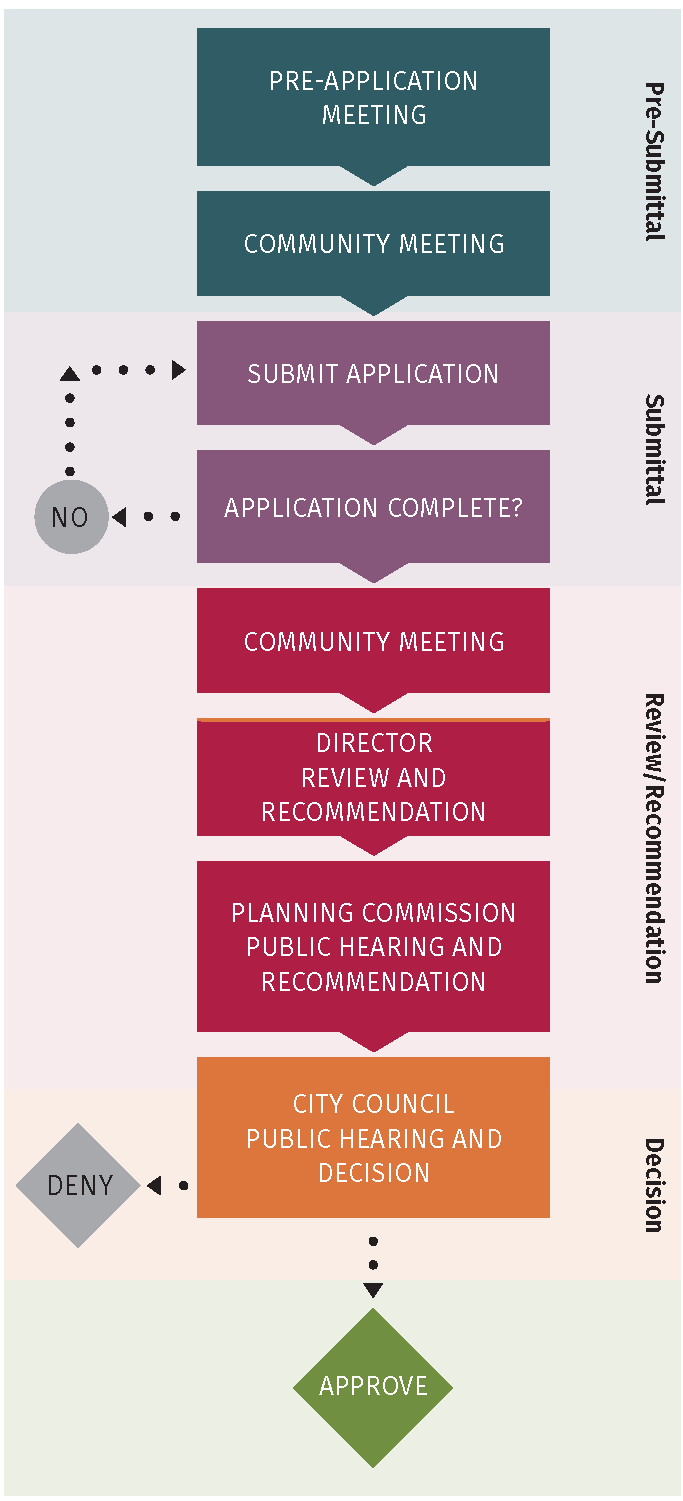
Legislative Review Generalized Procedure
D.
Conditional Use Permits A request to change or expand an existing use identified as a conditional use in Article 3 through Article 7 or expressly requiring a conditional use permit elsewhere in this Development Code. Conditional use may not be used to allow additional height beyond the allocated district or beyond the maximum bonus height.
(Ord. No. 2023-12-20, § I(Att. A), 12-5-2023)
Sec. 11.3.3. - Application Initiation
A.
The City Council, the Planning Commission or the Director may initiate an application for Legislative Review.
B.
Any person, firm, corporation or agency may initiate a Zoning Map Amendment or Conditional Use Permit application, provided they are the owner or the owner's representative of the subject property.
C.
Any zoning map amendment must be consistent with the Character Area Map of the Comprehensive Plan. Where a proposed zoning map amendment would be inconsistent with the Character Area Map based on its implementing zoning districts, an amendment of the Character Area Map must be approved by the City Council prior to submittal of the zoning map amendment.
(Ord. No. 2023-12-20, § I(Att. A), 12-5-2023)
Sec. 11.3.4. - Submittal Process
A.
Pre-Application Meeting
1.
Before submitting an application, the applicant must schedule a pre-application meeting to discuss the request, procedures, standards and regulations required for approval.
B.
Community Meetings
1.
An applicant or authorized representative must organize and participate in at least 2 community meetings to discuss the proposed application. See Sec. 11.2.5.
2.
The intent of this meeting is to inform and initiate discussion with the community.
C.
Application Submittal
1.
A complete application form and any required attachments, along with the required review fee, must be submitted to the Department in accordance with the adopted schedule.
2.
Where a Zoning Map Amendment and a Conditional Use Permit are requested simultaneously, 2 separate applications must be filed but will be treated as 1 case.
D.
Conditions
1.
The City policy is to limit the number of conditions to those deemed essential to the proper development and use of the subject property, and to the safety and quality of life of the community.
2.
Applicants for zoning map amendments and conditional use permits may propose conditions. The Director will make a recommendation on their adoption to the Planning Commission and City Council.
3.
The Director and Planning Commission may recommend and City Council may adopt any conditions deemed necessary.
(Ord. No. 2023-12-20, § I(Att. A), 12-5-2023)
Sec. 11.3.5. - Application Review
A.
Initial Distribution of an Application Upon determination of a complete application, the Director will promptly distribute the application for review by internal City Departments and external agencies.
B.
Public Hearing Notice Legislative Review requires a public hearing before the Planning Commission and before the City Council. Notice requirements for public hearings are specified in the Summary of Review Authority in Div. 11.1.
C.
Director Review
1.
Reserved.
2.
If, after the internal and external review, the Director finds that the application meets the approval criteria in Sec. 11.3.6, the application will be certified as complying with all applicable requirements of the Development Code and scheduled for the next available Planning Commission hearing.
3.
Upon certification by the Director that the application complies with the approval criteria in Sec. 11.3.6, no changes to the application are permitted prior to the Planning Commission hearing.
D.
Text Amendment Analysis The Director must review the application and make a written recommendation to the Planning Commission, based on an analysis of the criteria in Sec. 11.3.6.
E.
Character Area Map Analysis
1.
At the time of the request, the applicant must provide a written analysis of the impact of the proposed Character Area Map change with respect to each of the approval criteria in Sec. 11.3.6.
2.
The Director must review any application for a change to the Character Area Map and make a written recommendation to the Planning Commission, based on an analysis of the approval criteria in Sec. 11.3.6.
F.
Zoning Impact Analysis
1.
At the time of the request, the applicant must provide a written analysis of the impact of the proposed Official Zoning Map change with respect to each of the approval criteria in Sec. 11.3.6.
2.
The Director must review any application for a change to the Official Zoning Map and make a written recommendation to the Planning Commission, based on an analysis of the approval criteria in Sec. 11.3.6.
G.
Conditional Use Analysis
1.
In the interest of the public health, safety and welfare, the City Council may exercise discretion in evaluating the site proposed for a conditional use.
2.
At the time of the request, the applicant must provide a written analysis of the impact of the proposed conditional use with respect to each of the approval criteria in Sec. 11.3.6.
3.
The Director must review any application for a conditional use permit and make a written recommendation to the Planning Commission, based on an analysis of the approval criteria in Sec. 11.3.6.
4.
In granting such permits, conditions may be attached as are deemed necessary in the particular case for the protection or benefit of neighbors to ameliorate the potential impacts of the proposed conditional use.
H.
Planning Commission Public Hearing
1.
The Planning Commission will conduct a public hearing and provide a recommendation to the City Council on the application.
2.
The Planning Commission has 65 calendar days from the date of the public hearing to submit their recommendations to the City Council. This time period may be extended if both the applicant and the Planning Commission agree on an extension.
3.
The pre-application meeting and the Planning Commission public hearing must not be more than 6 months apart, unless the Applicant submits a written request to the Director, stating the reasons for the delay. The Director has the discretion to allow a one-time extension of no more than 3 months.
I.
City Council Public Hearing
1.
Following the recommendation of the Planning Commission, the City Council will conduct a public hearing.
2.
The City Council has 65 calendar days from the date of the public hearing to approve, approve with conditions, deny, or send the application back to the Planning Commission for additional consideration. This time period may be extended if both the applicant and the City Council agree on an extension.
J.
Concurrent Variances Concurrent variances to Zoning Map or Character Area Map amendment requests are not allowed. A separate variance application must be submitted to the Board of Appeals following action by the City Council.
(Ord. No. 2023-12-20, § I(Att. A), 12-5-2023)
Sec. 11.3.6. - Approval Criteria
Different legislative approvals have different review criteria. The following lists are not exhaustive, but provide guidance for making decisions on each type of approval.
A.
For a Text Amendment
1.
The Text Amendment corrects an error or meets the challenge of some changing condition, trend or fact.
2.
The Text Amendment is in response to changes in State law, as established through amendments to the Georgia General Statutes or by court decision.
3.
The Text amendment is in response to revised City policies, newly adopted plans, or changes in other City Ordinances.
4.
The Text Amendment substantially conforms with the Comprehensive Plan, contemporary planning practices, and local, state and federal laws.
5.
The Text Amendment substantially conforms with the Stated purpose and intent of this Development Code.
6.
The Text Amendment constitutes a benefit to the City as a whole and is not solely for the good or benefit of a particular landowner or owners at a particular point in time.
7.
The Text Amendment will not significantly impact the natural environment negatively, including air, water, noise, stormwater management, wildlife and vegetation.
8.
The Text Amendment will not significantly impact existing conforming development patterns, standards or zoning regulations.
B.
For a Character Area Map Amendment
1.
The Character Area Map Amendment corrects an error or meets the challenge of some changing condition, trend or fact.
2.
The Character Area Map Amendment substantially conforms with the remainder of the Comprehensive Plan.
3.
The Character Area Map Amendment will reinforce the existing or planned character of the area.
4.
The Character Area Map Amendment will not significantly impact the natural environment, including air, water, noise, stormwater management, wildlife and vegetation.
5.
The Character Area Map Amendment will not have a significant adverse impact on property in the vicinity of the subject property.
C.
For a Zoning Map Amendment
1.
The Zoning Map Amendment corrects an error or meets the challenge of some changing condition, trend or fact.
2.
The Zoning Map Amendment substantially conforms with the Comprehensive Plan.
3.
The Zoning Map Amendment substantially conforms with the Stated purpose and intent of this Development Code.
4.
The Zoning Map Amendment will reinforce the existing or planned character of the area.
5.
The subject property is appropriate for the development allowed in the proposed district and the use and development of adjacent properties.
6.
There are substantial reasons why the property must not be used according to the existing zoning.
7.
There is a need for the proposed use at the proposed location.
8.
The City and other service providers will be able to provide sufficient public facilities and services including schools, roads, recreation facilities, wastewater treatment, water supply and stormwater facilities, police, fire and emergency medical services, while maintaining sufficient levels of service to existing development.
9.
The Zoning Map Amendment will not significantly impact the natural environment, including air, water, noise, stormwater management, wildlife and vegetation.
10.
The Zoning Map Amendment will not have a significant adverse impact on property in the vicinity of the subject property.
D.
For a Conditional Use
1.
The use is allowed as a conditional use in the respective zoning district (see Div. 7).
2.
The use complies with the applicable specific use standard listed in Article 7 without the granting of any variance.
3.
The use is compatible with adjacent uses in terms of location, scale, site design, hours of operation and operating characteristics.
4.
Any significant adverse impacts resulting from the proposed use in the affected area will be effectively mitigated or offset.
5.
The City and other service providers will be able to provide sufficient public facilities and services including schools, roads, recreation facilities, wastewater treatment, water supply and stormwater facilities, police, fire and emergency medical services, while maintaining sufficient levels of service to existing development.
(Ord. No. 2023-12-20, § I(Att. A), 12-5-2023)
Sec. 11.3.7. - Denied Application
A.
Decisions of the City Council are final. Anyone not satisfied with a decision may pursue an appeal to Fulton County Superior Court, within 30 calendar days of the decision.
B.
No application for Legislative Review affecting the same or any portion of property that was denied by the City Council will be accepted for filing within 12 months of the date the application was denied.
(Ord. No. 2023-12-20, § I(Att. A), 12-5-2023)
Sec. 11.3.8. - Action Following Approval
Approval of an application for Legislative Review allows applicants to move forward with additional approvals applicable to their development.
A.
For information on subdividing property, see Div. 11.4.
B.
Reserved.
(Ord. No. 2023-12-20, § I(Att. A), 12-5-2023)
Sec. 11.3.9. - Modification of Conditions
Any modification of a condition of approval following City Council approval requires full review under this Section as a rezoning or conditional use permit, as applicable.
(Ord. No. 2023-12-20, § I(Att. A), 12-5-2023)
Sec. 11.4.1. - Applicability
Subdivision Review is required for any:
A.
Division of land into 2 or more lots;
B.
Combination of 2 or more lots, when the lots are under different ownership;
C.
Revision or reconfiguration of lot lines;
D.
Extension of public utilities (other than individual service lines) or other municipal facilities;
E.
Dedication of public right-of-way;
F.
Abandonment of existing public right-of-way; and
G.
Extension of public or private streets.
(Ord. No. 2023-12-20, § I(Att. A), 12-5-2023)
Sec. 11.4.2. - Approval Authority
All plats are approved by the Director. Where a final plat includes dedications to the City, they must be accepted by the City Council.
(Ord. No. 2023-12-20, § I(Att. A), 12-5-2023)
Sec. 11.4.3. - Lot Size Reduction
A.
When a lot or property is reduced in area, all resulting subdivided lots and all structures must meet the minimum requirements of this Development Code.
B.
Where a lot or property is reduced in area to less than the minimum lot size as a result of government action (including, but not limited to, right-of-way condemnation), the lot will not be deemed nonconforming.
(Ord. No. 2023-12-20, § I(Att. A), 12-5-2023)
Sec. 11.4.4. - Application Initiation
Any person, firm, corporation or agency may initiate an application for Subdivision Review, provided they are the owner or the owner's representative of the property for which the application is being submitted.
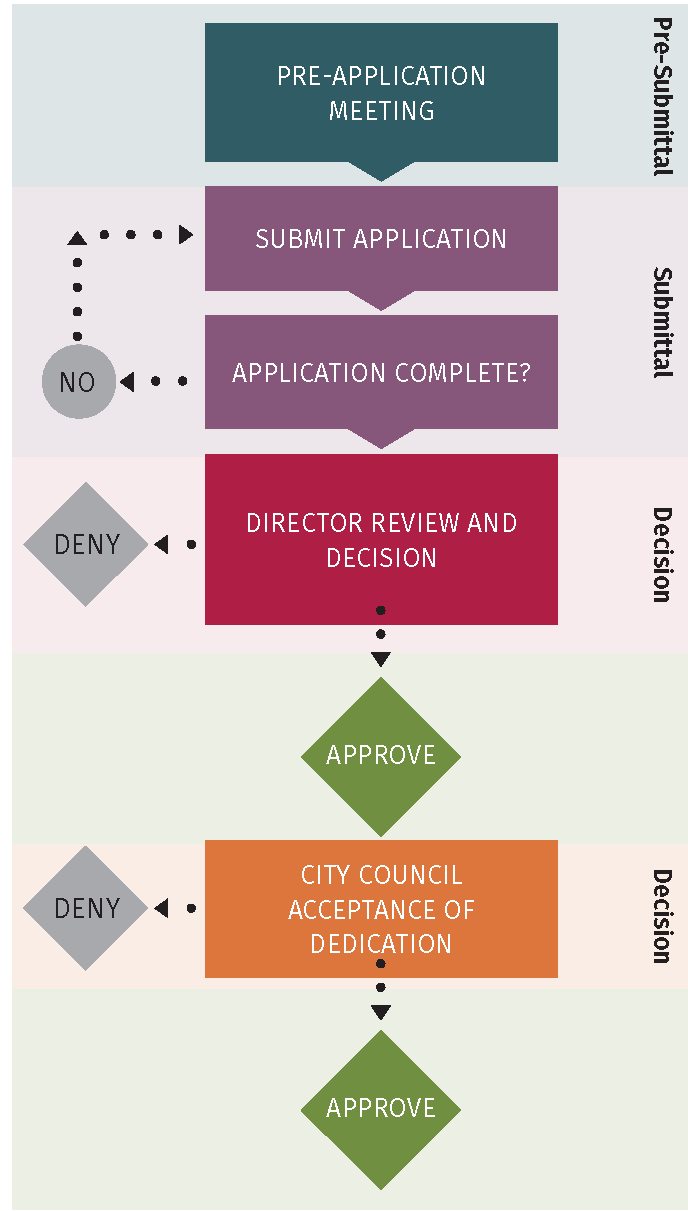
Subdivision Review Generalized Procedure
(Ord. No. 2023-12-20, § I(Att. A), 12-5-2023)
Sec. 11.4.5. - Submittal Process
A.
Schedule a Pre-Application Meeting Before submitting an application, the applicant may schedule a pre-application meeting with the Department to discuss the procedures, standards and regulations required for approval.
B.
Submit Application Following the pre-application meeting, the applicant may start the application process. To begin, submit a complete application form and any required attachments, along with the required review fee, to the Department.
(Ord. No. 2023-12-20, § I(Att. A), 12-5-2023)
Sec. 11.4.6. - Application Review
A.
Public Meeting Notice
1.
A public hearing is not required for approval of a plat without public dedication, therefore, no formal notice of the submittal is published, mailed or posted.
2.
Final Plats with public dedication are advertised on the City Council agenda at least 7 days before the scheduled meeting.
(Ord. No. 2023-12-20, § I(Att. A), 12-5-2023)
Sec. 11.4.7. - Preliminary Plan Applicability
A.
Applicability
1.
The Director may consider several existing or proposed parcels as a single development project for the purposes of meeting jointly certain requirements of this Code, upon the following findings:
a.
The proposed uses are compatible with and complementary to each other, and
b.
All the parts of the development are interconnected physically by streets, drives, sidewalks or trails; and
c.
The development is subject to an approved preliminary plan.
B.
Requirements
1.
The review process for the preliminary plan is the same as for a land disturbance permit.
2.
The preliminary plan must show all existing and proposed property lines and rights-of-way, building setbacks and build-to zones, buffers, easements and areas associated with each proposed parcel.
3.
a.
The preliminary plan must show all proposed site improvements and identify proposed uses.
b.
The preliminary plan must be to scale and include all data and dimensions necessary to demonstrate compliance with this Code. The use of exhibits in addition to the site plan are encouraged.
c.
Primary and side streets must be designated, and their type and frontage (if applicable) must be identified.
d.
Conceptual grading and stormwater management strategies must be indicated.
e.
Construction phasing diagrams must be included, if applicable.
f.
The submittal must include data demonstrating compliance of the overall site with zoning requirements, in particular, parking, lot coverage, outdoor amenity space, build-to zone and protected neighborhood transition (if applicable).
4.
The approval of the preliminary plan does not constitute approval of a Final Plat or a variance or a waiver from any requirements of this Development Code. Rather, it is approval of a generalized subdivision layout and is to be used as a guide for the preparation of an application for a Land Disturbance Permit.
5.
A traffic impact study may be required before the approval of a preliminary plan.
6.
The update of the preliminary plan must proceed in the same manner as the original approval. Such update may be required if the change in the proposed development results in an increase in the size of the building footprint, a reduction in the provision of outdoor amenity space, a change in circulation patterns, or other changes, at the discretion of the Director.
7.
Should an amendment to the Development Code render the preliminary plan nonconforming, the Director may require an update of the preliminary plan to bring it into compliance.
(Ord. No. 2023-12-20, § I(Att. A), 12-5-2023)
Sec. 11.4.8. - Approval Criteria
When reviewing or approving a Preliminary Plan, the Director considers the following:
A.
Recommendations from internal City Departments and external agencies;
B.
Compliance with the applicable requirements of this Development Code; and
C.
Substantial conformance with the City's applicable adopted plans and policies.
(Ord. No. 2023-12-20, § I(Att. A), 12-5-2023)
Sec. 11.4.9. - Action Following Preliminary Approval
Upon approval of a preliminary plan, plans and specifications for the installation of improvements required for a land disturbance permit may be prepared and submitted pursuant to Sec. 11.5.1.
(Ord. No. 2023-12-20, § I(Att. A), 12-5-2023)
Sec. 11.4.10. - Performance Sureties
A.
When deemed appropriate by the Director, a performance surety may be required prior to approval of development conformance for those improvements not yet completed. A performance surety meeting the following requirements must be filed by the applicant:
1.
Be conditioned upon the faithful performance by the applicant or developer of all work required to complete all improvements and installations for the development, or any approved portion, in compliance with this Development Code, within a specified time;
2.
Be payable to, and for the indemnification of, the City;
3.
Be in an amount equal to 125% of the cost of construction of the required improvements not yet completed, as calculated by the Director on the basis of yearly contract prices or City contracts, where available. When contract prices are not available, the Director may use cost estimates from any source deemed reasonable by the Director to approximate the cost of the proposed work;
4.
Where a surety is acceptable it must be issued by a company entered and licensed to do business in the State of Georgia; and
5.
The only acceptable form for a surety is:
a.
Cashier's check; OR
b.
Irrevocable letter of credit.
B.
If the applicant fails to complete the work as stated in the surety agreement within the Stated time frame the City may call the surety and use the proceeds to complete the work.
C.
Additional surety funds may be required for work that is completed within the right-of-way, City easement or other City property under a right-of-way/utility permit.
(Ord. No. 2023-12-20, § I(Att. A), 12-5-2023)
Sec. 11.4.11. - Validity of Preliminary Plan
A.
An approved preliminary plan expires 2 years after the approval date, unless the applicant has filed a complete application for a final plat.
B.
An approved preliminary plan expires 2 years after the approval date, unless an LDP has been approved in accordance with the preliminary plan.
C.
For phased development, the preliminary plan expires 2 years after a certificate of occupancy is issued for a phase, unless an LDP has been approved in accordance with the preliminary plan for the following phase.
(Ord. No. 2023-12-20, § I(Att. A), 12-5-2023; Ord. No. 2025-09-22, § I, 9-16-2025)
Sec. 11.4.12. - Preliminary Plan Revisions
A.
Minor revisions to an approved Preliminary Plan that reflect the same basic street and lot configurations as the original approval may be approved by the Director.
B.
Any request for a revision to an approved Preliminary Plan that increases the number of building lots, decreases the amount of common open space, or alters a street or block pattern, must be initiated and processed as a new Preliminary Plan application.
(Ord. No. 2023-12-20, § I(Att. A), 12-5-2023; Ord. No. 2025-09-22, § I, 9-16-2025)
Editor's note— Ord. No. 2025-09-22, § I, adopted Sept. 16, 2025, amended the title of § 11.4.12 to read as herein set out. The former § 11.4.12 title pertained to preliminary plat revisions.
Sec. 11.4.13. - Preliminary Plan Denial
If unsatisfied with the decision of the Director, the applicant may file an appeal within 30 calendar days of the decision (see Div. 11.6).
(Ord. No. 2023-12-20, § I(Att. A), 12-5-2023; Ord. No. 2025-09-22, § I, 9-16-2025)
Editor's note— Ord. No. 2025-09-22, § I, adopted Sept. 16, 2025, amended the title of § 11.4.13 to read as herein set out. The former § 11.4.13 title pertained to preliminary plat denial.
Sec. 11.4.14. - Final Plat Approval
A.
Approval by the Director
1.
Before applying for Final Plat approval, the requirements of Sec. 11.4.8 must be met.
2.
Upon determination of a complete application, the Director will promptly distribute the application for review by internal City Departments and external agencies.
3.
If, after the internal and external review, the Director finds that the Final Plat does not meet all the applicable requirements of the Development Code or substantially conform with the Preliminary Plan, the Director will notify the applicant in writing of the specific provisions that have not been met and offer the applicant the opportunity to make changes to the Final Plat.
4.
If, after the internal and external review, the Director finds that the Final Plat meets all applicable requirements of this Development Code and substantially conforms with the Preliminary Plan, the application will be certified as complying with all applicable requirements of the Development Code.
5.
Where an approved final plat does not require public dedication, the applicant will record the Final Plat in the records of the Clerk of the Superior Court of Fulton County and file a copy with the Director.
6.
Where the approved final plat includes public dedication, the application will be scheduled for the next available City Council meeting. Upon certification by the Director that the application complies with all applicable requirements of the Development Code, no changes to the application are permitted prior to the City Council meeting.
B.
Dedication Acceptance by the City Council
1.
The City Council must accept or decline any dedication of land or public improvements. The Final Plat must be signed by the Mayor.
2.
Decisions of the City Council are final. Any party not satisfied with a decision of the City Council may pursue appeals to Fulton County Superior Court within 30 calendar days of the decision.
3.
Once a public dedication has been approved by the City Council, the applicant will record the Final Plat in the records of the Clerk of the Superior Court of Fulton County and file a copy with the Director.
(Ord. No. 2023-12-20, § I(Att. A), 12-5-2023; Ord. No. 2025-09-22, § I, 9-16-2025)
Sec. 11.5.1. - Land Disturbance Permits
A.
Authority The Director oversees the issuance of Land Disturbance Permits to ensure that site work conforms to federal, state and local regulations.
B.
Applicability
1.
A Land Disturbance Permit is required for land disturbance activity, including, but not limited to, clearing and grubbing, dredging, grading, excavating, filling, tree removal, storage or transporting of materials on or off a site, and the construction of improvements such as streets, surface parking areas and drives, stormwater drainage facilities, sidewalks, or other structures permanently placed on or in the property except for buildings or other structures requiring the issuance of a building permit. A permit is required for all such work, even when it is temporary in nature.
2.
Water and sanitary sewer system improvements must be authorized by the utility provider; however, the location and land disturbing activities associated with those facilities will be reviewed and permitted by the City to ensure compliance with applicable tree protection, stream buffer, zoning buffer or other City standards that may be affected by the construction of utilities.
3.
A major Land Disturbance Permit is required for projects that:
a.
Propose more than half an acre of disturbance; or
b.
Add more than 5,000 square feet of impervious surface; or
c.
More than 1 acre of grubbing; or
d.
The maximum height/depth of excavation or fill over 10 feet; or
e.
The maximum quantity of 50 cy total movement on the site.
Projects meeting these criteria will likely qualify as major land disturbance projects, but the City will consider all factors of the project to make the final determination.
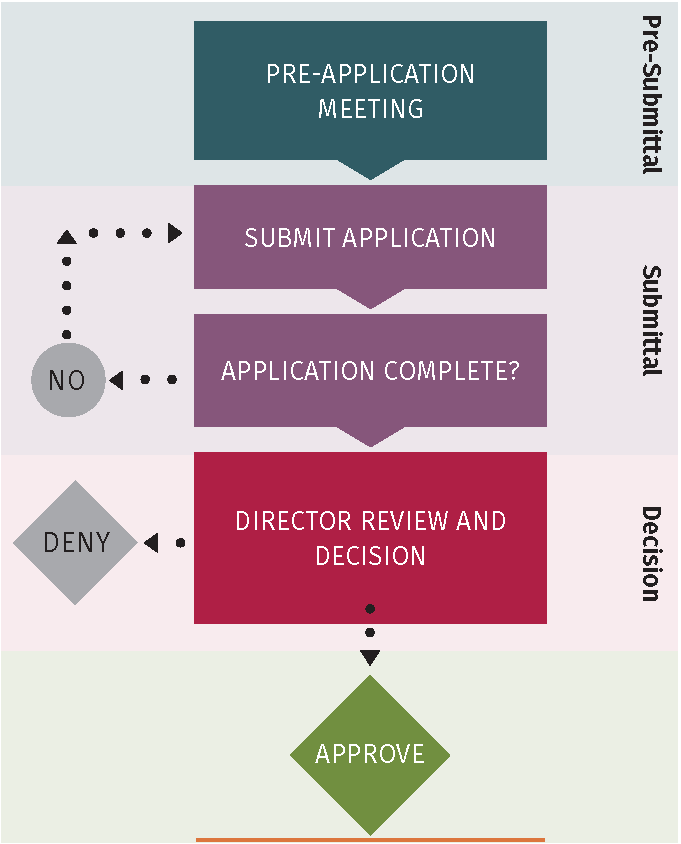
Permit Review Generalized Procedure
4.
A minor Land Disturbance Permit is required for projects that:
a.
Do not include any work in the right-of-way; or
b.
Have less than half an acre of disturbance;
c.
And/or are adding less than 5,000 square feet of impervious surface;
d.
And/or have less than 1 acre of grubbing;
e.
And/or maximum height/depth of excavation or fill over 10 feet;
f.
And/or maximum quantity of 50 cy total movement on the site;
g.
And/or less than a 15% slope.
Projects meeting these criteria will likely qualify as minor land disturbance projects, but the City will consider all factors of the project to make the final determination.
5.
A land disturbance permit is not required for any proposed ground disturbance that does not exceed 2,500 square feet, does not result in the need for erosion control BMPs, and does not result in changes to topography or stormwater drainage patterns.
6.
It is recommended that you contact The City of Sandy Springs to verify a permit is not required before proceeding with any work.
7.
The calculation of the area of disturbance applies to the cumulative disturbed area of a project regardless of property boundaries.
C.
Application Initiation Any person, firm, corporation or agency may submit an application for a Land Disturbance Permit, provided they are the owner or the owner's representative of the property for which the application is being submitted.
D.
Submittal Process
1.
Schedule a Developer meeting
a.
Before submitting an application for a Major Land Disturbance Permit, the applicant must schedule a Developer Meeting with the Director to discuss the procedures, standards and regulations required for approval. If it cannot be clearly determined whether the LDP will be a Major or Minor LDP under the criteria in 11.5.1.B, this initial meeting will establish what type of Land Disturbance Permit is required for the project.
b.
To schedule a Developer Meeting, call, email, or visit the Department.
2.
Submit Application
a.
Following the Developer Meeting, the applicant may start the application process by completing an application form and providing plan sets along with the required review fees, to the Department.
E.
Application Review
1.
Initial Distribution of an Application Upon determination of a complete application, the Director will promptly distribute the application for review by internal City Departments and external agencies.
2.
Public Hearing Notice A public hearing is not required for a Land Disturbance Permit, therefore, no formal notice of the submittal is published, mailed or posted.
3.
Developer Meeting The public is allowed to observe the Developer Meeting to enhance the transparency and public awareness of the permitting process.
4.
Traffic Impact Study A traffic impact study is required when any development generates 100 or more trips during the peak hour.
5.
Director Review
a.
If, after the internal and external review, the Director finds that the application does not meet all applicable requirements of this Development Code, the Director will notify the applicant in writing of the specific provisions that have not been met and offer the applicant the opportunity to make changes to the application. If revised application materials are required, see Sec. 11.2.3 E.
b.
If, after the internal and external review, the Director finds that the application meets all applicable requirements of this Development Code, the Director will accept the application as complete.
F.
Approval Criteria The approval of or requirement of revisions to a land disturbance permit application are based solely on whether or not the submittal meets or fails to meet the applicable requirements of this Development Code.
G.
Denied Application If unsatisfied with the Director's decision, the applicant may file an appeal within 30 calendar days of the decision with the Superior Court of Fulton County.
H.
Permit Revisions Revisions to an approved Land disturbance permit may be approved by the Director following review by applicable internal and external agencies consistent with this Section.
I.
Application Expiration An application submitted for a land disturbance permit expires after 6 months from the issuance of the latest letter of permit revisions. At this time, the City will issue a written notice of expiration of permit application to the applicant and require that comments be addressed or permit be resubmitted within 30 days of issuance of the notice.
J.
Permit Validity A land disturbance permit remains valid for the duration of the project subject to the following time restrictions:
1.
Land disturbance permits expire 6 months from the date of issuance if no inspection has been requested; or
2.
If 1 year elapses between inspection requests.
K.
Permit Extension
1.
Extension by Director
a.
The Director is authorized to grant, in writing, an extension of a land disturbance permit for a period not more than 180 calendar days, subject to the qualifying conditions set forth in this Section. To request an extension by the Director, an application must be submitted to the Department at least 30 days prior to the expiration of the land disturbance permit.
b.
No more than one 180-calendar-day extension per land disturbance permit may be granted by the Director for any of the qualifying conditions set forth in this Section (except a court action delay).
2.
Extension by the City Council
a.
Reserved.
b.
To request an extension by the City Council, an application must be submitted to the Department at least 30 days prior to the expiration of the 180-calendar-day extension period granted by the Director pursuant to this Section.
c.
The Department must prepare an analysis and recommendation as to whether the documentation in the application is sufficient based on 1 of the 4 criteria which may validate an extension request by the City Council.
3.
Qualifying Conditions In every application for an extension of a land disturbance permit, the applicant shall provide an affidavit documenting at least 1 of the following:
a.
A delay resulting from court actions involving the land disturbance permit or a previous extension on the subject property for which an extension is sought. Extensions approved in connection with court action shall remain valid for 1 year beyond the granting of an order or the expiration of an appeal period before any court with jurisdiction.
b.
Nonavailability of utilities resulting from government and/or private utility inaction. In those instances where wastewater and water facilities are available for a fraction of the desired capacity, or when capacity was available at some time during the one-year period, but not during the 60 days prior to expiration, the City Council may evaluate such case's qualifications for an extension on its individual merits considering any evidence that might indicate a diligent effort to proceed with development.
c.
A delay in development resulting from wetlands regulatory procedures requires the applicant to provide a copy of the application acknowledgment letter from the Savannah Regulatory Branch of the Corps of Engineers as documented evidence. The application must have been filed at least 6 months before the expiration of the land disturbance permit.
d.
An inability to obtain financing, despite documentation of the property owner's efforts during the 3 months prior to the applicant seeking an extension and continuing until 1 week prior to consideration of the extension request to the City Council. Documentation must consist of 2 official denials signed by officers of 2 different lending institutions who have final jurisdiction over such financial transactions.
L.
Lapse in Construction Activity For the purposes of this Section, a lapse in or suspension of development activity, as authorized by a land disturbance permit, as a direct result of action or inaction on the part of the City which is completely beyond the control of the developer, will not be considered as a lapse in activity causing the development permit to expire. The 180 calendar days within which development activity must begin will exclude any such time period during which the activity is prohibited or has been caused to lapse by said City's action or inaction. Any action or inaction on the part of the developer which results in a suspension of development activity will be counted toward the 12-month time period.
M.
Bonding Infrastructure Improvements Prior to the approval of a Final Plat, a bond is required for right-of-way infrastructure improvements, landscaping and stormwater improvements that have not been installed. The required bond amount will be 125% of the total estimated cost for infrastructure. The City must approve any cost estimate used for bond purposes. The bond will be released upon installation and City approval of the improvements.
N.
Action Following Work Upon completion of the work required under a Land Disturbance Permit, application for Final Plat and Building Permits may be made.
(Ord. No. 2023-12-20, § I(Att. A), 12-5-2023; Ord. No. 2025-09-22, § I, 9-16-2025)
Sec. 11.5.2. - Building Permit
A.
Building Code Building permits, including associated certificates of occupancy, are issued consistent with Chapter 105, Article 2 of the City Code.
B.
Other Applicable Codes Building permits for all structures or interior finishes are issued after meeting the applicable requirements of the Fire Prevention and Life Safety Codes, and the various health, water, sewer, and building codes of the City or utility providers, as well as the provisions of any certificate approved under the Chattahoochee River Corridor, if applicable and the provisions of this Development Code.
C.
Sanitary Sewage Disposal
1.
Septic System For any structure for which on-site sewage disposal (septic systems) will be provided, a permit issued by the Fulton County Health and Wellness Department must be required prior to issuance of a building permit. The permit may first require approval of a plan showing the location of the sewage disposal system and other site improvements, in accordance with Fulton County Section 34-568, Wastewater Discharge.
2.
Connection to Public Sanitary Sewer Any structure that requires a connection to or modification of the existing sanitary sewer system requires approval from Fulton County prior to the issuance of a building permit.
D.
Potable Water Supply Any structure for which a connection to the potable water system is required must provide proof of payment of all applicable fees to the water provider.
E.
Single Family
1.
A building permit for a single family (single unit) residence may only be issued after the recording of a final plat or after the lot on which the building is to be located has otherwise become a buildable lot of record.
2.
Reserved.
F.
Reserved
G.
Fee-Simple Townhouse Subdivisions A building permit may be issued on a buildable lot of record established for each building (containing any number of townhouse dwelling units) through recording of a final plat following completion of all required public improvements. Upon completion of the buildings, the final plat must be re-recorded to establish individual lots for the townhouse units, based on their actual locations, prior to issuance of certificates of occupancy.
H.
Multifamily and Nonresidential Structures
1.
Issuance of a building permit for any principal building other than a single unit detached (and associated accessory structure) requires issuance of a land disturbance permit for the building site, and the building permit must be consistent with the land disturbance permit.
2.
Building plans must be received and approved by the Department prior to permitting for all structures.
3.
Fulton County approval may be required prior to the issuance of a building permit for construction activities involving, food service, commercial swimming pools, dumpster pads, hotels or motels, grease traps, and similar uses requiring review by a department of Fulton County.
I.
Demolition Permits Demolition permits may be required for the partial or complete demolition of the interior or exterior of any structure within the City. Pursuant to the State of Georgia's Asbestos Safety Act, an asbestos survey is required.
J.
Expiration of Building Permits A building permit remains valid for the time period specified in the building codes adopted by the City.
K.
Expiration of Building Permit Application An application submitted for a building permit expires after 60 days from the issuance of the latest letter of permit revisions. At that time, the City will issue a written notice of expiration of permit application to the applicant and require that comments be addressed or the permit be obtained within 30 days of issuance of the notice of expiration.
L.
Issuance of Permits Prior to Final Plat Building permits will only be issued on buildable lots of record, as defined in this Development Code, except under special circumstances limited to and as specifically described in this Section.
1.
Single unit and 2-family residential model homes.
2.
Nonresidential subdivisions. Building permits may be issued on the basis of an approved preliminary plan and after a land disturbance permit has been approved reflecting the site plan and construction drawings for specific buildings and associated site improvements. Issuance of the building permits will be conditioned on the following:
a.
An approved surety must have been received in a form acceptable to the City Attorney, drawn in favor of the City and in an amount not less than 125% of the cost of completing all public improvements as authorized and required by the land disturbance permit.
b.
The performance bond or other approved surety must not exceed an aggregate total for all required public improvements of $12,000.00 per acre for the total acreage included within the subdivision or portion of the subdivision where the improvements are proposed, except by approval of the City Council.
c.
Fire Marshal approval is required prior to issuance of any building permit, which may include approval of acceptable access and water under pressure for combustible construction.
d.
Approval of the Fulton County Health and Wellness Department for on-site sewage disposal or the Fulton County Sewer Department for a building to be served by public sewer is required prior to issuance of any building permit.
e.
Construction of the required public improvements must proceed concurrently with construction of the buildings.
f.
No certificate of occupancy will be approved for any structure within the subdivision prior to recording of the final plat without the express approval of the Director.
g.
The Director must find that the public interest is best served and that a public purpose is involved in the acceptance of the surety.
(Ord. No. 2023-12-20, § I(Att. A), 12-5-2023; Ord. No. 2025-09-22, § I, 9-16-2025)
Sec. 11.5.3. - Certificate of Occupancy
A.
A Certificate of Occupancy indicating that a building, lot and use comply with the Building Code and this Development Code is required under provisions of the adopted Building Code.
B.
The City provides for multi-phased certificates of occupancy when certain criteria are met, as further described in established Department policy.
C.
The Certificate of Occupancy must be posted on site where it is visible for inspection for a period of 30 days from the date of issuance. After such period, the Certificate of Occupancy must be kept on the premises.
D.
Any owner, authorized agent, or contractor who desires to change the use of a building or structure must apply to the building official, obtain the required permits, and obtain a Certificate of Occupancy prior to occupying the structure.
(Ord. No. 2023-12-20, § I(Att. A), 12-5-2023)
Sec. 11.5.4. - Other Permits
A.
Right-of-Way Encroachment/Utility Permit No person or company may perform construction work in the street right-of-way without a permit issued by the City. The permit must be posted at the construction site at all times. Such construction must conform to the construction/maintenance guidelines and specifications of the City or the State Department of Transportation.
B.
Tree Removal Permit When tree removal is anticipated and the activity may result in the removal, damage or destruction of any tree, please see Sec. 9.3.3 for permit requirements.
C.
Groundwater Well and Septic Permit No person or company may install or perform construction of groundwater wells or septic systems without prior approval from the Fulton County Department of Health and Wellness and completion of a pre-construction meeting with the City of Sandy Springs.
D.
Sign Permit
1.
Applicability All free-standing signs require a separate building permit.
2.
Application An application for a sign permit must be completed as required in the Sandy Springs Technical Manual.
3.
Incomplete; False Application The Director must, within 30 days of receipt of an application, reject any application that is incomplete, that contains false material statements or omissions, or that is for a sign which would violate any standard in Div. 8. The Director may reject at any time prior to the expiration of the 30-day period, if the application is incomplete or contains false material statements or omissions.
4.
Processing Time; Denial The City will process all complete and accurate sign permit applications within 30 business days of the City's actual receipt of a complete and accurate application and upon remittance of the appropriate sign permit fee. The Director will give notice to the applicant of the decision by email or mail on or before the 30th business day. If the decision of the Director is to deny the application, the decision must state the grounds upon which the denial is based. Failure of the City to act within the 30-day period is deemed a denial of the permit. If notice is mailed in conformity with this Section, notice is deemed to have been given upon the date of mailing. Any application meeting the standards of this Div. 8.3 will be granted. Any application not meeting the standards of Div. 8.3 will be denied.
5.
Resubmission A rejected application later resubmitted in conformity with Div. 8.3 is deemed to have been submitted on the date of resubmission, instead of the original submission date. An application which is resubmitted must meet all the standards for an original application.
E.
Fence or Wall Permit
1.
Applicability
a.
A wall that retains earth requires a retaining wall permit (see Sec. 9.4.3). A wall that does not retain earth is considered a fence for permitting purposes.
b.
Fence permits are required when installing a new fence or wall that does not retain earth, non-vehicular gate, or when a replacement of an existing fence results in a change in placement, height, materials or design.
c.
Electronic vehicular gates require a building permit.
d.
A swimming pool enclosure fence will be approved as part of the pool permit.
e.
A fence permit is not required for temporary security purposes during construction.
2.
Application An application for a fence permit must be completed as required in the Sandy Springs Technical Manual.
F.
Trenching Permit
1.
Prohibition No individual, partnership, corporation, or other entity of any kind whatsoever may engage in any excavation or trenching except in compliance with the provisions of this Development Code and in compliance with any applicable laws of the State of Georgia or of the United States or any rules and regulations of the U.S. Department of Labor, Occupational Safety and Health Administration, or any other state or federal governmental entity or Department promulgating rules and regulations applicable to excavating and trenching.
2.
Adoption of Federal Regulations All safety and health regulations adopted by OSHA with regard to excavating and trenching operations, particularly Part 1926, Subpart P-Excavations, Trenching, and Shoring, Section 1926.650, 1926.651, 1926.652, 1926.653 of the Code of Federal Regulations, as the same now exist or may be amended, are adopted as a part of this Development Code as if quoted verbatim here.
3.
Permit Required No excavation or trenching may be performed until a permit or authorization for the work has been obtained from the City in accordance with this Article. Applicants are required to acknowledge receipt and understanding of safety requirements before any permit will be issued.
4.
Certificate Required No equipment operator or supervisory personnel may participate in any excavation or trenching or in any way work in an excavation or trench unless such person holds a valid certificate evidencing satisfactory completion of a required educational program on safe trench/excavation practices. No other person may participate in or work in any excavation or trenching site unless a certificate holder is present at the excavation or trench site where work is being performed.
5.
Inspection The City will periodically inspect trench/excavation sites. Such inspectors will, among other things, verify the presence of the required permit, verify existence of required certificates, and verify compliance to OSHA safety standards adopted in paragraph B. The inspectors may operate pursuant to a contract between the City and a third-party entity.
G.
Swimming Pool Permit Issuance of a permit for a swimming pool as an accessory use to a single unit residence, whether to be issued at the same time or subsequent to the permitting or construction of the house, requires approval of a swimming pool site plan. The plan must show the proposed location of the swimming pool, associated deck, pool equipment, pool enclosing fence and gate details, the property boundaries, setback lines, topography lines, septic tank and septic tank drain field (if any), and any easements on the site, and all requirements of this Development Code and the swimming pool code found in the International Swimming Pool & Spa Code. A certificate of occupancy or a certificate of completion will not be issued until conformance to the swimming pool site plan and all applicable building codes has been field verified by the Department. Additionally, all permitted swimming pools must conform to the swimming pool discharge policy.
H.
Administrative Use Permit
1.
Intent Administrative use permits are intended to be used where complex or unusual technical determinations are involved and/or in conjunction with temporary uses and structures where the matter is not of such a nature as to require public notice and hearing. Such permits shall be processed by the community development department.
2.
Authority The Director shall be responsible for processing administrative use permits, making or causing to be made all necessary studies and referrals, and deciding thereon.
3.
Conditions In granting administrative use permits, such conditions may be attached as are deemed necessary in the particular case to protect the public interest and surrounding properties. Such conditions shall generally be of a nature as stated below, in addition to policy or regulations specific to the use otherwise required by the City:
a.
Ingress and egress to the property and proposed structure or uses thereon, with particular reference to automotive and pedestrian safety and convenience, traffic flow and control, and access in case of fire or other catastrophe.
b.
Off-street parking and loading areas where required, with particular attention to the items in a. above.
c.
Refuse and service areas.
d.
Appropriate buffering or screening to alleviate such potentially adverse effects as may be created by noise, glare, odor, lighting, signs or traffic congestion.
e.
Hours and manner of operations.
f.
Length of time regarding the duration of such permit, if any.
g.
Tree preservation and replacement in accordance with the requirements of the City of Sandy Springs Tree Conservation Ordinance (Div. 9.3).
4.
Applications A property owner, or any other person with notarized written consent of the property owners, may file with the Director an application for an administrative use permit on such property, provided that such permit is generally authorized in the district in which such purpose is so designated. The application shall be filed on a form provided for such purposes and shall be accompanied by plans, reports or other information, exhibits or documents as may reasonably be required by the Director to make the necessary findings in the case.
5.
Action by Director The Director shall examine the application and supporting materials for conformance with the requirements and stated intent of this Code, make such referrals as are called for in the circumstances of the case, and within 30 days (unless a longer period is mutually agreed upon) decide on the application.
The Director may issue the permit as applied for, issue a permit conditional upon changes to the application, set forth in writing, as necessary to assure conformance with the requirements and stated intent of this Code, or deny the application, with written reasons for such denial.
6.
Withdrawal of Application An application for an administrative use permit may be withdrawn at any time without limitation on resubmittal.
7.
Appeals of Decision Made By the Director Appeals of decisions made by the Director shall be submitted to the Superior Court of Fulton County, as provided in Sec. 11.6.3.
(Ord. No. 2023-12-20, § I(Att. A), 12-5-2023)
Sec. 11.6.1. - Administrative Variance
A.
Authority The Director is authorized to approve Administrative Variances for up to 10% of any measurable standard in this Development Code.
B.
Limitations Variances are not allowed for any of the following:
1.
Minimum lot area, minimum lot frontage on a street or minimum lot width;
2.
Building height;
3.
Sign height, sign area allocation or individual sign area;
4.
Fence and building materials;
5.
Standards for Conditional Use Permits;
6.
Elimination of frontage improvement requirements; and
7.
Permitted or accessory uses.
C.
Application Initiation Any person, firm, corporation or agency may submit an application for an Administrative Variance, provided they are the owner or the owner's representative of the property for which the application is being submitted.
D.
Submittal Process The process begins with the submittal of fees, plans and supporting documents in the application checklist to the Department.
E.
Director Review
1.
If after review, including consideration of any public objections filed, the Director finds that the request meets the criteria for approval below, the Director will approve the application.
2.
The Director must issue a decision no later than 21 working days after the date of filing of a complete application.
F.
Approval Criteria The Director will approve an administrative variance where all of the following conditions exist:
1.
There are practical (not financial) difficulties pertaining to the particular piece of property in question because of its size, shape or topography;
2.
The requested variance will be in harmony with the purpose and intent of this Development Code and will not be injurious to the neighborhood or to the general welfare; and
3.
The variance requested is the minimum variance that will make possible the proposed use of the land, building or structure.
G.
Denied Application If the Director denies the request, the applicant may file an application for a variance with the Superior Court of Fulton County under Sec. 11.6.3, within 30 calendar days of the decision.
H.
Validity An administrative variance runs with the land and remains valid in perpetuity, until such time as the land is redeveloped.
(Ord. No. 2023-12-20, § I(Att. A), 12-5-2023)
Sec. 11.6.2. - Variances
A variance is a request for relief from the provisions of this Development Code.
A.
Authority Variances are approved or denied by the Board of Appeals.
B.
Limitations Variances are not allowed for any of the following:
1.
Minimum lot area, minimum lot frontage on a street or minimum lot width at the time of subdivision (this does not include a nonconforming lot of record platted prior to the effective date of this Development Code — see Sec. 11.7.4);
2.
Building height;
3.
Sign height, sign area allocation or individual sign area;
4.
Fence, wall and building materials;
5.
Standards for Conditional Use Permits;
6.
Elimination of frontage improvement requirements; and
7.
Permitted or accessory uses; and
8.
Construction classification and building height requirements provided in Sec. 6.6.3.
C.
Application Initiation Any person, firm, corporation or agency may submit an application for a Variance, provided they are the owner or the owner's representative of the property for which the application is being submitted.
D.
Submittal Process
1.
To begin, submit a complete application form, along with the required review fees, to the Department.
2.
The general submittal requirements for all development review applications are listed in Sec. 11.2.3 and must be followed.
E.
Director Review
1.
After review, the Director will schedule the application for the next available Board of Appeals hearing.
2.
Upon certification by the Director that the application complies with all applicable requirements of the Development Code, no changes to the application are permitted prior to the Board of Appeals hearing.
F.
Board of Appeals Public Hearing Following the recommendation of the Director, the Board of Appeals will conduct a public hearing.
G.
Approval Criteria
1.
Variances will only be granted upon showing that:
a.
The variance request would not result in negating the general intent of this Development Code or with the Comprehensive Plan policies;
b.
The variance if granted will not be detrimental to the public safety, health, or welfare of the public or injurious to other property;
c.
The conditions on which the request is based are unique to the property for which the relief is sought and are not applicable generally to other property;
d.
Because of the particular physical surroundings, shape, size, or topographical conditions of the specific property involved, an extraordinary hardship would result, as distinguished from a mere inconvenience, if the strict letter of these regulations is carried out;
e.
The variance requested is the minimum necessary to accomplish the development or building;
f.
In the case of an amendment to a buffer or setback required by this Code, the variance application shows how equal or greater protection will be achieved of the adjacent property or natural resource affected by the proposed development, should the variance be granted; and.
g.
Such conditions are not the result of action or inaction of the current property owner; and
2.
Failure of an applicant to obtain a land disturbance permit, building or any other permit required by this Code shall not in and of itself constitute a justification for a variance absent a showing of the criteria listed under Section 1 above.
H.
Denied Application Decisions of the Board of Appeals are final. Those not satisfied with a decision of the Board of Appeals may pursue an appeal with the Fulton County Superior Court within 30 calendar days of the decision. Denial of an application bars resubmittal of the application for 1 year.
I.
Validity A variance runs with the land and remains valid in perpetuity, until such time as the land is redeveloped.
J.
Noise Variance A noise variance may be requested. See Sandy Springs City Code Article III, Division 2, Noise, Sec. 38-86.
(Ord. No. 2023-12-20, § I(Att. A), 12-5-2023; Ord. No. 2025-09-22, § I, 9-16-2025)
Sec. 11.6.3. - Administrative Appeals
A.
Authority The Superior Court of Fulton County has the authority to hear and decide on appeals regarding administrative decisions made by the Director. For appeals of Stop Work Orders, which are heard by the Board of Appeals, see process requirements below.
B.
Application Initiation Any applicant or immediate neighbor unsatisfied with a decision by the Director on an application may file an appeal with the Fulton County Superior Court, or if the appeal is in regards to a Stop Work Order, it must be heard by the Board of Appeals.
C.
Submittal Process
1.
To begin the appeal process, submit a complete application form, along with the required review fees, to the Department. The appeal application must be filed within 30 calendar days of the date of decision of the Director.
2.
The general submittal requirements for all development review applications are listed in Sec. 11.2.3 and must be followed.
D.
Notice Notice of a public hearing before the Board of Appeals is required as shown in Div. 11.1.
E.
Review by Board of Appeals Any appeal received and all papers constituting the record relating to the action appealed will be transmitted by the Director to the Board of Appeals. The review by the Board of Appeals is conducted on the record established as part of the Director's decision.
F.
Board of Appeals Public Hearing The Board of Appeals will conduct a public hearing, make findings, and render a decision at the public hearing. Alternatively, only once, the Board of Appeals may choose to defer the appeal to a future date.
G.
Other Approvals The filing of an appeal means the applicant may no longer move forward with any other approvals related to their development project, unless the Director certifies to the Board of Appeals that in the Director's opinion, not moving forward would cause immediate peril to life or property.
H.
Approval Criteria The criteria for approving or denying the request are the same used for the original decision by the Director.
I.
Denied Application Decisions of the Board of Appeals are final. Those not satisfied with a decision of the Board of Appeals may pursue an appeal with the Fulton County Superior Court within 30 calendar days of the decision.
(Ord. No. 2023-12-20, § I(Att. A), 12-5-2023)
Sec. 11.6.4. - Stream Buffer Variance
Variance Procedures Variances from Stream Buffer requirements as provided in Div. 9.2. may be granted in accordance with the following provisions:
1.
Where a parcel was platted prior to December 12, 2005, and its shape, topography or other existing physical condition prevents land development consistent with this Division, and the City finds and determines that the requirements of this Division prohibit the otherwise lawful use of the property by the owner, the Board of Appeals may grant a variance from paragraph A. above, provided such variance requires mitigation measures to offset the effects of any proposed land development on the parcel.
2.
The Board of Appeals will follow the procedure set forth in Sec. 11.6.2.
3.
Variances will be considered only in the following cases:
a.
When a property's shape, topography or other physical conditions existing on December 12, 2005 prevents land development unless a buffer or setback variance is granted.
b.
Unusual circumstances when strict adherence to the minimal buffer and setback requirements in this Division would create an extreme hardship.
4.
Variances will not be considered when actions of any property owner of a given property after December 12, 2005 have created conditions of a hardship on that property.
5.
At a minimum, a variance request must include the following information:
a.
A site map that includes locations of all state waters, wetlands, floodplain boundaries and other natural features, as determined by field survey;
b.
A description of the shape, size, topography, slope, soils, vegetation and other physical characteristics of the property;
c.
A detailed site plan that shows the locations of all existing and proposed structures and other impervious cover, the limits of all existing and proposed land disturbance, both inside and outside the buffer and setback. The exact area of the buffer and setback to be affected is accurately and clearly indicated;
d.
Documentation of unusual hardship should the buffer and setback be maintained;
e.
At least 1 alternative plan that does not include a buffer or setback intrusion, or an explanation of why such a site plan is not possible;
f.
A calculation of the total area and length of the proposed intrusion;
g.
A stormwater management site plan, if applicable; and
h.
Proposed mitigation, if any, for the intrusion. If no mitigation is proposed, the request must include an explanation of why none is being proposed.
6.
The following factors will be considered in determining whether to issue a variance:
a.
The shape, size, topography, slope, soils, vegetation and other physical characteristics of the property;
b.
The locations of all state waters, wetlands, floodplain boundaries and other natural features on the property, including along property boundaries, as determined by field survey;
c.
The location and extent of the proposed buffer or setback intrusion;
d.
Whether alternative designs are possible which require less intrusion or no intrusion;
e.
The long-term and water quality impacts of the proposed variance; and
f.
Whether issuance of the variance is at least as protective of natural resources and the environment.
(Ord. No. 2023-12-20, § I(Att. A), 12-5-2023)
Sec. 11.7.1. - Nonconforming Use
A.
Defined Any use of a building or land lawfully occupied at the time of passage of this Development Code, or any amendment to this Development Code, that does not conform with the use regulations of the zoning district in which it is situated.
B.
Continuance A nonconforming use is allowed to continue legally even though such use does not conform with the provisions of this Development Code, subject to the following provisions:
1.
The nonconforming use must not be expanded to occupy a greater area of land or building.
2.
The nonconforming use must continue in the original building, structure or on land area that was originally occupied by the nonconforming use.
3.
The nonconforming use will not be reinstated after it has been abandoned. It is considered prima facia evidence of abandonment for the owner and/or operator of the nonconforming use to:
a.
Discontinue the nonconforming use for 12 months; or
b.
Fail to obtain a new or renew an existing business license, as required under the City Code, for the operation of such nonconforming use; or
c.
Fail to declare and remit the sales tax required by State law for the nonconforming use.
d.
Failure to follow any state, federal or local administrative procedure or regulation that is required for the nonconforming use.
4.
The nonconforming use must not be changed to another nonconforming use.
5.
The nonconforming use must maintain any screening or buffering that existed prior to the use becoming a nonconforming use or that was later voluntarily added.
6.
If the use constitutes a nuisance as defined by state law, the City may revoke the certificate of occupancy or business license if the nuisance cannot be extinguished.
7.
Nothing in this Section will be construed to allow a use that is dangerous to the general public to continue to exist.
8.
Nothing in this Section will be construed not to require changes to buildings and structures to comply with any fire code, life safety code or other safety ordinance or regulation.
9.
Notwithstanding anything in this Div. 11.7 to the contrary, the amortization of any lawful, nonconforming adult establishment use shall continue to be governed by Sec. 26-37 of the City Code. As established in prior judicial decisions, however, there are no lawful, nonconforming adult establishments in the City as of the adoption of this Development Code.
(Ord. No. 2023-12-20, § I(Att. A), 12-5-2023)
Sec. 11.7.2. - Nonconforming Structure
A.
Defined A building or structure that does not conform with the requirements of this Development Code. For the purposes of this Section, any building legally constructed prior to the adoption of this Development Code that exceeds the zoning district height limit established in this Development Code will be considered a conforming structure, and not subject to the requirements of this nonconforming structure Section.
B.
Continuance A nonconforming structure is allowed to continue legally even though the structure does not conform with the provisions of this Development Code, subject to the following provisions:
1.
Regular maintenance and repairs to a nonconforming structure are allowed.
2.
A nonconforming structure may be expanded, altered or rebuilt where such expansion, alteration or rebuilding conforms with all the applicable requirements of this Development Code.
3.
No new nonconformity may be created by any expansion, alteration or rebuilding.
4.
Expansion on the vertical plane, such as the addition of another story to a nonconforming structure that does not meet the district setback, is considered an expansion of the nonconformity and therefore prohibited. Expansion on the vertical plane in conformance with all the applicable requirements of this Development Code is allowed.
5.
The nonconforming structure may not be rebuilt, altered or repaired after damage or deterioration exceed 75% of its replacement cost at the time of destruction, except in conformity with this Development Code. Where a residential structure is damaged or destroyed through natural catastrophe, the Director may allow it to be reconstructed without regard to the extent of damage, provided that the extent of any prior structure nonconformity remains the same or is reduced for the new structure.
6.
A permit to begin such restoration shall be applied for no later than 6 months from the date the damages were incurred. At the request of the applicant, the Director may grant 1 extension of a maximum of 6 months, upon demonstration of extenuating circumstances outside of the owner's control. The applicant must request an extension in writing, no later than 30 days prior to the expiration of the grace period.
7.
This section does not apply to signs. See Sec. 11.7.5.
8.
A request to expand, alter or rebuild an existing nonconforming structure may be brought before the Board of Appeals as a request for a variance.
(Ord. No. 2023-12-20, § I(Att. A), 12-5-2023)
Sec. 11.7.3. - Nonconforming Site Element
Where a lot does not conform with the requirements of Article 8, Site Development, the following requirements apply:
A.
When a new principal structure is constructed on the lot, the area of the lot that accommodates the building, any required stormwater facility, and any parking area must be brought into conformance. On a lot with multiple buildings, only that portion of the lot associated with the new construction must be brought into conformance with Article 8.
B.
The following requirements apply when the scope of work on a project involves a change of the building which requires a building permit. Minor upgrade, repair or maintenance such as painting, reroofing, replacing windows or doors do not trigger this requirement.
1.
Short-term bicycle parking;
2.
Parking lot perimeter landscaping;
3.
Foundation planting;
4.
Screening;
5.
Fences and walls (if any are installed);
6.
Signs (all), including elimination of any prohibited signs; and
7.
Site lighting for any new fixtures installed, along with elimination of any prohibited lighting.
C.
When an existing principal structure is increased in floor area by less than 50% cumulatively over 5 years from the effective date of this Development Code, the area of the lot that accommodates the expanded building, any required stormwater expansion, and any expanded parking area must be brought into conformance with Article 8.
D.
When an existing principal structure is increased in floor area by 50% or more cumulatively over 5 years from the effective date of this Development Code, the entire lot, including any building, any required stormwater facility, and any parking area must be brought into conformance with Article 8.
E.
When an existing fence or wall is reconstructed or repaired along at least 50% of its length, the entire fence or wall must be brought into conformance with Article 8.
F.
When 25% or more of an existing parking lot is reconstructed (excavated or milled and repaved) for any reason, the entire parking lot must be brought into complete conformance with the parking and landscaping provisions.
G.
Resealing or restriping an existing parking lot does not trigger conformance with Article 8, except with regard to the minimum dimensions for striping.
(Ord. No. 2023-12-20, § I(Att. A), 12-5-2023)
Sec. 11.7.4. - Nonconforming Lot of Record
A.
Defined A lot that was legally platted and recorded in the deed records of Fulton County that no longer meets the standards of this Development Code.
B.
Buildable
1.
A nonconforming lot of record that is inadequate in area or width is considered buildable under this Development Code, provided it meets all of the other remaining standards of the Code, including setbacks. Where relief is necessary to make an existing nonconforming lot of record buildable, a variance may be considered by the Board of Appeals.
2.
Where a nonconforming lot of record adjoins another vacant lot of record, it must either:
a.
Be used as a nonconforming lot of record without resorting to a variance of any kind; or
b.
Be combined with the adjacent lot to create a conforming lot.
(Ord. No. 2023-12-20, § I(Att. A), 12-5-2023)
Sec. 11.7.5. - Nonconforming Sign
A.
Defined A sign that does not comply with the requirements of this Development Code.
B.
Maintained
1.
All nonconforming signs must be maintained in good repair.
2.
A nonconforming sign must not be replaced by another nonconforming sign, except that the substitution or interchange of poster panels, painted boards, or dismountable material on nonconforming signs is permitted, provided that the replacement does not constitute a material change to the sign.
C.
Repairs
1.
Minor repairs and maintenance of nonconforming signs are permitted; provided that no structural repairs or changes in the size or shape of a nonconforming sign are permitted except to make the sign comply with the standards of this Development Code.
2.
To the extent that any sign allowable under this Development Code is damaged or destroyed by Act of God or by other circumstances beyond control of the owner of the sign, then such sign may be repaired without regard to the restrictions of this paragraph B.
3.
The replacement of an existing sign face utilizing LED, plasma or similar technology is expressly prohibited.
D.
Continuance Nonconforming signs may stay in place until 1 of the following conditions occurs:
1.
The façade of the associated principal building is modified;
2.
The deterioration of the sign or damage to the sign makes it a hazard or renders it dilapidated, unsightly, or unkempt; OR
3.
The sign has been damaged to such extent that more than minor repairs or a material change is required to restore the sign.
4.
No structural repairs or change in shape or size are permitted except to make the sign comply with all standards of this Development Code.
(Ord. No. 2023-12-20, § I(Att. A), 12-5-2023; Ord. No. 2025-09-22, § I, 9-16-2025)
Sec. 11.7.6. - Burden of Proof
The owner of the property upon which exists a nonconforming use, nonconforming structure or nonconforming sign carries the burden of demonstrating that the nonconformity was established legally prior to the adoption of this Development Code, and, for nonconforming uses, that the use has been continuous since that time.
(Ord. No. 2023-12-20, § I(Att. A), 12-5-2023)
Sec. 11.8.1. - Enforcement
A.
It is the duty of the Director to enforce the provisions of this Development Code.
B.
In addition, it is the duty of all officers and employees of the City, especially members of the Code Enforcement, Police and Fire Departments, to assist the Director by reporting any seeming violations, including violations in new construction, redevelopment or land use.
(Ord. No. 2023-12-20, § I(Att. A), 12-5-2023)
Sec. 11.8.2. - Violation
A.
Any person, firm, partnership or corporation prosecuted for violating any of the provisions of this Development Code may be deemed guilty of an ordinance violation, punishable as prescribed in Section 1-10 of the City of Sandy Springs Code of Ordinances.
B.
Each day's continuance of a violation may be considered a separate offense.
C.
The prosecution of any owner and tenants of any buildings or premises, or parts of buildings or premises, where anything in violation of this Development Code is placed or exists, and any architect, design professional, builder, contractor or agent, or the owner or tenants who may have assisted in the commission of any such violation may each be deemed guilty of a separate offense.
(Ord. No. 2023-12-20, § I(Att. A), 12-5-2023)
Sec. 11.8.3. - Work in Violation
In any case in which activities are undertaken in violation of this Development Code, not in compliance with the provisions of a permit issued under the authorization of this Chapter, or without authorization of a permit which would otherwise be required, the Director is authorized to:
A.
Suspend or invalidate such permits;
B.
Order that all unauthorized or improper work be stopped;
C.
Direct correction of deficiencies;
D.
Issue summonses to any court of competent jurisdiction; or
E.
Take any other legal or administrative action appropriate to the severity of the violation and degree of threat to the public health, safety and welfare.
(Ord. No. 2023-12-20, § I(Att. A), 12-5-2023)

