
Sandy Springs City Zoning Code
ARTICLE 7
- USE PROVISIONS
Div. 7.2. - Allowed Use Table
(Ord. No. 2023-12-23, § I(Att. A), 12-5-2023; Ord. No. 2025-09-22, § I, 9-16-2025)
Sec. 7.1.1. - Principal Uses
A.
In order to regulate a variety of similar uses, use categories have been established for principal uses. Use categories provide a systematic basis for assigning uses to appropriate categories with other, similar uses. Use categories classify principal uses and activities based on common functional, product or physical characteristics.
B.
Where a use category contains a list of included uses, the list is to be considered example uses, and not all-inclusive. The Director has the responsibility for categorizing all uses.
C.
The allowed use table in Div. 7.2 establishes permitted principal uses by district. No building or lot may be used except for a purpose permitted in the district in which it is located. Principal uses not specifically listed must be approved by the Director in accordance with Sec. 7.1.3.
D.
Use definitions and use standards for principal uses are specified in Div. 7.3 through Div. 7.7.
(Ord. No. 2023-12-23, § I(Att. A), 12-5-2023)
Sec. 7.1.2. - Accessory Uses
A.
An accessory use is any use that is subordinate in both purpose and size, incidental to and customarily associated with a permitted principal use located on the same lot.
B.
The allowed use table in Div. 7.2 establishes permitted accessory uses by district. Accessory uses not specifically listed must be approved by the Director in accordance with Sec. 7.1.4.
C.
Use definitions and use standards for accessory uses are specified in Div. 7.8.
(Ord. No. 2023-12-23, § I(Att. A), 12-5-2023)
Sec. 7.1.3. - Principal Uses Not Listed
A principal use not specifically listed is prohibited unless the Director determines the use to be part of a use category as described below.
A.
If a proposed use is not listed in a use category, but is similar to a listed use, the Director may consider the proposed use part of that use category. When determining whether a proposed use is similar to a listed use, the Director must consider the following criteria.
1.
The actual or projected characteristics of the proposed use;
2.
The relative amount of site area or floor area and equipment devoted to the proposed use;
3.
Relative amounts of sales;
4.
The customer type;
5.
The relative number of employees;
6.
Hours of operation;
7.
Building and site arrangement;
8.
Types of vehicles used and their parking requirements;
9.
The number of vehicle trips generated;
10.
How the proposed use is advertised;
11.
The likely impact on surrounding properties; and
12.
Whether the activity is likely to be found independent of the other activities on the site.
B.
Where a use not listed is found by the Director not to be similar to any other permitted use, the use is only permitted following a text amendment (see Div. 11.3)
(Ord. No. 2023-12-23, § I(Att. A), 12-5-2023)
Sec. 7.1.4. - Accessory Uses Not Listed
An accessory use not specifically listed is prohibited unless the Director determines the accessory use:
A.
Is clearly incidental to and customarily found in connection with an allowed principal use;
B.
Is subordinate in area to and serving an allowed principal use;
C.
Contributes to the comfort, convenience or needs of occupants, business or industry in the principal use served; and
D.
Is located on the same lot as the principal use served.
E.
Use definitions and use standards for accessory uses are specified in Div. 7.8.
(Ord. No. 2023-12-23, § I(Att. A), 12-5-2023)
Sec. 7.1.5. - Use Table Key
A.
Permitted Use (P) Indicates a use permitted in the respective district, subject to basic use standards (if any) referenced in the right-hand column of the use table. The use is also subject to all other applicable requirements of this Code.
B.
Limited Use (L) Indicates a use is permitted in the respective zoning district, subject to basic (if any) and additional use standards found in the right-hand column of the use table. The use does not require a Conditional Use Permit, but is subject to all other applicable requirements of this Code.
C.
Conditional Use Permit (C) Indicates a use may be permitted in the respective district only where approved with a Conditional Use Permit by the City Council in accordance with Div. 11.3. Conditional uses are subject to all other applicable requirements of this Article, including any applicable use standards, except where the use standards are expressly modified by the City Council as part of the conditional use permit approval.
D.
Administrative Use Permit (A) Indicates a use may be permitted in the respective district only where approved with an Administrative Use Permit by the Director in accordance with Div. 11.5, Administrative Use Permit.
E.
Use Not Permitted (—) in a cell indicates that a use is not permitted in the respective district.
(Ord. No. 2023-12-23, § I(Att. A), 12-5-2023)
Sec. 7.3.1. - Household Living
A.
Defined Residential occupancy of a dwelling unit by a household. A household means 1 or more persons related by blood, marriage, adoption, guardianship or other duly authorized custodial relationship, or up to 4 unrelated persons, occupying a dwelling unit and living as a single housekeeping unit.
B.
Single Unit Detached
1.
Defined One dwelling unit on a single lot.
2.
Limited Use Standards
a.
In PX- and PM- Districts on sites 5 acres or larger, the total gross floor area of single unit attached, single unit detached, and neighborhood unit uses cannot exceed 50% of the total square footage of the development footprint.
C.
Single Unit Attached
1.
Defined Two or more dwelling units attached with common walls where each dwelling unit is located on an individual lot and has its primary pedestrian access on the ground story.
2.
Limited Use Standards
a.
In PX- and PM- Districts on sites 5 acres or larger, the total gross floor area of single unit attached, single unit detached, and neighborhood unit uses cannot exceed 50% of the total square footage of the development footprint.
D.
Accessory Dwelling, Guest House
1.
Defined A dwelling unit accessory to the principal dwelling on a single unit detached or single unit attached lot.
2.
Basic Use Standards
a.
A guest house must be located on a lot with a primary dwelling unit, and may be attached or detached from the primary dwelling unit.
b.
No more than 1 guest house per lot allowed.
c.
A separate kitchen facility is allowed.
d.
Total heated floor area (HFA) must be less than 1,500 square feet.
e.
When separate from the principal dwelling unit, minimum separation between buildings is 20 feet.
f.
Principal building setbacks apply.
g.
Height must be no greater than 2 stories.
h.
When separate from the principal dwelling unit, the location is limited to the rear yard and must meet all district setbacks.
i.
A guest house may be located over a garage, provided the location and size meet all other use standards.
E.
Neighborhood Unit
1.
Defined Two or more dwelling units on a lot designed to be at a scale that blends into a low-density neighborhood context.
2.
Basic Use Standards
a.
No more than 1 building per lot is permitted.
b.
No more than 12 dwelling units per building are permitted, except as listed below.
c.
Height must be no greater than 2.5 stories.
d.
Buildings with a height greater than 2 stories must have a sloped roof of 6:12 or greater.
e.
Street-facing building width must be no greater than 100 feet.
f.
Any attached or detached garage or carport located on the same lot must be located behind the principal building.
3.
Limited Use Standard
a.
In RU- Districts, no more than 4 dwelling units per building are permitted.
b.
In ON- Districts, Neighborhood Unit uses require a CUP and are only allowed on parcels with access onto a street with a functional classification as a collector or greater.
c.
In PX- and PM- Districts on sites 5 acres or larger, the total gross floor area of single unit attached, single unit detached, and neighborhood unit uses cannot exceed 50% of the total square footage of the development footprint.
F.
Age-Restricted (55+) Unit
1.
Defined Two or more dwelling units on a lot, intended to be occupied by residents 55 year of age or older.
2.
Basic Use Standards
a.
Age-restricted units must follow all of the design standards required for multi-unit.
b.
New construction or additions must adhere to the Federal Fair Housing Act standards for Age- Restricted Units, including the following standards:
i.
A minimum of 80% of the units must be occupied by at least 1 occupant who is 55 years of age or older;
ii.
The project developer must publish and adhere to policies and procedures that demonstrate the intent to operate as age-restricted housing; and
iii.
The project developer must comply with HUD's regulatory requirements for age verification of residents.
c.
Limited Use Standards
i.
In RM- Districts, a new construction or addition project must provide a minimum of 10% of the total number of units in the development as single unit detached or single unit attached.
G.
Multi-Unit
1.
Defined A lot containing 2 or more attached dwelling units. Multi-unit includes structures which are not designed and built to the Neighborhood Unit use standards.
2.
Basic Use Standards
a.
In addition to any storage space available within a particular residential unit, any multi-unit project with over 20 units must provide a minimum of 16 square feet of additional storage area, with a minimum height of 8 feet, for each residential unit. The storage space must be internal to the residential building or within an associated parking structure.
b.
Rooms in each unit shall have minimum 9-foot ceiling heights.
c.
All stairs leading to upper levels shall be screened and not visible from any street.
d.
All halls shall be internal.
3.
Limited Use Standards
a.
In RM- Districts, a new construction or addition project must provide a minimum of 10% of the total number of units in the development as single unit detached or single unit attached.
b.
In ON- Districts, multi-unit is only permitted with a Conditional Use Permit and the following standards apply:
i.
Multi-unit is only allowed in existing buildings where the building was intended for a Commercial use for a minimum of 5 years prior to the application for a Conditional Use Permit.
c.
In OX- Districts, the following standards apply:
i.
Multi-unit is only allowed in existing buildings where the building was intended for a Commercial use for a minimum of 5 years prior to the application for a Conditional Use Permit.
ii.
Multi-unit is only permitted on the third floor of a building and above.
iii.
Multi-unit is permitted on the first and second floor of a building with a Conditional Use Permit.
d.
The following districts require a minimum amount of commercial-active space (Sec. 6.6.2 E) and commercial-ready space (Sec. 6.6.2 F) for street-facing portions of the Multi-unit development. The commercial-ready space must be a minimum of 25' deep when measured from the building façade into the interior of the building. The Director may vary the requirement based on the balance of commercial uses surrounding the site. Active Commercial requirements may assemble in centralized locations over a development and do not need to meet the standard at each building.
H.
Live/Work
1.
Defined A building or spaces within a building used jointly for commercial and residential purposes.
2.
Basic Use Standards
a.
Live/work is only permitted in units with street level access.
b.
The work area of the live/work unit must not exceed 2,000 square feet or 50% of the total gross floor area, whichever is greater.
c.
Hours of operation must begin no earlier than 6 a.m. and end no later than 10:00 PM, including all deliveries.
d.
A minimum of 1 employee or owner of the business must occupy the live/work unit as their primary place of residence.
e.
No business storage or warehousing of material, supplies or equipment is permitted outside of the live/work unit.
f.
The nonresidential use of the unit is limited to office, personal service, retail and artisanal uses as defined in this Article and must be permitted uses, limited uses, or conditional uses, except that the following uses are prohibited. Any limited use standards or use permit requirements do apply for limited or conditional uses.
i.
Alternative financial services establishment (such as check cashing, bail bonds, or title loan establishments).
ii.
Gas station.
iii.
Liquor store.
g.
No equipment or process may be used in connection with the live/work unit that creates noise, vibration, glare, fumes, odors, or electrical interference detectable to the normal senses off the premises.
(Ord. No. 2023-12-23, § I(Att. A), 12-5-2023; Ord. No. 2025-09-22, § I, 9-16-2025)
Sec. 7.3.2. - Group Living
A.
Defined Residential occupancy of a structure by a group of people that does not meet the definition of household living. Generally, group living facilities have a common eating area for residents, and residents may receive care or training.
The Fair Housing Act (42 U.S.C. Section 3604(f)(3)) makes it unlawful to make a dwelling unavailable to a person because of race, color, national origin, sex, familial status, handicap or disability. No policy or practice of this Development Code is intended to have a disparate impact on a protected class. Further, in order to avoid prohibited discrimination, if a person or persons identified as a protected class believes a reasonable accommodation can be made to any use restriction, that person or persons are required to make application for a conditional use or zoning text or map change.
B.
Boarding/Rooming House
1.
Defined A facility that contains individual rooms without cooking facilities that are rented to the general public. The facility may or may not contain shared living areas and cooking facilities.
2.
Basic Use Standards
a.
No boarding/rooming house may be located within 1,320 feet of another boarding house (as measured in a straight line from property line to property line).
b.
Every boarding/rooming house must provide resident management. The resident manager's name and room number must be placed on the primary entrance of the dwelling.
C.
Hospice
1.
Defined A health care facility for the terminally ill that emphasizes pain control and emotional support for the patient and family, typically refraining from taking extraordinary measures to prolong life.
D.
Institutional Residential
1.
Defined An umbrella term that encompasses the following uses as defined below: assisted living community, independent living, intermediate care home, nursing home, personal care home and skilled nursing care facility.
a.
Assisted Living Facility Residences for the frail elderly that provide rooms, meals, personal care, and supervision of self-administered medication.
b.
Independent Living Adults at least 55 years of age or older living within multi-family rental properties with central dining facilities that provide residents, as part of their monthly fee, access to meals and other services such as housekeeping, linen service, transportation, and social and recreational activities. Independent living facilities do not provide, in a majority of the units, assistance with activities of daily living such as supervision of medication, bathing, dressing, and toileting. There are no licensed skilled nursing beds on the property.
c.
Intermediate Care Home A facility that admits residents on medical referral only, and includes the provision of food, and special diets when required, shelter, laundry and personal care services, such as help with dressing, getting in and out of bed, bathing, feeding, medications and similar assistance, such services being under appropriate licensed supervision. Intermediate care does not normally include providing care for bed-ridden patients except on an emergency or temporary basis.
d.
Nursing Home A facility that admits patients on medical referral only and for whom arrangements have been made for continuous medical supervision, maintains the services and facilities for skilled nursing care, rehabilitative nursing care, and has a satisfactory agreement with a physician and dentist who will be available for any medical or dental emergency and who will be responsible for the general medical and dental supervision of the home.
e.
Skilled Nursing Care Facility A facility that admits residents on medical referral; it maintains the services and facilities for skilled nursing care and has a satisfactory agreement with a physician and dentist who will provide continuing supervision including emergencies; it complies with rules and regulations of the Georgia Department of Human Resources. The term "skilled nursing care" means the application of recognized nursing methods, procedures, and actions directed toward implementation of the physician's therapeutic and diagnostic plan, detection of changes in the human body's regulatory system, preservation of such body defenses, prevention of complications and emotional well-being, including but not limited to the following:
i.
The administration of oral or injectable medications which cannot be self-administered. Other examples include the administration of oxygen, the use of suction, the insertion or changing of catheters, the application of medicated dressings, the use of aseptic technique and preparation of the patient for special procedures;
ii.
Observation in the care of the patient for symptoms and/or physical and mental signs that may develop and which will require attention of the physician and a revision in the patient's treatment regimen.
E.
Personal Care Home
1.
Defined Any dwelling, whether operated for profit or not, which undertakes through its ownership or management to provide or arrange for the provision of housing, food service, and 1 or more personal services for 3 or more adults who are not related to the owner or administrator by blood or marriage.
2.
Basic Use Standards
a.
The personal care home must be operated in a manner compatible with the neighborhood and must not be detrimental to adjacent properties as a result of traffic, noise, light, refuse, parking or other activities.
b.
The operator of the personal care home must comply with all applicable local, state and federal laws and regulations. Copies of all applicable licenses and permits, including but not limited to, a business license, and other required State licenses must be provided at the time of application.
c.
The personal care home must comply with all applicable building, housing and fire codes.
d.
To prevent the institutional atmosphere created by concentrating or clustering of personal care homes, thereby defeating the goal of integrating individuals into the community, each personal care home must be located a minimum of ¼-mile from any other personal care home.
3.
Limited Use Standards
a.
If located in a Protected Neighborhood zoning district, the design and or maintenance of the structure used for the personal care home must be residential in appearance and in keeping with neighboring homes.
b.
Care provided to 4 residents or more must obtain a Conditional Use Permit prior to applying for a business license.
(Ord. No. 2023-12-23, § I(Att. A), 12-5-2023)
Sec. 7.3.4. - Rehabilitation or Treatment Facility
A.
Defined A facility licensed by the State of Georgia that provides treatment for persons who present a direct threat to the persons or property of others. Includes persons convicted for illegal manufacture or distribution of a controlled substance, sex offenders, and juvenile offenders. Includes facilities that provide transient housing related to post-incarceration and social service programs. Includes Rehabilitation Centers and Community Living Arrangements.
(Ord. No. 2023-12-23, § I(Att. A), 12-5-2023)
Sec. 7.4.1. - Civic
A.
Defined Places of public assembly that provide ongoing governmental, life safety, educational and cultural services to the general public, as well as meeting areas for religious practice.
B.
College/University
1.
Defined An institution of higher education having authority to award associates, bachelors and higher degrees.
C.
Place of Assembly
1.
Defined Facility where a group of persons congregates for civic, cultural, fraternal, political, or social purposes, including events centers, auditoriums, and movie theaters. Activities take place primarily indoors.
2.
Basic Use Standards
a.
Outdoor areas may be provided as accessory to the primary use.
D.
Government Facility
1.
Defined Any building, structure, or use owned or operated by the federal government, State of Georgia, Fulton County, or other county, the City of Sandy Springs or other municipality, or any authority, agency, board, or commission of the above governments, that is employed to serve a public purpose, including, but not limited to, government administrative buildings, post offices, police, fire and EMS stations, public health facilities, public works facilities and community centers.
E.
Library, Museum
1.
Defined A facility having public significance by reason of its architecture or former use or occupancy, or a building serving as a repository for a collection of books, natural, scientific, literary curiosities or objects of interest, or works of art, and arranged, intended, and designed to be viewed by members of the public, with or without an admission fee, and which may include as an accessory use the sale of goods to the public as gifts or for their own use.
2.
Basic Use Standards
a.
In the ON- District, the following Basic Use Standards apply:
i.
Lot area must be a minimum of 1 acre and a maximum of 3 acres.
ii.
Access must be from an arterial street.
iii.
The maximum lot coverage and maximum building height must not exceed those in the ON- District.
F.
Place of Worship
1.
Defined A building or structure that by design and construction is primarily intended for conducting organized religious services. Associated accessory uses include, but are not limited to, schools, gymnasiums, meeting halls, indoor and outdoor recreational facilities, clergy house, rectory, day care, counseling, and kitchens.
2.
Basic Use Standards
a.
No buildings and use areas/structures other than parking and pedestrian walkways may be located within 100 feet of any Protected Neighborhood District used for residential purposes.
b.
No parking areas may be located within 50 feet of any Protected Neighborhood District used for residential purposes.
c.
Any associated private schools, recreational fields or other uses requiring a conditional use permit as a stand-alone use in that zoning district are allowed only under a separately approved conditional use permit for each use.
d.
The maximum lot coverage and maximum building height beyond those of the underlying zoning district are determined through the Conditional Use Permit process.
G.
Prison/Correctional Facility
1.
Defined A public or state-licensed privately-owned building, and all accessory uses and structures, used for long-term confinement housing and supervision of persons who are serving terms of imprisonment for violation of criminal laws. A prison is distinguished from a jail, in that a prison is considered to be larger and for longer terms, and is normally operated under the authority or jurisdiction of the State or Federal government.
2.
Basic Use Standards
a.
Minimum lot size is 100 acres.
b.
All boundary lines of the property included within the conditional use permit must be at least 500 feet from the properties listed below:
i.
Any residential use.
ii.
The property line of any public recreational facilities.
iii.
Public or private institutional uses.
c.
All boundary lines of the property included within the conditional use permit must be located at least 10 miles from any other prison/correctional facility.
d.
Together with the application for a conditional use permit, a certified boundary survey of the site and the use of adjoining properties should be submitted. If any of the uses or zoning districts mentioned above are within 500 feet or another prison/correctional facility is located within 10 miles, they must be identified by map as part of the use permit application.
H.
School, Private (K-12)
1.
Defined An educational use having a curriculum at least equal to a public school, but not operated by the Fulton County Board of Education.
2.
Basic Use Standards
a.
Day care facilities (see Sec. 7.8.3) in association with the school do not require a separate conditional use permit.
b.
No buildings and refuse area may be located within 100 feet of a Protected Neighborhood District used for residential purposes.
c.
No active outdoor recreation area may be located within 100 feet of a Protected Neighborhood District used for residential purposes.
d.
No parking areas may be located within 50 feet of any Protected Neighborhood District used for residential [purposes].
e.
Student drop-off and vehicular turn-around facilities must be provided on-site so that vehicles may re-enter the street in a forward manner.
f.
Off-site stadium:
i.
Vehicular access is prohibited from a local street.
ii.
A minimum 200-foot buffer and minimum 10-foot improvement setback must be provided along all common lot lines adjacent to a Protected Neighborhood or Urban Neighborhood District.
iii.
The hours of operation are limited to 6:00 a.m. and 11:00 p.m. adjacent to a street right-of-way or residential district.
g.
In the ON- District, the following Basic Use Standards apply:
i.
Lot area must be a minimum of 1 acre and a maximum of 3 acres.
ii.
Access must be from an arterial street.
iii.
The maximum lot coverage and maximum building height must not exceed those in the ON- District.
iv.
There must be no more than 150 students per lot area of 1 to 3 acres.
v.
There must be no athletic facilities on site. Any requirement for student recreation areas is permitted, as is required by the appropriate regulating State Authority.
vi.
Day care facilities associated with K-12 Private schools are limited to:
a)
Early childhood education (not elder or senior care);
b)
A location interior to the School facility; and
c)
Must be included in the enrollment cap.
vii.
A school as defined by the State of Georgia, must be located no closer than 200 yards from any other school from property line to property line.
3.
Limited Use Standards
a.
Minimum lot area is 1 acre.
b.
Permitted curb cut access must not be from a local street.
c.
The maximum lot coverage and maximum building height beyond those of the underlying zoning district are determined through the Conditional Use Permit process.
I.
School, Public (K-12)
1.
Defined An educational facility for students in grades pre-kindergarten through 12 operated by the Fulton County Board of Education. Includes charter schools.
(Ord. No. 2023-12-23, § I(Att. A), 12-5-2023)
Sec. 7.4.2. - Recreation and Open Space
A.
Defined Uses focusing on natural areas consisting mostly of vegetation, passive or active outdoor recreation areas, and having few structures.
B.
Cemetery/Mausoleum
1.
Defined Any land or structure in the City dedicated to and used for interment of human or pet remains. It may be a burial park for earth interments, a mausoleum for vault or crypt interments, a columbarium for storing urns containing human or pet remains, a traditional funeral home (that does not offer cremation options on-site), or a combination of 1 or more of the above.
2.
Basic Use Standards
a.
Permitted curb cut access must only be from a major thoroughfare or nonresidential local street, unless in conjunction with a place of worship.
b.
No building may be located within 100 feet of a Protected Neighborhood District used for residential purposes.
c.
Above ground monuments may not be located within 50 feet of any property line.
d.
All other structures, including earth interments, must meet the minimum setbacks or 10 feet, whichever is greater.
e.
No parking areas may be located within 50 feet of any Protected Neighborhood District used for residential purposes.
f.
Buildings must not exceed 35 feet in height.
g.
Any security lighting must have a controlled footprint and be screened from adjacent residential areas.
h.
The maximum lot coverage is determined through the Conditional Use Permit process.
i.
An undisturbed natural vegetative buffer of 25 feet must be located and maintained along all side and rear lot lines.
j.
Copies of applicable local, state, and federal permits must be provided to the Department prior to the issuance of a Certificate of Occupancy.
C.
Reserved
D.
Conservation Area
1.
Defined A tract of land that is protected in order to ensure that natural features, cultural heritage or biota are preserved. May include recreation trails, greenways and nature preserves.
E.
Golf Course
1.
Defined A use of land for playing the game of golf. The term does not include miniature golf, but may include a clubhouse and a driving range as an accessory use.
2.
Basic Use Standards
a.
Permitted curb cut access must be from a major thoroughfare or nonresidential local street, unless shown on the approved preliminary plat of a single unit detached subdivision.
b.
When located outside of a single unit detached subdivision, where a golf course is located adjacent a Protected Neighborhood District used for residential purposes, Protected Neighborhood Transition standards apply (see Sec. 8.3.6).
c.
When located adjacent to any street right-of-way or Protected Neighborhood District, hours of operation are limited to the hours of 8:00 a.m. and 11:00 p.m.
d.
The need for any accessory netting associated with a driving range, tee, green, fairway or other course feature that is proposed to exceed the maximum zoning district height must be reviewed by the Director. A report prepared by a qualified engineer or expert documenting that the netting is required based upon a safety hazard caused by the driving range, tee, green, fairway or other course feature must be submitted with the application in support of the proposed height.
F.
Reserved
G.
Residential Subdivision Amenity
1.
Defined Improved areas designed and intended for the playing of a game such as basketball, volleyball or tennis, and indoor or outdoor facilities such as community meeting rooms, picnic areas, swimming pools or playgrounds. These facilities serve dwelling units and are owned and/or controlled by a neighborhood club, homeowner's association, or similar organization. The term "subdivision amenity" includes fences surrounding the recreational amenity and all surface area inside the fences and overhead lighting fixtures (See Sec. 8.5.4) accessory to the same.
2.
Basic Use Standards
a.
Use of the subdivision amenity is limited to residents and guests of the neighborhood in which they are located.
b.
Where subdivision amenity is located adjacent to a Protected Neighborhood District that is not part of the same subdivision or neighborhood, Protected Neighborhood Transition standards apply (see Sec. 8.3.6).
c.
The need for any accessory netting associated with a driving range, tee, green, fairway or other course feature that is proposed to exceed the maximum zoning district height must be reviewed by the Director. A report prepared by a qualified engineer or expert documenting that the netting is required based upon a safety hazard caused by the driving range, tee, green, fairway or other course feature must be submitted with the application in support of the proposed height.
d.
All swimming pools must be completely surrounded by an enclosure that meets the requirements of the International Swimming Pool and Spa Code as well as the requirements in Sec. 8.3.10. The enclosure must be in place prior to pool completion. Materials and construction must comply with the regulations administered by the Fulton County Health Department.
H.
Reserved
I.
Recreational Facility
1.
Defined Equipment and areas prepared for use for indoor and outdoor recreational and leisure purposes including, but not limited to playground equipment, including swing sets and climbing structures; recreational courts; swimming pools; recreational fields; community picnic pavilions, including covered facilities with grills or fire rings, and community buildings for recreational events. Trails and bicycle paths through open spaces are not typically considered recreational facilities. Recreational facility does not include public park facilities or subdivision amenities.
2.
Basic Use Standards
a.
All swimming pools must be completely surrounded by an enclosure that meets the requirements of the International Swimming Pool and Spa Code as well as the requirements in Sec. 8.3.10. The enclosure must be in place prior to pool completion. Materials and construction must comply with the regulations administered by the Fulton County Health Department.
b.
The need for any accessory netting associated with a driving range, tee, green, fairway or other course feature that is proposed to exceed the maximum zoning district height must be reviewed by the Director. A report prepared by a qualified engineer or expert documenting that the netting is required based upon a safety hazard caused by the driving range, tee, green, fairway or other course feature must be submitted with the application in support of the proposed height.
(Ord. No. 2023-12-23, § I(Att. A), 12-5-2023; Ord. No. 2025-09-22, § I, 9-16-2025)
Sec. 7.4.3. - Utilities
A.
Defined Utilities include the following.
1.
Minor Utilities Public or private infrastructure serving a limited area with no on-site personnel, including on-site stormwater retention or detention facility, neighborhood serving telephone exchange/switching center, gas/ electric/telephone/cable transmission lines, water and waste water pump station or lift station, gas gates, reservoir, control structure, drainage well, water supply water well, utility and public service uses.
2.
Major Utilities Public or private infrastructure serving the general community, and often requiring on-site personnel, including aeration facility, electrical substation, electric or gas generation plant, filter bed, transmission towers, waste treatment plant, water tower or tank, gas metering and control stations.
(Ord. No. 2023-12-23, § I(Att. A), 12-5-2023)
Sec. 7.4.4. - Wireless Communication
A.
Defined A facility for the provision of radio waves or wireless service.
B.
Alternative Support Antenna Structure and Roof-Mounted Antenna
1.
Defined Roof-mounted antennas, clock towers, campaniles, free standing steeples, light structures and other alternative support structures that camouflage or conceal antennas as an architectural feature (man-made trees are prohibited).
2.
Basic Use Standards
a.
New antenna structures must be set back a distance equal to the height of the tower from a property line unless the structure is proposed to be located on an existing building.
b.
Above-ground equipment shelters must be surrounded by a minimum 10-foot wide buffer.
c.
Rooftop antennas and associated structures must not project more than 10 feet above roof line.
d.
Height must not exceed 150 feet from existing grade unless co-located with or replacing an existing antenna that is legally non-conforming.
C.
Amateur Radio Antenna
1.
Defined A radio communication facility that is an accessory structure to a single unit dwelling unit and is operated for non-commercial purposes by a Federal Communication Commission licensed amateur radio operator.
2.
Basic Use Standards
a.
All antennas must be located in the rear yard.
b.
The maximum height allowed is 90 feet. Any request to exceed the maximum height requires a conditional use permit, as provided in Div. 11.3.
c.
All antennas must be set back from all property lines ⅓ of the height of the antenna or the district setback requirements, whichever is greater. The antenna must be located a distance equal to or greater than the antenna height from existing residential dwellings, excluding the owner's primary dwelling or structure.
d.
The antenna must not be lit.
e.
All antennas must be constructed with an anti-climbing device.
f.
All antennas must be painted in a neutral color identical to or closely compatible with surroundings, subject to the approval of the Director.
g.
All guy wires must be anchored on-site and outside of any right-of-way.
D.
Tower Antenna
1.
Defined Any structure that is designed and constructed primarily for the purpose of supporting 1 or more antennas, including self-supporting lattice towers, guyed towers and monopoles but not alternative antenna support structures. The term includes, but is not limited to, radio and television transmission towers, microwave towers, common carrier towers and cellular telephone towers, but excludes amateur radio antenna.
2.
Basic Use Standards
a.
New tower and accessory structures must be set back a distance equal to 1.5 times the height of the tower from a property line or any street right-of-way or residential district.
b.
Tower and associated facilities must be enclosed by fencing not less than 6 feet in height and towers must be equipped with an anti-climbing device, and screened (see Sec. 8.3.9 B).
c.
Height must not exceed 200 feet from existing grade. Height must be calculated to include all appurtenances (e.g. light, marking) required by the F.A.A.
d.
No new Tower Antenna may be located within 2,640 feet of any existing Tower Antenna.
(Ord. No. 2023-12-23, § I(Att. A), 12-5-2023)
Sec. 7.5.1. - General Standards
A.
In RM- and RX- districts, the following standards apply:
1.
In the RM- District, the total gross floor area of commercial uses cannot exceed 25% of the total square footage of the development footprint.
2.
In the RX- District, each commercial tenant space must not exceed 6,000 square feet in gross floor area, except for Grocery tenants. Grocery tenants must not exceed 15,000 square feet in gross floor area.
3.
Hours of operation limited to 6:00 a.m.—11:00 p.m., including all deliveries.
4.
Drive-through or drive-in facilities are not permitted.
B.
In all CX- districts located between Abernathy Road and US 285, each commercial tenant space must not exceed 30,000 square feet in gross floor area.
C.
In a SX- districts located between Abernathy Road and US 285, each commercial tenant space must not exceed 30,000 square feet in gross floor area.
D.
In CS- districts, each commercial tenant space must not exceed 30,000 square feet in gross floor area.
(Ord. No. 2023-12-23, § I(Att. A), 12-5-2023)
Sec. 7.5.2. - Adult Establishment
A.
Defined Adult establishment is defined as set forth in Sec. 26-22 of the City Code.
B.
Intent and Findings It is the intent of this Section to regulate the place and manner of the operation of Adult Establishments as defined in Sec. 26-22 of the City Code. It is well established and has been the experience of other communities in Georgia and throughout the United States that adult establishments have been associated with disorderly conduct, prostitution, negative impacts on surrounding properties, and other adverse secondary effects. This Section advances the substantial government interest in promoting and protecting public health, safety, and general welfare, and maintaining law and order. The Section is narrowly constructed to protect the First Amendment rights of citizens of Sandy Springs while furthering the substantial governmental interest of combating the secondary effects of adult establishments from areas and uses in the community which are incompatible. Areas and uses which are to be protected from adult establishments include but are not limited to residential, churches, day care centers, libraries, recreational facilities, and schools. The City Council hereby readopts and incorporates by reference the findings and secondary effects evidence concerning adult establishments in the legislative record for Chapter 26, Article II of the Code of the City of Sandy Springs, Georgia and for ordinances adopting and amending those provisions. Specifically, the City Council incorporates here all of the secondary effects evidence and findings contained in Sec. 26-21 of the City Code.
The City Council finds, based upon an October, 1980, study by the Minnesota Crime Prevention Center, Inc., Minneapolis, Minnesota, entitled "An Analysis of the Relationship Between Adult Entertainment Establishments, Crime, and Housing Values", that adult establishments are significantly related to diminishing market values of neighboring residential areas, that adult establishments should not be located in residential areas, and that adult establishments should be permitted only in locations that are at least 1/10 mile, or approximately 500 feet, from residential areas.
The City Council further finds, based upon a June, 1978, study by the Division of Planning of the St. Paul, Minnesota, Department of Planning and Economic Development and the Community Crime Prevention Project of the Minnesota Crime Control Planning Board entitled "Effects on Surrounding Area of Adult Entertainment Businesses in Saint Paul," that the presence of adult establishments correlates with a decreasing market value of neighboring residential areas, that adult establishments tend to locate in areas of poorer residential condition, tend to be followed by a relative worsening of the residential condition, and that more than 2 adult establishments in an immediate area is associated with a statistically significant decrease in residential property market value, and that such a concentration of adult establishments in a given area should be discouraged. The study also finds that such worsening of residential conditions will adversely affect uses found in residential areas or in the proximity of residential areas, such as public recreational facilities, public or private institutional uses, churches, schools, universities, colleges, trade-schools, libraries, and day care centers.
The City Council further finds, based upon a May 19, 1986, land use study conducted in Austin, Texas, that an adult establishment within 1 block of a residential area decreases the market value of homes, that adult establishments are considered a sign of decline by lenders, making underwriters hesitant to approve the 90—95% financing many home buyers require, and that patrons of adult establishments tend to be from outside the immediate neighborhood in which the adult establishment is located.
The City Council further finds, based upon a March 3, 1986, study conducted by the Oklahoma City, Oklahoma, Community Development Department entitled "Adult Entertainment Businesses in Oklahoma City—A Survey of Real Estate Appraisers," that an adult establishment will have a negative effect on residential property market values if it is located closer than 1 block to residential uses.
The City Council further finds that the regulation of adult establishments was carefully considered by a work group of Fulton County staff drawn from the areas of law enforcement, land use, land planning, and law; by the Planning Commission at public meetings open to the citizens of Sandy Springs where public comment was available; and by a committee of citizens with expertise in law, real estate, land use, and other disciplines, who have reviewed the effects of adult establishments on market values of residential and other property, and that the information gathered and results of this informal study support the need for these development standards.
This portion of the zoning ordinance is intended to be a carefully tailored regulation to minimize the adverse land use impacts caused by the undesirable secondary effects of adult establishments, and the City Council finds that restricting adult establishments to certain zones and imposing development standards can legitimately regulate adult establishments by establishing zones where adult establishments are least incompatible with other uses or the surrounding neighborhood, and by requiring minimum distances to be maintained between adult establishments and other uses so as to afford the most protection to residential uses.
It is not the intent of the City Council, in enacting this portion to the zoning ordinance, to deny to any person rights to speech protected by the United States or Georgia Constitutions, nor is it the intent to impose any additional limitations or restrictions on the contents of any communicative materials, including sexually-oriented films, videotapes, books, or other materials; further, in the adoption of this amendment to the zoning ordinance, the City Council does not intend to deny or restrict the rights of any adult to obtain or view any sexually oriented materials protected by the United States or Georgia Constitutions, nor does it intend to restrict or deny any constitutionally protected rights that distributors or exhibitors of such sexually-oriented materials may have to sell, distribute, or exhibit such constitutionally protected materials; finally, in the enactment of this portion of the zoning ordinance, the City Council intends to adopt a content neutral measure to address the secondary effects of adult establishments in continuation of practices that previously applied to the citizens of the now incorporated City of Sandy Springs as when they were formerly citizens residing in unincorporated Fulton County.
The City Council hereby re-adopts and incorporates these pre-enactment findings and evidence into the adoption of the following code amendments.
C.
Basic Use Standards
1.
An adult establishment must be located at least 300 feet from the properties listed below:
a.
The property line of any property in a Protected Neighborhood District, Urban Neighborhood District, or of any property used for residential purposes; and
b.
The property line of any public park, public recreational fields, public recreational courts, public golf course, public playground, public playing field, government building owned and/or occupied by such government, library, civic center, public or private school, commercial day care facility or place of worship.
c.
For the measurements required by paragraph C.1.a. and b., the distance must be measured in a straight line from the structure or tenant space of the applicable adult establishment to the closest property line of the zoned property or uses outlined in subparts a or b, above. Where property conditioned for residential purposes is part of a mixed use development, the distance must be measured to the closest boundary of the area shown on the approved site plan as conditioned for residential purposes. Where a use listed in subpart b is located in a structure or tenant space in a multi-tenant development, the distance must be measured to the structure or tenant space of that use rather than the property line of the overall development, so as to maximize the number of locations available to adult establishments. The zoning and/or use of land in adjacent jurisdictions will not disqualify any location within the City of Sandy Springs from being available to an adult establishment.
2.
No adult establishment shall be located any closer than 400 feet from any other adult establishment. For the measurement required by this subsection, distance shall be measured in a straight line from the nearest public entrance of the structure or tenant space of the adult establishment to the nearest public entrance of the structure or tenant space of the other adult establishment.
3.
No adult entertainment establishment shall be located any closer than 50 feet from any establishment authorized and licensed to sell alcoholic beverages or malt beverages or wine for consumption on the premises. For the measurement required by this subsection, distance shall be measured from the nearest public entrance of the structure or tenant space of the adult entertainment establishment to the nearest entrance to the public of the structure or tenant space of the establishment authorized and licensed to sell alcoholic beverages or malt beverages or wine for consumption on the premises.
4.
Notwithstanding any provision in this Development Code or the Sandy Springs Code of Ordinances to the contrary, an adult establishment in a location that satisfies the standards of this Section shall not be rendered nonconforming, nor shall the location be deemed non-compliant with this Section or Sec. 26-23 of the City Code, by virtue of the subsequent establishment of a land use or zoning district specified in this Section.
D.
Other Regulations
1.
Adult establishments that satisfy the requirements of this Section shall not be required to satisfy any discretionary standard under this Development Code or the City of Sandy Springs Code of Ordinances to open and engage in protected expression.
2.
See also Chapter 26, Article II, Adult Establishments, of the Sandy Springs Municipal Code.
E.
In the PM- Districts Adult establishments are allowed in the PM-12/15 District. No other PM- Districts allow adult establishments.
(Ord. No. 2023-12-23, § I(Att. A), 12-5-2023)
Sec. 7.5.3. - Animal Care
A.
Defined A facility providing care and boarding of domesticated animals for compensation including animal hospital, doggy day care, kennel, pet boarding, pet grooming, pet training facility, veterinary office, and horse stables. Animal care includes the following:
1.
Animal Care, Indoor
a.
Defined A completely enclosed soundproof indoor facility designed or arranged for the care of animals without any outdoor activity. No outdoor activity associated with care of animals is allowed, including outdoor walking of dogs, for indoor animal care in a multi-tenant building.
b.
Basic Use Standards
i.
In a freestanding, single-tenant building, a fenced, outdoor area not to exceed 25% of the building floor area may be created for walking dogs on a leash (provided that no dogs are allowed off-leash).
2.
Animal Care, Outdoor
a.
Defined A facility designed or arranged for the care of animals that includes outdoor activity.
b.
Limited Use Standards
i.
All outdoor exercise areas and runs must be fenced for the safe confinement of animals;
ii.
Adjacent to all common lot lines, a District Boundary Buffer applies (see Sec. 8.3.7).
iii.
No animal may be outdoors between 11:00 p.m. and 6:00 a.m.; and
iv.
No part of any building, structure or run in which animals are housed may be closer than 150 feet from any property line, except:
a)
Property owned or occupied by an owner or operator of the facility; or
b)
A completely enclosed soundproof indoor facility, which is allowed to meet only the required district setbacks.
Sec. 7.5.5. - Day Care
A.
Defined A use in which shelter, care and supervision for 7 or more children or adults on a regular basis away from their residence for less than 24 hours a day. A day care facility may provide basic educational instruction.
Day care includes adult day care, child care learning center and preschool. See Sec. 7.8.4 for Family Day Care Home.
B.
Basic Use Standards
a.
All day care must meet the applicable standards of the Georgia Department of Early Care and Learning, or the Georgia Department of Community Health, as applicable.
(Ord. No. 2023-12-23, § I(Att. A), 12-5-2023)
Sec. 7.5.7. - Medical
A.
Defined A facility providing medical or surgical care to patients. Some facilities may offer overnight care.
B.
Hospital
1.
Defined An institution classified and having a permit as a hospital from the Georgia Department of Community Health pursuant to the O.C.G.A. and the rules and regulations of the Georgia Department of Community Health.
(Ord. No. 2023-12-23, § I(Att. A), 12-5-2023)
Sec. 7.5.8. - Office
A.
Defined A facility used for activities conducted in an office/shared office setting and generally focusing on business, professional or financial services. Office includes the following:
1.
Business services including, but not limited to, advertising, business management consulting, computer or data processing, graphic design, commercial art or employment agency.
2.
Counseling in an office setting.
3.
Financial services including, but not limited to, lender, investment or brokerage house, bank, call center, bail bonds, insurance adjuster, real estate or insurance agent, mortgage agent or collection agency.
4.
Professional services including, but not limited to, lawyer, accountant, auditor, bookkeeper, engineer, architect, sales office, travel agency, interior decorator or security system services.
5.
Radio, TV station, recording studio.
6.
Trade, vocational, technical, business school, cooking school or culinary facility.
(Ord. No. 2023-12-23, § I(Att. A), 12-5-2023)
Sec. 7.5.10. - Overnight Lodging
A.
Defined Accommodations arranged for short-term stays, but not including short-term rentals.
B.
Bed and Breakfast
1.
Defined A facility where overnight accommodations not exceeding 5 rooms are provided for compensation, with or without a morning meal, and which may include an afternoon or evening meal for guests, and where the owners of the facility live on the premises. Bed and breakfast does not include retail uses, public bar, conference center or special event facilities.
2.
Basic Use Standards
a.
A minimum of 2 guest rooms and a maximum of 5 guest rooms are permitted.
b.
No parking in the minimum front yard.
c.
The Bed and Breakfast is owner-occupied.
C.
Boutique Hotel
1.
Defined A facility not exceeding 30 rooms where overnight accommodations for 15 consecutive days or less are provided for compensation.
2.
Basic Use Standards
a.
All guest rooms must be accessed through a central lobby and interior corridors only.
b.
A boutique hotel may include as accessory uses the following: full dining, retail use, and special event facilities.
D.
Hotel
1.
Defined A facility with more than 30 rooms where overnight accommodations for 15 consecutive days or less are provided for compensation.
2.
Basic Use Standards
a.
A hotel may include as accessory uses the following: full dining, retail uses, special events and conference center facilities.
b.
All guest rooms must be accessed through a central lobby and interior corridors only.
E.
Executive Suites Hotel
1.
Defined A facility with more than 30 rooms where overnight accommodations are provided for compensation.
2.
Basic Use Standards
a.
A maximum of 70% of the guest rooms may be equipped with cooking facilities;
b.
A fire suppression system is required in all guest rooms with cooking facilities;
c.
Food preparation areas must be physically separate and distinct from sleeping areas;
d.
All guest rooms must be accessed through a central lobby and interior corridors only;
e.
An attendant must be stationed at the front desk for 24 hours a day;
f.
A limited-service restaurant offering at least 2 meals daily must be provided;
g.
At least 3 amenities of the following must be provided:
i.
Swimming pool;
ii.
Fitness center;
iii.
Valet service;
iv.
Conference space of minimum 3,000 square feet;
v.
Dog park of minimum 200 square feet;
vi.
Other amenities may be approved by the Director.
(Ord. No. 2023-12-23, § I(Att. A), 12-5-2023)
Sec. 7.5.11. - Parking Structure, Commercial
A.
Defined A structure, not a lot, that provides parking as a principal use. A fee may or may not be charged.
(Ord. No. 2023-12-23, § I(Att. A), 12-5-2023)
Sec. 7.5.12. - Passenger Terminal
A.
Defined A facility for trains, buses, taxis or limo services, or for utilizing shared transportation options. Passenger terminal includes facilities for the following:
1.
Bus transfer facility or bus station.
2.
Car share facility.
3.
Limousine or taxi service.
4.
Light rail station.
5.
Rail station.
6.
Rapid rail transportation system.
(Ord. No. 2023-12-23, § I(Att. A), 12-5-2023)
Sec. 7.5.13. - Personal Service
A.
Defined A facility involved in providing personal or repair services to the general public. Personal service may include the following:
1.
Beauty, hair or nail salon.
2.
Catering service.
3.
Cleaning establishment, dry cleaning, laundry, laundromat.
4.
Copy center, printing, binding, photocopying, blueprinting, mailing service.
5.
Dance, martial arts, music studio or classroom.
6.
Funeral home, crematory, mortuary and undertaking establishment, pet funeral home in a standalone building.
7.
Locksmith.
8.
Gym, health spa, tanning salon, personal trainer or yoga studio.
9.
Optometrist.
10.
Repair of appliances, bicycles, canvas product, clocks, computers/tablets, jewelry, mobile phones, musical instruments, office equipment, shoes, televisions, watches or similar items.
11.
Tailor, milliner, upholsterer, embroiderer.
12.
Therapeutic massage.
13.
Tattoo parlor, body piercing.
14.
Taxidermist.
15.
Tutoring.
16.
Wedding chapel.
(Ord. No. 2023-12-23, § I(Att. A), 12-5-2023)
Sec. 7.5.14. - Restaurant
A.
Defined A facility that prepares and sells food and drink for on- or off-premises consumption. Restaurant includes the following:
1.
Brewpub (subject to the barrel limitation prescribed in O.C.G.A. § 3-5-36).
2.
Bakery, cake shop.
3.
Coffee, tea shop.
4.
Juice bar, smoothie shop.
5.
Restaurant.
6.
Yogurt or ice cream shop.
(Ord. No. 2023-12-23, § I(Att. A), 12-5-2023)
Sec. 7.5.15. - Retail
A.
Defined A facility involved in the sale, lease or rental of new or used products. Retail includes the following:
1.
Antiques, appliances, art supplies, batteries, bicycles, books, building supplies, cameras, carpet and floor coverings, crafts, clothing, computers, convenience goods, dry goods, electronics, fabric, flowers, furniture, garden supplies, gifts or novelties, groceries, hardware, home improvement, household products, jewelry, medical supplies, music, musical instruments, office supplies, package shipping, pets, pet supplies, pharmaceuticals, phones, photo finishing, picture frames, plants, pottery, printed materials, produce, seafood, shoes, souvenirs, sporting goods, stationery, tobacco, toys, vehicle parts and accessories, videos, video games and related products.
2.
Fuel pumps, fuel station.
3.
Pawnshop.
4.
Payday/title loans or check cashing.
B.
Reserved
C.
Fireworks Retail Facility
1.
Defined A fireworks retail facility includes:
a.
Fireworks Consumer Fireworks Retail Sales Facility. A permanent or temporary building or structure or Consumer Fireworks Retail Sales Stand that is used primarily for the retail display and sale of consumer fireworks to the public. Does not include a tent, canopy or membrane structure. Primarily means that 80% or greater of the Consumer Fireworks Retail Sales Facility is used for the retail display and sale of consumer fireworks to the public.
b.
Fireworks Store. A building classified as a mercantile occupancy that contains a variety of merchandise and that is not used primarily for the retail sales of consumer fireworks. Includes such buildings with at least 4,000 square feet of retail display space and wherefrom:
i.
No more than 25% of such retail display space is used for consumer fireworks and items or products as provided under O.C.G.A. § 25-10-1(b)(2)1;
ii.
Other items or products which are not consumer fireworks or items or products as provided for under O.C.G.A. § 25-10-1(b)(2) are sold; and
iii.
Provided, further, that such term means a person, firm, corporation, association, or partnership with more than 1 mercantile location, where all such mercantile locations are collectively known to the public by the same name or share central management.
2.
Basic Use Standards
a.
A fireworks retail facility must be located at least 200 feet from any Protected Neighborhood District.
D.
Fuel Pumps, Fuel Station
1.
Defined A retail facility that sells fuel for motor vehicles, with or without personnel. The facility may or may not include a convenience or other retail store.
2.
Basic Use Standards
a.
A fuel pump is considered to be a single fuel pumping apparatus. Fuel pumps are generally 2-sided, with a fueling space on each side.
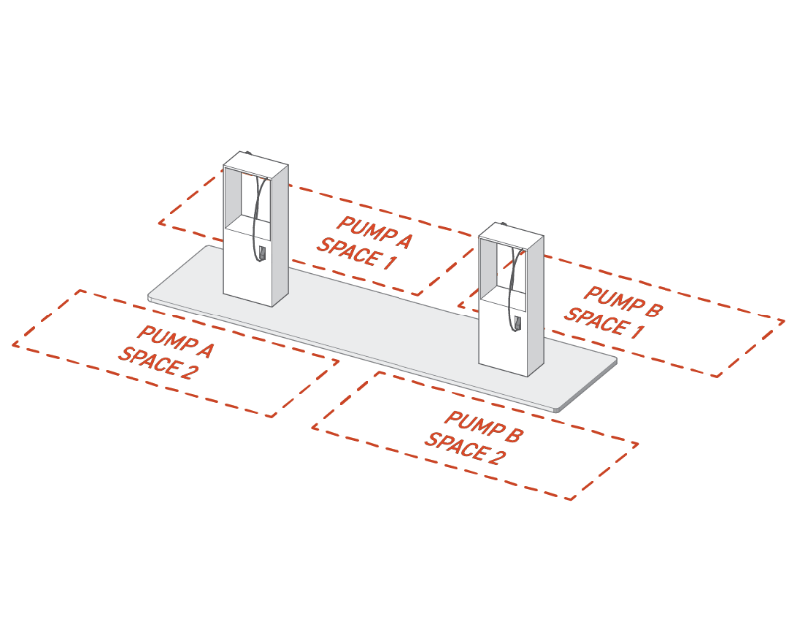
b.
A canopy for fuel pumps or a fuel station must be architecturally-integrated with any associated commercial building on the site, and must not include any signs. Canopy support columns must be fully encased with materials that are complementary to those used on the main building. The canopy band face must be of a color consistent with the main structure. Primary or fluorescent colors must not exceed 10% of each canopy band face.
c.
Any pavement associated with vehicles must be screened from view, except for drive entrances, using landscaping (see Sec. 8.3.2, Parking Lot Landscaping).
d.
Fuel pumps must be located a minimum of 100 feet from the lot line of a Protected Neighborhood property.
e.
Fuel pumps must be located a minimum of 10 feet from the build-to zone.
f.
A masonry wall may count toward the minimum build-to requirement of the district provided the following standards are met:
i.
The building must meet the minimum width requirements of Sec. 6.1.2 C.5;
ii.
The masonry wall must have openings meeting the transparency requirements of Div. 6.3. and must provide similar architectural elements to the building, such as materials, cornices, and awnings; and
iii.
The masonry wall is not required to meet the minimum story requirement of the District so long as the wall is a minimum of 12 feet in height.
g.
Direct pedestrian access to the building is required for each street frontage.
h.
Fuel pumps are permitted in any parking structure, where fuel pumps are a permitted use.
i.
Improvements to Existing Fuel Pumps, Fuel Stations
i.
Existing nonconforming stations as of the date of the adoption of this Code may be upgraded, replaced or redeveloped when, as determined by the Director, such upgrade, replacement or redevelopment is for the purpose of remedying a use that is dangerous to the general public or to ensure that such use complies with any fire code, life safety code, or other safety ordinance or regulation.
ii.
Fuel pumps or fuel stations may be upgraded, replaced or redeveloped, including an increase in building size but not an increase in the number of pumps, on the existing site with the approval of the Director.
j.
Expansion of Fuel Pumps at Existing Fuel Stations
i.
Existing nonconforming fuel pumps as of the date of the adoption of this Code may be expanded in accordance with this Section when, as determined by the Director, such expansion is for the purpose of remedying a use as that is dangerous to the general public or to ensure that such use complies with any fire code, life safety code, or other safety ordinance or regulation.
ii.
The Director may approve the addition of up to 4 fuel pumps to an existing site, provided the following standards are met:
a)
The Director determines the site has adequate room for additional fuel pumps and vehicle spacing;
b)
The building façade and fuel canopy have been brought into compliance with all of the standards of this Code;
c)
The vehicle and pedestrian access points have been brought into compliance with all of the standards of this Code;
d)
All paved areas have been screened in accordance with Sec. 8.3.2, Parking Lot Screening; and
e)
Any nonconforming signs on the property have been removed.
k.
Relocation of Existing Fuel Pumps or Fuel Stations
Existing fuel pumps or fuel stations may be relocated to an alternative site within the CX-, CC- or IX- districts with a Conditional Use Permit approval by the City Council. Any new fuel pumps or gas station must be located at least ½-mile from any existing fuel pump or gas station. The ½-mile measurement must be taken without regard to the City limits of Sandy Springs and is measured to the property line, regardless of where the fuel pumps are located on the site. Conditional Use Permit approval is predicated on the elimination of an existing site with fuel pumps or fuel station and the mitigation of the former site such that it is ready for any other permitted use in the district.
E.
Pawnshop
1.
Defined An establishment engaged in a business involved in any part of the pledge, pawn, or exchange of any goods, wares, merchandise, or any kind of personal property or title as security for the repayment of money lent. See also Sec. 26-186 of the City Code.
2.
Basic Use Standards
a.
A pawnshop must not be located within 5,000 feet of any other pawnshop or title loan or check cashing business (measured in a straight line from building entrance to building entrance).
F.
Title Loans, Check Cashing
1.
Defined A facility engaged in the business of making loans in exchange for possession of the certificate of title to property or a security interest in titled property. Also includes check-cashing, which is a business other than a bank or savings and loan or similar financial institution that cashes checks for a fee as a business activity and may or may not also make title loans as part of that business activity.
2.
Use Standards
a.
Where title loan or check cashing is allowed, it must not be located within 5,000 feet of any other title loan or check cashing business or pawnshop (measured in a straight line from building entrance to building entrance).
(Ord. No. 2023-12-23, § I(Att. A), 12-5-2023)
Sec. 7.5.16. - Vehicle Sales and Rental
A.
Defined A facility that sells, rents or leases passenger vehicles, trucks, and other consumer vehicles such as motorcycles, boats and recreational vehicles. This definition does not include rental options operated without on-site customer and support services (such as car-sharing). Vehicle sales and rental includes the following:
B.
Minor Vehicle Sales and Rental
1.
Defined Sales, rental or leasing of passenger vehicles, light trucks, vans and motorcycles.
2.
Limited Use Standards
a.
Minor vehicle rental (but not sales) is permitted as an accessory use only, and must be wholly enclosed within a parking structure.
C.
Major Vehicle Sales and Rental
1.
Defined Sales, rental or leasing of commercial vehicles, heavy equipment and manufactured homes. Includes recreational vehicles, boats, tractor-trailers, commercial box trucks, high-lifts, construction, heavy earthmoving equipment and manufactured homes.
2.
Basic Use Standards
a.
Access points must be provided at no less than the following:
i.
Roswell Road: minimum spacing 200 linear feet
ii.
All other streets: 100 linear feet
b.
No trailer or mobile building is permitted on the property (other than a temporary construction office).
c.
No part of any service buildings may be located between a primary structure and the primary street.
d.
Roll-up, garage or bay doors and similar wide openings must not face a primary street.
e.
Vehicles may not be displayed on elevated platforms. All exterior display areas must be located at ground level.
f.
Vehicles must be parked in orderly fashion similar to a regular parking lot.
g.
Outdoor display of tires is prohibited.
h.
Outdoor washing and detailing of vehicles is prohibited. All vehicle service must be conducted inside a building.
i.
All sites established after the effective date of this Development Code must conduct loading and unloading of vehicles on-site, and must not be designed to require maneuvering or parking on streets.
j.
Locations with frontage on Roswell Road: Only manufacturer-authorized new vehicle franchise dealerships (offering customary service of new and pre-owned automobiles as an accessory service only) are allowed. The minimum total acreage of the dealership must be 3 acres. The property may include multiple distinct and separate lots, provided they are located within 1,500 linear feet of each other measured in a straight line.
k.
Car vending machines are not permitted on the property.
D.
Vehicle Showroom
1.
Defined A facility that showcases and sells, rents or leases passenger vehicles, trucks, or other consumer vehicles such as motorcycles, boats and recreational vehicles.
2.
Basic Use Standards
a.
All vehicles on must be displayed indoors.
c.
No vehicle maintenance or repair apparatus can be located on site.
d.
Total square footage of the business and its operations must not exceed 5,000 square feet.
(Ord. No. 2023-12-23, § I(Att. A), 12-5-2023)
Sec. 7.6.1. - Artisanal
A.
Defined A facility for small-scale, craft production, with fewer than 5 employees on the premises at any given time. The facility must be open for the sale of products, classes, or other form of interaction with the public at least 10 days each month. Artisanal includes the following:
1.
Blacksmith, metalwork.
2.
Ceramics manufacturing.
3.
Food processing.
4.
Woodworking, cabinet makers or furniture manufacturing.
5.
Glass blowing.
6.
Jewelry, silverware and plated ware manufacturing.
7.
Musical instrument manufacturing.
8.
Leatherwork.
9.
Cobbler.
10.
Basket weaving; stitchery/quilting.
(Ord. No. 2023-12-23, § I(Att. A), 12-5-2023)
Sec. 7.6.2. - Heavy Industrial
A.
Defined A facility that involves dangerous, noxious or offensive uses or a facility that has smoke, odor, noise, glare, fumes, gas, vibration, threat of fire or explosion, emission of particulate matter, interference with radio, television reception, radiation or any other likely cause. Heavy industrial includes the following:
1.
Animal processing, packing, treating and storage, livestock or poultry slaughtering, processing of food and related products, production of lumber, explosives, fireworks, tobacco, chemical, rubber, leather, clay, bone, paper, pulp, plastic, stone, or glass materials or products, production or fabrication of metals or metal products including enameling and galvanizing.
2.
Bottling plant.
3.
Bulk fuel sales.
4.
Bulk storage of flammable liquids, chemical, cosmetics, drug, soap, paints, fertilizers and abrasive products.
5.
Chemical, cosmetics, drug, soap, paints, fertilizers and abrasive products.
6.
Concrete batch plant.
7.
Petroleum, liquefied petroleum gas and coal products and refining.
8.
Prefabricated building manufacturing.
9.
Sawmill, log production facility, lumberyard.
10.
Rubber and plastic products, rubber manufacturing.
(Ord. No. 2023-12-23, § I(Att. A), 12-5-2023)
Sec. 7.6.3. - Light Industrial/Manufacturing
A.
Defined A facility conducting light manufacturing operations within a fully-enclosed building. Light industrial manufacturing includes the following:
1.
Brewery, winery, cidery, distillery.
2.
Clothing, textile or apparel manufacturing.
3.
Assembly or manufacturing of scientific measuring instruments; semiconductor and related devices, including, but not limited to, clocks, integrated circuits, jewelry, medical, musical instruments, photographic or optical instruments or timing instruments.
4.
Micro-producers.
5.
Motion picture studio.
6.
Pharmaceutical or medical supply manufacturing.
7.
Recreational equipment manufacturing.
8.
Toy manufacturing.
9.
Sheet metal, welding, machine shop, tool repair.
10.
Furniture upholstery installation or reupholstery.
11.
Woodworking, cabinet makers or furniture manufacturing.
B.
Breweries, Distilleries, Cideries and Wineries
1.
Defined An industrial facility where malt beverages, distilled spirits, alcoholic cider or wine are produced on the premises and then sold or distributed for off-premises consumption in compliance with State law and Department of Revenue licensing requirements.
2.
Basic Use Standards
a.
Applicants are required to obtain an alcoholic beverage manufacturing license from the City and comply with State law and Department of Revenue Rules and Regulations relating to the manufacture, sale and distribution of malt beverages, distilled spirits and wine.
b.
No pouring or tasting of any alcoholic beverages is permitted between the hours of 12:00 a.m. and 8:00 a.m. any day of the week. In addition, no pouring or tasting is permitted on Sunday before 12:30 p.m. and after 11:30 p.m., or on any other days or times prohibited by State law. Promotional or educational tours of a facility are only permitted during the allowed times for pouring and tasting.
c.
All tasting processes and procedures must adhere to and be in strict compliance with state law and Department of Revenue Rules and Regulations.
d.
Applicants must comply with Chapter 6, Alcoholic Beverages of the Sandy Springs Code of Ordinances.
e.
Parking will be determined by the Director on a case-by-case basis based on preliminary plans and details of the proposed operations provided by the applicant.
f.
For brewpubs, see Restaurant.
C.
Micro-Producers (Malt Beverages, Distilled Spirits and Wine)
1.
Defined A micro-producer is defined as a micro-brewery, micro-winery or micro-distillery.
2.
Basic Use Standards
a.
Production facilities are limited to 20,000 square feet. All activities associated with micro-producing facilities must be wholly contained within the 20,000 square foot production facility.
b.
Applicants are required to obtain an alcoholic beverage manufacturing license from the City and comply with State law and Department of Revenue Rules and Regulations relating to the manufacture, sale and distribution of malt beverages, distilled spirits and wine.
c.
No tasting or pouring of any alcoholic beverages is permitted between the hours of 12:00 a.m. and 8:00 a.m. any day of the week. In addition, no pouring or tasting is permitted on Sunday before 12:30 p.m. and after 11:30 p.m., or on any other days or times prohibited by State law. Promotional or educational tours of a facility are only permitted during the allowed times for pouring and tasting.
d.
All tasting processes and procedures must adhere to and be in strict compliance with state law and Department of Revenue Rules and Regulations.
e.
The sale, by a retail licensee, of malt beverages manufactured at a microbrewery is permitted from the premises, provided that the annual quantity sold does not exceed 3,000 barrels.
f.
The sale, by a retail licensee, of distilled spirits manufactured at a micro-distillery is permitted from the premises.
g.
Applicants must comply with Chapter 6, Alcoholic Beverages of the Sandy Springs Code of Ordinances.
h.
Parking will be determined by the Director on a case-by-case basis based on preliminary plans and details of the proposed operations provided by the applicant.
D.
Film Studios
1.
Defined Facilities for the production of film, including stages, exterior sets, sound recording facilities, related commercial vehicles, and accessory fabrication activities.
2.
Limited Use Standards
a.
In CX- and OX- Districts, film studios are limited to 20% of the site.
b.
In PX- Districts, film studios must be located on sites with a minimum size of 4 acres and are limited to 50% of the site.
(Ord. No. 2023-12-23, § I(Att. A), 12-5-2023)
Sec. 7.6.4. - Research and Development
A.
Defined A facility focused primarily on the research and development of new products. Research and development includes the following:
1.
Laboratories, offices and other facilities used for research and development by or for any individual, organization or concern, whether public or private.
2.
Prototype production facilities that manufacture a limited amount of a product in order to fully investigate the merits of such a product.
3.
Pilot plants used to test manufacturing processes planned for use in production elsewhere.
B.
Life Sciences, Bio-Safety Level 1
1.
Defined BSL-1 labs are used to study infectious agents or toxins not known to consistently cause disease in healthy adults. They follow basic safety procedures, called Standard Microbiological Practices and require no special equipment or design features. Standard engineering controls in BSL-1 laboratories include easily cleaned surfaces that are able to withstand the basic chemicals used in the laboratory.
2.
Basic Standards
a.
Life Sciences, Bio-Safety Level 1 is not permitted on lots that directly abut a Protected Neighborhood or Urban Neighborhood District.
b.
Buildings with Life Sciences, Bio-Safety Level 1 uses are not permitted to be within 100 feet from any Protected Neighborhood, RU-, or RT- District.
C.
Life Sciences, Bio-Safety Level 2
1.
Defined BSL-2 laboratories are used to study moderate-risk infectious agents or toxins that pose a risk if accidentally inhaled, swallowed, or exposed to the skin. Design requirements for BSL-2 laboratories include hand washing sinks, eye washing stations in case of accidents, and doors that close automatically and lock. BSL-2 labs must also have access to equipment that can decontaminate laboratory waste, including an incinerator, an autoclave, and/or another method, depending on the biological risk assessment.
2.
Basic Standards
a.
Life Sciences, Bio-Safety Level 2 is not permitted on lots that directly abut a Protected Neighborhood or Urban Neighborhood District.
b.
Buildings with Life Sciences, Bio-Safety Level 2 uses are not permitted to be within 200 feet from any Protected Neighborhood, RU-, or RT- District.
D.
These requirements are in addition to, and do not replace or supersede, any other applicable requirements established under state law, and approval of or exemption from these requirements does not constitute approval of or exemption from requirements established under state law or from other applicable local, county, state, or federal regulations.
(Ord. No. 2023-12-23, § I(Att. A), 12-5-2023)
Sec. 7.6.5. - Resource Extraction
A.
Defined A facility that extracts minerals and other solids and liquids from land. Resource extraction includes the following:
1.
Borrow pit.
2.
Extraction of phosphate or minerals.
3.
Extraction of sand or gravel, borrow pit.
4.
Metal, sand, stone, gravel, clay mining and other related processing.
5.
Oil and natural gas extraction.
6.
Stockpiling of sand or gravel.
(Ord. No. 2023-12-23, § I(Att. A), 12-5-2023)
Sec. 7.6.6. - Vehicle Service and Repair
A.
Defined Repair and service to passenger vehicles, trucks, and other consumer motor vehicles such as motorcycles, boats and recreational vehicles.
B.
Minor Vehicle Service and Repair
1.
Defined A facility where minor vehicle repair and service is conducted. Includes audio and alarm installation, custom accessories, quick lubrication facilities, minor scratch and dent repair, emissions testing, bed-liner installation, glass repair or replacement, and auto detailing and car wash.
2.
Basic Use Standards
a.
Vehicles awaiting repair may be stored up to 14 days within a screened storage area.
3.
Limited Use Standards
a.
Permitted as an accessory use only, and must be wholly enclosed within a parking structure.
C.
Major Vehicle Service and Repair
1.
Defined A facility where general vehicle repair is conducted, including engine, transmission, brake, muffler and tire shops, along with body and paint shops.
2.
Basic Use Standards
a.
No trailer or mobile building is permitted on the property (other than a temporary construction office).
b.
Roll-up, garage or bay doors and similar wide openings must not face a primary street.
c.
Outdoor display of tires is prohibited.
d.
Outdoor washing and detailing of vehicles is prohibited. All vehicle service must be conducted inside a building.
e.
All sites established after the effective date of this Development Code must not be designed to require maneuvering or parking on streets.
f.
Vehicles awaiting repair may be stored up to 14 days within a screened storage area.
(Ord. No. 2023-12-23, § I(Att. A), 12-5-2023)
Sec. 7.6.7. - Warehouse and Distribution
A.
Defined A facility involved in the storage or movement of goods for themselves or other firms. Goods are generally delivered to other firms or the final consumer with little on-site sales activity to customers. Warehouse, storage and distribution includes the following:
1.
Building materials storage yard.
2.
Contractor storage yard.
3.
Distribution center.
4.
Enclosed storage (includes bulk storage, cold storage plants, frozen food lockers, ice, household moving and general freight storage).
5.
Fleet storage.
6.
Furniture transfer and storage.
7.
Newspaper distribution.
8.
Self-service storage, mini-warehouse.
9.
Trailer storage, drop off lot.
10.
Towing/impounding of vehicles.
11.
Tractor trailers and rail cars.
12.
Landscaping Materials.
B.
Fireworks Distributor
1.
Defined Any person, firm, corporation, association, or partnership which sells consumer fireworks and is properly licensed by the State as such.
C.
Self-Service Storage, Mini-Warehouse
1.
Defined Facilities providing separate storage areas for personal or business use designed to allow private access by the tenant for storing or removing personal property. May include accessory sales of boxes, tape and other packing-related materials. Does not include truck rental.
2.
Basic Use Standards
a.
An existing self-storage or mini-warehouse may be upgraded on its existing site with approval of the Director, provided it meets all the basic use standards.
b.
No outside storage is allowed, including vehicle or trailer leasing.
c.
All buildings must be at least 2 stories tall and have windows at 50% transparency for every level. Roller/storage unit doors must not be visible from any exterior point. The transparency requirement is for the 3 most visible sides (from a street or streets) of the building, as determined by the Director.
d.
Storage buildings must be finished with brick or stone for a minimum of 80% of the 3 most visible sides (from a street or streets) of the building.
e.
No activities other than the dead storage or transfer of nonvolatile goods or leasing of storage space are permitted within the storage establishment or portion of any development.
f.
Prohibited accessory uses include, but are not limited to, the following:
i.
Fabrication or repair of vehicles, equipment or other goods;
ii.
Transfer-storage business based on-site;
iii.
Residential uses (other than the resident manager's apartment); or
iv.
Any use which creates a nuisance due to noise, odor, dust, light or electrical interference.
(Ord. No. 2023-12-23, § I(Att. A), 12-5-2023)
Sec. 7.6.8. - Waste-Related Service
A.
Defined A facility that processes or stores waste material. Waste-related service includes the following:
1.
Automobile dismantlers/recyclers, junk yard, wrecking yard, salvage yard.
2.
Hazardous household materials collection center.
3.
Hazardous waste facility.
4.
Landfill.
5.
Recycling processing center.
6.
Scrap metal processor.
7.
Waste transfer station.
B.
Recycling Processing Center
1.
Defined Any facility utilized for the purpose of collecting, sorting, and processing materials to be recycled including, but not limited to, plastics, glass, paper, and aluminum materials.
2.
Basic Use Standards
a.
A minimum 200-foot buffer and 10-foot improvement setback is required along all common lot lines, except rights-of-way. A minimum 50-foot buffer and 10-foot improvement setback is required along all rights-of-way.
b.
All recyclable materials must be stored in containers with no stockpiling outside the containers.
c.
Collection, storage containers, or receptacles are not allowed in required yards. Storage must be screened (see Sec. 8.3.9).
d.
The processing of recyclable materials must be conducted within an enclosed building.
e.
Driveways must be designed so vehicles exit the facility in a forward direction.
f.
The recycling center must comply with regulations administered by the Fulton County Department of Health.
(Ord. No. 2023-12-23, § I(Att. A), 12-5-2023)
Sec. 7.7.1. - Agriculture
A.
Defined The production of crops, livestock or poultry. Agriculture includes the following:
1.
Community garden.
2.
Commercial composting.
3.
Plant nursery.
4.
Timber harvesting.
5.
Urban farming.
B.
Community Garden
1.
Defined Areas of land managed and maintained by a group of individuals to grow and harvest crops and non-food ornamental crops, for personal or group use, consumption, or donation. A community garden is to be primarily used for growing and harvesting food crops and ornamental crops, for consumption or donation or for sale off-site. They may be divided into separate plots for cultivation by 1 or more individuals or may be farmed collectively by members of the group and may include common areas maintained and used by the group. On-site sales, as regulated below, are permitted in nonresidential districts.
2.
Basic Use Standards
a.
On-site sales are not permitted in any Protected Neighborhood or Urban Neighborhood District outside of special events, permitted separately. On-site sales may be permitted in the Corridors & Node Districts with the approval of a conditional use permit, following the procedures set forth in Div. 11.3. Sales are restricted to horticultural and agricultural products produced on the premises.
b.
Detached accessory structures such as storage or utility buildings, gazebos, trellises, or accessory greenhouse structures are permitted, subject to compliance with the requirements of the zoning district and the requirements for accessory structures in Div. 7.8.
c.
If lighting is installed, only motion-detecting fixtures are permitted. All-night lighting is prohibited.
d.
Community gardens must be managed and maintained in compliance with all applicable standards of this Development Code and the City Code, including, but not limited to, those pertaining to: nuisance abatement, stormwater, site accessibility, signs, soil erosion and sedimentation control and any required tree conservation and landscaping.
e.
The raising of animals is subject to the following conditions:
i.
The community garden must be in active use for the growing and harvesting of crops.
ii.
Hoofed animals are prohibited.
iii.
Chickens are permitted. See Sandy Springs City Code Chapter 10, Article I, Sec. 10-16.
iv.
A maximum of 2 bee hives are permitted.
v.
Any coop, hutch, or other structure for housing animals must be located at least 25 feet from any property line.
vi.
No structures are allowed in the required front setback area. Build-to requirements do not apply.
C.
Commercial Composting
1.
Defined A commercial processing operation for the treatment of vegetative matter, such as trees, leaves and plant material, into a humus-like material that can be recycled as a soil fertilizer amendment, for sale to off-site users. Organic animal waste, food, municipal sludge, solid waste, and other non-farm or vegetative type wastes are not included.
2.
Basic Use Standards
a.
Lot area must be a minimum of 5 acres.
b.
Permitted curb cut access must be from an arterial or collector road.
c.
The hours of operation are limited to the hours of 7:00 a.m. through 6:00 p.m.
d.
All operations must maintain a minimum setback of 100 feet from all property lines.
e.
On-site traffic must be limited to an all-weather surfaced area.
f.
Stored materials must be contained in such a manner as to prevent the blowing of any materials onto any surrounding property, roadway, or into surface waterways.
g.
The composting facility is required to obtain all necessary permits from the Department of Natural Resources, Environmental Protection Division.
D.
Plant Nursery
1.
Defined A business in which the primary operation is the sale of seeds and organic and inorganic materials, including, but not limited to, trees, shrubs, flowers, and other plants for sale or transplanting, mulch, pine straw, and other organic products for landscaping purposes, and other limited retail accessory products for gardening and/or landscaping.
E.
Timber Harvesting
1.
Defined The cutting, harvesting or hauling of timber (softwood or hardwood) for delivery as pulpwood, logs, poles, posts or wood chips on a property meeting the State definition of a bona fide conservation use property in O.C.G.A. 48-5-7-4.
F.
Urban Farm
1.
Defined Raising and harvesting of trees (excluding forestry), vines, seeds, plants and crops, as well as keeping, grazing or feeding of animals (including fish) for animal products, animal propagation, or value increase when located in an urbanized (developed) area. An urban farm may be owned by an individual, group or organization and may include intensive agriculture, typical large-scale farm equipment, and animal husbandry.
2.
Basic Use Standards
a.
Detached accessory structures such as storage or utility buildings, gazebos, trellises, or greenhouses are permitted, subject to compliance with the requirements of the zoning district and Div. 7.8.
b.
On-site sales may be permitted upon approval of a conditional use permit under Div. 11.3.
c.
Where lighting is installed, only motion-detecting fixtures are permitted. All-night lighting is prohibited.
d.
Livestock raising may be allowed as an accessory use subject to the use table and the district in which that use is located.
e.
Poultry raising may be allowed subject to Sandy Springs City Code Chapter 10, Article I, Sec. 10-16.
(Ord. No. 2023-12-23, § I(Att. A), 12-5-2023)
Sec. 7.8.1. - Amphitheater
A.
Defined A structure having tiers of seats rising gradually outward from a central open space, stage, band shell or arena.
B.
Basic Use Standards
1.
Lot area must be a minimum of 10 acres.
2.
The stage must be located a minimum of 600 feet from adjacent properties zoned for residential use.
3.
Permitted curb cut access must be from an arterial street.
4.
A minimum 100-foot buffer and minimum 10-foot improvement setback must be provided along all common lot lines adjacent to a Protected Neighborhood or Urban Neighborhood District.
5.
A minimum 50-foot buffer and 10-foot improvement setback must be provided adjacent to all common lot lines adjacent to all zoning districts other than Protected Neighborhood or Urban Neighborhood Districts.
6.
Buffer design must follow the standards of Neighborhood Transitions (see Sec. 8.3.6 A).
7.
The hours of operation are limited to the hours of 8:00 a.m. to 11:00 p.m. when adjacent to a property zoned for residential use.
(Ord. No. 2023-12-23, § I(Att. A), 12-5-2023)
Sec. 7.8.2. - Car Wash
A.
Defined An accessory facility with mechanical equipment used for cleaning, washing, polishing, or waxing of motor vehicles, typically associated with a convenience store with fuel pumps, gas station.
B.
Basic Use Standards
1.
Only 1 single-bay automatic (not self-service) car wash that is completely enclosed except for openings necessary to allow entry and exit of vehicles is allowed.
2.
Neighborhood Transitions standards (see Sec. 8.3.6) apply to all common lot lines adjacent to Protected Neighborhood and Urban Neighborhood Districts.
3.
When abutting a ground floor residential use, the car wash facility must not operate before 7:00 a.m. or after 11:00 p.m.
4.
Car washes may be located in parking structures when fully enclosed within the structure.
(Ord. No. 2023-12-23, § I(Att. A), 12-5-2023)
Sec. 7.8.3. - Day Care
A.
Defined A facility meeting the definition of Sec. 7.5.5, Day Care.
B.
Basic Use Standards
Day care as an accessory use is only permitted when the following standards are met:
1.
The day care must be associated with a permitted place of worship or private school (K-12); and
2.
The day care must meet all the use standards of Sec. 7.5.5, Day Care.
3.
Day care facilities in association with a place of worship do not require a separate conditional use permit.
(Ord. No. 2023-12-23, § I(Att. A), 12-5-2023)
Sec. 7.8.4. - Drive-Through Facility
A.
Defined A facility at which the customer is served while sitting in a vehicle, typically associated with drive-through restaurants, banks and pharmacies.
B.
Basic Use Standards
1.
No drive-through window, lane or order box is allowed within 50 feet of a Protected Neighborhood or Urban Neighborhood District (measured from the residential lot line to the closest point of the drive-through lane);
2.
All drive-through areas, including, but not limited to, menu boards, stacking lanes, trash receptacles, ordering box, drive up windows, and other objects associated with the drive-through, must be located to the side or rear of the principal building. Drive-through windows and lanes may not be placed between a street (not including an alley) and the associated building; and
3.
Stacking requirements are in Sec. 8.2.9.
4.
Pedestrian crossings must be raised with stamped concrete design or pavers. General pedestrian paths must either be raised or installed as a sidewalk.
C.
An existing legal nonconforming drive-through facility may be relocated, renovated and/or expanded within a same development, provided it is associated with a restaurant and located on the outparcel of a larger development. Any modification to a nonconforming drive-through must be in accordance with the use standards listed above.
(Ord. No. 2023-12-23, § I(Att. A), 12-5-2023; Ord. No. 2025-09-22, § I, 9-16-2025)
Sec. 7.8.5. - EV Charging Facility
A.
Defined A facility that provides electric vehicle infrastructure for the purpose of charging electric vehicles as an accessory to another primary use.
1.
Charging Level The standardized indicators of electrical force, or voltage, at which an electric vehicle's battery is recharged:
a.
Level 1 The slowest type of charging equipment plugs directly into a standard 120-volt AC outlet supplying an average power output of 1.3 kW to 2.4 kW.
b.
Level 2 Considered medium charging; typically requires a 40-100 amp breaker on a 240-volt AC circuit.
c.
Level 3 or greater Considered rapid charging; typically requires a 60 amp or higher dedicated breaker on a 480-volt or higher 3-phase circuit with special grounding equipment. DC fast charging uses an off-board charger to provide the AC to DC conversion, delivering AC directly to the car battery.
2.
Electric Vehicle Infrastructure The structures, machinery, and equipment necessary and integral to supporting an electric vehicle, including the electrical conduit and wiring requirements for the installation of electric vehicle charging equipment.
B.
Exempt The following EV charging facilities are exempt from these regulations:
1.
Single Unit Residential Charging facilities located on single unit detached or attached lots designated as private, restricted use only. All installations must comply with the placement and screening requirements of mechanical equipment found in Sec. 6.1.2 B.3 and Sec. 8.3.9.
2.
Enclosed in Parking Structure Any EV charging facilities located within an enclosed parking structure or garage. These installations must comply with the signs and maintenance requirements below.
C.
Basic Use Standards
1.
Signs
a.
Signs must be posted identifying voltage and amperage levels and use, fee, and safety information related to the EV charging facility.
b.
Signs must be posted at public EV charging facilities indicating that the space is reserved for EV charging purposes only. For purposes of this provision, "charging" means that an electric vehicle is parked at an EV charging facility and connected to the battery charging station equipment, otherwise known as "actively charging."
c.
Prohibited signs (Sec. 8.4.3) are not allowed.
d.
Level 2 charging facilities must have no more than 25% of the total charger used for signs or an otherwise illuminated display. Level 2 charging facilities do not require a sign permit but will instead be verified as a part of the building permit. This sign percentage requirement does not apply when the charger is located within a parking structure or garage.
e.
Level 3 or greater charging facility must have no more than 50% of the total charger used for signs or otherwise illuminated display. Level 3 or greater charging facilities do not require a sign permit but will instead be verified as a part of the commercial building permit. This sign percentage requirement does not apply when the charger is located within a parking structure.
2.
No portion of the EV charging facility can impede pedestrian, bicycle, or wheelchair movement, or create a safety hazard.
3.
EV charging facilities, including electrical transformers and other mechanical equipment associated with the charger, must conform to any applicable screening requirements in Sec. 8.3.9.
4.
All proposed or improved on-street parking is required to install conduit for future EV charging facilities.
5.
A Level 2 charging facility must be no wider than 24 inches at any point, not including the plug handle, hook, hose, and related components.
6.
A group of 6 or more Level 3 or greater EV charging facilities is considered a designation EV installation and must be an accessory to a primary retail use.
7.
An EV charging facility must be located a minimum of 10 feet from the build-to zone. In Perimeter Districts, the charger must be located a minimum of 20 feet from the build-to zone.
8.
A masonry wall may count toward the minimum build-to requirement of the District provided the following standards are met:
a.
The building must meet the minimum width requirements of Sec. 6.1.2 C.5;
b.
The masonry wall must have openings meeting the transparency requirements of Div. 6.3 and must provide similar architectural elements to the building, such as materials, cornices, and awnings; and
c.
The masonry wall is not required to meet the minimum story requirement of the district so long as the wall is a minimum of 12 feet in height.
9.
EV charging facilities must be maintained, including the functioning of the equipment. A phone number or other form of contact information must be provided on the equipment to report when it is not functioning, or other problems are encountered.
10.
EV charging facility canopies must be architecturally integrated with any associated commercial building on the site and not include any signs. Canopy support columns must be fully encased with masonry materials that are complementary to those used on the main building. The canopy band face must be of a color consistent with that of the main structure or an accent color. Primary or fluorescent colors must not exceed 10% of each canopy band face.
11.
No charging facility may be located within 50 feet of the lot line of a Protected Neighborhood.
12.
Existing Fuel Pumps or Fuel Stations
Level 2 charging facilities may be installed at existing fuel pumps on existing parking spaces, so long as they are at least 10 feet from any build-to zone. Level 3 or greater charging facilities may replace existing fuel pumps on a site.
(Ord. No. 2023-12-23, § I(Att. A), 12-5-2023)
Sec. 7.8.6. - Family Day Care Home
A.
Defined A private residence in which a business is operated by any person for pay that provides for supervision and care for up to 6 children under 18 years of age who are not residents in the same private residence.
B.
Basic Use Standards
1.
The family day care home must operate fewer than 24 hours per day.
2.
The family day care home must be registered with the State of Georgia as a Family Child Care Learning Home and licensed by the City of Sandy Springs.
(Ord. No. 2023-12-23, § I(Att. A), 12-5-2023)
Sec. 7.8.7. - Farmers Market
A.
Defined The outside temporary display and sale of agricultural products sold directly by farmers. A farmers market typically consists of booths, tables or stands where farmers sell fruits, vegetables, meats, and sometimes prepared foods and beverages and crafted goods.
B.
Basic Use Standards
1.
A farmers market on private property requires a special event permit.
2.
A set of operating rules addressing the governance structure for the market, hours of operation, maintenance, security, and the appointment of a market manager must be prepared.
3.
All temporary structures such as umbrellas, tables, and displays must be removed when not in use or be stored within a screened storage area.
4.
The on-site presence of a market manager during hours of operation is required.
5.
All waste must be removed from the site each day.
6.
Hours of Operation:
a.
The farmers market may operate between the hours of 7:00 a.m. and 9:00 p.m.
b.
A market cannot operate more than 2 days per week and more than 6 hours per day.
c.
Set-up of market operations may begin no earlier than 6:00 a.m. and take-down must end no later than 10:00 p.m.
7.
Inventory:
If a booth sells farm products or value-added farm products that are not produced by the vendor, the booth must explicitly disclose the producer's name and location in writing with lettering that is at least 2 inches tall and visible to the consumer.
(Ord. No. 2023-12-23, § I(Att. A), 12-5-2023)
Sec. 7.8.8. - Fuel Pumps
A.
Defined A facility for the sale of motor vehicle fuel, typically located on the same lot and associated with a retail use.
B.
Basic Use Standards
1.
Up to 8 fuel pumps may be established as an accessory use to an existing retail use that has a minimum floor area of 35,000 square feet.
2.
The fuel pumps must not impact the compliance of any other use on the site with any requirement of this Code.
3.
The fuel pumps must meet all of the requirements of this Code, including build-to, landscape screening, and signs.
4.
No convenience sales or vending machines are allowed in association with the fuel pumps.
5.
The proposed site layout will be reviewed by the Director for compliance with vehicle stacking, vehicle access, and pedestrian access requirements.
6.
Existing Accessory Fuel Pumps
a.
Sites with existing accessory fuel pumps may expand to provide a maximum of 8 fuel pumps without meeting the build-to requirement. All other use standards apply.
(Ord. No. 2023-12-23, § I(Att. A), 12-5-2023)
Sec. 7.8.9. - Greenhouse, Non-Commercial
A.
Defined A greenhouse that is not used to raise products for sale.
(Ord. No. 2023-12-23, § I(Att. A), 12-5-2023)
Sec. 7.8.10. - Home Occupation
A.
Defined An occupation that provides a service or product that is conducted wholly within a residential dwelling, unless classified as "outdoor" below.
B.
Basic Use Standards
1.
General Provisions
a.
No more than 2 home occupations may be established in a dwelling.
b.
A home occupation must be clearly incidental and secondary to the use of the dwelling for residence purposes.
2.
Physical Limitations The gross floor area of a dwelling unit devoted to all home occupations must not exceed 750 square feet, or 25% of the gross floor area of the dwelling, whichever is less.
3.
Alterations to the Dwelling The exterior appearance and character of the dwelling must remain that of a dwelling.
4.
Vehicles and Parking
a.
Vehicles kept on site in association with the home occupation must be used by residents only.
b.
Only vehicles used primarily as passenger vehicles are permitted in connection with the conduct of a home occupation. One limousine or other livery car may be kept on-site, provided it is driven by an occupant of the dwelling.
c.
The transport of goods by commercial truck is prohibited.
5.
Equipment, Off-Site Impacts and Nuisances
a.
No home occupation may generate traffic, sound, smell, vibration, light, or dust that is offensive or that creates a nuisance.
b.
No equipment that interferes with radio or television reception is allowed.
c.
Home occupations must exclude the use of machinery or equipment that emits sound (for example, saws, drills, or musical instruments) detectable beyond the property.
d.
Chemical, electrical, or mechanical equipment that is not normally a part of domestic or household equipment which is used primarily for commercial purposes is not permitted.
6.
Visitation
a.
Total client visits are limited to 5 per week in conjunction with the home occupation. The following exceptions are made for the purposes of meeting overriding public goals of education and the care of children:
i.
Educational tutoring or instruction in music, dance, fitness, arts and crafts, and similar subjects, limited to 2 students in the home at 1 time; and
ii.
A family day care home (see Sec. 7.8.4).
7.
Employees and Licenses Only occupants of the dwelling and 1 additional employee, consultant, or agent or subcontractor are allowed to work on the premises in connection with a home occupation. Any occupational licenses, including business registrations, required by State, County, or City regulations must be obtained.
8.
Display, Stock-in-Trade, Sales and Storage
a.
Display, stock-in-trade and any commodity sold or stored on the premises in connection with a home occupation is prohibited.
b.
No activity associated with the home occupation may be visible outside the dwelling.
9.
Cottage Food Operator
a.
Cottage food operators are required to have a Cottage Food License issued by the Georgia Department of Agriculture annually and comply with Chapter 40-7-19, Cottage Food Regulations, of the Rules of Georgia Department of Agriculture Food Safety Division.
b.
Allows production of non-potentially hazardous foods in their home kitchens for sale to the end consumer. These foods include: Loaf bread, rolls and biscuits; cakes; pastries and cookies; candies and confections; fruit pies; jams, jellies and preserves; dried, fruits; dry herbs, seasonings and mixtures; cereals, trail mix and granola; coated or uncoated nuts; vinegar and flavored vinegar; and popcorn, popcorn balls and cotton candy.
10.
Uses Specifically Prohibited The following uses are specifically prohibited as home occupations. This list is not all-inclusive. The Director may prohibit additional uses that do not meet the intent of these home occupation regulations.
a.
Animal care (not a hobby kennel).
b.
Commercial or catering kitchen (except a cottage food operator).
c.
Funeral home.
d.
Hotel or motel.
e.
Limousine or other car livery service with more than 1 car on site.
f.
Machine shop.
g.
Personal services.
h.
Restaurant.
i.
Retail services.
j.
Special event facility.
k.
Vehicle sales or rental.
l.
Vehicle service and repair.
m.
Wholesale facility.
C.
Home Occupation (Outdoor)
1.
Defined An occupation that provides an outdoor recreational, educational, or instructional service, which by its nature, must be conducted outside the principal residential structure. This includes swimming lessons and personal athletic coaching.
2.
Basic Use Standards
a.
General Provisions
i.
No more than 2 home occupations (total of any indoor & outdoor home occupations) may be established on a residential lot.
ii.
No more than 1 outdoor home occupation may be established on a residential lot.
iii.
A home occupation must be clearly incidental and secondary to the use of the dwelling for residence purposes.
iv.
No activity associated with an outdoor home occupation may conducted between the wall plane of a dwelling and a street other than an alley.
b.
Alterations to the Residential Lot The exterior appearance and character of the residential lot must remain that of a residential lot.
c.
Vehicles and Parking
i.
All parking needs in association with the outdoor home occupation must be met on the residential lot. The outdoor home occupation must provide a transportation plan that demonstrates how parking needs can be met on-site. That plan must mark the parking spaces to be used by the home business (outdoor), ingress/egress routes, and anticipated trip generation.
ii.
In addition to the requirements in Div. 8.1, an outdoor home occupation must provide 2 additional parking spaces on-site. Tandem parking is not allowed for these additional parking spaces (see Sec. 8.2.5 D).
d.
Equipment, Off-Site Impacts and Nuisances
i.
No home occupation may generate traffic, sound, smell, vibration, light, or dust that is offensive or that creates a nuisance.
ii.
No equipment that interferes with radio or television reception is allowed.
iii.
Home occupations must exclude the use of machinery or equipment that emits sound (for example, saws, drills, or musical instruments) detectable beyond the property.
iv.
Chemical, electrical, or mechanical equipment that is not normally a part of domestic or household equipment which is used primarily for commercial purposes is not permitted.
v.
Any part of a property used for an outdoor home business must be screened from adjoining properties with an opaque fence or wall. Said wall or fence must be at least 6 feet tall and must meet the standards in Sec. 8.3.10 of the Development Code. In lieu of the 6-foot fence, an outdoor home business may be screened with a 20-foot buffer similar to the standards in Sec. 8.3.7 B. of the Development Code.
e.
Visitation
i.
Total client visits are limited to 2 students being tutored at 1 time with a maximum of 4 students per hour.
ii.
Outdoor home occupations are limited to between 8.00 a.m. to 6.00 p.m. on weekdays, and to between 8.00 a.m. to 5.00 p.m. on Saturdays. No activity is allowed outside these hours, on Sundays, or on legal holidays (New Year's Day (as observed by the City), Memorial Day, Independence Day (as observed by the City), Labor Day, Thanksgiving Day, and Christmas Day (as observed by the City).
iii.
Outdoor home occupations are limited to a maximum of 6 hours of operation per day.
f.
Employees and Licenses
i.
Only occupants of the dwelling are allowed to work on the premises in connection with a home business (outdoor). Any occupational licenses, including State, County, or City regulations must be obtained.
ii.
An operator of any outdoor home occupations with clients under 18 years of age must possess and maintain Red Cross CPR (cardiopulmonary resuscitation) Certification or a similar certification.
g.
Swimming Pools
i.
For any outdoor home occupation utilizing a swimming pool, the pool, pool deck, and pool enclosure must meet the requirements of the International Swimming Pool and Spa Code.
ii.
An operator of an outdoor home occupation utilizing a swimming pool in any capacity must possess and maintain Red Cross Swim Instructor Certification or a similar certification.
(Ord. No. 2023-12-23, § I(Att. A), 12-5-2023)
Sec. 7.8.11. - Horse Stable, Non-Commercial
A.
Defined A structure for sheltering horses for the use and enjoyment of residents of the property.
B.
Basic Use Standards
1.
The horse stable may only be used for non-commercial, personal purposes.
2.
The minimum lot size for the keeping of horses is 2 acres. No more than 3 horses may be kept on the 2 acres.
3.
An additional 0.5 acre is required for each additional horse beyond 3 horses.
4.
Any accessory building or structure related to the keeping of horses must be located a minimum of 150 feet from any common lot line of a Protected Neighborhood or Urban Neighborhood District.
(Ord. No. 2023-12-23, § I(Att. A), 12-5-2023)
Sec. 7.8.12. - Kennel, Residential
A.
Defined Each premises where there are 4 or more dogs over the age of 4 months kept, maintained or harbored for a period of 14 days or longer will be deemed to constitute a kennel.
B.
Basic Use Standards
1.
A business license is required when revenue is generated from the sale of animals.
2.
If the kennel is a non-business operation, its use may be certified by the Fulton County Animal Control Office.
(Ord. No. 2023-12-23, § I(Att. A), 12-5-2023)
Sec. 7.8.13. - Livestock Raising
A.
Defined Livestock includes any animals of the equine, swine, or bovine class including goats, sheep, mules, cattle, hogs, pigs and other grazing animals, and all ratites, including, but not limited to, ostriches, emus and rheas.
B.
Basic Use Standards
1.
The minimum lot size for raising livestock is 2 acres.
2.
Any accessory building or structure related to livestock raising must be located a minimum of 150 feet from any common lot line of a Protected Neighborhood or Urban Neighborhood District.
(Ord. No. 2023-12-23, § I(Att. A), 12-5-2023)
Sec. 7.8.14. - Outdoor Dining
A.
Defined A seating area specifically designed for the consumption of food or drink, typically associated with a restaurant, and which is either: (1) located entirely outside the walls of building; or (2) enclosed on 2 or fewer sides by walls, with or without a solid roof cover; or (3) enclosed on 3 sides by walls without a solid roof cover.
B.
Basic Use Standards
1.
The outdoor dining area must not interfere with the circulation of pedestrian or vehicular traffic.
2.
The hours of operation for the outdoor dining area may be no greater than that of the principal use.
(Ord. No. 2023-12-23, § I(Att. A), 12-5-2023)
Sec. 7.8.15. - Murals
A.
Murals A work of visual art that conforms with the following standards:
1.
Murals must be painted or drawn onto a façade or wall, without obscuring any windows or doors. Building wraps or super graphic wraps are not allowed. Projected-image signs are also not allowed.
2.
No more than 1 mural is allowed per building.
3.
A mural must be installed with the owner's permission. Any visual artwork installed without the owner's permission will be considered graffiti and must be immediately removed.
(Ord. No. 2023-12-23, § I(Att. A), 12-5-2023)
Sec. 7.8.16. - Outdoor Storage, Minor
A.
Defined Minor outdoor storage includes, but is not limited to:
1.
The outdoor storage of merchandise or material in boxes, in crates, on pallets or other kinds of shipping containers;
2.
The overnight outdoor storage of vehicles awaiting repair (but not vehicles for sale).
B.
Basic Use Standards
1.
Minor outdoor storage may not be more than 12 feet in height and must be screened from the right-of-way, public parking areas, and abutting properties using a buffer (see Sec. 8.3.7); and
2.
Vehicles awaiting repair may be stored up to 14 days within a screened storage area.
(Ord. No. 2023-12-23, § I(Att. A), 12-5-2023)
Sec. 7.8.17. - Outdoor Storage, Major
A.
Defined Major outdoor storage includes, but is not limited to:
1.
The outdoor storage of contractors' equipment;
2.
The outdoor storage of fleet vehicles; and
3.
The outdoor storage of soil, mulch, stone, lumber, pipe, steel, salvage or recycled materials, and other similar merchandise, material or equipment.
B.
Basic Use Standards
1.
Major storage must be screened from view from the right-of-way, public parking areas, and abutting properties using a buffer designed to District Boundary Buffer standards (see Sec. 8.3.7).
(Ord. No. 2023-12-23, § I(Att. A), 12-5-2023)
Sec. 7.8.18. - Short-Term Rental
A.
Defined The rental of all or part of a dwelling unit including all accessory structures or other curtilage to the same guest resident(s) for a period of less than 30 days.
B.
Basic Use Standards
1.
The dwelling unit, if it is a single-family house, townhouse or condominium, must be Owner-Occupied (as demonstrated by proof of Fulton County Homestead Exemption on property taxes).
2.
All parking must be accommodated on the lot.
3.
No more than 4 unrelated persons 18 years of age or older may occupy the short-term rental dwelling unit. For short-term rentals with more than 4 unrelated persons, see Sec. 7.9.6, Special Events.
4.
A maximum of 1 rental is permitted in its residence or on its grounds except as provided below in any 24-hour period.
a.
A maximum of 2 separate rentals may be permitted during a single 24-hour rental period only in scenarios where the owner is present for the duration of the rented stays.
5.
A rental may be issued to a single individual, family, or group for a maximum of up to 180 calendar days per year.
6.
No more than 1 rental is permitted during a 24-hour period outdoors. If a parcel includes 2 rental units as prescribed above in subsection 4.a, 1 of the units must be located within conditioned, interior space.
7.
No provision for supplemental services shall be allowed for any short-term rental.
8.
For rentals of more than 2 units, see Sec. 7.3.2 A, Group living—Boarding/Rooming house.
(Ord. No. 2023-12-23, § I(Att. A), 12-5-2023)
Sec. 7.8.19. - Poultry Raising
A.
Defined Poultry raising includes the keeping of any domesticated bird, including, but not limited to, chickens, ducks, guinea fowl, quail and pigeons.
B.
Basic Use Standards
1.
See Sandy Springs City Code Chapter 10, Article I, Section 10-16.
(Ord. No. 2023-12-23, § I(Att. A), 12-5-2023)
Sec. 7.8.20. - Skywalk
A.
Defined An enclosed overhead walkway between buildings, often across a street or connecting to structured parking.
B.
Basic Use Standards
1.
A minimum vertical clearance of 16 feet above all streets, and a minimum vertical clearance of 16 feet above the walkway must be provided.
2.
Ample space for the free flow of pedestrians with a 12-foot minimum walkway width must be provided.
3.
Prior to issuance of a building permit, an Encroachment and Indemnification Agreement must be filed with the Department as a condition of approval.
(Ord. No. 2023-12-23, § I(Att. A), 12-5-2023)
Sec. 7.8.21. - Solar Panels, Wind Turbines, Rainwater Collection Systems
A.
Defined Renewable energy systems for on-site use such as solar panels and wind turbines, along with rainwater collection systems such as rain barrels and cisterns.
(Ord. No. 2023-12-23, § I(Att. A), 12-5-2023)
Sec. 7.8.22. - Swimming Pool, Multi-Unit
A.
Defined A recreational facility designed and intended for water contact activities which serves multi-unit residential properties.
B.
Basic Use Standards
1.
All swimming pools must be completely surrounded by an enclosure that meets the requirements of the International Swimming Pool and Spa Code as well as the requirements in Sec. 8.3.10. The enclosure must be in place prior to pool completion. Materials and construction must comply with the regulations administered by the Fulton County Health Department.
(Ord. No. 2023-12-23, § I(Att. A), 12-5-2023)
Sec. 7.8.23. - Unmanned Retail Structure
A.
Defined A retail structure that stores or dispenses items for sale, rent or customer pick-up. Includes the outdoor placement of soft drink or similar vending machines, propane gas storage racks, ice storage bins, automated teller machines (ATM), donation bins, and other similar machines. May be freestanding or attached to a principal structure. (For information on electric vehicle charging facilities see Sec. 7.8.5.)
B.
Basic Use Standards
1.
General (apply to all types)
a.
Up to 3 unmanned retail structures are allowed per lot.
b.
An unmanned retail structure may not exceed a footprint of 150 square feet and 14 feet in height.
c.
The unmanned retail structure is not allowed in any required setback area.
d.
The unmanned retail structure may not encroach on any required site elements such as landscaping, buffers, required parking or pedestrian access.
2.
Freestanding
Wall signs may be applied to the unmanned retail structure, provided that they follow the sign requirements in Div. 8.3 and do not cause the lot to exceed its allocation of sign area.
3.
Attached
a.
The unmanned retail structure may not block any windows.
b.
Wall signs may be applied to the unmanned retail structure, provided that they follow the sign requirements in Div. 8.3 and do not cause the lot to exceed its allocation of sign area.
4.
Donation Bin
a.
A donation bin may not exceed a footprint of 25 square feet. Larger donation bins have to follow the requirements in Sec. 7.9.3, Temporary Use.
5.
Package Delivery Lockers
Package delivery lockers may be located outdoors, so long as they are flush with the building and do not block any windows, doors, pedestrian passage, or line of sight and they must match the building color.
(Ord. No. 2023-12-23, § I(Att. A), 12-5-2023)
Sec. 7.8.24. - Residential Accessory Structures
A.
Residential accessory structures, minor
1.
Defined Improvements typically associated with single unit residential uses that are not predominately intended for the shelter of humans or goods. Typically, minor residential accessory structures are smaller in size than major residential accessory structures, and are unenclosed on 3 or more sides. Examples include:
a.
Gazebo;
b.
Outdoor fire place, fire pit;
c.
Play structure;
d.
Sport court;
e.
Outdoor kitchen;
f.
Tree house (unconditioned); and
g.
Swimming pool.
2.
Basic Use Standards
a.
No minor residential accessory structures may be located between the front plane of the principal structure and a street. In cases where site orientation is atypical, determination is at the director's discretion.
b.
Minor residential accessory structures may be located between the principal structure and a common side, side street, or rear lot line. Minor residential accessory structures must be a minimum of 10 feet or the required setback, from any property line, whichever is less restrictive. In cases where site orientation is atypical, determination is at the director's discretion.
c.
A minor residential accessory structure may not exceed 24 feet in height. If located within the required building setbacks, a minor residential accessory structure may not exceed 15 feet in height.
d.
All swimming pools must be completely surrounded by an enclosure that meets the requirements of the International Swimming Pool and Spa Code as well as the requirements in Sec. 8.3.10. The enclosure must be in place prior to pool completion. Materials and construction must comply with the regulations administered by the Fulton County Health Department.
B.
Residential Accessory Structures, Major
1.
Defined Improvements typically associated with single unit residential uses that are predominately intended for the shelter of humans or goods. Typically, major residential accessory structures are enclosed on 2 or more sides. Examples include:
a.
Cabana, pool house;
b.
Garage, detached; and
c.
Shed.
2.
Basic Use Standards
a.
No major residential accessory structures may be located between the front plane of the principal structure and a street. In cases where site orientation is atypical, determination is at the director's discretion.
b.
Major residential accessory structures may be located between the principal structure and a common side, side street, or rear lot line. In cases where site orientation is atypical, determination is at the director's discretion.
c.
Major residential accessory structures must comply with applicable building setbacks if their footprint exceeds 500 square feet. Major residential accessory structures with a footprint of less than 500 square feet must be a minimum of 10 feet or the required setback, from any property line, whichever is less restrictive.
d.
A major residential accessory structure may not exceed 24 feet in height. If located within the required building setbacks, a major residential accessory structure may not exceed 15 feet in height.
e.
Guest houses are regulated under Sec. 7.8.6.
C.
Height Calculation Each façade or element of the accessory structure must comply with the principal building maximum height. The height is measured from the average grade directly adjacent to said façade or element.
(Ord. No. 2025-09-22, § I, 9-16-2025)
Sec. 7.9.1. - Manufactured Home
A.
While Residence Being Built
1.
Basic Use Standards
a.
The building permit for the principal structure must have been issued and remain valid during the period that the manufactured home is on the property.
b.
The manufactured home must be located on the same lot as the principal structure being constructed and comply with all zoning district setbacks.
c.
The permit will expire 12 months after issuance or upon occupancy of the principal structure, whichever occurs first. Only 1 renewal for a 1-year period may be issued.
d.
The manufactured home must be occupied by the owner of the principal residence under construction.
(Ord. No. 2023-12-23, § I(Att. A), 12-5-2023)
Sec. 7.9.2. - Cell on Wheels (COWs) Antenna
A.
Defined COWs are typically used to provide additional temporary wireless coverage or capacity for large events such as festivals, for emergency situations where existing infrastructure has been damaged, or for redevelopment where major renovation is occurring at a building with an existing rooftop-mounted antenna. A COW usually consists of a truck with a tall mast that holds up cell antennas and microwave dishes. Electrical power may be provided by a nearby building or a generator.
B.
Basic Use Standards
1.
COWs must meet all district setbacks for structures, and may not encroach on any required site elements (buffers, transitions and similar requirements).
2.
COWs require approval by the Director.
(Ord. No. 2023-12-23, § I(Att. A), 12-5-2023)
Sec. 7.9.3. - Donation Bin or Trailer
A.
Defined A donation bin is any enclosed receptacle, container or trailer that is designed or intended for the donation and temporary storage of clothing, shoes, books or other salvageable personal property items to be used by the operator for distribution, resale or recycling.
B.
Basic Use Standards
1.
Consent of the owner of the property is required prior to placement of the donation bin or trailer.
2.
The bin or trailer may not encroach on any required site elements such as landscaping, required parking or pedestrian access.
3.
Maintenance of the bin or trailer, including ensuring overflowing materials are not stacked outside the bin or trailer, is the joint obligation of the property owner and the owner of the bin.
4.
Bins and trailers can remain on a same lot no longer than 30 consecutive days and no more than twice per year. Bins shorter than 72 inches in height and with a footprint smaller than 25 square feet can remain on a same lot no longer than 5 years without approval from the Director.
5.
Allowed in non-residential zoning districts and in residential districts with non-residential uses only.
(Ord. No. 2023-12-23, § I(Att. A), 12-5-2023)
Sec. 7.9.4. - Goat/Sheep Yard Maintenance
A.
Defined The temporary use of goats or sheep to maintain a yard or other landscaped area.
B.
Basic Use Standards
1.
Allowed for up to 7 days per acre of land to be grazed.
2.
The area to be grazed must be enclosed by a temporary fence adequate to contain the animals.
(Ord. No. 2023-12-23, § I(Att. A), 12-5-2023)
Sec. 7.9.5. - Model Home
A.
Defined A new single unit detached or single unit attached building in a new subdivision or development, used to show the living space and features of other units available or proposed to be constructed.
B.
Basic Use Standards
1.
After approval of a preliminary plan, an applicant is allowed 1 building permit for each 15 lots located in the proposed subdivision, provided the applicant submits an Agreement to Install Improvements form and a cash surety equal to 125% of the cost of the remaining infrastructure improvements, based on written estimates by the design professional for the project.
2.
No more than 10 building permits for model homes are allowed in any 1 subdivision.
3.
For lots where model homes are proposed, the following conditions must be met prior to the issuance of the building permits:
a.
The lots must be located within 300 feet of an active fire hydrant; and
b.
Sanitary sewer and water service for these lots must be installed and approved by the governing regulatory authority; and
c.
The lots must have a minimum 20-foot wide fire access road extending from a paved public street to within 100 feet of the proposed structure.
4.
A certificate of occupancy will not be issued for the completed model home until the final plat encompassing the model home building lots has been approved and recorded.
(Ord. No. 2023-12-23, § I(Att. A), 12-5-2023)
Sec. 7.9.6. - Special Events
A.
Special Event
1.
See Section 50, Article IV of the City Code of Ordinances for requirements for special events not specifically defined below.
B.
Party House
1.
Defined A single unit detached, single unit attached, or multi-unit dwelling, including all accessory structures and the dwelling unit's curtilage, which is used for the purpose of hosting a commercial event. For this definition, commercial event includes parties, ceremonies, receptions or similar large-scale gatherings where a fee is charged for the use of the dwelling unit, whether or not the attendees are charged entry to the event; or parties, ceremonies, receptions or similar large-scale gatherings where attendees are charged entry. Criteria for approval shall be outlined in the administrative use permit application as established by the Director of Community Development.
2.
Basic Use Standards
a.
It is unlawful for a party house event to occur in the city without having first obtained a permit for such event.
b.
An application shall be subject to review of the Director of the Community Development Department to determine compliance with the City's zoning requirements. Administrative exceptions are subject to the approval of the City Manager.
c.
All permits are temporary and shall not vest in the holder any permanent property rights in a permit.
d.
Unless specifically provided otherwise, a party house event is subject to and must comply with any and all other applicable ordinances of the City.
e.
The location of a party house must comply with all existing zoning requirements of the City, and there must be sufficient lawful parking available.
f.
Party house use shall be prohibited within 150 feet of a property zoned RE-, RD-, PK-, CON-, RU-, RT-, RM-, RX-, PR-, or a property used for residential purposes measured from property line to property line.
(Ord. No. 2023-12-23, § I(Att. A), 12-5-2023)
Sec. 7.9.7. - Temporary Office
A.
Defined A temporary structure constructed and intended for use as an office, classroom, temporary medical facility or similar purpose.
B.
Basic Use Standards
1.
A temporary office is not allowed in any Protected Neighborhood, Urban Neighborhood or the City Springs (CS-) District.
2.
The structure must be constructed for its use and certified as such by the Department.
3.
The principal use must exist prior to the issuance of the permit.
4.
A temporary classroom must not be used to increase the capacity or enrollment as limited by zoning conditions or other use permit conditions.
5.
A permit for a temporary office expires 3 years from the date of approval, at which time the structure must be removed unless a new permit is obtained within 30 days of the expiration date.
6.
The Structure must not be located within any principal building setbacks or within any required landscaping or buffer.
(Ord. No. 2023-12-23, § I(Att. A), 12-5-2023)
Sec. 7.9.8. - Temporary Fireworks Retail Sales
A.
Defined A temporary structure that is used for the retail display and sale of consumer fireworks to the public. Temporary use is defined as a use not to exceed 90 days after issuance of a city license for the purpose of this definition.
B.
Basic Use Standards
1.
Temporary Fireworks Retail Sales are allowed only in the CX- and CC- Districts.
2.
The floor area of a temporary fireworks retail stand may not exceed 800 square feet.
3.
A permit application must be submitted to the Department no later than 45 calendar days prior to commencement of sales. A permit expires 90 calendar days after issuance of any subsequently applied for Temporary Consumer Retail Sales Stand License by the Sandy Springs Department of Revenue pursuant to O.C.G.A 25-10-5.1(c). The permitted location is not transferable and no more than 2 permits per year may be issued for any location or lot.
4.
The permit must be posted on the site during the operation of the stand.
5.
Temporary Fireworks Retail Sales must not be located within 1,500 feet of another Temporary Fireworks Retail Sales facility.
6.
Temporary Fireworks Retails Sales must be located within 500 feet of a fire hydrant, unless the Fire Marshal in writing authorizes operation in excess of 500 feet.
7.
A minimum of 6 parking spaces must be provided adjacent to the vending area for the exclusive use of the vending operation and must not occupy minimum required parking spaces for any other use.
8.
Any Temporary Fireworks Retail Sales must maintain a minimum 25-foot setback from the right-of-way and not be located within a required landscape strip, buffer or improvement setback. Sales must also maintain a minimum setback of 10 feet from any driveway.
9.
The applicant must provide a notarized written permission statement from the property owner or lease holder of the subject site. A 24-hour contact number for the property owner or lease holder must be provided along with the permit application.
10.
The hours of operation are limited to the hours of 8:00 a.m. to 9:00 p.m.
11.
No distributor equipment, vehicle, display or sales activity may block access to a public facility, including but not limited to, a mail box, parking meter, fire alarm box, fire hydrant, traffic control box, driveway or other access point.
12.
Vending is not permitted from any vehicle.
13.
Temporary Fireworks Retail Sales must not be located within 150 feet of nursing homes, hospitals, day care facilities, schools or residential districts.
14.
Temporary Fireworks Retail Sales must conform to all applicable fire code and building regulations including NFPA 1124.
(Ord. No. 2023-12-23, § I(Att. A), 12-5-2023)
Sec. 7.9.9. - Other Temporary Structure
A.
Defined Temporary Structures (whether portable toilets, tents, site-built mobile or manufactured structures) used for ticket booths, security guard shelters, storage structures, or site elements and structures in association with active construction, declared local, state, or federal states of emergency and other similar uses may be permitted by the Department in any district.
B.
Basic Use Standards
1.
Temporary structures must be located outside of any required buffers and landscape areas, and must maintain the principal building setbacks of the district. Portable toilets must be located within the buildable area and cannot be located closer than 50 feet from existing dwellings on adjacent lots.
2.
Temporary structures must be removed prior to the issuance of a certificate of occupancy or within 5 days of completion of the temporary event or activity for which the structure was approved.
3.
The temporary structure may remain in place for a duration determined by the Director, based on the information provided by the applicant, up to a maximum of 3 years. Conditions may be imposed by the Director as necessary to ensure land use compatibility and to minimize negative impacts on nearby uses. These include, but are not limited to, time and frequency of operation, temporary arrangements for parking and traffic circulation, requirement for screening or enclosure, and guarantees for site restoration and cleanup following temporary uses.
4.
The Director may allow an approved temporary structure to remain in a same location after the original expiration date, provided that the applicant submits a request at least 30 days prior to the expiration date. The Director's decision will be based on progress made in the construction of a permanent structure, complaints received regarding the structure and other pertinent information.
(Ord. No. 2023-12-23, § I(Att. A), 12-5-2023)
Sec. 7.9.10 - Other Temporary Uses
A.
Defined Temporary uses are uses established for a short period of time, including seasonal sale of pumpkins and Christmas trees. Mobile food units (food trucks) are regulated under Ch. 26, Licenses, Permits and Miscellaneous Regulations of the City Code.
B.
Basic Use Standards
1.
Temporary uses must obtain a business license from the City before operating.
2.
Allowed in non-residential zoning districts and in residential districts with non-residential uses only.
3.
A temporary use conducted in a parking lot or structure cannot occupy more than 10% of the required parking spaces (see Div. 8.1), cannot impede interior circulation, and cannot impede access from the street.
4.
Applicants must provide written approval from the property owner to conduct the temporary use.
5.
The duration of the use will be determined by the Director, based on the information provided by the applicant, up to a maximum of 30 consecutive days.
6.
A same location cannot accommodate temporary uses more than twice per year (either a same use twice, or 2 different uses once each). Only 1 temporary use at a time is allowed.
7.
Within 5 days of the expiration date, all materials, products and debris related to the operation of the temporary use must be removed from the site.
8.
Other conditions may be imposed by the Director as necessary to ensure land use compatibility and to minimize negative impacts on nearby uses. These include, but are not limited to, time and frequency of operation, temporary arrangements for parking and traffic circulation, requirement for screening or enclosure, and guarantees for site restoration and cleanup following temporary uses.
(Ord. No. 2023-12-23, § I(Att. A), 12-5-2023)
Sec. 7.9.11 - Mobile Services
A.
Defined Service provided out of a motor vehicle or attached trailer that has the ability to move from 1 location to another, such as mobile veterinary clinic.
B.
Basic Use Standards
1.
The motor vehicle or trailer must be parked on private property and cannot occupy more than 10% of the parking spaces (see Div. 8.1), cannot impede interior circulation, and cannot impede access from the street.
2.
The motor vehicle or trailer cannot remain on a same lot for more than 7 total days over a period of 3 months.
3.
A same lot cannot accommodate more than 2 mobile service vehicle or trailer at once.
4.
Allowed in non-residential zoning districts and in residential districts with non-residential uses only.
(Ord. No. 2023-12-23, § I(Att. A), 12-5-2023)

