
Sandy Springs City Zoning Code
ARTICLE 6
- GENERAL RULES
Div. 6.3. - Development Patterns
Where allowed as a Development Pattern, the following prescriptive designs may be developed according to the requirements of this Division.
Div. 6.5. - Residential Parking & Storage[2]
Editor's note—Ord. No. 2025-09-22, § I, adopted Sept. 16, 2025, amended the title of Div. 6.5 to read as herein set out. The former Div. 6.5 title pertained to residential parking.
Sec. 6.1.1. - Lot Parameters
Density
Density is not specifically regulated for any use except neighborhood unit. The maximum
number of units allowed for single unit detached or attached is directly related to
the minimum lot size of the underlying zoning district. The maximum number of units
allowed for multi-unit residential dwellings is a function of lot size, utilities,
easements, rights-of-way, stormwater, parking and height.
A.
Lot
1.
Defined A parcel of land, either vacant or occupied, intended as a unit for the purpose, whether immediate or for the future, of transfer of ownership, or possession, or for development.
2.
Recordation For use as a development site, a lot must be a lot recorded as part of a plat in the Fulton County deed records.
3.
Site A development site may include a group of contiguous lots owned or functionally controlled by the same person or entity, assembled for the purpose of development. Such a development site will be treated as 1 lot, even though multiple tax parcels are included.
B.
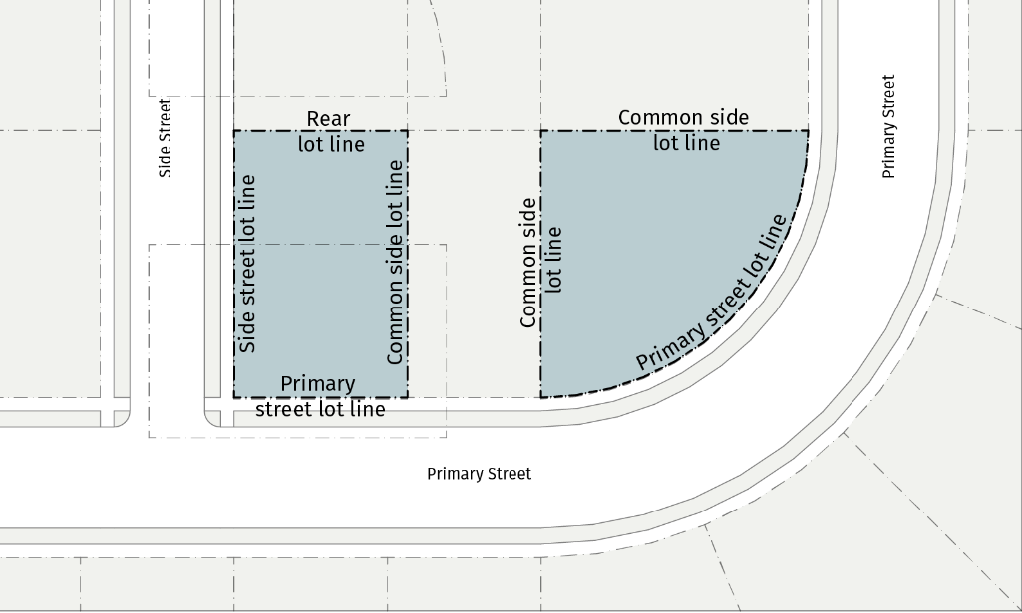
Lot Lines Each lot line must have a designation of primary street, side street, common side or rear as follows.
1.
Primary Street Lot Line A lot line separating the lot from a primary street.
2.
Side Street Lot Line A lot line separating the lot from a side street.
3.
Rear Lot Line
a.
A lot line which is opposite and most distant from the primary street lot line.
b.
In the case of a lot that fronts on 2 streets, a lot may have no rear lot line.
c.
Where no lot line is clearly opposite to the primary street lot line or where there are multiple primary street lot lines, the lot line having the highest portion of its length serving as the rear lot line of abutting lots is the rear lot line. When a rear lot line cannot be determined in this manner, the rear lot line will be determined by the Director.
4.
Common Side Lot Line
a.
Any lot line not considered a Primary Street, Side Street or Rear lot line.
b.
In developments governed by a preliminary plan, there are no common side lot lines internal to the site. See Sec. 11.4.7.
C.
Primary and Side Street Designation
1.
Where only 1 street abuts a lot, that street is considered a primary street.
2.
A multiple street frontage lot must designate at least 1 primary street. A lot may have more than 1 primary street. The Director will determine which streets are primary streets based on:
a.
The pedestrian orientation of the street, existing or proposed;
b.
The established orientation of buildings on the block;
c.
The street or streets abutting the longest face of the block;
d.
The street or streets parallel to an alley within the block;
e.
The street from which the lot takes its address; and
f.
The street with the highest classification or highest traffic counts.
3.
Where a street, including interstate and other high road classifications, abuts a lot but does not allow for direct access to the lot, that street cannot be considered a primary street.
D.
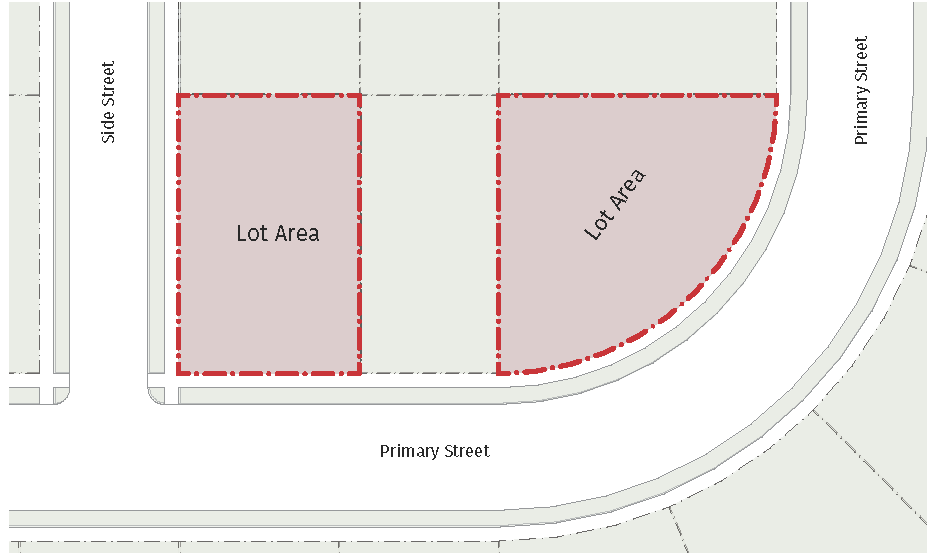
Lot Area Lot area is the contiguous land area included within the lot lines. Lot area does not include existing or proposed right-of-way, whether dedicated or not dedicated to public use.
E.
Lot Width and Lot Depth
1.
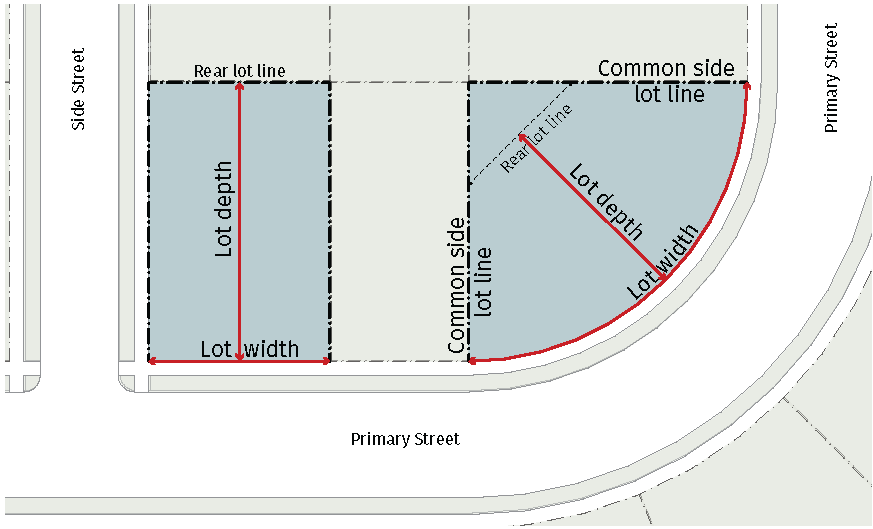
Lot width is the distance between the 2 lot lines measured at the primary or side street property line along a straight line or along the property line on a curvilinear lot.
2.
Lot depth is the distance between the front and rear lot lines measured along a line midway between the side lot lines.
F.
Lot Frontage
1.
Lot frontage is the length of any lot line abutting a primary street, side street, alley (for rear-loaded townhouses only) or courtyard (for a cottage court).
2.
Every lot or unit on a lot must have frontage upon a public street, or private street designed and built to public standards, or meet the requirements of Development Patterns found in Div. 6.3.
G.
Reserved
H.
Lot Coverage
1.
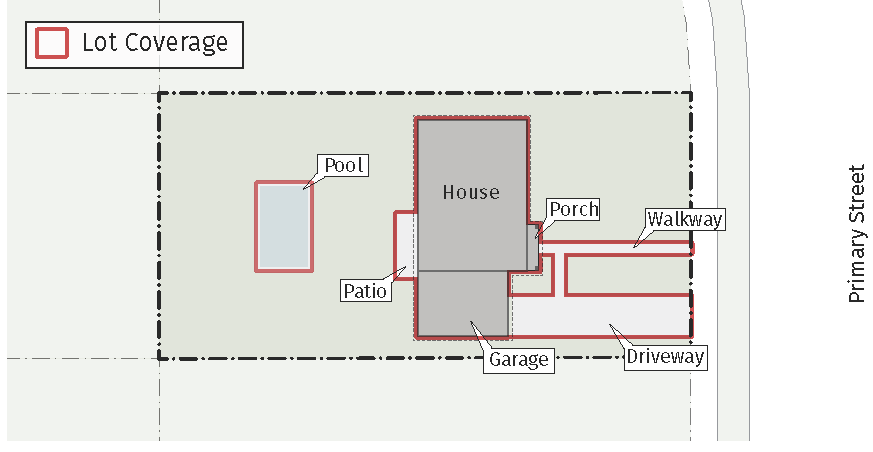
Lot coverage includes:
a.
The horizontal area of the building footprint measured within the outside of the exterior walls of the ground floor of all principal buildings and any roofed accessory building on the lot; and
b.
Any impervious parking areas, driveways, walkways, steps, terraces, uncovered patios and decks, swimming pools, and any similar features. The Director may establish rules for determining the extent to which partially pervious materials are exempt from the lot coverage.
2.
In RU- and RT- zoning districts, lot coverage can be assessed at the individual lot level, with each lot meeting lot coverage independently, or at the project level, in which case the pervious areas required to meet the lot coverage for the whole development must be under common ownership and indicated on the recorded plat.
3.
100% area credit will be given for pervious pavers and 50% area credit for pervious concrete. Other materials will be evaluated upon request.
4.
For legal nonconforming lots that are smaller than the minimum lot area required by their respective zoning districts, lot coverage is calculated by accounting for the maximum lot coverage allowed in both the district and the nearest district with a smaller minimum lot area. The total area of the lot is divided in 2 parts, 1 as the minimum lot area of the nearest zoning district, and the other as the remainder of the total area. The respective maximum lot coverage is then applied to the 2 parts. As an example, the lot coverage of a lot in RE-1 that is 34,000 square feet in size is calculated as the sum of 27,000 square feet at 30% and 7,000 square feet at 25%, for a maximum lot coverage of 9,850 square feet.
5.
In RE- and RD- Districts, the base maximum lot coverage may be supplemented by 5% if mitigation measures are implemented. The mitigation consists of providing stormwater infiltration for the additional impervious area beyond the base maximum lot coverage at a rate of 2.4 inches in 24 hours.
I.
Outdoor Amenity Space Improvement Standards (OASIS)
1.
General
a.
Outdoor amenity space is common outdoor area provided in a development for use by all of its occupants for social and recreational activities. Outdoor amenity space may also be provided for use by the general public, in addition to patrons or occupants of the development.
b.
Examples of outdoor amenity space include swimming pools, playgrounds, sport courts, dog parks, gardens, community gardens, parks, greens, pavilions, seating areas, plazas, common balconies, rooftop decks or rooftop gardens.
2.
Standards
a.
Provision and Access Required outdoor amenity space must be provided on the lot and at least 25% must be publicly accessible as outdoor space. The OASIS plan must be designed by a registered landscape architect or architect. A required buffer may not be used to meet the outdoor amenity space requirement; see paragraph h. below for exceptions.
b.
Use of Enclosed Space Required outdoor amenity space may be enclosed on 2 sides or less by walls (with or without a solid roof cover) or enclosed on 3 sides by walls without a solid roof cover.
c.
Grade Location Required outdoor amenity space may be located at or above grade. In RM-, RX- and CC- Districts, outdoor amenity space must be located at grade.
d.
Spatial Requirements Required outdoor amenity space may be met in 1 contiguous outdoor area or in multiple outdoor areas on a lot and must have a minimum area of 100 square feet with no dimension less than 15 feet.
e.
Vehicular Restrictions Required outdoor amenity space must not be parked or driven upon, except for emergency access and permitted temporary events.
f.
Groundcover At least 50% and no more than 80% of the total amount of required outdoor amenity space at grade and 25% of required outdoor amenity space above grade must be planted with groundcover, shrubs or trees. For the purposes of this Section, turf grass is not considered groundcover.
g.
Seating Seating must be provided at the rate of 1 seat for every 400 square feet or fraction of 400 square feet of required outdoor amenity space. Seats may be permanent or movable. Two linear feet of bench or seat wall equals 1 seat. Up to 50% of the required seating may consist of seat walls.
h.
Path A path to the accessible OASIS area is required and must consist of pavers, concrete, or asphalt. Alternative materials may be considered with the approval of the Director. When a path is located in a natural setting (such as a state waters buffer) or other greenspace that cannot be used as amenity space in its entirety, the path may count towards the outdoor amenity space area calculation by using a width of 25 feet, multiplied by the length of the path.
i.
Pet Relief A multi-unit development of 20 residential units or more must provide a pet relief station at a rate of 5 square feet per unit, up to a maximum of 500 square feet required. This is in addition to OASIS requirements. Consideration may be given for OASIS based on integration of design between the spaces at the discretion of the Director.
j.
Minimum Amenity Space The table below provides the requirements for outdoor amenity space, based on lot size:
k.
Landmark Tree Credit A reduction of 1% point from the requirements listed above for lots 1.0 acre and larger may be granted for every healthy landmark tree (as defined by Sec. 9.3.6) incorporated into the design of the outdoor amenity space.
l.
Additional Public Access Credit A reduction of 1% point from the requirements listed above for lots 1.0 acre and larger may be granted for every 1,000 square foot of outdoor amenity space accessible and usable by the public beyond the minimum required. The OASIS must be accessed directly from the public right-of-way and be open between 8:00 a.m. and 8:00 p.m. at a minimum.
m.
Credit Maximum No reduction, based on paragraphs k. and l. above individually or combined, greater than 3% points for lots 1.0—1.9 acres and no greater than 5% points for lots of 2 acres and greater in size will be granted.
n.
Pedestrian Amenity Space Allowance
i.
General
Pedestrian Amenity Space is a type of Outdoor Amenity Space intended to create a pedestrian-friendly environment, and therefore has more standards than other Outdoor Amenity Spaces. In addition to the standards below, Pedestrian Amenity Space is intended to be publicly accessible and located in close proximity to the public sidewalk. Examples include patios and plazas.
ii.
Standards
The Director may approve outdoor amenity space meeting the requirements of pedestrian amenity space to fulfill the outdoor amenity space requirement. Pedestrian amenity space requirements include:
a)
Each square foot of pedestrian amenity space counts as 2 square feet of the required outdoor amenity space.
b)
Pedestrian amenity space must be accessible and usable by the public.
c)
Pedestrian amenity space must have a minimum area of 400 square feet with no dimension less than 15 feet.
d)
At least 25% of the pedestrian amenity space must abut and be directly accessible from the sidewalk of a primary street or side street.
e)
Pedestrian amenity space cannot be separated from the sidewalk by any structure for more than 40% of the width of the amenity space.
f)
The finished elevation of the pedestrian amenity space must be located at the same grade as the sidewalk or the ground story.
g)
All building façades abutting the pedestrian amenity space must meet the transparency and entrance requirements of the zoning district.
h)
A minimum of 15% of the pedestrian amenity space must be a planted area with trees or groundcover and a minimum of 25% of the pedestrian amenity space must be hardscaped.
i)
Pedestrian amenity space cannot be used for vehicle parking or access, except for emergency access or permitted temporary events.
j)
Mechanical equipment cannot be located in a pedestrian amenity space or between the pedestrian amenity space and the building.
(Ord. No. 2023-12-22, § I(Att. A), 12-5-2023; Ord. No. 2025-09-22, § I, 9-16-2025)
Sec. 6.1.2. - Building Placement
A.
Building Setbacks
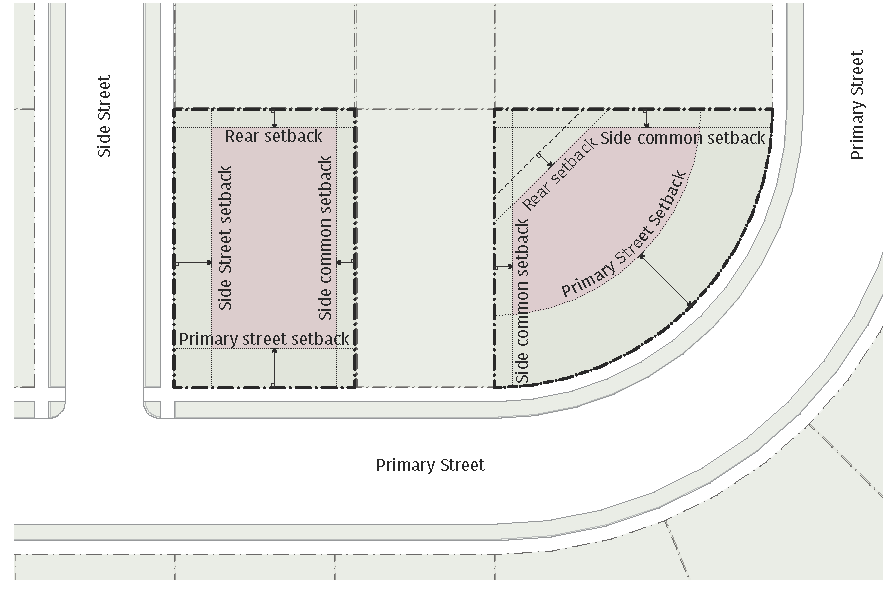
1.
Type of Setbacks There are 4 types of setbacks: primary street, side street, common side and rear. Building setbacks apply to both principal and accessory buildings or structures except where this Development Code explicitly states otherwise.
2.
Measurement of Building Setbacks
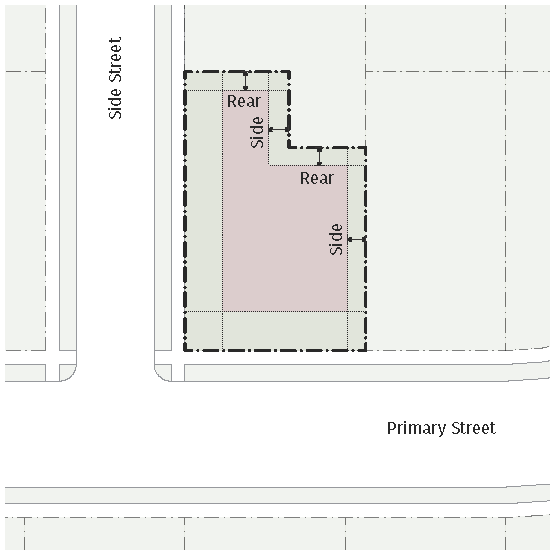
a.
A primary street setback is measured at a right angle (perpendicular) to the primary street lot line.
b.
A side street setback is measured at a right angle (perpendicular) from the side street lot line.
c.
A rear setback is measured at a right angle (perpendicular) to the rear property line or the rear lot line.
d.
All lot lines which are not primary street, side street or rear lot lines are considered common side lot lines for the purpose of measuring setbacks. Common side setbacks are measured at a right angle (perpendicular) from the side lot line.
e.
All setbacks are drawn using an extension of a line perpendicular to the lot line until they intersect with another setback line.
f.
Reserved.
g.
Where street right-of-way dedication occurs, all setbacks are measured from the final property line.
3.
Irregularly-Shaped Lots The Director will determine how setbacks apply to irregularly-shaped lots. (See also Sec. 6.1.1 B.)
4.
Irregular Rights-of-Way The Director may determine primary or side street setbacks will be measured from the back of curb when rights-of-way widths vary.
B.
Setback Encroachments All buildings and structures must be located at or behind the required setbacks, except as listed below. No building or structure can extend into a required buffer, easement (including private street easement) or public right-of-way.
1.
Building Features
a.
All Setbacks.
i.
Building eaves, roof overhangs, gutters, downspouts, light shelves, bay windows, and oriels less than 10 feet wide, cornices, belt courses, sills, buttresses, or other similar architectural features may encroach up to 3 feet into a required setback, if such extension is at least 3 feet from the vertical plane of any lot line.
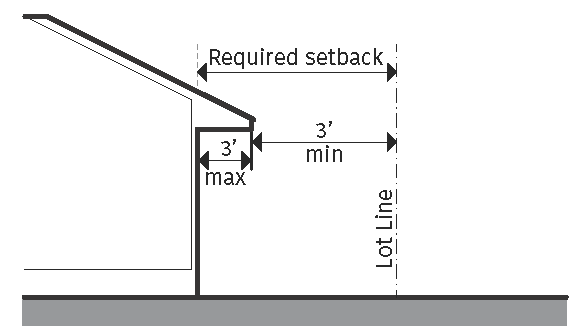
ii.
Chimneys may encroach up to 4 feet into a required setback, if such extension is at least 5 feet from the vertical plane of any lot line.
iii.
Handicap ramps may encroach to the extent necessary to perform their proper function.
iv.
Balconies may encroach no more than 10 feet into a required setback, if such extension is at least 5 feet from the vertical plane of any lot line. Balconies are not required to be set back from lot lines in instances where a zero-foot setback is employed.
v.
Awnings/canopies may extend into a required setback if such extension is at least 3 feet from the vertical plane of any lot line.
b.
Primary and Secondary Street Setbacks. Porches, raised entries, and stoops, including steps, may encroach no more than 10 feet into a required setback, if such extension is at least 5 feet from the vertical plane of any lot line.
c.
Common Side and Rear Setbacks. Unenclosed patios, decks, terraces, or fire escapes may encroach into a common side or rear setback, provided that such extension is at least 5 feet from the vertical plane of any common side lot line and 10 feet from any rear lot line.
d.
Build-To Zones. Any building feature may be built as close to the minimum build-to line as is practically possible, taking into account considerations such as spacing necessary to install footings, utilities, and other subgrade or otherwise needed improvements.
2.
Low Impact Stormwater Features
a.
Rain gardens, bioretention areas, and similar features, as determined by the Director, may encroach into a required setback, provided such extension is at least 3 feet from the vertical plane of any lot line.
b.
Rain barrels or cisterns of 6 feet or less in height may encroach up to 3 feet into a required setback, if such extension is at least 3 feet from the vertical plane of any lot line. These features are considered ground-mounted equipment and require screening per Sec. 8.3.9 B.4.
3.
Mechanical Equipment and Utility Lines
a.
In Protected Neighborhood Districts, mechanical equipment such as HVAC units and generators cannot encroach into any required setback.
b.
In Urban Neighborhood Districts, mechanical equipment may encroach up to 5 feet into a required rear setback, if such extension is at least 5 feet from the lot line. No encroachment into side building setbacks is allowed.
c.
In any zoning district, mechanical equipment cannot encroach into a setback where the property line abuts a property zoned RE- or RD- that is used for residential purposes.
d.
In any zoning district other than described above, mechanical equipment may encroach into a required setback, if such extension is at least 5 feet from the lot line.
e.
In all instances, mechanical equipment must be screened (see Sec. 8.3.9) and may not be located between the primary building and a primary street, unless the lot meets the following exceptions.
i.
Where the primary building has multiple offsets in the street-facing façade, mechanical equipment must be located at least 15 feet behind the frontmost street-facing façade.
ii.
In Protected Neighborhoods where the primary structure is located more than 100 feet from primary street lot line, mechanical equipment can be located between the building and primary street so long as the equipment is screened with a masonry wall.
C.
Build-to Zone
1.
The build-to zone (BTZ) is an area of a lot or site where building façades, in whole or in part, must be located to satisfy the required build-to percentage. The build-to zone is the area between a minimum and maximum primary or side street setback, measured from the edge of the right-of-way or private street easement. Freestanding walls and opaque fences over 42 inches in height are prohibited within any BTZ. Other walls or fences that are part of a landscape design prepared by a licensed landscape architect may be permitted by the Director.
2.
Where the build-to zone lies within a stream buffer or easement that does not allow construction, or buffers or setbacks as required by zoning conditions, transitional buffers or otherwise, the Director may waive the build-to requirement, in whole or in part.
3.
The required percentage specifies the amount of the building façade that must be located in the BTZ. The percentage is calculated as the width of the street-facing building façade in the BTZ divided by the total width of the street-facing building façade. Where a proposed building will not fill the entire street frontage of a site, the longer façade of the building must be street-facing.
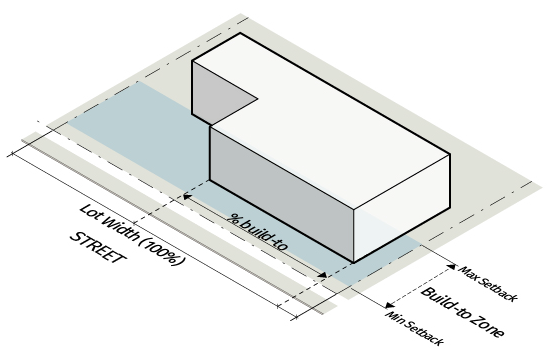
4.
The width of a parking entrance into or through a building does not count towards the build-to requirement. However, in no case will access to an irregularly-shaped parcel that has no alternative access options be denied due to application of the build-to requirement. In all cases where access is necessary, a driveway of the minimum acceptable width for fire safety purposes is allowed, even where it reduces the building width below the required build-to percentage.
5.
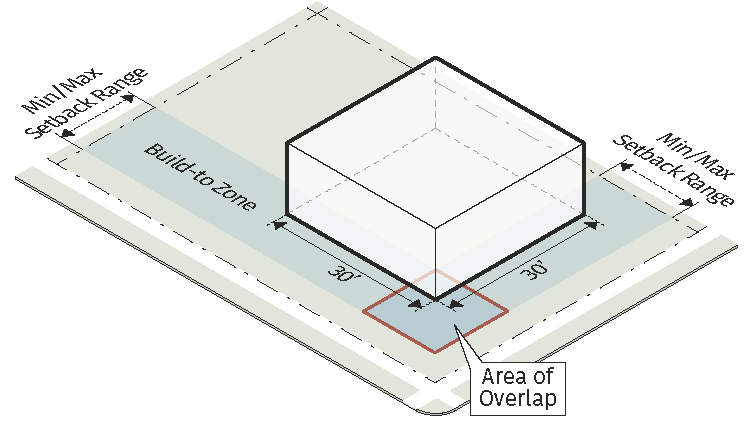
On a corner lot, a building must be placed within or abutting the area where the build-to zones of 2 intersecting streets overlap. The building must extend within the build-to zone for a minimum of 30 feet in both directions. If in neither direction, a proposed development has 30 feet of length, the building must be placed in the corner of the intersecting streets.
6.
The BTZ applies up to the height designated as the minimum height of a building. Upper stories beyond this point may be set further back or reduced in width.
7.
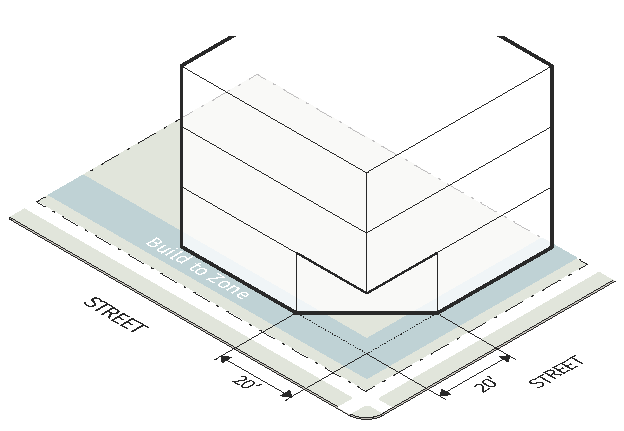
The Director may allow a courtyard, plaza, or other similar pedestrian activated space meeting the requirements of pedestrian amenity space to be considered part of the building for the purpose of meeting the build-to requirement. A chamfered corner on the ground floor of no more than 20 feet in width that extends outside of the build-to zone is considered part of the building for the purpose of meeting the build-to requirement.
D.
Build-to-Zone: New Buildings
1.
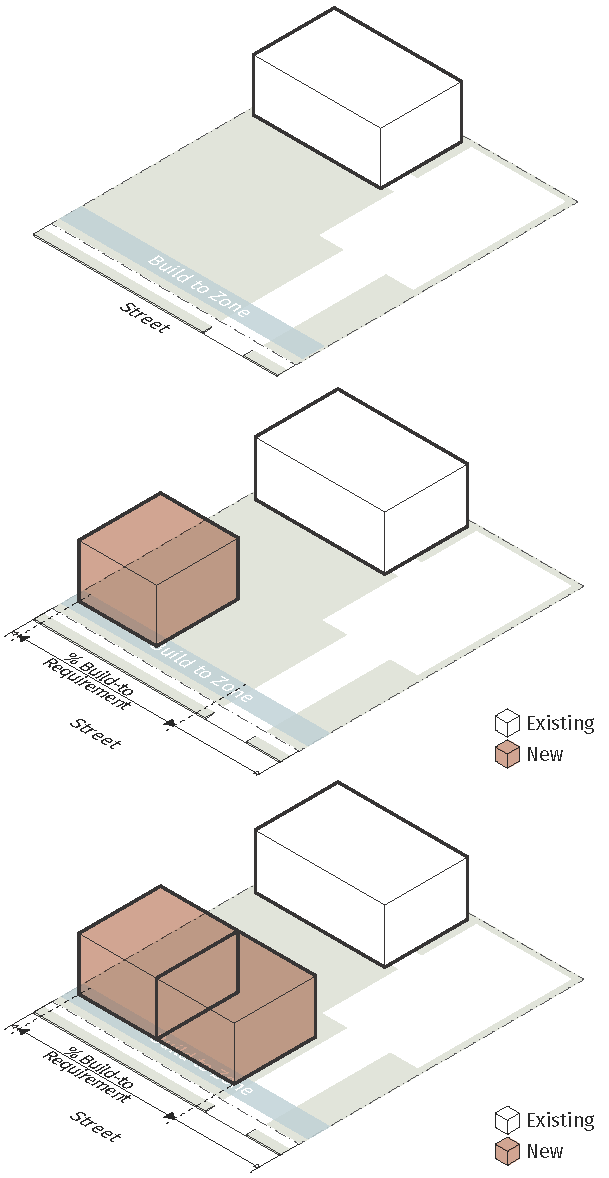
All new buildings must be placed in the build-to zone until the required percentage for the entire lot or site has been met.
2.
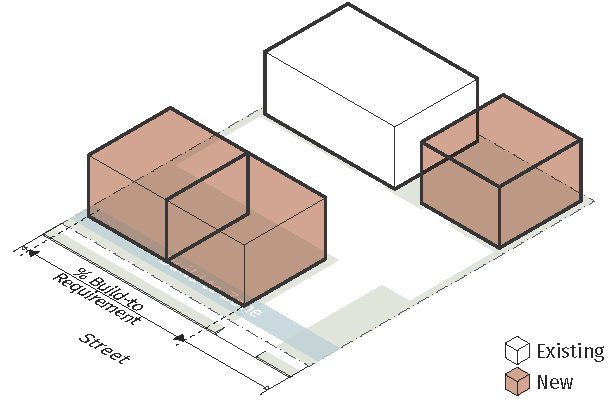
Once the required percentage has been met for the entire lot or site, new buildings may be placed outside of the build-to zone.
E.
Build-to Zone: Additions
1.
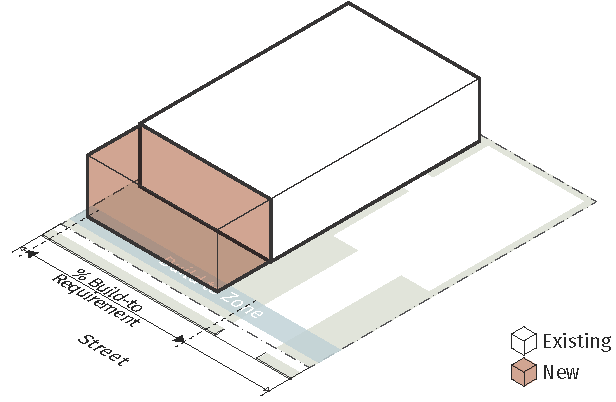
Front Additions Any addition to the front of an existing building must be placed in the build-to zone. The addition does not have to meet the required percentage for the entire lot or site. Front additions no greater than 10% cumulatively of the existing building footprint are allowed outside of the build-to zone.
2.
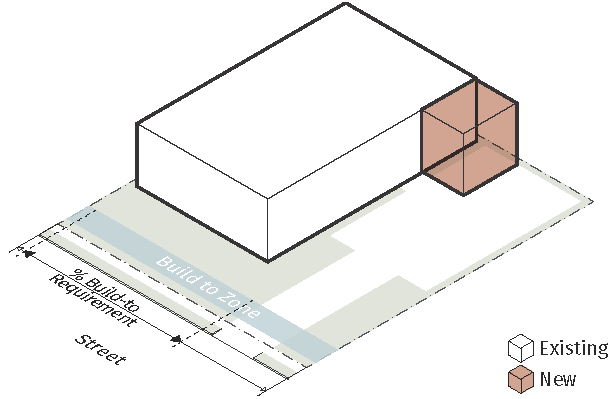
Side Additions Side additions no greater than 20% cumulatively of the existing building footprint are allowed outside of the build-to zone. Once the required percentage for the entire lot or site has been met, side additions of any size are allowed.
3.
Rear Additions
a.
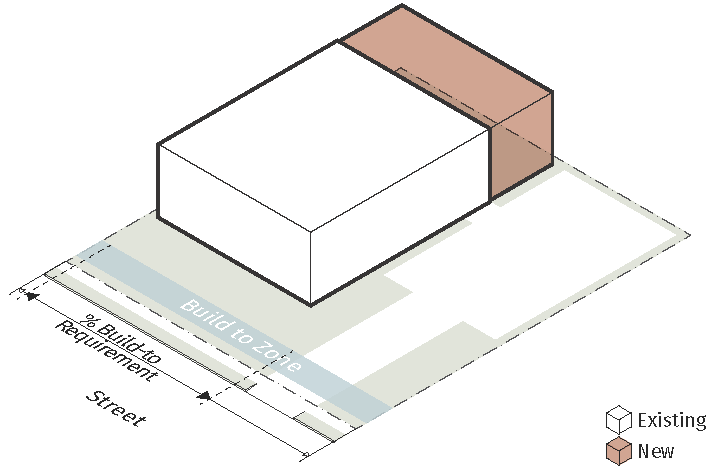
Rear additions are allowed outside of the build-to zone.
b.
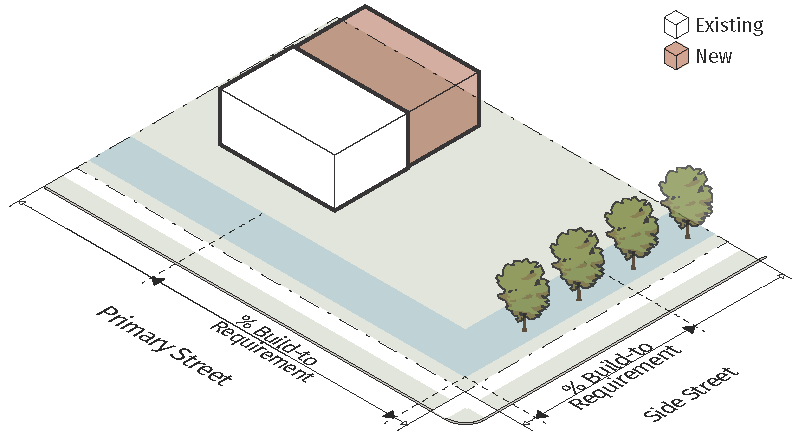
Rear additions on corner lots where the side street does not meet the build-to requirement must include additional street planting to screen the side street for the length of the existing and expanded building. The screening must consist of a 10-foot landscape strip planted with trees every 30 feet on center and landscaped with shrubs.
F.
Parking Location
1.
All parking spaces must be located consistent with the parking location requirements.
2.
Where parking is allowed in a yard, it may be placed between the principal or accessory building and the lot line (but not in a required buffer), in accordance with the parking setback if applicable.
G.
Parking Setbacks
1.
All parking spaces (surface and structured) must be located behind the parking setback line.
2.
Parking below and covered by the ground may encroach into a required parking setback but must not extend into a required easement or the right-of-way or within 3 feet of any common side lot line.
3.
The parking setback applies to the ground story only.
4.
Parking setbacks are measured from the right-of-way, private street easement or property line.
5.
Parking Structures
a.
Required parking setbacks apply only to the ground floor of the parking structure.
b.
In order to meet the parking setback requirement, parking structures must adhere to 1 of the following standards:
i.
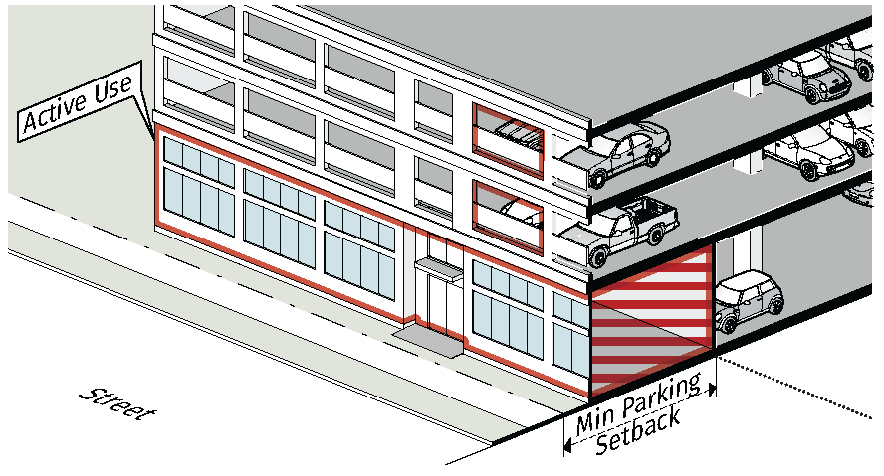
The ground story of a structure parking garage facing any street (not including an alley), must have active uses (such as, but not limited to, residential, commercial, office, or civic space, where permitted) within the parking setback. No active uses are required for portions of the parking structure located behind the minimum parking setback; or
ii.
The entire parking structure must be constructed to be adaptable, requiring the floor plates to be level except to the minimum extent required for drainage, the structure must be constructed to accommodate standard design loads of office uses according to the International Building Code, and the floor-to-floor heights must be a minimum of 12 feet.
c.
Parking structure screening is required (see Sec. 8.1.8 K).
(Ord. No. 2023-12-22, § I(Att. A), 12-5-2023)
Sec. 6.1.3. - Height and Mass
A.
Building Height
1.
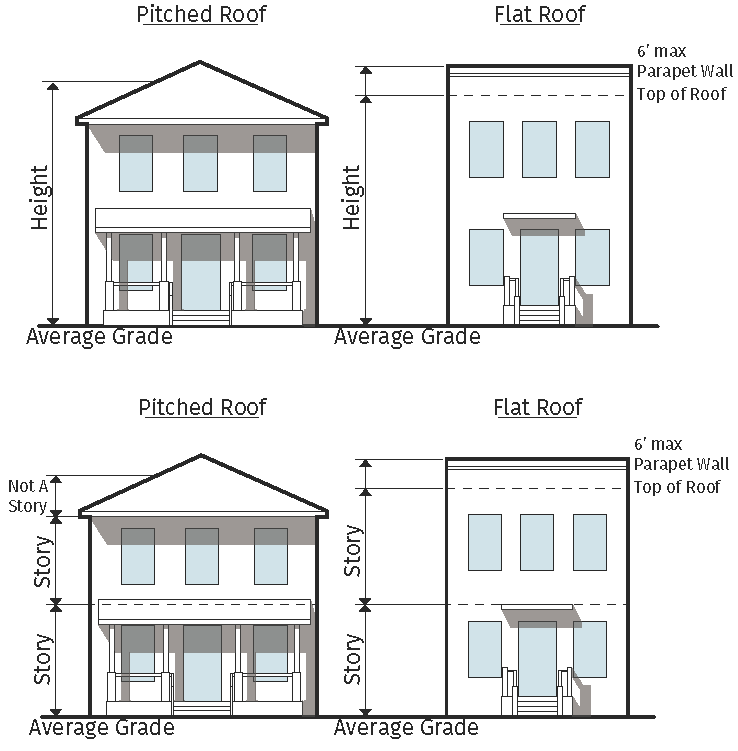
Building height is measured in both stories and feet from average grade to the average height level between the eaves and ridge of a pitched roof, or to the highest point of the roof deck of a flat roof. A maximum 6-foot height encroachment for a parapet wall is allowed.
2.
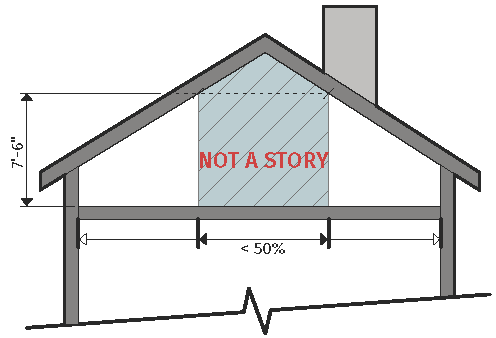
An attic in a pitched roof form does not count as a story where 50% or more of the attic floor area has a clear height of less than 7.5 feet; measured from the finished floor to the finished ceiling.
3.
Basements and mezzanines, as defined in the Building Code, do not count as a story. Mezzanines can be counted to meet district height minimums, however (See Sec. 6.1.3 B.1 below).
4.
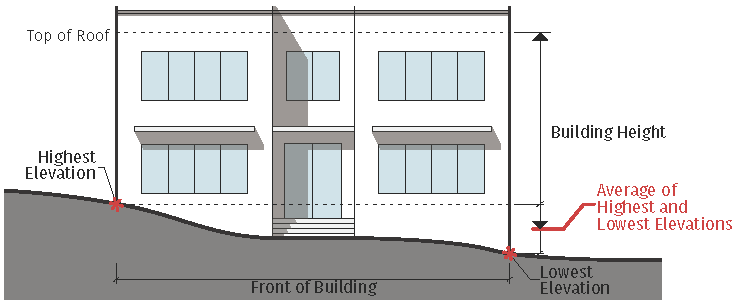
For all buildings with a build-to-zone requirement and all single unit detached, the average grade is determined by calculating the average of the highest and lowest elevation of the finished grade measured along the front of the building parallel to the primary street setback.
For all other buildings, the average grade is determined by calculating the average of the highest and lowest elevation of the finished grade measured around the entire perimeter of the building. This applies to building in districts that do not have build-to-zones, when a required frontage overrides the build-to-zone requirement, and for buildings where no part of the building is within the build-to-zone.
5.
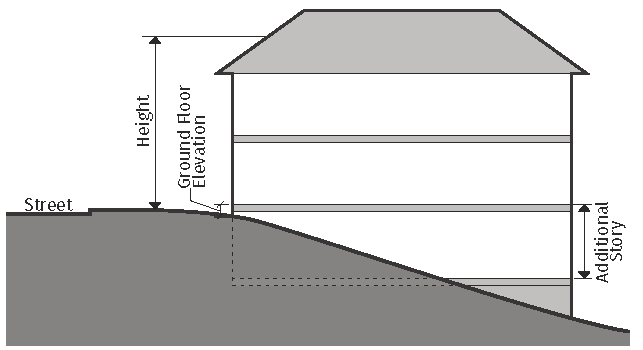
For all single unit detached and single unit attached units, where a lot slopes downward from the front property line, only 1 story in addition to the specified maximum number of stories may be built on the lower, rear portion of the lot.
6.
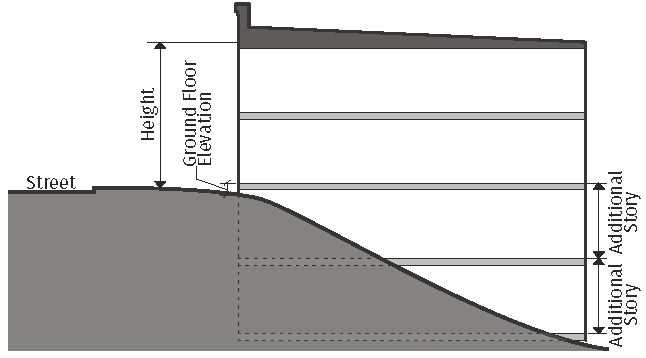
For any building type other than residential single unit detached or attached, there is no restriction on the number of stories added on a lower, rear portion of a lot. This also applies to developments where the lower, rear portion of the lot abuts a new street required by the Development Code. When a new street is required, 2 additional stories may be constructed along the new street in the rear portion of the lot. However, any additional buildings fronting on the new street are required to meet the story maximum for the district.
7.
A story is considered that portion of a building included between the upper surface of any floor and the upper surface of the floor next above, except that the topmost story means that portion of a building included between the upper surface of the topmost floor and the ceiling or roof above.
B.
Minimum Height
1.
Where a minimum height of 2 or more stories is required, each required story must contain habitable space for at least 50% of the floor. A mezzanine can be used in lieu of a second floor upon request at the Director's discretion.
2.
The Director may allow the following buildings to be exempt from minimum height requirements:
a.
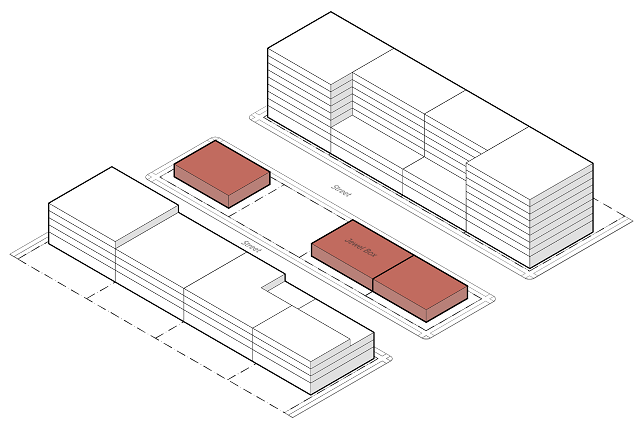
Buildings internal to a site not directly serviced by on-site parking or a drive-through, such as a jewel box building or kiosk, so long as it is integrated into the overall site plan.
b.
Buildings with a footprint of 2,000 square feet or less.
c.
Buildings with single unit detached, single unit attached, or neighborhood unit uses.
C.
Height Encroachment Any height encroachment not specifically listed below is expressly prohibited, except where the Director determines that the encroachment is similar to a permitted encroachment listed below.
1.
The maximum height limits of the district do not apply to a spire, belfry, cupola, dome, or other similar feature that does not contain a habitable space, or public utility facilities which by design or function must exceed the established height limits.
2.
The following accessory structures may exceed the established height of the district, provided they do not exceed the maximum height by more than 6 feet:
a.
Chimney, flue or vent stack;
b.
Rooftop deck, patio;
c.
Flagpole;
d.
Landscaping;
e.
Skylights;
f.
Parapet wall; and
g.
Solar panels, wind turbines and rainwater collection systems.
3.
The following accessory structures may exceed the established height, provided they do not exceed the maximum height by more than 18 feet, do not occupy more than 50% of the roof area:
a.
Cabana, pool house, rooftop restaurant, or other amenity;
b.
Pergola, trellis, gazebo, or other similar minor structure architecturally integrated with the building;
c.
Elevator or stairway access to the roof; and
d.
Mechanical equipment.
D.
Ground Floor Elevation
1.
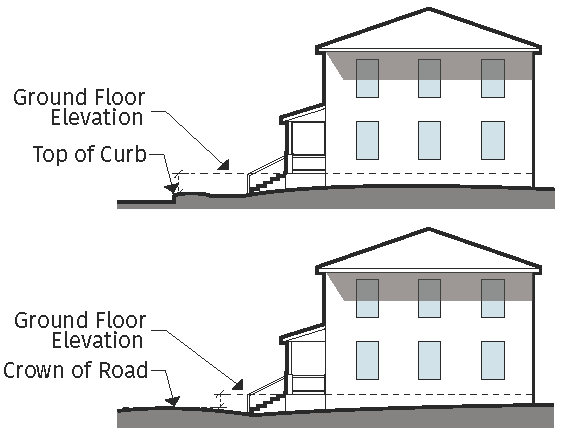
Ground floor elevation is measured from the top of the adjacent curb, or from the crown of the road where no curb exists, to the top of the finished ground floor at the building main entrance.
2.
Minimum ground floor elevation applies to the first 30 feet of the lot depth measured from the right-of-way.
3.
The Director may provide relief to the extent necessary from the maximum ground floor elevation requirements on sites with significant topography.
E.
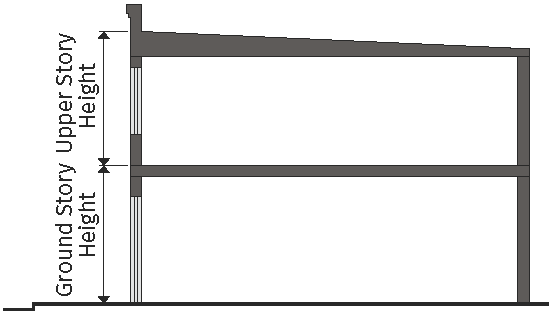
Story Height Story height is the height of each story of building, measured from the top of the finished floor to the top of the finished floor above. When there is no floor above, story height is measured from the top of the finished floor to the top of the wall plate above.
F.
Building Mass
1.
Street-Facing Building Length Street-facing building length is the maximum length of a building or structure facing a public or private street, and located within the build-to zone.
2.
Building Break Allowance
Buildings that meet 1 of the following standards, the Director may allow the maximum street facing-building length to be exceeded.
a.
When a continuous structure provides an open space meeting the following requirements, the portions of the building on each side of the open space may be considered as a separate building:
i.
One building break per street-facing façade is allowed;
ii.
The open space must meet the requirements of Pedestrian Amenity Space;
iii.
The building break width must be at least ¼ the width of the widest adjacent street-facing building length; and
iv.
The building break depth must be at least equal to the width of the open space or 20 feet, whichever is less.
b.
When a continuous structure provides an articulation to the building façade that meets the following requirements, each façade articulation may be considered as a separate building:
i.
Two portions of the street-facing building façade must have a variation in setback of at least 4 feet. The combined length of the setbacks must total no less than 25% of the length of the building.
ii.
Contrasting colors or material is used on the primary façade and the abutting façade setback to emphasize the articulation and variation along the street-facing building façade.
(Ord. No. 2023-12-22, § I(Att. A), 12-5-2023; Ord. No. 2025-09-22, § I, 9-16-2025)
Sec. 6.1.4. - Activation
A.
Transparency
1.
Transparency is the minimum percentage of windows and glazed doors that must cover a ground or upper story façade.
2.
Transparency applies to primary and side street facing building façades only, and may be reduced or waived by the Director when particular conditions (such as required buffers or other visual obstructions) significantly reduce the visibility of the building from the public realm.
a.
For single unit attached, transparency applies to any façade visible from a street or path.
3.
Glass is considered transparent where it has a transparency higher than 80% and external reflectance of less than 15%.
4.
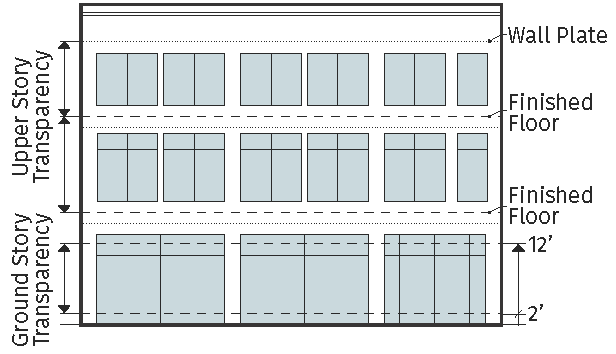
Ground story transparency is measured between 2 and 12 feet above the abutting sidewalk.
5.
Upper story transparency is measured from the top of the finished floor to the top of the finished floor above. When there is no floor above, upper story transparency is measured from the top of the finished floor to the top of the wall plate above.
6.
In the SX- District or -SH Frontage, a minimum of 50% of the street-facing, street-level window pane surface area must allow viewing into the ground story for a minimum of 8 feet in depth. Windows must not be made opaque by non-operable window treatments (except curtains, blinds or shades within the conditioned space).
B.
Blank Wall Length
1.
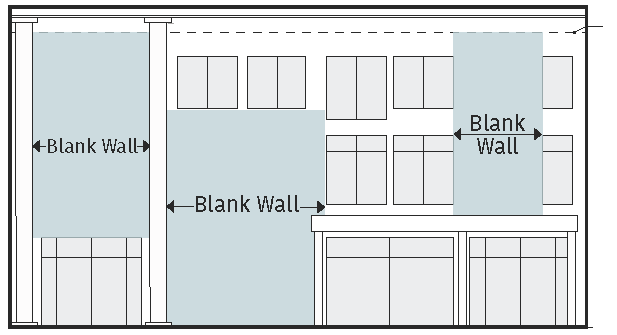
Blank wall length means a portion of the exterior façade of the building that does not include: windows or doors; columns, pilasters or other articulation greater than 12 inches in depth; or a substantial material change (paint color is not considered a substantial change).
2.
Blank wall length applies in both a vertical and horizontal direction.
3.
Blank wall length applies to ground and upper story primary and side street-facing façades.
C.
Pedestrian Access
1.
An entrance providing both ingress and egress, operable to residents at all times and customers during regular business hours, is required to meet the street-facing entrance requirements. Additional entrances off another street, pedestrian area or internal parking area are allowed.
2.
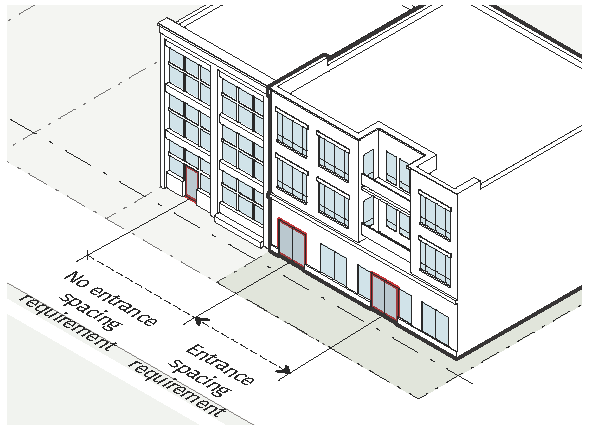
The entrance spacing requirements must be met for each building, but are not applicable to adjacent or abutting buildings. Entrance spacing is measured from the center of 1 door to the center of the next door.
3.
An angled entrance may be provided at either corner of a building along the street to meet the street-facing entrance requirements.
(Ord. of 4-17-2018(4), § 6-16)
Sec. 6.3.1. - Cottage Court
A.
General Standards
1.
A cottage court is a group of small buildings centered around a common open space or courtyard. The central courtyard enhances the character of the area through the provision of consolidated common open space.
2.
Cottage courts are a permitted Development Pattern in all districts other than Protected Neighborhood and Office Neighborhood (ON-). In ON- cottage courts require a CUP.
3.
Cottage court lots are not required to provide frontage for every lot or unit as required in Sec. 6.1.1 F.2 as long as the lot or unit provides frontage on the courtyard.
B.
Courtyard Standards
A cottage court must set aside a portion of the project area as courtyards. The required courtyards must meet all the following standards:
1.
Configuration of Courtyard
a.
The required courtyards must meet the minimum width requirement of this Section. Exceptions may be granted by the Director for items such as trail easements, linear parks, and tree conservation areas.
b.
Courtyards must meet the minimum contiguous requirement of this Section.
c.
Where feasible, the courtyard should adjoin any neighboring areas of open space, other protected areas, and non-protected natural areas.
d.
Access to the courtyard must be provided either by an abutting street or easement not less than 20 feet in width.
2.
Reserved
3.
Allowed Use of Courtyard
To the extent not otherwise prohibited, required courtyard may be used for the following:
a.
Conservation areas for natural, archeological, or historic resources;
b.
Meadows, woodlands, wetlands, wildlife corridors, or similar conservation-oriented areas;
c.
Pedestrian or multipurpose trails;
d.
Passive recreation areas;
e.
Active recreation areas, provided that impervious area is limited to no more than 25% of the required courtyard;
f.
Water bodies, provided that lakes, ponds, and floodways are limited in area to no more than 50% of the required courtyard;
g.
Community gardens:
h.
Stormwater control measures designed as an open space amenity; and
i.
Easements for drainage, access, and underground utility lines.
5.
Prohibited Uses of Open Space
Required open space cannot be used for the following:
a.
Individual wastewater disposal systems;
b.
Overhead electric transmission lines or high voltage electric transmission lines; and
c.
Streets and parking areas.
6.
Ownership and Management of Open Space
Required open space must be owned or maintained by 1 of the following entities:
a.
Land Conservancy or Land Trust
A bona fide land conservancy or land trust with the legal authority may own the open space. The responsibility for maintaining the open space and any facilities may be borne by a land conservancy or land trust.
b.
Homeowners' Association
A homeowners' association representing the residents of the development may own the open space. The homeowners' association must have lien authority to ensure the collection of dues from all members. The responsibility for maintaining the open space and any facilities is borne by the homeowners' association.
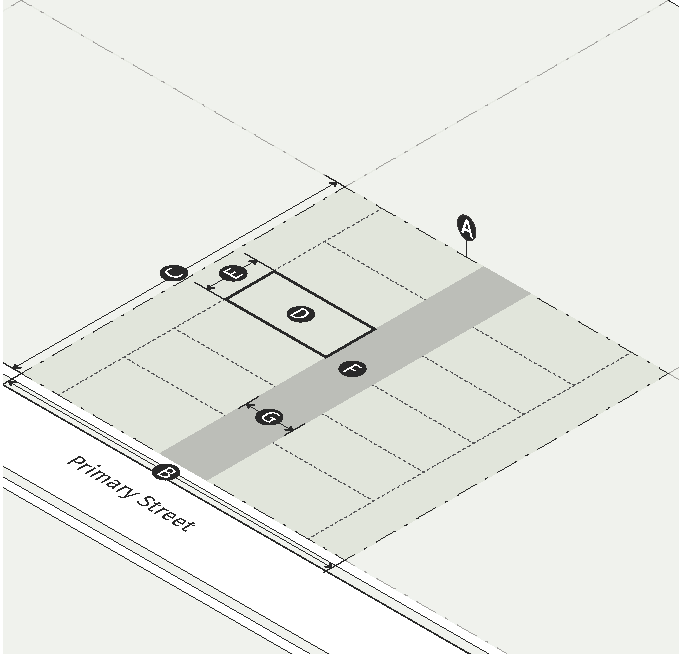
C.
Site Parameters
| C. SITE PARAMETERS | ||
 | ||
| Site | ||
 | Site area | 14,000 SF min |
 | Site width | 120' min |
 | Site depth | 120' min |
| Lot | ||
 | Lot area | 700 SF min |
 | Lot or unit width | 14' min |
| Min number of lots | 3 | |
| Courtyard | ||
 | Courtyard area per unit | 400 SF min |
 | Courtyard width | 30' avg/10' min |
| % of lots abutting courtyard | 75% min | |
| Contiguous area | 60% min | |
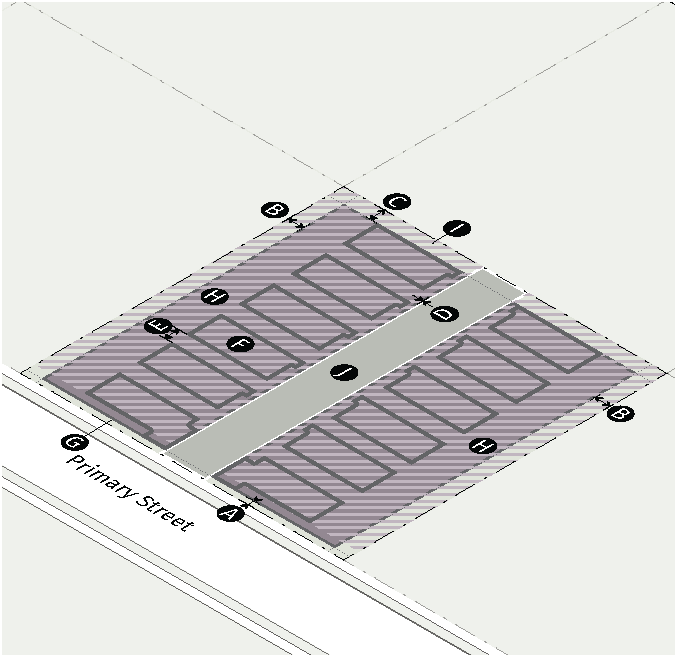
D.
Building Placement
| D. BUILDING PLACEMENT | ||
 | ||
| Building Setbacks and Unit Size | ||
| Primary street | 15' min |
| Site: side common lot line | 10' min |
| Site: rear common lot line | 10' min |
| Courtyard | 0' min |
| Parking Location | ||
| Primary street yard | Not allowed |
 | Site: side yard | Allowed |
 | Site: rear yard | Allowed |
 | Courtyard | Not Allowed |
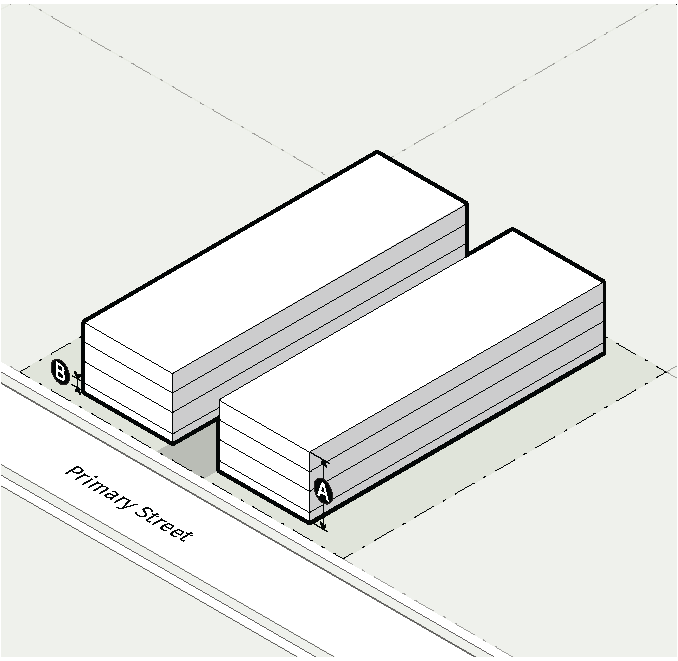
E.
Height and Mass
| E. HEIGHT AND MASS | ||
 | ||
| Building Height | ||
| Principal | 3 stories/40' max |
| Story Height | ||
| Ground story elevation | |
| Along primary and side street | 2' min/5' max | |
| Along courtyard or alley | 0' min/5'max | |
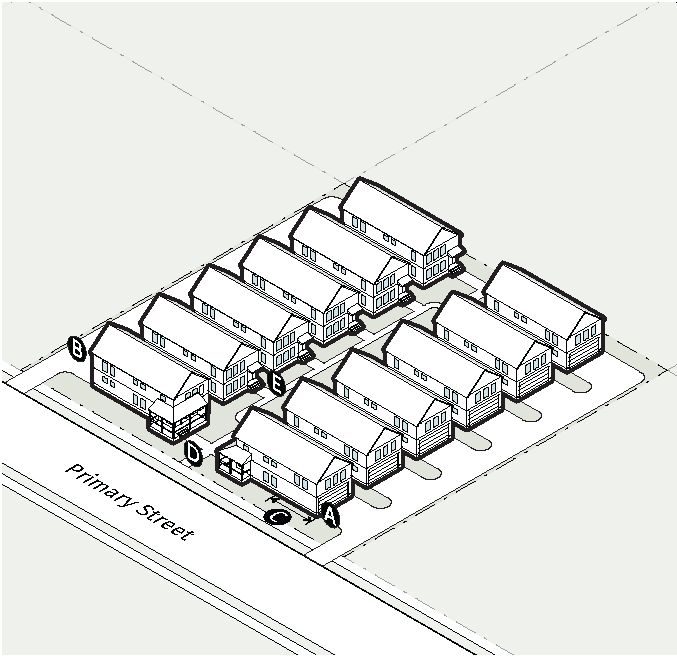
F.
Activation
| F. ACTIVATION | ||
 | ||
| Transparency | ||
| Ground story | 20% min |
| Upper story | 20% min |
| Blank wall length | 20' max |
| Pedestrian Access | ||
| Entrance or front porch facing primary street | Required for end units |
| Entrance facing courtyard | Required for all units |
(Ord. No. 2023-12-22, § I(Att. A), 12-5-2023)
Sec. 6.3.2. - Shared Court
A.
General Standards
1.
A shared court development pattern is a group of small buildings centered around a common shared court. The shared court can serve both vehicles and pedestrians while [it] enhances the character of the area through the provision of consolidated common open space and site access.
2.
Shared courts are a permitted Development Pattern in all districts other than Protected Neighborhood and Office Neighborhood (ON-). In ON- shared courts require a CUP.
3
Shared court lots are not required to provide frontage for every lot or unit as required in Sec. 6.1.1 F.2 as long as the lot or unit provides frontage on the shared court.
B.
Shared Court Standards
A shared court development pattern must set aside a portion of the project area as shared court. The required shared court must meet all the following standards:
1.
Design of Shared Court
A shared court must front on a street meeting the design specifications of Sec. 10.4.10, Shared Street.
[2.
Reserved.]
3.
Allowed Use of Open Space
To the extent not otherwise prohibited, required shared court may be used for the following:
a.
Vehicle and pedestrian access;
b.
Pedestrian or multipurpose trails;
c.
Stormwater control measures designed as an open space amenity; and
d.
Easements for drainage, access, and underground utility lines.
[4.
Reserved.]
5.
Prohibited Uses of Open Space
Required open space cannot be used for the following:
a.
Individual wastewater disposal systems;
b.
Overhead electric transmission lines or high voltage electric transmission lines; and
c.
Parking areas.
6.
Ownership and Management of Open Space
Required open space must be owned or maintained by 1 of the following entities:
a.
Land Conservancy or Land Trust
A bona fide land conservancy or land trust with the legal authority may own the shared space. The responsibility for maintaining the space and any facilities may be borne by a land conservancy or land trust.
b.
Homeowners' Association
A homeowners' association representing the residents of the development may own the shared space. The homeowners' association must have hen authority to ensure the collection of dues from all members. The responsibility for maintaining the space and any facilities is borne by the homeowners' association.
C.
Site Parameters
| C. SITE PARAMETERS | ||
| ||
| Site | ||
| Site area | 14,000 SF min |
| Site width | 120' min |
| Site depth | 120' min |
| Lot | ||
| Lot area | 700 SF min |
| Lot or unit width | 14' min |
| Min number of lots | 3 | |
| Shared Court | ||
| Shared court width | 15' min |
| % of lots abutting court | 75% min | |
D.
Building Placement
| D. BUILDING PLACEMENT | ||
| ||
| Building Setbacks and Unit Size | ||
| Primary street | 10' min |
| Site: side common lot line | 10' min |
| Site: rear common lot line | 10' min |
| Shared court | 0' min |
| Parking Location | ||
| Primary street yard | Not allowed |
| Site: side yard | Allowed |
| Site: rear yard | Allowed |
| Shared court | Not Allowed |
E.
Height and Mass
| E. HEIGHT AND MASS | ||
| ||
| Building Height | ||
| Principal | 3 stories/40' max |
| Story Height | ||
| Ground story elevation | |
| Along primary and side street | 2' min/5' max | |
| Along court or alley | 0' min/5'max | |
F.
Activation
| F. ACTIVATION | ||
| ||
| Transparency | ||
| Ground story | 20% min |
| Upper story | 20% min |
| Blank wall length | 20' max |
| Pedestrian Access | ||
| Entrance or front porch facing primary street | Required for end units |
| Entrance facing shared court | Required for all units |
(Ord. of 4-17-2018(4), § 6-24; Ord. No. 2025-09-22, § I, 9-16-2025)
Sec. 6.5.1. - Applicability
Any residential garage, parking, or paving-related construction in the RD-, RU-, or RT- zoning districts and all single unit attached development after the effective date of this Code must meet the following standards. In addition to the standards provided below, attached and detached garages must meet all applicable requirements for either principal buildings or accessory structures as specified in this Code. This Division also applies to the RE- zoning districts when specified and when the term "all" is used to describe which residential zones.
(Ord. No. 2023-12-22, § I(Att. A), 12-5-2023)
Sec. 6.5.2. - Single Unit Detached Dwelling
A.
Front and Side Yard Paving
1.
Only 1 driveway is allowed for every 65 feet of residential frontage on a same lot. Only a single driveway is allowed on streets with a functional classification of Collector or Arterial.
B.
Garage
1.
In all residential zones, no attached garage may encroach into a required setback, except where:
a.
An alley provides access, in which case the garage may encroach into the rear setback.
b.
A residence with an existing street-facing garage or carport prior to December 1, 2005 may construct a garage that encroaches into the primary street setback if the following requirements are met:
i.
The garage or carport Is limited to 1-story in height, with no living space in an attic above the garage or carport;
ii.
The garage or carport must be constructed as a side or courtyard entry garage (see illustration below);
iii.
The garage or carport must be positioned no more than 30 feet in front of the front wall plane of the house;
iv.
The garage or carport can encroach a maximum of 20 feet into the primary street setback;
v.
The garage must be at least 30 feet from the primary street lot line; and
vi.
A single-car garage door, 10 feet in width or less, may continue to face the street if the existing garage door is a street-facing door.
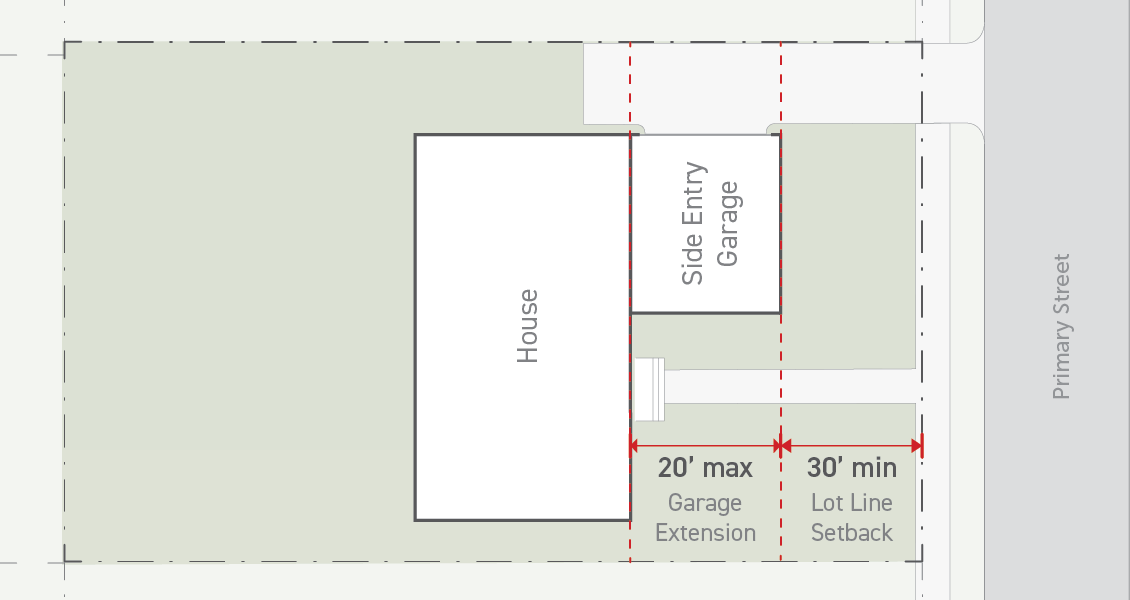
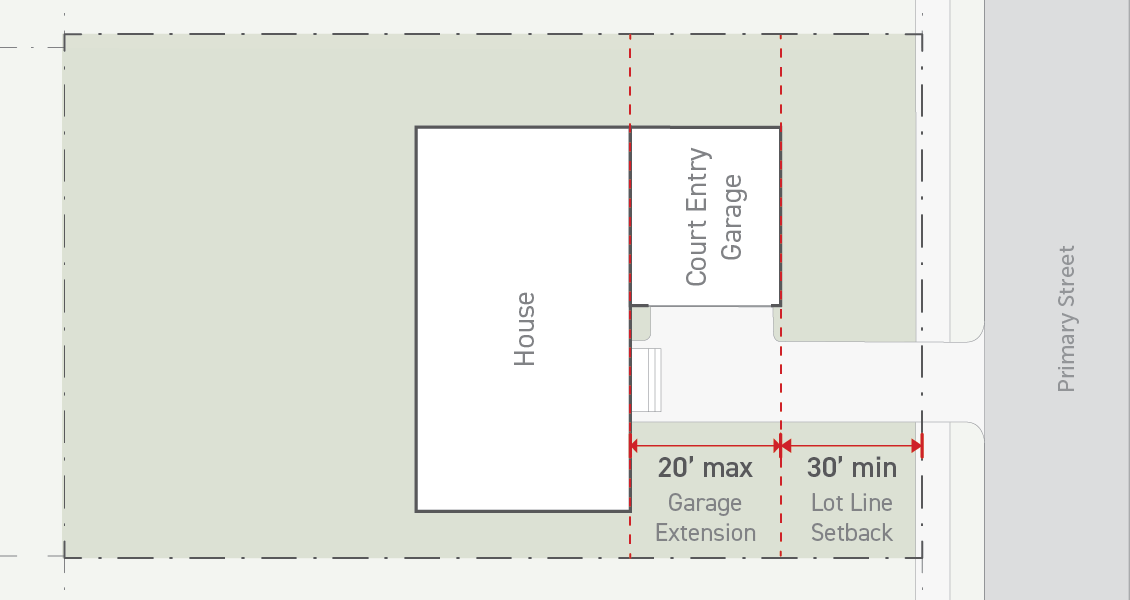
2.
Garage doors or carport entries must be positioned at least 5 feet behind the front wall plane of the house, extending no more than 40% of any street-facing width of the house. This requirement does not apply to side-entry garages. Architectural finish and windows must be provided for any side-entry garage wall facing a primary or side street.
3.
Garage doors facing a street or alley must be either:
a.
Less than 6 feet from the back of sidewalk or back of curb if there is no sidewalk; or
b.
More than 20 feet from the back of sidewalk or back of curb if there is no sidewalk.
C.
Parking Design and Location
1.
In required front setbacks, no parking pad is allowed, however a turnaround extension of no more than 200 square feet is allowed.
2.
In RE- zones, there is a parking setback of 20 feet from any property line, or the grading setback, whichever is less. Parking areas may alternatively be screened with evergreen trees (full to the ground and at least 6-feet tall at time of planting), as long as the surface parking is no less 10 feet from any property line or the grading setback (Sec. 9.4.2), whichever is more, maintained in perpetuity.
3.
The visible storage or parking of more than 4 vehicles at a single-family residence is unlawful.
4.
In all residential zones, parking space lines, wheel stops, and other apparatus germane to commercial parking are prohibited.
5.
Parking or storage of a junk or salvage vehicle constitutes an unlawful use, except that no more than 2 junk or salvage vehicles are permitted if parked or stored in a garage or carport not visible from a street or adjacent residential property.
6.
In RX-, Corridors & Node Districts, or Perimeter Center Districts, all single unit detached development must be rear-loaded.
D.
Storage
1.
Specialized Vehicles Specialized vehicles such as recreational vehicles, campers, trailers, motor coaches, boats, and boat trailers, may be parked or stored in all residential zones under the following conditions:
a.
The vehicles must not be used as permanent living quarters.
b.
The location of the parking area must be in the buildable area of the lot and not in front of the principal structure. Also, the surface of the area must be constructed as a parking area as described in Sec. 6.5.2 C.5 above.
c.
Specialized vehicles must be screened from view of adjoining properties and rights-of-way with a minimum 6-foot tall fence or wall meeting the standards of Sec. 8.3.9. unless they are viewable for less than 48 consecutive hours as a visitor's means of transportation. Enhanced screening standards such as height, materials, or otherwise may be practically necessary to properly screen and may be requested at the discretion of the Director.
d.
For construction trailers, see Sec. 7.9.9.
2.
All Other Items
a.
Items intended for indoor use such as upholstered furniture and household appliances may not be stored outside. Tools, equipment and supplies utilized for automobile repair or construction may not be stored outside. Other items may be approved at the discretion of the Director.
[b.
Reserved.]
(Ord. No. 2023-12-22, § I(Att. A), 12-5-2023; Ord. No. 2025-09-22, § I, 9-16-2025)
Sec. 6.5.3. - Single Unit Attached Dwelling
For single unit attached dwellings, garage placement must meet the following standards.
A.
Rear-Loaded
1.
Garage must be placed entirely to the rear of the townhouse and be rear-accessed (loaded). Garage may be attached or detached.
2.
Garage doors must face the rear alley or easement.
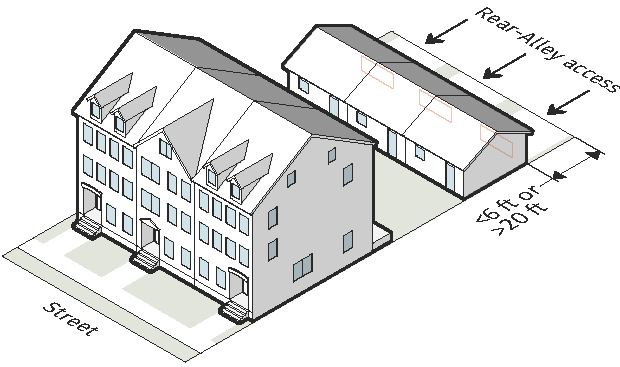
3.
The garage door must be either:
a.
Less than 6 feet from the edge of alley pavement; or
b.
More than 20 feet from the edge of alley pavement.
4.
On sites 3 acres or larger, the Director may allow up to 20% of the townhouses in the development to have front-loaded garages. The front-loaded garages must be located on streets internal to the site. Townhouses fronting on streets at the perimeter of the development site must be rear loaded.
Any street servicing a front-loaded unit must incorporate design found in Sec. 10.4.10.
(Ord. No. 2023-12-22, § I(Att. A), 12-5-2023; Ord. No. 2025-09-22, § I, 9-16-2025)
Sec. 6.6.1. - Applicability
A.
The standards of Sec. 6.6.2 apply to:
1.
All nonresidential buildings in Protected Neighborhoods;
2.
All buildings in RT, RM- and RX- Districts;
3.
All buildings in Corridors & Nodes Districts; and
4.
All buildings in Perimeter Center Districts.
B.
The standards of Sec. 6.6.3 apply to all buildings in every district except for buildings in the NEX- District.
(Ord. No. 2023-12-22, § I(Att. A), 12-5-2023)
Sec. 6.6.2. - Building Design
A.
Color Primary or fluorescent colors are not permitted except on sign faces, awnings, canopies or as accent colors (not to exceed 10% of each building or canopy façade exclusive of window and door areas) on any side of the building.
B.
Architectural Treatment
1.
Exempt Exterior building walls, decorative elements, parapets and cornices are exempt from the architectural treatment requirements when they meet the following conditions:
a.
When the exterior wall is not visible from any public or private street; and
b.
The exterior wall does not include a public entrance.
2.
Prohibited
a.
Prohibited exterior building materials include:
i.
[Reserved];
ii.
Non-architectural metal panel systems;
iii.
Unfinished cast-in-place or precast concrete vertical elements, e.g., walls, columns, exposed elevated slab edges (except as noted in Sec. 6.6.2 B.3.b.vii, below);
iv.
Exposed standard concrete masonry units (CMU);
v.
Softwood plywood grade B or lower, oriented-strand board and particle boards; or
vi.
Vinyl siding.
b.
Prohibited exterior building components, include: steel gates, burglar bars and roll-down security curtains. Interior security measures are not regulated.
3.
Required
a.
All exterior walls (not including windows and doors) for all new construction must consist of 1 or a combination of the following durable materials in the quantity required below:
i.
Up to 10 vertical feet from grade: 100% durable materials; and
ii.
Remaining building height: minimum 70% durable materials.
b.
Durable materials include:
i.
Clay brick;
ii.
Ceramic and porcelain tile;
iii.
Dressed stone with rusticated, flamed, honed, polished, bush-hammered or other standard face finish;
iv.
Traditional cement stucco (real stucco);
v.
Architectural concrete masonry units (CMU) with fluted, split-face, ground, glazed or other architectural finish; painted standard CMU is not an acceptable finish;
vi.
Portland cement plaster and lath systems;
vii.
Architectural (either cast-in-place, pre-cast or tilt-up) concrete with a finish proposed by the architect and approved by the Director;
viii.
Fiber cement-board, painted; or
ix.
Exterior Insulation and Finish Systems (EIFS) which employ a high-impact mesh as a system component.
c.
Sloped roofs (pitch greater than 2:12) must be standing seam metal, slate, concrete or metal roof tiles or composition shingles. A decorative parapet or cornice must be constructed along all flat roof lines (i.e., roofs with slopes less that 2:12).
d.
Alternate materials may be approved for use by the Director, provided they are considered equivalent or better than the listed materials.
C.
Building Articulation
1.
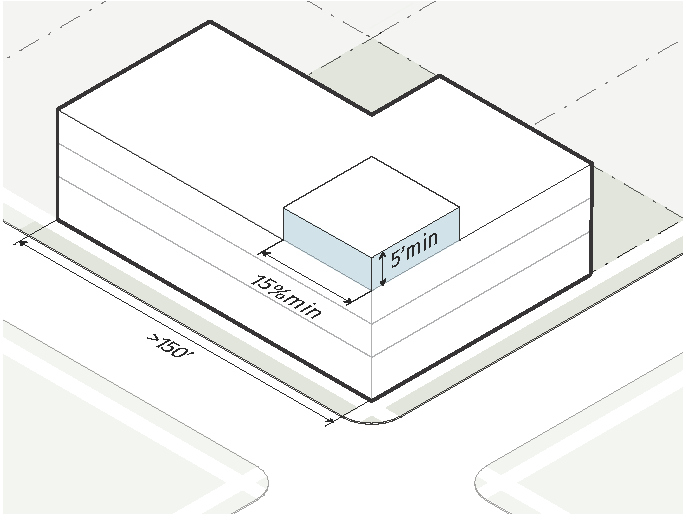
Articulation in Building Height For buildings 100 feet or more in length, at least 15% of the street-facing roof line must have a variation in height of at least 5 feet. On a corner lot, the variation in height must be located at the corner of the building that addresses both street fronts. A parapet that meets the requirements of this Development Code may be counted toward this articulation requirement. Signs are not allowed above the roof line, and do not count toward this articulation requirement.
2.
Articulation in Building façade
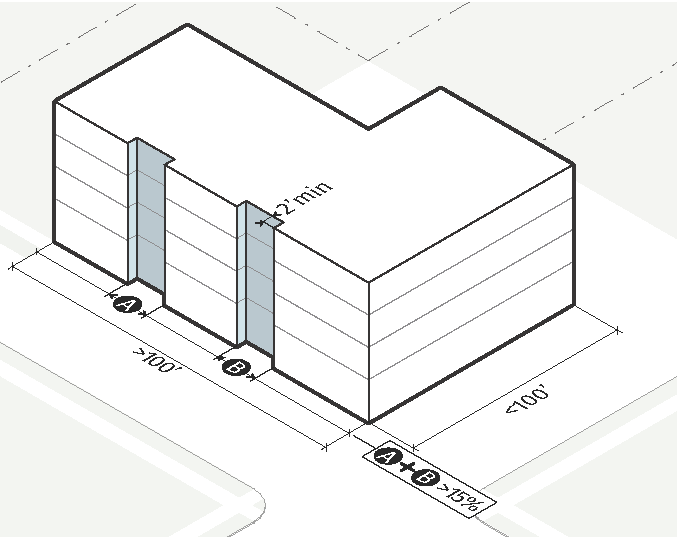
a.
For buildings 100 feet or more in length, at least 2 portions of the street-facing building façade must have a variation in setback of at least 2 feet. The combination of the required variations in setback must total no less than 15% of the length of the building.
b.
The Director may require contrasting colors or materials must be used on the primary façade and abutting façade setbacks to emphasize the articulation and variation along the street-facing building façade.
D.
Ground Floor Retail Tenant Size In the City Springs and Perimeter Districts, no ground floor retail tenant may occupy more than 30,000 contiguous rentable square feet. No variances to this standard are allowed; however, the Director may approve renovation of existing tenant spaces so long as the renovation does not increase the gross square footage of an existing tenant space.
E.
Commercial-Active Space Where required by the zoning district or use. the ground story must be constructed to meet or exceed the minimum requirements for ground floor elevation, ground story height. transparency. and entrance spacing required for a retail or commercial use. Commercial-active space is restricted to only commercial use.
F.
Commercial-Ready Space Where required by the zoning district or use, the ground story must be constructed to meet or exceed the minimum requirements for ground floor elevation, ground story height, transparency, and entrance spacing required for a retail or commercial use. Commercial-ready space is allowed to be occupied by any use allowed in the zoning district.
(Ord. No. 2023-12-22, § I(Att. A), 12-5-2023; Ord. No. 2025-09-22, § I, 9-16-2025)
Sec. 6.7.1. - Applicability
A.
Districts with a bonus height will qualify for additional height based on the Enhanced Community Benefits Matrix described in this Division. Districts with a minimum height may also qualify for reduced minimum height requirements based on the Enhanced Community Benefits Matrix and List in the Technical Manual.
B.
Credits are allotted for any item included by a developer above the minimum if already required in the Development Code.
(Ord. No. 2023-12-22, § I(Att. A), 12-5-2023)
Sec. 6.7.2. - Enhanced Community Benefit Matrix
(Ord. No. 2023-12-22, § I(Att. A), 12-5-2023; Ord. No. 2025-09-22, § I, 9-16-2025)
Sec. 6.7.3. - Community Benefit Impact Equivalency
Many of the Enhanced Community Benefit features are space and size contingent. To measure the impact of installment of Community Benefits, the following formula will be used and the resulting points will be added to:
A.
The total credits established based the list above.
B.
Square footage tallied from any items in either "Housing," "Tenants & Uses," or any parking related percentage may not be included in the calculating of the Community Benefit Impact Scale formula. The formula will be calculated as follows:
1.
Formula Base Variables Benefit Square Footage (BSF): BSF is the total square footage of amenity space above required OASIS for a site, and total square footage of community benefit site features above required.
a.
Seating in OASIS.
b.
Total Square Footage of site (TSF).
2.
Formula:
a.
BSF / TSF = Square Footage Scale (SFS).
SFS × 10 =
b.
Benefit Credit Equivalency (BCE).
c.
BCE × Initial Benefit Credit = Total Enhanced Community Benefit Credit.
(Ord. No. 2023-12-22, § I(Att. A), 12-5-2023)
Sec. 6.7.4. - NEX- Districts
A.
Applicability
1.
A height bonus is allowed in any eligible NEX- District, subject to the requirements of this Section. The total bonus height in stories (where allowed) is designated on the Official Zoning Map as follows:
2.
A height bonus for retail ground floor may not be used in conjunction with an affordable housing height bonus to gain additional height.
B.
Height Bonus System
1.
Retail Ground Floor A bonus will be provided in the NEX-5/6 and NEX-5/10/12 District, when an active ground floor occupied by retail uses. The retail ground floor depth must be a minimum of 30 feet. One additional story in height is allowed in the NEX-5/6 District and 2 additional stories are allowed in the NEX-5/10/12 District Additional design requirements are specified on the applicable zoning district pages. This bonus may not be used with an affordable housing bonus.
2.
Affordable Housing
a.
A bonus will be provided in the NEX-5/6 and NEX-5/10/12 District, in trade for making 10% of all multi-unit residential affordable to those earning up to 80% of the Area Median Income (AMI), as calculated by the US Department of Housing and Urban Development using US Census data. The affordability requirement must extend a minimum of 30 years. The available height with bonus is defined in paragraph A, above. This bonus may not be used with a retail ground floor bonus. See also Sec. 6.6.5, Phasing of Residential Development.
b.
Unit sizes for affordable housing must match the unit sizes proposed for the entire building, as a percentage (for example, a building with 60% 2-bedroom market-rate units must include 60% 2-bedroom affordable units). The affordable units must be identical to the market rate units.
C.
Process for Acquiring Additional Rights Any allowed additional height may be granted by the Director, provided the requirements of this Section have been met.
D.
Additional Requirements No variances to outdoor amenity space or transition provisions may be granted in conjunction with a height bonus.
(Ord. No. 2023-12-22, § I(Att. A), 12-5-2023)

