
Sarasota County Unincorporated
City Zoning Code
City Zoning Code
ARTICLE 6
- GENERAL, BASE, AND INACTIVE ZONING DISTRICT DEVELOPMENT STANDARDS
Sec. 124-70.- Districts Enumerated.
(a)
Active Districts. For the purpose of these regulations and the Official Zoning Map, Sarasota County is hereby divided into the following zoning districts:
(b)
Inactive Districts. The following zoning districts exist on the Official Zoning Map; however, no new lands in the County shall be rezoned to these designations:
(Ord. No. 2019-006, § 5, 4-23-2019; Ord. No. 2020-43, § 2, 1-13-2021)
Sec. 124-71. - Application of District Regulations.
This section contains the development standards that vary by district. The supplemental development standards of Article 8 may also apply. The regulations within each district shall be minimum or maximum limitations, as the case may be and shall apply uniformly to each class or kind of structure, to each use, and to all land or water. The following general regulations shall apply, except where expressly modified elsewhere in this UDC.
(a)
Zoning Affects Use or Occupancy. No building, structure, land, or water shall hereafter be used or occupied, and no building, structure, or part thereof shall hereafter be erected, constructed, reconstructed, located, moved, or structurally altered except in conformity with the regulations herein specified for the district in which it is located.
(b)
Zoning Affects Height, Population Density, Coverage, Yards, and Open Spaces. No building or structure shall hereafter be erected or altered in any manner contrary to the provisions of this UDC, including, but not limited to:
(1)
Exceeding height, bulk, or floor area;
(2)
Providing a greater number of dwelling units than allowed by the gross maximum density for the applicable zoning district;
(3)
Providing less lot area per dwelling unit than allowed by the gross maximum density for the applicable zoning district;
(4)
Occupying a greater percentage of lot area;
(5)
Providing narrower or smaller yards, courts, or other open spaces; or
(6)
Providing less separation between buildings or structures or portions of buildings or structures.
(c)
Multiple Use Prohibited. No part of a required yard or other required open space, or required off-street parking or off-street loading space, provided in connection with one building, structure, or use shall be included as meeting the requirements for any other building, structure, or use, except where specific provision is made in this UDC.
(d)
Reduction of Lot Area Prohibited.
(1)
No lot or yard shall thereafter be reduced in size, dimension, or area below the minimum requirements set out herein, except as set forth in subsection (2), below. Lots or yards shall meet the minimum requirements established herein.
(2)
At the request of the property owner, and upon submission of documentation acceptable to the County Attorney establishing that land was transferred to any government agency through dedication, condemnation, or recording a Right-of-Way map, the Administrator shall have the authority to grant a reduction in the setback, landscaping and lot dimensional requirements. Any such reduction shall be reviewed as an Administrative Adjustment in accordance with Section 124-46.
(e)
Continuity of Zoning. In the event any unincorporated territory within the County shall hereafter become incorporated, to ensure that there shall be no lapse of zoning, any and all UDC regulations which may be in effect in such territory and administered by the County shall remain in full force and effect and shall continue to be administered and enforced by the County under this zoning law until such time as municipal zoning within such territory shall be adopted and take effect.
(f)
Use Categorizing.
(1)
Approach to Categorizing Uses. Specific uses may be further defined by their North American Industrial Classification System (NAICS) codes, and in Article 17, Definitions of the UDC. Any use not specifically set forth is expressly prohibited, unless the Administrator determines in accordance with Article 5, Section 124-45 Written Interpretation, that the use is similar to a listed permitted use. Where such similar permitted use is subject to limited use standards or special exception approval, the proposed use shall also be subject to such standards or approval.
(2)
Basis for Classifications. Use categories classify land uses and activities based on common functional, product, or physical characteristics. Characteristics include the type and amount of activity, the type of customers or residents, how goods or services are sold or delivered, likely impact on surrounding properties, and site conditions. The Use Categories provide a systematic basis for assigning land uses to appropriate zoning districts.
(3)
Principal Uses Not Specifically Listed.
a.
Determination of the appropriate category for a proposed principal use shall be made by the Administrator in accordance with the provisions of Article 5, Section 124-45 Written Interpretation, using information contained in the NAICS codes as promulgated from time-to-time by the U.S. Census Bureau, and the criteria listed below. The criteria shall be used to determine both the appropriate category for a use not specifically listed in a zoning district or the examples in the Use Category descriptions, and whether a use is considered principal or accessory.
1.
The actual or projected characteristics of the activity in relationship to the stated characteristics of each Use Category.
2.
The relative amount of site area or floor space and equipment devoted to the activity.
3.
Relative amounts of sales from each activity.
4.
The customer type for each activity.
5.
The relative number of employees in each activity.
6.
Hours of operation.
7.
Building and site arrangement.
8.
Types of vehicles used and their parking requirements.
9.
The relative number of vehicle trips generated.
10.
Signs.
11.
How the use is advertised.
12.
The likely impact on surrounding properties.
13.
Whether the activity is likely to be found independent of the other activities on the site.
b.
Following a determination that a specific use not listed in the UDC regulations is similar to another listed use, the proposed use shall be subject to any limited or special exception use standards applicable to the similar use. The Administrator shall not amend these UDC regulations by adding to or eliminating any use standards for the proposed use.
c.
Where a use not listed in the zoning district is found by the Administrator not to be similar to any other use in the zoning district, the use shall be permitted only following a text amendment of these UDC regulations in accordance with Article 5, Section 124-38 UDC Text Amendments, and such a decision shall not be appealed to the Board of Zoning Appeals.
d.
When considering appropriate districts for a use not listed in the zoning district, the district intent statements in Article 6, General, Base, and Inactive Zoning District Development Standards, shall be taken into consideration.
(4)
Developments with Multiple Principal Uses. Developments with multiple principal uses shall conform to the following:
a.
When all principal uses of a development fall within one Use Category, the entire development is assigned to that Use Category.
b.
When the principal uses of a development fall within different Use Categories, each principal use is classified in the applicable Use Category and each use is subject to all applicable regulations for that Use Category.
COMMENTARY: Where a use has a specific use standard applied in the zoning district (such as a minimum site acreage), the standard applies even when that use is part of a development with multiple principal uses.
c.
A development comprised of uses regulated by multiple provisions of a zoning district shall be reviewed using the most restrictive process from among the proposed uses.
COMMENTARY: If a proposed development includes a convenience store, fuel sales and a restaurant, including outparcels, and one of those uses is only permitted by special exception in the district, then the entire development requires special exception review.
d.
Where a use requiring a special exception lies on a separate legal parcel, only the building containing the use and its separate parcel shall be subject to special exception review, not the entire project. However, where the separate legal parcel is an outparcel, the special exception petition shall describe the relationship of the outparcel to the remaining site.
COMMENTARY: For example, where a truck stop in a CG District (requiring a special exception) is an outparcel within a larger retail development, the special exception shall review the outparcel only, not the entire development. However, where a special exception use is proposed in a building that contains a variety of other uses, the entire building and its associated parcel(s) of land shall require special exception review.
(5)
Principal Uses. The "Principal Uses" portion of each use category lists principal uses common to that use category. The names of these sample uses are generic and are based on common meanings, not on what a specific use may call itself.
COMMENTARY: A use that calls itself "Wholesale Warehouse," but sells mostly to retail consumers, is included in the Retail Sales and Service category rather than the Wholesale Trade category.
(6)
Accessory Uses. Accessory uses are allowed by right in conjunction with a principal use. Except as provided for within Article 6, Section 124-73(a)(7), no accessory use may be established on a site without a principal use.
(Ord. No. 2019-006, § 5, 4-23-2019)
Sec. 124-72. - Determination of Specific Standards.
The regulations within each district shall be minimum or maximum limitations, as the case may be, and shall apply uniformly to each class or kind of structure, to each use, and to all land or water. The following general regulations shall apply, except where expressly modified elsewhere in this UDC.
(a)
Measurement of Standards.
(1)
Lot Area. Minimum lot areas shall be exclusive of public rights-of-way or private streets and all lands seaward of the mean high water line, except as expressly provided for in Sections 124-76(a)(1)f, (2)f, (3)f and (4)f.
(2)
Lot Width. Width of a lot shall be considered to be the average distance between straight lines connecting front and rear lot lines at each side of the lot, measured as straight lines between the foremost points of the side lot lines in front (where they intersect with the street line) and the rear-most points of the side lot lines in the rear. Additionally, the width between the side lot lines at their foremost points in the front shall not be less than 80 percent of the required lot width except in the case of lots on the turning circle of a cul-de-sac, where the width shall not be less than 60 percent of the required lot width or 60 feet, whichever is smaller.
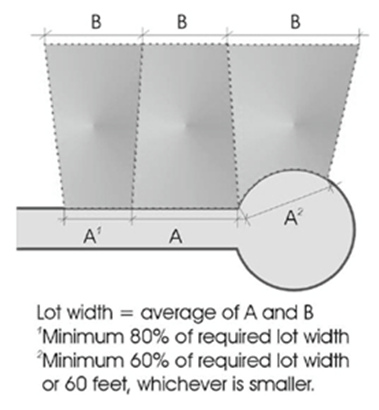
Lot Width
(3)
Building Coverage. The maximum area of the lot that is permitted to be covered by buildings, including both principal structures and accessory buildings. Building coverage does not include paved areas such as driveways, uncovered porches or patios, decks, swimming pools or pool cages, or roof overhangs of less than three feet. Nonconforming lots of record zoned RMF shall also comply with Section 124-283(d).
The Siesta Key Overlay District includes restrictions on maximum impervious coverage on a lot in single-family and multifamily residential districts (see Section 124-102(b)(4)i.)
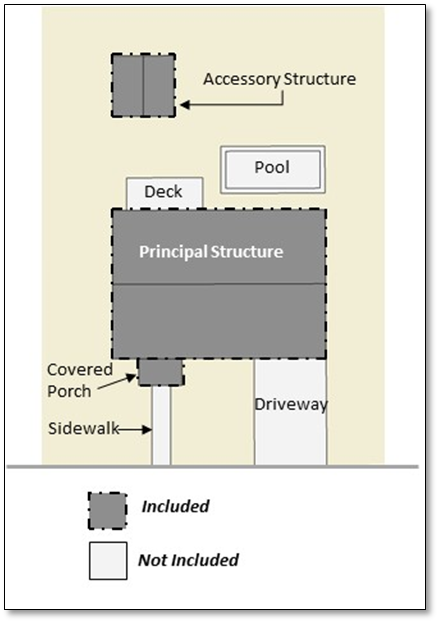 Building Coverage
| 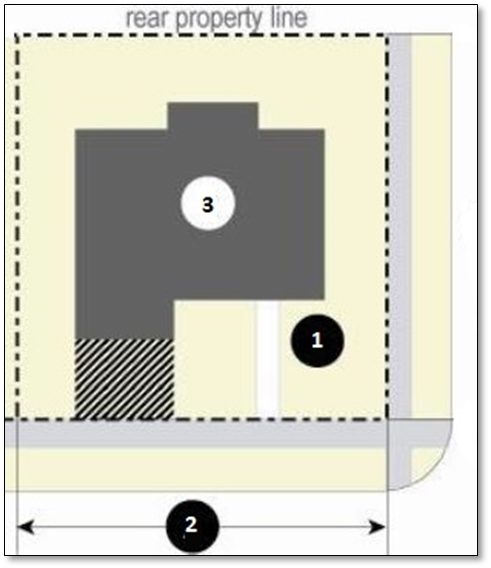 Lot Area (1), Lot Width (2), andBuilding Coverage (3)
|
(4)
Daylight Plane.
a.
Within the RE, RSF and RMF Districts, all structures located in A-Zones or V-Zones as depicted on the Flood Insurance Rate Maps (FIRMs), except within Planned Unit Developments, shall not be of such a height or size that they penetrate the daylight plane, which is an angle of 45 degrees (a 12:12 slope) measured vertical from the minimum required side yard setback lines, and beginning at 25 feet above the greater of the predevelopment grade of the parcel or the FEMA or State-mandated elevation of the structure, including any freeboard required by the Florida Building Code, as amended, plus an addition of up to three (3) feet of freeboard at the option of the applicant, the plane projecting upward toward the center of the parcel. However, in the Casey and Manasota Key Conservation Districts, the 45 degree daylight plane shall begin at twenty (20) feet above the greater of the predevelopment grade of the parcel or the FEMA or State-mandated elevation of the structure.
b.
Exceptions to this height restriction are as set forth in subsection (5), below and as provided below. (See also Section 124-282, Nonconforming Structures.)
c.
The daylight plane requirements above shall not apply to:
1.
Roof overhangs of three feet or less;
2.
Dormers that do not exceed a combined 12 feet in length per side of the structure or 25 percent of the length of the side of the structure upon which the dormers are located (excluding roof overhang), whichever is less.
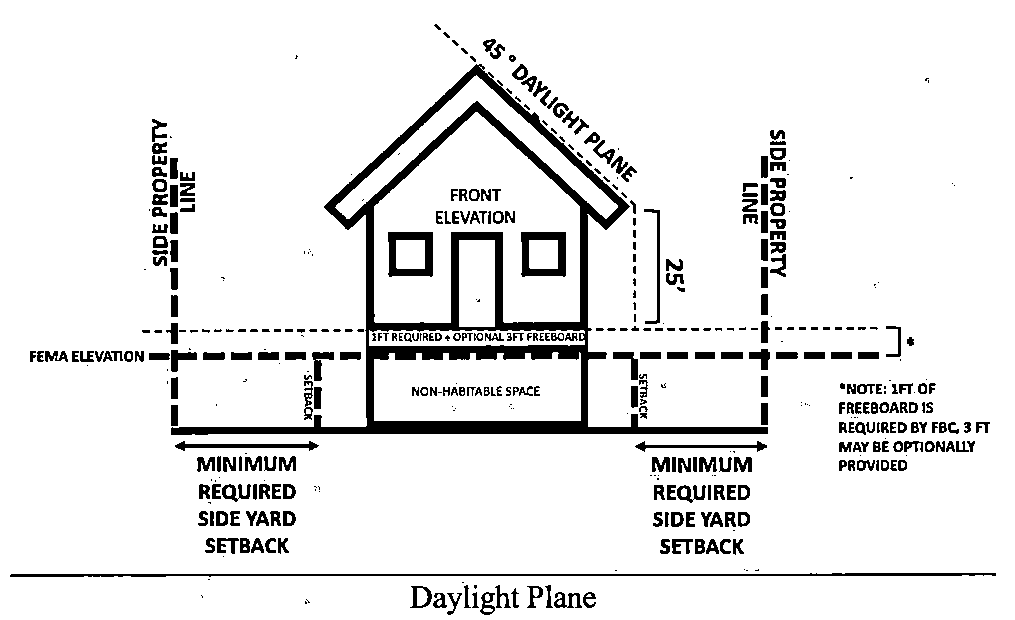
(5)
Density.
a.
Density means the maximum number of residential dwelling units permitted per gross acre of land, except where Sections 124-283(b) and 124-283(b)(1) allow additional dwelling units on a nonconforming lot of record. The maximum density set forth for the district shall constitute the maximum number of units allowed on property, unless a different density is otherwise specifically permitted in this UDC and must be consistent with the County Comprehensive Plan. Refer to each zoning district for specific density maximums. The density expressed in each zoning district is the maximum density that can be achieved. However, the maximum density/intensity is not guaranteed by right and shall be subject to the performance criteria set forth in this UDC.
b.
Within the Urban Service Area, cluster subdivisions may be developed on multiple unplatted parcels that are abutting or across a right-of-way with different Residential Single Family (RSF) zoning districts, provided that the maximum density for the entire subdivision is calculated using the density allowed by the lower-density RSF District. In addition, the development shall comply with the requirement for perimeter compatibility set forth in Section 124-76(b)(2)k, and shall be consistent with the Future Land Use maximum density. The subdivision shall be treated as one parcel for purposes of habitat protection requirements. The provisions of this section shall not be applied to parcels located on the Barrier Islands.
c.
A Multi-Family dwelling that is no greater than 750 square feet of habitable space, located within the Urban Service Area Boundary but not on a Barrier Island, and not used as a Transient Accommodation, shall be counted as one-half unit (0.5) for density purposes only.
d.
In the determination of the maximum number of residential dwelling units permitted on a specific parcel of land, a fractional unit shall not entitle the applicant to an additional unit.
(6)
Height.
a.
Height of building is the vertical distance above finished grade to the highest point of a flat roof, to the deck line of a mansard roof, or to the average height between the plate and the ridge of a gable or hip roof.
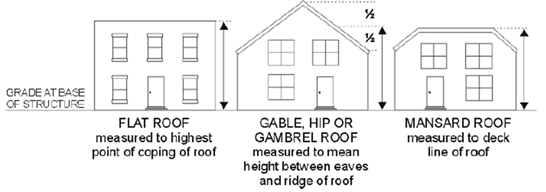
Building Height
b.
The height of a stepped or terraced building is the maximum height of any segment of the building.
c.
In floodprone areas where minimum floor elevations have been established by law, which exceed the minimum point of measurement established by this section, the building height shall be measured from such required minimum floor elevations.
1.
For properties located in A-Zones or V-Zones as depicted on the Flood Insurance Rate Maps (FIRMs), the height of a building shall be the minimum floor elevation as established by law, including any freeboard required by the Florida Building Code, as amended, and up to an additional three (3) feet of freeboard at the option of the applicant. The required minimum floor elevation as established by the Florida Building Code, and up to an additional three (3) feet of freeboard at the option of the applicant, shall not be included in the calculation of building height.
d.
Except for in residential districts on the Barrier Islands where building height is required by law to be measured from an established minimum floor elevation, which is separately addressed in subsection 4., below, height limitations do not apply to the following:
1.
Flagpoles; antennas and transmission towers in conformance with Chapter 118, Article II, of the County Code; water tanks or fire towers; heating, ventilation or air conditioning equipment, elevator shafts, chimneys and unenclosed roof-top stairways/ladders (when and specifically as required by the Building Code) on buildings with four or more stories;
2.
Feed storage structures; or
3.
Airport control towers, provided, however, the heights of these structures or appurtenances thereto shall not exceed any height limitations prescribed by the Federal Aviation Agency or airport UDC regulations within the flight approach zone of airports.
4.
On the Barrier Islands in residential districts, where building height is required by law to be measured from an established minimum floor elevation, the only exceptions from height and Conservation District two-story limitations shall be for unenclosed heating, ventilation, and air conditioning equipment, antennas in conformance with Chapter 118, Article II, of the County Code, and chimneys (decorative or functional). Chimneys may only extend six inches past the height required by the Building Code. Nonconforming lots of record zoned RMF shall also comply with Section 124-283(d).
5.
Vegetation associated with Greenroof Treatment System designs, provided the placed vegetation does not grow higher than six feet above the already allowable maximum building height. The vegetation height shall be measured to the expected mature height for the vegetation selected for the Greenroof Treatment System Construction. In no event shall the proposed vegetation be of such height or size that they penetrate the daylight plane, as described in subsection (4), above.
e.
Roof ornaments including spires, belfries, steeples, minarets, clock towers, or cupolas, or any other ornaments or appurtenances that are not addressed in subsection d.1-3,above and that are placed at or rising above the roof level may be made a part of residential or nonresidential structures.
1.
In all residential districts, roof ornaments may be affixed to residential structures, and rooftops may be used for accessory uses such as swimming pools, spas, cooking facilities, playing courts, wet bars, railings, tables, chairs, umbrellas, tents and similar uses, provided no portion of any roof ornament or accessory use exceeds the maximum height limit for the zoning district.
2.
Roof ornaments associated with nonresidential structures in all zoning districts shall be subject to the following:
i.
No horizontal plane of the roof ornament shall exceed five percent of the total floor area of the building to which it is attached, nor shall the horizontal planes of all roof ornaments associated with the building exceed five percent of the total floor area of the building.
ii.
The height of a roof ornament may extend beyond the maximum height allowed in the district, but the amount of such extension shall not exceed 20 percent of the maximum height for the zoning district in which the property is located. A cupola or other ornament may be placed atop a roof ornament, but in such case the roof ornament shall be considered a single ornament for purposes of this section.
iii.
The Board may allow roof ornaments on structures connected with special exception uses that result in heights greater than that normally allowed under this Section 124-72(a)(6) if the Board finds that the extra height, when taken in light of the lot coverage, massing of the structures on the property, and intensity of use of the property, will not be incompatible with character of the surrounding area or with the height, lot coverage, massing of structures, or intensity of uses in the surrounding area.
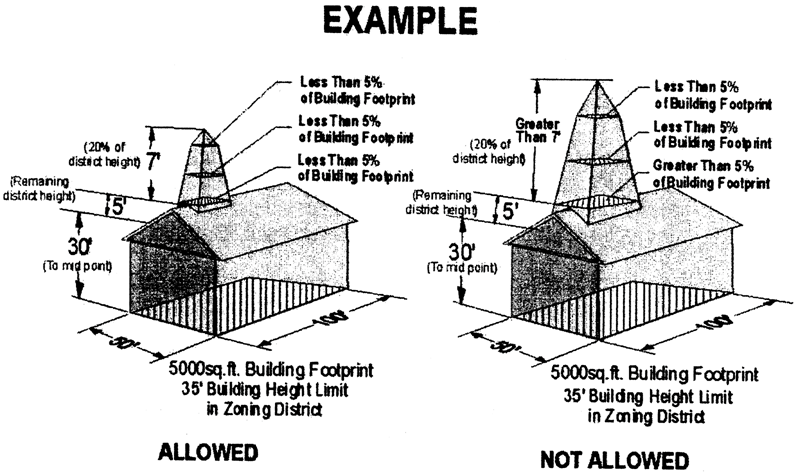
Roof Ornaments
f.
Notwithstanding the foregoing, on the Barrier Islands, in residential districts, where building height is required by law to be measured from an established minimum floor elevation, the only exclusions from height and Conservation District two-story limits shall be for unenclosed heating, ventilation, and air conditioning equipment and antennas in conformance with Chapter 118, Article II, of the County Code.
g.
The height of any wall or fence shall be measured as the highest point above the finished grade on either side of the wall or fence.
(b)
Open Space.
(1)
The minimum open space required in a development under common ownership or unified control, or within a subdivision, shall be property under control of the developer or in public or common private ownership. It shall not be in individual lots. All open space shall be unoccupied or predominately unoccupied by buildings or other impervious surfaces. Unoccupied or predominately unoccupied by buildings or other impervious surfaces shall mean that not more than five percent of the area of any required open space shall be occupied by such surfaces.
(2)
Open space may be used for parks, recreation, agriculture, conservation, preservation of native habitat and other natural resources, Stormwater Management System, historic or scenic purposes. For the purpose of this section, Greenroof Treatment Systems, Cisterns, and Pervious Pavement Systems shall not be included in the Stormwater Management System open space calculation. When used for recreation, the following shall apply:
a.
Recreational activities in conservation or preservation open space areas shall maintain the areas in their natural state with little or no land disturbance. Structures are limited to improvements such as boardwalks, permeable pathways and signage necessary for resource management.
b.
Recreational activities in all other open space areas may include, but are not limited to, structures or other active, player-oriented facilities such as playgrounds, ballfields, golf courses, club houses, tennis courts and associated accessory facilities such as parking areas and restrooms, subject to the limits on occupation of open space in Section a. above.
(3)
Any property within 20 feet of any structure (except any accessory structures within the designated open space) or having a dimension of less than 15 feet, regardless of ownership, shall not be considered open space in meeting the requirements of this UDC.
(4)
Required open space in residential districts shall be measured exclusive of any individual lots, except in an Open Use District or the RE-1 or RE-2 Districts. However, when an Open Use District, RE-1 or RE-2 District is being developed as a Conservation Subdivision the previous exception shall not apply.
(5)
Where areas within a development are identified as native habitat (see the County Comprehensive Plan), said areas shall be utilized to fulfill the open space requirements of this UDC.
(6)
Refer to Section 124-102(b)(6) for open space requirements within Conservation Subdivisions.
(c)
Site Area. The minimum area required for a particular type of development. The site may then be divided into smaller lots.
(d)
Waterfront Property Minimum Floor Elevation. In all districts where dwellings are permitted, no building for human habitation shall be erected except in accordance with the County flood regulations (see Chapter 54, Article XVI, of the County Code).
(e)
Yards.
(1)
Generally. Every part of every required yard shall be open and unobstructed from 30 inches above the general ground level of the graded lot upward to the sky except as hereinafter provided or as otherwise permitted in this UDC.
(2)
Types of Yards.
a.
There are four types of yards: street (or front), side, rear and waterfront yards.
b.
Corner lots and through lots shall be considered to have two street yards and two side yards. However, where a non-ingress/egress easement is recorded along the entire frontage of one of the two street frontages for a through lot, that street frontage shall not be considered a street yard.
c.
Any yard abutting waterfront property (e.g., the Gulf of Mexico, any bay, pass, creek, stream river, tributary, canal or other waterway) shall be considered a waterfront yard as determined by the Administrator. (See also the Coastal Setback Code Chapter 54, Article XXII, Sections 54-721 through 54-724 of the County Code.)
Stormwater ponds, lakes, ditches or other similar stormwater conveyances do not require waterfront yards. Properties affected by the Myakka River Protection Zone and the Coastal Setback Code may require greater setbacks than the waterfront yard.
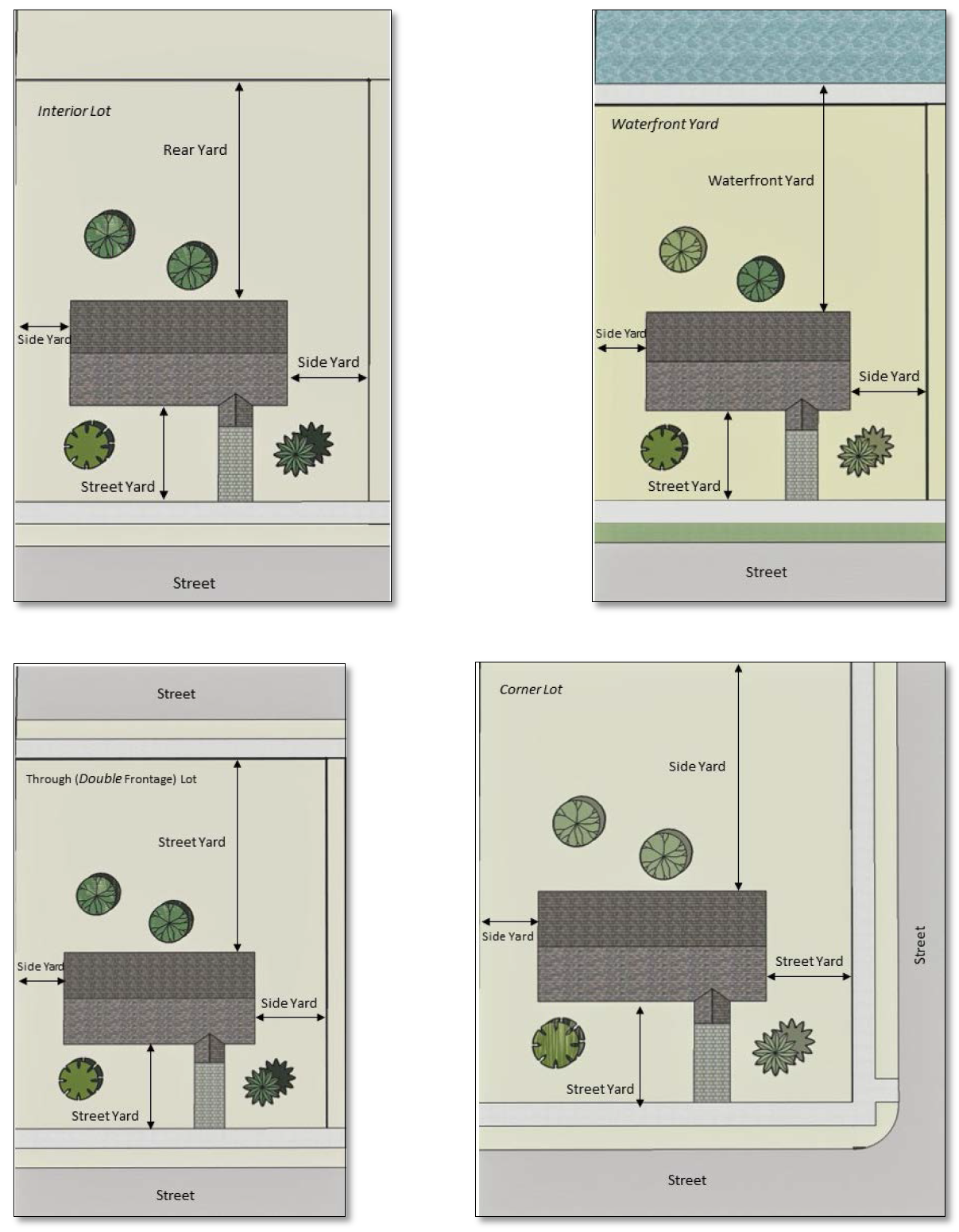
Yard Types
(3)
Measurement of Yards.
a.
Depth of a required street yard shall be measured at right angles to a straight line joining the foremost points of the side lot lines. The foremost point of the side lot lines, in the case of rounded property corners at street intersections and cul-de-sac lots, shall be assumed to be the point at which the side and front lot lines would have met without such rounding. However, for cul-de-sac lots in residential districts, no required front yard shall be less than ten feet in depth.
b.
Width of a required side yard shall be measured in such a manner that the yard established is a strip of the minimum width required by district regulations with its inner edge parallel with the side lot line.
c.
Depth of a required rear yard shall be measured in such a manner that the yard established is a strip of the minimum width required by district regulations with its inner edge parallel with the rear lot line.
d.
Base setback lines have been established for certain roads. (See, Article 13 of the UDC.)
(4)
Exemptions.
a.
In all districts, roof overhangs and chimneys may project into a required yard not more than three feet where the required yard is eight feet or more in width. Roof overhangs may project into a required yard not more than two feet where the required yard is less than eight feet in width. In those districts where side yards are permitted to be less than five feet, roof overhang projections are prohibited.
b.
Sills and belt courses may project up to 12 inches into a required yard.
c.
Fire escapes, stairways and balconies, whether unroofed, open and unenclosed, or enclosed, shall not intrude into required yards.
d.
Except as provided for below, fences, privacy walls, and vegetation are permitted in required yards, provided such structures or vegetation do not block visibility at intersections or at vehicular access points to roadways.
e.
Privacy walls and fences located in required waterfront yards shall be limited to a maximum height of 30 inches. Privacy walls and fences located less than 20 feet landward from the Gulf of Mexico or pass beach or dune shall be prohibited. Any privacy wall or fence within 20 feet farther landward of Gulf of Mexico or beach pass or dune shall be limited to a maximum height of 30 inches.
f.
Air-conditioning, mechanical, electrical and plumbing equipment located at above ground level or elevated due to FEMA elevation requirements is exempt from side and rear yard setback requirements. In no case shall such equipment be located closer than three feet from the property line or in any easement. In the case of a PUD where there are not required setbacks, such equipment shall not be placed in any easement. See Section 124-102(b)(4)j.5. for equipment placement requirements in the SKOD.
g.
Satellite dishes, in excess of one meter in diameter shall not be located on any residentially zoned parcel between the main residential structure and street frontages.
(f)
Structural Access. Principal entrance/access points for residential properties located within the adopted North Casey Key Conservation District shall only be permitted on the first habitable floor as measured from the required FEMA minimum floor elevation. Access via vehicular garage doors is permitted on levels below the required FEMA minimum floor elevation provided the minimum floor elevation is a minimum of 12 feet.
(Ord. No. 2019-004, § 2, 3-13-2019; Ord. No. 2019-006, § 5, 4-23-2019; Ord. No. 2025-050, § 2, 1-27-2026)
Sec. 124-73. - Accessory Uses and Structures.
(a)
General Standards.
(1)
Accessory uses shall be consistent with all standards in the district for the principal use, except as expressly set forth below.
(2)
Uses and structures shall:
a.
Be accessory and clearly incidental and subordinate to permitted, limited or special exception uses and structures, except docks/piers on vacant parcels in residential districts, subject to the standards of Section 124-73(c)(3).
b.
Be located on the same lot as the permitted, limited or special exception use or structure, or on a contiguous lot in the same ownership.
c.
Not involve operations or structures not in keeping with the character of the primary use or principal structure served.
d.
Not be of a nature likely to attract visitors in larger numbers than would normally be expected, where applicable.
(3)
The accessory use shall contribute to the comfort, convenience or necessity of occupants of the primary use served.
(4)
The accessory use shall be located within the same zoning district as the principal use. County Parks, docks, and boatlifts are exempt from this limitation.
(5)
No accessory building or structure shall be erected in any required setback area, except as expressly set forth in Article 6.
(6)
Tractor trailers, storage pods, ship cargo containers and transport containers are prohibited as storage buildings or structures except as permitted on an active construction site, or as allowed as a temporary use pursuant to Section 124-74(c)(1)d.
(7)
An accessory use shall only be allowed when a principal use exists, except for Barn or shade structures for animals in the Open Use districts, and as expressly set forth in subsection (c)(3), below.
(8)
The temporary storage of recyclable materials is permitted as an accessory use in accordance with this Article 6 and the following standards:
a.
In Residential and Open Use Districts, all storage of recyclable materials must be in an approved County container or trash receptacle, except for yard trash, which may be composted or which may be stored for no longer than 30 days in a can, bundle, or other County-approved container.
b.
In districts other than Residential or Open Use, the temporary storage of recyclable materials shall be permitted provided such storage outside of a completely enclosed structure is in a neat and orderly manner and for periods not exceeding 30 days.
c.
The temporary storage of recyclable construction and demolition debris is only permitted in accordance with the Recycling Facility (Including Stockpiling) use standards in certain zoning districts of this Article 6.
(b)
Miscellaneous Structures.
(1)
School bus shelters and bicycle racks may be located in any district. No advertising sign shall be permitted on such structures. District setbacks are waived. Recommended locations and setbacks shall be provided by the County Traffic Advisory Council. Locations and setbacks shall be approved by the School Board of Sarasota County.
(2)
Bus stop benches and public bus shelters may be located in any district. No advertising sign shall be permitted on bus stop benches. Advertising signage shall only be permitted on bus shelters in accordance with this UDC. In addition, public bus shelters containing advertising signs shall not be located on any residentially zoned property or within the right-of-way abutting any residentially zoned property. Locations shall be approved by the Board or their specific designee. All public bus shelters located within the right-of-way shall require a Right-of-Way Permit.
(3)
Telephone booths may be located in any district. District setbacks are waived. Locations shall be approved by the County Traffic Advisory Council if nearer a street line than the district street yard setback line.
(4)
Mail and newspaper delivery boxes may be placed in accord with U.S. Postal Service regulations, and are exempt from district setbacks.
(c)
Accessory Uses in Residential Districts.
(1)
Generally.
a.
In residential districts, accessory uses and structures shall not be located in a required yard, except as expressly provided elsewhere in this UDC.
b.
On waterfront property (e.g. the Gulf of Mexico, any bay, pass, creek stream, river, tributary, canal or other waterway), accessory structures (including pool cages), deck, or other improvement over 30 inches in height (including a retaining or stem wall for a swimming pool or pool cage) shall be setback a minimum of 20 feet from the mean high water line/seawall or required landward portion of a permitted dock. For the purposes of this subsection, any deck or other improvement under 30 inches shall be located no closer than ten feet to the mean high water line. Additionally, the structures or improvements must comply with Chapter 54, Article XXXIII, Myakka River Protection Code, Chapter 54, Article XXII, Coastal Setback Code, and the UDC Watercourse Buffer requirements. (For the purposes of this section, stormwater ponds, lakes, ditches or other similar stormwater conveyances do not represent waterfront yards.)
c.
All accessory structures in the RSF, RMF and RC zone districts, shall not exceed 20 feet in height. In SKOD all accessory structures in residential districts shall not exceed the height of the principal structure. Lots of record in existence prior to October 27, 2003 that were converted from OUE-2 to RE-1 may construct accessory structures utilizing the OUE development standards.
d.
Except as permitted elsewhere in this UDC, no screen enclosure or pool cage shall be located within six feet of any rear property line, within 20 feet of the Gulf of Mexico, any bay, pass, creek or stream, river, canal or other waterway, or within any easement and shall meet the primary structure's side and front yard setback requirements for the applicable district. Additionally, the structure must comply with Chapter 54, Article XXXIII, Myakka River Protection Code, Chapter 54, Article XXII, Coastal Setback Code and the UDC watercourse buffer requirements.
e.
Ramps for skateboard, bicycle or in-line skating use are prohibited in all residential districts.
f.
Accessory structures in the RSF, RMF, and RC zone districts are subject to the following additional design requirements:
1.
All accessory structures shall not exceed 50% of the footprint of the principal structure.
2.
All accessory structures shall be the same color as the principal structure. Carports, gazebos, pool cages, and pools are exempt from requirement.
3.
All accessory structures shall be maintained in sound condition and good repair.
4.
Quonset huts are prohibited in all residential districts.
(2)
Boats or Other Floating Structures Being Used as Dwelling Units. Boats or other floating structures being used as dwelling units or commercial establishments may not anchor or tie off shore in County sovereign waters for longer than 48 hours, except at marinas, boatyards and ways, and boat liveries.
(3)
Docks/Piers on Vacant Parcels in Residential Districts. A dock or pier may be established on a lot or parcel without a principal use in any residential district, subject to all of the following criteria:
a.
Only one dock or pier shall be permitted per lawfully established lot or parcel.
b.
The lot or parcel shall have a minimum width of 30 feet at the water.
c.
Adequate room shall exist on the lot or parcel for the safe parking of two vehicles outside the public right-of-way.
d.
Adequate room on the parcel shall be available for the safe maneuvering of the boat.
e.
No overnight parking of vehicles shall be allowed.
f.
The dock or pier shall be for use only by the owner of the lot or parcel. No rental of the dock is allowed.
g.
No accessory structures other than the dock or pier shall be allowed.
h.
The dock or pier shall meet the requirements of Chapter 54, Article XX, Water and Navigation Control Authority.
i.
Where the dock or pier is located in the MP District, it shall comply with all MP District regulations.
(4)
Group Living. Group living, including a hospice, may be permitted as an accessory use in a medical facility such as a hospital.
(5)
Home-Based Business. A business that operates from a residential property is permitted. A business is considered a home-based business if it operates, in whole or in part, from a residential property and meets the standards of this section.
a.
General Standards.
1.
Employees of the business who work at the residential dwelling must also reside in the residential dwelling, except that up to a total of two employees or independent contractors who do not reside at the residential dwelling may work at the business. The business may have additional remote employees that do not work at the residential dwelling.
2.
Parking for the residential dwelling is limited per the standards of Section 124-120(c). In addition to the standards of Section 124-120(c), vehicles and trailers used in connection with the business must be parked in legal parking spaces that are not located within the right-of-way, on or over a sidewalk, or on any unimproved surfaces at the residence.
3.
Parking or storage of heavy equipment at the home-based business shall not be visible from the street or neighboring property. For the purpose of this subsection, "heavy equipment" means commercial, industrial, or agricultural vehicles, equipment, or machinery.
4.
External modifications made to a residential dwelling to accommodate a home-based business must conform to the residential character and architectural aesthetics of the neighborhood. Accessory structures must conform to the standards of 124-73(c).
5.
The home-based business may not conduct retail transactions at a structure other than the residential dwelling; however, incidental business uses and activities may be conducted at the residential property.
6.
The activities of the home-based business shall be secondary to the property's use as a residential dwelling.
7.
All business activities and uses shall comply with the standards of the Code of Ordinances of Sarasota County and with the standards of permitted principal and limited uses and structures for the zoning district in which the home-based business exists.
8.
All business activities shall comply with any relevant local, state, and federal regulations with respect to the use, storage, or disposal of any corrosive, combustible, or other hazardous or flammable materials or liquids.
9.
Transient accommodations are not permitted as a home-based business except as expressly provided elsewhere in this UDC.
10.
Signs shall be in conformance with Article 11 of the UDC.
(6)
Private Community Center. A private community center is permitted as an accessory use in accordance with this Article 6 and the following standards:
a.
A private community center shall be located on a separate and individual tract or parcel with the subdivision or development.
b.
A private community center shall not be located on the perimeter of the subdivision or development.
c.
A private community center shall be maintained by any private association of persons that reside in the area entitled to access to the community center.
(7)
Residential Leasing Office. A residential leasing office is permitted as an accessory use in accordance with this Article 6 and the following standards:
a.
The office shall be located within a multifamily dwelling complex.
b.
The office shall be designated by the condominium association or similar governing body.
c.
The office shall not be used for the sale, rental or leasing of off-site real estate or any appurtenances thereto.
(d)
Accessory Uses in Nonresidential Districts.
(1)
Aircraft Landing Field. An aircraft landing field or helicopter landing facility is permitted subject to the requirement that adequate land area is available for take-off and landing to ensure public safety in accordance with Federal Aviation Administration standards. Where such facility is located within 500 feet of any existing residence, a buffer with a minimum opacity of 0.7 in accordance with Section 124-122 shall be required along the property line.
(2)
Automatic One-Bay Car Wash Facility. A one-bay automatic (not self-service) car wash facility that is completely enclosed except for openings necessary to allow entry and exit of vehicles is permitted as an accessory use to a convenience store with fuel pumps or a gas station, provided that:
a.
The automatic one-bay car wash facility shall not exceed a height of 20 feet or exceed an overall building dimension of 25 feet in width and 50 feet in length.
b.
The automatic one-bay car wash facility shall have the same architectural character as the principal building.
c.
The automatic one-bay car wash facility and storage of auxiliary equipment related to the car wash facility shall be located behind the front building line of the principal building.
d.
The one-bay automatic car wash facility shall be sited so as to discourage direct street view of the facility.
e.
The automatic one-bay car wash facility shall not operate before 6:00 a.m. or after 10:00 p.m. when abutting residentially-zoned property.
f.
All one-bay automatic car wash facility shall meet the applicable district setback standards. Notwithstanding the requirements of Section 124-282, a car wash facility existing on October 27, 2003, shall be permitted to be reconstructed in its location as of that date.
g.
Any car wash with more than one bay or providing anything other than automatic service shall be considered a principal use rather than an accessory use.
(e)
Accessory Use Standards for Places of Worship.
(1)
The following facilities may be considered accessory to a place of worship, provided the uses conform to any approved Binding Development Concept Plan. Additional buffering may be required through the review and approval of a Zoning Map Amendment (Rezoning) or Special Exception for a place of worship to address the intensity of the proposed place of worship and the proposed accessory uses.
a.
Offices for the place of worship;
b.
Rooms for religious instruction or counseling;
c.
Meeting rooms for intermittent community meetings or instruction;
d.
Fellowship hall;
e.
Kitchen facilities;
f.
Senior center, neighborhood arts center or other community center;
g.
Temporary child care during religious services or events;
h.
Outdoor play area;
i.
Columbarium;
j.
"Meals on Wheels" or other similar programs using the kitchen in the place of worship but delivering food elsewhere; and
k.
Residence for clergy employed by the place of worship.
Many of these uses constitute a "family life center".
(2)
A gymnasium or similar indoor recreational facility is permitted provided that the minimum parcel size of the place of worship shall not be less than ten acres.
(3)
A cemetery is permitted provided that the minimum parcel size of the place of worship shall not be less than ten acres, and shall be subject to the standards as specified in certain zoning districts of the Article 6 and all state regulations.
(4)
Overnight accommodations for visiting clergy and nonpaying guests of clergy employed by the place of worship are permitted provided that the minimum parcel size of the place of worship shall not be less than ten acres.
(5)
A day care facility in a place of worship approved by the Board is permitted subject to the following standards:
a.
The minimum parcel size of the place of worship site, including the educational facility or child care center, shall not be less than two acres.
b.
Outdoor play area shall not be located within 50 feet of any property in a residential or open use district.
c.
A landscaped buffer with a minimum opacity of 0.5 shall be required around the perimeter of the outdoor play area.
(6)
An educational facility with 25 or fewer students in a place of worship approved by the Board, is permitted subject to the following standards:
a.
The minimum parcel size of the place of worship site, including the educational facility, shall not be less than two acres.
b.
Outdoor play area shall not be located within 50 feet of any property in a residential or open use district.
c.
A landscaped buffer with a minimum opacity of 0.5 shall be required around the perimeter of the outdoor play area.
(7)
The following uses are permitted only as additional principal uses, subject to the requirements as specified in certain zoning districts of the Article 6.
a.
Schools; and
b.
Soup kitchens or other social service facilities.
(Ord. No. 2018-065, § 2, 1-19-2019; Ord. No. 2019-006, § 5, 4-23-2019; Ord. No. 2020-011, § 2, 7-8-2020; Ord. No. 2022-026, § 2, 6-7-2022; Ord. No. 2022-028, § 2, 8-30-2022)
Sec. 124-74. - Temporary Uses.
(a)
Generally.
(1)
Certain uses are temporary in character. They vary in type and degree, as well as length of time involved. Such uses may have little impact on surrounding and nearby properties or they may present questions involving potential incompatibility of the temporary use with existing uses. The permit issued for any temporary use shall be visibly displayed at the principal entrance of the business or in a prominent location for the duration of the event. Unless otherwise specified in this UDC, the following regulations shall govern temporary uses.
(b)
Procedures.
(1)
All requests for Temporary Use Permits must comply with the procedural requirements in Section 124-52, Temporary Use Permit. Any Temporary Use Permit requiring approval by the Board must be heard in a duly noticed public hearing. Specific uses may have additional requirements.
(c)
Temporary Uses Exempt from Permit.
(1)
The following permitted temporary uses, as defined in Article 17, are exempt from these requirements:
a.
Christmas tree sales lots.
b.
Pumpkin patch lots.
c.
Garage or yard sales are permitted only by the resident on their property and are allowed once every four months at any given location. The sale may not exceed three consecutive days in length. Advertising signs may not be placed on any County rights-of-way.
d.
Storage pods, shipping containers and transport containers used for off-site storage of household or other goods are permitted for a maximum of seven consecutive days, provided that such pods or containers do not exceed eight feet high by eight feet wide by 16 feet deep. Said storage pods, shipping containers and transport containers may be authorized twice per calendar year for an additional 21 days with an approved Temporary Use Permit. Said storage pods, shipping containers and transport containers are prohibited as storage in the commercial zoning districts.
(d)
Temporary Use Permit Required.
(1)
The following temporary uses are allowed in the frequency stated below except that no property shall have more than four of the events listed in subsections (1)a. through (1)f. and (1)j., below, in a calendar year:
EXAMPLE: A Temporary Use Permit (TUP) for a carnival would be counted in considering whether to issue a Temporary Use Permit for a nonprofit special event.
a.
Commercial Circuses, Carnivals or Fairs. Commercial circuses, carnivals or fairs, for not more than two consecutive weeks in any calendar year.
b.
Temporary Religious or Revival Activities. Temporary religious or revival activities in tents in any Open Use District, or in any RE or RSF District in association with a place of worship, for not more than two consecutive weeks in any calendar year.
c.
Nonprofit Special Events. Special events run by nonprofit, eleemosynary organizations, in any zoning district, and occurring no longer than seven consecutive days once every three months. Nonprofit charitable organization fund raising during common holidays is exempt from a Temporary Use Permit, subject to permission from the property owner and provided that the owner or lessor derive no income from the fundraising.
d.
Tent Sales. Tent sales by merchants occupying the premises on which the sale is conducted and having a valid certificate of occupancy, and occurring no longer than seven consecutive days once every three months.
e.
Grand Opening Sales. Grand opening sales, including outside food and beverage vending, for three consecutive days, once per certificate of occupancy. A temporary sign advertising the grand opening sale may be displayed for a total of ten consecutive days including days prior to the sale and the sale days.
f.
Outdoor Vehicle Show or Sale. Outdoor motor vehicles or recreational vehicle show or sale, for three consecutive days, twice per calendar year. The above standards shall also apply to properties that contain multiple ownerships but are under unified control or have common elements such as parking, stormwater or access, such as malls or shopping centers. In the case of a Regional Commercial Center with multiple ownerships, each ownership shall only be entitled to one outdoor motor vehicle or recreational vehicle show or sale for three consecutive days per calendar year.
g.
Farmers' Market. Farmers' markets are intended to provide a location where agricultural and organic items and related goods and services may be offered for sale. These markets are not intended to be craft fairs or flea markets. Farmers' markets are allowed only: (1) on properties zoned Commercial General/Siesta Key Overlay District (CG/SKOD) on Siesta Key, or (2) at a Place of Worship, with approval of a Temporary Use Permit subject to the following standards:
1.
An application for a TUP must be submitted to the Administrator. The Administrator shall review the application for thoroughness and adherence to standards set forth below and present the final application to the Board for approval at a duly advertised public hearing. It shall be the responsibility of the applicant to verify that market vendors have all of the licenses required below. The application must include the following:
i.
A map indicating the location of the market. The market may be located within parking areas, with notarized written consent of the property owner, provided that parking equaling one and one-half spaces per vendor remains available on site;
ii.
The day(s) of the week and hours of operation for the market shall be included in the application. On Siesta Key, farmers' markets will only be allowed on Sunday mornings between the hours of 7:00 a.m. and 1:00 p.m.;
iii.
A site plan showing the layout and boundaries of the market;
iv.
The maximum number of vendors offering products for sale including the type of products or services proposed for sale. Any changes to the list of approved products and or services will required amendment of the permit by the Board pursuant to Section 124-52 at a duly noticed public hearing; and
v.
Adequate pedestrian and vehicular access to the site to provide safe passage without endangering the citizens or property shall be demonstrated.
2.
The market shall not be located in the County right-of-way.
3.
The TUP may be approved for up to 52 days per calendar year. Renewal TUP applications must be submitted to the Administrator at least 60 days prior to expiration. The renewal request requires approval by the Board at a duly notice public hearing.
4.
Each vendor shall be responsible for securing and displaying all necessary licenses, including but not limited to any license/approval required when offering prepared food for consumption, etc. (i.e., Florida Department of Agriculture, Food Safety, and Department of Business and Professional Regulation, etc.).
5.
Allowed products and services shall be limited to:
i.
Unprocessed agricultural products such as fruits, vegetables, grains, flowers, and plants;
ii.
Processed agricultural products such as milk, cheese, oils, vinegars, meats, poultry, eggs, honey, spices, coffee, jams, nuts, sauces, pasta, soaps, ice cream, herbal preparations, jellies;
iii.
Prepared foods such as ready-to-eat baked goods, breads, meats, cheeses, cakes, and pies;
iv.
Food booths where preparation of food occurs on site;
v.
Agriculture-related crafts, such as handmade wreaths, swags, dry flower arrangements, pressed flowers, scented sticks and potpourri; candles, scented sticks;
vi.
Items designed to promote water, soil, or energy conservation, such as rain barrels, organic fertilizer, compost boxes, and related educational materials;
vii.
Miscellaneous vendors such as art works, health arts products, massage, fitness, holistic healing may be allowed provided that no more than ten percent of the total vendors/booths are comprised of these types of vendors;
viii.
Musical entertainment may occur only at one location within the market area, may consist of no more than three performers, and must comply with the County noise ordinance; and
ix.
Other goods and services determined by the Board to be substantially similar to the above vendor types.
6.
Prohibited Items and Vendors: Used goods, antiques, collectibles, and all other goods and services not expressly set forth above.
7.
The Board shall have the authority to modify or revoke the farmers' market TUP upon a finding at a duly noticed public hearing of a violation of any condition of the TUP approval. Prior to revoking a permit, the permittee shall be given written notice of the violation and the action necessary to correct the same. The notice shall be delivered by U.S. certified mail, return receipt requested, or by hand delivery. The notice shall provide that failure to correct the violation shall result in the revocation of the TUP. Within five days of the receipt of the aforementioned notice, the permittee may request an opportunity to appear before the Administrator in order to show cause why the permit should not be revoked. However, such appearance shall not be required in the event that the permittee takes corrective action within the time designated. In the case of repeated violations, the Administrator may revoke the permit upon notice, subject to appeal to the Board or application for a new TUP.
h.
Capital Improvement Projects. A Temporary Use Permit may be issued in conjunction with a Sarasota County Capital Improvement Project for staging purposes subject to the following standards:
1.
The contractor shall submit an application for a Temporary Use Permit to the Administrator. The application must include a site plan outlining all properties that will be used for staging areas. The site plan must identify all uses on the property (i.e., material locations and heights, construction trailers, heavy equipment, etc.).
2.
The Temporary Use Permit shall be issued for the duration of the construction period indicated on the contract between the County and said contractor. Should construction exceed the contract period, an extension may be requested, not to exceed an additional 120-day period.
3.
The Contractor utilizing the property shall be required to protect adjoining properties, to the greatest extent possible, from adverse noise, odor and visual impacts by installing appropriate screening or fencing measures, limiting hours of operation, directing traffic and access points away from residential uses, and any other precautions deemed necessary by the Administrator. The proposed measures must be approved by the Administrator.
4.
Any changes to the topography, groundcover, trees, etc., must be approved by the appropriate County agencies.
i.
Reserved.
j.
Outside special events at restaurants and bars within the Siesta Key Overlay commercial district (CG/SKOD or CI/SKOD) may be permitted as follows:
1.
Temporary Use Permits may only be issued for the following major holidays and times, beginning no earlier than 11:00 a.m. and ending at the hour specified:
i.
New Year's Eve—Valid to 12:30 a.m. on New Year's Day.
ii.
St. Patrick's Day—Valid to 10:00 p.m.
iii.
Memorial Day—Valid to 10:00 p.m.
iv.
Independence Day (4th of July)—Valid to 12:30 a.m. on the 5th.
v.
Labor Day—Valid to 10:00 p.m.
vi.
Halloween—Valid to 10:00 p.m.
vii.
Thanksgiving—Valid to 10:00 p.m.
2.
The TUP may include one additional day immediately before or immediately after the holiday for which it is obtained, which is valid to 10:00 p.m. If a second day is requested, all subsequent properties requesting a TUP for that holiday desiring a second day must select the same second day.
3.
Noise regulations will apply to all TUPs.
4.
Outdoor entertainment will not be allowed except within the times as set forth in subsection j.1., above.
5.
The applicant is responsible for making arrangements for sufficient additional parking on private property.
6.
The event must remain within the property controlled by the applicant; it shall not spill over onto residential neighborhoods, nor can the TUP be transferred to another location without approval by the County.
k.
Other Temporary Uses. Other temporary uses may be permitted that are similar in nature to the ones listed above, with corresponding limitations, as determined by the Administrator. These uses may include, but are not limited to, community events, neighborhood events, educational events, fishing tournaments, and outside events at restaurants and bars for special events.
l.
Special Events in County Parks. Special Events (public or private) conducted in County Parks are not subject to frequency or duration limitations. The Parks Manager is authorized to limit or terminate any Special Event that becomes incompatible with surrounding uses or detrimental to the park.
m.
Outdoor Display. Outdoor display is allowed only on properties zoned Commercial General/Siesta Key Overlay District (CG/SKOD) with the approval of a Temporary Use Permit subject to the following standards:
1.
An application for a TUP must be submitted to the Administrator and shall demonstrate compliance with the standards herein.
i.
The applicant shall pay a nominal fee.
ii.
An applicant seeking approval for the display of general retail merchandise shall submit an application for a Temporary Use Permit along with a Sidewalk Layout Plan illustrating:
a)
All display area is located on the commercial property, not in the public right-of-way;
b)
A four-foot wide pedestrian clear zone from the parking area to the retail store's principal entrance door;
c)
A five-foot wide pedestrian clear zone along sidewalks paralleling the storefront;
d)
A two-foot wide setback from parking areas or streets;
e)
ADA accessibility requirements are met;
f)
The linear length of the display shall not exceed 33 percent of the linear tenant storefront dimension;
g)
The maximum height of the display is seven feet above the sidewalk;
h)
Display merchandise shall not hang from any exterior portion of the building (i.e., awnings, windows, doors, etc.); and
i)
The display area shall be limited to two of the following items:
1)
A table with a maximum measurement of 72 inches by 36 inches by 30 inches high;
2)
A mannequin no larger than 24 inches in diameter by 72 inches high;
3)
A clothing rack no larger than 72 inches by 24 inches by 72 inches high; or
4)
A mobile cart no larger than 60 inches by 30 inches by 36 inches high.
iii.
No signage larger than one square foot shall be permitted on any display racks.
iv.
No items shall be allowed for display except for those items placed on designated display mechanisms (i.e., table, rack, mannequin).
v.
An applicant seeking approval for the display of items for rent (i.e., bicycles, scooters, surfboards, etc.) shall submit an application for a Temporary Use Permit along with a Sidewalk Layout Plan illustrating:
a)
All display area is located on the commercial property, not in the public right-of-way;
b)
The display area for merchandise shall be no greater than 240 square feet by 12 feet high;
c)
If the display area is to be located within a parking area, parking calculations shall be submitted demonstrating that the commercial building or center/plaza has sufficient parking to meet current County UDC Requirements;
d)
A four-foot wide pedestrian clear zone from the parking area to the retail store's principal entrance door shall be maintained;
e)
ADA accessibility requirements shall be met.
vi.
The TUP shall be valid for a period of no more than one year.
vii.
Two violations of any conditions set out in this section shall constitute a violation of the Temporary Use Permit and cause said Temporary Use Permit to be revoked. Once revoked, a Temporary Use Permit shall not be issued for outdoor display for a period of one year.
viii.
In the event a parcel contains both a retail establishment and a rental establishment, the following standards shall apply:
a)
The Outdoor Display permit shall allow one display item as listed above and 120 square feet of rental display area; or
b)
A permit shall be limited to either the Retail Display Permit or the Rental Display Permit.
ix.
The Administrator shall revoke the TUP permit upon a finding of two or more violations of any condition of the TUP approval. The permittee may appeal a revocation to the Board of Zoning Appeals through the process provided in Section 124-47. Upon revocation, the property may not apply for another TUP under this subsection for one (1) year.
(2)
Outdoor Display of Merchandise.
a.
Outdoor display of merchandise in nonresidential districts by merchants occupying the premises and having a valid certificate of occupancy, occurring no longer than nine consecutive days up to four times per year, is allowed subject to issuance of Temporary Use Permit and all of the following conditions:
1.
Merchandise shall only be displayed in front of the premises occupied by the merchant.
2.
Merchandise shall not be displayed closer than five feet to any public entrance to the premises.
3.
Merchandise shall only be displayed in a manner that does not obstruct pedestrian or vehicular circulation or traffic.
4.
Merchandise shall not be displayed in parking lots.
5.
The display of merchandise shall not exceed eight feet in height.
6.
Merchandise shall only be displayed during the merchant's hours of operation, and must be taken inside the premises at closing.
7.
No payment (collection of monies) shall occur outside. All sales must occur within a completely enclosed building.
8.
Merchandise shall only be displayed in an area not wider than 50 percent of the total linear foot frontage of the building occupied by the merchant.
9.
The required County Temporary Use Permit must be visibly displayed at the principal entrance of the associated merchant.
10.
A violation of any conditions set out in this section shall constitute a violation of the Temporary Use Permit and cause said Temporary Use Permit to be revoked. Once revoked, a Temporary Use Permit shall not be issued for the same temporary use for a period of one year.
b.
Any Temporary Use Permit issued under subsections (1)d. through (1)j., above, shall be counted in the maximum number of Temporary Use Permit allowed for the outdoor display of merchandise.
c.
The requirements of this section do not supersede any previously issued Special Exception for outdoor display or outdoor storage.
(e)
Manufactured Home or Trailer for Temporary Use.
(1)
After approval by the Administrator, a manufactured home or trailer may be used in any zoning district as a temporary office, security shelter, or shelter for materials or tools (but not for residential purposes or sales offices) incident to construction on or development of the premises upon which the manufactured home or trailer is located.
(2)
Construction trailers shall be permitted on active construction sites and are exempt from Temporary Use Permits. If a construction trailer is not on a construction site pursuant to a valid, active Building Permit, it shall be removed from the site within 30 days.
(f)
Temporary Use in Conjunction with Special Event Permit.
(1)
Where a valid permit has been issued by the County for use of adjacent right-of-way that makes the street unavailable to vehicular traffic, a Temporary Use Permit may be issued for events on the grounds or in the parking lot of any adjacent parcel during the period of the special event permit in accordance with this Section.
(g)
Temporary Uses in Connection with Real Estate Development Projects.
(1)
A developer may request a Temporary Use Permit in any zoning district for necessary commercial promotional, storage, or fabrication activities at the development site which occur during construction of that developer's project.
(2)
When the request is for a sales office, the application and Business Use Permit shall list the lots, condominium/apartment units, or dwelling units to be initially sold.
(3)
The Temporary Use Permit shall be restricted to only those activities and properties listed on the application. Such activities shall not include any sale of properties outside the development site or any resale of properties. For the purpose of this section, activities at the development site (referred to in this subsection as "activities") shall mean activities which are restricted to areas within a subdivision or unit of a subdivision actively under development or within an internal commercial area allowed under a "master plan development order" (as such term is described in F.S. § 380.06(21)(b)). On the Barrier Islands, Temporary Use Permits may be requested to allow sales activities only within permitted temporary or permanent structures. No temporary or permanent sales structures shall be located on any sandy beach or dune areas or within habitats identified for conservation or preservation in Chapter 1 of the Comprehensive Plan. This prohibition includes, but is not limited to, the use of any signs, vehicles, or temporary structures placed in sandy beach or dune areas.
(4)
"Activities" shall terminate when 95 percent of the lots have been sold or developed, or there are five lots left to be sold or developed, whichever is less. In a phase or unit type development, the 95 percent, or five lots, shall apply to the phase or unit under development and the "activities" shall be relocated to the unit being developed.
(5)
The following "activities" in connection with such a project require a Temporary Use Permit:
a.
Offices for sale of real estate or for persons engaged in the development. In cases where a sales office for a phase or unit type development is located within a clubhouse or other common area type facility not deemed to be a lot, said sales activities within the facility shall terminate when 95 percent of the lots in the last phase have been sold or developed, or there are five lots left to be sold or developed, whichever is less.
b.
Construction materials storage, general contractors' business office, processing, or fabrication.
c.
Equipment storage.
(6)
Each builder shall be allowed to build model homes or sample apartments, provided that no more than one model of each significantly unique dwelling is allowed per builder in a subdivision or phase of a subdivision.
(h)
Post-Disaster Temporary Dwelling.
(1)
The purpose and intent of the Temporary Use Permit for a Post-Disaster Temporary Dwelling is to allow the occupant and the occupant's family to live on the premises where a single-family dwelling or manufactured home is damaged or destroyed by a disaster to an extent which renders the residence uninhabitable during the period of time required for repair or reconstruction of the existing residence or construction of a replacement residence on the same property.
(2)
A Temporary Use Permit may be issued to the owner of each parcel of any residentially zoned district with a single-family dwelling or manufactured home (subject to the limitations identified below) for the purpose of placing one (1) Post-Disaster Temporary Dwelling on said property and connecting the Post-Disaster Temporary Dwelling to utility service if the single-family residence located on the property is damaged or destroyed as a result of a disaster, and such damage or destruction renders the residence uninhabitable. The Post-Disaster Temporary Dwelling shall be occupied by the owner or the owner's family during the time that the residence is repaired or reconstructed or a replacement residence is constructed on the property.
(3)
The criteria for a Temporary Use Permit for a Post-Disaster Temporary Dwelling is as follows:
a.
A declaration of a state of emergency for a disaster must be issued by the President of the United States, the Governor of the State of Florida, or the Board covering all or part of the County ("Emergency Declaration").
b.
A single-family residence or manufactured home located on a site must be damaged or destroyed as a result of the disaster described in the declaration of the state of emergency. The damage or destruction must render the residence uninhabitable during the period of time required for repair or reconstruction of the existing residence or construction of a replacement residence on the same property.
c.
The Post-Disaster Temporary Dwelling must be located on a parcel of property in a zoning district where residential single-family dwellings or manufactured homes are allowed as a permitted use.
d.
For properties on the coastal barrier islands and flood zones, Post-Disaster Temporary Dwellings shall be limited to a recreational vehicle, trailer, or similar structure placed on a residential property. In no event shall a mobile home be placed on properties on the coastal barrier islands and flood zones under this Section.
e.
The Post-Disaster Temporary Dwelling must be located outside of all utility and drainage easements, visibility triangles, and fire lanes on the property.
f.
The Post-Disaster Temporary Dwelling must be set back a minimum of five (5) feet from any structures on the property and all property lines, sidewalks and adjacent roadways. Setbacks shall be measured from the trailer hitch (including the tongue) and the rear of the temporary dwelling (including the rear bumper if applicable).
g.
If the Post-Disaster Temporary Dwelling is a manufactured or mobile home a building permit shall be required and connected to operational utility service. All utility service connections shall comply with the applicable provisions of the Florida Building Code. The potable water and wastewater utility service connections shall be approved by the public or private utility provider or the Florida Department of Health, if applicable.
h.
If the Post-Disaster Temporary Dwelling is a recreational vehicle (RV), it must be connected to utility services when such connections are legally permitted, and the utility system has sufficient capacity to allow such a connection at, or above, adopted levels of service. If not connected to central sewer, a wastewater holding tank shall be emptied at a properly permitted sanitary dump station.
i.
The Post-Disaster Temporary Dwelling shall be occupied by the owner, or any other occupant(s), who were in residence at the time when the residence was damaged or destroyed by a disaster, and during the time that the Temporary Use Permit remains in effect while the existing residence is repaired or reconstructed, or a replacement residence is constructed on the same property.
j.
The Temporary Use Permit for the Post-Disaster Temporary Dwelling shall be effective for an initial period not to exceed thirty-six (36) months after the date of the Emergency Declaration or until a certificate of occupancy is issued on the permanent residential structure on the property, whichever occurs first, as long as the criteria herein is met. The Temporary Use Permit may be renewed or extended in additional 3-month period(s) based on an active building permit for repair. Before approving any extension, the County may require a site inspection to verify compliance with the requirements for the Temporary Use Permit and any conditions of the original Temporary Use Permit. After a period of thirty-six (36) months after the date of the Emergency Declaration, the Administrator may revoke the Temporary Use Permit for the Post-Disaster Temporary Dwelling by providing thirty (30) days written notice to the property owner.
k.
The Temporary Use Permit for the Post-Disaster Temporary Dwelling shall expire thirty (30) days after the issuance of a certificate of occupancy or a temporary certificate of occupancy or certificate of completion or closure of the primary structure's building permit as required under the Florida Building Code for repair, reconstruction, or construction of the single-family residence, manufactured home, or mobile home on the subject property. If the building permit expires under the Florida Building Code before a certificate of occupancy or a temporary certificate of occupancy, certificate of completion is issued for the residence, the County may revoke the Temporary Use Permit for the Post-Disaster Temporary Dwelling by providing thirty (30) days written notice to the property owner.
l.
Upon expiration or revocation of the Temporary Use Permit, the Post-Disaster Temporary Dwelling shall be disconnected from utility service and vacated. A manufactured home and mobile home used as a Post-Disaster Temporary Dwelling must be removed from the property, and a recreational vehicle used as a Post-Disaster Temporary Dwelling may be stored on the property in compliance with this Code.
(Ord. No. 2019-006, § 5, 4-23-2019; Ord. No. 2022-029, § 2, 8-30-2022; Ord. No. 2023-023, § 2, 10-24-2023; Ord. No. 2024-058, § 5, 10-23-2024)
Sec. 124-75. - Essential Services, Roads and Trails.
(a)
Essential services are defined as services designed and operated to provide water, sewer, gas, telephone, electricity, cable television or communications to the general public by providers which have been approved and authorized according to laws having appropriate jurisdiction, and government facilities. Essential services are allowed in any zoning district subject to the requirements of state law and the County Code of Ordinances.
(b)
Roads and bicycle and pedestrian and similar trails and ancillary facilities are allowed in any zoning district.
(Ord. No. 2019-016, § 1, 5-21-2019)
Sec. 124-76. - District Development Standards—Base Districts.
(a)
Open Use Districts. The following districts are considered Base Districts—Open Use Districts:
(1)
"OUC" OPEN USE CONSERVATION.
a.
District, Intent.
1.
The OUC District is intended to retain the open character of the land. This district is further intended to preserve and protect native habitats, wilderness areas, marsh lands, watersheds, water recharge areas, open spaces; park lands (unless otherwise zoned GU), scenic areas, historical and archaeological resources and beaches. It is to be used to establish wildlife and open space corridors; as buffer areas to lands designated Public Resource Lands on the Future Land Use Map; to protect life and property in areas subject to flooding, and to conserve fish and wildlife. Permitted uses are restricted to conservation and, with certain limitations, recreation and other uses that are not contrary to the open character of the district.
2.
This district is used to implement any designated land use area on the Future Land Use Map of the Comprehensive Plan.
b.
Permitted Principal and Limited Uses and Structures: Uses allowed by right in the district. Such uses are subject to all other applicable requirements of this UDC. Additional dimensional standards may allow a more intense use through the Special Exception process where expressly provided for in this Article 6.
1.
Single-family detached dwelling. Such building shall be for the residence of the owner, operator or resident caretaker of agricultural or conservation activity.
2.
Natural areas parks.
3.
Minor utilities (Defined in Section 124-305), including neighborhood-serving telephone exchange, gas, or electrical installation; water and wastewater pump station or lift station.
4.
Barn or shade structure for animals.
c.
Permitted Accessory Uses and Structures: Uses and structures which are customarily accessory and clearly incidental to permitted or permissible uses and structures. A barn or shade structure for animals may be established on a lot or parcel without a principal use in this district.
d.
Special Exceptions: Uses allowed only where approved as a Special Exception by the Board in accordance with the procedures of Section 124-43. Special exception uses are subject to all other applicable requirements of this UDC, including any additional standards listed below, except where expressly modified by the Board as part of the Special Exception approval.
1.
Parks other than natural areas parks.
e.
Development Standards. Unless specified elsewhere in this UDC, the following dimensional standards shall apply to all development in the OUC Districts:
f.
Additional Standards.
1.
Private road or street easements may be used in meeting the minimum lot area requirement.
2.
Access easements that serve only one building site are not considered private streets.
3.
Where a lot or parcel is zoned in part as OUC and the balance is any residential district, no permanent structure shall be located on that part zoned OUC. However, in determining the total number of residential units permitted on the residentially zoned portions of the lot or parcel, the area of the entire tract, including the OUC, may be utilized at the density of that permitted by the residential district.
(2)
"OUA" OPEN USE AGRICULTURAL.
a.
District, Intent.
1.
The OUA District is commonly intended to retain the open character of the very large land areas that encompass these properties. This district is further intended for agricultural purposes and uses and to preserve, for agricultural uses, those lands with agricultural development potential. Non-agriculturally-oriented residential development is discouraged, and all commercial and industrial development is prohibited, except for certain activities clearly appropriate and accessory to food and fiber production. Permitted uses shall be limited to conservation, agriculture, recreation, and with certain limitations, other uses that are not contrary to the open character of the district.
2.
These lands should not be rezoned to more intensive uses without a clear showing of proven need in the public interest and conformity with the Comprehensive Plan. This district is generally used to implement those areas designated as Rural on the Future Land Use Map of the Comprehensive Plan. Lands within the Urban Service Area Boundary that have existing OUA zoning are acknowledged, and are considered to be consistent with the Future Land Use Map. However, OUA-zoned lands within the Urban Service Area Boundary may be rezoned to a more intensive zoning district consistent with the Comprehensive Plan.
b.
Permitted Principal and Limited Uses and Structures: Uses allowed by right in the district. Such uses are subject to all other applicable requirements of this UDC. Additional dimensional standards may allow a more intense use through the Special Exception process where expressly provided for in this Article 6.
1.
Agricultural Production Crops, livestock, and animal specialties (NAICS 111, 112), subject to the following:
i.
All uses and structures shall meet the principal structure setback for the district.
ii.
Swine, poultry, emu, rhea and ostriches shall not be permitted to run within 100 feet of any residentially-zoned property.
2.
Animal boarding (Defined in Section 124-305), except those requiring Special Exception approval as specified in subsection d. below, subject to the following:
i.
A landscaped buffer with a minimum opacity of 0.5 shall be required on non-street property lines.
ii.
Buildings or open runs for the housing of animals shall not be located within 200 feet of any other property line.
iii.
Outdoor animal boarding establishments shall board no more than 50 dogs for parcels located within an area designated as "Rural" or "Semi-Rural" on the Future Land Use Plan Map of the County Comprehensive Plan. Any establishment with capacity to board more than 50 dogs shall require Special Exception review in accordance with Section 124-43.
iv.
Outdoor animal boarding existing as of October 27, 2003, within the Urban Service Area boundary on the Future Land Use Plan Map may expand to board up to 50 dogs. Any greater expansion shall require Special Exception review in accordance with Section 124-43.
v.
New outdoor animal boarding shall be prohibited within the Urban Service Area Boundary on the Future Land Use Plan Map.
3.
Aviary (Defined in Section 124-305), subject to the following:
i.
A landscaped buffer with a minimum opacity of 0.5 shall be required on non-street property lines.
ii.
An aviary shall not be located within 200 feet of any other property line.
4.
Farm/produce stand (Defined in Section 124-305), except those requiring Special Exception approval as specified in subsection d. below, subject to the following:
i.
A farm/produce stand provides a market for farmers to retail their products directly to consumers. The principal use shall consist of farm products grown or raised on-site. The sale of supplemental farm products grown or raised off-site is allowed. However, in no case shall all of the farm products be brought in from off-site. The property upon which the farm stand is located shall have an Agricultural (Greenbelt) Classification issued by the Sarasota County Property Appraiser. To enhance the income of farmers the sale of value added products made from farm products grown or raised on-site such as jam, juice etc., are also allowed as part of the principal use.
Accessory uses shall be clearly incidental and subordinate to the principal use and include only the following:
a)
Sale of handmade crafts, candles, soap.
b)
Sale of homemade baked goods.
ii.
Agriculturally oriented holiday special event for 14 days total subject to the issuance of a Temporary Use Permit:
a)
Children's games.
b)
Food service.
c)
Crop maze.
d)
Petting zoo.
e)
Organized group activities (e.g. company picnics).
5.
Keeping of ponies or horses, subject to the following:
i.
The horses or ponies are for private, noncommercial riding use.
ii.
No structure for the keeping of horses or ponies shall be located within 100 feet of any property zoned RSF, or within 50 feet of any other residentially-zoned property.
iii.
Such horses or ponies shall be kept on an adequately fenced enclosure.
6.
Livestock auction (Defined in Section 124-305), feeding pen, milk processing (NAICS 112120), packing house (Defined in Section 124-305), stockyard (NAICS 488999), provided that such uses are not located within 500 feet of any property line. No citrus concentrate plants are permitted.
7.
Plant nursery (NAICS 111421), subject to the following:
i.
Such facility shall engage in the wholesale or retail trade of plant material only.
ii.
Such facility shall not sell any of the following:
a)
Bulk materials such as mulch, rocks or topsoil;
b)
Landscaping supplies such as railroad ties, weed mats, or edging or border materials;
c)
Fencing, sheds or gazebos;
d)
Fountains, ponds or other lawn ornaments; or
e)
Wheelbarrows, hoses or other garden tools or supplies.
iii.
Where such facility is located within 100 feet of any existing residence, a buffer with a minimum opacity of 0.3 in accordance with Section 124-122 shall be required along the property lines that abut the existing residence or residential district.
iv.
The sale of any materials listed in subsection ii., above, shall render the establishment a garden center and shall require the appropriate zoning for such use.
v.
Not withstanding the provisions of subsection ii.a), above, such nursery may sell bulk materials such as mulch, rocks or topsoil provided that the materials are screened with a landscape buffer along all streets and residential property lines with a minimum opacity of 0.5 in accordance with Section 124-122.
8.
Plant nursery with landscape supply (NAICS 111421 and 444220), except those requiring Special Exception approval as specified in subsection d. below, subject to the following:
i.
Such establishment may engage in the wholesale trade of the items listed below. Retail sales are permitted provided that the establishment has frontage on an arterial roadway.
ii.
Such establishment may engage in the sale of plant material, bulk materials such as mulch, rocks or topsoil, or landscape supplies such as railroad ties, weed mats, edging or border materials. However, all bulk material and landscape supplies shall be screened with a landscape buffer along all streets and residential property lines with a minimum opacity of 0.5 in accordance with Section 124-122.
iii.
Fountains, ponds or other lawn ornaments may be displayed.
iv.
The sale of fencing, sheds or gazebos may only be permitted by special exception.
v.
The sale of wheelbarrows, hoses or other garden tools or supplies shall render the establishment a garden center and shall require the appropriate zoning for such use.
vi.
A landscape supply establishment may include a landscape installation business as an accessory use provided all employee vehicles and equipment are a minimum of 50 feet from the property line and screened from view from the public right-of-way.
9.
Borrow pit (Defined in Section 124-305), operated in accordance with Chapter 54, Article XII, Sections 54-341 through 54-347, of the County Code.
10.
Guest house, subject to the following:
i.
A guest house is a dwelling unit in a building separate from and in addition to the principal dwelling unit on a lot. A guest house, including the combined area of all enclosed air-conditioned areas, enclosed non air-conditioned areas and unenclosed areas such as porches, decks, carports and pool enclosures in total, shall not exceed 50 percent of the enclosed living area of the principal dwelling unit or 1,200 square feet, whichever is less. In addition, the guest house shall be used only for intermittent or temporary occupancy.
ii.
No such living quarters shall be rented, leased, or otherwise be made available for compensation of any kind and shall be used only for the housing of guests.
iii.
If the guest house is occupied by the property owner, the main residence shall not be rented, leased or made available for compensation.
iv.
A guest house shall meet all of the principal structure setback and yard requirements.
v.
There may be one guest house for each permitted single-family dwelling.
11.
Day care facility (Defined in Section 124-305), including intermediate childcare, afterschool, and latch-key programs, except those requiring Special Exception approval as specified in subsection 124-76(a)(2)d. below. A day care facility with 11 or more children shall be subject to the requirements of Section 124-146.
12.
Cemetery, columbaria, mausoleum, memorial park (NAICS 812220), except those requiring Special Exception approval as specified in subsection 124-76(a)(2)d. below. Such use shall be limited to the boundaries existing on [of] October 27, 2003.
13.
Artesian wells, aeration facilities and wastewater treatment facilities are allowed as a limited use, subject to the standards for major utilities of Section 124-137. Other types of major utilities (Defined in Section 124-305) are prohibited unless in existence as of October 27, 2003.
14.
Reserved.
15.
Reserved.
16.
Hunting/fishing camp or dude ranch (Defined in Section 124-305), except those requiring Special Exception approval as specified in subsection 124-76(a)(2)d. below, subject to the following:
i.
No building for the housing of animals shall be located within 100 feet of any property line.
ii.
Residential density shall not exceed the district maximum. A bed in a bunkhouse or other similar group living arrangements shall be considered one-fourth of a dwelling unit.
iii.
All residential units shall have access to common dining facilities. No individual kitchens shall be permitted.
iv.
Structures, parking, and other facilities are not permitted within 1,400 feet of Clark Road, within 500 feet of parcel boundaries and within 500 feet of any land designated as Greenway RMA on Figure RMA-1 of the Future Land Use Map Series.
v.
Hunting/Fishing Camp or Dude Ranch as Limited Use: A hunting/fishing camp or dude ranch meeting the general standards in this section shall be permitted up to four guestrooms as a limited use. The provision of greater than four guestrooms per parcel shall require a special exception. No variances from this paragraph shall be permitted.
vi.
The permitted density of such use shall be one guestroom per 20 acres.
17.
Riding academy or public stable (Defined in Section 124-305), except those requiring Special Exception approval as specified in subsection d. below, subject to the following:
i.
A riding academy or public stable located outside the Urban Service Area Boundary as shown on the Future Land Use Plan Map shall be a limited use.
ii.
A riding Academy or public stable existing as of October 27, 2003, within the Urban Service Area Boundary may continue. Any expansion to such facilities or any new riding academy or public stable shall require Special Exception review in accordance with Section 124-43.
iii.
The minimum parcel size shall be five acres.
iv.
Any structure associated with the riding academy or public stable shall be located no closer to the property line than the district setback for principal structures.
v.
Where such facility is located within 75 feet of any existing residence, a buffer with a minimum opacity of 0.7 in accordance with Section 124-122 shall be required along the property line.
18.
Reserved.
19.
Wilderness camping (Defined in Section 124-305), subject to the following:
i.
Utilities including but not limited to water, septic/sewer, and electricity shall not be provided. Centralized dump station shall be provided.
ii.
Number of groups for overnight wilderness trips is two.
iii.
Group size for overnight wilderness trips is limited to 24 people. Larger groups are not permitted. Affiliated groups may not combine to form a group of more than 24 people at any time, and must camp and travel at least one-half mile apart.
iv.
Fires are permitted only in designated fire rings.
v.
Pets, vehicles, bicycles, and other wheeled devices are not permitted on undeveloped trails, or in any undeveloped area.
vi.
Users are required to secure their food, garbage, and other scented items from wildlife 24 hours a day.
vii.
Users may not utilize a campsite for more than seven consecutive days within any 45-day period.
viii.
All camping, parking, and other structures are not permitted within 1,400 feet of Clark Road, within 500 feet of parcel boundaries and all camping within 100 feet and parking and other structures within 500 feet of any land designated as Greenway RMA on Figure RMA-1 of the Future Land Use Map Series.
ix.
Users must protect riparian areas by camping at least 200 feet from lakes, streams, and rivers.
x.
Recreational vehicles are prohibited.
xi.
The facility shall be operated by a resident manager.
20.
Commercial hunting and trapping (Defined in Section 124-305), except those requiring Special Exception approval as specified in subsection d. below, subject to the following:
i.
Parking and other facilities are not permitted within 1,400 feet of Clark Road, within 500 feet of parcel boundaries and within 500 feet of any land designated as Greenway RMA on Figure RMA-1 of the Future Land Use Map Series.
ii.
The facility shall meet all applicable State and County regulations.
21.
Reserved.
22.
Animal hospital; veterinary clinic, with or without animal boarding (NAICS 541940); pet resort (NAICS 812910), except those requiring Special Exception approval as specified in subsection d. below. Animal boarding shall be subject to the requirements of "Animal Boarding" above.
23.
Bed and breakfast (Defined in Section 124-305), except those requiring Special Exception approval as specified in subsection d., below, subject to the standards of Section 124-141.
24.
Crematorium, limited to the operation of human or animal crematories in conjunction with State of Florida regulated cemeteries (F.S. Ch. 497). The crematorium shall be located a minimum of 175 feet from the property line of the cemetery.
25.
Stockpiling of sand and gravel, except those requiring Special Exception approval as specified in subsection d. below, except that this use is prohibited within the Agricultural Reserve RMA, as described and depicted in the County Comprehensive Plan, Figure RMA-1, Resource Management Area Map.
26.
Single-family detached.
27.
Family day care home (Defined in Section 124-305).
28.
Large family child care home (Defined in Section 124-305).
29.
Adult day care home (up to 6) (Defined in Section 124-305).
30.
Natural Areas Parks.
31.
Minor utilities (Defined in Section 124-305), including neighborhood-serving telephone exchange, gas, or electrical installation; water and wastewater pump station or lift station.
32.
Barn or shade structure for animals.
33.
Parking, storage or servicing of vehicles in excess of 6,000 pounds empty vehicle weight, subject to the following:
i.
This use shall be subject to the requirements of Section 124-120(c), Parking of Commercial and Residential Vehicles in Residential and Open Use Districts.
ii.
This provision applies only to those vehicles that are not used exclusively for agricultural purposes on the premises, such as a dump truck, payloader, backhoe, tractor, semi-tractor, semi-trailer and the like.
iii.
Implements attached to vehicles, such as farm implements including discs, tillers and the like, are allowed and shall not be considered in the calculation of the maximum number of vehicles.
iv.
The parcel shall be located within an area designated as "Rural" or "Semi-Rural" on the Future Land Use Plan Map of the County Comprehensive Plan.
v.
The parcel shall include a residence which shall be occupied by the owner of the legal entity operating the vehicles parked, stored, and serviced on the parcel.
vi.
The minimum required land area shall be five acres.
vii.
The maximum number of vehicles shall not exceed four vehicles regardless of parcel size. Any greater number of vehicles regardless of parcel size is allowed only by special exception.
viii.
No vehicle shall be stored within 50 feet of any property line.
ix.
A landscape buffer in compliance with the following standards shall be provided to screen the vehicles from any right-of-way or abutting property.
The landscape buffer shall be consistent with the following:
a)
Shall have a minimum width of 20 feet.
b)
Shall be located around the vehicle parking/storage area.
c)
Shall consist of three large trees per 100 linear feet of the buffer and a continuous hedge capable of reaching a height of eight feet within one year.
d)
Existing native habitat or plant material that meets the requirements of this UDC may be counted as contributing to the total buffer requirements.
x.
Hours of operation shall be limited to the hours between 7:00 a.m. and 7:00 p.m.
c.
Permitted Accessory Uses and Structures: Uses and structures which are customarily accessory and clearly incidental to permitted or permissible uses and structures. The following apply to accessory uses and structures in this district:
1.
A barn or shade structure for animals may be established on a lot or parcel without a principal use.
2.
In lieu of meeting the residential standards for the district set forth in Article 6, the owner is permitted to provide single-family housing for (a) farm or ranch owners and members of their immediate family, and (b) laborers employed in agricultural activities on the property, subject to the following standards:
i.
The minimum area shall be 100 acres in single ownership.
ii.
The minimum lot area for each dwelling unit need not be met, provided the parcel remains in single ownership.
iii.
The parcel may not be subdivided unless all requirements of this UDC, are met.
iv.
There shall be a maximum of six dwelling units on the single-ownership parcel.
v.
No dwelling unit shall be located within 250 feet of any property under separate ownership or any public right-of-way.
vi.
There must be ongoing bona fide agricultural activities on the property.
vii.
Such housing may include manufactured homes.
3.
In lieu of meeting the residential standards for the district set forth in Article 6, the owner is permitted to provide dormitory-style housing for farm or ranch laborers employed in agricultural activities on the property, subject to the following standards:
i.
The minimum area shall be 100 acres in single ownership.
ii.
No dwelling unit shall be located within 250 feet of any property under separate ownership or any public right-of-way.
iii.
Such housing may be consolidated on a single ten-acre site with a maximum density of six persons per acre. Dormitory style housing and a common dining area shall be provided on the site.
iv.
Such housing may include manufactured homes.
4.
Cutting and milling of timber as an accessory use is permitted subject to the following standards:
i.
Processing of forestry by-products is not permitted.
5.
An aircraft landing field or helicopter landing facility is permitted as an accessory to an agricultural operation, subject to the requirement that adequate land area is available for take-off and landing to ensure public safety in accordance with Federal Aviation Administration standards. Where such facility is located within 500 feet of any existing residence, a buffer with a minimum opacity of 0.7 in accordance with Section 124-122 shall be required along the property line.
6.
Roadside Stand. A Roadside Stand is permitted subject to the following standards:
i.
Required front, side and rear setbacks are 50 feet, but no closer than 400 feet from any dwelling outside the ownership of the applicant.
ii.
The stand shall be of portable construction, permitting it to be removed from its roadside location during the seasons when it is not in use.
iii.
Portable sanitary facilities meeting ADA requirements must be provided on-site.
iv.
The area between the stand and the road right-of-way shall be reserved exclusively for parking.
v.
Operating hours are limited to between sunrise and sunset.
vi.
The size of the roadside stand is limited to 300 square feet, including the entire floor area of the structure, as well as any outdoor display.
7.
Scenic and Sightseeing Tours. Scenic and Sightseeing Tours are permitted, subject to the following standards:
i.
Parking and other facilities are not permitted within 1,400 feet of Clark Road, within 500 feet of parcel boundaries and within 500 feet of any land designated as Greenway RMA on Figure RMA-1 of the Future Land Use Map Series.
ii.
No building for the housing of animals shall be located within 75 feet of any lot line.
8.
U-Pick or Pick-Your-Own Operations. U-Pick or Pick-Your-Own Operations are permitted, subject to the following standards:
i.
Required front, side and rear setbacks are 50 feet, but no closer than 400 feet from any dwelling outside the ownership of the applicant.
ii.
Operating hours are limited to between sunrise and sunset.
9.
Cemetery, columbaria, mausoleum, memorial park (NAICS 812220) meeting all of the following:
i.
On parcels 40 acres or more.
ii.
Licensed as a cemetery by the State of Florida prior to January 1, 1980.
iii.
The parcel is located on an arterial or collector roadway.
iv.
No grave or monument shall be located any closer than 25 feet to any street. Any properties that have had right-of-way transferred to the government may continue to develop at the same street yard setbacks currently utilized on site at the time of the adoption ordinance, upon submission of documentation acceptable to the County Attorney establishing such transfer.
v.
No grave or monument shall be located closer than 25 feet to any boundary line of the property abutting a residential district; and
vi.
No elevated structures including but not limited to columbaria, chapels, offices, lawn covered crypts, mausoleums shall be closer than 50 feet to any boundary line of the property abutting a residential use or district. For purposes of this section, elevated structures include any structures that are higher than 12 inches above the natural/existing grade.
In all other situations, the cemetery and associated accessory uses shall be reviewed as Special Exception in accordance with Section 124-43.
d.
Special Exceptions: Uses allowed only where approved as a Special Exception by the Board in accordance with the procedures of Section 124-43. Special Exception uses are subject to all other applicable requirements of this UDC, including any additional standards listed below, except where expressly modified by the Board as part of the Special Exception approval.
1.
Animal boarding (Defined in Section 124-305), with outdoor facilities with the capacity to board more than 50 dogs.
2.
Animal shelter (Defined in Section 124-305), subject to the following:
i.
No building or open run for animals shall be located closer than 200 feet from any property line and all outdoor runs shall be screened by an opaque barrier such that the runs are not visible from adjacent properties or public right-of-way. If vegetative material is used for the opaque barrier, said material shall form an opaque barrier within one year from the time of first planting. A buffer in excess of this requirement may be applied as a condition of approval of a special exception.
ii.
No dogs shall be permitted in open run areas between the hours of 7:00 p.m. and 7:00 a.m.
iii.
This use is prohibited within the Agricultural Reserve RMA, as described and depicted in the County Comprehensive Plan, Figure RMA-1, Resource Management Area Map.
3.
Farm/produce stand (Defined in Section 124-305), involving the sale of value added agricultural products made from farm products not grown or raised on-site such as milk, eggs, cheese, etc., with the exception of handmade crafts, candles, soap, and homemade baked goods
4.
Plant nursery with landscape supply (NAICS 111421 and 444220), which includes a landscape maintenance business as an accessory use; or includes the sale of fencing, sheds, or gazebos.
5.
Retail or wholesale sales of agriculturally-related supplies and equipment (NAICS 423820 and 444220), excluding retail sales with over 60,000 square feet of gross floor area in a single occupant building. Such uses shall not be located within 250 feet of any residentially-zoned property or 100 feet of any property line. Structures, parking, and other facilities are not permitted within 1,400 feet of Clark Road, within 500 feet of parcel boundaries and within 500 feet of any land designated as Greenway RMA on Figure RMA-1 of the Future Land Use Map Series.
6.
Cannabis farm (Defined in Section 124-305), subject to the following minimum standards for planting, growing, harvesting, or drying of marijuana plants or any parts thereof:
i.
Outside Cultivation Prohibited. Outside cultivation of Cannabis shall be prohibited. Areas of cultivation shall only be within a closed structure or greenhouse.
ii.
Gas Products. Gas products (including, without limitation, CO 2 , butane, propane, and natural gas), or generators shall not be used within a closed structure or greenhouse used for the cultivation of Cannabis.
iii.
Access. Areas of cultivation must be restricted to authorized personnel, 18 years of age or older. Such area of cultivations shall be secured and locked at all times when not occupied by authorized personnel of the Cannabis Farm.
iv.
Alarm System. Areas of cultivation shall be equipped with an alarm system that complies with the provisions of Chapter 50, Emergency Services, of the County Code.
v.
Separation Distance. Cannabis Farms shall be kept a minimum of 500 feet from any pre-existing school, house of worship, day care facility, public park, or public beach. All distance requirements shall be measured by drawing a straight line from the nearest property line of the pre-existing protected use to the nearest property line of the proposed Cannabis Farm.
vi.
Medical Marijuana Treatment Centers. Medical Marijuana Treatment Centers are not a permitted combination of uses under this UDC. Instead, the individual uses are allowed separately as a Cannabis Farm, Medical Marijuana Dispensary, and Medical Marijuana Research or Processing.
7.
Rural retreat center (Defined in Section 124-305), subject to the following:
i.
The center shall be located on a parcel of no less than 20 acres in size.
ii.
The maximum density of a rural retreat center shall be determined at the time of the issuance of the Special Exception Permit, however in no case shall the overnight accommodations associated with the center exceed 30 units.
iii.
Each unit having kitchen facilities shall be equal to one dwelling unit. Each unit not having kitchen facilities shall be equal to one-half dwelling unit.
iv.
No more than one group or event shall have use of a rural retreat center at a given time.
8.
Day care facility (Defined in Section 124-305), including intermediate childcare, afterschool, and latch-key programs.
9.
Adult day care facility (7 or more) (Defined in Section 124-305), subject to the standards of Section 124-146.
10.
Wild animal sanctuary (Defined in Section 124-305), subject to all applicable state and federal regulations and provided that no structure, open run or open fenced area for animals shall be located within 500 feet of any property line.
11.
All places of worship (NAICS 813110), subject to the following standards:
i.
A place of worship may have accessory uses in accordance with Section 124-73(e).
ii.
Reserved.
12.
All outdoor recreation, including circus ground (NAICS 711190), drive-in theater (NAICS 512132), batting cage, golf driving range, mini-amusement park, miniature golf facility, swimming pool, tennis court, water park, stadium or arena, motor vehicle racing track or facility, commercial amphitheater, ballfield, commercial tourist attraction, and winter quarters or training quarters.
Circus grounds, winter quarters, or training quarters are prohibited within the Agricultural Reserve RMA, as described and depicted in the County Comprehensive Plan, Figure RMA-1, Resource Management Area Map.
The following outdoor recreation uses are not permitted: Community recreation facility (Defined in Section 124-305); Dog or horse track, jai-alai fronton; Entertainment, outdoors (Defined in Section 124-305); Flea market, outdoor; Recreation vehicle park/campground (Defined in Section 124-305).
13.
Firing or archery range, outdoors, subject to the following:
i.
The facility shall be located on a parcel not less than five acres in size.
ii.
No structure shall be closer than 50 feet to any boundary line of the property. The shot fall zone shall be placed a minimum of 300 feet from any boundary line of the property.
iii.
Berms, backstops or baffles are required for outdoor firing ranges that control less than 1.5 miles downrange for pistols or 3.5 miles downrange for high-powered rifles, with appropriate left and right ricochet safety zones. All berms, backstops or baffles shall be placed such that maximum safety to off-site areas is preserved.
iv.
Lead shot may be permitted at any outdoor firing range provided that a lead management plan is approved and implemented.
v.
The facility shall meet all other applicable State and County regulations.
14.
Golf course, executive and par-three golf courses, clubhouse, yacht club, tennis club, country club, subject to the standards of Section 124-138.
15.
Hunting/fishing camp or dude ranch, with more than four guestrooms per parcel.
16.
Riding academy or public stable. Any expansion to such facilities or a new a riding academy or public stable.
17.
Sports academy (Outdoors) (NAICS 611620).
18.
Polo club.
19.
Special events in conjunction with an approved outdoor recreation use, subject to the standards of Section 124-142.
20.
Animal hospital, veterinary clinic, with or without animal boarding (NAICS 54190); Pet resort (NAICS 812910).
21.
Bed and Breakfast (Defined in Section 124-305) with more than four guestrooms; or which included business meetings, receptions, teas and other events from which the property owner may benefit financially involving attendance by anyone other than registered overnight guests may be permitted as part of the Special Exception approval, except in the Siesta Key Overlay District (SKOD), subject to the standards of Section 124-141.
22.
Stockpiling of sand and gravel.
23.
Recycling equipment, storage, and facilities (NAICS 562920), subject to the standards of Section 124-143.
24.
Composting facility (Defined in Section 124-305), subject to the following:
i.
Parking, storage, structures, and other facilities are not permitted within 1,400 feet of Clark Road, within 500 feet of parcel boundaries and within 500 feet of any land designated as Greenway RMA on Figure RMA-1 of the Future Land Use Map Series.
ii.
Effective barriers to unauthorized entry and dumping shall be provided (such as fences, gates and locks).
25.
Asphalt processing or manufacture, concrete batch plant (NAICS 324110, 324121, 327320), subject to the following:
i.
No noise, dust or fumes from said operation shall be discernable at or beyond the property line and the operation shall meet the air pollution control standards as contained in Chapter 54, Article V, of the County Code.
ii.
The facility shall only be operated on the same site as a permitted borrow pit operation.
iii.
Asphalt processing and manufacturing facilities shall be located at least one-half mile from any residence or platted residential subdivision.
iv.
Sand and shell processing facilities shall be present on the site.
v.
When an earthmoving permit/borrow pit permit expires, the asphalt plant shall cease to operate.
26.
Slaughterhouse (NAICS 311611, 311615), provided that no structure shall be located within 500 feet of any residentially-zoned property.
27.
Parks, other than natural areas parks.
28.
Elementary, middle or high school (NAICS 611110).
e.
Development Standards. Unless specified elsewhere in this UDC, the following dimensional standards shall apply to all development in the OUA Districts:
f.
Additional Standards.
1.
All dwellings shall be located a minimum of 25 feet from the nearest nonresidential structure.
2.
Private road or street easements may be used in meeting the minimum lot area requirement.
3.
Access easements that serve only one building site are not considered private streets.
(3)
"OUR" OPEN USE RURAL.
a.
District, Intent.
1.
The OUR District is intended to retain the open character of the land. This district is further intended for agricultural purposes and uses, and to preserve lands with agricultural development potential. Agriculturally-oriented residential development is encouraged, and all commercial and industrial development is prohibited. The development of certain recreational activities considered appropriate for the district are permitted. Permitted uses are limited to conservation, agriculture, very low density residential development, recreation, and with certain limitations, other uses that are not contrary to the open character of the district.
2.
This district is generally used to implement the Comprehensive Plan within those areas shown as Rural on the Future Land Use Map. Lands within the Urban Service Area Boundary that have existing OUR zoning are acknowledged, and are considered to be consistent with the Future Land Use Map. However, OUR-zoned lands within the Urban Service Area Boundary may be rezoned to a more intensive zoning district consistent with the Comprehensive Plan.
b.
Permitted Principal Uses and Structures: Uses allowed by right in the district. Such uses are subject to all other applicable requirements of this UDC. Additional dimensional standards may allow a more intense use through the Special Exception process where expressly provided for in this Article 6.
1.
Agricultural Production Crops, livestock, and animal specialties (NAICS 111, 112), except those requiring Special Exception approval as specified in subsection d. below, subject to the following:
i.
All uses and structures shall meet the principal structure setback for the district, except for structures for the keeping and raising of livestock and poultry shall be separated 500 feet from residentially-zoned property, and 100 feet from nonresidential property.
ii.
Swine, poultry, emu, rhea and ostriches shall not be permitted to run within 100 feet of any residentially-zoned property.
2.
Animal boarding (Defined in Section 124-305) except those requiring Special Exception approval as specified in subsection d. below. Any animal boarding facility with outdoor dog runs shall be considered outdoor animal boarding subject to the same standards. Outdoor animal boarding shall be subject to the standards in Section 124-147 and the following:
i.
No building (or portion of a building) or open run for dogs shall be located closer than 75 feet of any property line and all outdoor runs shall be screened by an opaque barrier such that the runs are not visible from adjacent properties or public rights-of-way. If vegetative material is used for the opaque barrier, said material shall form an opaque barrier within one year from the time of first planting;
ii.
No dogs shall be permitted in open run areas between the hours of 7:00 p.m. and 7:00 a.m.
3.
Aviary (Defined in Section 124-305), subject to the following:
i.
A landscaped buffer with a minimum opacity of 0.5 shall be required on non-street property lines.
ii.
No aviary shall be located closer than 75 feet of any property line.
4.
Farm/produce stand (Defined in Section 124-305), except those requiring Special Exception approval as specified in subsection d. below, subject to the following:
i.
A farm/produce stand provides a market for farmers to retail their products directly to consumers. The principal use shall consist of farm products grown or raised on-site. The sale of supplemental farm products grown or raised off-site is allowed. However, in no case shall all of the farm products be brought in from off-site. The property upon which the farm stand is located shall have an Agricultural (Greenbelt) Classification issued by the Sarasota County Property Appraiser. To enhance the income of farmers the sale of value added products made from farm products grown or raised on-site such as jam, juice etc., are also allowed as part of the principal use.
Accessory uses shall be clearly incidental and subordinate to the principal use and include only the following:
a)
Sale of handmade crafts, candles, soap.
b)
Sale of homemade baked goods.
ii.
Agriculturally oriented holiday special event for 14 days total subject to the issuance of a Temporary Use Permit.
a)
Children's games.
b)
Food service.
c)
Crop maze.
d)
Petting zoo.
e)
Organized group activities (e.g. company picnics).
5.
Keeping of ponies or horses, subject to the following:
i.
The horses or ponies are for private, noncommercial riding use.
ii.
No structure for the keeping of horses or ponies shall be located within 100 feet of any property zoned RSF, or within 50 feet of any other residentially-zoned property.
iii.
Such horses or ponies shall be kept on an adequately fenced enclosure.
6.
Livestock auction (Defined in Section 124-305), feeding pen, milk processing (NAICS 112120), packing house (Defined in Section 124-305), stockyard (NAICS 488999), provided that such uses are not located within 500 feet of any property line. No citrus concentrate plants are permitted.
7.
Plant nursery (NAICS 111421), subject to the following:
i.
Such facility shall engage in the wholesale or retail trade of plant material only.
ii.
Such facility shall not sell any of the following:
a)
Bulk materials such as mulch, rocks or topsoil;
b)
Landscaping supplies such as railroad ties, weed mats, or edging or border materials;
c)
Fencing, sheds or gazebos;
d)
Fountains, ponds or other lawn ornaments; or
e)
Wheelbarrows, hoses or other garden tools or supplies.
iii.
Where such facility is located within 100 feet of any existing residence, a buffer with a minimum opacity of 0.3 in accordance with Section 124-122 shall be required along the property lines that abut the existing residence or residential district.
iv.
The sale of any materials listed in subsection ii, above, shall render the establishment a garden center and shall require the appropriate zoning for such use.
v.
Not withstanding the provisions of subsection ii.a) above, such nursery may sell bulk materials such as mulch, rocks or topsoil provided that the materials are screened with a landscape buffer along all streets and residential property lines with a minimum opacity of 0.5 in accordance with Section 124-122.
8.
Plant nursery with landscape supply (NAICS 111421 and 444220), except those requiring Special Exception approval as specified in subsection d. below, subject to the following:
i.
Such establishment may engage in the wholesale trade of the items listed below. Retail sales are permitted provided that the establishment has frontage on an arterial roadway.
ii.
Such establishment may engage in the sale of plant material, bulk materials such as mulch, rocks or topsoil, or landscape supplies such as railroad ties, weed mats, edging or border materials. However, all bulk material and landscape supplies shall be screened with a landscape buffer along all streets and residential property lines with a minimum opacity of 0.5 in accordance with Section 124-122.
iii.
Fountains, ponds or other lawn ornaments may be displayed.
iv.
The sale of fencing, sheds or gazebos may only be permitted by Special Exception.
v.
The sale of wheelbarrows, hoses or other garden tools or supplies shall render the establishment a garden center and shall require the appropriate zoning for such use.
vi.
A landscape supply establishment may include a landscape installation business as an accessory use provided all employee vehicles and equipment are a minimum of 50 feet from the property line and screened from view from the public right-of-way. Landscape maintenance business may be permitted as an accessory use to a Plant Nursery with Landscape Supply by Special Exception. All employee vehicles and equipment are required to be kept a minimum of 50 feet from the property line and screened from view from the public right-of-way.
9.
Borrow pit (Defined in Section 124-305), provided that such uses shall be operated in accordance with Chapter 54, Article XII, Sections 54-341 through 54-347, of the County Code.
10.
An Accessory Dwelling Unit (ADU) or a Guest house is permitted, subject to the following below. Only one guest house/one accessory dwelling unit (attached or detached) shall be permitted on a parcel. A free-standing, detached accessory structure (i.e., garage, shed) is not subject to this limitation.
(a)
Guest House:
i.
A guest house is a dwelling unit in a building separate from and in addition to the principal dwelling unit on a lot to be used only for intermittent or temporary occupancy. A guest house, including the combined area of all enclosed air-conditioned areas, enclosed non air-conditioned areas and unenclosed areas such as porches, decks, carports and pool enclosures in total, shall not exceed 50 percent of the enclosed living area of the principal dwelling unit or 1,200 square feet, whichever is less.
ii.
No such living quarters shall be rented, leased, or otherwise be made available for compensation of any kind and shall be used only for the housing of guests.
iii.
If the guest house is occupied by the property owner, the main residence shall not be rented, leased or made available for compensation.
iv.
A guest house shall meet all of the principal structure setback and yard requirements.
v.
There may be one guest house for each permitted single-family dwelling.
vi.
Where a property contains land area in excess of 10 acres, one guest house may be permitted for each permitted single-family home. Such guest house structure shall not be limited in size or to intermittent or temporary occupancy.
vii.
Guest houses are only allowed on the Barrier Islands or within cluster subdivisions.
(b)
Accessory Dwelling Unit:
i.
The property owner shall occupy either the principal dwelling or the accessory dwelling unit. Restrictions on the rental of a dwelling that apply within the district shall also apply to the accessory dwelling unit.
ii.
An accessory dwelling unit shall meet all of the principal structure setback and yard requirements.
iii.
There may be one accessory dwelling unit for each permitted single-family dwelling. The accessory dwelling unit square footage shall be less than the square footage of the principal dwelling.
iv.
No accessory dwelling units shall be permitted on Barrier Islands or within cluster subdivisions.
v.
Previously permitted guest houses, except for guest houses on the Barrier Islands or within a cluster subdivision, shall be considered an accessory dwelling unit.
11.
Cemetery, columbaria, mausoleum, memorial park (NAICS 812220) meeting all of the following:
i.
On parcels 40 acres or more.
ii.
Licensed as a cemetery by the State of Florida prior to January 1, 1980.
iii.
The parcel is located on an arterial or collector roadway.
iv.
No grave or monument shall be located any closer than 25 feet to any street. Any properties that have had right-of-way transferred to the government may continue to develop at the same street yard setbacks currently utilized on site at the time of the adoption ordinance, upon submission of documentation acceptable to the County Attorney establishing such transfer.
v.
No grave or monument shall be located closer than 25 feet to any boundary line of the property abutting a residential district.
vi.
No elevated structures including but not limited to columbaria, chapels, offices, lawn covered crypts, mausoleums shall be closer than 50 feet to any boundary line of the property abutting a residential use or district. For purposes of this section, elevated structures include any structures that are higher than 12 inches above the natural/existing grade.
In all other situations, the cemetery and associated accessory uses shall be reviewed as a Special Exception in accordance with Section 124-43.
12.
Airport and heliport (NAICS 481), subject to the following standards:
i.
Adequate land area is available for take-off and landing to ensure public safety in accordance with Federal Aviation Administration standards. In addition, the helicopter landing facility and the aircraft runway shall be a minimum of 500 feet from all property lines. Exceptions to the 500-foot setback shall be allowed only where abutting properties allow the use and the use is not prohibited on abutting properties by private covenant or restriction.
ii.
The use is permitted provided that it exists as on [of] October 27, 2003.
13.
Artesian wells, aeration facilities and wastewater treatment facilities are allowed as a limited use, subject to the standards for major utilities of Section 124-137. Other types of major utilities (Defined in Section 124-305) are prohibited unless in existence as of October 27, 2003.
14.
Riding academy or public stable (Defined in Section 124-305), except those requiring Special Exception approval as specified in subsection d. below, subject to the following:
i.
A riding academy or public stable located outside the Urban Service Area Boundary as shown on the Future Land Use Plan Map shall be a limited use.
ii.
A riding Academy or public stable existing as of October 27, 2003, within the Urban Service Area Boundary may continue. Any expansion to such facilities or any new riding academy or public stable shall require Special Exception review in accordance with Section 124-43.
iii.
The minimum parcel size shall be five acres.
iv.
Any structure associated with the riding academy or public stable shall be located no closer to the property line than the district setback for principal structures.
v.
Where such facility is located within 75 feet of any existing residence, a buffer with a minimum opacity of 0.7 in accordance with Section 124-122 shall be required along the property line.
15.
Animal hospital, veterinary clinic, with or without animal boarding (NAICS 541940); Pet Resort (NAICS 812910), except those requiring Special Exception approval as specified in subsection d. below. Animal boarding shall be subject to the requirements of "Animal Boarding" above.
16.
Crematorium, limited to the operation of human or animal crematories in conjunction with State of Florida regulated cemeteries (F.S. Ch. 497). The crematorium shall be located a minimum of 175 feet from the property line of the cemetery.
17.
Single-family detached.
18.
Family day care home (Defined in Section 124-305).
19.
Large family child care home (Defined in Section 124-305).
20.
Adult day care home (up to 6) (Defined in Section 124-305).
21.
Natural Areas Parks.
22.
Minor utilities (Defined in Section 124-305), including neighborhood-serving telephone exchange, gas, or electrical installation; water and wastewater pump station or lift station.
23.
Barn or shade structure for animals.
24.
Reserved.
25.
Parking, storage or servicing of vehicles in excess of 6,000 pounds empty vehicle weight, subject to the following:
i.
This use shall be subject to the requirements of Section 124-120(c), Parking of Commercial and Residential Vehicles in Residential and Open Use Districts.
ii.
This provision applies only to those vehicles that are not used exclusively for agricultural purposes on the premises, such as a dump truck, payloader, backhoe, tractor, semi-tractor, semi-trailer and the like.
iii.
Implements attached to vehicles, such as farm implements including discs, tillers and the like, are allowed and shall not be considered in the calculation of the maximum number of vehicles.
iv.
The parcel shall be located within an area designated as "Rural" or "Semi-Rural" on the Future Land Use Plan Map of the County Comprehensive Plan.
v.
The parcel shall include a residence which shall be occupied by the owner of the legal entity operating the vehicles parked, stored, and serviced on the parcel.
vi.
The minimum required land area shall be five acres.
vii.
The maximum number of vehicles shall not exceed four vehicles regardless of parcel size. Any greater number of vehicles regardless of parcel size is allowed only by special exception.
viii.
No vehicle shall be stored within 50 feet of any property line.
ix.
A landscape buffer in compliance with the following standards shall be provided to screen the vehicles from any right-of-way or abutting property:
a)
Shall have a minimum width of 20 feet.
b)
Shall be located around the vehicle parking/storage area.
c)
Shall consist of three large trees per 100 linear feet of the buffer and a continuous hedge capable of reaching a height of eight feet within one year.
d)
Existing native habitat or plant material that meets the requirements of this UDC may be counted as contributing to the total buffer requirements.
x.
Hours of operation shall be limited to the hours between 7:00 a.m. and 7:00 p.m.
c.
Permitted Accessory Uses and Structures: Uses and structures which are customarily accessory and clearly incidental to permitted or permissible uses and structures. The following apply to accessory uses and structures in this district:
1.
A barn or shade structure for animals may be established on a lot or parcel without a principal use.
2.
In lieu of meeting the residential standards for the district set forth in Article 6, the owner is permitted to provide single-family housing for (a) farm or ranch owners and members of their immediate family, and (b) laborers employed in agricultural activities on the property, subject to the following standards:
i.
The minimum area shall be 100 acres in single ownership.
ii.
The minimum lot area for each dwelling unit need not be met, provided the parcel remains in single ownership.
iii.
The parcel may not be subdivided unless all requirements of this UDC, are met.
iv.
There shall be a maximum of six dwelling units on the single-ownership parcel.
v.
No dwelling unit shall be located within 250 feet of any property under separate ownership or any public right-of-way.
vi.
There must be ongoing bona fide agricultural activities on the property.
vii.
Such housing may include manufactured homes.
3.
In lieu of meeting the residential standards for the district set forth in Article 6, the owner is permitted to provide dormitory-style housing for farm or ranch laborers employed in agricultural activities on the property, subject to the following standards:
i.
The minimum area shall be 100 acres in single ownership.
ii.
No dwelling unit shall be located within 250 feet of any property under separate ownership or any public right-of-way.
iii.
Such housing may be consolidated on a single ten-acre site with a maximum density of six persons per acre. Dormitory style housing and a common dining area shall be provided on the site.
4.
An aircraft landing field or helicopter landing facility is permitted as an accessory to an agricultural operation, subject to the requirement that adequate land area is available for take-off and landing to ensure public safety in accordance with Federal Aviation Administration standards. Where such facility is located within 500 feet of any existing residence, a buffer with a minimum opacity of 0.7 in accordance with Section 124-122 shall be required along the property line.
d.
Special Exceptions: Uses allowed only where approved as a Special Exception by the Board in accordance with the procedures of Section 124-43. Special exception uses are subject to all other applicable requirements of this UDC, including any additional standards listed below, except where expressly modified by the Board as part of the Special Exception approval.
1.
Animal boarding (Defined in Section 124-305) (Outdoors), establishments with the capacity to board more than 50 dogs.
2.
Animal shelter (Defined in Section 124-305), subject to the following:
i.
No building or open run for animals shall be located closer than 200 feet from any property line and all outdoor runs shall be screened by an opaque barrier such that the runs are not visible from adjacent properties or public right-of-way. If vegetative material is used for the opaque barrier, said material shall form an opaque barrier within one year from the time of first planting. A buffer in excess of this requirement may be applied as a condition of approval of a special exception.
ii.
No dogs shall be permitted in open run areas between the hours of 7:00 p.m. and 7:00 a.m.
iii.
This use is prohibited within the Agricultural Reserve RMA, as described and depicted in the County Comprehensive Plan, Figure RMA-1, Resource Management Area Map.
3.
Farm/produce stand (Defined in Section 124-305), involving the sale of value added agricultural products made from farm products not grown or raised on-site such as milk, eggs, cheese, etc., with the exception of handmade crafts, candles, soap, and homemade baked goods.
4.
Landscape maintenance business as an accessory use to a plant nursery with landscape supply (NAICS 111421 and 444220). All employee vehicles and equipment are required to be kept a minimum of 50 feet from the property line and screened from view from the public right-of-way.
5.
Retail or wholesale sales of agriculturally-related supplies and equipment (NAICS 423820 and 444220), excluding retail sales with over 60,000 square feet of gross floor area in a single occupant building. Such uses shall not be located within 250 feet of any residentially-zoned property or 100 feet of any property line.
6.
Cannabis farm (Defined in Section 124-305) subject to the following minimum standards for planting, growing, harvesting, or drying of marijuana plants or any parts thereof:
i.
Outside Cultivation Prohibited. Outside cultivation of Cannabis shall be prohibited. Areas of cultivation shall only be within a closed structure or greenhouse.
ii.
Gas Products. Gas products (including, without limitation, CO 2 , butane, propane, and natural gas), or generators shall not be used within a closed structure or greenhouse used for the cultivation of Cannabis.
iii.
Access. Areas of cultivation must be restricted to authorized personnel, 18 years of age or older. Such area of cultivations shall be secured and locked at all times when not occupied by authorized personnel of the Cannabis Farm.
iv.
Alarm System. Areas of cultivation shall be equipped with an alarm system that complies with the provisions of Chapter 50, Emergency Services, of the County Code.
v.
Separation Distance. Cannabis Farms shall be kept a minimum of 500 feet from any pre-existing school, house of worship, day care facility, public park, or public beach. All distance requirements shall be measured by drawing a straight line from the nearest property line of the pre-existing protected use to the nearest property line of the proposed Cannabis Farm.
vi.
Medical Marijuana Treatment Centers. Medical Marijuana Treatment Centers are not a permitted combination of uses under this UDC. Instead, the individual uses are allowed separately as a Cannabis Farm, Medical Marijuana Dispensary, and Medical Marijuana Research or Processing.
7.
All group living (Defined in Section 124-305), including boarding house; rooming house; fraternity; sorority; orphanage (NAICS 623999); community residential homes (subject to the standards of Section 124-145); group home for the physically disabled, mentally disabled, or emotionally disturbed with 14 or more residents; hospice, nursing, or convalescent home (NAICS 623111); monastery; convent; residential facility without individual self-contained dwelling units. These uses shall be subject to the standards of Section 124-144.
8.
All community service including community recreational facility (nonprofit), library, museum (NAICS 7121), neighborhood arts center or similar community facility (public), philanthropic institution, senior center, union hall, youth-oriented community service, subject to the following:
i.
The facility shall be located on a parcel not less than two acres in size.
ii.
No structure shall be closer than 50 feet to any residentially-zoned property.
9.
Rural retreat center (Defined in Section 124-305), subject to the following:
i.
The center shall be located on a parcel of no less than 20 acres in size.
ii.
The maximum density of a rural retreat center shall be determined at the time of the issuance of the Special Exception Permit, however in no case shall the overnight accommodations associated with the center exceed 30 units.
iii.
Each unit having kitchen facilities shall be equal to one dwelling unit. Each unit not having kitchen facilities shall be equal to one-half dwelling unit.
iv.
No more than one group or event shall have use of a rural retreat center at a given time.
10.
Day care facility (Defined in Section 124-305), including intermediate childcare, afterschool, and latch-key programs. A day care facility with 11 or more children shall be subject to the standards of Section 124-146.
11.
Adult day care facility (7 or more) (Defined in Section 124-305). An adult day care facility with seven or more adults is subject to the standards of Section 124-146.
12.
Day facility (Defined in Section 124-305).
13.
Elementary, middle or high school (NAICS 611110).
14.
Wild animal sanctuary (Defined in Section 124-305), subject to all applicable state and federal regulations and provided that no structure, open run or open fenced area for animals shall be located within 500 feet of any property line.
15.
All places of worship (NAICS 813110), subject to the following standards:
i.
A place of worship may have accessory uses in accordance with Section 124-73(e).
ii.
Reserved.
16.
Clubs and lodges (Defined in Section 124-305).
17.
All outdoor recreation, including circus ground (NAICS 711190), drive-in theater (NAICS 512132), batting cage, golf driving range, mini-amusement park, miniature golf facility, swimming pool, tennis court, water park, stadium or arena, motor vehicle racing track or facility, commercial amphitheater, ballfield, commercial tourist attraction, and winter quarters or training quarters.
Circus grounds, winter quarters, or training quarters are prohibited within the Agricultural Reserve RMA, as described and depicted in the County Comprehensive Plan, Figure RMA-1, Resource Management Area Map.
The following outdoor recreation uses are not permitted: Community recreation facility (Defined in Section 124-305); dog or horse track, jai-alai fronton; entertainment, outdoors (Defined in Section 124-305); flea market, outdoor; wilderness camping (Defined in Section 124-305); commercial hunting and trapping (Defined in Section 124-305); and those uses that are further restricted in this subsection below.
18.
Outdoor facility for extreme sports such as paintball, BMX, or skateboarding. This use is prohibited within the Agricultural Reserve RMA, as described and depicted in the County Comprehensive Plan, Figure RMA-1, Resource Management Area Map.
19.
Firing or archery range, outdoors (Defined in Section 124-305), subject to the following:
i.
The facility shall be located on a parcel not less than five acres in size.
ii.
No structure shall be closer than 50 feet to any boundary line of the property. The shot fall zone shall be placed a minimum of 300 feet from any boundary line of the property.
iii.
Berms, backstops or baffles are required for outdoor firing ranges that control less than 1.5 miles downrange for pistols or 3.5 miles downrange for high-powered rifles, with appropriate left and right ricochet safety zones. All berms, backstops or baffles shall be placed such that maximum safety to off-site areas is preserved.
iv.
Lead shot may be permitted at any outdoor firing range provided that a lead management plan is approved and implemented.
v.
The facility shall meet all other applicable State and County regulations.
20.
Golf course, executive and par-three golf courses, clubhouse, yacht club, tennis club, country club, subject to the standards of Section 124-138.
21.
Hunting/fishing camp or dude ranch, subject to the following:
i.
No building for the housing of animals shall be located within 100 feet of any property line.
ii.
Residential density shall not exceed the district maximum. A bed in a bunkhouse or other similar group living arrangements shall be considered one-fourth of a dwelling unit.
iii.
All residential units shall have access to common dining facilities. No individual kitchens shall be permitted.
22.
Recreational vehicle park/campground (Defined in Section 124-305).
23.
Riding academy or public stable (Defined in Section 124-305), located within the Urban Service Area.
24.
Sports academy (Defined in Section 124-305). This use is prohibited within the Agricultural Reserve RMA, as described and depicted in the County Comprehensive Plan, Figure RMA-1, Resource Management Area Map.
25.
Polo club.
26.
Special events in conjunction with an approved outdoor recreation use, subject to the standards of Section 124-142.
27.
Bed and Breakfast (Defined in Section 124-305), subject to the standards of Section 124-141.
28.
Stockpiling of sand and gravel. The stockpiling of sand and gravel is prohibited within the Agricultural Reserve RMA, as described and depicted in the County Comprehensive Plan, Figure RMA-1, Resource Management Area Map.
29.
Recycling equipment, storage, and facilities (NAICS 562920), subject to the standards of Section 124-143.
30.
Asphalt processing or manufacture, concrete batch plant (NAICS 324110, 324121, 327320), subject to the following:
i.
No noise, dust or fumes from said operation shall be discernable at or beyond the property line and the operation shall meet the air pollution control standards as contained in Chapter 54, Article V, of the County Code.
ii.
The facility shall only be operated on the same site as a permitted borrow pit operation.
iii.
Asphalt processing and manufacturing facilities shall be located at least one-half mile from any residence or platted residential subdivision.
iv.
Sand and shell processing facilities shall be present on the site.
v.
When an earthmoving permit/borrow pit permit expires, the asphalt plant shall cease to operate.
31.
Slaughterhouse (NAICS 311611, 311615), provided that no structure shall be located within 500 feet of any residentially-zoned property.
e.
Development Standards. Unless specified elsewhere in this UDC, the following dimensional standards shall apply to all development in the OUR Districts:
f.
Additional Standards.
1.
All dwellings shall be located a minimum of 25 feet from the nearest nonresidential structure.
2.
All lots shall be ten acres, provided, however, the minimum lot size shall not be less than six acres in platted subdivisions as follows:
i.
Conventional subdivision where all areas are platted achieving an average lot size of ten acres; or
ii.
Conservation subdivision where some or all areas of significant native habitats are set aside in common ownership as preservations areas (for example, using conservation easements), outside the boundaries of platted lots.
Notwithstanding the foregoing, lots located with a Conservation Subdivision shall not have a minimum lot area requirement, provided that the lots comply with Section 124-102(b)(6)d.
3.
Private road or street easements may be used in meeting the minimum lot area requirement.
4.
Access easements that serve only one building site are not considered private streets.
(4)
"OUE" OPEN USE ESTATE.
a.
District, Intent.
1.
The OUE District is intended to retain the open character of land. This district provides for and encourages resource conservation and activities with an agricultural orientation, and is intended to be comprised of a combination of residential and agricultural activity. Normally, necessary urban services cannot be efficiently or economically provided to lands in this district in the foreseeable future. Permitted uses are limited to conservation, agriculture, very low density residential development, recreation, and with certain limitations, institutional and other uses not contrary to the character of the district. The open vista, low-density character of residential areas in this district should be protected from the encroachment of incompatible uses. The Comprehensive Plan's objective of protecting the integrity and quality of established residential neighborhoods should be implemented in residential areas within this district.
2.
This district is generally used to implement the Comprehensive Plan within those areas shown as Rural on the Future Land Use Map. Lands within the Urban Service Area Boundary that have existing OUE zoning are acknowledged, and are considered to be consistent with the Future Land Use Map. However, OUE-zoned lands within the Urban Service Area Boundary may be rezoned to a more intensive zoning district consistent with the Comprehensive Plan.
b.
Permitted Principal and Limited Uses and Structures: Uses allowed by right in the district. Such uses are subject to all other applicable requirements of this UDC. Additional dimensional standards may allow a more intense use through the Special Exception process where expressly provided for in this Article 6:
1.
Single-family detached.
2.
Agricultural Production Crops, livestock, and animal specialties (NAICS 111, 112).
The following uses are not included in the category: Those uses requiring Special Exception approval as specified in subsection d., below; and livestock auction (Defined in Section 124-305), feeding pen, milk processing (NAICS 112120), packing house (Defined in Section 124-305), and stockyard (NAICS 488999).
This use shall be subject to the following:
i.
All uses and structures shall meet the principal structure setback for the district, except for structures for the keeping and raising of livestock and poultry shall be separated 100 feet from residentially-zoned property, and 50 feet from nonresidential property.
ii.
Swine, poultry, emu, rhea and ostriches shall not be permitted to run within 100 feet of any residentially-zoned property.
3.
Animal boarding (Defined in Section 124-305), except those requiring Special Exception approval as specified in subsection d., below. Any animal boarding facility with outdoor dog runs shall be considered outdoor animal boarding subject to the same standards. Outdoor animal boarding shall be subject to the standards in Section 124-147 and the following:
i.
No building (or portion of a building) or open run for dogs shall be located closer than 75 feet of any property line and all outdoor runs shall be screened by an opaque barrier such that the runs are not visible from adjacent properties or public rights-of-way. If vegetative material is used for the opaque barrier, said material shall form an opaque barrier within one year from the time of first planting;
ii.
No dogs shall be permitted in open run areas between the hours of 7:00 p.m. and 7:00 a.m.
4.
Farm/produce stand (Defined in Section 124-305), except those requiring Special Exception approval as specified in subsection d. below, subject to the following:
i.
A farm/produce stand provides a market for farmers to retail their products directly to consumers. The principal use shall consist of farm products grown or raised on-site. The sale of supplemental farm products grown or raised off-site is allowed. However, in no case shall all of the farm products be brought in from off-site. The property upon which the farm stand is located shall have an Agricultural (Greenbelt) Classification issued by the Sarasota County Property Appraiser. To enhance the income of farmers the sale of value added products made from farm products grown or raised on-site such as jam, juice etc., are also allowed as part of the principal use.
Accessory uses shall be clearly incidental and subordinate to the principal use and include only the following:
a)
Sale of handmade crafts, candles, soap.
b)
Sale of homemade baked goods.
ii.
Agriculturally oriented holiday special event for 14 days total subject to the issuance of a Temporary Use Permit:
a)
Children's games.
b)
Food service.
c)
Crop maze.
d)
Petting zoo.
e)
Organized group activities (e.g. company picnics).
5.
Keeping of ponies or horses, subject to the following:
i.
The horses or ponies are for private, noncommercial riding use.
ii.
No structure for the keeping of horses or ponies shall be located within 100 feet of any property zoned RSF, or within 50 feet of any other residentially-zoned property.
iii.
Such horses or ponies shall be kept on an adequately fenced enclosure.
6.
Plant nursery (NAICS 111421), subject to the following:
i.
Such facility shall engage in the wholesale or retail trade of plant material only.
ii.
Such facility shall not sell any of the following:
a)
Bulk materials such as mulch, rocks or topsoil;
b)
Landscaping supplies such as railroad ties, weed mats, or edging or border materials;
c)
Fencing, sheds or gazebos;
d)
Fountains, ponds or other lawn ornaments; or
e)
Wheelbarrows, hoses or other garden tools or supplies.
iii.
Where such facility is located within 100 feet of any existing residence, a buffer with a minimum opacity of 0.3 in accordance with Section 124-122 shall be required along the property lines that abut the existing residence or residential district.
iv.
The sale of any materials listed in subsection ii., above, shall render the establishment a garden center and shall require the appropriate zoning for such use.
v.
Not withstanding the provisions of subsection ii.(a), above, such nursery may sell bulk materials such as mulch, rocks or topsoil provided that the materials are screened with a landscape buffer along all streets and residential property lines with a minimum opacity of 0.5 in accordance with Section 124-122.
7.
Borrow pit (Defined in Section 124-305), provided that such uses shall be operated in accordance with Chapter 54, Article XII, Sections 54-341 through 54-347, of the County Code.
8.
An Accessory Dwelling Unit (ADU) or a Guest house is permitted, subject to the following below. Only one guest house/accessory dwelling unit (attached or detached) shall be permitted on a parcel. A free-standing, detached accessory structure (i.e., garage, shed) is not subject to this limitation.
(a)
Guest House:
i.
A guest house is a dwelling unit in a building separate from and in addition to the principal dwelling unit on a lot to be used only for intermittent or temporary occupancy. A guest house, including the combined area of all enclosed air-conditioned areas, enclosed non air-conditioned areas and unenclosed areas such as porches, decks, carports and pool enclosures in total, shall not exceed 50 percent of the enclosed living area of the principal dwelling unit or 1,200 square feet, whichever is less.
ii.
No such living quarters shall be rented, leased, or otherwise be made available for compensation of any kind and shall be used only for the housing of guests.
iii.
If the guest house is occupied by the property owner, the main residence shall not be rented, leased or made available for compensation.
iv.
A guest house shall meet all of the principal structure setback and yard requirements.
v.
There may be one guest house for each permitted single-family dwelling, provided the total lot area shall be not less than five acres.
vi.
Guest houses are only allowed on the Barrier Islands or within cluster subdivisions.
(b)
Accessory Dwelling Unit:
i.
The property owner shall occupy either the principal dwelling or the accessory dwelling unit. Restrictions on the rental of a dwelling that apply within the district shall also apply to the accessory dwelling unit.
ii.
An accessory dwelling unit shall meet all of the principal structure setback and yard requirements.
iii.
There may be one accessory dwelling unit for each permitted single-family dwelling. The accessory dwelling unit square footage shall be less than the square footage of the principal dwelling.
iv.
No accessory dwelling units shall be permitted on Barrier Islands or within cluster subdivisions.
v.
Previously permitted guest houses, except for guest houses on the Barrier Islands or within cluster subdivisions, shall be considered an accessory dwelling unit.
9.
Cemetery, columbaria, mausoleum, memorial park (NAICS 812220) meeting all of the following:
i.
On parcels 40 acres or more.
ii.
Licensed as a cemetery by the State of Florida prior to January 1, 1980.
iii.
The parcel is located on an arterial or collector roadway.
iv.
No grave or monument shall be located any closer than 25 feet to any street. Any properties that have had right-of-way transferred to the government may continue to develop at the same street yard setbacks currently utilized on site at the time of the adoption ordinance, upon submission of documentation acceptable to the County Attorney establishing such transfer.
v.
No grave or monument shall be located closer than 25 feet to any boundary line of the property abutting a residential district.
vi.
No elevated structures including but not limited to columbaria, chapels, offices, lawn covered crypts, mausoleums shall be closer than 50 feet to any boundary line of the property abutting a residential use or district. For purposes of this section, elevated structures include any structures that are higher than 12 inches above the natural/existing grade.
In all other situations, the cemetery and associated accessory uses shall be reviewed as a Special Exception in accordance with Section 124-43.
10.
Artesian wells, aeration facilities and wastewater treatment facilities are allowed as a limited use, subject to the standards for major utilities of Section 124-137. Other types of major utilities (Defined in Section 124-305) are prohibited unless in existence as of October 27, 2003.
11.
Stormwater facility in different zoning district than principal use, except those requiring Special Exception approval as specified in subsection d., below. Landscape buffers shall be required as listed in Section 124-122(m)(4).
12.
Riding academy or public stable (Defined in Section 124-305), except those requiring Special Exception approval as specified in subsection d. below, subject to the following:
i.
A riding academy or public stable located outside the Urban Service Area Boundary as shown on the Future Land Use Plan Map shall be a limited use.
ii.
A riding Academy or public stable existing as of October 27, 2003, within the Urban Service Area Boundary may continue. Any expansion to such facilities or any new riding academy or public stable shall require Special Exception review in accordance with Section 124-43.
iii.
The minimum parcel size shall be five acres.
iv.
Any structure associated with the riding academy or public stable shall be located no closer to the property line than the district setback for principal structures.
v.
Where such facility is located within 75 feet of any existing residence, a buffer with a minimum opacity of 0.7 in accordance with Section 124-122 shall be required along the property line.
13.
Animal hospital, veterinary clinic, with or without animal boarding (NAICS 541940); Pet Resort (NAICS 812910), except those requiring Special Exception approval as specified in subsection d. below. Animal boarding shall be subject to the requirements of "Animal Boarding" above.
14.
Crematorium, limited to the operation of human or animal crematories in conjunction with State of Florida regulated cemeteries (F.S. Ch. 497). The crematorium shall be located a minimum of 175 feet from the property line of the cemetery.
15.
Reserved.
16.
Family day care home (Defined in Section 124-305).
17.
Large family child care home (Defined in Section 124-305).
18.
Adult day care home (up to 6) (Defined in Section 124-305).
19.
Natural areas parks.
20.
Minor utilities (Defined in Section 124-305), including neighborhood-serving telephone exchange, gas, or electrical installation; water and wastewater pump station or lift station.
21.
Barn or shade structure for animals.
22.
Parking, storage or servicing of vehicles in excess of 6,000 pounds empty vehicle weight, subject to the following:
i.
This use shall be subject to the requirements of Section 124-120(c), Parking of Commercial and Residential Vehicles in Residential and Open Use Districts.
ii.
This provision applies only to those vehicles that are not used exclusively for agricultural purposes on the premises, such as a dump truck, payloader, backhoe, tractor, semi-tractor, semi-trailer and the like.
iii.
Implements attached to vehicles, such as farm implements including discs, tillers and the like, are allowed and shall not be considered in the calculation of the maximum number of vehicles.
iv.
The parcel shall be located within an area designated as "Rural" or "Semi-Rural" on the Future Land Use Plan Map of the County Comprehensive Plan.
v.
The parcel shall include a residence which shall be occupied by the owner of the legal entity operating the vehicles parked, stored, and serviced on the parcel.
vi.
The minimum required land area shall be five acres.
vii.
The maximum number of vehicles shall not exceed four vehicles regardless of parcel size. Any greater number of vehicles regardless of parcel size is allowed only by special exception.
viii.
No vehicle shall be stored within 50 feet of any property line.
ix.
A landscape buffer in compliance with the following standards shall be provided to screen the vehicles from any right-of-way or abutting property.
The landscape buffer shall be consistent with the following:
a)
Shall have a minimum width of 20 feet.
b)
Shall be located around the vehicle parking/storage area.
c)
Shall consist of three large trees per 100 linear feet of the buffer and a continuous hedge capable of reaching a height of eight feet within one year.
d)
Existing native habitat or plant material that meets the requirements of this UDC may be counted as contributing to the total buffer requirements.
x.
Hours of operation shall be limited to the hours between 7:00 a.m. and 7:00 p.m.
c.
Permitted Accessory Uses and Structures: Uses and structures which are customarily accessory and clearly incidental to permitted or permissible uses and structures. The following apply to accessory uses and structures in this district:
1.
A barn or shade structure for animals may be established on a lot or parcel without a principal use.
2.
In lieu of meeting the residential standards for the district set forth in Article 6, the owner is permitted to provide single-family housing for (a) farm or ranch owners and members of their immediate family, and (b) laborers employed in agricultural activities on the property, subject to the following standards:
i.
The minimum area shall be 100 acres in single ownership.
ii.
The minimum lot area for each dwelling unit need not be met, provided the parcel remains in single ownership.
iii.
The parcel may not be subdivided unless all requirements of this UDC, are met.
iv.
There shall be a maximum of six dwelling units on the single-ownership parcel.
v.
No dwelling unit shall be located within 250 feet of any property under separate ownership or any public right-of-way.
vi.
There must be ongoing bona fide agricultural activities on the property.
vii.
Such housing may include manufactured homes.
3.
In lieu of meeting the residential standards for the district set forth in Article 6, the owner is permitted to provide dormitory-style housing for farm or ranch laborers employed in agricultural activities on the property, subject to the following standards:
i.
The minimum area shall be 100 acres in single ownership.
ii.
No dwelling unit shall be located within 250 feet of any property under separate ownership or any public right-of-way.
iii.
Such housing may be consolidated on a single ten-acre site with a maximum density of six persons per acre. Dormitory style housing and a common dining area shall be provided on the site.
4.
An aircraft landing field or helicopter landing facility is permitted as an accessory to an agricultural operation, subject to the requirement that adequate land area is available for take-off and landing to ensure public safety in accordance with Federal Aviation Administration standards. Where such facility is located within 500 feet of any existing residence, a buffer with a minimum opacity of 0.7 in accordance with Section 124-122 shall be required along the property line.
5.
Lots of five acres or less in residential use shall also be subject to the accessory use standards for residential uses of Section 124-73(c).
d.
Special Exceptions: Uses allowed only where approved as a Special Exception by the Board in accordance with the procedures of Section 124-43. Special exception uses are subject to all other applicable requirements of this UDC, including any additional standards listed below, except where expressly modified by the Board as part of the Special Exception approval.
1.
Animal boarding (Defined in Section 124-305) (Outdoor), establishments with the capacity to board more than 50 dogs.
2.
Animal shelter (Defined in Section 124-305), subject to the following:
i.
No building or open run for animals shall be located closer than 200 feet from any property line and all outdoor runs shall be screened by an opaque barrier such that the runs are not visible from adjacent properties or public right-of-way. If vegetative material is used for the opaque barrier, said material shall form an opaque barrier within one year from the time of first planting. A buffer in excess of this requirement may be applied as a condition of approval of a special exception.
ii.
No dogs shall be permitted in open run areas between the hours of 7:00 p.m. and 7:00 a.m.
iii.
This use is prohibited within the Agricultural Reserve RMA, as described and depicted in the County Comprehensive Plan, Figure RMA-1, Resource Management Area Map.
3.
Aviary (Defined in Section 124-305), subject to the following:
i.
A landscaped buffer with a minimum opacity of 0.5 shall be required on non-street property lines.
ii.
No aviary shall be located closer than 75 feet of any property line.
4.
Farm/produce stand (Defined in Section 124-305), involving the sale of value added agricultural products made from farm products not grown or raised on-site such as milk, eggs, cheese, etc., with the exception of handmade crafts, candles, soap, and homemade baked goods.
5.
Plant nursery with landscape supply (NAICS 111421 and 444220), subject to the following:
i.
Such establishment may engage in the wholesale trade of the items listed below. Retail sales are permitted provided that the establishment has frontage on an arterial roadway.
ii.
Such establishment may engage in the sale of plant material, bulk materials such as mulch, rocks or topsoil, or landscape supplies such as railroad ties, weed mats, edging or border materials. However, all bulk material and landscape supplies shall be screened with a landscape buffer along all streets and residential property lines with a minimum opacity of 0.5 in accordance with Section 124-122.
iii.
Fountains, ponds or other lawn ornaments may be displayed.
iv.
The sale of wheelbarrows, hoses or other garden tools or supplies shall render the establishment a garden center and shall require the appropriate zoning for such use.
v.
A landscape supply establishment may include a landscape installation business as an accessory use provided all employee vehicles and equipment are a minimum of 50 feet from the property line and screened from view from the public right-of-way.
6.
Landscape maintenance business as an accessory use to a plant nursery with landscape supply (NAICS 111421 and 444220). All employee vehicles and equipment are required to be kept a minimum of 50 feet from the property line and screened from view from the public right-of-way.
7.
Retail or wholesale sales of agriculturally-related supplies and equipment (NAICS 423820 and 444220), excluding retail sales with over 60,000 square feet of gross floor area in a single occupant building, provided that such uses are not located within 250 feet of any residentially-zoned property or 100 feet of any property line.
8.
Cannabis farm (Defined in Section 124-305), subject to the following minimum standards for planting, growing, harvesting, or drying of marijuana plants or any parts thereof:
i.
Outside Cultivation Prohibited. Outside cultivation of Cannabis shall be prohibited. Areas of cultivation shall only be within a closed structure or greenhouse.
ii.
Gas Products. Gas products (including, without limitation, CO 2 , butane, propane, and natural gas), or generators shall not be used within a closed structure or greenhouse used for the cultivation of Cannabis.
iii.
Access. Areas of cultivation must be restricted to authorized personnel, 18 years of age or older. Such area of cultivations shall be secured and locked at all times when not occupied by authorized personnel of the Cannabis Farm.
iv.
Alarm System. Areas of cultivation shall be equipped with an alarm system that complies with the provisions of Chapter 50, Emergency Services, of the County Code.
v.
Separation Distance. Cannabis Farms shall be kept a minimum of 500 feet from any pre-existing school, house of worship, day care facility, public park, or public beach. All distance requirements shall be measured by drawing a straight line from the nearest property line of the pre-existing protected use to the nearest property line of the proposed Cannabis Farm.
vi.
Medical Marijuana Treatment Centers. Medical Marijuana Treatment Centers are not a permitted combination of uses under this UDC. Instead, the individual uses are allowed separately as a Cannabis Farm, Medical Marijuana Dispensary, and Medical Marijuana Research or Processing.
9.
All group living (Defined in Section 124-305), including boarding house; rooming house; fraternity; sorority; orphanage (NAICS 623999); community residential homes (subject to the standards of Section 124-145); group home for the physically disabled, mentally disabled, or emotionally disturbed with 14 or more residents; hospice, nursing, or convalescent home (NAICS 623111); monastery; convent; residential facility without individual self-contained dwelling units. These uses shall be subject to the standards of Section 124-144.
10.
All community service, including community recreational facility (nonprofit), library, museum (NAICS 7121), neighborhood arts center or similar community facility (public), philanthropic institution, senior center, union hall, youth-oriented community service, subject to the following:
i.
The facility shall be located on a parcel not less than two acres in size.
ii.
No structure shall be closer than 50 feet to any residentially-zoned property.
11.
Rural retreat center (Defined in Section 124-305), subject to the following:
i.
The center shall be located on a parcel of no less than 20 acres in size.
ii.
The maximum density of a rural retreat center shall be determined at the time of the issuance of the Special Exception Permit, however in no case shall the overnight accommodations associated with the center exceed 30 units.
iii.
Each unit having kitchen facilities shall be equal to one dwelling unit. Each unit not having kitchen facilities shall be equal to one-half dwelling unit.
iv.
No more than one group or event shall have use of a rural retreat center at a given time.
12.
Day care facility (Defined in Section 124-305), including intermediate childcare, afterschool, and latch-key programs. A day care facility with 11 or more children shall be subject to the standards of Section 124-146.
13.
Adult day care facility (7 or more) (Defined in Section 124-305). An adult day care facility with seven or more adults is subject to the standards of Section 124-146.
14.
Day facility (Defined in Section 124-305).
15.
Elementary, middle or high school (NAICS 611110).
16.
Wild animal sanctuary (Defined in Section 124-305), subject to all applicable state and federal regulations and provided that no structure, open run or open fenced area for animals shall be located within 500 feet of any property line.
17.
All places of worship (NAICS 813110), subject to the following standards:
i.
A place of worship may have accessory uses in accordance with Section 124-73(e).
ii.
Reserved.
18.
Stormwater facility in different zoning district than principal use that is not part or a Development of Regional Impact, not within a revitalization or redevelopment plan adopted by the County, not part of a regional stormwater facility, or not part of a government roadway project.
19.
Clubs and lodges (Defined in Section 124-305).
20.
All outdoor recreation, including circus ground (NAICS 711190), drive-in theater (NAICS 512132), batting cage, golf driving range, mini-amusement park, miniature golf facility, swimming pool, tennis court, water park, stadium or arena, motor vehicle racing track or facility, commercial amphitheater, ballfield, commercial tourist attraction, and winter quarters or training quarters.
Circus grounds, winter quarters, or training quarters are prohibited within the Agricultural Reserve RMA, as described and depicted in the County Comprehensive Plan, Figure RMA-1, Resource Management Area Map.
The following outdoor recreation uses are not permitted: community recreation facility (Defined in Section 124-305); dog or horse track, jai-alai fronton; entertainment, outdoors (Defined in Section 124-305); firing, or archery range, indoor (Defined in Section 124-305); flea market, outdoor; wilderness camping (Defined in Section 124-305); commercial hunting and trapping (Defined in Section 124-305); and those uses that may be further restricted in this subsection below.
21.
Community recreation facility (Defined in Section 124-305).
22.
Outdoor facility for extreme sports such as paintball, BMX, or skateboarding. This use is prohibited within the Agricultural Reserve RMA, as described and depicted in the County Comprehensive Plan, Figure RMA-1, Resource Management Area Map.
23.
Golf course, executive and par-three golf courses, clubhouse, yacht club, tennis club, country club, subject to the standards of Section 124-138.
24.
Hunting/fishing camp or dude ranch, subject to the following:
i.
No building for the housing of animals shall be located within 100 feet of any property line.
ii.
Residential density shall not exceed the district maximum. A bed in a bunkhouse or other similar group living arrangements shall be considered one-fourth of a dwelling unit.
iii.
All residential units shall have access to common dining facilities. No individual kitchens shall be permitted.
25.
Recreational vehicle park/campground (Defined in Section 124-305). Special Exceptions for new recreational vehicle parks/campgrounds or recreation areas or expansions to recreational vehicle parks/campgrounds or recreation areas, if any portion of the new recreational vehicle parks/campgrounds or recreation areas, or expansion of a recreational vehicle parks/campgrounds or recreation areas, is located within 500 feet of an existing residence or platted residential subdivision as measured from the parcel boundary of the residence or platted residential subdivision. For purposes of this provision the term "expansion" or "expansions" shall be construed to mean any extension of the perimetrical boundaries of the existing recreational vehicle parks/campgrounds or recreation areas, but shall not include any otherwise permitted expansion of structures, facilities, accessory uses, amenities, or activities within the perimetrical boundaries of such existing recreational vehicle parks/campgrounds or recreation areas. For the purposes of this provision an "existing" residence shall be construed to mean any residence for which construction has been completed at the time the Special Exception application is filed.
26.
Riding academy or public stable (Defined in Section 124-305), located within the Urban Service Area.
27.
Sports academy (Defined in Section 124-305). This use is prohibited within the Agricultural Reserve RMA, as described and depicted in the County Comprehensive Plan, Figure RMA-1, Resource Management Area Map.
28.
Polo club.
29.
Special events in conjunction with an approved outdoor recreation use, subject to the standards of Section 124-142.
30.
Animal hospital, veterinary clinic, with or without animal boarding (NAICS 54190); Pet resort (NAICS 812910).
31.
Bed and Breakfast (Defined in Section 124-305), subject to the standards of Section 124-141.
32.
Stockpiling of sand and gravel. The stockpiling of sand and gravel is prohibited within the Agricultural Reserve RMA, as described and depicted in the County Comprehensive Plan, Figure RMA-1, Resource Management Area Map.
33.
Recycling equipment, storage, and facilities (NAICS 562920), subject to the standards of Section 124-143.
34.
Asphalt processing or manufacture, concrete batch plant (NAICS 324110, 324121, 327320), subject to the following:
i.
No noise, dust or fumes from said operation shall be discernable at or beyond the property line and the operation shall meet the air pollution control standards as contained in Chapter 54, Article V, of the County Code.
ii.
The facility shall only be operated on the same site as a permitted borrow pit operation.
iii.
Asphalt processing and manufacturing facilities shall be located at least one-half mile from any residence or platted residential subdivision.
iv.
Sand and shell processing facilities shall be present on the site.
v.
When an earthmoving permit/borrow pit permit expires, the asphalt plant shall cease to operate.
e.
Residential Development Standards. Single-family detached dwelling units are the only residential housing type permitted in the OUE District. Single-family detached units in the OUE are required to meet all of the standards in the table below, except when such units are developed in a PUD in accordance with Sections 124-101(b)(1) and (2) or in a Conservation Subdivision in accordance with Sections 124-102(b)(6).
f.
Additional Residential Standards.
1.
In the OUE District, the minimum lot area shall be five acres, provided, however, that a minimum lot area of three acres shall be allowed in platted subdivisions as follows:
i.
Conventional subdivision where all areas are platted achieving an average lot size of five acres, where no lot is less than three acres in size; or
ii.
Conservation subdivision where some or all areas of significant native habitats are set aside in common ownership as preservation areas (for example, using conservation easements) outside the boundaries of platted lots, and no lot is less than three acres in size.
Notwithstanding the foregoing, lots located with a Conservation Subdivision shall not have a minimum lot area requirement, provided that the lots comply with Section 124-102(b)(6)d.
2.
In the OUE District, private road or street easements may be used in meeting the minimum lot area requirement.
g.
Nonresidential Development in the OUE District. Unless specified elsewhere in this UDC, the following dimensional standards shall apply to all nonresidential development in the OUE District:
h.
Conservation Subdivision Development. Conservation subdivision development in the OUE district shall be subject to the standards of Section 124-102(b)(6), Conservation Subdivision (CS).
(b)
Residential Districts. The following districts are considered Base Districts Residential Districts. See Section 124-303 for a list of all districts that are considered "residential".
(1)
"RE" RESIDENTIAL, ESTATE.
a.
Districts, Intent.
1.
The RE Districts permits large lot, estate-type development. A limited number of nonresidential uses are allowed, subject to the restrictions and requirements necessary to preserve and protect the low-density estate character of the district.
2.
The RE Districts are generally used to implement the Comprehensive Plan within those areas shown as Semi-Rural, Low Density and Moderate Density Residential on the Future Land Use Map. Locations on the Barrier Islands that have existing RE zoning are acknowledged, and are considered to be consistent with the Future Land Use Map; however, such lands shall not be rezoned to a more intensive RE District.
3.
Agricultural uses permitted under the OUE-2 District prior to October 27, 2003, shall continue to be permitted uses on those parcels converted from OUE-2 to RE-1 zoning.
b.
Permitted Principal and Limited Uses and Structures: Uses allowed by right in the district. Such uses are subject to all other applicable requirements of this UDC. Additional dimensional standards may allow a more intense use through the Special Exception process where expressly provided for in this Article 6.
1.
Agricultural Production Crops, livestock, and animal specialties (NAICS 111, 112).
The following uses are not included in this category: Those uses requiring Special Exception approval as specified in subsection d. below; animal shelter (Defined in Section 124-305); aviary (Defined in Section 124-305); farm/produce stand (Defined in Section 124-305); keeping of ponies or horses; livestock auction (Defined in Section 124-305); feeding pen, milk processing (NAICS 112120); packing house (Defined in Section 124-305); stockyard (NAICS 488999); plant nursery (NAICS 111421); plant nursery with landscape supply (NAICS 111421 and 444220); retail or wholesale sales of agriculturally-related supplies and equipment (NAICS 423820 and 444220); cannabis farm (Defined in Section 124-305).
This use shall be subject to the following:
i.
All uses and structures shall meet the principal structure setback for the district.
ii.
An agricultural use that was permitted by right under the OUE-2 District in the zoning ordinance in effect prior to October 27, 2003, may be established or continued on those parcels converted from OUE-2 to RE-1, subject to a setback of 100 feet from any residentially-zoned property, and 50 feet from any nonresidential property line.
iii.
Swine, poultry, emu, rhea and ostriches shall not be permitted to run within 100 feet of any residentially-zoned property.
iv.
When property adjacent to an existing OUE zoned district is rezoned on or after March 21, 1995, from OUE to residential, the existing OUE zone shall not be subject to the 100-foot setbacks provided herein but shall be subject to all other setbacks of the OUE District.
v.
Agricultural Use in RE-1, consisting of 2 acres or more, must be setback 100 feet from any residentially-zoned property, and 50 feet from any nonresidentially zoned property.
vi.
Agricultural uses within the RE-2 and RE-3 districts are limited to the keeping of chickens. The keeping of chickens is allowed as an accessory use if the following standards are met:
a)
No more than four chickens may be kept, with roosters prohibited;
b)
No person shall slaughter any chickens;
c)
The chickens shall be provided with a movable covered enclosure (i.e. "hen house/coop") and must be kept in the covered enclosure or a fenced enclosure at all times. Chickens must be secured within the movable henhouse/coop during non-daylight hours;
d)
The space per bird in the henhouse/coop shall not be less than four square feet per bird;
e)
No covered enclosure or fenced enclosure shall be located in the front yard or side yard, nor shall the henhouse/coop be closer than ten feet to any property line of an adjacent property, nor within 25 feet of any adjacent residential structure. Odors from chickens, chicken manure, or other chicken related substances shall not be detectable at the property boundaries;
f)
All enclosures for the keeping of chickens shall be so constructed and maintained as to prevent rodents or other pests from being harbored underneath, within, or within the walls of the enclosure. The henhouse/coop must be impermeable to rodents, wild birds, and predators, including dogs and cats. Enclosures shall be kept in neat condition, including provision of clean, dry bedding materials and regular removal of waste materials. All manure not used for composting or fertilizing shall be removed promptly;
g)
All feed and other items associated with the keeping of chickens that are likely to attract or to become infested with or infected by rodents or other pests shall be kept in secure containers or otherwise protected so as to prevent rodents and other pests from gaining access to or coming into contact with them;
h)
The sale of eggs or any other chicken products generated is prohibited;
i)
Nothing in this subsection shall affect any homeowner association declarations or restrictions; and
j)
Chickens that are no longer wanted by their owners shall not be taken to Animal Control, nor shall they be released. Unwanted chickens may be taken to Health & Human Services Mosquito Control Division for utilization in the Sentinel Chicken Program.
2.
Animal boarding (Defined in Section 124-305), except those requiring Special Exception approval as specified in subsection d., below. Any animal boarding facility with outdoor dog runs shall be considered outdoor animal boarding subject to the same standards. Outdoor animal boarding shall be subject to the standards in Section 124-147 and the following:
i.
Outdoor animal boarding is allowed without Special Exception approval only on those parcels converted from OUE-2 to RE-1. All other outdoor animal boarding in this district requires Special Exception approval.
ii.
On parcels converted from the OUE-2 District to the RE-1 District, as of January 24, 1995, no building (or portion of a building) or open run for dogs shall be located closer than 75 feet of any property line and all outdoor runs shall be screened by an opaque barrier such that the runs are not visible from adjacent properties or public rights-of-way. If vegetative material is used for the opaque barrier, said material shall form an opaque barrier within one year from the time of first planting; and
iii.
No dogs shall be permitted in open run areas between the hours of 7:00 p.m. and 7:00 a.m.
3.
Keeping of ponies or horses, subject to the following:
i.
The horses or ponies are for private, noncommercial riding use.
ii.
No structure for the keeping of horses or ponies shall be located within 100 feet of any property zoned RSF, or within 50 feet of any other residentially-zoned property.
iii.
Such horses or ponies shall be kept on an adequately fenced enclosure.
4.
Accessory dwelling unit, subject to the following:
i.
No accessory dwelling units shall be permitted on Barrier Islands or within cluster subdivisions.
ii.
Only one accessory dwelling unit shall be permitted per lot or parcel. Previously permitted guest houses, except for guest houses on the Barrier Islands or within cluster subdivisions, shall be considered an accessory dwelling unit.
iii.
The property owner shall occupy either the principal dwelling or the accessory dwelling unit. Restrictions on the rental of a dwelling that apply within the district shall also apply to the accessory dwelling unit.
iv.
The total floor area of the accessory dwelling unit shall not exceed 750 square feet. Notwithstanding the foregoing, if the total lot area is equal to twice the minimum lot size for a single-family dwelling on the lot or parcel, the ADU may be 50 percent of the enclosed living area of the principal dwelling unit or 1,200 square feet, whichever is less.
v.
A subdivision with accessory dwelling units shall not exceed the maximum district density requirements, counting all principal dwelling units and any accessory dwelling units. The accessory dwelling unit shall not count for density purposes.
vi.
The principal dwelling and accessory dwelling unit together shall not exceed the maximum district building coverage.
vii.
The accessory dwelling unit may be part of or attached to the principal structure, and or may be a separate structure. All principal structure setbacks and yard requirements shall be met.
viii.
The accessory dwelling unit shall not exceed the height of the principal structure. The accessory dwelling unit shall have a similar architectural style, roof style, building materials. exterior appearance and finish (excluding roof material) to the principal structure.
EXAMPLE: If you have a stucco home, the accessory dwelling unit will need to be constructed with a stucco finish
ix.
One additional parking space on the same premises shall be required for the accessory dwelling unit. Tandem parking and shell or grass surfacing are permitted for such parking space.
x.
Reserved.
xi.
The accessory dwelling unit may include a kitchen.
5.
Guest house. There may be one guest house for each permitted single-family dwelling provided that the total lot area shall be equal to twice the minimum lot size for a single-family dwelling on the lot or parcel, and subject to the following:
i.
A guest house is a dwelling unit in a building separate from and in addition to the principal dwelling unit on a lot. A guest house, including the combined area of all enclosed air-conditioned areas, enclosed non air-conditioned areas and unenclosed areas such as porches, decks, carports and pool enclosures in total, shall not exceed 50 percent of the enclosed living area of the principal dwelling unit or 1,200 square feet, whichever is less. In addition, the guest house shall be used only for intermittent or temporary occupancy.
ii.
No such living quarters shall be rented, leased, or otherwise be made available for compensation of any kind and shall be used only for the housing of guests.
iii.
If the guest house is occupied by the property owner, the main residence shall not be rented, leased or made available for compensation.
iv.
A guest house shall meet all of the principal structure setback and yard requirements.
v.
Guest houses are only allowed on the Barrier Islands or within cluster subdivisions.
6.
All group living (Defined in Section 124-305), including boarding house; rooming house; fraternity; sorority; orphanage (NAICS 623990); community residential homes (subject to the standards of Section 124-145); group home for the physically disabled, mentally disabled, or emotionally disturbed with 14 or more residents; hospice, nursing, or convalescent home (NAICS 623111); monastery; convent; residential facility without individual self-contained dwelling units. These uses shall be subject to the standards of Section 124-144.
7.
Major utilities (Defined in Section 124-305), including aeration facility, artesian well, electric substation, electric or gas generation plant, filter bed, railroad right-of-way (new), waste treatment plant, water pumping facility, water tower, or water tank. These uses shall be subject to the standards of Section 124-137.
8.
A stormwater facility is permitted when the principal use it serves is on a nonresidentially zoned parcel as a limited use when part of a Development of Regional Impact, within a revitalization or redevelopment plan adopted by the County, part of a regional stormwater facility; or part of a government roadway project. Landscape buffers shall be required as listed in Section 124-122(m)(4). All other stormwater facilities shall require Special Exception approval in accordance with Section 124-43.
9.
Riding academy or public stable (Defined in Section 124-305), except those requiring Special Exception approval as specified in subsection d. below, subject to the following:
i.
A riding Academy or public stable existing as of October 27, 2003, within the Urban Service Area Boundary may continue. Any expansion to such facilities or any new riding academy or public stable shall require Special Exception review in accordance with Section 124-43.
ii.
The minimum parcel size shall be five acres.
iii.
Any structure associated with the riding academy or public stable shall be located no closer to the property line than the district setback for principal structures.
iv.
Where such facility is located within 75 feet of any existing residence, a buffer with a minimum opacity of 0.7 in accordance with Section 124-122 shall be required along the property line.
10.
Animal hospital, veterinary clinic, with or without animal boarding (NAICS 541940); pet resort (NACIS 812910), except those requiring Special Exception approval as specified in subsection d. below. Outdoor animal boarding shall be subject to the requirements of "Animal Boarding" above. In the RE Districts an animal hospital or veterinary clinic is allowed only on those parcels converted from OUE-2 to RE-1.
11.
Single-family detached.
12.
Family day care home (Defined in Section 124-305).
13.
Large family child care home (Defined in Section 124-305).
14.
Adult day care home (up to 6) (Defined in Section 124-305).
15.
Natural areas parks.
16.
Minor utilities (Defined in Section 124-305), including neighborhood-serving telephone exchange, gas, or electrical installation; water and wastewater pump station or lift station.
c.
Permitted Accessory Uses and Structures: Uses and structures which are customarily accessory and clearly incidental to permitted or permissible uses and structures. Such uses are subject to the requirements of Section 124-73, Accessory Uses and Structures. Lots of record in existence prior to October 27, 2003 that were converted from OUE-2 to RE-1 may construct accessory structures utilizing the OUE development standards.
d.
Special Exceptions: Uses allowed only where approved as a Special Exception by the Board in accordance with the procedures of Section 124-43. Special exception uses are subject to all other applicable requirements of this UDC, including any additional standards listed below, except where expressly modified by the Board as part of the Special Exception approval:
1.
Animal boarding (Defined in Section 124-305), with outdoor facilities except on those parcels converted from OUE-2 to RE-1 which are permitted uses; and any with outdoor facilities with the capacity to board more than 50 dogs.
2.
All community service, including community recreational facility (nonprofit), library, museum (NAICS 7121), neighborhood arts center or similar community facility (public), philanthropic institution, senior center, union hall youth-oriented community service; except rural retreat center (Defined in Section 124-305), subject to the following:
i.
The facility shall be located on a parcel not less than two acres in size.
ii.
No structure shall be closer than 50 feet to any residentially-zoned property.
3.
Day care facility (Defined in Section 124-305), including intermediate childcare, afterschool, and latch-key programs. A day care facility with 11 or more children shall be subject to the standards of Section 124-146.
4.
Adult day care facility (7 or more) (Defined in Section 124-305). An adult day care facility with seven or more adults is subject to the standards of Section 124-146.
5.
Day facility (Defined in Section 124-305). In the RE Districts, a Special Exception application for a day facility is permitted only on those parcels converted from OUE-2 to RE-1.
6.
Elementary, middle, or high school (NAICS 611110).
7.
Cemetery, columbaria, mausoleum, memorial park (NAICS 812220).
8.
All places of worship (NAICS 813110), subject to the following standards:
i.
A place of worship may have accessory uses in accordance with Section 124-73(e).
ii.
Reserved.
9.
Clubs and lodges (Defined in Section 124-305).
10.
Community recreation facility (Defined in Section 124-305).
11.
Golf course, executive and par-three golf courses, clubhouse, yacht club, tennis club, country club, subject to the standards of Section 124-138.
12.
Hunting/fishing camp or dude ranch (Defined in Section 124-305), subject to the following:
i.
No building for the housing of animals shall be located within 100 feet of any property line.
ii.
Residential density shall not exceed the district maximum. A bed in a bunkhouse or other similar group living arrangements shall be considered one-fourth of a dwelling unit.
iii.
All residential units shall have access to common dining facilities. No individual kitchens shall be permitted.
iv.
A Special Exception application for a hunting/fishing camp (commercial) is permitted only on those parcels converted from OUE-2 to RE-1.
13.
Recreational vehicle park/campground (Defined in Section 124-305).
14.
Riding academy or public stable (Defined in Section 124-305), located within the Urban Service Area.
15.
Special events in conjunction with an approved outdoor recreation use, subject to the standards of Section 124-142.
16.
Artesian wells, aeration facilities and wastewater treatment facilities are allowed as a limited use, subject to the standards for major utilities of Section 124-137. Other types of major utilities (Defined in Section 124-305) are prohibited unless in existence as of October 27, 2003.
17.
All commercial parking (NAICS 812930), including park-and-ride facility.
18.
Bed and breakfast (Defined in Section 124-305), subject to the standards of Section 124-141.
19.
Parks, other than natural areas parks.
e.
Conservation Subdivision Development. Conservation subdivision development in the RE districts shall be subject to the standards of Section 124-102(b)(6), Conservation Subdivision (CS).
f.
Residential Development Standards.
1.
Unless specified elsewhere in this UDC, the following dimensional standards shall apply to all residential development in the RE Districts:
2.
All conventional subdivisions in the RE-3 District that exceed 30 acres in size shall incorporate a common neighborhood use and focal point within the development such as a park, play area, plaza, square or other similar facility. The focal point area shall be equal to at least one percent of the gross area of the subdivision. The focal point shall contain at a minimum, a community use facility. The focal point shall be specified at the time of Subdivision or Site Development Plan submittal.
g.
Nonresidential Development in the RE Districts. Unless specified elsewhere in this UDC, the following dimensional standards shall apply to all nonresidential development in the RE Districts:
(2)
"RSF" RESIDENTIAL, SINGLE FAMILY.
a.
Districts, Intent.
1.
The RSF Districts permit single-family residential densities, which may take the form of single-family detached or cluster subdivisions. Cluster subdivisions may include lot line, traditional, patio, villa, atrium, duplex, or townhouse units. The nature of the use of property is the same in all RSF Districts, with variation among the RSF-1, RSF-2, RSF-3 and RSF-4 Districts in the requirements for density, lot area and width, and yards. A limited number of nonresidential uses are allowed, subject to the restrictions and requirements necessary to preserve and protect the single-family residential character of the neighborhood.
2.
The RSF Districts are generally used to implement the Comprehensive Plan within those areas shown as Low Density, Moderate Density and Medium Density Residential on the Future Land Use Map and on the Barrier Islands where the application of the district would not increase the density of development or hamper hurricane evacuation planning and disaster mitigation efforts. Locations on the Barrier Islands that have existing RSF zoning are acknowledged, and are considered to be consistent with the Future Land Use Map. The RSF-4 District is also used to implement the Comprehensive Plan in the areas shown as Office/Multifamily Residential Area and Corridor on the Future Land Use. The RSF-4 District, while not a primary implementing district, may also be allowed in Regional, Community, Village I, Village II, and Neighborhood Commercial Centers. Appropriate densities within the Low. Moderate or Medium Density Residential areas shall be guided by the density ranges as outlined in Future Land Use Policy 1.1.1, Objective 2.3, and Policy 2.3.1 of the Comprehensive Plan. These densities shall also be determined, in part, by the land use designations and developed residential areas surrounding the parcel.
b.
Permitted Principal and Limited Uses and Structures: Uses allowed by right in the district. Such uses are subject to all other applicable requirements of this UDC. Additional dimensional standards may allow a more intense use through the Special Exception process where expressly provided for in this Article 6.
1.
Agricultural uses, limited to the keeping of chickens. The keeping of chickens is allowed if the following standards are met:
i.
No more than four chickens may be kept, with roosters prohibited;
ii.
No person shall slaughter any chickens;
iii.
The chickens shall be provided with a movable covered enclosure (i.e. "hen house/coop") and must be kept in the covered enclosure or a fenced enclosure at all times. Chickens must be secured within the movable henhouse/coop during non-daylight hours;
iv.
The space per bird in the henhouse/coop shall not be less than four square feet per bird;
v.
No covered enclosure or fenced enclosure shall be located in the front yard or side yard, nor shall the henhouse/coop be closer than ten feet to any property line of an adjacent property, nor within 25 feet of any adjacent residential structure. Odors from chickens, chicken manure, or other chicken related substances shall not be detectable at the property boundaries;
vi.
All enclosures for the keeping of chickens shall be so constructed and maintained as to prevent rodents or other pests from being harbored underneath, within, or within the walls of the enclosure. The henhouse/coop must be impermeable to rodents, wild birds, and predators, including dogs and cats. Enclosures shall be kept in neat condition, including provision of clean, dry bedding materials and regular removal of waste materials. All manure not used for composting or fertilizing shall be removed promptly;
vii.
All feed and other items associated with the keeping of chickens that are likely to attract or to become infested with or infected by rodents or other pests shall be kept in secure containers or otherwise protected so as to prevent rodents and other pests from gaining access to or coming into contact with them;
viii.
The sale of eggs or any other chicken products generated is prohibited;
ix.
Nothing in this subsection shall affect any homeowner association declarations or restrictions; and
x.
Chickens that are no longer wanted by their owners shall not be taken to Animal Control, nor shall they be released. Unwanted chickens may be taken to Health & Human Services Mosquito Control Division for utilization in the Sentinel Chicken Program.
2.
Single-family detached.
3.
Lot line, traditional, patio, villa, or atrium house, two-family house, and townhouse (semi-attached). These uses shall only be permitted when part of a cluster subdivision designed in accordance with subsection g., below, or part of an approved Planned Unit Development (PUD).
4.
Accessory dwelling unit, subject to the following:
i.
No accessory dwelling units shall be permitted on Barrier Islands or within cluster subdivisions.
ii.
Only one accessory dwelling unit shall be permitted per lot or parcel. Previously permitted guest houses, except for guest houses on the Barrier Islands or within cluster subdivisions, shall be considered an accessory dwelling unit.
iii.
The property owner shall occupy either the principal dwelling or the accessory dwelling unit. Restrictions on the rental of a dwelling that apply within the district shall also apply to the accessory dwelling unit.
iv.
The total floor area of the accessory dwelling unit shall not exceed 750 square feet. Notwithstanding the foregoing, if the total lot area is equal to twice the minimum lot size for a single-family dwelling on the lot or parcel, the ADU may be 50 percent of the enclosed living area of the principal dwelling unit or 1,200 square feet, whichever is less.
v.
A subdivision with accessory dwelling units shall not exceed the maximum district density requirements, counting all principal dwelling units and any accessory dwelling units. The accessory dwelling unit shall not count for density purposes.
vi.
The principal dwelling and accessory dwelling unit together shall not exceed the maximum district building coverage.
vii.
The accessory dwelling unit may be part of or attached to the principal structure, and or may be a separate structure. All principal structure setbacks and yard requirements shall be met.
viii.
The accessory dwelling unit shall not exceed the height of the principal structure. The accessory dwelling unit shall have a similar architectural style, roof style, building materials, exterior appearance and finish (excluding roof material) to the principal structure.
EXAMPLE: If you have a stucco home, the accessory dwelling unit will need to be constructed with a stucco finish.
ix.
One additional parking space on the same premises shall be required for the accessory dwelling unit. Tandem parking and shell or grass surfacing are permitted for such parking space.
x.
Reserved.
xi.
The accessory dwelling unit may include a kitchen.
5.
Guest house, subject to the following:
i.
A guest house is a dwelling unit in a building separate from and in addition to the principal dwelling unit on a lot. A guest house, including the combined area of all enclosed air-conditioned areas, enclosed non air-conditioned areas and unenclosed areas such as porches, decks, carports and pool enclosures in total, shall not exceed 50 percent of the enclosed living area of the principal dwelling unit or 1,200 square feet, whichever is less. In addition, the guest house shall be used only for intermittent or temporary occupancy.
ii.
No such living quarters shall be rented, leased, or otherwise be made available for compensation of any kind and shall be used only for the housing of guests.
iii.
If the guest house is occupied by the property owner, the main residence shall not be rented, leased or made available for compensation.
iv.
A guest house shall meet all of the principal structure setback and yard requirements.
v.
There may be one guest house for each permitted single-family dwelling, provided that the total lot area shall be equal to twice the minimum lot size for single-family dwellings on the lot or parcel.
vi.
Guest houses are only allowed on the Barrier Islands or within cluster subdivisions.
6.
All group living (Defined in Section 124-305), including boarding house; rooming house; fraternity; sorority; orphanage (NAICS 623999); community residential homes (subject to the standards of Section 124-145); group home for the physically disabled, mentally disabled, or emotionally disturbed with 14 or more residents; hospice, nursing, or convalescent home (NAICS 623111); monastery; convent; residential facility without individual self-contained dwelling units. These uses shall be subject to the standards of Section 124-144.
7.
Artesian wells, aeration facilities and wastewater treatment facilities are allowed as a limited use, subject to the standards for major utilities of Section 124-137. Other types of major utilities (Defined in Section 124-305) are prohibited unless in existence as of October 27, 2003.
8.
A stormwater facility is permitted when the principal use it serves is on a nonresidentially zoned parcel as a limited use when part of a Development of Regional Impact, within a revitalization or redevelopment plan adopted by the County, part of a regional stormwater facility; or part of a government roadway project. Landscape buffers shall be required as listed in Section 124-122(m)(4). All other stormwater facilities will require Special Exception approval.
9.
Family day care home (Defined in Section 124-305).
10.
Large family child care home (Defined in Section 124-305).
11.
Adult day care home (up to 6) (Defined in Section 124-305).
12.
Natural areas parks.
13.
Minor utilities (Defined in Section 124-305), including neighborhood-serving telephone exchange, gas, or electrical installation; water and wastewater pump station or lift station.
c.
Existing Uses.
1.
Reserved.
d.
Permitted Accessory Uses and Structures: Uses and structures which are customarily accessory and clearly incidental to permitted or permissible uses and structures. Such uses are subject to the requirements of Section 124-73, Accessory Uses and Structures.
e.
Special Exceptions: Uses allowed only where approved as a Special Exception by the Board in accordance with the procedures of Section 124-43. Special exception uses are subject to all other applicable requirements of this UDC, including any additional standards listed below, except where expressly modified by the Board as part of the Special Exception approval.
1.
All community service, including community recreational facility (nonprofit), library, museum (NAICS 7121), neighborhood arts center or similar community facility (public), philanthropic institution, senior center, union hall youth-oriented community service. except rural retreat center (Defined in Section 124-305), subject to the following:
i.
The facility shall be located on a parcel not less than two acres in size.
ii.
The structure shall be no closer than 50 feet to any residentially zoned property.
2.
Day care facility (Defined in Section 124-305), including intermediate childcare, afterschool, and latch-key program. A day care facility with 11 or more children shall be subject to the standards of Section 124-146.
3.
Adult day care facility (7 or more) (Defined in Section 124-305). An adult day care facility with seven or more adults is subject to the standards of Section 124-146.
4.
Elementary, middle, or high school (NAICS 611110).
5.
Cemetery, columbaria, mausoleum, memorial park (NAICS 812220).
6.
All places of worship (NAICS 813110), subject to the following standards:
i.
A place of worship may have accessory uses in accordance with Section 124-73(e).
ii.
Reserved.
7.
Clubs and lodges (Defined in Section 124-305).
8.
Parks, other than natural areas parks.
9.
Community recreation facility (Defined in Section 124-305).
10.
Golf course, executive and par-three golf courses, clubhouse, yacht club, tennis club, country club, subject to the standards of Section 124-138.
11.
Special events in conjunction with an approved outdoor recreation use, subject to the standards of Section 124-142.
12.
All commercial parking (NAICS 812930), including park-and-ride facility.
13.
Bed and breakfast (Defined in Section 124-305), subject to the standards of Section 124-141.
f.
Types of Residential Development. Development within the RSF Districts allows a variety of housing types, as set forth in Section 124-130, Housing Types. Two types of subdivisions are permitted, as follows:
1.
Conventional Subdivision. Conventional subdivision is a pattern of residential development that provides the majority of property owners with substantial yards on their own property.
2.
Cluster Subdivision. Cluster subdivision trades smaller lot sizes (with smaller yards) for additional common open space. Cluster subdivision must provide a minimum of 30 percent common open space, exclusive of individual lots. The focal point area shall be equal to at least one percent of the gross area of the subdivision. The focal point shall contain at a minimum, a community use facility.
g.
Development Intensity Table (dwelling units per acre): Residential development in the RSF districts shall comply with the maximum gross density and minimum open space requirements below:
h.
Permitted Housing Types.
1.
Single-family detached houses are the only permitted housing type allowed in conventional subdivisions developed before October 27, 2003. (See 124-130(b) for development standards. There shall be no more than one (1) dwelling unit per lot.
2.
Single family detached houses are the only permitted housing type allowed on a conforming or nonconforming single-family lot of record as of October 27, 2003 not located in a subdivision. (See 124-130(b) for development standards). There shall be no more than one (1) dwelling unit per lot.
3.
A variety of housing types are permitted in cluster subdivisions in the RSF Districts developed after October 27, 2003. For illustrations and development standards for each type, see Section 124-130, Housing Types. To promote housing type compatibility and consistency within a block of a residential subdivision, no more than one housing type shall be permitted along any side of a given block. The permitted housing type on a corner lot shall be based on the side of the block containing the street access for the corner lot. The following housing types are permitted in any cluster subdivision, subject to the requirement for 30 percent common open space as set forth in subsection g., Development Intensity Table above, the requirement for perimeter compatibility set forth in subsection k., Perimeter Compatibility Required below, and provided that there is no more than one dwelling unit per platted lot of record:
i.
Single-family detached house;
ii.
Lot line house;
iii.
Traditional house;
iv.
Patio house;
v.
Villa house;
vi.
Atrium house;
vii.
Two-family house;
viii.
Semi-attached townhouse;
ix.
Townhouse; and
x.
Roof-deck townhouse
4.
However, two-family, semi-attached townhouse, townhouse, and roof-deck townhouse housing types shall not be permitted in cluster subdivisions in the RSF-1 zoning districts.
5.
Cluster subdivisions approved prior to September 9, 2008, may utilize the housing types noted on the plat.
i.
Development Standards. Unless specified elsewhere in this UDC, the following dimensional standards shall apply to all conventional subdivision development in the RSF Districts:
j.
Cluster Subdivision. The following dimensional standards shall apply to all cluster subdivisions in the RSF Districts:
k.
Perimeter Compatibility Required. All cluster subdivisions shall require perimeter compatibility as follows:
1.
Where perimeter lots are equal to or greater than the minimum single-family detached lot area and width required for the district, no perimeter buffer over and above that required in Section 124-122 shall be required.
Lots must match the applicable district's minimum lot area, not necessarily the size of neighboring lots.
2.
Where perimeter lots are not equal to or greater than the minimum single-family detached lot area and width required for the district, a landscaped project boundary buffer with a minimum opacity of 0.5 in accordance with Section 124-122 shall be required. No averaging of the width of this buffer shall be permitted. Where this buffer meets all of the requirements for open space in Section 124-72(b), it may count as open space. Where a lake, a minimum of 120 feet from top of bank to top of bank, is proposed as part of a cluster subdivision's perimeter compatibility buffer, more grouping of vegetation and a lesser buffer opacity is allowed in order to allow lake views as approved by the County's Landscape Architect.
EXAMPLE: A buffer with an opacity of 0.5 requires a 20 foot wide buffer area with 3 large trees, 6 medium/small trees and 34 shrubs per 100 feet of buffer using Alternative 1 in Section 124-122(i).
Any residential development adjacent to a different zoning district requires a project boundary buffer as set forth in Section 124-122.
l.
Conventional Subdivisions Over 30 Acres. All conventional subdivisions in the RSF District that exceed 30 acres in size shall incorporate a common neighborhood use and focal point within the development such as a park, play area, plaza, square or other similar facility. The focal point area shall be equal to at least one percent of the gross area of the subdivision. The focal point shall contain at a minimum, a community use facility. The focal point shall be specified at the time of Subdivision or Site Development Plan submittal.
m.
Landscape Buffers in Separate Tracts. Perimeter landscape buffers and street buffers shall be in separate tracts. The easements shall be recorded in the public record in a manner acceptable to the Office of the County Attorney, and shall identify the entity responsible for maintenance and place covenants or deed restrictions to prohibit encroachment into a landscape buffer. Landscape buffers shall not be located in individual development lots. If the landscape buffer is 15 or more feet wide, it shall count towards any open space requirement.
(3)
"RMF" RESIDENTIAL, MULTIFAMILY.
a.
Districts, Intent.
1.
The RMF Districts permit multifamily residential densities, which may take the form of a variety of housing types, including single-family detached, lot line, traditional, patio, villa, atrium, duplex, townhouse, multiplex, or apartment units. These districts are used in areas having convenient access to both collector and arterial streets, and nearby civic and commercial uses, as well as employment opportunities.
2.
The RMF Districts are generally used to implement the Comprehensive Plan within those areas shown as Medium Density Residential, High Density Residential, Office/Multifamily Residential Areas and Corridors, and Town and Village Centers on the Future Land Use Map, on the Barrier Islands where the application of the district would not increase the density of development or hamper hurricane evacuation planning and disaster mitigation efforts, and Developments of Regional Impact. The RMF Districts, while not a primary implementing district, may also be allowed in Regional, Community, Village I, Village II, and Neighborhood Commercial Centers. Appropriate densities within the Medium Density and High Density Residential areas shall be guided by the density ranges as outlined in Future Land Use Policy 1.1.1, Objective 2.3, and Policy 2.3.1 of the Comprehensive Plan. These densities shall also be determined, in part, by the land use designations and developed residential areas surrounding the parcel.
b.
Permitted Principal and Limited Uses and Structures: Uses allowed by right in the district. Such uses are subject to all other applicable requirements of this UDC. Additional dimensional standards may allow a more intense use through the Special Exception process where expressly provided for in this Article 6.
1.
Single-family detached.
2.
Lot line, traditional, patio, villa, or atrium house.
3.
Two-family house.
4.
Townhouse (semi-attached, roof-deck, stacked).
5.
Multifamily (multiplex, apartment).
6.
Short-term rental (Defined in Section 124-305) (Permitted on Barrier Islands only), subject to the following:
i.
Such dwelling units may be rented for periods of less than 30 days.
ii.
The owner or managing agent of real property that is offered for rent or lease shall maintain records, including the names and addresses of the lessees, that are adequate to establish the period for which a unit is rented and the number of family members or unrelated individuals occupying the premises during each rental period.
iii.
All of the additional requirements of the Siesta Key Overlay District (SKOD), Section 124-102(b)(4), shall apply.
iv.
Certain existing short-term rental rooms in the RMF districts on barrier islands shall be subject to the standards of subsection f., below.
7.
All group living (Defined in Section 124-305), including boarding house; rooming house; fraternity; sorority; orphanage (NAICS 623999); community residential homes (subject to the standards of Section 124-145); group home for the physically disabled, mentally disabled, or emotionally disturbed with 14 or more residents; hospice, nursing, or convalescent home (NAICS 623111); monastery; convent; residential facility without individual self-contained dwelling units. These uses shall be subject to the standards of Section 124-144.
8.
Day care facility (Defined in Section 124-305), including intermediate childcare, afterschool, and latch-key programs. A day care facility with 11 or more children shall be subject to the standards of Section 124-146.
9.
Adult day care facility (7 or more) (Defined in Section 124-305). An adult day care facility with seven or more adults is subject to the standards of Section 124-146.
10.
Artesian wells, aeration facilities and wastewater treatment facilities are allowed as a limited use, subject to the standards for major utilities of Section 124-137. Other types of major utilities (Defined in Section 124-305) are prohibited unless in existence as of October 27, 2003.
11.
A stormwater facility is permitted when the principal use it serves is on a nonresidentially zoned parcel as a limited use when part of a Development of Regional Impact, within a revitalization or redevelopment plan adopted by the County, part of a regional stormwater facility; or part of a government roadway project. Landscape buffers shall be required as listed in Section 124-122(m)(4). All other stormwater facilities will require Special Exception approval.
12.
Family day care home (Defined in Section 124-305).
13.
Large family child care home (Defined in Section 124-305).
14.
Adult day care home (up to 6) (Defined in Section 124-305).
15.
Natural areas parks.
16.
Minor utilities (Defined in Section 124-305), including neighborhood-serving telephone exchange, gas, or electrical installation; water and wastewater pump station or lift station.
17.
Community recreation facility (Defined in Section 124-305).
c.
Existing Uses.
1.
Reserved.
d.
Permitted Accessory Uses and Structures: Uses and structures which are customarily accessory and clearly incidental to permitted or permissible uses and structures. Such uses are subject to the requirements of Section 124-73, Accessory Uses and Structures.
e.
Special Exceptions: Uses allowed only where approved as a Special Exception by the Board in accordance with the procedures of Section 124-43. Special exception uses are subject to all other applicable requirements of this UDC, including any additional standards listed below, except where expressly modified by the Board as part of the Special Exception approval.
1.
All community service, including community recreational facility (nonprofit), library, museum (NAICS 7121), neighborhood arts center or similar community facility (public), philanthropic institution, senior center, union hall youth-oriented community service, excluding rural retreat center (Defined in Section 124-305).
This use shall be subject to the following:
i.
The facility shall be located on a parcel not less than two acres in size.
2.
Elementary, middle, or high school (NAICS 611110).
3.
Cemetery, columbaria, mausoleum, memorial park (NAICS 812220).
4.
All places of worship (NAICS 813110), subject to the following standards:
i.
A place of worship may have accessory uses in accordance with Section 124-73(e).
ii.
A place of worship including accessory uses in the rural area as designated on the Future Land Use Map shall not exceed 15,000 square feet in gross floor area.
5.
Neighborhood resource center (Defined in Section 124-305), subject to the following standards:
i.
The site shall provide a landscaped buffer with a minimum opacity of 0.7 on all non-street property lines.
ii.
Direct access to the site shall be from an arterial or collector roadway is required and no vehicular access driveway shall be permitted to a local street.
iii.
Operation of any retail sales component is not permitted between 7:00 p.m. and 8:00 a.m.
iv.
Retail sales component is an accessory use only to the principal use and building and shall not comprise more than 20 percent of floor area of the principal building and shall be depicted on the Site Development Plan to be submitted.
v.
Site Development Plan approval is required.
6.
A stormwater facility is permitted when the principal use it serves is on a nonresidentially zoned parcel as a limited use when part of a Development of Regional Impact, within a revitalization or redevelopment plan adopted by the County, part of a regional stormwater facility; or part of a government roadway project. Landscape buffers shall be required as listed in Section 124-122(m)(4). All other stormwater facilities will require Special Exception approval.
7.
Golf course, executive and par-three golf courses, clubhouse, yacht club, tennis club, country club, subject to the standards of Section 124-138.
8.
Special events in conjunction with an approved outdoor recreation use, subject to the standards of Section 124-142.
9.
All commercial parking (NAICS 812930), including park-and-ride facility.
10.
All restaurants (NAICS 722511, 722513, 722514) and small scale catering establishments (NAICS 722310, 722320), except drive-thru. Restaurants shall be subject to the standards of Section 124-140.
11.
Bed and breakfast (Defined in Section 124-305), subject to the standards of Section 124-141.
12.
Parks, other than natural areas parks.
13.
Clubs and lodges (Defined in Section 124-305).
f.
Certain Existing Short-Term Rental Rooms in the RMF Districts on the Barrier Islands having been issued a Certificate of Compliance by the Administrator pursuant to the Short-Term Rental Rooms compliance determination program in effect at the time are allowed to continue as lawful uses if compliance with this UDC and other applicable regulations.
g.
Development Intensity Table (dwelling units per acre): Residential development in the RMF districts shall comply with the maximum gross density and minimum open space requirements below:
h.
Residential Development Standards. The dimensional standards for residential development in the RMF District are based on housing type. Refer to Section 124-130 of Article 8, Supplemental Development Regulations.
i.
Nonresidential Development Standards. Unless specified elsewhere in this UDC, the following dimensional standards shall apply to all nonresidential development in the RMF Districts:
j.
Additional Height for In-Structure Parking. To reduce the impervious area typically associated with required surface parking, an increase in the maximum building height in the RMF District is allowed if in-structure parking is provided, as follows:
1.
A maximum of two levels of in-structure parking shall be permitted to count toward additional building height in excess of the maximum building height requirement for the district. However, within 250 feet of the Intracoastal Waterway or the bays, only one level of in-structure parking shall be permitted, except in the RMF-4 District that is permitted a maximum of two levels of in-structure parking when located 80 or more feet landward of the Intracoastal Waterway or the bays.
2.
The maximum height of two permitted levels of in-structure parking shall not exceed 24 feet measured from predevelopment existing grade to the ceiling of the second level of in-structure parking.
3.
Each parking story shall not exceed 12 feet in height, measured from predevelopment existing grade to the ceiling of the parking level and with a clear height of ten feet six inches from the parking level floor to the lowest structural member above the parking level floor.
4.
When in-structure parking is used, the maximum height of the building shall be measured from the finished floor of the first habitable story. Nonconforming lots of record zoned RMF shall also comply with Section 124-283(d).
5.
For any lands rezoned to the RMF District after October 27, 2003, this paragraph shall be applied only where a Development Concept Plan submitted with the Rezoning application indicates that in-structure parking is proposed and specifies the number of parking levels proposed.
6.
Any in-structure parking requirement contained in a Critical Area Planning Study that is more restrictive than the above standards shall apply (for example, the Osprey Revitalization Plan).
7.
The following graphic illustrates the requirements contained in subsections 2., 3., and 4., above.
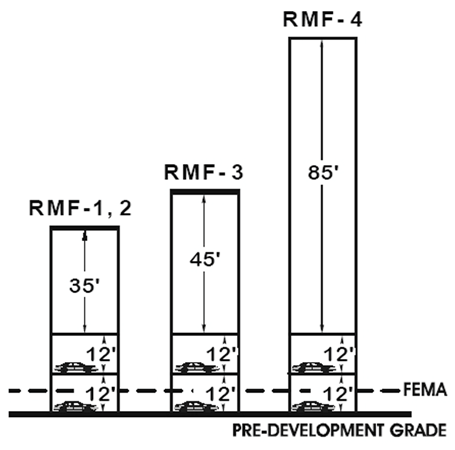
In-Structure Parking
k.
Height Along the Intracoastal Waterway and the Bays. In order to preserve the scenic character of the Intracoastal Waterway and the bays, and ensure appropriate massing of buildings along these waterfront areas, the following special restrictions shall apply within 250 feet of the Intracoastal Waterway and the bays (not including any passes, the Gulf of Mexico, basins, creeks or canals). Nonconforming lots of record zoned RMF shall also comply with Section 124-283(d).
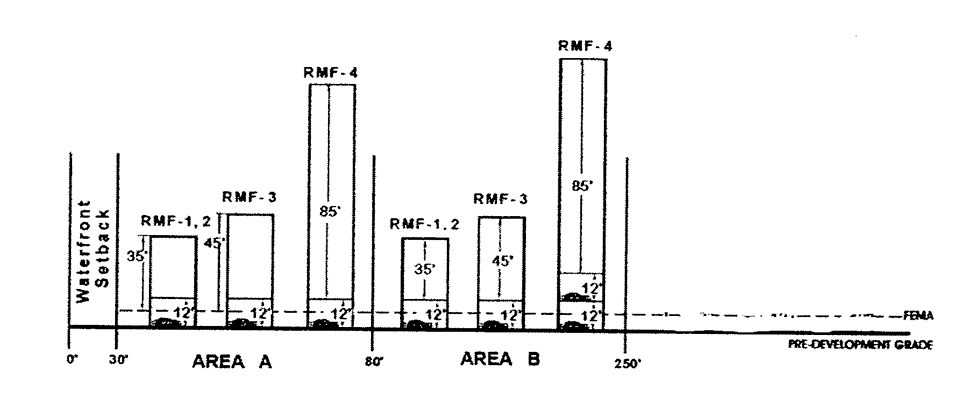
Height Along Intracoastal Waterway
(4)
"RMH" RESIDENTIAL, MANUFACTURED HOME.
a.
Districts, Intent.
1.
The RMH District provides for manufactured housing in the County and recognizes the existence of manufactured housing as a housing choice for the County's residents. This district is further intended to declare that the use of manufactured homes for dwelling purposes shall only be allowed in manufactured home parks or manufactured home subdivisions. This district of manufactured home development is provided to allow a suitable living environment in manufactured homes and to ensure the compatibility of such developments with adjoining and nearby present and future development of other types of residential units.
2.
The RMH District shall generally be used to implement the Comprehensive Plan within those areas shown as Moderate or Medium Density Residential on the Future Land Use Map.
b.
Permitted Principal and Limited Uses and Structures: Uses allowed by right in the district. Such uses are subject to all other applicable requirements of this UDC. Additional dimensional standards may allow a more intense use through the Special Exception process where expressly provided for in this Article 6:
1.
One manufactured home or recreational vehicle per manufactured home site or lot. A mobile home existing as of October 27, 2003, shall be permitted; however, no mobile home shall be located or relocated in an RMH District after that date.
2.
Manufactured home park/subdivision.
3.
Park recreation facilities including community room or center, courts for games, docks, piers, boat launching areas, and the like (but excluding facilities for boat repair requiring removal of boat from the water or dry storage).
4.
Park offices, maintenance facilities, and laundry facilities.
5.
Enclosed storage structures and storage garage facilities with use limited to park residents only.
6.
Open storage areas for recreational vehicles or boats, with use limited to park or subdivision residents only, provided no sales of recreational vehicles or boats shall be made from the premises and further provided that all such areas shall be screened from view by a landscaped buffer with an opacity of 0.70 in accordance with Section 124-122(i). No open storage area shall exceed five percent of the total land area of a manufactured home park or subdivision.
7.
Artesian wells, aeration facilities and wastewater treatment facilities are allowed as a limited use, subject to the standards for major utilities of Section 124-137. Other types of major utilities (Defined in Section 124-305) are prohibited unless in existence as of October 27, 2003.
8.
A stormwater facility is permitted when the principal use it serves is on a nonresidentially zoned parcel as a limited use when part of a Development of Regional Impact, within a revitalization or redevelopment plan adopted by the County, part of a regional stormwater facility; or part of a government roadway project. Landscape buffers shall be required as listed in Section 124-122(m)(4). All other stormwater facilities will require Special Exception approval.
9.
Child care center when operated as an activity of and on the same site as a place of worship provided:
i.
The minimum parcel size of the place of worship site, including the child care center, shall not be less than two acres.
ii.
Outdoor play areas shall not be located within 50 feet of any residential or agricultural zoned property.
iii.
A landscaped buffer in compliance with Section 124-73(e)(5) shall be required around the perimeter of the outdoor play area.
10.
Family day care home (Defined in Section 124-305).
11.
Large family child care home (Defined in Section 124-305).
12.
Adult day care home (up to 6) (Defined in Section 124-305).
13.
Minor utilities (Defined in Section 124-305), including neighborhood-serving telephone exchange, gas, or electrical installation; water and wastewater pump station or lift station.
14.
Transmission tower (see Chapter 118, Article II, of the County Code).
c.
Permitted Accessory Uses and Structures: Accessory uses and structures are permitted where such accessory uses and structures are customarily accessory and clearly subordinate to permitted or permissible uses and structures, are located on the same lot or parcel as the manufactured home park or subdivision, are not of a nature likely to attract visitors in larger numbers than would normally be expected in a manufactured home park or subdivision, and do not involve operations or structures not in keeping with the character of a manufactured home park. Noncommercial plant nurseries and greenhouse, private garages, toolhouses and garden sheds, garden work centers, children's play areas and play equipment, private barbecue pits, private swimming pools and the like. In addition, sales of groceries and sundries and coin-operated laundry facilities shall be permitted subject to the following restrictions:
1.
Such establishments and the parking areas primarily related to their operations shall not occupy more than one percent of the gross area of the park or subdivision.
2.
Such establishments shall be restricted in their use to occupants of the park or subdivision.
3.
Such establishments shall present no visible evidence from any street outside the park of their commercial character which would attract customers other than occupants of the park or subdivision.
4.
The structure housing such facilities shall not be located closer than 100 feet to any public street, shall not be directly accessible from any public street, and shall be accessible only from a street within the park or subdivision.
d.
Special Exceptions: Uses allowed only where approved as a Special Exception by the Board in accordance with the procedures of Section 124-43. Special exception uses are subject to all other applicable requirements of this UDC, including any additional standards listed below, except where expressly modified by the Board as part of the Special Exception approval:
1.
All group living (Defined in Section 124-305), including boarding house; rooming house; fraternity; sorority; orphanage (NAICS 623999); community residential homes (subject to the standards of Section 124-145); group home for the physically disabled, mentally disabled, or emotionally disturbed with 14 or more residents; hospice, nursing, or convalescent home (NAICS 623111); monastery; convent; residential facility without individual self-contained dwelling units. These uses shall be subject to the standards of Section 124-144.
2.
All community service, including community recreational facility (nonprofit), library, museum (NAICS 7121), neighborhood arts center or similar community facility (public), philanthropic institution, senior center, union hall youth-oriented community service, excluding rural retreat center (Defined in Section 124-305).
This use shall be subject to the following:
i.
The facility shall be located on a parcel not less than two acres in size.
3.
Day care facility (Defined in Section 124-305), including intermediate childcare, afterschool, and latch-key programs. A day care facility with 11 or more children shall be subject to the standards of Section 124-146.
4.
Adult day care facility (7 or more) (Defined in Section 124-305).
This use shall be subject to the following:
i.
The facility shall be located on a parcel not less than two acres in size.
5.
All places of worship (NAICS 813110), subject to the following standards:
i.
A place of worship may have accessory uses in accordance with Section 124-73(e).
ii.
Reserved.
6.
A stormwater facility is permitted when the principal use it serves is on a nonresidentially zoned parcel as a limited use when part of a Development of Regional Impact, within a revitalization or redevelopment plan adopted by the County, part of a regional stormwater facility; or part of a government roadway project. Landscape buffers shall be required as listed in Section 124-122(m)(4). All other stormwater facilities will require Special Exception approval.
7.
Clubs and lodges (Defined in Section 124-305).
8.
Community recreation facility (Defined in Section 124-305).
9.
Golf course, executive and par-three golf courses, clubhouse, yacht club, tennis club, country club, subject to the standards of Section 124-138.
10.
Recreational vehicle park/ campground (Defined in Section 124-305).
e.
Development Standards.
1.
Minimum Area: 40 acres. This minimum applies to all new parks or subdivisions, but not to additions to existing parks or subdivisions.
2.
Minimum Number of Spaces: Minimum number of spaces completed and ready for occupancy before first occupancy is permitted shall be 75.
3.
Access and Internal Streets.
i.
Access to the park or subdivision shall be from County maintained roadways, and shall be designed for safe and convenient movement of traffic into and out of the development with minimization of impact to traffic movement on adjacent streets. All vehicular traffic into and out of the park or subdivision shall be through such designated entrances and exits.
ii.
Entrances and exits to recreational vehicle parks, in addition to the access requirements of Section 124-121, shall be designed so as to not require turns at acute angles, and radii of curbs and pavements at intersections shall facilitate easy turning movements for large vehicles and vehicles with trailers attached. No vehicular access to a recreational vehicle park shall be through a manufactured home park of subdivision.
iii.
Internal streets in parks or subdivisions shall be designed and constructed in accordance with Article 13 of the UDC. All streets within a manufactured home park or a recreational vehicle park shall be private streets.
4.
Communications Systems. Such systems shall only be permitted within a manufactured home park or a recreational vehicle park and shall not be audible beyond park boundaries. Outside public address systems are prohibited.
5.
Utilities.
i.
Street lighting shall be installed in manufactured home parks and recreational vehicle parks. Such lighting may be overhead or low level; however, the source of said lighting shall not be visible beyond park boundaries and all light shall be directed onto the street or pedestrian way.
ii.
Each manufactured home or recreational vehicle site shall be provided with an approved electric service, and shall be connected to a central water and sewer system.
iii.
All utilities distribution and collection systems, including those for water, sewer, electricity, telephone, gas and television cable shall be underground. Electric power or central gas systems (if used) shall be serviced by individual meters.
iv.
Utility easements shall be provided in accordance with Article 13 of the UDC.
6.
Garbage and Trash Facilities. Each manufactured home or recreational vehicle site within a manufactured home park or a recreational vehicle park shall be provided with at least one trash container of not less than 20-gallon capacity. Such containers shall be located so as to be obstructed from view from streets within the park and outside the park. Park management shall be solely responsible for internal trash and garbage collection. Central park collection points shall be provided for pick-up by solid waste collection vehicles. These central collection points shall be totally screened from view, both within and outside of the park.
7.
Manufactured Home Foundation and Tie-Down. Each manufactured home shall be installed per State Code.
8.
Recreation Facilities. Eight percent of the gross area of a manufactured home park or subdivision, or a recreational vehicle park shall be developed for recreational purposes. No manufactured home site, required buffer area, street right-of-way, storage area, utility site or utility easement shall be counted as recreation area in meeting this requirement. Recreation areas and facilities shall be owned, operated and maintained by the management in a manufactured home or recreational vehicle park. Recreation areas and facilities in a manufactured home subdivision shall be owned, operated and maintained by the developer of the subdivision; or shall be held in common ownership and operated and maintained by all owners within the manufactured home subdivision. Prior to approval of a Final Plat for a manufactured home subdivision, a program for continued maintenance of all recreation areas shall be submitted to the County Commission, and to an attorney designated by the Board for review and approval. Said program shall include agreements, contracts, deed restrictions, sureties or other appropriate legal instruments to guarantee installation and continued maintenance of such recreation areas and facilities.
9.
Landscaped Buffer Areas. Except at points of ingress and egress, a property owner in an RMH district shall maintain landscaped buffer areas along the district boundaries. These landscaped buffer areas shall meet the requirements of Section 124-122(i) and not be less than 25 feet in width. Such buffer areas may be used for Stormwater Management Systems and utility easements, but shall not be used for any other purpose. Landscape buffer areas shall not be permitted to extend into lots or spaces designated for manufactured home use. All required buffer areas shall be planted with vegetative materials in accordance with Section 124-122, Landscaping and Buffering.
10.
Carport or Patio. Each manufactured home site in a manufactured home park shall contain a concrete slab not less than ten feet by 20 feet in dimension for carport or patio. Such slab shall not be required until after the manufactured home is in position.
f.
Maximum Residential Density. Manufactured Home Park or Subdivision: Five units per acre.
g.
Minimum Lot or Site Requirements.
1.
Manufactured Home Subdivision:
i.
Width: 60 feet.
ii.
Area: 6,000 square feet.
2.
Manufactured Home Park or Recreational Vehicle Park: None, except as required to meet the requirements of this Section and Section 124-153.
h.
Maximum Lot or Site Coverage by All Buildings.
1.
New Manufactured Home Parks. Maximum lot coverage in a manufactured home park established after October 27, 2003, shall not exceed 40 percent.
2.
Replacement Homes in Existing Parks. Replacement homes in manufactured home parks existing as of October 27, 2003, are subject to the following maximum lot coverage standards.
3.
New Homes on Existing Lots or Sites Under 6,000 Square Feet. New homes installed on lots or sites of 6,000 square feet or less in manufactured home parks existing as of October 27, 2003, that have never had a manufactured home installed on the lot may apply the table in paragraph 2. above.
i.
Minimum Yard Requirements. Manufactured Home Parks and Subdivisions:
1.
Front: Ten feet.
i.
On a lot in a manufactured home park that has previously had a manufactured or mobile home on it, the depth of the street yard shall be no smaller than the lesser of:
a)
Five feet; or
b)
The distance from the edge of the road to the front of the home previously located on the lot.
ii.
If the home that was previously on the lot had a street yard depth of less than five feet, that home's location shall be indicated by a drawing with a surveyor's seal. This drawing shall show the distance from the edge of pavement to the front of the home previously on the lot and that distance shall be the minimum street yard for that lot.
iii.
In all cases, adequate access for emergency vehicles shall be maintained.
2.
Side: 5 feet. Provided that in a nonconforming park or subdivision the side yard may be less than five feet if the separation requirements of the NFPA are met and the application provides written acknowledgment at the time of permit application that the lesser yard may affect placement of homes on adjacent lots and the adjacent lots must be under the control of the Applicant.
3.
Rear: 5 feet. Provided that in a nonconforming park or subdivision the rear yard may be less than five feet if the separation requirements of the NFPA are met and the application provides written acknowledgment at the time of permit application that the lesser yard may affect placement of homes on adjacent lots and the adjacent lots must be under the control of the Applicant. Provided, however, roof projections, overhangs, rain gutters and air conditioners may project into any required setback areas.
4.
Waterfront: 20 feet.
j.
Maximum Height of Structures.
1.
Recreational facilities: 35 feet.
2.
All other structures: 25 feet.
(c)
Commercial Districts. The following districts are considered Base Districts Commercial Districts:
(1)
"CN" COMMERCIAL, NEIGHBORHOOD.
a.
Districts, Intent.
1.
The CN District permits small-scale, neighborhood-oriented commercial facilities. Their proper development and use shall be facilitated through design techniques and sufficient buffering (as set out in Article 7), which provide for walkable, pedestrian-friendly uses compatible with nearby residential uses. The district is not intended for use by major or large-scale commercial, sales, service or automotive-oriented activities. The primary uses include retail sale of food, drugs, hardware, and similar items and the provision of personal services. Offices and other similar uses are encouraged. Uses in this district are intended to be located within convenient traveling distance from one or several neighborhoods which they will serve. This district allows residential use, including upper story residential dwelling units, in order to promote live-work and mixed use opportunities.
2.
The CN District is generally used to implement the Comprehensive Plan within those areas of the County shown as Regional, Community, Village I, Village II, or Neighborhood Commercial Center, or Commercial Corridor on the Future Land Use Map.
3.
When rezoning to the CN District the applicant for Rezoning may submit a Development Concept Plan with the Rezoning application. Under such circumstances, if the Rezoning is approved, it shall be in accord with the approved Development Concept Plan.
b.
Permitted Principal and Limited Uses and Structures: Uses allowed by right in the district. Such uses are subject to all other applicable requirements of this UDC. Additional dimensional standards may allow a more intense use through the Special Exception process where expressly provided for in this Article 6:
1.
Multifamily (multiplex, apartment), subject to the standards specified in subsection c., below and the following standards:
i.
Multi-family shall be allowed in the CN district as part of mixed use development in those areas where an adopted Critical Area Plan expressly permits mixed use development. Multi-family development shall comply with the development standards of subsection f. below and any conditions of development approval of the Critical Area Plan.
2.
Live-work unit, subject to the standards of Section 124-139.
3.
Upper story residential uses, subject to the following additional development standards:
i.
All ground level square footage shall contain only nonresidential uses. For each level of upper story residential use, the total square footage of each residential level shall not exceed the ground level square footage of nonresidential development nor shall it exceed allowable density and height. For the purposes of this section, the calculation of the ground level square footage shall not include any ground level in-structure parking areas.
4.
All group living (Defined in Section 124-305), including boarding house; rooming house; fraternity; sorority; orphanage (NAICS 623990); community residential homes (subject to the standards of Section 124-145); group home for the physically disabled, mentally disabled, or emotionally disturbed with 14 or more residents; hospice, nursing, or convalescent home (NAICS 623111); monastery; convent; residential assisted living facility without individual self-contained dwelling units. These uses shall be subject to the standards of Section 124-144.
5.
Community services, Community recreational facility (nonprofit), library, museum (NAICS 7121), neighborhood arts center or similar community facility (public), philanthropic institution, senior center.
6.
Family day care home (Defined in Section 124-305).
7.
Large family child care home (Defined in Section 124-305).
8.
Day care facility (Defined in Section 124-305), including intermediate childcare, afterschool, and latch-key programs. These uses are subject to the standards specified in subsection c., below. A day care facility with 11 or more children shall be subject to the standards of Section 124-146.
9.
Adult day care home (up to 6) (Defined in Section 124-305).
10.
Adult day care facility (7 or more) (Defined in Section 124-305).
11.
Day facility (Defined in Section 124-305).
12.
Vocational, trade or business school (NAICS 6112 6115).
13.
All medical, dental, and chiropractic offices, laboratories and facilities, blood plasma donation center, hospital, out-patient clinic (NAICS 6211, 6213, 6214, 6215, 6216, 6219, 6221), except patient family accommodations and pain management clinics, subject to the standards specified in the following standards:
i.
Medical facilities are permitted, provided that no facility in the CN District is greater than 20,000 square feet in size.
14.
All parks.
15.
All places of worship (NAICS 813110), subject to the following standards:
i.
A place of worship may have accessory uses in accordance with Section 124-73(e).
16.
Neighborhood resource center (Defined in Section 124-305), subject to the following standards:
i.
The site shall provide a landscaped buffer with a minimum opacity of 0.7 on all non-street property lines.
ii.
Direct access to the site shall be from an arterial or collector roadway is required and no vehicular access driveway shall be permitted to a local street.
iii.
Operation of any retail sales component is not permitted between 7:00 p.m. and 8:00 a.m.
iv.
Retail sales component is an accessory use only to the principal use and building and shall not comprise more than 20 percent of floor area of the principal building and shall be depicted on the Site Development Plan to be submitted.
v.
Site Development Plan approval is required.
17.
Major utilities that are permitted with limitations including aeration facility, artesian well, wastewater treatment plant, subject to the standards of Section 124-137, except those requiring Special Exception approval as specified in subsection e. below.
18.
Minor utilities (Defined in Section 124-305), including on-site stormwater retention or detention facility, neighborhood-serving telephone exchange, gas or electrical installation; water and wastewater pump station or lift station.
19.
Stormwater facility in a different zoning district than principal use.
20.
Bar (Defined in Section 124-305), except those requiring Special Exception approval as specified in subsection e., below, and subject to the standards specified in subsection c., below. Also subject to criteria outlined under "Restaurants". See additional criteria regarding "Indoor/Outdoor Entertainment" in this Section.
21.
Clubs and lodges (Defined in Section 124-305).
22.
Entertainment, indoor (Defined in Section 124-305), within a completely enclosed building shall be permitted between 8:00 a.m. and 10:00 p.m. After 10:00 p.m., such indoor entertainment shall require a Special Exception approval as specified in subsection e., below. Indoor entertainment shall also be subject to the standards specified in subsection c., below. All entertainment shall be governed by Air and Sound Pollution and Noise, Chapter 54, Article V and VI of the County Code.
23.
All offices, including urgent care facilities, emergency medical offices, counseling in an office setting, and TV and radio studios, subject to the standards specified in subsection c., below.
24.
Community recreation facility (Defined in Section 124-305).
25.
Entertainment, outdoor (Defined in Section 124-305). Outdoor entertainment is permitted between 8:00 a.m. and 10:00 p.m. After 10:00 p.m., such outdoor entertainment shall require a Special Exception approval as specified in subsection e., below. Outdoor entertainment shall also be subject to the standards specified in subsection c., below. All entertainment shall be governed by Air and Sound Pollution and Noise, Chapter 54, Article V and VI of the County Code.
26.
All restaurants (NAICS 722511, 722513, 722514) and small scale catering establishments (NAICS 722310, 722320), except Drive-thru (drive in), and those requiring Special Exception approval as specified in subsection e., below. Such restaurants shall be subject to the standards specified in subsection c., below to the standards of Section 124-140.
27.
All retail sales (NAICS 442—453); Personal services (NAICS 811490); Professional services (NAICS 54); and Household goods maintenance and repair services (NAICS 8112—8114); subject to the standards specified in subsection c., below.
The following retail sales and services are excluded: Those uses requiring Special Exception approval as specified in subsection e. below; motor vehicle and mobile home dealers (NAICS 441 and 453930); package store (Defined in Section 124-305); Retail sales of lumber and building supplies (NAICS 444110 and 444190) up to 60,000 square feet gross floor area; Pawn shops (NAICS 522298); and Medical Marijuana Dispensary (Defined in Section 124-305), subject to the standards specified in Section 124-150.
28.
Animal hospital, veterinary clinic, with or without animal boarding (use in conjunction with an animal hospital or veterinary clinic) (NACIS 812910), except those requiring Special Exception approval as specified in subsection e. below, subject to the standards specified in subsection c., below. Animal Hospital or veterinary clinic is limited to 20,000 square feet with outdoor boarding and any animal boarding facility shall also comply with the requirements of Section 124-147.
29.
Convenience store (Defined in Section 124-305) with gas pumps, gas station with minimart, with a maximum of four pumping stations (serving up to four vehicles simultaneously, and no more). More than four shall require Special Exception approval as specified in subsection e., below. Convenience store with gas pumps, gas station uses shall also be subject to the standards specified in subsection c., below, and Section 124-148.
30.
Convenience store (Defined in Section 124-305) without gas pumps, except those requiring Special Exception approval as specified in subsection e., below subject to the standards specified in subsection c., below.
31.
Drive-thru retail sales or service, subject to the standards specified in subsection c., below.
32.
Garden center (Defined in Section 124-305), completely enclosed, except those requiring Special Exception approval as specified in subsection e. below, subject to the standards specified in subsection c., below.
33.
Retail sales of vehicle parts and accessories (NAICS 441310), subject to the standards specified in subsection c., below.
34.
All transient accommodations including hotels, motels, inns, and extended stay facilities (NAICS 721110), subject to the standards specified in subsection c., below and subject to the following standards:
i.
Establishments having more than 100 rooms may have a restaurant, and bar and, in addition, shops for the retail sale of flowers, sundries, books, jewelry, gifts, art and similar items, and barber or beauty shops. Such uses must be located inside the main building.
35.
Bed and breakfast (Defined in Section 124-305), and subject to the standards specified in Section 124-141 and subsection c., below.
36.
Elementary, middle or high school (NAICS 611110).
c.
Other standards for certain uses within the CN District.
1.
Certain uses as noted in subsection b. above, are permitted in the CN District subject to the following standards:
i.
No individual use shall be greater than 20,000 square feet in gross floor area unless a Special Exception has been issued for such use.
ii.
The sale of alcoholic beverages for on-premises consumption shall only be permitted in establishments as follows:
a)
Alcoholic beverages may be served in conjunction with a meal provided the establishment is operating under a valid Consumption on Premises License (1 or 2 C.O.P. Licenses) issued by the State of Florida Pursuant to F.S. § 563.02 or 564.02 or such comparable sections of the Florida Statutes which may be in force from time to time regulating the sale of alcoholic beverages under such C.O.P. license, if such establishments have a kitchen where food is prepared for on-premise consumption; or
b)
Alcoholic beverages may be served with or without a meal provided the establishment is operating under a valid Special Restaurant License issued by the State Department of Business and Professional Regulations pursuant to Florida Administrative Code: Section 61a-3.0141 or such comparable section of the Florida Administrative Code which may be in force from time to time regulating the sale of alcoholic beverages under such special restaurant license.
iii.
A pharmacy in the CN District is permitted one drive through lane, provided the parcel is a minimum of one acre in size, fronts on an arterial or collector road and there is no order board for the drive through.
d.
Permitted Accessory Uses and Structures: Uses and structures which are customarily accessory and clearly incidental to permitted or permissible uses and structures. These uses are subject to the standards of Section 124-73, Accessory Uses and Structures.
e.
Special Exceptions: Uses allowed only where approved as a Special Exception by the Board in accordance with the procedures of Section 124-43. Special exception uses are subject to all other applicable requirements of this UDC, including any additional standards listed below, except where expressly modified by the Board as part of the Special Exception approval:
1.
College, seminary, or university (NAICS 6112 and 6113, not including vocational, trade, or business schools).
2.
Major utilities (Defined in Section 124-305), including electric substation, electric or gas generation plant, filter bed, railroad right-of-way (new), water pumping facility, water tower, or water tank, including expansions to such facilities in existence as of the effective date of this UDC; but excluding aeration facility, artesian well, wastewater treatment facility, subject to the standards in Section 124-137.
3.
All indoor recreation, including convention center, movie theater, and other theater (NAICS 512131, 7111) or similar uses, subject to the standards specified in subsection c., above.
4.
Bar (Defined in Section 124-305), with outdoor dining or drinking, after 10:00 pm, Sunday through Thursday or after 11:00 pm Friday and Saturday. If outdoor entertainment is proposed, this use is subject to the following standards:
i.
The parcel is a minimum of four acres; and
ii.
No outdoor entertainment shall be located closer than 200 feet from any residential zoning district.
5.
Entertainment, indoor (Defined in Section 124-305), indoor entertainment after 10:00 pm All entertainment shall be governed by Air and Sound Pollution and Noise, Chapter 54, Article V and VI of the County Code.
6.
All individual office uses that exceed 20,000 square feet in area, urgent care facilities, emergency medical offices, counseling in an office setting, and TV and radio studios
7.
Entertainment, outdoor (Defined in Section 124-305)All entertainment shall be governed by Air and Sound Pollution and Noise, Chapter 54, Article V and VI of the County Code. Outdoor entertainment after 10:00 pm is permitted by Special Exception, subject to the following standards:
i.
The parcel is a minimum of four acres; and
ii.
No outdoor entertainment shall be located closer than 200 feet from any residential zoning district.
8.
Special events in conjunction with an approved outdoor recreation use, subject to the standards of Section 124-142.
9.
All individual restaurant uses that exceed 20,000 square feet in area (NAICS 722511, 722513, 722514) and small scale catering establishments (NAICS 722310, 722320), except drive-thru. Restaurants shall be subject to the standards of Section 124-140.
10.
All individual retail sales and service uses that exceed 20,000 square feet in area (NAICS 442—453); Personal services (NAICS 811490); Professional services (NAICS 54); and Household goods maintenance and repair services (NAICS 8112—8114).
11.
Convenience store (Defined in Section 124-305), with gas pumps or gas station with minimart that have more than four pumping stations or more that 20,000 square feet building area, subject to the standards in Section 124-148.
12.
Convenience store (Defined in Section 124-305), without gas pumps with more than 20,000 square feet building area.
13.
Garden center (Defined in Section 124-305), outside merchandise.
14.
Bed and breakfast (Defined in Section 124-305) with more than 20,000 square feet building area or which will include business meeting, receptions, teas and other events from which the property owner may benefit financially involving attendance by anyone other than registered overnight guests may be permitted as part of the Special Exception approval, except in the Siesta Key Overlay District (SKOD), subject to the standards of Section 124-141.
15.
Brewpub subject to the standards of Section 124-155.
f.
Development Standards. Unless specified elsewhere in this UDC, the following dimensional standards shall apply to all development in the CN District:
(2)
"OPI" OFFICE, PROFESSIONAL AND INSTITUTIONAL.
a.
Districts, Intent.
1.
The OPI District permits both small and large-scale office, institutional, cultural, and allied uses. The district is not retail commercial in character. Large-scale office, cultural and institutional uses are encouraged to locate in these districts. This district allows residential use, including upper story residential dwelling units, in order to promote live-work and mixed use opportunities.
2.
The OPI District is generally used to implement the Comprehensive Plan within those areas of the County shown as Regional, Community, Village I, Village II, and Neighborhood Commercial Center, Commercial Corridors, Office/Multifamily Residential Area and Corridor, and Town and Village Centers on the Future Land Use Map.
3.
When rezoning to the OPI District the applicant for rezoning may submit a Development Concept Plan with the Rezoning application. Under such circumstances, if the Rezoning is approved, it shall be in accord with the approved Development Concept Plan.
b.
Permitted Principal and Limited Uses and Structures: Uses allowed by right in the district. Such uses are subject to all other applicable requirements of this UDC. Additional dimensional standards may allow a more intense use through the Special Exception process where expressly provided for in this Article 6:
1.
Multifamily (multiplex, apartment), subject to the following standards:
i.
Multi-family shall be allowed in the OPI district as part of mixed use development in those areas where an adopted Critical Area Plan expressly permits mixed use development. Multi-family development shall comply with the development standards of the applicable zoning district and any conditions of development approval of the Critical Area Plan.
2.
Live-work unit, subject to the standards of Section 124-139.
3.
Upper story residential, subject to the following additional development standards:
i.
All ground level square footage shall contain only nonresidential uses. For each level of upper story residential use, the total square footage of each residential level shall not exceed the ground level square footage of nonresidential development nor shall it exceed allowable density and height. For the purposes of this section, the calculation of the ground level square footage shall not include any ground level in-structure parking areas.
4.
All group living (Defined in Section 124-305), including boarding house; rooming house; fraternity; sorority; orphanage (NAICS 623990); community residential homes (subject to the standards of Section 124-145); group home for the physically disabled, mentally disabled, or emotionally disturbed with 14 or more residents; hospice, nursing, or convalescent home (NAICS 623111); monastery; convent; residential assisted living facility without individual self-contained dwelling units. These uses shall be subject to the standards of Section 124-144.
5.
All community service including community recreational facility (nonprofit), library, museum (NAICS 7121), neighborhood arts center or similar community facility (public), philanthropic institution, senior center, union hall youth-oriented community service; not including Rural Retreat Center.
6.
Day care facility (Defined in Section 124-305), including intermediate childcare, afterschool, and latch-key programs. A day care facility with 11 or more children shall be subject to the standards of Section 124-146.
7.
Family day care home (Defined in Section 124-305).
8.
Adult day care home (up to 6) (Defined in Section 124-305).
9.
Adult day care facility (7 or more) (Defined in Section 124-305).
10.
College, seminary, or university (NAICS 6112 and 6113).
11.
Day facility (Defined in Section 124-305).
12.
Elementary, middle or high school (NAICS 611110).
13.
Vocational, trade or business school (NAICS 6112—6115).
14.
All medical, dental, and chiropractic offices, laboratories and facilities, blood plasma donation center, hospital, out-patient clinic (NAICS 6211, 6213, 6214, 6215, 6216, 6219, 6221), except pain management clinics (Defined in Section 124-305).
15.
Patient family accommodations (Defined in Section 124-305), subject to Section 124-154.
16.
All parks.
17.
All passenger terminals, including bus passenger terminal, taxi dispatch center, train passenger terminal (NAICS 485), scenic and sight-seeing tour.
18.
Airports and heliports (NAICS 481), subject to the following standards:
Adequate land area is available for take-off and landing to ensure public safety in accordance with Federal Aviation Administration standards. In addition, the helicopter landing facility and the aircraft runway shall be a minimum of 500 feet from all property lines. Exceptions to the 500-foot setback shall be allowed only where abutting properties allow the use and the use is not prohibited on abutting properties by private covenant or restriction.
19.
All places of worship (NAICS 813110).
20.
Neighborhood resource center (Defined in Section 124-305), subject to the following standards:
i.
The site shall provide a landscaped buffer with a minimum opacity of 0.7 on all non-street property lines.
ii.
Direct access to the site shall be from an arterial or collector roadway is required and no vehicular access driveway shall be permitted to a local street.
iii.
Operation of any retail sales component is not permitted between 7:00 p.m. and 8:00 a.m.
iv.
Retail sales component is an accessory use only to the principal use and building and shall not comprise more than 20 percent of floor area of the principal building and shall be depicted on the Site Development Plan to be submitted.
v.
Site Development Plan approval is required.
21.
Minor utilities (Defined in Section 124-305), including on-site stormwater retention or detention facility, neighborhood-serving telephone exchange, gas, or electrical installation; water and wastewater pump station or lift station.
22.
Stormwater facility in a different zoning district than principal use.
23.
Clubs and lodges (Defined in Section 124-305).
24.
All offices, including government and non-government offices, urgent care facilities, emergency medical offices, counseling in an office setting, TV and radio studios, advertising office, bank (with or without drive-through), business management consulting, data processing, financial business such as lender, investment or brokerage house, collection agency, real estate or insurance agent, professional service such as lawyer, accountant, bookkeeper, engineer, architect, sales office, travel agency (NAICS 518, 52, 5312, 54 [except 54194], 55, 561).
25.
Community recreation facility (Defined in Section 124-305).
26.
All commercial parking, including mixed parking lot (partially accessory to a specific use, partly to rent for others), short-and long-term fee parking facility (NAICS 812930), and park-and-ride facility.
27.
Self Service Storage within State Road 776 Corridor and Bee Ridge Road/I-75 South Critical Area Plan. Properties within the S.R. 776 Corridor Plan Area may contain Self-service storage facilities subject to compliance with the S.R. 776 Corridor Plan Condition for Development Approval No. 18. (See S.R. 776 Corridor Plan). Properties within the Bee Ridge/I-75 South Critical Area Plan may contain Self-service storage facilities subject to compliance with Condition for Development Approval No. 16 (Bee Ridge Rd/I-75 South CAP).
28.
Research testing and development laboratory (NAICS 5417) without manufacturing facility.
c.
Permitted Accessory Uses and Structures: Uses and structures which are customarily accessory and clearly incidental to permitted or permissible uses and structures. These uses are subject to the standards of Section 124-73, Accessory Uses and Structures.
d.
Special Exceptions: Uses allowed only where approved as a Special Exception by the Board in accordance with the procedures of Section 124-43. Special exception uses are subject to all other applicable requirements of this UDC, including any additional standards listed below, except where expressly modified by the Board as part of the Special Exception approval:
1.
Pain management clinics (Defined in Section 124-305), subject to the standards specified in Section 124-151.
2.
All social service institutions (NAICS 622210, 623210, 623220, 623990, 6241, 6242), Alternative- or post-incarceration facility, Exclusive care and treatment for psychiatric, alcohol, or drug problems, where patients are residents (NAICS 62221, 6232), Rehabilitative clinic, Social service facility, soup kitchen, transient lodging or shelter for the homeless (NAICS 624, 6242), subject to the following standards:
i.
The facility shall be located on a parcel not less than two acres in size.
ii.
No structure shall be closer than 50 feet to any residentially-zoned property.
3.
Major utilities (Defined in Section 124-305), limited to aeration facility, artesian well, electrical substation, wastewater treatment facility, subject to the standards of Section 124-137.
4.
Special events in conjunction with an approved outdoor recreation use, subject to the standards of Section 124-142.
5.
Animal hospital, veterinary clinic, with or without animal boarding (NAICS 541940). A Veterinary clinic without animal boarding may be allowed in the OPI district, provided that such veterinary clinic receives approval as a Special Exception and the use meets the following minimum standards:
i.
The parcel is designated on the Future Land Use Plan Map as Office/Multi Family Residential.
6.
Medical marijuana dispensary (Defined in Section 124-305), subject to the standards of Section 124-150.
7.
Self-service storage (enclosed). No outdoor storage or exterior accessed storage spaces are permitted. Such facility shall be designed to be consistent with the architectural and design standards for Self-Service Storage within Section 124-128.
e.
Development Standards. Unless specified elsewhere in this UDC, the following dimensional standards shall apply to all development in the OPI Districts:
f.
Additional Height by Special Exception. When maximum height of a structure is increased through the special exception process, the following restrictions shall be met:
1.
Maximum building coverage shall be reviewed as part of the Special Exception application.
2.
Side and rear yards shall be provided at a ratio of one foot for each four feet of additional building height in excess of the permitted maximum height.
3.
Street yards shall be 25 feet or one-half of the building height, whichever is greater.
(3)
"CG" COMMERCIAL, GENERAL.
a.
Districts, Intent.
1.
The CG District provides for general commercial facilities of varying scales and may include either an individual business located on its own parcel, or multiple businesses located together on a parcel (such as a shopping center). Businesses in this district should be sited convenient to automotive traffic. Pedestrian traffic will also be found in this district, and therefore pedestrian connections to existing neighborhoods are important. In large-scale projects, access, internal vehicular and pedestrian circulation and transit access are also important. This district should be designed to serve a community-wide market area and offer a wide range of goods and services. It is further intended that sufficient buffering and design techniques be used to reduce or prevent impacts on adjacent or nearby residential uses. This district allows residential use, including upper story residential dwelling units, in order to promote live-work and mixed use opportunities. When rezoning to the CG District, it shall be in accord with an approved Binding Development Concept Plan.
2.
The CG District is generally used to implement the Comprehensive Plan within those areas of the County shown as Regional, Community, Village I and Village II Commercial Center, or Commercial Corridor on the Future Land Use Map.
b.
Permitted Principal and Limited Uses and Structures: Uses allowed by right in the district. Such uses are subject to all other applicable requirements of this UDC. Additional dimensional standards may allow a more intense use through the Special Exception process where expressly provided for in this Article 6:
1.
Multifamily (multiplex, apartment), except those requiring Special Exception approval as specified in subsection e. below and subject to the following standards:
i.
Multi-family shall be allowed in the CG district as part of mixed use development in those areas where an adopted Critical Area Plan expressly permits mixed use development. Multi-family development shall comply with the development standards of the applicable zoning district and any conditions of development approval of the Critical Area Plan.
2.
Live-work unit, subject to the requirements of Section124-139.
3.
Upper story residential, subject to the following additional development standards:
i.
All ground level square footage shall contain only nonresidential uses. For each level of upper story residential use, the total square footage of each residential level shall not exceed the ground level square footage of nonresidential development nor shall it exceed allowable density and height. For the purposes of this section, the calculation of the ground level square footage shall not include any ground level in-structure parking areas.
4.
All group living (Defined in Section 124-305), including boarding house; rooming house; fraternity; sorority; orphanage (NAICS 623990); community residential homes (subject to the standards of Section 124-146); group home for the physically disabled, mentally disabled, or emotionally disturbed with 14 or more residents; hospice, nursing, or convalescent home (NAICS 623111); monastery; convent; residential assisted living facility without individual self-contained dwelling units. These uses shall be subject to the standards of Section 124-144.
5.
All community service, including community recreational facility (nonprofit), library, museum (NAICS 7121), neighborhood arts center or similar community facility (public), philanthropic institution, senior center, union hall youth-oriented community service; not including Rural Retreat Center.
6.
Family day care home (Defined in Section 124-305).
7.
Large family child care home (Defined in Section 124-305).
8.
Day care facility (Defined in Section 124-305), including intermediate childcare, afterschool, and latch-key programs. A day care facility with 11 or more children shall be subject to the standards of Section 124-146.
9.
Adult day care home (up to 6) (Defined in Section 124-305).
10.
Adult day care facility (7 or more) (Defined in Section 124-305).
11.
College, seminary, or university (NAICS 6112 and 6113).
12.
Day facility (Defined in Section 124-305).
13.
Vocational, trade, or business school (NAICS 6112—6115).
14.
All medical, dental, and chiropractic offices, laboratories and facilities, blood plasma donation center, hospital, out-patient clinic (NAICS 6211, 6213, 6214, 6215, 6216, 6219, 6221), not including pain management clinics (Defined in Section 124-305), requiring Special Exception approval as specified in subsection e.
15.
Patient family accommodations (Defined in Section 124-305), subject to Section 124-154.
16.
All parks.
17.
All passenger terminals, bus passenger terminal, taxi dispatch center, train passenger terminal (NAICS 485), scenic and sight-seeing tour.
18.
Airports and heliports (NAICS 481), subject to the following standards:
Adequate land area is available for take-off and landing to ensure public safety in accordance with Federal Aviation Administration standards. In addition, the helicopter landing facility and the aircraft runway shall be a minimum of 500 feet from all property lines. Exceptions to the 500-foot setback shall be allowed only where abutting properties allow the use and the use is not prohibited on abutting properties by private covenant or restriction.
19.
All places of worship (NAICS 813110).
20.
Neighborhood resource center (Defined in Section 124-305).
21.
Major utilities that are permitted with limitations including aeration facility, artesian well, wastewater treatment plant, subject to the standards of Section 124-137, except those requiring Special Exception approval as specified in subsection e. below.
22.
Minor utilities (Defined in Section 124-305), including on-site retention or detention facility, neighborhood-serving telephone exchange, gas, or electrical installation; water and wastewater pump station or lift station.
23.
Stormwater facility in a different zoning district than principal use.
24.
Adult bookstores and video stores (Defined in Section 124-305), subject to the standards of 124-149, Sexually Oriented Business Uses.
25.
Semi-nude model studios, subject to the standards of 124-149, Sexually Oriented Business Uses.
26.
Other adult retail stores, subject to the standards of 124-149, Sexually Oriented Business Uses.
27.
Indoor recreation including convention center, movie theater, and other theater (NAICS 512131, 7111); but excluding those requiring Special Exception approval as specified in subsection e. below.
28.
Bar, subject to criteria outlined under "Restaurants". See additional criteria regarding "Indoor/Outdoor Entertainment" in this Section.
29.
Clubs and lodges (Defined in Section 124-305).
30.
Entertainment, indoor (Defined in Section 124-305), within a completely enclosed building shall be permitted between 8:00 a.m. and 10:00 p.m. After 10.p.m., such indoor entertainment shall require a Special Exception approval as specified in subsection e. below. All entertainment shall be governed by Air and Sound Pollution and Noise, Chapter 54, Article V and VI of the County Code.
31.
Indoor facility for extreme sports such as paintball, BMX, or skateboarding.
32.
Firing range or archery range, indoor (Defined in Section 124-305).
33.
Gymnastics facility, martial arts facility, fitness gym, dance and fine arts studio, indoor sports academy (NAICS 611620 and 611610).
34.
All offices, including government and non-government offices, urgent care facilities, emergency medical offices, counseling in an office setting, and TV and radio studios, advertising office, bank (with or without drive-through), business management consulting, data processing, financial business such as lender, investment or brokerage house, collection agency, real estate or insurance agent, professional service such as lawyer, accountant, bookkeeper, engineer, architect, sales office, travel agency (NAICS 518, 52, 5312, 54 [except 54194], 55, 561).
35.
Community recreation center (Defined in Section 124-305).
36.
Entertainment, outdoor (Defined in Section 124-305). Outdoor entertainment is permitted between 8:00 a.m. and 10:00 p.m. After 10:00 p.m., such outdoor entertainment shall require a Special Exception approval as specified in subsection e. below. All entertainment shall be governed by Air and Sound Pollution and Noise, Chapter 54, Article V and VI of the County Code.
37.
All commercial parking (NAICS 812930), including park-and-ride facility.
38.
All restaurants (NAICS 722511, 722513, 722514) and small scale catering establishments (NAICS 722310 and 722320). Restaurants shall be subject to the standards of Section 124-140.
39.
Retail sales, including Store selling, leasing or renting consumer, home, and business goods including, but not limited to, alcoholic beverages, antiques, appliances, art, art supplies, baked goods, bicycles, books, building supplies, cameras, carpet and floor coverings, crafts, clothing, computers, convenience goods, dry goods, electronic equipment, fabric, flowers, furniture, garden center, gifts or novelties, groceries, hardware, home improvement, household products, jewelry, medical supplies, musical instruments, pets, pet supplies, pharmaceuticals, photo finishing, picture frames, plants, postal substation, printed materials, produce, souvenirs, sporting goods, stationery, tobacco and related products, vehicle parts and accessories, videos, full- or self-serve gas (NAICS 44131, 442, 443, 444, 445, 446, 447, 448, 451, 452, 453, except 45393).
40.
Professional/Personal Retail Services, including Animal grooming (NAICS 81291), athletic, tennis, swim or health club, art, music or photographic studio or classroom, dry-cleaning or laundry drop-off facility, laundromat (NAICS 81231, 81232), hair, nail, tanning, massage therapy and personal care service (NAICS 8121), photocopy, blueprint, package shipping and quick-sign service (NAICS 561439), psychic or medium, taxidermist.
41.
Repair Oriented Retail Services, including Appliance, bicycle, canvas product, clock, computer, jewelry, musical instrument, office equipment, radio, shoe, television or watch repair, Tailor, milliner, upholsterer (NAICS 8112, 8114), Locksmith (NAICS 561622).
42.
Animal hospital, veterinary clinic, with or without animal boarding
43.
Convenience store (Defined in Section 124-305), with gas pumps, gas station minimart, subject to the standards in Section 124-148.
44.
Convenience store (Defined in Section 124-305), without gas pumps.
45.
Drive-thru retail sales or service.
46.
Garden center (Defined in Section 124-305), completely enclosed.
47.
Package store (Defined in Section 124-305).
48.
Vehicle parts and accessories (NAICS 441310).
49.
Retail of lumber and building supplies (NAICS 444110 and 444190) up to 60,000 square feet gross floor area.
50.
Pawn shops (NAICS 522298).
51.
All self-service storage (NAICS 531130).
52.
Bed and breakfast (Defined in Section 124-305), subject to the standards of Section 124-141.
53.
Car wash, full or self-service (Defined in Section 124-305). Automatic car wash buildings shall be subject to the standards of Section 124-152.
54.
Vehicle service, general (NAICS 8111) A general vehicle service establishment is permitted provided that, if the establishment has more than two service bays, the service bay doors shall not be oriented toward the public right-of-way or residentially-zoned property, or shall be screened from view from the public right-of-way or residentially zoned property.
55.
Boat livery/marina (Defined in Section 124-305).
56.
Boat sales (NAICS 441222), accessory to boat livery or marina.
57.
Wholesale trade (NAICS 423, 4241—4246, 4248, 4249, 425); mail-order house (NAICS 454110); sale or rental of machinery, equipment, heavy equipment, building materials, special trade tools; welding supplies, janitorial supplies, restaurant equipment, and store fixtures; commercial water softening.
58.
Elementary, middle or high school (NAICS 611110).
59.
Brewpub subject to the standards of Section 124-155.
60.
Microbrewery, including a taproom and ancillary restaurant, subject to the standards of UDC Section 124-158.
61.
Microdistillery, including a taproom and ancillary restaurant, subject to the standards of UDC Section 124-158.
62.
Contractor office/showroom/indoor storage (NAICS 236, 237, 238), subject to the standards of UDC Section 124-159.
c.
Existing Uses:
1.
Dock or pier (commercial) (NAICS 48831).
d.
Permitted Accessory Uses and Structures: Uses and structures which are customarily accessory and clearly incidental to permitted or permissible uses and structures. These uses are subject to the standards of Section 124-73, Accessory Uses and Structures:
1.
The rental of light or medium moving trucks may be permitted as an accessory use to a self-service storage facility on properties zoned CG subject to:
i.
Such vehicles may be contained within a gated facility and not within 35 feet of any property boundary; and
ii.
No more than one (1) truck per 5,000 s.f. of Self-service Storage building shall be permitted.
e.
Special Exceptions: Uses allowed only where approved as a Special Exception by the Board in accordance with the procedures of Section 124-43. Special Exception uses are subject to all other applicable requirements of this UDC, including any additional standards listed below, except where expressly modified by the Board as part of the Special Exception approval:
1.
Multifamily (multiplex, apartment), only if a part of a mixed-use development. The following residential uses may be allowed in the CG district by Special Exception provided the cumulative amount of residential structures shall not exceed 30 percent of building coverage:
i.
Multi-family units in one or more free standing buildings not attached to a structure with commercial use; and
ii.
One or more residential units attached to a structure with commercial use. A residential unit or units may be attached to any surface of the commercial structure by common walls, a connecting corridor, or any other structural member whether or not an entranceway is provided between the commercial and residential uses.
2.
Upper story residential, with nonresidential use on the ground floor, that does not meet the standards in Section 124-76(c)(3)b.3.i, above.
3.
Pain management clinics (Defined in Section 124-305), subject to the standards in Section 124-151.
4.
All social service institutions (NAICS 622210, 623210, 623220, 623990, 6242), except neighborhood resource center (Defined in Section 124-305), subject to the following standards:
i.
The facility shall be located on a parcel not less than two acres in size.
ii.
No structure shall be closer than 50 feet to any residentially-zoned property.
5.
Major utilities (Defined in Section 124-305), including electric substation, electric or gas generation plant, filter bed, railroad right-of-way (new), water pumping facility, water tower, or water tank; but excluding aeration facility, artesian well, wastewater treatment plant, subject to the standards in Section 124-137.
6.
Adult entertainment establishments (Defined in Section 124-305), subject to the standards of Section 124-149, Sexually Oriented Business Uses.
7.
Adult movie theaters and motels, subject to the standards of 124-149, Sexually Oriented Business Uses.
8.
Bar (Defined in Section 124-305), with outdoor entertainment after 10:00 p.m. or outdoor dining after 10:00 p.m. Sunday through Thursday, or after 11:00 p.m. Friday and Saturday.
9.
Entertainment, indoor (Defined in Section 124-305), with entertainment after 10:00 p.m. All entertainment shall be governed by Air and Sound Pollution and Noise, Chapter 54, Article V and VI of the County Code.
10.
All outdoor recreation, including circus ground (NAICS 711190), drive-in theater (NAICS 512312), batting cage, golf driving range, mini-amusement park, miniature golf facility, swimming pool, tennis court, water park, stadium or arena, motor vehicle racing track or facility, commercial amphitheater, ballfield, commercial tourist attraction, and winter quarters or training quarters.
The following outdoor recreation uses are excluded: community recreation facility (Defined in Section 124-305); outdoor Facility for extreme sports such as paintball, BMX, or skateboarding; firing range or archery range, outdoor (Defined in Section 124-305); golf course, executive and par-three golf courses, clubhouse, yacht club, tennis club, country club; hunting/fishing camp or dude ranch (Defined in Section 124-305); recreational vehicle park/campground (Defined in Section 124-305); riding academy or public stable (Defined in Section 124-305); sports academy (Outdoors) (NAICS 611620); wilderness camping (Defined in Section 124-305); and commercial hunting and trapping (Defined in Section 124-305).
11.
Dog or horse track, jai-alai fronton.
12.
Entertainment, outdoor (Defined in Section 124-305), entertainment after 10:00 p.m. All entertainment shall be governed by Air and Sound Pollution and Noise, Chapter 54, Article V and VI of the County Code.
13.
Flea market, outdoor.
14.
Polo club.
15.
Special events in conjunction with an approved outdoor recreation use, subject to the standards of Section 124-142.
16.
Pet resort (NACIS 812910), subject to the standards of Section 124-156.
17.
Garden center (Defined in Section 124-305), outside merchandise.
18.
Medical marijuana dispensary (Defined in Section 124-305), subject to the standards of Section 124-150.
19.
All transient accommodations, including hotels, motels, inns, and extended stay facilities (NAICS 721110), not including bed and breakfast (Defined in Section 124-305), subject to the following standards:
i.
Establishments having more than 100 rooms may have a restaurant, and bar and, in addition, shops for the retail sale of flowers, sundries, books, jewelry, gifts, art and similar items, and barber or beauty shops. Such uses must be located inside the main building.
20.
Truck stop (Defined in Section 124-305).
21.
Vehicle sales, leasing or rental (NAICS 4411, 4412, 532111, 532120), subject to the following standards:
i.
The property shall be located within one mile of an interstate interchange;
ii.
The property shall be a minimum of 9 acres;
iii.
The property shall be located along a major arterial roadway;
iv.
Service bay doors shall not be oriented toward the public right-of-way or residentially-zoned property, or shall be screened from view from the public right-of-way or residentially zoned property.
22.
Vehicle service, intensive (NAICS 8111), subject to the following standards:
i.
The property shall be located within one mile of an interstate interchange;
ii.
The property shall be a minimum of 9 acres;
iii.
The property shall be located along a major arterial roadway;
iv.
Service bay doors shall not be oriented toward the public right-of-way or residentially-zoned property, or shall be screened from view from the public right-of-way or residentially zoned property.
23.
Light industrial/flex office space, with associated outdoor storage, if not more than 15% of building area, with a 90% opacity on improved surface. Light industrial/flex office space may be restricted based on the particular use, design of the facility, adjacent land uses, screening, architectural design, and other relevant factors.
f.
Development Standards. Unless specified elsewhere in this UDC, the following dimensional standards shall apply to all development in the CG Districts:
g.
Additional Height by Special Exception. When maximum height of a structure is increased through the special exception process, the following restrictions shall be met:
1.
Maximum building coverage shall be reviewed as part of the Special Exception application.
2.
Side and rear yards shall be provided at a ratio of one foot for each four feet of additional building height in excess of the permitted maximum height.
3.
Street yards shall be 25 feet or one-half of the building height, whichever is greater.
4.
Height from 85 feet to a maximum of 110 feet may be requested by special exception in the CG District (excluding CG/SKOD) only for projects containing a substantial mix of residential and commercial uses, to be developed in an integrated manner using design techniques such as pedestrian walkability, provision of a community use facility, internal trip capture, site sensitive design, and integration with surrounding uses and such height is determined through the special exception process to be necessary to achieve this development form. Approval of Special Exceptions will require a super majority vote by the Board of County Commissioners.
h.
Additional Standards for Parcels Previously Zoned CSC. The following standards shall apply to all parcels converted to the CG District from the CSC District as of October 27, 2003, except when a redevelopment plan pursuant to Section 124-129 is approved.
1.
Maximum building coverage for all sites developed or redeveloped after October 27, 2003, shall be 25 percent.
2.
All yards adjacent to residentially-zoned property, or to alleys adjacent to residentially-zoned property, shall be at least 20 feet in depth.
3.
Yards adjacent to property zoned other than residential shall be at least eight feet in depth.
4.
For properties developed or redeveloped after October 27, 2003, a minimum of 30 percent of the site shall be in open space. Where off-site stormwater facilities are provided, no open space credit shall be allowed for such facilities. All development in a revitalization or redevelopment area adopted by the County shall be exempt from this 30 percent requirement.
(4)
"CI" COMMERCIAL, INTENSIVE.
a.
Districts, Intent.
1.
The CI District provides for high intensity commercial development and automotive-oriented uses that require highly visible and highly accessible locations with direct access to arterial streets. Typical uses in this district serve regional needs. Such activities generally require large land areas, do not cater directly to pedestrians, and require ample off-street parking and loading space. The permitted uses are generally uses not of a neighborhood or general commercial type, but serve large sections of the County. This district allows residential use, including upper story residential dwelling units, in order to promote live-work and mixed use opportunities.
2.
The CI District is generally used to implement the Comprehensive Plan within those areas of the County shown as Regional or Community Commercial Center, or Commercial Corridor on the Future Land Use Map.
3.
When rezoning to the CI District the applicant for rezoning may request that the Development Concept Plan submitted with the Rezoning application be binding. Under such circumstances, if the Rezoning is approved, the Development Concept Plan shall be binding.
b.
Permitted Principal and Limited Uses and Structures: Uses allowed by right in the district. Such uses are subject to all other applicable requirements of this UDC. Additional dimensional standards may allow a more intense use through the Special Exception process where expressly provided for in this Article 6:
1.
Multifamily (multiplex, apartment), subject to the following standards:
i.
Multi-family shall be allowed in the CI district as part of mixed use development in those areas where an adopted Critical Area Plan expressly permits mixed use development. Multi-family development shall comply with the development standards of the applicable zoning district and any conditions of development approval of the Critical Area Plan.
2.
Live-work unit subject to the requirements of Section 124-139.
3.
Upper story residential, subject to the following additional development standards:
i.
All ground level square footage shall contain only nonresidential uses. For each level of upper story residential use, the total square footage of each residential level shall not exceed the ground level square footage of nonresidential development nor shall it exceed allowable density and height. For the purposes of this section, the calculation of the ground level square footage shall not include any ground level in-structure parking areas.
4.
All community service, including community recreational facility (nonprofit); library; museum (NAICS 7121); neighborhood arts center or similar community facility (public); philanthropic institution; senior center; union hall; youth-oriented community service, excluding rural retreat center (Defined in Section 124-305).
5.
Family day care home (Defined in Section 124-305).
6.
Large family child care home (Defined in Section 124-305).
7.
Day care facility (Defined in Section 124-305), including intermediate childcare, afterschool, and latch-key programs. A day care facility with 11 or more children shall be subject to the standards of Section 124-146.
8.
Adult day care home (up to 6) (Defined in Section 124-305).
9.
Adult day care facility (7 or more) (Defined in Section 124-305).
10.
College, seminary, or university (NAICS 6112 and 6113).
11.
Day facility (Defined in Section 124-305).
12.
Vocational, trade or business school (NAICS 6112—6115).
13.
All medical, dental and chiropractic offices, laboratories and facilities, including blood plasma donation center, hospital, out-patient clinic (NAICS 6211, 6213, 6214, 6215, 6216, 6219, 6221), except patient family accommodations (Defined in Section 124-305) and pain management clinics (Defined in Section 124-305).
14.
All parks.
15.
All passenger terminals, including bus passenger terminal, taxi dispatch center, train passenger terminal (NAICS 485), scenic and sight-seeing tour.
16.
Airport and heliport (NAICS 481), subject to the following standards:
Adequate land area is available for take-off and landing to ensure public safety in accordance with Federal Aviation Administration standards. In addition, the helicopter landing facility and the aircraft runway shall be a minimum of 500 feet from all property lines. Exceptions to the 500-foot setback shall be allowed only where abutting properties allow the use and the use is not prohibited on abutting properties by private covenant or restriction.
17.
All places of worship (NAICS 813110).
18.
Neighborhood resource center (Defined in Section 124-305), subject to the following standards:
i.
The site shall provide a landscaped buffer with a minimum opacity of 0.7 on all non-street property lines.
ii.
Direct access to the site shall be from an arterial or collector roadway is required and no vehicular access driveway shall be permitted to a local street.
iii.
Operation of any retail sales component is not permitted between 7:00 p.m. and 8:00 a.m.
iv.
Retail sales component is an accessory use only to the principal use and building and shall not comprise more than 20 percent of floor area of the principal building and shall be depicted on the Site Development Plan to be submitted.
v.
Site Development Plan approval is required.
19.
Major utilities that are permitted with limitations including aeration facility, artesian well, wastewater treatment plant, subject to the standards of Section 124-137, except those requiring Special Exception approval as specified in subsection d. below.
20.
Minor utilities (Defined in Section 124-305), including on-site retention or detention facility, neighborhood-serving telephone exchange, gas, or electrical installation; water and wastewater pump station or lift station.
21.
Stormwater facility in a different zoning district than principal use.
22.
Indoor recreation including convention center, movie theater, and other theater (NAICS 512131, 7111); but excluding those requiring Special Exception approval as specified in subsection d. below.
23.
Bar (Defined in Section 124-305), subject to criteria outlined under "Restaurants".
See additional criteria regarding "Indoor/Outdoor Entertainment" in this section.
24.
Clubs and lodges (Defined in Section 124-305).
25.
Entertainment, indoor (Defined in Section 124-305) All entertainment shall be governed by Air and Sound Pollution and Noise, Chapter 54, Article V and VI of the County Code.
26.
Indoor Facility for extreme sports such as paintball, BMX, or skateboarding.
27.
Firing or archery range, indoor (Defined in Section 124-305).
28.
Gymnastics facility, martial arts facility, fitness gym, dance and fine arts studio, indoor sports academy (NAICS 611620 and 611610).
29.
All offices, including government and non-government offices, urgent care facilities, emergency medical offices, counseling in an office setting, and TV and radio studios, advertising office, bank (with or without drive-through), business management consulting, data processing, financial business such as lender, investment or brokerage house, collection agency, real estate or insurance agent, professional service such as lawyer, accountant, bookkeeper, engineer, architect, sales office, travel agency (NAICS 518, 52, 5312, 54 [except 54194], 55, 561).
30.
Community recreation facility (Defined in Section 124-305).
31.
Entertainment, outdoor (Defined in Section 124-305). Outdoor entertainment is permitted between 8:00 a.m. and 10:00 p.m. After 10:00 p.m., such outdoor entertainment shall require a Special Exception approval as specified in subsection d. below. All entertainment shall be governed by Air and Sound Pollution and Noise, Chapter 54, Article V and VI of the County Code.
32.
Outdoor facility for extreme sports, such as paintball, BMX, or skateboarding.
33.
All commercial parking (NAICS 812930), including park-and-ride facility.
34.
All restaurants (NAICS 722511, 722513, 722514) and small scale catering establishments (NAICS 722310 and 722320). Restaurants shall be subject to the standards of Section 124-140.
35.
Retail sales, including Store selling, leasing or renting consumer, home, and business goods including, but not limited to, alcoholic beverages, antiques, appliances, art, art supplies, baked goods, bicycles, books, building supplies, cameras, carpet and floor coverings, crafts, clothing, computers, convenience goods, dry goods, electronic equipment, fabric, flowers, furniture, garden center, gifts or novelties, groceries, hardware, home improvement, household products, jewelry, medical supplies, musical instruments, pets, pet supplies, pharmaceuticals, photo finishing, picture frames, plants, postal substation, printed materials, produce, souvenirs, sporting goods, stationery, tobacco and related products, vehicle parts and accessories, videos, full- or self-serve gas (NAICS 44131, 442, 443, 444, 445, 446, 447, 448, 451, 452, 453, except 45393).
36.
Professional/Personal Retail Services, including Animal grooming (NAICS 81291) Athletic, tennis, swim or health club, Art, music or photographic studio or classroom, Dry-cleaning or laundry drop-off facility, Laundromat (NAICS 81231, 81232), Hair, nail, tanning, massage therapy and personal care service (NAICS 8121), Photocopy, blueprint, package shipping and quick-sign service (NAICS 561439), Psychic or medium, Taxidermist.
37.
Repair Oriented Retail Services, including Appliance, bicycle, canvas product, clock, computer, jewelry, musical instrument, office equipment, radio, shoe, television or watch repair, Tailor, milliner, upholsterer (NAICS 8112, 8114), Locksmith (NAICS 561622).
38.
Animal hospital, veterinary clinic, with or without animal boarding; pet resort (use in conjunction with an animal hospital or veterinary clinic) (NACIS 812910). Animal Hospital or veterinary clinic with outdoor boarding and any animal boarding facility with outdoor dog runs shall also comply with the requirements of Section 124-147.
39.
Convenience store (Defined in Section 124-305), with gas pumps, gas station minimart, subject to the standards in Section 124-148.
40.
Convenience store (Defined in Section 124-305) without gas pumps.
41.
Drive-thru retail sales or service.
42.
Garden center (Defined in Section 124-305) completely enclosed.
43.
Garden center (Defined in Section 124-305) outside merchandise.
44.
Package store (Defined in Section 124-305).
45.
Vehicle parts and accessories (NAICS 441310).
46.
Retail sales of lumber and building supplies (NAICS 444110 and 444190) up to 60,000 square feet gross floor area.
47.
Pawn shops (NAICS 522298).
48.
All self-service storage (NAICS 531130).
49.
Car wash, full or self-service (Defined in Section 124-305). Automatic car wash buildings shall be subject to the standards of Section 124-152.
50.
Truck stop (Defined in Section 124-305).
51.
Vehicle sales, rental, or leasing facilities, including passenger vehicles, motorcycles, trucks, boats, and other recreational vehicles.
52.
Vehicle service (NAICS 8111), intensive, including Alignment shop, auto body shop, auto upholstery shop, repair of cars, trucks, RVs and boats, towing service.
53.
Vehicle service (NAICS 8111), general, including Quick lubrication facilities, battery sales and installation, auto detailing, minor scratch and dent repair, bed liner installation, provided such repair is within a completely enclosed building (no open service bays, doors, or windows); tire sales and mounting.
This use is subject to the following criteria:
If the establishment has more than two service bays, the service bay doors shall not be oriented toward the public right-of-way or residentially-zoned property, or shall be screened from view from the public right-of-way or residentially zoned property.
54.
Boat/livery marina (Defined in Section 124-305.
55.
Manufactured housing sales (NAICS 45393).
56.
Light industrial service, including Building, heating, plumbing, landscaping or electrical contractor and others who perform services off-site, but store equipment and materials or perform fabrication or similar work on-site (NAICS 232, 234, 235);
Bulk mailing service; Catering establishment, large-scale; Clothing or textile manufacturing, manufacture or assembly of equipment, instruments (including musical instruments), appliances, precision items, electrical items, printing, publishing, and lithography, production of artwork and toys, sign-making (NAICS 313, 314, 315, 316, 323, 334, 335, 339);
Janitorial and building maintenance service, exterminator, maintenance yard or facility (NAICS 56171, 56172, 56173, 56174); Laundry, dry-cleaning, and carpet cleaning plants (NAICS 81233);
Movie production facility (NAICS 51211); Photo-finishing laboratory (NAICS 812921); Repair of scientific or professional instruments, electric motors (NAICS 8112); Research, testing, and development laboratory (NAICS 5417; Sheet metal shop; Soft drink bottling; Storage area used for manufacturing; Welding, machine, tool repair shop; Woodworking, including cabinet makers and furniture manufacturing.
57.
Wholesale trade (NAICS 423, 4241—4246, 4248, 4249, 425); mail-order house (NAICS 454110); sale or rental of machinery, equipment, heavy equipment, building materials, special trade tools; welding supplies, janitorial supplies, restaurant equipment, and store fixtures; commercial water softening; wholesale of food, clothing, auto parts, and building hardware (NAICS 42); not including flammable liquids which shall require a Special Exception approval as specified in subsection d. below.
58.
Elementary, middle or high school (NAICS 611110).
59.
Brewpub subject to the standards of Section 124-155.
c.
Permitted Accessory Uses and Structures: Uses and structures which are customarily accessory and clearly incidental to permitted or permissible uses and structures. These uses are subject to the standards of Section 124-73, Accessory Uses and Structures.
d.
Special Exceptions: Uses allowed only where approved as a Special Exception by the Board in accordance with the procedures of Section 124-43. Special exception uses are subject to all other applicable requirements of this UDC, including any additional standards listed below, except where expressly modified by the Board as part of the Special Exception approval:
1.
All social service institutions (NAICS 622210, 623210, 623220, 623990, 6241, 6242), Alternative- or post-incarceration facility, Exclusive care and treatment for psychiatric, alcohol, or drug problems, where patients are residents (NAICS 62221, 6232), Rehabilitative clinic, Social service facility, soup kitchen, transient lodging or shelter for the homeless (NAICS 624, 6242), subject to the following standards:
i.
The facility shall be located on a parcel not less than two acres in size.
ii.
No structure shall be closer than 50 feet to any residentially-zoned property.
2.
Major utilities (Defined in Section 124-305), including electric substation, electric or gas generation plant, filter bed, railroad right-of-way (new), water pumping facility, water tower, or water tank; but excluding aeration facility, artesian well, wastewater treatment plant, subject to the standards in Section 124-137.
3.
Bar (Defined in Section 124-305), with outdoor entertainment after 10:00 p.m. or outdoor dining after 10:00 p.m. Sunday through Thursday, or after 11:00 p.m. Friday and Saturday.
4.
All outdoor recreation, including circus ground (NAICS 711190), drive-in theater (NAICS 512312), batting cage, golf driving range, mini-amusement park, miniature golf facility, swimming pool, tennis court, water park, stadium or arena, motor vehicle racing track or facility, commercial amphitheater, ballfield, commercial tourist attraction, and winter quarters or training quarters.
The following outdoor recreation uses are excluded: community recreation facility (Defined in Section 124-305); and commercial hunting and trapping (Defined in Section 124-305).
5.
Dog or horse track, jai-alai fronton.
6.
Entertainment, outdoor (Defined in Section 124-305), entertainment after 10:00 p.m. All entertainment shall be governed by Air and Sound Pollution and Noise, Chapter 54, Article V and VI of the County Code.
7.
Firing range or archery range, outdoor (Defined in Section 124-305), subject to the following standards:
i.
The facility shall be located on a parcel not less than five acres in size.
ii.
No structure shall be closer than 50 feet to any boundary line of the property. The shot fall zone shall be placed a minimum of 300 feet from any boundary line of the property.
iii.
Berms, backstops or baffles are required for outdoor firing ranges that control less than 1.5 miles downrange for pistols or 3.5 miles downrange for high-powered rifles, with appropriate left and right ricochet safety zones. All berms, backstops or baffles shall be placed such that maximum safety to off-site areas is preserved.
iv.
Lead shot may be permitted at any outdoor firing range provided that a lead management plan is approved and implemented.
v.
The facility shall meet all other applicable State and County regulations.
8.
Flea market, outdoor.
9.
Polo club.
10.
Special events in conjunction with an approved outdoor recreation use, subject to the standards of Section 124-142.
11.
Wholesale trade of flammable liquids (NAICS 4247).
e.
Development Standards. Unless specified elsewhere in this UDC, the following dimensional standards shall apply to all development in the CI District:
f.
Additional height by Special Exception. When maximum height of a structure is increased through the special exception process, the following restrictions shall be met:
1.
Maximum building coverage shall be reviewed as part of the Special Exception application.
2.
Side and rear yards shall be provided at a ratio of one foot for each four feet of additional building height in excess of the permitted maximum height.
3.
Street yards shall be 25 feet or one-half of the building height, whichever is greater.
(5)
"CHI" COMMERCIAL, HIGHWAY INTERCHANGE.
a.
Districts, Intent.
1.
The CHI District is intended to create and enhance interstate interchange areas where automobile-associated traveler services are desired, such as one-stop complexes providing automotive services, motels, restaurants, offices, and similar uses are encouraged. The CHI District is necessary in order to promote and aid in the tourist industry, which is declared to be of importance to the economy of the County. The District recognizes that interstate interchange areas are unique, and therefore coordinated development, access controls, common access driveways, and frontage roads are required. Quality development shall be facilitated through design techniques and sufficient buffering (as set out Section 124-122). When rezoning to the CHI District, an approved Development Concept Plan is required.
2.
The CHI District is used to implement the Comprehensive Plan at those interchange areas located at any interchange quadrant of I-75 that are designated Commercial Highway Interchange, as reflected on the Future Land Use Map.
b.
Permitted Principal and Limited Uses and Structures: Uses allowed by right in the district. Such uses are subject to all other applicable requirements of this UDC. Additional dimensional standards may allow a more intense use through the Special Exception process where expressly provided for in this Article 6:
1.
All offices, including government and non-government offices, urgent care facilities; emergency medical offices; counseling in an office setting; TV and radio studios; medical, dental and chiropractic offices; laboratories and facilities (NAICS 6211, 6213, 6214, 6215, 6216, 6219, 6221), subject to the following standards:
i.
The area to be used for offices shall be depicted on the Development Concept Plan at the time of Rezoning. For all areas rezoned to the CHI District prior to February 1, 1994, a plan depicting the areas to be used for offices shall be provided for review and approval with the submission of a Subdivision or Site Development Plan for the area rezoned CHI;
ii.
Areas designated for offices shall not be located on arterial roadways (including parcels which do not have direct access to the arterial); and
iii.
Areas designated for offices shall not exceed 35 percent of the acreage proposed for Rezoning.
2.
All parks.
3.
Major utilities (Defined in Section 124-305), including aeration facility, artesian well, electric substation, electric or gas generation plant, filter bed, railroad right-of-way (new), waste treatment plant, water pumping facility, water tower, or water tank, subject to the standards in Section 124-137.
4.
Minor utilities (Defined in Section 124-305), including on-site retention or detention facility, neighborhood-serving telephone exchange, gas, or electrical installation; water and wastewater pump station or lift station.
5.
Stormwater facility in a different zoning district than principal use.
6.
Bar (Defined in Section 124-305), subject to criteria outlined under "Restaurants". See additional criteria regarding "Indoor/Outdoor Entertainment" in this Section.
7.
Entertainment, indoor (Defined in Section 124-305) All entertainment shall be governed by Air and Sound Pollution and Noise, Chapter 54, Article V and VI of the County Code.
8.
Entertainment, outdoor (Defined in Section 124-305) All entertainment shall be governed by Air and Sound Pollution and Noise, Chapter 54, Article V and VI of the County Code.
9.
All commercial parking (NAICS 812930), including park-and-ride facility.
10.
All restaurants (NAICS 722511, 722513, 722514) and small scale catering establishments (NAICS 722310 and 722320). Restaurants shall be subject to the standards of Section 124-140.
11.
Retail Sales and Service. Only the following retail sales and services shall be permitted:
i.
Transient accommodations establishments having 100 or more rooms may have a restaurant and bar and, in addition, shops for the retail sale of flowers, sundries, books, jewelry, gifts, art and similar items, and barber or beauty shops. Such uses must be located within the main building.
ii.
Sale of fruit, gifts or novelties, souvenir shops and similar uses catering to the traveling public; provided, all display of products shall be inside a completely enclosed building and such uses are carried on in connection with another use permitted in the district.
iii.
Convenience stores with gas pumps/gas station with mini-mart.
iv.
Retail sales of automotive parts and accessories (including installation).
v.
Urgent care or emergency medical office.
vi.
Drugstores.
vii.
Retail sales and service uses not listed in this section are not permitted.
12.
Drive-thru retail sales or service.
13.
All transient accommodations including hotels, motels, inns, and extended stay facilities (NAICS 721110), not including bed and breakfast (Defined in Section 124-305), subject to the following standards:
i.
Establishments having more than 100 rooms may have a restaurant, and bar and, in addition, shops for the retail sale of flowers, sundries, books, jewelry, gifts, art and similar items, and barber or beauty shops. Such uses must be located inside the main building.
14.
Bed and breakfast (Defined in Section 124-305). A bed and breakfast is permitted subject to the standards in Section 124-141.
15.
Car wash, full or self-service (Defined in Section 124-305). Automatic car wash buildings shall be subject to the standards of Section 124-152.
16.
Vehicle service, general (NAICS 8111). A general vehicle service establishment is permitted provided that, if the establishment has more than two service bays, the service bay doors shall not be oriented toward the public right-of-way or residentially-zoned property, or shall be screened from view from the public right-of-way or residentially zoned property.
17.
Elementary, middle, or high school (NAICS 611110).
18.
All places of worship.
19.
Brewpub subject to the standards of Section 124-155.
20.
All self-service storage (NAICS 531130).
c.
Permitted Accessory Uses and Structures: Uses and structures which are customarily accessory and clearly incidental to permitted or permissible uses and structures. These uses are subject to the standards of Section 124-73, Accessory Uses and Structures.
d.
Special Exceptions: Uses allowed only where approved as a Special Exception by the Board in accordance with the procedures of Section 124-43. Special exception uses are subject to all other applicable requirements of this UDC, including any additional standards listed below, except where expressly modified by the Board as part of the Special Exception approval:
1.
Bar (Defined in Section 124-305), with outdoor entertainment after 10:00 p.m. or outdoor dining after 10:00 p.m. Sunday through Thursday, or after 11:00 p.m. Friday and Saturday.
2.
Truck stop (Defined in Section 124-305).
e.
Development Standards. Unless specified elsewhere in this UDC, the following dimensional standards shall apply to all development in the CHI Districts:
f.
Additional height by Special Exception. When maximum height of a structure is increased through the special exception process, the following restrictions shall be met:
1.
Maximum building coverage shall be reviewed as part of the Special Exception application.
2.
Side and rear yards shall be provided at a ratio of one foot for each four feet of additional building height in excess of the permitted maximum height.
3.
Street yards shall be 25 feet or one-half of the building height, whichever is greater.
g.
Additional Standards.
1.
Minimum area for consideration of rezoning to CHI classification is four acres.
2.
Minimum area for consideration of a development concept plan is four acres.
3.
No off-street loading area is permitted in a required street yard. Off-street loading areas are permitted within side or rear yards, but shall not be located within 25 feet of any property line.
4.
No two buildings shall be located closer to one another than a distance equal to the height of the lower building.
5.
Front yards shall be a minimum of 50 feet, except that gas pumps, pump is lands, pump island and drive-in bank canopies may be erected no closer than 35 feet from any roadway right-of-way line.
6.
Transient accommodations and offices may be up to 50 feet in height by right, and up to 85 feet in height as a special exception.
7.
Streets and Pedestrian Paths:
i.
Development shall be served by an internal street system via frontage roads.
ii.
Where an access road to service a CHI District does not presently exist, access points to the proposed district shall be located at a minimum distance of 1,000 feet from the point that the exit ramp of a limited access highway intersects with the arterial or collector road system.
iii.
On a corner lot, no curb cut shall be located closer than 60 feet to the curb line extended of the intersecting street.
iv.
No curb cut, except for a service drive, shall be located closer than 20 feet to a side or rear lot line, unless a common curb cut serves adjacent uses, and in no instance shall the distance between separate curb cuts serving adjacent land uses be less than 40 feet.
v.
Except where frontage is on a service drive, a freestanding use shall have no more than two curb cuts on any single right-of-way, and such curb cuts shall have a minimum distance of 40 feet between them.
vi.
Where pedestrian paths are provided, they shall be separated from vehicular traffic by not less than one foot from the street right-of-way line. Paving of these paths shall be of concrete. Other materials may be used for surfacing these paths upon approval of the Board of County Commissioners.
vii.
Any development involving more than one building or structure shall provide common access roads and pedestrian paths and comply with the requirements are Section 124-121, Access and Circulation.
(6)
"CM" COMMERCIAL, MARINE.
a.
Districts, Intent.
1.
The CM District provides for commercial marine facilities in waterfront locations, or in locations with water access. Commercial marine uses are of importance in the County. The district is designed to service watercraft and other uses accessory to such facilities, such as the storage of watercraft, refueling, repairing (including haul-out facilities), and other accessory services.
2.
The CM District is used in areas within the Urban Service Area Boundary as depicted on the Future Land Use Map. The retention of existing marine facilities is encouraged. Existing commercial marine facilities that are located on Barrier Islands may be rezoned to the district if it is demonstrated that the application of the CM District is in conformance with the applicable goals, objectives and policies of the Comprehensive Plan. The CM District is, however, limited in application, and while it allows a variety of uses, not all uses will be appropriate for all sites that could be rezoned to CM. The CM District is not intended to be applied to areas where impacts on estuarine waters would not be minimal, or within or adjacent to areas of significant manatee habitat.
b.
Permitted Principal and Limited Uses and Structures: Uses allowed by right in the district. Such uses are subject to all other applicable requirements of this UDC. Additional dimensional standards may allow a more intense use through the Special Exception process where expressly provided for in this Article 6:
1.
Upper-story/attached residential dwelling units, subject to the following standards:
i.
Such units shall only be permitted in conjunction with a marina;
ii.
The marina shall remain accessible to the general public. All existing public vehicular, pedestrian and boat access to the marina shall be retained. All wet slips shall be available to the general public for lease or for transient use in association with the nonresidential uses on the property. No fees shall be charged for transient slips;
iii.
The residential use on the property shall be an accessory use in scale and intensity to the principal use of commercial/public and shall not exceed 30 percent of the total square footage of uses of the property, not including parking spaces. For purposes of this section, total square footage is the cumulative square footage of all residential use on the property (i.e. a two-story building with 5,000 square feet on each floor equals a total of 10,000 square feet);
iv.
Commercial and public use and activity must be the principal use and activity on the property. Public use and activity areas include, but are not limited to, boardwalks and piers accessible to the general public, public recreation areas such as picnic areas or gazebos, and no-cost transient boat slips; and
v.
Commercial and public use and activity space must be the predominant assignment of space on the property. This shall constitute a minimum of 70 percent of the total square footage of the uses on the property, not including parking spaces. For purposes of this section, total square footage is the cumulative square footage of all commercial and public uses on the property (i.e. a two-story building with 5,000 square feet on each floor equals a total of 10,000 square feet). Additionally, the square footage of any public use areas (i.e. boardwalks, piers, docks, wet slip areas, recreation areas, etc.) shall be included in the total square footage calculation, including use areas that extend over and into the water. Other submerged lands shall not be included in the total square footage calculation. These submerged lands, include, but are not limited to, boat travel lanes, navigable waterways, or other areas extending beyond the boat slip and walkway areas.
2.
All parks.
3.
Major utilities (Defined in Section 124-305), that are permitted with limitations including aeration facility, artesian well, electric substation, electric or gas generation plant, filter bed, railroad right-of-way (new), waste treatment plant, water pumping facility, water tower, or water tank, subject to the standards in Section 124-137.
4.
Minor utilities (Defined in Section 124-305), including on-site retention or detention facility, neighborhood-serving telephone exchange, gas, or electrical installation; water and wastewater pump station or lift station.
5.
Stormwater facility in a different zoning district than principal use.
6.
Entertainment, indoor (Defined in Section 124-305), within a completely enclosed building shall be permitted between 8:00 a.m. and 10:00 p.m. After 10.p.m., such indoor entertainment shall require a Special Exception approval as specified in subsection d. below. All entertainment shall be governed by Air and Sound Pollution and Noise, Chapter 54, Article V and VI of the County Code.
7.
Entertainment, outdoor (Defined in Section 124-305). Outdoor entertainment is permitted between 8:00 a.m. and 10:00 p.m. After 10:00 p.m., such outdoor entertainment shall require a Special Exception approval as specified in subsection d. below. All entertainment shall be governed by Air and Sound Pollution and Noise, Chapter 54, Article V and VI of the County Code.
8.
All restaurants (NAICS 722511, 722513, 722514) and small scale catering establishments (NAICS 722310 and 722320). Restaurants shall be subject to the standards of Section 124-140.
9.
Retail sales, including Store selling, leasing or renting consumer, home, and business goods including, but not limited to, alcoholic beverages, antiques, appliances, art, art supplies, baked goods, bicycles, books, building supplies, cameras, carpet and floor coverings, crafts, clothing, computers, convenience goods, dry goods, electronic equipment, fabric, flowers, furniture, garden center, gifts or novelties, groceries, hardware, home improvement, household products, jewelry, medical supplies, musical instruments, pets, pet supplies, pharmaceuticals, photo finishing, picture frames, plants, postal substation, printed materials, produce, souvenirs, sporting goods, stationery, tobacco and related products, vehicle parts and accessories, videos, full- or self-serve gas (NAICS 44131, 442, 443, 444, 445, 446, 447, 448, 451, 452, 453, except 45393).
10.
Professional/Personal Retail Services, including Animal grooming (NAICS 81291)Athletic, tennis, swim or health club, Art, music or photographic studio or classroom, Dry-cleaning or laundry drop-off facility, Laundromat (NAICS 81231, 81232), Hair, nail, tanning, massage therapy and personal care service (NAICS 8121), Photocopy, blueprint, package shipping and quick-sign service (NAICS 561439), Psychic or medium, Taxidermist
11.
Repair Oriented Retail Services, including Appliance, bicycle, canvas product, clock, computer, jewelry, musical instrument, office equipment, radio, shoe, television or watch repair, Tailor, milliner, upholsterer (NAICS 8112, 8114), Locksmith (NAICS 561622).
12.
Boat livery/marina (Defined in Section 124-305).
13.
Boat sales (NAICS 441222), accessory to boat livery or marina.
14.
Dock or pier (commercial) (NAICS 48831).
15.
Elementary, middle or high school (NAICS 611110).
16.
All places of worship.
c.
Permitted Accessory Uses and Structures: Uses and structures which are customarily accessory and clearly incidental to permitted or permissible uses and structures. These uses are subject to the standards of Section 124-73, Accessory Uses and Structures.
d.
Special Exceptions: Uses allowed only where approved as a Special Exception by the Board in accordance with the procedures of Section 124-43. Special exception uses are subject to all other applicable requirements of this UDC, including any additional standards listed below, except where expressly modified by the Board as part of the Special Exception approval:
1.
Entertainment, indoor (Defined in Section 124-305), with entertainment after 10:00 pm All entertainment shall be governed by Air and Sound Pollution and Noise, Chapter 54, Article V and VI of the County Code.
2.
Entertainment, outdoor (Defined in Section 124-305), entertainment after 10:00 pm All entertainment shall be governed by Air and Sound Pollution and Noise, Chapter 54, Article V and VI of the County Code.
3.
Retail sales (NAICS 442-453, except 453930), over 60,000 square feet gross floor area in a single occupant building
4.
All transient accommodations including hotels, motels, inns, and extended stay facilities (NAICS 721110), subject to the following standards:
i.
Establishments having more than 100 rooms may have a restaurant, and bar and, in addition, shops for the retail sale of flowers, sundries, books, jewelry, gifts, art and similar items, and barber or beauty shops. Such uses must be located inside the main building.
5.
Bed and breakfast (Defined in Section 124-305), subject to the standards specified in Section 124-141
e.
Development Standards. Unless specified elsewhere in this UDC, the following dimensional standards shall apply to all development in the CM Districts:
(d)
Industrial Districts. The following districts are considered Industrial Base Districts:
(1)
"IR" INDUSTRIAL, RESEARCH.
a.
Districts, Intent.
1.
The IR District provides for industrial, office, research and development, light manufacturing, processing, storage and warehousing, wholesaling, and distribution uses. The district is intended to allow for industry clustering opportunities where the inputs and outputs of a particular industry are clustered geographically to improve efficiency. The IR District is not commercial in nature or character.
2.
The IR District is generally used to implement the Comprehensive Plan within those areas of the County shown as Major Employment Center (MEC) on the Future Land Use Map.
b.
Permitted Principal and Limited Uses and Structures: Uses allowed by right in the district. Such uses are subject to all other applicable requirements of this UDC. Additional dimensional standards may allow a more intense use through the Special Exception process where expressly provided for in this Article 6:
1.
Live-work unit, subject to the requirements of Section 124-139.
2.
College, seminary, or university (NAICS 6112 and 6113).
3.
Vocational, trade or business school (NAICS 6112—6115).
4.
All parks.
5.
All passenger terminals, including bus passenger terminal, taxi dispatch center, train passenger terminal (NAICS 485), scenic and sight-seeing tour.
6.
Airport and heliport (NAICS 481), subject to the following standards:
Adequate land area is available for take-off and landing to ensure public safety in accordance with Federal Aviation Administration standards. In addition, the helicopter landing facility and the aircraft runway shall be a minimum of 500 feet from all property lines. Exceptions to the 500-foot setback shall be allowed only where abutting properties allow the use, and the use is not prohibited on abutting properties by private covenant or restriction.
7.
Major utilities (Defined in Section 124-305), that are permitted with limitations include aeration facility, artesian well, electric substation, electric or gas generation plant, filter bed, railroad right-of-way (new), waste treatment plant, water pumping facility, water tower, or water tank; subject to the standards in Section 124-137.
8.
Minor utilities (Defined in Section 124-305), including on-site retention or detention facility, neighborhood-serving telephone exchange, gas, or electrical installation; water and wastewater pump station or lift station.
9.
Stormwater facility in a different zoning district than principal use.
10.
All offices, including government and non-government offices, urgent care facilities, emergency medical offices, counseling in an office setting, and TV and radio studios, advertising office, bank (with or without drive-through), business management consulting, data processing, financial business such as lender, investment or brokerage house, collection agency, real estate or insurance agent, professional service such as lawyer, accountant, bookkeeper, engineer, architect, sales office, travel agency (NAICS 518, 52, 5312, 54 [except 54194], 55, 561).
11.
Light industrial service, including Building, heating, plumbing, landscaping or electrical contractor and others who perform services off-site, but store equipment and materials or perform fabrication or similar work on-site (NAICS 232, 234, 235);
Bulk mailing service; Catering establishment, large-scale; Clothing or textile manufacturing, manufacture or assembly of equipment, instruments (including musical instruments), appliances, precision items, electrical items, printing, publishing, and lithography, production of artwork and toys, sign-making (NAICS 313, 314, 315, 316, 323, 334, 335, 339);
Janitorial and building maintenance service, exterminator, maintenance yard or facility (NAICS 56171, 56172, 56173, 56174); Laundry, dry-cleaning, and carpet cleaning plants (NAICS 81233);
Movie production facility (NAICS 51211); Photo-finishing laboratory (NAICS 812921); Repair of scientific or professional instruments, electric motors (NAICS 8112); Research, testing, and development laboratory (NAICS 5417); Sheet metal shop; Soft drink bottling; Storage area used for manufacturing; Welding, machine, tool repair shop; Woodworking, including cabinet makers and furniture manufacturing.
12.
Research testing, and development laboratory (NAICS 5417) without manufacturing facility.
13.
Warehouse and freight movement, including Bulk storage, including nonflammable liquids, cold storage plants, including frozen food lockers, household moving and general freight storage, separate warehouse used by retail store such as furniture or appliance store (NAICS 48421, 4931).
Bus barn; Commercial packing for fruits and vegetables (NAICS 115114); Outdoor storage yard; Parcel services (NAICS 4921); Transfer and storage business where there are no individual storage areas or where employees are the primary movers of the goods to be stored or transferred.
14.
All wholesale trade (NAICS 423, 4241—4246, 4248, 4249, 425) including mail-order house (NAICS 454110); sale or rental of machinery, equipment, heavy equipment, building materials, special trade tools; welding supplies, janitorial supplies, restaurant equipment, and store fixtures; commercial water softening.
15.
Asphalt processing or manufacture, concrete batch plant (NAICS 324110, 324121, 327320), subject to the following standards:
i.
No noise, dust or fumes from said operation shall be discernable at or beyond the property line and the operation shall meet the air pollution control standards as contained in Chapter 54, Article V, of the County Code.
16.
Heavy industrial within a completely enclosed building.
17.
Elementary, middle or high school (NAICS 611110)
18.
All places of worship.
c.
Permitted Accessory Uses and Structures: Uses and structures which are customarily accessory and clearly incidental to permitted or permissible uses and structures. These uses are subject to the standards of Section 124-73, Accessory Uses and Structures.
d.
Special Exceptions: Uses allowed only where approved as a Special Exception by the Board in accordance with the procedures of Section 124-43. Special exception uses are subject to all other applicable requirements of this UDC, including any additional standards listed below, except where expressly modified by the Board as part of the Special Exception approval:
1.
Day care facility (Defined in Section 124-305), including intermediate childcare, afterschool, and latch-key programs. A day care facility with 11 or more children shall be subject to the standards of Section 124-146.
2.
Electric or gas generation plant (NAICS 221).
3.
Crematorium, limited to the operation of human or animal crematories in conjunction with State of Florida regulated cemeteries (F.S. Ch. 497). The crematorium shall be located a minimum of 175 feet from the property line of the cemetery.
4.
Medical Marijuana Research or Processing (Defined in Section 124-305),subject to the following standards:
i.
Loitering. A Medical Marijuana Research and Processing use shall not allow business invitees to stand, sit (including in a parked car), or gather or loiter outside of the building where the plant operates, including in any parking areas, sidewalks, right-of-way, or neighboring properties for any period of time longer than that reasonably required to arrive and depart. No consumption of Cannabis is allowed on the premises. The Medical Marijuana Research and Processing plant shall post conspicuous signs on at least three sides of the building that no loitering is allowed on the property.
ii.
Separation Distances. Notwithstanding any language contained in this UDC, Medical Marijuana Research or Processing use shall not be co-located on the same property with any medical office, pain management clinic, pharmacy, or other medical marijuana research or processing plant. Medical Marijuana Research or Processing use shall be kept a minimum of 500 feet from any Medical Marijuana Dispensary, pre-existing school, house of worship, day care facility, public park, or public beach. All distance requirements shall be measured by drawing a straight line from the nearest property line of the pre-existing protected use to the nearest property line of the proposed Medical Marijuana Research or Processing use.
iii.
Operating Hours. Medical Marijuana Research or Processing use shall only be allowed to operate between 7:00 a.m. and 7:00 p.m., Monday through Friday, and between 7 a.m. and 12:00 p.m. on Saturdays, and shall not operate on Sundays.
iv.
Alarm Systems. Each Medical Marijuana Research or Processing use shall have any buildings equipped with an alarm system that complies with the provisions of Chapter 50, Emergency Services, of the County Code governing alarm systems.
v.
Compliance with Other Laws. All Medical Marijuana Research or Processing uses shall at all times be in compliance with all federal and state laws and regulations, and the County Code.
vi.
Medical Marijuana Treatment Centers. Medical Marijuana Treatment Centers are not a permitted combination of uses under the UDC. Instead, the individual uses are allowed separately as a Cannabis Farm, Medical Marijuana Dispensary, and Medical Marijuana Research or Processing.
5.
Stockpiling of sand and gravel. The stockpiling of sand and gravel is prohibited within the Agricultural Reserve RMA, as described and depicted in the County Comprehensive Plan, Figure RMA-1, Resource Management Area Map.
6.
All waste-related services.
7.
Recycling equipment, storage, and facilities (NAICS 562920), subject to the standards of Section 124-143.
8.
Heavy Industrial including any use that is potentially dangerous, noxious or offensive to neighboring uses in the district or those who pass on public ways by reason of smoke, odor, noise, glare, fumes, gas, vibration, threat of fire or explosion, emission of particulate matter, interference with radio, television reception, radiation or any other likely cause.
9.
Animal processing, packing, treating, and storage, citrus concentrate plant, processing of food and related products, production of chemical, rubber, leather, clay, bone, paper, pulp, plastic, stone, or glass materials or products, production or fabrication of metals or metal products including enameling and galvanizing, sawmill (NAICS 311, 312, 321, 322, 324, 325, 326, 327, 331, 332, 333, 336, 337).
10.
Commercial feed lot, Earth moving and heavy construction equipment, Wrecking, junk or salvage yard.
11.
Slaughterhouse (NAICS 311611, 311615), provided that no structure shall be located within 500 feet of any residentially-zoned property.
12.
Warehouse, storage of flammable liquids (Defined in Section 124-305)
13.
Wholesale trade of flammable liquids (NAICS 4247)
14.
Clubs and lodges, nonconforming. Nonconforming clubs and lodges located within the Industrial Research (IR) zoning district may be permitted to expand the existing use or structures with approval of a Special Exception as set forth in Section 124-43.
e.
Development Standards. Unless specified elsewhere in this UDC, the following dimensional standards shall apply to all development in the IR Districts:
f.
Additional Standards.
1.
No outdoor storage or display, off-street loading or off-street parking shall be permitted within 25 feet of the residential district boundary. See also Section 124-124, Outdoor Display and Storage.
(2)
"ILW" INDUSTRIAL, LIGHT MANUFACTURING AND WAREHOUSING.
a.
Districts, Intent.
1.
The ILW District provides for industrial, light manufacturing, processing, storage and warehousing, wholesaling, and distribution uses. The ILW District is not generally commercial in nature or character. Only certain commercial and service uses relating to the character of the district and supporting its activities and employees are permitted. Certain commercial relating to automotive and heavy equipment sales and repair are allowed. Heavy industry is allowed by special exception.
2.
The ILW District is generally used to implement the Comprehensive Plan within those areas of the County shown as Major Employment Center (MEC) and Major Employment Center/Interstate Regional Office Park (MEC/IROP) on the Future Land Use Map.
b.
Permitted Principal and Limited Uses and Structures: Uses allowed by right in the district. Such uses are subject to all other applicable requirements of this UDC. Additional dimensional standards may allow a more intense use through the Special Exception process where expressly provided for in this Article 6:
1.
Retail or wholesale sales of agriculturally-related supplies and equipment (NAICS 423820 and 444220).
2.
Multifamily (multiplex, apartment), subject to the following standards:
i.
The property is to be used for Multifamily use and is part of and consistent with an existing Corridor Plan; and
ii.
The Multifamily used to be developed is part of a unified development plan that consists of, at a minimum, 100,000 square feet of existing Office use; and
iii.
The Multifamily use is located on or accessed from a major arterial road via an existing signalized intersection; and
iv.
The Multifamily use is located within 5,000 feet of an existing full interchange with Interstate 75; measured from the center point of the interchange; and
v.
The Multifamily use allowed hereunder shall be developed in a manner consistent with the Development Area Standards set forth in the Planned Commercial Development (PCD) District Dimensional Table in Section 124-101(b)(4)g., in lieu of the Commercial and Industrial District Development Intensity Table Standards for ILW zoned property set forth in subsection f., below; and
vi.
If any Multifamily structure to be developed hereunder is located within 300 feet of the boundary of an adjacent RSF district, and at the time of Site Development Plan submittal for the Multifamily use there exists no intervening nonresidential use between the Multifamily structure and the RSF district boundary, then a minimum buffer width of 50 feet with a buffer opacity of 0.7 shall be required between the Multifamily structure and the RSF district boundary and a master landscape plan incorporating this buffer shall be submitted prior to, or concurrent with, the Site Development Plan submittal. Such buffer areas shall be developed and maintained in accordance with Section 124-122, Landscaping and Buffering.
3.
Live-work, unit subject to the requirements of Section 124-139.
4.
Day facility (Defined in Section 124-305).
5.
Vocational, trade or business school (NAICS 6112—6115).
6.
All medical, dental, and chiropractic offices, laboratories and facilities, including blood plasma donation center, hospital, out-patient clinic (NAICS 6211, 6213, 6214, 6215, 6216, 6219, 6221); excluding patient family accommodations (Defined in Section 124-305), and pain management clinics (Defined in Section 124-305).
7.
All parks.
8.
All passenger terminals, including bus passenger terminal, taxi dispatch center, train passenger terminal (NAICS 485), scenic and sight-seeing tour.
9.
Airport and heliport (NAICS 481), subject to the following standards:
Adequate land area is available for take-off and landing to ensure public safety in accordance with Federal Aviation Administration standards. In addition, the helicopter landing facility and the aircraft runway shall be a minimum of 500 feet from all property lines. Exceptions to the 500-foot setback shall be allowed only where abutting properties allow the use and the use is not prohibited on abutting properties by private covenant or restriction.
10.
Neighborhood resource center (Defined in Section 124-305), subject to the following standards:
i.
The site shall provide a landscaped buffer with a minimum opacity of 0.7 on all non-street property lines.
ii.
Direct access to the site shall be from an arterial or collector roadway is required and no vehicular access driveway shall be permitted to a local street.
iii.
Operation of any retail sales component is not permitted between 7:00 p.m. and 8:00 a.m.
iv.
Retail sales component is an accessory use only to the principal use and building and shall not comprise more than 20 percent of floor area of the principal building and shall be depicted on the Site Development Plan to be submitted.
v.
Site Development Plan approval is required.
11.
Major utilities (Defined in Section 124-305), that are permitted with limitations include aeration facility, artesian well, electric substation, electric or gas generation plant, filter bed, railroad right-of-way (new), waste treatment plant, water pumping facility, water tower, or water tank; subject to the standards in Section 124-137.
12.
Minor utilities (Defined in Section 124-305), including on-site retention or detention facility, neighborhood-serving telephone exchange, gas, or electrical installation; water and wastewater pump station or lift station.
13.
Stormwater facility in a different zoning district than principal use.
14.
Bar (Defined in Section 124-305), subject to criteria outlined under "Restaurants". See additional criteria regarding "Indoor/Outdoor Entertainment" in this Section.
15.
Entertainment, indoor (Defined in Section 124-305), within a completely enclosed building shall be permitted between 8:00 a.m. and 10:00 p.m. After 10.p.m., such indoor entertainment shall require a Special Exception approval as specified in subsection d. below. All entertainment shall be governed by Air and Sound Pollution and Noise, Chapter 54, Article V and VI of the County Code.
16.
Indoor facility for extreme sports such as paintball, BMX, or skateboarding.
17.
Firing or archery range, indoor (Defined in Section 124-305).
18.
Gymnastics facility, martial arts facility, fitness gym, dance and fine arts studio, indoor sports academy (NAICS 611620 and 611610).
19.
All offices, including government and non-government offices, urgent care facilities, emergency medical offices, counseling in an office setting, and TV and radio studios, advertising office, bank (with or without drive-through), business management consulting, data processing, financial business such as lender, investment or brokerage house, collection agency, real estate or insurance agent, professional service such as lawyer, accountant, bookkeeper, engineer, architect, sales office, travel agency (NAICS 518, 52, 5312, 54 [except 54194], 55, 561).
20.
Entertainment, outdoor (Defined in Section 124-305). Outdoor entertainment is permitted between 8:00 a.m. and 10:00 p.m. After 10:00 p.m., such outdoor entertainment shall require a Special Exception approval as specified in subsection d. below. All entertainment shall be governed by Air and Sound Pollution and Noise, Chapter 54, Article V and VI of the County Code.
21.
All commercial parking (NAICS 812930), including park-and-ride facility.
22.
All restaurants (NAICS 722511, 722513, 722514) and small scale catering establishments (NAICS 722310 and 722320), except those requiring Special Exception approval as specified in subsection e., below. Restaurants shall be subject to the standards of Section 124-140.
23.
Drive-thru (drive in) (Defined in Section 124-305).
24.
Retail sales, including store selling, leasing or renting consumer, home, and business goods including, but not limited to, alcoholic beverages, antiques, appliances, art, art supplies, baked goods, bicycles, books, building supplies, cameras, carpet and floor coverings, crafts, clothing, computers, convenience goods, dry goods, electronic equipment, fabric, flowers, furniture, garden center, gifts or novelties, groceries, hardware, home improvement, household products, jewelry, medical supplies, musical instruments, pets, pet supplies, pharmaceuticals, photo finishing, picture frames, plants, postal substation, printed materials, produce, souvenirs, sporting goods, stationery, tobacco and related products, vehicle parts and accessories, videos, full- or self-serve gas (NAICS 44131, 442, 443, 444, 445, 446, 447, 448, 451, 452, 453, except 45393), subject to one of the following criteria:
i.
Retail sales and service uses that are accessory and incidental uses (i.e., less than 50 percent of gross square footage) in buildings that are primarily devoted to industrial, warehouse, or office uses; or
ii.
As freestanding uses:
a)
Freestanding retail sales and service uses that do not exceed 12 percent of the total nonresidential building square footage in a designated Major Employment Center (MEC) when specifically approved through a Development of Regional Impact (DRI), Critical Area Plan (CAP), Development of Critical Concern (DOCC) or Rezone, and developed with shared parking associated with a principal office, industrial, or other employment use; or
b)
Retail sales and service uses of less than 15,000 gross square feet in areas that were zoned ILW as of January 1, 2012; uses larger than 15,000 square feet must first be approved by the Board as a Special Exception.
25.
Professional/Personal Retail Services, including Animal grooming (NAICS 81291); Athletic, tennis, swim or health club; Art, music or photographic studio or classroom; Dry-cleaning or laundry drop-off facility; Laundromat (NAICS 81231, 81232); Hair, nail, tanning, massage therapy and personal care service (NAICS 8121); Photocopy, blueprint, package shipping and quick-sign service (NAICS 561439); Psychic or medium; Taxidermist, subject to one of the following criteria:
i.
Retail sales and service uses that are accessory and incidental uses (i.e., less than 50 percent of gross square footage) in buildings that are primarily devoted to industrial, warehouse, or office uses; or
ii.
As freestanding uses:
a)
Freestanding retail sales and service uses that do not exceed 12 percent of the total nonresidential building square footage in a designated Major Employment Center (MEC) when specifically approved through a Development of Regional Impact (DRI), Critical Area Plan (CAP), Development of Critical Concern (DOCC) or Rezone, and developed with shared parking associated with a principal office, industrial, or other employment use; or
b)
Retail sales and service uses of less than 15,000 gross square feet in areas that were zoned ILW as of January 1, 2012; uses larger than 15,000 square feet must first be approved by the Board as a Special Exception.
26.
Repair Oriented Retail Services, including Appliance, bicycle, canvas product, clock, computer, jewelry, musical instrument, office equipment, radio, shoe, television or watch repair; Tailor, milliner, upholsterer (NAICS 8112, 8114); Locksmith (NAICS 561622), subject to one of the following criteria:
i.
Retail sales and service uses that are accessory and incidental uses (i.e., less than 50 percent of gross square footage) in buildings that are primarily devoted to industrial, warehouse, or office uses; or
ii.
As freestanding uses:
a)
Freestanding retail sales and service uses that do not exceed 12 percent of the total nonresidential building square footage in a designated Major Employment Center (MEC) when specifically approved through a Development of Regional Impact (DRI), Critical Area Plan (CAP), Development of Critical Concern (DOCC) or Rezone, and developed with shared parking associated with a principal office, industrial, or other employment use; or
b)
Retail sales and service uses of less than 15,000 gross square feet in areas that were zoned ILW as of January 1, 2012; uses larger than 15,000 square feet must first be approved by the Board as a Special Exception.
27.
Convenience store (Defined in Section 124-305), with gas pumps, gas station minimart, subject to the standards in Section 124-148.
28.
Convenience store (Defined in Section 124-305) without gas pumps.
29.
Vehicle parts and accessories (NAICS 441310).
30.
Retail sales of lumber and building supplies (NAICS 444110 and 444190) up to 60,000 square feet gross floor area.
31.
All self-service storage (NAICS 531130). Self-service storage facilities shall only be allowed within in the S.R. 776 Corridor Plan Area, subject to compliance with the S.R. 776 Corridor Plan Condition for Development Approval No. 18. (See S.R. 776 Corridor Plan.)
32.
Truck stop (Defined in Section 124-305).
33.
Vehicle sales, leasing or rental (NAICS 4411, 4412, 532111, 532120).
34.
Vehicle service (NAICS 8111), intensive.
35.
Vehicle service, general (NAICS 8111) A general vehicle service establishment is permitted provided that, if the establishment has more than two service bays, the service bay doors shall not be oriented toward the public right-of-way or residentially-zoned property, or shall be screened from view from the public right-of-way or residentially zoned property.
36.
Light industrial service, including Building, heating, plumbing, landscaping or electrical contractor and others who perform services off-site, but store equipment and materials or perform fabrication or similar work on-site (NAICS 232, 234, 235);
Bulk mailing service; Catering establishment, large-scale; Clothing or textile manufacturing, manufacture or assembly of equipment, instruments (including musical instruments), appliances, precision items, electrical items, printing, publishing, and lithography, production of artwork and toys, sign-making (NAICS 313, 314, 315, 316, 323, 334, 335, 339);
Janitorial and building maintenance service, exterminator, maintenance yard or facility (NAICS 56171, 56172, 56173, 56174); Laundry, dry-cleaning, and carpet cleaning plants (NAICS 81233);
Movie production facility (NAICS 51211); Photo-finishing laboratory (NAICS 812921); Repair of scientific or professional instruments, electric motors (NAICS 8112); Research, testing, and development laboratory (NAICS 5417; Sheet metal shop; Soft drink bottling; Storage area used for manufacturing; Welding, machine, tool repair shop; Woodworking, including cabinet makers and furniture manufacturing, microbrewery, microdistillery, regional brewery, and taproom.
37.
Research testing, and development laboratory (NAICS 5417) without manufacturing facility.
38.
Warehouse and freight movement, including Bulk storage, including nonflammable liquids, cold storage plants, including frozen food lockers, household moving and general freight storage, separate warehouse used by retail store such as furniture or appliance store (NAICS 48421, 4931).
Bus barn; Commercial packing for fruits and vegetables (NAICS 115114); Outdoor storage yard; Parcel services (NAICS 4921); Transfer and storage business where there are no individual storage areas or where employees are the primary movers of the goods to be stored or transferred
39.
All wholesale trade (NAICS 423, 4241—4246, 4248, 4249, 425)including mail-order house (NAICS 454110); sale or rental of machinery, equipment, heavy equipment, building materials, special trade tools; welding supplies, janitorial supplies, restaurant equipment, and store fixtures; commercial water softening.
40.
Asphalt processing or manufacture, concrete batch plant (NAICS 324110, 324121, 327320), subject to the following standards:
i.
No noise, dust or fumes from said operation shall be discernable at or beyond the property line and the operation shall meet the air pollution control standards as contained in Chapter 54, Article V, of the County Code.
41.
Heavy industrial within a completely enclosed building.
42.
Elementary, middle, or high school (NAICS 611110).
43.
All places of worship.
c.
Permitted Accessory Uses and Structures: Uses and structures which are customarily accessory and clearly incidental to permitted or permissible uses and structures. These uses are subject to the standards of Section 124-73, Accessory Uses and Structures.
d.
Special Exceptions: Uses allowed only where approved as a Special Exception by the Board in accordance with the procedures of Section 124-43. Special exception uses are subject to all other applicable requirements of this UDC, including any additional standards listed below, except where expressly modified by the Board as part of the Special Exception approval:
1.
Animal shelter (Defined in Section 124-305), subject to the following:
i.
No building or open run for animals shall be located closer than 200 feet from any property line and all outdoor runs shall be screened by an opaque barrier such that the runs are not visible from adjacent properties or public right-of-way. If vegetative material is used for the opaque barrier, said material shall form an opaque barrier within one year from the time of first planting. A buffer in excess of this requirement may be applied as a condition of approval of a special exception.
ii.
No dogs shall be permitted in open run areas between the hours of 7:00 p.m. and 7:00 a.m.
iii.
This use is prohibited within the Agricultural Reserve RMA, as described and depicted in the County Comprehensive Plan, Figure RMA-1, Resource Management Area Map.
2.
Family day care home (Defined in Section 124-305).
3.
Large family child care home (Defined in Section 124-305).
4.
Day care facility (Defined in Section 124-305), including intermediate childcare, afterschool, and latch-key programs. A day care facility with 11 or more children shall be subject to the standards of Section 124-146.
5.
Electric or gas generation plant (NAICS 221).
6.
Bar (Defined in Section 124-305), with outdoor entertainment after 10:00 p.m. or outdoor dining after 10:00 p.m. Sunday through Thursday, or after 11:00 p.m. Friday and Saturday.
7.
Entertainment, indoor (Defined in Section 124-305), with entertainment after 10:00 pm All entertainment shall be governed by Air and Sound Pollution and Noise, Chapter 54, Article V and VI of the County Code.
8.
Entertainment, outdoor (Defined in Section 124-305), entertainment after 10:00 pm All entertainment shall be governed by Air and Sound Pollution and Noise, Chapter 54, Article V and VI of the County Code.
9.
Outdoor facility for extreme sports, such as paintball, BMX, or skateboarding
10.
Firing or archery range, outdoors (Defined in Section 124-305), subject to the following:
i.
The facility shall be located on a parcel not less than five acres in size.
ii.
No structure shall be closer than 50 feet to any boundary line of the property. The shot fall zone shall be placed a minimum of 300 feet from any boundary line of the property.
iii.
Berms, backstops or baffles are required for outdoor firing ranges that control less than 1.5 miles downrange for pistols or 3.5 miles downrange for high-powered rifles, with appropriate left and right ricochet safety zones. All berms, backstops or baffles shall be placed such that maximum safety to off-site areas is preserved.
iv.
Lead shot may be permitted at any outdoor firing range provided that a lead management plan is approved and implemented.
v.
The facility shall meet all other State and County regulations.
11.
Retail sales and service uses that meet the following conditions:
i.
As an accessory or incidental use (i.e., less than 50 percent of the gross square footage) in buildings that are primarily devoted to industrial, warehouse, or office uses, uses in excess of 20,000 square feet in any one building; or
ii.
As a freestanding building, uses larger than 15,000 square feet.
12.
Garden center (Defined in Section 124-305) completely enclosed.
13.
Garden center (Defined in Section 124-305) outside merchandise.
14.
Boat livery/marina (Defined in Section 124-305).
15.
Crematorium, limited to the operation of human or animal crematories in conjunction with State of Florida regulated cemeteries (F.S. Ch. 497). The crematorium shall be located a minimum of 175 feet from the property line of the cemetery.
16.
Medical Marijuana Research or Processing (Defined in Section 124-305), subject to the following standards:
i.
Loitering. A Medical Marijuana Research and Processing use shall not allow business invitees to stand, sit (including in a parked car), or gather or loiter outside of the building where the plant operates, including in any parking areas, sidewalks, right-of-way, or neighboring properties for any period of time longer than that reasonably required to arrive and depart. No consumption of Cannabis is allowed on the premises. The Medical Marijuana Research and Processing plant shall post conspicuous signs on at least three sides of the building that no loitering is allowed on the property.
ii.
Separation Distances. Notwithstanding any language contained in this UDC, Medical Marijuana Research or Processing use shall not be co-located on the same property with any medical office, pain management clinic, pharmacy, or other medical marijuana research or processing plant. Medical Marijuana Research or Processing use shall be kept a minimum of 500 feet from any Medical Marijuana Dispensary, pre-existing school, house of worship, day care facility, public park, or public beach. All distance requirements shall be measured by drawing a straight line from the nearest property line of the pre-existing protected use to the nearest property line of the proposed Medical Marijuana Research or Processing use.
iii.
Operating Hours. Medical Marijuana Research or Processing use shall only be allowed to operate between 7:00 a.m. and 7:00 p.m., Monday through Friday, and between 7 a.m. and 12:00 p.m. on Saturdays, and shall not operate on Sundays.
iv.
Alarm Systems. Each Medical Marijuana Research or Processing use shall have any buildings equipped with an alarm system that complies with the provisions of Chapter 50, Emergency Services, of the County Code governing alarm systems.
v.
Compliance with Other Laws. All Medical Marijuana Research or Processing uses shall at all times be in compliance with all federal and state laws and regulations, and the County Code.
vi.
Medical Marijuana Treatment Centers. Medical Marijuana Treatment Centers are not a permitted combination of uses under the UDC. Instead, the individual uses are allowed separately as a Cannabis Farm, Medical Marijuana Dispensary, and Medical Marijuana Research or Processing.
17.
Stockpiling of sand and gravel. The stockpiling of sand and gravel is prohibited within the Agricultural Reserve RMA, as described and depicted in the County Comprehensive Plan, Figure RMA-1, Resource Management Area Map.
18.
All waste-related services.
19.
Recycling equipment, storage, and facilities (NAICS 562920), subject to the standards of Section 124-143.
20.
All heavy industrial (NAICS 311, 312, 321, 322, 324, 325, 326, 327, 331, 332, 333, 336, 337), except those uses listed as Permitted in subsection b. above
21.
Slaughterhouse (NAICS 311611, 311615), provided that no structure shall be located within 500 feet of any residentially-zoned property.
22.
Warehouse, storage of flammable liquids (Defined in Section 124-305).
23.
Wholesale trade of flammable liquids (NAICS 4247).
24.
Pet resorts (NAICS 812910), subject to the standards of Section 124-156.
e.
Development Standards. Unless specified elsewhere in this UDC, the following dimensional standards shall apply to all development in the ILW Districts:
f.
Additional Standards.
1.
No outdoor storage or display, off-street loading or off-street parking shall be permitted within 25 feet of the residential district boundary. See also Section 124-124, Outdoor Display and Storage.
(3)
"BP" BUSINESS PARK.
a.
Districts, Intent.
1.
The Business Park (BP) District provides for office, research and development, light industrial/flex office space, manufacturing and processing, indoor storage and warehousing, wholesaling, distribution uses, and flex spaces which may combine the aforementioned uses with limited office and/or retail functions. The district is intended to provide employment opportunities in developments where there is integration of building architecture, landscaping, and infrastructure. The BP District is not commercial in nature or character but certain limited commercial and service uses relating to the character of the district and supporting its activities and employees are permitted. Heavy industry and residential uses are not allowed in the Business Park District.
2.
The BP District is generally used to implement the Comprehensive Plan within those areas of the County shown as Major Employment Center (MEC) on the Future Land Use Map and Business Park Corridor on the Sarasota 2050 RMA (Resource Management Area) Map.
b.
Permitted Principal and Limited Uses and Structures: Uses allowed by right in the district. Such uses are subject to all other applicable requirements of this UDC. Additional dimensional standards may allow a more intense use through the Special Exception process where expressly provided for in this Article 6:
1.
College, seminary, or university (NAICS 6112 and 6113).
2.
Vocational, trade or business school (NAICS 6112—6115).
3.
Major utilities (Defined in Section 124-305), that are permitted with limitations include aeration facility, artesian well, electric substation, electric or gas generation plant, filter bed, railroad right-of-way (new), waste treatment plant, water pumping facility, water tower, or water tank; subject to the standards in Section 124-137.
4.
Minor utilities (Defined in Section 124-305), including on-site retention or detention facility, neighborhood-serving telephone exchange, gas, or electrical installation; water and wastewater pump station or lift station.
5.
Stormwater facility in a different zoning district than principal use.
6.
All offices, including government and non-government offices, urgent care facilities, emergency medical offices, counseling in an office setting, and TV and radio studios, advertising office, bank (with or without drive-through), business management consulting, data processing, financial business such as lender, investment or brokerage house, collection agency, real estate or insurance agent, professional service such as lawyer, accountant, bookkeeper, engineer, architect, sales office, travel agency (NAICS 518, 52, 5312, 54 [except 54194], 55, 561).
7.
Light industrial service, including Building, heating, plumbing, landscaping or electrical contractor and others who perform services off-site, but store equipment and materials or perform fabrication or similar work on-site (NAICS 232, 234, 235);
Bulk mailing service; Catering establishment, large-scale; Clothing or textile manufacturing, manufacture or assembly of equipment, instruments (including musical instruments), appliances, precision items, electrical items, printing, publishing, and lithography, production of artwork and toys, sign-making (NAICS 313, 314, 315, 316, 323, 334, 335, 339);
Janitorial and building maintenance service, exterminator, maintenance yard or facility (NAICS 56171, 56172, 56173, 56174); Laundry, dry-cleaning, and carpet cleaning plants (NAICS 81233);
Movie production facility (NAICS 51211); Photo-finishing laboratory (NAICS 812921); Repair of scientific or professional instruments, electric motors (NAICS 8112); Research, testing, and development laboratory (NAICS 5417); Sheet metal shop; Soft drink bottling; Indoor storage area used for manufacturing; Welding, machine, tool repair shop; Woodworking, including cabinet makers and furniture manufacturing.
Light industrial service/flex office space.
8.
Research testing, and development laboratory (NAICS 5417) without manufacturing facility.
9.
Warehouse and freight movement, including Bulk storage, including nonflammable liquids, cold storage plants including frozen food lockers, household moving and general freight storage, separate warehouse used by retail store such as furniture or appliance store (NAICS 48421, 4931); Commercial packing for fruits and vegetables (NAICS 115114); Parcel services (NAICS 4921).
10.
Wholesale trade, including mail-order houses (NAICS 454110), not requiring outdoor storage of merchandise, materials, or tools.
11.
All restaurants (NAICS 722511, 722513, 722514) and small-scale catering establishments (NAICS 722310 and 722320), except those requiring Special Exception approval as specified in subsection e., below. Restaurants shall be subject to the standards of Section 124-140.
12.
Drive-thru (drive in) (Defined in Section 124-305).
13.
Retail sales that are accessory and incidental uses (i.e., less than 50 percent of gross square footage) in buildings that are primarily devoted to industrial, warehouse, or office uses.
14.
Professional/Personal Retail Services, including Animal grooming (NAICS 81291); Athletic, tennis, swim or health club; Art, music or photographic studio or classroom; Dry-cleaning or laundry drop-off facility; Laundromat (NAICS 81231, 81232); Hair, nail, tanning, massage therapy and personal care service (NAICS 8121); Photocopy, blueprint, package shipping and quick-sign service (NAICS 561439); Psychic or medium; Taxidermist, subject to that are accessory and incidental uses (i.e., less than 50 percent of gross square footage) in buildings that are primarily devoted to industrial, warehouse, or office uses.
15.
Repair Oriented Retail Services, including Appliance, bicycle, canvas product, clock, computer, jewelry, musical instrument, office equipment, radio, shoe, television or watch repair; Tailor, milliner, upholsterer (NAICS 8112, 8114); Locksmith (NAICS 561622), subject to that are accessory and incidental uses (i.e., less than 50 percent of gross square footage) in buildings that are primarily devoted to industrial, warehouse, or office uses.
16.
Vehicle parts and accessories (NAICS 441310).
c.
Permitted Accessory Uses and Structures: Uses and structures which are customarily accessory and clearly incidental to permitted or permissible uses and structures. These uses are subject to the standards of Section 124-73, Accessory Uses and Structures.
d.
Special Exceptions: Uses allowed only where approved as a Special Exception by the Board in accordance with the procedures of Section 124-43. Special exception uses are subject to all other applicable requirements of this UDC, including any additional standards listed below, except where expressly modified by the Board as part of the Special Exception approval:
1.
Day care facility (Defined in Section 124-305), including intermediate childcare, afterschool, and latch-key programs. A day care facility with 11 or more children shall be subject to the standards of Section 124-146.
2.
Electric or gas generation plant (NAICS 221).
3.
Warehouse, storage of flammable liquids (Defined in Section 124-305)
4.
Wholesale trade of flammable liquids (NAICS 4247)
5.
Outdoor storage, if not more than 15% of building area, with a 90% opacity on improved surface.
e.
Development Standards.
1.
Development Standards Within MEC (Major Employment Center). The following dimensional standards shall apply to all development in the BP Districts when located in MEC on the Future Land Use Map:
2.
Development Standards Within Sarasota 2050 RMA (Resource Management Area) Map. The following dimensional standards shall apply to all development in the BP Districts when located in the Business Corridor on the Sarasota 2050 RMA Map:
f.
Additional Standards for BP District.
1.
No off-street loading or off-street parking shall be permitted within 25 feet of a residential district boundary.
2.
For a BP District within the Business Park Corridor RMA, architectural and design standards shall be required per Section 124-128.
(Ord. No. 2019-006, § 5, 4-23-2019; Ord. No. 2019-016, § 2, 5-21-2019; Ord. No. 2019-024, § 2, 9-25-2019; Ord. No. 2020-012, § 2, 7-8-2020; Ord. No. 2020-016, § 2, 7-8-2020; Ord. No. 2020-018, § 2, 7-8-2020; Ord. No. 2020-023, § 2, 8-26-2020; Ord. No. 2021-029, § 2, 7-14-2021; Ord. No. 2021-047, §§ 2—9, 10-27-2021; Ord. No. 2021-114, §§ 2—4, 3-8-2022; Ord. No. 2022-012, § 2, 4-12-2022; Ord. No. 2022-005, § 2, 4-26-2022; Ord. No. 2022-016, §§ 2, 3, 7-13-2022; Ord. No. 2022-037, § 2, 8-30-2022; Ord. No. 2022-050, § 2, 11-16-2022; Ord. No. 2022-052, § 2, 12-13-2022; Ord. No. 223-012, § 2, 10-10-2023; Ord. No. 2023-067, §§ 2—9, 2-21-2024; Ord. No. 2024-078, §§ 1, 2, 1-28-2025; Ord. No. 2025-041, §§ 2—4, 3-3-2026)
Sec. 124-77. - District Development Standards—Special Purpose Districts.
(a)
Special Purpose Districts. The following districts are considered Special Purpose Districts:
(b)
Special Purpose District Standards.
(1)
Government Use District (GU).
a.
Districts, Intent.
1.
The GU District is intended to apply to those lands where national, state, or local governmental activities are conducted, and where governments or other public entities hold title to such lands. Any lawful governmental activity is permitted in this district. The district includes a variety of uses of varying scales and intensities. Therefore, development of a specific site should be appropriate to the nature of the proposed use and address the impacts on surrounding areas.
2.
Due to the nature of the uses permitted in the GU District, it is used to implement the Comprehensive Plan within any land use designation on the Future Land Use Map.
b.
Permitted Principal and Limited Uses and Structures: Uses allowed by right in the district. Such uses are subject to all other applicable requirements of this UDC. Additional dimensional standards may allow a more intense use through the Special Exception process where expressly provided for in this Article 6:
1.
All community service including community recreational facility (nonprofit), library, museum (NAICS 7121), neighborhood arts center or similar community facility (public), philanthropic institution, senior center, union hall youth-oriented community service; not including Rural Retreat Center.
2.
Day care facility (Defined in Section 124-305), including intermediate childcare, afterschool, and latch-key programs. A day care facility with 11 or more children shall be subject to the standards of Section 124-146.
3.
College, seminary, or university (NAICS 6112 and 6113), not including vocational, trade, or business schools).
4.
Day facility (Defined in Section 124-305).
5.
Elementary, middle or high school (NAAICS 611110).
6.
Vocational, trade, or business school (NAICS 6112—6115).
7.
All government facilities including post offices (NAICS 491).
8.
Patient family accommodations (Defined in Section 124-305), subject to Section 124-154.
9.
All parks.
10.
Cemetery, columbaria, mausoleum, memorial park (NAICS 812220).
11.
All passenger terminals, including bus passenger terminal, taxi dispatch center, train passenger terminal (NAICS 485), scenic and sight-seeing tour.
12.
Airport and heliport (NAICS 481), subject to the following standards:
Adequate land area is available for take-off and landing to ensure public safety in accordance with Federal Aviation Administration standards. In addition, the helicopter landing facility and the aircraft runway shall be a minimum of 500 feet from all property lines. Exceptions to the 500-foot setback shall be allowed only where abutting properties allow the use and the use is not prohibited on abutting properties by private covenant or restriction.
13.
Neighborhood resource center (Defined in Section 124-305).
14.
Major utilities (Defined in Section 124-305), including electric substation, electric or gas generation plant, filter bed, railroad right-of-way (new), water pumping facility, water tower, or water tank; but excluding aeration facility, artesian well, wastewater treatment facility, subject to the standards in Section 124-137.
15.
Minor utilities (Defined in Section 124-305), including on-site retention or detention facility, neighborhood-serving telephone exchange, gas, or electrical installation; water and wastewater pump station or lift station.
16.
Stormwater facility in a different zoning district than principal use.
17.
All offices, including government and non-government offices, urgent care facilities, emergency medical offices, counseling in an office setting, and TV and radio studios.
18.
All outdoor recreation, including circus ground (NAICS 711190), drive-in theater (NAICS 512312), batting cage, golf driving range, mini-amusement park, miniature golf facility, swimming pool, tennis court, water park, stadium or arena, motor vehicle racing track or facility, commercial amphitheater, ballfield, commercial tourist attraction, and winter quarters or training quarters.
The following outdoor recreation uses are not included in this category: community recreation facility (Defined in Section 124-305); dog or horse track, jai-alai fronton; entertainment, outdoors (Defined in Section 124-305); outdoor facility for extreme sports such as paintball, BMX, or skateboarding; flea market, outdoor; hunting/fishing camp or dude ranch (Defined in Section 124-305); golf course, executive and par-three golf courses, clubhouse, yacht club, tennis club, country club; recreation vehicle park/campground (Defined in Section 124-305); riding academy or public stable (Defined in Section 124-305); sports academy (Outdoors) (NAICS 611620); wilderness camping (Defined in Section 124-305); commercial hunting and trapping (Defined in Section 124-305); polo club; and special events in conjunction with an approved outdoor recreation use. In the GU District, such uses shall be publicly owned, or expressly authorized pursuant to a lease agreement by the governmental entity owning or controlling the property.
19.
Community recreation facility (Defined in Section 124-305).
20.
Outdoor facility for extreme sports such as paintball, BMX, or skateboarding. This use is prohibited within the Agricultural Reserve RMA, as described and depicted in the County Comprehensive Plan, Figure RMA-1, Resource Management Area Map.
21.
Firing or archery range, outdoor (Defined in Section 124-305) subject to the following:
i.
The facility shall be located on a parcel not less than five acres in size.
ii.
No structure shall be closer than 50 feet to any boundary line of the property. The shot fall zone shall be placed a minimum of 300 feet from any boundary line of the property.
iii.
Berms, backstops or baffles are required for outdoor firing ranges that control less than 1.5 miles downrange for pistols or 3.5 miles downrange for high-powered rifles, with appropriate left and right ricochet safety zones. All berms, backstops or baffles shall be placed such that maximum safety to off-site areas is preserved.
iv.
Lead shot may be permitted at any outdoor firing range provided that a lead management plan is approved and implemented.
v.
The facility shall meet all other State and County regulations.
22.
All commercial parking (NAICS 812930), including park-and-ride facility, that are specifically approved as part of Binding Development Concept Plan.
23.
Dock or pier (commercial) (NAICS 48831).
24.
All light industrial service.
25.
All warehouse and freight movement (NAICS 481112, 481212, 482111, 482212, 483111, 483313, 483211, 484, 488310, 488320, 4931).
26.
Asphalt processing or manufacture, concrete batch plant (NAICS 324110, 324121, 327320), subject to the following standards:
i.
No noise, dust or fumes from said operation shall be discernable at or beyond the property line and the operation shall meet the air pollution control standards as contained in Chapter 54, Article V, of the County Code.
27.
Heavy industrial within a completely enclosed building.
28.
Aquarium, as defined in Section 124-305, within a Special Planning Area constructed and owned or operated by a non-profit organization that was organized for the purposes of promoting community interest and welfare and is used for public or community interest and welfare. Aquariums shall be for educational purposes and open to the general public.
c.
Permitted Accessory Uses and Structures: Uses and structures which are customarily accessory and clearly incidental to permitted or permissible uses and structures. These uses are subject to the standards of Section 124-73, Accessory Uses and Structures.
1.
Outdoor special events are permitted as accessory to an Aquarium for the full implementation of the use of the property as an Aquarium and continuance of outreach and educational activities. These special events shall be limited to the Aquarium's property and shall not exceed 250 attendees.
d.
Special Exceptions: Uses allowed only where approved as a Special Exception by the Board in accordance with the procedures of Section 124-43. Special exception uses are subject to all other applicable requirements of this UDC, including any additional standards listed below, except where expressly modified by the Board as part of the Special Exception approval.
1.
Animal shelter (Defined in Section 124-305), subject to the following:
i.
No building or open run for animals shall be located closer than 200 feet from any property line and all outdoor runs shall be screened by an opaque barrier such that the runs are not visible from adjacent properties or public right-of-way. If vegetative material is used for the opaque barrier, said material shall form an opaque barrier within one year from the time of first planting. A buffer in excess of this requirement may be applied as a condition of approval of a special exception.
ii.
No dogs shall be permitted in open run areas between the hours of 7:00 p.m. and 7:00 a.m.
iii.
This use is prohibited within the Agricultural Reserve RMA, as described and depicted in the County Comprehensive Plan, Figure RMA-1, Resource Management Area Map.
2.
Jail, prison or work camp (NAICS 922140).
3.
All medical, dental, and chiropractic offices, laboratories and facilities (NAICS 6211, 6213, 6214, 6215, 6216, 6219, 6221).
4.
All social service institutions (NAICS 622210, 623210, 623220, 623990, 6242), except Neighborhood resource center (Defined in Section 124-305, subject to the following standards:
i.
The facility shall be located on a parcel not less than two acres in size.
ii.
No structure shall be closer than 50 feet to any residentially-zoned property.
5.
Electric or gas generation plant (NAICS 221).
6.
All waste-related services.
7.
Landfill (NAICS 562212).
8.
Recycling equipment, storage, and facilities (NAICS 562920).
9.
Warehouse, storage or flammable liquids (Defined in Section 124-305).
e.
Development Standards. Unless specified elsewhere in this UDC, the following dimensional standards shall apply to all development in the GU District:
1.
Maximum Residential Density. One dwelling unit per acre, as accessory to principal permitted uses, however no GU parcel shall contain more than a total of five residences, regardless of the total acreage of the GU zoned parcel.
2.
Medical Facilities in GU. Medical facilities in GU zoning districts are a permitted use provided that the property is located within the Urban Service Area. A Special Exception is required for medical facilities in GU zoning districts located outside the Urban Service Area. All medical facilities within GU zoning districts shall comply with the Office, Professional, and Institutional District (OPI) development standards. Additional height may be requested by Special Exception and must follow the provisions in Section 124-76(c)(2)e.
(2)
Marine Park District (MP).
a.
Purpose and Intent.
1.
The MP District is intended to protect and preserve water areas within the jurisdiction of the County regardless of the designation on the Future Land Use Map. All waters including, but not limited to, all boat basins, bays, bayous, canals, lakes, rivers, streams, waterways, and waters of the Gulf of Mexico, and all publicly and privately owned submerged lands extending from mean high water line or bulkhead line are included in this district. All permitted and special exception uses in this district are subject to all regulations and permit procedures of all agencies having jurisdiction over County waters and specifically the requirements of Chapter 54, Article XX, of the County Code (Water and Navigation Control Authority).
2.
Water orientation is of major importance to the County and its citizens. The economy of the County depends in considerable measure upon the water, and it is intended that this district be used for the purpose of protecting and preserving water areas within the jurisdiction of the County.
b.
Permitted Uses and Principal Structures.
1.
Permitted principal uses and structures shall be limited to the following and shall be subject to all regulations and permit procedures of all agencies having jurisdiction over County waters, and particularly the requirements of the County Code Chapter 54, Article XX, Water and Navigation Control Authority.
i.
Water-oriented recreational uses, including, but not limited to, boating, swimming, fishing, diving, water skiing, surf boarding, wading, and similar uses.
ii.
Noncommercial piers, docks, docking of boats, covered boat slips, uncovered boat slips, and other water dependent structures for residential or nonresidential use provided they comply with the following:
a)
Are accessory to permitted principal uses and structures or special exception uses in the upland district abutting the MP zoning, or otherwise exempted in Section 124-73(c)(3);
b)
Do not require the approval of a major work permit pursuant to County Code Chapter 54, Article XX, Water and Navigation Control Authority;
c)
Are consistent with the criteria of Chapter 54, Article XX, Water and Navigation Control Authority of the County Code; and
d)
Covered boat slips shall also meet the following standards:
1)
A covered boat slip shall be less than 15 feet in height above the mean high water line;
2)
A covered boat slip shall be less than 250 square feet in area, including any terminal platform;
3)
All sides of a covered boat slip shall be open;
4)
The roof shall have a maximum pitch of four-foot horizontal to one-foot vertical slope; and
5)
No covered boat roof shall contain cementitious tile shingles.
2.
Signs authorized by the U.S. Coast Guard and all other applicable federal, state and local agencies (including the County Water and Navigation Control Authority) for the purpose of improving navigation, waterway management, or for environmental protection.
c.
Prohibited Uses and Structures.
The following uses and structures are prohibited except as otherwise allowed herein.
1.
Any use or structure not specifically, provisionally or by reasonable implication permitted herein.
2.
The operation of a business unless accessory to a permitted use on the upland property abutting an MP District (for example, a dinner boat operating out of a marina in a CM Zoning District).
3.
Transmission tower.
4.
Extraction of minerals or ore from the earth (excluding fill materials and shell), oil and gas exploration, and extraction activities.
d.
Special Exceptions. Special exception uses shall be limited to the following and shall be subject to all regulations and permit procedures of all agencies having jurisdiction over County waters, and particularly the requirements of the County Code Chapter 54, Article XX, Water and Navigational Control Authority:
1.
Structures and uses, which relate directly and immediately to permitted uses in upland zoning classifications abutting an MP District.
2.
New covered boat slips or uncovered boat slips, or expansions of covered or uncovered boat slips existing as of October 27, 2003, that are for residential or nonresidential use and that require approval of a major work permit pursuant to the County Code Chapter 54, Article XX, Water and Navigational Control Authority.
e.
Maximum Residential Density. None, except that where a lot or parcel (1) contains a privately-owned, artificially-created freshwater lake or saltwater basin, (2) the lot or parcel is zoned in part as MP and the balance as any residential district, and (3) the entire lot or parcel, including the MP portion, is in the same ownership, then the MP portion of the lot or parcel may be used in determining the total number of residential units permitted on the residentially zoned portion of the lot or parcel. Where this density provision is applied, public access to the MP portion of the tract shall be required. No residential use shall be located on that part of the lot or parcel zoned MP.
(Ord. No. 2019-006, § 5, 4-23-2019; Ord. No. 2019-016, § 2, 5-21-2019; Ord. No. 2021-20, § 2, 8-24-2021)
Sec. 124-78. - District Development Standards—Inactive Districts.
(a)
Inactive Districts. Those zoning districts that were retired with adoption of the previous Zoning Codes. Under the provisions of this Unified Development Code, no new zoning applications will be accepted for the RC, RMF-4, TR, PRD, PID, and AHO zoning districts. However, properties or parcel assemblages governed by these pre-existing zoning classifications may continue to be developed pursuant to the regulations for the aforementioned inactive districts contained in this Section.
The inactive districts include RC, RMF-4, TR, PRD, PID, and AHO.
(b)
Inactive District Standards.
(1)
Residential Combination District (RC).
a.
Intent. Under previous regulations, a district existed which permitted intermixture of conventional dwellings and manufactured homes. While such an arrangement is not in the best interest of either conventional dwellings or mobile homes, use has been such that to eliminate the district would result in a large number of nonconformities and cause hardship. It is intended that no further lands be zoned in this category after the date of adoption of this UDC.
b.
Permitted Principal Uses and Structures.
1.
One single-family dwelling or manufactured home per lot or parcel. Such dwelling or manufactured home to be occupied by one family.
2.
Family child care homes.
3.
Home occupations.
4.
Utility buildings and facilities.
5.
One guest house for each single-family dwelling, provided that the total lot area shall not be less than that required for a similar number of single-family dwellings.
6.
Expansion of existing cemeteries, or new cemeteries, columbaria and mausoleums, provided no grave, monument or structure shall be closer than 25 feet to any boundary line of the property.
7.
Townhouses.
8.
Day care center when operated as an activity of and on the same site as a place of worship approved by the Board provided:
i.
The minimum parcel size of the place of worship site, including the child care center, shall not be less than two acres.
ii.
Outdoor play areas shall not be located within 50 feet of any residential or agricultural zoned property.
iii.
A landscaped buffer with a minimum opacity of 0.5 in conformance with Section 124-122, shall be required around the perimeter of the outdoor play area.
9.
Temporary storage of recyclable materials.
10.
Transmission Tower (see Chapter 118, Article II of the County Code).
c.
Permitted Accessory Uses and Structures.
1.
Uses and structures which:
i.
Are customarily accessory and clearly incidental and subordinate to permitted or permissible uses and structures.
ii.
Do not involve the conduct of business on the premises.
iii.
Are located on the same lot as the permitted or permissible principal use or structure, or on a contiguous lot in the same ownership.
iv.
Are not of a nature likely to attract visitors in larger numbers than would normally be expected in residential neighborhood.
v.
Do not involve operations or structures not in keeping with the character of a single-family neighborhood.
2.
Personal plant nurseries and greenhouses with no sales of any kind, private garages, pool and garden sheds, children's play areas and equipment, private barbecue pits, private swimming pools, and the like are permitted in these districts.
3.
All accessory structures with a roof impervious to weather and exceeding 150 square feet in floor area (except carports) in the RSF and RC Districts or 250 square feet in floor area (except carports) in the RE District shall be constructed using the same style and exterior material as the principal structure. Structures for keeping of horses or ponies may be constructed of wood regardless of the material used for the residence.
4.
The keeping of chickens is allowed as an accessory if the following standards are met:
i.
No more than four chickens may be kept, with roosters prohibited;
ii.
No person shall slaughter any chickens;
iii.
The chickens shall be provided with a movable covered enclosure (i.e. "hen house/coop") and must be kept in the covered enclosure or a fenced enclosure at all times. Chickens must be secured within the movable henhouse/coop during non-daylight hours;
iv.
The space per bird in the henhouse/coop shall not be less than four square feet per bird;
v.
No covered enclosure or fenced enclosure shall be located in the front yard or side yard, nor shall the henhouse/coop be closer than ten feet to any property line of an adjacent property, nor within 25 feet of any adjacent residential structure. Odors from chickens, chicken manure, or other chicken related substances shall not be detectable at the property boundaries;
vi.
All enclosures for the keeping of chickens shall be so constructed and maintained as to prevent rodents or other pests from being harbored underneath, within, or within the walls of the enclosure. The henhouse/coop must be impermeable to rodents, wild birds, and predators, including dogs and cats. Enclosures shall be kept in neat condition, including provision of clean, dry bedding materials and regular removal of waste materials. All manure not used for composting or fertilizing shall be removed promptly;
vii.
All feed and other items associated with the keeping of chickens that are likely to attract or to become infested with or infected by rodents or other pests shall be kept in secure containers or otherwise protected so as to prevent rodents and other pests from gaining access to or coming into contact with them;
viii.
The sale of eggs or any other chicken products generated is prohibited.
ix.
Nothing in this subsection shall affect any homeowner association declarations or restrictions.
x.
Chickens that are no longer wanted by their owners shall not be taken to Animal Control, nor shall they be released. Unwanted chickens may be taken to Health & Human Services Mosquito Control Division for utilization in the Sentinel Chicken Program.
d.
Prohibited Uses and Structures. Any use or structure not specifically, provisionally, or by reasonable implication permitted herein, or permissible by Special Exception is prohibited. The following uses are specifically prohibited:
1.
The keeping of farm animals, exotic animals, livestock and poultry is prohibited unless specifically permitted.
2.
The operation of a business is prohibited in the RC zoning districts, unless specifically permitted. There shall not be evidence of business activity on the premises including the parking and storage of commercial vehicles (except as set forth in Section 124-120(c)), material storage, inordinate vehicular traffic, outside storage or advertising signs.
3.
Transmission Tower (see Chapter 118, Article II of the County Code).
e.
Special Exceptions.
1.
Place of worship including child care center, provided minimum parcel size shall not be less than two acres. The following standards shall apply:
i.
Outdoor play areas shall not be located within 50 feet of any residential or agricultural zoned property.
ii.
A landscaped buffer with a minimum opacity of 0.5 in conformance with Section 124-122, shall be required around the perimeter of the outdoor play area.
2.
Child care centers in accordance with Chapter 62, Article V, Sections 62-131 through 62-143 of the County Code, provided a landscaped buffer may be required on non-street property lines, and provided the minimum lot requirements shall be as for single-family residence in the particular district.
3.
Emergency services.
4.
When these districts adjoin a commercial or office district without an intervening street, but with or without an intervening alley, off-street parking lots in connection with nearby existing commercial or office uses, provided:
i.
Such parking lots may be permitted only between the commercial or office district and the nearest street in the residential district.
ii.
Landscaped buffer area required on all non-street property lines.
iii.
No source of illumination for such lots shall be in excess of the standards in Section 124-126.
iv.
No movement of vehicles on such lots between the hours of 10:00 p.m. and 7:00 a.m., and greater limitations may be imposed where so required.
v.
There shall be: (1) no sales, sales display, or service activity of any kind; (2) no commercial renting or selling of spaces for any period of less than one week; (3) no parking of automotive vehicles other than passenger automobiles; and (4) no parking of automobiles for periods of longer than 24 hours.
vi.
No access from the parking area to a local residential street shall be permitted.
vii.
Site Development Plan is required.
viii.
The Development Concept Plan shall depict the land area covered by the Special Exception application and the abutting commercial or office area to be served by said off-street parking.
f.
Maximum Residential Density. Four and one-half units per acre.
g.
Minimum Lot Requirements.
1.
Single-family dwelling or manufactured home on individual lot:
i.
Width: 75 feet.
ii.
Area: 7,500 square feet.
2.
Other permitted or permissible uses and structures: None, except as needed to meet all other requirements herein set out.
h.
Maximum Lot Coverage by All Buildings.
1.
Single-family dwellings and manufactured homes and their accessory buildings: 35 percent.
2.
Other permitted or permissible buildings in connection with permitted or permissible uses including their accessory buildings: 25 percent.
i.
Minimum Yard Requirements.
1.
Single-family Dwellings.
i.
Front: 20 feet.
ii.
Side: Six feet minimum, but in no case less than 15 feet combined side yards.
iii.
Rear: 10 feet.
iv.
Waterfront: 20 feet (see Chapter 54, Article XXII, Section 54-721 through 54-724, of the County Code, Gulf Beach Setback Line).
2.
Other Permitted or Permissible Structures. As for single-family dwellings except:
i.
Side: None for Townhouses. A minimum building separation of 12 feet must be met unless an alternative is approved pursuant to Section 124-133.
j.
Maximum Height of Structures. All uses: 35 feet.
(2)
Residential Multifamily District (RMF-4).
a.
Intent. Under previous County Comprehensive Plans, a maximum density of 18 dwelling units per acre was permitted. The RMF-4 District provides for this density. While a maximum density of 18 units per acre is not in the best interest of the citizens of the County, as determined by the Comprehensive Plan adopted in 1989, to eliminate the RMF-4 District would result in a number of nonconformities and cause hardship. It is intended that no further lands be zoned to the RMF-4 category.
b.
Permitted Principal Uses and Structures.
1.
Single-family dwelling units, two-family dwelling units, and multiple-family dwelling units. On the Barrier Islands, such dwelling units may be rented for periods of less than 30 days. The owner or managing agent of real property that is offered for rent or lease shall maintain records, including the names and addresses of the lessees, that are adequate to establish the period for which a unit is rented and the number of family members or unrelated individuals occupying the premises during each rental period.
2.
Public parks, playgrounds, playfields, and County buildings in keeping with the character and requirements of the district and public libraries.
3.
Existing cemetery or mausoleum within existing boundaries.
4.
Noncommercial piers and docks.
5.
Townhouses.
6.
Place of worship including child care centers.
7.
Family child care homes.
8.
Commercial radio and television receiving dish, with or without tower, provided, if the receiving dish is over 12 inches in diameter:
i.
Construction plans shall be submitted to the Planning and Development Services Department for review and approval prior to the issuance of a Building Permit.
ii.
Ground mounted dish antennas shall be totally screened from view from public rights-of-way and adjacent property lines in accordance with Section 124-122.
iii.
Roof mounted dish antennas shall be located in such a manner so that the fall area of the antenna or tower is contained wholly within a flat roofed area.
iv.
No dish antenna shall exceed 12 feet in diameter and shall not exceed 16 feet in height, including tower. The height of a ground mounted antenna shall be the total maximum height to which it is capable of being raised and shall be measured from the finished grade adjacent to the structure. The height of roof mounted antennas shall be the total maximum height to which it is capable of being raised and shall be measured from the highest point of the finished grade of the portion of the roof on which it is mounted.
v.
Only one dish antenna shall be permitted per parcel, lot or tract.
vi.
For transmission tower, see Chapter 118, Article II of the County Code.
9.
Planned Unit Development, upon approval of the PUD Overlay District.
10.
Assisted living facilities, nursing homes, housing for orphans and the aged, convalescent homes, and extended care facilities, provided that all other State and County regulations in regard to such establishments are met.
11.
Monastery or convent.
12.
Golf course and country club, not including miniature golf course, provided the total area is at least 110 acres of land in one parcel and that any required parking area is located at least 100 feet and any building or structure is located at least 300 feet from any other residentially zoned property.
13.
Executive par three golf course, provided the total area is at least 60 acres of land in one parcel and that any required parking area is located at least 100 feet from any other residentially zoned property.
14.
Yacht club, provided any required parking area is at least 100 feet and any building or structure is at least 200 feet from any other residentially zoned property.
15.
Tennis club, provided that no structure, tennis court or required parking area is located within 100 feet from any other residentially zoned property.
16.
One guest house or servants' quarters for each permitted single-family dwelling, provided the total lot area shall not be less than that required for a similar number of single-family dwellings on the lot or parcel.
17.
Essential services and public utility buildings and facilities necessary to serve surrounding neighborhoods (not including service or storage yards).
18.
Home occupations.
19.
Community residential homes (subject to the standards of Section 124-145), provided such facilities house a maximum of 14 residents, are not located within a 1,000-foot radius of another existing community residential home or within a 500-foot radius of any RSF Zoning District.
20.
Temporary storage of recyclable materials.
21.
Transmission tower (see Chapter 118, Article II of the County Code).
c.
Permitted Accessory Uses and Structures.
1.
Uses and structures which:
i.
Are customarily accessory and clearly incidental and subordinate to permitted or permissible uses and structures.
ii.
Do not involve the conduct of business on the premises.
iii.
Are located on the same lot as the permitted or permissible principal use of structure, or on a contiguous lot in the same ownership.
iv.
Are not of a nature likely to attract visitors in larger numbers than would normally be expected in a residential neighborhood.
v.
Do not involve operations or structures not in keeping with low to medium density residential neighborhoods.
2.
Personal plant nurseries and greenhouses with no sales of any kind, private garages, tool houses and garden sheds, garden work centers, children's play areas and play equipment, private barbecue pits, private swimming pools, and the like are permitted in these districts.
3.
Notwithstanding paragraph 1.ii., above, the sale, rental or leasing of units within a multifamily dwelling complex, from an office located within such complex designated by its governing body, provided the office is not used for the sale, rental or leasing of off-site real estate or any appurtenances thereto.
4.
All accessory structures with a roof impervious to weather and exceeding 150 square feet in floor area (except carports) shall be constructed using the same style and exterior material as the principal structure. Structures for keeping of horses or ponies may be constructed of wood regardless of the material used for the residence.
d.
Prohibited Uses and Structures.
1.
The keeping of horses or ponies as an accessory use is prohibited in RMF Districts.
2.
Any use or structure not specifically, provisionally, or by reasonable implication permitted herein, or permissible by special exception. The following uses are specifically prohibited:
i.
The keeping of farm animals, exotic animals, livestock and poultry is prohibited unless specifically permitted.
ii.
The operation of a business is prohibited in the RMF Zoning Districts unless specifically permitted. There shall not be evidence of business activity on the premises including the parking and storage of commercial vehicles (except as set forth in Section 124-120(c), Parking of Commercial and Residential Vehicles in Residential and Open Use Districts), material storage, inordinate vehicular traffic, outside storage or advertising signs.
3.
Transmission tower (see Chapter 118, Article II of the County Code).
e.
Special Exceptions.
1.
Child care centers in accordance with Chapter 62, Article V, Sections 62-131 through 62-143 of the County Code, provided a landscaped buffer may be required on non-street property lines, and provided the minimum lot requirements shall be as for single-family residence in the particular district.
2.
Emergency services.
3.
New cemeteries, columbarium's, and mausoleums, providing no grave, monument, or structure shall be closer than 25 feet to any boundary line of the property. Expansion of boundaries on existing cemeteries or mausoleums.
4.
When these districts adjoin a commercial or office district without an intervening street, but with or without an intervening alley, off-street parking lots in connection with nearby existing commercial or office uses, provided:
i.
Such parking lots may be permitted only between the commercial or office district and the nearest street in the residential district.
ii.
Landscaped buffer area required on all non-street property lines.
iii.
No source of illumination for such lots shall be in excess of the standards in Section 124-126.
iv.
No movement of vehicles on such lots between the hours of 10:00 p.m. and 7:00 a.m., and greater limitations may be imposed where deemed appropriate.
v.
There shall be:
a)
No sales, sales display, or service activity of any kind;
b)
No commercial renting or selling of space for any period of less than one week;
c)
No parking of automotive vehicles other than passenger automobiles; and
d)
No parking of automobiles for periods of longer than 24 hours.
vi.
No access from the parking area to a local residential street shall be permitted.
vii.
Site Development Plan is required.
viii.
The Development Concept Plan shall depict the land area covered by the Special Exception application and the abutting commercial or office area to be served by said off-street parking.
5.
Membership club or lodge.
6.
Youth-oriented community service, nonprofit organizations, provided the use of the property is primarily for administrative use or a meeting place rather than a full-time camp or retreat center. For the purposes of these Special Exception items, the term youth organization shall apply to those organizations which deal with individuals below the age of majority.
7.
Rooming houses and boarding houses.
8.
Restaurant existing as of October 27, 2003.
9.
Public, private, and charter schools.
10.
Transmission tower (see Chapter 118, Article II of the County Code).
11.
Neighborhood resource center with the following development criteria:
i.
At a minimum, a landscape buffer with a minimum opacity of 0.7 on all non-street property lines;
ii.
No vehicular access driveway to a local residential street shall be permitted;
iii.
Direct access to the site from an arterial roadway or collector roadway is required;
iv.
Operation of retail sales component is not permitted between 7:00 p.m. and 8:00 a.m.;
v.
Retail sales component is an accessory use only to the principal use and building and shall not comprise more than 20 percent of floor area of the principal building and shall be depicted on the Site Development Plan to be submitted; and
vi.
Site Development Plan approval is required.
12.
Licensed massage therapy uses provided:
i.
Such uses are located on an arterial roadway;
ii.
The therapist shall be licensed by the State of Florida;
iii.
A landscape buffer area shall be required on all non-street property lines;
iv.
Hours of operation shall be limited to the hours between 7:00 a.m. and 7:00 p.m.;
v.
Such uses shall be limited to a maximum building square footage of 3,000 square feet; and
vi.
No source of illumination for such lots shall be in excess of the standards in Section 124-126.
f.
Maximum Residential Density.
1.
Residential Uses:
i.
RMF-4: 18 units per acre.
g.
Minimum Lot Requirements.
1.
Single-Family Detached and Two-Family Dwellings.
i.
Width: 75 feet.
ii.
Area: 7,500 square feet.
2.
Townhouses.
i.
Width: None.
ii.
Area: None.
3.
Multiple-Family Dwellings.
i.
Width: 100 feet.
ii.
Area per dwelling unit: 2,420 square feet.
h.
Maximum Lot Coverage by All Buildings.
1.
Single-Family and Two-Family Dwellings, and their accessory buildings: 35 percent.
2.
Townhouses or Cluster Housing: None.
3.
Multiple-Family Dwellings: Maximum for all dwellings includes all solid roofed areas and 50 percent of covered parking of one story not in main structure.
i.
Up to 35 feet in height: 30 percent.
ii.
36 to 45 feet in height: 28 percent.
iii.
46 to 55 feet in height: 26 percent.
iv.
56 to 65 feet in height: 24 percent.
v.
66 to 75 feet in height: 22 percent.
vi.
76 to 85 feet in height: 20 percent.
vii.
Other permitted or permissible buildings in connection with permitted or permissible uses, including accessory buildings: 30 percent.
i.
Minimum Yard Requirements.
1.
Single-Family and Two-Family Dwellings.
i.
Front: 20 feet if serviced by central sewer; 25 feet if septic tank is required.
ii.
Side: Six feet minimum but in no case less than 15 feet combined side yards.
iii.
Rear: Ten feet.
iv.
Waterfront: 20 feet (see Chapter 54, Article XXII, Section 54-721 through 54-724, of the County Code, "Gulf Beach Setback Line").
2.
Multiple-Family Dwellings.
i.
Front: *25 feet.
ii.
Side: *15 feet.
iii.
Rear: *15 feet.
iv.
Waterfront: 30 feet for bays and the Intracoastal Waterway. 20 feet for all other waterfront yards. (See Chapter 54, Article XXII, Section 54-721 through 54-724, of the County Code, "Gulf Beach Setback Line.")
* Provided buildings above 35 feet shall provide additional side and rear yards at a ratio of one foot of yard for each three feet of building height and street yard of 25 feet or one-half of building height, whichever is greater.
3.
Cluster Housing. As for single-family dwellings except:
i.
Side: No minimum except that adjacent structures shall be separated by at least 12 feet unless an alternative is approved pursuant to Section 124-133.
4.
Other permitted or permissible uses and structures, unless otherwise specified:
i.
Front: 20 feet.
ii.
Side: Eight feet minimum, but in no case less than 18 feet combined side yards.
iii.
Rear: Ten feet.
iv.
Waterfront: 30 feet for bays and the Intracoastal Waterway, 20 feet for all other waterfront yards (see Chapter 54, Article XXII, Section 54-721 through 54-724 of the County Code, "Gulf Beach Setback Line").
j.
Maximum Height of Structures.
1.
All uses, except Planned Unit Development:
i.
RMF-4: 85 feet.
Additional height and in-structure parking may be permitted in accordance with Section 124-76(b)(3)j.
(3)
Planned Recreational Development District (PRD).
a.
Purpose and Intent.
1.
The purpose of the Planned Recreational Development District is to provide an area for recreational facilities and services to be developed in a coordinated and efficient manner. The establishment of this district provides the mechanism to allow public or private sector recreational facilities to be developed harmoniously with other uses in a manner not provided for in open use or commercial districts.
2.
It is the intent of this UDC to facilitate the coordination of recreational land uses into physically and functionally integrated development that is compatible and harmonious with adjacent land uses, and upon the site itself. This UDC are designed to protect adjacent development from potentially adverse impacts sometimes associated with recreational facilities, and to promote efficient and economic land use. This intent is achieved through the coordinated application of standards which regulate location, open space, ground coverage, height, lighting, signage, noise, landscape and other physical design elements.
3.
A Planned Recreational Development District:
i.
Is land under unified control, planned and developed as a whole in a single development operation or approved programmed series of development operations, primarily for active, passive, or spectator recreational activities and necessary supporting accessory and related uses and facilities;
ii.
Is designed with a park-like atmosphere including extensive landscaping, and careful attention to aesthetic considerations;
iii.
Is developed according to plans which include streets, utilities, various types of transportation access, and the like;
iv.
Includes approved provisions and restrictions on the lessees or owners of land within the PRD as to how facilities may be used, and includes provisions for the responsibility of maintenance and operation of any common facilities or open spaces.
4.
This district is generally intended to implement the Comprehensive Plan within any land use designation depicted on the Future Land Use Map. Appropriate locational factors, compatibility, and size requirements shall be achieved through the implementation of the Development Criteria Matrix.
b.
Permitted Principal Uses and Structures.
1.
Golf courses and country clubs; provided that no structures other than rain shelters shall be located within 100 feet of any lot line.
2.
Golf driving ranges.
3.
Miniature golf facility.
4.
Sports academies for active recreational or competitive sports.
5.
Riding academy or public stable; provided that no building for the housing of animals shall be located within 100 feet of any lot line.
6.
Archery ranges.
7.
Dude ranch; provided no building for the housing of animals shall be located within 100 feet of any lot line.
8.
Transmission tower (see Chapter 118, Article II of the County Code).
9.
Executive par-three golf courses.
10.
Elementary, middle or high school (NAICS 61110).
11.
All places of worship.
c.
Permitted Accessory Uses and Structures.
1.
Uses and structures which:
i.
Are customarily accessory and clearly incidental and subordinate to permitted or permissible uses and structures;
ii.
Are located on the same lot as the permitted or permissible use or structure, or on a contiguous lot under the same ownership; or
iii.
Do not involve operations or structures not in keeping with the character of the district.
2.
Pro shops and supply sales of goods related to the on-site activities of each specific use.
3.
Food preparation or dining area.
4.
Caretakers or security person housing.
5.
Dormitories for participants of training or teaching facilities.
6.
Jogging, hiking, fitness and other types of trails.
7.
Game preserves and wildlife management areas, private campgrounds, hunting or fishing camps.
8.
Exercise and weight training rooms, gymnasiums and similar activities.
9.
Game arcades.
10.
Maintenance facilities.
11.
Rain shelters.
12.
Equipment storage.
13.
Classrooms.
14.
Miniature golf facilities.
15.
Day care.
16.
Clubhouses.
d.
Prohibited Uses and Structures. Any use or structure not specifically or provisionally permitted herein. Listed permitted or permissible uses do not include any of the following uses:
1.
Residential except as specified under PRD accessory uses and structures.
2.
Adult entertainment establishments.
3.
Retail commercial.
4.
Manufacturing, warehousing, or any other use or structure not specifically related to recreational activities or the permitted or accessory uses above.
e.
Special Exceptions.
1.
A Special Exception for up to 125 percent of the maximum number of equivalent dwelling units as allowed within the Comprehensive Plan may be granted, provided that in no case shall the residential density exceed 13 units per acre.
2.
Mini-amusement park (formerly family recreation/entertainment center).
3.
Transmission tower (see Chapter 118, Article II of the County Code).
4.
Sports academies for football, baseball, tennis, golf, soccer, swimming, gymnastics, or other active recreational or competitive sports in the Rural area as designated on the Comprehensive Plan Future Land Use Map.
f.
Maximum Residential Density. For dormitory units, the density of dwelling units shall not exceed the density allowances provided for in the Comprehensive Plan for the Rural, Semi-Rural, and Urban areas as follows:
1.
Rural: One unit per five acres.
2.
Semi-Rural: One unit per two acres.
3.
Urban: Not to exceed six units per acre.
g.
Minimum Lot Requirements. Minimum lot requirements shall be based upon the individual area requirements for each permitted use found in the "Performance Matrix."
h.
Maximum Lot Coverage by All Buildings. Unrestricted, except as necessary to meet all requirements herein set out.
i.
Minimum Yard Requirements. All structures:
1.
Front: 25 feet.
2.
Rear: 25 feet.
3.
Side: 25 feet.
4.
Waterfront: 30 feet for bays and the Intracoastal Waterway, 20 feet for all other waterfront yards (see Chapter 54, Article XXII, Section 54-721 through 54-724, of the County Code, Gulf Beach Setback Line).
j.
Maximum Height of Structures.
1.
Thirty-five feet.
2.
No structures shall penetrate a 30-degree vertical tangent beginning at the District Boundary and proceeding toward the center of the district.
k.
Limitations on Signs. See Section Article 11, Signs.
l.
Buffer Requirements.
1.
Location and Performance Standards. The primary purpose of the perimeter buffer area is to assist in maintaining a park-like setting and to assure that potentially adverse impacts are mitigated.
i.
The minimum buffer requirement widths for each specific use allowed in this district shall be determined through the use of the Development Criteria Matrix. The minimum requirement for the perimeter buffer may be modified by the Planning and Development Services Department to reflect site specific issues, provided that the parcel proposed for the PRD zoning is adjacent to an existing utility or drainage easement of at least 50 feet in width.
ii.
All open ground not in native habitat shall be planted with grass or other live ground cover.
iii.
In buffer areas, to effectively screen the PRD District from adjacent land uses, additional plantings and screens in accordance with Section 124-122, Landscaping and Buffering, shall be employed to create a park-like setting, unless the management guidelines for native habitats could not be maintained.
2.
Restricted Uses. No buildings, structures, accessory buildings, parking, loading, storage or other like uses shall be permitted within the perimeter buffer areas unless specifically provided for within this ordinance.
3.
Permitted Uses. The perimeter buffer may contain the following:
i.
Passive recreational facilities such as picnic facilities or rain shelters with or without restroom facilities.
ii.
Nature trails, areas of native habitat and water resources including stormwater detention/retention, but not including industrial and domestic waste or effluent disposal ponds.
m.
Lighting Restrictions. See Section 124-126, Outdoor Lighting.
n.
Development Criteria Matrix.
(4)
Planned Industrial Development District (PID).
a.
Purpose and Intent.
1.
The PID District promotes industrial activity, more efficient and economical industrial land use, harmony in physical design and industrial relationships, variety and amenity in industrial development, and the protection of adjacent and nearby existing and future nonindustrial uses and activities. This district should be located along major thoroughfares so that any traffic generated by the industrial activity will not be channeled through residential areas or unduly interfere with traffic on those major thoroughfares. The PID District shall be used to implement the Comprehensive Plan within those areas of the County designated as Major Employment Center (MEC) or Major Employment Center/Interstate Regional Office Park (MEC/IROP) on the Future Land Use Map. While the rezoning of land to the PID District is not permitted, modifications to the stipulations and Binding Development Concept Plan for existing PID Districts are permitted.
2.
Development as a PID District shall be under unified control, planned and developed as a whole in a single development operation or approved programmed series of development operations, primarily for industrial, warehousing and distribution activity and necessary supporting uses and facilities. The development shall be designed in a park-like atmosphere, including extensive landscaping, low ground coverage by buildings and structures, buildings of moderate height, and careful attention to such aesthetic considerations, such as locations and sizes of signs, lighting, off-street parking and off-street loading areas. The development shall occur according to plans which include streets, utilities, various types of transportation access, and the like; include approved provisions and restrictions on the lessees or owners of land as to how the individual lots may be used and responsibilities for the upkeep thereof; and include a program of full provision, maintenance, and operation of any common facilities or open spaces.
3.
Structures.
i.
In cases where the provisions of Section 124-128, Architectural and Design Standards, do not apply, the exterior walls of any building or structure constructed in a PID District that directly faces a street, shall be constructed of one or a combination of the following materials: concrete aggregate, stucco, brick, stone, glass or wood, provided that, in the PID District, the portion of the exterior wall of a pre-engineered metal building system which directly faces a street and which is eight feet or more above the foundation may be constructed of metal. Other exterior walls may be constructed of other prefabricated materials such as metal. No exterior walls of exposed cinderblock are permitted.
b.
Permitted Principal Uses and Structures. All uses require Site Development Plan approval.
1.
Wholesale trade, warehouse and freight movement, self-service storage, or distribution establishments, and similar uses.
2.
Light manufacturing (including paint manufacturing), processing (including food processing, but not slaughterhouse), packaging, or fabricating in completely enclosed building.
3.
Printing, lithographing, publishing, or similar establishments.
4.
Service establishments catering to commerce and industry including professional office, business offices, linen supply, freight movers, communication services, business machine services, canteen services, restaurant (including drive-in and fast food restaurant), hiring and union halls, employment agency, sign company, automotive service or truck stops, and similar uses.
5.
Vocational, trade, and other commercial schools.
6.
Medical clinic.
7.
Passenger terminals.
8.
Radio and television stations and transmitters, excluding transmission towers.
9.
Railroad rights-of-way and sidings.
10.
Railroad yards, areas for car storage, and switching facilities.
11.
Experimental laboratories.
12.
Helicopter landing pads.
13.
Emergency services.
14.
Rehabilitative clinic.
15.
Temporary storage of recyclable materials
16.
Retail sales of lumber and building supplies in a completely enclosed building.
17.
Indoor shooting range.
18.
Equipment rental.
19.
Transmission tower (see Chapter 118, Article II of the County Code).
20.
Neighborhood resource center.
21.
Gymnastics facility or indoor sports academy.
22.
Convenience stores.
23.
Banks and financial institutions with or without drive-in.
24.
Medical clinics.
25.
Elementary, middle or high school (NAICS 61110).
26.
All places of worship.
c.
Permitted Accessory Uses and Structures. Uses and structures which are customarily accessory and clearly incidental and subordinate to permitted principal uses and structures, provided, however, that no residential facilities shall be permitted in the district except for watchmen or caretakers whose work requires residence on the premises or for employees who will be temporarily quartered on the premises.
d.
Prohibited Uses and Structures.
1.
Dwelling units (including motel and hotel) except as provided under accessory uses, hospitals, or clinics (except clinic in connection with industrial activity), nursing home and similar uses, churches, yards or lots for scrap or salvage operations or for processing, storage, display, or sale of any scrap, salvage, or second-hand building materials and automotive vehicle parts.
2.
Chemical and fertilizer manufacture.
3.
Explosives manufacturing or storage.
4.
Paper and pulp manufacture.
5.
Petroleum refining.
6.
Stockyards or feeding pens.
7.
Slaughter of animals.
8.
Tannery or the curing or storage of raw hides.
9.
Any other uses or structures not specifically, provisionally, or by reasonable implication permitted herein.
e.
Special Exceptions.
1.
Wrecking, junk or salvage yard in other than a completely enclosed building, provided such yard shall not be located closer than 100 feet (not counting any intervening street rights-of-way) to any property zoned residential and no portion of the lot within 25 feet of a public street shall be used for any purpose other than the off-street parking of patrons. Any such activity shall be completely enclosed by an eight-foot high, 100 percent opaque, concrete block wall with stucco finish. The entire wall shall be of the same type construction and shall be landscaped with a minimum buffer opacity of 0.7 in accordance with Section 124-122 of this UDC.
2.
Any industrial use not specifically permitted or prohibited which is otherwise lawful and which conforms to performance standards as set out in Chapter 54, Article V, of the County Code.
3.
Bulk storage, not including bulk storage of flammable liquids subject to the provisions of the County or State Fire Codes, provided that such storage yards shall be buffered in accordance with Section 124-122, and, in addition, buffered from adjacent industrial districts with a minimum buffer opacity of 0.5 in accordance with Section 124-122.
4.
Outdoor storage yards and lots; provided such outdoor storage yard shall not be located closer than 25 feet to any public street; that this provision shall not permit wrecking yards (including automobile wrecking yard), junk yards, or yards used in whole or in part for scrap or salvage operations or for processing, storage, display, or sales of any scrap, salvage, or second-hand automotive parts, and that such storage yards shall be buffered in accordance with Section 124-122, and in addition, buffered from adjacent industrial districts with a minimum buffer opacity of 0.5 in accordance with Section 124-122.
5.
Transmission Tower (see Chapter 118, Article II of the County Code).
6.
Recycling and stockpiling of recyclable materials, (excluding Type B, C and recyclable D fill), including aluminum cans, corrugated cardboard, glass, high grade, and other mixed paper, newspaper, polystyrene, recyclable plastics and steel cans as those items are defined by Chapter 106 of the County Code. The recycling and stockpiling use shall be developed in accordance with the following standards:
i.
The minimum parcel size shall be ten acres, excluding wetlands, watercourses and waterbodies, unless demonstrated at the time of Special Exception that a lesser parcel size is adequate in shape and size to accommodate the scale of the proposed facility and the amount of materials to be processed;
ii.
Recycling equipment shall not be located within 200 feet of the boundaries of the property for which the use is proposed and processing shall occur in a completely enclosed building;
iii.
Stockpiles shall not be located within 75 feet of any non-industrially zoned property;
iv.
The stockpile or recycling equipment shall not be located within 200 feet of any watercourse, waterbody, or wetland; and
v.
As part of the Special Exception application, the following issues shall be addressed:
a)
Height of stockpiles;
b)
Fencing of processing, storage and shipping areas;
c)
Lighting;
d)
Noise;
e)
Hours of operation;
f)
Traffic impacts; and
g)
Litter control.
7.
Recycling and stockpiling of Types B, C and D fill (including recyclable construction and demolition debris but not garbage), in accordance with Chapter 106 and Chapter 54, Article XII, of the County Code, and in accordance with the following standards:
i.
The minimum parcel size shall be ten acres excluding wetlands, watercourses and waterbodies;
ii.
An earthmoving permit shall be obtained in accordance with Chapter 54, Article XII, of the County Code;
iii.
All stockpiles and recycling equipment shall not be located within 200 feet of the boundaries of the property for which the use is proposed, or within 200 feet of any watercourse, waterbody, or wetland.
iv.
As part of the Special Exception application, the following issues shall be addressed:
a)
Height of stockpiles;
b)
Fencing of processing, storage and shipping areas;
c)
Lighting;
d)
Noise;
e)
Hours of operation;
f)
Traffic impacts;
g)
Litter control; and
h)
Dust and emission control.
8.
Elementary, middle or high schools provided:
i.
The cumulative total of the land area of the site for such schools shall not exceed 15 percent of the cumulative acreage of any contiguously zoned PID parcels; and
ii.
Such schools shall be located only within that portion of the Planned Industrial Development approved for only office uses or other similar non-industrial type uses as reflected on the Binding Development Concept Plan for the Planned Industrial Development approved by the Board; and
iii.
The applicant provides a traffic circulation plan, including vehicle stacking areas and school bus and vehicle drop off areas, as part of the application for a Special Exception for the proposed school that is acceptable to and is approved by the Board.
f.
Maximum Residential Density. None.
g.
Minimum Lot Requirements.
1.
Area: Ten acres.
2.
Width: 75 feet.
h.
Maximum Lot Coverage by All Buildings. Unrestricted, except as necessary to meet all requirements herein set out.
i.
Minimum Open Space Requirements. 30 percent.
j.
Minimum Yard Requirements.
1.
No portion of any building or structure and no activity related to any use within the district shall be located closer than 25 feet to any PID boundary. Where a PID District abuts property zoned residential, no building or structure shall be located within 75 feet of the boundary of the PID District and no activity shall be permitted within the 75-foot area, except that off-street parking, but not off-street loading, may be permitted to within 25 feet of the PID residential boundary, but not closer to the PID residential boundary. In those instances where a rezoning to residential category for property abutting or adjoining an established PID District is accomplished after the PID District has been established, the provisions of the first sentence of this subsection shall apply, and no use in a PID District established prior to such residential zoning shall be made nonconforming within a PID District.
2.
Where individual lots or building sites are offered for sale or lease, minimum side yard setbacks shall be 20 feet. Such yards may be used for driveways or parking. Where there is more than one building on an individual lot or building site, spacing between such buildings shall be as required by County building regulations.
3.
In a waterfront yard along bays or the Intracoastal Waterway a 30-foot waterfront yard is required.
k.
Maximum Height of Structures. 65 feet.
l.
Landscape Buffers. A minimum buffer width of 25 feet shall be required surrounding the entire PID development. Said buffer area shall be developed and maintained in accordance with Section 124-122, Landscaping and Buffering.
m.
PID Modification Provision. The PID modification provision process may be used as a way to propose more efficient and economical industrial land use, harmony in physical design and industrial relationships, variety and amenity in industrial development, and the protection of adjacent and nearby existing and future non-industrial uses and activities. To achieve such design, any of the standards and requirements set out in this UDC may be modified by the Board upon explanation of the purpose of the modification by the applicant and upon demonstration by the applicant that measures for mitigating potential adverse impacts have been taken. Additional standards include the following:
1.
All modifications requested must be indicated at the time of filing of a Rezoning to amend an adopted PID district.
2.
All modifications must be labeled and identified on the Binding Development Concept Plan.
3.
All proposed modifications shall be accompanied by documentation demonstrating that the modification is necessary, meets the intent of this District, is compatible with surrounding development, and any potential adverse impacts will be mitigated.
The Board may allow modifications to the UDC if it determines that the modifications are in the public interest and in the best interests of the County. The purpose of this PID modification provision is to provide flexibility to the typical development regulations found in the UDC to allow a planned project and use which are demonstrably mutually beneficial to the County and the developer, and to encourage enlightened and imaginative approaches to site planning. PID modifications are not in the nature of variances, and are matters in the discretion of the Board. Specific PID modifications are negotiated voluntarily by both the developer and the County, and neither modifications for the developer nor modifications for the County are available by right. Just as the Board cannot impose a planned unit development overlay on a property owner who objects to such an overlay for any reason whatsoever, so too the Board has the same inherent right and discretion to decline a request for a modification for any legitimate reason.
(5)
Tourist Resort District (TR).
a.
Intent. This district is intended to provide for tourist and other transient accommodations and facilities. Permitted uses include transient accommodations and in addition, tourist oriented support facilities such as marinas are permissible either as accessory uses or by Special Exception under appropriate conditions. Due to the characteristics and impacts of transient activities, these districts require a location on a major thoroughfare having sufficient capacity to absorb the additional traffic generated by these districts as well as good access to tourist attractions, restaurants, and shopping facilities. It is intended to utilize this district to implement the Comprehensive Plan within those areas shown as Low Density Residential, Moderate Density Residential, Medium Density Residential, Neighborhood Centers, Village I Centers, Village II Centers, Community Centers, and Regional Centers on the Future Land Use Map.
b.
Permitted Principal Uses and Structures.
1.
Transient accommodations. Establishments having more than 100 rooms may have a restaurant, and bar and, in addition, shops for the retail sale of flowers, sundries, books, jewelry, gifts, art and similar items, and barber or beauty shops. Such uses must be located inside the main building.
2.
Noncommercial piers and docks.
3.
Restaurant, provided on-premises consumption of food and beverage is in a completely enclosed room or in an interior court completely surrounded by the restaurant. Consumption of food or beverage in any outdoor area, including outdoor patios and decks, whether screened or unscreened or under awnings, which outdoor area is not completely enclosed by the exterior walls of the restaurant building shall only be permitted as provided below.
i.
Restaurant, with outdoor dining, provided outdoor dining shall be permitted between the hours of:
a)
6:00 a.m. and 10:00 p.m., Sunday through Thursday.
b)
6:00 a.m. and 11:00 p.m., Friday and Saturday.
c)
Patrons shall be permitted to remain outdoors to complete meals and beverages served before the latest hours indicated above. Outdoor dining shall be prohibited at any other time. The sale and consumption of all food and beverages between the hours of 10:00 p.m. and 6:00 a.m., Sunday through Thursday, and 11:00 p.m. and 6:00 a.m., Friday and Saturday, shall take place only within a completely enclosed structure, except as otherwise provided in this UDC.
4.
Temporary storage of recyclable materials.
5.
Transmission tower (see Chapter 118, Article II of the County Code).
6.
For all uses, Site Development Plan is required.
c.
Permitted Accessory Uses and Structures.
1.
Uses and structures which:
i.
Are customarily accessory and clearly incidental and subordinate to permitted or permissible uses and structures.
ii.
Do not involve the conduct of business on the premises.
iii.
Are located on the same lot as the permitted or permissible principal use or structure, or on a contiguous lot in the same ownership.
2.
Notwithstanding paragraph 1.ii., above, the sale, rental or leasing of units within a multifamily dwelling complex, from an office located within such complex designated by its governing body, provided the office is not used for the sale, rental or leasing of offsite real estate or any appurtenances thereto.
d.
Prohibited Uses and Structures.
1.
Any use or structure not specifically, provisionally, or by reasonable implication permitted herein, or permissible by special exception.
2.
Transmission tower (see Chapter 118, Article II of the County Code).
e.
Special Exceptions.
1.
Marinas.
2.
Emergency services.
3.
Buildings over 35 feet in height but not in excess of 85 feet in height.
4.
Outdoor sale and consumption of food and beverages at a restaurant after 10:00 p.m., Sunday through Thursday, and after 11:00 p.m., Friday and Saturday.
5.
Transmission tower (see Chapter 118, Article II of the County Code).
f.
Maximum Residential Density.
1.
Transient accommodations where not more than 25 percent of the units have cooking facilities: 36 units per acre.
2.
Transient accommodations where more than 25 percent of the units have cooking facilities: 18 units per acre.
g.
Minimum Lot Requirements. None, provided no TR District shall contain less than one acre.
h.
Maximum Lot Coverage by All Buildings.
1.
Up to 35 feet in height: 30 percent.
2.
36 to 45 feet in height: 28 percent.
3.
46 to 55 feet in height: 26 percent.
4.
56 to 65 feet in height: 24 percent.
5.
66 to 75 feet in height: 22 percent.
6.
76 to 85 feet in height: 20 percent.
i.
Minimum Open Space Requirements. 30 percent.
j.
Minimum Yard Requirements.
1.
Front: *25 feet.
2.
Side: *15 feet.
3.
Rear: *15 feet.
4.
Waterfront: 30 feet for bays and the Intracoastal Waterway, 20 feet for all other waterfront yards (see Chapter 54, Article XXII, Section 54-721 through 54-724, of the County Code, Gulf Beach Setback Line).
*Provided buildings above 35 feet shall provide additional side and rear yards at a ratio of one foot of yard for each three feet of building height and street yard of 25 feet or one-half of building height, whichever is greater.
k.
Maximum Height of Structures. 35 feet, unless otherwise provided through approval of a Special Exception application.
(6)
Community Housing Development (Affordable Housing Overlay (AHO)).
a.
Affordable Housing Overlay.
1.
General Provisions.
i.
The intent of the Affordable Housing Overlay (AHO) is to comply with and implement Future Land Use Policy 3.1.7 of the Sarasota County Comprehensive Plan and to encourage the development of affordable housing in combination with market rate housing in areas with access to necessary services and facilities to support development.
2.
Applicability.
i.
The provisions of this section are applicable to property designated as Affordable Housing Overlay in the Sarasota County Comprehensive Plan.
3.
Affordability Requirement.
i.
At least 15 percent of the housing units built on site shall be sold to households with Moderate Income (earning less than 100 percent of AMI). No less than ⅔ of these housing units shall be sold to households (based on family size of four) with incomes at 80 percent AMI or less. The units shall be subject to Deed Restrictions, in a form approved by the County Attorney, ensuring that they will continue to be owned only by households meeting those requirements for no less than five years from the original purchase upon construction.
4.
Financial.
i.
Sale and Rental Rates. The affordable housing units shall be leased at restricted rental rates or initial sale prices which correspond to the latest maximum mortgage and rental rates calculated by the Office of Housing and Community Development (OHCD), based on annual Area Median Income data from the United States Department of Housing and Urban Development (HUD).
ii.
Income and Eligibility Standards.
a)
The Affordable Housing Unit shall be the primary residence of the occupant(s).
b)
The initial or subsequent purchaser(s) or leaseholder(s) shall be certified as income eligible by the County Administrator or designee.
c)
Income from all sources shall be considered for the purposes of income eligibility, consistent with The Department of Housing and Urban Development guidelines. No less than 50 percent of the income shall be earned income from wages.
d)
For determining eligibility for the purchase/lease of a Affordable Housing Unit, the Housing Ratio shall be no less than 27 percent.
e)
All rental units that fulfill the development obligation for Affordable Housing Units shall require any new occupant of a dwelling unit to meet the income eligibility requirements set forth in this article.
iii.
Transfers and Conveyances. For a period of five years from the initial purchase of a new Affordable Housing Unit, a renewal of the affordability controls covenant will be entered into upon each change of ownership of an Affordable Housing Unit, whether voluntarily or by operation of law.
iv.
Resale Price. The maximum sales price and qualification of purchaser(s) permitted on resale of an Affordable Housing Unit developed per subsection (3)a, above shall be specified in the affordability control covenant for each unit.
5.
Development Regulations.
i.
Relationshipto Sarasota 2050.
a)
Property designated as Affordable Housing Overlay shall not be required to be developed as a Conservation Subdivision.
b)
Development in the Affordable Housing Overlay shall avoid the on-site Greenway as depicted on Future Land Use Map Series RMA-3 and further refined by Policy GS1.1. No density credits shall be transferred from the on-site Greenway. The on-site Greenway may be modified upon demonstration that the Alternative Greenway configuration provides an equivalent or greater net ecological benefit. A management plan may be required by the Board establishing the uses allowed and designating a responsible party for the maintenance of the Greenway portions of the site.
ii.
Density. The overall maximum residential density on the site shall not exceed five dwelling units per acre.
iii.
Timing. No less than one Affordable Housing Units shall be constructed prior to the issuance of a Building Permit for more than five Market Rate Units, unless otherwise approved by the Board of County Commissioners. The phasing schedule for the proportionate construction of Affordable Housing Units in conformance with the thresholds specified within this section, as well as the phasing and timing of the remaining Affordable Housing Units shall be monitored and regulated by Sarasota County by way of incremental and subsequent plat approvals.
iv.
Unit Specification. The Affordable Housing Units shall have a minimum of three bedrooms.
v.
Implementation.
a)
The following zoning districts are implementing districts for the AHO:
1)
Any residential single family size zoning district with a Planned Unit Development Overlay.
2)
Any modification to an approved Planned Unit Development shall be consistent with Article 6 of the Zoning Regulations.
b)
In order to utilize the additional density provided for in this section, an application for the proposed development must include all lands in the Affordable Housing Overlay and must be filed and approved in accordance with the process for a rezoning application as specified in Article 5 of the UDC. The application shall provide the following information:
1)
Total density on the site.
2)
Number of Affordable Housing Units, identification of the location of the Affordable Housing Units and type of unit to be provided.
3)
An explanation of how the increased density allowable within the AHO will further the goals, objectives and policies of the Comprehensive Plan.
b.
Administration. The County Administrator or its designee shall administer the implementation of the Ordinance. Among other things, the County Administrator or its designee shall be responsible for certifying the eligibility of applicants before certificates of occupancy or their equivalent are issued for Community Housing Units and for certifying eligibility of tenants for rental units.
c.
Definitions. The following words and phrases, as used in this section, have the following meaning:
AMI: See definition for Area Median Income.
Affordability Control Covenant: A document recorded in the public records of Sarasota County, Florida which limits the resale price of a Community/Affordable Housing Unit to ensure long term affordability.
Affordable Housing Unit: A dwelling unit where monthly rents, including utilities, or monthly mortgage payments, including taxes and insurance, may not exceed 30 percent of median gross income for extremely low income, very low income, low income and moderate income households.
Area Median Income (AMI):For a specific geographic entity, the value at which the income distribution is divided into two equal groups, half having incomes above the median, half having incomes below the median.
Community Housing Unit: Housing, regardless of tenure, which is affordable to households whose income is equal to or less than 120 percent of area median income.
Extremely Low Income: Households with gross income at or below 30 percent of the area median income.
Housing Ratio: Percent of household income spent on a mortgage payment including principal, interest, taxes and insurance or the percent of household income spent for rent including utilities.
Low Income: Households with annual gross incomes between 50 percent and 80 percent of area median income.
Market Rate Unit: A residential unit that is not a Community Housing Unit.
Market Rate Housing: Housing units sold on the open market between two or more unassociated parties.
Moderate Income: Households with annual gross income between 80 percent and 100 percent of area median income.
Resale Price: The maximum sale price and qualification of purchaser(s) permitted on resale of a Community Housing Unit shall be specified in the affordability control covenant for each unit.
Residential Development: The proposed development of any single-family, duplex or condominium dwelling unit in residential or mixed-use development requiring site and development approval or preliminary plat approval under the County's Subdivision Ordinance.271
Very Low Income: Households with annual gross income between 30 percent and 50 percent of area median income.
Workforce Housing: Housing, regardless of tenure, which is affordable housing to households earning between 60 percent and 100 percent of Area Median Income.
(Ord. No. 2019-006, § 5, 4-23-2019; Ord. No. 2019-016, § 2, 5-21-2019; Ord. No. 2020-43, § 2, 1-13-2021)

