
Sarasota County Unincorporated
City Zoning Code
City Zoning Code
ARTICLE 8
- SUPPLEMENTAL DEVELOPMENT REGULATIONS
Sec. 124-120.- Off-Street Parking and Loading.
(a)
Purpose. It is the intent of this UDC that the public interest, welfare and safety require that every building and use erected or instituted after the effective date of this Code, shall be provided with adequate off-street parking facilities for the use of occupants, employees, visitors, customers or patrons. It is also the intent of this UDC that the public interest, welfare, and safety require that certain uses provide adequate off-street loading facilities. Such off-street parking and off-street loading facilities shall be maintained and continued so long as the principal use continues.
(b)
Off-Street Parking, Loading or Vehicular Facilities. Wherever in any zoning district off-street facilities are provided for the parking, outdoor storage or display of any and all types of vehicles, boats or heavy construction equipment, whether such vehicles, boats or equipment are self-propelled or not, and all land upon which vehicles traverse the property as a function of the primary use (including "drive-in" facilities), hereinafter referred to as "other vehicular uses", such off-street facilities and land shall conform to the minimum requirements of this UDC.
(c)
Parking of Commercial and Residential Vehicles in Residential and Open Use Districts.
(1)
The intent of this section is to prohibit the parking and storage in residential or open use districts of vehicles that are primarily used for commercial purposes, or are inappropriate in residential districts due to their weight, size or length, unless the use and parking of such vehicles is identified in Section 124-76(a) or (b), as a permitted, limited or special exception use.
(2)
Prohibited Commercial Vehicles, Commercial Trailers, and Construction Equipment. In any residential district, the storage or overnight parking (off-street or on-street) of any of the following commercial vehicles shall be prohibited, except as allowed in Section 124-76(a) or (b):
a.
Semi-truck or trailer;
b.
Dump truck;
c.
Wreckers;
d.
Bucket trucks;
e.
Construction equipment, including but not limited to, front end loader, bulldozer, skid steer, or ditch digger, with the sole exception of construction equipment parked during the tenure of construction;
f.
Tractors;
g.
Trucks with stake beds;
h.
Box trucks;
i.
Vehicles converted for the sale of food; and
j.
Any commercial vehicle that is in excess of 7,500 pounds empty vehicle weight. The parking, servicing, repair and storage of trucks, buses, vans, tractor trailers in excess of 7,500 pounds vehicle empty weight, as listed on the vehicle registration form, is prohibited in the any residential or open use district except that on residential or open use parcels of one acre or greater outside the urban service boundary, the empty weight of a personal vehicle shall not exceed 10,000 pounds. This vehicle empty weight restriction shall not apply to licensed recreational vehicles. Trailers are considered single-axle or double-axle platforms complete with towing tongues for the purposes of hauling items. Trailers may be open or enclosed; however, removable walls are to be included in trailer weight. The trailer empty weight shall not exceed 2,500 pounds as listed on the trailer registration form.
(3)
Personal Vehicles. Personal vehicles may be parked or stored on parcels in the residential and open use districts subject to the following:
a.
No more than four vehicles may be located in the street yard. Any additional personal vehicles must be parked within a fully-enclosed structure or within a side or rear yard buffered from abutting properties and the public right-of-way by a six-foot fence, wall or 70 percent opaque six-foot hedge;
b.
At no time shall there be more than one personal vehicle or boat or recreational vehicle offered for sale on a parcel. Additionally, the vehicle offered for sale must be owned by the resident of the parcel where the car is located.
(d)
Parking, Storage, or Use of Certain Recreational Vehicles and Equipment.
(1)
For purposes of this paragraph, recreational vehicles and equipment are hereby defined as including, boats, boats on trailers, empty trailers, jet skis on a trailer, travel trailers, camping trailers, truck campers, motor homes, private motor coaches, and van conversions that are licensed by the State of Florida as such. Also included are swamp buggies and other off-road vehicles licensed by the State of Florida. The height and weight restrictions for commercial and personal vehicles do not apply to recreational vehicles.
(2)
These vehicles or equipment may be parked and stored in residential zoning districts (except where specifically prohibited) provided the vehicle is operational with current license tags and is on the property of the owner or tenant who resides at the residence and is the personal property of the owner or tenant. Parking or storing of recreational vehicles or boats on a public right-of-way or vacant property is prohibited.
(3)
No lot or parcel of land shall contain more than two recreational vehicles stored outside of a completely enclosed building, and no such vehicle or equipment shall be used for living, sleeping, housekeeping or business purposes. In addition, no such vehicle or equipment shall be connected to utility services except in preparation for departure.
(4)
Private aircraft may be parked or stored in any zoning district provided:
a.
In the OUA, OUR, and OUE Districts, aircraft may be parked or stored outside a completely enclosed building provided a private landing strip is available for use on the same property or other property within a platted residential subdivision, and that aircraft access to the landing strip is not provided on public road rights-of-way.
b.
In the RE-1 and RE-2 Districts, no more than one aircraft may be parked or stored outside a completely enclosed building, provided that any aircraft stored or parked outside must be located in the rear or side yard.
c.
In the RE-3, RSF and RMF Districts, no aircraft may be parked or stored outside of a completely enclosed building.
(e)
Parking and Storage of Certain Vehicles. Automotive vehicles, or trailers of any type, without current license plates and current inspection stickers where required by law shall not be parked or stored on any residentially-zoned property other than in completely enclosed buildings.
(f)
Applicability.
(1)
Off-street parking and off-street loading facilities shall be provided as set forth in this UDC.
(2)
Buildings and uses lawfully existing may be modernized, altered or repaired without meeting current parking standards if the change does not increase the demand for parking.
(3)
Where a building or use is enlarged by 2,000 square feet or more of impervious area, it shall be updated to current standards for parking and loading.
(4)
Change in use of a building or use shall require additional off-street parking and off-street loading facilities to comply with the requirements of this UDC for the new use unless:
a.
The building, unit of a building or use is less than 2,000 square feet in floor area;
b.
The building, unit of a building or use is located in an area with non-assigned common parking by deed or common public parking on a County right-of-way; or
c.
The new use has the same parking requirement or a lesser requirement than the previous one.
(5)
New building construction on vacant lots or parcels in existing subdivisions and developments which provide non-assigned common parking by deed, or common public parking on a County right-of-way, need not provide parking in accordance with this UDC.
(6)
The design, construction and arrangement regulations herein set out for off-street vehicular facilities do not apply to single-family and two-family dwellings.
(7)
The design construction and arrangement regulations herein set out for off-street vehicular facilities do not apply to parking and vehicle use areas constructed prior to November 11, 1975.
(8)
Required off-street parking shall not be used for sales, display, storage, repair, dismantling or servicing of any type or kind or any other business activity, nor shall areas devoted to such activities count as meeting off-street parking requirements except as allowed in Section 124-74.
(9)
No parking shall be located in required buffer areas.
(10)
Required side and rear yards may be used for off-street parking in residential districts, subject to required buffer areas.
(11)
Required street yards shall not be used for off-street parking purposes, except for single-family homes, two-family homes or property in the Tourist Resort (TR) District, subject to required buffer areas.
(12)
Subject to required buffer areas, all required yards in commercial and industrial districts may be used for off-street parking.
(13)
The required number of off-street parking spaces or area of off-street loading facilities may be reduced by up to ten percent where necessary to protect existing trees as defined in Section 124-122(d), or to add landscaping to an existing parking area.
(14)
The landscaping provisions of Section 124-122(s) shall apply to all new off-street parking or other vehicular use areas, and additions to existing parking and vehicular use areas. Prior to issuing any Certificate of Occupancy for new construction, implementation and completion of landscaping requirements in off-street vehicular facilities shall be required.
(15)
For uses within Siesta Key Overlay District, see also Section 124-102(b)(4).
(g)
Off-Street Parking Requirements.
(1)
Generally.
a.
The following required parking ratios are presumed appropriate for development within the County. Where in the opinion of the applicant, a listed ratio requires too much or too little parking, the applicant may provide an alternative parking plan with data submitted by the applicant in support of higher or lower ratios (in accordance with subsection (k), below). The County Engineer and Administrator shall review and make a final decision on the plan.
b.
Where development on a specific site has already occurred according to the ratios of this section, but the site exhibits a continuing or recurring parking problem that creates a hazard to public safety, the UDC Administrator shall have the authority to require an alternative parking plan that illustrates a solution to the parking problem. The UDC Administrator's decision to require such a plan may be appealed to the Zoning Board of Appeals.
c.
Regardless of any other requirement of this UDC, each and every separate individual store, office, or other business shall be provided with at least one off-street parking space, unless specific provision to the contrary is made herein.
(2)
Required Parking Ratios. The following minimum off-street parking requirements are applicable to all base zoning districts, 2050 zoning districts, and Planned Development Districts. See Section 124-102(b)(3) for additional parking ratios for uses located in the Main Street Overlay District (MSOD). See Section 124-102(b)(4) for additional parking ratios for uses located in the Siesta Key Overlay District (SKOD). Required parking ratios shall be expressed via a minimum and maximum. Notwithstanding allowances provided for in this section for reduced parking, provided parking shall be within this minimum and maximum range. The table below includes a minimum parking required ratio and maximum parking allowed (calculated at 125% of the minimum, unless otherwise noted).
a.
Example Calculation. The following is an example calculation:
A Proposed Office Use of 1,000 Square Feet:
Minimum Parking Required: 1/250 SF = Minimum 4 Spaces Required
Maximum Parking Allowed: 4 Spaces x 125% Allowance = Maximum 5 Spaces Allowed
(3)
Parking Requirements for Unlisted Uses. The Administrator shall apply the standards of this UDC unless an alternative parking plan has been approved. Where a use is not listed, the Administrator shall first determine whether the proposed use is similar to a use listed in the table above (and apply that standard). Where a use is not similar to any use listed in the table, the Administrator shall require the approval of an alternative parking plan based on parking ratio data submitted by the applicant (see subsection (k), below).
(4)
Special Parking Requirements. Special parking requirements for the HPIOD District (Section 124-102(b)(1)), the CTOD District (Section 124-102(b)(2)), and the MSOD District (Section 124-102(b)(3)) modify the ratios of the table above for certain uses.
(5)
Site Context-Based Parking Reduction Allowances. Minimum parking required, as defined in the table subsection (g)(2) above, may be reduced by maximum 10% when a site meets the criteria below. It shall be the responsibility of the applicant to submit evidence that a development qualifies for the options for reduction below. This shall be included at time of Site Development review.
Options for reduction are defined as follows:
a.
Project is located within one-quarter mile (1,320 feet) of a completed multi-use trail as designated on the Sarasota County Trails Master Plan (as amended) or a similar successor plan. Any number of vehicle spaces reduced in this manner shall be offset by an equivalent number of bicycle parking or storage spaces. This bicycle parking requirement shall not be counted toward other bicycle parking that would be required for the project per Sec. 124-120 (p).
b.
Project located within one-quarter mile (1.320 feet) of a fixed-route transit service operated by Sarasota County Breeze Transit for at least 16 hours per day and with frequency of at least every 30 minutes.
(6)
Valet Parking. The Administrator (or designee) may approve valet parking as a means of satisfying otherwise applicable off-street parking requirements where all of the following standards have been met:
a.
Adequate assurance of the continued operation of the valet parking is provided, such as a contractual agreement for valet services or the tenant's affidavit agreeing to provide such services;
b.
An equivalent number of valet spaces are available to replace the required parking spaces. Such valet spaces do not require individual striping, and may take into account the tandem or mass parking of vehicles. All valet parking areas shall meet the requirements of Section 124-122(s), Off-Street Vehicular Landscaping Requirements;
c.
Valet parking drop-off locations shall meet the requirements of subsection (n), below, Vehicle Stacking Areas:
d.
The valet parking spaces shall comply with the County drainage and construction standards; and
e.
The design of the valet parking shall not cause customers who do not use the valet service to park off-premises or cause queuing in the right-of-way.
f.
The property owner requesting approval for valet parking must provide proof of authorization from another property owner allowing them to utilize the property for valet parking. Valet parking on a property with an existing business shall only be allowed if the business hours of the two businesses do not overlap each other.
g.
Use of valet parking to allow a project to reduce its off-street spaces below the minimum requirements in the table in subsection (g)(2) above will not allow more than 20% of spaces to be reduced in this manner.
h.
It shall be the responsibility of the applicant to submit evidence a development qualifies for valet parking, in accordance with the standards above. This shall be included at time of Site Development review.
(7)
On-Street Parking. On-street parking spaces within 400 feet of the principal use of a site may be counted toward meeting up to 5% of off-street parking requirements.
For commercial businesses located within the Siesta Key Overlay District (SKOD), on-street parking spaces abutting the parcel and within the extension of the side lot lines into the roadway may be counted toward meeting minimum off-street parking requirements for the entire development, including multitenant buildings. Additionally, businesses within SKOD may count partial on-street spaces (spaces straddling a common property line or tenant separation) as one-half space per business, which may be rounded-up when a fractional space is credited to the business. All equivalent number of on-street spaces shall be clearly shown and indicated on any required Site Development plan.
(8)
Off-Site Parking. The Administrator may approve a reduction in the minimum spaces required in the table above for spaces on a separate lot from the lot on which the principal use is located. Reductions will not exceed 20% of minimum requirement per the table above if the off-site parking complies with all of the following standards.
a.
Ineligible Activities. Off-site parking may not be used to satisfy the off-street parking standards for residential uses (except for guest parking), as well as convenience stores or other convenience-oriented uses. Required parking spaces reserved for persons with disabilities may not be located off-site.
b.
Location. No off-site parking space may be located more than 600 feet from the primary entrance of the use served (measured along the shortest legal pedestrian route). Off-site parking spaces may not be separated from the use served by an arterial street right-of-way (as designated in the Comprehensive Plan), unless a grade-separated pedestrian walkway is provided, or other traffic control or remote parking shuttle bus service is provided.
c.
Zoning Classification. Off-site parking areas for uses located in a nonresidential district shall not be located in any residential district, except by Special Exception in accordance with subsection (1), below.
d.
Agreement for Off-Site Parking. In the event that an off-site parking area is not under the same ownership as the principal use served, a written agreement between the record owners is required. The owner of the off-site parking area shall enter into a written agreement with the County, with enforcement running to the County, providing that the land comprising the parking area shall never be disposed of except in conjunction with the sale of the building which the parking area serves so long as the facilities are required; and that the owner agrees to bear the expense of recording the agreement and such agreement shall bind his or her heirs, successors, and assigns. An attested copy of the agreement between the owners of record must be submitted to the Administrator for recordation in form established by the Office of the County Attorney. Recordation of the agreement must take place prior to issuance of a Building Permit or Certificate of Occupancy for any use to be served by the off-site parking area. An off-site parking agreement may be revoked only if all required off-street parking spaces will be provided, in accordance with the off-street parking schedules in this section.
e.
Two or more owners or operators of buildings or uses requiring off-street parking facilities may make collective provision for such facilities, provided that the total of such parking spaces when combined or used together shall not be less than the sum of the requirements computed separately except in accordance with this paragraph. Any arrangement for combined off-street parking shall be subject to the filing of a legal instrument satisfactory to the Office of the County Attorney ensuring that such off-street parking will be maintained in the future so long as a use or uses requiring such off-street parking continue.
f.
Change in Use. Where the uses subject to a shared parking agreement change, the Administrator shall have the authority to require a revised shared parking study and a new shared parking agreement when the revised shared parking study indicates additional parking is required.
(9)
Shared Parking. The Administrator may approve reductions in the minimum parking requirements as defined in the table above based on shared use of parking in developments that will feature different uses with different operating hours or different peak business periods. Such shared parking-based reductions shall comply with all of the following standards:
a.
Shared Parking Study. Applicants wishing to use shared parking as a means of satisfying off-street parking requirements may calculate their required parking using a computation methodology form maintained by the Administrator that clearly demonstrates the feasibility of shared parking. Completion of this form and identification of shared parking to be provided must address, at a minimum, the size and type of the proposed development.
b.
Ineligible Activities. Shared parking may not be used to satisfy the off-street parking standards for upper-story residential uses. Required parking spaces reserved for persons with disabilities may not be located off-site.
(10)
Fla. Stat. A qualified development under applicable Florida Statutes, as amended, may utilize provisions related to reduced parking included in the Statute.
(11)
Reduced Parking. In no instance shall parking be reduced greater than 20% from the required parking ratio utilizing the provisions of 124-120(g)(5) through 124-120(g)(10). If reducing greater than 20%, an alternative parking plan is required.
(h)
Maximum Parking Permitted.
(1)
Uses are limited to providing no more than 125 percent of the required parking shown in the table in subsection (g), above, unless another maximum parking allowance is specified in the table.
(2)
Where a project is intended to be developed in phases, the Administrator may approve development of a parking area intended to serve current and future phases of the development and in such circumstance the number of parking spaces may exceed the 125 percent maximum of the phase proposed.
(i)
Rules for Computing Required Spaces.
(1)
Fractional Measurements. When units or measurements determining number of required off-street parking spaces result in requirement of a fractional space, then such fraction equal to or greater than one-half shall require a full off-street parking space.
(2)
Floor Area Measurement. Where the off-street parking requirements are based on floor area, the following areas shall be excluded from the calculation of required parking. The floor area of a structure may be measured from the inside surface of exterior walls.
a.
Public corridors;
b.
Common restrooms;
c.
Attic areas with a headroom of less than seven feet;
d.
Unenclosed stairways, enclosed stairways or fire escapes;
e.
Elevator structures;
f.
Cooling towers;
g.
Areas devoted to air conditioning, ventilating, heating or other building machinery and equipment;
h.
Parking structures; and
i.
Basement space where the ceiling is not more than an average of 48 inches above the general finished and graded level of the adjacent portion of the lot.
(3)
Other Miscellaneous Measurements.
a.
In hospitals, bassinets shall not count as beds.
b.
In stadiums, sports arenas, religious institutions, and other places of public assembly in which occupants utilize benches, pews or other similar seating arrangements, each 24 lineal inches of such seating facilities shall be counted as one seat for the purpose of computing off-street parking requirements.
(j)
Location of Required Spaces. Required off-street parking facilities shall be located on the same lot or parcel of land they are intended to serve, except as set forth in subsection (k), below for all zoning districts.
(k)
Alternative Parking Plans. Where an applicant requires an amount of parking either below the minimum ratios or above the maximum ratios of subsection (g), or if determined necessary if the proposed use is not listed in the table, the applicant may prepare an Alternative Parking Plan to analyze and demonstrate parking needs and identify and request a specific number of spaces. The Alternative Parking Plan shall be required at time of Site Development. The Administrator shall be authorized to review and approve alternative plans for providing off-street parking spaces required by this Section in accordance with the following provisions:
(1)
Generally.
a.
Procedures.
1.
Alternative Parking Plans shall be reviewed and approved in accordance with the procedures of Section 124-46, Administrative Adjustment.
2.
Applicants must provide information to demonstrate the need for the parking supply being requested. This shall include, but not be limited to:
•
Site studies from at least three similar uses;
•
Citations from industry-accepted engineering standards (for example, ITE Parking Generation handbooks); and
•
One of the other items below:
◦
Documentation from a corporate real estate office or other similar corporate entity articulating any company- or brand-specific requirements for parking to be used in branch or franchised businesses that claim to have a standard parking requirement.
◦
Business growth or expansion plan that details expected employment over a period of time into the future representing the alleged parking need.
◦
Special events operations plan that provides detail on expected event attendance and related parking need.
◦
Demonstration of how additional environmental impacts, including but not limited to stormwater runoff, are to be addressed with a number of parking spaces above the maximum parking requirements defined in this section.
•
Criteria for Documentation. Alternative Parking Plans must be signed and sealed by a Florida-licensed professional engineer or other similar professional with appropriate certification.
b.
Recordation of Approved Plans. An attested copy of an approved Alternative Parking Plan and approval letter must be recorded in the deed records for the County. An Alternative Parking Plan may be amended by following the same procedure required for the original approval. The applicant shall provide proof of recordation prior to approval of the Certificate of Occupancy.
c.
Violations. Violations of an approved Alternative Parking Plan constitute a violation of this UDC and will be subject to the enforcement and penalty provisions of Article 16, Enforcement.
(l)
Parking Lots Allowed by Special Exception. When RE, RSF or RMF District adjoin a commercial or office district without an intervening street, but with or without an intervening alley, off-street parking lots in connection with adjacent existing commercial or office uses may be permitted by Special Exception in accordance with Section 124-43, provided that:
(1)
Such parking lots may be permitted only between the commercial or office district and the nearest street in the residential district.
(2)
A landscaped buffer area with a minimum opacity of 0.3 shall be required along street rights-of-way and residential property lines.
(3)
No source of illumination for such lots shall be in excess of the standards in Section 124-126.
(4)
No movement of vehicles on such lots between the hours of 10:00 p.m. and 7:00 a.m. shall be permitted, and greater limitations may be imposed where so required.
(5)
There shall be:
a.
No sales, sales display, or service activity of any kind;
b.
No commercial renting or selling of spaces;
c.
No parking of automotive vehicles other than passenger automobiles; and
d.
No parking of automobiles for periods of longer than 24 hours.
(6)
No access from the parking area to a local residential street shall be permitted.
(7)
Site Development Plan is required.
(8)
Notwithstanding any requirement for impervious paving materials elsewhere in this section, the applicant may request pervious paving of the proposed spaces at the time of Special Exception as indicated on the proposed Development Concept Plan.
(9)
The Development Concept Plan for the Special Exception shall depict the land area covered by the Special Exception application and the abutting commercial or office area to be served by said off-street parking.
(m)
Off-Street Parking Design Standards.
(1)
Safe and Convenient Access. Each required off-street parking space and off-street parking facility shall:
a.
Be arranged for convenient access and safety of pedestrians and vehicles; and
b.
Be so arranged that no vehicle shall be required to back from such facilities directly onto public streets, except as set forth in paragraph c., below, and subsection (k)(8), above.
c.
In addition to the requirements in paragraph a., above, Office and Personal Service Oriented Retail Sales and Service uses in the HPIOD are subject to the standards in Section 124-102(b)(1).
(2)
Plans Required. A plan shall be submitted with every application for a Site Development Plan for any building or use that is required to provide off-street parking. The plan shall accurately designate the required parking spaces, access aisles, and driveways, and the relationship of the off-street parking facilities to the uses or structures such facilities are designed to serve. The proposed landscaping to comply with requirements of this UDC shall be depicted on the landscape plan, as well as tree protection requirements, where applicable.
(3)
Off-Street Parking Dimensional Standards.
a.
Each parking space shall be a minimum of 9 feet wide by 18 feet long. If the parking space is curbed, two feet of the space beyond the curb may be pervious.
b.
Minimum aisle width shall be as follows:
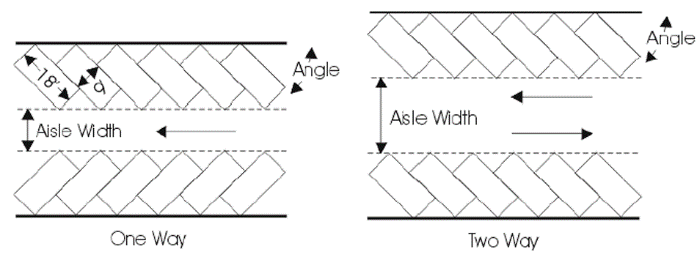
Off-Street Parking Dimensional Standards
c.
Tandem Parking. All single-family dwelling units (including manufactured housing), upper-story residential and two-family dwelling units may provide required parking for up to two vehicles in tandem spaces. Such spaces shall be no less than ten feet in width and a minimum of 35 feet in depth for the pair of vehicles. Such tandem parking shall not extend over the sidewalk or otherwise interfere with pedestrian or vehicular movement. In the case of new construction of multifamily developments or condominium developments that conform to the current zoning district density requirements, tandem parking may be allowed with the submittal of a request for an Alternative Parking Plan from the Administrator and recorded homeowner's documentation that driveways are deeded with the specific unit at the time of purchase. The garage space may be counted as one of the required parking spaces. Tandem parking is prohibited on the barrier islands.
(4)
On-Site Parking Backing into Public Streets. On-site parking spaces for commercially-zoned properties within the Siesta Key Overlay District (SKOD) are permitted to back directly into public streets provided that they meet the following minimum criteria. Additional requirements may be required by the Administrator (if recommended by the County Engineer) that are deemed necessary to ensure pedestrian and vehicle safety.
a.
The parking space may not be within any required clear sight triangle;
b.
The maximum speed limit is 25 m.p.h. for the street that the vehicle is backing into; and
c.
Parking spaces must be parallel or 30 degree or 60 degree angled parking. Ninety degree angled parking may be approved by the Administrator (with a recommendation by the County Engineer) provided that appropriate documentation is submitted that verifies that the proposed 90 degree parking will not create a pedestrian or vehicular safety hazard.
(5)
Accessible Parking for Eligible Users. Applicants must provide parking accessible parking spaces for eligible users to meet the requirements of the Americans with Disabilities Act and its supporting Public Right-of-Way Guidelines. All designated accessible parking areas shall meet the requirements of the Florida Accessibility Code.
(6)
Parking with Charging Capability for Electric Vehicles. Applicants may provide electric vehicle charging infrastructure in parking facilities with specific spaces adjacent to and associated with this infrastructure to be reserved for electric vehicle use.
a.
Spaces dedicated for electric vehicles shall not be included in the calculations for minimum and maximum parking spaces from the table in Section 124-120(g)(2), up to a maximum of 15 spaces.
b.
These spaces may be provided independently of the required parking spaces, up to a maximum of 15 parking spaces.
c.
After the maximum 15 parking spaces dedicated for electric vehicles, any additional spaces dedicated for electric vehicles shall count toward the required parking in Section 124-120(g)(2).
(7)
Properties on Well and Septic Systems. No off-street parking facility or other vehicular use area shall be located over a septic system or its drain field, or over a water well.
(8)
Landscaping Required. Wherever in any zoning district off-street facilities are provided for parking or any other vehicular uses as provided in this section, such off-street facilities and land shall conform to the minimum landscaping requirements set forth in this UDC; except that single-family and two-family residential uses on individually platted lots and multilevel parking structures shall be exempt from such requirements. See Section 124-122(s) for further details.
(9)
Parking Lot Landscape Islands. Off-street parking areas in excess of 1,500 square feet or five spaces shall provide interior landscaped areas in accordance with the following requirements.
a.
Landscaped islands shall be located to divide and break up the expanse of paving and at strategic points to guide traffic flow and direction.
b.
All rows of parking areas shall contain no more than 15 parking spaces uninterrupted by a required landscape island.
c.
All rows of parking spaces shall terminate in a curbed landscaped island.
d.
Each island shall have a minimum area of 170 square feet with a minimum width often feet inside the curb and include one large tree as described in Section 124-122(s).
e.
The remaining area shall be surfaced with shrubs, ground cover, grass, or other landscape material (excluding rock or shell). However, rock and shell may be used along the front slope for energy dissipation (e.g., erosion control stabilization) when surface runoff from parking areas is being directed to landscaped medians and islands.
f.
Utility lines and pipes located under parking lot islands should be avoided.
g.
Landscape islands shall be located between a row of parking spaces and a dumpster and also between a row of parking spaces and a loading zone.
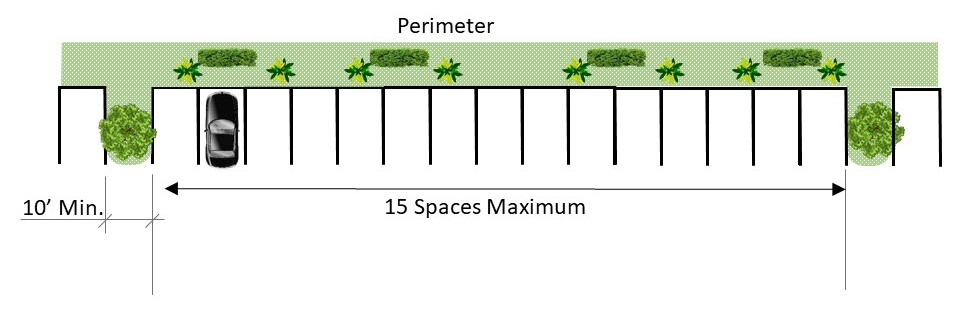
Parking Lot Landscape Islands
(10)
Medians Between Tiers.
a.
Single-Tier Parking Layout. Where tiers of interior parking spaces are proposed to abut one another, they shall be designed so as to have a landscape median area of not less than ten feet in width between such tiers, measured to back of curb. The tiers shall be landscaped in accordance with Section 124-122(s). There shall be no more than 15 parking spaces uninterrupted by a landscape island at least ten feet in width.
b.
Multitier Parking Layout Options.
1.
Option 1. Required medians may be combined. Where two medians are combined, one 15-foot median may be substituted, and the other median eliminated. Both tiers, whether they contain a median or not, shall contain no more than ten spaces in a row without a landscape island at least ten feet in width. A sidewalk may be added down the center of the combined median or it may meander provided that a minimum of four feet of landscaped area is included on either side of the sidewalk. The remaining area is not considered adequate to support a large tree, therefore the applicant shall select from other trees or palms on the approved parking lot list.
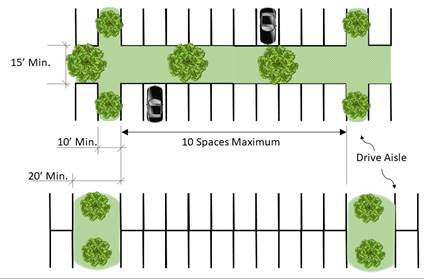
Multitier Parking Layout
2.
Option 2. Required medians may be eliminated. Where the median is eliminated, the landscape islands shall be increased in width to 20 feet inside of curb. There shall be no more than ten spaces in a row without a landscape island.
3.
Where medians have been eliminated, up to ten percent of the spaces may be designed as pull-through spaces for trailers and oversized vehicles.
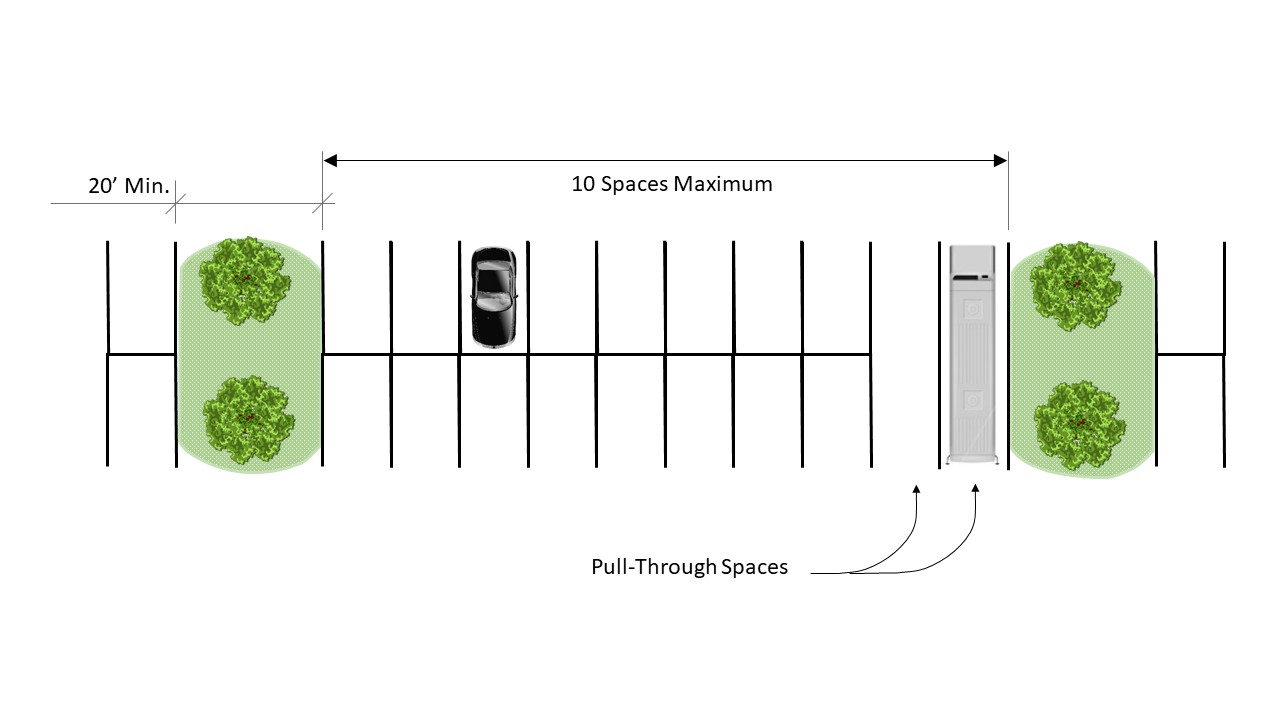
Parking Layout With Pull-Throughs
(11)
Curbs. Where off-street facilities are provided for parking or any other vehicular use areas, they shall have curbs so as to prevent vehicles from overhanging on or into adjacent property, or perimeter landscaped areas. See Section 124-122(s)(1)b. for curbing requirements for landscaped areas located within parking areas. Where alternative parking surfaces are provided as set forth in subsection (11), below, the Administrator may allow wheel stops in place of curbs.
(12)
Markings.
a.
Each required off-street parking space and off-street parking facility shall be identified as to purpose and location when not clearly evident;
b.
If parking areas are in excess of 1,500 square feet or five off-street parking spaces, individual spaces shall be marked.
(13)
Surfacing.
a.
Surface Required. Where off-street facilities are provided for parking or any other vehicular use areas, they shall be surfaced with asphalt bituminous, concrete or dustless material approved by the County Engineer, and maintained in a smooth, well-graded condition, except as provided below.
b.
Grass Lawn or Shell Parking.
1.
Generally. Grass lawn, shell or other pervious parking surfaces may be permitted for specific uses as set forth below, pursuant to subsection 2., below and provided they are approved by the Administrator and County Engineer. Where provided, such alternative parking surfaces shall be maintained in a smooth, well-graded condition. If parking demand is such that said grass or lawn is caused to be damaged or destroyed to the extent that said grass or lawn ceases to grow, then paving, shell or other parking surfaces approved by the Administrator and County Engineer and in accordance with this section may be required.
2.
Alternative Parking for Specific Uses.
i.
Any structure or use located in the HPIOD or in OUA may provide all driveways, access aisles and parking spaces (excluding handicapped) surfaced in grass lawn, shell or other substantially pervious parking surface.
ii.
All driveways, access aisles and parking spaces (excluding handicapped) may be surfaced with grass lawn, shell or other substantially pervious parking surface for the following uses: accessory dwelling units, places of worship, properties zoned Commercial Transition Overlay District, public parks, public and private schools, and recreational vehicle and boat storage areas within a recreational vehicle park or campground. This provision may also apply to kennels, riding academies, and plant nurseries in the OUE zoning district provided that such uses are in areas designated Rural and Semi-Rural on the Comprehensive Plan Future Land Use Map.
iii.
Wholesale nurseries shall pave and construct all entryways located within public and private rights-of-way. Said entryways shall be constructed to the requirements of the Articles 12 and 13 of this UDC.
iv.
Public stables and riding academies shall construct all driveways providing access to a public or private street with a shell, asphalt bituminous or concrete surface between the public or private street and the off-street vehicular parking facility and such surface shall be maintained in a smooth, well-graded condition.
v.
For all other uses, up to 25 percent of the required parking and vehicular use areas may be surfaced with grass lawn, shell or other substantially pervious parking surface.
3.
Siesta Key Overlay District. Driveways, access aisles and parking spaces on properties in the Siesta Key Overlay District may be surfaced with shell, gravel or similar material, provided that any such driveway shall have along its edges at the street access point a ribbon curb or similar limiting structure to ensure that the entrance is not enlarged over time. Driveways, access aisles and parking spaces shall be maintained in a smooth, well-graded condition. Driveways shall be designed and constructed with a stabilized ground surface to ensure emergency vehicle access to the property.
c.
Paving Next to Existing Trees. Where an existing tree is adjacent to a parking area, paver bricks or other pervious surface shall be used within the dripline of the tree. The pervious material shall be set at existing grade.
(14)
Drainage Facilities. Where off-street facilities are provided for parking or any other vehicular use areas, they shall be drained so as not to cause any nuisance on adjoining or nearby properties as determined by the County Engineer.
(15)
Vehicle Encroachment. Vehicles shall not be permitted to encroach into adjacent landscaped areas except in accordance with Section 124-122(s)(2)e.
(16)
Lighting. Lighting is required in all public parking areas. See Section 124-126, Outdoor Lighting.
(17)
Separation From All Buildings. All parking shall be separated from all buildings by a minimum distance of three feet.
(n)
Vehicle Stacking Areas. The vehicle stacking standards of this subsection shall apply unless otherwise expressly approved by the County Engineer. The County Engineer may require additional stacking spaces where trip generation rates suggest that additional spaces will be needed.
(1)
Minimum Number of Spaces. Off-street stacking spaces shall be provided as follows:
(2)
Design and Layout of Stacking Spaces. Required stacking spaces are subject to the following design and layout standards:
a.
Size. Stacking spaces must be a minimum of 8 feet by 20 feet in size.
b.
Location. Stacking spaces may not impede on-site or off-site traffic movements or movements into or out of off-street parking spaces.
c.
Design. Stacking spaces must be separated from other internal driveways by raised medians if deemed necessary by the County Engineer for traffic movement and safety.
d.
Gated Entries. Gated entries shall be designed so that vehicles may turn around outside of the right-of-way without entering the gated area.
(3)
Drive-Through Windows. Drive-through windows and lanes shall be designed to adhere to the following standards:
a.
Drive-through windows placed between the right-of-way of a roadway and the associated building shall require a parking buffer as set forth in Section 124-122(h) installed and maintained along the entire length of the drive-through lane, located between the drive-through lane and the adjacent right-of-way.
b.
No drive-through window shall be permitted on the side of a building adjacent to any residential district.
(4)
Voluntary Valet Parking. Where valet parking is offered in addition to the required number of parking spaces, the following standards shall be met:
a.
Valet parking drop-off locations shall meet the requirements of this Section, Vehicle Stacking Areas; and
b.
The design of the valet parking shall not cause customers who do not use the valet service to park off-premises or cause queuing in the right-of-way.
(o)
Off-Street Loading.
(1)
Plans Required. A plan shall be submitted with every Site Development Plan, Building Permit, or Certificate of Occupancy for any use or structure required or proposing to provide off-street loading facilities. The plan shall accurately designate the required or proposed off-street loading spaces, access thereto, dimensions and clearance. Such plan shall be reviewed by the County Engineer.
(2)
Minimum Dimensions. Where off-street loading spaces are required, they shall be 10 feet wide by 40 feet long.
(3)
Design of Spaces.
a.
Off-street loading facilities are required by this UDC so that vehicles engaged in unloading will not encroach on or interfere with the public use of streets, sidewalks, and alleys by automotive vehicles or pedestrians and so that adequate space is available for the unloading and loading of goods, materials, items or stock for delivery and shipping.
b.
Off-street loading facilities provided to meet the needs of one use may not be considered as meeting the needs of another use.
c.
Off-street parking facilities may not be used or counted as meeting off-street loading requirements.
(4)
Spaces Required.
a.
Residential Uses. Each multifamily building containing 100 or more dwelling units shall provide one off-street loading space per building.
b.
Commercial and Industrial Uses.
1.
Each retail store, storage warehouse, wholesale establishment, industrial plant, factory, freight terminal, restaurant, laundry, dry cleaning establishment or similar use shall provide loading according to the following table.
2.
Any vehicle sales or similar use requiring delivery of vehicles by truck shall demonstrate adequate on-site area exists for the loading and unloading of such trucks. Such loading and unloading activity shall not be permitted in any public right-of-way.
3.
Any convenience store or similar use requiring frequent deliveries by truck shall demonstrate adequate on-site area exists for the loading and unloading of such trucks. Such loading and unloading activity shall not be permitted in any public right-of-way.
4.
Any limited access self-storage facility or similar use shall provide one loading area per 10,000 square feet of storage area.
5.
Vehicles shall have access to loading areas only from arterial or collector roadways not from local streets.
6.
Loading areas shall be signed to indicate "no idling."
7.
Any loading area located adjacent to a residential use shall not receive deliveries between the hours of 11:00 p.m. and 6:00 a.m.
c.
Other Unlisted Uses. For any use not specifically mentioned, the requirements for off-street loading facilities for the most similar use, as determined by the Administrator, shall apply.
d.
Exemption for Certain Uses. The Administrator may waive or reduce the loading requirements of this section where the applicant can demonstrate that vehicles requiring loading areas are not an integral part of the proposed or future use of the proposed facility.
(5)
Change in Use, Enlargement or Expansion.
a.
When the use of a structure or land or any part thereof is changed to a use requiring off-street loading facilities, the full amount of off-street loading space required shall be supplied and maintained.
b.
When any structure is enlarged or any use extended so that the size of the resulting occupancy requires off-street loading space, the full amount of such space shall be supplied and maintained for the structure or use in its enlarged or extended size.
(6)
Access. Each off-street loading space shall be directly accessible from a street or alley without crossing or entering any other required off-street loading space. Access shall be from arterial or collector roadways and not from local residential streets. Access from a local street is allowed only when access from the arterial or collector is not feasible. Such loading space shall be accessible from the interior of the building it serves, and shall be arranged for convenient and safe ingress and egress by motor trucks or trailer combination.
(7)
Combined Off-Street Loading. Collective, joint or combined provisions for off-street loading facilities for two or more buildings or uses may be made, provided that such off-street loading facilities are equal in size and capacity to the combined requirements of the several buildings or uses and are designed, located, and arranged to be usable thereby.
(8)
Landscaping. All loading areas shall be required to provide a parking buffer in accordance with Section 124-122(h).
(9)
Markings. Each off-street loading space shall be permanently marked and identified as a loading area in which no parking is allowed.
(p)
Bicycle Parking Facilities. In order to enhance the multimodal transportation opportunities in the County, the following standards for bicycle parking shall be met.
(1)
New nonresidential development shall provide a minimum of four bicycle parking spaces. Nonresidential development providing more than 20 vehicle parking spaces, but less than 100 vehicle parking spaces, shall be required to provide six bicycle parking spaces. An additional two bicycle parking spaces shall be provided for each additional 33 vehicle parking spaces, or fraction thereof. A maximum of 24 bicycle parking spaces shall be required under this paragraph.
(2)
Bicycle parking facilities shall be located with easy access, near main building entrances, in areas with natural surveillance.
(3)
Bicycle parking facilities shall be high-quality, inverted "U" - type construction. Alternative high-quality bicycle parking facilities may be approved by the Administrator if they can be shown to:
a.
Provide adequate theft protection and security; and
b.
Support the bicycle at two points of contact to prevent damage to the bicycle wheels and frame.
(4)
The requirement to provide bicycle parking facilities may be waived for utilities, government uses, communication towers, and other uses that do not have employees present on a daily basis. Waiver requests must be submitted to the Administrator along with appropriate justification.
(q)
Delivery Vehicles.
(1)
The idling of vehicles is prohibited at all times adjacent to residential zoning districts, except during active loading or unloading of said vehicles. This provision is intended to protect residential areas from the prolonged noise and fumes associated with the unnecessary idling of vehicles and the use of commercial loading and parking areas next to residential areas as rest stops for commercial vehicles left idling.
(2)
Delivery areas shall be posted with a sign that reads, "no idling".
(3)
Any delivery area located adjacent to a residential use shall not receive deliveries between the hours of 11:00 p.m. and 6:00 a.m.
(Ord. No. 2019-006, § 7, 4-23-2019; Ord. No. 2024-046, § 2, 8-28-2024)
Sec. 124-121. - Access and Circulation.
(a)
Buildings to Have Access.
(1)
Every building hereafter erected or moved shall be on a lot adjacent to a public or approved private street. In addition, a building may be erected or moved on a lot that has a minimum 20-foot access easement to a public or approved private street; however, said 20-foot easement shall only cross one parcel of land to access said building site.
(2)
Where a parcel requires access by way of an access easement as described in subsection (1) above, and the access easement was recorded prior to August 2, 1999, the parcel shall be considered conforming with regard to access provided the parcel was created in conformance with this UDC at the time of subdivision. However, any further subdivision of any parcel relying on such access easement after August 2, 1999 shall meet the requirements of subsection (1), above.
(3)
No access easement shall serve more than one lot or parcel.
(4)
An access easement that serves more than two parcels or dwelling structures shall constitute a road and shall comply with Articles 12 and 13 of this UDC for streets and roads and shall be completed before a Certificate of Occupancy for any buildings or structures may be issued.
(b)
Use of Residentially—Zoned Property for Access. No land which is residentially-zoned shall be used for driveway or vehicular access purposes to any land which is zoned other than residential, or used for any purpose not permitted in a residential district except for ingress and egress to use existing as of November 11, 1975, that does not abut a street.
(c)
Emergency Vehicle Lanes/Open Access Areas.
(1)
All commercial and industrial developments shall meet the minimum requirements of the current adopted edition of the Florida Fire Prevention Code and the National Fire Protection Association.
(2)
All commercial and industrial developments, except warehouses, on five acre tracts or larger existing as of July 1, 1987, shall provide a minimum 12-foot wide emergency vehicle lane adjacent to the curb along the longest wall containing a major public entrance or any wall containing a major public entrance to a building or unit of a building. The edge of the curb or sidewalk shall be painted white or yellow for the entire length adjacent to such walls. In the absence of a curb or sidewalk, such emergency vehicle lane shall not be located further than ten feet from the longest wall or any wall containing a major public entrance. The emergency vehicle lane shall extend the entire length along any wall containing a major public entrance.
(3)
All nonresidential buildings existing as of July 1, 1987, that have Fire Department Connections (FDC) shall provide a 12-foot by 30-foot open access area adjacent to each FDC. Such access area shall be accessible by emergency equipment at all times and be centered on the connection point.
(4)
All commercial and industrial developments for which a Building Permit is issued after July 1, 1987, shall provide emergency equipment lanes as designated for existing developments. An open access area adjacent to all Fire Department Connections may be substituted for the required emergency vehicle lane and be designed to the standards for existing developments.
(5)
For all existing and new developments that are required to meet requirements of this UDC, where open access areas are used in place of emergency vehicle lanes, an additional open access area shall be provided in front of any main public entrance to any building that is 10,000 square feet or larger in floor area.
(6)
Emergency vehicle lanes shall meet the minimum requirements of the current adopted version of the Florida Fire Prevention Code and the National Fire Protection Association.
(7)
Emergency vehicle lanes shall be posted with signs adjacent to the building side of the lane spaced not more than 60 feet apart along the entire length of the lane. Signs shall be readable from both directions along the lane. The top sign shall be the standard 12-inch by 12-inch international "No Parking" sign, red and black on a white background. The bottom sign shall be a rectangular sign, 12 inches in width by six inches in height with a red upper half background and a blue lower half background. The word "FIRE" shall be centered in white letters on the red background portion and the words "EMERGENCY LANE" shall be centered in white letters on the blue background portion of the sign. The lowest portion of the sign shall be a minimum of six feet six inches above the surface at their installation point.
(8)
Emergency vehicle lanes shall be bounded on the outside edge by a continuous white or yellow stripe not less than eight inches in width. If there is a driveway or access aisle that is wider than 12 feet, then the outside edge of the driveway or access aisle is bounded by the eight-inch stripe. Where a two-way drive aisle is less than 24 feet in width, the outside edge of that drive aisle must be identified with a solid painted stripe and signage on both sides of such drive aisle.
(9)
Open access areas adjacent to a FDC or main entrance shall be bounded by an eight-inch yellow stripe with four-inch diagonal stripes one foot apart. Fire Department Connections shall also be posted with a sign denoting same. Main entrances using an open access area shall be posted no parking.
(10)
Signs posted to designate Emergency Vehicle Lanes or Open Access Areas shall be deemed Official Traffic Control Devices and deemed to be placed or erected by authority of a public body having jurisdiction for the purpose of regulating, warning or guiding traffic.
(d)
Pedestrian Walkways.
(1)
Purpose and Intent. To provide safe opportunities for alternative modes of transportation by connecting pedestrian and bicycle pathways to existing and planned transit and to existing and planned pedestrian and bicycle pathways within the county, and to provide safe passage from the public right-of-way to the nonresidential building or project, and between alternative modes of transportation.
(2)
Applicability. For nonresidential buildings greater than 20,000 square feet, pedestrian ways shall be provided at a minimum ratio of one for each public vehicular entrance to a project, excluding ingress and egress points intended primarily for service, delivery or employee vehicles. For buildings less than 20,000 square feet, pedestrian ways shall be provided at a minimum ratio of one for each parcel.
(3)
Pedestrian Access Standards. Pedestrian ways, linkages and paths shall be provided from the building entry to surrounding streets, external sidewalks, transit stops and out-parcels. Pedestrian ways shall be designed to provide access between parking areas and the building entrance in a coordinated and safe manner. Shared pedestrian walkways connecting adjacent properties are encouraged. At least one accessible route in accordance with Section 4.3 and Section 10, of the Florida Accessibility Code, shall connect buildings, facilities, elements and parking spaces that are on the same site.
(4)
Minimum Dimensions. Pedestrian walkways that are a minimum of five feet wide and in compliance with applicable standards contained in Section 4.3 and Section 10, Florida Accessibility Code, shall be deemed handicap accessible.
(5)
Materials. Pedestrian walkways shall be consistent with the Florida Accessibility Code. Materials may include specialty pavers, Pervious Pavement Systems, concrete, colored concrete or stamped pattern concrete.
(6)
Pedestrian Crosswalks. Crosswalks shall be designed and coordinated to move people safely to and from buildings and parking areas by identifying pedestrian crossings with signage and variations in pavement materials or markings.
Sec. 124-122. - Landscaping and Buffering.
(a)
There are three basic types of landscaping that may be required for any project. They include (1) project boundary buffers, (2) street buffers (which may include a parking buffer) and (3) parking lot landscaping. Each is further described below.
(b)
Purpose. The use of properly landscaped and maintained areas can reduce the potential incompatibility of adjacent land uses, conserve natural resources and maintain open space, protect established residential neighborhoods, and promote and enhance community image and roadway beautification. In order to minimize negative effects between adjacent uses and zoning districts, this section requires that a landscaped buffer area be provided. The separation of land uses and the provision of landscaping along public and private rights-of-way through a required buffer is designed to eliminate or minimize potential nuisances, and to enhance community image and roadway beautification. Such nuisances may include dirt, litter, noise, lights, signs, unsightly buildings and structures, off-street loading and refuse areas, or parking areas. In addition, buffers provide spacing and landscaping to reduce potentially adverse impacts of noise, odor or lighting. Landscaping shall be coordinated with all site design elements including building layout, parking, access and signs.
(c)
Applicability.
(1)
Landscaping and buffers shall be provided as set out in this UDC. Buildings and structures lawfully existing as of October 27, 2003, may be modernized, altered, or repaired without providing or modifying landscaping and buffers in conformance with this section, provided there is no increase in floor area in such building or structure or impervious area on the site. This shall not be construed as prohibiting the provision of landscaping or buffers in full conformance with this UDC.
(2)
Where a building or structure existed as of October 27, 2003, and such building is enlarged in floor area or impervious area on the site by ten percent or 2,000 square feet, whichever is less, landscaping and buffers as specified in this section shall be provided.
(3)
The regulations herein set out for landscaping and buffers do not apply to one-family or two-family dwellings on a single lot or parcel.
(4)
The provision of required landscape buffers, as specified in this UDC, are minimum standards. The amount of land and type and amount of planting or other screening specified for each landscape buffer requirement are designed to mitigate nuisances or incompatibility between adjacent land uses or between a land use and a public road, and have been calculated to ensure that they do, in fact, function as "buffers." In those instances where this UDC specify different buffering requirements (e.g., a different type of buffer), then the more restrictive specific provisions shall govern.
(5)
None of the provisions of this UDC shall be construed as prohibiting additional plant material, screening or buffer area above that required by this UDC; or prohibiting the modification of existing landscaped buffers to perform to an equivalent degree as the buffer required by this UDC.
(d)
Design of Landscaping and Buffers.
(1)
Existing Vegetation. The retention of "existing vegetation" shall be maximized within the proposed landscaping, parking and buffer areas. When retaining existing vegetation within the landscape buffer area, only clearing methods that do not disturb the root structure shall be allowed within the dripline of tree canopies. Existing native habitat or plant material located within the proposed landscape buffer area that meets the requirements of this UDC may be counted toward the total buffer required between adjacent land uses, or toward total landscaping requirements. If the existing vegetation has been counted toward the total required buffer or landscaping and is subsequently removed or dies, it shall be replaced with the appropriate buffer or landscaping material.
(2)
Design, Installation and Establishment Standards. Location of plants and design of landscaping, including maintenance, shall be according to sound landscape and horticultural principles. The use of native vegetation and other lower maintenance landscape materials is required to promote environmental protection, energy efficiency, and water conservation in a manner consistent with the Comprehensive Plan.
a.
Landscape plans submitted for Subdivision or Site Development Plan approval for the purposes of satisfying the requirements of this section, shall be signed and sealed by a Florida Registered Landscape Architect.
b.
Plant material shall be chosen from the lists of recommended plant species contained within this section, and shall adhere to the minimum specifications therein. Plant materials shall be reviewed for suitability with regard to the eventual size and spread, susceptibility to diseases and pests, and appropriateness to existing soil, climate and site conditions. Plant materials that vary from this list may be used with the approval of the County Forester or County Landscape Architect.
c.
Tree and shrub installation and establishment shall follow the guidelines provided in the current edition of the ANSI A300 Planting Standards (American Standards Institute). All Container Stock requires root ball remediation and shearing at the time of installation. Please refer to the Sarasota County Landscape Design Manual for planting details.
(3)
Tree Protection Credit. Credit shall be given for tree preservation within the proposed buffer or landscaping areas. Trees planted in compliance with this section may satisfy the planting requirements of the Trees Code, Chapter 54, Article XVIII of the County Code, if they meet the more stringent specifications of the two Sections. Species acceptable for both Sections are indicated on the species lists.
(4)
Plant Material. The County has established a Master Tree List as part of the Landscape Design Manual; Article 18, Appendix A. All materials shall be Florida #1 or better quality as per "Grades and Standards for Nursery Plants," Florida Department of Agriculture and Consumer Services.
(5)
Cold Hardy and Drought Tolerant Plants. Required trees and shrubs shall be cold hardy for the specific location where they are to be planted. Trees and shrubs shall be drought tolerant and able to survive on natural rainfall once established with no loss of health.
(6)
Soils. All landscape buffer areas shall have uncompacted coarse loam that is a minimum of 12 inches deep. Soils shall be appreciably free of gravel, stones, rubble or trash, except where structural soils have been approved by the County Landscape Architect. All compacted soil, contaminated soil or roadbase fill shall be removed. Under no circumstances shall soils with greater than five percent or less than 0.5 percent organic matter be accepted. Structural soil used in planters shall be approved by the County Landscape Architect. When the Applicant elects to place a Stormwater Management System within the landscape buffer area, the County may allow for a different soil composition using best professional judgment, provided that such a determination must take into account such facts as permeability, percent organic matter, survivability of plantings in such soil, and soil depth. Other methods to keep the friable nature of the soil may be utilized and encouraged through a modular suspended pavement system.
(7)
Nuisance Trees and Shrubs Excluded. Harmful nuisance trees and shrubs shall be excluded from any landscaping plan and shall be removed from the property. Such species include those listed in the table below, plus any additional species referenced the most recent list of such plants provided by the Florida Exotic Pest Plant Council (FLEPPC).
(8)
Required Plant Species. The Master Tree List provided in Appendix A, Article 18 of this UDC shall be used as a guide in identifying and categorizing the different acceptable types and minimum sizes for any required plant.
a.
Large Trees. Large trees shall be a minimum of ten feet in height with a four-foot to five-foot spread and a two-inch caliper trunk at time of planting.
b.
Medium/Small Trees. Medium/Small trees shall be a minimum of eight feet in height with a three-foot to four-foot spread and a 1½-inch caliper trunk at time of planting. To qualify for credit toward the County's tree protection requirements, a two-inch caliper tree is required. Medium/small trees can fulfill the parking lot island requirements at a 2:1 ratio only under powerlines or on constrained sites. Examples of constrained areas are next to a tall wall, a loading dock, or the redevelopment of a site where the existing parking lot island is undersized.
c.
Mixing of Trees. When more than 20 large or medium/small trees are required to be planted on a site, a mix of genera shall be provided. The maximum of any one Species on any site is 25%.
d.
Shrubs.
1.
All required shrubs shall be a minimum of 20-inches in height in a minimum 3-gallon container.
2.
Shrubs shall be of a species that under average conditions will reach a minimum height of 24 inches within 12 months.
3.
When planted as a hedge, the maximum spacing for 20-inch high shrubs shall be 36 inches on center. Spacing for other size shrubs shall be determined by the County Landscape Architect based on the proposed species.
4.
Alternative shrub species that are significantly larger than the required minimum in paragraph 1. above may be counted by the County Landscape Architect as two or more shrubs on the basis of their anticipated volume five years after planting. For the purposes of this calculation, a standard shrub shall be considered to be three feet in height, covering an area of 14 square feet.
As an example, if a shrub species is anticipated to reach six feet in height covering 20 square feet of area within five years of planting, the County Landscape Architect may credit the shrub towards 1.5 shrubs required in any landscape buffer.
e.
Alternative Plant Materials.
1.
Generally. A maximum of 25 percent Palm species may be substituted on any site.
2.
Palm Tree Substitution for Required Trees. A grouping of three or more palm trees shall be considered equivalent to one large tree. A grouping of two or more palm trees shall be considered equivalent to one medium/small tree. Exceptions shall be made for Roystonea spp. and Phoenix dactylifera cultivars, which shall count one palm as one large tree. Palms shall have a minimum of ten feet of clear trunk at time of planting.
3.
Alternative Plant Material for use in Low Impact Development Techniques. This plant list represents suggested plant species selections that may be utilized in Stormwater Management Systems using Low Impact Development Techniques and is not meant to be exhaustive in nature. Considering such factors as soil, hydrology, topography, mature root zone, and available sunlight affecting the survivability of the plantings, the county may approve any requested plants or trees not included on the list.
(9)
Minimum Planting Areas. Large trees shall have a planting area no less than ten feet wide in all dimensions. Medium/small shall have a planting area no less than eight feet wide in all dimensions. Single palm trees shall have a planting area no less than five feet wide with a minimum of 64 square feet root zone. Trees used in constrained landscape buffers shall be exempt from this minimum planting area requirement.
(10)
Mulch.
a.
Plants shall be mulched a minimum of three inches deep. Where selected plant material is not tolerant of deep mulch, a specific note regarding shallower mulch shall be set forth on the final landscape plan and approved by the County as part of the landscape plan. Mulch shall be kept a minimum of 6 inches away from tree trunks. The mulch ring shall be a minimum of 6 feet in diameter.
b.
The use of recycled mulch, such as Australian pine, Melaleuca and Eucalyptus is recommended, provided the mulch has been treated to ensure that the seeds of the invasive species will not germinate.
c.
Cypress mulch shall not be used.
d.
Mulch installation should comply with current standards within ANSI 300 Part 2, Soil Management.
(e)
Required Landscape Buffers.
(1)
Landscape Buffer Defined. A buffer is a specified land area, located parallel to and within the outer perimeter of a lot or parcel and extending to the lot or parcel boundary line, together with the planting and landscaping required on the land. A buffer may also contain, or be required to contain, a barrier such as a berm, fence or wall, or combination thereof, where such additional screening is necessary to achieve the desired level of buffering between various land use activities. A buffer is not intended to be commensurate with the term "yard."
(2)
Types of Required Landscape Buffers. There are three types of required buffers that may occur on any given development site, as follows:
a.
Street buffers;
b.
Parking lot buffers; and
c.
Project boundary buffers.
(3)
Location. Buffers shall be located within the outer perimeter of a lot or parcel, parallel to and extending to the lot or parcel boundary line. Buffers shall not be located on any portion of an existing, dedicated or reserved public or private street or right-of-way. Landscape buffers shall not be located in designated wetlands, upland buffers or conservation or preserve areas. Buffers shall also comply with Section 124-210(a)(12), Site Triangle and Visibility.
(4)
Planting in Easements.
a.
No trees shall be planted in wet retention ponds or drainage maintenance easements.
b.
Trees and shrubs shall be installed at least five feet away from the flow line of a Swale.
c.
Existing trees may remain in dry retention ponds provided that the natural grade is undisturbed to the tree line, they are a species adapted to seasonal flooding and the pond is adequately maintained.
d.
Trees listed in the Sarasota County Master Tree List, Appendix A, Article 18 of this UDC, shall be allowed in access easements, provided a minimum 20-foot wide travelway is maintained clear of vegetation, and all clear sight triangles are met.
e.
Trees may be planted in underground utility easements with County approval, provided the root structure of the proposed tree is not anticipated to extend more than three feet below the ground. Shrubs may be planted, provided they are only within the outer three feet of the easement. Where such trees and shrubs are planted, the property owner shall be responsible for replacement of such required vegetation if maintenance or other utility requirements require their temporary removal.
f.
A minimum landscape buffer width of five feet, or at least half the minimum required buffer width, shall be provided outside of any required easements. The majority of buffer plantings and all structures shall be located outside the easements. An Applicant may use Low Impact Development techniques such as, but not limited to, Shallow Bioretention and Detention with Biofiltration to meander through the landscape buffer provided the buffer meets the following requirements: (1) opacity; (2) landscape buffer width; and (3) a stormwater easement provides permanent rights of drainage.
(f)
Determination of Landscape Buffer Requirements. To determine the type of landscape buffer required between two adjacent lots or parcels, or between a lot or parcel and a street, the following procedure shall be followed:
(1)
Street Buffers. Classify any street adjacent to the subject parcel. Refer to the Comprehensive Thoroughfare Map. Determine the appropriate street buffer based on subsection (g), below.
(2)
Parking Buffers. A parking buffer may be required within a required street buffer (see subsection (h), below).
(3)
Project Boundary Buffers. Identify the zoning districts of the subject parcel and all adjacent properties. Determine the buffer opacity class required on each boundary (or segment thereof) of the subject parcel. Refer to the minimum project boundary buffer table in subsection (i), below.
(4)
Land Use Designated in Critical Area Plan, Corridor Plan, Revitalization Plan or DRI. Where adjacent vacant properties have been designated for a different land use classification or zoning district by an adopted Critical Area Plan, Commercial Corridor Plan, Revitalization Plan or Development of Regional Impact, the affected landscape buffer may be based on a zoning district consistent with the approved land use designation. The affected landscape buffer may also be based on a zoning district consistent with the approved land use designation when the adjacent property is not vacant with consent of said adjacent property owner.
(5)
Design Variations. The design variations under this section are intended to encourage undulating or curvilinear buffers that appear more natural than formal landscaping arrangements. These variations are not intended to be utilized where minimum buffer widths cannot be met. While the landscape buffer depth is normally calculated as parallel to the property line, design variations are allowed and are calculated on the average depth of the landscape buffer per 100 feet or portion thereof. Minimum depth of landscape buffer in any case shall not be less than one-half the required depth of the landscape buffer chosen, or less than five feet, whichever is greater. Maximum depth for the purposes of installing required landscaping, or receiving credit for existing vegetation, shall not be more than one and one-half times the required depth of the buffer chosen.
(6)
Multitenant Expansion and Redevelopment. Any expansion or redevelopment of a multitenant development shall be required to provide a percentage of the required project boundary buffer, and a percentage of the required street buffer, including any required parking buffer, when improvements are made that trigger the provisions of this section. Said percentage shall equal the total gross leasable area of the proposed expansion or redevelopment, divided by the total gross leasable area of the entire existing multitenant development (including the proposed expansion or redevelopment).
(g)
Street Buffers. The following types of street buffers shall be required (see Comprehensive Plan Future Thoroughfare Map to determine street designation). A street or road along a designated Canopy Road shall be subject to Chapter 98, Article IV of the County Code. No vegetation shall interfere with a required clear sight triangle at a driveway or intersection. Any shrubs located within a required clear sight triangle at a driveway or intersection shall be maintained at under 24 inches in height. Berms constructed in accordance with subsection (l)(2), below are encouraged as a component of any street buffer.
(1)
Interstate I-75 Buffers. All development located along Interstate I-75 shall be required to provide one of the following buffers along the entire frontage abutting the right-of-way of I-75.
a.
A four-foot continuous evergreen hedge and three large trees per 100 linear feet of property frontage, located within a 20-foot landscape buffer; or
b.
A four-foot continuous evergreen hedge and two large trees and three medium/small trees per 100 linear feet of property frontage, located within a 20-foot landscape buffer.
c.
An equivalent buffer approved as part of a Planned Unit Development (PUD) or Development of Regional Impact (DRI).
(2)
Arterial or Collector Street Buffers. All development located along either an arterial or a collector street shall be required to provide one of the following buffers along the entire street frontage:
a.
Three large trees per 100 linear feet of property frontage, located within a ten-foot landscape buffer; or
b.
Two large trees and two medium/small trees per 100 linear feet of property frontage, located within a ten-foot landscape buffer; or
c.
Under utility lines only, four medium/small trees per 100 linear feet of property frontage, located within a ten-foot landscape buffer. No trees under utility lines shall have a natural height over 25 feet.
d.
Arterial or collector street buffers may average ten feet in width provided that no portion of the street buffer shall be less than five feet in width.
(3)
Local Streets.
a.
Nonresidential development shall provide a landscape buffer with a minimum opacity of 0.1 and a minimum width of six feet.
b.
Residential development is exempt from a local street buffer, except when a fence or wall over 4 foot in height is installed adjacent to the streetfront on an individual residential lot.
(4)
Measurements.
a.
Driveway widths (measured at the inside edge of the buffer) shall not be counted in the calculation of the plant material required.
b.
All buffers shall be measured from the future right-of-way line determined during Site Development Plan review.
c.
If an unbuilt street is platted, it shall be buffered and treated as a street, even where no pavement currently exists.
d.
Vehicular access easements shall not be treated as a street, but shall be buffered as a project boundary buffer outside the easement area. The buffer may be provided on either side of the easement.
e.
Additional measurement methodologies related to landscape buffer depth and height are found in subsection (f)(4), above.
(h)
Parking Buffers. Whenever a parking area, drive aisle, paved display area or paved storage area lies within 50 feet of and is visible from any street right-of-way, the street buffer shall include a three-foot continuous evergreen hedge for the entire linear extent of the parking area. A six-foot wide area, that cannot be reduced to less than four feet wide, is required for the shrub plantings.
(i)
Project Boundary Buffers.
(1)
Plant Units.
a.
Generally. This Section establishes a standard buffer landscaping element called a "plant unit." The plant unit serves as a basic measure of plant material required for all buffer landscaping except native habitat. The plant unit provides a balance of vegetation. The developer is free to use alternative plant units 1, 2 or 3 shown below interchangeably. Alternative 3 includes a wall as part of the landscape buffer. Alternative 4 is permitted only for use under utility lines. In the illustrations below each Plant Unit represents 1,600 square feet of landscape buffer area.
| Plant Unit Options | Quantity | Plants Required | Illustration |
|---|---|---|---|
|
Alternative 1:
Large | 1 | Large Trees |  |
| 2 | Medium/Small Trees | ||
| 13 | Shrubs | ||
|
Alternative 2:
Mixed | 1 | Large Trees |  |
| 3 | Medium/Small Trees | ||
| 5 | Shrubs | ||
|
Alternative 3:
Large and Wall | 2 | Large Trees |  |
| 4 | Shrubs | ||
|
Alternative 4:
Utility Line (below utility line only) | 5 | Medium/Small Trees |  |
| 15 | Shrubs |
Plant Unit Options
Illustrations above are only examples of possible plant unit arrangement. Specific arrangement is at the applicant's discretion.
b.
Plant Unit Calculations. When figuring the quantity of plant units and plant material required, the quantity shall always be rounded up. For example, 3.12 large trees is rounded up to four large trees.
c.
Alternative Plant Material Substitution. Alternative plant materials, including palms, may be substituted in accordance with Section 124-122(d)(8)e, above.
(2)
Required Project Boundary Landscape Buffer Table. The requirements for project boundary buffers may create a tree canopy that is too thick to support the medium/small trees and shrubs below it over time. This crowding out of understory is anticipated to occur, and has been taken into account in the requirements for these buffers. The intent is to achieve an immediate buffering effect based on the smaller species, and a long-term effect based on growth of the large trees.
a.
The landscape buffer standards in the table below address the opacity of the buffer that is required on the property boundary between zoning districts, and in some instances within a zoning district.
b.
An opacity of 0.1 screens ten percent of an object, and an opacity of 1.0 would fully screen the adjacent development during summer months after five years of growth.
c.
How to Read the Landscape Buffer Table.
1.
The required opacity of project boundary buffers is represented in the Table below by two numbers (for example, .3/.5).
2.
The second number represents the total required landscape buffer opacity between any two properties.
3.
Where the proposed project is located adjacent to vacant property, the first number represents the project's required landscape buffer opacity.
4.
Where the adjacent property is already developed with no landscape buffer, the proposed project is responsible for providing the total required opacity (the second number).
5.
Where the adjacent property is already developed with a partial landscape buffer, the proposed project is responsible for providing the remaining opacity required.
6.
A zero means no project boundary buffer is required.
A .1/.3 requires a ten percent opaque landscape buffer for property adjacent to vacant land or a 30 percent opaque landscape buffer when adjacent to existing development. A .3/.3 requires a 30 percent opaque landscape buffer property adjacent to either vacant or developed land. A zero means no project boundary buffer is required.
See Section 124-78(b)(3), for the project boundary buffer standard for the PRD District. See Section 124-78(b)(4), for the project boundary buffer standard for the PID District. See Section 124-101(b)(4) for the project boundary buffer standards for the PCD District. The project boundary buffer standards for the HPIOD, RCTOD and MSOD Overlay Districts shall be based on the underlying zoning district, unless modified by specific overlay district landscape buffer standards. EXAMPLE: A new development in the CG District abutting a developed RSF District would be required to provide a landscape buffer with an opacity of .6 (60 percent opaque) if the adjacent RSF property were vacant, the requirement would still be .6 since the commercial development is the more intensive use.
(3)
Minimum Project Boundary Buffers. The table below shows the minimum width and plant units required for a standard project boundary buffer meeting the required opacity. The developer may use this table.
EXAMPLE: Continuing the example of a site in the CG District next to a developed RSF District with no landscape buffer, the required .6 opacity (from the previous table) would allow for the following options:
Alternative 1: 20-foot landscape buffer with 4 large trees, 7 medium/small trees and 43 shrubs
Alternative 2: 20-foot landscape buffer with 4 large trees, 10 medium/small trees and 17 shrubs
Alternative 3: 15-foot landscape buffer with 5 large trees, 9 shrubs and a 6-foot wall
(j)
Constrained Sites.
(1)
An alternative landscape buffer calculation using a reduced landscape buffer width may be used only where the standard project boundary or street buffer width shown cannot be physically met on the site for one of the following reasons:
a.
Redevelopment of an existing site requires a landscape buffer to be added, but the building, pavement or stormwater facility already exists; or
b.
The site has lost area from an existing landscape buffer due to adjacent road widening; or
c.
It can be shown that the narrowest standard project boundary buffer and street buffer width would occupy more than ten percent of the site area.
(2)
The intent of this section is not to discourage the continued use of such properties, but rather to protect adjoining uses from nuisances associated with uses.
(3)
A constrained project boundary buffer shall be calculated using the required opacity from the table in subsection (i)(2), above. Where possible, the constrained landscape buffer shall meet or exceed the required opacity, in spite of the reduced landscape buffer width.
(4)
Where necessary to achieve the required opacity, a constrained project boundary buffer shall contain a minimum six-foot wall. The County Landscape Architect shall ensure that adequate provision for soil and moisture is provided for any trees in a constrained landscape buffer. Such provisions may include raised or at-grade planters, or a requirement for pervious pavement in adjacent parking or other vehicular use areas.
(5)
In no case shall the constrained landscape buffer width be reduced below five feet, nor shall the opacity be reduced below 50 percent of the required opacity.
(k)
Credit for Existing Landscape Buffer.
(1)
Credit is permitted for existing plant material within the proposed landscape buffer area, provided such plant material meets the minimum standards of this section.
(2)
Credit shall be allocated on a one-for-one basis for shrubs or medium/small trees. The size of material shall not be taken into account, except where such material is below the required minimum planting size.
(3)
Credit for existing large trees shall be allocated based on the length of the existing tree canopy that overhangs the landscape buffer. Credit can be given for 80 percent of that length.
(4)
Credit may be permitted for existing plant material and walls on an adjacent property, provided such items are in a permanently protected area, including, but not limited to:
a.
A conservation easement or preserve area on adjacent property.
b.
An existing County-approved landscape buffer on adjacent property may receive credit for the existing material and width.
The total landscape buffer opacity must be met, however, the plant material can be on either side of the property line. An example with a CG District project adjacent to a developed RSF project with an existing landscape buffer would be calculated as follows:
Total landscape buffer required = 0.6 opacity
Existing RSF landscape buffer = 0.3 opacity, (allows 0.3 opacity credit)
Remaining opacity required on CG property = 0.3 opacity (not 0.6 as in table)
c.
Any existing utility or drainage easement exceeding 100 feet in width.
(l)
Structures Within Required Landscape Buffer Area.
(1)
Walls. Where structures are built within any required landscape buffer area, they shall meet the following requirements:
a.
Walls shall be constructed of one or a combination of the following materials: stucco over concrete block, brick, stone, split-faced block or glass block in a structurally safe and attractive condition. Alternative walls (including EIFS or other similar systems) may be permitted with the approval of the Administrator. No walls of exposed concrete block are permitted, whether painted or not. Panel/column type walls are recommended in existing tree areas to protect their roots.
b.
No wall shall be located within any required drainage, utility or similar easement without permission or subordinate agreement from the entity(ies) that own the easement.
c.
All walls, when used as part of a landscape buffer abutting developed land without a landscape buffer, shall be planted on the face towards the adjacent property with at least one shrub for every eight feet of wall length, or one vine for every 12 feet of wall length. These vines or shrubs may be counted towards meeting the opacity requirement for the landscape buffer. Where the landscape buffer tables require additional shrubs, the excess shrubs shall be waived.
d.
The applicant shall be required to demonstrate provision for access and maintenance of landscaping and the wall structure at the time of landscape plan approval.
e.
Pedestrian connections through walls that connect to adjacent neighborhoods or other uses are encouraged.
f.
All walls located within street buffers shall be placed at the rear of the landscape buffer. Required plant material shall be placed streetward of the wall.
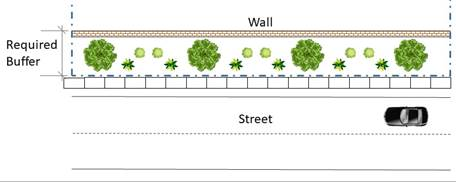
Subdivision Lots Abutting Boundary Line
g.
All walls must also comply with standards in Section 124-125 and the Sight Triangle and Visibility requirements in Section 124-210(a)(12).
(2)
Berms/Slopes. Berms shall have a minimum average height of 2.5 feet with side slopes of not less than four feet horizontal for each one foot vertical. Slopes in excess of four feet horizontal for each one foot vertical may be permitted if sufficient erosion control methods are taken and deemed by the Administrator to be maintainable. For healthy tree growth, landscape berms shall have slopes of not less than four feet horizontal for each one foot vertical.
(3)
Fences.
a.
Fences may be constructed in a required landscape buffer, subject to Section 124-125, however, they shall not be counted towards required opacity of the landscape buffer.
b.
Chain-link fences may not be used in landscape buffer areas or along rights-of-way abutting the perimeter of the subdivision (see Section 124-125(a) for additional limitations on chain-link fences).
(m)
Plant and Structure Location. The placement of required plants and structures shall be the decision of each user, except that the following requirements shall be satisfied:
(1)
Although this section does not generally specify the location or spacing of required plant material, all plant materials shall be installed to achieve the purposes for which that planting is required. This means that plant materials shall be located so as to achieve the maximum level of protection to the less intense zoning district or use. Unless otherwise required by this UDC, such as in the case of a hedge, the required planting should generally be in an irregular line and spaced (or grouped) at random. Plant material shall meet the landscape buffer requirements every 100 feet.
(2)
Large trees shall be located no closer than five feet from any structure. Other trees and shrubs shall be planted no closer than three feet from any structure. Where vines are planted, the minimum distance shall be two feet. Trees, shrubs and vines planted in constrained landscape buffers shall be exempt from this requirement.
(3)
All trees adjacent to overhead utility lines shall conform to Florida Power and Light (FPL) publications for tree setbacks.
(4)
Where a separate legal parcel is permitted for stormwater management, by right or special exception, it shall be included as part of a common development plan. The following landscape buffer shall be required:
a.
A landscape buffer with a minimum opacity of 0.1 on the street and residential sides of the stormwater parcel;
b.
A project boundary buffer along the interior lot line, screening the development; and
c.
A locked gate for maintenance purposes shall be permitted through the landscape buffer wall.
(5)
Buffer areas not retained in native habitat shall be seeded or sodded with lawn, established with ground cover, or mulched with organic mulch. No turfgrass shall be planted under the dripline of trees. Inorganic ground cover shall not exceed 20 percent of the total required area of the landscape buffer.
(6)
As an existing landscape buffer matures, it is anticipated that medium/small trees may not survive the shading by large trees. Where the buffer opacity has been met, replacement of such medium/small trees and shrubs shall not be deemed necessary.
(7)
In parking lots and loading areas foliage or other landscape structures shall not be allowed to obstruct visibility or to create hazards for ingress or egress to these areas. Shrubs within islands shall reach a maximum mature height of 30 inches, or be maintained at or below 30 inches in height.
(n)
Permitted Use of Landscape Buffer Area.
(1)
A landscape buffer may be used for passive recreation and picnic facilities; and it may contain pedestrian, bike, or equestrian trails, provided that:
a.
No existing plant material is eliminated, other than nuisance exotics;
b.
The total width of the landscape buffer is maintained; and
c.
All other requirements of this UDC are met.
(2)
Other appurtenances which require high visibility and easy access, such as fire hydrants, public and emergency telephones, mail boxes, and school bus or other bus shelters or benches, are also permitted in a landscape buffer. No screening of such appurtenances is required.
(3)
A required landscape buffer is encouraged to retain areas of native habitat and may incorporate water resources including Stormwater Management Systems. However a minimum ten-foot width of the landscape buffer shall be preserved as a planting area without a Stormwater Management System. When the Applicant elects to place a Stormwater Management System within the landscaped buffer area, the county shall review the application and determine the appropriate width and configuration based on best professional judgment and taking into account such factors as the soils, hydrology, topography, mature root zone and biota affecting the efficacy of such a Stormwater Management System or the survivability of any plantings.
(4)
Ingress and egress to the proposed use, and utility lines and appurtenances, may cross the landscape buffer provided they minimize the amount of landscape buffer devoted to this use.
(5)
The landscape buffer area may be included as part of the calculation of any required open space.
(6)
Identification signs may be located within a landscape buffer as specifically permitted in, Article 11, Sign Regulations. The landscape buffer shall be designed to address visibility of allowed ground signs.
(7)
Lighting may be located within a landscape buffer as specifically permitted in Section 124-126, Outdoor Lighting.
(8)
Any other uses may be located within the landscape buffer where specifically permitted elsewhere in this UDC.
(o)
Prohibited Use of Landscape Buffer Area. A landscape buffer area shall not be used for any building or use, accessory building or use, parking or loading area, storage area, or other principal or accessory uses except as specifically permitted in this section.
(p)
Ownership of Landscape Buffers. Buffers may remain in the ownership of the original developer (and assignees) of a lot or parcel of land; they may be subjected to deed restrictions and subsequently be freely conveyed; or they may be transferred to any consenting grantees, such as a park or forest preserve, the County, open space held by association (homeowners, etc.), or conservation group. Any such conveyance shall adequately guarantee the protection and maintenance of the landscape buffer in accordance with the provisions of this UDC.
(q)
Requirements for Maintaining Landscape Buffers.
(1)
Responsibility. The responsibility for maintenance of a required landscape buffer shall remain with the owner of the property, his or her successors, heirs, assignees or any consenting grantee. Maintenance is required in order to ensure the proper functioning of a landscape buffer as a landscaped area which reduces or eliminates nuisance or conflict.
(2)
Maintenance.
a.
All plantings shall be maintained in an attractive and healthy condition. Maintenance shall include, but not be limited to, watering, mulching, fertilizing and pest management, mowing, weeding, removal of litter and dead plant material, and necessary pruning and trimming, which includes structural pruning as specified in ANSI A300 Part 1, current edition. Buffers shall be kept free of nuisance and invasive species. Species to be addressed are as specified in Exotic Plants, Chapter 54, Article XIX, Section 54-621 of the County Code, state regulations (Chapters 5B-57.007 and 62C-52.011, FAC) and the Florida Exotic Pest Plant Council's list of Category I and II invasive species as appropriate to this geographic region.
b.
Necessary pruning and trimming shall be in accordance with the American National Standards for Tree Care Operations: Tree Shrub and Other Woody Plant Maintenance — Standards Practices (Pruning), ANSI 300, Part 1, as amended, and shall not be interpreted to include topping of trees through removal of crown material or the central leader, or any other similarly severe procedures such as lollipopping or meatballing that cause irreparable harm to the natural form of the tree, except where such procedures are necessary to maintain public overhead utilities. Any such activity shall be a violation of this UDC. Additional plant material shall be required by the County Landscape Architect or County Forester to replace or supplement the damaged plant material.
c.
Dead or diseased plantings shall be removed. Replacement plantings shall be provided for any required plants which die or are removed for any reason and shall meet all minimum standards and conform to this UDC.
d.
Natural water courses within a landscape buffer shall be maintained in a natural condition consistent with the Comprehensive Plan and other applicable regulations.
e.
A water source shall be supplied within 50 feet of any planting requiring continuing watering. Where nonnative or non-drought tolerant native vegetation is incorporated in the landscape buffer in a manner consistent with the Comprehensive Plan, an irrigation system shall be required. Irrigation systems shall meet the standards of the County's Water Efficient Landscape Ordinance, within Chapter 22, Article VI of the County Code.
f.
Landscape structural features such as walls, fences, berms or water features shall be maintained in a structurally safe and attractive condition.
g.
Where other uses, including pedestrian, bike or other trails, are allowed within a landscape buffer, these uses shall be maintained to provide for their safe use.
(3)
Failure to Maintain. In the event that any owner of a landscape buffer area fails to maintain same according to the standards of this UDC, this UDC shall be enforceable by the County of Sarasota with the right to recover the cost of enforcement, including reasonable attorney fees. The County may also, following reasonable notice and a demand that deficiency of maintenance be corrected, enter the landscape buffer area to maintain same. The cost of such maintenance shall be charged to those persons having the primary responsibility for maintenance of the landscape buffer area.
(r)
Hardship Relief.
(1)
The landscape buffer requirement may be modified by the Administrator upon a finding that a modification would be consistent with the purpose and intent of this Section, with the Comprehensive Plan, that such modification would not adversely affect the land use compatibility or public interest, and complies with one or more of the following criteria:
a.
The affected landscape buffer is parallel and adjacent to an existing conservation area, preserve area, or utility or drainage easement of at least 100 feet in width;
b.
The affected landscape buffer is between uses that are to be developed under a common development plan or series of development plans;
c.
The affected landscape buffer is adjacent to a property that has a joint use agreement with the parcel under site plan; or
d.
The affected landscape buffer is parallel and adjacent to an existing railroad right-of-way.
e.
The topography of the lot is such that buffering would not be effective.
(s)
Off-Street Vehicular Facility Landscaping Requirements.
(1)
General.
a.
Wherever in any zoning district off-street facilities are provided for parking or any other vehicular uses as provided in this section, such off-street facilities and land shall conform to the minimum landscaping requirements set forth in this UDC; except that single-family and two-family residential uses on individually platted lots and multilevel parking structures shall be exempt from such requirements.
b.
All landscaped areas shall be protected from vehicular encroachment by curbs, wheel stops or other similar devices. All landscape islands shall be curbed to prevent vehicular encroachment: however, curb cuts may be used to facilitate flow of stormwater runoff into landscape islands. With the approval of the Administrator, grass, shell, or other permeable surface parking areas may use alternative forms of curbing.
c.
Existing trees, as defined herein, may be used to meet the requirements of this paragraph.
(2)
Off-Street Vehicular Facility Landscaping Standards.
a.
Landscaping Required Prior to Occupancy Permit. Completion of landscape improvements in off-street vehicular facilities is required prior to issuing any Certificate of Occupancy for construction subject to these landscaping regulations.
b.
Required Interior Landscaping. Each off-street facility for parking or any other vehicular uses shall be constructed so that interior portions of off-street vehicular facilities not utilized specifically as a parking space or maneuvering or other vehicular use area shall not be paved, but shall be landscaped in accordance with this subsection (2).
c.
Alternative Plant Material Substitution. Palms, may be substituted in accordance with Section 124-122(d)(8)e., above.
d.
Relocation of Required Landscaping. In some vehicular use areas, the strict application of this subsection would seriously limit the function of said area, such as vehicle storage/display areas and grass parking areas. As an alternative, ten percent of vehicular use area may be calculated and this square footage shall be added as additional green space, along with required trees. Such required interior landscaping which is relocated as herein provided shall be in addition to the perimeter landscaping requirements.
e.
Vehicle Encroachment into Required Interior Landscaped Islands. The front of a vehicle may encroach upon any interior landscaped island or walkway when said area is at least four and one-half feet in depth per abutting parking space and protected by curbing. Two feet of such interior landscaped island or walkway may be part of the required depth of each abutting parking space. When the Applicant elects to place a Stormwater Management System within the landscaped island, the county may approve a different width and configuration based upon best professional judgment and taking into account such factors as soils, hydrology, topography, and other factors affecting the efficacy of the Stormwater Management System or survivability of any plantings. No tree or shrub more than two feet in height shall be planted within two feet of the edge of the landscape island. The front of a vehicle shall not encroach within any project boundary or street buffer area required by this section.
f.
Trees.
1.
Where a landscaped median between abutting tiers of parking is provided, one parking lot tree shall be provided for each 50 lineal feet of such landscaped area.
2.
One parking lot tree shall be provided in each parking lot island.
3.
All trees shall be selected from the Master Tree List, Appendix A, Article 18 of this UDC, except where approved by the County Landscape Architect.
g.
Parking Lot Island and Median Soils in Preparation for Planting.
1.
All parking lot planting areas receiving trees shall have uncompacted coarse loam that is a minimum of 36 inches deep. All compacted soil, contaminated soil or roadbase shall be removed. Under no circumstances shall median soils with greater than five percent or less than 0.5 percent organic matter be accepted. Soils in planting areas must be appreciably free of gravel, stones, rubble or trash.
2.
When the Applicant elects to place a Stormwater Management System within the parking lot island, the county may approve a different soil composition based upon best professional judgment and taking into account the efficacy of the Stormwater Management System and the survivability of any plantings.
3.
No heavy machinery shall be allowed in medians once the final grade has been established.
(Ord. No. 2019-006, § 7, 4-23-2019; Ord. No. 2022-005, § 3, 4-26-2022)
Sec. 124-123. - Buffering and Screening of Service Function Areas.
(a)
Buffering and Screening of Service Function Areas.
(1)
Buffering and Screening. Refuse collection (dumpsters), mechanical equipment, trash compaction, loading areas, recycling, roof-top equipment and other service function areas shall be fully screened and out of view from adjacent properties and public rights-of-way. Such screening shall be constructed so as to conceal the equipment visible in elevation, and shall extend one foot above the height of the object to be screened. Complete screening from adjacent roadways may not be possible in areas with elevated roadways such as I-75.
(2)
Materials and Design. Screening material and design shall be consistent with design treatments of the primary facade of the building or project and its landscape plan.
(3)
Requirements for Utilities. Above-ground utilities and appurtenances to underground utilities which require above-ground installation shall be buffered by a continuous planting of shrubs, with a minimum mature height equal to that of the structure, up to eight feet. Required accessways to these utilities are exempt from the screening provisions.
(4)
Requirements for Outdoor Refuse Collection (Dumpsters) and Refuse Storage Areas.
a.
All outdoor refuse collection (dumpsters) and refuse storage areas shall be limited to that area shown on an approved Site Development Plan.
b.
Areas shall be visually screened with a wall a minimum of eight feet in height and of similar building material as the principal structure. The interior dimensions of refuse areas shall be a minimum of 12 feet in both width and depth, with a minimum opening width for access of 12 feet. Materials stored in said areas shall not protrude above the screen.
c.
No outdoor refuse collection (dumpsters) or refuse storage area shall be located in a street yard, or within ten feet of any side or rear property line, except where access to railroad sidings is necessary.
(b)
Sight Distance for Landscaping Adjacent to Rights-of-Way and Access. When an accessway intersects a public right-of-way, all landscaping shall meet Florida Department of Transportation Roadway and Traffic Design Standards, provided that trees shall be trimmed in such a manner that no limbs or foliage extend into the cross visibility area. Such trees shall be located so as not to create a traffic hazard. Landscaping, except required grass or ground cover, shall not be located closer than three feet from the edge of any accessway pavement.
(c)
Stormwater Facility Fencing in Nonresidential Districts. See Section 124-252.
Sec. 124-124. - Outdoor Display and Storage.
(a)
Applicability.
(1)
Outdoor display may be permitted in any nonresidential district through the Special Exception process, in accordance with subsection (b)(1), below.
(2)
Outdoor storage is permitted only as set forth in subsection (c), below.
(3)
Vehicles for sale, lease or rent as part of a properly permitted use (including boats and manufactured housing) shall not be considered merchandise, material or equipment subject to the restrictions of this section.
(4)
Plant material at a Plant Nursery or Plant Nursery with Landscape Supply shall not be considered merchandise material or equipment subject to the restrictions of this section.
(5)
Waste generated on-site and deposited in ordinary refuse containers shall not be subject to the restrictions of this section.
(6)
Temporary uses permitted by this UDC are not subject to the requirements of this section.
(7)
The requirements of this section do not supersede any Special Exception for outdoor display approved prior to October 27, 2003.
(b)
Outdoor Display.
(1)
Outdoor display shall be permitted in any nonresidential district only through the Special Exception process in Section 124-43. A binding site plan illustrating the extent of the permitted area for outdoor display shall be required.
(2)
The outdoor location of soft drink or similar vending machines shall be considered outdoor display where the location is visible from the public right-of-way, parking areas, or adjacent residential development.
(3)
Acceptance of remittance outdoors (including cash registers or similar devices) shall not be permitted, except for activities permitted through a Temporary Use Permit.
(4)
See Section 124-74(d)(2) for outdoor display of merchandise as a temporary use.
(c)
Outdoor Storage.
(1)
District Regulations. Outdoor storage is allowed in unlimited quantity in the IR and ILW Districts. Outdoor storage may be allowed in the PID District as a Special Exception in accordance with Section 124-78(b)(4)e.4.
(2)
Located Outside of Right-of-Way. All outdoor storage shall be located at least 15 feet from a public or private right-of-way and any abutting residential use or residentially zoned district.
(3)
Not Permitted in Required Street or Side Yards.
a.
No outdoor storage shall be allowed in street yards or otherwise forward of the front building line.
b.
Outdoor storage may be located to the side of a building, provided it is outside of the required side yard area.
c.
Any rear yard may be used for outdoor storage purposes.
(4)
Screening Required. All outdoor storage shall be screened from view from the public right-of-way, public parking areas, or adjacent residential development by an opaque wall or fence a minimum of eight feet in height. Chain link fencing with slats inserted shall be considered acceptable for this screening, except where located abutting or across the street from a residential use or residentially-zoned property. In addition to required screening, when the subject property abuts a residential district or is across a street from a residential district all outdoor storage shall be placed behind the front building line that faces the residential district.
(5)
All outdoor storage shall employ pollution prevention best management practices (BMPs) to minimize the risk of stormwater exposure and the potential for pollutant transport to any on-site stormwater management system, to the Municipal Separate Storm Sewer System (MS4), or to surface waters of the state.
Sec. 124-125. - Fences and Walls.
(a)
Fences and Walls in Residential Districts. Fences and walls in residential districts are permitted on residential lots provided they comply with the standards of this Section. Chain link, wood or vinyl fences on residential properties are subject to the standards of this Section, but may be constructed without a Building Permit. All walls in the Siesta Key Overlay District are subject to the standards of Section 124-102(b)(4) and require a Building Permit. All other fences and walls, including subdivision walls approved under subsection (b), below, are subject to the standards of this section and require a Building Permit.
(1)
Height and Setback.The maximum permitted fence and wall height is as follows as measured from the finished grade on either side of the wall or fence:
(2)
Landscaping. For any fence or wall on an individual residential lot in excess of four feet in height, the property owner shall landscape the area between the street side of the wall or fence and the right-of-way line. The required landscaping shall include sufficient quantities, types, heights and densities of materials to provide at least 50 percent opacity within five years of planting, and shall be maintained at 50 percent or greater opacity thereafter. It shall include a minimum of three shrubs, 20 inches in height in a minimum three-gallon container size for each 15 linear feet of the wall or fence. Alternative plant material providing equivalent opacity may be used with approval of the Administrator. It shall be the responsibility of the property owner to maintain the required landscaping. Existing vegetation or plant material in the landscape area may be used to satisfy all or part of the landscaping requirement.
(3)
Fence and Wall Design
a.
Generally.
1.
The finished side of all walls and fences shall face the street and adjacent properties.
2.
All walls and fences shall be maintained in sound condition and good repair.
3.
No fence shall be permitted to obstruct visual clearance along a right-of-way, pursuant to Section 124-210(a)(12).
4.
No fence or hedge shall be constructed or installed in such a manner as to interfere with drainage on the parcel.
b.
Requirements Based on Material Type.
1.
Barbed wire or materials of similar character shall be prohibited, except as required by other ordinances or where used by lawful agricultural uses.
2.
Chain-link fences are prohibited in the required front yards and any required yard facing a public right-of-way.
3.
All wood fencing shall be constructed using new decay-resistant or pressure-treated material.
4.
Masonry or similar hard surfaces shall have a decorative finish such as stucco, and must be painted.
c.
Temporary Fences. Vinyl coated chain-link fences may be erected to surround vacant lots or buildings. Such fence shall be permitted on a temporary basis for a period not to exceed one year and subject to removal prior to the issuance of a Certificate of Occupancy for a principal permitted use on the property.
d.
Tennis Courts. Fences around tennis courts that are located within 21 feet of the playing court boundaries may be up to ten feet in height, measured from the surface of the playing court, provided such fences comply with all required setbacks for the principal structure.
(b)
Subdivision Walls.
(1)
Generally.
a.
No wall shall be constructed within an easement in accordance with Articles 12 and 13 of the UDC.
b.
All walls and plantings shall comply with the Sight Triangle and Visibility standards in Section 124-210(a).
c.
If replacing an existing wall or fence, the new wall or fence may be placed in the same location as that being replaced. Walls and fences in the Siesta Key Overlay District shall also comply with Section 124-102(b)(4).
(2)
All perimeter walls along a right-of-way around new residential developments shall be constructed using the following standards:
1 Up to an additional 18 inches in height is permitted for decorative architectural elements or finials
(3)
All subdivision walls shall be required to comply with the following landscape buffer requirements:
a.
Plantings shall be provided in front of the wall, visible from the street, in accordance with the project Boundary Buffer Opacity Standards set forth in Section 124-122(i).
b.
Required landscape buffers shall be planted within sixty days of the completion of the wall, prior to the issuance of the Final Letter from the County.
c.
Maintenance of buffer area and plantings shall be the responsibility of the developer or homeowner's association.
d.
If a buffer wall is installed in front of an existing subdivision, the required landscape plantings, as listed above, shall be installed within sixty days of the completion of the wall. The wall shall be set at the rear of an existing buffer area, and shall meet the standards set forth in Sections 124-122(d) and 124-122(i) with regard to size and opacity.
(Ord. No. 2019-006, § 7, 4-23-2019)
Sec. 124-126. - Outdoor Lighting.
(a)
Purpose and Intent. Nonresidential and multifamily buildings and projects, including outparcels, shall be designed to provide safe, convenient, and efficient lighting for pedestrians and vehicles. Lighting shall be designed in a consistent and coordinated manner for the entire site. The lighting and lighting fixtures shall be integrated and designed so as to enhance the visual impact of the project on the community or should be designed to blend into the surrounding landscape. Lighting design and installation shall ensure that lighting accomplishes on-site lighting needs without intrusion on adjacent properties.
(b)
Applicability.
(1)
A site lighting plan shall be required during review of any nonresidential or multifamily Site Development Plan.
(2)
The site lighting requirements in this section shall not supersede the requirements of the Marine Turtle Protection Code, Chapter 54, Article XXIII of the Sarasota County Code.
(c)
Site Lighting Design Requirements. Lighting shall be used to provide safety while accenting key architectural elements and to emphasize landscape features. Light fixtures shall be designed as an integral design element that complements the design of the project. This can be accomplished through style, material or color. All lighting fixtures designed or placed so as to illuminate any portion of a site shall meet the following requirements:
(1)
Fixture (Luminaire). The light source shall be completely concealed behind an opaque surface and recessed within an opaque housing and shall not be visible from any street right-of-way or adjacent properties.
(2)
Fixture Height. Lighting fixtures shall be a maximum of 30 feet in height within the parking lot and shall be a maximum of 15 feet in height within nonvehicular pedestrian areas. All light fixtures located within 50 feet of any residential use or residential property boundary shall not exceed 15 feet in height.
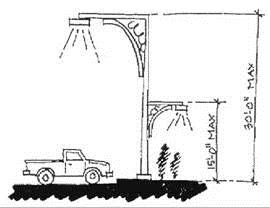
Site Lighting Height
(3)
Light Source (Lamp). Only LED, incandescent, florescent, metal halide, or color corrected high-pressure sodium may be used. The same light source type must be used for the same or similar types of lighting on any one site throughout any development.
(4)
Mounting. Fixtures shall be mounted in such a manner that the cone of light is contained on-site and does not cross any property line of the site.
(5)
Limit Lighting to Periods of Activity. The use of sensor technologies, timers or other means to activate lighting during times when it will be needed may be required by the Administrator to conserve energy, provide safety, and promote compatibility between different land uses.
(6)
Illumination Levels. Illumination levels are measured in footcandles. A footcandle is equivalent to the amount of light that is produced by a candle at the distance of one foot. It is also the equivalent of one lumen per square foot.
a.
All site lighting shall be designed so that the level of illumination as measured in footcandles (fc) at any one point meets the standards in the table below.
b.
Minimum and maximum levels are measured on the pavement within the lighted area. Average level is the overall, generalized ambient light level, and is measured as a not-to-exceed value calculated using only the area of the site intended to receive illumination.
c.
Lighting for automated teller machines shall be required to meet the standards of F.S. § 655.962.
d.
Outdoor recreation areas adjacent to residential uses or districts shall not be illuminated after 10:00 p.m. Sunday through Thursday, and 11:00 p.m. Friday and Saturday.
(d)
Excessive Illumination.
(1)
Lighting within any multifamily or nonresidential lot that unnecessarily illuminates and substantially interferes with the use or enjoyment of any other property is prohibited. Lighting unnecessarily illuminates another lot if it exceeds the requirements of this section.
(2)
All outdoor lighting shall be designed and located such that the maximum illumination measured in footcandles at the property line does not exceed 0.2 on adjacent residential uses, and 0.5 on adjacent commercial sites and public rights-of-way.
(3)
Lighting shall not be oriented so as to direct glare or excessive illumination onto streets in a manner that may distract or interfere with the vision of drivers on such streets.
(4)
Fixtures used to accent architectural features, landscaping or art shall be located, aimed or shielded to minimize light spill into the night sky.
(5)
Illumination using illuminated tubing or strings of lights that completely outline or define property lines, sales areas, roofs, doors, windows or similar areas in a manner that is not primarily for safety purposes, as determined by the Building Official, is prohibited.
Sec. 124-127. - Outdoor Speaker Systems.
(a)
Outdoor Speaker Systems. Outdoor loudspeaker or paging systems shall not be permitted in any nonresidential zoning district.
(b)
Reserved.
Sec. 124-128. - Architectural and Design Standards.
(a)
General Purpose and Intent.
(1)
The purpose of this section is to supplement development standards elsewhere in this UDC with specific criteria that apply to the design of certain commercial buildings and projects.
(2)
The applicable commercial development depends on high visibility from public streets. In turn, design of certain commercial buildings and sites determines much of the image and attractiveness of the streetscapes and character of the community. Massive or generic projects that do not contribute to, or integrate with, the community in a positive manner can be detrimental to a community's image and sense of place.
(3)
The County's goal is to create and maintain a positive ambiance and community image and identity by providing for architectural and site design treatments that will enhance the visual appearance of certain commercial development and the quality of life in Sarasota County.
(4)
This Section incorporates a basic level of architectural design which, in conjunction with site design, landscaping, lighting and sign treatments located elsewhere in this UDC, is intended to result in a comprehensive scheme for building design and site development consistent with the goals, policies and objectives of the Sarasota County Comprehensive Plan. However, this section is not intended to require any specific style of architecture.
(5)
This Section is also intended to:
a.
Promote high standards in architectural design and the construction of creative, innovative, aesthetically pleasing structures;
b.
Encourage landowners, designers and developers to look closely at local conditions and the development site, and produce new development that enhances and complements both the built and natural environment;
c.
Continue the significant architectural heritage of Sarasota; and
d.
Ensure that development and building design is sensitive to the specific site, consistent with the existing and proposed character of the area, including residential and nonresidential uses in the surrounding area, and does not detract from the positive elements existing neighborhood characteristics.
(b)
Applicability.
(1)
Table of Requirements. The requirements of this section shall apply to the uses and use categories listed in the following table:
1 Includes redevelopment of over 50 percent of the length of a building facade.
2 Includes expansion of over 20 percent of the area of the existing building, or redevelopment of over 50 percent of the length of a building facade where the existing use, or the existing use plus any expansion, would exceed 60,000 square feet. These standards do not apply to an individual building that is less than 60,000 square feet.
3 The 60,000 square feet shall be measured by the gross floor area of individual and attached buildings as measured from the outside walls. Unattached buildings and buildings attached only by walkways or porticos are measured separately.
(2)
Exceptions for Approved Critical Area Plans.
a.
A critical area plan may define a specific architectural style. Where the application of that style conflicts with the requirements of this subsection (d), below, the requirements of subsection (d), below shall apply unless expressly in conflict with the architectural requirements implementing the adopted critical area plan.
b.
A critical area plan pursuant to Section 124-101(b) may result in approvals for multistory commercial or mixed-use buildings.
(3)
Exception for Developments of Regional Impact. A development of regional impact development order may contain specific architectural standards and requirements for structures that would otherwise be regulated by subsection (d), below, where approved by the Board. All Building Permits, Site Development or Construction Plan applications for affected buildings shall reference the adopted development order's architectural standards and requirements.
(c)
Small-Scale Commercial.
(1)
Purpose and Intent. The intent of this section is to ensure that certain warehouse-like buildings are designed to eliminate the blank unarticulated walls of such structures, and instead, provide visual interest while enhancing the community's character and identity through the use of architectural detail.
(2)
Requirements for Design and Articulation.
a.
All building facades shall be given equal design significance. The design shall present a continuity of style on all facades except for service areas not visible from public streets.
b.
All facades shall provide architectural features to provide visual interest and avoid expanses of blank featureless walls. Architectural features may include roof forms, projections of facade, fenestration, canopies, arcades, or any other features that meet the intent of this section.
(3)
Demonstration of Compliance. Compliance with the small-scale commercial requirements shall be demonstrated through submittal of architectural drawings at the time of Site Development Plan review in accordance with Article 12, or where no Site Development Plan is required, submittal directly to the Design Administrator. Drawings shall include, but not be limited to, a floor plan, roof plan and all exterior building elevations, and any other information deemed necessary to demonstrate compliance with this section.
(4)
Review by Design Administrator. The Design Administrator shall review the required drawings and accompanying materials and make a determination as to whether or not the proposed development meets the requirements set forth above. The determination shall be provided in writing to the applicant, and once approved by the Design Administrator, a Building Permit application for the project may be filed. Applicants may revise the proposal and resubmit the application; however, such application shall be considered a new application.
(5)
Criteria for Approval. The Design Administrator shall apply the following criteria in making a determination of compliance with these small-scale commercial requirements:
a.
The application is complete and the information contained within the application is sufficient and correct to allow adequate review and final action;
b.
The application illustrates compliance with the small-scale commercial requirements of this section;
c.
The design demonstrates unique, site-sensitive architecture; and
d.
The design is compatible with the design of surrounding properties.
(6)
Appeal of Design Administrator's Determination. The applicant may appeal the Design Administrator's decision to the Board of Zoning Appeals in accordance with the provisions of Section 124-47, Administrative Appeal.
(d)
Large-Scale Commercial.
(1)
Purpose and Intent. The intent of this section is to ensure that certain large, boxy, warehouse-like buildings are designed to eliminate the common monolithic appearance of such structures, and that instead it provides visual interest while enhancing the community's character and identity through the use of detail and scale.
(2)
Requirements for Building Massing and Articulation.
a.
The design shall help integrate the development with its surroundings by breaking down the apparent mass and scale of the building on all sides. This provision shall not be required in the immediate area surrounding loading docks, where specific heights may be required.
b.
No more than 40,000 gross square feet of the structure shall be designed as a distinct mass. Preferably, two or more building masses shall be expressed.
c.
All facades shall be given equal design significance. There shall be no blank, featureless walls, including rear walls. The design shall present a continuity of style on all facades, except where separated by a party wall located on a lot line.
d.
Outparcels shall be designed and integrated with the main project.
(3)
Requirements for Building Entries.
a.
The design shall use architectural features which clearly define the public entry.
b.
Multiple entryways shall be incorporated into the design wherever possible in order to break up the apparent mass and scale of the project.
c.
At least one clearly articulated entrance shall be visible from a public street, and connected to that street with a pedestrian sidewalk. Such a sidewalk may cross vehicular traffic within the parking area, provided that a change in materials clearly designates the pedestrian crosswalk.
(4)
Demonstration of Compliance. Compliance with the large-scale commercial requirements shall be demonstrated through submittal of architectural drawings at the time of Site Development Plan review in accordance with Article 12, or where no Site Development Plan is required, submittal directly to the Design Administrator. Drawings shall include, but not be limited to, a floor plan, roof plan and all exterior building elevations, and any other information deemed necessary to demonstrate compliance with this section.
(5)
No Variance Permitted. No Variance from the Board of Zoning Appeals from requirements of this section shall be permitted.
(6)
Review by Design Administrator. The Design Administrator shall review the required drawings and accompanying materials and make a determination as to whether or not the proposed development meets the requirements set forth above. The determination shall be provided in writing to the applicant, and once approved by the Design Administrator, a Building Permit application for the project may be filed. Applicants may revise the proposal and resubmit the application; however, such application shall be considered a new application.
(7)
Criteria for Approval. The Design Administrator shall apply the following criteria in making a determination of compliance with these large-scale commercial requirements:
a.
The application is complete and the information contained within the application is sufficient and correct to allow adequate review and final action.
b.
The application demonstrates compliance with the prohibition on duplicate buildings in this section.
c.
The application illustrates compliance with the large-scale commercial requirements of this section.
d.
The design demonstrates unique, site-sensitive architecture.
e.
The design is compatible with the design of surrounding properties.
(8)
Appeal of Design Administrator's Determination. The applicant may appeal the Design Administrator's decision to the Board, who shall review the submitted application and accompanying Design Administrator's materials for compliance with this section.
Sec. 124-129. - Optional Commercial Redevelopment Regulations.
(a)
Purpose and Intent.
(1)
In the County there are older commercial properties, particularly narrow strip commercial properties on arterial roadways impacted by road widening and many commercial properties that were developed prior to the establishment of off-street parking, landscape buffering, stormwater management and other land development standards. The rehabilitation and redevelopment of such properties is a vital component to maintaining a thriving urban area with adequate services for residents. Often redevelopment efforts have been constrained by current regulations regarding the development of land. This section provides an optional set of flexible regulations to facilitate the redevelopment of older commercial properties.
(2)
Improvements to older commercial properties required by this section will increase the quality and aesthetics of development in the county, provide an economic stimulus to the immediate area, increase property values, provide employment opportunities and strengthen the County's economic base.
(3)
Successful implementation of this section will require recognition and balance of private and public purposes. The developer is asked to correct or improve existing traffic circulation and access problems, to make sure the site is safe, well landscaped, and well drained and to improve the appearance of structures on the site. County staff is asked to adopt an outcome-based perspective in the implementation of this section and assist the developer in finding ways to achieve those outcomes.
(4)
The redevelopment of older commercial properties presents greater challenges than the development of an undeveloped site. Fixed development standards typically designed for undeveloped sites are difficult to meet in a redevelopment project and further complicate the commercial redevelopment effort. This section establishes a series of performance standards that can be met in multiple ways and balanced against one another to achieve a positive community outcome. The standards prescribe a series of desired outcomes. The performance standards allow the developer to design a project around opportunities and constraints of the individual site as opposed to adhering to specific standards that may not encourage a quality redevelopment project.
(5)
This section provides standards to address the incompatibility of abutting commercial and residential uses by improving the management of stormwater, improving pedestrian and vehicular access and circulation, and improving the safety and appearance of older commercial properties.
(b)
Applicability.
(1)
The provisions of this Section 124-129 are available as an optional set of development standards for developed commercial properties currently zoned CN, OPI, CG, CI or CM that were approved for development prior to October 3, 1989. The provisions of this section shall not be applied to properties zoned CN/SKOD, OPI/SKOD, CG/SKOD, CI/SKOD or CM/SKOD.
(2)
In the case of Regional Commercial Centers developed as unified developments with multiple owners that meet the applicability provisions set forth in subsection (1), above, the redevelopment regulations set forth in this Section shall only apply to the property and improvements of the owner or owners proposing the redevelopment plan.
(3)
All commercial redevelopment plans, including Site Development Plans, Construction Plans and Building Permit applications, pursuant to this Section shall be submitted to the Planning and Development Services Department for distribution to Development Review Coordination for review of compliance with the regulations in this Section.
(4)
A meeting with neighbors is required for a redevelopment plan. The Applicant shall send certified letters to the owners of the abutting properties and to the owners of the property directly across any street or right-of-way advising them of the neighborhood meeting date, time, location and purpose of the meeting. The Planning and Development Services Department shall provide the names and addresses to the Applicant based on the latest available ad valorem tax records maintained by the County. The Applicant shall send the letter to the property owners at least ten calendar days in advance of the meeting. The meeting shall be held on the proposed redevelopment site. The meeting shall occur no earlier than 6:00 pm on weekdays and between 9:00 am and 5:00 pm on weekends. A County staff member shall attend the meeting. No posting or advertising of the meeting is required. The neighborhood meeting shall take place prior to submission of the redevelopment plan.
(5)
The provisions contained in subsection (1) below, Stormwater Management, shall only apply to proposed redevelopment of commercial properties with a lot or parcel area of 20 acres or less and an existing impervious coverage in excess of 50 percent of the lot or parcel area.
(c)
Permitted, Limited and Special Exception Uses.
(1)
Permitted and limited uses in the applicable zoning district.
(2)
Special Exception uses in the applicable zoning district.
(d)
Permitted Accessory Uses and Structures. In addition to the requirements of Section 124-73, for lots with an average lot depth of 500 feet or greater, the following accessory uses or structures shall not be located in the minimum required side or rear yard when those yards abut a residential zoning district or a residential Future Land Use Map designation.
(1)
Solid waste storage and collection areas.
(2)
Air conditioning compressors and any other mechanical equipment that generates noise that is incompatible with an abutting residential use.
(3)
All delivery and loading and unloading areas and activities.
(4)
Drive-through lanes and windows.
(e)
Maximum Residential Density. Upper-Story Residential dwelling units are permitted at a maximum residential density of 13 dwelling units per acre. Upper-story Residential dwelling units no greater than 750 square feet of habitable space, located within the Urban Service Area Boundary (not applicable on Barrier Islands), and not used as Transient Accommodation, shall be counted as one-half unit (0.5) for density purposes only.
(f)
Maximum Building Coverage. Unrestricted, subject to compliance with all requirements contained in this Section.
(g)
Minimum Yard Requirements.
(1)
Street Yards.
a.
Provision of a street buffer pursuant to subsection (k), below.
b.
The building shall be designed to comply with the Florida Department of Transportation (FDOT) clear sight area standard at all abutting street intersections and all intersections of driveways and streets.
c.
Five-foot setback for buildings of one story and not exceeding 20 feet in height with provision of the following:
1.
Trees, shrubs and other ornamental plants provided in front of 20 percent of the length of the front building wall.
d.
Ten foot setback for buildings of two stories and not exceeding 35 feet in height.
e.
Fifteen-foot setback for buildings of three or more stories and exceeding 35 feet in height.
(2)
Side and Rear Yards. None, except as below:
a.
When abutting a nonresidential zoning district, there shall be no required minimum side or rear yards as long as the project complies with the standards in the Building Code and the Life Safety Code and is approved by the Fire Marshal and Building Official.
b.
When abutting a residential zoning district the minimum required side and rear yards shall be as is required in the applicable zoning district. No reduction of the minimum required side yard shall be allowed for fire resistive construction.
c.
Reserved.
(3)
Railroad Right-of-Way Setback. There shall be a minimum setback from an active railroad right-of-way. No setback is required along railroad spurs located on private property.
(h)
Maximum Building Height.
(1)
Except for the following provisions, the maximum building height of the applicable zoning district shall apply.
(2)
For structures including upper story residential that abut a residential zoning district, the following shall apply:
a.
For any part of the structure located within 50 feet of any residential property line, the maximum building height of the applicable zoning district shall apply.
b.
For any part of the structure with two stories of upper story residential located more than 50 feet from any residential zoning district, the maximum building height shall be 50 feet.
c.
The provisions of a. and b. above shall not apply if the property of the subject redevelopment plan and the property of the abutting residential zoning district are under common ownership.
(i)
Site and Building Improvements.
(1)
A commercial redevelopment project provides the opportunity for various site improvements including building improvements, improved pedestrian access and landscaping improvements to be made to a commercial property. To ensure that the appearance of a commercial site and building is noticeably improved, this subsection requires a commercial redevelopment project to provide a minimum combination of site or building improvements. Compliance with this section is required and does not constitute the full extent of improvements that may be required as part of approval of the redevelopment plan.
(2)
A commercial redevelopment project consisting of a multitenant building with more than 60,000 square feet of proposed floor area may provide the improvements identified in the redevelopment plan by phase. The phasing plan for the improvements to the entire property shall not exceed three years from the date of the first plan approval.
(j)
Off-Street Parking and Loading, Access and Circulation.
(1)
Application of this subsection shall require maintenance of public safety and the identification of opportunities for any improvements in access, circulation, and pedestrian accessibility and shall constitute the requirement of an approved Alternative Parking Plan. When the provisions of this subsection conflict with other applicable provisions contained in these UDC regulations, the provisions of this subsection shall prevail. On-site and off-site parking and loading facilities, access and safety-related improvements shall be required to comply with the following performance standards:
a.
Safe circulation for vehicles, including delivery vehicles and solid waste pick-up vehicles, bicyclists and pedestrians shall be provided.
b.
The minimum number of off-street parking spaces as required by Section 124-120 of this UDC shall be provided. Except for new restaurant or entertainment uses and the conversion of a residential use to a nonresidential use, when an existing parking facility is nonconforming with regard to the minimum required number of parking spaces, new parking spaces shall only be required for the net increase in building floor area.
c.
The proposed facility shall provide safe ingress into and egress out of the property. When determined to be necessary and practicable, this shall be achieved through the restriction of turn movements at street access driveways, modification of turning radii at street access driveways, establishment of one-way street access driveways, the narrowing or relocation of existing or proposed street access driveways, or the abandonment of street access driveways.
d.
The applicant shall attempt to establish vehicular and pedestrian cross access and shared parking facilities with abutting commercial properties. Where such facilities are practicable, the owner or the owner's agent shall provide a letter demonstrating an attempt has been made to establish cross access and shared parking facilities.
e.
Where applicable, the applicant shall improve the accessibility and convenience of existing or planned transit facilities that abut the subject property or provide new transit stop improvements. Such improvements shall include benches, shelters or other transit related improvements. For commercial centers over 60,000 square feet that are located on an arterial roadway, the applicant shall report on the feasibility of accommodating on-site transit service. If deemed feasible, the appropriate transit authority official shall evaluate the mobility benefits of on-site transit service. If mobility benefits will be obtained, the owner or the owner's authorized agent shall enter into an agreement with the transit authority authorizing the provision of on-site transit service.
(2)
Subject to compliance with subsection (1), above, a commercial redevelopment project may utilize any of the following alternative approaches for the design and layout parking and loading facilities.
a.
Employee parking areas may:
1.
Use tandem parking of vehicles; and
2.
Design the parking spaces with a minimum width of 8.5 feet.
b.
Up to 25 percent of customer parking areas may contain parking spaces with a minimum width of 8.5 feet. The remaining percentage of parking spaces shall be nine feet in width per Section 124-120(m). Customer parking spaces of less than nine feet in width shall be signed for compact cars.
c.
When determined to be safe, parking areas located adjacent to a non-thru local public street can be designed for vehicles to back out into the street. Along local thru streets, parking areas designed for vehicles to back out into the street may be permitted provided that the local street has low levels of existing and projected traffic volume and that no adverse impacts on the adjoining residential neighborhood are created. Existing parking areas that use a backing out movement onto a local street shall be presumed safe if there is no history or report of traffic accidents associated with the parking area. The backing out parking facility shall be subject to the issuance of a Right-of-Way Use Permit, pursuant to Section 124-48. As part of the Right-of-Way Use Permit application, the applicant shall submit a legal instrument, acceptable to the Office of the County Attorney, which holds the County harmless from any loss of parking spaces resulting from County action in the public right-of-way. As a condition for the issuance of the Right-of-Way Use Permit, the applicant may be required to make necessary improvements within the right-of-way to accommodate a safe and controlled backing out movement.
d.
Modification from the parking aisle standards contained in Section 124-120(m)(3)b. may be allowed upon demonstration that safe vehicular circulation and movement can be provided.
e.
Modification from the standards for parking area landscape islands contained in Section 124-120(m)(7) and parking area medians between tiers of parking contained in Section 124-120(m)(8) may be allowed provided that the required landscaping associated with the islands and medians that is the subject of the modification is located elsewhere on site consistent with the priority listing in subsection (k)(3)b.3, below. The preferred dimension of any planting area shall be ten feet, however, in no case shall any dimension of planting area be less than five feet. Landscaped islands at the end of rows of parking shall be required to control vehicular circulation in the parking lot. Wheel stops, curbing or other approved barrier shall be provided for each parking space.
f.
The elimination or reduction of loading spaces may be allowed provided that the applicant can demonstrate that loading and unloading activities can be conducted safely without a formally designated loading space.
g.
Flexible enforcement of other off-street parking standards not identified above may be allowed provided that all applicable safety-related issues have been satisfactorily addressed.
h.
On-street parking spaces located immediately abutting the subject parcel, entirely within the extension of the side lot lines into the roadway, and not within any required clear sight triangle, may be counted toward meeting off-street parking requirements.
(k)
Landscaping and Buffering.
(1)
Flexibility in the application of landscape buffer standards can facilitate the redevelopment of older commercial properties. When standards in this subsection are in conflict with standards contained in Section 124-120 or 124-122 of this UDC, the standards contained in this subsection shall prevail. Improvements to landscaping on the site are highly valued as part of the redevelopment plan.
(2)
General Standards.
a.
The applicant shall, to the extent practicable, provide the full amount of buffer plantings for the applicable buffers required by Section 124-122 of this UDC.
b.
Reductions not exceeding 50 percent of the required minimum width of a property boundary buffer and street buffer are allowed only when required circulation, parking and stormwater facilities or an existing building is retained and physically constrains the buffer area.
(3)
Project Boundary Buffer.
a.
No project boundary buffer shall be required where the project boundary abuts a nonresidential zoning district.
b.
Where the project boundary abuts a residential zoning district or an existing one-story or two-story transient accommodation, the project boundary buffer shall comply with the following:
1.
A minimum six-foot high wall, consistent with Section 124-122(l), of this UDC shall be located within the required buffer. The height of the wall shall be measured from the elevation of the finished floor of the commercial building. Except as provided in paragraphs 2. and 3., below, a planting area on outside of the wall shall be provided to accommodate the installation, maintenance and long term viability of the project boundary buffer landscaping.
2.
Stormwater facilities may be located within the landscape buffer area.
3.
To the greatest extent practicable, the full amount of required project boundary landscape material shall be provided in the buffer area abutting the residential district. Required landscape material may be relocated to the following areas on the site that are listed in order of priority:
i.
The area between the landscape buffer and the commercial building.
ii.
Within the required street buffer.
iii.
Along the perimeter of the parking facility, or
iv.
In the interior of the parking facility.
(4)
Street Buffer. Street buffers shall be provided in compliance with the standards contained in Section 124-122 of this UDC, except when an existing parking area is to be retained and the existing street buffer is less than five feet in width. In this case, to the greatest extent practicable, the street buffer shall be sufficiently wide to accommodate the planting and long-term viability of a hedgerow. To the greatest extent practical, a hedgerow shall be provided between the street right-of-way and an adjacent parking area. Pursuant to subsection (g)(1), above, an alternative street buffer shall be required when a building is located five or less feet from the street right-of-way.
(l)
Stormwater Management. This subsection allows the use of various techniques to meet existing stormwater management standards. The various types of stormwater improvements cited in this subsection and others not cited are presumed to comply with the stormwater management standards contained in the UDC. Where there exists a conflict with this subsection and any other provision of the UDC, the provisions of this subsection shall prevail.
a.
When adding less than 5,000 square feet of impervious area, a stormwater management plan for attenuation, water quality treatment and floodplain compensation is not required.
b.
When adding 5,000 square feet or more of impervious area, a stormwater management plan for attenuation, water quality treatment and floodplain compensation is required per the UDC, providing for the following:
(1)
When the commercial redevelopment project is subject to Site Development Plan review, stormwater treatment shall be provided for the Directly Connected Impervious Area in compliance with applicable standards contained in this UDC.
(2)
Innovative stormwater management designs and techniques including but not limited to porous pavement, infiltration trenches, treatment inlet boxes, cisterns, underground vaults, etc. and stormwater treatment mitigation may be considered for addressing stormwater treatment. All stormwater management designs and techniques shall be certified by a Florida registered professional engineer.
(3)
Up to three inches of flooding in the deepest portion of parking areas may be allowed and included as one means of meeting stormwater attenuation or floodplain compensation volume requirements.
(4)
To minimize the amount of site fill and the associated impacts of such fill to existing native vegetation and trees, historical wet season water table levels may be controlled at lower elevations subject to the physical limitations of the receiving drainage system and compliance with the criteria for such set forth by the Southwest Florida Water Management District (SWFWMD).
(5)
Stormwater attenuation requirements may be waived for sites located between the city limits of the City of Sarasota and the City of Venice and within one mile of the east coast of bays or the Intracoastal Waterway to the extent that the post development site cannot cause an adverse increase in flood stages off site. This consideration is granted provided the site provides stormwater treatment for 150 percent of the site and adequate downstream capacity exists for the proposed discharge rate when considered within the context of the total watershed discharge and its timing, subject to the requirements of the Florida Department of Transportation (FDOT), if applicable.
(m)
Outdoor Lighting. The subject property shall comply with all applicable outdoor lighting standards contained in Section 124-126 of this UDC for lighting added as part of the redevelopment plan. Existing lighting shall be evaluated for compliance with the illumination levels in Section 124-126(c)(6). Outdoor lighting on the site shall be designed with sensitivity to adjacent neighborhoods in order to minimize the visual impacts on abutting residential properties.
(n)
Open Space. Aside from required landscape buffers and stormwater improvement facilities, there shall be no minimum open space requirement. This requirement shall supersede the open space requirements of the applicable existing zoning district.
(o)
Solid Waste Facilities and Screening of Roof-Top Equipment. Where practicable, solid waste storage facilities on the commercial redevelopment site shall be shared by all tenants at a single consolidated location that is conveniently accessible for a solid waste disposal truck. In addition, a site redevelopment plan shall comply with 124-123, Buffering and Screening of Service Function Areas.
(p)
Appeal Procedures. Appeals shall follow the Administrative Appeals process of Section 124-47.
(Ord. No. 2021-075, § 2, 12-7-2021)
Sec. 124-130. - Housing Types.
(a)
Generally.
(1)
These housing types are established to provide a common terminology for housing in the County. The choices include a variety of housing types not currently found in the County, to provide for their potential use in the future.
(2)
Drawings in this section are for illustrative purposes only, and variations that meet the standards are encouraged.
(3)
Recreation areas, such as the clubhouse, swimming pool, and tennis, volleyball, or basketball courts, shall be oriented internally or along major roadways, and away from adjacent residential development.
(4)
Proposed housing types shall be identified on Subdivision or Site Development Plan and Final Plats. Any changes to the siting of the house or a change of housing type shall be approved by the Administrator.
(5)
Nonconforming lots of record zoned RMF shall also comply with Section 124-283(d).
(b)
Single-Family Detached House.
(1)
Description. A single-family detached house is a dwelling unit normally located on a privately-owned lot with private yards on all four sides of the house. Garage access may take place from the front or rear of the lot. Notwithstanding the requirements of Section 124-74(c), a garage with alley access may extend into the rear setback.
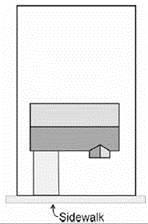
Single-Family Detached House
(2)
Conventional Subdivision. A conventional subdivision only allows one single-family detached house per platted lot of record occupied by a single family and not to exceed the maximum density allowed by the zoning district or the future land use category, whichever is more restrictive. All conventional subdivisions in the RE and RSF Districts that exceed 30 acres in size shall incorporate a common neighborhood use and focal point within the development such as a park, play area, plaza, square, pavilion or other similar facility that can accommodate such activities as outdoor gatherings, neighborhood events, and picnicking. The focal point size shall be equal to at least one percent of the gross area of the subdivision. The focal point shall contain at a minimum, a community use facility. The focal point shall be specified at the time of Subdivision or Site Development Plan submittal.
(3)
Cluster Subdivision. A cluster subdivision provides a minimum of 30 percent common open space, exclusive of individual lots, and allows those housing types specified in Section 124-76(b)(2)h. when occupied by a single family. All cluster subdivisions shall incorporate a common neighborhood use and benefit focal point within the development such as a park, play area, plaza, square, pavilion or other similar facility that can accommodate such activities as outdoor gatherings, neighborhood events, and picnicking. The focal point size shall be equal to at least one percent of the gross area of the subdivision. The focal point shall contain at a minimum, a community use facility. The focal point shall be specified at the time of Subdivision or Site Development Plan submittal. Where single-family detached housing occurs within a cluster subdivision, such housing shall meet the standards of Section 124-76(b)(2)i. NOTE: For density limitations in cluster subdivisions, also see Section 124-72(a)(5).
(c)
Lot Line House.
(1)
Description. The lot line house is a single-family dwelling unit positioned on one side lot line without any setback. The house has private yards on three sides of the building, including a wider side yard comprising the equivalent of two side yards for conventional detached housing. Garage access may take place from the front or the rear of the lot.
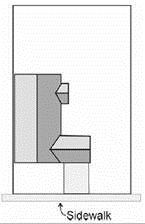
Lot Line House
(2)
Lot Line House Development Standards. A lot line house is permitted in accordance with Section 124-76(b)(2)h., when occupied by a single family.
a.
Setbacks. The side building setback may be reduced to zero on one side of the house. This reduction is not allowed on the street yard setback or to the side yard setback adjacent to lots that are not part of the zero lot line project. Notwithstanding the requirements of Section 124-73(c), a garage with alley access may extend into the rear setback.
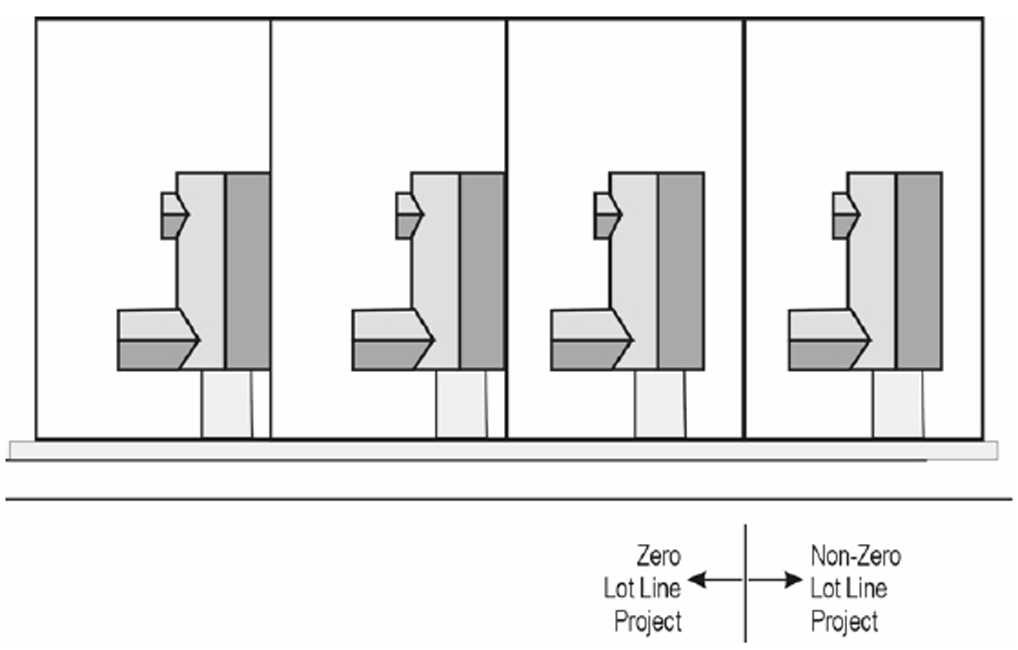
Setbacks
If the street yard is at least 20 feet in depth, no additional garage setback is required. Where the street yard is set at the minimum of 15 feet in depth, the garage must be set further back to keep vehicles from overhanging the sidewalk.
b.
Maintenance Easement. An easement between the two property owners to allow for maintenance or repair of the house is required when the roof overhang or side wall of the house are within four feet of the adjacent property line (no roof overhang shall be permitted to extend across the property line). The easement on the adjacent property must provide at least five feet of unobstructed space. The easement shall be recorded on the Subdivision Plat.
c.
Privacy. If the side wall of the house is on the property line, or within three feet of the property line, windows or other openings that allow for visibility into the side yard of the adjacent lot are not allowed. Windows that do not allow visibility into the side yard of the adjacent lot, such as a clerestory window or a translucent window, are allowed. All materials within three feet of the property line shall be fire-rated to meet building code requirements.
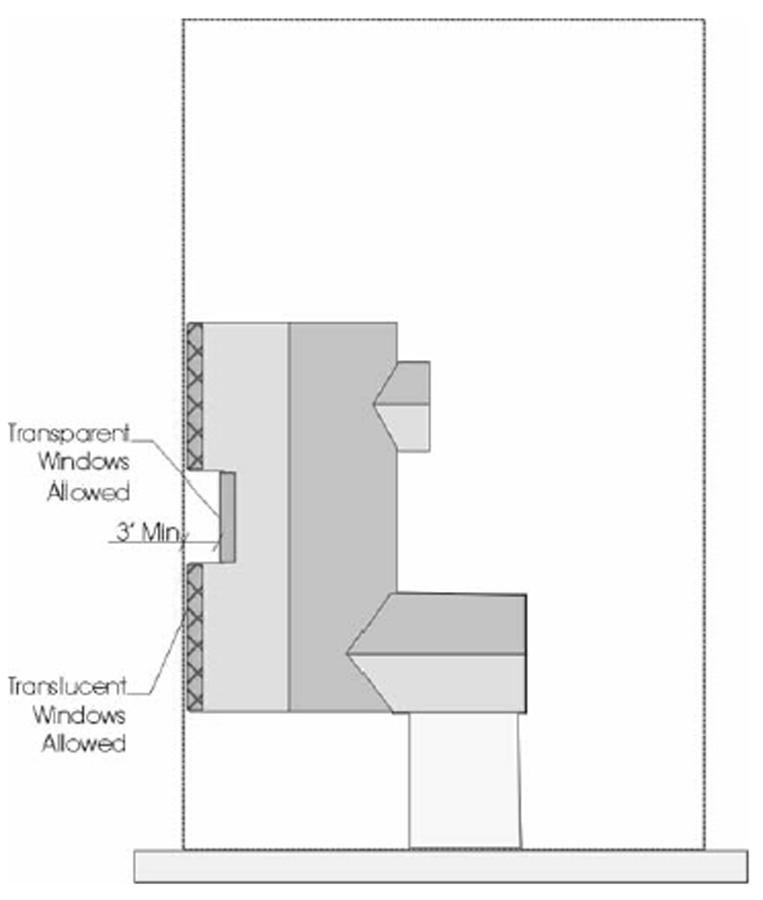
Lot Line House Privacy
(d)
Traditional House.
(1)
Description. The traditional house is a single-family detached dwelling unit that is set much closer to the street than a conventional single-family detached house. It has private yards on each side of the building. An alley is required, and all garage access must take place from the alley.
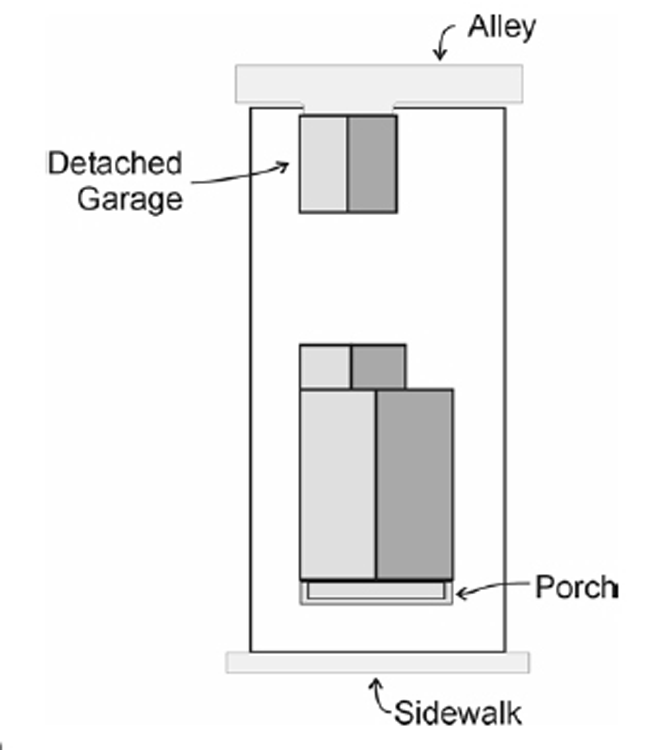
Traditional House
(2)
Traditional House Development Standards.
a.
A traditional house is permitted in accordance with Section 124-76(b)(2)h., when occupied by a single family.
b.
Notwithstanding the requirements of Section 124-73(c), a garage with alley access may extend into the rear setback.
(e)
Patio House.
(1)
Description. The patio house is a single-family detached dwelling unit, similar to a lot line house, placed on a small lot. Due to the modest area of the lot, the rear yard is enclosed by a wall, while still preserving a narrow street yard. Where an alley is provided, all garage access must take place from the alley.
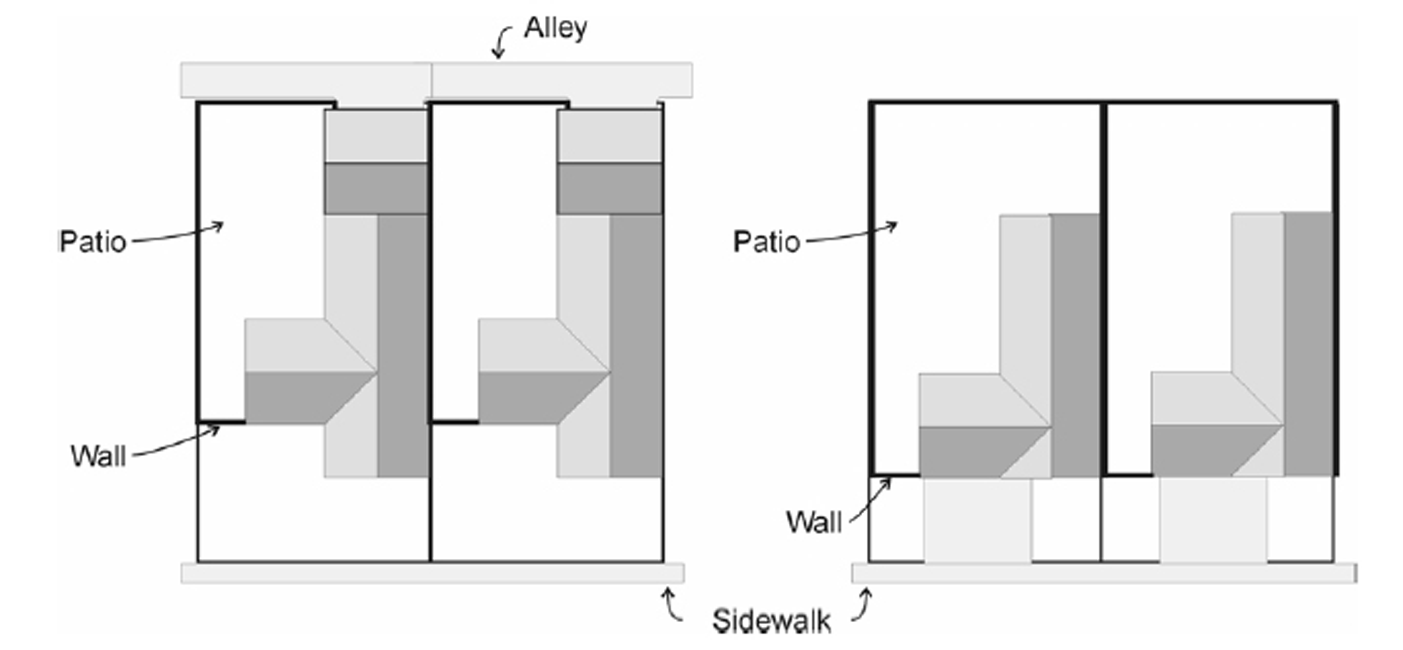
Patio House
(2)
Patio House Development Standards.
a.
A patio house is permitted in accordance with Section 124-76(b)(2)h., when occupied by a single family.
b.
Notwithstanding the requirements of Section 124-73(c), a garage with alley access may extend into the rear setback.
If the street yard is at least 20 feet in depth, no additional garage setback is required. Where the street yard is set at the minimum of 12 feet in depth, the garage must be set further back to keep cars from overhanging the sidewalk.
(f)
Villa House.
(1)
Description. The villa house is an attached single-family dwelling unit with a common wall. In many cases, a separate lot line falls under the common wall, providing for fee-simple ownership. Where an alley is provided, all garage access must take place from the alley.
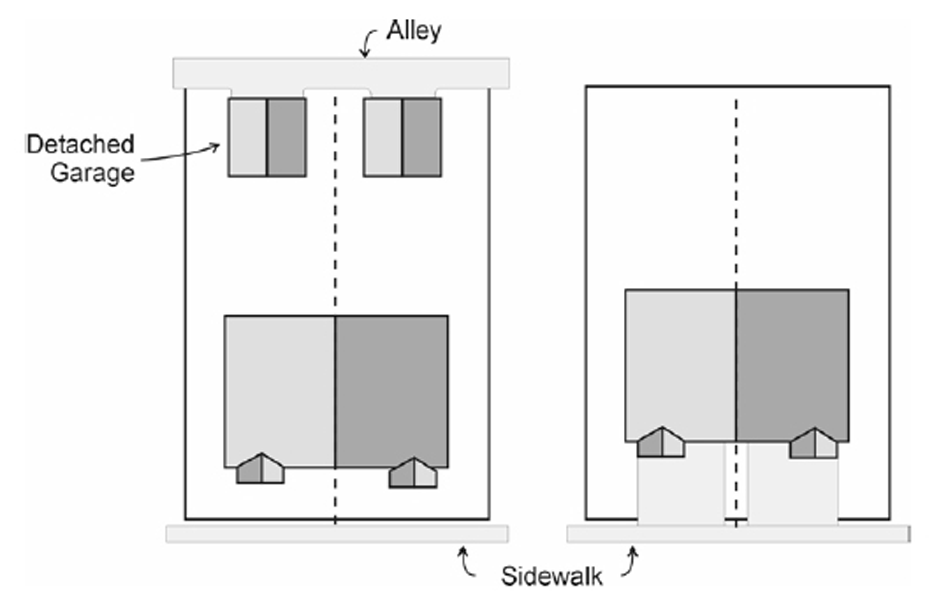
Villa House
(2)
Villa House Standards.
a.
A villa house is permitted in accordance with Section 124-76(b)(2)h., when occupied by a single family.
b.
Notwithstanding the requirements of Section 124-73(c), a garage with alley access may extend into the rear setback.
If the proposed street yard is at least 20 feet in depth, no additional garage setback is required. Where the street yard is set at the minimum of 15 feet in depth, the garage must be set back further to keep cars from overhanging the sidewalk.
(g)
Atrium House.
(1)
Description. This single-family, one-story house is characterized by an open, landscaped courtyard or atrium surrounded by living areas. The primary source of light and air is through the open courtyard. This house is often attached, or in a checkerboard pattern, but retains a narrow street yard. An alley is required, and all garage access must take place from the alley.
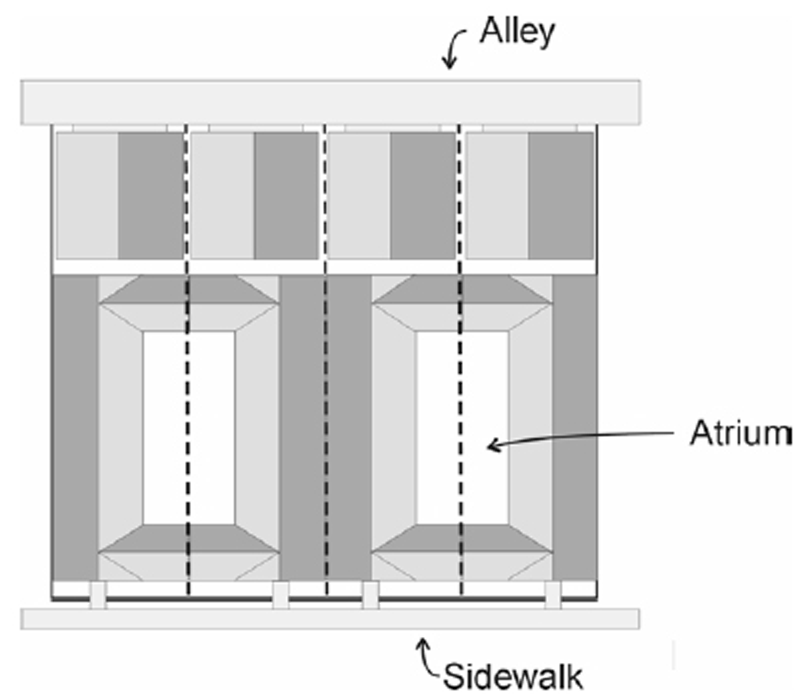
Atrium House
(2)
Atrium House Standards.
a.
An atrium house is permitted in accordance with Section 124-76(b)(2)h., when occupied by a single family.
b.
Notwithstanding the requirements of Section 124-73(c), a garage with alley access may extend into the rear setback.
(h)
Two-Family House.
(1)
Description. The two-family house is two units in a single structure on a single lot or parcel (often called a duplex). The units may be located on separate floors or side-by-side. Where an alley is provided, all garage access must take place from the alley.
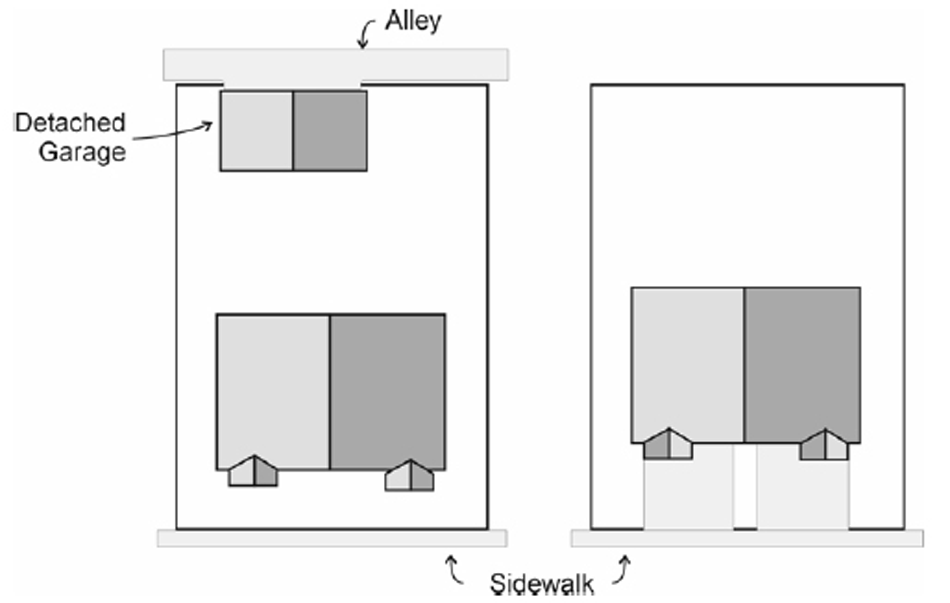
Two-Family House
(2)
Two-Family House Standards.
a.
A two-family house is permitted in accordance with Section 124-76(b)(2)h., when occupied by two families. Nonconforming lots of record zoned RMF shall also comply with Section 124-283(d)
b.
Notwithstanding the requirements of Section 124-73(c), a garage with alley access may extend into the rear setback.
If the street yard is at least 20 feet in depth, no additional garage setback is required. Where the street yard is set at the minimum of 12 feet in depth, the garage must be set further back to keep cars from overhanging the sidewalk.
(i)
Semi-Attached Townhouse.
(1)
Description. The semi-attached townhouse is a building made up of three or more attached units where the units are lined up in a row and share side walls. The semi-attached townhouse has both a one-story and two-story portion of each unit and is, thus, wider than the traditional townhouse. The one-story portion is commonly the garage.
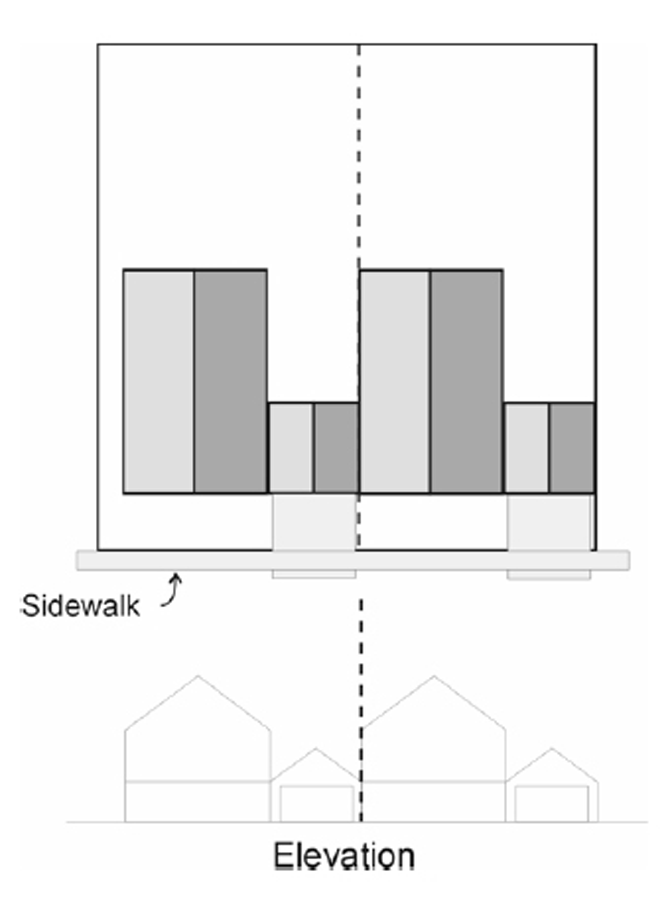
Semi-Attached Townhouse
(2)
Semi-Attached Townhouse Standards. A semi-attached townhouse is permitted in accordance with Section 124-76(b)(2)h., when occupied by a single family.
a.
Not withstanding Section 124-73(c), a garage with alley access may extend into the rear setback.
b.
Side yards are not required for interior townhouses, but street and rear yards shall be provided for all townhouses, and building separation requirements shall be maintained for all townhouse structures.
If the street yard is at least 20 feet in depth, no additional garage setback is required. Where the street yard is set at the minimum of 15 feet in depth, the garage must be set further back to keep cars from overhanging the sidewalk.
(j)
Townhouse.
(1)
Description. The townhouse is a building made up of three or more attached units where the units are lined up in a row and share side walls. Access to garages may be from the front or rear, although front-access townhouses must be on a wider lot. Where an alley is provided, all garage access must take place from the alley.
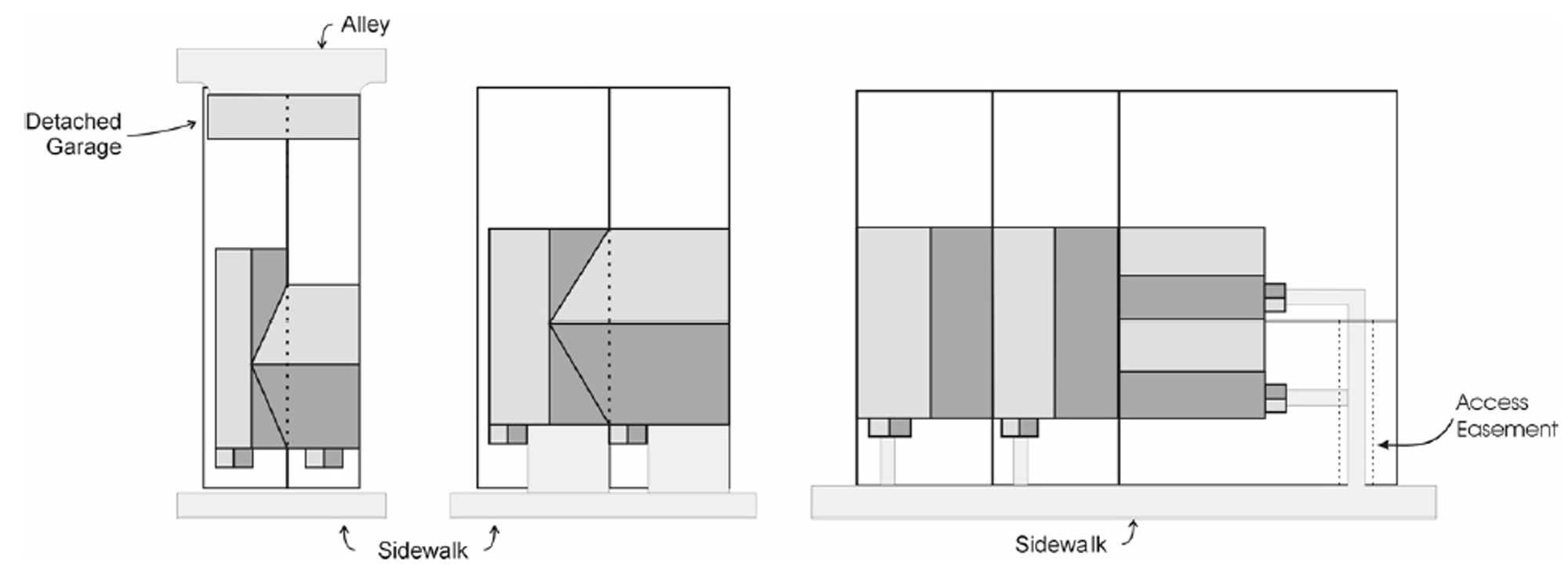
Townhouse
(2)
Townhouse Standards. A townhouse is permitted in accordance with Section 124-76(b)(2)h., when occupied by a single family.
a.
Notwithstanding the requirements of Section 124-73(c), a garage with alley access may extend into the rear setback.
b.
Side yards are not required for interior townhouses, but street and rear yards shall be provided for all townhouses, and building separation requirements shall be maintained for all townhouse structures.
If the street yard is at least 20 feet in depth, no additional garage setback is required. Where the street yard is set at the minimum of 15 feet in depth, the garage must be set further back to keep cars from overhanging the sidewalk.
c.
A townhouse building may mix townhouse, roof-deck townhouse, or stacked townhouse units, provided the most restrictive standards for each townhouse type are followed for the entire building.
(k)
Roof-Deck Townhouse.
(1)
Description. The roof-deck townhouse is a building made up of three or more attached units where the units are lined up in a row and share side walls. The roof deck townhouse has its yard on its roof. It is ideal for areas where a view is available. The roof-deck townhouse is more compact than normal townhouses. Where an alley is provided, all garage access must take place from the alley.
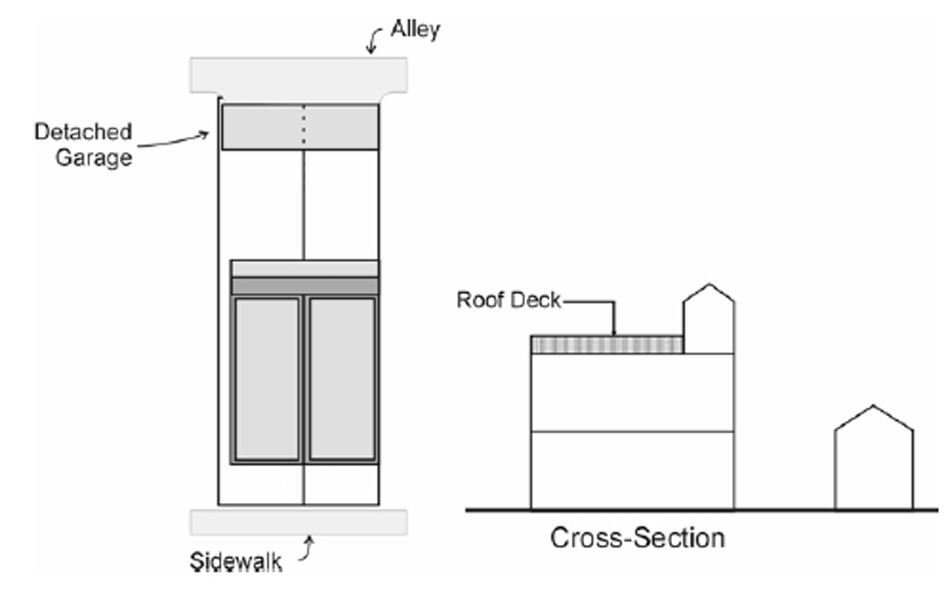
Roof-Deck Townhouse
(2)
Roof-Deck Townhouse Standards. A roof-deck townhouse is permitted in accordance with Section 124-76(b)(2)h., when occupied by a single family.
a.
Notwithstanding the requirements of Section 124-73(c), a garage with alley access may extend into the rear setback.
b.
Side yards are not required for interior townhouses, but street and rear yards shall be provided for all townhouses, and building separation requirements shall be maintained for all townhouse structures.
If the street yard is at least 20 feet in depth, no additional garage setback is required. Where the street yard is set at the minimum of 12 feet in depth, the garage must be set further back to keep cars from overhanging the sidewalk.
c.
A townhouse building may mix townhouse, roof-deck townhouse, or stacked townhouse units, provided the most restrictive standards for each townhouse type are followed for the entire building.
(l)
Stacked Townhouse.
(1)
Description. The stacked townhouse is a building made up of attached units where the units are lined up in a row and share side walls. A first-floor unit is accessed at grade, while a stair serves a unit comprising one or two stories above. Where an alley is provided, all garage access must take place from the alley.
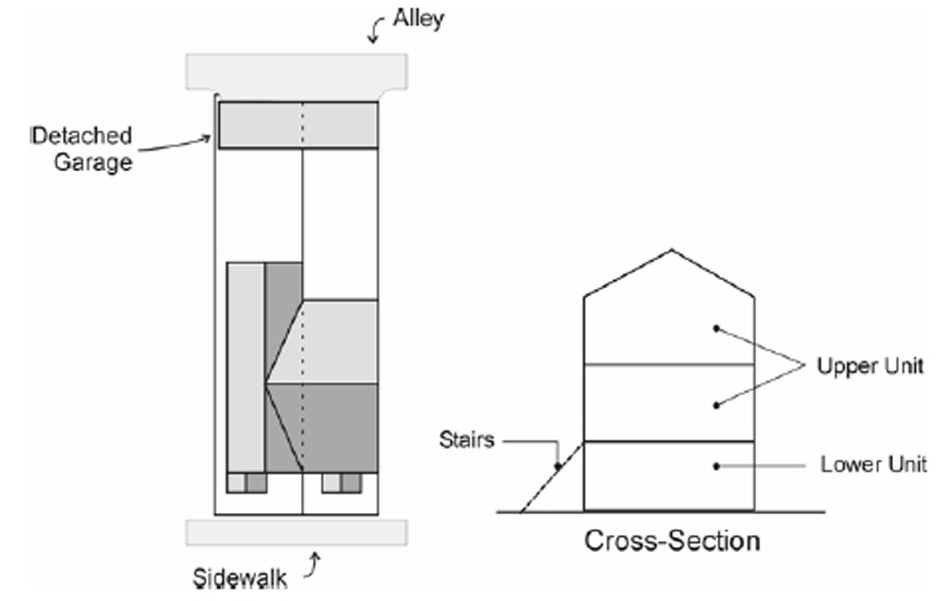
Stacked Townhouse
(2)
Stacked Townhouse Standards.
a.
Notwithstanding the requirements of Section 124-73(c), a garage with alley access may extend into the rear setback.
b.
Side yards are not required for interior townhouses, but street and rear yards shall be provided for all townhouses, and building separation requirements shall be maintained for all townhouse structures.
If the street yard is at least 20 feet in depth, no additional garage setback is required. Where the street yard is set at the minimum of 15 feet in depth, the garage must be set further back to keep cars from overhanging the sidewalk.
c.
A townhouse building may mix townhouse, roof-deck townhouse, or stacked townhouse units, provided the most restrictive standards for each townhouse type are followed for the entire building.
(m)
Multiplex.
(1)
Description. The multiplex is a series of three or more units, usually under single ownership, consolidated into a single structure. A multiplex is typically on a single lot, and contains common walls. The multiplex units may be two stories in height, however, units are not vertically mixed. Parking is often consolidated, even where garages or carports are used. Where an alley is provided, all garage access must take place from the alley.
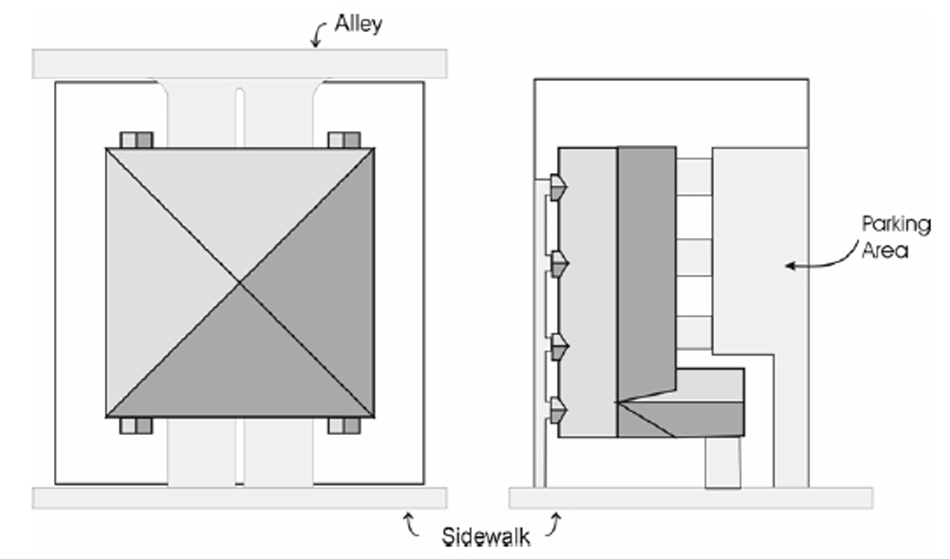
Multiplex
(2)
Multiplex Standards.
1 Intracoastal Waterway and bays: 30 feet. All other waterfront yards: 20 feet.
a.
Notwithstanding the requirements of Section 124-73(c), a garage with alley access may extend into the rear setback.
(n)
Multifamily.
(1)
Description. A multifamily structure on a single tract or parcel of land containing one or more units which may or may not share walls, often with separate units by floor as well. Multifamily units may vary in height from one to four stories. Parking is normally consolidated, even where garages or carports are used. Multifamily developments are owned as apartments (single-owner/manager) or condominiums (multiple-owner).
i.
Multifamily-Apartment: Type 1. A multifamily structure in the form of a residential building accommodating several households.
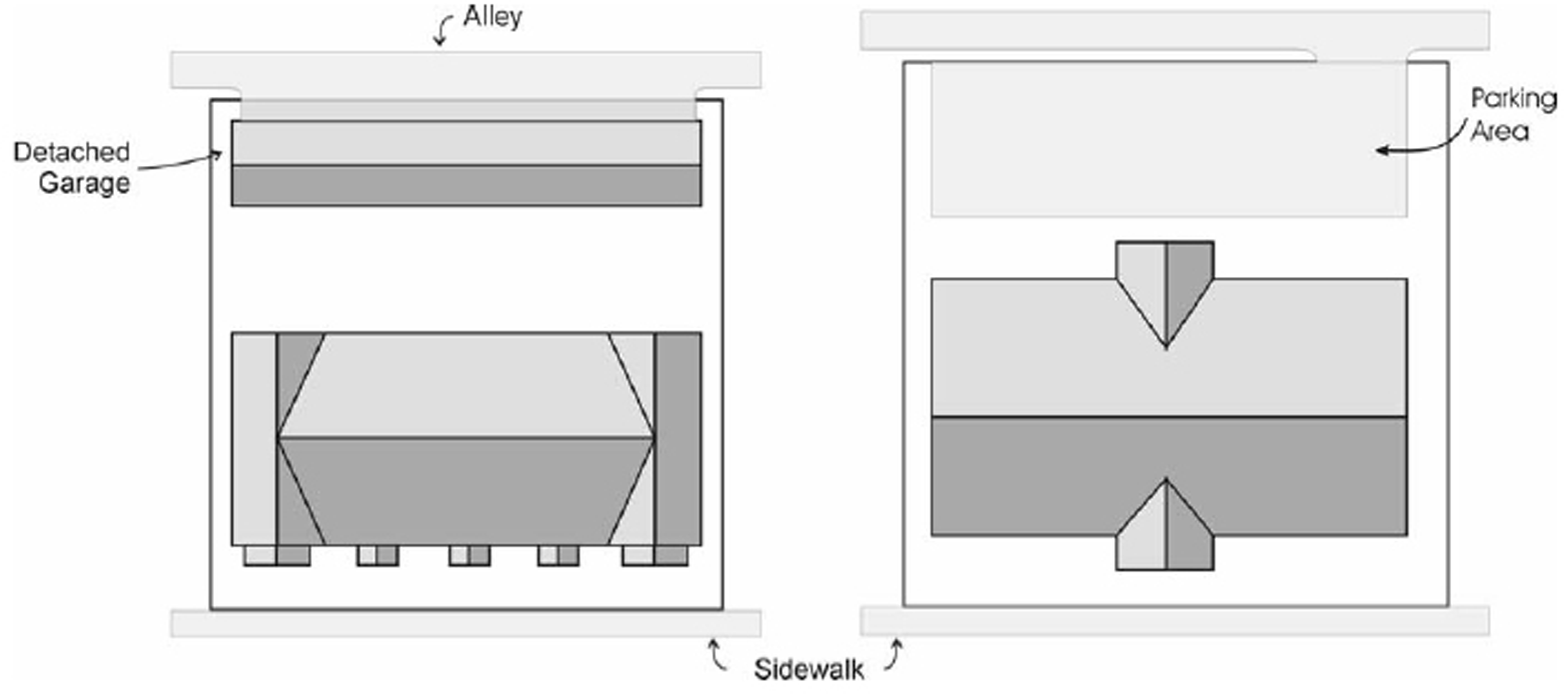
Multifamily
ii.
Multifamily-Apartment: Type 2. A collection of residential buildings containing one or more units, on a single lot accommodating several households.
(2)
Multifamily Standards.
1 Intracoastal Waterway and bays: 30 feet. All other waterfront yards: 20 feet.
a.
Notwithstanding the requirements of Section 124-73(c), a garage with alley access may extend into the rear setback.
(Ord. No. 2019-006, § 7, 4-23-2019; Ord. No. 2021-057, § 2, 11-15-2021)
Sec. 124-131. - Rental of Dwelling Units in OUA, OUR, OUE, RE, RSF, RMF, RC, and RMH Districts.
(a)
Rental of Dwelling Units in OUA, OUR, OUE, RE, RSF, RMF (not on barrier islands), RC and RMH Districts.
(1)
Dwelling units may be rented as a whole and for periods of greater than 30 days provided that a dwelling unit shall not be rented more than once every 30 days.
(2)
Portions of a dwelling may be rented for periods of greater than 30 days provided that the dwelling is physically occupied by the owner during more than 50 percent of the lease term and the dwelling unit is not rented more than once every 30 days. "Owner" shall include any individual owning an interest in the dwelling as an individual and any individual owning a majority of the interests or shares of a corporation, partnership, or other business entity.
(3)
The owner or managing agent of real property that is offered for rent or lease shall maintain records, including the names and addresses of the lessees, that are adequate to establish the period for which a unit is rented and the names of family members or unrelated individuals occupying the premises during each rental period. Such records shall be provided upon request to inspectors authorized by the County to enforce this UDC.
(4)
Except for community residential homes, any rental or lease of a single-family residence to more than one individual and his or her family or roommates is prohibited, unless all persons residing in the single-family residence have full use of the entire residence, including the single kitchen, accessory buildings, and associated property.
(5)
Any attempt made to solicit, advertise, or commit the act of leasing a rental in a manner inconsistent with the provisions of this section shall constitute a violation.
(b)
Reserved.
Sec. 124-132. - Minimum Living Standards to Prevent Overcrowding.
(a)
The following standards shall apply to all residential uses, including household or group living:
(1)
For homes with five or more boarding rooms or sleeping areas, at least one communal living room will be provided.
(2)
Each boarding room or sleeping area will have a gross floor area of at least 80 square feet.
(3)
Where more than two persons occupy a boarding room or sleeping area, the required floor area shall be increased at the rate of 60 square feet for each occupant in excess of two.
(b)
Reserved.
Sec. 124-133. - Alternative Building Separation Criteria.
(a)
The 12-foot minimum separation between residential buildings in Sections 124-76(b)(2), 124-78(b)(1) and (2), 124-101(b)(2), 124-130(c)(2), 124-130(d)(2), 124-130(e)(2), 124-130(f)(2), 124-130(g)(2), 124-130(h)(2), 124-130(i)(2), 124-130(j)(2), 124-130(k)(2) and 124-130(l)(2) may be reduced to as little as 8 feet subject to all of the following:
1.
Both buildings are served by a central potable water system;
2.
The buildings are within five miles of a Sarasota County Fire Rescue Station via the shortest road route and via any required emergency access point;
3.
Improvements in the side yards are prohibited, except for HVAC, mechanical, pool, and other equipment that is either to the rear of the building or staggered so that equipment on adjacent lots is 10 feet apart. These limitations shall be included in the applicable declaration of restrictions;
4.
The opposing exterior walls shall be constructed of CMU block or concrete building material with equivalent fire resistance, or both buildings shall incorporate a fire suppression system that achieves equivalent fire resistance; and
5.
The reduction is otherwise consistent with applicable fire and building codes.
(b)
Reserved.
(Ord. No. 2019-006, § 7, 4-23-2019)
Sec. 124-134. - Address Numbers on Buildings.
(a)
Address numerals shall be not less than four inches in height for residential and at least six inches in height for all other buildings, structures, or portions thereof, as specified in Chapter 22, Article VII, County Uniform Addressing System.
(b)
Reserved.
Sec. 124-135. - Erection of Buildings on Unimproved Roads.
(a)
No Building Permit application shall be approved for any lot or parcel of land that is accessed or fronts solely on an unimproved road unless the County Engineer grants a Variance. The conditions for a Variance are as follows:
(1)
The lot must be accessible by emergency vehicles.
(2)
The owner must sign an affidavit (See Article 18, Appendix C21) approved by the County Attorney affirming that the owner is responsible for road maintenance. The affidavit shall be recorded in the public records of Sarasota County.
(3)
Only the owner and primary resident of the proposed building are eligible to apply for a Variance.
(b)
Reserved.
Sec. 124-136. - Accessory Uses in County Parks and Open Areas.
(a)
The following uses and similar uses are permitted as accessory uses in Parks and Open Areas only in County Parks where approved by the Parks Manager. The Parks Manager may limit or terminate any use or activity that becomes incompatible with surrounding uses or detrimental to the park:
(1)
Ballfield with no lighting.
(2)
Farmer's market (with sales (vendors) located more than 250' from the closest residential property line and not within the Siesta Key Overlay District).
(3)
Primitive camping (no facilities provided).
(4)
Special events (public/private).
(5)
Swimming pool.
(6)
Tennis court.
(b)
The following uses and similar uses are permitted as accessory uses in Parks and Open Areas only in County Parks, provided that they are approved by the Board after receiving public input, including a minimum of one advertised public meeting:
(1)
Ballfield with lighting.
(2)
BMX track.
(3)
Campground.
(4)
Enclosed boat storage facility.
(5)
Boat ramp (motorized).
(6)
Community/recreation center.
(7)
Dock/pier (commercial use).
(8)
Dog park (defined area).
(9)
Farmer's market.
(10)
Museum.
(11)
Library.
(12)
Restaurant.
Sec. 124-137. - Major Utilities.
(a)
Major utilities are permitted in accordance with this UDC, subject to the following standards:
(1)
No water or sewer plant structures shall be located closer to the boundary of the service area of the facility or to any residential structure including mobile and manufactured homes within the service area than one foot for each 2,000 gallons per day of the plant's treatment design capacity, provided the minimum setback shall be 150 feet and the maximum setback required shall be 500 feet.
(2)
The reuse of reclaimed water and land application of effluent shall meet the requirements of Chapter 62-610, Florida Administrative Code, which in addition to other criteria, defines setback distances and minimum system size requirements.
(3)
All major utility plant sites and polishing ponds shall be enclosed with a minimum six-foot high fence or wall.
(4)
A landscaped buffer in accordance with a minimum opacity of 0.6 shall be provided on all non-street property lines.
(5)
All street frontages shall be landscaped in accordance with Section 124-122.
(6)
This Section shall not be deemed to permit the erection of structures for commercial activities such as sales of related merchandise, collection of bills or maintenance or storage yards in districts from which such activities would otherwise be prohibited.
(7)
Under this section, where structures are involved, such structures shall conform to the maximum extent possible to the character of the district as to architecture, and landscaping, including screening compatible with the district.
(8)
Electric substations shall be allowed in all Future Land Use Map categories except Public Conservation/Preservation and areas designated for Historic Preservation, in conformance with State statutes.
(b)
Artesian wells, aeration facilities and wastewater treatment facilities are allowed as a limited use in the OUA, OUR, OUE and residential zoning districts subject to the standards listed above in subsection (a). Other types of major utilities are prohibited in said zoning districts unless in existence as of October 27, 2003.
(c)
Artesian wells, aeration facilities and wastewater treatment facilities are allowed as a limited use in the CN, CG, CI, and PCD zoning districts subject to the standards listed above in subsection (a). Other types of major utilities are allowed by Special Exception in said district. Other types of major utilities in existence as of October 27, 2003, are permitted but expansions to such facilities shall require a Special Exception in accordance with Section 124-43.
Sec. 124-138. - Golf Course, Clubhouse, Yacht Club, Tennis Club, Country Club.
(a)
A golf course, clubhouse, yacht club, tennis club, country club is permitted in accordance with this UDC, subject to the following standards:
(1)
Golf Course.
a.
The total area is at least 110 acres of land in one parcel.
b.
Any parking area is located at least 100 feet from any residentially-zoned property not part of the development, or any residential structure that is part of the development.
c.
Any building or structure, including any accessory building or structure, is located at least 300 feet from any residentially-zoned property not part of the development, or any residential structure that is part of the development.
d.
The golf course shall be developed and maintained in accordance with the Golf Course Construction Regulations within Article 13.
e.
This use is prohibited within the Agricultural Reserve RMA, as described and depicted in the Comprehensive Plan, Figure RMA-1, Resource Management Area Map.
(2)
Golf Course, Executive Par Three.
a.
The total area is at least 60 acres of land in one parcel.
b.
Any parking area is located at least 100 feet from any residentially-zoned property not part of the development, or any residential structure that is part of the development.
c.
The golf course shall be developed and maintained in accordance with the Golf Course Construction Regulations within Article 13.
d.
This use is prohibited within the Agricultural Reserve RMA, as described and depicted in the Comprehensive Plan, Figure RMA-1, Resource Management Area Map.
(3)
Yacht Club.
a.
Any parking area is located at least 100 feet from any residentially-zoned property not part of the development, or any residential structure that is part of the development.
b.
Any building or structure, including any accessory building or structure, is located at least 200 feet from any residentially-zoned property not part of the development, or any residential structure that is part of the development.
(4)
Tennis Club.
a.
Any parking area or tennis court is located at least 100 feet from any residentially-zoned property not part of the development, or any residential structure that is part of the development.
b.
Any building or structure, including any accessory building or structure, is located at least 100 feet from any residentially-zoned property not part of the development, or any residential structure that is part of the development.
(b)
Reserved.
Sec. 124-139. - Live-Work Unit.
(a)
A live-work unit is permitted in accordance with this UDC, subject to the following standards:
(1)
The unit shall be in a building either:
a.
Constructed after October 27, 2003; or
b.
Originally constructed for commercial, institutional, public, community facility or manufacturing purposes.
(2)
Every unit shall have one or more windows in the residential portion of the space.
(3)
The unit shall meet all of the applicable fire code requirements for residential occupancy in portions of the building intended for residential use, as determined by the Fire Marshal and Building Official in accordance with Section 124-133.
(4)
The unit shall meet all of the applicable fire code requirements for the appropriate form of nonresidential occupancy in portions of the building intended for nonresidential use, as determined by the Fire Marshal and Building Official.
(b)
Reserved.
Sec. 124-140. - Restaurants.
(a)
A restaurant is permitted in accordance with this UDC, subject to the following standards:
(1)
Restaurants serving alcohol shall be subject to Chapter 6, Article II, Section 6-31(c), Location Restrictions as to Sales for On-Premises Consumption, of the County Code.
(2)
Outdoor dining shall be permitted between the hours of:
a.
6:00 a.m. and 10:00 p.m., Sunday through Thursday.
b.
6:00 a.m. and 11:00 p.m., Friday and Saturday.
(3)
Patrons shall be permitted to remain outdoors to complete meals and beverages served before the latest hours indicated above. Outdoor dining shall be prohibited at any other time.
(4)
The sale and consumption of all food and beverages between the hours of 10:00 p.m. and 6:00 a.m., Sunday through Thursday and 11:00 p.m. and 6:00 a.m., Friday and Saturday, shall take place only within a completely enclosed structure, except as otherwise provided in this UDC.
(5)
Outdoor dining may be permitted after the hours listed in paragraph (2), above, provided a Special Exception is granted in accordance with Section 124-43.
(6)
Patrons dining in their vehicles at a drive-in restaurant shall not be considered outdoor dining.
(7)
Additional requirements for indoor and outdoor entertainment may be applicable pursuant to the Zoning District use criteria.
(8)
In the CHI District, provided on-premises consumption of food and beverage is in a completely enclosed room or in an interior court completely surrounded by the restaurant. Consumption of food or beverage in any outdoor area, including outdoor patios and decks, whether screened or unscreened or under awnings, which outdoor area is not completely enclosed by the exterior walls of the restaurant building shall only be permitted as provided in Section (4) and (5) above.
(9)
Restaurants existing in the RMF District as of October 27, 2003, may be amended by Special Exception. New Special Exception restaurants in the RMF Districts are prohibited.
(10)
Public Food Service Establishments that have received a permit pursuant to this subsection are exempt from those sections of the Food and Drug Administration Food Code that prohibit live animals in Public Food Service Establishments.
a.
Definitions.
1.
Division shall mean the Florida Department of Business and Professional Regulation, Division of Hotels and Restaurants.
2.
Public Food Service Establishment shall mean restaurant as defined by Section 124-305 of this UDC.
3.
Employee or Employees shall include, but is not limited to, the owner or owners of the Public Food Service Establishment.
b.
No dog shall be in a Public Food Service Establishment unless allowed by state law and the Public Food Service Establishment has received and maintains an unexpired permit pursuant to this subsection allowing dogs in designated outdoor areas of the establishment.
c.
Name, location, mailing address and Division-issued license number of the Public Food Service Establishment. Public Food Service Establishments must apply for and receive a permit from the Sarasota County Health Department (SCHD) before patrons' dogs are allowed on the premises. The Board shall adopt a reasonable fee by resolution to cover the cost of processing the initial application, permitting, inspections, renewals, and enforcement. The application for a permit shall require the following information:
1.
Name, location, mailing address and Division-issued license number of the Public Food Service Establishment.
2.
Title, name, mailing address, and telephone contact information of the permit applicant. Applications are accepted from only the owner of the Public Food Service Establishment or the owner's authorized agent, which authorization must be in writing and notarized. The name, mailing address, and telephone contact information of the owner of the Public Food Service Establishment shall be provided if the owner is not the permit applicant.
3.
A diagram and description of the outdoor area which is requested to be designated as available to patrons' dogs, including dimensions of the designated area; a depiction of the number and placement of tables, chairs, and restaurant equipment, if any; the entryways and exits to the designated outdoor area; the boundaries of the designated area and of the other outdoor dining areas not available for patrons' dogs; any fences or other barriers; surrounding property lines and public rights-of-way, including sidewalks and common pathways.
4.
The diagram shall be accurate and to scale but need not be prepared by a licensed design professional. A copy of the approved diagram shall be attached to the permit.
5.
Days of the week and hours of operation that patrons' dogs will be permitted in the designated outdoor area of the Public Food Service Establishment.
d.
Public Food Service Establishments that receive a permit to allow dogs in a designated outdoor area pursuant to this subsection shall require that:
1.
Employees wash their hands promptly after touching, petting, or otherwise handling any dog.
2.
Employees be prohibited from touching, petting, or otherwise handling any dog while serving food or beverages or handling tableware or before entering other parts of the Public Food Service Establishment.
3.
Patrons in a designated outdoor area be advised by appropriate signage, at conspicuous locations, that they should wash their hands before eating and waterless hand sanitizer be provided at all tables in the designated outdoor area.
4.
Patrons keep their dogs under control and on a leash at all times.
5.
Employees and patrons not allow dogs to come into contact with serving dishes, utensils, tableware, linens, paper products, or any other items involved with food service operations.
6.
Employees and patrons not allow any part of a dog to be on chairs, tables, or other furnishings.
7.
Employees clean and sanitize all table and chair surfaces with an approved product between seating of patrons.
8.
Employees remove all dropped food and spilled drink from the floor or ground as soon as possible but in no event less frequently than between seating of patrons at the nearest table.
9.
Employees and patrons remove all dog waste immediately and the floor or ground be immediately cleaned and sanitized with an approved product. Employees shall keep a kit with the appropriate materials for this purpose near the designated outdoor area.
10.
Employees and patrons not permit dogs to be in, or to travel through, indoor or non-designated outdoor portions of the Public Food Service Establishment.
11.
At all times while the designated outdoor portion of the Public Food Service Establishment is available to patrons and their dogs, at least one sign be posted in a conspicuous and public location near the entrance to the designated outdoor portion of the Public Food Service Establishment, notifying patrons that the designated outdoor portion of the Public Food Service Establishment is currently available to patrons accompanied by their dog or dogs. The mandatory sign shall be not less than eight and one-half inches in width and 11 inches in height (8½ × 11) and printed in easily legible typeface of not less than twenty (20) point font size.
12.
At least one sign reminding patrons of the applicable rules, including those contained in this part, and any permit conditions, which may be imposed by the SCHD, be posted in a conspicuous location within the designated outdoor portion of the public food service establishment. The mandatory sign shall be not less than eight and one-half inches in width and 11 inches in height (8½ × 11) and printed in easily legible typeface of not less than 20 point font size.
13.
At least one sign reminding employees of the applicable rules, including those contained in this part, and any permit conditions, which may be imposed by the SCHD, be posted in a conspicuous location frequented by employees within the Public Food Service Establishment. The mandatory sign shall be not less than eight and one-half inches in width and 11 inches in height (8½ × 11) and printed in easily legible typeface of not less than 20 point font size.
14.
Ingress and egress to the designated outdoor area not require entrance into or passage through any indoor area or non-designated outdoor portions of the Public Food Service Establishment.
15.
The Public Food Service Establishment and designated outdoor area comply with all permit conditions and the approved diagram.
16.
Employees and patrons not allow any dog to be in the designated outdoor areas of the Public Food Service Establishment if the Public Food Service Establishment is in violation of any of the requirements of this subsection.
17.
Permits be conspicuously displayed in the designated outdoor area.
e.
A permit issued pursuant to this subsection shall expire automatically upon the sale of the Public Food Service Establishment and cannot be transferred to a subsequent owner. The subsequent owner may apply for a permit pursuant to this subsection if the subsequent owner wishes to continue to allow patrons' dogs in a designated outdoor area of the Public Food Service Establishment. Permits shall expire on June 30 of each year.
f.
Complaints and reporting.
1.
Complaints may be made in writing to the SCHD. The SCHD shall accept, document, and respond to all complaints and shall timely report to the Division all complaints and the response to such complaints.
2.
The SCHD shall provide the Division with a copy of all approved applications and permits issued.
3.
All applications, permits, and other related materials shall contain the Division-issued license number for the Public Food Service Establishment.
g.
It shall be unlawful to fail to comply with any of the requirements of this subsection. Each instance of a dog on the premises of a Public Food Service Establishment that does not have a valid permit authorizing dogs at the Establishment is a separate violation.
h.
Enforcement and Penalties.
1.
It shall be the responsibility of the SCHD to enforce the provisions of this subsection within the County.
2.
A permit may be revoked by the SCHD if, after notice and reasonable time in which the grounds for revocation may be corrected as specified in the notice, the Public Food Service Establishment fails to comply with any condition of the permit, fails to comply with the approved diagram, fails to maintain any required state or local license, or is found to be in violation of any provision of this subsection. If the ground for revocation is a failure to maintain any required state or local license, the revocation may take effect immediately upon giving notice of revocation to the permit holder.
3.
If a Public Food Service Establishment's permit for allowing dogs at the Establishment is revoked, no new permit may be approved for the Establishment until the expiration of 180 days following the date of revocation.
4.
Any Public Food Service Establishment that fails to comply with the requirements of this subsection shall be guilty of violating this part of the UDC and shall be subject to any and all enforcement proceedings consistent with the UDC and general law. Each day a violation exists shall constitute a distinct and separate offense.
(b)
Reserved.
Sec. 124-141. - Bed and Breakfasts.
(a)
A bed and breakfast is permitted in accordance with this UDC, subject to the following standards:
(1)
Existing buildings may be modified or expanded, to accommodate the bed and breakfast; however, the building shall maintain a residential character, style and appearance.
a.
The property shall meet the parking requirement of one on-site, off-street parking space for every guest unit plus one parking space for the manager. No variances from this requirement shall be permitted.
b.
No bar or restaurant shall be located on the same parcel as a bed and breakfast.
c.
Use of the property for a bed and breakfast shall meet all applicable building and fire codes.
d.
Business meetings, receptions, teas and other events from which the property owner may benefit financially involving attendance by anyone other than registered overnight guests may be permitted as part of the Special Exception approval, except in the Siesta Key Overlay District (SKOD).
e.
In nonresidential zoning districts the maximum permitted density for the number of rooms in a bed and breakfast shall be as per the maximum permitted density of the zoning district in which it is located. In residential zoning districts the permitted density for the number of rooms shall be determined as part of the Special Exception. Each bed and breakfast room shall be equal to one-half of a dwelling unit.
f.
Within the OUA District:
1.
Structures, parking, and other facilities are not permitted within 1,400 feet of Clark Road, within 500 feet of parcel boundaries and within 500 feet of any land designated as Greenway RMA on Figure RMA-1 of the Future Land Use Map Series.
2.
Bed and Breakfast as Limited Use: A bed and breakfast meeting the general standards in this section shall be permitted up to four guestrooms as a limited use. The provision of greater than four guestrooms per parcel shall require a Special Exception. No Variance from this paragraph shall be permitted.
3.
The permitted density of such use shall be one guestroom per 20 acres.
(b)
Reserved.
Sec. 124-142. - Special Events in Conjunction with an Approved Outdoor Recreation Use.
(a)
In conjunction with any permitted or principal Outdoor Recreation use, a Special Exception to allow special events shall be reviewed in accordance with Section 124-43. The following standards and use limitations shall be considered during the review of the Special Exception:
(1)
Special Exception may be requested for properties with an approved Outdoor Recreation use provided that they are ten acres or greater in size. Parcels less than ten acres may conduct special events by obtaining a Temporary Use Permit subject to the provisions in Section 124-74.
(2)
The Special Exception application shall include the general activities to be allowed under Special Exception, the approximate timeframe for events to be held, approximate duration of the events, and approximate number of special events per year. Any deviation from the report of activities shall be submitted to the Administrator for approval.
(3)
The potential users shall be either bona fide organizations, established community/civic organizations or organized groups of residents;
(4)
If approved, the Special Exception shall have an expiration date of three years from approval. An application for an extension must be submitted prior to the three-year expiration date. The extension request shall be heard at a public hearing before the Board, but will not require additional fees. A report containing information on the special events shall be included in the extension application. The Board may extend, modify, or deny the request for extension based on the standards in Section 124-43(d) of the UDC and the history of the Special Exception use under the previously approved Special Exception.
(5)
The Board may impose reasonable conditions on a Special Exception for special events in conjunction with an approved outdoor recreation use, including conditions providing for revocation of the Special Exception where the Board finds that a stipulation or condition of the Special Exception has been violated.
Where a special event Special Exception has been revoked, the Special Exception use authorized shall thereupon cease to be a lawful use.
(6)
Each event shall be in keeping with the public safety, health, and welfare of the citizens.
(7)
A Binding Development Concept Plan will be required for the Special Exception. The application and Concept Plan must adequately address the following:
a.
Adequate parking accommodations for the most intense potential user;
b.
Adequate traffic circulation to accommodate the most intense potential user;
c.
Adequate pedestrian and vehicular access to the site to provide safe passage without endangering the citizens or property;
d.
Adequate protection of adjacent uses from any nuisance or hazardous features involved with any applicant;
e.
All access roads thereto shall be maintained to prevent dust or debris from blowing or spreading onto adjoining properties or onto any public rights-of-way;
f.
Provision of adequate sanitary sewer facilities, potable water and emergency first aid;
g.
Assurance that no promotional activity shall encroach upon any right-of-way, drive aisle, or the visibility triangle; and
h.
Proposed lighting.
(8)
Any tents utilized for a special event must obtain the necessary tent permits and approvals required by the County.
(b)
Reserved.
Sec. 124-143. - Recycling Facility (Including Stockpiling).
(a)
A recycling facility is permitted in accordance with this UDC, subject to the following standards:
(1)
Recycling and stockpiling of Types B, C and D fill (including recyclable construction and demolition debris but not garbage) in accordance with Chapter 54, Article XII of the County Code, and in accordance with the following standards:
a.
The site shall be used for Stockpile Type B or C fill, or recyclable construction and demolition debris only (a component of Type D fill), excluding incinerators.
b.
The parcel shall be located within an area designated Rural or Future Urban/Rural on the Future Land Use Plan Map of the Comprehensive Plan.
c.
The minimum parcel size shall be 35 acres.
d.
Recycling equipment shall not be located within 500 feet of the boundaries of the property or within 200 feet of any watercourse, waterbody, or wetland.
e.
Any stockpile shall not be located within 100 feet of the boundaries of the property or within 200 feet of any watercourse, waterbody, or wetland.
f.
As part of the Site Development Plan review, the following issues shall be addressed:
1.
Height of stockpiles;
2.
Fencing of processing, storage and shipping areas;
3.
Lighting;
4.
Noise;
5.
Hours of operation;
6.
Traffic impacts;
7.
Litter control; and
8.
Dust and emission control.
(2)
In the IR and ILW Districts only, recycling and stockpiling of recyclable materials, (excluding Type B, C and Recyclable D fill), including aluminum cans, corrugated cardboard, glass, high grade and other mixed paper, newspaper, polystyrene, recyclable plastics and steel cans as those items are defined by Chapter 106 of the County Code. The recycling and stockpiling use shall be developed in accordance with the following standards:
a.
The minimum parcel size shall be ten acres, excluding wetlands, watercourses and waterbodies, unless demonstrated at the time of Special Exception that a lesser parcel size is adequate in shape and size to accommodate the scale of the proposed facility and the amount of materials to be processed;
b.
Recycling of Type B, C and Recyclable D fill is not allowed, unless the parcel is (1) larger than 15 acres, excluding wetlands, watercourses, and waterbodies, (2) zoned IR or ILW, (3) within a designated Major Employment Center (MEC), (4) within the Urban Service Boundary, and (5) at least 1,000 feet from any residentially zoned properties;
c.
Recycling equipment shall not be located within 200 feet of the boundaries of the property for which the use is proposed and processing shall occur in a completely enclosed building;
d.
Stockpiles shall not be located within 75 feet of any property zoned other than industrial for which the use is proposed;
e.
Stockpiles or recycling equipment shall not be located within 200 feet of any watercourse, waterbody, or wetland; and
f.
As part of the Special Exception application, the following issues shall be addressed:
1.
Height of stockpiles;
2.
Fencing of processing, storage and shipping areas;
3.
Lighting;
4.
Noise;
5.
Hours of operation;
6.
Traffic impacts;
7.
Litter control; and
8.
Whether recycling and processing may occur outside of an enclosed building.
(3)
The stockpiling of sand and gravel is prohibited within the Agricultural Reserve RMA, as described and depicted in the Comprehensive Plan, Figure RMA-1, Resource Management Area Map.
(b)
Reserved.
(Ord. No. 2019-006, § 7, 4-23-2019)
Sec. 124-144. - Group Living.
(a)
Group living is permitted in accordance with this UDC, subject to the following standards:
(1)
Each separate room or group of rooms designed or intended for use as a residence by an individual or family and having kitchen facilities shall be equal to one dwelling unit.
(2)
Each separate bedroom or bedroom and associated rooms containing two beds, designed or intended for use as a residence and not having kitchen facilities but having access to a common dining area, shall be equal to one-half dwelling unit.
(3)
Each separate bedroom or bedroom and associated rooms containing only one bed, designed or intended for use as a residence by an individual or couple and not having kitchen facilities but having access to a common dining area, shall be equal to one-quarter dwelling unit.
(4)
Where beds are provided for residents in the nature of a hospital or nursing home ward rooms, as opposed to residential dwelling units with three or more beds, each bed shall be equal to one-quarter dwelling unit.
(5)
In the OUR and OUE Districts, the maximum density for a group living facility shall be six persons per acre. In all other districts, the maximum district density shall apply.
(6)
All other State and County regulations in regard to such establishments shall be met.
(7)
Group living in the GU District shall be permitted where directly associated with an adjacent hospital or similar medical facility.
(b)
Reserved.
Sec. 124-145. - Community Residential Homes.
(a)
Community residential homes are permitted in the same manner as other residential uses in accordance with this UDC, subject to the following standards:
(1)
Community Residential Home, Licensing Entity Notification.
a.
As specified in F.S. § 419.001, a licensing entity, shall notify the County at the time of home occupancy that the home is licensed by the licensing entity.
(2)
Community Residential Home, Operating as Functional Equivalent of Family.
a.
Community Residential Homes operating as the functional equivalent of a family shall be treated as a family under this UDC.
(3)
Community Residential Homes in General.
a.
Nothing in this section shall be deemed to affect the authority of any community residential home established prior to October 1, 1989, to continue to operate.
b.
Nothing in this section shall permit persons to occupy a community residential home who could constitute a direct threat to the health and safety of other persons.
c.
All other State and County regulations in regard to such establishment shall be met.
(b)
Reserved.
Sec. 124-146. - Day Care Facilities.
(a)
A day care facility with 11 or more children or an adult day care facility with seven or more adults is permitted in accordance with this UDC, subject to the following standards:
(1)
The use shall be established and operated in accordance with Chapter 62, Article V of the County Code.
(2)
A landscaped buffer with a minimum opacity of 0.5 shall be required on non-street property lines.
(3)
This use is prohibited within the Agricultural Reserve RMA, as described and depicted in the Comprehensive Plan, Figure RMA-1, Resource Management Area Map.
(b)
Reserved.
Sec. 124-147. - Outdoor Animal Boarding.
(a)
Outdoor animal boarding is permitted in accordance with this UDC, subject to the following standards:
(1)
A landscaped buffer with a minimum opacity of 0.5 shall be required on non-street property lines.
(2)
Outdoor animal boarding establishments shall board no more than 50 dogs for parcels located within an area designated as "Rural" or "Semi-Rural" on the Future Land Use Plan Map of the Comprehensive Plan. Any establishment with capacity to board more than 50 dogs shall require Special Exception review in accordance with Section 124-43.
(3)
Outdoor animal boarding existing as of October 27, 2003, within the Urban Service Area boundary on the Future Land Use Plan Map may expand to board up to 50 dogs. Any greater expansion shall require Special Exception review in accordance with Section 124-43.
(4)
New outdoor animal boarding shall be prohibited within the Urban Service Area Boundary on the Future Land Use Plan Map.
(5)
Any animal boarding facility with outdoor dog runs shall be considered outdoor animal boarding subject to the standards above.
(b)
Reserved.
Sec. 124-148. - Convenience Stores with Gas Pumps, Gas Stations.
(a)
A convenience store with gas pumps, or a gas station with or without a convenience store, is permitted in accordance with this UDC, subject to the following standards:
(1)
Location of Structures.
a.
No sign of any type, and no gasoline pump or tank shall be located within 25 feet of any residentially-zoned property.
b.
The main building shall conform to all street frontage setbacks required for the district.
c.
Gasoline pumps, tanks, vents, pump islands, pump island canopies, and accessory car washes shall conform to side and rear setback requirements as for other structures in the district, provided that no pumps, tanks, vents, pump islands or pump island canopies shall be located closer than 25 feet to any side or rear property line.
d.
Gasoline pumps, tanks, and pump islands, may be located no closer than 20 feet to the street property line. Pump island canopies may be located no closer than 15 feet to the street right-of-way. If such 20-foot or 15-foot requirement, as the case may be, is closer than setback requirements for the district, such appurtenances shall be removed before the property is converted to a use other than a gas station. In districts where setbacks greater than 20 feet or 15 feet, as the case may be, are required, no gasoline pumps, tanks, pump islands, or pump island canopies shall be located at a 20-foot or 15-foot distance, as the case may be, from the street right-of-way line until a legal instrument satisfactory to the County Attorney has been prepared and recorded at the expense of the property owner or lessee, which instrument shall relieve the County of all costs of removal of such appurtenances and from any severance damages should the County acquire such right-of-way.
e.
Freestanding vents are not permitted.
(b)
Reserved.
Sec. 124-149. - Sexually Oriented Business Uses.
(a)
Sexually oriented business uses are permitted in accordance with this UDC, subject to the following standards:
(1)
No sexually oriented business, as defined in Section 26-32 of the County Code, may be established within 800 feet along the same right-of-way or 400 feet along intersecting rights-of-way of any unincorporated area in Sarasota County zoned RE, RSF, RMF, RC, PUD, and residential portions of OUA, OUR, OUE, OPI, CG, CSC, nor within 800 feet along rights-of-way of any church/synagogue, school, child care center, home for orphans, or public recreation area.
(2)
These uses may not be established within 500 feet of any other such regulated use.
(3)
All required distances shall be measured by the shortest distance between property lines, without regard to the route of normal travel, along public thoroughfares from the main entrance of the sexually oriented business to the nearest property corner of property zoned or used for residential purposes or a church/synagogue, school, child care center, home for orphans, or any public recreation area. Where a residential property is located in the same block on the opposite side of the same right-of-way, the distance shall be measured directly across the right-of-way and then along the right-of-way to the nearest corner of the residential property. Nothing in this Section shall be construed to permit the operation of any business or the performance of any activity prohibited under any other section of this Article. Additionally, nothing in this Article shall be construed to authorize, allow, or permit the establishment of any business, the performance of any activity, or the possession of any item, which is obscene under the judicially established definition of obscenity.
(4)
All of these uses shall comply with the licensing and other provisions of Article II, Sexually Oriented Business Code.
(b)
Reserved.
Sec. 124-150. - Medical Marijuana Dispensary.
(a)
Medical Marijuana Dispensaries are permitted in accordance with this UDC, subject to the following standards.
(1)
Loitering. A Medical Marijuana Dispensary shall provide adequate seating for its patients and business invitees and shall not allow patients or business invitee to stand, sit (including in a parked car), or gather or loiter outside of the building where the dispensary operates, including in any parking areas, sidewalks, right-of-way, or neighboring properties for any period of time longer than that reasonably required to arrive and depart. No consumption of Cannabis is allowed on the premises. The Medical Marijuana Dispensary shall post conspicuous signs on at least three sides of the building that no loitering is allowed on the property.
(2)
No drive through service. No Medical Marijuana Dispensary shall have a drive through or drive in service aisle. All dispensing, payment for and receipt of products shall occur from inside the Medical Marijuana Dispensary.
(3)
No Queuing or Stacking of Motor Vehicles. A Medical Marijuana Dispensary shall ensure that there is no queuing or stacking of motor vehicles in any right-of-way.
(4)
Alcoholic Beverages. No consumption of alcoholic beverages shall be allowed on the premises, including in the parking areas, sidewalks, or right-of-way. The owner or tenant shall take all necessary and immediate steps to ensure compliance with this paragraph.
(5)
Separation Distances. Notwithstanding any language contained in this UDC, Medical Marijuana Dispensaries shall not be co-located on the same property with any medical office, pain management clinic, pharmacy, or other medical marijuana dispensary. Medical Marijuana Dispensaries shall be kept a minimum of 500 feet from any Medical Marijuana Research and Processing Use, pre-existing school, house of worship, day care facility, public park, or public beach. All distance requirements shall be measured by drawing a straight line from the nearest property line of the pre-existing protected use to the nearest property line of the proposed Medical Marijuana Dispensary.
(6)
Operating Hours. Medical Marijuana Dispensaries shall only be allowed to operate between 7:00 a.m. and 7:00 p.m., Monday through Friday, and between 7 a.m. and 12:00 p.m. on Saturdays. Medical Marijuana Dispensaries shall not operate on Sundays.
(7)
Other Activities. Other than dispensing of Cannabis as permitted herein no Medical Marijuana Dispensary shall sell, market, dispense, provide, exchange, or otherwise vend any other services; product; or drug paraphernalia as defined by federal or state law or this Code.
(8)
Alarm Systems. Each Medical Marijuana Dispensary shall be equipped with an alarm system that complies with the provisions of Chapter 50, Emergency Services, of the County Code governing alarm systems.
(9)
Compliance with Other Laws. All Medical Marijuana Dispensaries shall at all times be in compliance with all federal and state laws and regulations, and the County Code.
(10)
Non-medical marijuana sales are prohibited in all zoning districts.
(11)
Notwithstanding any other provisions of this UDC, Personal Caregivers may deliver or dispense Cannabis for Medical Use to a Qualifying Patient at an Adult Day Care, Extended Care Facility, hospital, Assisted Living Facility, or Nursing Home.
(12)
Medical Marijuana Treatment Centers. Medical Marijuana Treatment Centers are not a permitted combination of uses under this UDC. Instead, the individual uses are allowed separately as a Cannabis Farm, Medical Marijuana Dispensary, and Medical Marijuana Research or Processing.
(b)
Reserved.
Sec. 124-151. - Pain Management Clinic Uses.
(a)
Pain management clinics are permitted in accordance with this UDC, subject to the following standards:
(1)
Controlled Substances. The on-site sale, provision, or dispensing of controlled substances at a pain management clinic is prohibited except as specifically authorized by applicable federal or state law.
(2)
Loitering. The pain management clinic shall provide adequate seating for its patients and business invitees. The pain management clinic shall not direct or encourage any patient or business invitee to stand, sit (including in a parked car), or gather or loiter outside of the building where the clinic operates, including in any parking areas, sidewalks, right-of-way, or neighboring properties for any period of time longer than that reasonably required to arrive and depart. The pain management clinic shall post conspicuous signs on at least three sides of the building that no loitering is allowed on the property.
(3)
Queuing of vehicles. The pain management clinic shall ensure that there is no queuing of vehicles in the right-of-way. The pain management clinic shall take all necessary and immediate steps to ensure compliance with this paragraph.
(4)
Alcoholic Beverages. No consumption of alcoholic beverages shall be allowed on the premises, including in the parking areas, sidewalks, or right-of-way. The pain management clinic shall take all necessary and immediate steps to ensure compliance with this paragraph.
(5)
Separation Distances. Notwithstanding any language contained in this UDC, pain management clinics and pharmacies shall not be co-located on the same property.
(6)
Operating Hours. Pain management clinics shall only be allowed to operate between 7:00 a.m. and 7:00 p.m., Monday through Friday, and between 7:00 a.m. and 12:00 p.m. on Saturdays. Pain management clinics shall not operate on Sundays.
(7)
Compliance with Other Laws. All pain management clinics shall at all times be in compliance with all federal and state laws and regulations, and the County Code, including Article XI, Chapter 62, County Code, as amended.
(8)
Nonconformities. The requirements for separation distances as outlined in this section shall be prospective only from the effective date of this ordinance, and therefore existing clinics in the County which do not meet the separation distance requirements shall be granted nonconforming status. This nonconforming characteristics of use shall be regulated in the same manner as set forth in Section 124-285 of this UDC. Therefore, no change shall be made by existing clinics which increases the nonconforming characteristics of use of separation distances. Notwithstanding any other provision of Section 124-285 of this UDC, all other characteristics of use (controlled substances, loitering, queuing of vehicles, alcoholic beverages, operating hours, and compliance with other laws) shall be applicable to all existing and future pain management clinics.
(b)
Reserved.
Sec. 124-152. - Automatic Car Wash Building.
(a)
Automatic car wash buildings are permitted in accordance with this UDC, and shall meet the following additional development standards when located in any nonresidential zoning district:
(1)
Entry/exit door openings shall not be open toward adjacent residential uses or zoning districts. However, this standard shall not apply in the CG (Commercial General) and PCD (Planned Commerce District) zoned districts where an automatic car wash building is separated from residential uses or residentially zoned properties by a major arterial roadway;
(2)
Car wash blowers shall be located on the side of the car wash building farthest from an adjacent residential use or zoning district;
(3)
Perimeter buffering in accordance with Section 124-122(d) shall be provided to reduce the noise level. Additionally, a minimum of 80 percent of the buffering along the adjacent residential use or zoning district shall be opaque utilizing walls and six-foot high plant material on the commercial side of the wall;
(4)
Car wash buildings shall be located at least 25 feet from the property line adjacent to any residential use or zoning district; and
(5)
Car wash blowers shall not be operational any day of the week between the hours of 10:00 p.m. and 7:00 a.m. when adjacent to a residential use or zoning district.
(b)
Reserved.
(Ord. No. 2020-022, § 2, 7-8-2020; Ord. No. 2021-058, § 2, 11-15-2021)
Sec. 124-153. - Manufactured Homes, RV Parks and Campgrounds.
(a)
Generally. No manufactured home shall be used for dwelling purposes, or be parked, stored or located, except as specifically set out in this UDC.
(1)
Temporary Government Use. Any agency of local, municipal, state, or federal government may utilize a manufactured home or trailer for temporary purposes in any zoning district, provided such uses shall not be or include a residential use.
(2)
Office Use Prohibited. Except as specifically set out in Section 124-74, Temporary Uses, no manufactured home, mobile home or recreational vehicle may be used for temporary or permanent office purposes in any district, including manufactured home sales.
(b)
Nonconforming Manufactured Home, Mobile Home or Recreational Vehicle.
(1)
The use of a manufactured home, mobile home or recreational vehicle located on an individual lot (or situated on a site not located in a manufactured home park or recreational vehicle park) and in a district not permitting such use, shall not thereafter be allowed to resume when the use is removed from the lot or site for a period of more than six months.
(2)
The following provision applies to existing nonconforming manufactured home parks that may be nonconforming because they are on land zoned other than RMH, or are on lands zoned RMH but are nonconforming by reason of noncompliance with current RMH development standards in Section 124-76(b)(4)e., f., and g.
a.
Manufactured homes and their accessory structures in such existing, nonconforming manufactured home parks may be replaced, provided that in all cases and without any regard to time limits, replacement manufactured homes and structures shall comply with the requirements of the National Fire Protection Association (NFPA) Standard 501A, as may be amended, and shall comply (regardless of zoning district) with the standards relative to replacement homes in Section 124-76(b)(4)h. (regarding maximum lot coverage), Section 124-76(b)(4)i. (regarding minimum yards) and with the standards of Section 124-76(b)(4)j. (regarding height).
(c)
Minimum Distance between Manufactured Homes. No manufactured home, including its accessory structures, shall be located closer than ten feet to another manufactured home, including its accessory structures, in any zoning district except under the following circumstances:
(1)
In existing nonconforming manufactured home parks as defined in subsection (b)(2), above, manufactured homes and their accessory structures may be replaced without regard to time limits provided that, in all cases, replacement structures shall comply with the requirements of the National Fire Protection Association (NFPA) Standard 501A, as may be amended.
(d)
Rezoning Existing Manufactured Home Parks. Existing manufactured home parks which have a permit to operate under F.S. Ch. 513, may, regardless of land area, be rezoned to the RMH District after demonstrating that they meet all minimum health and sanitation requirements as determined by the Sarasota County Health Department and all requirements for health and safety as determined by the County.
(e)
Development Standards.
(1)
Sites in recreational vehicle parks and campgrounds shall be occupied only by travel trailers, truck campers, motor homes, camping trailers, private motor coaches, van conversions, park trailers and tents.
(2)
Detached utility storage buildings, and other external appurtenances such as carports, cabanas, screened porches, and patios, and similar structures are permitted accessory uses and structures in a recreational vehicle park or campground on a recreational vehicle site in the RMH, RE, OUE and OUR Zoning Districts and need not be dismantled upon removal of the recreational vehicle.
(3)
Additional Standards for Park Trailers.
a.
In RMH, RE, OUE and OUR Zoning Districts, any park trailer that remains on site for longer than 45 consecutive days must obtain a park trailer placement permit after 45 days and be installed according to applicable codes for park trailer placement.
1.
All external appurtenances attached to park trailers for longer than 45 consecutive days are required to obtain a Building Permit. Reasonable Building Permit and inspection fees shall be due upon application for placement of a park trailer, or installation of an external appurtenance.
2.
No other charges or fees shall be due, including, but not limited to, road assessment fees and other impact fees, if the site on which the park trailer shall be placed, or the external appurtenance installed, had been previously approved for occupancy.
3.
Park trailers located in Federal Emergency Management Agency (FEMA) flood hazard zones for more than 45 days must be elevated to meet the Sarasota County Flood Plain Management Ordinance, as amended, and NFPA (National Fire Protection Association) structure separation #501A, as amended. Where required, a current elevation certificate indicating the lowest floor elevation of the park trailer is required prior to the unit receiving a Certificate of Occupancy; however, in unnumbered "A" flood hazard zones, park management or property owners may submit a letter to the County certifying that all park trailers will be installed a minimum of 24 inches above existing adjacent grade. This elevation certificate or letter shall bear the seal of a Florida Registered Surveyor or Engineer.
4.
No impact fees or other assessments shall be charged if the site on which the park trailer is installed is within the number of sites previously approved for occupancy.
5.
The removal of wheels and placement of a park trailer on a foundation in a recreational vehicle park in an OUR and OUE District is prohibited, except in Federal Emergency Management Agency (FEMA) flood hazard zones.
6.
Structural or nonstructural improvements to recreational vehicle sites in OUE and OUR Districts are permitted.
b.
External appurtenances such as screened enclosures, room additions, and awnings on recreational vehicle sites are permitted provided that the appurtenance meets the following limitations:
1.
External appurtenances may be attached to park trailers provided that such appurtenances are constructed following issuance of a Building Permit.
2.
Such external appurtenances shall be dismantled if the recreational vehicle to which they are attached is removed from the recreational vehicle site.
3.
Screened enclosures shall meet the following standards.
No
more than one screened enclosure is permitted on a recreational vehicle site.
i.
The screened enclosure may not exceed ten feet in width nor extend past the front or rear of the park trailer.
ii.
The screened enclosure must have a roof made of canvas or composite aluminum.
iii.
The walls of the screened enclosure must be made of nonrigid material such as canvas, screen or soft vinyl; conventional material such as aluminum, wood, glass and glazing is not permitted. Supports required by the Building Code shall be exempt from this requirement.
iv.
No screened enclosure shall be installed so as to be free standing from the park trailer.
v.
The screened enclosure shall be supported by posts, columns or other suitable material that will be securely attached to the park trailer and the ground in accordance with current Building Code requirements.
vi.
No HVAC systems, plumbing systems or electrical systems shall be installed in any screened enclosure, however, electric service may be provided to the screened area through exterior outlets installed in the park trailer.
vii.
No screened enclosure shall be located closer than five feet to any recreational vehicle site line.
4.
Recreational vehicles other than park trailers may have an aluminum awning in lieu of a canvas or vinyl awning provided the aluminum awning can be folded against the recreational vehicle and attached to the recreational vehicle when it is moved to other locations. Nonrigid or conventional walls are not permitted with a hinged aluminum awning system attached to a recreational vehicle other than a park trailer.
c.
After October 27, 2003, every Building Permit or placement permit issued for a park trailer site shall also require that appurtenances meet the standards of this section.
d.
Notwithstanding the provisions above, any park trailer and associated external appurtenances located on sites for recreational vehicles in recreational vehicle parks and campgrounds on October 27, 2003, shall be deemed lawfully existing, nonconforming structures, for which Building Permits shall not be required.
(4)
Minimum Park Area. 40 acres.
(5)
Location and Access. A recreational vehicle park and campground shall be so located that no entrance or exit from a park shall discharge traffic into any residential district, nor require movement of traffic from the park through a residential district. A recreational vehicle park and campground shall have a minimum of 150 feet of frontage on a public street.
(6)
Site Conditions. Condition of soil, groundwater level, drainage, and topography shall not create hazards to the property or the health or safety of the occupants. The site shall not be exposed to objectionable smoke, noise, odors, or other adverse influences, and no portion of the park subject to flooding, subsidence, or erosion shall be used for any purpose which would expose persons or property to hazards.
(7)
Accessory Uses. Management headquarters, recreational facilities, toilets, dumping stations, showers, coin operated laundry facilities, recreational vehicle and boat storage areas, and other uses and structures customarily incidental to operation of a recreational vehicle park and campground are permitted as accessory uses to the park. In addition, stores, restaurants, beauty parlors, barber shops, and other convenience establishments shall be permitted as accessory uses in recreational vehicle parks, and campgrounds in districts where such uses are not allowed as principal uses, subject to the following restrictions:
a.
Recreational vehicle and boat storage areas shall not occupy more than five percent of the gross area of the park. Recreational vehicle and boat storage areas in recreational vehicle parks and campgrounds shall be surfaced in grass, shell, gravel, paving or other suitable material. Recreational vehicle storage shall be construed to mean placement of the recreational vehicles in an area of the recreational vehicle park where the recreational vehicle will be unoccupied and will not be connected to essential utilities such as water, sewer and electric. Recreational vehicle and boat storage areas do not include or allow servicing or washing of the recreational vehicles or boats.
b.
Such establishments shall be restricted in their use to occupants of the park.
c.
Such establishments shall present no visible evidence from any street outside the park of their commercial character which would attract customers other than occupants of the park.
d.
The structures housing such facilities shall not be located closer than 100 feet to any public street and shall not be directly accessible from any public street, but shall be accessible only from a street within the park.
(8)
Streets. Streets in recreational vehicle parks and campgrounds shall be private, but shall be constructed in accordance with this UDC, or other sections of the County Code.
(9)
Buffers. A landscaped buffer area of not less than 25 feet and in accordance with Sections 124-122(g) and 124-122(i) of this UDC is required along all streets and boundaries of the recreational vehicle park or campground, provided that at the time of the granting of a Special Exception, additional buffer areas and types may be required in developed areas and areas of projected future growth.
(10)
Sites. Each recreational vehicle site or space shall be at least 2,500 square feet in area. However, in no case shall the maximum density of a recreational vehicle park exceed five units per acre. Each site shall contain a stabilized vehicular parking pad of shell, marl, paving, or other suitable material. In no case shall a recreational vehicle be located closer to another recreational vehicle than ten feet.
(11)
Other Regulations to be Met. All other applicable regulations of the State of Florida and Sarasota County shall be met, and particularly, but not limited to, sanitary and safety facilities. All sites shall have central water and sanitary sewer facilities.
(12)
Recreation Facilities. A minimum of eight percent of the gross site area for the recreational vehicle park or campground shall be set aside and developed as common use areas for open or enclosed recreation facilities. No recreational vehicle or campground site, required buffer, street right-of-way, storage area, or utility site shall be counted as meeting recreational purposes.
(13)
Design of Access to Park. Entrance and exits to recreational vehicle parks and campgrounds shall be designed for safe and convenient movement of traffic into and out of the park, and to minimize impacts on movement of traffic on adjacent streets. All traffic into or out of the park shall be through such entrances and exists. No entrance or exit shall require a turn at an acute angle for vehicles moving in the direction intended, and radii of curbs and pavements at intersections shall be such as to facilitate easy turning movements for vehicles with trailers attached. No material impediment to visibility shall be created or maintained which obscures the view of an approaching driver in the right lane of the street within (a) 100 feet where speedlimit is less than 45 m.p.h., or (b) 150 feet where speed limit is 45 m.p.h. or more, of any portion of the approach lane of the accessway within 25 feet of its intersection with the right hand lane of the street.
(14)
Off-Street Parking, Loading and Maneuvering Space. In connection with use of any recreational vehicle park or campground, no parking, loading, or maneuvering incidental to parking or loading shall be permitted on any public street, sidewalk, required buffer, or right-of-way, or on any public grounds, or on any private grounds not part of the recreational vehicle park, unless the owner has given written permission for such use. Each recreational vehicle park or campground shall provide off-street parking, loading, and maneuvering space located and scaled so that the prohibitions above may be observed, and park owners shall be held responsible for violations of these requirements.
(15)
Procedures.
a.
Applications for Rezoning to the RMH District which include a recreational vehicle park or campground, or application for Special Exception in the RMH, RE, OUR or OUE Districts for a recreational vehicle park or campground, shall submit a Development Concept Plan containing sufficient information to provide the Planning Commission and the Board a sound basis upon which to reach a decision.
b.
Site Development Plans for recreational vehicle parks and campgrounds shall be processed in accordance with procedures set out in Articles 12 and 13 of this UDC. The same information and data shall be furnished at each stage of plan approval as is required in Subdivision or Site Development Plan approval, but no Final Plat shall be made of record.
c.
After all required improvements have been completed for a recreational vehicle park and campground, or an approved construction unit of a park or campground, the County Departments involved shall in writing confirm that the improvements have been completed. Until that confirmation has been received, no recreational vehicle or other unit shall be placed thereon.
(16)
Recreational Vehicle Park Combined with Manufactured Home Park.
a.
Where the owner of a parcel zoned RMH desires to carry on a joint manufactured home park and recreational vehicle park, such total operation shall be presented in the Rezoning to the RMH District, in conjunction with the filing of a Special Exception. The application shall clearly delineate those areas to be devoted to such uses and shall particularly include details as to how the manufactured home section shall be buffered from the recreational vehicle or campground section.
b.
No mixing of recreational vehicle and manufactured home sites is permitted, except that existing parks with a mix or recreational vehicles and manufactured homes may replace such units with a unit of the same type.
c.
No vehicular access to the recreational vehicle park or campground shall be through the manufactured home section of the park and the manufactured home portion of the park shall have at least one entrance and exit which does not require passage through the recreational vehicle park or campground section.
d.
Recreation facilities may be jointly used, but the total percentages of land area to be devoted to recreation facilities must total the percentages for the manufactured home park and recreational vehicle park or campground separately computed.
(Ord. No. 2022-052, § 3, 12-13-2022)
Sec. 124-154. - Patient family accommodations.
(a)
Patient family accommodations (Defined in Section 124-305), subject to the following standards:
(1)
The facility shall be located in conjunction with a hospital or similar medical establishment.
(2)
The facility shall have a maximum density of 13 dwelling units per acre.
(3)
A transient accommodation shall be considered a residential use and, for purposes of determining allowable density in such facilities, the following shall apply:
a.
Each separate room or group of rooms intended for use as an accommodation by an individual or family and having kitchen facilities shall be equal to one dwelling unit.
b.
Each separate room or group of rooms intended for use as an accommodation by an individual or family and not having kitchen facilities shall be equal to one-quarter dwelling unit.
(b)
Reserved.
(Ord. No. 2019-006, § 7, 4-23-2019)
Sec. 124-155. - Brewpub.
(a)
In addition to the development standards of the zoning district, applicable general development standards for a bar and/or restaurant and where applicable, Use Specific Development Standards for an establishment that meets the definition of a brewpub shall comply with the following:
(1)
Revenue from food sales shall constitute more than 50 percent of the total business revenues;
(2)
No more than 50 percent of the total gross floor area of the establishment shall be used for the brewery function including, but not limited to, the brewhouse, boiling and water treatment areas, bottling and kegging lines, malt milling and storage, fermentation tanks, conditioning tanks and serving tanks;
(3)
Where permitted by local ordinance, state and federal law, retail carryout sale of beer produced on the premises shall be allowed in specialty containers holding no more than a U.S. gallon (3,785 ml/128 US fluid ounces). These containers are commonly referred to as growlers and/or crowlers;
(4)
All mechanical equipment visible from the street (excluding alleys), an adjacent residential use or residential zoning district shall be screened using architectural features consistent with the principal structure;
(5)
Access and loading bays shall not face toward any street, excluding alleys;
(6)
Access and loading bays facing an adjacent residential use or residential zoning district, shall have the doors closed at all times, except during the movement of raw materials, other supplies and finished products into and out of the building;
(7)
Service trucks for the purpose of loading and unloading materials and equipment shall be restricted to between the hours of 8:00 a.m. and 8:00 p.m. Monday through Saturday and between 11:00 a.m. and 7:00 p.m. on Sundays and national holidays;
(8)
No outdoor storage shall be allowed. This prohibition includes the use of portable storage units, cargo containers and tractor trailers.
(b)
Reserved.
(Ord. No. 2020-012, § 4, 7-8-2020)
Sec. 124-156. - Pet Resorts.
(a)
Pet Resorts. Pet resorts shall be subject to the following standards:
(1)
Pet resorts shall only be established on a parcel with frontage on an arterial or collector roadway.
(2)
Those parts of structures in which animals are boarded shall be fully enclosed, with solid core doors and no operable windows except for emergency purposes consistent with all requirements of the Sarasota County Code, and shall be sufficiently insulated so no noise which is plainly audible, or odor which is plainly smelled, by a person using his or her normal faculties, can be detected off the premises.
(3)
Outdoor areas utilized by animals shall be screened by a minimum 6-foot-high composite fence or masonry or concrete wall. The fence or wall shall include landscaping meeting 0.2 opacity if adjacent to commercially zoned properties, 0.5 opacity if adjacent to residential zoned properties.
(4)
The maximum square footage of outdoor areas utilized by animals may be restricted based on the design of the facility, adjacent land uses, screening, and other relevant factors.
(5)
No animals shall be permitted in outdoor areas between the hours of 10:00 p.m. and 7:00 a.m.
(Ord. No. 2021-114, § 6, 3-8-2022)
Sec. 124-157. - Mobile Food Dispensing Vehicles.
(a)
Mobile Food Dispensing Vehicles. Mobile food dispensing vehicle means any vehicle that is a public food service establishment and that is self-propelled or otherwise movable from place to place and includes self-contained utilities, including, but not limited to, gas, water, electricity, or liquid waste disposal. Food dispensing from any vehicle which does not meet the definition above is prohibited. Mobile food dispensing vehicles shall be subject to the following standards:
(1)
The sale of alcoholic beverages shall be prohibited.
(2)
Overnight parking of mobile food dispending vehicle(s) shall be allowed only on private property.
(3)
The County retains the right to relocate any mobile food dispensing vehicle on public property, in the public rights-of-way, or on sidewalks for any reason.
(4)
Mobile food dispensing vehicles shall only be permitted, with the property owner's consent, on property located in the Commercial General (CG), Industrial Light Warehousing (ILW) and Planned Industrial Development (PID), Commercial Neighborhood (CN), Office, Professional & Institutional (OPI), Planned Commerce Development (PCD), Commercial Highway Interchange (CHI), Commercial Intensive (CI), Commercial Marine (CM), and Governmental Use (GU) zoning districts subject to the following additional standards:
a.
The mobile food dispensing vehicle shall not be located within any of the required parking for the property.
b.
The mobile food dispensing vehicle location shall not impede, endanger, or interfere with pedestrian or vehicular traffic.
c.
The mobile food dispensing vehicle shall be set back at least 50 feet from any abutting residential districts and must be set back from residential structures by 150 feet unless an intervening nonresidential building screens the vendor from view.
d.
The mobile food dispensing vehicle may only operate on a developed property; however, it may be on a vacant property under the same ownership and abutting a developed property.
e.
Operation of mobile food dispensing vehicles may operate during the operating hours of the on-site business or institution that is not a mobile food dispensing vehicle.
f.
There may be no more than two mobile food dispensing vehicles on any parcel unless part of a Special Event for which a Temporary Use Permit has been issued by the Administrator.
(5)
No item related to the operation of the mobile food dispensing vehicle shall be placed on the street, sidewalk, public place or anywhere other than in or on the vehicle.
(6)
The mobile food dispensing vehicle operator and property owner shall provide for the collection of waste and trash. The operator and property owner shall be responsible for the proper disposal of waste and trash associated with the operation. No grease, waste, trash or other debris from the operation shall be deposited on or released onto county property, which includes the streets, sidewalk or other public place nor into the gutter or storm drainage system.
(7)
The mobile food dispensing vehicle shall not be larger than 10 by 27 feet, with each separate mobile component containing no more than two axles.
(Ord. No. 2022-029, § 3, 8-30-2022)
Sec. 124-158. - Microbrewery and Microdistillery.
(a)
In addition to the development standards of the zoning district and applicable general development standards for a bar and/or restaurant, a microbrewery or microdistillery shall comply with the following:
(1)
All mechanical equipment visible from the street (excluding alleys) and adjacent residential use or residential zoning district shall be screened using architectural features consistent with the principal structure.
(2)
Access and loading bays shall not face toward any street, excluding alleys.
(3)
Access and loading bays facing an adjacent residential use or residential zoning district shall have the doors closed at all times, except during the movement of raw materials, other supplies, and finished products into and out of the building.
(4)
Service trucks for the purpose of loading and unloading materials and equipment shall be restricted to between the hours of 8:00 a.m. and 8:00 p.m. Monday through Saturday and between 11:00 a.m. and 7:00 p.m. on Sundays and national holidays.
(5)
A taproom (i.e. tasting room) that is ancillary to onsite production of alcohol, where the public can purchase and/or consume alcoholic beverages as licensed and regulated by the State of Florida Department of Business and Professional Regulation, Division of Alcoholic Beverages and Tobacco, shall be permitted.
(6)
An ancillary restaurant shall be permitted.
(7)
Retail sales of alcohol produced onsite, or in collaboration offsite, that is ancillary to the on-site production of alcohol shall be permitted.
(8)
Ancillary, limited retail sales of merchandise shall be permitted.
(Ord. No. 223-012, § 3, 10-10-2023)
Sec. 124-159. - Contractor office/showroom/indoor storage (NAICS 236, 237, 238).
(a)
In addition to the development standards of the zoning district, the following standards shall apply:
(1)
Associated outdoor storage, if not more than 15% of building area with a 90% opacity on improved surfaces, is allowed through a special exception.
(2)
Equipment and/or vehicles intended for earth moving, construction (including but not limited to front end loader, bulldozer, skid steer, ditch digger, backhoe), or any other heavy industrial use shall be prohibited.
(3)
Commercial vehicles (including fleet cars, vans, and similar) may be permitted on-site however shall not be visible from the public right-of-way.
(Ord. No. 223-012, § 3, 10-10-2023)

