
Saratoga City Zoning Code
ARTICLE 15
29 - FENCES3
Editor's note— Ord. No. 320, § 1.F.18, adopted Nov. 5, 2014, retitled Art. 15-29 to read as herein set out. Art. 15-29 was formerly titled "Fences and Hedges."
15-29.010 - Height restrictions.
(a)
General regulations. A building permit shall be required for any solid fence greater than six feet in height. Height maximums and permitted materials for fences shall be as follows:
(1)
Solid fences. Except as otherwise specified in this Article, no solid fence shall exceed six feet in height. However, up to two feet of lattice (or similar material) that is at least twenty-five percent open to the passage of light and air may be added to the top of a solid fence. A solid fence taller than six feet shall not be permitted unless approved by the Planning Commission through the exception process detailed in Section 15-29.090, or approved by the Community Development Director pursuant to Sections 15-29.030, 15-29.040, or 15-29.050 of this Chapter.
(2)
Open fences. Except as otherwise specified in this Article, open fencing, such as wrought iron, wire material, split rail, chain link, or other similar fencing shall not exceed eight feet in height. With the exception of chain link fencing, open fencing shall have openings sufficient to allow the unobstructed passage of a sphere having a diameter of four inches. For chain link fencing, the opening shall be two inches at minimum and no slats are allowed in any opening.
(b)
Front setback area. No fence located within any required front setback area shall exceed three feet in height.
(c)
Exterior side setback area of reversed corner lots. No fence located within any required exterior side setback area of a reversed corner lot shall exceed three feet in height.
(d)
Exceptions. The height limitations do not apply to the following circumstances:
(1)
Wrought iron entrance gates within the front setback area, designed with openings to permit visibility through the same, may extend to a height not exceeding five feet, and shall be located a minimum of twenty feet from the edge of street pavement.
(2)
Safety railings that are required by the California Building Code shall be excluded from the height requirements of this Section.
(3)
Pedestrian entryway elements, such as arbors and trellises, when attached to a fence within a front setback area or within an exterior side setback area, may be permitted to a maximum height of eight feet, a maximum width of five feet, and a maximum depth of five feet.
(4)
On any lot where the front setback area, or a portion thereof, of the subject property: (1) does not have street frontage as defined by Section 15-06.290; and (2) the front lot line, or a portion thereof, of the subject property abuts the side or rear setback area of an abutting property, the maximum permitted fence height for a side or rear setback area shall be permitted within the front setback area of the subject property where it abuts the side or rear setback area of an abutting property.
(e)
Street intersections. No fence, hedge, retaining wall, entryway element, pilaster, gate, or other similar element located within a triangle having sides fifty feet in length from a street intersection, as measured from intersecting curblines or intersecting edges of the street pavement where no curb exists, shall exceed three feet in height above the established grade of the adjoining street.
(f)
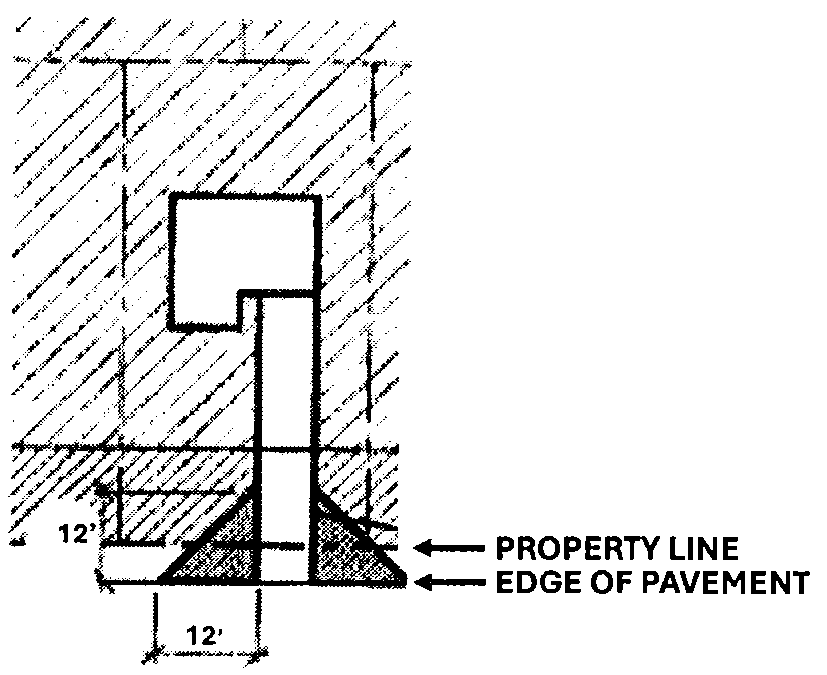
Driveway intersections. No fence, hedge, retaining wall, entryway element, pilaster, gate, or other similar element located within a triangle having sides twelve feet in length from either side of a driveway where it intersects with the edge of pavement on a street without a sidewalk (or, on a street with a sidewalk, the back of the curb) shall exceed three feet in height above the established grade of the adjoining street. Protected trees described in Section 15-50.050 of this Code are not subject to this requirement.
(g)
Vehicular obstructions. No fence, hedge, retaining wall, entryway element, or any other similar element shall constitute an obstruction as provided for in City Code Section 10-05.030.
(h)
Recreational courts. Fencing around recreational courts shall comply with the regulations contained in Section 15-80.030(c) of this Chapter.
(i)
Pilasters. Pilasters constituting a part of a fence, in reasonable numbers and scale in relationship to the nature and style of the fence, may extend to a height of not more than two feet above the height limit applicable to the fence containing such pilasters, but in no case shall the height of pilasters exceed eight feet. If pilasters within the front setback area are attached to a wrought iron entrance gate, the pilasters are permitted to a maximum height of seven feet.
(j)
Light fixtures. The height of a fence shall not include light fixtures mounted thereon at the entrance of driveways and sidewalks leading into a site. Not more than two such light fixtures shall be installed at each driveway and sidewalk entrance.
(k)
Swimming pool fences. Fences required for swimming pools are governed by the California Building Code and City Code Section 15-29.020(e).
(l)
Retaining walls. No retaining wall shall exceed seven feet in height. Notwithstanding the foregoing, no retaining wall located in a front or exterior side setback area shall exceed three feet in height.
(Amended by Ord. 71.86 § 1, 1991; Ord. 71-106 § 6, 1992; Ord. 245 § 2 (Att. A) (part), 2006; Ord. 252 § 1, 2007; Ord. No. 263, § 1(Att. A), 2-18-09; Ord. No. 284, § 1(Att. A), 5-18-2011; Ord. No. 294, § 1.A.3., 9-5-2012; Ord. No. 360, §9(Exh. A), 12-5-2018; Ord. No. 403, § 1(Exh. A, § 11), 7-3-2024; Ord. No. 406, § 1(Att. 1, § 6), 3-5-2025)
15-29.020 - Fencing within hillside districts.
In addition to the regulations set forth in Section 15-29.010 of this Article, fences located within an HR or R-OS district shall comply with the following regulations:
(a)
Area of enclosure. Except for fencing which constitutes part of a corral, no fencing on a single site shall encompass or enclose an area in excess of six thousand square feet or 15 percent of the gross site area, whichever is greater, unless approved by the Planning Commission. The fencing shall meet the requirements stipulated in Section 15-29.010 of this Article. "Encompass and enclose," as used in this section, shall mean to surround an area with a continuous fence or a fence.
(b)
Fencing outside area of enclosure. Except for fencing which constitutes part of a corral or fencing required by the Building Code for swimming pools, fencing outside the area of enclosure shall not exceed three feet in height, and shall be split rail fencing, stone wall, or stucco.
(c)
Parallel retaining walls. Parallel retaining walls shall be separated by a horizontal distance of not less than five feet. Where two or more retaining walls are approximately parallel to each other and separated by a horizontal distance of thirty feet or less, the combined height of such walls shall not exceed twenty feet.
(d)
Wildlife trails. No fence shall unreasonably impede the movement of wildlife animals utilizing an established trail or migratory route which crosses the site.
(e)
Swimming pool fences within hillside districts. When a fence already encompasses or encloses six thousand square feet or more on a single site, and a swimming pool fence is required for a swimming pool that is not located within the area of enclosure as described in Article [Section] 15-29.020(a), an additional area around the swimming pool may be enclosed with a fence, provided the swimming pool fence follows the contour of the pool with no more than ten feet of distance located between the fence and edge of water.
(f)
Exemptions. The provisions of this Section shall not apply to any property located within and constituting a part of Tract 7763, as shown on the subdivision map thereof recorded in the office of the County Recorder.
(g)
Stipulations. Any property located within and constituting a part of Tracts 6526 and 6528 (Parker Ranch Subdivision), as shown on the subdivision map thereof recorded in the office of the County Recorder shall meet the regulations stipulated in Resolution FE-90-001 or successor amendments.
(Amended by Ord. 71.89 § 1, 1991; Ord. 71.98 § 4, 1991; Ord. 71.113 § 3, 1992)
(Ord. No. 263, § 1(Att. A), 2-18-09; Ord. No. 406, § 1(Att. 1, § 6), 3-5-2025)
15-29.030 - Fencing adjacent to commercial districts.
The Community Development Director may issue a special permit to allow a solid fence, or other type of fence permitted by this Chapter, up to a maximum of eight feet in height where such fence is installed along a rear setback area or interior side setback area of a residential site which abuts a commercial district. The Community Development Director may impose such conditions deemed appropriate to mitigate any visual or other adverse impacts of the fence, including, but not limited to, requirements with respect to the design and materials of the fence and landscape screening. Applications for a special permit under this subsection shall be filed with the Community Development Director on such form as he shall prescribe, and shall be accompanied by a processing fee in such amount as established from time to time by the City Council.
(Ord. No. 263, § 1(Att. A), 2-18-09)
15-29.040 - Fencing to mitigate noise from certain arterial streets.
(a)
For the purpose of noise mitigation, a solid fence, or other type of fence permitted by this Article, exceeding the height otherwise prescribed in this Article as the limit for such fence may be located within any required setback area abutting Prospect Road, Saratoga/Sunnyvale Road, Quito Road, the portion of Saratoga Avenue between Fruitvale Avenue and Lawrence Expressway or the portion of Cox Avenue between Saratoga/Sunnyvale Road and Saratoga Avenue, or any other roadway if the fence was specifically approved by the Planning Commission in accordance with the Saratoga City Code, upon the issuance by the Community Development Director of a fence permit and subject to the following provisions:
(1)
Where the fence is located within an exterior side setback area or rear setback area abutting one of the arterial streets specified herein, the fence shall not exceed eight feet in height at the property line, plus one additional foot in height for each additional five feet of setback from the property line, up to a maximum height of ten feet if the fence is still located within a required setback area.
(2)
Where the fence is located within a front setback area abutting one of the arterial streets specified herein, the fence may be located no closer than ten feet from the front property line and shall not exceed eight feet in height, plus one additional foot in height for each additional five feet of setback from the front property line in excess of ten feet, up to a maximum height of ten feet if the fence is still located within the required front setback area.
(3)
Where a street line is located within a site, the location and setback of the fence as specified in subsections (a)(1) and (2) of this Section shall be determined by the street line rather than the property line.
(4)
The applicant shall landscape and permanently maintain an area parallel to and along the entire exterior side of the fence facing the street, in accordance with a landscape plan approved by the Community Development Director. All or any portion of such area may be located within the public right-of-way, subject to approval by the Community Development Director. The landscaped area required herein shall be not less than five feet in width, except that where the available space between the fence and the interior edge of the sidewalk, or the edge of the street pavement where no sidewalk exists, is less than five feet, the Community Development Director may approve a landscape area of not less than two feet. Prior to issuance of the fence permit, a landscape maintenance agreement shall be executed by the applicant and recorded in the office of the County Recorder, which agreement shall constitute a covenant running with the land.
(5)
The design of the fence shall be subject to approval by the Community Development Director, based upon a finding that the fence is compatible with existing or proposed structures on the site and upon neighboring properties.
(6)
No permit shall be issued if the Community Development Director finds that the fence will constitute a hazard for vehicular or pedestrian traffic or will otherwise be detrimental to the public health, safety or welfare.
(b)
Applications for a fence permit under this Section shall be filed with the Community Development Director on such form as he shall prescribe, and shall be accompanied by a processing fee in such amount as established from time to time by resolution of the City Council.
(Amended by Ord. 71.110 § 2, 1992; Ord. 245 § 2 (Att. A) (part), 2006)
(Ord. No. 263, § 1(Att. A), 2-18-09; Ord. No. 328, § 1(Att. A, § 16), 7-1-2015)
15-29.050 - Fencing adjacent to scenic highways.
In addition to the regulations set forth in Section 15-29.010 of this Article, fences adjacent to State designated scenic highways shall comply with the following requirements:
(a)
Fence permit. No person shall construct any fence which faces and is located within one hundred feet from the right-of-way of a State-designated scenic highway without first obtaining a fence permit from the Planning Director. Application for such permit shall be submitted to the Planning Director on such form as he shall prescribe, and shall be accompanied by a processing fee in such amount as established from time to time by resolution of the City Council.
(b)
Setback. No fence shall be constructed within fifteen feet from the property line abutting the right-of-way of a scenic highway. The Planning Director may require this minimum setback to be increased to a maximum of one hundred feet if he determines that such increased setback is necessary to preserve the scenic qualities of the highway.
(c)
Color, material and design. Fences adjacent to scenic highways may be constructed of wood, stone, stucco, masonry, wrought iron or similar material, but no chain link, plastic or wire fencing shall be permitted. The design, color and materials of the fence or wall shall be subject to approval by the Planning Director, based upon a finding that the fence or wall will not adversely affect the scenic qualities of the highway and will be compatible with the natural terrain.
(d)
Landscape screening. The applicant shall landscape and permanently maintain an area parallel to and along the entire length of the exterior side of the fence facing the scenic highway, in accordance with a landscape plan approved by the Planning Director. Such landscape plan shall provide for the planting of trees and vegetation that are native to the area, fast growing, and require little or no maintenance. The Planning Director shall not approve the landscape plan unless he finds that the proposed landscaping will effectively screen the fence from public view and enhance the visual appearance of the scenic highway. Prior to issuance of the fence permit, a landscape maintenance agreement shall be executed by the applicant and recorded in the office of the County Recorder, which agreement shall constitute a covenant running with the land.
(e)
Height. The height of any fence adjacent to a scenic highway shall comply with the regulations set forth in Section 15-29.010 of this Article; provided, however, where the applicant demonstrates to the satisfaction of the Planning Director that his property is subjected to greater noise impacts from the scenic highway as compared generally with other properties located adjacent to such highway, the Planning Director may approve a fence or wall not exceeding eight feet in height. As a condition of such approval, the Planning Director may require increased setbacks and landscaping to mitigate the visual impact of the higher fence or wall.
(Amended by Ord. No. 263, § 1(Att. A), 2-18-09)
15-29.060 - Barbed wire and electrified wire prohibited.
No fence constructed or installed within the City shall contain barbed or electrified wire unless approved by the Planning Commission, based upon a finding that the barbed or electrified wire is necessary for security purposes and that measures will be taken, when appropriate, to mitigate any adverse impacts of such wire.
(Amended by Ord. No. 263, § 1(Att. A), 2-18-09)
15-29.070 - Fences adjacent to heritage lanes.
In addition to the regulations set forth in Section 15-29.010 of this Article, fences adjacent to a designated heritage lane shall comply with the following requirements:
(a)
Fence permit. No person shall construct any fence which faces and is located within fifty feet from the right-of-way of a designated heritage lane, and which exceeds three feet in height, without first obtaining a fence permit from the Community Development Director. Application for such permit shall be submitted and processed in the manner provided in Article 13-20 of the City Code. If the Heritage Commission recommends issuance, the Community Development Director shall issue the permit in accordance with those recommendations and any condition related but not limited to the design standards set forth in subsections (c), (d), (e) and (f) of this Section and pursuant to the process prescribed in Article 13-20.
(b)
Supporting data. The level of detail of the supporting data required by Section 13-20.030 shall be determined by the Community Development Director to allow adequate review of the proposed fence.
(c)
Setback. No fence which exceeds three feet in height shall be constructed within the required setback area fronting a heritage lane. This minimum setback may be required to be increased to a maximum of fifty feet upon the finding that such increased setback is necessary to preserve the historic qualities of the heritage lane.
(d)
Color, material and design. Fences adjacent to a heritage lane may be constructed of wood, stone, masonry, wrought iron or similar material. The design, color and materials of the fence shall be approved based upon a finding that the fence will not adversely affect the historic qualities of the lane and will be compatible with the design and materials of existing buildings on the site and structures on adjacent properties.
(e)
Height. The height of any fence adjacent to a heritage lane shall comply with the regulations set forth in Section 15-29.010 of the City Code.
(f)
Landscaping. The applicant shall landscape and maintain an area within the right-of-way, parallel to and along the entire length of the exterior side of a fence in excess of three feet in height and facing the heritage lane, in accordance with a landscape plan approved by the Community Development Director. Such landscape plan shall provide for the planting of trees and vegetation that are native to the area and require little or no maintenance. The landscape plan may be approved by the Community Development Director upon the finding that the proposed landscaping will effectively blend the fence with its environment and enhance the visual appearance of the lane.
(Ord. 71.110 § 1, 1992; Amended by Ord. 245 § 2 (Att. A) (part), 2006)
(Ord. No. 263, § 1(Att. A), 2-18-09)
15-29.080 - Exemption for agricultural uses.
Fencing around the immediate perimeter of an orchard, vineyard, equestrian facility or similar agricultural use is exempt from this Article. This exemption applies to raising of fruit and nut trees, vegetables and horticultural specialties, but does not include nurseries, greenhouses or storage of landscaping equipment, products or supplies for commercial uses.
(Ord. No. 263, § 1(Att. A), 2-18-09)
15-29.090 - Fence exceptions.
(a)
The owner(s) of a fence, or proposed fence, including any gates or pilasters attached thereto, may request that the Planning Commission grant an exception to the regulations regarding fences. The Planning Commission may grant this exception if all of the following findings are made:
(1)
The subject fence will be compatible with other similar structures in the neighborhood;
(2)
The entirety of the subject fence will be constructed of materials that are of high quality, exhibit superior craftsmanship, and that are durable;
(3)
The modification will not impair the integrity and character of the neighborhood in which the fence is located;
(4)
The granting of the exception will not be detrimental or injurious to the property, adjacent neighbors, or improvements in the general vicinity and district in which the property is located; and
(5)
The granting of the exception will not create a safety hazard for vehicular, pedestrian or bicycle traffic and does not obstruct the safe access to and from adjacent properties.
(b)
For exceptions proposed in the HR or R-OS districts, the Planning Commission may grant the exception if, in addition to the findings made in subsection (a), it also makes all of the following findings:
(1)
The visibility of the fence from public streets and adjacent properties will substantially be reduced by the topography, landscaping or other features of the site; and
(2)
The fence does not unreasonably impede the movement of wildlife animals utilizing an established trail or migratory route which crosses the site; and
(3)
In the event the exception is to increase the area of enclosure pursuant to Section 15-29.020(a), the increased area of enclosure is required for safety reasons.
(c)
A public hearing on the application for exception approval under this Article shall be required. Notice of the public hearing shall be given not less than ten days nor more than thirty days prior to the date of the hearing by mailing, postage prepaid, to the applicant and to all persons whose names appear on the latest available assessment roll of the County as owning property within five hundred feet of the boundaries of the parcel which is the subject of the application. Notice of the public hearing shall also be published once in a newspaper having general circulation in the City not later than ten days prior to the date of the hearing.
(d)
A decision or determination made by the Planning Commission under this Article may be appealed to the City Council in accordance with the procedure set forth in Article 15-90 of this Chapter.
(Ord. No. 263, § 1(Att. A), 2-18-09)
15-29.100 - Existing legal nonconforming fences, pilasters, entryway trellises.
This Article shall not require any modification to any fence, pilaster, entryway, or trellis that was in compliance with the City Code at the time it was built (for the purposes of this Article, a "Legal Nonconforming Fence"). Upon destruction or removal of more than one-half length of a Legal Nonconforming Fence or any element thereof any new fence or element shall be constructed to meet height requirements as prescribed in this Article or be approved by an exception process described in Section 15-29.080 of this Article.
(Ord. No. 263, § 1(Att. A), 2-18-09)

