
Saratoga City Zoning Code
ARTICLE 15
06 - DEFINITIONS
15-06.005 - Application of definitions.
The definitions set forth in this Article shall be applied throughout this Chapter, unless the context or the provision clearly requires otherwise.
(Amended by Ord. 223 § 2 (part), 2003)
15-06.010 - Abandon.
"Abandon" means to cease or discontinue a use or activity without intent to resume, but excluding temporary or short-term interruptions to a use or activity during periods of remodeling, reconstructing, replacing, maintaining or otherwise improving or rearranging a site or structure, or during normal periods of vacation or seasonal closure, or during brief periods of discontinuance in connection with a pending sale or other transfer of ownership or management of a use or structure.
(Amended by Ord. 223 § 2 (part), 2003)
15-06.011 - Abatement.
"Abatement" means the act of eliminating the condition that causes a nuisance.
(Ord. 223 § 2 (part), 2003)
15-06.020 - Abutting.
"Abutting" means having property lines or district lines in common.
(Amended by Ord. 223 § 2 (part), 2003)
15-06.021 - Access.
"Access" means a way or means of approach to provide vehicular or pedestrian physical entrance to a property.
(Ord. 223 § 2 (part), 2003)
15-06.022 - Accessory structure.
"Accessory structure" means a structure which is: (a) detached from any other structure such that the distance between any part of the two structures is thirty-six inches or more; and (b) incidental and subordinate to, and customarily associated with, the main structure or principal use on the lot. Notwithstanding the foregoing, an accessory dwelling unit is not an accessory structure as that term is used in this Code. No accessory structure is permitted in any zone district in the absence of an existing or concurrently established main structure or principal use on the lot.
(Ord. 223 § 2 (part), 2003; Amended by Ord. 245 § 2 (Att. A) (part), 2006)
(Ord. No. 272, § 2(Exh. A), 9-16-2009; Ord. No. 348, § 1(Att. A, § 6), 1-18-2017)
15-06.023 - Accessory use.
"Accessory use" means a use of land or a building or portion thereof incidental and subordinate to the principal use of the lands or building and located on the same lot with the principal use.
(Ord. 223 § 2 (part), 2003)
15-06.024 - Acre.
"Acre" means a measure of land area containing forty-three thousand five hundred sixty square feet.
(Ord. 223 § 2 (part), 2003)
15-06.030 - Addition.
"Addition" means any construction which increases the size of a structure in terms of site coverage, height, or floor area.
(Amended by Ord. 223 § 2 (part), 2003; Ord. 245 § 2 (Att. A) (part), 2006)
15-06.035 - Alcoholic beverage.
"Alcoholic beverage" means any beverage, as defined per Section 23004 of the State of California Business and Professional Code that requires a license from the California Department of Alcoholic Beverage Control to make, sell, or distribute.
(Ord. No. 305, § 1, 5-1-2013)
15-06.040 - Alley.
"Alley" means a service roadway providing a secondary means of public access to abutting property and not intended for general traffic circulation.
(Amended by Ord. 223 § 2 (part), 2003)
15-06.050 - Alteration.
"Alteration" means any construction or physical change in the internal arrangement of rooms or the supporting members of a building or structure, or change in relative position of structures on a site, or substantial change in the exterior appearance of any structure.
(Amended by Ord. 223 § 2 (part), 2003)
15-06.051 - Apartment unit.
"Apartment unit" means an independent, self-contained dwelling unit with one or more rooms with private bath and kitchen facilities in a building containing three or more such dwelling units.
(Ord. 223 § 2 (part), 2003)
15-06.052 - Applicant.
"Applicant" means a person submitting an application for development. Where the applicant is not the owner of the lot that is the subject of the application for development, the applicant shall provide the approving authority with evidence that the application for development is authorized by the owner.
(Ord. 223 § 2 (part), 2003)
15-06.053 - Application for development.
"Application for development" means the application form and all accompanying documents and exhibits required of an applicant by the approving authority for development application review purposes.
(Ord. 223 § 2 (part), 2003)
15-06.060 - Approving authority.
"Approving authority" means the legislative body, commission, committee or official of the City designated under the provisions of this Chapter as having the authority to approve or deny a particular type of application.
(Amended by Ord. 223 § 2 (part), 2003)
15-06.061 - Appurtenances.
"Appurtenances" means the visible, functional, or ornamental objects accessory to and part of buildings, such as: chimneys, flag poles, cupolas, spires, or antennas.
(Ord. 223 § 2 (part), 2003)
15-06.062 - Architectural feature.
"Architectural feature" means a prominent or significant part or element of a building, structure, or site.
(Ord. 223 § 2 (part), 2003)
15-06.063 - Architectural style.
"Architectural style" means the characteristic form and detail of buildings of a particular historic architectural context or period.
(Ord. 223 § 2 (part), 2003)
15-06.070 - Repealed.
Editor's note— Ord. No. 320, § 1.F.10, adopted Nov. 5, 2014, repealed § 15-06.070, which defined "Attached" and derived from original codification; Ord. 223 § 2(part), 2003; and Ord. 245 § 2(Att. A)(part), 2006.
15-06.080 - Attic.
"Attic" means that part of a building that is immediately below and wholly or partially within the roof framing.
(Ord. 71.66, 1989; Ord. 223 § 2 (part), 2003)
15-06.085 - Awning Valance.
"Awning Valance" is a decorative part of an awning that hangs down from the bottom edge of the awning frame or structure.
(Ord. No. 418, § 1(Exh. B), 4-1-2026)
Editor's note— Ord. No. 418, § 1 (Exh. B), adopted April 1, 2026, enacted provisions originally designated as § 15-06-005. To avoid numerical duplication and maintain proper sequence, the editor has redesignated these provisions as § 15-06.085.
15-06.090 - Basement.
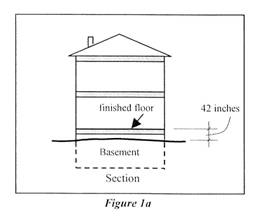
"Basement" means a space in a structure that is partly or wholly below grade and where the vertical distance from grade to a finished floor directly above such space is less than or equal to forty-two inches. (See Figure 1a) If the finished floor directly above the space is more than forty-two inches above grade at any point along the perimeter, such space shall be considered a story, and the entire space shall be included in the calculation of floor area. This requirement applies to all lots, with the exception of hillside lots.
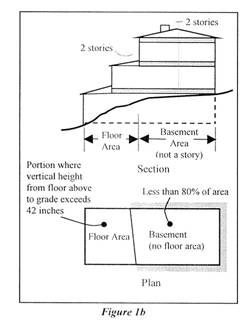
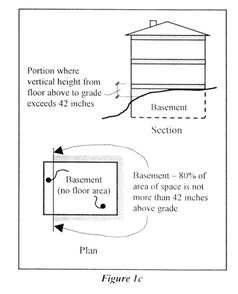
On hillside lots, as defined in Section 15-06.420(e), only the portion of space where the vertical distance of the finished floor directly above such space is more than forty-two inches above grade shall be counted as floor area and considered a story. The number of stories measured vertically at any given point shall not exceed the maximum number of stories allowed in each zoning district. (See Figure 1b) However, if the vertical distance of the finished floor above the space is not more than forty-two inches above grade for at least eighty percent of area of such space, then the entire space is a basement that shall not be included in the calculation of gross floor area and shall not be considered a story. (See Figure 1c.)
As used herein, the term "grade" shall mean either the natural grade or finished grade immediately adjacent to the exterior walls of the structure, whichever is lower. The Community Development Director shall make the determination for sites where it is unclear as to which is the natural and which is the finished grade. Basements are subject to the requirements of Section 15-80.035.
(Amended by Ord. 209 § 2 (part), 2002; Ord. 223 § 2 (part) 2003; Ord. 245 § 2 (Att. A) (part), 2006)
(Ord. No. 284, § 1(Att. A), 5-18-2011)
15-06.100 - Bed and breakfast establishment.
"Bed and breakfast establishment" means a structure designed as a single-family dwelling containing no more than three rooms, which rooms are rented for transient occupancy and breakfast is served to the guests on the premises.
(Amended by Ord. 223 § 2 (part), 2003)
15-06.105 - Below market rate dwelling unit.
"Below market rate dwelling unit" means a dwelling unit, which is rented, leased or sold to only households that qualify as lower, very-low, or extremely-low income households as those terms are defined in the most recent Santa Clara County Housing and Urban Development Program Income Limits or, in the event that the most recent such report is more than five years old, in accordance with the definitions set forth in Health and Safety Code Sections 50079.5, 50105, and 50106 as those sections exist as of the effective date of this restriction.
(Ord. 223 § 2 (part), 2003)
15-06.106 - Belt Course.
"Belt Course" means a continuous, horizontal band set in a building wall for visual emphasis or structural support. Belt courses typically project from a building face and visually separates different floors or building materials. Also known as a "string course."
(Ord. No. 418, § 1(Exh. B), 4-1-2026)
15-06.110 - Block.
"Block" means any lot or group of contiguous lots on one side of a street and lying between intersecting streets, railroad rights-of-way, waterways or unsubdivided land.
(Amended by Ord. 223 § 2 (part), 2003)
15-06.115 - Block Face.
"Block face" refers to the five structures on either side of and on the same side of the right-of-way as a subject property, or the structures between a subject property and the nearest intersection, whichever is less.
(Ord. No. 406, § 1(Att. 1, § 1), 3-5-2025)
15-06.120 - Building.
"Building" means any structure used or intended for supporting or sheltering any use or occupancy.
(Amended by Ord. 223 § 2 (part), 2003)
15-06.121 - Building Frontage.
"Building frontage" means the lineal dimension, parallel to the ground, of a building elevation that directly faces a right-of-way.
(Ord. No. 399, § 1(Att. 1), 4-3-2024)
15-06.122 - Building, main.
"Building, main" means a building in which is conducted the principal use of the parcel and/or building site on which it is situated.
(Ord. 223 § 2 (part), 2003)
15-06.125 - Building site.
"Building site" means a lot, occupied or to be occupied by a main building and accessory buildings, or by a dwelling and its accessory buildings, together with such open spaces as are required by the terms of this Chapter and having its principal frontage on a street, road, or highway.
(Ord. 71.98 § 3 (part), 1991; Ord. 223 § 2 (part), 2003)
15-06.130 - Cabana.
"Cabana" means an accessory structure designed for use as a bathhouse or recreation room in connection with use of a swimming pool.
(Amended by Ord. 223 § 2 (part), 2003)
15-06.140 - Carport.
"Carport" means an accessory structure or a portion of a main structure designed for the storage of motor vehicles having a permanent roof and not fully enclosed on all sides.
(Amended by Ord. 223 § 2 (part), 2003)
15-06.150 - Clinic.
"Clinic" means a facility for the medical diagnosis and treatment of outpatients.
(Amended by Ord. 223 § 2 (part), 2003)
15-06.160 - Community facility.
"Community facility" means a place, structure, area or other facility used for and providing fraternal, social or recreational programs or activities generally open to the public. The term includes parks, swimming pools, recreational courts, community centers, libraries, museums, and golf courses.
(Amended by Ord. 223 § 2 (part), 2003)
15-06.165 - Community view sheds.
"Community view sheds" means any views which are visible from an area, which has scenic value for the community.
(Ord. 71.98 § 3 (part), 1991; Ord. 223 § 2 (part), 2003)
15-06.170 - Corral.
"Corral" means an area enclosed by fencing for the keeping of equines or other livestock.
(Amended by Ord. 223 § 2 (part), 2003)
15-06.180 - Covered parking.
"Covered parking" means a garage or carport that provides full overhead protection from the elements with ordinary roof coverings. Canvas, lath, fiberglass, plastic and vegetation are not ordinary roof coverings and cannot be used in providing a covered parking space.
(Amended by Ord. 223 § 2 (part), 2003)
15-06.185 - Creek bank.
"Creek bank" means the sides of a watercourse, the top of which shall be the topographic line roughly parallel to stream center line where the side slopes intersect the plane of ground traversed by the watercourse. Where banks do not distinguishably end, City or Santa Clara Valley Water District shall determine the top of such banks.
(Ord. 71.98 § 3 (part), 1991; Ord. 223 § 2 (part), 2003)
15-06.190 - Day care facility.
"Day care facility" means the use of a site or portion of a site for a group day care program for eight or more clients other than those resident on the site. The term includes nursery school, preschool and similar facilities.
(Amended by Ord. 223 § 2 (part), 2003)
15-06.195 - Demolition.
"Demolition" of a building means:
(a)
Removal or covering of more than fifty percent of the exterior walls of an existing structure so the walls no longer function as exterior walls and removal of more than fifty percent of the existing roof structure and exterior roof sheathing; or
(b)
Removal or covering of more than fifty percent of the exterior walls of an existing structure so the walls no longer function as exterior walls and removal of more than fifty percent of interior walls.
The exclusive removal of interior walls without any modification or removal of exterior walls or any modification or removal of the existing roof structure and exterior sheathing is not considered a demolition.
(Ord. No. 328, § 1(Att. A, § 11), 7-1-2015)
15-06.200 - Dooryard.
"Dooryard" means a type of building entry that provides a limited amount of private open space at the primary entrance. The dooryard area is defined by a low wall, planter or fence that provides a buffer between the right-of-way and the building while preserving a sense of openness to the building entrance.
(Ord. No. 399, § 1(Att. 1), 4-3-2024)
15-06.204 - Development.
"Development" means, on land, in or under water, the placement or erection of any solid material or structure; discharge or disposal of any dredged material or of any gaseous, liquid, solid, or thermal waste; grading, removing, dredging, mining, or extraction of any materials; change in the density or intensity of use of land, including but not limited to, subdivision pursuant to the Subdivision Map Act (commencing with Section 66410 of the Government Code), and any other division of land, including lot splits, except where the land division is brought about in connection with the purchase of such land by a public agency for public recreational use; construction, reconstruction, demolition, or alteration of the size of any structure, including any facility of any private, public or municipal utility; and the removal or harvesting of major vegetation other than for agricultural purposes.
(Ord. 223 § 2 (part), 2003)
15-06.208 - Director.
"Director" means the director of the Community Development Department or the Director's designee. The Director is the zoning administrator for the City of Saratoga.
(Ord. No. 270, § 1, 7-15-2009)
15-06.210 - District.
"District" means a portion of the City within which certain uses of land and structures are permitted, conditionally permitted, or prohibited and within which certain yards and other open areas are required and certain height limits and design standards are established for structures, all as set forth and specified in this Chapter.
(Amended by Ord. 223 § 2 (part), 2003)
15-06.220 - Drive-through service.
"Drive-through service" means a feature or characteristic of a use involving the sales of products or provision of services to occupants in motor vehicles, including drive-in or drive-up windows.
(Amended by Ord. 223 § 2 (part), 2003)
15-06.230 - Driveway.
"Driveway" means a private roadway servicing up to four parcels, the use of which is limited to persons residing or working on the site and their visitors, which provides access to off-street parking or loading spaces on the site.
(Amended by Ord. 223 § 2 (part), 2003)
15-06.240 - Dwelling.
"Dwelling" means a permanent building, or a portion of a permanent building used as the personal residence of the occupants thereof, excluding trailers, campers, recreational vehicles, hotels, motels, bed and breakfast establishments, tents and temporary structures.
(a)
Dwelling unit means a room or group of rooms including living, sleeping, eating, cooking and sanitation facilities, constituting separate and independent housekeeping units, occupied or intended for occupancy by one family on a permanent basis and having not more than one kitchen.
(b)
Single-family dwelling means a dwelling unit constituting the only main structure upon a single building site.
(c)
Multi-family dwelling means a structure or site containing more than one dwelling unit, designed for occupancy by more than one family living independently of each other, and doing their own cooking in the building. However, a single-family dwelling and a lawful accessory dwelling unit located upon the same site shall not be deemed a multi-family dwelling.
(d)
Accessory dwelling unit means an attached or detached residential dwelling unit, built or legalized pursuant to this Chapter, which provides complete independent living facilities for one or more persons, including permanent provisions for living, cooking, sleeping and sanitation and that meets all requirements set forth in Article 15-56 . An accessory dwelling unit also includes the following:
(1)
An accessory dwelling unit that is an efficiency unit, as defined in Health and Safety Code Section 17958.1.
(2)
An accessory dwelling unit that is a manufactured home, as defined in Health and Safety Code Section 18007.
(e)
Junior accessory dwelling unit is a unit that is no more than 500 square feet in size, and contained entirely within the walls of an existing or proposed single-family dwelling , and that meets all requirements set forth in Article 15-56. For purposes of this subsection, attached garages are considered a part of the existing or proposed single-family dwelling. A junior accessory dwelling unit may include separate sanitation facilities or may share sanitation facilities with the existing structure.
(Amended by Ord. 223 § 2 (part), 2003; Ord. 245 § 2 (Att. A) (part), 2006)
(Ord. No. 348, § 1(Att. A, § 6), 1-18-2017; Ord. No. 355, 6-6-2018; Ord. No. 376, § 1(Exh. A), 10-21-2020; Ord. No. 399, § 1(Att. 1), 4-3-2024)
15-06.250 - Emergency access.
"Emergency access" means a street which is gated or otherwise closed to regular use by vehicular traffic and intended for use by vehicular traffic only in the event of emergency.
(Amended by Ord. 223 § 2 (part), 2003)
15-06.251 - Emergency shelter.
(a)
"Emergency shelter, permanent" means a permanently operated facility that provides people shelter with minimal supportive services for a time period not exceeding six months per person per year.
(b)
"Emergency shelter, rotating" means a facility that, for a time period not exceeding a total of three months per year per location, provides people shelter with minimal supportive services.
Both permanent and rotating emergency shelters may include other interim interventions, including, but not limited to, a navigation center, bridge housing, and respite or recuperative care.
(Ord. No. 361, § 1(Exh. A), 2-6-2019; Ord. No. 399, § 1(Att. 1), 4-3-2024)
15-06.253 - Employee Housing.
"Employee housing," means any portion of any housing accommodation, or property upon which a housing accommodation is located, if both of the following factors exist: (1) The accommodations consists of living quarters or other housing accommodations, maintained in one or more buildings or one or more sites, and the premises are provided for employees by the employer; and (2) The accommodations are maintained in connection with any work or place where work is being performed, whether or not rent is involved. The definition of employee housing is as otherwise defined by California Health and Safety Code § 17008 as it may be amended from time to time.
(Ord. No. 399, § 1(Att. 1), 4-3-2024)
15-06.255 - Ember-Resistant Zone.
"Ember-resistant zone" means the area within five feet, measured horizontally from the exterior wall surface of a structure or any attached deck, that is created and maintained in accordance with defensible space standards for such zones established by CAL FIRE or as determined by the Santa Clara County Fire Department.
(Ord. No. 417, § 1(Exh. A, 6), 2-4-2026)
15-06.260 - Family.
"Family" means an individual or two or more persons occupying a dwelling unit and living together as a single housekeeping unit in which each occupant has access to all parts of the dwelling unit. A family shall be deemed to include necessary household help. The term shall not include a group of persons occupying a hotel, motel, bed and breakfast establishment, nursing home, or institution of any kind.
(Amended by Ord. 223 § 2 (part), 2003)
15-06.261 - Fence.
"Fence" means any structural device forming a physical barrier by means of glass, wood, masonry, metal, chain, brick, stake, plastic, concrete block, wrought iron, wire, or other similar materials. A wall, other than a wall of a building or a retaining wall, is considered a fence.
(Ord. 223 § 2 (part), 2003)
(Ord. No. 263, § 1(Att. A), 2-18-2009; Ord. No. 360, § 6(Exh. A), 12-5-2018)
15-06.270 - Financial institution.
"Financial institution" means a bank, savings and loan association, credit union, thrift association or similar organization.
(Amended by Ord. 223 § 2 (part), 2003)
15-06.280 - Floor area.
"Floor area" means the total enclosed, habitable or accessible floor space of all floors of a building where the interior height of the area is equal to or greater than five feet. The term "enclosed," as used in this Section, means a structure or area with a roof and with three or more walls. The term "wall," as used in this Section, means any structural device forming a physical barrier by means of glass, wood, masonry, metal, concrete block, wrought iron, wire, or other similar materials with more than fifty percent of its façade area is closed. The term "roof," as used in this Section, means a covering of any solid material over at least seventy-five percent of the area.
Floor area is measured to the outside surfaces of exterior walls. In the case of a sloped ceiling or ground surface, the floor area shall be measured to the point at which the interior height is less than five feet.
Pursuant to the foregoing, floor area may include halls, stairways, elevator shafts, ducts, service and mechanical equipment rooms, underfloor areas, porches, verandas and similar building elements, garages, attics, crawl spaces and accessory structures. Floor area does not include interior courts, which are areas surrounded on all sides by habitable space but which do not have a roof, as defined in this Section.
(Ord. 71-177 § 2, 1998; Ord. 223 § 2 (part), 2003; Ord. 245 § 2 (Att. A) (part), 2006)
(Ord. No. 360, § 6(Exh. A), 12-5-2018; Ord. No. 364, § 1(Exh. A), 9-4-2019)
15-06.290 - Frontage.
"Frontage" means the property line of a site abutting on a street. In the case of a corner lot, the frontage shall be that property line with the shortest dimension of the lot fronting a street which does not result in the creation of a nonconforming lot with respect to frontage, width or depth. (Amended by Ord. 223 § 2 (part), 2003)
(Amended by Ord. No. 272, § 2(Exh. A), 9-16-2009)
15-06.291 - Funeral home.
"Funeral home" means an establishment with facilities for the preparation and servicing of the dead for cremation or burial, for the viewing of the body, and for the hosting of funeral services or end of life commemorations.
(Ord. No. 328, § 1(Att. A, § 12), 7-1-2015)
15-06.295 - Game arcade.
"Game arcade" means an establishment having more than three coin or token-operated pinball machines, video games or other form of mechanical or electronic games or any combination thereof, available for use by the general public. A game arcade may exist as either a principal use or as an incidental use conducted by another principal use on the site.
(Amended by Ord. 223 § 2 (part), 2003)
15-06.300 - Garage.
"Garage" means an accessory structure or a portion of a main structure that has a permanent roof, is fully enclosed on all sides, and is designed for the storage of motor vehicles.
(Amended by Ord. 223 § 2 (part), 2003)
15-06.310 - Gasoline service station.
"Gasoline service station" means a place where gasoline, oil, tires, small parts and accessories for the operation of motor vehicles are offered for sale to the public, and servicing incidental thereto, including the washing of vehicles where no chain conveyor, blower or steam cleaning device is used.
(Amended by Ord. 223 § 2 (part), 2003)
15-06.320 - General Plan.
"General Plan" means the current General Plan as adopted by the City pursuant to the requirements of the Government Code and includes, for the purposes of this Chapter, any specific plan applicable to the site.
(Amended by Ord. 223 § 2 (part), 2003)
15-06.325 - Geotechnical clearance.
"Geotechnical clearance" means a written acknowledgement from the City Engineer indicating that:
(a)
The applicant has identified all geological and geotechnical hazards and constraints present on the site;
(b)
The applicant has evaluated those hazards and constraints identified in subsection (a) which would affect the proposed development of the site or impact adjacent properties, as required by the City Engineer and City Geotechnical Consultant;
(c)
The applicant has developed appropriate measures to avoid and/or mitigate those hazards and constraints evaluated in subsection (b) to the satisfaction of the City Engineer and City Geotechnical Consultant;
(d)
The applicant has paid all fees associated with the City Geotechnical Consultant's review of the application.
Geotechnical clearance does not and shall not be construed as constituting an approval or entitlement of any form or type.
(Ord. 71-106 § 1, 1992; Ord. 223 § 2 (part), 2003)
15-06.328 - Group Home.
"Group home" means housing operating as a single residence shared by unrelated persons with disabilities that provide peer and other support for their residents' disability-related needs and in which residents share cooking, dining, and living areas. Groups homes are distinguished from Supportive Housing and Transitional Housing, which uses are defined by Government Code. There are three types of group homes allowed in Saratoga:
Class 1:
The group home does not provide licensable services to the residents.
Class 2:
The group home provides licensable services to six or fewer residents.
Class 3:
The group home provides licensable services to more than six residents.
(Ord. No. 399, § 1(Att. 1), 4-3-2024)
15-06.330 - Guest house.
"Guest house" means an accessory structure containing a lodging unit without kitchen facilities, and used to house occasional visitors or nonpaying guests of the occupants of a dwelling unit on the same site.
(Amended by Ord. 223 § 2 (part), 2003)
15-06.331 - Health/Fitness Center.
"Health/Fitness Centers" means membership based fitness facilities, gymnasiums, athletic clubs, and similar establishments requiring membership for access.
(Ord. No. 307, § 1.C.4, 10-16-2013)
15-06.335 - Hedge.
"Hedge" means a series of trees or other natural landscaping planted in a linear and uninterrupted pattern such that a boundary is created. The natural landscaping must be able to stand on its own and shall not require supports upon maturity. A hedge is not a fence.
(Ord. No. 263, § 1(Att. A), 2-18-2009)
15-06.340 - Height of buildings.
"Height of building" means the vertical distance from the average of the highest and lowest point of the lot at the building's edge, measured from natural grade, of that portion of the lot covered by the building to the topmost point of the roof excluding appurtenances, unless otherwise specified in this Chapter. The Community Development Director, through the use of the best available information, such as tract grading plans, vegetation, and neighborhood topography or existing grades, shall determine natural grade.
(Amended by Ord. 223 § 2 (part), 2003)
15-06.341 - Height of fences.
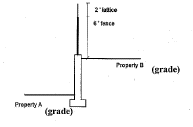
"Height of fences" means a vertical line from the highest point of the fence (including lattice or similar material), to a point directly below at either the natural grade or the finished grade, at the owner's choice. Where there are differences in grade between abutting properties, the fence height is measured from the property with the higher grade unless a different measurement standard applies pursuant to another Section of this Code.
(Ord. 223 § 2 (part), 2003; Amended by Ord. No. 263, § 1(Att. A), 2-18-2009; Ord. No. 284, § 1(Att. A), 5-18-2011)
15-06.342 - Height of retaining wall.
"Height of retaining wall" means a vertical line from the highest point of the retaining wall to a point directly below the lowest natural grade unless a different measurement standard applies pursuant to another Section of this Code.
(Ord. No. 263, § 1(Att. A), 2-18-2009)
15-06.350 - Home occupation.
"Home occupation" means any activity which is the conduct of an art or profession, the offering of a service, the conduct of a business or the handcraft manufacture of products in a dwelling unit solely by the occupants thereof, in a manner incidental and secondary to the use of the dwelling for dwelling purposes, and in accord with the provisions of this Code.
(Amended by Ord. 223 § 2 (part), 2003)
15-06.360 - Hotel.
"Hotel" means a structure or portion thereof or a group of attached or detached structures containing individual guest rooms or suites where lodging is provided primarily to transients for compensation for a period of not more than 29 consecutive days. The term includes motel, inn, tourist court, bed and breakfast establishment, short-term-rental, or similar use.
(Amended by Ord. 223 § 2 (part), 2003)
(Ord. No. 403, § 1(Exh. A, § 10), 7-3-2024)
15-06.370 - Impervious surface.
"Impervious surface" means any structure or constructed surface that prevents the passage of water into the underlying soil or otherwise significantly increases runoff and disrupts the aesthetic of the landscape. Common impervious surfaces include, but are not limited to, concrete, asphalt, roofs, and brick or other stone materials set in sand or concrete. Porous materials may receive certain exceptions from site coverage as provided for in this chapter.
(Amended by Ord. 223 § 2 (part), 2003; Ord. 245 § 2 (Att. A) (part), 2006; Ord. No. 293, § 2.A, 6-20-2012)
15-06.380 - Institutional facility.
"Institutional facility" means a place, structure or area operated by a public or private organization or agency, used for and providing educational, residential or health care services to the community at large. The term includes residential developments and health care facilities operated by non-profit organizations, and both public and private schools or colleges.
(Amended by Ord. 223 § 2 (part), 2003)
15-06.385 - Intermittent stream.
"Intermittent stream" means a watercourse with seasonal water flow and dry in dry seasons.
(Ord. 71.98 § 3 (part), 1991; Ord. 223 § 2 (part), 2003)
15-06.390 - Keeping; keeping for private use.
(a)
Keeping, in relation to the keeping of animals, means the harboring or maintaining possession of any animal on a site together with the maintenance of such animal by the feeding or otherwise supplying of necessities of life to the same. Any animal physically present on a site for a continuous period in excess of seventy-two hours is being kept, within the meaning of this definition, by the owner or other occupant of the site.
(b)
Keeping for private use, in relation to the keeping of animals, means the keeping of an animal owned by the owner of the site where such animal is kept, for the private use by such owner and his guests as a use accessory to a dwelling on the same site, and not for remuneration, hire or sale.
(Amended by Ord. 223 § 2 (part), 2003)
15-06.400 - Kitchen.
"Kitchen" means a room designed, intended or used for the cooking and preparation of food which includes either a 220 volt outlet or a natural gas connection for a cooking appliance.
(Amended by Ord. 223 § 2 (part), 2003)
(Ord. No. 307, § 1.C.5, 10-16-2013)
15-06.405 - Lightwell.
"Lightwell" means an excavated area adjacent to a building that is enclosed on four sides, that is open at the top, and allows light into a below-grade level of a building.
(Ord. 209 § 2 (part), 2002; Ord. 223 § 2 (part), 2003; Ord. 245 § 2 (Att. A) (part), 2006)
(Ord. No. 307, § 1.C.25, 10-16-2013)
15-06.410 - Loading facility.
"Loading facility" means an area on a site or within a building, or both, used or intended for use for the loading or unloading of goods from a motor vehicle or trailer in connection with the use of the site on which such facility is located. The loading facility area on the site may include loading berths, aisles, access driveways, turning and maneuvering areas, clearances and similar features, which meet the requirements established by this Chapter.
(Amended by Ord. 223 § 2 (part), 2003)
15-06.420 - Lot.
"Lot" means a parcel of land consisting of a single lot of record.
(a)
Lot of record means a lot which is part of a subdivision and shown on a map thereof as recorded in the office of the County Recorder, or a legally created parcel of land described by metes and bounds or shown on a parcel map which has been so recorded.
(b)
Corner lot means a lot situated at the intersection of two or more streets, or bounded on two or more connected sides by street lines.
(c)
Interior lot means a lot other than a corner lot.
(d)
Flag lot means a lot having access to a street by means of a private driveway or corridor of land not otherwise meeting the requirements of this Chapter for site width.
(e)
Hillside lot means a lot having an average slope of ten percent or greater.
(f)
In-fill lot means a lot surrounded by other developed lots in at least three out of four northern, southern, eastern or western directions.
(g)
Reversed corner lot means a corner lot, the side lot line of which is substantially a continuation of the front lot line of the first lot to its rear.
(h)
Double frontage lot means an interior lot having frontage on two parallel or approximately parallel streets.
(Amended by Ord. 223 § 2 (part), 2003; Ord. No. 272, § 2(Exh. A), 9-16-2009; Ord. No. 294, § 1.A.2., 9-5-2012; Ord. No. 320, § 1.F.11, 11-5-2014)
15-06.430 - Lot line.
"Lot line" means any boundary of a lot.
(a)
Front lot line means, on an interior lot, the lot line abutting a street, or, on a corner lot, the shortest dimension of the lot fronting the street, or, on a double frontage lot, the lot line abutting the street providing the primary means of access to the lot, or, on a flag lot, the interior lot line most parallel to and nearest the street providing site access unless the average width of the lot exceeds its average depth in which case the front lot line shall be the interior lot line with the shortest dimension.
(b)
Rear lot line means the lot line not intersecting a front lot line which is most distant from and most closely parallel to the front lot line. A lot bounded by only three lot lines will not have a rear lot line.
(c)
Side lot line means any lot line which is not a front or rear lot line.
(d)
Interior lot line means any lot line not abutting a street.
(e)
Exterior lot line or street lot line means any lot line abutting a street.
(f)
The Community Development Director may assign or designate lot lines for irregular-shaped parcels or lots that do not have frontage, as defined in Section 15-06.290. (Amended by Ord. 223 § 2 (part), 2003)
(Amended by Ord. No. 272, § 2(Exh. A), 9-16-2009; Ord. No. 320, § 1.F.12, 11-5-2014)
15-06.438 - Manufactured Home.
"Manufactured home" means a structure that was constructed on or after June 15, 1976, is transportable in one or more sections, is eight body feet or more in width, or forty body feet or more in length, in the traveling mode, or, when erected on site, is three hundred twenty or more square feet, is built on a permanent chassis and designed to be used as a single-family dwelling with or without a foundation when connected to the required utilities, and includes the plumbing, heating, air conditioning, and electrical systems contained therein or as otherwise defined by California Health and Safety Code § 18007 as it may be amended from time to time.
(Ord. No. 399, § 1(Att. 1), 4-3-2024)
15-06.440 - Repealed.
(Ord. 223 § 2 (part), 2003)
15-06.441 - Market.
"Market" means an establishment where more than two thousand square feet or twenty-five percent of the total floor area is dedicated to food and/or beverage sales for off-site human consumption, with the exception of a tasting room as defined in this Article or a lawfully located mobile canteen or other mobile unit as defined in Article 7-25.
(Ord. No. 302, § 1, 2-6-2013; Ord. No. 305, § 1, 5-1-2013)
15-06.443 - Ministerial Review.
"Ministerial review" is a review process by which the City is obligated to issue a permit to an applicant provided the project meets all applicable development and design standards established in the Zoning Code. Ministerial review requires administrative approval by the Community Development Director to verify compliance with applicable standards; however, ministerial review is based on objective standards only and is non-discretionary.
(Ord. No. 406, § 1(Att. 1, § 1), 3-5-2025)
15-06.445 - Mixed use development.
The development of a lot or building with two or more different land uses, such as residential, commercial, office or public.
(Ord. 223 § 2 (part), 2003)
15-06.449 - Mortuary.
"Mortuary" means funeral home.
(Ord. No. 328, § 1(Att. A, § 13), 7-1-2015)
15-06.450 - Motel.
"Motel" means hotel, as defined in Section 15-06.360.
(Amended by Ord. 223 § 2 (part), 2003)
15-06.460 - Nonconforming.
"Nonconforming" means not in conformity with any of the regulations set forth in this Chapter.
(a)
Nonconforming use means a use of a structure or site, or both, which was lawfully established or maintained in compliance with all zoning regulations then applicable to such use, but which, by virtue of a subsequent rezoning, reclassification, or the adoption of or change in use regulations, no longer conforms with the use regulations of the district in which it is located.
(b)
Nonconforming structure means a structure which was lawfully constructed in compliance with all zoning regulations then applicable to the site, but which, by virtue of a subsequent rezoning, reclassification, or the adoption of or change in zoning regulations, no longer conforms with the standards of size, coverage, setback areas, height, distance between structures, or other regulation of this Chapter for the district in which the structure is located.
(c)
Nonconforming facility means a structure or site, which conforms with the regulations of this Chapter but is used or occupied by one or more nonconforming uses.
(d)
Nonconforming lot means a single and separate parcel of land, which was legally created, and a legal building site at the date of adoption of an ordinance rendering it nonconforming.
(e)
Nonconforming site means a site which was lawfully created in compliance with all zoning and subdivision regulations then applicable to the site, but which, by virtue of subsequent rezoning, reclassification, or the adoption of or change in zoning regulations, no longer conforms with the standards of area, frontage, width, depth, or other regulation of this Chapter for the district in which the site is located.
(Amended by Ord. 223 § 2 (part), 2003; Ord. 245 § 2 (Att. A) (part), 2006)
15-06.470 - Nursing home.
"Nursing home" means a residential structure in which nursing, dietary and other personal services are rendered to six or more convalescents, invalids or elderly persons residing at the facility, and in which surgery or other medical treatment customarily given in hospitals is not performed. A convalescent home or rest home shall be deemed a nursing home. The term shall not include a so-called half-way house or rehabilitation center occupied by persons under treatment for alcoholism, drug abuse or any contagious disease.
(Amended by Ord. 223 § 2 (part), 2003)
15-06.480 - Office.
(a)
Professional office means a use providing professional or consulting services, including therapists and healing arts professionals and other similar service providers that do not create significant odors, noise, or medical waste. Examples of allowable professional office uses are acupuncturists, traditional ethnic medicine practitioners, physical therapist, psychologist, cranialsacral therapist, and occupational therapist.
(b)
Administrative office means a use providing facilities for the conduct of management and administrative functions of a business or other enterprise.
(c)
Medical office means a use providing consultation, diagnosis, therapeutic, preventative, or corrective personal treatment services by licensed/certified doctors, dentists, and similar practitioners. Uses with the primary focus on the dispensing and sale of glasses, contact lenses, nutritional supplements, or medical devices and products are not a medical office use.
(Amended by Ord. 223 § 2 (part), 2003)
(Ord. No. 307, § 1.C.7, 10-16-2013; Ord. No. 328, § 1(Att. A, § 14), 7-1-2015)
15-06.485 - Open space.
"Open space" means as defined in the Open Space Element of the General Plan.
(Ord. 71.98 § 3 (part), 1991; Ord. 223 § 2 (part), 2003)
15-06.487 - Parking district.
"Parking district" means an assessment district formed by the City of Saratoga for the purpose of providing shared parking for several individual properties.
(Ord. 223 § 2 (part), 2003)
15-06.490 - Parking facility.
"Parking facility" means an area on a site or within a building, or both, used or intended for use for parking of one or more motor vehicles, including aisles, access driveways, turning and maneuvering areas, clearances and similar features, and meeting the requirements established by this Chapter. The term includes garages, carports, parking lots and parking structures.
(Amended by Ord. 223 § 2 (part), 2003)
15-06.495 - Perennial stream.
"Perennial stream" means a watercourse of persisting water flow throughout the year.
(Ord. 71.98 § 3 (part), 1991; Ord. 223 § 2 (part), 2003)
15-06.500 - Permeable Paving.
"Permeable paving" refers to a paving system that allows stormwater to seep through and filter into the soil below. Permeable paving includes either paving made of a porous material that enables stormwater to seep through or blocks designed or spaced so that water can flow through gaps into the soil. Also referred to as pervious concrete, porous concrete, gap-graded concrete, and permeable pavers.
(Ord. No. 406, § 1(Att. 1, § 1), 3-5-2025)
15-06.510 - Repealed.
(Ord. 223 § 2 (part), 2003)
15-06.516 - Quasi-public use.
"Quasi-public use" means a use owned or operated by a nonprofit, religious, medical or charitable institution, having the primary purpose of serving the general public and providing educational, cultural, recreational, religious, or similar types of programs.
(Ord. 223 § 2 (part), 2003)
15-06.519 - Porch.
"Porch" means a type of building entry with a set of stairs and raised landing attached to the façade. Porches may be open on two or three sides and may be either engaged within or attached to the front façade. Porches may be covered or uncovered.
(Ord. No. 399, § 1(Att. 1), 4-3-2024)
15-06.520 - Property line.
"Property line" means lot line, as defined in Section 15-06.430.
(Amended by Ord. 223 § 2 (part), 2003)
(Amended by Ord. No. 272, § 2(Exh. A), 9-16-2009)
15-06.525 - Protected creek.
"Protected creek" means any creek identified in the most recently available Maps of Flood Control Facilities and Limits of One Percent Flooding prepared by the Santa Clara Valley Water District, and as may be amended from time to time.
(Ord. 71-184 § 3, 1998; Ord. 223 § 2 (part), 2003)
15-06.530 - Recreational court.
"Recreational court" means any planked, paved or otherwise hard-surfaced outdoor area used primarily for athletic activities, other than swimming pools, and including, but not limited to, courts for tennis, racquetball, paddle ball, squash, basketball, and similar activities.
(Amended by Ord. 223 § 2 (part), 2003)
15-06.535 - Recreational vehicle.
"Recreational vehicle" means any vehicle used for recreation and designed for human habitation for recreational, emergency, or other occupancy, and not including passenger vehicles.
(Ord. 244 § 1 (part), 2006)
15-06.540 - Religious institution.
"Religious institution" means a use providing facilities for organized religious worship and religious education and other activities incidental thereto. A property tax exemption obtained pursuant to Section 3(f) of Article XIII of the State Constitution and Section 206 of the State Revenue and Taxation Code, or successor legislation, constitutes prima facie evidence that such use is a religious institution.
(Amended by Ord. 223 § 2 (part), 2003)
15-06.550 - Restaurant.
"Restaurant" means any eating or drinking establishment having seating capacity which sells or offers for sale to the public any food or drink for immediate human consumption on the premises, and includes any coffee shop, cafeteria, short order cafe, luncheonette, tavern, bar, soda fountain or dining room.
(Amended by Ord. 223 § 2 (part), 2003)
15-06.557 - Restriction.
"Restriction" means a limitation on property that may be created in a property deed, lease, mortgage, through certain zoning or subdivision regulations, or as a condition of approval of an application for development.
(Ord. 223 § 2 (part), 2003)
15-06.560 - Retail establishment.
"Retail establishment" means a use engaged in the sale or rental of goods directly to the consumer with no more than two thousand square feet or twenty-five percent of the total floor area dedicated to food and/or beverage sales for off-site human consumption. Any use engaged in the sale of personal services is not a retail establishment.
(Amended by Ord. 223 § 2 (part), 2003; Ord. 236 § 2B, 2005; Ord. 245 § 2 (Att. A) (part), 2006)
(Amended by Ord. No. 305, § 1, 5-1-2013; Ord. No. 360, § 6(Exh. A), 12-5-2018)
15-06.565 - Retaining wall.
"Retaining wall" means a structural device constructed and erected to resist lateral pressure from earth or to retain soil.
(Ord. No. 263, § 1(Att. A), 2-18-2009)
15-06.570 - Right-of-way.
"Right-of-way" means a strip or area of land used, or reserved or intended for use, as a street, road or alley, or to provide pedestrian or equestrian access, or public utility service, or any combination thereof, and includes all and any part of the entire width or other area of a designated right-of-way, whether or not such entire width or area is actually used for street, road, alley, pedestrian, equestrian or utility purposes. "Right-of-way" includes access, pedestrian, equestrian and utility easements.
(a)
Public right-of-way means a right-of-way owned by the City or any other public entity or public utility.
(b)
Private right-of-way means a right-of-way owned by and for the benefit of one or more persons, including a right-of-way offered for dedication to the City or to any other public entity which has not been accepted and on which no improvements or maintenance has regularly been performed by the City or other public entity.
(c)
Railroad right-of-way means a strip of land on which railroad tracks, spur tracks, sidings, switching equipment and signals are located, and includes the entire width or other area of the designated right-of-way, whether or not the entire width or area is actually used for such railroad facilities. (
Amended by Ord. 223 § 2 (part), 2003)
15-06.575 - Rowhouse.
"Rowhouse" means a single-family dwelling that shares a party wall with another of the same type placed side-by-side with individual entries along the front and dedicated private open space for each unit. Each unit has its own front access located at the ground floor. Also known as a townhouse or townhome.
(Ord. No. 399, § 1(Att. 1), 4-3-2024)
15-06.580 - Repealed.
(Ord. 223 § 2 (part), 2003)
15-06.581 - Santa Clara Valley Urban Runoff Pollution Prevention Program.
"Santa Clara Valley Urban Runoff Pollution Prevention Program" means the current policies and directives adopted by the Santa Clara Valley Urban Runoff Pollution Prevention Program, including but not limited to the National Pollutant Discharge Elimination System (NPDES).
(Ord. 229 § 2 (part), 2004)
(Ord. No. 307, § 1.C.8, 10-16-2013)
15-06.585 - Personal service business.
"Personal service business" means a use that sells any personal convenience services directly to the public, including but not limited to, barbers, beauty salons, nail salons, hair removal and/or replacement, piercing, tattooing, psychics, cleaners, tailors, dog grooming, yoga studios, fitness centers and other services of a similar nature. Personal service business does not include travel agencies, insurance offices, law offices, or any other type of office use.
(Amended by Ord. 223 § 2 (part), 2003; Ord. 236 § 2A, 2005)
15-06.587 - Setback.
"Setback" means the minimum distance between the structure and any lot line. Where a street line is located within the boundaries of a site, the required setback shall be measured from such street line instead of the lot line. (Amended by Ord. 223 § 2 (part), 2003)
(Amended by Ord. No. 272, § 2(Exh. A), 9-16-2009)
15-06.588 - Setback area.
(a)
Front setback area means that portion of a site bounded by the side lot lines, the front lot line, and the front setback line, located the required minimum distance from the front lot line.
(b)
Side setback area means that portion of a site bounded by the front setback area, the rear setback area, the side lot line, and the side setback line, located the required minimum distance from the side lot line.
(1)
Exterior side setback area means that portion of a site bounded by the front setback area, the rear setback area, the exterior side lot line, and the exterior side setback line, located the required minimum distance from the exterior side lot line of a corner lot. Exterior side setback areas exist only on corner lots.
(2)
Interior side setback area means that portion of a site bounded by the front setback area, the rear setback area, the interior side lot line, and the interior side setback line, located the required minimum distance from the interior side lot line.
(c)
Rear setback area means that portion of a site bounded by the side lot lines, the rear lot line or the rearmost portion of the lot if there is no rear lot line, and the rear setback line, located the required minimum distance from the rear lot line or the rearmost portion of the lot if there is no rear lot line.
(d)
[Lot line located in street.] When a lot line is located in a street, the setback area shall be measured from the right-of-way line, street line, or the plan line of a street (if any, and defined as the ultimate City-determined improvement line for a specific street segment), instead of the lot line.
(Ord. 245 § 2 (Att. A) (part), 2006; Amended by Ord. No. 272, § 2(Exh. A), 9-16-2009)
15-06.590 - Setback line.
"Setback line" means a line that is located at the required minimum distance from any lot line, which establishes area within which the principal structure, a fence or a wall greater than six feet, and certain enclosed accessory structures listed in Section 15-80.030(d) must be erected or placed.
(Amended by Ord. 223 § 2 (part), 2003)
15-06.595 - Shopfront.
"Shopfront" means a type of building entry typically used for commercial and retail use where the façade is aligned close to the frontage line with the building entrance at the level of the sidewalk.
(Ord. No. 399, § 1(Att. 1), 4-3-2024)
15-06.600 - Shopping center.
"Shopping center" means a group of five or more retail service establishments, planned, developed, owned or managed as a unit, with off-street parking provided on the site.
(Amended by Ord. 223 § 2 (part), 2003)
15-06.605 - Sight triangle.
"Sight triangle" means a triangular-shaped portion of land established at street intersections pursuant to Section 15-29.010(e) in which nothing is erected, placed, or planted or allowed to grow in such a manner as to limit or obstruct the sight distance of motorist entering or leaving the intersection.
(Ord. 223 § 2 (part), 2003)
15-06.610 - Sign.
See Section 15-30.020 in this Chapter for all definitions related to signs.
(Amended by Ord. 223 § 2 (part), 2003; Ord. No. 294, § 1.A.1., 9-5-2012)
15-06.615 - Single-room occupancy building.
"Single-room occupancy (SRO) building" means any building containing five or more rental units dedicated to providing housing for persons with disabilities, the elderly or lower-income individuals. SRO buildings contain either individual or common cooking and/or bathroom facilities. SRO units are individual living spaces within an SRO building.
(Ord. No. 313, § 1.1, 2-5-2014)
15-06.620 - Site.
"Site" means a lot, as defined in Section 15-06.420.
(a)
Gross site area means the total horizontal area included within the property lines of a single site.
(b)
Net site area means that portion of gross site area remaining after deducting therefrom the following:
(1)
Any portion of a site within the right-of-way of an existing public or private street, road or access easement, except an emergency access street;
(2)
Any portion of a site within the proposed right-of-way of a future street (except an emergency access street), as shown on an approved tentative subdivision map or a recorded subdivision map;
(3)
The portion of a flag lot constituting the access corridor where the length of the corridor is measured from the front lot line to the frontage line of the corridor at the street;
(4)
Any portion of a site within an easement to the Santa Clara Valley Water District;
(5)
Those areas which are classified by the City Geologist as "Md"; and
(6)
Any quarries, unless shown to be suitable for development, as determined by a detailed geotechnical analysis approved by the City Geologist.
(c)
Site frontage means the length of the front lot line.
(d)
Site width means the horizontal distance between side lot lines, measured at right angles to the site depth at a point midway between the front and rear lot lines, or if there is no rear lot line, at the midway points of the intersecting side lot lines.
(e)
Site depth means the horizontal distance from the midpoint of the front lot line to the midpoint of the rear lot line, or to the most distant point on any other lot line where there is no rear lot line.
(f)
Site coverage means the percentage of net site area covered by impervious surfaces including all structures, open or enclosed, or projections of structures.
(Amended by Ord. 223 § 2 (part), 2003; Ord. No. 307, § 1.C.6, 10-16-2013; Ord. No. 320, § 1.F.13, 11-5-2014)
15-06.630 - Slope.
"Slope" means the average slope of the net site area determined by the following formula, and rounded to the nearest whole percent:
(Amended by Ord. 71-182 § 1, 1998; Ord. 223 § 2 (part), 2003; Ord. 245 § 2 (Att. A) (part), 2006)
15-06.640 - Stable.
"Stable" means any building or structure or portion thereof designed or used for the housing or feeding of an equine or equines or other livestock.
(a)
Boarding stable means any stable or corral where equines are lodged or fed for remuneration.
(b)
Commercial stable means any establishment providing services or shelter for equines owned and used by someone other than the occupant or owner of the residence and including but not limited to boarding stables, riding schools, related shows, lessons, clinics and similar activities, but not including community stables.
(c)
Community stable means a private stable or corral designed, owned and used solely by residents and guests of a particular area, for the keeping or use of equines in private ownership, for homeowners, private clubs, or riding schools, where riding lessons are not open to the public and no equines are offered to the public for remuneration, hire or sale.
(Amended by Ord. 223 § 2 (part), 2003)
15-06.645 - Stoop.
"Stoop" means a type of building entry where the façade is set back front the property line by a distance that is generally equal to the depth of the entry stairs and landing; the first story elevated from the sidewalk sufficiently to secure privacy for first-story windows; and the entrance is accessed via an exterior stair and landing and/or ramp.
(Ord. No. 399, § 1(Att. 1), 4-3-2024)
15-06.650 - Storage.
(a)
On-site storage means the use of a site or structure, or portion thereof, for the keeping of materials, supplies, inventory, equipment, or other items of personal property owned by the occupant of the site or structure and kept in connection with such occupant's use of the premises. "Storage" does not include any area where merchandise offered for sale is on display or where retail services are otherwise being rendered, nor does the term include any area generally accessible to persons other than the occupant who may lawfully come upon the premises.
(b)
Off-site storage means the use of a site or structure, or portion thereof, for the keeping of materials, supplies, inventory, equipment, or other items of personal property which is not owned by the occupant of the site or structure.
(Amended by Ord. 223 § 2 (part), 2003)
15-06.651 - Storefront bay.
"Storefront bay" means a section of a building's ground-floor facade that is visually defined by the building's structural elements and improved with windows, signage, or other pedestrian-oriented elements.
(Ord. No. 418, § 1(Exh. B), 4-1-2026)
15-06.655 - Story.
"Story" means that portion of a building included between the surface of any floor and the surface of the floor next above, or if there is no floor above, then the space between the floor and the ceiling or roof next above. Basements are excluded from being considered a story.
(Amended by Ord. 71.99 § 2, 1991; Ord. 223 § 2 (part), 2003)
15-06.660 - Street.
"Street" means an existing permanent public or private right-of-way, which is used as the principal means of access to abutting properties.
(a)
Public street means a street owned and maintained by the City, the County or the State, including streets offered for dedication, which have been regularly maintained or improved by the City, the County or the State.
(b)
Private street means a street in private ownership and used or intended for motor vehicle travel by the owners of the street and persons having express or implied permission from the owners to use such street. Driveways serving four or fewer parcels are not considered streets.
(c)
Street line means the boundary of a street right-of-way.
(d)
Emergency access street. See Section 15-06.250.
(Amended by Ord. 223 § 2 (part), 2003)
15-06-665 - Street Wall.
"Street wall" means the wall of a building or portion of a wall facing a right-of-way that is below any required upper-story step-back or angular plane, excluding minor recesses for elements such as doorways or intrusions such as bay windows.
(Ord. No. 399, § 1(Att. 1), 4-3-2024)
15-06.670 - Structure.
"Structure" means that which is built or constructed which requires a location on the ground, an edifice or building of any kind, or any piece of work artificially built up or composed of parts joined together in some definite manner. "Structure" includes retaining walls, decks, patios, swimming pools, and recreational courts but does not include a fence not exceeding six feet in height.
(a)
Main structure means a structure housing the principal use of a site or functioning as the principal use.
(b)
Accessory structure is as defined in this Chapter.
(Amended by Ord. 223 § 2 (part), 2003; Ord. 245 § 2 (Att. A) (part), 2006)
15-06.680 - Subdivision Ordinance.
"Subdivision Ordinance" means the Subdivision Ordinance of the City as contained in Chapter 14 of this Code.
(Amended by Ord. 223 § 2 (part), 2003)
15-06.685 - Subterranean Structure.
"Subterranean Structure" includes a cellar, bunker, or other attached or detached structure that (a) is not located beneath the building footprint of a structure; (b) does not encroach into setback areas; (c) is located wholly underground below natural and/or finish grade, whichever is lower, except for required ingress/egress, lighting and ventilation; and (d) is not visible from the public right-of-way. The floor area of subterranean structures is not counted against a property's maximum floor area and only fifty percent of the floor area is counted against a property's maximum site coverage.
(Ord. No. 307, § 1.C.9, 10-16-2013; Ord. No. 364, § 1(Exh. A), 9-4-2019)
15-06.690 - Swimming pool.
"Swimming pool" means a pool, pond, open tank or tub capable of containing water to a depth of two feet at any point, the primary purpose of which is swimming, wading or other recreational use. The term includes spa and hot tub.
(Amended by Ord. 223 § 2 (part), 2003)
15-06.695 - Tasting room.
Tasting room means a commercial establishment that does not contain a kitchen and is devoted to the sampling, consumption, and sales of wine or beer produced on or off the premises.
(Ord. No. 292, § 1(Exh. A), 7-18-2012)
15-06.697 - Terrace.
"Terrace" means a type of building entry where an elevated walkway along the primary facade allows for pedestrian circulation and direct building access to a finished floor above street level. Terraces may serve multiple entrances.
(Ord. No. 399, § 1(Att. 1), 4-3-2024)
15-06.700 - Use.
"Use" means the conduct of an activity, or the performance of a function or operation, on a site or within a structure.
(a)
Principal use means a use which fulfills a primary function of a household, establishment, institution or other entity, or the primary function of a site or structure.
(b)
Accessory use means a use which is subordinate and incidental to, and customarily associated with, a specified principal use, and which is conducted on the same site as the principal use.
(c)
Permitted use means a use listed by the regulations of any particular district as a permitted use within that district, and generally permitted therein as a matter of right when conducted in accord with the purposes, objectives and regulations established by this Chapter.
(d)
Conditional use means a use listed by the regulations of any particular district as a conditional use within that district, and allowable therein solely on a discretionary and conditional basis, subject to the issuance of a conditional use permit and to all other purposes, objectives and regulations established by this Chapter.
(e)
Change of use means the replacement of an existing use by a new use, or a change in the nature of an existing use, but not including a change of ownership, tenancy, or management where the previous nature of the use, line of business, or other function is substantially unchanged.
(Amended by Ord. 223 § 2 (part), 2003)
15-06.702 - Variance.
"Variance" means permission to depart from the literal requirements of the Zoning Ordinance with respect to site area, site frontage, site width and depth, site coverage, setbacks for front, side and rear setback areas, allowable floor area, height of structures, distance between structures, signs, off-street parking and loading facilities, fences, walls and hedges, and alteration or expansion of nonconforming structures, in accordance with the procedures and requirements set forth in this Chapter. The Planning Commission must make specific findings of fact (or the City Council on appeal) to grant this permission; see Article 15-70 of this Code.
(Ord. 223 § 2 (part), 2003; Ord. 245 § 2 (Att. A) (part), 2006)
15-06.704 - Vested right.
"Vested right" means a right that cannot be changed or altered by subsequent changes in regulation.
(Ord. 223 § 2 (part), 2003)
15-06.710 - Village.
"Village" or "Saratoga Village" or "Saratoga Village boundary" means the area defined in section 15-62.010(b) of this Code.
(Amended by Ord. 223 § 2 (part), 2003; Ord. No. 413, § 1(Exh. A, § 23, 11-5-2025; Ord. No. 418, § 1(Exh. B), 4-1-2026)
15-06.715 - Watercourse.
"Watercourse" means the elongated channel or depression whether natural or manmade, in which water does or may flow and may include the overflow area, if any, of such channel or depression.
(Ord. 71.98 § 3 (part), 1991; Ord. 223 § 2 (part), 2003)
15-06.720 - Repealed.
(Ord. 245 § 2 (Att. A) (part), 2006)
15-06.725 - Winery.
"Winery" means a commercial agricultural facility primarily used for the fermenting and processing of fruit juice into wine. Processing can include wholesale sales, crushing, fermenting, blending, aging, storage, bottling, administrative office functions for the winery and warehousing. Special events, retail sales and tasting rooms may be permitted as part of the winery operations.
(Ord. No. 360, § 6(Exh. A), 12-5-2018)
15-06.727 - Wildland Urban Interface Area.
"Wildland Urban Interface Area" means areas set forth and delineated on the map entitled "Wildland-Urban Interface Fire Area" adopted by the City Council in Ordinance 414 on November 5, 2025 as it may be amended from time to time. The map properly attested, shall be on file in the Office of the City Clerk of the City of Saratoga and a copy shall be available on the City's website.
(Ord. No. 417, § 1(Exh. A, 6), 2-4-2026)
15-06.730 - Zoning clearance.
"Zoning clearance" means a certification from the Community Development Director that a project as shown on construction drawings complies with all applicable zoning regulations and development conditions (e.g., conditions of approval). A zoning clearance shall not constitute a representation or warranty by the City to the owner of the property or to any other person with respect to the statements contained therein, nor shall the issuance of a zoning clearance prevent the City from enforcing any zoning regulation or development condition if a violation of the same is later found to exist.
(Ord. No. 272, § 2(Exh. A), 9-16-2009)
15-06.740 - Zoning map.
"Zoning map" means the set of maps that are part of the Zoning Ordinance and delineate the boundaries of zone districts.
(Ord. 223 § 2 (part), 2003; Ord. 245 § 2 (Att. A) (part), 2006)

