
Savoy City Zoning Code
CHAPTER 16
03 - USE STANDARDS
16.03.001 - General provisions.
A.
Purpose. The purpose of this chapter is to establish permitted uses in each zoning district of the village, including how they are permitted (by right, special use, etc.) and supplemental standards that must be met for use establishment.
B.
Applicability. The uses and supplemental use standards established in this chapter shall apply to all parcels within the Village of Savoy per zoning district, as detailed by the Village of Savoy Zoning Map, and to all parcels within the extraterritorial jurisdiction.
(Ord. No. 2025-O-03, § 10(Att. A), 2-12-25)
16.03.002 - Classification of uses.
A.
General Use Types. In order to regulate the use of land, general use types have been established. General use types provide a systematic basis for assigning land uses to appropriate categories with other similar uses by classifying land uses and activities based on common functional, product, or physical characteristics.
1.
Characteristics include the type and amount of activity, the hours of operation, the type of customers or residents, how goods or services are sold or delivered, likely impact on surrounding properties, and site conditions.
2.
Where a general use definition contains a list of example uses, the list is to be considered noninclusive.
B.
Qualified Uses.
1.
Floor Dependent.
a.
If a use includes "above ground floor only" in the title, it shall be allowed on the second story or higher of a building only.
b.
If a use does not include "above ground floor only" in the title, it shall be allowed on all building stories.
2.
Square Footage Dependent.
a.
If a use includes a qualifying statement regarding square footage, such as "less than #### sq. ft.," the total square footage of the building in which the use may operate shall not exceed what is specified.
b.
If a use does not include a qualifying statement regarding square footage, the total square footage of the building in which the use may operate is not restricted, unless otherwise stated in this title.
3.
Public or Private Designation.
a.
If a use includes "public" in the title, it shall be owned and operated by a governmental entity, nonprofit organization, or other nontaxing body.
b.
If a use includes "private" in the title, it shall be owned and operated by a for-profit organization or business.
C.
Principal Uses.
1.
Allowance.
a.
Principal uses are allowed by district as established in Table 16.03.003.A principal uses.
b.
A parcel may contain one or more principal uses.
c.
A development with multiple principal uses shall include only those principal uses designated in Table 16.03.003.A principal uses as allowed in the applicable zoning district, and each principal use shall be subject to all applicable supplemental standards.
2.
Use Categories.
a.
Residential. Premises for long-term human habitation by means of ownership or rental, excluding short-term leasing or rental of less than one month.
b.
Public and Institutional. Premises for organizations dedicated to religion, government, arts and culture, recreation and sports, and other similar areas of public assembly in addition to uses and premises dedicated to education, social service, and health care.
c.
Commercial. Premises for the commercial sale of merchandise, prepared foods, and food and drink consumption; the transaction of general business and the provision of services; and short-term human habitation, including daily and weekly rental.
d.
Industrial and Vehicle-Related. Premises for the creation, assembly, storage, and repair of items, including their wholesale or retail sale, in addition to uses and premises dedicated to the sale, maintenance, servicing, or storage of automobiles or similar vehicles.
e.
Utilities and Infrastructure. Uses and structures dedicated to transportation, communication, and utilities.
f.
Agriculture and Animal-Related. Premises for growing crops, raising animals, harvesting timber, and harvesting fish and other animals from a farm, ranch, or their natural habitat, and all related functions in addition to animal care facilities located in commercial settings.
D.
Accessory Uses. Accessory uses are allowed by district as established in Table 16.03.004.A accessory uses, but only as incidental to a legally established principal use.
E.
Temporary Uses. Temporary uses are allowed by district as established in Table 16.03.005.A temporary uses.
(Ord. No. 2025-O-03, § 10(Att. A), 2-12-25)
16.03.003 - Principal uses.
A.
Principal Uses Table. The following shall be used in the interpretation of Table 16.03.003.A.
1.
Permitted Uses (P). Uses which are marked as "P" in the table shall be allowed principal uses subject to all applicable regulations of this UDO.
2.
Special Uses (S). Uses which are marked as "S" in the table shall require approval as a special use as detailed in Section 16.08.006 prior to establishment.
3.
Prohibited Uses. A blank space in the table indicates that a use is prohibited.
4.
Uses Not Listed. The CED director may make a determination as to the proper zoning district and use classification for a new or unlisted use per Section 16.03.002.A. If no permitted or special use can be assigned to a general use type, the use shall be considered prohibited.
5.
Supplemental Standards. If a use has supplemental standards, they are referenced in the supplemental standards. Supplemental standards shall apply to the use, regardless of whether it is a permitted, limited, or conditional use.
Table 16.03.003.A: Principal Uses by District
B.
Principal Use Supplemental Standards.
1.
Dwelling, Duplex.
a.
Duplex dwellings shall be oriented with their primary entrances toward the designated front lot line.
b.
A minimum of one of the parking spaces, as required in Table 16.04.001.B. of this UDO, shall be provided in an attached or detached garage.
c.
Attached garages located on the primary façade shall be setback a minimum of twenty-five (25) feet from the front property line.
d.
Exterior building cladding materials shall utilize time- and weather-tested materials and techniques including, but not limited to, masonry; stone veneer systems; stucco; precast panels with inlaid or stamped brick texture; vinyl, cement board, wood, or smart board siding.
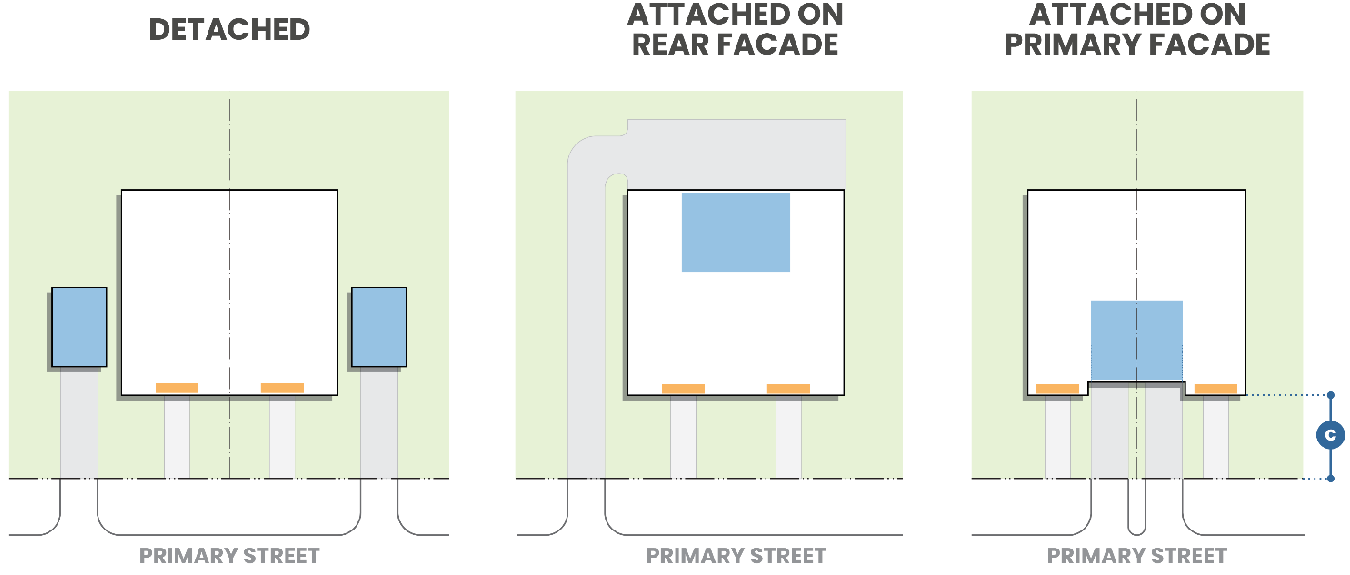
Figure 1 Dwelling Duplex
2.
Dwelling, Triplex/Quadplex.
a.
Triplexes or quadplexes shall be oriented with their primary entrances toward the designated front lot line.
b.
Parking.
i.
Parking shall be located to the interior side or rear of a triplex or quadplex building.
ii.
Unless parking is provided within an enclosed garage, parking shall be screened from the public right-of-way through a combination of fence and landscape including:
(A)
Fence. The screening fence shall be completely opaque and have a minimum height of four feet.
(B)
Landscaping. One shrub or native grass shall be planted along every three feet of screening fence.
c.
Exterior building cladding materials shall utilize time- and weather-tested materials and techniques such as but not limited to masonry; stone veneer systems; stucco; precast panels with inlaid or stamped brick texture; vinyl, cement board, wood, or smart board siding.
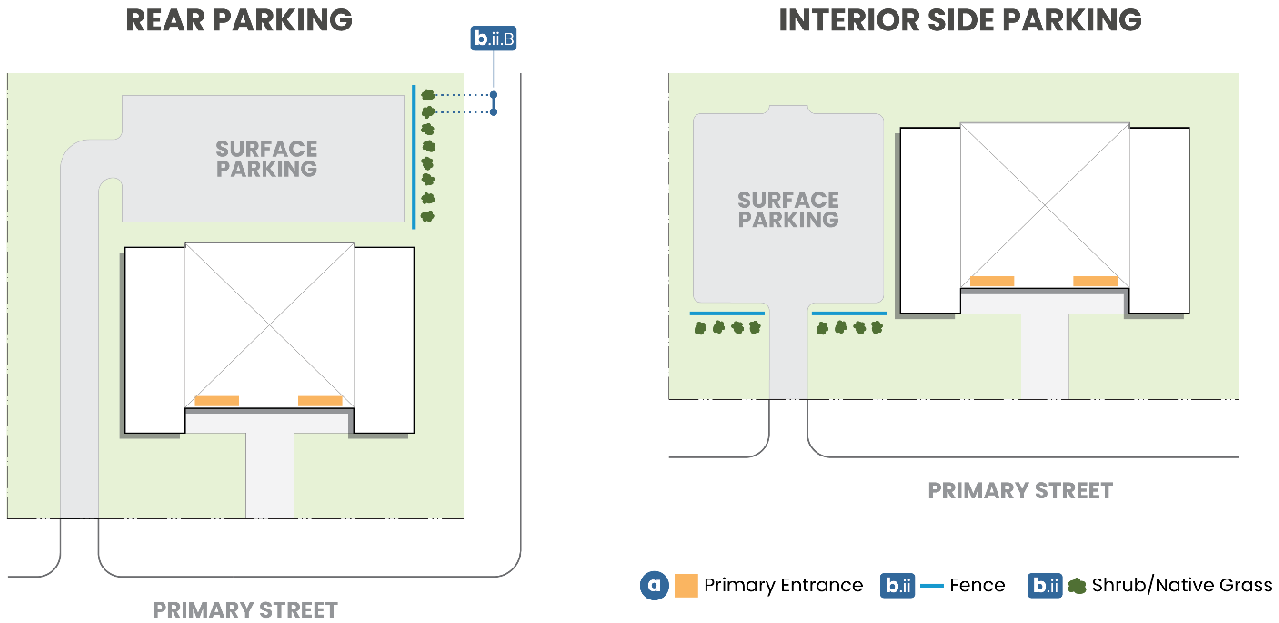
Figure 2 Dwelling, Triplex/Quadplex
3.
Dwelling, Townhome.
a.
Townhome dwellings shall be oriented with their primary entrances either:
i.
Toward the designated front lot line. The primary entrance of end unit townhomes on corner lots may be oriented toward the designated front or exterior side lot line; or
ii.
Toward an internal courtyard space. The primary entrance of end unit townhomes closest to the designated front lot line shall be oriented toward the designated front lot line.
b.
The siting of the units in a cluster shall be staggered in order to define street edges, entry points, and public gathering spaces.
c.
Attached garages located on the primary façade shall be setback a minimum of twenty-five (25) feet from the front property line.
d.
All additional off-street parking, as required in Table 16.04.001.B. of this UDO, shall be located to the rear or interior side of the primary building and shall be setback a minimum of five feet from the front and street side elevations of the primary building.
e.
Exterior building cladding materials shall utilize time- and weather-tested materials and techniques such as but not limited to masonry; stone veneer systems; stucco; precast panels with inlaid or stamped brick texture; vinyl, cement board, wood, or smart board siding.
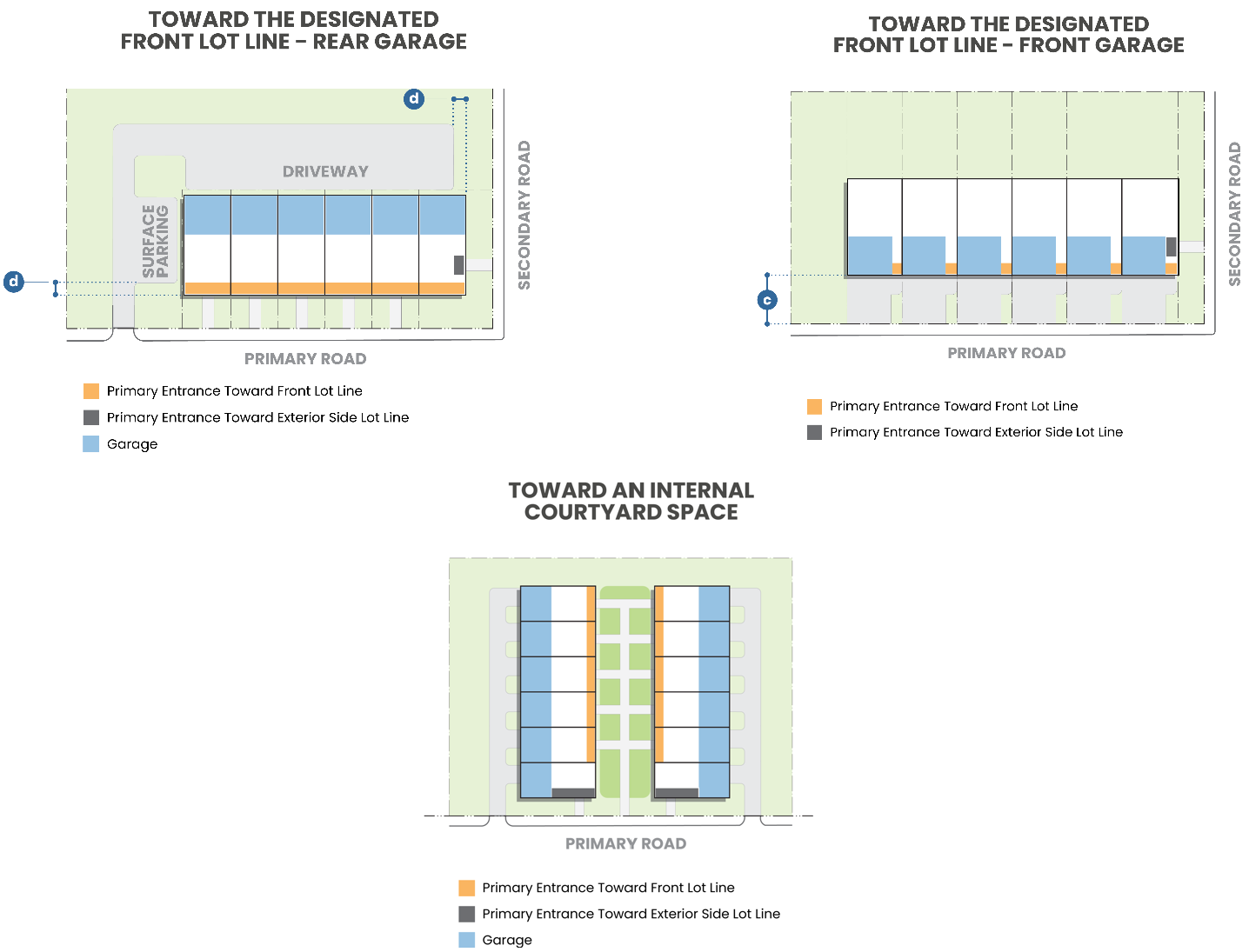
Figure 3 Dwelling, Townhome
4.
Dwelling, Multi-Unit.
a.
The building's primary façade and principal entrance shall be oriented toward a public street.
b.
A maximum of one curb cut shall be permitted per street frontage unless otherwise approved by the village engineer.
c.
All off-street parking, as required in Table 16.04.001.B. of this UDO, shall be located in the rear and/or interior side of the primary building. Off-street parking located in the interior side yard shall be set back a minimum of five feet from the front elevation of the primary building.
d.
All multi-unit buildings shall meet the design standards of Section 16.04.006.
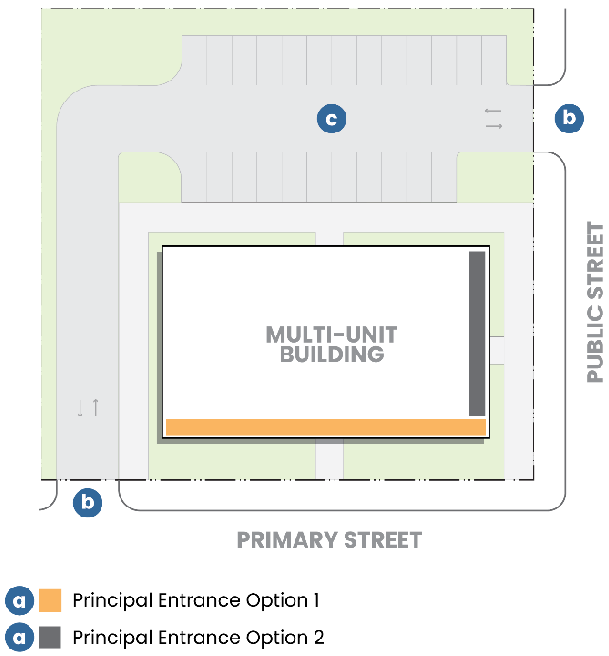
Figure 4 Dwelling, Multi-Unit
5.
Dwelling, Cottage Court.
a.
Number of Cottage Courts. A maximum of one cottage court shall be allowed per development site.
b.
Dwelling Unit Standards.
i.
Dwelling Unit Lot Standards. If the cottage court buildings are located on individual lots, the following standards shall apply.
(A)
Lot Area. The minimum size of a cottage court building lot shall be two thousand five hundred (2,500) square feet.
ii.
Size of Dwelling Units.
(A)
A cottage court building utilized as a dwelling shall have a maximum floor area of one thousand eight hundred (1,800) square feet.
(B)
A cottage court building utilized as a common amenity space shall have a maximum floor area of four thousand (4,000) square feet.
iii.
Number of Dwelling Units.
(A)
A maximum of one dwelling unit shall be allowed per building.
(B)
A cottage court development site shall have a minimum of four and a maximum of twelve (12) buildings per site.
(C)
One of the allowed cottage court buildings may be utilized for common amenity space.
iv.
Building Orientation and Design.
(A)
Buildings shall be oriented with their main entrance facing the shared common court open space, except for corner buildings.
(B)
Corner buildings shall be oriented with their main entrance facing either the shared common court open space or the public right-of-way.
(C)
Buildings shall have a front porch meeting the following standards:
(a)
Width. Eight feet minimum,
(b)
Depth. Six feet minimum.
v.
Permanent Foundation Required. Individual cottage court buildings shall be affixed to the ground with a permanent foundation.
c.
Common Court Open Space.
i.
Buildings in a cottage court shall be arranged around a common court.
ii.
The common court shall be open to and visible from the public right-of-way.
iii.
The common court shall have a minimum area of two thousand five hundred (2,500) square feet.
iv.
The common court shall have a minimum width of thirty (30) feet as measured from the interior of the pedestrian walkway.
v.
Required building setbacks do not count as common court open space.
vi.
A maximum of thirty percent (30%) of a common court open space may be used for stormwater management if designed as a rain garden or bioswale.
d.
Pedestrian Access.
i.
A pedestrian walkway with a minimum width of five feet shall connect all buildings to the public right-of-way, common court open space, and parking areas.
ii.
The pedestrian walkway shall be setback a minimum of six feet from building entrances.
e.
Vehicle Access and Parking.
i.
Parking and driveways shall be located to the rear of the buildings in a cottage court.
ii.
Parking shall be accessed by an alley, if an alley exists.
iii.
If no alley exists, parking shall be accessed by a single driveway.
iv.
The driveway shall be located either:
(A)
From the secondary street, if the development site is a corner lot, or
(B)
To the interior side of the buildings on the development site.
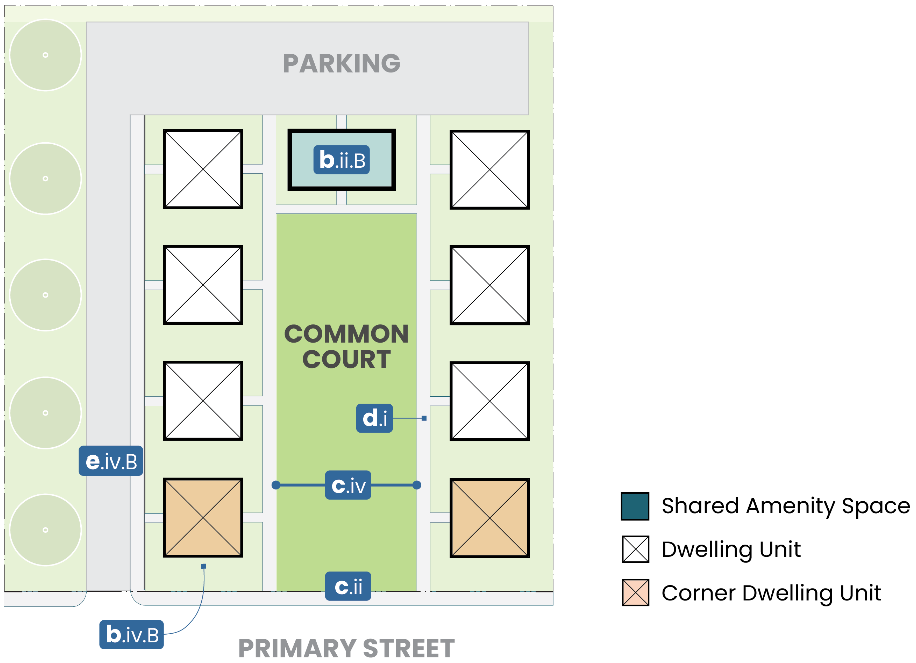
Figure 5 Dwelling, Cottage Court
6.
Multi-Unit Building Complex.
a.
Ingress and Egress.
i.
Multi-unit building complexes with eight or fewer units per building shall have a minimum of two points of ingress and egress.
ii.
Multi-unit building complexes with more than eight units per building shall have a minimum of three points of ingress and egress.
b.
The primary entrance and front façade of buildings within a multi-family complex shall be oriented towards the following, listed in priority order:
i.
Perimeter streets;
ii.
Primary internal streets;
iii.
Parks or other common open space;
iv.
Secondary internal streets; or
v.
Parking areas only if approved by the community and economic development (CED) director.
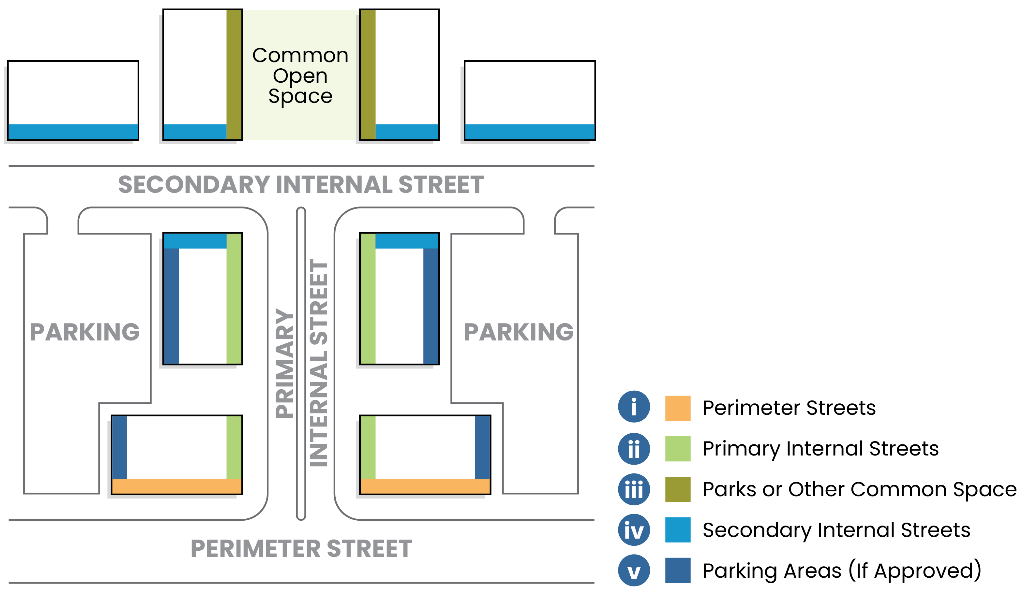
Figure 6 Multi-Building Complex
7.
Live-Work Unit. Construction shall meet requirements of the International Residential Code, and the following:
a.
The maximum total size of a live-work unit shall be three thousand (3,000) square feet;
b.
The work area shall occupy a maximum of fifty percent (50%) of the total unit;
c.
The nonresidential area shall be limited to the first or main floor only;
d.
A maximum of five nonresidential workers or employees are allowed to occupy the nonresidential area at any one time; and
8.
Mobile Home Park.
a.
Size and Density. No mobile home park shall contain an area of less than five acres or a density of more than eight mobile home sites for each gross acre of land.
b.
Screening. All mobile home park boundaries adjacent to existing residential development shall provide a type C buffer as specified in Table 16.04.003.H.2 along a lot line adjoining the residential use.
c.
Yard Setbacks.
i.
The minimum distance between any individual mobile home and the pavement edge of the street serving the mobile home site shall be fifteen (15) feet.
ii.
All mobile home structures shall maintain a setback of no less than forty-five (45) feet from the right-of-way line of Interstate, United States, or State of Illinois highways, and a setback of no less than thirty-five (35) feet from the right-of-way line of any other highway or street which borders the mobile home park.
iii.
There shall be minimum side and rear yards of fifteen (15) feet as measured from the mobile home, except where Subsection B.8.c.ii of this section applies.
iv.
There shall be a rear yard provided for each mobile home of at least ten (10) feet.
d.
Lot Area. All mobile home sites rented or used in a mobile home park shall contain a contiguous area of at least four thousand five hundred (4,500) square feet.
e.
Mobile Home Stand Required.
i.
A mobile home stand shall be provided for each mobile home site, of sufficient size to accommodate a mobile home. A mobile home stand shall be a solid, continuous concrete slab constructed so as not to shift or settle unevenly under the weight of a mobile home or other forces due to frost, vibration, wind or water.
ii.
Provisions shall be made for the use of ground anchors designed to withstand a minimum load of four thousand eight hundred (4,800) pounds each.
iii.
Four such ground anchor connections shall be provided for each mobile home of fifty-one (51) feet or less in length and six such ground anchor connections shall be provided for each mobile home exceeding fifty-one (51) feet in length.
f.
Outdoor Living Space Required. Each mobile home site shall be provided with an outdoor living space on the site to supplement the interior living space of the mobile home. Such outdoor living space must be paved monolithically or constructed of masonry or concrete movable units placed sufficiently close together to create a single usable surface adjacent to the mobile home. The area of the outdoor living space shall be a minimum of one hundred sixty (160) square feet, with a minimum length or width of eight feet.
g.
The space between the mobile home stand and the floor of the mobile home shall be enclosed with noncombustible skirting. The area thereby enclosed may be used for storage of nonflammable objects and materials.
h.
Plot Plan Copies Required. Mobile home park operators shall maintain a copy of the current plot plan of the mobile home park, indicating specific locations of all mobile home stands, in the office of the CED director.
i.
Street Requirements.
i.
All mobile home parks shall be provided with adequate, safe and convenient vehicular access from abutting public streets.
ii.
Public street dedications within or abutting mobile home parks may be required and shall be made in accordance with the standards of the Village of Savoy.
iii.
No mobile home site shall have direct access onto a dedicated public street.
iv.
Entrance drives into mobile home parks shall have direct access to a public street and shall be designed to have free traffic flow onto such public streets. Additionally, no parking or mobile home site access driveway shall be permitted within fifty (50) feet of the entrance drive where it connects to a right-of-way.
v.
With respect to design and construction standards, the provisions of the manual of practice shall apply to private streets, except as otherwise provided herein.
vi.
Parking spaces shall not be located within the required private street pavement width. Parking on the sides of minor streets is permitted, provided that the required twenty-eight (28) feet of pavement remains unobstructed for travel.
j.
Pedestrian Walkways.
i.
Individual walks to each mobile home stand from paved streets or parking areas are required and shall be a minimum of two feet in width. An individual walkway may be combined with a required on-site parking space, provided the total paved width of such a walkway and parking space shall not be less than ten (10) feet.
ii.
Common walks are required at locations where heavy pedestrian traffic is likely to occur, such as at entrances, service facilities and recreation areas. Common walks should be located through interior areas removed from streets wherever possible.
iii.
Individual and common walks shall be paved monolithically or constructed of masonry or concrete movable units placed sufficiently close together to create a continuous surface. Individual walks shall not be less than two feet in width. Common walks shall not be less than three and one-half feet in width.
iv.
No walk shall be used as a drainage way. Sudden changes in alignment and gradient shall be avoided.
k.
All mobile home parks shall comply with 210 ILCS 115, the Mobile Home Park Act.
l.
Each mobile home park shall contain a storm shelter with design plans, engineering calculations, diagrams, and other data prepared by an architect licensed under the Illinois Architecture Practice Act of 1989, a professional engineer licensed under the Professional Engineering Practice Act of 1989, and as applicable a structural engineer licensed under the Structural Engineering Practice Act of 1989. Each shelter must have:
i.
The ability to withstand wind speeds of two hundred (200) miles per hour;
ii.
Twelve (12) square feet of floor space per mobile home pad in the park.
iii.
A ceiling height of not less than seven feet.
iv.
Two exits, including at least one exit that is accessible by persons with physical disabilities.
v.
Underground electrical service.
vi.
Interior lighting and an emergency lighting system supplied by storage batteries or an on-site generator.
vii.
A location that is centrally located in relation to all mobile homes in the park.
viii.
A multi-purpose facility that contains an area meeting the standards in paragraphs (1) through (7) herein shall satisfy the requirements of this section.
9.
Group Homes.
a.
No group home shall be located or established within one thousand (1,000) feet of another group home when located in the AG-1, R-1, R-2, R-3 and R-4 zoning districts.
b.
No group home shall be located or established within five hundred (500) feet of another group home when located in the R-5 zoning district.
c.
To the greatest extent practical, a group home shall conform to the type and outward appearances of the residences in the neighborhood in which it is located.
10.
Senior Housing, Dependent and Independent.
a.
Senior housing shall meet applicable federal and state requirements including, but not limited to licensing, health, safety and building code requirements.
b.
Adequate vehicular drop-off and pick-up zones, sidewalks, and exterior lighting for the safety of the residents and other pedestrians shall be provided.
c.
The site and building characteristics shall complement the visual character of the surrounding neighborhood to the greatest extent possible. Features including roof pitch, window placement, and the location of parking shall be considered.
C.
Public and Institutional Use Standards.
RESERVED
D.
Commercial Use Standards.
1.
Adult Oriented Business.
a.
No liquor license shall be issued and no liquor shall be sold or consumed on the premises of any adult-use.
b.
Location. Adult-uses may be allowed in commercial and industrial districts subject to the following limitations:
i.
No adult-use shall be located within two hundred fifty (250) feet of any property which is zoned or used for a residential use, public or institutional use, or another adult-use.
ii.
In commercial districts, no building containing an adult-use shall be permitted within two hundred fifty (250) feet of the centerline of Dunlap Avenue (Illinois Route 45).
iii.
Adult-uses shall not violate any state or federal statute then in effect.
c.
Exterior Display. No adult-use shall be conducted in any manner that permits the observation of any material depicting, describing or relating to sexual acts or explicit anatomical features from any public way or adjacent property. This provision shall apply to any display, decoration, sign, show window or other opening.
2.
Bar/Tavern.
a.
Outdoor seating and/or dining shall operate only until 10:00 p.m.
b.
Any bar next to a residential use or district shall be screened with a type C buffer as specified in Table 16.04.003.H.2.
3.
Bed and Breakfast.
a.
An owner/manager of a bed and breakfast home shall reside on the property.
b.
Activities and functions at the bed and breakfast home shall be provided for overnight guests only and shall be limited to breakfast and an afternoon and/or evening refreshment.
c.
The bed and breakfast home may have six private parties, receptions, or similar activities per year. This provision shall not restrict the owner/manager's use of their home for personal entertaining of guests.
4.
Food Truck Court.
a.
A minimum of three food trucks shall be accommodated per food truck court.
b.
The maximum number of food trucks allowed on site will be dependent on the size of the lot and the site's ability to provide required electrical access and parking as determined by the village through the special use permit process.
c.
A minimum of ten (10) feet of clearance shall be provided between all individual food trucks and from buildings.
d.
The area for a food truck court shall be clearly defined and separated from all patron parking with an enclosure. Any use of fencing or planters to separate the food truck park from parking shall provide visibility into the site and shall not exceed four feet in height.
e.
To create an inviting and attractive aesthetic environment, seating and shade elements shall be provided.
f.
No food truck court shall be located less than seven hundred fifty (750) feet from any other food truck court.
g.
Electrical service shall be provided to each food truck, no generators shall be allowed.
h.
Food trucks shall be inspected in accordance with the State of Illinois and Champaign County.
5.
Self-Service Laundry and Dry Cleaning. No dry-cleaning establishment or laundry shall have a boiler with a steam generating capacity greater than three thousand eight hundred (3,800) pounds per hour. Dry-cleaning establishments shall be required to have a separate entrance.
6.
Micro-Brewery/Winery/Distillery.
a.
A micro-brewery/winery/distillery shall include one or more accessory or principal uses such as a tasting room, tap room, restaurant, retail, demonstration area, education and training facility or other uses incidental to the brewery, distillery, or winery and that are open and accessible to the public.
b.
Storage of materials used in the manufacturing, processing, and for distribution shall be located entirely within a building.
7.
Short-Term Rental. The residential dwelling in which short-term rental operates shall be the primary residence of the property owner. All short-term rentals shall be subject to the transition zone requirements set out in Table 16.04.003.H.3.
E.
Industrial and Vehicle-Related Use Standards.
1.
Artisan Manufacturing.
a.
Outdoor storage shall be prohibited.
b.
Outdoor operations or activities may be approved with a temporary use permit.
c.
Artisan manufacturing shall not create or cause any perceptible noise, odor, smoke, electrical interference, or vibrations that constitute a public or private nuisance to neighboring properties.
d.
Retail sales of goods manufactured on-site shall be required and shall comprise a minimum of twenty-five percent (25%) of the total area of the building. Retail sales areas shall be located on the ground floor and shall be directly adjacent to storefront windows.
e.
Manufacturing areas are encouraged to be visible from retail areas.
2.
Car Wash.
a.
When adjacent to residential districts, hours of operation shall be restricted to between 7:00 a.m. and 9:00 p.m. only.
b.
All mechanical equipment, excluding self-service vacuum units, shall be enclosed within a building.
c.
All facilities shall be designed and configured such that any outdoor spraying preparation or drying activities are directed away from any abutting residential properties.
d.
All car wash facilities and accessory equipment such as vacuums, dryers, accessory buildings, etc. shall be set back a minimum of one hundred (100) feet from any residential use or district.
e.
If self-service vacuum facilities are provided:
i.
They shall be setback a minimum of twenty (20) feet from all property lines, unless otherwise specified.
ii.
A minimum of one parking space shall be provided for each vehicle capable of being serviced at any one time at such vacuum facility. Parking spaces for accessory vacuum facilities shall not interfere with circulation or entrance or exit drives.
f.
All full-service or conveyor-based carwash facilities shall be equipped with, and maintain in operation, a water recycling system that shall recycle a minimum of fifty percent (50%) of the water being used by the facility.
3.
Fuel Sales.
a.
Location. Fuel pump canopies shall be located a minimum of one hundred (100) feet from any interior side or rear property line that adjoins a residential use or district.
b.
Height. Fuel pump canopy height shall not exceed the height of the principal building or sixteen (16) feet, whichever is greater.
c.
Lighting. Fuel pump canopy lighting shall be fully recessed.
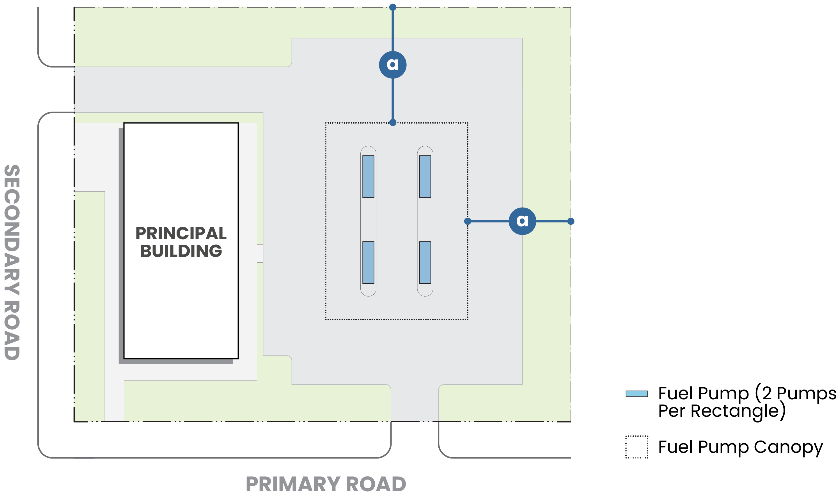
Figure 7 Fuel Sales
4.
Industry, Light.
a.
Off-Site Impacts/Public Nuisances. No generation of dust, odors, noise, vibration or electrical interference or fluctuation shall be perceptible outside of the building.
b.
Environmental Hazards. All establishments shall be maintained so as not to create environmental hazards that pose a threat to ground or surface water quality, air quality, wildlife and/or humans.
c.
Vehicular Access. Vehicular access to the site shall be provided on a thoroughfare of suitable industrial capacity as determined by the CED director, village engineer, and/or any required transportation impact analysis.
5.
Mini-Warehouse, Personal Storage.
a.
The outdoor storage of goods or materials, portable storage units, boats, RVs, or similar vehicles is prohibited.
b.
The only activities permitted in individual storage units shall be the rental of the unit and the deposit or pick-up of goods and/or property. Storage units shall not be used for activities including, but not limited to:
i.
Residences, offices, workshop, hobby, or rehearsal area;
ii.
Manufacturing, fabrication, processing, service or repair, or any industrial activity;
iii.
Retail sales, including garage sales or auctions;
iv.
Storage of flammable, perishable, or hazardous materials; or
v.
Keeping of animals.
c.
Hours of Operation. Self-service storage facilities shall not operate or allow tenant access between the hours of 9:00 p.m. and 8:00 a.m. if the site abuts any residential property or district.
6.
Motor Vehicle Sales/Rental.
a.
All outdoor display areas for sales shall be improved with all-weather surfaces.
b.
Parking lots utilized for the outdoor display of motor vehicles for sale shall be exempt from the landscape spacing requirements for the parking area perimeter zone as detailed in Section 16.04.003.F, and instead may cluster required landscape elements in order to preserve views to motor vehicles offered for sale and/or rent.
c.
Vehicle service bays shall be set perpendicular to the street or otherwise screened with a type D buffer from any residential property or the street right-of-way.
d.
No more than one elevated display shall be used, raising the vehicle no more than three feet off the ground.
e.
Accessory uses and structures, such as car wash facilities and their incidental functions (vacuums and air compressors) shall be subject to all applicable use standards.
f.
No existing buildings shall be occupied or re-used for vehicle sales, rental, and service unless all requirements of this UDO are met.
g.
The use shall operate in accordance with all other applicable federal, state, and local laws. If additional permits are required, such permits shall be obtained prior to the operation's approval.
h.
Drainage from outdoor storage and/or activity areas shall be directed to gravel, grassed, or other planted areas in a manner that prevents direct discharge to storm drain inlets and surface waters.
7.
Vehicle Services, Major Repair/Body Work.
a.
Location. Vehicle services bays associated with major vehicle repair/body work shall be located no closer than seven hundred fifty (750) feet from properties with the following pre-existing uses:
i.
All residential uses;
ii.
School, public/private;
iii.
Place of worship;
iv.
Public cultural/community facility;
v.
Public entertainment/recreation facility;
vi.
Child/adult daycare center;
vii.
Park; and
viii.
Cemetery.
b.
Vehicles which are not operable or suitable for driving shall be stored indoors, in accessory outdoor storage areas meeting all requirements of Section 16.03.004.B.1, or in screened parking areas for a period not to exceed twenty-four (24) hours, in compliance with the standards outlined in Section 16.04.003.F.
c.
Drainage from outdoor storage and/or activity areas shall be directed to gravel, grassed, or other planted areas in a manner that prevents direct discharge to storm drain inlets and surface waters.
8.
Vehicle Services, Minor Maintenance/Repair.
a.
Vehicle service bays associated with minor vehicle maintenance/repair shall be located a minimum of one hundred (100) feet from the property line of any residential use or district.
b.
Vehicle service bays shall be set perpendicular to the street or otherwise screened with a type D buffer from any residential property or the public right-of-way.
c.
The use's operation shall be limited to between the hours of 7:00 a.m. and 9:00 p.m.
d.
Drainage from outdoor storage and/or activity areas shall be directed to gravel, grassed, or other planted areas in a manner that prevents direct discharge to storm drain inlets and surface waters.
9.
Warehouse Distribution Storage. Loading docks shall be oriented towards interior side and rear lot lines only.
F.
Utility and Infrastructure Use Standards.
1.
Solar Farm.
a.
No solar farm shall be erected on any lot less than three acres in size.
b.
A certified professional engineer shall certify that the foundation and design on the solar panels are within accepted professional standards, given local soil and climate conditions.
c.
Power and communication lines running between banks of solar panels and to electric substations or interconnections with buildings shall be buried underground.
d.
Off-street parking provided on site shall be paved. Gravel or other unpaved materials shall be prohibited.
e.
Systems, equipment, and structures shall not exceed thirty (30) feet in height when ground mounted.
f.
Groundcover as specified in Section 16.04.003.C.7 shall be provided beneath all solar panels.
g.
Ground mounted solar energy collection systems as part of a solar farm shall have a minimum setback for all equipment, excluding fences, of:
i.
Front and Corner Yards. One hundred (100) feet.
ii.
Side and Rear Yards. Fifty (50) feet from nonresidential property lines and one hundred (100) feet from residential property lines.
h.
Systems equipment and structures shall be fully enclosed and secured by a fence or wall with a height of eight feet. Knox boxes and keys shall be provided at locked entrances for emergency personnel access.
i.
Warnings.
(A)
Warning signs shall be provided at the entrance to the facility and along the perimeter of the solar farm in locations determined necessary by the CED director.
(B)
The signs shall be less than four square feet and made with letters and numbers at least three inches in height and shall include the 911 address and an emergency phone number of the operator which shall be answered twenty-four (24) hours a day by a live operator. A nonemergency phone number for the operator shall also be displayed.
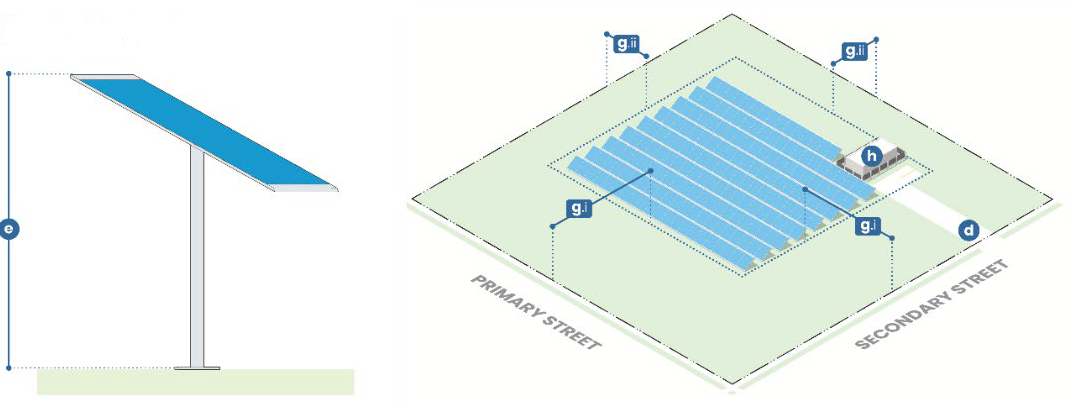
Figure 8 Solar Farm
i.
Outdoor Storage. Only the outdoor storage of materials, vehicles, and equipment that directly support the operation and maintenance of the solar farm shall be allowed except for outdoor storage that is expressly allowed in the zoning district specified in Table 16.03.004.A.
j.
Materials Handling, Storage, and Disposal.
i.
All solid waste related to the construction, operation, and maintenance of the solar farm shall be removed from the site promptly and disposed of in accordance with all federal, state, and local laws.
ii.
A list of hazardous fluids that may be used on site shall be provided. All hazardous materials related to the construction, operation, and maintenance of the solar farm shall be handled, stored, transported, and disposed of in accordance with all applicable local, state, and federal laws.
k.
Decommissioning Plan. Prior to receiving approval, the applicant shall submit a decommissioning plan to ensure that the solar farm project is properly decommissioned, which shall include:
i.
Provisions describing the triggering events for decommissioning the solar farm project. Any nonfunctioning solar panel/array of the project shall be decommissioned within thirty (30) days unless the operator has shown to the CED director that it is diligently repairing such solar panel/array or component;
ii.
Procedures for the removal of structures, debris, and cabling, including those below the soil surface;
iii.
Provisions for the restoration of the natural soil and vegetation;
iv.
An estimate of the decommissioning costs certified by a professional engineer, to be updated every three years or as determined necessary by the CED director. The CED director may request an independent third-party verification of the decommissioning costs at any time. The costs for this verification shall be reimbursed by the applicant and/or operator;
v.
Financial assurance in the form of an irrevocable letter of credit issued by a federally-insured financial institution, secured by the owner or operator, for the purpose of performing the decommissioning, in an amount equal to one-hundred twenty (120) percent of the professional engineer's certified estimate of the decommissioning cost which has been reviewed and approved by the village engineer and once in place, the solar farm operator shall keep said irrevocable letter of credit in force for the entire time that the solar farm is kept operation; and
vi.
A provision that the terms of the decommissioning plan shall be binding upon the owner or operator and any of their successors, assigns, or heirs.
l.
Solar farm developments shall be restricted to electricity production facilities that direct the generated electricity directly to a high voltage electrical grid. Solar farms that contain lithium-ion batteries are prohibited.
2.
Wireless Telecommunications Equipment and Wireless Telecommunications Towers.
a.
Purpose and Intent. This Subsection creates the framework for the siting of wireless telecommunication facilities in a manner which protects the public health, safety, and general welfare of the community, provides comprehensive service to the community, and implements the village's policies for said facilities, as detailed below. The provisions of this subsection are in addition to, and do not replace, any obligations an applicant may have under any franchises, licenses, encroachments, or other permits issued by the village:
i.
Facilitate the comprehensive provision of wireless telecommunication services to the residents and businesses of the Village of Savoy;
ii.
Maximize the use of existing and approved telecommunication towers, buildings, and structures to accommodate new wireless telecommunication antennas in order to minimize the number of telecommunication towers needed to comprehensively serve the community;
iii.
Minimize the number, height, obtrusiveness, and the visual impacts of telecommunications towers, associated equipment, and buildings;
iv.
Direct and allow wireless telecommunication facilities to areas which are least disruptive to residential, park, open space, and greenway uses and to be as unobtrusive and invisible as reasonably possible;
v.
Ensure that the height of telecommunications towers has the least visual impact and is no greater than required to achieve service area requirements and potential co-location;
vi.
Site telecommunications towers to minimize locations which are visually solitary or prominent when viewed from residential areas or any public way;
vii.
Site telecommunications towers at locations which are obscured by vegetation, tree cover, topographic features, buildings or other structures to the maximum extent feasible;
viii.
Protect views of and vistas from architecturally or historically significant structures and historically significant landscapes so that these architectural or historical resources are not impaired or diminished by the placement of telecommunications towers; and
ix.
Avoid potential damage to adjacent properties from telecommunication towers failure by following structural design standards and specifying setback requirements from the property line.
b.
General Applicability. The provisions of this subsection shall apply to the following:
i.
Wireless telecommunication facilities (towers and associated equipment) that are or will be operated by a licensed wireless telecommunication service provider which consists of the equipment and structures involved in the receiving or transmitting of electromagnetic waves associated with wireless telecommunication services.
ii.
Small wireless telecommunication towers that meet the following characteristics:
(A)
Each antenna is located inside or could fit within an enclosure of no more than six cubic feet in volume or, in the case of an antenna that has exposed elements;
(B)
All other wireless equipment associated with the facility is cumulatively no more than twenty-eight (28) cubic feet in volume. The following types of associated ancillary equipment are not included in the calculation of equipment volume: electric meter, concealment elements, telecommunications demarcation box, ground-based enclosures, grounding equipment, power transfer switch, cut-off switch, and vertical cable runs for the connection of power and other services; and
(C)
An antenna array feature that is attached to a telecommunications tower or building to transmit or receive radio waves. For this Subsection, this does not include antenna dishes or other antenna features on individual homes or businesses that are intended to receive radio or television broadcasts, or internet communication for said use.
c.
Amateur Radio Exemption. These provisions neither apply to nor shall be construed to apply to amateur radio operators who are licensed to operate a radio or transmitter by the Federal Communications Commission under Part 97 of the Federal Communications Commission's Rules.
d.
Interference with Public Safety Telecommunications. No new or existing telecommunications service shall interfere with public safety telecommunications. Before the introduction of new service or changes in existing service, telecommunication providers shall notify the village at least ten (10) calendar days in advance of such changes and allow the village to monitor interference levels during the testing process.
e.
Compliance with Other Laws. A telecommunications tower shall be erected and operated in compliance with the most current Federal Communication Commission and Federal Aviation Administration rules and regulations and other applicable federal and state standards. All telecommunications towers shall comply with all ordinances of the village which are not in conflict with this subsection.
f.
Wireless Telecommunication Facilities Establishment and Siting Alternatives Analysis.
i.
Co-Location Preference. The village shall promote the co-location of wireless telecommunications equipment on existing towers, buildings, or utilities elements. New standalone wireless telecommunication facilities (towers) may only be allowed where co-location of said facilities on existing towers, buildings, or public infrastructure elements is deemed infeasible through a siting alternatives analysis.
ii.
Siting Alternatives Analysis. For all new, standalone wireless telecommunication towers, the applicant shall provide a siting alternatives analysis to determine whether co-location on existing structures is feasible within the applicant's search ring, including information pertaining to the fair market value of similar contracts—this shall be provided as part of the permitting process and submittal requirements pursuant to Title 16. The siting alternatives analysis shall determine the feasibility of co-locating the new telecommunication facilities/equipment in the following situations:
(A)
Co-Location Standards. The co-location or placement of new telecommunications antennas upon existing telecommunications towers, light poles, and/or buildings.
(B)
Village-owned Structure or Building. The utilization of existing village-owned structures and buildings for placement of antenna and associated equipment or buildings, including surface-mounted and roof- mounted applications of telecommunication antennas on existing buildings and structure-mounted applications of telecommunication antennas on water towers, electric line transmission towers, or other existing structures.
(C)
Existing Structure or Building Utilization. The utilization of all other existing structures and buildings for placement of antenna and associated equipment or buildings, including surface mounted and roof- mounted applications of telecommunication antennas on existing buildings and structure-mounted applications of telecommunication antennas on existing structures.
iii.
Consulting Option. As part of the review procedures, the CED director shall determine the sufficiency of the information. The village may choose to hire an outside consultant to conduct a third-party review of the siting alternatives analysis in the following situations: (i) where there are disputes of the findings between the applicant and the administrator and/or (ii) where expert consultation is deemed necessary to reach conclusions of the analysis. Where the village utilizes a consultant in its application review, the fee for such services shall be fixed in advance as part of the application fee for a new telecommunications facility.
g.
Telecommunication Tower and Antenna Array Design Standards. The following design standards apply to new telecommunication towers and associated antenna array facilities. These standards do not apply to co- location activities on existing towers, buildings, or public infrastructure elements.
i.
Height. The maximum height of a telecommunications tower, including antenna array, shall be less than two hundred (200) feet above grade. small wireless telecommunications towers shall be limited to fifty (50) feet above grade.
ii.
Location. Telecommunication towers and antenna arrays shall not be located within three hundred (300) feet of an existing or future thoroughfare, as identified in the Champaign-Urbana Urban Area Transportation Study's (CUUATS) most recent long range transportation plan.
iii.
Setbacks Required. Telecommunication towers, including antenna array, shall be set back one hundred twenty-five percent (125%) of the height of the tower from any lot line or a distance equal to the engineered fall zone, whichever is greater.
iv.
Guys and Guy Anchors. All guys and guy anchors shall be located within the buildable area of the lot and shall not be located within any required setback, required landscape area, wetland feature, and watercourse riparian buffer.
v.
Security Fencing. Security fencing shall surround the telecommunications tower base, all guy anchors, and equipment. The compound area and all guy anchors shall be secured with a fence of not less than six feet in height nor more than ten (10) feet in height. A security wire (barbed, razor, etc.) may be located on the telecommunications tower side of the fence but shall not extend above the top of the fence. The type of fence selected shall, in the determination of the CED director, be compatible with development in the surrounding area. A chain link fence, if used, shall be black vinyl coated.
vi.
Structural Design. A telecommunications tower shall be designed and built so as to:
(A)
Be capable of use by at least two wireless communications providers for a telecommunications tower less than eighty (80) feet in height;
(B)
Be capable of use by three or more wireless communications providers for a telecommunications tower of eighty (80) feet in height or greater;
(C)
Accommodate antenna arrays consisting of nine to twelve (12) antennas for each array; however, this regulation shall not apply to slick antenna applications;
(D)
Locate such antenna arrays within fifteen (15) vertical feet of each other;
(E)
Have no more than three degrees of twist and sway at the top elevation;
(F)
Provide internal cable routing for all tapering monopole telecommunication towers; and
(G)
Meet or exceed associated state and federal structural standards relating to telecommunication standards (e.g., EIA-222).
vii.
Signs Prohibition. No lettering, symbols, images, trademarks, signs, or advertising shall be placed on or affixed to any part of a telecommunications tower, antenna array or antenna, other than as required by Federal Communications Commission regulations regarding tower registration or other applicable law.
viii.
Lights. No signals, lights or other illumination shall be permitted on telecommunications towers unless required by the Federal Communications Commission, the Federal Aviation Administration, or the village.
h.
Engineering Compliance for Modifications. If any additions, changes or modifications are to be made to a telecommunications tower, the administrator may require proof, through the submission of engineering and structural data, that the addition, change or modification conforms to structural wind load and all other requirements of the village's building code.
i.
Separation and Location.
i.
New Wireless Telecommunication Towers. New telecommunication towers are subject to the following minimum separation radius from another telecommunications tower:
(A)
A quarter-mile radius for proposed telecommunications towers less than eighty (80) feet in height;
(B)
A half mile radius for proposed telecommunications towers between eighty (80) feet in height and one hundred twenty (120) feet in height;
(C)
A one-mile radius for proposed telecommunications towers one hundred twenty (120) feet in height or greater; or
(D)
In determining the required separation between telecommunication towers of different heights, the required separation for the taller tower shall apply.
ii.
Small Wireless Telecommunication Towers. New small wireless telecommunication towers are subject to the following minimum separation radius from another telecommunications tower, as measured from the base.
(A)
For the Same Wireless Telecommunication Provider. Each new small wireless telecommunication facility shall not be located such that the anticipated coverage ring of the small wireless telecommunication facility substantially overlaps the coverage ring of any other wireless telecommunication facility.
(B)
For Different Wireless Telecommunication Providers. Each new small wireless telecommunication facility operated by different providers shall not be located within three hundred (300) feet of another small wireless telecommunication facility unless the applicant can show that locating the small wireless telecommunication facility within the prescribed distance is necessary.
iii.
Deviations. As part of a special use permit review, the village may authorize deviations from these separation standards due to special circumstances relating to natural features, scarcity of available land, and telecommunications operating standards.
j.
Wireless Telecommunications Antennas Mounted on Existing Buildings or Structures. The following design standards apply to antennas associated with wireless communication operations and mounted on existing buildings and structures.
i.
Roof-Mount Elements. Roof-mounted wireless telecommunications antennas are permitted on buildings and structures in all districts. Said elements shall be subject to the following standards:
(A)
Whip telecommunication/antenna features (an antenna which transmits signals in three hundred sixty (360) degrees) shall not exceed the height of the building by more than fifteen (15) feet and shall be no closer than fifteen (15) feet to the perimeter of the building;
(B)
Nonwhip telecommunication/antenna features shall not exceed the height of the building by more than ten (10) feet and shall be no closer than ten (10) feet to the perimeter of the building; and
(C)
The telecommunications antenna and associated equipment located on buildings shall be screened in elevation view with enclosures or façades having an appearance that blends with the building on which they are located; and be located so they are not overtly visible from an adjacent public right-of-way.
ii.
Surface-Mount Elements. Surface-mounted telecommunications antennas are permitted on buildings or structures in all districts and subject to the following standards:
(A)
Telecommunications/antenna features shall be mounted flush with the exterior of the building or structure so that it projects no more than thirty (30) inches from the surface to which it is attached;
(B)
The telecommunications/antenna appearance shall blend with the surrounding surface of the building or structure in terms of color and materials; and
(C)
Surface-mount elements are subject to applicable design standards of properties and districts listed in the National Register, local historic districts, and locally designated historic landmarks.
iii.
Elements Attached to Other Existing Structures. Telecommunications antennas are permitted on existing utility, lighting, telecommunications towers, and other structures in all districts subject to the following standards:
(A)
Existing utility, lighting, telecommunications towers, and other structures used to affix telecommunication/antenna features shall not exceed height limit outlined in Subsection F.2.g.i;
(B)
The telecommunications antenna shall follow the height restrictions specified in Subsection F.2.g.i;
(C)
Existing structures may be rebuilt/modified to support the load of the new telecommunications antenna subject to the village's building permitting standards; and
(D)
Existing structure-mounted elements are subject to the applicable design standards of properties and districts listed in National Register, local historic districts, and locally designated historic landmarks.
iv.
Separation Standards. Telecommunications antennas and associated features located on existing buildings or structures are not subject to the separation requirements stated above.
v.
Photo Simulation Requirements. As part of the application process, applicants shall provide photo simulations showing the site of the existing structure with a photo realistic representation of the proposed telecommunications antenna and the existing structure or any proposed reconstruction of the structure as it would appear viewed from the closest residential district and from adjacent public right-of-way. The applicant shall also submit photographs of the same views as in the photo simulations showing the current appearance of the site without the proposed telecommunications antenna.
k.
Abandonment and Removal of Telecommunications Towers, Antenna Arrays, and Associated Equipment. The following standards apply to all telecommunication features and their associated elements. These standards ensure inoperable features are removed. Habitable buildings are exempt from these requirements.
i.
Abandonment. Telecommunications towers, antenna arrays, and associated equipment which have not been used for a period of one year shall be deemed abandoned and shall be removed from the site.
ii.
Notice Required. The owner of the telecommunications tower and the last service provider to use a telecommunications tower shall notify the CED director within thirty (30) days that use of a telecommunications tower has been discontinued.
l.
Special Requirements for Small Wireless Telecommunication Facilities Located Within the Public Right-of-Way. To minimize new visual, aesthetic, and public safety impacts, and to reduce the need for additional antenna-supporting structures, small wireless telecommunication facilities shall whenever possible be located outside the public right-of-way; co-located on existing utility poles or wireless support structures; concealed; and have their accessory equipment mounted on the utility pole or wireless support structure. The following requirements are intended to be reasonable for small wireless telecommunication facilities located within the public right-of-way while avoiding the intangible public harm of unsightly or out of character deployments and are implemented as requirements for an application for small wireless telecommunication facilities. Unless otherwise defined by this UDO, all definitions are the same as defined in the Wireless Siting Act (50 ILCS 840/) Illinois Statutes as amended.
i.
Siting Hierarchy of Small Wireless Telecommunication Facilities Located Within the Public Right-of-Way.
(A)
Co-Location Required.
(a)
Co-Location Feasibility.
(1)
Any applicant for a new small wireless telecommunication facility shall evaluate the reasonable feasibility of co-locating new antennas and equipment on existing utility poles, light pole fixtures, or wireless support structures within the applicant's search ring.
(2)
Co-location on existing utility poles, light pole fixtures, or wireless support structures is not reasonably feasible if co-location is technically or commercially impractical or the owner of the existing utility poles, light pole fixtures, or wireless support structures has refused in writing to the requesting party, after having been offered the fair market fee for co-location, to enter into a contract for such use at fair market value.
(3)
Minor alterations or adjustments to the location or technical specifications of the small wireless telecommunication facility as a result of co-locating on an existing utility pole, light pole fixture, or wireless support structure shall not constitute a technical or commercial impracticality.
(b)
Information Required.
(1)
The applicant shall provide to the village all information necessary to determine whether co-location on existing utility poles, light pole fixtures, or wireless support structures is reasonably feasible, including information pertaining to the fair market value of similar contracts.
(2)
The village shall determine the sufficiency of the information and may employ such experts as outside consultants to evaluate the information. In the event that the village determines outside consultants are necessary, the fee for such consultant shall be fixed in advance as part of the application fee for a new small wireless telecommunication facility.
(c)
Siting Alternatives Hierarchy. Development of small wireless telecommunication facilities shall be in accordance with the following siting alternatives hierarchy. The order of ranking, from highest to lowest, shall be from Subsection C. to Subsection B., outlined below. Where a lower ranked alternative is proposed, the applicant must demonstrate by substantial evidence that higher ranked options are not technically feasible or available.
(B)
Co-Location Standards. The co-location of small wireless telecommunication facility on existing utility poles, light pole fixtures, or wireless support structures and associated equipment or buildings shall comply with the following regulations:
(a)
Height. Each new small wireless telecommunication facility shall not extend more than ten (10) feet above the existing utility pole, light pole fixture, or wireless support structure on which it is co-located. No new small wireless telecommunication facility shall be co-located on any utility pole, light pole fixture, or wireless support structure that is less than fifteen (15) feet above grade.
(b)
Separation. Co-location of small wireless telecommunication facilities on existing utility poles, light pole fixtures, or wireless support structures are not subject to a separation requirement.
(c)
Objective Design Standards. Small wireless telecommunication facilities to be co-located on an existing utility pole, light pole fixture, or wireless support structure shall be designed to match the style and color of the existing utility pole, light pole fixture, or support structure and designed such that all cabling is inside the existing utility pole, light pole fixture, or wireless support structure. If cabling cannot be located inside the existing utility pole, light pole fixture, or support structure, cabling shall be located within a solid enclosure that is designed to match the style and color of the existing utility pole, light pole fixture, or support structure.
(1)
All small wireless telecommunication facilities shall be stealth antenna facilities. Stealth antenna and accessory equipment must be shrouded or otherwise concealed.
(2)
To mitigate the visual impacts of unsightly or out of character small wireless telecommunication facilities, ground equipment shall be screened, to the extent possible as approved by the government body with jurisdiction of the right-of-way in which the small wireless telecommunication facility is to be located.
(d)
Engineer's Certification. Prior to installation of a small wireless telecommunication facility or equipment, the village shall be provided with an engineer's certification that existing utility pole, light pole fixture, or wireless support structure will support the proposed small wireless telecommunication facility or equipment.
(C)
New Small Wireless Telecommunication Facilities. Construction of new small wireless telecommunication facilities on new utility poles or wireless support structures and associated equipment or buildings shall comply with the following regulations:
(a)
Height. The maximum height of new utility poles or wireless support structures shall be fifty (50) feet above grade. Each new small wireless telecommunication facility shall not extend more than ten (10) feet above the utility pole or wireless support structure on which it is located. Notwithstanding the above, in no instance shall a utility pole or wireless support structure exceed forty (40) feet above grade in an area zoned for detached residential dwellings where the existing utilities are installed underground. No new small wireless telecommunication facility shall be located on any utility pole or wireless support structure that is less than fifteen (15) feet above grade.
(b)
Location. No portion of a new utility pole or wireless support structure associated with a small wireless telecommunication facility may be placed in the public right-of-way in a manner that obstructs the following: pedestrian, vehicular, or bicycle access; sight lines or visibility, including visibility triangle requirements per Section 16.04.009; traffic signage, or signals; public art or focal points; or access by persons with disabilities. An applicant may be required to place equipment in vaults located underground to avoid obstructions or interference. To the greatest extent possible, a new utility pole or wireless support structure associated with a small wireless telecommunication facility shall align with existing utility poles, light pole fixtures, or wireless support structures installed in the right-of-way.
(c)
Separation. New small wireless telecommunication facilities shall have the following minimum separation radius from another small wireless telecommunication facility:
(1)
Separation for the Same Wireless Telecommunication Provider. Each new small wireless telecommunication facility shall not be located such that the anticipated coverage ring of the small wireless telecommunication facility substantially overlaps the coverage ring of any other wireless telecommunication facility;
(2)
Substantial Overlap. Substantial overlap shall be defined as the more than ten percent (10%) overlap between the anticipated coverage ring of a new small wireless telecommunication facility and the coverage ring of any other existing wireless telecommunication facility of the same provider; this definition shall also apply between the anticipated coverage rings of two or more new small wireless telecommunication facilities;
(3)
Coverage Ring. Coverage ring shall be defined as the approximate area of coverage that each small wireless telecommunication facility is able to provide; or in the case of new small wireless telecommunication facilities, the approximate area the small wireless telecommunication facility is anticipated to provide; and
(4)
Coverage. Coverage is defined as the area in which a person or entity is able to establish an electronic connection with the small wireless telecommunication facility.
(d)
Review. If an applicant desires to locate a new small wireless telecommunication facility within the prescribed distance and the location is found to be necessary, the facility shall be reviewed by the CED director and approved on a case-by-case basis.
(e)
Separation from Different Provider. Each new small wireless telecommunication facility shall not be located within three hundred (300) feet of another small wireless telecommunication facility operated by a different provider unless the applicant can show that locating the small wireless telecommunication facility within the prescribed distance is necessary. Such small wireless telecommunication facility shall be reviewed by the CED director and approved on a case-by-case basis.
(f)
Objective Design Standards. Small wireless telecommunication facilities and utility poles and wireless support structures shall be compatible with the surrounding area. Where existing street light fixtures are present, the utility pole or wireless support structure color shall match that of the street light fixture pole and shall be located in such a manner as to visually appear to be part of a common scheme of street light fixture pole placement.
(1)
Utility poles and wireless support structures shall be made of galvanized steel or comparable material except when otherwise required by applicable federal or state regulations. Wood utility poles and wireless support structures are prohibited.
(2)
Small wireless telecommunication facilities shall be located, designed, and/or screened to blend in with the existing natural or built surroundings to reduce the visual impacts as much as possible, and to be compatible with neighboring land uses and the character of the community.
(3)
All small wireless telecommunication facilities shall be stealth antenna facilities. Stealth antenna and accessory equipment must be shrouded or otherwise concealed. To mitigate the visual impacts of unsightly or out of character small wireless telecommunication facilities, ground equipment shall be screened to the greatest extent possible, as approved by the governmental body with jurisdiction over the right-of-way in which the small wireless telecommunication facility is to be located.
ii.
Maintenance.
(A)
All small wireless telecommunication facilities and related equipment, including, but not limited to fences, cabinets, poles, and landscaping, shall be maintained in good working condition over the life of the use. This shall include keeping the structures maintained to the visual standards established at the time of approval. The small wireless telecommunication facilities shall remain free from trash, debris, litter, graffiti, and other forms of vandalism. Any damage shall be repaired as soon as practicable, and in no instance more than thirty (30) calendar days from the date of notification by the village. In public rights-of-way, damaged or deteriorated components must be corrected within five business days of notification.
(B)
No lettering, symbols, images, trademarks, signs, or advertising shall be placed on or affixed to any part of a small wireless telecommunication facility other than as required by Federal Communications Commission regulations regarding small wireless telecommunication facilities registration or other applicable law.
iii.
Filing Requirements. All applications for a small wireless telecommunications facility shall be required to meet the filing requirements specified in Section 16.08.001.C.
G.
Agriculture and Animal-Related Use Standards.
1.
Animal Clinic/Day Care, With Outdoor Runs.
a.
Location. Aside from accessory outdoor runs, the use shall be conducted primarily within a fully enclosed building designed with noise resistant materials.
b.
Animals Allowed. No animals other than domestic animals shall be boarded, treated, or kept on the premises.
c.
Animal Boarding. Animals shall not be boarded overnight at an animal day care facility.
d.
Boarding Areas.
i.
Boarding areas provided on site shall be completely enclosed within a building.
ii.
The boarding area must be air-conditioned and heated so that windows, doors, or other openings can be closed at any time.
iii.
All litter and waste shall be contained and controlled on site by having appropriate flushing drains and other physical elements to properly dispose of cleaning waste from the boarding area.
e.
Outdoor Areas.
i.
Drainage from outdoor areas shall be directed to gravel, grassed, or other planted areas in a manner that prevents direct discharge to storm drain inlets and surface waters.
ii.
Outdoor areas used by for animal recreation, exercise, or to be used for other animal care purposes shall be set back a minimum of one hundred fifty (150) feet from neighboring residential properties.
iii.
Solid waste will be removed from the outdoor area after each use of the area.
iv.
All outdoor areas shall be screened by a one hundred percent (100%) opaque, six-foot fence or wall. Chain link fences with slats shall not be considered to meet screening requirements.
v.
Use of outdoor areas between the hours of 10:00 p.m. and 7:00 a.m. is prohibited.
2.
Animal Clinic/Day Care, Without Outdoor Runs.
a.
Location. The use shall be conducted primarily within a fully enclosed building designed with noise resistant materials.
b.
Animals Allowed. No livestock or large animals other than domestic animals shall be boarded, treated, or kept on the premises.
c.
Animal Boarding. Animals shall not be boarded overnight at an animal clinic facility except in case where overnight stays are necessary for medical purposes, such as surgery, observation, or treatment.
d.
Boarding Areas.
i.
Boarding areas provided on site shall be completely enclosed within a building.
ii.
The boarding area must be air-conditioned and heated so that windows, doors, or other openings can be closed at any time.
iii.
All litter and waste shall be contained and controlled on site by having appropriate flushing drains and other physical elements to properly dispose of cleaning waste from the boarding area.
3.
Animal Kennel, With Outdoor Runs.
a.
Animals Allowed. No animals other than domestic animals shall be boarded, treated, or kept on the premises.
b.
Animal Boarding. Animals may be boarded for an extended period of up to four consecutive weeks.
c.
Boarding Areas.
i.
Boarding areas provided on site shall be completely enclosed within a building.
ii.
The boarding area must be air-conditioned and heated so that windows, doors, or other openings can be closed at any time.
iii.
All litter and waste shall be contained and controlled on site by having appropriate flushing drains and other physical elements to properly dispose of cleaning waste from the boarding area.
d.
Outdoor Areas.
i.
Drainage from outdoor areas shall be directed to gravel, grassed, or other planted areas in a manner that prevents direct discharge to storm drain inlets and surface waters.
ii.
Outdoor areas used for animal recreation, exercise, or to be used for other animal care purposes shall be set back a minimum of one hundred fifty (150) feet from neighboring residential properties.
iii.
Solid waste will be removed from the outdoor area after each use of the area.
iv.
All outdoor areas shall be screened by an opaque fence or wall at least six feet in height. Chain link fence with slats shall not be considered as meeting screening requirements.
v.
Use of outdoor areas between the hours of 10:00 p.m. and 7:00 a.m. is prohibited.
4.
Animal Kennel, Without Outdoor Runs.
a.
Location. The use shall be conducted solely within a fully enclosed building designed with noise resistant materials.
b.
Animals Allowed. No animals other than domestic animals shall be boarded, treated, or kept on the premises.
c.
Boarding Areas.
i.
Boarding areas provided on site shall be completely enclosed within a building.
ii.
The boarding area must be air-conditioned and heated so that windows, doors, or other openings can be closed at any time.
iii.
All litter and waste shall be contained and controlled on site by having appropriate flushing drains and other physical elements to properly dispose of cleaning waste from the boarding area.
(Ord. No. 2025-O-03, § 10(Att. A), 2-12-25)
16.03.004 - Accessory uses.
A.
Accessory Uses Table. The following shall be used in the interpretation of Table 16.03.004.A.
1.
Permitted Uses (P). Uses which are marked as "P" in the table shall be allowed principal uses subject to all applicable regulations of this UDO.
2.
Special Uses (S). Uses which are marked as "S" in the table shall require approval as a special use as detailed in Section 16.08.006 prior to establishment.
3.
Prohibited Uses. A blank space in the table indicates that a use is prohibited.
4.
Uses Not Listed. A use not specifically listed is prohibited..
5.
Supplemental Standards. If a use has supplemental standards, they are referenced in the supplemental standards column. Supplemental standards shall apply to the use, regardless of whether it is a permitted, limited, or conditional use.
Table 16.03.004.A: Accessory Uses By District
B.
Accessory Use Standards.
1.
Accessory Structures.
a.
Size, Area, and Impervious Coverage.
i.
Maximum Size and Area.
(A)
On lots with residential uses, the combined area of all accessory structures on a lot shall not exceed the ground floor area of the principal dwelling.
(B)
On lots with nonresidential uses, the combined area of all accessory structures shall not exceed one thousand (1,000) square feet or twenty percent (20%) of gross lot area, whichever is greater, however in no instance shall an accessory building or structure exceed the ground floor area of the principal structure.
(C)
Fences, driveways, parking areas, accessibility ramps, and steps and stairs shall not be included in the calculation of the combined area of all accessory structures on a lot.
ii.
Impervious Coverage. The number of all accessory structures on a lot shall not exceed the maximum impervious surface coverage allowed per district as established in Chapter 16.02.
b.
Compatibility. The exterior of an accessory structure that is two hundred (200) square feet in size or larger shall be compatible with the principal structure in terms of color, exterior building cladding materials, and roof style and materials.
c.
Height.
i.
The allowed height of an accessory structure shall be that of the applicable district in which the accessory structure is located.
ii.
In a residential district, an accessory structure shall not exceed fifteen (15) feet in height.
iii.
Flagpoles in residential districts shall be not more than twenty-five (25) feet in height. Flagpoles in all other districts shall be not more than thirty-five (35) feet in height.
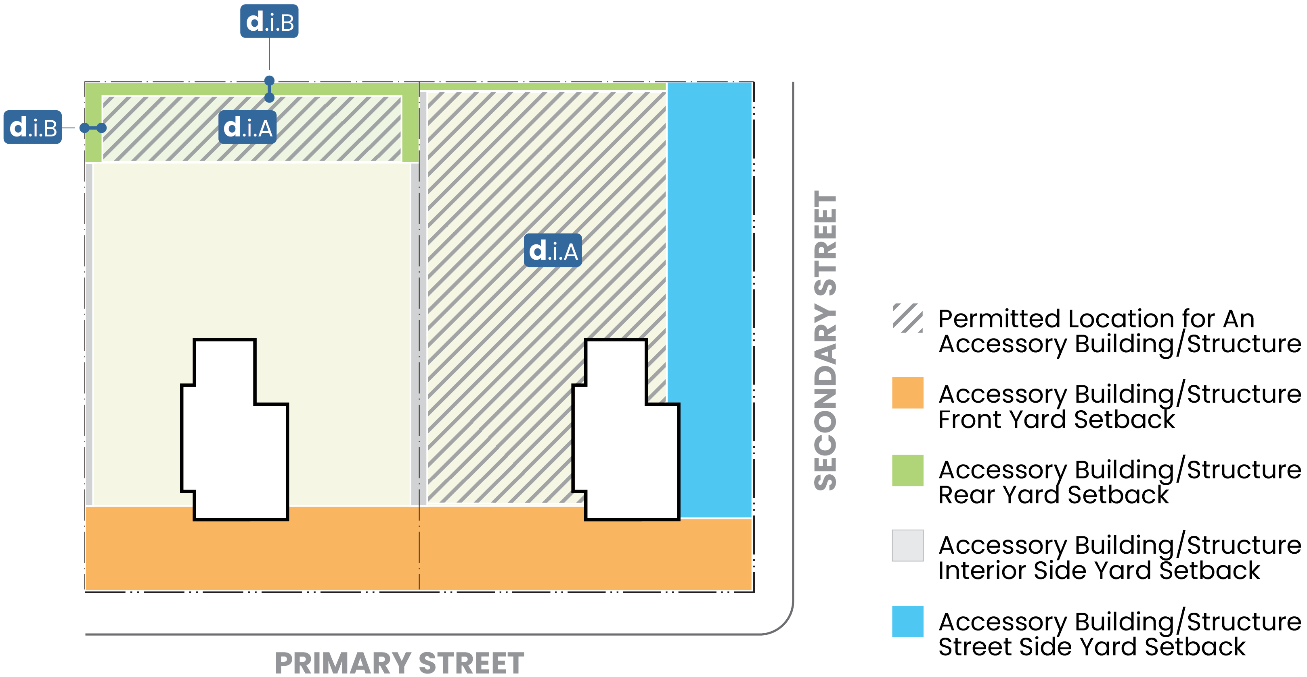
Figure 9 Accessory Building
d.
Prohibited Structures and Uses.
i.
Campers, travel trailers and recreational vehicles are not permitted for use as an accessory structure.
2.
Drive-Through Facilities.
a.
Location. Drive-through facilities, including, but not limited to order boxes, menu boards, stacking spaces, and lanes shall be located within the buildable area of the lot of the principal use.
b.
Drive-throughs are prohibited as accessory to restaurants in the C-2 district.
c.
Stacking.
i.
Stacking Lanes. Stacking lanes shall have a minimum depth of twenty (20) feet per stacking space and the following minimum lane widths:
(A)
One lane: twelve (12) feet;
(B)
Two or more lanes: ten (10) feet per lane.
ii.
Stacking Spaces. Drive-through facilities shall have the minimum number of stacking spaces established per principal use as detailed in Table 16.03.004.B.2.c.
Table 16.03.004.B.2.c: Drive-Through Stacking Requirements
d.
Menu Boards.
i.
A drive-through facility shall be permitted a maximum of two menu boards per stacking lane.
ii.
The combined maximum area of the menu boards shall be eighty (80) square feet.
iii.
Each menu board shall not exceed:
(A)
Forty (40) square feet in area; and
(B)
Eight feet in height.
iv.
Menu boards may utilize digital display boards for one hundred percent (100%) of the permitted menu board area.
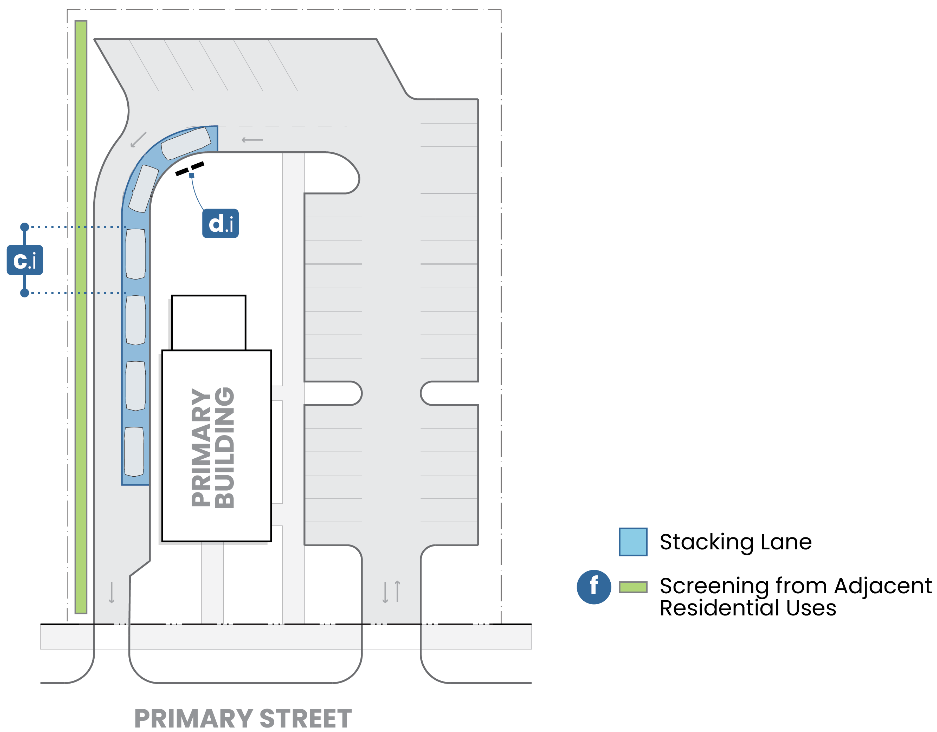
Figure 10 Drive-Through
e.
Overhead Canopy. Should an overhead canopy be utilized, it shall meet the standards of vehicle fueling station canopies, per Section 16.03.003.E.3.
f.
Screening. If located adjacent to a property with a residential use or district, a type D buffer shall be utilized to minimize the impact of menu boards, headlights, and other off-site impacts of drive-through facilities.
3.
Electric Vehicle Charging Station.
a.
Equipment.
i.
Electric vehicle charging stations (EVCS) that are accessory to all mixed-use, multi-family, and nonresidential uses shall be a minimum of a level 2 charging capacity.
ii.
Electric vehicle charging station equipment (EVSE) shall be protected by a wheel stop, curb, or bollards.
iii.
All connections of the EVCS to electrical utility equipment shall be underground.
iv.
All EVSE shall comply with the National Fire Protection Association/National Electrical Code and be approved by the underwriters laboratory.
v.
All EVSE shall be constructed of low-maintenance, durable materials and shall be vandal-proof to the extent possible.
vi.
All EVSE shall provide a cord management system that minimizes tripping hazards for pedestrians.
Charging cords may not cross sidewalks, walkways, or driveways.
b.
Design Considerations.
i.
EVSE shall be located in a manner that will not obstruct pedestrian walkways. A minimum of three feet of clearance area shall be maintained.
ii.
EVCSs shall provide a safe and clearly delineated area for maneuvering around the vehicle for connecting to the equipment.
iii.
A sign indicating that the electric vehicle parking is for use while charging only shall be provided.
iv.
All charging stations shall be illuminated. Lighting shall comply with the limitations in Section 16.04.008.
c.
Maintenance. All EVSE shall be maintained to working condition. Equipment that is no longer functional must be decommissioned, repaired, or replaced within sixty (60) days.
4.
Food Truck, Accessory.
a.
Relationship to Primary Use.
i.
Food trucks shall be allowed accessory to micro-brewery/winery/distillery, brewery/winery/distillery, and bar uses only.
ii.
The hours of operation of the accessory food truck shall not exceed the hours of operation of the principal use to which it is accessory.
iii.
Accessory food trucks shall not have separate outdoor seating areas from the principal use to which it is accessory.
b.
Location.
i.
Accessory food trucks shall be located outside of public rights-of-way.
ii.
Accessory food trucks shall be located a minimum of ten (10) feet from structures and buildings.
iii.
Accessory food trucks shall not be parked in required parking spaces.
iv.
Accessory food trucks shall not block points of ingress or egress.
v.
Accessory food trucks shall not be located in a manner that interferes with vehicle, pedestrian, or bicyclist circulation.
c.
Electrical service shall be provided to accessory food trucks. No generators shall be allowed.
d.
Accessory food trucks shall not have audio amplification.
e.
An accessory food truck operator shall be responsible for proper disposal of waste, trash, and grease.
f.
An accessory food truck operator shall be responsible for obtaining any applicable state and county approvals/permits. All required village, county, and state permits and licenses shall be clearly displayed on the food truck.
5.
Garden, Accessory.
a.
All storage/stockpiling of compost and organic matter on site shall:
i.
Not cover more than twenty percent (20%) of the total area of the property;
ii.
Be located in rear or interior side yard;
iii.
Be managed to prevent rodents and pests;
iv.
Be maintained to prevent odors; and
v.
Be located to prevent leachate from flowing onto adjacent property or into natural or human-made storm channels.
b.
The site shall be designed and maintained to prevent water from irrigation and/or other activities and/or fertilizer from draining onto adjacent property.
6.
Home Occupation.
a.
Use Accessory To. Home occupations shall be allowed accessory to any single-unit residential use.
b.
Location. A home occupation may be located interior to the principal dwelling or in an accessory building meeting all standards of Section 16.03.004.B.1.
c.
Employees. Only residents of the property may be employed by a home occupation.
d.
Outside Entrance. A home occupation shall not have a separate entrance.
e.
On-Site Customers/Clients. A home occupation may receive, by appointment only, no more than three customers or clients on site at any one time.
f.
Signs. No advertising sign, other than a name plate not exceeding one square foot in total area, shall be displayed in connection with a home occupation.
g.
Prohibited Home Occupations. The following uses shall be prohibited as home occupations:
i.
All public and institutional uses;
ii.
All commercial uses, with the exception of personal services and professional services;
iii.
All industrial and automotive uses;
iv.
All utilities and infrastructure uses; and
v.
All agriculture- and animal-related uses.
7.
Outdoor Display/Sale of Merchandise, Outdoor Seating for Eating and Drinking Uses.
a.
Principal Use. Outdoor seating/display shall be allowed accessory to a legally conforming principal use only.
b.
Location. Accessory outdoor seating/display areas may be located:
i.
On a public sidewalk directly in front of the principal use to which the outdoor seating is accessory so long as:
(A)
A clear pathway at least five feet wide is maintained to allow pedestrian traffic along the sidewalk and from the sidewalk to the entrance of the establishment. A greater width may be required by the CED Director to ensure the safe and convenient flow of pedestrian traffic; and
(B)
A clear separation of at least five feet is maintained from any alley, crosswalk, fire hydrant, or similar public or emergency access feature in or near the sidewalk. A greater distance may be required by the CED director to ensure accessibility of the public or emergency access features.
ii.
In a parking lot so long as:
(A)
No more than ten percent (10%) of the required parking spaces (per Section 16.04.001) are utilized;
(B)
The outdoor seating/display area is directly accessible from inside the principal use to which it is accessory;
(C)
The outdoor seating/display area is surrounded by a barrier between three and four feet in height; and
(D)
It is located within the buildable area of the lot, per Chapter 16.02.
c.
Noise. No sound production or reproduction machine or device (including, but not limited to musical instruments, loudspeakers, and sound amplifiers) shall be used, operated, or played in an outdoor seating/display area within fifty (50) feet of a residential use or district.
d.
Hours of Operation. Hours of operation shall be the same as those for the principal use to which the outdoor seating/display area is accessory. The outdoor seating at bars and taverns may require separate standards, as referenced in Section 16.03.003.D.2.a.
e.
Furnishings.
i.
Tables, chairs, umbrellas, and other furnishings associated with the outdoor seating/display area shall be of sufficient quality design, materials, and workmanship to ensure the safety and convenience of area occupants and compatibility with adjacent uses.
ii.
If located on a public sidewalk, no tables, chairs, umbrellas, or other furnishings or equipment associated with the outdoor seating area shall be attached, chained, or otherwise affixed to any curb, sidewalk, tree, post, sign, or other fixture within the outdoor seating/display area.
8.
Outdoor Storage Yard.
a.
Outdoor storage yards shall be fully concealed from the right-of-way and adjacent property by the principal building or an opaque wall or fence meeting the standards of Section 16.04.005.
b.
A type A buffer, as detailed in Table 16.04.003.H.2shall be required along lot lines adjacent to any parcel in the I-1, I-2, RR, or P-1 districts.
c.
A type D buffer, as detailed in Table 16.04.003.H.2, shall be required along lot lines adjacent to any parcel in the R-1, R-2, R-3, R-4, R-5, C-1, C-2, or DT districts.
d.
Outdoor storage areas shall be paved with an appropriate material that prevents erosion and rutting and manages on-site stormwater, as approved by the CED director or village engineer.
9.
Solar Energy Collection System, Canopy.
a.
Canopy solar energy collection systems are permitted over any principal or accessory parking lot.
b.
The height of canopy solar energy collection systems shall not exceed the height of the principal building that the parking area serves or twenty (20) feet, whichever is greater.
c.
The minimum height of solar energy collection systems shall allow clearance for emergency and service vehicles.
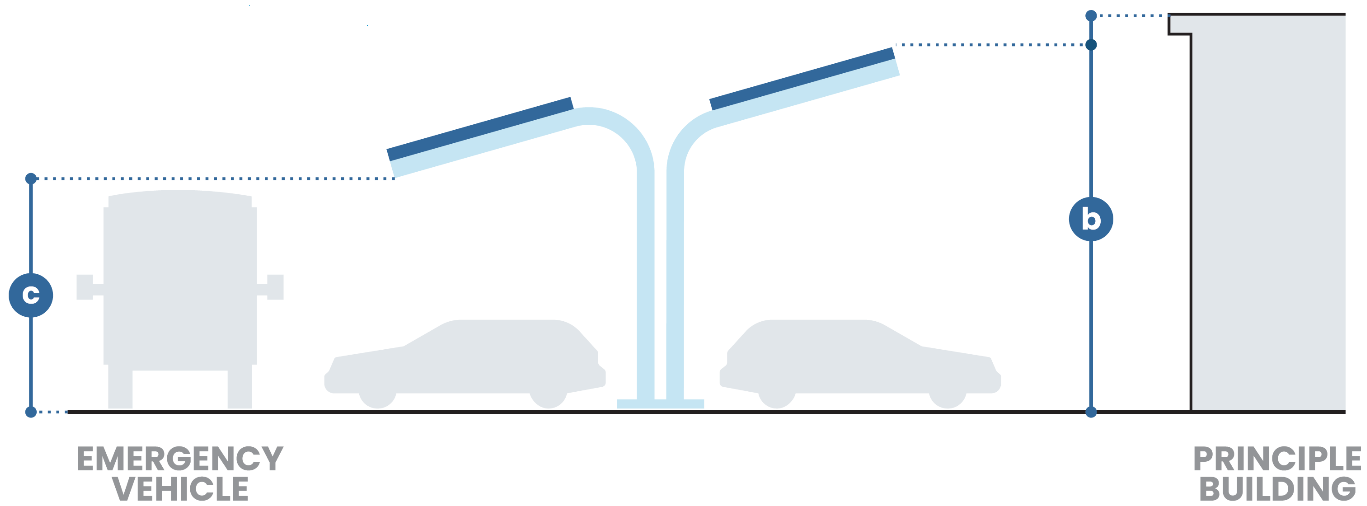
Figure 11 Solar Energy Collection System, Canopy
10.
Solar Energy Collection System, Ground.
a.
Ground mounted solar energy collection systems shall be permitted in the rear yard only.
b.
The maximum height of ground mounted solar energy collection systems shall be five feet in height, measured from the grade at the base of the pole to the highest edge of the system.
c.
Minimum clearance between the lowest point of the system and the surface on which the system is mounted is twelve (12) inches.
d.
All parts of the freestanding system shall be set back ten (10) feet from the side and rear lot lines. The system shall not be located in a public utility easement.
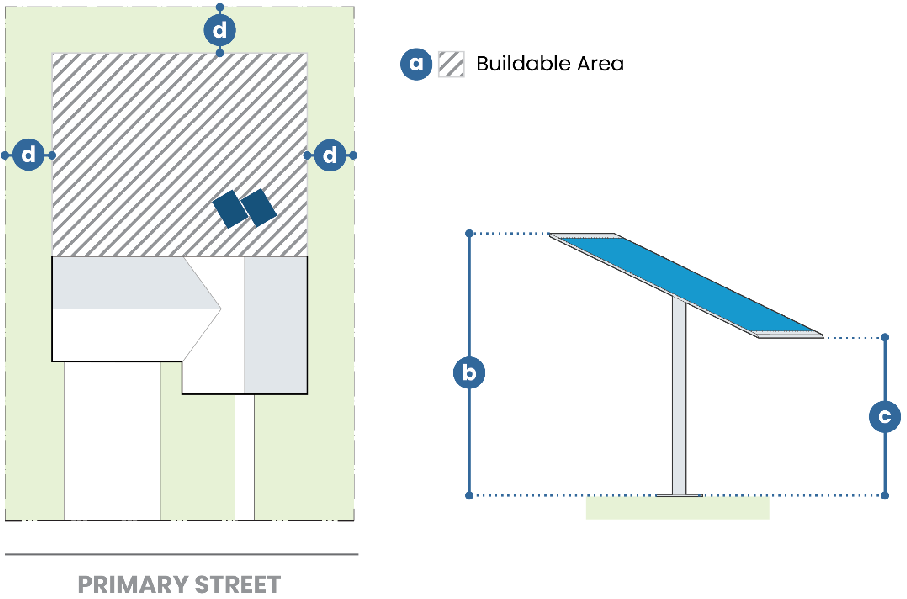
Figure 12 Solar Energy Collection System, Ground-Mounted
11.
Solar Energy Collection System, Roof Mounted.
a.
Roof-mounted solar energy collection systems may be located on any roof face of principal or accessory buildings. Systems should be flush mounted when possible.
b.
Systems on structures thirty-five (35) feet or less in height shall not extend beyond twelve (12) inches parallel to the roof surface.
c.
Systems on structures greater than thirty-five (35) feet in height shall not extend beyond thirty-six (36) inches parallel to the roof surface.
d.
Systems on all structures shall not extend above the highest peak of a pitched roof.
e.
All materials used for racking, mounts, mounting clamps, and flashings shall be of a color consistent with the color of the roof surface to minimize visibility.
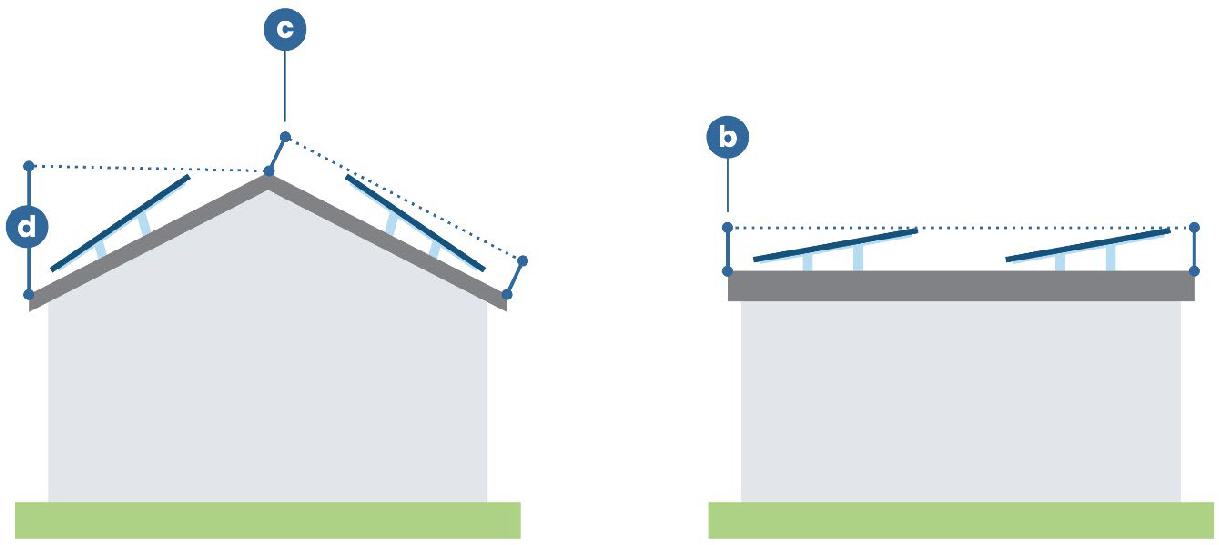
Figure 13 Roof Mounted Solar Energy Collection System
(Ord. No. 2025-O-03, § 10(Att. A), 2-12-25)
16.03.005 - Temporary uses.
A.
Temporary Uses Table. The following shall be used in the interpretation of Table 16.03.005.A.
1.
Permitted Uses (P). Uses which are marked as "P" in the table shall be allowed principal uses subject to all applicable regulations of this UDO.
2.
Special Uses (S). Uses which are marked as "S" in the table shall require approval as a special use as detailed in Section 16.08.006 prior to establishment.
3.
Temporary Uses (T). Uses which are marked as "T" in the table shall require approval as a temporary use as detailed in Section 16.03.005 prior to establishment.
4.
Prohibited Uses. A blank space in the table indicates that a use is prohibited.
5.
Uses Not Listed. A use not specifically listed is prohibited unless.
6.
Supplemental Standards. If a use has supplemental standards, they are referenced in the supplemental standards column. Supplemental standards shall apply to the use, regardless of whether it is a permitted, limited, or conditional use.
Table 16.03.005.A: Temporary Uses by District
B.
Temporary Use Standards.
1.
Contractor Trailer/Temporary Real Estate Sales.
a.
Contractors' trailers and temporary real estate sales model units are allowed when accessory to a construction project or a new development.
b.
Contractors' trailers and temporary real estate sales model units shall be limited to a period not to exceed the duration of the active construction phase of such project or the active selling and leasing of space in such development.
c.
Contractors' trailers and temporary real estate sales model units shall not contain any sleeping or cooking accommodations, except if located in a model unit.
d.
No such trailer, unit, or office shall be used as the general office or headquarters of any firm.
2.
Pop-Up Business.
a.
The maximum of four pop-up business operations shall be allowed per calendar year on one given parcel.
b.
The duration of each pop-up business operation shall be approved by the CED director. The maximum duration for any individual pop-up business shall be ninety (90) days.
c.
Pop-up businesses shall maintain all relevant registration and licenses with state offices.
3.
Seasonal Sales.
a.
Seasonal sales areas may use a maximum of twenty percent (20%) of the parking spaces required for the operation of the principal use or two thousand (2,000) square feet, whichever is less.
b.
Seasonal sales areas shall not block circulation and movement of emergency vehicles.
c.
Seasonal sales areas shall not block pedestrian walkways in a manner which reduces the width of that walkway to less than five feet.
d.
Seasonal sales hours of operations shall be limited to between 8:00 a.m. and 9:00 p.m.
(Ord. No. 2025-O-03, § 10(Att. A), 2-12-25)

