
Scottsboro City Zoning Code
ARTICLE 10
- PARKING AND LOADING REQUIREMENTS
§ 10.1.- Off-street parking and loading terms.
10.1.1.
The following off-street parking and loading terms, when used in this article, shall have the meanings defined in this section:
1.
Employee: The maximum number of persons employed at the facility regardless of the time period during which this occurs or whether the persons are full-time employees. The major shift may be a particular day of the week or a lunch or dinner period in the case of a restaurant.
2.
Gross leasable area (GLA): The total floor area for which the tenant pays rent and that is designed for the tenant's occupancy and exclusive use. GLA does not include public or common areas, such as utility rooms, stairwells and corridors.
3.
Loading area: That area used to satisfy the requirements of this ordinance for truck loading and unloading.
4.
Loading space: An off-street space or berth used for the unloading or loading of commercial vehicles.
5.
Occupancy load: The maximum number of persons, which may be accommodated by the use as determined by its design or by fire code standards.
6.
Parking aisle: That portion of the parking area consisting of lanes providing access to parking spaces.
7.
Parking area: An improved area on a lot exclusively used or designed for use as a temporary storage area for motor vehicles, containing access driveways, parking aisles and parking spaces.
8.
Parking space: That portion of the parking area set aside for the parking of one vehicle.
9.
Stacking space: An off-street space for the temporary stacking of vehicles with an aisle intended to serve a drive-in teller window, take-out food window, dry cleaning/laundry pick-up or similar type activity station.
§ 10.2. - Required off-street parking spaces.
In all zoning districts there shall be provided, at the time any permitted use is established, enlarged or increased in capacity, off-street parking spaces in accordance with the requirements set forth in this article pursuant to table 10-1. For uses not specifically mentioned in the table, parking requirements shall be determined by the zoning official using the most analogous use in the table. Fractional off-street parking space requirements shall be counted as a whole space if the fraction is greater than one-half.
Off-street parking areas shall not be considered as loading or unloading areas. No off-street parking facility, in existence at the effective date of these regulations, shall be reduced to less than the amount required for the use involved.
10.2.1.
Site plan review. All off-street parking areas with 15 or more parking spaces shall be subject to site plan review by the commission.
10.2.2.
Off-street parking design requirements.
1.
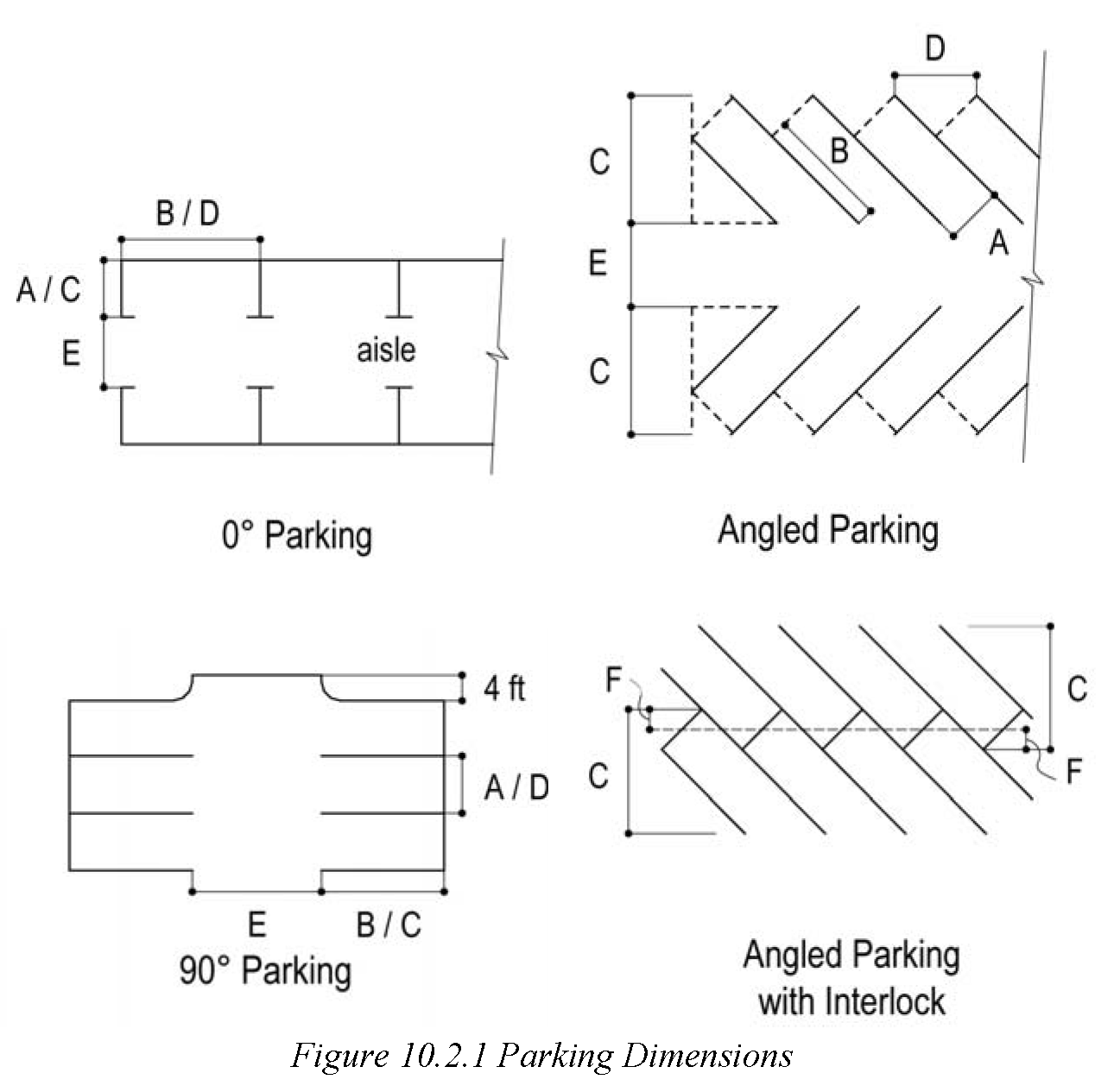
The minimum parking space dimensions shall be as shown in table 10-2 and figure 10.2.2.
2.
In parking areas of 20 or more parking spaces, up to 20 percent of the spaces may be reserved for compact cars. Such spaces shall contain a minimum rectangular area of eight feet in width and 16 feet in length. These spaces shall be conspicuously marked for compact cars only.
3.
Stacking space shall contain a minimum rectangular area of ten feet in width and 20 feet in length and be separate from parking aisles and spaces.
4.
Handicapped parking spaces shall be provided and designed in accordance with the applicable provisions of the city building code.
5.
All off-street parking areas shall be so designed and be of such size that no vehicle is required to back into a public street for egress, except for lots devoted to single family and duplex dwellings. However, backing into arterials shall be prohibited in all cases.
6.
Parking areas for all developments shall be so designed that sanitation, emergency and other public service vehicles can adequately and safely serve such developments without the necessity of backing unreasonable distances or making other dangerous maneuvers. Fire lanes may be required by the fire code.
7.
All permanent off-street parking areas shall be of a hard surface or in such a manner that no dust will result from continuous use. All parking areas shall be maintained in good condition, i.e. free of potholes, weeds, trash, refuse, etc.
8.
Parking spaces, except those serving single-family and duplex dwellings, shall be clearly marked and meet all city specifications.
9.
Drainage in parking areas shall direct stormwater back into the site from adjacent properties toward adequate drainage channels. Drainage plans shall be subject to approval by the city engineer.
10.
The area between the street and an off-street parking lot shall have a curb, or similar barrier, as approved by the zoning official, separating the parking lot from the sidewalk to prevent the encroachment of vehicles onto the sidewalk.
10.2.3.
Location of required parking.
1.
All required parking spaces shall be located on the same lot as the use served by the parking, except as provided below:
a.
Required parking within planned residential developments may be provided in common parking areas.
b.
If the number of required parking spaces cannot reasonably be provided on the same lot as the served use, remote parking may be permitted by a special exception if within 500 feet of the concerned lot. Such special exception requires legal documentation that the applicant has the right to use such remote spaces.
2.
No off-street parking shall extend beyond any lot line, unless approved by the city engineer for common parking areas with cross access between uses on abutting lots.
10.2.4.
Joint and shared parking. Joint off-street parking facilities for two or more uses may be established so long as the required number of off-street parking spaces shall not be less than the sum of the requirements for the individual uses computed separately. However, subject to approval by the commission, minimum parking requirements for a mixed-use development may be reduced by calculation of shared parking requirements using the shared parking demand information in table 10-3.
10.2.5.
Parking prohibitions.
1.
The use of off-street parking in any residential district for non-residential purposes is prohibited.
2.
The use of any required parking space for the storage of any motor vehicle for sale or for any purpose other than parking is prohibited.
*Different parking demands may be used than the typical shown here if documented in a parking demand study.
§ 10.3. - Off-street loading.
In all zoning districts where permitted uses require the receipt or distribution of material or merchandize by truck or similar vehicle, off-street loading and unloading space shall be provided. Such requirements shall apply to new structures or that portion of existing structures that are altered or expanded after the effective date of this ordinance.
10.3.1.
One space shall be required for the first 20,000 square feet of floor area plus one additional space for each 20,000 square feet of floor area up to 100,000 square feet and one space for each additional 40,000 square feet thereafter. However, the approving authority may waive loading requirements for uses under 8,000 square feet.
10.3.2.
Off-street loading design standards.
1.
The minimum size of a loading space shall be 15 feet by 50 feet, exclusive of driveway and maneuvering space. Each space shall allow vertical clearance of 14 feet.
2.
Joint or combined off-street loading space for two or more buildings on the same lot can be provided as long as the amount of such combined off-street space is equal in size and capacity to the combined requirements of the buildings to be served.
3.
No street or alley shall be considered as part of the off-street loading area.
4.
All loading areas shall be so designed and located to permit traffic to exit facing a street or alley. Off-street loading spaces may occupy required yard areas provided that no loading space shall be located within ten feet of the front lot line nor within five feet of any side or rear lot line.
5.
No loading space shall be used to meet parking requirements, interfere with the on-site circulation of traffic, nor allow a truck to extend into any right-of-way or over any property line.
§ 10.4. - Driveway spacing.
The following regulations shall govern ingress and egress to all lots:
10.4.1.
Within the first 15 feet of the lot (measured from the front lot line along which a driveway is proposed) driveways shall not exceed the following widths:
1.
Single-family and duplex dwellings: 30 feet
2.
Multi-family dwellings: 40 feet (for two travel lanes)
3.
Non-residential uses: 40 feet (for two travel lanes)
10.4.2.
Access points shall be in accordance with table 10-4, driveway spacing, and the following:
1.
Single-family and duplex dwellings with greater lot frontage may only have a second access if approved by the city engineer after a determination that traffic safety and movement at the particular location will not be adversely impacted by the additional access.
2.
Corner lots-of-record may have a driveway with less than the above required distance from the intersecting street provided the driveway will be located along the street of lesser classification (as applicable) and as far as practicable from the intersection, and that, in the opinion of the city engineer, the driveway will not adversely affect traffic safety and movement on adjoining streets.
10.4.3.
No two access points on the same lot frontage shall be closer than 40 feet from their nearest edges.
10.4.4.
The area between the street and a driveway parallel to the street shall have a curb at least six inches in height and six inches in width separating the drive from the sidewalk to prevent encroachment of vehicles onto the sidewalk area.
10.4.5.
No curbs on public streets or rights-of-way shall be cut or altered without written approval of the city.
10.4.6.
Where access to a state or federal highway is controlled by regulations other than those stated herein, those rules and regulations shall prevail.

