
Scottsboro City Zoning Code
ARTICLE 5
- SUPPLEMENTARY REGULATIONS
§ 5.1.- Uses.
5.1.1.
Permitted, special exception and conditional uses. In each district no other uses other than the types specified as uses permitted-by-right or by approval of a special exception (see § 13.6) or conditional use (see § 12.11) shall be allowed. Uses permitted-by-right are permitted upon application to the zoning official. Permits shall only be issued for special exception or conditional uses upon approval by the board or the commission, respectively.
5.1.2.
Interpretation of uses. The use tables in this ordinance (i.e., table 6-1 and table 7-1) are not intended to be all-inclusive. Therefore, the zoning official may make interpretations so as to classify any questioned use within a listed use of most similar impact and characteristics.
5.1.3.
Unclassified uses. In the event the zoning official finds a new or unusual use that cannot appropriately fit a listed use in any district, the following procedures shall be followed:
1.
If compatible with the existing zoning district intent, the unclassified use shall be permitted by special exception upon approval and subject to the conditions set by the board.
2.
If the unclassified use would not be compatible with the intent of the existing zoning district, the applicant may request rezoning to another district in which the zoning official determines the unclassified use is best suited. If rezoning is sought, the unclassified use may only be permitted by special exception in the requested district. Following final action on the unclassified use, the commission may initiate an amendment to this ordinance to list the use in the most appropriate district(s).
§ 5.2. - Area and dimensional regulations.
The regulations set by this ordinance shall be the minimum regulations and shall apply to each class or kind of structure or land, and particularly, expect as hereinafter provided:
5.2.1.
No building, structure, or land shall hereafter be used or occupied, and no building or structure or part thereof shall hereafter be erected, constructed, reconstructed, moved, or structurally altered except in conformity with this ordinance.
5.2.2.
No building or other structure shall hereafter be erected or altered:
1.
To exceed the height or bulk;
2.
To accommodate or house a greater number of families;
3.
To occupy a greater percentage of lot area;
4.
To have narrower or smaller rear yards, front yards, side yards, or other open spaces; than herein required; or in any manner contrary to the provisions of this ordinance.
5.2.3.
Every part of a required yard shall be open to the sky, unobstructed by any structure or part thereof, and, unoccupied for storage, servicing or similar uses, except as otherwise specified in this ordinance.
5.2.4.
No part of a yard, or other open space, or off-street parking or loading space required about or in connection with any building for the purpose of complying with this ordinance, shall be included as part of a yard, open space, or off-street parking or loading space similarly required for any other building, unless specifically provided for otherwise in this ordinance.
5.2.5.
No yard or lot existing at the time of passage of this ordinance shall be reduced in dimension or area below the minimum requirements set forth herein. Yards or lots created after the effective date of this ordinance shall meet at least the minimum requirements established by this ordinance.
5.2.6.
All territory, which may hereafter be annexed to the city, shall be considered to be in the low density residential district, unless otherwise classified. However, if an annexation petitioner desires to have property classified within any zone other than R-1, following annexation, the petitioner must obtain the approval from the commission prior to the submission of the formal annexation request to the council, and the council must approve such zoning classification.
5.2.7.
Each structure hereafter erected or altered shall comply with the area and dimensional regulations applied by this ordinance. Exceptions to these requirements are as follows:
1.
Where the owner of a lot of official record at the time of adoption of this ordinance does not own sufficient adjacent land to enable such owner to conform to area and dimensional requirements, one building and its accessory structures may be built provided the setbacks and other requirements conform as closely as possible, in the opinion of the board, to the requirements of the applicable district; and further provided that neither side yard shall be reduced to less than five feet in width, except where a lesser or no side yard setback is required.
2.
No building shall be required to be set back more than the average of the setbacks of the existing principal buildings within 100 feet each side thereof.
§ 5.3. - Height.
Height limitations shall not apply to church steeples, barns, silos, farm structures, chimneys, flag poles, public utility poles, cooling towers, water tanks, and industrial structures, when required by manufacturing process and provided the structure does not exceed 25 percent of the lot area, except in those districts where height restrictions are for the protection of aircraft.
§ 5.4. - Structures.
It is the intent of this ordinance that there shall be but one principal structure plus any permitted accessory structures on any lot used for single-family or duplex dwellings; however, any and all accessory structures shall not be used as living quarters, unless specifically permitted by this ordinance. This shall not apply to single-family and duplex dwelling developments under condominium ownership that otherwise meet the area and dimensional requirements of this ordinance. Protective shelters classified as accessory structures may provide temporary living quarters in times of danger or emergency.
§ 5.5. - Future street lines.
On any lot which, as of the effective date of this ordinance or amendment thereto, may be reduced in area by widening a public street to the right-of-way width indicated on any duly adopted federal, state, regional county or municipal plan, or as same may be hereafter amended, the minimum required yards, lot area, lot width, and lot coverage area shall be measured by considering such future street lines as the lot line of the concerned lot. However, upon a recommendation by the city engineer, the commission may modify this requirement as it applies to streets under the city's jurisdiction.
§ 5.6. - Rear yard abuts a public street.
When the rear yard of a lot abuts a public street, all buildings or structures on that rear yard shall observe the same setback from the street line or property line as required for adjacent properties which front on that street. In addition, any structure located within 25 feet of that setback line shall observe the side yard requirements of the adjoining properties fronting on that street.
§ 5.7. - Intersection visibility.
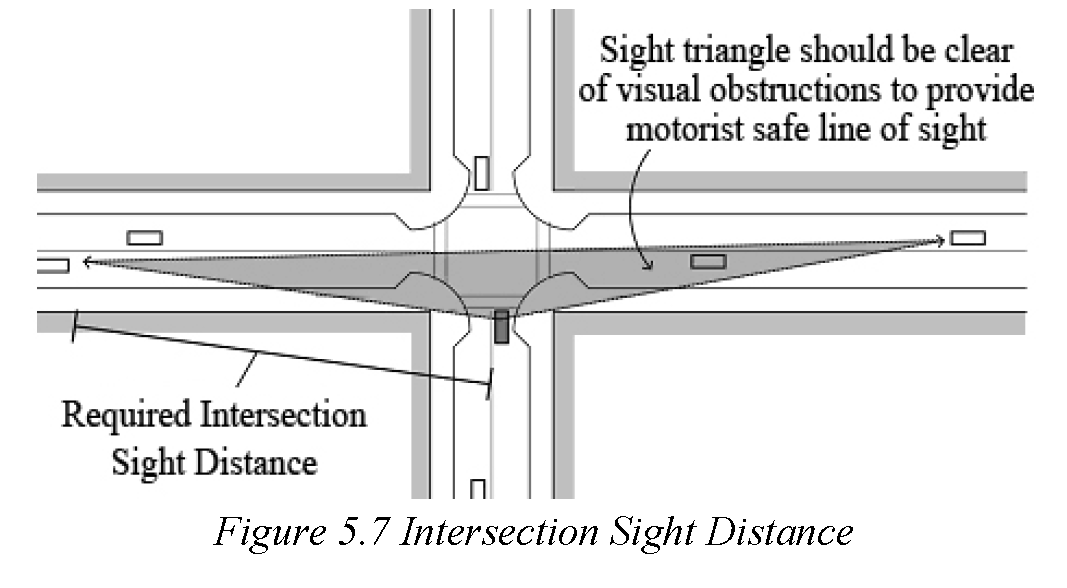
To provide a clear view at intersections, there shall be an unobstructed triangular area at the intersection of any two streets or a street with a driveway, alley or railroad. The size of this triangular area shall be determined in accordance with table 5-1. Such distance shall be measured from the position of a car stopped at the intersection to the centerline of the intersecting street, as shown in figure 5.7. Within this triangular area, no structure, sign or planting shall be permitted which obstructs motorists view between a height of 2.5 feet and eight feet above grade level at the intersection.
1 Distances are intended as a minimum guideline. Site conditions such as grades, traffic volumes, signalization types, etc. may warrant increases in desired sight distances.
§ 5.8. - Rear dwelling prohibited.
No accessory structure or building on the lot of a single-family or duplex dwelling, other than the principal building used for such single-family or duplex dwelling, may be used for residential purposes, unless specifically approved as part of a planned development.
§ 5.9. - Location of accessory buildings.
Accessory buildings may be erected on any lot; however, such buildings shall be located so as to comply with the following requirements:
5.9.1.
No accessory building shall be erected in any required front or side yard and shall not occupy more than 30 percent of any required rear yard. Accessory buildings shall be at least five feet from all lot lines and from any building on the same lot.
5.9.2.
No accessory building not an integral part of the principal building shall be located within 40 feet from the front lot line.
5.9.3.
In the case of a corner lot adjoined in the rear by a lot facing the side street, the accessory structure shall be located in such a manner as to conform to the front and side yard requirements of the adjoining lots.
§ 5.10. - Access to public streets.
Every use, building or structure established after the effective date of this ordinance shall be on a lot or parcel with street frontage. All structures shall be as located on lots as to provide safe and convenient access for servicing, fire protection and required off-street parking.
§ 5.11. - Fences, walls, hedges.
Notwithstanding other provisions of this ordinance, fences, wall and hedges may be permitted in any required yard, or along the edge of any yard, provided no fence, wall, or hedge shall exceed 2.5 feet in height within the clear sight triangle required by § 5.7. Fences in the required front yard must be less than 2.5 feet in height or be constructed of clearly visible material so as to provide visibility through the fence.
§ 5.12. - Essential community facilities.
Nothing in this ordinance shall prohibit the provision of essential services, provided the installation of such facility or service does not violate any other applicable provision of this ordinance.
Nothing contained in this section shall be construed to permit the erection, construction or enlargement of any building, tower, or maintenance depot for provision of an essential community facility or service except as otherwise permitted in this ordinance.
§ 5.13. - Access streets.
The following regulations shall apply to all commercial and industrial developments located on major arterials:
5.13.1.
There shall be provisions made by the developer whereby adequate land shall be set aside to provide an access street parallel to the major arterial.
5.13.2.
The developer shall provide a paved access street for the length of the lot frontage and that meets city specifications.
5.13.3.
Ingress and egress points to the access road from private property shall be coordinated by the developer with the city engineer.
5.13.4.
The commission may waive any parts of this provision governing access streets if its is determined by the city engineer that direct access will not adversely affect traffic safety and movement on the major arterial and any adjoining streets.
§ 5.14. - Parking and storage of certain vehicles.
Automotive vehicles or trailers of any kind or type without current license plates, or which are inoperable or otherwise disabled for a period of 30 consecutive days, shall not be stored or parked on any residentially zoned property, whether occupied as a residence or not, or on property used for residential purposes in a non-residential district other than in a completely enclosed building. For the purposes of this section, a vehicle shall be deemed inoperable or otherwise disabled if it is unable to operate on the streets and roadways of the State of Alabama in full compliance with the various provisions of the Code of Alabama, 1975, as amended.
Campers, travel trailers, or recreational vehicles may be stored in any residential district provided that they are parked in either the side or rear yards, or in a garage or accessory structure conforming to the requirements of this ordinance. No such vehicle shall be used for living, sleeping, or housekeeping purposes when parked or stored on a residential lot or in any location not approved for such use.
§ 5.15. - Manufactured homes and portable buildings.
5.15.1.
Manufactured homes not in use may be stored only in conforming manufactured home sales lots, within the confines of a building, or in individual lots in conforming manufactured home parks with only one manufactured home permitted per manufactured home space.
5.15.2.
Portable buildings meeting the definitions of Class A or B manufactured homes may be used as bona fide construction offices on any premises for which a building permit has been issued and remains valid.
5.15.3.
Portable buildings meeting the definitions of Class A or B manufactured homes may be used as accessory structures on lots in non-residential districts that are already developed with a permanent structure that houses the principal use. In such cases, the portable building may only house a use that is customarily incidental to the principal use, including a caretaker dwelling, but shall only be placed behind the front building line. Where such placement is insufficient to obscure public views of the portable building, screening may be required by the zoning official, consistent with the standards in § 11.3, screening.
5.15.4.
In accordance with § 12.3, Building Permit Required, the placement of any manufactured home on property, whether temporarily or permanently, shall require a building permit. This shall not apply to the placement of a manufactured home on a previously approved manufactured home park space nor the placement of a manufactured home for sale on an approved manufactured home sales lot.
§ 5.16. - Swimming pool.
5.16.1.
Swimming pools shall not be located closer to any lot line than ten feet, and non-commercial pools shall be enclosed by a fence or wall not less than four feet to prevent uncontrolled access.
5.16.2.
Private swimming pools may be established in residential districts for the exclusive use of the occupants of the subject property and their guests and provided that no part of the swimming pool extends into any required front or side yard.
§ 5.17. - Additional regulations for areas of special flood hazard.
All properties within areas of special flood hazard, as defined in Ordinance 439, Flood Damage Prevention Ordinance, City of Scottsboro, shall also be subject to the applicable regulations of said ordinance in addition to the requirements of this ordinance. Wherever there is a conflict between the provisions of this ordinance and those of Ordinance 439, the more restrictive shall apply.
§ 5.18. - Ownership and maintenance of common open spaces and facilities.
For all proposals involving the creation of open spaces or facilities (including stormwater detention ponds and similar facilities) to be owned and maintained by a developer or a homeowner, property owner, or condominium association, including where such open spaces are required by this ordinance, the following shall apply:
5.18.1.
Owner's association. In the case of an owner's association, such association shall own the common open space or facility in perpetuity. Membership in the association shall be mandatory and automatic for all owners of the subdivision or condominium and their successors. The association shall have lien authority to ensure the collection of dues from all members. The responsibility for maintaining the common open space and/or facilities located thereon shall be borne by the association.
5.18.2.
Management plan, submittal. The applicant shall submit, along with a proposed preliminary plat or site plan, as applicable, a plan for the management of open space and/or common facilities that:
1.
Allocates responsibility and guidelines for the maintenance and operation of the common open space/facilities including provisions for ongoing maintenance and for long-term capital improvements;
2.
Estimates the costs and staffing requirements needed for maintenance and operation of, and insurance for, the common open space/facilities and outlines the means by which such funding will be obtained or provided;
3.
Provides that any changes to the plan be approved by the commission; and
4.
Provides for enforcement of the plan.
In the event the party responsible for maintenance of the common open space fails to maintain all or any portion in reasonable order and condition, the city may enter the premises and take corrective action, including the provision of extended maintenance. The costs of such maintenance may be charged to the association, or to the individual owners that make up the association, and may include administrative costs and penalties. Such costs shall become a lien on all involved properties.
§ 5.19. - Noise standards.
In addition to the separation and landscaping requirements of § 11-1, Buffers, no use shall produce continuous, recurring, scheduled or intermittent noise beyond its property and that exceeds the levels indicated in table 5-2.
5.19.1.
Any use which may produce noise levels in excess of those permitted at the property line as indicated in table 5-2 shall be required to incorporate noise baffles or other noise suppression techniques in order to comply with these requirements.
5.19.2.
Exemptions. The following uses and activities shall be exempt from this § 5.19:
1.
Noise from safety signals, warning devices, and emergency pressure relief valves.
2.
Noise from any authorized emergency vehicle, when responding to an emergency call or acting in time of emergency.
3.
Noise from aircraft or railways.
4.
Noise from utility stations, utility substations or utility plants.
5.
Noise from construction activities occurring between 7:00 a.m. and sundown or from temporary operation of maintenance equipment or activities in residential and commercial areas between the hours of 7:00 a.m. and 9:00 p.m.
5.19.3.
Where a change in zoning or use occurs on abutting property, the noise from a pre-existing industrial or commercial use shall be subject to the pre-existing restrictions, as if the zoning or use of the abutting property had not changed.
§ 5.20. - Lighting standards.
The intent of these standards is to reduce the impacts of glare, light trespass and light pollution while promoting safety and energy conservation. For all non-residential and multi-family developments, the following shall apply:
5.20.1.
Definitions. For this § 5.20, the following terms shall have the meanings provided herein:
1.
Floodlighting: Artificial lighting so directed or diffused as to provide comparatively uniform illumination over a large area.
2.
Full cut-off light fixture: A light fixture that, by design of the housing, does not allow any light dispersion or direct glare to shine above 90-degree horizontal plane from the base of the fixture.
3.
Glare: The sensation produced by a bright light source that is sufficiently brighter than the level to which the eyes are adapted, which causes annoyance, discomfort, or loss in visual performance.
4.
Glare, direct: Glare resulting from direct line-of-sight eye contact with a direct light source.
5.
Light trespass: Light from an artificial source that is intruding into an area where it is not wanted or does not belong.
6.
Light fixture shield: A non-reflective covering, canopy or other such device fitted over a light source preventing light from illuminating an area not intended to be illuminated.
7.
Uplighting: Any light source that distributes illumination above a horizontal plane.
5.20.2.
Standards.
1.
All outdoor lighting fixtures shall be designed, shielded, aimed, located and maintained to prevent light trespass and glare onto adjacent properties or roadways.
2.
The intensity, location, and design of lighting shall be such that not more than one foot candle of light is cast upon adjacent residential property.
3.
Light fixtures shall be full cut-off fixtures, with the following exceptions:
a.
Holiday lighting from November 15 to March 1.
b.
Sensor activated lights, provided that:
1)
It is located in such a manner as to prevent glare and lighting onto properties of others or into the public right-of-way;
2)
The light is set to illuminate only when activated and to extinguish within five minutes after activation has ceased; and
3)
The light must not be triggered by activity that occurs off of the subject property.
c.
All temporary emergency lighting needed by fire and police departments or other emergency agencies.
d.
Floodlights with external shielding if the luminaire does not cause glare or light to shine on adjacent property or public rights-of-way.
e.
Uplighting for flags, address markers, and architectural features and low-voltage landscape lighting, provided that direct illumination is focused exclusively on the object and away from adjoining properties and public streets and sidewalks. In all cases, uplighting must not cause glare or light trespass.
f.
Light fixtures that have a maximum output of 1,000 lumens per fixture (equal to a single 60-watt incandescent light), regardless of the number of lamps, provided:
1)
The bulb of the fixture is not visible;
2)
The fixture uses frosted, opalescent, clear or iridescent glass;
3)
The fixture has an opaque top or is under an opaque portion of the building;
4)
If the fixture utilizes clear glass, the output of the fixture must be shielded by the architecture of the structure; and
5)
All fixtures must not cause glare or light trespass beyond the property.
g.
Floodlighting used for outdoor recreational facilities provided:
1)
To the extent practicable, all light fixtures/light poles used to illuminate playing fields, courts and other outdoor recreational facilities, shall be set back a minimum of one foot for every foot in height from any residential property line or right-of-way.
2)
In any case, floodlighting shall be turned off no later than one hour after an event is concluded. The fixtures must be aimed so that their beams are directed and fall within the primary playing or performance area. All sports and event lighting must be equipped with a glare-control package (louvers, shields or similar devices) and the fixtures must be aimed so that beams are directed and fall within the primary playing area and light trespass is minimized.
4.
In parking lots, light fixture poles shall not be more than 30 feet in height.
5.
Light fixtures under any canopy shall be recessed into the canopy ceiling with a flat lens to prevent glare. The bottom of the fixtures may protrude a no more than two inches from the ceiling. No other portions of the canopy not included in the sign area shall be illuminated.
5.20.3.
Lighting plan required. For all non-residential and multi-family developments involving off-street parking areas in excess of 20 spaces, a lighting plan shall be submitted as part of the required site plan. The lighting plan shall be prepared by a registered engineer, design or lighting professional and shall include the information listed in appendix 5.

