
Scottsboro City Zoning Code
ARTICLE 2
- DEFINITIONS
For the purposes of this ordinance, certain terms or words used herein shall be interpreted as follows:
§ 2.1.- Interpretation.
2.1.1.
The word "used" or "occupied" as applied to any land or building shall be construed to include the words "intended, arranged, or designed to be used or occupied."
2.1.2.
The word "building" includes "structure."
2.1.3.
The word "person" includes a firm, association, organization, partnership, trust, company, or corporation as well as an individual.
2.1.4.
The present tense includes the future tense, the singular number includes the plural, and the plural number includes the singular.
2.1.5.
The masculine gender shall include the feminine and the feminine gender shall include the masculine.
2.1.6.
The word "shall" is mandatory; the word "may" is permissive.
2.1.7.
The word "lot" includes the words "plot" or "parcel."
2.1.8.
Except as otherwise provided herein, all words have their customary dictionary meaning. The zoning official is authorized to make a final determination of the meaning of any term used in this ordinance, which determination may be appealed to the board.
§ 2.2. - Definitions of terms used in this ordinance.
2.2.1.
Abutting: Touching along a common side, boundary or property line. Two pieces of property that are separated by a right-of-way are "adjacent", but not "abutting".
2.2.2.
Access: A way or means of approach to provide physical entrance to a property.
2.2.3.
Accessory structure or accessory building: A structure on the same lot with, and of a nature customarily incidental and subordinate to, the principal structure.
2.2.4.
Accessory use: A use of land or of a building or portion thereof commonly associated with and integrally related to the principal use of the land or building on the same lot.
2.2.5.
Adjacent: Either abutting or on the opposite side of a street, right-of-way, or easement that separates it from the subject property. Properties separated by a railroad shall not be considered "adjacent".
2.2.6.
Adjoining: See "abutting."
2.2.7.
Agriculture: The production, storage, keeping, harvesting, grading, packaging, processing, boarding or maintenance, for sale, lease, or personal use, of plants and animals, including but not limited to: forages and sod crops; grains and seed crops; dairy animals and products; poultry and poultry products; the keeping, raising and breeding of livestock; bees and apiary products; fur animals; trees and forest products; fruits, nuts and vegetables; plants and flowers; or lands that are devoted to soil conservation or forestry management.
2.2.8.
Alley: A public or private way, other than a driveway, less in width than a street, designed for the special accommodation of the property it reaches, and not intended for general circulation.
2.2.9.
Alteration: Any change or rearrangement in the supporting members of an existing building, such as bearing walls, columns, beams, girders or interior partitions, as well as any change in doors or windows or any enlargement to a building or structure whether horizontally or vertically or the moving of a building or structure from one location to another.
2.2.10.
Animal shelter: A non-profit or public facility providing shelter for small domestic animals.
2.2.11.
Applicable district: That zoning district in which a building, structure, property, or subdivision, for which a zoning application is submitted or permit is sought, is located or is to be moved.
2.2.12.
Applicant: A person submitting an application for development, variance, special exception, conditional use or rezoning.
2.2.13.
Assisted living facility: A building, portion of a building, or a group of buildings in which room, board, meals, laundry, and assistance with personal care and other services are provided for not less than 24 hours in any week to at least two ambulatory adults not related by blood or marriage to the owner and/or administrator and licensed by the State of Alabama.
2.2.14.
Automotive repair, major: An establishment engaged in the repair and maintenance of vehicles including painting, body work, rebuilding of engines or transmissions, upholstery work, fabrication of parts and similar activities all of which shall be performed entirely within an enclosed building.
2.2.15.
Automotive repair, minor: An establishment engaged in sales, installation, and servicing of mechanical equipment and parts, including audio equipment and electrical work, lubrication, tune-ups, wheel alignment, tire balancing, brake and muffler work, battery charging and/or replacement and similar activities.
2.2.16.
Automotive sales or rental: An establishment engaged in the sale or rental of automobiles, light trucks, recreational vehicles, boats, motorcycles, including the incidental parking, storage, maintenance, servicing and repair of such vehicles.
2.2.17.
Bakery, retail: An establishment, which bakes goods for on-premises retail sale only.
2.2.18.
Basement: A portion of a building located wholly or partially underground, having one-half or more of its floor-to-ceiling height above the average grade of the adjoining ground.
2.2.19.
Bed and breakfast: A single-family detached dwelling, or part thereof, where lodging and meals are provided on a daily basis; and in which the operator of the bed and breakfast resides.
2.2.20.
Bedroom: A room marketed, designed or otherwise intended to function primarily for sleeping.
2.2.21.
Block: A tract or parcel of land entirely surrounded by public streets other than alleys or a combination of streets, public land, public parks, cemeteries, railroad rights-of-way, bodies of water or watercourses, or any other barrier to the continuity of development.
2.2.22.
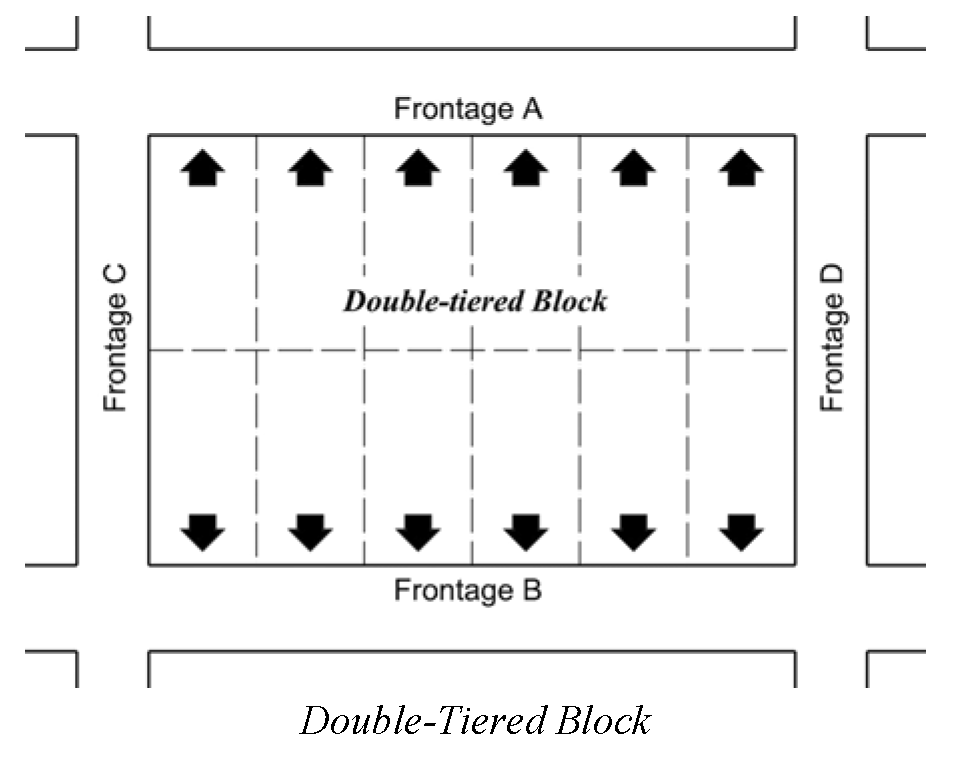
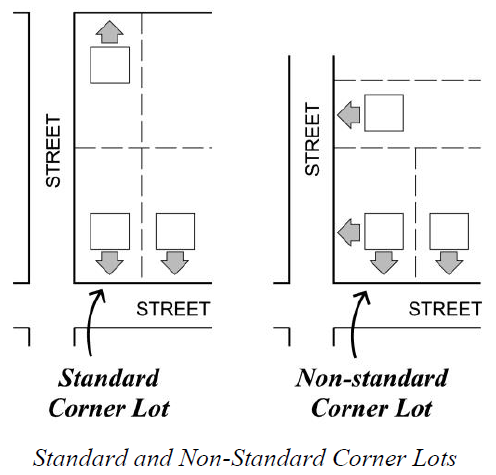
Block, double-tiered: A block for single-family detached and duplex dwellings bounded on all sides by streets and within which lots fronts only on two of the surrounding streets. The corner lots of such blocks are considered "standard corner lots".
2.2.23.
Board of zoning adjustment or board: The board of zoning adjustment of Scottsboro, Alabama.
2.2.24.
Boarding house: A single-family detached dwelling or part thereof in which, for compensation, lodging and meals are provided on a weekly or monthly basis.
2.2.25.
Broadcast studio: An establishment primarily engaged in broadcasting and other information relay services accomplished through the use of electronic and telephonic mechanisms.
2.2.26.
Buffer: A strip of land that is landscaped to separate incompatible land uses, promoting visual harmony, reducing noise, diverting emissions, and reducing glare. Buffers may consist of existing or planted trees, shrubs or vegetation, fences, walls or berms.
2.2.27.
Building: A structure, having a foundation and roof supported by columns, or by walls, designed to be used as a place of occupancy, storage or shelter.
2.2.28.
Buildable area: The portion of the lot remaining after required yards and buffers, if any, have been provided.
2.2.29.
Building area: The portion of the lot occupied by the principal building and accessory and other structures.
2.2.30.
Building code or city building code: The International Building Code as adopted, and as may be amended, by the city council.
2.2.31.
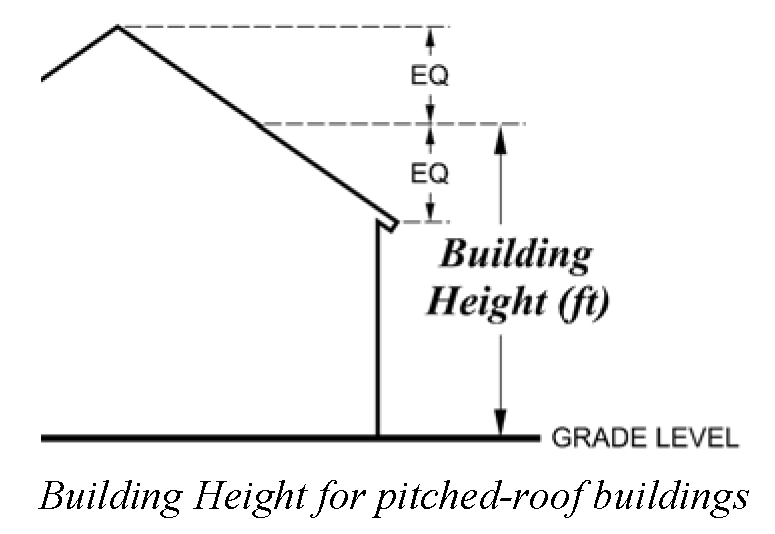
Building height: For flat roof buildings, the vertical distance measured from grade level at the front of the building to the highest point of the roof. For pitched-roof buildings, the vertical distance measured from grade level at the front of the building to the average of the eaves and ridges.
2.2.32.
Building line, front: A line extending across the width of a lot coincident with the front-most plane of the building, excluding eaves and cornices.
2.2.33.
Building official: The city official assigned by the city council to administer the city building code and provisions of this ordinance as specified herein, including his/her designee.
2.2.34.
Building, principal: The building in which is conducted the principal use of the concerned lot. This includes any structures attached to such building, including a garage, carport, porte-cochere, or porch.
2.2.35.
Building spacing: The minimum distance between buildings, measured from the outermost projection, excluding bay windows, chimneys, flues, ornamental features, cornices and eaves.
2.2.36.
Business office or professional office: A room or group of rooms used for the conduct of a business, profession, service, industry and generally furnished with desks, tables and communications equipment.
2.2.37.
Business support service: A business which supplies support services primarily to business establishments, such as sales of office equipment, supplies and services; cleaning services; computer and office equipment repair and similar services.
2.2.38.
Campground: A plot of ground on which two or more campsites are located, established, or maintained for occupancy by camping units as temporary living quarters for recreation, education or vacation purposes.
2.2.39.
City: The City of Scottsboro, Alabama.
2.2.40.
Club: A group of people organized for a common purpose to pursue common goals, interests and activities and usually characterized by certain membership qualifications, payment of fees or dues, which holds regular meetings and has a constitution or by-laws.
2.2.41.
Commercial parking: Parking of motor vehicles on a temporary basis within a commercially operated, off-street parking lot or garage.
2.2.42.
Commercial school: A private, gainful business providing instruction in arts, business, crafts, trades or professions.
2.2.43.
Communication tower: A transmission tower that either (1) serves an individual user and is not available to the general public; (2) is privately owned and operated for the purpose of leasing tower space to others; and/or (3) is a single-purpose facility and not part of a cellular network.
2.2.44.
Conditional use: A use that would not generally be appropriate throughout a zoning district without restriction(s), but which, if controlled as to number, location, area, size, traffic, noise, lighting or other impacts, would not be detrimental to public health. This use is permitted subject to approval by the commission.
2.2.45.
Condominium: A building, or group of buildings, in which dwellings units, offices, or floor area are owned individually. The structure, all land areas, and common improvements and facilities are owned by all the owners on a proportional, undivided basis.
2.2.46.
Conservation subdivision or development: A form of development that permits a reduction in dimensional requirements, provided there is no increase in the overall density of the development, and the remaining land area is devoted to open space, recreation, or preservation of environmentally sensitive areas.
2.2.47.
Convenience store: A retail establishment, often associated with a gas station, selling food products and beverages, household items, newspapers, magazines and similar goods.
2.2.48.
Council or city council: The city council of the City of Scottsboro.
2.2.49.
Country club: Land or buildings containing recreational facilities and clubhouse for private club members and their guests. Facilities in which the primary function is the operation of a casino, nightclub, dance hall or bingo hall is not considered a country club.
2.2.50.
Day care center: A licensed facility, other than a residence, providing care for part of a 24-hour day to children, elderly, handicapped or infirm persons in accordance with the applicable regulations of the State of Alabama.
2.2.51.
Density: The minimum required lot area per dwelling unit or the maximum number of dwelling units per acre of site area.
2.2.52.
Development: Any proposal to affect the use of land or structures including: subdivision, the construction, reconstruction, conversion, alteration, relocation or enlargement of a structure; any mining, dredging, fitting, grading, paving, excavation, drilling or disturbance of land; and, any use or extension of the use of the land.
2.2.53.
Dwelling: Any building or portion thereof, which is designed and used for residential occupancy.
2.2.54.
Dwelling, accessory: A dwelling located on the same lot of and that is subordinate to a detached, single-family dwelling. Accessory dwellings are commonly referred to as guest houses, garage apartments, mother-in-law units or mews units.
2.2.55.
Dwelling, caretaker: A residence, incidental to a principal use, for an on-site manager, watchman or caretaker employed on the premises.
2.2.56.
Dwelling, duplex: A building containing two single-family dwelling units totally separated from each other by an unpierced wall extending from basement to roof.
2.2.57.
Dwelling, garden/patio home: A detached, single-family dwelling on a small lot that is permitted a zero lot line on one side.
2.2.58.
Dwelling, multi-family: A building containing three or more dwelling units on a commonly shared lot.
2.2.59.
Dwelling, single-family (detached): A building containing one dwelling unit and that is not attached to any other dwelling by any means and is surrounded by open space or yards.
2.2.60.
Dwelling, townhouse: A single-family dwelling in a row of 3-8 such units in which each unit has its own front and rear access to the outside, no unit is located over another, and each unit is separated by one or more vertical common fire-resistant walls.
2.2.61.
Dwelling unit: One or more rooms occupied as separate living quarters, with cooking, sleeping, and sanitary facilities provided within the dwelling unit for the exclusive use of a single family maintaining a household.
2.2.62.
Dwelling, upper-story: A dwelling unit located on a floor above a use of another type. Upper-story dwellings may commonly be referred to as "loft apartments."
2.2.63.
Entertainment, indoor: A commercial establishment providing spectator entertainment within an enclosed building, including movie theaters, playhouses, concert halls, etc.
2.2.64.
Entertainment, outdoor: An establishment providing spectator entertainment in open or partially enclosed or screened facilities, including sports arenas, racing tracks, drive-in theaters, amusement parks, etc.
2.2.65.
Family: Any one of the following arrangements when living together in a dwelling as a single housekeeping unit:
1.
An individual.
2.
Two or more persons related by legal adoption, blood, or a licit marriage plus up to two unrelated individuals.
3.
A group of not more than five unrelated persons.
2.2.66.
Farm: Land used primarily for agricultural purposes.
2.2.67.
Farm support business: A commercial establishment engaged in the sale of farm support goods and services, including but not limited to the following: the sale of feed, grains, fertilizers, pesticides and similar farm support goods; the provision of warehousing and storage facilities for raw farm products; and the provision of veterinary services to farm animals.
2.2.68.
Fence: An artificially constructed barrier of any material or combination of materials erected to enclose or screen areas of land.
2.2.69.
Floor area, gross: The total area of a building measured using the outside dimensions of the building at each floor level intended for occupancy or storage.
2.2.70.
Fowl: Chickens, turkeys, ducks, geese, quail, guineas, etc.
2.2.71.
Front-accessed: Having vehicular access from the front of the property, requiring a driveway along a front lot line.
2.2.72.
Freight depot or truck terminal: An area and building where trucks load and unload cargo and freight and where the cargo and freight may be broken down or aggregated into smaller or larger loads for transfer to other vehicles or modes of transportation.
2.2.73.
Garden center or nursery: The growing, cultivation storage and sale of garden plants, trees, flowers, shrubs, and fertilizers, as well as the sale of garden tools and similar accessory and ancillary products, to the general public.
2.2.74.
Gas station: An establishment dispensing automotive fuels at retail. A gas station that includes minor vehicle repair activities is considered a "service station."
2.2.75.
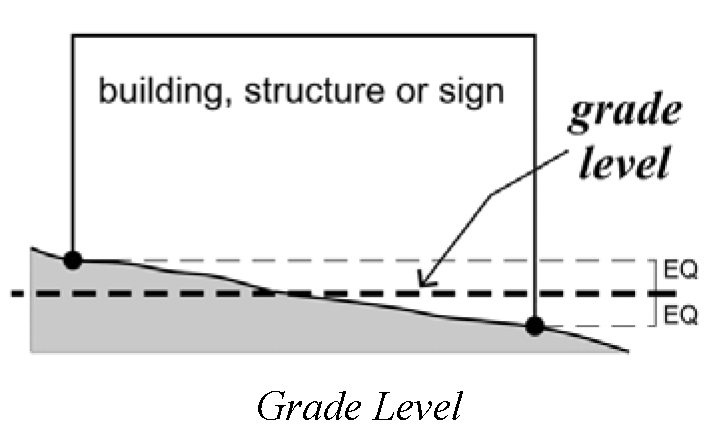
Grade Level: For buildings, the average level of the finished grade at the front building line. For trees, landscaping, signs and light fixtures, the level of finished grade at the base of the tree, plant, sign or fixture.
2.2.76.
Grocery store: A retail establishment primarily selling food, for off-premises consumption and/or preparation, as well as other convenience and household goods.
2.2.77.
Group care home: A dwelling for the sheltered care of persons, which, in addition to providing food and shelter, may also provide some combination of personal care, social or counseling services, and transportation. Group care homes are further defined and regulated by the State of Alabama.
2.2.78.
Home occupation: A business, profession, occupation or trade conducted for gain or support as an incidental activity within a dwelling.
2.2.79.
Home improvement center: A place of business providing building, yard and garden materials, appliances, tools and supplies at retail or wholesale.
2.2.80.
Hospital: An establishment providing primary health services and medical or surgical care to persons, primarily inpatients, suffering from illness, disease, injury, deformity, and other abnormal physical or mental conditions and including as an integral part of the institution related facilities such as laboratories, outpatient facilities, training facilities, medical offices and staff residences.
2.2.81.
Hotel: A lodging establishment, in which guest rooms are accessed from the interior of the building. Hotels may also include, as an incidental use, a liquor lounge.
2.2.82.
Improvement: Any permanent item that becomes a part of, is placed upon or is affixed to real estate.
2.2.83.
Independent living facility: A multi-family residential facility for the elderly. These facilities may provide meals and other services such as housekeeping, linen service, transportation, and social and recreational activities. Such facilities do not provide, in a majority of the units, assistance with activities of daily living such as supervision of medication, bathing, dressing, toileting, etc.
2.2.84.
Industry or industrial use: Economic activities including resource extraction; construction; manufacturing; transportation, communication, electric, gas, and sanitary services; wholesale trade; and warehousing.
2.2.85.
Industry, heavy: Meat or poultry processing, slaughterhouses, resource extraction, the storage or manufacturing of flammable, explosive or toxic materials or other materials generally considered to be hazardous or offensive in nature.
2.2.86.
Industry, light: An industry characterized by one or more of the following:
1.
Smaller in bulk and area, employing fewer employees, and having lesser noise and other environmental impacts than heavy industries;
2.
Produce goods for end users rather than as intermediates for other industries;
3.
Produce goods of relatively high value per weight using moderate amounts of partially processed materials.
2.2.87.
Institutional use: Structures or land occupied by a group, cooperative, or other entity created for non-profit purposes or for public use or services; but not including those of an industrial nature such as garages, repair or storage yards, and warehouses. Institutional uses are further categorized as follows:
1.
Low intensity: places of assembly up to 250 seats; day care centers and group care homes; and nursing care facilities and other homes for the aged up to 10,000 square feet.
2.
Medium intensity: government buildings up to 12,500 square feet; elementary and junior high/middle school; places of assembly up to 500 seats; and health and other institutions up to 35,000 square feet.
3.
High intensity: government buildings greater than 12,500 square feet; places of assembly greater than 500 seats; high schools, universities, colleges, and junior colleges; health and other institutions greater than 35,000 square feet; and stadiums and arenas.
2.2.88.
Internal street: A street completely contained within the boundaries of a planned development whether dedicated for public use or not.
2.2.89.
Junk yard: See "salvage yard".
2.2.90.
Kennel: An establishment in which domesticated animals are housed, groomed, bred, boarded, trained, or sold, all for compensation.
2.2.91.
Landfill: A state-approved site for solid waste disposal employing an engineering method of disposing of solid wastes in a manner that minimizes environmental hazards by spreading, compacting to the smallest volume and applying cover material over all exposed waste at the end of each operating day.
2.2.92.
Laundering plants: Establishments primarily engaged in high volume laundry and garment services, including commercial and industrial laundries; garment pressing and dry cleaning; linen supply; diaper service; carpet and upholstery cleaners, but excluding laundromats and dry cleaning pick-up stations without dry cleaning equipment.
2.2.93.
Laundry services: Laundromat, laundry and dry cleaning pick-up stations, dryer, and clothing storage, but excluding laundering plants.
2.2.94.
Liquor lounge: A licensed establishment engaged in the preparation, sale or serving of liquor for consumption on the premises only. This includes but is not limited to the following terms: taverns, bars, cocktail lounges, nightclubs and similar uses where liquor consumption is a primary or incidental activity on the premises of the establishment.
2.2.95.
Livestock sales: The sale of animal livestock within an enclosed yard or structure, including livestock markets, horse or cattle auctions and similar activities.
2.2.96.
Lot: A parcel of land in one ownership, used or set aside and available for use as the site of one or more buildings and accessory structures or for any other permitted purpose.
2.2.97.
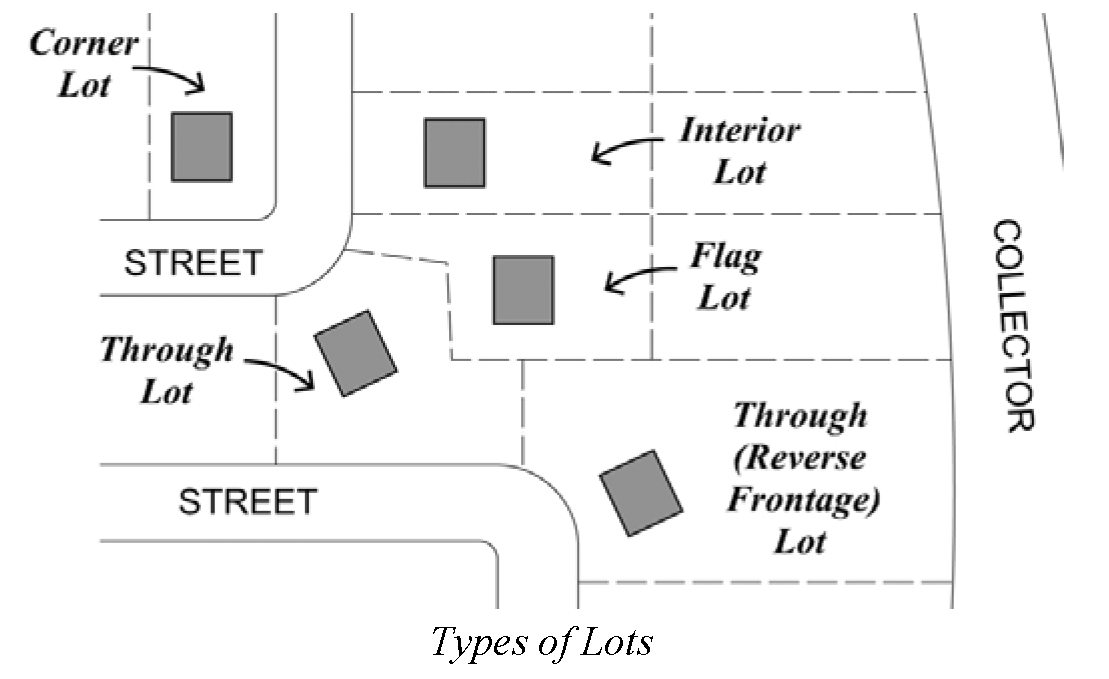
Lot, corner: A lot abutting two or more streets at their intersections or on two parts of the same street forming an interior angle of less than 135 degrees.
1.
Non-standard corner lot: A corner lot on other than a double-tiered block. Non-standard corner lots have two front yards, each abutting the front yards of the two interior lots adjoining it.
2.
Standard corner lot: A corner lot, for single-family detached and duplex dwellings, on a double- tiered block. A standard corner lot has a front yard, abutting the front yard of the adjoining interior lot, and a street side yard abutting the same of the adjoining standard corner lot.
2.2.98.
Lot, interior: A lot other than a corner lot.
2.2.99.
Lot, reverse frontage: A through lot fronting on both a major street and a parallel, lesser street. Reverse frontage lots may be required to have access from the lesser street.
2.2.100.
Lot, through: A lot that fronts on two streets that do not intersect at the boundaries of the lot.
2.2.101.
Lot area: The total area within the lot lines of a lot, excluding any rights-of-way.
2.2.102.
Lot frontage: The lot width measured at the front lot line.
2.2.103.
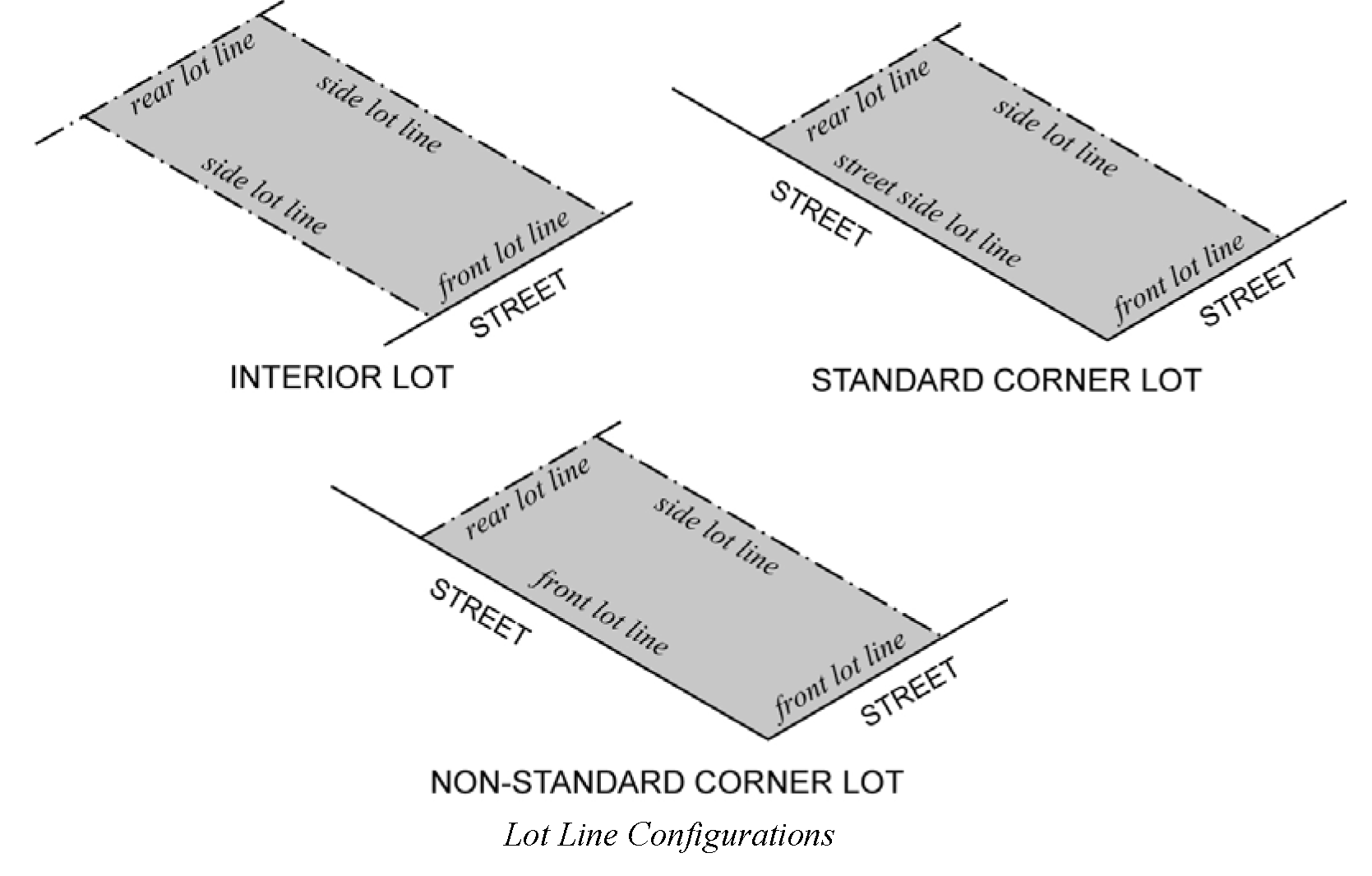
Lot line: A line bounding a lot which divides it from another lot or from a street or from any other public or private place.
2.2.104.
Lot line, front: The lot line separating a lot from a street right-of-way. In the case of standard corner lots, there shall be a front lot line and a street side lot line. The shorter of the two shall be the front lot line. For all other corner lots, any lot line along a street frontage shall be considered a front lot line.
2.2.105.
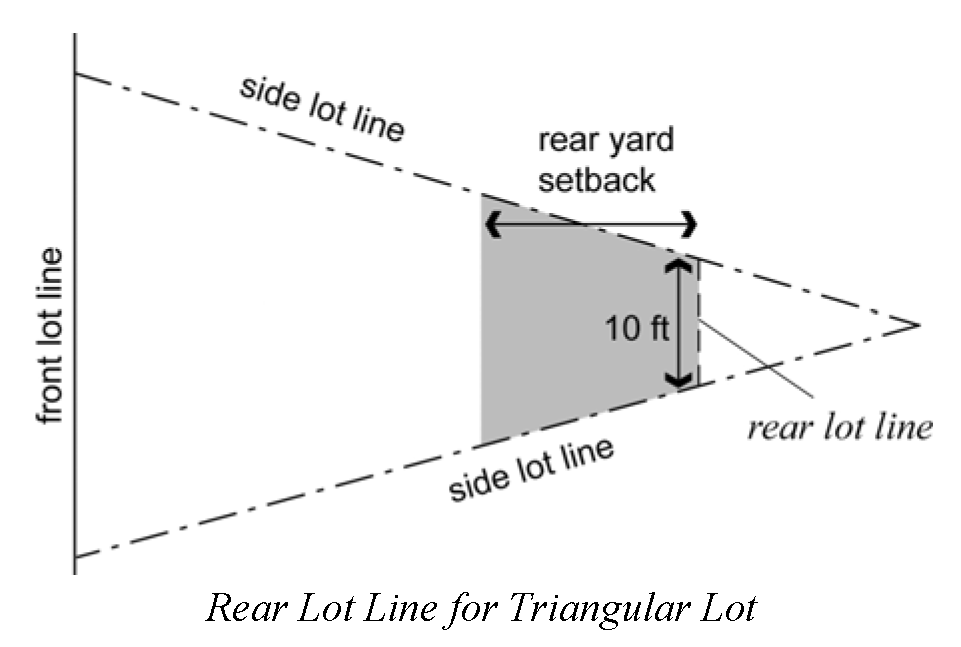
Lot line, rear: That lot line which is parallel to and most distant from the front line. In the case of a triangular or irregularly shaped lot, a line ten feet in length, entirely within the lot, parallel to and at the maximum distance from the front lot line.
2.2.106.
Lot line, side: Any lot line other than a front lot line or a rear lot line.
2.2.107.
Lot line, street side: For standard corner lots, that lot line corresponding with the longer of the two street frontages.
2.2.108.
Lot of record: A lot that exists as shown or described on a plat or deed that has been recorded in the office of the probate judge.
2.2.109.
Lot width: The minimum distance measured between the side lot lines at the front building line. For corner lots, lot width is the distance measured between the side lot line and the opposite lot line.
2.2.110.
Maintenance service: An establishment providing building and yard maintenance services, such as janitorial services, exterminating services, landscaping services, window cleaning services, office cleaning services and similar uses.
2.2.111.
Manufactured homes:
1.
Class A manufactured home: A double-wide or larger manufactured home constructed after July 1, 1976 that meets or exceeds the construction standards promulgated by the U.S. Department of Housing and Urban Development that were in effect at the time of construction and that satisfies the criteria in § 6.7 and where the manufactured home has a length not exceeding four times its width.
2.
Class B manufactured home: A single-wide manufactured home constructed after July 1, 1976 that meets or exceeds the construction standards promulgated by the U.S. Department of Housing and Urban Development that were in effect at the time of construction.
3.
Class C manufactured home: A manufactured home built before 1976 that does not meet the definition of a Class A or Class B manufactured home. Class C manufactured homes are not allowed in the city, except as existing structures permitted prior to the adoption of this ordinance.
2.2.112.
Manufactured home lot: A lot designed for the siting of a manufactured home in a manufactured home subdivision.
2.2.113.
Manufactured home space: A space designed for the siting of a manufactured home within a manufactured home park.
2.2.114.
Manufactured home subdivision: A subdivision designed and intended for the siting of Class A manufactured homes.
2.2.115.
Manufactured home park: Land used or designed to accommodate a manufactured home community of multiple spaces for rent or lease.
2.2.116.
Manufacturing: Industrial uses that involve the processing and manufacturing of materials or products and the incidental storage, sale and distribution of such products.
2.2.117.
Manufacturing, heavy: The manufacture, predominantly from extracted or raw materials of finished products or parts, including processing, fabrication, assembly, treatment and packing of such products.
2.2.118.
Manufacturing, light: The manufacture, predominantly from previously prepared materials of finished products or parts, including processing, fabrication, assembly, treatment and packing of such products.
2.2.119.
Medical clinic: A facility providing medical, psychiatric or surgical services for sick or injured persons exclusively on an outpatient basis.
2.2.120.
Medical support service: A place of business, which supplies medical support services to individuals, medical practitioners, clinics and hospitals, including but not limited to a pharmacy, medical and surgical supply store, and an optician.
2.2.121.
Mini-warehouse: A structure group of structures partitioned for leasing of individual storage spaces and is exclusively used for the storage of non-volatile, non-toxic and non-explosive materials.
2.2.122.
Mixed use or mixed use development: The combination of a residential use with commercial and/or lodging uses on the same site or within the same building.
2.2.123.
Motel: A lodging establishment, in which guest rooms are accessed from the exterior of the building. Motels may also include, as an incidental use, a liquor lounge.
2.2.124.
Nonconformities: Lawful uses of lots, structures or characteristics of uses, which, as a result of amendment to this ordinance, no longer conform to all applicable zoning provisions.
2.2.125.
Non-residential: Land uses including agricultural, institutional, commercial, lodging and industrial activities. Mixed-use developments shall also be considered non-residential uses.
2.2.126.
Nursing care facility: A licensed institution providing skilled nursing care and medical supervision at a lower level than that provided in a hospital but at a higher level than provided in an assisted or independent living facility.
2.2.127.
Office: See "business office".
2.2.128.
Open air market: Retail sales of arts, crafts, produce, discount or used goods, which are located partially or wholly outside of an enclosed building. This may include produce market, craft. market, farmers market or similar activities.
2.2.129.
Open space, common: Land area within a development owned and maintained by the developer or held in common ownership and maintained by a property owner's association for all of the owners for recreation, protection of natural land features, amenities or buffers; is freely accessible to all owners of the development; and, is required by this ordinance to remain in such use.
2.2.130.
Outdoor storage: The keeping, in an unenclosed area, of any goods, materials, merchandise, products or vehicles in the same place for more than 48 hours.
2.2.131.
Owner: The person having the right and legal title to, beneficial interest in or a contractual right to purchase a lot or parcel of land, or their authorized designee.
2.2.132.
Park: Publicly owned and operated parks, playgrounds, recreation facilities and open spaces. Parks owned and operated by a property owners association are referred to as "common open spaces."
2.2.133.
Personal service: An establishment primarily engaged in providing services involving the care of a person or their personal goods or apparel.
2.2.134.
Perimeter: The boundaries or borders of a lot, tract or parcel of land.
2.2.135.
Place of assembly: A facility used for and providing religious, fraternal, recreational, social, educational or cultural activities.
2.2.136.
Planning commission or commission: The planning commission of the City of Scottsboro, Alabama.
2.2.137.
Premises: A lot, parcel, tract or plot or land together with the structures hereon.
2.2.138.
Printing establishment: Blue printing, copying, printing, engraving or other reproduction services.
2.2.139.
Property line: The lot line or boundary line.
2.2.140.
Public facility: Buildings providing public services, not otherwise defined in this section, including government offices, post offices, museums, libraries, transit stations, police and fire stations, emergency service stations, civil defense operations and similar uses.
2.2.141.
Public utility facility: A facility that provides public utility services to the public at large, including water and sewer, gas distribution, electric transmission and distribution, and cable transmission and distribution facilities.
2.2.142.
Rear-accessed: Having vehicular access by way of an alley or similar means and without a driveway along any front lot line.
2.2.143.
Recreation: A commercial establishment providing recreational or sports activities to participants, including bowling alleys, billiard parlors, video game centers, ice and roller skating rinks, driving ranges, miniature golf courses, conventional golf courses, swimming pools, tennis courts and other commercial recreational and sports activities.
2.2.144.
Recreational vehicle: A vehicular type portable structure without permanent foundation that can be towed, hauled, or driven and is designed primarily as a temporary living accommodation of recreational and camping purposes.
2.2.145.
Recycling center: Land, with or without buildings, upon which used materials are separated and processed for shipment for eventual reuse in new products.
2.2.146.
Recycling plant: A facility, other than a junkyard, in which recoverable resources, such as newspapers, magazines, books and other paper products; glass, metal cans and other products are recycled, reprocessed and treated to return such products to a condition in which they may be used again in new products.
2.2.147.
Research laboratory: A building or group of buildings in which are located facilities for scientific research, investigation, testing or experimentation, but not facilities for the manufacture or sale of products, except as incidental to the main purpose of the laboratory.
2.2.148.
Resource extraction: The removal of soil, sand, stone, chert, clay, gravel, limestone, or other minerals or similar materials, for commercial purposes, including quarries, sand and gravel operations, gas extraction, and mining operations, and the loading, sizing, crushing, and processing of such materials, and the incidental storage, sale and distribution of such materials.
2.2.149.
Restaurant, drive-in or drive-through: An establishment where food and drink are rapidly prepared for drive-through or drive-in service, but which also includes on-premises dining.
2.2.150.
Restaurant, standard: An establishment where food and drink are prepared, served and primarily consumed within the building where patrons are seated and served.
2.2.151.
Restaurant, take-out only: An establishment where food and drink are prepared and served for consumption off-premises only.
2.2.152.
Retail, general:
1.
General retail, enclosed: Retail sales of goods and services including, but not limited to; food sales, department stores, clothing stores, home furnishings, appliance stores, automobile parts and supply stores, video rental, gift. shops, florist shops, hardware stores, specialty shops, jewelry stores, variety stores, sporting goods stores, antique shops, auction houses and similar retail activities.
2.
General retail, unenclosed: Retail sales of goods and services conducted partially or fully outside of a building, including but not limited to flea markets and similar activities.
2.2.153.
Salvage yard or junk yard: A lot or structure or part thereof, used primarily for the collecting, storage and sale of waste paper, rags, scrap metal or discarded material or for the collecting, dismantling, storage and salvaging of machinery or vehicles not in running condition or for the sale of parts thereof.
2.2.154.
School: A public or non-profit school.
2.2.155.
Screen: To visually shield or obscure a building, structure or use from adjacent property or public view by means of opaque fencing, walls, berm or densely planted vegetation.
2.2.156.
Service station: A gas station that engages in minor vehicle repair activities.
2.2.157.
Shopping center: A group of commercial establishments located on a lot planned and developed in a unified manner and design with shared parking and driveway facilities and under a common ownership or management authority.
2.2.158.
Site: Land intended to have one or more buildings or intended to be subdivided into one or more lots.
2.2.159.
Special exception use: A use that would not generally be appropriate in a zoning district without restriction(s), but which, if controlled as to number, area, location or relation to the neighborhood, would not be detrimental to public health, safety and general welfare. See § 13.6.
2.2.160.
Story: That portion of a building included between the surface of any floor and the surface of the floor next above it, or if there is no floor above it, the ceiling next above and including basements used for the principal use. A top floor, in which the floor area with eight feet or more of head clearance is 50 percent or less than the floor area of the story next below, is considered a "half story." A basement is considered a story if its ceiling is more than five feet above grade level or if it is used for residential purposes.
2.2.161.
Street: A vehicular way dedicated for public use including all land within the right-of-way. Streets are further classified as:
1.
Arterial: A major street serving as a primary artery, intended to mainly carry through traffic and to connect major activity centers in the city, and as further classified following:
a.
Major arterials include U.S. 72, AL 279 (south of Broad Street), and AL 35 (from B.B. Comer Bridge to U.S. 72).
b.
Minor arterials include AL 79, AL 279 (north of Broad Street), AL 35 (north of U.S. 72), and Broad Street.
2.
Collector: A street that collects traffic from an area and moves it to the arterial network while providing some access to abutting property, including but not limited to: Bob Jones Road, Goose Pond Drive, County Park Road, Clemons Road, Woods Cove Road, Snodgrass Road, Scott Street, and Jefferson Drive.
3.
Local street or minor street: A minor street used primarily for access to abutting properties.
2.2.162.
Street line: The right-of-way line of a street.
2.2.163.
Structure: A combination of materials that form a construction for use, occupancy, or ornamentation whether installed on, above or below the surface of land or water. All buildings are structures but not all structures are buildings.
2.2.164.
Studio: A place of work for an artist, photographer or craftsman, including instruction, display, production and retail sales of materials produced on the premises.
2.2.165.
Subdivision: The division of a lot, tract or parcel or land into two or more lots, plats, sites or other divisions of land for the purpose, whether immediate or future, of sale or of building development. Such term includes re-subdivision of land and when appropriate to the context relates to the process of subdivision or to the land or territory subdivided.
2.2.166.
Tree, canopy: A deciduous tree that reaches a mature height of at least 20 feet.
2.2.167.
Tree, understory: A deciduous tree that reaches a mature height of 15—25 feet.
2.2.168.
Truck stop: An establishment involving the maintenance, servicing, storage or repair of commercial vehicles; the retail dispensing of motor vehicle fuels; and the sale of accessories or equipment for trucks and similar commercial vehicles. Truck stops may include overnight accommodations or dining.
2.2.169.
Variance: A relaxation or waiver of the terms of this ordinance (other than use provisions) as will not be contrary to the public interest where, owing to special conditions, a literal enforcement of the provisions of this ordinance will result in unnecessary hardship.
2.2.170.
Vehicle and equipment sales, rental and service: An establishment engaged in the sale or rental of heavy trucks (over one ton), construction equipment, tractors farm implements and similar equipment, including the storage, maintenance and servicing of such vehicles and equipment.
2.2.171.
Veterinary hospital: A place where animals are given medical care and the boarding of animals is limited to short-term care incidental to the hospital use.
2.2.172.
Wholesaling establishment: An establishment primarily engaged in selling merchandise to other businesses, including retailers, industrial, commercial, institutional, or professional business users, other wholesalers, or acting as agents or brokers and buying merchandise for, or selling merchandise to, such individuals or companies.
2.2.173.
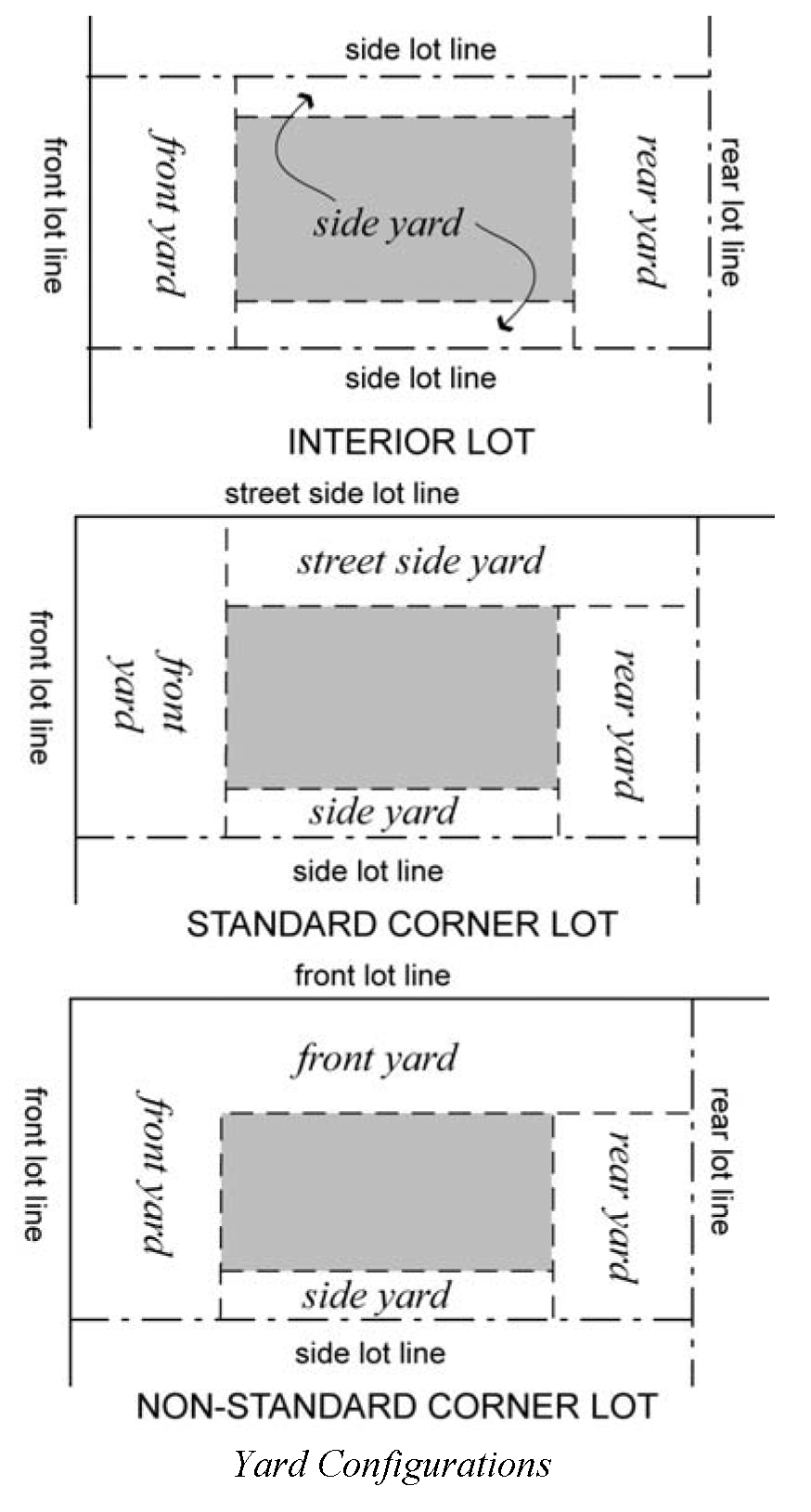
Yard: A minimum open area unobstructed from the ground up extending along a lot line and inward to the structure. The yard shall be measured as the shortest distance between the structure and the lot line.
1.
Front yard: A yard extending the full width of the lot between any building and the front lot line and measured perpendicular to the building at the closest point to the front lot line.
2.
Rear yard: A yard extending the full width of the lot between the principal building and the rear lot line and measured perpendicular to the building to the closest point of the rear lot line.
3.
Side yard: A yard extending from the front yard to the rear yard between the principal building and the side lot line and measured perpendicular from the side lot line to the closest point of the principal building.
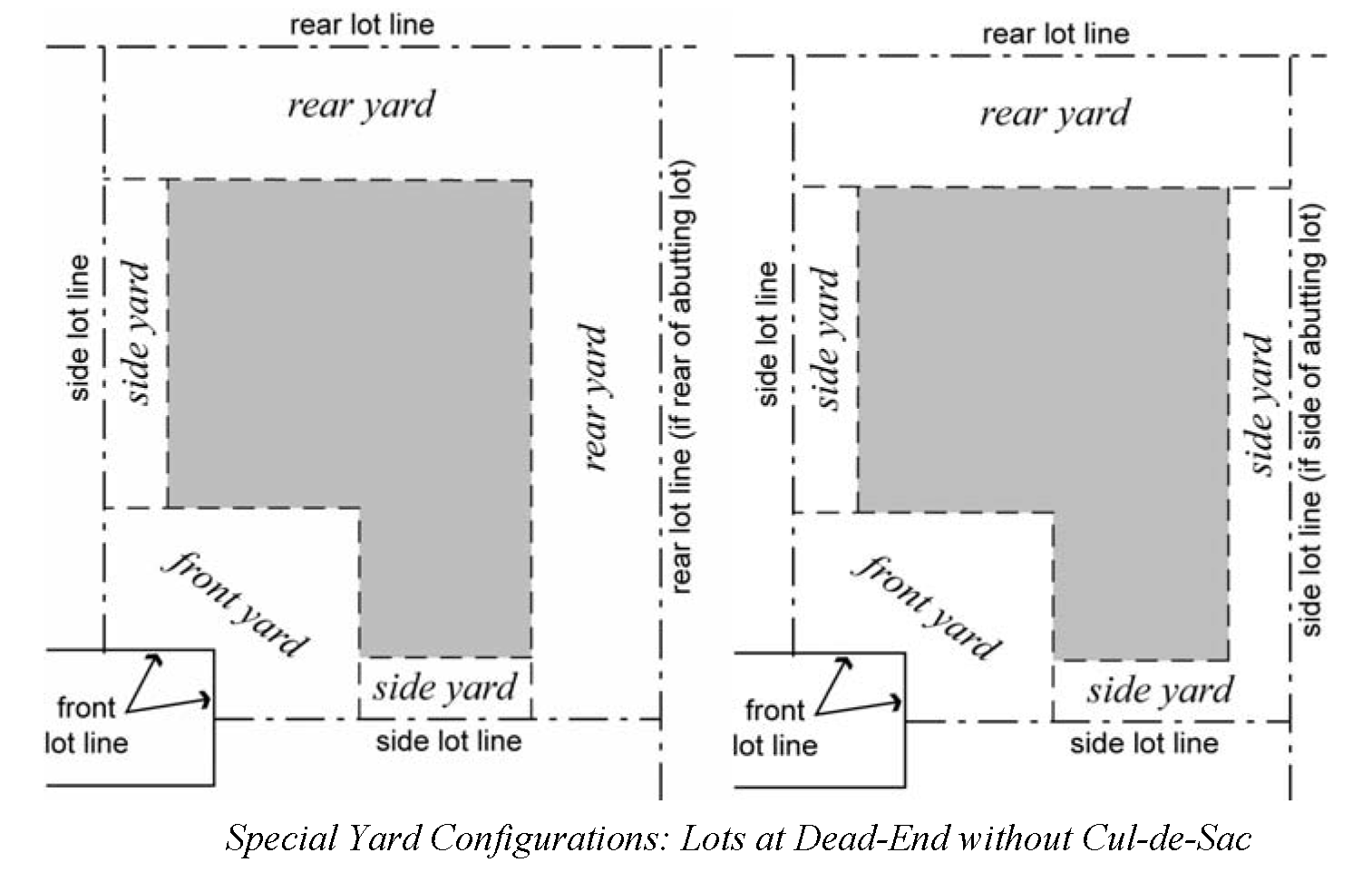
In some cases, there may be lots-of-record platted along dead end streets without cul-de-sac turnarounds. In such cases there yards are defined as shown below. In such cases, the side and rear yards are determined by the zoning official based on the arrangement of abutting lots.
4.
Street side yard: For standard corner lots, a yard extending from the front yard to the rear yard between the principal building and the street side lot line and measured perpendicular from the street side lot line to the closest point of the principal building.
2.2.174.
Zero lot line: A lot line with no required setback.
2.2.175.
Zoning official: The city official assigned by the city council to administer this ordinance, including his/her designee.
§ 2.3. - Abbreviations used in this ordinance.
2.3.1.
BR - Bedroom
2.3.2.
CR - County Road
2.3.3.
Dr. - Drive
2.3.4.
DU - Dwelling unit
2.3.5.
EQ - equal
2.3.6.
FAA - Federal Aviation Administration
2.3.7.
FEMA - Federal Emergency Management Agency
2.3.8.
ft. - foot or feet
2.3.9.
GFA - gross floor area
2.3.10.
GLA - gross leasable area
2.3.11.
max. - maximum
2.3.12.
min. - minimum
2.3.13.
na - not applicable
2.3.14.
oc - on center
2.3.15.
PL - property line or lot line
2.3.16.
ROW - right-of-way
2.3.17.
sf - square feet
2.3.18.
% - percent
2.3.19.
§ - section, subsection, paragraph or item within this ordinance or other regulations, as specified

