
Scottsboro City Zoning Code
ARTICLE 11
- LANDSCAPING, SCREENING AND BUFFERS
The intent of this article is to require a minimum number of trees in residential areas, to establish standards for buffers required between incompatible land uses and to provide for landscaping surrounding and within vehicular areas in high traffic corridors. For the purposes of this article, "fences" and "walls" shall have the same meaning. Landscaping shall not be planted in a manner or location, which causes a hazard to vehicles entering or within the public right-of-way. Required landscape plans shall include the information listed in appendix 3.
§ 11.1.- Buffers.
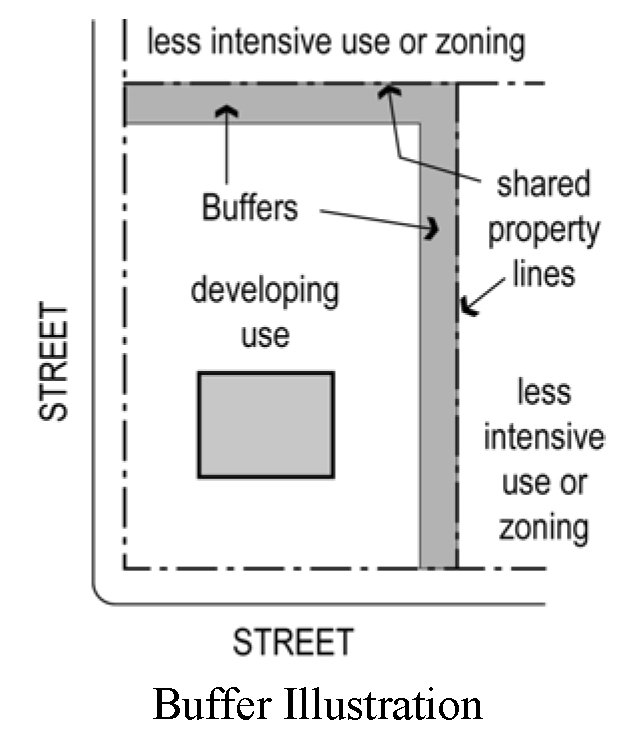
Buffers shall be provided in accord with the requirements of table 11-1 and as described herein.
11.1.1.
Applicability. Except as otherwise provided herein, buffer requirements shall be based on the developing land use and the existing, abutting use.
11.1.2.
General standards. To decrease incompatibility between neighboring land uses, the following standards shall apply to all required buffers:
1.
Required yards, where corresponding with the buffer area, may overlap and may be counted toward a buffer width requirement.
2.
The buffer requirement, if any, shall be the responsibility of the developing land use.
3.
Buffer requirements may be modified by the approving authority in certain cases as follows:
a.
If the land use relationships between two abutting lots changes so that a lesser buffer would be required, the width of the previously provided buffer may be reduced accordingly.
b.
Up to one-half of the width of an abutting alley may be counted toward the buffer width requirement but the landscaping density requirements shall not be reduced.
c.
Whenever the proposed use abuts vacant land, buffer requirements shall be based on the zoning of the abutting property or the use projected by the comprehensive plan, whichever requires a lesser buffer.
4.
Buffers shall not be used for parking, recreational use or any other purpose, except as provided herein. The approving authority may permit a pedestrian access way through a required buffer where appropriate. Public utilities and storm drainage facilities may be constructed in a required buffer, provided the buffer is otherwise installed in compliance with the approved landscaping plan. The city may require supplemental plantings to mitigate the effect of any such land disturbance in the buffer.
11.1.3.
Design standards.
1.
Prior to occupancy of the premises, the buffer shall provide a visually impervious barrier, from the ground to five feet above grade level throughout the entire length of the buffer through the use of shrubs and trees. Fences may also be used in combination with shrubs and trees (see paragraph 3 below). Within one year after installation, the buffer shall be at least six feet above grade throughout the entire length of the buffer.
2.
Required plantings shall be evergreen.
3.
The required buffer width may be reduced as provided in table 11-1 when a fence is provided that is five—seven feet tall and that meets the requirements in § 11.4. With a fence, maximum shrub spacing may be reduced to not more than eight feet.
§ 11.2. - Landscaping for vehicular areas.
11.2.1.
Applicability. These regulations apply to areas used for off-street parking and loading; vehicular storage, display, maneuvering and washing; and the dispensing of motor fuels.
11.2.2.
A landscaping plan shall be required as part of every development application for new construction, which includes vehicular areas as herein, described. This section shall apply to new vehicular areas for all uses, except single-family dwellings, duplexes and multiplexes. If the size of an existing, applicable vehicular area is increased by ten percent or ten spaces, whichever is greater, the new vehicular area shall be made to comply with the requirements of this section.
11.2.3.
Requirements.
1.
The primary landscaping materials used in vehicular areas shall be canopy trees. Shrubs and other planting materials may be used to complement the required trees.
2.
Required plantings shall be set back from the edge of the planted area or as otherwise needed to prevent damage by vehicles.
3.
Interior landscaping. Each vehicular area shall have interior landscaping covering not less than five percent of the total vehicular area.
4.
Street frontage landscaping.
a.
A landscaped strip at least ten feet wide shall be located between the vehicular area and the street line. The width may be reduced to five feet when a fence, meeting the requirements of § 11.4 and that is between 2.5 to 3.5 feet tall, is provided.
b.
Shrubs shall be evergreen and spaced no more than five feet on center. If used in combination with a fence meeting the requirements of § 11.4, shrubs may be deciduous and may be spaced no more than eight feet on center.
c.
At least one understory tree for every 40 linear feet or one canopy tree for every 50 feet of required landscape strip shall be planted. Only canopy and understory trees, as defined in article 2, shall be counted toward these requirements.
5.
Perimeter landscaping. A five-foot-wide landscaping strip shall be provided along the parking lot perimeter and shall be planted with evergreen shrubs and one understory tree per each 40 feet of frontage (the width of any cross access drives may be discounted). Where this overlaps or conflicts with other landscaping requirements, the greater requirement shall govern.
§ 11.3. - Screening.
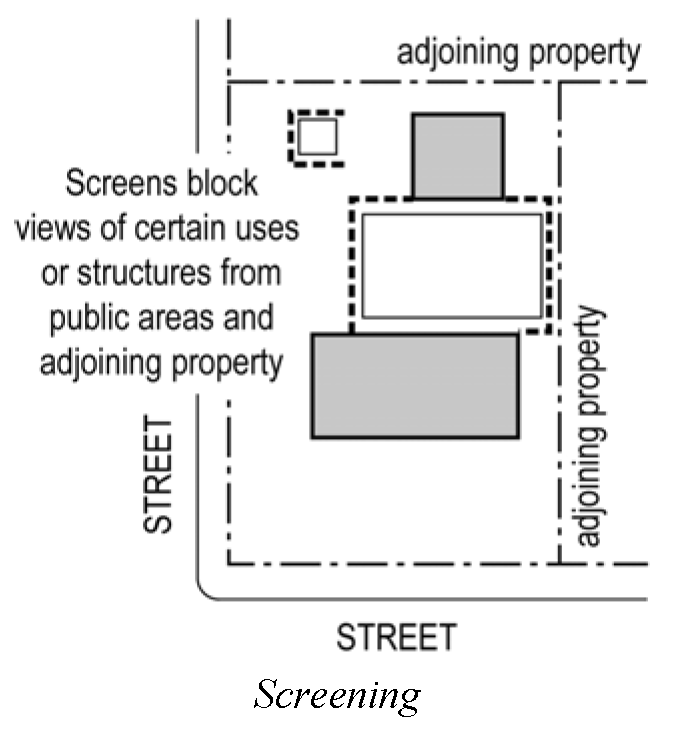
Screening is intended to provide visual separation of certain uses from public areas and adjoining properties.
11.3.1.
Applicability. For all multi-family, non-residential and mixed use developments, the following shall require screening:
1.
Garbage collection, recycling and refuse handling areas.
2.
Maintenance areas or utility structures associated with a building or development.
3.
Water meters, gas meters, electric meters and air conditioners/mechanical units.
4.
Loading areas.
5.
Outside runs for veterinary clinics, animal shelters, and kennels.
6.
Outdoor storage of materials, stock, equipment, and vehicles (such as those stored for repair).
7.
Any other uses for which screening may be required by the reviewing authority.
11.3.2.
Design requirements. The design of screening shall be in accord with the following and as approved by the reviewing authority:
1.
Location on site should be the first consideration in providing screening. The reviewing authority may lessen screening requirements when the location of the use to be screened reduces its visibility to the public and neighboring properties. Uses requiring screening, when co-located, may be screened together.
2.
Screening shall not be placed so as to impede any drainage way and shall not block access to any aboveground, pad-mounted transformer and shall provide the minimum clear distance required by the utility company.
3.
The method of screening, including height and materials, shall be that which is sufficient to visually screen the use. The minimum height needed is preferred.
4.
Fences, berms, or landscaping used for other purposes, but that are proposed as part of a required screen and that meet the requirements of this section, may count toward these requirements.
5.
Uses that produce objectionable noise or odors shall be located so as to minimize such impacts to the public and abutting properties.
6.
Shrubs shall be evergreen and spaced no more than five feet on center. If used in combination with a fence, shrubs may be deciduous and may be spaced no more than eight feet on center.
7.
Trees shall be evergreen and, when used in the absence of a fence, shall be used together with shrubs to provide a continuous, opaque screen.
11.3.3.
Requirements for specific uses.
1.
Refuse and recycling containers shall not be located forward of the front building line. Such containers shall be screened by a combination of opaque fence and plant material on three sides. Opaque gates shall be installed for access. The fence shall be at least two feet taller than the container.
2.
For restaurants, enclosures shall be sized, as needed, to accommodate the storage of grease containers.
3.
Mechanical equipment on roofs or on site shall be screened so as to not be visible from public streets or adjacent properties. The screening of building-mounted mechanical equipment shall be an integral component of the building design. Mechanical equipment installed on site shall be adequately screened by plant materials and/or fences to blend in with site landscaping.
4.
Outdoor storage, where permitted, shall be screened to a height of six feet or two feet taller than the material or equipment to be screened, whichever is greater.
5.
Service areas, loading docks, work yards, and similar uses should be located to minimize their visibility to the public and to any abutting properties to which such functions would be objectionable. Where their location is insufficient to effectively screen the use, required screening shall be at least six feet in height.
§ 11.4. - Design standards for fences.
Fences used as a part of any required buffer, screen, or perimeter landscaping shall comply with the following:
11.4.1.
No more than 25 percent of the fence surface shall be left. open. The finished side of the fence shall face abutting property.
11.4.2.
Required shrubs and trees shall be planted on the exterior side of the fence.
The commission shall approve the design of fences to assure their functions, as required by this article, are properly served. In particular, the commission shall not approve a reduced buffer width pursuant to § 11.1.3.3 without also approving the design of the fence.
§ 11.5. - Modifications.
The planting requirements of this article shall be applied equally to similarly classified and situated properties, but may be modified or waived altogether in certain cases where a building site is subject to any of the following circumstances determined by the commission:
11.5.1.
Existing natural vegetation, which meets, in whole or in part, buffer or screening requirements, may be applied toward the requirements of this article. Where natural vegetation (trees and/or shrubs) exist on a piece of property, when application is made for a building permit, such natural vegetation shall be left. undisturbed until the zoning official has evaluated it for its suitability as a buffer or screen, as applicable. The zoning official may require that the developer retain such natural vegetation. However, additional planting may be required to fully achieve the requirement.
11.5.2.
Where impending development of adjacent property would make these standards unreasonable or impractical.
11.5.3.
Where, after inspection by the zoning official, it is found that the view from adjoining properties is blocked by a change in grade or other natural or man-made features.
11.5.4.
Where planting cannot, in the professional opinion of an expert, be expected to thrive due to poor soil conditions, intense shade or similar conditions.
§ 11.6. - Maintenance and irrigation.
11.6.1.
All plant material shall be maintained in a healthy growing condition, replaced when dead and kept free of weeds, refuse and debris.
11.6.2.
All fencing shall be permanently maintained in good condition and whenever necessary, repaired or replaced by the party required to provide such fence.
11.6.3.
All required landscaping shall be drought-tolerant, native species or shall be irrigated by an automatic irrigation system.

