
Simi Valley City Zoning Code
CHAPTER 9
30 - General Property Development and Use Standards
9-30.010 - Purpose
This Chapter expands upon the requirements of Article 2 by addressing additional details of site planning, project design, and the operation of land uses, to ensure that proposed development produces an environment of stable and desirable character, is compatible with existing and future development in the vicinity, and protects the use and enjoyment of neighboring properties, consistent with the General Plan and any applicable specific plan.
(§ 5, Ord. 1085, eff. January 6, 2006)
9-30.020 - Applicability
The requirements of this Chapter shall apply to all proposed development and new land uses, except as specified in Chapter 9-72 (Nonconforming Uses, Structures, and Parcels), and shall be considered in combination with the standards for the applicable zoning district in Article 2 (Zoning Districts, Allowable Land Uses, and Zone-Specific Standards), and those in Article 4 (Standards for Specific Land Uses). If there is a conflict, the standards in Article 4 shall control.
(§ 5, Ord. 1085, eff. January 6, 2006)
9-30.030 - Development/Design Considerations
A.
Development criteria. Factors including the following may be considered by the review authority in establishing permit conditions, and in determining appropriate intensity of development and time limitations, including residential densities, for the site of a proposed project:
1.
Freeway corridor development. Development in the freeway corridor between Alamo and Cochran Streets, shall comply with the following requirements:
a.
All accessory buildings shall incorporate design elements, including roof configuration and pitch, materials and colors, similar to the main structure for which the permit was granted.
b.
The use of a flat roof design is discouraged and shall be minimized to the maximum extent feasible.
2.
Screening of mechanical equipment. No roof-mounted air conditioning or heating equipment shall be visible from view from abutting lots, streets, or roadways. This shall be accomplished through the extension of the main structure or roof or other architecturally compatible features.
3.
Roof design and materials.
a.
Roofs (including mansard roofs) shall be built up to a height sufficient to shield mechanical equipment.
b.
Where wood shakes are not permitted because of fire hazard or are requested to be replaced because of damage or age, acceptable substitute materials in lieu of wood shakes, irrespective of Planned Development Permit Conditions relative to roofing materials, shall include barrel tiles, lightweight clay or concrete tiles, molded composites of cement and wood fiber or molded composites of perlite, cement and acrylic fibers and asphalt composition shingle roofing material weighing 300 pounds or more per square (one square equals 100 square feet of roof coverage). Structural support for acceptable substitute roofing materials shall meet Uniform Building Code Standards. Fire retardant treated wood shakes are an acceptable roofing material where no fire hazard exists. Substitution of acceptable materials for wood shakes in compliance with this standard shall be considered equivalent and require no further discretionary review.
c.
Asphalt composition shingles replacing wood shake roofing shall be substantially overlapped to provide a shadow detailing to the roof appearance.
d.
Asphalt composition shingles replacing wood shake roofing shall be of a color resembling natural roofing materials, such as wood and terra cotta tile.
4.
Trash enclosures. Each project shall contain a sufficient number of enclosures to screen bins for collection of discards in compliance with Chapter 9-35 (Recyclable and Discard Material Containers and Facilities) of this Article.
5.
Landscaping. Landscaping should be installed in accordance with the principles as demonstrated in the City's Landscape Design Guidelines.
6.
Walls and fences. Walls and fences shall reflect the overall design theme of the project and consist of the following designs:
a.
Decorative block, such as slumpstone or splitface block, with cap;
b.
Plain block with cap, stuccoed to reflect the general design theme;
c.
Theme pilasters and wrought iron;
d.
Wood fences are permitted only in residential areas. Wood fences shall be of adequate and sound design as determined by the Deputy Director/City Planner;
e.
Chain link fences are not allowed, unless required by Caltrans or the Ventura County Watershed Protection District;
f.
Vinyl fences are permitted only in residential areas and must be installed per the manufacturer's requirements. Vinyl fences shall be constructed with steel-reinforced rails, metal stiffeners, or similar materials to reduce bowing and sustain high wind loads.
B.
Sewage disposal. Sewage disposal for all requested uses and structures shall be provided by means of a system approved by the Department of Public Works.
C.
Fire protection. Dwellings shall comply with all applicable fire protection requirements of the Ventura County Fire Protection District, including all requirements for construction within High Fire Hazard Areas.
(§ 5, Ord. 1085, eff. January 6, 2006 as amended by Exh. A, Ord. 1165, eff. November 11, 2010; § 2 (Exh. A), Ord. No. 1282, eff. December 11, 2017; § 2(Exh. A), Ord. No. 1315, effective October 19, 2020; § 2(Exh. A), Ord. No. 1316, effective December 3, 2020 and § 2(Exh. A), Ord. No. 1341, eff. July 14, 2022)
9-30.040 - Exterior Light and Glare
Each exterior light fixture and light source shall comply with the following standards:
A.
Each commercial, industrial, and single- and multi-family residential light fixture shall be designed, constructed, and maintained to ensure that light is directed away from any adjacent use, and to ensure that there shall be no illumination or glare from the exterior lighting system onto adjacent properties or streets.
B.
Flashing lights are strictly prohibited.
C.
In order to comply with the above requirements of this Section, each plan for construction of a building with outside parking and lighting shall include the following:
1.
An exterior lighting (photometric) plan consisting of a point-by-point foot candle layout (based on a 10-foot grid center) extending a minimum of 20 feet outside the property lines, prepared by a California-registered electrical engineer.
2.
The maximum overall height of each fixture located within 100 feet of a residentially zoned or developed parcel shall be not more than 14 feet, and shall not be more than 20 feet in all other areas.
3.
Fixtures shall possess sharp cut-off qualities at property lines. No exposed lenses shall be used.
4.
There shall be no more than a 7:1 ratio (maximum to minimum) level of illumination shown between lighting standards.
5.
Low pressure sodium lighting fixtures are prohibited.
6.
Illumination intensity shall comply with the SVMC Title 8, Chapter 21 (Security Standards for Buildings).
(§ 5, Ord. 1085, eff. January 6, 2006 as amended by § 2(Exh. A), Ord. No. 1341, eff. July 14, 2022)
9-30.050 - Height and Location Requirements for Fences, Walls, Hedges, and Other Structures
This Section addresses all fences, walls, hedges, vegetation, mounds, hardscaping, and other structures, except for the exclusions listed in Subsection B, below. These structures will be referred to as "fences, walls, and hedges," and shall comply with the applicable provisions of this Section. For sign height requirements, see Chapter 9-37 (Signs).
A.
Height requirements.
1.
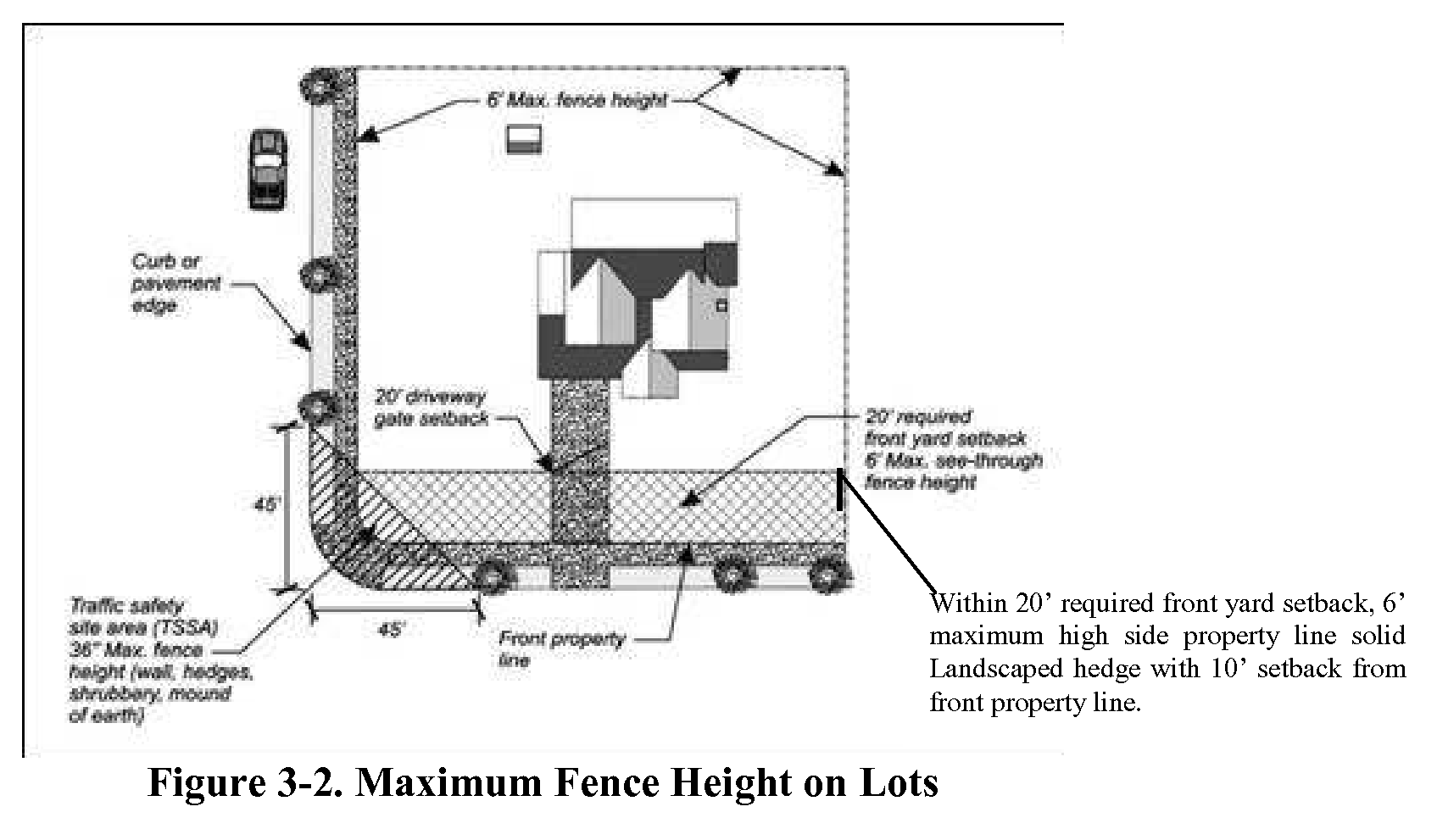
Within the Traffic Safety Sight Area (TSSA), for all zones.
a.
Within the TSSA, as defined in Article 8 (Definitions), and within the public right-of-way, no fences, walls, or hedges over 24 inches high measured from the top of the nearest street curb (street level, if no curb) are allowable without a permit authorized by law (encroachment permit).
b.
Within the TSSA and located on private property, no fences, walls, or hedges over 36 inches high measured from the top of the nearest street curb (street level, if no curb) are allowable without a permit authorized by law.
2.
Outside the TSSA, for residential zones only.
a.
Within the front yard setback, no fence, wall, or hedge shall exceed 42 inches in height and no see-through fence shall exceed six (6) feet in height. A combination of fence, wall, or hedge and see-through fence shall be permitted, said design subject to approval by the Planning Director, in which the solid fence, wall, or hedge does not exceed 42 inches and the total height, including see-through fence, does not exceed six (6) feet in height. However, a maximum six (6)-foot high solid landscaped hedge may be permitted at the side property line with a setback not less than 10 feet from the front property line. Measurement shall be from the top of the highest adjacent grade. Chain-link fences are not allowed, pursuant to Section 9-30.030.A.6.e.
b.
Property line fences and walls outside of the front setback, may not exceed six feet in height as measured from the highest adjacent grade, unless authorized by law.
c.
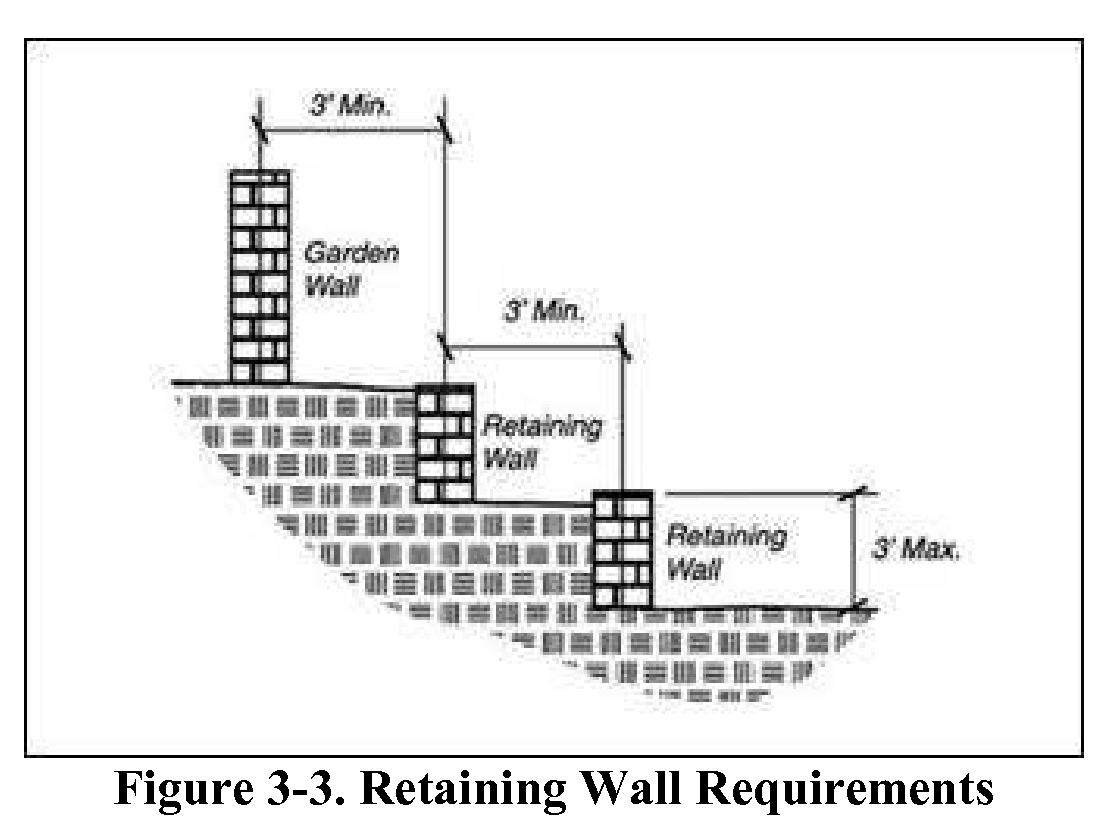
Retaining walls within the front or street facing side setback may not exceed 36 inches in height. No other garden or retaining walls may be located within three feet of a retaining wall. Measurement shall be from the lowest adjacent grade.
d.
The height of a rear or side residential fence(s), wall(s), or hedge(s) may be increased for up to two additional feet for properties abutting arterial street(s) or a residentially zoned property adjacent to a commercially or industrially zoned property. Any change in fence or wall height must be consistent with the existing design theme, colors, and materials.
B.
Exclusions. Section A above shall not apply to the following:
1.
Public utility facilities, including but not limited to poles;
2.
Signs, fountains, or lights;
3.
Trees or other vegetation within the TSSA, the front yard setback, or the public right-of-way, which are required to be trimmed to the trunk to a line at least six feet above the top of the nearest street curb;
4.
In the TSSA, saplings or plants, not planted or maintained in the form of a hedge, which provide during all seasons a clear view through them;
5.
Supporting members of appurtenances to permanent buildings approved prior to August 20, 1986;
6.
Freestanding poles where the pole does not exceed 19 inches in circumference;
7.
Official traffic control devices; and
8.
U.S. Postal Service approved mailboxes and supports.
C.
Governmental law or regulation. The provisions of this Section shall not apply to fences, walls, and hedges required by a law or regulation of a governmental agency.
D.
Restricted fence materials. The use of chain link, barbed wire, electrified fence, or razor wire in conjunction with any fences, walls, and hedges, or by itself within any residential zone, is prohibited unless required by a law or regulation of a governmental agency.
E.
Gated entrance setback. Notwithstanding any other provision of this Development Code, all gates for vehicles on driveways or roadways must be set back a minimum of 20 feet from the property line, except for side or rear access gates in residential zones that do not abut arterial or collector streets. Vehicle gates must comply with the following standards:
1.
Vehicle gates must not abut any Landscape Maintenance District, landscaping easement, no-access easement, or encroach on any Homeowner's Association (HOA)-maintained landscaping easement;
2.
Vehicle gates must lead to an approved parking space;
3.
A Zoning Clearance and Encroachment Permit (if a new driveway approach is required) must be obtained; and
4.
Vehicle gates must be designed and installed to not open into the public right-of-way.
(§ 5, Ord. 1085, eff. January 6, 2006, as amended by Exh. A, Ord. 1147, eff. August 20, 2009; § 2 (Exh. A), Ord. No. 1179, eff. December 8, 2011, § 2 (Exh. A), Ord. No. 1183, eff. March 15, 2012, and § 3(Exh. A), Ord. No. 1353, effective December 18, 2023)
9-30.060 - Height Limits and Exceptions
A.
Purpose. This Section describes the required methods for measuring the height of structures in compliance with the height limits established by this Development Code, and exceptions to those height limits.
B.
Maximum height of structures. The height of each structure shall not exceed the height limit established for the applicable zoning district by Article 2 (Zoning Districts, Allowable Land Uses, and Zone-Specific Standards), or a height limit established for a specific land use or structure by Article 4 (Standards for Specific Land Uses) except as otherwise provided by this Section.
C.
Height measurement. The maximum allowable height shall be measured as the vertical distance from the average of the highest and lowest points of the portion of the site adjacent to the building, whether natural or paved surface, to the topmost point of the structure, excluding chimneys or vents. See Figure 3-4.
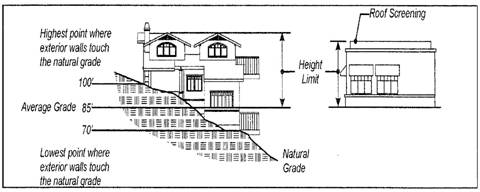
Figure 3-4. Height Measurement
D.
Exceptions to height limits.
1.
Roof structures (including mechanical penthouses, chimneys, vents) may exceed the height limits required by the applicable zoning district provided that no additional floor space for the principal use is thereby created.
2.
The height of an existing residence or residential accessory structure may be increased up to 10% in height, when it is in the Valley Floor, the site is developed as a detached single-family use, the roof has a minimum slope of 25% (3:12), and the slope increases in height from all property lines.
(§ 5, Ord. 1085, eff. January 6, 2006, as amended by § 2 (part), Ord. 1110, eff. April 6, 2007 and § 2 (Exh. A), Ord. No. 1183, eff. March 15, 2012)
9-30.070 - Screening
All new utility equipment and appurtenances to be installed in conjunction with any new application for development project approval shall be completely screened from public view. Each applicant shall submit a Conceptual Utility Screening Program as part of any new development project application.
(§ 5, Ord. 1085, eff. January 6, 2006)
9-30.080 - Setback and Separation Requirements and Exceptions
A.
Purpose. This Section provides standards for the use and minimum size of setbacks. These standards provide open areas around structures for: visibility and traffic safety; access to and around structures; access to natural light, ventilation and direct sunlight; separation of incompatible land uses; and space for privacy, landscaping and recreation.
B.
Setback requirements.
1.
General requirement. Each structure shall comply with the setback requirements of the applicable zoning district, and with any setbacks established for specific uses by this Article, except as otherwise provided by this Section. No portion of a structure, including eaves or roof overhangs, shall extend beyond a property line; or into an access easement or street right-of-way, without first being authorized by an Encroachment Permit.
2.
Distance between structures on the same lot (interior setbacks). The minimum distance between structures on the same lot shall be six feet as measured between the closest exterior walls and/or columns, except that no principal structure shall be placed closer than 10 feet to any other principal structure; if more than one story, minimum distance shall be twenty (20) feet.
C.
Measurement of setbacks. Setbacks shall be measured as follows, provided that whenever this Development Code refers to a setback distance from a street, and the street in question is a public street, the setback shall be measured from the ultimate right-of-way width as shown in the General Plan. See Figure 3-5. In the case of a site with a perimeter wall, the property lot line shall be presumed to be the perimeter wall, unless shown otherwise by a surveyor.
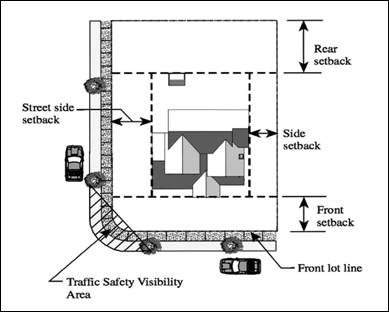
Figure 3-5. Location and Measurement of Setbacks
1.
Front setback. A required front setback shall be measured into a lot from the front property line (or edge of the right-of-way where the property line is at the center of the street), extending the full width of the lot between the side lot lines intersecting the front lot line.
2.
Street side yard setback. A required street side setback shall be measured into a lot from any side property line (or edge of the right-of-way where the property line is at the center of the street) that abuts a street, extending between the front and rear setbacks.
3.
Side setback. A required interior side setback shall be measured into a lot from a side lot line, extending between the front and rear setbacks.
4.
Rear setback. A required rear setback shall be measured into a lot from the rear lot line, extending between the side lot lines intersecting the rear lot line; provided that:
a.
For lots having no defined rear lot line, the rear setback shall be measured into the lot from the rearmost point of the lot depth to a line parallel to the front lot line; and
b.
In computing the depth of a rear setback for any lot abutting an alley, the setback may be measured from the midpoint of the rear alley.
5.
Flag lot setbacks. In the case of a flag lot, the required setbacks shall be measured from the applicable front, rear, and sides of the lot as shown in Figure 3-6.
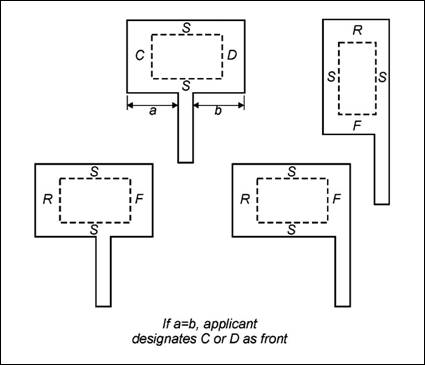
Figure 3-6. Flag Lot Setbacks
D.
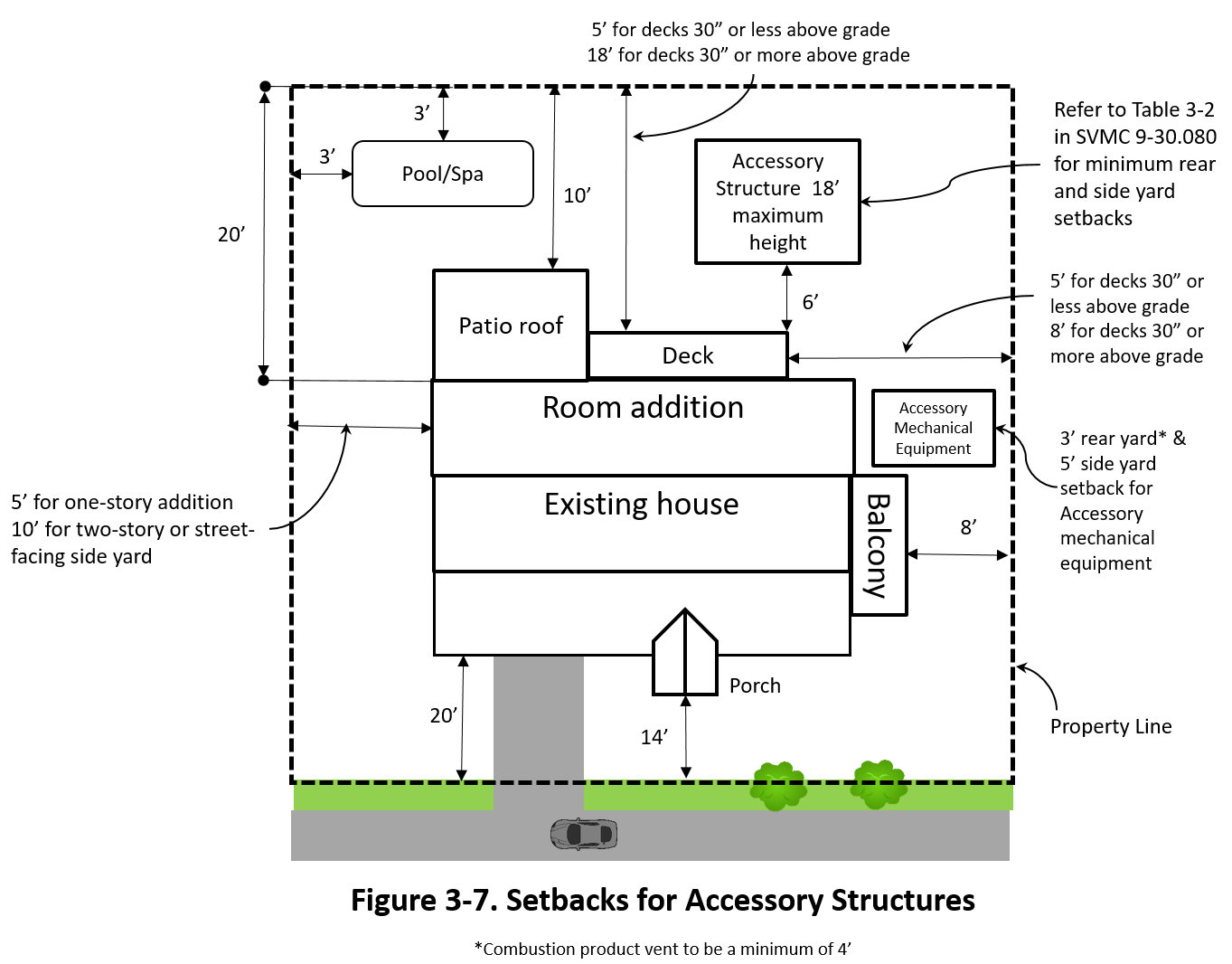
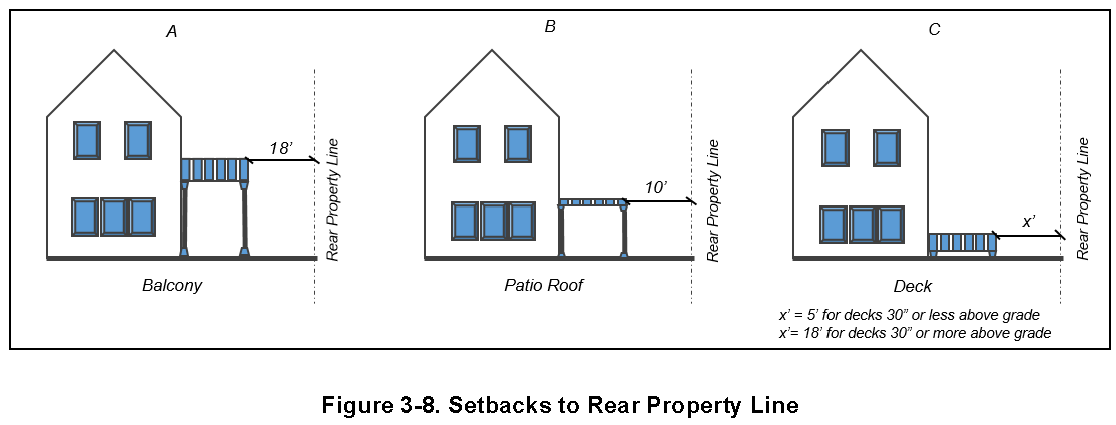
Setbacks for architectural features and accessory structures. Architectural features and accessory structures require the following setbacks as listed in Table 3-2.
TABLE 3-2 - SETBACKS FOR ARCHITECTURAL FEATURES AND ACCESSORY STRUCTURES
* Accessory structures shall not cover more than 40 percent of any required yard except for Accessory Dwelling Units which are subject to yard coverages as outlined in Section 9-44.160
** Also see Section 9-24.050, Table 2-3, Notes (4), (5), and (6), for setback reductions adjacent to common and open space areas.
+ Requires an open area in the rear yard setback, per Section 9-24.050.C.2
++ Allowed on residential lots 20,000 square feet or greater, or with an A, L, or H Overlay, pursuant to Section 9-44.070(C)(1)(b).
E.
Use of required setbacks.
1.
No yard or other open space abutting any building for the purpose of complying with the regulations of this Chapter shall be considered as providing a yard or open space for any other building or structure, unless approved by the Commission.
2.
Notwithstanding other limitations, all required yards may be used for landscaping, walkways and driveways.
3.
On a corner lot, no building shall be placed within a Traffic Safety Sight Area.
(§ 5, Ord. 1085, eff. January 6, 2006, as amended by § 2 (part), Ord. 1110, eff. April 6, 2007; § 2 (Exh. A), Ord. No. 1183, eff. March 15, 2012; § 2 (Exh. A), Ord. No. 1282, eff. December 11, 2017; and § 2(Exh. A), Ord. No. 1289, eff. July 5, 2018; § 2(Exh. A), Ord. No. 1315, effective October 19, 2020; § 2(Exh. A), Ord. No. 1316, effective December 3, 2020; § 2(Exh. A), Ord. No. 1341, eff. July 14, 2022 and § 2(Exh. A), Ord. No. 1351, effective July 17, 2023)
9-30.090 - Undergrounding of Utilities
Existing and new overhead utility facilities shall be converted to, or installed as, underground utilities in compliance with this Section.
A.
Applicability. No Zoning Clearance shall be issued for any construction of a new structure or land development unless the applicant's plans comply with the provisions of this Section.
B.
Definitions. Definitions of the technical or specialized terms and phrases used in this Section may be found in Article 8.
C.
Requirements for undergrounding. All utilities servicing a new structure or servicing any existing structure located on the same parcel of land as a new structure shall be installed or relocated underground, except as otherwise exempted in this Section. Relocation of existing overhead utility service to an off-site location is not permitted.
Utility lines, such as electric distribution (under 33,000 volts), communications, street lighting and cable television, shall be placed underground by the applicant, who shall make the necessary arrangements with the utility companies for the installation of such facilities. Existing utility poles on the project site shall be removed and undergrounding of all overhead service not directly affecting service to adjacent sites shall be accomplished to the nearest existing off-site pole as determined by the City Engineer. New poles may be set only in special instances where no other feasible solution is available as determined by the utility company.
D.
Exemptions from undergrounding requirements. The following types of facilities are exempt from the undergrounding requirements of this Section.
1.
Poles, overhead wires and associated utility services used for electricity transmission at a nominal voltage of 33,000 volts or higher.
2.
Appurtenant structures and equipment, including surface mounted transformers, pedestal-mounted terminal boxes and meter cabinets.
3.
Temporary poles, overhead wires and associated utility services used or to be used in conjunction with construction projects.
4.
Temporary poles, overhead wires and associated utility services for a temporary use, when a Temporary Use Permit has been issued, and when the permit requires removal of the temporary utility service upon completion of the temporary use.
5.
Public utilities doing work governed by the rules, regulations and tariffs of the California Public Utilities Commission.
6.
Emergency poles, overhead wires, and utility services to be installed and maintained for a period not to exceed 10 days, with the approval of the City Engineer.
7.
Whenever an undergrounding utility district has already been formed or is projected to be formed in compliance with Municipal Code Title 7, Chapter 4, Section 7 4.01 et seq.
8.
Whenever an unreasonable hardship has been established by the Planning Commission in compliance with Subsection F.
E.
In-lieu fee. When a project does not qualify for one of the exemptions listed in Subsection D, above, and the Commission has granted relief from undergrounding in conjunction with a request for construction under Subsection F, an in-lieu fee may be established based on front footage costs estimated by the Southern California Edison Company. The City Engineer shall collect the in-lieu fees and manage and adjust the fees for inflation as deemed necessary.
F.
Hardship waiver - In-lieu fees. If the cost of placing utility services underground is so great as to constitute an unreasonable hardship, the property owner, subject to the undergrounding requirement, may apply in writing to the approving body for relief from the provisions of this Section. The request shall include a detailed description of the overhead utility services proposed to be placed underground and separate itemized cost estimates of construction of the project if the utilities were placed or relocated underground or above ground.
1.
Unreasonable hardship findings. After considering the request for relief, the approving body may grant relief as may be deemed proper under the circumstances, including the imposition of in-lieu fees or the indefinite deferral of the undergrounding requirement. The approving body may grant this relief only if the approving body makes all of the following findings, each of which are supported by substantial facts:
a.
The cost of undergrounding utilities exceeds 20 percent of the total project cost, including all on- and off-site improvements and structures, with valuation to be determined using the currently adopted valuation tables of the Building Official and the Public Works Department;
b.
No new utility poles are to be erected;
c.
There is another overhead utility service in the immediate vicinity which would remain even if no waiver is granted; and
d.
The grant of approval would not be inconsistent with the intent and purposes of this Chapter.
2.
Deferral. The approving body may grant a deferral of the requirements to underground utilities, by requiring a deed restriction to be recorded against the property concurrent with recordation of the final map or prior to issuance of a zoning clearance. The deed restriction will require the current or future property owner to accept any future assessment proceedings for undergrounding the existing onsite overhead utilities. This deferral may only be granted by the approving body if the undergrounding of existing overhead utility services would require the installation of more guy poles than the number of existing utility poles required to be removed. The determination regarding the need for additional guy poles shall be verified by the appropriate utility company.
3.
Appeal of approving body decision. Any decision of the approving body concerning a hardship waiver request under this Section may be appealed by any interested person in compliance with Chapter 9-76 (Appeals), and as follows.
a.
Appeal requirements. The appeal shall contain the following information:
(1)
A detailed description of the overhead utility services proposed to be placed underground;
(2)
A separate itemized cost estimate for: the construction valuation of the project certified by the Building Official; the construction costs of the utilities to be placed underground; and, if applicable, the construction costs of utilities to be relocated above ground; and
(3)
The grounds for the appeal.
b.
Granting of the appeal. Upon consideration of the appeal, the appeal body may grant relief as it may deem proper under the circumstances, including indefinite deferral of the undergrounding requirement. The appeal may be granted if the appeal body is able to make all of the findings of Subsection (F)(1), each of which is supported by substantial facts.
(§ 5, Ord. 1085, eff. January 6, 2006, as amended by § 2 (part), Ord. 1110, eff. April 6, 2007)

