
Simi Valley City Zoning Code
CHAPTER 9
44 - Standards for Specific Land Uses4
Prior ordinance history: Ord. 1085, effective January 6, 2006.
9-44.010 - Purpose
This Chapter provides site planning; development, and/or operating standards for certain land uses that are allowed by Article 2 (Zoning Districts, Allowable Land Uses, and Zone-Specific Standards) within individual or multiple zoning districts, and for activities that require special standards to mitigate their potential adverse impacts.
(Amended during 3-07 supplement)
9-44.020 - Applicability
The land uses and activities covered by this Chapter shall comply with the provisions of each Section applicable to the specific use, in addition to all other applicable provisions of this Development Code.
A.
Where allowed. The land uses and activities that are subject to the standards in this Chapter shall be located in compliance with Article 2 (Zoning Districts, Allowable Land Uses, and Zone-Specific Standards).
B.
Land use permit requirements. The uses that are subject to the standards in this Chapter shall be authorized by the land use permit required by Article 2, except where a land use permit requirement is established by this Chapter for a specific use.
C.
Development standards. The standards for specific uses in this Chapter supplement and are required in addition to those in Articles 2 (Zoning Districts, Allowable Land Uses, and Zone-Specific Standards) and 3 (Development and Operational Standards). In the event of any conflict between the requirements of this Chapter and those of Article 2 or 3, the requirements of this Chapter shall control.
(Amended during 3-07 supplement)
9-44.030 - Accessory Retail
In the CO Zone, accessory barber shops, beauty shops, coffee shops, and newsstands may be located in an office building provided there are no entrances directly from the street to such businesses, that there are no signs or other evidence indicating the existence of such businesses visible from the outside of any such office building, and, provided the building is of sufficient size that the patronage of such businesses may be expected to be furnished substantially or wholly by tenants of the office building.
(Amended during 3-07 supplement)
9-44.040 - Amplified Music/Dancing
A.
Purpose. This Section provides development standards for locations having amplified music and/or dancing on the premises on a permanent basis, that are located adjacent to sensitive land uses.
B.
General standards for amplified music/dancing in all applicable zoning districts. Establishments requesting amplified music and/or dancing on a permanent basis, as defined in Article 8 (Glossary), shall be required to obtain a Conditional Use Permit (CUP) in compliance with Section 9-52.070 (Conditional Use Permits), if the following requirements are met:
1.
The amplified music/dancing site is located within 250 feet of any church, hospital, school, or public park; and
2.
The amplified music/dancing site is located within 250 feet of any residential zone.
Distances shall be measured from the nearest property line of the above uses of zones to the nearest exterior building or wall of the proposed amplified music/dancing site. After a project application has been deemed complete, the project will not be subjected to any further application of the distance requirements. Any conflicting use, such as a church, hospital, or school, which commences after the CUP application is "deemed complete" date, does not affect the amplified music/dancing establishment.
C.
Exemptions. These standards shall not apply to uses requesting amplified music/dancing on a temporary basis. Occasional dances at churches, schools, and community center are exempt from the requirement for a CUP, but must comply with requirements for Dance Permits, SVMC Section 5-7.02.
(Amended during 3-07 supplement)
9-44.050 - Animal Facilities
This Section provides standards for the design, construction, and maintenance of specialized animal facilities. See also Section 9-44.060 (Animal Keeping).
A.
Animal hospitals. An animal hospital shall be completely enclosed within a soundproofed building.
B.
Equestrian facilities. Commercial equestrian stables and arenas shall comply with the following standards.
1.
Minimum lot area. No commercial equestrian riding/rental stable, boarding stable or show arena shall be allowed on a site of less than three acres.
2.
Access. Each commercial rental/riding or commercial boarding stable or combination thereof including either of the two, shall have direct access to the City's equestrian trail system. A commercial show arena, when not in combination with either a riding/rental stable or boarding stable, shall not be subject to this requirement.
C.
Wildlife Rehabilitation Facilities. Wildlife Rehabilitation Facilities (Wildlife Facilities) are facilities, whose purpose is the care and release back into the natural environment, of injured and orphaned wild animals. Wildlife Facilities shall comply with the following standards.
1.
Wildlife Facilities must be located on Residential properties in the Limited Farm Animal-overlay zone, have a minimum of 20,000 square feet, and have a City-issued Conditional Use Permit.
2.
Wildlife Facilities must have all applicable County, State and Federal permits prior to issuance of a Conditional Use Permit.
3.
The animals that may be treated must be indigenous to the State of California, including game birds, protected nongame birds, resident small game mammals, nongame mammals, furbearing mammals, reptiles and amphibians. The following animals are prohibited at the Wildlife Facility: mountain lions, elk, adult deer (e.g., deer that have lost their fawn spots), wild pigs, antelope, bighorn sheep, bear, big game mammals as defined in California Code of Regulations section 350 of Title 14, or animals that are exotic to the State of California (ferrets, Burmese pythons, African lions, and other animals as defined in California Code of Regulations section 671 of Title 14, and the California Dept. of Fish and Wildlife publication "Manual No. 671 (2/25/92) Importation, Transportation And Possession Of Restricted Species" or subsequent updates).
4.
The maximum number of animals on-site at any one time, must be identified in the Conditional Use Permit.
5.
Except as allowed under paragraph 6 below, once treatment is completed, animals must be either released into the wild, transferred to a permitted facility, or humanely euthanized. Animals may not be released to the surrounding area unless they originated in this area.
6.
Resident wild animals may be kept on site as part of the maximum number of animals on-site at any one time, only if they cannot survive upon release back into the wild and are either related to facility operations or are used for off-site, educational presentations. The applicant must have the applicable County, State and Federal permits.
7.
Wildlife Facilities must be an accessory use to the primary residential use, and the permittee of the City's Conditional Use Permit must be the owner-occupant of the property.
8.
Only Wildlife Facility employees and/or volunteers (maximum of two on-site at one time) are allowed at the Wildlife Facility site. No programs or events related to the Facility may be held on-site.
9.
Wildlife Facilities must provide the following setbacks:
a.
All structures used to house wildlife, must be located behind the residence on the parcel and must maintain side and rear setbacks in compliance with the adopted Simi Valley Municipal Code, unless the site abuts a nonoverlay zoned property.
b.
Setbacks for the wildlife enclosures abutting nonoverlay zoned property must be a minimum of 20 feet when a Limited Farm Animal Overlay zoned property abuts nonoverlay zoned property.
c.
All wildlife enclosures, except for aviaries, including pens, uncovered stables, and similar wildlife containment structures that are not fully enclosed with solid walls, shall provide a minimum distance of 50 feet from any legally existing off-site structure used for human occupancy or habitation, other than the residence of the owner or keeper of the animals.
(Amended during 3-07 supplement as amended by § 1 (Exh. A), Ord. No. 1229, eff. November 13, 2015)
9-44.060 - Animal Keeping
A.
Purpose. This Section establishes standards and conditions for the keeping of all animals in the City while protecting the health, safety and welfare of its residents.
B.
Applicability. The standards in this Section shall apply equally to residential properties within or outside of the (A), (L), and (H) overlay zones, with the exception of the density standards, except as noted in specific standards.
C.
General requirements.
1.
Enclosure. All animals shall be properly caged or housed, and must be kept in their corrals, barns, pens or other enclosure. All corrals, pens, coops, lofts, exercise areas, or similar structures shall be fenced or otherwise enclosed to adequately confine the animals.
2.
Maintenance. All buildings housing farm animals, all animal enclosures, and all pasture areas shall be maintained free from litter, garbage and the accumulation of manure. Premises shall be maintained in a neat and sanitary manner. If farm animals are not maintained in compliance with these standards, or are otherwise allowed to become a nuisance, the City shall initiate enforcement proceedings in compliance with Chapter 9-78 (Enforcement).
3.
Compost bins. Property owners electing to permanently place a compost bin enclosure in the front yard area shall adhere to the standards listed in Section 9-24.060(A)(6).
4.
Animal disturbance. No person shall keep or permit to remain on any premises within the City any animal that habitually disturbs the peace and quiet of two or more residents (in two different dwelling units) in a neighborhood, by howling, barking, crying, baying or making any other noise. Included, but not limited are such animals as roosters, peacocks and geese. Except for barking dogs, this requirement shall not apply in the (A), (L), and (H) overlay zones.
D.
Standards for animals other than farm animals.
1.
Beekeeping. Beehives and beekeeping practices shall be permitted in the RMod, RM, RL, RVL, RE, and OS Zones as follows:
a.
A Zoning Clearance within the A (Farm Animal), L (Limited Farm Animal), and H (Horse) overlay zoning districts on lots up to three acres is not required.
b.
A Zoning Clearance is required for residential properties 10,000 square feet to three acres that are in the residential zones listed above and are not in the animal overlay zoning districts.
c.
For lots that are three acres or greater within or outside the animal overlay zoning districts, a Zoning Clearance is not required.
d.
Beekeeping activities must comply with SVMC Section 9-44.060.D.1. Docile honey bees, such as Apis Mellifera species (European honey bees) are permitted, and Apis Mellifera Scutellata (African honey bees) species are prohibited.
All beekeeping activities outlined in SVMC Section 9-44.060.D.1. a through d listed above are subject to the following standards:
a.
A bee hive shall consist of one queen bee and her colony. No more than 2 hives are allowed per property, unless otherwise permitted with the approval of an Administrative CUP.
b.
The entrance of the hives shall be directed away from the nearest property line if the hive entrance is closer than twenty (20) lineal feet of a property line.
c.
Hives shall not be placed within the front yard area (the area between the wall of the principal or main building which face the front property line and the front lot line, extending between the side lot lines) and seven (7) lineal feet of a side or rear property line. Hives shall not be placed within 20 lineal feet of any public street, sidewalk, public park, or other public thoroughfare.
d.
Hives shall be screened by a minimum 6-foot high solid fence or shrubbery. If shrubbery is used to screen the hives, the shrubs or bushes must consist of small to medium-sized evergreen perennial woody plants. The shrubs should be spaced to provide 100 percent of coverage within three (3) years after planting.
e.
A water source with adequate supply of water must be provided for the bees at all times on the property where the bees are kept to discourage bee visitation at water sources on adjacent or surrounding properties.
f.
Each colony shall be maintained in movable-frame hives.
g.
Hives shall be re-queened (replacement of the queen bee in the colony with a younger and more productive queen) at least once every two years to prevent swarming. All queens are recommended to be marked on the thorax with the color corresponding to the queen's first year of production to quickly locate the queen and her age, and to determine whether the colony has gone through a re-queening process. Documentation shall be submitted to the City to show proof of the re-queened bee.
h.
Adequate space shall be maintained in the hive to prevent over-crowding and swarming or aggressive behavior. For purposes of this ordinance, "aggressive bee behavior" shall be defined as more than one bee repeatedly attacking, but not necessarily stinging, any person or domestic animal at a distance of fifteen (15) feet or more from the front of the hive entrance, or a distance of five (5) feet or more from the side or rear of the hive.
i.
Each colony shall be registered with the Ventura County Agricultural Commissioner and kept in compliance with all State regulations governing bee management and honey production as provided in Division 13 of the California Food and Agriculture Code, Section 29000, et seq. Those regulations are enforced by the County Agricultural Commissioner.
j.
The beekeeping activities may only be granted to an occupying resident of the home and is not transferable to a new owner or tenant.
k.
Bee hives must be a minimum of 50 feet from the property line of a legally existing, off-site structure used for human occupancy or habitation, other than the residence of the property owner.
l.
Prior to issuance of a Zoning Clearance for allowing beekeeping on lots within the animal overlay zoning district, or on lots of 10,000 square feet in size or greater, outside the animal overlay zoning district, the Environmental Services Department shall give notice of the proposed use by mailing a written notice to the applicant, the owners of the property involved, and the owners of the property situated in whole or in part within a radius of 100 feet of the boundaries of the assessor's parcel(s), as follows:
Notice and hearing. The notice and hearing procedures for the Zoning Clearance shall be as follows: The Environmental Services Department shall give notice of the proposed use by mailing a written notice, postage prepaid, describing the use, not less than 10 calendar days prior to the date of the decision to the applicant, the owners of the property involved, and to the owners of the property situated in whole or in part within a radius of 100 feet of the boundaries of the assessor's parcel(s) on which the proposed use is to be located. Names and addresses shall be obtained by the applicant from the latest equalized assessment roll. No hearing on the application for a permit issued pursuant to this paragraph shall be held before a decision is made unless a hearing is requested by the applicant or other affected persons. If a hearing is requested, the Zoning Administrator will follow the guidelines of noticing and hearing procedures in Chapter 9-74 (Public Hearings).
m.
All Zoning Clearance approvals for beekeeping shall be subject to review by the Director within one year after their initial approval as a result of a complaint by any person affected by the beekeeping activities.
n.
In the event of an alleged violation of an approved Zoning Clearance for beekeeping, the permittee shall, at the request of the Director, or their designee, submit proof of compliance for City review in the form of either (a) date stamped and authenticated photographs or videotape which demonstrates that no violation exists, or (b) an invitation by the permittee to the Director to visit the site of the alleged violation. The sufficiency of the evidence shall be evaluated on the basis of the clear and convincing evidence standard. If the Director determines that the access allowed or the evidence presented is not sufficient to verify compliance with the Beekeeping Permit, the permit shall be subject to revocation. Revocation of a Beekeeping Permit by the Director can be appealed to the Planning Commission pursuant to the provisions of this Code.
o.
Zoning Clearances that are issued pursuant to this Section may be revoked by the Reviewing Authority, following a public hearing upon such revocation, for any violation of the standards set forth in this Section or of the permit conditions.
2.
Dogs, cats, and Vietnamese pot bellied pigs.
a.
Domestic cats, dogs and Vietnamese pot bellied pigs may be kept as an accessory use, upon lots used primarily for residential or agricultural uses, for recreational purposes (and as protection) as provided in Subsection (D)(2)(b). They are permitted to be kept as an accessory use upon any lot developed with an office, business or other commercial or industrial use for the primary purpose of protecting the premises from varmints and trespassers.
b.
Within the OS, RE, RVL, RL, RM, RMod, RH, RVH and MH zones, four dogs, four cats, or four Vietnamese pot bellied pigs or any combination of four of these animals may be kept on each residential unit.
c.
Within the Mixed-Use Overlay District (for residential uses), four dogs, four cats, or four Vietnamese pot bellied pigs or any combination of four of these animals may be kept for each residential unit.
3.
Breeding of dogs and cats in Residential Zones.
a.
Cat breeding activities for no more than four adult cats (cats over four months in age), with a limit of two litters born per household per calendar year, is allowed in all residential zones. A Home Occupation Permit is required for the sale of the cats.
b.
Dog breeding activities for no more than four adult dogs (dogs over four months in age), with a limit of two litters born per household per calendar year, are allowed in the Animal (A) Overlay Zone, Limited Farm Animal (L) Overlay Zone and Horse (H) Overlay Zone on lots of 20,000 square feet or more in size (exclusive of any homeowner's association landscape easements), that have a detached single-family dwelling. A Home Occupation Permit is required for the sale of the dogs.
c.
Cat breeding involving five or more cats is allowed on properties, which have a detached single-family dwelling, with a Conditional Use Permit subject to the following conditions:
(1)
The maximum number of cats is limited to 12 adult cats (cats over four months in age) and two litters born per household per calendar year, subject to compliance with the Ventura County Animal Regulation Department specifications for animal health and safety.
(2)
A current kennel license issued by the Ventura County Animal Regulation Department is required.
(3)
An annual inspection of the property must be conducted by the Ventura County Animal Regulation Department and a copy of the inspection report be provided to the City annually.
(4)
Obtain a Home Occupation Permit issued by the City for the sale of the cats.
(5)
Cats are to be housed only in the principal dwelling at all times unless under the full control of the owner.
(6)
The offspring born of such cats, or other cats under four months of age, which increases the total number on the lot beyond the number permitted under the Special Use Permit, must be removed from the premises not later than four months after birth.
(7)
The property owner, upon City request, must provide a certification from a licensed Veterinarian or other form approved by the Deputy Director/City Planner that verifies the birth date or age of all the cats being kept on the property.
(8)
City must be provided full access to the property after 24 hours notice in order to inspect the premises for compliance with the Animal Special Use Permit conditions of approval.
d.
Dog breeding involving five or more dogs is allowed on residential properties with detached single-family dwellings located in an Animal (A) Overlay zone, and with a Conditional Use Permit subject to the following conditions:
(1)
A minimum of 20,000 square foot lot is required (the 20,000 square feet must be exclusive of any homeowners association landscape easements).
(2)
The maximum number of dogs is limited to 12 adult dogs (dogs over four months in age) and two litters born per household per calendar year, subject to the following criteria:
(a)
Compliance with the Ventura County Animal Regulation Department specifications for animal health and safety.
(b)
Dog enclosures and open dog exercise areas must be set back a minimum of 50 feet from all habitable structures located on adjoining properties.
(3)
A current kennel license issued by the Ventura County Animal Regulation Department is required.
(4)
An annual inspection of the property must be conducted by the Ventura County Animal Regulation Department and a copy of the inspection report be provided to the City annually.
(5)
Obtain a Home Occupation Permit issued by the City for the sale of the dogs.
(6)
The offspring born of such dogs, or other dogs under four months of age, which increases the total number on the lot beyond the number permitted under the Conditional Use Permit, must be removed from the premises not later than four months after birth.
(7)
The property owner, upon City request, must provide a certification from a licensed Veterinarian or other form approved by the Deputy Director/City Planner that verifies the birth date or age of all the dogs being kept on the property.
(8)
City to be provided full access to the property after 24 hours notice in order to inspect premises for compliance with the Conditional Use Permit conditions of approval.
4.
Other household animals.
a.
Other domestic creatures that are neither farm animals, except rabbits, exotic or wild animals (as defined in California Fish & Wildlife Code Section 2116), including domestic mice and rats, hamsters, guinea pigs, turtles, tropical fish, canaries, birds of the Psittacine family or Columbiformes family, and rabbits, may be kept upon any parcel in any zone where the principal use upon the parcel is residential, so long as animals are not maintained for commercial purposes, do not constitute a nuisance, are adequately provided with food, care and sanitary facilities, and do not exceed a total of six animals (fish being exempt), except rabbits, where a maximum of three is allowed, on any parcel either within or outside any dwelling unit.
b.
Household animals may be kept in excess of the number and distribution allowed by this Section upon the granting of a Conditional Use Permit in compliance with Subsection F (Modification of standards), below.
c.
Animals that, because of size, specialized breeding or other unique quality, cannot be clearly categorized may be allowed upon granting of a Conditional Use Permit in compliance with Subsection F (Modification of standards), below.
5.
Wild and exotic animals. No wild or exotic animal, nor any animal not normally considered a farm animal or domesticated household pet, shall be kept within any zoning district in the City, except as allowed to be kept per Section 9-44.050.C.
6.
Animals not classified. Any animal not specifically classified within this Section shall be classified by the Director as necessary, based upon a determination as to the probable negative impact of the health, safety or general welfare upon the community.
E.
Standards for farm animals.
1.
Animal Overlay Zone required. The (A), (L), or (H) Overlay Zone designations as described in this Section shall be required on a parcel in order to maintain farm animals as an allowed residential accessory use in the City, with the exception of parcels granted a Conditional Use Permit in compliance with Section 9-52.070 (Conditional Use Permits) and Subsection F (Modification of standards), below.
a.
(A) Overlay Zone defined. The (A) Overlay Zone shall permit all farm animals to be kept on a parcel in compliance with the standards of this Section, as allowed above. Farm animals shall consist of bulls, burros, chickens, chinchillas, cows, donkeys, ducks, goats, horses, mules, peacocks, pigs, ponies, rabbits, sheep, steers, turkeys, and other non-carnivorous fur-bearing animals of a similar size.
b.
(L) Overlay Zone defined. The (L) Overlay Zone shall allow only the following limited types of farm animals for purposes of this Section: burros, Columbiformes, donkeys, ducks, goats, hens (limited to five hens per parcel), horses, llamas (limited to one llama per parcel), mules, ponies and rabbits.
c.
(H) Overlay Zone defined. The (H) Overlay Zone shall allow only burros, donkeys, horses, mules, and ponies to be kept on a parcel in compliance with the standards of this Subsection.
2.
Farm animal units. The keeping of any farm animals allowed in Subsection 1, immediately above, shall be allowed in compliance with the following table of farm animal units (Table 4-1, Maximum Allowable Farm Animal Units), and the density standards in Subsection 3, below. Ponies and miniature horses are limited to 14.2 hands (56.8 inches) or less in height.
TABLE 4-1 - MAXIMUM ALLOWABLE FARM ANIMAL UNITS
3.
Density. All farm animals shall be established at the density of one farm animal unit equivalency (FAUE) for each 10,000 square feet of net parcel area for each of the first two animal units and 7,000 square feet for each animal unit thereafter, except that parcels with less than 10,000 square feet in an Animal Overlay Zone may be used for the keeping of one animal unit on a parcel; provided, the setback standards of Subsection (D)(5), below, can be met. The farm animal density on any parcel where farm animals are allowed shall not exceed the maximum allowed by this formula unless a Conditional Use Permit is granted in compliance with Subsection F (Modification of Standards), below. Density limitations shall not apply to bovine, equine, and ovine contained on parcels or contiguous assemblages of parcels under the same ownership of 25 or more in the RE or OS zoning districts.
a.
In establishing square footage for the purpose of calculating FAUE allowed, fractional densities shall be counted.
Example: On a 13,000 square foot parcel, 1.3 FAUE farm animals units would be allowed.
b.
In calculations for allowed animals, animal categories may be combined so that the FAUE of the combined categories is equal to or less than the allowed density identified in Subsection (F)(3), above.
Example: On a 13,000 square foot parcel in the appropriate zoning district, the following combination would be allowed:
c.
On lots with a minimum of 20,000 square feet of net parcel area and located in the (L) Overlay Zone, three horses may be kept as an alternative to using the Farm Animal Unit calculations in subsection 2. If this three-horse alternative is chosen for the number of Farm Animals to be located on a lot, then no additional Farm Animals shall be allowed, unless the additional animal(s) meet the standards in SVMC Section 9-44.060, which includes the density calculations for the lot area exceeding 20,000 square feet.
d.
Within the (L) Overlay Zone, hens are limited to five hens per parcel, and llamas are limited to one llama per parcel.
4.
Minimum parcel size. There shall be no minimum parcel size requirement for farm animal keeping on any animal overlay zoned parcel, except that the standards for density (Subsection 3, above) and setbacks (Subsection 5, below) shall apply in determining if a farm animal may be maintained on a parcel. In order to maintain farm animals on a parcel as an accessory use in a non-overlay zone, a minimum parcel size of 20,000 square feet and a Conditional Use Permit, approved in compliance with Subsection F (Modification of Standards), below, shall be required.
5.
Setbacks.
a.
All structures used to house farm animals, including livestock and poultry buildings, barns, coops, lofts, stables, and similar accessory structures, shall be located behind the residence on the parcel and shall maintain side and rear setbacks in compliance with the adopted Uniform Building Code, unless the site abuts a nonoverlay zoned property.
b.
Setbacks for the structures abutting nonoverlay zoned property shall be 20 feet when an overlay zoned property abuts nonoverlay zoned property.
c.
All other animal enclosures, including corrals, feed areas, paddocks, pens, uncovered stables, and similar enclosures, shall be maintained a minimum distance of 50 feet from any legally existing off-site structure used for human occupancy or habitation, other than the residence of the owner or keeper of the animals.
6.
Special requirements. The keeping of specific domestic animals is subject to the special requirements in this Subsection, in addition to other standards identified in this Section.
a.
Bovine. All bovines shall be maintained in a fenced area.
b.
Equine. All property on which equines are maintained shall provide a corral with a minimum area of 500 square feet for each animal.
c.
Swine. All swine (excluding Vietnamese pot bellied pigs) shall be maintained in pens.
7.
Boarding of equines. The boarding of equines is permitted in the (A), (L), and (H) Overlay Zones subject to obtaining a Home Occupation Permit in compliance with Section 9-44.090. The total number of animals kept or boarded may not exceed the number allowed by Subsection (E)(3) (Density), above. If the number to be kept or boarded exceeds the number allowed, a Conditional Use Permit shall be required in addition to the Home Occupation Permit, as follows:
a.
For commercial riding, rental or boarding stables and show arenas, where allowed by Article 2 (Zoning Districts, Allowable Land Uses, and Zone-Specific Standards) and in compliance with Section 9-44.050 (Animal Facilities); and
b.
For non-commercial boarding of equines, as identified in Subsection F (Modification of Standards), below.
8.
Hen Projects.
a.
The person conducting the hen project must be: 1) attending a course related to animal husbandry in an educational classroom environment; or 2) a member of a regional or nationally recognized non-profit organization, in which the person participates in a program that is associated with the raising and caring of farm animals.
b.
A Zoning Clearance (valid for one year) will be issued to the person and property owner to allow for a maximum of six hens (roosters not permitted) in conjunction with a hen project. The Zoning Clearance can be renewed on an annual basis.
c.
The property must contain a single-family dwelling and be zoned for single-family use (OS, RE, RVL, RL, RM, and RMod Zoning Districts), with a minimum of 8,000 square feet.
d.
The hens must be kept in a coop and enclosed area with a minimum of three square feet and a maximum of six square feet per hen. The maximum height allowed for the coop is six feet.
e.
The coop and enclosure must be located in the rear yard and setback ten feet from the side and rear property line.
f.
Animal Keeping requirements per Section 9-44.060.C must be met, including maintenance standards for the chicken coop and not disturbing the neighborhood.
F.
Modification of standards.
1.
Scope of modifications allowed. The Deputy Director/City Planner may grant a Conditional Use Permit at an administrative hearing in compliance with Section 9-52.070, to allow the keeping of:
a.
Farm animals as an accessory use on parcels of 20,000 square feet or more; or
b.
Cats, dogs, other household pets, or farm animals when otherwise allowed by these regulations, in excess of the those allowed by this Section.
2.
Required findings for approval of a Conditional Use Permit. The Deputy Director/City Planner may grant a Conditional Use Permit after first finding that the subject parcel is:
a.
Reasonably proportioned and of adequate size for the purposes requested; and
b.
Situated or mitigation measures have been applied, so that the animals would not be detrimental to the health, safety or welfare of the general public, or to persons residing or working in the neighborhood of the use, or be detrimental or injurious to property or improvements in the vicinity of the use.
3.
Minimum requirements. In granting a Conditional Use Permit to allow the keeping of farm animals as an accessory use on parcels of 20,000 square feet or more in a non-overlay zone, the following two conditions shall be applied as minimum requirements:
a.
The Conditional Use Permit remains valid as long as the site is not developed for a higher residential density or for a nonresidential use; and
b.
The Conditional Use Permit remains valid as long as the animal keeping does not cease for more than 12 months.
(Amended during 3-07 supplement as amended by § 3 (Exh. B), Ord. No. 1193, eff. July 19, 2012; § 2 (Exh. A), Ord. No. 1202, eff. October 25, 2012; § 2 (Exh. A), Ord. No. 1216, eff. December 19, 2013; § 2 (Exh. A), Ord. No. 1217, eff. December 19, 2013; § 1 (Exh. A), Ord. No. 1229, eff. November 13, 2015; § 1 (Exh. A), Ord. No. 1233, eff. February 26, 2015 and § 2 (Exh. A), Ord. No. 1322, eff. July 8, 2021)
9-44.065 - Business Park Overlay District Standards
A.
Retail sales.
1.
Where allowed. Retail sales incidental to a principal use are allowed provided that:
a.
The operations are housed as part of the building or buildings comprising the basic operations.
b.
Retail sales represent less than 20 percent of the gross receipts of the company. Receipts and/or other proof of the percentage of gross receipts shall be provided to the City upon request.
c.
No retail sales or display of merchandise occurs outside of the building(s).
2.
Conditional Use Permit required.
a.
Conditional Use Permit approval shall be required when retail sales incidental to a principally permitted use that conforms to all of the standards of this Subsection represent more than 20 percent but less than 50 percent of the gross receipts of the business. Receipts and/or other proof of the percentage of gross receipts shall be provided to the City upon request.
b.
The Planning Commission may grant CUP approval for the retail use only if the findings contained in Section 9-52.070 (Conditional Use Permits) are met.
B.
Cargo Containers. Cargo containers shall either be considered as part of a development permit application, or added to a developed site with a Zoning Clearance. Cargo containers shall only be located within the rear two-thirds of the site and not visible from any public or private street.
C.
Outdoor Storage. Accessory outdoor storage shall be confined to the rear two-thirds of the property and screened from public and private streets by appropriate walls, fencing, earth mounds, or landscaping.
D.
Signage. Signs will be regulated according to the requirements in Section 9-37.060.B.
(§ 3 (Exh. B), Ord. No. 1193, eff. July 19, 2012)
9-44.070 - Cargo Containers
A.
Purpose. This Section provides development standards for the location and use of cargo containers in the residential and specified commercial and industrial zoning districts in the City.
B.
Standards for residential zoning districts. The following cargo container standards shall apply in RM, RL, RVL, RE, and OS zoning districts.
1.
Cargo containers may be allowed as permanent incidental storage to residential uses on parcels at least 20,000 square feet in area, or on parcels with an Animal, Limited Animal or Horse Overlay. Incidental storage to residential uses shall comply with the following requirements:
a.
Use. A cargo container shall be non-habitable and used only for the storage of supplies, equipment, or other materials incidental to the approved Primary Residential Unit on site.
b.
Location. Cargo containers can only be placed in yards on top of a concrete pad. In no instance, shall a cargo container be placed in any required parking spaces, driveways, easements or required yard setbacks. No cargo container shall be located closer than 10 feet from any side or rear property lines. Cargo containers shall not be allowed permanently in the front yard. Refer to Table 3-2 in Section 9-30.080.
c.
Screening. All cargo containers shall be screened with a solid six foot high perimeter wall.
d.
Colors. Cargo containers shall be painted in one (1) solid color, which is found on the primary residential unit on the site.
e.
Limitations. Only one cargo container up to 160 square feet in size will be allowed per residential lot. The top of any cargo container shall not exceed a height of nine (9) feet as measured from abutting grade. No stacking of cargo containers shall be allowed. No storage of materials on top of cargo containers shall be allowed. Cargo container shall not be outfitted with electrical or plumbing connections.
2.
On a residentially zoned parcel with an allowed nonresidential use (e.g., church, synagogue, or other structure used for religious worship, school, or hospital), cargo containers may be allowed when incidental to the allowed nonresidential use located on the site. Cargo containers shall either be considered as part of a development permit application, or added to a developed site with a Zoning Clearance, subject to the following provisions:
a.
Use. A cargo container shall be used only for the storage of supplies, equipment, or other materials incidental to the approved primary land use on the site.
b.
Location. In no instance shall a cargo container be placed in any required parking space, loading zone, drive aisle, easement, or landscaped area. No cargo container may be located closer than 20 feet from side or rear property line adjacent to residentially zoned property.
c.
Screening. Cargo containers shall not be visible from any public street. All cargo containers shall be screened from adjoining residential properties with a 10-foot wide landscaped buffer, containing a combination of at least two specimen evergreen trees, spaced no more than 20 feet from each other measured from the center of each tree within the required buffer area, shrubs, and screen plantings no less than eight feet tall spaced to provide a full screen hedge within a maximum of three years.
d.
Signs. No signs shall be allowed on the cargo containers.
e.
Colors. Cargo containers shall be painted in one (1) solid color, which is found on the primary structure on the site.
f.
Limitations. The top of any cargo container shall not exceed a height of 10 feet as measured from abutting level land either on-site or off-site. No stacking of cargo containers shall be allowed. No storage of materials on top of cargo containers shall be allowed.
C.
Standards for commercial zoning districts. The following cargo container standards shall apply to the CI, CO, CPD, and CR zoning districts, except as otherwise provided in these regulations.
1.
Cargo containers in the CI, CPD, and CR zoning districts. Cargo containers shall either be considered as part of a development permit application, or added to a developed site with a Zoning Clearance, subject to the following provisions:
a.
Allowed only in rear half of site. Cargo containers shall only be located within the rear one-half of the site.
b.
Use. A cargo container shall be used only for the storage of supplies, inventory, or equipment incidental to the approved primary nonresidential land use on the site. A cargo container shall not be used or occupied as office, sales, retail distribution, or manufacturing space, or for vehicle parking, and may not be leased for use by any off-premises person, business, organization or other entity.
c.
Location. Cargo containers may be allowed only in those zoning districts and locations which allow open storage, except as provided in Section 9-44.110 (Outdoor storage).
d.
Limitations. Cargo containers shall conform to the maximum height, minimum setback, and minimum distance between structure requirements of the zoning district in which they are located. In no instance shall a cargo container be placed in any required parking space, loading zone, drive aisle, easement or landscaped area. The top of any cargo container shall not exceed a height of 10 feet as measured from abutting level land either on-site or off-site. No stacking of cargo containers shall be allowed. No storage of materials on top of cargo containers shall be allowed.
2.
Cargo containers in the CO zoning district.
a.
Cargo containers may be allowed in the CO zoning district only when incidental to the allowed use for a church, synagogue or other structure used for religious worship, school, or hospital on the site.
b.
Cargo containers shall either be considered as part of a development permit application, or added to a developed site with a Zoning Clearance, subject to the following provisions:
(1)
Use. A cargo container shall be used only for the storage of supplies, equipment, or other materials incidental to the approved primary land use on the site.
(2)
Location. In no instance shall a cargo container be placed in any required parking space, loading zone, drive aisle, easement, or landscaped area. No cargo container may be located closer than 20 feet from any side or rear property line adjacent to residentially zoned property.
(3)
Limitations. The top of any cargo container shall not exceed a height of 10 feet as measured from abutting level land either on-site or off-site. No stacking of cargo containers shall be allowed. No storage of materials on top of cargo containers shall be allowed.
D.
Standards for industrial zoning districts. The following standards shall apply to the LI and GI zoning districts, except as otherwise provided for in these regulations. Cargo containers shall either be considered as part of a development permit application, or added to a developed site with a Zoning Clearance, subject to the following provisions:
1.
Allowed only in rear of principal structure. Cargo containers shall only be located within the following areas of the site:
a.
LI zoning district. Cargo containers in the LI zoning district shall only be allowed in the area to the rear of the principal structure, or the rear two-thirds of the site, whichever would be more restrictive; and
b.
GI zoning district. Cargo containers in the GI zoning district shall only be allowed to the rear of a line which is an extension of the front wall of the principal structure.
2.
Use. A cargo container shall be used only for the storage of supplies, inventory, or equipment incidental to the approved primary nonresidential land use on the site. A cargo container shall not be used or occupied as office, sales, retail distribution, or manufacturing space, or for vehicle parking, and may not be leased for use by any off-premises person, business, organization, or other entity.
3.
Location. Cargo containers may be allowed only in those zoning districts and locations which allow open storage, except as provided in Section 9-44.110 (Outdoor storage).
4.
Limitations. Cargo containers shall conform to the maximum height, minimum setback, and minimum distance between structure requirements of the zoning district in which they are located. In no instance shall a cargo container be placed in any required parking space, loading zone, drive aisle, easement, or landscaped area. The top of any cargo container shall not exceed a height of 10 feet as measured from abutting level land either on-site or off-site. No stacking of cargo containers shall be allowed. No storage of materials on top of cargo containers shall be allowed.
(Amended during 3-07 supplement and § 2(Exh. A), Ord. No. 1351, effective July 17, 2023)
9-44.080 - Drinking Places
As of February 12, 1998, drinking places, as defined in Article 8 (Glossary) shall be required to obtain a Conditional Use Permit (CUP) in compliance with Section 9-52.070. Each drinking place shall meet the following requirements:
A.
The drinking place is located at least 250 feet away from any church, hospital, school or public park; and
B.
The drinking place is located at least 250 feet away from any residential zone.
Distances shall be measured from the nearest property line of the above uses or zones to the nearest exterior building wall of the proposed drinking place. A project shall meet all the above distance requirements at the time the application is deemed complete. After a project application has been deemed complete, the project will not be subjected to any further application of the distance requirements. Any conflicting use, such as a church, hospital, or school, which commences after the CUP application "deemed complete" date, does so subject to the CUP project.
(Amended during 3-07 supplement)
9-44.085 - Alcoholic Beverage Manufacturing Standards
The requirements for this Section shall apply to alcoholic beverage manufacturing facilities, such as breweries, distilleries, and wineries.
A.
On-site tasting and alcoholic beverage sales. On-site tasting and alcoholic beverage sales must be limited to the product manufactured on-site or offsite associated with the alcoholic beverage manufacturing facility, unless a Type 41, 47 (restaurant) license is issued.
B.
Retail sales. Incidental retail sales of related products, other than alcoholic beverage sales, is allowed.
C.
Equipment and storage location. All alcoholic beverage manufacturing equipment and storage activities must be located completely within the enclosed building of the facility.
D.
Off-street parking. An Alcoholic Beverage Manufacturing facility shall meet off-street parking requirements as set forth in Chapter 9-34, of the SVMC or Subsection E of this Section. For the purposes of calculating parking:
1.
Preparing areas shall be considered manufacturing,
2.
Tanks and/or barrels, and bottle storage areas shall be considered storage,
3.
Office space shall be considered office, and
4.
Indoor and outdoor tasting areas shall be considered as tasting/eating areas.
E.
Alternate parking options. Alcoholic beverage manufacturing facilities unable to meet the proposed off-street parking requirements, are allowed to use the following alternatives:
1.
Provide a reciprocal parking, ingress, and egress agreement with an adjacent property or properties within 500 feet of facility.
2.
Provide an Alternate Business Hours Shared Parking Analysis to share parking with businesses that would not have overlapping business hours.
3.
Provide valet parking service, including a valet parking program specifying location of valet parking drop off/pick up area, parking locations, hours of operation and number of staff members providing this service. Tandem parking is allowed for valet service.
F.
ABC License. Alcoholic beverage manufacturing facilities offering the sale of alcoholic beverages shall obtain and thereafter maintain the appropriate license from the State of California Department of Alcoholic Beverage Control (ABC).
G.
Associated events. May include tours, specialty dinners, food pairings, retail sales, and/or on-site consumption with tasting areas, including occasional events that may have entertainment and/or amplified music.
(§ 2(Exh. A), Ord. No. 1328, eff. November 11, 2021)
9-44.090 - Home Occupations
The requirements of this Section shall apply to the conduct of a home occupation in any residential dwelling unit.
A.
Allowable home occupation activities. A home occupation shall be limited to business and professional services that do not involve the on-site presence of more than one client at a time (except as provided for in the California Child Day Care Facilities Act Title 1596.70). It shall be unlawful to conduct a home occupation of any other type unless allowed by the underlying zoning district.
B.
Standards for home occupations. Each home occupation shall comply with all of the following standards.
1.
The business or professional service use shall be clearly incidental and secondary to the use of the dwelling for residential purposes.
2.
No sign(s) relating to the home occupation shall be allowed.
3.
No person, other than residents of the home, shall conduct business at the dwelling which is granted the Home Occupation Permit.
4.
No home occupation shall be developed or operated in a manner that will change the residential character and/or appearance of the property, or in a manner as to cause the property to be recognized as a place where a home occupation is conducted.
5.
The area of use for all home occupations shall be confined entirely to one room in the dwelling, not to exceed 20 percent of the total gross floor area of the dwelling, and the entrance to the home occupation space shall be from within the dwelling.
6.
No garage, carport, accessory structure, or similar structure shall be used in conjunction with a home occupation. However, a garage may be used for the storage of items related to an allowed home occupation; provided, there is enough room to park one motor vehicle in a one-car garage or two motor vehicles in a two or more car garage. The dimensions of a motor vehicle for the purpose of this Subsection shall be no less than eight feet wide and 15 feet long. Further, there shall be a clearance of no less than 20 inches on each side of the vehicle(s).
7.
The home occupation shall not attract or generate any additional vehicular or foot traffic to the dwelling beyond that which is considered normal for the zoning district in which the home occupation is located.
8.
No equipment or process shall be used in the home occupation which creates fumes, glare, noise, odor, or vibration detectable to the normal unaided human senses off the parcel, if the occupation is conducted in a single-family detached residence, or outside the dwelling unit if it is conducted in other than a single-family detached residence. No equipment or process shall be used which creates visual or audible electrical interference in any radio or television receiver or other electronic device outside the dwelling unit or causes fluctuations in the line voltage outside the dwelling unit. No use of materials or mechanical equipment not recognized, as being part of normal household uses shall be allowed.
9.
The home occupation shall not cause, involve, or result in the use of commercial vehicles for delivery of materials or supplies to or from the premises, excluding parcel service and the United States mail.
10.
The home occupation shall not generate any solid waste or sewerage discharge in volume or type, which is not normally associated with residential use.
11.
In the case of a dwelling which is part of a common interest ownership community, the provisions of this Section shall not be deemed to supercede any agreement, by-laws, covenant, deed restriction, master deed, or other documents which prohibit a home occupation.
C.
Prohibited Uses. The following uses are expressly prohibited as home occupations:
1.
The repair, reconditioning, servicing, or manufacture of any internal combustion or diesel engine or of any motor vehicle, including automobiles, trucks, motorcycles or boats;
2.
Repair, fix-it, or plumbing shops;
3.
Uses which entail the harboring, training, breeding, raising, or grooming of dogs, cats, or other animals on the premises, unless otherwise allowed in Section 9-44.060(D)(3) (Breeding of dogs and cats in Residential Zones);
4.
Uses which entail food handling, processing, packing or sales;
5.
Healing arts (patients on premises);
6.
Uses which utilize explosives or highly combustible materials and activities which involve the handling, use, generation, or storage of hazardous materials as defined in California Code of Regulations, Sections 66084 and 66060;
7.
Uses which will result in the overnight parking of commercial vehicles (with a gross weight of 10,000 pounds or greater) within the residential area in which the home occupation occurs; and
8.
Beauty salons.
D.
Permit requirement. It is unlawful to operate a business from a dwelling without a valid Home Occupation Permit, issued in compliance with Subsection F (Home Occupation Permit procedures), below.
E.
Limitation on Home Occupation Permit holder. A Home Occupation Permit may only be granted to a resident of the home.
F.
Home Occupation Permit procedures. A Home Occupation Permit shall be processed and may be issued as an administrative matter by the Director after review and consideration of the application without the requirements for a public hearing.
1.
Application requirements. Applications for Home Occupation Permits shall be made before engaging in the business on the forms provided by the Department, and shall include all of the information and materials required by the Director.
2.
Review and decision. After receiving a written application for a Home Occupation Permit, the Director may conduct, or cause to be conducted, an investigation of the application as may be deemed appropriate, and shall within 14 days, either issue a permit to the applicant or render a written decision to the applicant.
a.
The permit may be conditioned to ensure compliance with the provisions of this Section.
b.
If one or more of the standards identified in Subsection B, above cannot be satisfied by the applicant for a Home Occupation Permit, the Director shall disapprove the application, or at the Director's discretion, may refer the application to the Commission for consideration at a noticed public hearing conducted in compliance with Chapter 9-74 (Public Hearings).
c.
The decision of the Director shall be final unless appealed in writing within 14 days after the date of the written decision in compliance with Chapter 9-76 (Appeals).
3.
Appeal. An appeal shall be filed and processed in compliance with Chapter 9-76 (Appeals). It shall be the responsibility of the applicant to pay all appeal fees and to provide a list of surrounding property owners in compliance with Chapter 9-76 (Appeals).
4.
Transfer of permit. A Home Occupation Permit shall not be transferable; each new home occupation shall require a new permit.
5.
One-year review. All home occupation permits shall be subject to review by the Director within one year after their initial approval or as a result of any complaint by any person affected by the operation of the home occupation.
6.
Violations. In the event of an alleged violation of a home occupation permit, the permittee shall, at the request of the Director, or their designee, submit proof of compliance for City review in the form of either (a) date stamped and authenticated photographs or videotape which demonstrates that no violation exists, or (b) an invitation by the permittee to the Director to visit the site of the alleged violation. The sufficiency of the evidence shall be evaluated on the basis of the clear and convincing evidence standard. If the Director determines that the access allowed or the evidence presented is not sufficient to verify compliance with the Home Occupation Permit, the permit shall be subject to revocation. Revocation of a Home Occupation Permit by the Director can be appealed to the Planning Commission pursuant to the provisions of this Code.
7.
Revocation. Home Occupation Permits issued pursuant to this Subsection may be revoked by the Commission, following a public hearing upon such revocation, for any repeated violation of the standards set forth in this Subsection or of the permit conditions.
(Amended during 3-07 supplement; Exh. A, Ord. 1147, eff. August 20, 2009)
9-44.100 - Reserved
Editor's note— Ord. No. 1341, § 2(Exh. A), adopted June 13, 2022, effective July 14, 2022, repealed § 9-44.100, which pertained to large family day care homes and derived from being amended during the March, 2007 supplement.
9-44.105 - Mixed-Use (MU) Overlay District Standards
A.
Mixed-Use Overlay Development Standards. Subdivisions, new land uses and structures, and alterations to existing land uses shall be designed, constructed, and/or established in compliance with the requirements herein, and the applicable standards in Article 3 (Development and Operational Standards).
1.
Maximum lot size. The maximum lot size is determined through the subdivision process per Section 9-61.020 (Tentative Map Preparation, Application Contents).
2.
Residential density. The allowed residential density is 20.1 to 35 units per acre.
3.
Setbacks.
a.
Residential:
Residential setbacks shall meet the requirements in Section 9-24.050 for Residential Very High developments.
b.
Non-residential:
Commercial setbacks shall meet the requirements in Section 9-26.040 depending on the underlying zoning district and the type of development proposed.
c.
Accessory structures:
Accessory structure setbacks shall meet the requirements in Section 9-30.080.
4.
Signage. Signs will be regulated according to the requirements in Section 9-37.060.B.
B.
Mixed-Use Overlay District Site Planning Requirements. The following minimum standards must be implemented for all new or modified developments within the Mixed-Use Overlay District.
1.
Percentage of project as residential uses. A minimum of 50% of the project's floor area must be developed and maintained as residential uses.
2.
Percentage of project as commercial uses. A minimum of 25% of the project's floor area must be developed and maintained as commercial uses.
3.
Ground floor uses. Only commercial uses are permitted on the ground floor of buildings fronting an arterial street. Residential units are permitted on the ground floor of buildings fronting non-arterial and internal streets and driveways.
C.
Mixed-Use Overlay District Primary Building Height Limit Exceptions.
1.
Height Limit. The following are the maximum height limits for buildings in the Mixed-Use District.
a.
Primary structures: 55 feet and four stories
b.
Accessory structures: 18 feet and one story
2.
Exceptions to height limits. A multi-story structure in the Mixed-Use District that exceeds 55 feet or four stories in height shall comply with the standards listed in Section 9-26.050.A.
D.
Mixed-Use Overlay District Operational Standards and Use Limitations. In addition to complying with all applicable standards contained within SVMC Chapter 9-30, the following standards shall also apply to all new or modified developments within the Mixed-Use District.
1.
Common entrances. Non-residential and residential uses located on the same floor shall not have common entrance hallways or balconies.
2.
Reasonable Accommodation. Refer to Section 9-52.110.
3.
Enclosed building requirements. All uses shall be conducted within a completely enclosed building, unless the use:
a.
Is specifically listed in Table 2-4.a as an outdoor use;
b.
Must be located outdoors due to safety, health, or welfare requirements; or
c.
Is specifically approved by a Planned Development Permit or Conditional Use Permit.
4.
Storage areas. For residential units with no garage, an enclosed lockable secure storage area attached to the unit or assigned carport parking space shall be provided.
5.
Affordable and senior housing projects. Affordable and senior housing projects shall have an Affordable or Senior Housing Agreement in compliance with the City's Affordable Housing Guidelines. Additionally, senior housing projects within the Mixed-Use Overlay District shall comply with the standards set forth in Section 9-24.060.B.4 (Senior housing projects).
6.
Optional residential development standards. The residential portions of all mixed-use developments shall provide optional standards as applicable to the type of residential project (senior housing, affordable housing, or market-rate projects with five or more units), per Section 9-24.060.D (Optional standards).
7.
Retail establishments. Retail establishments may include accessory wholesaling, but not wholesale distribution centers.
8.
Shopping carts. Shopping carts shall be regulated per Section 9-26.060.A.5.
9.
Roof equipment. All roof-mounted equipment, except solar energy equipment, shall not be visible from any abutting lot or any street. This shall be accomplished in a manner that is architecturally integrated with the main building. Solar energy equipment may be exposed to view from adjacent parcels and street rights-of-way provided the equipment is mounted flush with the roof plane.
10.
Refuse and Recyclable Container Enclosures. Containers for refuse and recyclables shall be provided per SVMC Section 9-35.050.A. In addition, the following standards apply to mixed-use developments.
a.
Residential units shall maintain separate refuse and recyclables containers from those used by the nonresidential uses, and these containers shall be clearly marked for residential use only.
b.
Refuse and recyclables containers shall be located no farther than 200 feet from any residential unit.
11.
Newspaper racks. Newspaper racks shall be consolidated into one rack and screened from the street on three sides with walls that complement other site furnishings in the area or the architecture of adjacent buildings. The racks shall be permanently anchored. Individual racks shall not be permitted.
12.
Noise/vibration.
a.
The City noise standards are 63db Ldn in outdoor living areas and 45db Ldn in interior living areas. To comply with these standards, all new projects or additions to existing projects must meet the minimum Sound Transmission Class (STC) 50 rating set forth in the California Building Code between residential units in the same building and the minimum STC 60 rating between residential units and non-residential uses in the same building. Applicants for these projects must, under the direction of the Director of Environmental Services, prepare an acoustical analysis report (prepared by an acoustical engineer) describing the acoustical design features of the structure required to satisfy the exterior and interior noise standards. The report must include satisfactory evidence that the measures specified in the report(s) have been, or will be, incorporated into the design of the project.
b.
No commercial use within a mixed-use development shall be conducted between 12 a.m. and 6 a.m. unless approved with Conditional Use Permit.
13.
Joint recorded Conditions, Covenants, and Restrictions (CC&Rs) and/or recorded Common Area Maintenance (CAM) Agreement required. A joint commercial/office/residential owners' association recorded Declaration of Conditions, Covenants and Restrictions (CC&Rs) and/or recorded Common Area Maintenance (CAM) Agreement is required for all mixed-use developments. The required CC&Rs or CAM shall address the assignment of required residential parking spaces and the identification of maintenance responsibilities.
E.
Mixed-Use Overlay District Open Space Requirements.
1.
Residential Private Open Space.
a.
Residential private open space shall be provided at a ratio of a minimum of 100 square feet per dwelling unit. The minimum private open space dimension shall be seven feet.
b.
Residential private open space shall be separated from adjoining units with a privacy wall, and shall be separated from public open spaces by a wall, fence, or landscaping that is at least 42 inches high, but not greater than 72 inches high.
2.
Residential Common Recreation Areas.
a.
Residential common areas for active recreation, such as pools, recreation rooms, playgrounds, etc., and/or for passive recreation, such as picnic tables and barbeque areas, shall be provided at a ratio of a minimum of 100 square feet per dwelling unit.
b.
Non-senior projects containing 25 or more residential units shall provide a tot lot with a minimum of 500 square feet of area and containing at a minimum: play equipment including climbing and sliding equipment; seating; and one, 48-inch box shade tree or a shade structure over the seating area.
c.
Residential common recreation areas can be outdoors or indoors, must be located within 500 feet of each dwelling unit on the site, and may incorporate any setback area except street side. Green roofs, plazas, and courtyards may fulfill common area requirements. Common areas shall consist of slopes less than 4:1.
d.
Residential common recreation areas shall be designed for project residents and their guests only.
e.
Single Room Occupancy (SRO) projects are required to comply with SVMC Section 9-44.215.
3.
Public Open Space.
a.
Public open space (outdoor dining space, gathering areas, promenades, etc.) shall be provided at a ratio of 100 square feet of public open space per 1,000 square feet of gross commercial floor area.
b.
Public open spaces shall be designed with access and an unimpeded line-of-sight to and from the public sidewalk, and shall be integrated into pedestrian circulation systems.
F.
Mixed-Use Overlay District Landscape Requirements. In addition to complying with all applicable landscape standards contained within SVMC Sections 9-33.030.A, E-H and 9-33.040, the following standards shall also apply to all new or modified developments within the Mixed-Use Overlay District.
1.
Minimum landscape coverage. The minimum landscape coverage shall be 10 percent.
2.
Connecting walkways. Connecting walkways must be planted with either shade trees spaced 30 feet on-center or covered with a shade structure.
3.
Trees. A minimum of one, 36-inch box container size tree per 50 feet of lineal street frontage shall be planted within the required setback area adjacent to streets. In addition, a minimum of one, 36-inch box container size tree shall be planted in residential common areas for each ground level unit. Specimen palms may be used at a ratio of ¼-foot brown trunk height for each one inch of box tree size.
4.
Expandable tree grates. Expandable tree grates or guards shall be provided along sidewalks and in plazas where a continuous walking surface is needed.
5.
Landscape planters. Landscape planters must be at least three feet in width; however, planters less than six feet in width must use engineered soils or other mechanism with a circumference of at least three times the size of root ball of the tree to be planted within the planter, to allow for the planting and long-term health and maintenance of trees within the planters.
6.
Parking structure landscape requirements.
a.
One minimum 24-inch box container size tree is required at the end of each parking row, and per each five parking spaces in a single row and 10 spaces in double rows on all open-air parking structure decks.
b.
Planters for trees on parking structure open-air decks must be three feet deep and at least six feet in width by six feet in length, to allow for the planting and long-term health of trees within the planters.
G.
Mixed-Use Overlay District Parking Requirements.
1.
Parking space requirements. Off-street parking spaces for non-residential uses in the Mixed-Use District must be provided in compliance with SVMC Section 9-34.060 (Parking Space Requirements), Table 3-4 (Parking Requirements by Land Use). Off-street parking spaces for residential units in the Mixed-Use District must be provided in compliance with Table 4-3 (Parking Requirements for Residential Units in the Mixed-Use District), below.
TABLE 4-3 - PARKING REQUIREMENTS FOR
RESIDENTIAL UNITS IN THE MIXED-USE DISTRICT
2.
Covered parking required. A minimum of one parking space for each residential unit must be covered. SRO units are not required to provide covered parking spaces.
3.
Location of assigned spaces for residential units. Off-street parking shall be located no more than 200 feet from the dwelling unit for which the parking is provided, except for SRO units. See SVMC Section 9-44.215.
4.
Separate parking facilities. Separate parking facilities shall be provided for non-residential uses and assigned residential parking, or separate levels shall be provided if located within a parking structure. Assigned residential parking spaces shall be specifically designated by posting, pavement markings, distinctive architectural elements, landscape features, and/or by physical separation. For SRO units, see SVMC Section 9-44.215.
5.
Visitor parking. The sharing of visitor parking for residential and nonresidential uses within the same mixed-use development is permitted.
6.
Facilities for vehicles with alternative fueling systems. Facilities for vehicles with alternative fueling systems (such as electric vehicle charging stations, etc.) shall be provided in all parking areas at a ratio of one alternative fueling facility per 100 parking spaces. Parking lots with fewer than 100 parking spaces shall be provided with a minimum of one alternative fueling facility.
7.
Reciprocal access and parking. Reciprocal ingress/egress access and parking shall be provided between all parcels within a project area.
8.
Parking structures. The following requirements apply to all parking structures proposed within the Mixed-Use District.
a.
Parking structures shall not be located along arterial streets unless retail, restaurants, offices, or similar pedestrian-oriented land uses occupy the ground floor portion of the parking structure fronting the street, with the exception of the vehicular entrance/exit to the structure.
b.
Subterranean parking will not count as a building story when measuring overall building height.
9.
Bicycle parking provisions. The following requirements for bicycle parking apply to all new or modified projects.
a.
Covered, secure bicycle parking shall be provided at a ratio of one bicycle per residential unit without a garage. For Single Room Occupancy (SRO) Bicycle parking requirements, see SVMC Section 9-44.215.
b.
Directional signage within the public right-of-way shall be installed for public bicycle parking areas.
10.
Loading Zone Standards. Loading zones shall be provided in accordance with SVMC Section 9-34.100, except that:
a.
Loading zones for retail commercial and restaurant uses less than 20,000 square feet in gross floor area may be reduced in size to 11 feet in width by 35 feet in length.
b.
Loading spaces shall be located within 100 feet to the side or rear of the business being served by the loading space and have direct access from the business served by the space.
H.
Mixed-Use Overlay District Parcel Consolidation Program. The purpose of the Mixed-Use District Parcel Consolidation Program is to encourage the consolidation of several smaller, contiguous parcels into one, larger project, to provide for additional design flexibility.
1.
Program thresholds. Consolidation of one or more parcels entitles two of the following incentives:
a.
Graduated Density: Allow a 10% increase in the number of dwelling units per acre over the maximum density for mixed-use Planned Developments.
b.
Allow up to 75% of the project's floor area to be developed as nonresidential uses.
c.
Allow a reduction of a maximum of two of the optional residential development standards required per Section 9-24.060.D for all types of residential projects in a mixed-use project.
I.
Mixed-Use Overlay District Design Guidelines. The following design guidelines are strongly encouraged for use in the design of mixed-use development applications. Note that all design guidelines appear in italics to distinguish them from standards, which are mandatory requirements.
1.
Site design guidelines. The following guidelines should be incorporated into the site planning for a mixed-use development.
a.
Site design should relate to surrounding properties with respect to building locations, orientation, massing, setbacks, and the arrangement of driveways, pedestrian pathways, parking, and open space.
b.
The location of structures and site improvements should create a pedestrian-oriented environment. Pedestrian pathways should be provided throughout mixed-use projects and should connect to on-site uses, parking areas, adjacent uses, and to existing and future transit stops within or adjacent to the project site.
c.
Developments should be designed to minimize motor vehicle circulation through local single-family neighborhood streets.
d.
Where feasible, traffic calming features should be used to encourage the pedestrian-oriented nature of a mixed-use development. Examples of appropriate traffic calming measures include: lighted and clearly marked crosswalks; horizontal deflections such as landscaped center islands, street bulb-outs, road narrowing, chicanes and roundabouts; vertical deflections such as raised and textured intersections and crosswalks; and street trees and parkway planters that provide visual interest and buffer pedestrians from motor vehicles on public streets.
e.
Mixed-use projects should include clear and well-designed entries into the project. Such entries should incorporate the use of walls, signage, landscaping, and decorative paving to visually link the site entry to the buildings.
f.
A decorative treatment (i.e., special paving) should be used to delineate pedestrian pathways and crossings at circulation drives and within parking areas.
g.
Public open space designed as gathering areas (courtyards, plazas, etc.) should include amenities such as fountains, seating, enhanced landscaping, decorative pavement, etc.
2.
Architecture. The following guidelines should be incorporated into the design of all buildings within a mixed-use development.
a.
The corners of buildings at intersections should receive special architectural treatment, including but not limited to towers, arcades, unique color, materials and window treatments, etc.
b.
To encourage pedestrian activity, a minimum of 60% of the building frontage facing a street or pedestrian way should incorporate pedestrian-oriented features (i.e., pedestrian entrances, display windows, etc.).
c.
All buildings within a mixed-use development should be designed to a human scale and be connected by a uniform architectural theme.
d.
The architectural style and use of materials should be consistent throughout the entire mixed-use project. Differences in materials and/or architectural details should only occur on a structure where the intent is to differentiate between the residential scale and character of the structure and the commercial scale and character.
e.
Building wall planes should be vertically and horizontally offset or otherwise articulated every 10 feet on all sides. To articulate the wall planes, facades should incorporate arcades, colonnades, recessed entrances, window details, bays, variation in building materials, balconies, porches, vines on trellises, roofline trim detail, etc. The wall offsets should vary in depth of the building wall by a minimum of four feet or a series of offsets, projections or recesses, including balconies, that vary the depth of the building wall by a minimum of four feet.
f.
Window placement for street level businesses should be located along public street frontages at a height that pedestrians can easily look into and see the business activities, products, etc.
g.
Upper floors should incorporate windows, bays, and balconies that overlook the street wherever feasible.
h.
Windows of residential units should be offset when facing other residential units and should face away from loading areas, docks, and trash enclosures when feasible.
i.
Building entries with high activity levels should be illuminated. Appropriate treatments include: bathing entry surfaces with light; allowing the building interior light glow through glazing; or using decorative lighting fixtures to announce entries.
j.
Projects three stories or less in height should incorporate full roofs on at least 50% of the roof area.
k.
At a minimum, the roofline at the top of the structure should not run in a continuous plane for more than 50 feet without offsetting or jogging the roof plane and/or incorporating design features such as gables, decorative cornices, etc. Roof materials should be appropriate to the style of the building, roof slope and form. Corrugated metal, composition shingles, illuminated roofing, and highly reflective surfaces that create glare are not allowed.
l.
All roof-mounted equipment shall be screened. Special consideration should be given to the location and screening of noise generating equipment such as refrigeration units, air conditioning, and exhaust fans. Noise reducing screens and insulation may be required where such equipment has the potential to impact residential uses.
3.
Accessory Structures. Accessory structures, such as bus shelters, kiosks, gazebos, etc., should be architecturally compatible with the principal structure on the site through the use of consistent architecture, colors and materials, and landscaping.
4.
Landscaping. The following guidelines should be incorporated into the design of the overall landscape plan for a mixed-use development.
a.
One species of street tree should be used for the sidewalk planting area with an additional type for any on-street parking and median plantings.
b.
Vines and climbing plants should be used to break up large expanses of blank building walls, and on garden walls, refuse enclosures, etc., to enhance the aesthetic value of the project and to deter graffiti.
c.
Regular up-lighting of walls and focal landscape features, such as specimen trees, should occur throughout the project site to create a consistent and dramatic effect.
5.
Parking. The following guidelines should be considered when designing the parking areas (open and/or structured parking areas) for a mixed-use development.
a.
Where feasible, parking structures should be constructed rather than open parking lots.
b.
Parking structures should be architecturally integrated with the project design.
c.
Parking aisles should be separated from pedestrian access routes whenever possible.
d.
Parking areas should be located and designed to be convenient for all visitors and users of the mixed-use development, in order to minimize parking in adjacent neighborhoods.
e.
Open parking areas shall be screened from the street by a 30-inch high wall, fence, berm, or landscaping that is measured above the highest adjacent grade.
f.
In parking lots for mixed-use developments containing over 100 parking stalls, pedestrian walkways that are separated from vehicular traffic shall be provided through parking areas, to provide safe access for pedestrians through the site.
6.
Refuse and Recyclable Container Enclosures. Loading areas and trash enclosures should be located and designed for convenient access by service vehicles and by tenants and residents of the project.
7.
Pedestrian Access. Primary building entries and courtyards abutting a street shall be directly accessed from the street to facilitate pedestrian access and movement between adjacent uses. Where primary building entries do not abut a street, connecting walkways shall link the building entrance to street sidewalks. Connecting walkways must have a minimum six-foot clear paved width and any covered structure, such as a trellis, must have at least 10 feet clear height.
(Amended during 3-07 supplement as amended by § 3 (Exh. B), Ord. No. 1193, eff. July 19, 2012; § 2 (Exh. A), Ord. No. 1323, eff. August 26, 2021 and § 2(Exh. A), Ord. No. 1341, eff. July 14, 2022)
9-44.110 - Outdoor Storage
The standards of this Section shall apply to the outdoor storage of materials or equipment, where allowed by Article 2 (Zoning Districts, Allowable Land Uses, and Zone-Specific Standards).
A.
CI, CPD, and CR zoning districts. The following regulations apply to the CI, CPD, and CR zoning districts.
1.
The open storage of materials or equipment shall be allowed only when incidental to the allowed use on the site, and the storage shall only be within the rear one-half of the site.
2.
The storage area shall be completely screened from view from any adjoining property or roadway and the entire area shall be landscaped.
B.
LI zoning district. The following regulations apply to the LI zoning district.
1.
Accessory outdoor storage shall be confined to the area to the rear of the principal structure or the rear two-thirds of the property, whichever is the more restrictive, and screened from view from any property line by appropriate walls, fencing, earth mounds, or landscaping. The materials stored shall not exceed a height of 10 feet as measured from abutting level land, either on-site or off-site.
2.
All storage areas within view of or from any property line shall be screened by the use of decorative walls, fencing, earth mounds, and landscaping, or a combination thereof.
C.
GI zoning district. The following regulations apply to the GI zoning district.
1.
Outdoor storage, operations yards, and cargo containers shall be confined to the area to the rear of a line which is an extension of the front wall of the principal structure and shall be screened from view from any street by appropriate walls, fencing, earth mounds, and landscaping, or a combination thereof.
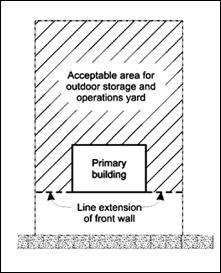
Figure 4-1. Location of outdoor storage
2.
The materials stored shall not exceed a height of 15 feet as measured from abutting level land, either on-site or off-site.
3.
For uses performed outside of a structure, outdoor storage may only be authorized with the granting of a Conditional Use Permit. In granting the Conditional Use Permit, the applicable review authority shall first find that the outdoor storage will be screened from view from any public or private street by appropriate walls, fencing, earth mounds, and landscaping, or a combination thereof. This finding shall be required in addition to the findings identified in Section 9-52.070 (Conditional Use Permits).
(Amended during 3-07 supplement)
9-44.115 - Outdoor Dining Areas
Roofed and unroofed outdoor dining areas shall be subject to the following standards:
A.
The outdoor dining area must be located immediately adjacent to, abutting, and adjoining the establishment with which it is associated, and shall not extend beyond the building and/or storefront frontage and/or length of the tenant space of the associated primary establishment. An outdoor dining area to be shared between establishments may vary from these requirements as approved by the Director.
B.
An accessible path of travel shall be maintained for pedestrian and disabled access circulation to and within the customer dining area. Said path of travel shall be not less than four feet in width and comply with the California Building Code.
C.
The restaurant operator shall maintain the outdoor dining area in a clean and safe condition at all times, and shall properly dispose of all trash generated by the operation.
D.
If an enclosure wall or fence is provided for the outdoor dining area, it must include appropriate additional detailing and architectural enhancements as deemed sufficient by the Director and complement the design, scale, colors and materials of the adjacent building.
E.
The height of any solid or predominantly solid portion of an enclosure wall or fence for an outdoor dining area shall not exceed 36 inches within the Traffic Safety Sight Area (TSSA). Within any setbacks or required landscaping, no fence, wall, or hedge shall exceed 42 inches in height and no see-through fence shall exceed six feet in height. A combination of fence, wall, or hedge and see-through fence shall be permitted, said design subject to approval by the Planning Director, in which the solid fence, wall, or hedge does not exceed 42 inches and the total height, including see-through fence, does not exceed six feet in height.
F.
No identification or advertisement signs shall be allowed on any walls or fencing enclosing an outdoor dining area.
G.
Dining establishments that serve alcoholic beverages in a dining area shall comply with all regulations of the State of California Alcoholic Beverage Control Board, and of other state and local agencies with jurisdiction.
H.
Establishments with outdoor dining areas shall comply with all requirements of the Health Department of the County of Ventura and any other applicable health regulations.
(§ 2(Exh. A), Ord. No. 1327, eff. November 11, 2021)
9-44.120 - Rehabilitation Project Standards
A.
Applicability. The standards of this Section shall apply to a project that obtains a Zoning Clearance, Administrative Action, or Modification for a remodel of an existing commercial or industrial site and requests to reduce off-street parking in exchange for landscape site enhancements as specified in the following sections.
B.
Off-street parking conditions. Off-street parking shall be provided in compliance with Chapter 9-34 (Parking and Loading Standards) with the added provision that up to a 10 percent parking reduction may be granted by the applicable review authority where the project has provided one or more of the offsetting landscaping conditions outlined in Section C below. In no case shall any parking reduction be in addition to the reductions allowed in the LAAPO or TAPO Overlay zones.
C.
Landscape conditions. The landscaping requirements for the requested rehabilitation shall be satisfied by selecting one or more of the following options:
1.
The project provides equivalent site landscaping, for the square footage of lost parking stalls, including a minimum of three new trees of at least 36" box size to provide shading and cooling; and/or
2.
The project adds intervening planters every 15 parking spaces capable of supporting at least a 24" box size tree; and/or
3.
The project provides a new, pedestrian outdoor seating area that includes such features as a fountain, tables, benches, landscaping, and decorative paving; and/or
4.
The project adds a covered pedestrian paseo, or decorative arbor or pergola with blooming vines growing on it, that connects buildings within a center and allows pedestrian travel outside of the parking lot area; and/or
5.
The project adds an interior vehicular connection between sites or shopping centers, where none previously existed, that reduces the need to access the public street to travel between centers.
D.
Rehabilitation Sign Permit for a freestanding individual business identification sign. For structures in commercial zoning districts constructed before July 21, 1986, located on individual parcels and consisting of a single business, an applicant may elect to use either this Subsection or the provisions identified in Chapter 9-37 (Signs).
1.
In-lieu of a permanent on-building street frontage sign. One freestanding individual business identification sign may be installed in-lieu of a permanent on-building street frontage sign; provided, the parcel does not already have and does not otherwise qualify for a freestanding sign at the time the Rehabilitation Sign Permit is approved in compliance with this Subsection.
2.
Freestanding individual business identification sign criteria.
a.
A freestanding individual business sign as provided for in this Subsection is any sign in which the entire bottom is in contact with, or within one foot of, the ground, and is detached from any structure.
b.
The maximum height of the sign shall be seven feet.
c.
The maximum sign area for a freestanding sign shall be 0.25 square foot for every linear foot of parcel frontage, and shall not exceed 38 square feet in total area.
d.
The freestanding sign shall be located not less than one foot inside the property line, shall be oriented perpendicular to the street frontage, and shall not be located within the traffic safety area, if located on a corner parcel.
e.
The sign shall not be located so as to interfere with pedestrian or vehicular traffic.
3.
Rehabilitation Sign Permit application. A request for a freestanding individual business identification sign in compliance with this Subsection shall require submittal of a Rehabilitation Sign Permit application.
a.
The Rehabilitation Sign Permit application shall be approved by the Director upon a showing of compliance with the requirements of this Subsection.
b.
The Rehabilitation Sign Permit application shall include a statement from the property owner acknowledging that the freestanding sign is being installed in-lieu of a permanent on-building sign.
c.
No permanent on-building sign shall be allowed during the duration of the Rehabilitation Sign Permit which authorizes the freestanding individual business identification sign.
(Amended during 3-07 supplement, as amended by § 4 (Exh. A), Ord. No. 1207, eff. March 28, 2013)
9-44.130 - Residential Planned Development Standards
The applicable Homeowner's Association (HOA) shall have the exclusive responsibility to enforce the replacement of colors and materials in approved "detached" single-family residential developments, following completion of the last unit.
(Amended during 3-07 supplement)
9-44.140 - Self-Storage Facilities
Self-storage facilities shall comply with the following standards:
A.
Exterior doors to self-storage units shall not face any adjacent residentially zoned properties. Additional landscape screening requirements for self-storage facilities are contained in Section 9-33.030(H).
B.
In the CO, CPD, CI, and GI Zones, a self-storage facility with a Planned Development Permit or Conditional Use Permit that was use inaugurated on or before December 20, 2007 shall be deemed a Conditionally Permitted Use. Offsite expansion of a self-storage facility is not permitted under this Section.
(Amended during 3-07 supplement, as amended by § 2, Ord. 1120, eff. December 20, 2007)
9-44.150 - Reserved
Editor's note— Ord. No. 1221, § 2 (Exh. A), adopted January 13, 2014, eff. February 13, 2014, repealed § 9-44.150, which pertained to senior citizen dwelling units and derived from being amended during 3-07 supplement and Ord. No. 1126, eff. March 13, 2008.
9-44.160 - Accessory Dwelling Units (Ministerial)
A.
General Provisions.
1.
Intent and purpose. The intent and purpose of this Section is to provide a means by which the City's existing housing resources and infrastructure may be more effectively utilized to produce less costly rental housing through the creation of new accessory dwelling units (ADUs) on residentially zoned lots that already contain one legally established unit, or with the construction of a new residential unit, or in conjunction with a Two-Unit Residential Development.
2.
Authority. The creation of an Accessory Dwelling Unit (ADU) and Junior Accessory Dwelling Unit (JADU) pursuant to Government Code Sections 65582.1, 65852.2, 65852.22, and 65852.21 (SB-9 or Two-Unit Residential Development) on lots containing an existing or proposed single-family or multi-family dwelling and zoned OS, RE, RVL, RL, RM, RMod, RH, MH, RVH, and the MU Overlay District shall be subject to the standards set forth in this section.
3.
Notwithstanding any other regulation in this Development Code that is specifically applicable to ADUs or JADUs, a Zoning Clearance must be ministerially reviewed for an application for a building permit to create an ADU and/or a JADU within a residential zone subject to the development standards set forth in this section.
4.
The City reserves the right to limit construction of ADUs or JADUs in locations where there is inadequate water or sewer services, impact on traffic flow, or public safety.
5.
Neither ADUs nor JADUs shall count towards the allowable density for the lot upon which the ADU or JADU is located.
6.
The City shall act on the application to create an ADU or JADU within 60 days from the date an application is deemed complete if there is an existing single-family or multifamily dwelling on the lot. If the permit application to create ADU or JADU is submitted with a permit application to create a new single-family dwelling on the lot, the City may delay acting on the permit application for the ADU or JADU until a Building Permit is issued for the new single-family dwelling, but the application to create the ADU or JADU shall be considered without discretionary review or hearing. If the applicant requests a delay, the 60-day time period shall be tolled for the period of the delay.
7.
Where an ADU or JADU is proposed with the construction of a new single-family dwelling and/or Two-Unit Residential Development, the proposed single-family dwelling or Two-Unit Residential Development must be approved for occupancy before an ADU or JADU is approved for occupancy.
8.
The permitting of an ADU and/or a JADU is subject to the California Building Code (CBC) and California Residential Code (CRC). Any conflicts between the requirements of this Development Code and the California Building Code and California Residential Code shall be resolved in favor of whichever Code imposes the greater requirement, subject to compliance with California Government Code Sections 65582.1, 65852.2, and 65852.22.
9.
"Living area" as used in SVMC 9-44.160 is defined as the interior habitable area of a dwelling unit, including enclosed patios, garages, basements and attics, but does not include any accessory structure.
10.
The rental of any ADU or JADU, or the primary single-family dwelling, if the owner lives on site in the ADU or JADU, must be for periods of 30 days or more.
11.
ADUs proposed in slopes subject to the Hillside Performance Standards, pursuant to SVMC Chapter 9-32, will be limited to 800 square feet in size. Any access driveways or other improvements will be subject to the standards in SVMC Chapter 9-32.
B.
Table 4-4 identifies the number of ADUs and JADUs permitted per lot. ADUs and JADUs may be permitted in the following combinations with existing or proposed single-family dwellings and/or Two-Unit Residential Development (i.e., SB-9 units)
Table 4-4: Number of ADUs and JADUs permitted per lot
C.
Table 4-5 details the development standards applicable to all ADUs and JADUs. Additional development standards for attached ADUs, detached ADUs and JADUs are listed in sections D through G.
Table 4-5: ADU's and JADU's Development Standards
* A minimum of 10-foot side yard and 20-foot front yard and rear yard setbacks are required if for the proposed attached ADU's building height is between 25-feet and the maximum of 30-feet height.
** This height can be increased to a maximum of 30-feet if a minimum of 10-foot side yard and 20-foot front yard and rear yard setbacks are provided for the proposed attached ADU
*** The height of any detached ADU may be increased by up two feet for a maximum of 20 feet if the ADU is within ½ mile of a major transit stop or a high-quality transit corridor as defined in Section 21155 of the Public Resources Code, if the increase is required in order to accommodate a roof pitch that is aligned with the roof pitch of an existing or proposed primary dwelling. Elevations plans for the primary dwelling must be submitted to obtain this allowance.
**** Required parking may be uncovered or tandem parking that is located on paved surfaces with paved access, or as outlined in Section 9-34.040.A, subject to traffic safety requirements and front yard landscape requirements pursuant to Section 9-33.030.C, as required. At the property owner's option, an automobile parking lift will be allowed but will be considered a structure for the purposes of setbacks and permit requirements. The Director may waive the required parking, if it determined that there are no feasible locations for the required parking locations on site.
1 "Public transit" is defined as a location, including, but not limited to, a bus stop or train station, where the public may access buses, trains, subways, and other forms of transportation that charge set fares, run on fixed routes, and are available to the public.
D.
JADU Requirements.
1.
Where a JADU is proposed in conjunction with an addition to an existing dwelling unit, the addition must meet the setback requirements for a single-family dwelling as required by the underlying zoning and/or any approved Planned Development Permit conditions.
2.
Prior to issuance of a Zoning Clearance for a JADU, a Deed Restriction must be recorded on the property on the form provided by the City specifying that the owner of the property shall occupy either the JADU or the primary single-family dwelling. If a new owner takes title to the property, failure to maintain the owner occupancy required by said deed restriction will require that the JADU be removed from the property and any separate rental must be vacated within 90 days.
E.
Attached ADU Requirements.
1.
Where an attached ADU is proposed with new construction or an addition to the existing single-family Dwelling, the ADU shall be no larger than 50 percent of the square footage of the existing square footage of the single family dwelling or 800 square feet, whichever is larger, up to a maximum of 1,000 square feet.
2.
Existing living area of a single-family dwelling may be converted to an ADU without any limits on size provided the ADU is within the existing structure. Up to a 150 square feet addition limited to accommodating ingress and egress is permitted without additional setbacks being required. Construction beyond this limit must meet all current requirements of the Simi Valley Municipal Code.
3.
Any external stairs required to provide an entrance to an ADU proposed on a second story will be subject to the setback requirements of SVMC 9-30.080 - Setback and Separation Requirements and Exceptions.
4.
Where an attached garage that provides the required parking for a SFD, as set forth in SVMC Section 9-34.040.B, is partially converted to an ADU, the remaining space will continue to be utilized for parking if physically feasible and the remaining space is a minimum of 12 feet by 20 feet or if this is not feasible, it will be utilized for storage or a similar non-habitable use.
F.
Detached ADU Requirements.
1.
The first new construction detached ADU up to 800 square feet in size proposed on a lot will be subject only to the setbacks and development standards outlined in Section C.
2.
[Reserved.]
3.
All detached ADUs, including those created by the conversion of existing permitted structures, must have a six foot separation from the main single-family dwelling and existing structures with the exception of a second ADU proposed in conjunction with an SB-9 unit per Table 4-4, where ten-feet of separation will be required.
4.
The maximum size of a detached ADU that is not proposed in conjunction with an existing or proposed SB-9 unit will be as follows:
a.
A maximum of 1,000 square feet on any parcel up to 8,000 square feet subject to the development standards shown in SVMC Section 9-44.160, Table 4-4.
b.
A maximum of 1,200 square feet on any parcel over 8,000 square feet subject to the development standards shown in SVMC Section 9-44.160, Table 4-4.
5.
Where an existing legally permitted accessory structure with a solid roof and structural framing is converted to a detached ADU in the same location, and to the same dimensions as the existing structure, the above size and height limits will not apply and no additional setbacks will be required. The development standards in Table 4-6 will not apply. Up to a 150 square feet addition limited to accommodating ingress and egress is permitted without additional setbacks being required. Construction beyond this limit must meet all current requirements of the City of Simi Valley Municipal Code.
6.
A detached ADU may only be attached to a garage or a patio cover subject to the below standards and the setback requirements in SVMC 9-30.080.
a)
Where a detached ADU is proposed with an attached garage, the garage portion shall be no larger than 400 square feet.
b)
The size of any proposed patio cover will be limited to 10 percent of the square footage of the proposed ADU excluding any attached parking structure.
Table 4-6: Development standards for new construction ADUs over 800 square feet in size and second ADUs of any size associated with an SB9 unit or multifamily dwellings
1 This includes coverage by the ADU, accessory buildings, sheds, gazebos, or other permitted structures.
For a single-family dwelling: the required side yard is the first five feet for a single-story structure or the first 10 feet for a two-story structure from the side property line; the required rear yard is the first 20 feet from the rear property line; or as otherwise required by 9-24.050 or the underlying development permit.
G.
ADUs in Multi-Family Dwellings.
1)
ADUs on lots with existing or proposed multi-family dwellings must meet the requirements in SVMC Section 9-44.160.F, Table 4-7: Development standards for ADUs in multi-family dwellings and Section C.
Table 4-7: Development standards for ADUs in multi-family dwellings
* The height of any ADU may be increased by two feet if the ADU is within ½ mile of a major transit stop or a high-quality transit corridor as defined in Section 21155 of the Public Resources Code, if the increase is required in order to accommodate a roof pitch that is aligned with the roof pitch of an existing or proposed primary dwelling. Elevations plans for the primary dwelling must be submitted for this allowance.
(§ 2 (Exh. A), Ord. No. 1265, eff. January 9, 2017 as amended by § 2 (Exh. A), Ord. No. 1282, eff. December 11, 2017; § 2(Exh. A), Ord. No. 1289, eff. July 5, 2018; § 2(Exh. A), Ord. No. 1315, effective October 19, 2020; § 2(Exh. A), Ord. No. 1316, effective December 3, 2020; § 2(Exh. A), Ord. No. 1341, eff. July 14, 2022 and § 2(Exh. A), Ord. No. 1349, effective July 5, 2023)
Editor's note— Ord. No. 1265, § 2, adopted January 9, 2017, effective January 9, 2017, amended § 9-44.160 in its entirety to read as herein set out. Former § 9-44.160, pertained to second dwelling units (ministerial), and derived from amendment during 3-07 supplement, and Ord. No. 1126, effective March 13, 2008.
9-44.170 - Reserved
Editor's note— Ord. No. 1265, § 2, adopted January 9, 2017, effective January 9, 2017, repealed § 9-44.170, which pertained to second dwelling units (requirement of a cup) and derived from amendment during 3-07 supplement, and Ord. No. 1126, effective March 13, 2008.
9-44.180 - Gas (Service) Stations
Gas (automobile service) stations and commercial uses with accessory gasoline and/or diesel fuel sales shall comply with the following standards.
A.
Limitations on location. A service station shall be approved only in the following locations.
1.
No more than two automobile service stations may be constructed at a given intersection and only one at a "T" intersection. The freeway shall not be considered as a street for purposes of this Section.
2.
An automobile service station shall be approved only in conjunction with and designed as a part of a larger development, such as a shopping center, travel complex or auto service center.
B.
Access. Each driveway shall comply with the following standards.
1.
No part of the driveway entrance curb return shall be within the street curb return of any two fronting streets or within five feet of the end of the street curb return.
2.
Wherever possible, a combined driveway for both a service station or commercial use with accessory gasoline or diesel fuel sales and an adjacent shopping center shall be provided.
3.
The width of a driveway shall not exceed 30 feet unless the driveway is a common driveway or special circumstances are demonstrated, in which case the width shall not exceed 40 feet, except by approval of the Commission.
4.
Only one driveway will be allowed on any street frontage.
C.
Connection to adjoining commercial development. No more than two interior access openings to an adjoining commercial area shall be permitted.
D.
Pump islands. A service station shall be limited to four pump islands, with not more than four meter cabinets per island. Two fuel outlet hoses for each meter cabinet may be permitted.
E.
Service bays. The entrance to a service bay shall not open to any street, but shall face the rear or interior side property lines.
F.
Restroom screening. All restroom entrances shall be screened by not less than a five-foot high decorative structure which shall conform to the general design of the facility.
G.
Peripheral wall. A service station site abutting a residential zone shall be provided a solid decorative masonry wall not less than six feet in height and a landscape planter not less than five feet in width along the property line abutting the residential zone. However, where the wall abuts the front yard of an adjacent residential parcel, the peripheral wall shall not exceed a height of three feet for that portion of the required front yard on the adjacent parcel.
H.
Merchandising. All merchandise shall be stored and displayed within the main building, except for tires, batteries, auto accessories, and lubrication items which are used to service vehicles on the site. Any auto service related merchandise displayed outside the main building shall be limited to the pump islands and immediately adjacent to the exterior of the main building.
I.
Used parts. No used or discarded automotive parts or equipment or permanently disabled, junked, or wrecked vehicles may be located outside the main building, except within a trash enclosure.
J.
Repair and service. All hydraulic hoists and pits and all lubrication, greasing, and permitted repair equipment must be enclosed entirely within a building. Operations permitted outside shall be limited to:
1.
The retail sale of petroleum products;
2.
The supply of air and water;
3.
Tire changing;
4.
Battery servicing, charging and changing; and
5.
Installation of minor accessories, e.g., windshield blades and arms, gas caps, lamps, etc.
All other automotive repair shall be conducted within an enclosed building or service bay.
K.
Air and water facilities. All gasoline sales facilities must provide and maintain air and water facilities for public use.
L.
Public address system. No public address system or speaker may be located outside of the structure or be audible outside.
(Amended during 3-07 supplement)
9-44.185 - Electric Vehicle Charging Facilities
Purpose. This section provides development standards to promote and encourage the use of electric vehicle charging stations and to limit the obstacles to their use as set forth in California Government Code Section 65850.7. The standards in this section are in substantial compliance with the recommendations of the "Zero-Emission Vehicles in California: Community Readiness Guidebook" and "Plug-in Electric Vehicle Infrastructure Permitting Checklist" published by the Office of Planning and Research.
A.
Definition. An Electric Vehicle Charging Facility is an accessory land use where one or more Electric Vehicle Charging Stations, as defined in California Government Code Section 65850.7(i)(3), are located.
B.
Applicability. Electric Vehicle Charging Facility is an accessory land use to any existing legal single family or multiple-family residential parking garage, car port, parking lot or parking space; or any existing legal commercial, industrial, or recreational parking garage, car port, parking lot or parking space, and is subject to all applicable requirements of this code.
C.
Standards. Electric Vehicle Charging Station ("EVCS") installation shall comply with the following standards.
1.
Electric Vehicle Charging Stations for private use in a single-family or multiple-family garage or car port shall:
a.
Be located in a manner that will not allow public access to the charging station.
b.
Be equipped with a mechanism to prevent the theft of electricity by an unauthorized user.
c.
Be protected as necessary to prevent damage by automobiles.
d.
Be tamper-resistant to prevent injury particularly to children.
e.
Be resistant to potential damage by vandalism.
2.
Electric Vehicle Charging Stations for public use in a commercial, industrial or recreational parking garage, parking lot or parking space shall be subject to the following requirements:
a.
The EVCS shall be located in a manner that will be easily seen by the public for informational and security purposes and shall be illuminated during evening business hours.
b.
Be located in desirable and convenient parking locations that will serve as an incentive for the use of electric vehicles.
c.
The EVCS pedestals shall be designed to minimize potential damage by vandalism and to be safe for use in inclement weather.
d.
Complete instructions and appropriate warnings concerning the use of the EVCS shall be posted on a sign in a prominent location on each station for use by the operator.
e.
One standard non-illuminated sign, not to exceed four square feet in area and eight feet in height, may be posted for the purpose of identifying the location of each cluster of EVCS.
f.
The EVCS may be on a timer that limits the use of the station to the normal business hours of the use(s) that it serves to preclude unauthorized use after business hours.
g.
EVCS installation shall maintain a minimum parking space length to comply with the requirements of this code.
h.
All available charging station mounting options should be considered and optimized for the space.
i.
EVCS installations shall avoid removing or altering existing infrastructure, or removing mature landscape trees, in order to mitigate excess costs, potential hazards and other negative impacts.
j.
EVCS installations, when disturbing existing infrastructure, mature landscape trees and/or other required landscaping shall be mitigated in accordance with SVMC Chapter 9-33, Landscape Standards; Chapter 9-34, Parking and Loading Standards; and Chapter 9-38, Tree Preservation, Cutting and Removal.
k.
Large equipment shall be screened from the public right of way as set forth in SVMC Section 9-30.070, Screening.
D.
Permit requirement. A use permit or Zoning Clearance is not required for an Electric Vehicle Charging Station in compliance with this section.
E.
Expedited permit for construction. Electric Vehicle Charging Station installations meeting the standards of this section are eligible for expedited processing of a permit for construction in accordance with Title 8, Chapter 25 of this code.
(§ 2(Exh. A), Ord. No. 1312, effective October 15, 2020)
9-44.190 - Surface Mining Permits and Reclamation Plans
A.
Permit requirements. Reclamation plans and surface mining operation permits required in compliance with the California Surface Mining and Reclamation Act of 1975 (Public Resources Code Section 2710 et seq.), and shall be processed, heard, approved, modified, and revoked in the same manner as is specified in this Development Code for Conditional Use Permits.
B.
Performance security. As a condition of approval of reclamation plans and surface mining operation permits, surface mining operators may be required to consent to the creation of liens or to post surety bonds or other sufficient security to guarantee reclamation in compliance with the reclamation plan.
C.
Annual inspection. Each surface mining operation that is subject to these provisions shall be inspected at least annually for compliance with permit conditions.
(Amended during 3-07 supplement)
9-44.195 - Emergency Shelters
Emergency shelters shall be subject to the following standards:
A.
Overnight occupancy shall be limited to 1 bed per 70 square feet of sleeping area, with maximum occupancy of 30 beds per facility.
B.
The length of stay for any emergency shelter resident shall not exceed 180 days.
C.
Off-street parking must be provided at 1 space per staff person during the largest shift plus 1/5 th of a parking space for each resident.
D.
On-site management shall be provided at all times while the shelter remains open, consisting of a minimum of 1 staff person per 15 clients.
E.
No emergency shelter shall be located within 300 feet of another emergency shelter.
(§ 2 (Exh. A), Ord. No. 1221, eff. February 13, 2014)
9-44.200 - Vehicle Sales Lots
New and used vehicle sales lots shall comply with the following standards:
A.
No repair or reconditioning of Vehicle-Automobiles, Vehicle-Recreational, Vehicle-Motorcycle, and Vehicle-Aircraft shall be permitted unless otherwise authorized by this Zoning Code.
B.
Except for required landscaping, the entire open area of the premises shall be surfaced with concrete or asphaltic concrete.
C.
Used Vehicle-Automobile sales lots that have a Conditional Use Permit to sell used Vehicle-Automobiles exclusively may display up to two temporary signs, up to twelve square feet in size each, on up to four parking lot light poles without a Sign Permit, fees, or limits on sign posting duration. Parking lot light pole signs must not be located in or above the public right-of-way, installed above the height of the light pole, or strung between light poles, fences, automobiles, or landscaping.
D.
Vehicle-Motorcycle sales lots that have a Conditional Use Permit [5] to sell Vehicle-Motorcycles exclusively are allowed the following promotional activities and temporary signage.
1.
Promotional activities must comply with Subsection 9-52.080(I)(5) (Limited sidewalk sales or displays, extensive promotional commercial activities, and holiday seasonal sales) with the following exceptions:
a.
Temporary Use Permits or fees shall not be required.
b.
There are no limits to the number of events or number of days that promotional activities may occur except under Subsection C.
c.
The use of amplified music requires a Temporary Use Permit, which is subject to project conditions and the City's Noise Ordinance.
d.
Large balloons/inflatables may be displayed on the ground (not to exceed 30 feet in height). Signage may be attached to the balloons/inflatables.
2.
Temporary signage must comply with SVMC Section 9-37.070, with the following exceptions:
a.
Temporary sign permits or fees are not required.
b.
There is no limit on temporary sign posting duration.
c.
There are no quantity limits to the temporary signs.
d.
Freestanding and on-building temporary signs must be limited to 50 square feet.
e.
Temporary signs up to 12 square feet in size may be attached onto display vehicles. No more than one sign per vehicle is allowed.
f.
Temporary signs up to 24 square feet in size are allowed to be displayed on on-site light poles. No more than one sign per light pole is allowed. Signs must not be located in or above the public right-of-way, be installed above the height of the light pole, or strung between light poles, vehicles, or landscaping.
(Amended during 3-07 supplement, as amended by § 4 (Exh. A), Ord. No. 1205, eff. April 18, 2013 and § 2 (Exh. A), Ord. No. 1228, eff. May 29, 2015)
As of the date of adoption of 9-44.200(D), the following vehicle dealers have approvals to sell and repair Vehicles-Motorcycles and Vehicle-Recreational without a Conditional Use Permit and are covered under this code section: 1. Simi Valley Cycles located at 2902 East Los Angeles Avenue. 2. Simi Valley Honda located at 4346 East Los Angeles Avenue. 3. Kawasaki of Simi Valley located at 4821 East Los Angeles Avenue.
9-44.210 - Residential Care in the Commercial Office Zone
Residential care facilities located in the Commercial Office zone shall only be located on lots meeting the following standards:
A.
The lot on which the facility is located shall have no frontage along a public street; and
B.
The lot on which the facility is located shall be a minimum of one-half acre in size.
(§ 4 (part), Ord. 1107, eff. February 9, 2007)
9-44.215 - Single Room Occupancy (SRO) Development Standards
1.
Unit Size. SRO units shall be no less than 250 square feet and no more than 450 square feet in size.
2.
Kitchens and Bathrooms. Each SRO unit shall include a private kitchen and bathroom.
3.
Rental Duration. The rental of any SRO unit must be for a period of 30 days or longer.
4.
Affordability. Applications for SROs shall include proposed rental rates of all unit types.
5.
Operations, Management and Security. Submission of preliminary information describing the operational, management and security aspects of a project is required along with a Conditional Use Permit (CUP) application. This includes, but is not limited to:
a.
Description of general operations;
b.
24-hour onsite management for projects with 16 units or more;
c.
Emergency procedures; and
d.
SRO Rental process and rates.
6.
Common indoor/outdoor recreation areas. A minimum of 300 square feet of common indoor and/or outdoor recreation area must be provided per project for projects with 10 units or less, and a minimum of 300 square feet of common indoor and/or outdoor recreation area per project, plus 15 square feet per unit for projects larger than 10 units. Recreation areas include, but are not limited to: recreation rooms, rooftop terraces, courtyards, pools, sports courts, playgrounds with play equipment, picnic areas with barbeques, tables, and seats. Common areas can be divided into multiple usable areas.
7.
Parking. Parking for SRO units shall be as follows:
8.
Reciprocal Parking Agreement. A Reciprocal Parking Agreement shall be submitted with the Conditional Use Permit application for any shared parking agreement with commercial uses within the same, or adjacent, or across the street parcels that have surplus parking or when the shared parking does not conflict with the business hours of the subject property that is providing the shared parking. The Reciprocal Parking Agreement must allow residents and owners of the SRO property to be granted access over and upon certain entries, roadways and parking spaces of the providing property owner. The Reciprocal Parking agreement must further provide perpetual access for parking (unless otherwise agreed by the property owners) and must run with the land. The application must be accompanied by a shared parking analysis prepared by a qualified transportation planner/engineer and shall be approved by the Planning Commission.
9.
One loading zone for Single Use Occupancy (SRO) projects is required and must be 11 feet in width by 27 feet in length. This area can be utilized for resident pick-up and drop-off when not in use for truck loading.
10.
Bicycle Parking. Covered, secure bicycle parking must be provided at a ratio of one bicycle parking space for every 3 units.
11.
Trash/Recycling Enclosures. Trash/recycling enclosures shall be provided in accordance with Section 9-35.050.
12.
Each SRO unit must be provided with a minimum 30 cubic foot storage closet within the unit or a storage locker within the building, carport, garage parking area, or accessory structure.
(§ 2 (Exh. A), Ord. No. 1323, eff. August 26, 2021)
9-44.220 - Residential Accessory Structures
A.
Development Standards. Accessory residential structures shall comply with the following:
1.
Height, setback, and lot coverage requirements of SVMC Sections 9-24 and 9-30.
2.
Standards listed in subsections B and C of this chapter.
3.
City-adopted Simi Valley Residential Design Guidelines for Accessory Structures. The Environmental Services Director has the authority to establish, and from time to time, approve modifications to the Residential Design Guidelines for Accessory Structures. The City will publish such design guidelines and make them available to the public and any applicant.
4.
Accessory structures shall not cumulatively cover more than 40 percent of any required yard and shall maintain a minimum six (6) foot separation from all on-site structures.
B.
Size Limits. Accessory residential structures are limited to the following sizes:
1.
For the purpose of this section, the square footage of the primary structure shall be defined as the sum of the square footage of the first story of the structure and any attached garages, excluding any attached patios or porches.
2.
On lots less than one acre in size, each accessory residential structure shall not be larger than 30 percent of the square footage of the primary structure as defined in subsection B.1 up to a maximum of 1,200 square feet. The maximum size of an accessory residential structure may be increased beyond the 30 percent limit up to 2,000 square feet in compliance with Section 9-52.030 Administrative Actions.
3.
On lots of one acre or more, each accessory residential structure shall not exceed 30 percent of the square footage of the primary structure as defined in subsection B.1 up to a maximum of 2,000 square feet. The maximum size of an accessory residential structure may be increased beyond the 30 percent limit, up to 2,000 square feet in compliance with Section 9-52.030 Administrative Actions, and beyond 2,000 square feet in compliance with Section 9-52.070 Conditional Use Permits.
4.
On properties within an Animal Overlay Zone (A), (H), (L), each accessory residential structure shall not exceed 2,000 square feet. On lots of one acre or more in size and within an Animal Overlay Zone, the maximum size of an accessory residential structure may be increased beyond 2,000 square feet in compliance with Section 9-52.070 Conditional Use Permits.
C.
Number of Accessory Structures.
1.
On lots less than one acre in size, accessory residential structures 1,200 square feet or more are limited to a maximum of two (2) structures per lot, inclusive of ADUs.
2.
On lots of one acre or more, accessory residential structures 1,200 square feet or more are limited to a maximum of two (2) structures per acre, inclusive of ADUs.
3.
When calculating the maximum number of accessory structures, natural slope areas exceeding 20 percent are excluded from the calculation of total lot area.
Table 1 - Development Standards for Residential Accessory Structures
*
The square footage of the primary structure shall be defined as the sum of the square
footage of the first story of the structure and any attached garages, excluding any
attached patios or porches (SVMC § 9-44.220).
** Exclusive of two-unit developments as described in SVMC § 9-24.080.
(§ 3(Exh.A), Ord. No. 1355, eff. April 15, 2024)

