
Simi Valley City Zoning Code
CHAPTER 9
33 - Landscaping Standards
9-33.010 - Purpose of Chapter
The purposes of this Chapter are to achieve the following:
A.
Protect and enhance the community's environmental, economic, and aesthetic resources by providing standards relating to the quality, quantity, and functional aspects of landscaping and landscape screening;
B.
Protect public health, safety, and welfare by minimizing the impact of all forms of physical and visual pollution, controlling soil erosion, screening incompatible land uses, preserving the integrity of existing residential neighborhoods, conserving natural resources and preserving the natural character of an area; and
C.
Promote water conservation by requiring the efficient use of irrigation, appropriate plant materials, and regular maintenance of landscaped areas.
(§ 5, Ord. 1085, eff. January 6, 2006)
9-33.020 - Applicability
A.
Landscaping required. All projects that require the installation of landscaping in compliance with the standards of this Development Code shall provide and maintain the landscaping in compliance with the provisions of this Chapter.
B.
Landscaping plans subject to Department review.
1.
Landscape plans, and plans for the ornamental use of water, including fountains and ponds, shall be prepared in compliance with the City's Landscape Design Guidelines, and submitted to the Department for review for compliance with the requirements of this Chapter.
2.
Landscaping shall not be installed until the applicant receives approval of the landscape plans.
3.
Changes to the approved landscape plans that affect the character or quantity of the plant material or irrigation system design are required to be resubmitted for approval before installation.
(§ 5, Ord. 1085, eff. January 6, 2006)
9-33.030 - Landscape Requirements
A.
Landscape islands.
1.
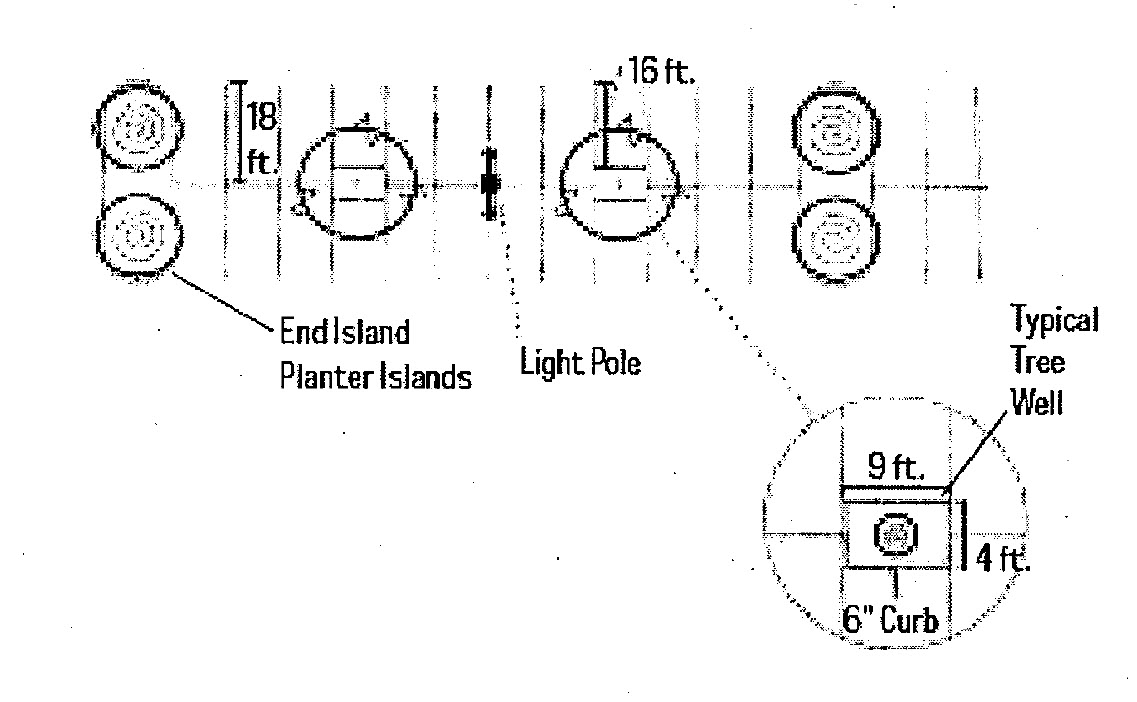
Each island shall be a minimum of seven (7′) feet wide and include a 12-inch landing/curb area when located adjacent to parking. An island shall be provided at the end of each parking row, and at intervals of every 15 parking spaces on an average within each row.
In addition to landscape islands describe above, tree wells shall be provided at intervals of every five parking spaces on an average within each double loaded row. Tree well planters shall be four feet by nine feet with a six-inch curb.
2.
The end planters shall not be included in the count when determining the landscaped fingers required in each row.
3.
The placement of landscape areas shall be determined during the development review process.
B.
Landscaping adjacent to streets. Except for driveway openings and single-family residential development, a 10-foot wide landscaping area shall be provided along the property lines adjacent to a public street.
C.
Front yard landscaping requirements. For single-family residential areas, a minimum of 50 percent of the square footage of the front yard area between the principal dwelling unit and the front public or private street curb, and between the side property lines must be landscaped with natural plants such as lawns, groundcover, succulents, shrubs, and trees. Mulch may be used as an integral part of all natural plantings. No more than one-half of the landscaped area may consist of decorative features such as boulders, river and lava rock, fountains, ponds, rock riverbeds, and pedestrian bridges, or other features as approved by the Deputy Director/City Planner that are consistent with this section. With a Zoning Clearance, up to 100 percent of the landscaped area may be covered by artificial turf that meets the definition and standards in Article 8 (Glossary) Artificial turf that does not meet the standards contained in Article 8 (Glossary) is prohibited.
The public sidewalk and driveway aprons are excluded from the percentage calculation. The driveway leading directly to required parking spaces (e.g., the garage or carport), the 10-foot wide parking strip adjacent to the driveway per Section 9-34.090.B.1, and a maximum four-foot wide pedestrian walkway directly to the front door may exceed 50 percent of the front yard area. Any paving in place prior to September 15, 2005 is exempt from these standards.
1.
Additional Paving Allowances. The public sidewalk and driveway aprons are excluded from the percentage calculation. The driveway leading directly to required parking spaces (e.g., the garage or carport), the 10-foot wide parking strip adjacent to the driveway per Section 9-34.090(B)(1), and a maximum four-foot wide pedestrian walkway directly to the front door may exceed 50 percent of the front yard area. Any paving in place prior to September 15, 2005, is exempt from these standards.
D.
Parkway landscaping requirement. For single-family residential areas, the parkway must be landscaped. Decorative paving such as brick, stone, turf-block or other pavers may be used in the parkway if it is integrated with the landscape design, as approved by the Deputy Director/City Planner. Monolithic concrete paving may not be used in the parkway except as part of a driveway. With an encroachment permit, artificial turf may be used in the parkway as approved by the Director of Public Works, consistent with standards and conditions for such artificial turf in the parkway as approved by the City Council.
E.
Use of Artificial Turf. For multi-family, commercial, and industrial properties, the use of artificial turf in up to 50 percent of the landscape area is permitted. With an encroachment permit, artificial turf may be used in the parkway as approved by the Director of Public Works, consistent with standards and conditions for such artificial turf in the parkway as approved by the City Council.
F.
Curbing requirement. All landscaping and planting within paved areas shall be contained within raised planters surrounded by six-inch high concrete curbs.
G.
Property line landscaping. Landscaping along a property line adjacent to an abutting property which has no entitlement application on file for development is required to be defined by the use of a six-inch high concrete curbing, a block wall, a six-inch wide concrete mowing strip, or a combination thereof.
H.
Minimum percentage of landscaping required. The minimum percentage of landscaping required in each zoning district shall be in compliance with Article 2 (Zoning Districts, Allowable Land Uses, and Zone-Specific Standards).
I.
Buffer landscaping requirements.
1.
For any commercial or industrial yard next to residentially zoned property, a minimum of 10 feet of landscaping shall also be required adjacent to the residentially zoned property within the required setback area in compliance with Article 2 (Zoning Districts, Allowable Land Uses, and Zone-Specific Standards). A solid six-foot high masonry wall shall also be required along the common property line. Buffer requirements for mini-warehouse/self-storage facilities are contained in Section 9-33.030.K. Buffer requirements for CR zones are contained in Section 9-33.030.I.3.
2.
Landscaping, when providing a buffer and interface between commercial or industrial land uses and a residential land use, shall include at least one specimen tree for each 200 square feet of required landscape area. A specimen tree shall be defined as a 48-inch box tree with a trunk diameter of three inches as measured six inches above the root crown. Buffer requirements for CR zones are contained in Section 9-33.030.I.3.
3.
For CR-zoned property adjacent to residentially zoned property, a minimum of 30 feet of landscaping shall be required along the common property line. A six-foot high solid masonry wall or decorative metal fence shall also be required within the landscaped area. The landscape design and fencing material shall be as approved in a Conditional Use Permit for the project.
J.
Service station landscaping requirements. Service stations shall have the following additional landscaping requirements:
1.
On a corner parcel, a minimum of 150 square feet of raised planter area shall be provided at the street corner between the sidewalk and a line drawn from the edge of each driveway opening at the intersecting streets.
2.
When the use is an integral part of a commercial center or when a block wall is not constructed in compliance with Section 9-33.030(D), a five-foot wide planter shall be provided along not less than two thirds of the interior perimeter boundaries. No more than two interior access openings to an adjoining commercial area shall be allowed.
3.
Not less than 10 percent of the site shall be in raised landscaped areas. There shall be at least one 24-inch box tree for each 200 square feet of required landscaping area.
4.
A minimum five-foot wide raised planter shall be located along at least 40 percent of the building facade fronting on the street or corner.
5.
All planting other than trees within street frontage planting shall be of a variety that can be maintained at a height of 30 inches and shall not extend over the sidewalk.
6.
All landscaping materials, other than hardscape and artificial turf, shall be natural or living materials. Any other plastic, simulated, or synthetic plant materials shall not be allowed.
K.
Self-storage/mini-warehouse facilities. Self-storage/mini-warehouse facilities shall have additional landscaping requirements as follows:
1.
A minimum landscaped area of 15 percent located along the perimeter of the site, irrespective of the land coverage requirement of the zone within which they are located.
2.
When adjacent to residential zones, a landscaped buffer with a minimum width of 20 feet along the property lines adjacent to residential zones. This buffer shall be planted with a double row of 36-inch evergreen box trees (or predominantly evergreen) with a trunk diameter of two inches as measured four and one-half feet above the root crown. One such tree for each 200 square feet of required landscape area shall be provided. A solid six-foot high masonry wall shall also be required at the property line. Detention basins shall not be allowed within this buffer area.
3.
Exceptions to block wall buffer requirement when adjacent to residential zones. When a solid block wall is not required to protect the privacy of adjacent residential development, an applicant may request that the Planning Commission authorize the applicant to construct a six-foot high wrought iron/tubular steel fence or a six-foot high wall containing a combination of masonry and wrought iron/tubular steel. In such instances, prior to the issuance of a Zoning Clearance, the applicant must present a form, subject to approval by the Deputy Director/City Planner, to each adjacent property owner authorizing the adjacent property owner to select the type of fencing on their shared property lines. Property owners shall have at least 21 days to make a selection. A six-foot high block wall shall be required in the event that an adjacent property owner does not make a selection within 21 days.
L.
Outdoor dining areas for restaurants or food retailer. Outdoor dining areas for restaurants and food retailers shall have additional landscaping requirements as follows:
1.
Where landscape islands are required adjacent to parking, up to 50% of the width of such an island, when directly adjacent to an existing or proposed outdoor dining area, may be paved with decorative pavers and utilized for unroofed outdoor dining areas, with removable seating and shade covers.
2.
Up to 50% of the required 10-foot wide landscaping area along the property lines adjacent to a public street may be utilized for unroofed outdoor dining areas as long as it is adjacent to the restaurant. The area may be paved with decorative pavers and utilized for outdoor dining with removable seating and shade covers.
3.
For all instances where landscape buffers are utilized for outdoor dining as described above, the use of landscape planters, additional detailing and architectural enhancements as deemed sufficient by the Director will be required.
4.
Existing trees within a landscaped area which is proposed to be converted to an outdoor dining area shall either be preserved and integrated into the design of the area, or transplanted to a location within or adjacent to the area. Transplanting shall only be allowed for trees which will survive the transplanting process and survive in good health in the new location and will be subject to Chapter 9-38 - Tree Preservation, Cutting, and Removal.
(§ 5, Ord. 1085, eff. January 6, 2006, as amended by Exh. A, Ord. 1147, eff. August 20, 2009; Exh. A, Ord. 1161, eff. August 26, 2010; § 2 (Exh. A), Ord. No. 1187, eff. April 26, 2012; § 3 (Exh. A), Ord. No. 1241, eff. August 13, 2015 and § 3 (Exh. A), Ord. No. 1242, eff. August 13, 2015 and § 2(Exh. A), Ord. No. 1327, eff. November 11, 2021, and § 3(Exh. A), Ord. No. 1353, effective December 18, 2023)
9-33.040 - Maintenance Requirements
All installed landscaping and irrigation systems shall be continually maintained. Maintenance of approved landscaping and irrigation systems shall consist of regular watering, mowing, pruning, fertilizing, clearing of debris and weeds, monitoring for pests and disease, the removal and replacement of dead plants, and the repair of the irrigation system, including its individual components.
(§ 5, Ord. 1085, eff. January 6, 2006)

