
Simi Valley City Zoning Code
CHAPTER 9
37 - Signs
9-37.010 - Findings and Intent of Chapter
Regulations established by this Chapter are intended to appropriately regulate the placement, type, size, and number of signs allowed within the City, and to require the proper maintenance of signs in order to protect the public health, safety, and welfare. In order to further these purposes, the City finds and determines that these regulations are necessary in order to:
A.
Avoid traffic hazards to motorists and pedestrians caused by visual distractions and obstructions by insuring that official traffic regulation devices can be easily seen, that adequate sight distance is maintained, and that visual impacts are limited to reduce hazards, by prohibiting nearby visual obstructions such as moving, rotating or blinking signs, an excessive number of signs, an excessive amount of copy-on signs or signs resembling official signs, and by prohibiting signs in the public right-of-way;
B.
Promote the aesthetic and environmental values of the community by providing for signs that do not impair the attractiveness of the City, prohibiting the visual clutter of obtrusive signs, and prohibiting signs in the public right-of-way;
C.
Provide for signs as an effective channel of communications, while ensuring that signs are aesthetically proportioned in relation to adjacent structures and the structures to which they are attached;
D.
Regulate commercial signage based upon the City's determination that such signage constitutes the majority of existing signs and that the City desires to regulate and allow such signage in such a manner that allows for reasonable and equitable identification of businesses and properties, while providing a channel of communication to advertise businesses in the commercial and industrial zones of the City, and maintaining the residential character of the City's residential zones;
E.
Regulate based upon the City's compelling interest in maintaining the residential character of such zones, in order to provide that a residential use with a home occupation shall be considered a residential use and no commercial signs, other than commercial signs placed by charitable organizations, may be displayed;
F.
Regulate based upon the City's compelling interest in ensuring traffic safety, in order to provide that ancillary signs are permitted in order to directly advance that interest, subject to the maximum number set forth in this Development Code; and
G.
Prohibit the placement of signs in the public right-of-way based upon the following:
Prior to the adoption of the ordinance, the City of Simi Valley has permitted temporary signs in the public right-of-way, which has resulted in substantial unsightly conditions, as illustrated in evidence presented to the City Council during its consideration of this ordinance.
The placement and accumulation of temporary signs in the public right-of-way, on traffic and utility devices, upon public sidewalks or on public easements presents dangerous conditions to the free and safe flow of pedestrian and vehicular traffic. Such areas must be preserved for official traffic signs and official utility notices in order to assure the safe flow of traffic.
In addition, in upholding prohibitions against the posting of signs on sidewalks, utility poles and other public property, the U.S. Supreme Court, in the case City Council of Los Angeles v. Taxpayers for Vincent, 466 U.S. 789 (1984), said that "The problem addressed by this ordinance - the visual assault on the citizens of Los Angeles presented by an accumulation of signs posted on public property - constitutes a significant substantive evil within the City's power to prohibit. "[T]he City's interest in attempting to preserve [or improve] the quality of urban life is one that must be accorded high respect." Young v. American Mini Theaters, Inc., 427 U.S., at 71." The Vincent Court also observed that temporary signs could still be allowed on private property, noting that, "Moreover, by not extending the ban to all locations, a significant opportunity to communicate by means of temporary signs is preserved, and private property owners' esthetic concerns will keep the posting of signs on their property within reasonable bounds. Even if some visual blight remains, a partial, content-neutral ban may nevertheless enhance the City's appearance."
H.
Regulate signs for charitable organizations by permitting them to be located on private property and for a sufficient duration, in order to promote charitable events and activities based upon the City's substantial interest in supporting such events and activities because of the community services they support and based upon the following:
The temporary sign ordinance, which prohibits signs on public property and in the public right-of-way, and otherwise limits the number and duration of temporary commercial signs on private property, directly advances the City's substantial governmental interests and concerns regarding aesthetics by reducing the visual blight created by the proliferation of temporary commercial signs without burdening an excessive amount of speech.
The sign ordinance is narrowly tailored because it does not over-regulate protected speech. It restricts the duration, size, and location of temporary commercial signs, other than signs placed by charitable organizations. Also, with the limited exception of charitable commercial signs, the ordinance prohibits commercial signs in residential zones, in order to advance the City's compelling interest in maintaining the residential character of such zones. Commercial enterprises still have the ability to advertise, contact and communicate with consumers in other ways; such as direct mail, newspaper, radio, television and on-site advertising.
The general principle that the First Amendment forbids the government from regulating speech in ways that favor some viewpoints or ideas at the expense of others is not applicable here because the City's regulations are neutral or even silent concerning any speaker's point of view. Members of the City Council of the City of Los Angeles v. Taxpayers for Vincent (1984) 466 U.S. 787.
Content-based regulations which disadvantage commercial speech are subject to a lesser degree of First Amendment protection as provided in the U.S. Supreme Court case Central Hudson Gas & Electric Corp. v. Public Service Commission of N.Y. 447 U.S. 557, 566 (1980).
Central Hudson established a three-part test for First Amendment challenges to regulations restricting nonmisleading commercial speech that relates to lawful activity. First, the government must assert a substantial interest to be achieved by the regulation. Second, the regulation must directly advance that governmental interest. Third, although the regulation need not be the least restrictive measure available, it must be narrowly tailored so as not to restrict more speech than necessary. Together, these final two factors require that there be a reasonable fit between the government's objectives and the means it chooses to accomplish those ends.
The government bears the burden of asserting one or more substantial governmental interests and demonstrating a reasonable fit between those interests and the challenged regulation. The government is not limited in the evidence it may use to meet its burden.
Unlike the ban in City of Cincinnati v. Discovery Network, Inc., 507 U.S. 410 (1993), which only applied to 62 of the 1,500 to 2,000 news racks in the City, addressing only a "minute" and "paltry" share of the problem, the City of Simi Valley's limitation of allowing one temporary onsite commercial sign, by permit for four 30 day periods per year, applies to all of the approximately 7,500 businesses in Simi Valley which have obtained business licenses and will substantially reduce the number of temporary commercial signs from what has previously been allowed in the City. Charitable signs, without such numerical or permit requirements, may also be placed on private property with permission of the property owner, however, based upon historical experience in the City, the number of charitable organizations and events, and thus the potential for placement of their signs, are limited in number. Moreover, eliminating commercial signs from residential neighborhoods, except for charitable commercial signs, will substantially advance the City's interests in aesthetics and maintaining the residential character of residential neighborhoods. In addition the City is going no further than necessary to achieve its regulatory objective in that the distinctions between commercial signs has been structured to be based upon broad categories (i.e., signs placed by charitable organizations promoting charitable events and activities) as opposed to the specific content or point of view of the organization or enterprise.
The government may be said to advance its purpose by substantially reducing sign proliferation, even where it is not totally eradicated. Evidence presented to the City Council during its consideration of the adoption of this ordinance provided examples of sign proliferation in the City. A limitation on temporary sign display is directly related to the objective of aesthetics. The Simi Valley City Council desires to allow a greater number of temporary charitable commercial signs because of their unique value to the community.
The City has a substantial governmental interest in permitting nonprofit organizations that are raising funds for charitable events that support social services in the community to have their signs in place for an amount of time sufficient to promote their event. This is necessary because most of these charitable organizations, unlike most commercial businesses, have no fixed location where they can place signs upon their property advertising their events, thus furthering the necessity for signage display.
The temporary sign ordinance does not hinder any business's ability to advertise its business by other means such as additional window signs, newspaper, direct mail or other forms of advertising, in addition to permitted onsite temporary signs. There is a distinction drawn in the ordinance between the signs of sellers of goods or services and those placed by charitable organizations.
The United States Supreme Court held that "because charitable solicitation does more than inform private economic decisions and is not primarily concerned with providing information about the characteristics and costs of goods and services, it has not been dealt with as a variety of purely commercial speech." Village of Schaumburg v. Citizens for a Better Environment 444 U.S. 620, 632 (1980). See also Mainstream Marketing Services v. Federal Trade Commission [10th Circuit (2004)].
Therefore, the City of Simi Valley has established a reasonable fit between the substantial interests which it advances and the regulation of the signs.
(§ 4, Ord. 1092, eff. July 6, 2006)
9-37.020 - Applicability
A.
Signs regulated. The requirements and development standards in this Chapter shall apply to all signs in all zoning districts.
B.
Applicability to sign content. The provisions of this Chapter do not regulate the message content of signs (sign copy), regardless of whether the message content is commercial or non-commercial.
C.
Non-commercial speech. Notwithstanding any other provision of this Chapter, non-commercial speech shall be allowed in all zoning districts in accordance with the provisions established in this Chapter for signs. In interpreting where non-commercial speech may be located, this title shall be interpreted to authorize non-commercial speech to be substituted for commercial copy wherever commercial copy is allowed.
(§ 4, Ord. 1092, eff. July 6, 2006)
9-37.030 - Sign Permit Requirements
No sign shall be installed, constructed, or altered unless it receives a Sign Permit or is allowed without a Sign Permit by Subsection (D), below.
A.
Fees and plans required. An application for a Sign Permit shall be filed and processed in compliance with Chapter 9-50 (Application Filing and Processing). The application shall include all required contents identified in the Department handout for Sign Permits (e.g., architectural elevations and plans of all proposed signs drawn to scale, with all dimensions noted, and include illustrations of copy, colors, materials, and samples of the proposed colors and materials) in addition to other materials determined to be necessary by the Director.
B.
Review and approval. Notwithstanding any other provision in this Code to the contrary, upon a determination that an application is complete in accordance with Section 9-50.060, the Director shall approve, deny or refer the sign permit application to the Planning Commission within 20 business days. The Director or Commission shall issue a permit if it is found that the sign complies with the requirements and restrictions of the Development Code. The Director or Commission shall deny a sign permit if it is found that the sign is not in compliance with the provisions of this Code or if required, that the applicant has not received a building permit authorizing erection. Applications referred to the Commission shall be scheduled for the next available meeting, and if appealed, the next available City Council meeting, but in no event shall the available meeting be held more than 30 days after the application is deemed complete, or the appeal has been filed.
C.
Master Sign Program.
1.
When required. An approved Master Sign Program shall be required concurrently with the approval of the required discretionary permit for the following:
a.
All new nonresidential projects; and
b.
Major rehabilitation work on an existing nonresidential project that involves exterior remodeling. For the purposes of this Chapter, major rehabilitation means any project which requires a modification to the subject discretionary permit, in compliance with Sections 9-52.070 (Conditional Use Permits) and 9-52.050 (Planned Development Permits).
All signs installed or replaced within the nonresidential project shall comply with the approved Master Sign Program.
2.
Applicable review authority. A Master Sign Program shall be reviewed, and approved or disapproved by the applicable review authority for the land use permit required for a proposed development or new land use, when a Master Sign Program is required with the project application.
3.
Content of plan. A Master Sign Program shall provide standards for the style, size, and placement of signs within the proposed nonresidential project.
4.
Revisions. Revisions to a Master Sign Program may be approved by the Director if it is determined that the revision is minor, in compliance with Section 9-52.100 (Modification of an Approved Project), and that the intent of the original approval, and any applicable conditions are not affected. A new Master Sign Program approval shall be obtained for revisions that substantially deviate from the original approval.
5.
Requirement for permit. A sign permit in compliance with this Chapter is required for all signs approved under a Master Sign Program prior to installation.
D.
Signs allowed without a Sign Permit. The following are allowed without a Sign Permit, provided that they comply with Section 9-37.050 (General Requirements for All Signs), and any required Building Permit is obtained.
1.
Governmental signs and signs required by law. Signs placed by a governmental entity as required by federal, state, or local law. These signs shall not be illuminated unless required by law, and shall be of the size, height, and location required by law.
2.
Temporary commercial signs placed by charitable organizations. Temporary commercial signs placed by charitable organizations in compliance with this Chapter.
3.
Non-commercial signs. Non-commercial signs in compliance with this Chapter.
4.
Used Vehicle-Automobile sales lot signs. Used Vehicle-Automobile sales lots that have a Conditional Use Permit to sell used Vehicle-Automobiles exclusively may display up to two signs, up to twelve square feet in size each, on up to four parking lot light poles without a Sign Permit, fees, or limits on sign posting duration. Parking lot light pole signs must not be located in or above the public right-of-way, installed above the height of the light pole, or strung between light poles, automobiles, or landscaping.
(§ 4, Ord. 1092, eff. July 6, 2006, as amended by § 4 (Exh. A), Ord. No. 1205, eff. April 18, 2013)
9-37.040 - Prohibited Signs
A.
The following types of signs and devices are prohibited:
1.
Animated signs, including electronic message display signs, unless otherwise authorized by this Code, and variable intensity, blinking, or flashing signs on the building exterior;
2.
Balloons and other inflatable devices, except as allowed in compliance with Section 9-52.080 (Temporary Use Permits);
3.
Illegal signs (see Subsection B, below);
4.
Moving or rotating signs;
5.
Permanent off-premise signs;
6.
Pennants, banners and streamers, except as allowed in compliance with Section 9-52.080 (Temporary Use Permits) and Section 9-37.070(C)(9);
7.
Pole signs and other freestanding signs over the height limits specified in Section 9-37.060(B);
8.
Roof signs;
9.
Because of the City's compelling interest in ensuring traffic safety, signs that simulate in words, symbols, color, size, or design, any traffic control sign or signal;
10.
Signs attached to or suspended from a vehicle, parked within a public right-of-way or in a location on private property, which extends more than 12 inches beyond the height or width of the vehicle, and that is visible from a public right-of-way, except a sign painted directly upon, magnetically affixed to, or permanently affixed to the body or other integral part of the vehicle;
11.
Temporary and portable signs, except as allowed by this Chapter; and
12.
Signs posted, affixed, attached and/or placed by any person on or over the public right-of-way, public easements, or upon any utility pole, fencing, tree, shrub, railroad crossing, or lighting system, unless otherwise allowed pursuant to SVMC Section 9-44.200(C).
B.
The following types of signs are illegal:
1.
Signs erected without first complying with all regulations in effect at the time of its construction or use;
2.
Signs that were legal when erected, but whose use has ceased; signs upon which the structure of the display was placed and which structure has been abandoned by its owner; or signs not being used to identify or advertise a business which has been in existence for at least 90 days;
3.
Signs that were legally erected but later became nonconforming and then were damaged to the extent of 50 percent or more of its current replacement value, as determined by the City Building Official, or his designee; or
4.
Signs that are maintained in such a manner so as to constitute an immediate danger to the public.
(§ 4, Ord. 1092, eff. July 6, 2006, as amended by § 2, Ord. 1126, eff. March 13, 2008, and § 4 (Exh. A), Ord. No. 1205, eff. April 18, 2013)
9-37.050 - General Requirements for All Signs
A.
Sign area. Sign area shall be measured as follows to determine compliance with the sign area limitations of this Chapter.
1.
The surface area of a sign shall be calculated by enclosing all framing, writing, logo, representation, emblem, or other display within a single continuous perimeter line. See Figure 3-11.
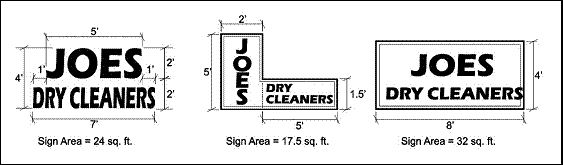
Figure 3-11. Sign Area Measurement
2.
Supporting members or bracing that is clearly incidental to the display itself shall not be computed as sign area.
3.
The area of a double-faced (back-to-back) freestanding sign shall be calculated as a single sign face if the distance between each sign face does not exceed one foot at any point.
4.
Where a sign consists of one or more three-dimensional objects (e.g., balls, cubes, clusters of objects, sculptures and statue-like trademarks), the sign area shall be measured as their maximum projection upon a vertical plane. See Figure 3-12.
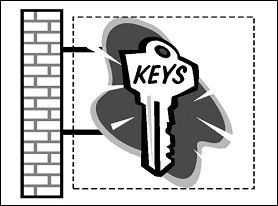
Figure 3-12. 3-D Sign Measurement
B.
Sign height. Sign height shall be measured as the vertical distance from the top of the adjacent curb elevation to the highest point of the structure, or average grade, whichever is less, as shown in Figure 3-13.
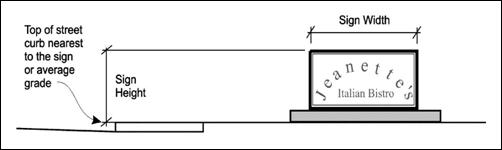
Figure 3-13. Sign Height Measurement
C.
Sign location requirements.
1.
All signs shall be located on the same site as the subject of the sign, except as otherwise allowed by this Chapter. A sign may project over an adjacent public right-of-way only if authorized by an encroachment permit as well as a Sign Permit.
2.
Signs shall not be located within the public right-of-way, except as otherwise allowed by this Chapter.
3.
Except for awnings, signs shall not overlap any portion of a window.
D.
Maintenance standards for signs.
1.
Signs and supporting hardware, including temporary signs, shall be maintained in a good state of repair and must function properly at all times. Signs with broken frames and mounting brackets, missing or broken panels, missing or unreadable text or graphics, burned out lights, peeling paint, rusted, or bent structural members shall be deemed not to be in a good state of repair. Repairs to signs shall be of equal or better quality of materials and design as the original sign. Signs that are not in a good state of repair shall be deemed to be a public nuisance, and may be abated in compliance with the City's Property Maintenance Ordinance.
2.
When existing signs are removed or replaced, all brackets, poles, and other supports that are no longer required shall be removed. Walls shall be repaired and painted to match the supporting structure.
E.
Rehabilitation Sign Permit Standards. Refer to Section 9-44.120(D) for standards.
F.
Design guidelines for signs. The following design guidelines are strongly encouraged for use in preparation of sign permit applications. (Note: All sign design guidelines appear in italics to distinguish them from standards, which are mandatory requirements.)
1.
Responsibility for design and construction.
a.
Design drawings for proposed permanent signs should be prepared by design professionals (e.g., graphic designers, architects, landscape architects, interior designers, whose principal business is the design, manufacture, or sale of signs) or others who are determined by the Director to be capable of producing professional results.
b.
All permanent signs should be constructed by individuals whose principal business is building construction or a related trade, including those whose principal business is the manufacture and installation of signs, or others capable of producing professional results. The intent is to achieve signing of careful construction, neat and readable copy, and durability, to reduce maintenance costs and to prevent dilapidation.
2.
Sign copy. The City does not regulate the message content (copy) of signs; however, the following are principles of copy design and layout that can enhance the readability and attractiveness of signs. Copy design and layout consistent with these principles is encouraged.
a.
Sign copy should relate only to the name and/or nature of the business or commercial center.
b.
Permanent signs that advertise continuous sales, special prices, etc. should be avoided.
c.
Information should be conveyed briefly or by logo, symbol, or other graphic manner. The intent should be to increase the readability of the sign and thereby enhance the identity of the business.
d.
Freestanding signs should contain the street address of the parcel or the range of addresses for a multi-tenant center.
3.
Colors. Colors on signs and structural members should be harmonious (e.g., compatible and complementary) with one another and representative of the dominant colors of the building(s) being identified.
4.
Materials and structure.
a.
Materials selected for permanent signs should be durable and capable of withstanding weathering over the life of the sign with reasonable maintenance.
b.
Sign materials (including those for framing and support) should be similar in appearance to the type and scale of materials used on the buildings on the same site as the sign. Insofar as possible, sign materials should match the materials used on the building and on other signs on the project site.
c.
The size of the structural members (e.g., supports) should be proportional to the sign panel they are supporting. In general, fewer larger supporting members are preferable to many smaller supports.
d.
Any background required to support the individual letters should be the same (e.g., color, materials, etc.) for all on-site signs with backgrounds.
e.
The use of signs composed of individual letters mounted on a building wall and incorporated into the building design (rather than signs with background and framing other than the building wall) should be required under the following:
(1)
Proposed signs under a Master Sign Program;
(2)
New or modified signs; and
(3)
Any background required to support the individual letters should be the minimum amount needed to serve the intended purpose.
5.
Light sources. Light sources should utilize energy efficient fixtures to the greatest extent possible.
6.
Sign illumination.
a.
External light sources should be directed and shielded to limit direct illumination of any object other than the sign.
b.
In areas with low ambient nighttime illumination levels (e.g., residential neighborhoods or business districts with little or no illuminated signing) applicants are encouraged to use light, illuminated copy against dark or opaque backgrounds.
c.
Reflective-type bulbs and incandescent lamps that exceed 15 watts should not be used on the exterior surface of signs so as to expose the face of the bulb or lamp to a public right-of-way or adjacent property.
G.
Electronic changeable copy sign standards.
1.
The display illumination shall not have continuous motion or appear to be in continuous motion.
2.
The message rate shall not change at a rate faster than one message every 30 seconds.
3.
The intensity of the illumination shall neither change nor flash.
4.
For signs located within or abutting residential zones, the hours of operation are limited to 7:00 a.m. to 10:00 p.m.
5.
The display is limited to text only and no graphics/pictures are allowed.
6.
The sign shall be freestanding only with a maximum height of eight feet and a total area allowed for electronic display limited to 40 square feet.
(§ 4, Ord. 1092, eff. July 6, 2006, as amended by § 2, Ord. 1126, eff. March 13, 2008)
9-37.060 - Zoning District Permanent Sign Standards
The signs and sign area authorized by this Section shall be allowed unless otherwise expressly provided in Section 9-37.030(D) (Signs allowed without a Sign Permit).
A.
Residential zoning districts.
1.
Sign standards. Signs in residential zoning districts (e.g., incorporating single-family, multi-family, and institutional uses) shall be in compliance with the standards identified in the Table 3-9.
TABLE 3-9 - SIGN STANDARDS FOR RESIDENTIAL ZONING DISTRICTS
2.
Ancillary signs. In addition to the maximum sign area allowed in Table 3-9 above, ancillary signs may be allowed without a permit. The maximum allowable sign area shall not exceed six square feet per sign or a total of 24 square feet for all on-site ancillary signs.
3.
Non-commercial signs. Non-commercial signage is allowed without a permit, provided that the total sign area allowed on a parcel shall not exceed six square feet.
B.
Commercial, office, and industrial zoning district sign standards. The types of signs listed in Table 3-10 are allowed within the commercial, office, and industrial zoning districts only, in compliance with the standards in Table 3-10.
TABLE 3-10 - SIGN STANDARDS FOR THE COMMERCIAL AND INDUSTRIAL ZONING DISTRICTS
(§ 4, Ord. 1092, eff. July 6, 2006, as amended by § 2, Ord. 1126, eff. March 13, 2008; Exh. A, Ord. 1147, eff. August 20, 2009; § 2 (Exh. B), Ord. No. 1250, eff. December 3, 2015 and § 2 (Exh. A), Ord. No. 1254, eff. March 24, 2016)
9-37.070 - Temporary Sign Standards
A.
Non-commercial temporary signs.
1.
Requirements. Non-commercial signs, as defined in Article 8 (Definitions), shall not require a permit but are subject to the restrictions contained in Subsection C and F relating to size, placement, height, attachments, identification and illumination standards.
2.
Location. Non-commercial signs are allowed on private property, with the permission of the property owner.
3.
Duration. The duration of non-commercial signs shall not exceed 128 days except election signs. Election sign duration shall not exceed 60 days prior to, and including the date of, any election and must be removed within 7 days after the date of the election.
B.
Commercial temporary signs not allowed on residential properties. Commercial temporary signs, except those placed by charitable organizations with the permission of the property owner, and property management or leaseholder as representative of the property owner, are not allowed on residentially zoned or residentially developed properties.
C.
General standards for all temporary signs. The following standards shall apply to all temporary signs:
1.
Placement of signs. No such sign shall be placed on other sign or attached to landscaping materials.
2.
Height. The height of a temporary sign shall not exceed:
a.
Freestanding. Six feet above the grade level; or
b.
Mounted on a structure. The height of the structure upon which the sign is mounted.
3.
Requirement for permit. All temporary commercial signs located on private property require a sign permit, except those placed by charitable organizations in compliance with this Chapter.
4.
Attachments. It shall be unlawful to attach, connect, or otherwise affix balloons, pinwheels, streamers, or similar objects to any temporary sign.
5.
Sign illumination prohibited. Temporary signs shall not be internally illuminated, shall not have external lighting installed, and shall not be a form of redirect illumination.
6.
Supporting structures for temporary signs. Any supporting structure that was installed or erected to hold or support a temporary sign shall be completely removed when the temporary sign is removed.
7.
Construction requirements. The sign shall be constructed and affixed in a manner so as to withstand natural forces, such as wind and rain.
8.
V-shaped signs. "V"-shaped signs shall be considered two signs.
9.
Signs/banners located on light or utility poles. Notwithstanding any provision in this Chapter to the contrary, nothing herein shall be deemed to prohibit signs or banners placed on light or utility poles by or with the express permission of the utility that owns the pole.
10.
Location. Temporary signs are not allowed to be posted, affixed, attached and/or placed by any person on or over the public right-of-way, public easements, or upon any utility pole, fencing, tree, shrub, railroad crossing, or lighting system.
D.
Other standards for temporary commercial signs.
1.
Window signs. Temporary signs attached, glued, painted, resting upon, or otherwise affixed to a window glass surface shall not obscure or render opaque more than 40 percent of the exterior glass surface upon which it is affixed or painted. Signs mounted within two (2) feet of the exterior glass surface shall be considered window signs. Neon signs shall measure less than half of the allowed 40 percent coverage, and shall not rotate, move, flash, blink, or vary in intensity. The area of window signs shall be measured using the method described in Section 9-37.050 (General requirements for all signs). Temporary windows signs do not require a permit.
2.
Vehicle signs.
a.
Signs on a vehicle that do not meet the definition contained in Article 8 (Glossary), are prohibited.
b.
Vehicle signs that meet the definition of vehicle sign contained in Article 8 (Glossary), are allowed and do not require a sign permit.
3.
Signs advertising real property. Temporary commercial signs advertising real property for sale, lease, or exchange are permitted pursuant to the regulations of Civil Code Section 713 and shall be in compliance therewith. However, pursuant to the authority in Civil Code Section 713, in commercial and industrial zones, the maximum sign area is 50 square feet and maximum sign height is six feet. For residential zones, the maximum sign area allowed is 12 square feet, the maximum height is six feet, and signs shall not extend over rear or side property walls.
4.
New business grand opening sign. New businesses, defined as a new business concern being operated by a business owner, or entity, with a first time Simi Valley Business Tax Certificate, may have one additional, on-building sign not to exceed 50 square feet, for a period not to exceed 30 calendar days from the date of opening to the public. A no-fee temporary sign permit is required.
5.
Quantity. Only one temporary commercial sign may be placed on a parcel or leasehold interest thereon, except charitable organizations may place an unlimited number of signs, in compliance with Subsection F, below. However, additional temporary commercial signs may be approved on private property subject to a Temporary Use Permit under Section 9-52.080(D)(5) and (D)(6).
6.
Location. A temporary sign shall be located five feet or more from the property line, except when an existing structure is located within five feet of the front or side property line then the temporary sign can be located within the five-foot setback.
E.
Unauthorized removal of temporary signs.
1.
Except as provided below in Section 9-37.090(E) (Enforcement), no person shall destroy, relocate, remove, or otherwise disturb any temporary sign, or direct or allow the destruction, relocation, removal, or disturbance without the written permission of the party who caused the sign to be erected.
2.
Nothing in this Section shall prohibit summary sign abatement as provided in Section 9-37.090(E) (Enforcement), or prohibit the owner of the property or structure, or their authorized representative, from removing a temporary sign from their property or structure when the sign has been erected without their consent.
3.
Nothing in this Subsection shall prevent the Director, or other authorized representative of the City, from taking action to abate temporary sign violations.
F.
Standards for charitable commercial temporary signs on private property. Charitable organizations may place an unlimited number of commercial signs on private property, with the permission of the property owner, as follows:
1.
Maximum size. The maximum sign area of a charitable commercial temporary sign shall not exceed 12 square feet on each side.
2.
Duration. The maximum duration of a charitable commercial sign is 30 days prior to an event, and such sign must be removed within five days after the end of the event that it is advertising.
3.
Identification required.
a.
Each charitable commercial temporary sign shall have affixed on the front in the lower right hand corner of the sign, the legible date range or period of its posting (excluding election signs). The name, address, and phone number of the person or organization installing, placing, or erecting or causing the installation, placement, or erection of the sign shall also be legibly affixed on the front of the sign in the lower right corner, unless the name, address, and phone number of the person or organization appear within the graphics of the sign. As an alternative, sign owner's name, address, and telephone number must be affixed to the sign or identified on the sign and it is maintained on file with the organization, the individual, the campaign office, or County of Ventura Elections Division and made accessible, if verification of sign ownership is requested.
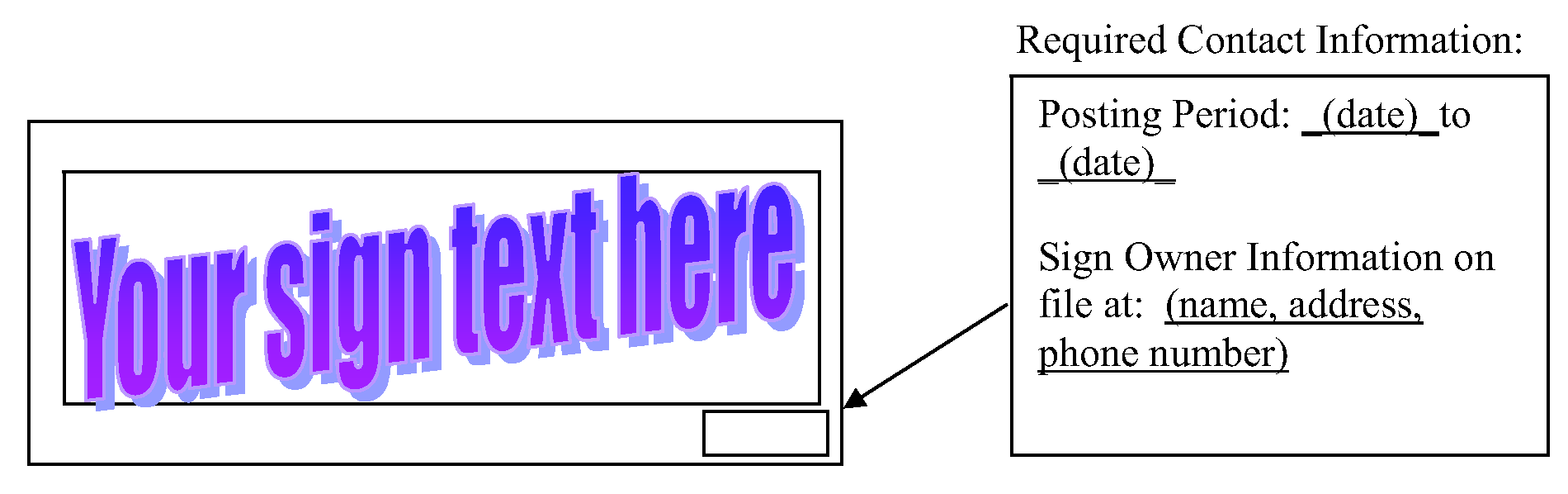
b.
Charitable commercial temporary signs not displaying the above required identification shall be prohibited and shall be subject to abatement procedures and/or prosecution by the City of any person causing the sign to be installed, in compliance with Section 9-37.090(E) (Enforcement).
c.
Location. Leaseholders of businesses may grant permission for charitable commercial temporary signs to be placed directly on their storefront and/or within 10 feet of the main exterior entrance to the business.
G.
Standards for temporary commercial signs requiring a permit. The following standards shall apply to all temporary commercial signs placed within all applicable zoning districts by permit (refer also to subsection H below).
1.
Maximum size. The maximum sign area allowed for temporary commercial signs, is not reduced by the signage allowed for permanent signs.
a.
Freestanding temporary signs shall not exceed 12 square feet on each side in compliance with Section 9-37.060 (Zoning District Sign Standards).
b.
Temporary signs attached to buildings shall not exceed 50 square feet.
2.
Duration.
a.
A temporary sign shall not be displayed at any location for a period exceeding 16 days per Sign Permit.
b.
No more than a total of eight separate Sign Permits shall be allowed in any calendar year for any business, individual, or organization.
3.
Identification required. Each temporary sign shall have legibly affixed on the front in the lower right corner of the sign a City sign seal, with identifying number and expiration date issued by the Department.
4.
Location. Freestanding temporary commercial signs may be located anywhere on the parcel of the respective business (or within the commonly managed shopping center with the property owner's or manager's permission); shall be located such that they do not interfere with traffic safety sight areas (TSSA), visibility at driveways, private sidewalk clearances, or disabled access; and shall not be located in, nor overhang, the public right-of-way.
5.
Processing of a Temporary Sign Permit application.
a.
A Temporary Sign Permit application shall be submitted and approved by the Department of Environmental Services before the placement of any temporary sign.
b.
The permit shall describe the duration, location, number, size, type (e.g., commercial or noncommercial), and design of the sign(s).
c.
The Director shall designate the form to be used for Temporary Sign Permit applications.
d.
The permit shall be issued by the Director within three business days after receipt of the completed application if the requested sign(s) complies with the applicable requirements identified in this Section. If the sign(s) is not disapproved within three business days from receipt of the application, the sign(s) shall be deemed approved.
e.
Only one Sign Permit application shall be required for multiple signs to be erected by a single applicant where the signs have identical graphics, are the same size, and/or are being placed on more than one parcel.
f.
A sign seal, provided by the Department of Environmental Services, shall be placed on each sign.
H.
Number, size, duration, and location of temporary signs. The following standards shall apply to temporary commercial signs placed within all applicable zoning districts by permit. All other standards for commercial temporary signs not specified herein shall apply.
1.
Sunset clause. This subsection 9-37.070(H) shall automatically expire on December 31, 2015 unless extended by the City Council.
2.
Quantity. Temporary commercial signs shall be allowed per tenant business for up to two of the following:
a.
One on-building temporary sign;
b.
One freestanding temporary sign;
c.
Two freestanding temporary feather signs. A temporary commercial feather sign is a ground-mounted freestanding sign that is vertical in nature with total maximum size of 12 square feet, maximum height above adjacent grade of ten feet, and a maximum width at any point of two feet, displayed under the authority of Sections 9-37.070.H or I of this Code.
3.
Duration.
a.
The Temporary Sign Permit shall not exceed a period of 16 calendar days.
b.
A maximum of eight separate Temporary Sign Permit periods shall be allowed in any calendar year per tenant business.
4.
Location. Freestanding temporary commercial signs may be located anywhere on the parcel of the respective business (or within the commonly managed shopping center with the property owner's or manager's permission), shall be located such that they do not interfere with traffic safety sight areas (TSSA), visibility at driveways, private sidewalk clearances, disabled access, and shall not be located in, nor overhang, the public right-of-way.
5.
Drive-through restaurants. In addition to the temporary commercial signs allowed under subsection (H)(2) above, one additional freestanding or on-building temporary sign, not exceeding six square feet, shall be permitted with a Temporary Sign Permit within the drive-through area of a restaurant provided it is not visible from the public right-of-way.
I.
Temporary Use Permit signage. As part of a Temporary Use Permit for limited sidewalk sales or displays and extensive promotional activities per Section 9-52.080, the Temporary Use Permit may include temporary commercial signage as follows:
1.
Sunset clause. This subsection 9-37.070(I) shall automatically expire on December 31, 2015, unless extended by the City Council.
2.
One temporary commercial sign that is either an on-building sign not exceeding 50 square feet, or a freestanding sign.
3.
The one Temporary Use Permit related temporary commercial sign may be located as specified in subsection H.4, above.
4.
The one Temporary Use Permit related temporary commercial sign is in addition to the maximum temporary signs allowed with a Temporary Sign Permit per subsection (H)(2), above, and shall not require a separate Temporary Sign Permit.
(§ 4, Ord. 1092, eff. July 6, 2006, as amended by § 2, Ord. 1126, eff. March 13, 2008, Exh. A, Ord. 1147, eff. August 20, 2009, Exh. A, Ord. 1164, eff. November 11, 2010; § 2 (Exh. A), Ord. 1168, eff. February 10, 2011; § 2 (Exh. A), Ord. No. 1185, eff. March 29, 2012; § 2 (Exh. A), Ord. No. 1200, eff. October 11, 2012; § 2 (Exh. A), Ord. No. 1210, eff. May 9, 2013; § 2 (Exh. A), Ord. No. 1211, eff. May 9, 2013; § 2 (Exh. A), Ord. No. 1222, eff. 2-27-2014 and § 2 (Exh. A), Ord. No. 1250, eff. December 3, 2015)
9-37.080 - Legal Nonconforming Signs
A legal nonconforming sign is any permanent sign that was legally established, erected or maintained in compliance with the provisions of all applicable laws in effect at the time of original installation, but that does not now comply with the provisions of this Development Code. A legal nonconforming sign shall not be:
A.
Changed to another nonconforming sign;
B.
Structurally altered to extend its useful life;
C.
Expanded;
D.
Re-established after a business is discontinued for 90 days; or
E.
Re-established after damage or destruction to 50 percent or more of the value of the sign or its components, as determined by the Building Official, and the destruction is other than facial copy replacement, and the display cannot be repaired within 30 days of the date of its destruction.
(§ 4, Ord. 1092, eff. July 6, 2006)
9-37.090 - Violations and Abatement
A.
Public nuisance unlawful. Any sign erected or maintained contrary to the provisions of this Chapter is unlawful and a public nuisance. Proceedings for its removal may take place in compliance with Chapter 9-78 (Enforcement of Development Code Provisions).
B.
Public nuisance declared by Council. After providing the owner of the sign and the owner of the property on which the sign is located notice of the date and time of the City Council meeting at which it will be considered, the Director may ask the Council to declare a sign a public nuisance under the following conditions:
1.
The sign is significantly damaged either in support structure or sign face, as determined by the Building Official.
2.
The sign is illegible either through fading, rusting, or erosion of the sign face or through faulty or missing illumination; or
3.
The sign is unsafe for vehicles or pedestrians.
The owner of the sign and the owner of the property on which the sign is located shall be afforded an opportunity to respond and present evidence at the meeting.
C.
Removal of abandoned sign. A sign shall be removed by the sign owner and/or property owner when business is no longer conducted on the premises, unless the sign is re-used by a subsequent tenant within 90 days of the business closure. If the sign owner and/or property owner fail to remove the sign within the above mentioned time period, the Director shall give the sign owner and/or property owner 30 days written notice to remove it. Upon failure to comply with the notice, the Director may have the sign removed at the sign owner's and property owner's expense. The sign owner and the property owner shall be jointly and severally liable and responsible for any costs incurred. Proceedings for the removal of signs and/or support structures shall comply with Chapter 9-78 (Enforcement).
D.
Immediate removal of hazards. The City may immediately abate any sign which poses an immediate traffic hazard, including the obstruction of motorists line-of-sight. Within five days after removal of such sign, the City shall give notice to the owner of the sign, if known, to retrieve the sign within 10 days thereafter. If the owner fails to respond within 10 days, the City may destroy the sign.
E.
Enforcement.
1.
Signs located in public right-of-way or public easements.
a.
Upon determining that a violation of any provision of this Chapter has occurred, the City may immediately abate signs located in the public right-of-way or public easements, including those in the median or island of any public street.
b.
The procedure identified in this Section shall not limit or restrict the City from enforcing this Section, or any other provision of this Chapter, in any other manner provided by law, including civil or criminal prosecution.
2.
Signs located on private property.
a.
Upon determining that a violation of any provision of this Chapter has occurred, the City may, with the written consent of the owner of the private property or structure on which a temporary sign(s) has been placed in violation of this Section, immediately abate the offending sign on the private property or structure.
b.
The procedure identified in this Section shall not limit or restrict the City from enforcing the provisions of this Chapter, in any other manner provided by law, including civil or criminal prosecution.
(§ 4, Ord. 1092, eff. July 6, 2006)
9-37.100 - Judicial Review
Any permit issued or disapproved in compliance with this Chapter shall be subject to expedited judicial review in compliance with the time limits identified in Code of Civil Procedure Sections 1094.8 et seq. and Chapter 9-78 of the Municipal Code.
(§ 4, Ord. 1092, eff. July 6, 2006)
9-37.110 - Severability
In the event that any part of this Chapter is held to be invalid or inapplicable to any sign or signs, it is intended that the invalid part or parts be severed from the remaining provisions in order to continue in force and effect as many provisions of this Chapter as possible. It is specifically intended that severance occur, if necessary, that will allow the application of restrictions on the height, size, type, number, and location of signs. The Council hereby declares that it would have passed this Chapter and adopted this Chapter and each section, sentence, clause, or phrase thereof, irrespective of the fact that one or more sections, subsections, sentences, clauses, or phrases be declared invalid or unconstitutional.
(§ 4, Ord. 1092, eff. July 6, 2006)

