
Stoughton City Zoning Code
ARTICLE I
- ESTABLISHMENT OF ZONING DISTRICTS
Sec. 78-101.- Purpose.
The area located within the jurisdiction of this chapter is hereby divided into zoning districts of such number as is necessary to achieve compatibility of land uses within each district, to implement the City of Stoughton Comprehensive Plan, and to achieve the other purposes of this Zoning Ordinance (See section 78-005.).
(Ord. No. 0-6-09, 6-23-2009)
Sec. 78-102. - Standard zoning districts and standard zoning district categories.
For the purpose of this chapter, all areas within the jurisdiction of this chapter (See section 78-009) are hereby divided into the following standard zoning districts, and standard zoning district categories (listed in underlined text), which shall be designated as follows:
Agricultural Category: (See subsection 78-105(1))
Rural Holding (RH) District
Residential Category: (See subsection 78-105(2))
Exurban Residential (ER-1) District
Single-family Residential-3 (SR-3) District
Single-family Residential-4 (SR-4) District
Single-family Residential-5 (SR-5) District
Single-family Residential-6 (SR-6) District
Two-family Residential-6 (TR-6) District
Multi-family Residential (MR) District
Office Category: (See Section 78-105(3))
Neighborhood Office (NO) District
Planned Office (PO) District
Business Category: (See Section 78-105(4))
Neighborhood Business (NB) District
Planned Business (PB) District
Central Business (CB) District
Industrial Category: (See Section 78-105(5))
Light Industrial (LI) District
Heavy Industrial (HI) District
Institutional Category: (See Section 78-105(6))
Institutional (I) District
Planned Development Category: (See Section 78-105(7))
Planned Development District (PD year - order of approval in that year) (e.g.: (PD 2005-2))
(Ord. No. 0-6-09, 6-23-2009; Ord. No. 0-21-2024, § 1(Exh. A), 11-26-2024)
State Law reference— Section 62.23(7)(b), Wisconsin Statutes.
Sec. 78-103. - Map of standard zoning districts.
Standard zoning districts established by this chapter are shown on the official zoning map of the City of Stoughton, which together with all explanatory materials thereon, is hereby made part of this chapter.
(Ord. No. 0-6-09, 6-23-2009; Ord. No. 0-01-2026, § 1(Exh. A), 1-27-2026)
Sec. 78-104. - Interpretation of zoning district boundaries.
The following rules shall be used to determine the precise location of any zoning district boundary shown on the official zoning map of the City of Stoughton:
(1)
Zoning district boundaries shown as following or approximately following the limits of any city, village, town or county boundary shall be construed as following such limits.
(2)
Zoning district boundaries shown as following or approximately following streets or railroad lines shall be construed as following the centerline of such streets or railroad lines.
(3)
Zoning district boundary lines shown as following or approximately following platted lot lines or other property lines as shown on the City of Stoughton or County of Dane Tax Maps shall be construed as following such lines.
(4)
Zoning district boundaries shown as following or approximately following the centerlines of streams, rivers, or other continuously flowing watercourses shall be construed as following the channel centerlines of such watercourses, and, in the event of a natural change in the location of such streams, rivers, or other watercourses, the zoning district boundary shall be construed as moving with the channel centerline.
(5)
Zoning district boundaries shown as following or approximately following ridgelines or watershed boundaries shall be construed as following such lines.
(6)
Zoning district boundaries shown as separated from, any of the features listed in subsections (1) through (5), above, shall be construed to be at such distances therefrom as are shown on the official zoning map.
(7)
Where any uncertainty exists as to the exact location of a zoning district boundary line, as shown on the official zoning map, the location of the line shall be determined by the zoning administrator.
(Ord. No. 0-6-09, 6-23-2009)
Sec. 78-105. - Purpose and intent of standard zoning districts.
The following subsections specify the purpose and intent of the standard zoning districts established by this chapter.
(1)
Agricultural District
a.
Rural Holding (RH) District
1.
Description and purpose: This district is intended to permit development which is solely of a rural community character. The land use standards for this district permit very low density single-family detached residential development at a density of one dwelling unit for every 35 gross acres, as well as a variety of agricultural and agriculture-supporting land uses. Density and intensity standards for this district are designed to ensure that development which requires even a minimum of urban services does not occur until such services are available. As such, the Rural Holding (RH) District shall either serve as a designation which preserves and protects agricultural activities, or as a "holding zone" which provides for an interim land use (agriculture) that will easily permit further development (with rezoning to another district) at the appropriate time.
Rationale: This district is used to provide for the protection of agricultural activities, and a very low density residential area for those who want to live in a rural environment and who retain enough land with their residence to ensure that the rural environment is maintained as long as the Rural Holding (RH) District designation is retained. In this manner, even if all property were developed in a given area with the Rural Holding (RH) District designation, the rural community character of that area would still be maintained.
2.
List of allowable principal land uses (per article II).
a.
Principal Land Uses Permitted by Right: (per subsection 78-202(1)).
Single-Family Detached - 35 acre lot (per subsection 78-206(1)(a)1.)
Cultivation (per subsection 78-206(2)(a))
On-Site Agricultural Retail (per subsection 78-206(2)(e))
Selective Cutting (per subsection 78-206(2)(f))
Passive Outdoor Public Recreation (per subsection 78-206(3)(a))
Active Outdoor Public Recreation (per subsection 78-206(3)(b))
Public Services and Utilities (per subsection 78-206(3)(e))
Community Living Arrangement (1—8 residents) (per subsection 78-206(3)(g))
Single-Family Detached - 40,000 square foot lot (for lots smaller than 35 acres, remainder of 35 acres must be deed restricted with a conservation easement prohibiting subsequent development of additional principal structures unless rezoned for higher density development)
Husbandry (per Section 78-206(2)(b))
Intensive Agriculture (per Section 78-206(2)(c))
Agricultural Services (per Section 78-206(2)(d))
Clear Cutting (per Section 78-206(2)(g))
Community Gardens (per Section 78-206(2)(h))
Market Gardens (per Section 78-206(2)(i))
Outdoor Institutional (per Section 78-206(3)(d))
Outdoor Commercial Entertainment (per Section 78-206(4)(i))
Commercial Animal Boarding (per Section 78-206(4)(j))
Bed and Breakfast Establishments (per Section 78-206(4)(l))
Campground (per Section 78-206(4)(n))
Junkyard or Salvage Yard (per Section 78-206(5)(d))
Waste Disposal Facility (per Section 78-206(5)(e))
Composting Operation (per Section 78-206(5)(f))
Airport/Heliport (per Section 78-206(6)(b))
Extraction Use (per Section 78-206(7)(d))
Mobile service support structure
3.
List of Allowable Accessory Uses: (per subsection 78-202(3))
a.
Accessory land uses permitted by right:
Farm Residence (per subsection 78-206(8)(b))
Detached residential garage, shed; gazebo or similar accessory structure (per subsection 78-206(8)(c))
Home Occupation (per subsection 78-206(8)(j))
Family Day Care Home (four to eight children) (per subsection 78-206(8)(k))
On-Site Parking Lot (per subsection 78-206(8)(n))
Private Residential Recreational Facility (per subsection 78-206(8)(o))
Drainage Structure (per subsection 78-206(8)(r))
Filling (per subsection 78-206(8)(s))
Lawn Care (per subsection 78-206(8)(t))
Exterior Communication Devices (per subsection 78-206(8)(v))
Keeping of chickens (per subsection 78-206(8)(y)).
Keeping of honey bees (per subsection 78-206(8)(z)).
b.
Accessory land uses permitted as conditional use:
Outdoor Display Incidental (per subsection 78-206(8)(f))
Intermediate Day Care Home (9—15 children) (per subsection 78-206(8)(l))
Migrant Labor Camp (per subsection 78-206(8)(m))
Private Residential Kennel (per subsection 78-206(8)(p))
Private Residential Stable (per subsection 78-206(8)(q))
In-family Suite (per subsection 78-206(8)(x))
4.
List of allowable temporary uses: (per subsection 78-202(4))
General Temporary Outdoor Sales (per subsection 78-206(9)(a))
Outdoor Assembly (per subsection 78-206(9)(b))
Contractor's Project Office (per subsection 78-206(9)(c))
Contractor's On-Site Equipment Storage (per subsection 78-206(9)(d))
On-Site Real Estate Sales Office (per subsection 78-206(9)(f))
Temporary Portable Storage Container (per subsection 78-206(9)(i))
Mobile Food Vending (per subsection 78-206(9)(j))
Mobile Food Vending at Special Events (per subsection 78-206(9)(k))
5.
List of allowable energy production uses:
a.
Energy production uses permitted by right:
Solar Energy Systems (per subsection 78-206(10)(c))
b.
Energy production uses permitted as conditional use:
Small Wind Energy System (per subsection 78-206(10)(a))
6.
Regulations applicable to all uses.
a.
Landscaping Regulations (See article VI)
b.
Performance Standards: (See article VII)
c.
Signage Regulations: (See article VIII)
7.
Regulations applicable to residential uses.
a.
Residential density and intensity requirements:
Maximum Gross Density (MGD): 0.03 dwelling unit/acre
Minimum Landscape Surface Ratio (LSR): 90 percent
Maximum Accessory Building Coverage: Ten percent
b.
Residential bulk requirements*
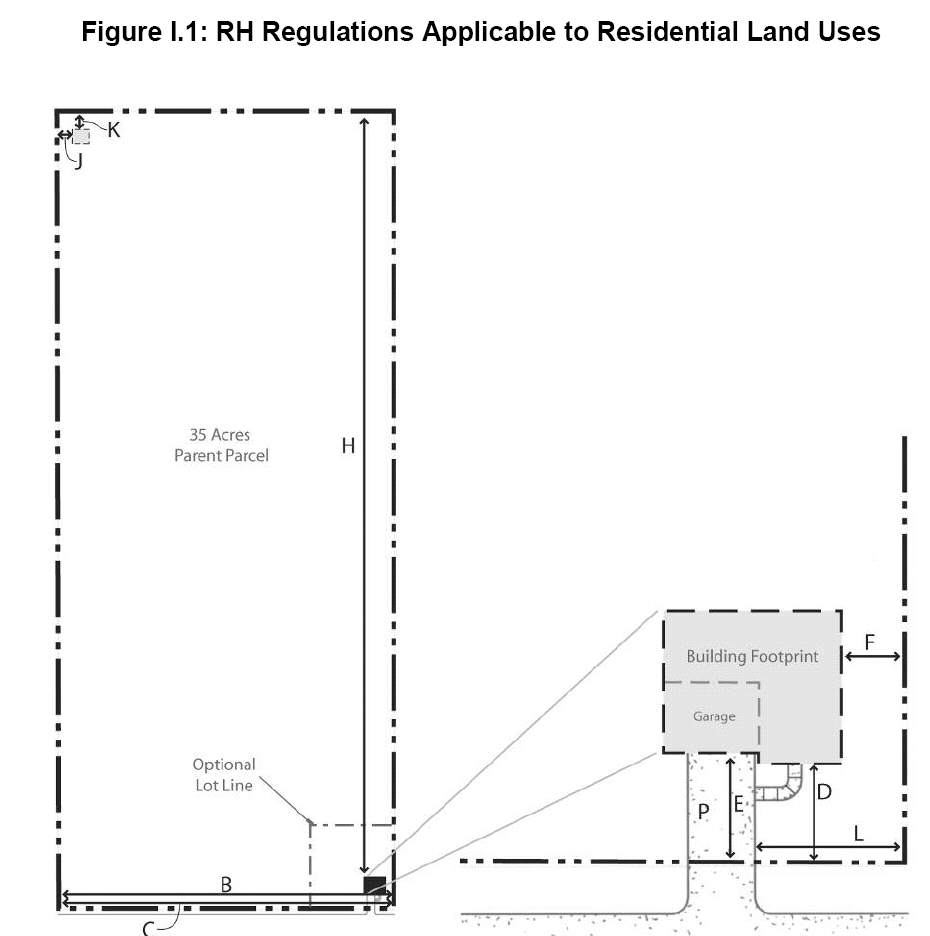
Figure I.1
A.
Minimum lot area: 35 acres, or 40,000 sf with conditional use permit (for lots less than 35 acres a conditional use permit shall require the remainder of 35 acres to be deed restricted with a conservation easement prohibiting subsequent development of additional principal structures unless rezoned for higher density development)
B.
Minimum lot width: 100 feet
C.
Minimum street frontage: 50 feet
Minimum Setbacks:
D.
Front or street side lot line to house: 25 feet
E.
Front or street side lot line to attached garage: 30 feet
F.
Side lot line to house or attached garage: Ten feet
G.
Total of both sides, lot lines to house or attached garage: 20 feet
H.
Rear lot line to house or attached garage: 30 feet
I.
Side lot line to accessory structure: Three feet from property line, five feet from alley
J.
Rear lot line to accessory structure: Three feet from property line, five feet from alley
K.
Required bufferyard: See section 78-610 along zoning district boundary
L.
Minimum paved surface setback: Five feet from side or rear, or zero feet in the case of a shared driveway; ten feet from right-of-way
M.
Minimum dwelling unit separation: 20 feet for multiple principle dwellings on the same lot
N.
Maximum height of dwelling unit: 35 feet
O.
Maximum height of accessory structure: 45 feet
P.
Minimum number of off-street parking spaces required on the lot (Includes garage, drives, and all designated parking surfaces):
• Four spaces if located on street with standard local pavement width
• Eight spaces if located on street with reduced pavement width
• For a nonconforming structure, see section 78-408
8.
Regulations applicable to nonresidential uses:
a.
Nonresidential intensity requirements:
Maximum number of floors (F): Two
Minimum landscape surface ratio (LSR): 90 percent
Maximum building size (MBS): na
b.
Nonresidential bulk requirements*:
A.
Minimum lot area: 40,000 square feet, 20,000 sf with a conditional use permit
B.
Minimum lot width: 100 feet;
C.
Minimum street frontage: 50 feet
Minimum Setbacks:
D.
Building to front or street side lot line: 35 feet
E.
Building to residential side lot line: 50 feet
F.
Building to residential rear lot line: 50 feet
G.
Building to nonresidential side lot line: 50 feet
H.
Building to nonresidential rear lot line: 50 feet
I.
Side lot line to accessory structure: Four feet from property line, and alley
J.
Rear lot line to accessory structure: Four feet from property line, and alley
K.
Required bufferyard: See section 78-610 along zoning district boundary
L.
Minimum paved surface setback: Five feet from side or rear, or zero feet in the case of a shared driveway; ten feet from right-of-way
M.
Minimum building separation: 100 feet for multiple principle dwellings on the same lot
N.
Maximum building height: 35 feet
O.
Minimum number of off-street parking spaces required on the lot: See parking lot requirements per specific land use in section 78-206
• For a nonconforming structure, see section 78-408
(2)
Residential districts.
(a)
Exurban Residential (ER-1) District.
1.
Description and purpose. This district is intended to permit development which has a very low density, exurban community character. Unlike the case for the Rural Holding (RH) District, the land use standards for this district permit primarily single-family detached residential development and a variety of related institutional land uses, and are not oriented to a wide range of agricultural activities. Density and intensity standards for this district are designed to ensure that the Exurban Residential (ER-1) District shall serve as a designation which preserves and protects the exurban community character of its area. A variety of residential development options are available in this district, with a Maximum Gross Density (MGD) of one dwelling unit for every one gross acre.
Rationale: This district is used to provide for the permanent protection of a very low density residential area for those who want to live in an exurban environment and retain enough land with their residence, or in their development, to ensure that the exurban character is maintained as long as the ER-1 District designation is retained, regardless of how much development occurs within that area.
2.
List of allowable principal land uses (per article II).
a.
Principal land uses permitted by right: (per subsection 78-202(1))
Single-family detached—40,000 sf lot
Cultivation (per subsection 78-206(2)(a))
On-site agricultural retail (per subsection 78-206(2)(e))
Selective cutting (per subsection 78-206(2)(f))
Passive outdoor public recreation (per subsection 78-206(3)(a))
Active outdoor public recreation (per subsection 78-206(3)(b))
Public services and utilities (per subsection 78-206(3)(e))
Community living arrangement (1—8 residents) (per subsection 78-206(3)(g))
Mobile service support structure
b.
Principal land uses permitted as conditional use: (per subsection 78-202(2))
Clear cutting (per subsection 78-206(2)(g))
Community gardens (per subsection 78-206(2)(h))
Market gardens (per subsection 78-206(2)(i))
Community living arrangement (9—15 residents) (per subsection 78-206(3)(h))
Bed and breakfast establishments (per subsection 78-206(4)(l))
3.
List of allowable accessory uses: (per subsection 78-202(3))
a.
Accessory land uses permitted by right:
Farm residence (per subsection 78-206(8)(b))
Detached residential garage, shed; gazebo or similar accessory structure (per subsection 78-206(8)(c))
Home occupation (per subsection 78-206(8)(j))
Family day care home (4—8 children) (per subsection 78-206(8)(k))
On-site parking lot (per subsection 78-206(8)(n))
Private residential recreational facility (per subsection 78-206(8)(o))
Drainage structure (per subsection 78-206(8)(r))
Filling (per subsection 78-206(8)(s))
Lawn care (per subsection 78-206(8)(t))
Exterior communication devices (per subsection 78-206(8)(v))
In-family suite (per subsection 78-206(8)(x))
Keeping of chickens on a lot with a single-family dwelling (per subsection 78-206(8)(y)).
Keeping of honey bees (per subsection 78-206(8)(z)).
b.
Accessory land uses permitted as conditional use:
Intermediate day care home (9—15 children) (per subsection 78-206(8)(l))
Private residential kennel (per subsection 78-206(8)(p))
Private residential stable (per subsection 78-206(8)(q))
Caretaker's residence (per subsection 78-206(8)(w))
4.
List of allowable temporary uses: (per subsection 78-202(4))
General Temporary Outdoor Sales (per subsection 78-206(9)(a))
Outdoor assembly (per subsection 78-206(9)(b))
Contractor's project office (per subsection 78-206(9)(c))
Contractor's on-site equipment storage (per subsection 78-206(9)(d))
On-site real estate sales office (per subsection 78-206(9)(f))
Temporary portable storage container (per subsection 78-206(9)(i))
Mobile Food Vending at Special Events (per subsection 78-206(9)(k))
5.
List of allowable energy production uses:
a.
Energy production uses permitted by right:
Solar energy systems (per subsection 78-206(10)(c))
b.
Energy production uses permitted as conditional use:
Small wind energy system (per subsection 78-206(10)(a))
6.
Regulations applicable to all uses:
a.
Landscaping regulations (See article VI)
b.
Performance standards: (See article VII)
c.
Signage regulations: (See article VIII)
7.
Regulations applicable to residential uses:
a.
Residential density and intensity requirements:
Maximum gross density (MGD): 1.0 dwelling unit/acre
Minimum landscape surface ratio (LSR): 80 percent
Maximum accessory building coverage: Five percent
b.
Residential bulk requirements*:
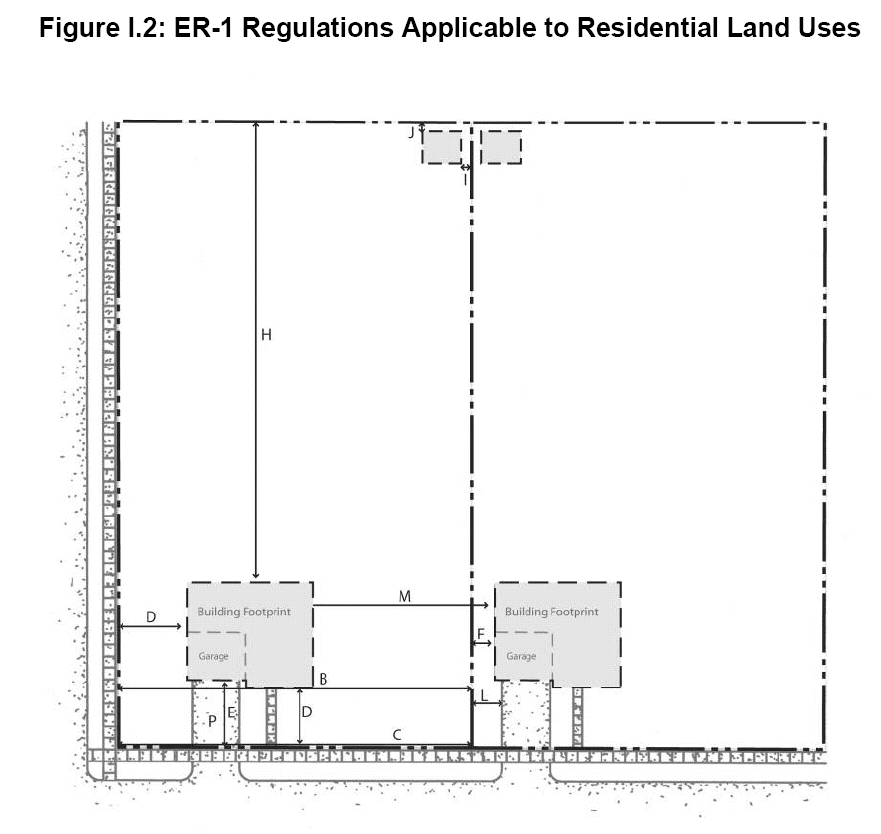
Figure I.2
A.
Minimum lot area: 40,000 square feet, 20,000 sf with a conditional use permit
B.
Minimum lot width: 100 feet
C.
Minimum street frontage: 50 feet
Minimum Setbacks:
D.
Front or street side lot line to house: 25 feet
E.
Front or street side lot line to attached garage: 30 feet
F.
Side lot line to house or attached garage: Ten feet
G.
Total of both sides, lot lines to house or attached garage: 20 feet
H.
Rear lot line to house or attached garage: 30 feet
I.
Side lot line to accessory structure: Four feet from property line, four feet from alley
J.
Rear lot line to accessory structure: Four feet from property line, four feet from alley
K.
Required bufferyard: See section 78-610 along zoning district boundary
L.
Minimum paved surface setback: Five feet from side or rear, or zero feet in the case of a shared driveway, ten feet from right-of-way
M.
Minimum dwelling unit separation: 20 feet for multiple principle dwellings on the same lot
N.
Maximum height of dwelling unit: 35 feet
O.
Maximum height of accessory structure: 20 feet.
P.
Minimum number of off-street parking spaces required on the lot (Includes garage, drives, and all designated parking surfaces): Two
• For a nonconforming structure, see section 78-408
8.
Regulations applicable to nonresidential uses:
a.
Nonresidential intensity requirements:
Maximum number of floors (F): Two
Minimum landscape surface ratio (LSR): 80 percent
Maximum building size (MBS): na
b.
Nonresidential bulk requirements*:
A.
Minimum lot area: 40,000 sf
B.
Minimum lot width: 100 feet; Minimum street frontage: 50 feet
Minimum Setbacks:
C.
Building to front or street side lot line: 25 feet
D.
Building to residential side lot line: 30 feet
E.
Building to residential rear lot line: 30 feet
F.
Building to nonresidential side lot line: 30 feet
G.
Building to nonresidential rear lot line: 30 feet
H.
Side lot line to accessory structure: Four feet from property line, four feet from alley
I.
Rear lot line to accessory structure: Four feet from property line, four feet from alley
J.
Required bufferyard: See section 78-610 along zoning district boundary
K.
Minimum paved surface setback: Five feet from side or rear; ten feet from right-of-way
L.
Minimum building separation: 60 feet
M.
Maximum building height: 35 feet
N.
Minimum number of off-street parking spaces required on the lot: See parking lot requirements per specific land use in section 78-206
• For a nonconforming structure, see section 78-408
c.
Nonresidential landscaping requirements (Nonresidential and multi-family):
O.
50 landscaping points per 100 linear feet of building foundation
P.
30 landscaping points per 1,000 square feet of gross floor area
Q.
50 landscaping points per 100 linear feet of street frontage
R.
100 landscaping points per 10,000 square feet paved area/20 stalls
d.
Nonresidential performance standards: (See article VII)
e.
Nonresidential signage regulations: (See article VIII)
(b)
Single-family Residential-3 (SR-3) District.
1.
Description and purpose: This district is intended to permit development which has a moderate density community character. Density and intensity standards for this district are designed to ensure that the Single-family Residential-3 District shall serve as a designation which preserves and protects the residential community character of its area. Residential development with a maximum gross density (MGD) of three dwelling units per gross acre is available within this district.
Rationale: This district is used to provide for the permanent protection of a moderate density residential area for those who want to live in an suburban residential environment and who retain enough land with their residence, or in their development, to ensure that the community character is maintained as long as the SR-3 District designation is retained, regardless of how much development occurs within that area.
2.
List of allowable principal land uses (per article II)
a.
Principal land uses permitted by right: (per subsection 78-202(1))
Single-family detached—12,000 sf lot (per subsection 78-206(1)(a)1.)
Cultivation (per subsection 78-206(2)(a))
On-site agricultural retail (per subsection 78-206(2)(e))
Selective cutting (per subsection 78-206(2)(f))
Passive outdoor public recreation (per subsection 78-206(3)(a))
Active outdoor public recreation (per subsection 78-206(3)(b))
Public services and utilities (per subsection 78-206(3)(e))
Community living arrangement (1—8 residents) (per subsection 78-206(3)(g))
Mobile service support structure
b.
Principal land uses permitted as conditional use: (per subsection 78-202(2))
Clear cutting (per subsection 78-206(2)(g))
Community gardens (per subsection 78-206(2)(h))
Market gardens (per subsection 78-206(2)(i))
Community living arrangement (9—15 residents) (per subsection 78-206(3)(h))
Bed and breakfast establishments (per subsection 78-206(4)(l))
3.
List of allowable accessory uses: (per subsection 78-202(3))
a.
Accessory land uses permitted by right:
Farm residence (per subsection 78-206(8)(b))
Detached residential garage, shed; gazebo or similar accessory structure (per subsection 78-206(8)(c))
Home occupation (per subsection 78-206(8)(j))
Family day care home (4—8 children) (per subsection 78-206(8)(k))
On-site parking lot (per subsection 78-206(8)(n))
Private residential recreational facility (per subsection 78-206(8)(o))
Drainage structure (per subsection 78-206(8)(r))
Filling (per subsection 78-206(8)(s))
Lawn care (per subsection 78-206(8)(t))
In-family suite (per subsection 78-206(8)(x))
Keeping of chickens on a lot with a single-family dwelling (per subsection 78-206(8)(y)).
Keeping of honey bees (per subsection 78-206(8)(z)).
b.
Accessory land uses permitted as conditional use:
Intermediate day care home (9—15 children) (per subsection 78-206(8)(l))
Exterior communication devices (per subsection 78-206(8)(v))
4.
List of allowable temporary uses: (per subsection 78-202(4))
Outdoor assembly (per subsection 78-206(9)(b))
Contractor's project office (per subsection 78-206(9)(c))
Contractor's on-site equipment storage (per subsection 78-206(9)(d))
On-site real estate sales office (per subsection 78-206(9)(f))
Temporary portable storage container (per subsection 78-206(9)(i))
Mobile Food Vending at Special Events (per subsection 78-206(9)(k))
5.
List of allowable energy production uses:
a.
Energy production uses permitted by right:
Solar energy systems (per subsection 78-206(10)(c))
b.
Energy production uses permitted as conditional use:
Small wind energy system (per subsection 78-206(10)(a))
6.
Regulations applicable to all uses.
a.
Landscaping regulations: (see article VI)
b.
Performance standards: (see article VII)
c.
Signage regulations: (see article VIII)
7.
Regulations applicable to residential uses
a.
Residential density and intensity requirements:
Maximum gross density (MGD): 3.0 dwelling units/acre
Minimum landscape surface ratio (LSR): 50 percent
b.
Residential bulk requirements*:
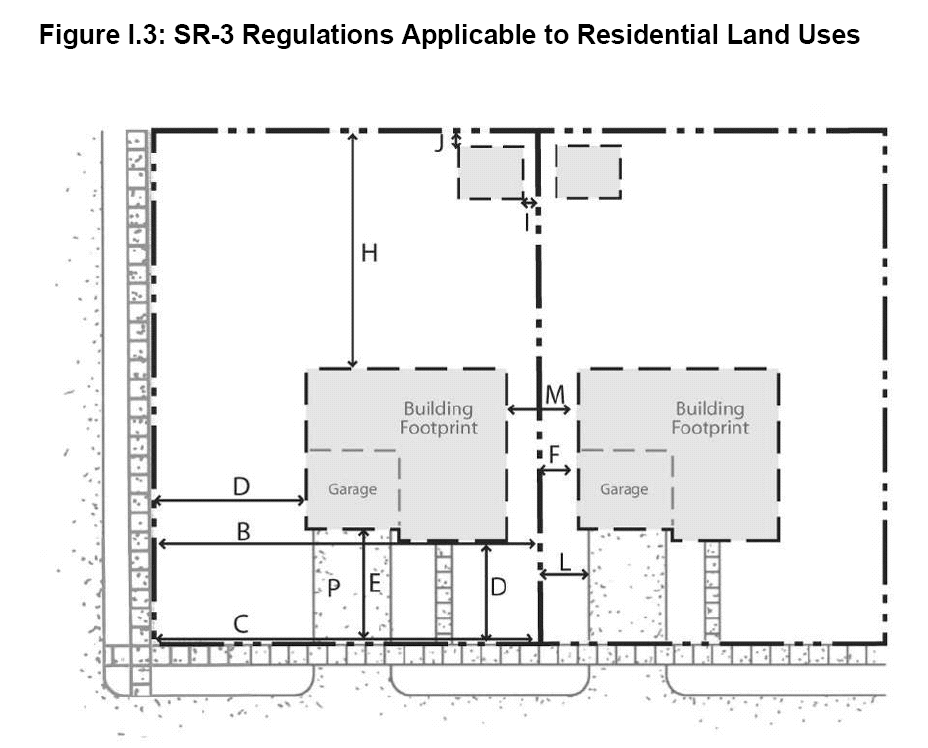
Figure I.3
A:
Minimum lot area: 12,000 square feet
B:
Minimum lot width: 80 feet
C:
Minimum street frontage: 50 feet
Minimum Setbacks:
D:
Front or street side lot line to house: 25 feet
E:
Front or street side lot line to attached garage: 25 feet
F:
Side lot line to house or attached garage: Ten feet
G:
Total of both sides, lot lines to house or attached garage: 20 feet
H:
Rear lot line to house or attached garage: 30 feet
I:
Side lot line to accessory structure: Four feet from property line, four feet from alley
J:
Rear lot line to accessory structure: Four feet from property line, four feet from alley
K.
Required bufferyard: See section 78-610 along zoning district boundary
L.
Minimum paved surface setback: Five feet from side or rear, or zero feet in the case of a shared driveway; ten feet from right-of-way.
M:
Minimum dwelling unit separation: 20 feet for multiple principle dwellings on the same lot
N:
Maximum height of dwelling unit: 30 feet
O.
Maximum height of accessory structure: 20 feet.
P:
Minimum number of off-street parking spaces required on the lot (Includes garage, drives, ad all designated parking surfaces): Two
• For a nonconforming structure, see section 78-408
8.
Regulations applicable to nonresidential uses.
a.
Nonresidential intensity requirements:
Maximum number of floors (F): Two
Minimum landscape surface ratio (LSR): 50 percent
Maximum building size (MBS): na
b.
Nonresidential bulk requirements*:
A:
Minimum lot area: 40,000 square feet, 20,000 square feet with a conditional use permit
B:
Minimum lot width: 100 feet; Minimum street frontage: 50 feet
Minimum Setbacks:
C:
Building to front or street side lot line: 30 feet
D:
Building to residential side lot line: Ten feet
E:
Building to residential rear lot line: 20 feet
F:
Building to nonresidential side lot line: Ten feet
G:
Building to nonresidential rear lot line: 20 feet
H:
Side lot line to accessory structure: Four feet from property line, four feet from alley
I:
Rear lot line to accessory structure: Four feet from property line, four feet from alley
J.
Required bufferyard: See section 78-610 along zoning district boundary
K:
Minimum paved surface setback: Five feet from side or rear, or zero feet in the case of a shared driveway; ten feet from right-of-way
L:
Minimum building separation: 20 feet for multiple principle dwellings on the same lot
M:
Maximum building height: 35 feet
N:
Minimum number of off-street parking spaces required on the lot: See parking lot requirements per specific land use in section 78-206
* For a nonconforming structure, see section 78-408
(c)
Single-family Residential-4 (SR-4) District
1.
Description and purpose: This district is intended to permit development which has a moderate density community character. Density and intensity standards for this district are designed to ensure that the Single-family Residential-4 (SR-4) District shall serve as a designation which preserves and protects the residential community character of its area. Residential development with a maximum gross density (MGD) of four dwelling units per gross acre is available within this district.
Rationale: This district is used to provide for the permanent protection of a moderate density residential area for those who want to live in an suburban residential environment and who retain enough land with their residence, or in their development, to ensure that the community character is maintained as long as the SR-4 District designation is retained, regardless of how much development occurs within that area.
2.
List of allowable principal land uses (per article II):
a.
Principal land uses permitted by right: (per subsection 78-202(1))
Single-Family detached — 8,600 sf lot (per subsection 78-206(1)(a)1.)
Cultivation (per subsection 78-206(2)(a))
On-site agricultural retail (per subsection 78-206(2)(e))
Selective cutting (per subsection 78-206(2)(f))
Passive outdoor public recreation (per subsection 78-206(3)(a))
Active outdoor public recreation (per subsection 78-206(3)(b))
Public services and utilities (per subsection 78-206(3)(e))
Community living arrangement (1—8 residents) (per subsection 78-206(3)(g))
Mobile service support structure
b.
Principal land uses permitted as conditional use: (per subsection 78-202(2))
Clear cutting (per subsection 78-206(2)(g))
Community gardens (per subsection 78-206(2)(h))
Market gardens (per subsection 78-206(2)(i))
Community living arrangement (9—15 residents) (per subsection 78-206(3)(h))
Bed and breakfast establishments (per subsection 78-206(4)(l))
3.
List of allowable accessory uses: (per subsection 78-202(3))
a.
Accessory land uses permitted by right:
Farm residence (per subsection 78-206(8)(b))
Detached residential garage, shed; gazebo or similar accessory structure (per subsection 78-206(8)(c))
Home occupation (per subsection 78-206(8)(j))
Family day care home (4—8 children) (per subsection 78-206(8)(k))
On-site parking lot (per subsection 78-206(8)(n))
Private residential recreational facility (per subsection 78-206(8)(o))
Drainage structure (per subsection 78-206(8)(r))
Filling (per subsection 78-206(8)(s))
Lawn care (per subsection 78-206(8)(t))
In-family suite (per subsection 78-206(8)(x))
Keeping of chickens on a lot with a single-family dwelling (per subsection 78-206(8)(y)).
Keeping of honey bees (per subsection 78-206(8)(z)).
b.
Accessory land uses permitted as conditional use:
Intermediate day care home (9—15 children) (per subsection 78-206(8)(l))
Exterior communication devices (per subsection 78-206(8)(v))
4.
List of allowable temporary uses: (per subsection 78-202(4))
Outdoor assembly (per subsection 78-206(9)(b))
Contractor's project office (per subsection 78-206(9)(c))
Contractor's on-site equipment storage (per subsection 78-206(9)(d))
On-site real estate sales office (per subsection 78-206(9)(f))
Temporary portable storage container (per subsection 78-206(9)(i))
Mobile Food Vending at Special Events (per subsection 78-206(9)(k))
5.
List of allowable energy production uses:
a.
Energy production uses permitted by right:
Solar energy systems (per subsection 78-206(10)(c))
b.
Energy production uses permitted as conditional use: (per subsection 78-202(2))
Small wind energy system (per subsection 78-206(10)(a))
6.
Regulations applicable to all uses:
a.
Landscaping regulations: (See article VI)
b.
Performance standards: (See article VII)
c.
Signage regulations: (See article VIII)
7.
Regulations applicable to residential uses:
a.
Residential density and intensity requirements:
Maximum gross density (MGD): 4.0 dwelling units/acre
Minimum landscape surface ratio (LSR): 50 percent
b.
Residential bulk requirements*:
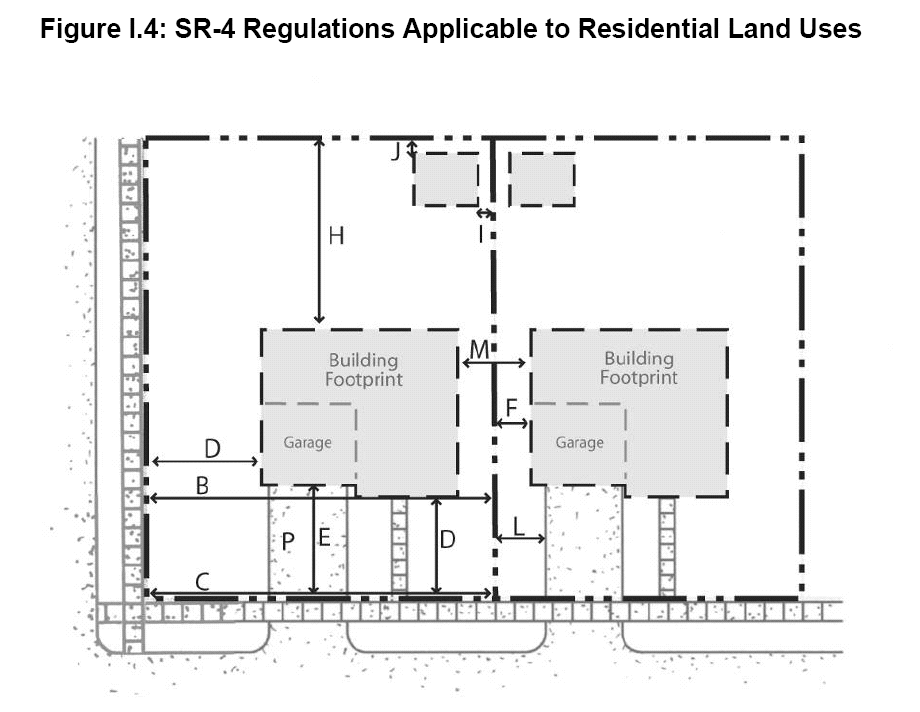
Figure I.4
A:
Minimum lot area: 8,600 square feet
B:
Minimum lot width: 66 feet
C:
Minimum street frontage: 50 feet
Minimum Setbacks:
D:
Front or street side lot line to house: 25 feet
E:
Front or street side lot line to attached garage: 25 feet
F:
Side lot line to house or attached garage: Ten feet
G:
Total of both sides, lot lines to house or attached garage: 20 feet
H:
Rear lot line to house or attached garage: 30 feet
I:
Side lot line to accessory structure: Four feet from property line, four feet from alley
J:
Rear lot line to accessory structure: Four feet from property line, four feet from alley
K.
Required bufferyard: See subsection 78-610 along zoning district boundary
L:
Minimum paved surface setback: One foot from side or rear, or zero feet in the case of a shared driveway; ten feet from right-of-way
M:
Minimum dwelling unit separation: 20 feet for multiple principle dwellings on the same lot
N:
Maximum height of dwelling unit: 30 feet
O.
Maximum height of accessory structure: 20 feet
P:
Minimum number of off-street parking spaces required on the lot (Includes garage, drives, and all designated parking surfaces): Two
* For a nonconforming structure, see section 78-408
8.
Regulations applicable to nonresidential uses.
a.
Nonresidential intensity requirements:
Maximum number of floors (F): Two
Minimum landscape surface ratio (LSR): 50 percent
Maximum building size (MBS): na
b.
Nonresidential bulk requirements*:
A:
Minimum lot area: 40,000 square feet, 20,000 sf with a conditional use permit
B:
Minimum lot width: 100 feet; Minimum street frontage: 50 feet
Minimum setbacks:
C:
Building to front or street side lot line: 30 feet
D:
Building to residential side lot line: Ten feet
E:
Building to residential rear lot line: 20 feet
F:
Building to nonresidential side lot line: Ten feet
G:
Building to nonresidential rear lot line: 20 feet
H:
Side lot line to accessory structure: Four feet from property line, four feet from alley
I:
Rear lot line to accessory structure: Four feet from property line, four feet from alley
J.
Required bufferyard: See section 78-610 along zoning district boundary
K:
Minimum paved surface setback: One foot from side or rear, or zero feet in the case of a shared driveway; ten feet from right-of-way
L:
Minimum building separation: 20 feet for multiple principle dwellings on the same lot
M:
Maximum building height: 35 feet
N:
Minimum number of off-street parking spaces required on the lot: See parking lot requirements per specific land use in section 78-206
* For a nonconforming structure, see section 78-408
(d)
Single-Family Residential-5 (SR-5) District:
1.
Description and purpose: This district is intended to permit development which has a moderate density community character. Density and intensity standards for this district are designed to ensure that the Single-family Residential-5 (SR-5) District shall serve as a designation which preserves and protects the residential community character of its area. Residential development with a maximum gross density (MGD) of five dwelling units per gross acre is available within this district.
Rationale: This district is used to provide for the permanent protection of a moderate density residential area for those who want to live in an suburban residential environment and who retain enough land with their residence, or in their development, to ensure that the community character is maintained as long as the SR-5 District designation is retained, regardless of how much development occurs within that area.
2.
List of allowable principal land uses (per article II).
a.
Principal land uses permitted by right: (per subsection 78-202(1))
Single-family detached — 7,200 sf lot (per subsection 78-206(1)(a)1.)
Cultivation (per subsection 78-206(2)(a))
On-site agricultural retail (per subsection 78-206(2)(e))
Selective cutting (per subsection 78-206(2)(f))
Passive outdoor public recreation (per subsection 78-206(3)(a))
Active outdoor public recreation (per subsection 78-206(3)(b))
Public services and utilities (per subsection 78-206(3)(e))
Community living arrangement (1—8 residents) (per subsection 78-206(3)(g))
Mobile service support structure
b.
Principal land uses permitted as conditional use: (per subsection 78-202(2))
Two-flat — 7,200 sf lot
Clear cutting (per subsection 78-206(2)(g))
Community gardens (per subsection 78-206(2)(h))
Market gardens (per subsection 78-206(2)(i))
Community living arrangement (9—15 residents) (per subsection 78-206(3)(h))
Bed and breakfast establishments (per subsection 78-206(4)(l))
3.
List of allowable accessory uses: (per subsection 78-202(3))
a.
Accessory land uses permitted by right:
Farm residence (per subsection 78-206(8)(b))
Detached residential garage, shed; gazebo or similar accessory structure (per subsection 78-206(8)(c))
Home occupation (per subsection 78-206(8)(j))
Family day care home (4—8 children) (per subsection 78-206(8)(k))
On-site parking lot (per subsection 78-206(8)(n))
Private residential recreational facility (per subsection 78-206(8)(o))
Drainage structure (per subsection 78-206(8)(r))
Filling (per subsection 78-206(8)(s))
Lawn care (per subsection 78-206(8)(t))
In-family suite (per subsection 78-206(8)(x))
Keeping of chickens on a lot with a single-family dwelling (per subsection 78-206(8)(y)).
Keeping of honey bees (per subsection 78-206(8)(z)).
b.
Accessory land uses permitted as conditional use:
Intermediate day care home (9—15 children) (per subsection 78-206(8)(l))
Exterior communication devices (per subsection 78-206(8)(v))
4.
List of allowable temporary uses: (per subsection 78-202(4))
Outdoor assembly (per subsection 78-206(9)(b))
Contractor's project office (per subsection 78-206(9)(c))
Contractor's on-site equipment storage (per subsection 78-206(9)(d))
On-site real estate sales office (per subsection 78-206(9)(f))
Temporary portable storage container (per subsection 78-206(9)(i))
Mobile Food Vending at Special Events (per subsection 78-206(9)(k))
5.
List of allowable energy production uses:
a.
Energy production uses permitted by right:
Solar energy systems (per subsection 78-206(10)(c))
b.
Energy production uses permitted as conditional use:
Small wind energy system (per subsection 78-206(10)(a))
6.
Regulations applicable to all uses:
a.
Landscaping regulations: (See article VI)
b.
Performance standards: (see article VII)
c.
Signage regulations: (see article VIII)
7.
Regulations applicable to residential uses:
a.
Residential density and intensity requirements:
Maximum gross density (MGD): 5.0 dwelling unit/acre
Minimum landscape surface ratio (LSR): 40 percent
b.
Residential bulk requirements*:
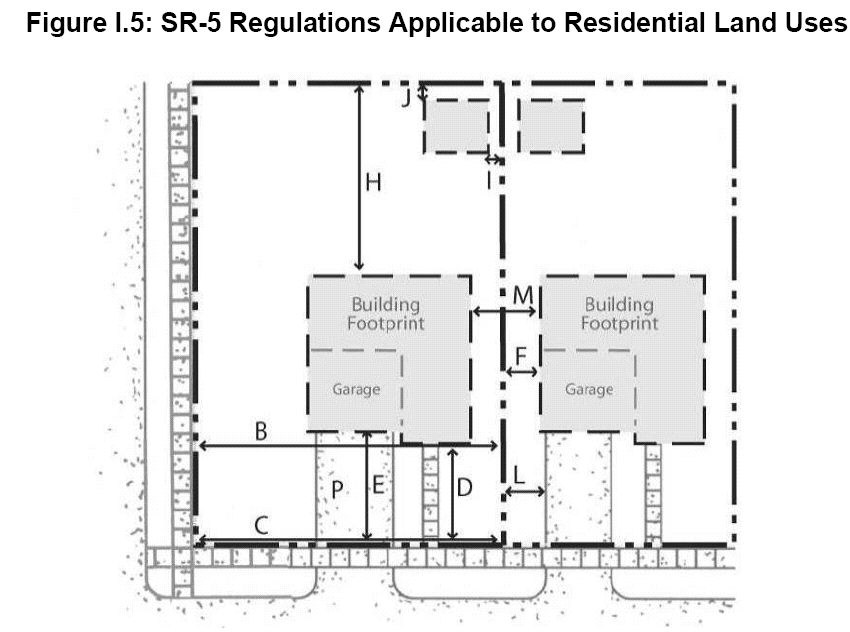
Figure I.5
A:
Minimum lot area: 7,200 square feet
B:
Minimum lot width: 60 feet
C:
Minimum street frontage: 50 feet
Minimum Setbacks:
D:
Front or street side lot line to house: 25 feet
E:
Front or street side lot line to attached garage: 25 feet
F:
Side lot line to house or attached garage: Six feet
G:
Total of both sides, lot lines to house or attached garage: 14 feet
H:
Rear lot line to house or attached garage: 25 feet
I:
Side lot line to accessory structure: Four feet from property line, four feet from alley
J:
Rear lot line to accessory structure: Four feet from property line, four feet from alley
K.
Required bufferyard: See section 78-610 along zoning district boundary
L:
Minimum paved surface setback: One foot from side or rear, or zero feet in the case of a shared driveway; ten feet from right-of-way
M:
Minimum dwelling unit separation: 12 feet for multiple principle dwellings on the same lot
N:
Maximum height of dwelling unit: 30 feet
O:
Maximum height of accessory structure: 20 feet
P:
Minimum number of off-street parking spaces required on the lot (Includes garage, drives, and all designated parking surfaces): Two
* For a nonconforming structure, see section 78-408
8.
Regulations applicable to nonresidential uses:
a.
Nonresidential intensity requirements:
Maximum number of floors (F): Two
Minimum landscape surface ratio (LSR): 50 percent
Maximum building size (MBS): na
b.
Nonresidential bulk requirements*:
A:
Minimum lot area: 40,000 square feet, 20,000 sf with a conditional use permit
B:
Minimum lot width: 100 feet; Minimum Street Frontage: 50 feet
Minimum Setbacks:
C:
Building to front or street side lot line: 30 feet
D:
Building to residential side lot line: Ten feet
E:
Building to residential rear lot line: 20 feet
F:
Building to nonresidential side lot line: Ten feet
G:
Building to nonresidential rear lot line: 20 feet
H:
Side lot line to accessory structure: Four feet from property line, four feet from alley
I:
Rear lot line to accessory structure: Four feet from property line, four feet from alley
J.
Required bufferyard: See section 78-610 along zoning district boundary
K:
Minimum paved surface setback: One foot from side or rear, or zero feet in the case of a shared driveway; ten feet from right-of-way
L:
Minimum building separation: 20 feet for multiple principle dwellings on the same lot
M:
Maximum building height: 35 feet
N:
Minimum number of off-street parking spaces required on the lot: See parking lot requirements per specific land use in section 78-206
* For a nonconforming structure, see section 78-408
(e)
Single-family Residential-6 (SR-6) District:
1.
Description and purpose: This district is primarily intended to permit single family detached development which has a moderate density in the city's older established neighborhoods surrounding downtown. Secondarily, this district also permits traditional neighborhood community character using homes served by alleys. Density and intensity standards for this district are designed to ensure that the Single-family Residential-6 (SR-6) District shallserve as a designation which preserves and protects the residential community character of its area. Residential development with a maximum gross density (MGD) of six dwelling units per gross acre is available within this district.
Rationale: This district is used to provide for the permanent protection of a moderate density residential area for those who want to live in an suburban residential environment and who retain enough land with their residence, or in their development, to ensure that the community character is maintained as long as the SR-6 District designation is retained, regardless of how much development occurs within that area.
2.
Rules Specific to Traditional Neighborhood Development in the Single-family Residential-6 District (established after the adoption date of this ordinance):
a.
This district allows a minimum 4,000 square feet lot for New Traditional Neighborhood Development. Lots less than 6,600 square feet must be alley-loaded.
b.
New lots must meet a front or street side lot maximum setback of 25 feet to house and 15 feet to porch.
3.
List of allowable principal land uses: (per article II)
a.
Principal land uses permitted by right: (per subsection 78-202(1))
Single-family detached — 6,600 sf lot (per subsection 78-206(1)(a)1)
Single-family detached — 4,000 sf lot in Traditional Neighborhood Development served by alleys (per subsection 78-206(1)(a)1)
Cultivation (per subsection 78-206(2)(a))
On-site agricultural retail (per subsection 78-206(2)(e))
Selective cutting (per subsection 78-206(2)(f))
Passive outdoor public recreation (per subsection 78-206(3)(a))
Active outdoor public recreation (per subsection 78-206(3)(b))
Public services and utilities (per subsection 78-206(3)(e))
Community living arrangement (1—8 residents) (per subsection 78-206(3)(g))
Mobile service support structure
b.
Principal land uses permitted as conditional use: (per subsection 78-202(2))
Two-flat — 6,000 sf lot
Clear cutting (per subsection 78-206(2)(g))
Community gardens (per subsection 78-206(2)(h))
Market gardens (per subsection 78-206(2)(i))
Community living arrangement (9—15 residents) (per subsection 78-206(3)(h))
Bed and breakfast establishments (per subsection 78-206(4)(l))
4.
List of allowable accessory uses: (per subsection 78-202(3))
a.
Accessory land uses permitted by right:
Farm residence (per subsection 78-206(8)(b))
Detached residential garage, shed; gazebo or similar accessory structure (per subsection 78-206(8)(c))
Home occupation (per subsection 78-206(8)(j))
Family day care home (per subsection 78-206(8)(k))
On-site parking lot (per subsection 78-206(8)(n))
Private residential recreational facility (per subsection 78-206(8)(o))
Drainage structure (per subsection 78-206(8)(r))
Filling (per subsection 78-206(8)(s))
Lawn care (per subsection 78-206(8)(t))
In-family suite (per subsection 78-206(8)(x))
Keeping of chickens on a lot with a single-family dwelling (per subsection 78-206(8)(y)).
Keeping of honey bees (per subsection 78-206(8)(z)).
b.
Accessory land uses permitted as conditional use:
Intermediate day care home (9—15 children) (per subsection 78-206(8)(l))
Exterior communication devices (per subsection 78-206(8)(v))
5.
List of allowable temporary uses: (per subsection 78-202(4))
Outdoor assembly (per subsection 78-206(9)(b))
Contractor's project office (per subsection 78-206(9)(c))
Contractor's on-site equipment storage (per subsection 78-206(9)(d))
On-site real estate sales office (per subsection 78-206(9)(f))
Temporary portable storage container (per subsection 78-206(9)(i))
Mobile Food Vending at Special Events (per subsection 78-206(9)(k))
6.
List of allowable energy production uses:
a.
Energy production uses permitted by right:
Solar energy systems (per subsection 78-206(10)(c))
b.
Energy production uses permitted as conditional use:
Small wind energy system (per subsection 78-206(10)(a))
7.
Regulations applicable to all uses:
a.
Landscaping regulations: (See article VI)
b.
Performance standards: (See article VII)
c.
Signage regulations: (See article VIII)
8.
Regulations applicable to residential uses:
a.
Residential density and intensity requirements:
Maximum gross density (MGD): 6.0 dwelling unit/acre
Minimum landscape surface ratio (LSR): 30percent
b.
Residential bulk requirements*:
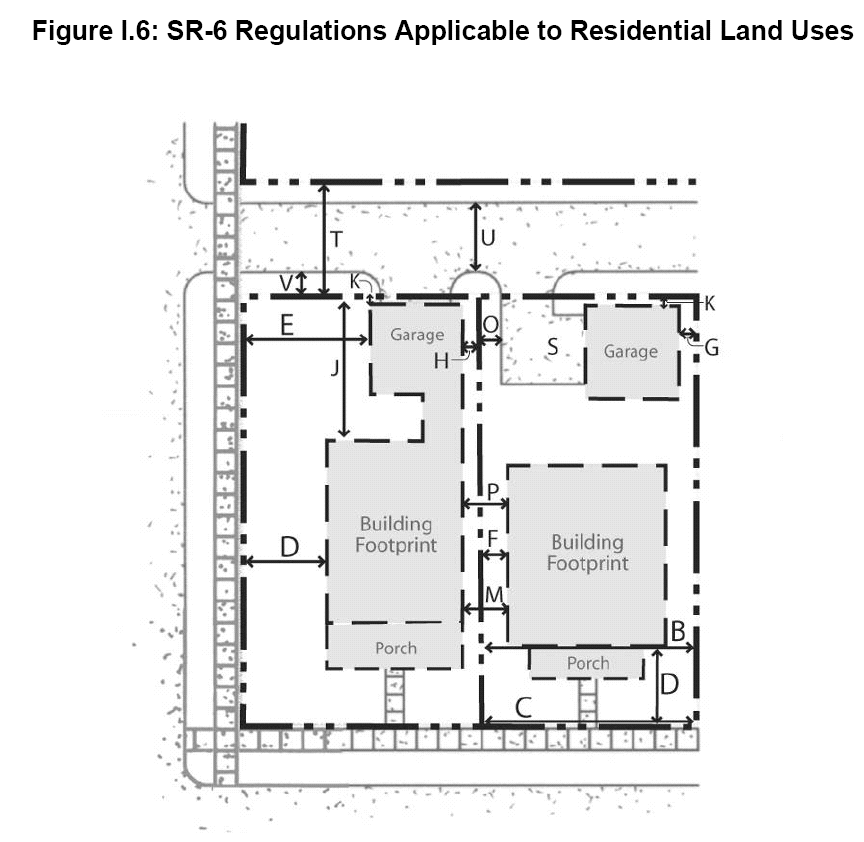
Figure I.6
A.
Minimum lot area: 6,600 square feet or 4,000 square feet for Traditional Neighborhoods
B:
Minimum lot width: 40 feet
C:
Minimum street frontage: 40 feet
Minimum Setbacks:
D.
Front or street side lot line to house: minimum 20 feet to house; 12 feet to porch
E:
Front or street side lot line to attached or detached garage: Minimum 20 feet
F:
Side lot line to house: Minimum six feet
G:
Reserved.
H:
Reserved.
I:
Total of both sides, lot lines to house: Minimum 14 feet
J:
Rear lot line to house: Minimum 20 feet
K:
Reserved.
L:
Side lot line to accessory structure: Four feet from property line, four feet from alley
M:
Rear lot line to accessory structure: Four feet from property line, four feet from alley
N:
Required bufferyard: See section 78-610 along zoning district boundary
O:
Minimum paved surface setback: One foot from side, or zero feet in the case of a shared driveway; ten feet from right-of-way
P:
Minimum dwelling unit separation: Ten feet for multiple principle dwellings on the same lot
Q:
Maximum height of dwelling unit: 35 feet
R.
Maximum height of accessory structure: 20 feet.
S:
Minimum number of off-street parking spaces required on the lot (Includes garage, drives, and all designated parking surfaces): Two
T:
Alley right-of-way width: 26 feet
U:
Alley pavement width: 16 feet, with no curb
V:
Alley terrace width: Five feet
* For a nonconforming structure, see section 78-408
9.
Regulations applicable to nonresidential uses:
a.
Nonresidential intensity requirements:
Maximum number of floors (F): Two
Minimum landscape surface ratio (LSR): 50 percent
Maximum building size (MBS): na
b.
Nonresidential bulk requirements*:
A:
Minimum lot area: 40,000 square feet, 20,000 sf with a conditional use permit
B:
Minimum lot width: 100 feet; minimum street frontage: 50 feet
Minimum Setbacks:
C:
Building to front or street side lot line: 30 feet
D:
Building to residential side lot line: Ten feet
E:
Building to residential rear lot line: 20 feet
F:
Building to nonresidential side lot line: Ten feet
G:
Building to nonresidential rear lot line: 20 feet
H:
Side lot line to accessory structure: Four feet from property line, four feet from alley
I:
Rear lot line to accessory structure: Four feet from property line, four feet from alley
J:
Required bufferyard: See section 78-610 along zoning district boundary
K:
Minimum paved surface setback: Five feet from side or rear, or zero feet in the case of a shared driveway; ten feet from right-of-way
L:
Minimum building separation: 20 feet for multiple principle dwellings on the same lot
M:
Maximum building height: 35 feet
N:
Minimum number of off-street parking spaces required on the lot: See parking lot requirements per specific land use in section 78-206
* For a nonconforming structure, see section 78-408
(f)
Two-family Residential-6 (TR-6) District:
1.
Description and purpose: This district is intended to permit development which has a moderate density community character. The land use standards for this district permit both single-family detached residential development and twin house/duplexes permitted by right and two flat, mobile home parks, and mobile home subdivisions permitted as a conditional use. Density and intensity standards for this district are designed to ensure that the Two-family Residential-6 District shall serve as a designation which preserves and protects the moderate density residential community character of its area. Various residential development options are available in this district, with a maximum gross density (MGD) of six dwelling units per gross acre.
Rationale: This district is used to provide for the permanent protection of an area for those who want to live in a moderate density residential environment and who retain enough land with their residence, or in their development, to ensure that the desired community character is maintained as long as the TR-6 District designation is retained, regardless of how much development occurs within that area. As such, this district is intended to provide the principal location for a wide range of single-family attached dwelling types, including single-family, duplexes, twin houses, and two flats.
2.
List of allowable principal land uses: (per article II).
a.
Principal land uses permitted by right: (per subsection 78-202(1))
Single-family detached—7,200 sf lot (per subsection 78-206(1)(a)1.) (Follow bulk rules for SR-5 District.)
Twin house/duplex — 5,000 sf per du (per subsection 78-206(1)(a)2 or 3)
Cultivation (per subsection 78-206(2)(a))
Selective cutting (per subsection 78-206(2)(f))
Passive outdoor public recreation (per subsection 78-206(3)(a))
Active outdoor public recreation (per subsection 78-206(3)(b))
Public services and utilities (per subsection 78-206(3)(e))
Community living arrangement (1—8 residents) (per subsection 78-206(3)(g))
Community living arrangement (9—15 residents) (per subsection 78-206(3)(h))
Mobile service support structure
b.
Principal land uses permitted as conditional use: (per subsection 78-202(2))
Two-flat — 7,200 sf lot (per subsection 78-206(1)(a)4.)
Mobile home subdivision or park—5,800 sf lot (per subsections 78-206(1)(d) or (e))
Clear cutting (per subsection 78-206(2)(g))
Community gardens (per subsection 78-206(2)(h))
Market gardens (per subsection 78-206(2)(i))
Bed and breakfast establishments (per subsection 78-206(4)(l))
Group day care center (9+ children) (per subsection 78-206(4)(m))
3.
List of allowable accessory uses: (per subsection 78-202(3))
a.
Accessory land uses permitted by right:
Farm residence (per subsection 78-206(8)(b))
Detached residential garage, shed; gazebo or similar accessory structure (per subsection 78-206(8)(c))
Home occupation (per subsection 78-206(8)(j))
Family day care home (4—8 children) (per subsection 78-206(8)(k))
On-site parking lot (per subsection 78-206(8)(n))
Private residential recreational facility (per subsection 78-206(8)(o))
Drainage structure (per subsection 78-206(8)(r))
Filling (per subsection 78-206(8)(s))
Lawn care (per subsection 78-206(8)(t))
Keeping of chickens on a lot with a duplex or twin home dwelling (per section 78-206(8)(y)).
Keeping of honey bees (per subsection 78-206(8)(z)).
b.
Accessory land uses permitted as conditional use:
Intermediate day care home (9—15 children) (per subsection 78-206(8)(l))
Exterior communication devices (per subsection 78-206(8)(v))
4.
List of allowable temporary uses: (per subsection 78-202(4))
Outdoor assembly (per subsection 78-206(9)(b))
Contractor's project office (per subsection 78-206(9)(c))
Contractor's on-site equipment storage (per subsection 78-206(9)(d))
On-site real estate sales office (per subsection 78-206(9)(f))
Temporary portable storage container (per subsection 78-206(9)(i))
Mobile Food Vending at Special Events (per subsection 78-206(9)(k))
5.
List of allowable energy production uses:
a.
Energy production uses permitted by right:
Solar energy systems (per subsection 78-206(10)(c))
b.
Energy production uses permitted as conditional use:
Small wind energy system (per subsection 78-206(10)(a))
6.
Regulations applicable to all uses:
a.
Landscaping regulations: (see article VI)
b.
Performance standards: (see article VII)
c.
Signage regulations: (see article VIII)
7.
Regulations applicable to residential uses:
a.
Residential density and intensity requirements:
A.
Conventional development:
Maximum gross density (MGD): 6.00 dwelling units/acre
Minimum landscape surface ratio (LSR): 50 percent
B.
Mobile home park/subdivision:
Maximum gross density (MGD): 6.00 du/acre
Minimum landscape surface ratio (LSR): 50 percent
b.
Residential bulk requirements*:
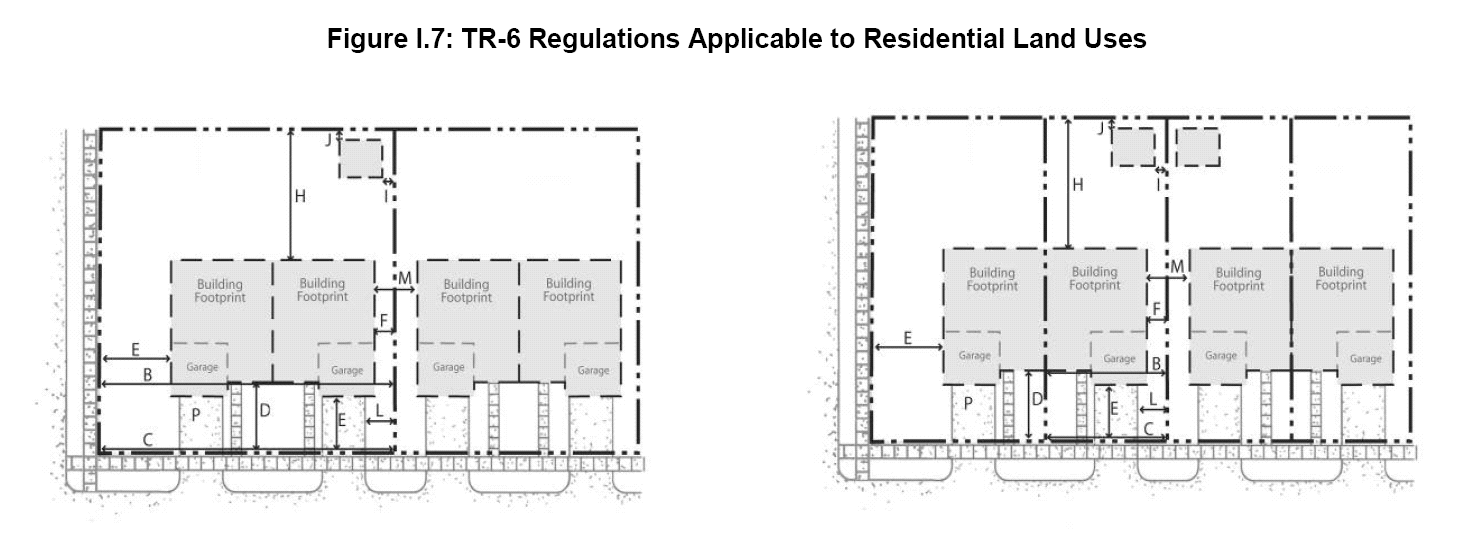
Figure I.7
A:
Minimum lot area: 5,000 square feet for each dwelling unit
B:
Minimum lot width: 100 feet; (twin home: 50 feet)
C:
Minimum street frontage: 50 feet
Minimum Setbacks:
D:
Front or street side lot line to house: 20 feet; 15 feet for open walled front porches
E:
Front or street side lot line to attached garage: 20 feet
F:
Side lot line to house or attached garage: Ten ft or zero ft along common wall
G:
Total of both sides, lot lines to house or attached garage: 20 feet or zero ft along common wall
H:
Rear lot line to house or attached garage: 30 feet
I:
Side lot line to accessory structure: Four feet from property line, four feet from alley
J:
Rear lot line to accessory structure: Four feet from property line, four feet from alley
K:
Required bufferyard: See section 78-610 along zoning district boundary
L:
Minimum paved surface setback: One foot from side or rear, or zero feet in the case of a shared driveway; ten feet from right-of-way
M:
Minimum dwelling unit separation: 20 feet or zero feet along common wall for multiple principle dwellings on the same lot
N:
Maximum height of dwelling unit: 30 feet
O:
Maximum height of accessory structure: 20 feet
P:
Minimum number of off-street parking spaces required on the lot (Includes garage, drives, and all designated parking surfaces): Two
* For a nonconforming structure, see section 78-408
8.
Regulations applicable to nonresidential uses:
a.
Nonresidential intensity requirements:
Maximum number of floors (F): Two
Minimum landscape surface ratio (LSR): 30 percent
Maximum building size (MBS): na
b.
Nonresidential bulk requirements*:
A:
Minimum lot area: 40,000 square feet, 20,000 sf with a conditional use permit
B:
Minimum lot width: 100 feet; minimum street frontage: 50 feet
Minimum Setbacks:
C:
Building to front or street side lot line: 30 feet
D:
Building to residential side lot line: Ten feet
E:
Building to residential rear lot line: 20 feet
F:
Building to nonresidential side lot line: Ten feet
G:
Building to nonresidential rear lot line: 20 feet
H:
Side lot line to accessory structure: Four feet from property line, four feet from alley
I:
Rear lot line to accessory structure: Four feet from property line, four feet from alley
J:
Required bufferyard: See section 78-610 along zoning district boundary
K:
Minimum paved surface setback: One foot from side or rear, or zero feet in the case of a shared driveway; ten feet from right-of-way
L:
Minimum building separation: 20 feet for multiple principle dwellings on the same lot
M:
Maximum building height: 35 feet
N:
Minimum number of off-street parking spaces required on the lot: See parking lot requirements per specific land use in section 78-206
* For a nonconforming structure, see section 78-408
(g)
Multi-family Residence (MR) District:
1.
Description and purpose: This district is intended to permit development which has a moderate to high-density community character. Density and intensity standards for this district are designed to ensure that the multi-family use shall serve as a designation that preserves and protects the community character of the surrounding area. In addition, the use of the district is intended to minimize the use of PD zoning by allowing a range of housing options within the same development. The development shall follow detailed land use descriptions and regulations for design.
2.
Permitted use (principal land uses):
A.
The following residential uses:
i.
Single family: Up to six houses per acre.
ii.
Twin houses (duplex): Up to eight units per acre.
iii.
Townhouse: Up to eight units per acre.
iv.
Multiplex and apartments: Up to ten units per acre.
B.
Outdoor public recreation.
C.
Public services and utilities.
D.
Community living arrangement (1—15 residents).
E.
Mobile service support structure (cell towers).
F.
Solar energy systems.
G.
A non-family household in the MR district shall be limited to three unrelated persons.
H.
Home occupations/professional home offices for non-retail (goods and services for businesses that do not require customer access or alteration of the structure).
3.
Conditional use permit (principal land uses permitted as conditional use):
A.
Residence:
i.
Townhouse, over eight units per acre.
ii.
Multiplex and apartments over ten units per acre.
B.
Community gardens: An area for cultivation and related activities divided into one or more plots to be cultivated by more than one operator or member. These areas may be on public or private lands. Regulations:
i.
All activity areas and structures shall comply with the required setbacks and height regulations for principal structures within the zoning district.
ii.
Site plan submittal shall include the property owner, established sponsoring organization, and garden manager.
iii.
Site plan which demonstrates considerations for and indicates locations of structures, materials storage, equipment storage, access for deliveries and pickups, water availability, shaded rest area, and availability of public parking.
iv.
The following structures are permitted: tool sheds, shade pavilions, barns, rest-room facilities with composting toilets, and planting preparation houses, benches, bike racks, raised/accessible planting beds, compost bins, picnic tables, seasonal farm stands, fences, garden art, rain barrel systems, beehives, and children's play areas.
v.
Signs shall be limited to identification, information and directional signs, including sponsorship information where the sponsorship information is clearly secondary to other permitted information on any particular sign and shall not exceed a total aggregate area of 48 square feet.
vi.
Fences shall comply with the regulations in section 78-718, except that chicken wire, woven wire, and related garden fencing shall be permitted without restriction around and within cultivated areas.
C.
Market gardens: An area for cultivation and related activities divided into one or more plots to be cultivated by more than one operator or member. These areas may be on public or private lands, with on-site sales of crops grown on-site. Regulations:
i.
All activity areas and structures shall comply with the required setbacks and height regulations for principal structures within the zoning district.
ii.
Site plan submittal shall include the property owner, established sponsoring organization, and garden manager.
iii.
Site plan which demonstrates considerations for and indicates locations of structures, materials storage, equipment storage, access for deliveries and pickups, water availability, shaded rest area, and availability of public parking.
iv.
The following structures are permitted: tool sheds, shade pavilions, barns, rest-room facilities with composting toilets, and planting preparation houses, benches, bike racks, raised/accessible planting beds, compost bins, picnic tables, seasonal farm stands, fences, garden art, rain barrel systems, beehives, and children's play areas.
v.
Seasonal farm stands shall be removed from the premises or stored inside a building on the premises during that time of the year when the garden is not open for public use.
vi.
Signs shall be limited to identification, information and directional signs, including sponsorship information where the sponsorship information is clearly secondary to other permitted information on any particular sign and shall not exceed a total aggregate area of 48 square feet.
vii.
Fences shall comply with the regulations in section 78-718, except that chicken wire, woven wire, and related garden fencing shall be permitted without restriction around and within cultivated areas.
D.
Community living arrangement (16+ residents).
E.
Bed and breakfast establishments.
F.
Group daycare center.
G.
Exterior communication devices.
H.
Small wind energy system.
4.
Permitted accessory uses:
A.
Detached residential garage, shed; gazebo or similar accessory structure.
B.
Family day care home (four to eight children).
C.
On-site parking lot. All areas intended to be utilized as a driveway shall be surfaced with asphalt or concrete. The parking stalls are to be striped.
D.
Private residential recreational facility.
E.
Drainage structure.
F.
Lawn care.
5.
Temporary uses:
A.
Contractor's project office.
B.
Contractor's on-site equipment storage.
C.
On-site real estate sales office.
D.
Temporary portable storage container.
E.
Outdoor assembly and special events.
6.
Minimum setback regulations for the multi-family residential district.
A.
Minimum lot size: 43,560 square feet (one acre).
B.
Minimum lot width (street frontage): 100 feet.
C.
Minimum front yard (street yard) setback: 25 feet from the right-of-way.
D.
Minimum side yard setback: ten feet.
E.
Minimum rear yard setback: 20 feet.
F.
Accessory structure:
i.
Accessory structures in front yard (street yard): 25 feet from right-of-way line.
ii.
Side and rear yard: five feet from property line and alleyways.
G.
Minimum building separation: 20 feet for multiple principal dwellings on the same lot. More than 20 feet between buildings may be required if the land(s) between buildings is needed for a fire lane.
H.
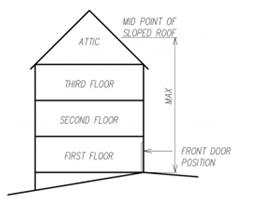
Maximum building height for a principal structure is 45 feet or three stories. Building height is the vertical distance measured from the average elevation of the proposed finished grade at the front of the building to the highest point of the roof deck of a flat roof, to the highest point of a mansard roof, or to the mean height level between the eaves and ridge of a gable, hip, or gambrel roof.
I.
The maximum height of an accessory structure is 20 feet.
J.
No pavement for the parking area shall be closer than five feet to an adjacent lot line unless there is a shared driveway documented with a recorded easement.
K.
Minimum landscape surface ratio (section 78-604).
i.
Maximum accessory building coverage ten percent.
ii.
Minimum landscape surface ratio (LSR) 50 percent.
L.
Required buffer yard: Combination of distance, vegetation, fencing and berm which results in a reduction of visual and other interaction with an adjoining property. See section 78-610 along zoning district boundary.
M.
Minimum number of off-street parking spaces required on the lot (includes garage and all designated parking surfaces):
2.5 per three or more bedrooms;
Two per two bedrooms;
One per one-bedroom or efficiency.
The parking lot layout and dimensions will follow the off-street parking and traffic circulation standards (section 78-704). All parking surfaces shall be paved with a hard, all-weather surface with clearly marked parking spaces.
N.
Outdoor dumpster enclosures for developments of three or more units shall be screened and not be located next to buildings. The enclosure shall have a six-foot-high fence with four sides, accessible by a gate. The dumpster shall be screened with year-round landscaping on three sides. The side of the dumpster enclosure with gates or doors shall face away from the view of public streets and residential areas.
O.
Mechanical equipment screening:
i.
All roof, ground and wall mounted mechanical equipment (e.g., air handling equipment, compressors, duct work, transformers and elevator equipment) shall meet the district setbacks for principal buildings. All mechanical equipment not screened by an intervening building and installed after the effective date of the ordinance from which this section is derived shall be positioned, screened, or both so that the mechanical equipment is not visible from any public right-of-way, common areas, adjacent property or property line on the far side of an adjacent public street right-of-way.
ii.
Screening enclosures shall be the same as or compatible with the principal building, in terms of color, texture, quality, and material, and may include metal screening or louvers painted to blend in with the principal building.
iii.
The screening shall form a continuous enclosure around the mechanical equipment at least one foot taller than the tallest equipment enclosed. Wall or ground-mounted equipment screening may use plantings to meet the screening requirements.
P.
Off-street bicycle parking spaces shall be provided equal to ten percent of the automobile parking space requirement. The ten percent requirement may be broken up between short-term and long-term parking space.
i.
Short-term bicycle parking spaces must be located no more than 50 feet from the principal building entrance and at the same grade as the sidewalk or an accessible route.
ii.
Long-term bicycle parking for residential uses may be provided in garages, storage rooms and other resident-accessible, secure areas. Space within dwelling units or on balconies are not counted toward satisfying bicycle parking requirements.
7.
Lot coverage.
A.
Multifamily: Reviewed by engineering staff and approval by the planning department and/or the plan commission shall be required.
B.
The principles and standards set forth in the city erosion control and stormwater management requirements policy which includes the stormwater management ordinance and the city's construction site control ordinance, shall be used by the property owner and staff for drafting and reviewing stormwater management plans.
C.
A minimum of 30 percent of the development's gross site area (GSA) shall be held as permanently protected green space.
8.
Minimum usable floor area in the MR district:
A.
No dwelling unit shall be constructed or remodeled to have less living area than the following minimum standards:
B.
For the purpose of this section, "floor area" shall be the sum of the areas of the floors of a building used for human occupancy or use, as measured from the interior faces of the walls, but not including unfinished basements, garages, porches, breezeways of common hallways and unfinished attics.
C.
Multifamily: Each unit shall be designed to meet the minimum space use and location requirements of this ordinance (section 10-284). With the exception of habitable room (bedrooms) having at least one window directly facing the outdoors.
D.
Multifamily buildings are permitted to have an: offices, gyms, maintenance areas, and other facilities associated with the multifamily building. This may also include a group daycare center.
9.
Multifamily residential building facades shall incorporate at least three of the following design features:
A.
Change in wall plane (such as projection or recesses with an offset or depth of at least one foot, width of at least ten feet located a minimum of every 25 feet.
B.
Roofline changes, coupled with correspondingly aligned wall offset or facade material change, including changes in the roof planes or changes in the height of the wall.
C.
Awning or other weather protection for pedestrians.
D.
Distinct changes in material and color of wall surfaces.
E.
A covered front porch or other designated gathering area occupying at least 25 percent of the front facade.
F.
Vertical accents or focal points such as towers, spires, cupolas, or window walls.
G.
Artwork or bas relief.
(3)
Office Districts:
(a)
Neighborhood Office (NO) District:
1.
Description and purpose: This district is intended to permit high-quality office and related land uses at an intensity compatible with the older portions of the city predominately developed with large homes which are desirable to maintain, where traffic volumes and adjacent land uses dictate the transition of these areas to certain nonresidential uses. The desired neighborhood character of the development is attained through landscape surface area ratio (LSR) requirements, and by restricting the maximum building size (MBS) of all buildings within each instance of this district to 5,000 square feet. A range of dwelling unit types may be allowed. Significant areas of landscaping are required in this district to ensure that this effect is achieved. In order to ensure a minimum of disruption to adjacent residential development, development within this district shall take access to a collector or arterial street.
Rationale: This district is used to provide for the permanent protection of an area which preserves the original residential appearance, yet permits office and institutional land uses, and which ensures that the neighborhood character is maintained as long as the NO district designation is retained, regardless of how much development occurs within that area.
2.
Neighborhood office architectural and operational requirements:
a.
Maximum zoning district area: Four acres
b.
Minimum zoning district separation: 500 feet
c.
Maximum building size: 5,000 sq. ft. (one story); 10,000 sq. ft. (two-story)
d.
No parking in required setbacks for principal buildings
e.
Residential architectural and landscaping requirements include: foundation planting; residential roof materials, such as shingles; minimum 15 percent window covering; and acceptable exterior materials, including wood, cement board, vinyl siding, brick, decorative block, stone, and other materials approved by the plan commission.
f.
Minimum landscape surface ratio: 30 percent
g.
Operating hours: No earlier than 7:00 a.m. or later than 9:00 p.m., unless otherwise extended by a granting of a conditional use permit.
h.
Shall provide a neighborhood-oriented amenity, per plan commission direction (i.e., outdoor neighborhood gathering area, public art, etc)
3.
List of allowable principal land uses (per article II)
a.
Principal land uses permitted by right: (per subsection 78-202(1))
Single-family detached - 8,600 sf lot (per subsection 78-206(1)(a)1) Based on SR-4 bulk requirements.
Cultivation (per subsection 78-206(2)(a))
Selective cutting (per subsection 78-206(2)(f))
Passive outdoor public recreation (per subsection 78-206(3)(a))
Active outdoor public recreation (per subsection 78-206(3)(b))
Public services and utilities (per subsection 78-206(3)(e))
Office (per subsection 78-206(4)(a))
Personal or professional services (per subsection 78-206(4)(b))
Mobile service support structure
b.
Principal land uses permitted as conditional use: (per subsection 78-202(2))
Twin house/duplex - 5,000 sf per du (per subsection 78-206(1)(a)2 or 3) based on
TR-6 bulk requirements
Two-flat - 8,600 sf lot (per subsection 78-206(1)(a)4) based on SR-45 bulk requirements
Clear cutting (per subsection 78-206(2)(g))
Community gardens (per subsection 78-206(2)(h))
Market gardens (per subsection 78-206(2)(i))
Indoor institutional (per subsection 78-206(3)(c))
Outdoor institutional (per subsection 78-206(3)(d))
Community living arrangement (1—8 residents) (per subsection 78-206(3)(g))
Community living arrangement (9—15 residents) (per subsection 78-206(3)(h))
Community living arrangement (16+ residents) (per subsection 78-206(3)(i))
Indoor sales or service (per subsection 78-206(4)(c))
Indoor commercial entertainment (per subsection 78-206(4)(h))
Bed and breakfast establishments (per subsection 78-206(4)(l))
Group day care center (9+ children) (per subsection 78-206(4)(m))
4.
List of allowable accessory uses: (per subsection 78-202(3))
a.
Accessory land uses permitted by right:
Farm residence (per subsection 78-206(8)(b))
Detached residential garage, shed; gazebo or similar accessory structure (per subsection 78-206(8)(c))
Company cafeteria (per subsection 78-206(8)(d))
Company provided on-site recreation—without exterior lighting (per subsection 78-206(8)(e))
Home occupation (per subsection 78-206(8)(j))
On-site parking lot (per subsection 78-206(8)(n))
Private residential recreational facility (per subsection 78-206(8)(o))
Drainage structure (per subsection 78-206(8)(r))
Filling (per subsection 78-206(8)(s))
Lawn care (per subsection 78-206(8)(t))
b.
Accessory land uses permitted as conditional use:
Upper story dwelling unit (per subsection 78-206(8)(a))
Company provided on-site recreation-with exterior lighting (per subsection 78-206(8)(e))
Exterior communication devices (per subsection 78-206(8)(v))
5.
List of allowable temporary uses: (per subsection 78-202(4))
Outdoor assembly (per subsection 78-206(9)(b))
Contractor's project office (per subsection 78-206(9)(c))
Contractor's on-site equipment storage (per subsection 78-206(9)(d))
Relocatable building (per subsection 78-206(9)(e))
On-site real estate sales office (per subsection 78-206(9)(f))
Temporary portable storage container (per subsection 78-206(9)(i))
Mobile Food Vending (per subsection 78-206(9)(j))
Mobile Food Vending at Special Events (per subsection 78-206(9)(k))
6.
List of allowable energy production uses:
a.
Energy production uses permitted by right:
Solar energy systems (per subsection 78-206(10)(c))
b.
Energy production uses permitted as conditional use:
Small wind energy system (per subsection 78-206(10)(a))
7.
Regulations applicable to all uses:
a.
Landscaping regulations (See article VI)
b.
Performance standards: (See article VII)
c.
Signage regulations: (See article VIII)
8.
Regulations applicable to residential uses: For single-family dwellings, twin house/duplex, and two flats, see the SR-4 District. For two-family dwellings see the TR-6 District.
9.
Regulations applicable to nonresidential uses:
a.
Nonresidential intensity requirements:
Maximum number of floors (F): Three
Minimum landscape surface ratio (LSR): 30 percent
Maximum floor area ratio (FAR): .4 (may be exceeded through use of structured parking)
Maximum building size (MBS): na
b.
Nonresidential bulk requirements:
A:
Minimum lot area: 10,000 square feet
B:
Minimum lot width: 100 feet; minimum street frontage: 50 feet
Minimum Setbacks:
C:
Building to front or street side lot line: 30 feet
D:
Building to residential side lot line: Ten feet
E:
Building to residential rear lot line: 20 feet
F:
Building to nonresidential side lot line: Ten feet
G:
Building to nonresidential rear lot line: 20 feet
H:
Side lot line to accessory structure: Four feet from property line, four feet from alley
I:
Rear lot line to accessory structure: Four feet from property line, four feet from alley
J:
Required bufferyard: See section 78-610 along zoning district boundary
K:
Minimum paved surface setback: Five feet from side or rear; ten feet from right-of-way
L:
Minimum building separation: 20 feet
M:
Maximum building height: 35 feet
N:
Minimum number of off-street parking spaces required on the lot: See parking lot requirements per specific land use in section 78-206
(b)
Planned Office (PO) District:
1.
Description and purpose: This district is intended to permit high-quality office and related land uses at an intensity that is compatible with the overall community character of the city. Significant areas of landscaping are required in this district to ensure that this effect is achieved. In order to ensure a minimum of disruption to residential development, development within this district shall take access to a collector or arterial street.
Rationale: This district is used to provide for the permanent protection of an area for those who desire a high quality office environment which maintains the attractiveness of the site and retains enough open land in their development to ensure that the community character is maintained as long as the PO District designation is retained, regardless of how much development occurs within that area.
2.
List of allowable principal land uses: (per article II)
a.
Principal land uses permitted by right: (per subsection 78-202(1))
Cultivation (per subsection 78-206(2)(a))
Selective cutting (per subsection 78-206(2)(f))
Passive outdoor public recreation (per subsection 78-206(3)(a))
Active outdoor public recreation (per subsection 78-206(3)(b))
Public services and utilities (per subsection 78-206(3)(e))
Office (per subsection 78-206(4)(a))
Personal or professional services (per subsection 78-206(4)(b))
Mobile service support structure
b.
Principal land uses permitted as conditional use: (per subsection 78-202(2))
Clear cutting (per subsection 78-206(2)(g))
Community gardens (per subsection 78-206(2)(h))
Market gardens (per subsection 78-206(2)(i))
Indoor institutional (per subsection 78-206(3)(c))
Outdoor institutional (per subsection 78-206(3)(d))
Community living arrangement (9—15 residents) (per subsection 78-206(3)(h))
Community living arrangement (16+ residents) (per subsection 78-206(3)(i))
Indoor sales or service (per subsection 78-206(4)(c))
In-vehicle sales or service (per subsection 78-206(4)(g))
Indoor commercial entertainment (per subsection 78-206(4)(h))
Commercial indoor lodging (per subsection 78-206(4)(k))
Group day care center (9+ children) (per subsection 78-206(4)(m))
Airport/heliport (per subsection 78-206(6)(b))
3.
List of allowable accessory uses: (per subsection 78-202(3))
a.
Accessory land uses permitted by right:
Farm residence (per subsection 78-206(8)(b))
Detached residential garage, shed; gazebo or similar accessory structure (per subsection 78-206(8)(c))
Company cafeteria (per subsection 78-206(8)(d))
Company provided on-site recreation (per subsection 78-206(8)(e))
Home occupation (per subsection 78-206(8)(j))
On-site parking Lot (per subsection 78-206(8)(n))
Private residential recreational facility (per subsection 78-206(8)(o))
Drainage structure (per subsection 78-206(8)(r))
Filling (per subsection 78-206(8)(s))
Lawn care (per subsection 78-206(8)(t))
b.
Accessory land uses permitted as conditional use:
Upper story dwelling unit (per subsection 78-206(8)(a))
Company provided on-site recreation (per subsection 78-206(8)(e))
In-vehicle sales and service, incidental to on-site land use (per subsection 78-206(8)(g))
Exterior communication devices (per subsection 78-206(8)(v))
4.
List of allowable temporary uses: (per subsection 78-202(4))
Outdoor assembly (per subsection 78-206(9)(b))
Contractor's project office (per subsection 78-206(9)(c))
Contractor's on-site equipment storage (per subsection 78-206(9)(d))
Relocatable building (per subsection 78-206(9)(e))
On-site real estate sales office (per subsection 78-206(9)(f))
Temporary portable storage container (per subsection 78-206(9)(i))
Mobile Food Vending (per subsection 78-206(9)(j))
Mobile Food Vending at Special Events (per subsection 78-206(9)(k))
5.
List of allowable energy production uses:
a.
Energy production uses permitted by right:
Solar energy systems (per subsection 78-206(10)(c))
b.
Energy production uses permitted as conditional use:
Small wind energy system (per subsection 78-206(10)(a))
6.
Regulations applicable to all uses:
a.
Landscaping regulations (See article VI)
b.
Performance standards: (See article VII)
c.
Signage regulations: (See article VIII)
7.
Regulations applicable to residential uses:
Not applicable.
8.
Regulations applicable to nonresidential uses:
a.
Nonresidential intensity requirements:
Maximum number of floors (F): Four
Minimum landscape surface ratio (LSR): 25 percent
Maximum floor area ratio (FAR): 1.0 (may be exceeded through use of structured parking)
Maximum building size (MBS): na
b.
Nonresidential bulk requirements:
A:
Minimum lot area: 20,000 square feet
B:
Minimum lot width: 100 feet; minimum street frontage: 50 feet
Minimum Setbacks:
C:
Building to front or street side lot line: 20 feet
D:
Building to residential side lot line: Ten feet
E:
Building to residential rear lot line: 20 feet
F:
Building to nonresidential side lot line: Ten feet or zero feet on zero lot line side
G:
Building to nonresidential rear lot line: 20 feet
H:
Side lot line to accessory structure: Four feet from property line, four feet from alley
I:
Rear lot line to accessory structure: Four feet from property line, four feet from alley
J:
Required bufferyard: See section 78-610 along zoning district boundary
K:
Minimum paved surface setback: Five feet from side or rear; ten feet from right-of-way
L:
Minimum building separation: 20 feet, zero feet where property line divides attached buildings, 40 feet for lot adjacent to a street officially mapped as being equal to or exceeding 100 feet
M:
Maximum building height: 45 feet
N:
Minimum number of off-street parking spaces required on the lot: See parking lot requirements per specific land use in section 78-206
(4)
Business Districts:
(a)
Neighborhood Business (NB) District:
1.
Description and purpose: This district is intended to permit small-scale commercial development which is compatible with the desired overall neighborhood community character of the area in general, and with adjacent residential development in particular. The desired neighborhood community character of the development is attained through landscape surface area ratio (LSR) requirements, and by restricting the maximum building size (MBS) of all buildings within each instance of this district to 5,000 square feet. Significant areas of landscaping are required in this district to ensure that this effect is achieved. In order to ensure a minimum of disruption to residential development, development within this district shall take access from a collector or arterial street.
Rationale: This district is used to provide both convenience oriented goods and services and for the permanent protection of adjacent residential areas by permitting only a limited range of commercial activities. Together, these requirements ensure that the desired character is maintained as long as the NB District designation is retained, regardless of how much development occurs within that area.
2.
Neighborhood business architectural and operational requirements:
a.
Maximum zoning district area: Four acres
b.
Minimum zoning district separation: 500 feet
c.
All new Neighborhood Business (NB) Districts shall be established through the conditional rezoning process. Under this approach, the Neighborhood Business District shall not be vested until the approved project has been completed.
d.
Maximum building size: 5,000 sq. ft. (one story); 10,000 sq. ft. (two-story)
e.
No parking in required setbacks for principal buildings
f.
Residential architectural and landscaping requirements include: foundation planting; residential roof materials, such as shingles; minimum 15 percent window coverage; and acceptable exterior materials, including wood, cement board, vinyl siding, brick, decorative block, stone, and other materials approved by the plan commission.
g.
Minimum landscape surface ratio: 30 percent
h.
Operating hours: No earlier than 7:00 a.m. or later than 9:00 p.m., unless otherwise extended by a granting of a conditional use permit
i.
Shall provide a neighborhood-oriented amenity, per plan commission direction (i.e., outdoor neighborhood gathering area, public art, etc)
3.
List of allowable principal land uses: (per article II)
a.
Principal land uses permitted by right: (per subsection 78-202(1))
Single-family detached - 8,600 sf lot (per subsection 78-206(1)(a)1.) based on SR-4 District.
Cultivation (per subsection 78-206(2)(a))
Selective cutting (per subsection 78-206(2)(f))
Passive outdoor public recreation (per subsection 78-206(3)(a))
Active outdoor public recreation (per subsection 78-206(3)(b))
Public services and utilities (per subsection 78-206(3)(e))
Office (per subsection 78-206(4)(a))
Personal or professional services (per subsection 78-206(4)(b))
Indoor sales or service (per subsection 78-206(4)(c))
Indoor maintenance service (per subsection 78-206(4)(e))
Mobile service support structure
b.
Principal land uses permitted as conditional use: (per subsection 78-202(2))
Twin house/duplex - 5,000 sf per du (per subsection 78-206(1)(a)2 or 3) Based on TR-6 District
Two-flat - 5,000 sf per du (per subsection 78-206(1)(a)4.) Based on TR-6 District
Clear cutting (per subsection 78-206(2)(g))
Community gardens (per subsection 78-206(2)(h))
Market gardens (per subsection 78-206(2)(i))
Indoor institutional (per subsection 78-206(3)(c))
Outdoor institutional (per subsection 78-206(3)(d))
Community living arrangement (1—8 residents) (per subsection 78-206(3)(g))
Community living arrangement (9—15 residents) (per subsection 78-206(3)(h))
Community living arrangement (16+ residents) (per subsection 78-206(3)(i))
In-vehicle sales or service (per subsection 78-206(4)(g))
Indoor commercial entertainment (per subsection 78-206(4)(h))
Bed and breakfast establishments (per subsection 78-206(4)(l))
Group day care center (9+ children) (per subsection 78-206(4)(m))
Boarding house (per subsection 78-206(4)(o))
4.
List of allowable accessory uses: (per subsection 78-202(3))
a.
Accessory land uses permitted by right:
Farm residence (per subsection 78-206(8)(b))
Detached residential garage, shed; gazebo or similar accessory structure (per subsection 78-206(8)(c))
Home occupation (per subsection 78-206(8)(j))
On-site parking lot (per subsection 78-206(8)(n))
Private residential recreational facility (per subsection 78-206(8)(o))
Drainage structure (per subsection 78-206(8)(r))
Filling (per subsection 78-206(8)(s))
Lawn care (per subsection 78-206(8)(t))
In-family suite (per subsection 78-206(8)(x))
b.
Accessory land uses permitted as conditional use:
Upper story dwelling unit (per subsection 78-206(8)(a))
In-vehicle sales and service (per subsection 78-206(8)(g))
Exterior communication devices (per subsection 78-206(8)(v))
5.
List of allowable temporary uses: (per subsection 78-202(4))
General temporary outdoor sales (per subsection 78-206(9)(a))
Outdoor assembly (per subsection 78-206(9)(b))
Contractor's project office (per subsection 78-206(9)(c))
Contractor's on-site equipment storage (per subsection 78-206(9)(d))
Relocatable building (per subsection 78-206(9)(e))
On-site real estate sales office (per subsection 78-206(9)(f))
Temporary portable storage container (per subsection 78-206(9)(i))
Mobile Food Vending (per subsection 78-206(9)(j))
Mobile Food Vending at Special Events (per subsection 78-206(9)(k))
6.
List of allowable energy production uses:
a.
Energy production uses permitted by right:
Solar energy systems (per subsection 78-206(10)(c))
b.
Energy production uses permitted as conditional use:
Small wind energy system (per subsection 78-206(10)(a))
7.
Regulations applicable to all uses:
a.
Landscaping regulations (See article VI)
b.
Performance standards: (See article VII)
c.
Signage regulations: (See article VIII)
8.
Regulations applicable to residential uses: For single-family dwellings see the SR-4 District. For two-family dwellings see the TR-6 District.
9.
Regulations applicable to nonresidential uses:
a.
Nonresidential intensity requirements:
Maximum number of floors (F): Three
Minimum landscape surface ratio (LSR): 30 percent
Maximum floor area ratio (FAR): .4 (may be exceeded through use of structured parking)
Maximum building size (MBS): 5,000 square feet
b.
Nonresidential bulk requirements:
A:
Minimum lot area: 6,600 square feet
B:
Minimum lot width: 100 feet; minimum street frontage: 50 feet
Minimum Setbacks:
C:
Building to front or street side lot line: 30 feet
D:
Building to residential side lot line: Ten feet
E:
Building to residential rear lot line: 20 feet
F:
Building to nonresidential side lot line: Ten feet
G:
Building to nonresidential rear lot line: 20 feet
H:
Side lot line to accessory structure: Four feet from property line, four feet from alley
I:
Rear lot line to accessory structure: Four feet from property line, four feet from alley
J:
Required bufferyard: See section 78-610 along zoning district boundary
K:
Minimum paved surface setback: One foot from side or rear; ten feet from right-of-way
L:
Minimum building separation: 20 feet
M:
Maximum building height: 35 feet
N:
Minimum number of off-street parking spaces required on the lot: See parking lot requirements per specific land use in section 78-206
(b)
Planned Business (PB) District:
1.
Description and purpose: This district is intended to permit large and small scale commercial development which is compatible with the desired overall community character of the area in general. Significant areas of landscaping are required in this district to ensure that this effect is achieved. A wide range of office, retail, and lodging land uses are permitted within this district. In order to ensure a minimum of disruption to residential development, development within this district shall take access from a collector or arterial street.
Rationale: This district is intended to provide the principal zoning district for commercial development which occurs after the adoption of this chapter. The standards of this district are designed to provide a clear distinction from the Central Business District in terms of permitted intensity of development, treatment of outdoor sales, and required green space areas. The desired suburban community character of the development is attained through the landscape surface area ratio (LSR) requirements. Together, these requirements ensure that the desired community character is maintained as long as the planned business district designation is retained, regardless of how much development occurs within that area.
2.
List of allowable principal land uses: (per article II)
a.
Principal land uses permitted by right: (per subsection 78-202(1))
Cultivation (per subsection 78-206(2)(a))
Selective cutting (per subsection 78-206(2)(f))
Passive outdoor public recreation (per subsection 78-206(3)(a))
Active outdoor public recreation (per subsection 78-206(3)(b))
Public services and utilities (per subsection 78-206(3)(e))
Office (per subsection 78-206(4)(a))
Personal or professional services (per subsection 78-206(4)(b))
Indoor sales or service (per subsection 78-206(4)(c))
Indoor maintenance service (per subsection 78-206(4)(e))
Artisan studios (per section 78-206(4)(r))
Mobile service support structure
b.
Principal land uses permitted as conditional use: (per subsection 78-202(2))
Clear cutting (per subsection 78-206(2)(g))
Community gardens (per subsection 78-206(2)(h))
Market gardens (per subsection 78-206(2)(i))
Indoor institutional (per subsection 78-206(3)(c))
Outdoor institutional (per subsection 78-206(3)(d))
Outdoor display (per subsection 78-206(4)(d))
In-vehicle sales or service (per subsection 78-206(4)(g))
Indoor commercial entertainment (per subsection 78-206(4)(h))
Outdoor commercial entertainment (per subsection 78-206(4)(i))
Commercial animal boarding (per subsection 78-206(4)(j))
Commercial indoor lodging (per subsection 78-206(4)(k))
Bed and breakfast establishments (per subsection 78-206(4)(l))
Group day care center (9+ children) (per subsection 78-206(4)(m))
Vehicle repair and maintenance service (per subsection 78-206(4)(q))
Artisan production shops (per section 78-206(4)(r))
3.
List of allowable accessory uses: (per subsection 78-202(3))
a.
Accessory land uses permitted by right:
Farm residence (per subsection 78-206(8)(b))
Detached residential garage, shed; gazebo or similar accessory structure (per subsection 78-206(8)(c))
Company cafeteria (per subsection 78-206(8)(d))
Company provided on-site recreation (per subsection 78-206(8)(e))
Home occupation (per subsection 78-206(8)(j))
On-site parking lot (per subsection 78-206(8)(n))
Private residential recreational facility (per subsection 78-206(8)(o))
Drainage structure (per subsection 78-206(8)(r))
Filling (per subsection 78-206(8)(s))
Lawn care (per subsection 78-206(8)(t))
Keeping of chickens when in conjunction with group daycares, schools and church uses (per subsection 78-206(8)(y))
b.
Accessory land uses permitted as conditional use:
Upper story dwelling unit (per subsection 78-206(8)(a))
Company provided on-site recreation (per subsection 78-206(8)(e))
Outdoor display incidental (per subsection 78-206(8)(f))
In-vehicle sales and service (per subsection 78-206(8)(g))
Exterior communication devices (per subsection 78-206(8)(v))
4.
List of allowable temporary uses: (per subsection 78-202(4))
General temporary outdoor sales (per subsection 78-206(9)(a))
Outdoor assembly (per subsection 78-206(9)(b))
Contractor's project office (per subsection 78-206(9)(c))
Contractor's on-site equipment storage (per subsection 78-206(9)(d))
Relocatable building (per subsection 78-206(9)(e))
On-site real estate sales office (per subsection 78-206(9)(f))
Temporary portable storage container (per subsection 78-206(9)(i))
Mobile Food Vending (per subsection 78-206(9)(j))
Mobile Food Vending at Special Events (per subsection 78-206(9)(k))
5.
List of allowable energy production uses:
a.
Energy production uses permitted by right:
Solar energy systems (per subsection 78-206(10)(c))
b.
Energy production uses permitted as conditional use:
Small wind energy system (per subsection 78-206(10)(a))
6.
Regulations applicable to all uses:
a.
Landscaping regulations (See article VI)
b.
Performance standards: (See article VII)
c.
Signage regulations: (See article VIII)
7.
Regulations applicable to residential uses:
Not applicable.
8.
Regulations applicable to nonresidential uses:
a.
Nonresidential intensity requirements:
Maximum number of floors (F): Four
Minimum landscape surface ratio (LSR): 25 percent
Maximum floor area ratio (FAR): 1.0 (may be exceeded through use of structured parking)
Maximum building size (MBS): na
b.
Nonresidential bulk requirements:
A:
Minimum lot area: 20,000 square feet
B:
Minimum lot width: 100 feet; minimum street frontage: 50 feet
Minimum Setbacks:
C:
Building to front or street side lot line: 20 feet
D:
Building to residential side lot line: Ten feet
E:
Building to residential rear lot line: 20 feet
F:
Building to nonresidential side lot line: Ten feet, zero feet on zero lot line side, 40 feet for lot adjacent to a street officially mapped as being equal to or exceeding 100 feet
G:
Building to nonresidential rear lot line: 20 feet
H:
Side lot line to accessory structure: Four feet from property line, four feet from alley
I:
Rear lot line to accessory structure: Four feet from property line, four feet from alley
J:
Required bufferyard: See section 78-610 along zoning district boundary
K:
Minimum paved surface setback: Five feet from side or rear; ten feet from right-of-way
L:
Minimum building separation: 20 feet, zero feet where property line divides attached buildings, 40 feet for lot adjacent to a street officially mapped as being equal to or exceeding 100 feet
M:
Maximum building height: 45 feet
N:
Minimum number of off-street parking spaces required on the lot: See parking lot requirements per specific land use in section 78-206
(c)
Central Business (CB) District:
1.
Description and purpose: This district is intended to permit both large and small-scale "downtown" commercial development at an intensity that provides significant incentives for infill development, redevelopment, and the continued economic viability of existing development. A wide range of offices, retail, residential, and lodging land uses are permitted within this district. There are no requirements for onsite landscaping or parking in this district unless specifically noted. This district is strictly limited to the central city locations. This district is designed to assist in maintaining the long-term viability of the central city.
2.
Permitted use (principal land use):
a.
Outdoor public recreation (both passive and active).
b.
Mobile service support structure and public services. Utilities (per subsection 78-206(3)(e)). Exterior communication devices (per subsection 78-206(8)(v)).
c.
Office.
d.
Personal or professional services.
e.
Indoor sales or services.
f.
Indoor maintenance services.
g.
Off-site parking lot.
h.
Artisan studios and artisan production shops.
i.
Indoor commercial entertainment.
j.
Residential, up to two units.
k.
Solar energy systems. May only be mounted on rooftop and building-mounted systems in this district, unless part of a public improvement infrastructure. The requirements of Wis. Stats., including, but not limited to, §§ 66.0401 and 66.0403, shall apply to all solar energy systems.
l.
Exterior communication devices.
m.
Undeveloped lots.
3.
Conditional use permit (principal land use permitted as a conditional use):
a.
Taverns, and other places selling alcoholic beverages by the drink; including expansion of existing uses for which consideration shall be given but is not limited to, conditions regarding the following issues:
1.
Signage.
2.
Outdoor seating.
3.
Provisions for avoiding noise and lighting nuisances.
4.
Buffering and fencing.
5.
Obtaining an alcohol license.
6.
The conditional use permit shall run with the applicant and not the land. Any change in ownership/licensee (or operation) will require approval of a conditional use permit for the new owner/licensee from the plan commission.
7.
Maximum capacity to be established by the fire inspector and shall be posted.
b.
Community gardens. The following requirements apply to this use:
1.
All activity areas and structures shall comply with the required setbacks and height regulations for principal structures within the zoning district.
2.
Conditional use application shall include the property owner, established sponsoring organization, and garden manager.
3.
Site plan that indicates locations of structures, materials storage, equipment storage, access for deliveries and pickups, water availability, shaded rest area, and availability of public parking.
4.
The following structures are permitted: tool sheds, shade pavilions, barns, restroom facilities with composting toilets, and planting preparation houses, benches, bike racks, raised/accessible planting beds, compost bins, picnic tables, seasonal farm stands, fences, garden art, rain barrel systems, beehives, and children's play areas.
5.
Signs shall not exceed a total aggregate area of 48 square feet.
6.
Fences shall comply with the regulations in section 78-718, except that chicken wire, woven wire, and related garden fencing shall be permitted without restriction around and within cultivated areas.
c.
Indoor institutional.
d.
Outdoor seating or patio areas associated with an indoor commercial entertainment land use. All land uses that provide entertainment services primarily within an enclosed building. The following minimum requirements shall be established: noise, lighting, dust, trash, and hours of operation.
e.
Institutional residential.
1.
No individual lots are required, although the development shall contain a minimum of 800 square feet of gross site area for each occupant of the development.
2.
A minimum of 30 percent of the development's gross site area (GSA) shall be held as permanently protected green space.
3.
Use shall provide an off-street passenger loading area at a minimum of one location within the development.
4.
Parking requirements:
i.
Senior housing or retirement housing: One-half space per dwelling unit.
ii.
Assisted living facility or limited care facility: One space per two dwelling units.
iii.
Monastery, convent or dormitory: One space per six residents, plus one space per employee on the largest work shift, plus one space per five chapel seats if the public may attend.
iv.
Nursing home or hospice: One space per four patient beds, plus one space per two employees on the largest work shift, plus one space per doctor.
f.
Bed and breakfast.
1.
Such land uses may provide indoor recreational facilities for the exclusive use of their customers.
2.
If alcoholic beverages of any kind are to be served on the premises, the owner of the establishment shall first obtain the appropriate license in accordance with city and state regulations.
3.
Each such establishment shall be inspected to verify that the land use meets all applicable regulations.
4.
One sign, with a maximum area of 20 square feet and a maximum height of six feet, shall be permitted on the property.
5.
No premises shall be utilized for a bed and breakfast operation unless there are at least two exits to the outdoors from such premises.
6.
Rooms utilized for sleeping shall have a minimum size of 100 square feet for two occupants with an additional 30 square feet for each additional occupant to a maximum of four occupants per room.
7.
Each sleeping room used for the bed and breakfast operation shall have a separate operational smoke detector alarm, as required in the building code. One lavatory and bathing facility shall be required for every ten occupants, in addition to the owner/occupants personal facilities.
8.
The dwelling unit in which the bed and breakfast takes place shall be the principal residence of the operator/owner and said operator/owner shall live on the premises when the bed and breakfast operation is active.
9.
Only the meal of breakfast shall be served to overnight guests.
10.
The maximum stay for any occupants of bed and breakfast operations shall be 14 consecutive days.
11.
Application requirements. Applicants for a conditional use permit to operate a bed and breakfast shall submit a floor plan of the single-family dwelling unit illustrating that the proposed operation will comply with this chapter and any other applicable city ordinances.
12.
Public nuisance violations. Bed and breakfast operations shall not be permitted whenever the operation endangers, or offends, or interferes with the safety or rights of others so as to constitute a nuisance.
13.
Parking requirements: Two spaces.
g.
Group day care centers.
1.
Facility shall provide a buffer yard with a minimum opacity of 0.50 along all property borders abutting residentially zoned property (see section 78-610).
2.
Parking requirements: One space per each employee on the largest work shift. The center shall provide an off-street passenger loading area for drop-off and pick-up.
h.
Residential with more than two units, in an existing building.
1.
The alterations or modifications shall take place within the existing footprint of the building. The only alterations approved outside of the existing building footprint are for purposes of creating or altering means of egress.
i.
Residential new construction. New construction, meaning a structure that is brand new construction in a location where a building did not previously exist, or the building has been demolished.
1.
Each residential unit requires one parking space per unit.
2.
Off-street bicycle parking spaces shall be provided for each unit. The requirement may be divided between short-term and long-term parking spaces. Short-term bicycle parking spaces must be located no more than 50 feet from the principal building entrance and at the same grade as the sidewalk or an accessible route. Long-term bicycle parking for residential uses may be provided in garages, storage rooms, and other resident-accessible, secure areas. Space within dwelling units or on balconies is not counted toward satisfying bicycle parking requirements.
3.
Each unit shall have usable open space per unit. This may include rooftop common areas, balconies or porch areas.
i.
Balcony or porch area shall be a minimum size of four feet by six feet.
ii.
In lieu of a balcony or porch areas, units may be designed with a rooftop common area that can be accessed by all units in the development. The rooftop common area shall have a minimum of 24 square feet of common space per unit.
iii.
Common community room opening into a shared open space.
j.
Provided on-site recreation in conjunction with principal use.
k.
Light industrial land uses at which all operations comply with the following requirements (with the exception of loading operations):
1.
Conducted entirely within an enclosed building;
2.
Do not create nuisances such as odor, noise, heat, vibration and radiation which are detectable at the property line;
3.
Do not pose a significant safety hazard (such as danger of explosion); and
4.
Comply with all the performance standards listed for potential nuisances in article VII. Alcoholic beverage production qualifies as a light industrial use, but only when conducted incidental to indoor sales or service. Light industrial land uses may conduct retail sales activity as an accessory use.
4.
Permitted accessory uses:
a.
Detached residential garage, shed, gazebo, or similar accessory structure.
b.
Company cafeteria.
c.
Home occupations/professional home offices for non-retail (goods and services for businesses that do not require customer access or alteration of the structure).
d.
On-site parking lot.
e.
Private residential recreational facility.
5.
Temporary uses:
a.
General temporary outdoor sales.
b.
Outdoor assembly.
c.
Contractor's project office.
d.
Contractor's on-site equipment storage.
e.
On-site real estate sales office.
f.
Temporary portable storage container, up to 12 months.
g.
Mobile food vending at special events.
6.
Regulations applicable to all uses:
a.
Performance standards: (See article VII).
b.
Signage regulations: (See article VIII).
c.
Regulations applicable to residential uses. No dwelling unit shall be constructed or remodeled to have less living area than the following minimum standards:
d.
For the purpose of this section, "floor area" shall be the sum of the areas of the floors of a building used for human occupancy or use, as measured from the interior faces of the walls, but not including unfinished basements, garages, porches, breezeways of common hallways and unfinished attics.
e.
Multifamily: Each unit shall be designed to meet the minimum space use and location requirements of this ordinance (section 10-284). With the exception of habitable room (bedrooms) having at least one window directly facing the outdoors which can be used as a second egress.
f.
Multifamily buildings are permitted to have: offices, gyms, maintenance areas, and other facilities associated with the multifamily building. This may also include a group daycare center.
g.
Ground-level uses fronting on a public street shall be nonresidential uses.
1.
A minimum of 50 percent of the ground level of the building must be active, nonresidential uses.
2.
This area may be used for retail or commercial uses allowed in the zoning district.
3.
Storage and parking are not considered active uses.
4.
The first 24 feet of the ground floor measured from the front of the building shall be nonresidential.
7.
Minimum regulations for the district:
a.
Maximum number of floors (F): Four.
b.
Minimum number of floors: One.
c.
Minimum landscape surface ratio (LSR): Zero percent.
d.
Maximum floor area ratio (FAR): 4.0 (may be exceeded through use of structured parking).
e.
Maximum building size (MBS): None.
f.
Minimum lot area: 1,000 square feet.
g.
Minimum lot width: 20 feet; minimum street frontage: 20 feet.
h.
Minimum front yard (street yard) setback: Building to front or street side lot line: average of directly adjacent building or buildings along same street frontage as determined by the department of planning and development using average yard setback.
i.
Minimum side yard setback: Zero feet or five feet.*
j.
Minimum rear yard setback: Zero feet.*
k.
Minimum side lot line to accessory structure: Four feet from property line, four feet from the alley.
l.
Rear lot line to accessory structure: Five feet from property line, five feet from alley.
m.
Required bufferyard: See section 78-610 along the zoning district boundary.
n.
Minimum paved surface setback: Zero feet.*
o.
Minimum building height, the minimum ground story height is 12 feet, measured from the sidewalk to the second story or roof line.
p.
Minimum number of off-street parking spaces required on the lot: There are no requirements for onsite landscaping or parking in this district unless specifically required for a particular use under the CB district requirements.
*Maximum permitted setback of zero feet, except where permitted by the plan commission as an essential component of site design, fire code, or egress. A no-build easement may be required to achieve egress for new buildings or additions.
q.
Entrance orientation.
1.
Primary building entrances on all new buildings shall be oriented to the primary abutting public street and have a functional door.
2.
Additional secondary entrances may be oriented to a secondary street or parking area.
3.
Entries shall be clearly visible and identifiable from the street, and delineated with elements such as roof overhangs, recessed entries, landscaping, or similar design features.
r.
Facade articulation.
1.
The facades of new buildings more than 40 feet in width shall be divided into smaller vertical intervals through techniques including, but not limited to, the following:
i.
Facade modulation, step backs, or extending forward of a portion of the facade.
ii.
Vertical divisions using different textures, materials, or colors of materials.
iii.
Division into multiple storefronts, with separate display windows and entrances.
iv.
Variation in roof lines to reinforce the modulation or vertical intervals.
v.
Arcades, awnings, window bays, arched windows, and balconies to reinforce the vertical intervals.
s.
Door and window openings.
1.
For street-facing facades with ground story nonresidential uses, a minimum of 50 percent of that portion of a street-facing exterior wall, which is between two feet in 12 feet above the sidewalk grade, must be comprised of a transparent window or opening.
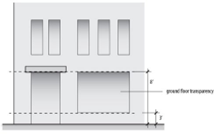
2.
Upper floors. A minimum of 40 percent of the exterior wall of all upper floors shall consist of transparent windows and openings.
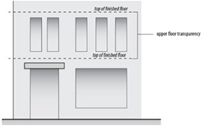
3.
Garage doors and opaque service doors shall not count toward the above requirements.
4.
Glass on all windows and doors shall be clear or maximum window tint shall be 30 percent, allowing views into and out of the interior. Spandrel glass may be used on service areas on the building.
t.
Building materials.
1.
Buildings shall be constructed of durable, high-quality materials.
2.
All building facades visible from a public street or public walkway shall use materials and design features similar to or complementary to those of the front facade.
3.
All outdoor building equipment and any outdoor service areas shall be screened from public view and located in an area not visible from the public street.
4.
Outdoor loading areas or mechanical equipment are not permitted in the front yard. When visible from an abutting public street or walkway, they shall be screened by a decorative fence, wall, or screen of plant material.
5.
No doors or openings providing access to parking or loading facilities shall abut the main street.
6.
Fences and walls shall be architecturally compatible with the design and materials of the principal building. Design details shall be substantially the same (but need not be identical) as those of the principal building.
u.
Screening of rooftop equipment.
1.
All rooftop equipment, with the exception of solar and wind equipment, shall be screened from view from adjacent streets and public rights-of-way. Rooftop equipment shall be screened from view from adjacent buildings to the extent possible.
2.
The equipment shall be within an enclosure. This structure shall be set back a distance of one and one-half times its height from any primary facade fronting a public street. Screens shall be of durable, permanent materials (not including wood) that are compatible with the primary building materials.
v.
Lot coverage.
1.
Reviewed by engineering staff and approved by the planning department or designee shall be required.
2.
The principles and standards set forth in the city erosion control and stormwater management requirements policy which includes the stormwater management ordinance and the city's construction site control ordinance, shall be used by the property owner and staff for drafting and reviewing stormwater management plans.
(d)
Arts (A) Zoning District:
1.
Purpose: The purpose of this zoning district is to regulate the design and construction of new and existing buildings with an arts mixed-use district, which is to facilitate investment involving improvements to land and structures. The intended result is to help establish a mixed-use area with art-related businesses, other low-intensity, neighborhood-supporting businesses, live/work units, and traditional residences integrated together in a manner. The innovative approach allows artists, owners, and operators of support businesses to occupy joint living and commercial space within the same structure that would otherwise not be allowed in many other zoning districts. The creation of the district promotes investment through mixed-use development that expands the presence of and/or otherwise enhances the arts within the zone.
2.
Definitions: The following definitions shall apply to this section 78-105(4)(d) only. If there is a conflict between these definitions and a definition under section 78-015, the definition under section 78-105(4)(d) shall control.
Art center. A facility whose mission is to promote the arts and make them available to the public. An arts center may host art exhibits and shows, provide studio space for the use of artists and engage in public education and exposure to the arts.
Art gallery. An establishment that engages in the sale, loan or display of paintings, sculptures, photographs, video art or other works of art. "Art gallery" does not include a cultural facility such as a library, museum or non-commercial gallery that may also display works of art or an arts studio.
Art use. Creation or assembly of visual art, including two- and three-dimensional works of fine art or craft, or other fine art objects created or assembled for purposes of sale, display, commission, or trade by artists or artisans. Art use may also include classes held for art instruction.
Artist. A person who practices the arts, design, graphic, musical, literary, computer, or performing arts; or a person whose profession relies on the application of these skills to produce a creative product or art. The term includes, but is not limited to, individuals who practice visual arts, such as painters, printmakers, illustrators, sculptors, potters, jewelry makers, glass makers, craft artists and photographers; performing arts, such as musicians, composers, playwrights, choreographers and dancers; literary arts, such as creative writers and literary translators; architecture and design, such as architects, landscape architects, engineers, urban designers and planners, interior designers and decorators, industrial designers, graphic designers and fashion designers; and media arts, such as filmmakers, video and audio artists and web-based designers.
Artist studio. An area in a building used for creation, production, rehearsal, study or teaching of any visual art or craft, including, but not limited to, painting, drawing, graphic design, photography, video, film, sculpture, and pottery: written works of fiction or nonfiction; or any performing art, whether for live or recorded performance, including music, dance and theater. "Artist studio" may include performance space related to classes taught on-site and recording studios; a studio for artisan-related crafts, such as small-scale metalworking, glassblowing, furniture making, pottery, leather craft, and similar activities. "Artist studio" may also include accessory sales of art produced on the premises.
Arts. The interpretation of imagination and creativity in a physical form or performance.
Boutique hotel. A small lodging facility with 35 or fewer guest rooms that are rented to occupants on a daily basis for not more than 14 consecutive days. Access to each guest room shall be through an inside lobby.
Commercial kitchen. A kitchen that has durable equipment designed specifically for mass food production that also incorporates safety features rarely found on equipment designed for residential use, including safety shields and finger guards. Also, exhaust fans over cooktops and automatic fire suppression systems are controlled by sensors, industrial extinguishers and/or fire-retardant systems integrated into the structure of the building. A commercial kitchen is where individually priced meals are prepared and served, primarily for on-premises consumption. The establishment with a commercial kitchen shall have a dining room or rooms, a kitchen and the number and kinds of employees necessary for the preparation, cooking and serving of meals to satisfy the licensing authority.
Consignment store. An enclosed retail establishment, whether operated by a for or not-for-profit organization or entity, engaged in selling used merchandise, such as clothing, furniture, jewelry, books, shoes, or household appliances, etc., on consignment. Consignment stores do not include those selling vehicles, auto parts, scrap, or waste.
Drive-through. Any facility that may be accessed directly by means of a motor vehicle for transacting business.
Entertainment, live. Any musical act, including karaoke, theatrical act, including a play, revue or stand-up comedy, dance, magic act, disc jockey, or similar activity performed live by one or more persons, whether or not for compensation or an admission charge.
Event venue. A building used for the hosting of events such as weddings, conferences, and galas. The venue may contain a space for catering prep and storage, but does not include a commercial kitchen. The indoor venue can also include an outdoor area attached or nearby the building.
Food truck (also called mobile food vending). A motorized vehicle or trailer drawn by a motorized vehicle used to prepare and sell food to the public directly from the vehicle or trailer. Food trucks are mobile food vendors and shall follow all requirements of section 78-206(9)(j).
Food truck court. A parcel of land where licensed, motorized vehicles or mobile food units congregate to sell food or beverages to the general public.
Food truck vendor. Any person or entity that prepares and sells food from a food truck in a designated food truck court or that otherwise operates a food truck in accordance with the requirements.
Live-work unit. A unit configured for both residential and nonresidential use in which the primary activity is the nonresidential use and the residential use is ancillary to the primary activity; which contains essential living facilities including a sleeping area, cooking facilities, and sanitary facilities; and in which the living and working areas have separate entrances and are shown as separate areas on the floor plan. The live-work unit shall be the primary dwelling of the occupant.
Makerspace. An indoor or outdoor facility or both intended to be used by artists as studio and retail space. Makerspaces often combine production, equipment, community, and education for the purposes of enabling participating individuals to design, prototype, and create works that said individuals would have difficulty producing if working alone due to a lack of resources, tools, artistic input, and/or space. Such space may be in a residential, commercial, mixed use or a live/work building and often provides tools for community use. Makerspaces are characterized by consistent design elements, such as high ceilings, large windows, durable surfaces and wide entrances. These spaces are designed to accommodate and foster a variety of creative activities. Makerspaces may also include common space such as galleries, meeting rooms and open space that encourages resident engagement and community involvement.
Microbrewery. Any business licensed by the State of Wisconsin to operate as a brewery and operated for the production of not more than 60,000 barrels of fermented malt beverages annually and the sale of said beverages for on-site consumption or in sealed containers for consumption off-site.
Outdoor arts market. A temporary event, which does not exceed 72 hours, held on private or public property where artwork is offered for sale.
Small power tools. Hand equipment driven by other than human means. Examples include circular saws, power drills, portable mitre saws, routers, electric belt sanders and wood lathes. Not defined as small power tools are chain saws, mounted mitre saws, and band saws. jackhammers and similar power tools.
Thrift store. An enclosed retail establishment, whether operated by a for- or not-for-profit organization or entity, engaged in selling previously owned or used goods and merchandise from an area greater than 25 percent of the total floor area devoted to retail sales and whose merchandise is acquired principally by donation. Thrift stores do not include those selling vehicles, auto parts, scrap, or waste.
3.
Permitted arts and retail uses.
a.
Art gallery.
b.
Artist studio.
c.
Artist co-op to allow multiple artist studios that are not bazaars, junk stores, specialty shops and flea markets, etc.
d.
Arts and crafts retail sales.
e.
Arts center.
f.
Arts-related businesses and services such as craft shops, galleries and studios within which is conducted the preparation, display, or sale of art products such as antiques, collectibles, custom apparel, jewelry, paintings, photography, picture framing, pottery, sculpture, stained glass and similar arts, crafts merchandise, and activities such as set design and restoration of artwork.
g.
Arts supply store.
h.
Concert hall or other performing arts space, dinner theater, legitimate theater or movie theater. Performing arts ticket office or booking agency.
i.
Craftsman or artisan shop.
j.
Music store, musical instruments store.
k.
Photographic studio.
l.
Recording studios provided appropriate soundproofing is installed.
m.
Farmers market or green market.
n.
Pottery and ceramics shop.
o.
Boutique hotel.
4.
Cultural and entertainment uses:
a.
Brewpubs, including outdoor seating.
b.
Microbreweries, subject to the provisions of chapter 14, article II and the development standards.
c.
City-sponsored and/or approved outdoor cultural events and performances that feature visual art, music, dance, theater, performance art, science, design or cultural heritage.
d.
Live entertainment, provided that all establishments hosting live entertainment shall comply with any and all applicable noise regulations and ordinances of the city.
e.
Restaurants or commercial kitchens. The establishment serves prepared food or beverages for consumption on or off the premises.
f.
Event venues.
5.
Educational and public uses:
a.
Art school and other visual and performing arts instruction including school of dance, photography, filmmaking, music, writing, painting, sculpting and printmaking, but excluding adult entertainment and erotic dance.
b.
Educational or instructional activities, including training, vocational or craft schools, the arts and personal development.
c.
Public and semipublic uses, including public and private schools, churches and religious institutions, government facilities, active recreational parks, museums, public transportation terminals, and similar uses.
d.
Training studios, including martial arts studios, gymnastics and yoga.
6.
Residential uses:
a.
Live-work units, subject to the following requirements:
1.
The residential portion of a live-work unit shall contain sleeping areas, cooking facilities, and complete sanitary facilities.
2.
The nonresidential portion of a live-work unit shall be limited to two employees per shift, including the person living in the unit that is associated with the business. The nonresidential space must be occupied by the tenant of the residential space, and no portion of the live-work unit may be rented or sold separately.
3.
The minimum floor area of a live-work unit shall be 500 square feet. A minimum of 50 percent of a unit must be for nonresidential purposes. Each unit must contain a minimum residential floor area of 250 square feet. Sanitary facilities may be considered residential or nonresidential.
4.
One off-street parking space is required per live-work unit.
b.
Ground-level uses fronting on a public street, sidewalk, or alley shall be nonresidential uses. A minimum of 50 percent of the ground level must be active, nonresidential uses. This area may be used for retail/commercial, as well as areas dedicated for production or industrial uses. Storage and parking are not considered active uses. The first 25 feet of the ground floor measured from the front of the building shall be nonresidential.
7.
Minimum usable floor area for residential dwelling units.
a.
No dwelling unit shall be constructed or remodeled to have less living area than the following minimum standards:
b.
For the purpose of this section, "floor area" shall be the sum of the areas of the floors of a unit used for human occupancy or use, as measured from the interior faces of the walls, but not including unfinished basements, garages, porches, breezeways of common hallways and unfinished attics.
c.
Dwelling units. Each unit shall be designed to meet the minimum space use and location requirements of this chapter. With the exception of habitable rooms (bedrooms) having at least one window directly facing the outdoors.
8.
Accessory uses.
a.
Kilns.
b.
Outdoor display of artwork and merchandise during hours of operation of the primary business or activity on the property.
c.
Power tools. The use of hand tools is encouraged; the use of small power tools is allowed. All tools shall be used in compliance with the noise regulations and ordinances of the city.
d.
Food trucks, in designated food truck courts only, and subject to the development standards in this section.
e.
Consignment stores and thrift stores, subject to the development standards in this section.
f.
Makerspaces, subject to the development standards in this section.
g.
Office space used in connection with the principle use.
9.
Minimum regulation for the district.
a.
Minimum lot size: 5,000 square feet.
b.
Building to front or street side lot line: average of directly adjacent building or buildings along the same street frontage as determined by the department of planning and development.
c.
Building side lot line: Zero feet.
d.
Building rear lot line: Zero feet.
e.
Side lot line to accessory structure: Four feet from property line, four feet from alley.
f.
Rear lot line to accessory structure: Four feet from property line, four feet from alley.
g.
Required bufferyard: See section 78-610 along the zoning district boundary.
h.
Minimum paved surface setback: Zero feet.*
i.
Minimum building separation: Zero feet.*
j.
Maximum building height for a principal structure is 55 feet or four stories. Floors three and four shall step back six feet to create visual depth to the building face, utilizing a change in color or panel siding. A portion of these upper-story stepbacks are to be used as balconies for the units.
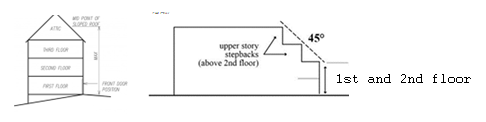
The minimum ground story height shall be 12 feet, measured from the sidewalk to the second story floor.
k.
Parking and vehicular access. No surface parking shall be allowed between the building and any street. All parking shall be located at the rear of buildings on the site, enclosed within a structure (any building on the site), below grade, or on upper floors. Below-grade parking may occupy the entire footprint of a lot. Automobile parking spaces shall be provided in the following ratios for uses that require overnight parking:
1.
Residential unit. At least one automobile parking space per unit.
2.
Hotels. At least one automobile parking space per every guest room.
3.
Electric vehicle spaces. A minimum of ten percent of automobile parking spaces provided on a lot shall include electric vehicle (EV) charging stations.
l.
Off-street bicycle parking spaces shall be provided equal to ten percent of the automobile parking space requirement. The ten percent requirement may be broken between short-term and long-term parking spaces.
1.
Short-term bicycle parking spaces must be located no more than 50 feet from the principal building entrance and at the same grade as the sidewalk or an accessible route.
2.
Long-term bicycle parking for residential uses may be provided in garages, storage rooms and other resident-accessible, secure areas. Space within dwelling units or on balconies are not counted toward satisfying bicycle parking requirements.
*Maximum permitted setback of zero feet, except where permitted by the plan commission as an essential component of site design, fire code, or egress.
10.
Lot coverage.
a.
Reviewed by engineering staff and approval by the planning department and/or the plan commission shall be required.
b.
The principles and standards set forth in the city erosion control and stormwater management requirements policy, which includes the stormwater management ordinance and the city's construction site control ordinance, shall be used by the property owner and staff for drafting and reviewing stormwater management plans.
11.
Site design.
a.
No overhead service doors or bays used solely for delivery shall face the primary street serving the property. Loading and service areas shall be internal to the development and accessed via service alleys and non-pedestrian-oriented streets.
b.
Pedestrian and main entrances shall be located on the primary street serving the property. Curb cuts must be located on a side street where possible.
c.
Parking shall not be the dominant visual element of the site along the primary frontage. Parking shall be designed as smaller, multiple parking lots separated by landscape and buildings, or placed behind buildings.
d.
The parking space standard shall be eight and one-half feet by 18 feet. All parking surfaces shall be paved with a hard, all-weather surface with clearly marked parking spaces. No loading space requirement shall apply. In most instances, the short-term loading needs of the business can be met in the vehicle parking area.
e.
The facades of new buildings more than 40 feet in width shall be divided into smaller vertical intervals through techniques including, but not limited to, the following:
1.
Facade modulation, step backs, or extending forward of a portion of the facade.
2.
Vertical divisions using different textures, materials, or colors of materials.
3.
Division into multiple storefronts, with separate display windows and entrances.
4.
Variation in roof lines to reinforce the modulation or vertical intervals.
5.
Arcades, awnings, window bays, arched windows, and balconies to reinforce the vertical intervals.
f.
All building facades visible from a public street or public walkway shall use materials and design features similar to or complementary to those of the front facade.
g.
Screening of rooftop equipment.
1.
All rooftop equipment, with the exception of solar and wind equipment, shall be screened from view from adjacent streets and public rights-of-way. Rooftop equipment shall be screened from view from adjacent buildings to the extent possible.
2.
The equipment shall be within an enclosure. This structure shall be set back a distance of one and one-half times its height from any primary facade fronting a public street. Screens shall be of durable, permanent materials (not including wood) that are compatible with the primary building materials.
12.
Public art. Placement or installation of outdoor sculpture and other art forms on private property intended to be viewed from a public right-of-way or other public property shall not be subject to setback standards of the applicable zoning district and shall not require a permit, provided that:
a.
The placement does not impede the flow of pedestrians, bicycle or vehicle traffic or block motorist visibility at intersections, alleys or driveways.
13.
Facade transparency.
a.
Ground level. A minimum of 50 percent of that portion of a street-facing exterior wall, which is between three feet to eight feet above the sidewalk grade, must be comprised of transparent (untinted, unfrosted, non-reflective) windows or openings.
b.
Upper floors. A minimum of 40 percent of the exterior wall of all upper floors shall consist of transparent windows and openings.
14.
Use specific standards. The following standards shall control the development and manner of operation of the following uses within the arts district:
a.
Food truck courts.
1.
Food truck courts as primary or accessory use may be established in free-standing commercial parking lots provided that the property owner has given permission for the property to be used as a food truck court.
2.
Food truck courts may operate accessory to a primary use without a separate occupational tax permit. Accessory food truck courts may operate up to six hours per day, and up to three days per week. If the primary use shares a parking lot with other tenants or property owners, and the minimum parking requirements for all users are greater than the number of spaces provided in the lot, the hosting entity shall obtain written consent from each tenant or property owner prior to operating a food truck court. This consent will be made available to the city upon request. Lack of written consent will constitute of violation of this chapter and the food trucks will be required to leave the premises immediately. The host of a food truck court should consider installing dedicated power stations with sufficient voltage to meet the needs of multiple trucks.
3.
Food truck courts operating as a primary use shall require a conditional use permit and shall be required to provide customer restrooms on-site.
4.
All food trucks shall have valid mobile food vendor permits from [the] county health department. Operators of food truck courts shall retain a copy of each food truck's mobile food vendor permit, to be furnished upon request to the code enforcement officer.
5.
Food trucks shall not sell or offer to sell any goods, foods, products, or services between the hours of 10:00 p.m. to 7:00 a.m.
6.
Where food truck courts are a primary use, such courts must provide a minimum of two parking spaces for customer use per food truck in addition to any parking necessary for the use of the food trucks themselves. There shall be no maximum number of food trucks in a food truck court.
7.
No wastes of any kind shall be discharged from a food truck. Trash receptacles shall be provided by the host of the food truck vendor for customers to dispose of food wrappers, food utensils, paper products, cans, bottles, food and other such waste. Such receptacles shall be located no more than ten feet from the food truck. The host of the food truck vendor shall be responsible for removing all trash, litter and refuse from the site at the end of each business day.
8.
Food truck courts must adhere to all requirements of the sign ordinance. No LED strip lighting shall be used in conjunction with any food truck court.
9.
No loudspeakers or amplified noise shall be used for announcements or hawking of products in conjunction with any food truck court.
10.
The property owner and/or landlord may provide limited seating on the food truck court to customers of the food truck vendor(s). Canopies for the protection of customers from the elements may also be provided by the property owner and/or landlord or the food truck vendor(s). Such canopies shall be temporary, shall not exceed an area of 144 square feet, and shall be removed at the conclusion of business.
11.
A minimum distance of 100 feet shall be maintained between any food truck and the entrance to any restaurant.
12.
No food truck shall be located within any required setback, any sight distance triangle or required buffer. Access aisles sufficient to provide emergency access to any food truck shall be provided.
13.
Sales of articles other than food and beverages shall be prohibited.
b.
Kilns.
1.
The total volume of kiln space shall not exceed 60 cubic feet.
2.
Kilns may be located outside. Outside kilns shall be set back a minimum of 25 feet from any boundary common to property zoned residential or in residential use.
c.
Microbreweries.
1.
No trucks larger than a 24-foot box truck shall be used in delivery to or shipment from the microbrewery.
2.
Shipments or deliveries shall not occur between the hours of 10:00 p.m. and 7:00 a.m.
3.
All operations by the microbrewery shall be conducted within an enclosed building.
4.
No fumes, vapors, odor, smoke, dust or other particulate matter or offensive vibration, noise, heat, humidity, glare or other objectionable effect generated by the operation shall be perceptible at the property boundary of the microbrewery.
5.
A landscaped buffer having a minimum horizontal dimension of 40 feet shall be established along any property boundary common to a residential zoning district. Alternate compliance may be achieved by berming to a minimum height of three feet, affording a reduction in buffer width to 30 feet. Landscaping shall achieve nearly opaque screening of the microbrewery operation from adjacent residential districts throughout the year.
d.
Makerspaces.
1.
A communal workshop in which two or more people or businesses share space, equipment, technology, infrastructure, ideas, and/or knowledge for the production or fabrication of crafts, technologies, or products by hand or with minimal automation.
2.
A retail gallery may be established in conjunction with the workshop to sell products that have been made on location.
e.
Consignment stores and thrift stores.
1.
An enclosed retail establishment engaged in selling used merchandise, such as clothing, furniture, jewelry, books, shoes, or household appliances, etc., on consignment. Consignment and thrift stores do not include those selling vehicles, auto parts, scrap, or waste.
(5)
Industrial Districts:
(a)
Light Industrial (LI) District:
1.
Description and purpose: This district is intended to permit both large and small scale industrial and office development at an intensity which is consistent with the overall desired suburban community character of the community. Beyond a relatively high minimum green space ratio (GSR), the primary distinguishing feature of this district is that it is geared to indoor industrial activities which are not typically associated with high levels of noise, soot, odors and other potential nuisances for adjoining properties. In order to ensure a minimum of disruption to residential development, development within this district shall take access from a collector or arterial street.
Rationale: This district is intended to provide a location for suburban intensity light industrial land uses such as assembly operations, storage and warehousing facilities, offices, and light manufacturing which are protected from potential nuisances associated with certain development permitted within the GI District. In addition, land uses shall comply with the minimum performance standards presented in article VII.
2.
List of allowable principal land uses: (per article II)
a.
Principal land uses permitted by right: (per subsection 78-202(1))
Cultivation (per subsection 78-206(2)(a))
Selective cutting (per subsection 78-206(2)(f))
Passive outdoor public recreation (per subsection 78-206(3)(a))
Active outdoor public recreation (per subsection 78-206(3)(b))
Public services and utilities (per subsection 78-206(3)(e))
Office (per subsection 78-206(4)(a))
Personal or professional services (per subsection 78-206(4)(b))
Indoor maintenance service (per subsection 78-206(4)(e))
Indoor storage or wholesaling (per subsection 78-206(5)(a))
Light industrial (per subsection 78-206(7)(a))
Indoor commercial entertainment (per section 78-206(4)(h), specifically health or fitness centers and all forms of training studios (dance, art, martial arts, etc.)
Mobile service support structure
b.
Principal land uses permitted as conditional use: (per subsection 78-202(2))
Clear cutting (per section 78-206(2)(g))
Community gardens (per section 78-206(2)(h))
Market gardens (per section 78-206(2)(i))
Indoor sales or service (per section 78-206(4)(c))
Group day care center (9+ children) (per section 78-206(4)(m))
Personal storage facility (per section 78-206(5)(c))
Airport/heliport (per section 78-206(6)(b))
Distribution center (per section 78-206(6)(d))
Commercial animal boarding (per section 78-206(4)(j)
Commercial outdoor entertainment (per section 78-206(4)(i))
3.
List of allowable accessory uses: (per subsection 78-202(3))
a.
Accessory land uses permitted by right:
Farm residence (per subsection 78-206(8)(b))
Detached residential garage, shed; gazebo or similar accessory structure (per subsection 78-206(8)(c))
Company cafeteria (per subsection 78-206(8)(d))
Company provided on-site recreation (per subsection 78-206(8)(e))
Indoor sales incident to light industrial use (per subsection 78-206(8)(h))
Home occupation (per subsection 78-206(8)(j))
On-site parking lot (per subsection 78-206(8)(n))
Private residential recreational facility (per subsection 78-206(8)(o))
Drainage structure (per subsection 78-206(8)(r))
Filling (per subsection 78-206(8)(s))
Lawn care (per subsection 78-206(8)(t))
Exterior communication devices (per subsection 78-206(8)(v))
b.
Accessory land uses permitted as conditional use:
Company provided on-site recreation (per subsection 78-206(8)(e))
In-vehicle sales and service, incidental to on-site land use (per subsection 78-206(8)(g))
Outdoor storage (per subsection 78-206(5)(b)
4.
List of allowable temporary uses: (per subsection 78-202(4))
General Temporary Outdoor Sales (per subsection 78-206(9)(a))
Outdoor assembly (per subsection 78-206(9)(b))
Contractor's project office (per subsection 78-206(9)(c))
Contractor's on-site equipment storage (per subsection 78-206(9)(d))
Relocatable building (per subsection 78-206(9)(e))
On-site real estate sales office (per subsection 78-206(9)(f))
Temporary portable storage container (per subsection 78-206(9)(i))
Mobile Food Vending (per subsection 78-206(9)(j))
Mobile Food Vending at Special Events (per subsection 78-206(9)(k))
5.
List of allowable energy production uses:
a.
Energy production uses permitted by right:
Solar energy systems (per subsection 78-206(10)(c))
b.
Energy production uses permitted as conditional use:
Small wind energy system (per subsection 78-206(10)(a))
Commercial wind energy system (per subsection 78-206(10)(b))
6.
Regulations applicable to all uses:
a.
Landscaping regulations (see article VI)
b.
Performance standards: (see article VII)
c.
Signage regulations: (see article VIII)
7.
Regulations applicable to residential uses: Not applicable.
8.
Regulations applicable to nonresidential uses:
a.
Nonresidential intensity requirements:
Maximum number of floors (F): Four
Minimum landscape surface ratio (LSR): 25 percent
Maximum floor area ratio (FAR): 1.0 (may be exceeded through use of structured parking)
Maximum building size (MBS): na
b.
Nonresidential bulk requirements:
A:
Minimum lot area: 20,000 square feet (7,200 square feet permitted as a conditional use)
B:
Minimum lot width: 100 feet (70 feet permitted as a conditional use); Minimum street frontage: 50 feet
Minimum Setbacks:
C:
Building to front or street side lot line: 20 feet
D:
Building to residential side lot line: Ten feet
E:
Building to residential rear lot line: 20 feet
F:
Building to nonresidential side lot line: Ten feet
G:
Building to nonresidential rear lot line: 20 feet
H:
Side lot line to accessory structure: Four feet from property line, four feet from alley
I:
Rear lot line to accessory structure: Four feet from property line, four feet from alley
J:
Required bufferyard: See section 78-610 along zoning district boundary
K:
Minimum paved surface setback: Five feet from side or rear; ten feet from right-of-way
L:
Minimum building separation: 20 feet
M:
Maximum building height: 40 feet
N:
Minimum number of off-street parking spaces required on the lot: See parking lot requirements per specific land use in section 78-206
(b)
Reserved:
(c)
Heavy Industrial (HI) District:
1.
Description and purpose: This district is intended to permit both large and small scale industrial and office development at an intensity which provides ample incentive for infill development and redevelopment of industrial areas existing as of the effective date of this chapter. This district is designed to permit a very wide variety of industrial uses which may occur both indoors and outdoors, including certain land uses which are permitted in no other zoning district because of their potential to create nuisances for adjoining properties. In order to ensure a minimum of disruption to residential development, development within this district shall take access from a collector or arterial street.
Rationale: This district is intended to provide a location for both light and heavy industrial uses in a zoning district in which the potential for nuisance complaints from nearby properties is minimized. It must be emphasized that this is not a district where virtually any land use is permitted, as all uses shall comply with the minimum performance standards presented in article VIII. In addition, certain land uses such as extraction, junkyards and salvage operations, and freight terminals are permitted within this district only upon the granting of a conditional use permit.
2.
List of allowable principal land uses: (per article II)
a.
Principal land uses permitted by right: (per subsection 78-202(1))
Cultivation (per subsection 78-206(2)(a))
Selective cutting (per subsection 78-206(2)(f))
Passive outdoor public recreation (per subsection 78-206(3)(a))
Public services and utilities (per subsection 78-206(3)(e))
Office (per subsection 78-206(4)(a))
Indoor maintenance service (per subsection 78-206(4)(e))
Indoor storage or wholesaling (per subsection 78-206(5)(a))
Off-site parking lot (per subsection 78-206(6)(a))
Light industrial (per subsection 78-206(7)(a))
Mobile service support structure
b.
Principal land uses permitted as conditional use: (per subsection 78-202(2))
Agricultural services (per subsection 78-206(2)(d))
Clear cutting (per subsection 78-206(2)(g))
Community gardens (per subsection 78-206(2)(h))
Market gardens (per subsection 78-206(2)(i))
Outdoor maintenance service (per subsection 78-206(4)(f))
Sexually oriented land use (per subsection 78-206(4)(p))
Vehicle repair and maintenance service (per subsection 78-206(4)(q))
Outdoor storage or wholesaling (per subsection 78-206(5)(b))
Junkyard or salvage yard (per subsection 78-206(5)(d))
Waste disposal facility (per subsection 78-206(5)(e))
Composting operation (per subsection 78-206(5)(f))
Airport/heliport (per subsection 78-206(6)(b))
Freight terminal (per subsection 78-206(6)(c))
Distribution center (per subsection 78-206(6)(d))
Heavy industrial (per subsection 78-206(7)(b))
The following uses are limited to properties zoned heavy industrial, abutting Main Street:
Indoor commercial entertainment (per subsection 78-206(4)(h))
Office (per subsection 78-206(4)(a))
Personal or professional services (per subsection 78-206(4)(b))
Indoor sales or service (per subsection 78-206(4)(c))
3.
List of allowable accessory uses: (per subsection 78-202(3))
a.
Accessory land uses permitted by right:
Farm residence (per subsection 78-206(8)(c))
Detached residential garage, shed; gazebo or similar accessory structure (per subsection 78-206(8)(c))
Company cafeteria (per subsection 78-206(8)(d))
Company provided on-site recreation (per subsection 78-206(8)(e))
Indoor sales incident to light industrial use (per subsection 78-206(8)(h))
Home occupation (per subsection 78-206(8)(j))
On-site parking lot (per subsection 78-206(8)(n))
Private residential recreational facility (per subsection 78-206(8)(o))
Drainage structure (per subsection 78-206(8)(r))
Filling (per subsection 78-206(8)(s))
Lawn care (per subsection 78-206(8)(t))
Exterior communication devices (per subsection 78-206(8)(v))
b.
Accessory land uses permitted as conditional use:
Company provided on-site recreation (per subsection 78-206(8)(e))
In-vehicle sales and service, incidental to on-site land use (per subsection 78-206(8)(g))
Migrant labor camp (per subsection 78-206(8)(m))
4.
List of allowable temporary uses: (per subsection 78-202(4))
Outdoor assembly (per subsection 78-206(9)(b))
Contractor's project office (per subsection 78-206(9)(c))
Contractor's on-site equipment storage (per subsection 78-206(9)(d))
Relocatable building (per subsection 78-206(9)(e))
On-site real estate sales office (per subsection 78-206(9)(f))
Temporary portable storage container (per subsection 78-206(9)(i))
Mobile Food Vending (per subsection 78-206(9)(j))
Mobile Food Vending at Special Events (per subsection 78-206(9)(k))
5.
List of allowable energy production uses:
a.
Energy production uses permitted by right:
Solar energy systems (per subsection 78-206(10)(c))
b.
Energy production uses permitted as conditional use:
Small wind energy system (per section 78-206(10)(a))
Commercial wind energy system (per section 78-206(10)(b))
6.
Regulations applicable to all uses:
a.
Landscaping regulations (see article VI)
b.
Performance standards: (see article VII)
c.
Signage regulations: (see article VIII)
7.
Regulations applicable to residential uses: Not applicable.
8.
Regulations applicable to nonresidential uses:
a.
Nonresidential intensity requirements:
Maximum number of floors (F): Four
Minimum landscape surface ratio (LSR): 15 percent
Maximum floor area ratio (FAR): 1.0 (may be exceeded through use of structured parking)
Maximum building size (MBS): na
b.
Nonresidential bulk requirements:
A:
Minimum lot area: 20,000 square feet
B:
Minimum lot width: 100 feet; minimum street frontage: 50 feet
Minimum Setbacks:
C:
Building to front or street side lot line: 20 feet
D:
Building to residential side lot line: 20 feet
E:
Building to residential rear lot line: 20 feet
F:
Building to nonresidential side lot line: 20 feet
G:
Building to nonresidential rear lot line: 20 feet
H:
Side lot line to accessory structure: Four feet from property line, four feet from alley
I:
Rear lot line to accessory structure: Four feet from property line, four feet from alley
J:
Required bufferyard: See section 78-610 along zoning district boundary
K:
Minimum paved surface setback: Five feet from side or rear; ten feet from right-of-way
L:
Minimum building separation: 40 feet
M:
Maximum building height: 45 feet (or more with conditional use permit)
N:
Minimum number of off-street parking spaces required on the lot: See parking lot requirements per specific land use in section 78-206
(6)
Institutional Districts:
(a)
Institutional (I) District:
1.
Description and purpose: This district is intended to permit high-quality institutional land uses at an intensity compatible with the overall community character of the city.
Rationale: This district is used to provide for the reservation and designation of areas for institutional development.
2.
List of allowable principal land uses: (per article II)
a.
Principal land uses permitted by right: (per subsection 78-202(1))
Cultivation (per subsection 78-206(2)(a))
Selective cutting (per subsection 78-206(2)(f))
Passive outdoor public recreation (per subsection 78-206(3)(a))
Active outdoor public recreation (per subsection 78-206(3)(b))
Public services and utilities (per subsection 78-206(3)(e))
Office (per subsection 78-206(4)(a))
Personal or professional services (per subsection 78-206(4)(b))
Mobile service support structure
b.
Principal land uses permitted as conditional use: (per subsection 78-202(2))
Clear cutting (per subsection 78-206(2)(g))
Community gardens (per subsection 78-206(2)(h))
Market gardens (per subsection 78-206(2)(i))
Indoor institutional (per subsection 78-206(3)(c))
Outdoor Institutional (per subsection 78-206(3)(d))
Institutional residential - 20,000 sf lot (per subsection 78-206(3)(f))
Community living arrangement (1—8 residents) (per subsection 78-206(3)(g))
Community living arrangement (9—15 residents) (per subsection 78-206(3)(h))
Community living arrangement (16+ residents) (per subsection 78-206(3)(i))
Group day care center (9+ children) (per subsection 78-206(4)(m))
3.
List of allowable accessory uses: (per subsection 78-202(3))
a.
Accessory land uses permitted by right:
Farm residence (per subsection 78-206(8)(b))
Detached residential garage, shed; gazebo or similar accessory structure (per subsection 78-206(8)(c))
Company cafeteria (per subsection 78-206(8)(d))
Company provided on-site recreation (per subsection 78-206(8)(e))
Home occupation (per subsection 78-206(8)(j))
On-site parking lot (per subsection 78-206(8)(n))
Private residential recreational facility (per subsection 78-206(8)(o))
Drainage structure (per subsection 78-206(8)(r))
Filling (per subsection 78-206(8)(s))
Lawn care (per subsection 78-206(8)(t))
Exterior communication devices (per subsection 78-206(8)(v))
Solar energy systems (per subsection 78-206(10)(c))
Keeping of chickens when in conjunction with group daycares, schools and church uses (per subsection 78-206(8)(y))
b.
Accessory land uses permitted as conditional use:
Company provided on-site recreation (per subsection 78-206(8)(e))
In-vehicle sales and service, incidental to on-site land use (per subsection 78-206(8)(g))
Intermediate day care home (9—15 children) (per subsection 78-206(8)(l))
4.
List of allowable temporary uses: (per subsection 78-202(4))
General temporary outdoor sales (per subsection 78-206(9)(a))
Outdoor assembly (per subsection 78-206(9)(b))
Contractor's project office (per subsection 78-206(9)(c))
Contractor's on-site equipment storage (per subsection 78-206(9)(d))
Relocatable building (per subsection 78-206(9)(e))
On-site real estate sales office (per subsection 78-206(9)(f))
Temporary portable storage container (per subsection 78-206(9)(i))
Mobile Food Vending (per subsection 78-206(9)(j))
Mobile Food Vending at Special Events (per subsection 78-206(9)(k))
5.
List of allowable energy production uses:
a.
Energy production uses permitted as conditional use:
Small wind energy system (per subsection 78-206(10)(a))
6.
Regulations applicable to all uses:
a.
Landscaping regulations (See article VI)
b.
Performance standards: (See article VII)
c.
Signage regulations: (See article VIII)
7.
Regulations applicable to institutional residential uses: For institutional residential development, see the MR district.
8.
Regulations applicable to nonresidential uses:
a.
Nonresidential intensity requirements:
Maximum number of floors (F): Four
Minimum landscape surface ratio (LSR): 25 percent
Maximum floor area ratio (FAR): 1.0 (may be exceeded through use of structured parking)
Maximum building size (MBS): na
b.
Nonresidential bulk requirements:
A:
Minimum lot area: 20,000 square feet
B:
Minimum lot width: 100 feet; minimum street frontage: 50 feet
Minimum Setbacks:
C:
Building to front or street side lot line: 25 feet
D:
Building to residential side lot line: Ten feet
E:
Building to residential rear lot line: 30 feet
F:
Building to nonresidential side lot line: Ten feet or zero feet where property line divides attached buildings
G:
Building to nonresidential rear lot line: 30 feet
H:
Side lot line to accessory structure: Four feet from property line, four feet from alley
I:
Rear lot line to accessory structure: Four feet from property line, four feet from alley
J:
Required bufferyard: See section 78-610 along zoning district boundary
K:
Minimum paved surface setback: Five feet from side or rear; ten feet from right-of-way
L:
Minimum building separation: 20 feet or zero feet where property line divides attached buildings
M:
Maximum building height: 40 feet
N:
Minimum number of off-street parking spaces required on the lot: See parking lot requirements per specific land use in section 78-206
(7)
Planned development districts:
(a)
Planned Development (PD_-_) District:
1.
Description and purpose: This district is intended to provide more incentives for redevelopment in areas of the community which are experiencing a lack of reinvestment, or which require flexible zoning treatment because of factors which are specific to the site. This district is designed to forward both aesthetic and economic objectives of the city by controlling the site design and the land use, appearance, density, or intensity of development within the district in a manner which is consistent with sound land use, urban design, and economic revitalization principles. The application of these standards will ensure long-term progress and broad participation toward these principles. Refer to section 78-914 for the procedures applicable to proposal review in this standard zoning district. The city intends to use the planned development district to provide a mechanism for review of traditional neighborhood developments per State Statute 66.1027.
2.
Development standards: Development standards are flexible within this zoning district. Refer to subsection 78-914(2) for the range of development standards potentially available in this zoning district.
(Ord. No. 0-6-09, 6-23-2009; Ord. No. 0-24-09, § 1, 12-22-2009; Ord. No. 0-1-2010, § 1, 1-26-2010; Memo. of 3-22-2010; Ord. No. 0-6-10, § 1, 8-10-2010; Ord. No. 0-9-10, § 1, 8-10-2010; Ord. No. 0-4-2011, §§ 2—10, 102, 107, 113, 130—147, 5-10-2011; Ord. No. 0-3-2012, §§ 2—19, 4-10-2012; Ord. No. 0-3-2013, § 1, 3-12-2013; Ord. No. 0-9-2013, § 1, 5-14-2013; Ord. No. 0-29-2013, § 1, 12-10-2013; Ord. No. 0-9-2014, § 1, 5-13-2014; Ord. No. 0-26-2014, § 1, 11-11-2014; Ord. No. 0-27-2014, § 1, 12-9-2014; Ord. No. 0-3-2015, §§ 2, 3, 7-14-2015; Ord. No. 0-02-2016, §§ 2, 3, 2-9-2016; Ord. No. 0-9-2016, § 1, 6-14-2016; Ord. No. 0-26-2016, §§ 2, 3, 12-27-2016; Ord. No. 0-12-2019, § 5(Exh. D), 4-23-2019; Ord. No. 0-26-2020, 12-8-2020; Ord. No. 0-13-2021, §§ 2—19, 6-8-2021; Ord. No. 0-27-2022, §§ 4—23,
11-15-2022; Ord. No. 0-21-2024, § 1(Exh. A), 11-26-2024; Ord. No. 0-03-2025, § 1, 2-11-2025; Ord. No. 0-30-2025, § 1(Exh. A), 10-28-2025; Ord. No. 0-31-2025, § 1(Exh. A), 10-28-2025)

