
Stoughton City Zoning Code
ARTICLE VII
PERFORMACE STANDARDS
Sec. 78-701.- Purpose.
The purpose of this article is to indicate the requirements for access, visibility, off-street parking, off-street loading, exterior storage, exterior lighting, vibration, noise, air pollution, odors, electromagnetic radiation, glare and heat, fire and explosion, toxic and noxious materials, waste materials, drainage, exterior construction materials, and hazardous materials for all development occurring within the jurisdiction of this chapter (see section 78-009).
(Ord. No. 0-6-09, 6-23-2009)
Sec. 78-702. - Access standards.
(1)
Purpose. The purpose of this section is to alleviate or prevent congestion of public rights-of-way so as to promote the safety and general welfare of the public by establishing minimum requirements for the provision of access to public rights-of-way in accordance with the utilization of various sites.
(2)
Permit required. Each access point onto a public street or right-of-way shall have a permit issued by the director of planning and development per Wisconsin Statutes 86.07(2).
(3)
Number of access points.
(a)
Each lot shall have not more than two access points on any street frontage adjacent to any lot. Said access shall require approval by the director of planning and development.
(b)
In no instance shall any lot be permitted more than one access point on any one street if its frontage on said street is less than 100 linear feet (as measured along the right-of-way line).
(c)
On arterial streets and in certain areas experiencing, or expected to experience, congestion and/or safety problems, access to a lot may be required to be located via an access point located on an adjacent property or another street frontage.
(d)
For residential uses, two access points serving the same street frontage may be approved as a conditional use.
(4)
Residential uses. Residential uses shall not have access points onto a nonresidential collector or arterial street unless such street has the only available frontage.
(5)
Nonresidential uses. Nonresidential uses shall not have access points onto a residential street unless such street has the only available frontage.
(6)
Access near street intersections. At its intersection with the street right-of-way line on an arterial or nonresidential collector street, no access point shall be located closer than 100 feet from the intersection of any two street rights-of-way unless such street is the only available frontage on the subject property. In all cases, access points shall be located as far from an intersection as the lot size permits. Nonconforming driveways may be replaced in their current location, except as part of site-plan review and approval.
(7)
Distance between access drives. The minimum distance between access drives serving the same property shall be 25 feet (edge to edge), as measured at the property line. A distance in excess of said 25 feet may be required if, in the opinion of the zoning administrator and the director of planning and development, present or projected traffic factors warrant a greater distance.
(8)
Angle of intersection with public right-of-way. All access drives shall intersect with any public right-of-way at an angle of not less than 75 degrees, and shall intersect at an angle of 90 degrees wherever possible.
(9)
Distance from an access drive to a property line. See bulk regulations in Appendix E for specific zoning district requirements.
(10)
Width of driveways. All access drives shall have a minimum width of ten feet for one- and two-family dwellings, and 18 feet for all other land uses. All curb openings for access drives shall have a maximum width of 24 feet for all residential uses, and 30 feet for all non-residential uses, as measured at the right-of-way line. Access drives may be flared between the right-of-way line and the roadway up to a maximum of five additional feet. May be exceeded with explicit plan commission approval for uses other than single family.
(11)
Traffic control. The traffic generated by any use shall be channelized and controlled in a manner which avoids congestion on public streets and other safety hazards. Traffic into and out of all off-street parking, loading and traffic circulation areas serving six or more parking spaces shall be forward moving, with no backing into streets or pedestrian ways. Traffic control devices shall be required as determined by the director of planning and development.
(12)
Depiction on required site plan. Any and all proposed access drives on the subject property shall be depicted as to their location and configuration on the site plan required for the development of the subject property. (Refer to section 78-908.)
(13)
Paving of access. All access approach areas located within a street right-of-way shall be a concrete apron from the public sidewalk to the pavement edge of adjacent streets. If the property has no sidewalk the concrete apron shall be installed from the property line to the pavement edge of adjacent streets. Relief cuts should be placed on the pavement for future sidewalk areas per the public works sidewalk policy. This requirement must be fulfilled before building occupancy, unless granted a time-specific extension in writing by the director of planning and development.
(Ord. No. 0-6-09, 6-23-2009; Ord. No. 0-4-2011, § 115, 5-10-2011; Ord. No. 0-15-2012, § 1, 9-11-2012; Ord. No. 0-20-2024, 11-12-2024)
Sec. 78-703. - Visibility standards.
(1)
Purpose. The purpose of this section is to alleviate or prevent congestion of public rights-of-way so as to promote the safety and general welfare of the public by establishing minimum requirements for the provision of vehicular visibility.
(2)
Requirement. In order to provide a clear view of intersecting streets to motorists there shall be a triangular area of clear vision formed by the two intersecting streets and a chord connecting said centerlines, as determined by the director of planning and development. Generally, the following standards shall apply:
Table 78-703: Vision Clearance Triangle Standards
Within said triangular area, no signs, parking spaces, structures, or earthwork in excess of 30 inches, and no vegetation, fencing, nor other such obstructions between 30 inches and eight feet in height shall be permitted which exceeds 30 inches in height above either of the centerline elevations of said two streets.
(3)
Depiction on required site plan. Except in the downtown where no requirement is imposed, any and all visibility triangles located on the subject property shall be depicted as to their location and configuration on the site plan required for the development of the subject property. (Refer to section 78-908.)
(Ord. No. 0-6-09, 6-23-2009; Ord. No. 0-1-2012, § 2, 1-24-2012)
Sec. 78-704. - Off-street parking and traffic circulation standards.
(1)
Purpose. The purpose of this section is to alleviate or prevent congestion of public rights-of-way so as to promote the safety and general welfare of the public by establishing minimum requirements for the provision of off-street parking and circulation in accordance with the utilization of various sites.
(2)
Depiction on required site plan. Any and all parking and traffic circulation areas proposed to be located on the subject property shall be depicted as to their location and configuration on the site plan required for the development of the subject property. (Refer to section 78-908.) Each and every on-site parking space designed to serve as required parking shall not be located farther than 300 feet, except as permitted by a conditional use permit, of shortest walking distance from the access to all of the various areas it is designated to serve. A garage stall, meeting the access requirements of subsection (6)(d), below, shall be considered a parking space. Parking spaces for any and all vehicles exceeding 18 feet in length, shall be clearly indicated on said site plan.
(3)
Use of off-street parking areas. The use of all required off-street parking areas shall be limited to the parking of licensed operable vehicles not for lease, rent, or sale. Within residential districts, required parking spaces shall only be used by operable cars and trucks.
(4)
Traffic circulation and traffic control. Site circulation shall be designed to provide for the safe and efficient movement of all traffic entering, exiting, and on the site. Circulation shall be provided to meet the individual needs of the site with specific mixing of access and through movements, and where required, shall be depicted on the required site plan. Circulation patterns shall conform with the general rules of the road and all traffic control measures shall meet the requirements of the Manual of Uniform Traffic Control Devices.
(5)
Installation and maintenance of off-street parking and traffic circulation areas. All off-street parking and traffic circulation areas shall be completed prior to building occupancy and shall be maintained in a dust-free condition at all times. In no instance or manner shall any off-street parking or traffic circulation area be used as a storage area, except as provided for by section 78-706.
(6)
Off-street parking and traffic circulation design standards.
(a)
Surfacing and marking. All off-street parking and traffic circulation areas (including all residential driveways-except those within the RH District) shall be paved with a hard, all-weather surface, to the satisfaction of the director of planning and development. Said surfaces intended for six or more parking stalls shall be marked in a manner which clearly indicates required parking spaces.
(b)
Curbing. All off-street parking areas designed to have head-in parking within six and one-half feet of any lot line shall provide a tire bumper or curb of adequate height and which is properly located to ensure that no part of any vehicle will project beyond the required setbacks of this chapter (see sections 78-402 and 78-403.)
(c)
Lighting. All off-street parking and traffic circulation areas serving six or more cars shall be lit to ensure the safe and efficient use of said areas during the hours of use. Such parking areas shall meet the standards of section 78-707.
(d)
Access. Each required off-street parking space shall open directly upon an aisle or driveway that is wide enough and designed to provide a safe and efficient means of vehicular access to the parking space without directly backing or maneuvering a vehicle into a public right-of-way exceeding 82.5 feet in width. All off-street parking and traffic circulation facilities shall be designed with an appropriate means of vehicular access to a street or alley, in a manner which least interferes with traffic movements. No driveway across public property, or requiring a curb cut, shall exceed a width of 40 feet for commercial and industrial land uses, or 25 feet for residential land uses. (See also Table 78-704(6)(j).) Off-street parking spaces for residential uses may be stacked or in front of one-another for the same building unit. Parking spaces located behind an enclosed garage and located directly off a through aisle shall be a minimum of 30 feet deep.
(e)
Signage. All signage located within, or related to, required off-street parking or traffic circulation shall comply with the requirements of article VIII.
(f)
Handicapped parking spaces. Parking for the handicapped shall be provided at a size, number, location, and with signage as specified by state and federal regulations.
(g)
Parking space design standards. Other than parking required to serve the handicapped, all provided off-street parking spaces shall comply with the minimum requirements of Table 78-704(6)(j). The minimum required length of parking spaces shall be 18.0 feet. All parking spaces shall have a minimum vertical clearance of at least seven feet.
(h)
Snow storage. Required off-street parking and traffic circulation areas shall not be used for snow storage.
(i)
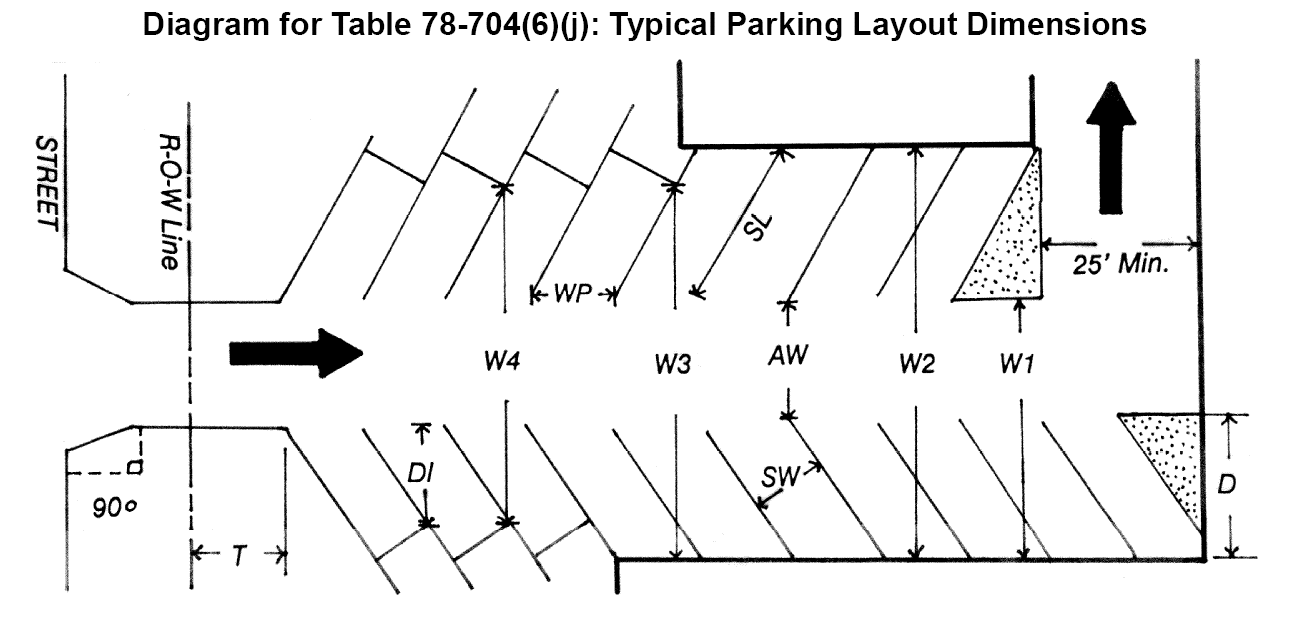
Parking lot design standards. Horizontal widths for parking rows, aisles, and modules shall be provided at widths no less than listed in Table 78-704(6)(j), and shown on the following page. Additional design standards apply to "large developments." (See section 78-205(11))
(j)
Landscaping. Parking lot landscaping shall comply with the requirements of the paved area landscaping requirements in subsection 78-604(3).
(7)
Calculation of minimum required parking spaces.
(a)
General guidelines for calculating required parking spaces. The requirements of subsection (c), below, shall be used to determine the maximum allowed number of off-site parking spaces to be provided on the subject property. Minimum required parking spaces are generally tied to the capacity of the use; the gross floor area of the use; or the number of employees which work at the subject property during the largest work shift. The term "capacity" as used herein means the maximum number of persons that may be accommodated by the use as determined by its design or by State Building Code regulations, whichever number is greater. References herein to "employee(s) on the largest work shift" means the maximum number of employees working at the facility during a single given day, regardless of the time period during which this occurs, and regardless of whether any such person is a full-time employee. The largest work shift may occur on any particular day of the week or during a lunch or dinner period in the case of a restaurant. In all cases, one reserved parking space shall be provided for each vehicle used by the operation during business hours. Said spaces shall be in addition to those required by subsection (c), below. Where said parking needs of any land use exceed the minimum requirements of this chapter, additional parking spaces sufficient to meet the average maximum weekly peak-hour parking space demand shall be provided by said land use.
(b)
Partial development of required parking spaces. Any development may seek permission to not install a portion of its required parking at time of site plan review; however, said site plan shall depict the minimum number of required parking spaces.
(c)
Limit on the maximum number of required parking spaces. No site plan may be approved, for a multi-family or non-residential use, which contains more than 120 percent of the development's minimum number of required parking spaces, except as granted through a conditional use permit.
Table 78-704(6)(j): Parking Layout Dimensions
1 Parking spaces located behind an enclosed garage and located directly off a thorough aisle shall be at least 30 feet deep.
2 This dimension represents (AW) for one-way traffic.
(8)
Joint and off-site parking facilities.
(a)
Parking facilities which have been approved by the director of planning and development to provide required parking for one or more uses, shall provide a total number of parking spaces which shall not be less than the sum total of the separate parking needs for each use during any peak hour parking period when said joint parking facility is utilized at the same time by said uses. However, this aggregate requirement may be reduced or expanded by the planning commission by explicit motion associated with this site plan review process.
(b)
Each parking space designed to serve as joint parking shall not be located farther than 300 feet, except as permitted by a conditional use permit, from the access to all of the various areas it is designated to serve. See subsection 78-206(6)(a).
(c)
The applicant(s) for approval of a joint parking facility shall demonstrate to the director of planning and development' satisfaction that there is no substantial conflict in the demand for parking during the principal operating hours of the two of more uses for which the joint parking facility is proposed to serve.
(d)
A legally binding instrument, approved by the city attorney, shall be executed by any and all parties to be served by said joint parking facility. This instrument shall be recorded with the register of deeds office, and filed with the city clerk. A fee shall be required to file this instrument (see section 78-919).
(9)
Minimum off-street parking requirements for land uses. The off-street parking requirements for each land use are listed within section 78-206.
(10)
Parking within the (CB) Central Business District. The parking requirements of this chapter are hereby waived within the (CB) Central Business District.
(11)
Locational prohibitions for off-street parking areas.
(a)
Off-street parking shall not be located between the principal structure on a residential lot and a street right-of-way, except within residential driveways and parking lots designated on the approved site plan (see section 78-908).
(b)
No private parking shall occur on street terraces, driveways, or any other areas located within a public right-of-way not explicitly designated by the director of planning and development.
(12)
Minimum permitted throat length. The Table 78-704(7)(f) on the following page shall be used to determine the minimum permitted throat length of access drives serving parking lots, as measured from the right-of-way line along the centerline of the access drive. This regulation may be modified by the planning commission by explicit motion associated with this site review process.
Table 78-704(7)(f): Minimum Permitted Throat Length
(13)
Bicycle parking standards.
(a)
Required provision of bicycle parking areas. For residential and non-residential sites having an off-street automobile parking requirement of 100 spaces or more, off-street bicycle parking spaces shall be provided in a number equal to five percent of the automobile parking space requirement. For residential and non-residential sites having an off-street parking requirement of less than 100 spaces, a number of off-street bicycle parking spaces shall be provided equal to ten percent of the automobile parking space requirement. Each inverted-U type rack provided will count as two bicycle parking spaces.
(b)
Specifications for bicycle parking spaces. The "Inverted-U" type bike rack is the preferred bicycle parking rack and means of providing off-street bicycle parking spaces as required in this section. All bicycle parking provided should be on a hard-surfaced area, and be located a minimum of 24 inches from a parallel wall, and 30 inches from a perpendicular wall (as measured closest to the inverted-U). Bicycle parking lockers are specifically encouraged for assigned use by employees and bicycle commuters. Bicycle parking capacity provided via lockers will be considered as being in compliance with these rules. Lockers are to be placed in accordance with setback requirements applicable to vehicular parking lots.
Bicycle parking spaces should either be installed in the public street right-of-way or on private sites in conformance with setback requirements applicable to automobile parking lots. The spaces shall be placed within 50 feet of building entrances, or where bicyclists would naturally transition to pedestrian mode. The placement of the racks should minimize conflicts with pedestrians and motorized traffic.
(14)
Potential reduction in automobile parking spaces. The plan commission may decrease the required number of off-street automobile parking spaces by up to 25 percent of the normal requirements based upon more than one of the following criteria:
1.
Technical documentation furnished by the applicant that indicates, to the satisfaction of the plan commission, that actual off-street parking demand for that particular use is less than the required standard set forth in this ordinance.
2.
Bicycle parking spaces will be provided through racks, or equivalent structures located convenient to the proposed use.
3.
A public transportation route is located within 500 feet of the property.
(Ord. No. 0-6-09, 6-23-2009; Memo. of 3-22-2010; Ord. No. 0-4-2011, §§ 16, 126—129, 5-10-2011; Ord. No. 0-10-2012, §§ 4, 5, 6-12-2012; Ord. No. 0-20-2020, 10-13-2020; Ord. No. 0-26-2020, 12-8-2020)
Sec. 78-705. - Off-street loading standards.
(1)
Purpose. The purpose of this section is to prevent congestion of public rights-of-way and private lots so as to promote the safety and general welfare of the public by establishing minimum requirements for the provision of loading facilities on various sites.
(2)
Applicability. Any use which has a gross floor area of 6,000 square feet or more, and which requires deliveries or makes shipments from large trucks, shall provide off-street loading facilities in accordance with the regulations of this section. See subsection 78-705(11).
(3)
Location. All loading berths shall be located 25 feet or more from the intersection of two street right-of-way lines. Loading berths shall not be located within any required front yard or street yard setback area. Access to the loading berth shall be located in conformance with section 78-702. All loading areas shall be located on the private lot and shall not be located within, or so as to interfere with, any public right-of-way.
(4)
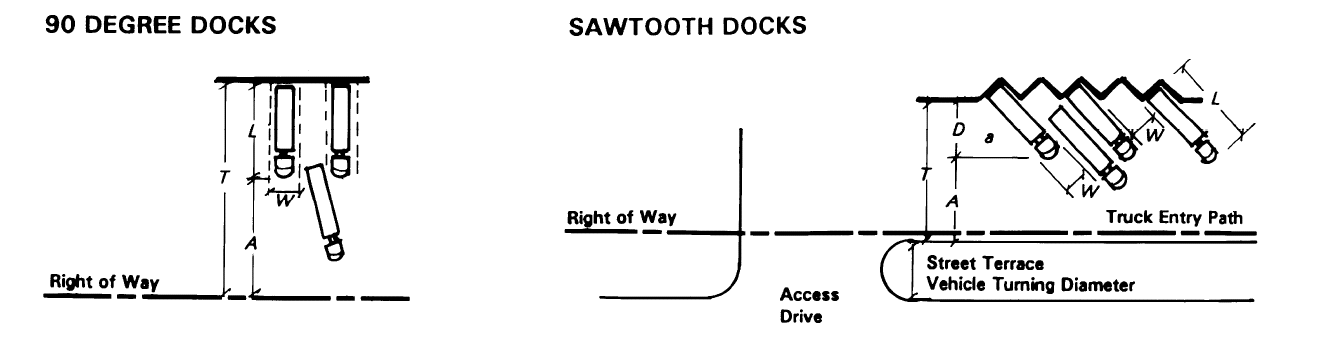
Size of loading area. The first required loading berth shall be designed in accordance with Table 78-705(4). All remaining required loading berths shall be a minimum of 50 feet in length and ten feet in width. All required loading berths shall have a minimum vertical clearance of 14 feet. The following standards shall be the minimum used to design loading areas:
Table 78-705(4): Loading Standards
(5)
Access to loading area. Each loading berth shall be located so as to facilitate access to a public street or alley, and shall not interfere with other vehicular or pedestrian traffic per section 78-704, and shall not interfere with the function of parking areas. In no instance shall loading areas rely on backing movements into public rights-of-way.
(6)
Surfacing and marking. All required loading areas shall be paved and maintained in a dust-free condition at all times. Said surface shall be marked in a manner which clearly indicates required loading areas.
(7)
Use of required loading areas. The use of all required loading areas shall be limited to the loading and unloading of vehicles. Said area shall not be used to provide minimum required parking spaces.
(8)
Lighting. All loading areas shall be lit so as to not exceed the standards of section 78-707.
(9)
Signage. All signage located within, or related to, loading areas shall comply with the requirements of article VIII.
(10)
Depiction on required site plan. Any and all required loading areas and trailer and container storage areas proposed to be located on the subject property shall be depicted as to their location and configuration on the site plan required for the development of the subject property. (Refer to section 78-908.)
(11)
Calculation of required loading spaces.
(a)
Indoor institutional land uses. One loading berth shall be required for each building having a gross floor area of 6,000 square feet to 29,999 square feet. For such uses located in buildings having a gross floor area of 30,000 square feet or greater, two loading berths shall be required.
(b)
Commercial (except offices), storage/disposal, transportation, and industrial land uses. One loading berth shall be required for each building having a gross floor area of 6,000 square feet to 29,999 square feet. For such uses located in buildings having a gross floor area of 30,000 square feet or greater, an additional loading berth shall be required for any portion of each 50,000 square feet of gross floor area in addition to the original 29,999 square feet.
(c)
Office land uses. One loading berth shall be required for each building having a gross floor area of 6,000 square feet to 99,999 square feet. For such uses located in buildings having a gross floor area of 100,000 square feet or greater, an additional loading berth shall be required for any portion of each 100,000 square feet of gross floor area in addition to the original 99,999 square feet.
(Ord. No. 0-6-09, 6-23-2009; Memo. of 3-22-2010)
Sec. 78-706. - Exterior storage standards for residential, office, and business districts.
(1)
Purpose. The purpose of this section is to control the use of residential, office and commercial property for exterior storage so as to promote the safety and general welfare of the public. For exterior storage in agricultural and industrial districts, refer to section 78-206.
(2)
Requirements for exterior storage in office and business districts. In all office and business zoning districts (see section 78-102 for a listing of these districts), all materials and equipment shall be stored within a completely enclosed building except for the following which shall not be located within any front yard or required street yard (except for vehicles in designated parking spaces) and shall be stored a minimum of five feet from any and all property lines: screened refuse containers; construction materials, landscape materials and related equipment connected within on-site construction; and off-street parking.
(3)
Inoperative motor vehicles and junk. Refer to the City Code of Ordinances, section 10-318.
(4)
Exterior trash storage. All exterior trash storage shall be located within a gated enclosure that completely screens the view of said trash. The exterior of said enclosure shall be constructed of some or all of the materials used on the main building.
(5)
Exterior parking and storage of recreational and trailering vehicles such as mobile homes, jetski, boats, all trailers, campers, snowmobiles, off-road motorcycles, ATVs and similar vehicles. For this section, recreational vehicles are defined as either motor vehicles or tow-able trailers and are primarily intended for leisure activities such as trail riding and camping.
Recreational vehicles and trailers:
(a)
Parked or stored within the front yard or side yard must be on a driveway that is made of a dust-free, continual hard surface such as concrete or asphalt pavement and shall be a minimum of five feet from any property line or right-of-way line. Permeable pavement including turfstone is also allowable. For this section, the side yard shall end at the rear of the home.
(b)
May be parked in the rear yard, beyond the rear of the home without the need for a hard surface, subject to all other conditions. Note: corner lots have two fronts, one side and one rear.
(c)
Shall be owned by the resident who is occupying the property on which the vehicle is parked or stored.
(d)
Are permitted only for storage purposes except mobile homes and campers may be used for overnight sleeping for a maximum of 14 days in one calendar year.
(e)
Shall not be permanently connected to wastewater or sanitary sewer lines, or electricity except for charging of batteries.
(f)
Shall not be used for storage of goods, materials or equipment other than those items considered to be part of the unit or essential for its use.
(g)
Shall be placed a minimum of five feet from all property lines and shall not be parked within any easement.
(h)
The maximum number of recreational vehicles and trailers allowed outside of a building per property is three unless the property is zoned for such outdoor storage.
(i)
A trailer with multiple recreational vehicles on it shall be considered one recreational vehicle, but all recreational vehicles on the trailer shall be owned by the resident occupying the property on which trailer is parked.
(j)
Individual canoes, kayaks and similar vehicles not on a trailer are exempt from these requirements.
(Ord. No. 0-6-09, 6-23-2009; Ord. No. 0-1-2012, § 3, 1-24-2012; Ord. No. 0-2-2012, § 1, 1-24-2012; Ord. No. 0-5-2015, § 1, 4-14-2015)
Sec. 78-707. - Exterior lighting standards.
(1)
Purpose. The purpose of this section is to regulate the spill-over of light and glare on operators of motor vehicles, pedestrians, and land uses near a light source in order to promote traffic safety and to prevent the creation of nuisances.
(2)
Applicability. The requirements of this section apply to all private exterior lighting within the jurisdiction of this chapter, except for lighting within public rights-of-way and/or lighting located on public property.
(3)
Depiction on required site plan. Any and all exterior lighting shall be depicted as to its location, orientation and configuration on the site plan required for the development of the subject property. (Refer to section 78-908.)
(4)
Requirements.
(a)
Orientation of fixture. In no instance shall an exterior lighting fixture be oriented so that the lighting element (or a clear shield) is visible from a property located within a residential zoning district. The use of shielded luminaries and careful fixture placement is encouraged so as to facilitate compliance with this requirement.
(b)
Intensity of illumination. In no instance shall the amount of illumination attributable to exterior lighting, as measured at the property line, exceed 0.50 footcandles above ambient lighting conditions on a cloudless night.
(c)
Location. Light fixtures shall not be located within required bufferyards.
(d)
Fixture heights. The maximum fixture height in the CB, ER-1, NO, NB, SR-3, SR-4, SR-5, SR-6, TR-6, and MR Districts shall be 16 feet. The maximum fixture height in the RH, PO, PB, PI, GI, HI, and I Districts shall be 25 feet.
(e)
Flashing, flickering and other distracting lighting. Flashing, flickering and/or other lighting which may distract motorists are prohibited.
(f)
Minimum lighting standards. All areas designated on required site plans for vehicular parking, loading, or circulation and used for any such purpose after sunset shall provide artificial illumination in such areas at a minimum intensity of 0.4 footcandles.
(g)
Nonconforming lighting. All lighting fixtures existing prior to the effective date of this chapter shall be considered as legal conforming uses (see section 78-210).
(h)
Special events lighting. Any temporary use using exterior lighting which is not in complete compliance with the requirements of this section shall secure a temporary use permit. (Refer to section 78-906.)
(Ord. No. 0-6-09, 6-23-2009; Memo. of 3-22-2010; Ord. No. 0-20-2020, 10-13-2020; Ord. No. 0-21-2024, § 1(Exh. A), 11-26-2024)
Sec. 78-708. - Vibration standards.
(1)
Purpose. The purpose of this section is to regulate the creation of vibration which adversely effects adjoining properties in order to prevent the creation of nuisances and to promote the general welfare of the public.
(2)
Applicability. The requirements of this section apply to all uses and activities which create detectable vibrations, except that these standards shall not apply to vibrations created during the construction of the principal use on the subject property.
(3)
Depiction on required site plan. Any activity or equipment which create detectable vibrations outside the confines of a building shall be depicted as to its location on the site plan required for the development of the subject property. (See section 78-908.)
(4)
Requirements. No activity or operation shall cause or create earthbone vibrations in excess of the displacement values given below.
(5)
Method of measurement. Measurements shall be made at or beyond the adjacent lot line or the nearest residence district boundary line, as described below. Vibration displacements shall be measured with an instrument capable of simultaneously measuring in three mutually perpendicular directions. The maximum permitted displacements shall be determined in each zoning district by the following formula:
D = K/f, where D = displacement in inches
K = a constant to be determined by reference to the tables below
f = the frequency of vibration transmitted through the ground, cycles per second
(6)
Reserved.
(7)
Standards in the heavy industrial district. In the Heavy Industrial District, the maximum earth displacement permitted at the points described below shall be determined by use of the formula above and the appropriate K constant shown in the table below.
(8)
Standards in the Light Industrial District. In the Light Industrial District, the maximum earth displacement permitted at the points described below shall be determined by use of the formula above and the appropriate K constant shown in the table below.
(Ord. No. 0-6-09, 6-23-2009; Ord. No. 0-01-2026, § 1(Exh. A), 1-27-2026)
Sec. 78-709. - Noise standards.
(1)
Purpose. The purpose of this section is to regulate the creation of noise which adversely affects adjoining properties in order to prevent the creation of nuisances and to promote the general welfare of the public.
(2)
Applicability. The requirements of this section apply to all uses and activities which create detectable noise, except that these standards shall not apply to noise created during the construction of the principal use on the subject property, or by incidental traffic, parking, loading, maintenance or agricultural operations.
(3)
Requirements. All noise shall be muffled so as not to be objectionable due to intermittence, beat frequency or shrillness. In no event shall the sound-pressure level of noise radiated from a facility exceed at the lot line of the subject property the values given in Table 78-709(3)(a) (set out hereafter) as measured by, at the minimum, a Type 2 sound meter that is in compliance with ANSI standard S1.4-1983, where said lot abuts property within any residential, office, business zoning district, or the Light Industrial (LI) District. (See section 78-102.)
Table 78-709(3)(a): Maximum Permitted Noise Level at Lot Line For Noise
Radiated Continuously*
(4)
Noises that were in effect as of the effective date of this chapter shall be considered legal nonconforming noises. The burden of proof to demonstrate that said noises were in effect prior to the effective date of this chapter shall be the responsibility of the noise producer.
Table 78-709(3)(b): Adjustment Factors for Maximum Noise Levels
(Ord. No. 0-6-09, 6-23-2009; Ord. No. 0-4-2011, §§ 153, 154, 5-10-2011; Ord. No. 0-21-2024, § 1(Exh. A), 11-26-2024; Ord. No. 0-01-2026, § 1(Exh. A), 1-27-2026)
Sec. 78-710. - Air pollution standards.
(1)
Purpose. The purpose of this section is to regulate the creation of air pollution which adversely effects adjoining properties in order to prevent the creation of nuisances and to promote the general welfare of the public.
(2)
Applicability. The requirements of this section apply to all land uses and activities, except that these standards shall not apply to air pollution created during the construction of the principal use on the subject property, or by incidental traffic, parking, loading, or maintenance operations.
(3)
Standards.
(a)
The emission, from all sources within any lot, of particulate matter containing a particle diameter larger than 44 microns is prohibited.
(b)
Emission of smoke or particulate matter of density equal to, or greater than Number 2 on the Ringelmann Chart (US Bureau of Mines) is prohibited at all times.
(c)
Dust and other types of air pollution borne by the wind from such sources as storage areas, yards, and roads within the boundaries of any lot shall be kept to a minimum by appropriate landscaping, paving, oiling or other acceptable means.
(d)
All applicable state and federal standards.
(Ord. No. 01-09, § 1, 3-17-2009)
Sec. 78-711. - Odor standards.
(1)
Purpose. The purpose of this section is to regulate the creation of odor which adversely effects adjoining properties in order to prevent the creation of nuisances and to promote the general welfare of the public.
(2)
Applicability. The requirements of this section apply to all land uses and activities, except that these standards shall not apply to odors created during the construction of the principal use on the subject property, or by incidental fertilizer application, traffic, parking, loading, or maintenance operations. Public landfills and public sanitary sewage treatment plants shall be exempted from the requirements of this section as essential public services.
(3)
Standards. Except for food preparation and cooking odors emanating from residential land uses, and odors associated with property development and maintenance (such as construction, lawn care, and the painting and roofing of structures), no odor shall be created for periods exceeding a total of 15 minutes per any day which are detectable (by a healthy observer such as the zoning administrator or a designee who is unaffected by background odors such as tobacco or food) at the boundary of the subject property, where said lot abuts property within any residential, office, business zoning district, or the Light Industrial (LI) District. (See subsection 78-102.)
(Ord. No. 01-09, § 1, 3-17-2009; Ord. No. 0-01-2026, § 1(Exh. A), 1-27-2026)
Sec. 78-712. - Glare and heat standards.
(1)
Purpose. The purpose of this section is to regulate the creation of glare or heat which adversely effects adjoining properties in order to prevent the creation of nuisances and to promote the general welfare of the public.
(2)
Applicability. The requirements of this section apply to all land uses and activities, except that these standards shall not apply to glare created during the construction of the principal use on the subject property, or by incidental traffic, parking, loading, or maintenance operations.
(3)
Standards. No direct or sky-reflected glare, whether from floodlights or from temperature processes such as combustion or welding or otherwise, so as to be visible at the lot line of the subject property shall be permitted. (See also, section 78-707.) Furthermore, there shall be no transmission of heat or heated air so as to be discernible (by a healthy observer such as the zoning administrator or a designee) at the lot line. Solar systems regulated by Wisconsin Statutes 66.0401 shall be entitled to the protection of its provisions.
(Ord. No. 01-09, § 1, 3-17-2009)
Sec. 78-713. - Fire and explosion standards.
(1)
Purpose. The purpose of this section is to regulate the creation of fire and/or explosion hazards which adversely affect adjoining properties in order to prevent the creation of nuisances and to promote the general welfare of the public.
(2)
Applicability. The requirements of this section apply to all land uses and activities.
(3)
Standards. Any use involving materials which could decompose by detonation shall locate such materials not less than 400 feet from any residential or office zoning district (see section 78-102), except that this standard shall not apply to the storage or usage of liquefied petroleum or natural gas for normal residential or business purposes. All activities and storage of flammable and explosive materials at any point shall be provided with adequate safety and fire fighting devices in accordance with all fire prevention codes of the State of Wisconsin.
(Ord. No. 01-09, § 1, 3-17-2009)
Sec. 78-714. - Toxic or noxious material standards.
(1)
Purpose. The purpose of this section is to regulate the handling of toxic or noxious material which adversely affects adjoining properties in order to prevent the creation of nuisances and to promote the general welfare of the public.
(2)
Applicability. The requirements of this section apply to all land uses and activities.
(3)
Standards.
(a)
No use shall discharge across the boundaries of the subject property, or through percolation into the subsoil, toxic or noxious material in such concentration as to be detrimental to, or endanger, the public health, safety, comfort, or welfare, or cause injury or damage to the property or business.
(b)
No use shall discharge at any point into any public or private sewage disposal system or stream, or into the ground, any liquid or solid materials except in accordance with the regulations of the Wisconsin Department of Public Health.
(Ord. No. 0-6-09, 6-23-2009)
Sec. 78-715. - Waste material standards.
(1)
Purpose. The purpose of this section is to regulate the handling of waste material which adversely effects adjoining properties in order to prevent the creation of nuisances and to promote the general welfare of the public.
(2)
Applicability. The requirements of this section apply to all land uses and activities.
(3)
Standards.
(a)
No use shall discharge across the boundaries of the subject property, or through percolation into the subsoil, toxic or noxious material in such concentration as to be detrimental to, or endanger, the public health, safety, comfort, or welfare, or cause injury or damage to the property or business.
(b)
No use shall discharge at any point into any public or private sewage disposal system or stream, or into the ground, any liquid or solid materials except in accordance with the regulations of the Wisconsin Department of Natural Resources.
(Ord. No. 01-09, § 1, 3-17-2009)
Sec. 78-716. - Exterior construction material standards.
(1)
Purpose. The purpose of this section is to regulate the use of certain exterior construction materials creation so as to attain a degree of uniformity in exterior appearance, and thus maintain and enhance the attractiveness and property value of certain zoning districts.
(2)
Applicability. The requirements of this section apply to all land uses and activities.
(3)
Standards for all residential, office, business, institutional and the industrial zoning districts. Except for exposed foundations not to exceed three feet in height from the adjacent grade, all non-single family development located within the RH, ER-1, SR-3, SR-4, SR-5, SR-6, TR-6, MR, NO, PO, NB, PB, CB, and I districts shall employ only high-quality, decorative exterior construction materials on the visible exterior of the following portions of all structures and buildings:
(a)
Any portion of the building or structure within 50 feet of an adjacent residentially zoned property;
(b)
Any portion of the building or structure located within 50 feet of a public right-of-way;
(c)
Any other portion of the building or structure visible from a public street and/or situated at an angle of 60 degrees or less: from a line which is parallel to the nearest right-of-way (for uncurved rights-of-way); or from a line which is parallel to a chord connecting the right-of-way boundary on the inside side of the curve at points located at, or opposite from, the two outer boundaries of the subject property along the right-of-way line (for curved rights-of-way).
The following exterior construction materials shall not be considered "high quality, decorative:" non-decorative concrete block or cinder block, non-decorative concrete foundation walls or panels, non-decorative plywood, asphaltic siding, or other materials using exposed fastener systems or non-decorative surfaces as determined by the plan commission. However, such materials may be allowed by the plan commission as decorative elements; or,
(d)
Metal panels with exposed exterior fasteners of the same color may be used in the following instances:
1.
Reserved;
2.
In Planned Business (PB) and Light Industrial (LI) Districts on a maximum of 50 percent of the front side of the building (the side containing the primary entrance for customers or visitors). This material is not allowed within 50 feet of any customer or visitor entrance.
(4)
Architecture and design elements shall be compatible with the surrounding area and community standards and shall minimize user-specific design elements as determined appropriate by the plan commission.
(5)
Architectural design is subject to the site plan review process, (see section 78-908).
(6)
Exceptions. The conditional use process (per section 78-905) may be used to propose the use of a material otherwise prohibited by subsection (3) above.
(Ord. No. 01-09, § 1, 3-17-2009; Ord. No. 0-29-2013, § 1, 12-10-2013; Ord. No. 0-21-2024, § 1(Exh. A), 11-26-2024; Ord. No. 0-01-2026, § 1(Exh. A), 1-27-2026)
Sec. 78-717. - Hazardous materials standards.
(1)
Purpose. The purpose of this section is to provide information to the city regarding the nature of land uses which involve research, production, storage, disposal, handling, and/or shipment of hazardous materials.
(2)
Applicability. The requirements of this section apply to all land uses and activities involving any one or more of the following:
(a)
Micro-Organism Cultures subject to Wisconsin Statutes 94.65;
(b)
Pesticides subject to Wisconsin Statutes 94.67(25);
(c)
Biological Products subject to Wisconsin Statutes 95.39;
(d)
Hazardous Substances subject to Wisconsin Statutes 100.37(1)(c);
(e)
Toxic Substances subject to Wisconsin Statutes 101.58(2)(j);
(f)
Infectious Agents subject to Wisconsin Statutes 101.58(2)(f);
(g)
Any material for which the State of Wisconsin requires notification of a local fire department; or
(h)
Any other uses, activities, or materials which are subject to county, state, or federal hazardous, or related, materials regulations.
(3)
Standards. All land uses involving such hazardous materials shall submit a written description of such materials and the operations involving such materials conducted on their property as part of the required site plan submittal. (See section 78-908.)
(Ord. No. 0-6-09, 6-23-2009)
Sec. 78-718. - Fencing standards.
(1)
Purpose. The purpose of this section is to regulate the materials, location, height, and maintenance of fencing, landscaping walls and decorative posts in order to prevent the creation of nuisances and to promote the general welfare of the public.
(2)
Applicability. The requirements of this section apply to all fencing, walls and decorative posts used similar to fencing for all land uses and activities.
(3)
Standards.
(a)
Height of fencing regulated.
1.
On corner lots in all zoning districts, no fence, wall, hedge, planting or structure shall be erected, placed, planted or allowed to grow in such a manner as to obstruct vision between a height of two and one-half feet and ten feet above grade, in the area bounded by the street lines of such corner lots and a line joining the points along such street lines, ten feet from the point of intersection. Additionally, no fence, wall, planting, or structure shall be erected, placed, planted or allowed to grow in such a manner to obstruct vision between a height of two and one-half feet above grade and ten feet above grade on both sides of a driveway where connected to a public sidewalk, ten feet from the points of intersection.
2.
A fence, wall, tree, hedge or shrubbery may be erected, placed, maintained or grown along a lot line on residentially zoned property or adjacent thereto; the height of such fences or walls shall not exceed six feet above the ground level. Where such lot line is adjacent to property zoned NB, PB, CB, PI, GI, or HI; there shall be a ten-foot limit on the height of fencing, along such lot line. For this subsection: On residential corner lots, the street front setback will be determined by the owners' choice. Any fence in the front setback area shall not exceed four feet in height.
3.
Fences, walls, trees, hedges or shrubbery erected, placed, maintained or grown along a lot line on any business or industrially zoned property, adjacent to residentially zoned property, shall be to a height not less than six feet nor more than ten feet in height, except there is no maximum height for trees, hedges or shrubbery. No barbed wire or electrical fences may be erected or maintained, except that barbed tops are permitted in the HI district on top of fences having a minimum height of eight feet.
(b)
Setback for fencing.
1.
Fences in or adjacent to a residential property shall have minimum three feet side and rear yard setbacks unless the adjacent owner consents in writing to the entrance upon such owner's land for the purpose of maintaining such fence or such fence is maintenance free, in which case the minimum setback shall be six inches. A lot survey may be required if property lines cannot be determined.
2.
Living fences or hedges shall be planted so that they may be trimmed without entry on abutting lands. Species shall determine distance but in no case shall any shrub or plant be planted less than three feet from the center to the lot line.
(c)
Wood fences. Wood fences on the perimeter of a lot shall be installed with the finish side of the fence slats facing toward the neighboring property.
(d)
Fence maintenance. All fences, including their painted surfaces, shall be maintained and kept safe and in a state of good repair, including painted surfaces.
(e)
Temporary fences. Fences erected for the protection of plantings or to warn of construction hazards or for similar purposes, shall be clearly visible or marked with colored streamers or other such warning devices at four-foot intervals. Such fences shall comply with the setback requirements set forth in this section. The issuance of a permit shall not be necessary for temporary fences as described in this subsection. Snow fences shall be removed by April 1.
(f)
Fencing for dumpsters. Three or more unit apartment buildings shall provide a six-foot high fence with four sides, accessible by a gate, for dumpsters.
(g)
Orientation. Any and all fences, landscape walls, or decorative posts shall be erected so as to locate visible supports and other structural components toward the subject property.
(h)
Maintenance. Any and all fences, landscape walls, or decorative posts shall be maintained in a structurally sound and attractive manner.
(i)
Easements.
a.
For purposes of this subsection, "utility easement area" means a land area subject to an easement that allows the City of Stoughton or a public utility to use the land for the installation, operation or maintenance of facilities used for the distribution of electricity, or for the conveyance of water, wastewater or stormwater.
b.
Except as expressly authorized by this subsection, no fence shall be located within the boundaries of a utility easement area.
c.
This subsection shall not apply to any fence that, but for being located in a utility easement area, was a lawfully installed fence on the date this subsection is adopted, and any such fence may be maintained, repaired or replaced without restriction under this subsection.
d.
In the case of a utility easement area that is more than 12 feet wide, and where no underground facilities are located within the utility easement area, the restrictions in this section shall be limited to an area that is 12 feet wide. Where the exterior boundary of the utility easement area is a property line, the 12-foot area in which the restrictions apply shall be measured from the property line. Where the exterior boundary of the utility easement area is not a property line, the 12-foot-area shall be measured from that exterior boundary of the utility easement area that is closest to a property line. However, if a utility easement area has been graded to create a drainage swale to convey surface water, no fence may be located within the boundaries of the drainage swale.
e.
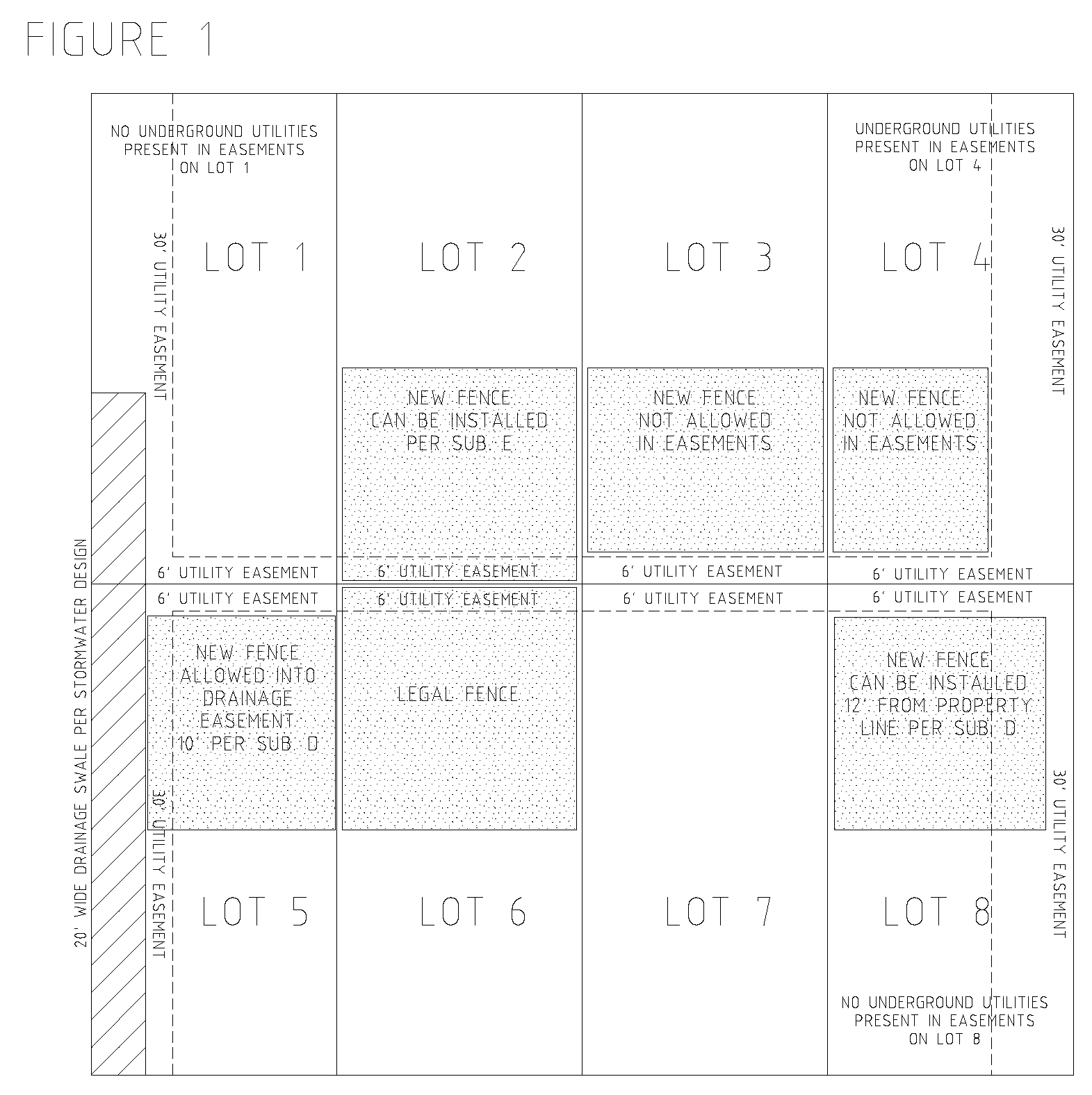
Notwithstanding the limitation in subsection (i)2., where a legal, existing fence is located in a utility easement area along and parallel to the property line between two parcels, a new fence may be located within the utility easement area in order to be connected, in a generally perpendicular manner, to the existing, as illustrated in Figure 1, below. However, if a utility easement area has been graded to create a drainage swale to convey surface water, no fence may be located within the boundaries of the drainage swale.
(Ord. No. 0-6-09, 6-23-2009; Memo. of 3-22-2010; Ord. No. 0-4-2011, § 103, 5-10-2011; Ord. No. 0-4-2015, § 5, 4-14-2015; Ord. No. 0-21-2019, 7-23-2019; Ord. No. 0-01-2026, § 1(Exh. A), 1-27-2026)
Sec. 78-721. - Signal receiving antennas (satellite dishes) standards.
(1)
Purpose. This section regulating the placement of signal receiving antennas is adopted to:
(a)
Provide uniform regulation of all signal receiving antenna devices;
(b)
Secure placement of such antennas in an aesthetically sensitive manner while allowing users reasonable reception of signals;
(c)
Protect the public from injury from antennas that are inadequately mounted, unduly susceptible to wind pressure, improperly installed and wired, or are placed on structures insufficiently designed or constructed to safely support the antenna; and
(d)
Provide for placement of such antennas in locations that preserve access to rear property areas by firefighting apparatus and emergency personnel.
(2)
Definitions.
(a)
For purposes of this section, a "signal receiving antenna" is defined as any apparatus capable of receiving communications from a transmitter or a transmitter relay located in a planetary orbit. This definition includes all types of signal receiving antennas, including, without limitation, parabolic antennas, home earth stations, satellite television disks, UHF and VHF television antennas, and AM, FM, ham and short-wave radio antennas, regardless of the method of mounting.
(b)
"Owner" means the holder of record of an estate in possession of fee simple, or for life, in land or real property, or a vendee of record under a land contract for the sale of an estate in possession in fee simple or for life but does not include the vendor under a land contract. A tenant in common or joint tenant shall be considered such owner to the extent of his interest. The personal representative of at least one owner shall be considered an owner.
(3)
Application. Application for a signal receiving antenna permit shall be made in writing to the zoning administrator. With such application, there shall be submitted a fee (see section 78-919) and a sufficient set of mounting plans and specifications, including a general plot plan showing the location of the proposed signal receiving antenna with respect to streets, lot lines and buildings. If such application meets all requirements of this section, the application shall be approved.
(4)
Installation standards. Signal receiving antennas installed in any zoning district within the city shall comply with the following provisions:
(a)
Setbacks.
1.
Any signal receiving antenna and its mounting post shall be located a minimum of ten feet from any property line.
2.
Subject to the provisions herein, signal receiving antennas shall only be located in the rear yard of any lot. If reasonable reception of signals is not possible with a rear yard placement due to the physical characteristics of the lot and area, the signal receiving antenna shall be placed in the side yard of the lot. In the event that reasonable reception of signals is not possible by locating the signal receiving antenna on the rear or side yard of the property, such antenna may be placed in the front yard or on the roof of structures on the property. For corner lots, a side yard is only a yard that does not face a street.
3.
If side yard, front yard or roof mounting is requested, the zoning administrator shall determine where reasonable reception is possible, based on evidence provided by the person seeking to erect or construct the antenna.
(b)
Mounting. Signal receiving antennas attached to the wall or roof of any principal or accessory structure shall be permitted only if the structure is properly constructed to carry all imposed loading and complies with applicable state and local building code requirements. The zoning administrator may require engineering calculations.
(c)
Diameter. The diameter of the signal receiving antenna shall not exceed 15 feet in diameter for business uses or ten feet in diameter for residential uses, except for systems used to provide community antenna television services.
(d)
Height.
1.
A ground-mounted signal receiving antenna, including any platform or structure upon which said antenna is mounted or affixed, may not exceed 18 feet in height, as measured from the ground to the highest point of the dish.
2.
A roof-mounted antenna may not exceed 15 feet in height above the surrounding roof line as measured from the lowest point of the existing roof line.
(e)
Wind pressure. All signal receiving antennas shall be permanently mounted in accordance with the manufacturer's specifications for installation. All such installations shall meet a minimum wind load design velocity of 80 MPH.
(f)
Electrical installations. Electrical installations in connection with signal receiving antennas, including grounding of the system, shall be in accordance with the National Electrical Safety Code, Wisconsin State Electrical Code and the instructions of the manufacturer. In cases of conflict, the stricter requirements shall govern. All cable used to conduct current or signals from the signal receiving antenna to the receivers shall be installed underground unless installation site conditions preclude underground. If a signal receiving antenna is to be used by two or more residential property owners, all interconnecting electrical connections, cables and conduits must also be buried. The location of all such underground lines, cables and conduits shall be shown on the application for a permit. All signal receiving antennas shall be grounded against direct lightning strikes.
(g)
Temporary placement. No portable or trailer-mounted signal receiving antenna shall be allowed, except for temporary installation for on-site testing and demonstration purposes for periods not exceeding five days. However, such trial placement shall be in accordance with all provisions of this section. Failure to comply shall result in a citation being issued for violation of this section. Any person making such temporary placement shall first give written notice to the zoning administrator of the date when such placement shall begin and end.
(h)
Advertising. No form of advertising or identification, sign or mural is allowed on the signal receiving antenna other than the customary manufacturer's identification plates.
(i)
Interference with broadcasting. Signal receiving antennas shall be filtered and/or shielded so as to prevent the emission or reflection of an electromagnetic radiation that would cause any harmful interference with the radio and/or television broadcasting or reception on adjacent properties. In the event that harmful interference is caused subsequent to its installation, the owner of the signal receiving antenna shall promptly take steps to eliminate the harmful interference in accordance with Federal Communications Commission regulations.
(j)
Compliance with federal regulations. The installation and use of every signal receiving antenna shall be in conformity with the Federal Cable Communications Policy Act of 1984 and regulations adopted there under.
(k)
Aesthetic considerations. Signal receiving antennas shall be located and designed to reasonably reduce visual impact from surrounding properties at street level.
(5)
Enforcement. It shall be unlawful to construct, use, build or locate any signal receiving antenna in violation of any provisions of this section. In the event of any violation, the common council or any property owner who would be specifically damaged by such violation may institute appropriate action or proceedings to enjoin a violation of this section.
Any person, firm or corporation who fails to comply with the provisions of this section shall, upon conviction, be subject to the general penalty found in section 78-920.
(Ord. No. 0-6-09, 6-23-2009; Ord. No. 0-24-09, § 1, 12-22-2009; Memo. of 3-22-2010; Ord. No. 0-1-2012, § 4, 1-24-2012)
Sec. 78-722. - Swimming pools standards.
(1)
Definition. A "swimming pool" means an outdoor structure containing a body of water in a receptacle or other container having a depth for water at any point greater than 36 inches located above or below the surface of ground elevation or deck, used or intended to be used solely by the owner, operator or lessee thereof and by family and friends invited to use it, and includes all structural facilities, appliances and appurtenances, equipment and other items used and intended to be used for the operation and maintenance of a private or residential swimming pool.
(2)
Exempt pools. storable swimming or wading pools that are so constructed that they may be readily disassembled for storage and reassembled to their original integrity and have a maximum water capacity of 36 inches are exempt from the provisions of this section. Decorative pools that are 36 inches or less in maximum water depth are exempt from the provisions of this section. Spas and hot tubs with lockable tops are also exempt.
(3)
Permit required. Before work is commenced on the construction or erection of a private or residential swimming pool or on any alterations, additions, remodeling or other improvements, an application for a swimming pool building permit to construct, erect, alter, remodel or add thereto must be submitted in writing to the building inspector. Plans and specifications and pertinent explanatory data should be submitted to the building inspector at the time of application. No work or any part of the work shall be commenced until a written permit for such work is obtained by the applicant. A current fee shall accompany such application.
(4)
Construction requirements. In addition to such other requirements as may be reasonably imposed by the building inspector, the building inspector shall not issue a permit for construction as provided for in subsection (3), above, unless the following construction requirements are observed:
(a)
Approved materials. All materials and methods of construction in the construction, alteration, addition, remodeling or other improvements and pool installation shall be in accord with all state regulations and code and with any and all ordinances of the city now in effect or hereafter enacted.
(b)
Plumbing. All plumbing work shall be in accordance with all applicable ordinances of the city and all state codes. Every private or residential swimming pool shall be provided with a suitable draining method, and in no case shall waters from any pool be drained into the sanitary sewer system or onto lands of other property owners adjacent to that on which the pool is located or in the general vicinity.
(c)
Electrical installations. All electrical installations, including lighting and heating but not limited thereto, which are provided for, installed and used in conjunction with a private swimming pool shall be in conformance with the state laws and city ordinances regulating electrical installations.
(5)
Setbacks and other requirements.
(a)
Private swimming pools shall be erected or constructed on rear or side lots only and only on a lot occupied by a principal building. No swimming pool shall be erected or constructed on an otherwise vacant lot. A lot shall not be considered vacant if the owner owns the contiguous lot and said lot is occupied by a principal building.
(b)
All swimming pools shall be at least six feet from any lot line or building unless designed and approved as an addition to a building.
(6)
Enclosure. Pools within the scope of this section that are not enclosed with a permanent building shall be completely enclosed by a fence of sufficient strength to prevent access to the pool. Such fence or wall including gates and doors shall not be less than five feet in height from ground level, not less than four feet from the pool edge, and constructed not to have voids, holes or openings larger than four inches in one dimension. Gates or doors shall be equipped with self-closing and self-latching devices located at the top of the gate or door on the pool side of the enclosure, except the door of any residence that forms a part of the enclosure. Above ground pools with an attached rail fence system that combined with the side of the pool is at least five feet in overall height above ground level satisfies fencing height requirements. Any deck or entry attached or adjacent to an above ground pool must be fenced to meet the five-foot height requirement and any stairs used to gain entrance to an above ground pool shall be equipped with a gate with self-closing, self-latching devices as described above.
(7)
Compliance. All pools, including those pools existing at the time of passage of this section, shall comply with the fencing requirements of this section. Enclosures for pools shall be inspected by the zoning administrator for compliance. Variations in enclosure requirements that do not adversely affect the safety of the public may be approved.
(8)
Draining and approval thereof. No private swimming pool shall be constructed so as to allow water therefrom to drain into any sanitary sewer nor to overflow upon or cause damage to any adjoining property. Provisions may be made for draining the contents of any swimming pool into a storm sewer, but such installation shall be subject to prior approval by the Plumbing Inspector.
(9)
Filter system required. All private swimming pools within the meaning of this chapter must have, in connection therewith, some filtration system to assure proper circulation of the water therein and maintenance of the proper bacterial quality thereof.
(10)
Dirt bottoms prohibited. All swimming pools of a permanent nature shall have the sides and bottom of a smooth finish, and no sand or dirt bottom shall be permitted.
(Ord. No. 0-6-09, 6-23-2009; Memo. of 3-22-2010; Ord. No. 0-4-2011, § 106, 5-10-2011; Ord. No. 0-3-2021, 1-26-2021)
Sec. 78-723. - Outdoor storage of firewood standards.
(1)
No person shall store firewood in the front yard on residentially zoned property, except that firewood may be temporarily stored in the front yard for a period of 30 days from the date of its delivery.
(2)
Firewood should be neatly stacked and may not be stacked closer than two feet to any lot line and not higher than six feet from grade, except adjacent to a fence where firewood can be stacked against the fence as high as the fence. Fences as used in this section shall not include hedges and other vegetation.
(3)
All brush, debris and refuse from processing of firewood shall be promptly and properly disposed of and shall not be allowed to remain on the premises.
(4)
Woodpiles that contain diseased wood that is capable of transmitting disease to healthy trees and woodpiles that harbor or are infested or inhabited by rats or other vermin are public nuisances and may be abated pursuant to the provisions of this Code of Ordinances.
(5)
Not more than 20 percent of the side and rear yard may be used for storage of firewood at any one time.
(Ord. No. 0-6-09, 6-23-2009)
Sec. 78-724. - Administration and enforcement of performance standards.
(1)
Determinations necessary for administration and enforcement of performance standards set forth herein range from those which can be made with satisfactory accuracy by a reasonable person using normal senses and no mechanical equipment, to those requiring great technical competence and complex equipment for precise measurement. It is the intent of this chapter that:
(a)
Where determinations can be made by the zoning administrator using equipment normally available to the city or obtainable without extraordinary expense, such determinations shall be so made before notice of violations is issued.
(b)
Where technical complexity or extraordinary expense makes it unreasonable for the city to maintain the personnel or equipment necessary for making difficult or unusual determinations, procedures shall be available for causing corrections or apparent violations of performance standards, for protecting individuals from arbitrary, capricious, and unreasonable administration and enforcement of performance standard regulations, and for protecting the general public from unnecessary costs for administration and enforcement.
1.
The zoning administrator shall give written notice, by certified mail or other means, ensuring a signed receipt for such notice to the person or persons responsible for the alleged violations. The notice shall describe the particulars of the alleged violation and the reasons why the zoning administrator believes there is a violation in fact, and shall require an answer or correction of the alleged violation to the satisfaction of the zoning administrator.
2.
The notice shall state, and it is hereby declared, that failure to reply or to correct the alleged violation to the satisfaction of the administrative official within the time limit set constitutes admission of violation of the terms of this chapter. The notice shall further state that upon request of those to whom it is directed, technical determination as described in this chapter will be made, and that if violations as alleged are found, costs of such determinations shall be charged against those responsible for the violation, in addition to such other penalties as may be appropriate, but that if it is determined that no violation exists, the cost of the determination will be paid by the city.
(2)
Enforcement of the provisions of this article shall be per section 78-920.
(Ord. No. 0-6-09, 6-23-2009)

