
Tarrant City Zoning Code
ARTICLE 2
- DEFINITIONS
Sec. 2.01.- Meaning of certain terms.
For the purpose of this ordinance, certain words and terms are defined as herein indicated and shall apply to all parts of this Ordinance. Unless specifically defined herein, words or phrases used in this ordinance shall be interpreted so as to give then the same meaning as they have in common usage and so as to give this Ordinance its most reasonable application. All words used in the present tense shall include the future tense; all words in the singular number shall include the plural number; and all words in the plural number shall include the singular number unless the natural construction of the wording indicates otherwise; the words "used for" shall include the meaning "designed for"; and the word "lot" shall include the words "plot", "property", "parcel" and "tract". The word "shall" is mandatory and not directory. The word "may" is permissive. The word "person" shall include a firm, corporation, association, organization, trust or partnership. The masculine gender shall include the feminine, and the feminine gender the masculine.
(a)
General definitions.
Access drive. A private drive providing vehicular access between a thoroughfare and an off-street parking area.
Accessory building or structure. A building or structure subordinate to the principal building, the use of which is incidental to the principal use of the premises. An accessory building, other than an accessory dwelling, does not contain a dwelling unit.
Accessory use. A use incidental to the main use of the premises. A sign is considered accessory to the use permitted. Billboards and other off-premise signs are not so considered, but are rather considered separate and distinct business uses or activities.
Alley. A strip of land over which there is a publicly or privately owned right-of-way, and on which no parcel fronts, which provides access for two (2) or more properties typically along the side or rear of such properties.
Alteration, alter, altered. Any addition to the height, width or depth of a building or structure; or any change in the location of any of the exterior walls of a building or structure; or any increase in the interior accommodations of a building or structure.
Animal equivalent unit. A measure used to determine the number of animals permitted on a hobby farm.
Applicant. A landowner or developer, as hereinafter defined, who has filed an application for development including his heirs, successors and assignees.
Application for development. Every application, whether preliminary, tentative or final, required to be filed and approved prior to start of construction or development including but not limited to an application for a building permit, for the approval of a subdivision plat or plan, or for the approval of a development plan.
Arterial or arterial road. See "thoroughfare, arterial."
Basement. That portion of a building which is completely below grade or partially below grade where the average distance between the finished surface of the above floor and the ground level along the perimeter of all exterior walls is less than six (6) feet.
Block. A unit of land bounded by thoroughfares or a combination of thoroughfares, public land, public parks, cemeteries, railroad rights-of-way, watercourses, or any other barrier to the continuity of development.
Block, double-tiered. A residential block bounded on all sides by a combination of thoroughfares and within which lots fronts only on two of the surrounding thoroughfares, as shown in the illustration at right.
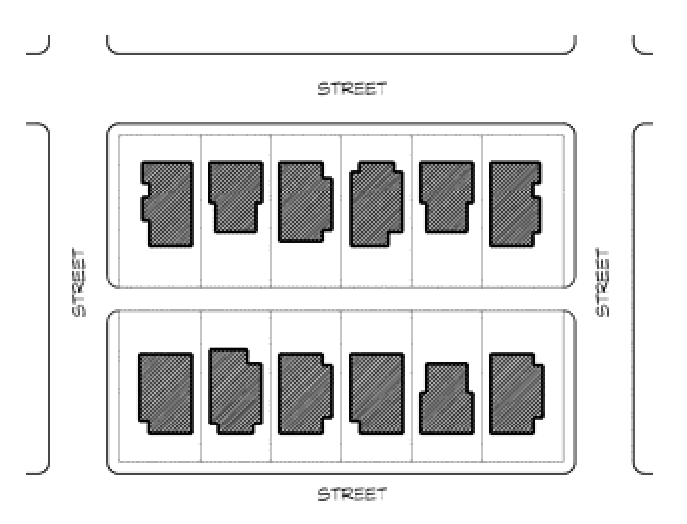
Double-tiered Block
Buffer. A landscaped strip of land provided between two or more properties, uses, or buildings to mitigate the incompatible characteristics of adjacent uses and/or buildings. Buffers may include berms, shrubs, trees, fences or walls, other screening devices, or a combination of such devices as required by this Ordinance.
Building. Any structure constructed or used for a residence, business, industry, or other public or private purpose, or accessory thereto, and including porches, decks, swimming pools, greenhouses, stables, garages, roadside stands, manufactured homes, and similar structures, whether stationary or movable, but excluding fences, walls, signs and awnings. Features, which are structurally essential and connected to the structure, shall be considered as part of the structure within the meaning of this Ordinance.
Building code. The International Building Code as written by the International Code Council; the adopted building code of the City of Tarrant, Alabama.
Building frontage. The side of the building which fronts on a thoroughfare; the length or area of the front of the building measured between the side walls.
Building height. The vertical distance from average grade level to the highest point of the coping of a flat roof or to the deck line of a mansard roof, or to the average height between eaves and ridge for gable, hip and gambrel roofs.
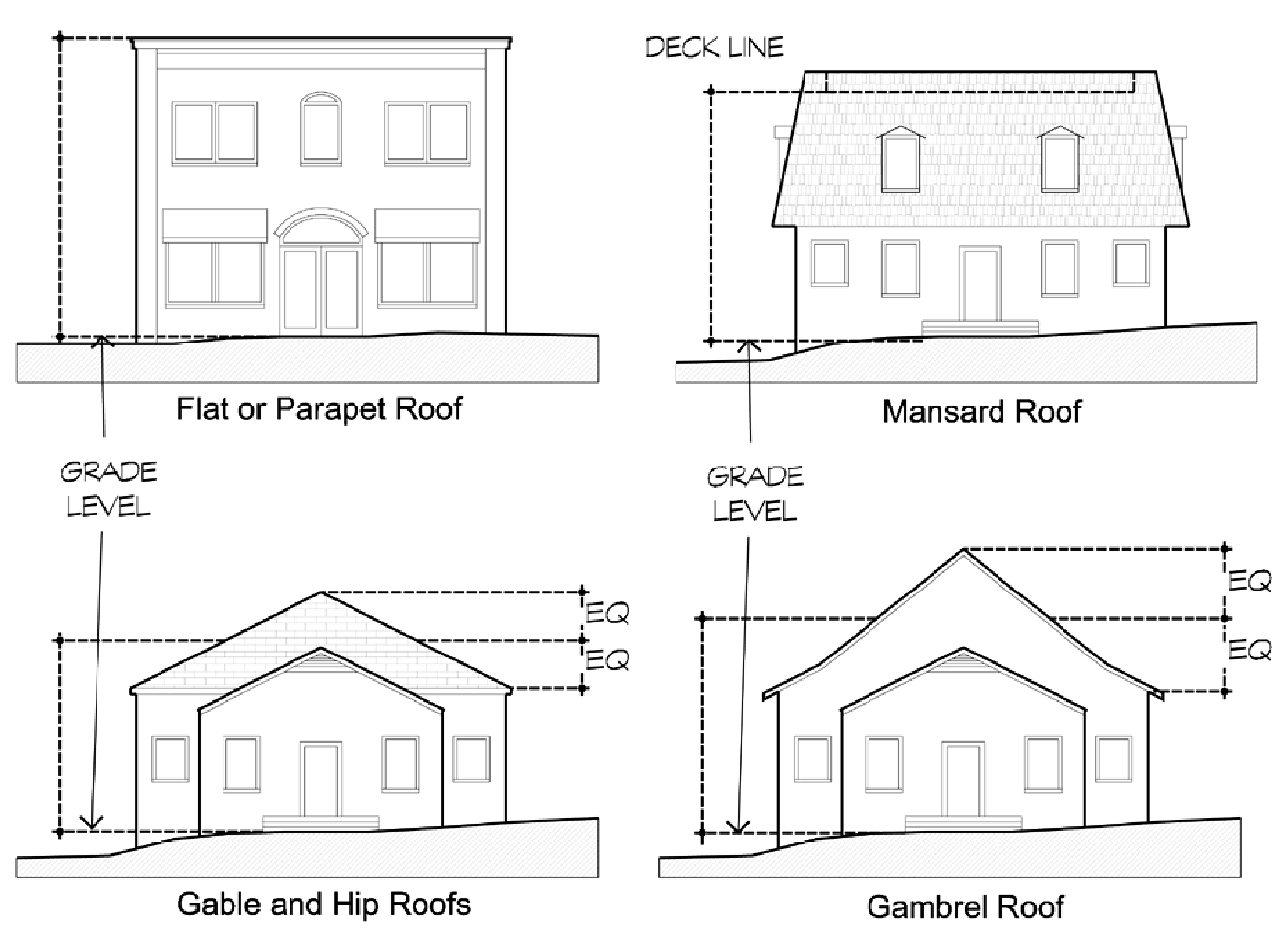
Measurement of Building Height
Building line. The extreme overall dimensions of a building as staked on the ground, including porches, chimneys and similar projections at grade level, whichever is nearest to the property line. The front building line refers to that portion of the building nearest the front lot line.
Build-to line. A line parallel to the front property line, which establishes the maximum setback allowed within the NC, TC and GB Zones. Example: A build-to line of twenty (20) feet requires that the front building line can be no further than twenty (20) feet from the front property line: A corner lot shall be considered to have two such build-to lines in an applicable zone.
Caliper. The diameter of the trunk of a tree measured six inches above grade level.
Cartway. The width of a thoroughfare or alley available for vehicular traffic, including on-street parking.
Certificate of occupancy. A certificate issued by the duly authorized representative of the City upon completion of the construction of a new building or upon a change or conversion of the structure or use of a building, which certifies that all requirements and regulations as provided herein, and within all other applicable requirements, have been complied with.
City. The City of Tarrant, Jefferson County, Alabama.
City engineer. A registered professional engineer, licensed as such by the State of Alabama, employed by the city or engaged as a consultant to the city.
Collector or collector road. See "thoroughfare, collector."
Comprehensive plan. The official public document prepared in accordance with § 11-52-8 of the Code of Alabama, as amended, consisting of maps, charts, and textual material, that constitutes a policy guide to decisions about the physical and social development of the City of Tarrant.
Conditional use. A use of unique character and impact which is typically not associated with or permitted in the applicable zone but which may be allowed by granting of a Conditional Use permit by the city council according to special conditions to abate potential negative impacts to surrounding properties and neighborhoods.
Covenant. "See deed restriction".
Cul-de-sac. See "thoroughfare, cul-de-sac."
Deck. An elevated structure constructed for use as an outdoor living area.
Dedication. The deliberate appropriation of land, such as an easement, by its owner for public use.
Deed restriction. A restriction upon the use of a property placed in a deed running with the land and enforced by private landowners or homeowner or condominium associations.
Density. The number of units of occupancy per acre of lot area within a block.
Developer. Any landowner, agent of such landowner or tenant with the permission of such landowner, who makes or causes to be made a subdivision of land or a land development.
Development. Any of the following activities:
(1)
The improvement of one (1) lot or two (2) or more contiguous lots, tracts or parcels of land for any purpose involving:
a.
A group of two (2) or more residential or nonresidential buildings, whether proposed initially or cumulatively, or a single nonresidential building on a lot or lots regardless of the number of occupants or tenure; or
b.
The division or allocation of land or space, whether initially or cumulatively, between or among two (2) or more existing or prospective occupants by means of, or for the purpose of streets, common areas, leaseholds, condominiums, building groups, or other features;
(2)
A subdivision of land; or
(3)
The addition of an accessory building subordinate to an existing principal building when the costs of such construction are greater than five thousand dollars ($5,000.00).
Development plan. See "plan, development plan".
Driveway. See "Access Drive".
Easement. A right granted by a landowner to a grantee, allowing for limited use of private land for a public or quasi-public or private purpose, and with which the landowner of the property shall not have the right to make use of the land in a manner that violates the right of the grantee.
Engineer. A professional engineer registered by the State of Alabama.
Erect, erected, erection. Build, construct, reconstruct, move upon, or other physical operation on the premises required for building. When used in reference to signs, "erect" shall include build, construct, attach, hang, place, suspend, and affix.
Family: any one of the following:
(1)
A single individual occupying a dwelling unit.
(2)
Two (2) or more persons related by blood, marriage or adoption occupying a dwelling unit.
(3)
Not more than four (4) unrelated persons occupying a dwelling unit.
Fence. A barrier of any material or combination thereof, other than a building, erected to enclose or screen areas of land or used as a means of protection or confinement.
Fence, privacy. A fence intended to provide a visual barrier between common or public areas and a private area or land use. Such fences are characterized by opaque design.
Floodplain. An area adjacent to a watercourse, which area is subject to flooding as the result of the occurrence of an intermediate regional flood and which area thus is so adverse to past, current or foreseeable construction or land use as to constitute a significant hazard to public health and safety and to property.
Floor area, gross. The sum of the total horizontal areas of the several floors of all buildings on a lot, measured from the faces of exterior walls. The term Gross Floor Area shall include basements; elevator shafts; stairwells at each story; floor space used for mechanical equipment with structural headroom of six (6) feet, six (6) inches or more; penthouses; attic space, whether or not a floor has actually been laid, providing structural headroom of six (6) feet, six (6) inches or more; interior balconies; and mezzanines.
Fowl. Winged animals or livestock including chickens, geese, ducks, and exotic birds, but not including birds kept as domestic pets.
Fowl house. An enclosed or partially enclosed agricultural structure used for the keeping and raising of two or more chickens or other fowl.
Fowl pen. A small, partially enclosed structure used for the keeping of no more than one chicken or other fowl.
Gambling device. Any device for the reception of money or other thing of value, on chance or skill or upon the action of which, said money or thing of value is staked, bet, won, or lost; or, any device designed primarily for use in a gambling place; but excluding:
(1)
A coin-operated mechanical device played for the amusement that rewards the player with the right to replay said device;
(2)
Vending machines by which full and adequate return is made for the money invested, and in which there is no element of chance or hazard; and
(3)
Games of skill designed and clearly intended for use by minors, those under the age of nineteen (19) years old.
Grade level. For buildings, the average level of the finished ground surface at the front building line. For ground signs, the average level of the finished ground surface at the edge of the sign nearest the thoroughfare. For thoroughfares, the ratio of rise-to-run measured along a length of a planned or finished thoroughfare.
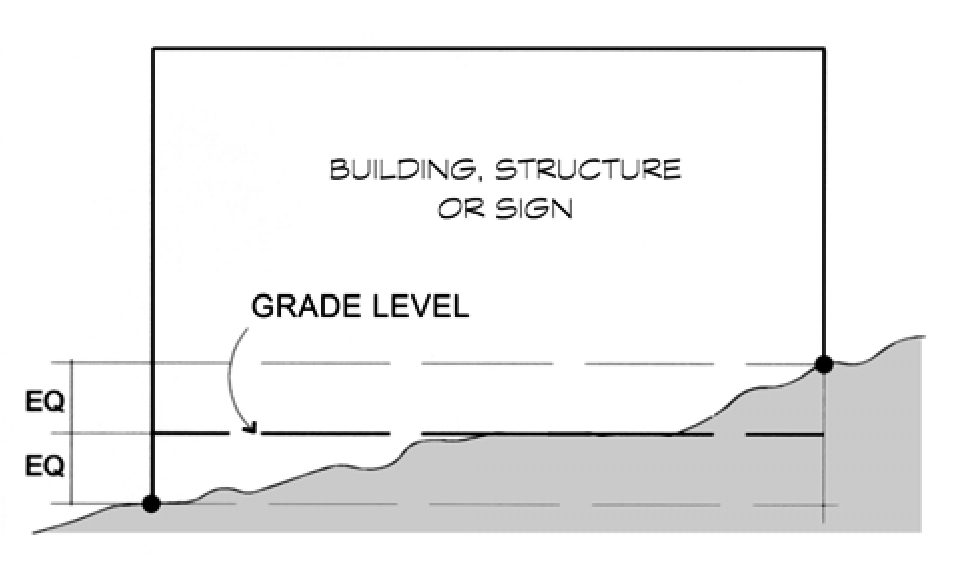
Grade Level
Greenway. An open space corridor that links urban, suburban, and rural communities to natural and scenic areas with a network of connected trials, walkways, and natural preservation areas.
Hardship or unnecessary hardship. A unique condition or set of conditions wherein the literal enforcement of the provisions of this ordinance would deprive a person of rights commonly enjoyed by others in the same zone and as further established in Article 10.
Hardship, personal or self-imposed. A hardship including all other situations not meeting the criteria set forth for proving "unnecessary hardship" in Article 10, including where a person causes or brings about the condition, whether by their own action, inaction, knowledge or lack thereof, etc. Further, such hardships do not represent substantive grounds for the issuance of a variance.
Impervious surface. Any surface or structure, composed of non-porous materials, that prevents natural absorption of runoff into the ground.
Improvements. Those physical additions and changes to the land that may be necessary to produce usable and desirable developments including but not limited to driveways, landscaping, streets, sidewalks, curbs and gutters, sewer, and stormwater management facilities.
Intersection sight distance. The length of the line of sight between a motorist, stopped at an intersection, and the nearest intersection, driveway, alley or other signalized or non-signalized access point to the left or to the right of the motorist. See also "sight triangle, clear".
Junk. Junk shall include scrap, copper, brass, rope, rags, batteries, paper, trash, rubber debris, waste iron, steel and other old or scrap ferrous or non-ferrous material, including wrecked, scrapped, ruined, dismantled or junked motor vehicles or parts thereof.
Landowner. The legal or beneficial owner or owners of land including the holder of an option or contract to purchase (whether or not such option or contract is subject to any condition), a lessee if he is authorized under the lease to exercise the rights of the landowner, or other persons having a proprietary interest in land.
Livestock. Animals of any kind, including fish and fowl, kept, bred or raised for commercial or other purposes, excluding house pets such as domestic cats and dogs, fish, fowl, and other similar animals kept for personal pleasure in accordance with regulations of the health department and applicable animal control authority of Jefferson County.
Loading, off-street. Land occupied, necessary and maintained for loading or unloading of goods, materials or things, for delivery and shipping, in a manner that vehicles may provide for such services without encroaching on or interfering with the public use of streets and alleys by pedestrians and vehicles.
Local street. See "thoroughfare, local street."
Lot. A designated parcel, tract or area of land established by a plat or otherwise as permitted by law and to be used, developed or built upon as a unit. Lots are classified into the following categories:
(1)
Corner lot. A lot abutting two (2) or more street rights-of-way at their intersection in which the average centerlines of such thoroughfares along the frontage of the lot form an interior angle of less than one hundred thirty-five (135) degrees.
(2)
Standard corner lot. A single-family residential corner lot on a double-tiered block.
(3)
Double-frontage lot or through lot. A lot which is not a corner lot and abuts two or more thoroughfares.
(4)
Flag lot. A lot that does not meet the lot width requirements of its zone.
(5)
Interior lot. A lot, which is not a corner lot.
(6)
Reverse-frontage lot. A double-frontage lot where the principal structure fronts on the thoroughfare of lesser classification.
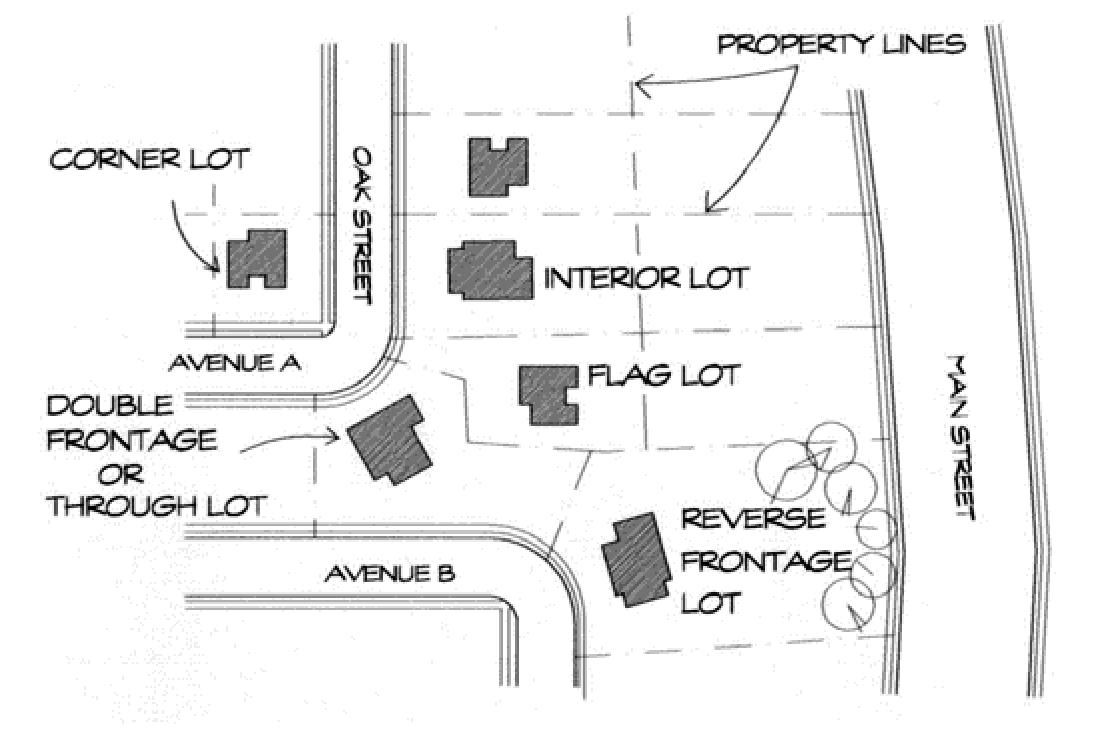
Lot Types
Lot area. The area contained within the lot lines of the individual lot, excluding space within any thoroughfare or ultimate right-of-way, but including the area of any easement. Lot area shall be measured to the legal ROW line of the thoroughfare.
Lot frontage. Distance measured along the front lot line. When a lot fronts on a curved street, the frontage shall be determined by utilizing the arc length.

Lot Frontage
Lot line. A line of record bounding a lot that divides one (1) lot from another lot or from an alley, thoroughfare or any other public space. Lot lines are classified into the following categories:
(1)
Front lot line. A lot line separating the front of the lot from the thoroughfare. On non-residential corner lots, non-standard residential lots and all double-frontage lots, all lot lines, which abut a thoroughfare shall be front lot lines. For standard corner lots, there shall be a "primary front lot line" and a "secondary front lot line".
(2)
Side lot line. Any lot line, which is not a front or rear lot line.
(3)
Rear lot line. A lot line, which does not intersect a front lot line and is most distant from a front lot line. Where the side lot lines of an interior lot meet in a point, the rear lot line shall be assumed to be a line not less than ten (10) feet long drawn within the lot between the two side lot lines, which is equidistant to the front lot line.
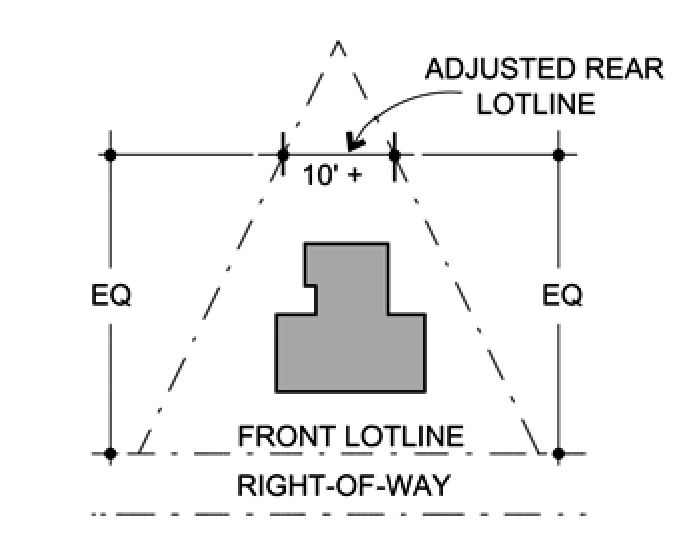
Rear Lot Line (as adjusted, when side lot lines meet at a point)
Lot width. In the case of an interior lot, the distance between the side lot lines. In the case of a standard corner lot, the distance between the side lot line and the secondary front lot line. Such distance shall be measured along a straight line, which is at right angles to the axis of a lot and shall be measured so at any point between the front lot line and the front building line. When a lot abuts on a curved street the lot width shall be determined by utilizing the arc length.
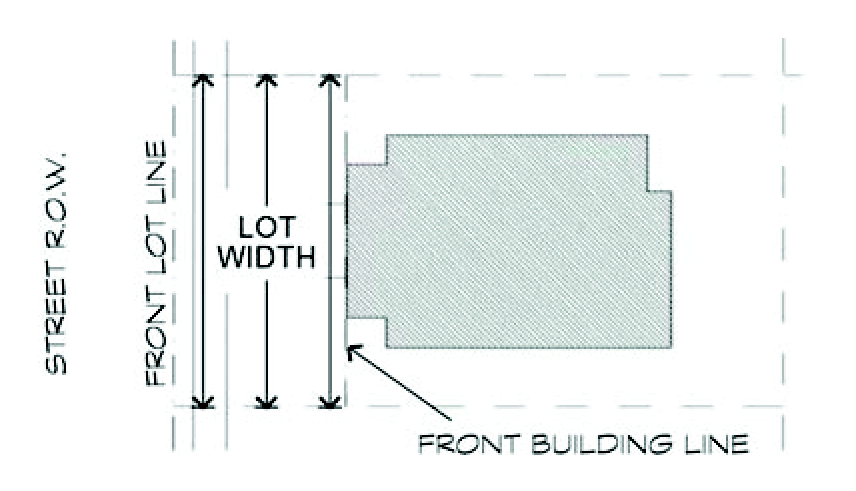
Lot Width (Interior Lot)
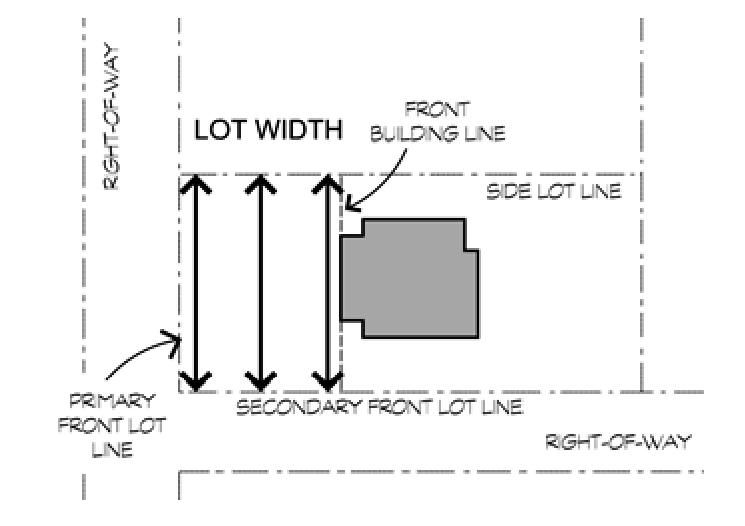
Lot Width (Standard Corner Lot)
Lot of record. A lot which is part of a subdivision, a plat of which had been recorded by Jefferson County at the time of adoption of this ordinance.
Nonconforming lot. A lot the area or dimension of which was lawful prior to the adoption or amendment of this Zoning ordinance, but which fails to conform to the requirements of the zoning district in which it is located by reasons of such adoption or amendment.
Nonconforming structure or building. A structure or part of a structure not complying with the applicable provisions of this ordinance or amendment heretofore or hereafter enacted, where such structure lawfully existed prior to the enactment of such ordinance or amendment or prior to the application of such ordinance or amendment to its location by reason of annexation. Such nonconforming structures include, but are not limited to, nonconforming signs.
Nonconforming use. A use, whether of land or of a structure, which does not comply with the applicable use provisions of this ordinance or amendment heretofore or hereafter enacted, where such use was lawfully in existence prior to the enactment of such ordinance or amendment, or prior to the application of such ordinance or amendment to its location by reason of annexation. Any use whether of land or a structure which is permitted as a special exception or as a conditional use in the applicable zone shall be deemed to be a nonconforming use unless that use complies with every provision of this ordinance.
Open space. Land, not covered by parking areas, rights-of-way or buildings other than recreational structures, which is landscaped or left in a natural state as required by the provisions of this ordinance or the City of Tarrant Subdivision Regulations and which is intended for natural or scenic preservation and/or passive recreational purposes.
Open space, common. Land area within a development that is held in common ownership and maintained by a homeowners' association of all of the residents for recreation, protection of natural land features, amenities or buffers; is freely accessible to all residents of the development; and is protected by covenant and the provisions of this ordinance to ensure that it remains in such uses. Common open space does not include surface water bodies (i.e., rivers, streams, lakes or ponds) nor land occupied by common driveways or parking areas, or street rights-of-way; nor does it include lots for single family or multi-family dwellings. Common open space shall be left in a natural state or landscaped, except in the case of recreational structures.
Ordinance. Except where otherwise specified, the zoning ordinance of the City of Tarrant.
Parking space, off-street. An accessible space permanently reserved for the temporary storage of one vehicle, connected to a thoroughfare by a driveway or an alley.
Party wall. A wall on an interior lot line used or adopted for joint service between two (2) buildings; such walls shall fully comply with fire and all other provisions and standards established for such walls in the building code.
Pervious surface. Any surface, composed of porous materials, that allows absorption of runoff into the ground.
Plan. The provisions for development, including a planned residential development, a plat of subdivision, all covenants relating to use, location and bulk of buildings and other structures, intensity of use or density of development, thoroughfares, sidewalks and parking facilities, common open space and public facilities. A plan shall be categorized as one of the following classifications:
(1)
Development plan. A complete set of drawings prepared for a rezoning request, zoning approval or as otherwise required by this ordinance. Such plan shall provide all information as necessary to determine conformance of the proposed development with this ordinance and other applicable regulations.
(2)
Final plat. A complete and exact subdivision plan including all supplementary data prepared for official recording as required by statute. A final plat becomes a record plat when it has been recorded with the Jefferson County Tax Assessor.
(3)
Preliminary plat. A tentative subdivision plan including all required supplementary data, indicating the proposed layout of a subdivision or land development as a basis for consideration prior to preparation of a final plat.
Planning commission or commission. The City of Tarrant Planning Commission.
Planting strip. A strip of land, between a curb and sidewalk or between an off-street parking area and a sidewalk or thoroughfare, provided for landscaping beds or tree wells.
Plat. A map or plan of a subdivision or land development, whether preliminary or final.
Preliminary plat. See "plan, preliminary plat."
Premises. A lot, together with all buildings and structures existing thereon.
Principal building or structure. The primary structure developed on a property, which is intended to be the largest and closest to the thoroughfare of all structures permitted on one property except in the AG Zone, where farm structures shall be considered accessory structures and may be greater in gross floor area than the principal dwelling.
Principal use. The primary or dominant operation, business or other such use of and taking place on a lot, or premises, as distinguished from accessory uses.
Privacy fence. A fence or wall intended to provide a visual barrier between common or public areas and a private area or land use, characterized by an opaque design and taller than three (3) feet above grade level at the fence line.
Private drive. A service road or access drive serving as and maintained solely for access to cluster or multi-family developments or other developments to which access to the public may be limited.
Public hearing. A formal meeting held pursuant to public notice by the governing body or planning agency, intended to inform and obtain public comment, prior to taking action in accordance with the Code of Alabama.
Public meeting. A forum held pursuant to notice under the act of July 3, 1986 (P.L. 388, No. 84), known as the Sunshine Act, and as amended.
Public notice. Notice published prior to a public hearing by the board of adjustments, commission or city council. Notice for a hearing before the commission shall be posted in four (4) public locations six (6) days prior to such hearing. Notice for a hearing before the board or the council shall be posted in four (4) public locations fifteen (15) days prior to such hearing. Such notices shall state the time and place of the hearing and the particular nature of the matter to be considered at the hearing. Public notice for rezoning, special exception, conditional use and variance requests shall also include the posting of a sign at conspicuous locations along the perimeter of the subject property; these sign(s) shall be posted at least one (1) week prior to the hearing and shall exhibit the nature, date, time, and location of the hearing.
Record plat. See "plan, final plat."
Rezoning. The change of a zoning classification for property as approved by the city council according to the provisions of this ordinance and as categorized below:
(1)
Downzoning. A change in the zoning classification of a property to a zone with greater limitations on uses, density and intensity.
(2)
Lateral rezoning. A change in the zoning classification of a property to a zone with comparable restrictions on land uses, density, and intensity.
(3)
Upzoning. A change in the zoning classification of a property to a zone with fewer limitations on uses, density and intensity.
Right-of-way. The total width of any land reserved or dedicated as a thoroughfare, alley, pedestrian way, or for other public or private use.
Right-of-way line. The legal boundary of the area dedicated and/or improved for a thoroughfare, alley, or pedestrian way typically corresponding with the front lot line of adjacent properties.
Riparian zone. An area of trees and other vegetation which can intercept surface runoff, subsurface flow and deeper groundwater flows for the purpose of removing or buffering the effects of nutrients, pesticides or other chemicals from upland land use, which could otherwise enter bodies of water.
Setback or setback line. A line that is the required minimum distance from any lot line and that establishes required yards and therefore the area within which the principal building must be erected or placed. Example: A required front yard is established between the front lot line and the front setback line.
Significant change in trip generation. A change in the use of a property, including land, structures, or facilities, or an expansion of the size of structures or facilities causing an increase in the trip generation of the property exceeding ten (10) percent (either peak or daily) and one hundred (100) vehicles per day more than the existing use for all thoroughfares under local jurisdiction; or exceeding twenty-five (25) percent (either peak or daily) and one hundred (100) vehicles per day more than the existing use for all roads under state jurisdiction.
Shared parking. The provision of off-street parking areas shared amongst contiguous uses developed with the intent to maximize efficiency in parking lot design and accessibility; encourage pedestrian access and safety; support access management and other goals of the comprehensive plan; and to reduce the number of required spaces for individual uses.
Sight triangle, clear. An area of unobstructed vision at a thoroughfare intersection defined by a line of sight between points at a given distance from the intersection of the street centerlines. See also "intersection sight distance".
Special exception. A condition of use permitted in a particular zone pursuant to the provisions of Article 10.
Specified anatomical area(s). (1) Less than completely and opaquely covered human genitals, pubic region, buttock, and female breast below a point immediately above the top of the areola; and (2) human male genitals in a discernibly turgid state, even where completely and opaquely covered.
Specified sexual activities. (1) Human genitals in a state of sexual stimulation or arousal; (2) acts of human masturbation, sexual intercourse or sodomy; and (3) fondling or other erotic touching of human genitals, pubic region, buttock or female breast.
Spot zoning. The reclassification of property to a zone in conflict with the comprehensive plan; or the upzoning of property, of less than two (2) acres, into a zone not contiguous with any properties of the same zone as requested or other zones of an equally or more intense nature, with the exception of such cases that conform to the comprehensive plan.
Stacking space. A space intended for the queuing of vehicles to a drive-through window or other intermittent stopping point, such as a fuel pump or ATM.
Stopping sight distance. The distance required by a motorist to stop a vehicle traveling at or near the design speed of a thoroughfare before reaching a traffic-controlled intersection or stationary object in their path.
Stormwater management. A program of controls and measures designed to regulate the quantity and quality of stormwater runoff from a development while promoting the protection and conservation of ground waters and groundwater recharge.
Story. That portion of a building included between the surface of any floor and the surface of the next floor above it, or if there is not a floor above it, then the space between such floor and the ceiling or roof above it. Any story greater than fourteen (14) feet from floor to ceiling shall be considered more than one story.
Street. See "thoroughfare."
Street centerline. The center of the surveyed right-of-way, or where not surveyed, the center of the cartway.
Street, private. A thoroughfare not offered for dedication or whose dedication was not accepted by the city.
Structural alterations. Any change in the supporting members of a building or structure, such as bearing walls, columns, beams or girders; provided, however, that the application of any exterior siding to an existing building for the purpose of beautifying and modernizing shall not be considered a structural alteration.
Structure. Any man-made object having an ascertainable stationary location on or in land or water, whether or not affixed to the land.
Subdivision. The division or redivision of a lot, tract or parcel of land by any means into two or more lots, tracts, parcels or other divisions of land including changes in existing lot lines for the purpose, whether immediate or future, of lease, partition by the court for distribution to heirs or devisees, transfer of ownership or building or lot development.
Supplemental use regulations. Detailed regulations and restrictions provided by means of specific minimum criteria, which must be met by uses in order to protect neighbors from adverse impacts of adjoining land uses and to protect the general health, safety and welfare by limiting where uses may be established, insuring that traffic congestion is minimized, controlling the intensity of use, and prescribing other such performance criteria necessary to implement the comprehensive plan.
Temporary building or structure. Portable, mobile, or transportable temporary contractors' construction buildings, the use, of which is incidental to the construction operations being conducted on the same or adjoining lot.
Thoroughfare. A strip of land, including the entire right-of-way, publicly or privately owned, serving primarily as a means of vehicular and pedestrian travel, and furnishing access to abutting properties, which may also be used to provide space for sewers, public utilities, shade trees, and sidewalks. Thoroughfares shall conform to one of the following categories:
(1)
Access road. A minor thoroughfare one side of which is parallel and in close proximity to a major street and the other side of which provides access to abutting properties. Also referred to as a frontage road or service road.
(2)
Arterial. A major thoroughfare, which primarily provides access for inter-community travel, including U.S. Highway 79.
(3)
Collector. A thoroughfare, which provides for inter-community travel, connecting population centers and carrying large volumes of traffic at speeds higher than desirable on local streets. Collectors include: Tarrant Huffman Road, East Lake Boulevard, Pinehill Road, and Black Creek Road.
(4)
Cul-de-sac. A local thoroughfare terminating in a vehicular turnaround at one end.
(5)
Local road or Street. A thoroughfare used primarily to provide access to abutting properties.
Unit of occupancy. A building, or a portion of a building, which is used as a dwelling unit or used as an independent non-residential use in any public, commercial, or industrial building.
Use. Any purpose for which buildings or other structures or land may be arranged, designed, intended, maintained, or occupied; or any occupation, business, activity, or operation carried on or intended to be carried on in a building or other structure or on land.
Variance. A relaxation of certain regulations contained in this ordinance where such variance shall not be contrary to the public interest and where, owing to conditions peculiar to the property and not the result of the actions of the applicant, a literal enforcement of the ordinance would result in unnecessary and undue hardship. As used in this ordinance, a Variance may be authorized only for height, area, size of structure, size of yards and open spaces, off-street parking and loading requirements, or design of fences, screens or buffers. Establishment or expansion of a use otherwise prohibited shall not be allowed by variance, nor shall a variance be granted because of the presence of nonconformities in the zone or uses in an adjoining zone.
Watercourse. A permanent or intermittent stream, river, brook, run, creek, channel, swale, pond, lake or other body of surface water, carrying or holding surface water, whether natural or manmade.
Watershed. All the land from which water drains into a particular watercourse.
Wetland. Areas that are inundated or saturated by surface water or groundwater at a frequency and duration sufficient to support, and that under normal circumstances does support, a prevalence of vegetation typically adapted for life in saturated soil conditions, commonly known as hydrophytic vegetation; provided that lands which are periodically irrigated for agricultural purposes are not considered to be wetlands as the term is used herein.
Yard. An open space between a building or use and the adjoining lot lines, unoccupied and unobstructed by any structure or use from the ground upward. For the purpose of determining the width or depth of a yard, the minimum distance between the lot lines and the principal building shall be used. A required yard shall mean a yard the depth of which is specified in the district regulations.
(1)
Front yard. A space extending the full width of the lot between the front setback and the front lot line. Standard corner lots shall have yards, as described below; however all other corner lots and double-frontage lots shall have two front yards:
a.
Primary front yard. The yard abutting the thoroughfare on which adjacent dwellings commonly front.
b.
Secondary front yard. The yard fronting on a public thoroughfare on which no other dwellings front (on same side of street).
(2)
Rear yard. A space extending across the full width of the lot between the rear yard setback and the rear lot line.
(3)
Side yard. A space extending from the front yard to the rear yard between the side yard setbacks and the side lot lines. On a standard corner lot, the side yard is the area between the side yard setback and the side lot line and bounded by the front yard and rear yard.
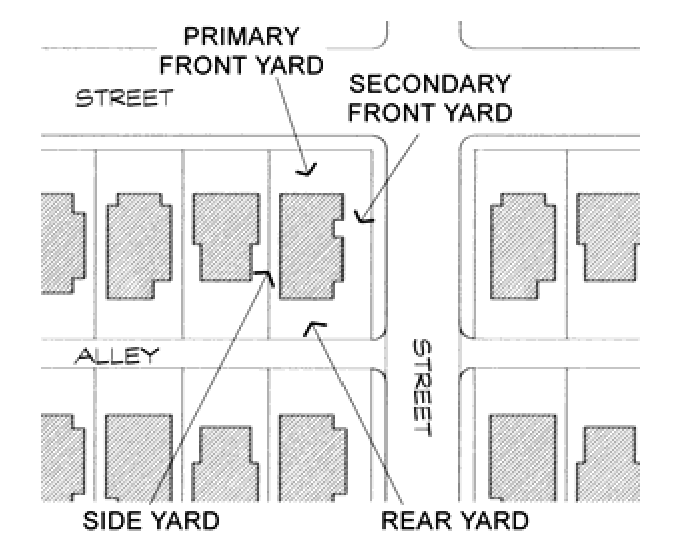
Yards of Standard Corner Lots
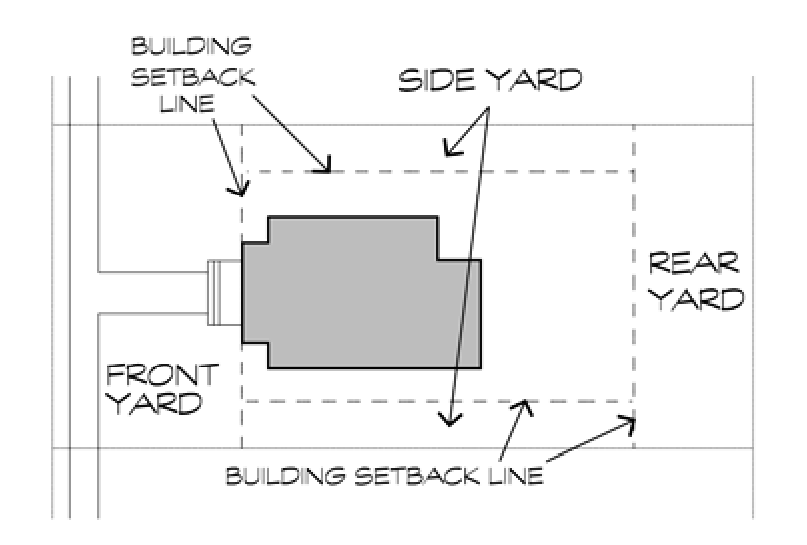
Yards of Interior Lots
Zone, district, zoning classification or zoning district. The zoning classification established, defined, and regulated by this ordinance, in which a property is located or requested to be located.
Zoning approval. Certification, being issued by the building inspector under the procedures required by this ordinance, stating that the purpose for which a building or land is to be used is in conformity with the use permitted and all other requirements under this ordinance for the zone in which it is located or is to be located. Such approval is required before issuance of a building permit.
(b)
Land use definitions.
Accessory dwelling. A dwelling unit, other than a manufactured home, used in combination with a non-residential use, such as the family residence of a manager, business owner, or security guard, within the same building or on the same lot of a non-residential use. Accessory dwellings also include secondary dwelling units (other than manufactured homes) permitted on residential lots such as guest houses, garage apartments and granny flats. Refer also to section 6.04.
Age-restrictive uses. Any one of the following areas of sales, service or entertainment (refer also to section 6.05.):
(1)
Adult bookstore. Any establishment or place:
a.
Which has a substantial or significant portion of its stock in trade consisting of either:
(i)
Books, magazines or other periodicals, films or other forms of audio or visual representation which are distinguished or characterized by an emphasis on depiction, description or display of specified sexual activities or specified anatomical areas; or
(ii)
Instruments, devices or paraphernalia which are designed primarily for use in connection with specified sexual activities or conduct; or
b.
To which the public is permitted or invited wherein coin or slug operated electronically or mechanically controlled still or motion picture machines, projectors or other image producing devices are maintained to present material distinguished or characterized by an emphasis on depiction, description or display of specified sexual activities or specified anatomical areas.
(2)
Adult theatre. Any theatre, auditorium or other place of assembly (1) presenting any form of audio or visual material, characterized by emphasis on depiction, description or display of specified sexual activities or specified anatomical areas, or (2) featuring live performances on a regular basis which are distinguished or characterized by emphasis on depiction, description or display of specified sexual activities or specified anatomical areas for observation by patrons.
(3)
Other adult-oriented retail, commercial service or entertainment establishment. Any other business or club which primarily offers its patrons or members retail goods, commercial services, or entertainment which is characterized by an emphasis on matter or activities relating to, depicting, describing or displaying specified sexual activities or specified anatomical areas.
Animal shelter. A facility operated by a public or semi-public agency and used to house, contain, impound or harbor any seized stray, homeless, relinquished or abandoned animal. Refer also to section 6.06.
Apartment. An individual dwelling unit within a building consisting of four or more dwellings. Apartments are rented, in contradistinction to a "condominium", which are owned.
Apartment building. A building consisting of four or more dwelling units, whether as part of an apartment complex or on an individual lot.
Apartment complex. A cluster of detached apartment buildings on one lot and in which, typically, individual entrances are provided for each dwelling unit from the exterior of the building and/or from a roofed breezeway or stairwell.
Arcade. A commercial building in which there are three or more amusement game machines, commercial recreation machines, or other games on the premises and available to the public; or a place or facility where games and/or game machines are played for amusement only. For the purposes of this ordinance, the term "arcade" shall refer to those establishments as defined herein that cater to children and young adults. Any such premise which includes bingo games, gambling devices, adult arcade devices, or similar equipment or operations shall be considered an "age-restrictive use".
Assisted living facility. A building, establishment, complex, or distinct part thereof which (refer also to section 6.07):
(1)
Accepts primarily aged persons for domiciliary care, not nursing or medical care;
(2)
Provides on site to its residents private lockable residential spaces; meal service in a community dining facility and non-medical personal care services appropriate to the resident's respective needs;
(3)
Other than supervision of self-medication, medical services are not a service provided by the facility. The facility may provide space for an unrelated home health service or a doctor's office for ease of access to those services by the residents;
(4)
Provides linkages with hospitals, community services and makes transportation available; and
(5)
Provides timely assistance to residents for response to urgent or emergency needs.
Automobile gas station. A building or lot or part thereof supplying and selling gasoline or other equivalent fuel for motor vehicles at retail direct from pumps and storage tanks and which excludes accessory facilities for rendering services, such as lubrication, washing and minor repairs.
Automobile repair service, major. A place of business engaged in the repair and maintenance of automobiles and light trucks including the sale, installation, and servicing of mechanical equipment and parts including painting, body work, upholstery work, fabrication of parts, or rebuilding of engines.
Automobile repair service, minor. A place of business engaged in the repair and maintenance of automobiles and light trucks including the sale, installation, and servicing of mechanical equipment and parts but not including painting, body work, upholstery work, fabrication of parts, or rebuilding of engines.
Automobile sales, major. A sales establishment offering new or used automobiles and light trucks where total sales inventory exceeds thirty (30) vehicles.
Automobile sales, minor. A sales establishment offering new or used automobiles and light trucks where total sales inventory does not exceed thirty (30) vehicles.
Automobile service station. A building or lot or part thereof supplying and selling gasoline or other equivalent fuel for motor vehicles at retail direct from pumps and storage tanks and which may include accessory facilities for rendering services, such as lubrication, washing and minor repairs.
Bars and taverns. Business establishments offering for sale alcoholic beverages for on-premise consumption not otherwise meeting the food sales requirements for "pub restaurants".
Bed and breakfast. A dwelling unit where lodging for persons not of the immediate family is provided for by compensation for short periods of time as further defined by the supplemental use regulations. Refer also to section 6.08.
Billboard. A freestanding, off-premise sign designed with the intent to be viewed by motorists.
Condominium or condominium building. One or more dwelling units other than detached single-family residences under individual ownership conforming to the provisions of State Law 1059, HB No. 107, 1973 Regular Session of the Legislature of the State of Alabama and for which a condominium association is legally established.
Conservation subdivision. A subdivision of single-family detached dwellings, wherein portions of the site containing environmental features are left substantially undeveloped for preservation and/or recreation but where the developer may otherwise build the maximum number of lots, permissible under the base zoning district for the entire site, by clustering such dwellings on the portion(s) of the site not containing said environmental features. Refer also to section 6.10.
Corner store. A retail store containing no more than 2,500 square feet of gross floor area that is designed and stocked to sell primarily food, beverages, produce and other household supplies to customers who purchase only a relatively few items, excluding automotive fuel service islands. Refer also to section 6.11.
Cottage subdivision. A subdivision of four to twelve single-family detached dwellings, wherein the individual dwellings front on a common open space and are provided access by a shared service drive. Refer also to section 6.12.
Day care center. A licensed facility, other than a residence, providing day care on a regular basis to more than six persons, including but not limited to nursery schools and kindergartens. Refer also to section 6.13.
Duplex. A building designed for or occupied exclusively by two families living independently of each other.
Dwelling. A building containing one or more dwelling units used for residential purposes, but in the case of a building having two (2) or more portions divided by one or more party walls forming a complete separation, each such portion shall be considered a separate dwelling.
Dwelling unit. One or more rooms located within a building and forming a single habitable unit with facilities which are used or intended to be used for living, sleeping, cooking and eating purposes.
Dwelling, multi-family. A building designed for or occupied exclusively by three or more families living independently of each other. Refer also to section 6.20.
Dwelling, single-family. A building designed for or occupied exclusively by one household or family.
Family day care home. A care facility, licensed by the State of Alabama Department of Human Resources, which is a family home and which receives no more than six children for care during only part of the day. Refer also to section 6.13.
Farm. A tract of land used for the production, keeping or maintenance, for sale or lease, of plants and animals useful to man, including the following farming activities:
(1)
Forages and sod crops;
(2)
Grains and seed crops;
(3)
Dairy animals and products;
(4)
Poultry, including egg production but excluding poultry processing;
(5)
Livestock, such as beef cattle, sheep, goats, or any similar livestock, including the breeding and grazing of such animals but excluding meat processing;
(6)
Nursery operations involving the raising of plants, shrubs, and trees for sale and transplantation and including greenhouses and incidental sales of items customarily associated with a nursery operation;
(7)
Forestry operations involving the operation of timber tracts, tree farms, forest nurseries, the gathering of forest products, or performing forest services, including temporary sawmills and chippers for cutting of timber growth on the same premises but excluding lumber yards, mills, and similar activities;
(8)
Bees and apiary products;
(9)
Fisheries, excluding fish and seafood processing;
(10)
Fruits and vegetables of all kinds, including growing and harvesting of such fruits and vegetables, but excluding food processing.
Farm support business. A commercial establishment engaged in the sale of farm support goods and services, including the following activities:
(1)
The sale of feed, grains, fertilizers, pesticides, and similar farm support goods;
(2)
The provision of warehousing and storage facilities for raw farm products; and
(3)
The provision of veterinary services to large animals.
Flea market. A permanent, enclosed or partially unenclosed facility for the sale of fresh produce, arts and crafts, antiques, and other goods, but excluding livestock and poultry. The term "flea market" does not include the offering for sale of goods by the owner thereof at owner's residence at what are commonly referred to as "garage sales" or "yard sales".
General retail and services. Retail and service businesses serving citywide and commuter users, including but not limited to: restaurants, general merchandise, apparel, furniture, household and hardware, electronics, drugs and sundries; art galleries; jewelry and gifts; florists; sporting goods; pet shops; dry cleaning and laundry pickup stations; barber and beauty shops; shoe repair, offices (including broadcast stations), banks, post offices, and theaters. The following uses shall not be considered under this category: fast food restaurants; car washes; automotive dealerships; stockyard; live animal scales; and industrial and manufacturing uses.
Group home. A dwelling shared as a residence by persons who reside together as a single housekeeping unit, in which staff persons may provide supervision, counseling, treatment or therapy for the residents therein, and which may be licensed by, certified by, registered with, or otherwise authorized, funded or regulated, in whole or in part, by an agency of the state or federal government. The term shall include adult care homes, homes for the chronically mentally ill, homes for abused women or children, group care agencies, and similar residential living arrangements for handicapped persons, but shall not include boarding houses, homes for the developmentally disabled, nursing homes, substance abuse treatment facilities, or any facility providing treatment, counseling, or therapy to patients or clients who do not reside on the premises. Refer also to section 6.14.
Hobby farm. A two-acre or larger tract of land used for the production, keeping, or maintenance of farm animals, as an accessory use to the principal dwelling and where any income derived from such use is incidental only to the income of the residents. Refer also to section 6.15.
Home instruction. Instruction in the arts, music, or academic subjects given from a dwelling by the resident to up to four students at a time, except in the case of musical and dance instruction which shall be limited to up to two students at a time.
Home occupation, major. A home occupation which (refer also to section 6.16):
(1)
Has no exterior evidence of the home occupation with the exception of signs permitted by Article 8 of this ordinance;
(2)
Is conducted within a single-family dwelling including a single-family detached dwelling, a single-family semi-detached dwelling, or a single-family attached dwelling;
(c)
Accommodates the off-street parking needs of both the dwelling and home occupation; and
(d)
Involves or employs no more than one (1) person who is not a family member residing on the premises in the operation of the home occupation.
Home occupation, minor. A home occupation which (refer also to section 6.16):
(1)
Has no exterior evidence of the home occupation;
(2)
Does not generate traffic in excess of 20 (twenty) trips in one (1) day in addition to trips generated by the residence. (A "trip" is a vehicle traveling in one direction to or from a source. In other words, twenty (20) trips equals ten (10) round trips);
(3)
Does not create a need for off-street parking beyond normal dwelling needs; and
(4)
Is operated by and employs family members residing on the premises of the home occupation.
Hotel. A building in which lodging, or boarding and lodging, are provided and offered to the public for compensation and in which ingress and egress to and from all rooms are made through an inside lobby or office supervised by a person in charge at all hours. A hotel is open to the transient public in contradistinction to a rooming/boarding house, which is herein separately defined.
Independent living facility. A residential building or complex, which groups seniors for the purpose of social interaction and mutual support in a common interest community. Group facilities may be provided on premises for recreation and social interaction, but only limited support services are typically provided. Refer also to section 6.17.
Industrial park. A tract of land developed for industrial use(s), the control and administration of which are vested in a single body. Such controls include regulation of permitted uses on site and otherwise in accordance with Alabama Legislative Act 1978, No. 604.
Industrial uses, general. Uses, including but not limited to the following: all light industrial uses; auto wrecking; gasoline, oil or alcohol storage above the ground in excess of five hundred (500) gallons; grist or flour mill; junk, scrap paper, rag storage or baling; slaughter house; bag cleaning; central mixing plant for cement, mortar, plaster, or paving material; curing, tanning or storage of hides; distillation of bones, coal, tar, or wood; fat rendering; forge plant; manufacture of acetylene, acid, alcohol, ammonia, bleaching powder, brick, pottery, terra cotta or tile, concrete blocks, candles, disinfectants, dyestuffs, fertilizers, illuminating or heating gas; and including the storage of paint, turpentine, varnish, soap, and tar products; wool pulling or scouring, cotton waste reclaiming; and similar types of plants or operations.
Industrial uses, light. Uses, including but not limited to the following: storage and warehousing; light manufacturing processes which do not emit detectable dust, odor, smoke, gas or fumes beyond the bounding property lines of the lot or tract upon which the use is located and which do not generate noise or vibrations at the boundary of the zone which is generally perceptible in frequency or pressure above the ambient level of noise in the adjacent areas including: bottle works, candy manufacture, clothing manufacture, dairy products, leather good manufacture, optical and scientific instrument manufacture, scientific and technological research and development; tire recapping and retreading, and electrical equipment assembly.
Institution or institutional use. A structure or land occupied by a group, cooperative, or other entity created for non-profit purposes or for public use or services, as categorized below:
(1)
Low intensity: Civic, service, and fraternal organizations; cultural facilities; day care centers; dormitories; elementary schools; group homes with more than six (6) residents; nursing homes, rest homes, and other homes for the aged.
(2)
Medium intensity: Government buildings up to 12,500 sf; health institutions up to 50,000 sf; junior high and middle schools; religious institutions up to 750 seats; stadiums and arenas up to 5,000 seats; other institutions up to 50,000 sf.
(3)
High intensity: Government buildings greater than 12,500 sf; health institutions greater than 50,000 sf; religious institutions greater than 750 seats; high schools, universities, colleges, junior colleges; other institutions greater than 50,000 sf.
Laundry service. A commercial establishment providing laundering, dry cleaning, or dyeing service (other than a laundry or dry cleaning pick-up station defined under personal service), such as a laundry and dry cleaning plant, diaper or linen service.
Liquor store. An establishment licensed by the Alabama Beverage Control (ABC) Board for the sale of alcoholic beverages for off-premise consumption only.
Kennel. An establishment for the boarding or breeding of dogs, cats and other household pets for commercial purposes. Refer also to section 6.06.
Manufactured home, Class A. A double-wide manufactured home constructed after July 1, 1976 that meets or exceeds the construction standards promulgated by the U.S. Department of Housing and Urban Development that were in effect at the time of construction and that satisfies the following criteria:
(1)
The manufactured home has a length not exceeding four (4) times its width, with length measured along the longest axis and width measured at the narrowest part of the other axis.
(2)
The manufactured home has a minimum of nine hundred sixty (960) square feet of enclosed and heated living area per dwelling area.
(3)
The pitch of the roof of the manufactured home has a minimum vertical rise of three (3) feet for each twelve (12) feet of horizontal run and the roof is finished with a type of shingle that is commonly used in standard residential construction.
(4)
All roof structures shall provide an eave projection of no less than six (6) inches, which may include a gutter.
(5)
The exterior siding consists predominantly of vinyl or aluminum horizontal siding (whose reflectivity does not exceed that of gloss white paint), wood, or hardboard, comparable in composition, appearance and durability to the exterior siding commonly used in standard residential construction.
(6)
The manufactured home is set up in accordance with the standards set by the Alabama Manufactured Home Institute. Screening of the foundation area shall be by a continuous, permanent masonry foundation or skirting, unbroken except for required ventilation and access, and which is installed under the perimeter of the manufactured home.
(7)
Stairs, porches, entrance platforms, ramps, and other means of entrance and exit to and from the manufactured home shall be installed or constructed in accordance with the standards set by the Building Code, freestanding or attached firmly to the primary structure and anchored securely to the ground.
(8)
The moving hitch, wheels and axles, and transporting lights have been removed.
(9)
It is the intent of these criteria to insure that a Class A manufactured home, when installed, shall have substantially the appearance of an on-site, conventionally built, single-family dwelling.
Manufactured home, Class B. A single-wide manufactured home constructed after July 1, 1976 that meets or exceeds the construction standards promulgated by the US Department of Housing and Urban Development that were in effect at the time of construction.
Manufactured home, Class C. A manufactured home built before 1976 that does not meet the definition of a Class A or Class B manufactured home. Class C Manufactured Homes shall not be allowed in the City of Tarrant, except as existing structures permitted prior to the adoption of this ordinance.
Manufactured home park. Any parcel of ground upon which one or more Class A or Class B manufactured homes occupied for dwelling purposes are located, regardless of whether a charge is made for accommodations.
Manufactured home subdivision. A subdivision designed and/or intended for the sale of lots for siting Class A Manufactured Homes and in accordance with the requirements of the City of Tarrant Subdivision Regulations.
Manufacturing, general. The basic processing and manufacturing of materials or products predominately from extracted or raw materials and the incidental storage, sales, and distribution of such products.
Manufacturing, light. The manufacture, predominantly from previously prepared materials, of finished products or parts, including processing, fabrication, assembly, treatment, and packaging of such products, and incidental storage, sales, and distribution of such products.
Mini-warehouse. A building or group of buildings containing separate storage spaces which are leased on an individual basis for the exclusive purpose of storing non-hazardous household goods, but not including the storage of materials for a commercial or industrial enterprise or for any activity other than dead storage. Refer also to section 6.19.
Modular home. A factory fabricated transportable building consisting of units designed to be incorporated at a building site on a permanent foundation into a permanent structure to be used for residential purposes and which meets the standards of the building code.
Motel. A building or group of buildings used for the temporary occupancy of transients in which direct ingress and egress to and from all rooms is from the exterior of the building and in which individual units contain no facilities for cooking. A motel is open to the transient public in contradistinction to a rooming/boarding house, which is herein separately defined.
Neighborhood retail. Retail stores and markets, including food; general merchandise; apparel; household and hardware; drugs and sundries; specialty shops such as arts and crafts, jewelry and gifts; florists; and similar types of stores that provide for the recurring needs of the surrounding neighborhood(s).
Neighborhood services. Service businesses including dry cleaning and laundry pickup stations; barber and beauty shops; shoe repair, offices, banks, and similar services that provide for the recurring needs of the surrounding neighborhood(s).
Night club. A business establishment offering for sale alcoholic beverages for on-premise consumption only and also offering entertainment such as music, dancing, and live music performances that do not meet the definition of "age restrictive use".
Nursing home: a home for the aged or infirm in which three (3) or more persons not of the immediate family are received, kept or provided with food and shelter or care for compensation but not including hospitals, clinics or similar establishments devoted primarily to the diagnosis and treatment of the sick or injured.
Office. A building, room or other space where professional, clerical, administrative and similar activities are performed.
Outdoor storage. The keeping of goods and materials, other than that necessary to and in association with construction under a valid Building Permit, and vehicles, belonging to persons other than the property owner that are not wholly enclosed within a building or structure, and that are retained on the same premises for more than twenty-four (24) hours.
Place of worship. Buildings arranged for religious service purposes, such as churches and synagogues, including related facilities for instruction, meeting, recreation, lodging, eating, and other integrally related activities.
Portable building. Mobile or transportable factory-built buildings or structures used for other than residential, instructional, recreational, medical or dining purposes or for civic, social or religious functions.
Private club. A building or premises, or portion thereof, owned or operated by a corporation, association, person or persons for a social, educational or recreational purpose, but not primarily for profit or to render a service customarily carried on as a business.
Private school. A private, gainful business providing instructional service in the arts, business, crafts, trades, and professions.
Pub restaurant. Any place or premises in which foods, refreshments, and malt or brewed beverages and/or table wines are offered for sale for consumption within the building in which the establishment is located, which meets the requirements for such use in the supplemental use regulations. Refer also to section 6.22.
Public facility. Buildings arranged for the purpose of providing public services, not otherwise listed in this section, including government offices, post offices, transit stations, police stations, fire and emergency service stations, civil defense operations, and similar uses.
Public utility facility. Facility that provides public utility services to the public at large, including water and sewerage facilities, gas distribution facilities, electric transmission and distribution facilities, and cable transmission and distribution facilities. Refer also to section 6.21.
Recreation, active. The use of land for sports and other recreational activities, which typically require improvements and maintenance of the land for playing fields and include related structures and equipment.
Recreation, passive. The use of open space for leisure activities and recreation other than sports. Such activities typically require only minor land improvement and facilities and include but shall not be limited to picnicking, walking, hiking, biking, playgrounds, wildlife observation, fishing, and the incidental use of open fields or grassed areas for "pick-up" games.
Recreational vehicle. A vehicular, either motorized or non-motorized, built on a chassis designed as a temporary dwelling for travel, recreation, vacation, and other short-term use. This term shall include portable campers attached to the bed of pickup trucks.
Restaurant, fast food. An establishment where food and drink are rapidly prepared for carry out, fast delivery, drive-through, or drive-in and may also include standard sit-down consumption.
Rooming or boarding house. A building, other than a hotel or motel, where lodging for more than three persons not of the immediate family is provided for definite periods and for compensation. Refer also to section 6.23.
Salvage yard or junk yard or dismantling yard. A place of business engage in the storage, sale, dismantling or other processing of used or waste materials, such as a junk or automotive salvage yard. Refer also to section 6.18.
Stable. A commercial establishment engaged in the raising, keeping, boarding, or training of horses, ponies, and similar animals, including riding academies and incidental sales of riding accessories and animals raised or regularly kept on the premises.
Telecommunications tower. A tower used for the transmission of wireless communication signals to the general public or private receivers, other than building-mounted antennae and distributed, repeater, or microcell antenna systems, amateur radio towers and towers used by a public facility. Refer also to section 6.24.
Temporary outdoor sales. The intermittent use of a premises for the sale of goods, including but not limited to, produce stands and seasonal sales. Refer also to section 6.25.
Townhouse. A building designed for or occupied exclusively by one (1) family and attached to two (2) or more other buildings of similar design and separated by one (1) or more party walls. Refer also to section 6.26.
Triplex. A building designed for or occupied exclusively by three families living independently of each other.
Upper-story dwelling. A dwelling located in the upper story of a building where the ground floor is devoted to non-residential use. Refer also to section 6.27.
Vehicle and equipment repair, major. A place of business engaged in the repair and maintenance of heavy trucks (over one ton), travel trailers, recreational vehicles, boats, construction equipment, tractors and implements or engaged in painting, body repair, upholstery repair, fabrication of parts, or rebuilding of engines.
Vehicle and equipment sales or rental, major. A place of business engaged in the sale or rental of heavy trucks (over one ton), construction equipment, tractors and farm implements, manufactured homes, and similar heavy equipment, including incidental storage, maintenance, and servicing.
Vehicle sales or rental, major. A commercial establishment engaged in the sale or rental of travel trailers, recreational vehicles, boats, including incidental parking, storage, maintenance, and servicing.
Veterinary clinic/hospital. A place where small household pets are given medical or surgical treatment and short-term boarding within an enclosed building. Refer also to section 6.28.
Wireless communications service. Building-mounted antennae and distributed, repeater, or microcell antenna systems used for the transmission of wireless communication signals to the general public, excluding "telecommunications towers". Refer also to section 6.29.
Sec. 2.02. - Abbreviations used in this ordinance.
The following abbreviations shall have the meanings as specified herein:

