
Tarrant City Zoning Code
ARTICLE 7
- OFF-STREET PARKING AND LOADING
Sec. 7.01.- Off street parking.
There shall be provided, at the time of the erection of any building or at the time any principal building is enlarged or increased in capacity by adding dwelling units, guest rooms, seats, or floor area, or before conversion from one (1) type of use or occupancy to another, permanent off-street parking in the amount specified in this article. Such parking space may be provided in a parking garage or parking lot or in driveways serving single-family dwellings and duplexes. Parking facilities provided in accordance with the terms of this ordinance shall not subsequently be reduced below the requirements of this ordinance or subsequent amendment thereto.
(a)
Joint use of parking lots. The number of parking spaces required for one use shall not be considered as all or part of the required parking for another use on the same or separate lot except in conformance to section 7.03.
(b)
Certification of minimum parking requirements. Each application for a building permit shall include information as to the location and dimensions of off-street parking spaces, if required, and the means of ingress and egress between such space and a thoroughfare or alley. This information shall be in sufficient detail to enable the building inspector to ensure the provisions of this article are fully met.
(c)
General requirements.
(1)
All parking spaces, excluding those on the lots of single-family dwellings, duplexes and triplexes, shall be striped.
(2)
Ingress and egress for parking facilities shall be in accordance with section 4.11. Wherever a reservoir or vehicle standing area is deemed necessary by the Building Inspector to prevent blocking of traffic, such reservoir shall be required. No parking space shall block designated emergency access. Fire lanes may be required by the fire department.
(3)
Except for dwellings in single-family residential Zones, no off-street parking space shall be permitted which requires a vehicle to back out into a public thoroughfare.
(4)
Except for single-family dwellings, duplexes and triplexes, access drives and parking aisles shall not be used to meet minimum parking requirements.
(5)
No portion of any parking space shall be located within the right-of-way of a thoroughfare or alley or an easement not intended for such purposes.
(6)
Dimensional requirements of parking spaces. Parking space dimensions shall be in accordance with the minimum requirements described in Table 7.01. Compact car spaces may be provided but shall not exceed a ratio of one (1) compact car space: three (3) standard spaces. Handicapped spaces shall be provided as required by the building code.
TABLE 7.01. DIMENSIONAL REQUIREMENTS OF PARKING SPACES
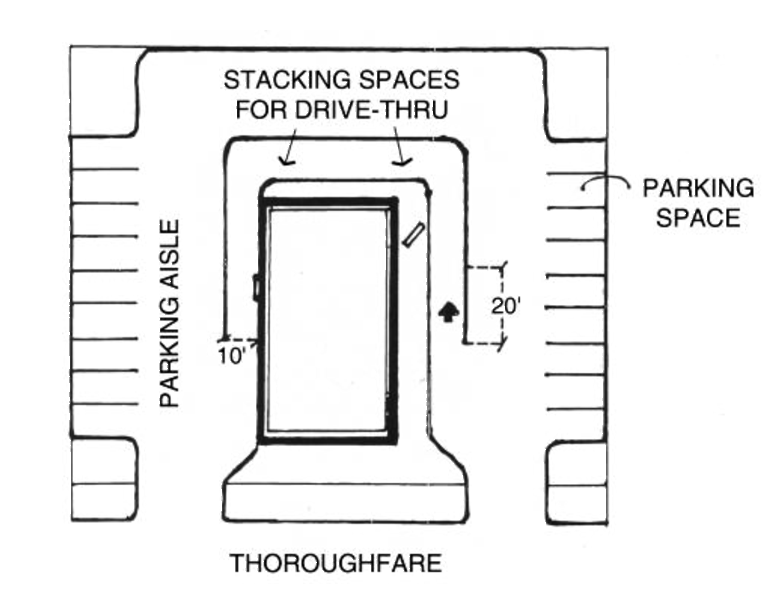
Figure 7.01.A. Stacking Spaces
Sec. 7.02. - Minimum parking requirements by use.
The number of off-street automobile parking spaces shall conform to the following thresholds for the various types of uses described in Table 7.02, except as otherwise provided in section 7.03 for shared parking. Any fractional space calculated according to Table 7.02 shall be computed as a whole space.
(a)
Availability of on-street parking. In non-residential areas where on-street parking is existing or required by the subdivision regulations, on-street parking spaces directly abutting the use, as determined by the building inspector, may be counted toward the parking requirement for the use. On-street handicap parking spaces shall not be counted. No on-street parking space may be counted toward two or more uses.
(b)
Use not specified. Where a use is not specifically identified herein, the parking space requirements of a similar or related use shall apply.
TABLE 7.02. PARKING REQUIREMENTS BY USE
Sec. 7.03. - Parking reductions for shared parking.
In circumstances involving a combination of uses sharing a common parking area(s) for which compliance with the conventional requirements of section 7.02 might create total parking in excess of actual need, such shall be determined and certified by the building inspector and subsequently approved by the commission.
(a)
Reductions shall only be approved when a written agreement between the owners of such parking areas has been provided to the building inspector and where the parking areas are commonly shared and interconnected by parking aisles, an alley or a shared drive and by pedestrian walkways. Reductions shall only be applicable to uses on the same block and where each space to be shared is no greater than six hundred (600) feet from an entrance to any of the uses sharing such parking and shall be applied according to the percentage reductions as provided in Table 7.03. Such reductions shall be calculated based on the sum of the minimum requirements for all individual uses on the site as required within this ordinance. Where more than two different uses are proposed, the total allowable reduction shall be calculated using the smallest possible reduction factor of the various uses proposed, as described below:
TABLE 7.03. Parking Requirement Reductions for Shared Parking Areas
Shared spaces is based on the use type (residential, lodging, office, or retail) with the lowest number of required spaces. The total shared spaces is calculated by multiplying such number of spaces by the number of use types that are proposed to share such spaces, i.e. a development with lodging, retail and residential would use a multiplier of "3".
(b)
Wherever a use for which highest parking demand occurs at a different time from other uses on the same lot or block, the parking requirement for the combined uses may be reduced in accordance with a recommendation by the building inspector and as approved by the commission.
Sec. 7.04. - Design requirements.
(a)
All parking areas, except for access drives, shall be physically separated from any thoroughfare by use of an approved curb.
(b)
Parking areas for all developments shall be designed so that sanitation, emergency, and other public service vehicles can serve such developments without the necessity of backing unreasonable distances or making dangerous turning movements.
(c)
For single-family dwellings, duplexes and triplexes, parking shall be permitted on driveways; however, no vehicle parked on a driveway shall extend into the right-of-way or block pedestrian travel on a sidewalk. For all other uses, the use of required setbacks for parking shall be restricted according to the provisions of the applicable zone and the buffer requirements of the applicable zone or use.
(1)
Parking spaces, on other than an approved driveway, shall be prohibited within the required front yard in a residential zone.
(2)
In the case of corner lots, parking aisles and maneuvering areas shall be prohibited along any street frontage and within any zone, where the corner lot adjoins, whether abutting or separated by an alley, a zone where front yard parking is prohibited.
(d)
All parking areas shall be designed in accordance with recognized traffic engineering design practices acceptable to the city engineer. For parking areas of twenty (20) or more spaces, a parking and circulation plan shall be subject to acceptance of the city engineer.
(e)
Parking lot configurations shall respond to site conditions, including topography, drainage patterns and natural amenities. On sloping sites, lines of parking spaces shall run parallel to site contours, with planted medians taking up excessive slope. Paved parking areas or vehicular space areas shall not exceed a six (6) percent slope.
(f)
Illumination. All lighting fixtures used to illuminate parking areas shall not direct lights on adjacent thoroughfares or properties. Any changes to lighting fixtures within a parking area shall require the lighting of the entire parking area to comply with this provision.
(g)
Surfacing. Surfacing of parking and loading areas shall be constructed in accordance with engineering design standards accepted by the city engineer. Except as provided in paragraphs (1)—(4) below, parking areas shall be permanently surfaced with hard and dust-free materials, such as asphalt, concrete or pervious concrete. In any case, where a pervious parking surface is proposed, the city engineer must determine that the alternative surfacing is practical and sufficient for the given vehicle storage needs.
(1)
Wherever a property has historically shown a tendency to retain excessive stormwater, the city engineer may require special treatment of parking areas to address such issues, including use of pervious parking surfaces and/or stormwater retention or detention basins.
(2)
In cases where the parking area accommodates spaces in excess of the minimum required by this article, except parking for residential uses, the city engineer may approve a dust-free, pervious parking surface. Such pervious surface, where accepted by the city engineer, shall have concrete curbing around the parking area perimeter to confine gravel.
(3)
Storage lots for commercial vehicles and trailers, excluding passenger vehicles, not used for daily transportation (i.e. truck trailers, moving trailers, RV's, campers, farm implements, construction vehicles) may be accepted by the city engineer for a pervious parking surface, such as compacted gravel. Such pervious surface, where accepted by the city engineer, shall have concrete curbing around the parking area perimeter to confine gravel.
(4)
Where a developer proposes to provide parking space in excess of the maximum established within this article, such as to meet intermittent high demands for parking (i.e. holiday shopping), such excess space may be permitted but only upon a pervious parking surface approved by the city engineer or within a parking structure. Only the excess spaces may be on a pervious parking surface except as provided for above.
(h)
Parking aisle width. The minimum width of parking aisles shall be as specified in Table 7.04:
TABLE 7.04. ANGLE OF PARKING
*Two-way traffic direction is prohibited, except for access to parallel spaces or spaces of sixty (60) degrees or greater angle.

Figure 7.04.A. Parking Aisle Widths
(i)
Demarcation of spaces and traffic flow. The city engineer may prescribe such traffic markers and or signs as deemed necessary to safely and efficiently manage traffic flow. Parking spaces on impervious surfaces, except those serving single-family dwellings and duplexes, shall be demarcated with painted lines and/or signs or other markings accepted by the city engineer. Stacking spaces shall not be individually marked but instead shall be clearly demarcated to direct the flow to traffic, as necessary.
(j)
Vehicle overhang. Up to two (2) feet of vehicle overhang over a wheel stop may count toward the required length of a parking space. Vehicle overhang shall not project over a lot line, public right-of-way, sidewalk, required landscaped area, or internal walkway.
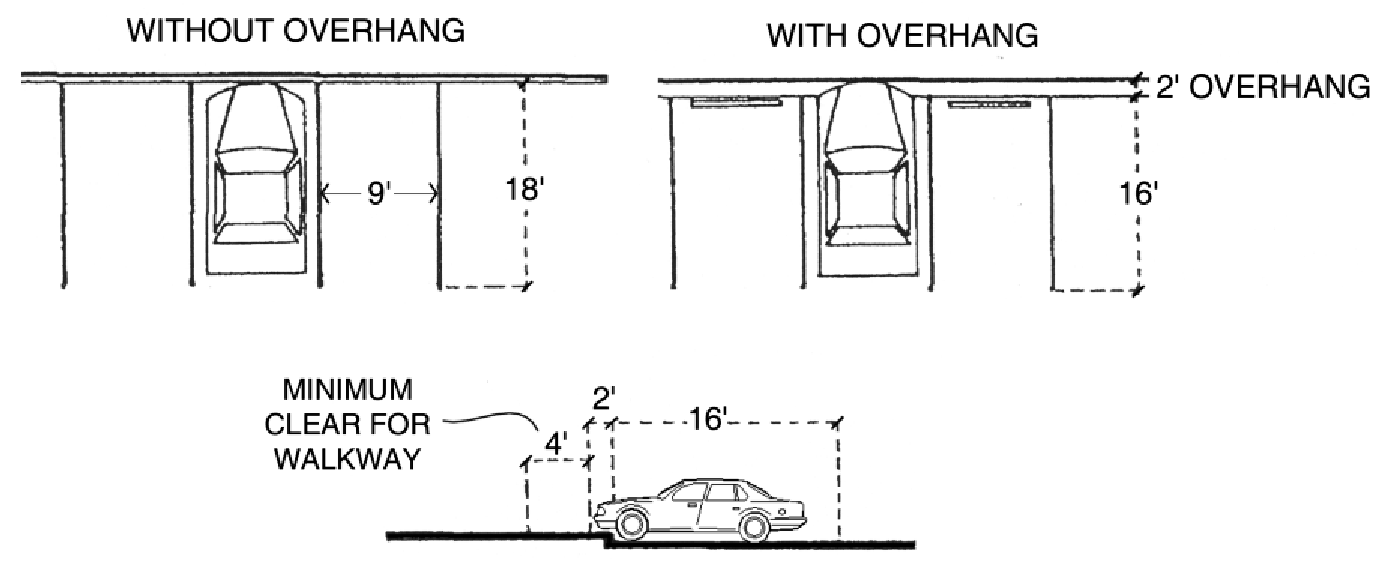
Figure 7.04.B. Vehicle Overhang
(k)
Shopping cart return stations. For stores providing return stations for customer shopping carts, the design and location of shopping cart return stations within parking areas shall be blended into the overall landscape design and contained within interior landscaping areas.
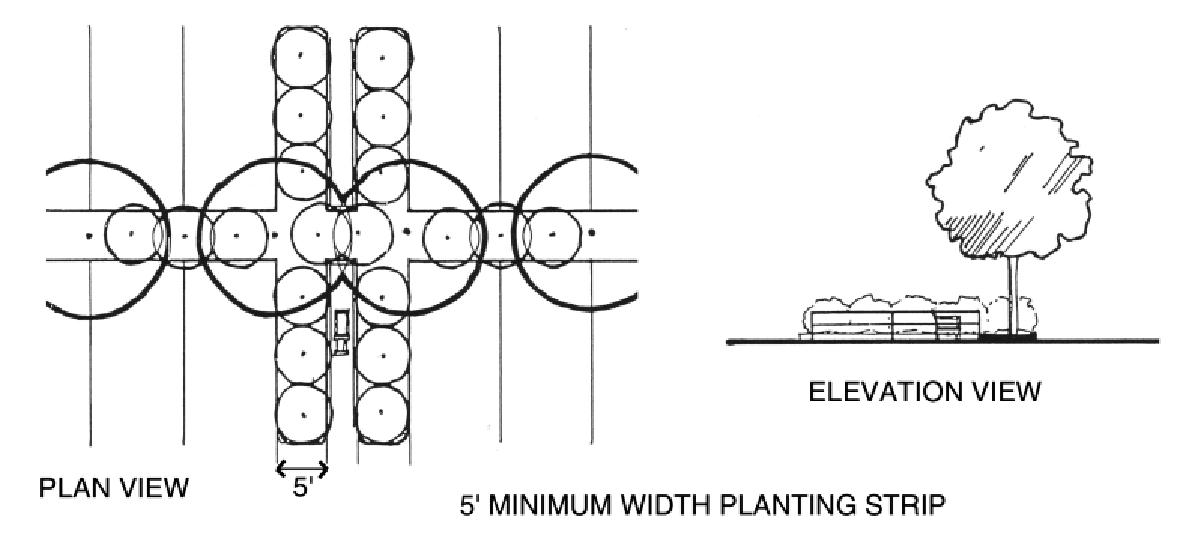
Figure 7.04.C. Required Landscaping for Shopping Cart Return Station
(l)
Drainage for all developments requiring parking, except for single-family dwellings, duplexes, and triplexes, shall direct stormwater away from adjacent properties and toward adequate drains, detention/retention ponds or off-site drainage ways.
(m)
Maintenance. All parking areas shall be cleaned of debris and maintained in good condition, including being kept free of potholes, by the owner, responsible agents of the owner, tenant, or other person in charge of the property.
Sec. 7.05. - Landscaping standards.
All parking lots containing ten (10) or more spaces shall be required to have installed landscaping improvements in accordance with this Section and according to the site plan approved by the commission. When existing parking lots, established prior to the effective date of this ordinance and amendments thereto, are to be expanded by ten (10) or more additional spaces, the parking lot shall be improved in accordance with the provisions of this section. Conflicts between the requirements of this section and the applicable requirements of Ordinance Number 927, Article IX, Landscape Regulations, shall be resolved through site plan approval and at the discretion of the commission. In such cases, the commission, at the applicant's request, may waive the more restrictive standards so long as the intent of the ordinances is sufficiently maintained.
(a)
To mitigate the negative microclimate and visual impacts of parking lots, a minimum of ten (10) percent of a development's vehicular use area within the area and immediately adjacent to this area shall be landscaped.
(b)
Required landscape islands shall be sodded, seeded, or mulched and shall include trees, shrubs, annuals, perennials, ornamental grass and/or groundcover or a combination of these.
(c)
Trees shall be provided in required perimeter planting strips.
(1)
If canopy trees are used, they shall be minimum of two (2) inches in caliper and twelve (12) feet high.
(2)
If understory trees are used, the same conditions apply, but the required spacing increment drops to thirty (30) to forty (40) feet on center. Understory trees may be used only where preexisting overhead utility lines prevent the use of canopy trees.
(3)
Trees shall be planted within the perimeter planting strip and within internal islands so that all parking spaces are within no more than seventy-five (75) feet of a tree.
(d)
Where shrubs are used for required screening, they shall:
(1)
Be at least thirty (30) inches tall at installation;
(2)
Be spaced closely together so as to create a hedge, but not farther than five (5) feet on center;
(3)
Be shrub species that shall attain an average normal growth height of five (5) to six (6) feet within four (4) years; and
(4)
Be mostly evergreen species. Twenty-five (25) percent of the required shrubs may be deciduous, although evergreen shrubs are required for all areas fronting on a public right of way.
(e)
Where walls are used, they shall:
(1)
Be three (3) to four (4) feet in height;
(2)
Be constructed in a durable fashion of brick, stone, other masonry materials, wood posts and planks, or metal or other materials specifically designed as fencing materials, or any combination thereof, as may be approved by the commission. A chain-link fence with plastic, metal, or wooden slats shall not be permitted;
(3)
Have no more than twenty-five (25) percent of the fence surface left open, and the finished side of the fence shall face the abutting property; and
(4)
Not create a stockade appearance by the use of solid fencing. Solid fences facing public streets shall have masonry columns located no greater than fifty (50) feet on center. Undulating the fence and using evergreen vegetative material may also be used to avoid a stockade look.
(f)
Existing vegetation, which meets, in whole or in part, the purposes of perimeter landscaping, described within this section, may be applied toward requirements.
(g)
Standards by specified zones and development types.
(1)
NC and TC Zones and multi-family and attached dwelling developments. Parking shall be provided to the side and/or rear of buildings and the following design requirements shall apply:
a.
No more than twelve (12) contiguous spaces on one side of an aisle shall be provided without using a landscape island. Landscape islands shall be curbed and shall include plants from the list of approved planting materials in the Appendix. Whenever trees are provided, the island shall be sized appropriately to provide an adequate root area for the matured tree.
b.
Wherever the parking area abuts a thoroughfare, an eight-foot wide perimeter planting strip shall be provided between the sidewalk and parking area or a masonry wall of a minimum of three (3) feet in height and a five (5) foot wide perimeter planting strip provided behind the wall.
c.
A planting strip of eight (8) feet in width and containing shade trees shall be used to screen parking lots from adjacent residential properties or as otherwise required by section 4.08 and section 4.09.
(2)
GC and Industrial Zones. Parking shall be provided to the side and/or rear of buildings and limited parking may be provided between the front building line and thoroughfare. The following design requirements shall apply to new parking areas and to the expansion of existing parking areas, where required:
a.
No more than fifteen (15) contiguous spaces on one side of an aisle shall be provided without using a landscape island. Landscape islands shall be curbed and shall include plants from the list of approved planting materials in the Appendix. Whenever trees are provided, the island shall be sized appropriately to provide an adequate root area for the matured tree.
b.
Wherever the parking area abuts a thoroughfare, a planting strip and other perimeter screening shall be provided. Along the primary frontage, a ten-foot wide perimeter planting strip shall be provided between the primary thoroughfare and the parking area or; a masonry wall of a minimum of three (3) feet in height and a seven-foot wide perimeter planting strip provided behind the wall. Along the secondary frontage, an eight-foot wide perimeter planting strip shall be provided between the sidewalk and parking area or a masonry wall of a minimum of three (3) feet in height and a five-foot wide perimeter planting strip provided behind the wall.
c.
A pedestrian walkway of five (5) feet in width shall be provided for each parking aisle longer than one hundred fifty (150) feet. This walkway shall be clear and unobstructed.
d.
A planting strip of twelve (12) feet in width and containing shade trees shall be used to screen parking lots from adjacent residential properties or as otherwise required by section 4.08 and section 4.09.
(h)
Bonding for required landscaping. For all developments of one hundred (100) or more parking spaces, the city shall require surety bonds in an amount equal to one hundred fifteen (115) percent of the estimated cost of completion of the required plantings as assurance for installation and maintenance. It shall be the responsibility of the owner of the parking area to obtain and maintain the bond continuously for the maintenance period until released by the city. The bond shall remain in effect for a period of two (2) years from the date of permit issuance and shall then be released by the city to the owner, provided all required landscaping materials have been installed and maintained as required. The bond shall be provided by a bonding company licensed and registered in the State of Alabama with a rating of B+ or better. In lieu of a surety bond, the owner may file a cash bond or instrument of credit with the city in a form accepted by the city attorney in an amount equal to that which would be required in the surety bond.
Sec. 7.06. - Required off-street loading spaces.
(a)
Applicability. Any use with a GFA of six thousand (6,000) square feet or more which requires deliveries and shipments must provide off-street loading spaces in accordance with Table 7.06, Required Off-Street Loading Spaces. All plans submitted with a building permit application shall contain a table which clearly summarizes the required number of off-street loading spaces, the use requiring loading spaces, the GFA and corresponding loading spaces required (i.e. 30,000 sf of GFA = 2 spaces), and the number of loading spaces provided.
(b)
Non-listed uses. In situations where the required number of loading spaces is not determinable by the table, the building inspector is authorized to determine the loading space requirements based on the most similar use.
(c)
Fractional spaces. When determining the total required loading spaces, any fractional space shall be rounded up to the next whole number.
(d)
Use of required spaces. Required loading spaces, associated aisles, and accessways shall be used exclusively for vehicle loading and unloading. No parking space, structure, outdoor storage, sales display, vehicle sales, or any other use other than loading shall be permitted within the required loading area.
TABLE 7.06. REQUIRED OFF-STREET LOADING SPACES
(e)
Off-street loading design standards.
(1)
Dimensional standards. Each loading space shall have a minimum rectangular area of twelve (12) feet in width and fifty-five (55) feet in length, exclusive of driveway and maneuvering space. Each space shall allow vertical clearance of fourteen (14) feet in height. See Figure 7.06.
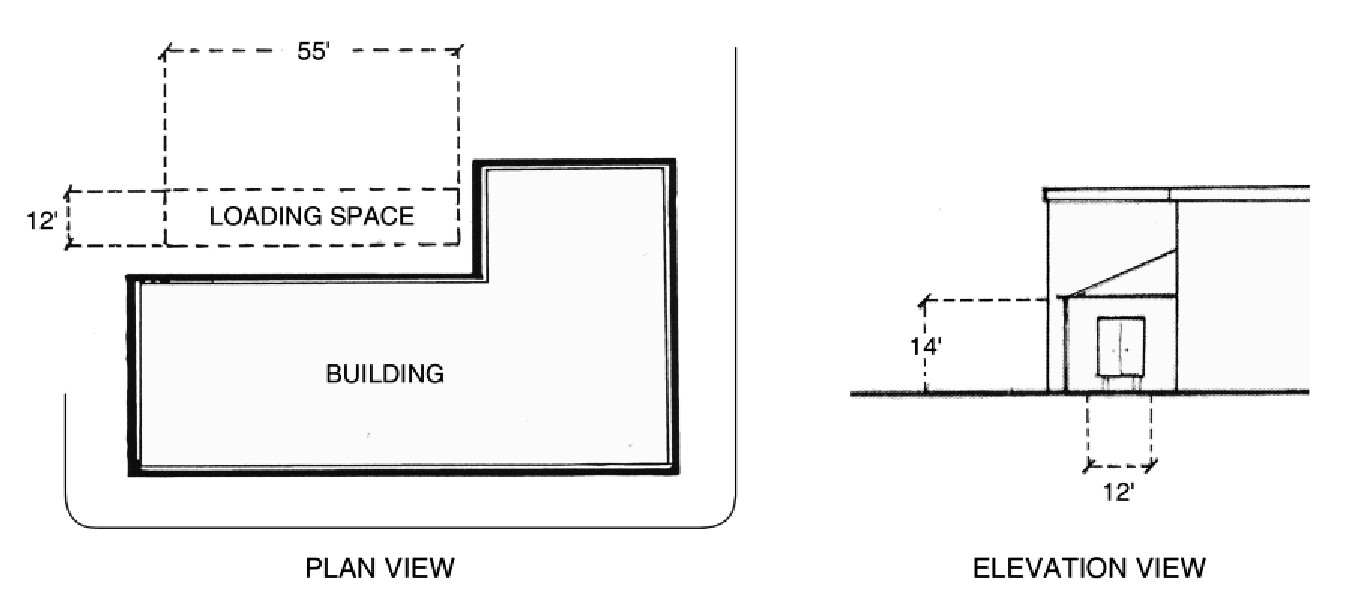
Figure 7.06. Loading Space Dimensions
(2)
Yard and setback restrictions. No loading space shall be located within a required front yard.
(3)
Arrangement of spaces.
a.
No loading space shall be used to meet the parking space requirement, interfere with on-site circulation of traffic, or allow a truck to extend into any thoroughfare right-of-way or over a lot line.
b.
Loading areas shall be designed so that vehicles may enter or exit such areas without backing onto or from a public thoroughfare, other than an improved public alley of sufficient maneuvering width.
(4)
Lighting. All lighting fixtures used to illuminate loading areas shall not direct light on adjacent thoroughfares or properties.
(5)
Screening. Screening shall be provided in accordance with section 4.09. All required loading spaces shall be located on the same lot as the principal use. Loading spaces shall be located internally to each property or block, such as to the rear of the building or between buildings, and shall not be located between the building and any thoroughfare right-of-way.
(6)
Location.
a.
All required loading spaces shall be located on the same lot as the principal use.
b.
Loading spaces shall be located internally to each property or block, such as to the rear of the building or between buildings, and shall not be located between the building and any thoroughfare.
Sec. 7.07. - Conflicting requirements.
Except as otherwise provided in section 7.05, whenever the requirements of this article are more or less restrictive or in any way conflict with any other provision of this ordinance or any statute, law, code, regulations, ordinance, or enforceable guideline, the more restrictive requirements shall apply.

