
Tarrant City Zoning Code
ARTICLE 8
- SIGN REGULATIONS
Sec. 8.01.- General regulations applying to all signs.
(a)
No sign shall be erected or maintained which would imitate, resemble, obscure, or otherwise physically interfere or be confused with any official traffic sign, signal or device, nor obstruct, mislead, confuse or otherwise physically interfere with pedestrian or vehicular traffic flow.
(b)
Signs shall not be erected or maintained which are structurally unsafe or in substantial disrepair.
(c)
It shall be unlawful to use a vehicle or trailer as a sign for the purposes of circumventing conformity with these regulations.
(d)
No roof sign shall be permitted.
(e)
No sign structure shall be located on or project over any public right-of-way or property, nor shall any portion of a sign or its structure project over or protrude into any required setback area, except as otherwise provided herein:
(1)
Building-mounted signs may project into a right-of-way no more than six (6) inches when the building, to which the sign is attached, is built up to the front lot line, as permitted within certain zones, and fronts directly on a sidewalk. However, such signs shall not be located so as to obstruct the required clear sight triangle or otherwise obstruct vehicular or pedestrian traffic.
(2)
Building-mounted signs may project into a required front setback no more than six (6) inches when the building, to which the sign is attached, is built up to the front setback line.
(f)
No sign shall contain, include or be illuminated by intermittent lighting except those giving only public service information such as but not limited to the time, date, temperature, weather or news.
(g)
All illuminated or highly reflective signs shall be effectively shielded so as to prevent beams or rays of light from being directed at any portion of a thoroughfare or sidewalk, or from shining on or into any residential buildings, or otherwise adversely affecting surrounding or facing properties. Furthermore, such signs shall not adversely affect the safe operation of motor vehicles by reason of light intensity or brilliance, which causes glare or otherwise impairs the vision of drivers of motor vehicles.
(h)
Unless otherwise authorized by the zoning board of adjustment, the prescribed time period for the display of temporary signs shall be thirty (30) days, and shall be for new businesses or locations only.
(i)
Unless otherwise specified herein, any references to freestanding signs may be understood to include single signs with two faces oriented in opposite directions. When the distance between the two faces is never greater than two (2) feet, such sign shall be counted as one sign and the area of only one (1) face shall be counted for the purpose of calculating signage area. Where such sign faces are greater than two (2) feet apart, each face shall be counted as a separate sign and the area of each face shall be counted for the purpose of calculating signage area.
(j)
Maintenance. Any sign not meeting the following provisions shall be removed within sixty (60) days after receipt of notification from the Building Inspector, unless it is determined by said Inspector that the sign owner is delayed for legitimate reasons and is making a good faith effort to correct any deficiencies:
(1)
The area around any freestanding sign shall be kept clear of trash and litter and shall present a neat and orderly appearance.
(2)
All signs shall be maintained at the level of appearance originally held at the time of erection and in accordance with the requirements of this article.
(3)
Exposed backs of signs must be painted a single, neutral color so as to present an attractive, finished appearance.
(4)
It shall be the responsibility of the business owner of an on-premises sign to maintain and ensure compliance with the provisions of this article; abandoned signs shall be the responsibility of the property owner.
(k)
Penalties. Both the owners or other person responsible for a sign and the owners of property on which a sign is located shall be responsible for assuring compliance with this article. Any failure or refusal to comply with these provisions shall constitute a violation of this ordinance and shall be subject to the penalties provided in Article 11 of this ordinance.
(l)
Calculation of sign area. Calculation of sign area shall be performed as described in Figure 8.01. For freestanding signs, the entire area of the surface or background, including any enclosing frame, upon which the sign is provided shall be included in the area calculation. Where the sign copy exceeds the surface, background, and or frame, the extent of the sign copy shall be included in the area calculation. Columns and similar supports shall not be included in the calculation of sign area.
(1)
Every face of a freestanding sign shall be considered as a separate sign for purposes of computing allowable area with the following exception. The sign area of a double-faced sign, where the two sign faces are never greater than two (2) feet apart, shall be calculated as the area of one sign face, whichever is greater. When the two sign faces are greater than two (2) feet apart, the sign area shall be calculated as the sum of both faces.
(2)
For signs with more than two faces, the sign area shall be calculated by adding the area of every face.
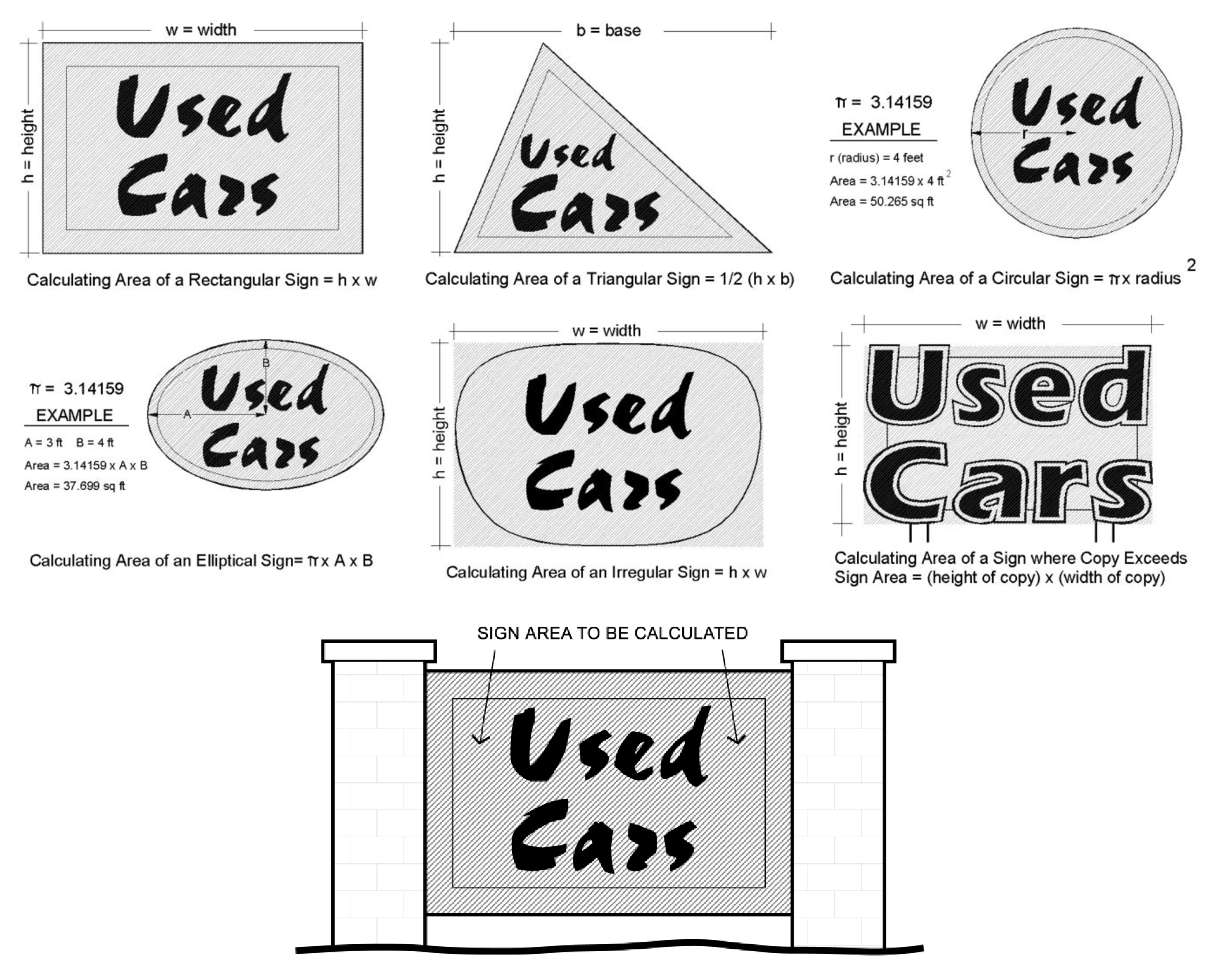
Calculating Sign Area
Sec. 8.02. - Area and dimensional requirements.
Unless otherwise specified in this article, the following dimensional requirements shall apply:
(1)
The maximum area of any sign and maximum height of any freestanding sign shall be according to the provisions of Table 8.02.
(2)
All building-mounted signs shall extend outward from the building, to which it is attached, no more than thirty (30) inches, shall not exceed the total area provided in Table 8.02, and shall be limited in elevation such that the top edge of the sign is no higher than the top of the building or structure to which it is attached.
TABLE 8.02. AREA AND DIMENSIONAL REQUIREMENTS OF SIGNS
*refers to one multi-family building only per lot
(3)
For freestanding signs, sign height shall be measured from the grade level of the sign.
(4)
The minimum front setback for freestanding signs shall be three (3) feet from the front lot line, five (5) feet from a sidewalk, or ten (10) feet from the edge of pavement, whichever is greater. Signs shall be set back twenty-five (25) feet from the centerline of any undedicated road. These setbacks shall not apply to name/address signs on mailboxes, nor for temporary signs, which shall be subject to section 8.04.
(5)
The side and rear setbacks required by the applicable zone shall be the minimum yard setback for freestanding signs, whichever is greater. In no case shall any sign be erected closer than fifteen (15) feet to a boundary line of a residential zone.
(6)
No sign shall be located so as to obstruct a clear sight triangle at driveways or access points to any business or to intersections of thoroughfares and alleys.
(7)
Whenever there is both a freestanding sign and a building-mounted sign on a lot, a fuel price sign shall be incorporated into one of these signs and shall not be provided as a separate, additional sign.
(8)
Freestanding and portable signs shall be located no closer than the distance specified herein from another freestanding or portable sign on the same side of the same block:
a.
Along an arterial—One hundred (100) feet.
b.
Along a collector—Seventy-five (75) feet.
c.
Along a local thoroughfare—Sixty (60) feet.
Sec. 8.03. - Materials for freestanding sign backgrounds, frames, supports and ornamentation.
Finish materials for permanent freestanding signs shall be durable, have low maintenance, be of the same or higher quality as the principal structure(s), and shall not adversely impact adjacent uses. The various parts of signs shall be compatible in design quality.
(1)
The following materials are considered to be appropriate for sign backgrounds, frames, supports, and ornamentation:
a.
Brick.
b.
Natural stone, including panels. The use of natural materials is favored; however, the use of imitation stone is acceptable.
c.
Stained split-face block.
d.
Wood.
e.
Exterior insulation and finish systems (EIFS) (trade name DryVit), or similar material, in combination with brick, split-face block, or stone.
f.
Metal panels, when used in combination with brick, split-face block, or stone.
g.
Plastic, or other synthetic materials, when used in combination with brick, split-face block, or stone.
(2)
The following materials are prohibited for sign backgrounds, frames, supports, and ornamentation:
a.
Exposed metal poles. For pole-mounted signs, poles shall be enclosed by a masonry veneer.
b.
Smooth-face concrete blocks, whether painted or unpainted.
c.
Metal panels, when used without brick, split-face block, or stone.
d.
Plastic, or other synthetic materials, when used without brick, split face block, or stone.
Sec. 8.04. - Signs permitted in specified zones.
Any type of sign not listed herein as being permitted in a particular zone shall be considered prohibited in that zone. The provisions of sections 8.01—8.03 shall apply to all signs permitted herein, whether or not specific references are cited, unless otherwise indicated.
(a)
Address sign required.
(1)
All multi-family and non-residential buildings shall include the street number (address) on a freestanding sign, building-mounted sign, and/or at the main entrance of the use. Address numbers shall not be smaller than three (3) inches nor larger than twelve (12) inches in height. Each building containing a dwelling in a multi-family complex shall include an address sign affixed to the front of the building. Each tenant of a multi-tenant non-residential building shall include an address sign affixed to the front wall or entrance of the tenant space. When the address sign is separate from other signs, other than for multi-family complexes, the address sign shall not be counted toward the total maximum sign area.
(2)
All single-family dwellings, duplexes and triplexes shall include an address sign affixed to the front wall or entrance of each unit, which shall be visible from the fronting thoroughfare. Address numbers shall not be smaller than two (2) inches nor larger than five (5) inches in height.
(b)
All zones. The following signs are allowed in all zones, subject to the provisions specified:
(1)
Traffic and public safety signs;
(2)
Auxiliary signs, including but not limited to, signs required to be posted by law; signs indicating bus stops, taxi stands and similar transportation facilities; signs giving information concerning the location or use of accessory off-street parking facilities; location of on-premises bathrooms; accepted credit card signs and similar signs; or loading and unloading facilities;
(3)
Signs established by, or by order of, any government agency;
(4)
Decorative flags and bunting for celebrations, conventions, and commemorations for a period of time prescribed and authorized by the city council;
(5)
One development sign limited to thirty-two (32) square feet in area or one development sign per street entrance limited to twenty (20) square feet in area per sign.
(6)
One (1) construction sign located on a property where building is actually in progress under a valid building permit. Such sign may include the names of the persons and/or firms performing services or labor, or supplying materials to the premises, but must not exceed twenty-four (24) square feet in area. Such sign shall also be removed prior to receipt of a certificate of occupancy.
(c)
AG Zone. The following signs shall be permitted on any one lot in an AG Zone:
(1)
Product advertising signs provided the total area of such signs, when added to the area of other permitted signs on-premises, does not exceed the applicable total maximum sign area.
(2)
Identification sign providing the name of the farm, or business where applicable, only.
(d)
NC and TC Zones. The following signs shall be permitted on any one lot, or per tenant as specified, in a NC or TC Zone:
(1)
One (1) building-mounted sign denoting only the address and/or business name per tenant;
(2)
One (1) freestanding, on-premises sign per street frontage per lot or one (1) per shopping center per street frontage;
(3)
One (1) fuel price sign per use containing only fuel price information and not exceeding nine (9) square feet in area when incorporated into a freestanding sign or twelve (12) square feet in area when building-mounted;
(4)
One (1) removable sidewalk sign, not greater than four (4) square feet in area per face, only when such signs are placed so that there is a continuous clear zone for pedestrians of at least five (5) feet in width along the sidewalk and only when such signs are removed from the sidewalk daily during non-business hours (portable sidewalk signs shall not count toward the total maximum sign area);
(5)
Window signs not covering more than fifty (50) percent of the window surface; and
(6)
Auxiliary signs, each not greater than two (2) square feet in area.
(e)
GB Zone. The following signs shall be permitted on any one lot, or per tenant as specified, in a GB Zone:
(1)
One (1) building-mounted sign per tenant per building;
(2)
One (1) freestanding, on-premise sign per street frontage per lot or one per shopping center per street frontage;
(3)
One (1) fuel price sign per use containing only fuel price information and not exceeding nine (9) square feet in area when incorporated into a freestanding sign or twelve (12) square feet in area when building-mounted;
(4)
One (1) or more signs, advertising goods, services or products available on such lot only, not attached to a fence or other screen and not exceeding a cumulative area of twelve (12) square feet per street frontage per tenant;
(5)
Window signs not covering more than fifty (50) percent of the window surface; and
(6)
Auxiliary signs, each not greater than two (2) square feet in area.
(f)
Industrial zones. The following signs shall be permitted on any one lot, or per tenant as specified, in an I-1, I-2 or I-3 Zone:
(1)
One (1) building-mounted sign denoting only the address and/or business name per tenant per building;
(2)
One (1) freestanding, on-premises sign per lot and one freestanding, on-premise sign per entrance for industrial parks;
(3)
One (1) fuel price sign per use containing only fuel price information and not exceeding nine (9) square feet in area when incorporated into a freestanding sign or twelve (12) square feet in area when building-mounted;
(4)
Auxiliary signs, each not greater than two (2) square feet in area.
(g)
Billboards. Billboards shall be permitted only as a conditional use, and only in a GB Zone or industrial zone. However, in consideration of the unique characteristics of such structures, the following additional restrictions shall apply to such signs:
(1)
Billboards shall be exempt from the area and dimensional requirements of section 8.02, but shall instead be subject to the requirements and restrictions of this Section. However, all other provisions of this article shall be applicable to such signs.
(2)
Such signs shall be the only use on the lot and a minimum lot area of twenty thousand (20,000) sf shall be required.
(3)
Such signs shall be erected no closer than three hundred (300) feet to any single or multi-family dwelling nor closer than six hundred (600) feet to another such sign.
(4)
The minimum front setback shall be fifty (50) feet from the right-of-way or one hundred (100) feet from the edge of pavement, whichever is greater.
(5)
Such signs shall only be permitted on arterials.
(6)
The minimum side and rear yard setbacks shall be fifty (50) feet.
Sec. 8.05. - Prohibited signs.
The following signs shall hereafter be considered expressly prohibited throughout the city:
(a)
Lights and signs that resemble any traffic control device, official traffic control signs, or emergency vehicle lights or markings;
(b)
Signs that emit audible sound, odor, visible matter such as smoke or steam, or involve the use of live animals;
(c)
Signs attached to or painted onto a vehicle for which the vehicle's primary purpose is advertising;
(d)
Abandoned signs;
(e)
Snipe signs;
(f)
Billboards that are stacked (separate sign displays mounted one above another whether on unified or separate structures);
(g)
Signs or attention getting devices that contain a beacon of any type and/or contain a spot light providing direct illumination to the public;
(h)
Portable signs, except as provided for sidewalk signs (see section 8.04(d));
(i)
Signs that project more than thirty (30) inches from any building or similar structure on which they are mounted;
(j)
Signs that contain any lighting or control mechanism that causes unreasonable interference with radio, television, or other communication signals;
(k)
Roof signs;
(l)
Signs visible from a public right-of-way that use the word "stop" or "danger" or otherwise present or imply the need or requirement of stopping, caution, the existence of danger, or which for any reason are likely to be confused with any sign displayed or authorized by a public authority; and
(m)
Off-premises signs, other than billboards.
Sec. 8.06. - Permit required.
The erection of a permanent freestanding or permanent building-mounted sign shall require application and approval of a sign permit. Applications shall be provided and reviewed by the building inspector for conformity with this article. The following signs are exempt from this permit requirement, however, they shall be subject to all applicable provisions of this article:
(a)
Permit exempt signs. The following signs shall be allowed without permit but their area shall be calculated for the purposes of determining the total sign area on the premises only where specified herein. No such signs shall be allowed to encroach into a required clear sight triangle except where, by nature of the sign, it is required to be placed in such a location, such as street signs and public safety signs; and no such signs shall reduce a pedestrian zone along a sidewalk to less than five (5) feet in width nor in any way create a hazard to the public, as determined by the building inspector:
(1)
Address signs, unless a part of a freestanding or building-mounted sign that includes other than the address. See also section 8.04(a).
(2)
Construction signs. See also section 8.04(b).
(3)
Development signs.
(4)
Auxiliary signs. See also section 8.04(b).
(5)
Nameplate and directory signs. One (1) sign per building not to exceed nine (9) square feet in area. Nameplate and directory signs, when placed on the building exterior, shall be included in total sign area.
(6)
Public safety signs.
(7)
Historical markers and memorial signs.
(8)
Hazard, prohibition, and warning signs. Signs warning of construction, excavation, or similar hazard and signs such as "No Trespassing" and "No Parking" as long as they do not contain logos or text advertising a commercial product or activity. Such signs are not to exceed four (4) square feet in sign area per sign and not to exceed four (4) in number per lot.
(9)
Help wanted signs. Signs advertising job vacancies of the business or activity on premises. Such signs are limited to four (4) square feet in sign area. One (1) sign shall be allowed per business and must be located on the premises advertising for help.
(10)
Holiday decorations, shall not be displayed for a period of more than sixty (60) consecutive days or more than sixty (60) cumulative days in a year.
(11)
Interior signs, window displays and signs painted or similarly affixed to a window or door. See also section 8.04(b).
(12)
Public notices. Official federal, state or local government informational signs and notices issued by any court, person, or officer in performance of a public duty.
(13)
Public facility signs. Permanent freestanding signs and building-mounted signs of any governmental or public facility, including but not limited to, government office buildings, fire and police stations, post offices, public parks, community centers, and public schools, which include the name of the building or use on the premises, shall be subject to the area and dimensional requirements of the applicable zone but shall not require a permit.
(14)
Official federal, state, or local government flags and emblems. Official flags must be flown in a manner that meets U.S. Congressional protocol. Failure to display flags in this manner shall constitute a violation of this ordinance. Non-governmental uses may display federal, state or local government flags but shall be limited to no more than two (2) such flags per premises.
(15)
Political signs. Political signs may be placed on private property at any time. Political signs are generally not permitted on public rights-of-way. However, political signs may be placed on any public right-of-way owned by the city thirty (30) days prior to the date of the election and/or voting to which the political sign pertains. Political signs must be removed from all rights-of-way within thirty (30) days after the election and/or voting to which the political sign pertains, except in the case of a run-off or similar event, in which case such signs may be posted until thirty (30) days after the run-off or similar event to which the political sign pertains. All political signs placed in public rights-of-way owned by the city shall comply with section 8.01(A) through (D) of Ordinance No. 974, which pertains to general regulations applying to all signs. No political sign placed in a public a right-of-way owned by the city may be affixed to a utility pole, traffic device, directional sign, or other structure.
(16)
Special Permission. The mayor may give special permission and a time limit to allow the display of any sign that pertains to functions that promote the social and general welfare of the City of Tarrant, upon a recommendation by the building inspector on the location of the proposed sign.
(17)
Real estate signs. Signs indicating real estate for sale or lease shall only be allowed, without a permit, on the premise for sale or lease.
(18)
Garage sale signs. Temporary signs advertising permitted sales activities on private property, such as garage sales, yard sales, etc. and which are not located within a right-of-way. Posting of such signs on other than the property on which the sales event is to occur shall require approval of the owner of the property on which the sign is to be placed. Garage sale signs shall not be permitted more than forty-eight (48) hours prior to the event and shall be removed within twenty-four (24) hours after the close of the event.
(b)
The following shall not be considered as creating a sign that requires the issuance of a sign permit, but must be in conformance with all other building, structural, and electrical requirements and regulation of the city:
(1)
Changing of the advertising copy or message on an existing, painted or printed sign, marquee, changeable copy sign or a similar sign, whether electrical, illuminated, electronic handing message center or non-illuminated painted message, which are all specifically designed for the use of replaceable copy; and
(2)
Painting, repainting, cleaning or other normal maintenance and repair of a sign, whether conforming or non-conforming, not involving structural changes.
(Ord. No. 988, § 1, 4-7-2008)
Sec. 8.07. - Nonconforming signs.
(a)
Conditions. Any sign that is not specifically permitted, or that does not comply with all provisions of this ordinance, yet which existed and was maintained as such as of the effective date of this ordinance, shall be considered a nonconforming sign.
(b)
Alterations. A nonconforming sign shall not, after the effective date of this ordinance, be enlarged, structurally altered, or extended unless such sign shall be made to comply with all the provisions of this ordinance. A nonconforming sign may not be replaced by another nonconforming sign. Minor repairs and maintenance of nonconforming signs, such as repainting and electrical repairs, shall be permitted. However, no changes in the location, size, or shape of any nonconforming sign shall be permitted except to make the sign comply with all provisions of this ordinance. Further, changing the copy, message, or display of a nonconforming sign is prohibited.
(c)
Compliance. The building inspector shall require all nonconforming signs to be removed or made to conform with all provisions of this ordinance, by the owner of the property upon which the sign is located, in accordance with the following provisions:
(1)
Where use of the premises, on which the nonconforming sign is located, changes by use, occupancy, or ownership, such sign shall immediately come in to compliance with this ordinance.
(2)
Where the exterior of the building or site conditions on the property, on which the nonconforming sign is located, are to be altered to the extent that a building permit is required, such sign shall.
(3)
Whenever damage, by any cause, to a nonconforming sign requires the replacement of structural or finish materials, the sign shall be brought into compliance with this ordinance.
Sec. 8.08. - Sign definitions.
For the purposes of administering this article, the following definitions shall apply to the terms used in this article.
Abandoned sign. Any sign or sign structure identifying a use or activity that has not occupied the site for a period greater than thirty (30) days, does not maintain a current business license or pertains to a time, event or purpose which no longer applies to the premises.
Auxiliary sign. Any sign attached, affixed or painted onto a building, canopy, appurtenance or other structure indicating general information, such as trading stamps, credit cards, official notices or services required by law, or giving directions to offices, restrooms, exits, and like facilities. Auxiliary signs are typically permanent though content may change.
Awning sign. A building-mounted sign directly painted or otherwise directly affixed to an awning.
Billboard. An off-premise sign, intended to be viewed by motorists, exceeding the height and area regulations of the applicable zone and only permitted by issuance of a conditional use permit.
Building-mounted sign. Any sign attached, affixed, painted, embossed, engraved or projecting from a building wall.
Canopy sign. A sign directly painted or otherwise directly affixed upon a building canopy.
Construction sign. A temporary sign indicating the names of architects, engineers, landscape architects, contractors, and similar artisans involved in the design and construction of a structure or project only during the construction period and only on the premises on which the construction is taking place.
Development sign. A sign used at the entrance to a new subdivision, office park, or similar development that indicates lots for sale, the name of the developer, financing institution or other development parties.
Directory sign. A small sign indicating the names and locations of tenants within a multi-tenant building, often located on the interior of a building.
Double-faced sign. A freestanding sign, both sides of which are visible and used as signs.
Freestanding sign. A sign that is attached to or part of an upright support that stands removed from any building.
Holiday decorations. Temporary holiday decorations used to celebrate a single holiday or season.
Intermittent light. Any flashing, traveling, animated, blinking, or fluctuating light, including arrangements that spell messages, simulate motion, or form various symbols or images.
Lighting, external. Light reflected from a separate outside source aimed toward it, including silhouettes on a background or reflected light.
Lighting, internal. Light directed outward from a lighting source within a sign, including neon signs.
Memorial sign. A sign or table indicating the name of a premises and its date of erection or dedication.
Nameplate sign. A small sign indicating the name and/or address of a business and located near eye level and intended for view by pedestrians.
Off-premise sign. A sign identifying or advertising a business, person, organization, product, service or activity not located or occurring on the premises on which the sign is located.
On-premise sign. A sign identifying or advertising a business, person, organization, product, service or activity located or occurring on the premises on which the sign is located.
Political sign. A temporary sign identifying or urging support for an election issue, political party, or candidate for public office.
Portable sign. A sign which is carried, wheeled, or moved about without having to detach the sign from a secure anchoring device, which is set in the ground or to a building which is set on an approved foundation; or, a sign which is not secured to a building or structure or the ground in a manner approved by the building inspector. This includes, but is not limited to, "A frame" signs and sandwich board signs.
Public notice. An official announcement, required by federal, state, or local law, of a public proceeding.
Public safety sign. A government sign for control of traffic and other regulatory purposes, street sign, danger sign, railroad crossing sign and signs of public service companies indicating danger and aids to service or safety which are erected by or on the order of a public or governmental official in performance of his/her public duty.
Real estate sign. A sign advertising real estate for sale or lease.
Snipe sign. A sign of any material, whether freestanding or attached in any way to a utility pole, park bench, bus shelter, waste receptacle, street marker, traffic control device, guard rail, tree, fence, rock, ground or similar object, placed without permission of the entity owning or governing the land or object on which it is placed.

