
Tipp City City Zoning Code
SECTION 154
10: - PARKING, ACCESS, AND MOBILITY STANDARDS
§ 154.10(A) - Purpose.
The purpose of this section is to regulate the amount and location of vehicle parking and maneuvering areas in order to promote a more efficient use of land, enhance urban form, encourage the reduction of impervious surface area, provide for better pedestrian movement, and protect air and water quality. The provisions of this section are intended to:
(1)
Prevent and alleviate the congestion of public streets;
(2)
Encourage the incorporation of alternative modes of transportation by emphasizing pedestrian and bicycle circulation;
(3)
Promote greater safety of passage between highway and land;
(4)
Minimize the detrimental effects of vehicular use areas on adjacent properties;
(5)
Encourage the reduction of impervious surfaces through effective design and the use of shared parking where practical; and
(6)
Promote the health, safety, and public welfare by establishing minimum requirements for vehicular use areas.
(Ord. 5-14, passed 3-17-2014)
§ 154.10(B) - Organization and applicability.
(1)
This section is divided into subsections that address different components of parking, access, and mobility within Tipp City. Each subsection has its own separate applicability standards.
(2)
All land owned by the City of Tipp City within the CD District, the WP Overlay District, and the FA Overlay District shall be exempt from this section and all of the subsections if the proposed use or activity is necessary for the provision of municipal utilities and/or services (not open to the public).
(3)
All development in the CC District shall be exempt from the requirements of this section except that any parking, loading, or stacking spaces shall be subject to the location requirements of § 154.10(C)(3).
(Ord. 5-14, passed 3-17-2014)
§ 154.10(C) - Off-street parking, loading, and vehicle stacking standards.
(1)
Applicability.
(a)
Time of Review. Compliance with this section shall be reviewed as part of a site plan review, zoning permit, and/or zoning compliance permit, as applicable.
(b)
New Development.
(i)
The requirements of this section shall apply to all new development where there is the construction of a new structure (excluding accessory structures), establishment of a new land use, or an enlargement of an existing structure.
(ii)
The number of existing parking, loading, or stacking spaces may not be reduced below the minimum requirements established within this section.
(c)
Expansions and Enlargements. The parking, loading, and stacking space requirements of this section shall apply when an existing structure is expanded or enlarged or when there is an increase in the number of dwelling units within the building. In the case of such expansions and enlargements, additional parking, loading, and stacking spaces are required to serve only the enlarged or expanded area.
(d)
Nonconforming Parking, Loading, Stacking. Where a site is legally nonconforming due to a lack of compliance with the parking, loading, or stacking space requirements of this section, a future use of the site need not comply with the required number of spaces provided:
(i)
The applicant provides the maximum amount of parking, loading, or stacking spaces possible without being required to remove or partially remove a structure.
(ii)
If a structure or a portion of a structure is voluntarily removed, the resulting area shall be used to provide the additional parking, loading, or stacking spaces necessary towards fulfilling the minimum requirements of this section.
(iii)
In no case shall the number of parking spaces be further reduced after the effective date of this code or amendment thereto.
(iv)
A use or structure with nonconforming off-street parking (e.g., insufficient off-street parking to meet the current requirements or insufficient landscaping) may only be expanded in compliance with the provisions of this section.
(v)
Changes to a residential dwelling shall not require the addition of parking, regardless of the number of existing spaces, provided the change does not increase the number of dwelling units, nor eliminate the only portion of the site that can be used for the required or existing parking or access.
(2)
Exemptions. Single-family and two-family dwellings are required to comply with this section as it relates to setbacks and the number of parking spaces required, as well as the general requirements in § 154.10(C)(3), but are otherwise exempt from other standards related to the design and layout of vehicular use areas.
(3)
General Requirements.
(a)
Location.
(i)
Except as otherwise expressly provided in this code, all required off-street parking, loading, and vehicle stacking spaces shall be located on the same lot as the principal use.
(ii)
Parking lots, parking spaces, vehicle stacking spaces, and loading spaces shall be subject to this subsection, unless otherwise expressly stated in this code.
(iii)
Where a buffer is required pursuant to § 154.09(E), no vehicular use area may be located in the required buffer area and related setback.
(iv)
Vehicular use areas with 5 or more parking spaces shall be set back a minimum of 10 feet from all lot lines unless shared parking or joint parking arrangements are made.
(v)
In the CC and LD Districts, any off-street parking areas (required or not) shall be located in the rear yard to the maximum extent feasible and if not, may be permitted in the side yard. Vehicular use areas located in front yards are prohibited.
(vi)
The location and size of driveways and access drives to and from a public or private street shall be controlled by § 154.10(F).
(b)
Fire Code. All vehicular use areas shall conform to all requirements set forth in the applicable fire code as adopted by Tipp City Fire Department.
(c)
Accessibility. All vehicular use areas shall be designed and improved in compliance with applicable building and design codes to ensure compliance with the Americans with Disabilities Act.
(d)
Utilization of Vehicular Use Areas.
(i)
Off-street vehicular use areas required by this section shall be used solely for the parking of motor vehicles in operating condition of patrons, occupants or employees of such uses.
(ii)
No motor vehicle repair work or service of any kind, except emergency repairs, shall be permitted in or in association with any off-street vehicular use area, except that off-street vehicular use areas for residential uses may be used for occasional auto washing or minor repairs of vehicles owned by the occupant.
(iii)
No motor vehicle, including trucks, truck beds and semi-tractor-trailers, shall be stored or parked in any off-street vehicular use area for the purpose of warehousing or distributing goods from said vehicle, except for temporary sales pursuant to the regulations in § 154.06(B). All such vehicles shall otherwise be parked in designated off-street loading areas as regulated under § 154.10(C)(7).
(iv)
No off-street parking areas shall be used for the parking of a business or service vehicle or truck larger than a normal passenger vehicle that can fit within a space of the size specified in this section. All such vehicles shall be parked either in an enclosed building, in a designated off-street loading areas as regulated in § 154.10(C)(7), or in an area specifically designated only for the parking of business vehicles. Such area designated for the parking of business vehicles shall not be located in any front yard or street side yard, and shall be located at least 25 feet from any right-of-way line.
(v)
Off-street parking areas shall not be used for the storage or display of vehicles, trailers, boats, etc. for sale unless such display is in conjunction with a business establishment whose principal business is in the sale or lease of vehicles, trailers, or boats.
(e)
Parking of Disabled or Junk Vehicles.
(i)
The parking of a disabled vehicle or a junk vehicle within a residential district shall comply with Chapter 98 Abandoned and Junk Motor Vehicles. Vehicle(s) may be stored in an enclosed garage or other accessory building provided that no business shall be conducted in connection therewith while such vehicle is parked or stored.
(ii)
Exceptions to the above prohibition shall be when:
A.
The vehicle is parked or stored on a lot used for automotive repair and complies with § 154.04(G)(24) or § 154.04(G)(25);
B.
The vehicle is parked or stored within an enclosed structure; or
C.
The vehicle is parked or stored on a lot where the principal use is a junk yard or salvage center.
(iii)
Upon identification of a violation, the Zoning Administrator shall issue a notice of violation and the property owner shall have 10 days to park or store the vehicle in compliance with this section or restore the vehicle to working order. After the initial 10 days, each subsequent period of 30 days without compliance shall constitute a separate violation of this code.
(f)
Parking of Recreational Vehicles and Commercial Vehicles in Residential Districts. The off-street parking of any recreational vehicle, boat and/or boat trailer, dual purpose truck-camper, pick-up camper or coach (designed to be mounted on automotive vehicles), motorized dwelling, tent trailer, travel trailer, utility trailer, bus, semi-tractor trailer or commercial vehicle designed or used for carrying merchandise or freight shall be permitted in a residential district only under the following conditions:
(i)
One camping or recreational vehicle may be parked in a residential district on a front driveway that is permanently hard-surfaced for a period of time not to exceed 48 consecutive hours within any seven-day period.
(ii)
One commercial vehicle having empty weight of less than 10,000 pounds and not more than 7 feet in height may be parked on any lot in a residential district on a driveway that is permanently hard-surfaced.
(iii)
One vehicle less than 10,000 pounds weight and/or 10 feet in width, buses, boats, and trailers less than the allowable length in accordance with the Ohio Revised Code may be parked or stored on any lot in a residential district. However, such parking or storing shall be prohibited in any front yard.
(iv)
All permitted camping and recreational vehicles and equipment and commercial vehicles shall be kept in good repair and carry a current year's license and/or registration. Automotive vehicles or trailers of any kind or type without current license plates shall not be parked or stored on any residentially zoned property other than in completely enclosed buildings.
(v)
Parked or stored camping and recreational vehicles and equipment or other similar habitable vehicles shall not be connected to electricity, water, gas or sanitary sewer facilities, with the exception that a temporary electric service may be connected for maintenance purposes only.
(vi)
No person shall permanently remove the wheels or similar transporting devices of any habitable vehicle parked in any residential district, nor shall such vehicle be otherwise fixed to the ground by any person in any manner that would prevent the ready removal of said habitable vehicle.
(vii)
No person shall conduct business within or from any vehicle on a property in a residential district except as permitted in § 154.06(B).
(viii)
The conditions set forth in subdivisions (i) through (vii) above shall not apply under the following situations:
A.
Commercial vehicles making service calls, including vehicles being used for moving personal goods.
B.
Vehicles owned, rented or leased by a church, school or other institutional use, provided that such vehicle is parked or stored only on the property where such use is located and that the location and screening of such storage or parking area complies with the provisions of subdivision (iii) above.
(ix)
Temporary habitation of recreation vehicles on private property shall be allowed up to a maximum of 21 calendar days within a calendar year. The property owner shall register with the Zoning Administrator, prior to the temporary habitation use, and inform the Zoning Administrator of the dates of stay. A visitor may park a recreational vehicle on a public street in conformance with Chapter 76 - Parking Regulations and register with the police department.
(4)
Off-Street Parking Requirements.
(a)
Rules for Computation.
(i)
On-Street Parking. On-street parking spaces shall not be counted toward off-street parking space requirements except as may otherwise be provided for in this code.
(ii)
Driveway Space Meeting Parking Requirements. Entrances, exits, or driveways shall not be computed as any part of a required parking lot or area, except in the case of single-family and 2-family dwellings where driveways may be used in calculating the amount of off-street parking.
(iii)
Multiple Uses.
A.
If the development includes a multi-tenant building as defined in this code, such use shall comply with the parking requirements for such use as established in Table 154.10-1.
B.
Where a development contains multiple buildings with different uses, the parking areas shall include a number of spaces that equals the combined total of parking spaces required for each individual use.
(iv)
Area Measurements.
A.
All square footage-based parking standards shall be computed on the basis of gross floor area of all floors in a nonresidential building. Up to 15% of the gross floor area may be excluded from the above calculation if the area is used for storage accessory to the principal use, restrooms, utilities or other maintenance areas, loading and unloading docks, and other areas incidental to the principal use.
B.
When determination of the number of required parking spaces results in the requirement of a fractional space, any fraction one-half or less shall be disregarded and any fraction over one-half shall require 1 parking space.
(v)
Capacity-Based Standards.
A.
For the purpose of computing parking requirements based on employees, students, residents, or occupants, calculations shall be based on the typical, or average, number of persons working on a single shift, the typical, or average, enrollment, or the maximum fire-rated capacity, whichever is lesser.
B.
In hospitals, bassinets shall not be counted as beds.
C.
In the case of benches, pews and similar seating accommodations, each 24 inches thereof shall be counted as 1 seat for the purpose of determining the parking requirements.
(vi)
Parking Areas within a Structure. No parking spaces located within the interior of a structure (excluding parking garages) shall be counted in meeting the off-street parking requirements of this section except when located within a private garage, parking garage, or other facility designed for the parking of cars.
(vii)
Unlisted Uses.
A.
Upon receiving an application for a use not specifically listed in the parking schedule in Table 154.10-1, the Zoning Administrator shall apply the parking standard specified for the listed use that the Zoning Administrator deems most similar to the proposed use in regards to use, size and intensity of use.
B.
If the Zoning Administrator determines that there is no listed use similar to the proposed use, intensity, or size, the Zoning Administrator may refer to the estimates of parking demand based on recommendations of the American Planning Association (APA), the Urban Land Institute (ULI) and/or the Institute of Traffic Engineers (ITE).
C.
The Zoning Administrator's decision regarding parking requirements for a specific use is appealable to the BZA as established in § 154.03(M).
(viii)
Accessory and Temporary Uses. Accessory and temporary uses shall be exempt from off-street parking requirements unless specifically required in Section 154.06: Accessory and Temporary Use Regulations.
(b)
Number of Spaces Required.
(i)
This section defines the number of parking spaces required for each use within the city.
(ii)
For all uses except single-family and two-family dwellings, the number of parking spaces required in Table 154.10-1 or Table 154.10-2 may be modified according to the following provisions.
A.
An applicant shall provide the number of spaces required in Table 154.10-1 or Table 154.10-2, or up to 20% more or 10% less without needing an administrative waiver or variance approval.
B.
An applicant may provide additional spaces beyond those provided for in paragraph (A) above if the applicant can demonstrate a need for additional parking through a parking study.
(iii)
Ten percent of the spaces required in this section may be reduced as of right but the remaining percentage, with a maximum reduction of 50%, may be permitted only if the applicant provides off-site parking spaces, shared parking spaces, or land banked parking spaces as provided for in § 154.10(C)(4)(f).
(iv)
In the LD District, the number of parking spaces required by this section may be reduced by 30% as of right and without the provision of off-site parking spaces, shared parking, or land banked parking spaces. The number of parking spaces may be reduced a further 20% (a maximum reduction of 50%) only if the applicant provides off-site parking spaces, shared parking spaces, or land banked parking spaces as provided for in § 154.10(C)(4)(f).
(v)
Off-Street Standards for Selected Industrial Uses. Uses that reference this subsection in Table 154.10-1, shall provide the minimum number of spaces identified in Table 154.10-2.
(c)
Uses with Variable Parking Demand Characteristics. Uses that reference this subsection in Table 154.10-1, have widely varying parking demand characteristics, making it difficult to establish a single off-street parking standard. Applicants that propose a use subject to this subsection shall submit information with their application on the size of building, potential employment, proposed seating, applicable fire capacity information and similar information along with justification on how the proposed number and design of parking spaces is sufficient for the proposed use. The Zoning Administrator shall have the authority to review and make a decision on the proposed number of parking spaces based on the information submitted by the applicant and any estimates of parking demand based on recommendations of the American Planning Association (APA), the Urban Land Institute (ULI) and/or the Institute of Traffic Engineers (ITE).
(d)
Bicycle Parking.
(i)
Developments are encouraged to include bicycle spaces, bicycle racks, or other bicycle parking (and locking) accommodations for all development.
(ii)
Any bicycle parking accommodations provided on a site shall be located in an area adjacent to the building and separate from vehicular or pedestrian (sidewalk) traffic circulation so as to prevent traffic conflicts and safety hazards between vehicles, people, and bicyclists.
(e)
Parking for the Disabled. Parking spaces required for the disabled shall be provided in compliance with all the applicable state and federal requirements. Additionally, all spaces for the disabled shall be located so that:
(i)
The spaces provide easy access from the closest parking spaces to the major entrance of the use for which they are provided; and
(ii)
The disabled individual is not compelled to wheel or walk behind parked cars other than his or her own.
(f)
Alternative Parking Options.
(i)
Land Banked Parking. A portion of the required parking spaces may remain landscaped and unpaved or paved with pervious pavement provided that the parking and unpaved areas complies with the following standards and is authorized in accordance with this section. See Figure 154.10-A.
Figure 154.10-A: The parking lot shown on the left is a traditional parking lot with
interior parking islands while the parking lot on the right illustrates where an area
is unimproved but is designated for future parking spaces if the demand arises.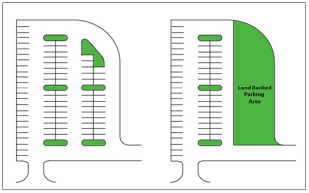
A.
The parking plan submitted with the site plan application shall denote the location and layout of that portion of the parking area that currently is deemed not required. The plan shall indicate that the "land banked" parking spaces will be constructed according to these regulations in the event that the Zoning Administrator determines at any time that all or any portion of this parking is necessary.
B.
The applicant shall be required to design the site for full compliance with the applicable stormwater regulations, lighting regulations, and landscaping regulations even though a portion of the parking area may not be developed initially.
C.
Any conditions required by the city, and the design for the site as established above, shall be illustrated on a final site plan that shall be recorded with the Miami County Recorder's Office. The applicant shall be required to provide proof that the final site plan has been recorded with the Miami County Recorder's Office prior to the issuance of a certificate of occupancy.
D.
At no time shall any portion of the required parking area that is so designated for future construction be used for the construction of any structure or paved surface with the exception that pervious pavement may be used to provide temporary parking provided that the pavers allow for grass and other vegetation to grow through the material.
E.
At no time shall any portion of the required parking or loading area that is so designated for future construction as provided herein be counted as open space or other non-paved areas required by other provisions of this section.
F.
The owner shall initiate construction of the approved land banked parking area(s), as identified on the approved parking plan, within 3months of the receipt of a certified letter or a letter through normal postal service (in the event that the certified letter is not accepted) sent to the owner of record from the Zoning Administrator, identifying that such parking is determined to be necessary. Such determination may be made:
1.
When the Zoning Administrator is reviewing an application related to a change of use or activity; or
2.
When the Zoning Administrator, or their designee, documents that vehicles related to the use are consistently parked on the grass, landscaping area, or on the street.
G.
If at the time of notice, the parking area cannot be improved or paved in accordance with this subsection, the property owner shall be required to submit a financial guarantee in accordance with this subsection.
H.
When a financial guarantee is required, such guarantee shall be in the form of cash, letter of credit, performance bond, or instrument of credit, in an amount equal to 100% of the total value of all pavement materials, landscaping materials, installation, and maintenance and shall be posted with the city.
(ii)
Shared Parking. A portion of the required parking spaces may be located on an adjacent property if the parking area complies with the following standards and is authorized in accordance with this section.
A.
Shared parking is encouraged and permitted if the multiple uses that the shared parking will benefit can cooperatively establish and operate the facilities.
B.
The applicant shall have the burden of proof for reduction of the total number of parking spaces and shall document and submit information substantiating their request. Shared parking may be approved if:
1.
A sufficient number of spaces is provided to meet the highest demand of the participating uses;
2.
Evidence has been submitted by the parties operating the shared parking facility, to the satisfaction of the Zoning Administrator, documenting the nature of uses and the hours when the individual uses will operate so as to demonstrate the lack of potential conflict between them.
C.
A shared parking agreement is submitted and approved by the city's legal counsel, that provides for the rights of the respective parties to use the shared parking areas in a manner adequate to accommodate multiple users or that parking spaces will be shared at specific times of the day (i.e., 1 activity uses the spaces during daytime hours and another activity use the spaces during evening hours). This agreement shall include provisions and evidence of deed restrictions or other recorded covenants that ensure that the spaces will be properly maintained during the life of the development.
D.
The approved shared parking agreement shall be filed with the application for a zoning permit and shall be filed with the appropriate county and recorded in a manner as to encumber all properties involved in the shared parking agreement.
E.
The applicant shall be required to provide proof that the agreement has been recorded with the Miami County Recorder's Office prior to the issuance of a certificate of occupancy.
(iii)
Off-Site Parking. A portion of the required parking spaces may be located on a separate lot from the lot on which the principal use is located if the off-site parking complies with the following standards and is authorized in accordance with this section.
A.
Off-site parking shall not be used to satisfy the off-street parking standards for residential uses, hospitals, bars (if not incidental to a restaurant), or convenience stores and other convenience-oriented uses. Required parking spaces reserved for persons with disabilities shall not be located in an off-site parking facility.
B.
No off-site parking space shall be located more than 500 feet from the primary entrance of the use served, measured along the shortest legal, practical walking route. This route may include crossing a right-of-way provided it uses a legal crosswalk.
C.
If an off-site parking area is located in a different zoning district, the off-site parking areas shall adhere to the regulations of the same or a more intensive zoning classification than that required for the use served.
D.
In the event that an off-site parking area is not under the same ownership as the principal use served, a written agreement shall be required.
E.
An off-site parking agreement shall be submitted and approved in a form acceptable to the city's legal counsel. This agreement shall include evidence of deed restrictions or other recorded covenants that ensure that the spaces will be properly maintained during the life of the development.
F.
The approved off-site parking agreement shall be filed with the application for a zoning permit and shall be filed with the appropriate county and recorded in a manner as to encumber all properties involved in the off-site parking agreement.
G.
The applicant shall be required to provide proof that the agreement has been recorded with the Miami County Recorder's Office prior to the issuance of a certificate of occupancy.
(5)
Design of Off-Street Parking Areas.
(a)
Access to Parking. Access to parking areas shall be provided as follows for all parking areas other than garages for individual dwelling units:
(i)
Parking areas shall provide suitable maneuvering area so that vehicles enter from, and exit to, a public street in a forward direction only.
(ii)
Parking lots shall be designed to prevent access at any point other than at designated access drives.
(b)
Access to Adjacent Sites.
(i)
Nonresidential Developments.
A.
Applicants for nonresidential developments should provide on-site vehicle access to parking areas on adjacent nonresidential properties to provide for convenience, safety, and efficient circulation.
B.
A joint access agreement shall be recorded at the Miami County Recorder's Office by the owners of the abutting properties guaranteeing the continued availability of the shared access between the properties. The applicant shall be required to provide proof that the agreement has been recorded with the Miami County Recorder's Office prior to the issuance of a certificate of occupancy.
(ii)
Shared pedestrian access between adjacent residential developments is strongly encouraged but not required.
(c)
Parking Space Dimensions. Each parking space, driveway, and other parking lot features shall comply with the minimum dimensions in Table 154.10-3 as illustrated in Figure 154.10-B.
Figure 154.10-B: Parking space and aisle requirements based on angle of parking.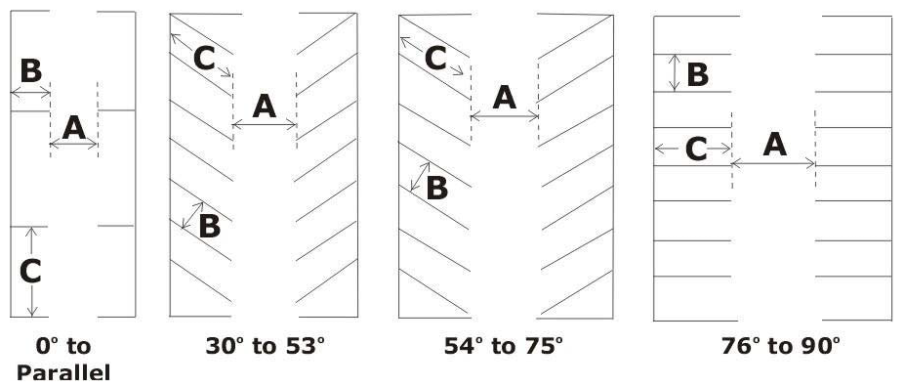
(i)
When the length of a parking space (full size or compact) abuts a column, fence, wall, or other obstruction, the required width of the entire parking space shall be increased by at least 1 foot.
(ii)
The required length of a parking space may include an area of overhang where a vehicle can overhang a landscape island, curb, sidewalk, or walkway provided:
(iii)
Such overhang does not extend over any public right-of-way; and/or
(iv)
Such overhang shall, if extending over a sidewalk or walkway, shall not encroach on the minimum width of sidewalk or walkway required for compliance with the Americans with Disabilities Act.
(d)
Use of Compact Vehicle Spaces.
(i)
This subsection provides for the establishment of compact vehicles spaces as an alternative to full sized spaces.
(ii)
For parking lots with 50 or more spaces, a minimum of 5% of the total spaces shall be designed for compact vehicle spaces.
(iii)
A maximum of 20% of spaces in any single parking lot may be dedicated to compact parking spaces.
(iv)
Compact spaces shall be clearly labeled for "compact cars" and grouped together in 1 or more locations, or at regular intervals, so that only compact vehicles can easily maneuver into the space.
(v)
The compact parking spaces shall be identified by signs or painting on the pavement, as approved by the Zoning Administrator, to prevent the parking of standard size vehicles in compact parking spaces.
(vi)
Existing nonresidential developments that wish to utilize this section to create additional parking spaces (e.g., either by adding land area to an existing parking lot or modifying an existing parking lot to gain more spaces) shall first apply for site plan review.
(vii)
The minimum off-street parking dimensions for compact vehicle spaces shall be as identified in Table 154.10-3.
(e)
Striping and Identification.
(i)
Parking spaces shall be clearly outlined with four-inch wide lines painted white on the parking surface unless required by state law (e.g., parking for the disabled).
(ii)
The striping shall be continuously maintained in a clear and visible manner in compliance with the approved plans.
(iii)
Where approaches contact the public right-of-way, the paint lines dividing vehicle paths and other pavement markings shall be in accordance with the Ohio Uniform Traffic Control Manual.
(f)
Grading, Surface, and Maintenance.
(i)
All grading and stormwater control plans relating to the parking areas shall be reviewed and approved by the City Engineer before any work can commence.
(ii)
All parking areas shall be properly graded and drained so as to dispose of all surface water accumulated within the area of the parking lot.
(iii)
In no instance shall a storm drainage facility be designed to allow the flow of water into abutting property or right-of-way without an approved easement.
(iv)
Up to 50% of parking spaces may be constructed of a pervious surface, as approved by the City Engineer. The design of any areas surfaced with a pervious surface shall be reviewed by the City Engineer. Failure to maintain the pervious surface in good working order as may be necessary dependent on the type of surface shall be considered a violation of this code subject to Section 154.13: Enforcement and Penalties.
(v)
Except for temporary parking permitted as part of a temporary use or any pervious surface permitted above, all open off-street parking areas shall be graded and provided with a hard surface of asphalt or Portland cement concrete.
(g)
Wheels Stops and Curbing.
Figure 154.10-C: Cuts in the continuous curb allow for stormwater to be directed into
landscaped areas.
(i)
All parking areas subject to this section shall be bounded by curbs with a minimum height of 6 inches. Such curbs may be made of concrete, stone or similar material, but shall not be made of asphalt.
(ii)
Continuous concrete curbing that is at least 6 inches high and 6 inches wide shall be provided for parking spaces located adjacent to fences, walls, lot lines, landscaped areas, and structures, unless the elimination of this curbing is required to adhere to storm water management requirements. Curb cuts are permitted along the curbing where it will allow for the passage of stormwater. See Figure 154.10-C.
(iii)
Individual wheel stops may be provided in lieu of continuous curbing only when the parking is adjacent to a landscaped area, and the drainage is directed to the landscaped area.
(iv)
When provided, wheel stops shall be placed to allow for 2 feet of vehicle overhang area within the dimension of the parking space.
(6)
Vehicle Stacking Space Requirements.
(a)
General Standards.
(i)
Audible electronic devices such as loudspeakers, automobile service order devices, and similar instruments shall be set back a minimum of 200 feet from any adjacent residential dwelling unit.
(ii)
All drive-through areas, including but not limited to drive-through signs, stacking lanes, trash receptacles, loudspeakers, drive up windows, and other objects associated with the drive-through area shall be located in the side or rear yard of a property to the maximum extent feasible, and shall not cross, interfere with, or impede any public right-of-way.
(iii)
Drive-through signs shall be regulated in accordance with § 154.11(I)(7).
(b)
Stacking Space and Lane Requirements.
(i)
The number of required stacking spaces shall be as provided for in Table 154.10-4. See Figure 154.10-D for illustration of stacking spaces:
(ii)
Stacking lanes shall be provided for any use having a drive-through establishment and shall apply comply with the following standards:
Figure 154.10-D: Location of stacking spaces and lanes. Note that the stacking lanes
are oriented toward the side and rear yards rather than the front yard.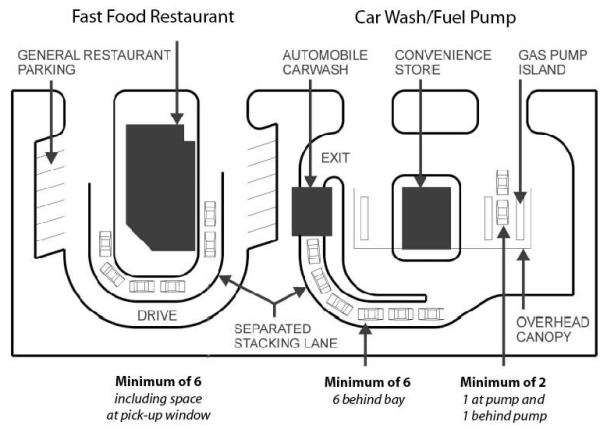
A.
Drive-through stacking lanes shall have a minimum width of 10 feet and a minimum length of 18 feet for each space required.
B.
When stacking lanes are separated from other stacking lanes, bypass lanes or from other site areas, the separation shall be by means of a raised concrete median, concrete curb, or landscaping.
C.
Stacking lanes shall be set back 25 feet from rights-of-way.
D.
The number of stacking spaces required by Table 154.10-4 shall be required for each separate stacking lane. If 2 or more stacking lanes converge into 1 lane (e.g., 2 lane separate lanes to order at a restaurant converge to 1 lane after the drive-through sign), the stacking spaces shall be measured in accordance with Table 154.10-4 with the spaces located after the convergence point counting toward both stacking lanes.
(7)
Off-Street Loading Requirements.
(a)
Applicability. This code does not require a specific number of off-street loading spaces for uses but the standards of this subsection shall apply in any instance where an applicant proposes to provide off-street loading spaces or docks.
(b)
Design Standards.
(i)
Off-street loading spaces shall not overlap with any areas used for parking or vehicle stacking.
(ii)
Each loading space shall have a minimum width of 12 feet, a minimum length of 25 feet, and have a minimum vertical clearance of not less than 15 feet.
(iii)
Loading spaces shall be located as near as possible to the main structure and shall only be permitted in side and rear yards. The spaces shall be subject to the minimum setbacks established for the applicable zoning district.
(iv)
All loading and unloading activities, including truck maneuverability, shall take place on-site. In no case shall a loading space or maneuverability area encroach on a public right-of-way or on other required vehicular use areas.
(v)
Access.
A.
Loading spaces shall be designed and arranged to provide access to a street or alley in a manner that will create the least possible interference with traffic movement and parking lot circulation.
B.
Loading spaces shall be designed with sufficient apron area to accommodate truck-turning movements and to prevent backing of trucks onto any street right-of-way.
(vi)
Screening.
A.
All operations, materials, and vehicles within any loading space that are visible from a public street or from any residential use shall be screened.
B.
See § 154.09(G) for screening requirements.
(vii)
Lighting. Loading areas shall have lighting capable of providing adequate illumination for security and safety; lighting shall also comply with the requirements of § 154.07(B).
(viii)
Striping.
A.
Loading spaces shall be striped, and identified for "loading only."
B.
The striping and "loading only" notations shall be continuously maintained in a clear and visible manner in compliance with the approved plans.
(Ord. 5-14, passed 3-17-2014; Am. Ord. 27-16, passed 12-5-2016; Am. Ord. 24-17, passed 11-6-2017; Am. Ord. 25-17, passed 11-6-2017)
§ 154.10(D) - Sidewalks.
For new subdivisions and any new development, sidewalks shall be installed in accordance with the Tipp City Thoroughfare Plan and the Tipp City Subdivision Regulations.
(Ord. 5-14, passed 3-17-2014)
§ 154.10(E) - Access for emergency vehicles and apparatus.
(1)
Purpose. The purpose of this section is to facilitate rapid and effective emergency service by ensuring that all premises that police, fire, and emergency medical service personnel may be called to in case of an emergency shall be readily accessible for effective safety operations.
(2)
Applicability.
(a)
Fire lanes shall be installed for all uses as required by the Ohio Fire Code.
(b)
In addition to the requirements of the Ohio Fire Code, a fire lane may also be required if the Tipp City Fire Chief determines that the distance of a structure from the nearest hydrant, the configuration of structures on a site, or other special characteristics of the site otherwise inhibit rapid, effective emergency access, or if the use of the structure is classified as a high hazard use by the Tipp City Fire Chief.
(3)
General Fire Lane Standards.
(a)
A fire lane, where required, shall comply with the following standards:
(i)
A fire lane shall provide clear, unobstructed access for vehicles and apparatus at all times.
(ii)
Signage shall be installed that prohibits the stopping, standing, or parking of motor vehicles.
(iii)
Fire lanes shall be a minimum clear width of 20 feet (curb to curb) and the design and construction of fire lanes shall comply with the Ohio Fire Code.
(iv)
An alley may contribute all or part of a required fire lane if it meets all other requirements of this section.
(b)
In lieu of meeting the standards specified above, a developer may substitute alternative means (including, but not limited to, fire resistant roofs, fire separation walls, space separation, and automatic fire extinguishing systems) to ensure the access necessary for effective safety operations, upon approval of the Fire Chief.
(Ord. 5-14, passed 3-17-2014)
§ 154.10(F) - Access management/driveways.
(1)
Purpose. The purpose of these standards is to regulate access to public streets. These standards are designed to minimize safety hazards, traffic congestion, and other negative impacts which can result when land use development is not carefully coordinated with the street and roadway system.
(2)
Applicability. This section shall apply to all development within the city.
(3)
Modification of Standards.
(a)
These standards may be modified upon recommendation to the Zoning Administrator, by the City Engineer, in the following situations:
(i)
To accommodate unique safety or design situations; or
(ii)
If indicated by a traffic impact analysis (see § 154.10(G)).
(b)
The applicant shall be responsible for providing sufficient information to the City Engineer and Zoning Administrator to document a need for such modification.
(c)
The standards in this section shall not be used to totally prohibit access to a site that meets all other standards for development under the provisions of this section; however, any access point which is permitted shall meet these access control standards to the maximum extent possible and shall meet all minimum design specifications for access points on arterials.
(4)
Street Access.
(a)
Permitted Access.
(i)
All residential uses are permitted to take direct access to local access streets or minor collector streets, except that the City Engineer may require larger scale residential subdivisions or developments to also have access from a principal arterial or minor arterial street.
(ii)
Nonresidential uses in a residential zoning district may be permitted direct access to a local access street only if such access would, in the opinion of the City Engineer, improve traffic safety, as, for example, on sites located at the intersection of a local access and any type of arterial street, or if a traffic impact analysis conducted pursuant to the provisions of § 154.10(G) indicates that such use would have no negative impact on the residential street.
(iii)
Single-family and two-family dwellings shall not be permitted direct access onto major collector streets, freeways, or any type of arterial street.
(iv)
Where a new use will be located on a corner lot, the City Engineer shall have the authority to determine where the driveway may access the adjacent street system.
(v)
If there are single-family or two-family dwellings located on a corner lot as of the effective date of this code that have driveway access to a major collector or any type of arterial street, such use is encouraged to relocate the driveway access to a lower volume side street (e.g., to a local access street or minor collector street), closing off the driveway that accesses the major collector or arterial street, wherever possible.
(vi)
All uses except single-family and two-family dwellings may be permitted access to an arterial street; however, any use wishing to take access to an arterial street shall be subject to review by the City Engineer.
(b)
Alignment and Separation of Driveways.
(i)
Driveways shall either be directly opposite other driveways or street intersections or shall be offset by the minimum driveway spacing distances shown in Table 154.10-5, except in locations where there is a raised median in the street.
(ii)
A driveway shall intersect a cross-street at, or nearly at, a right, 90 degree angle. In no case shall any intersection have an angle less than 75 degrees.
(iii)
The spaces established in Table 154.10-5 shall be measured from edge of pavement to edge of pavement between the 2 closest edges of the driveways. See Figure 154.10-E.
Figure 154.10-E: Illustration of minimum driveway spacing requirements.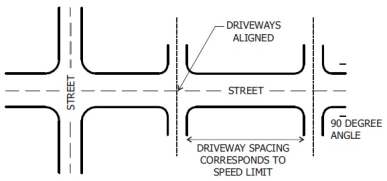
(iv)
Single-family and two-family residential uses shall be exempt from this provision.
(c)
Driveway Setbacks.
(i)
Driveways for residential dwellings shall be set back a minimum of 3 feet from all lot lines.
(ii)
Driveways for nonresidential uses shall be set back a minimum of 10 feet from all lot lines unless shared parking or joint parking arrangements are made. This setback shall be increased to 25 feet if the use is adjacent to a lot in a residential zoning district
(iii)
All driveways that access vehicular use areas where there is parking for 5 or more vehicles shall be set back a minimum of 100 feet from any stop sign as measured from the sign pole to the closest edge of the driveway pavement.
(d)
Dimensions of a Driveway.
(i)
Multi-Family Dwellings and Nonresidential Uses.
A.
All driveways for shall have a minimum width of 22 feet and a minimum five-foot flare.
B.
All two-lane driveways shall have a minimum width of 24 feet. All one-lane driveways shall have a minimum width of 22 feet. In no case shall any driveway exceed 30 feet in width.
C.
Aisle width for off-street parking areas shall be as provided in Table 154.10-3.
(ii)
Single-Family and Two-Family Dwellings.
A.
All driveways for shall have a minimum width of 8 feet and a minimum radius at the curb of 5 feet or a three-foot flare.
B.
A driveway for a single-family or two-family dwelling shall have a minimum width of 8 feet for single lane and a minimum of 16 feet for a 2 lane. The driveway shall have a minimum depth of 20 feet as measured from the right-of- way line to the back of the driveway. The maximum width for a single lane driveway shall not exceed 16 feet and the maximum width for a 2 lane shall not exceed 24 feet at the right-of-way line.
C.
In no case shall a driveway exceed 30 feet in width along its full length with the exception of any turnaround areas used for maneuverability.
(e)
Additional Standards.
(i)
All driveways shall be constructed with a pavement thickness of at least 6 inches within the right-of-way for residential and a minimum of 9 inches for commercial and industrial.
(ii)
Driveways shall be set back from an intersection of 2 roadways to the maximum extent feasible.
(iii)
Within the street right-of-way area, driveway grades shall not exceed 8%. In upward sloping driveways beyond the street right-of-way area, the change in grade shall not exceed 12% within 10 feet of distance. On downward sloping driveways beyond the street right-of-way area (entering basement garages), the change in grade shall not exceed 8% within any 10 feet of distance.
(5)
Intersection Visibility.
(a)
In order to provide a clear view to the motorist there shall be a triangular area of clear visibility that is free of any obstructions where there is an intersection of 2 or more streets and/or where a driveway intersects with a street.
(b)
Where a street intersects with another street, the triangular areas shall be defined by measuring 35 feet from the intersection of the extension of the front and side street curb lines (or the edge of pavement where there is no curb) and connecting the lines across the property. See Figure 154.10-F.
Figure 154.10-F: Intersection visibility area for 2 intersecting streets.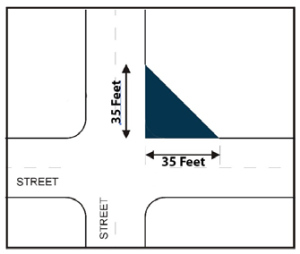
(c)
Where a driveway intersects a street, the triangular areas shall be defined by measuring 25 feet from the edge of the driveway along the street and 20 feet along the driveway, perpendicular from the street. See Figure 154.10-G.
Figure 154.10-G: Traffic safety visibility triangle for driveway and street intersections.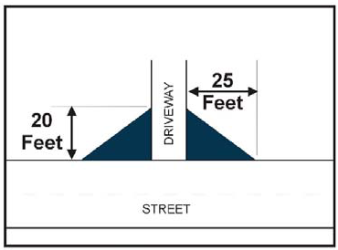
(d)
These standards shall not apply to driveways for single-family or two-family dwellings.
(e)
The Zoning Administrator, in consultation with the City Engineer, may reduce the distance requirement where it is determined that a narrow parcel frontage would excessively reduce buildable area.
(f)
No structure, sign, or landscape element shall exceed 36 inches in height, measured from the top of the curb, within the area established above, unless approved by the City Engineer. Trees may be located within these areas provided they are pruned and/or the canopy is trimmed to provide clear visibility (with the exception of the tree trunk) up to 8 feet above the top of the curb.
(g)
Where no curb exists, the height shall be measured from the top of the pavement.
(h)
Trees planted along public streets and rights-of-way shall also be subject to the pruning requirements of § 97.30 of the Tipp City Code of Ordinances.
(Ord. 5-14, passed 3-17-2014)
§ 154.10(G) - Traffic impact analysis (TIA).
(1)
Intent. A Traffic Impact Analysis (TIA) is intended to identify the transportation impacts which are likely to be generated by a proposed use and to identify improvements required to ensure safe ingress to and egress from a proposed development, maintenance of adequate street capacity, and elimination of hazardous conditions.
(2)
Applicability. A TIA shall be required in the following cases:
(a)
Any use that will generate in excess of 250 trips per acre per day based upon an estimate by the Highway Capacity Manual;
(b)
The development is expected to reduce the level of service (LOS) on adjacent roadways and/or intersections to below a level of service below C, as noted or defined in the Highway Capacity Manual;
(c)
Any use that due to its size, density, traffic generation rates, or location can reasonably be expected to create traffic issues, as determined by the City Engineer, are required to submit a TIA.
(3)
Contents of a TIA. The TIA shall be prepared and certified by a professional traffic engineer and shall include, at a minimum, the following data and information. Information and statistics required by this section may, when available, be obtained from the city.
(a)
Study Area.
(i)
Developments wishing to take access from an arterial street shall provide an analysis of the traffic impact from the proposed point of access to the nearest signalized intersections in all directions, or up to a 0.5 mile radius, whichever is less.
(ii)
Developments wishing to take access from a collector street shall provide an analysis of the traffic impact from the proposed point of access to the nearest intersections of the collector with an arterial in all directions, or up to a 0.5 mile radius, whichever is less.
(iii)
Developments wishing to take access from a residential street shall provide an analysis of the traffic impact from the proposed point of access to the nearest arterial streets in all directions, or up to a 0.25 mile radius, whichever is less.
(iv)
For large developments which generate between 250 and 1,000 vehicle trips per hour between 3:00 p.m. and 6:00 p.m., the City Engineer may require the TIA to include an analysis of all arterial and collector roadways within 1 mile of the proposed site.
(v)
For developments which will generate over 1,000 trips per hour between 3:00 p.m. and 6:00 p.m., the analysis may be required for a radius of up to 3 miles of the proposed site.
(b)
Existing Conditions. The report shall contain information clearly describing, in written or graphic form, the existing and proposed conditions including:
(i)
The proposed land use of the site and anticipated stages of construction;
(ii)
The existing street system including major intersections, ingress and egress locations, roadway and right-of-way widths, traffic signals and traffic control devices and public transportation facilities;
(iii)
Any proposed changes in the street system; and
(iv)
A 24-hour traffic count on all roadways which have direct access to the proposed development site and the existing average daily traffic volume and the highest average peak hour volume for any weekday hour between 3:00 p.m. and 6:00 p.m.
(c)
Development Impact. The report shall include information on the average weekday trip generation rate (trip ends) and the highest average hourly weekday trip generation rate between 3:00 p.m. and 6:00 p.m. for the proposed use as determined from figures provided by a qualified traffic engineer.
(d)
Determination of the Capacity of the Roadway.
(i)
Data and procedures contained in the Highway Capacity Manual, Special Report 87, published by the National Highway Research Board, shall be utilized to calculate the level of service of roadways as required for this TIA. Roadway service volumes shall be calculated at level of service C for roads identified as arterials and at level of service D for roads identified as collectors.
(ii)
All arterial roadways operating below level of service C (inclusive of levels D, E, and F) shall be identified as congested locations. All collector roadways operating below level of service D (inclusive of levels E and F) shall be identified as congested locations.
(e)
Determination of the Capacity of Intersections.
(i)
A load-factor analysis shall be conducted for 1 24-hour period on a weekday on all intersections within the study area. The highest average hourly load factor between 3:00 p.m. and 6:00 p.m. shall also be recorded. A maximum load factor of 3/10 are operating below level of service C (inclusive of levels D, E, and F) and shall be identified as congested locations.
(ii)
A maximum load factor of 7/10 will be allowed for intersections involving 2 collector roads. All such intersections with a load factor greater than 7/10 are operating below level of service D (levels E and F) and shall be identified as congested locations.
(iii)
To determine intersection capacity at levels of service C and D, Figure 6.8 and Tables 6.4, 6.5, and 6.6 of the Highway Capacity Manual shall be consulted or any other applicable figures or tables as determined by the City Engineer.
(f)
Conclusions. The projected total future peak hour traffic demand shall be calculated for all roads fronting on a proposed site and all intersections within the study area. This demand shall consist of an assumed normal increase of traffic volume of 2% per year (or the Miami Valley Regional Planning Commission projections, whichever is less) and the anticipated traffic that will be generated by the proposed development. An analysis shall be undertaken to determine if roadways and intersections will operate at the appropriate level of service following completion of the development, given the future peak hour traffic that will be generated by the proposed development. This analysis consists of the comparison of the total future peak hour intersection and roadway traffic demand with the service volumes for levels C and D computed in § 154.10(G)(3)(d) above. All roadways and intersections that would operate below the required level of service following completion of the development shall be considered deficient.
(4)
Mitigating Traffic Impacts. If the TIA results in the conclusion that the level of service of adjacent roadways and/or intersections is or will become deficient prior to the proposed development and will not be able to accommodate the increased traffic load generated by the proposed development, any or all of the following mitigating steps may be required, at the developer's expense, by the Zoning Administrator upon recommendation by the City Engineer. The Zoning Administrator shall make their determination prior to approval of a site plan, zoning permit, or zoning compliance permit, whichever is applicable.
(a)
Limitation of the number and/or location of access points;
(b)
Design of access points to prevent certain turn movements;
(c)
Dedication of and/or improvement to the right-of-way abutting the development of improvements in the immediate vicinity of the development to add turn lane, through traffic lanes or allow redesign of intersections or access points to accommodate additional traffic or turning movements;
(d)
Installation of traffic signals or other traffic control devices as may be warranted by the Uniform Traffic Control Manual; and/or
(e)
Development of the site at a lower intensity than originally proposed.
(5)
Responsibility for Thoroughfare Improvements. In cases in which a proposed street or right-of-way, as shown on the Tipp City Thoroughfare Plan, abuts or crosses the proposed development, the subdivider shall be responsible for all required public improvements, including the construction of the right-of-way as delineated on the Tipp City Thoroughfare Plan. Certain public improvements may be waived on review and approval by the Planning Board; however, right-of-way dedication shall be required in all cases. See also § 155.04(D)(4) in the Tipp City Subdivision Regulations.
(Ord. 5-14, passed 3-17-2014)

