
Tipp City City Zoning Code
SECTION 154
07: - GENERAL DEVELOPMENT STANDARDS
§ 154.07(A) - Performance standards.
No land or building in any district shall be used or occupied in any manner creating dangerous, injurious, noxious, or otherwise objectionable conditions which could adversely affect the surrounding areas or adjoining premises, except that any use permitted by this chapter may be undertaken and maintained if acceptable measures and safeguards are taken to reduce dangerous and objectionable conditions to acceptable limits, as established by this subsection.
(1)
Standards.
(a)
Air pollution. Air pollution shall be subject to the requirements and regulations established by the county, state, federal government, or other authority having jurisdiction.
(b)
Stormwater and Erosion. All development and earth movement shall be subject to all applicable stormwater controls of the city, county, and the Ohio Environmental Protection Agency (OEPA).
(c)
Fire and Explosion Hazards.
(i)
Adequate safety devices shall be provided where there are activities involving burning or storage of flammable or explosive materials in accordance with all applicable city, county, state, and federal standards.
(ii)
Adequate safety devices against the hazards of fire and explosion and adequate firefighting and fire suppression equipment and devices, standard in the industry, shall be provided in accordance with all applicable city, county, state, and federal standards.
(iii)
Burning of waste materials in open fire is prohibited.
(d)
Fissionable, Radioactivity or Electrical Disturbance. No activities shall be permitted which utilize fissionable or radioactive materials if their use results at any time in the release or emission of any fissionable or radioactive material into the atmosphere, the ground, or sewerage systems, and activities shall be permitted which emit electrical disturbance affecting the operation at any point of any equipment other than that of the creator of such disturbances.
(e)
Glare and Heat.
(i)
Any operation producing intense light or heat, such as high temperature processes like combustion or welding, shall be performed within an enclosed building and shall not be visible beyond any lot line bounding the premises.
(ii)
Welding that is required for exterior construction of a structure shall be exempt from these regulations.
(iii)
Outdoor lighting shall be subject to the standards of § 154.07(B).
(f)
Noise or Vibration. No noise or vibration, other than related to transportation activities and temporary construction work, shall be discernible without instruments at any point along a lot line.
(g)
Liquid or Solid Wastes.
(i)
No discharge at any point into any public sewer, private sewerage disposal system, stream, or into the ground, of any materials of such nature or temperature as can contaminate any water supply, interfere with bacterial processes in sewage treatment, or otherwise cause the emission of dangerous or offensive elements, shall be permitted, except in accordance with minimum standards approved by the Miami County Health Department, the Ohio Department of Health, the Ohio Environmental Protection Agency, or such other governmental agency as shall have jurisdiction over such activities.
(ii)
The use of dumpsters or other types of reasonably accessible waste containers for the disposal of potentially dangerous liquid or solid waste materials shall be prohibited.
(iii)
The storage of large quantities of toxic material shall be prohibited.
(h)
Vibration. No uses shall be located and no equipment shall be installed in such a way to produce intense, earth-shaking vibrations which are discernible without instruments at the lot lines of the subject premises. Farming, excavation activities and temporary construction activities conducted during the daytime are exempt from this requirement.
(2)
Enforcement.
(a)
Enforcement Provisions. The Zoning Administrator prior to the approval of a site plan, zoning permit, or zoning compliance permit may require the submission of statements and plans indicating the manner in which dangerous and objectionable elements involved in processing and in equipment operations are to be eliminated or reduced to acceptable limits and tolerances.
(b)
Standards and Measurement Procedure. Standards and measurement methods and procedures for the determination of the existence of any dangerous and objectionable elements shall conform to applicable standards and, measurement procedures published by the American Standards Association, Inc., New York, the Manufacturing Chemists Association, Inc., Washington, D.C., the United States Bureau of Mines, the Ohio Environmental Protection Agency, Miami County Public Health, and other similarly recognized organizations.
(Ord. 5-14, passed 3-17-2014)
§ 154.07(B) - Outdoor lighting.
(1)
Purpose. The purpose of this section is to regulate light spillage and glare to ensure the safety of motorists and pedestrians, and to ensure lighting does not adversely affect land uses on adjacent properties. More specifically, this section is intended to:
(a)
Regulate exterior lighting to assure that excessive light spillage and glare are not directed at adjacent properties, neighboring areas, and motorists;
(b)
Ensure that all site lighting is designed and installed to maintain adequate lighting levels on site while limiting negative lighting impacts on adjacent lands; and
(c)
Provide security for persons and land.
(2)
Applicability.
(a)
General. The provisions of this section shall apply to the addition of any new light fixture on a lot or all development in the city except for:
(i)
Lots with single-family and two-family dwellings, however, no such lot shall have lighting positioned so as to extend glare onto an adjacent property or a public right-of-way.
(ii)
Existing athletic field lighting;
(iii)
City-owned, city-operated, or city-maintained street lights located within a street right-of-way or other easement granted to the city; and
(iv)
Lighting and fixtures approved as part of a Certificate of Appropriateness.
(b)
Lighting Plan Required. An exterior lighting plan shall be submitted and approved as part of a site plan application or as necessary, a zoning permit or zoning compliance permit application (for changes of uses, additions, etc.).
(c)
Lighting Standards.
(i)
No flickering or flashing light shall be permitted. Holiday lighting and decorations shall be exempt from this requirement.
(ii)
All lighting shall be directed downward except for low-wattage architectural lighting intended to illuminate structures.
(iii)
Exterior lighting shall not shine directly into the yard or windows of adjacent residential uses or onto a public right-of-way.
(iv)
Light fixtures in excess of 1,000 lumens shall use full cut-off lenses or hoods to prevent glare or spillover onto adjacent parcels and streets.
(v)
No light source in a canopy structure shall extend downward further than the lowest edge of the canopy's ceiling.
(vi)
The maximum illumination permitted at any lot line shall be 0.5 foot-candles except when a commercial or industrial use is located adjacent to another commercial or industrial use, in which case, the maximum illumination permitted at the lot line shall be 2.5 foot-candles.
(vii)
Parking areas shall have an average illumination level of 2.0 foot-candles for safety purposes with the exception of lighting near adjacent lots, in which case the lighting shall comply with the maximum illumination levels established above.
(viii)
White and yellow shall be the only permitted colors for light fixtures.
(ix)
The illumination of signs shall be regulated in § 154.11(G).
(x)
Height of Lighting.
A.
The maximum height of a light fixture, either mounted on a pole or on a structure, is established in Table 154.07-1.
B.
In no case shall a light fixture mounted on a structure be mounted at a height where the fixture will exceed the height of the roofline.
C.
Wall pack fixtures on buildings are permitted but shall be restricted to cutoff fixture types to direct the light vertically downward.
Figure 154.07-A: Illustration of cutoff and non-cutoff lighting fixtures.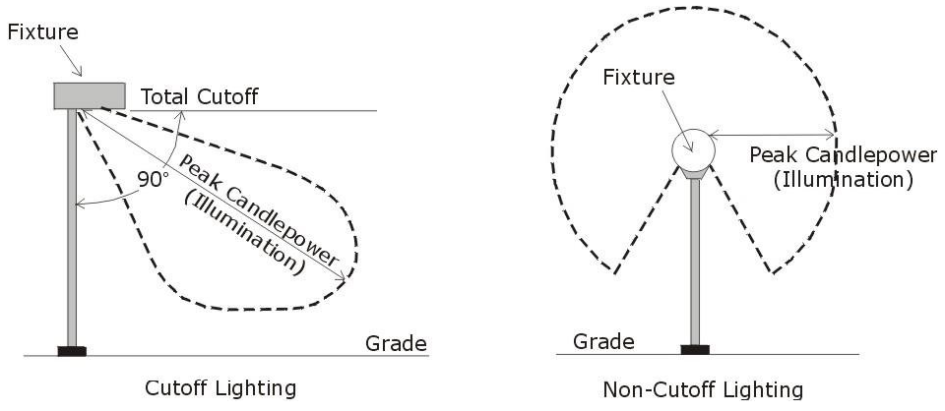
(Ord. 5-14, passed 3-17-2014)
§ 154.07(C) - Large waste receptacles and refuse collection areas.
(1)
All large waste receptacles, including dumpsters, recycling bins, and other refuse collection areas shall be located in the rear yard to the maximum extent feasible. In no case shall a trash collection facility be located or stored in the front yard of a lot.
(2)
A small trash container(s) may be placed at the public right-of-way during the normal trash collection day.
(3)
The location and configuration of screening for large waste receptacles and refuse collection areas shall be depicted on plans as part of the site plan, zoning permit, and/or zoning compliance permit application, whichever is applicable.
(4)
A large waste receptacle or collection area shall be situated in a permanent location and placed on a concrete pad (3,000 psi minimum). A dumpster pad shall be of a dimension that will allow a dumpster to sit entirely on the pad and to permit the front wheels of a trash disposal truck to reset on the pad while emptying said dumpster.
(5)
The feature shall be screened so as to not be visible from a public right-of-way or an adjacent property.
(6)
All such screens shall be of durable wood construction or of masonry type material, compatible in color and design with the principal structure. The facility may also be screened on 3 sides by vegetative materials if it complies with § 154.09(G).
(7)
In cases where access to feature faces a public right-of-way, the accessway shall be screened with an opaque gate. Chain link shall not be used for such gates.
(Ord. 5-14, passed 3-17-2014)

